
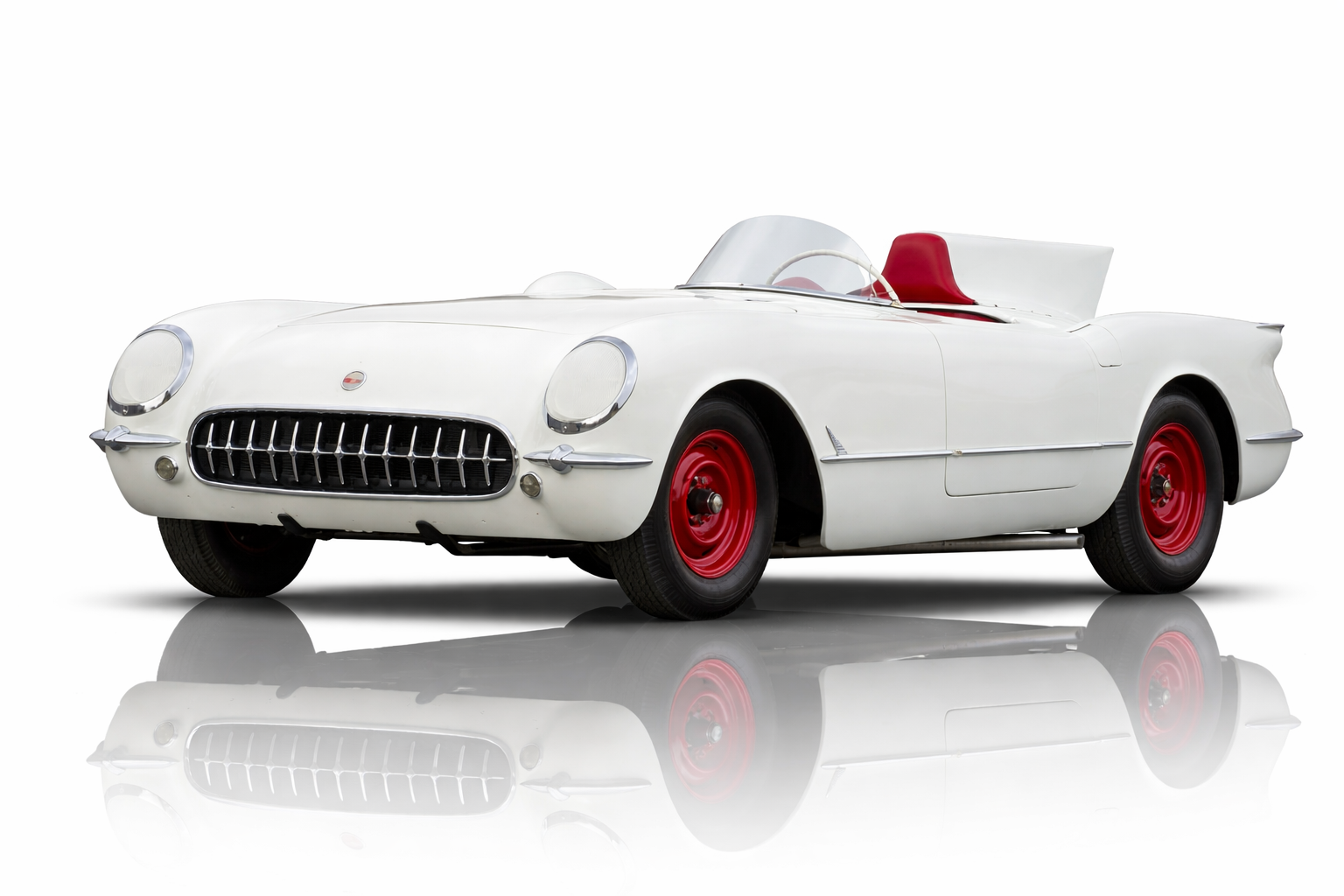
The EX-87 was never intended to be a show car, nor was it born from the glamour-driven world of GM’s Motorama turntables. It did not wear dramatic chrome flourishes, nor did it preview a futuristic body style meant to dazzle the public. Instead, the EX-87 emerged quietly, almost anonymously, from Chevrolet Engineering—built not to inspire dreams, but to answer a far more fundamental question: Could the Corvette survive as a true performance machine?
By 1954, the Corvette’s future was far from secure. Sales were lukewarm, the Blue Flame six-cylinder engine was widely regarded as underwhelming, and within General Motors there remained deep skepticism that an American-built sports car could—or should—compete with Europe’s established marques. Harley Earl had given Chevrolet a shape and a name, but shape alone would not save the car.
As Harley Earl reflected on the Corvette’s early identity crisis, he was blunt about the limits of styling alone. “You can’t sell a sports car on looks only,” Earl later explained when discussing the program’s early challenges. “It has to perform like one.”
That belief increasingly aligned Earl with Duntov’s push for measurable performance, reinforcing the idea that the Corvette’s credibility would ultimately be earned on the road and the stopwatch, not the show stand.
It was into this uncertain environment that the EX-87 was created.
A Mule With a Mission

The EX-87 began life as a 1954 production Corvette pulled from the line and reassigned as a full-time engineering test vehicle—a “mule” in the purest sense. Chevrolet Engineering assigned it the internal designation EX-87 to track its progress through an experimental powertrain program spearheaded by Ed Cole, who at the time was quietly laying the groundwork for what would become one of the most consequential engines in automotive history.
Cole was not interested in incremental improvement. He believed Chevrolet’s future depended on a lightweight, compact V8 that could be produced economically and adapted across multiple platforms. “We needed an engine that would democratize performance,” Cole would later explain. “Power shouldn’t be exotic. It should be accessible.”
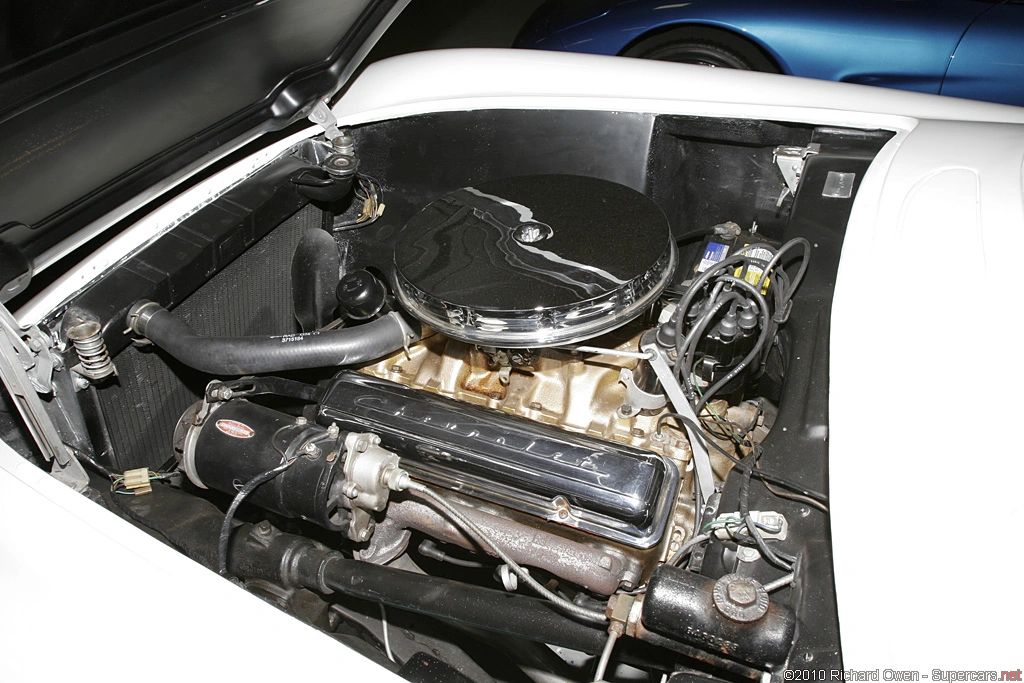
The engine installed in the EX-87 was an early developmental version of that vision—an experimental small-block V8 initially targeted at 283 cubic inches. The Corvette was not chosen for prestige. It was selected because it offered something no other Chevrolet did: low weight, a fiberglass body, and a layout already suited to performance testing.
At first, the EX-87’s work was strictly internal—hours of durability testing, cooling evaluations, and power validation. Had history taken a different turn, it might have remained nothing more than a footnote in GM’s engineering logs.
But Zora Arkus-Duntov had other ideas.
Zora’s Opportunity
Duntov joined Chevrolet in 1953 with a singular obsession: proving that the Corvette could be a legitimate high-performance sports car. From the outset, he believed Ed Cole’s new V8 was far more than a convenient replacement for the Blue Flame six—it was a platform capable of sustained development, real measurement, and genuine competition. To Zora, the EX-87 represented more than an engine test bed. It was proof—waiting to be demonstrated—that the Corvette could stand shoulder to shoulder with Europe’s best.
“I did not believe the Corvette lacked ability,” Duntov once said. “I believed it lacked opportunity.”
He approached Ed Cole with a bold proposal: use the EX-87 to demonstrate, publicly and unequivocally, that a Corvette could achieve a top speed of 150 miles per hour. Cole, ever the pragmatist, immediately recognized the value. Performance numbers could silence critics far faster than styling sketches or sales projections.
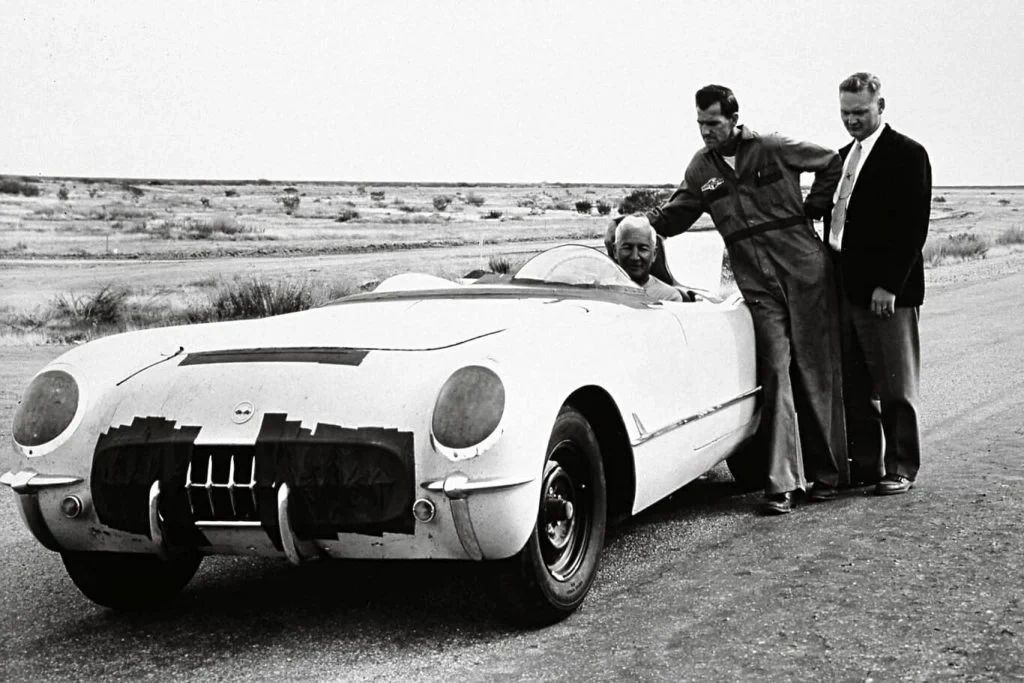
Cole approved the plan without hesitation. A second internal tracking number—#5951—was assigned to the car in the fall of 1955 as it was formally transferred into Duntov’s engineering division. From that moment forward, the EX-87 ceased to be merely an engine mule. It became a weapon.
In the years that followed, Zora would continue to push those same boundaries—most famously in 1956, when he drove a modified Corvette to victory at the Pikes Peak Hill Climb, stunning both skeptics and GM leadership alike. That climb was not an isolated triumph, but a continuation of the philosophy first proven with EX-87: that Corvette performance was not theoretical—it simply needed to be unleashed.
Engineering the Air
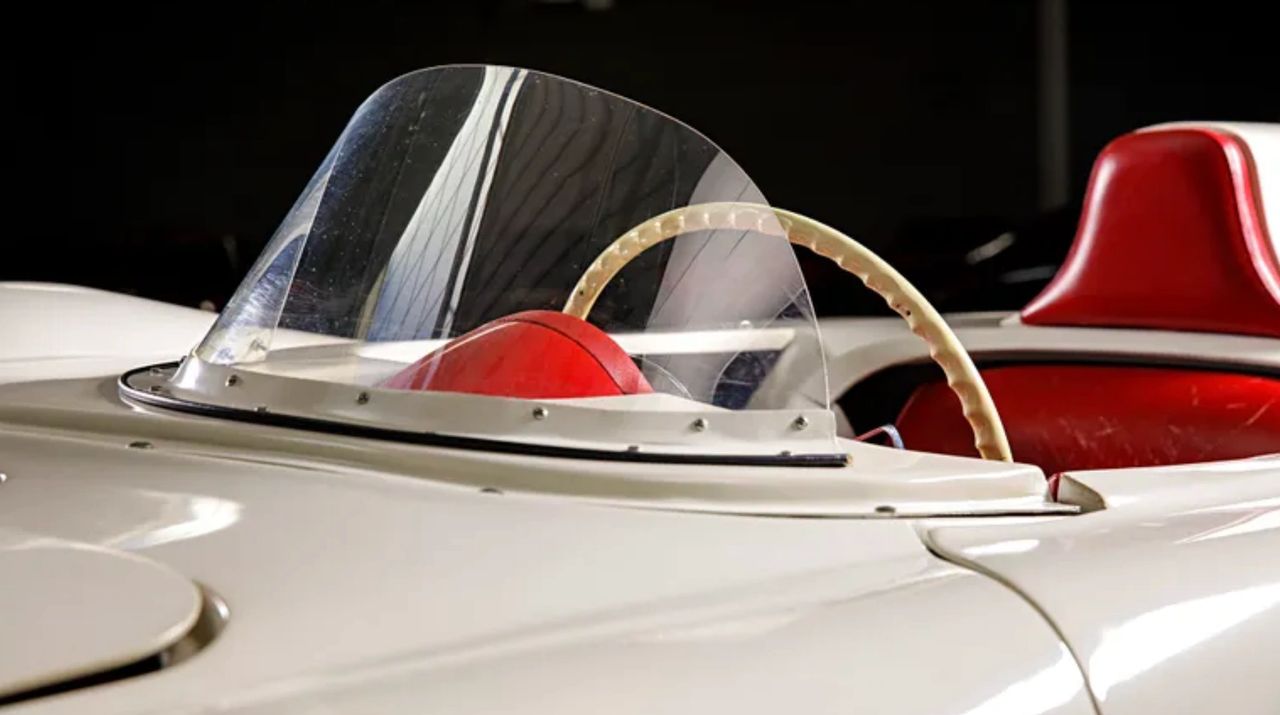
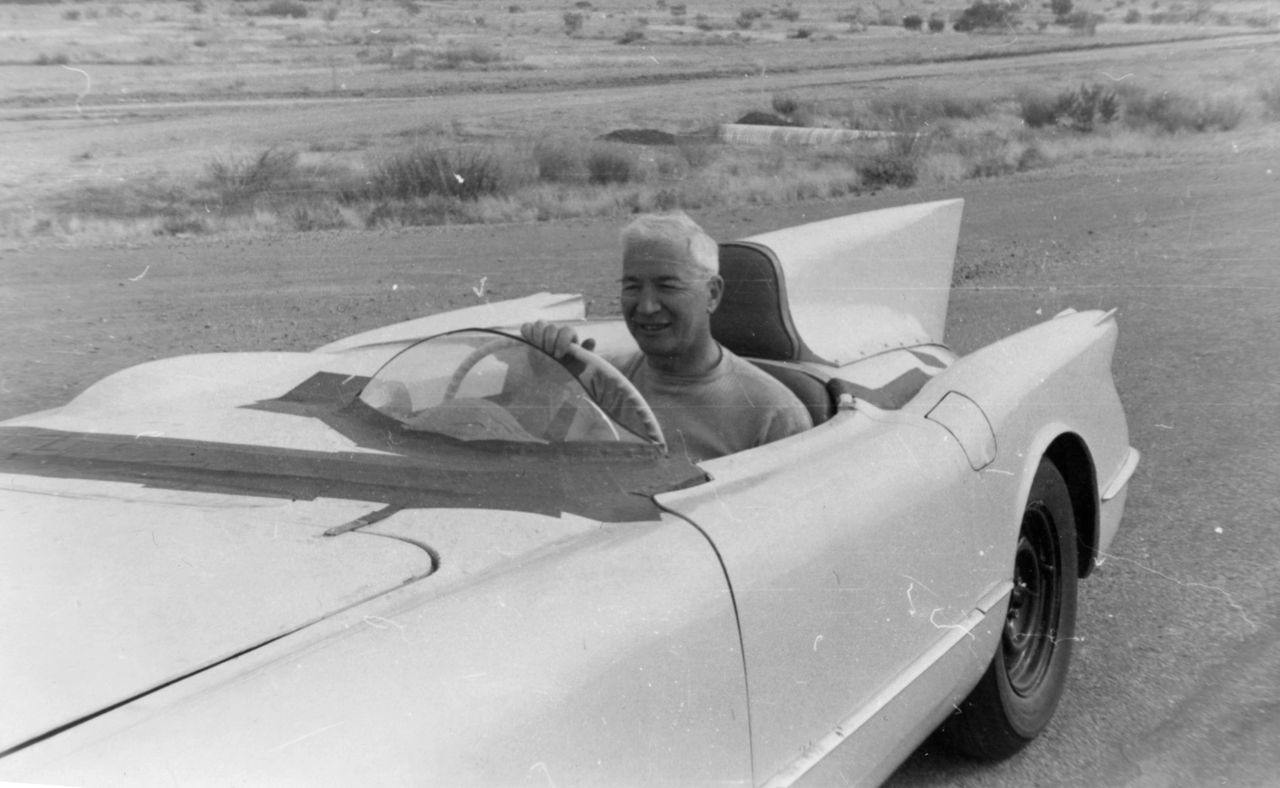
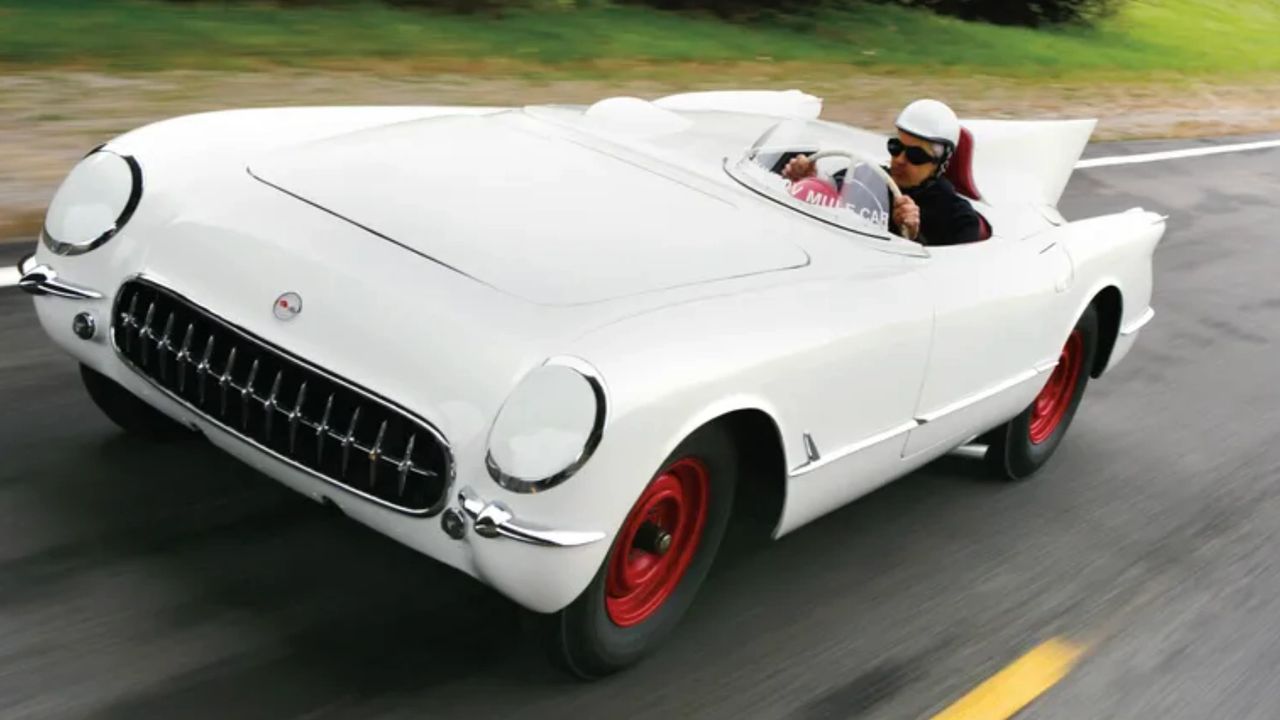
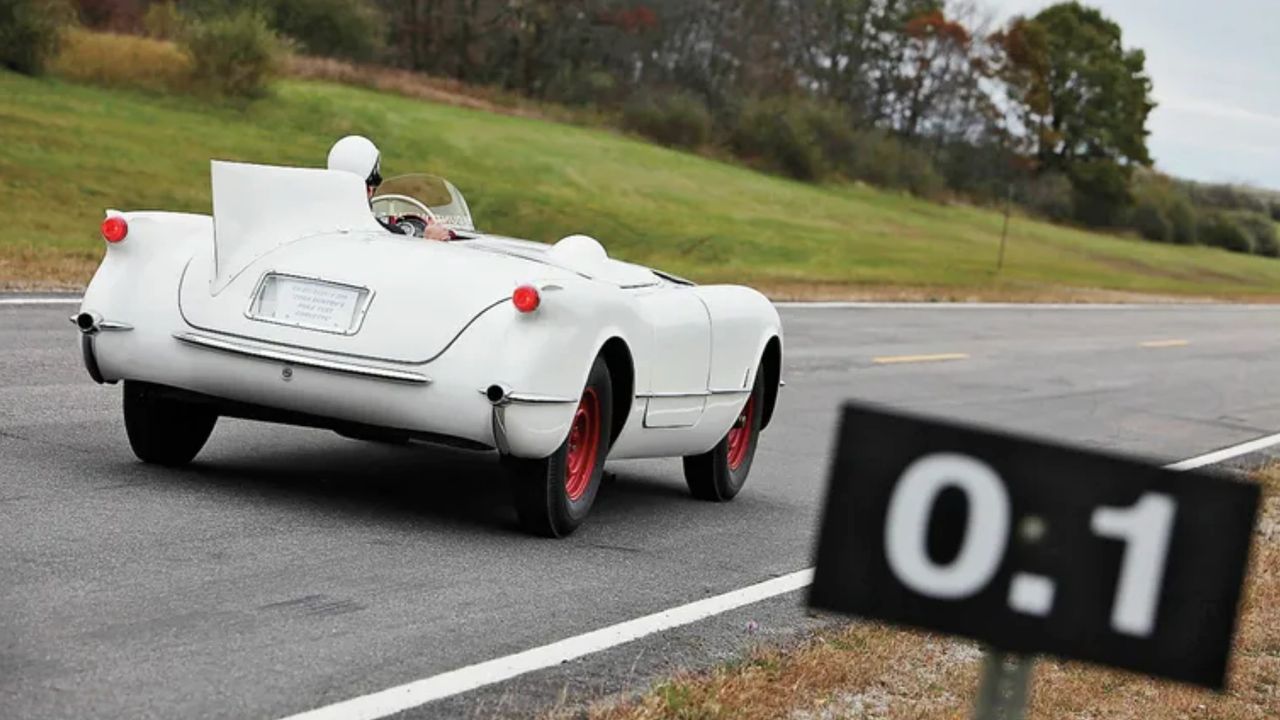
Zora attacked the problem methodically. Speed, he understood, was as much about air as horsepower. His first modification was the addition of a full underpan beneath the chassis, smoothing airflow and reducing drag. Next came the windshield—removed entirely and replaced with a low, curved plexiglass windscreen that barely rose above the cowl.
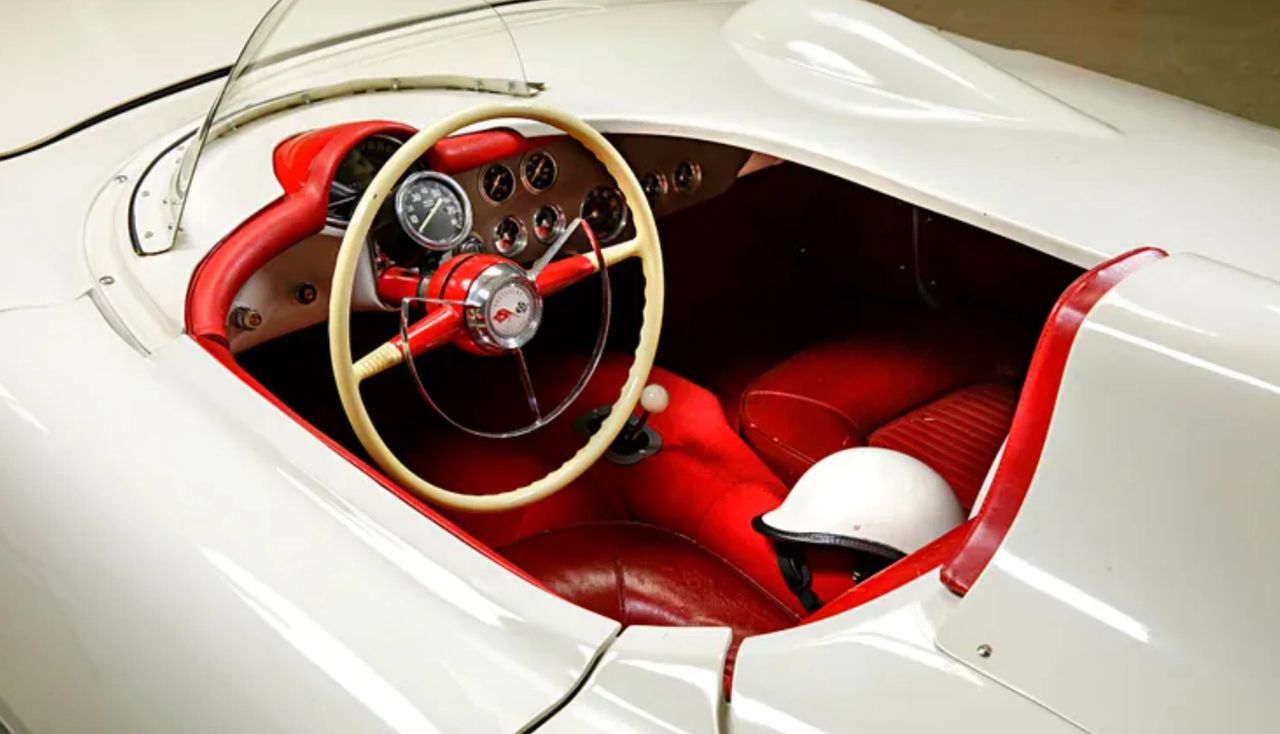
The passenger seat was sealed beneath a fiberglass tonneau cover, transforming the cockpit into a strictly single-occupant environment. Duntov also fabricated a headrest that extended rearward into a subtle tailfin, a feature conceived solely to improve directional stability at extreme speed rather than visual appeal.
As Duntov would later explain when reflecting on his early Corvette work, “I was not interested in beauty. I was interested in results.” (source: Karl Ludvigsen, Corvette: America’s Sports Car)
The EX-87 embodied that philosophy completely—its form dictated by airflow, stability, and data, with no concessions made to aesthetics.
Power Becomes the Limiting Factor
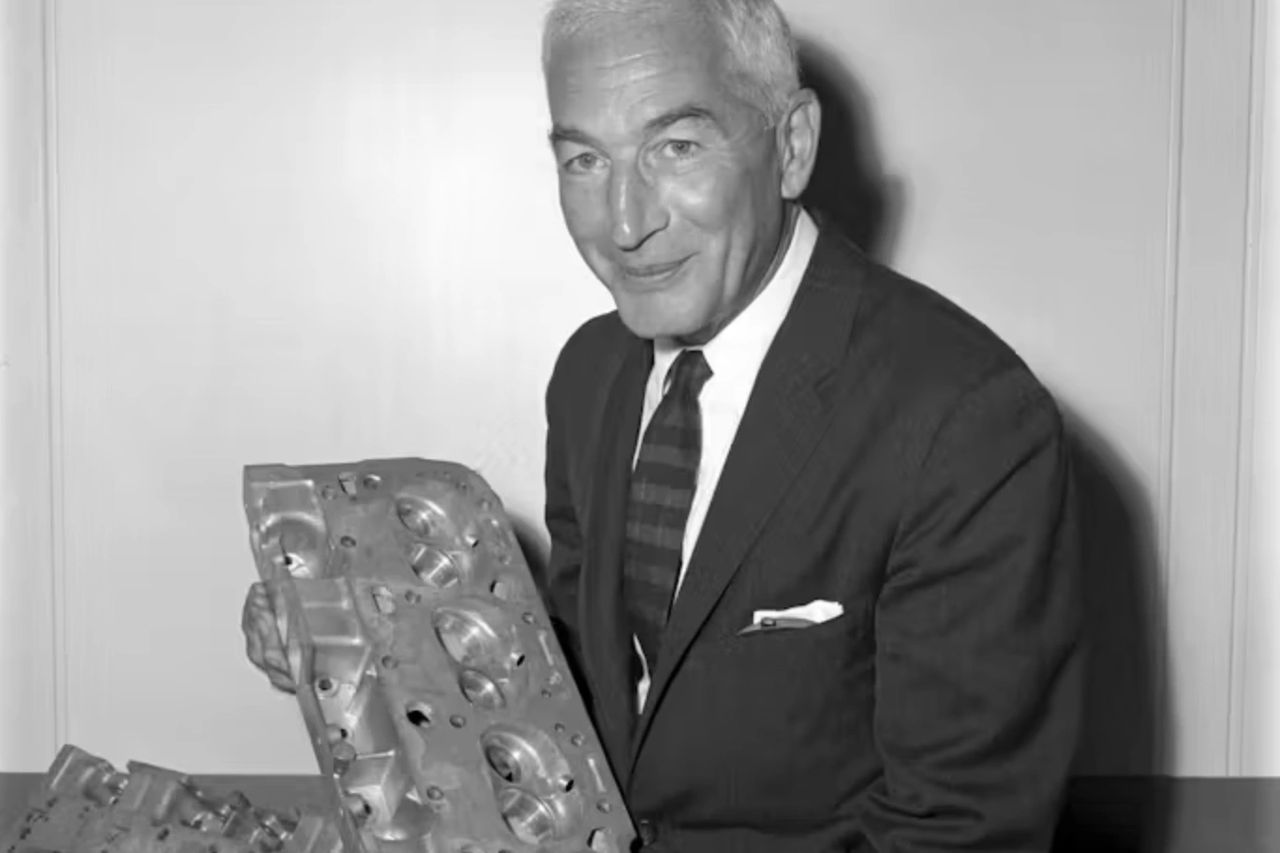
Initial testing at GM’s new Technical Center in Warren, Michigan, revealed the uncomfortable truth: even with improved aerodynamics, the Corvette simply did not have enough power. The early 283 fell short of the 150-mph goal.
Zora calculated the deficit precisely. Approximately thirty additional horsepower would be required.
Drawing on his pre-war engineering experience in Europe, Duntov increased displacement to 307 cubic inches and turned his attention to the camshaft—a component often overlooked, but central to engine character. His design emphasized longer intake and exhaust durations with comparatively modest valve lift, optimizing high-rpm breathing and throttle response.
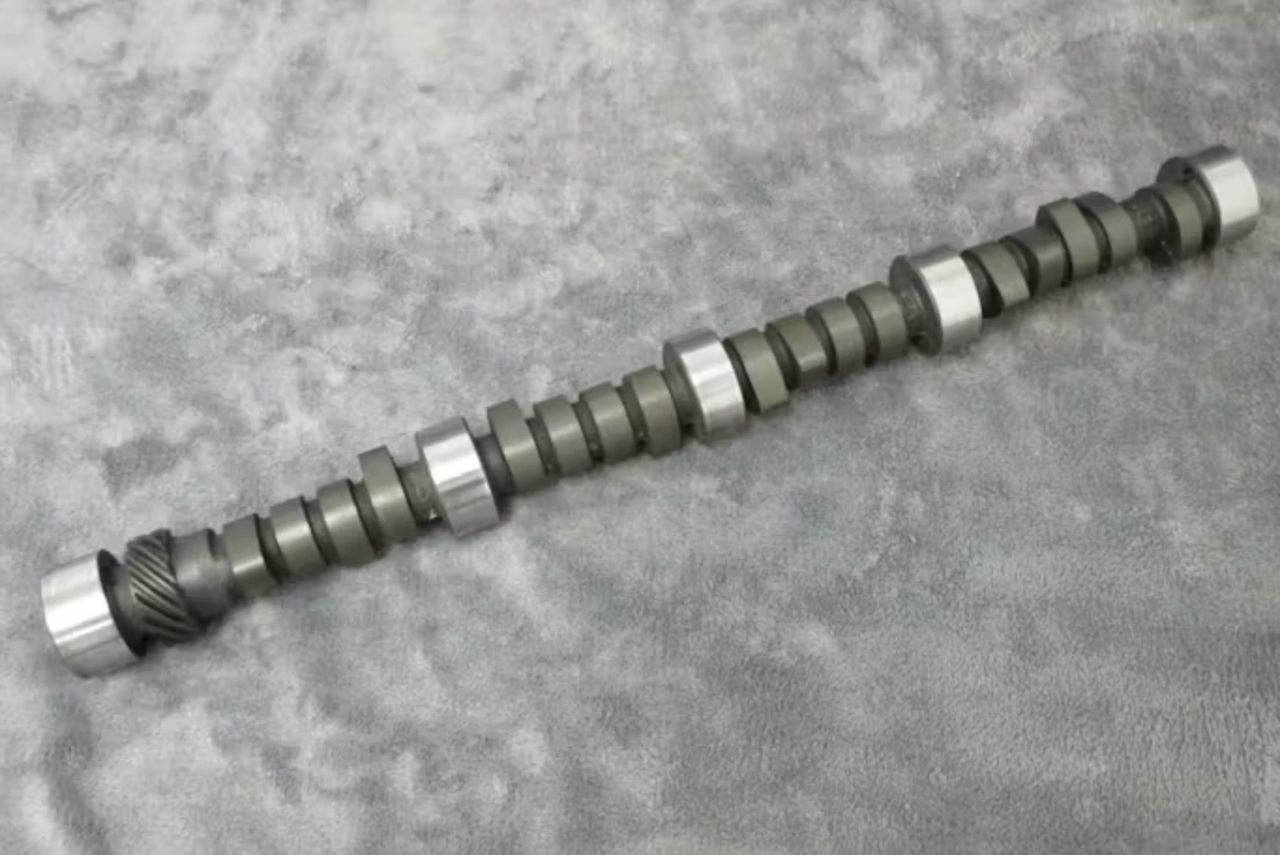
When Zora presented the camshaft to Cole’s engineering staff, the reaction was skeptical. The design was labeled “unorthodox,” even risky. But Duntov had no patience for theoretical debate.
Rather than wait for approval, he loaded the EX-87/#5951 onto a trailer and headed for GM’s Mesa Proving Grounds in Arizona, where conditions favored high-speed testing. Only after further internal review did Cole’s team approve the camshaft for production, and a sample was rushed to Mesa.
The results were immediate and undeniable.
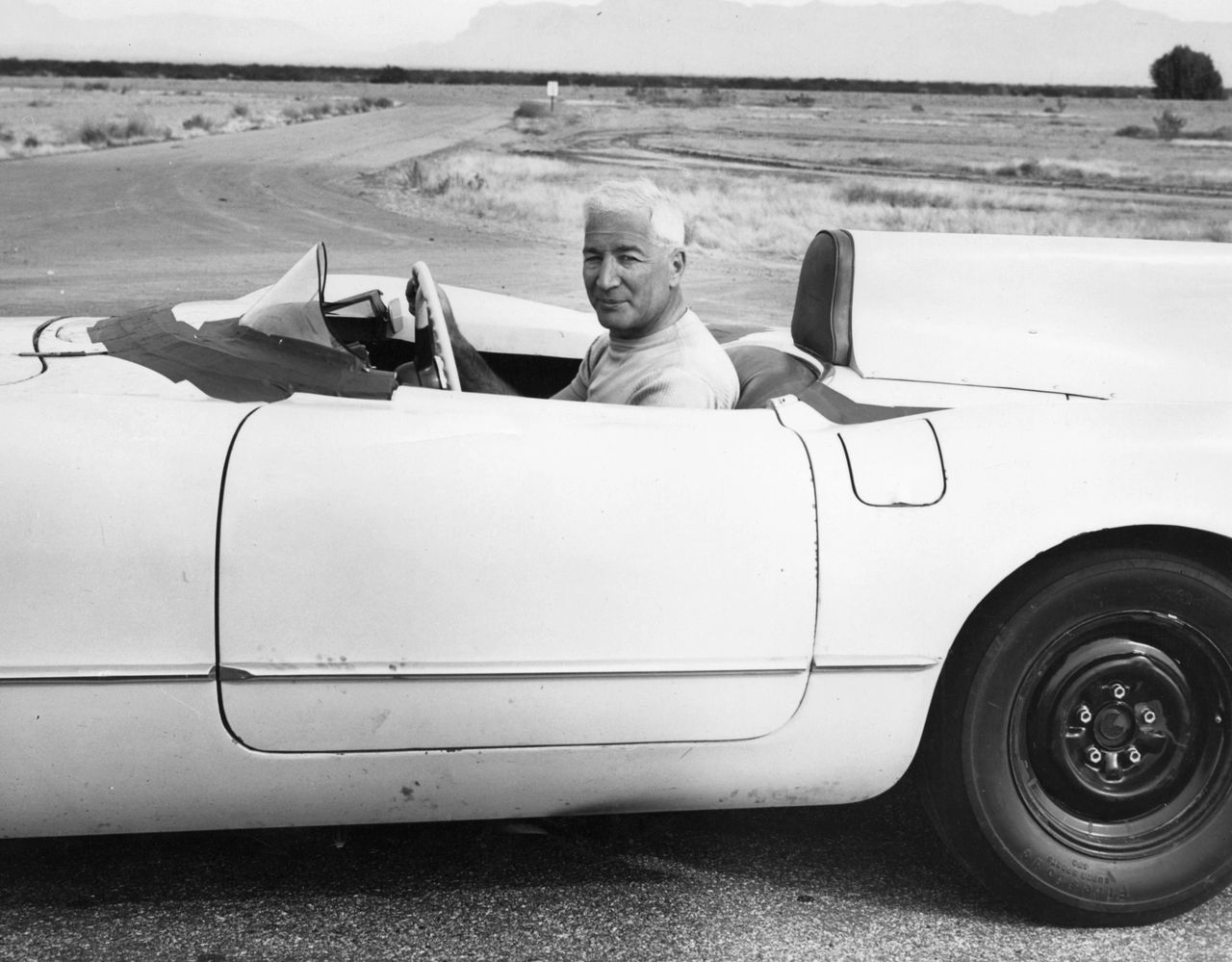
On December 20, 1955, Zora piloted the EX-87 to 163 miles per hour at 6,300 rpm, the desert air ringing with the sound of what would soon be known as the Duntov Cam. It was a defining moment—not just for the Corvette, but for Chevrolet engineering as a whole.
“That camshaft,” Cole later acknowledged, “changed how we thought about performance engines.”
Daytona: Making It Public
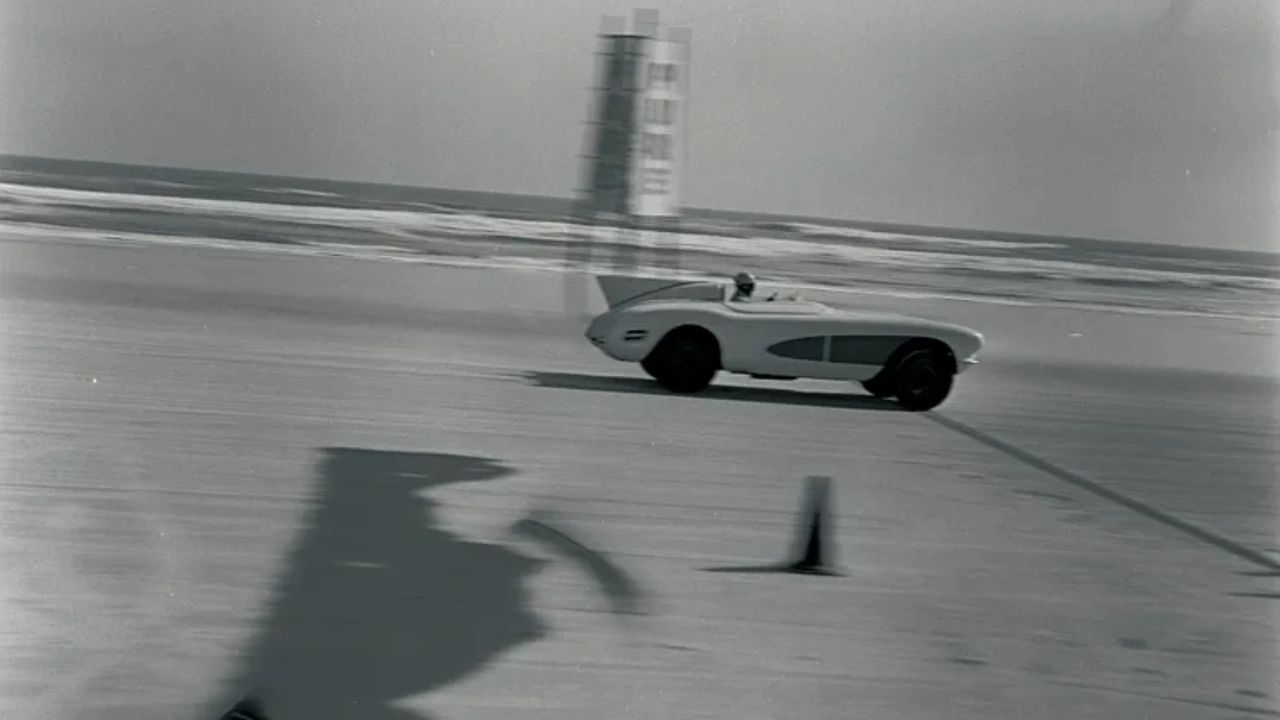
For the official record attempt, Chevrolet selected a 1956 Corvette—chassis #6901—into which the EX-87’s engine, transmission, rear axle, tachometer, and instrumentation were transplanted wholesale. The goal was no longer internal validation. It was public proof.
In January 1956, on the hard-packed sands of Daytona Beach, Zora Arkus-Duntov drove the Corvette flat-out through the flying mile. When the timers stopped, the result was unmistakable: 150.583 miles per hour, averaged over two runs in opposite directions.
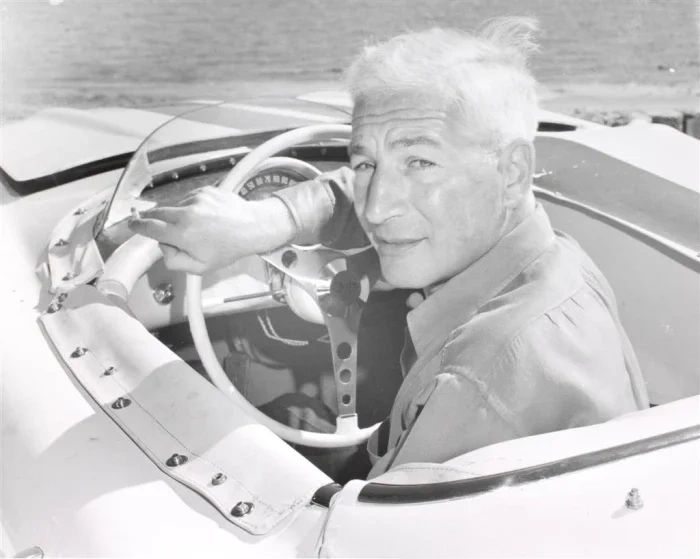
The number carried weight far beyond its decimals. It announced, unequivocally, that the Corvette had crossed a threshold.
“The car did not ask permission,” Zora later reflected. “It simply did what it was capable of doing.”
From Experiment to Identity
The work done with the EX-87 reshaped the Corvette’s destiny. The lessons learned—from aerodynamics to camshaft theory—were applied directly to production engineering. More importantly, the achievements at Mesa and Daytona transformed public perception. The Corvette was no longer merely America’s sports car. It was becoming a serious one.
As GM retired the Motorama after 1956, reallocating funds toward engineering and competition development, the Corvette quietly shifted from spectacle to substance. Harley Earl, nearing the end of his career, recognized the moment with clarity.
“I started the Corvette with a shape,” Earl said. “These men gave it a soul.”
In trusting Duntov and Cole to carry the Corvette forward, Earl ensured that his creation would evolve beyond styling into a legacy. The EX-87—born as a humble test mule—had become the crucible in which the Corvette’s performance identity was forged.
From that point forward, the Corvette would no longer be judged by what it promised, but by what it proved.
1955 Chevy Corvette EX-87 Mule: Specs and Details
- Engine: 306.6-cu-in/5025cc OHV V-8, 1×4-bbl Rochester Carter WCFB
- Power and torque: (SAE gross, est.) 275 hp @ 5400 rpm, 295 lb-ft @ 3650 rpm
- Drivetrain: 3-speed manual RWD
- Brakes: Drum, front and rear
- Suspension, front: Control arms, coil springs
- Suspension, rear: Live axle, leaf springs
- Dimensions: 167.0 in, W: 72.2 in, H: 46.1 in (est. )
- Weight: 2393 lb
- 0-60 MPH*: 5.7 sec
- Quarter mile*: 14.3 sec @ 94 mph
- Price: Incalculable
Why the EX-87 Still Matters
The EX-87 matters today because it was the moment the Corvette stopped being judged solely as a styling experiment and started being defended as an engineering program. In the mid-1950s, Chevrolet did not need another beautiful two-seater—it required proof that its new sports car could compete with the world’s best when the conversation shifted from showrooms to speed, durability, and repeatable performance. The EX-87 delivered that proof in the language that executives, engineers, and enthusiasts all understand: measured results. It established a template that would become Corvette doctrine—test relentlessly, validate everything, and let numbers settle arguments.
Just as importantly, the EX-87 represents the origin point of a philosophy that still defines Corvette development: real performance is engineered, not claimed. The car’s focus on airflow management, driver stability, gearing strategy, and incremental engine evolution foreshadowed the way Corvette programs would later be built—from the big-block era to ZR-1, Z06, and today’s ZR1/Z06-style track-capable variants. Modern Corvettes arrive with wind-tunnel refinement, track validation, and durability testing baked into their DNA because the brand learned early—through cars like the EX-87—that reputation is earned at speed and under load.
In the long arc of Corvette history, the EX-87 is not remembered for its appearance, but for what it proved: that a Corvette could be a serious performance machine when given serious engineering intent. That distinction still matters in a world where performance claims are easy to make and hard to substantiate. The EX-87 was substantiation—an early, uncompromising demonstration that the Corvette’s identity would be forged by innovation, verified testing, and the refusal to accept “good enough” as an answer.