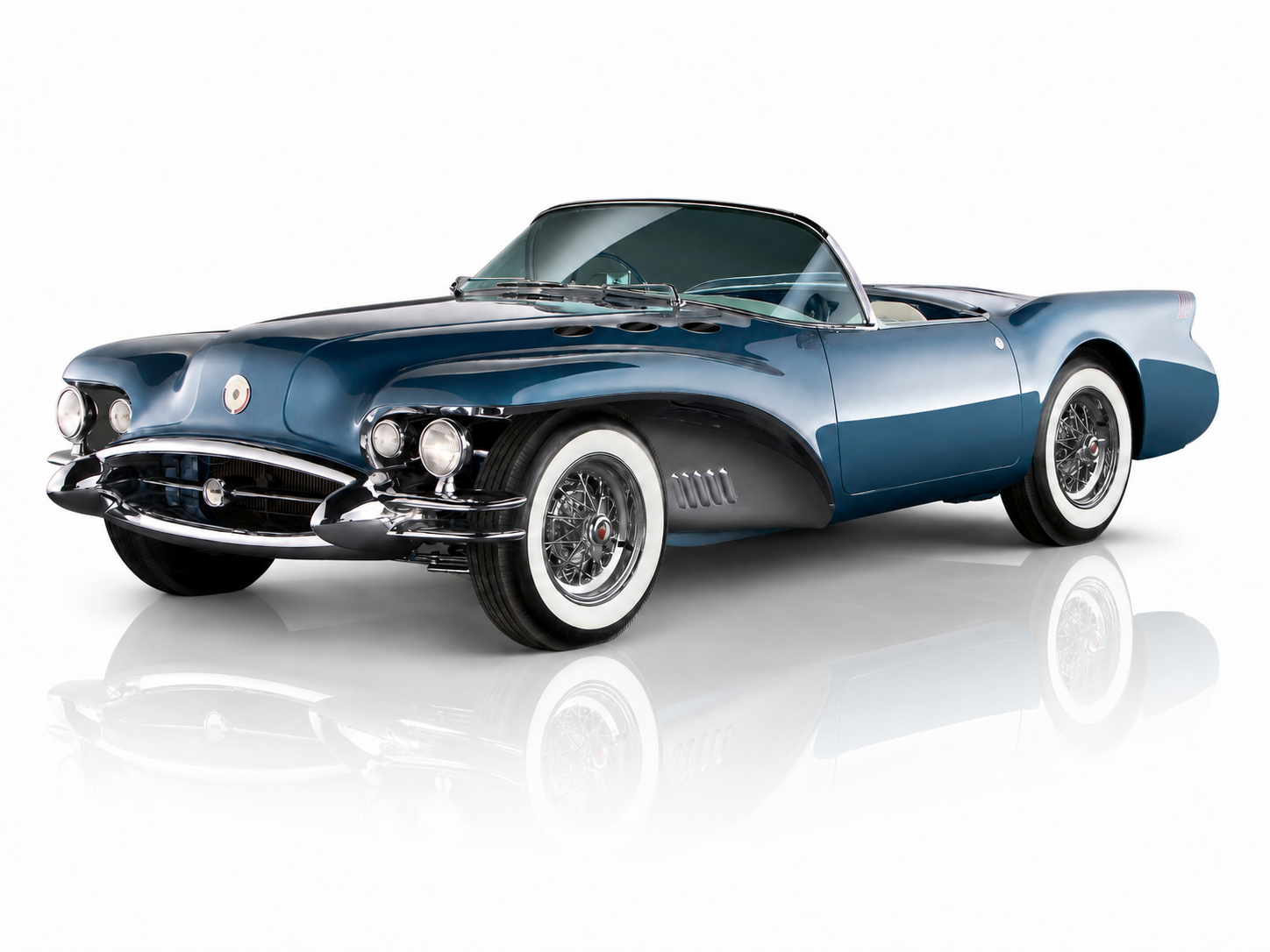
The 1954 Buick Wildcat II did not simply appear beneath the lights of General Motors’ Motorama. It arrived like a dare. Low, bright, and unapologetically strange, it represented Buick at its most adventurous—a division better known for polished power, formal confidence, and upper-middle-class prestige suddenly imagining itself as the builder of a radically styled two-seat American sports car.
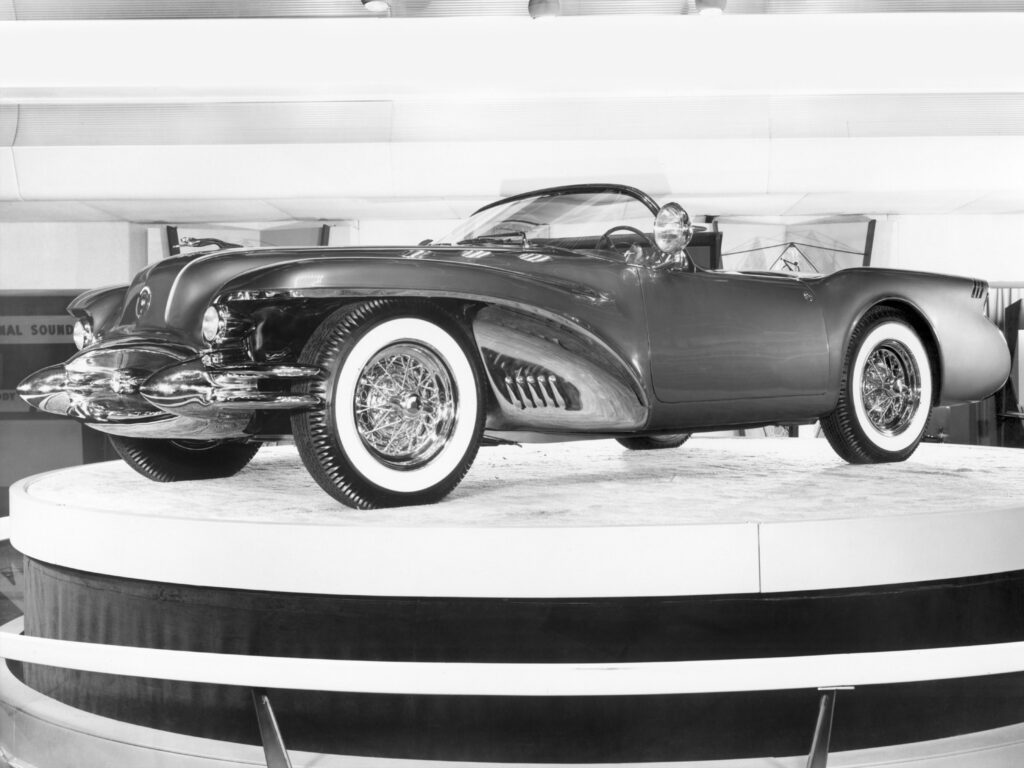
Introduced during the 1954 General Motors Motorama season, the Wildcat II stood among some of the most memorable dream cars GM ever produced. The 1954 show opened at New York’s Waldorf-Astoria on January 26 and later traveled to additional major cities, drawing more than 1.9 million visitors during the season. The roster included the Chevrolet Nomad, Pontiac Bonneville Special, Oldsmobile F-88, Cadillac La Espada, Cadillac El Camino, Cadillac Park Avenue, and the gas-turbine Firebird I. Even in that company, the Buick was difficult to ignore. Its exposed front wheels, flying-wing fenders, wraparound windshield, cowl-mounted lamps, and electric-blue fiberglass body made it one of the most radical GM concepts of the decade.
Buick did not describe the Wildcat II quietly. Period language called it “a revolutionary front-end design with flying-wing fenders that flare straight out from the body, exposing the entire front wheel and part of the front-end suspension.” That sentence still captures the car’s central shock. Most 1950s American cars concealed their chassis and suspension beneath heavy fenders, chrome bumpers, and broad front-end mass. The Wildcat II did the opposite. It treated the mechanical pieces as jewelry. It made the suspension part of the view.
Buick’s Place in the Motorama Moment
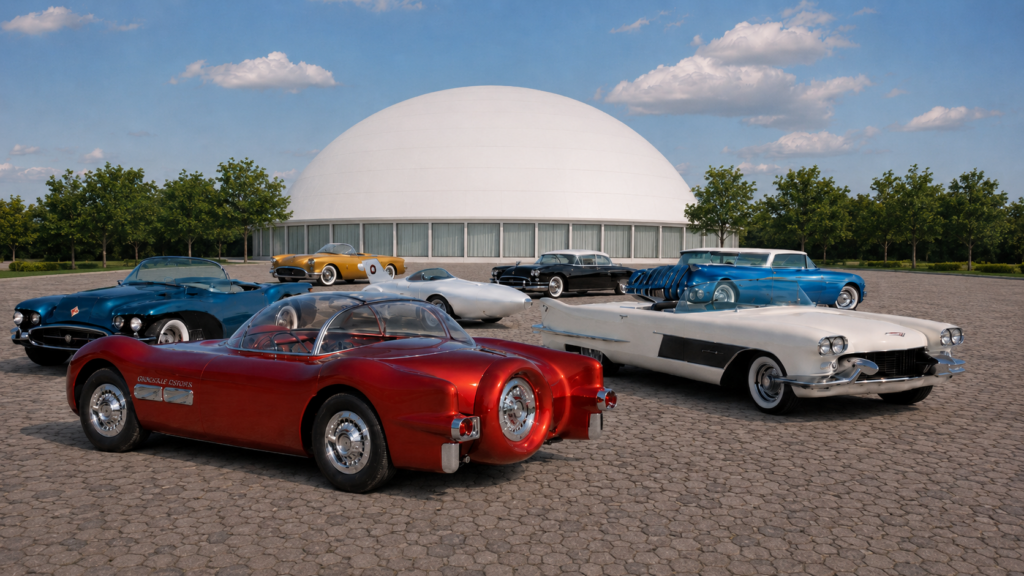
To understand the Wildcat II, it helps to understand the world that produced it. The early 1950s were the great dream-car years at General Motors. Harley Earl’s styling organization had become one of the most powerful creative engines in American industry, and Motorama gave GM a national stage on which to turn future product direction into public spectacle. These shows were part auto show, part design laboratory, part sales campaign, and part corporate confidence exercise. GM was not merely showing cars; it was selling the idea that tomorrow would be longer, lower, brighter, faster, and more glamorous.
The 1954 Motorama season was especially important because GM was putting multiple fiberglass-bodied dream cars in front of the public at once. Chevrolet had already launched the Corvette for 1953, but GM’s divisions were still exploring what an American two-seat performance car could look like if each brand interpreted the idea for itself. Pontiac answered with the Bonneville Special. Oldsmobile answered with the F-88. Cadillac had La Espada. Buick answered with the Wildcat II.
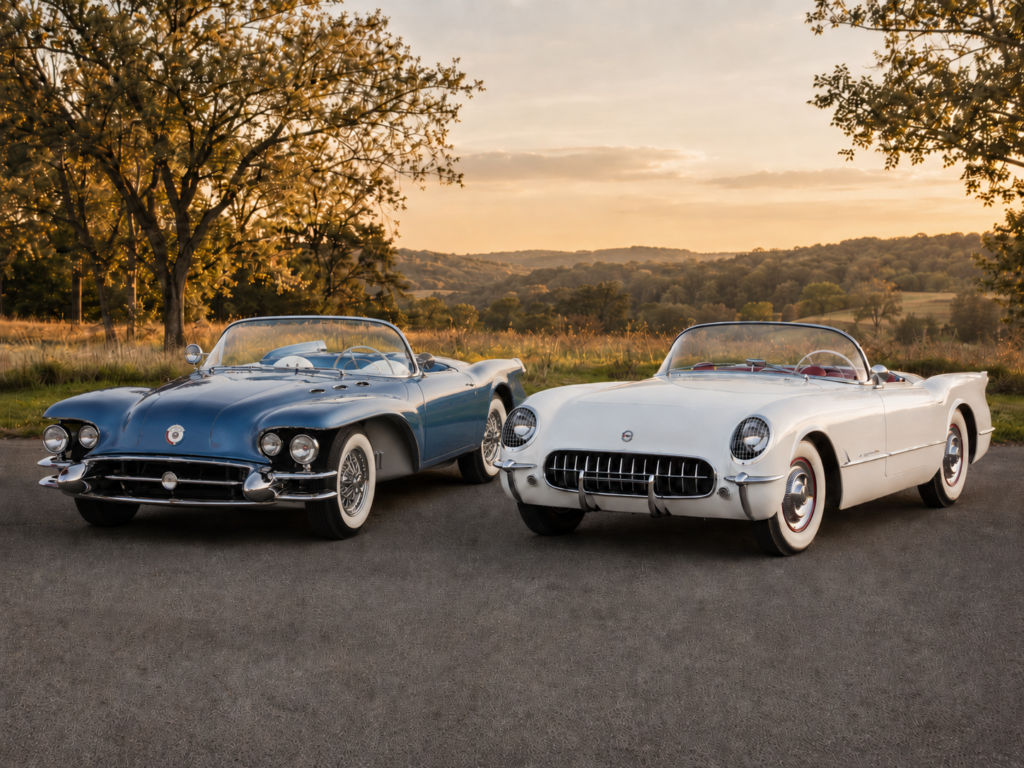
That point is central to the car’s identity. The Wildcat II was not simply Buick’s version of the Corvette, even though the two cars shared the broader two-seat fiberglass sports-car conversation. It was Buick testing how far its own brand vocabulary could be stretched. The Corvette was relatively clean, rounded, and restrained in its first-generation form. The Wildcat II was bolder, heavier-looking, more ornate, and more mechanical in its presentation. It was not trying to be European. It was trying to be American in a Buick-specific way: powerful, polished, dramatic, and visibly expensive.
From Wildcat I to Wildcat II
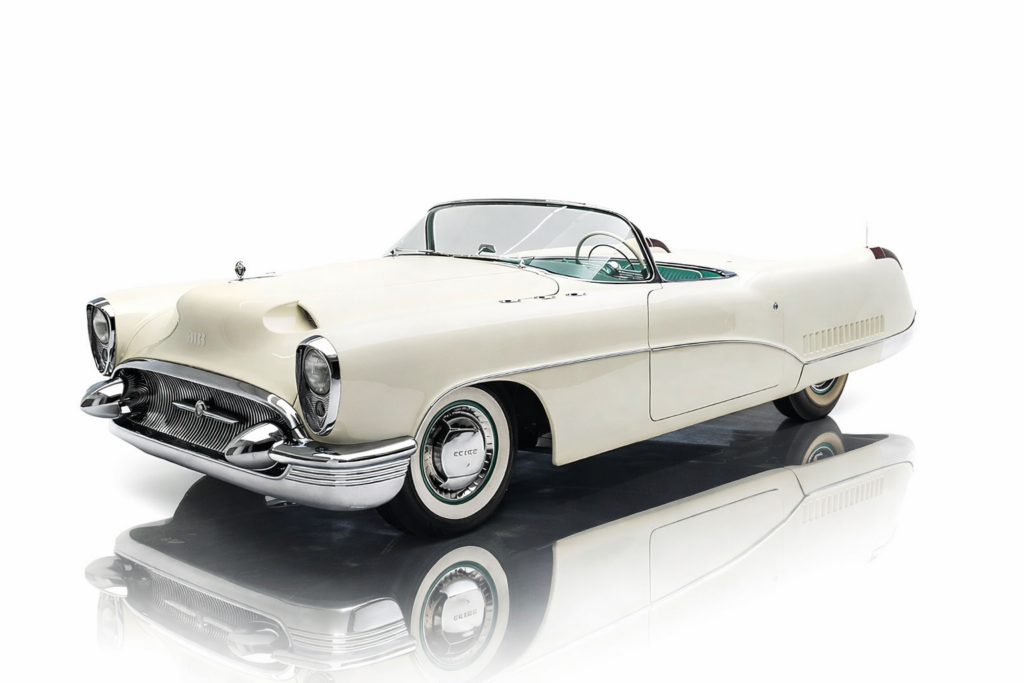
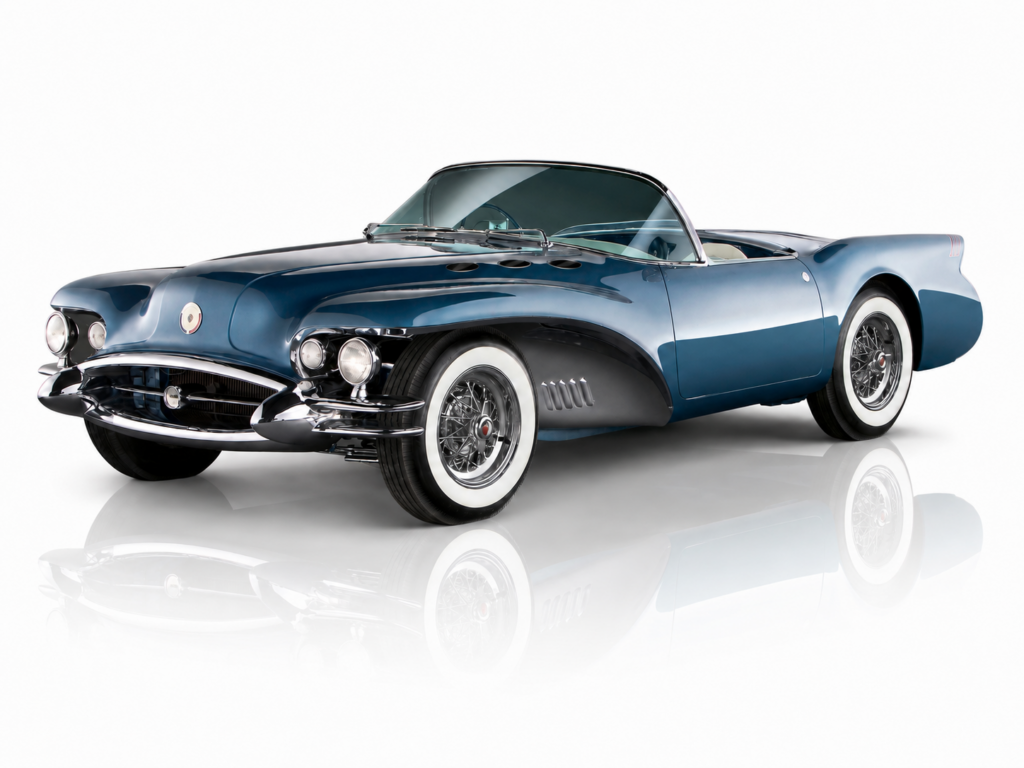
The Wildcat II was the second in Buick’s run of 1950s Wildcat dream cars. The original Wildcat I appeared in 1953 as a low, two-seat fiberglass convertible, helping establish the name as Buick’s experimental sports-car identity. The Wildcat II followed in 1954 with a far more radical design vocabulary. Then Buick returned in 1955 with the Wildcat III, a concept that was more conventional in its proportions and more directly connected to production Buick styling themes.
That three-car progression is useful because the Wildcat II was the most extreme of the group. The Wildcat I showed that Buick could imagine a sports car. The Wildcat II asked how wild that idea could become before it stopped looking like a Buick. The Wildcat III brought the idea back toward the showroom. In the middle sits the 1954 car: the boldest, strangest, and arguably most unforgettable of the Wildcats.
Ned Nickles, Harley Earl, and Buick’s Design Voice
Credit for the Wildcat II’s design is generally given to Buick stylist Ned Nickles, working under GM design chief Harley Earl. A GM press handout quoted Nickles describing the car as “an American adventure in tomorrow’s design.” That phrase is worth keeping because it is not generic show-car language. It explains the car’s intent. The Wildcat II was not presented as an imitation of a Jaguar, Ferrari, Austin-Healey, or Mercedes-Benz. It was an American adventure—meaning a homegrown answer to the sports-car question, expressed through American size, American chrome, American V-8 power, and American postwar confidence.
Nickles was a natural fit for that assignment. He was closely associated with some of Buick’s most memorable early-1950s design cues, including the brand’s famous VentiPorts. The often-repeated origin story traces those portholes to Nickles’ personal 1948 Roadmaster, where he experimented with illuminated openings in the front fenders. Buick eventually translated the idea into production as non-illuminated VentiPorts, and the feature became one of the brand’s most recognizable design signatures.
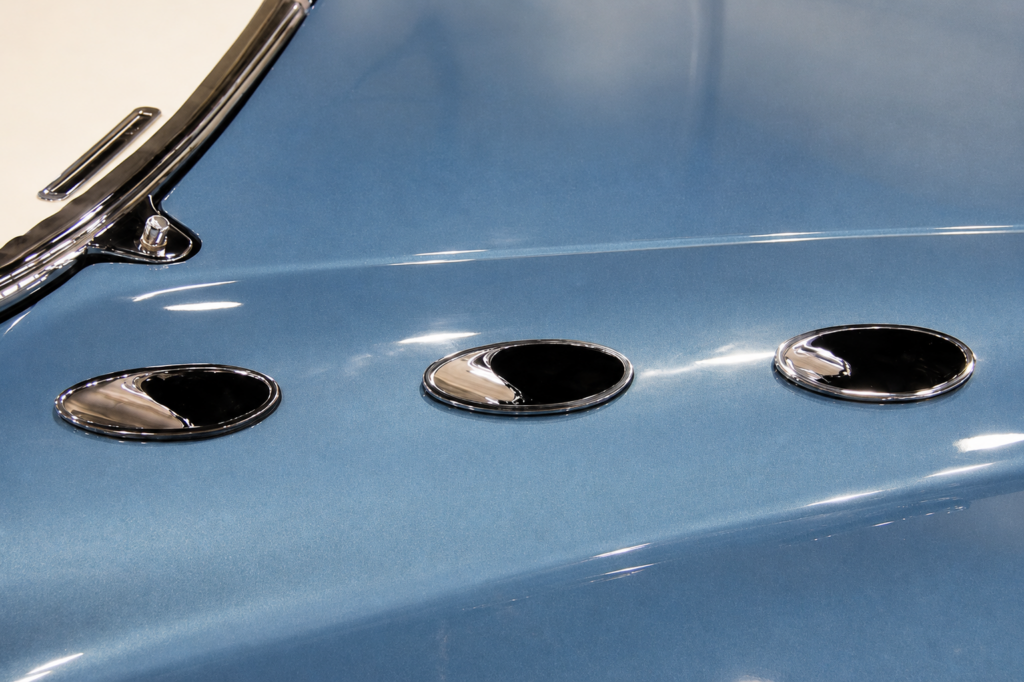
On the Wildcat II, that familiar cue was moved from the front fenders to the top of the hood. It was a brilliant piece of brand translation. With the normal front fender area largely opened up by the flying-wing design, Buick could not simply place the VentiPorts where buyers expected them. So the designers relocated them above the centerline, where they became part of the hood’s visual jewelry. The result was unmistakably Buick even though the rest of the car shared almost nothing with a production Roadmaster, Super, Century, or Special.
Harley Earl’s broader influence was equally visible. Earl famously said in a 1954 interview, “My main purpose in those twenty-eight years was to lengthen and lower the American automobile. My perception was that oblongs are more attractive than squares.” The Wildcat II was that philosophy compressed into a two-seat show car: a long hood, low cowl, short passenger compartment, clean deck, and a body that looked stretched even on a compact 100-inch wheelbase.
Defining the Wildcat II’s Design
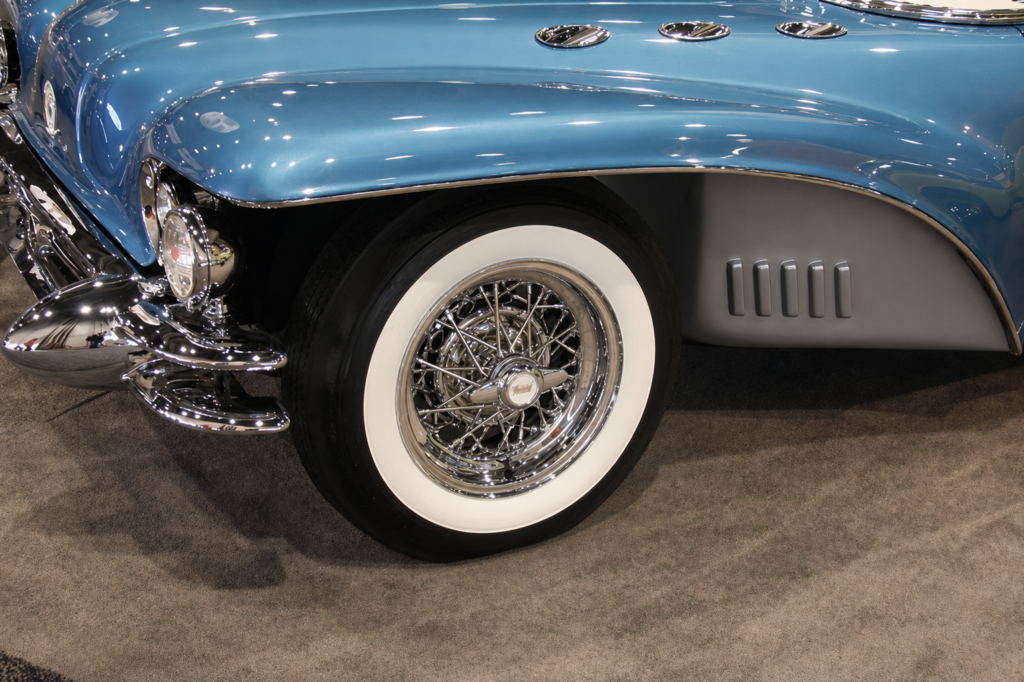
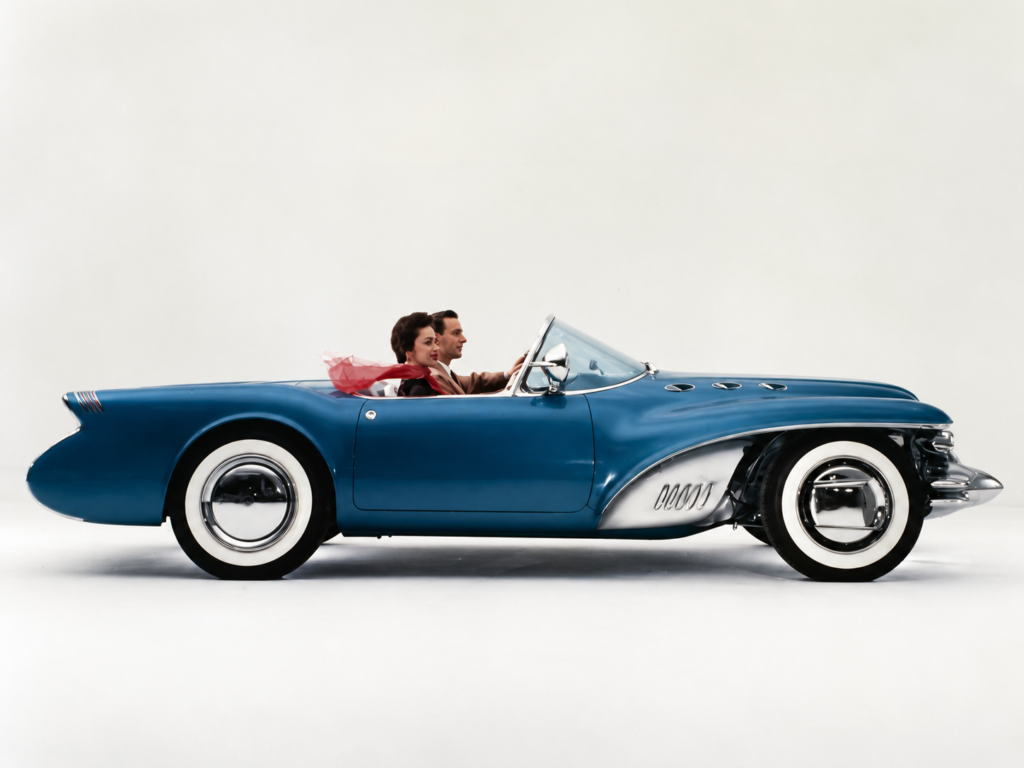
The Wildcat II’s design begins at the front because there is no way around it. The exposed front-wheel treatment is the car’s defining element. The fenders flare outward from the body like horizontal wings, leaving the front wheels and part of the suspension exposed. Polished metal liners fill the wheel openings, giving the area a crafted, almost aircraft-like finish. It is not subtle. It is not practical in the normal production-car sense. But it is unforgettable.
That exposed suspension treatment did something important: it turned the Wildcat II into a rolling sculpture of motion. Even standing still, the car seemed to be showing how it worked. It made the connection between body, wheel, and road visible. In a period when most American production cars used mass and ornament to project importance, the Wildcat II used negative space. The open wheel wells became as important as the fiberglass surfaces around them.
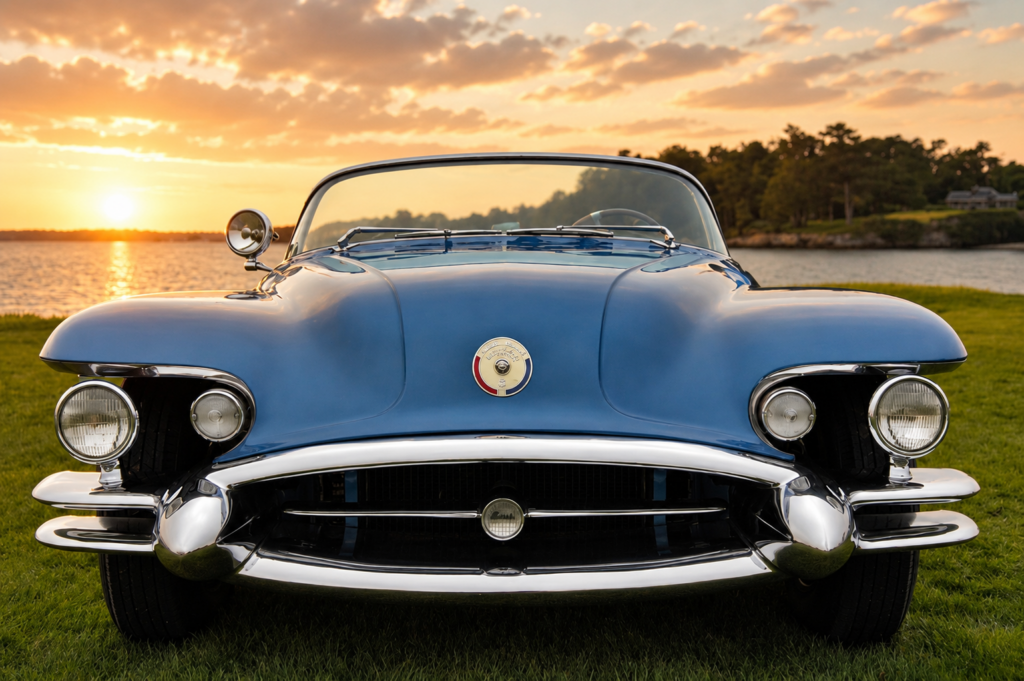
The front-end details intensified the effect. Early versions of the car used cowl-mounted headlamps near the base of the windshield, giving the front view a strange, almost creature-like expression. Later in the car’s life, more conventional fender-mounted lamps were reportedly added, though at least one large cowl lamp remained. Mac’s Motor City Garage also notes that the car originally used “Roto-Static” front wheel covers, stationary covers intended to serve as brake scoops while the wheels rotated, before they were replaced with Kelsey-Hayes wire wheels.
The windshield was another key element in the modernization. The wraparound panoramic glass fit directly into GM’s early-1950s fascination with aircraft-inspired visibility and low rooflines. On the Wildcat II, the windshield helped visually separate the cockpit from the broad hood and rear deck, creating the impression of a sleek personal aircraft as much as a sports car. This was the same design world that produced jet-age tailfins, panoramic glass, turbine concepts, and dashboards that looked increasingly influenced by aviation.
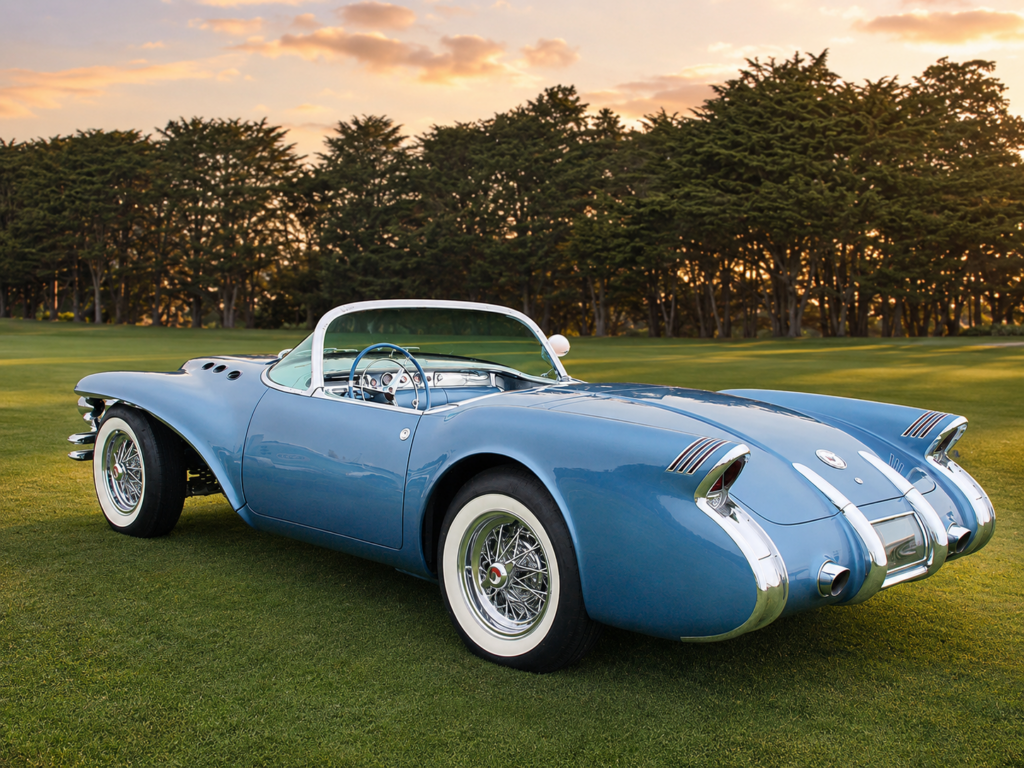
The rear of the Wildcat II was less shocking than the front, but it was still full of intent. The deck was clean and sculpted, the tail treatment sharply finished, and the rear details suggested the direction Buick production styling would continue to explore. Seen from behind, the car looked more like a polished dream of future Buick elegance. Seen from the front, it looked like an experiment that had broken out of the studio before anyone could tame it. That tension is what gives the Wildcat II so much life.
Color, Trim, and Visual Personality
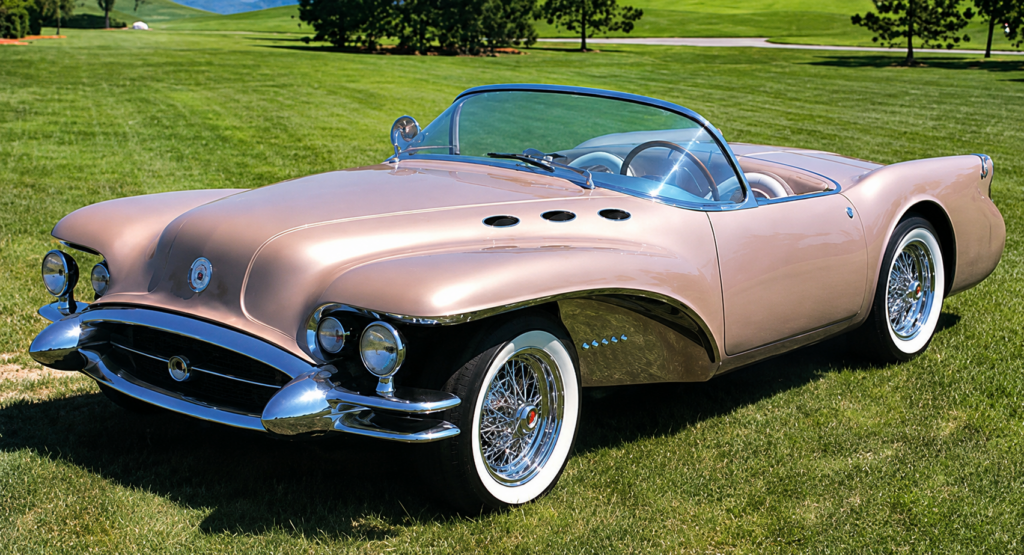
The Wildcat II’s original color scheme was Electric Blue over a white leather interior, a pairing that gave the car both technical coolness and luxury contrast. The blue paint made the body look crisp and futuristic, while the white cockpit gave it the tailored, expensive quality expected of Buick. The car was reportedly repainted later in its life—variously described in later accounts as metallic lavender, dark tan, gold, or platinum-like depending on source and period—but it has since been returned to a blue presentation closer to its original identity.
That color history is more than trivia. It shows how dream cars often lived multiple lives. They were updated, repainted, re-trimmed, repaired, and sometimes altered as they moved from Motorama spotlights to dealer appearances, storage, museum display, or private hands. Many did not survive at all. The fact that the Wildcat II exists today in recognizable form is remarkable by itself.
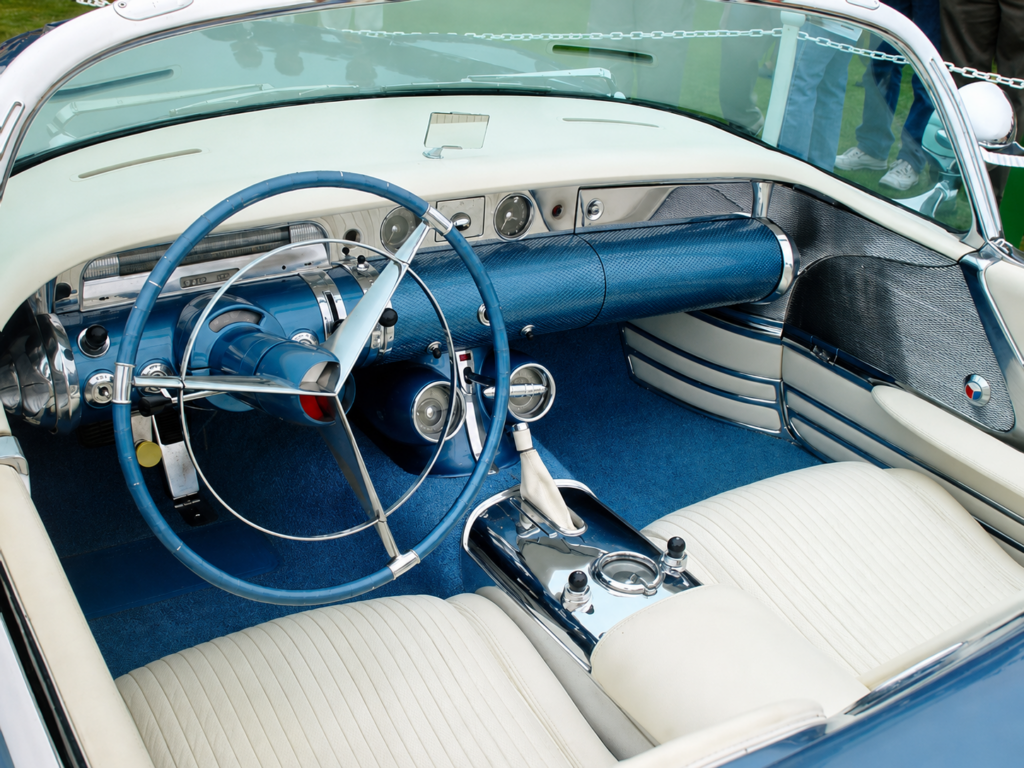
The interior followed the same message as the exterior: sporty, but still Buick. It was a true two-seat cockpit with bucket-style seating, a low windshield, and a driver-focused feel. Buick would not offer bucket seats in regular production until much later, which gives the Wildcat II’s cabin additional significance as an early exploration of personal-car packaging inside a GM division better known for bench-seat comfort. Period dream cars often previewed ideas long before they became normal, and the Wildcat II’s cockpit is a good example of that pattern.
Mechanical Composition: Nailhead Power in a Fiberglass Body
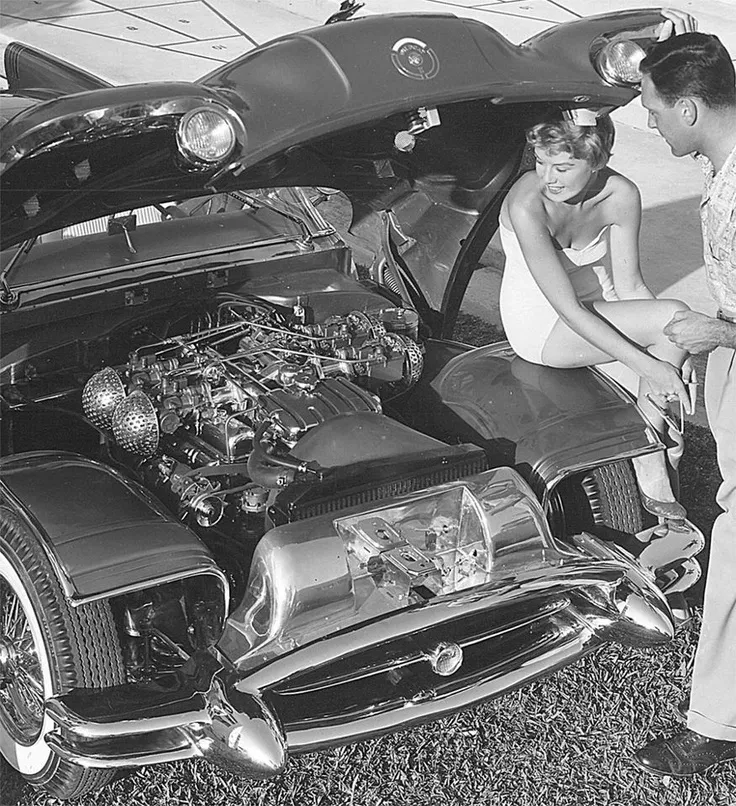
For all its visual drama, the Wildcat II was not an empty styling shell. It carried Buick’s 322-cubic-inch overhead-valve V-8, the engine later nicknamed the “Nailhead” because of its small, vertically arranged valves. In the Wildcat II, the engine was rated at 220 horsepower. ConceptCarz lists the car as a front-engine, rear-drive fiberglass roadster with a 322-cubic-inch V-8, 220 horsepower, a cast-iron block, 16-valve OHV layout, and automatic transmission.
Mac’s Motor City Garage adds one of the most interesting mechanical details: the Wildcat II’s V-8 used four Carter YH sidedraft carburetors on a log manifold. Those carburetors were the same type used on the six-cylinder Corvette, but here they fed Buick’s larger V-8. The engine was paired with Buick’s Dynaflow automatic transmission, and the chassis used coil springs at all four corners.
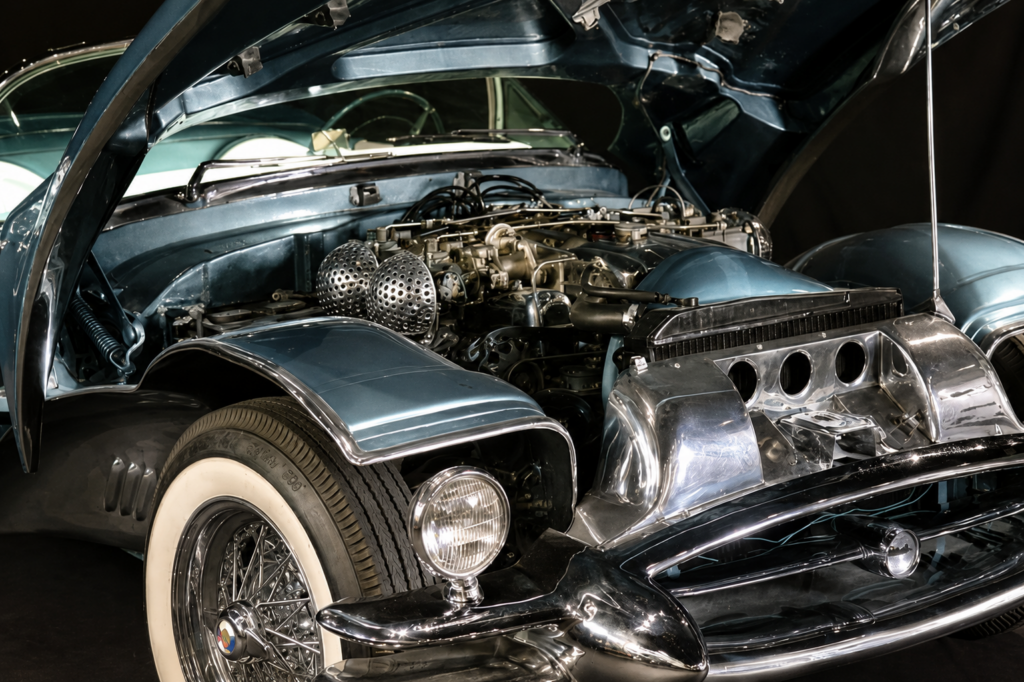
The Dynaflow automatic is an important detail because it reinforces the car’s Buick character. A lighter, more European-minded sports car might have demanded a manual gearbox, but Buick’s identity in the early 1950s was rooted in smoothness, torque, and effortless power delivery. The Wildcat II may have looked like a radical sports roadster, but mechanically it still spoke Buick fluently. It was less a track weapon than a dream of a high-style American grand roadster.
The fiberglass body was mounted on a 100-inch wheelbase chassis. Reported figures place the car at roughly 171 inches long and less than 41 inches high, with a curb weight around 3,770 pounds. Those numbers tell an honest story. The Wildcat II was short and low by Buick standards, but it was not a featherweight. It had visual speed, V-8 power, and compact proportions, but it still carried the mass and material richness associated with a GM dream car.
Why the Wildcat II Was Not a Production Car
It is tempting to look at the Wildcat II and ask why Buick did not build it. That question becomes even stronger when you remember the timing. Chevrolet already had the Corvette in production. Ford would launch the Thunderbird in 1955. American automakers were clearly aware of growing interest in personal two-seat cars, even if the market remained limited. Buick had the engine, the prestige, and the design talent to play in that space.
But the Wildcat II was never a clean production proposal. Its exposed front wheels and flying-wing fenders were spectacular but impractical for mass production. The open wheel wells would have raised obvious concerns around weather protection, debris, durability, and customer expectations. The cowl-mounted lighting, Roto-Static covers, fiberglass body, and low two-seat packaging all belonged to the experimental world more than the showroom.
There was also the question of internal GM politics and brand spacing. Chevrolet was already tasked with making the Corvette work. A Buick two-seater might have created overlap within GM at a time when the corporation preferred each division to maintain a distinct market role. Buick’s job was not to be Chevrolet. Its job was to sell aspirational, powerful, comfortable cars to customers moving up the GM ladder. A production Wildcat II might have been fascinating, but it would also have been a narrow-market car inside a division built around volume, prestige, and comfort.
That does not make the Wildcat II less serious. In many ways, it makes the car more interesting. It was free to be bold precisely because it did not have to pass through every production filter. It could test public reaction. It could advance Buick’s image. It could give designers permission to explore proportions and details that might later be softened for production. It could make Buick look young, powerful, and technically curious without requiring the division to bet its business case on a two-seat roadster.
The Wildcat II as a Buick Identity Study
The best way to read the Wildcat II is not as a failed production car, but as a Buick identity study. It asked what would happen if the division’s core values were compressed into a sports-car form.
Power was there in the 322-cubic-inch V-8. Polish was there in the chrome, white leather, and carefully finished exposed suspension. Presence was there in the flying-wing fenders and dramatic nose. Brand memory was there in the hood-top VentiPorts. Futurism was there in the panoramic windshield, fiberglass construction, cowl lighting, and clamshell-style front access. The Wildcat II was not Buick abandoning itself. It was Buick turning itself up.
That is why the car still feels so different from the Corvette. A Corvette of the period was Chevrolet’s sports-car experiment. The Wildcat II was Buick’s dream of what a premium American performance roadster might be if it did not have to apologize for size, ornament, or chrome. It was not trying to chase European minimalism. It was making a case for American abundance.
The Clamshell Front End and Mechanical Display
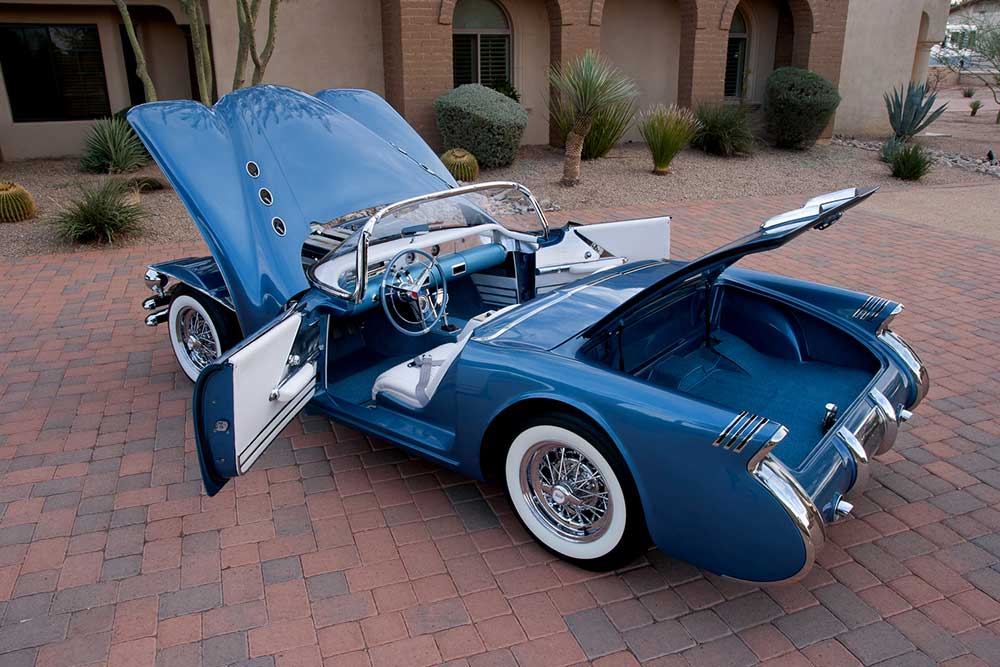
One of the Wildcat II’s more fascinating features was the way its front bodywork opened. Mac’s Motor City Garage notes that the entire top half of the front end hinged upward in a clamshell fashion to provide engine access. That detail adds another layer to the car’s mechanical drama. The Wildcat II not only showed pieces of its suspension from the outside; it also opened in a way that made the powertrain part of the presentation.
For a Motorama car, that was valuable. Show cars had to communicate quickly. Visitors were moving through crowded exhibition spaces, surrounded by music, lighting, models, turntables, displays, and other dream cars. A car like the Wildcat II had to be legible from across the room. Its front end accomplished that instantly. Then, when opened or photographed with the hood raised, it had to reward closer inspection. The clamshell front and carbureted Nailhead V-8 helped it do exactly that.
This is also where the car’s design and engineering language overlap most strongly. The exposed suspension was not necessary. The clamshell front was not the only possible solution. The hood-top VentiPorts did not have to be there. But together, these pieces made the car feel engineered and designed as one object. It presented motion, mechanics, and brand identity in a single visual package.
The Motorama Purpose: Public Reaction, Publicity, and Product Direction
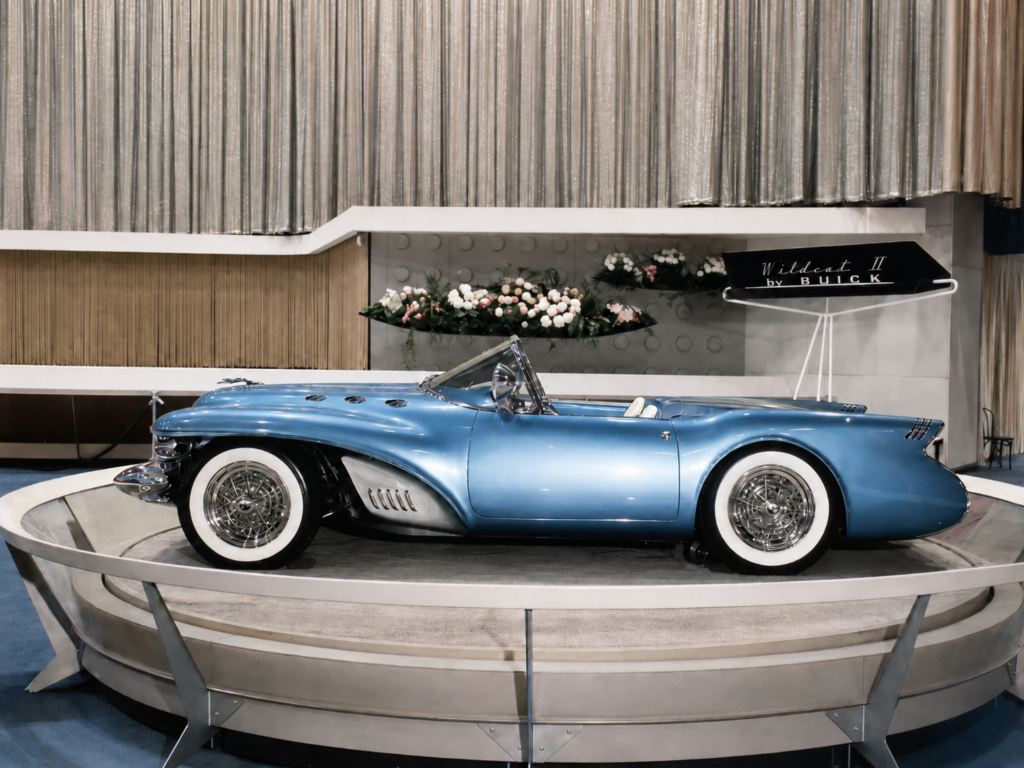
The Wildcat II’s purpose was not limited to looking outrageous. GM used dream cars as tools. They created excitement around the corporation’s design leadership, drew crowds to Motorama venues, generated newspaper and magazine coverage, and enabled designers to study how the public responded to advanced ideas.
Joseph M. Sherlock’s historical overview makes this broader point well, noting that GM’s traveling Motorama put dream cars in front of wide audiences and that aging concepts could later appear at major auto shows, smaller shows, or even key dealerships to draw showroom traffic.
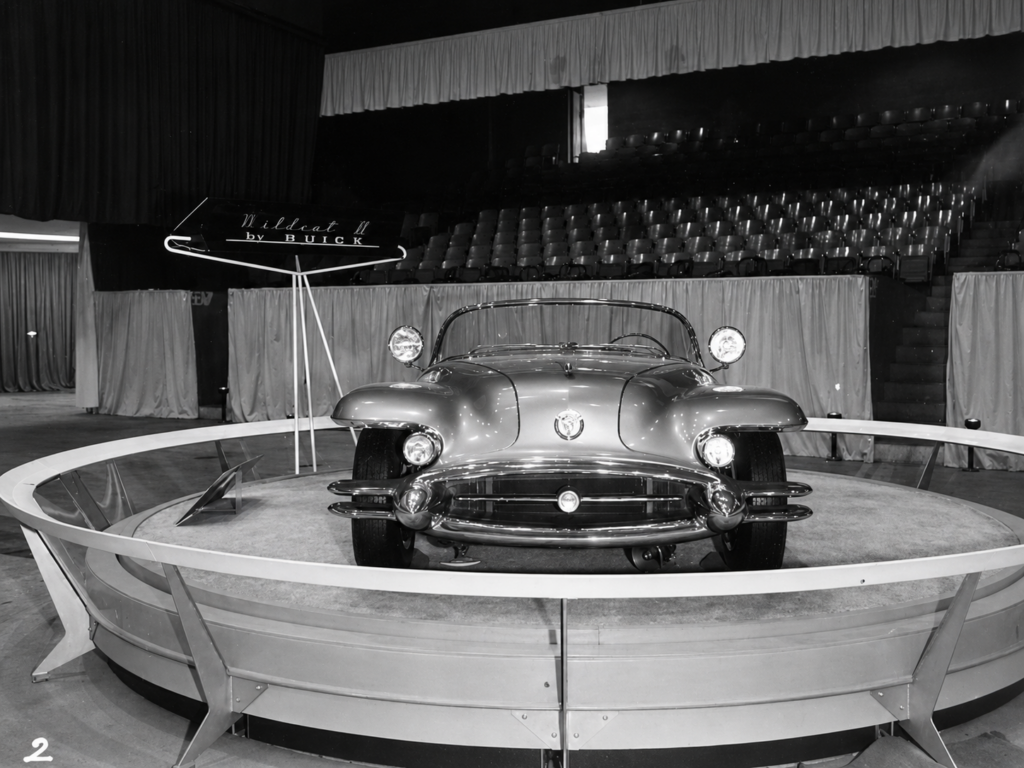
That publicity cycle gave a concept like the Wildcat II a longer life than a single debut. It could generate excitement at Motorama and then continue to build Buick’s image through subsequent appearances. The car became part of a rolling conversation between GM and the public. Even if visitors never expected to buy that exact car, they absorbed the message: Buick had imagination, Buick had power, Buick had access to GM’s most advanced styling ideas, and Buick was not afraid to experiment.
This was especially useful in 1954. Buick was a major GM division, but it needed to remain visually fresh in a market becoming more competitive and more style-driven. Dream cars helped keep the brand emotionally charged. They made production cars feel connected to a larger future, even when showroom Buicks remained far more practical and conservative than the Motorama machines.
A Brief Competition Footnote: Watkins Glen
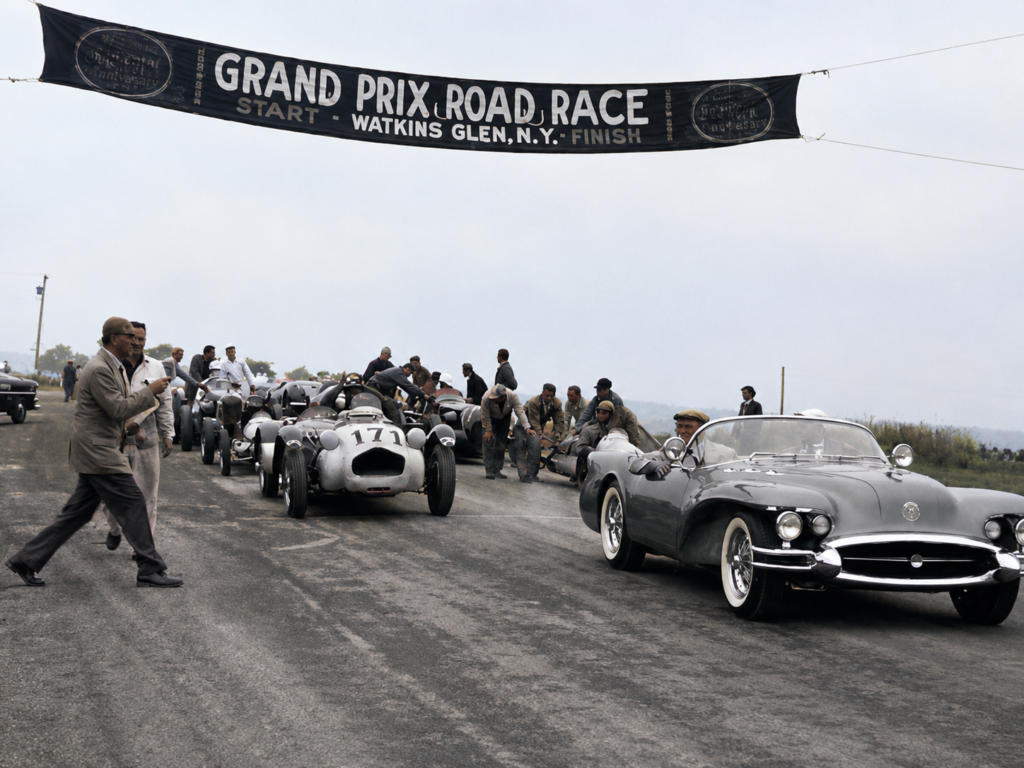
The Wildcat II’s public life was not confined to static display. Sherlock notes that the car served as the pace car for the 11-lap 1955 Seneca Cup Race at Watkins Glen. That detail gives the car a small but useful connection to the competition world, placing Buick’s dream roadster in front of an enthusiast audience rather than only Motorama crowds.
It would be easy to overstate this. The Wildcat II was not a racecar. Its Dynaflow automatic, substantial weight, show-car construction, and ornate design made it very different from the Jaguars, specials, and European sports cars that populated serious road racing in the mid-1950s. But as a pace car, it made perfect sense. It looked fast, it sounded credible, and it carried enough Buick power to avoid feeling like a hollow styling exercise. For Buick, the Watkins Glen appearance helped connect the Wildcat II to the performance conversation in a more public, enthusiast-facing way.
Influence and Production Echoes
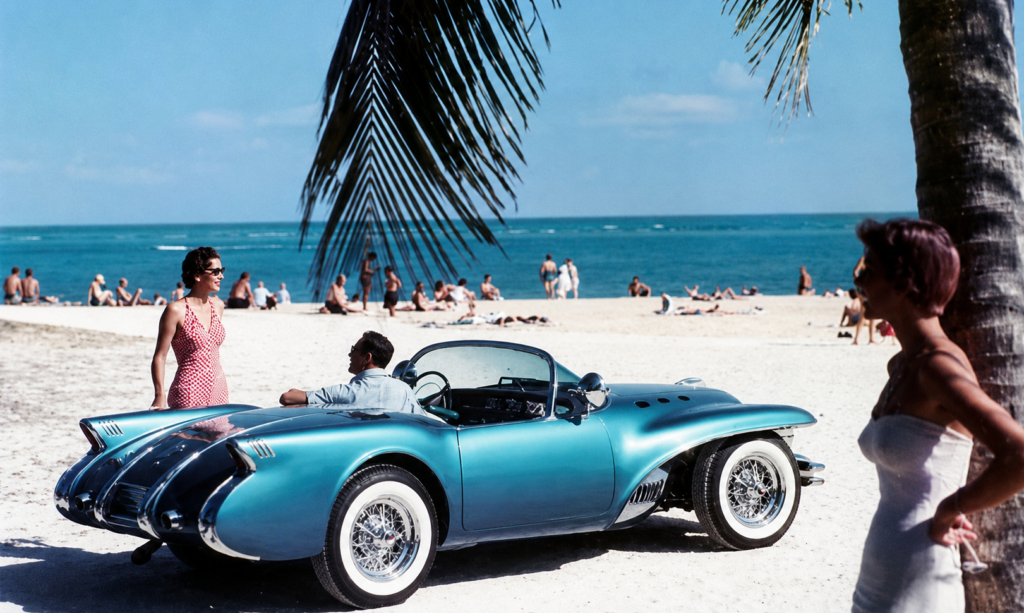
The Wildcat II did not become a production Buick, but that does not mean it existed in isolation. GM dream cars often indirectly influenced production design. Details, proportions, colors, rooflines, lighting ideas, grille treatments, and interior concepts could be applied to showroom cars after being softened for manufacturing and customer acceptance.
With the Wildcat II, the most obvious influence was not a single direct production transfer but a broader attitude. It showed Buick designers exploring lower proportions, more dramatic front-end identity, stronger performance imagery, and more adventurous personal-car language. Some later accounts have pointed to the car’s front bumper and rear taillight ideas as elements that could be seen in later full-size Buick design. Hot Rod noted that while Buick stayed away from the two-seat sporty-car field for years, elements such as the Wildcat II’s front bumper and rear taillights could be seen echoed in later full-size styling.
The hood-top VentiPorts also deserve attention. They did not become a standard Buick feature in that exact form, but they showed how flexible a brand signature could be. A design cue did not have to stay frozen in one location to remain recognizable. On the Wildcat II, Buick’s portholes were transformed from side decoration into hood sculpture, proving that familiar brand elements could be reinterpreted in a futuristic setting.
Survival, Restoration, and Current Home
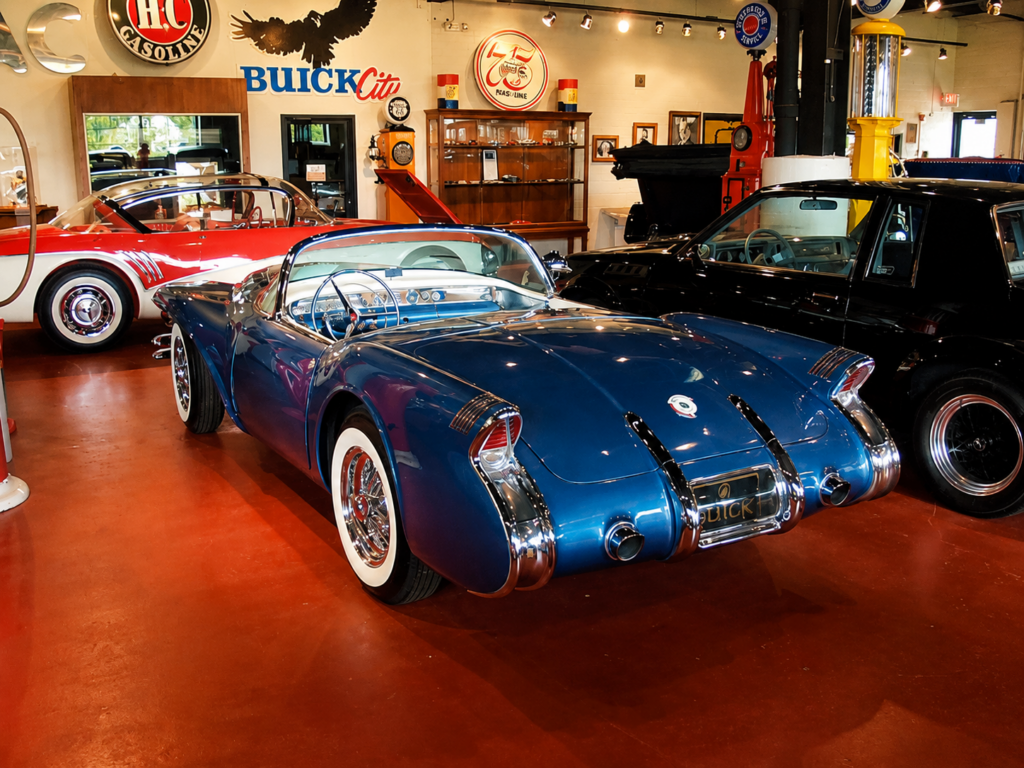
Many GM Motorama cars were destroyed after their useful lives ended. Some were cut up. Some were buried. Some were sold, altered, or lost. That makes the Wildcat II’s survival especially valuable. The car lived long enough to be restored and preserved, and today it is strongly associated with the Sloan Museum/Buick Automotive Gallery in the Flint, Michigan area. The Buick Gallery identifies the 1954 Wildcat II among its regular feature concept cars, alongside the 1951 XP-300, 1956 Centurion, 1963 Silver Arrow I, and 1977 Phantom.
The Buick Car Club of Australia’s historical page goes further, stating that the Wildcat II is owned by Sloan Museum, while other sources describe it as housed or displayed at Sloan’s Buick Gallery. That aligns with the broader public record and is the safest way to present the car’s current status.
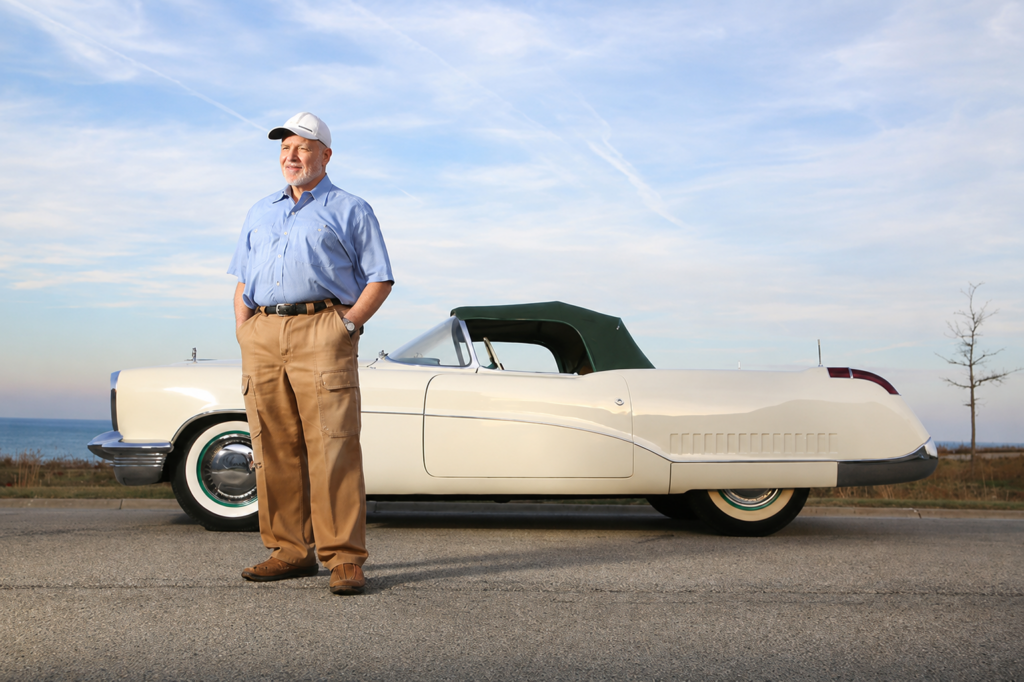
In our research on the Buick Wildcat II, we came across references suggesting that Joe Bortz may have played an active role in both the car’s restoration and its ownership history. That association deserves careful handling. Bortz is one of the most important private collectors in the world of GM dream cars, and his name is closely associated with the 1953 Buick Wildcat I, as well as several other surviving Motorama concepts. However, the 1954 Buick Wildcat II belongs in a different category. The current Bortz Collection vehicle gallery includes the 1953 Wildcat I and several other GM dream cars, but it does not include the 1954 Wildcat II. For that reason, Bortz should not be identified as the current owner of the 1954 Wildcat II.
Why the Wildcat II Still Feels So Radical
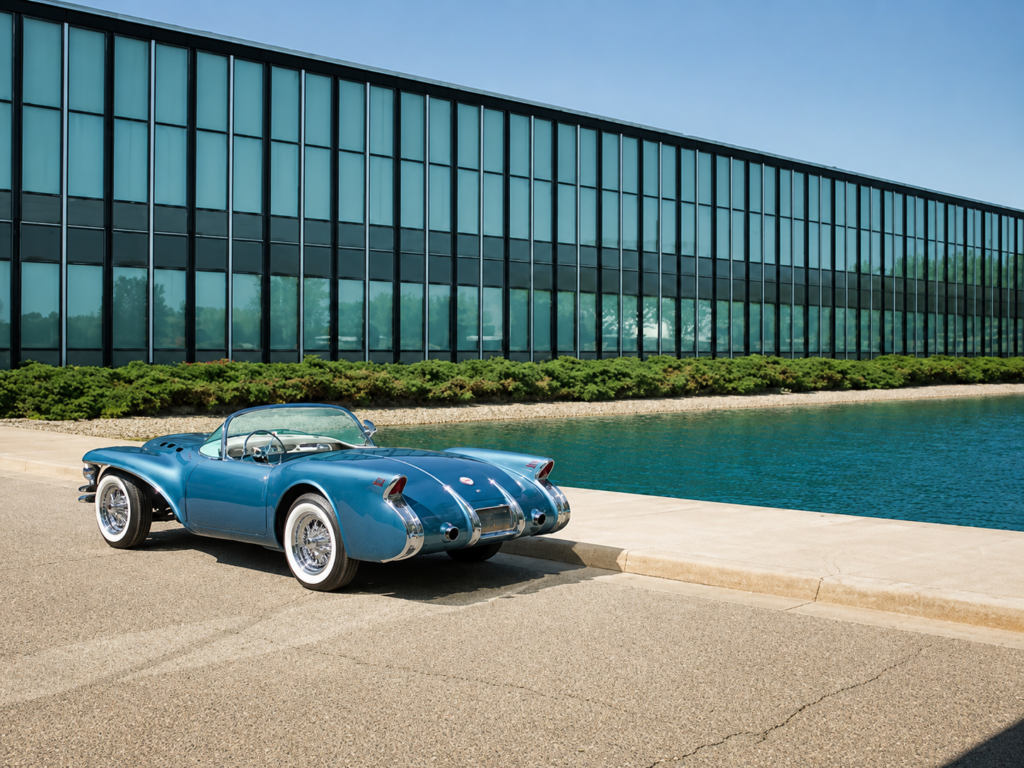
The Wildcat II has not lost its ability to surprise because its weirdness is structural rather than decorative. Many 1950s dream cars look flamboyant because of fins, chrome, bubble tops, jet-age lamps, or dramatic paint. The Buick is different. Its most radical choice is the front-end architecture. Remove the paint, remove the upholstery, remove the show-car lighting, and the exposed front-wheel layout would still stop people cold.
That is the genius of the car. It did not rely only on ornament. It changed how a Buick sports car could be visually organized. The body did not simply sit over the wheels; it opened around them. The suspension was not hidden; it was framed. The fenders did not enclose; they projected. The car asked viewers to reconsider what a front end could be.
At the same time, the Wildcat II avoided becoming anonymous futurism. It remained tied to Buick through its V-8, VentiPorts, chrome treatment, road presence, and upscale cockpit. The car was wild, but it was not random. It was a Buick dream car, not a generic Motorama fantasy.
Key Specifications and Features
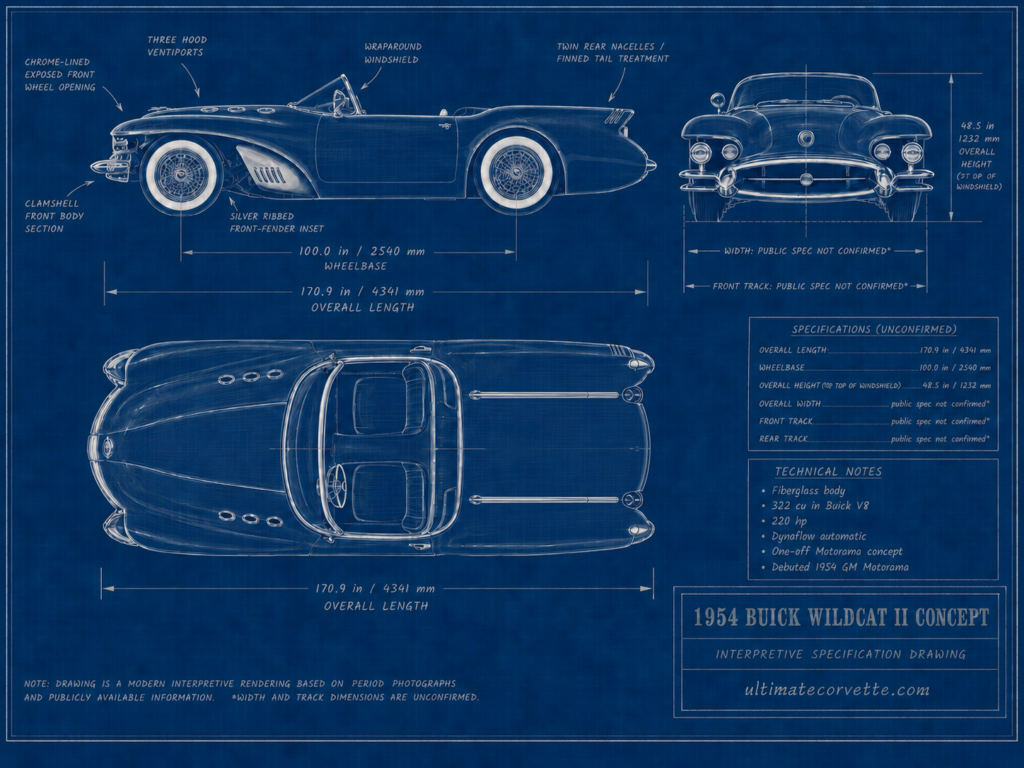
The known and commonly cited specifications place the 1954 Buick Wildcat II on a 100-inch wheelbase, with a fiberglass body, a two-seat roadster layout, a front-engine/rear-drive configuration, and Buick’s 322-cubic-inch OHV V-8 rated at 220 horsepower. The engine used four Carter YH sidedraft carburetors, and power was routed through a Dynaflow automatic transmission. The car’s height is generally described as just under 41 inches, with an overall length of around 171 inches and a reported weight of around 3,770 pounds.
Its defining design features included the flying-wing front fenders, exposed front suspension, polished front wheel-well liners, hood-top VentiPorts, panoramic wraparound windshield, early cowl-mounted headlamp treatment, fiberglass body construction, white leather cockpit, and show-car blue exterior. Over time, the car’s wheels, lighting, and paint presentation changed, but the essential form survived.
Why the 1954 Buick Wildcat II Still Matters Today
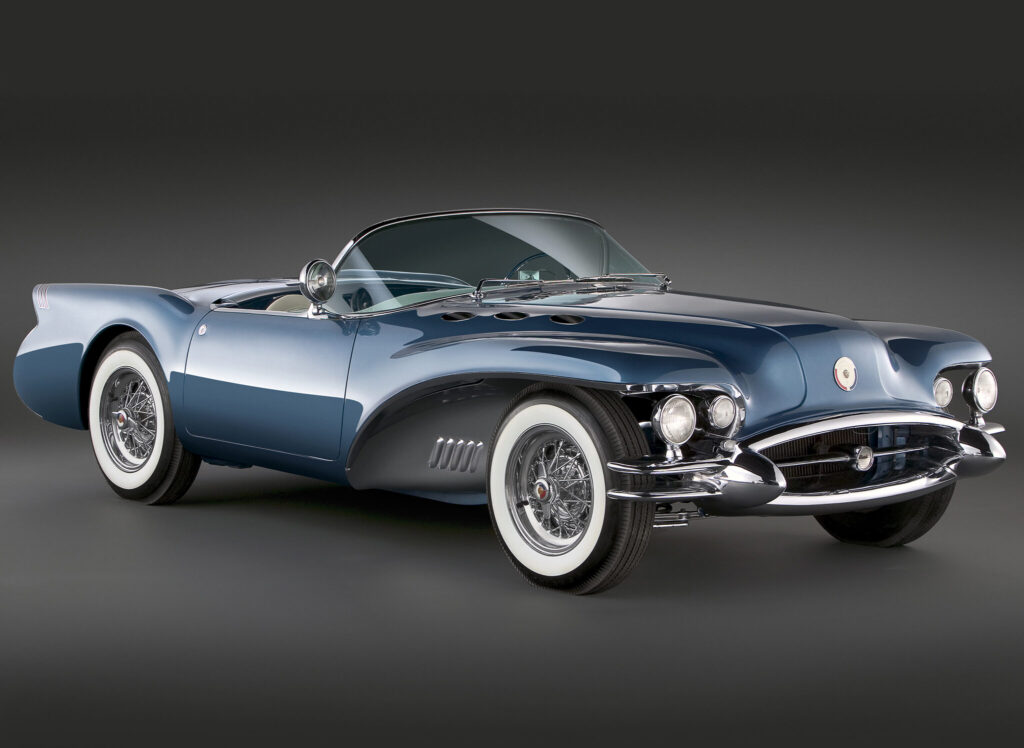
The 1954 Buick Wildcat II remains one of the clearest expressions of Buick’s postwar imagination. It was not a production forecast in the strict sense, and it was never meant to be judged like a showroom car. Its value comes from something larger. It shows Buick using the full force of GM Styling to ask what an American sports car could be when filtered through Flint’s own design language.
That is what gives the Wildcat II its staying power. It was radical without abandoning Buick’s identity. It was futuristic without becoming anonymous. It had fiberglass construction, a low two-seat body, an exposed front suspension, cowl lighting, a panoramic windshield, and a clamshell front end, but it also had a Buick Nailhead V-8, Dynaflow automatic, VentiPorts, white leather, chrome confidence, and the visual weight of an upscale American car.
It also reminds us how important Motorama was to American automotive culture. These cars were not only decorations for turntables and spotlights. They were experiments in public desire. GM used them to measure reaction, shape expectations, create headlines, and push its own designers toward bolder solutions. Some ideas faded. Some were softened for production. Some survived only as photographs. The Wildcat II survived as a complete object, which makes it one of the more important Buick dream cars still available for study.
For Buick, the Wildcat II is a statement of possibility. It shows a division often remembered for comfort and prestige stepping directly into the sports-car conversation with something stranger, richer, and more daring than anyone would have expected. It was not the Corvette’s Buick sibling. It was its own animal entirely—a flying-wing Motorama roadster with Nailhead power, fiberglass skin, and a face only the 1950s could have produced. That is why, seventy years later, the Wildcat II still feels alive.