1963 CORVETTE OVERVIEW

The 1963 Corvette arrived as a shock to the automotive world, signaling a clean break from everything that came before it. With its radical Sting Ray design, independent rear suspension, and an unmistakable focus on performance, the 1963 model transformed Corvette from a stylish American sports car into a serious, purpose-built machine with global aspirations.…

1963 Corvette Sting Ray

The year 1963 marked a watershed moment in American automotive history. With the arrival of the second-generation Corvette Sting Ray, Chevrolet transformed its fiberglass sports car from a stylish curiosity into a world-class performance machine. The ’63 Corvette was the culmination of nearly a decade of experimentation, racing, and bold design exploration—driven by men like Bill Mitchell, GM’s flamboyant styling chief, and Zora Arkus-Duntov, the Corvette’s indefatigable chief engineer.

The new Corvette was a product of its time: born in the shadow of the space race, shaped by postwar prosperity, and engineered for a public hungry for both performance and panache. When it arrived in showrooms, it didn’t just improve on the C1—it redefined what a Corvette could be.

From Racer to Road Car
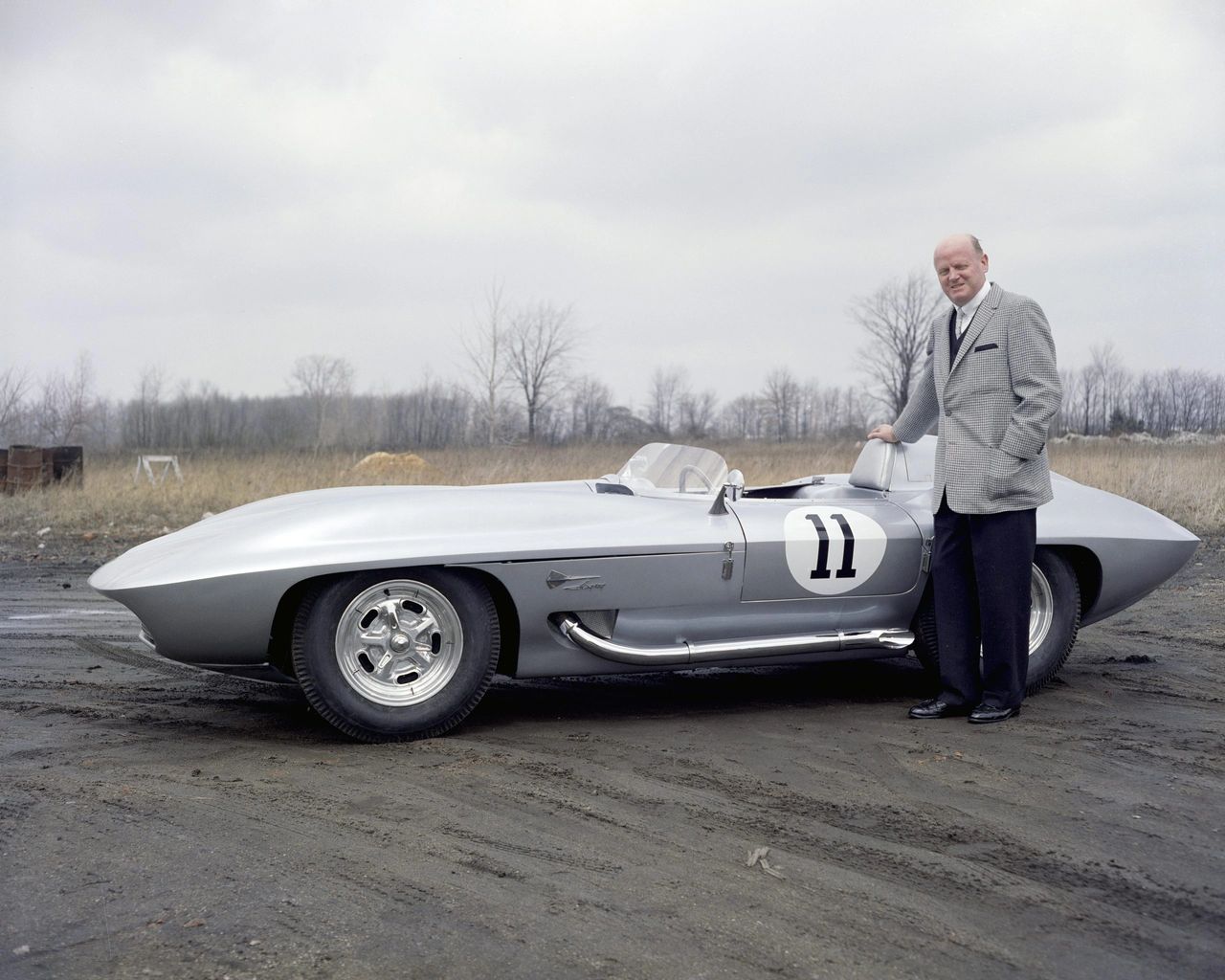
This image shows GM design chief Bill Mitchell standing proudly beside the legendary XP-87 Stingray Racer, the privately funded prototype that directly influenced the styling of the 1963 Corvette Sting Ray. Finished in silver with racing roundels, side pipes, and knock-off wheels, the Stingray was both a competition car and a rolling design laboratory. Mitchell often drove it himself, and its sharp, aerodynamic lines would become the visual DNA of the second-generation Corvette. (Image courtesy of GM Media LLC.)

The Sting Ray name had already entered Corvette lore by 1959, when Mitchell—using his own funds to skirt GM’s corporate racing ban—commissioned the XP-87 Stingray Racer. The sharp-nosed, muscular car, designed by a young Larry Shinoda, stunned onlookers at Nassau Speed Week and SCCA events. Mitchell remembered: “I wanted something that looked like it could sting you if you got too close.”

Though officially a private project, the Stingray Racer was a laboratory for Corvette’s future. Its fiberglass body, knife-edge fenders, and dramatically hunkered stance directly inspired the C2. As Mitchell put it, “We had to make a car that looked like it was moving when it stood still.”

Zora Arkus-Duntov, meanwhile, was determined to give the Corvette the performance to match its looks. Often called the “Father of the Corvette,” Duntov had joined Chevrolet in 1953 after seeing the original Motorama roadster. By the early ’60s, he pushed relentlessly for racing technology in production cars: independent suspension, fuel injection, and a stiff chassis capable of handling European competition.

The World of 1963
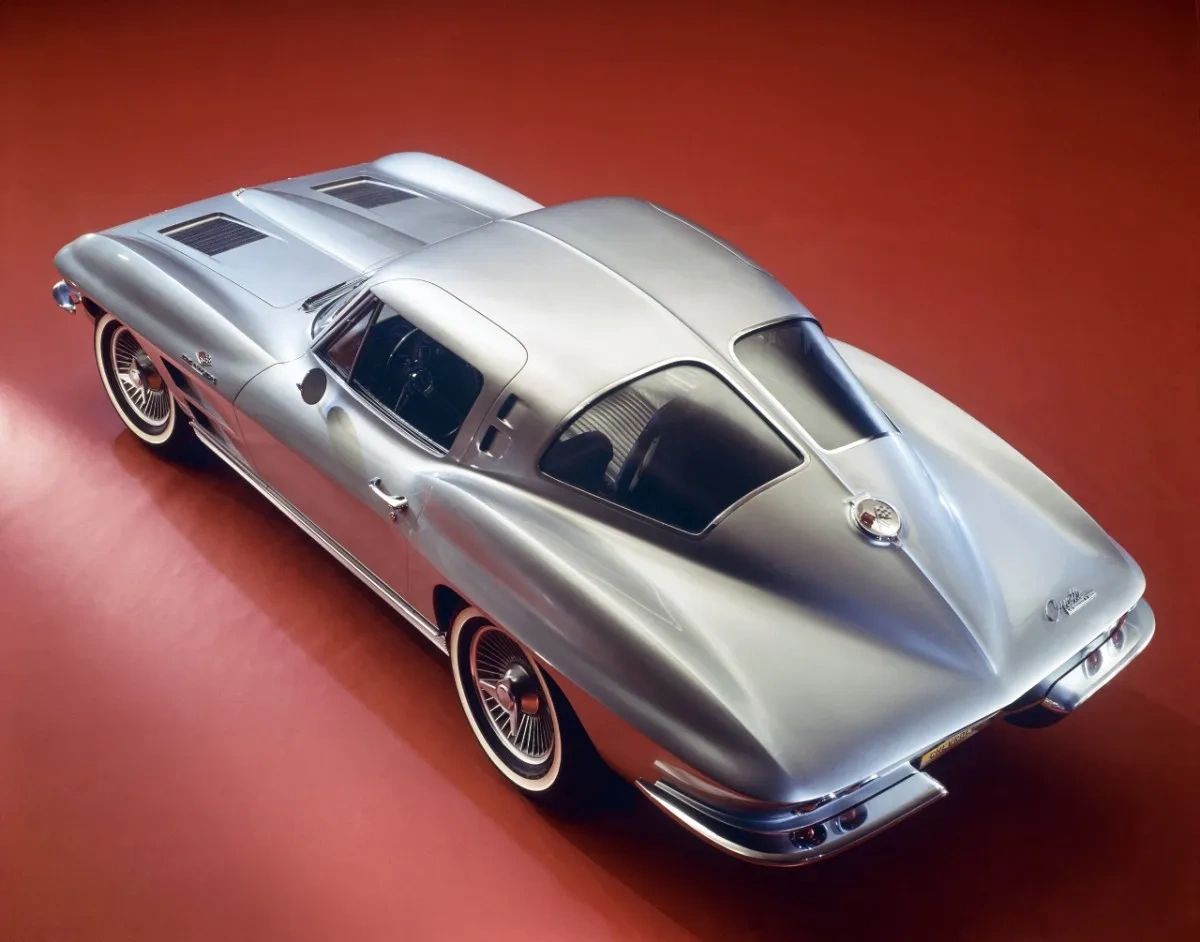
This image shows an early press release photograph of the 1963 Chevrolet Corvette Sting Ray Split-Window Coupe, captured in a studio setting to showcase its groundbreaking design. The shot emphasizes the car’s distinctive split rear window—exclusive to the 1963 model year—and the sleek, aerodynamic fastback profile that set it apart from anything else on the road. Finished in silver with knock-off wheels and whitewall tires, this official press image helped introduce the world to Bill Mitchell and Larry Shinoda’s revolutionary vision for America’s sports car. (Image courtesy of GM Media LLC.)

When the second-generation Corvette debuted in fall 1962 as a ’63 model, America was in the midst of profound change. President John F. Kennedy had just pledged to put a man on the moon by the decade’s end. The Cuban Missile Crisis had rattled the nation’s nerves. At the same time, suburban affluence and a booming youth market fueled demand for exciting cars. Imports like Jaguar, Ferrari, and Porsche offered style and handling that Detroit’s cruisers couldn’t match.

Chevrolet needed the Corvette not just as a halo car, but as proof that an American automaker could build a true sports car on par with Europe’s finest. The Sting Ray delivered that message loud and clear.

A Radical New Design
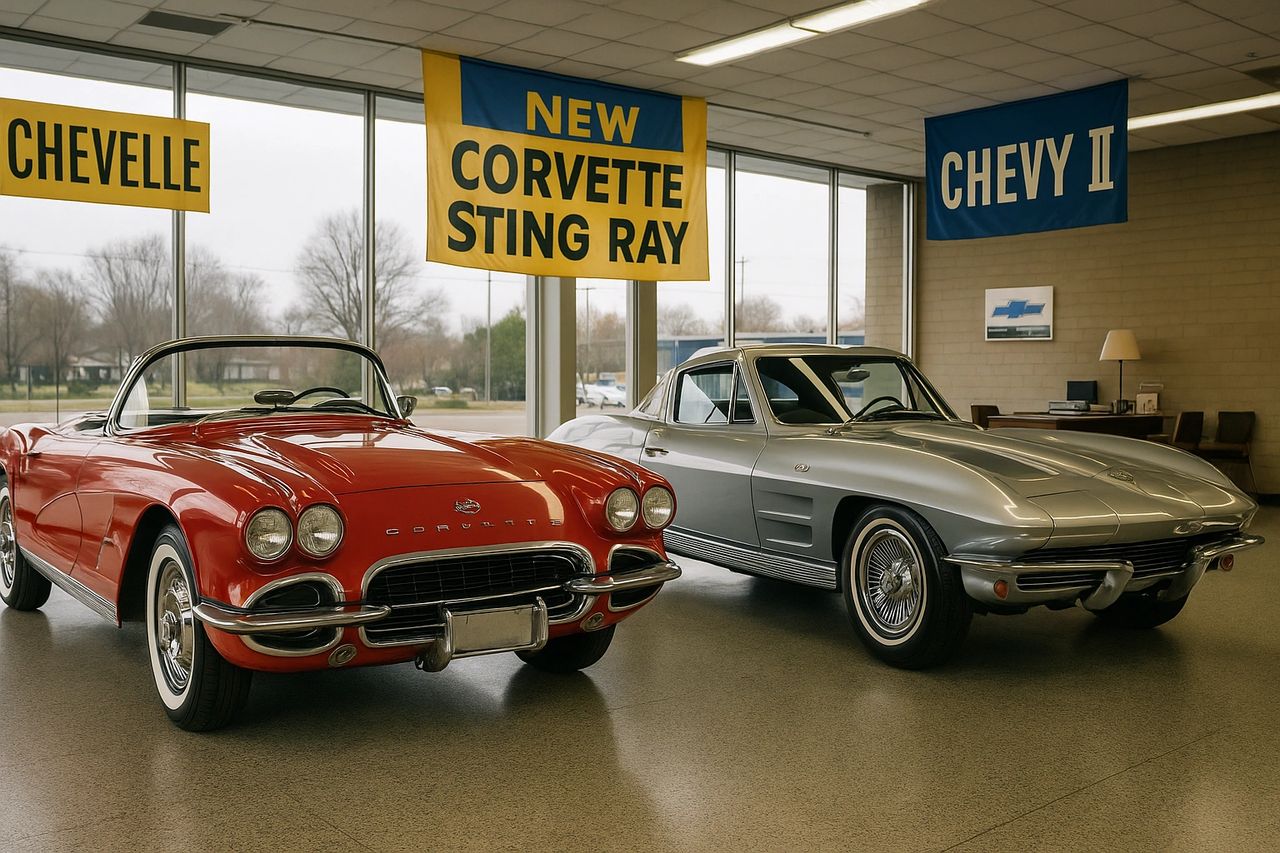
Inside a mid-century Chevrolet showroom, two legends stand side by side—the outgoing 1962 Corvette and the revolutionary 1963 Corvette Sting Ray. The red ’62, with its rounded lines, chrome trim, and dual headlights, represents the final evolution of the first-generation Corvette. Just beside it, the silver ’63 Split-Window Coupe introduces a bold new era with its knife-edged styling, hidden headlamps, and fastback profile.  This moment captures the dramatic handoff between generations: one car closing out the Corvette’s formative years, the other stepping forward as a world-class sports car that would redefine America’s automotive identity. Together, they embody the transition from tradition to transformation—a story of design, engineering, and vision that made Corvette an icon.
Inside a mid-century Chevrolet showroom, two legends stand side by side—the outgoing 1962 Corvette and the revolutionary 1963 Corvette Sting Ray. The red ’62, with its rounded lines, chrome trim, and dual headlights, represents the final evolution of the first-generation Corvette. Just beside it, the silver ’63 Split-Window Coupe introduces a bold new era with its knife-edged styling, hidden headlamps, and fastback profile. This moment captures the dramatic handoff between generations: one car closing out the Corvette’s formative years, the other stepping forward as a world-class sports car that would redefine America’s automotive identity. Together, they embody the transition from tradition to transformation—a story of design, engineering, and vision that made Corvette an icon.

The most striking aspect of the 1963 Corvette was its appearance. Shinoda’s design evolved Mitchell’s Sting Ray Racer into a production reality: crisp beltlines, peaked fenders, a blunt shark-like nose, and a fastback roofline that looked plucked from the era’s fighter jets.

The split rear window coupe became the instant icon of the line. Mitchell fought hard for it, insisting it gave the car “personality” and reinforced the spine of the design. Duntov hated it, arguing it hurt rearward visibility. For one year only, Mitchell won—and the result was one of the most collectible Corvettes of all time.

The advertising tagline captured the mood: “Only a man with a heart of stone could withstand temptation like this.”

Engineering Revolution
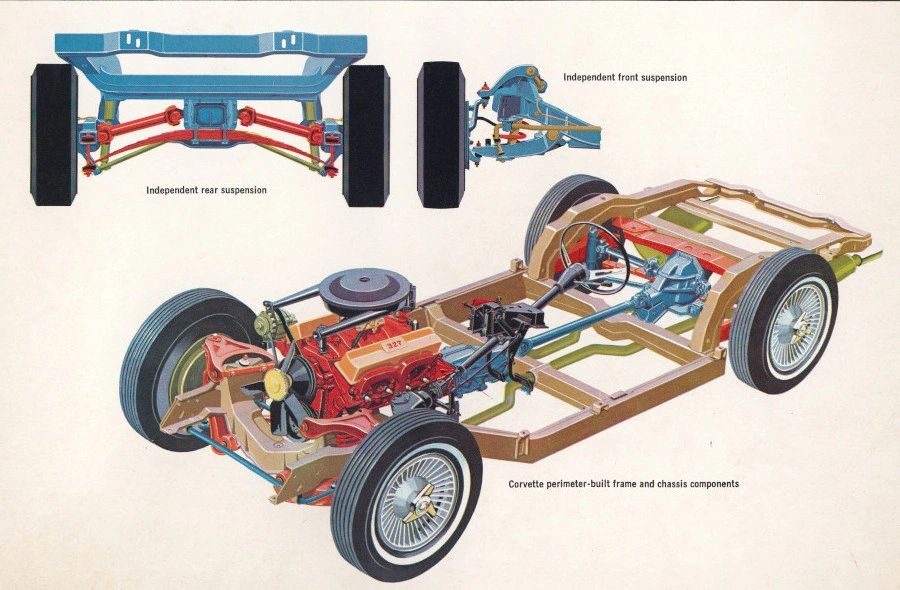
This illustration showcases the revolutionary chassis and suspension design of the 1963 Corvette Sting Ray. For the first time, Corvette engineers introduced a perimeter frame paired with fully independent front and rear suspension—a leap forward that transformed handling, balance, and ride quality. Anchored by the potent 327-cubic-inch small-block V8, this foundation made the C2 Corvette not just a striking sports car, but a genuine performance machine capable of competing on the world stage.

Beneath its dramatic skin, the C2 introduced a new chassis that transformed Corvette dynamics. The wheelbase shrank by four inches, and Duntov’s prized independent rear suspension finally arrived, replacing the old solid axle. This IRS (Independent Rear Suspension) setup—featuring a transverse leaf spring and half-shafts—gave the car vastly improved grip, reduced wheel hop, and made it competitive on both street and track.

Road & Track observed in 1963: “At last, the Corvette is a fully realized sports car. It corners flat, it accelerates fiercely, and it finally feels European in precision.”

The car’s “Ball-Race” steering (as the ad copy called it) delivered sharper response. Engineers also shifted 80 pounds rearward, improving balance and traction. Even without standard power steering, the car felt remarkably manageable.

Power Under the Hood
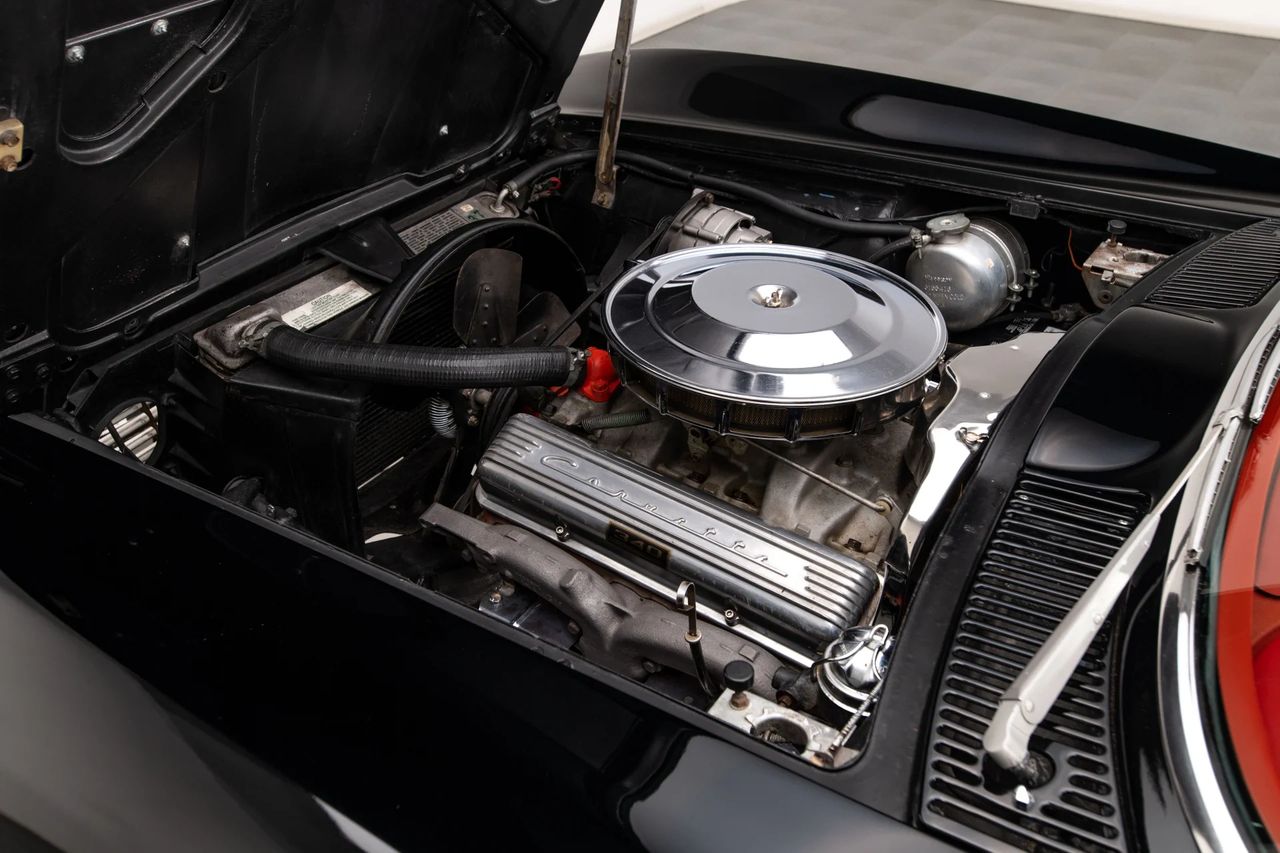
Under the hood of the 1963 Corvette Sting Ray lies Chevrolet’s potent 327-cubic-inch V8, shown here topped with a chrome air cleaner and finned aluminum valve covers proudly embossed with “Corvette.” Depending on configuration, this small-block delivered between 250 and 360 horsepower, with the top-tier fuel-injected version making the Sting Ray a genuine world-class performance car. Clean, purposeful, and beautifully engineered, the 327 became the beating heart of the Corvette’s second generation. (Image courtesy of RK Motors.)

While the chassis was all new, engines carried over from 1962—yet they were still formidable. Four 327-cubic-inch small-block V8s were offered:

  • 250 hp with a four-barrel carburetor
  • 300 hp with upgraded valves and manifolds
  • 340 hp with a hotter cam
  • 360 hp with Rochester mechanical fuel injection (RPO L84)

The top “fuelie” made the Sting Ray a true giant killer, capable of 0-60 mph in under six seconds and top speeds north of 130 mph. As Car Life wrote: “The small-block Chevy remains America’s best contribution to the internal combustion engine.”

Transmission choices included a three-speed manual, Powerglide automatic, and the enthusiast’s favorite: a Borg-Warner four-speed, ordered by nearly four out of five buyers. Axle ratios ranged from 3.08 to 4.56:1, catering to both highway cruisers and drag-strip warriors.

Stopping Power

For the first time, the Corvette offered real stopping confidence. Larger 11-inch cast-iron drum brakes came standard, with optional sintered-metallic linings and finned aluminum “Al-Fin” drums for racers. Power assist was available too. Although four-wheel disc brakes would not arrive until 1965, the ’63 was already a step ahead of many rivals.

Inside the Cockpit
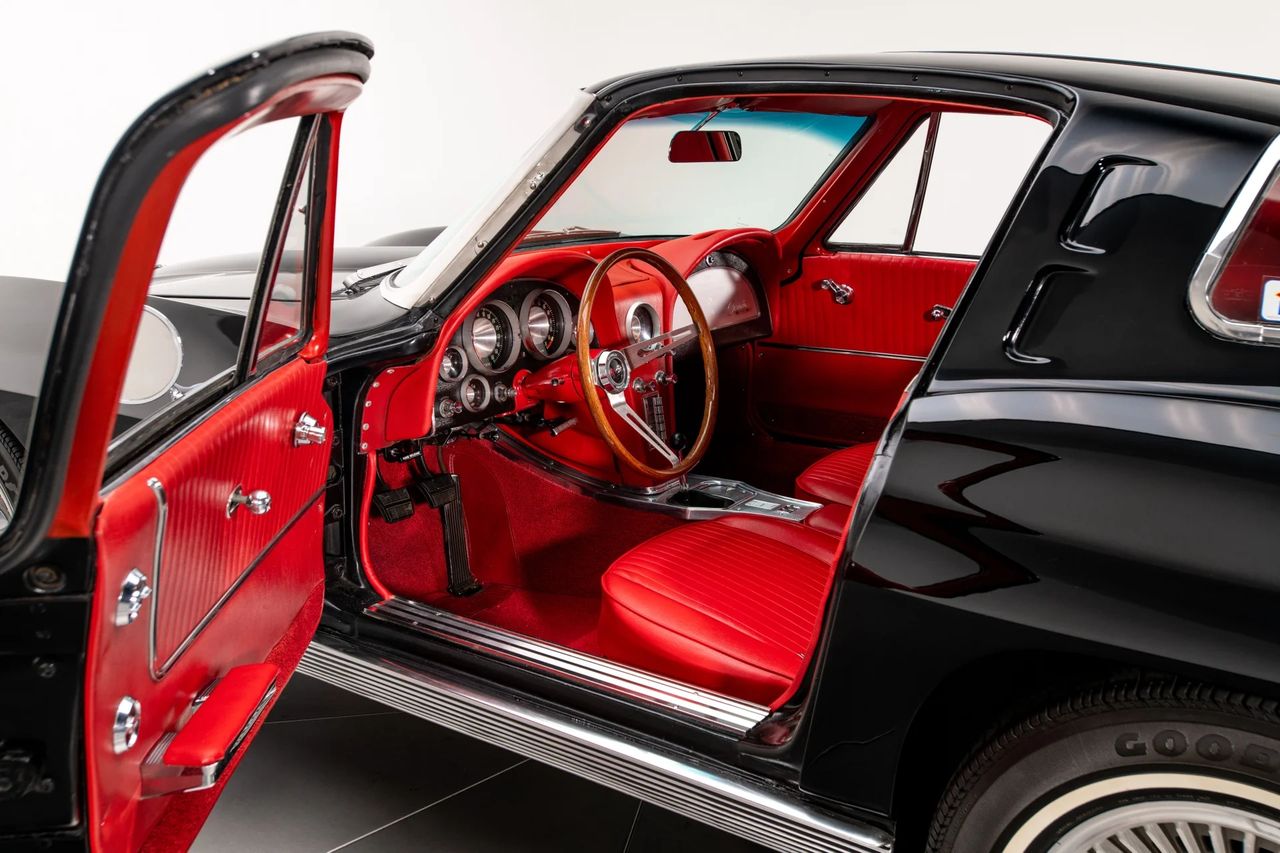
The interior of the 1963 Corvette Sting Ray was as groundbreaking as its exterior, blending race-inspired function with upscale refinement. Shown here in striking red, the cabin features contoured bucket seats, full instrumentation, and a wood-rimmed steering wheel—all laid out in a driver-focused cockpit. It was a dramatic step forward from the first-generation Corvette, offering both performance-oriented ergonomics and a touch of luxury that elevated the Sting Ray to true world-class status. (Image courtesy of RK Motors.)

The C2 interior reflected a new level of refinement. Low-back bucket seats, a deep-dish steering wheel, and full instrumentation gave drivers a fighter-jet vibe. For the first time, amenities like leather upholstery, air conditioning (278 cars), and power windows were available.

Even Car and Driver, usually critical of American ergonomics, praised the Sting Ray’s cockpit as “sporting yet civilized.”

Zora’s Secret Weapon: The Z06
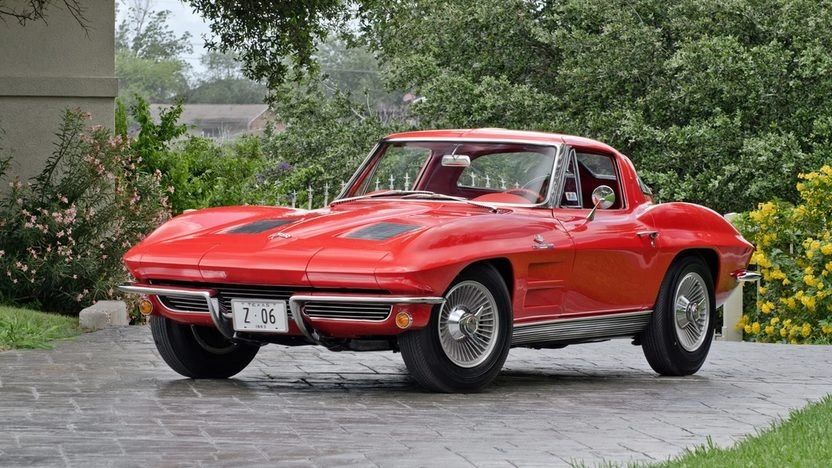
Pictured here is a stunning 1963 Corvette Sting Ray Z06, finished in Riverside Red and fitted with knock-off style wheels. The Z06 package, masterminded by Zora Arkus-Duntov, transformed the already groundbreaking Sting Ray into a track-ready weapon with heavy-duty suspension, upgraded brakes, and the potent 327ci fuel-injected V8. With only 199 built in 1963, and just 63 featuring the optional 36.5-gallon “big tank,” the Z06 remains one of the rarest and most desirable Corvettes ever produced.

Duntov, ever the racer, wanted customers to have a Corvette that could dominate the track. Out of this came RPO Z06, a competition package that quietly slipped past GM’s racing ban.

For $1,818.45—nearly half the cost of a base Corvette—the Z06 added heavy-duty suspension, larger brakes with dual master cylinder, a thicker anti-roll bar, and most importantly, a 36.5-gallon fuel tank for endurance racing. Buyers also had to specify the L84 fuel-injected 360-hp engine, four-speed manual, and Positraction differential.

Only 199 Z06s were built in 1963, 63 of them with the “big tank.” Most went to racers like Dave MacDonald and Mickey Thompson. Survivors today are among the rarest and most valuable Corvettes ever produced.

The Grand Sport Dream
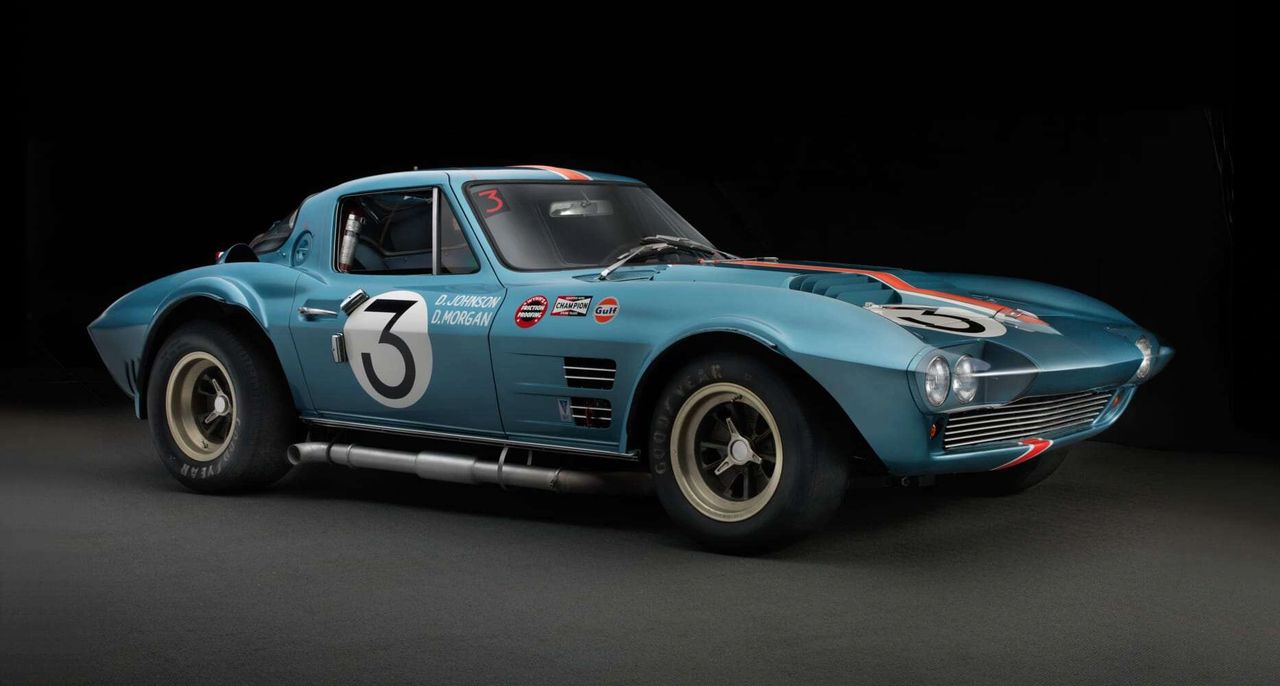
This image features the legendary 1963 Corvette Grand Sport, one of only five ever built by Zora Arkus-Duntov and his engineering team. Finished in racing blue and wearing the number 3, the car was purpose-built to challenge Carroll Shelby’s Cobra with its lightweight body, widened stance, and a ferocious small-block V8 producing over 500 horsepower. Though GM’s internal racing ban cut the program short, the Grand Sport proved its dominance in privateer hands, becoming one of the most mythical and desirable Corvettes in history.

Yet Duntov wasn’t satisfied. He envisioned a lighter, more radical racing Corvette to take on Carroll Shelby’s Cobras. The result was the 1963 Grand Sport, a stripped-down Sting Ray with aluminum and magnesium components, four-wheel disc brakes, and a 550-hp 377-ci small-block.

Only five Grand Sports were built before GM brass shut the project down. But in their brief outings, they proved fearsome. At Nassau in 1963, they outpaced Cobras by 9 mph on the straights. As racer Dick Thompson recalled: “The Grand Sport was the car Zora always wanted the Corvette to be.”

Sales Triumph

If the Grand Sport was a racer’s fantasy, the production Sting Ray was a showroom sensation. Chevrolet built 21,513 Corvettes for 1963—a 50 percent increase over 1962. For the first time, a coupe body style was offered alongside the convertible, splitting sales nearly evenly (10,594 coupes, 10,919 convertibles).

Customers lined up despite wait times of up to two months, often paying full sticker price. Demand was so great that Chevrolet added a second shift at its St. Louis plant.

The Sting Ray even buoyed the values of earlier Corvettes, making the C1 one of the first postwar cars to appreciate above its original sale price.

Market Reception
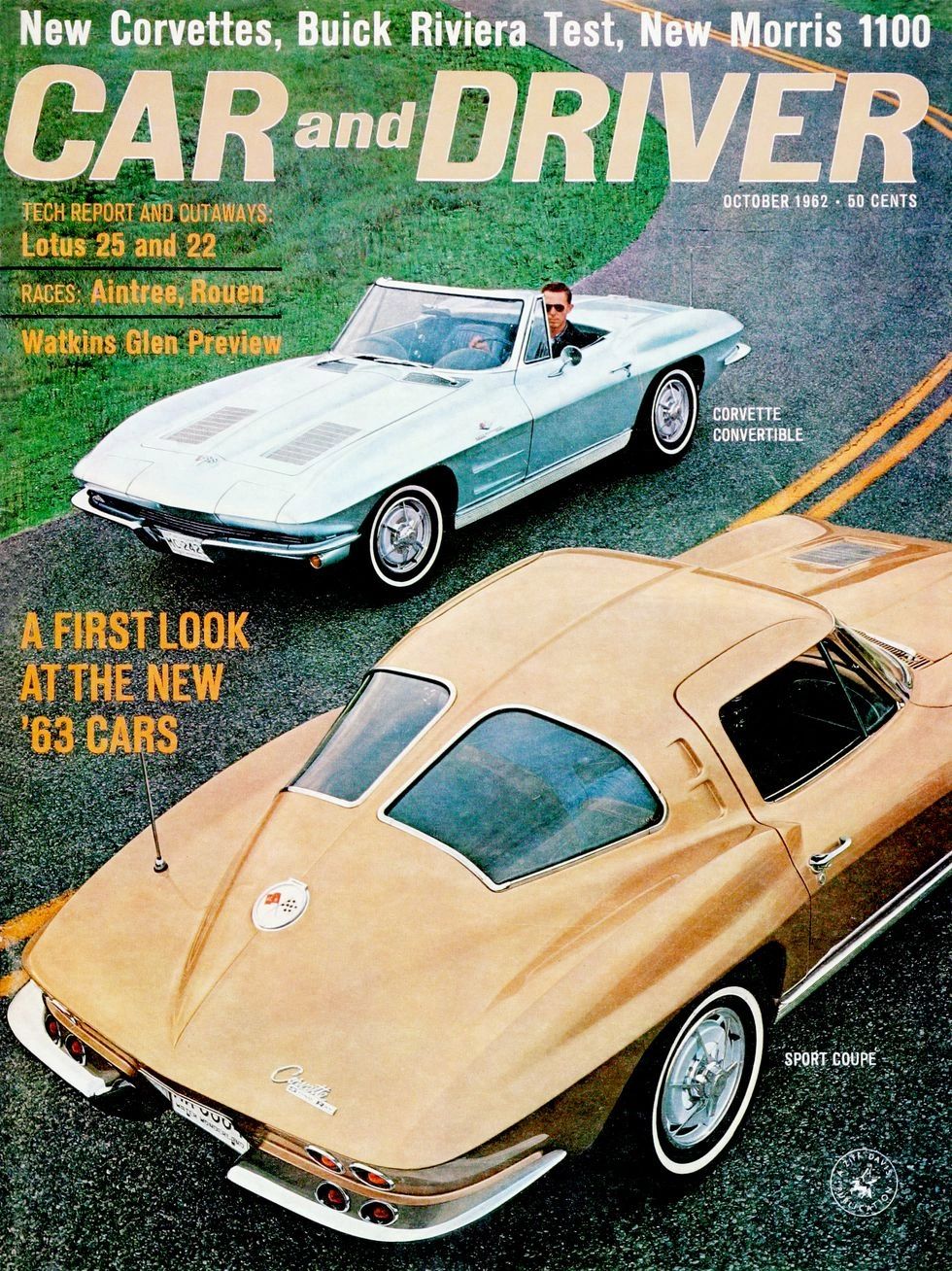
This vintage October 1962 cover of Car and Driver spotlights the brand-new 1963 Corvette Sting Ray, giving readers their first in-depth look at Chevrolet’s revolutionary second-generation sports car. The cover shows both body styles—the futuristic Split-Window Coupe in gold and the sleek convertible in white—capturing the dramatic design leap that stunned the automotive world. Priced at just 50 cents, this issue heralded the dawn of a new Corvette era that combined show-car styling with world-class engineering. (Image courtesy of Car & Driver Magazine)

The press was almost universally impressed. Car Life awarded the Sting Ray its “Engineering Excellence” trophy. Car & Driver declared: “Corvette has finally come of age.”

The lone controversy was the split rear window. Critics called it impractical and dangerous to visibility. Duntov himself detested it. Bowing to pressure, Mitchell relented, and for 1964 the coupe switched to a single rear window. Ironically, the “flaw” made the ’63 coupe one of the most coveted collector cars ever.

Specifications and Performance

  • Engines: 327 V8 (250–360 hp)
  • Transmissions: 3-spd manual, 4-spd manual, 2-spd Powerglide auto
  • Brakes: 11-inch drums (optional metallic linings, Al-Fin drums)
  • Suspension: Independent rear with transverse leaf, coil-spring front
  • Performance: 0-60 mph in 5.9 sec (fuel-injected); quarter-mile ~14.6 sec; top speed 130+ mph

Legacy
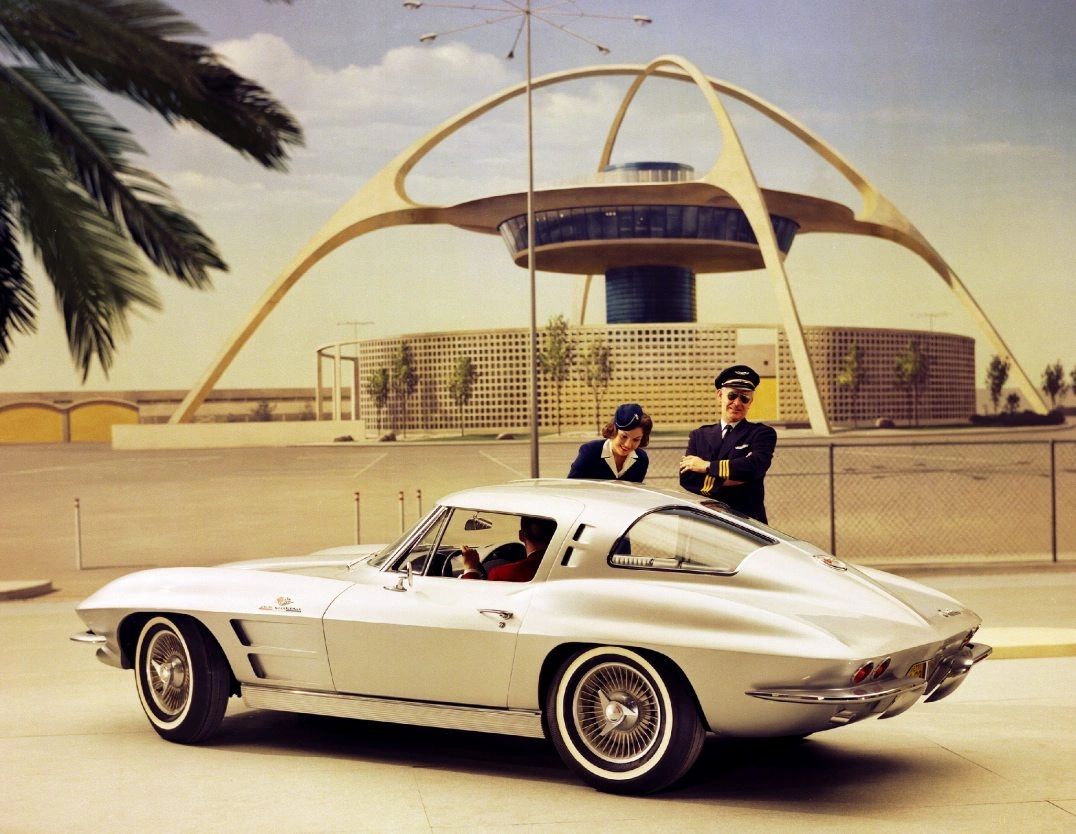
This period promotional photo captures the futuristic spirit of the 1963 Corvette Sting Ray Split-Window Coupe, posed in front of the equally space-age LAX Theme Building in Los Angeles. The sleek silver coupe, with its dramatic fastback roofline and turbine-style knock-off wheels, embodies the jet-age optimism of the early 1960s. Together, the Sting Ray and the modernist architecture symbolized America’s confidence in design, technology, and innovation at the dawn of a new era. (Image courtesy of GM Media LLC.)

The 1963 Corvette Sting Ray was more than just a new model—it was a cultural statement. It arrived at a time when America was flexing its technological might, and it showed that a U.S. automaker could build a sports car of global stature.

Its design remains timeless, its engineering innovations set the stage for decades, and its Z06 and Grand Sport variants planted the seeds for Corvette’s racing dominance.

As Bill Mitchell said years later: “The ’63 Corvette was the car that proved we could do it all—style, performance, and soul. It was America’s Sting Ray.”

Production Numbers

  • Total: 21,513
  • Coupes: 10,594 ($4,257 base)
  • Convertibles: 10,919 ($4,037 base; over half with hardtops)

Conclusion
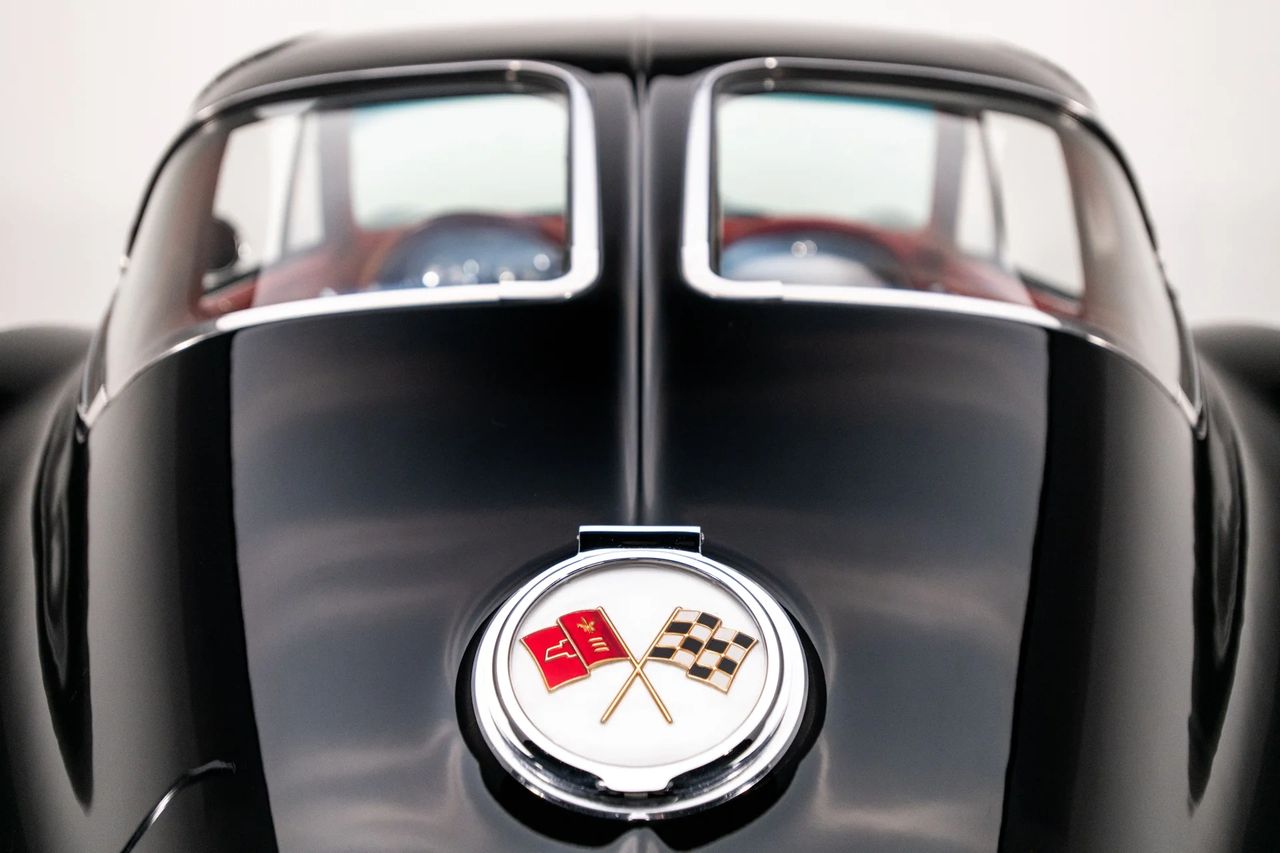
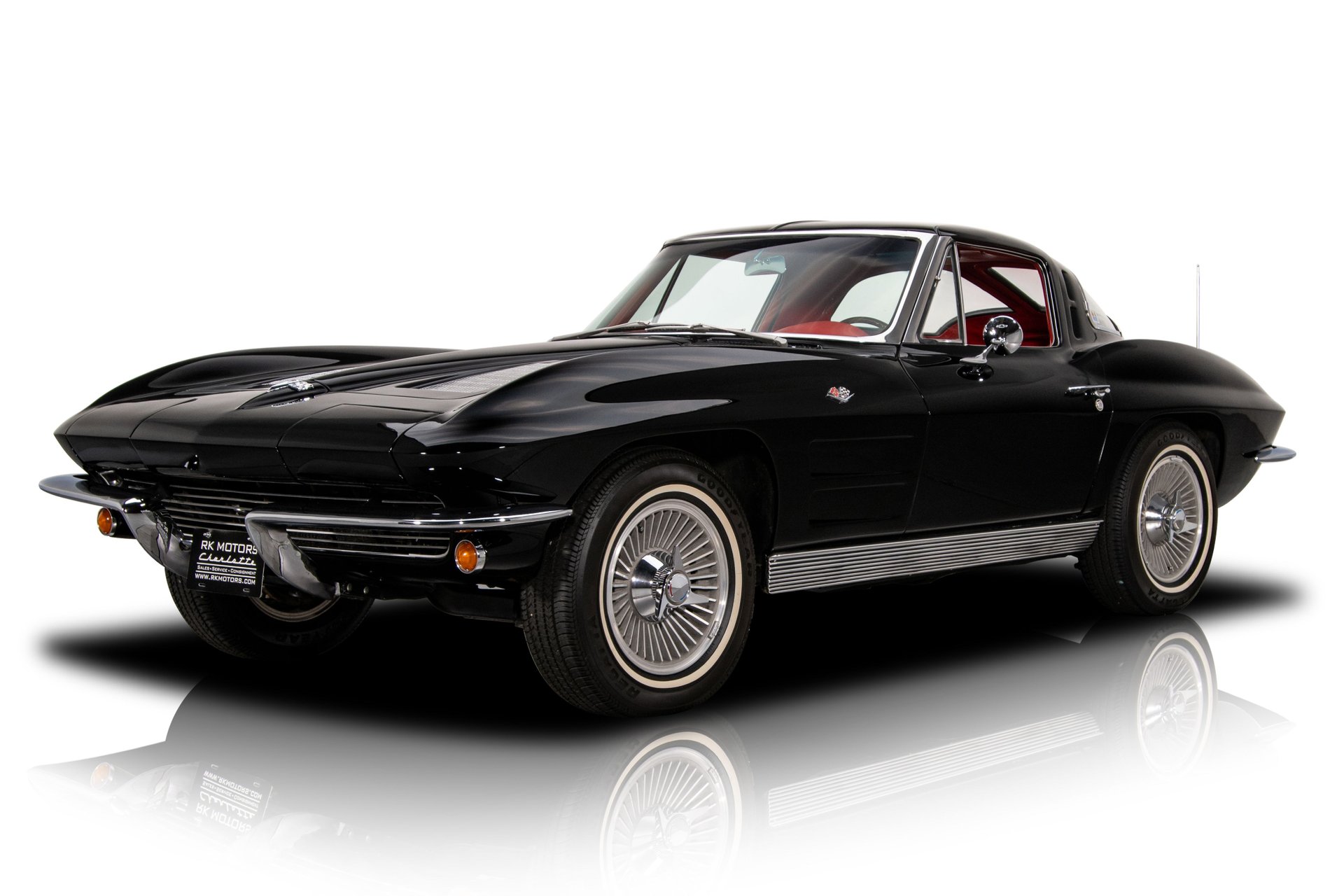
The rear split window was unique to the 1963 model year.  It was deemed so controversial when introduced that many owners had the rear glass assembly converted to a single, wrap around window.  Little did they realize that they were seriously hurting the future value of the car!  (Image courtesy of RK Motors.)
The rear split window was unique to the 1963 model year. It was deemed so controversial when introduced that many owners had the rear glass assembly converted to a single, wrap around window. Little did they realize that they were seriously hurting the future value of the car! (Image courtesy of RK Motors.)

The 1963 Corvette Sting Ray remains one of the most significant sports cars ever produced—not just in Corvette history, but in the entire automotive landscape. It fused racing technology with show-car style, captured the spirit of its era, and laid the foundation for Corvette’s transformation from niche fiberglass experiment to America’s enduring sports car icon.

More than 60 years later, its split-window coupe still stops collectors in their tracks. Its Z06 and Grand Sport variants still inspire the modern Corvette performance lineage. And its presence reminds us why, in 1963, America fell in love with the Sting Ray.