
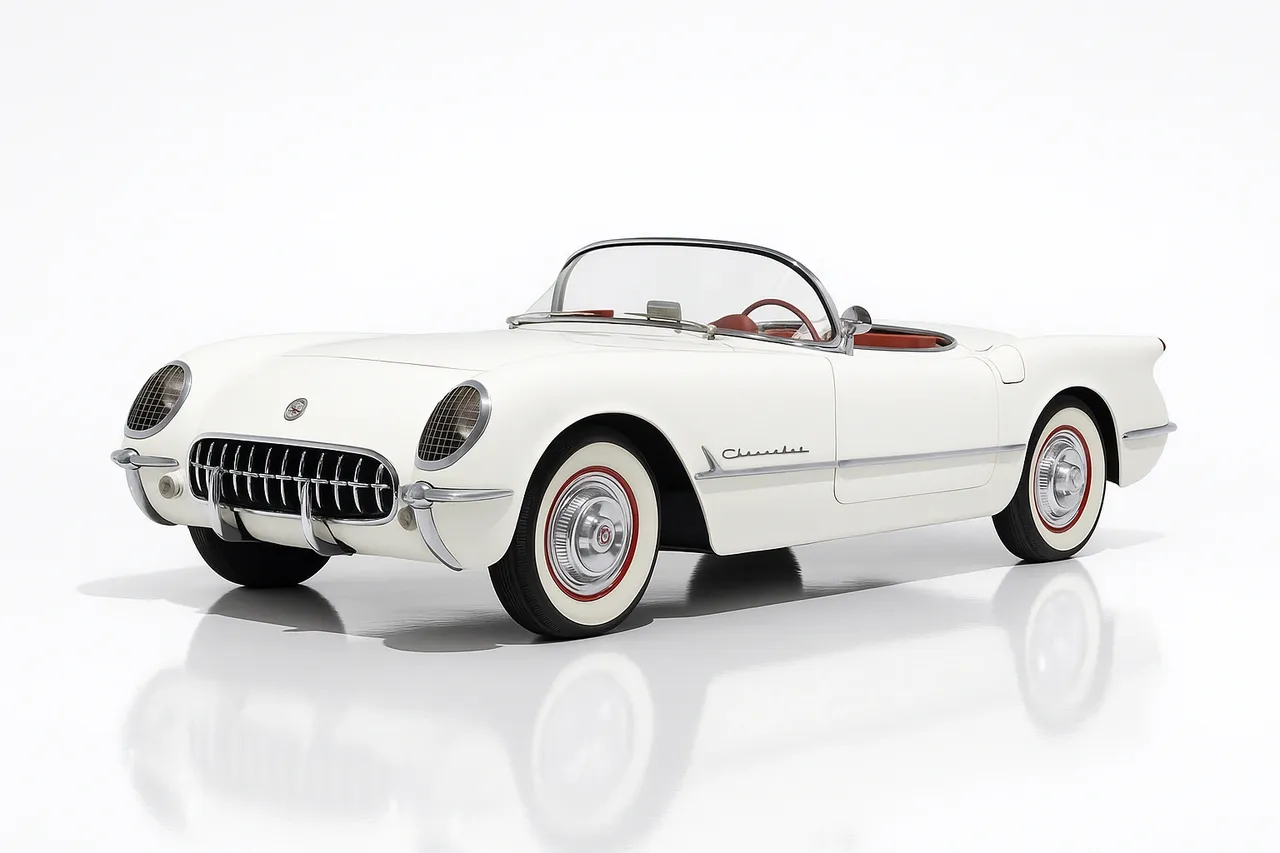
On January 17, 1953, Chevrolet rolled its EX-122 two-seat “dream car” onto the stage at GM’s glittering Motorama in New York’s Waldorf-Astoria, and the effect was electric. Beneath the chandeliers of that storied ballroom, America caught its first glimpse of a fiberglass-skinned roadster unlike anything to ever wear a bowtie. The moment had the pulse of theater—bright lights, orchestras, choreographed models striding past the car as if it were haute couture. Crowds queued in the bitter January cold just for a chance to press forward and see the future up close. GM brass, led by interim president Harlow Curtice, stood at the receiving line as if presenting royalty. By the end of that first day, an estimated 50,000 people had filed through to marvel at the Corvette prototype. And as the Motorama caravan crisscrossed the nation—Detroit, Miami, Los Angeles, San Francisco—the tally would swell past a million Americans, all seduced by the idea that Chevrolet had conjured not just a car, but a dream on wheels.
- Press excerpt (1953): Popular Mechanics, looking ahead in mid-1953, teased readers about Chevrolet’s coming sports car: “Chevrolet’s newest model, the two-seater sports car, the Corvette… is expected to have a terrific impact… on the whole industry.”
Greenlit Before the Applause
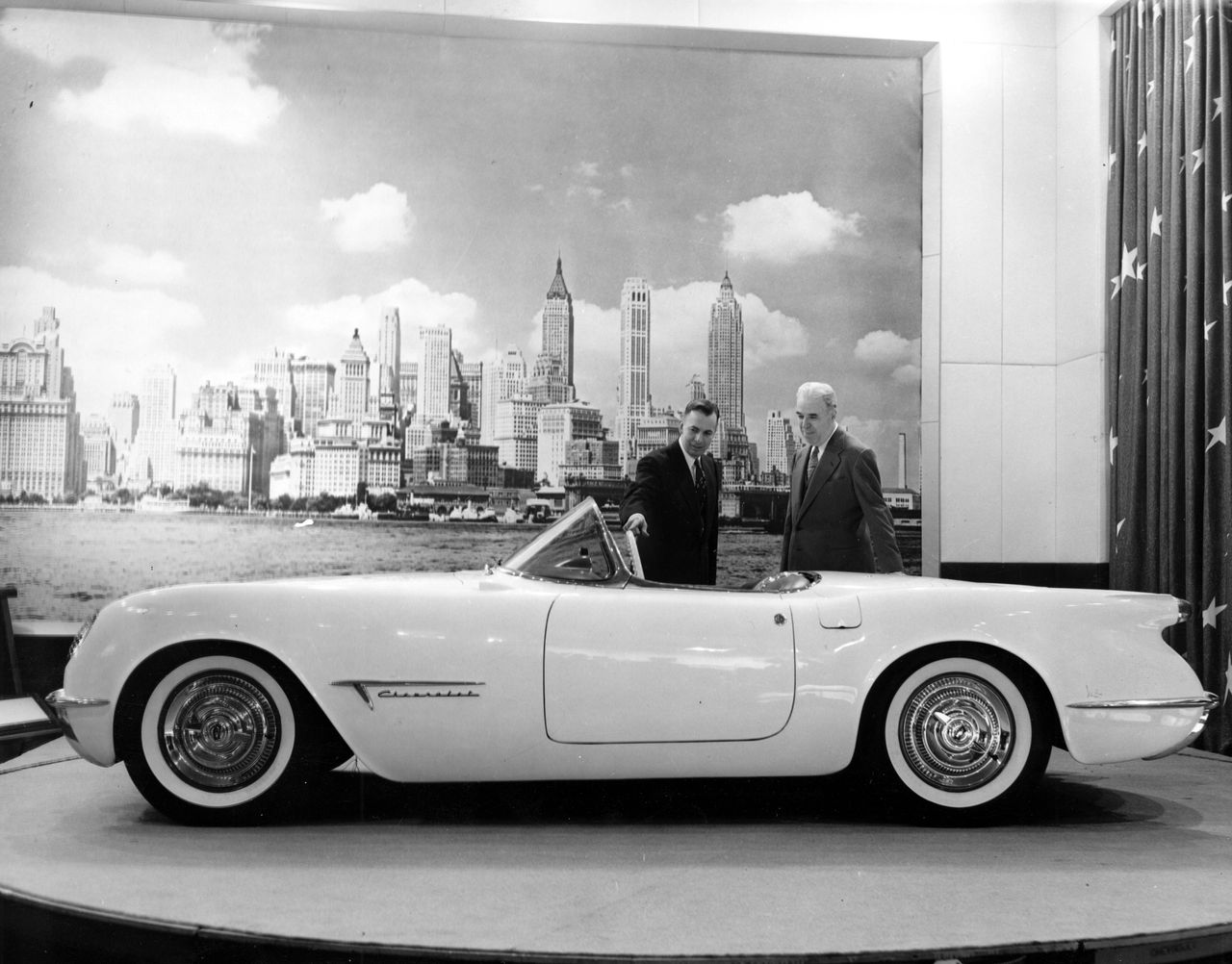
Behind the velvet curtain, the decision had already been made. Chevrolet general manager Tom Keating and GM’s newly anointed president Harlow Curtice had quietly given the green light to build the car even before the first Motorama spotlight hit its fiberglass curves. The rapture of the crowd didn’t change their minds—it simply lit the fuse. What followed was nothing short of unprecedented: within just six months, Chevrolet transformed a show-stopping dream car into a production reality. On June 30, 1953, in a corner of GM’s Flint assembly plant, the first production Corvette rolled into the light. It wasn’t born on a high-volume line but in a kind of handcrafted ritual, each body laid up in fiberglass, each piece assembled with the urgency of a moonshot. By year’s end, only 300 Corvettes would exist—rare, fragile, almost experimental machines that announced not just a new model, but the arrival of America’s sports car.
- Press excerpt (1953): From a period newspaper report reprinted by Click Americana: “Chevrolet presented the Corvette as the first plastic-bodied automobile ever built by mass production methods.”
Why Fiberglass?
Chevrolet didn’t choose glass-reinforced plastic (GRP) for style alone. Fiberglass let GM avoid the time and capital for steel stamping dies, enabling quick, low-volume production with dramatic surfacing—and corrosion resistance to boot. But the learning curve was steep. Bodies arrived from Molded Fiber Glass Company (Ashtabula, Ohio) as subcomponents that workers jigged, bonded, and finished by hand; early panel fit and surface quality varied, and production practice evolved on the fly.
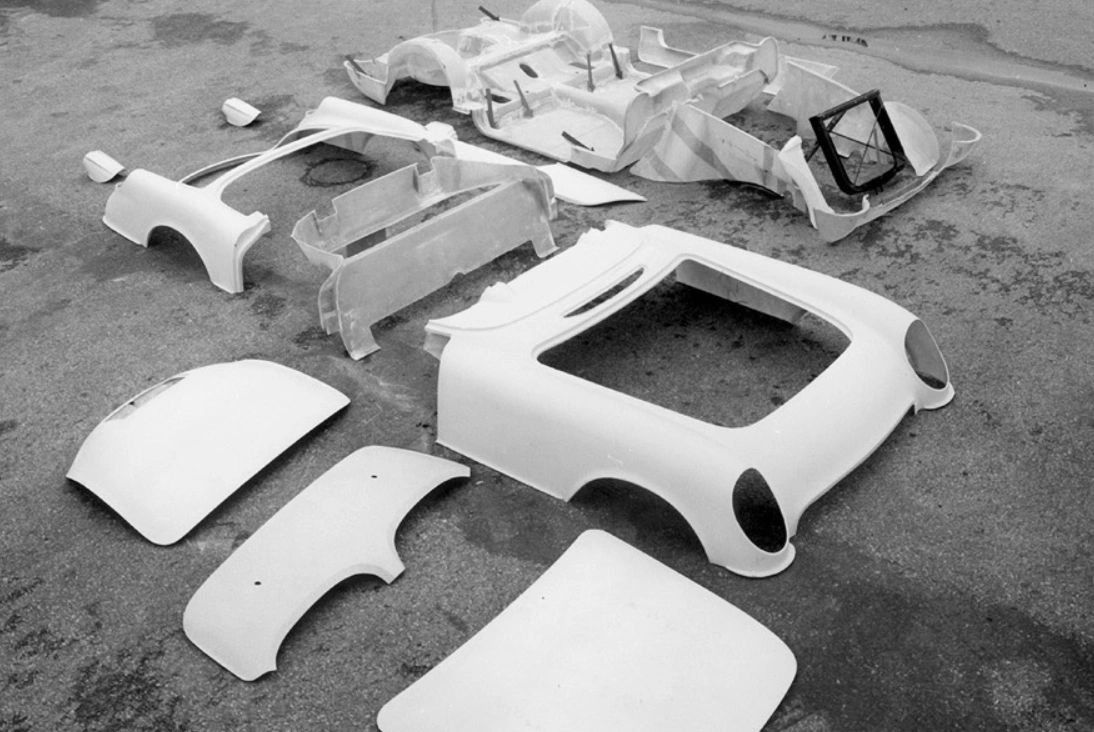
Period figures frequently cited by historians: 46 separate GRP pieces formed each 1953 body before bonding into larger assemblies. While this detail is widely reported in marque histories and museum write-ups, it also appears in contemporary-style retrospectives about MFG’s role in the program.
- Press excerpt (1953): The Racine Journal Times (via Click Americana) explained the new process to readers: “Body parts are ‘cured’ into panels in 61 separate molds. The parts are then bonded and riveted together to form a body shell.” (Reprinted 10/2/1953.)
Note on numbers: The “46 pieces” describes the number of body sections assembled; the “61 molds” quoted above refers to the number of tooling molds used to cure those sections, which can exceed the number of final bonded pieces. Both reflect the intense handwork behind early production.
Hand-built in Flint

The first two Flint-built cars served as engineering test units and were later destroyed; the remaining cars were distributed in limited fashion while Chevrolet refined processes and prepared a dedicated line in St. Louis for 1954. Every 1953 car was Polo White with Sportsman Red interior and a black canvas top.
To simplify assembly, trim and equipment were standardized. Although a signal-seeking AM radio and heater were listed as options, all cars received both; fiberglass’s non-conductivity also allowed Chevrolet to hide the radio antenna in the trunk lid—a neat party trick on an all-plastic body that period restorers and marque specialists still discuss today.
Styling: American jet-age sleek
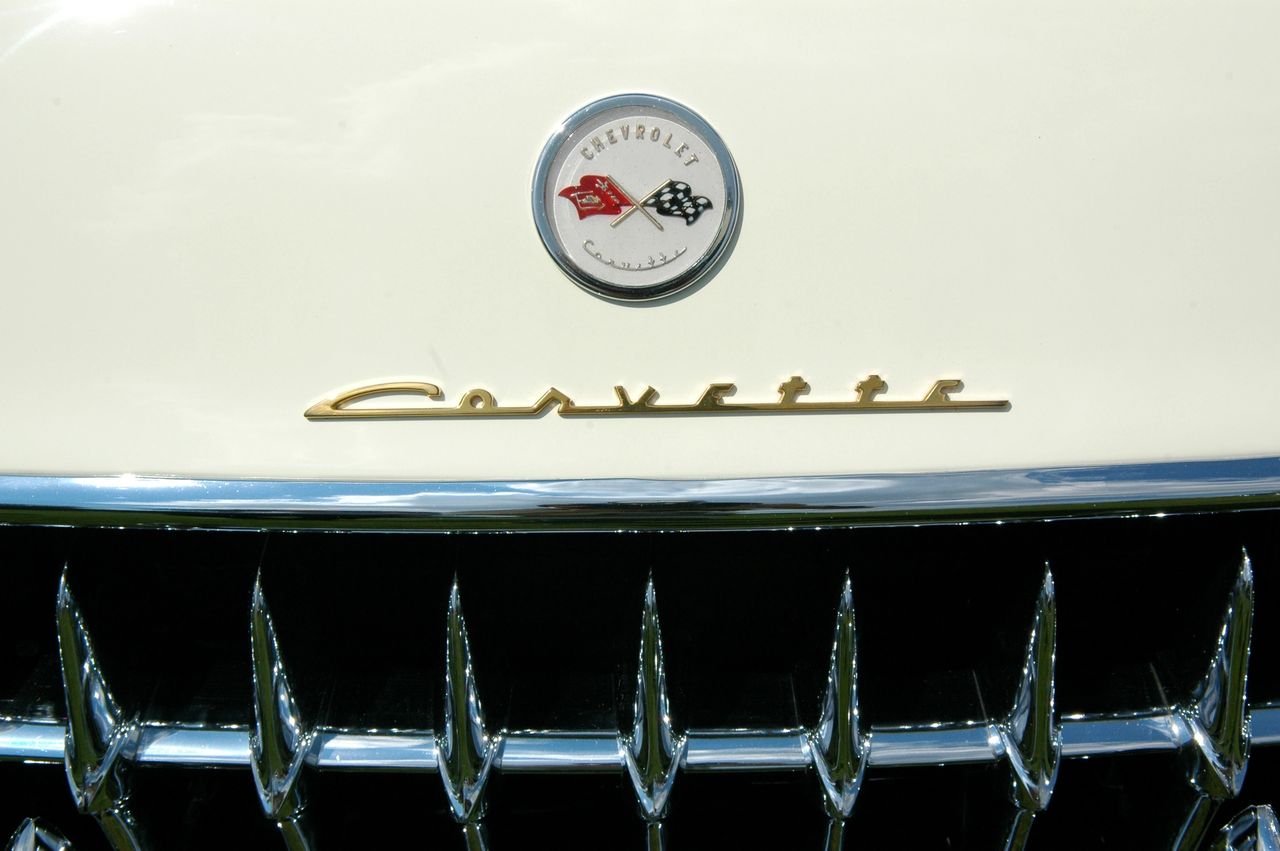
Harley Earl’s team penned a low, flowing form—grille “teeth,” faired rear fenders, a wraparound windshield—that nodded to European roadsters without abandoning American drama. The Motorama prototype’s white finish was a favorite of Earl’s for concept cars, as it highlighted complex curves under show lights and photography.
- Press excerpt (1953): A Talk-of-the-Town piece in The New Yorker captured the Motorama’s aura—Buick’s “Wildcat” and other dream cars shared the stage as GM executives greeted celebrities—underscoring the glitzy context into which the Corvette was born.
Mechanical reality: Powerglide and the Blue Flame Six
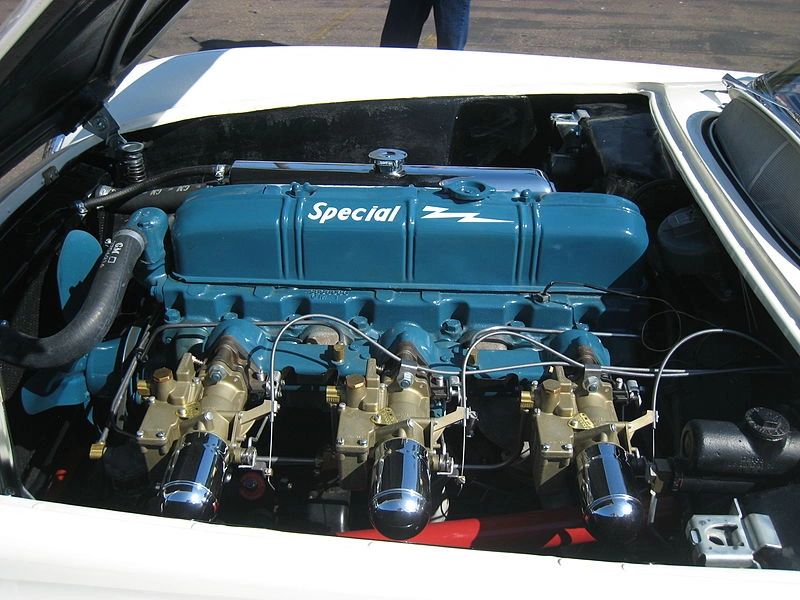
Under the long hood beat Chevrolet’s 235-cu-in Blue Flame straight-six, hot-rodded with a higher-lift cam, solid lifters, dual valve springs, 8.0:1 compression, and triple Carter YH side-draft carburetors. Output: 150 hp at 4,500 rpm—respectable for a Chevrolet six, but not exotic by European standards. Every 1953 car used the two-speed Powerglide automatic; a manual gearbox wouldn’t arrive until 1955.
Period and retrospective tests peg performance around 0–60 mph in ~11–11.5 seconds, ¼-mile ~17.9 sec @ ~77 mph, and top speed ~108 mph.
- Press excerpt (1953): Chevrolet’s own positioning (again via a 1953 news reprint) set expectations: GM’s Keating said the Corvette “is not a racing car in the accepted sense that a European car is a race car.”
Selling sizzle (and scarcity)
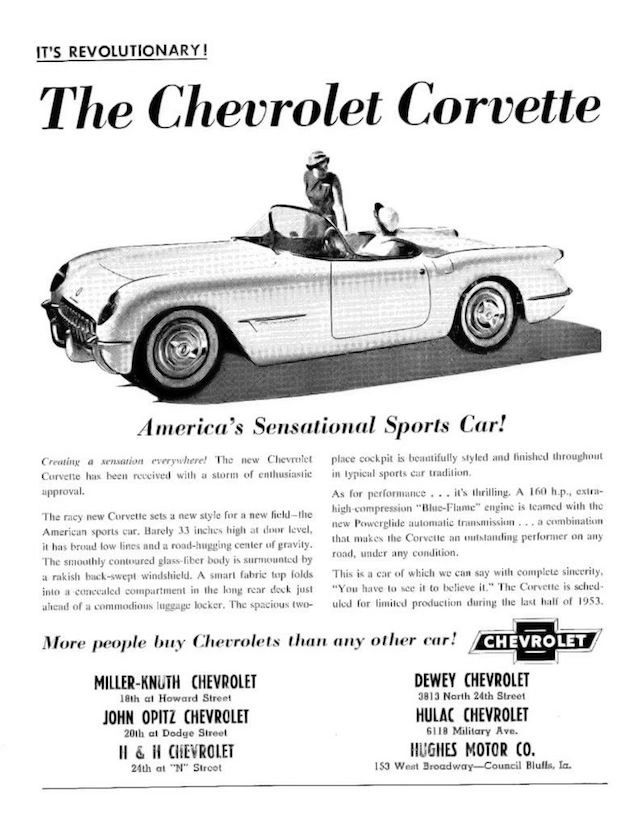
Chevrolet treated the ’53 as a prestige halo, initially rotating cars through regional showrooms and leaning on VIP allocations to build mystique—mayors, local celebrities, industrialists. The strategy generated chatter but also frustration: the public could see a Corvette yet not purchase one, and some early opinion leaders criticized the car’s “jet-age” styling, modest performance, side-curtain weather sealing, and price ($3,498).
- Press excerpt (1953): A period news report reprinted by Click Americana hyped the fundamentals—“high power-to-weight ratio, low center of gravity, and balanced weight distribution”—but also spelled out the boulevard-friendly kit: Powerglide, radio, heater, clock.
Production Numbers
- Location & date: Flint, Michigan; first car built June 30, 1953.
- Volume: 300 hand-built cars for 1953; the first two were engineering cars later destroyed.
- Spec uniformity: All Polo White / Sportsman Red / black top. Radio and heater functionally standard.
The moment that changed Corvette’s future
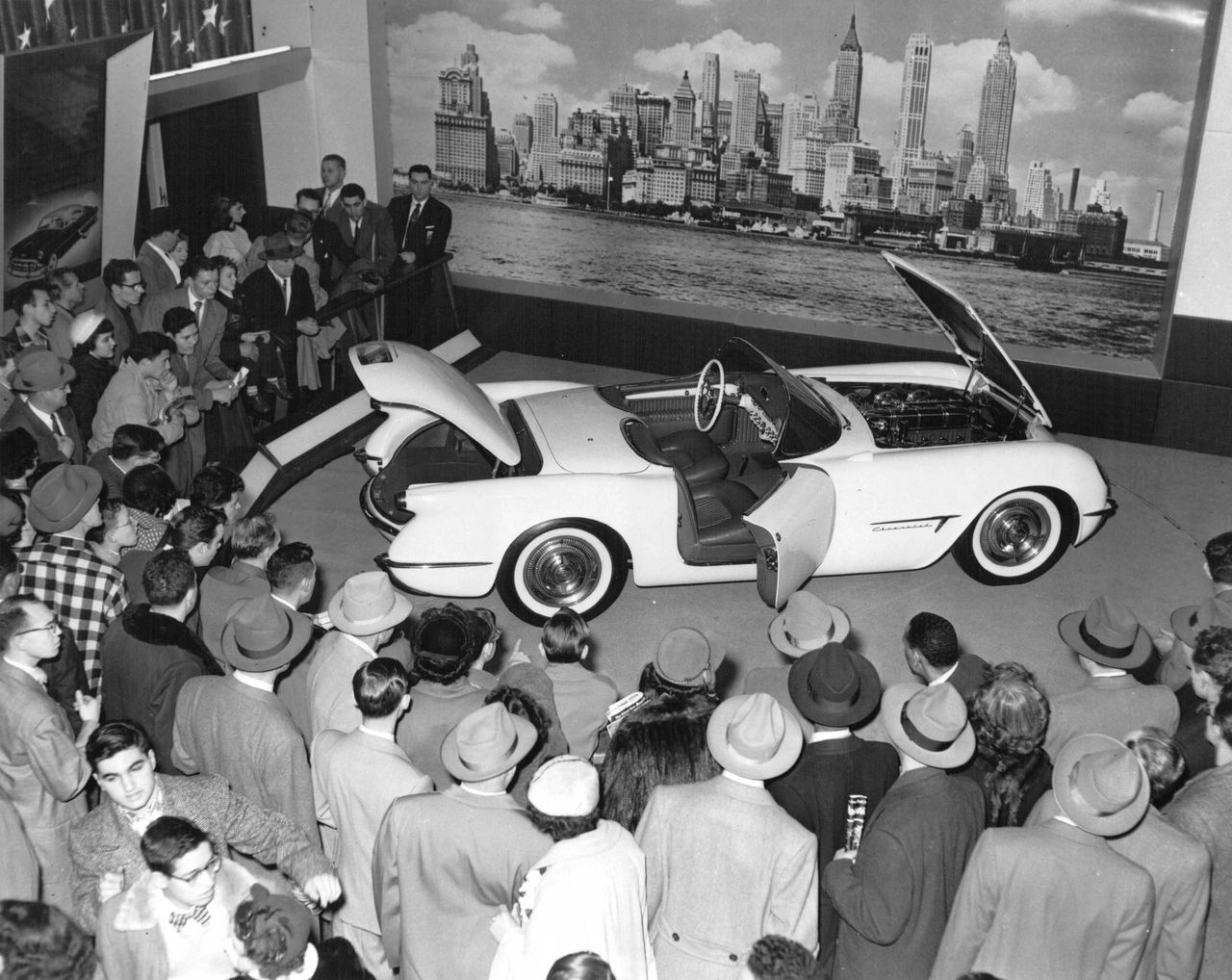
One Motorama attendee—Zora Arkus-Duntov—famously admired the Corvette’s looks but lamented its mechanicals, then wrote Ed Cole and soon joined Chevrolet (May 1, 1953). His memos and engineering leadership would drive the car toward true high performance, most dramatically with the arrival of the small-block V-8 in 1955.
Beyond the myth: What the ’53 really was
The 1953 Corvette wasn’t a lap-time champion, nor was it priced like a bare-bones British roadster. It was a bold manufacturing experiment, a halo style statement, and a deliberate brand-builder for Chevrolet. The hand-built Flint cars laid the groundwork for a far more ambitious 1954 program in St. Louis and signaled that America would have a home-grown sports car—even if the formula needed several quick revisions.
Quick-reference technical summary (1953)
- Engine: 235-cu-in OHV “Blue Flame” inline-six, 150 hp @ 4,500 rpm; triple Carter YH carbs; dual exhaust.
- Transmission: Powerglide 2-speed automatic (only).
- Chassis: Independent “Knee-Action” front; solid rear axle with semi-elliptic leaf springs.
- Body: Glass-reinforced plastic (fiberglass) bonded shell; body assembled from ~46 pieces; production used 61 molds for panels per period reporting.
- Performance (typical): 0–60 mph ~11–11.5 s; ¼-mile ~17.9 s @ 77 mph; 108 mph top speed.
- Price: $3,498 list.
- Colors: Polo White exterior / Sportsman Red interior only.
- Production: 300; Flint, MI; first car June 30, 1953.
Motorama-era press & period voices (short excerpts)
- Popular Mechanics (June 1953): “Chevrolet’s newest model, the two-seater sports car, the Corvette… is expected to have a terrific impact… on the whole industry.”
- Racine Journal Times (Oct. 2, 1953; via Click Americana): “Chevrolet… revealed for the first time the company’s facilities for the production of reinforced plastic bodies.”
- Racine Journal Times (Oct. 2, 1953; via Click Americana): “The Corvette isn’t a race car,” said Chevrolet’s T. H. Keating—distancing it from European competition focus.
- The New Yorker (Jan. 31, 1953): A “seven-day capacity run” at the Waldorf, with GM executives greeting celebrities amid dream cars like Buick’s Wildcat—setting the glamorous stage for Corvette’s debut.
Legacy
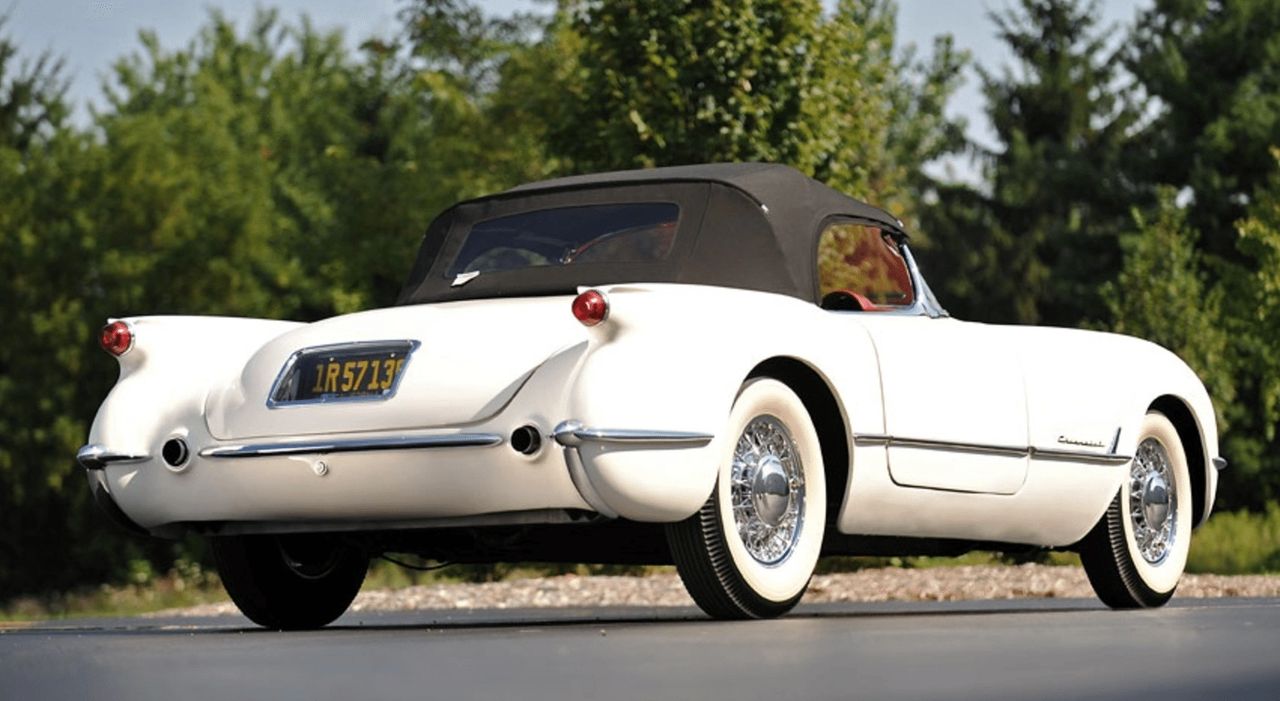
If the 1953 Corvette asked America to buy into a vision, customers answered “show us more.” Chevrolet did—quickly—adding V-8 power and manual transmissions within two years. But the spark was here: an American sports car, built with unconventional materials, wearing unforgettable style. Today the 1953s are blue-chip collectibles, rolling artifacts from the hectic months when GM turned a show car into a reality, one bonded fiberglass panel at a time.