
Tag: 1973 Chevrolet Corvette

  • 1973 CORVETTE OVERVIEW

    1973 CORVETTE OVERVIEW

    From the moment the clock struck midnight on January 1, 1973, the world seemed to sprint toward two competing futures. One path soared upward—toward discovery, ingenuity, and possibility. The other pulled sharply inward, forcing nations and institutions to reckon with protests, policy, and a growing demand for accountability.

    The positive milestones were extraordinary. NASA launched Skylab, giving America its first foothold in long-duration life beyond Earth. Rivers of oil began moving through 800 miles of frozen frontier as construction of the Trans-Alaska Pipeline entered high gear. On the other side of the globe, the Sydney Opera House opened its wind-carved sails, a monument to creativity finally realized after years of setbacks. Even diplomacy found a breakthrough, as the Paris Peace Accords formally signaled America’s exit from the Vietnam conflict.
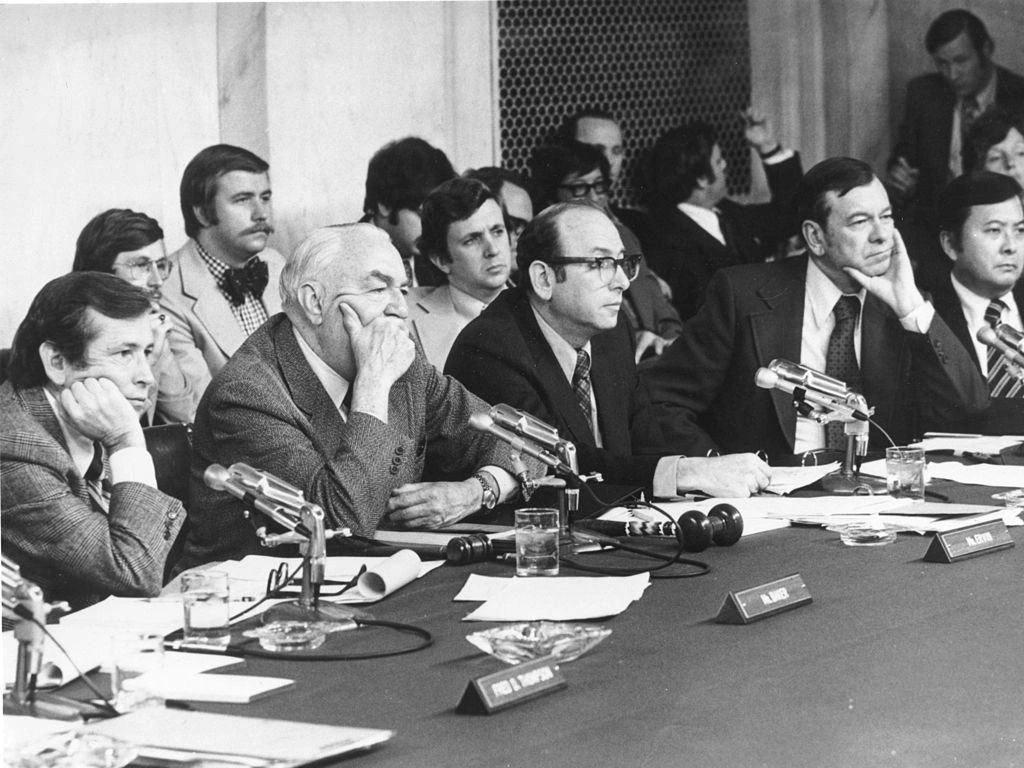
    In 1973, the U.S. Senate launched one of the most consequential investigations in American political history: the Watergate hearings. For 51 days that spring and summer, senators and special counsel interrogated the machinery behind the President’s re-election campaign—unraveling a conspiracy that stretched far beyond a botched break-in at Democratic National Committee headquarters. Broadcast live to an estimated 80 million Americans, the hearings transformed accountability into prime-time national ritual, revealing secret taping systems, coded campaign slush funds, and testimony that exposed deliberate obstruction at the highest levels of government. What began as political scandal evolved into constitutional crisis, redefining public expectations of transparency and proving that even the most powerful institutions must eventually answer to the unblinking eye of record. (photo credit: Gene Forte)
    In 1973, the U.S. Senate launched one of the most consequential investigations in American political history: the Watergate hearings. For 51 days that spring and summer, senators and special counsel interrogated the machinery behind the President’s re-election campaign—unraveling a conspiracy that stretched far beyond a botched break-in at Democratic National Committee headquarters. Broadcast live to an estimated 80 million Americans, the hearings transformed accountability into a prime-time national ritual, revealing secret taping systems, coded campaign slush funds, and testimony that exposed deliberate obstruction at the highest levels of government. What began as a political scandal evolved into a constitutional crisis, redefining public expectations of transparency and proving that even the most powerful institutions must eventually answer to the unblinking eye of record. (photo credit: Gene Forte)

    Yet political turbulence was impossible to ignore. The Watergate hearings began to tighten around the Nixon administration. The Supreme Court issued its landmark Roe v. Wade ruling, triggering national celebration for some and organized political backlash for others. The Yom Kippur War was still months away, but tensions in the Middle East were already simmering, with global oil politics becoming visibly unstable. Social movements filled streets and headlines, reshaping conversations around civil rights, women’s rights, and public trust in institutions.

    And while the world wrestled with reinvention, so did Detroit—literally. NHTSA bumper mandates for low-speed impacts forced new engineering priorities across the auto industry. Chevy’s Corvette, celebrating 20 years of defying convention, met the moment not by retreating from innovation but reframing it. The 1973 model debuted its federally-required rubberized front bumper—less about yielding to aesthetics, more about adapting a performance icon to a new cultural reality.
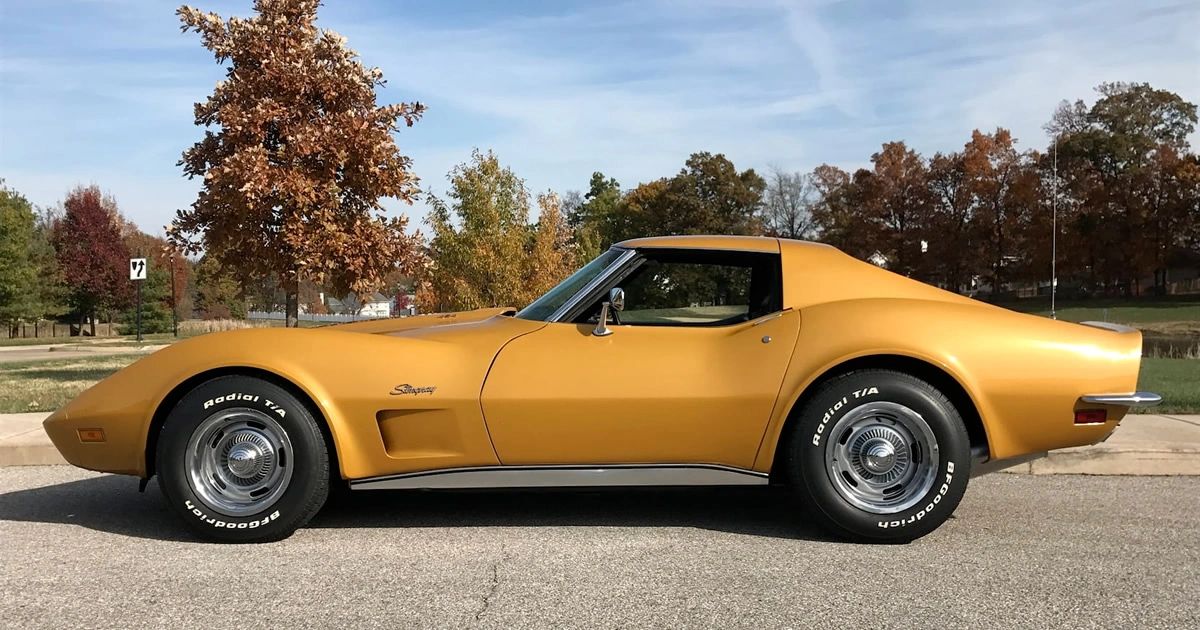
    In profile, this 1973 Corvette makes its point quietly: the familiar shark nose is now a body-color urethane bumper, with no trace of the gleaming chrome “bumperettes” that defined earlier C3s. It was the first Corvette to trade brightwork for impact-absorbing engineering up front, even as the traditional chrome rear bumper hung on for just one more year—literally marking 1973 as the hinge between eras. (Image courtesy Corvette Action Center)
    In profile, this 1973 Corvette makes its point quietly: the familiar shark nose is now a body-color urethane bumper, with no trace of the gleaming chrome “bumperettes” that defined earlier C3s. It was the first Corvette to trade brightwork for impact-absorbing engineering up front, even as the traditional chrome rear bumper hung on for just one more year—literally marking 1973 as the hinge between eras. (Image courtesy Corvette Action Center)

    What mattered most wasn’t the bumper itself, but what it represented: a car built from fiberglass and rebellion learning to work within a world demanding resilience, responsibility, and reinvention—without losing its spirit, or its speed.

    Years earlier, Zora Arkus-Duntov had joked that Corvette was “too rough for boulevard duty but built for endurance,” and the 1973 car somehow honored that spirit while sanding down its sharpest edges. More than any Corvette before it, this was a car of compromise—but not in the sense of surrender. It was a negotiation for continuation, a way of carrying the performance torch into a world that now demanded crash standards, emissions controls, and a different kind of responsibility. It marked the quiet end of the chrome-bright era and the beginning of a Corvette whose shape was dictated more by engineering function than showroom flash. Chevrolet never formally stamped “form follows function” into its press materials in 1973, but the car made the statement without needing words. The rest of Detroit just wouldn’t feel those words for another decade.

    The Federal Mandate Meets the Mako Shark
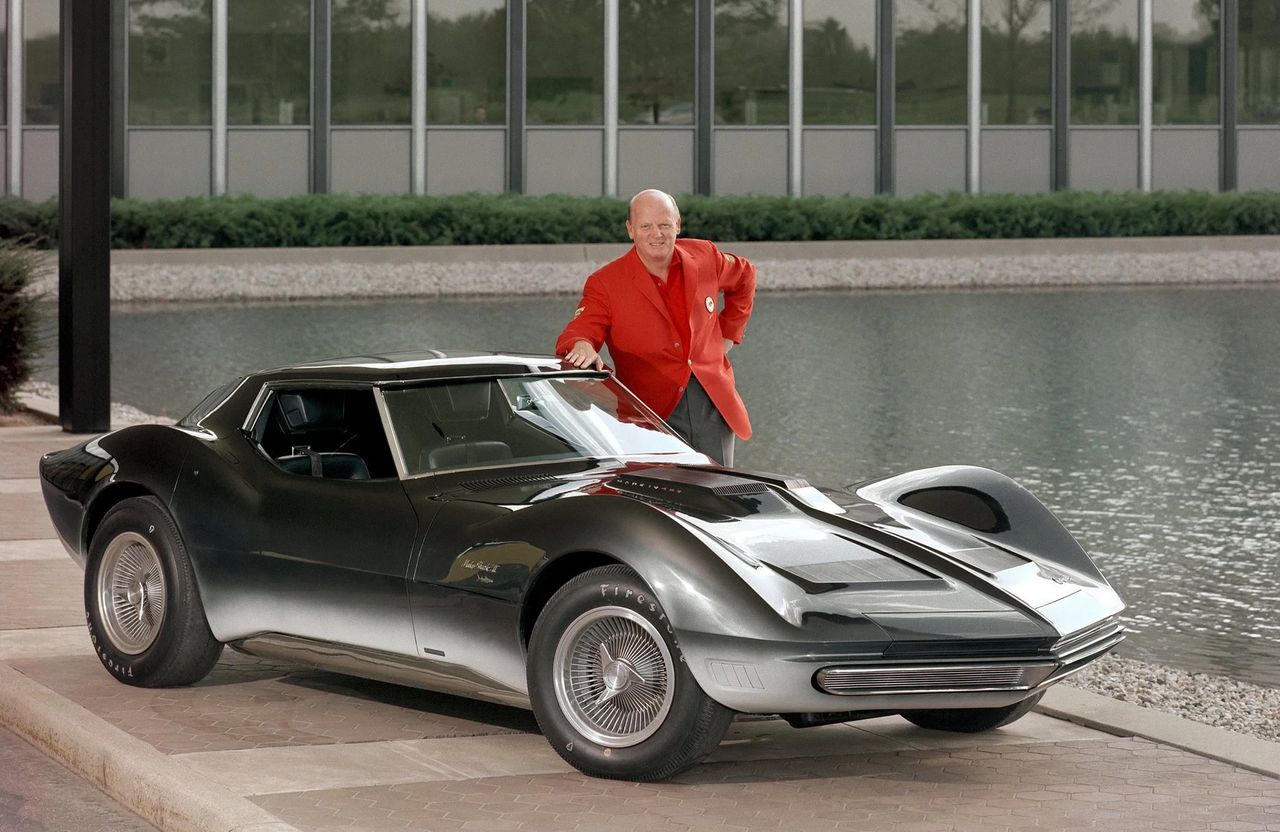
    The Mako Shark II was the purest expression of late-’60s Corvette fantasy—a rolling manifesto of knife-edge fenders, a pinched, chrome-laden nose, and bodywork that seemed to ignore anything as mundane as crash standards. By 1973, that attitude simply couldn’t survive the new NHTSA 5-mph bumper mandate. The production Corvette’s front end had to evolve into a longer, urethane-covered impact structure that could deform and recover without shattering paint or fiberglass. In the process, the Mako’s theatrical spear-point face was softened into something more compliant and durable—proof that even the most dramatic show car visions eventually answer to regulation, or disappear.
    The Mako Shark II was the purest expression of late-’60s Corvette fantasy—a rolling manifesto of knife-edge fenders, a pinched, chrome-laden nose, and bodywork that seemed to ignore anything as mundane as crash standards. By 1973, that attitude simply couldn’t survive the new NHTSA 5-mph bumper mandate. The production Corvette’s front end had to evolve into a longer, urethane-covered impact structure that could deform and recover without shattering paint or fiberglass. In the process, the Mako’s theatrical spear-point face was softened into something more compliant and durable—proof that even the most dramatic show car visions eventually answer to regulation, or disappear. (Image courtesy of GM Media LLC.)

    When the C3 Corvette debuted for 1968, it landed like a Space Age statement—arriving at the height of America’s race to the Moon, just months before the Apollo 11 mission would make history. The car wasn’t merely new, it was transformative: lower, chiseled, aggressively surfaced, and sparkling with chrome like the edge of a turbine blade catching runway sun. It felt inevitable, as though it had been shaped in a wind tunnel designed by dreamers instead of committees. The Mako Shark II concept that inspired it was a car that treated styling as an event-horizon breaker, a philosophy of motion even at rest. That original design era—from 1970 through 1972 for production customers—still delivered Corvettes powered by high-compression, mechanical-lifter, small-block engines, breathing through independent fender vent grilles and framed by delicate chrome bumpers that carried more ego than apology. It was a time when the Corvette shape led first, and engineering was asked to follow—quickly, dramatically, and always under protest.

    In 1973, the team behind the Corvette reversed the order completely, not by preference, but by ultimatum. That was the year the United States government demanded something automotive designers had historically dreaded: durability without negotiation. Beginning in 1973, every new passenger car sold in the country had to carry a bumper system capable of surviving a 5-mph impact without cosmetic damage. For most manufacturers, this translated into bulkier reinforcements and styling that suddenly looked like it had been engineered for combat instead of motion. But the Corvette’s rebellion had always been its altitude—low enough to defy convention, sharp enough to mock physics, compact enough to embarrass compromise. Those very strengths became the problem. Chevrolet didn’t need focus groups to confirm it. The engineers, product planners, and designers all saw the same unwelcome reality: you could not armor the existing 1968 Mako-derived front fascia against 5-mph impacts without destroying the car’s proportion, inviting infinite warranty claims, or handing the enthusiastic press a loaded rifle by which to cripple credibility.
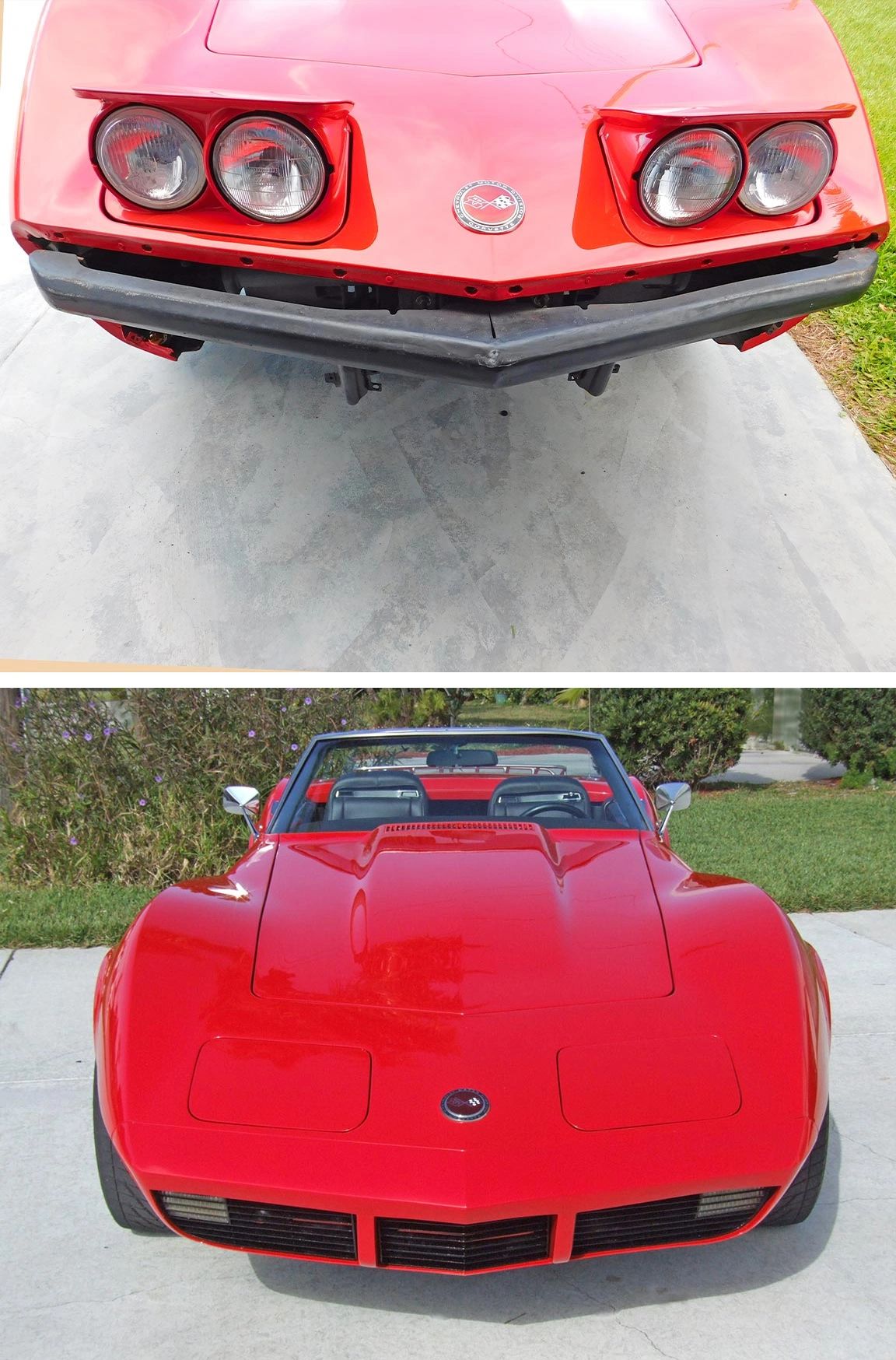
    The upper photo reveals the true front bumper structure of the 1973 Corvette—the steel impact bar engineered to meet new 5-mph NHTSA durability mandates, normally invisible to the public eye. Beneath the theatrics of the earlier Mako-inspired chrome nose, this is the hardware that had to absorb and yield, protecting paint and fiberglass from a regulatory impact it was never designed to face. The lower image shows that same engineering now concealed beneath a body-matched urethane fascia, a compliant skin that preserved Corvette’s low, sharp identity while sacrificing the chrome sparkle up front. It wasn’t design revisionism—it was design triage: function first, beauty salvaged second. (Images courtesy of Corvette Magazine)
    The upper photo reveals the true front bumper structure of the 1973 Corvette—the steel impact bar engineered to meet new 5-mph NHTSA durability mandates, normally invisible to the public eye. Beneath the theatrics of the earlier Mako-inspired chrome nose, this is the hardware that had to absorb and yield, protecting paint and fiberglass from a regulatory impact it was never designed to face. The lower image shows the same engineering now concealed beneath a body-matched urethane fascia, a compliant skin that preserved Corvette’s low, sharp identity while sacrificing the chrome sparkle up front. It wasn’t design revisionism—it was design triage: function first, beauty salvaged second. (Images courtesy of Corvette Magazine)

    The solution that emerged was surgical in its restraint, brilliant in its brutality, and misunderstood for decades because it was born from necessity, not fashion. Chevrolet introduced a deformable steel impact bar, wrapped not in chrome, but in an all-new urethane cover, then color-matched to the body paint itself. The chrome “bumperettes” were gone—not because Corvette had outgrown them, but because they could no longer be defended. This new system extended the Corvette’s nose forward by approximately 2 inches and increased curb weight by about 35 pounds, a figure that, by modern standards, barely seems worth acknowledging.

    But nothing about Corvette existed in a vacuum, especially not in 1973. Those 35 pounds were measured at a time when the world still benchmarked performance purity against European aristocracy and Japanese upstarts armed with precision and innocence. Corvette suddenly found itself weighed—literally—against cars like Ferrari’s 365 GTB/4, Porsche’s 911E, Datsun’s 240Z, Lamborghini’s Miura, and DeTomaso’s Pantera. Worse yet, it was measured against the 1972 Corvette itself, a car whose LT-1 small-block still represented the high-water mark for enthusiast-grade small-block toughness in boulevard skin. Thirty-five pounds was not a statistic. It was a betrayal. It was something testers could quantify, journalists could weaponize, and owners could feel before third gear. The enthusiast press didn’t just note the change—they announced it, amplified it, and interrogated it like sworn testimony.
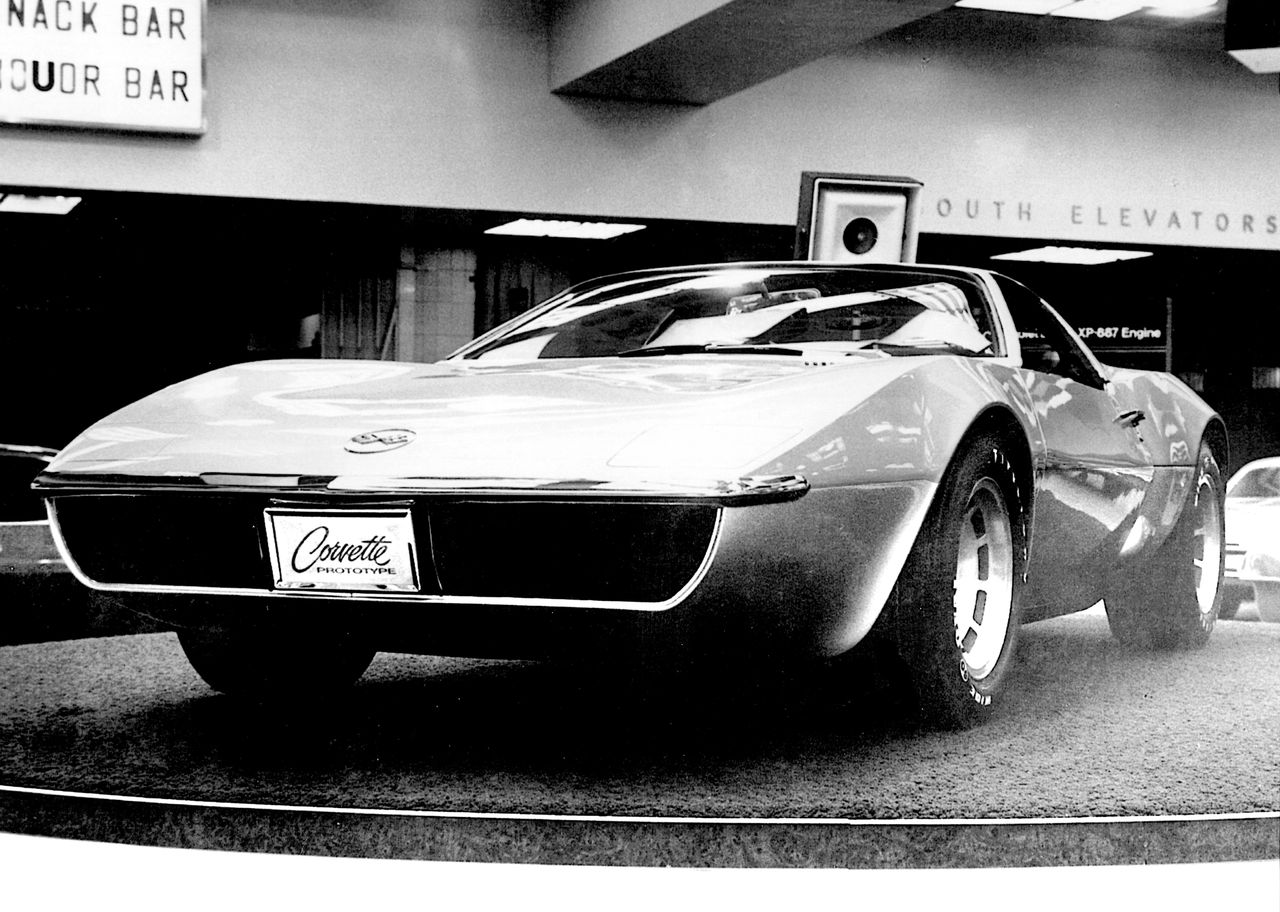
    When car magazines talked about the 1973 Corvette, they kept circling back to the 1970 XP-882 concept like it was a prophecy they almost missed. Publications loved how low, futuristic, and aerodynamic it looked, and many treated it as the moment Chevy silently signaled a new design direction. Writers “latched” onto it because it felt like the bridge between the wild chrome-edged concept era and the more regulated 1973 production reality. Some outlets even framed 1973 as the year Detroit finally started catching up to the vision XP-882 previewed three years earlier. The concept became an easy shorthand for explaining why 1973 looked so different — and why the Corvette story still felt ahead of its time. (Image courtesy of GM Media LLC)
    When car magazines talked about the 1973 Corvette, they kept circling back to the 1970 XP-882 concept like it was a prophecy they almost missed. Publications loved how low, futuristic, and aerodynamic it looked, and many treated it as the moment Chevy silently signaled a new design direction. Writers “latched” onto it because it felt like the bridge between the wild chrome-edged concept era and the more regulated 1973 production reality. Some outlets even framed 1973 as the year Detroit finally started catching up to the vision XP-882 previewed three years earlier. The concept became an easy shorthand for explaining why 1973 looked so different — and why the Corvette story still felt ahead of its time. (Image courtesy of GM Media LLC)

    Magazines latched onto the prototype XP-882 when explaining 1973, fascinated by trench-style cooling evaluations, aerodynamic transfer resolution, and aluminum-wheel porosity testing. All of it was gorgeous, nerdy, necessary stuff. But the truth of 1973’s design revolution was even simpler, harsher, and more historically important: the real production influence was function itself. The new bumper wasn’t engineered to stand out at car shows. It was engineered so that Corvette could continue to exist at all, and then still look distinctive enough to justify its own mythology.

    And it did. 1973 became the first production Corvette to prove that engineering could lead to style without murdering it. The nose was not redesigned to be different—it was redesigned so it could endure a future the original shape hadn’t been built to survive. It changed American automotive styling more than any design manifesto ever did, because it wrote a new one without trying: Form, when forced by law, must still bow to physics. Function, once proven, earns the right to become style again.

    From Separate Grilles to Integrated Reliefs
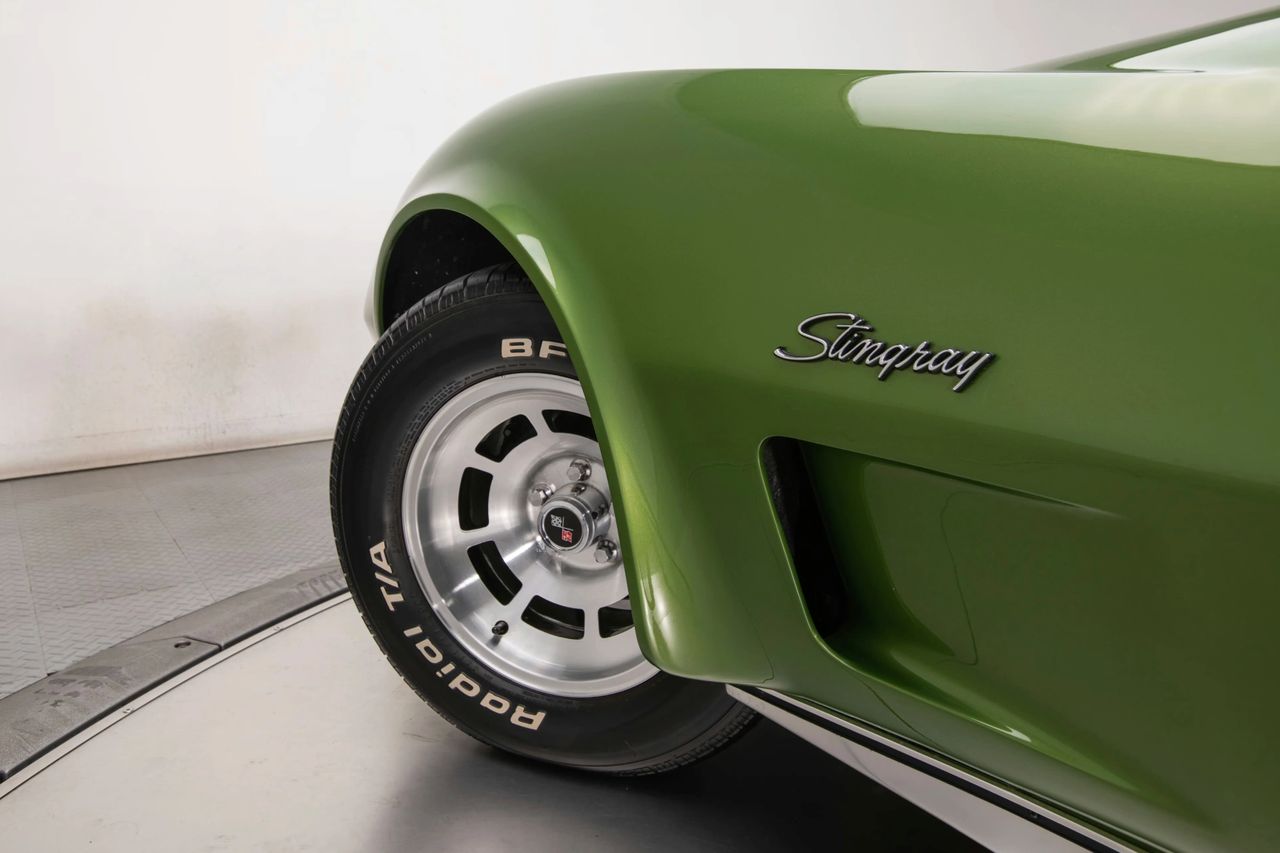
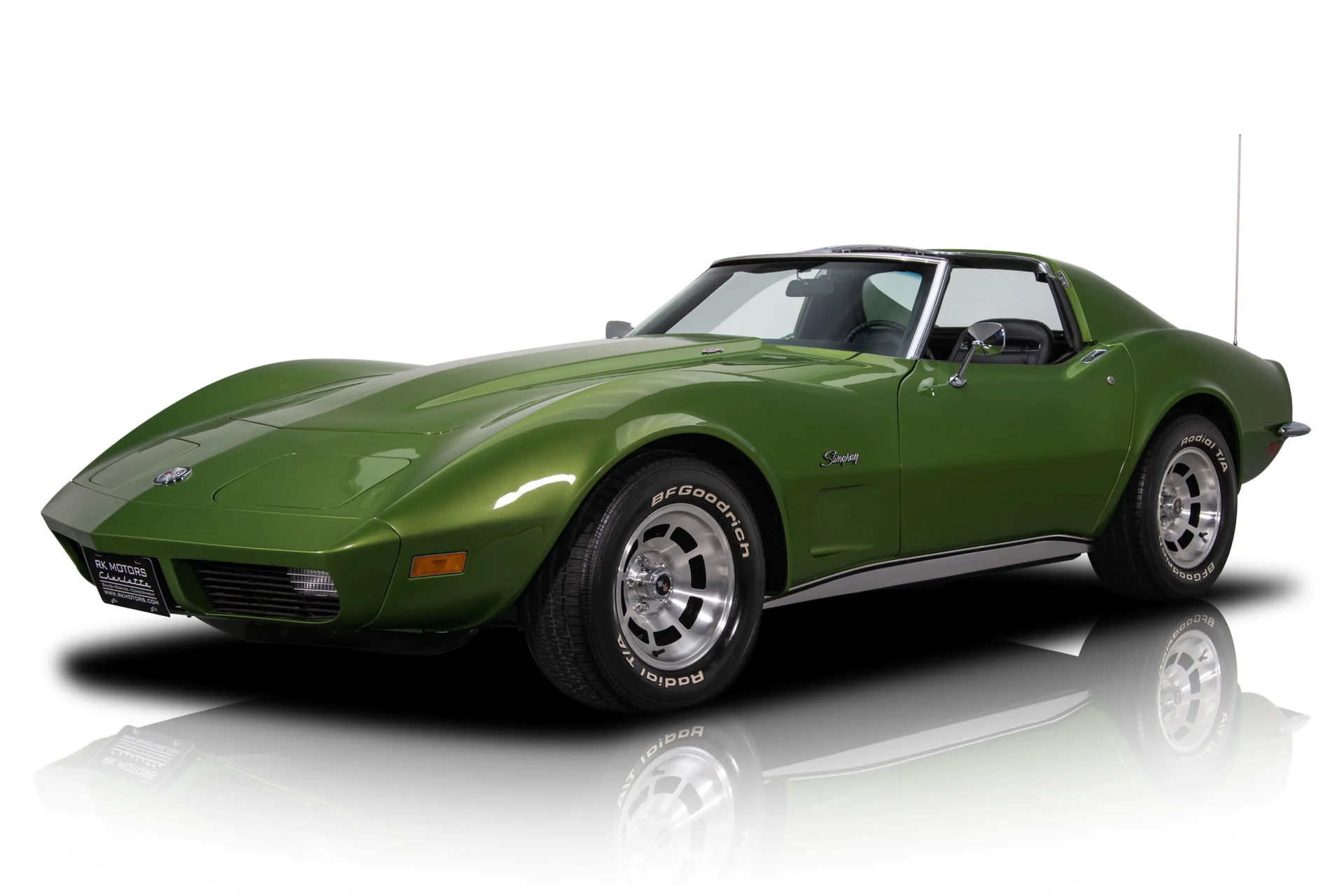
    On the 1973 Corvette, the front fender had lost the ornate egg-crate grille of the ’70–’72 cars and gained this smooth, sculpted vent pressed directly into the body side. The opening read as part of the fender instead of a bolt-on trim piece, giving the Stingray a cleaner, more contemporary profile. Up close, it quietly marked the moment when Corvette styling started to answer more to airflow and engineering than to chrome decoration. (Image courtesy of RK Motors)
    On the 1973 Corvette, the front fender had lost the ornate egg-crate grille of the ’70–’72 cars and gained this smooth, sculpted vent pressed directly into the body side. The opening read as part of the fender instead of a bolt-on trim piece, giving the Stingray a cleaner, more contemporary profile. Up close, it quietly marked the moment when Corvette styling started to answer more to airflow and engineering than to chrome decoration. (Image courtesy of RK Motors)

    Beyond the bumper, Corvette’s front fenders were redesigned to replace separate vent-grille assemblies with integrated recessed air vents. Instead of bolt-on chrome-trim egg-crate-style grilles, the fenders incorporated simplified, nearly vertical openings molded directly into the car’s fiberglass forms. This eliminated part complexity and provided a sleeker fender sculpt. The appearance shift mattered here, but again, not for the reason critics assumed. The 19701972 vent assemblies looked race-inspired, mechanical, industrial, and parts-heavy. For 1973, lowering the parts count and integrating them made the Corvette look more mature without abandoning the functional purpose of the vents themselves. It was the first proof point that Corvette was maturing toward real-world consumer sophistication, not Saturday-night stoplight theatrics.

    To complement the updated fenders, Corvette received a longer hood panel that concealed the wipers when parked. This was not an exercise in aesthetic indulgence—it was a functional necessity. Before 1973, the wiper-door panel was raised via vacuum actuation to allow the windshield wipers to operate. The system, while mechanical and novel, was infamous for misalignment, vacuum leaks, and sluggish operation. If 1973 was the year the country decided to mandate functionality in automotive regulatory frameworks, it was also the year Chevy quietly eliminated a vacuum-actuated panel that had already been embarrassing owners since 1968. It was both mandated progress and a matter of mercy.

    For 1973, Corvette retired the troublesome vacuum-operated wiper door and introduced this new domed hood. Its raised center section flowed into a rectangular cowl vent at the trailing edge, feeding a rear air-induction system that drew cooler, high-pressure air from the base of the windshield under full throttle. All ’73s carried this hood, which quietly improved under-hood temperatures and straight-line performance while giving the car a visibly more purposeful nose. (Image courtesy of bringatrailer.com)
    For 1973, Corvette retired the troublesome vacuum-operated wiper door and introduced this new domed hood. Its raised center section flowed into a rectangular cowl vent at the trailing edge, feeding a rear air-induction system that drew cooler, high-pressure air from the base of the windshield under full throttle. All ’73s carried this hood, which quietly improved under-hood temperatures and straight-line performance while giving the car a visibly more purposeful nose. (Image courtesy of bringatrailer.com)

    But Chevy didn’t stop there. The new hood also reincorporated a cowl-induction system to deliver cooler air to the carburetor, controlled by a solenoid-operated valve built into the hood. The return of cowl-induction was not just a hat-tip to earlier small-blocks—it was an engineering improvement poised to maintain power output stability in heavier and emissions-restricted contexts, a necessary step for a maturing car in a tightening era. Chevy had killed mechanical lifters in 1973, but it brought automated air induction back to compensate—and that one move did more to maintain Corvette’s continuity-holding air-fuel-power spirit than the chrome-elimination ever did to drain it. This was airflow with purpose.

    Longitudinal Door Beams and the Rising “Birdcage” Standard

    Inside the car’s doors, Chevrolet installed longitudinal fluted steel impact beams, extending from the door hinges to the lock plates. These beams tied into the car’s steel “birdcage” body structure, providing improved occupant protection from side impacts. Unlike traditional automotive doors that relied primarily on geometry and metal thickness for safety, Corvette’s side-impact beams were an engineered safety innovation pioneered by General Motors.

    These beams were not lightweight. They w ere not elegant. They were heavy, fluted, and hammered together like structural guardrails—yet they were one of the most important safety improvements the car ever received at a product-level stage. The beams gave Corvette a more “civilized” real-world justification for being both louder and lower than almost anything else on the road. Corvette was a fiberglass car, but its skeleton was increasingly steel-reinforced by 1973—and that mattered enormously. If 1973 was the estimated peak of consumer safety evolution for the C3 series before the 1974 chrome-elimination, 1973 was also the year that the skeleton became singular in its duty to protect the people inside it, starting from the doors inward.

    Corvette fans today debate a lot of controversial engineering divides over the course of the model’s run: which car was the best balanced, which was the most aggressive, which was the least compromised. But if you want a pre-OPEC regulation moment that changed Corvette’s actual occupant safety infrastructure irrevocably—and proved that even a part-heavy birdcage can bolster continuation without needing to be chrome-finished—it was the 1973 longitudinal door beam upgrade.

    Radial Tires – The Technology that Gave Stability but Took the Bragging Rights
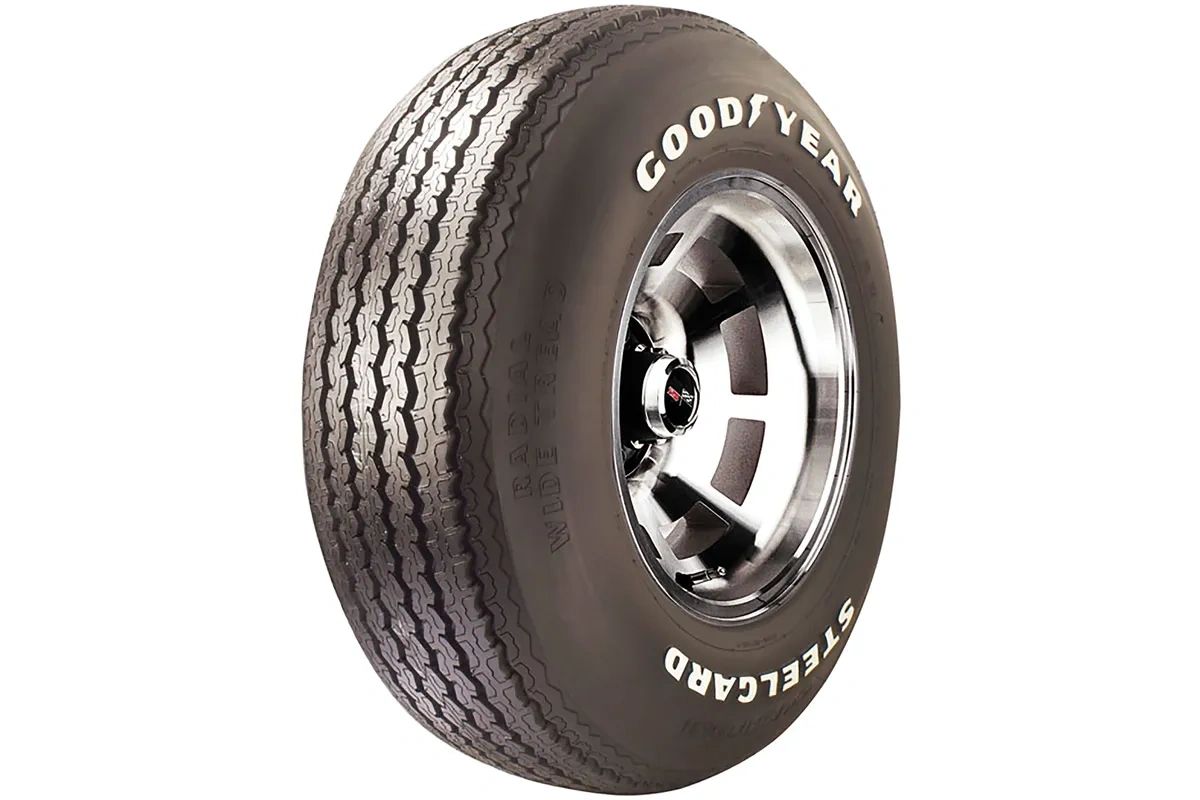
    On the 1973 Corvette, this is exactly the kind of rubber that marked Chevy’s move into the radial era. From the factory, Stingrays rode on GR70x15 steel-belted radials, most commonly Firestone 500s or Goodyear Steelgards, depending on supplier and how the car was optioned. Buyers could choose narrow white stripes or bold raised white letters, but either way the tire size and construction were the same. These radials replaced the old bias-ply Wide Ovals and gave the ’73 Corvette better highway stability, improved wet-weather manners, and longer tread life. Enthusiasts grumbled about the 120-mph speed rating and slightly softer skidpad numbers, but visually and mechanically, a 1973 Corvette sitting on Firestone 500 or Goodyear Steelgard GR70-15s is pure period-correct Stingray. (image courtesy of Goodyear)
    On the 1973 Corvette, this is exactly the kind of rubber that marked Chevy’s move into the radial era. From the factory, Stingrays rode on GR70x15 steel-belted radials, most commonly Firestone 500s or Goodyear Steelgards, depending on supplier and how the car was optioned. Buyers could choose narrow white stripes or bold raised white letters, but either way the tire size and construction were the same. These radials replaced the old bias-ply Wide Ovals and gave the ’73 Corvette better highway stability, improved wet-weather manners, and longer tread life. Enthusiasts grumbled about the 120-mph speed rating and slightly softer skidpad numbers, but visually and mechanically, a 1973 Corvette sitting on Firestone 500 or Goodyear Steelgard GR70-15s is pure period-correct Stingray. (image courtesy of Goodyear)

    In 1973, Chevrolet did something consequential but easy to miss if you only skim the spec sheets: it made radial-ply tires standard equipment across the entire Corvette lineup. Until that   ,mmoment, Corvette had been a bias-ply, big-cam, edge-case machine—happy on dry pavement, happiest when mistreated, and most alive when flung through corners with more optimism than traction science could justify. Radials changed the baseline. They brought improved tread life, better stability at highway speeds, and significantly improved performance in the rain. They also brought math into the conversation. Not fantasy. Not folklore. Just hard advantages every owner could measure in real-world driving.

    But progress rarely arrives without irony, and the radial-tire upgrade was no exception. The gains in stability and wet-weather grip were immediate. The losses were measurable. The tires—speed-rated to just 120 mph—set a theoretical ceiling far below what automotive journalists had achieved in earlier years. Reporters in 1972 routinely tested Corvettes that were capable of comfortably exceeding 140 mph. LT-1 cars, especially, routinely embarrassed their published limits. Then 1973 came along and told enthusiasts, gently but firmly: your new traction miracles are highway-smart…not high-speed immortal.
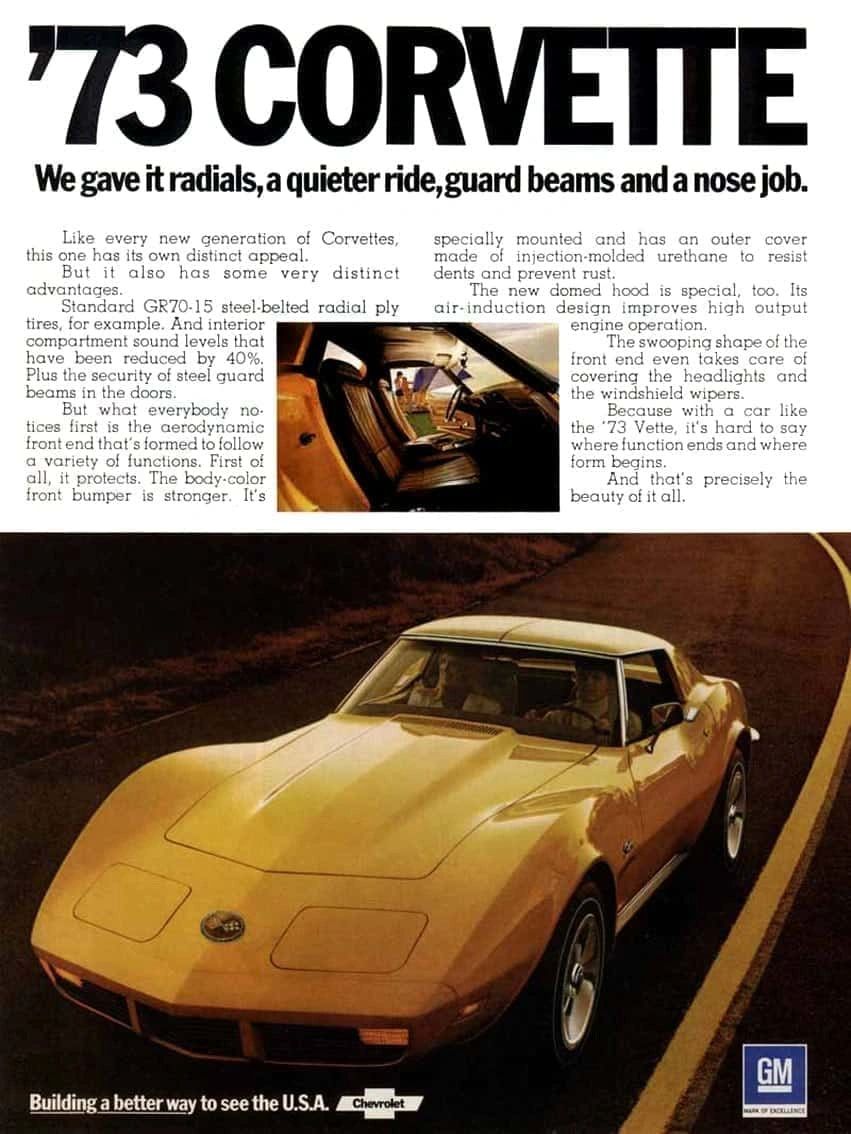
    The 1973 Corvette was the year the Stingray officially grew up, shaped less by bravado and more by obligation—both regulatory and consumer-driven. As the attached article teases, the biggest visual statement was the new body-color urethane-wrapped bumper, paired with cleaner, integrated fender vents that replaced the parts-heavy grilles of earlier years. Chevrolet swapped bias-ply for GR70-15 steel-belted radials, trading headline top-speed heroics for better highway stability, longer tread life, and manners that shined when the weather didn’t cooperate. Longitudinal steel door beams fortified the birdcage, while insulation, revised body mounts, thicker carpeting, and an extended cowl-induction hood made the car quieter, sturdier, and more livable. It wasn’t the fastest Corvette of its era, but it was the most road-wise, proof that refinement, not speed, was the new currency. In the end, 1973 didn’t dull the legend—it seasoned it. (source: GM Marketing)
    The 1973 Corvette was the year the Stingray officially grew up, shaped less by bravado and more by obligation—both regulatory and consumer-driven. As the attached article teases, the biggest visual statement was the new body-color urethane-wrapped bumper, paired with cleaner, integrated fender vents that replaced the parts-heavy grilles of earlier years. Chevrolet swapped bias-ply for GR70-15 steel-belted radials, trading headline top-speed heroics for better highway stability, longer tread life, and manners that shone when the weather didn’t cooperate. Longitudinal steel door beams fortified the birdcage, while insulation, revised body mounts, thicker carpeting, and an extended cowl-induction hood made the car quieter, sturdier, and more livable. It wasn’t the fastest Corvette of its era, but it was the most road-wise, proof that refinement, not speed, was the new currency. In the end, 1973 didn’t dull the legend—it seasoned it. (source: GM Marketing)

    The most interesting tension wasn’t the change itself. It was the reinterpretation of it. For years, Corvette had been the car that magazines used to benchmark how fast American street engineering could get without filing a flight plan. Now it was the car being graded against the physics of low-speed bumper survival and tire-compound behavior. Owners gained durability and stability, but the tradeoff surfaced in the worst possible place for bragging rights: the stopwatch. Independent magazine tests logged longer stopping distances compared to 1972, even though the brake hardware was unchanged. The culprit was transition behavior—weight transfer under deceleration, tread squirm, and thermodynamic differences in how radials deformed under braking load compared to bias-ply.

    Lateral grip told an even stranger story. Corvette now hugged the road with more contact-patch integrity at highway speed, but posted lower lateral-G figures on skidpad testing. On the surface, this sounded like regression. In reality, it was just reclassification. The skidpad is a controlled environment—predictable asphalt, predictable temps, predictable heroics. But the wet road isn’t predictable. And the biggest gain in 1973 wasn’t lateral-G fantasy. It was predictability in conditions that would’ve sent a 1968 Zora-era bias-ply C3 sliding into the guardrail like a drunk figure-skater.

    Even acceleration testing had a footnote, though most enthusiasts glossed over it. Despite the added 35 lbs from the mandated urethane nose and the changed behavior of the new radials under load, magazine-tested 1973 Corvettes were still running quarter-miles in the mid-15-second bracket. That meant something important: the 1973 Corvette wasn’t slow. It was comparable. It stacked up respectably against Europe’s finest when tested without hometown favoritism. On a drag strip, 1973 still produced results comfortably within shouting distance of the Porsche 911E, Ferrari Dino, Jaguar E-Type V12, and DeTomaso Pantera. It just got there with more stability than swagger.
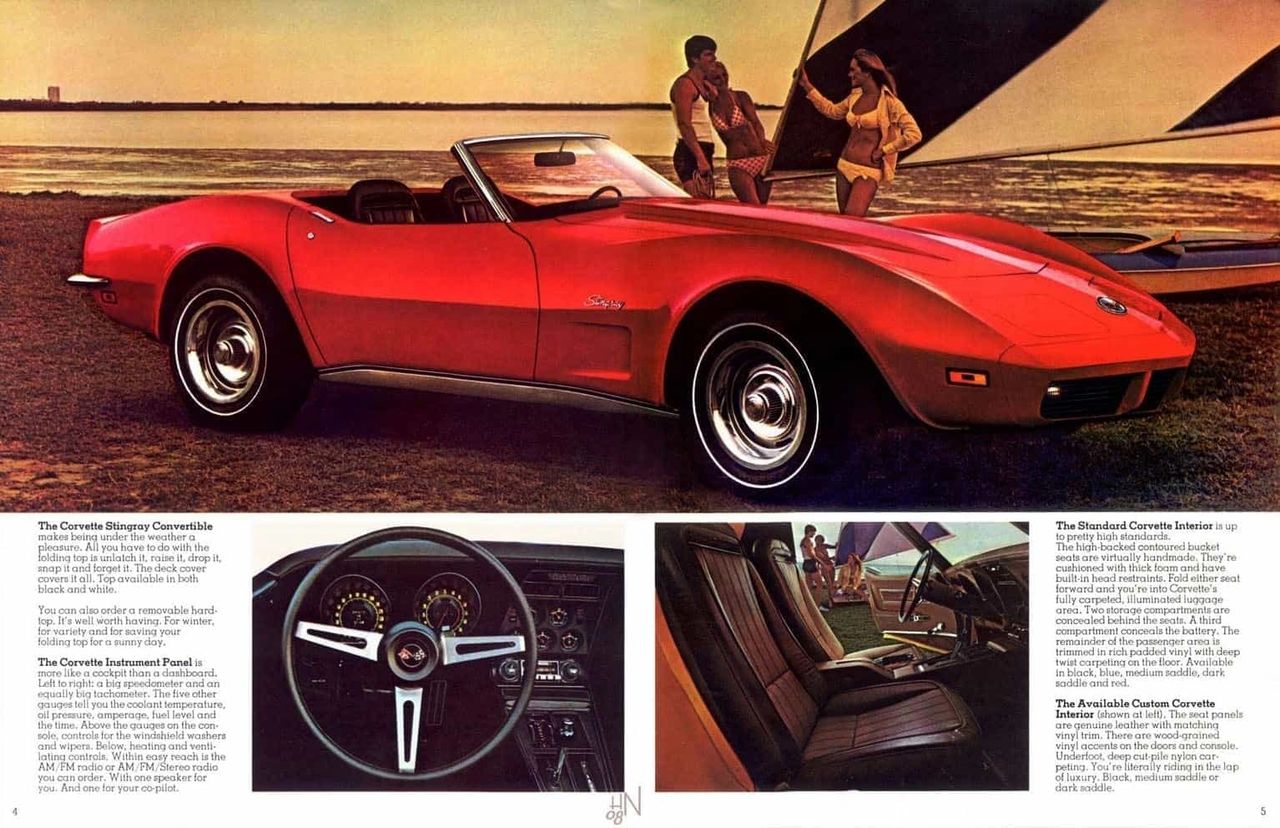
    To European eyes, the 1973 Corvette looked like the loud American extrovert parked at the beach—low, long, and drenched in color—but by this point it was quietly closing the gap on their idea of a well-rounded grand tourer. Magazine tests still showed the Stingray running with cars like the Porsche 911 and Ferrari Dino in straight-line performance, yet Chevrolet was steadily engineering in the kind of reliability and comfort that made it more than a weekend toy. Year by year, the convertible in this brochure gained better tires, improved body mounts, stronger door beams, and more sound insulation, turning it into a car that could cross states as confidently as it blitzed on-ramps. European sports cars were praised for their balance and refinement; the ’73 Corvette was starting to earn similar respect while keeping its big-bore attitude and open-sky drama. To many enthusiasts, it proved that America’s fiberglass icon didn’t have to choose between speed and staying power—it could do both, with each model year getting just a little more grown-up.
    To European eyes, the 1973 Corvette looked like the loud American extrovert parked at the beach—low, long, and drenched in color—but by this point it was quietly closing the gap on their idea of a well-rounded grand tourer. Magazine tests still showed the Stingray running with cars like the Porsche 911 and Ferrari Dino in straight-line performance, yet Chevrolet was steadily engineering in the kind of reliability and comfort that made it more than a weekend toy. Year by year, the convertible in this brochure gained better tires, improved body mounts, stronger door beams, and more sound insulation, turning it into a car that could cross states as confidently as it blitzed on-ramps. European sports cars were praised for their balance and refinement; the ’73 Corvette was starting to earn similar respect while keeping its big-bore attitude and open-sky drama. To many enthusiasts, it proved that America’s fiberglass icon didn’t have to choose between speed and staying power—it could do both, with each model year getting just a little more grown-up.

    And that’s where perception fell behind reality. Corvette legend had always been built around the outliers—the rare engines, the underrated tires, the top speeds that seemed to defy the rulebook. The switch to radial tires didn’t suddenly make the car slow or soft. It just made its performance easier to measure and harder to exaggerate. Instead of feeding the myths, the radials forced people to see what the car could really do.

    If 1973 taught us anything, it’s that Corvette engineering kept moving forward even when opinions about the car didn’t. The move to radial tires wasn’t a sellout of performance—it simply changed how that performance showed up. On paper, the Corvette was still a sports car. In practice, it was becoming a smarter one: better in the rain, more stable at highway speeds, and more livable for owners who actually expected their tires to last longer than their monthly payment cycle.
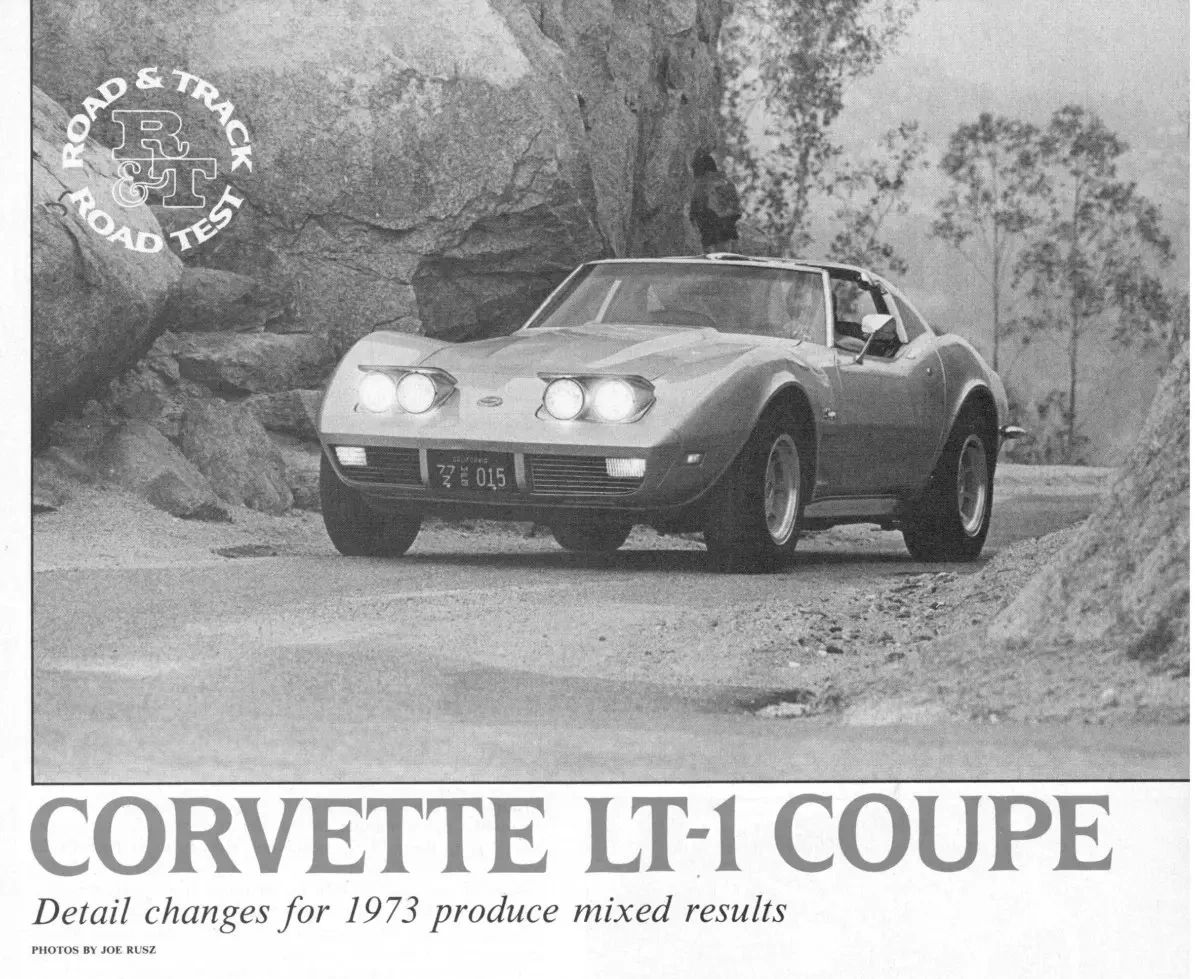
    When the 1973 Corvette hit the road-test circuit, publications like Car and Driver and Road & Track didn’t just critique the car—they mourned what they felt had been lost. Progress toward a calmer ride, better manners, and federal compliance was treated as regression, with every softer response or quieter mile stacked up against the razor-edged, high-compression cars of just a few years prior. One test even mislabeled the car as an LT-1 when it was actually an L82, a slip that perfectly captured the mindset of the day: critics were still mentally living in the solid-lifter era and judging the new car against a ghost. The ’73’s broader usability and maturing character were largely dismissed because they didn’t fit the old spec-sheet hero narrative. Instead of seeing a Corvette that was evolving into a more refined, everyday-capable sports car, many reviewers framed it as a fallen idol. In that climate, every change—tires, tuning, insulation, or otherwise—was read as evidence that the Corvette was drifting away from its “proper” past, even when the numbers said it was still very much in the fight. (source: Road and Track)
    When the 1973 Corvette hit the road-test circuit, publications like Car and Driver and Road & Track didn’t just critique the car—they mourned what they felt had been lost. Progress toward a calmer ride, better manners, and federal compliance was treated as regression, with every softer response or quieter mile stacked up against the razor-edged, high-compression cars of just a few years prior. One test even mislabeled the car as an LT-1 when it was actually an L82, a slip that perfectly captured the mindset of the day: critics were still mentally living in the solid-lifter era and judging the new car against a ghost. The ’73’s broader usability and maturing character were largely dismissed because they didn’t fit the old spec-sheet hero narrative. Instead of seeing a Corvette that was evolving into a more refined, everyday-capable sports car, many reviewers framed it as a fallen idol. In that climate, every change—tires, tuning, insulation, or otherwise—was read as evidence that the Corvette was drifting away from its “proper” past, even when the numbers said it was still very much in the fight. (source: Road and Track)

    The real story of 1973 isn’t just tire chemistry; it’s survival. Corvette didn’t need to run 140 mph to prove it still belonged. It needed to pass new 5-mph impact rules, live with tighter emissions standards, and come out the other side recognizable. It did that through engineering discipline, shedding some chrome flash and bias-ply habit while keeping its core character intact.

    Progress in 1973 simply landed faster than many fans were ready to admit. The radials weren’t installed to turn the Corvette into a slower cornering car—they were there to extend its usefulness in a world about to face fuel shortages and changing expectations. The straight-line performance remained, stability improved, tread life stretched out, and the brakes waited their turn for an upgrade. The legend stayed loud, even as the cabin got quieter and the car itself became better behaved on real roads in real weather.

    The Wheel That Was Nearly a Revolution: RPO YJ8
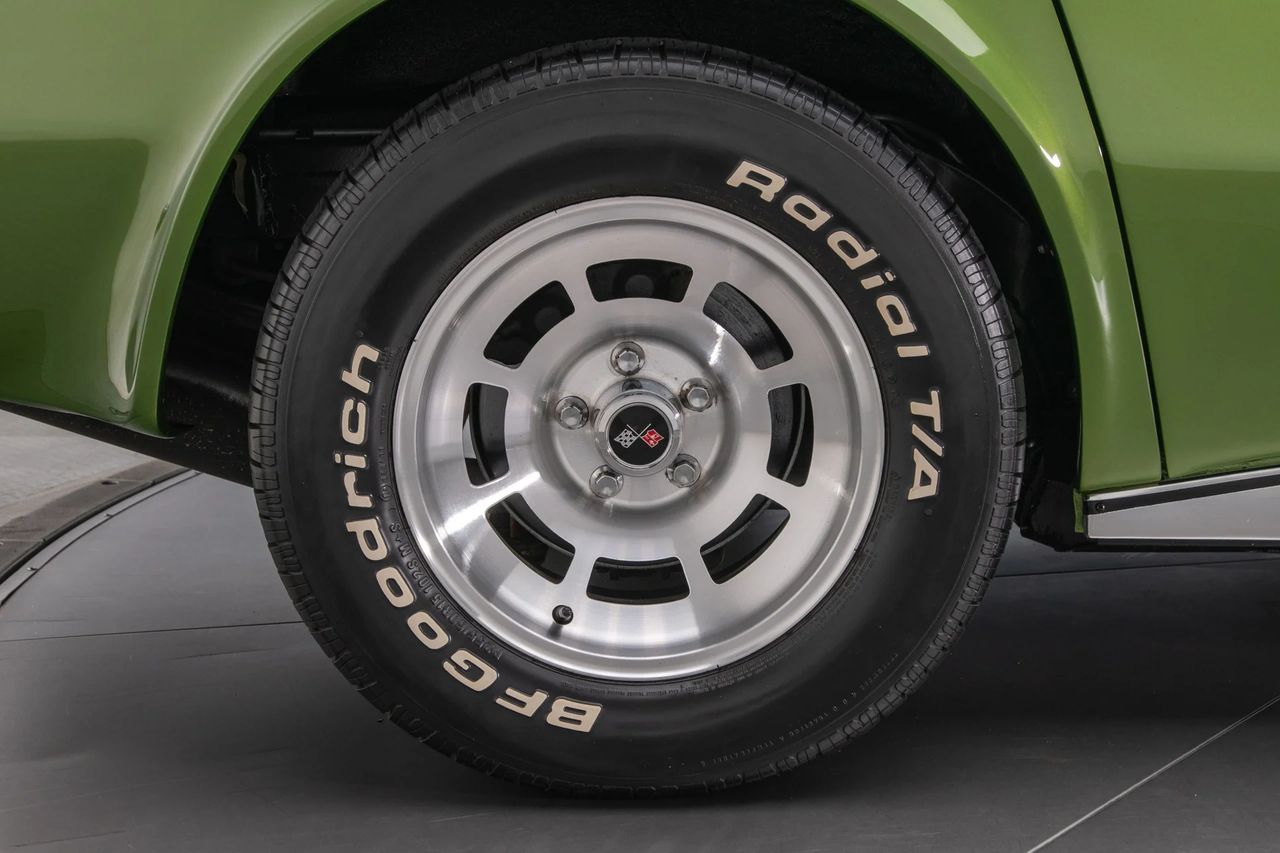
    The 1973 Corvette YJ8 wheel option marked Chevrolet’s first serious push into lightweight aluminum rolling stock for America’s favorite fiberglass sports car. These cast aluminum wheels—distinguished by their symmetrical 8-slot turbine-style windows and small tri-bar center cap—shaved precious unsprung mass at a moment when Corvette engineering was fighting weight everywhere it could. Not only did they signal a break from stamped-steel wheel norms, they previewed an industry transition toward aluminum wheels as de facto performance equipment in the decades to follow. In 1973, they weren’t the popular choice—networks of purists still clung to road feel over material innovation—but they were the right choice for anyone who understood racing math: less weight at the wheel meant more wheel doing the driving. (Image: RK Motors)
    The 1973 Corvette YJ8 wheel option marked Chevrolet’s first serious push into lightweight aluminum rolling stock for America’s favorite fiberglass sports car. These cast aluminum wheels—distinguished by their symmetrical 8-slot turbine-style windows and small tri-bar center cap—shaved precious unsprung mass at a moment when Corvette engineering was fighting weight everywhere it could. Not only did they signal a break from stamped-steel wheel norms, but they also previewed an industry transition toward aluminum wheels as de facto performance equipment in the decades to follow. In 1973, they weren’t the popular choice—networks of purists still clung to road feel over material innovation—but they were the right choice for anyone who understood racing math: less weight at the wheel meant more wheel doing the driving. (Image: RK Motors)

    If 1973 was a year of reach, radial compromise, noise suppression, and federal rules crashing into fiberglass sports-car dreams, then nothing sums it up better than Corvette’s infamous RPO YJ8 cast aluminum wheel. Unlike most chrome-era wheels, YJ8 stands out not because Chevrolet nailed it, but because the option failed in a big way. Only four customer-ordered sets are officially recorded for 1973, yet Chevy is believed to have built as many as 800 sets before discovering serious porosity problems in the aluminum. That porosity created structural weakness, forcing Chevrolet to recall the wheels that had gone out. They carried casting number 329381 and used lug nuts with black painted, recessed centers—small details that now loom large in the legend.

    Wheels have always mattered to Corvette’s identity, visually and dynamically, but YJ8 took on a life far bigger than its tiny production footprint. It’s remembered today not for how many exist, but for how few were sold and how quickly they were pulled back. The story fits perfectly into Corvette culture, which has always been built more on rare exceptions than everyday averages. In the same year unused VINs were left on the table, engines lost compression to regulations, radials replaced Wide Ovals, side-impact beams appeared in the doors, and extra insulation quieted the cabin, this one aluminum wheel option quietly became the most talked-about RPO of the C3 era.

    In the world of automotive folklore, a memorable failure often outlives a routine success—and YJ8 is proof. These wheels didn’t just fade into obscurity; some slipped into customer hands through dealer parts channels, with spotty documentation and plenty of speculation. Chevrolet never set out to create a myth around them. The metal itself did that.

    NVH – The Quietest Loud Car Ever Tested
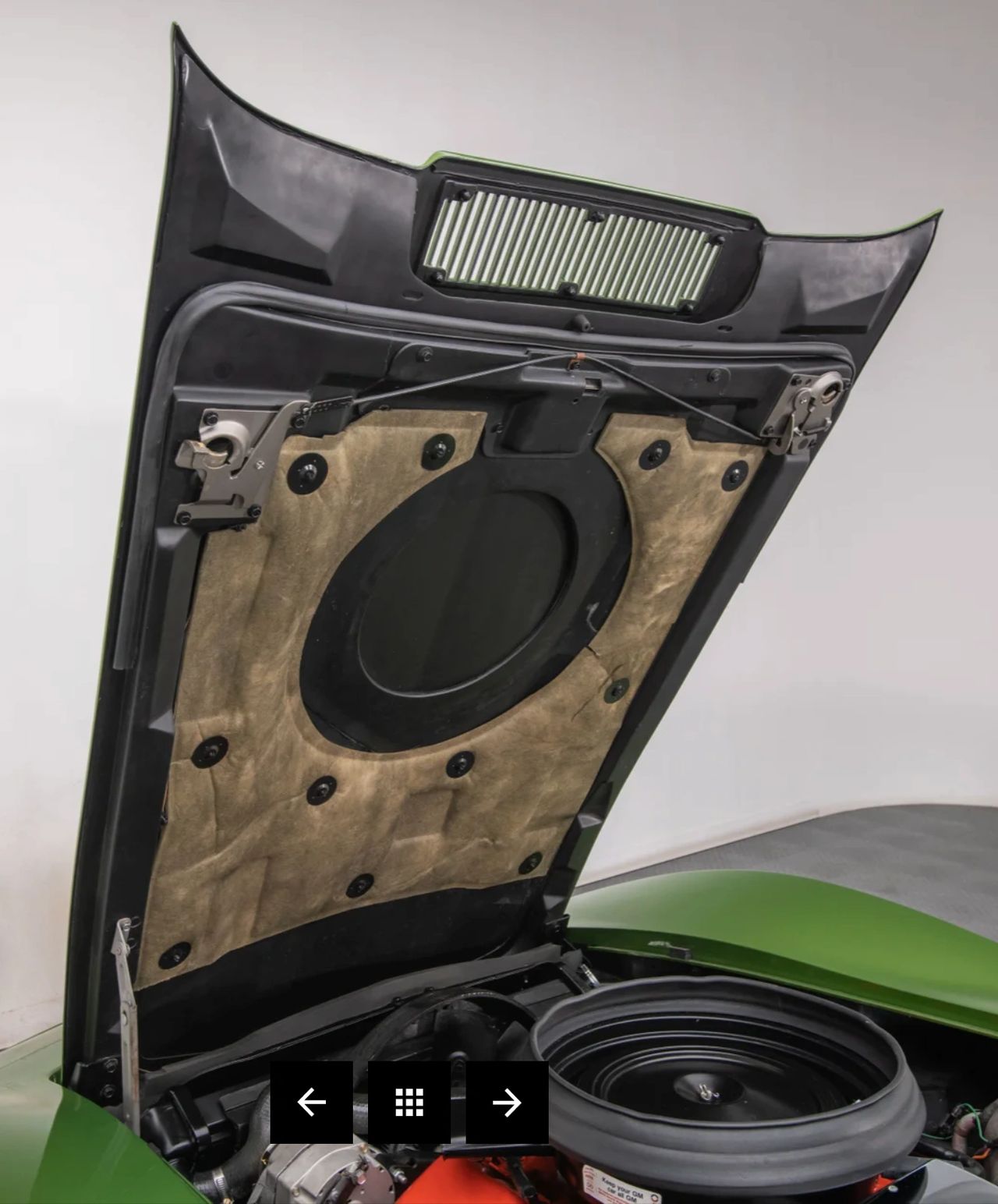
    ChatGPT said:  One of the subtler but most meaningful upgrades for 1973 was Chevrolet’s push to tame noise, vibration, and harshness in the Corvette. Under the hood, new insulation pads like the one shown here helped soak up valvetrain clatter and induction roar before it reached the cabin, taking the edge off the big V8 without muting it. Chevrolet paired that with revised rubber engine and body mounts that isolated more vibration from the frame while still keeping the car feeling tight and responsive. The result was a Stingray that sounded less raw and tinny, but still very much like a Corvette when you laid into the throttle. It was the first real step toward a car you could drive all day without feeling like you’d spent it inside the engine bay. (Source: RK Motors)
    One of the subtler but most meaningful upgrades for 1973 was Chevrolet’s push to tame noise, vibration, and harshness in the Corvette. Under the hood, new insulation pads like the one shown here helped soak up valvetrain clatter and induction roar before it reached the cabin, taking the edge off the big V8 without muting it. Chevrolet paired that with revised rubber engine and body mounts that isolated more vibration from the frame while still keeping the car feeling tight and responsive. The result was a Stingray that sounded less raw and tinny, but still very much like a Corvette when you laid into the throttle. It was the first real step toward a car you could drive all day without feeling like you’d spent it inside the engine bay. (Source: RK Motors)

    Perhaps the most under-appreciated evolution of the 1973 Corvette was the quiet work happening under the paint—literally. While the buzz in brochures was all about bumpers, vents, and safety, Chevrolet engineers were pouring serious effort into what we now call Noise, Vibration, and Harshness—NVH. They didn’t use that acronym in 1973, but they were absolutely engineering toward it. The goal was simple: make the Corvette feel more solid, more refined, and less fatiguing to drive…without turning it into something unrecognizable.

    One of the biggest steps forward was the introduction of rubber-steel-encased body mounts. These mounts isolated more of the drivetrain and road harshness from the cabin, but still kept the chassis tight enough to feel like a proper sports car. Pair that with asphalt-based sound-deadening sprayed onto inner body panels and a new hood insulation pad, and the ’73 Corvette really did sound and feel different from behind the wheel. Chevrolet advertising even claimed up to a 40% reduction in interior noise, and period tests backed up the idea that this wasn’t just marketing fluff. The exact percentage matters less than the intent: Chevy was making a Corvette you could drive farther, more often, without coming out of it feeling wrung out.

    For the 1973 Corvette, fixing the rear glass delivered a real NVH win, even if the headlines were chasing bumpers and horsepower drama. Making the window permanent reduced wind turbulence and pressure pulses in the cabin, cutting the booming buffet that came with the old removable glass. With one solid, sealed light, Chevrolet also eliminated rattle points and air gaps, helping keep highway noise out instead of letting it echo in. The result was a cockpit that felt tighter, quieter, and less tiring at speed, without taking anything away from the character of the car. It was a small engineering decision that made a surprisingly big difference the longer you drove. (source: RK Motors)
    For the 1973 Corvette, fixing the rear glass delivered a real NVH win, even if the headlines were chasing bumpers and horsepower drama. Making the window permanent reduced wind turbulence and pressure pulses in the cabin, cutting the booming buffet that came with the old removable glass. With one solid, sealed light, Chevrolet also eliminated rattle points and air gaps, helping keep highway noise out instead of letting it echo in. The result was a cockpit that felt tighter, quieter, and less tiring at speed, without taking anything away from the character of the car. It was a small engineering decision that made a surprisingly big difference the longer you drove. (source: RK Motors)

    Inside, the upgrades continued with thicker carpeting and strategically placed acoustic mats, all aimed at cutting down on road roar and driveline hum. Even the change from a removable to a fixed rear window played a role. The earlier pop-out glass gave you novelty and noise; the new fixed window reduced wind buffeting, tightened up the cabin, and freed up more usable storage space behind the seats. It was a small but telling shift—from weekend toy thinking to real grand-touring usability.

    What matters most is that none of this killed the car’s character. The federally strangled engines might have lost some of their old spec-sheet swagger, but the Corvette didn’t suddenly go mute. You could still hear the tires working, still hear the carburetor pulling air—you just didn’t have to shout over it. By 1973, Corvette wasn’t trying to yell its legend anymore. It was learning how to communicate it: still mechanical, still emotional, just filtered through a cabin that finally let you hear your own thoughts along with the exhaust.

    Engine Philosophy Meets Reality – The Year the LT-1 Left and Hydraulics Became Standard
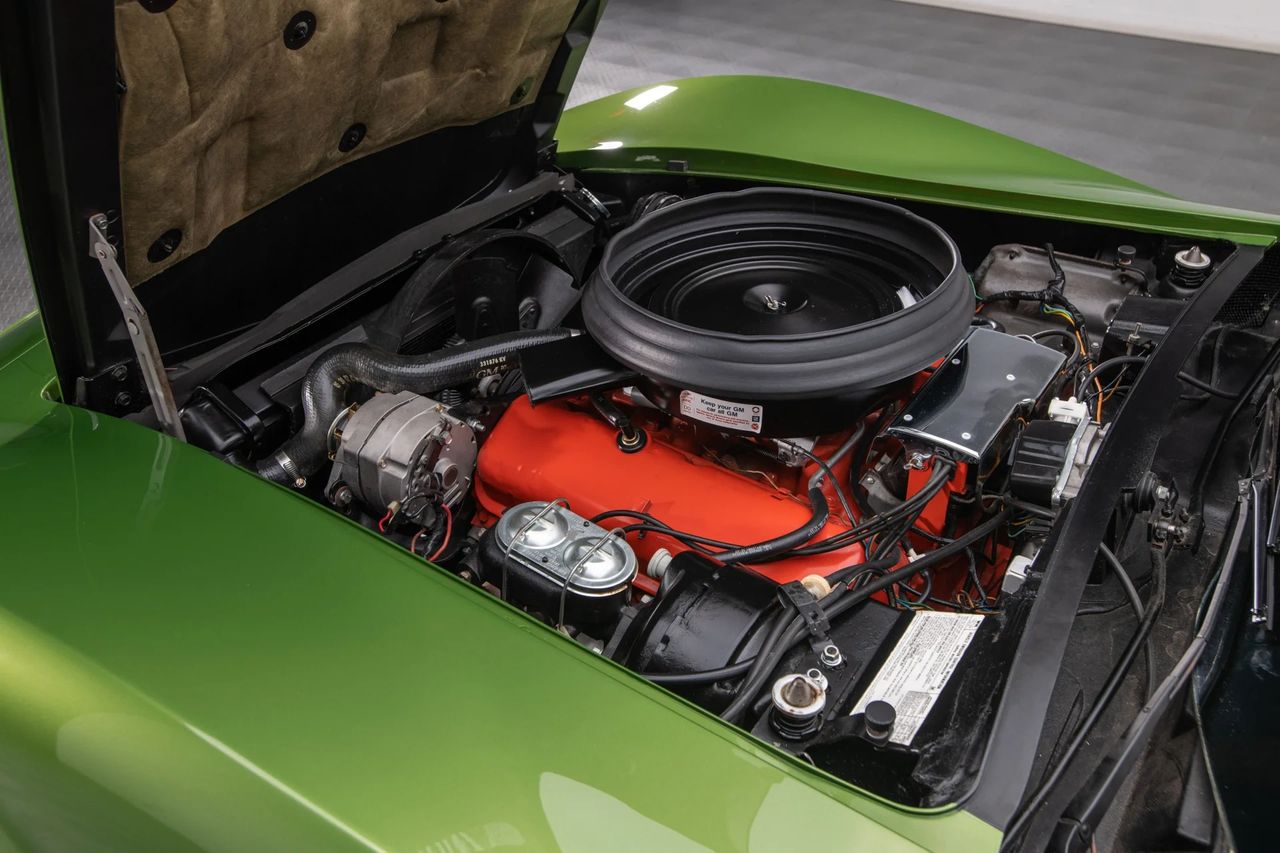
    The 454 big-block in the 1973 Corvette, the LS4, stood as the lineup’s elder statesman in a year dominated by change. It carried forward its 270-hp rating from 1972, but felt different in the real world because the car around it was getting heavier, quieter, and more composed. The big 454 delivered effortless low-end torque, making the ’73 Corvette feel strong off the line without needing to scream its way to peak power. It paired especially well with the 3.70:1 axle and close-ratio 4-speed in test cars, pulling hard through the midrange where most drivers actually lived. By 1973, the 454 wasn’t the wild heavyweight champ anymore, but it was still the car’s big, steady proof that size and muscle could evolve without completely losing their bite.ChatGPT said:  The 454 big-block in the 1973 Corvette, the LS4, stood as the lineup’s elder statesman in a year dominated by change. It carried forward its 270-hp rating from 1972, but felt different in the real world because the car around it was getting heavier, quieter, and more composed. The big 454 delivered effortless low-end torque, making the ’73 Corvette feel strong off the line without needing to scream its way to peak power. It paired especially well with the 3.70:1 axle and close-ratio 4-speed in test cars, pulling hard through the midrange where most drivers actually lived. By 1973, the 454 wasn’t the wild heavyweight champ anymore, but it was still the car’s big, steady proof that size and muscle could evolve without completely losing their bite. (source: RK Motors)
    The 454 big-block in the 1973 Corvette, the LS4, stood as the lineup’s elder statesman in a year dominated by change. It carried forward its 270-hp rating from 1972, but felt different in the real world because the car around it was getting heavier, quieter, and more composed. The big 454 delivered effortless low-end torque, making the ’73 Corvette feel strong off the line without needing to scream its way to peak power. It paired especially well with the 3.70:1 axle and close-ratio 4-speed in test cars, pulling hard through the midrange where most drivers actually lived. By 1973, the 454 wasn’t the wild heavyweight champ anymore, but it was still the car’s big, steady proof that size and muscle could evolve without completely losing their bite.ChatGPT said: The 454 big-block in the 1973 Corvette, the LS4, stood as the lineup’s elder statesman in a year dominated by change. It carried forward its 270-hp rating from 1972, but felt different in the real world because the car around it was getting heavier, quieter, and more composed. The big 454 delivered effortless low-end torque, making the ’73 Corvette feel strong off the line without needing to scream its way to peak power. It paired especially well with the 3.70:1 axle and close-ratio 4-speed in test cars, pulling hard through the midrange where most drivers actually lived. By 1973, the 454 wasn’t the wild heavyweight champ anymore, but it was still the car’s big, steady proof that size and muscle could evolve without completely losing their bite. (source: RK Motors)

    Perhaps no topic fuels more debate among enthusiasts of the C3 generation than the disappearance of the mechanical-lifter LT-1 engine option for 1973. Since 1956, Corvette owners could choose a mechanical-lifter engine—an unapologetically raucous valvetrain configuration that carried the car’s racing parity, its snarling idle, and its ripsaw mechanical vibe. 1973 killed that engine—not for lack of fans, but for lack of federal permissions. Instead, Chevrolet offered a choice of three hydraulic-lifter engines, each engineered to be quieter, smoother, and compliant with tightening emissions standards.
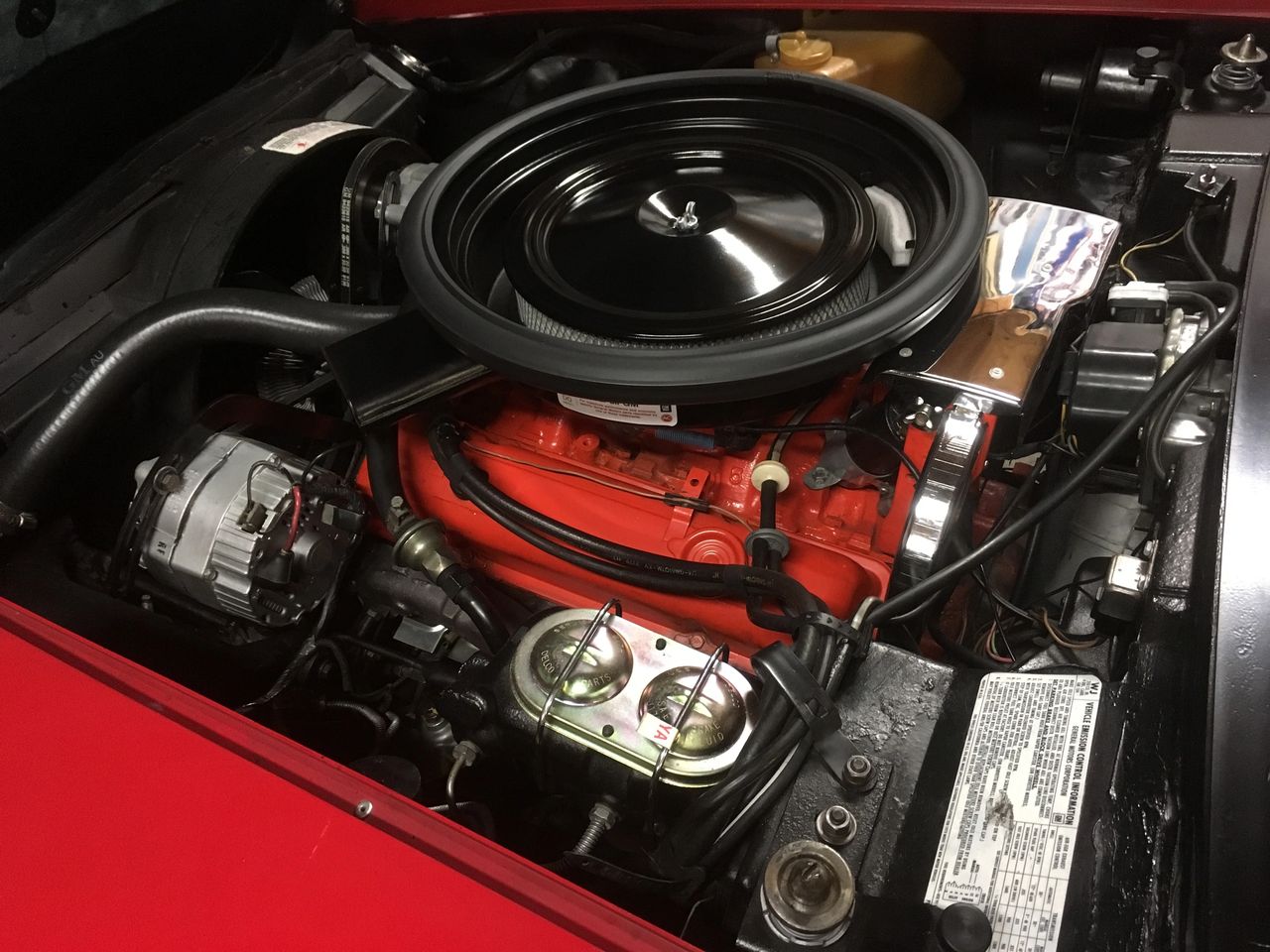
    Under the hood of many 1973 Corvettes lived this workhorse: the L48 350-cubic-inch small-block. Rated at 190 horsepower, it was no longer the fire-breather of the late ’60s, but it delivered smooth, usable torque and easy drivability that matched the car’s move toward a more refined grand-touring role. Paired with either a four-speed manual or Turbo-Hydramatic automatic, the L48 made the ’73 Stingray perfectly happy in traffic, on the highway, or cruising a back road without constant gear-hunting. It also tolerated the new unleaded-fuel and emissions realities better than the wilder solid-lifter mills that came before it. In a year defined by compromise, this engine became the dependable, everyday heart that kept Corvette ownership within reach for a broad slice of buyers. (source: CorvetteForum)
    Under the hood of many 1973 Corvettes lived this workhorse: the L48 350-cubic-inch small-block. Rated at 190 horsepower, it was no longer the fire-breather of the late ’60s, but it delivered smooth, usable torque and easy drivability that matched the car’s move toward a more refined grand-touring role. Paired with either a four-speed manual or Turbo-Hydramatic automatic, the L48 made the ’73 Stingray perfectly happy in traffic, on the highway, or cruising a back road without constant gear-hunting. It also tolerated the new unleaded fuel and emissions realities better than the wilder solid-lifter mills that came before it. In a year defined by compromise, this engine became the dependable, everyday heart that kept Corvette ownership within reach for a broad slice of buyers. (source: CorvetteForum)

    The base 350 CID V8 (RPO L48) was rated at 190 horsepower, a noticeable drop from prior years. An upgraded 350 (L82) produced 250 horsepower, while the lone 454 big-block engine option (LS4) generated 270 horsepower. While all outputs were diminished from the small-block glory days of the late 60s and early 70s, none of them kept the car from running 15-second quarter-miles in road tests—figures comparable to many European contemporaries from Porsche and DeTomaso. The 454 big-block was the only engine that did not receive a horsepower downgrade for 1973, but even that figure often created confusion among contemporary writers, since some marketing materials misquoted performance outputs early in the year’s release before official ratings were finalized.

    The reason mechanical lifters disappeared was simple: emissions legislation and unleaded-fuel mandates pushed the car away from high-emissions-tolerant configurations and forced Chevy to reprioritize engine compliance, noise diplomacy, and airflow induction improvements to compensate for mass and emissions restrictions.
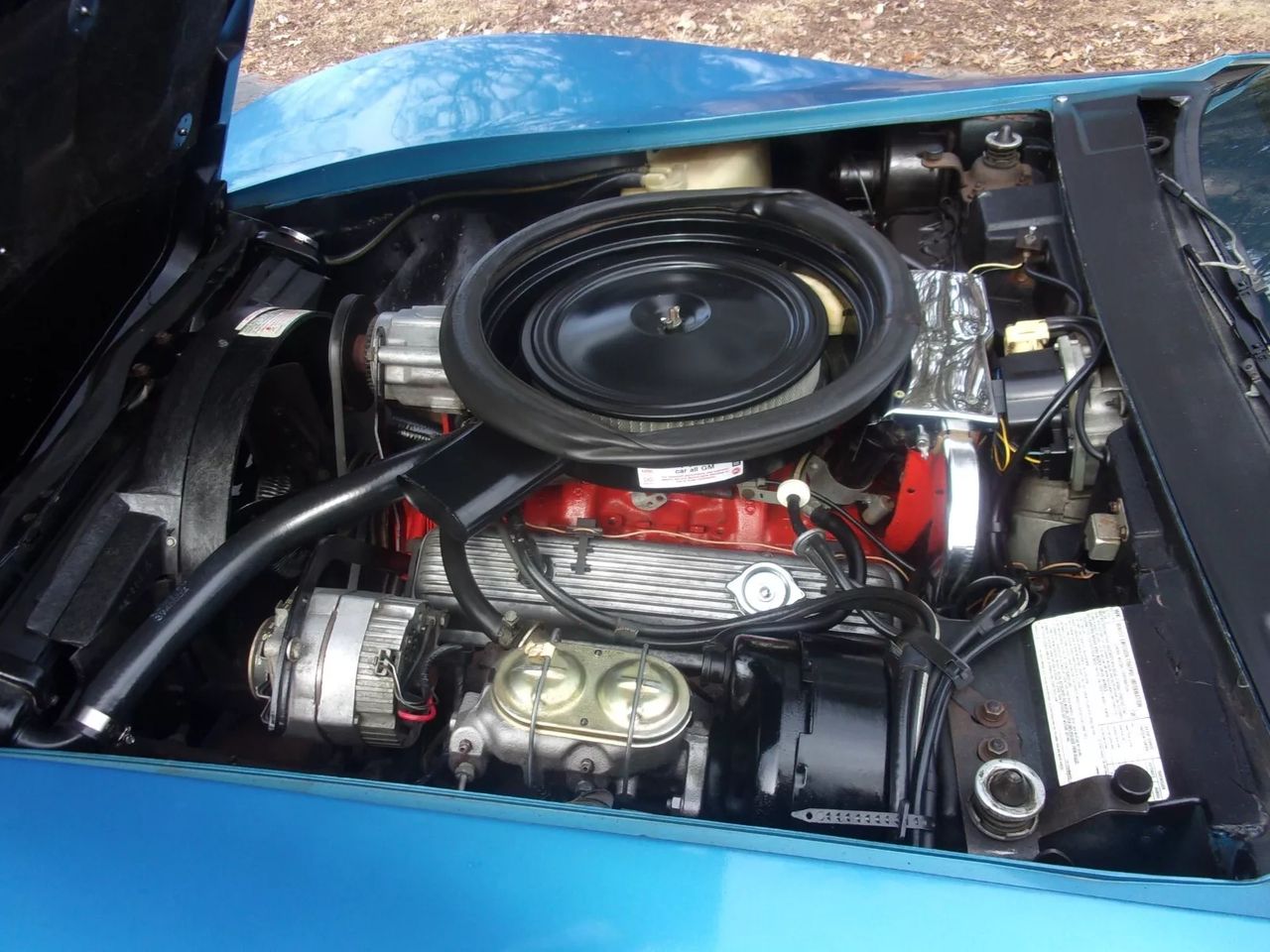
    Here’s the sweet spot of the 1973 lineup: the L82 350-cubic-inch small-block. Rated at 250 horsepower, it gave the Stingray a sharper edge than the base L48 without the nose-heavy feel of the 454, making it the enthusiast’s choice in a year full of compromises. The higher compression and hotter cam let it pull harder through the midrange, and paired with a close-ratio four-speed, it delivered the kind of throttle response that still felt properly Corvette. It wasn’t the wild LT-1 of just a few seasons earlier, but it carried enough punch to keep the car respectable in any European company. In many ways, the L82 was the bridge between the muscle-era Stingrays and the more refined, emissions-era Corvettes that would follow.
    Here’s the sweet spot of the 1973 lineup: the L82 350-cubic-inch small-block. Rated at 250 horsepower, it gave the Stingray a sharper edge than the base L48 without the nose-heavy feel of the 454, making it the enthusiast’s choice in a year full of compromises. The higher compression and hotter cam let it pull harder through the midrange, and paired with a close-ratio four-speed, it delivered the kind of throttle response that still felt properly Corvette. It wasn’t the wild LT-1 of just a few seasons earlier, but it carried enough punch to keep the car respectable in any European company. In many ways, the L82 was the bridge between the muscle-era Stingrays and the more refined, emissions-era Corvettes that would follow.

    It wasn’t the end of performance—it was the beginning of a new era where Corvette would have to justify its performance identity not through theater, but through engineering and owner loyalty.

    Let’s put it bluntly: the LT-1 didn’t disappear because Corvette ran out of heroes. It disappeared because it legally couldn’t breathe out leaded emissions anymore.

    Hydraulic lifters didn’t make it slower. They made it qualified for continuation.

    VINs, Identity, and Numerological Oddities – A Year of Proof That Chevy Wasn’t Cutting Corners Either
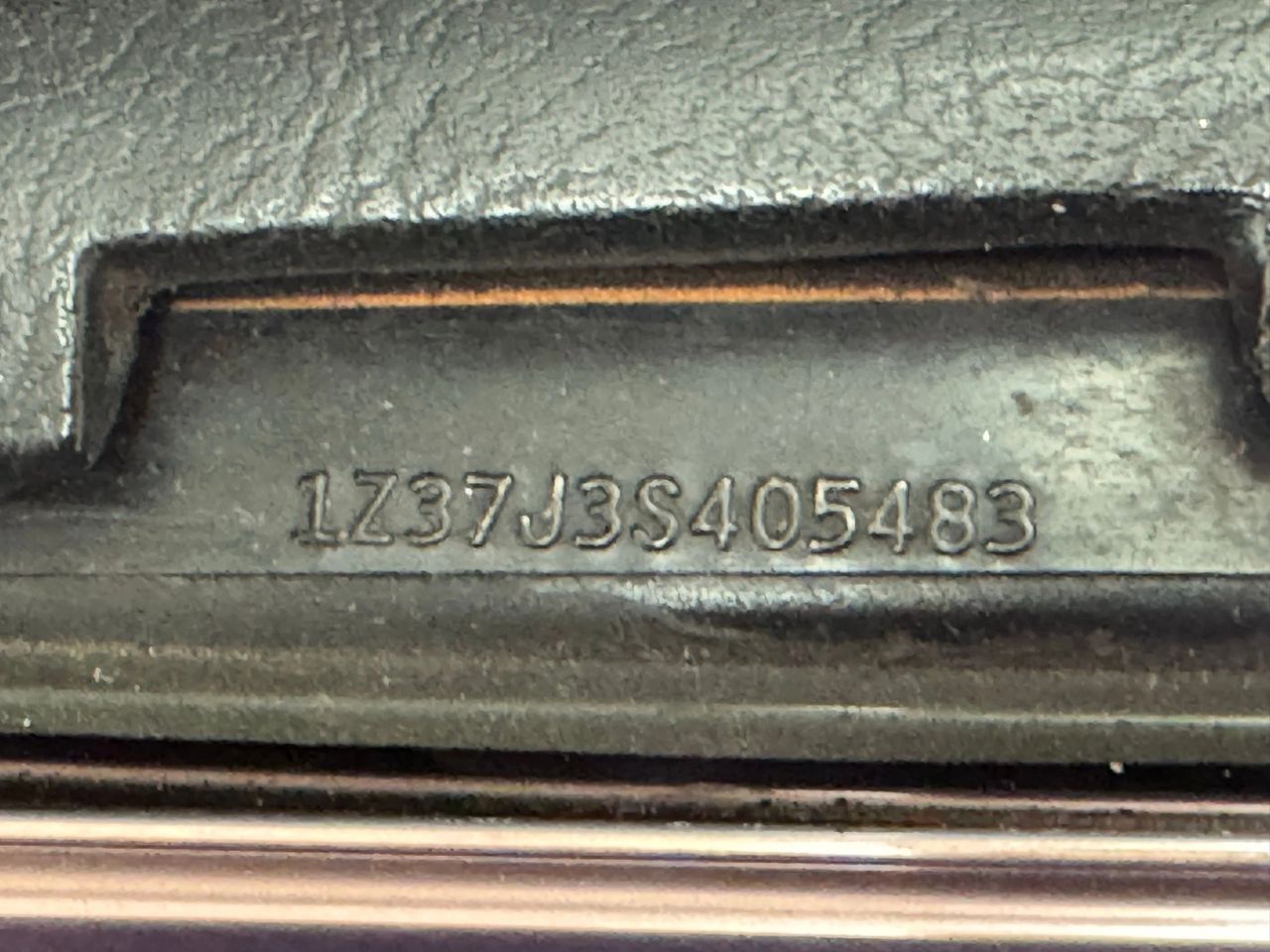
    This dash VIN stamp reads 1Z37J3S405483, the unique 13-character vehicle identification number assigned to this Corvette. Decoding it shows 1 = Chevrolet, Z = Corvette, 37 = coupe body, J = L48 350-ci small-block V-8, 3 = 1973 model year, and S = St. Louis assembly plant. The final six digits (405483) mark it as the 5,483rd 1973 Corvette built, an important reference point for confirming its numbers-matching status. (source: Classic Auto Mall)
    This dash VIN stamp reads 1Z37J3S405483, the unique 13-character vehicle identification number assigned to this Corvette. Decoding it shows 1 = Chevrolet, Z = Corvette, 37 = coupe body, J = L48 350-ci small-block V-8, 3 = 1973 model year, and S = St. Louis assembly plant. The final six digits (405483) mark it as the 5,483rd 1973 Corvette built, an important reference point for confirming its numbers-matching status. (source: Classic Auto Mall)

    Corvette’s production identity in 1973 was every bit as polarizing—and as talked-about—as its new urethane nose. Chevrolet reserved a block of VIN serials running from 400001 through 434464, enough for 34,464 potential cars. In reality, only 30,464 Corvettes were built that year. That left exactly 4,000 VINs that were never stamped on a frame or title, creating one of those neat, maddening little gaps that Corvette people love to argue about.

    The unused block corresponds to sequence numbers 24001–28000, a clean, 4,000-car hole that historians later mapped out and collectors have obsessed over ever since. Federal rules required every car to have a unique VIN—but they didn’t require Chevrolet to use every number it set aside. By leaving that chunk of the sequence untouched, Chevy made it clear that real-world production, safety upgrades, and the hard work of getting the 1973 car right took precedence over making the paperwork look perfectly continuous on paper.
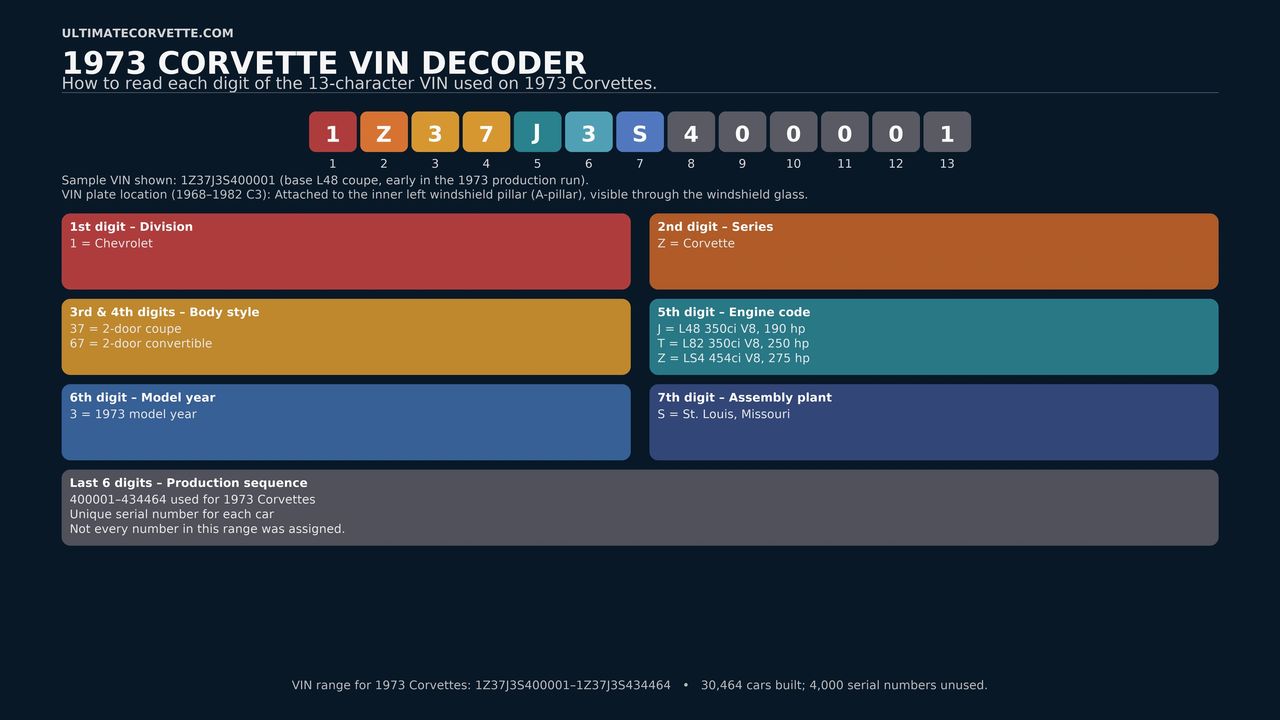
    This 1973 Corvette VIN guide breaks down all 13 characters—division, series, body style, engine, plant, and build sequence—so you can verify exactly what your ’73 left St. Louis as from day one. (Image courtesy of UltimateCorvette.com)
    This 1973 Corvette VIN guide breaks down all 13 characters—division, series, body style, engine, plant, and build sequence—so you can verify exactly what your ’73 left St. Louis as from day one. (Image courtesy of UltimateCorvette.com)

    For Corvette enthusiasts, that skipped VIN range became more than a clerical oddity. It turned into a symbol of how turbulent and transition-heavy 1973 really was. Corvette mythology has never been just about horsepower numbers or quarter-mile times; it’s also about the continuity and identity encoded in details like this. Even the VIN analysts were, in their own way, acknowledging how far-reaching—and controversial—the year’s changes had become. In that sense, 1973 stands as an emblematic inflection point: Chevy literally assigned numbers it never meant to build, and in doing so, added yet another layer of lore to a car already overflowing with it.

    Concept Corvettes in the 1973 Orbit

    For 1973, Corvette engineering thinking stretched well beyond the familiar C3 shape in the form of the XP-987 GT, a mid-engine two-rotor concept car. Built on a shortened Porsche 914 chassis with Pininfarina-crafted steel bodywork, it housed GM’s experimental twin-rotor Wankel engine amidships and explored a smaller, more European-flavored Corvette of the future. Intended as a possible mid-’70s successor to the production car, it was ultimately sidelined when GM’s rotary program was cancelled, but the one-off survived and now lives in museum custody as a rolling “what if.” We cover the full story of the XP-987 GT—its development, near-disposal, and unlikely rescue—in a dedicated deep-dive on the Mid-Engine/C8 Corvette Concepts page of UltimateCorvette.com. (Image courtesy of Joe Kolecki/Kolecki Photography)
    For 1973, Corvette engineering thinking stretched well beyond the familiar C3 shape in the form of the XP-987 GT, a mid-engine two-rotor concept car. Built on a shortened Porsche 914 chassis with Pininfarina-crafted steel bodywork, it housed GM’s experimental twin-rotor Wankel engine amidships and explored a smaller, more European-flavored Corvette of the future. Intended as a possible mid-’70s successor to the production car, it was ultimately sidelined when GM’s rotary program was cancelled, but the one-off survived and now lives in museum custody as a rolling “what if.” We cover the full story of the XP-987 GT—its development, near-disposal, and unlikely rescue—in a dedicated deep-dive on the Mid-Engine/C8 Corvette Concepts page of UltimateCorvette.com. (Image courtesy of Joe Kolecki/Kolecki Photography)

    For all the talk of rubber bumpers, emissions hardware, and NVH improvements, 1973 was also the year Corvette flirted hardest with an entirely different future. While the production car stayed front-engined and familiar, Chevrolet’s advanced studios were quietly pushing out a string of radical mid-engine and rotary-powered concepts that wore Corvette badges but shared almost nothing with the long-hood C3 in your local showroom. Seen together, these cars form a shadow “lineup” around the 1973 model year—a parallel timeline where Corvette might have gone lighter, smaller, and far more exotic.

    The most visible of these was the XP-987 GT Two-Rotor Corvette, a compact mid-engine coupe originally developed as the “Chevrolet GT.” Underneath its low, Pininfarina-built body sat a shortened and widened Porsche 914/6 chassis, with the suspension, steering, and brakes largely carried over. GM’s experimental RC2-206 two-rotor Wankel engine—206 cubic inches and roughly 180 horsepower—was mounted transversely behind the seats and drove a new automatic transaxle, previewing hardware meant for future compact Chevrolets. Days before its debut at the 1973 Frankfurt Motor Show, Chevrolet quietly rebranded the car as the Corvette Two-Rotor, an acknowledgment that, at least for a moment, this tidy, European-scale machine was being considered as a legitimate extension of the Corvette story.

    If the Two-Rotor hinted at a smaller, more efficient Corvette, its big sibling went in the opposite direction. Building off the earlier XP-882 mid-engine program, Chevrolet created the XP-895 Four-Rotor Corvette—a dramatic wedge-shaped prototype powered by a 420-horsepower Wankel built by pairing two Vega two-rotor engines into a single four-rotor unit. The chassis layout remained mid-engine, but the car itself was bolder, lower, and visually closer to the supercars Chevrolet expected to battle on the world stage. This was the “no apologies” interpretation of a rotary Corvette, aimed squarely at traditional performance expectations even as fuel economy and regulations were tightening around the production car.

    Though its internal project date is 1972, the XP-895 Reynolds Aluminum Corvette is often treated as a 1973 concept because that’s the year it made its public debut at the New York Auto Show. Developed as an evolution of the XP-882 mid-engine program, XP-895 used a transverse-mounted 400-cid small-block V-8 driving the rear wheels through a Turbo-Hydramatic and bevel gearbox. Chevrolet had two nearly identical cars built, one in conventional steel and one in aluminum, the latter crafted in partnership with Reynolds Metals to test how much weight—and therefore performance—could be gained by going all-alloy. When the silver mid-engine coupe finally rolled onto the New York show stand in 1973, it served as both a rolling laboratory for lightweight construction and a very public hint at the mid-engine Corvette future GM was actively exploring. (Image courtesy of GM Media LLC)
    Though its internal project date is 1972, the XP-895 Reynolds Aluminum Corvette is often treated as a 1973 concept because that’s the year it made its public debut at the New York Auto Show. Developed as an evolution of the XP-882 mid-engine program, XP-895 used a transverse-mounted 400-cid small-block V-8 driving the rear wheels through a Turbo-Hydramatic and bevel gearbox. Chevrolet had two nearly identical cars built, one in conventional steel and one in aluminum, the latter crafted in partnership with Reynolds Metals to test how much weight—and therefore performance—could be gained by going all-alloy. When the silver mid-engine coupe finally rolled onto the New York show stand in 1973, it served as both a rolling laboratory for lightweight construction and a very public hint at the mid-engine Corvette future GM was actively exploring. (Image courtesy of GM Media LLC)

    XP-895 also spawned one of the era’s most technically interesting offshoots: the so-called Reynolds Aluminum Corvette. In place of the original steel body, Chevrolet and Reynolds Metals Company (yes, that Reynolds company….as in Reynolds Wrap aluminum foil) developed an aluminum skin that closely followed the same basic surfacing but cut roughly 400–500 pounds from the car’s mass. The prototype—finished in a simple silver—served as a rolling proof-of-concept that lightweight alloys could be used for volume bodywork, something well beyond Corvette’s fiberglass comfort zone at the time. Even when later re-fitted with a transversely mounted 400-cubic-inch small-block V8 and automatic transmission, the car remained a test bed for materials and packaging ideas that wouldn’t fully pay off until much later generations.

    All of these experiments eventually converged into what enthusiasts now simply call the Aerovette—a further-refined evolution of the XP-882/XP-895 theme with a V8 in place of the rotary and striking details like double-folding gullwing doors. By the mid-1970s, there was a serious internal push to put a version of this car into production as an early-1980s Corvette, priced above the existing C3 and aimed squarely at exotic imports. The program ultimately died as key champions like Zora Arkus-Duntov, Bill Mitchell, and Ed Cole left GM, and as new leadership decided that a front/mid-engine layout (what we’d eventually recognize in the C4) made more sense for cost, performance, and manufacturing.

    To a 1973 Corvette buyer leafing through magazines, these cars may have looked like distant possibilities—cool showpieces with no clear path to the local dealer. Inside Chevrolet, though, they were very real alternatives being weighed against the familiar Shark-bodied car that stayed in production. Together, the Two-Rotor Corvette, the XP-895 Reynolds Aluminum prototypes, and the Aerovette family show just how wide the decision space really was around the 1973 model year. The fact that the C3 stayed front-engined and fiberglass doesn’t diminish those concepts; if anything, it makes them even more compelling side stories. Each one represents a different answer to the same question—what should Corvette become next?—and each earns its own deep-dive exploration beyond this overview.

    Colors, Body Styles & How Many Were Built
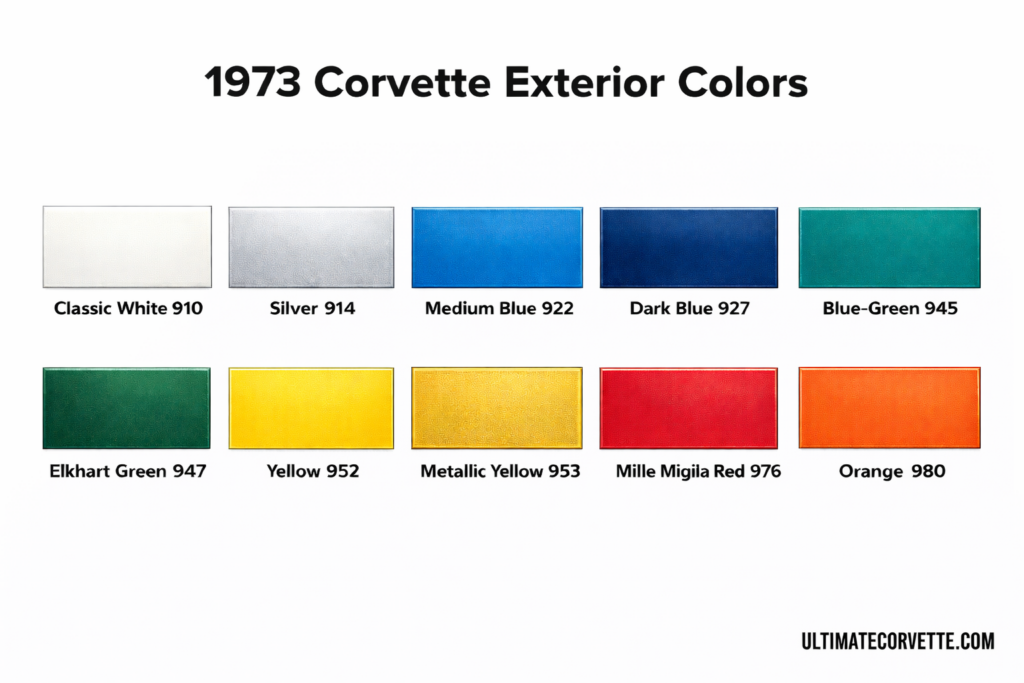
    1973 Chevy Corvette Exterior Paint Color Palette
    1973 Corvette paint colors with description and original paint codes. (Image source: UltimateCorvette.com)

    From a pure numbers standpoint, 1973 was a healthy year for Corvette production. Chevrolet built 30,464 cars in total, divided into 25,521 coupes and 4,943 convertibles—roughly 84 percent coupes to 16 percent convertibles, or about five fixed-roof cars for every open one. It was another data point in a trend that had been building since the late ’60s: buyers were increasingly choosing the T-top coupe over the soft-top Corvette, even as Chevrolet continued to offer both. Adding to the production trivia, Chevrolet skipped 4,000 VINs (numbers 24,001 through 28,000) during the 1973 run, so the last serial number ends at 34,464 even though only 30,464 cars were actually built.

    Paint choices were just as interesting. The 1973 palette offered ten exterior colors: Classic White (910), Silver (914), Medium Blue (922), Dark Blue (927), Blue-Green (945), Elkhart Green (947), Yellow (952), Metallic Yellow (953), Mille Miglia Red (976), and Orange (980). They ranged from conservative showroom staples—white, silver, and the familiar Mille Miglia Red—to more adventurous hues like the one-year-only Blue-Green and the butterscotch-toned Metallic Yellow, both of which are widely regarded in the hobby as rare sights today. Chevrolet, however, never released a formal breakdown of how many cars were painted in each shade, and even the most detail-heavy reference guides list those color quantities as “n/a,” so any claims of exact per-color totals are educated guesses rather than factory-documented fact.

    Even without hard numbers, the survivor population tells its own story. On today’s show fields and in auction catalogs, Classic White, Silver, and Mille Miglia Red appear far more frequently, suggesting they were the safe, high-volume dealer orders in 1973, while Blue-Green and Metallic Yellow tend to draw attention precisely because they’re seldom seen and were offered for a very short window. Taken together—body-style mix, skipped VINs, and a color chart that ranged from conservative to downright bold—the 1973 production picture underscores a Corvette trying to satisfy mainstream demand while still giving buyers enough visual drama to stand out in the era of insurance surcharges and tightening regulations.

    Economics, Passion, and a Slightly Softer Legend

    A metallic burnt-orange 1973 Chevrolet Corvette Stingray coupe is shown in side profile, parked on a paved desert turnout in Southern Arizona. The car features a long sculpted hood, removable T-top roof panels, chrome rear bumper, turbine-style wheels, and polished side-exit exhausts, all illuminated by a vivid sunset sky filled with layered orange and pink clouds. Sparse desert vegetation, saguaros, and distant rock formations stretch across the background, emphasizing the Corvette’s low stance and dramatic C3 silhouette against the open desert landscape.
    he 1973 Corvette was a pivotal one-year bridge in the C3 era: it introduced the first urethane (energy-absorbing) front bumper, while retaining the last chrome rear bumper. That split-personality look makes ’73 instantly recognizable—and historically important—as Corvette began adapting to new safety and emissions realities without losing its long-hood Stingray attitude. Today, its unique “best of both worlds” bumper combination, classic C3 proportions, and role as a true transition-year model keep the 1973 Corvette highly relevant (and highly collectible) in the modern hobby.

    Sales volumes for 1973 increased slightly over 1972, with Chevy manufacturing 30,464 cars in total—more than 80% being coupes. The base coupe price was $5,561.50, while the convertible listed at $5,398.50. Options like air conditioning (C60) were ordered on 21,578 cars—more than 70% of the total production run. This was not a coincidence. Corvette fans wanted a car capable of personality, comfort, and performance—not silence.

    It was the end of Vietnam, the beginning of regulatory accountability, and Corvette’s own coming-of-age year—where the car met federal safety mandates while retaining mechanical diplomacy through noise suppression, induction automation, and European performance parity.

    Today’s Corvette lovers may debate which model years best maintain high-performance identities without compromise. But 1973 does something rarer: it reminds the world that compromise is the currency of continuation, and continuation is what protects myth.

    The 1973 Corvette doesn’t just represent an inflection point in Corvette history—it embodies the paradox of 1973 itself:

    • We could put people in space, yet still argued over whether a bumper would survive a 5-mph parking-lot nudge.
    • We watched a war wind down overseas even as a different kind of battle erupted at home over fuel, safety, and emissions.
    • We built pipelines across frozen wilderness while fretting over the weight of steel, the cost of chrome, and the porosity of aluminum wheels.
    • We matured politically, technologically, culturally—and Corvette matured right along with it, trading chrome for urethane, noise for nuance, and proving that growing up didn’t have to mean giving up.

    It was a decade of research. It was a year of reach. It was the beginning of engineering-led styling. It was the end of mechanical lifters.

    And frankly? It made the legend stronger.

    The 1973 Corvette arrived at a crossroads—where muscle-era attitude met a changing automotive world. With its dramatic C3 styling, one-year-only bumper combination, and unmistakable Stingray presence, the ’73 Corvette tells a story of adaptation without surrender. It’s a model year defined not just by what changed, but by what Corvette fiercely refused to give up.