
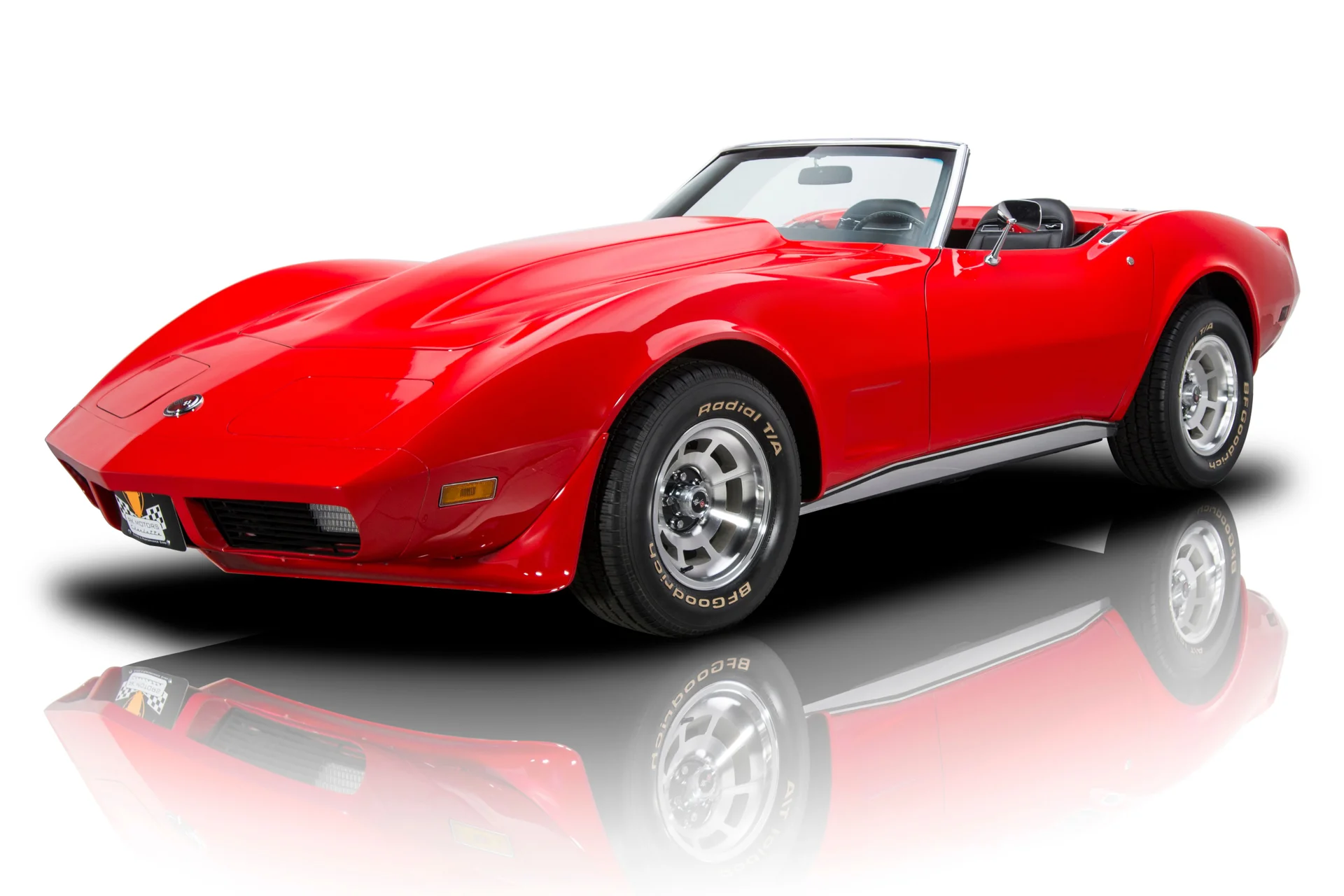
By the time the 1974 Corvette reached showrooms, the American performance car was fighting for its life. The trouble had not started in St. Louis, but half a world away.
In October 1973, the Arab members of OAPEC—joined by Egypt, Syria, and Tunisia—announced an oil embargo against the United States and several Western allies in response to U.S. support for Israel during the Yom Kippur War. From October 1973 to March 1974, crude prices roughly quadrupled from about $3 to $12 a barrel, while U.S. gasoline prices jumped nearly 50 percent in a matter of months. Long lines at the pump, odd/even rationing schemes, and shuttered stations became part of the American landscape.
Detroit had already been grappling with a different kind of crisis: tightening federal emissions rules and new safety standards that forced carmakers to add weight while simultaneously cutting compression and horsepower. The Clean Air Act amendments of 1970 had empowered the newly formed EPA to ratchet down allowable tailpipe emissions, effectively forcing a move toward catalytic converters in the mid-1970s and making unleaded gasoline a necessity, since leaded fuel quickly poisoned catalyst substrates.
Against that backdrop, the 1974 Corvette emerged as a transitional car in every sense. It still looked and felt like a classic C3 Stingray, still offered a genuine big-block 454, still exhaled through a real dual exhaust system—and yet it sat on the brink of the catalytic-converter era. In many ways, 1974 was the last Corvette of the “old world,” even as it pointed directly at the future.
Bridging Two Eras: Power, Fuel, and the End of the Big-Block
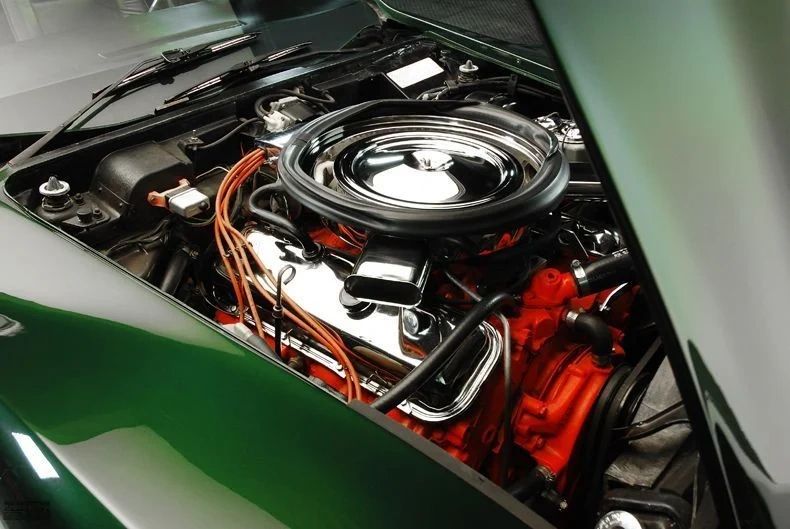
From a historical standpoint, three “lasts” define the 1974 model year:
- It is the final year a Corvette could be ordered with a big-block V-8, the LS4 454.
- It is the final year of a true dual exhaust system, with separate pipes and mufflers for each bank of cylinders.
- It is the final Corvette that could legally run on leaded gasoline; starting with the 1975 model year, federal regulations and the arrival of catalytic converters made unleaded fuel mandatory for new passenger cars.
The 1974 engines were engineered to operate on 91-octane leaded or low-lead fuel, a transitional step that anticipated the coming unleaded-only world. Chevrolet, like every other manufacturer, was walking a tightrope: trying to preserve as much of the Corvette’s performance character as possible while keeping the car compliant with emissions, noise, and fuel-economy pressures that simply did not exist when the C3 debuted for 1968.
If you draw a line through the early chrome-bumper cars and the late, catalyst-equipped C3s, the 1974 Corvette sits almost exactly at the pivot point. It is both the last of the big-inch bruisers and an increasingly refined grand touring car.
Styling: Urethane All Around and a One-Year-Only Tail
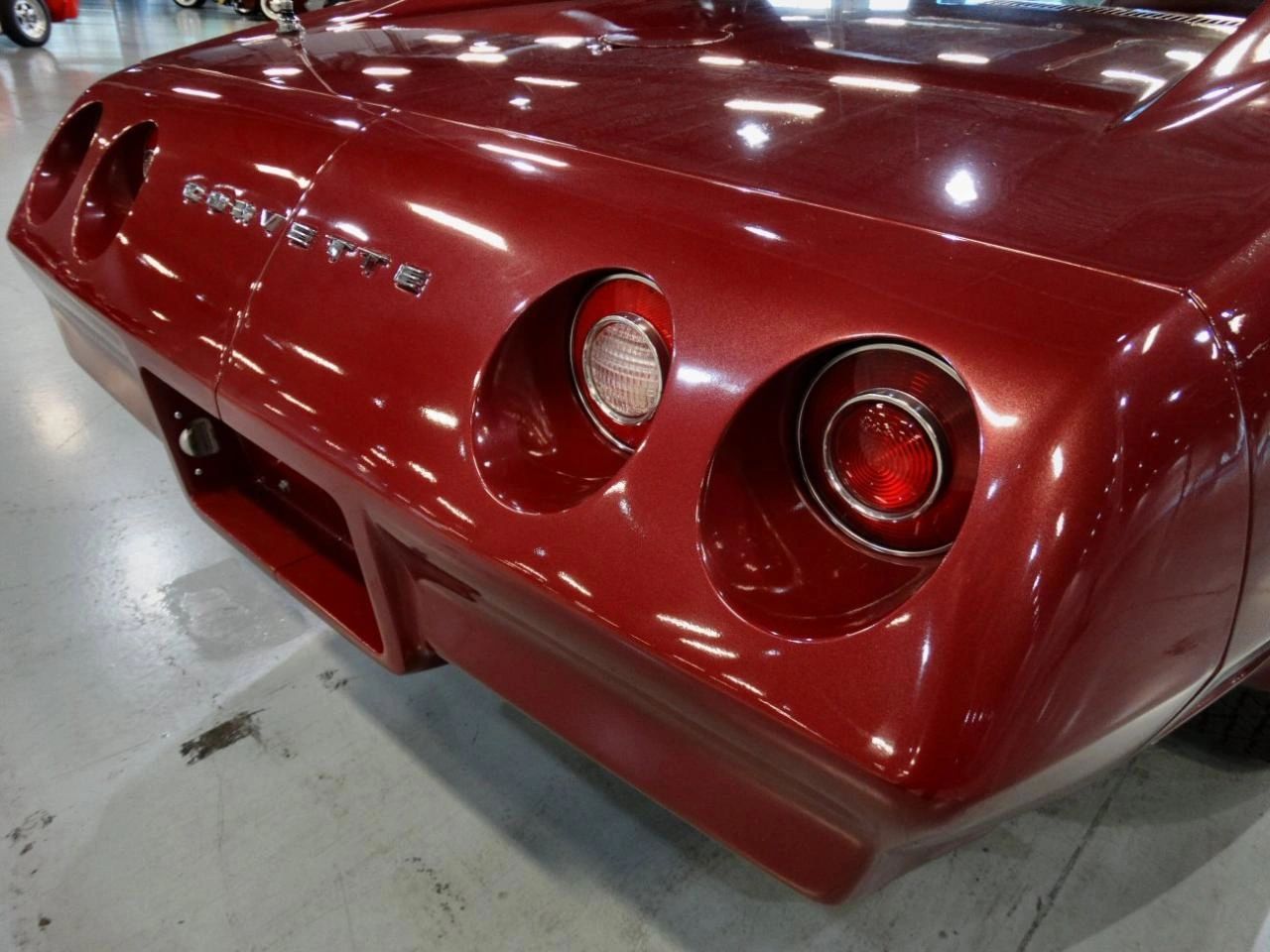
The most obvious visual change for 1974 is at the rear of the car. Federal bumper regulations had required a 5-mph front impact standard starting in 1973 and extended that 5-mph requirement to the rear for 1974.
Chevrolet’s response was to complete the transition begun in 1973. The chrome rear bumper was retired, and in its place came a body-color urethane fascia that visually matched the urethane front treatment introduced the previous year. Under that plastic “skin” lived a substantial aluminum impact bar mounted on telescoping brackets, engineered to absorb low-speed hits without damaging the frame.
Several details make the 1974 rear fascia unique:
- The urethane shell was built in two halves, left and right, joined by a vertical center seam. No other C3 model year used this two-piece arrangement, and the seam is a quick visual tell for a ’74.
- The taillamps were recessed into larger pockets, and the exhaust outlets were moved to exit underneath the bumper rather than through cutouts in the bodywork, as on earlier cars.
- The familiar fuel-filler “cross-flags” emblem on the rear deck, last seen in 1973, disappeared; 1974s went without a gas-lid emblem altogether.
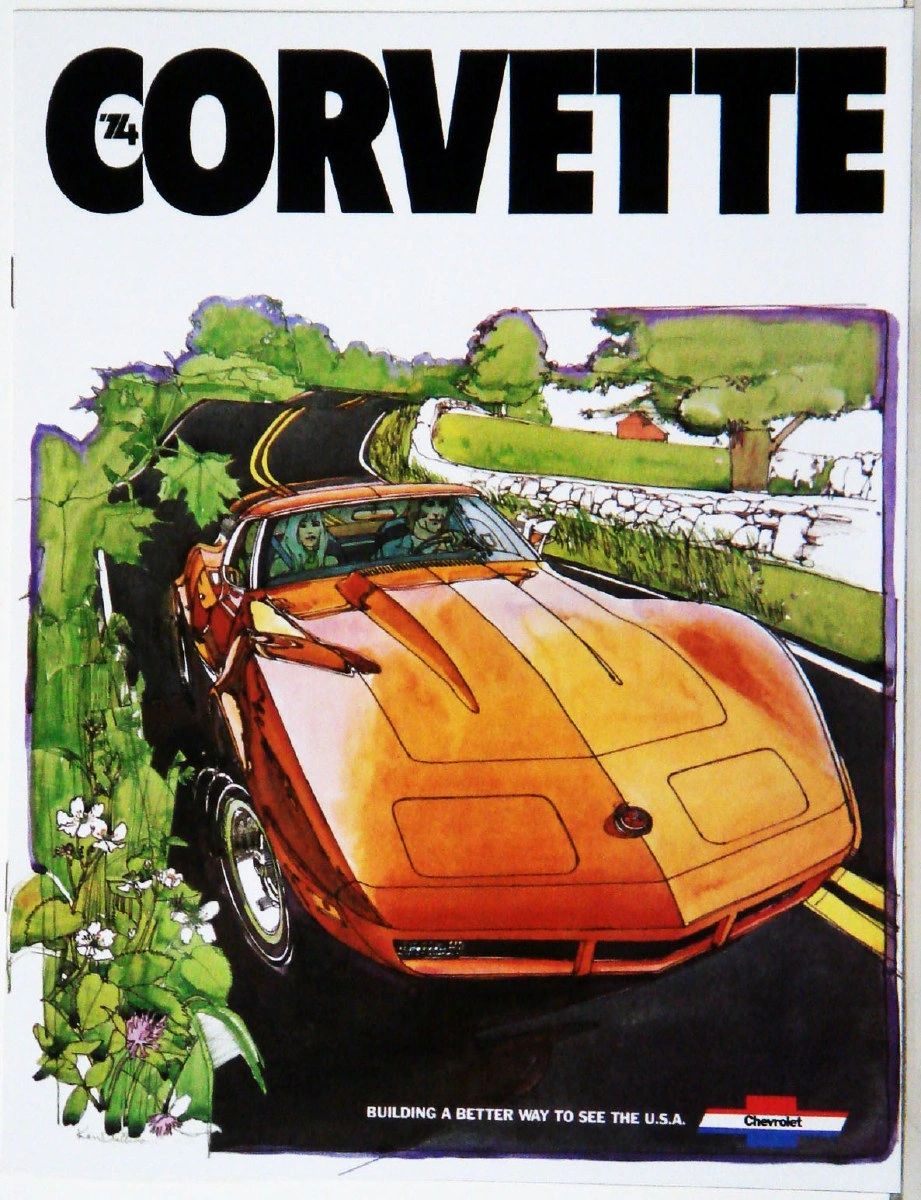
Chevrolet’s own brochure copy made the case that this wasn’t change for the sake of change: when engineers strengthened the rear bumper, styling was refined as well, yielding a smoother, more integrated tail that complemented the wind-tunnel-honed nose and fenders.
Up front, the car carried over the ’73 urethane bumper cover, pop-up headlamps and the now-familiar “shark” profile. Subtle detail changes—black aluminum grille inserts, revised emblem treatment—kept the car visually fresh without disturbing the fundamental shape that had made Corvette one of the most recognizable silhouettes in the world by the mid-1970s.
Interior and Safety: Quiet Refinement
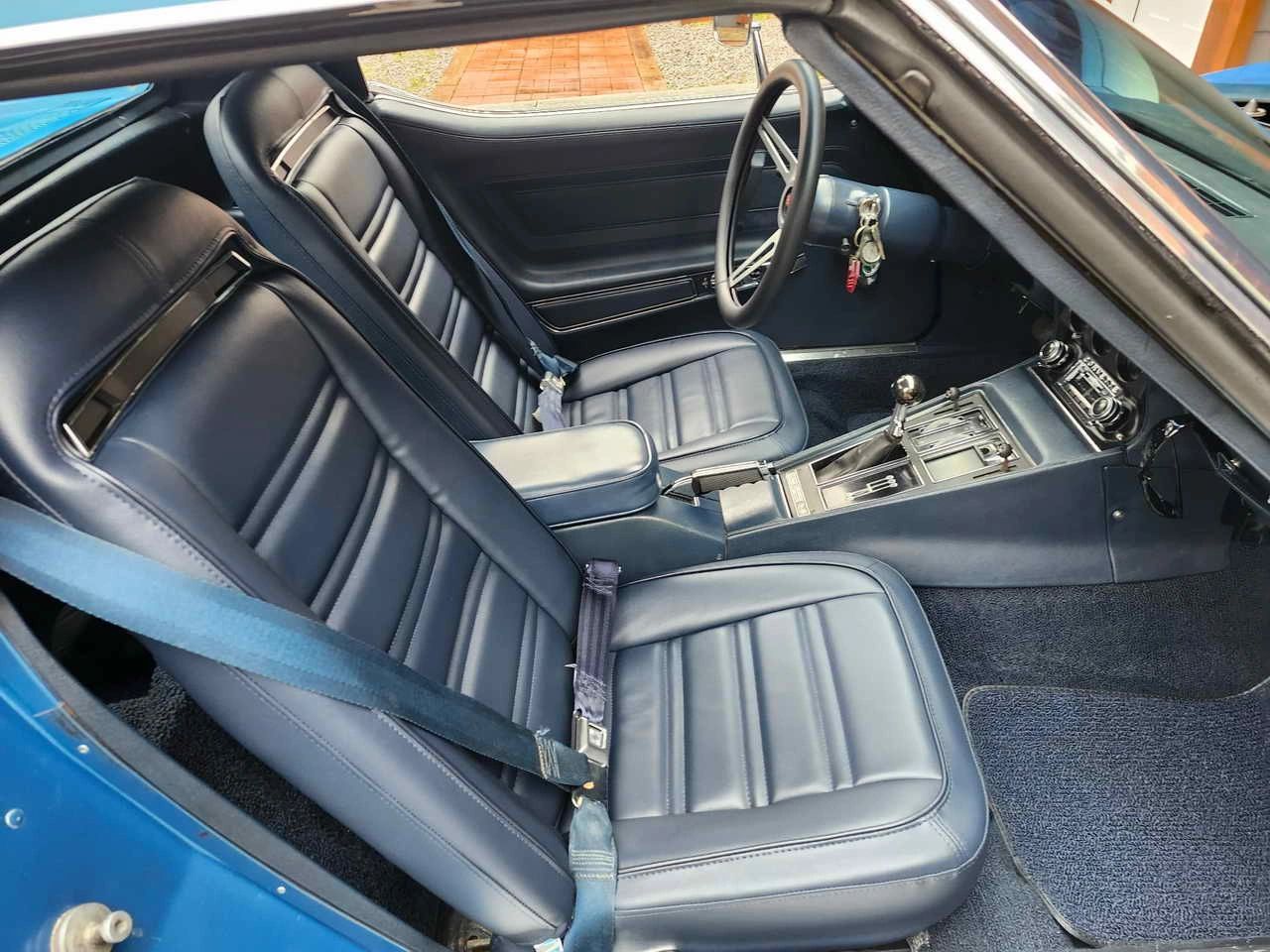
The interior of the 1974 Corvette did not undergo a wholesale redesign, but it did receive meaningful upgrades aimed at refinement, safety, and day-to-day usability.
The most important change came in occupant restraint. Coupes received new integrated lap-and-shoulder belts for the first time, with inertia-reel mechanisms engineered to lock under deceleration rather than solely on belt-pull rate. Convertibles retained separate lap and optional shoulder belts.
Other updates included:
- A wider inside rearview mirror—now 10 inches across—to broaden the driver’s view aft.
- Revisions to the HVAC ducting that improved air distribution, especially when equipped with the increasingly popular Four-Season air conditioning.
- Additional attention to sound control. When steel-belted radials were adopted earlier, road noise dropped enough that the exhaust note stood out more prominently. For 1974, Chevrolet “retuned” the dual exhaust system with added resonators—essentially mini-mufflers—to soften the cabin sound level without losing the Corvette’s characteristic growl.
The overall cabin remained familiar: a driver-centric layout with a deep-dish sport steering wheel, full instrumentation grouped directly ahead and to the right of the column, a center console housing the shifter and handbrake, and twin storage bins under the rear deck. Deep-pleated vinyl or optional leather seats offered more lateral support than the pre-’70 chairs, and color-keyed, deep-twist carpeting helped sustain the Corvette’s increasingly upscale grand-touring persona.
Chassis, Suspension, and Brakes
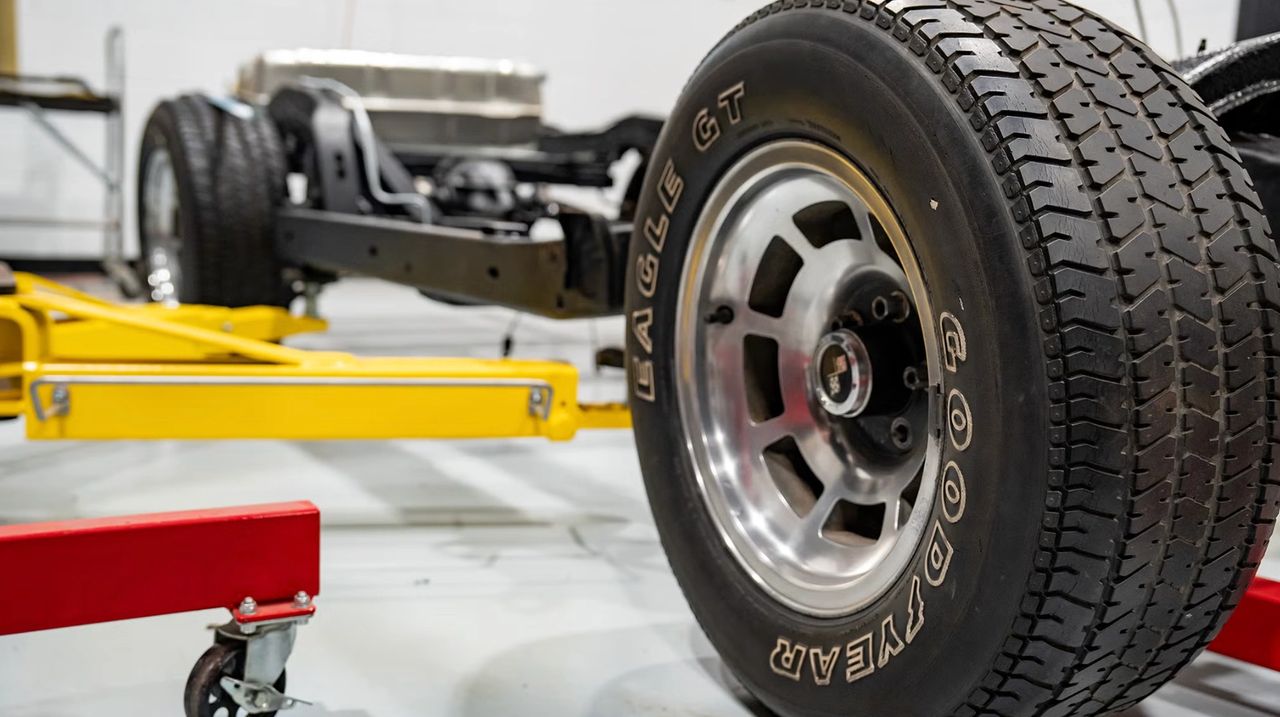
Underneath, the 1974 Corvette remained fundamentally a 1963-era Sting Ray at heart—and that was not a bad thing. The basic chassis architecture, refined over a decade, still delivered the combination of ride and handling that made the Corvette the de facto benchmark for American sports cars.
The front suspension used unequal-length A-arms, coil springs, and an anti-roll bar; the rear retained the independent layout introduced in 1963, with a differential solidly mounted to the frame, and each wheel carried on trailing arms, struts, and a transverse multi-leaf steel spring. This independent rear suspension reduced unsprung weight and allowed each wheel to follow the road more faithfully, helping the Corvette maintain composure over broken pavement and during aggressive cornering.
Four-wheel disc brakes were standard, with power assist (RPO J50) ordered on an overwhelming majority of cars—33,306 of 37,502, or nearly 89 percent of production. Corvette owners in 1974 clearly valued braking confidence and everyday drivability as much as straight-line speed.
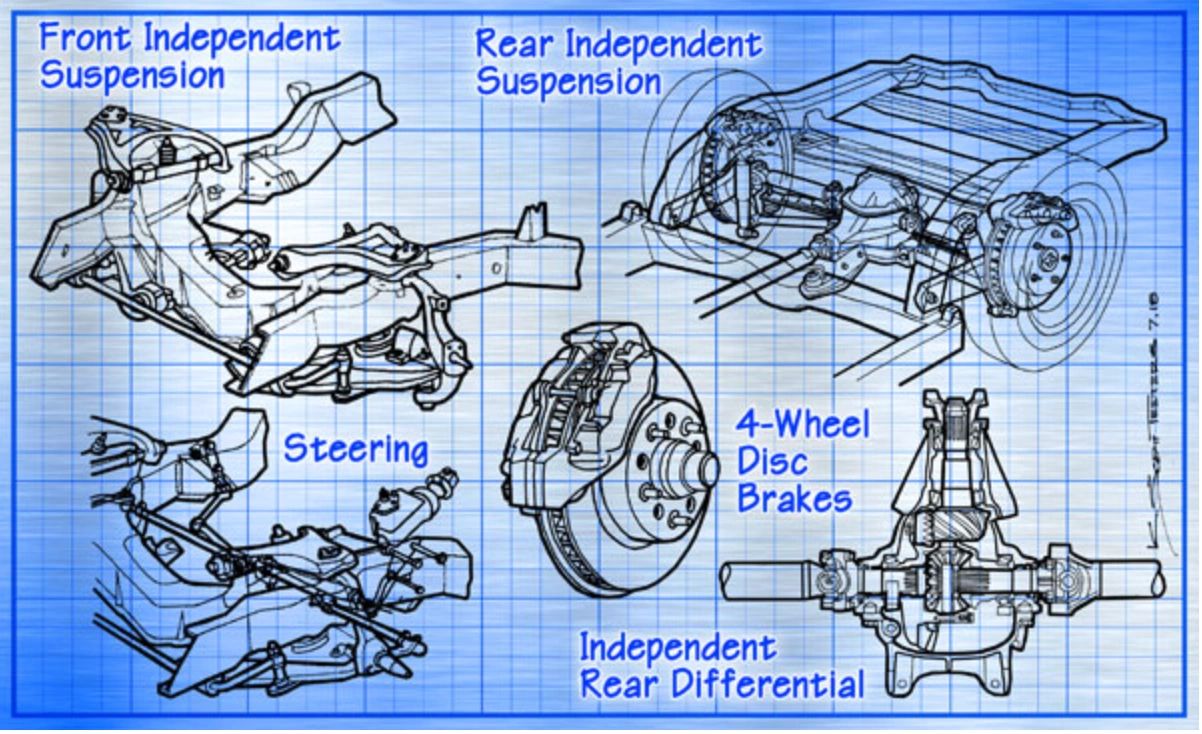
For the serious driver, the sleeper option of the year was the FE7 Gymkhana Suspension. For a mere seven dollars, Gymkhana added higher-rate springs, firmer shocks, and a larger-diameter front stabilizer bar. The package had its roots in the F41 and Z06 heavy-duty suspensions of the 1960s, but by 1974 it had morphed into one of the all-time performance bargains—specified on just 1,905 cars (about 5 percent of production).
Above that sat RPO Z07, the Off-Road Suspension and Brake package. Z07 combined the Gymkhana underpinnings with heavy-duty power disc brakes and specific gearing; just 47 cars were built with this package, making Z07-equipped ’74s some of the rarest performance-focused C3s of the era.
Powertrains: Three Very Different V-8 Characters
Despite the hostile regulatory and fuel environment, Chevrolet still offered three distinct engines for the 1974 Corvette, each with its own personality.
L48: The Everyday Small-Block
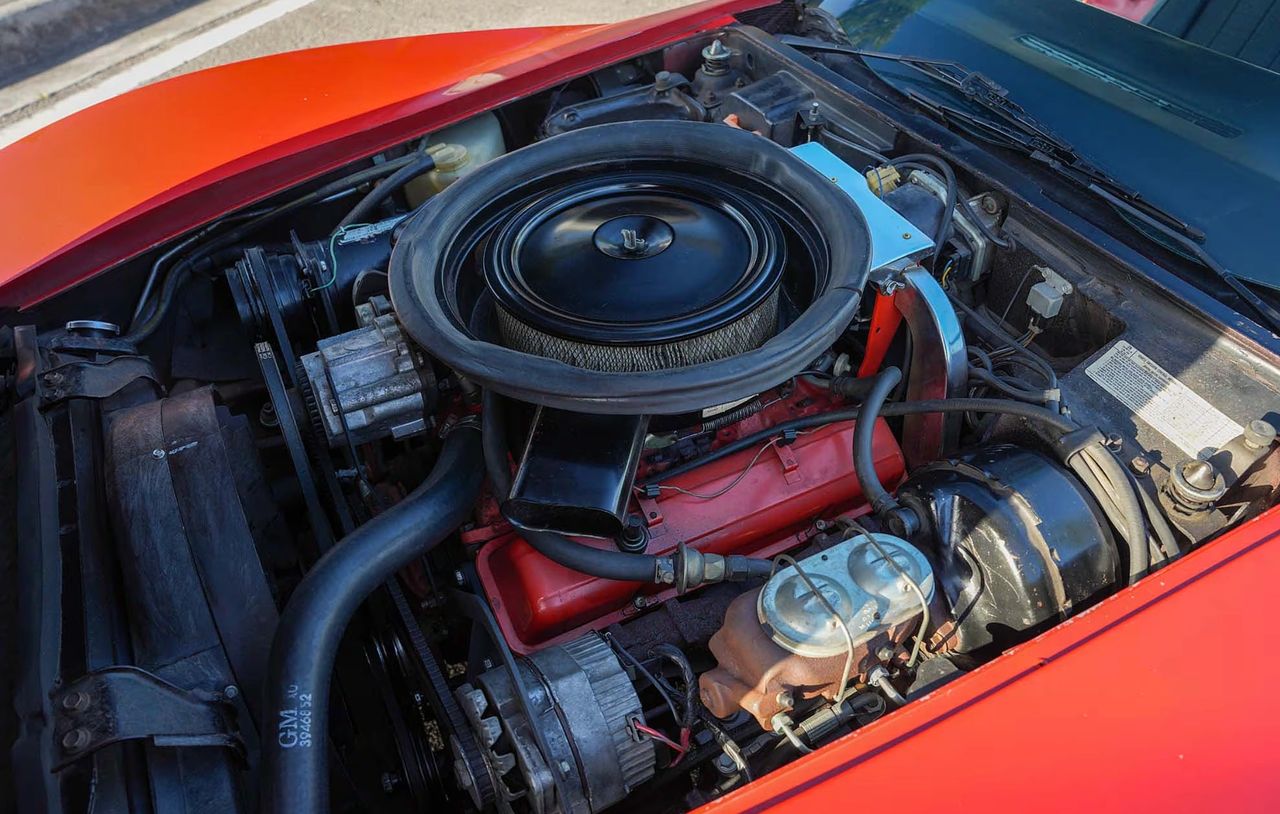
The standard engine remained the 350-cid Turbo-Fire small-block (RPO ZQ3, commonly identified as L48 for 1974), rated at 195 net horsepower at 4,400 rpm and 275 lb-ft of torque at 2,800 rpm.
Compression sat at 8.5:1, and fueling was via a Rochester Quadrajet four-barrel carburetor. In this tune, the small-block was deliberately mild-mannered: smooth idle, good low-speed driveability, and enough mid-range torque to make the car feel lively even with the increasingly popular Turbo Hydra-Matic automatic transmission. Contemporary tests of base-engine, automatic-equipped cars with economy axle ratios produced 0–60 mph times in the high-eight to low-nine-second range—respectable performance in the early “malaise” years, if not the tire-melting brutality of late-1960s big-blocks.
L82: The “Enthusiast” 350
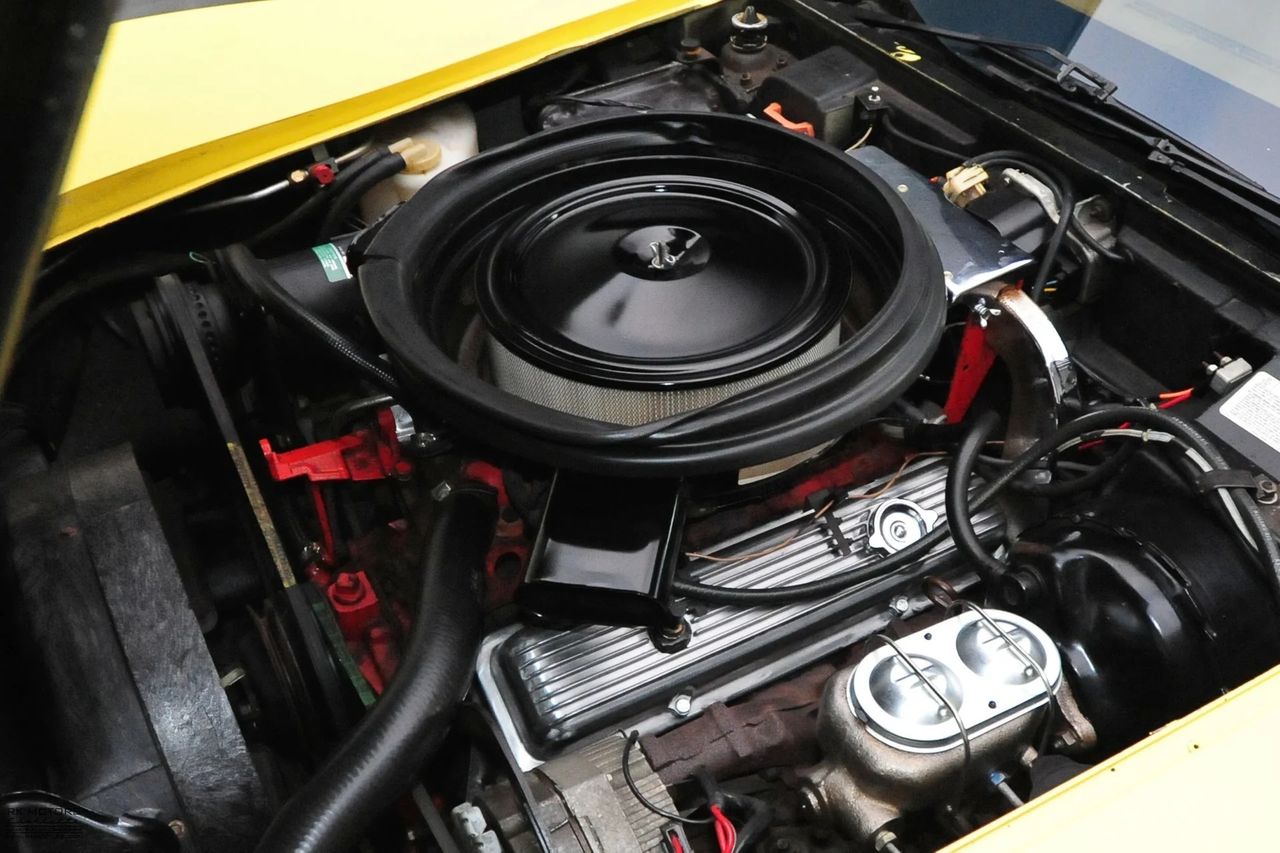
For buyers who still wanted some sting in their Stingray, the L82 350-cid engine remained the sweet spot. Rated at 250 net horsepower at 5,200 rpm and 285 lb-ft at 4,000 rpm, the L82 employed a more aggressive camshaft, higher 9.0:1 compression, revised cylinder heads, and other detail changes to broaden the powerband and sharpen throttle response.
Hi-Performance Cars magazine’s September 1973 issue, in a period comparison of L48, L82, and LS4, praised the base engine for its balance but acknowledged that the L82 delivered the best all-around performance. Independent performance compilations show L82 four-speed cars posting 0–60 times in the mid-7-second range and quarter-mile runs in the mid-15s at around 90–92 mph.
In short, the L82 restored much of the real-world punch that the lower net horsepower labels tended to obscure. It was not an LT-1, but in the context of 1974, it remained one of the stronger performance engines available in an American production car.
LS4: The Final 454
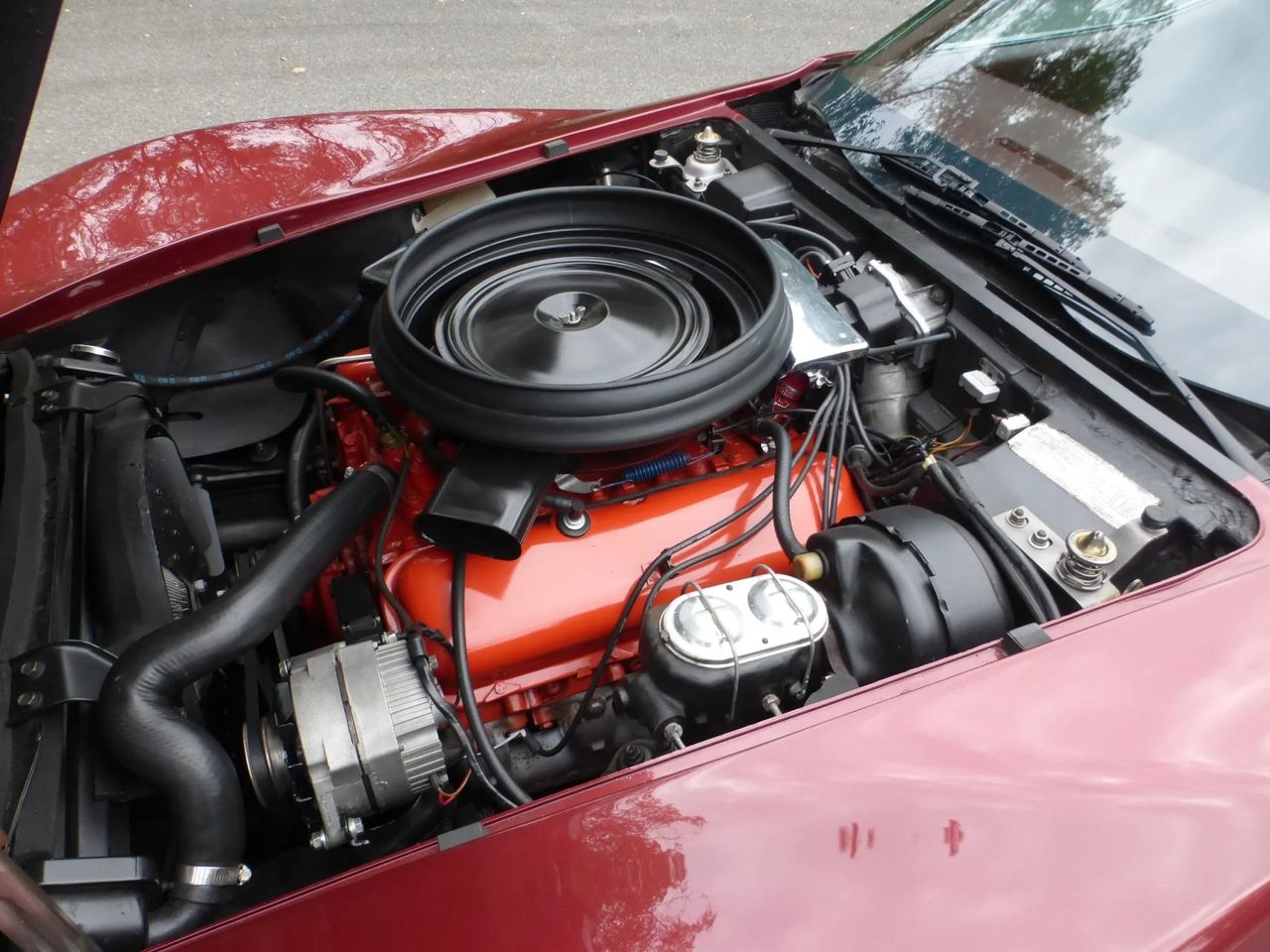
At the top of the range sat the LS4 454-cid Turbo-Jet big-block, rated at 270 net horsepower at 4,400 rpm and a stump-pulling 380 lb-ft of torque at just 2,800 rpm. Compression was a relatively modest 8.25:1, and like the other engines, the LS4 had been tamed to satisfy emissions and noise regulations.
On paper, the LS4’s 270 hp rating might look underwhelming next to earlier gross-rated 427s and 454s, but the engine still delivered immense mid-range thrust. Contemporary commentary often noted that the LS4 felt strongest in rolling acceleration, lunging the car forward on a wave of torque rather than screaming to redline.
Importantly, 1974 was the last time any Corvette buyer could check a box for a factory big-block. Only 3,494 cars—just over 9 percent of production—were ordered with the LS4, making 1974 454 cars a finite and historically significant subset of C3 production.
Transmissions and Axle Ratios
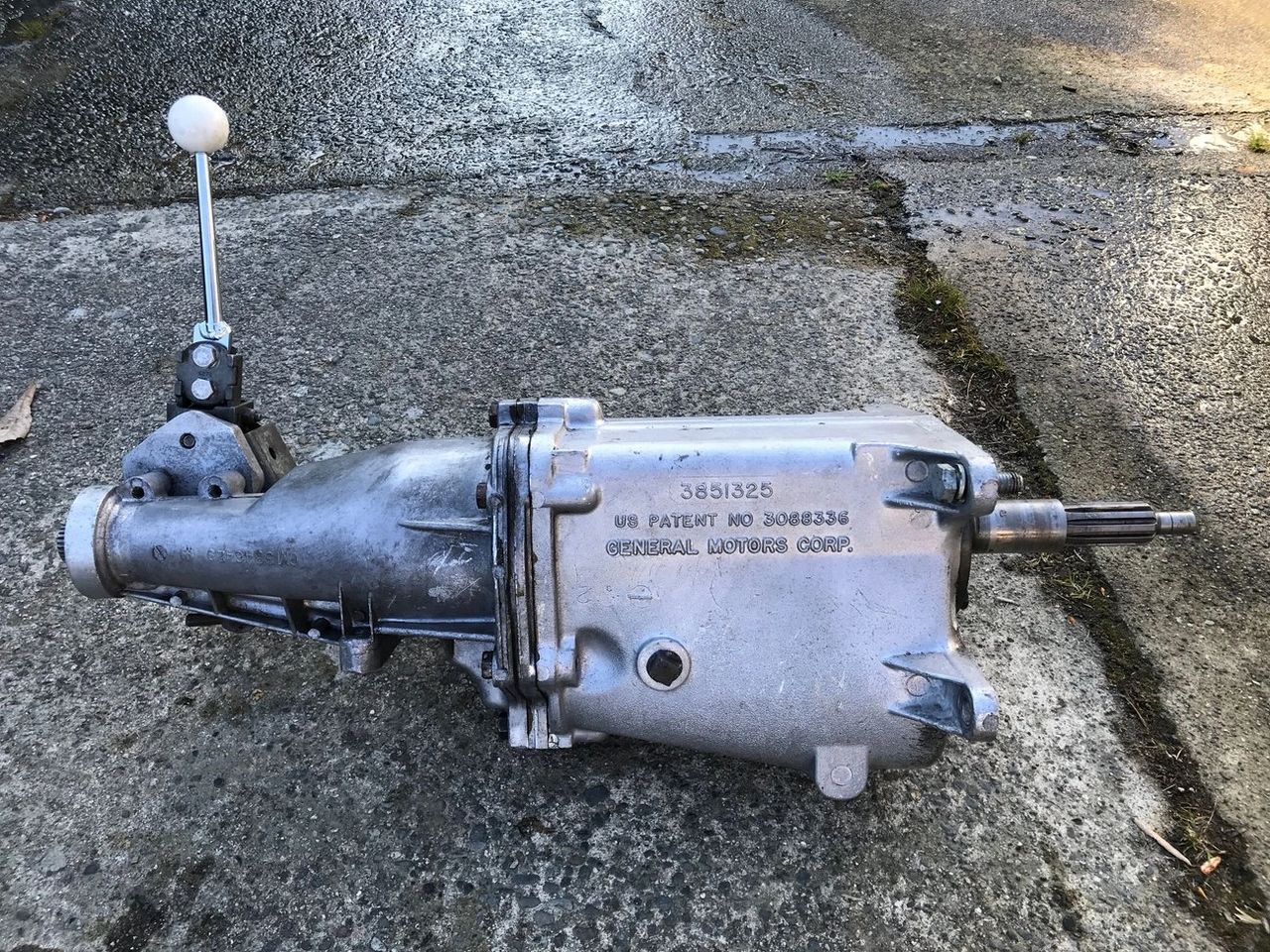
A fully synchronized four-speed manual transmission remained the Corvette’s baseline choice, carrying a wide-ratio gearset that used a 2.52:1 low gear to make the most of the era’s torque curves and relatively tall rear gearing. In practical terms, that 2.52 first gear gave drivers a livable launch without forcing an overly aggressive axle ratio, which helped keep engine speed (and cabin noise) reasonable at highway pace—an important consideration in the mid-1970s when fuel economy, emissions calibration, and drivability were all competing priorities. It also fit the Corvette’s dual-role identity of the period: still very much a performance car, but increasingly expected to behave like a refined grand tourer in normal traffic.
For buyers who wanted a more performance-oriented shift pattern, RPO M21 added a close-ratio four-speed with a 2.20:1 first gear—an arrangement that effectively “tightened up” gear spacing and kept the engine in a narrower, more usable power band during spirited driving. That closer stepping could make the car feel more eager once rolling, especially when paired with engines that responded well to being kept on the boil, but it also meant you generally needed the right rear axle ratio to avoid a soft, luggy launch. Notably, M21 availability was limited to higher-performance combinations—available only with the L82 and LS4—and it was installed on 3,494 cars, underscoring that most customers still prioritized broad drivability and everyday ease over a more demanding, track-leaning setup.
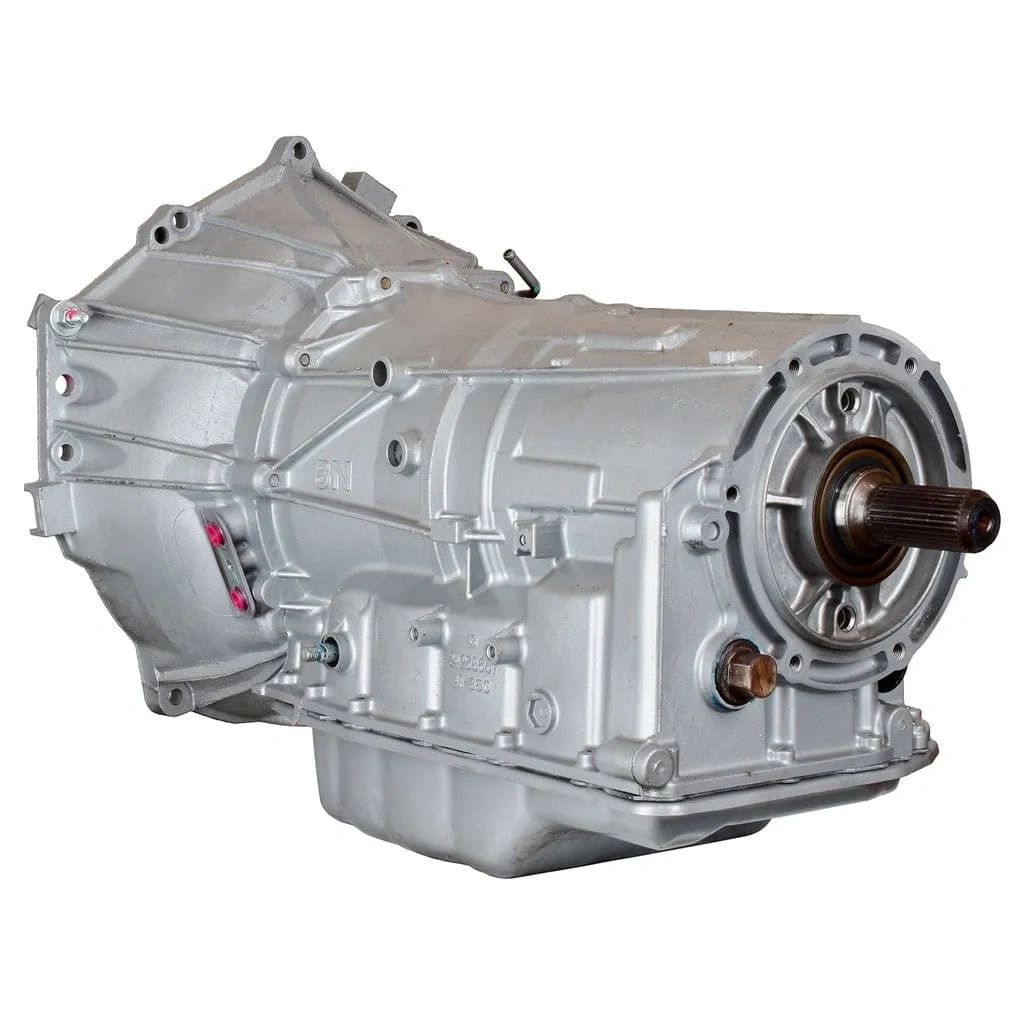
Meanwhile, the Turbo Hydra-Matic three-speed automatic (RPO M40) continued to build momentum, appearing on 25,146 Corvettes—roughly two-thirds of total production—highlighting the market’s clear drift toward automatics even in sports cars. This wasn’t simply a comfort trend; it also reflected how well the THM units could handle torque, how consistent they were in real-world acceleration, and how many buyers wanted performance without the effort and learning curve of a manual in stop-and-go conditions. In a decade where manufacturers were heavily focused on emissions compliance and repeatable drivability, the automatic also offered a predictable, calibration-friendly operating window—one more reason it became the default choice for a large share of the Corvette audience.
Axle ratios, as always, were the quiet “multiplier” that shaped how each engine-and-transmission combination felt from a stop and at cruising speed, and choices varied by engine, transmission, and whether the car carried air conditioning. Base-engine cars typically leaned on 3.36:1 and 3.08:1 gears as balanced, all-purpose matches; L82 cars could be ordered with 3.55:1 or 3.70:1 to sharpen initial hit and midrange punch; and LS4 cars usually ran 3.08:1 or 3.36:1, with 3.55:1 reserved for off-road Z07 applications. Put simply, deeper gears improved jump off the line and helped a close-ratio four-speed feel “alive,” while taller gears reduced cruise rpm and noise—exactly the kind of tradeoff buyers weighed when deciding whether their Corvette would live more on back roads, highways, or the occasional competition-style environment.
Performance in Context
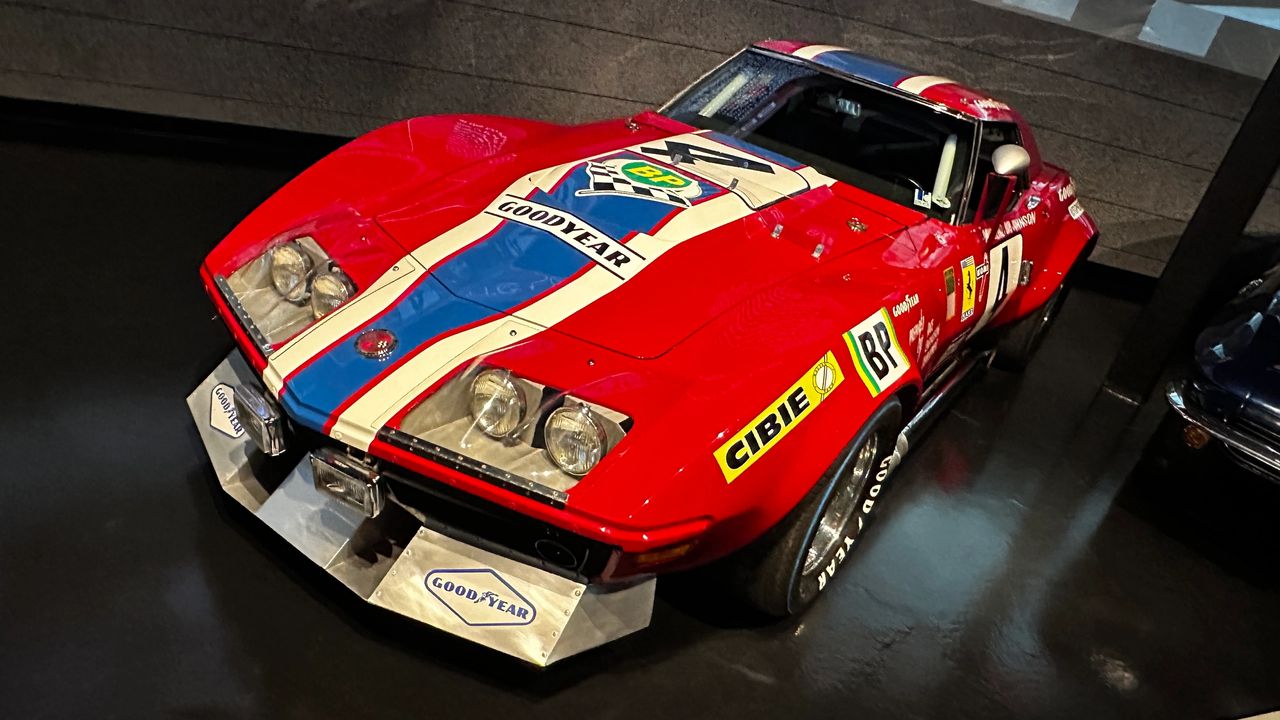
Viewed through a modern lens, mid-7-second 0–60 times and mid-15-second quarter miles do not sound heroic. In the context of 1974, they were very real numbers—earned in an era when the entire industry was wrestling with lower compression, retarded ignition timing, leaner calibration, exhaust gas recirculation, and the added weight and aero compromises that came with new 5-mph bumper standards. The result wasn’t just slower stoplight sprints; it was a wholesale reshaping of the performance landscape. Many family sedans—and plenty of “personal luxury” coupes—now needed well into the teens to reach 60 mph, and the gap between “fast car” and “regular car” narrowed dramatically.
Against that backdrop, the 1974 Corvette—especially in L82 or LS4 form with a four-speed—remained a genuinely quick car by contemporary standards. It still delivered real passing power, still felt composed at speed, and still rewarded drivers who understood gearing and kept the engine in its sweet spot. Top speeds in the 120–125 mph range (depending on engine and axle ratio) weren’t just plausible; they reinforced Corvette’s identity as a high-speed American GT at a moment when many rivals were being detuned into softness. Contemporary reviewers continued to praise the Corvette’s stability, and as radial tires became more common, the Corvette’s ability to settle in and track cleanly at higher speeds only improved.
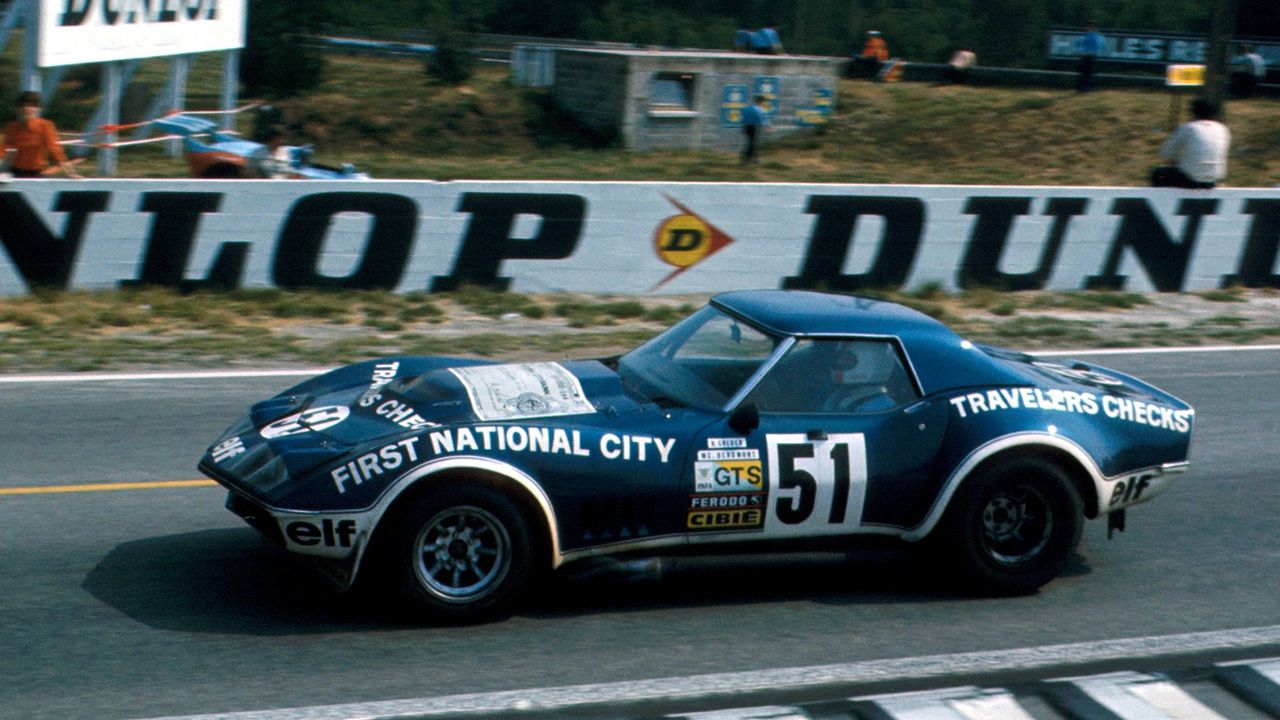
Fuel economy, however, was no longer a sidebar—it was front-page news. Period accounts and modern owner data consistently point to “mid-teens if you behave” highway mileage for a well-tuned small-block, with big-block cars generally returning somewhat lower figures, especially in city driving. The key change was psychological as much as mechanical: by 1974, even performance buyers could no longer treat mpg as trivia. With gas lines, price shocks, and a marketplace increasingly sensitized to efficiency, Corvette owners were being asked—often for the first time—to think about range and consumption in the same breath as acceleration.
Yet the Corvette’s performance identity was never confined to instrumented tests, and the mid-1970s did not mark an end to competition relevance. The C3 platform remained a stout foundation for racing thanks to its fundamentals—strong chassis geometry, broad parts support, and an engine architecture that privateers understood down to the last bolt. In road racing circles, the formula was clear: reduce weight, improve cooling, widen the tire footprint, upgrade brakes, and build the small-block or big-block to survive sustained rpm. Even as street cars absorbed the compromises of the day, track-prepped Corvettes continued to prove the underlying package still had real pace.
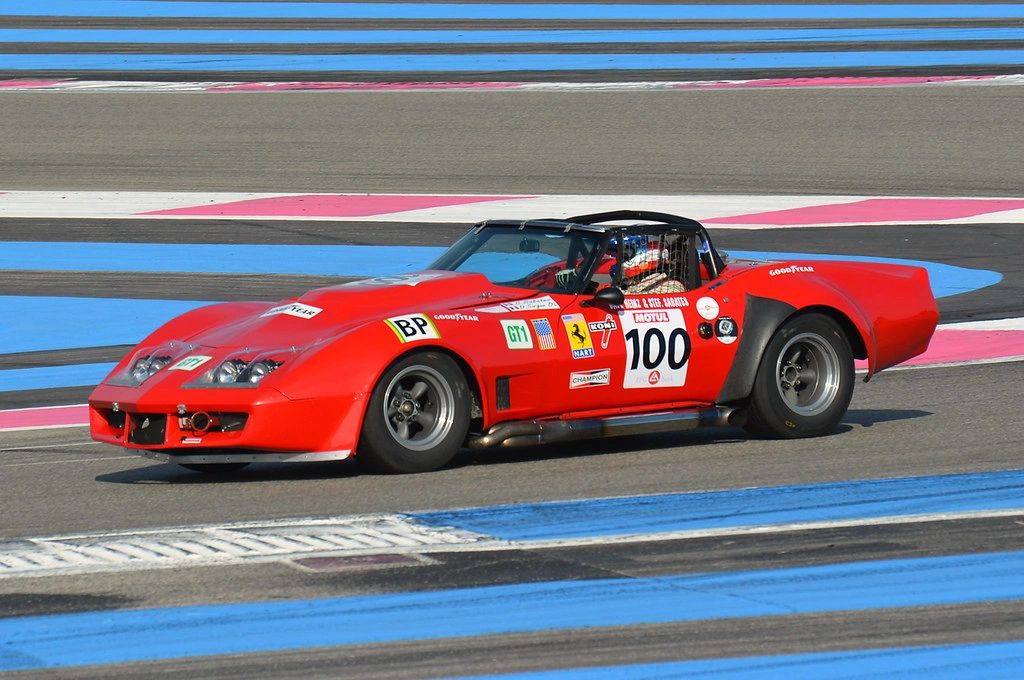
That dual identity—street compromise, track potential—helps explain why 1974-era Corvettes continue to appear in historic competition today. Many are prepared to period-correct specifications and run in vintage GT classes, where the C3’s long-wheelbase stability and V8 torque remain effective tools. The example shown here, wearing “GT1” markings and period-style sponsor livery, captures that spirit: a purposeful, wide-tired Corvette built to look and behave like the sort of privateer C3 that would have been developed for endurance-style road racing, where stability, braking, and reliability mattered as much as outright straight-line speed.
The most striking detail on the car—the Ferrari prancing horse—has its roots in one of the more unusual footnotes in Corvette endurance lore. In the early 1970s, a Corvette entry found a path to Le Mans through an arrangement connected to Luigi Chinetti’s North American Racing Team (N.A.R.T.), long associated with Ferrari’s international racing efforts. As part of that deal, the Corvette carried N.A.R.T./Ferrari identifiers, including the prancing horse, despite being very much a Chevrolet-powered car. On modern historic grids, the emblem is often worn as a deliberate tribute to that episode—a visual reminder that international endurance racing has always involved a blend of speed, politics, sponsorship leverage, and the occasional improbable alliance.
Production, Market Reception, and the State of Chevrolet
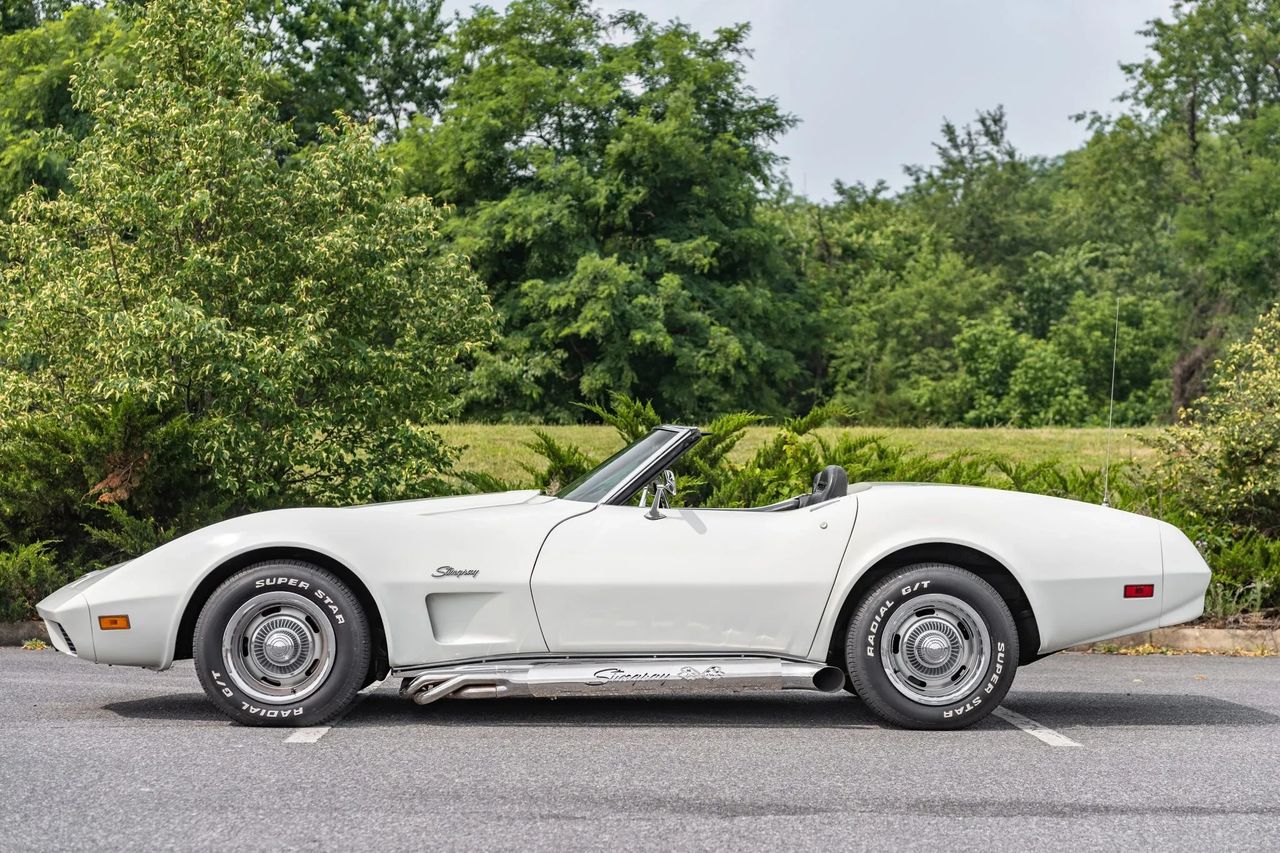
In a year when U.S. auto sales overall fell by more than 12 percent, Corvette did something remarkable: its sales went up. Model-year 1974 production totaled 37,502 units, up from 30,464 in 1973. That made 1974 one of the strongest sales years yet for the Corvette and a clear signal that America’s sports car still had drawing power even in an era of fuel shortages and performance retrenchment.
The body-style mix tells a more nuanced story. Coupes accounted for 32,028 units, while convertibles totaled just 5,474—about 14.6 percent of production. Convertible demand had been shrinking for years under the combined weight of safety concerns, noise and weather considerations, and the increasing appeal of air-conditioned, fixed-roof GTs. The trend would culminate in 1975, the final year of a Corvette convertible until the C4 droptop returned in 1986.
Base prices reflected both inflation and the growing equipment level. A 1974 coupe started at $6,001.50; a convertible at $5,765.50. But few cars left St. Louis without options. Consider the penetration of some key comfort and convenience features:
- C60 air conditioning was ordered on 29,397 cars, 78.65 percent of production.
- N41 power steering appeared on 35,944 cars, an astonishing 95.85 percent.
- J50 power brakes showed up on 33,306 cars, or 88.81 percent.
- A31 power windows found their way into 23,940 cars, or nearly 64 percent.
Tilt-tele steering (N37) was another overwhelmingly popular option, with 27,700 cars so equipped. These numbers paint a clear picture: by 1974, Corvette buyers expected their cars to be comfortable, well-equipped, long-distance machines as much as weekend autocross weapons.
On the other end of the spectrum, the ultra-low production Z07 Off-Road package (47 cars) and FE7 Gymkhana suspension (1,905 cars) speak to a smaller but passionate subset of owners who still saw the Corvette first and foremost as a driver’s car.
1974 Colors and Trim: Seventies Hues, Corvette Attitude
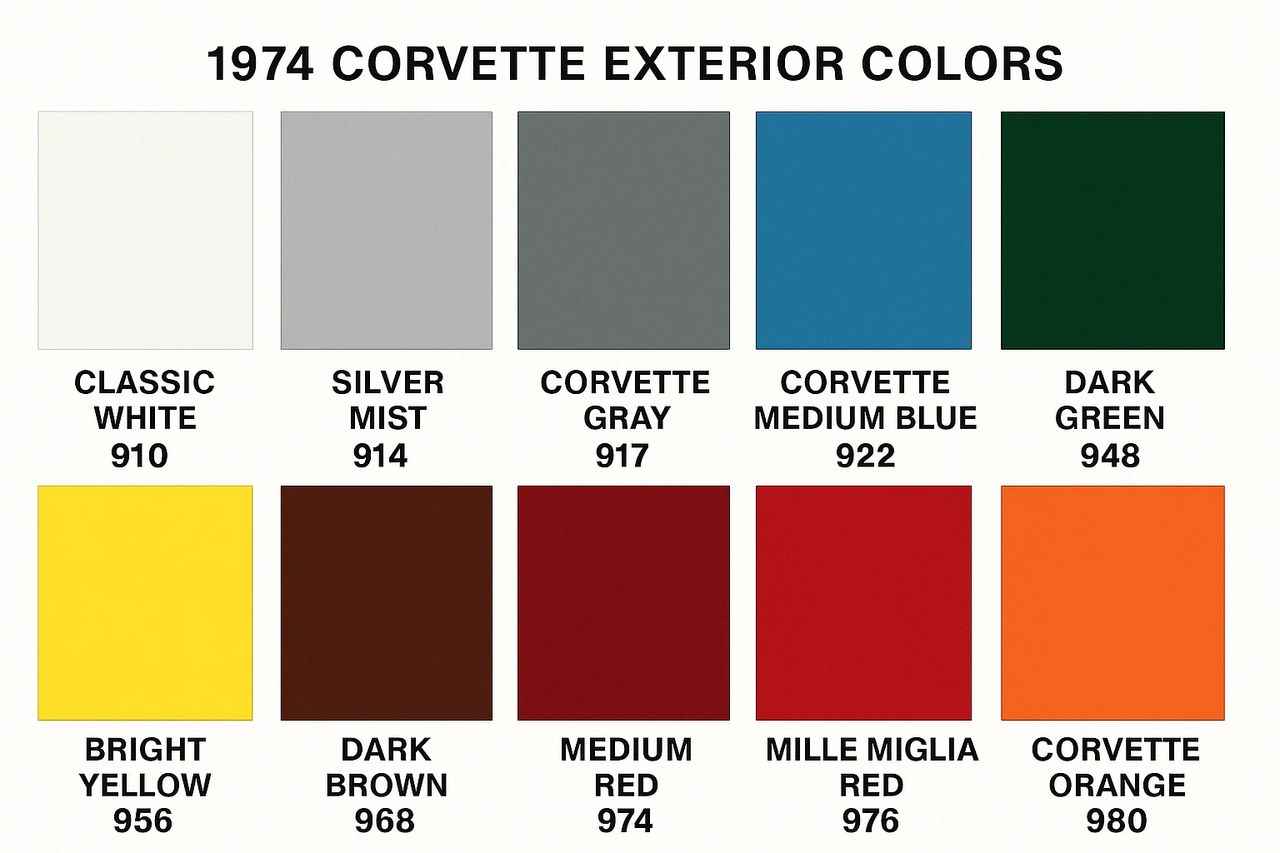
If you park a row of 1974 Corvettes together, the color palette tells you a lot about where American taste was headed in the mid-1970s. Chevrolet offered ten exterior colors for 1974:
Classic White, Mille Miglia Red, Corvette Silver Mist, Corvette Medium Blue Metallic, Corvette Dark Green Metallic, Corvette Brown Metallic, Corvette Gray Metallic, Corvette Bright Yellow, Corvette Medium Red Metallic, and Corvette Orange Metallic. Several of these—Dark Green, Brown, Gray, Bright Yellow, and Medium Red—were new for 1974.
Inside, standard-trim cars could be ordered in Silver (new), Light Neutral (new), Medium Saddle, Dark Blue, Dark Red, or Black. The Custom Interior option is layered in upgraded cut-pile carpeting, wood-grain accents, and genuine leather seating surfaces in Silver, Medium Saddle, or Black.
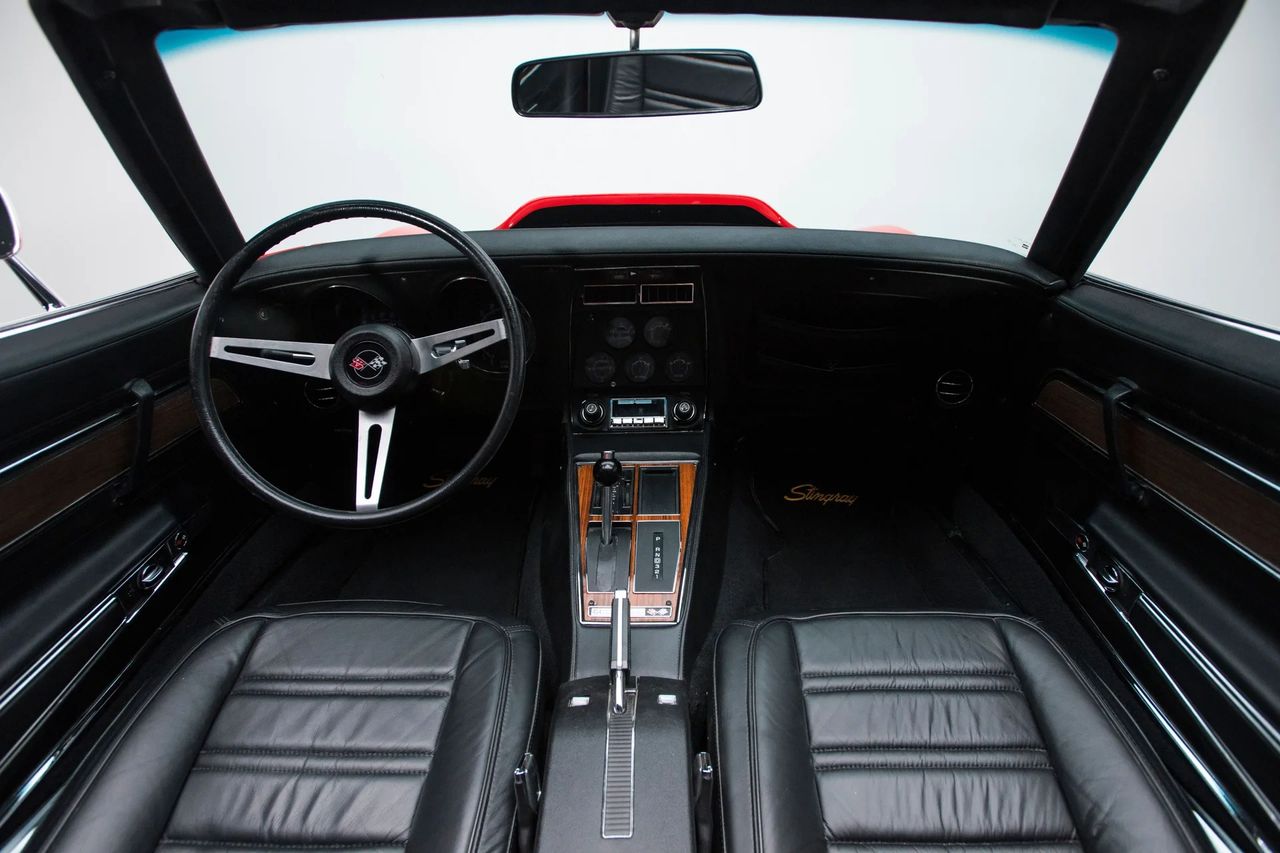
The result is a fascinating mix of classic Corvette brights—Mille Miglia Red, Classic White, and Corvette Orange—with very period-correct metallic earth tones. A Brown or Dark Green ’74 with a Medium Saddle leather interior and a tilt-tele column reads more as European-flavored GT than stripped-down sports car, and that was very much Chevrolet’s intent.
Among the noteworthy 1974 Corvettes, none is more personally significant than the one owned by Zora Arkus-Duntov, the legendary “father of the Corvette.” Originally delivered as a silver-over-black LS4 model complete with power steering, power brakes, and air conditioning, this was the only Corvette that Arkus-Duntov ever personally purchased during his tenure at GM. However, the car that resides at the National Corvette Museum today is no longer in its original silver livery. At some point in its life, it was repainted into a striking two-tone blue scheme, a custom touch that adds another layer of uniqueness to an already historic car.
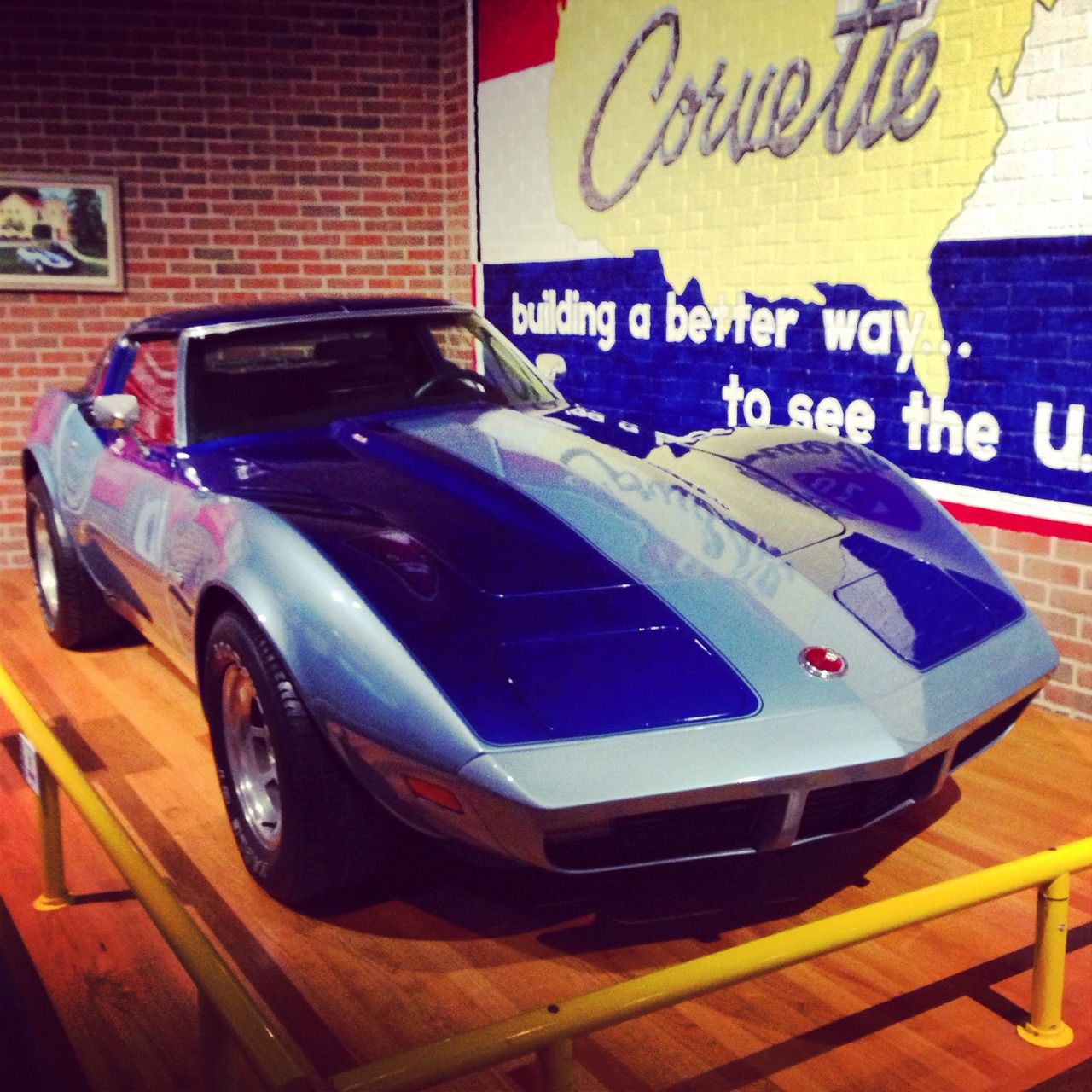
Now carefully preserved rather than fully restored, this Corvette serves as a rolling testament to the marque’s mid-1970s era. It highlights not only the car’s place in Corvette history but also what the model meant to its chief engineer. For enthusiasts, it’s a rare opportunity to see a Corvette that was truly personal to Arkus-Duntov, reflecting his connection to the car’s evolution and the changing landscape of American performance in the mid-1970s.
1974 Corvette Technical Specifications
For readers who want the hard numbers in one place, the 1974 Corvette in its primary configurations can be summarized as follows.
Powertrain
All engines used cast-iron blocks and heads and a single four-barrel carburetor.
- 350-cid Turbo-Fire V-8 (L48/ZQ3, standard): 195 net hp @ 4,400 rpm; 275 lb-ft @ 2,800 rpm; 8.5:1 compression.
- 350-cid Turbo-Fire Special V-8 (L82, optional): 250 net hp @ 5,200 rpm; 285 lb-ft @ 4,000 rpm; 9.0:1 compression; hotter camshaft and internal upgrades versus L48.
- 454-cid Turbo-Jet V-8 (LS4, optional): 270 net hp @ 4,400 rpm; approximately 380 lb-ft @ 2,800 rpm; 8.25:1 compression; final big-block Corvette engine.
Transmissions:
- Standard wide-ratio four-speed manual (2.52:1 first).
- Close-ratio four-speed manual (M21, 2.20:1 first), available with L82 and LS4 only; 3,494 cars built.
- Turbo Hydra-Matic three-speed automatic (M40), available with all engines; 25,146 cars built.
Typical axle ratios:
- L48: 3.36:1 and 3.08:1 depending on transmission and A/C.
- L82: 3.55:1 or 3.70:1; performance-oriented gearing.
- LS4: 3.08:1 or 3.36:1 standard; 3.55:1 in certain Z07/off-road applications.
Chassis and Dimensions
Body style: two-seat fiberglass coupe (with removable roof panels) or convertible, both on a separate steel frame.
- Wheelbase: 98.0 in
- Overall length: 185.5 in
- Width: 69.0 in
- Height: approx. 47.7–47.8 in
- Front track: 58.7 in
- Rear track: 59.5 in
- Curb weight: approx. 3,500–3,550 lb, depending on equipment
- Fuel capacity: 18.0 gal
Suspension:
- Front: independent, unequal-length A-arms, coil springs, telescopic shocks, and anti-roll bar.
- Rear: independent, differential mounted to frame, trailing arms, struts, nine-leaf steel transverse spring, telescopic shocks.
Brakes and steering:
- Standard four-wheel power-assisted disc brakes, vented rotors, with power assist ordered on most cars (J50).
- Recirculating-ball steering with variable ratio; power steering (N41) on roughly 96 percent of production.
Tires:
- GR70-15 steel-belted radial tires, with white stripe (QRM) or raised white letters (QRZ) as options.
VIN and Identification
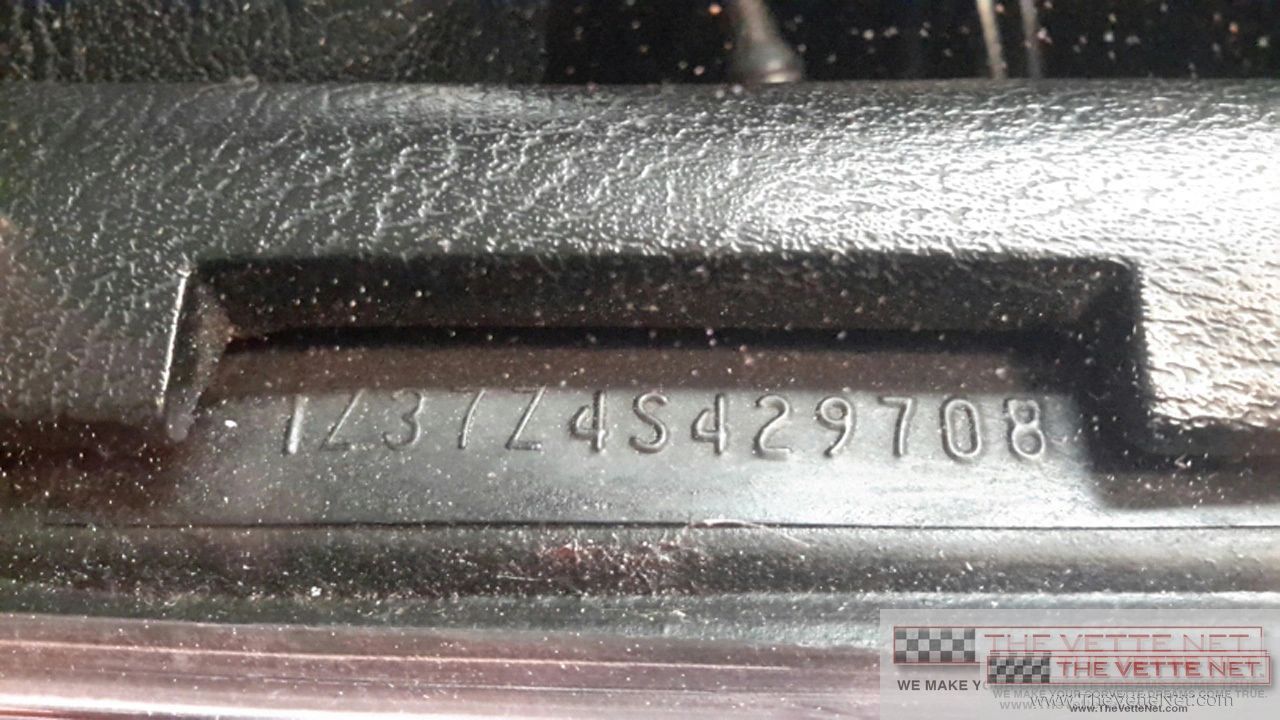
All 1974 Corvettes carried a 13-digit VIN, with the last six digits running from 400001 through 437502, covering the total production run of 37,502 cars. The VIN plate is located on the left front body hinge pillar/windshield post area, visible with the driver’s door open.
The familiar “1YZ37” and “1YZ67” style codes marked base coupes and convertibles, respectively, with engine, year, and plant information encoded in the preceding characters—standard fare to anyone who has spent time decoding C3 tags, but still critical for evaluating originality today.
WHY THE 1974 CORVETTE STILL Matters
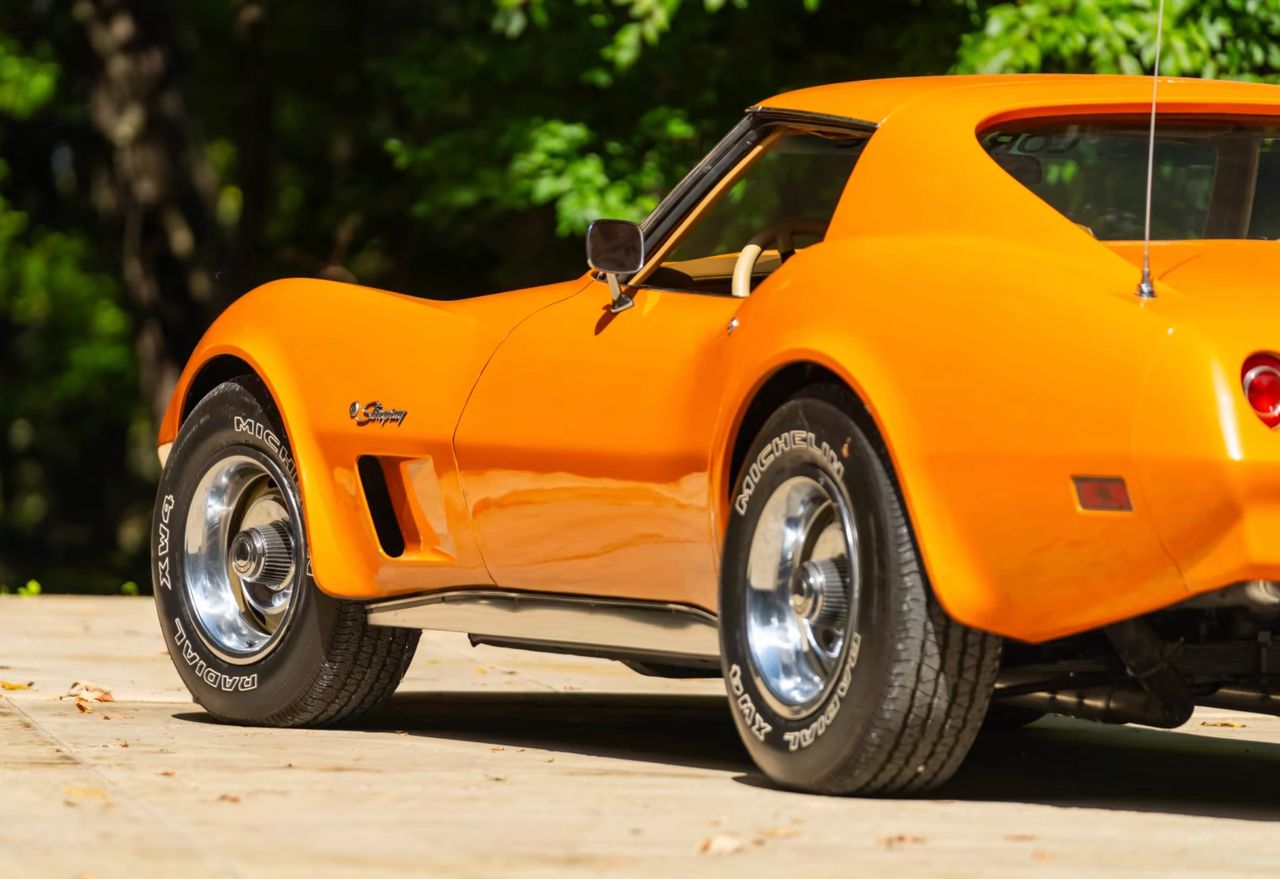
It is easy to dismiss the mid-1970s as a lost era for performance cars, and certainly the numbers on paper do not match those of the late-1960s. But the 1974 Corvette tells a more complicated—and more interesting—story.
This is the car that completes the transition to impact-absorbing urethane bumpers while still preserving the classic shark profile. It is the last Corvette with a factory big-block, the last with a true dual exhaust system, and the last that could legally drink leaded fuel. It is also a car that sold in near-record numbers in the middle of an oil crisis and a recession, precisely because it offered a blend of style, performance, and comfort that no other American manufacturer could quite match.
In L48 form, it is an accessible, comfortable GT with enough performance to be engaging even today. As an L82 four-speed or an LS4 big-block, it becomes one of the more charismatic expressions of malaise-era muscle—faster in reality than its net horsepower ratings suggest, and deeply evocative of a generation when the Corvette was evolving from raw sports car to refined grand tourer without losing its identity.
For the historian, the 1974 Corvette is a hinge point. For the enthusiast, it remains a uniquely appealing way to experience both the last gasp of big-block power and the first real phase of modern Corvette refinement in a single, distinctive package—with that two-piece rear bumper seam as its signature.