
The 1975 Chevrolet Corvette arrived at a moment when the entire American automotive industry was being forced to rethink some of its most basic assumptions. The new model year did not simply bring another round of styling tweaks, emissions adjustments, or horsepower reductions. It marked a much larger turning point. After years of mounting concern over the serious health risks and environmental contamination associated with leaded gasoline, the industry was moving toward a future without it. For Chevrolet, for Corvette, and for anyone who still believed in American performance, that shift was impossible to ignore.
Today, the end of leaded fuel feels like an obvious and necessary step. In the mid-1970s, however, it was anything but simple. For Corvette engineers — and really for the entire performance world — leaded gasoline had been part of the operating formula for decades. It was not some optional ingredient sitting on the margins. It helped make high-compression V8s practical. It allowed engines to tolerate aggressive spark advance, harder timing curves, and the kind of combustion pressures that had defined Corvette performance through the muscle-car era. Remove the lead, and the whole equation changed. Suddenly, the challenge was no longer just building power. It was building power that could survive on the new fuel, meet tightening emissions standards, and still feel worthy of the Corvette name.

Tetraethyllead — better known simply as TEL — had been part of the American gasoline story since the 1920s for one very simple reason: it worked. By reducing knock, it allowed engineers to raise compression ratios and build more powerful engines without constantly fighting detonation. For decades, that made leaded gasoline a quiet but essential partner in the development of high-performance V8s. But by the 1970s, the other side of that bargain could no longer be dismissed. Lead coming out of vehicle exhaust was not just an environmental concern in some distant, theoretical sense. It was being tied to widespread public exposure and serious neurological harm, especially in children. Public concern was growing, the science was becoming harder to ignore, and regulatory pressure was moving quickly behind it.
For Corvette, the issue was not only philosophical or environmental. It also became brutally mechanical. Leaded fuel and catalytic converters simply could not live together. As catalysts moved from experimental or emerging emissions technology into required equipment, lead contamination became a deal-breaker because it could damage the catalyst and prevent it from doing its job. That left the industry facing one of the hardest transitions of the era. The same fuel chemistry that had made traditional high-performance tuning easier was now incompatible with the emissions hardware that would define whether a car could legally be sold.
That is why the 1975 model year played such a significant role in the brand’s evolution. Not because the Corvette suddenly became faster, louder, or more dramatic, but because the priorities behind the car were changing in real time. Corvette engineers now had to think beyond peak horsepower numbers and quarter-mile mythology. They had to make a performance car work inside a completely new rulebook, one shaped by ignition calibration, emissions controls, exhaust aftertreatment, evaporative systems, durability requirements, and day-to-day drivability. The 1975 Corvette still looked familiar from the outside, but underneath the skin, the “how” of Corvette engineering was being rewritten.
The End of an Era: Duntov Steps Away

Zora Arkus-Duntov — the man most responsible for giving the Corvette its performance soul — retired at the beginning of 1975 after more than two decades with General Motors. His connection to Corvette began in 1953, when he saw Harley Earl’s original Corvette prototype on GM’s Motorama stage in New York. For Duntov, that first encounter was more than professional curiosity. He recognized something in the car that many inside Chevrolet had not yet fully grasped. Beneath the fiberglass body and show-car excitement was the possibility of a true American sports car. Duntov saw it, understood it, and then did what he would spend the rest of his career doing: he pushed.
Later that same year, he joined Chevrolet after writing to Ed Cole with his observations about the Corvette prototype. In hindsight, the story almost feels too perfect to be real — the brilliant engineer essentially introducing himself by telling Chevrolet how to improve, strengthen, and possibly save its own sports car. But that is also why the story has endured. Corvette has always needed champions at the exact moments when the program was most vulnerable, and Duntov became the man inside General Motors who was willing to challenge the system from within.
Even while assigned to other work, Duntov began “fiddling on the side” with Corvette throughout 1953 and 1954, gradually shaping the car into something more serious than the attractive but underdeveloped roadster that had first appeared under the Motorama lights. By 1956, he had been named Chevrolet’s director of high-performance vehicle design and development, giving him a more formal role in the company’s growing performance ambitions. Still, despite his deep and constant involvement with Corvette, Duntov was not officially named Corvette’s Chief Engineer until 1968. That long gap says a great deal about the car’s strange early life. Corvette had become a symbol, a dream, and a marketing statement before it was fully supported as a dedicated engineering program with the authority it deserved.
By 1975, the man who had defined Corvette’s performance identity for an entire generation was stepping away. Given Duntov’s reputation, his personal investment in the car, and the extraordinary run of Corvettes he had helped guide into existence, it was entirely reasonable for people to wonder what would happen next. Replacing a chief engineer is one thing. Replacing the person many enthusiasts regarded as Corvette’s conscience was something else entirely.
That anxiety was not romanticized nostalgia. It was real. Corvette has been shaped by the personalities behind it more than almost any other American car. Duntov was never simply an administrator moving paper through the corporate system. He represented Corvette as a serious performance machine, and he fought for that idea again and again when it would have been easier to let the car become little more than a stylish boulevard cruiser. In 1975, with horsepower under pressure, emissions regulations tightening, fuel changing, and performance itself becoming increasingly difficult to defend, losing Duntov felt like losing Corvette’s fiercest advocate at precisely the moment the car needed one most.
The New Steward: David McLellan Takes the Wheel

The person tasked with the challenging position—and the sizable shoes to fill—was David Ramsay McLellan, a man who had worked with Duntov and been groomed for the job after joining GM in 1959.
McLellan is often described as a “different kind of Corvette leader,” and that is exactly the right way to understand his arrival. In 1975, Corvette did not need another romantic. It needed a strategist. It needed someone who could look at a shrinking box of options and still find a way to keep the car coherent, credible, and worthy of the name. The assignment was no longer as simple as chasing a bigger horsepower number or winning an internal argument with raw performance. The real work was in managing trade-offs without letting them define the car’s entire personality. That required discipline. It required patience. It required an engineer who understood that Corvette’s identity had to be protected even as the rules, the fuel, the emissions requirements, and the business realities around it continued to shift. In McLellan’s era as Chief Engineer, leadership was not about dreaming louder. It was about navigating more clearly.
That is part of what makes McLellan’s preparation so interesting. He spent much of 1973 and 1974 at MIT’s Sloan School of Management at GM’s direction, a move that says a great deal about the kind of leadership General Motors believed it needed by the middle of the decade. This was not simply about making a talented engineer more technically capable. McLellan already had that foundation. GM was preparing him for the broader, more complicated world Corvette was entering — a world shaped by regulation, corporate planning, emissions compliance, budgets, timing, supplier realities, fuel economy concerns, and the long, often unforgiving chess game of product development. By the mid-1970s, protecting a performance car inside a major corporation required more than passion. It required someone who could speak engineering, management, and survival at the same time.

McLellan returned to Chevrolet as one of Duntov’s staff engineers, and when Duntov retired shortly thereafter, it was understood that McLellan would step into the role he had been carefully prepared to assume. Still, it is important to view his early tenure in the right context. McLellan would not place his full stamp on Corvette’s design language and engineering direction until the C4 era, when a clean-sheet opportunity finally gave him room to reshape the car in a more comprehensive way. The 1975 Corvette was not that kind of assignment. The C3 architecture was already established. The body, chassis, packaging, and much of the car’s basic personality had been locked in long before he took the chair. The market was changing, the regulations were tightening, and the performance landscape was becoming more difficult by the month. McLellan’s immediate job was not to reinvent Corvette overnight. It was to guide it through the turbulence without letting it lose its center.
Seen that way, 1975 becomes one of the most important years of leadership transition in Corvette history. The car was being passed from Zora Arkus-Duntov, the performance evangelist who had fought for Corvette’s soul, to Dave McLellan, the systems-minded engineer who would have to protect that soul in a very different world. Duntov had helped teach Corvette how to run. McLellan’s task was to make sure it could endure. And in the mid-1970s, that may have been the harder job.
A Corvette That Looked Familiar—Because the Revolution Was Underneath

The 1975 Corvette looked almost identical to the 1974 model. That visual continuity was part of the year’s deception. If you judged 1975 by a quick glance, you missed what mattered.
The most notable exterior change was the introduction of front and rear bumper pads integrated into the soft bumpers—parking protection in a decade when even sports cars were being asked to behave like appliances in crowded lots. That small feature captured the era perfectly: the Corvette was still meant to be desired, but it was also expected to survive daily life.

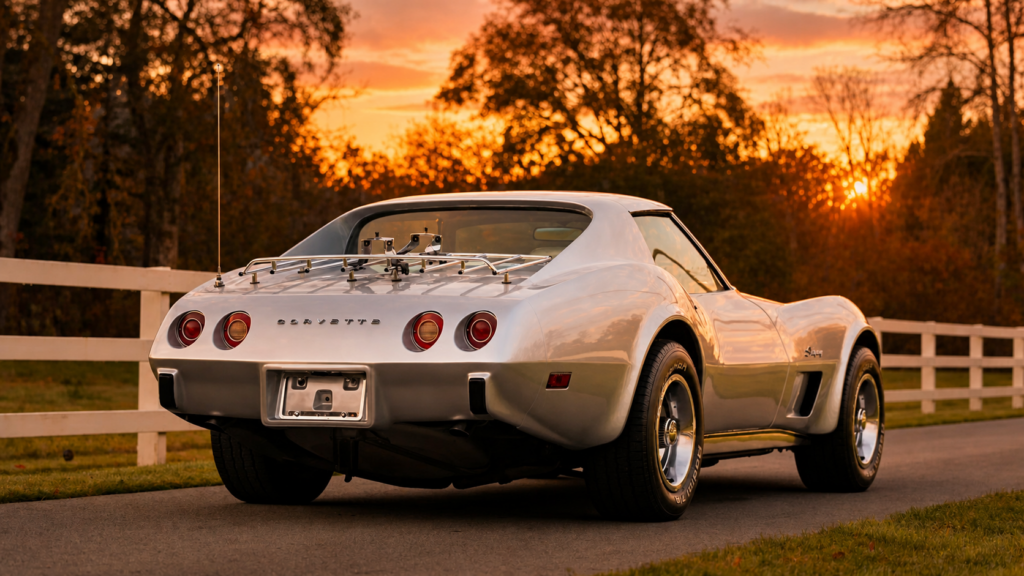
Beyond the pads, both bumpers were modified structurally. The front bumper gained an inner honeycomb core for added rigidity. The rear bumper received inner shock absorbers intended to reduce damage in low-speed impacts. And perhaps most importantly for anyone who had ever stared at the back of a 1974, the 1975 rear bumper fascia became a single molded urethane component rather than two separate assemblies meeting down the centerline. That one change—though subtle on paper—mattered to owners because it eliminated the unsightly seam and misalignment issues common with earlier “two-piece meets in the middle” bumper designs. On previous models, the split rear bumper could shift or gap over time, especially after minor impacts or wear, leading to a sloppy appearance. The switch to a one-piece urethane cover with integrated bumper pads not only met new federal crash standards but also offered a cleaner, more durable solution that better maintained its fit and finish over time.
This was how 1975 operated: not by announcing change, but by layering it. The C3’s shape stayed dramatic and instantly recognizable, but its intent evolved. By 1975, Corvette had stepped away from its raw, race-inspired edge and moved toward a more finished, cohesive identity. The crisp aggression of chrome gave way to the seamless flow of urethane, and the Corvette settled into the mid-1970s with a sense of purpose that would’ve seemed out of place just a few years earlier.
The Convertible: A Farewell That Didn’t Feel Like One

A significant milestone represented in the 1975 model year had nothing to do with what the Corvette introduced as a new option, but rather what it was about to eliminate as a production option for nearly the next decade.
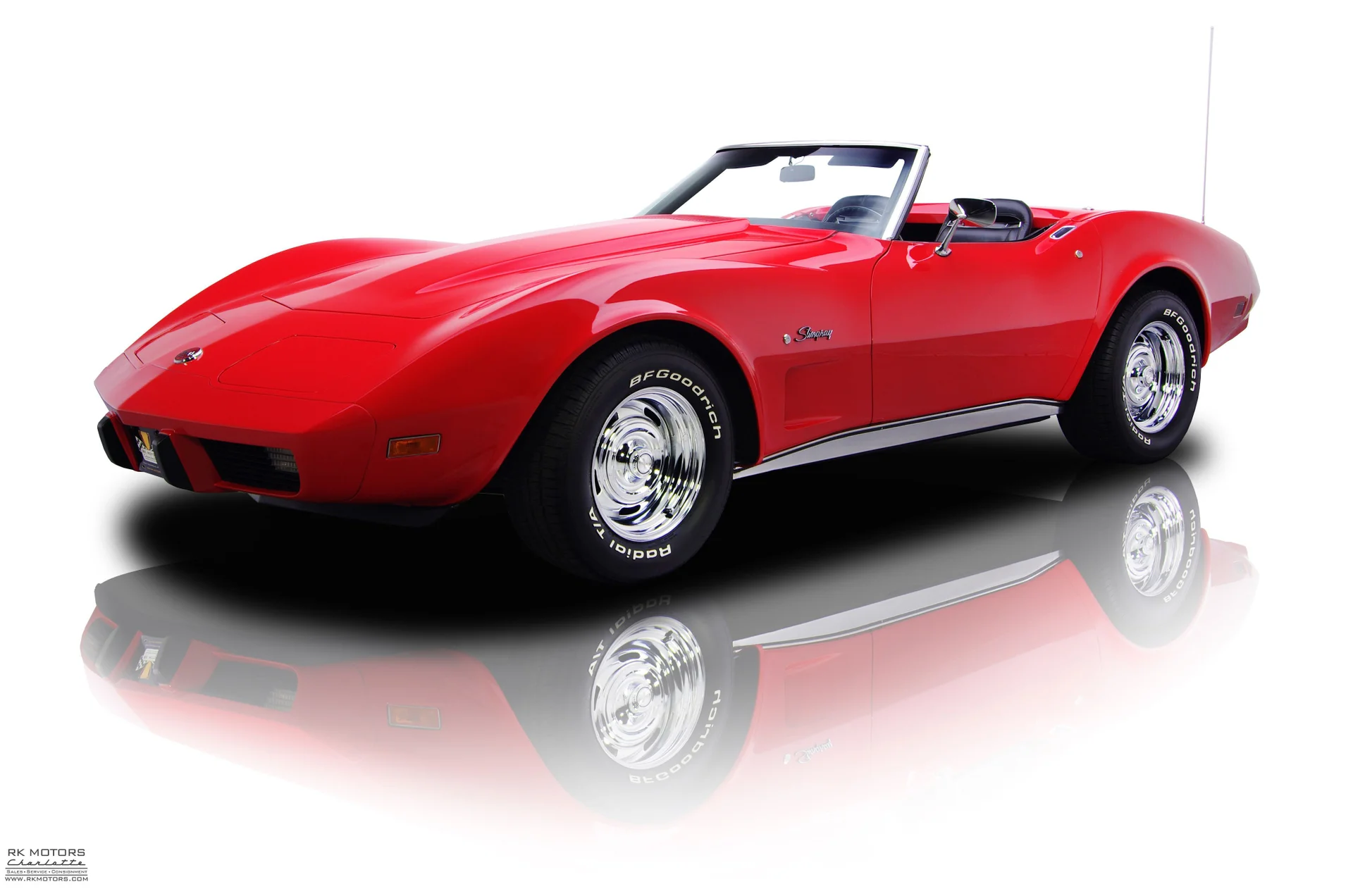
The 1975 Corvette was the last of the third-generation Corvettes to be offered as both a coupe and a convertible. Convertible volumes had diminished year after year, and Chevrolet had already considered eliminating the option. But when the government threatened legislation that would have effectively banned fully open cars after 1975, it sealed the decision. Corvette convertible production was discontinued, and the last C3 ragtop rolled off the line in late July of 1975.
This was a critical distinction: the myth was that convertibles were outlawed. The reality was that the industry anticipated an unfavorable regulatory direction, and manufacturers used that forecast—combined with slowing convertible demand—to justify decisions they were already leaning toward. The proposed rules never materialized into the ban many feared, but by the time that became clear, the business case had been rewritten. The decision stood.

Naturally, enthusiasts were not pleased. Corvette had been a convertible since its introduction in 1953. That open-car identity wasn’t optional in the emotional sense; it was foundational. Losing it felt like losing a piece of Corvette’s soul.
And yet another detail spoke to the era: 1975 was the last time in Corvette history that a convertible was actually less expensive than a coupe. That was such a mid-1970s twist—an iconic body style quietly priced below the “practical” option, right before it vanished for a decade.
In retrospect, the 1975 convertible occupied a strange space. Buyers at the time often assumed it would become instantly rare and financially untouchable. The Corvette convertible returned in 1986, and the collector’s story became more complicated. But rarity wasn’t the real point. The point was emotional and historical: 1975 was the year Corvette closed the roof—because the decade forced its hand.
Engines: Fewer Choices Than Years Past

Engine options for the 1975 Corvette were more limited than any second– or third-generation Corvette that had come before it. GM briefly offered an optional big-block early in the model run, but it was dropped quickly, leaving the standard 165-horsepower 350 and the optional L82 205-horsepower 350 as the only available choices.
Not since the 1955 Corvette had consumers faced such a limited engine menu. And it was the first year since 1967 that only a single displacement was offered.
That fact carried weight. Corvette had trained its audience to think in tiers: base engine, high-performance small-block, then the big-block hammer for those who wanted to rewrite the road. In 1975, the tiers collapsed into two versions of the same idea—a 350 built to survive and a 350 built to still feel like a Corvette.
This was where the narrative often got misunderstood, because the horsepower numbers alone didn’t tell the full story. Yes, the numbers were down. Yes, enthusiasts felt the loss. But the deeper truth was that the nature of engine development changed. Instead of “how high can we push compression,” the questions became: How stable was the calibration? How well did it start? How did it behave in real-world temperature swings? How did it stay compliant as components wore? How did engineers protect the catalyst? How did they meet warranty expectations? How did they prevent drivability complaints from becoming costly reputational damage?
In 1975, Corvette became less of a single-minded hot rod and more of an engineered product for an era that demanded consistency.
The L48: The Corvette That Had to Work Every Day

The base L48 was the survival engine. It wasn’t built for glory runs. It was built to start, idle, behave, and keep doing so.
In the smog era, a base engine could not be fragile. It couldn’t require constant tuning. It couldn’t drift out of compliance easily. It had to be resilient to the reality that most owners would not adjust points, chase vacuum leaks with the patience of a saint, or tolerate an engine that behaved differently every time the weather changed.
So the L48 became the anchor. It was the engine that kept Corvette accessible and sellable. It was the engine that kept the Corvette from becoming a temperamental boutique car at exactly the moment the country was losing patience for temperamental anything.
The L82: The Version That Still Wanted to Be a Corvette

The L82 existed for a different buyer: the person who still wanted the Corvette to sharpen when asked.
With the L82, buyers paid for character. They paid for the version of the 1975 Corvette that still spoke in a slightly more aggressive dialect—stronger pull, a more willing top end, a tone that felt less apologetic.
And in 1975, that mattered because it signaled Chevrolet had not given up. The L82 wasn’t the late-’60s dream reborn. It was a realistic performance option engineered inside the rules. That might not have sounded romantic, but it was actually one of the most Corvette things imaginable: finding a way to preserve the spirit when the method had to change.
The Catalytic Converter: A New Era Under the Floor

The 1975 model year was a significant one not only for Corvette but for American production automobiles as a whole: it was the year the catalytic converter was formally introduced and adopted broadly across U.S. manufacturers.
The catalytic converter was designed to convert toxic byproducts produced by internal combustion engines into less toxic substances via catalyzed chemical reactions. Compared to earlier emissions-control strategies, it was more effective and—crucially—more scalable. It also altered everything about how the Corvette breathed.
A key point remained front and center: this method of managing emissions may have prevented Corvette’s horsepower ratings from dropping even further than they had. That was the nuance many people missed. The converter wasn’t simply a power thief; it was a new tool in the emissions equation. It changed where the burden lived. It allowed engineers to consider different tuning strategies because the aftertreatment system was doing work downstream.

But there was no free lunch. Chevrolet understood that better than anyone, even if the 1975 sales literature tried to frame the change as progress. The brochure called it “Dual exhausts with catalytic converter” and reminded buyers that dual exhaust meant “less exhaust back pressure.” Chevrolet even claimed, “With the catalytic converter on the job, the factory can now tune your Corvette more toward performance and economy.” It was careful language for a difficult moment: technically optimistic, federally compliant, and written to reassure Corvette buyers that the car they loved had not been smothered by regulation.
Still, the hardware told a more complicated story.
For 1975, the Corvette no longer carried true dual exhaust in the traditional sense. Both manifolds fed into a Y-pipe, the exhaust passed through a single catalytic converter, and only then split again toward two mufflers and tailpipe assemblies. From the rear, the Corvette still gave owners the familiar visual signature of dual outlets. Underneath, however, the system had changed in a fundamental way.
For Corvette people, exhaust was never just plumbing. It was part of the car’s identity. It was the sound on startup, the pulse at idle, the look beneath the rear valance, and the mechanical honesty of a small-block Chevrolet exhaling through both sides of the car. In 1975, that voice was not silenced, but it was filtered. The Corvette still sounded like a Corvette, but the edge had been softened. The rawness had been reduced. Federal emissions compliance had become part of the exhaust note.
The catalytic converter also introduced a new ownership reality: heat. A mid-1970s Corvette already asked a lot of its cabin, floors, insulation, and surrounding components. The small-block, transmission tunnel, tight underbody packaging, and fiberglass structure all contributed to the car’s interior warmth. Add a converter beneath the floor, doing exactly what it was designed to do, and the environment under the car changed again. Owners felt it in hotter footwells, aging insulation, stressed shielding, and the slow wear that heat brings to anything living nearby.
None of this makes the 1975 Corvette less important. If anything, it makes the car more revealing. This was not Chevrolet giving up on Corvette. It was Chevrolet trying to keep Corvette alive inside a rulebook that had changed almost overnight. The catalytic converter cleaned up the exhaust stream and gave the engineers a legal path forward, but it also made the Corvette more managed, more mediated, and less instinctively raw than the cars that came before it.
The 1975 Corvette was still a Corvette. It was simply a Corvette learning how to breathe through the 1970s.
HEI Ignition: The Quiet Upgrade That Made the Whole Package Better

Under the hood was a new breakerless electronic ignition system known as HEI (High Energy Ignition). Unlike the previously available transistor ignition systems, the HEI was the first Corvette ignition to feature a distributor that did not require a points and condenser setup.
This was one of the most important “living with it” improvements of 1975, and it didn’t get enough credit because it wasn’t sexy in the way big horsepower numbers were sexy. But in a compliance era, ignition stability was everything. Points wore. Dwell drifted. Performance became inconsistent. Emissions became inconsistent. Starting became inconsistent. Owners complained. Warranty claims climbed. The car’s reputation suffered.
HEI was Chevrolet engineering the Corvette to be less fragile—more modern, more dependable, more consistent—at the exact moment consistency became a legal and economic requirement.

In conjunction with the new ignition, Chevrolet introduced the first electronic (instead of mechanical) tachometer drive. Where tachometers had previously been driven off the distributor, the new system translated an electrical signal into the output seen on the dashboard.
This particular detail, while arguably subtler than some of the more visible changes that were made to the 1975 Corvette, was still significant. It was a sign of Corvette’s transition into an era of greater electronic mediation. For all previous examples that predated the 1975 model year, the Corvette was still an analog experience, but it was beginning to rely on electrical architecture that would become normal in the decades to come.
Add to that the first appearance of the “Kilometers Per Hour” subtext beneath the “Miles Per Hour” on the speedometer—small, easy to dismiss, but emblematic of the time: standardization, global thinking, and the creeping presence of regulation and conformity even in America’s most iconic sports car.
The Other Changes That Told You This Car Was Built for the Mid-1970s Reality

Elsewhere on the 1975 Corvette, a headlights-on warning buzzer was added per federal mandate—another reminder that by the mid-1970s, the government wasn’t merely regulating what came out of the tailpipe; it was increasingly influencing how cars were expected to behave in the hands of normal drivers.
An internal bladder was added to the fuel tank to help prevent fuel vapors from escaping while also keeping air from entering and getting trapped—a piece of the emissions story that didn’t get the spotlight but absolutely belonged in any serious conversation about the 1975 model year. Emissions weren’t only about combustion; it was about evaporation. Corvette had to adapt at every point where hydrocarbons could enter the atmosphere.
Hood emblems featuring the engine designation “L82” were introduced in 1975, though many cars built that year did not include the emblem—a perfect micro-detail from the era of running changes and production variability.

And finally, 1975 was the last model year to feature Astro Ventilation, a system introduced with the 1968 C3. The end of Astro Ventilation was one of those details that seemed small until you realized it marked the closing of another early-C3 chapter. Corvette was gradually shedding parts of its 1968 identity, piece by piece, as the decade forced modernization.
Performance: The Numbers Were Down, but the Story Wasn’t Over

There was no denying it: the 1975 model year marked a sharp downturn in Corvette horsepower. The base L48 engine delivered just 165 horsepower, and even the optional L82 topped out at 205—respectable, but far from the high-water marks of the late 1960s. Emissions regulations, unleaded fuel, and new noise and durability standards all played a role. It’s easy to write the year off as a low point. But the full story is more complicated.
Despite the drop in output, the Corvette’s fundamentals remained intact. The chassis architecture—fully independent suspension, low center of gravity, wide track, and rearward weight bias—still delivered balanced handling and good feedback. The car hadn’t lost its identity; it had lost power. On a back road, the 1975 model still drove like a sports car.
More importantly, the era demanded a shift in what performance meant. Drivability became a key metric. The new High Energy Ignition (HEI) system made starting easier and tuning more stable. Electronic tachometers provided more reliable feedback. Catalytic converters and a Y-pipe exhaust helped the car meet new standards without entirely strangling performance. In daily use, the car was smoother, quieter, and more consistent than earlier models.
Road test numbers reflected the lower output, but they didn’t tell the whole story. Corvette in 1975 wasn’t obsolete—it was transitioning. And the updates made that transition possible without sacrificing the car’s core dynamics.
Sales and Production: Corvette Demand Proved the Name Still Mattered

Despite the lack of dramatic year-to-year change, the 1975 Corvette continued to sell with remarkable strength. Chevrolet moved 38,465 Corvettes that year, just 297 units shy of the 1969 model year’s 38,762-car total — still, at that point, the highest production year Corvette had ever recorded. For a car operating in the middle of emissions constraints, fuel-economy pressure, insurance scrutiny, and a broader performance-market retreat, that was not a small achievement. It was proof that Corvette still had gravity.
The mix told an equally important story. Of those 38,465 cars, 33,836 were coupes. The convertible accounted for just 4,629 units, representing barely 12% of total production. As painful as it was for traditionalists, the numbers made Chevrolet’s decision easier to understand. The open Corvette had been part of the car’s identity since 1953, but by the mid-1970s, the buyer had clearly moved toward the coupe. The removable roof panels gave owners much of the open-air experience with better weather protection, better security, and a shape that had become one of the most recognizable profiles in American performance-car design.
That is one of the underrated truths of the 1975 Corvette. On paper, this should have been a vulnerable moment. Horsepower was down. The big-block was gone. The catalytic converter had arrived. The convertible was nearing the end of its first continuous run. And yet buyers kept showing up.
Chevrolet’s own 1975 brochure leaned into that tension. It called the Corvette “this year’s version of last year’s ‘Best All-Around Car,’” referencing its selection by Car and Driver readers, and closed the thought with the line, “Corvette makes excitement make sense.” That was not just ad copy. It was the argument Chevrolet needed to make in 1975. Corvette could no longer sell itself on brute force alone. It had to sell the total experience.
And it did.
By 1975, Corvette had grown beyond the output rating stamped on a specifications chart. It was design. It was identity. It was reward. It was the car you bought because it still looked like nothing else in the showroom, because it still carried the promise of something special, and because even in a compromised decade, it remained unmistakably separate from the ordinary Chevrolet lineup.
That was the real achievement. The Corvette survived the mid-1970s not because it escaped the era, but because it adapted without losing its emotional value. The numbers prove it. Buyers understood that the car had changed. They also understood that it was still a Corvette.
And in 1975, that was enough.
Options, Pricing, and the Corvette Buyer Profile in 1975

If you wanted to understand how people actually bought the 1975 Corvette, you had to look past the horsepower rating and study the order sheet.
That was where the story became clearer.
Air conditioning was ordered on 31,914 cars, a remarkable number for a two-seat American sports car still carrying the emotional residue of the big-block era. Power steering appeared on 37,591 cars. Power brakes were selected on 35,842. Power windows went into 28,745 Corvettes. The tilt-telescopic steering column was chosen by 31,830 buyers, and the AM/FM stereo radio was installed in 24,701 cars. These were not fringe selections. They were mainstream buyer choices, and they said a great deal about where Corvette ownership had moved by the middle of the decade.
This was not Corvette selling out. It was Corvette growing up in public.
The 1975 buyer still wanted a sports car, but not necessarily a punishing one. Many wanted something they could drive regularly, take on trips, sit in comfortably, and enjoy without treating every mile like an act of mechanical devotion. That did not make the Corvette less serious. It made the Corvette more survivable. Chevrolet needed a healthy buyer pool at a time when the old performance formula was under pressure from emissions regulations, insurance costs, changing fuel expectations, and a market rapidly cooling toward traditional muscle. Comfort and convenience were not betrayals. They were part of the car’s defense mechanism.
Pricing added another strange wrinkle. The coupe carried a higher base price than the convertible, with Chevrolet listing the coupe at $6,797.10 and the convertible at $6,550.10. In emotional terms, the open Corvette had always felt like the more romantic car. In 1975, it was not the most expensive one. That inversion now reads almost like a farewell gesture: one last moment when the convertible remained available, still beautiful, still tied to the Corvette’s earliest identity, but no longer the dominant expression of what customers were actually buying.
The coupe had become the modern Corvette. The T-top body gave buyers enough open-air flavor to preserve the spirit of the roadster, while offering better security, better weather protection, and a more usable ownership experience. By 1975, that compromise was not viewed as a compromise by most buyers. It was the car they wanted.
And yet, Corvette had not completely turned its back on the serious driver. The FE7 Gymkhana Suspension remained available for buyers who wanted sharper responses, and Chevrolet still offered the more aggressive Z07 off-road suspension and brake package. The numbers were tiny — just 144 cars received Z07 — but the option’s presence still mattered in the larger story. Corvette was broadening, yes, but it was not abandoning its harder edge. It simply understood that not every customer needed to prove something every time they turned the key.
That is what makes the 1975 Corvette more interesting than its horsepower rating suggests. It was no longer a car defined only by maximum performance. It was becoming a more complete ownership proposition: part sports car, part personal reward, part long-distance companion, part rolling identity statement. The purist thread was still there for those who wanted it. But Chevrolet no longer built the Corvette around the assumption that every buyer was chasing the same experience.
By 1975, Corvette had learned something essential. Survival would not come from clinging to one narrow definition of performance. It would come from giving buyers enough Corvette to believe in, and enough comfort to keep coming back.
1975 Corvette Color Options: Inside and Out
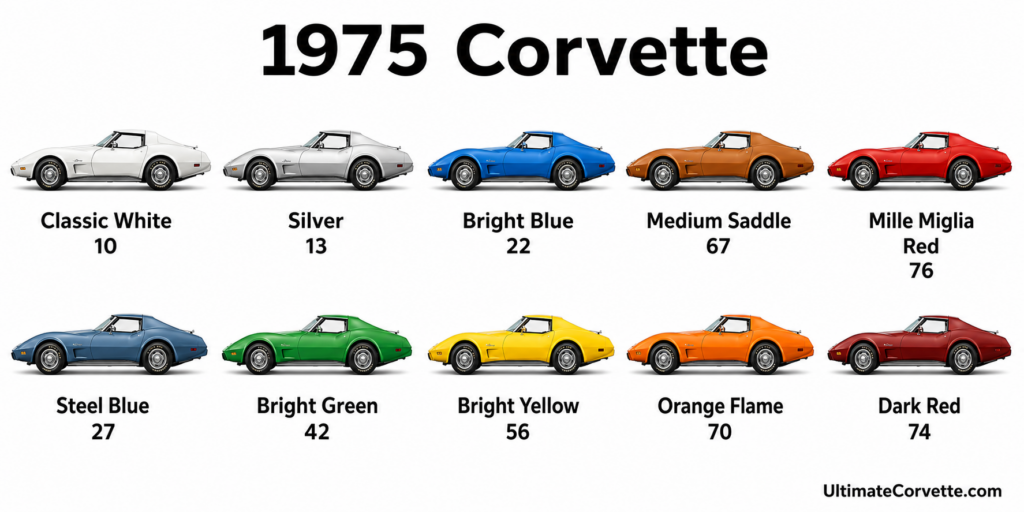
The 1975 Corvette arrived with a rich selection of factory paint colors that reflected both the era’s trends and Corvette’s evolving identity. A total of ten exterior colors were offered, ranging from bold shades like Mille Miglia Red, Bright Blue, and Bright Green, to more subdued and sophisticated tones like Silver, Classic White, and Steel Blue. New for the year was Medium Saddle Metallic, a deep bronze-gold hue that fit perfectly with the mid-1970s aesthetic. Each color was available with either a body-color or black urethane front and rear bumper, depending on the combination.
Interior choices were just as expressive, with a palette that included Black, Dark Red, Medium Saddle, Smoke, Silver, and Dark Blue. Buyers could select either vinyl or optional leather upholstery, and materials were updated for improved durability and appearance. The ability to pair almost any interior with any exterior paint gave owners a wide latitude for customization—whether they wanted a subtle monochrome look or a contrasting, high-impact combination.
This flexibility in color and trim was part of what made the 1975 Corvette feel personal. Even during a period of regulatory change, the car still offered enough individuality to reflect its driver’s personality.
Greenwood and IMSA: The Other Corvette Story Running in Parallel

If you wanted to understand the other side of the 1975 Corvette story, you did not look only at the showroom. You looked to the racetrack.
The production Corvette was being engineered around an entirely new set of realities: catalytic converters, unleaded fuel, emissions calibration, federal compliance, and the long-term survival of the nameplate in a market that had turned hard against traditional performance. That work was essential. Without it, Corvette would have become a memory instead of a continuing program. But it also meant the production car could no longer deliver the same unfiltered, full-throttle experience that enthusiasts associated with the badge.
John Greenwood filled that gap in the most direct way possible.
Greenwood did not treat the Corvette as a nostalgic object or a compromised relic of the muscle-car years. He treated it as a platform still worth developing. While the production car was being quieted, cleaned up, and calibrated for the regulatory world of the 1970s, Greenwood took the Corvette into IMSA and kept pushing it in the one environment where speed, durability, aerodynamics, and engineering nerve still carried the argument.
His cars were not modified street Corvettes in the casual, bolt-on sense. They were purpose-built racing machines, developed around the brutal realities of endurance competition. They had to stay alive over long stints. They had to manage heat. They had to use tires intelligently. They had to brake lap after lap without surrendering. They had to remain stable at speeds far beyond anything the production car was expected to see.
The bodywork made the point before the engine even fired. The wide fenders were not decoration; they were there to cover serious tire. The aero was not styling drama; it was an attempt to settle the car at speed. The stance was not about showroom swagger; it was dictated by lap time, track width, and the demands of racing a big, powerful Corvette against sophisticated international machinery.
That is where Greenwood’s Corvettes become so important to the 1975 story. The showroom car was adapting to survive the decade. The racecar was reminding everyone what the platform could still become when the rulebook rewarded capability instead of restraint.
In that period, that distinction carried real weight. Corvette buyers could see that the production car had changed. They understood that horsepower had been reduced, emissions equipment had arrived, and the old muscle-car formula was no longer available in the same way. But Greenwood’s presence in IMSA kept the Corvette connected to something larger than its catalog rating. It gave enthusiasts proof that the basic architecture still had teeth. The name still belonged at Daytona, Sebring, and the other places where American performance had to prove itself in public.
That kind of visibility helped protect Corvette’s credibility during one of the most difficult chapters in its history. A performance car can survive a temporary drop in output if people still believe in what it represents. Greenwood helped preserve that belief. He showed that the Corvette had not been reduced to style alone. Beneath the emissions controls, the softer street tuning, and the altered expectations of the mid-1970s, a serious competition machine still waited to be extracted.

That is why Greenwood belongs in any honest overview of the 1975 Corvette. The mid-1970s are too often summarized as a decline, but that only tells the showroom side of the story. On track, the Corvette platform was still being tested, refined, and pushed by people who understood its potential. Greenwood’s cars were loud, wide, fast, difficult, and demanding. They were also a necessary counterweight to the era’s more cautious production reality.
The factory Corvette was learning how to live within the new rules. Greenwood’s Corvette was making sure nobody forgot what the badge could do when performance remained the first priority.
Together, they explain 1975 more completely. One Corvette was adapting to preserve the future. The other was fighting to protect the legend.
This is why Greenwood belongs in any honest 1975 Corvette overview. The mid-1970s are often summarized as a performance downturn, but that only tells the showroom side of the story. On track, the Corvette platform was still being proven in real time—against real competition—by a team willing to invest the effort to make it fast and make it finish. The factory Corvette was learning compliance and longevity. Greenwood’s Corvette was demonstrating capability. Together, they explain the year more completely: one Corvette was adapting to survive the era, and the other was making sure nobody forgot what the badge could do when performance was the only requirement.
1975 Corvette Pricing, Options, and What Buyers Actually Chose

If the 1975 Corvette teaches anything about the mid-1970s, it’s that the Corvette buyer was changing right along with the car. The option sheet becomes a mirror of the era: still plenty of performance intent if you knew where to look, but a clear tilt toward comfort, convenience, and everyday drivability. In other words, Corvette wasn’t just surviving emissions and fuel realities—it was also learning how to remain desirable to people who wanted a sports car they could actually live with.
Start with pricing, because it tells a story all by itself. A base 1975 Corvette Sport Coupe (350ci, 165 hp, wide-ratio four-speed) carried a sticker price of $6,810.10, while the convertible—in its final year before the long hiatus—was actually less expensive at $6,550.10. That detail feels almost impossible through a modern lens, where corvettes are almost universally marketed as the premium experience. In 1975, the market logic was different. The coupe was increasingly the mainstream Corvette choice, and the convertible was an emotional holdover at a time when open cars were falling out of favor due to safety fears and rumored regulations.
Performance options still existed, but in 1975 they were chosen by a smaller, more deliberate group. The key mechanical upgrade was the L82 350ci, 205 hp engine—priced at $336—and its production count shows how niche “more performance” had become in the smog era: only 2,372 buyers checked that box. For the purist who wanted the most engaged version of the car, the M21 close-ratio four-speed was available (and effectively tied to the L82), with just 1,057 cars equipped that way. Meanwhile, the Turbo Hydra-Matic automatic dominated the transmission mix at 28,473 units—one of the clearest signals that by 1975, a large share of Corvette buyers valued effortless drivability over maximum involvement.

Then there are the options that reveal the Corvette’s split personality—half boulevard grand tourer, half still-ready-to-fight sports car. Chevrolet offered the FE7 Gymkhana Suspension for a laughably low $7, and while only 3,194 cars received it, the mere existence of a low-cost handling package tells you Chevrolet still cared about the driver. At the far end of the spectrum sat the Z07 Off-Road Suspension and Brake Package, priced at $400 and ordered by just 144 buyers. That number is small, but it’s also proof: even in 1975, when the Corvette was being engineered around catalysts and compliance, there were still customers—and still engineers—who wanted something sharper, more serious, more capable when pushed.
Some of the most telling options are the ones that sound mundane, because they expose what owners worried about in the real world. The rear window defogger shows up in meaningful numbers, as does the heavy-duty battery—practical upgrades for a car expected to start reliably and be driven in more conditions than the old muscle-era weekend fantasy. The auxiliary hardtop for convertibles was ordered by more than half of ragtop buyers, which speaks to how these cars were being used: owners wanted the open experience, but they also wanted a more sealed, quieter, more weatherproof configuration when the season—or the highway—demanded it.

Even the tire choices tell a story. By 1975, most Corvettes rolled out on white-letter steel-belted tires, a subtle but important cultural shift. Lettered tires weren’t just an aesthetic—though they absolutely were that—they were a declaration that the car still had attitude, even if the horsepower numbers had been humbled by regulation.
If you read the 1975 option sheet as a simple list, you miss the point. The choices buyers made—air conditioning in huge numbers, power steering nearly everywhere, automatics dominating, a smaller but meaningful performance minority checking L82 and suspension boxes—tell you exactly what Corvette had become by the middle of the decade: a car that still looked like a sports car, still turned like a sports car, still carried the Corvette promise, but increasingly delivered it in a way people could live with every day. And in 1975, that ability to be both aspirational and usable wasn’t just a feature. It was a survival strategy.
1975 Corvette Pricing and Options Summary (for Reference)
- Base Coupe (1YZ37): 33,836 built — $6,810.10
- Base Convertible (1YZ67): 4,629 built — $6,550.10
- L82 205 hp engine (RPO L82): 2,372 — $336.00
- Close-ratio 4-speed (M21): 1,057 — $0.00
- Automatic (M40 THM): 28,473 — $0.00
- Air Conditioning (C60): 31,914 — $490.00
- Power Steering (N41): 37,591 — $129.00
- Power Brakes (J50): 35,842 — $50.00
- Power Windows (A31): 28,745 — $93.00
- Tilt-Telescopic Column (N37): 31,830 — $82.00
- Rear Defogger (C50): 13,760 — $46.00
- Gymkhana Suspension (FE7): 3,194 — $7.00
- Z07 Off Road Suspension/Brakes: 144 — $400.00
- Auxiliary Hardtop for Convertible (C07): 2,407 — $267.00
- Vinyl Covered Aux Hardtop (C08): 279 — $350.00
- AM/FM Stereo (U58): 24,701 — $284.00
- AM/FM Radio (U69): 12,902 — $178.00
- White-letter tires (QRZ): 30,407 — $48.00
- White-stripe tires (QRM): 5,233 — $35.00
Why the 1975 Corvette Still Matters Today
The 1975 Corvette is easy to underestimate if you judge it only by the usual mid-1970s shorthand. Lower horsepower. New emissions equipment. Catalytic converters. Unleaded fuel. The final year of the convertible. The end of Zora Arkus-Duntov’s direct leadership. On paper, it can look like a year defined by things Corvette lost.
But that is not the full story.
What the 1975 Corvette actually represents is survival with intent. Chevrolet was not simply reacting to the decade. It was repositioning the Corvette so the car could endure it. The rules had changed. The fuel had changed. The market had changed. Buyer expectations had changed. And instead of letting those pressures dilute the car into irrelevance, Chevrolet found a way to keep Corvette recognizable, desirable, and commercially strong.
That is why 1975 matters.
It was the year the catalytic converter became part of the Corvette story, forcing a new exhaust layout and a new way of thinking about calibration, compliance, and drivability. It was the year unleaded fuel was no longer a future concern, but a daily operating reality. It was the year HEI ignition helped modernize the car’s starting, spark delivery, and everyday usability at a moment when clean running mattered more than ever. It was also the final year of the convertible’s first continuous production run, a decision that still feels emotional but made sense in the context of safety concerns, buyer trends, and the overwhelming popularity of the coupe.
And then there was Duntov.
His retirement at the end of the 1975 model year gave the moment an added sense of gravity. Corvette was already changing, but now the man most closely associated with its transformation into a true American sports car was stepping away. That could have marked an ending. Instead, it became a handoff. Duntov’s era had given Corvette its fighting character. The next chapter would require a different kind of discipline: strategic endurance, regulatory intelligence, and the ability to protect the car’s identity while the definition of performance itself was being rewritten.
That is the part of 1975 that deserves more respect. This was not Corvette surrendering to the times. It was Corvette learning how to survive them.
The street car became more refined, more livable, and more carefully managed. Buyers responded to that. They ordered air conditioning, power steering, power brakes, power windows, tilt-telescopic columns, better radios, and automatic transmissions in huge numbers because the Corvette had become more than a weekend weapon. It was a personal reward, a design statement, and a car people wanted to live with. The horsepower figure may have softened, but the desire did not.
At the same time, Corvette’s harder edge did not disappear. It simply showed up more clearly in other places. John Greenwood’s IMSA efforts kept the platform visible, aggressive, and credible in competition while the production car navigated emissions law, fuel changes, and federal expectations. That parallel story matters because it reminds us that the Corvette’s performance spirit was never extinguished. It was being expressed differently, depending on where the rules allowed it to breathe.
That is why the 1975 Corvette cannot be reduced to a single statistic. It was not just a low-horsepower C3. It was not just the last convertible before the long pause. It was not just Duntov’s farewell year. It was all of those things at once, and together they make 1975 one of the most revealing model years in Corvette history.
The 1975 Corvette still matters because it proved the car could adapt without disappearing into the decade around it. It kept the C3’s unmistakable shape. It preserved the Corvette’s emotional pull. It remained commercially strong. It gave buyers a version of the car that made sense for the world they were actually living in, while racing efforts kept the badge connected to speed, endurance, and credibility.
The Corvette did not outlast the mid-1970s by accident. It survived because Chevrolet made difficult choices before the program was cornered by them.
That is the legacy of 1975. It was not Corvette at its loudest, fastest, or most romantic. It was Corvette at one of its most important crossroads — a year when survival became part of the performance story.
And because the car survived that moment, everything that followed remained possible.