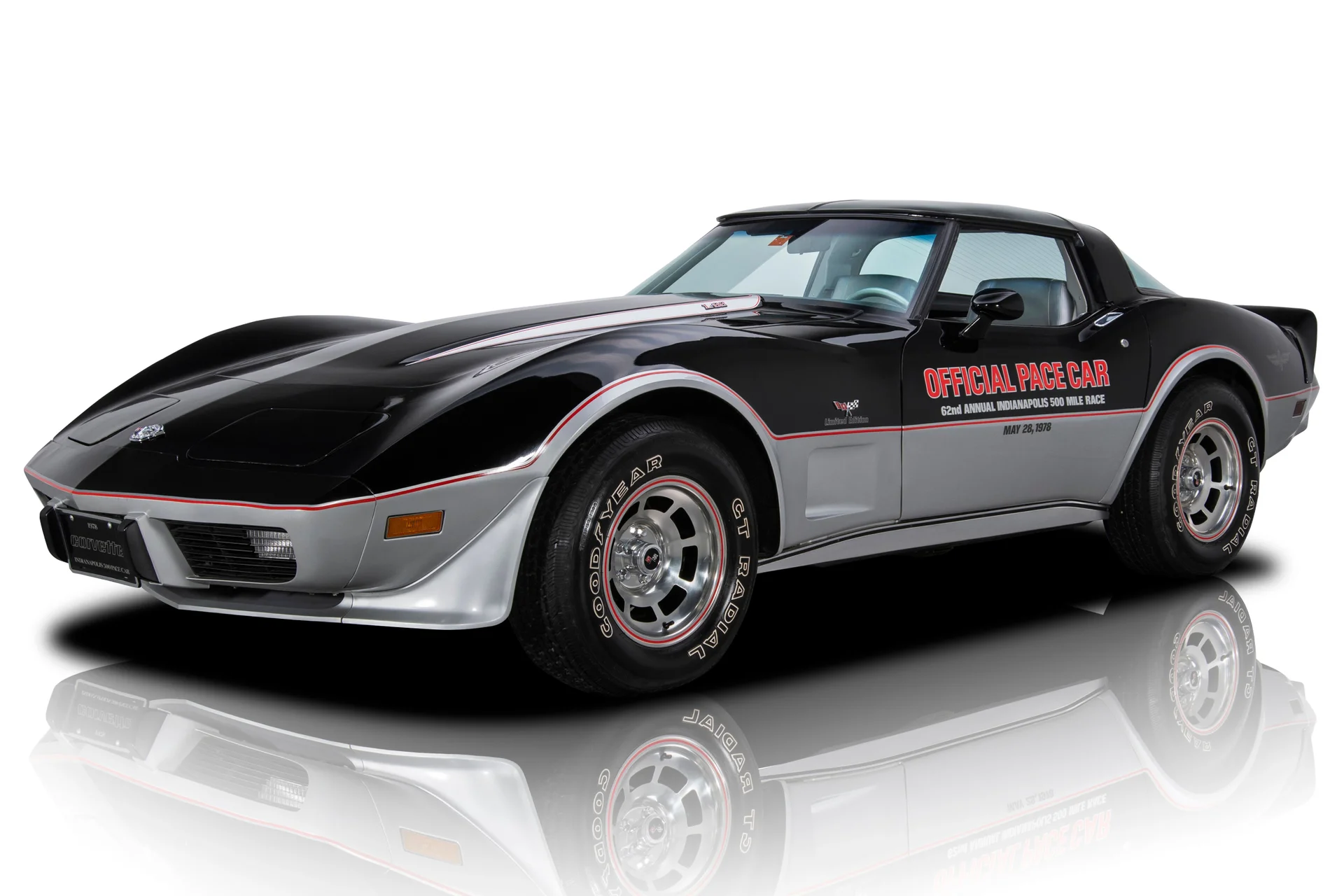
“Perhaps somewhat surprisingly, the Chevrolet Corvette was already in its 25th year of production when, in 1978, it finally served for the first time as the pace car for the Indianapolis 500.”
By 1978, Corvette had reached a milestone few American performance cars ever survive: its twenty-fifth year in production. Yet the anniversary arrived at a complicated moment for America’s sports car. The C3’s dramatic shape still had the power to stop people in their tracks, and Corvette remained one of Chevrolet’s most recognizable symbols of speed, style, and aspiration. But the decade had not been kind to performance cars. Two oil crises, rising fuel concerns, and tightening emissions standards had changed the entire automotive landscape, and Corvette was not immune to those pressures. Output had been reduced, expectations had shifted, and the car’s image was carrying the weight of an era that often seemed at odds with high-performance machinery. Enthusiasts still believed in Corvette, but even many loyalists were beginning to question whether the car’s real-world performance still lived up to the promise suggested by its long hood, low stance, and legendary name. Chevrolet understood the stakes. At twenty-five, Corvette was not merely celebrating a birthday; it was standing at a crossroads. The moment demanded more than commemorative trim, anniversary badging, or a ceremonial nod to the past. It needed a statement strong enough to remind the country why Corvette still mattered.
Chevrolet’s response came in two distinct forms, each aimed at a different side of the Corvette story. The first was a restrained celebration of lineage: the Silver Anniversary two-tone treatment, a clean silver-over-gray appearance package that acknowledged Corvette’s heritage with polish and restraint rather than spectacle. It was tasteful, reflective, and appropriate for a car marking a quarter-century of history. But Chevrolet also needed something louder, something that would not merely honor the past but seize attention in the present. That answer was the black-over-silver Limited Edition built for Indianapolis. More dramatic, more visible, and far more theatrical, it was created to stand on pit lane at the Indianapolis 500 and announce, unmistakably, that Corvette still belonged at the center of American performance culture. Its purpose was direct and deliberate. The car would mark Corvette’s first-ever assignment as the official Indianapolis 500 pace car, transforming the model’s 25th anniversary from an internal milestone into a national headline. This was not simply another model-year turn of the calendar. It was Chevrolet using one of America’s biggest racing stages to reassert Corvette’s identity, visibility, and cultural importance.
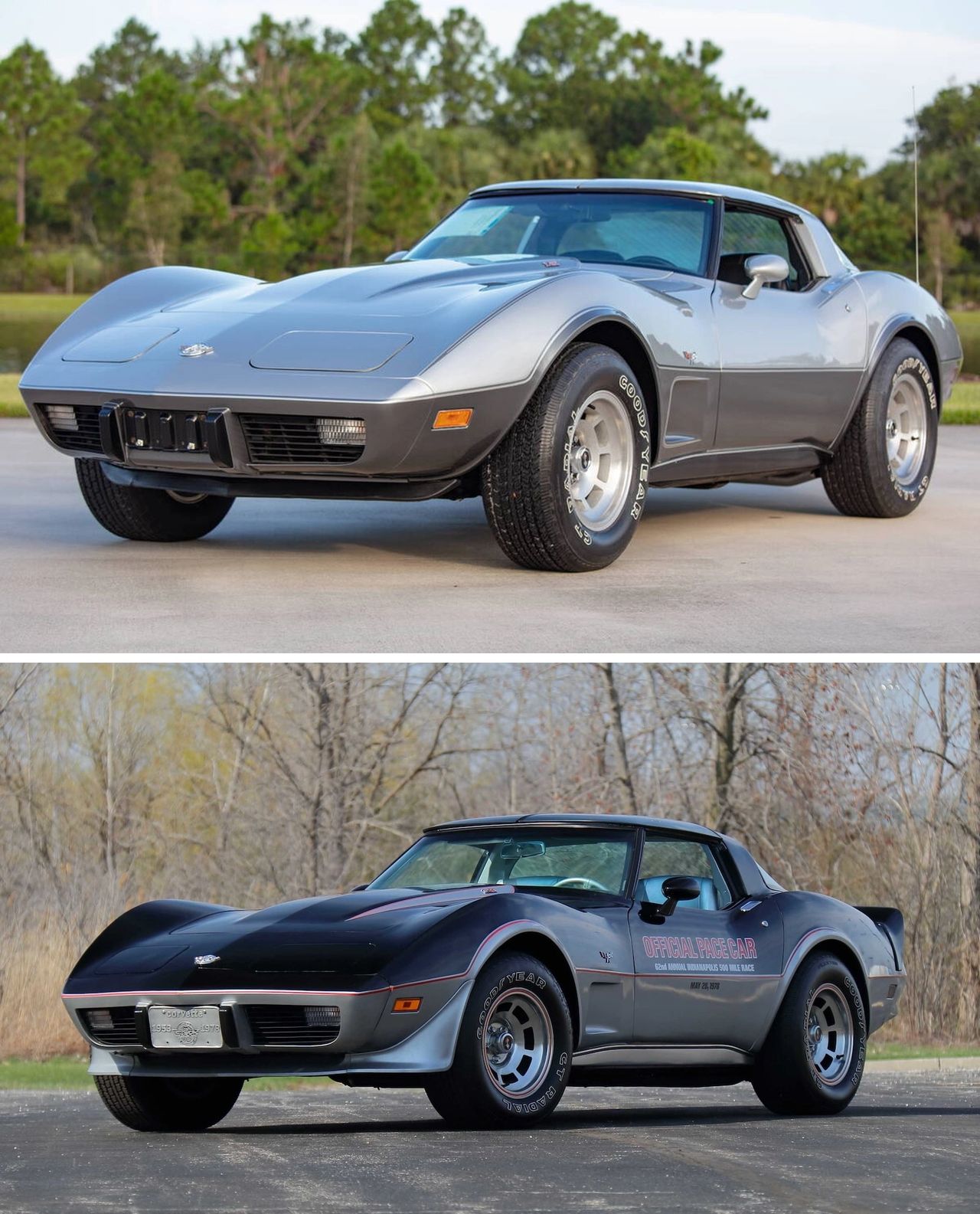
What followed was far bigger than a typical commemorative appearance package. The 1978 Corvette Limited Edition Pace Car replica, ordered under RPO Z78, did not simply arrive in Chevrolet showrooms as another special-trim Corvette. It set off a frenzy. Demand quickly spilled beyond normal buyer interest and became a national spectacle, reaching newspapers, collector circles, and dealership conversations across the country. Dealers demanded—and often received—thousands of dollars over sticker price. Collectors worked their way onto allocation lists, trying to secure one before the opportunity disappeared. Buyers with little or no intention of driving the car pursued ownership anyway, treating the Pace Car not just as transportation but as a future collectible from the moment it appeared. The story made news because it represented something larger than black-over-silver paint, graphics, or Indianapolis 500 identification. The excitement surrounding RPO Z78 became a kind of public referendum on Corvette’s standing in American culture. Even in a more cautious automotive era shaped by fuel concerns, emissions pressures, and diminished performance expectations, the Corvette name still carried heat. People still wanted it. They still believed in it. And when Chevrolet gave them a Corvette tied to Indianapolis, anniversary significance, and unmistakable visual drama, the response proved that the car’s cultural pull remained very much alive.
The timing only magnified the impact. In 1978, the Corvette had already received meaningful updates that helped advance the C3 design, most notably its new wraparound fastback rear glass. That design change gave the car a fresher, more contemporary profile while preserving the long-hood, low-slung character that had defined the generation. The Indianapolis program then amplified those changes with theater, scarcity, and provenance. The Pace Car package did not create the 1978 Corvette’s visual momentum on its own, but it focused national attention on it and gave the updated bodywork a dramatic stage. In doing so, Chevrolet minted one of the most instantly recognizable C3 Corvettes ever built. In a single season, the company transformed an anniversary into an event, an event into showroom demand, and that demand into a legacy. The 1978 Corvette Indy Pace Car became more than a limited-edition model; it became the car that helped define how the entire 1978 Corvette model year would be remembered.
Indy at last: a first for Corvette
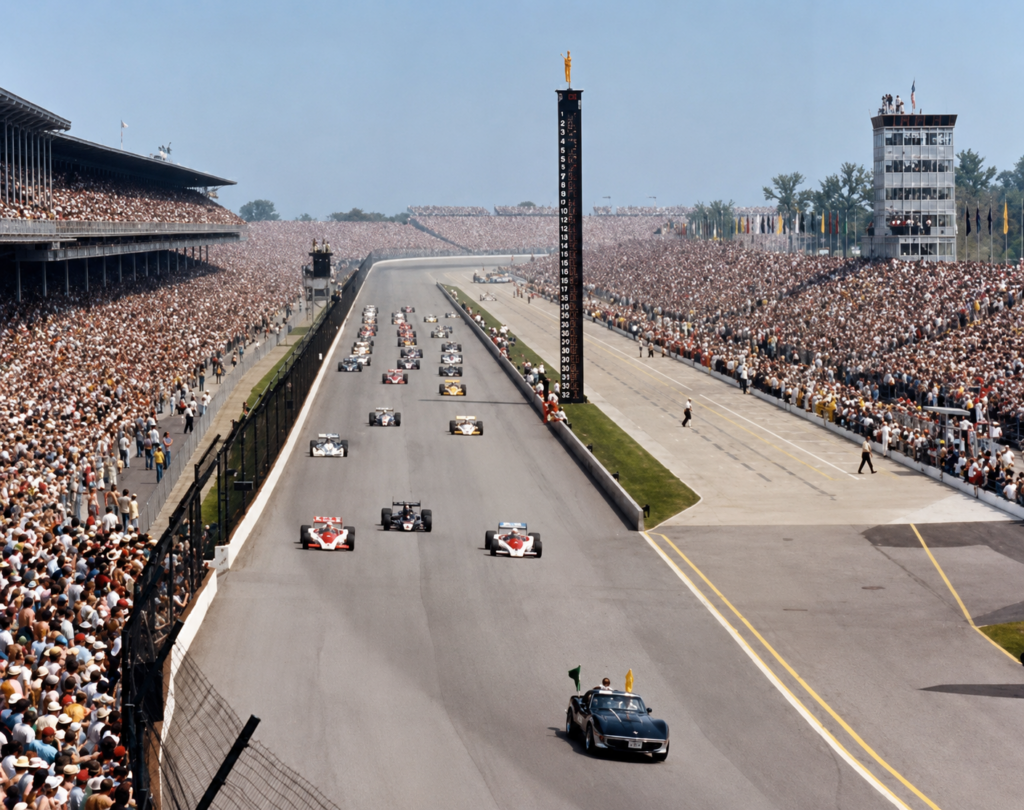
Despite twenty-five years of production history and a competition identity deeply woven into Corvette’s image, America’s sports car had never led the field at Indianapolis until May 28, 1978. That absence made the moment more meaningful. Corvette had long been associated with performance, style, and American speed, yet the Indianapolis 500—the country’s most visible racing stage—had remained just beyond its official pace car résumé. When the invitation finally came, Chevrolet understood the opportunity. This was not simply a ceremonial assignment. It was a chance to connect Corvette’s established heritage with the newly updated 1978 model and present the car to a national audience at precisely the right time.
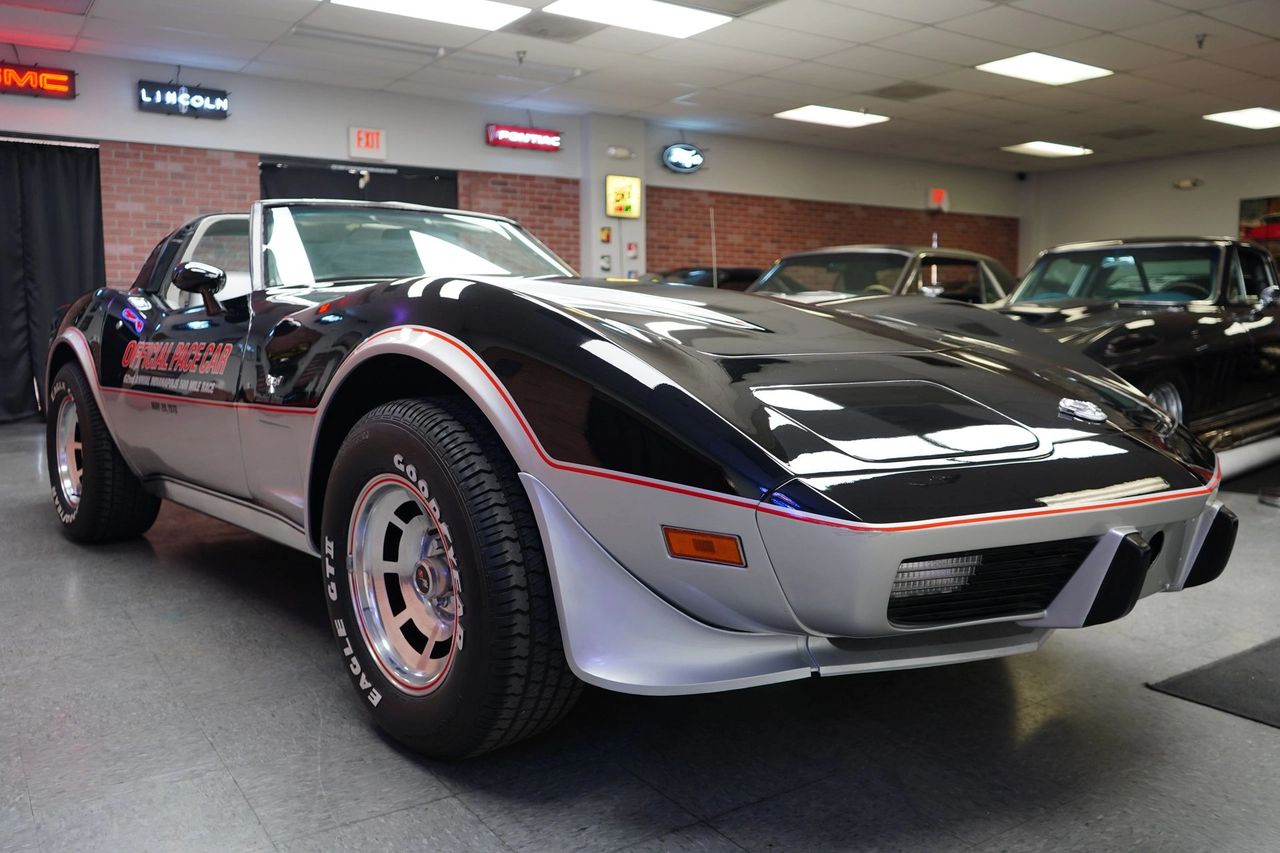
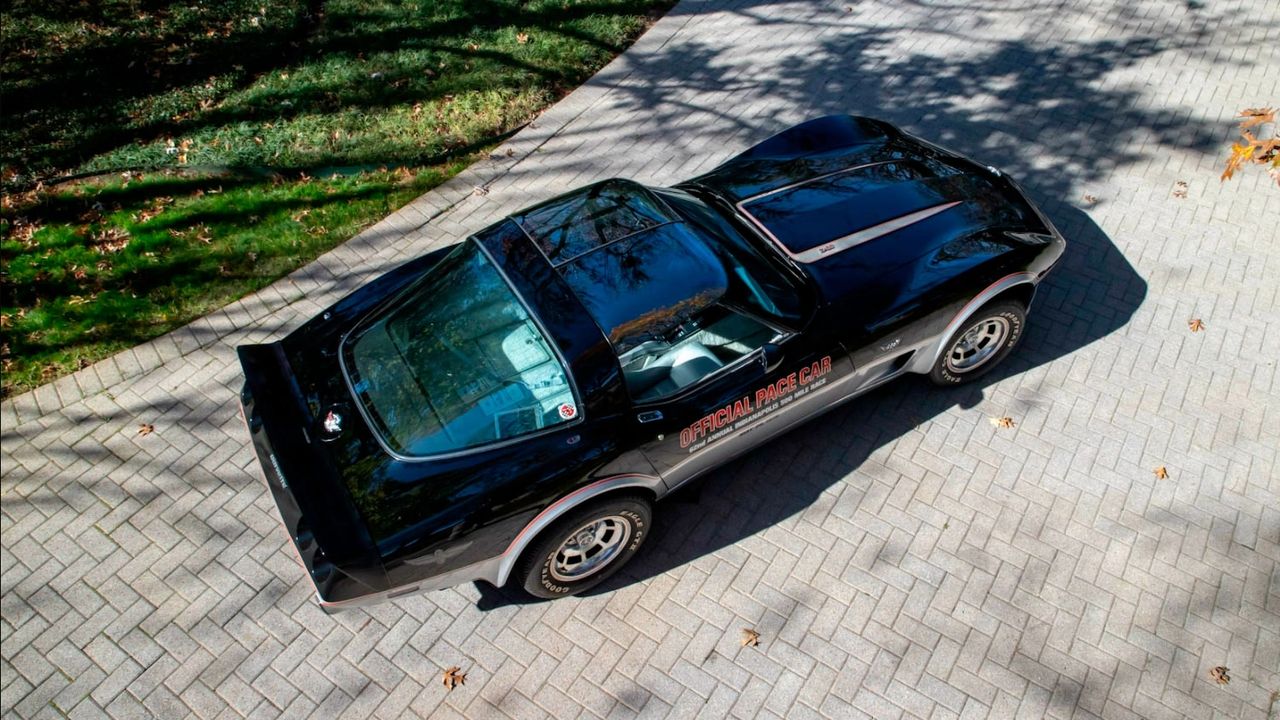
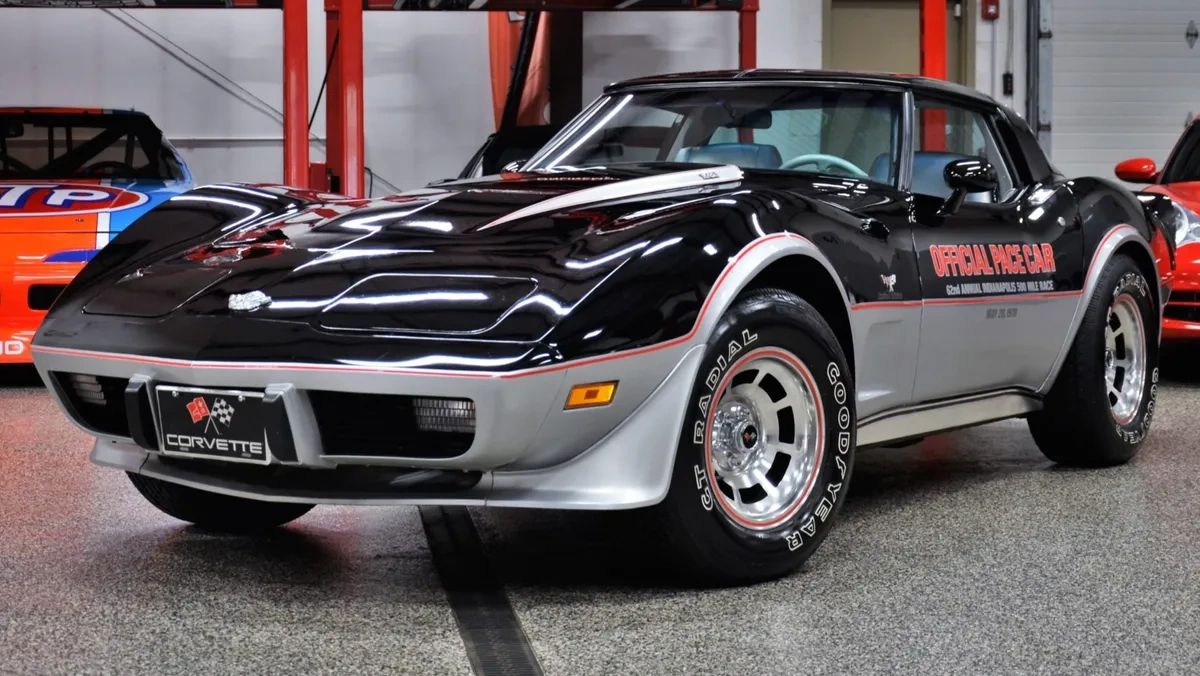
Chevrolet used the Indy program to tie together the past, present, and future of the C3. The car already carried the public’s still-glowing affection for the generation, but the 1978 facelift gave it fresh visual energy. The new wraparound fastback glass modernized the profile, while the fresher interior reinforced the sense that Corvette was still evolving rather than merely celebrating what it had been. For the official pace car, Chevrolet wrapped those updates in one of the most memorable finishes ever applied to a C3: black over metallic silver, divided by a razor-thin red knife-edge pinstripe. It was dramatic, clean, and instantly recognizable, giving the Corvette the visual presence needed to command attention on the pit lane and in front of the grandstands.
Mechanically, the official car carried the L82 350 small-block, rated at 220 horsepower, giving the Pace Car a proper performance identity to match its public role. Bolt-on urethane front and rear spoilers helped clean up the air while giving the shape a more purposeful stance. Turbine-style wheels and raised-white-letter Goodyear tires filled the arches with the kind of visual authority expected of a car chosen to lead the field at Indianapolis. Behind the wheel was Jim Rathmann, the 1960 Indianapolis 500 winner and a longtime Chevrolet ally, whose presence added credibility and ease to the assignment. Rathmann handled the pace duties with the authority of someone who knew the Speedway and understood the weight of the moment. When the race itself was over, Al Unser Sr. had claimed victory, earning his third win at the Brickyard and placing Corvette’s first Indy pace car appearance inside another memorable chapter of Indianapolis history.
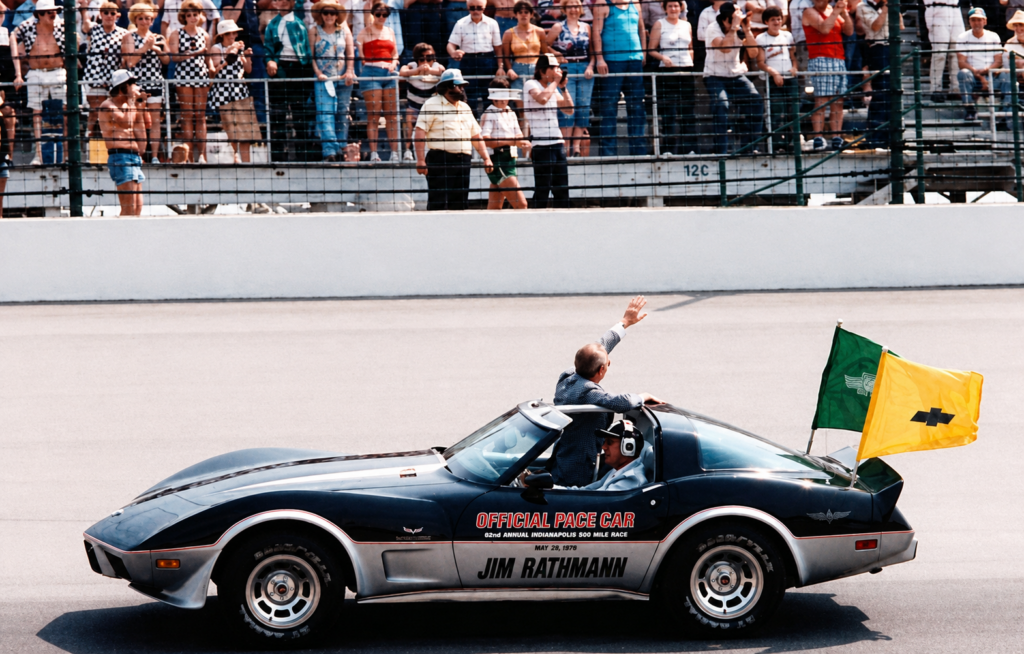
For Chevrolet, the optics were perfect: a milestone-year Corvette leading America’s biggest race, the cameras catching that black-and-silver profile over and over, and the same look waiting in showrooms a few weeks later. The replica (RPO Z78) carried the paint scheme, spoilers, mirrored-glass roof panels, and “Official Pace Car” door graphics—shipped in the trunk so owners could choose their look. Dealers got one apiece, speculation went nuts, and the car became as much a pop-culture moment as a product. In a year meant to celebrate the first 25, the Indy assignment did something more valuable: it reminded everyone that Corvette still mattered in front of the largest audience the car could find.
What 1978 changed—and how the Pace Car amplified it
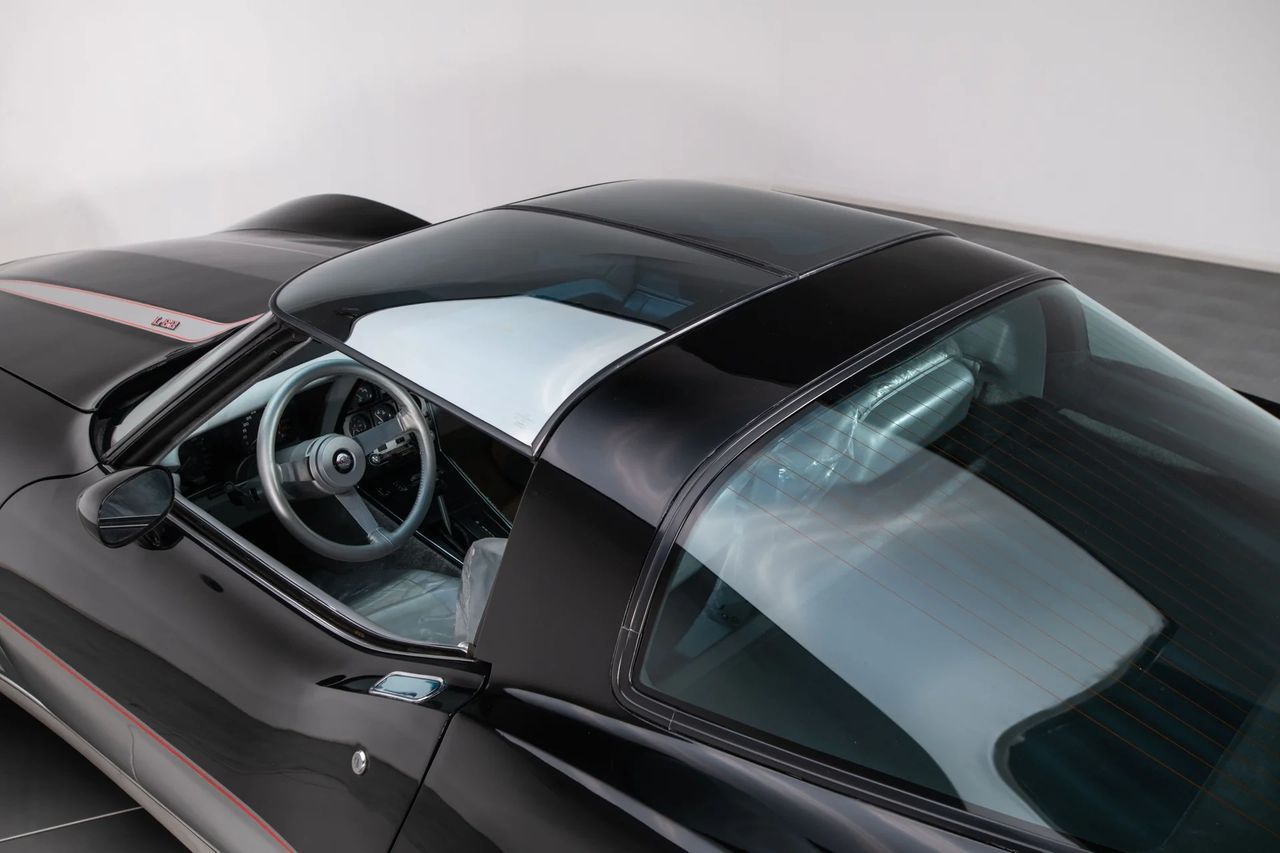
Even without Indy, 1978 was a meaningful year for the Corvette. The wrap-around fastback rear glass changed how the car worked as much as it did how it looked: rearward sightlines opened up, and the shelf behind the seats finally behaved like real luggage space rather than a token ledge. Inside, the instrumentation read cleaner, and the added storage felt deliberate rather than improvised—the cabin simply came together in a way that made the whole car feel more resolved day-to-day.
Dave McLellan—Zora’s successor as chief engineer—would later single out that fastback as an “excellent update,” the kind of improvement that signals renewed investment without rewriting the formula. And then the Pace Car put those same updates under the brightest lights, turning a set of practical changes into a widely seen statement that the Corvette was sharpening for its next chapter.
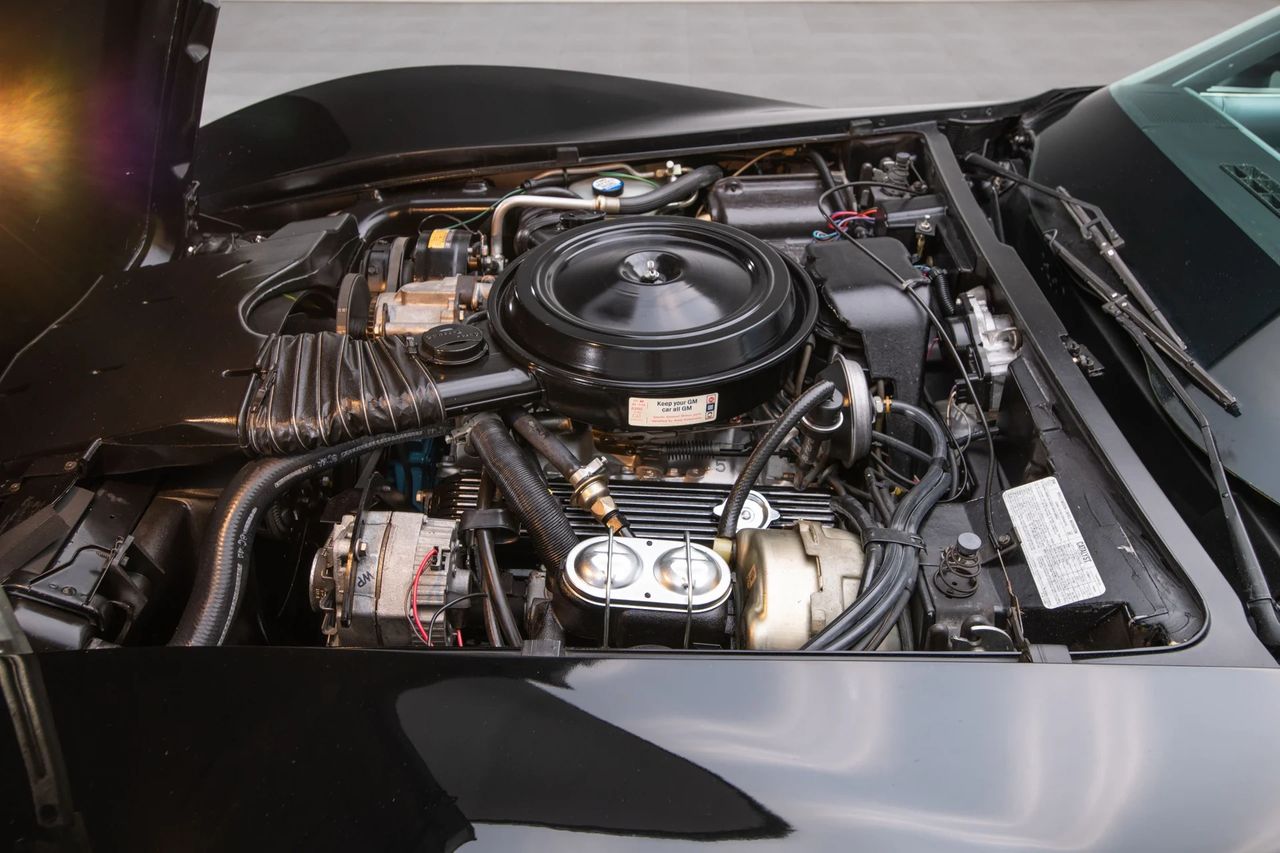
Mechanically, the lineup centered on two small-blocks: L48 (185 hp) and L82 (220 hp). Period tests ground the conversation in reality. In October 1977, Car and Driver introduced the revised ’78 and famously declared the L82/four-speed “certainly the fastest American production car” of the time, while noting the L48 automatic’s 0–60 in 7.8 seconds and 123-mph top speed. Contemporary Road & Track data on an L82/four-speed put 0–60 in ~6.5–6.6 and the ¼-mile in the mid-15s @ ~95 mph, with top speed reported around 127 mph. In an era often dismissed as performance-light, the Pace Car’s substance backed up its spectacle.
Not “just decals”: what Chevrolet actually built
Chevrolet did not stumble into the black-over-silver treatment; it engineered a complete visual story around the C3’s proportions. The placement of the color break is especially important. By setting the dividing line low on the body, the darker upper section reads almost like a canopy stretched over the passenger compartment, while the silver lower body adds visual width and mass closer to the pavement. The result is a car that appears lower, longer, and more planted before any of the individual details are consciously examined.
The black upper body also places greater emphasis on the Corvette’s glass, roofline, and flowing upper surfaces. It visually unifies the windshield, side glass, roof panels, and fastback area into one dark, continuous form, making the cockpit appear more compact and purposeful. Beneath it, the silver lower section traces the broader volume of the fenders, doors, and quarters, allowing the body’s muscular shape to remain visible without overwhelming the darker upper profile. Together, the two colors divide the car into distinct visual zones while still working as a single composition.
Between them, the razor-thin red pinstripe acts as more than a decorative flourish. It is the line that gives the entire treatment precision. Without it, the meeting point between black and silver could appear abrupt or unfinished. The red stripe sharpens that transition, creates a clean visual boundary, and helps disguise the slight variations in panel fit and alignment that can become more noticeable where two contrasting colors meet. It turns a potentially difficult paint seam into one of the design’s strongest details.
The placement of the stripe also encourages the eye to travel along the full length of the car. It follows the fender peaks, crosses the doors, and continues through the rear quarters in one uninterrupted gesture, emphasizing the Corvette’s length and the continuity of its body contours. Because the line remains narrow, it never competes with the black and silver surfaces. Instead, it connects them, functioning like punctuation within the larger composition: small in scale but essential to how the design is read.
In photographs, the red line provides an immediate point of contrast, giving the livery definition even when reflections flatten the difference between the two main colors. In person, its effect is more dimensional. The stripe traces the C3’s compound curves and gives those rounded forms a crisper edge, making the body appear more tailored and controlled. It works much like contrast piping on a well-cut suit, finding and emphasizing the shape with a single carefully placed line.

The aero elements deserve more attention because neither was treated as an isolated add-on. Up front, the three-piece air deflector follows the lower edge of the nose and turns inward toward the wheel openings, giving the front fascia a more integrated, finished appearance. Visually, it pulls the eye downward and outward, reducing the impression of height in the chin and making the Corvette appear broader and more planted. It also gives the wheel openings a stronger connection to the nose, so the front end reads as one continuous shape rather than a bumper with separate trim attached beneath it. The effect is subtle but important: the car looks lower and more composed without crossing into overt race-car theater.
The rear spoiler performs a similar visual correction at the opposite end of the body. Molded as a single polyurethane piece, it extends the tail’s horizontal emphasis and helps draw attention away from the rear bumper’s vertical depth. It also provides a cleaner conclusion to the fastback profile, carrying the roofline and rear glass into a more deliberate finishing point. Rather than interrupting the C3’s curves, the spoiler gives them somewhere to resolve. From the side, the car appears longer and flatter; from behind, the rear feels wider, more balanced, and less visually heavy. Neither spoiler needs to announce itself as a functional downforce device to be effective. Their real contribution lies in how they refine proportion, clean up the transitions around the body, and make the Corvette’s stance feel more intentional.
The glass T-tops add a different kind of drama by changing the car’s interior atmosphere. Removed, they transform the cockpit into an open-air space while retaining the structural framing and close-fitting character of the coupe. Installed, they still allow daylight to enter from above, preventing the cabin from feeling enclosed beneath the dark roof structure. That effect works especially well with the new fastback rear glass, which brings additional light into the rear of the interior. Together, the roof and hatch glass make the cockpit feel more expansive and visually connected to the outside, giving the updated cabin a lighter, more contemporary character without changing the fundamental C3 layout.
The mirrored surface seen on many of the panels adds another layer to that experience. From outside, it introduces a controlled flash of reflection that suits the Pace Car’s showpiece role; from within, the roof still feels brighter and more open than a conventional solid panel. The practical details are just as important to the ownership experience. Gasketed frames and secure latch geometry determine whether the panels feel like an integrated part of the body or a removable component that never quite settles into place. On a properly sorted car, the panels fit tightly and preserve the coupe’s sense of enclosure when installed. When removed, the dedicated storage bags protect the glass and mirrored surfaces, turning the T-tops from a visual novelty into a usable, repeatable part of the Corvette experience.

Under the fender lips, the cast-aluminum wheels become an essential part of the 1978 Corvette Indy Pace Car’s visual identity. Their red accent rings echo the slender red pinstripe separating the black upper body from the silver lower body, carrying that vivid dividing line downward and completing the car’s three-color composition. Rather than functioning as simple hardware, the wheels extend the exterior graphics into the stance of the car, ensuring that the red accent does not end at the bodywork but continues all the way to the pavement.
The contrast within each wheel is equally effective. The machined faces catch and reflect available light, emphasizing the shape of the spokes and adding brightness beneath the dark upper body. The painted pockets visually recede behind them, creating depth and definition without introducing unnecessary ornamentation. That interplay between polished surfaces and darker recesses gives the wheels a more dimensional appearance, particularly as the car moves and changing light travels across the machined aluminum.
On a black-and-silver Corvette, these wheels are anything but an afterthought. Their silver faces complement the lower body color, while the red rings repeat the pinstripe above, making the wheels the third major element in a carefully coordinated three-tone design. They visually anchor the body, connect the upper and lower portions of the livery, and reinforce the sense that every exterior detail was considered as part of a single composition.
Period-correct raised-white-letter tires heighten the effect even further. The bright lettering adds another crisp visual edge against the black sidewalls, framing the red accent rings and silver spokes within a layered sequence of contrasting colors. White letters, red rings, silver aluminum, and black rubber work together with the body’s graphics rather than competing against them. At rest, the combination gives the Pace Car a deliberate, performance-oriented stance. In motion, the rotating lettering, red rings, and reflective wheel faces turn that carefully arranged palette into a moving celebration of the livery.

Inside, the equipment loadout is pure late-1970s luxury-sport and intentionally comprehensive. The Pace Car was not meant to feel like a stripped-down competition machine wearing commemorative graphics; it was conceived as a fully equipped Corvette that blended visual drama with the comfort, convenience, and everyday usability expected of a premium grand-touring car. The interior features reinforce that mission, reducing many of the compromises that had traditionally accompanied ownership of a fiberglass-bodied American sports car.
Air conditioning is central to that equation. Beneath the expansive glass and within the close confines of the cockpit, effective climate control turns warm-weather driving from an endurance exercise into something genuinely enjoyable. Power windows and power door locks add another layer of convenience, allowing the driver to manage the cabin without reaching across the wide console or leaning awkwardly toward the passenger side. These amenities may seem routine by modern standards, but in the context of the late 1970s they helped position the Corvette as something more sophisticated than a basic performance car. It could still deliver the experience of a low-slung two-seater while asking fewer sacrifices from its occupants.
The rear-window defogger is one of the quieter but more purposeful elements of the package. The new wrap-around fastback backlight dramatically expands the view behind the car, but that added visibility is only useful when the glass remains clear. By helping remove fog and condensation, the defogger allows the driver to benefit fully from the larger rear window in cool, damp, or rapidly changing conditions. It is a small feature, yet one that supports one of the most important functional advantages of the redesigned rear bodywork.
The tilt-and-telescopic steering column contributes in much the same way. Adjusting both the angle and reach of the steering wheel allows drivers of different heights and proportions to establish a more natural relationship with the wheel, pedals, and instrument panel. In a tightly packaged sports-car cockpit, even modest improvements in reach can make a significant difference. The result is a driving position that feels more accommodating, more deliberate, and more consistent with the Pace Car’s upscale character.
Even the heavy-duty battery fits the same comprehensive brief. A commemorative Corvette might spend much of its life being displayed, driven only in favorable weather, or parked for extended periods between outings. Additional starting reserve therefore has practical value, providing greater assurance when the car is called back into service after sitting for a week, a season, or an entire winter. It is not a glamorous feature, but it supports the reliability and convenience expected of a car designed to be both celebrated and enjoyed.
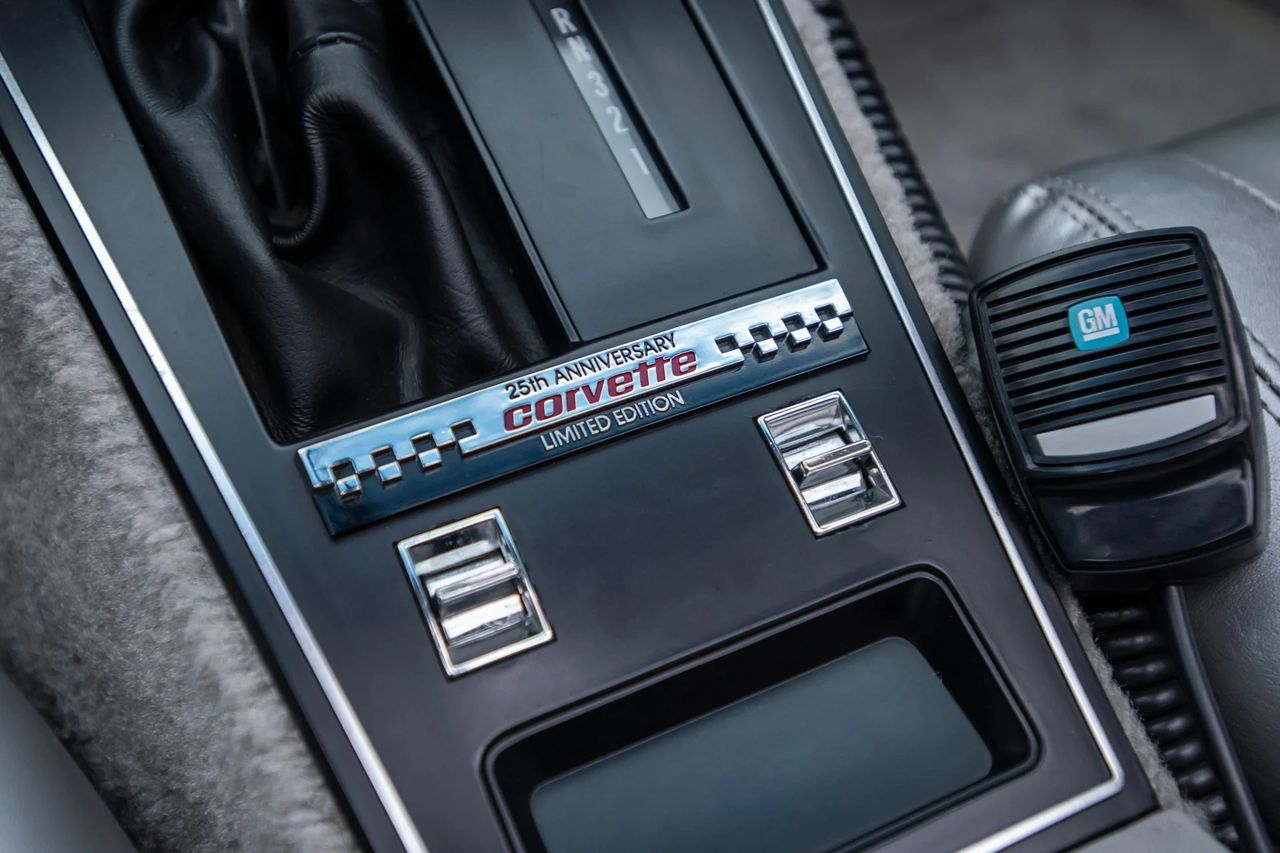
Finally, the entertainment stack plants the 1978 Corvette Pace Car firmly within its moment, and that is part of the car’s appeal rather than something that needs to be excused. The AM/FM head unit provided the foundation, but Chevrolet allowed buyers to layer in equipment that reflected the rapidly changing ways Americans listened, traveled, and communicated during the late 1970s. An available 8-track player provided the period equivalent of portable, on-demand entertainment, allowing drivers to carry their preferred music into the cockpit rather than relying entirely on local radio programming.
The 8-track installation also suited the Pace Car’s broader luxury-sport character. This was not intended to be a bare-bones racing special with every ounce of nonessential removed. It was a highly equipped Corvette designed to deliver performance, comfort, technology, and visual impact in equal measure. In that context, an upgraded audio system did more than play music. It helped make the cabin feel contemporary, indulgent, and appropriately special for a car created to commemorate one of the most visible assignments in American motorsports.
The available CB radio was even more era-specific. With its dedicated microphone and channel selector, it transformed the center stack into something resembling a compact communications station. By 1978, the CB had become a familiar part of American highway culture, allowing drivers to exchange traffic information, road conditions, warnings, and casual conversation across the open road. Inside the Pace Car, however, it carried an additional layer of personality. It made the cockpit feel active and connected, as though the driver were participating in the movement and energy surrounding the car rather than merely observing it.
In an ordinary automobile, such equipment might risk appearing fashionable or excessive. In the Pace Car, the CB becomes theater—and theater is entirely appropriate. It complements the exterior scripts, spoilers, contrasting paint, red accents, and other details that announce the car’s purpose before the engine is even started. Like the exterior graphics and aerodynamic elements, the microphone and controls inside contribute to the sense of occasion. They evoke the chatter of the highway, the coordination of a race weekend, and the excitement surrounding a car built to lead a field of competitors around Indianapolis.
That combination captures where American performance culture stood in 1978. It was part boulevard cruiser, part grand-touring machine, and part pit-lane fantasy. The Pace Car could look at home moving slowly through a crowded cruise night, covering miles on the interstate, or sitting beneath the pagoda at Indianapolis. Its entertainment and communications equipment supported all three identities. The technology may be unmistakably period-specific, but that specificity gives the interior much of its character. It is not merely old equipment; it is a preserved expression of how drivers experienced music, travel, and automotive culture at the end of the 1970s.
One smaller but especially telling interior distinction reinforces Chevrolet’s desire to make the Pace Car feel progressive rather than simply commemorative. The new thin-shell sport seats, developed with improved lumbar support, had originally been intended for introduction with the 1979 Corvette. Instead, Chevrolet pulled them forward so the 1978 Pace Car could debut them ahead of the regular production lineup.
The thinner seat construction gave the cockpit a more modern appearance while the revised support addressed the practical demands of spending time behind the wheel. In a low, tightly packaged sports car, seat shape directly affects driving comfort, posture, and the sense of space within the cabin. Improved lumbar support helped the seat hold the driver more naturally, while the thinner shell made the design appear less bulky and more purposefully integrated into the Corvette’s interior.
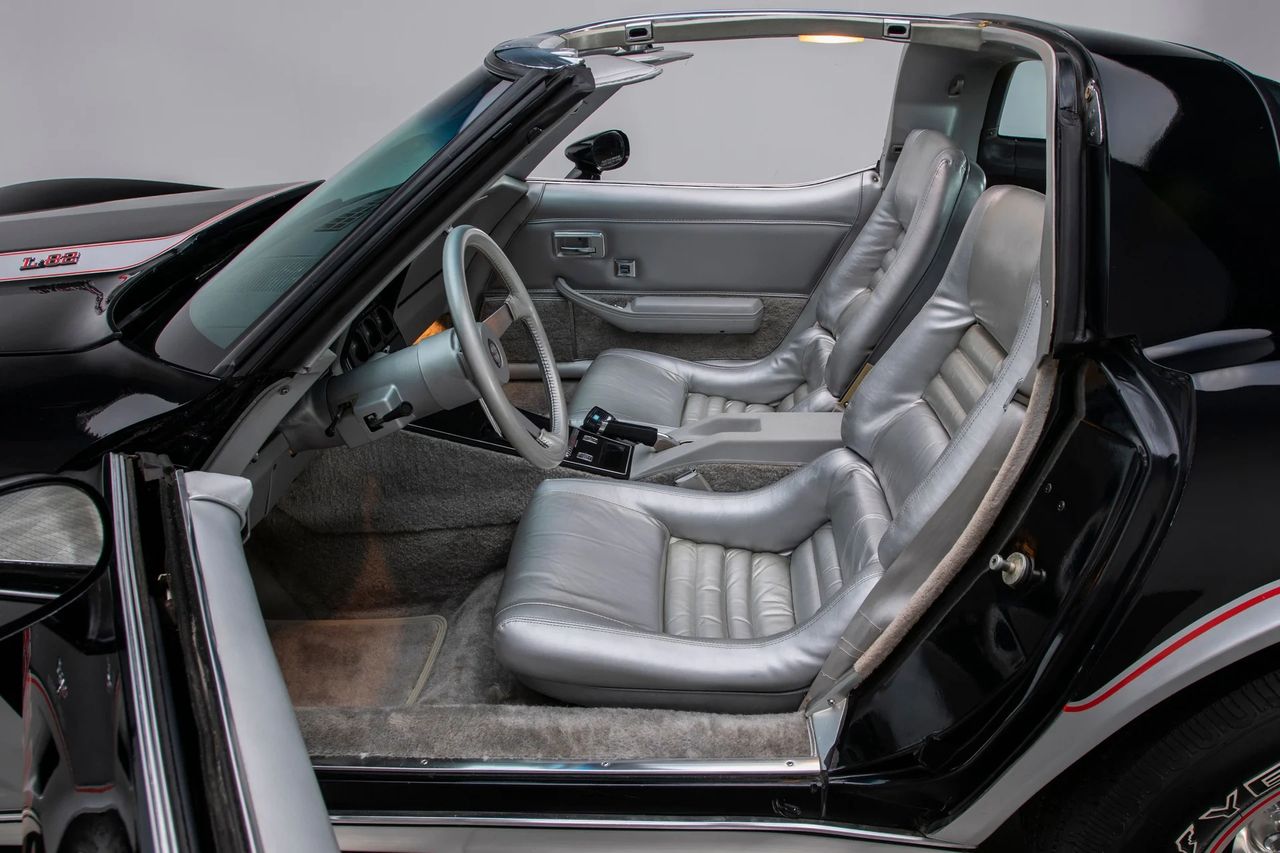
Their early installation also gave the Pace Car something more meaningful than a different upholstery treatment or commemorative emblem. The seats represented an actual preview of the Corvette’s immediate future. Buyers were not simply receiving a 1978 model decorated to celebrate the Indianapolis 500; they were receiving an interior feature that the rest of the Corvette range would not adopt as standard fare until the following model year.
That decision underscores Chevrolet’s broader intent. The Pace Car needed to acknowledge the significance of the Indianapolis assignment, but it also needed to feel like a step forward. By combining period entertainment and communications technology with seating originally intended for the next model year, Chevrolet created a cabin that looked in both directions at once. It captured the spectacle and personality of 1978 while offering a deliberate preview of what the Corvette was about to become.
Taken together, these elements read as a single design sentence. The paint and pinstripe define the theme; the spoilers set the stance; the glass tops and fastback glass brighten and modernize the cabin; the wheels echo the palette at the corners; the comfort and audio options make the car feel fully realized, not a stripped racer with decals. That coherence is why the look still works: nothing feels tacked on. It’s a limited edition that behaves like a factory concept—polished, integrated, and unmistakably of its moment.
Decal reality: factory vs. dealer
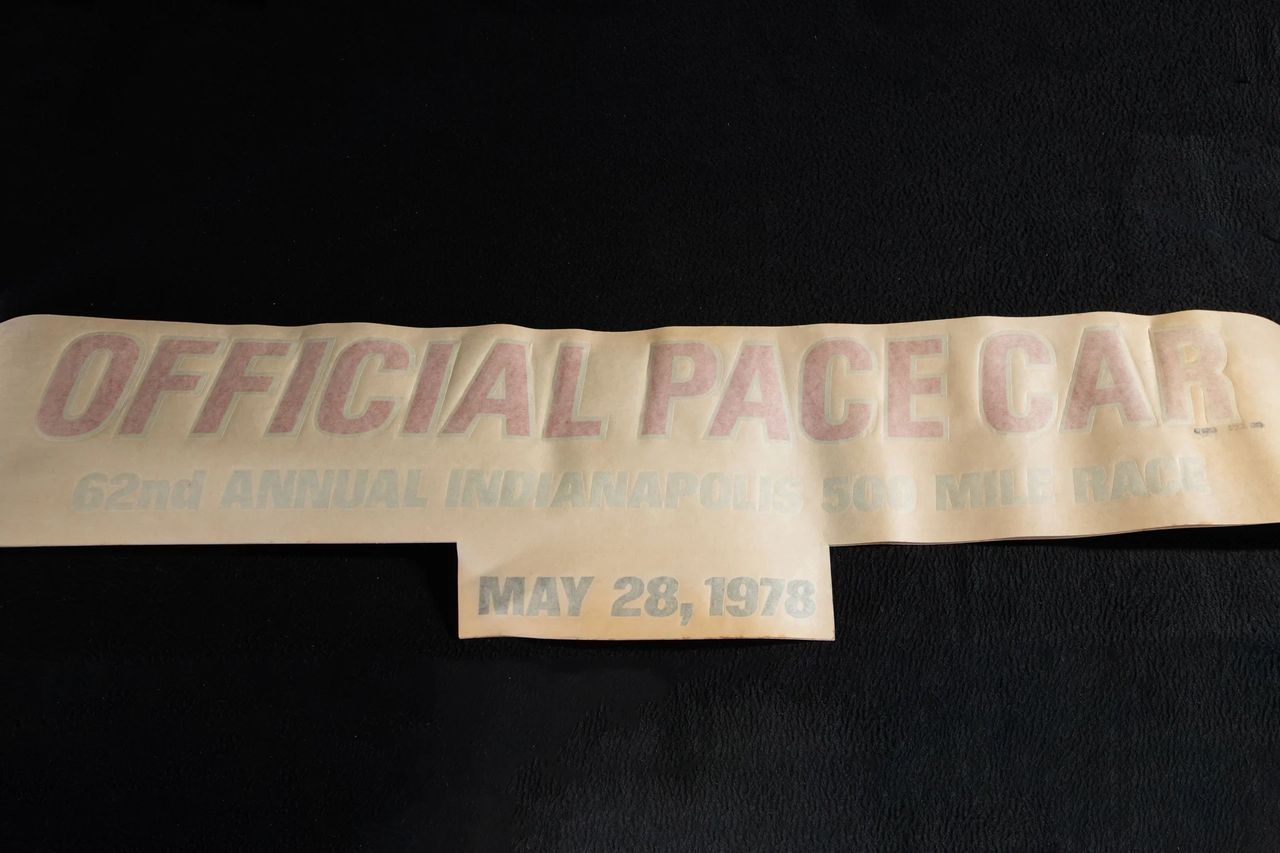
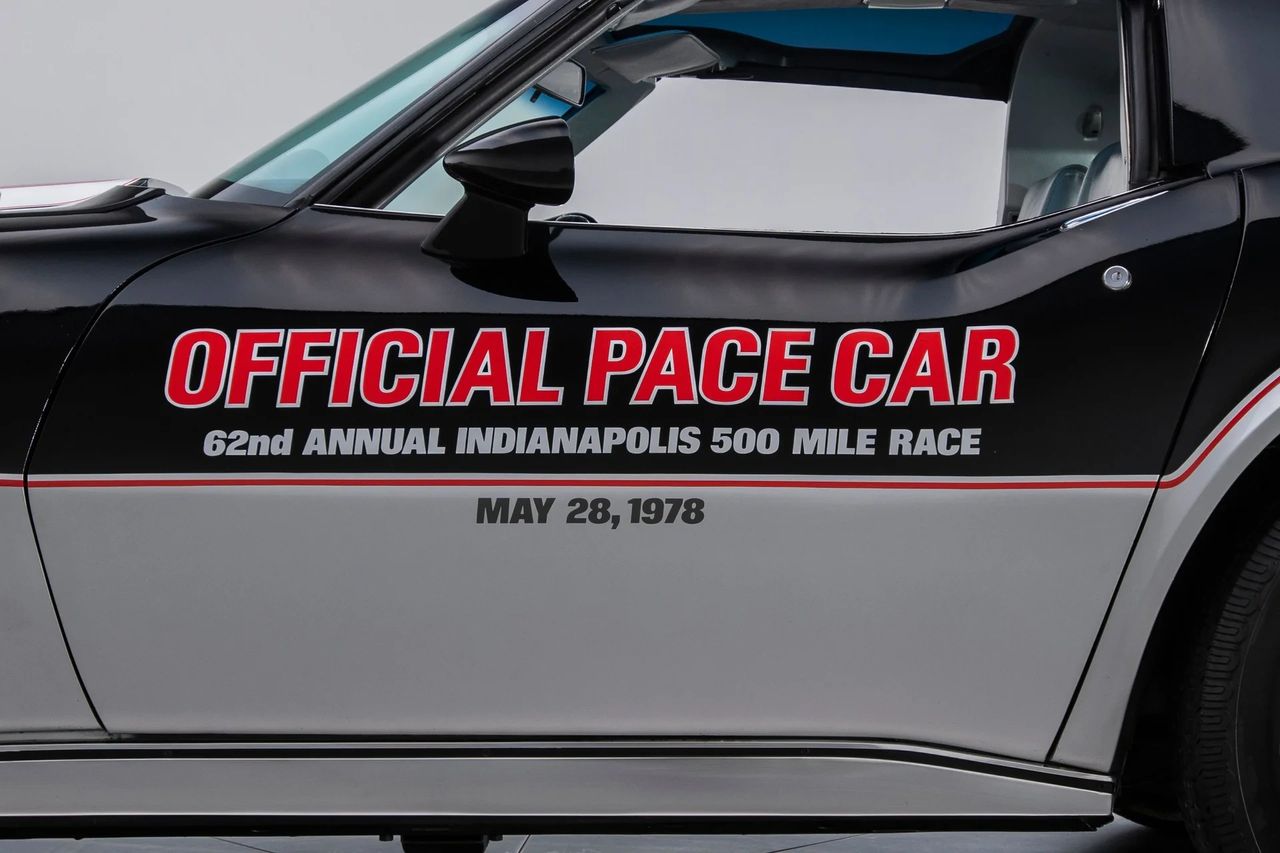
Confusion has persisted for decades because “factory-applied” and “as-delivered” did not necessarily mean the same thing when discussing the graphics on the 1978 Corvette Indy Pace Car. The car’s appearance was created through a split process: some elements of the visual treatment were installed during production in St. Louis, while the most conspicuous commemorative lettering was packaged with the car and applied later. As a result, two otherwise identical new Pace Cars could reach their first owners looking noticeably different.
The large door callouts reading “OFFICIAL PACE CAR • 62nd ANNUAL INDIANAPOLIS 500 MILE RACE • MAY 28, 1978” were not generally installed on the assembly line. Instead, the graphics were supplied in a boxed decal kit placed in the luggage area. The selling dealer or original owner could then decide whether the lettering should be applied. Some dealers installed the decals before placing the car on display or delivering it to the buyer, ensuring that it presented the full Indianapolis commemorative appearance from the moment it entered the showroom. Others left the kit untouched, allowing the purchaser to decide whether the doors should remain clean.
The finer elements of the exterior treatment were handled differently. The narrow red separation stripe—the knife-edge line dividing the black upper body from the silver lower section—and its related accent pieces were incorporated as part of the production process. These details established the Pace Car’s finished black, silver, and red composition before the optional installation of the larger door graphics. Even without the Indianapolis lettering, the car already possessed a complete and distinctive visual identity.
Because installation of the large decals was discretionary, survivor cars continue to appear in both configurations. Some time-capsule examples retain unused new-old-stock decal kits, occasionally still sealed in their original sleeves or preserved with their packaging. Other equally authentic cars received their lettering before delivery, sometimes applied with considerable care by a dealer body shop. Neither condition is inherently more original. A clean-sided Pace Car may represent exactly how it left St. Louis, while a lettered example may accurately preserve the appearance in which it was presented to its first owner.
This distinction also explains why period photographs can appear contradictory. Some brand-new Pace Cars are shown wearing the complete “Official Pace Car” door treatment, while others appear comparatively restrained, with uninterrupted black-and-silver doors. Both presentations can be historically correct. The difference frequently reflects where the car stood in the distribution and delivery process and whether the dealer or original purchaser elected to install the supplied graphics.

For collectors and judges, provenance therefore matters more than a blanket assumption that every authentic Pace Car should—or should not—wear the large door lettering. Original invoices, dealer records, delivery photographs, owner notes, and retained decal packaging can help establish how and when a particular car received its graphics. On a lettered car, the accuracy of the decal design and its period-correct placement are equally important. On an unlettered car, the survival of the original kit and packaging can provide unusually persuasive evidence that the clean-sided presentation is intentional rather than the result of later removal.
The phrase “original graphics” must consequently be used with care. A Pace Car without the door lettering is not necessarily incomplete, altered, or incorrectly restored, just as a car wearing dealer-installed decals is not automatically less authentic because those graphics were not applied inside the assembly plant. The proper question is not whether every car left St. Louis fully lettered, but how and when the specific car being examined acquired—or retained—its particular appearance.
The VIN that ends arguments
Chevrolet made the first stage of Pace Car authentication unusually straightforward by assigning the replicas their own production-number sequence. Standard 1978 Corvette coupes occupy the 400001–440274 serial-number range, while the Pace Car replicas were separated into a dedicated 900001–906502 block. That distinction is more than an accounting detail: it gives every genuine Pace Car a permanent identifier that cannot be duplicated merely by adding black-and-silver paint, spoilers, decals, or a silver interior to an ordinary 1978 coupe.
The complete VIN also identifies the car’s basic configuration. The opening “1Z” denotes a Chevrolet Corvette, “87” identifies the two-door coupe body style, and the fifth character records the engine originally installed. An “L” indicates the standard L48 350, while a “4” identifies the optional L82. The following “8” denotes the 1978 model year, and “S” identifies the St. Louis assembly plant. The final six digits are the decisive element for the Pace Car package: a genuine replica must fall between 900001 and 906502.
Accordingly, the VIN range is more accurately expressed as 1Z87[L or 4]8S900001 through 1Z87[L or 4]8S906502. A standard coupe will instead carry a final production sequence between 400001 and 440274. The difference is visible immediately once the number is decoded, making the VIN the logical starting point whenever a car is represented as an original Z78 Pace Car replica.
Chevrolet built 6,502 examples, a figure commonly described as approximately one Pace Car for each Chevrolet dealer operating at the time. That production strategy made the commemorative Corvette widely visible in dealer showrooms, but it also created enough cars—and enough public familiarity with their appearance—that replicas and later conversions inevitably followed. Over the years, ordinary 1978 coupes have been repainted, reupholstered, fitted with spoilers, and dressed with reproduction graphics to resemble the Indianapolis edition.
Some of those conversions are visually convincing. The black-over-silver finish can be recreated, the red separation stripe duplicated, and reproduction door lettering positioned closely enough to pass casual inspection. Even the distinctive silver interior and Pace Car-specific exterior pieces can be sourced or reproduced. None of those additions, however, changes a standard coupe’s original 400000-series production number into the dedicated 900000-series sequence assigned by Chevrolet.
For that reason, a claim that a car is an authentic Z78 must be corroborated by its VIN. A number ending within the standard 400001–440274 range identifies an ordinary 1978 coupe regardless of how accurately it has been converted. A number within the 900001–906502 range establishes that the car was produced within the genuine Pace Car sequence and provides the essential foundation for further examination of its engine, trim, equipment, and documentation.
The VIN should therefore be treated as the first decisive test rather than the entire authentication process. It confirms whether the car began life within Chevrolet’s Pace Car production block, while the remaining physical evidence establishes how much of that original configuration survives. For prospective buyers, restorers, and judges, that distinction is critical: appearance can be recreated, but the factory-assigned production sequence is where the identity of a true 1978 Corvette Indy Pace Car replica begins.
How many did Chevy mean to build?
As noted previously, Chevrolet ultimately built 6,502 examples of the 1978 Corvette Indy Pace Car replica. That number is often treated as a simple production statistic, but the story behind it reveals something more significant about Chevrolet’s intentions. The final total was not selected because it carried a particular historical meaning, nor because market research identified 6,502 as the ideal definition of exclusivity. It emerged from the collision between symbolism, dealer demand, customer enthusiasm, and the practical realities of Chevrolet’s enormous national retail network.
The earliest production discussions were reportedly far more modest. One figure frequently associated with the program is 300 cars—a deliberately symbolic number that would have echoed the 300 Corvettes assembled during the model’s inaugural 1953 production year. From a commemorative standpoint, the symmetry was almost irresistible. The 1978 Pace Car was helping celebrate the Corvette’s twenty-fifth anniversary, and a 300-car run would have connected that milestone directly to the small group of hand-built Polo White roadsters that began the story.
As a production strategy, however, 300 cars would have been nearly impossible to sustain once news of the Pace Car began circulating. The black-over-silver bodywork, red accent striping, front and rear spoilers, special interior, Indianapolis graphics, and connection to the 62nd running of the Indianapolis 500 gave the car immediate showroom appeal. This was not a subtle trim package that required explanation. It was a headline car, recognizable at a glance and capable of attracting attention before a salesperson had said a word.
A run of only 300 would therefore have placed the overwhelming majority of Chevrolet dealers—and virtually all interested customers—outside the allocation. The resulting competition would have been fierce, but it also would have created resentment throughout the dealer network. Chevrolet could hardly promote the Corvette’s first Indianapolis pace-car appearance as a national celebration while restricting the commemorative replica to a tiny handful of favored franchises.
A second proposed target of 2,500 cars attempted to balance exclusivity with broader availability. That number carried its own appealing logic: one hundred cars for each model year since the Corvette’s 1953 introduction. On paper, 2,500 examples sounded generous enough to create a meaningful national presence while preserving the aura of a tightly controlled special edition. In practice, it still fell well short of demand.
As regional representatives began hearing from dealers, the scale of the problem became apparent. Customer deposits, informal promises, dealer requests, and anticipated showroom demand were already accumulating. More importantly, Chevrolet operated through a network of more than 6,200 dealers. Even at 2,500 cars, fewer than half of those franchises could receive one. Every allocation would produce several disappointed stores, many of which wanted the Pace Car not merely because they had an immediate buyer, but because it promised to become one of the most effective showroom attractions of the year.
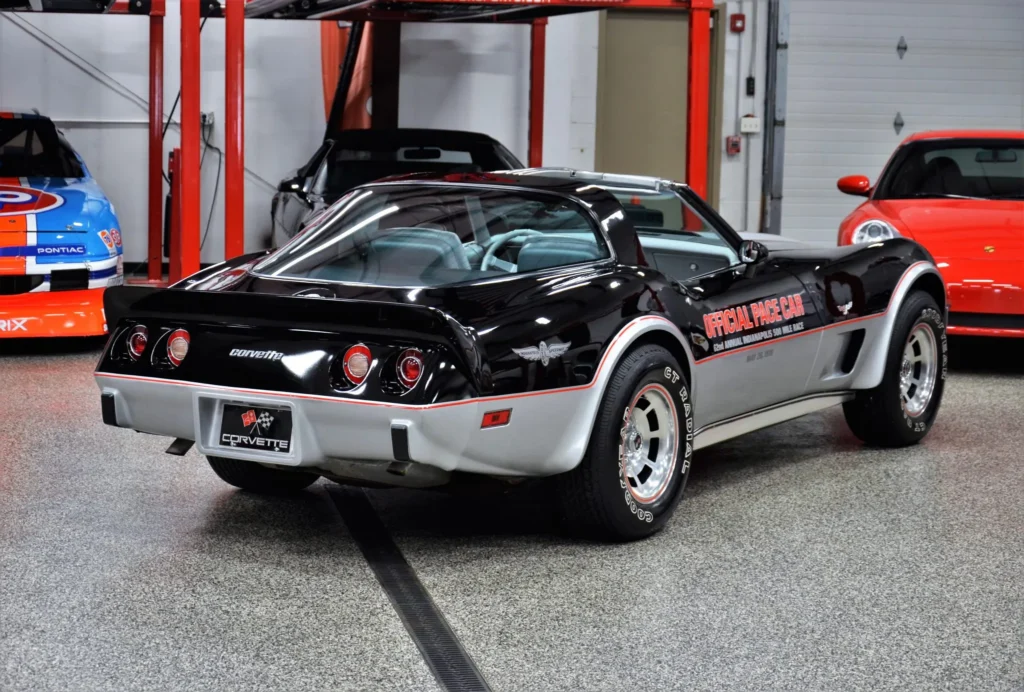
The final decision was therefore governed less by poetic symbolism than by arithmetic. If Chevrolet wanted the Pace Car celebration to reach the entire country, the company needed enough cars to place one in virtually every franchise. Production was expanded accordingly, and the final total settled at 6,502 examples—approximately one for each Chevrolet dealer and roughly 15 percent of all Corvettes produced for the 1978 model year.
That total altered the meaning of the term “limited edition.” The Pace Car was limited in the sense that it was a distinct, controlled, single-year commemorative package with a fixed production run. It was not limited in the boutique sense of being intentionally withheld from most of the market. Chevrolet’s objective was not to make the car nearly unobtainable. It was to create a special Corvette that could appear in showrooms across the United States at approximately the same moment.
In effect, the Pace Car was limited by distribution rather than engineered scarcity. One car per dealership was enough to preserve a sense of occasion within each local market, yet broad enough to make the program nationally visible. A customer might see only one at the neighborhood Chevrolet store, even though thousands existed across the country. That balance gave the car an unusual form of exclusivity: scarce within an individual showroom, but nearly ubiquitous across the dealer network as a whole.
The allocation strategy made each Pace Car a natural centerpiece. Dealers positioned them prominently, used them in advertising, and treated them as rolling symbols of Chevrolet’s connection to Indianapolis. Even buyers who had arrived to look at a Monte Carlo, Camaro, pickup, or ordinary Corvette were likely to notice the black-and-silver car surrounded by Indianapolis imagery. The Pace Car did not merely occupy inventory space; it generated showroom traffic and gave dealers a local connection to one of the most recognizable events in American motorsports.
Predictably, demand produced premiums. The promise of approximately one car per franchise did not guarantee that every interested buyer could obtain one at the suggested price. Some examples were sold quickly to established customers, some became the subject of competing offers, and others remained in dealer hands as display cars while interest continued to build. The combination of highly visible national promotion and tightly controlled local availability encouraged the perception that the Pace Car was destined to become an immediate collectible.
The expanded production run also had practical consequences inside Chevrolet. A program involving 6,502 cars was substantial enough to justify dedicated production tracking, including the separate VIN sequence discussed previously. That decision created one of the Pace Car’s most valuable long-term safeguards. Decades later, paint, spoilers, interiors, wheels, and decals can all be reproduced, but the factory-assigned 900000-series production number provides a direct means of establishing whether a particular Corvette originated within the authentic Pace Car run.
The allocation plan also helped shape the survivor population that exists today. Many buyers viewed the cars as collectibles from the outset. Rather than using them as ordinary transportation, owners stored them, displayed them, drove them sparingly, or preserved them with the expectation that their commemorative status would eventually produce significant appreciation. Some remained with their original owners for decades; others accumulated remarkably little mileage before entering established Corvette collections.
That behavior created an unusual contrast. Chevrolet did not build the Pace Car in ultra-low numbers, yet the marketplace contains a disproportionately large number of carefully preserved, low-mileage examples. The car’s survival rate is not evidence that it failed to attract buyers or that too many were built. It is evidence of how buyers perceived it from the beginning. The graphics, Indianapolis connection, anniversary timing, and dealer presentation convinced many purchasers that they were acquiring an artifact as much as an automobile.
The decision to build 6,502 cars therefore shaped nearly every chapter of the Pace Car’s later history. It gave the edition a nationwide showroom presence, fueled dealer premiums, encouraged immediate preservation, justified a dedicated VIN sequence, and ensured that authentic examples would remain identifiable long after replicas and clones began appearing.
Chevrolet did not create an impossibly rare boutique collectible. It engineered a controlled national moment. By giving virtually every dealer a Pace Car to display, the company allowed communities across the country to participate in Corvette’s Indianapolis milestone. The number 6,502 may have been born from dealer-network arithmetic, but it became central to the car’s identity—and the reason the celebration reached far beyond Indianapolis.
Speculation nation: front-page news and mothballed miles
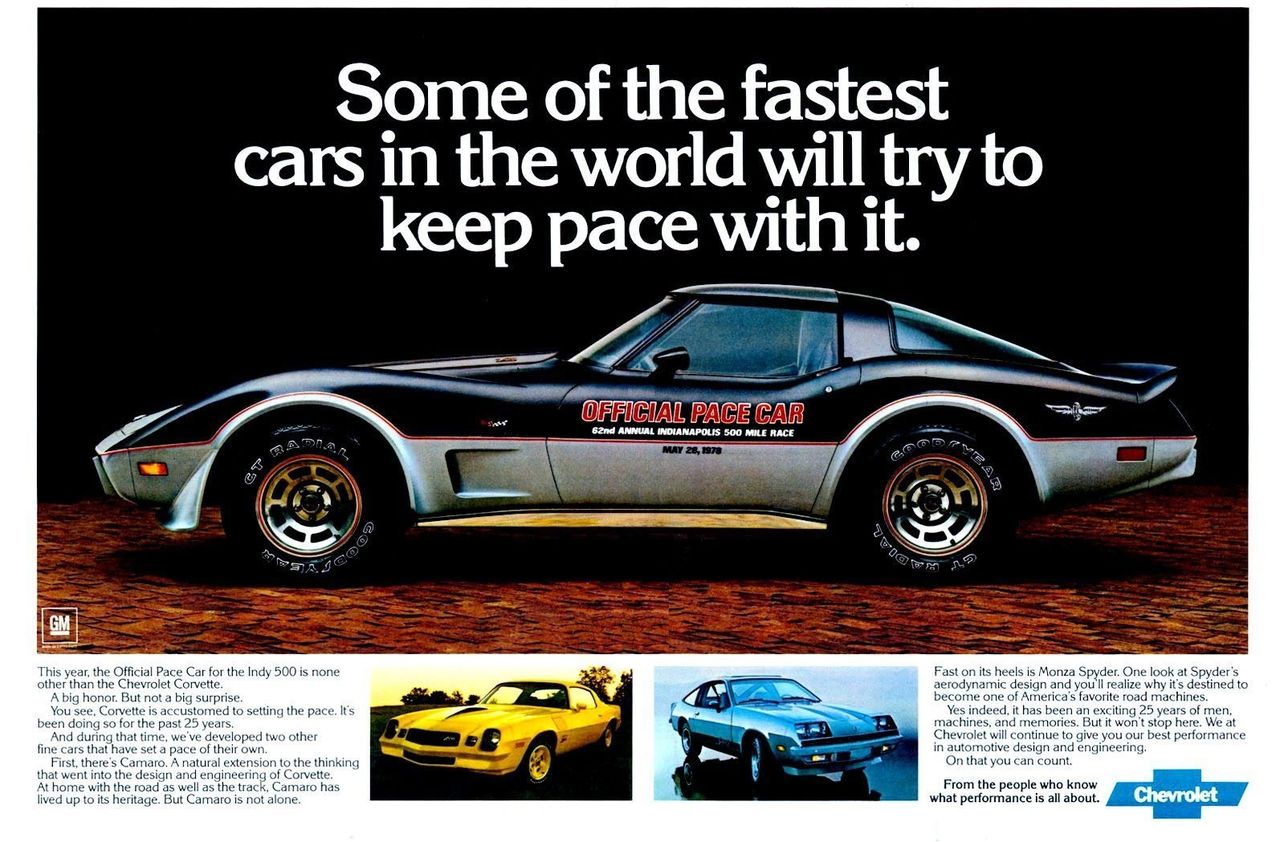
“The Limited Edition…stickered for a hefty $13,653.21—versus $9,351.89 for a base model… For the first time in Corvette’s history, these pace car replicas were given a separate VIN sequence…making it nearly impossible to clone one today.” — Hemmings Motor News
The speculative fever surrounding the 1978 Corvette Indy Pace Car had a clear inflection point: March 27, 1978. That was the day The Wall Street Journal placed the story on its front page, giving national visibility to the lawsuits, dealer markups, allocation disputes, and buyers treating the Corvette less like a weekend sports car than an appreciating financial asset. Demand had already been strong, but the article transformed scattered showroom enthusiasm into a fully formed national narrative.
The coverage seemed to validate every whispered promise that the Pace Car was destined to become an instant collectible. Dealer allocation lists became battlegrounds, deposits carried greater urgency, and buyers who might otherwise have hesitated suddenly feared being left behind. The frenzy became self-reinforcing: high prices generated headlines, the headlines encouraged higher expectations, and those expectations gave dealers additional justification for pushing prices still further.
The underlying numbers only intensified the effect. The Limited Edition carried a sticker price of $13,653.21, compared with $9,351.89 for a base Corvette coupe. Many dealers added another $5,000 or more, reasoning that the market had already begun assigning the car a future value beyond its factory price. In some cases, the premium climbed higher still as buyers, speculators, and would-be flippers competed for a car that each dealership might receive only once.
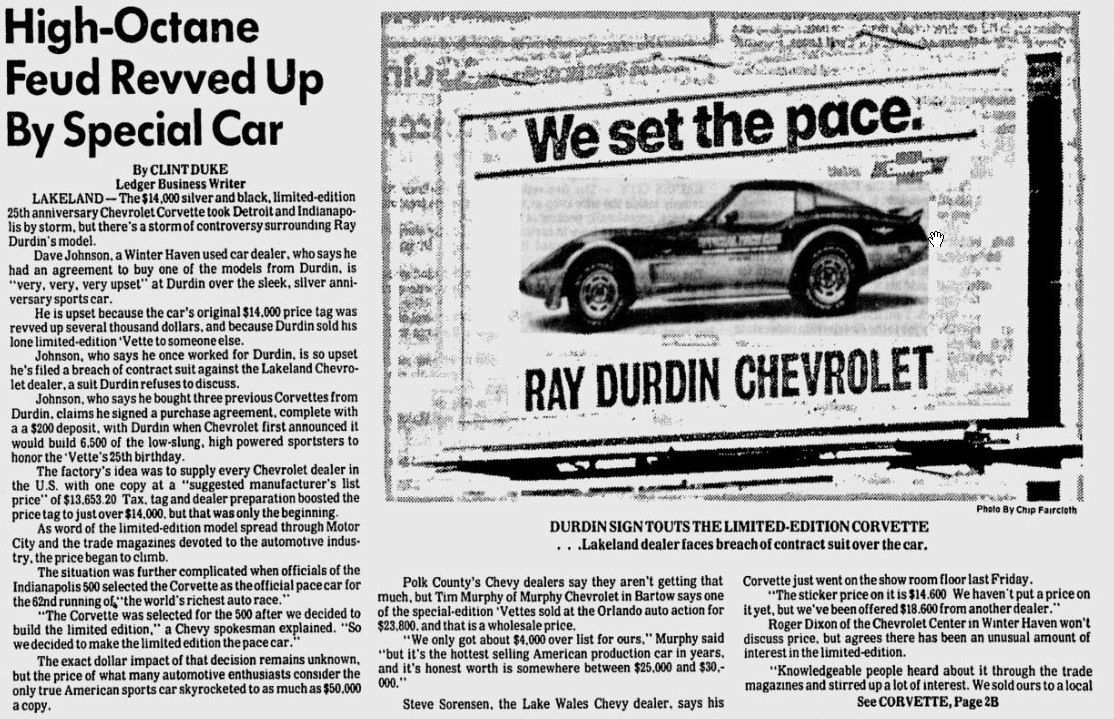
Contracts became contentious, verbal commitments were challenged, and some promised sales dissolved when a dealer realized that the same car might bring substantially more money elsewhere. Contemporary reports described disputes over breached agreements and cited roughly $14,000 cars bringing as much as $23,800 at wholesale, with retail expectations reaching $25,000 to $30,000. The combination of dealer feuds, auction prices, aggressive advertising, and quotable local personalities made the story irresistible to newspapers.
The resulting coverage is quintessentially late 1970s. Showroom theater and business reporting blurred together as photographs, advertisements, consumer complaints, and investment language shared the same pages. A promotional image declaring “We set the pace” could appear alongside a dispute over the very car being advertised, illustrating how quickly the Pace Car had become more than a commemorative Corvette. It was simultaneously a product, a status symbol, a speculative instrument, and a public spectacle.
That frenzy helps explain the remarkable survivor population that exists today. Many Pace Cars were purchased with little or no intention of being driven; owners parked them, preserved them, and retained the window stickers, sales documents, invoices, and unused decal kits as part of the expected investment. Those materials now carry historical value of their own, documenting the moment when celebration and speculation became inseparable. The separate Pace Car VIN sequence further strengthened that legacy by allowing genuine examples to prove their identity decades later, leaving today’s low-mileage survivors as tangible artifacts of the front-page spring of 1978.
How it drives (then and now)
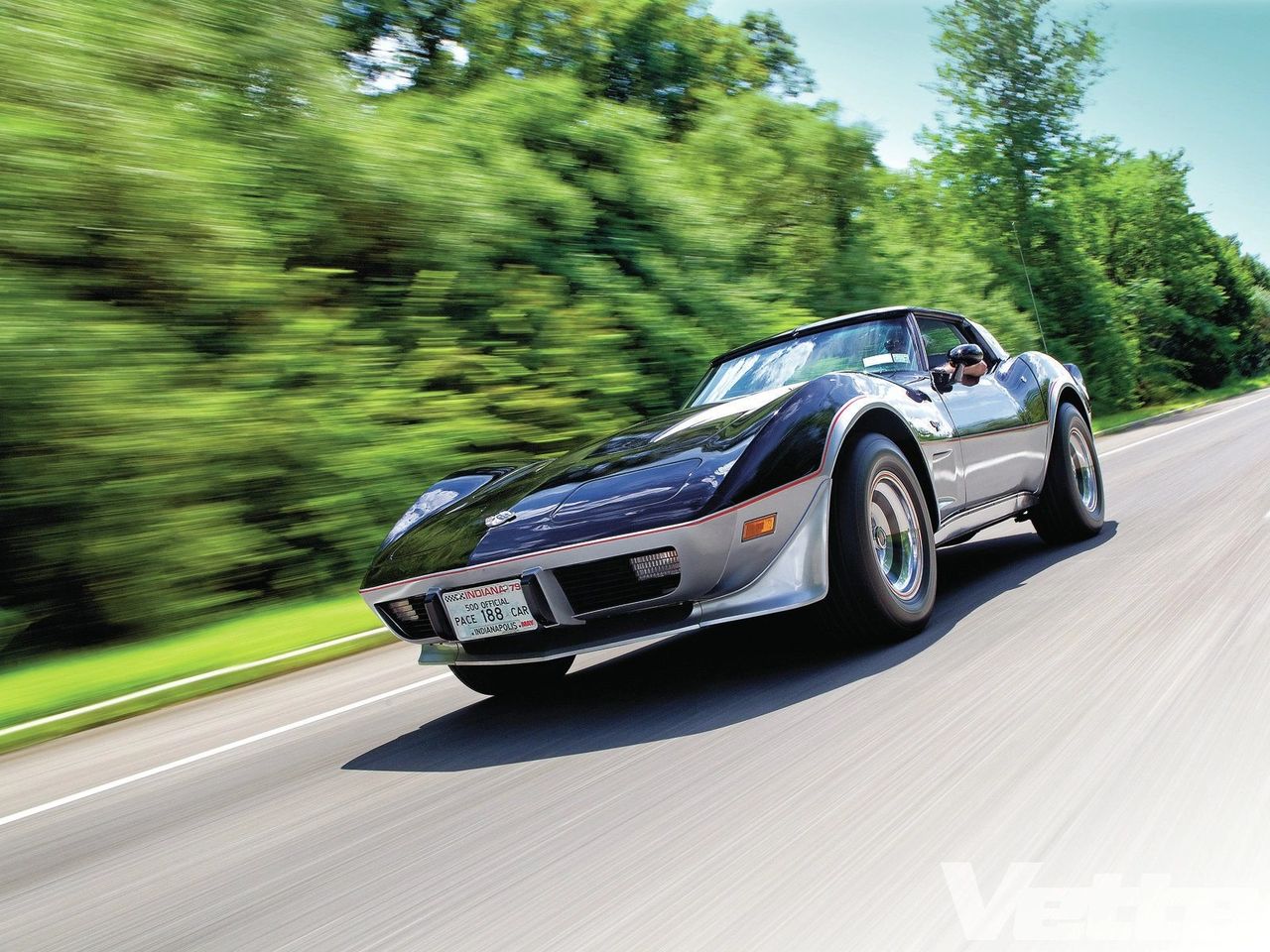
Forget the speculation, the unopened decal kits, and the low-mileage auction examples for a moment. Take a well-sorted 1978 Corvette onto a clean two-lane highway and the Pace Car begins to make sense as an automobile rather than simply a collectible. In an L82/four-speed car, the first quarter-throttle pull through the Rochester Quadrajet tells much of the story. The small-block responds cleanly, builds strength through the midrange, and delivers the straightforward, mechanical urgency that made the better late-C3s feel honest again.
A healthy tune and Chevrolet’s HEI ignition give the engine a crisp, nearly immediate response when the throttle opens. There is no need for theatrics; the L82 simply gathers itself and pulls, accompanied by the familiar small-block exhaust note settling into a steady Corvette thrum. It is present enough to give the car character without becoming tiresome at cruising speed, allowing the Pace Car to feel quick and purposeful without constantly announcing itself.
The close-ratio four-speed sharpens that personality. The shift gates are clearly defined, the throws are compact enough to keep the driver engaged, and the ratios help prevent the engine from falling out of its strongest operating range. Driven with intent, the transmission keeps the L82 working where its midrange torque and upper-rpm breathing are most useful. Second gear provides enough reserve to pull confidently out of a corner, while third continues the acceleration without feeling like the engine has already given everything it has.
Contemporary performance figures support the sensation: approximately 6.5 to 6.6 seconds to 60 mph, quarter-mile times in the mid-15-second range, and a top speed near 127 mph under favorable conditions. Those numbers are respectable, but they do not fully describe the experience. The more meaningful impression is the car’s accessibility—torque available without elaborate preparation, useful power across ordinary road speeds, and a drivetrain that rewards participation without demanding racetrack commitment.
Chassis-wise, a properly sorted 1978 Corvette rewards smooth, deliberate inputs. With fresh suspension bushings, healthy dampers, and correctly set tire pressures, the front end takes a confident bite without the nervousness or wandering that often defines neglected examples. The steering remains recirculating-ball in construction, but once the tires load and the car settles into a corner, its response becomes calm and linear. It does not dart into bends like a modern sports car; instead, it asks the driver to establish a line, trust the chassis, and carry the car through with measured hands.
The independent rear suspension contributes significantly to that composure. Over patched pavement and the uneven surfaces common to a two-lane highway, the rear remains planted rather than skipping sideways at every disturbance. The car feels substantial without becoming clumsy, and its limits arrive progressively enough for the driver to understand what the chassis is doing. Tired components can blur that communication, but in a healthy example the Corvette feels stable, predictable, and far more capable than its boulevard-cruiser reputation sometimes suggests.
The power-assisted four-wheel disc brakes reinforce that confidence. Pedal travel is relatively short, and braking effort builds in a predictable manner as pressure increases. More important than any isolated stopping-distance figure is the system’s repeatability: the Pace Car can shed speed for successive corners without introducing unnecessary drama or forcing the driver to second-guess the pedal. On a winding road, that consistency does more to establish trust than a single impressive number on a specification sheet.
What made the package work in 1978—and what continues to make it usable now—is how naturally it settles into the role of a long-distance sports car. With the glass roof panels installed, the cabin remains bright and open; remove them, and the experience becomes genuinely open-air without the structural shake associated with a full convertible. Behind the seats, the new fastback cargo area accommodates weekend bags, jackets, and camera equipment with an ease earlier Corvettes could not match. The Pace Car is not a big-block hammer, nor does it need to be. Its appeal lies in the combination of manageable performance, communicative road manners, and enough practicality to turn a Saturday-night attraction into a credible long-weekend grand tourer.
Provenance & VIN Check: Authenticating a 1978 Corvette Indy Pace Car Replica
Authenticating a 1978 Corvette Indy Pace Car should begin with the VIN, but it should not end there. Paint, spoilers, wheels, upholstery, glass roof panels, and reproduction graphics can all be added to an ordinary 1978 Corvette. Conversely, a genuine Pace Car may have lost some of its original components through age, damage, restoration, or owner preference. The soundest approach is therefore cumulative: establish the car’s identity through its VIN, corroborate that identity through the body and trim tag, inspect the Pace Car-specific equipment, and then use documentation to reconstruct how the individual car was originally built and delivered.
Start With the Dedicated VIN Sequence
Chevrolet gave the 6,502 Pace Car replicas their own production-number block, making the VIN the fastest and most decisive first test. Standard 1978 Corvette coupes use production numbers from 400001 through 440274. Pace Car replicas occupy the separate 900001 through 906502 sequence.
The complete VIN will contain either an L or a 4 in the fifth position, depending upon the original engine:
- 1Z87L8S900001–1Z87L8S906502: Pace Car equipped with the L48 engine
- 1Z8748S900001–1Z8748S906502: Pace Car equipped with the optional L82 engine
- 1Z87[L or 4]8S400001–440274: Standard 1978 Corvette coupe production sequence
Each portion of the VIN has a specific meaning:
- 1: Chevrolet division
- Z: Corvette model series
- 87: Two-door Corvette sport coupe
- L or 4: L48 or L82 engine
- 8: 1978 model year
- S: St. Louis assembly plant
- Final six digits: Individual production sequence
The important point is that Z78 does not appear literally within the VIN. Z78 was the Regular Production Option designation for the Limited Edition Pace Car package. The VIN verifies the package indirectly through the dedicated 900000-series production sequence. If a car is advertised as an authentic Z78 Pace Car but its final six digits begin with 400, it began life as a standard 1978 coupe regardless of how convincing its paint, spoilers, wheels, interior, or decals may be.
The VIN tag should also agree with the title, registration, sales documents, and any surviving factory paperwork. Evidence of disturbed fasteners, a damaged tag, inconsistent characters, or identification numbers that do not agree should be treated as a reason to stop and investigate further. A legitimate 900000-series VIN establishes that the Corvette was produced within the Pace Car run; uncertainty surrounding the tag itself undermines that foundation.
What the VIN Proves—and What It Does Not
A correct VIN proves that the car entered production as a Pace Car replica. It does not automatically establish that every component currently attached to the car is original.
A genuine Pace Car can have a replacement engine, changed transmission, repainted body, substituted interior, reproduction wheels, or newly applied graphics. It remains a genuine Pace Car by identity, but descriptions such as “numbers matching,” “unrestored,” “original paint,” and “all factory equipment” require separate evidence.
The fifth VIN character establishes whether the car was originally built with the L48 or L82 engine. An L48 car should carry an L, while an L82 car should carry a 4. Hood emblems, dual-snorkel air cleaners, valve covers, intake components, and other visible engine parts can be changed, so they should never override the VIN. When numbers-matching status is claimed, the engine-pad stamping, assembly suffix, casting dates, transmission identification, and other drivetrain markings should be checked against the car’s VIN and documented production chronology.
Neither engine choice disqualifies a car. Genuine replicas were built with both the standard L48 and optional L82, and buyers could select an automatic or four-speed manual transmission. The FE7 Gymkhana suspension was also optional on the production replicas rather than an automatic component of every Z78 car. A Pace Car should not be rejected simply because it has an L48, an automatic transmission, or the standard suspension.
Corroborate the VIN With the Trim Tag
The body and trim tag provides the next important layer of verification. On a correct Pace Car, the exterior paint coding should reflect the model’s black-over-silver combination:
- 19U: Black upper body
- 47M: Silver Metallic lower body
The special silver-themed interior was available in two configurations:
- 15C: Silver cloth-and-leather seating
- 152: Silver leather seating
These codes help separate an authentic Pace Car body from a standard coupe that has been refinished and retrimmed to resemble one. A 900000-series VIN accompanied by the correct Pace Car paint and interior codes creates a much stronger identification case than appearance alone.
The trim tag should also appear consistent with the car’s age, body condition, and production date. Its build-date information should make chronological sense when compared with the VIN sequence, engine assembly date, component date codes, and surviving paperwork. A correct-looking trim tag should still be considered part of a larger body of evidence rather than absolute proof by itself, particularly on a car that has received a comprehensive restoration.
Inspect the Exterior as a Complete Package
A genuine Pace Car left Chevrolet with far more than a pair of Indianapolis decals. Its exterior treatment was an integrated package built around the black-over-silver paint scheme and the narrow red separation stripe running between the two colors.
Expected exterior features include:
- Black upper body over a Silver Metallic lower body
- Fine red separation striping
- Three-piece front air deflector
- One-piece rear spoiler
- Pace Car-specific rocker-panel extensions
- Cast-aluminum wheels with red accent rings
- Raised-white-letter performance tires in the original presentation
- Mirror-tinted removable glass roof panels
- Dual sport mirrors
- Indianapolis door graphics, when installed
No single bolt-on component proves authenticity. Spoilers, wheels, roof panels, mirrors, and rocker extensions can be transferred to another Corvette or replaced with reproductions. What matters is whether the complete package agrees with the VIN, trim tag, documentation, and known history of the car.
The front and rear 25th Anniversary emblems should not be mistaken for Pace Car-only identifiers. Chevrolet fitted the anniversary crossed-flags emblems to all 1978 Corvettes. Their presence is appropriate, but it does not distinguish a Z78 from a standard coupe or Silver Anniversary model.
Original paint, when it survives, can provide useful supporting evidence. Inspect concealed edges, door jambs, panel returns, spoiler mounting areas, weatherstrip channels, and other protected locations for consistent layers of black, silver, primer, and striping. A repainted car is not automatically less legitimate, but the nature and quality of the repaint should be disclosed rather than presented as untouched factory finish.
Confirm the Pace Car Interior
The silver interior is one of the strongest visual identifiers, but it should agree with the trim code rather than merely resemble the correct color. Depending upon the original configuration, the car should have either silver leather upholstery or the silver cloth-and-leather combination, accompanied by the corresponding gray and silver cabin treatment.
The Pace Car also debuted Chevrolet’s new thin-shell sport seats before the design became standard across the Corvette line for 1979. These seats are more than a color difference. Their shell, contouring, upholstery construction, and improved lumbar support distinguish them from the conventional seats installed in standard 1978 Corvettes. Their presence supports the car’s identity, although later installation into another Corvette is possible.
The expected equipment loadout is deliberately comprehensive and reflects the Pace Car’s position as a premium, fully equipped commemorative model. Items to inspect include:
- Air conditioning
- Power windows
- Power door locks
- Rear-window defogger
- Tilt-and-telescopic steering column
- Heavy-duty battery specification
- Mirror-tinted glass roof panels
- AM/FM stereo paired with an 8-track player or CB-radio configuration
Many of these components were available elsewhere in the 1978 Corvette range, so none should be treated as independent proof. Their value lies in the way they support the full Z78 configuration. Missing equipment may indicate later replacement, removal, or an incomplete restoration; additional investigation is warranted before concluding that the car itself is not genuine.
Particular attention should be paid to the seat structure, upholstery pattern, carpet color, door panels, console, steering column, radio installation, roof-panel hardware, and rear-compartment trim. A superficially silver interior assembled from mismatched later components may photograph well while differing significantly from the original Pace Car presentation.
Understand the Door-Decal Question
The large door graphics reading “OFFICIAL PACE CAR • 62nd ANNUAL INDIANAPOLIS 500 MILE RACE • MAY 28, 1978” were not generally applied during assembly in St. Louis. Chevrolet supplied the graphics loose with the car so the dealer or original purchaser could decide whether to install them.
That means an authentic Pace Car may correctly appear in either of two forms:
- Lettered: The decals were applied by the selling dealer or an early owner.
- Clean-sided: The decal kit was never installed and may have remained boxed with the car.
Neither presentation is inherently more authentic. A clean-sided car is not necessarily missing part of its factory appearance, and a car with neatly applied dealer-installed lettering is not automatically less original. The key question is how the particular car was delivered and when its graphics were installed.
Unused original decal kits, sleeves, boxes, installation instructions, and dealer correspondence are desirable pieces of provenance, particularly when they have remained with the same car. Their presence strengthens the historical record, but a loose NOS kit does not authenticate a Corvette by itself; kits can be bought, sold, and transferred independently of the cars with which they were originally shipped.
On a lettered car, inspect the design, scale, typography, colors, placement, spacing, and aging of the graphics. Reproduction sets vary considerably in accuracy. Period delivery photographs, dealership advertisements, dated snapshots, or owner records can establish whether the existing decals are original dealer-applied pieces, early replacements, or part of a later restoration.
Documentation Is the Difference Between a Claim and a History
The strongest Pace Cars are supported by documentation that connects the physical automobile to its original sale and subsequent ownership. Useful records include:
- Original window sticker
- Factory build sheet
- Dealer invoice or retail purchase agreement
- Warranty and owner-information materials
- Original title or registration history
- Dealer allocation correspondence
- Delivery photographs
- Service and maintenance records
- Prior-owner statements
- Decal-kit packaging and instructions
- Restoration invoices and photographs
- Judging sheets or recognized certification records
The documents should agree with one another. The VIN, engine choice, transmission, trim, paint, equipment, dealer identity, selling date, and purchaser information should form a coherent timeline. A window sticker carrying the correct VIN is valuable; a window sticker, dealer invoice, build sheet, and period photograph that all tell the same story are substantially more persuasive.
Reproduction paperwork is available for many collector cars, so documents should be examined for provenance as carefully as the automobile itself. Paper type, printing, dates, dealer information, ownership continuity, and the circumstances under which the material surfaced all matter. Documentation is most powerful when it has remained with the car through successive owners rather than appearing separately shortly before a sale.
Authentication and Originality Are Different Judgments
A 900000-series VIN answers the first question: Was this Corvette built as a Pace Car replica?
The remaining evidence answers several different questions:
- Does it retain its original engine and transmission?
- Does it retain its original paint and interior?
- Are its spoilers, wheels, glass panels, and trim original or correctly restored?
- Were the door decals installed when new, added later, replaced, or never applied?
- Is its current appearance supported by period documentation?
- How much of the car’s original factory and dealer-delivered configuration survives?
A genuine Pace Car with replacement components remains a genuine Pace Car, although its level of originality and value may be affected. An ordinary 400000-series coupe fitted with every visible Z78 component remains a tribute or clone, no matter how accurate or attractive the conversion may be.
Clip-and-Save Authentication Sequence
When inspecting a prospective purchase, work through the evidence in this order:
- Read the VIN. The final six digits must fall between 900001 and 906502.
- Decode the engine character. L identifies the L48; 4 identifies the L82.
- Compare the VIN with the title and paperwork. Every record should agree.
- Inspect the VIN tag for disturbance or alteration. Investigate anything inconsistent.
- Read the trim tag. Look for 19U/47M paint and either 15C or 152 interior trim.
- Confirm the complete exterior package. Paint division, red stripe, spoilers, extensions, wheels, roof panels, mirrors, and tires should be correct.
- Confirm the silver interior and thin-shell sport seats. Check materials and construction, not color alone.
- Inventory the expected comfort equipment. Missing or substituted items should be explained.
- Treat the door decals separately. Applied and unapplied cars can both be correct.
- Verify drivetrain claims. A correct Pace Car VIN does not automatically mean a numbers-matching engine or transmission.
- Build the provenance file. Window sticker, build sheet, invoice, photographs, ownership history, decal kit, and restoration records should tell one consistent story.
- Separate identity from condition. First determine what the car is; then determine how much of its original configuration remains.
The dedicated VIN sequence makes the 1978 Pace Car easier to identify than many appearance-based special editions, but serious authentication still requires more than reading six digits through the windshield. The best examples are not simply cars with the correct number or the right collection of parts. They are automobiles whose VIN, trim tag, equipment, drivetrain, decals, paperwork, and ownership history converge on the same conclusion.
Auction Comps & Values: What the Market Says Now (circa fall/winter 2025)

The ’78 Pace Car market is segmented by configuration (Base, Silver Anniversary, Pace Car), engine (L48 vs. L82), and condition (#4 Fair through #1 Concours). Inside the Pace Car pool, L82/four-speed cars generally sit above L48/automatics, and condition tiers widen the gap quickly as originality and paperwork improve.
What actually moves money is a tight mix of miles, documentation, and originality. Delivery-mile and sub-1,000-mile examples still command strong premiums, but the sweet spot for usability and value is often 5–20k miles with crisp paint edges, clean underhoods, and no stories. Documentation—window sticker, build sheet, MSO, dealer invoice, original purchase order, delivery photos, and ideally an unused decal kit—adds tangible value because this model’s identity is so tied to provenance. Originality is scrutinized: correct paint and stripe execution, factory cast-aluminum wheels with the proper finish, unmodified interiors, and untouched engine bays are rewarded; over-restored cars with “better-than-new” finishes or incorrect details are quietly discounted.
Venue matters. In-person auctions tend to reward stance and paint presentation—the quick walk-around “read” of an honest survivor still sways paddles. Online, the comment thread becomes the inspection lane; sellers who lead with cold-start and driving videos, stamping and trim close-ups, underside photography, and a straight explanation of decal history and recommissioning outperform those who don’t. The same car can feel like a charisma buy in a ballroom and a documentation buy on a laptop.

Mechanical readiness is another separating line, especially for ultra-low-mile examples. The best results come when safety maintenance is up to date—tires, hoses, belts, and fluids addressed—and the original take-off parts are saved and tagged. Buyers want “preserved and ready,” not “parked and stale,” and they’re paying accordingly.
For sellers, the positioning playbook is simple and effective: lead with the VIN block (900xxx sequence), engine/trans, mileage, and whether the door decals were dealer-installed, owner-installed, or never installed (with boxed kit). Photograph the fastback glass edges, stripe breaks, spoiler fit, wheel finish, and seat upholstery to establish originality, and list the documents up front. Note recent service clearly; it reduces friction and protects price.
For buyers, the smart sequence is to verify the VIN range and engine/trans stampings, confirm graphics history (including presence and age of the decal kit), and read the car’s surfaces—stripe sharpness, wheel finish, and urethane bumper aging will often reveal respray or over-restoration. A proper drive or comprehensive running video should show straight tracking, clean shifts, stable temperatures, and a quiet chassis at interstate pace.
The recent comp set explains the spread: $28,600 at Mecum (2022) for a solid driver, $42,660 at GAA (2024) for a very tidy example, and a $36,666 Bring a Trailer high bid in September 2025 that stalled short—each result mapping cleanly to miles, paperwork depth, and originality. The bottom line remains consistent: a typical #3 (Good) Pace Car trades around $19–21k; strong #2 cars move well above that; true #1 examples reach materially higher. The most reliable premiums accrue to L82/four-speeds with low miles, complete documentation, correct presentation, and recent, careful servicing.
1978 Corvette Indy 500 Pace Car Replica—RPO Z78: Detailed Specifications
The specifications below apply to the production Pace Car replicas sold through Chevrolet dealers. They should not be confused with the specially prepared cars used for official duties at Indianapolis, which could incorporate equipment or preparation beyond the regular-production Z78 package.
Model and Factory Identification
Official designation: Limited Edition Corvette Coupe, Indianapolis 500 Pace Car Replica
Regular Production Option: Z78
Chevrolet model designation: 1YZ87/Z78
Body style: Two-door, two-passenger Corvette sport coupe
Assembly plant: Chevrolet’s St. Louis, Missouri, assembly plant
Model year: 1978
Drive layout: Front-engine, rear-wheel drive
Total Z78 production: 6,502 units
Chevrolet placed the Pace Car replicas in a separate production-number sequence from ordinary 1978 Corvette coupes. The fifth character of the VIN identifies the engine originally installed, so the complete Pace Car range must account for both available V8s:
- 1Z87L8S900001–1Z87L8S906502: L48-equipped Pace Car replicas
- 1Z8748S900001–1Z8748S906502: L82-equipped Pace Car replicas
- 1Z87[L or 4]8S400001–440274: Standard 1978 Corvette coupe sequence
The VIN decodes as follows:
- 1: Chevrolet division
- Z: Corvette model series
- 87: Two-door sport coupe
- L or 4: L48 or L82 350-cubic-inch V8
- 8: 1978 model year
- S: St. Louis assembly plant
- Final six digits: Individual production sequence
The RPO designation Z78 does not appear literally in the VIN. Authentication depends upon the dedicated 900001–906502 serial-number block, supported by the trim tag, equipment, and documentation.
Chevrolet produced 40,274 standard-sequence 1978 coupes and 6,502 Pace Car replicas, for total model-year production of 46,776 Corvettes. The Z78 therefore represented approximately 13.9 percent of 1978 production—roughly one Corvette in seven.
Body, Frame, and Packaging
The 1978 Corvette retained its molded body construction over a separate, all-welded, full-length ladder frame. Chevrolet specified five frame crossmembers, maintaining the traditional C3 arrangement rather than adopting a unitized body structure.
The most visible body development for 1978 was the large wrap-around rear backlight. Although its shape gave the Corvette the appearance of a hatchback, the glass remained fixed. Access to the rear storage area continued through the passenger compartment.
The redesigned tail nevertheless provided a substantial improvement in utility. Chevrolet listed approximately 8.4 cubic feet of usable luggage space, giving the Corvette a more practical area for soft luggage, jackets, tools, and roof-panel storage.
Body and dimensional specifications:
- Wheelbase: 98.0 inches
- Overall length: 185.2 inches
- Overall width: 69.0 inches
- Overall height: 48.0 inches
- Front track: 58.7 inches
- Rear track: 59.5 inches
- Front overhang: 42.4 inches
- Rear overhang: 44.8 inches
- Minimum running ground clearance: Approximately 4.3 inches
- Seating capacity: Two
- Usable luggage capacity: Approximately 8.4 cubic feet
- Nominal curb weight: Approximately 3,500 pounds, varying with powertrain and equipment
The Z78 package included CC1 removable glass roof panels. These mirror-tinted T-tops provided the visual openness of a glass roof while retaining the Corvette’s center roof structure and coupe body configuration.
Exterior Paint and Pace Car Appearance
The Pace Car replica used a dedicated black-over-silver color scheme:
- Upper body: Black, code 19
- Lower body: Silver Metallic, code 47
- Separation treatment: Fine red accent stripe
The narrow red stripe divided the black upper body from the silver lower section and visually connected the body graphics with the red accents applied to the wheels.
The Z78 exterior package included:
- Special black-and-silver two-tone paint
- Red accent striping
- Limited Edition and Indianapolis graphics
- Three-piece front air deflector
- One-piece rear spoiler
- Pace Car rocker and lower-body treatment
- Cast-aluminum wheels with accent striping
- P255/60R15 white-letter radial tires
- Mirror-tinted removable glass roof panels
- Left remote-control and right manual sport mirrors
The front air deflector and rear spoiler were molded polyurethane components integrated into the overall Pace Car presentation. They were visual and aerodynamic identifiers rather than merely decals applied to an otherwise standard coupe.
The large door graphics announced:
OFFICIAL PACE CAR
62nd ANNUAL INDIANAPOLIS 500 MILE RACE
MAY 28, 1978
Those door callouts were supplied with the car for dealer or owner installation. The finer body striping and supporting accent pieces were incorporated into the production presentation, allowing the car to appear complete even when the large door lettering remained unapplied.
Wheels and Tires
The Z78 used Chevrolet’s YJ8 cast-aluminum wheels, finished with the red accent treatment that distinguished them from the standard aluminum-wheel presentation.
Wheel specifications:
- Construction: Cast aluminum
- Diameter and width: 15 × 8 inches
- Offset: N-0.50 inch
- Bolt circle: 4.75 inches
- Wheel attachment: Five 7/16-20 lug nuts
Original tire specification:
- Size: P255/60R15
- Sidewall treatment: Raised white lettering
- Construction: Steel-belted radial with aramid-fabric reinforcement
The factory engineering material describes the specification rather than guaranteeing one tire brand across every production circumstance. Brand-specific originality claims should therefore be supported by the individual car’s window sticker, build documentation, delivery photographs, surviving tires, or other period evidence.
The temporary spare was significantly narrower than the road tires:
- Spare size: P195/80D15
- Construction: Bias-ply
Interior Trim and Seating
The Z78 cabin followed a coordinated silver theme rather than simply fitting conventional 1978 seats in a different color. Chevrolet’s order material specified silver metallic trim for the seats, doors, headliner, and instrument-panel pad, with silver-gray carpeting.
Two seat treatments were available:
- AVY2: Silver leather bucket seats
- HVY2: Silver cloth-and-leather bucket seats
The Pace Car introduced the new contoured thin-shell bucket-seat design before its broader use in the 1979 Corvette. The revised construction reduced visual bulk and incorporated improved lumbar support, making the seat itself a substantive part of the package rather than a simple upholstery variation.
Standard Z78 Comfort and Convenience Equipment
The Limited Edition was intentionally configured as a heavily equipped Corvette. Chevrolet’s order guide identified the following items as part of the Z78 content:
- Four-season air conditioning
- Power windows
- Power door locks
- Rear-window defogger
- Tilt-and-telescopic steering column
- Heavy-duty battery
- Sport mirrors
- Convenience Group
- Power antenna
- Dual rear speakers
- Removable glass roof panels
- AM/FM stereo entertainment system
The included steering column provided both angular and reach adjustment. That mattered in the C3’s low cockpit, where the relationship among the seat, pedals, console, and steering wheel could otherwise be restrictive for drivers of different heights.
Radio and Entertainment Equipment
The normal Z78 entertainment installation was the UM2 stereo tape system with AM/FM stereo radio, accompanied by a power antenna and dual rear speakers. In period terminology, the tape component was an 8-track player.
The principal alternative was UP6, Chevrolet’s AM/FM stereo Citizens Band radio with power antenna. The CB arrangement replaced the standard tape-system configuration rather than adding a second full radio system alongside it.
The two basic presentations were therefore:
- UM2: AM/FM stereo with 8-track tape player
- UP6: AM/FM stereo with integrated CB radio and power antenna
The CB installation included the controls and microphone necessary for two-way communication, making it one of the most unmistakably late-1970s elements available in the Pace Car cockpit.
Instrumentation and Electrical Equipment
Both engines used Chevrolet’s High Energy Ignition system, with the ignition coil incorporated into the distributor cap. HEI reduced routine ignition maintenance and provided more consistent spark energy than earlier breaker-point systems.
The driver faced conventional Corvette instrumentation rather than warning lights alone. The instrument package included:
- Speedometer with trip odometer
- Tachometer
- Fuel gauge
- Electric oil-pressure gauge
- Electric coolant-temperature gauge
- Voltmeter
- Brake-system warning lamp
- Parking-brake warning lamp
- Restraint-system warning lamp
The Z78’s heavy-duty battery complemented its substantial electrical load, which could include air conditioning, power windows, power locks, rear defogger, power antenna, stereo equipment, and the available CB radio.
Engine and Transmission Architecture
Both available engines belonged to Chevrolet’s 350-cubic-inch small-block V8 family and shared the same fundamental dimensions:
- Displacement: 350 cubic inches / 5.7 liters
- Bore: 4.00 inches
- Stroke: 3.48 inches
- Cylinder arrangement: 90-degree overhead-valve V8
- Cylinder block: Cast iron
- Cylinder heads: Cast iron
- Induction: Rochester four-barrel carburetor
- Fuel: Unleaded gasoline
- Ignition: High Energy Ignition
- Lubrication: Full-flow pressure system
- Exhaust: Dual-branch system feeding a single catalytic converter, with crossover and two rear mufflers
Although both were 350s, the L48 and L82 differed meaningfully in compression, camshaft specification, cylinder-head breathing, crankshaft construction, intake arrangement, operating range, and calibration.
L48 350-Cubic-Inch V8
RPO: L48
Displacement: 350 cubic inches / 5.7 liters
Compression ratio: 8.2:1
Carburetion: Rochester four-barrel
Rated output: 185 horsepower at 4,000 rpm
Rated torque: 280 lb-ft at 2,400 rpm
Crankshaft: Cast nodular iron
Standard air cleaner: Single-snorkel arrangement
The L48 emphasized low- and midrange torque. Its 280 lb-ft peak arrived at only 2,400 rpm, making it well suited to ordinary road driving and the three-speed automatic transmission.
California and certain high-altitude applications used a more restrictive L48 calibration. Chevrolet listed those versions at approximately:
- 175 horsepower at 3,800 rpm
- 265 lb-ft at 2,400 rpm
The L48 was the only engine available for California registration, where it was paired with the automatic transmission.
L82 350-Cubic-Inch V8
RPO: L82
Displacement: 350 cubic inches / 5.7 liters
Compression ratio: 8.9:1
Carburetion: Rochester four-barrel
Rated output: 220 horsepower at 5,200 rpm
Rated torque: 260 lb-ft at 3,600 rpm
Crankshaft: Forged steel
Intake manifold: Aluminum
Intake-valve diameter: Approximately 2.02 inches
Exhaust-valve diameter: Approximately 1.60 inches
Air cleaner: Dual-snorkel arrangement
The L82 produced less peak torque than the L48 on paper, but its higher compression, more aggressive valve timing, larger valves, greater valve lift, freer-breathing induction, and stronger forged crankshaft shifted its useful output higher in the rev range. It was the performance-oriented engine and the only choice compatible with the optional close-ratio four-speed.
The L82 was not available with California emissions certification.
Manual Transmissions
Chevrolet offered more than one four-speed ratio set, depending upon engine selection.
L48 Four-Speed Manual—MM4
- First: 2.85:1
- Second: 2.02:1
- Third: 1.35:1
- Fourth: 1.00:1
- Reverse: 2.85:1
L82 Four-Speed Manual—MM4
- First: 2.64:1
- Second: 1.75:1
- Third: 1.34:1
- Fourth: 1.00:1
- Reverse: 2.55:1
L82 Close-Ratio Four-Speed—M21
- First: 2.43:1
- Second: 1.61:1
- Third: 1.23:1
- Fourth: 1.00:1
- Reverse: 2.35:1
All forward gears were synchronized, and the shifter was mounted on the floor within the center console. The increasingly close ratio spread helped the L82 remain nearer its higher-rpm power band during acceleration.
Automatic Transmission
The optional automatic was Chevrolet’s three-speed Turbo Hydra-Matic, identified in the order material by RPO MX1.
Forward ratios:
- First: 2.52:1
- Second: 1.52:1
- Third: 1.00:1
- Reverse: 1.93:1
The transmission used a liquid-cooled torque converter and a console-mounted selector.
Rear Axle Ratios and Positraction
A limited-slip Positraction differential was standard with every available axle ratio.
The normal engine, transmission, and final-drive combinations were:
- L48 with MM4 four-speed: 3.36:1
- L48 with automatic: 3.08:1 in normal federal specification
- L48 automatic with California or high-altitude calibration: 3.55:1
- L82 with MM4 four-speed: 3.70:1 standard
- L82 with MM4 and G95 highway axle: 3.36:1 optional
- L82 with M21 close-ratio four-speed: 3.70:1
- L82 with automatic: 3.55:1
This means that “L82 four-speed” does not by itself identify the precise gearing. The transmission code and axle ratio must both be verified when documenting a particular car.
Suspension
The 1978 Corvette retained fully independent suspension at all four wheels.
Front suspension:
- Short-long-arm unequal-length control-arm design
- Coil springs
- Hydraulic double-acting shock absorbers
- Front stabilizer bar
- Standard stabilizer-bar diameter: approximately 0.875 inch
Rear suspension:
- Fixed differential
- Universally jointed half-shafts
- Lateral struts
- Trailing and torque-control arms
- Transverse multi-leaf spring
- Hydraulic double-acting shock absorbers
The optional FE7 Gymkhana suspension increased chassis roll control:
- FE7 front stabilizer bar: Approximately 1.12 inches
- FE7 rear stabilizer bar: Approximately 0.44 inch
The rear stabilizer bar was associated with the FE7 package rather than being standard equipment on every Pace Car replica.
Steering
Type: Saginaw power-assisted recirculating-ball steering
Overall steering ratio: Approximately 17.6:1
Turns lock-to-lock: Approximately 2.92
Outside wall-to-wall turning diameter: Approximately 38.6 feet
Steering-column adjustment: Tilt and telescopic
The steering remained linkage-based and power assisted, with a parallelogram linkage and conventional steering gear rather than rack-and-pinion construction.
Brakes
Power-assisted four-wheel disc brakes were standard.
Service-brake specifications:
- Front: Vented cast-iron discs
- Rear: Vented cast-iron discs
- Rotor outside diameter: Approximately 11.75 inches
- Rotor thickness: Approximately 1.25 inches
- Front caliper bore: Approximately 1.875 inches
- Rear caliper bore: Approximately 1.375 inches
- Power booster: Integral
- Proportioning: Metered hydraulic system
The parking brake used small internal drums located inboard of the rear disc rotors and operated through a hand lever between the seats.
Fuel and Cooling Capacities
Fuel capacity: Approximately 24 U.S. gallons
Fuel-filler location: Center of the rear deck
Fuel delivery: Mechanical pump
Cooling-system capacity: Approximately 21.6 quarts with heater
Radiator type: Cross-flow tube-and-center construction
Thermostat range: Approximately 192–198 degrees Fahrenheit
The larger 24-gallon capacity supported the Corvette’s evolving grand-touring role and gave both engines useful cruising range despite their carbureted V8 consumption.
Representative Period Performance
Contemporary testing varied according to engine tune, weather, tires, axle ratio, break-in mileage, test surface, and instrumentation. The following should be treated as representative magazine results rather than guaranteed factory figures.
L82 with four-speed manual:
- 0–60 mph: Approximately 6.5–6.6 seconds
- Quarter-mile: Mid-15-second range at approximately 95 mph
- Top speed: Approximately 127 mph
L48 with automatic:
- 0–60 mph: Approximately 7.8 seconds
- Top speed: Approximately 123 mph
The figures illustrate the difference between the two engine characters. The L48 delivered its strongest torque lower in the rev range, while the L82 gained its advantage through stronger high-rpm breathing and transmission combinations that kept it nearer its power peak.
Indianapolis 500 Connection
Event: 62nd Indianapolis 500
Date: May 28, 1978
Official pace-car driver: Jim Rathmann
Race winner: Al Unser Sr.
Winning significance: Unser’s third Indianapolis 500 victory
The 1978 event marked the first time a Corvette served as the official Indianapolis 500 pace car. The replica program connected that assignment with Corvette’s twenty-fifth anniversary, creating a commemorative model tied simultaneously to the marque’s history and one of America’s most important motor races.
Production Summary
Total Z78 Pace Car replicas: 6,502
Total 1978 Corvette production: 46,776
Share of model-year production: Approximately 13.9 percent
Approximate distribution strategy: One replica for virtually every Chevrolet dealership
Although the production total was substantial by limited-edition standards, each local dealer generally received only a very small allocation. That combination—national availability but controlled local supply—allowed the Pace Car to function as both a widely visible promotional model and a distinctive single-year Corvette package.
Why the 1978 Corvette indy Pace Car Still Matters Today
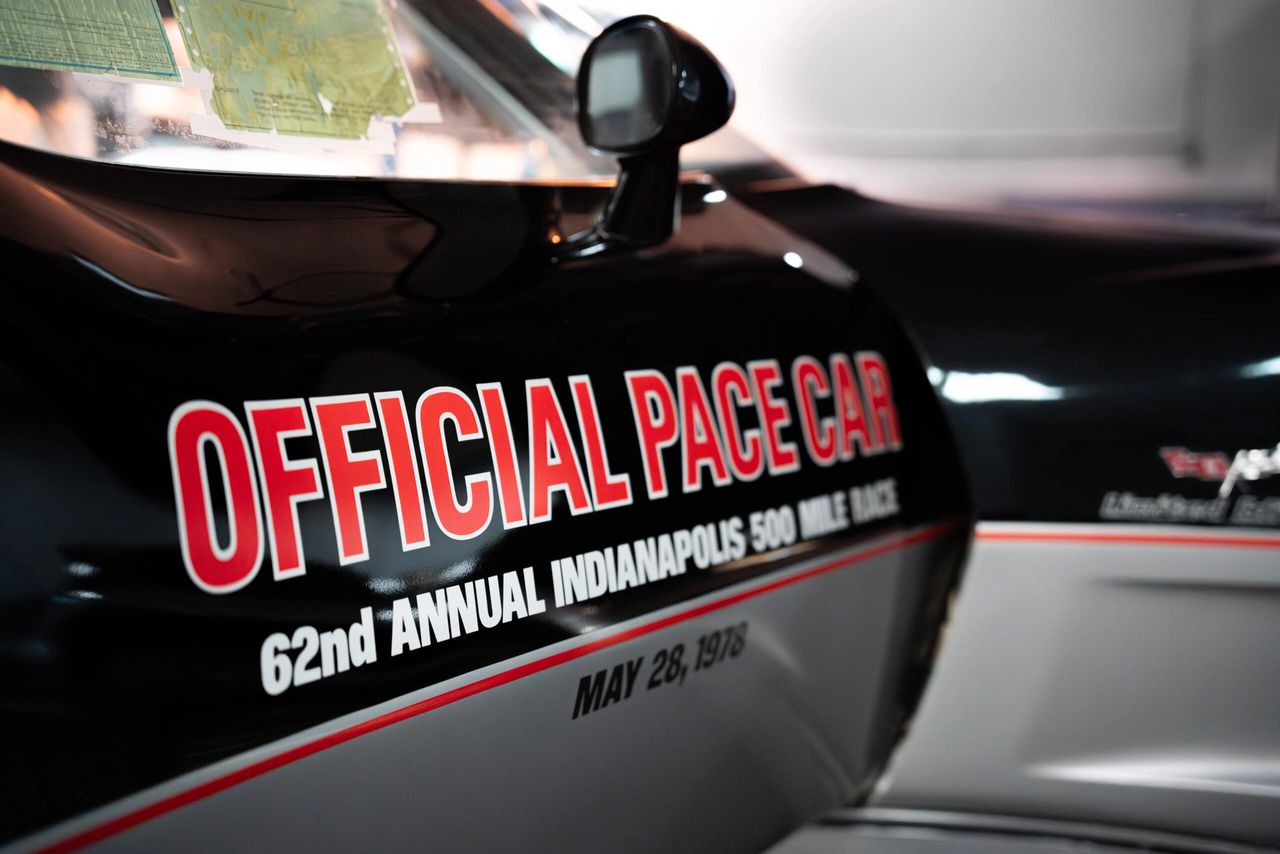
Anniversaries can be lazy. A familiar badge, a different paint color, a numbered plaque, and the expectation that nostalgia will do the rest. The 1978 Corvette could easily have followed that formula. Chevrolet was celebrating twenty-five years of America’s sports car, and simply acknowledging the milestone would have been enough to generate attention.
But the 1978 Corvette Indy Pace Car was not content to look backward.
It arrived at an important moment for the Corvette, one in which the car needed to prove that its story was still moving. The outrageous horsepower figures of the muscle-car era were gone. Emissions regulations, fuel concerns, insurance costs, and changing buyer expectations had reshaped the performance landscape. The Corvette remained visually dramatic and culturally important, but it could no longer rely exclusively on brute force to make its case.
Chevrolet’s answer was not to pretend that 1978 was 1968. Instead, it made the Corvette more complete.
The new wrap-around rear glass changed the car immediately. It modernized the C3’s silhouette, improved rearward visibility, brought more light into the cabin, and created a genuinely useful luggage area behind the seats. The glass remained fixed, but the fastback form anticipated the direction Corvette would soon take. It was not merely a styling trick applied for the anniversary; it was evidence that Chevrolet still regarded the Corvette as an engineering object worthy of continued development.
The thin-shell sport seats told a similar story. Originally intended for broader use in 1979, they were pulled forward so the Pace Car could introduce them first. That decision matters because it made the Limited Edition more than a graphics package. The car did not simply celebrate where Corvette had been. It previewed where the interior was going next.
That is the first reason the 1978 Pace Car still matters: it used commemoration as a platform for progress.
The second reason is Indianapolis.
For the first time in Corvette history, the crossed flags led the field at the Indianapolis 500. That assignment carried a significance far beyond a parade lap or ceremonial appearance. Indianapolis had long functioned as a national stage on which automotive companies demonstrated confidence, visibility, and technical credibility. To pace the 500 was to place a car at the center of American motorsports culture, and in 1978 Corvette finally received that honor.
The black-over-silver Pace Car looked as though it had been designed for the occasion. The dark upper body gave the cockpit a canopy-like presence. The silver lower section widened the car visually and planted it against the track. The thin red stripe sharpened the transition, while the spoilers, aluminum wheels, white-letter tires, and bold Indianapolis graphics transformed the familiar C3 shape into something theatrical.
That theater was not accidental. A pace car is supposed to command attention. It must look important at speed, at rest, in photographs, and beneath the lights of a crowded showroom. The 1978 Corvette accomplished all four. Even without the large door lettering installed, the black, silver, and red composition was unmistakable. With the graphics in place, it became one of the most recognizable Corvettes ever produced.
Nearly half a century later, the livery still works because it does not rely on subtlety. It is unapologetically tied to its era, yet the underlying composition remains coherent. Every major element participates: the body division, the red pinstripe, the wheel accents, the interior palette, and the aerodynamic pieces. The Pace Car does not merely wear special-edition trim. It presents a complete visual identity.
Then there is the performance.
The 1978 Corvette was not a return to big-block excess, and it never claimed to be. What it offered—especially with the L82 and a four-speed manual—was a renewed sense of credibility. The higher-output small-block, close-ratio gearing, independent suspension, four-wheel disc brakes, and low driving position combined to produce a car that still asked something of its driver.
As Car and Driver observed in October 1977:
“Not only will it run faster now—the L-82 version with four-speed is certainly the fastest American production car…”
The significance of that statement lies not only in the performance ranking, but in the broader implication. Corvette was again being discussed as a serious American performance car rather than merely a survivor of an earlier age.
A well-sorted L82/four-speed Pace Car still makes that argument from behind the wheel. The Rochester Quadrajet opens with a familiar mechanical urgency. The engine pulls cleanly through the midrange, the transmission keeps the small-block engaged, and the chassis rewards measured inputs rather than dramatic corrections. It is not violently fast by modern standards, but it remains involving in a way many faster cars are not.
That distinction matters.
The Pace Car requires the driver to participate. The steering takes a set. The four-speed asks to be worked. The engine responds best when the driver understands where the torque lives and where the L82 begins to breathe. The brakes, suspension, and drivetrain do not isolate the person behind the wheel from the mechanical process. They invite that person into it.
At the same time, the car is livable. The glass T-tops brighten the cabin when installed and create an open-air experience when removed. The fastback storage area makes room for luggage, jackets, tools, and camera cases. Air conditioning, power accessories, adjustable steering, improved seats, and available 8-track or CB equipment give the car the character of a late-1970s grand tourer rather than a stripped competition special.
That balance is central to the Pace Car’s appeal today. It is distinctive enough to anchor a collection, usable enough for a weekend trip, and interactive enough to reward the owner who chooses to drive it.
Of course, no discussion of the 1978 Pace Car can ignore the speculation.
The March 27, 1978, front-page story in The Wall Street Journal did more than report demand. It crystallized the idea that the Pace Car might be an appreciating asset before many examples had reached their first owners. Dealer markups, disputed agreements, auction prices, deposits, and whispered promises transformed the Limited Edition into a national commodity. Cars were purchased not simply to be driven, but to be stored, protected, and held against an imagined future value.
The frenzy became part of the car’s identity almost immediately. It also created one of its most unusual modern advantages: an enormous archive of survivors.
Many Pace Cars were preserved from new. They accumulated little mileage, retained their window stickers and dealer paperwork, and sometimes kept their large door-decals sealed in the original packaging. Owners treated them as collectibles before the paint had fully cured, creating a deep pool of cars that document not only Chevrolet production, but the market psychology surrounding the model.
That preservation can sometimes work against the car. Too many examples became static objects, discussed in terms of mileage, paperwork, untouched decals, and investment potential rather than road manners. The mythology of the unopened time capsule can obscure the fact that Chevrolet built a capable, usable Corvette beneath the commemorative treatment.
Yet the surviving documentation is also part of the Pace Car’s cultural value. Window stickers, dealer invoices, delivery photographs, newspaper clippings, allocation letters, and unused decal kits preserve the environment in which the car was sold. They tell the story of a moment when celebration, speculation, advertising, and national media attention converged around a single Corvette.
The separate VIN sequence gives that story unusual clarity. Because the 6,502 replicas occupy their own production-number block, authentic examples can establish what they are without relying solely on paint, trim, or owner claims. Reproduction graphics can be applied. Spoilers can be added. Interiors can be recolored. But a standard 400000-series coupe cannot become a genuine 900000-series Pace Car.
That permanent identity has helped protect the model’s legacy. It allows collectors to distinguish authentic cars from tributes, while still evaluating originality, condition, drivetrain, decals, and provenance as separate questions. For a special edition whose appearance has been copied repeatedly, that traceable factory foundation is invaluable.
The production total matters as well. Chevrolet did not create an impossibly scarce boutique collectible. It built 6,502 cars so virtually every dealer could receive one. The strategy gave the Pace Car a national footprint without making it commonplace in any individual showroom. One car per store was enough to create a local event, draw customers through the doors, and connect communities far from Indiana to Corvette’s first Indianapolis assignment.
That is why the total should not be dismissed as too large. The objective was never microscopic scarcity. Chevrolet was engineering reach.
The Pace Car became a national moment precisely because thousands of people could see one in person. It appeared in dealership windows, local newspaper advertisements, showroom promotions, and community conversations across the country. Its influence was measured not only by how many were built, but by how broadly the story traveled.
And that, ultimately, is why the 1978 Corvette Indy Pace Car still matters today.
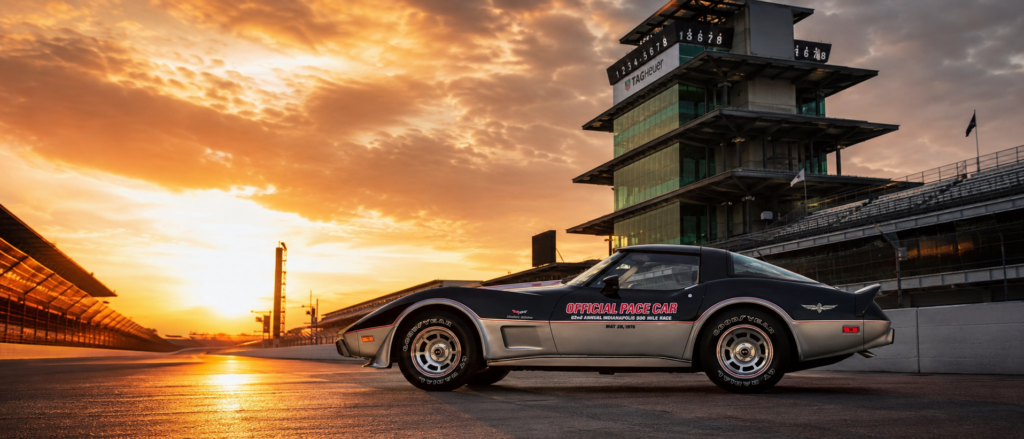
It matters because it marked Corvette’s first turn at the front of the Indianapolis 500 field.
It matters because its fastback glass and thin-shell seats moved the production car forward rather than merely decorating the past.
It matters because the L82/four-speed combination restored a measure of performance credibility at a time when American speed was being redefined.
It matters because the black, silver, and red livery remains one of the most confident and immediately recognizable designs ever applied to a Corvette.
It matters because the dealer-allocation strategy made the celebration national, while the separate VIN sequence ensured that authentic cars could remain identifiable decades later.
And it matters because beneath all the speculation, premiums, lawsuits, unopened decal kits, and low-mileage preservation, there is still a Corvette worth driving.
A good anniversary should honor the past while nudging the story forward. The 1978 Corvette Pace Car did both. It looked back to 1953, acknowledged twenty-five years of survival and evolution, and then pointed toward a more practical, better-equipped, more mature version of the C3.
The speculation fog is part of the legend, but it is not the definition.
What defines the car is how it looked under the Indianapolis sun, how the L82 pulled through a close-ratio four-speed, how the fastback glass changed the shape and usefulness of the Corvette, and how thousands of black-and-silver coupes returned America’s sports car to the center of public attention.
Chevrolet did not simply build a souvenir for the 1978 Indianapolis 500. It reminded the country that Corvette was still here, still evolving, and still capable of leading the field.
For one lap at Indianapolis, it did so literally.
For the Corvette story, it has done so for much longer.