
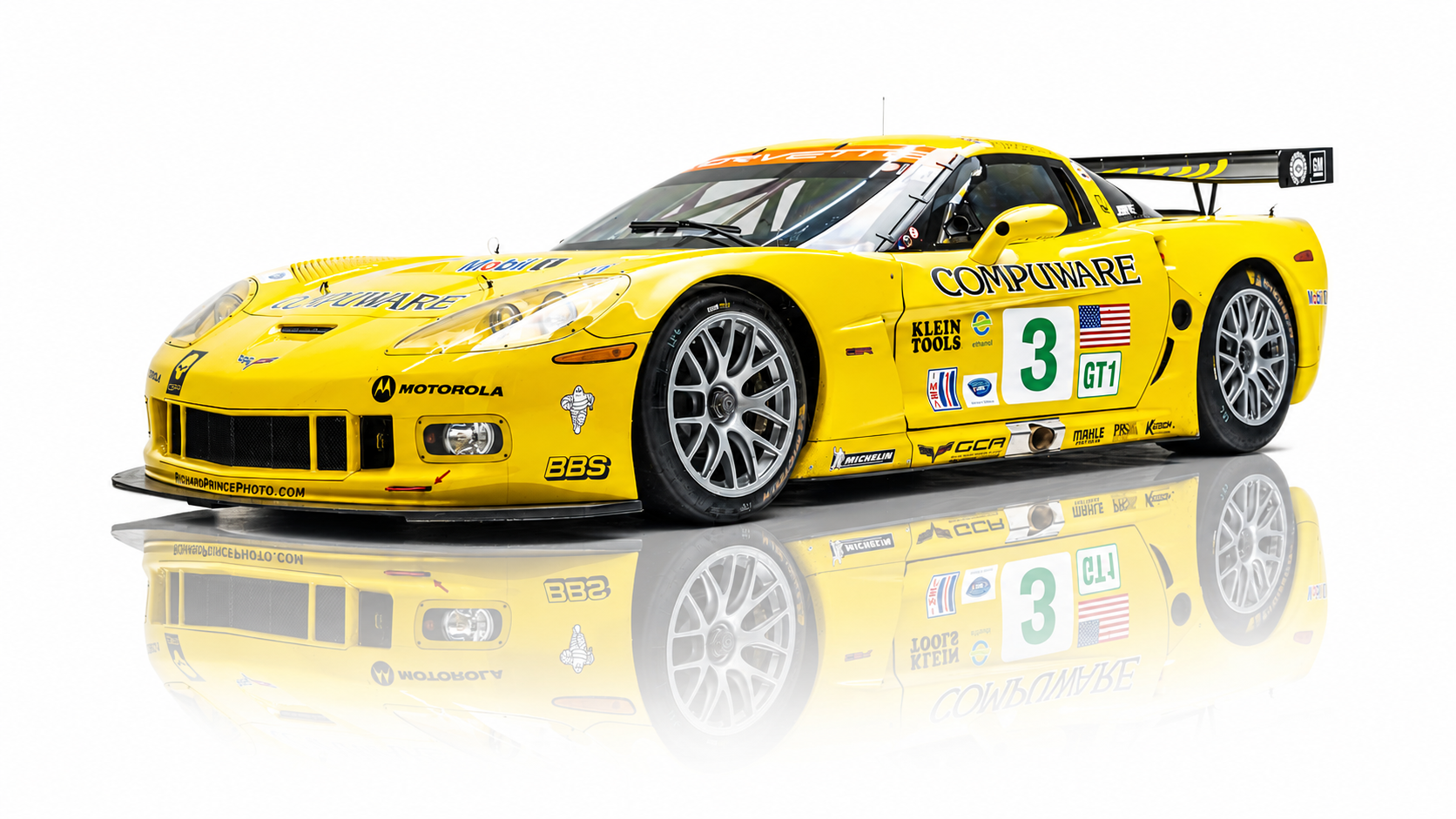
The Last Great GT1 Corvette
Some race cars earn their place in history because of a single extraordinary victory, one unforgettable driver, or a defining confrontation with a legendary rival. The Chevrolet Corvette C6.R earned its reputation through something far more difficult to achieve: sustained excellence across multiple seasons, racing series, circuits, and continents. It won sprint races and endurance contests, conquered Sebring and Road Atlanta, and stood atop the class podium at the 24 Hours of Le Mans. In the process, it delivered championships to Chevrolet, Corvette Racing, Pratt Miller, and the drivers who pushed it to the limits of adhesion, endurance, and mechanical durability. For an entire generation of Corvette enthusiasts, the bright yellow C6.R became more than another successful factory race car. It became proof that America’s sports car belonged alongside the most sophisticated and formidable grand touring machines in the world.
The expectations surrounding the C6.R were considerable, in large part because its predecessor had already transformed Chevrolet’s modern endurance-racing program into an international powerhouse. By the end of the C5-R era, Corvette Racing had won at Daytona, Sebring, Petit Le Mans, and the 24 Hours of Le Mans. It had secured championships, built an intensely loyal following, and established the partnership between Chevrolet and Pratt Miller as one of the most effective technical collaborations in contemporary motorsports. Replacing the C5-R, therefore, required more than simply creating a faster Corvette. The new car needed to preserve the durability, serviceability, and competitive discipline that had made the earlier program successful while taking advantage of the smaller dimensions, cleaner aerodynamics, and more advanced architecture of the sixth-generation Corvette.
It also had to compete in one of the most demanding grand touring categories of its era. The GT1 field included machines such as the Aston Martin DBR9, Ferrari 550 and 575 GTC, Saleen S7-R, and Maserati MC12, each of which represented a serious commitment from its manufacturer, constructor, or private racing organization. These were not lightly modified production cars wearing competition tires and sponsor decals. They were highly specialized racing machines that retained a recognizable connection to their road-going counterparts while exploiting the considerable engineering freedom permitted by contemporary GT1 regulations.
Chevrolet and Pratt Miller
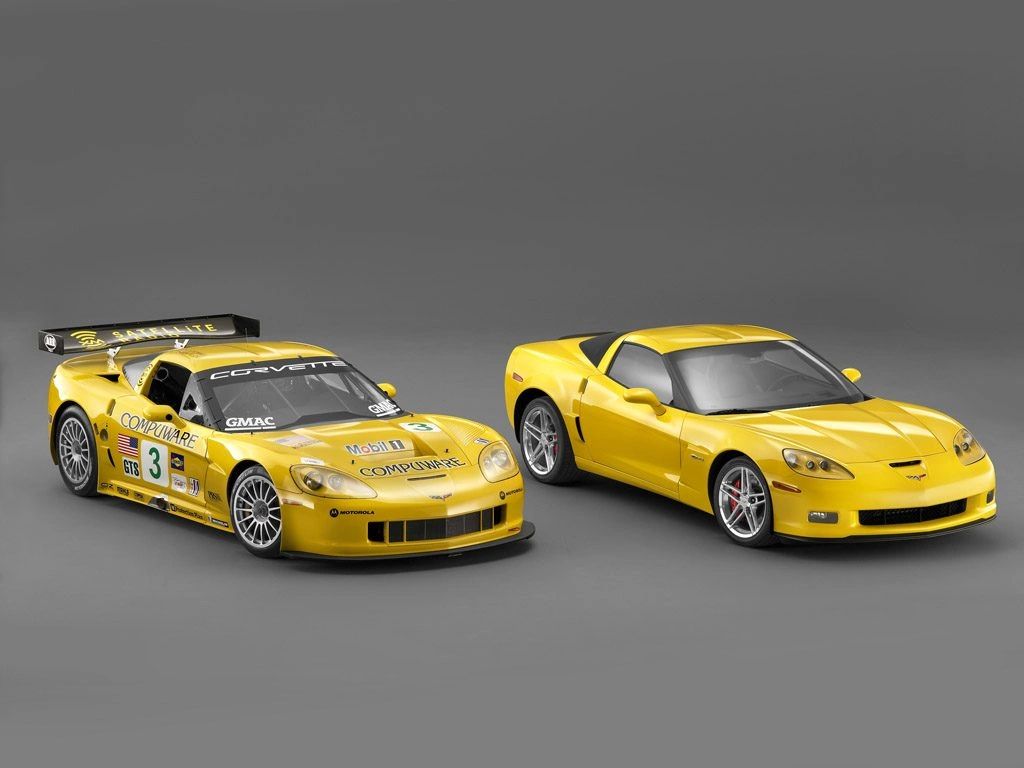
Chevrolet and Pratt Miller approached the development of the C6.R with that reality firmly in mind. Rather than treating the race car as an isolated competition project, they developed it alongside the road-going C6 Corvette and the upcoming Corvette Z06. This parallel development allowed the production and racing programs to influence one another much earlier than had traditionally been possible. The relationship was not as simple as transferring race-car components directly onto a street car, nor was the C6.R merely a production Corvette stripped of its interior and fitted with a roll cage. Instead, engineers from both programs exchanged priorities, packaging requirements, aerodynamic considerations, durability data, and design objectives while the sixth-generation Corvette was still taking shape.
That collaboration helped produce a road car whose basic configuration was better suited to the demands of racing, and a race car whose visual identity remained unmistakably connected to the Corvette available in Chevrolet showrooms. The fixed headlamps, centralized front air opening, tighter exterior proportions, and cleaner body profile of the C6 were beneficial to the production car, but they also provided Pratt Miller with a stronger foundation on which to develop the competition model. At the same time, lessons learned through racing continued to influence the way Chevrolet evaluated aerodynamics, materials, braking systems, cooling, durability, and overall vehicle performance.
This connection between the streetcar and the racecar became one of the central themes of the C6 era, but it is important not to overstate the similarities between them. In GT1 specification, the C6.R was a highly specialized machine designed around the requirements of international endurance racing. Its naturally aspirated 7.0-liter V8, sequential racing transmission, wide-track suspension, competition braking system, purpose-developed aerodynamics, sophisticated electronics, and tightly packaged cockpit existed for one reason: to cover as much ground as possible, as quickly and reliably as the regulations allowed. The C6.R looked like a Corvette because the rules required it to retain a recognizable relationship to the production model, but nearly every system beneath its bodywork had been evaluated and refined according to the unforgiving logic of the racetrack.
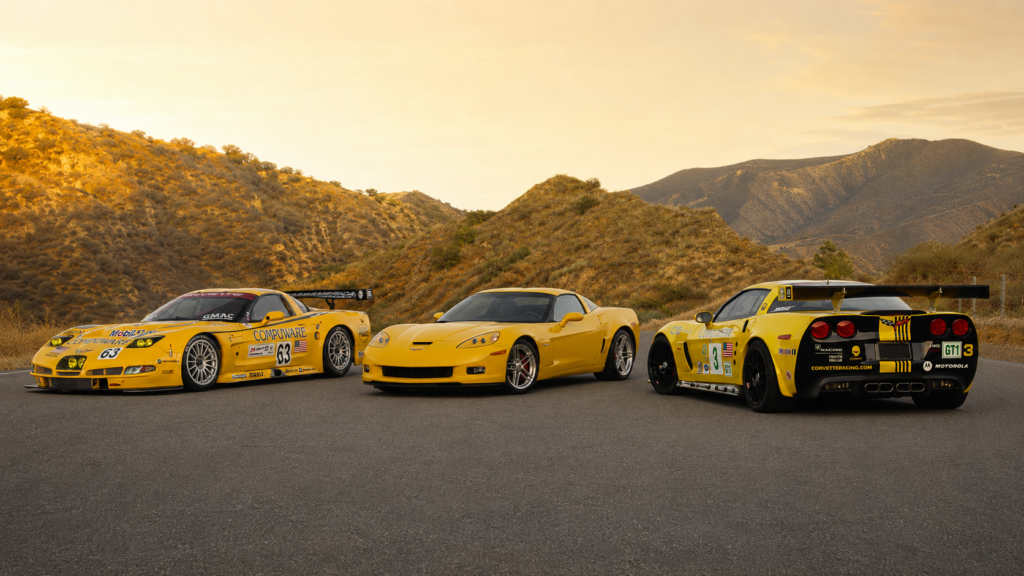
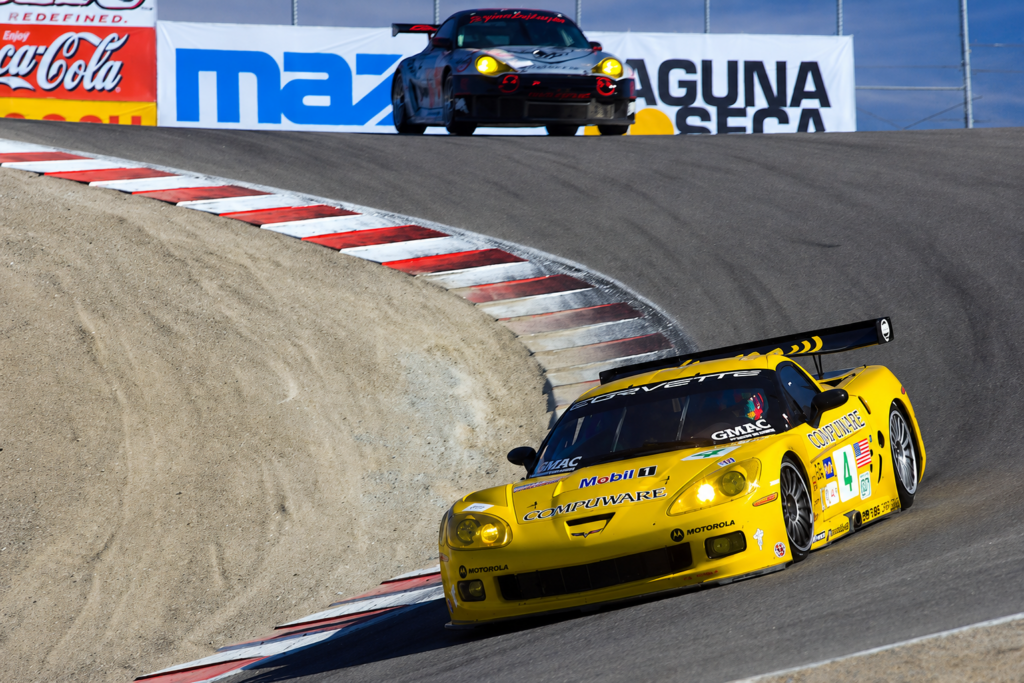
The distinction becomes even more important because the name C6.R eventually came to describe two substantially different Corvette racing programs. The original version was designed for the faster, more technically permissive GT1 category. This was the approximately 590-horsepower machine that began competition in 2005 and carried Corvette Racing through the conclusion of its factory GT1 campaign in 2009. Later that year, Chevrolet introduced a different C6.R developed for the more production-oriented GT2 regulations. That second car, which would later compete under evolving GT and GTE terminology, was based more closely on the Corvette ZR1 and continued racing through the remainder of the C6 generation.
Both versions were successful and contributed meaningfully to the broader history of Corvette Racing, but they should not be treated as interchangeable variations of the same car. This article focuses exclusively on the first of them: the GT1 C6.R that made its competition debut at Sebring in 2005, won its class at Le Mans during its inaugural season, repeated that victory in 2006, and returned to win again in 2009 during Corvette Racing’s final factory appearance in the category. It was also the car that delivered four consecutive sets of American Le Mans Series driver, team, and manufacturer championships from 2005 through 2008, establishing a level of consistency that few factory racing programs have ever matched.
The C6.R’s dominance became central to its mythology, although that success also complicates the way its history is sometimes remembered. The car did not single-handedly cause the collapse of GT1 racing. Rising costs, changing manufacturer priorities, uneven global participation, increasingly complex regulations, and the emergence of more production-based alternatives all contributed to the category’s decline. Even so, Corvette Racing’s ability to continue competing at an exceptionally high level while many of its rivals reduced their involvement or withdrew altogether left the two factory Corvettes increasingly racing against one another in the American Le Mans Series. By the final years of the program, the C6.R had become something of a paradox: a race car so successful within its original competitive environment that the environment itself was disappearing around it.
Describing the C6.R as the last great GT1 Corvette does not diminish the achievements of the later GT2 C6.R, the C7.R, the C8.R, or any of the competition Corvettes that followed. Instead, it identifies the car’s particular place in the evolution of Corvette Racing. The GT1 C6.R belonged to the final period in which Chevrolet fielded a large-displacement, front-engine Corvette under regulations that permitted extraordinary levels of power, aerodynamic freedom, and mechanical specialization. It represented the fullest expression of the racing philosophy established by the C5-R and, at the same time, marked the end of a form of factory-backed grand touring competition that no longer exists.
The C6.R was therefore more than the successor to the C5-R. It was the culmination of everything Chevrolet and Pratt Miller had learned in the early years of the modern Corvette Racing program, refined into one of the most successful, recognizable, and revered grand-touring race cars of its generation.
Form Follows Function
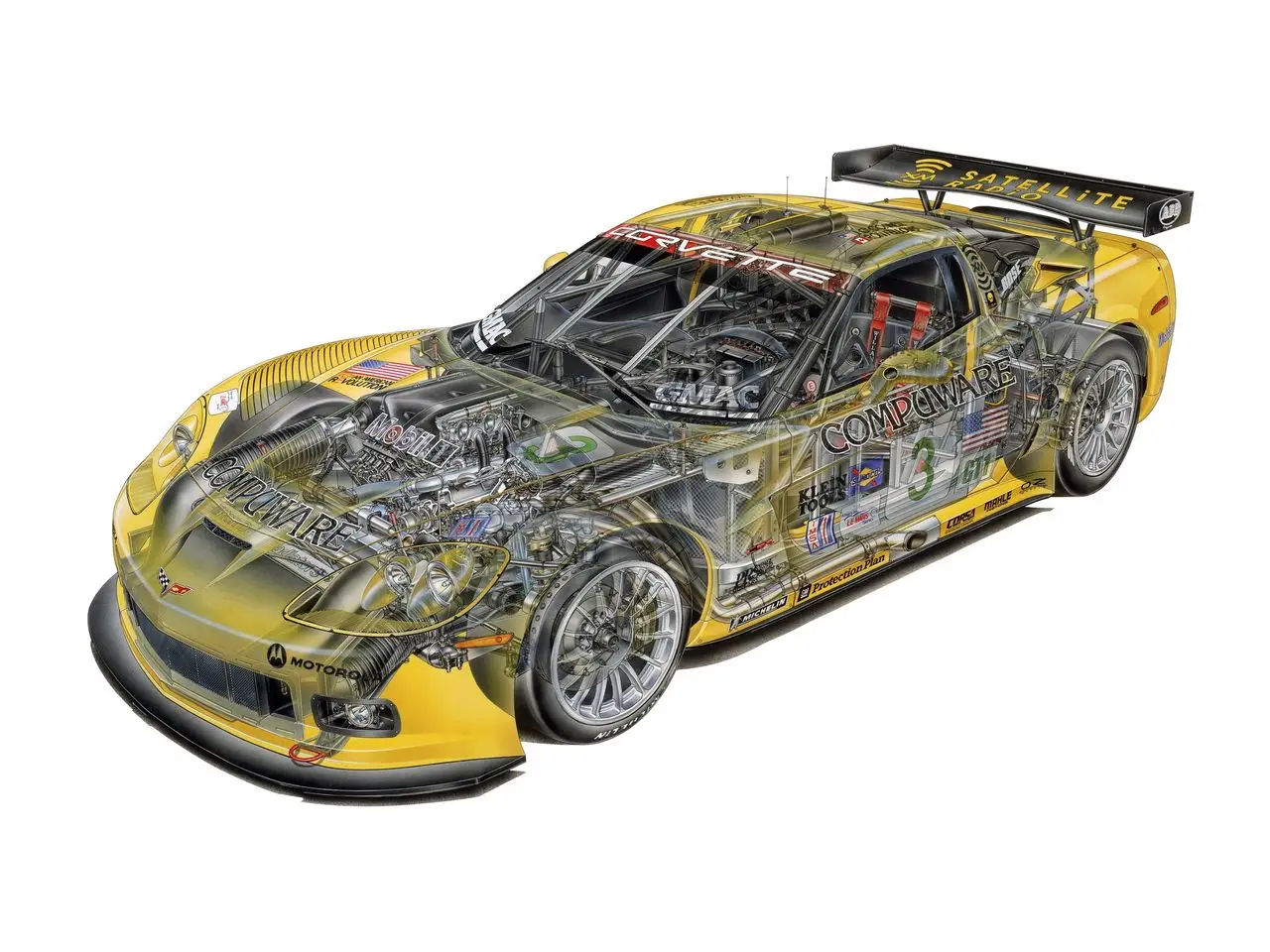
The relationship between the production C6 Corvette and the C6.R was genuine, although it is sometimes described in terms that make the two cars sound more mechanically interchangeable than they actually were. The C6.R was not a production Z06 with its interior stripped out and a collection of racing components added in its place. It was a purpose-built competition machine developed by Pratt Miller around the structural, dimensional, and homologation requirements of the sixth-generation Corvette, with nearly every element modified or replaced to withstand the demands of international endurance racing.
Even so, the connection began with something considerably more substantial than a shared silhouette. Like the C5-R before it, the C6.R incorporated hydroformed frame rails sourced from the same production system used to manufacture the road-going Corvette at GM’s Corvette Assembly Plant in Bowling Green, Kentucky. These steel rails served as the starting point for a heavily reinforced racing structure that included a fully integrated, welded roll cage, competition-specific suspension mounting points, safety structures, and composite exterior bodywork. The resulting chassis retained an authentic connection to the production Corvette while providing the rigidity, strength, repairability, and occupant protection required of a car expected to survive events lasting six, twelve, or twenty-four hours.
There is an important distinction to be made here. The road-going C6 Z06 used a lightweight hydroformed aluminum frame, whereas the original GT1 C6.R was constructed around production-sourced steel frame rails. The race car, therefore, did not simply inherit the complete Z06 chassis beneath its bodywork, despite the close visual and engineering relationship between the two. The connection was found instead in their common architecture, proportions, engine philosophy, and the unusual degree of cooperation that existed between the production Corvette engineers and the team developing the new race car.
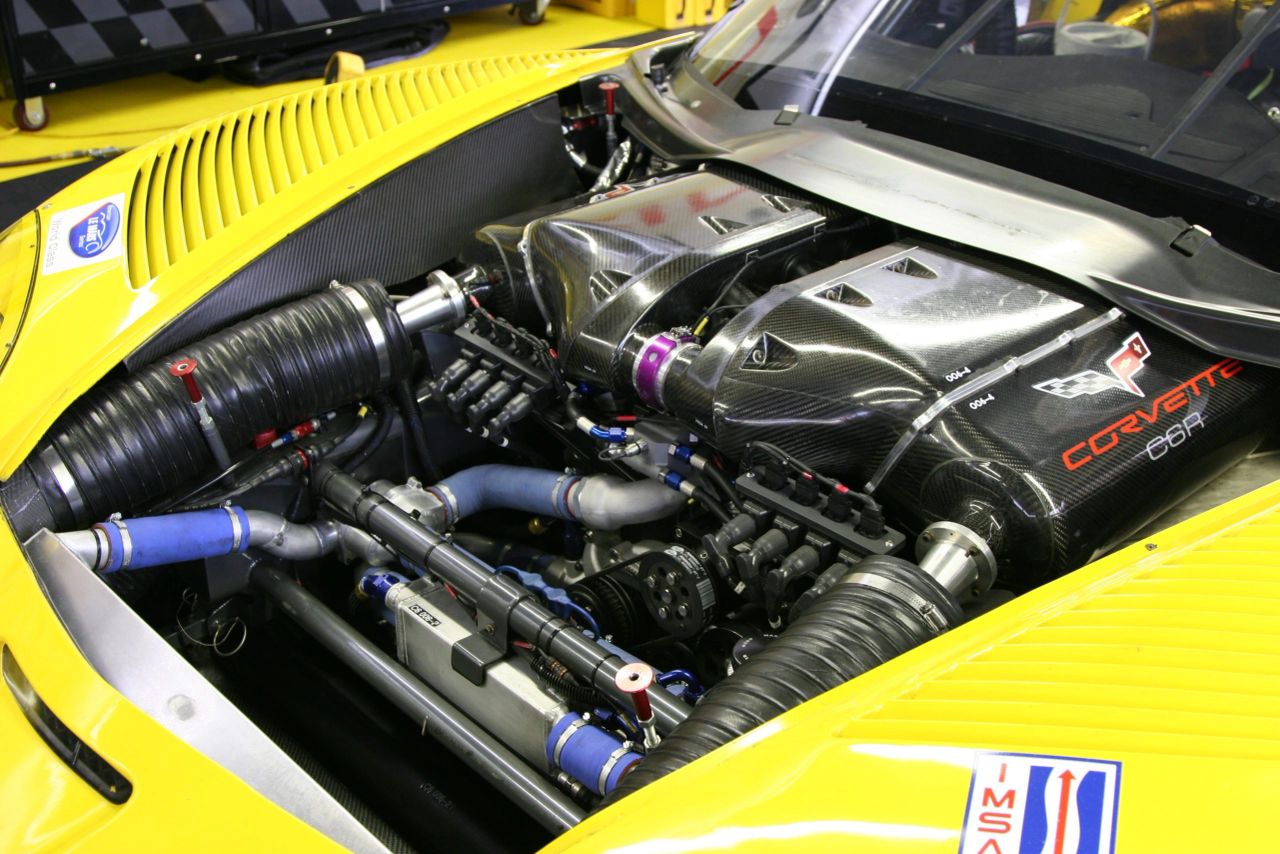
That cooperation was perhaps most evident in the development of the two cars’ 7.0-liter engines. The Katech-built LS7.R used in the C6.R grew out of the engine program that had already powered the later C5-Rs, but it shared a broader engineering philosophy with the production LS7 developed for the 2006 Corvette Z06. Both engines used 7.0 liters of displacement, dry-sump lubrication, CNC-machined cylinder heads, titanium valves and connecting rods, forged steel crankshafts, and carefully controlled cylinder-bore finishing. The exact parts, tolerances, operating requirements, and service expectations differed considerably, but the lessons learned through racing helped shape the production engine while GM’s engineering resources strengthened the competition program.
In GT1 specification, the LS7.R produced approximately 590 horsepower at 5,400 rpm and roughly 640 lb-ft of torque at 4,600 rpm, although its output was governed by the air restrictors and technical regulations imposed on the category. This was not an engine built to produce an impressive dyno number for a few seconds at a time. It had to operate at sustained speed through extreme heat, vibration, repeated shifts, extended periods at full throttle, and the inevitable contact and debris encountered during endurance racing. Just as importantly, it needed to remain serviceable enough for the Corvette Racing crew to inspect, maintain, and, when necessary, replace components within the tightly controlled rhythm of a race weekend.
The LS7.R’s combination of output, durability, and efficiency earned it considerable recognition beyond the Corvette paddock. In 2006, a panel of fifty racing-engine specialists selected it as the Global Motorsport Engine of the Year, an award that acknowledged more than its outright power. By that point, the engine had already demonstrated that it could survive and win at venues such as Sebring and Le Mans, where reliability mattered every bit as much as acceleration. The award reinforced what Corvette Racing’s competitors already understood: the LS7.R was not simply one of the C6.R’s strongest components; it was one of the finest endurance-racing engines of its era.
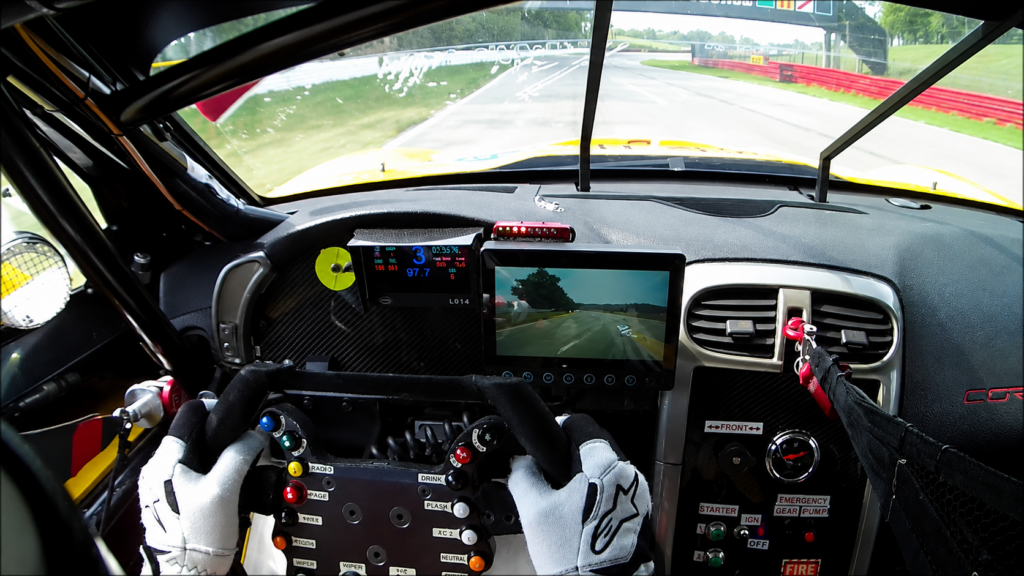
One of the C6.R’s less obvious technical solutions could be found inside the cockpit. Because of the firewall, structural framework, and fuel-system packaging behind the driver, the rear hatch area did not function as a conventional window. Forward visibility was already compromised by the car’s low seating position, wide bodywork, roll-cage structure, and heavily enclosed cockpit, while rear visibility through the center of the car was effectively nonexistent. In traffic that included faster prototypes approaching at enormous closing speeds, relying entirely on the door mirrors placed an additional burden on drivers who were already managing tires, brakes, fuel consumption, radio communication, and surrounding traffic.
Pratt Miller addressed the problem by using a rear-facing camera connected to a monitor inside the cockpit, giving the driver a clearer view of the cars approaching from behind. The system was far simpler than the radar-assisted technology Corvette Racing would introduce years later, but it represented the same practical philosophy: when the racing architecture created a visibility problem, the team developed an electronic solution rather than compromising the structure or aerodynamic shape of the car. The basic concept would eventually become familiar to owners of later production Corvettes through camera-based rearview-mirror systems, although the modern road-car technology is considerably more sophisticated.
The most visible examples of cooperation between the production and racing programs began much earlier, while the exterior shape of the C6 was still being defined. Corvette Racing program manager Doug Fehan later recalled that the production design team asked the racers what changes could be incorporated into the next Corvette to provide a better foundation for competition. The race team responded with three principal requests: replace the C5’s divided front openings with a single central inlet, eliminate the production car’s retractable headlamps in favor of fixed units, and revise the Corvette’s overall profile to improve its aerodynamic potential.
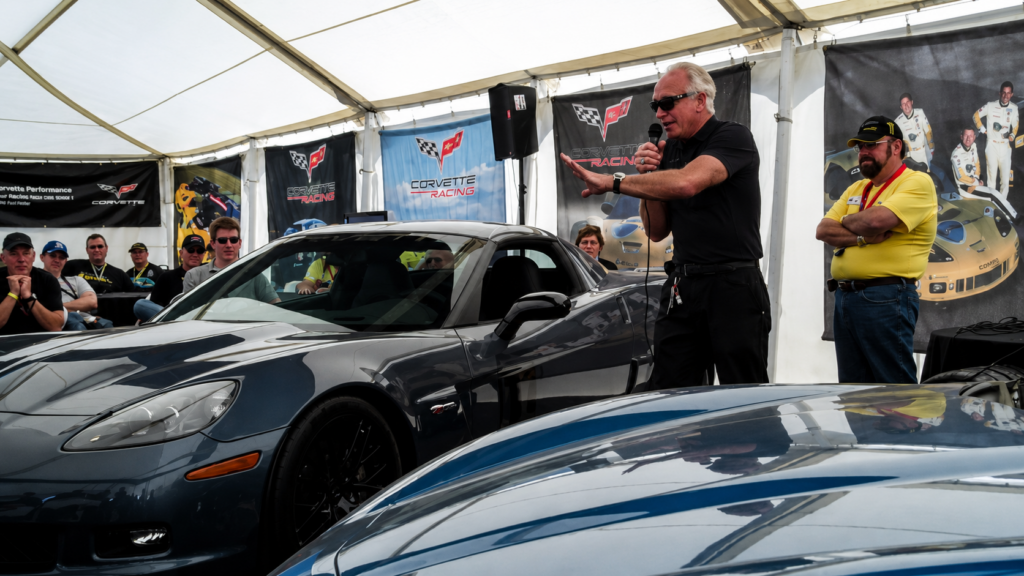
All three requests were reflected, to varying degrees, in the production C6 introduced for 2005.
The fixed headlamps represented the most obvious departure from the Corvettes that had come before it. With the exception of the earliest first-generation cars, concealed or retractable headlamps had been part of the Corvette’s identity since 1963. They were visually distinctive, but they also required space, mechanisms, doors, and body contours that complicated airflow management. The C5-R did not use operational pop-up lamps, but its competition headlight assemblies still occupied raised housings shaped partly by the production car’s underlying architecture.
The C6’s exposed, flush-mounted headlamps gave the production car a cleaner frontal profile while providing Pratt Miller with a more aerodynamically efficient starting point. Air could move across the nose and front fenders without encountering the interruptions created by retractable lamp doors or the pronounced fairings used on the C5-R. The change also simplified the conversion from the production shape to the race car’s lighting arrangement, allowing the C6.R to retain a recognizable relationship to the road car without carrying forward one of the C5 platform’s aerodynamic compromises.
The central front opening was equally important, even though its contribution was less immediately apparent. A single large inlet gave the engineers greater control over how air entered the car and was distributed among its various cooling systems. In racing trim, the C6.R required enormous airflow to manage engine coolant, oil temperature, brakes, and other heat-sensitive components, but every opening in the body also carried an aerodynamic penalty. The objective was therefore not simply to force more air into the car. It was to admit only what was required, direct it efficiently through the appropriate heat exchangers and ducts, and manage its exit without creating unnecessary drag or front-end lift.
The C6’s overall proportions presented both opportunities and challenges. The production car was more than five inches shorter than the C5, yet it rode on a slightly longer wheelbase, which dramatically reduced the front and rear overhangs. The cleaner body produced less drag, but the abbreviated rear overhang left the racing engineers with less body length through which to manage airflow and generate aerodynamic load. In particular, the center of aerodynamic pressure moved forward, making it more difficult to maintain the balance between front and rear downforce.
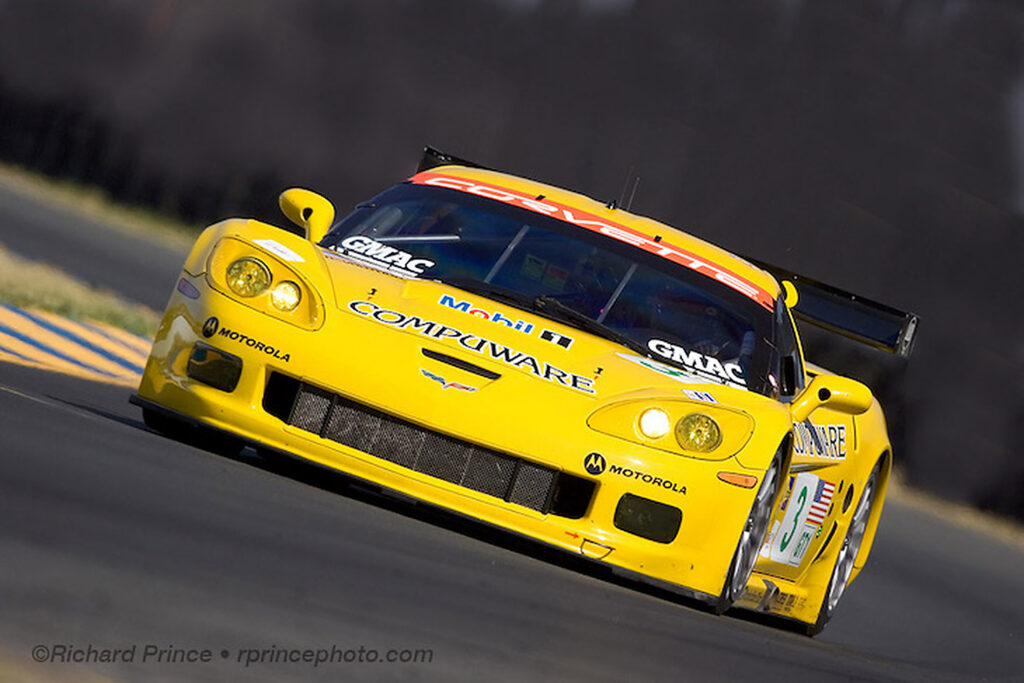
Pratt Miller addressed these challenges through a combination of computational fluid-dynamics analysis, wind-tunnel development, and extensive track testing. The C6.R’s front splitter, rear wing, enclosed side windows, revised fascia, flat underbody treatment, and multi-channel rear diffuser worked together rather than functioning as isolated additions. Even the side windows played an aerodynamic role by helping the airflow remain attached as it moved over the roof and toward the rear wing, allowing the wing to operate more effectively while carrying less angle and therefore producing less drag.
At the front of the car, the fascia flared outward near the wheel openings to create low-pressure areas that helped extract air from beneath the nose and through the wheel wells. At the rear, the diffuser divided the exiting airflow into multiple controlled channels, reducing turbulence and making the car less sensitive to changes in pitch and roll. The rear wing and front splitter could then be adjusted to suit the circuit, with a lower-drag configuration used on the long straights at Le Mans and a more aggressive downforce package selected for shorter, tighter venues.
The finished C6.R achieved a better lift-to-drag relationship than the C5-R, even though the production C6’s shortened body initially appeared to leave the racing team with fewer surfaces through which to generate downforce. That accomplishment illustrates the real meaning of “technology transfer” during the C6 program. Chevrolet did not build a road-going race car, nor did Pratt Miller simply convert a showroom Z06 into a GT1 competitor. Instead, the two programs developed alongside one another, with each side recognizing that seemingly ordinary decisions involving headlamps, grille openings, roof angles, body length, cooling paths, and structural materials could have significant consequences once the car reached the racetrack.
The C6 was therefore shaped in part by what Corvette Racing had learned from the C5-R, while the C6.R benefited from receiving a cleaner and more accommodating production foundation. In both cases, the final form followed the function expected of the car—whether that meant carrying two occupants across the country or carrying three drivers through an entire day and night at Le Mans.
The GT1 C6.R Was Too Good for Its Own Good
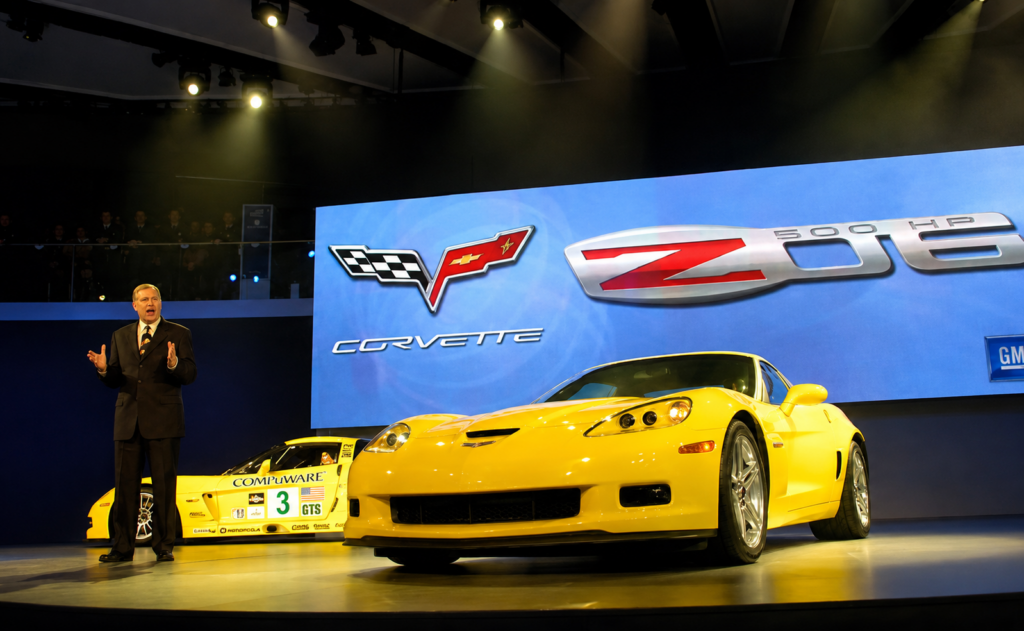
After a full year of development and testing, Chevrolet formally introduced the Corvette C6.R alongside the new 2006 Corvette Z06 at the North American International Auto Show in Detroit on January 10, 2005. General Motors Vice Chairman Bob Lutz handled the introduction, while Corvette Racing driver Ron Fellows provided the more memorable portion of the presentation by driving the yellow race car onto the stage. The message Chevrolet intended to convey was unmistakable. The Z06 and C6.R were developed as complementary expressions of the same performance philosophy, with one engineered for the road and the other designed to represent Corvette on the international racing stage.
At the time of its introduction, Chevrolet described the C6.R as the most technically advanced sports car it had ever developed. That was an ambitious claim, particularly given the success of the C5-R program that preceded it, but the new car arrived with every reason to inspire confidence. Pratt Miller had retained the institutional knowledge, personnel, driver lineup, and operational discipline that had carried the C5-R through an undefeated final season in 2004. The C6.R gave that same organization a cleaner aerodynamic package, a more compact production silhouette, and a racing platform shaped by everything the team had learned during the previous six years.
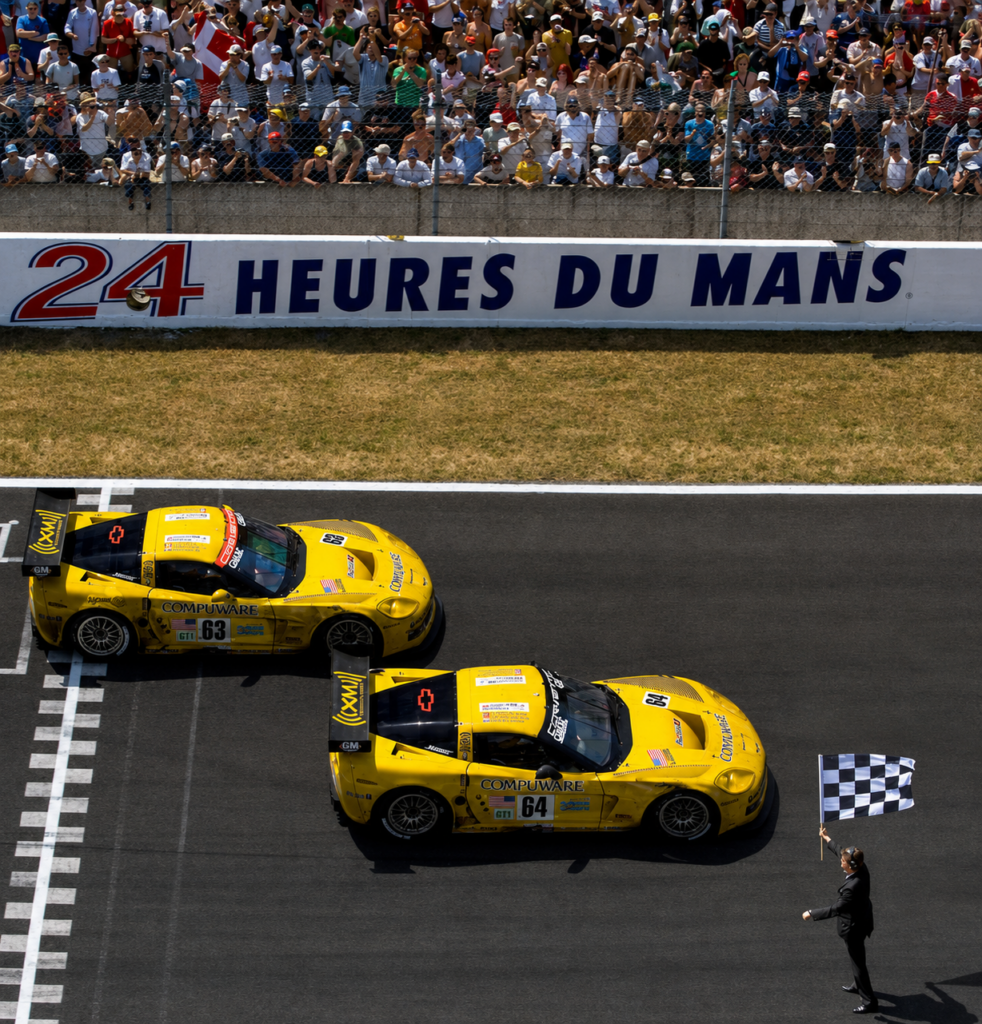
Even so, the C6.R did not begin its competitive life with an immediate victory. When the two factory Corvettes made their racing debut at the 12 Hours of Sebring in March 2005, they finished second and third in GT1 behind the new Aston Martin DBR9. It was a reminder that Chevrolet had not entered an empty category and that the C6.R’s success would need to be earned against another serious manufacturer’s effort. The disappointment did not last long. Corvette Racing responded by winning at Road Atlanta and Mid-Ohio before traveling to France, where the new C6.R delivered a commanding first-and-second-place finish in GT1 at the 24 Hours of Le Mans.
That victory immediately established the C6.R as a worthy successor to the C5-R, although the result was about more than simply adding another trophy to the Corvette Racing collection. Le Mans was the event around which the modern factory program had been built, and winning there during the car’s first season validated nearly every major decision made during its development. The C6.R had demonstrated its speed, fuel efficiency, serviceability, and durability under the most demanding conditions the team would face, completing twenty-four hours of competition while defeating Aston Martin, Ferrari, Saleen, and the other GT1 machinery assembled for the race.
The momentum continued throughout the remainder of the 2005 American Le Mans Series season. After losing the opener at Sebring, Corvette Racing won every remaining GT1 round on the schedule, including Petit Le Mans and the season finale at Laguna Seca. Oliver Gavin and Olivier Beretta secured the drivers’ championship, while Chevrolet and Corvette Racing claimed the corresponding manufacturer and team titles. The C6.R had entered the season facing the considerable burden of replacing one of the most successful GT cars of its era and ended it having begun a dynasty of its own.
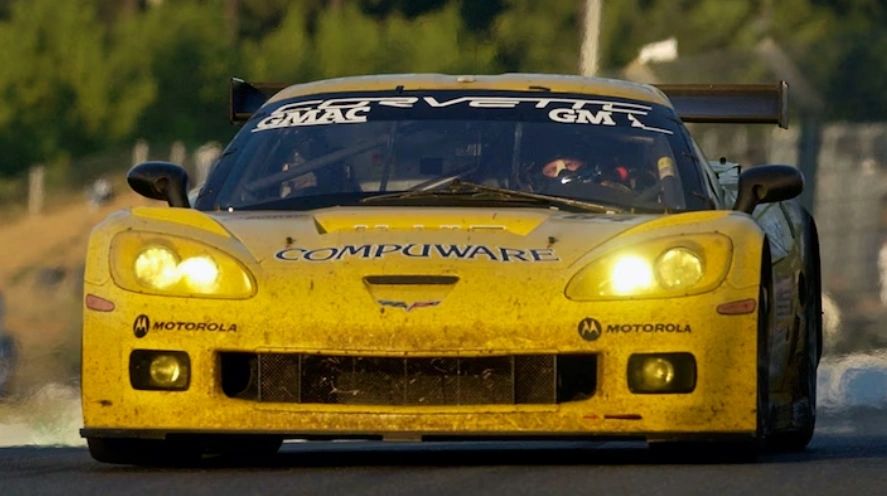
The following season produced some of the best racing of the entire GT1 program. Aston Martin returned with the Prodrive-developed DBR9, and the rivalry between the two manufacturers forced Corvette Racing to fight for nearly every significant result. The Aston’s V12, straight-line speed, and aerodynamic efficiency made it an exceptionally capable opponent, while the Corvette countered with the torque of its 7.0-liter V8, outstanding reliability, rapid pit work, and the accumulated experience of the Pratt Miller organization. Performance adjustments made under the category’s balancing regulations added another layer of complexity, with changes to weight, air restrictors, and fuel capacity capable of altering the competitive order from one event to the next.
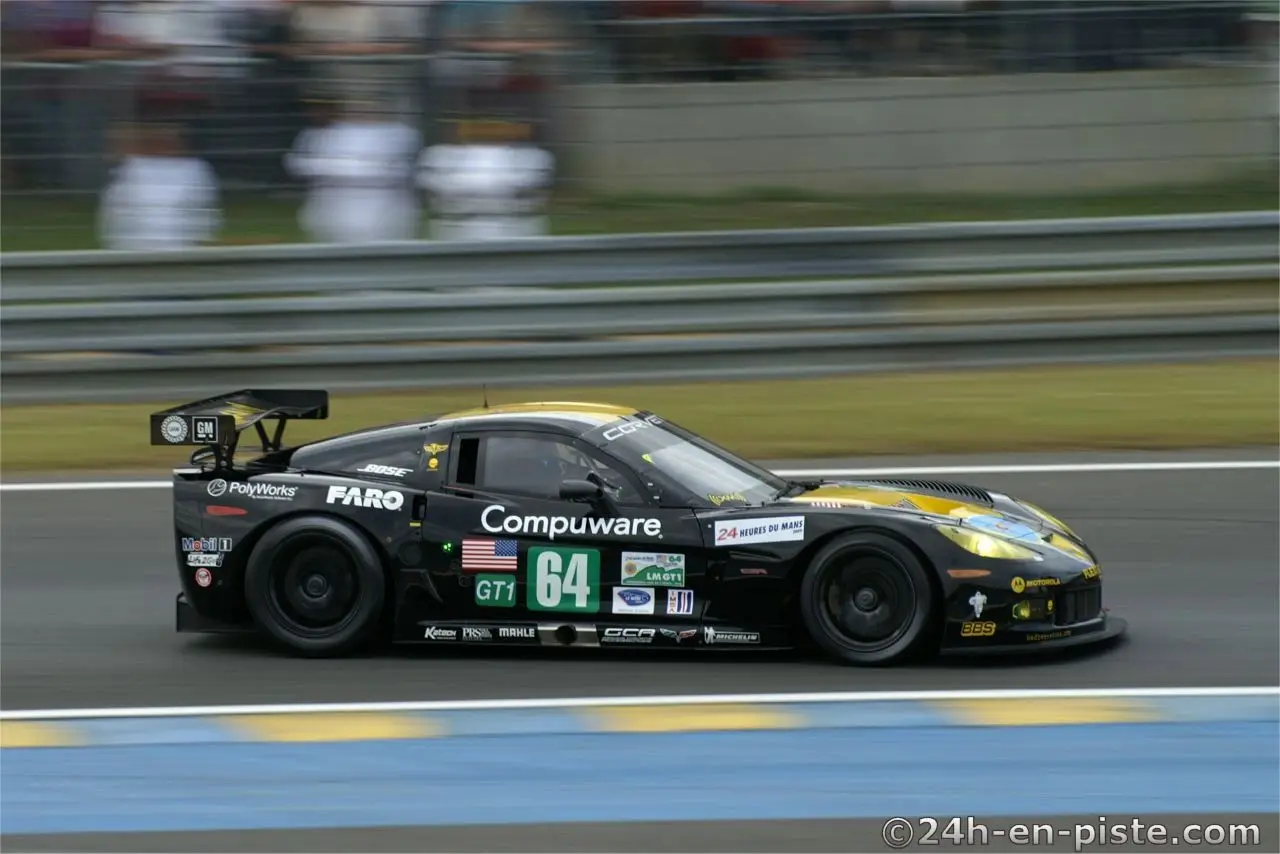
At Le Mans, the two programs remained locked together through much of the race. The No. 64 Corvette shared by Oliver Gavin, Olivier Beretta, and Jan Magnussen ultimately prevailed, finishing fourth overall and securing the C6.R’s second consecutive GT1 victory. The result was among the greatest achievements of the program, not because the Corvette had overwhelmed weak opposition, but because it had defeated an Aston Martin team that was capable of matching its pace and applying pressure for virtually the entire twenty-four hours.
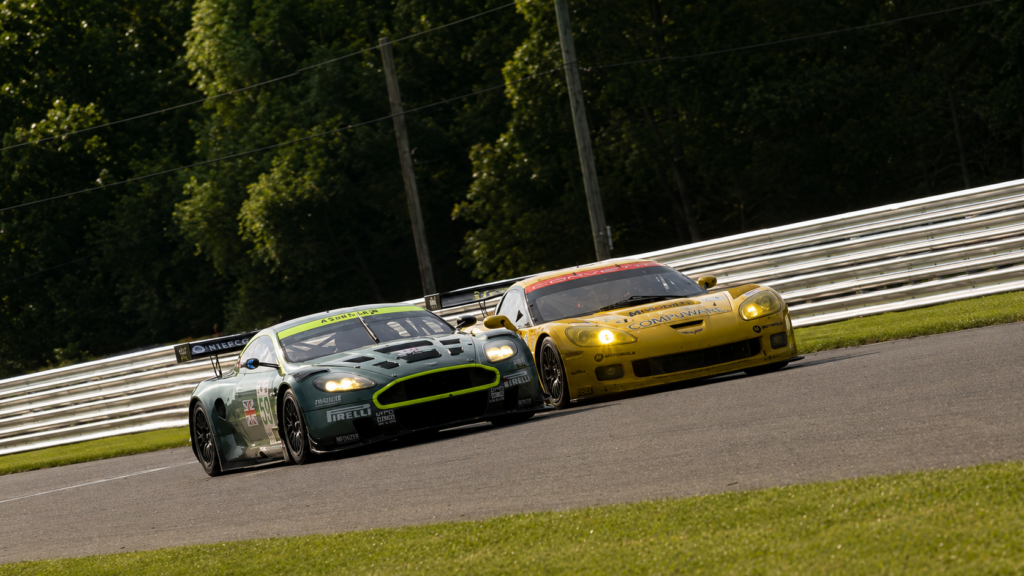
That distinction matters when evaluating the C6.R’s broader legacy. The Corvette was extraordinarily successful, but it was never invincible. Aston Martin ended Corvette’s Le Mans winning streak in 2007 and repeated the achievement in 2008, while the leading factory Corvette finished second in GT1 on both occasions. Those defeats did little to slow the team’s progress in North America, where Corvette Racing continued to accumulate victories and championships, but they demonstrated that a properly funded and professionally operated rival could still beat the C6.R on the largest stage in endurance racing.
Between 2005 and 2008, Corvette Racing secured the ALMS GT1 driver, team, and manufacturer championships in four consecutive seasons. Chevrolet’s own historical accounting credits the GT1 C6.R with 39 ALMS victories, including a twelve-race winning streak spanning portions of 2005 and 2006 and another run of twenty-five consecutive victories from 2007 through the beginning of 2009. Oliver Gavin, Olivier Beretta, Johnny O’Connell, and Jan Magnussen all earned GT1 driving championships during that period, while Ron Fellows, Max Papis, and the team’s other endurance drivers contributed to victories at Sebring, Petit Le Mans, and Le Mans.
Those numbers are remarkable, but they also require context. By 2007 and 2008, the GT1 field in the American Le Mans Series had begun to contract. The high cost of developing and operating the cars discouraged new manufacturers, while several existing programs shifted their attention to other championships or more production-based categories. Some privateer teams could no longer afford to compete at the level required to challenge a factory organization as mature and well financed as Corvette Racing. Aston Martin remained a genuine threat at selected events and continued to prove its competitiveness at Le Mans, but it did not maintain the same uninterrupted full-season presence in the ALMS that Chevrolet did.
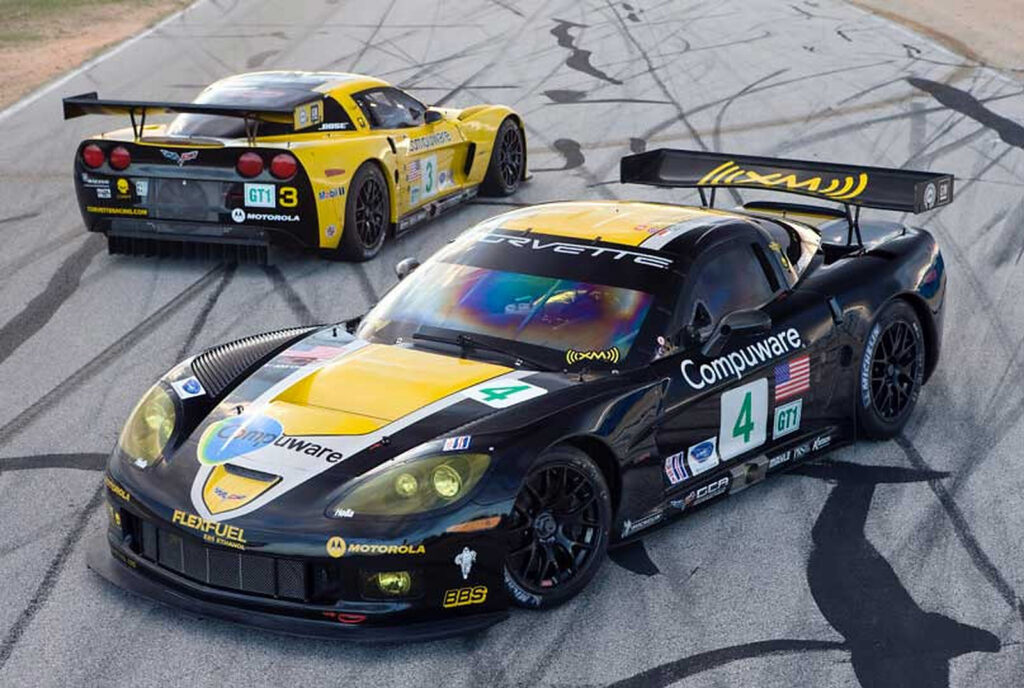
As the number of regular competitors declined, Corvette Racing increasingly found itself in the unusual position of racing its own two cars for class honors. That situation was less satisfying from a marketing perspective than defeating Aston Martin, Saleen, Ferrari, or another manufacturer, but it did not mean the No. 3 and No. 4 Corvettes merely circulated together until the checkered flag. The two driver pairings were exceptionally well matched, and the competition between them remained intense. Each crew developed its own setup preferences, tire strategies, fuel calculations, and approaches to traffic, creating an internal rivalry that continued to produce useful engineering data even when outside competition was scarce.
Doug Fehan later recalled that the shrinking field caused some within General Motors to question whether the company should suspend the program long enough for the rest of the category to recover. His response was grounded in the realities of operating a professional race team. Closing the shop for a year or more would risk losing drivers, engineers, mechanics, managers, and the institutional knowledge that had taken years to assemble. Those people were competitors by nature—“Racers want to go racing,” as Fehan put it—and there was no guarantee that they would still be available whenever Chevrolet decided to return.
Fehan also understood that Corvette Racing had become one of Chevrolet’s most effective marketing tools. During an era in which conventional Corvette advertising was comparatively limited, the racing program placed the car in front of enthusiasts across North America and around the world. The yellow Corvettes appeared at major endurance events, television broadcasts, dealer programs, enthusiast corrals, auto shows, and international competitions, creating an identity that connected the production Corvette to a visibly successful factory effort. Walking away from the program simply because the team had become too difficult to beat would have sacrificed much of what that success had created.
The situation nevertheless became increasingly difficult to sustain. A racing category requires more than one committed manufacturer if it is going to remain commercially relevant, and by the end of the decade the ALMS version of GT1 no longer offered the depth of competition it had possessed only a few years earlier. It would be tempting to say that the C6.R destroyed the category by winning too often, but that explanation gives the Corvette both too much credit and too much blame. GT1 was undermined by escalating costs, shrinking grids, shifting manufacturer priorities, fragmented international participation, and a growing preference for regulations that required cars to remain more closely related to their production counterparts.
The C6.R’s dominance accelerated the problem because it established the financial and technical standard that any new challenger would need to meet. At the same time, the presence of Aston Martin at Le Mans proved that Corvette could still be beaten when another manufacturer committed comparable resources to the effort. The larger issue was not that no one could build a faster car. It was that fewer companies could justify spending the money required to develop, homologate, operate, and continually update a full GT1 program.
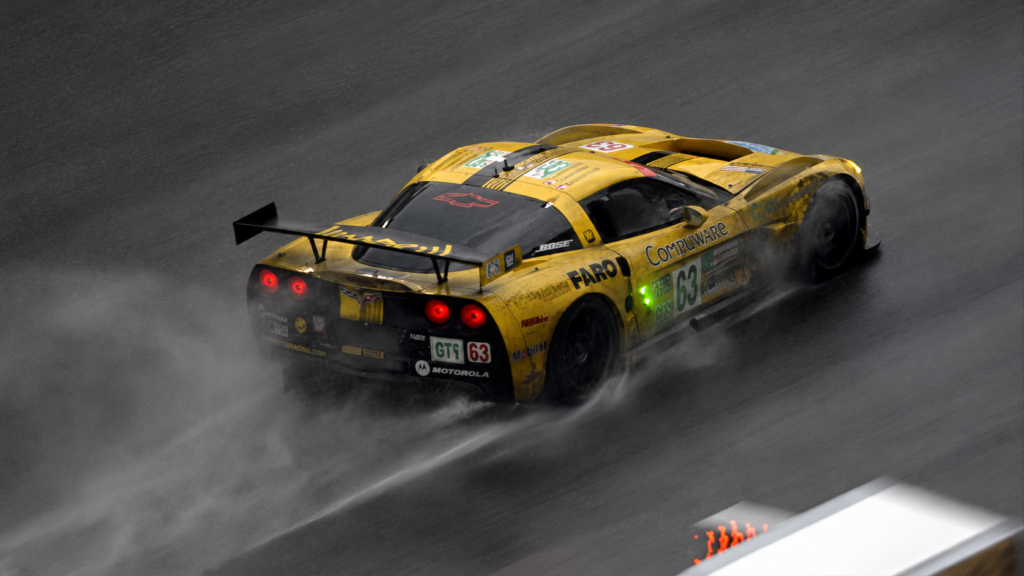
By 2009, Corvette Racing had already committed to moving into the more production-oriented GT2 category, but the team planned one final abbreviated campaign for the original GT1 C6.R. The two factory cars opened the ALMS season by winning at Sebring and Long Beach before returning to Le Mans for their last race in GT1 specification. There, the No. 63 Corvette shared by Johnny O’Connell, Jan Magnussen, and Antonio García secured the class victory, giving the factory GT1 C6.R a fitting conclusion at the event that had done more than any other to define its reputation.
After Le Mans, Corvette Racing introduced the new GT2-specification C6.R at Mid-Ohio. Although it carried the same basic name and retained the unmistakable appearance of a sixth-generation Corvette, it was a substantially different car developed around more restrictive regulations and a much closer relationship to the production Corvette ZR1. The GT2 version competed through the conclusion of the 2013 season before being replaced by the C7.R in 2014.
The move did not represent a retreat from competition so much as an acknowledgment of where international GT racing was headed. GT2 offered deeper fields, greater manufacturer participation, and a regulatory structure intended to control costs while strengthening the connection between the racing cars and the models sold to the public. Corvette Racing would encounter formidable opposition from Ferrari, Porsche, BMW, Ford, and Aston Martin under those rules, beginning another successful chapter in the program’s history.
Still, the GT1 C6.R occupied a space that none of its successors could completely replicate. It belonged to the closing years of an era in which large-displacement, highly specialized grand touring cars competed with an extraordinary degree of mechanical and aerodynamic freedom. Its success did not single-handedly end that era, but it exposed how difficult the category had become for anyone unwilling or unable to match Corvette Racing’s commitment.
In that sense, the C6.R really may have been too good for its own good. It did not merely defeat the competition placed in front of it; it established a standard of preparation, reliability, and sustained performance that fewer and fewer rivals were prepared to pursue. By the time Chevrolet finally moved on, the C6.R had not run out of speed or victories. It had simply outlasted the competitive environment for which it had been created.
The GT1 C6.R’s Enduring Legacy / Why It Still Matters Today
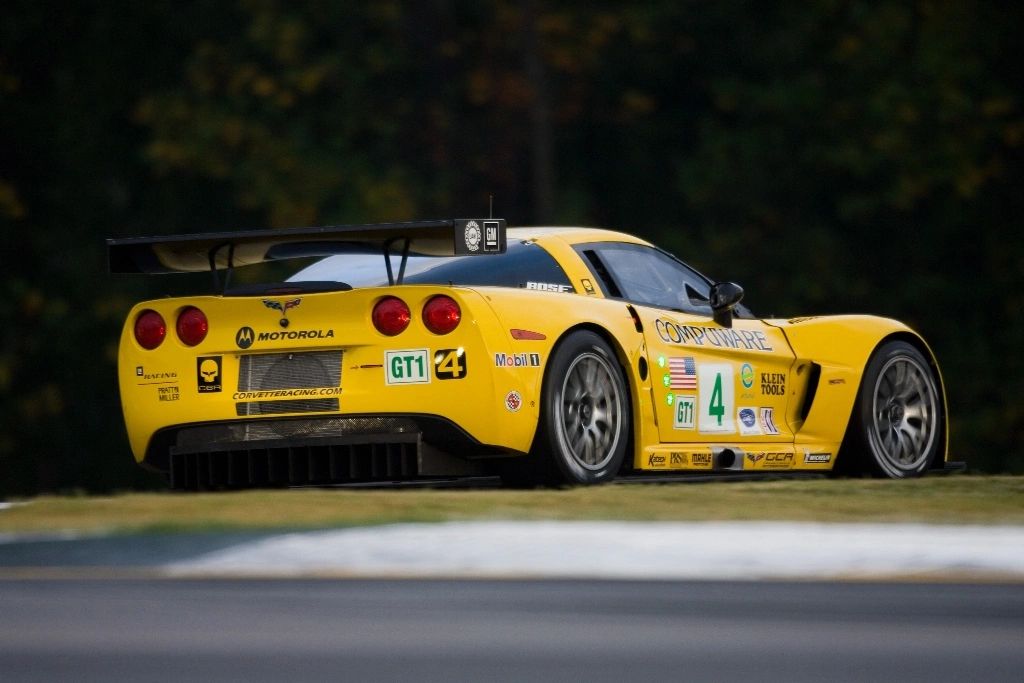
For anyone fortunate enough to witness the GT1 C6.R in competition, the statistics tell only part of the story. Its victories and championships were extraordinary, but the car’s reputation was also shaped by the experience of seeing and hearing it operate at racing speed. The low, wide body appeared almost impossibly planted to the pavement, while the unmistakable sound of its naturally aspirated 7.0-liter V8 carried across a circuit long before the yellow bodywork came into view. At venues such as Sebring, Road Atlanta, Mosport, Road America, and Le Mans, the arrival of a C6.R was not something spectators had to see to recognize.
Those qualities made the car memorable, but it was the consistency of the larger Corvette Racing program that made it historically significant. Chevrolet and Pratt Miller did not build one exceptional race car, discover one advantageous rules package, or assemble one championship season before fading back into the field. They created an organization capable of competing at the highest level year after year, across sprint races, endurance contests, temporary street circuits, permanent road courses, and the changing conditions of the 24 Hours of Le Mans. From the C6.R’s debut in 2005 through the conclusion of the factory GT1 campaign in 2009, Corvette Racing maintained a standard of preparation and execution that few sports-car racing programs have equaled.
Chevrolet’s historical accounting credits the C6.R GT1 Corvette with 39 victories in the American Le Mans Series. When its three GT1 wins at the 24 Hours of Le Mans are added, the factory-era total reaches 42 major class victories. The car also delivered ALMS driver, team, and manufacturer championships in four consecutive seasons from 2005 through 2008, along with winning streaks that demonstrated just how difficult the program had become to defeat. Corvette Racing won twelve consecutive ALMS races across portions of the 2005 and 2006 seasons, followed by an even more remarkable stretch of twenty-five consecutive class victories from 2007 into 2009.
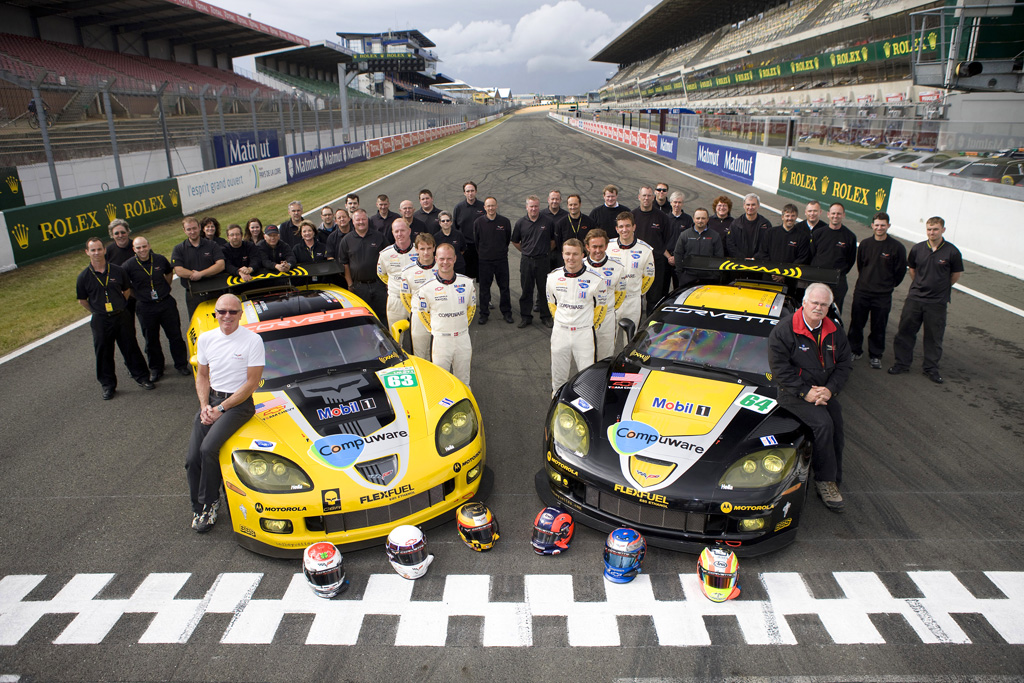
The Le Mans results remain central to the C6.R’s identity. Corvette Racing won GT1 during the car’s first appearance at the Circuit de la Sarthe in 2005, repeated the achievement in 2006, and returned to the top step of the class podium in 2009 during the factory team’s final race under GT1 regulations. The 2006 result was especially impressive, as the victorious No. 64 Corvette finished fourth overall behind only the three Audi R10 diesel prototypes. For a front-engine grand touring car competing among purpose-built prototypes, it was an extraordinary accomplishment and one of the finest overall finishes ever achieved by Corvette Racing at Le Mans.
None of this meant the C6.R was invincible. Aston Martin defeated Corvette at Le Mans in both 2007 and 2008, proving that a properly funded and professionally operated rival could still overcome the yellow cars on the largest stage in endurance racing. The Aston Martin DBR9, Saleen S7-R, Maserati MC12, Ferrari 550 and 575 GTC, and other GT1 machines of the period represented serious engineering programs in their own right, and the best of them were capable of matching or surpassing the Corvette under the right conditions.
What separated Corvette Racing across the length of the program was not any single mechanical advantage, but the completeness of the effort. The LS7.R engine was powerful, but it was also durable. The chassis was fast, but it had been designed around the practical realities of endurance racing, including serviceability, repair access, driver changes, cooling requirements, and the need to remain predictable over long runs. The drivers were aggressive, but they understood traffic management, tire conservation, fuel strategy, and the importance of bringing the car home. Behind them stood a disciplined crew and engineering group that continued refining the C6.R even after the depth of regular competition in the ALMS had begun to decline.
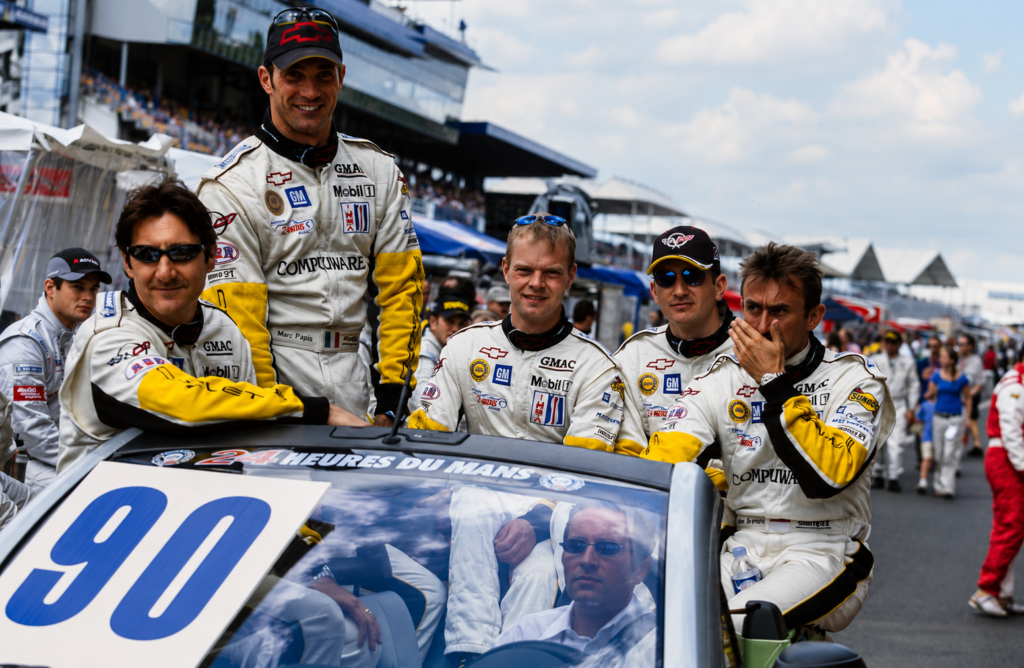
The drivers themselves became inseparable from the car’s history. Ron Fellows, Johnny O’Connell, Oliver Gavin, Olivier Beretta, Jan Magnussen, Max Papis, Antonio García, and the other men who shared the C6.R’s cramped cockpit contributed far more than lap times. Their battles against Aston Martin, their performances at Sebring and Le Mans, and the increasingly intense rivalry between Corvette Racing’s own No. 3 and No. 4 crews gave the program a human dimension that results tables alone cannot communicate. These were highly competitive drivers operating within one organization, and the internal fight for victories and championships often remained fierce even when the number of outside GT1 entrants had diminished.
Another remarkable aspect of the program was how few cars Pratt Miller required to produce such an extensive record. Eight GT1 C6.R chassis were constructed, numbered C6R-001 through C6R-008, with successive pairs introduced as the factory program evolved. Although the newest chassis generally received the latest developments, the earlier cars did not immediately become obsolete when Corvette Racing moved on to newer equipment. Several began second careers in Europe, where they competed in different liveries and under the direction of private teams.
Organizations including PSI Experience, Luc Alphand Aventures, Phoenix Carsport, PK Carsport, Selleslagh Racing Team, and Mad-Croc Racing campaigned former factory C6.Rs in the Le Mans Series, FIA GT Championship, French GT competition, and, eventually, the FIA GT1 World Championship. Those appearances extended the competitive life of the C6.R well beyond the factory team’s abbreviated final GT1 season in 2009 and demonstrated that the car’s success was not entirely dependent upon Chevrolet entering it beneath the Pratt Miller awning.
24 Hours of Spa
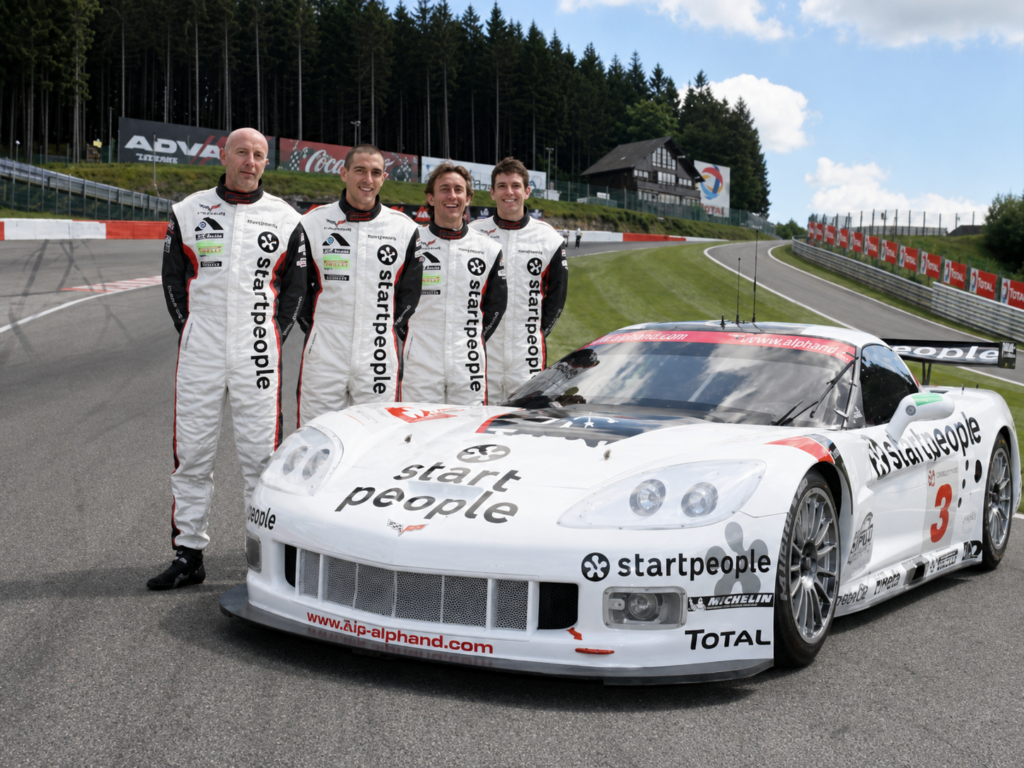
The 24 Hours of Spa became an especially important part of the C6.R’s privateer history. Carsport Holland won the event with a Corvette in 2007, and PK Carsport repeated the achievement in 2009. Those victories gave the C6.R two of the most prestigious endurance-racing successes available outside Le Mans and proved that former factory chassis remained capable of defeating the strongest GT1 competition in Europe after several seasons of use.
The international careers of these cars also gave individual chassis unusually complex histories. A single C6.R might begin its life in Corvette Racing yellow, compete at Sebring and Le Mans with factory drivers, and later reappear in Europe wearing an entirely different color scheme and carrying the identity of another team. Some cars accumulated years of competition across several championships, while others were rebuilt following accidents, updated as regulations changed, or transferred among teams as the remaining GT1 market evolved.
That history gives each surviving chassis an importance that extends beyond its appearance. These are not interchangeable examples of a common racing design. Every car carries its own combination of drivers, liveries, race entries, victories, repairs, mechanical revisions, and ownership changes. Establishing the identity and provenance of an individual C6.R therefore requires more than checking the number painted on its doors. Chassis plates, build records, period photographs, race documentation, and the records maintained by Pratt Miller and the private teams all contribute to understanding what a particular car accomplished.
Everything That Came After
The legacy of the C6.R GT1 Corvette version should not be used to diminish the later GT2 and GTE C6.R that followed it. The second-generation competition car entered a deeper and more consistently populated category, where Corvette Racing faced factory-backed opposition from Ferrari, Porsche, BMW, Aston Martin, and others. It won the GTE Pro class at Le Mans in 2011 and provided an essential bridge between the original GT1 program and the arrival of the C7.R. Its achievements deserve to be evaluated on their own merits rather than dismissed simply because its annual victory totals did not resemble those accumulated during the final years of a shrinking GT1 field.
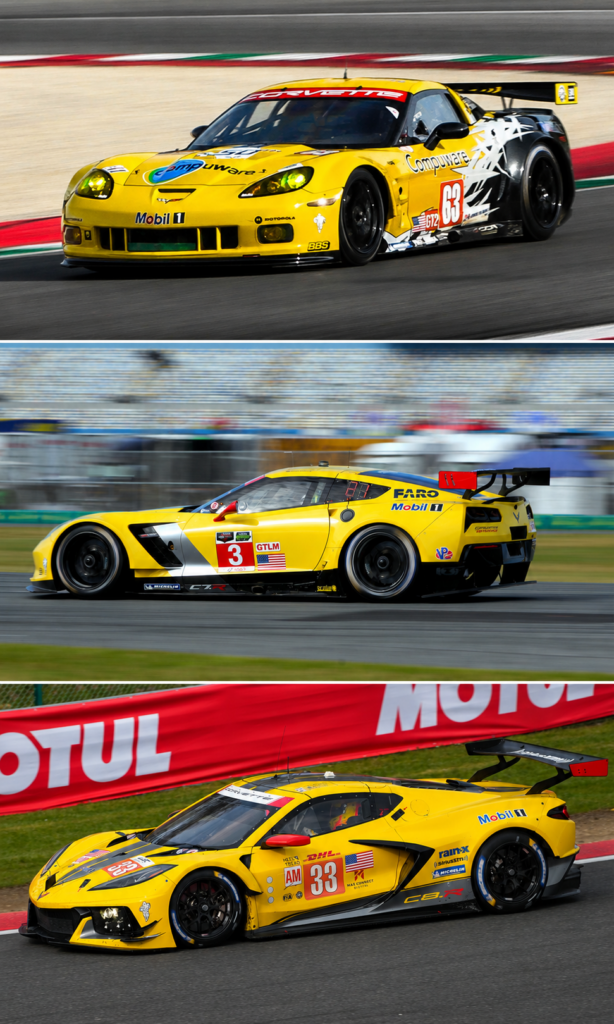
Even so, the original C6.R GT1 Corvette occupies a different place in Corvette history. It represented the final and most fully developed expression of the large-displacement, front-engine racing philosophy Chevrolet and Pratt Miller had introduced with the C5-R. The C7.R and C8.R that followed were successful in their respective categories, but they operated under different regulations and reflected different eras of international GT competition. Neither was intended to reproduce the GT1 C6.R’s particular combination of displacement, relatively low weight, aerodynamic freedom, mechanical specialization, and unmistakable V8 character.
That distinctiveness remains one reason the C6.R GT1 Corvette continues to command such attention whenever one appears at a museum, concours, historic race, or track demonstration. The bright yellow bodywork, black rear wing, exposed headlamps, crossed-flags emblems, and later “Jake” skull graphic created a visual identity recognizable far beyond the traditional Corvette community. The No. 3 and No. 4 cars became familiar to spectators who might never have considered purchasing a Corvette, while the battles with Aston Martin introduced many enthusiasts to international GT racing.
The sound was every bit as important as the appearance. Racing history can be preserved through photographs, lap times, chassis records, and finishing positions, but none of those fully capture what it was like to stand near the circuit as a C6.R accelerated through the gears. Its exhaust note became part of the atmosphere at the tracks where it competed, creating an emotional connection that no specification sheet could reproduce. Historic demonstrations continue to draw crowds because they restore that sensory experience, even if only for a few laps.
The car’s continued relevance also rests in what the program taught Chevrolet and Pratt Miller about building a lasting racing organization. The C6.R years reinforced the value of stable personnel, consistent driver pairings, detailed preparation, rapid pit work, and continuous development. When outside competition disappeared from much of the ALMS GT1 field, the team used the rivalry between its own two cars to maintain competitive intensity and continue gathering useful engineering data. That discipline later became essential when Corvette entered GT2, GTE, GTD Pro, and GT3 competition against renewed manufacturer opposition.
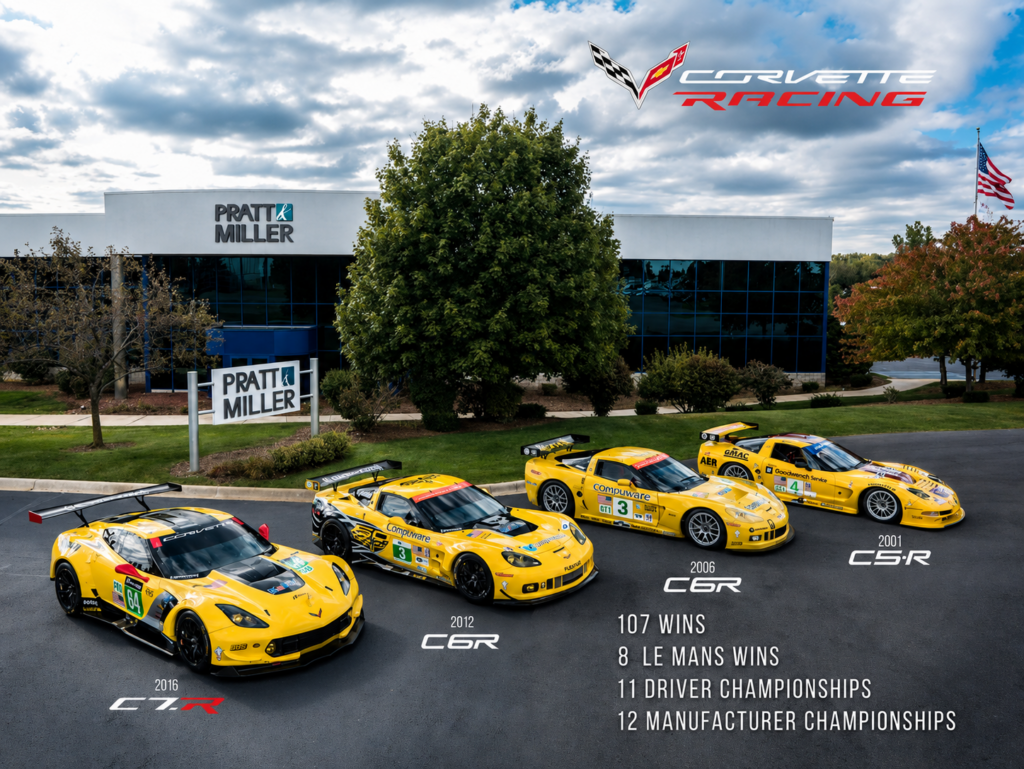
In this sense, the most enduring contribution of the C6.R may not be any individual component or victory. It helped define what Corvette Racing expected of itself. The program demonstrated that success at Le Mans could not be treated as a once-a-year project and that championships could not be won through horsepower alone. They required a permanent organization capable of retaining knowledge, developing personnel, learning from failures, adapting to changing regulations, and applying the same standards regardless of whether the team was fighting Aston Martin for a Le Mans victory or racing its own sister car in a depleted ALMS class.
The relationship between the C6.R and the production C6 also helped establish a model that continues to influence Corvette development. The two cars did not share every component, nor was the road-going Z06 simply a detuned race car, but their parallel development encouraged greater cooperation between the engineers responsible for the showroom Corvette and those working at the racetrack. Aerodynamics, cooling, materials, braking, engine durability, driver visibility, and packaging could be studied as connected parts of one broader performance program.
That philosophy has endured even as the Corvette itself has changed dramatically. The modern mid-engine C8 and its racing derivatives occupy territory that engineers and enthusiasts discussed for decades, while the current GT3 program reflects a global customer-racing structure far removed from the factory-centered GT1 effort of 2005. Even so, Chevrolet and Pratt Miller remain connected, and the idea that competition should inform the production Corvette—and that the production car should provide a credible foundation for racing—remains central to the program.
The privateer careers of the original C6.R GT1 Corvettes also anticipated the broader customer-racing approach Corvette has now embraced. After leaving the factory team, those GT1 cars continued competing under independent ownership, carrying the Corvette name into championships and markets where the two yellow factory cars could not appear every weekend. Today, customer teams perform a similar role on a much larger scale, competing with Corvette machinery across multiple international series.
The GT1 C6.R also provides an important counterpoint to the modern mid-engine Corvette. The C8 has demonstrated the advantages of placing the engine behind the driver, but the C6.R reminds us that the traditional front-engine Corvette architecture was never simply an outdated limitation waiting to be corrected. In its most developed form, it produced a car capable of winning repeatedly against some of the finest GT machinery in the world.
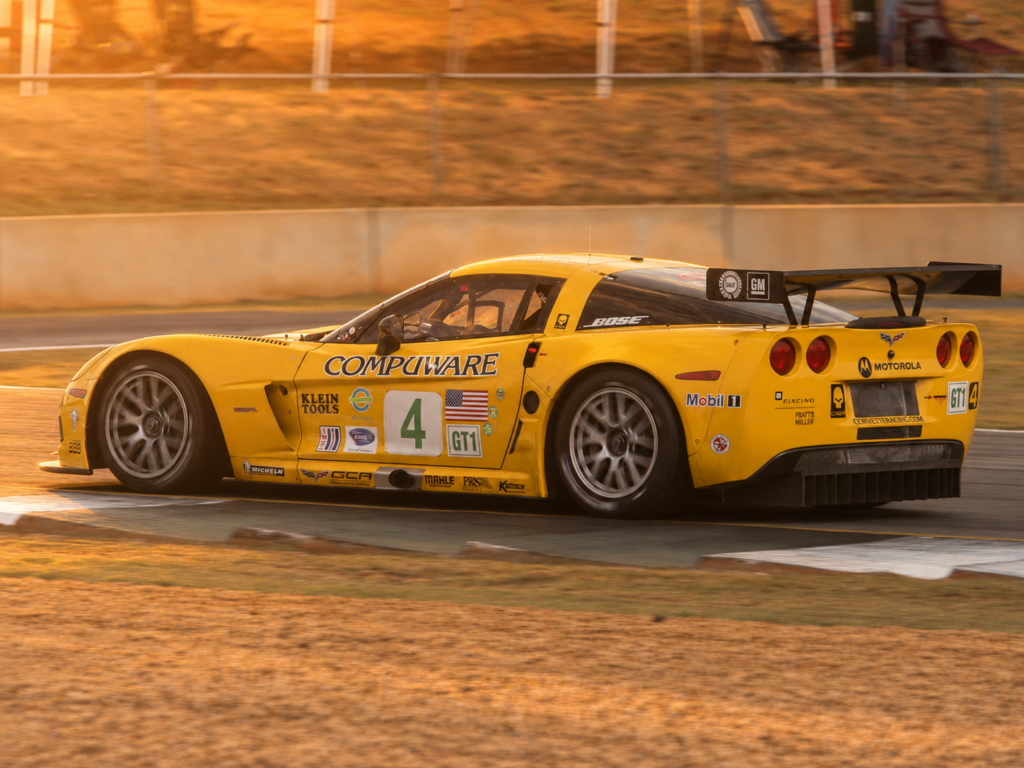
That achievement gives the C6.R a permanent place in the larger Corvette story. It stands at the intersection of the traditional and modern eras: front-engined but technologically sophisticated, recognizably related to the production Corvette yet purpose-built for competition, rooted in the lessons of the C5-R while influencing every racing Corvette that followed.
There will almost certainly be faster competition Corvettes, and future programs may eventually surpass portions of the C6.R’s statistical record. What will be much harder to reproduce is the particular combination of car, category, sound, rivalry, and circumstance that defined the GT1 era. The C6.R arrived when Corvette Racing had matured into a world-class organization, competed during the closing years of one of sports-car racing’s most spectacular categories, and completed its factory GT1 career with another victory at Le Mans.
Nearly two decades after its debut, the C6.R GT1 Corvette remains one of the clearest statements Chevrolet has ever made about what the Corvette could accomplish on the international stage. It was powerful, durable, technically disciplined, unmistakable in appearance, and supported by one of the finest organizations in endurance racing. Most importantly, it fulfilled the purpose for which it was created: to compete against the best grand touring cars in the world and win often enough that its rivals, drivers, and the enthusiasts who witnessed it have never forgotten it.