
The Year Chevrolet Had to Prove the C5 Was No Fluke
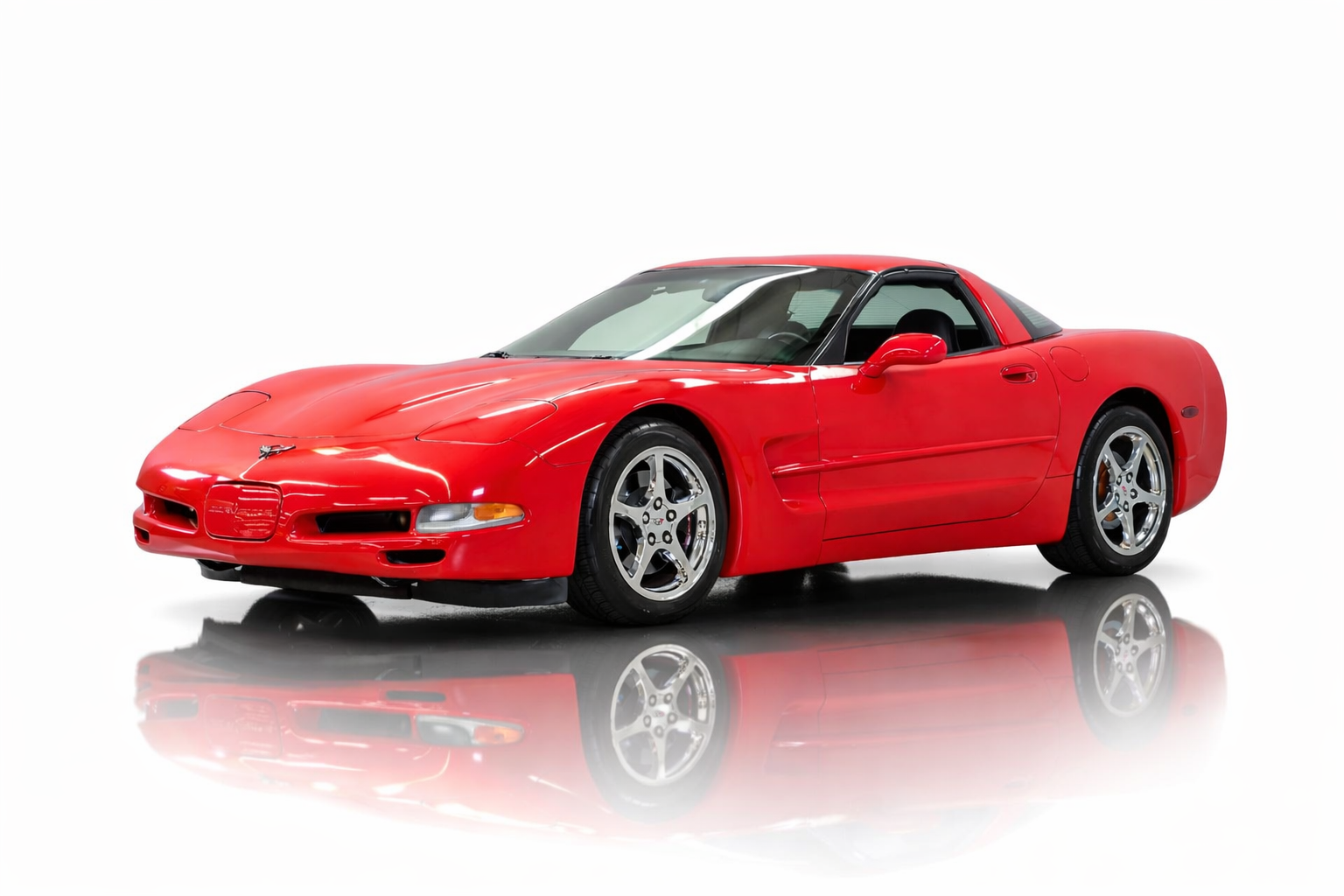
The 1998 Corvette was not asked to reinvent the franchise. Chevrolet had already done that in 1997. What 1998 had to do was something just as important: prove that the all-new C5 was not a one-year wonder, not a limited-launch success story inflated by novelty, and not a coupe-only achievement that would lose its structural rigidity the moment the roof came off. In that respect, the introduction of the 1998 model year was absolutely decisive. It brought about the first full-production season of the C5, reintroduced a convertible variant (which had always been part of the plan), introduced meaningful new technology, gave Chevrolet a high-profile Indianapolis 500 halo car, and closed the model year by pointing Corvette back toward serious factory-backed endurance racing. This was the year the C5 stopped being “the new Corvette” and started becoming the Corvette that reset expectations.
The sales mix tells part of that story. Chevrolet built 31,084 Corvettes in 1998, split between 19,235 coupes and 11,849 convertibles, meaning the open-car model accounted for approximately 38 percent of total production in its inaugural year. That was not a niche body style tacked onto a successful coupe. It was an immediate, meaningful part of the C5 story, and buyers responded like they had been waiting for it. At the same time, the car’s industry reception remained emphatic: the new-generation Corvette won Motor Trend’s 1998 Car of the Year, North American Car of the Year, and a Popular Science Best of What’s New grand prize, while Car and Driver put it on its 10Best list and praised the new convertible’s solidity, speed, and ease of use.
Chevrolet Did Not “Add” a Convertible. It Engineered One From the Beginning.
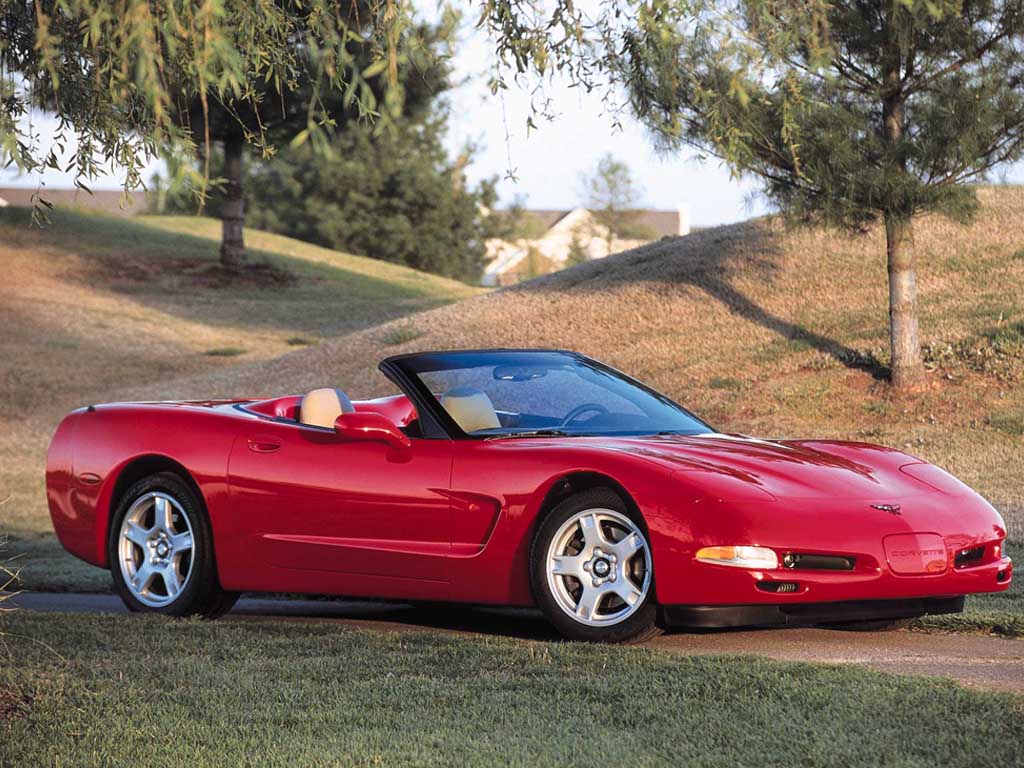
As the heading states, the distinction matters because the 1998 convertible was not a compromise. Chevrolet said outright that Corvette engineers had designed the 1997 car as a “topless” vehicle from the start, which is exactly why the 1998 convertible arrived without the usual structural challenges that tend to follow open-air variants. John Middlebrook, a senior engineer at General Motors and one of the key figures behind the development of the C5 Corvette, went even further, stating that the new car was “more rigid than any of the world-class convertible sports cars that Chevrolet measured during Corvette development.” That was a bold claim, but period road tests backed up the basic point. Car and Driver found the C5 convertible unusually free of cowl shake and rattles, and recorded a torsional-rigidity figure of 21.3 hertz with the top down, only two hertz shy of the coupe with its roof panel in place.
Just as important, Chevrolet achieved that result without turning the convertible into a heavy, overbuilt afterthought. Car and Driver reported that the manual top helped keep weight in check and noted that the convertible was only one pound heavier than the coupe, according to Chevrolet’s specifications. That was a remarkable figure for the period, and it explains why the 1998 convertible never felt like a softer, less serious member of the family. It was still a C5 first. It just happened to let the sky in.
The Convertible’s Best Trick Was Practicality
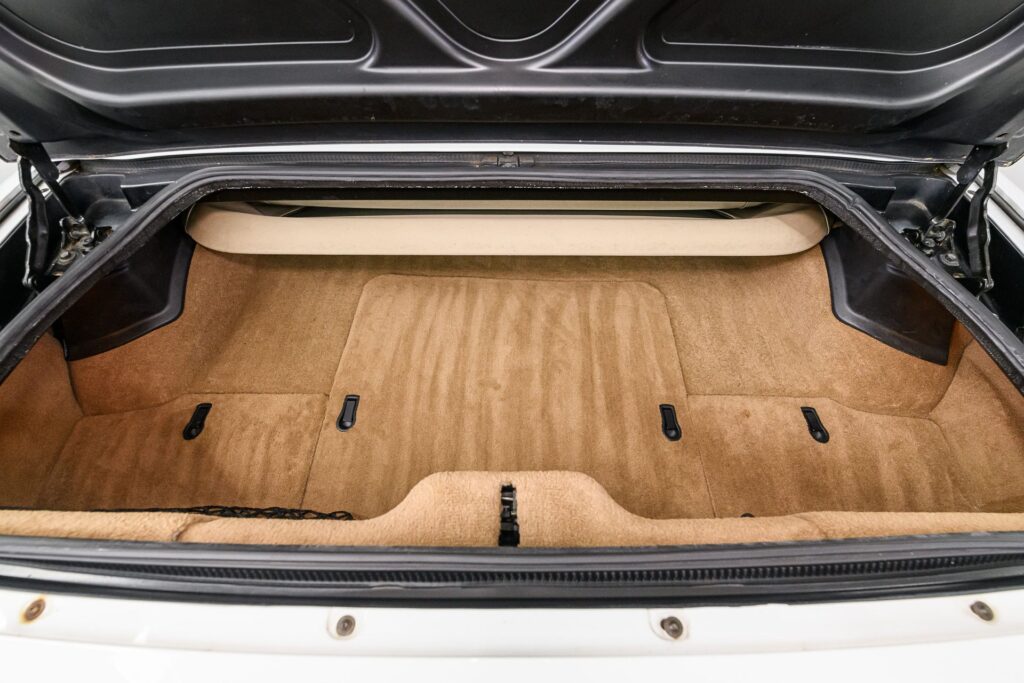
Chevrolet understood that if the new convertible was going to matter, it had to be more than pretty. So the 1998 Corvette convertible brought back something Corvette buyers had not had in an open car since 1962: a proper trunk accessible from the outside. Chevrolet’s own material bragged that it could hold two sets of golf clubs, while Motor Trend pegged the space at 13.9 cubic feet and emphasized how unusual that was in a real sports car. Car and Driver likewise noted how usable the trunk was and how much less space the manual top took up than a power arrangement would have. In other words, this was not just a Corvette with the roof removed. It was a Corvette that managed to be more livable while still looking sharper in profile with the top stowed.
The top itself was one of the most thoughtfully executed elements of the entire car. Chevrolet paired the cloth roof with a heated glass rear window, an express-down feature that partially lowered the side windows while releasing the tonneau cover, and a manual operation so efficient that Dick Almond famously summed it up: “We’re talking about seconds to take the top down.” Car and Driver put a number to it, timing the process at just 18 seconds and praising how cleanly it worked. This is significant because any awkwardness or complexity in the top’s operation would have compromised the car’s larger mission. Instead, the mechanism supported everything the C5 represented: a Corvette engineered not for gimmicks or unnecessary flourish, but to be more refined, more usable, and simply better in all the places that counted.
And visually, Chevrolet got it right. Motor Trend singled out the way the tonneau flowed into a waterfall section between the seats, explicitly connecting the car back to 1953-1962 Corvettes. That was more than nostalgia. It was a disciplined way to reintroduce an old Corvette cue in a body that otherwise looked modern, lower, cleaner, and far more resolved than the C4 convertible ever was. The 1998 roadster did not look like a roofless coupe. It looked like a Corvette that had been born open.
The LS1 and the Transaxle Layout Were Still the Heart of the Car
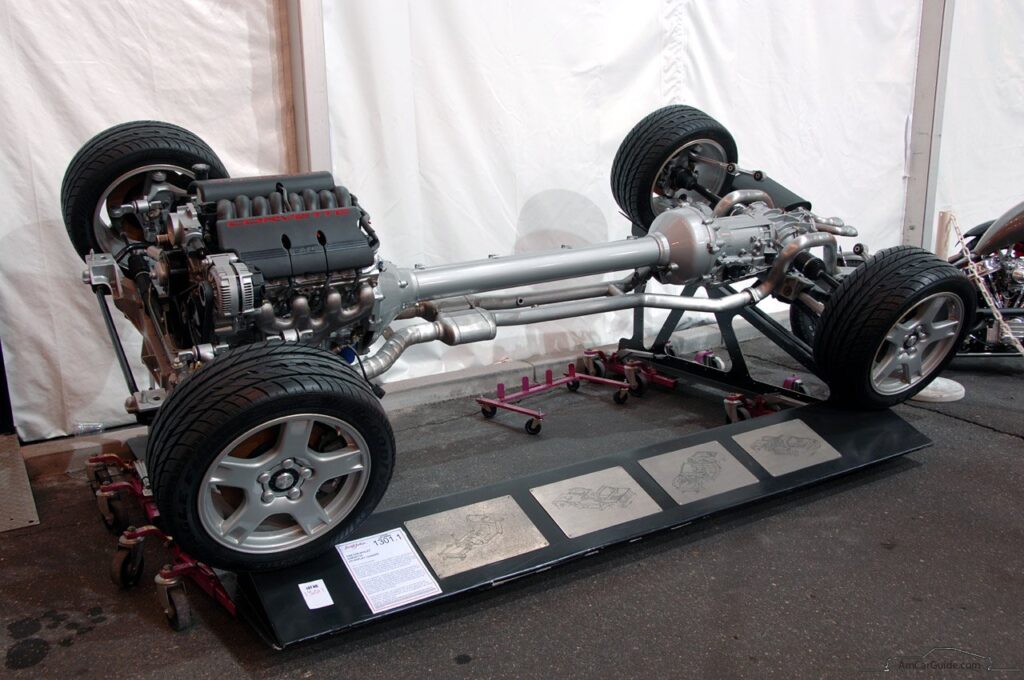
Even with all the attention focused on the arrival of the convertible, the real foundation of the 1998 Corvette remained the engineering formula that had already made the C5 such a watershed car. The LS1 continued as the lone engine offering, rated by Chevrolet at 345 horsepower and 350 lb-ft of torque. Chevrolet quoted a top speed of 175 mph and a 0-to-60 time of about 4.7 seconds with the six-speed, while Motor Trend recorded 4.8 seconds to 60 in the coupe along with a 13.2-second quarter-mile at 109.3 mph. Car and Driver, in its 10Best writeup, made clear that the C5 had not simply become more polished and more refined. It was still legitimately fast. That distinction was important, because while the Corvette had become more civilized, it had not given up the performance character that gave the name its weight in the first place.
The LS1 also represented a philosophical win for the Corvette team. In Motor Trend’s Car of the Year coverage, project manager John Juriga said “the key deciding factor” in sticking with a pushrod layout was that it “could develop more power while occupying less space than a DOHC engine.” That was not backward thinking. It was targeted engineering. The aluminum LS1 block saved substantial weight compared to the old LT4, met the packaging demands of the new chassis, and helped the C5 achieve its near-ideal balance target. Motor Trend credited that combination with contributing to a 51/49 front-rear weight distribution.
Then there was the transaxle. Motor Trend put the point plainly: the C5 became the first Corvette to use a rear-mounted transaxle in order to reduce crowding in the footwell and preserve a more even weight distribution. A five-inch torque tube tied the engine to the rear-mounted gearbox, and Chevrolet’s own materials emphasized the resulting gains in packaging, ride quality, and refinement. By 1998, that layout no longer needed to be defended in theory. It was proving itself in the real world as the foundation of a Corvette that felt more expensive, more composed, and far more international in the best sense of that word.
Transmission choice revealed how buyers used the car. The four-speed automatic remained the dominant gearbox, appearing in 23,978 of the Corvettes built in 1998, or 77.1 percent of total production, while the six-speed manual accounted for 7,106 cars, or 22.9 percent. Chevrolet also installed the F45 real-time damping suspension on 8,374 cars, or 26.9 percent of production, and the Z51 handling package was included on 4,249 cars, or 13.7 percent. That mix says a lot. Buyers still wanted performance, but they were now buying a Corvette that had broadened its appeal without becoming generic.
Chevrolet Kept Making the Car Easier to Live With
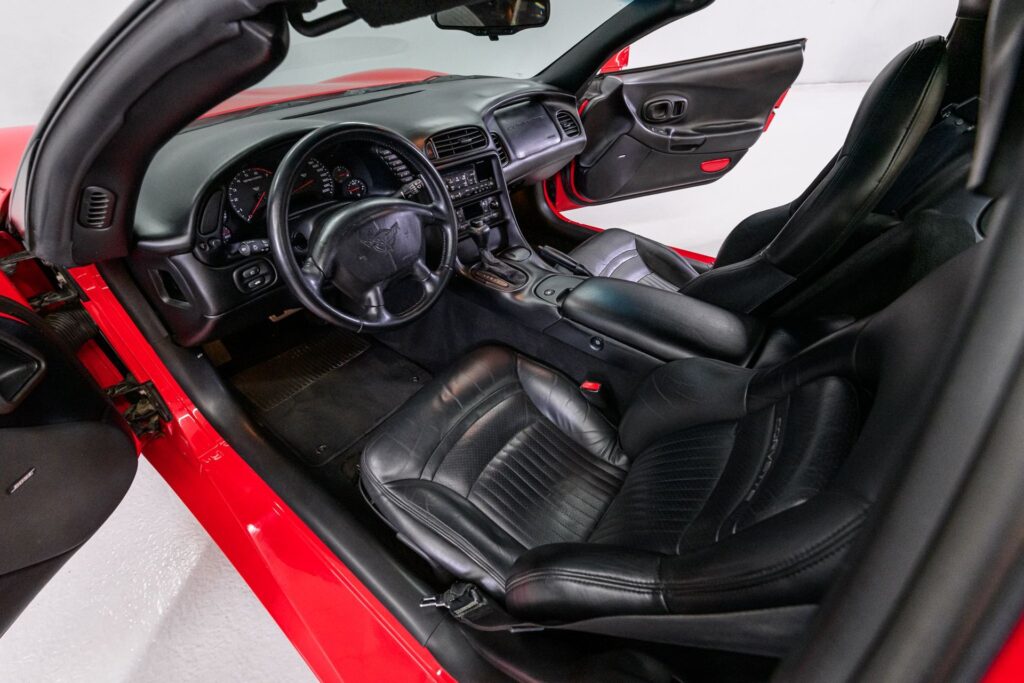
One of the most underrated parts of the 1998 Corvette story is how clearly Chevrolet understood that convenience and credibility no longer had to be enemies. The C5 already felt like a better long-distance car than the C4, and for 1998, Chevrolet leaned into that sentiment. New-year features included an engine air-filter monitor, extended-life coolant, and a 10,000-mile recommended oil-change interval under prescribed conditions. Standard extended-mobility tires and the low tire-pressure warning system remained central to the package, which is why Chevrolet could continue to eliminate the spare tire while preserving cargo capacity. The result was a Corvette that was easier to use, easier to maintain, and less compromised in day-to-day life than most people expected from a two-seat American sports car in the late 1990s.
The cabin story mattered too. Motor Trend pointed to the more spacious interior, dramatically improved instrument presentation, easier entry, and far friendlier ergonomics. Car and Driver’s 10Best piece made the same case more bluntly, noting that the old Corvette’s raw muscle had finally been joined by refinement and practicality. Those were not throwaway compliments. For decades, Corvette defenders had to explain away its shortcomings. By 1998, the burden was shifting. Now critics had to explain why the Corvette was no longer easy to dismiss.
Active Handling Brought Corvette Into the Electronic-Chassis Era
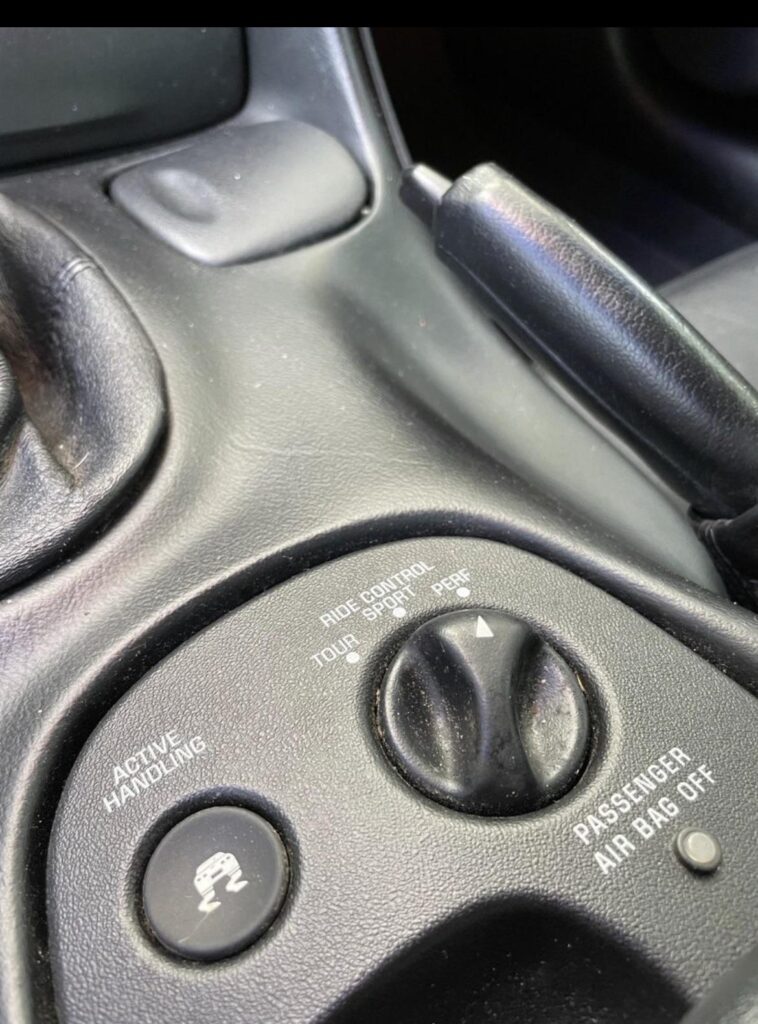
The most important technical change introduced during the 1998 model year was Active Handling, RPO JL4. Chevrolet announced it in November 1997, describing it as an optional chassis-control system that would become available on all Corvette models early in 1998, with the pace car package making it standard. Chevrolet was explicit about the system’s significance, stating that “No other sports car has a system like this,” and its technical description made clear that this was not a simple traction-control add-on. Active Handling monitored steering angle, yaw rate, and lateral acceleration, then selectively applied individual brakes to help stabilize the car when its actual path diverged from the driver’s intent.
What made the system important was not just what it did, but how it was tuned. Chevrolet said it gave the driver more latitude before intervention than rival systems, and it included a competition mode that disabled the traction-control portion to allow wheelspin in motorsport-style use. Mike Rizzo, one of the engineers behind the calibration, summed up the philosophy perfectly: “We never want to penalize a good driver for the deficiencies of a bad driver.” John Heinricy, deeply involved in the system’s development, was just as revealing when he said, “I wanted it to be a system I could drive at the track and wouldn’t want to turn it off.” That tells you everything about the mindset behind the 1998 Corvette. Chevrolet was not adding electronics to make the car timid. It was adding electronics to make the car smarter without dulling its edge.
The take rate shows that buyers recognized the value. Production data lists JL4 on 5,356 Corvettes, or 17.2 percent of the 1998 run. That is a healthy number for a mid-year-introduced performance-electronics option in 1998, and it also underscores how quickly Corvette buyers were willing to embrace new technology when it felt like it belonged in the car.
The Indianapolis 500 Pace Car Was a Big Moment, but the Details Matter
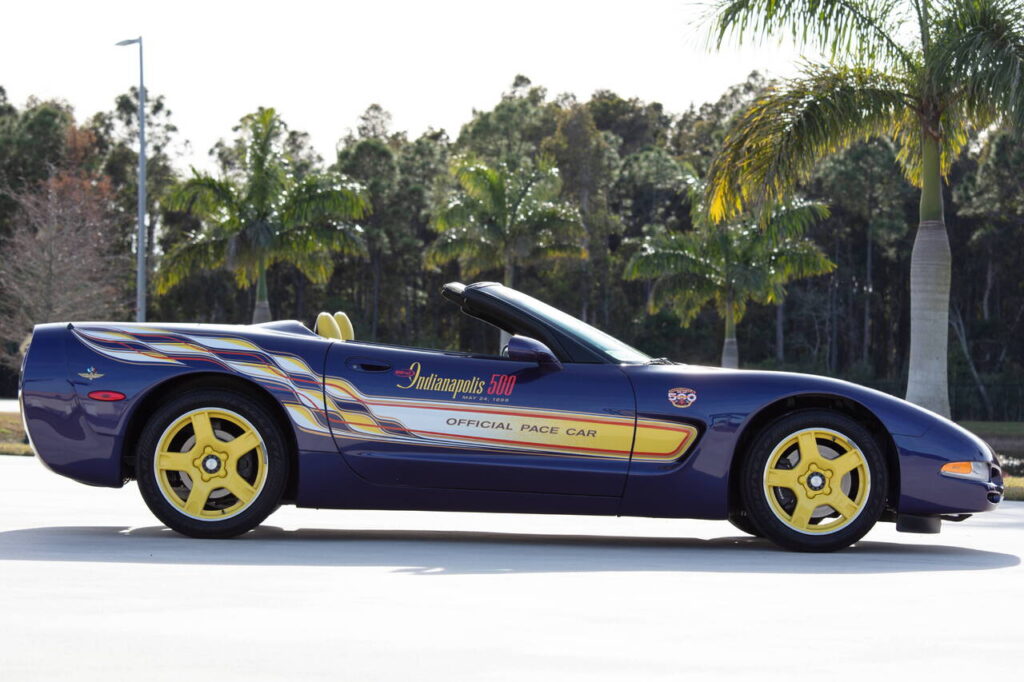
The 1998 Indianapolis 500 pace car gave Chevrolet exactly the kind of national spotlight the new convertible deserved. The company announced in November 1997 that the all-new convertible would serve as the official ace car at the 82nd running of the Great American Race, marking Corvette’s fourth Indy 500 appearance after 1978, 1986, and 1995. Chevrolet described the actual pace car as essentially factory stock, requiring only a steel roll bar, strobe lights behind the seats, and enlarged tonneau bulges with clear lenses to package the warning lights. That is worth emphasizing because it directly contradicts the common tendency to treat the real pace car as a heavily modified special. Chevrolet’s own press material said the 345-horsepower LS1 street drivetrain was sufficient for the job as delivered.
The look, of course, was anything but subtle. Chevrolet’s pace-car press releases described a special Radar Blue exterior with bright yellow wheels, yellow graphics, and a yellow-and-black interior. Yet production and paint-code references usually list the 21U color as Radar Purple Metallic. That is one of those wonderfully strange Corvette details that make the 1998 pace car so memorable: even its color is part of the lore. Chevrolet’s marketing language leaned blue; the production documentation leans purple; owners and collectors have spent years arguing somewhere in between.
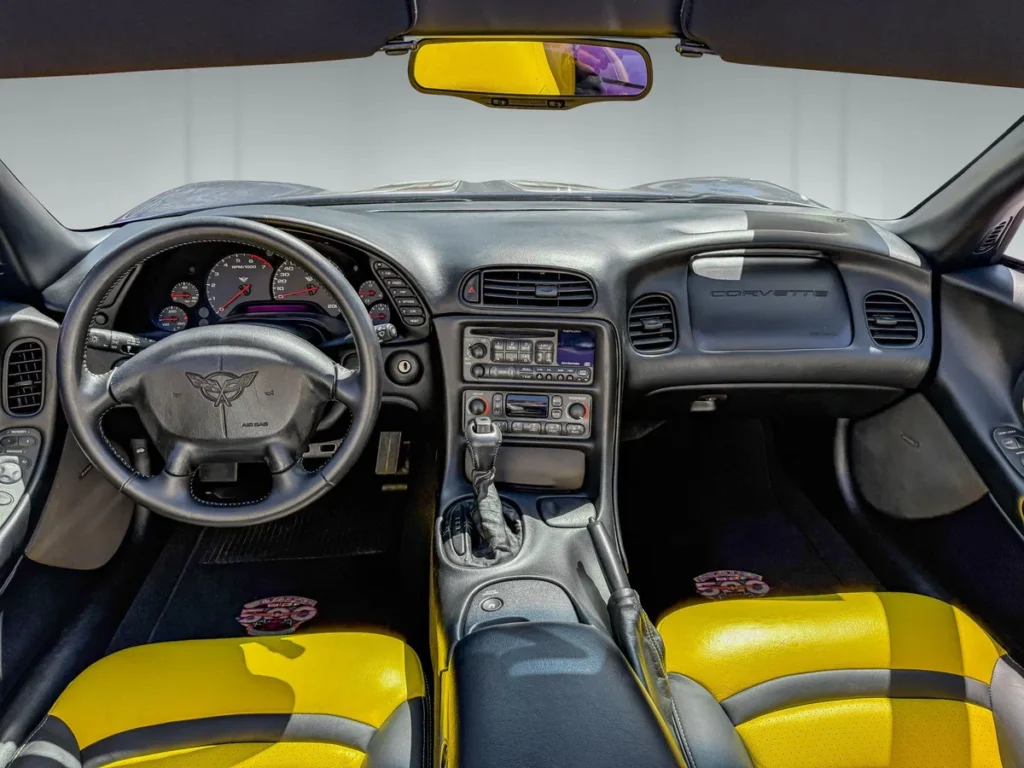
The replicas are another area where a careful review of the records is important. Chevrolet’s November 1997 press releases repeatedly said it planned to build 1,158 pace car replicas. But production references for the finished 1998 model year consistently show 1,163 Z4Z cars, matching the 1,163 total listed under 21U pace-car color production. So the cleanest way to say it is this: Chevrolet announced a 1,158-car plan, but the production data that enthusiasts and registries now rely on records 1,163 built. The package itself was generous, bundling the special paint and graphics with sport seats, memory package, dual-zone climate control, Bose audio, fog lamps, performance axle, and standard Active Handling. Chevrolet even noted unique neon-yellow stitching on the wheel, shifter, seats, and transmission-boot trim.
Even the pace-driver story has a twist. Chevrolet’s November 1997 announcement named Greg Norman as the driver, but the Indianapolis Motor Speedway’s official historical pace-car list records Parnelli Jones as the 1998 pace-car driver. That kind of discrepancy is exactly why the 1998 Corvette deserves a closer read than the usual shorthand summary. The year is full of details that were later simplified.
The 1998 Corvette Is Packed With the Sort of Collector Details People Love to Chase
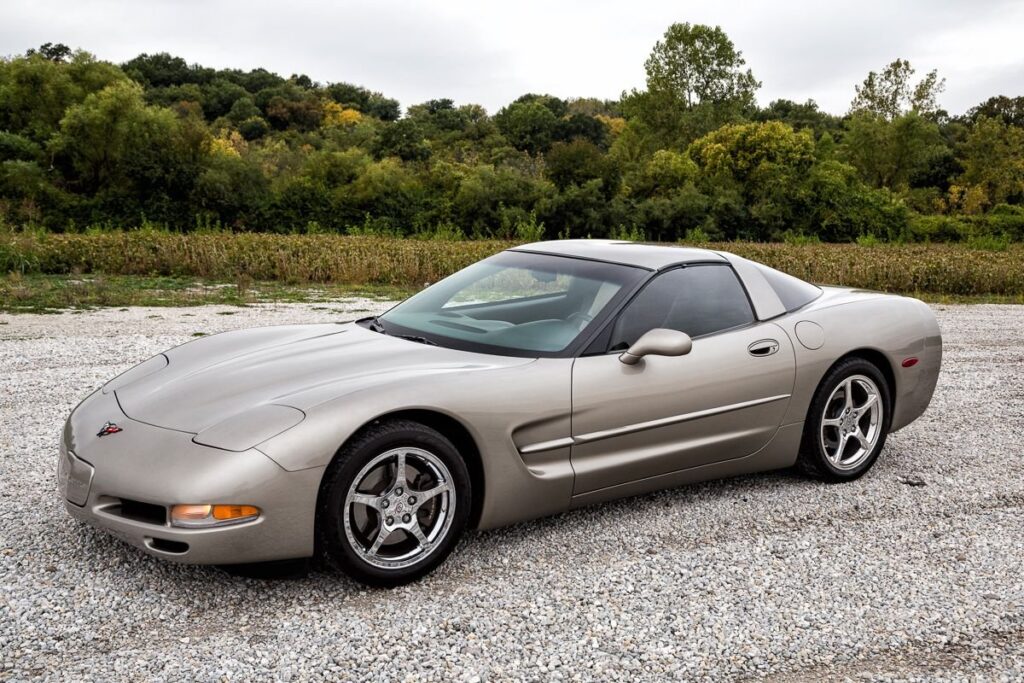
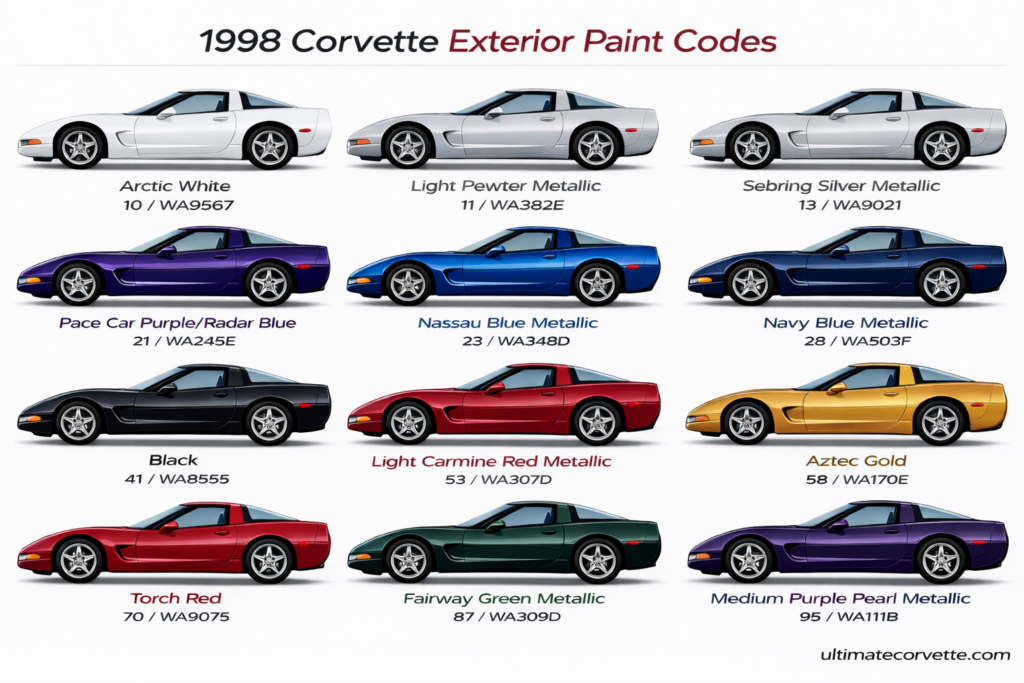
This is also one of the most interesting C5 model years if you care about rare-option and color trivia. Chevrolet officially added Light Pewter Metallic and Medium Purple Pearl Metallic for 1998, while the optional N73 five-spoke magnesium wheels arrived as a serious enthusiast item. Corvette Action Center’s production data identifies those Speedline-made magnesium wheels as a 1998 addition, and the production numbers show 1,425 cars got them, or 4.6 percent of the total run. That is low enough to matter, especially when you remember how expensive they were and how many were later damaged, refinished, or replaced.
Then there are the rare colors. Production tables show just 15 Aztec Gold cars and 14 Navy Blue cars for 1998, making them rarer than the pace-car color and dramatically rarer than medium-volume colors like Nassau Blue, Fairway Green, or Medium Purple Pearl. Registry documentation adds that Aztec Gold ended after only 15 cars, including three convertibles, while Navy Blue emerged late enough in production to edge it as the rarest 1998 shade. Fairway Green, meanwhile, was discontinued on November 13, 1997. These are the kinds of details that separate a broad C5 overview from a real 1998 discussion, because they show how active Chevrolet still was behind the scenes even as the basic product had already become a success.
One of the best obscure details from the year has nothing to do with paint at all. In July 1998, the C5 Registry reported that Chevrolet had begun placing a build sheet in the front frame rail of every new C5, a delightful echo of the old mid-year practice of hiding build sheets on top of fuel tanks. That is the sort of small production note that becomes catnip for future restorers and NCRS-style document hunters, and it is exactly the kind of thing that makes 1998 such a rewarding year to study closely.
By the End of 1998, Corvette Was Already Looking Back to Racing
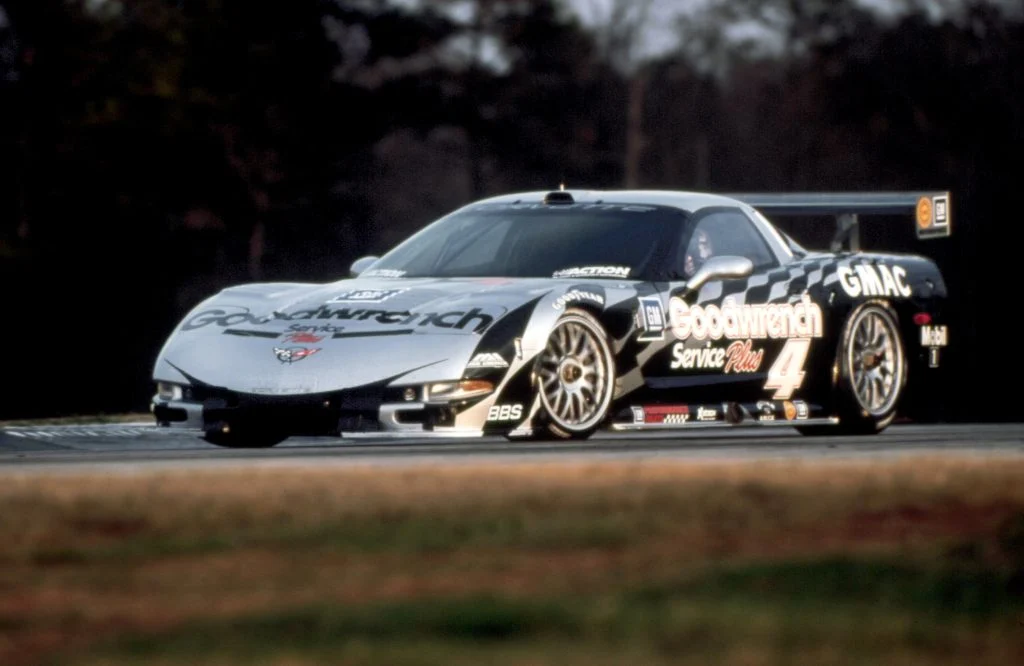
The final reason the 1998 model year matters so much is that it ended by pointing Corvette toward the next stage of its identity. In November 1998, Chevrolet announced that Corvette would return to factory-backed road racing with the C5-R, beginning in 1999 at the Rolex 24 at Daytona. John Middlebrook framed it as a restoration of purpose, saying, “The return of Chevrolet Corvette to the racetrack reinforces everything Corvette stands for.” Jim Campbell was even more direct: “Our primary focus is to improve the breed.” And Dave Hill connected the road car to the race program in the most important sentence of all: “The things that make it a great road car will also contribute to its success as a racecar.”
That announcement matters in any 1998 overview because it confirms what the best observers were already sensing. The C5 was not merely a better Corvette. It was a better platform. Chevrolet said Ron Fellows had already logged more than 4,000 miles in the C5-R using a significant number of production-based components. That meant the C5’s structure, layout, and general engineering logic were no longer just competitive in magazine comparisons. They were becoming the basis for a serious international endurance-racing effort. Once that happened, the story changed. Corvette was no longer asking for respect. It was building the tools to take it.
Why the 1998 Corvette Still Matters Today
If 1997 was the breakthrough, 1998 was the confirmation. It proved the C5 coupe was not a one-shot success. It proved Chevrolet could build a genuinely rigid convertible without burying it under weight and excuses. It proved Corvette buyers would embrace new technology like Active Handling when it was engineered with the right philosophy. It gave the C5 its first full-year production footprint, its first true open-air variant, its first Indy 500 spotlight of the generation, and some of its strangest and most collectible color stories. And by year’s end, it helped set the stage for the C5-R, which would go on to change the way the world talked about Corvette in competition.
That is why the 1998 Corvette deserves to be remembered as far more than the year the convertible came back. It was the year Chevrolet demonstrated that the C5 architecture was flexible, durable, sophisticated, and ambitious enough to carry Corvette into an entirely different era. The car had the performance. It had usability. It had the engineering credibility. And now, for the first time in a long time, it also had the unmistakable sense that the people behind it knew exactly what they had built. The rest of the world would spend the next several years catching up.