
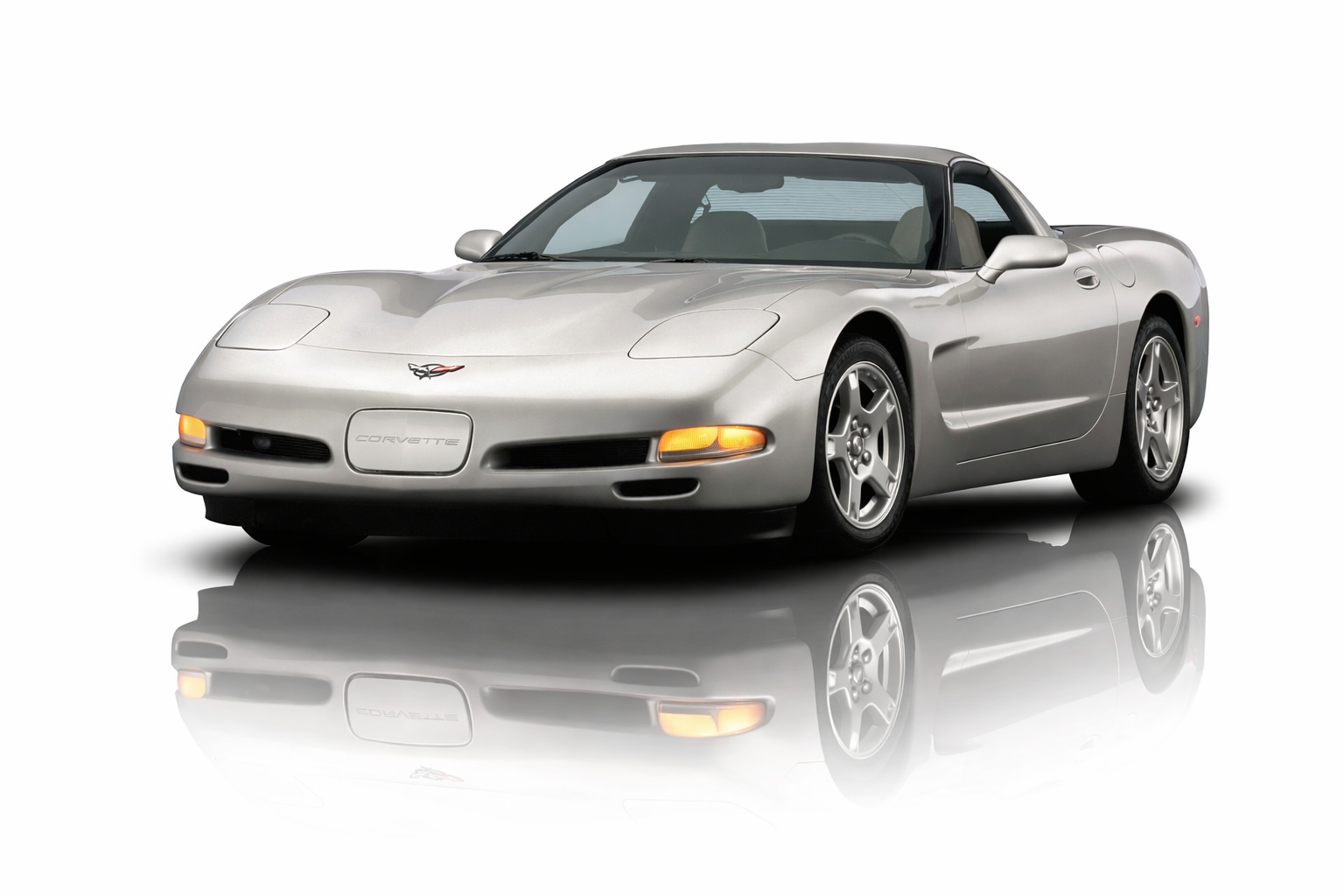
Tag: C5

  • 1997 CORVETTE OVERVIEW

    1997 CORVETTE OVERVIEW

    For Corvette enthusiasts the world over, March 7, 1997 was the day the waiting finally ended. After a long C4 sunset and months of spy shots, teases, and careful press choreography, Chevrolet opened the doors and let the first all-new Corvette in thirteen years out into the wild. The C5 wasn’t just a “next model year.” It was a structural, philosophical, and cultural reset—engineers and designers starting over with a clean sheet, refusing to let the Corvette become a museum piece defined by nostalgia more than capability. In Detroit that winter, and in showrooms by early spring, you could feel it: the fifth-generation Corvette would reframe the conversation about America’s sports car.

    Even before customers could buy one, the new car’s reveal showed how carefully Chevrolet staged the moment. At the January 1997 North American International Auto Show, the company put on a split-coast unveiling complete with Vegas-style misdirection and a magician orchestrating the stunts, then followed with a February press event in Chicago that doubled down on headlines. It worked. AutoWeek’s editors named the new C5 “Best in Show” in Detroit, and American Woman Motorscene called it “Most Likely to Be Immortalized”—early signals that the Corvette was being received as more than just a new body and brochure.
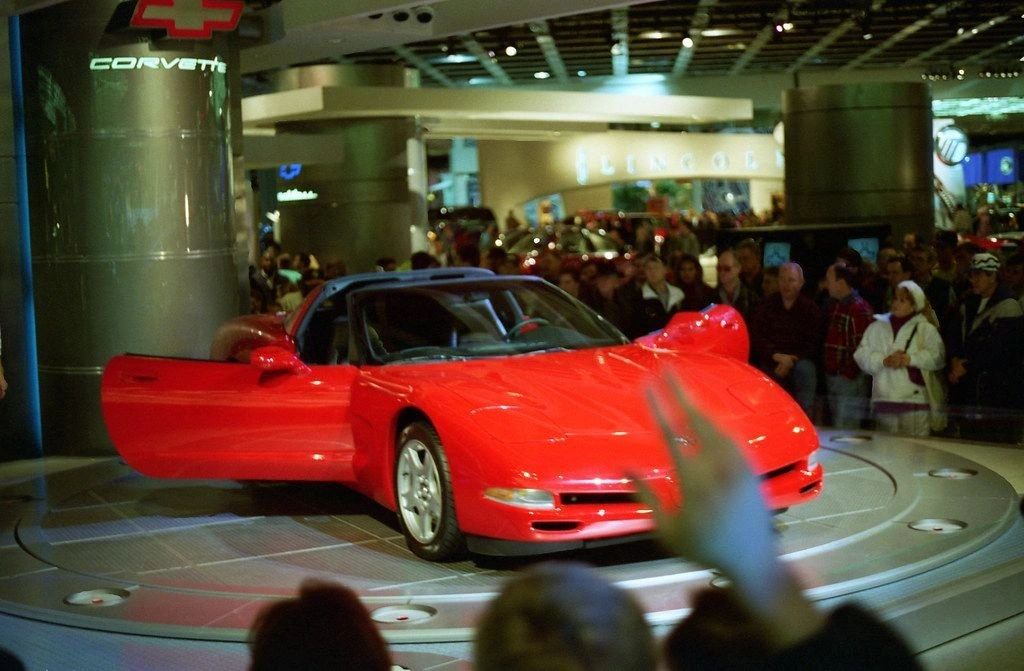
    Chevrolet unveiled the all-new 1997 Corvette (C5) on January 6, 1997 at the North American International Auto Show in Detroit. The clean-sheet car debuted a stiffer hydroformed frame, a rear-mounted transaxle for better cabin space and near-perfect balance, and a sleek 0.29 drag coefficient. Power came from the new aluminum 5.7-liter LS1 rated at 345 hp and 350 lb-ft, paired with either a 4L60-E automatic or Borg-Warner T-56 six-speed manual. Tech highlights at the reveal included Goodyear Eagle F1 GS EMT run-flats, optional Selective Real-Time Damping (F45), and the Z51 performance package. Chevrolet said retail sales would begin March 7, 1997, with a $38,060 MSRP—just $270 more than 1996 despite about $1,200 in added standard equipment.
    Chevrolet unveiled the all-new 1997 Corvette (C5) on January 6, 1997 at the North American International Auto Show in Detroit. The clean-sheet car debuted a stiffer hydroformed frame, a rear-mounted transaxle for better cabin space and near-perfect balance, and a sleek 0.29 drag coefficient. Power came from the new aluminum 5.7-liter LS1 rated at 345 hp and 350 lb-ft, paired with either a 4L60-E automatic or Borg-Warner T-56 six-speed manual. Tech highlights at the reveal included Goodyear Eagle F1 GS EMT run-flats, optional Selective Real-Time Damping (F45), and the Z51 performance package. Chevrolet said retail sales would begin March 7, 1997, with a $38,060 MSRP—just $270 more than 1996, despite about $1,200 in added standard equipment.

    The car that rolled out from under the cloth justified the hype. Car and Driver’s contributing editor Csaba Csere—rarely a pushover for marketing gloss—summed up the feeling from the enthusiast press in a line that has since become part of C5 lore: “If, as they say, God is in the details, then this is the first holy Corvette.” He wasn’t being cute. He was acknowledging real, hard-won substance: a structure four times stiffer than the C4, a ground-up chassis with hydroformed rails and a proper backbone, a new all-aluminum LS-series small-block, and—at last—a rear-mounted transaxle that brought weight distribution to the coveted neighborhood of 50/50.

    Clean-Sheet Thinking, Corvette DNA
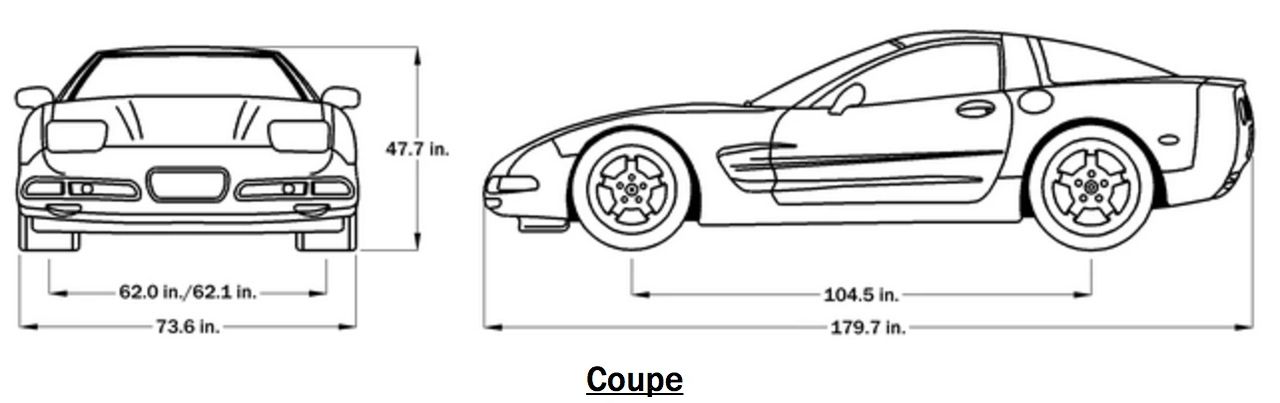
    Here’s the C5 Corvette coupe at a glance: 179.7 inches long on a 104.5-inch wheelbase, 73.6 inches wide, and just 47.7 inches tall. Track width measures 62.0 inches up front and 62.1 inches at the rear, giving the car its planted stance. The long wheelbase, wide tracks, and low roofline were central to the C5’s stability, interior packaging, and aero efficiency. (Graphic created by and courtesy of the author.)
    Here’s the C5 Corvette coupe at a glance: 179.7 inches long on a 104.5-inch wheelbase, 73.6 inches wide, and just 47.7 inches tall. Track width measures 62.0 inches up front and 62.1 inches at the rear, giving the car its planted stance. The long wheelbase, wide tracks, and low roofline were central to the C5’s stability, interior packaging, and aero efficiency. (Graphic created by and courtesy of the author.)

    From twenty paces the C5 read unmistakably as a Corvette: long hood, tucked tail, hidden headlights, round taillamps. Up close, though, the proportions and sections told a different story. The wheelbase stretched to 104.5 inches, the body grew wider and a touch taller, and designers lowered the cowl to open forward visibility. The result was a car that sat planted on its wheels with a more modern stance—and, crucially, a cockpit that welcomed full-size humans without gymnastic entry rituals. Those choices weren’t rhetorical. They were the visible outcome of engineering priorities that had moved decisively toward structural rigidity, ergonomics, and day-to-day livability, without abandoning the car’s role as a track-capable performance tool. Period tests noted the effect immediately, praising the easy ingress/egress, low cowl, and calmer, more settled responses over broken pavement and crown-rutted highways.

    The surface development had purpose, too. Wind-tunnel work pared the drag coefficient down to an impressive 0.29—significantly slipperier than the outgoing C4—and the taller, cleaner tail helped both luggage capacity and high-speed stability. Even in a time when supercars were starting to chase wind-tunnel fantasy numbers, the Corvette’s mix of low drag, reasonable frontal area, and reduced lift marked a leap forward for the nameplate.

    “We Examined Our Weak Points…”

    David Hill took over as Corvette chief engineer in late 1992 with a mandate to deliver a no-excuses successor to the C4. Under his leadership the 1997 C5 arrived as a clean-sheet car with a hydroformed steel frame, a rear-mounted transaxle tied together by a torque tube, and a dramatically stiffer, quieter structure. It launched the all-aluminum LS1 V-8 (345 hp) and everyday-usable tech like run-flat tires, reflecting Hill’s obsession with pairing world-class performance to real livability and quality. The result reestablished Corvette on the global stage, seeded the C5-R racing program, and laid the foundation for every modern Corvette that followed. (Image courtesy of GM Media LLC)
    David Hill took over as Corvette chief engineer in late 1992 with a mandate to deliver a no-excuses successor to the C4. Under his leadership the 1997 C5 arrived as a clean-sheet car with a hydroformed steel frame, a rear-mounted transaxle tied together by a torque tube, and a dramatically stiffer, quieter structure. It launched the all-aluminum LS1 V-8 (345 hp) and everyday-usable tech like run-flat tires, reflecting Hill’s obsession with pairing world-class performance to real livability and quality. The result reestablished Corvette on the global stage, seeded the C5-R racing program, and laid the foundation for every modern Corvette that followed. (Image courtesy of GM Media LLC)

    Inside Chevrolet, the re-think began years before the reveal. Corvette Vehicle Line Executive and Chief Engineer Dave Hill was blunt about the mission: fix weaknesses, turn them into strengths, and sweat execution. “We examined our weak points and turned them into strengths,” Hill said. “Things that were good, we made great. Things that are now great are now even better.” He tied that ambition to a laser focus on build quality—“Owners in this segment expect excellent quality”—and to an insistence that engineering teams start from a stiff, quiet structure before tuning ride and handling. That approach permeated the program, from the chassis layout to the plastics used for interior touch points.
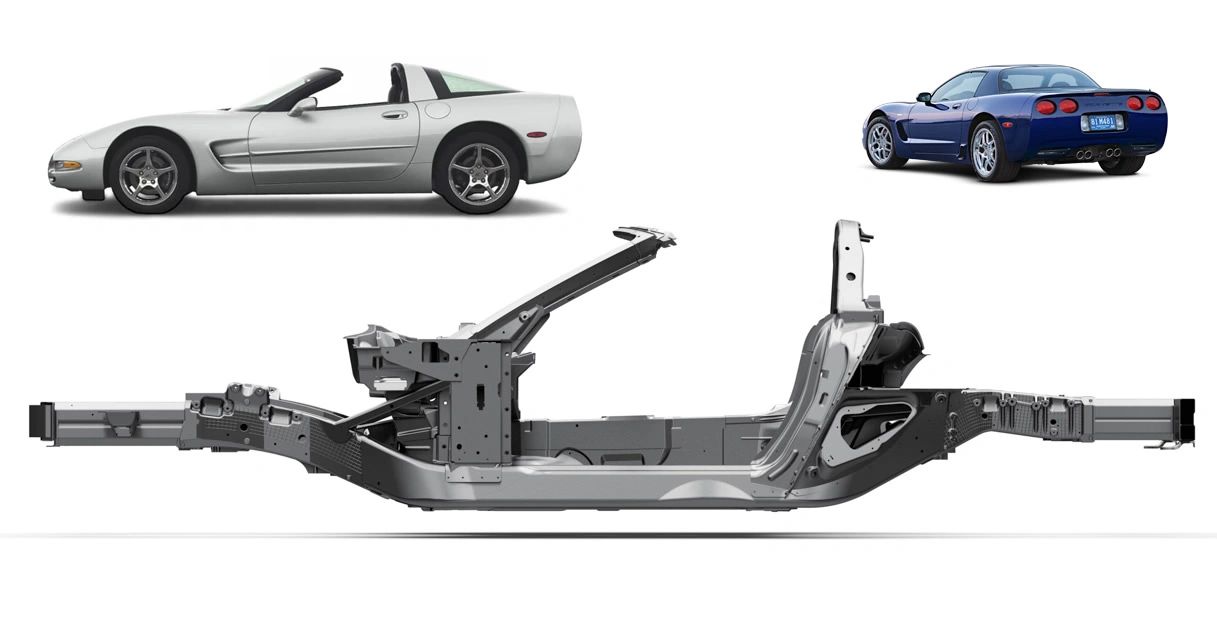
    The C5 Corvette’s hydroformed steel perimeter frame and rigid central tunnel created a true backbone, tying the LS1 to a rear-mounted transaxle through a torque tube. This layout shifted mass rearward for near 50/50 balance, reduced noise and vibration, and opened up meaningful cabin and trunk space. Aluminum suspension components and composite transverse leaf springs kept weight down while sharpening ride and handling. The result was a platform so stiff and refined that even the convertible became a no-compromise performance model and a foundation for the next generation.
    The C5 Corvette’s hydroformed steel perimeter frame and rigid central tunnel created a true backbone, tying the LS1 to a rear-mounted transaxle through a torque tube. This layout shifted mass rearward for near 50/50 balance, reduced noise and vibration, and opened up meaningful cabin and trunk space. Aluminum suspension components and composite transverse leaf springs kept weight down while sharpening ride and handling. The result was a platform so stiff and refined that even the convertible became a no-compromise performance model and a foundation for the next generation.

    There’s a practical hero in this story: the frame. Instead of a welded mosaic of dozens of individual stampings, the C5’s core structure combined a closed-section steel backbone with hydroformed, galvanized side rails that ran the length of the car. The rails began life as round tubes that were bent, inserted into dies, and “inflated” by water at ~5,000 psi to achieve their final rectangular cross-sections. The floor panels were a composite sandwich with balsa wood cores—light, stiff, and acoustically friendly. Sprinkle in magnesium castings (steering column support, roof frame) and cast-aluminum subframes, and you had a parts bin chosen for stiffness-per-pound rather than tradition. The payoff was obvious the first time you hit a frost heave: fewer squeaks, less cowl shake, and suspension geometry that could finally work from a stable foundation.

    The Transaxle That Changed Everything
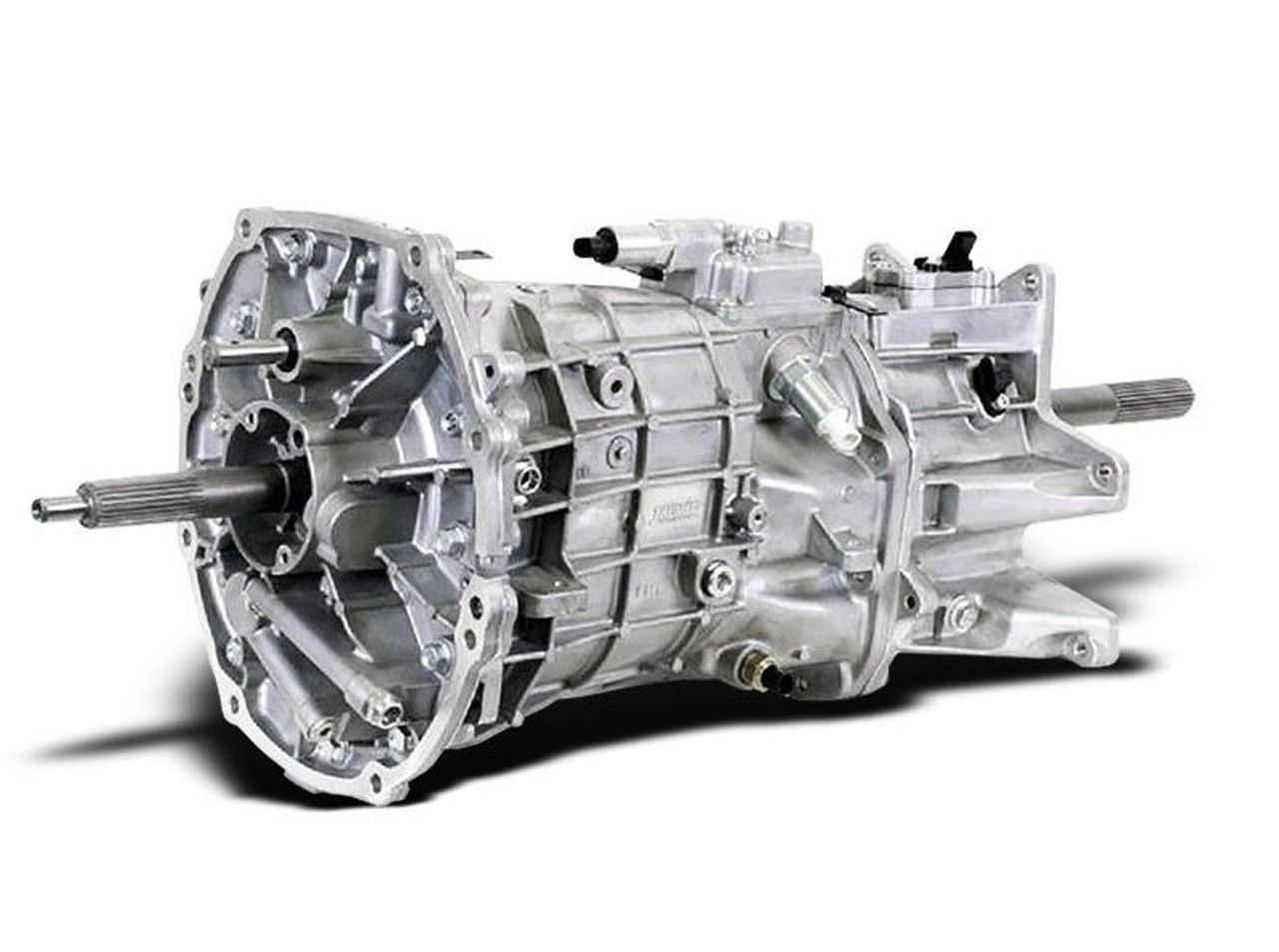
    Pictured is the Borg-Warner (later Tremec) T-56 six-speed used in the 1997 Corvette. In the C5 it was packaged as a rear transaxle and linked to the LS1 by a rigid torque tube, improving weight balance and quieting NVH. The T-56’s double overdrive allowed relaxed highway rpm, and its CAGS “skip-shift” could route 1st-to-4th under light throttle for fuel-economy targets. Its robust aluminum case and heavy-duty synchronizers comfortably handled the LS1’s 345 hp/350 lb-ft while delivering the crisp shift feel that helped define the new Corvette. (Image courtesy of GM Media LLC)
    Pictured is the Borg-Warner (later Tremec) T-56 six-speed used in the 1997 Corvette. In the C5 it was packaged as a rear transaxle and linked to the LS1 by a rigid torque tube, improving weight balance and quieting NVH. The T-56’s double overdrive allowed relaxed highway rpm, and its CAGS “skip-shift” could route 1st-to-4th under light throttle for fuel-economy targets. Its robust aluminum case and heavy-duty synchronizers comfortably handled the LS1’s 345 hp/350 lb-ft while delivering the crisp shift feel that helped define the new Corvette. (Image courtesy of GM Media LLC)

    Corvette had flirted with the idea of moving the transmission rearward before, but the C5 made it real. By bolting the gearbox to a differential unit just ahead of the rear axle and connecting it to the engine with a rigid torque tube, the team moved mass where it mattered, chased polar-moment benefits, and freed up the cabin from the pinched footwells that had defined C4 long-distance discomfort. The result: a near-ideal balance—51.4/48.6 front/rear in standard form—and steering/handling behavior that felt calmer at the limit and more predictable on rough roads. It wasn’t theoretical; instrumented tests and long reviews made a point of how different the C5 felt once you started leaning on it.

    LS1: A New Small-Block With an Old Soul
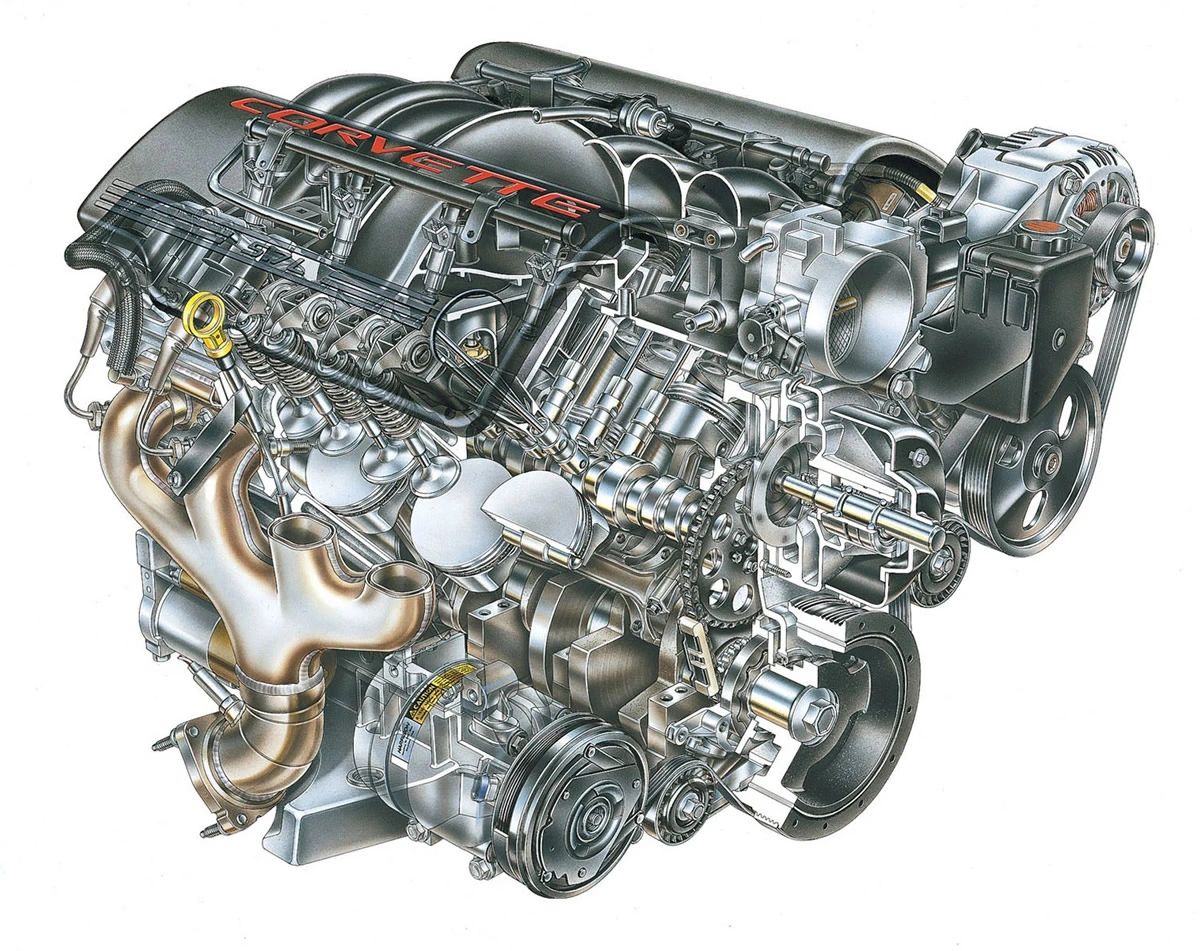
    Development of the LS1 began in 1993 as GM’s clean-sheet Gen III small-block for the 1997 Corvette. The all-aluminum 5.7-liter kept pushrod simplicity but added a deep-skirt “Y-block” with six-bolt main caps, a structural oil pan, coil-near-plug ignition, and a composite intake feeding high-flow cathedral-port heads—big gains in breathing, NVH, and durability. In Corvette tune it made 345 hp and 350 lb-ft at 10.1:1 compression, backed by either a T-56 six-speed manual or 4L60-E automatic. Its compact size and reduced mass helped enable the C5’s rear transaxle layout and near-50/50 balance while improving efficiency and emissions. The LS1 launched an entire LS lineage (LS6/LS2/LS3/LS7 and beyond) that defined GM performance for the next two decades. (Image courtesy of GM Media LLC)
    Development of the LS1 began in 1993 as GM’s clean-sheet Gen III small-block for the 1997 Corvette. The all-aluminum 5.7-liter kept pushrod simplicity but added a deep-skirt “Y-block” with six-bolt main caps, a structural oil pan, coil-near-plug ignition, and a composite intake feeding high-flow cathedral-port heads—big gains in breathing, NVH, and durability. In Corvette tune it made 345 hp and 350 lb-ft at 10.1:1 compression, backed by either a T-56 six-speed manual or 4L60-E automatic. Its compact size and reduced mass helped enable the C5’s rear transaxle layout and near-50/50 balance while improving efficiency and emissions. The LS1 launched an entire LS lineage (LS6/LS2/LS3/LS7 and beyond) that defined GM performance for the next two decades. (Image courtesy of GM Media LLC)

    Under the hood sat a familiar displacement—5.7 liters—and a familiar architectural recipe: two valves per cylinder actuated by pushrods. That’s where the carryover ended. The Gen-III LS1 was an all-aluminum design with deep skirt block, six-bolt main bearing caps (four vertical, two cross-bolts), revised head fastener patterns, and modern sealing practices. Output landed at 345 hp @ 5,600 rpm and 350 lb-ft @ 4,400 rpm—numbers that put the base C5 in the same performance time zone as the earlier LT5-powered ZR-1 without the ZR-1’s complexity or mass. Period coverage emphasized not just peak numbers but durability targets (100,000-mile design horizons) and the package work that tucked the sump as shallow as packaging allowed, preserving ground clearance while ensuring oil control during sustained lateral loads.

    Chevrolet paired the LS1 with two familiar transmissions: a four-speed automatic and a Borg-Warner/Tremec-pattern six-speed manual. The manual kept the first-to-fourth CAGS (Computer Aided Gear Selection) skip-shift logic (less intrusive than before), and the aft location of the gearbox added rotating inertia to the driveline that the synchros had to manage—one reason testers occasionally noted a notch here and there in the shift feel. The automatic, meanwhile, remained a smart choice for owners who wanted grand-touring ease with plenty of long-legged punch. Either way, the torque tube tied the powertrain into the spine of the car, turning the entire engine-to-axle assembly into a structural member.

    Chassis Tuning: Leaf Springs, Done Right
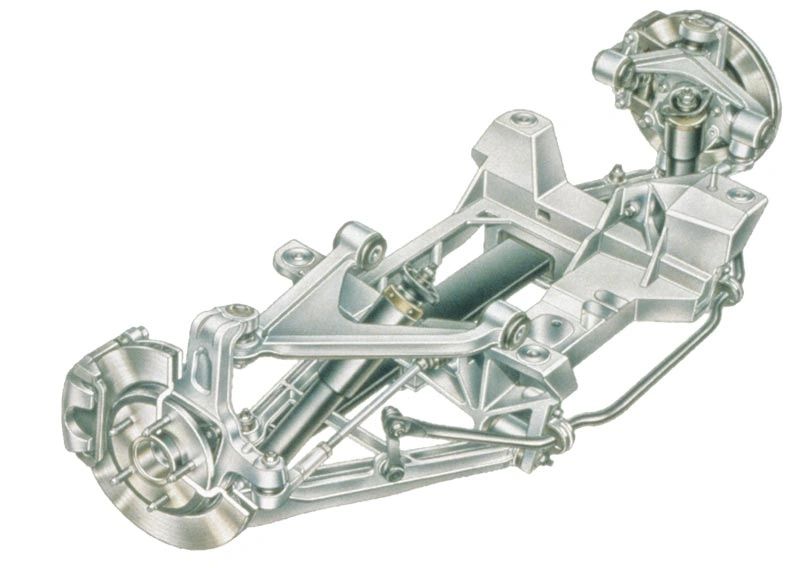
    The image shows the C5 Corvette’s rear suspension module—a double-wishbone (short/long arm) layout mounted to a rigid cradle. It pairs forged-aluminum control arms and knuckles with a composite transverse leaf spring, monotube shocks, a toe link, and a hollow anti-roll bar to slash unsprung mass. This compact, lightweight package worked around the rear transaxle and is a big reason the C5 felt planted and modern compared with the C4.
    The image shows the C5 Corvette’s rear suspension module—a double-wishbone (short/long arm) layout mounted to a rigid cradle. It pairs forged-aluminum control arms and knuckles with a composite transverse leaf spring, monotube shocks, a toe link, and a hollow anti-roll bar to slash unsprung mass. This compact, lightweight package worked around the rear transaxle and is a big reason the C5 felt planted and modern compared with the C4.

    Yes, the C5 still wore transverse composite leaf springs at both ends—not because engineers were nostalgic, but because the springs were light, compact, and freed valuable packaging space for low hoods and usable trunks. The geometry around those springs changed dramatically: true short/long-arm double wishbones, carefully controlled toe curves, and cast-aluminum subframes that located everything precisely. Buyers chose among a base passive-damper tune; the Z51 performance handling package; or F45 Selective Real Time Damping, an electronically controlled system with Tour, Sport, and Performance modes that could alter shock force up to 100 times per second. Contemporary testers praised the spread: Tour for commuting calm, Performance for canyon resolve, with Sport as the just-right middle that flattened pitch without going brittle. Brakes, meanwhile, grew thicker and breathed better thanks to dedicated ducting through the front fascia.
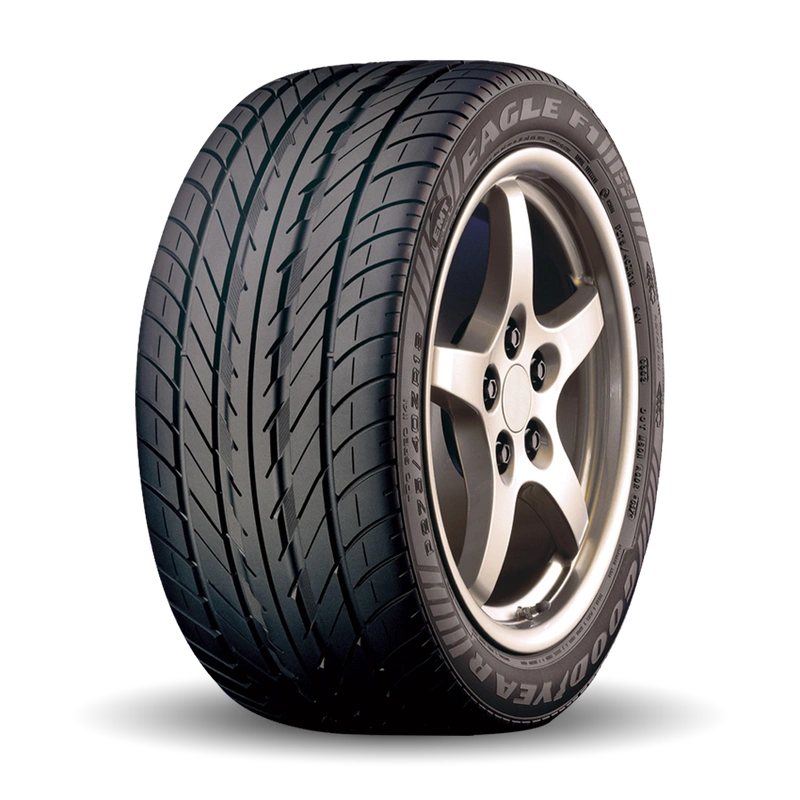
    Goodyear’s Eagle F1 GS EMT was the 1997 Corvette’s factory performance tire—a Z-rated run-flat that let Chevy delete the spare and gain real cargo space. Its stiff sidewalls and directional V-tread delivered about 50 miles of mobility at up to 55 mph after a puncture while preserving crisp steering. OE sizing was 245/45ZR17 up front and 275/40ZR18 in back, tuned for the C5’s aluminum control-arm chassis. Not ultimate track rubber, but a smart blend of grip, stability, and peace of mind. (Image courtesy of Goodyear Tires)
    Goodyear’s Eagle F1 GS EMT was the 1997 Corvette’s factory performance tire—a Z-rated run-flat that let Chevy delete the spare and gain real cargo space. Its stiff sidewalls and directional V-tread delivered about 50 miles of mobility at up to 55 mph after a puncture while preserving crisp steering. OE sizing was 245/45ZR17 up front and 275/40ZR18 in back, tuned for the C5’s aluminum control-arm chassis. Not ultimate track rubber, but a smart blend of grip, stability, and peace of mind. (Image courtesy of Goodyear Tires)

    The tire story mattered, too. The C5 arrived on Goodyear Eagle F1 GS EMT “extended mobility” (run-flat) tires, 245/45ZR-17 front and 275/40ZR-18 rear, with pressure monitoring as standard. The run-flats let Chevrolet delete the spare and jack—reducing mass and freeing cargo volume—while the staggered diameters contributed to stability and gave the car a purposeful stance without resorting to cartoon-wide rubber. Critics expected numbness; what they reported instead was tactility and improved on-center stability versus late C4s, even though the C5’s tires were actually a bit narrower.

    Interior: Analog Dials, Real Materials, Human Fit
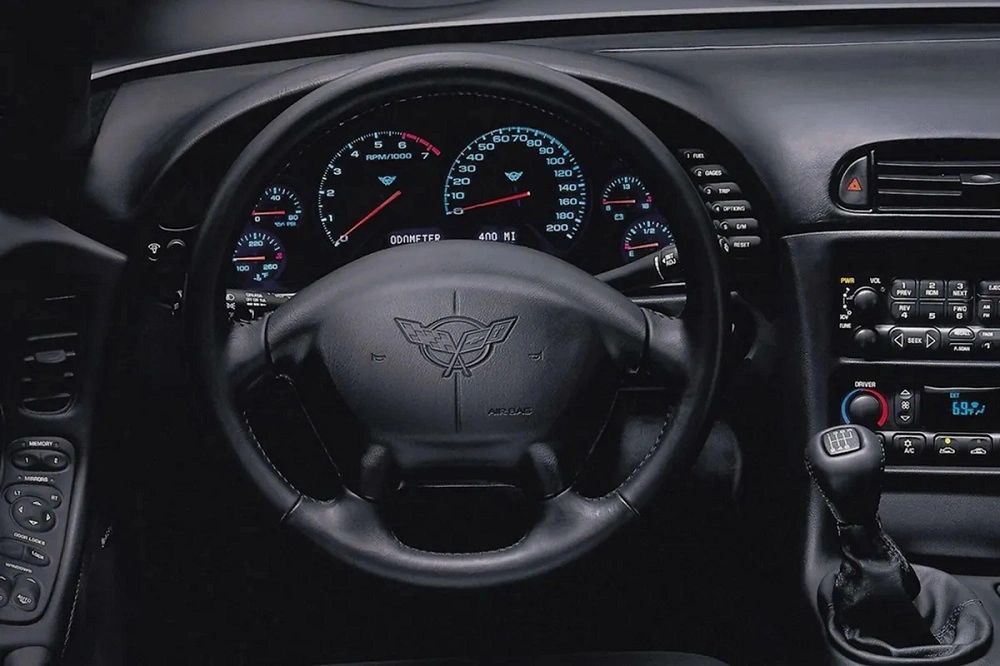
    The C5 cabin traded the C4’s digital arcade for crisp analog gauges and a thick, airbag wheel wearing crossed flags. The center stack grouped Bose audio, true climate control, and driver-memory switches within easy reach, while the stubby six-speed shifter fell naturally to hand. Quiet, solid, and functional—this was the first Corvette cockpit that felt genuinely modern.
    The C5 cabin traded the C4’s digital arcade for crisp analog gauges and a thick, airbag wheel wearing crossed flags. The center stack grouped Bose audio, true climate control, and driver-memory switches within easy reach, while the stubby six-speed shifter fell naturally to hand. Quiet, solid, and functional—this was the first Corvette cockpit that felt genuinely modern.

    When you climbed into a C5 after a late C4, you understood the word “civilized.” The sill height dropped. The footwells expanded and—hallelujah—there was a proper dead pedal. The dash traded arcade-era digital for a clean, legible analog cluster with layered, three-dimensional faces. The materials moved away from brittle plastics toward a mix that felt less cost-reduced and more intentional. Critics who had long ribbed Corvette for buzzy, squeaky cabins discovered a cockpit that stayed quiet over expansion joints and read like it had been assembled with a torque wrench, not a hope and a prayer. Car and Driver’s May 1997 road test put it memorably: “After years of wrong answers, the Corvette guys finally did their homework and aced a test.”

    The features list also read like modernity had finally arrived. It included a standard removable roof panel (with optional blue-tint polycarbonate), Bose audio with an in-dash CD, keyless entry, and a memory package that could recall seat, mirror, climate, and radio settings. Options such as dual-zone climate control, a remote 12-disc changer, and F45 damping added customization without drowning owners in complexity. The idea wasn’t to gild the Corvette into a boulevard cruiser; it was to recognize that even the most track-curious owners spent most of their time living with their cars. The C5 respected the week as much as the weekend.

    Performance: Numbers and Nuance
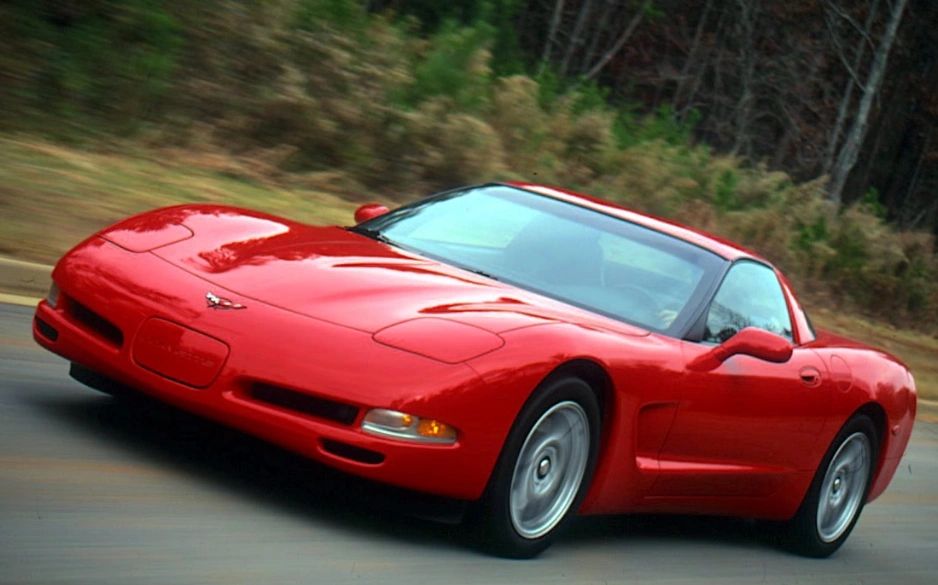
    The 1997 Corvette looked every bit as revolutionary as it drove, and this early C5 test car proves it—hunkered down, nose low, and carving through the kind of back road it was born for. Captured here by Car and Driver magazine, the all-new fifth-gen ‘Vette showcased its sleeker body, rigid structure, and LS1 powertrain in one clean shot: America’s sports car, finally modernized for the new era. (Image courtesy of Jim Frenak - Car and Driver)
    The 1997 Corvette looked every bit as revolutionary as it drove, and this early C5 test car proves it—hunkered down, nose low, and carving through the kind of back road it was born for. Captured here by Car and Driver magazine, the all-new fifth-gen ‘Vette showcased its sleeker body, rigid structure, and LS1 powertrain in one clean shot: America’s sports car, finally modernized for the new era. (Image courtesy of Jim Frenak – Car and Driver)

    The stopwatch didn’t flinch. With the six-speed manual, period tests recorded 0–60 mph in about five seconds flat (quicker in early preview tests on a sticky strip), quarter-miles in the mid-13s at ~107–108 mph, and a top speed brushing 171–172 mph—territory that only the most serious C4s could touch. Braking from 70 mph took well under 180 feet in independent testing, and skidpad numbers in the high-0.8s came with a stability and friendliness that C4 drivers didn’t always trust. It wasn’t simply “faster.” It was easier to drive quickly, and easier to live with when you weren’t.

    Those numbers translated directly into the narrative around the car. Car and Driver’s archive preview and full road test stressed the theme of latitude: a car that could hustle or loaf; a chassis that stayed calm when the road didn’t; a cabin that finally fit people and luggage in the same sentence. That nuance matters when you’re trying to understand why the C5 didn’t just win comparisons—it reset expectations about what a Corvette could be between bursts of throttle.

    Aerodynamics and the “High Tail”
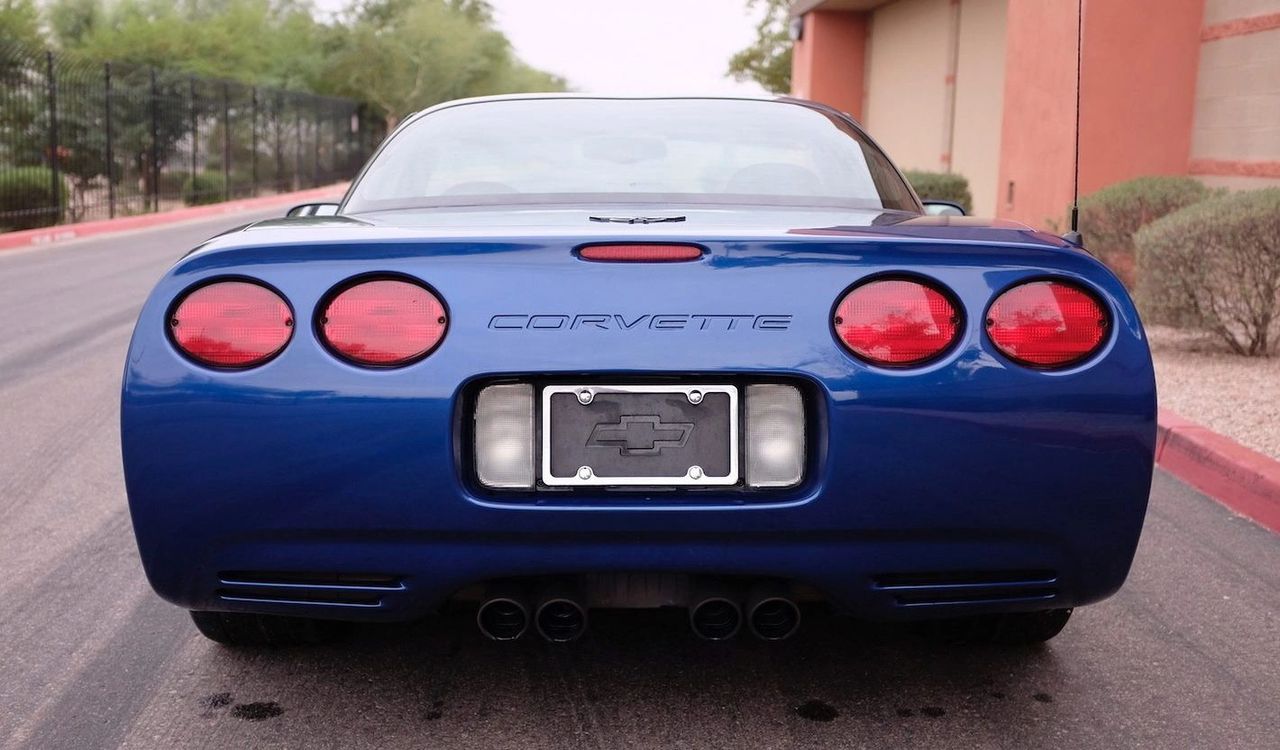
    Few shapes in the Corvette world are as distinctive as the C5’s tall rear deck. That “high tail” wasn’t just a styling flourish—it let Chevy stretch the hatch and deepen the cargo well, so this two-seater could swallow real luggage instead of just a gym bag. Aerodynamically, the raised tail helps clean up airflow and reduce high-speed lift, giving the C5 better stability on the highway and front straight than the slab-back C4 it replaced. Visually, it makes the car look hunkered down and purposeful, like it’s squatting over those quad exhaust tips, ready to launch. From this angle, you can see why the C5’s backside became a modern Corvette signature.
    Few shapes in the Corvette world are as distinctive as the C5’s tall rear deck. That “high tail” wasn’t just a styling flourish—it let Chevy stretch the hatch and deepen the cargo well, so this two-seater could swallow real luggage instead of just a gym bag. Aerodynamically, the raised tail helps clean up airflow and reduce high-speed lift, giving the C5 better stability on the highway and front straight than the slab-back C4 it replaced. Visually, it makes the car look hunkered down and purposeful, like it’s squatting over those quad exhaust tips, ready to launch. From this angle, you can see why the C5’s backside became a modern Corvette signature.

    Corvette stylists and aerodynamicists struck a useful compromise. The low nose improved sightlines and helped reduce lift. The taller rear fascia—broken up visually by oval lamps and slots—did the unfashionable work of drag reduction and flow management, while also enabling the now-famous “two golf bag” cargo boast. The raw numbers tell the story: a 0.29 Cd, roughly 8–9 percent less total drag than a comparable C4 when you account for the C5’s slightly larger frontal area, and a substantial reduction in lift at speed. The latter is why the C5 feels settled when you’re deep into triple digits—this isn’t a style decision alone; it’s stability you can sense in your fingertips.

    Awards, Reception, and the Culture Shift
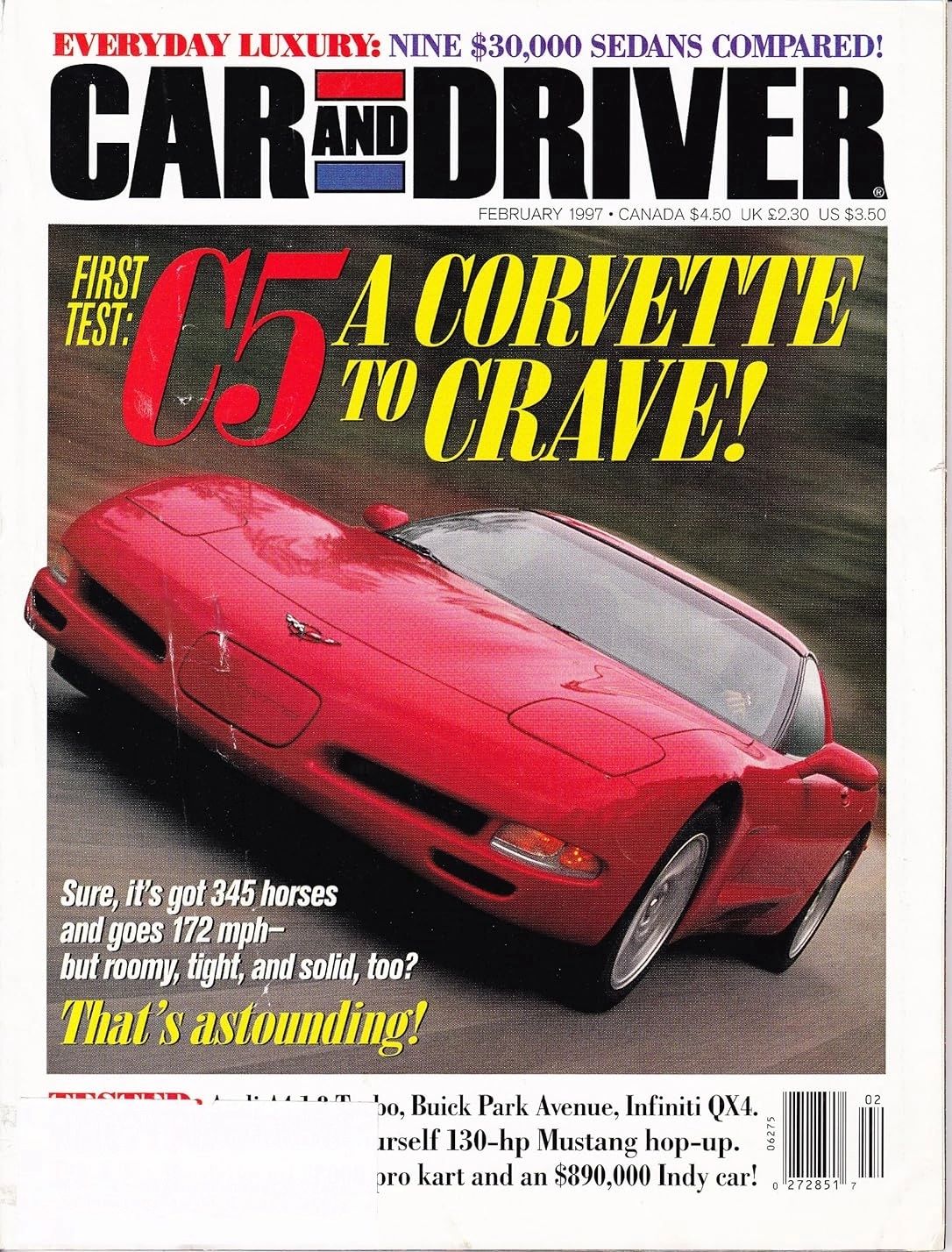
    ChatGPT said:  When Car and Driver splashed “C5: A Corvette to Crave!” across its February 1997 cover, it was the opening salvo in a tidal wave of praise for the all-new fifth-gen car. That early test quickly proved prophetic: the C5 would go on to be named Motor Trend’s 1998 Car of the Year, thanks to its blend of 345-hp LS1 performance, real-world usability, and cutting-edge chassis design. In the broader industry, the reborn Corvette also captured the 1998 North American Car of the Year award, beating out prestige sedans and imports that had traditionally owned that space. Car and Driver then cemented the point by returning the Corvette to its coveted 10Best list for 1998, signaling that America’s sports car wasn’t just quicker—it had finally achieved the refinement and polish enthusiasts had been begging for. (Image courtesy of Car and Driver)
    ChatGPT said: When Car and Driver splashed “C5: A Corvette to Crave!” across its February 1997 cover, it was the opening salvo in a tidal wave of praise for the all-new fifth-gen car. That early test quickly proved prophetic: the C5 would go on to be named Motor Trend’s 1998 Car of the Year, thanks to its blend of 345-hp LS1 performance, real-world usability, and cutting-edge chassis design. In the broader industry, the reborn Corvette also captured the 1998 North American Car of the Year award, beating out prestige sedans and imports that had traditionally owned that space. Car and Driver then cemented the point by returning the Corvette to its coveted 10Best list for 1998, signaling that America’s sports car wasn’t just quicker—it had finally achieved the refinement and polish enthusiasts had been begging for. (Image courtesy of Car and Driver)

    “Driver’s Choice”-type honors by outlets that had long treated Corvette with arched-eyebrow skepticism. Editors who expected to trade creaks and ergonomic compromises for lap times instead found a car that was quiet at speed, rock-solid over bad pavement, and genuinely comfortable for hours. The verdicts started to sound the same: this wasn’t a fast car that happened to be livable; it was a modern sports car that happened to be a Corvette.

    Long-term evaluations cemented that shift. The hydroformed frame and rear transaxle kept noise and vibration tamped down, the interior held together without the familiar squeaks, and the big hatch and real trunk turned weekend trips into non-events. Reviewers praised steering precision, brake feel, and highway stability while noting the everyday civility—reasonable fuel economy, compliant ride, and the security of run-flat tires—that made the C5 easy to recommend without caveats. The tone changed from “if you can live with it” to “why wouldn’t you,” and even the curmudgeons conceded the point.

    The Business End: Price, Options, and Colors
    Chevrolet announced a base MSRP of $38,060 (including destination) for the 1997 Corvette at the Detroit auto show—only $270 more than a ’96—while adding more than $1,200 in premium standard equipment such as the Bose audio, tire-pressure warning system, power driver’s seat, speed-sensitive steering, and EMT (Extended Mobility Technology) run-flat tires. Option pricing reflected the engineering priorities: $1,695 for the F45 Selective Real-Time Damping, $815 for the six-speed manual transmission, $365 for dual-zone climate control, $600 for the remote 12-disc changer, and $650 for the blue-tinted roof panel (or $950 for dual panels). The Z51 handling package, tuned for track-day appetites, was a modest $350.

    Production started late, so 1997 volumes were modest by Corvette standards: 9,752 coupes—no convertibles or hardtops yet—each identified by VINs whose last six ran from 100001 through 109707. (Pilot and pre-production cars complicate the sequence, so VIN serials don’t map one-to-one to production totals.)

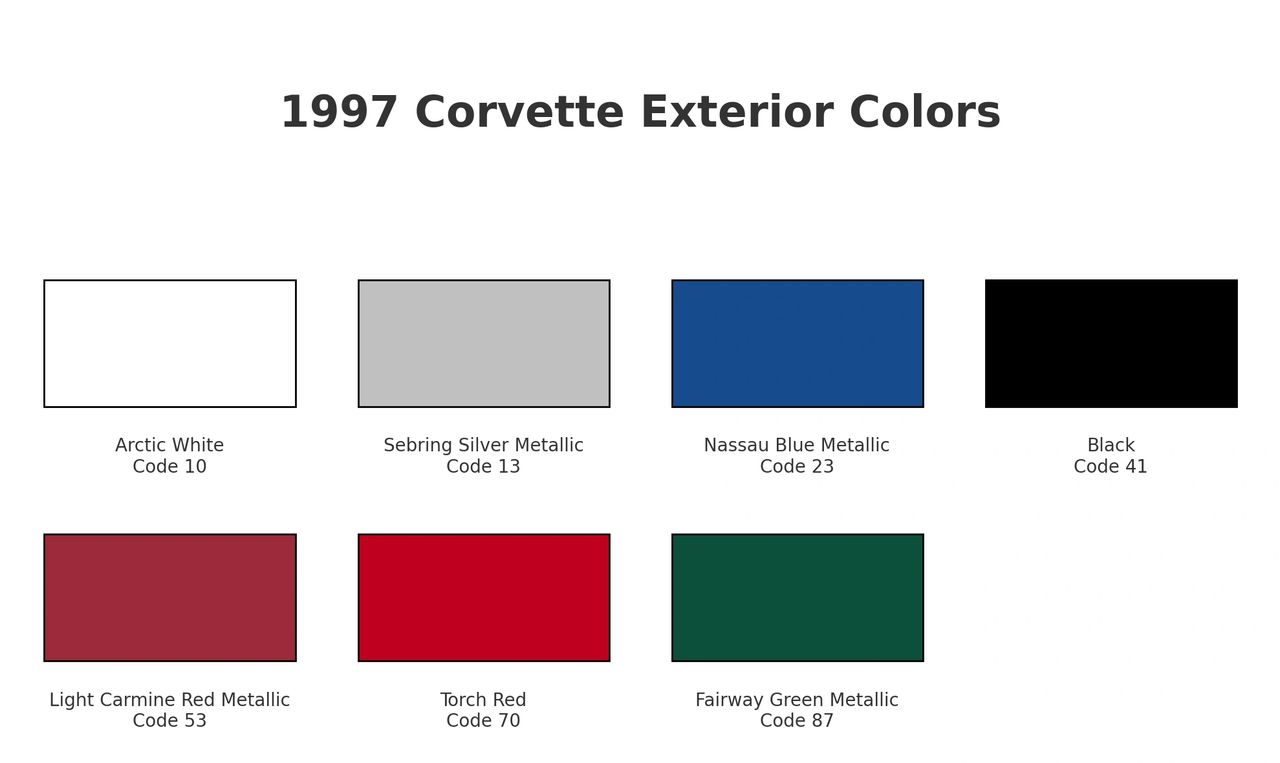
    Paint choices for the launch year leaned classic: Torch Red (the runaway favorite), Black, Sebring Silver Metallic, Arctic White, Nassau Blue Metallic, Light Carmine Red Metallic, and Fairway Green Metallic—some hues far rarer than others by percentage. Those distributions telegraphed two truths: Corvette buyers still loved red, and the C5 wore subtler, more sophisticated tones particularly well.

    Specifications Snapshot (What Mattered Most)

    • Engine: LS1 5.7-liter Gen-III small-block V-8, aluminum block/heads, 345 hp @ 5,600 rpm, 350 lb-ft @ 4,400 rpm.
    • Transmissions: 4-speed automatic or 6-speed manual; rear-mounted transaxle via rigid torque tube.
    • Chassis: Hydroformed steel rails, closed-box backbone, balsa-core composite floors, cast-aluminum subframes.
    • Suspension: SLA control arms F/R with composite transverse leaf springs; F45 electronically adjustable dampers optional; Z51 performance option.
    • Brakes: Vented discs with aluminum calipers; Bosch ABS integrated with traction control; dedicated front brake ducting.
    • Aero: Cd 0.29, reduced lift with higher tail and cleaner underbody.
    • Tires/Wheels: Goodyear Eagle F1 GS EMT run-flats; 245/45ZR-17 (F), 275/40ZR-18 (R); tire-pressure monitoring standard.
    • Dimensions: 104.5-in wheelbase; 179.7-in length; 73-plus-in width; 25 cu-ft cargo volume.
    • Performance (period testing): 0–60 mph ≈ 5.0 sec (manual), 1/4-mile 13.5 @ ~107 mph, top speed ~171–172 mph, 70–0 braking in ~166 ft.

    Inside the Development Culture
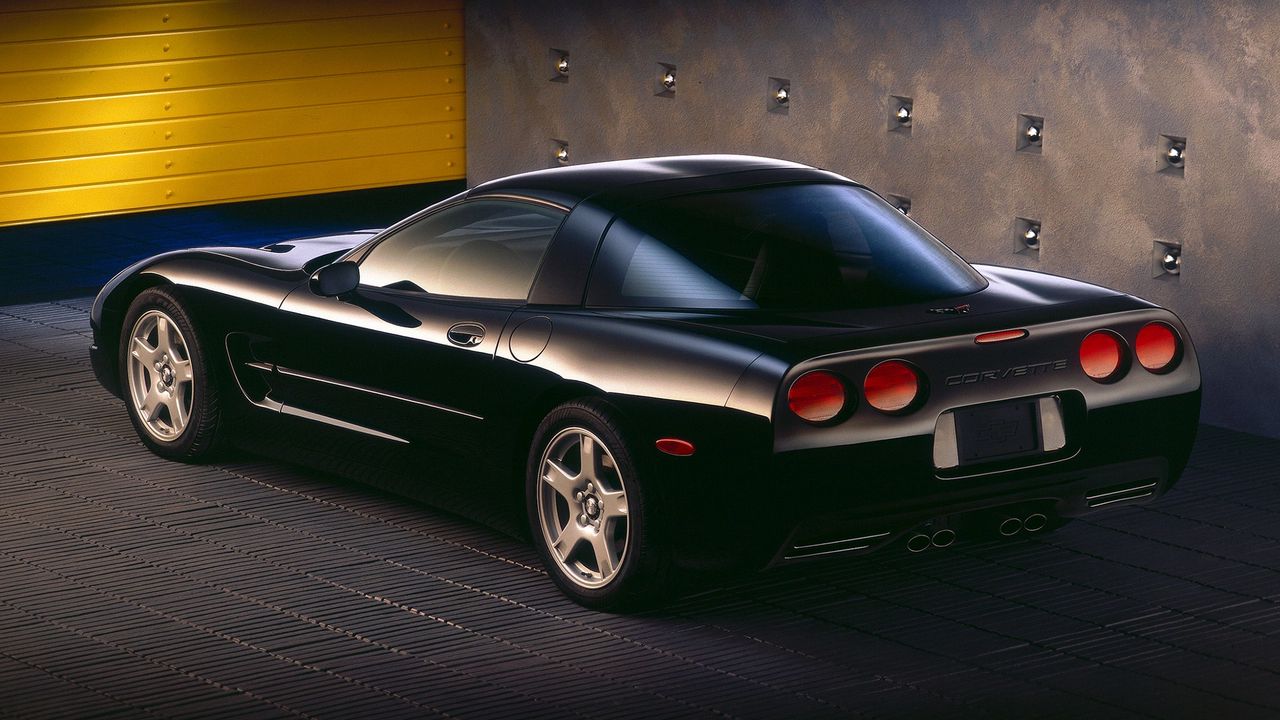
    ChatGPT said:  By the time this 1997 Corvette rolled out, it was more than just a new generation—it was the product of a wholesale culture shift inside Chevy engineering. After years of living with the compromises of the C4, the C5 team operated almost like a skunkworks group, obsessed with doing the car “right” instead of “cheap and quick.” They fought for the hydroformed backbone frame, the rear transaxle, and that deep, low cargo well in back because they believed Corvette had to be a world-class sports car, not just an American curiosity. Every surface, from the high tail to the tucked exhaust, reflects a group of engineers and designers who finally had permission—and the mandate—to rethink America’s sports car from the pavement up.
    ChatGPT said: By the time this 1997 Corvette rolled out, it was more than just a new generation—it was the product of a wholesale culture shift inside Chevy engineering. After years of living with the compromises of the C4, the C5 team operated almost like a skunkworks group, obsessed with doing the car “right” instead of “cheap and quick.” They fought for the hydroformed backbone frame, the rear transaxle, and that deep, low cargo well in back because they believed Corvette had to be a world-class sports car, not just an American curiosity. Every surface, from the high tail to the tucked exhaust, reflects a group of engineers and designers who finally had permission—and the mandate—to rethink America’s sports car from the pavement up.

    It’s easy to treat a generational change like a checklist. The C5 story resists that reduction. There’s a through-line from Dave Hill’s team that you hear across the period quotes and technical write-ups: start with structure; insist on quality; pick materials and processes because they work, not because “we’ve always done it that way.” Magazine tech features of the time read almost like love letters to manufacturing: hydroforming pressures, magnesium castings, bolt counts on the backbone’s closing plate, balsa sandwich lay-ups. Those aren’t trivia. They’re the fingerprints of a group that understood how to make a two-seat performance car feel like a car you could drive across a continent without Advil.

    The suspension philosophy tells the same story. Keeping the composite leaf springs was a lightning-rod decision—fuel for every late-night forum fight—but in context, the springs were a rational choice that enabled the low hood, supported a wide range of frequencies with little mass penalty, and worked superbly with the new geometry. Reviewers who arrived ready to sneer at “old tech” walked away praising balance, body control, and the uncanny way the car settled after mid-corner bumps. The engineering wasn’t chasing spec-sheet snobbery. It was chasing results that owners could feel.

    Why the C5 Matters Beyond 1997
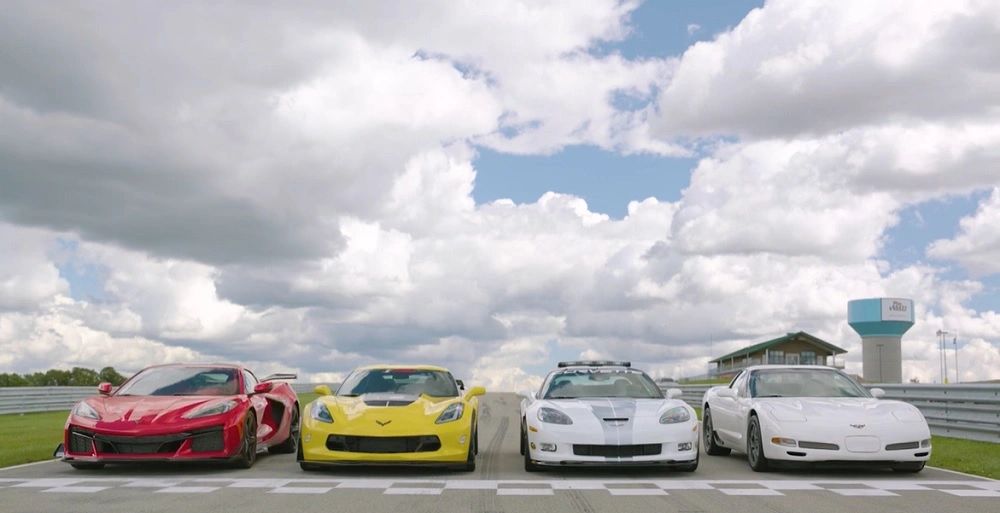
    Line these four cars up and you can draw a straight line back to 1997. The fifth-generation Corvette didn’t just replace the C4—it rewrote the engineering playbook with its rear transaxle, stiff backbone structure, and LS1 small-block, giving Chevrolet a modern performance platform it could grow into. The C5 Z06 showed just how serious that foundation really was, and the C6 and C7 Z06 programs simply kept turning up the intensity on the same core ideas: light, rigid, relentlessly capable. Even the mid-engine C8, which looks like a clean break on the surface, exists because Corvette engineers spent two decades refining the expectations set by that ’97 car. Every lap these newer Corvettes run is still, in many ways, a victory for the team that launched the C5. (Image courtesy of corvetteforum.com)
    Line these four cars up and you can draw a straight line back to 1997. The fifth-generation Corvette didn’t just replace the C4—it rewrote the engineering playbook with its rear transaxle, stiff backbone structure, and LS1 small-block, giving Chevrolet a modern performance platform it could grow into. The C5 Z06 showed just how serious that foundation really was, and the C6 and C7 Z06 programs simply kept turning up the intensity on the same core ideas: light, rigid, relentlessly capable. Even the mid-engine C8, which looks like a clean break on the surface, exists because Corvette engineers spent two decades refining the expectations set by that ’97 car. Every lap these newer Corvettes run is still, in many ways, a victory for the team that launched the C5. (Image courtesy of corvetteforum.com)

    The measure of a generational reset isn’t just whether it delights on day one; it’s whether the core ideas endure. Here, the C5 is a watershed. The fundamental layout—front-engine, rear transaxle; hydroformed rails; balsa-core composite floors; LS-series small-block—proved so sound that it carried forward into C6 and C7. Chevrolet refined, lightened, and sharpened. But the bones were C5 bones. And when Corvette finally made the mid-engine jump for C8, it did so from a position of strength born in the C5 era: a global reputation restored and a technical culture that had already demonstrated it could rethink the car without breaking the brand.

    You can feel the cultural change in the way the car is still discussed. Owners talk about road trips measured in states, not zip codes. Track-day folks talk about predictability, cooling, and consistency. Collectors point to 1997 as a hinge year that makes sense of the cars that followed. And historians—my tribe—note that the C5 was the first Corvette in a long time that convinced skeptics on both sides of the Atlantic that this wasn’t a nostalgic exercise. It was a sophisticated, modern sports car that happened to be built in Bowling Green.

    A Year One Coda

    As the 1997 model year drew to a close, Corvette was already driving into a very different future than the one it had inherited from the late C4 era. The all-new C5 chassis, LS1 small-block, and surprisingly refined ride had proven themselves not just as a clean-sheet redesign, but as a rock-solid foundation Chevy could build on. That momentum cleared the way for 1998: the return of the Corvette convertible, broader appeal, and the first wave of refinements that would sharpen the C5 without diluting its character. This image of a Torch Red ’97 disappearing into the sunset is the perfect sendoff—a visual handoff from the breakthrough first year to the deeper, more confident Corvette lineup that followed in 1998.
    As the 1997 model year drew to a close, Corvette was already driving into a very different future than the one it had inherited from the late C4 era. The all-new C5 chassis, LS1 small-block, and surprisingly refined ride had proven themselves not just as a clean-sheet redesign, but as a rock-solid foundation Chevy could build on. That momentum cleared the way for 1998: the return of the Corvette convertible, broader appeal, and the first wave of refinements that would sharpen the C5 without diluting its character. This image of a Torch Red ’97 disappearing into the sunset is the perfect sendoff—a visual handoff from the breakthrough first year to the deeper, more confident Corvette lineup that followed in 1998.

    Because 1997 production started late, volumes stayed under ten thousand units. That scarcity wasn’t a failure; it was a function of ramp timing and a deliberate pace to get quality right. Chevrolet didn’t dump inventory onto dealers and hope for the best. It introduced the coupe, dialed in the line, listened to owners, and prepared the convertible for the following model year. The market responded the way markets do when the product is right: with orders, with magazine covers, with used-car values that told their own story about desirability.

    And the car that buyers took home in ’97 still reads clean today. The proportions are resolved. The interior is human. The driving experience—especially with the six-speed—remains analog in the best sense, with a live front end and a long-legged top gear that reminds you this car was built by people who knew just how big the United States really is.


    The 1997 Corvette launched the all-new C5—and a true reset for America’s sports car. With a hydroformed frame, rear transaxle for near-perfect balance, and the debut of the LS1 V8, it delivered a leap in performance, refinement, and everyday usability. A modern Corvette era begins here.