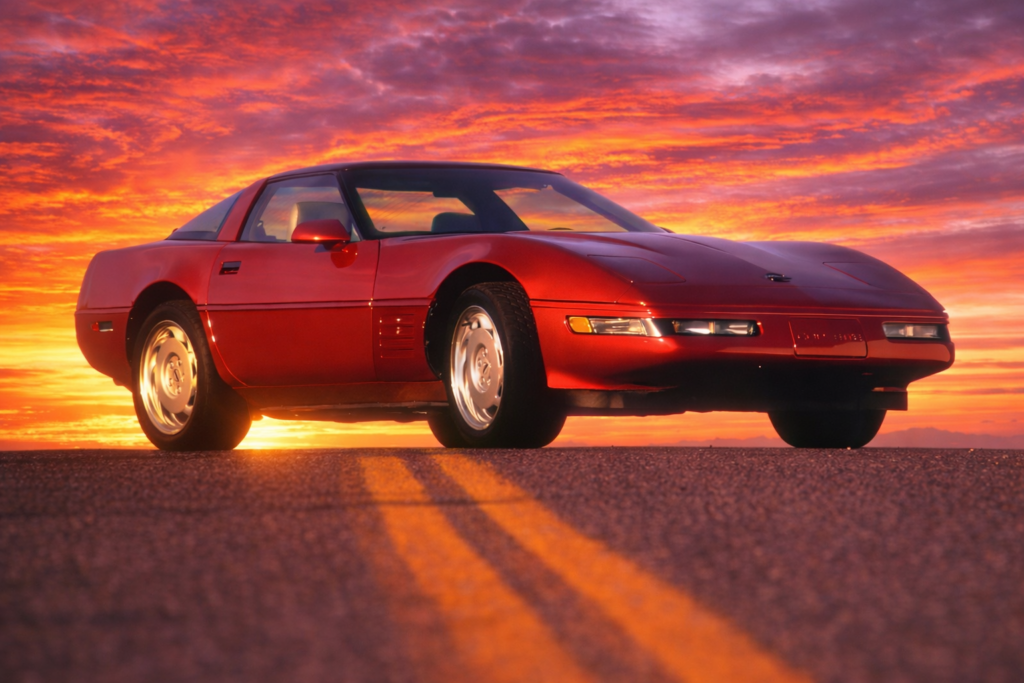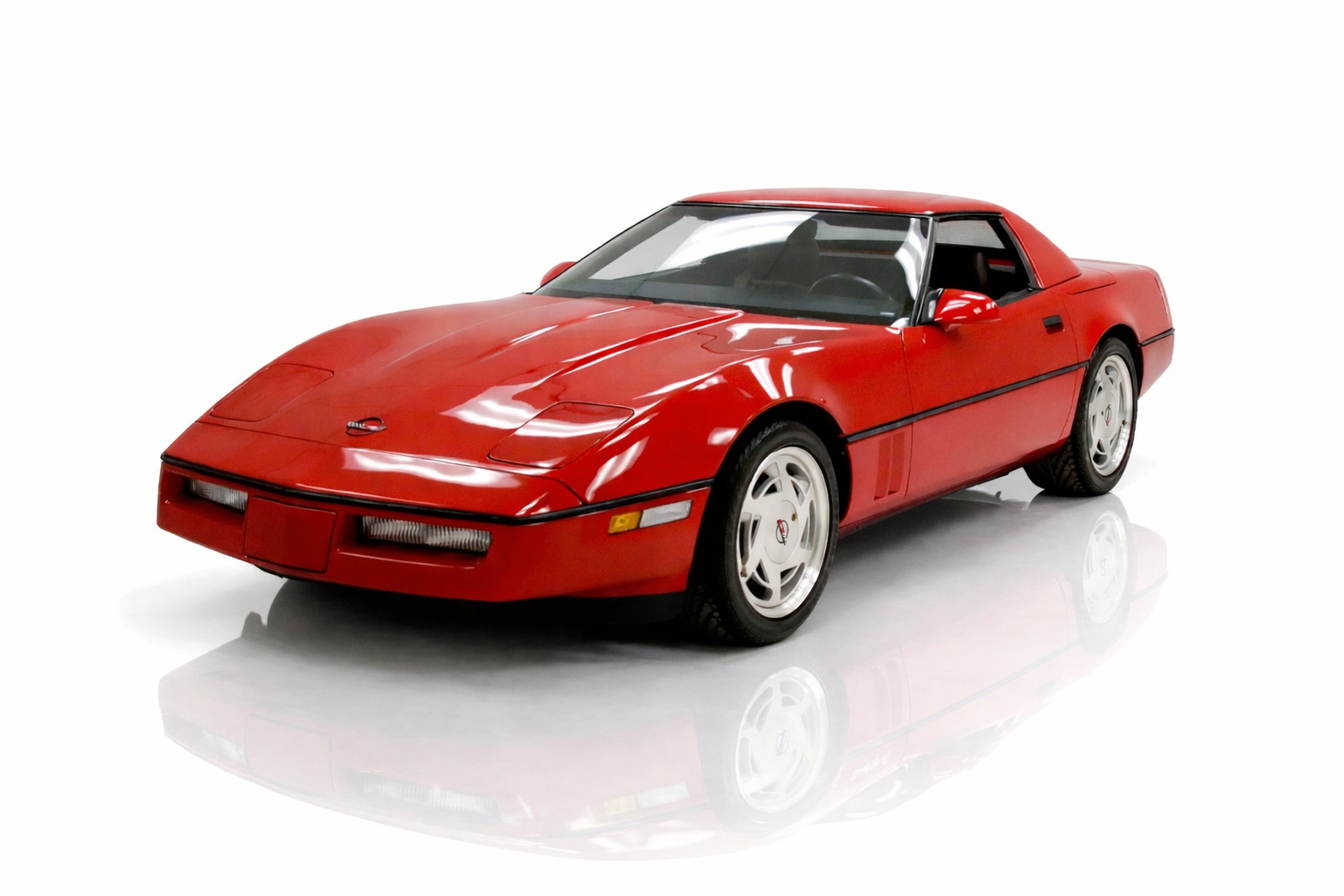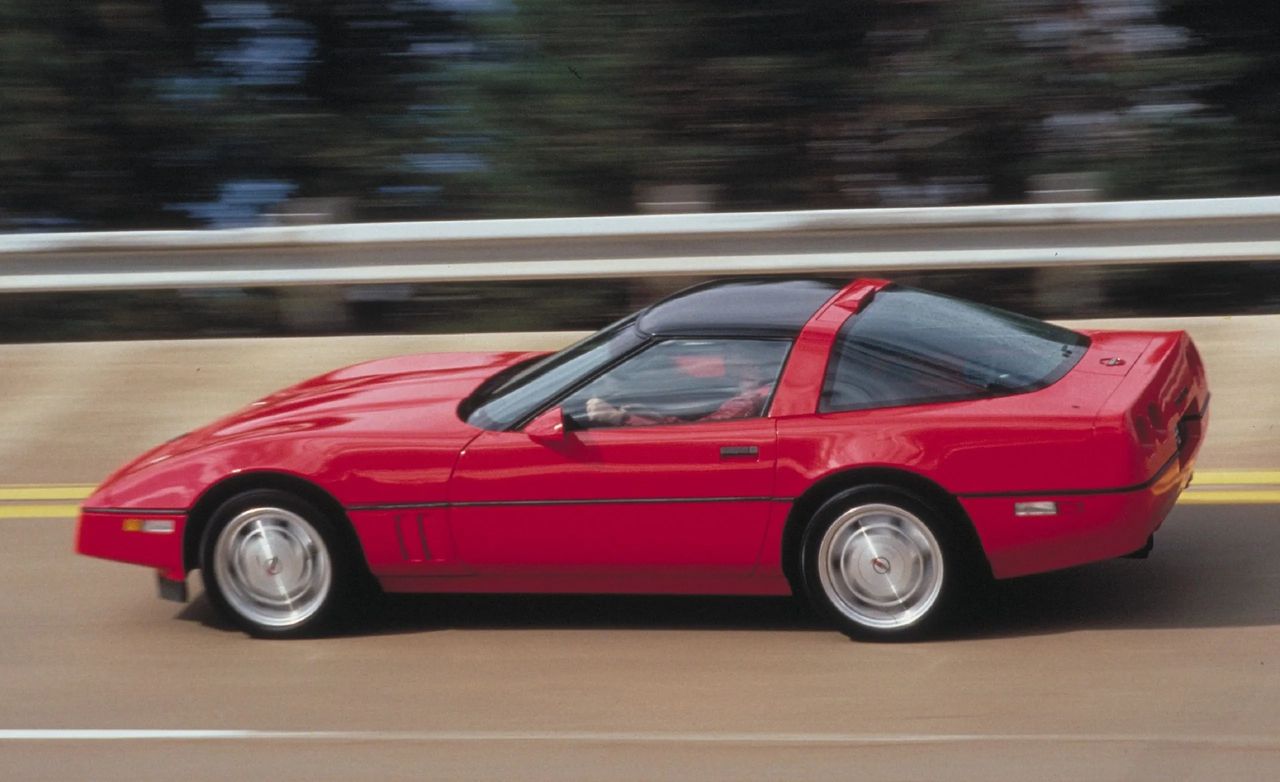
Tag: Corvette ZR-1

  • 1995 CORVETTE OVERVIEW

    1995 CORVETTE OVERVIEW

    By the mid-1990s the fourth-generation Corvette wasn’t chasing youth so much as perfecting experience. Eleven model years in, the C4 still launched like a slingshot and carved corners with the flinty precision that made it a chassis benchmark. Yet just offstage, a skunkworks within General Motors was already splitting its days and nights on the fifth-generation car—a clean-sheet coupe that wouldn’t hit showrooms until the 1997 model year. That tension defined 1995. Evolution over revolution. Polish over reinvention. This is the year Chevrolet made the C4 better in ways you feel more than see—and the year the fourth-generation ZR-1, America’s original modern supercar, took its final bow with a ceremony worthy of a monarch.

    There’s a temptation to reduce late C4s to option codes and production counts. But 1995 wasn’t merely an updated parts catalog; it was a philosophy. It was a team that had learned what Corvette owners actually lived with—the creaks, the chatter, the extra effort to snag reverse on a cold morning—and decided to fix what mattered most to them. The base model fourth-generation Corvette was a platform that could already out-corner its peers and, with a few key upgrades, would be able to stop with the same authority. And it was a factory willing to pause an assembly line to salute the end of a legend.

    Refining the LT1: Quieter, Stronger, Cleaner
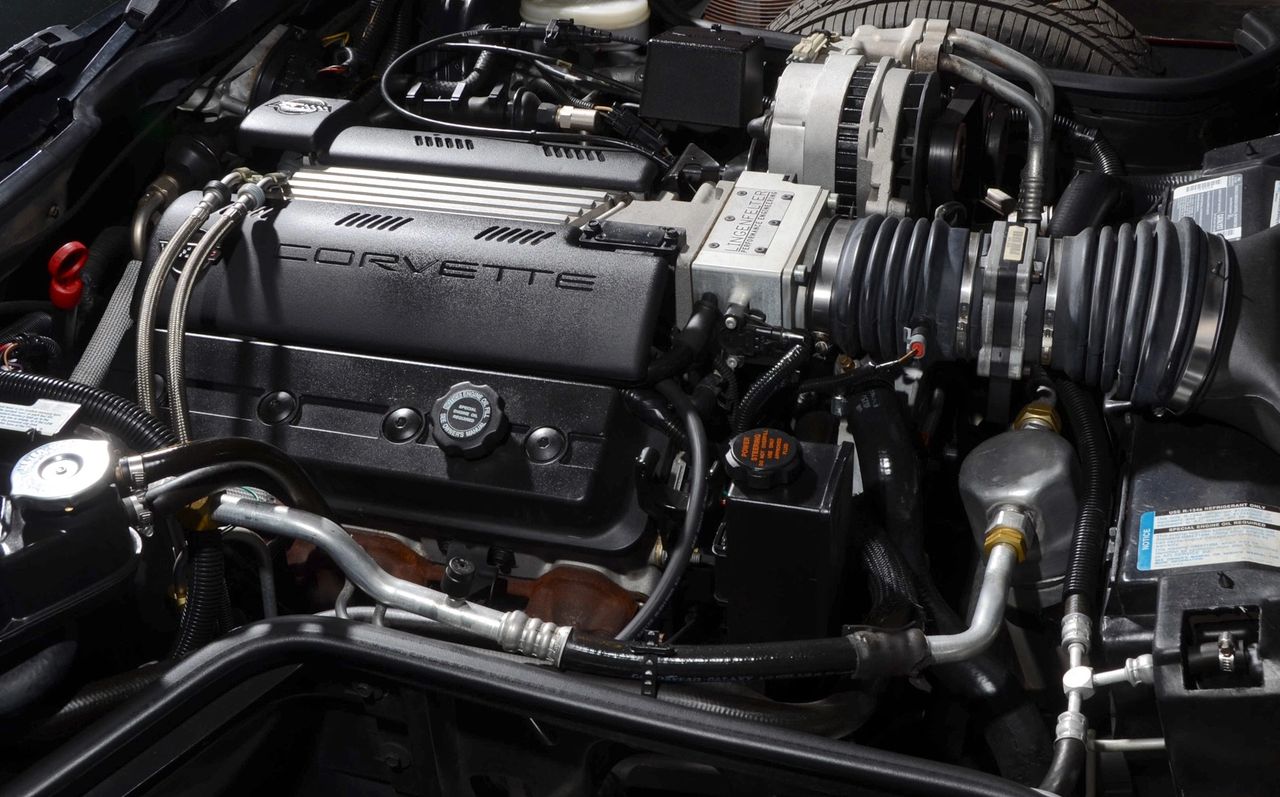
    The 1995 Corvette’s LT1 kept its 300 hp/340 lb-ft headline, but felt smarter and tougher thanks to quiet refinements—powdered-metal rods, ethanol-tolerant injectors, and calmer fan logic that sharpened drivability and durability. Paired with the year’s big-brake/ABS 5 rollout and cleaner 4L60-E or high-detent ZF shifts, the ’95 LT1 delivered the C4’s familiar punch with a more polished, everyday confidence. (Image courtesy of Motorcar Classics)
    The 1995 Corvette’s LT1 kept its 300 hp/340 lb-ft headline, but felt smarter and tougher thanks to quiet refinements—powdered-metal rods, ethanol-tolerant injectors, and calmer fan logic that sharpened drivability and durability. Paired with the year’s big-brake/ABS 5 rollout and cleaner 4L60-E or high-detent ZF shifts, the ’95 LT1 delivered the C4’s familiar punch with a more polished, everyday confidence. (Image courtesy of Motorcar Classics)

    On paper, the 5.7-liter LT1 returned unchanged at 300 horsepower and 340 lb-ft. In practice, the powerplant in the 1995 Corvette was tighter, tougher, and less fussy. GM’s move to powdered-metal connecting rods—by then fully resident in Corvette usage—wasn’t an enthusiast forum brag; it was metallurgy in service of longevity. Powdered-metal rods offer excellent dimensional uniformity and fatigue strength. When a V-8 lives between 5,000 and 6,000 rpm with regularity, consistency is not a luxury. It’s survival.

    Fuel delivery got smarter as well. The mid-’90s fuel pump reality was sifting towards ethanol blends showing up everywhere. Engineers responded with injectors more tolerant of alcohol content and specifically calibrated to reduce post-shutoff dripping—an unglamorous fix that trims evaporative emissions and makes hot restarts less dramatic and more “turn key, drive away.” Even the big electric fan—a staple of LT1 life—had its marching orders updated. Hardware and control strategy were tuned to hush the whir, the kind of NVH (Noise, Vibration, and Harshness) experience that can make a daily driver feel cheap or feel refined. In a car this honest about road texture, having a quieter fan mattered.

    None of those updates added a single “pony” to the engine’s output. They added confidence. You feel it in the way a 1995 LT1 settles into a hot idle, in the lack of fuel smell after a quick stop, in the sense that the bottom end is happy to be hammered again and again.

    And here’s the thing….the brochure didn’t sing about it. Owners did.

    Gates, Not Guesses: The ’95 Shift Upgrade
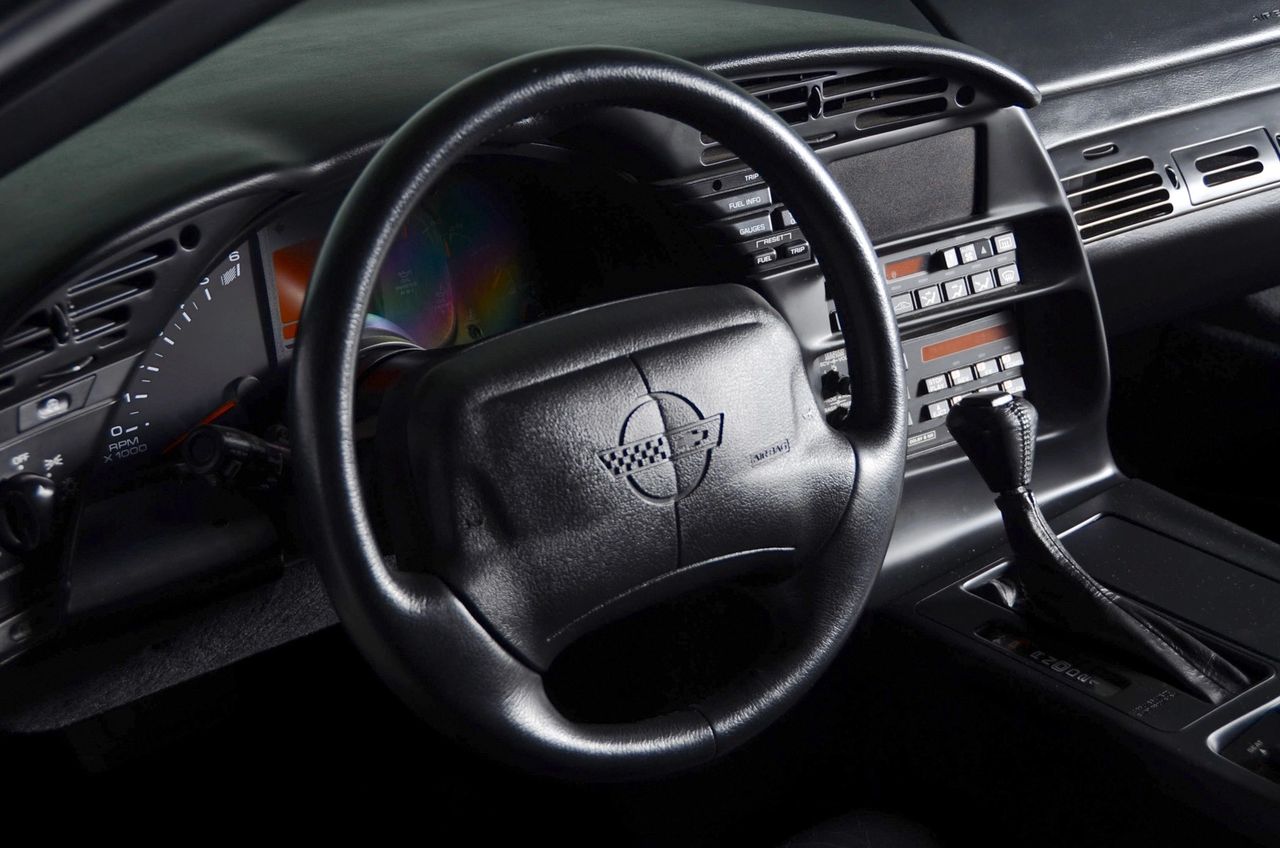
    The ’95 Corvette’s 4L60-E automatic was re-tuned with a lighter, stronger converter, so it hooks the LT1’s torque quicker and shifts cleaner in real-world driving. From the driver’s seat—airbag wheel, analog/digital cluster with the new ATF temp readout, and the console-mounted selector—the cockpit feels purposeful and modern, built to crush traffic and unwind a back road without drama. (Image courtesy of motorcarclassics.com)
    The ’95 Corvette’s 4L60-E automatic was re-tuned with a lighter, stronger converter, so it hooks the LT1’s torque quicker and shifts cleaner in real-world driving. From the driver’s seat—airbag wheel, analog/digital cluster with the new ATF temp readout, and the console-mounted selector—the cockpit feels purposeful and modern, built to crush traffic and unwind a back road without drama. (Image courtesy of motorcarclassics.com)

    The electronic four-speed automatic—4L60-E—was already a known quantity, but the 1995 calibration and hardware tweaks smudged out the last rough edges. Shift timing and pressure control came on cleaner. The torque converter shed weight while gaining strength, and you feel both at low speed: the car pulls into the throttle without that momentary pause you’d get in earlier calibrations, then locks with authority on the highway.
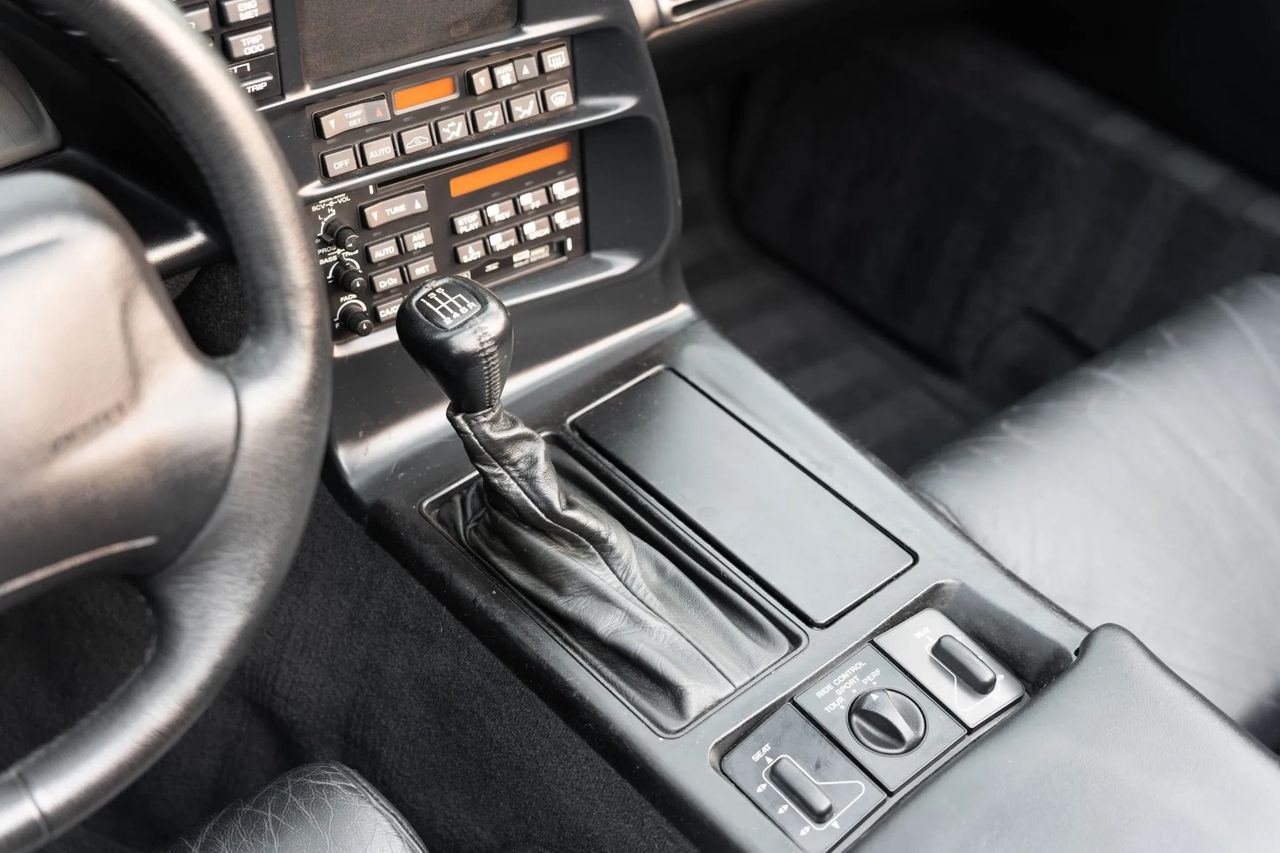
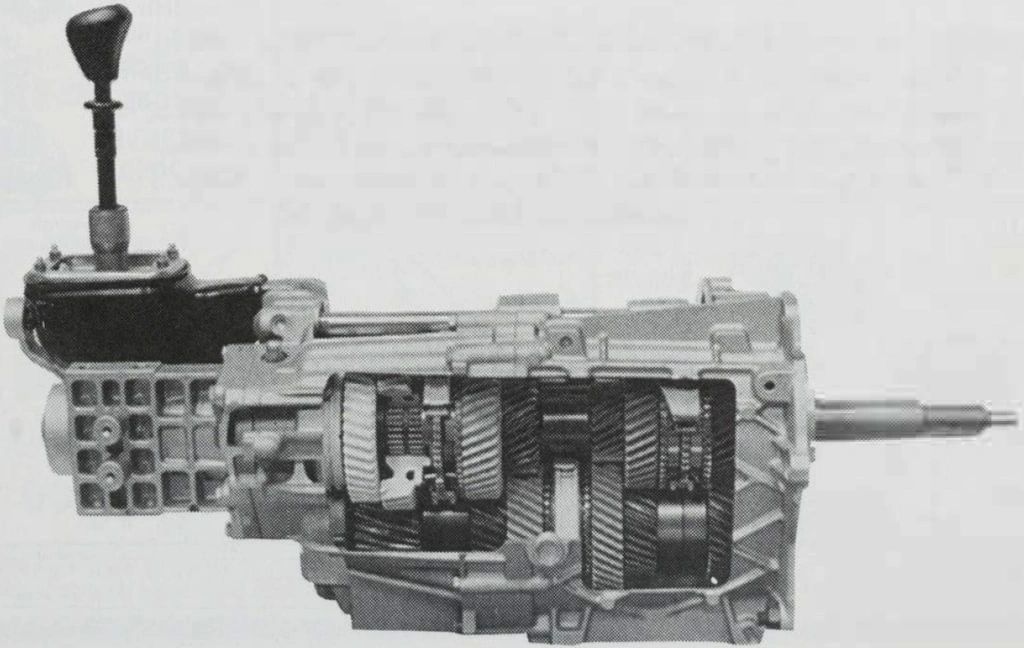
    The ’95 Corvette’s ZF S6-40 six-speed feels right at home here—short, mechanical throws capped by a leather-wrapped knob and the new high-detent reverse that replaced the fiddly lockout of ’94. It’s a driver’s interface first and foremost: slide across the gate, slot the gear, and the LT1 answers with crisp torque on command. (Image courtesy of bringatrailer.com)
    The ’95 Corvette’s ZF S6-40 six-speed feels right at home here—short, mechanical throws capped by a leather-wrapped knob and the new high-detent reverse that replaced the fiddly lockout of ’94. It’s a driver’s interface first and foremost: slide across the gate, slot the gear, and the LT1 answers with crisp torque on command. (Image courtesy of bringatrailer.com)

    For those who preferred three pedals, 1995 quietly fixed the C4’s most persistent annoyance: reverse. Gone was the 1994 reverse-lockout hardware. In its place came a high-detent reverse mechanism that made sliding the lever across the 5–R plane a deliberate, positive act instead of a “don’t-cross-the-wrong-fence” guess. On a handful of early ’95s, tolerances and spring rates made reverse too stout—owners reported abnormally high effort to push past the detent—so GM issued a running fix: an updated detent plunger/spring and a linkage adjustment procedure. Once corrected, the action felt as intended—clean, confident, and repeatable. It’s a small change that reads big in traffic and in the garage—less fishing, more doing—the kind of human-factor work late C4s specialized in: no posters, but plenty of gratitude from the people who lived with the car.

    The Year Big Brakes Went Mainstream
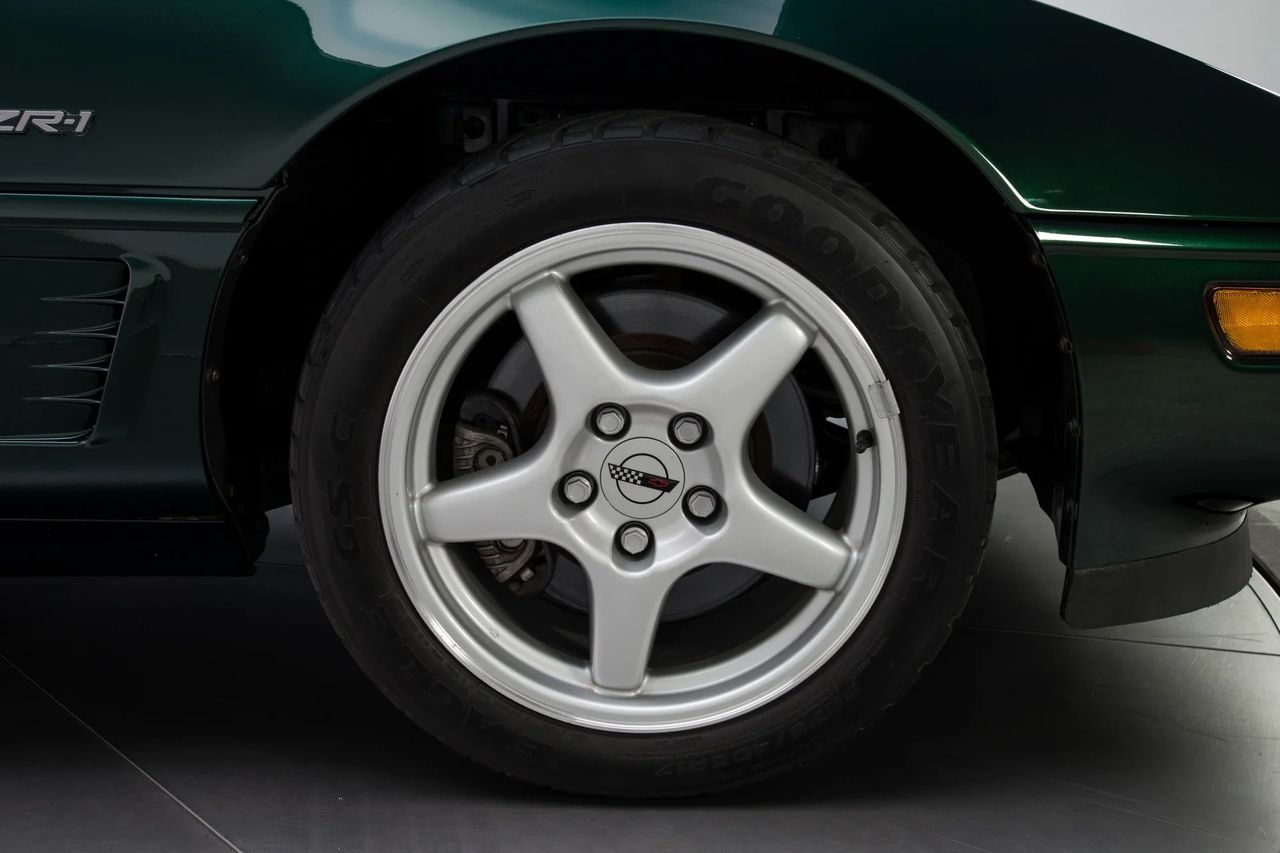
    or 1995, Corvette finally put big brakes on every car: ZR-1/Z07–spec 13-inch front rotors with stout PBR calipers, backed by Bosch ABS 5. The result is real heat capacity and cleaner modulation—pedal height stays consistent, stops stay straight, and threshold braking becomes confidence work, not bravery. It’s the year the C4’s stopping truly matches its going. (Image courtesy of RK Motors)
    or 1995, Corvette finally put big brakes on every car: ZR-1/Z07–spec 13-inch front rotors with stout PBR calipers, backed by Bosch ABS 5. The result is real heat capacity and cleaner modulation—pedal height stays consistent, stops stay straight, and threshold braking becomes confidence work, not bravery. It’s the year the C4’s stopping truly matches its going. (Image courtesy of RK Motors)

    Ask any C4 track rat to name the single best late-car upgrade, and one RPO code came back time after time: J55. For 1995, the heavy-duty front brake package—13-inch rotors, thicker hats, and real thermal capacity—graduated from ZR-1/Z07 exclusivity to standard on every Corvette. Paired with Bosch ABS 5, stopping finally matched going. Threshold braking became an exercise in confidence; the pedal stayed consistent lap after lap, rather than growing long and glassy with heat. The difference was not academic—it was the gap between braking into the apex and surrendering ten yards to nurse a fading system.

    ABS 5 also reshaped emergency stops. The controller cycled faster and with finer pressure modulation than earlier generations, allowing meaningful steering authority over mid-corner bumps and split-µ surfaces. Late C4s felt modern deep in the brake zone on broken pavement because the system maintained line stability while shedding speed: the car modulated, the chassis stayed settled, and the driver kept options. Added to the broader pad window and larger heat sink of the J55 hardware, fade resistance, pedal height, and repeatability became strengths rather than variables—exactly what a fast, confidence-led brake package should have delivered.

    Ride and Handling: Sanding the Rough Edges, Keeping the Edge

    The C4’s structural honesty—stiff backbone, aluminum control arms, short/long arm geometry that loved load—delivered world-class grip from day one. The critique, especially on broken pavement, was ride. For 1995, base-suspension cars received slightly lower front and rear spring rates and a switch to less-stiff de Carbon gas-charged shocks. This was not capitulation; it was control. Lower low-speed damping and spring rates quieted the jiggle and sharpened compliance over the chatter that defined everyday American asphalt. The chassis still talked to you, but it stopped shouting over the small stuff.
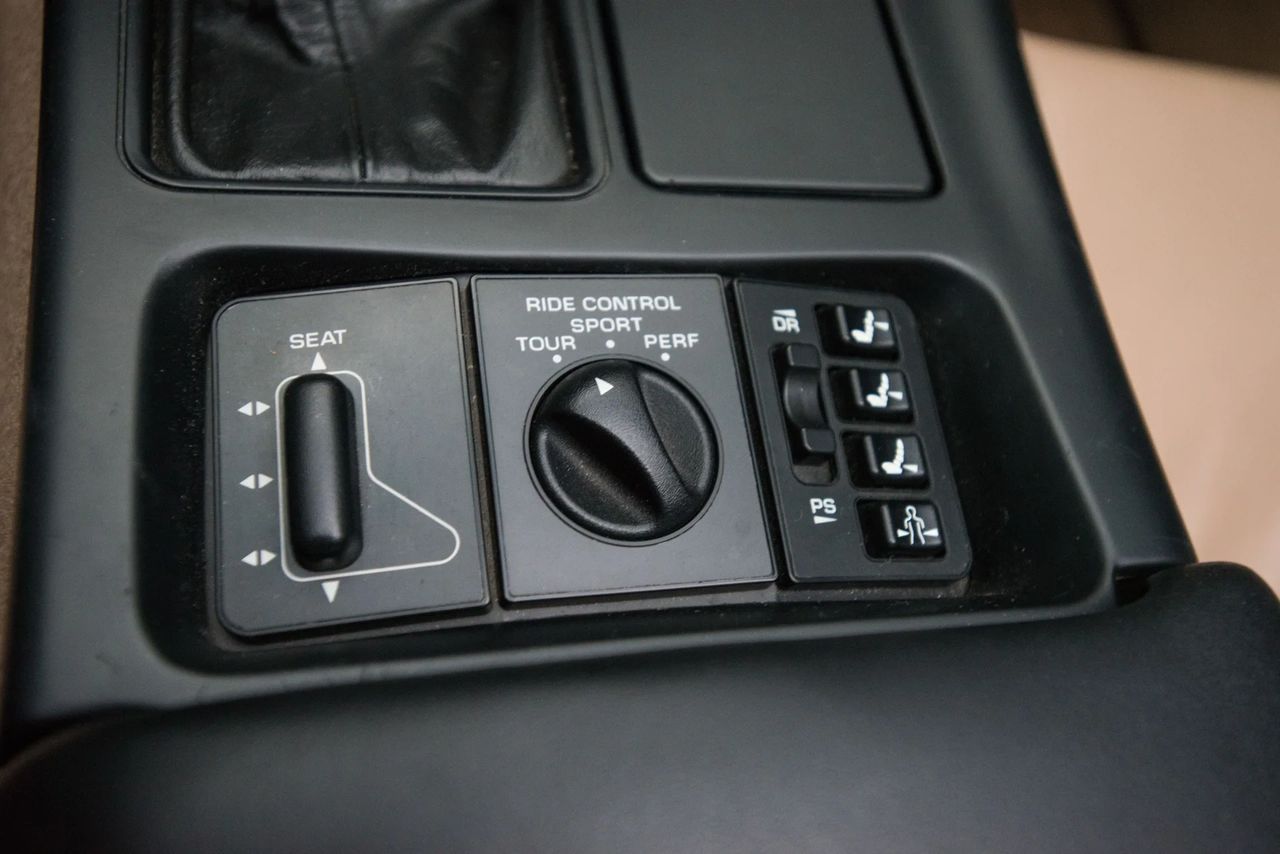
    FX3 Electronic Selective Ride Control pairs Bilstein electronically controlled dampers with a console dial—Tour, Sport, Perf—so the C4’s ride can match the road in seconds. Pick a mode and the system trims damping in real time via shock-mounted actuators, sharpening body control under speed, steering, and brake inputs without beating you up on rough pavement. It’s the late-C4 sweet spot: comfort when cruising, discipline when driven. (Image courtesy of RK Motors)
    FX3 Electronic Selective Ride Control pairs Bilstein electronically controlled dampers with a console dial—Tour, Sport, Perf—so the C4’s ride can match the road in seconds. Pick a mode and the system trims damping in real time via shock-mounted actuators, sharpening body control under speed, steering, and brake inputs without beating you up on rough pavement. It’s the late-C4 sweet spot: comfort when cruising, discipline when driven. (Image courtesy of RK Motors)

    If you ordered FX3 Electronic Selective Ride & Handling, the Bilstein adaptive dampers brought their own late-run refinement, but the real revelation is how cohesive a standard ’95 feels on a fast two-lane. You lift for the corner, load the outside front, lean into the throttle at the apex, and the car settles the way you always wished earlier C4s would settle—no hop, little head toss, and a sense that the platform is working with you, not demanding you drive around its moods.

    The Quiet Fixes Inside: Seats, Squeaks, and Skip-Skips
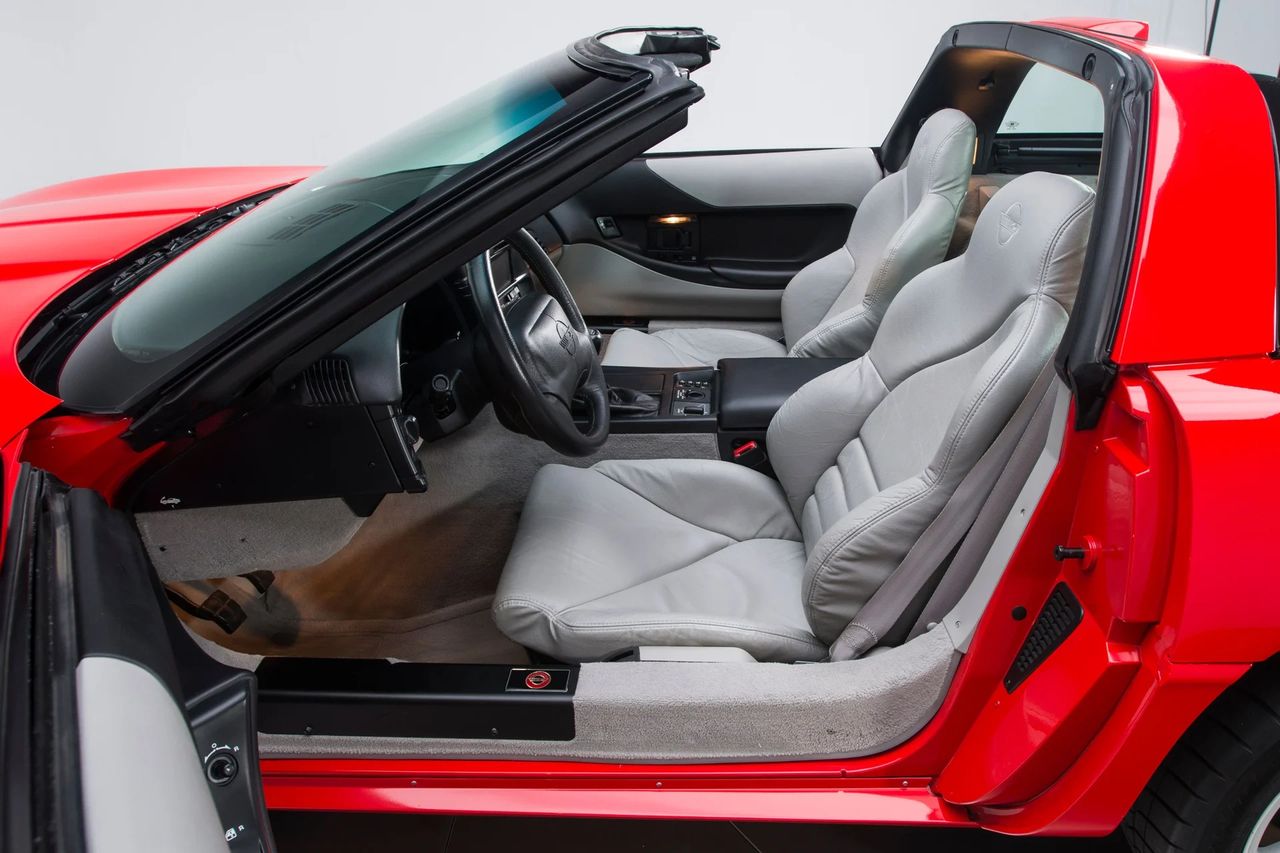
    For 1995, Corvette finally addressed the C4’s most common wear point: the seat bolsters. The sport buckets gained upgraded leather with French-seam stitching, spreading the load and resisting split seams while giving the cabin a cleaner, more tailored look. It’s a subtle change that pays off over time—better durability, tighter shape, and a genuinely upscale finish to the late-C4 interior. (Image courtesy of RK Motors)
    For 1995, Corvette finally addressed the C4’s most common wear point: the seat bolsters. The sport buckets gained upgraded leather with French-seam stitching, spreading the load and resisting split seams while giving the cabin a cleaner, more tailored look. It’s a subtle change that pays off over time—better durability, tighter shape, and a genuinely upscale finish to the late-C4 interior. (Image courtesy of RK Motors)

    Photos didn’t show what 1995 did for the cabin. Your back and ears did.

    Start with the sport seats. Earlier C4s were notorious for torn bolster seams—every bit of sliding in and out carved a little more life out of the stitching. For ’95, the sewing changed to “French” seams and did what good upholstery does: spread load, reduce stress risers, and hold shape. Ten years later, you could tell who had the late seats without asking.

    Then there were the squeaks and buzzes. Corvettes communicated; nobody wanted them to rattle. Engineers added adhesive-fabric straps in strategic spots, the Velcro-ish kind of restraint that preloaded small interfaces so they didn’t chatter. Add a stiffer mount for the radio/CD head unit—less skipping, less thump over expansion joints—and the whole cabin read tighter. A small nod to the faithful automatic crowd: 1995 added an ATF temperature readout in the cluster. It was the sort of subtle tell that this car had been built by people who ran laps on their lunch break and wanted you to have the same data they did.

    Tires and the $100 Credit That Made Sense

    Extended-mobility (run-flat) tires weren’t a novelty by 1995; they were good enough to trust. Chevrolet paired the option with something that felt almost subversive in the age of “pay more, get less”: RPO N84 spare tire delete, a $100 credit when you ordered extended-mobility rubber. You lost the spare, saved weight, and gained a small pocket of space. The safety engineers weren’t asleep at the switch; the area received specific reinforcement, so rear-impact energy management stayed to spec. It was a seemingly small decision that said a lot about where Corvette’s head was at—engineering first, gimmick last.

    Outside: A Subtle, Sharky Tell
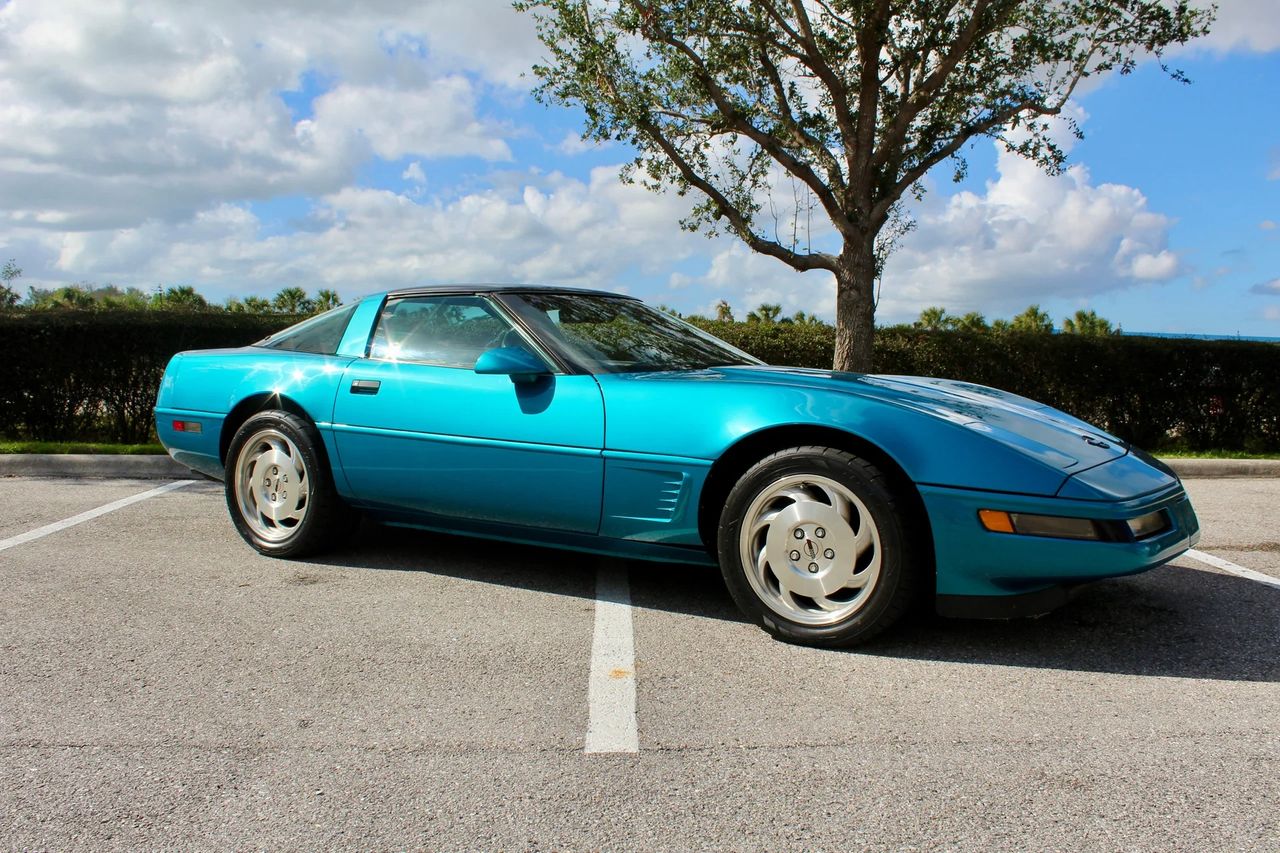
    For 1995, the C4’s front-fender vents lost the inset slats and adopted a cleaner, gill-style opening with a subtle, rolled surround. The change smooths the panel’s visual flow and gives the car a slightly longer, lower look—modernizing the profile without touching the classic long-hood/short-deck proportions. It’s the quickest visual tell you’re looking at a ’95.
    For 1995, the C4’s front-fender vents lost the inset slats and adopted a cleaner, gill-style opening with a subtle, rolled surround. The change smooths the panel’s visual flow and gives the car a slightly longer, lower look—modernizing the profile without touching the classic long-hood/short-deck proportions. It’s the quickest visual tell you’re looking at a ’95.

    There was an easy way to spot a 1995 Corvette in a sea of C4s: walk to the front quarter and look just aft of the wheel opening. Chevrolet reworked the fender “gills” from the earlier recessed slats into a cleaner, more integrated aperture with a soft, rolled surround—less add-on, more sculpture. The opening read longer and lower, visually stretching the car and tying the line back to the late-C1 shark gills without going retro. It was the same fender, same stance, but the surfacing felt tidier and more intentional, like the designers had gone back over the clay and knocked down the last sharp edge.

    That subtle reshaping also calmed the fender’s visual noise. Earlier slats could look inset and shadowy depending on the light; the ’95 treatment highlighted the panel in the same way the rest of the body did, so color flowed across the panel instead of breaking at the vent. In profile photos, it was the tell: the car looked a touch more modern, even though dimensions and proportions didn’t change by even a millimeter.
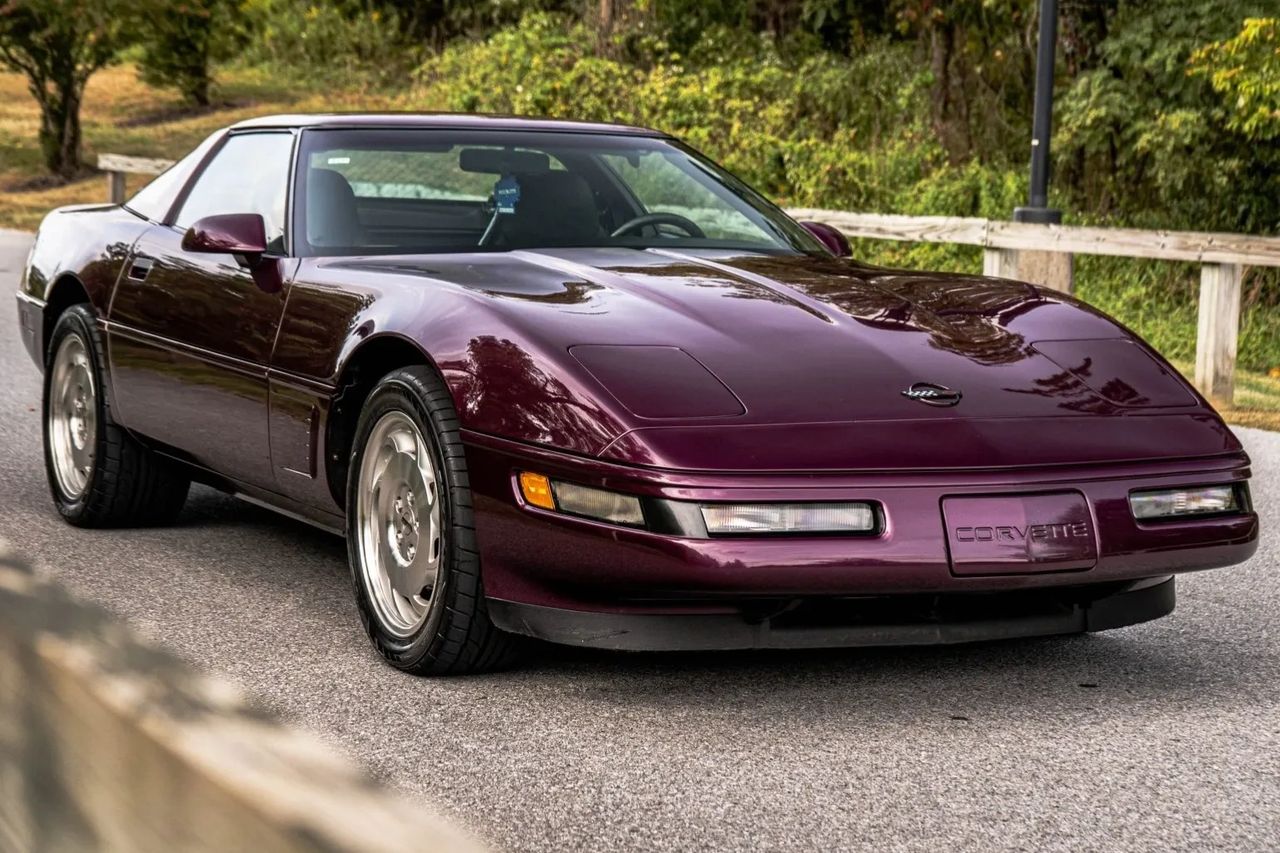
    New for 1995, Dark Purple Metallic gave the C4 a deep, blue-violet flop that flatters every compound curve—moody at dusk, jewel-like in sun. It replaced Copper and Black Rose and instantly became one of the late-run head-turners, with roughly 1,049 cars painted in the shade. Subtle it isn’t; period-correct and unforgettable, it absolutely is. (Image courtesy of bringatrailer.com)
    New for 1995, Dark Purple Metallic gave the C4 a deep, blue-violet flop that flatters every compound curve—moody at dusk, jewel-like in sun. It replaced Copper and Black Rose and instantly became one of the late-run head-turners, with roughly 1,049 cars painted in the shade. Subtle it isn’t; period-correct and unforgettable, it absolutely is. (Image courtesy of bringatrailer.com)

    Chevrolet paired the vent tweak with a handful of “live-with-it” updates outside. New wiper blades and revised arm geometry reduced lift and chatter at highway speeds—a small fix you noticed the first time rain hit at 75. And the paint deck gained a single, mood-setting hue: Dark Purple Metallic. It stepped in for Copper and Black Rose, bringing a deep, blue-violet flop that flattered the C4’s compound curves in a way the camera never quite captured. It was exactly what a late-run color should have been—fresh enough to turn heads, faithful enough to feel like it had always belonged.

    Colors People Actually Bought
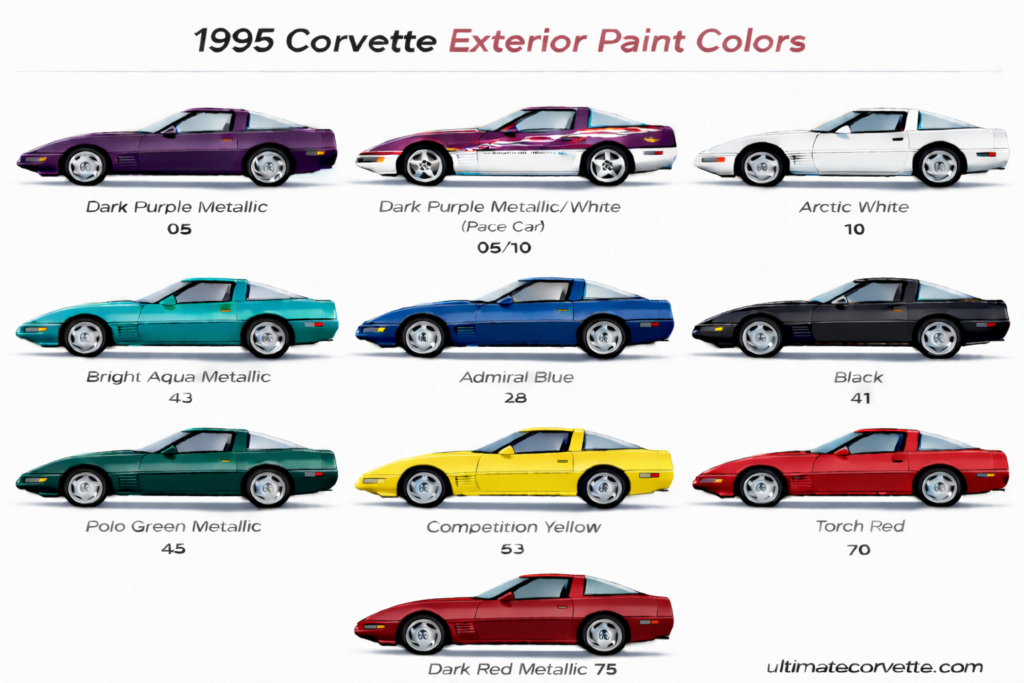
    1995 Chevrolet Corvette Exterior Paint Colors (and OEM Paint Color Codes)
    1995 Chevrolet Corvette Exterior Paint Colors (and OEM Paint Color Codes)

    If you showed up to a cruise-in and felt like you were drowning in Torch Red, there was a reason. Torch Red accounted for roughly 22% of 1995 production (4,500-plus cars), with Black and Arctic White right behind. Polo Green Metallic—the polite assassin’s color—held a strong fourth. At the rarer end were Admiral Blue, Competition Yellow, and the new Dark Purple Metallic, each flirting with the thousand-car mark. Pace Car replicas—two-tone Dark Purple over Arctic White—numbered 527 and looked like nothing else when you caught one in the sun. The mix told you who the ’90s Corvette buyer was: bold enough to wear color, practical enough to buy the ones that still looked fresh thirty years on.

    What It Cost—and How People Spec’d It

    Base price moved only slightly over 1994: $36,785 for the coupe, $43,665 for the convertible. The ZR-1’s option tally still read like a bank statement—$31,258 over a coupe—one reason the LT1 car nipped at its sales heels by the middle of the decade. Look at surviving window stickers, and you’ll see how owners lived: power seats almost everywhere (AG1/AG2), the blue-tint roof panel (24S) vastly preferred to bronze (64S), and a healthy take rate on FX3 for the folks who wanted to tune the ride with their right index finger.

    The 1995 Indy 500 Pace Car (and Z4Z Replicas)
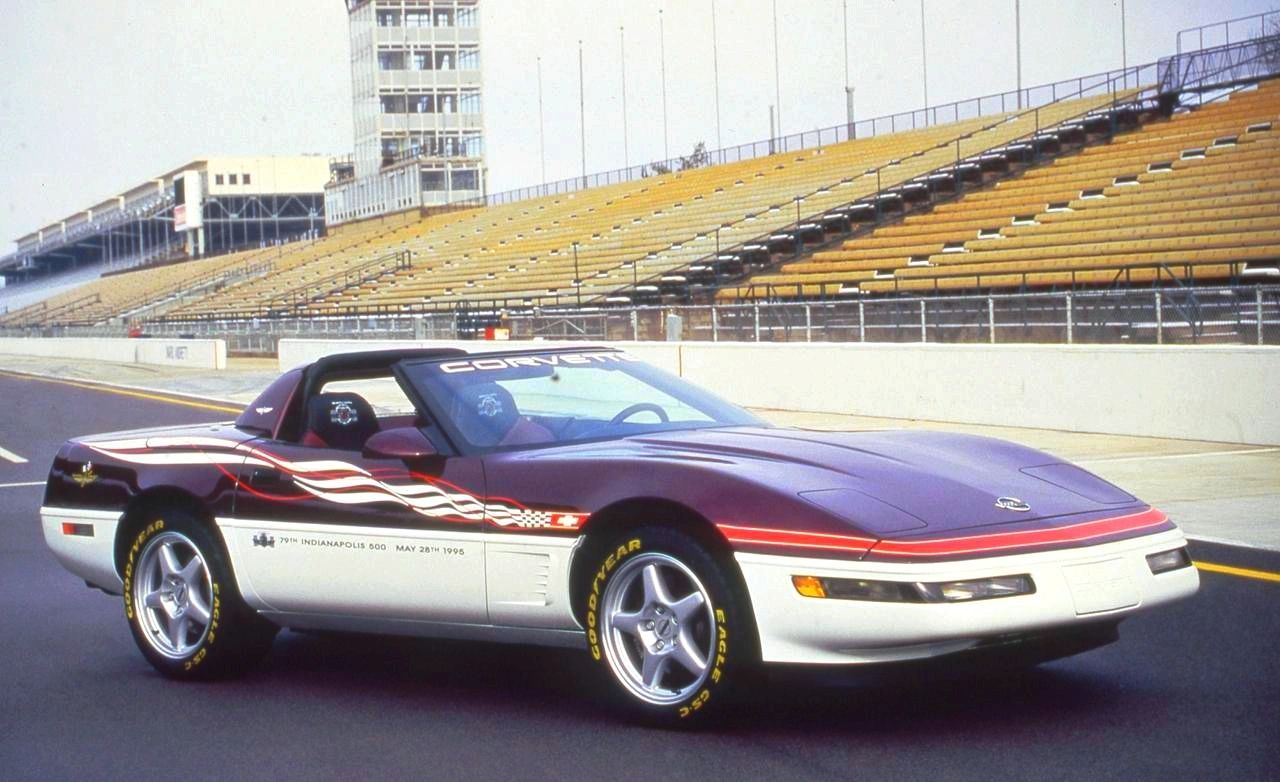
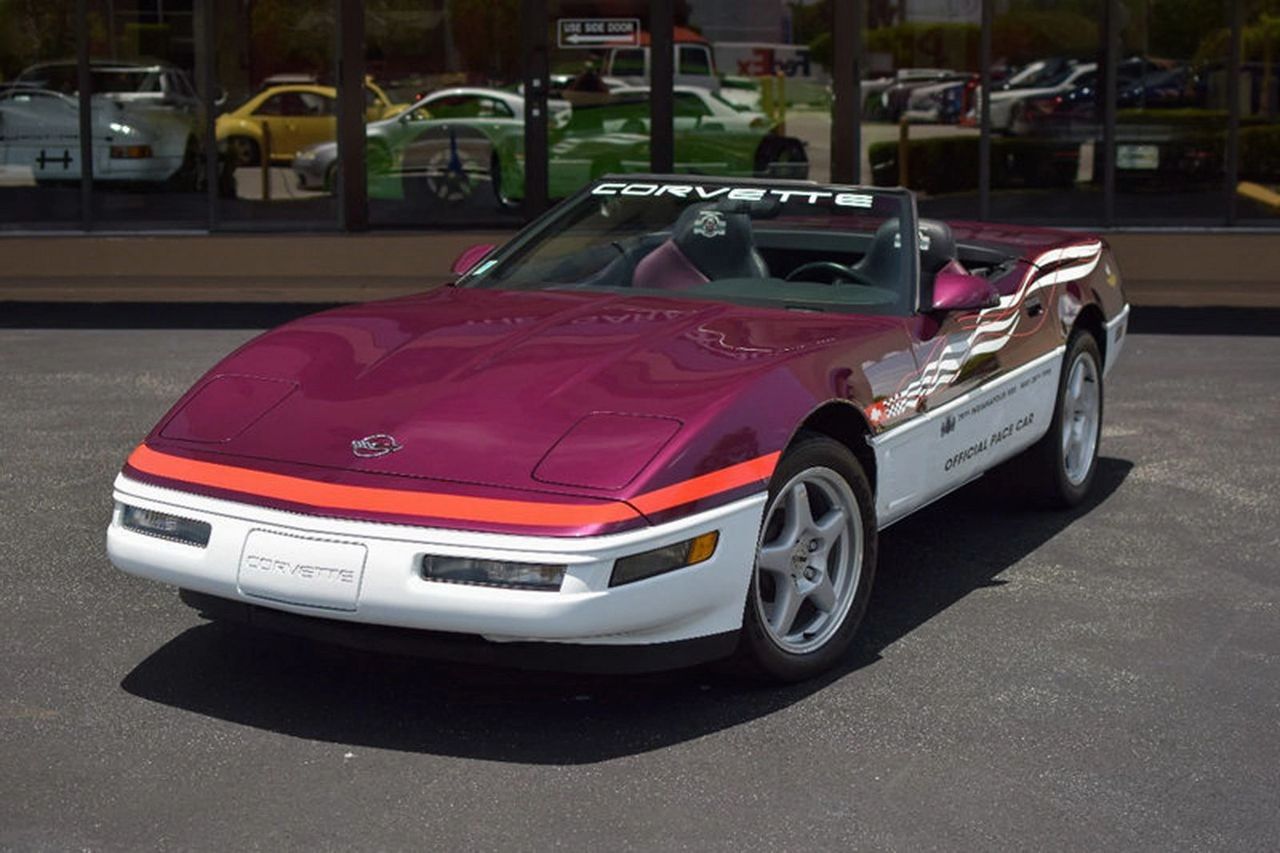
    This 1995 Corvette Pace Car—Dark Purple Metallic over Arctic White with wind-swept ribbon graphics—led the 79th Indianapolis 500 essentially stock, proof of how civilized and capable the late-C4 had become. Under the skin: LT1 torque, tidy chassis manners, and A/C cold enough for pit-lane crawls under a hot May sun. Chevrolet built 527 Z4Z Pace Car Replicas for the street, but the look you see here—white top, embroidered headrests, red pinstripe sweep—remains the poster shot: pure Motor Speedway theater on a car that could drive home afterward without breaking a sweat. (Image courtesy of GM Media LLC)
    This 1995 Corvette Pace Car—Dark Purple Metallic over Arctic White with wind-swept ribbon graphics—led the 79th Indianapolis 500 essentially stock, proof of how civilized and capable the late-C4 had become. Under the skin: LT1 torque, tidy chassis manners, and A/C cold enough for pit-lane crawls under a hot May sun. Chevrolet built 527 Z4Z Pace Car Replicas for the street, but the look you see here—white top, embroidered headrests, red pinstripe sweep—remains the poster shot: pure Motor Speedway theater on a car that could drive home afterward without breaking a sweat. (Image courtesy of GM Media LLC)

    The 79th Indianapolis 500 ran under heavy nostalgia and heavier sun, and the car leading the field was a near-stock 1995 Corvette convertible—the nameplate’s third time pacing the Brickyard. Chevrolet marked the moment with RPO Z4Z, a factory Pace Car Replica available only as a convertible. The look is unmissable: Dark Purple Metallic over Arctic White, a white top, swooping ribbon graphics, and embroidered headrests. Chevrolet built 527 examples; 87 handled race-week duty, 20 went overseas, and the balance were allocated to top-performing U.S. dealers. The package added $2,816 to a base convertible, but its visual drama made it feel like far more than a sticker sheet.
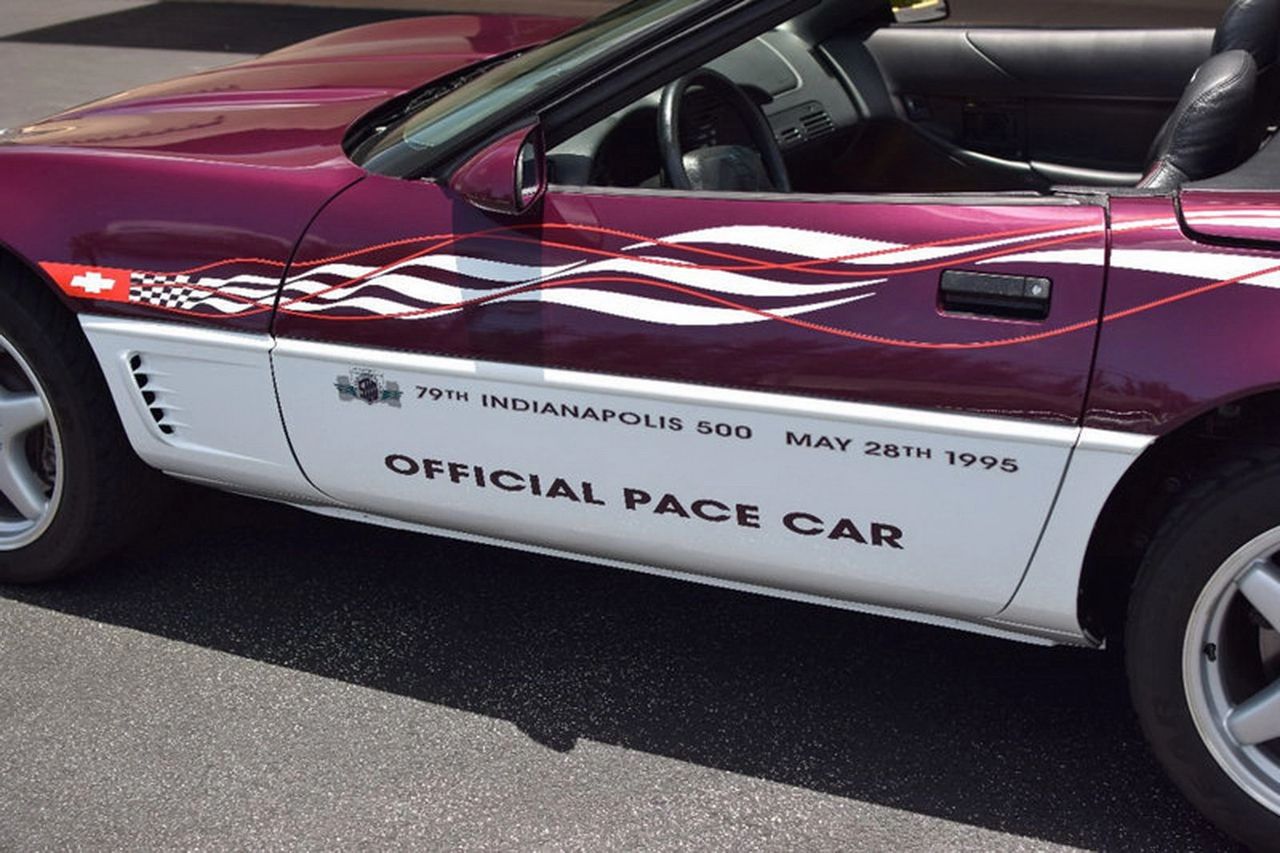
    Lettered like a pit-lane credential, the Z4Z’s flanks tell the whole story: “79th Indianapolis 500 — May 28th, 1995” riding above crisp “OFFICIAL PACE CAR” script. A red tracer threads through wind-swept ribbons that split Dark Purple Metallic from Arctic White, ending at the crossed-flags fender badge. The close-up also shows late-C4 cues—the clean side gills, body-color handle, and five-spoke alloys—wrapped in a livery that looks in motion even when parked.
    Lettered like a pit-lane credential, the Z4Z’s flanks tell the whole story: “79th Indianapolis 500 — May 28th, 1995” riding above crisp “OFFICIAL PACE CAR” script. A red tracer threads through wind-swept ribbons that split Dark Purple Metallic from Arctic White, ending at the crossed-flags fender badge. The close-up also shows late-C4 cues—the clean side gills, body-color handle, and five-spoke alloys—wrapped in a livery that looks in motion even when parked.

    Part of the appeal was what it didn’t change: the underlying car. By 1995, the LT1-powered C4 was the product of a decade of continuous refinement—tight body control, confident ABS/Traction Control, precise steering, and a cooling system you could trust in stop-and-go heat. That mattered at Indy. A nearly stock Corvette could idle on the pit lane with the A/C blasting, pace a field cleanly at speed, and then loaf home like a boulevard cruiser. The Z4Z didn’t exist to manufacture performance; it existed to spotlight a car that already had it, with manners to match.

    Collectors also respond to how cleverly Chevrolet framed the replica. The diagonal two-tone references a classic motorsport trope, but Dark Purple Metallic—new for 1995—made the car feel contemporary rather than retrospective. That purple wasn’t just a pace-car flourish either: across the entire model year, 1,049 Corvettes wore Dark Purple Metallic, outpacing several established hues. In that context, the Z4Z’s 527-unit tally reads as intentionally scarce—special enough to be collectible, common enough to be seen.
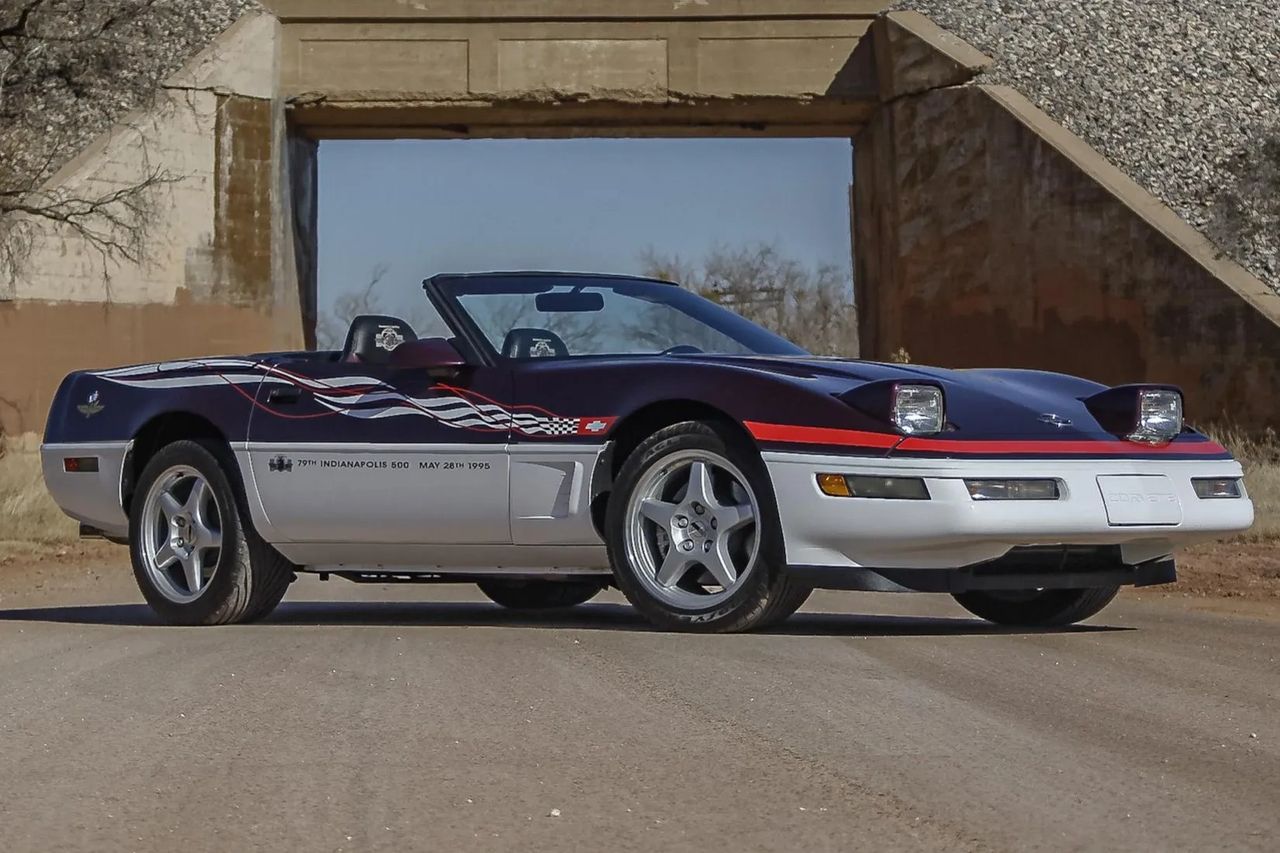
    As Indy-themed C4s go, the Z4Z is a sweet spot for collectors: low production, easy to live with, and still approachable money. Market-wise, driver-quality cars with average miles typically trade in the mid-teens (Hagerty pegs a “good” example around $16k), while exceptional, low-mile cars with full paperwork can push well into the $20s and occasionally crest $30k—a Mecum sale brought $34,100 in 2022. Recent auction floors show reality checks too; a Kissimmee car stalled at a $17,000 high bid in 2025. Provenance (festival or track-use docs), mileage under ~10k, untouched graphics, original wheels/tires, and complete books/window sticker move the needle; aftermarket paint or missing decals hold it back. With just 527 built, clean examples remain thin on the ground, which helps values stay resilient even as broader C4 prices fluctuate. (Image courtesy of bringatrailer.com)
    As Indy-themed C4s go, the Z4Z is a sweet spot for collectors: low production, easy to live with, and still approachable money. Market-wise, driver-quality cars with average miles typically trade in the mid-teens (Hagerty pegs a “good” example around $16k), while exceptional, low-mile cars with full paperwork can push well into the $20s and occasionally crest $30k—a Mecum sale brought $34,100 in 2022. Recent auction floors show reality checks too; a Kissimmee car stalled at a $17,000 high bid in 2025. Provenance (festival or track-use docs), mileage under ~10k, untouched graphics, original wheels/tires, and complete books/window sticker move the needle; aftermarket paint or missing decals hold it back. With just 527 built, clean examples remain thin on the ground, which helps values stay resilient even as broader C4 prices fluctuate. (Image courtesy of bringatrailer.com)

    And that, ultimately, is the late-C4 story: dual-purpose competence with a showman’s streak. The Z4Z cars gave the public a street-buyable slice of Indy pageantry, but the deeper message lived in the way a largely stock Corvette could do the ceremonial work without breaking a sweat—and do the real work, too. Pace-car paint made the statement loud; the LT1’s easy torque, the chassis’ polish, and the Corvette’s everyday usability made it true.

    Le Mans 1995: Blue-Collar Heroes in Yellow Light
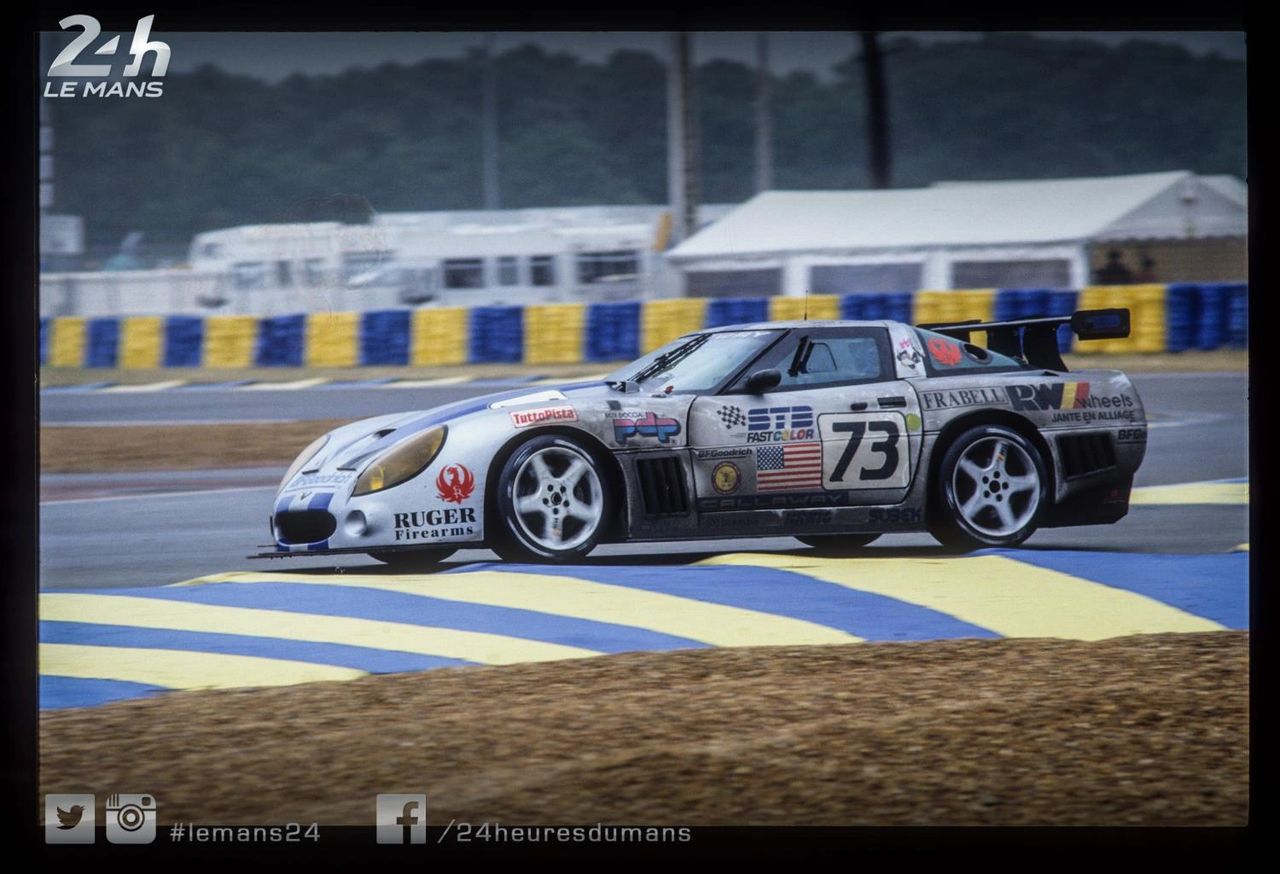
    Rain-polished curbs, yellow lights, and blue-collar thunder. Callaway’s #73 SuperNatural Corvette skims the Le Mans chicanes like a power tool on wet glass—front-engine torque tucked under a battered, stickered shell, rear wing carving spray into ribbons. The five-spokes blur, side vents inhale, and that long C4 hood points down the Mulsanne with purpose. Driven by Bertaggia/Unser/Jelinski, this was the GT2 grinder that climbed all night through traffic and weather, proving that an American V-8 with good hands and better discipline could dance in European rain—and finish on the GT2 podium for keeps.
    Rain-polished curbs, yellow lights, and blue-collar thunder. Callaway’s #73 SuperNatural Corvette skims the Le Mans chicanes like a power tool on wet glass—front-engine torque tucked under a battered, stickered shell, rear wing carving spray into ribbons. The five-spokes blur, side vents inhale, and that long C4 hood points down the Mulsanne with purpose. Driven by Bertaggia/Unser/Jelinski, this was the GT2 grinder that climbed all night through traffic and weather, proving that an American V-8 with good hands and better discipline could dance in European rain—and finish on the GT2 podium for keeps.

    Nobody alive forgets the weather at Le Mans in 1995. The light went silvery gray, the rain came in hard, wind-blown sheets, and the Circuit de la Sarthe turned into a master class in mechanical sympathy. Under that sodium-yellow glow at dusk, the fast way around wasn’t the bravest throttle but the softest hands—feeling the car skim, giving it just enough slip to clear traffic and just enough kindness to live another lap.

    In that chaos, the stories Corvette people tell live in the GT2 ranks. Callaway Competition rolled in with two production-based SuperNatural Corvettes—blue-collar tools dressed for a black-tie fight—and went to work. The #73 car, driven by Enrico Bertaggia, Johnny Unser, and Frank Jelinski, climbed from deep in the grid with the kind of wet-weather discipline you only learn the hard way: early brake releases into the rivered braking zones, patient throttle over the crown on the Hunaudières, and absolute trust through the kinks. When daylight returned to the pits, they were 9th overall and 2nd in GT2. The sister car shadowed that arc, grinding out clean sectors and unforced stops to finish 11th overall, 3rd in class—results that read modest on paper until you remember the conditions and the company.
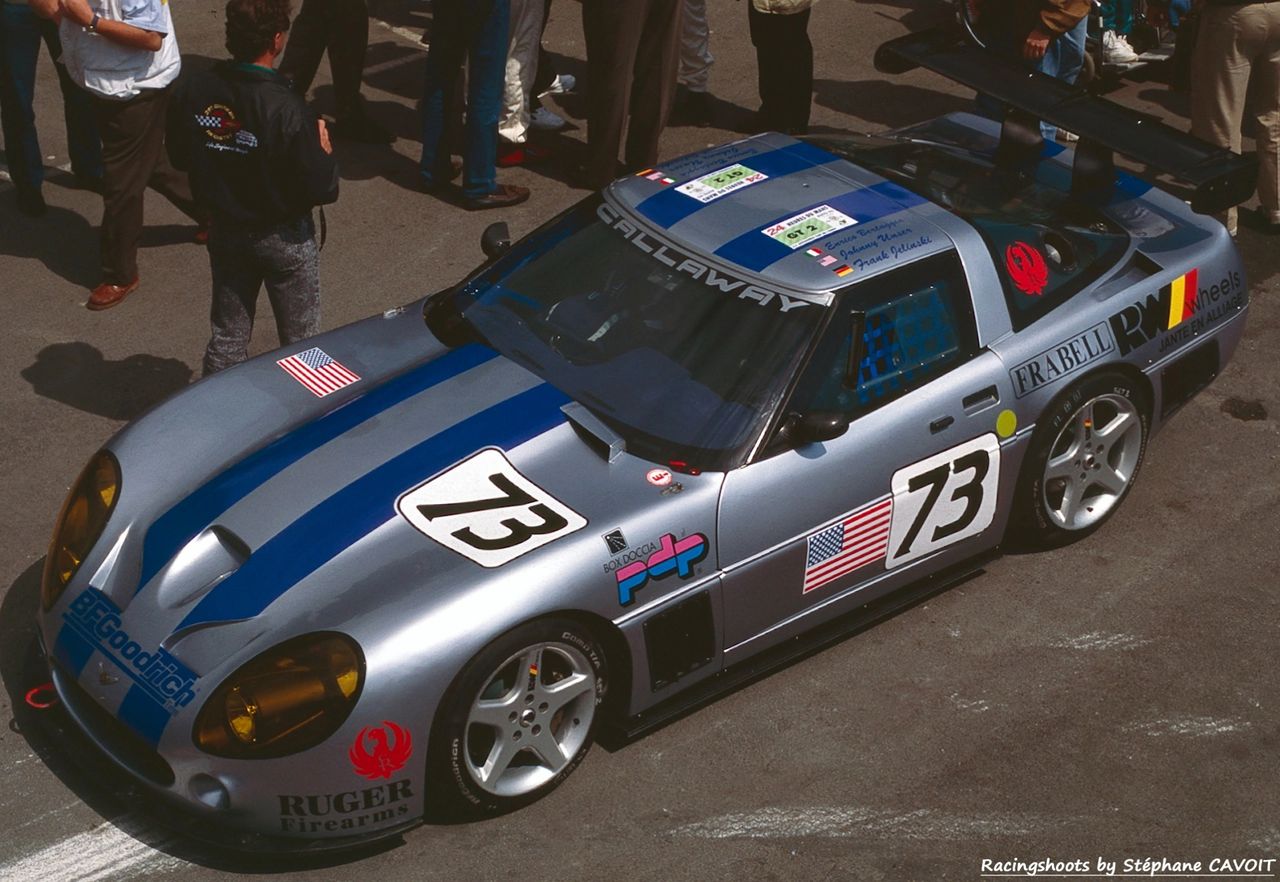
    Scrutineering tells the truth on #73. Roof stickers and driver flags march across the panel, CALLAWAY shouts from the visor, and the silver body with twin blue stripes looks purposeful, not pretty. Yellow headlamp film, a deep center duct, and a NACA scoop feeding the front brakes telegraph the brief. Big side extractors and a tall, single-plane wing square the C4’s shoulders, while five-spoke Speedlines tuck neatly under the arches. The sponsor set—BFGoodrich, Ruger, Frabell, RW Wheels—reads period-correct, but it’s the small stuff that sells it: tow eye peeking from the splitter, quick-release pins, hand-cut numbers. This is a car built for the long night, not the lawn.
    Scrutineering tells the truth on #73. Roof stickers and driver flags march across the panel, CALLAWAY shouts from the visor, and the silver body with twin blue stripes looks purposeful, not pretty. Yellow headlamp film, a deep center duct, and a NACA scoop feeding the front brakes telegraph the brief. Big side extractors and a tall, single-plane wing square the C4’s shoulders, while five-spoke Speedlines tuck neatly under the arches. The sponsor set—BFGoodrich, Ruger, Frabell, RW Wheels—reads period-correct, but it’s the small stuff that sells it: tow eye peeking from the splitter, quick-release pins, hand-cut numbers. This is a car built for the long night, not the lawn.

    What made it sing wasn’t just lap time; it was the way a front-engine American V-8 endured a European rain race. The Callaway cars were built around reliability and feel: broad, usable torque that let the drivers short-shift out of the slow stuff; gearing tall enough to stay calm on the long straights; brake packages they could nurse through the night without drama. In the garage, the operation looked exactly like a privateer should—handwritten pit boards, towels steaming on radiators, crews taping seams and wiping visors between fuel and tires—yet the execution was clinical. Tire calls were conservative, out-laps were tidy, and the cars kept their noses clean when prototypes sprayed sheets of water past Arnage.
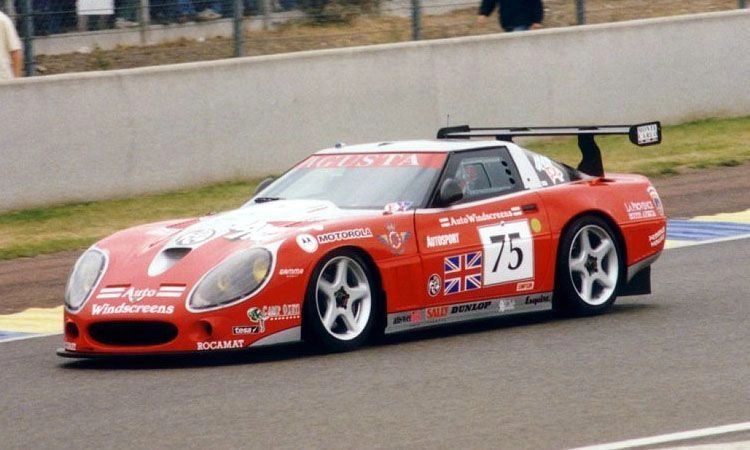
    Callaway brought two SuperNatural GT2 entries to La Sarthe alongside the headline #73: the #75 (shown in the picture) and #76 sister cars. In a race defined by rain and restraint, #75 did the blue-collar work—clean pit cycles, tidy stints, zero drama—and ground out a 3rd in GT2 and 11th overall, the kind of result you earn one disciplined lap at a time.  The #76 car showed flashes of the same pace but didn’t get the breaks; a long night of weather, traffic, and attrition ultimately sidelined it before the flag. Together, the two cars captured the Callaway brief in 1995: front-engine Corvette torque, privateer execution, and a refusal to flinch when the circuit turned to rivers.
    Callaway brought two SuperNatural GT2 entries to La Sarthe alongside the headline #73: the #75 (shown in the picture) and #76 sister cars. In a race defined by rain and restraint, #75 did the blue-collar work—clean pit cycles, tidy stints, zero drama—and ground out a 3rd in GT2 and 11th overall, the kind of result you earn one disciplined lap at a time. The #76 car showed flashes of the same pace but didn’t get the breaks; a long night of weather, traffic, and attrition ultimately sidelined it before the flag. Together, the two cars captured the Callaway brief in 1995: front-engine Corvette torque, privateer execution, and a refusal to flinch when the circuit turned to rivers.

    The result felt like a baton pass. Those weather-beaten, quietly professional finishes proved that a Corvette—properly prepared and intelligently driven—could be a 24-hour instrument, not just a sprint hammer. Within a few years, the factory-backed C5-R would arrive with Pratt Miller’s polish and start writing the big headlines. But the tone had already been set in 1995: blue-collar heroes in yellow light, doing the hard, unglamorous laps that turn a marque into a Le Mans contender.

    And that’s why 1995 still resonates. McLaren took the overall trophy, but Corvette people remember two cars that refused to flinch—front-engine thunder made gentle by good hands, finding grip where there shouldn’t have been any, and proving to everyone paying attention that America’s sports car belonged on the world’s toughest stage.

    Doug Rippie’s Lone 1995 CORvETTE ZR-1 at Le Mans
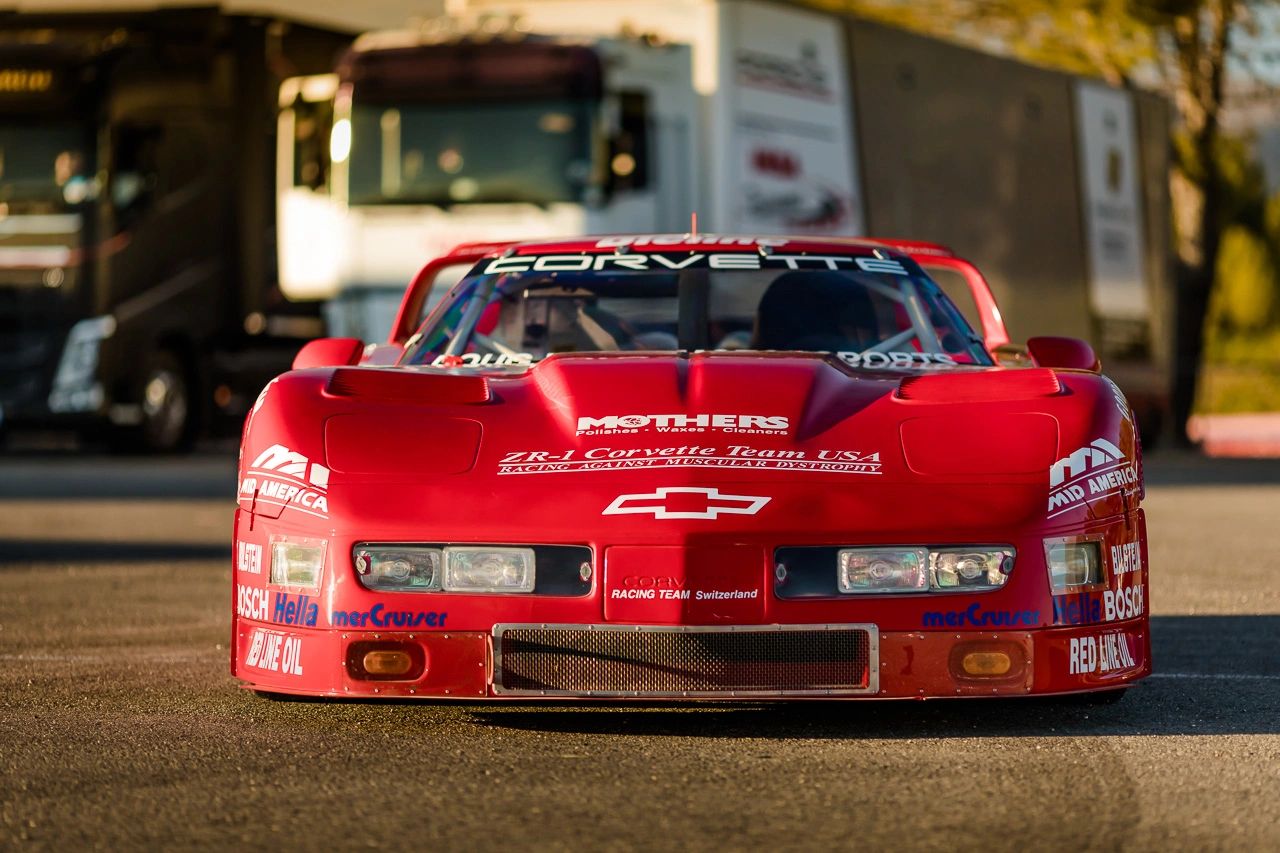
    Doug Rippie Motorsports took a single ZR-1 to Le Mans in 1995—the only C4 ZR-1 ever to start the 24—and trimmed it into a GT1 hammer: LT5 quad-cam V-8 breathing through a wide-mouth fascia, clear headlamp covers, big brakes, and aero you could measure with a ruler. It wasn’t a trailer queen; it mixed it with the class all day and deep into the night before an engine failure ended the run late. No trophy, but a statement: America’s quad-cam Corvette could qualify for, fight in, and very nearly finish the world’s roughest endurance race on privateer grit.
    Doug Rippie Motorsports took a single ZR-1 to Le Mans in 1995—the only C4 ZR-1 ever to start the 24—and trimmed it into a GT1 hammer: LT5 quad-cam V-8 breathing through a wide-mouth fascia, clear headlamp covers, big brakes, and aero you could measure with a ruler. It wasn’t a trailer queen; it mixed it with the class all day and deep into the night before an engine failure ended the run late. No trophy, but a statement: America’s quad-cam Corvette could qualify for, fight in, and very nearly finish the world’s roughest endurance race on privateer grit.

    In 1995, Doug Rippie Motorsports hauled the C4’s halo straight to La Sarthe—the only ZR-1 ever to start the 24. The car looked every inch the purpose-built GT1: clear headlamp covers over a shovel-nose fascia, deep hood extractors, a proper splitter, and that Lotus-designed LT5 quad-cam breathing through a wide mouth. The livery read like pit-lane roll call—Mothers, Mid America, Bosch, Red Line—but the stance said everything: low, wide, and unapologetically CORVETTE.

    The run was classic privateer grit. The DRM ZR-1 mixed it with the class through the wet night on tidy stops and honest pace before an engine problem ended the drive late. No trophy, but the point landed: a well-prepared, quad-cam C4 could qualify for, race in, and very nearly finish Le Mans. In the broader ’95 story, that effort feels like a handoff—the proof-of-concept that set the stage for the factory C5-R juggernaut to follow.

    The ZR-1’s Farewell: Long Live the King
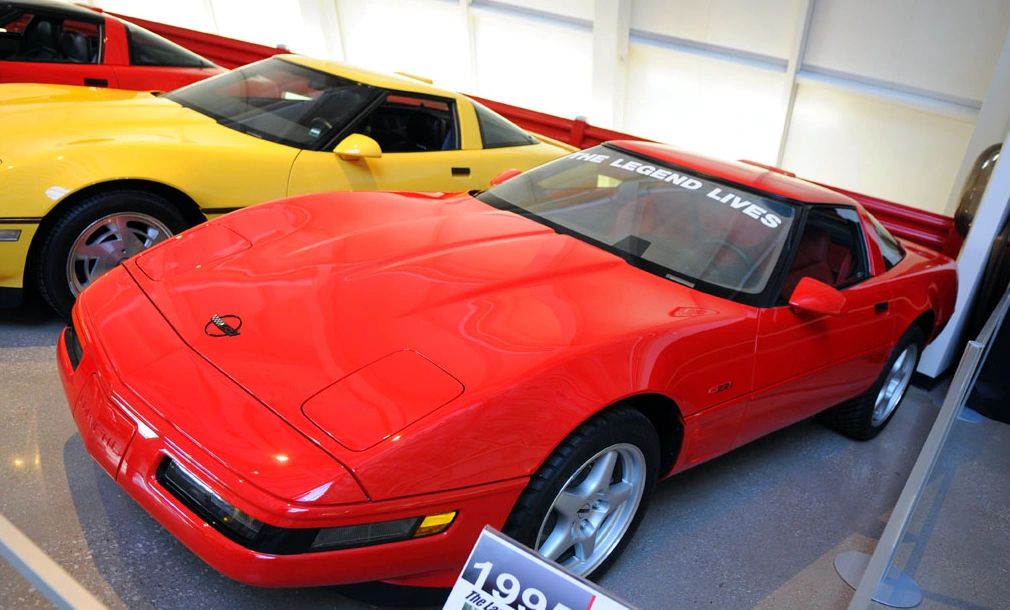
    This image shows the final 1995 Corvette ZR-1—the last C4 ZR-1 built—now preserved at the National Corvette Museum, identifiable by the windshield banner reading “The Legend Lives,” the slogan used for the model’s sendoff. Chevrolet ended ZR-1 production in 1995 after building 448 examples for the final model year, closing out a six-year run of the LT5-powered flagship. The 1995 ZR-1 used the 5.7-liter LT5 DOHC V8 rated at 405 horsepower and 385 lb-ft of torque, paired exclusively with a six-speed manual transmission. Contemporary accounts of the retirement ceremony note that the final Torch Red car was driven from the Bowling Green plant to the National Corvette Museum for permanent display.

    If the C4 democratized world-class handling, the ZR-1 redefined what an American supercar could be. Six model years; 6,939 cars; a Lotus-engineered, Mercury Marine-assembled LT5 with four cams, thirty-two valves, and a work ethic that made endurance records look like calendar invites. The final ZR-1 rolled off the Bowling Green line on Friday, April 28, 1995, and it didn’t sneak out a side door. The plant paused. The car—Torch Red, as if it could be anything else—was paraded off the line with Plant Manager Wil Cooksey and UAW’s Billy Jackson aboard. Jim Perkins, Chevrolet’s general manager and a man who could sell ice in Antarctica, took the wheel, checkered flag in hand. Riding shotgun across to the National Corvette Museum: Dave McLellan, the chief engineer who shepherded the C4 from square one into legend. It was equal parts celebration and salute.

    Why end it? Two truths converged. The 1996 emissions and onboard diagnostic standards made another year of LT5 prohibitively expensive. And the LT1 cars—cheaper, simpler, and increasingly mighty—were too good to ignore. Corvette people love to speculate about the path not taken: the higher-output LT5 evolutions (450-plus horsepower) that Lotus and GM explored, the prototypes that hinted at what might have been. But the market and the calendar set the terms. The ZR-1 had done its job. It changed minds. It dragged the world’s attention to a corner of Kentucky and made the Corvette name synonymous with speed, stamina, and civility. The king could retire; the kingdom was secure.

    And the epitaph had already been written in the present tense. As AutoWeek put it at the time: with rocket-sled acceleration, mastiff grip, and right-now brakes, the ZR-1 offered the largest performance envelope of any mass-produced American car, would trudge through gridlock with the A/C on “kill,” and, with a slight tailwind, run 180 mph. You don’t need a plaque for that. You need a long piece of road.

    Sales, VINs, and the Slow Fade to the Finale

    The numbers tell a polite truth. With the C5 looming, 1995 Corvette production settled at 20,742 units—15,771 coupes and 4,971 convertibles—even as dealers grew aggressive with their pricing. ZR-1 production stopped at 448 before the April ceremony. If you’re decoding a car today, the VIN blocks make life easy: base cars run 100001–120294; ZR-1s run 800001–800448. Don’t be surprised when serial ranges and total production totals don’t match exactly; number allocation doesn’t always run in a perfect, uninterrupted line. What matters is that the line, in the bigger sense, kept moving forward.

    How It Drives—Then and Now
    The ’95 drives like a sorted idea. The LT1 fires clean, leans on its torque, and pulls with that lazy-quick surge that makes short shifts feel smart. Steering is keyed-in but unneedy—light off center, confident as you lean on it—and the base suspension trades chatter for conversation, smoothing the junk without dulling the edge. Roll into the middle pedal and J55/ABS 5 keeps the car square; you get a short stroke, a steady nose, and permission to brake later than you planned. Gear it up on the highway and the whole car relaxes—long legs, low revs, cabin quiet enough to hear the tires working. It’s not trying to impress you; it just gets every job right, which is the point.
    The ’95 drives like a sorted idea. The LT1 fires clean, leans on its torque, and pulls with that lazy-quick surge that makes short shifts feel smart. Steering is keyed-in but unneedy—light off center, confident as you lean on it—and the base suspension trades chatter for conversation, smoothing the junk without dulling the edge. Roll into the middle pedal and J55/ABS 5 keeps the car square; you get a short stroke, a steady nose, and permission to brake later than you planned. Gear it up on the highway and the whole car relaxes—long legs, low revs, cabin quiet enough to hear the tires working. It’s not trying to impress you; it just gets every job right, which is the point.

    Drive a healthy 1995 Corvette, and the point lands without a sales pitch. The LT1 snaps awake and settles into a steady heartbeat; the six-speed works like a well-oiled bolt, reverse clicking in with the certainty of a light switch. A good automatic behaves like a seasoned co-driver—quiet, decisive, always where you want it. On a fast two-lane, the base suspension irons the small stuff instead of broadcasting it; the car trades chatter for conversation. Lean hard on the J55/ABS 5, and the nose stays glued to your line—short pedal, tidy weight transfer, courage on tap.

    Inside, the French-seam sport seats still hold you like a handshake you trust. The radio doesn’t hop over railroad tracks, and the cabin refuses to rattle like a coffee can of sockets on a washboard. None of it is brochure fireworks; it’s the clean execution that turns speed into confidence. That was the ’95 then, and it’s why a well-kept one now still feels like a sorted instrument, not just a fast car.

    Why THE 1995 CORVETTE Matters
    Why ’95 mattered is parked right here. The late-C4 finally became the car Chevy had been chasing—LT1 torque that lit every time, ABS 5/J55 brakes you could lean on, and a chassis that filtered chatter instead of shouting it. The new “gill” side vents and cleaner nose sharpened the look, while the Indy Pace Car program put the polish on display for everyone to see. It was the ZR-1’s curtain call, the LT1’s sweet spot, and the year the Corvette proved it could be quick, durable, and civilized all at once—setting the table for the C5 to sprint.
    Why ’95 mattered is parked right here. The late-C4 finally became the car Chevy had been chasing—LT1 torque that lit every time, ABS 5/J55 brakes you could lean on, and a chassis that filtered chatter instead of shouting it. The new “gill” side vents and cleaner nose sharpened the look, while the Indy Pace Car program put the polish on display for everyone to see. It was the ZR-1’s curtain call, the LT1’s sweet spot, and the year the Corvette proved it could be quick, durable, and civilized all at once—setting the table for the C5 to sprint.

    Collectors chase stories as much as they chase cars, and the 1995 Corvete tells several good ones. It’s the last season where, in theory, you could cross-shop a ZR-1 and an LT1 on the same floor. It’s the year big brakes became a birthright for every buyer. It’s Indy, if you want a commemorative with presence that still makes kids point. It’s also the sweet spot for owners who drive: late-run quality, sensible NVH, better “live-with-it” bits, and braking that belongs on a modern highway. If you want a C4 that carries the lessons of the whole generation without the price tag of the halo, 1995 checks every box in a steady, confident hand.

    Epilogue: The Heir Apparent
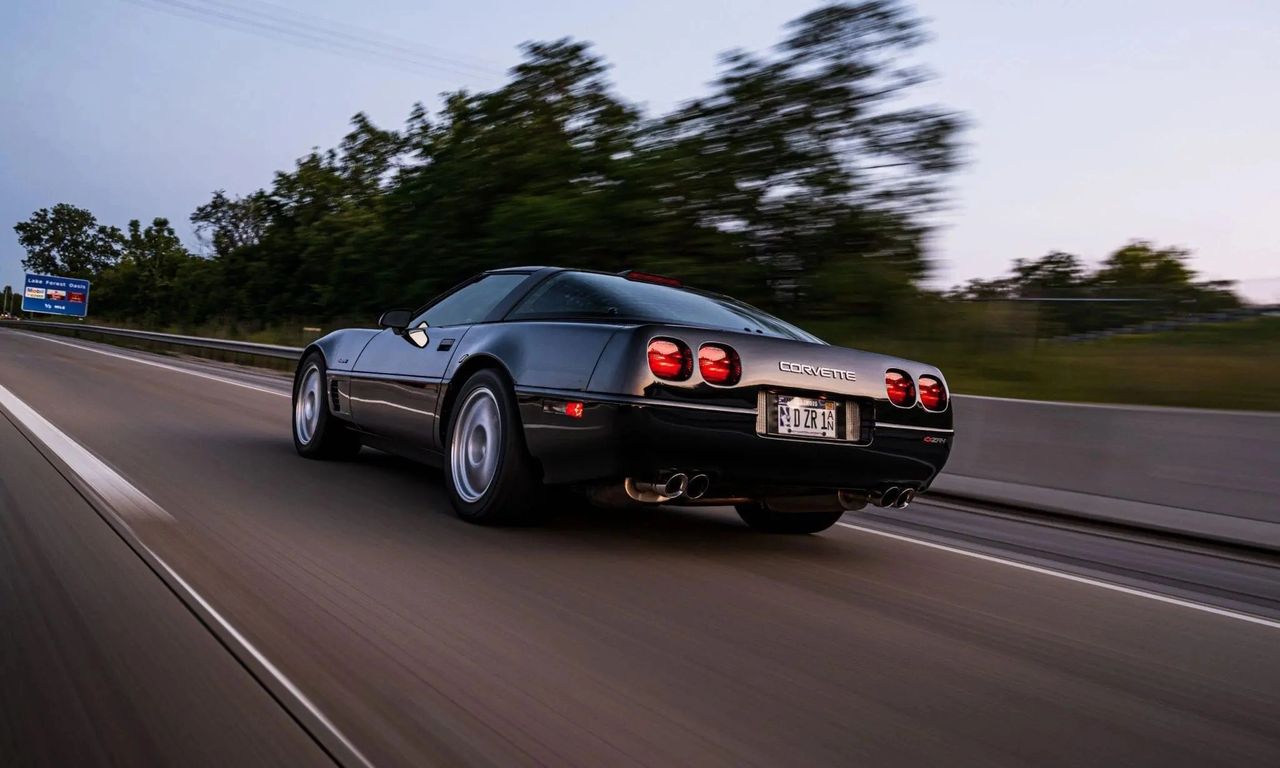
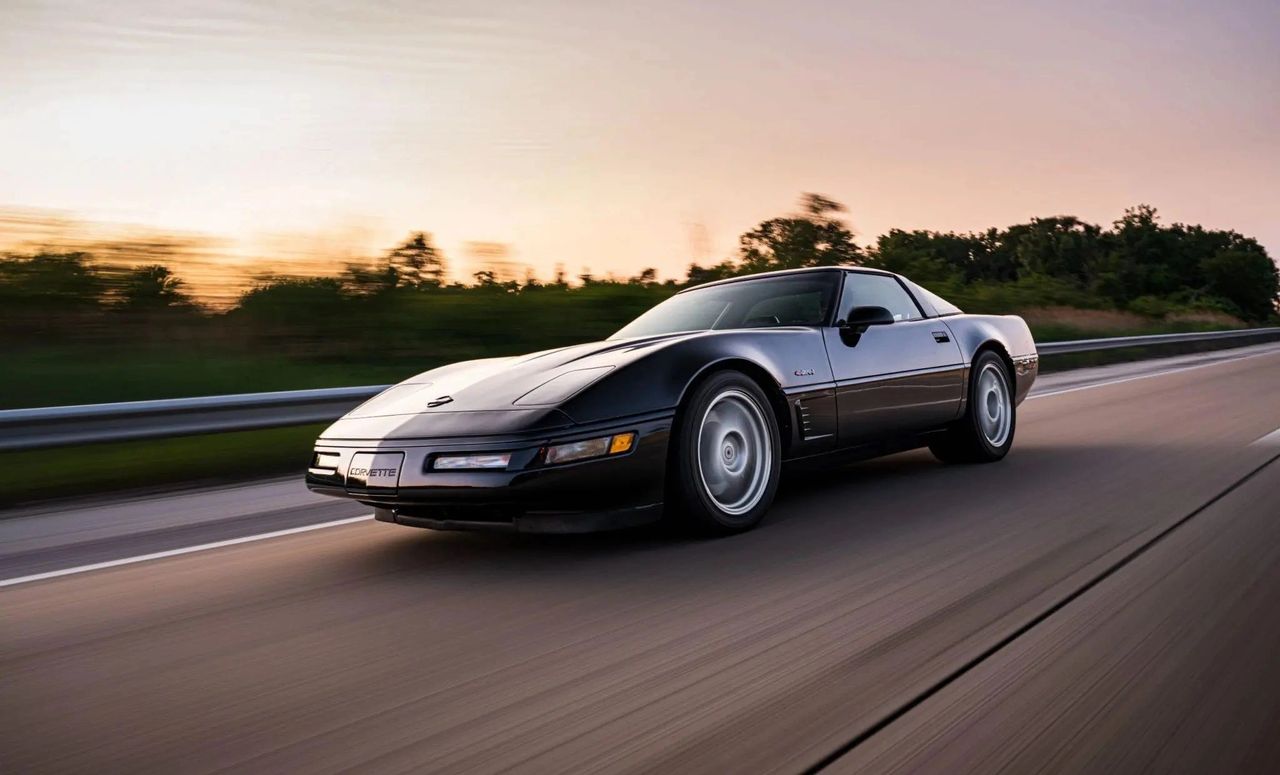
    Even as the 1995 ZR-1 slipped into the violet edge of the day, the LT5’s last note hung in the air like a promise. Four round taillights and four chrome tips faded to red fireflies, but the idea didn’t fade—the ZR-1 badge was never a period, only a comma. Engineers knew it, and the faithful did too: the recipe of durability, exotic power, and long-legged speed would return. Consider this shot the curtain call and the teaser—America’s quad-cam legend riding into the sunset so it could rise again when Corvette needed its ace.
    Even as the 1995 ZR-1 slipped into the violet edge of the day, the LT5’s last note hung in the air like a promise. Four round taillights and four chrome tips faded to red fireflies, but the idea didn’t fade—the ZR-1 badge was never a period, only a comma. Engineers knew it, and the faithful did too: the recipe of durability, exotic power, and long-legged speed would return. Consider this shot the curtain call and the teaser—America’s quad-cam legend riding into the sunset so it could rise again when Corvette needed its ace.

    When the line paused that afternoon in Bowling Green, the ZR-1’s farewell felt like an ending. It was. But you could already feel the future in the way the 1995 car went about its business. Make world-class performance easy to access. Make the everyday miles quiet, cooperative, and cool. Sweat the invisible details until the owner doesn’t notice them at all. That was the late-run C4’s promise. It became the C5’s identity. And it remains the Corvette’s defining trick: the long sprint from Motorama fantasy to daily-usable supercar.


    1995 Corvette: Deep-Spec Reference (Coupe & Convertible; ZR-1 where noted)

    Engine & Induction

    • Engine code: LT1 (RPO LT1), Gen II small-block V8
    • Displacement: 5,733 cc (350 cu in)
    • Block/heads: Cast iron block; aluminum cylinder heads
    • Bore × stroke: 4.00 in × 3.48 in (101.6 × 88.4 mm)
    • Compression ratio: ~10.5:1
    • Valvetrain: OHV, 2 valves/cyl; hydraulic roller lifters
    • Rated output: 300 hp @ 5,000 rpm; 340 lb-ft @ 4,000 rpm
    • Fuel system: Sequential port fuel injection (speed/density with MAP)
    • Ignition: OptiSpark distributor with crank-driven optical trigger (late-run spec)
    • Cooling & fans: Cross-flow radiator; electric primary fan with revised ’95 control/quiet hardware
    • Bottom-end notes (’95): Powdered-metal connecting rods; durability/NVH refinements
    • Exhaust: Dual undercar system with catalysts; quad rear outlets (’95 reroute minimizes heat soak/paint staining)

    ZR-1 (1995 carryover, early-year only)

    • Engine code: LT5 (RPO ZR1), 5.7L DOHC 32-valve V8
    • Output: 405 hp @ 5,800 rpm; 385 lb-ft @ 5,200 rpm
    • Induction: Sequential port; individual coil packs per bank; 4 cams, belt-driven

    Transmissions & Final Drives

    • Automatic: 4L60-E (RPO M30) electronic 4-speed; revised calibration & lighter/stronger converter in ’95
    • Manual: ZF S6-40 (RPO MN6) 6-speed
    • Ratios (typical LT1): 1st 2.68, 2nd 1.80, 3rd 1.31, 4th 1.00, 5th 0.75, 6th 0.50; Rev ~2.90
    • Reverse engagement: High-detent mechanism (’95 replaces ’94 lockout hardware)
    • Final drives (common LT1 setups):
    • Manual: 3.45:1 (std)
    • Automatic: 2.59:1 (std); 3.07:1 with RPO G92 Performance Axle Ratio
    • Clutch (manual): 11-in diaphragm, hydraulic actuation; dual-mass flywheel

    Chassis, Suspension & Steering

    • Structure: Uniframe/birdcage with bolt-on front/rear cradles; hatch-back coupe or soft-top convertible
    • Front suspension: SLA (short/long arm) with forged aluminum control arms; transverse composite leaf spring; monotube de Carbon gas shocks (’95 softer valving on base suspension)
    • Rear suspension: Upper/lower lateral links with trailing rod; transverse composite leaf spring; monotube de Carbon shocks
    • Selectable damping (opt): FX3 Electronic Selective Ride & Handling (Bilstein actuated, 3 modes)
    • Steering: Power rack-and-pinion, performance ratio; tilt column standard
    • Turning circle: ~38–40 ft curb-to-curb (tire/wheel dependent)

    Brakes (Big Brakes Go Standard in ’95)

    • System: 4-wheel discs with Bosch ABS 5; ASR traction control
    • Calipers/rotors (LT1 1995):
    • Front: 2-piston PBR calipers; ~13.0-in ventilated rotors (J55-spec hardware standard in ’95)
    • Rear: Single-piston sliding calipers; ~12.0-in ventilated rotors
    • Proportioning: Electronic via ABS/ASR logic; performance-oriented bias for stability under trail-brake

    Wheels & Tires

    • Standard alloys: 17-in cast aluminum “sawblade” or directional turbine design (finish varies)
    • Typical sizes (LT1):
    • Front tires: 255/45ZR-17
    • Rear tires: 285/40ZR-17
    • Run-flats (opt): WY5 Extended Mobility Tires (EMT)
    • Spare delete (opt): N84 Spare Tire Delete (requires WY5; nets ~$100 credit & small weight savings)
    • ZR-1 wheels/tires (reference): 17×9.5 in front, 17×11 in rear; 315-section rears with A-mold design

    Dimensions & Capacities

    • Wheelbase: 96.2 in (2444 mm)
    • Length: ~178.5 in (4530 mm)
    • Width: ~71.0 in (1803 mm)
    • Height: ~46.7 in (1186 mm) coupe; conv slightly taller with top up
    • Track: ~59.6 in front / 60.4 in rear (tire/wheel varies a tick)
    • Curb weight (approx):
    • Coupe (LT1): ~3,350–3,400 lb depending on options
    • Convertible (LT1): ~3,450–3,550 lb
    • ZR-1: ~3,550–3,600 lb
    • Fuel tank: 20.0 gal (75.7 L)
    • Hatch cargo (coupe): generous flat load floor; convertible uses rear well (smaller but usable)
    • Towing: Not rated; cooling/aero not configured for trailer duty

    Performance (Period Test Window; LT1)

    • 0–60 mph: ~5.2–5.5 sec (manual); ~5.7–6.0 sec (auto, axle-ratio dependent)
    • Quarter-mile: ~13.6–13.9 sec @ 102–104 mph (manual)
    • Top speed: ~165–170 mph (manual, gear/drag conditions)
    • 60–0 mph braking: ~115–125 ft (pads/tires swing results; ’95 big brakes markedly consistent)
    • Skidpad: ~0.90–0.95 g (tire compound & FX3 influence)
    • EPA fuel economy (typical): ~17/25 mpg (city/hwy) both transmissions, premium unleaded recommended

    Electrical/Controls

    • ABS/Traction: Bosch ABS 5 controller with integrated ASR
    • PCM: OBD-I strategy (’95 transitional refinements; 1996 goes OBD-II)
    • Gauges: 1995 cluster with ATF temperature readout for automatics; analog/digital hybrid display
    • Security: Factory VATS (Vehicle Anti-Theft System) with resistor key

    Interior & Ergonomics

    • Seats: Standard buckets; AQ9 sport seats optional with improved French-seam stitching (’95) to curb bolster tears; power adjustments AG1/AG2 widely ordered
    • Upholstery: Leather standard on most builds; colorways tied to exterior palettes; convertible gets specific trim/liner treatments
    • Audio: Delco-Bose with in-dash CD (U1F), reinforced head-unit mounting to reduce skip; power mast antenna
    • Rattle mitigation (’95): Added adhesive/Velcro straps in key cabin interfaces; additional isolators
    • Roof (coupe): Removable panel; 24S blue-tint or 64S bronze-tint top; C2L dual-panel package (both tops)
    • Convertible top: Fabric, heated glass rear window; optional CC2 auxiliary hardtop (limited take rate)

    Paint & Trim (1995)

    Standard colors: Arctic White, Black, Torch Red, Dark Red Metallic, Polo Green Metallic, Admiral Blue, Bright Aqua Metallic, Competition Yellow, Dark Purple Metallic (new). Special two-tone: Z4Z Indy 500 Pace Car Replica (Dark Purple Metallic over Arctic White with white top & ribbon graphics)

    1. Torch Red — 4,531
    2. Black — 3,959
    3. Arctic White — 3,381
    4. Polo Green Metallic — 2,940
    5. Dark Red Metallic — 1,437
    6. Dark Purple Metallic (new) — 1,049
    7. Admiral Blue — 1,006
    8. Competition Yellow — 1,003
    9. Bright Aqua Metallic — 909
    10. Z4Z Indy 500 Pace Car Replica (Dark Purple Metallic / Arctic White) — 527
    • Popular choices (’95 mix): Torch Red (~22%), Black (~19%), Arctic White (~16%), Polo Green (~14%); Dark Purple Metallic ~1k cars; Pace Car 527 units

    Options & Notables (selected RPOs)

    • FX3 Electronic Selective Ride & Handling (Bilstein)
    • G92 Performance Axle Ratio (3.07 on automatics)
    • UJ6 Low tire pressure warning indicator
    • WY5 Extended Mobility Tires (run-flats)
    • N84 Spare Tire Delete (requires WY5; –$100)
    • Z07 Adjustable Performance Handling Package (’95 availability limited; heavy-duty cooling/suspension mix)
    • Z4Z Indy 500 Pace Car Replica (convertible)
    • ZR1 Special Performance Package (coupe; early-’95 run only)

    Production, Pricing & VIN

    • Total ’95 production: 20,742
    • Coupe: 15,771
    • Convertible: 4,971
    • ZR-1 (’95): 448 (part-year; ZR-1 total ’90–’95: 6,939)
    • Base MSRP: Coupe $36,785; Convertible $43,665
    • ZR-1 option add: $31,258 (over coupe)
    • VIN blocks (’95):
    • Base coupe/convertible: 100001–120294 (serial allocation > production; skips occur)
    • ZR-1: 800001–800448

    Indy 500 Pace Car (Z4Z)

    • Configuration: Convertible only
    • Livery: Dark Purple Metallic over Arctic White; white top; ribbon graphics; embroidered headrests; specific trim
    • Build: 527 units; 87 used at Indy; 20 exported; remainder to top-performing U.S. dealers
    • Price add: $2,816 over base convertible

    What to Check (Buyer/Restorer CheckList)

    • OptiSpark health: Look for dry front cover, recent service, quality replacement parts
    • Cooling system: Clean coolant, proper fan engagement; radiator fins intact
    • ABS/ASR lights: Should prove-out and go out; Bosch 5 is robust but wiring/grounding matters
    • FX3 actuators (if equipped): Verify mode changes & no codes; actuators can stick
    • Seat bolsters: ’95 French seams hold up better, but foam wear still shows on high-mile cars
    • Roof panel seals (coupe): Wind noise/water leaks → new seals/adjustments fix it
    • Run-flats & N84: If spare is deleted, confirm tire date codes and condition; EMTs age out

    WHY THE 1995 CORVETTE STILL MATTERS TODAY
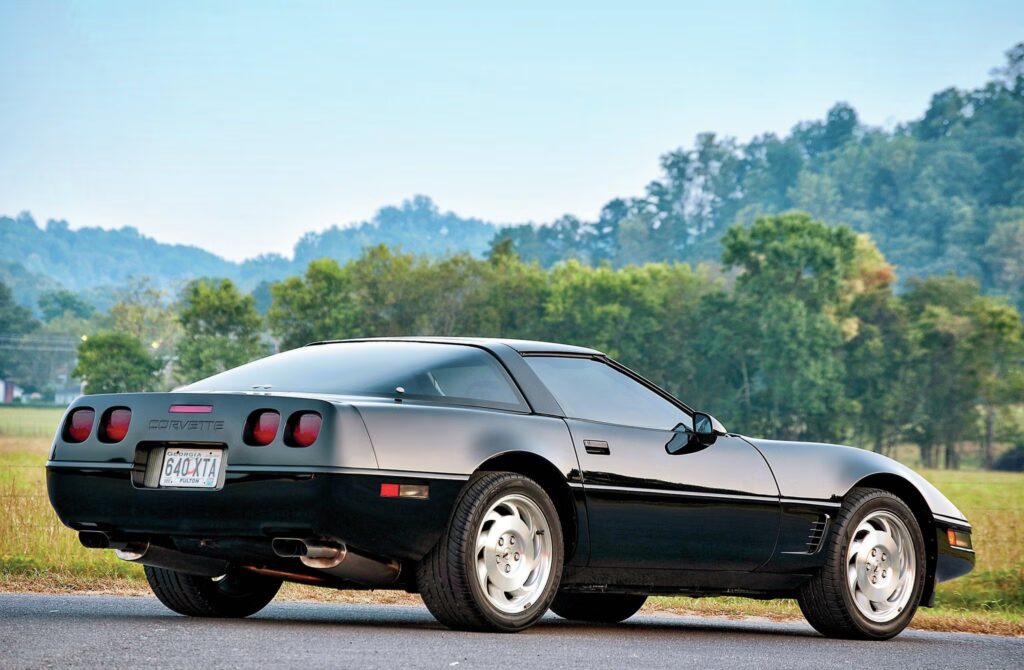
    The 1995 Chevrolet Corvette continues to represent one of the most advanced iterations of the fourth-generation Corvette. Future buyers considering a fourth-generation model would do well to explore both the 1995 and 1996 models as these last two model years provide some of the most complete, most capable, and most technologically developed Corvettes from this generation.

    The 1995 Corvette still matters today because it represents one of the most complete and confident expressions of the C4 generation. By this point, Chevrolet had spent more than a decade refining the platform, and it showed. The styling was sharp, the chassis was mature, the LT1 V8 delivered strong, dependable performance, and the overall driving experience felt far more polished than many people give it credit for. While earlier C4s introduced the world to a radically new Corvette, the 1995 model proved just how good that formula could become when the engineering, comfort, and performance all came together.

    It also matters because the 1995 Corvette sits in a fascinating place in Corvette history. It arrived just before the final sendoff of the C4 generation, which means it benefits from years of development while still carrying the unmistakable design language that defined the Corvette through much of the 1980s and 1990s. For enthusiasts today, that makes the 1995 model especially appealing. It offers classic C4 looks, real small-block power, proven road manners, and a driving experience that still feels engaging in a world increasingly shaped by technology and isolation.

    Most importantly, the 1995 Corvette still matters because it helped preserve the Corvette’s performance credibility during a period of transition. It kept America’s sports car relevant, desirable, and unmistakably bold while paving the way for what would come next. For owners, collectors, and longtime enthusiasts, the 1995 Corvette is more than just another model year. It is a reminder that refinement matters, that evolution matters, and that some of the most rewarding Corvettes are the ones that quietly got everything right.
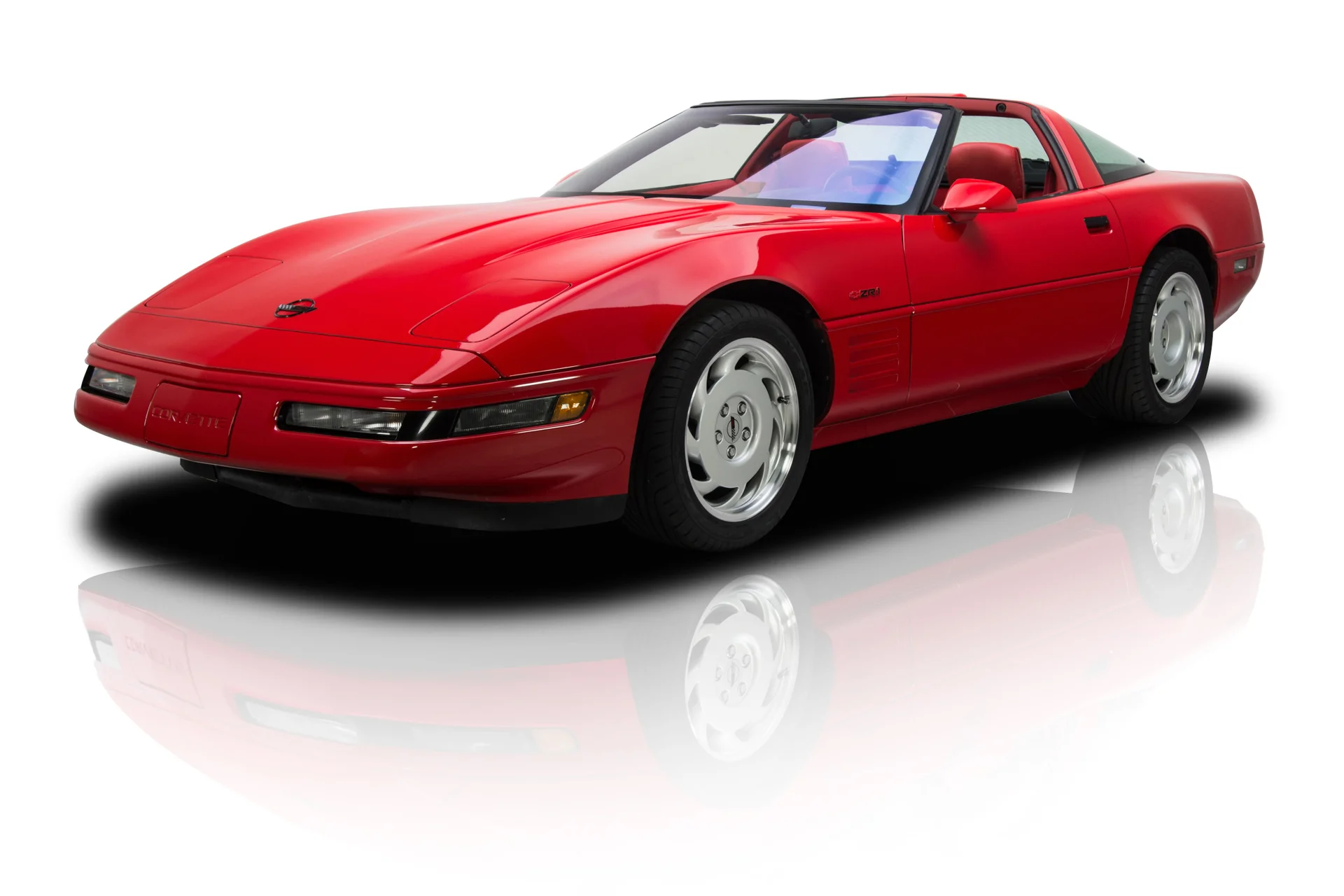

    The 1995 Corvette refined the C4 formula with sharper confidence, proven LT1 power, and one of the era’s most memorable color palettes. It was a car that felt mature, fast, and unmistakably Corvette, bridging the gap between the polished late-C4 years and the legends still to come.

  • 1992 CORVETTE OVERVIEW

    1992 CORVETTE OVERVIEW

    There were certain years in each generation of Corvette’s history when the car stopped trying to be the loudest voice in the room and instead focused on being the most articulate. 1992 was that kind of year.

    On paper, not much changed: the body was familiar, the interior still looked like late-’80s futurism, and the option sheet would have made a returning C4 owner feel right at home. But when drivers turned the key and set out through town, into a rainstorm, across a stretch of highway that usually made a sports car skittish, it became obvious that Chevrolet had spent the year turning the Corvette into a different animal. Quieter, more compliant, more secure in bad weather, and, most importantly, quicker in the ways that mattered day-to-day. The C4 wasn’t reborn; it was refined into its best self.

    The loudest single ingredient in that transformation was three letters and a hyphen that dropped the hyphen: LT1. The new small-block replaced the long-serving L98 with 300 horsepower and 330 lb-ft, the biggest jump in base-car output since the C4’s launch. Around it, Chevrolet framed a remarkably modern driving experience—ASR traction control, new ZR-rated Goodyear GS-C rubber, improved sound deadening, tidier switchgear—that let the chassis feel composed where earlier C4s had felt nervy. And beyond the production car, Chevrolet made two statements about what the Corvette was and where it was going: it built the one-millionth example on July 2, 1992, tying the present back to 1953, and it rolled out Sting Ray III, a California-penned concept that looked a decade ahead and hinted at a transaxle future.

    This is the story of how the 1992 model year —without a single new fender stamping—managed to move the Corvette forward.

    A Year Lived Between Projects

    In 1992, when GM’s upper management made the stunning call to cancel the C5 Corvette program, Jim Perkins—then Chevrolet’s general manager—refused to let America’s sports car die on his watch. A lifelong Chevrolet man and a racer at heart, Perkins saw Corvette not just as a model line, but as a cornerstone of the brand’s identity. When others in the executive suites declared the program finished, Perkins rallied his team behind closed doors, quietly keeping the C5 vision alive. He reassigned engineers, shielded budgets where he could, and lobbied relentlessly to convince GM leadership that Corvette was too important to abandon. His defiance wasn’t reckless—it was rooted in a deep conviction that Chevrolet without Corvette would lose its soul. Looking back, it’s clear: without Perkins’ grit and unshakable pride in the Bowtie, the Corvette story could have ended in 1992. Instead, it was his commitment that carried the car through the dark days and ultimately paved the way for the revolutionary C5. (Image courtesy of Motor Trend)
    In 1992, when GM’s upper management made the stunning call to cancel the C5 Corvette program, Jim Perkins—then Chevrolet’s general manager—refused to let America’s sports car die on his watch. A lifelong Chevrolet man and a racer at heart, Perkins saw Corvette not just as a model line, but as a cornerstone of the brand’s identity. When others in the executive suites declared the program finished, Perkins rallied his team behind closed doors, quietly keeping the C5 vision alive. He reassigned engineers, shielded budgets where he could, and lobbied relentlessly to convince GM leadership that Corvette was too important to abandon. His defiance wasn’t reckless—it was rooted in a deep conviction that Chevrolet without Corvette would lose its soul. Looking back, it’s clear: without Perkins’ grit and unshakable pride in the Bowtie, the Corvette story could have ended in 1992. Instead, it was his commitment that carried the car through the dark days and ultimately paved the way for the revolutionary C5. (Image courtesy of Motor Trend)

    By 1992, everyone inside Chevrolet knew the next-gen car—what would become the C5—was running behind schedule. Budgets were tight. Priorities elsewhere at General Motors had pushed hard decisions onto a handful of people who believed that a Chevrolet without a Corvette was a Chevrolet unmoored. Manufacturing executive Joe Spielman had walked into Chevrolet general manager Jim Perkins’ office with a rumor that the C5 might be killed. Perkins, a dyed-in-the-wool Chevy lifer, didn’t flinch. He did the thing old-school car people did when the spreadsheet said “no” and the product said “we must”: he found a way. We put about two and a half million dollars of marketing money into the program, Perkins admitted later, money that kept mule development alive and the team working toward hydroformed rails and a rear transaxle under a cut-and-shut C4 body. We knew we had something.

    Those were C5 details, but they mattered here because 1992 was the year the existing Corvette started to feel like the car those mules promised. Chevrolet couldn’t get from C4 to the C5’s quantum leap without learning how to tame noise, vibration, harshness, and wet-weather insecurity. The LT1 car became the bridge: an old platform taught new tricks.

    The LT1: Familiar Form, New Function

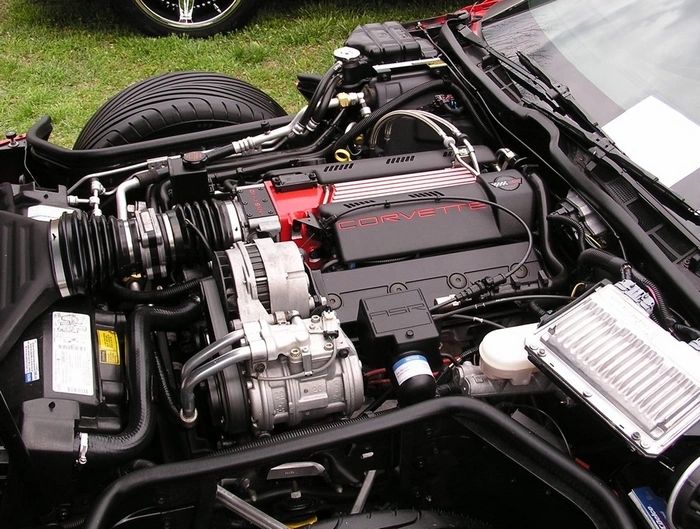
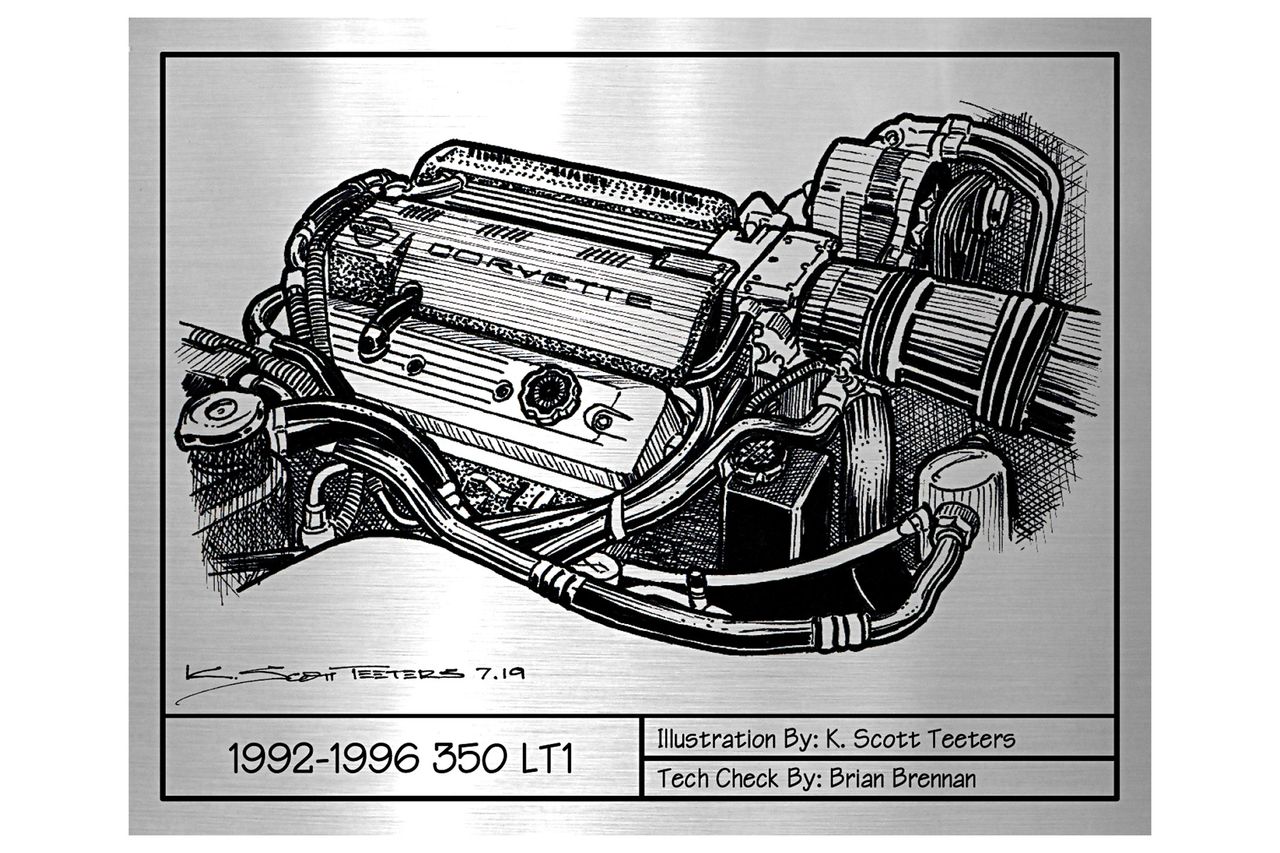
    The LT1 small-block debuted in the 1992 Corvette, ushering in a new era of performance for America’s sports car. Displacing 5.7 liters and rated at 300 horsepower, it introduced advanced features like reverse-flow cooling that allowed higher compression and improved efficiency. Compact, durable, and responsive, the LT1 carried the C4 through the mid-1990s with a blend of modern engineering and classic small-block character, setting the stage for the even hotter LT4 that followed in 1996.
    The LT1 small-block debuted in the 1992 Corvette, ushering in a new era of performance for America’s sports car. Displacing 5.7 liters and rated at 300 horsepower, it introduced advanced features like reverse-flow cooling that allowed higher compression and improved efficiency. Compact, durable, and responsive, the LT1 carried the C4 through the mid-1990s with a blend of modern engineering and classic small-block character, setting the stage for the even hotter LT4 that followed in 1996.

    The LT1 was not simply an L98 with a bigger cam and a better tune. It was a major rethink of the small-block’s fundamentals. Peak output rose to 300 hp at 5,000 rpm and 330 lb-ft at 4,000, but the headline wasn’t the numbers—it was how the engine went about making them. Chevy engineers introduced reverse-flow cooling, sending coolant to the heads first, then down through the block. The benefit was thermodynamic headroom: cooler chambers meant more compression and spark lead without detonation. The engine breathed better via freer-flow heads and a cleaner, dual-cat exhaust path with an O2 sensor per bank; the cam profile and ignition strategy complemented a revised multi-port injection system. For the first time, Mobil 1 synthetic was the factory-specified oil, and the external oil cooler disappeared from the options list because the package no longer needed it for durability. Road & Track had called the LT1 “a major overhaul of the classic small-block,” praising the way it changed the car’s manners as much as its speed.

    Drivers noticed the difference. The LT1 started cleanly hot or cold, idled with a purposeful smoothness that read “serious” without being fussy, and pulled in one continuous belt of torque instead of handing over a lump of shove and then begging for an upshift. It didn’t punish in bad weather; it allowed drivers to keep going through conditions that had once made earlier Corvettes feel like garage queens.

    The LT1 wasn’t just a horsepower bump—it was the foundation of a new generation of small-block technology. From 1992–1996, it brought modern ignition control with the Opti-Spark system, higher operating compression, and improved breathing that made the Corvette sharper and more responsive than ever. Its compact, efficient design proved versatile and durable, ensuring the LT1 became a mainstay across GM’s performance lineup, but it was the Corvette that showcased its full potential.
    The LT1 wasn’t just a horsepower bump—it was the foundation of a new generation of small-block technology. From 1992–1996, it brought modern ignition control with the Opti-Spark system, higher operating compression, and improved breathing that made the Corvette sharper and more responsive than ever. Its compact, efficient design proved versatile and durable, ensuring the LT1 became a mainstay across GM’s performance lineup, but it was the Corvette that showcased its full potential.

    Not every new piece was perfect. The Opti-Spark distributor tucked beneath the water pump—chosen for packaging and precision—proved sensitive to moisture in early production, spawning a small industry of updates and replacements. But the LT1’s total system—the cooling strategy, the oil choice, the exhaust, the engine management—delivered a base Corvette that felt far more modern than the silhouette suggested.

    ASR: Teaching an “Olympic Sprinter” to Waltz in the Rain

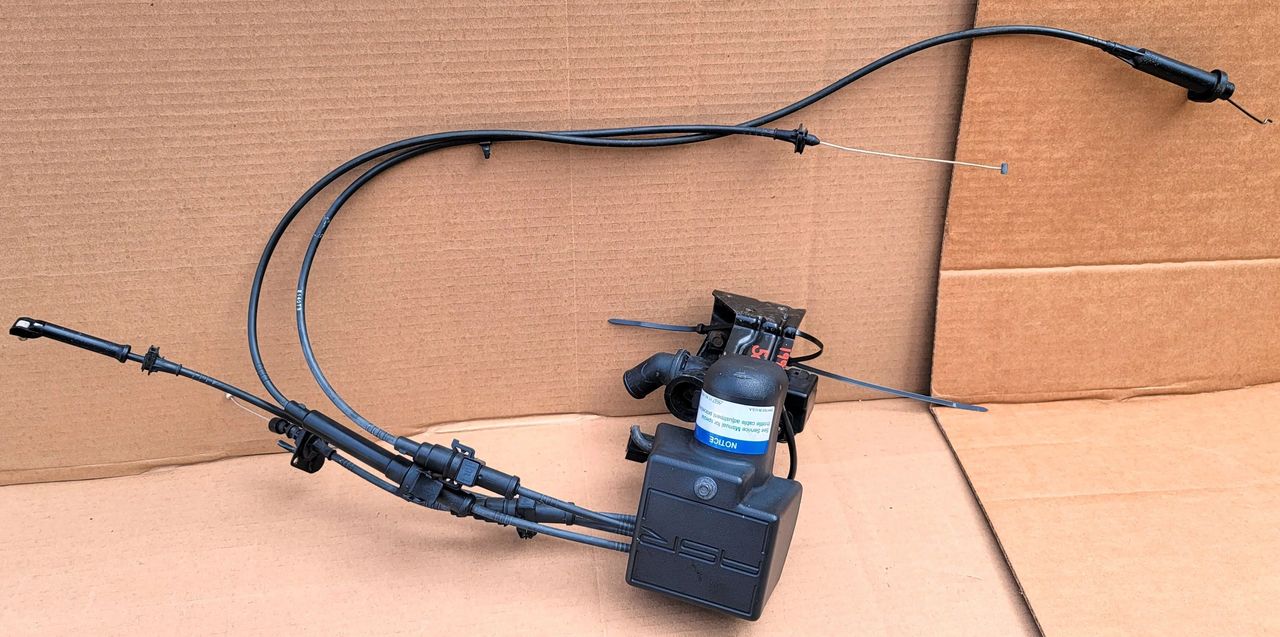
    1992 Corvette Acceleration Slip Regulation (ASR) module and linkage assembly. Introduced alongside the LT1, ASR was Corvette’s first traction control system, using throttle, spark, and brake modulation to keep the car stable under hard acceleration—a high-tech leap that made the C4 one of the most advanced sports cars of its era.
    1992 Corvette Acceleration Slip Regulation (ASR) module and linkage assembly. Introduced alongside the LT1, ASR was Corvette’s first traction control system, using throttle, spark, and brake modulation to keep the car stable under hard acceleration—a high-tech leap that made the C4 one of the most advanced sports cars of its era.

    Engineers loved acronyms because they hid a lot of smart under a few letters. ASRAcceleration Slip Regulation—was one of those. New for 1992 and standard across the line, ASR sat on the same sensor network as the anti-lock brakes and watched the rear wheels for over-speed relative to the fronts. When it saw wheel slip, it trimmed the throttle and spark and could apply the rear brakes independently to settle the car and restore traction. It wasn’t intrusive when the driver was in control; it was simply there in the background, saving trouble at moments where older Corvettes had asked for sainthood. In classic C4 fashion, it could be shut off with a console switch when a driver wanted the tail to breathe at an autocross.

    Road & Track captured the effect in a single line: “a surprisingly effective traction-control system… makes the Vette much more driveable in bad weather conditions.” They went further, noting that refinements such as ASR and the new Corvette-exclusive radial tires “narrowed the performance gap” to the ZR-1. That was the part that sent ripples through Bowling Green and the dealer body. When the base car stepped far enough forward, the halo felt crowded.

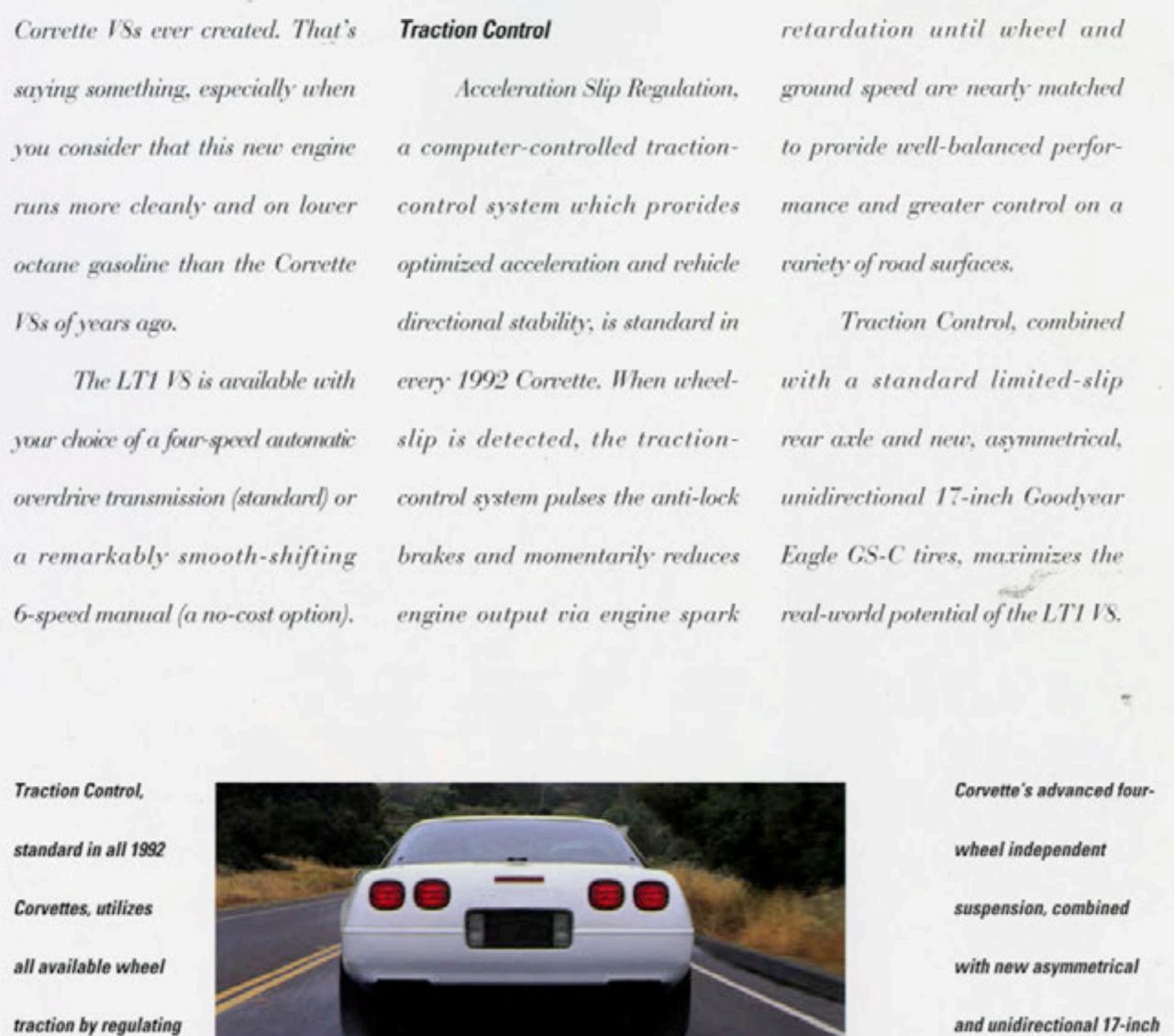
    Page 18 of Chevrolet’s 1992 Corvette brochure highlighting Acceleration Slip Regulation (ASR). Standard on every ’92 Corvette, ASR worked with ABS, spark control, and braking to reduce wheel slip, delivering optimized traction and stability. Paired with the limited-slip differential and new 17-inch Goodyear Eagle GS-C tires, it maximized the LT1’s performance on real-world roads. (Image courtesy of GM Media LLC.)
    Page 18 of Chevrolet’s 1992 Corvette brochure highlighting Acceleration Slip Regulation (ASR). Standard on every ’92 Corvette, ASR worked with ABS, spark control, and braking to reduce wheel slip, delivering optimized traction and stability. Paired with the limited-slip differential and new 17-inch Goodyear Eagle GS-C tires, it maximized the LT1’s performance on real-world roads. (Image courtesy of GM Media LLC.)

    Chevrolet’s own literature leaned into the technology—not as a gimmick but as a guardrail for real drivers on real roads. The brochure’s ASR explainer was careful engineering prose—Acceleration Slip Regulation, throttle and spark intervention, brake application where needed—and it read like a company intent on selling performance you could actually use.

    Pair ASR with the Goodyear Eagle GS-C tires—directional, asymmetric, Z-rated—and the C4 shook off the last bits of mid-’80s fragility on rough surfaces. The platform’s long-running virtues (rigidity, lateral grip, a willingness to communicate) came through without the old edge. The suspension still rode firmly, but isolation was up, and crashiness was down; the car tracked truer over seams and expansion joints, and the steering wheel didn’t chatter in a driver’s hands when the surface went off. If someone had lived with an early C4 and found it fatiguing after an hour on secondary roads, 1992 would have surprised them.

    Same Skin, New Heart: The 1992 Corvette’s Look

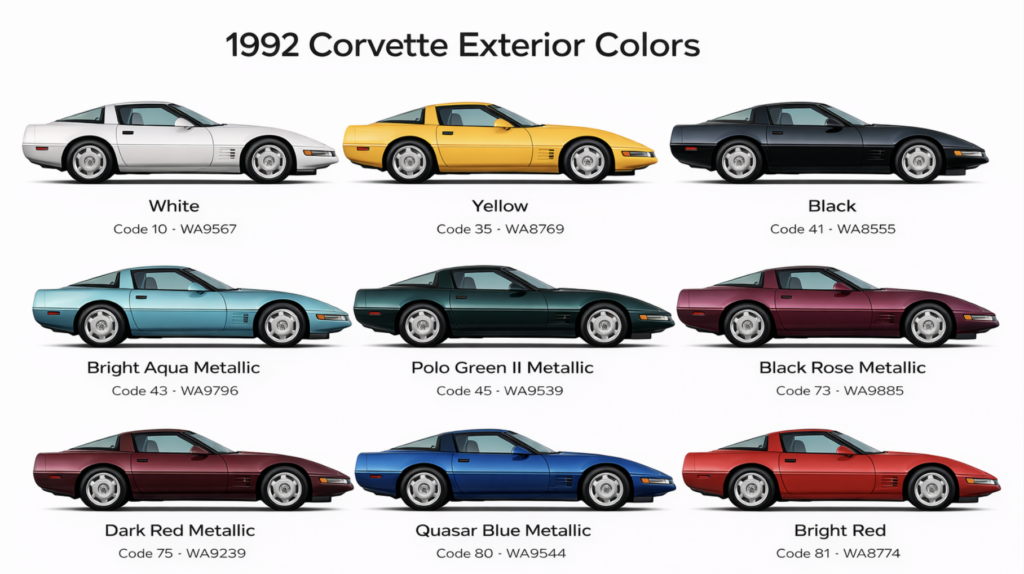
    1992 Chevrolet Corvette Exterior Paint Colors (Image source: ultimatecorvette.com)

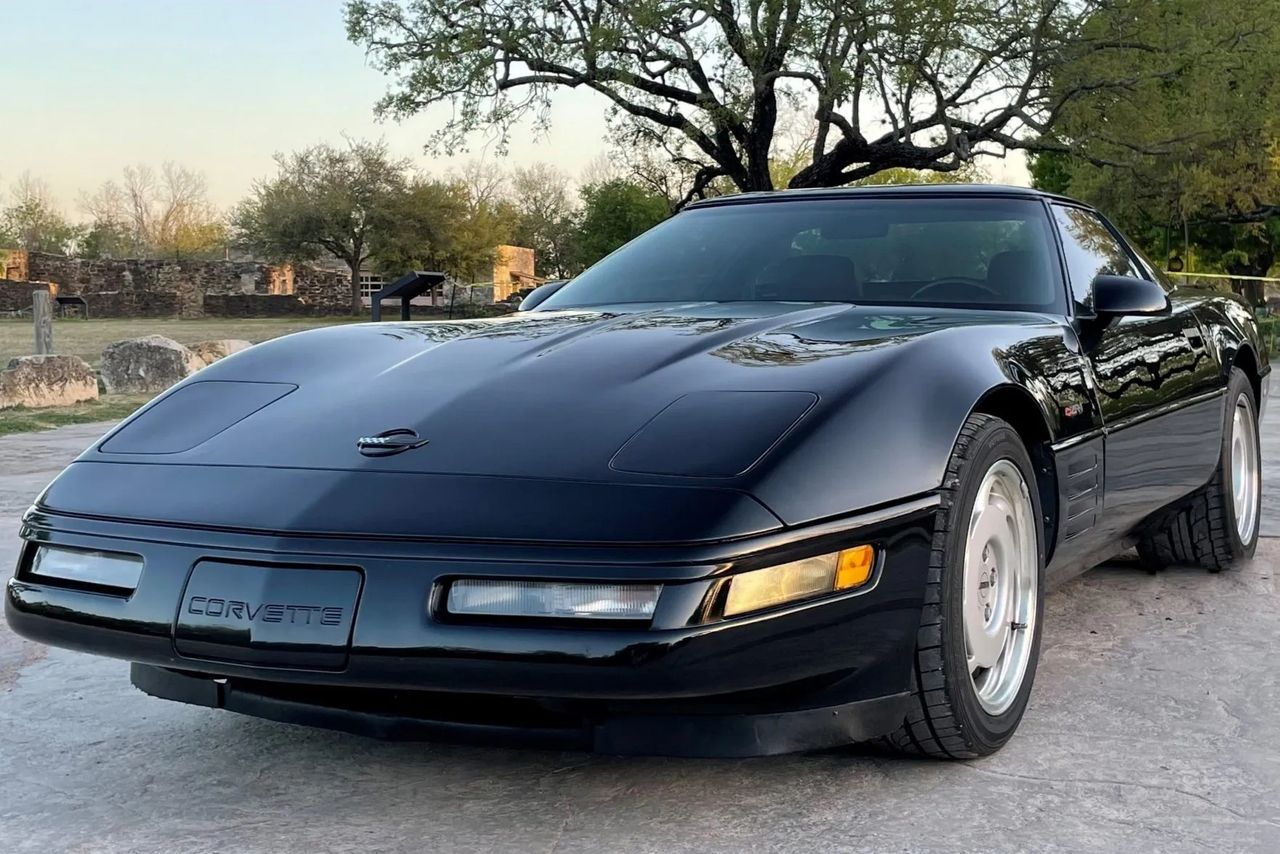
    For 1992, the C4 kept the sleek “91 refresh” exterior—softer front and rear fascias, quad-rectangular tail lamps, and the scalloped front-fender gills—while the real revolution happened under the hood with the LT1. Visually, coupes and convertibles wore the same wind-tunneled profile on 17-inch alloys; ZR-1s continued with the subtly wider rear bodywork to cover 11-inch rims, plus discreet ZR-1 fender badges added above the gills. In short, the shape stayed modern and clean, and the details stayed purposeful.

    Colors & popularity (with GM codes): Chevrolet offered nine exterior choices—Arctic White (10), Black (41), Bright Red (81), Yellow (35), Bright Aqua Metallic (43), Polo Green II Metallic (45), Black Rose Metallic (73), Dark Red Metallic (75), and Medium Quasar Blue Metallic (80). Based on 1992 production totals (20,479 cars), Bright Red (81) was the most popular with 4,466 built (~21.8%), while Yellow (35) was the rarest regular-production color at 678 cars (~3.3%). These counts and codes match period production records and align with the National Corvette Museum’s color roster for 1992.

    The Cabin and the Cues

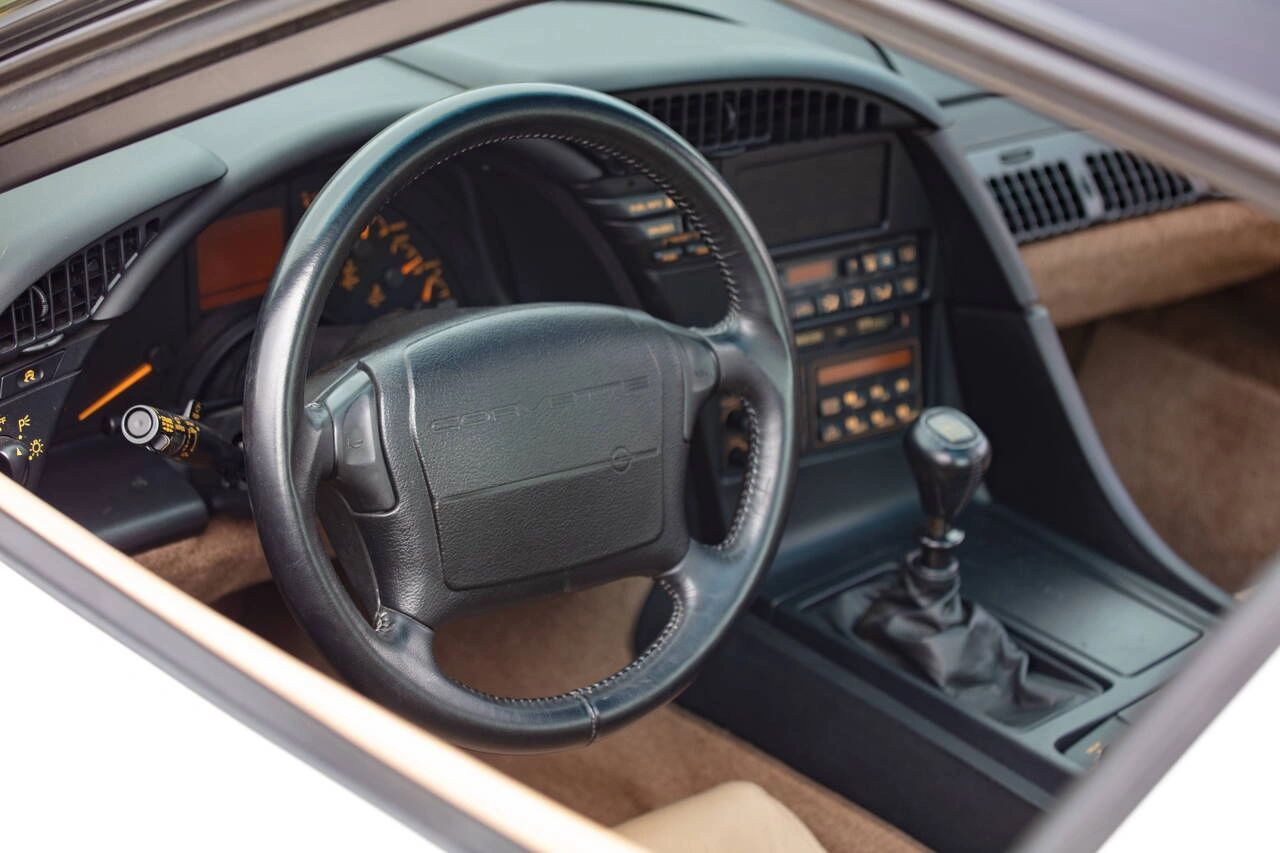
    The cockpit of a 1992 Corvette: a driver-focused interior with digital/analog hybrid gauges, the signature squared-off steering wheel embossed with Corvette, and the no-cost-option 6-speed manual shifter—offering enthusiasts the purest connection to the new LT1 small-block under the hood.
    The cockpit of a 1992 Corvette: a driver-focused interior with digital/analog hybrid gauges, the signature squared-off steering wheel embossed with Corvette, and the no-cost-option 6-speed manual shifter—offering enthusiasts the purest connection to the new LT1 small-block under the hood.

    The Corvette’s maturity in 1992 was also visible in the places Chevrolet didn’t chase flash. The instrument cluster and center stack went to an all-black scheme that cleaned up the cockpit’s visual noise. Switchgear lost the gray-black mix that once made the dash look like a parts catalog. Weathersealing improved. There was more insulation in the doors and transmission tunnel, cutting down the tire roar that could turn a long day into a longer headache. The retained-accessory power logic—radio, windows—now cut with either door, a small tweak that reads as considered, not cost-cut. These touches made the car feel less like a weekend event and more like something an owner could live with five days a week and still want on Saturday.

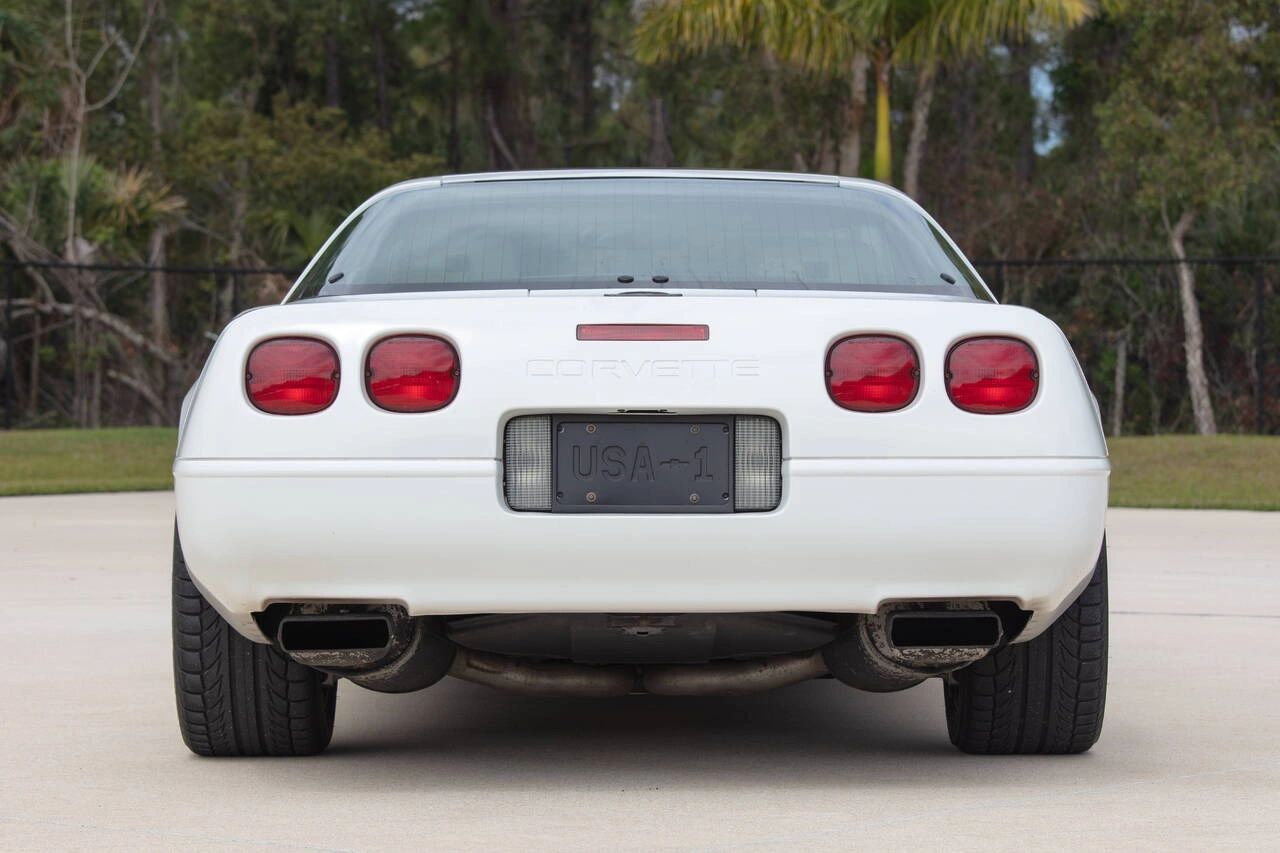
    The 1992 Corvette’s rear view showcased subtle but important updates—including the new rectangular exhaust outlets. These squared-off tips replaced the earlier round design, giving the LT1-powered C4 a more aggressive, modern look that matched its leap forward in performance and technology.
    The 1992 Corvette’s rear view showcased subtle but important updates—including the new rectangular exhaust outlets. These squared-off tips replaced the earlier round design, giving the LT1-powered C4 a more aggressive, modern look that matched its leap forward in performance and technology.

    Outside, the changes were subtle. The exhaust outlets became two rectangular finishers in place of the old quad rounds. It was a slight visual widening of the tail and a more contemporary look. ZR-1s picked up fender badges to go with the still-massive 315-section rear tires, little tells for the faithful.

    The ZR-1’s Dilemma

    In 1992, the 375-hp ZR-1 still reigned supreme, but the new 300-hp LT1 made the base Corvette nearly as quick—shaving the performance gap to mere tenths in 0–60 runs, while the ZR-1 flexed its muscle with a higher top speed and exotic LT5 pedigree.
    In 1992, the 375-hp ZR-1 still reigned supreme, but the new 300-hp LT1 made the base Corvette nearly as quick—shaving the performance gap to mere tenths in 0–60 runs, while the ZR-1 flexed its muscle with a higher top speed and exotic LT5 pedigree.

    No one in Chevrolet Engineering set out to make the ZR-1 look redundant. The LT5 remained a marvel—Lotus-penned, Mercury Marine-built, 375 horsepower with the kind of big-rpm silk that a pushrod motor couldn’t replicate. On a runway or an autobahn, the ZR-1 had a top-end authority the LT1 couldn’t touch. But two sentences summarized the market reality in 1992: the LT1 was nearly as quick to 60 as the ZR-1 in real use, and the price delta was huge. Contemporary testing recorded a stock automatic LT1 at 5.2 seconds to 60 mph, while a recent-test ZR-1 sat at 4.9. That half-second was the longest in the world to purists; to a buyer staring down a monthly payment, it was a non-issue. Sales told the story: 502 ZR-1s in 1992.

    The ZR-1 did not fail in product terms; it stumbled in context. The LT1’s breadth of ability, paired with the economy of the moment, squeezed a halo car that had been designed to run away from the base model’s acceleration and dynamically high-wire past its rough edges. When the base car’s edges were rounded off and its acceleration was right there with you in traffic, the halo had to lean on speed most people would never see. That was a tough sell in a recession.

    Sting Ray III: California Dreams, Real-World Echoes

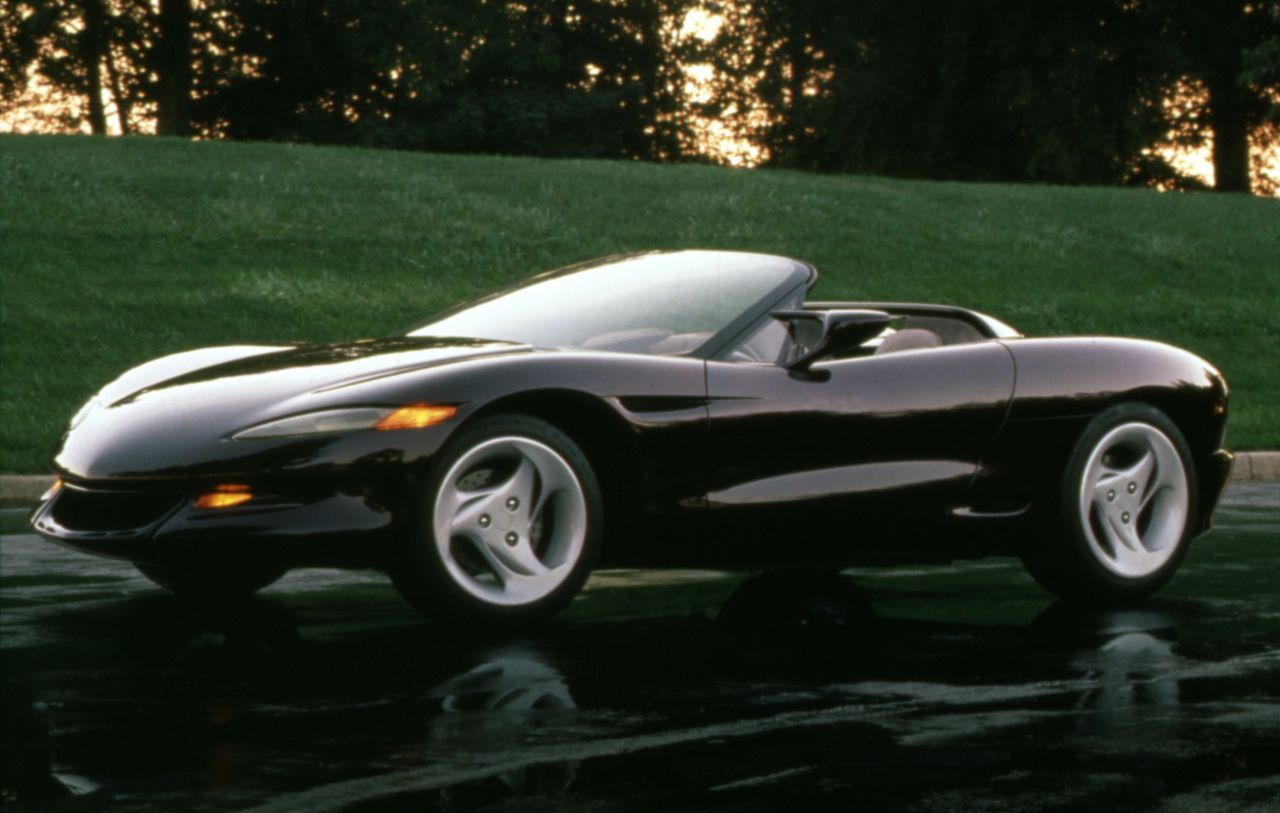
    The 1992 Corvette Sting Ray III Concept (also known as the California Corvette) was Chevrolet’s bold glimpse at the future. With its sweeping, organic lines, flush headlights, and a cockpit pushed forward for dramatic proportions, it previewed styling cues that would influence the upcoming C5. Built in partnership with Jerry Palmer’s design team and coachbuilder Metalcrafters, the Sting Ray III balanced exotic flair with Corvette heritage—proof that even in the uncertain early ’90s, GM was still dreaming big about America’s sports car. (Image courtesy of GM Media)
    The 1992 Corvette Sting Ray III Concept (also known as the California Corvette) was Chevrolet’s bold glimpse at the future. With its sweeping, organic lines, flush headlights, and a cockpit pushed forward for dramatic proportions, it previewed styling cues that would influence the upcoming C5. Built in partnership with Jerry Palmer’s design team and coachbuilder Metalcrafters, the Sting Ray III balanced exotic flair with Corvette heritage—proof that even in the uncertain early ’90s, GM was still dreaming big about America’s sports car. (Image courtesy of GM Media)

    If the production Corvette’s 1992 story was refinement, the concept car story was provocation. Sting Ray III—the “California Corvette”—landed at the Detroit show with the swagger of a studio unafraid to poke the bear. Penned at GM’s Advanced Concept Center in Newbury Park under John Schinella and championed by GM design chief Chuck Jordan, SR-III put the idea of a rear-mounted transaxle and advanced chassis systems in the public square while re-imagining the Corvette’s face with fixed headlamps and tauter surfacing. MotorTrend’s retrospective captured the brief: futuristic, unapologetically show-car bold, and very much a west-coast take on a traditionally midwestern icon. It looked nothing like a nostalgia soak and everything like the C5’s coming thesis.

    Design-history sources note that beyond the styling tease, SR-III’s package thinking was wildly ambitious for the time—active suspension, all-wheel steering, even explorations of night-vision rearward visibility—exactly the kind of blue-sky ideation a concept car should indulge. Many of those specifics would be toned down or deferred, but the transaxle idea didn’t die. The C5 would make it the Corvette’s core.

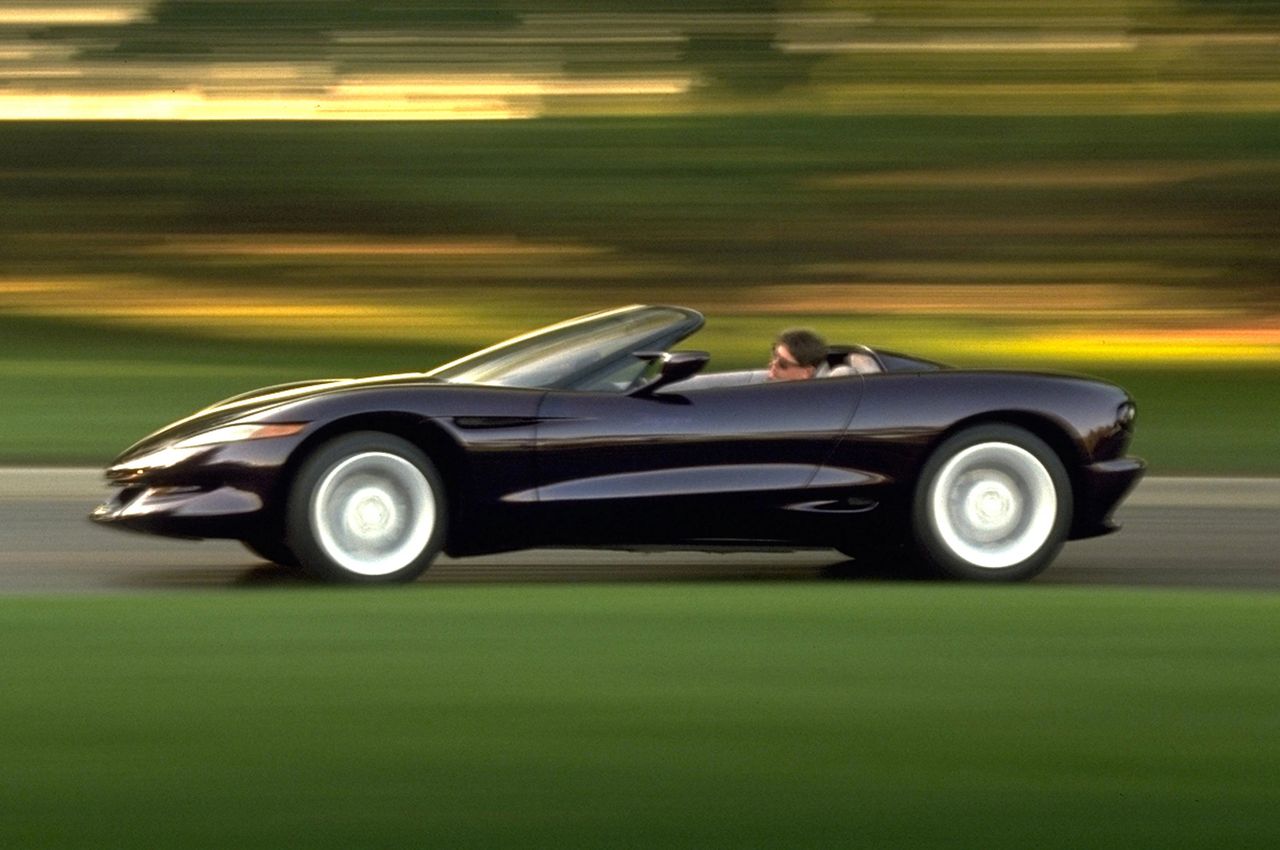
    Sleek, low, and futuristic, the Sting Ray III concept embodied the Corvette’s forward momentum in the early ’90s. Its fluid profile, hidden lamps, and sweeping fender lines suggested speed even at a standstill, while its open-top design emphasized a pure driver’s experience. More than just a show car, it was a rolling statement that Corvette design would not stand still heading into the next generation, or the next century. (Image courtesy of GM Media)
    Sleek, low, and futuristic, the Sting Ray III concept embodied the Corvette’s forward momentum in the early ’90s. Its fluid profile, hidden lamps, and sweeping fender lines suggested speed even at a standstill, while its open-top design emphasized a pure driver’s experience. More than just a show car, it was a rolling statement that Corvette design would not stand still heading into the next generation, or the next century. (Image courtesy of GM Media)

    There was an easy line between the “black cherry” convertible that appeared in early mockups and the production convertible that followed later in the decade: a real trunk returned to the Corvette family with the C5 convertible and FRC, a usability fix so obvious in hindsight it was hard to believe how long the car had gone without it. Even SR-III’s stance language—the way the plan view tightened the waist and pulled the corners outward—reappeared in the C5 and carried forward. Concepts didn’t have to predict; they needed to expand. Sting Ray III expanded the conversation at exactly the right moment.

    July 2, 1992: The One-Millionth Corvette

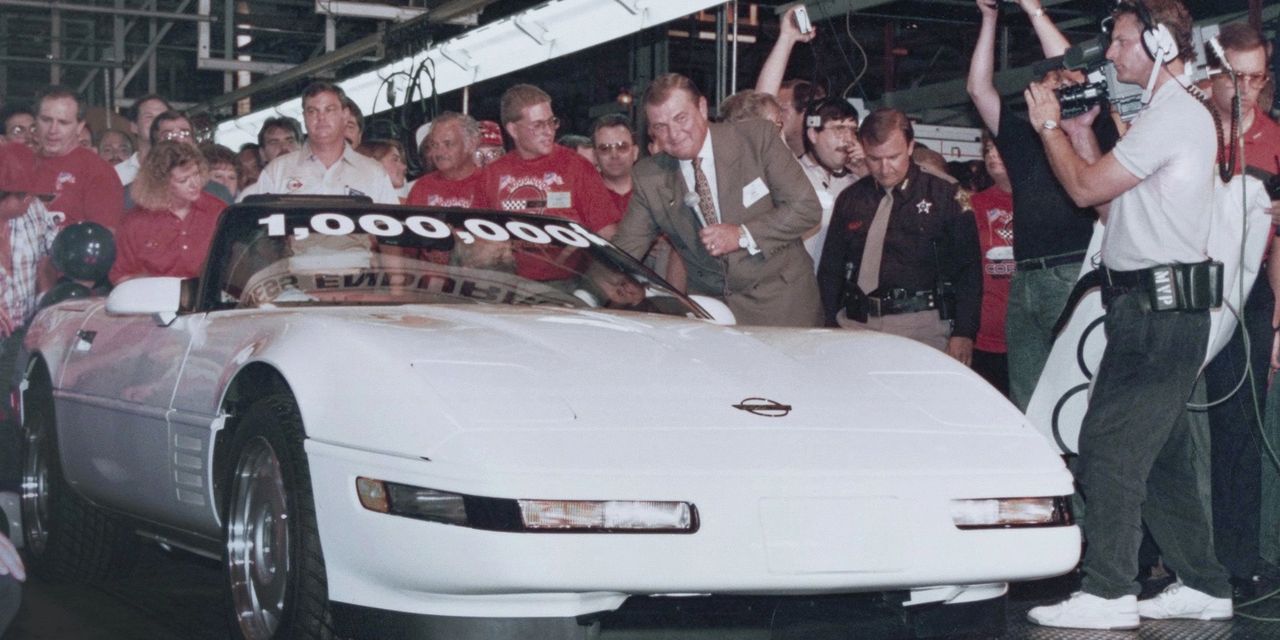
    A milestone moment in Corvette history: on July 2, 1992, the one-millionth Corvette rolled off the Bowling Green assembly line. Finished in classic white with a red interior—just like the very first 1953 model—the car was celebrated by workers, enthusiasts, and GM leadership alike. It symbolized not only Corvette’s enduring legacy but also the resilience of the brand during a challenging era for General Motors.
    A milestone moment in Corvette history: on July 2, 1992, the one-millionth Corvette rolled off the Bowling Green assembly line. Finished in classic white with a red interior—just like the very first 1953 model—the car was celebrated by workers, enthusiasts, and GM leadership alike. It symbolized not only Corvette’s enduring legacy but also the resilience of the brand during a challenging era for General Motors.

    Milestones were best when they were specific. On a summer day in Bowling Green—July 2, 1992—a white convertible with a red interior rolled across the line and into the history books as Corvette No. 1,000,000. The colorway was deliberate—a callback to 1953—and the car carried signatures from the people who built it. Few production-year headlines resonated decades later with the same warmth. When the National Corvette Museum’s 2014 sinkhole swallowed the millionth car, among others, the image was an international gut-punch. The restoration that followed, funded with Chevrolet’s help, returned the car to the floor and, with it, a sense that this model year’s most public moment was more resilient than the rock beneath the Skydome.

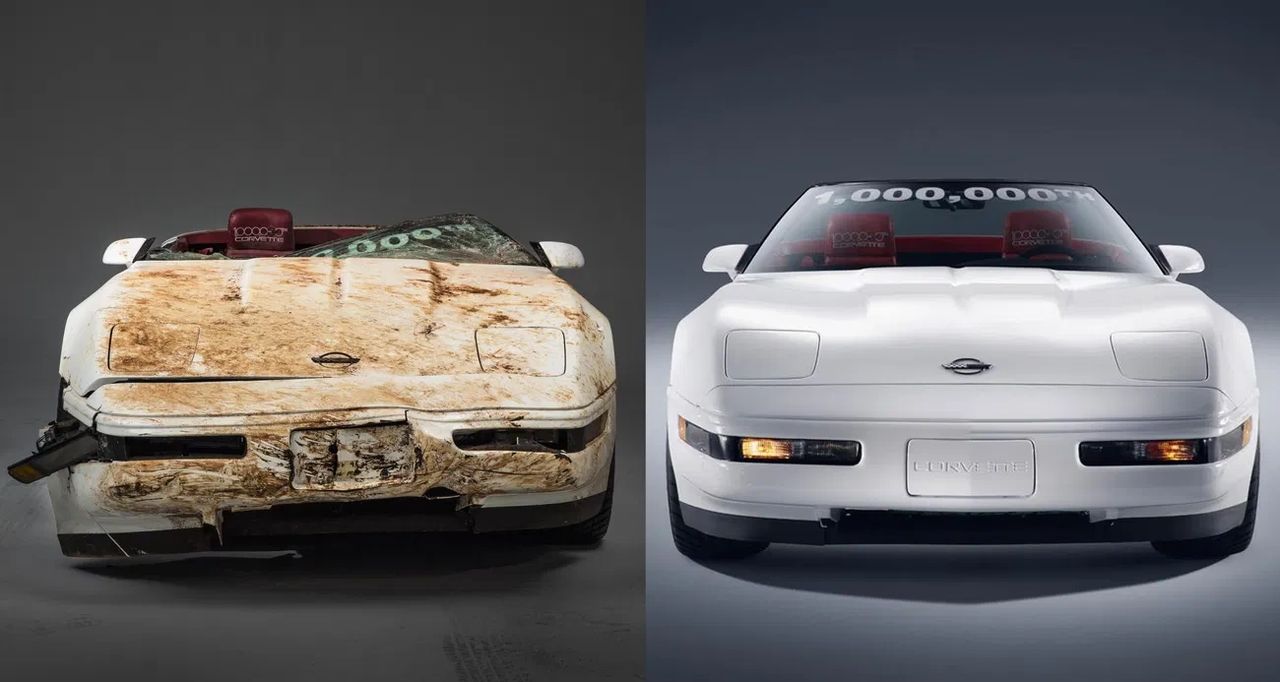
    In 2014, the one-millionth Corvette—a white 1992 convertible built to mirror the very first 1953 model—was swallowed by the infamous sinkhole that opened beneath the National Corvette Museum. The car was crushed and scarred, its once-pristine fiberglass body battered and caked in dirt, instantly becoming one of the most heartbreaking images in Corvette history. Recognizing its historical importance, Chevrolet and GM Design rallied a team of craftsmen to bring it back from near ruin. Using a combination of new-old-stock parts, donor panels, and painstaking restoration work, they preserved as much of the original car as possible, including its red leather seats and unique VIN. The process required months of effort, blending artistry with factory-correct precision, before the milestone Corvette was triumphantly returned to display in 2015. Today, the restored car stands as both a symbol of Corvette’s resilience and a testament to the passion of the people determined to save it.
    In 2014, the one-millionth Corvette—a white 1992 convertible built to mirror the very first 1953 model—was swallowed by the infamous sinkhole that opened beneath the National Corvette Museum. The car was crushed and scarred, its once-pristine fiberglass body battered and caked in dirt, instantly becoming one of the most heartbreaking images in Corvette history. Recognizing its historical importance, Chevrolet and GM Design rallied a team of craftsmen to bring it back from near ruin. Using a combination of new-old-stock parts, donor panels, and painstaking restoration work, they preserved as much of the original car as possible, including its red leather seats and unique VIN. The process required months of effort, blending artistry with factory-correct precision, before the milestone Corvette was triumphantly returned to display in 2015. Today, the restored car stands as both a symbol of Corvette’s resilience and a testament to the passion of the people determined to save it.

    For those who stood in front of that car and looked at the signatures under the hood, what was on display was more than paint and leather. It was continuity. It was the idea that even in a year of budget triage and delayed dreams, the Corvette could still mark time in a way that mattered.

    Why 1992 Mattered

    If Corvette history were charted only by body changes and horsepower peaks, 1992 might have been overlooked. But 1992 was bones. It proved that discipline—cool a head before a block; give the driver traction before more tire; take noise out before dollars out—could move a car forward as decisively as a new platform. It was also a reminder that context mattered. The ZR-1’s excellence didn’t dim; the LT1’s excellence grew into its space. Buyers did what buyers always did: they rewarded the car that made their actual lives better, most often for the least money. Chevrolet read that room and adjusted its future accordingly. The C5 that arrived later carried forward the LT1’s priorities—usability, composure, breadth—just as surely as it carried forward SR-III’s architecture.

    The year’s other two pillars—the Detroit-show concept and the millionth car—told the same story in different languages. Sting Ray III said, we’re not done making this car new. The millionth convertible said, we’ve been making this car long enough to matter to people who weren’t alive when it started. Put them together, and you get the Corvette’s trick in any era: balance the audacity of what’s next with the humility to honor what worked. In 1992, that balance was nailed.

    1992 Corvette — Key Specifications

    Quick Stats (Base vs. ZR-1)

    • Base (Coupe/Convertible): 5.7L LT1 V8 — 300 hp @ 5,000 rpm • 330 lb-ft @ 4,000 rpm; ZF S6-40 6-speed or 4-speed automatic (4L60/TH700-R4); ABS and ASR traction control standard.
    • ZR-1: 5.7L LT5 DOHC V8 — 375 hp @ 6,000 rpm • 370 lb-ft @ 4,800 rpm; ZF S6-40 6-speed only.

    Performance (period figures)

    • Base: ~0–60 mph 5.5–5.7 s, ¼-mile ~14.0–14.3 s @ ~100–102 mph (typical magazine ranges for LT1).
    • ZR-1: Quicker than base in contemporary testing due to higher output. (Benchmarked against factory ratings and period tests.)

    Chassis, Suspension & Brakes

    • Structure: Uniframe with composite body panels; forged-aluminum control arms (F/R); independent 5-link rear; transverse composite mono-leaf springs; gas-pressurized shocks. ABS standard; ASR (Acceleration Slip Regulation) traction control added for 1992.
    • Packages: Z07 Adjustable Suspension Package (’91–’95) combined Z51-type hardware with FX3 electronic selective ride (availability by body/trans).

    Wheels & Tires

    • Base: 17 × 9.5-in alloys (L/R specific) with P275/40ZR-17 Goodyear Eagles.
    • ZR-1: 17 × 9.5-in (front) / 17 × 11-in (rear) with 275/40ZR-17 (F) and 315/35ZR-17 (R).

    Dimensions & Weights (approx., factory data)

    • Wheelbase: 96.2 inLength: 178.5 in
    • Width: 70.7 in (base)73.1 in (ZR-1)
    • Height: 46.3 in (coupe) / 47.3 in (conv.) / 46.3 in (ZR-1)
    • Curb weight: 3,317 lb (coupe)3,358 lb (conv.)3,503 lb (ZR-1)
    • Fuel capacity: 20.0 gal.

    Powertrain Details

    • LT1 (base): OHV 2-valve; reverse-flow cooling; 10.5:1 compression; multi-port fuel injection; Mobil 1 factory fill.
    • LT5 (ZR-1): Aluminum block/heads; 32-valve DOHC; 11.0:1 compression; unique 16-runner intake; twin-injector per cylinder (factory spec).

    Paint & Trim (with GM codes; popularity snapshot)

    • Colors offered (9): Arctic White (10), Black (41), Bright Red (81), Yellow (35), Bright Aqua Metallic (43), Polo Green II Metallic (45), Black Rose Metallic (73), Dark Red Metallic (75), Medium Quasar Blue Metallic (80).
    • Most/least common: Bright Red (81) was the most popular in 1992 (4,466 cars ~21.8%), while Yellow (35) was the rarest regular-production color (678 cars ~3.3%). Totals out of 20,479 produced.

    Why the 1992 Corvette Still Matters Today

    The 1992 Chevy Corvette in Dark Red Metallic on open road at sunset.
    The 1992 Corvette represents a moment when the C4 platform had fully matured into the performance machine Chevrolet’s engineers originally envisioned. With refinements to the LT1-powered drivetrain, improved ride quality, and the continued presence of the groundbreaking ZR-1, the Corvette stood as a credible world-class sports car entering the final decade of the twentieth century. It was a year defined less by reinvention and more by confidence—proof that the Corvette formula was working. Looking back today, the 1992 model reminds us that sustained engineering discipline, not constant reinvention, is often what turns a great sports car into an enduring legend.

    The 1992 Corvette represents one of those quiet but important inflection points in the car’s long history. At first glance, it looked familiar—still the unmistakable C4 shape that had been evolving since 1984. But beneath the surface, Chevrolet introduced the LT1, a thoroughly modern small-block that redefined Corvette performance for the decade that followed.

    The LT1 was more than a horsepower bump. Its reverse-flow cooling system, higher compression, and modernized fuel injection allowed engineers to extract significantly more performance while maintaining durability and drivability. With 300 horsepower on tap, the Corvette instantly regained ground against the growing wave of high-performance imports and domestic rivals that had begun to challenge America’s sports car.

    Equally important, 1992 helped solidify the C4 platform as a legitimate world-class performance machine. With the ZR-1 continuing as the technological halo—packing Lotus-engineered, 32-valve power—the standard Corvette now delivered performance that felt far closer to its exotic sibling than ever before. The gap between Corvette and Corvette ZR-1 had narrowed in spirit, if not specification.

    Seen from today’s perspective, the 1992 Corvette marks the beginning of the modern small-block era that still defines the car. The LT1’s architecture and engineering philosophy laid the groundwork for the LS engines that would follow later in the decade—powerplants that would carry Corvette into an entirely new performance generation.

    In that sense, the 1992 Corvette is not simply another model year in the C4 timeline. It is the moment when Corvette’s future engine strategy snapped into focus—where tradition, technology, and performance aligned to push America’s sports car confidently into the modern era.

    Introduced for 1992, the Corvette marked a pivotal step in the evolution of the C4 generation. Chevrolet debuted the new LT1 5.7-liter small-block V8, producing 300 horsepower and restoring the Corvette’s place among the world’s serious performance cars while delivering improved efficiency and modern engineering beneath its familiar silhouette.

  • 1989 CORVETTE OVERVIEW

    1989 CORVETTE OVERVIEW

    By 1989, the fourth-generation Corvette (C4) had firmly matured from the promising but flawed debut of 1984 into a legitimate world-class sports car. What began as a futuristic yet imperfect package had, over six model years, been refined into a machine that combined state-of-the-art technology with increasingly serious performance. While the 1989 model year would not introduce wholesale styling changes, it represented one of the most pivotal years in Corvette history—a year of transition where yesterday’s Corvette met tomorrow’s supercar.

    The 1989 Corvette model year marked the end of one chapter and the beginning of another. It introduced major technological upgrades that made the Corvette more livable and competitive while also previewing the arrival of the legendary ZR-1 “King of the Hill.” Though Chevrolet would ultimately hold back full production of that car until 1990, the ’89 model year gave enthusiasts their first real taste of Corvette’s future.

    The ZR-1 Rumors Become Reality

    The 1989 Corvette ZR-1 marked the arrival of the “King of the Hill,” showcasing a revolutionary Lotus-designed, Mercury Marine–built LT5 V8 that redefined American performance. With its wide rear fascia, unique badges, and a top speed approaching 180 mph, it instantly became a legend in Corvette history. (Image courtesy of GM Media LLC.)
    The 1989 Corvette ZR-1 marked the arrival of the “King of the Hill,” showcasing a revolutionary Lotus-designed, Mercury Marine–built LT5 V8 that redefined American performance. With its wide rear fascia, unique badges, and a top speed approaching 180 mph, it instantly became a legend in Corvette history. (Image courtesy of GM Media LLC.)

    The buzz around a secret Corvette supercar had been building since 1987. Spy photos circulated in enthusiast magazines, whispered details leaked from GM insiders, and journalists speculated about a car being developed under the code name “King of the Hill.” By 1988, the anticipation was feverish.

    Chevrolet confirmed the rumors in March 1989 when it unveiled the ZR-1 at the Geneva Auto Show. The debut stunned the world: here was a Corvette boasting a 375-horsepower LT5 V8, developed by GM in partnership with Lotus Engineering and assembled by Mercury Marine. Designed under the guidance of Lotus technical director Tony Rudd, the LT5 was an engineering marvel—a 5.7-liter, all-aluminum, dual overhead cam, 32-valve small-block that bore almost no relation to the traditional Chevy pushrod V8.

    To showcase the car’s capability, GM invited the world’s press to Carcassonne, France, and to Goodyear’s Mireval test track. Writers flogged pre-production ZR-1s on high-speed runs and wet-pavement handling courses. “It’s a supercar with manners,” wrote Car and Driver, while European magazines like Auto Motor und Sport praised its refinement compared to Ferrari and Porsche rivals. Covers of automotive magazines worldwide were dominated by the Corvette ZR-1.

    And yet, the dream was just out of reach. On April 19, 1989, Chevrolet announced that ZR-1 production would be delayed until 1990 due to “insufficient availability of engines caused by additional development.” For enthusiasts, it was a bitter disappointment. GM had built 84 ZR-1s in 1989—for evaluation, press, and promotional use—but none were offered for sale. These rare pre-production models are now some of the most collectible C4 Corvettes in existence.

    Transmission Revolution: The ZF Six-Speed

    The 1989 Corvette introduced the ZF (which stands for Zahnradfabrik Friedrichshafen, which translates from German to “Gear Factory of Friedrichshafen”) six-speed manual transmission, developed by Germany’s ZF Friedrichshafen AG, as a significant leap forward in drivetrain technology. This gearbox was engineered to handle the high torque of the L98 engine while providing smoother, quicker shifts and improved highway fuel economy thanks to its overdrive sixth gear. Its adoption marked the beginning of a new era of performance and refinement for the C4 Corvette, solidifying the car’s reputation as a true world-class sports car. (Image courtesy of Hot Rod Magazine)
    The 1989 Corvette introduced the ZF (which stands for Zahnradfabrik Friedrichshafen, which translates from German to “Gear Factory of Friedrichshafen”) six-speed manual transmission, developed by Germany’s ZF Friedrichshafen AG, as a significant leap forward in drivetrain technology. This gearbox was engineered to handle the high torque of the L98 engine while providing smoother, quicker shifts and improved highway fuel economy thanks to its overdrive sixth gear. Its adoption marked the beginning of a new era of performance and refinement for the C4 Corvette, solidifying the car’s reputation as a true world-class sports car. (Image courtesy of Hot Rod Magazine)

    For regular production Corvettes, 1989’s biggest mechanical change was the introduction of an all-new six-speed manual transmission, built by German supplier ZF Friedrichshafen. This gearbox replaced the much-maligned Doug Nash “4+3” manual with overdrive, which had frustrated owners since 1984 with its awkward shifting and fragile reliability.

    The ZF six-speed transformed the Corvette driving experience. Ratios were better spaced, the shifter was smoother, and the unit could handle far more torque than the outgoing transmission. Corvette Chief Engineer Dave McLellan later recalled that the gearbox was chosen specifically to handle the forthcoming LT5 engine in the ZR-1.

    But the ZF box came with controversy. To avoid the dreaded EPA “gas guzzler” tax, GM introduced Computer Aided Gear Selection (CAGS). At light throttle (below 35%) and between 12–19 mph, the system forced drivers to skip from 1st gear directly to 4th. While effective in improving EPA ratings (16 mpg city, 25 mpg highway), enthusiasts found it infuriating. Many magazines noted that clipping a single wire easily disabled the feature—something Corvette engineers privately admitted was intentional.

    Despite the annoyance, the six-speed was a leap forward and set the tone for Corvette manuals through the C5 and C6 generations.

    Standardizing Performance: Z52 for Everyone

    Also in 1989, Chevrolet offered consumers the Z52 Sport Handling Package as a mid-level performance option for the C4 Corvette—slotting between the base suspension and the more aggressive Z51 Performance Handling Package.

    The 1989 Z52 package included:

    • Heavy-Duty Radiator – improved cooling capacity to support spirited driving and warmer climates.
    • Engine Oil Cooler – kept the L98’s oil temperature in check during extended performance use.
    • Bilstein Gas-Pressurized Shock Absorbers – firmer damping than stock, improving ride control and cornering response.
    • Finned Power-Steering Cooler – reduced heat buildup in the steering system during aggressive driving.
    • Specific Springs and Bushings – stiffer rates than base but more compliant than Z51, striking a balance between comfort and handling.
    • Performance Axle Ratio – typically 3.07:1, providing livelier acceleration compared to the standard 2.59 or 2.73 gears.
    • Heavy-Duty Brakes – upgraded pads and calipers to better manage repeated stops under spirited driving.

    Positioning

    The Z52 package was essentially a “best of both worlds” option: it gave owners a sharper-handling Corvette without the very stiff ride of the Z51 cars, making it popular with buyers who wanted improved performance but still planned to daily-drive their cars.

    For manual transmission cars, GM also included a heavy-duty oil cooler, radiator, and auxiliary cooling fan. This effectively meant that every Corvette left the factory with a balanced handling setup that made the car sharper and more capable without sacrificing daily comfort.

    The FX3 Selective Ride Control System

    At GM’s Bowling Green Assembly Plant, technicians use advanced measuring equipment to align a C4 Corvette body with exacting precision. For 1989, Chevrolet emphasized tighter build tolerances alongside new technology like the ZF six-speed gearbox and available FX3 Selective Ride Control, reinforcing the Corvette’s position as a world-class sports car.
    At GM’s Bowling Green Assembly Plant, technicians use advanced measuring equipment to align a C4 Corvette body with exacting precision. For 1989, Chevrolet emphasized tighter build tolerances alongside new technology like the ZF six-speed gearbox and available FX3 Selective Ride Control, reinforcing the Corvette’s position as a world-class sports car.

    If Z52 was now standard, Corvette engineers wanted to go further. Enter RPO FX3, an innovative electronic Selective Ride Control system developed jointly by GM’s Delco division and Bilstein. Available only on cars equipped with the Z51 package, FX3 allowed drivers to adjust suspension stiffness via a console-mounted switch.

    Three modes were offered: Touring, Sport, and Competition. The system used microprocessors to monitor conditions and adjust damping 10 times per second. Electric motors atop each shock turned rotary valves that changed fluid flow within the shocks, altering ride stiffness.

    Reviewers were impressed. Road & Track noted that in Touring mode the Corvette absorbed potholes with surprising civility, while in Competition it “felt as taut as a race-prepared car.” The ability to transform from boulevard cruiser to track weapon at the touch of a button was cutting-edge in 1989, rivaling similar systems in far more expensive European exotics.

    Interior Refinements

    The interior of the 1989 Corvette blended high-tech function with driver-focused comfort, reflecting Chevrolet’s commitment to modern performance. The cabin featured a digital-analog hybrid instrument cluster, ergonomically designed sport seats, and a cockpit-style dash that wrapped around the driver. Premium leather upholstery, available in a range of colors, elevated the experience, while options like the Delco-Bose sound system and electronic climate control underscored the Corvette’s move toward luxury and refinement without compromising its sporting edge.
    The interior of the 1989 Corvette blended high-tech function with driver-focused comfort, reflecting Chevrolet’s commitment to modern performance. The cabin featured a digital-analog hybrid instrument cluster, ergonomically designed sport seats, and a cockpit-style dash that wrapped around the driver. Premium leather upholstery, available in a range of colors, elevated the experience, while options like the Delco-Bose sound system and electronic climate control underscored the Corvette’s move toward luxury and refinement without compromising its sporting edge.

    By 1989, the once-futuristic interior of the C4 was showing its age. The square digital dashboard—so revolutionary in 1984—was beginning to look dated. GM would address this with a major redesign in 1990, but for ’89, refinements focused on comfort.

    • Newly redesigned seats improved support and comfort for long drives. Buyers could choose cloth, standard leather, or upgraded sport leather (the latter available only with Z51).
    • Optional removable hardtop for convertibles was introduced. Constructed of fiberglass-reinforced polyester around a steel/aluminum cage, it included a heated rear glass window and better weather sealing. Priced at $1,995, it offered quieter cruising than the fabric top and added security.
    • Convertible mechanisms were also simplified, making the top easier to operate.
    1989 Corvette Exterior Paint Colors
    1989 Corvette Exterior Paint Colors

    Eight colors were offered for 1989: White, Medium Blue Metallic, Dark Blue Metallic, Black, Dark Red Metallic, Bright Red, Gray Metallic, and Charcoal Metallic.

    As had been the trend throughout the 1980s, Bright Red was by far the most popular choice (29% of production). White (20.5%) and Black (18.3%) followed, with the blues and grays making up the balance. The Corvette had firmly embraced bold primary colors that reflected its performance image.

    Racing: The Final Corvette Challenge

    The 1989 Corvette Challenge marked the second season of the SCCA-sanctioned one-make racing series, featuring identically prepared Corvette coupes equipped with the L98 350ci engine and Z51 handling package. With 29 cars competing across multiple events, the series showcased the C4’s track-ready performance and provided a proving ground for both amateur and professional drivers.
    The 1989 Corvette Challenge marked the second season of the SCCA-sanctioned one-make racing series, featuring identically prepared Corvette coupes equipped with the L98 350ci engine and Z51 handling package. With 29 cars competing across multiple events, the series showcased the C4’s track-ready performance and provided a proving ground for both amateur and professional drivers.

    The 1989 Corvette model year also marked the last season of the SCCA Corvette Challenge. Chevrolet built 60 cars for the one-make series, which pitted showroom-stock Corvettes against one another in professional road racing. Thirty of these cars were fitted with higher-output engines from the Flint, Michigan plant, though at season’s end each car received its original numbers-matching engine back.

    The series gave young drivers like Bill Cooper and Stu Hayner a platform to showcase their skills, and it cemented the Corvette’s racing credibility in an era when GM officially avoided factory-backed racing programs due to the AMA ban’s lingering shadow. For enthusiasts, the Challenge cars remain collectible reminders of Corvette’s grassroots racing heritage.

    Callaway Twin Turbo: A Rare Option

    The 1989 Callaway Twin Turbo Corvette was a factory-option supercar that transformed the standard C4 into a 382-horsepower, twin-turbocharged powerhouse capable of topping 175 mph. Distinguished by its subtle “Callaway Twin Turbo” badging and aggressive performance, it represented one of the most exclusive and potent Corvettes of the late 1980s. (Image courtesy of bringatrailer.com)
    The 1989 Callaway Twin Turbo Corvette was a factory-option supercar that transformed the standard C4 into a 382-horsepower, twin-turbocharged powerhouse capable of topping 175 mph. Distinguished by its subtle “Callaway Twin Turbo” badging and aggressive performance, it represented one of the most exclusive and potent Corvettes of the late 1980s. (Image courtesy of bringatrailer.com)

    One of the most exotic Corvette options of the late ’80s was the Callaway Twin Turbo package (RPO B2K). Officially sanctioned by Chevrolet but built by Callaway Cars in Old Lyme, Connecticut, it transformed the standard L98 into a twin-turbocharged monster with output well beyond the factory rating.

    By 1989, however, the option was extremely rare. Priced at a staggering $25,895 on top of the Corvette’s base price, only 67 cars were built. While its raw speed impressed, the arrival of the factory-built ZR-1 signaled the end of Callaway as a GM-optioned Corvette. Today, however, B2K Corvettes are prized collectibles and symbols of the turbocharged ’80s.

    Engine and Performance

    All base-model 1989 Corvettes came equipped with the 245 horsepower, L98 350-cubic-inch small block V8 engine.
    All base-model 1989 Corvettes came equipped with the 245 horsepower, L98 350-cubic-inch small block V8 engine.

    For standard Corvettes, performance numbers carried over from 1988. The L98 350-cubic-inch small-block V8 produced 245 horsepower in coupes and 240 horsepower in convertibles.

    Notably, the engine received new Multecfuel injectors, a design originally developed for the LT5. Though they didn’t change output, they foreshadowed the technological leap of the 1990 Corvette model year.

    Performance remained respectable:

    • 0–60 mph in the low 6-second range.
    • Quarter mile in about 14.4 seconds.
    • Top speed around 150 mph.

    While not exotic by modern standards, these figures put the Corvette in direct contention with contemporary Porsche 944 Turbos, Nissan 300ZX Turbos, and even Ferrari’s 328 GTS.

    Production, Sales, and Pricing

    1989 Corvette Coupe
    1989 Corvette Coupe

    The 1989 model year saw an uptick in Corvette sales, reversing several years of decline. Chevrolet sold 26,412 cars, including nearly 10,000 convertibles. This increase came despite anticipation of the ZR-1’s launch in 1990, suggesting that buyers saw value in the new transmission, standard Z52 package, and suspension improvements.

    • Base Coupe: $31,545.
    • Base Convertible: $36,785.
    • Popular options included sport seats ($1,025), Delco-Bose audio ($773), Selective Ride Control ($1,695), and the removable hardtop ($1,995).

    Legacy of the 1989 Corvette

    Looking back, the 1989 Corvette reads like a hinge in the C4 story—a year that didn’t chase headlines with fiberglass or steel but quietly rewired the future. The ZF S6-40 six-speed changed how the car felt from the driver’s seat: closer ratios for the work, deep overdrive for the highway. It let Chevrolet pair shorter final drives for punch (and Z51 aggression) with relaxed cruise rpm, teaching the Corvette to be both weekend weapon and long-legged GT without compromise. Owners noticed immediately; the transmission would become a long-running cornerstone of Corvette drivetrains.

    Just as important, FX3 Selective Ride Control arrived to preview a new era of electronically managed chassis. Three console-selectable modes and computer-controlled valving didn’t make the C4 a magic carpet, but they proved the concept: a Corvette could tune itself to the road and the moment. Trace a straight line from FX3 to the C5’s F45 and on to the magnetic-ride Corvettes of today, and you see 1989’s fingerprints all over it. Add in the year’s quicker steering, the now-standard 17-inch unidirectional tires, and the emerging tire-pressure warning tech, and the picture sharpens—’89 is where the C4 traded some analog swagger for digital bandwidth.

    Then came the curtain-raiser. The ZR-1 was unveiled in 1989 for the 1990 model year, and it reset the conversation around what a Corvette could be. The LT5’s Lotus-designed, Mercury Marine-built 32-valve DOHC heart and its exotic intake hardware announced Corvette on the global stage—not as a value alternative, but as a peer to the era’s supercars. Even if you never bought a ZR-1, the message floated all boats: the platform’s aerodynamics, stability, and cooling were ready for serious horsepower, and the world took note.

    That’s the legacy in a sentence: 1989 fused maturity with ambition. It didn’t change the silhouette; it changed the trajectory. The model year gave owners a car that was easier to live with and harder to outgrow, while previewing the tech and credibility that would drive the Corvette’s 1990s renaissance. For enthusiasts today, an ’89 feels like a handshake across generations—familiar forms, historic firsts, and a clear pointer toward the high-tech future that followed.

    1989 Corvette — Key Specifications

    Quick Stats

    • Engine: 5.7L (350 cu in) L98 Tuned Port Injection V8
    • Output (SAE net): 245 hp @ 4,300 rpm • 340 lb-ft @ 3,200 rpm
    • Transmissions: 4-speed automatic (TH700-R4) • ZF S6-40 6-speed manual (no-cost option)
    • ABS: Bosch ABS II (4-wheel, 3-channel) standard
    • Steering ratio: 13.0:1 (quicker for ’89)

    Performance (period figures)

    • 0–60 mph: ~5.7–6.6 s (magazine tests vary by trans/axle)
    • ¼-mile: ~14.5–14.8 s @ ~96–98 mph
    • Top speed: ~150 mph Examples include contemporary instrumented tests of the 6-speed cars and GM’s own performance claims.

    Chassis, Suspension & Brakes

    • Structure: “Uniframe” with bolt-on cradles; composite body panels
    • Front/Rear: Forged-aluminum control arms; independent rear five-link; transverse composite monoleaf springs
    • Shocks: Delco-Bilstein gas-charged (std.; part of Z-packages as well)
    • Brakes: Power 4-wheel discs (vented) with Bosch ABS II
    • New option: FX3 Selective Ride Control electronic adjustable damping (coupe, requires Z51 + 6-speed)

    Wheels & Tires (bigger for 1989)

    • Standard (all models): 17 × 9.5-in alloy wheels with P275/40ZR-17 Goodyear Eagle unidirectional tires (largest factory tire/wheel yet offered on Corvette to that point).

    Dimensions & Capacities

    • Wheelbase: 96.2 in
    • L/W/H: 178.5 / 71.0 / 46.7 in (coupe); 46.4 in (conv.)
    • Track (F/R): 59.6 / 60.4 in
    • Turning circle: 40.4 ft
    • Fuel capacity: 20.0 gal
    • Curb weight (approx.): 3,257 lb (coupe, 6-spd)3,269 lb (conv., 6-spd)3,223 lb (coupe, auto)3,263 lb (conv., auto)

    Powertrain Details

    • Compression ratio: 9.5:1
    • Valvetrain: OHV, 2 valves/cyl, roller lifters
    • Management: Tuned Port Injection; electronic spark control
    • Common axle ratios: 2.59/2.73 (auto, application-dependent) • 3.07 (6-speed)
    • New for ’89: ZF S6-40 6-speed replaces 4+3; low-tire-pressure warning system added.

    Paint & Trim (with GM codes)

    Exterior colors (factory brochure names; GM codes as used on build/RPO labels):

    • White (40)
    • Black (41)
    • Medium Blue Metallic (20)
    • Dark Blue Metallic (28)
    • Gray Metallic (90)
    • Charcoal Metallic (96)
    • Bright Red (81)
    • Dark Red Metallic (74)

    The brochure lists these finishes for 1989; GM paint-code cross-references (Corvette Action Center / Corvette Central Tech) align those names to the two-digit codes shown above for ’89 production.

    Notable ’89 Features/Packages

    • Z51 Performance Handling (coupe, 6-speed only): HD springs/bars, HD brakes & cooling, 3.54:1 axle, power-steering cooler.
    • FX3 Selective Ride Control (coupe, requires Z51 + 6-speed): console switch (Tour/Sport/Perf), computer-controlled shock valving with speed-based damping maps.
    • VATS (PASS-Key) anti-theft, electronic climate control, Delco-Bose audio available.

    Why the 1989 Corvette Still Matters

    The 1989 Corvette matters because it represents the precise moment when Chevrolet stopped asking for permission and simply built a world-class performance car. This was the year the “King of the Hill” vision became real—when the Chevrolet Corvette ZR-1, powered by the Lotus-designed, Mercury Marine–assembled LT5, officially announced that America could engineer a 32-valve, dual-overhead-cam supercar and back it up with numbers. The hand-built 5.7L LT5 didn’t just raise horsepower; it elevated credibility. Backed by the German-sourced ZF six-speed and wrapped in those subtly widened rear haunches and squared taillights, the ZR-1 proved that performance didn’t need flamboyance—it needed execution.

    But 1989 also matters because it showcased Corvette’s dual personality. On one side stood the refined and proven L98 cars. On the other hand, the ZR-1 redefined the ceiling. And running parallel to both was the audacious Callaway Twin Turbo Corvette program—another example of how the C4 era fostered serious experimentation. Multiple high-performance paths. One platform. That kind of engineering confidence reshaped how the world viewed Corvette.

    Today, the 1989 model year stands as a turning point in the broader Chevrolet Corvette C4 story. It laid the philosophical groundwork for every elite Corvette that followed—Z06, ZR1, and ultimately the mid-engine revolution decades later. The idea that Corvette could go toe-to-toe with Europe’s best? That wasn’t marketing spin. It was validated in 1989.

    More than three decades later, the 1989 Corvette still resonates because it was bold without apology. It blended advanced engineering, global collaboration, and American swagger into a package that forced the world to recalibrate its expectations. And once expectations change, they never go back.


    This piece on the 1989 Corvette is lovingly dedicated to Kevin and Dean, a father and son duo who took the time to completely restore their own 1989 Corvette over the past several years.

    The 1989 Corvette arrived at a pivotal point in the C4 era—when years of steady refinement finally met a headline-making leap forward. Chevrolet had spent the mid-to-late 1980s sorting the platform: improving ride quality, sharpening handling, and proving the fourth-generation car could deliver real balance as both a driver’s machine and a daily companion. Then…