
Tag: Dave Heinz

  • 1972 CORVETTE OVERVIEW

    1972 CORVETTE OVERVIEW

    As the 1972 model year dawned, the Corvette faithful and automotive press alike expected another bold performance incarnation of America’s iconic two-door sports car. However, the reality was more nuanced: the 1972 Chevrolet Corvette arrived in essentially carry-over form from 1971. What changed was barely visible, yet the forces behind the scene were powerful—regulatory shifts, fuel concerns, corporate strategy, and the waning muscle-car era all converged in what would prove to be a quietly pivotal year for Corvette and its maker, General Motors.

    Although its arrival was anticipated by consumers and critics alike, there were virtually no physical or mechanical changes made to the 1972 Corvette from the previous year. In fact, the most dramatic “changes” made to the current model year involved items that were no longer available to prospective owners when ordering a new Corvette.

    A Shrinking Engine Menu: Options Disappear
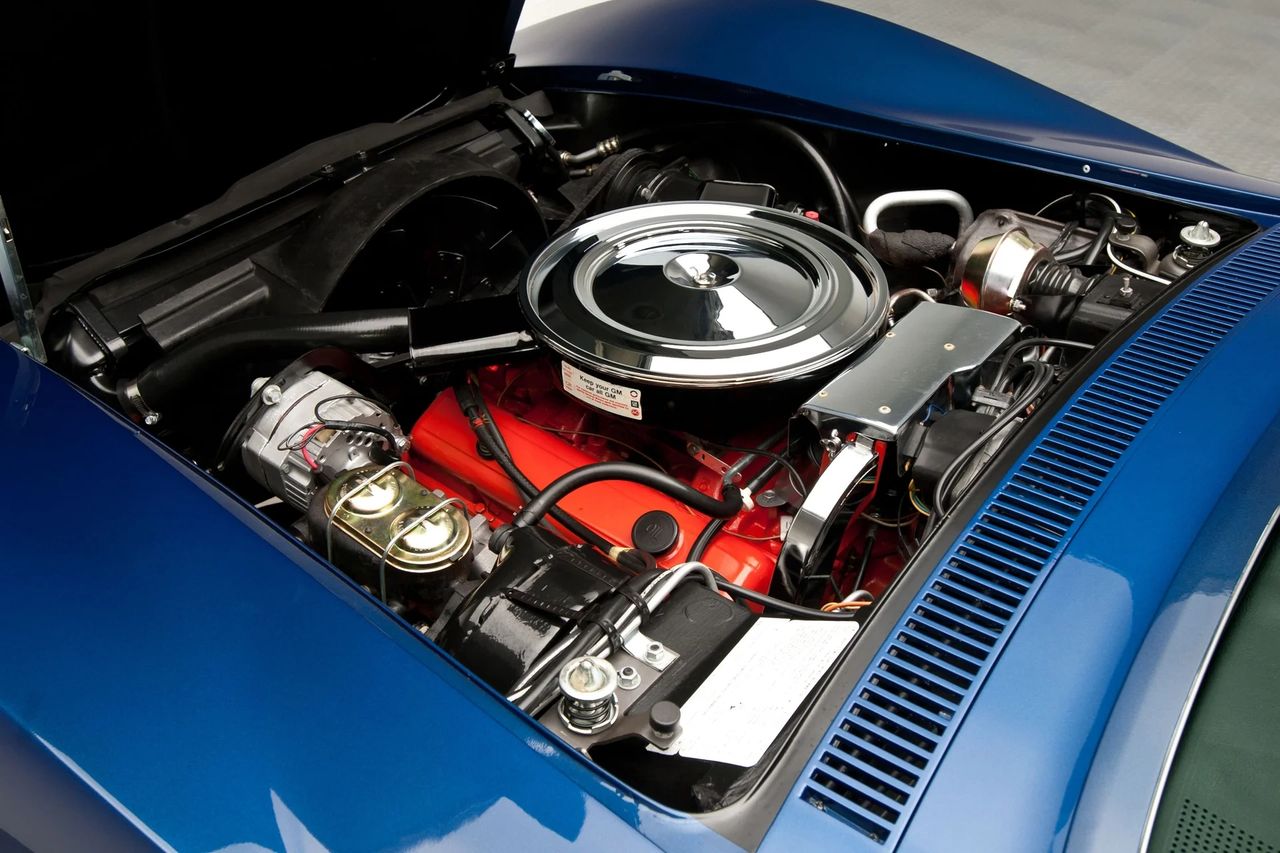
    The 1972 Corvette’s ZQ3 was the standard 350-ci small-block, rated at 200 SAE net horsepower and 300 lb-ft of torque. With its 8.5:1 compression ratio, Quadrajet four-barrel carburetor, and hydraulic lifters, it was engineered for broad, easy torque rather than high-rpm drama. The big drop in published output compared to 1971 was mostly the result of the industry-wide switch from gross to net horsepower ratings—making the numbers look softer even though real-world performance barely changed. Out on the road, a healthy ZQ3 still delivered that smooth, confident, small-block shove that defined the early C3 driving experience. (Image courtesy of RK Motors)
    The 1972 Corvette’s ZQ3 was the standard 350-ci small-block, rated at 200 SAE net horsepower and 300 lb-ft of torque. With its 8.5:1 compression ratio, Quadrajet four-barrel carburetor, and hydraulic lifters, it was engineered for broad, easy torque rather than high-rpm drama. The big drop in published output compared to 1971 was mostly the result of the industry-wide switch from gross to net horsepower ratings—making the numbers look softer even though real-world performance barely changed. Out on the road, a healthy ZQ3 still delivered that smooth, confident, small-block shove that defined the early C3 driving experience. (Image courtesy of RK Motors)

    For those ordering a Corvette in 1972, one of the earliest surprises came in the engine menu: the high-profile performance options that had headlined the late-1960s and early-1970s were gone or greatly constrained. The optional ZR-2 package—offered in prior years as the ultimate big-block track weapon—was eliminated. That package had provided the aluminum-headed LS-6 454 as the top choice, but for 1972, GM removed it entirely.

    Previously, buyers could specify the LS-6 on its own or as part of RPO ZR2, but because of extremely poor sales (only 188 Corvettes with the LS-6 and a mere 12 cars equipped with RPO ZR2 sold in 1971), GM saw the writing on the wall. The result: the engine list for the 1972 Corvette was reduced to just three offerings—the smallest selection since 1956.

    These three engines were all carry-overs from 1971, and each was rated more conservatively than its predecessor. The base RPO ZQ3 350-cubic-inch small-block was rated at 200 brake horsepower. The LT-1 small-block, the high-revving darling of the Corvette faithful, was carried over and rated at 255 horsepower. The big-block LS-5 (454 ci) remained, but at a mere 270 horsepower.
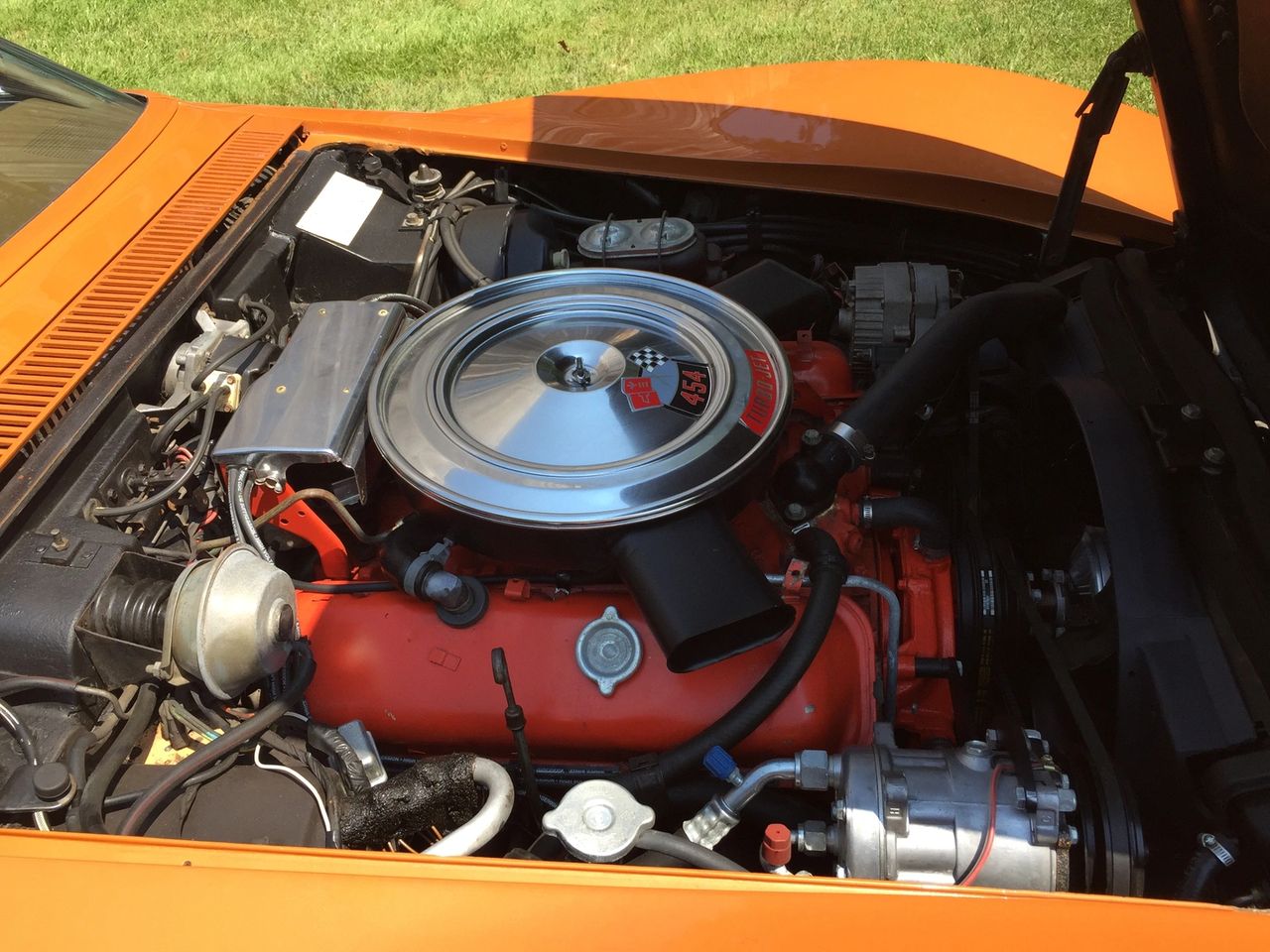
    The LS5 was the top-dog big-block in the 1972 Corvette, a 454-cubic-inch V8 now rated at 270 SAE net horsepower and a stump-pulling 390 lb-ft of torque. With 8.5:1 compression and a single 4-barrel carburetor, it was tuned for massive mid-range punch rather than high-rpm heroics, perfectly suited to the long-legged, big-cube character of the C3. Even as emissions rules and lower-octane fuel closed in, an LS5 car still felt effortlessly strong—more about rolling on the throttle and riding a wave of torque than spinning the tach to redline. It was also the final year you could spec a 454 in a Corvette, making a ’72 LS5 not just a brute in traffic, but a significant last chapter in the big-block era.
    The LS5 was the top-dog big-block in the 1972 Corvette, a 454-cubic-inch V8 now rated at 270 SAE net horsepower and a stump-pulling 390 lb-ft of torque. With 8.5:1 compression and a single 4-barrel carburetor, it was tuned for massive mid-range punch rather than high-rpm heroics, perfectly suited to the long-legged, big-cube character of the C3. Even as emissions rules and lower-octane fuel closed in, an LS5 car still felt effortlessly strong—more about rolling on the throttle and riding a wave of torque than spinning the tach to redline. It was also the final year you could spec a 454 in a Corvette, making a ’72 LS5 not just a brute in traffic, but a significant last chapter in the big-block era.

    Why this reduction? Two major external factors contributed to this: first, stricter emissions and smog-control regulations. Second, the change in how horsepower was measured. For 1972, GM adopted the SAE (Society of Automotive Engineers) “net” horsepower standard as opposed to the older gross rating. Net ratings measured output with all the usual accessories, exhaust, and intake hardware in place—water pump, alternator, power-steering pump, mufflers, and air-cleaner—rather than testing a stripped-down engine on a stand. The numbers looked lower on paper, but they were far more realistic.

    As catalogues and brochures went out, enthusiasts and critics alike noticed: the Corvette, once the poster car for unbridled American V8 power, was being quietly scaled back.

    Context: Emissions, Fuel Economy, and Corporate Strategy
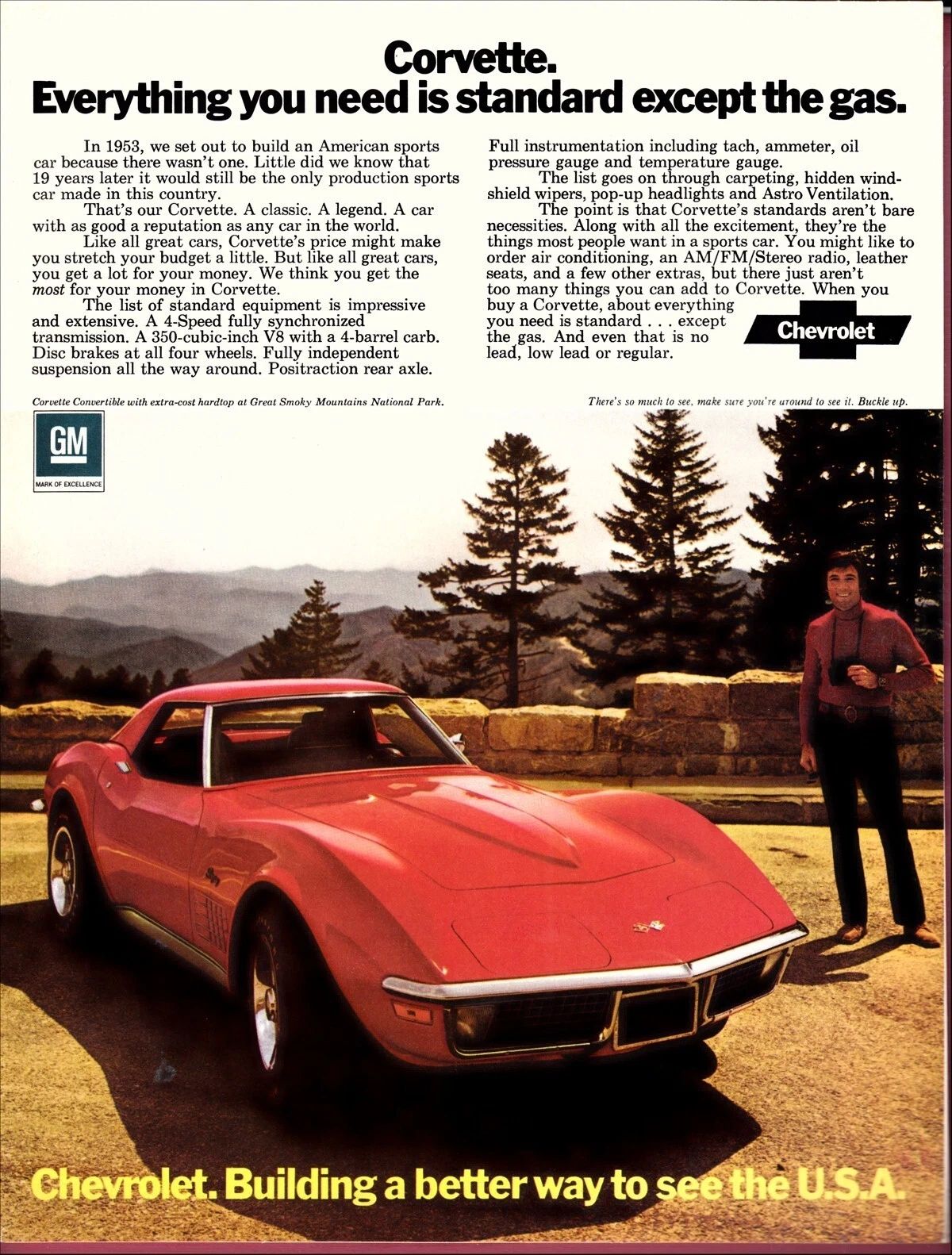
    By 1972, Federal emissions standards and changing fuel regulations were starting to squeeze performance, and Chevrolet clearly knew buyers were nervous about what that meant for their favorite sports car. This ad leans hard into the idea that Corvette still gives you “everything you need” right out of the box—power disc brakes, a 350 V-8, fully independent suspension—while quietly acknowledging that the only thing you really have to worry about now is the fuel. The closing line about “no lead, low lead or regular” is a wink at the new move toward low-lead and unleaded gasoline, reassuring owners that their Corvette is ready for the changing pump landscape. In other words, Chevrolet is selling the ’72 Corvette as a fully equipped, emissions-compliant sports car that hasn’t forgotten its performance roots, even as the rules tighten around it.
    By 1972, Federal emissions standards and changing fuel regulations were starting to squeeze performance, and Chevrolet clearly knew buyers were nervous about what that meant for their favorite sports car. This ad leans hard into the idea that Corvette still gives you “everything you need” right out of the box—power disc brakes, a 350 V-8, fully independent suspension—while quietly acknowledging that the only thing you really have to worry about now is the fuel. The closing line about “no lead, low lead or regular” is a wink at the new move toward low-lead and unleaded gasoline, reassuring owners that their Corvette is ready for the changing pump landscape. In other words, Chevrolet is selling the ’72 Corvette as a fully equipped, emissions-compliant sports car that hasn’t forgotten its performance roots, even as the rules tighten around it.

    To understand the 1972 Corvette’s constraints, it’s important to situate it in the broader context of the early-1970s American automotive industry. The muscle-car era was coming under pressure from multiple directions. Emissions regulations—driven by the newly empowered Environmental Protection Agency and state-by-state smog rules, most infamously in California—demanded lower compression ratios, add-on smog equipment, and detuned cam profiles. What engineers could once get away with in the 1960s was no longer acceptable in the 1970s.

    There was also a growing awareness of fuel economy and energy security. While the full-blown oil crisis precipitated by the 1973 OPEC oil embargo was still ahead, automakers were already paying attention to rising fuel prices, consumer attitudes shifting toward economy, and the looming possibility of federal fuel-economy standards. The days of casually offering 400-plus-horsepower engines across the board were ending.

    Inside GM, executives were already sketching out a corporate “downsizing” strategy—reduce body sizes, weight, and engine displacement across the portfolio to improve efficiency. The Corvette, as a niche performance car, wasn’t going to be turned into an economy commuter, but the same corporate pressures toward compliance and image management applied. By the early 1970s, the industry had begun to pivot away from raw muscle toward safety, comfort, and economy as the new selling points.

    In short, by 1972 the Corvette program found itself at an intersection of fading exuberance and rising restraint.

    Corvette Engineering & Design Hierarchy
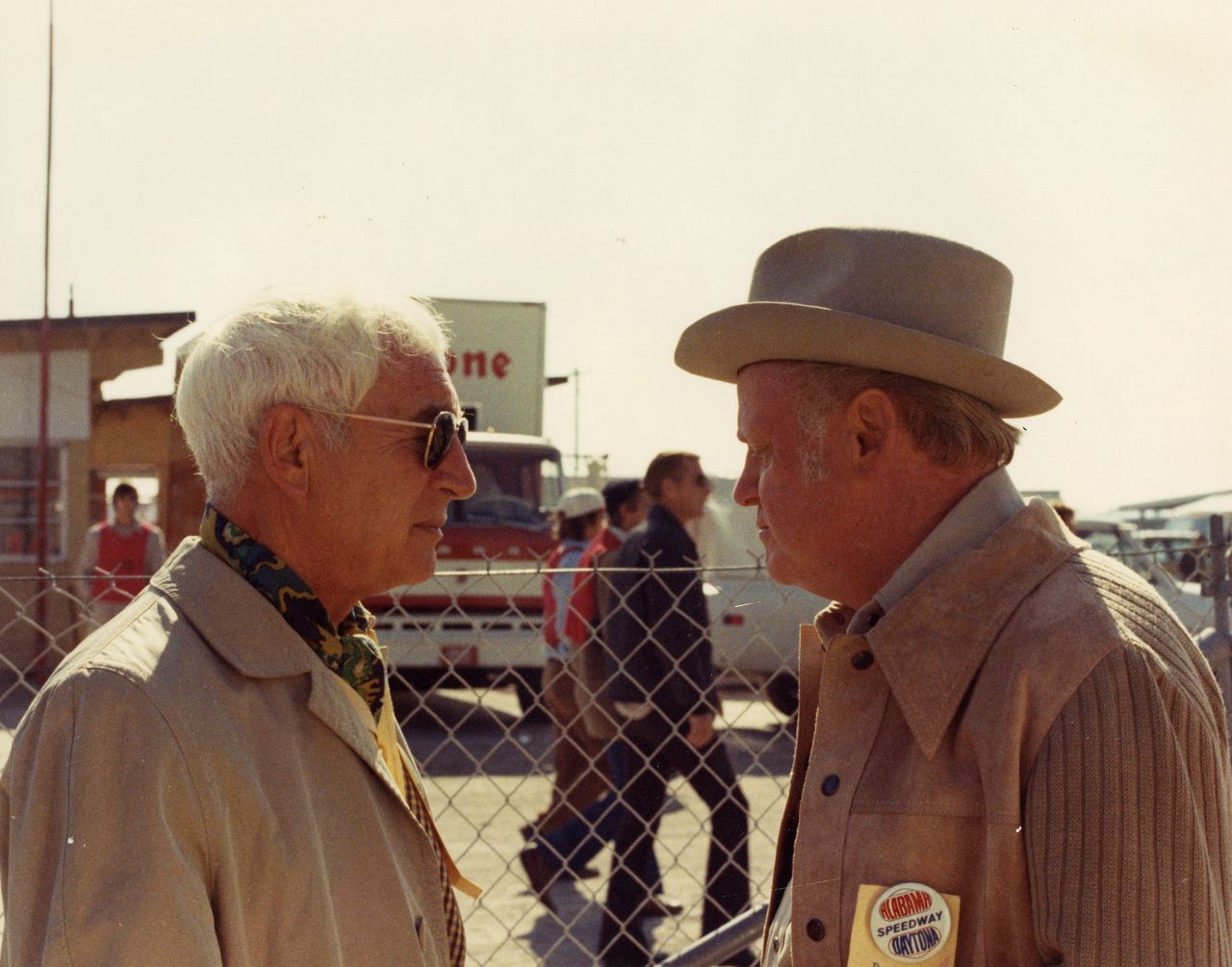
    Zora Arkus-Duntov and Bill Mitchell formed a classic “brains and beauty” partnership that helped steer the C3 Corvette through the turbulent early 1970s. Zora pushed for genuine performance and durability—refining chassis tuning, braking, and cooling—while Mitchell fought just as hard to keep the Stingray’s dramatic, show-car styling intact. By 1972, as compression ratios fell and net horsepower ratings replaced the old gross figures, the two men focused on preserving the car’s character rather than chasing headline numbers. Zora worked with his team to make the ’72 Corvette more driveable and refined, while Mitchell ensured the long-hood, short-deck drama of the body remained unmistakably Corvette. Together, they kept the 1972 model a true American sports car in spirit, even as regulations and fuel concerns reshaped the performance landscape around it. (Image courtesy of GM Media LLC)
    Zora Arkus-Duntov and Bill Mitchell formed a classic “brains and beauty” partnership that helped steer the C3 Corvette through the turbulent early 1970s. Zora pushed for genuine performance and durability—refining chassis tuning, braking, and cooling—while Mitchell fought just as hard to keep the Stingray’s dramatic, show-car styling intact. By 1972, as compression ratios fell and net horsepower ratings replaced the old gross figures, the two men focused on preserving the car’s character rather than chasing headline numbers. Zora worked with his team to make the ’72 Corvette more drivable and refined, while Mitchell ensured the long-hood, short-deck drama of the body remained unmistakably Corvette. Together, they kept the 1972 model a true American sports car in spirit, even as regulations and fuel concerns reshaped the performance landscape around it. (Image courtesy of GM Media LLC)

    The people behind the Corvette story in 1972 are as important as the hardware. The legendary engineer Zora Arkus-Duntov—widely regarded as the “Father of the Corvette”—was still influential within Chevrolet Engineering, though his retirement was on the horizon. His fingerprints remained on the Corvette’s performance character, even as regulations began to dull some of the sharper edges he had spent a career honing.

    On the design side, GM styling chief Bill Mitchell continued to oversee the look and feel of Chevrolet’s flagship sports car. Under Mitchell, Chevrolet’s in-house Corvette studio refined the C3’s basic shape—first introduced for 1968—while balancing cost, tooling, and the realities of a long production run. By 1972, the team knew they were nearing the end of a distinct styling phase: chrome bumpers, egg-crate grilles, and removable rear glass were all elements that would soon give way to more integrated, regulation-friendly forms.

    During the early ’70s—while the Corvette team was navigating emissions changes, new safety regulations, and GM’s corporate horsepower mandate—the Design Dome served as the one place where Mitchell could continually reassess the C3’s visual identity without losing the drama that made the car so magnetic. By 1972, the Dome was less about creating an all-new shape and more about protecting the C3’s signature form as external pressures forced mechanical changes underneath. Mitchell and his designers used the Dome’s controlled lighting to evaluate subtle adjustments to color palettes, trim detailing, and surface transitions so the car would maintain its emotional impact even as engineering constraints tightened. In short, while 1972 wasn’t a major redesign year, the Dome remained the Corvette studio’s sanctuary—a place to make sure the Stingray still looked like the performance car Zora wanted it to be, even as the rules of the era tried to tame it.
    During the early ’70s—while the Corvette team was navigating emissions changes, new safety regulations, and GM’s corporate horsepower mandate—the Design Dome served as the one place where Mitchell could continually reassess the C3’s visual identity without losing the drama that made the car so magnetic. By 1972, the Dome was less about creating an all-new shape and more about protecting the C3’s signature form as external pressures forced mechanical changes underneath. Mitchell and his designers used the Dome’s controlled lighting to evaluate subtle adjustments to color palettes, trim detailing, and surface transitions so the car would maintain its emotional impact even as engineering constraints tightened. In short, while 1972 wasn’t a major redesign year, the Dome remained the Corvette studio’s sanctuary—a place to make sure the Stingray still looked like the performance car Zora wanted it to be, even as the rules of the era tried to tame it.

    Within Chevrolet Engineering, the Corvette program relied on a matrix of specialists: powertrain engineers sorting out compression ratios, cam timing, and emissions; chassis engineers focused on ride, handling, and tire development; body engineers wrangling fiberglass panel fit and finish; and safety specialists looking ahead to evolving crash standards. While the specific org chart shifted year to year, the mission remained consistent: keep Corvette a credible performance car while aligning with the wider corporate and regulatory mandates.

    The powertrain group probably had the toughest brief. They were tasked with preserving the Corvette’s reputation as a driver’s car, even as they lowered compression, added emissions gear, and rated engines under stricter net standards. The styling group, meanwhile, was mindful that 1972 would be a kind of “last call” for the classic chrome bumpered C3. The result is a car that looks like its 1971 predecessor, but carries with it the weight of an era about to end.

    What was New WIth the1972 CORVETTE – Subtle Changes, Significant Ends
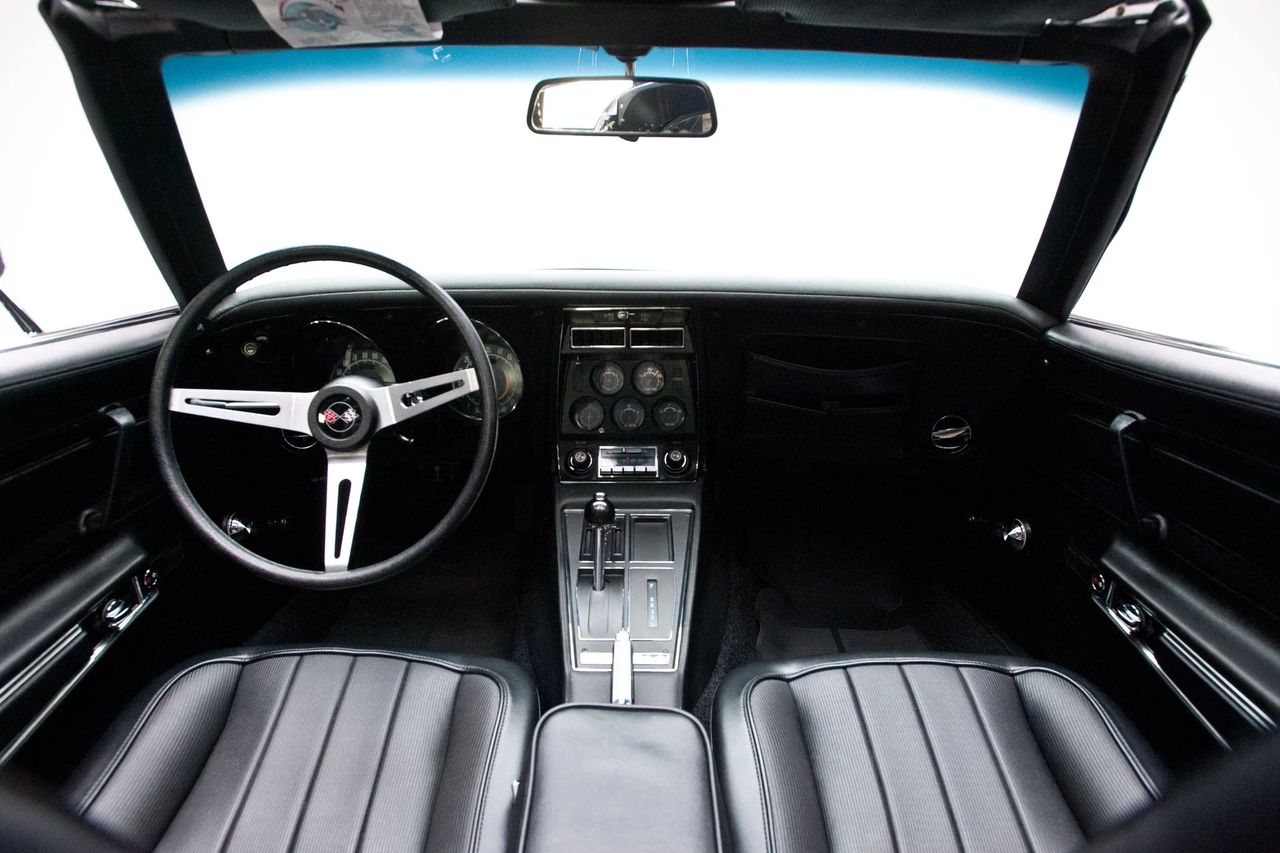
    Inside, the 1972 Corvette’s cockpit carried over the familiar C3 “aircraft” layout, but with a noticeably cleaner center console. The biggest change was the deletion of the fiber-optic lamp-monitoring panel, which simplified the console face and gave the gauge/radio stack a less cluttered, more modern look. Minor trim and labeling revisions further freshened the appearance, yet the basic environment—deeply hooded instruments, a tall console running between the seats, and that thin three-spoke wheel—still wrapped the driver in a focused, almost fighter-jet-like driving position. (Image courtesy of RK Motors)
    Inside, the 1972 Corvette’s cockpit carried over the familiar C3 “aircraft” layout, but with a noticeably cleaner center console. The biggest change was the deletion of the fiber-optic lamp-monitoring panel, which simplified the console face and gave the gauge/radio stack a less cluttered, more modern look. Minor trim and labeling revisions further freshened the appearance, yet the basic environment—deeply hooded instruments, a tall console running between the seats, and that thin three-spoke wheel—still wrapped the driver in a focused, almost fighter-jet-like driving position. (Image courtesy of RK Motors)

    Mechanically and visually, the 1972 Corvette looked very much like its 1971 sibling. Yet there were certain items worth noting—not so much for what was added, but for what quietly slipped away.

    On the hardware side:

    • The fiber-optic light-monitoring system, which had been a quirky yet ingenious way to keep tabs on lamp operation, was dropped. Owners may have loved to show it off, but it was often dismissed as a gimmick and added cost and complexity that Chevrolet no longer wanted to carry.
    • An all-new center console design replaced the older layout. The underlying architecture remained familiar, but the surfaces and presentation reflected incremental refinements in ergonomics and style.
    • A horn-honking burglar alarm was now standard on every Corvette. Armed and disarmed via a lock cylinder at the rear of the car, the system would unleash the factory horn if either the doors or the hood were opened while the car was “armed,” and would continue to sound until the key was used again in the alarm lock.
    • For the first time in this generation, the LT-1 engine could be paired with factory air-conditioning. That combination had previously been off-limits due to concerns that the high-revving small-block would toss belts under heavy load. To help guard against that, LT-1 tachometers now carried a 5,600-rpm redline instead of the previous 6,500-rpm mark.
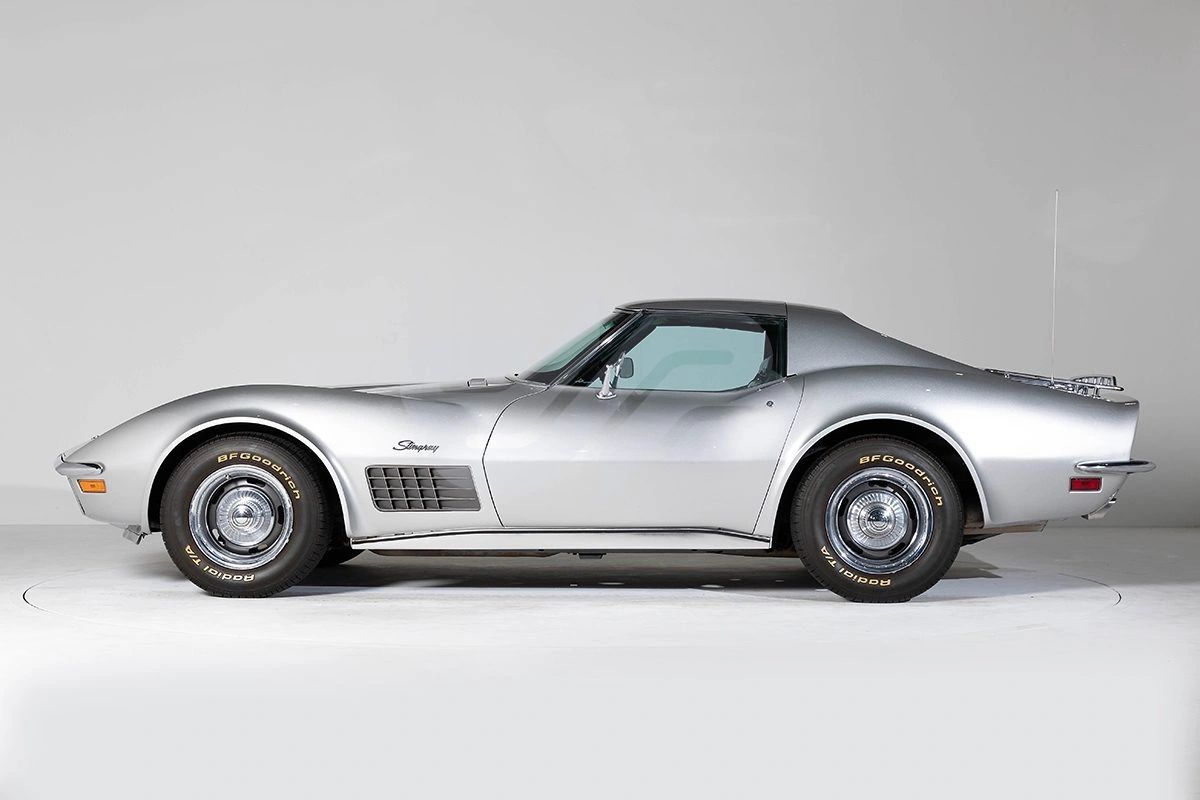
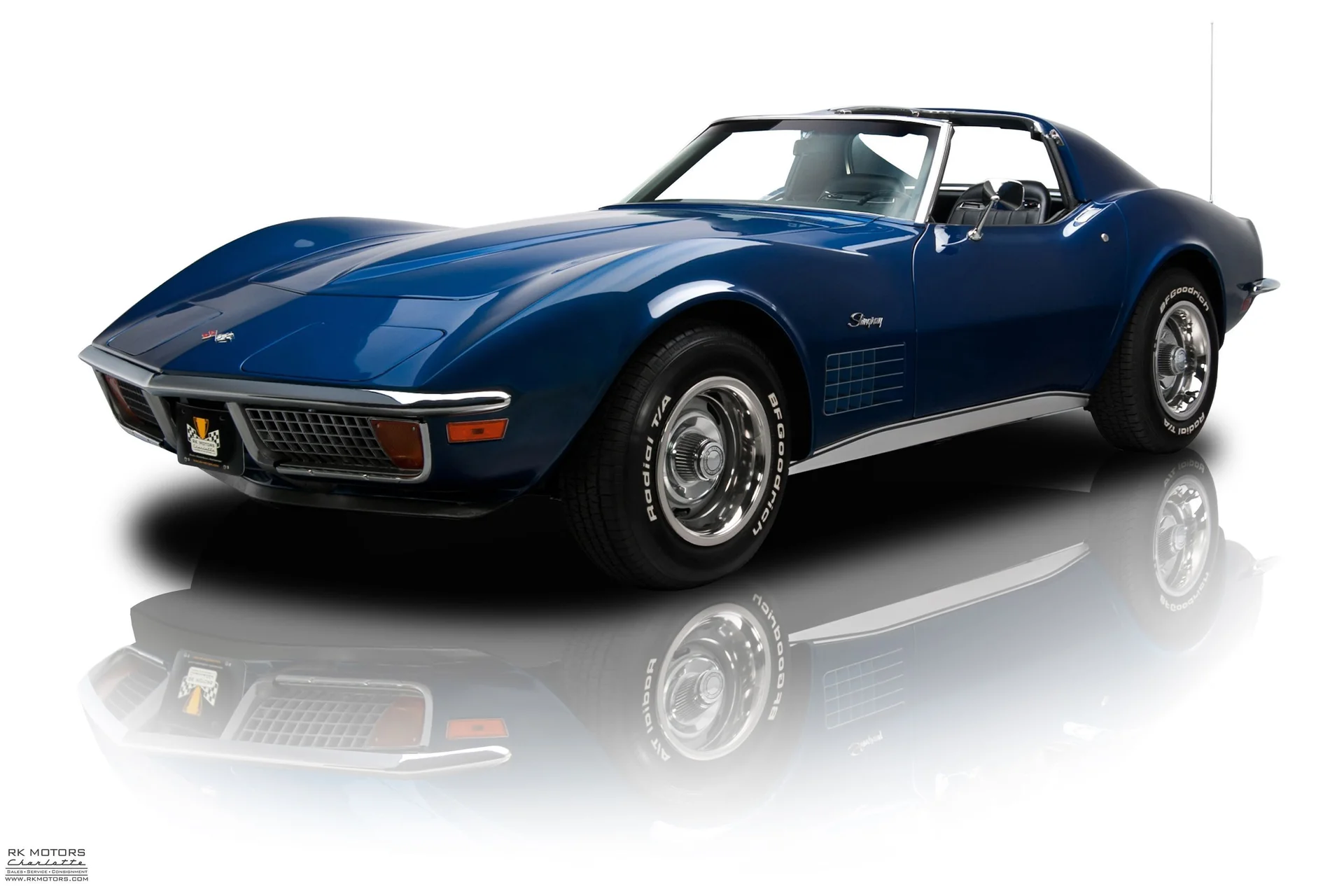
    The 1972 Corvette—seen here in Pewter Silver Metallic—quietly marked the end of several long-standing Stingray traditions. It was the final year for both the removable rear-window panel and the beloved chrome bumpers front and rear, features that had defined the C3’s character since 1968. It was also the last model year to offer the big-block 454, closing the door on the era of high-displacement Corvette muscle. Subtle on the surface but historically significant, the ’72 stands as the last truly classic, chrome-bumper Stingray before federal regulations reshaped the Corvette’s look and personality.
    The 1972 Corvette—seen here in Pewter Silver Metallic—quietly marked the end of several long-standing Stingray traditions. It was the final year for both the removable rear-window panel and the beloved chrome bumpers front and rear, features that had defined the C3’s character since 1968. It was also the last model year to offer the big-block 454, closing the door on the era of high-displacement Corvette muscle. Subtle on the surface but historically significant, the ’72 stands as the last truly classic, chrome-bumper Stingray before federal regulations reshaped the Corvette’s look and personality.

    Visually, 1972 marked the “end of an era” for the classic third-generation Corvette. First and foremost, it was the last model year to feature both front and rear chrome bumpers. Second, it was the final appearance of the bright egg-crate front grille. Third, it marked the end of the separate side-fender grills as purely stylistic elements; later cars would incorporate functional vents and, in some cases, different trim. Finally, and most poignantly for many owners, 1972 was the last year for the removable rear window—an instant open-air party trick that had been unique on the 1968–1972 Corvettes.

    Perhaps the most significant change wasn’t an addition at all, but the disappearance of choice. The LS-6 big-block and the ZR-2 package were gone, victims of poor sales and tightening corporate priorities. The LS-5 454 remained on the options list but ran into its own complication: Chevrolet failed to complete emissions certification of the Mark IV LS-5 in time to clear it for sale in California, where more stringent NOx limits were already in place. Chevrolet knew the LS-5 could be made to pass, but lacked the manpower to certify every possible engine/transmission combination. With relatively low production volume expected for the LS-5, it simply didn’t make the cut. That meant Corvette buyers in the brand’s second-largest market—California—were effectively shut out of the big-block option altogether.

    Performance & Specifications in the Real World
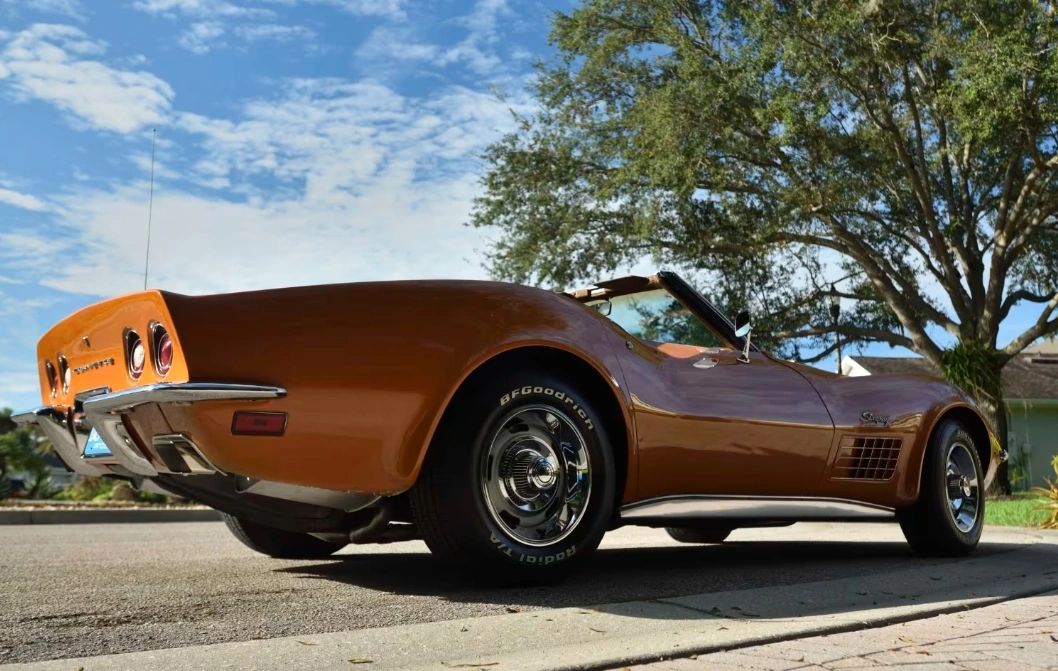
    This 1972 Corvette convertible shows how much charisma the C3 carried even as SAE net horsepower numbers dipped on paper. Bathed in a rich, period-perfect bronze hue, the car looks tailor-made for sunny boulevards and coastal drives, where its metallic highlights and flowing fender lines come alive. Under the hood, the small-block may be “down” on rated power compared with earlier years, but its broad torque curve and lighter, more refined driving manners make it an effortless cruiser in real-world conditions. Paired with radial tires and a well-sorted chassis, it’s the kind of Corvette you can drive all day with the top down and never feel shortchanged on enjoyment. In 1972, the numbers may have been lower—but behind the wheel of a car like this, the experience is anything but.
    This 1972 Corvette convertible shows how much charisma the C3 carried, even as SAE net horsepower numbers dipped on paper. Bathed in a rich, period-perfect bronze hue, the car looks tailor-made for sunny boulevards and coastal drives, where its metallic highlights and flowing fender lines come alive. Under the hood, the small-block may be “down” on rated power compared with earlier years, but its broad torque curve and lighter, more refined driving manners make it an effortless cruiser in real-world conditions. Paired with radial tires and a well-sorted chassis, it’s the kind of Corvette you can drive all day with the top down and never feel shortchanged on enjoyment. In 1972, the numbers may have been lower—but behind the wheel of a car like this, the experience is anything but.

    Once the dust settled on the new ratings system and revised engine lineup, Corvette performance looked more modest on paper, but the story behind the numbers is more interesting.

    With all three engines now reported under SAE net standards, the drop in advertised horsepower looked dramatic. The base 350-ci small-block at 200 horsepower was down substantially from earlier gross figures. The LT-1 at 255 horsepower looked a long way from the 330-horsepower rating it had carried just a year prior under the old system. The LS-5 big-block’s 270-horsepower rating hardly sounded like the stuff of legend for a 454-cubic-inch V8.

    Yet when testers got their hands on the cars, they discovered that the Corvette still moved with authority. A 1972 Corvette equipped with the 350 ci/255-horsepower LT-1 was good for a 0–60 mph sprint in the high-six-second range—around 6.9 seconds—and quarter-mile times in the neighborhood of 14 seconds flat. Hardly slow, especially when compared to the increasingly strangled full-size and intermediate muscle cars of the same era.

    Production numbers tell another part of the story. In 1972, Chevrolet built 27,004 Corvettes: 20,496 coupes and 6,508 convertibles. That represented an increase of nearly 5,200 units over 1971, suggesting that buyers were still very much on board with Corvette, even if the horsepower headlines had softened. Pricing, too, was slightly more attractive, thanks in part to the repeal of a federal excise tax on December 11, 1971. The base Corvette coupe—with 350-ci, 200-horsepower engine and wide-ratio four-speed manual—listed at $5,533. The base convertible started at $5,296.
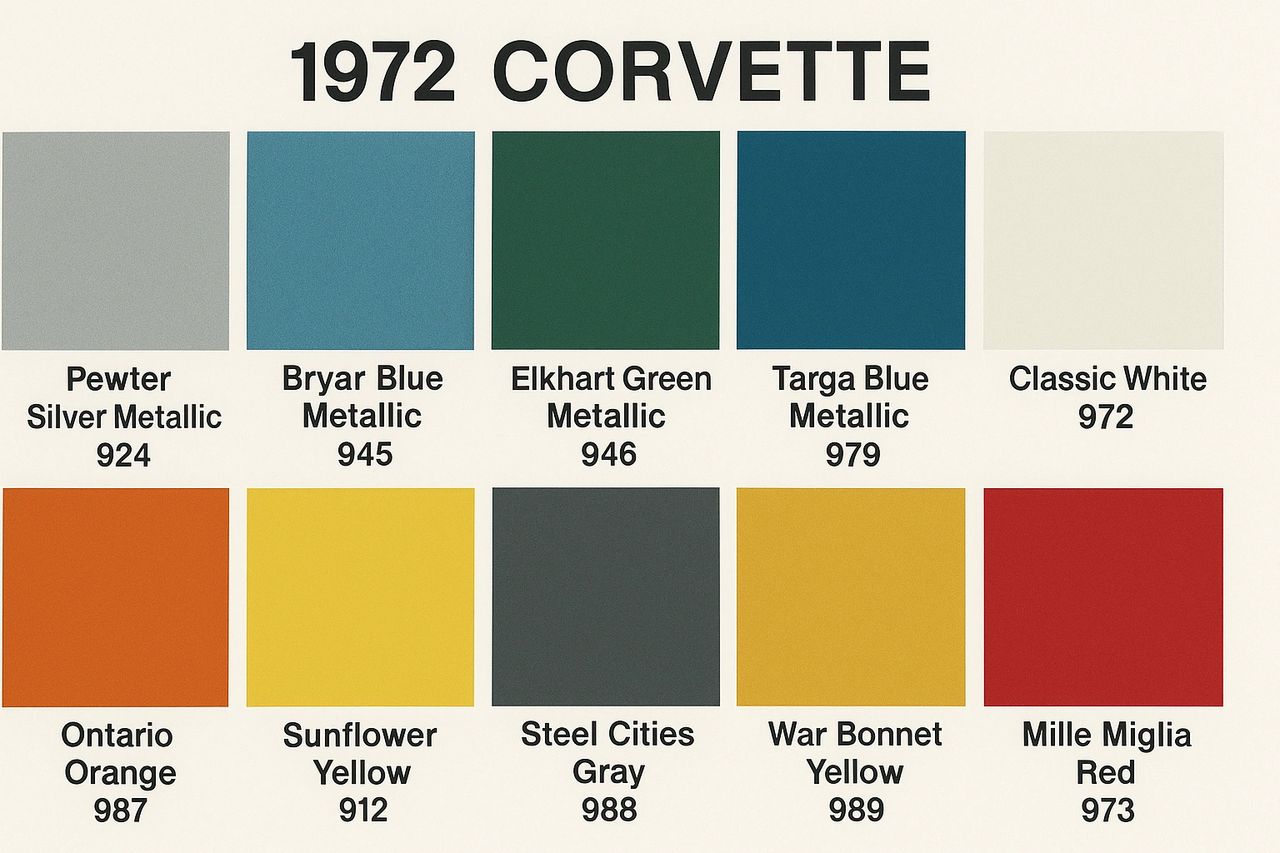
    1972 Corvette Paint Colors (Image courtesy of the author)
    1972 Corvette Paint Colors (Image courtesy of the author)

    Color options for 1972 were plentiful and period-perfect: Sunflower Yellow, Pewter Silver, Bryar Blue, Elkhart Green, Classic White, Mille Miglia Red, Targa Blue, Ontario Orange, Steel Cities Gray, and War Bonnet Yellow. It’s a palette that reads today like a catalog of early-1970s automotive fashion, and it adds another dimension to the car’s character, especially as collectors hunt specific colors and combinations.

    Under the skin, the basic Corvette formula remained intact: independent rear suspension, four-wheel disc brakes, a fiberglass body mounted to a steel frame, and the familiar mix of small- and big-block V8 power. The third-generation chassis and structure were, by 1972, well understood and refined, even if they were not yet truly modern by European standards. What mattered to most buyers was that the Corvette still felt like a Corvette—quick, distinctive, and unapologetically American.

    Motorsport, Tires, and the Corvette as Test Beds
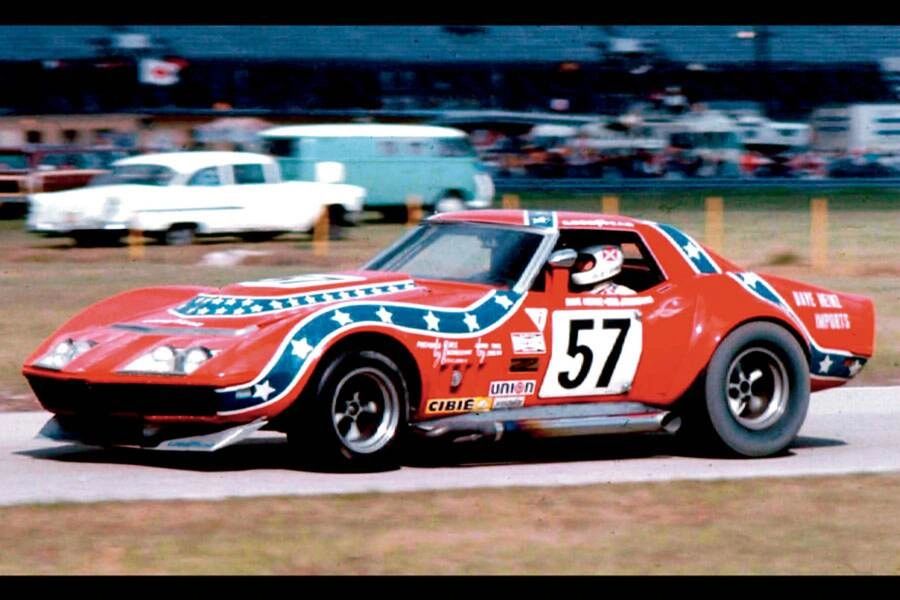
    The No. 57 Corvette was an absolute hammer in 1972, carrying its wild red-white-and-blue livery to back-to-back GT-class wins at Daytona and Sebring. Driven by Dave Heinz and Robert Johnson, the car combined brute power with surprising durability—exactly what endurance racing demanded. It became one of the season’s defining Corvette entries, proving America’s sports car could run with anyone, anywhere. (Image courtesy of Corvette Magazine)
    The No. 57 Corvette was an absolute hammer in 1972, carrying its wild red-white-and-blue livery to back-to-back GT-class wins at Daytona and Sebring. Driven by Dave Heinz and Robert Johnson, the car combined brute power with surprising durability—exactly what endurance racing demanded. It became one of the season’s defining Corvette entries, proving America’s sports car could run with anyone, anywhere. (Image courtesy of Corvette Magazine)

    Even in a “quiet” model year, the Corvette remained a force in motorsport—and an invaluable tool for technical development. The 1972 racing season saw the car excel in GT-class competition. The driving team of Dave Heinz and Robert Johnson, piloting the No. 57 Corvette, claimed a GT-class victory (and 8th overall) in the February 6 running of the Six Hour Daytona Continental, part of the World Manufacturers Championship. They followed it up with an even more impressive effort at the 12 Hours of Sebring on March 25, where they scored another GT-class win and finished fourth overall. That fourth-place result was, at the time, the best overall finish Corvette had ever achieved at Sebring.

    Beyond trophies, the Corvette also served as a rolling laboratory. The car’s combination of weight, speed, and durability demands made it an ideal platform for tire companies intent on proving the viability of radial-ply designs in serious competition. B.F. Goodrich and Goodyear both used Corvette entries as test beds to showcase that radials could not only survive, but thrive, under the rigors of endurance racing. Those lessons would filter down to street tires and, indirectly, help usher in the era where radials became the norm.
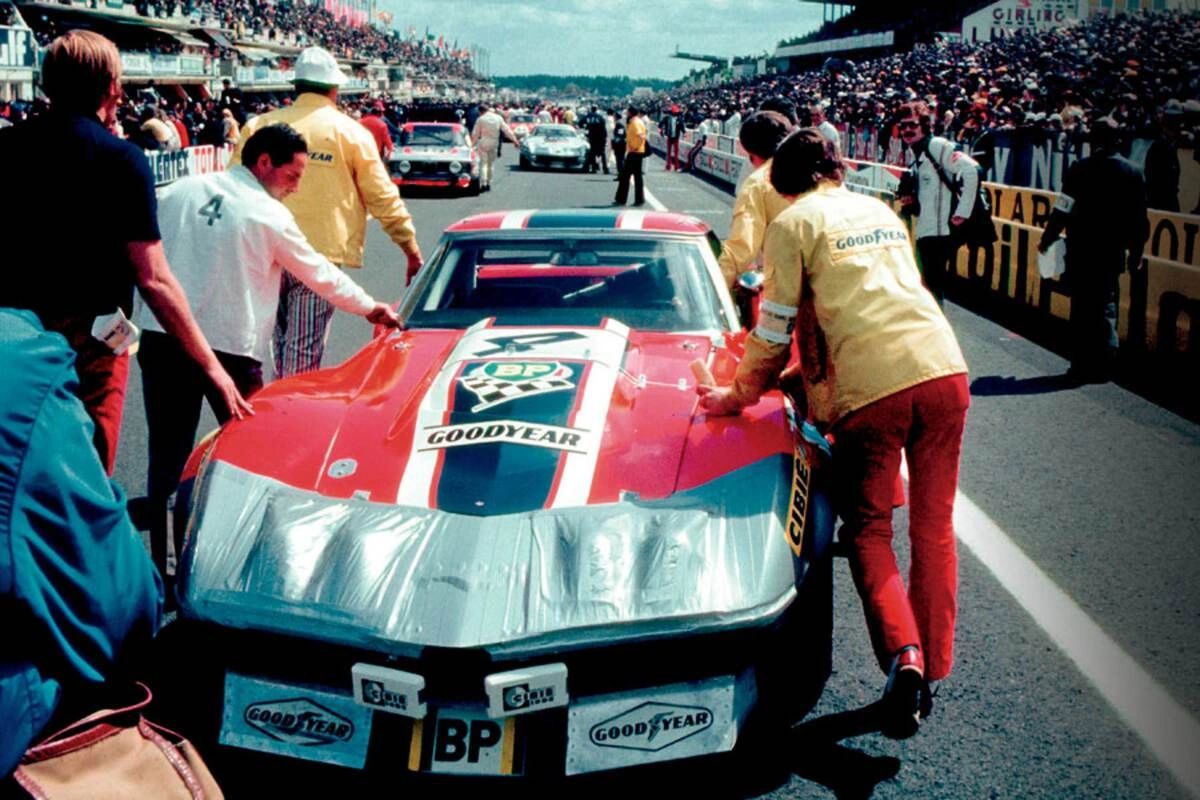
    The No. 4 Corvette from Race Engineering & Development wasn’t the headline-grabber in 1972—that honor went to the No. 57 domestic squad—but this car carved out its own legend by taking the American fight straight to the world stage. Shipped overseas and thrown into the cauldron of the 24 Hours of Le Mans, the privateer entry arrived armed not with factory backing, but with Goodyear’s radical experiment: proving that radial-ply tires could survive—and win—in endurance racing. In the thick of Europe’s most grueling event, the No. 4 wasn’t just chasing a class result; it was helping shape the future of Corvette performance. Every lap, every vibration, every blistering mile was data—tangible progress in real time. It’s the perfect snapshot of 1972: Corvette racing not just for trophies, but for transformation. (Image courtesy of Corvette Magazine)
    The No. 4 Corvette from Race Engineering & Development wasn’t the headline-grabber in 1972—that honor went to the No. 57 domestic squad—but this car carved out its own legend by taking the American fight straight to the world stage. Shipped overseas and thrown into the cauldron of the 24 Hours of Le Mans, the privateer entry arrived armed not with factory backing, but with Goodyear’s radical experiment: proving that radial-ply tires could survive—and win—in endurance racing. In the thick of Europe’s most grueling event, the No. 4 wasn’t just chasing a class result; it was helping shape the future of Corvette performance. Every lap, every vibration, every blistering mile was data—tangible progress in real time. It’s the perfect snapshot of 1972: Corvette racing not just for trophies, but for transformation. (Image courtesy of Corvette Magazine)

    In that context, it’s worth noting how the No. 57 effort dovetailed with another notable Corvette campaign: the No. 4 entry fielded by the privateer outfit Race Engineering & Development (R.E.D.). While the No. 57 team logged the wins at Daytona and Sebring, the No. 4 car forged a bold path overseas—arriving at the 24 Hours of Le Mans in 1972 with a Corvette pressed into GT service and backed by Goodyear’s radial-tire development program. The story of that effort highlights perfectly how the Corvette wasn’t just racing for glory—it was racing to evolve.

    The R.E.D. team’s Corvette, built from what had originally been a 1968 small-block convertible and re-worked into an FIA-eligible GT entry, carried the No. 4 at Le Mans. It ran a stout big-block engine tuned to roughly 575 horsepower, and its immense top-end speed—reportedly north of 210 mph down the Mulsanne Straight—made it one of the fastest cars in the field. Although mechanical issues eventually hampered its chances, the No. 4 still crossed the finish line, placing 15th overall and 7th in class. More importantly, it proved that the Corvette could withstand the brutal 24-hour crucible and serve as a real-world test platform for emerging tire technology.
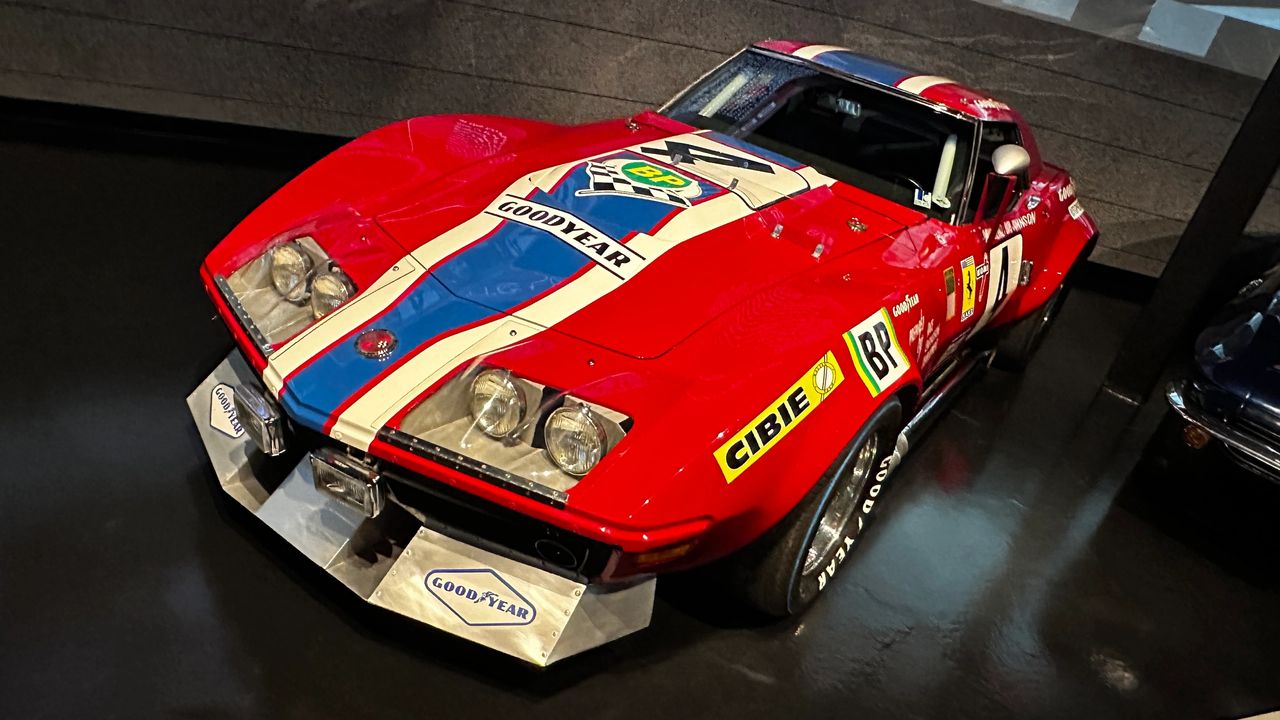
    On display at the National Corvette Museum in Bowling Green, the No. 4 BP/Goodyear C3 isn’t just a pretty red race car—it’s a survivor from one of Corvette’s boldest experiments. Fielded by the privateer Race Engineering & Development (R.E.D.) team, this car carried Goodyear’s then-new radial tires into the 1972 24 Hours of Le Mans, proving that a production-based Corvette could take the fight to Europe while doubling as a rolling tire test bed. Its story underscores how Corvette wasn’t merely chasing trophies; it was helping evolve the technology that would shape street cars for decades. Standing next to the car at the Museum, you can see the purposeful aero, the battle-ready stance, and the period sponsor graphics up close—details that photos just can’t capture. For anyone who loves Corvette Racing history, a trip to Bowling Green to see No. 4 in person is absolutely bucket-list material. (Image courtesy of the author)
    On display at the National Corvette Museum in Bowling Green, the No. 4 BP/Goodyear C3 isn’t just a pretty red race car—it’s a survivor from one of Corvette’s boldest experiments. Fielded by the privateer Race Engineering & Development (R.E.D.) team, this car carried Goodyear’s then-new radial tires into the 1972 24 Hours of Le Mans, proving that a production-based Corvette could take the fight to Europe while doubling as a rolling tire test bed. Its story underscores how Corvette wasn’t merely chasing trophies; it was helping evolve the technology that would shape street cars for decades. Standing next to the car at the Museum, you can see the purposeful aero, the battle-ready stance, and the period sponsor graphics up close—details that photos just can’t capture. For anyone who loves Corvette Racing history, a trip to Bowling Green to see No. 4 in person is absolutely bucket-list material. (Image courtesy of the author)

    In short: the 1972 Corvette pulled double duty. It kept the brand’s performance image alive at the track while also helping shape the future of everyday tire technology for the cars you and I drive. That dual role—race-win machine and mobile R&D lab—is exactly what made it such a potent chapter in the Corvette story.

    Design and Cultural Significance of the 1972 Corvette
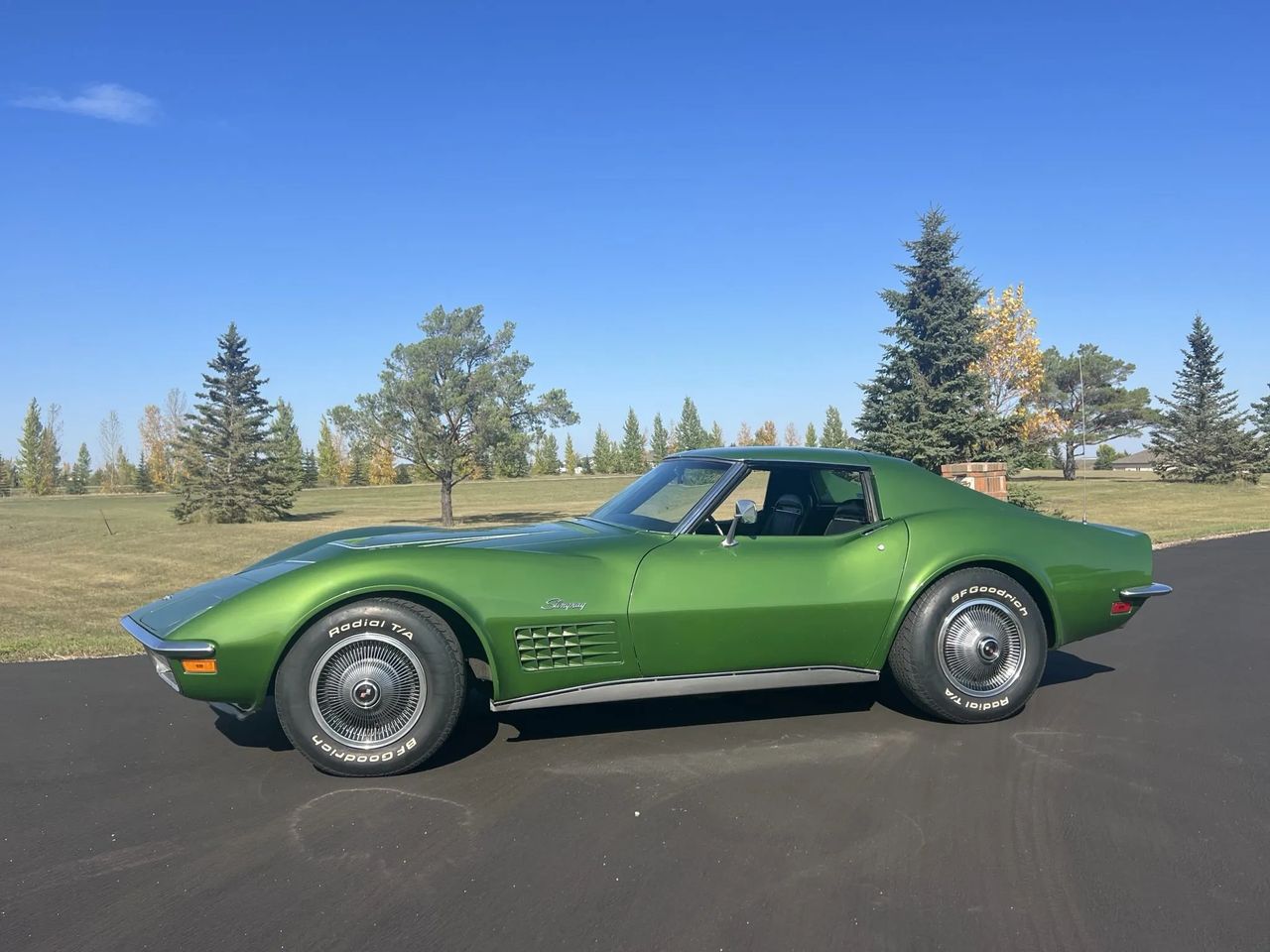
    In 1972, Corvette mattered because it proved Chevy’s sports car could survive the tightening emissions and insurance squeeze while still delivering big-block swagger, four-wheel discs, and true GT performance. This Elkhart Green Stingray captures that moment perfectly—the final year with chrome bumpers at both ends and one of the most vivid colors in the palette, it stood out on the road even as the horsepower numbers on paper were being recalculated in net ratings. (Image courtesy of bringatrailer.com)
    In 1972, Corvette mattered because it proved Chevy’s sports car could survive the tightening emissions and insurance squeeze while still delivering big-block swagger, four-wheel discs, and true GT performance. This Elkhart Green Stingray captures that moment perfectly—the final year with chrome bumpers at both ends and one of the most vivid colors in the palette, it stood out on the road even as the horsepower numbers on paper were being recalculated in net ratings. (Image courtesy of bringatrailer.com)

    From a design perspective, 1972 represents a watershed moment for the C3 Corvette. On one hand, it is the last of the “chrome bumper” era: a Corvette with brightwork both front and rear, a crisp egg-crate grille, and a removable rear window that allows the cabin to open up in a way later cars never quite replicate. On the other hand, it is a visible embodiment of the shift from raw, undiluted muscle toward a more refined, grand-touring interpretation of performance.

    The basic Stingray shape—long hood, short rear deck, pronounced fender peaks—was familiar by 1972, yet it still carried an undeniable presence on the street. T-top coupes and convertibles alike turned heads, especially when dressed in one of the bolder colors, such as Ontario Orange or Elkhart Green. The fiberglass bodywork, with its subtly flared arches and Coke-bottle waist, looked every bit the part of a world-class sports car, even as the mechanical spec sheet began to reflect the new realities of regulation.

    Culturally, the timing is significant. Just a year later, the 1973 oil crisis would erupt, sparking fuel shortages, long lines at gas stations, and a significant shift in how Americans viewed their cars. While the Corvette was never going to be a fuel-sipper, the 1972 model shows how even an icon of performance had to bend with the times. The decision by GM to scale back engine ratings, retire exotic big-block packages, and begin thinking more seriously about emissions and efficiency makes this year a quiet but meaningful turning point.

    For many enthusiasts today, the 1972 Corvette offers the best of both worlds: the classic, chrome-trimmed look of the early C3 combined with drivetrains and emissions systems that are a bit easier to live with than the wildest late-1960s combinations. It’s a car situated squarely between the maverick mid-sixties Corvette muscle years and the more regulated, touring-oriented era that would carry the nameplate through the remainder of the decade.

    Summary: Why the 1972 Corvette Matters
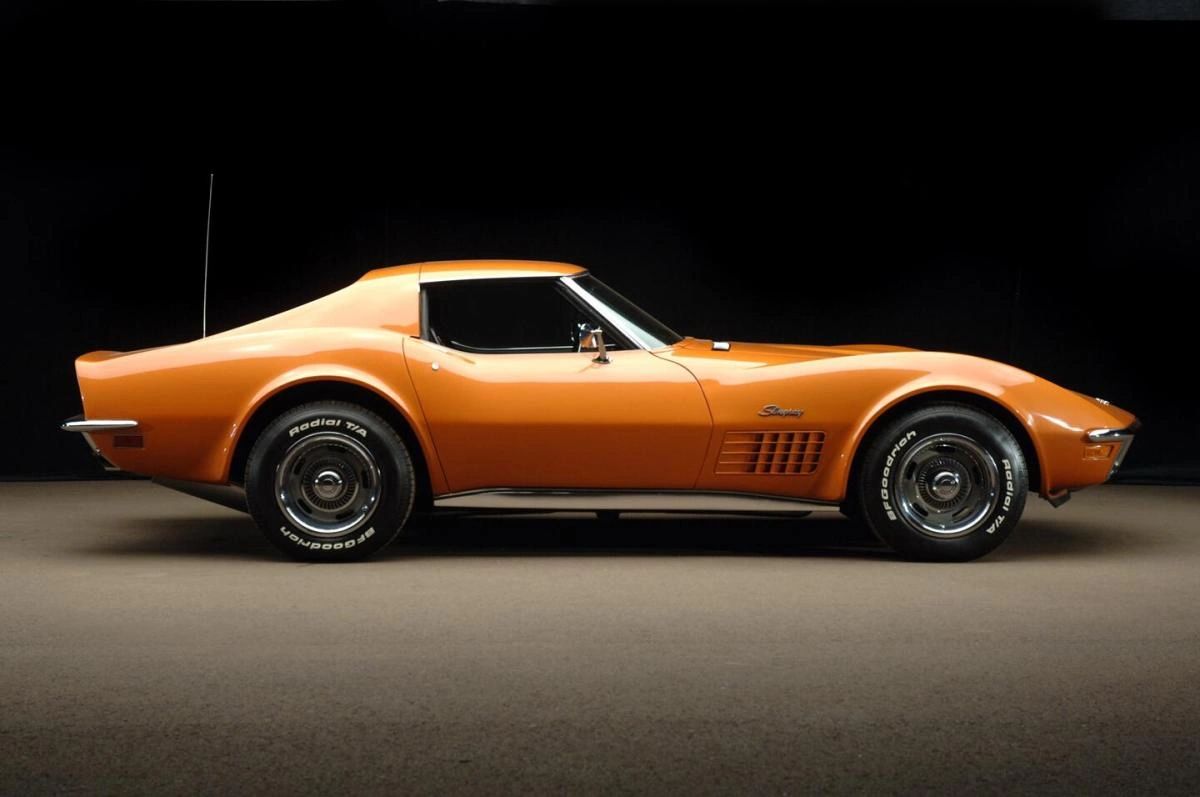
    Today, the 1972 Corvette stands as a pivotal link between the free-wheeling muscle era and the more regulated, efficiency-minded future. It was the last Corvette to wear chrome bumpers at both ends, yet it had already transitioned to net horsepower ratings and tighter emissions standards—proof the nameplate could adapt without losing its edge. Drenched in Ontario Orange, this Stingray also recalls a season when Corvette doubled as a development mule in endurance racing, helping refine the technology that would carry America’s sports car forward for decades. (Image courtesy of GM Media)
    Today, the 1972 Corvette stands as a pivotal link between the free-wheeling muscle era and the more regulated, efficiency-minded future. It was the last Corvette to wear chrome bumpers at both ends, yet it had already transitioned to net horsepower ratings and tighter emissions standards—proof that the nameplate could adapt without losing its edge. Drenched in Ontario Orange, this Stingray also recalls a season when Corvette doubled as a development mule in endurance racing, helping refine the technology that would carry America’s sports car forward for decades. (Image courtesy of GM Media)

    The 1972 Corvette may not carry the headline-grabbing mystique of a 1967 427 or a 1969 L88, but its importance lies precisely in its transitional character. It is the last of a specific visual and mechanical era: chrome bumpers front and rear, removable rear window, bright egg-crate grille, and a big-block option still present on the order sheet, if only just. At the same time, it is a car born into a world where emissions regulations, net horsepower ratings, shifting fuel realities, and corporate downsizing strategies were rewriting the rules.

    For enthusiasts and historians, 1972 offers a rich narrative. The year captures the Corvette at a crossroads—still very much a performance statement, but now compelled to coexist with the demands of regulation and a changing market. The engineering and design teams, working under figures like Zora Arkus-Duntov and Bill Mitchell, managed to keep the flame lit even as the winds began to shift.
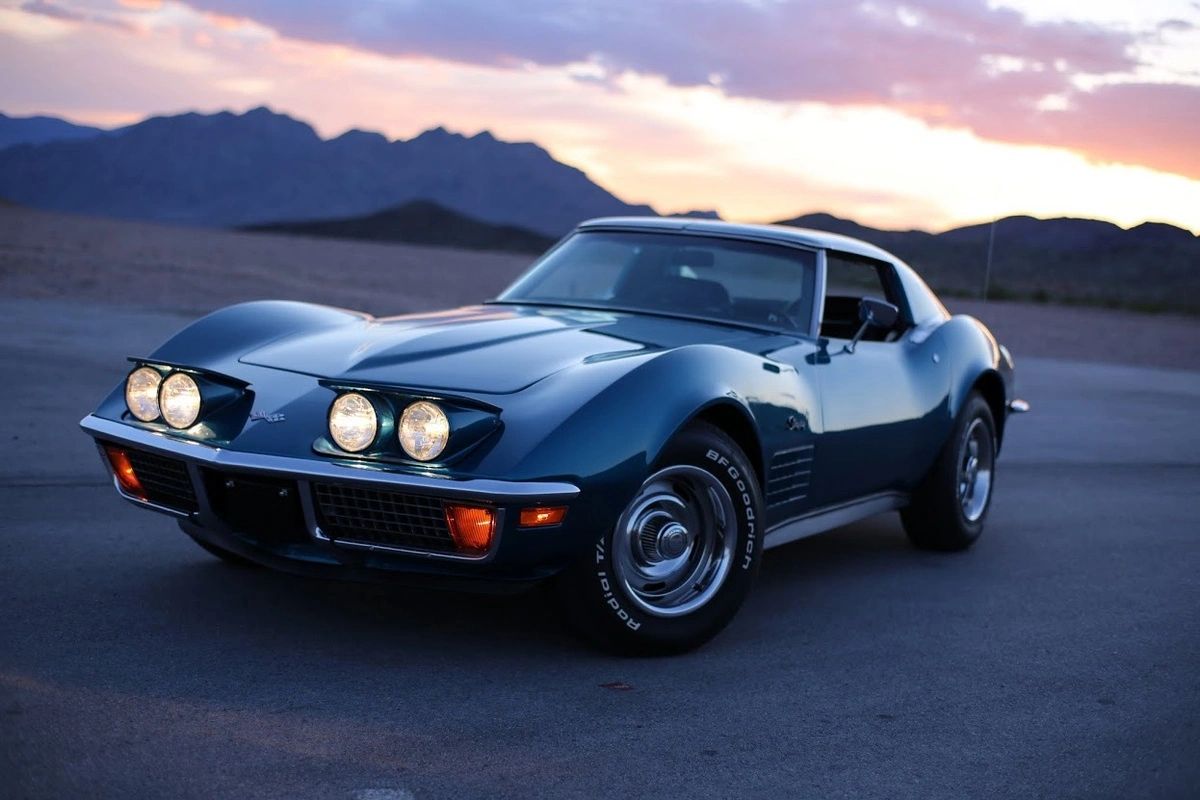
    As the sun drops behind the mountains, this ’72 Corvette feels like the last bright glow of an era that’s about to slip below the horizon. Its chrome bumpers, exposed headlights, and unfiltered small-block attitude represent the final, unbroken line back to the raw, late-’60s Stingray. Within a year, impact standards, emissions rules, and a softer, federally-minded 1973 facelift would begin reshaping Corvette’s face and character. This image is that quiet moment in between—a farewell to what was, and a subtle hint that the long twilight of the classic muscle era had already begun.
    As the sun drops behind the mountains, this ’72 Corvette feels like the last bright glow of an era that’s about to slip below the horizon. Its chrome bumpers, exposed headlights, and unfiltered small-block attitude represent the final, unbroken line back to the raw, late-’60s Stingray. Within a year, impact standards, emissions rules, and a softer, federally-minded 1973 facelift would begin reshaping Corvette’s face and character. This image is that quiet moment in between—a farewell to what was, and a subtle hint that the long twilight of the classic muscle era had already begun.

    Production numbers show that customers remained loyal; more people bought Corvettes in 1972 than in 1971 despite the diminished power ratings. That speaks to the deeper appeal of the car: the Corvette’s identity had grown beyond raw horsepower alone. It was about style, image, feel, and the uniquely American promise that came with a set of crossed flags on the nose.

    As a piece of Corvette history, the 1972 model invites reflection. It reminds us that performance is not always about chasing the biggest number. Sometimes, it’s about adapting to the times while staying true to your core. In that sense, the ’72 Corvette is not just the end of an era—it’s also the bridge that carried America’s sports car into a new, more complicated automotive world.

    As the 1972 model year dawned, the Corvette faithful and automotive press alike expected another bold performance incarnation of America’s iconic two-door sports car. However, the reality was more nuanced: the 1972 Chevrolet Corvette arrived in essentially carry-over form from 1971. What changed was barely visible, yet the forces behind the scene were powerful—regulatory shifts,…