There’s the car you see, and then there’s the car Chevrolet wanted you to see.
In 1998, as the C5 convertible took its first public bow, Corvette did something that looked outrageous on the surface but was quietly disciplined beneath the surface. It sent a nearly stock production convertible to lead America’s most famous race, then turned around and offered that same basic car—visually, mechanically, and philosophically—to anyone willing to sign the order sheet. The message was larger than paint, decals, or pageantry. It was not simply “look at us.” It was “this is the Corvette now.”
That distinction gave the 1998 Corvette Indianapolis 500 Pace Car Replica its real significance. Chevrolet was not just dressing up a Corvette for promotional effect. It was using the grandest stage in American motorsports to introduce the open-air version of the new C5 and to make a very specific claim about what the fifth-generation Corvette had become. This was a car built around structural honesty, not compromise. It was calm at speed, modern in its electronics, and composed enough to set the rhythm at Indy without requiring the sort of heavy-handed transformation that had often separated pace cars from their showroom counterparts.
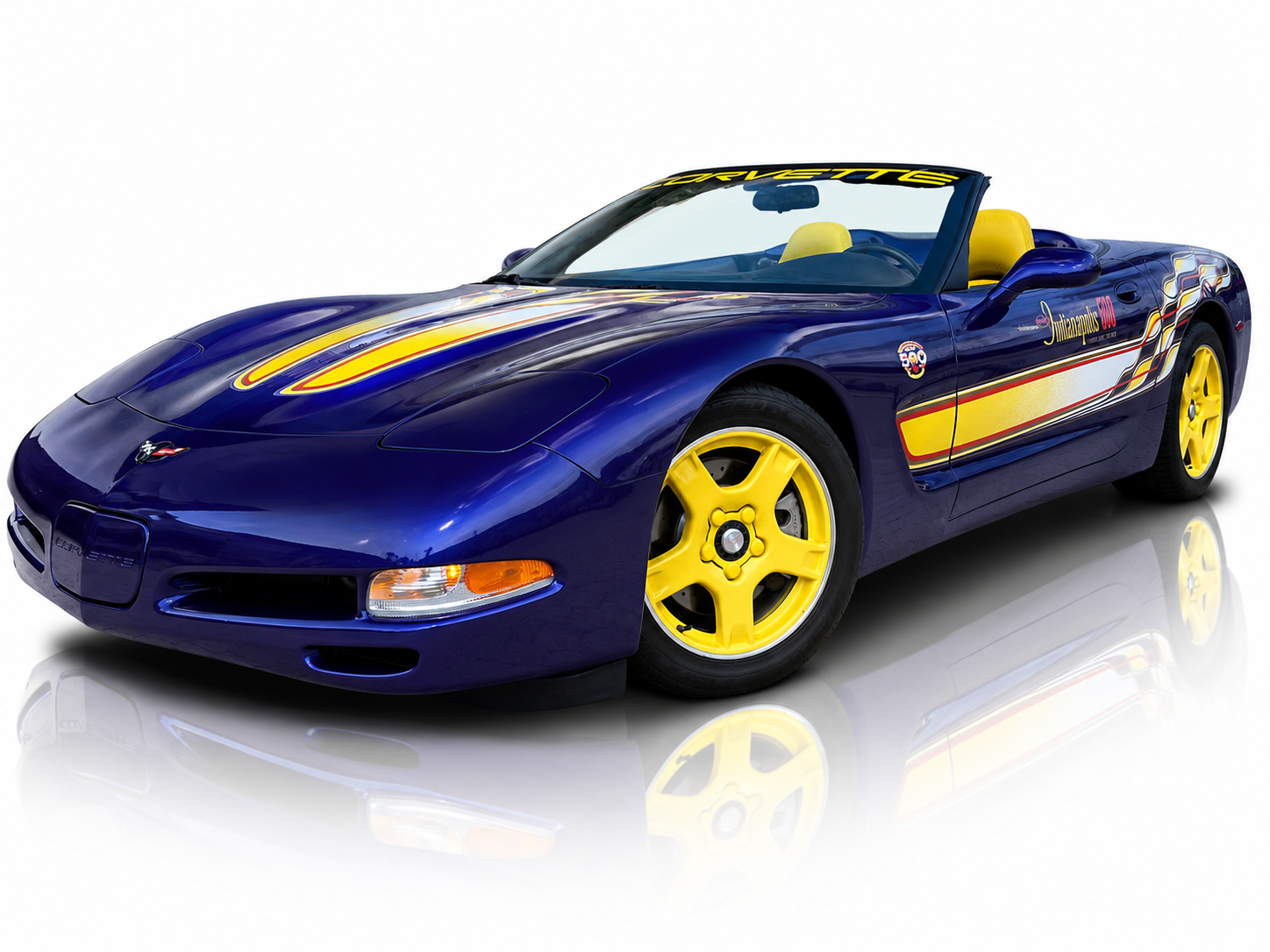
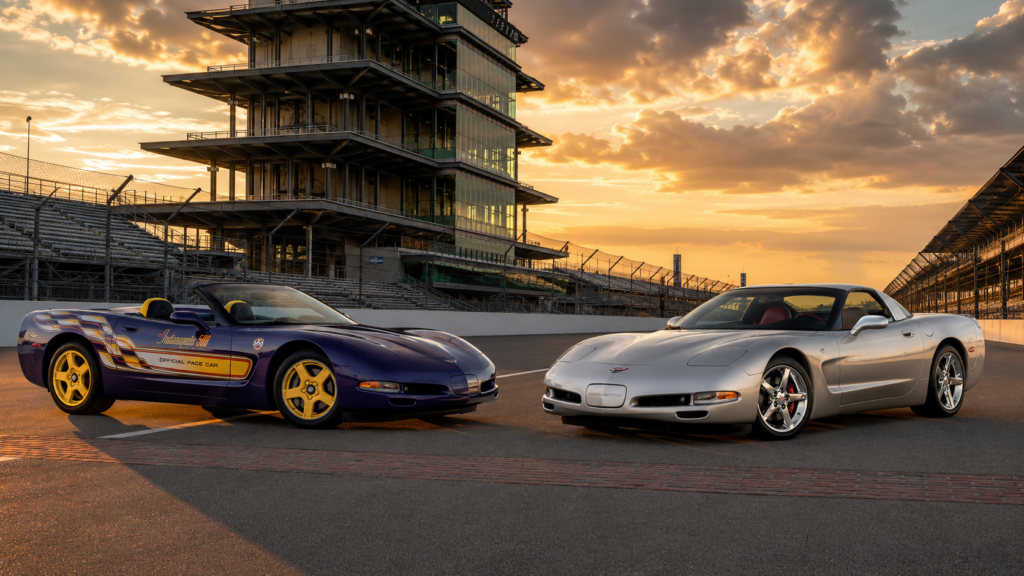
The livery made sure no one missed the moment. Radar Blue paint, yellow wheels, a flowing checkered motif that swept across the bodywork, and read clearly from the upper grandstands—none of it was shy, and none of it was intended to be. The car was loud in the way pace cars are supposed to be loud: instantly recognizable, unmistakably tied to the event, and memorable long after the field took the green flag. Yet beneath that visual bravado was the more interesting point. The spectacle served the engineering message.
By 1998, the C5 platform was sorted enough that Chevrolet did not need to turn the pace car into a fantasy build. It did not need to disguise weakness with special hardware or create a one-off machine that lived outside the normal Corvette world. The on-track car received the equipment necessary to perform its official duties—safety gear, lighting, and race-day requirements—but it remained, in essence, the same Corvette convertible that could be purchased through a Chevrolet dealer. That was the flex. The production car was good enough to wear the uniform.
For Corvette, that mattered. The C5 convertible was arriving with something to prove, not because the Corvette name lacked credibility, but because every new generation has to defend itself against memory. The outgoing C4 had carried the brand through a long and important era, but the C5 represented a far more complete rethink of what a modern Corvette could be. Using the Indianapolis 500 to showcase the convertible was not accidental. It placed the car in front of a national audience and framed it not as a nostalgic American roadster, but as a thoroughly modern performance car with the composure to lead the field at one of the most scrutinized events in motorsports.
Chevrolet did not whisper that point in period communications. It said it plainly. The 1998 Corvette Indy Pace Car Replica was not meant to be understood as a distant tribute to the actual Indy machine. It was meant to be understood as a production Corvette with a direct connection to the car that paced the race. The paint, graphics, wheels, interior treatment, and mechanical package all reinforced that idea. What you saw on race day was not some unreachable promotional prop. It was a preview of a Corvette you could actually own.
And that is what makes the 1998 Corvette Indy Pace Car Replica more interesting than its colors alone suggest. Yes, it was wild. Yes, it was divisive. Yes, it remains one of the most visually extroverted Corvettes of the modern era. But beneath the Radar Blue paint and yellow wheels was a very deliberate statement of confidence. Chevrolet was telling the world that the new C5 convertible did not need an asterisk. It could lead at Indy, sit on the showroom floor, and represent the next chapter of America’s sports car without changing its basic identity.
Before the green flag: setting 1998 in context
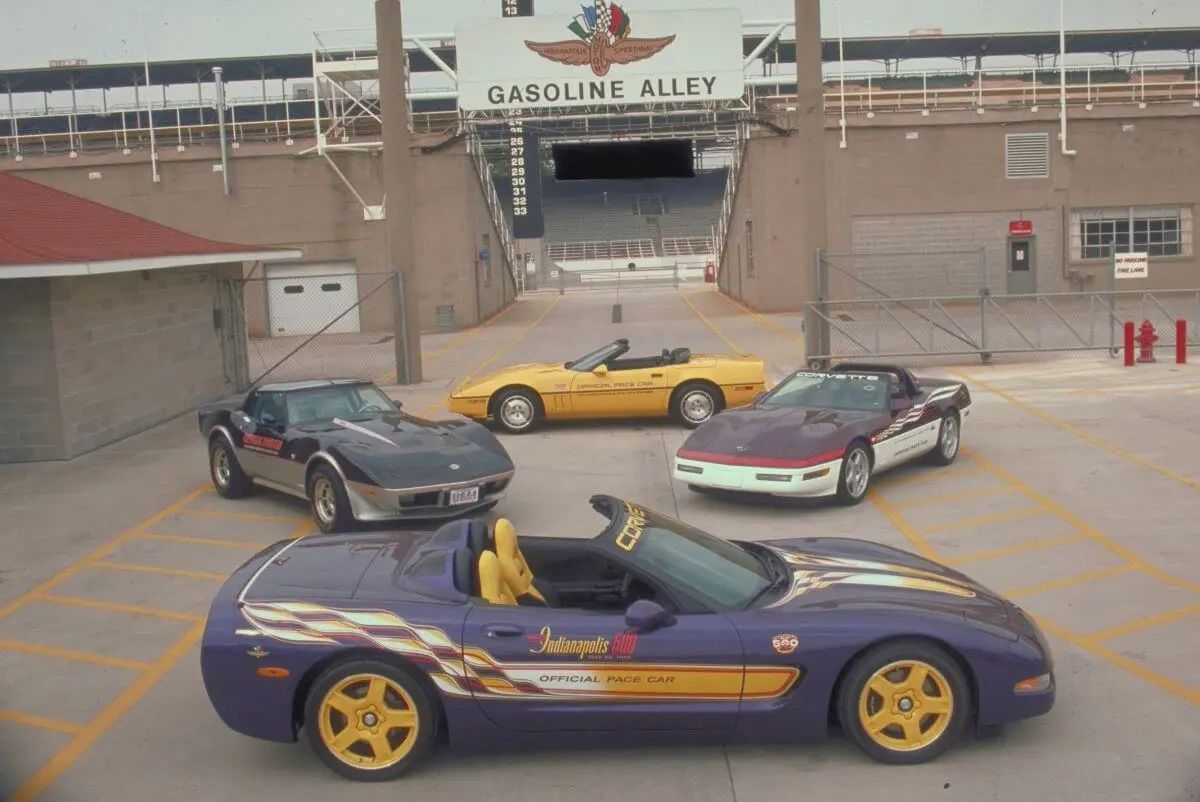
By 1998, Corvette and the Indianapolis 500 were old friends. The relationship already had a meaningful history, and Chevrolet understood exactly what the Brickyard could do for America’s sports car when the timing was right. Corvette had first led the field in 1978, marking the car’s 25th anniversary with a black-and-silver pace car that immediately became one of the most recognizable late-C3 special editions. In 1986, the Corvette convertible returned to the role just as the open-air model returned to the showroom after more than a decade away. Then, in 1995, the purple-over-white Z4Z pace car gave the C4 another high-profile moment at Indianapolis, again accompanied by a commemorative production run for customers.
The 1998 car belonged to that same lineage, but the C5 changed the tone.
This was not simply another Corvette selected to lead the Indianapolis 500. The fifth-generation car represented a major architectural reset for the brand, with its rear transaxle layout, stiffer backbone structure, and thoroughly modern LS1 small-block V8. The C5 was not a warmed-over continuation of the C4. It was a clean-sheet reboot, a Corvette designed to feel more composed, more structurally confident, and more in step with the expectations of a modern performance car. In that context, debuting the convertible version at Indy was more than convenient timing. It was a proof of concept placed in front of the biggest American motorsport audience Chevrolet could find.
A convertible always has to answer certain questions. Is it rigid enough? Is it refined enough? Does it feel like a compromised version of the coupe, or does it stand on its own? Chevrolet used the Indianapolis 500 to answer those questions in public. The company made it official on November 6, 1997, announcing that the 1998 Corvette convertible would serve as the next Indy 500 pace car and confirming that a limited run of replicas would be offered to the public. As with the earlier Corvette pace cars, customers would be able to buy into the moment. But this time, the replica was doing more than commemorating a race. It was helping introduce the open C5 as a serious, fully realized production Corvette.
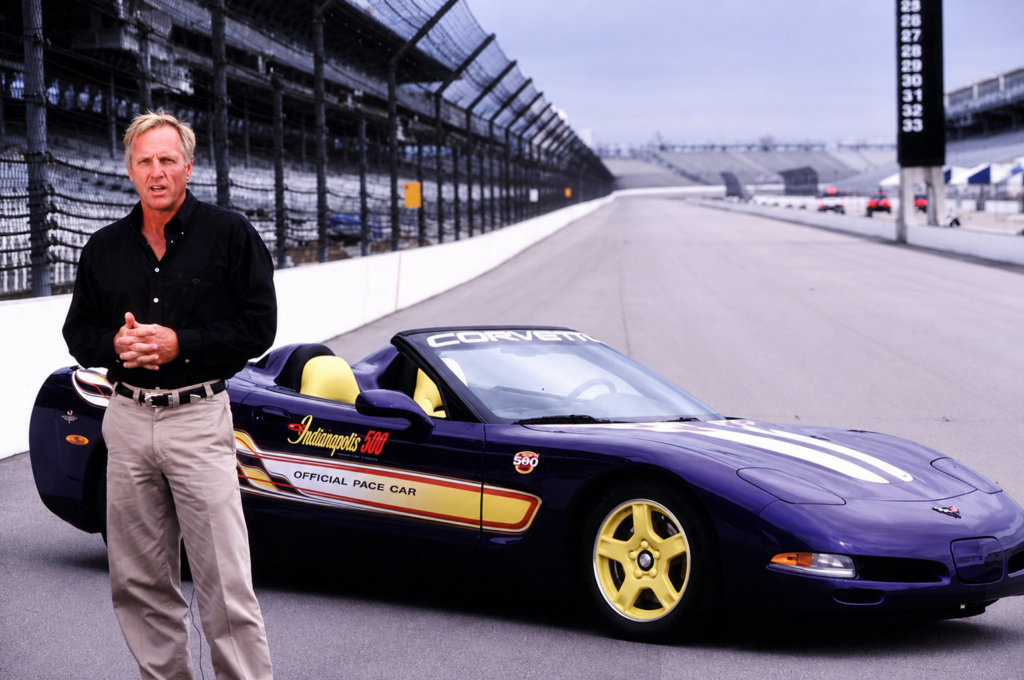
There was also a bit of last-minute drama around who would actually hold the steering wheel. Early plans put golfer Greg Norman in the driver’s seat. Norman brought celebrity visibility to the program and had even turned practice laps at Indianapolis Motor Speedway in April. His involvement fit the promotional side of the pace car assignment: a famous international sports figure, a new Corvette convertible, and one of the most watched racing events in America.
Then the plan changed.
The following month, arthroscopic surgery on Norman’s left shoulder for a rotator-cuff injury took him out of action. With race week looming, Chevrolet and the Speedway needed a replacement, and they did not settle for a stand-in. They named Parnelli Jones, winner of the 1963 Indianapolis 500, to pace the 82nd running on Sunday, May 24, 1998.
Jones was not a mere substitute. He was a signal.
Norman’s withdrawal could have made a carefully organized promotional moment feel scrambled. Instead, it gave the 1998 pace car story a different kind of weight. Putting a past Indy winner behind the wheel immediately shifted the emphasis from celebrity appearance to racing legitimacy. Jones’ résumé needed no explanation at Indianapolis. He was part of the Speedway’s own memory, a driver whose name carried the authority of having won the race outright. With him in the Corvette, Chevrolet did not have to borrow credibility from the event. The car was placed in the hands of someone who already belonged there.
That fit the message Chevrolet wanted the C5 to send. The new Corvette convertible was not being presented as a lifestyle accessory or a softened companion to the coupe. It was being shown as a proper performance car, one capable of leading the field at Indianapolis with a racer’s racer at the wheel. The imagery was direct: Parnelli Jones out front, the field tucked in behind him, and a Radar Blue C5 convertible setting the rhythm for the 500. On a day when Corvette wanted to telegraph legitimacy, Indy royalty led the grid.
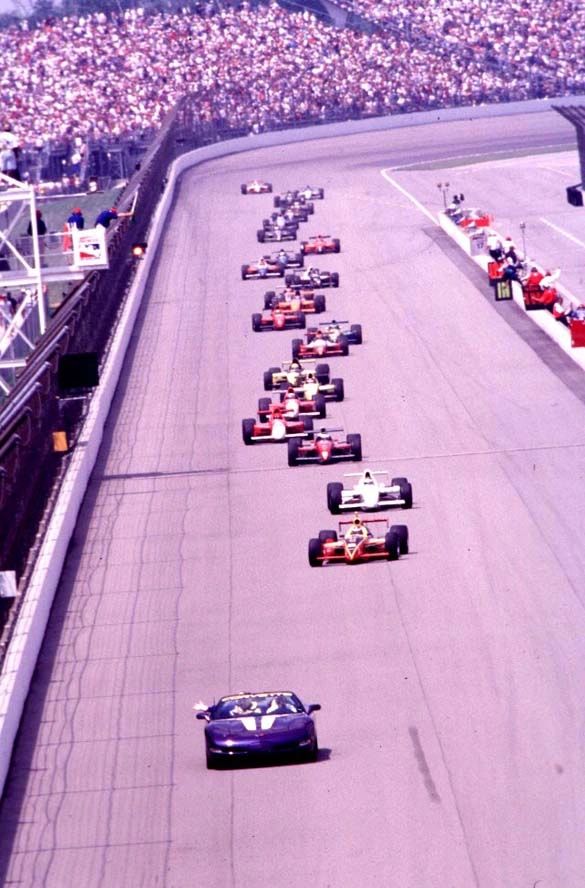
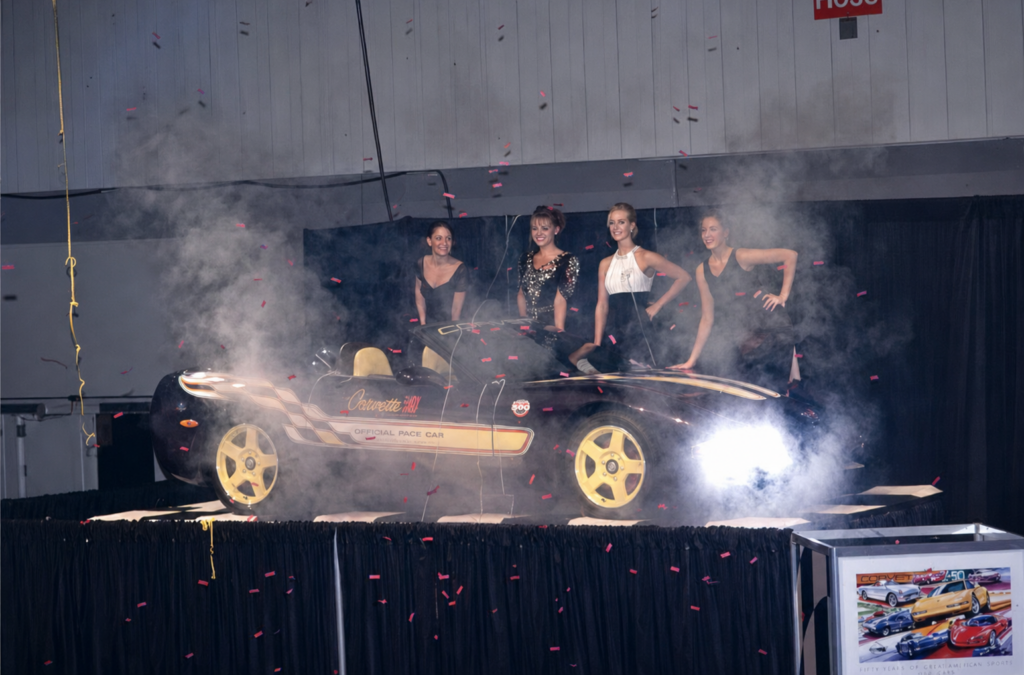
That tone had been established months earlier at the car’s unveiling. Chevrolet rolled out the 1998 Corvette Indy Pace Car Convertible Replica at the SEMA show in Las Vegas on November 6, 1997, with Mary F. Hulman and Chevrolet General Manager John Middlebrook helping make the announcement official. At that point, Norman was still billed as the driver, and the car’s promotional identity was already fully formed.
The look was impossible to miss: Radar Blue paint, bold yellow graphics, and matching yellow wheels. It was a visual package designed to read instantly from a distance, whether parked under show lights, photographed for press material, or rolling down the front straight at Indianapolis. Middlebrook framed the intent plainly, saying, “We told the designers we wanted something that would grab people immediately, and they didn’t disappoint us.” That was the brief in a sentence. The 1998 pace car was not supposed to ease into the Corvette story quietly. It was built to stop people first, then make its case.
Under the skin, however, the pace car remained notably close to showroom stock. The official car used the LS1 V8 paired with an automatic transmission, with the additions required for pace-car duty—most notably a roll bar and strobes—rather than a wholesale transformation into a one-off machine. That was the larger point. Chevrolet did not need to create a special mechanical outlier to make the C5 convertible look credible at Indy. The production car’s basic architecture was strong enough to carry the assignment.
The limited-run Z4Z replicas reinforced that idea for customers. They carried the same visual package, linking the showroom car directly to the one seen at Indianapolis, and they also showcased Corvette’s new JL4 Active Handling system. That production debut was very much part of the message Chevrolet wanted to put out front. The C5 was still recognizably Corvette—front-engine, V8-powered, unmistakably American—but it was also a more sophisticated machine than the cars that came before it. Active Handling gave Chevrolet another way to present the new Corvette as a modern performance car, one that blended traditional Corvette power with a more advanced electronic safety and control strategy.
In the end, the storyline tightened rather than frayed. Norman’s shoulder surgery sidelined the celebrity. Parnelli Jones took the wheel and gave the moment a deeper connection to Indianapolis itself. The C5 convertible paced the 82nd running of the Indy 500 not as a purpose-built special or a heavily modified promotional prop, but as a largely stock Corvette making its case in front of 250,000 people.
It did not need special pleading.
It just needed a green flag.
Why the graphics were loud—and smart
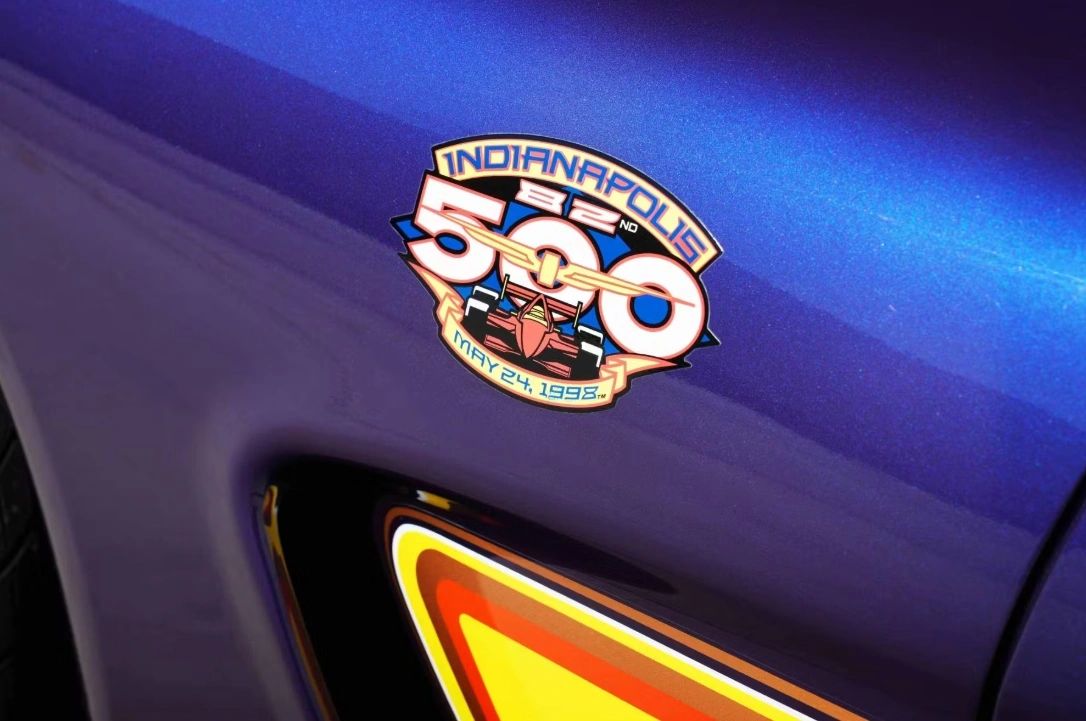
Good pace-car graphics are not really about fashion. They are about readability.
That distinction is important with the 1998 Corvette Indy Pace Car Replica, because the car’s visual treatment is often judged first by its color and only later by its purpose. Radar Blue paint, yellow wheels, yellow interior accents, and a sweeping checkered graphic package make for one of the most extroverted Corvettes of the modern era. It is not a quiet car, and it was never meant to be one. But viewed in the proper context, the design begins to make more sense. At the Indianapolis Motor Speedway, a pace car has to communicate from a distance. It has to stand apart in a massive bowl of grandstands, television cameras, sunlight, shadow, and motion. Subtlety is not the assignment.
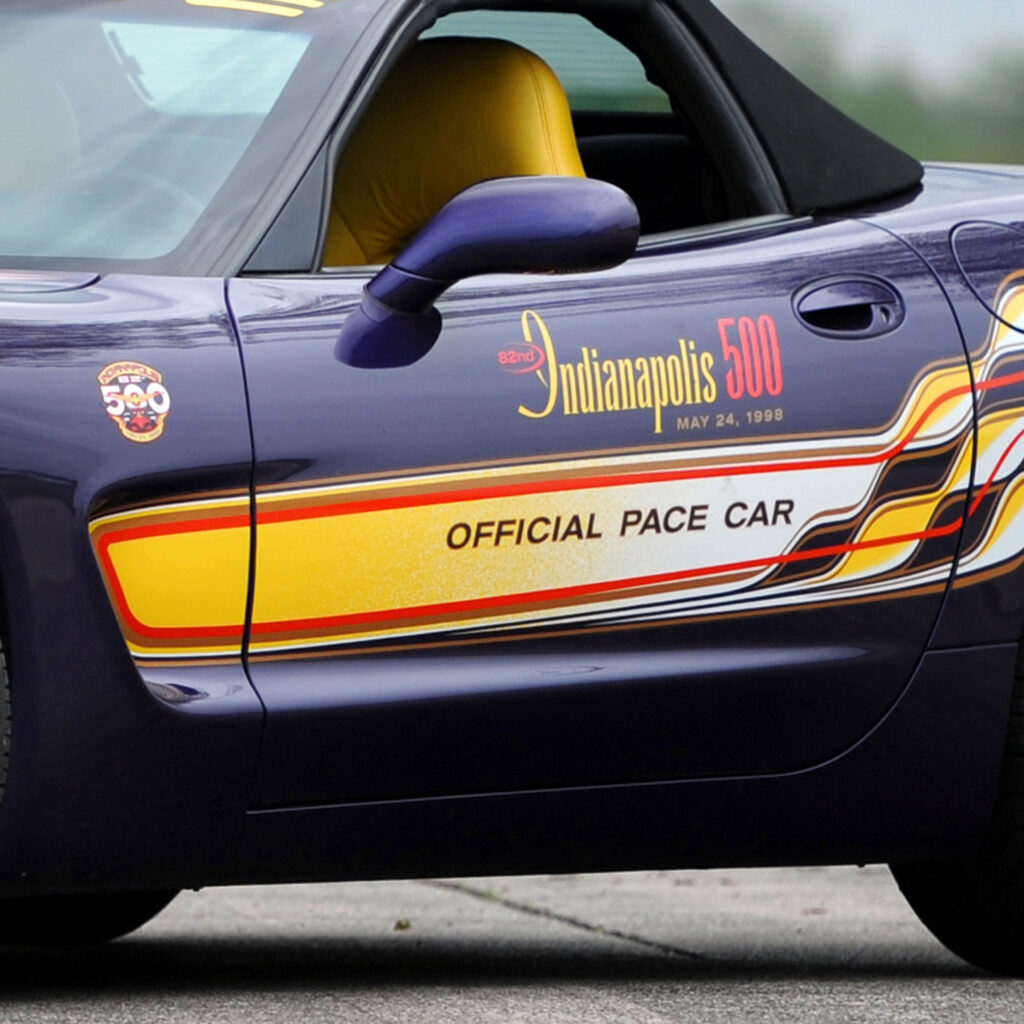
In a setting as vast as the Brickyard, the visuals have to telegraph both movement and identity from far away and at odd light. The 1998 design does exactly that. The graphics begin up front, dive along the flanks, and climb over the rear deck in a flowing checkered arc that gives the car an unmistakable sense of motion even when it is standing still. Rather than simply applying stripes for decoration, the layout works with the C5’s lower, more rounded body shape. It follows the car’s sculpture instead of fighting it, emphasizing the long horizontal sweep of the new-generation Corvette and drawing attention to the bodyline that helped distinguish the C5 from the C4 before it.
That is part of what makes the car more sophisticated than its first impression suggests. Yes, the color combination is loud. Yes, the yellow wheels are impossible to ignore. But the graphic package is not random noise. It is organized around the car’s form and around the pace-car function itself. The checkered motif ties directly to racing without relying on a literal flag slapped onto the body, and the arc of the graphics gives the Corvette a visual signature that reads clearly in photographs, press material, and trackside views. It was designed to be seen quickly, understood immediately, and remembered afterward.
The yellow wheels pushed the whole composition even further. On a conventional production Corvette, they would have felt almost defiant. On an Indianapolis 500 pace car, they made sense. They gave the car instant contrast against the Radar Blue bodywork and helped visually anchor the yellow elements in the graphics and interior. The result was a car that did not merely wear a special paint scheme; it had a complete visual identity. The exterior, wheels, and cabin all spoke the same language. Pair the blue-and-yellow bodywork with the yellow-and-black interior, and the car becomes something more than a graphic package. It becomes a fully coordinated event car.
That coordination is one reason the 1998 Corvette Indy Pace Car Replica photographs so sharply. Some special editions look better in person than they do in images, while others flatten under a camera lens. The 1998 car does not have that problem. Its contrast is strong, its shapes are readable, and its graphic movement gives still photography a sense of energy. Whether you like the palette or not, the design does what it was built to do. It announces itself.
The real quiet innovation, though, was not the colorway. It was the process.
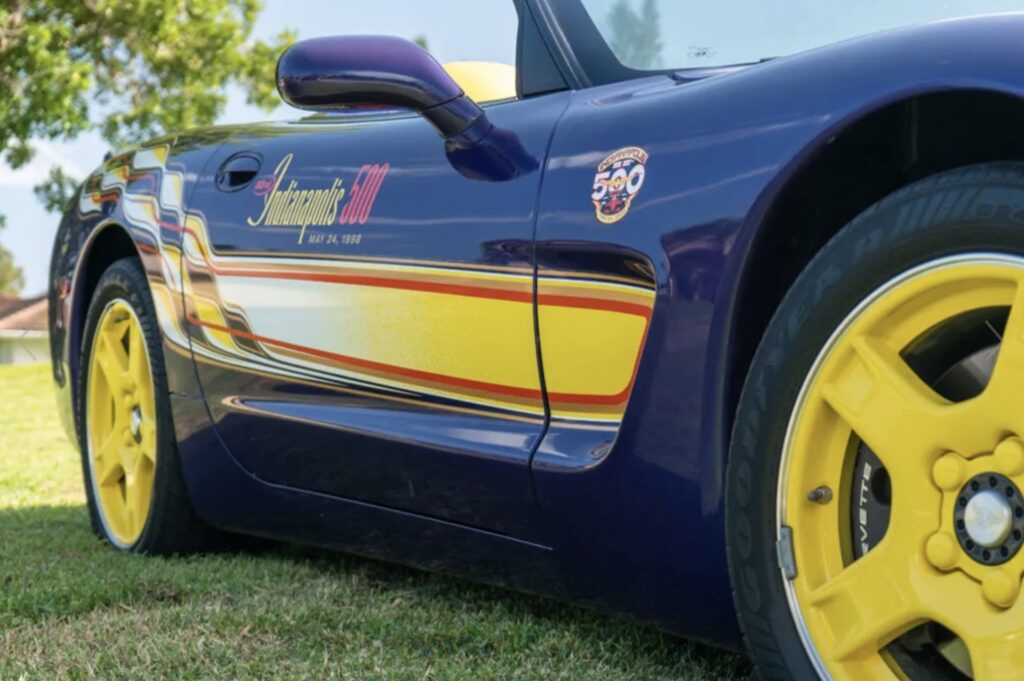
Unlike earlier pace car replicas, where graphics could involve dealer or owner installation, the 1998 livery was applied at the factory. That may sound like a small production detail, but it mattered enormously to the way the cars were received and preserved. Factory application meant clean alignment, reliable adhesion, and consistency from car to car. Every replica left with the same basic visual execution, rather than relying on the patience, skill, or interpretation of whoever installed the decals after delivery.
Anyone who has spent time around collector cars understands why that matters. Crooked stripes, bubbled vinyl, uneven placement, or graphics that age differently from panel to panel can change the whole character of a special edition. On a car as visually dependent as the 1998 Pace Car Replica, execution was everything. The design was too bold to hide sloppy application. If the graphics were off, the whole car would feel off. By applying the livery at the factory, Chevrolet gave the package the kind of discipline it needed to support the claim being made around it.
That claim was straightforward: the replicas were meant to be understood as closely connected to the real pace car, not as loose tributes assembled after the fact. Chevrolet’s own positioning only worked if the look was delivered with factory-level consistency. The Radar Blue paint, yellow wheels, checkered graphics, and interior treatment all had to feel intentional and repeatable. A pace car replica depends on that credibility. The more disciplined the execution, the stronger the connection between the car in the showroom and the car leading the field at Indianapolis.
That is why the factory-applied graphics deserve more attention than they usually receive. They helped separate the 1998 Z4Z from the idea of a decorative package and moved it closer to a fully integrated production special. The car may have been visually outrageous, but it was not casually assembled. Chevrolet treated the livery as part of the car’s identity, not as an accessory. For a Corvette built around the promise that customers could own something remarkably close to the official Indy pace car, that decision made the whole story more convincing.
The 1998 Pace Car Replica was loud by design. But the more you study it, the more you realize that the loudness had structure. The graphics were functional as much as expressive. The colors gave the car distance-read clarity. The wheels and interior made the theme feel complete. And the factory application gave the entire package a level of consistency that matched Chevrolet’s larger message.
This was not just a Corvette wearing decals.
It was a pace car identity executed with production-car discipline.
“Born ready”: the engineering subtext
The C5’s platform confidence shows in how little the official pace car actually needed.
For all the visual noise of the 1998 Indy Pace Car package, the mechanical story was remarkably restrained. Indianapolis safety requirements meant the official car had to receive the expected race-duty additions: roll-over hoops, rear-facing strobes integrated into the tonneau’s fairings, and the normal provisions required for event logistics. Those pieces were necessary for the job, but they did not transform the Corvette into some distant, specially prepared machine. That was the point Chevrolet wanted people to understand. Beneath the lights, safety equipment, and event markings, the car remained very close to the production C5 convertible customers could buy.
Chevrolet’s own description of the pace car was intentionally matter-of-fact. Mechanically, it was essentially factory stock. That choice gave the 1998 program much of its credibility. The company was not trying to sell the public a one-lap hero or a purpose-built promotional prop that only looked like the showroom car. It was using the Indianapolis 500 to make a more disciplined claim: the production C5 convertible had the structure, steering precision, powertrain refinement, and electronic support to lead the field without needing a long list of special explanations.
That message was especially important because convertibles are always asked to prove themselves in ways coupes are not. Removing the fixed roof can expose weakness in a platform. It can bring cowl shake, flex, looseness, and the sense that the open car is more about style than substance. The C5 convertible was designed to resist that criticism, and the Indy assignment gave Chevrolet the ideal stage to show it. The pace car did not need a wholesale mechanical makeover because the architecture underneath it was already strong enough to carry the moment.
Active Handling, RPO JL4, sits at the center of that story.
New for 1998 and fitted to the Z4Z pace-car replicas, Active Handling gave Chevrolet a modern electronic layer to pair with the C5’s new structure and powertrain. The system used a yaw sensor, steering-angle input, and lateral-G sensing to help determine when the car was beginning to move away from the driver’s intended path. When needed, it could selectively apply braking at individual wheels to help stabilize the car, trimming unwanted rotation or helping bring the Corvette back into line when traction got thin or the driver asked for too much, too quickly.
In period, Chevrolet was careful about how it presented the system. Active Handling was framed first as an accident-avoidance feature, and only second as a performance-confidence tool. That was smart positioning. Corvette had never lacked speed, and Chevrolet did not need to convince anyone that a small-block V8 two-seater could be quick. What JL4 added was composure. It made the car’s performance more repeatable and more accessible when conditions were less than ideal—on uneven pavement, in rain grooves, during a late-braking mistake, or in that brief moment when the rear of the car starts to rotate faster than the driver intended.
The best electronic systems do not announce themselves every mile. They work quietly in the background, allowing the car to feel natural until they are needed. Active Handling belonged to that category. It did not erase the Corvette’s character or make the car feel artificially restrained. Instead, it added a layer of control that helped the driver use more of the car with greater confidence. You might not think about it during an ordinary drive, but the first time it helped clean up a slide or settle the car without strangling the experience, the value became obvious.
That is why JL4 was such a fitting part of the 1998 Pace Car Replica story. The system reinforced exactly what Chevrolet wanted the C5 convertible to represent: not just speed, but composure; not just horsepower, but control; not just a bold-looking replica, but a modern Corvette with real engineering substance underneath the graphics. The car’s Indy role did not depend on a radical mechanical transformation. It depended on Chevrolet’s confidence that the showroom Corvette was finally strong, refined, and technically capable enough to stand in front of the field as itself.
The package: what RPO Z4Z actually bought you
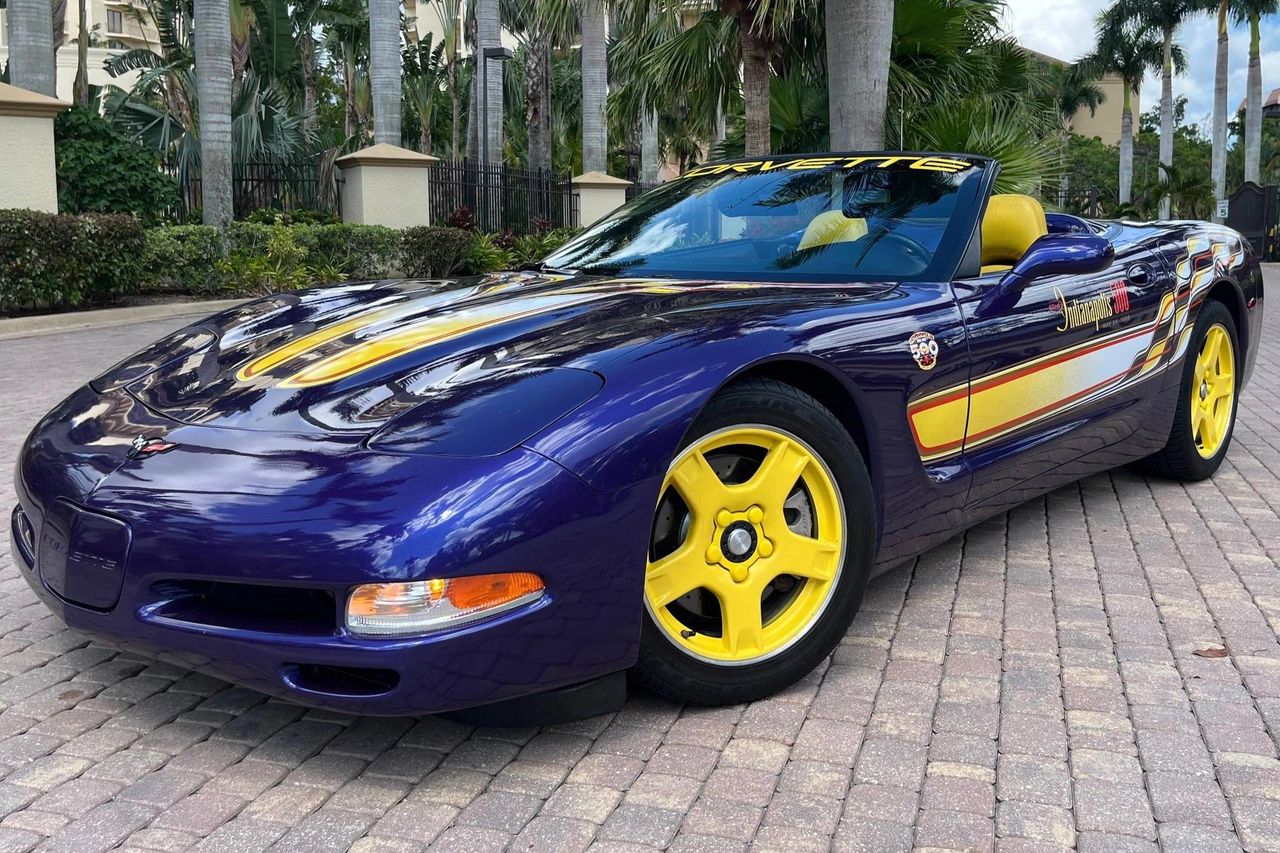
On paper, Z4Z was straightforward: take a 1998 Corvette convertible and give it the full Indianapolis 500 Pace Car identity. Radar Blue paint. Yellow wheels. The sweeping checkered-flag graphics. A yellow-and-black interior that carried the exterior theme into the cabin. It was not a subtle package, but it was a complete one, and that completeness is what separated the car from a standard C5 wearing a few commemorative decals.
What made the package more convincing was the way Chevrolet tied the visual treatment to the equipment customers would actually live with. The Z4Z cars were not stripped-down replicas built only for display. They carried the comfort and convenience features expected of a well-optioned late-1990s Corvette convertible, including Bose audio and the appropriate convenience content, while also incorporating JL4 Active Handling. That combination gave the car two identities at once: a limited-production Indy replica with unmistakable event presence, and a usable C5 convertible equipped like something meant to be driven rather than merely stored.
Period pricing can get a little slippery because announcement figures and window-sticker totals rarely align perfectly from car to car. Options, transmission choice, and final retail documentation can all affect how the numbers appear. But the basic story is consistent. The pace-car package added roughly five thousand dollars on top of a mid-$40,000 Corvette convertible, while the 6-speed manual added approximately another $800. Chevrolet was clearly asking buyers to pay for the occasion, but the car was not priced like an unreachable halo collectible. It was expensive enough to feel special, yet still grounded in the real production Corvette lineup.
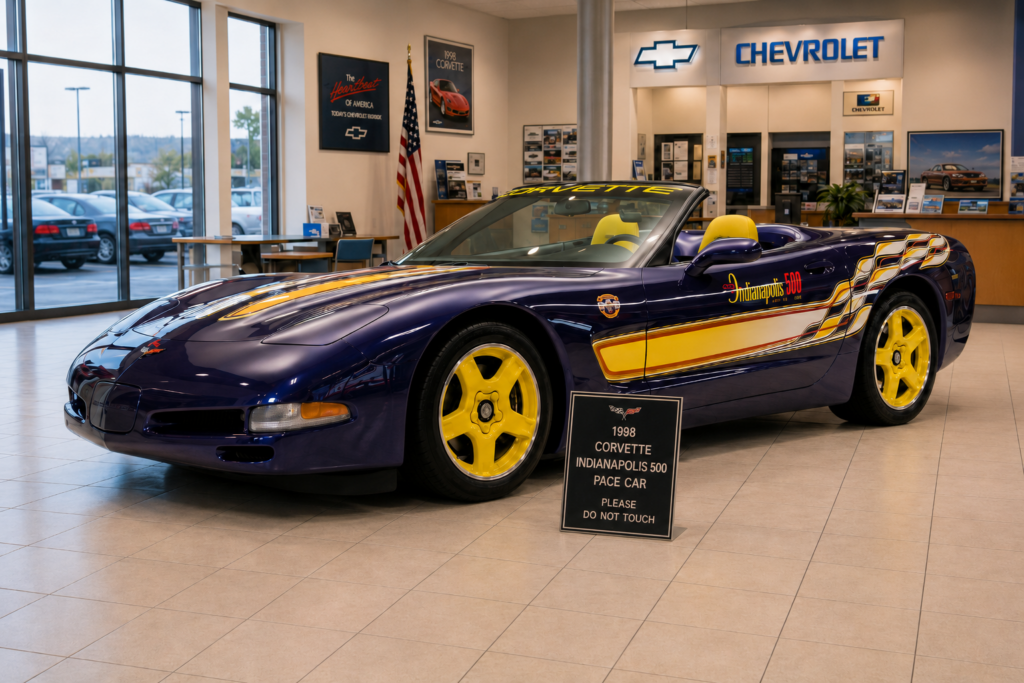
For Chevrolet dealers, cars like the 1998 Corvette Indianapolis 500 Pace Car were never just inventory; they were showroom magnets. GM understood the value of a halo car placed where customers could see it, circle it, talk about it, and then imagine some piece of that excitement attached to whatever Chevrolet they had actually come in to buy. The Pace Car did that job perfectly—bright, loud, unmistakably special, and directly connected to the biggest race in America. Images like this also take me back to the first time I saw one in person, shortly after GM introduced the replicas, sitting inside the showroom at Merrick Chevrolet in Berea, Ohio. I was not looking at an ordinary Corvette that day. I was looking at something that made the whole idea of Corvette feel bigger, closer, and somehow more possible. For me, that first encounter was a game-changer, and it only deepened the desire I already had to someday own a Corvette of my own. (Image credit: Author / ChatGPT)
That balance was part of the car’s appeal. The 1998 Pace Car Replica was not a hand-built exotic or a commemorative object detached from normal Corvette ownership. It remained a production C5 convertible, optioned and finished in a way that made it stand apart. Buyers were paying for a direct connection to Indianapolis, for the visual drama of the Z4Z package, and for the new-generation confidence Chevrolet was trying to attach to the C5. The car looked wild, but the business case behind it was practical: build something distinctive, keep it attainable for Corvette buyers, and let the Indy association do the rest.
Then there is the question that always follows a pace car replica: how many were actually built?
This is where enthusiasts can get pulled in different directions if they rely solely on early announcements. Initial estimates placed the production run somewhere in the low-thousand range, which was useful at the time but not precise enough for collectors trying to understand the car decades later. Final accounting, compiled and cross-checked through the C5 community, pace-car registries, and cars documented with original paperwork, lands at 1,163 total examples. That figure includes five pilot cars and breaks down by transmission into 616 automatics and 547 6-speeds.
Those numbers help explain the Z4Z’s unusual place in the Corvette world. It is not so rare that the car disappears into folklore, where only a handful trade privately and most enthusiasts never see one. But it is limited enough that a genuine Pace Car Replica still draws attention when it arrives at a show, a cruise-in, or a Corvette gathering. The production total gives the car credibility without making it inaccessible. It is scarce enough to feel like a find, yet present enough to have built its own small culture inside the larger C5 community.
That may be the sweet spot for a pace car replica. Too many, and the car risks feeling like a graphics package sold at scale. Too few, and it becomes more of a museum object than an enthusiast car. At 1,163 built, the 1998 Corvette Indy 500 Pace Car Replica landed in the middle: rare enough to spark a conversation, common enough to create a scene, and distinctive enough that no one mistakes it for anything else.
What Chevrolet was really saying at Indy in ’98
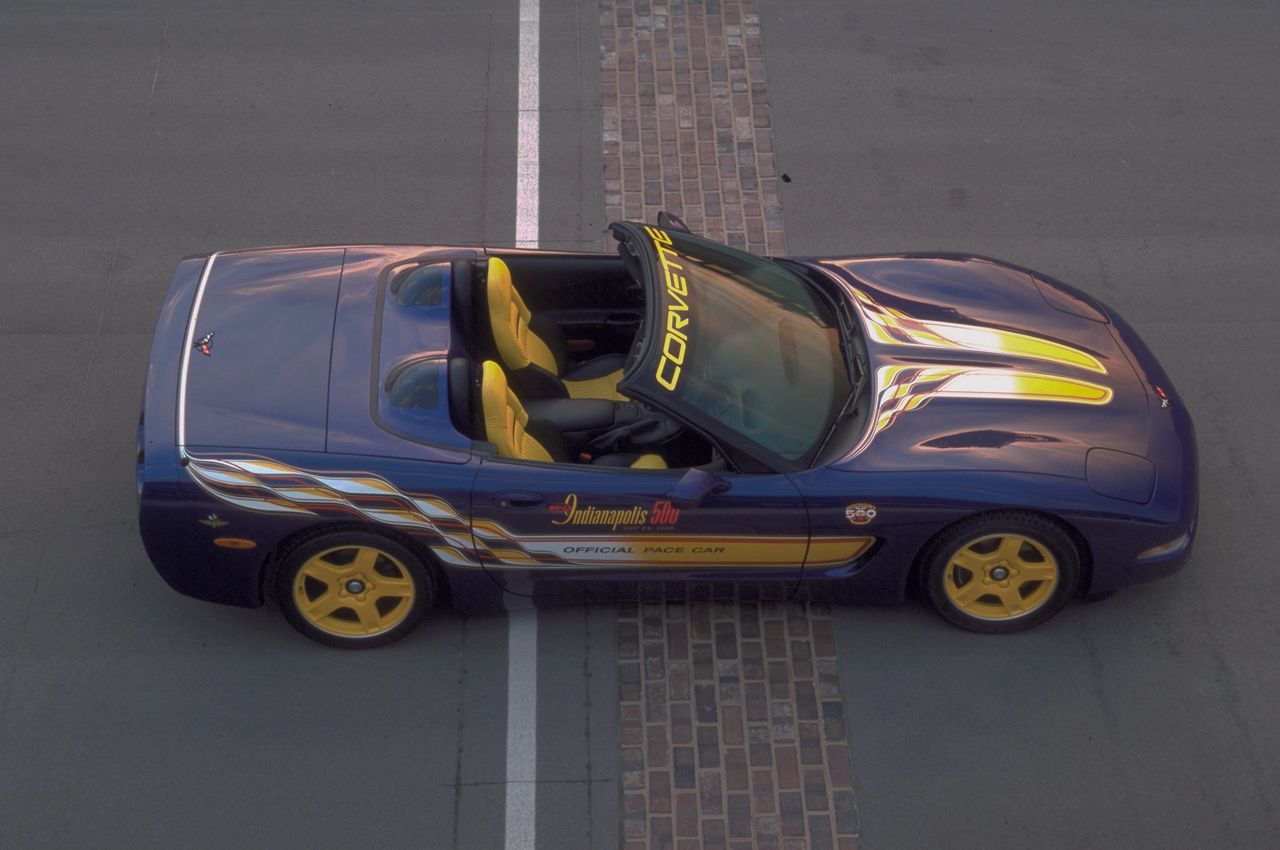
The real “why” behind this car lives at the intersection of architecture and audience:
- Architecture: The C5’s backbone changed what everyday Corvette driving felt like. The steering stayed lucid over expansion joints; the structure shrugged off the cowl shake that once defined American convertibles. Mount the transaxle at the rear, stiffen the tunnel and sills, and suddenly long-distance Corvette becomes a two-finger car instead of a work assignment. Putting that convertible at Indy—rather than a coupe with a token opening—telegraphed confidence in the chassis, not just the motor.
- Audience: Corvette’s move in the late ’90s was to pair big-league performance with approachable technology. JL4 fits that pivot. Call it stability control if you want—Chevrolet did—but the core was a stability culture shift. You didn’t have to be Mario Andretti to go quickly without drama. You could be a Sunday-morning driver with a long on-ramp and a rain cloud, and the car would flatter you.
- Authenticity: At a time when other pace-car programs would quietly tweak powertrains or braking systems to make an event day look easy, Chevrolet chose to undercut the myth. The ’98 pace-car program hung its hat on mechanical normalcy, then invited you to buy the match. The replica wasn’t “like” the pace car; it was the pace car in the ways that mattered.
What it’s like to drive a 1998 Corvette Indy Pace Car Replica now
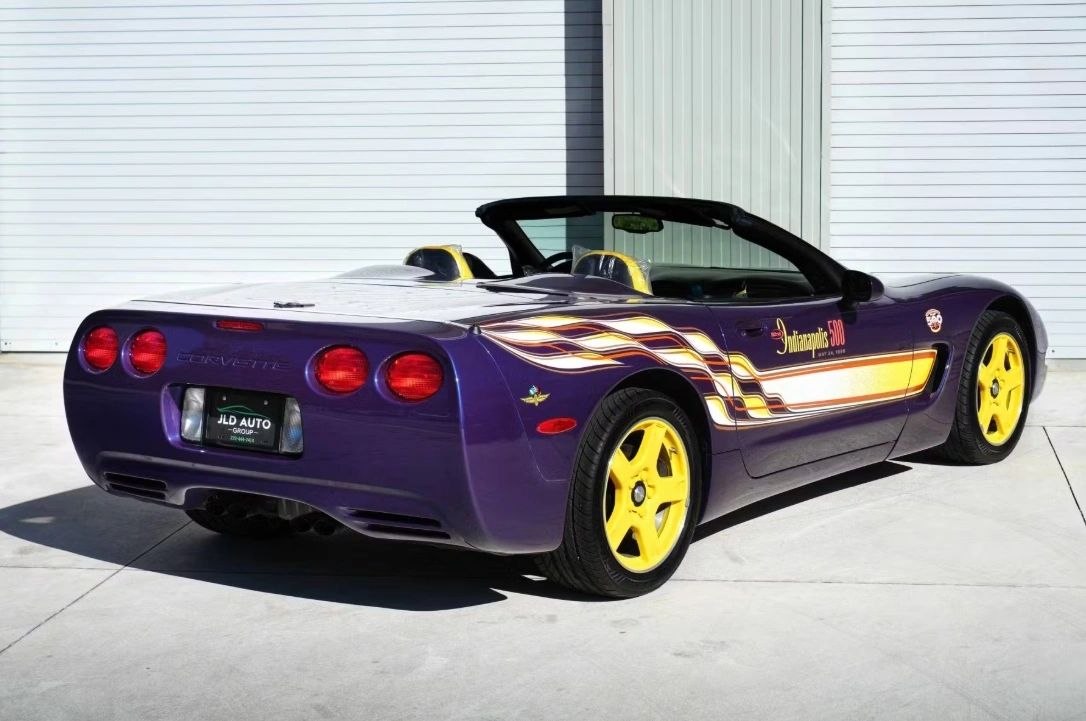
Drive a good 1998 Z4Z and two things happen in short order.
First, the livery noise fades. The yellow wheels, Radar Blue paint, and sweeping Indianapolis 500 graphics are the first things anyone notices, and understandably so. The car announces itself before the starter ever turns. But once you are behind the wheel, the visual volume begins to recede, and what remains is the basic goodness of the C5. The pace-car package may define the car at rest, but motion reminds you that this is still a fifth-generation Corvette convertible at its core—balanced, composed, and far more mature than the graphics suggest.
What stays with you is calm. That easy, unbothered C5 rhythm was one of the reasons the car changed so many opinions when it was new. It had the power people expected from Corvette, but it delivered that power through a platform that finally felt like it was working with the driver instead of constantly asking for forgiveness. The LS1 starts cleanly, settles quickly, and pulls with a smooth, confident sweep through the middle of the rev range. It does not need to be wrung out to feel satisfying. It has that broad-shouldered, small-block ease that makes the car feel quick without feeling frantic.
With the 6-speed manual, the car gains another layer of involvement. The gates feel deliberate, not vague; the shift action feels like a proper mechanical decision rather than a loose suggestion. The manual suits the C5’s personality because it makes the driver part of the car’s composure. You are not wrestling it into cooperation. You are working with something sorted. Even the base ride plays its part. Paired with the C5’s stronger structure, it gives the car a settled quality that earlier Corvette convertibles did not always possess. The chassis no longer feels like it is arguing with itself over every broken seam or uneven patch of pavement.
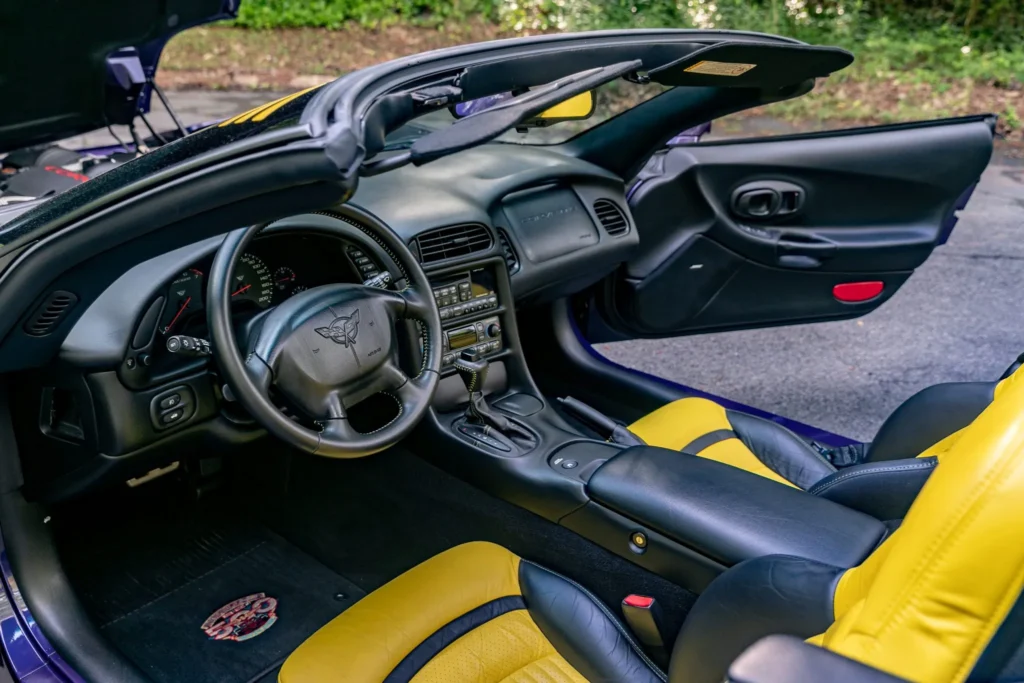
That is the first surprise for anyone expecting the Pace Car Replica to feel like a novelty item. It does not drive like a commemorative object. It drives like a Corvette that happens to be wearing a very loud uniform.
The second thing you notice is that JL4 Active Handling earns its keep. Not by taking over the car, and not by making the driver feel scolded, but by quietly standing watch at the edges. Maybe you are cresting a crowned two-lane road just as a shower starts. Maybe you turn in a little early and the rear begins to move before you are ready for it. Maybe the pavement gets greasy in a place where your right foot had already made a decision. In those moments, JL4 works with a kind of measured restraint. It trims yaw with a small, precise brake intervention and gives the car back to you before the moment becomes untidy.
That was the brilliance of the system in a Corvette context. Active Handling did not erase the car’s personality or turn the C5 into something sterile. It simply added a layer of composure that made the car easier to trust. Corvette had always offered speed. The C5, especially with JL4, made that speed feel more usable in the imperfect conditions where real drivers actually live: wet roads, uneven pavement, early turn-ins, late corrections, and all the small mistakes that happen between confidence and consequence. It was more quiet aide than schoolmarm, stepping in just enough to keep the conversation civilized.
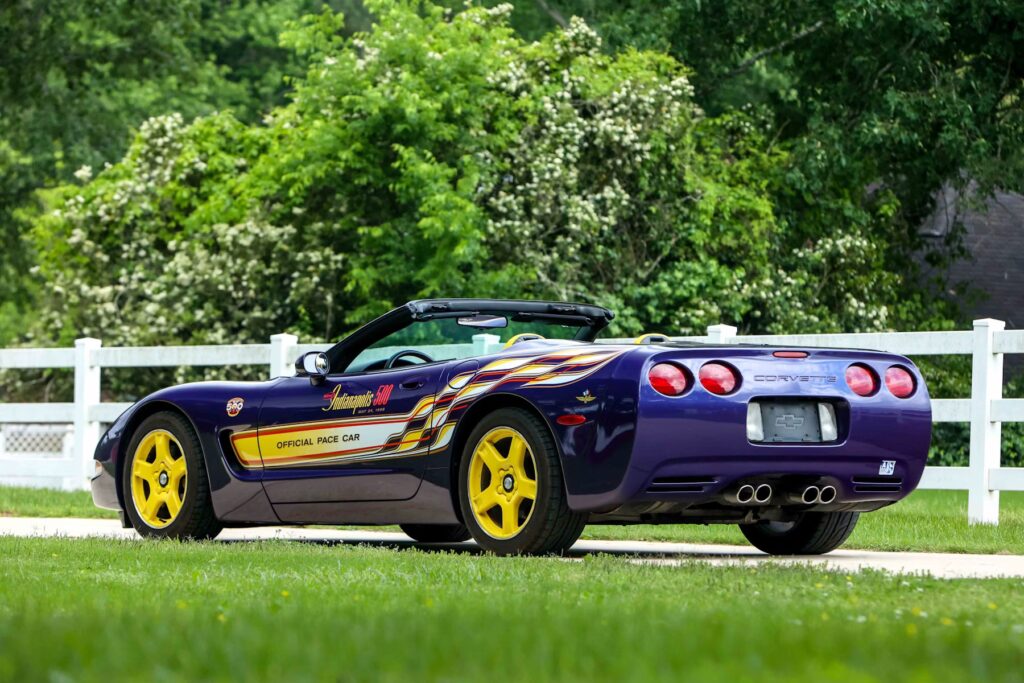
If you are used to C4 convertibles, the difference is especially clear. The C5’s soft top and seal management feel almost luxurious by comparison. With the top up, the car is quiet enough to have a conversation without raising your voice over wind noise and body tremor. It feels less like an open car trying to impersonate a coupe and more like a convertible designed into the platform from the beginning. That sense of integration changes the whole experience. You are not constantly aware of what was removed. You are more aware of what Chevrolet managed to preserve.
With the top down, the car stays present in a way that earlier Corvette convertibles could struggle to match. The body does not quiver over railroad crossings. The cowl does not shake its way through rough pavement. The steering remains clean, the structure feels settled, and the car retains the confident rhythm that made the C5 such a meaningful step forward. The open-air experience adds to the car rather than exposing it.
The upshot is that the 1998 Pace Car Replica drives like a Corvette first and a special edition second. That is its real charm. The graphics get people to walk over. The yellow wheels start the conversation. The Indianapolis connection gives the car its story. But the reason owners actually enjoy these cars is that beneath all the event identity is a genuinely good C5 convertible—smooth, stable, usable, and modern in the way late-1990s Corvette needed to be.
That is also why so many Z4Z owners put miles on them. The car may look like something built to sit under lights, but it was never limited to display duty. It has enough rarity to feel special, enough visual presence to make every fuel stop an event, and enough real Corvette substance to make the drive worth repeating. The Pace Car Replica may have been born from Indianapolis pageantry, but once the livery fades into the background, what remains is the car Chevrolet wanted you to discover all along.
The Details That Complete the Story
The 1998 Corvette Indy Pace Car story is easy to understand at full volume: Radar Blue paint, yellow wheels, wild graphics, and a C5 convertible leading the field at Indianapolis. But the smaller details are where the car becomes more interesting. The Z4Z was not just a bright commemorative package attached to a famous race. It was a carefully timed, carefully staged Corvette moment, and several of its best supporting details help explain why the car still has a distinct place in C5 history.
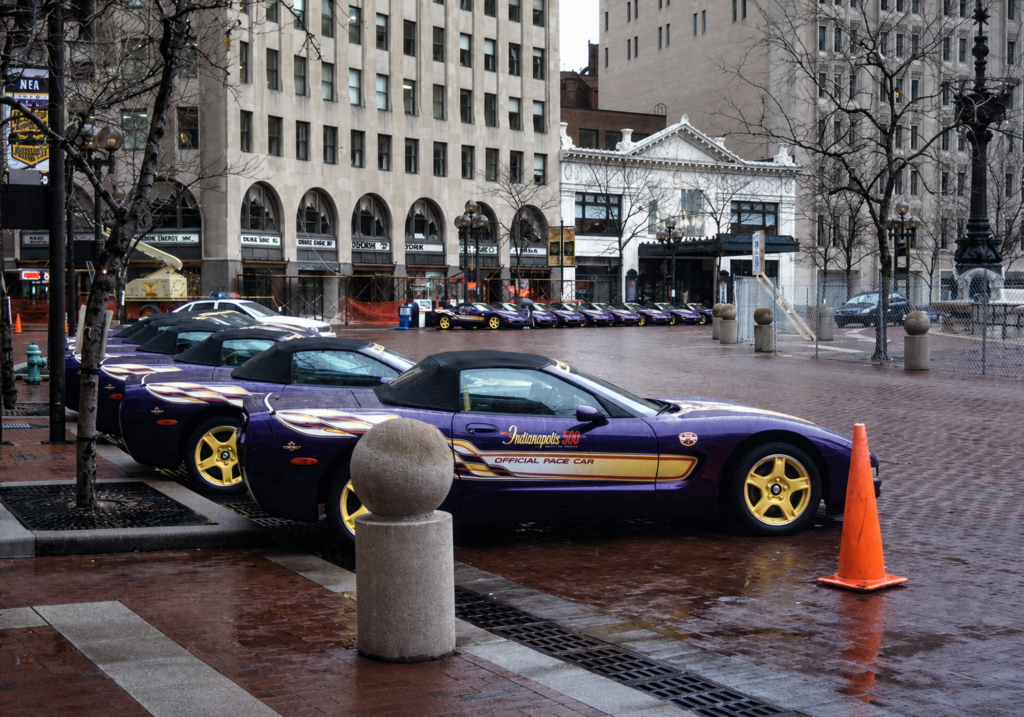
Monument Circle may be the best example. Before race day, downtown Indianapolis became its own kind of Corvette corral, with Radar Blue C5 pace cars gathered against wet brick and gray Indiana skies, their yellow wheels cutting through the gloom like signal flares. These cars wore the full Indy 500 livery and served as rolling promotion for race week, visually extending the Speedway into the heart of the city. Nearly twins to the Brickyard pacers, they announced May in Indianapolis from a block away. No billboard was required. A circle full of Corvettes did the work.
The driver change added its own layer to the story. Greg Norman may have been the original celebrity choice, but Parnelli Jones ultimately gave the 1998 pace-car assignment more weight. Norman’s late withdrawal could have made the program feel unsettled; instead, Jones’s substitution tied Chevrolet’s newest Corvette to a driver who already held a permanent place in Speedway history. It sharpened the narrative rather than weakening it. A new-generation Corvette convertible out front was one thing. A new-generation Corvette convertible led by a past Indy 500 winner was something else entirely.
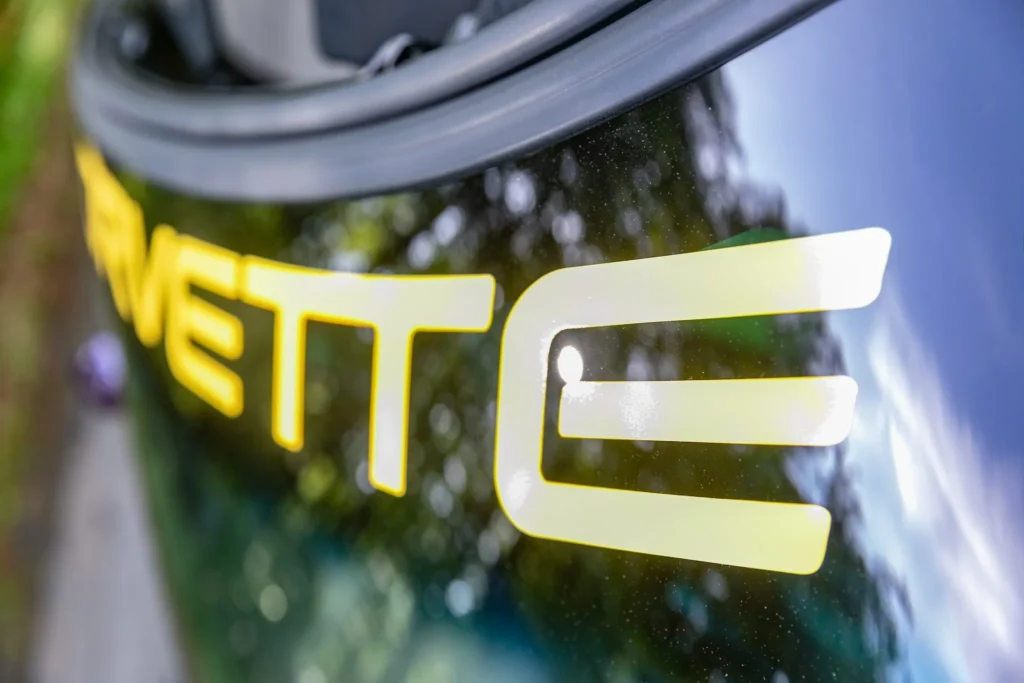
Then there were the graphics. Chevrolet’s decision to apply the livery at Bowling Green removed a major variable from the replica program. For collectors and restorers today, “factory stripes” versus “dealer stripes” is not just trivia. It is the difference between a car that left the line with clean, consistent execution and one that may spend years fighting alignment issues, lifting edges, bubbled vinyl, or aged adhesive. On a special edition built so heavily around visual impact, consistency was not a minor production detail. It was part of the car’s credibility.
The transmission split also says more than it first appears to. Of the 1,163 total Z4Z cars, 547 were built with the 6-speed manual. That number matters because it shows the package did not land only with parade enthusiasts or collectors chasing a bright commemorative edition. A substantial number of buyers wanted to row their own gears under that neon suit. The Pace Car Replica may have looked like event merchandise from a distance, but plenty of its original customers clearly still saw it as a Corvette to drive.
Active Handling gave the car another layer of purpose. GM’s press framing for JL4 read like a careful engineer’s argument for accident avoidance, stability, and control. In practice, the system helped present the C5 as something more mature than the old caricature of brute-force American performance. Corvette was still fast, still V8-powered, still unmistakably itself, but JL4 gave the car a more polished public face. It suggested performance with composure, not just performance with bravado.
That is why the Z4Z still works better than its loudest details might suggest. The downtown promo cars reinforced the “same as the real thing” message. The factory graphics gave the package a higher floor of execution. The manual-transmission count proved that real drivers were paying attention. And Active Handling helped position the C5 as a more complete Corvette for a new era. The 1998 Pace Car Replica was theatrical on the surface, but the fine print had substance.
The market, then and now
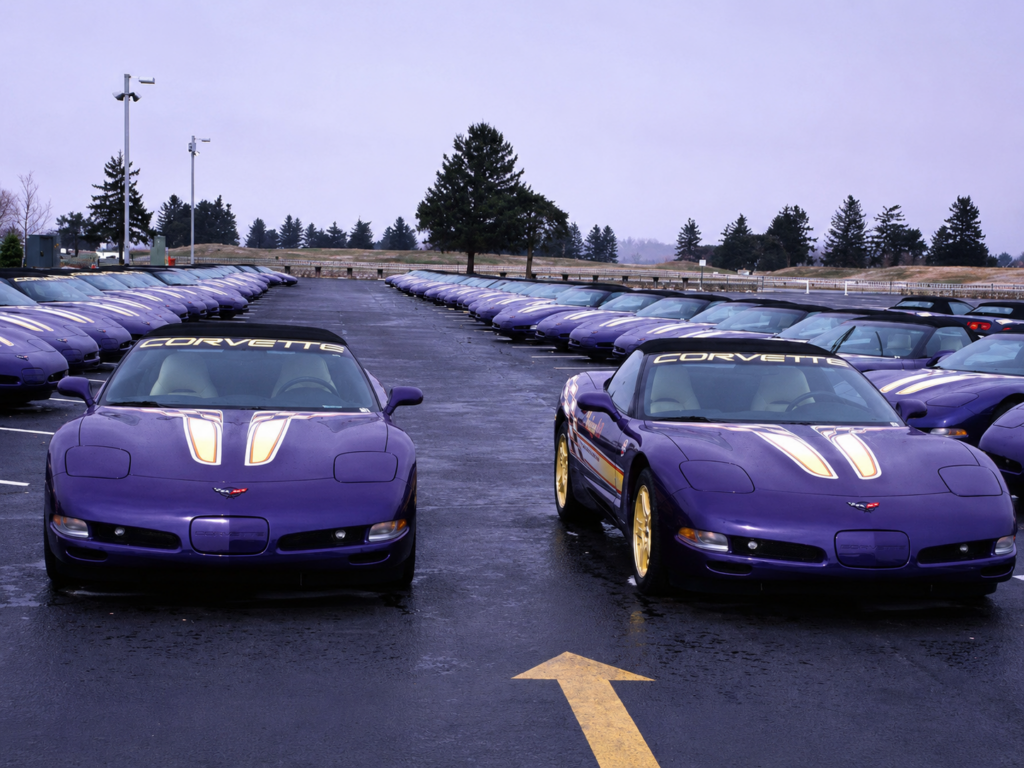
Window-sticker arithmetic put a well-optioned Z4Z in a sweet spot: special but not absurd. That helped the cars find garages outside of the “park and stare” crowd. Two and a half decades on, values tell a familiar story: driver-grade cars in the high-teens to mid-$20s, clean survivors and low-mile examples in the $30s, and documentation-rich or provenance-heavy cars that pop higher when the right buyer falls in love with the right story. High-visibility auction comps and marketplace pieces continue to cite the 1,163 total and the manual/automatic split, underlining how long the community has converged on those totals. The broader lesson isn’t that they’ve spiked; it’s that originality, paperwork, and factory graphics separate the good from the merely shiny.
The quick reference you’ll want handy
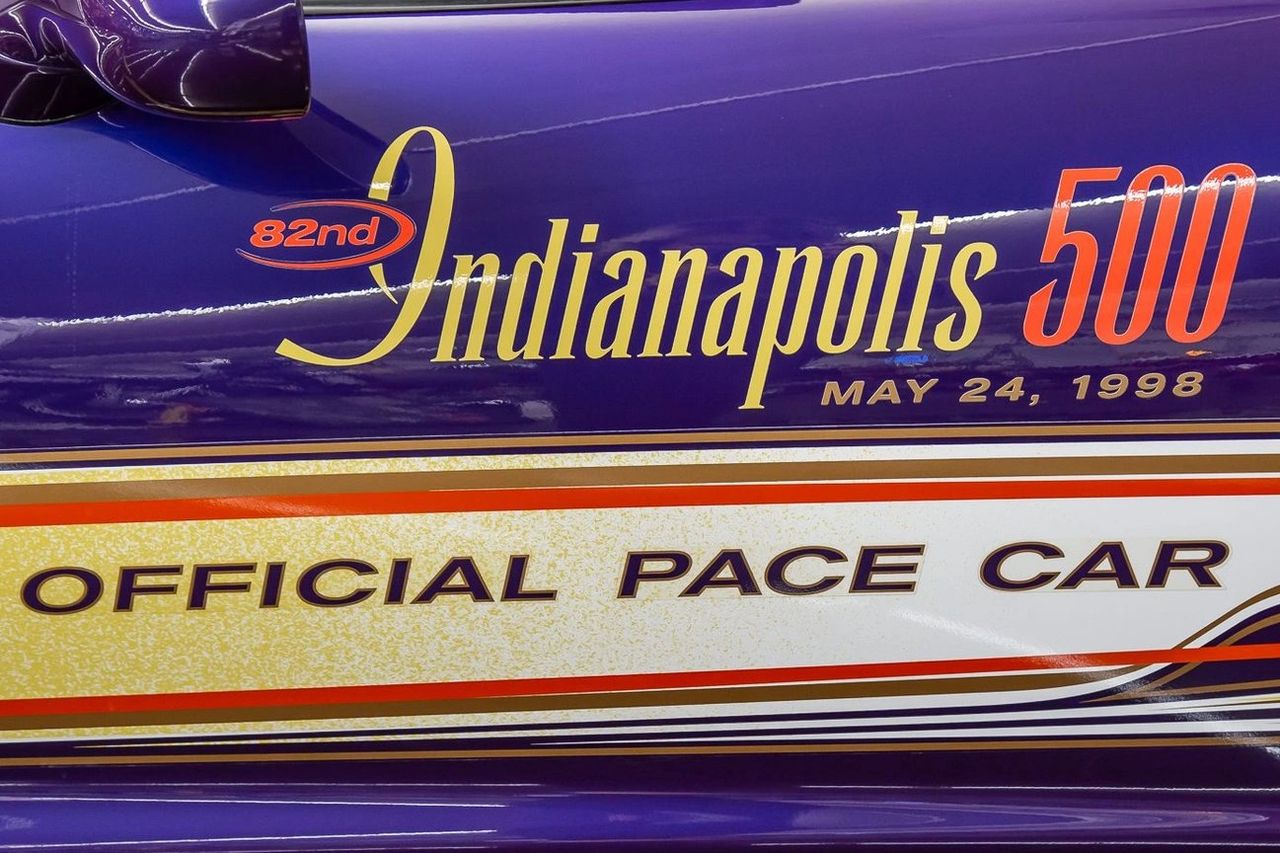
- Official announcement: Chevrolet made the program official on November 6, 1997, confirming that the 1998 Corvette convertible would pace the Indianapolis 500 and that a limited run of replicas would be offered to the public. It was a major visibility play for the new C5 convertible, but also a production-car statement: the open Corvette was ready for the spotlight.
- Race day: The 82nd running of the Indianapolis 500 took place on May 24, 1998, with Parnelli Jones behind the wheel of the Corvette pace car. Greg Norman had originally been announced as the driver and even participated in early promotional activity, but shoulder surgery forced him to withdraw before race week.
- Mechanical story: The official pace car stayed remarkably close to showroom specification. Race-day equipment such as safety gear, roll-over protection, and lighting separated the track-duty car from the replicas, but the basic message was clear: Chevrolet did not need to create a heavily modified one-off to put the C5 convertible out front at Indy.
- Active Handling — RPO JL4: Active Handling debuted for 1998 and was fitted to the Z4Z pace-car replicas, giving Chevrolet a high-profile way to introduce the system. Built around yaw, steering-angle, and lateral-G inputs, JL4 helped position the C5 as a more composed and electronically sophisticated Corvette. It later became standard equipment for 2001.
- Production: Final production is generally accepted at 1,163 total cars, including five pilot cars. The transmission split gives the number more texture: 616 automatics and 547 6-speeds, a healthy manual count that reinforces the idea that many buyers saw the Z4Z as a Corvette to drive, not just a commemorative object to store.
- Pricing context: The pace-car package added roughly $5,039 over the price of a well-optioned, mid-$40,000 Corvette convertible. Period announcements, registry material, and window-sticker references can vary slightly depending on equipment and accounting, but the direction is consistent: Chevrolet priced the Z4Z as a special car without pushing it completely outside normal Corvette buyer territory.
- Factory livery: For 1998, the major exterior graphics were applied at the Bowling Green Assembly Plant, giving the replicas a consistency that earlier decal-based special editions did not always enjoy. The windshield name decal remained an owner-installed piece, a small but useful distinction for restorers and collectors trying to understand what was factory-applied and what was delivered separately.
Why the 1998 Corvette Pace Car Replica Still Matters Today
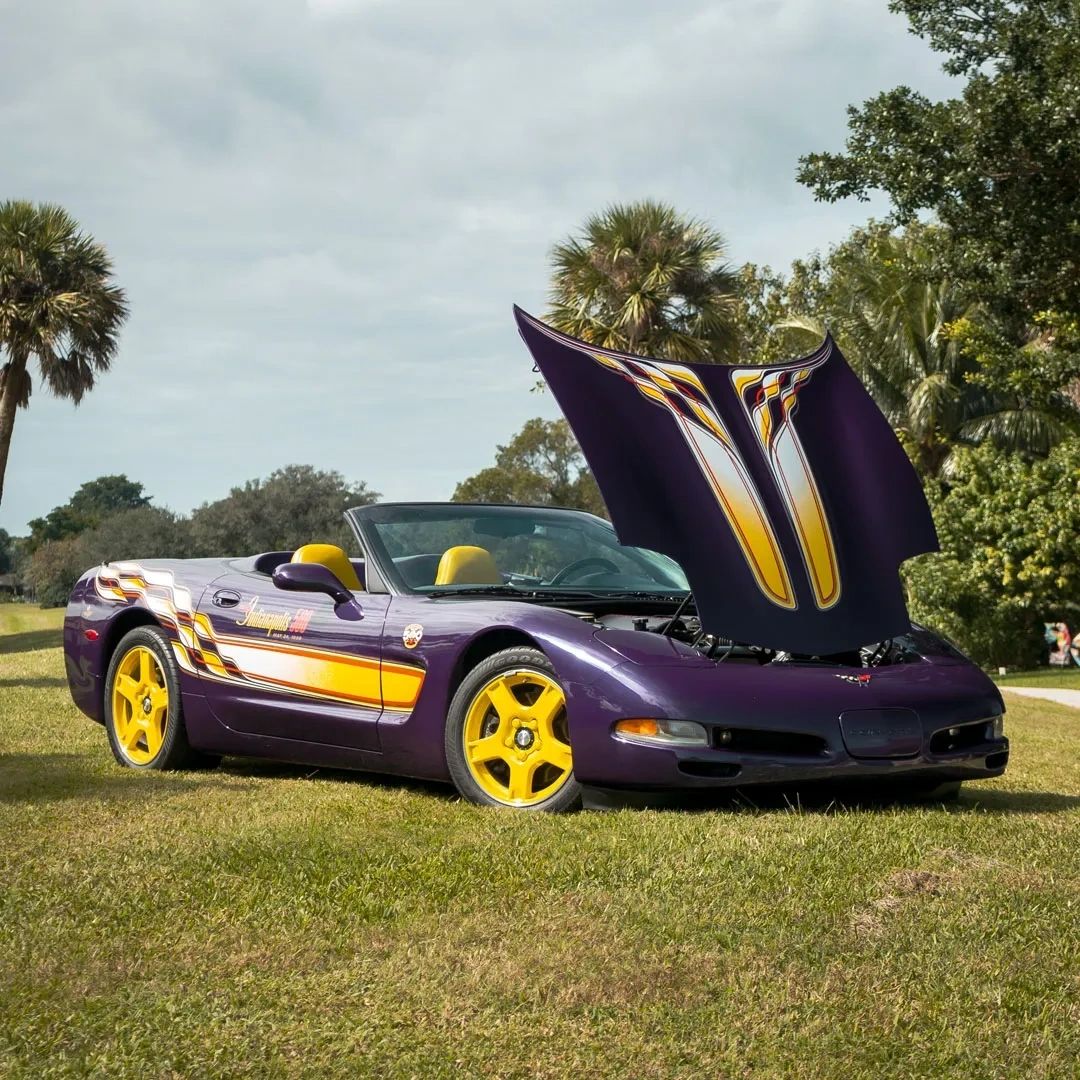
The 1998 Corvette Indianapolis 500 Pace Car Replica has always been easy to dismiss from a distance. Too purple. Too yellow. Too loud. Too tied to a particular late-1990s moment when Chevrolet was not afraid to let a special edition announce itself from the far end of a parking lot. But that quick reading misses why the car continues to hold a place in Corvette history. The Z4Z was never just a paint-and-decal exercise. It was the moment Chevrolet used the Indianapolis 500 to introduce the C5 convertible, showcase the credibility of the new platform, and put a factory-built replica into customers’ hands that was close enough to the real pace car to make the connection feel legitimate.
That is what separates it from simple commemorative dressing. The 1998 Pace Car arrived at a pivotal time for Corvette. The C5 had already begun changing the conversation around America’s sports car, but the convertible still had something to prove. Open Corvettes had always carried emotional weight, but they also carried the usual convertible questions: structure, refinement, sealing, cowl shake, and whether the roofless version felt like a compromise. The Indy assignment allowed Chevrolet to answer those questions in public. The car did not need a special chassis, a one-off engine, or a long list of mechanical excuses. It was essentially a production C5 convertible with the required pace-car equipment added for duty, and that was the point. Chevrolet trusted the showroom car enough to put it in front of the field.
The livery, for all its controversy, is part of what keeps the car working. A restrained 1998 Indy Pace Car would have been easier to like, but probably easier to forget. The Radar Blue paint, yellow wheels, black-and-yellow interior, windshield callout, event medallions, and sweeping checkered graphics gave the car a visual signature no other C5 shares. It is not merely colorful; it is unmistakable. At a cars-and-coffee, a concours field, a Corvette gathering, or a dealer showroom, the car does not need explanation before it starts a conversation. It brings Indianapolis with it.
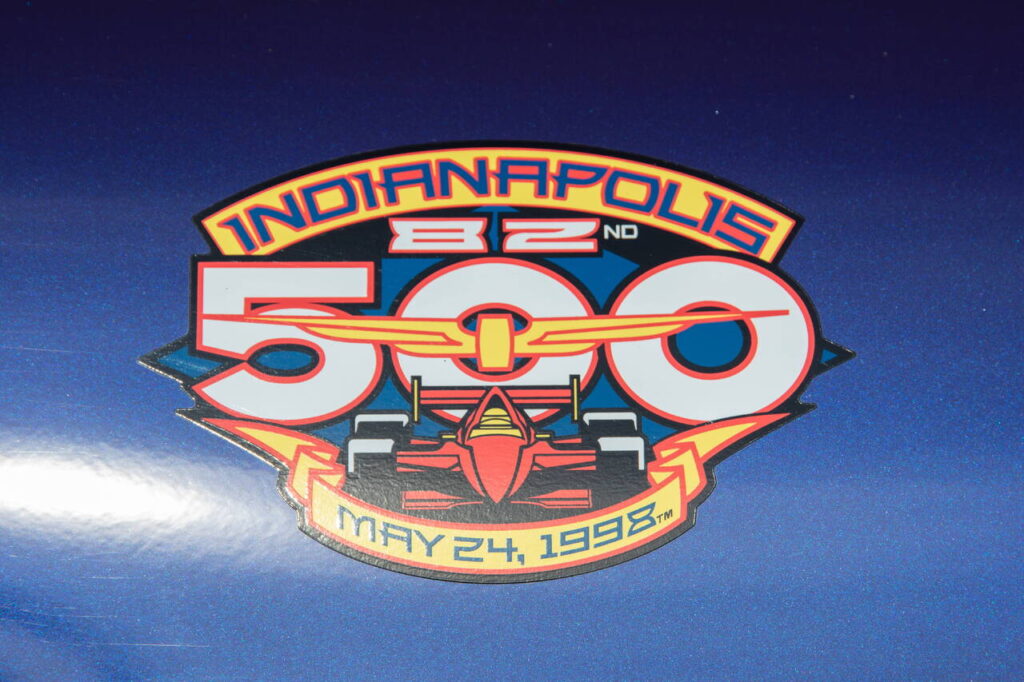
That kind of instant identity has become more valuable with time. Modern Corvette special editions often live in the space between tasteful and marketable, with unique stitching, wheel finishes, stripe packages, or numbered plaques doing much of the work. The 1998 Z4Z comes from a different school. It is a full-body event car, built during an era when Chevrolet still understood the promotional power of putting something visually outrageous in the showroom and letting people gather around it. For some buyers, that meant a limited-production collectible. For others, especially younger enthusiasts seeing one under dealership lights, it meant something more personal: proof that Corvette was still capable of stopping people in their tracks.
The production numbers help the car’s case. With 1,163 built, including five pilot cars, the 1998 Pace Car Replica is limited without being unobtainable. The transmission split also gives the story texture: 616 automatics and 547 six-speeds, which means nearly half the production run went to buyers who wanted the full visual drama paired with a manual gearbox. That matters for how the car is understood today. It was not simply a parade car for collectors who wanted the loudest Corvette on the block. A meaningful number of customers ordered it as a driver’s car, and the best surviving examples still carry that dual identity. They are collectible, yes, but they are also C5 convertibles with LS1 power, real chassis sophistication, and the kind of long-distance ease that made the fifth-generation Corvette such a leap forward.
The market seems to understand that balance. A standard 1998 Corvette convertible remains one of the more approachable ways into modern Corvette ownership, while documented Pace Car Replicas sit in their own lane because of the package, production total, mileage, transmission, originality, and paperwork. Hagerty’s valuation data places a typical 1998 Corvette convertible in good condition well below the strongest Pace Car Replica results, while Classic.com’s market page for the 1998 Indy Pace Car shows an average sale price around the low-$30,000 range, with a reported high sale above $50,000 and lower-mile or highly original examples trading at a premium. Recent auction data reinforces that spread, including a 22-mile 6-speed example that sold on Bring a Trailer for $41,000 in February 2026.
That spread is important because it tells the truth about the car. The Z4Z is not rare in the way a factory lightweight, developmental prototype, or ultra-low-production performance model is rare. It is not a secret-code Corvette that only specialists understand. Its appeal is more visible, more emotional, and more tied to provenance. The best cars are the ones that still have their factory graphics intact, their yellow wheels present, their black-and-yellow interiors preserved, their documentation in order, and their connection to the Indy program clearly understood. Mileage helps, but originality and completeness may matter even more because this car’s identity depends on the whole package being there.
That is also why the factory-applied graphics deserve a place in the closing argument. On many special editions, stripes are decoration. On the 1998 Pace Car, the livery is the car’s passport. Chevrolet applying the major graphics at Bowling Green gave the replicas a higher level of consistency and helped make the “same as the real thing” positioning more convincing. For collectors, that distinction becomes more meaningful with every passing year. A car with tired vinyl, missing details, incorrect replacement graphics, chrome wheels substituted for the original yellow pieces, or a softened interior loses more than condition points. It loses part of the reason the Z4Z exists.
And yet, the 1998 Pace Car Replica should not be reduced to preservation anxiety. One of the best things about the car is that it still drives like a good C5. The LS1 is smooth and eager. The chassis is calm. The convertible structure is far more convincing than the open C4s that came before it. JL4 Active Handling gave the car a modern safety and stability story at precisely the moment Corvette needed one. Taken together, those elements make the Z4Z more than a static collectible. It is a usable artifact of Corvette’s late-1990s reinvention.
That is the real reason the car still resonates. It captures the C5 at the moment Chevrolet was no longer simply trying to prove that Corvette was fast. Corvette had already won that argument many times over. The more important question was whether it could be modern, refined, electronically sophisticated, structurally honest, and still feel like itself. The 1998 Indy Pace Car answered with a kind of unapologetic confidence. It was flamboyant on the surface, but serious underneath. It could sit roped off in a showroom, pace the field at Indianapolis, turn heads on Monument Circle, and still behave like a Corvette once the road opened up.
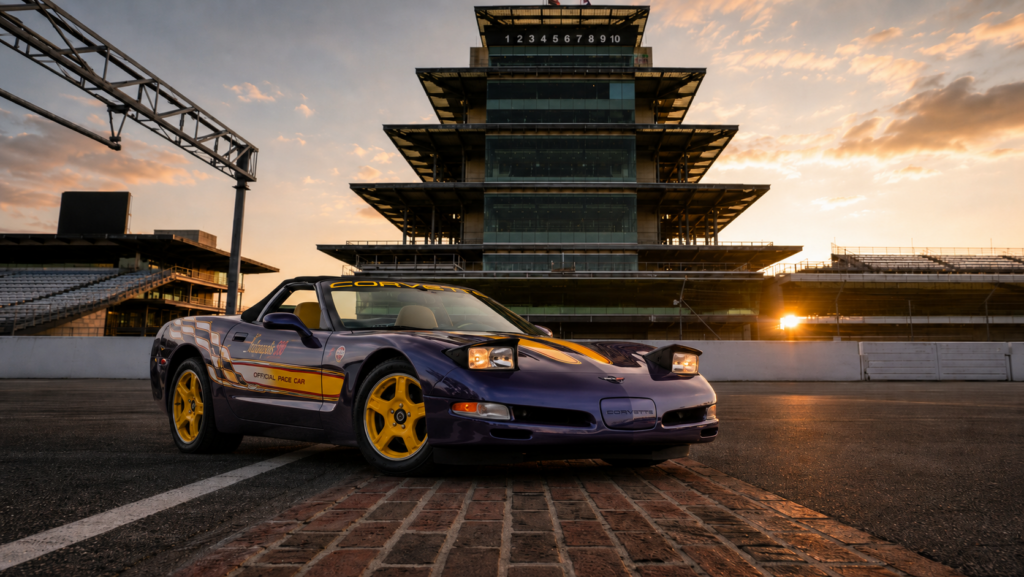
Not every important Corvette is subtle. Some mark their place by being elegant, rare, or technically revolutionary. Others do it by becoming impossible to ignore at exactly the right moment. The 1998 Corvette Indianapolis 500 Pace Car Replica belongs to the second group, but its importance runs deeper than its color. It helped introduce the C5 convertible, gave Active Handling a public stage, tied Corvette once again to the Speedway, and turned a bold promotional idea into a factory-built production car with real engineering behind it.
Twenty-plus years later, the yellow wheels still do their job. The graphics still start arguments. The car still looks like May in Indianapolis turned into fiberglass. But beneath all of that is the reason it deserves a serious place in the Corvette story: the 1998 Pace Car Replica was Chevrolet telling the world that the C5 convertible was not merely ready for the showroom.
It was ready to lead.