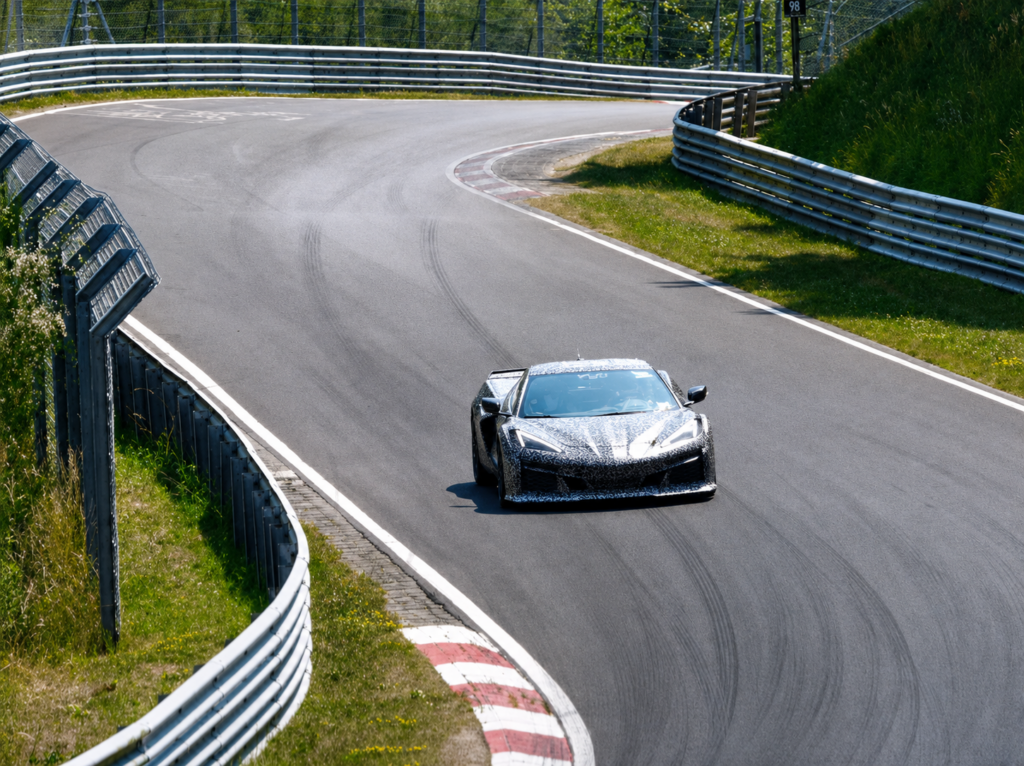
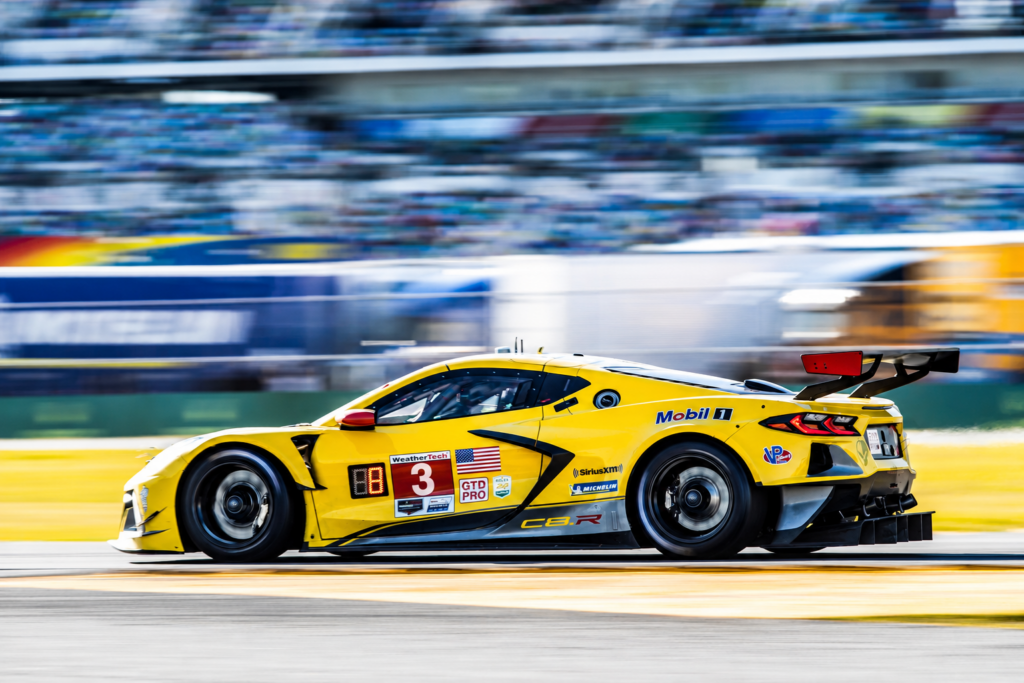
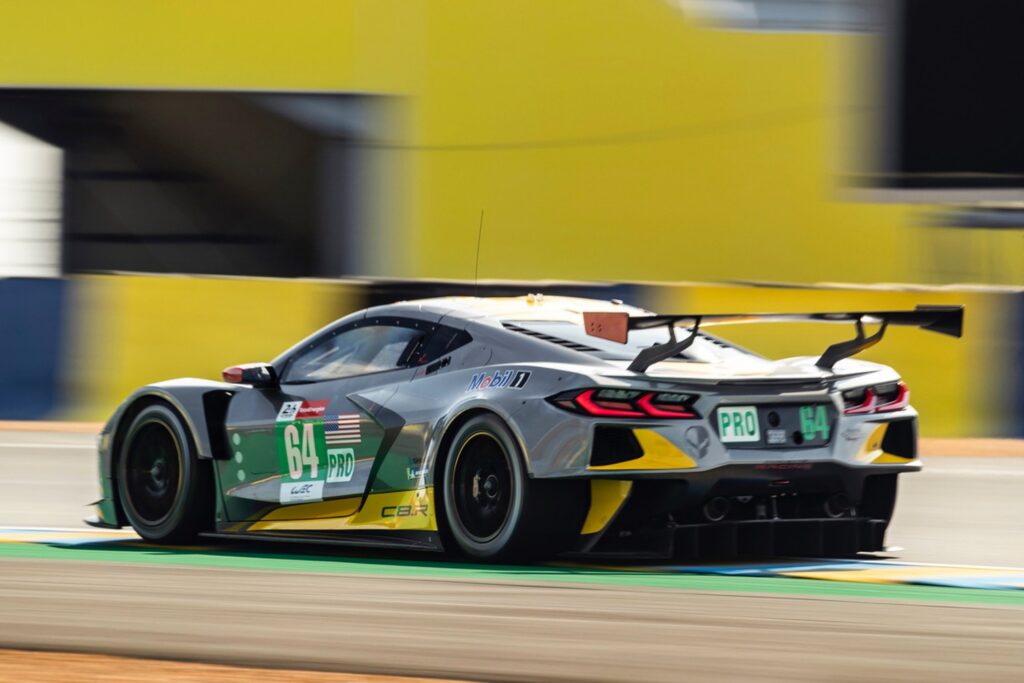
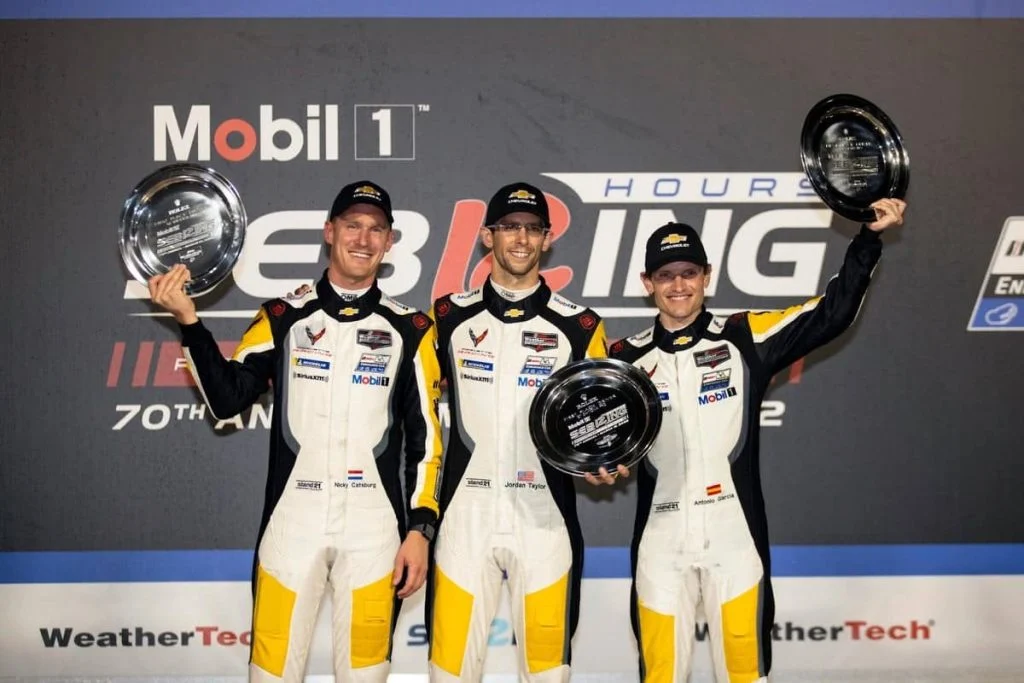
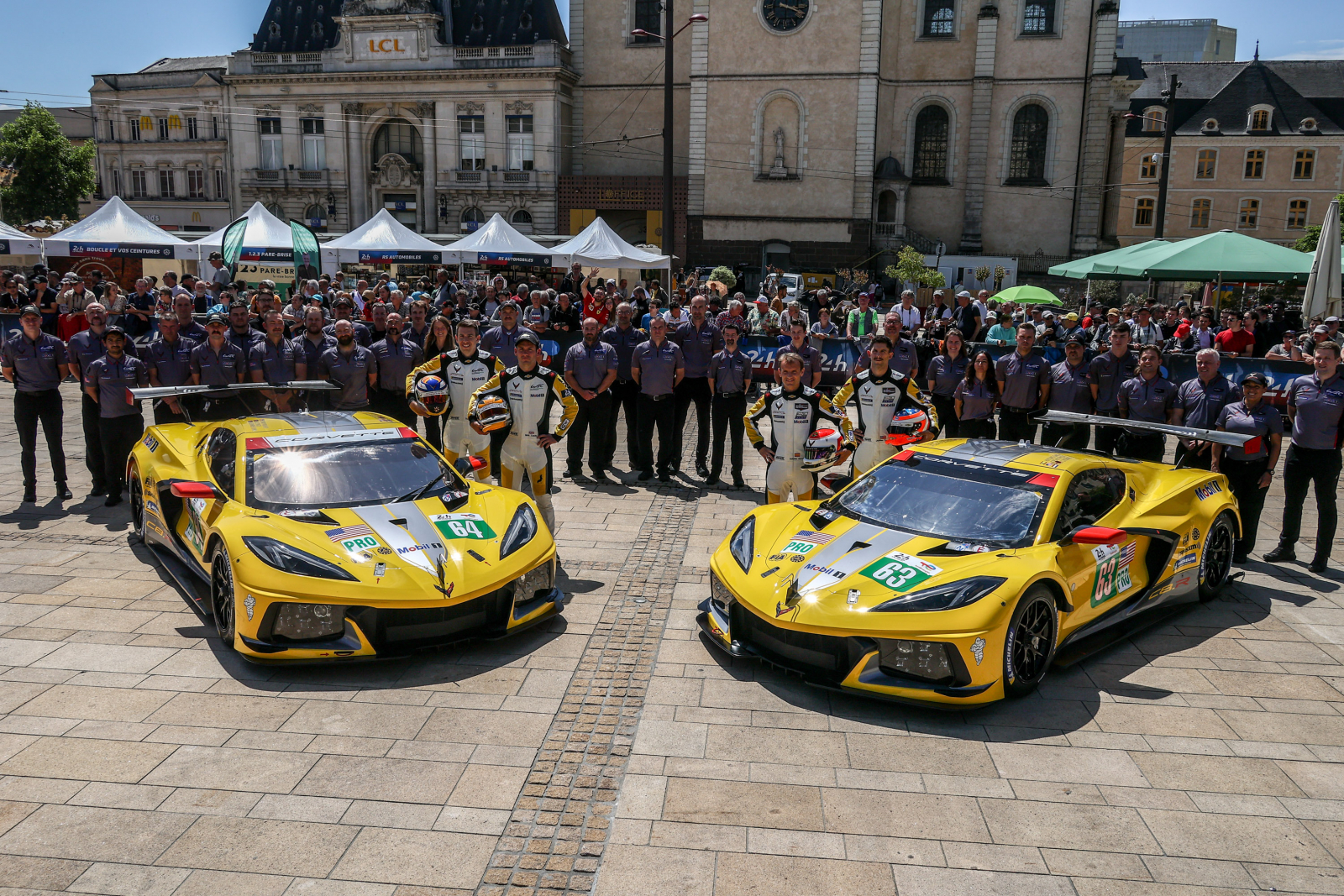
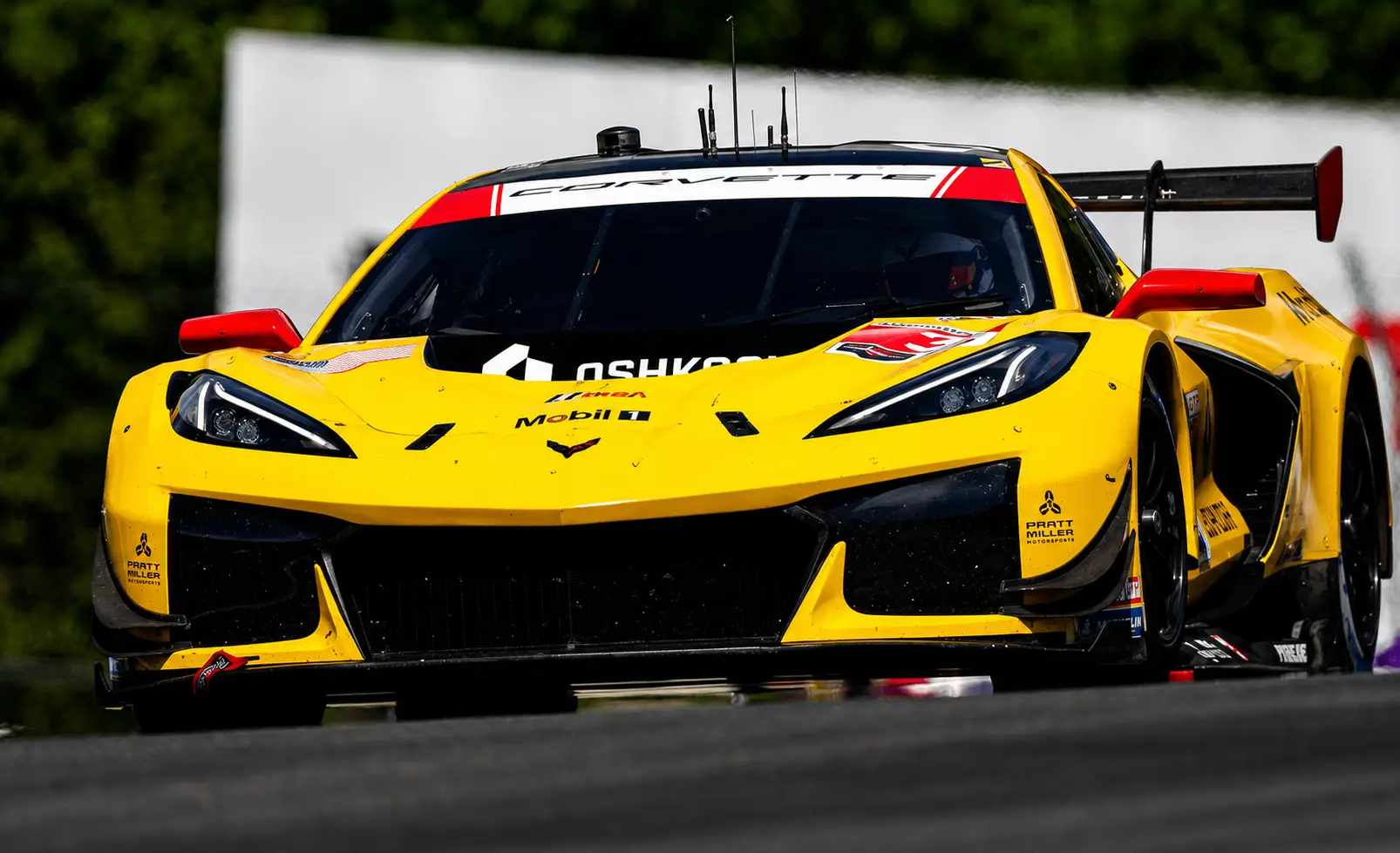
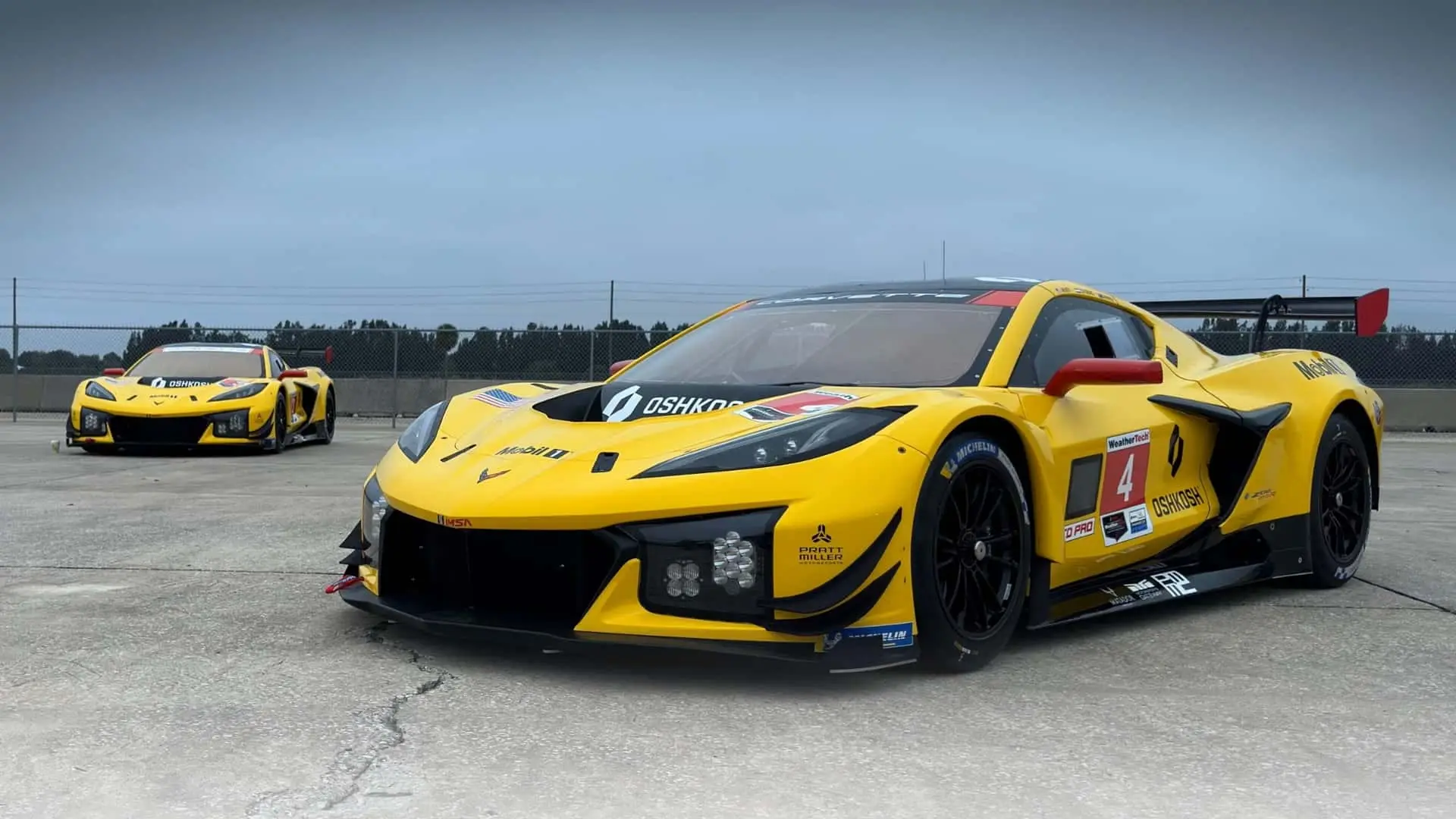
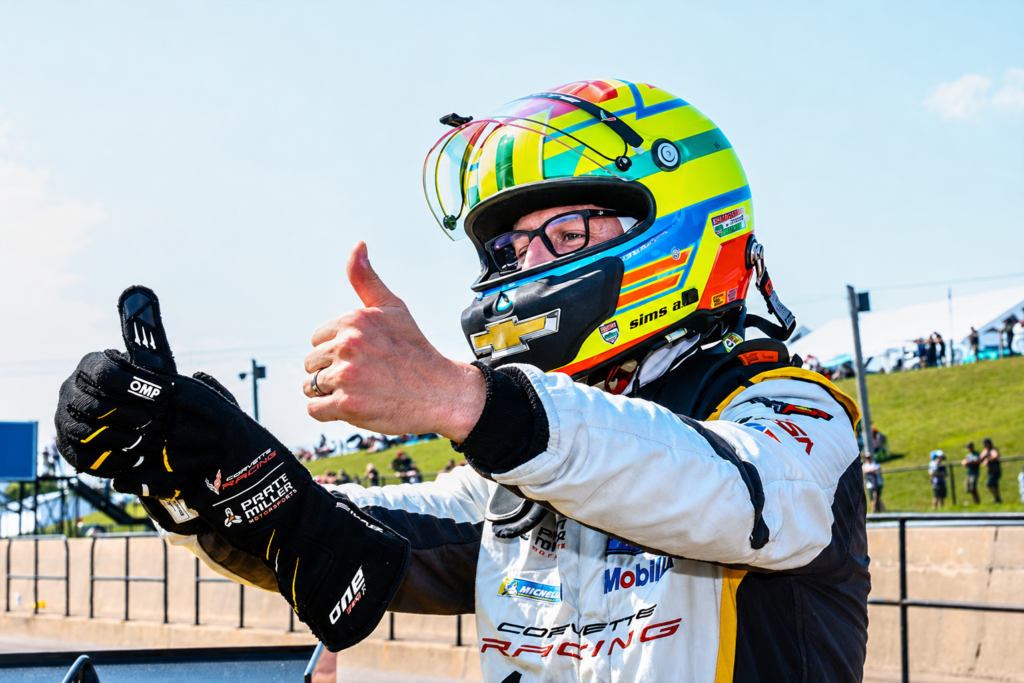
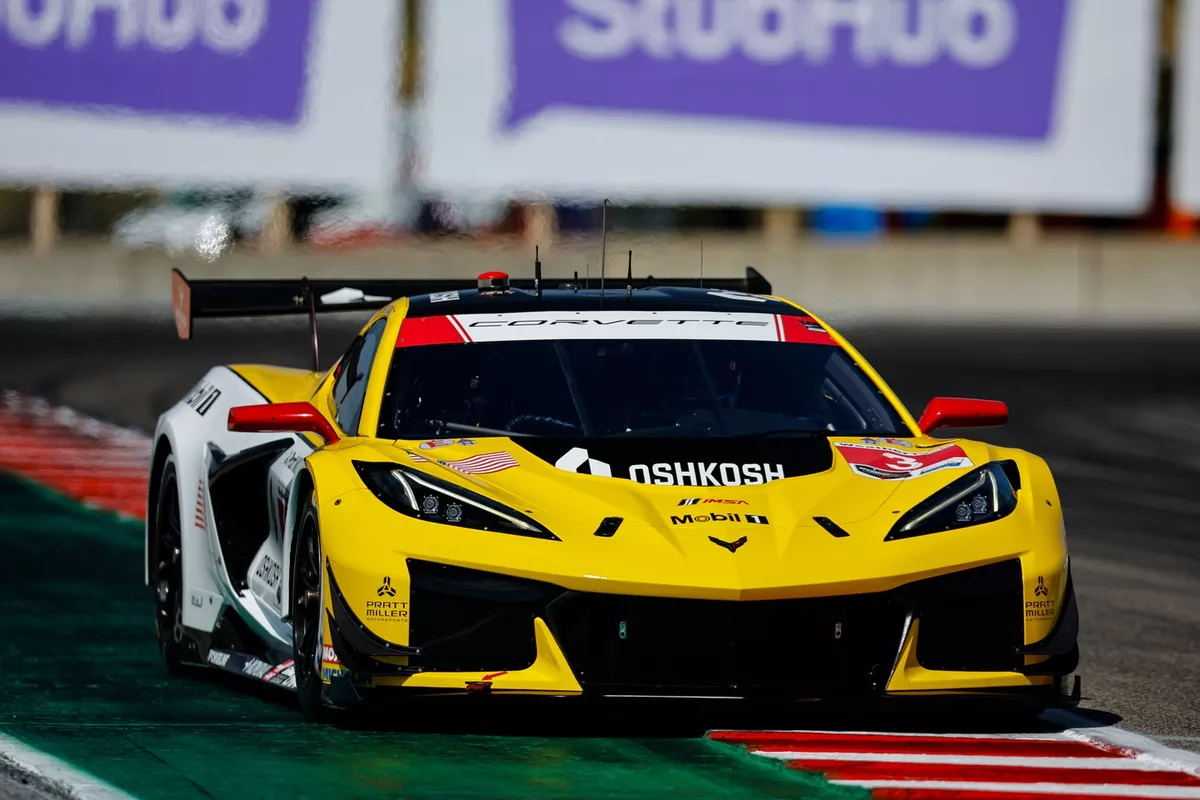
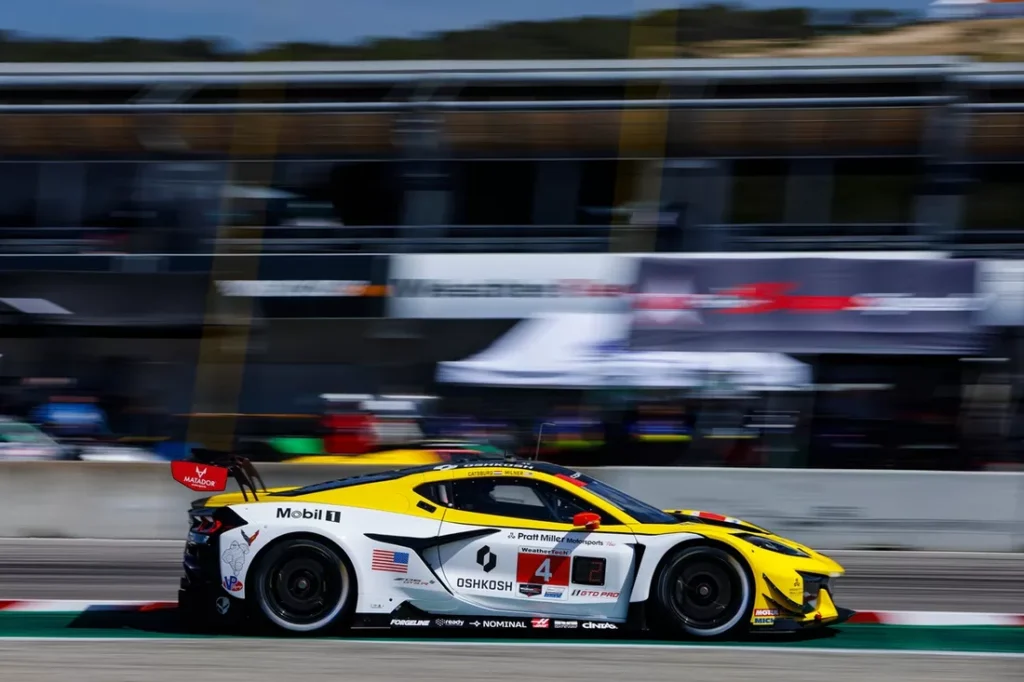
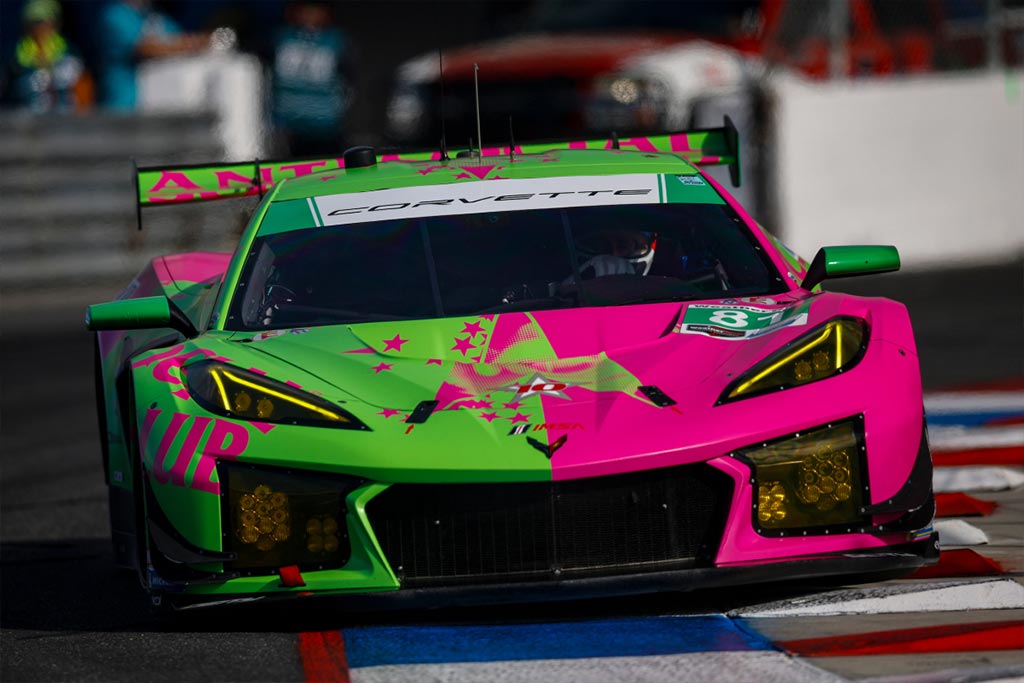
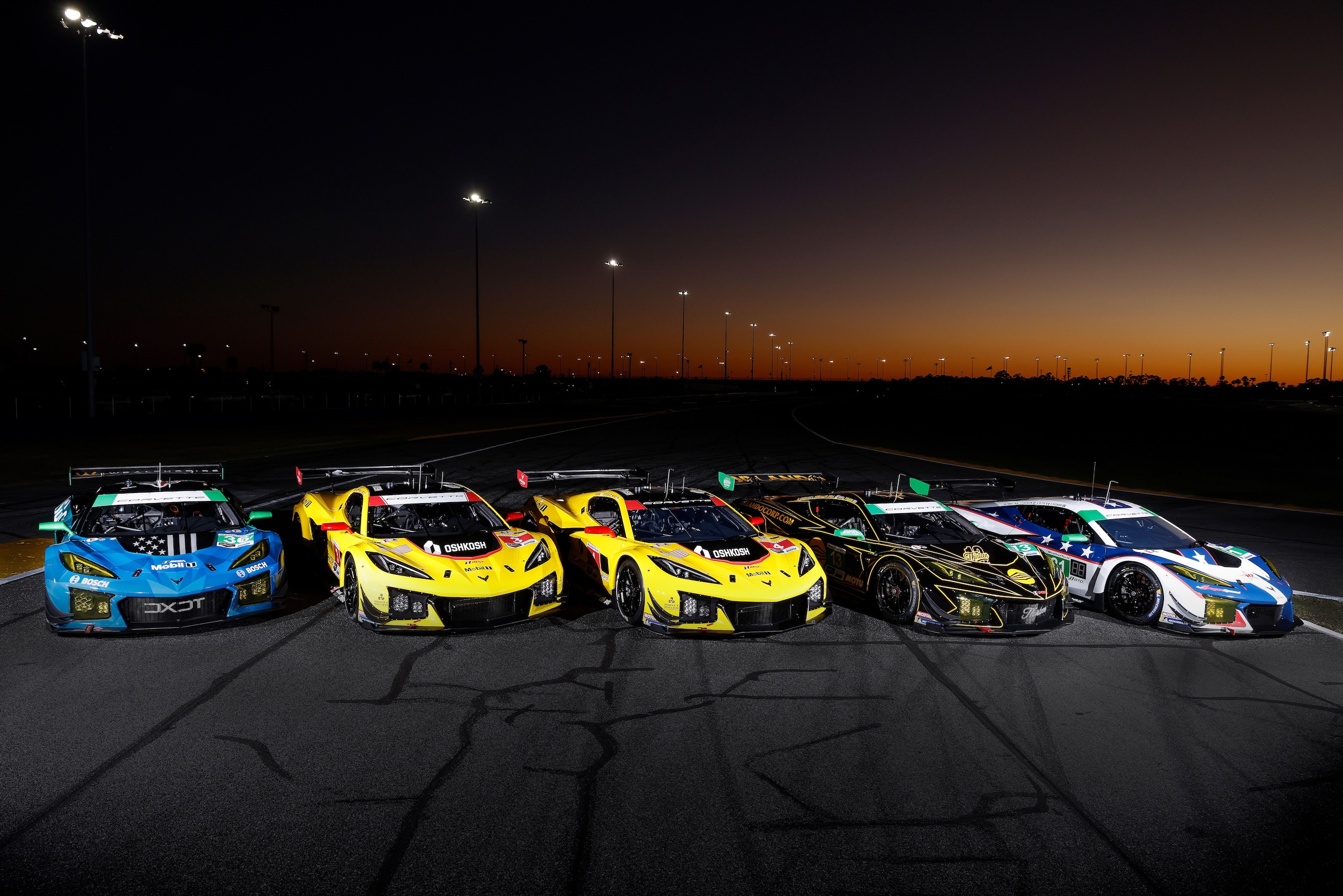
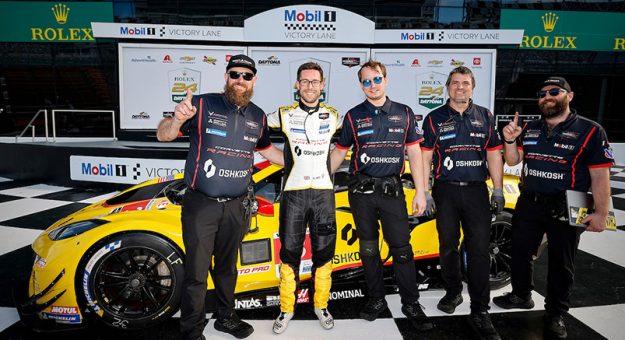
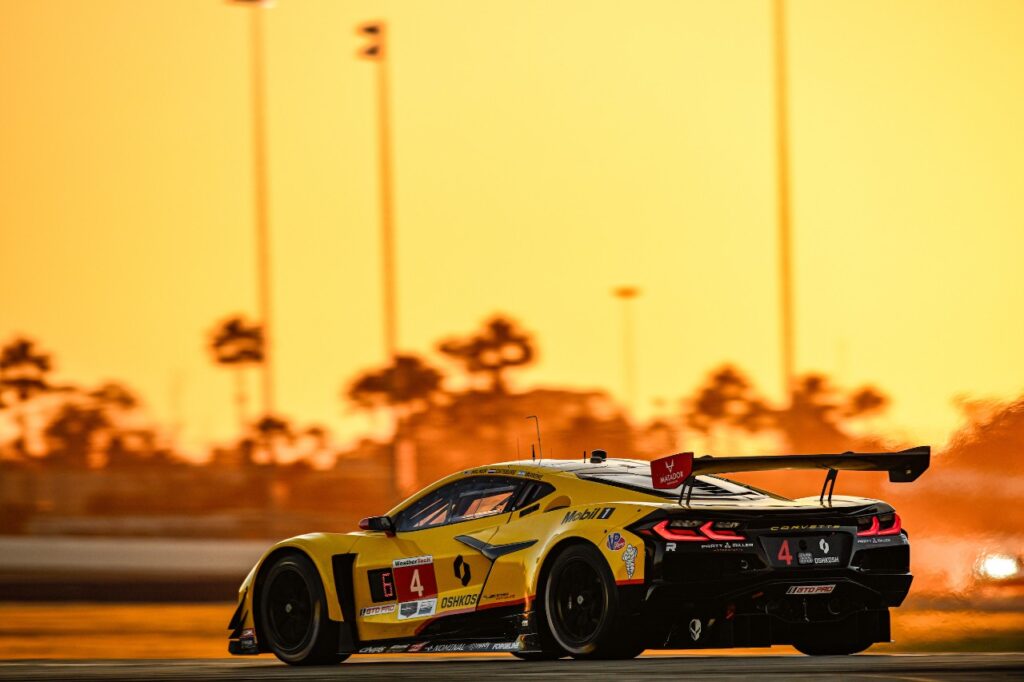
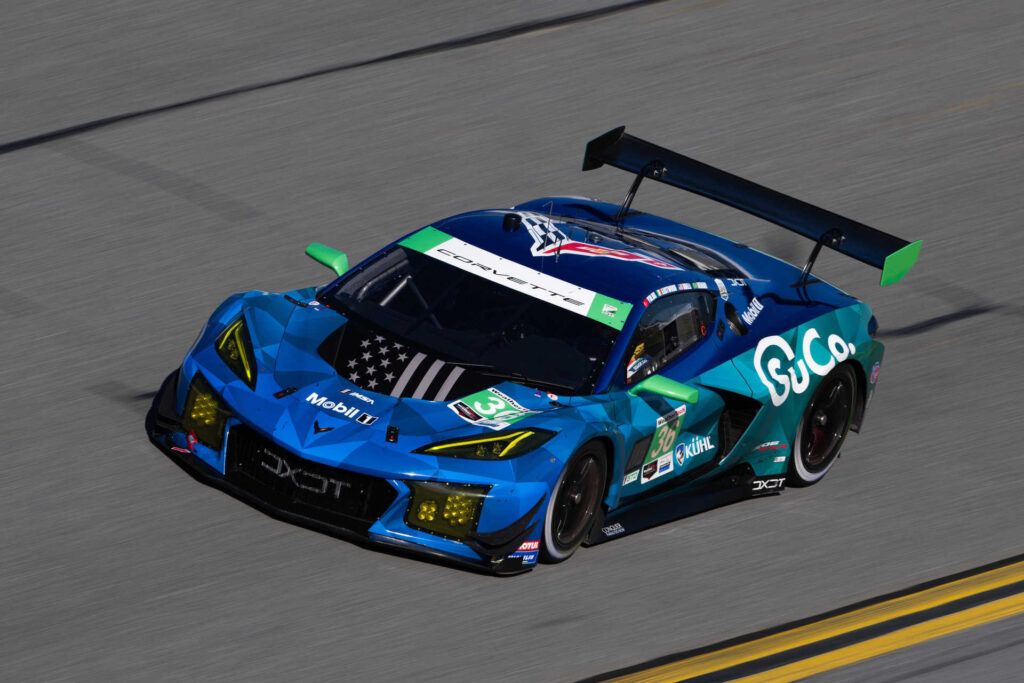
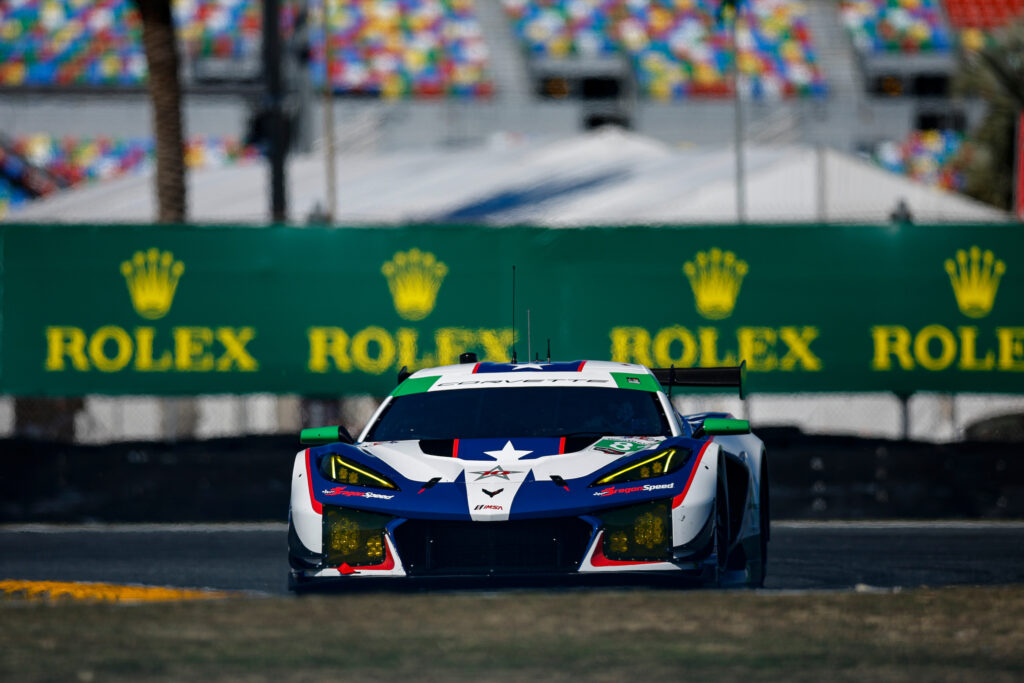
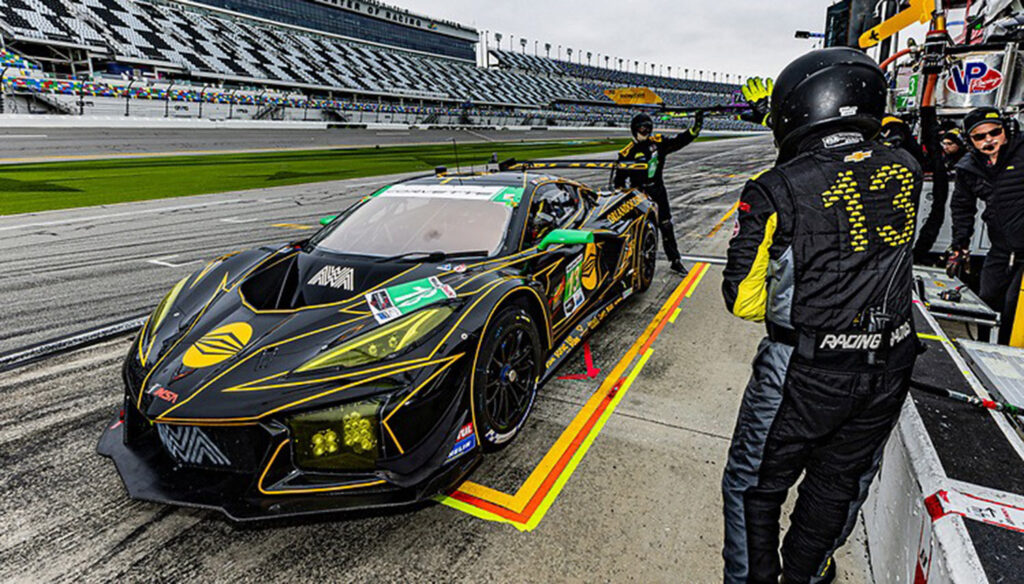
Five Corvette Z06 GT3.Rs entered the 2026 Motul Petit Le Mans with championships, a race victory and a trip to Le Mans all within reach. Ten chaotic hours later, Chevrolet emerged with the GTD PRO Manufacturers’ Championship, DXDT Racing stood on the GTD podium, and 13 Autosport secured another invitation to the 24 Hours of Le Mans—but the night also brought heartbreak for a Pratt Miller team that had arrived at Road Atlanta leading the championship.
There are endurance races where the final result tells most of the story, and then there are races like the 2026 Motul Petit Le Mans.
By the time the field took the checkered flag Saturday night at Michelin Raceway Road Atlanta, ten hours of racing had produced a race-record 17 full-course cautions, a red-flag stoppage for lightning, intermittent rain, constantly changing fuel strategies, punctures, contact, cars buried in gravel traps and championship battles that remained unsettled deep into the final hour.
For Corvette Racing, it was all of those things and more.
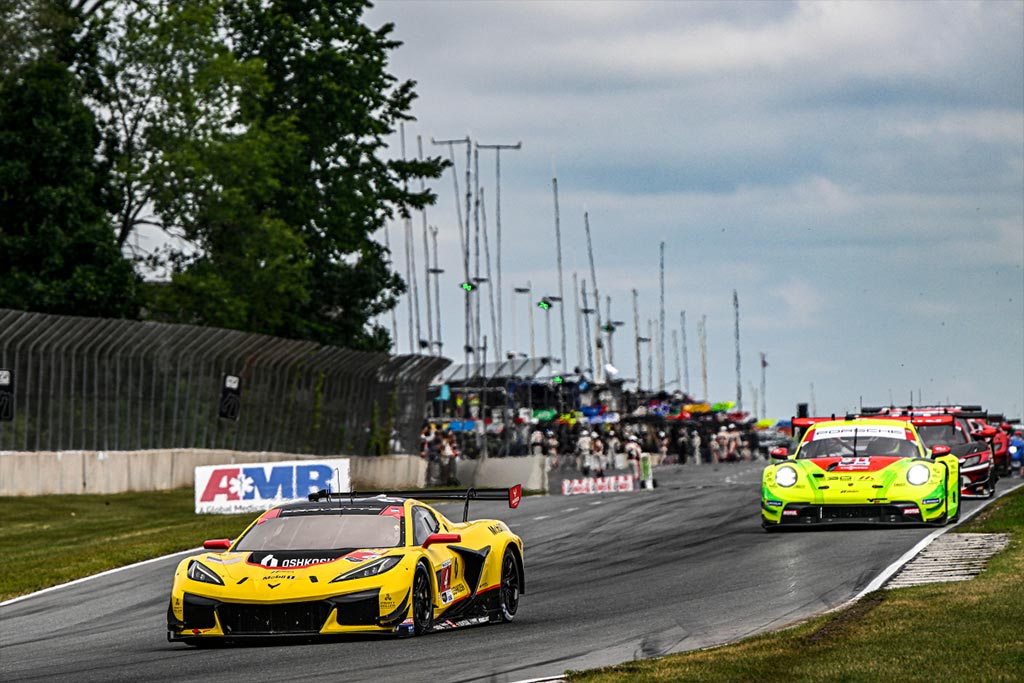
The two Corvette Racing by Pratt Miller Motorsports Z06 GT3.Rs showed genuine race-winning pace at Petit Le Mans, but both days ended in frustration. The No. 3 Corvette of Antonio García, Alexander Sims and Marvin Kirchhöfer led twice for 61 laps and remained a podium contender until a late left-rear tire puncture dropped them to eighth in GTD PRO. The No. 4 of Tommy Milner, Nicky Catsburg and Nico Varrone led three times for 29 laps and entered the race leading the championship. With roughly 80 minutes remaining, however, contact with the No. 64 Ford Mustang sent Catsburg into the Turn 10 gravel, costing the Corvette a lap and ultimately the Drivers’ and Teams’ championships as the No. 4 finished 12th. It was a painful conclusion to a race that demonstrated just how competitive both factory Corvettes were, although Chevrolet still left Road Atlanta as the 2026 GTD PRO Manufacturers’ Champion. (Images courtesy of the author)
Five Chevrolet Corvette Z06 GT3.Rs started the 29th running of Petit Le Mans across IMSA’s two production-based GT categories. The No. 3 and No. 4 Corvette Racing by Pratt Miller Motorsports entries were joined in GTD PRO by DragonSpeed’s No. 74 Corvette, while the No. 13 13 Autosport and No. 36 DXDT Racing Corvettes contested GTD.
Every one of them had a story to tell by the end of the night.
DragonSpeed finished sixth in GTD PRO and became the highest-finishing Corvette in the class. The No. 3 Pratt Miller Corvette finished eighth after spending significant portions of the race looking like a legitimate podium contender. The championship-leading No. 4 finished 12th after contact in the closing stages effectively ended its bid for the Drivers’ and Teams’ titles.
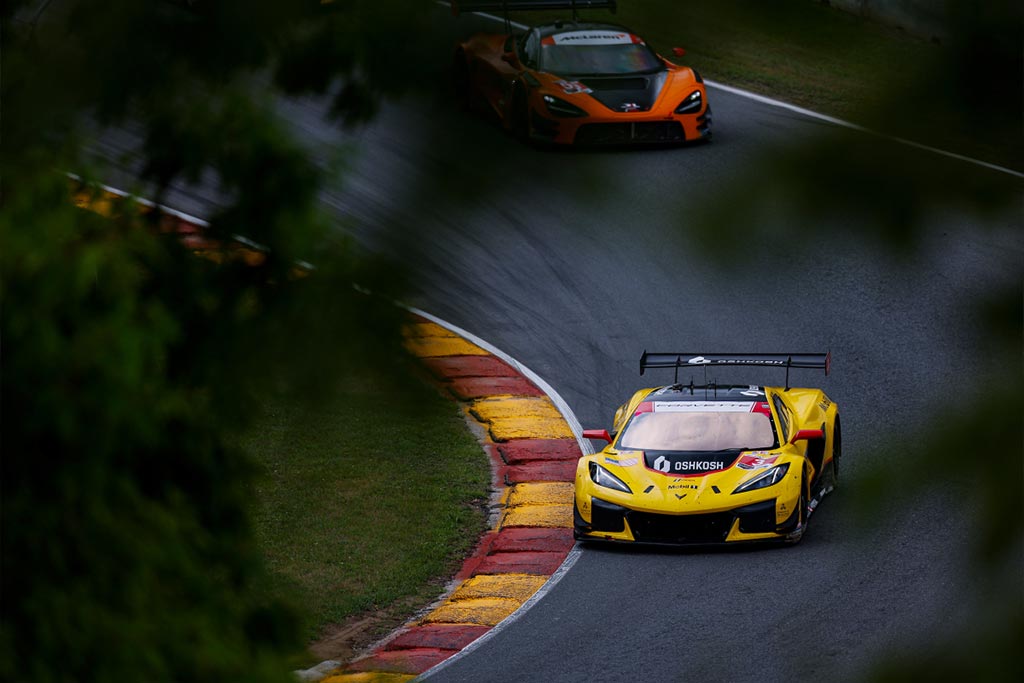
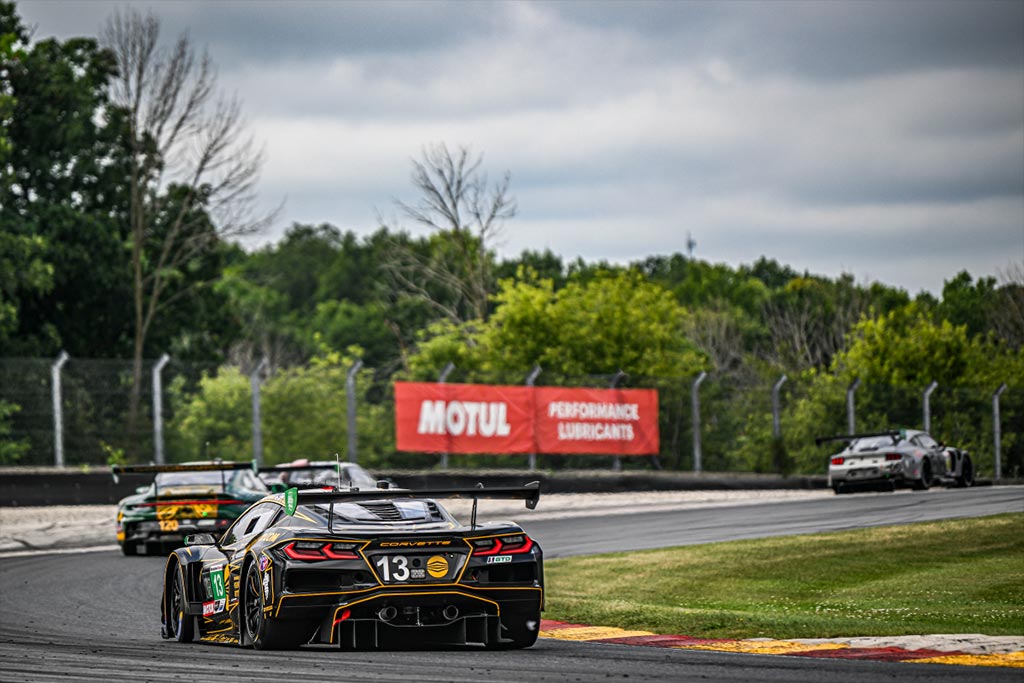
The three customer Corvette Z06 GT3.R programs delivered three very different but impressive performances at Petit Le Mans. DragonSpeed’s No. 74 of Giacomo Altoè, Casper Stevenson and Sébastien Bourdais led three times before finishing sixth in GTD PRO, making it the highest-finishing Corvette in the class. 13 Autosport’s No. 13 of Matt Bell, Orey Fidani and Lars Kern finished 10th in GTD after leading eight laps, but more importantly secured Fidani’s third consecutive Bob Akin Award and an automatic invitation to the 2027 24 Hours of Le Mans. Meanwhile, the No. 36 DXDT Racing Corvette of Charlie Eastwood, Mason Filippi and Salih Yoluç produced one of the remarkable drives of the race, recovering from four laps down to finish third in GTD and claim the team’s first IMSA podium of the season. Together, the three customer teams demonstrated just how competitive and increasingly capable Chevrolet’s Z06 GT3.R program has become. (Images courtesy of the author)
In GTD, DXDT Racing completed an extraordinary recovery from four laps down to finish third, while 13 Autosport’s 10th-place finish was enough for Orey Fidani to claim his third consecutive Bob Akin Award and another automatic invitation to the 24 Hours of Le Mans.
And despite missing out on the GTD PRO Drivers’ and Teams’ championships, Chevrolet left Road Atlanta as the 2026 IMSA GTD PRO Manufacturers’ Champion.
It was not the ending Corvette Racing had envisioned when the weekend began, but after ten hours of some of the most unpredictable racing IMSA produced all season, it was still a weekend that added another championship to Corvette’s competition record.
Ten Hours of Controlled Chaos
The 2026 Petit Le Mans began exactly as Road Atlanta often demands—with everyone immediately facing conditions that left virtually no margin for error. A wet circuit greeted the 54-car field, forcing drivers from all four classes to manage standing water, reduced grip, spray and limited visibility while simultaneously navigating some of the fastest and most congested traffic of the IMSA season. Headlights cut through the mist as the prototypes began working their way through the GT field, setting the tone for what would become an extraordinarily unpredictable ten hours. The track would eventually dry, but the weather was far from finished—and neither was the chaos.
Petit Le Mans has never been a race that rewards impatience. At Michelin Raceway Road Atlanta, the fastest car alone is seldom enough. You have to survive the traffic, manage the equipment, stay out of trouble, and—perhaps most importantly—still have a competitive race car beneath you when darkness falls and the final hours begin.
That challenge is amplified by the circuit itself. Road Atlanta packs 12 turns into just 2.54 miles, with significant elevation changes, blind corners and several sections where the closing speeds between prototypes and GT cars can be staggering. For the 2026 Petit Le Mans, 54 cars took the green flag: 11 GTP prototypes, 11 LMP2 cars, 14 GTD PRO entries and 18 GTD machines. Put that many cars on a circuit barely two and a half miles long, mix four different classes with dramatically different performance capabilities, and traffic becomes every bit as important as outright speed.
Then came the weather.
Rain complicated portions of Saturday’s race before lightning in the area eventually forced IMSA officials to stop the field under red-flag conditions. Even when the cars were circulating, it was difficult for anyone to establish a rhythm. An extraordinary sequence of spins, crashes, stalled cars and other incidents resulted in a race-record 17 full-course cautions, repeatedly bunching the field and wiping away advantages that teams had spent entire stints building.
For the strategists on pit lane, it became a constantly moving target. Fuel mileage, tire life, driver rotations and track position all mattered, but so did trying to anticipate when the next caution might arrive. A perfectly timed stop could suddenly move a car into contention; a yellow moments later could undo the advantage just as quickly. As afternoon became evening and darkness settled over Road Atlanta, Petit Le Mans increasingly felt less like a conventional endurance race and more like a ten-hour elimination contest.
With 54 cars spread across four classes and dramatically different levels of performance sharing just 2.54 miles of racetrack, simply staying in contention at Petit Le Mans was an accomplishment. Yet throughout ten hours of traffic, changing weather, repeated cautions, and constant interaction with the faster prototype classes, the Corvette Z06 GT3.R remained a factor. All three Corvettes competing in GTD PRO led laps, while the two GTD entries also worked their way into contention as the race unfolded. In a field this large, competitive, and unpredictable, the Corvettes didn’t simply survive the chaos—they remained relevant virtually until the very end.
Through all of that chaos, the Corvettes remained remarkably relevant. All three Z06 GT3.Rs competing in GTD PRO spent time at the front, with the No. 3 Pratt Miller Corvette leading 61 laps, the championship-contending No. 4 leading 29, and DragonSpeed’s No. 74 also taking its turn at the head of the field. The two GTD Corvettes had stories of their own: 13 Autosport led eight laps while fighting to secure Orey Fidani’s third consecutive Bob Akin Award, while DXDT Racing somehow transformed a race in which it had fallen four laps behind into a legitimate podium run.
For much of Saturday, then, Corvette was exactly where it needed to be. The factory cars had pace, the customer cars were making themselves factors in their respective classes, and the No. 4 remained in position to leave Road Atlanta with the GTD PRO Drivers’ and Teams’ championships. After nearly an entire season of racing, however, those championships would ultimately be decided in the final hours of the final race—and for Pratt Miller, that is where an already unpredictable Petit Le Mans became particularly painful.
The No. 4 Corvette: A Championship Slips Away
For much of the 2026 Petit Le Mans, the championship fight came down to exactly what Corvette Racing had expected: Corvette versus BMW. Tommy Milner and Nicky Catsburg entered Road Atlanta leading the GTD PRO Drivers’ Championship, and the No. 4 Corvette Z06 GT3.R remained locked in battle with the No. 1 Paul Miller Racing BMW M4 GT3 EVO deep into the race. As darkness approached, every position, pit stop and lap mattered, with the championship effectively being decided on the racetrack. That fight never received the opportunity to reach its natural conclusion. With less than 80 minutes remaining, contact from the No. 64 Ford Mustang GT3 sent Catsburg’s Corvette into the Turn 10 gravel, costing the No. 4 a lap and effectively eliminating its chance of securing the Drivers’ and Teams’ championships. The BMW ultimately prevailed, but for Corvette, a season-long championship fight ended not through a lack of speed, but through an incident in the closing stages of the final race.
Tommy Milner and Nicky Catsburg arrived at Road Atlanta with everything they had worked for all season still within reach. The pair led the GTD PRO Drivers’ Championship, while Corvette Racing by Pratt Miller Motorsports’ No. 4 Z06 GT3.R sat atop the Teams’ standings. After a season of wins, podiums, setbacks and recovery drives, the championship equation for Petit Le Mans was relatively straightforward: survive ten hours at Road Atlanta, stay ahead of their primary challengers and bring the title home.
For much of Saturday, that appeared entirely possible. Joined by endurance driver Nico Varrone, Milner and Catsburg kept the No. 4 Corvette firmly in contention through the rain, changing track conditions, relentless traffic and seemingly endless caution periods. More importantly, they had genuine pace. The No. 4 led GTD PRO three times for a total of 29 laps, and as daylight disappeared over Road Atlanta, Corvette remained very much in position to finish what it had started months earlier.
But endurance racing has an unfortunate habit of compressing an entire day’s work into a handful of decisive moments, and late in the race the championship began slipping away. Following another round of pit stops, the No. 1 Paul Miller Racing BMW M4 GT3 EVO moved ahead of the Corvette in the championship calculation. The situation had become more difficult, but it wasn’t over. Catsburg was still close enough to fight back on the racetrack, leaving the title to be decided during the closing stages of the season’s final race.
Then came the moment that effectively ended it.
With less than 80 minutes remaining, Catsburg and Dennis Olsen’s No. 64 Ford Mustang GT3 made contact entering the Turn 10 complex. The impact sent the No. 4 Corvette into the gravel, where Catsburg became stranded and ultimately lost a lap while the car was recovered. IMSA subsequently penalized the Ford for its role in the incident, but the penalty could not give Corvette back the time—or track position—it had lost. After spending much of the afternoon and evening fighting for a championship, the No. 4 eventually crossed the line 12th in GTD PRO.
For Milner, the disappointment afterward was understandable. This wasn’t a championship that disappeared because the Corvette lacked pace; the No. 4 had led the race and remained a legitimate contender deep into the final hours. Milner described the way their opportunity ended as “really a bummer,” but his comments also reflected considerable pride in what Catsburg, Varrone and the entire Pratt Miller organization had accomplished throughout the season. One incident may have helped determine the final points table, but it did not erase the body of work that put the No. 4 in position to fight for the championship in the first place.
And Corvette did not leave Road Atlanta empty-handed. While the Drivers’ and Teams’ titles ultimately went elsewhere, Chevrolet secured the 2026 GTD PRO Manufacturers’ Championship—an important achievement for a program that continues to develop both its factory-supported Pratt Miller effort and its expanding customer-racing operation. It wasn’t the ending the No. 4 crew had envisioned when Petit Le Mans began, but the Manufacturers’ title provided tangible evidence of just how competitive the Z06 GT3.R had become over the course of the season.
The No. 3 Corvette Was Better Than Eighth Place
The No. 3 Corvette Z06 GT3.R of Antonio García, Alexander Sims and Marvin Kirchhöfer was considerably stronger at Road Atlanta than its eighth-place GTD PRO finish suggests. The Pratt Miller Corvette led twice for a total of 61 laps, spending much of Petit Le Mans in legitimate contention for the podium and, at times, the class victory. Even as changing conditions, traffic and repeated cautions reshuffled the field, the No. 3 continued working its way back toward the front. Unfortunately, a late left-rear puncture effectively ended its challenge, costing the team valuable track position when there was little time remaining to recover. It was a frustrating conclusion to an otherwise impressive performance from a Corvette that had demonstrated race-winning pace throughout much of the day.
If the No. 4 Corvette’s final result does not adequately describe its race, neither does the eighth-place finish recorded by the No. 3.
Antonio García, Alexander Sims and Marvin Kirchhöfer spent much of Saturday looking like legitimate contenders for the GTD PRO victory. The No. 3 led twice for a total of 61 laps—more time at the front than either of its Pratt Miller teammates—and repeatedly worked its way back toward the sharp end of the field as strategies, pit stops and caution periods shuffled the running order. Through the rain, traffic and interruptions that defined much of the race, the Corvette continued to put itself back into contention.
More importantly, it was still there when Petit Le Mans began entering the hours that traditionally decide the race. As daylight disappeared and the complexion of Road Atlanta changed with it, the No. 3 remained within striking distance of a podium and potentially something more.
Then came a late left-rear puncture.
It was exactly the kind of setback Petit Le Mans can inflict on a team that has spent nine hours doing nearly everything correctly. The puncture cost the No. 3 valuable track position at precisely the wrong point in the race, taking a Corvette that had spent 61 laps at the front and effectively removing it from the fight for the podium. García, Sims and Kirchhöfer eventually brought the car home eighth in GTD PRO, a finishing position that said very little about how competitive the Corvette had actually been.
Sims later described the race as the “roller coaster that we expected,” which was an appropriate summary of an afternoon and evening in which the No. 3 repeatedly moved from contender to recovery mode and back again. There was understandable frustration with the result, but Sims also pointed to Chevrolet’s Manufacturers’ Championship as an important accomplishment for the larger Corvette Racing program.
That championship was built across an entire season, and the No. 3 played a meaningful role in securing it. García and Sims may not have arrived at Road Atlanta fighting for the Drivers’ Championship, but their victory on the streets of Detroit and their competitiveness throughout 2026 helped accumulate the points Chevrolet needed to claim the manufacturer crown. Petit Le Mans did not give the No. 3 the finish its performance deserved, but its contribution to Chevrolet’s championship season was considerably greater than an eighth-place result might suggest.
DragonSpeed Takes Corvette to Sixth in GTD PRO
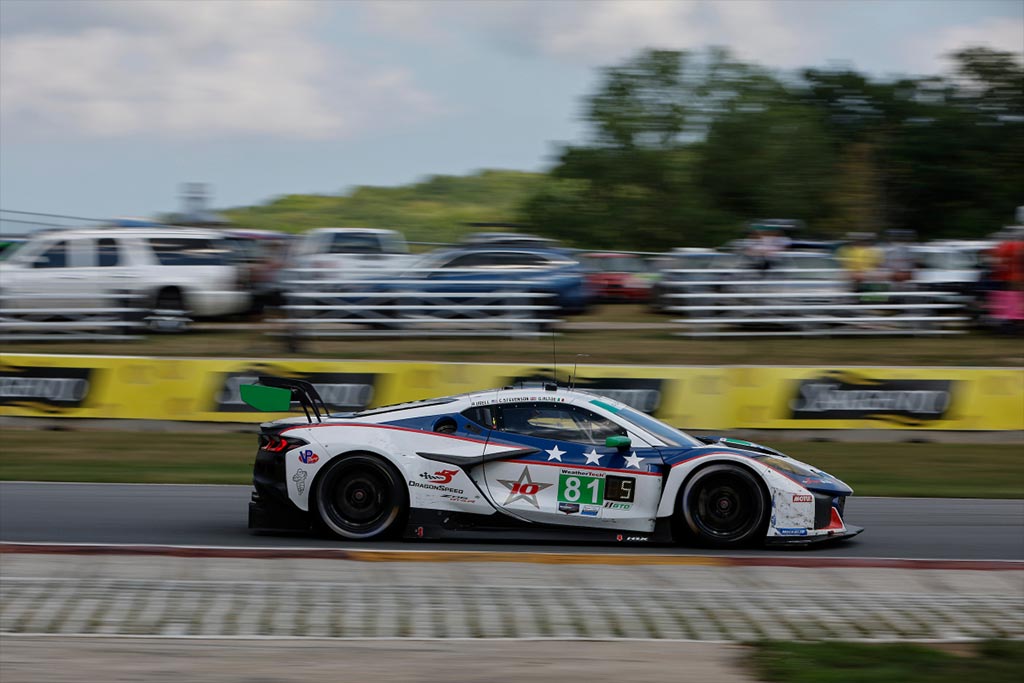
DragonSpeed’s No. 74 Corvette Z06 GT3.R proved that Corvette’s presence at the front of the 2026 Petit Le Mans extended well beyond the two Pratt Miller entries. With Giacomo Altoè, Casper Stevenson, and two-time Petit Le Mans winner Sébastien Bourdais sharing the car, DragonSpeed stepped into the all-professional GTD PRO category for the season finale and immediately showed it belonged there. The Corvette led three times during the second half of the race and remained within striking distance of the podium during the closing stages, with Stevenson later suggesting that another green-flag lap might have been enough to get them there. The No. 74 ultimately finished sixth, making it the highest-finishing Corvette in GTD PRO and delivering an impressive result for DragonSpeed in its first GTD PRO outing with the Z06 GT3.R.#81: DragonSpeed, Corvette Z06 GT3.R, GTD: Giacomo Altoė, Casper Stevenson
Perhaps the most interesting Corvette result in GTD PRO came from the one team that was not part of the factory-supported Pratt Miller operation.
DragonSpeed brought the No. 74 Corvette Z06 GT3.R to Road Atlanta and elected to move the car into the all-professional GTD PRO category for the season finale. Giacomo Altoè and Casper Stevenson were joined by two-time Petit Le Mans winner Sébastien Bourdais, giving the team an experienced lineup for what would be its first GTD PRO appearance with the Corvette.
There was nothing tentative about the effort. DragonSpeed immediately found itself competing against factory-supported programs representing some of the largest manufacturers in sports-car racing, yet as the race developed, the No. 74 increasingly became part of the conversation at the front. The Corvette led three times during the second half of the race and remained positioned to capitalize as strategies began converging during the closing stages.
By then, sixth place was hardly the limit of what appeared possible. Stevenson believed the team had enough pace to move farther forward and said afterward that with another green-flag lap, the No. 74 “would have been on the podium.” Instead, the final sequence of the race left DragonSpeed sixth in GTD PRO—but still the highest-finishing Corvette in the class.
That result deserves some perspective. DragonSpeed had stepped into GTD PRO against established factory and factory-supported programs and immediately demonstrated that its customer Z06 GT3.R could run at the front. The team didn’t simply circulate and collect a respectable finish; it led the race, remained relevant deep into the final stint and put itself within reach of the podium.
For Chevrolet, the performance also represented something larger. The Z06 GT3.R was conceived from the beginning as a true customer racing platform capable of taking Corvette beyond a single factory operation. DragonSpeed’s performance at Road Atlanta demonstrated exactly what that concept was supposed to produce: an independent Corvette team capable of stepping into IMSA’s most competitive GT category and immediately challenging some of the best GT3 programs in the world.
DXDT Comes Back From Four Laps Down
DXDT Racing’s No. 36 Corvette Z06 GT3.R produced one of the most remarkable recovery drives of the entire Petit Le Mans weekend. After a pair of penalties dropped Charlie Eastwood, Mason Filippi and Salih Yoluç four laps behind, the team refused to concede the race, using aggressive strategy and a succession of caution periods to methodically work its way back onto the lead lap. By the closing stages, Eastwood wasn’t simply trying to salvage a result—he was fighting near the front of GTD and briefly had a legitimate opportunity to contend for the victory. Forced to undertake an enormous fuel-saving effort during the final stint, Eastwood ultimately brought the No. 36 home third in GTD, completing an extraordinary four-lap comeback and delivering DXDT Racing its first IMSA podium of the 2026 season.
If one Corvette performance at Petit Le Mans best demonstrated why nobody should consider this race settled before the checkered flag, it belonged to DXDT Racing.
The No. 36 Corvette Z06 GT3.R of Charlie Eastwood, Mason Filippi and Salih Yoluç fell four laps behind following a pair of significant penalties early in the race. At almost any other event, losing four laps to an 18-car GTD field would effectively end any realistic hope of a podium. At Petit Le Mans, however, the combination of cautions, strategy and sheer persistence can occasionally create opportunities that simply do not exist elsewhere.
DXDT recognized that there was little value in playing conservatively. With nothing to protect, the team began taking chances, using caution periods and alternative strategy to recover whatever it could. One lap became two. Two became three. As the race continued to unravel around them, the No. 36 kept clawing its way back until, almost improbably, the Corvette had recovered all four laps and returned to the lead lap.
That alone would have made for a remarkable recovery. DXDT wasn’t finished.
By the closing stages, Eastwood was no longer trying to salvage a respectable finish from a race that had gone wrong hours earlier. He was fighting for a podium, and for a period of time, the possibility of winning Petit Le Mans was suddenly within reach.
The team’s final strategic gamble required Eastwood to stretch the Corvette’s available energy through the closing stint. He later estimated that the necessary conservation approached 20 percent, forcing him to balance the temptation to attack with the much more important requirement of actually reaching the checkered flag. With competitors ahead and behind, there was little room for error.
Eastwood managed it. The No. 36 crossed the line third in GTD, giving DXDT Racing its first IMSA podium of the season and Eastwood his first IMSA podium. His post-race reaction probably summarized the improbability of the result better than anything else could: “We somehow end up on the podium from being four laps down.”
There was certainly fortune involved—there almost always is in a recovery of this magnitude—but luck alone did not put DXDT on the podium. The team repeatedly made aggressive strategic decisions because simply circulating four laps behind offered nothing. Those decisions steadily pulled the Corvette back into the race until a day that had appeared lost became one of the strongest Corvette performances of the weekend.
Eastwood admitted afterward that the result produced an unusual mixture of satisfaction and frustration. Had he possessed slightly more usable energy during the closing stint, he believed the No. 36 might have been able to fight for the victory. Considering where the Corvette had been earlier in the afternoon, however, third place was an extraordinary result.
13 Autosport Wins the Race It Came to Win
13 Autosport’s No. 13 Corvette Z06 GT3.R of Orey Fidani, Matt Bell and Lars Kern arrived at Petit Le Mans with an objective that extended well beyond its finishing position. Fidani entered Road Atlanta fighting for his third consecutive Bob Akin Award, with an automatic invitation to the 2027 24 Hours of Le Mans waiting for the winner. The Corvette remained competitive throughout the race and even led GTD for eight laps as the battle with Brendan Iribe tightened during the closing hours. Although the No. 13 ultimately finished 10th in GTD, Fidani secured the Akin Award by just 10 points, earning his third straight invitation to Le Mans. For 13 Autosport, it was a reminder that endurance racing is not always about where you finish a single race—the team came to Road Atlanta with a season-long objective, and it accomplished exactly what it needed to do.
On paper, the No. 13 Corvette finished 10th in GTD. For Orey Fidani, Matt Bell, Lars Kern and 13 Autosport, however, the most important result of their weekend would never appear beside the car’s finishing position.
Fidani arrived at Road Atlanta attempting to secure his third consecutive Bob Akin Award, IMSA’s season-long recognition for the highest-performing eligible Bronze-rated driver in GTD. Beyond the prestige of winning the award, there was an enormous prize attached to it: an automatic invitation to the following year’s 24 Hours of Le Mans.
The championship fight had narrowed to Fidani and Brendan Iribe in the No. 70 Inception Racing Ferrari, and as Petit Le Mans unfolded, the margin between them became increasingly uncomfortable. The No. 13 worked its way forward and even led eight laps late in the race, briefly creating the possibility that 13 Autosport might leave Road Atlanta with both the Akin Award and a Petit Le Mans victory.
The class victory eventually slipped away, but the objective that mattered most did not. Fidani finished the season 10 points ahead of Iribe, effectively a single finishing position at Road Atlanta, and secured the Bob Akin Award for the third consecutive year. With it came another automatic invitation to the 24 Hours of Le Mans.
Fidani admitted afterward that the closing stages had him pacing the pit lane as the championship permutations changed around him. Bell described the Le Mans invitation as the team’s primary objective for the season, while Kern characterized this year’s Akin Award as the most difficult of the three they have secured.
There is unfinished business attached to that invitation as well. 13 Autosport showed competitive pace at Le Mans in 2026 before contact ended its race, and Bell made clear afterward that the experience only strengthened the team’s desire to return and demonstrate what the Corvette can accomplish there.
Now they will get another opportunity.
Aston Martin Wins GTD PRO; BMW Takes the Championship
The GTD PRO podium at Road Atlanta reflected just how unpredictable the 2026 Petit Le Mans had become. Mattia Drudi, Valentin Hasse Clot and Marco Sørensen delivered the class victory for the No. 68 CarBahn—Car Blanche Aston Martin, while the championship battle ultimately went to Connor De Phillippi and Neil Verhagen of Paul Miller Racing after their No. 1 BMW finished third. For Corvette, it was a bittersweet conclusion: neither Pratt Miller entry reached the podium after both demonstrated front-running pace, and the Drivers’ and Teams’ titles slipped away in the closing hours. Yet Chevrolet still emerged from the chaos as the 2026 IMSA GTD PRO Manufacturers’ Champion, ensuring that Corvette Racing left Road Atlanta with one of the season’s most important championships.
While Corvette’s championship fight supplied much of the drama from our perspective, the GTD PRO race ultimately belonged to an Aston Martin that arrived at Road Atlanta without being part of the season-long title battle.
The No. 68 CarBahn—Car Blanche Aston Martin Vantage GT3 Evo of Mattia Drudi, Valentin Hasse Clot and Marco Sørensen emerged from a constantly changing final hour to win GTD PRO. It was the team’s first IMSA victory, made all the more impressive by the fact that it came during its first Michelin Endurance Cup appearance in the class.
The closing stages featured the Aston Martin battling among entries from AO Racing, Manthey and Vasser Sullivan as fuel conservation, traffic, cautions and incidents continued reshuffling the order. Drudi eventually emerged at the front and survived the final restart to secure the victory.
Behind that fight, the championship Corvette had pursued all season was being decided. Connor De Phillippi and Neil Verhagen finished third in the No. 1 Paul Miller Racing BMW M4 GT3 EVO they shared with Dan Harper, giving De Phillippi and Verhagen the GTD PRO Drivers’ Championship and Paul Miller Racing the Teams’ title. After arriving at Road Atlanta leading both championships, the No. 4 Corvette ultimately finished the season third in the Teams’ standings.
The IMSA Manufacturers’ Championship rewards the performance of each marque rather than any individual car or driver pairing. At each event, only the highest-finishing eligible car from each manufacturer scores manufacturer points, preventing brands with multiple entries from gaining an advantage simply by fielding more cars. That distinction proved critical at Petit Le Mans: while the late incident involving the No. 4 Corvette allowed BMW to capture the GTD PRO Drivers’ and Teams’ championships, Chevrolet’s season-long performance had already built a strong manufacturer points position. With the best-finishing Corvette contributing Chevrolet’s points at each round throughout 2026, the collective performance of the Z06 GT3.R program was enough for Chevrolet to finish the season as the 2026 IMSA GTD PRO Manufacturers’ Champion.
But Chevrolet did leave Road Atlanta with one of IMSA’s major GTD PRO championships. Its season-long results were enough to finish ahead of Ford and BMW and secure the 2026 GTD PRO Manufacturers’ Championship, ensuring that the Z06 GT3.R program ended its third IMSA season with championship hardware.
GM Vice President of Global Motorsports Competition Eric Warren praised the development of the program afterward, describing the Z06 GT3.R as “just incredible.” Considering the depth of competition Chevrolet faced throughout the season—and the fact that both factory and customer Corvettes contributed to the program’s success—the Manufacturers’ Championship represented an important measure of just how far the car has progressed.
Winward Completes a Remarkable GTD Season
Winward Racing completed a remarkable 2026 GTD campaign at Road Atlanta, with the No. 57 Mercedes-AMG GT3 of Russell Ward, Philip Ellis and Indy Dontje converting pole position into victory at Petit Le Mans. The win provided a fitting conclusion to the season and secured a third consecutive GTD championship for Ward, Ellis and Winward Racing, reinforcing the consistency that has made the team one of the class benchmarks. Behind them, however, the fight remained intense until the end, with the No. 912 Manthey Porsche taking second and DXDT Racing completing its extraordinary four-lap recovery to put the No. 36 Corvette Z06 GT3.R on the podium in third.
The story in GTD extended well beyond the two Corvettes, with DXDT’s remarkable recovery and Fidani’s Bob Akin Award unfolding against another championship-winning performance at the front of the class.
The No. 57 Winward Racing Mercedes-AMG GT3 of Russell Ward, Philip Ellis and Indy Dontje started from pole and ultimately won Petit Le Mans, completing an impressive second half of the season for the team. The victory also secured a third consecutive GTD championship for Ward, Ellis and Winward Racing.
The No. 912 Manthey Porsche finished second, followed by DXDT’s No. 36 Corvette in third. Yet from a Corvette perspective, the significance of the GTD race extended beyond DXDT’s podium. With 18 cars entered in the class, both customer Z06 GT3.Rs still had meaningful objectives alive late Saturday evening. DXDT was fighting its way toward the front while, elsewhere on the circuit, 13 Autosport was simultaneously protecting the slender points margin that would ultimately secure Fidani another Bob Akin Award.
That is the kind of depth Chevrolet envisioned when the Z06 GT3.R program was created. Corvette’s presence in professional GT racing is no longer dependent upon the fortunes of two factory-supported cars. Customer teams are increasingly building their own programs, pursuing their own championships and, as Road Atlanta demonstrated, creating their own Corvette stories.
Porsche Wins Petit Le Mans Overall
Porsche Penske Motorsport finally conquered Petit Le Mans in 2026, with Laurens Vanthoor, Kévin Estre and Matt Campbell driving the No. 6 Porsche 963 to the overall victory after ten hours of some of the most unpredictable racing Road Atlanta could produce. The Porsche remained in contention through changing weather, a red flag and a record 17 full-course cautions before emerging at the front during the decisive closing stages. Vanthoor brought the No. 6 home just 1.205 seconds ahead of the No. 24 BMW M Hybrid V8, giving Porsche its first overall Petit Le Mans victory since 2015 and delivering Team Penske its first overall win in the event. For a Porsche Penske program that has won on some of endurance racing’s biggest stages, Road Atlanta had remained an important omission from the résumé—until 2026.
While the GT battles unfolded deeper in the field, an equally dramatic fight was developing at the front of the race.
The No. 6 Porsche Penske Motorsport Porsche 963 of Laurens Vanthoor, Kévin Estre and Matt Campbell ultimately won the 2026 Petit Le Mans after Vanthoor made the decisive move past Earl Bamber’s Cadillac during the closing stages. The victory marked Porsche’s first overall Petit Le Mans win since 2015 and delivered Team Penske its first overall victory at the event.
There was little breathing room at the finish. The No. 24 BMW M Team WRT BMW M Hybrid V8 of Dries Vanthoor, Sheldon van der Linde and Robin Frijns crossed the line just 1.205 seconds behind after ten hours of racing, while the No. 40 Wayne Taylor Racing Cadillac V-Series.R of Jordan Taylor, Louis Delétraz and Colton Herta completed the overall podium.
The championship picture produced another set of winners. Jack Aitken secured the GTP Drivers’ Championship aboard the No. 31 Whelen Cadillac V-Series.R, with Cadillac claiming the Manufacturers’ Championship and Whelen capturing the Teams’ title.
LMP2 produced another comeback story. George Kurtz, Alex Quinn and Toby Sowery brought the No. 04 CrowdStrike Racing by APR ORECA home first in class, with Kurtz and Quinn also securing the LMP2 championship.
Taken together, the four classes provided a fitting reminder of what makes Petit Le Mans such a compelling endurance race. There is never really one race taking place at Road Atlanta. There are several of them happening simultaneously, each with its own strategies, traffic, rivalries and championship calculations—and in 2026, remarkably few of those stories were settled until the final minutes.
Five Corvettes, Five Very Different Stories
#36: DXDT Racing, Corvette Z06 GT3.R, GTD: Mason Filippi, Charlie Eastwood, Scott McLaughlin, Salih Yoluc, #3: Corvette Racing by Pratt Miller Motorsports, Corvette Z06 GT3.R, GTD Pro: Antonio Garcia, Alexander Sims, Marvin Kirchhöfer, #4: Corvette Racing by Pratt Miller Motorsports, Corvette Z06 GT3.R, GTD Pro: Tommy Milner, Nicky Catsburg, Nico Varrone, #13: 13 Autosport, Corvette Z06 GT3.R, GTD: Orey Fidani, Matthew Bell, Lars Kem, Ben Green, #81: DragonSpeed, Corvette Z06 GT3.R, GTD: Henrik Hedman, Giacomo Altoė, Casper Stevenson, Matteo Cairoli
Looking only at the finishing order does not adequately describe Corvette’s 2026 Petit Le Mans. The results sheet records sixth, eighth and 12th in GTD PRO, along with third and 10th in GTD. Those numbers are accurate, but they tell only a fraction of what happened during ten hours at Road Atlanta. Pasted markdown
The No. 4 arrived leading a championship and remained capable of winning it until contact sent Catsburg into the Turn 10 gravel. The No. 3 led 61 laps and demonstrated podium-level pace before a late puncture changed the trajectory of its race. DragonSpeed moved its Corvette into GTD PRO for the first time, led three times and finished as the highest-placed Z06 GT3.R in the class. DXDT somehow turned a four-lap deficit into a podium. And 13 Autosport accomplished precisely what it came to Road Atlanta to do, securing Orey Fidani’s third consecutive Bob Akin Award and another invitation to the 24 Hours of Le Mans.
Above those individual performances sits the accomplishment that belongs to the Corvette program as a whole: Chevrolet is the 2026 IMSA GTD PRO Manufacturers’ Champion.
That championship represents more than the outcome of one chaotic Saturday in Georgia. It reflects the combined competitiveness of the Z06 GT3.R throughout an entire IMSA season and demonstrates how much the program has evolved since the car first entered competition. Pratt Miller remains at its center, but increasingly it is joined by customer organizations capable of taking the same basic platform and competing against some of the strongest GT3 programs in international motorsports.
Three seasons into the Z06 GT3.R era, Corvette is no longer simply developing the GT3 successor to the factory C8.R that preceded it. The car has matured into the global customer racing platform Chevrolet intended it to become: one capable of winning races, fighting for championships and putting multiple independent Corvette teams into meaningful positions on the biggest weekends of the season.
Petit Le Mans did not deliver every championship Corvette came to Road Atlanta hoping to win. Instead, it produced a Manufacturers’ Championship, a podium recovered from four laps down, another ticket to Le Mans and three GTD PRO Corvettes that each spent time leading one of the most competitive GT fields in the world. Across both classes, all five Z06 GT3.Rs found a way to become part of the story during ten of the wildest hours IMSA produced in 2026. Pasted markdown
There will undoubtedly be frustration within Corvette Racing over the championship that slipped away Saturday night. There should also be considerable pride in everything that did not: the pace demonstrated by both Pratt Miller cars, the emergence of DragonSpeed in GTD PRO, DXDT’s extraordinary recovery, 13 Autosport’s return ticket to Le Mans and, ultimately, another IMSA championship for Chevrolet.
The 2026 IMSA season may be over, but Corvette leaves Road Atlanta with something perhaps more important than any single result: clear evidence that the Z06 GT3.R program continues to grow stronger, deeper and more competitive.
And its story is far from finished.
Five Corvette Z06 GT3.Rs entered the 2026 Petit Le Mans chasing championships, victory and a trip to Le Mans. Ten chaotic hours later, Corvette emerged with a Manufacturers’ Championship, a GTD podium and another Le Mans invitation—but also the heartbreak of a Drivers’ Championship that slipped away.
With Indianapolis still to come and Petit Le Mans looming on the horizon, the No. 4 Corvette Z06 GT3.R remains just 23 points from the GTD PRO championship lead while Chevrolet controls the manufacturer standings.
Road Atlanta may be the race everyone is already anticipating, but Indianapolis cannot be treated simply as a stop along the way. The September 20 event is the penultimate round of the championship, and its points could determine whether Corvette arrives at Petit Le Mans chasing the title, defending the lead or attempting to recover from a costly afternoon at the Brickyard.
Milner and Catsburg Remain Within Striking Distance
Tommy Milner and Nicky Catsburg enter the final two races second in the GTD PRO Drivers Championship, only 23 points behind the leaders in the No. 4 Corvette Z06 GT3.R.
In the GTD PRO Drivers Championship, Tommy Milner and Nicky Catsburg enter Indianapolis second with 2,409 points. The No. 4 Corvette pairing trails championship leaders Connor De Phillippi and Neil Verhagen by only 23 points, leaving Milner and Catsburg close enough to erase the entire deficit with one strong qualifying session and race result.
Behind them, the championship picture is even more compressed. Andrea Caldarelli and Sandy Mitchell are third with 2,376 points, followed by Harry King and Nick Tandy at 2,365. Christopher Mies and Frederic Vervisch also have 2,365 points, meaning five driver pairings are separated by only 67 points at the top of the standings.
That lack of separation leaves little room for error. A slow pit stop, poorly timed caution, contact in traffic or mechanical problem could dramatically change the order before the championship reaches Road Atlanta. Conversely, a clean Indianapolis weekend could allow Milner and Catsburg to begin Petit Le Mans from the strongest possible position.
The No. 4 Corvette has reached the podium three times this season, including a second-place finish at WeatherTech Raceway Laguna Seca. Although its campaign has included some difficult weekends, the team has continued collecting enough points to remain a championship threat with two races remaining.
No. 4 Corvette Holds Second in the Team Championship
Championships are won by more than drivers alone. Corvette Racing by Pratt Miller Motorsports enters the final two rounds second in the GTD PRO Teams Championship, with qualifying, strategy and pit execution all carrying enormous weight.
The GTD PRO Teams Championship mirrors the battle between the drivers. Paul Miller Racing’s No. 1 BMW leads with 2,432 points, while the No. 4 Corvette Racing by Pratt Miller Motorsports entry occupies second with 2,409.
Pfaff Motorsports is third with 2,376 points, followed by the No. 77 AO Racing Porsche and No. 65 Ford Racing Mustang, which are tied at 2,365. Just as in the Drivers Championship, five teams remain packed within 67 points of the lead.
Qualifying will also carry added importance because IMSA awards championship points based on starting position. With the margins this narrow, the championship work will begin before the green flag falls. Every position gained—or lost—during qualifying could follow the team all the way to the final hours of Petit Le Mans.
Chevrolet Controls the Manufacturer Battle
Contributions from both factory Z06 GT3.Rs have carried Chevrolet to the top of the GTD PRO Manufacturers Championship with two races remaining.
Chevrolet’s strongest position can be found in the GTD PRO Manufacturers Championship. According to the official post-VIR IMSA standings, Chevrolet leads with 2,648 points, giving the Bowtie an 87-point advantage over BMW.
Ford sits another 11 points behind BMW with 2,550, followed by Porsche at 2,512 and Lamborghini at 2,484. Chevrolet therefore holds a 98-point advantage over Ford, a 136-point lead over Porsche and a 164-point margin over Lamborghini.
The manufacturer championship awards points based on the highest-finishing car from each brand, making both factory Corvettes important to Chevrolet’s position. The No. 3 Corvette of Antonio Garcia and Alexander Sims delivered Chevrolet’s GTD PRO victory on the streets of Detroit, while Milner and Catsburg have kept the No. 4 near the front of the championship throughout the season.
Chevrolet is pursuing its second consecutive GTD PRO manufacturer title and its 16th manufacturer championship in IMSA competition. Holding the lead is encouraging, but with two races and qualifying points still available, the title is far from secure.
The No. 3 Corvette Still Has a Job to Do
Antonio Garcia and Alexander Sims celebrate the No. 3 Corvette’s GTD PRO victory on the streets of Detroit. Although their driver-title opportunity has ended, the pairing remains critical to Chevrolet’s manufacturer championship and the No. 4 Corvette’s pursuit of the team and driver titles. In Picture: GM President Mark Reuss with winners #3: Corvette Racing by Pratt Miller Motorsports, Corvette Z06 GT3.R, GTD Pro: Antonio Garcia, Alexander Sims, with Eric Warren, GM Vice President, Global Motorsports Competiton and Jim Campbell, Performance & Motorsports at General Motors
Garcia and Sims stand seventh in the GTD PRO Drivers Championship with 2,238 points, matching the position of the No. 3 Corvette in the team standings. Their chance of winning the driver and team titles has ended, but their role in Corvette Racing’s championship pursuit remains significant.
A strong performance by the No. 3 can take points away from Chevrolet’s manufacturer rivals while helping the No. 4 in its battle with the leading BMW. Corvette Racing has spent decades demonstrating the value of operating as a complete team, and the final two races will demand that same coordinated effort.
Garcia and Sims will also have their own unfinished business. Neither driver has won at Indianapolis or Road Atlanta in the current IMSA configuration, and another victory would provide a satisfying conclusion to a season that has already included their triumph at Detroit.
Customer Corvettes Continue Their Own Championship Pursuits
Orey Fidani and Matt Bell’s No. 13 Corvette carries 13 Autosport into the closing rounds while Fidani continues pursuing a third consecutive Bob Akin Award.DXDT Racing’s distinctive No. 36 Corvette Z06 GT3.R attacks the undulating VIR circuit ahead of the final two IMSA rounds.DragonSpeed’s American-themed No. 81 Corvette will be shared by Giacomo Altoè and Casper Stevenson at Indianapolis.
Corvette will have five Z06 GT3.Rs competing at Indianapolis, with three customer entries joining the two factory-supported Pratt Miller cars. The group includes the No. 13 Corvette from 13 Autosport, DXDT Racing’s No. 36 and DragonSpeed’s No. 81.
Matt Bell and Orey Fidani stand seventh in the GTD driver and team standings with 1,888 points. Fidani, however, remains involved in a much closer individual battle as he pursues a third consecutive Bob Akin Award.
The award recognizes the highest-ranked Bronze-rated driver in GTD and includes an automatic invitation to the following year’s 24 Hours of Le Mans. Fidani enters Indianapolis second in the Akin standings, only 20 points behind Brendan Iribe.
DragonSpeed’s No. 81 Corvette stands 10th in the GTD Teams Championship with 1,698 points, while the No. 36 DXDT Racing entry occupies 13th with 1,552. Giacomo Altoè and Casper Stevenson will share the DragonSpeed Corvette at Indianapolis, where Stevenson returns after earning the GTD pole at the circuit one year ago. Mason Filippi will be joined in the DXDT Corvette by Canadian racer Robert Wickens.
Indianapolis Comes First
The No. 4 Corvette Z06 GT3.R crosses Indianapolis Motor Speedway’s famous Yard of Bricks. The 2026 Battle on the Bricks represents Corvette’s final opportunity to improve its championship position before Petit Le Mans.
The TireRack.com Battle on the Bricks is scheduled for Sunday, September 20, at 3:10 p.m. ET. Unlike the six-hour Indianapolis races held during the previous two seasons, the 2026 event returns to a two-hour, 40-minute sprint format.
That shorter distance will leave less time to recover from an early mistake or an unfavorable strategy call. Teams will need to execute cleanly from the opening lap, and the crowded multiclass field around Indianapolis Motor Speedway’s 2.439-mile, 14-turn road course will make traffic management another constant concern.
The race will air live on NBC beginning at 3 p.m. ET, with streaming coverage available through Peacock in the United States. IMSA’s official YouTube channel will provide international coverage.
Everything Leads to Road Atlanta
The No. 4 Corvette Z06 GT3.R charges across one of Michelin Raceway Road Atlanta’s dramatic elevation changes during Petit Le Mans. In 2026, the 10-hour race will once again decide the IMSA championships.
After Indianapolis, the championship will move to Michelin Raceway Road Atlanta for the season-ending Motul Petit Le Mans, scheduled for September 30 through October 3. The 10-hour endurance race will place the championship contenders into one of the most demanding environments on the IMSA calendar.
Road Atlanta combines elevation changes, heavy traffic, limited passing opportunities and the transition from daylight into darkness. Strategy can change repeatedly over 10 hours, but the championship may ultimately come down to the final pit stop, the final restart or one pass through the circuit’s high-speed closing sequence.
Corvette Racing will arrive with a legitimate chance to claim the GTD PRO Drivers and Teams championships, while Chevrolet remains in control of the Manufacturers Championship. The margins are close enough to create uncertainty, but the opportunity is unmistakable.
Before Corvette can fight for everything at Road Atlanta, it must first survive Indianapolis. If Milner, Catsburg and the No. 4 team can deliver a clean weekend at the Brickyard, Corvette Racing could enter Petit Le Mans with all three championships directly in front of it—and 10 hours remaining to finish the job.
Corvette Racing is charging toward the two remaining races of the 2026 IMSA season with three GTD PRO championships within reach. Discover where Tommy Milner, Nicky Catsburg, the No. 4 Corvette and Chevrolet stand—and what must happen at Indianapolis before the titles are decided at Petit Le Mans finale.
Road America has never required much help producing drama. Its long straights, heavy braking zones, high-speed corners, elevation changes, and narrow margins have made the 4.048-mile Wisconsin circuit one of the most demanding stops on the IMSA WeatherTech SportsCar Championship calendar. For 2026, IMSA expanded the event into a six-hour endurance race, and the additional distance delivered exactly what might have been expected: changing strategies, repeated cautions, damaged race cars, and a finishing order that remained unsettled until the final minutes.
Through it all, Corvette Racing by Pratt Miller Motorsports emerged with an important result. Tommy Milner and Nicky Catsburg drove the No. 4 Chevrolet Corvette Z06 GT3.R to third place in GTD PRO, returning the car to the podium while dramatically reducing the team’s championship deficit.
The weekend began with both factory Corvettes positioned near the front of an exceptionally tight GTD PRO field. Alexander Sims qualified the No. 3 Corvette third with a 2:04.264 lap, while Milner placed the No. 4 sixth. The numerical difference looked larger than the actual performance gap; Milner’s Corvette remained closer to Sims than Sims was to the class pole.
The No. 3 factory Corvette works through traffic at Road America, where four-class competition and repeated restarts demanded constant judgment from every driver. Antonio Garcia and Alexander Sims remained competitive until contact sent Sims into the Turn Three gravel trap, leaving the team six laps down and ultimately 10th in GTD PRO. (Image credit: Corvette Racing)
When the six-hour race began Sunday, Milner settled the No. 4 into the lead group and avoided the incidents that quickly began interrupting the event. Two full-course cautions occurred during the opening hour, and a third caution later reshaped several classes as teams were caught by a closed pit lane, penalties, or competing fuel strategies.
Milner and Catsburg remained disciplined. Milner handled the opening portion before turning the Corvette over to Catsburg, who drove the middle phase of the race. At the three-hour mark, the No. 4 ran second in GTD PRO behind the pole-sitting No. 77 AO Racing Porsche 911 GT3 R. The Corvette did not appear to possess a decisive pace advantage, but it remained firmly in contention through clean driving, accurate pit work, and a race strategy centered on surviving long enough to attack at the finish.
That approach became increasingly valuable as the race unraveled around them.
The No. 9 Pfaff Motorsports Lamborghini Temerario GT3 moved to the front through a combination of consistent pace, well-timed pit calls, and favorable caution periods. Andrea Caldarelli and Sandy Mitchell ultimately delivered the new Temerario its first IMSA victory and its first North American race win. Nick Tandy and Harry King finished second in the No. 77 Porsche, while Milner brought the No. 4 Corvette home third as the race ended under caution following another late incident.
The No. 13 Autosport Corvette Z06 GT3.R presses through a tightly grouped GTD field during the six-hour contest at Road America. Matt Bell, Lars Kern, and Orey Fidani overcame late contact and a significant loss of position to finish seventh, while Fidani reclaimed the lead in the Bob Akin Award standings.
Catsburg believed the final result understated the Corvette’s potential. A late yellow, he explained after the race, likely removed the team from a possible second-place finish or even a fight for the victory. Still, the No. 4 crew had executed without a meaningful error. Every pit stop was completed cleanly, the car remained undamaged, and Milner and Catsburg collected the points available to them rather than sacrificing the result in a desperate attempt to force an opportunity.
The same fortune did not follow the sister Corvette.
Sims and Antonio Garcia divided the first four hours in the No. 3 Z06 GT3.R and remained part of the competitive GTD PRO field. With just under two hours remaining, however, contact following a restart sent Sims into the gravel at Turn Three and damaged the Corvette’s right-rear corner. The Pratt Miller crew returned the car to competition, but it lost six laps during the recovery and repairs. Garcia and Sims were eventually classified 10th in GTD PRO.
DragonSpeed’s No. 81 Corvette Z06 GT3.R carried its American-themed livery near the front of the GTD field throughout much of the afternoon. Giacomo Altoé, Casper Stevenson, and Alec Udell narrowly missed the podium after IMSA ruled that a late pass occurred after the final caution had been displayed, leaving the team fourth. (Image credit: IMSA)
The customer Corvette teams experienced similarly eventful afternoons. DragonSpeed produced its strongest finish of the season with the No. 81 Corvette shared by Giacomo Altoé, Casper Stevenson, and Alec Udell. Altoé appeared to complete a pass for third shortly before the final caution, but IMSA’s review determined that the move occurred after the yellow had been displayed. The ruling placed the No. 81 fourth in GTD—still an encouraging result after the car remained among the class leaders for much of the race.
The No. 13 Corvette entered by 13 Autosport finished seventh in GTD after Matt Bell, Lars Kern, and Orey Fidani overcame late contact and a significant loss of track position. Bell recovered 11 positions during his closing double stint, while the result returned Fidani to the lead of the Bob Akin Award standings. That championship carries particular significance because its winner receives an automatic invitation to the following year’s 24 Hours of Le Mans.
DXDT Racing’s No. 36 Corvette also lost a possible top result through contact. Mason Filippi and Robert Wickens completed double stints before Charlie Eastwood took over for the finish. Eastwood was running seventh when another car struck and spun the Corvette, dropping it to 14th in GTD. Wickens’ participation also marked another competitive outing for the Corvette equipped with the hand-control system developed to accommodate the injuries he sustained in 2018.
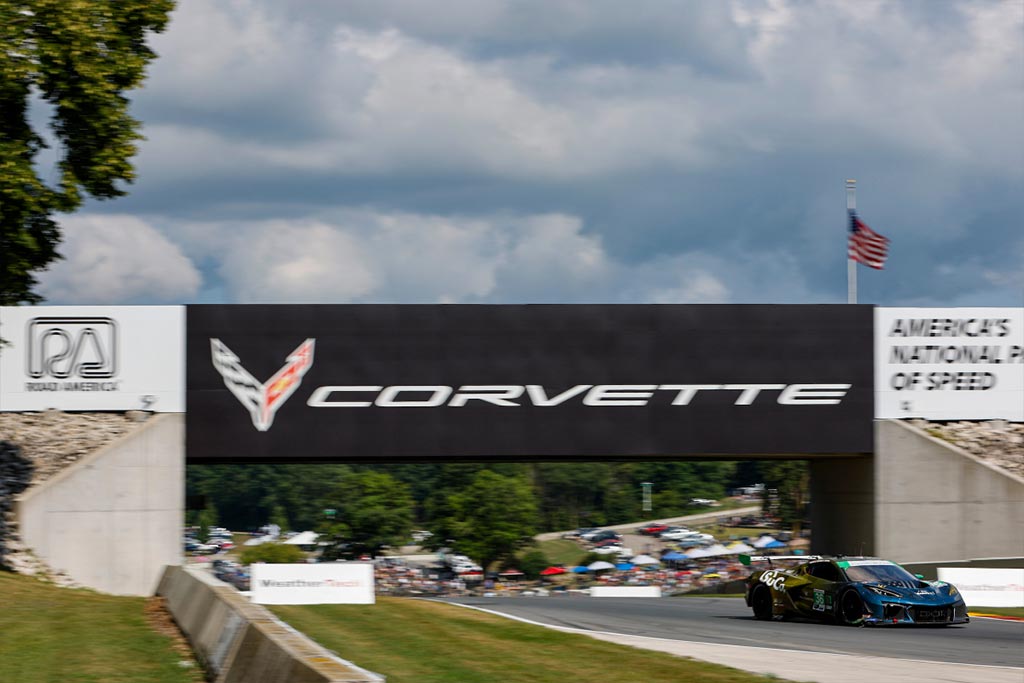
DXDT Racing’s No. 36 Corvette races beneath Road America’s Corvette bridge, one of the circuit’s most recognizable visual landmarks. The entry showed considerable promise with Mason Filippi, Robert Wickens, and Charlie Eastwood, but late contact spun Eastwood from seventh and dropped the Corvette to 14th in GTD. (Image credit: Corvette Racing)
For the No. 4 team, the podium carried consequences extending well beyond the trophy. Milner and Catsburg entered Road America 108 points behind GTD PRO championship leaders Connor De Phillippi and Neil Verhagen. After the Paul Miller Racing BMW finished 11th, the Corvette pairing left Wisconsin only 15 points from the lead. Chevrolet also increased its advantage in the GTD PRO Manufacturers Championship to 105 points with three races remaining.
Corvette Racing has won its class eight times at Road America, but Sunday’s third-place finish was not built upon dominance. It came from restraint, consistency, rapid work in the pit lane, and the ability to remain intact through six hours of increasingly aggressive racing. The No. 4 Corvette did not leave Elkhart Lake with the victory, but it departed with something nearly as valuable: a clean race car, another podium, and a championship fight that had been transformed in a single afternoon.
The battle resumes August 23 at Virginia International Raceway, where Milner, Catsburg, and the No. 4 Corvette will arrive no longer trying to rescue their season, but positioned to take control of it.
CORVETTE Z06 GT3.R POST-RACE DRIVER QUOTES
TOMMY MILNER, NO. 4 CHEVROLET CORVETTE Z06 GT3.R:“A great points today for us. The 77 in front of us was already close to us and is even closer to us now. But we did make some headway on the BMW. That’s racing. Some years nothing goes your way, some years everything goes your way and sometimes it’s up and down. It seems like it’s that way for a lot of cars this year… some ups and downs. You have to make the most of these weekends that are in your favor and take the points when you can get them. I’m a bit disappointed in the general driving standards across the board. The fans deserve a little bit more than that after last year and now in a six-hour race. But I was very happy with our Corvette today. We did everything right with good strategy and good pit stops. No issues today at all, so I’m very proud of the team for that.”
(On the race length) “It’s so cool to do six hours here. It’s the right track for a longer endurance race like this one. The fans here are amazing. I think the number is like 31 percent more fans this year than last year. It is, in my opinion, the best IMSA racing track we go to all year long. Some events may be a little better and some tracks are more exciting in some ways. But when you think about multi-class racing, Road America is the best. You’ve got big, long brake zones, nice high-speed sections. This is a staple of sports car racing and should be for a long time.”
NICKY CATSBURG, NO. 4 CHEVROLET CORVETTE Z06 GT3.R:“I think we got unlucky with one of the yellows late because otherwise I think we would have finished P2 or in the fight for P1. But that’s just the way IMSA is sometimes. It can be a little bit of a lottery. But the main thing is that our pitlane work was amazing. The guys did great today. The car is like new! Tommy didn’t touch anyone! It’s a very good day for us and a good points haul. This is exactly how we planned to do it. We didn’t want to take big risks. It’s a bit of an eye-opener today, the way you can get results in IMSA, as well. I’m really happy and pleased with the crew work. All our stops were on it. We do need to look at some stuff to improve. It seems some of the others are able to save a lot of fuel and beat us in the pitlane. We’ll figure that out, and it’s been a great day today.”
ALEXANDER SIMS, NO. 3 CHEVROLET CORVETTE Z06 GT3.R:“There were a lot of cars and not a lot of space. All through Turn One, it was very congested and we got through there OK. It felt even more congested going into Three. I knew I had a Porsche on the inside of me, and then I was right behind the 65. He was holding mid-track and so I braked to the outside and in hindsight that was the wrong thing to do. It was a bit messy. I also don’t sit here and think I wasn’t smart for doing it. I took a risk and it didn’t pay off this time. But I’m very pleased for the 4 car guys. They closed up so much in the points with the BMW’s troubles. It seems like we had a long list of issues in this race with refueling, with radio and whether or not we could have made it into the pitlane with Antonio on a late call. Unfortunately Road America is still a place where I haven’t had a good result. I love it but I need to get a good result here next year.”
CASPER STEVENSON, NO. 81 CHEVROLET CORVETTE Z06 GT3.R:“I’m happy with the result even though we were close to the podium. We were in the mix all day, which was a great feeling. I feel we got a bit unlucky with so many people taking gambles that weren’t in the fight and then with all the yellows they were in the fight. We managed to still overcome that.”
ALEC UDELL, NO. 81 CHEVROLET CORVETTE Z06 GT3.R:“The key in IMSA is always track position. Casper did a great job in qualifying to put the car toward the front. Being there and being able to fight there, you can control the race a lot better. There was some pit stop strategy there at the end, but the team called a great race and we were on the right strategy all the way through. We had great stops each time and a really good car. Giacomo had a couple of really awesome restarts to put us back in the fight with a couple of cars that took a gamble on strategy. That’s how it is. Sometimes you get lucky. We played a very clean-cut race and I’m really happy for the performance of the DragonSpeed guys. I know they’ve been pushing hard for this kind of result all year.”
MATT BELL, NO. 13 CHEVROLET CORVETTE Z06 GT3.R:“There were some positives to take away from today. We won the Akin award and retook the lead in the championship, which is our primary objective to get back to Le Mans. But there was a much better result on the table for us today. The crew did an amazing job. Lars had a fantastic stint and Orey did a great job to get us to third with two hours. Then there was IMSA carnage again on a restart. I got contact from the rear that put me into someone on the front which dropped me from third to last. I think we had the win in the cards today. 13 Autosport gave me the best GTD car today. The Corvette was on fire all weekend. It’s a result that’s gotten away. That’s bittersweet but happy to walk away with the Akin lead.”
ROBERT WICKENS, NO. 36 CHEVROLET CORVETTE Z06 GT3.R: “The team has done an amazing job. Just to get the hand controls into the car for this weekend was a huge undertaking. My first stint was not my best product, per se. But in the second stint I was much happier with the car. The team made a setup change on the pitstop, which was amazing they could do that in the race. It really transformed the car for my second stint and I made up four or five spots so that was fun going door-to-door and racing hard out there. We were struggling a lot for rear grip, kind of entry to middle and exit of the corner. We made a change to the front end of the car and that helped a lot.”
Road America’s new six-hour IMSA enduro delivered everything its expanded format promised: speed, strategy, attrition, and late-race chaos. Through it all, Corvette Racing’s No. 4 Z06 GT3.R survived intact, returned to the GTD PRO podium, and transformed a widening championship deficit into a genuine title fight for the closing rounds.
There are Corvette model years that feel like a launch, and there are model years that feel like a landing. The 2022 Corvette was the latter—the point at which the C8 stopped being viewed primarily as the radical new mid-engine Corvette and began establishing itself as the Corvette’s new normal.
That change marked an important turning point. When Chevrolet unveiled the eighth-generation Corvette in July 2019, nearly every conversation about the car began and ended with the location of its engine. After more than six decades of front-engine production, the Corvette had adopted the basic architecture associated with Ferrari, Lamborghini, McLaren, and the world’s most sophisticated racing machinery. It was a transformation so fundamental that the early C8 was often discussed more as an idea than as an automobile.
By 2022, however, the big idea had already been proven. The mid-engine layout worked. The cabin was no longer regarded as an experiment. The eight-speed dual-clutch transmission had demonstrated that it was not merely a concession to modernity but one of the car’s defining strengths. Owners had accumulated real miles, dealers had learned the product, and buyers were no longer asking whether Chevrolet could build a credible mid-engine Corvette. They were deciding which version they wanted.
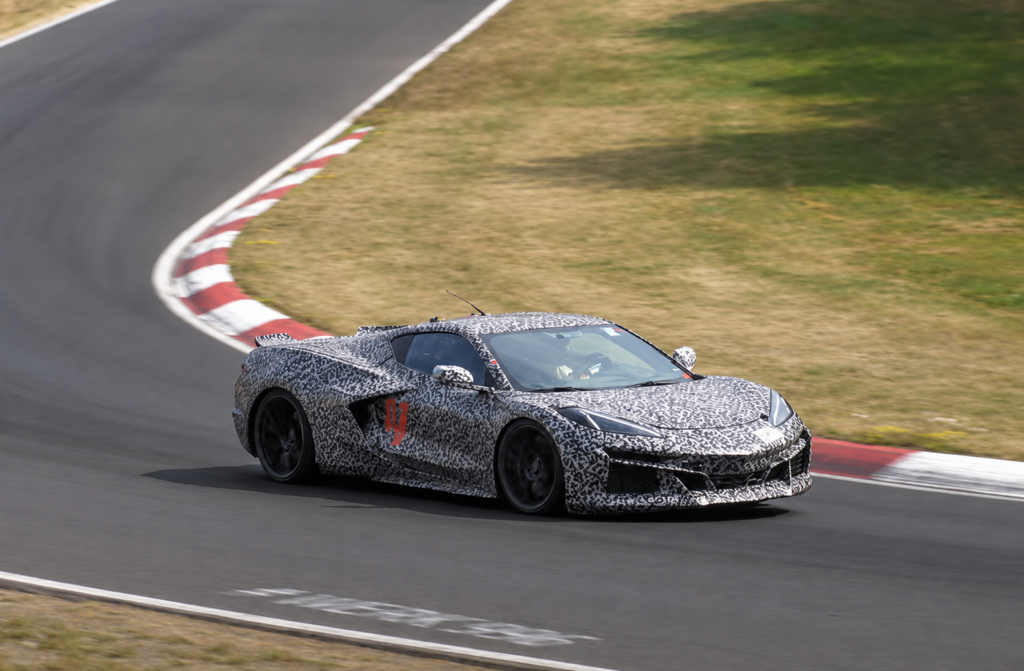
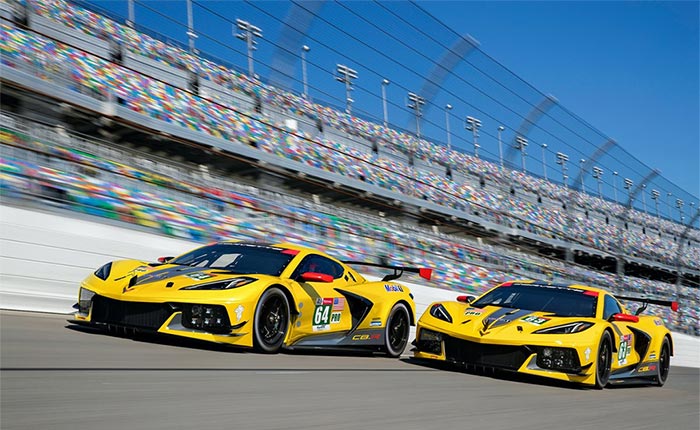
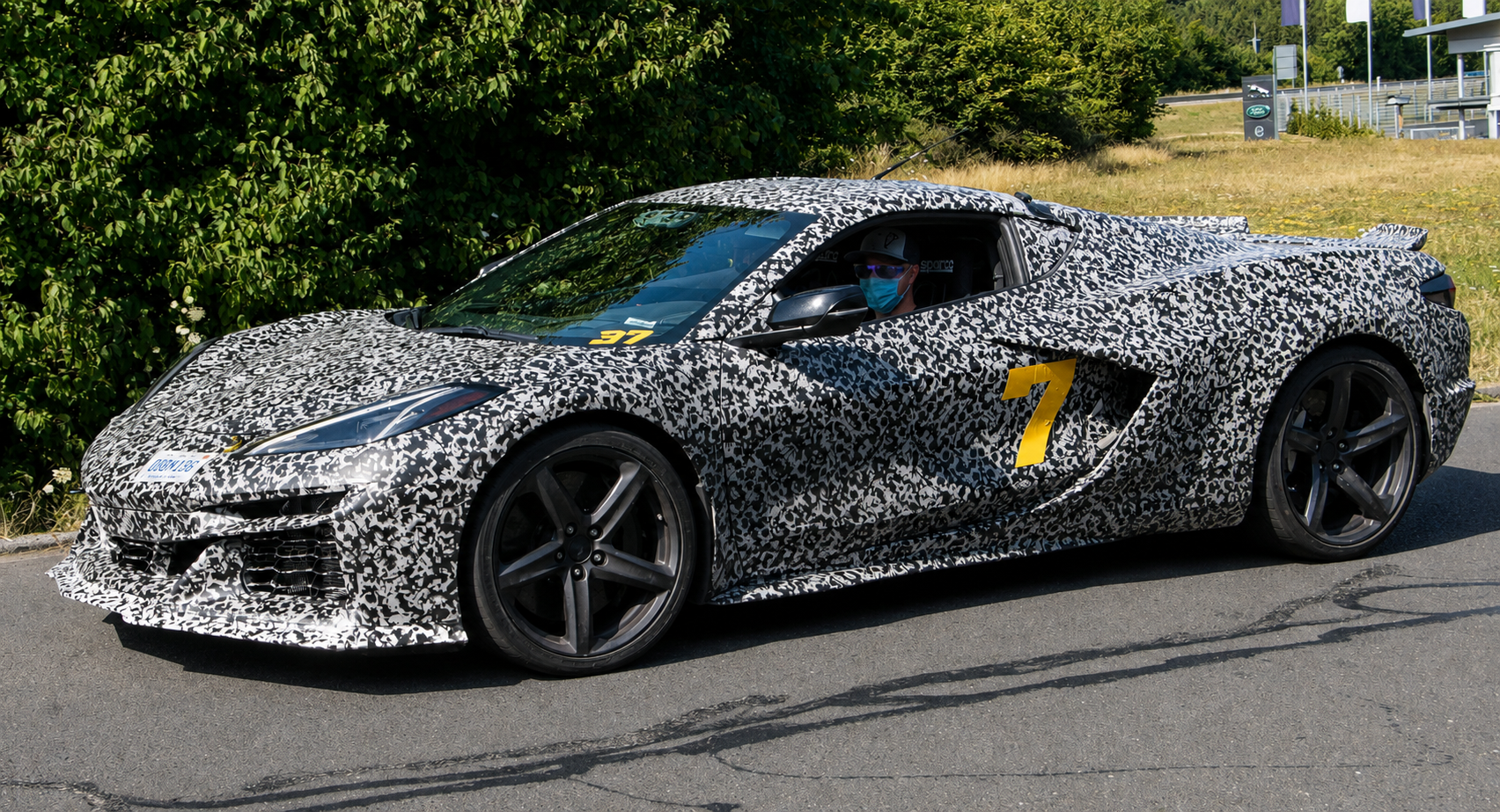
Viewed from left to right, these images capture the expanding scope of the Corvette program during calendar-year 2022. Throughout the year, camouflaged E-Ray prototypes underwent development and validation testing, quietly previewing the first electrified, all-wheel-drive Corvette. In September 2022, production of the 670-horsepower C8 Z06 began for the 2023 model year, opening the next high-performance chapter of the mid-engine era. Across that same racing season, the C8.R competed through a demanding period of transition in both IMSA and the FIA World Endurance Championship. Together, these developments demonstrate why the 2022 Corvette story extended far beyond the Stingray alone—a broader history we will explore throughout this overview.
At the same time, the 2022 Corvette story extended well beyond the Stingray carrying a 2022 vehicle identification number. Calendar year 2022 became one of the most consequential periods in the C8’s development. Chevrolet was preparing the 670-horsepower Z06 for production, engineers were validating the Corvette variant that would become the first all-wheel-drive and electrified Corvette, and Corvette Racing was taking the C8.R into a new international campaign shaped by changing regulations and increasingly global ambitions.
In other words, two Corvette stories were unfolding simultaneously. The 2022 Corvette Stingray represented the maturation of the original C8 formula, while the Z06, E-Ray, and racing program revealed just how much performance potential Chevrolet had built into the platform from the beginning.
Taken together, they made 2022 the year the C8 Corvette stopped being a single revolutionary model and began becoming a complete family of cars.
The Long Road to a Mid-Engine Corvette
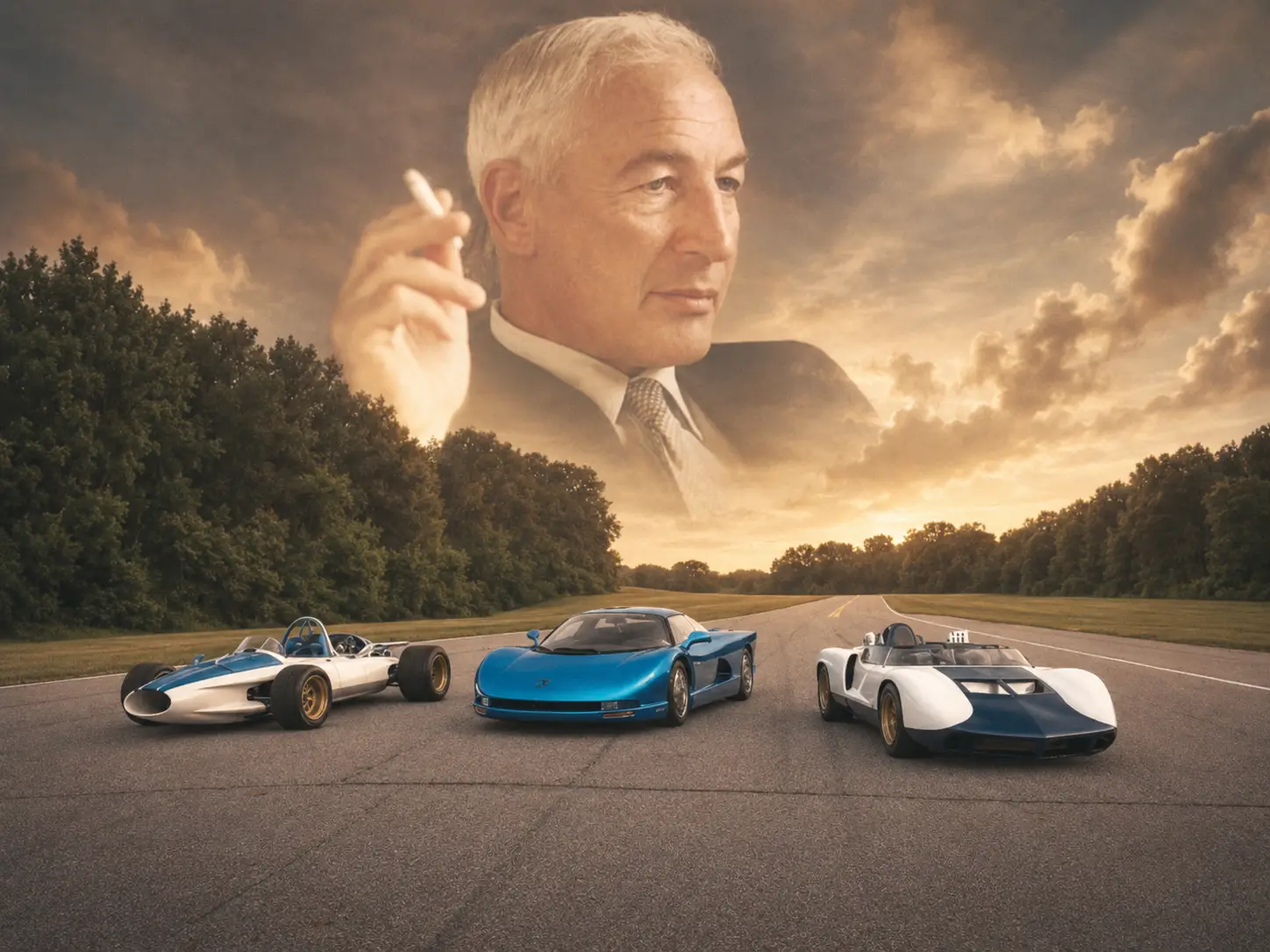
Seen together, the CERV I, CERV II, and CERV III trace the decades-long evolution of Chevrolet’s mid-engine ambitions. That pursuit began with Zora Arkus-Duntov, whose experimental CERV program explored the balance, traction, aerodynamics, and racing potential of placing the engine behind the driver. Although production reality remained decades away, each successive car carried his vision forward, gradually closing the distance between engineering experiment and road-going Corvette. The C8 did not invent the mid-engine Corvette—it fulfilled the future Duntov had begun pursuing generations earlier.
The Corvette’s move to a mid-engine configuration was not a sudden attempt to imitate European exotics. It was the result of an engineering argument that had been unfolding inside General Motors for generations.
Zora Arkus-Duntov, the engineer whose influence helped transform the early Corvette from a stylish boulevard cruiser into a legitimate performance car, recognized the advantages of placing the engine behind the driver decades before the C8 entered production. Through experimental vehicles such as the Chevrolet Engineering Research Vehicles—better known as the CERV I and CERV II—Duntov and his colleagues explored the traction, balance, packaging, and aerodynamic possibilities offered by a mid-engine platform.
Those vehicles were never direct production proposals in the conventional sense. They were laboratories—machines built to answer questions about chassis configuration, suspension geometry, cooling, weight distribution, and the future of high-performance automobiles. Later concepts, including the rotary-powered XP-882 and the technologically ambitious CERV III, kept the idea alive even as Chevrolet continued developing increasingly capable front-engine production Corvettes.
The resistance to a mid-engine Corvette was never simply a matter of engineering conservatism. Chevrolet had to protect the qualities that made the Corvette successful in the first place. The car needed to remain fast but also be usable. It needed enough luggage space for a road trip, sufficient ground clearance for ordinary streets, and a cabin that could accommodate owners who were not built like professional racing drivers. Most importantly, it needed to deliver world-class performance without abandoning the value proposition that had always set Corvette apart from traditional exotics.
Every generation of Corvette pushed the front-engine layout farther. The C5 introduced a hydroformed frame, rear-mounted transaxle, and dramatically improved chassis structure. The C6 refined that formula, while the C7 brought advanced aerodynamics, direct injection, sophisticated electronic controls, and performance variants capable of competing with almost anything in the world.
Yet the limits were becoming increasingly clear. As power climbed, the front-engine Corvette’s ability to put that power to the pavement became one of the platform’s defining constraints. Adding more horsepower was comparatively easy. Using it effectively—particularly from a standing start and during corner exit—was becoming more difficult.
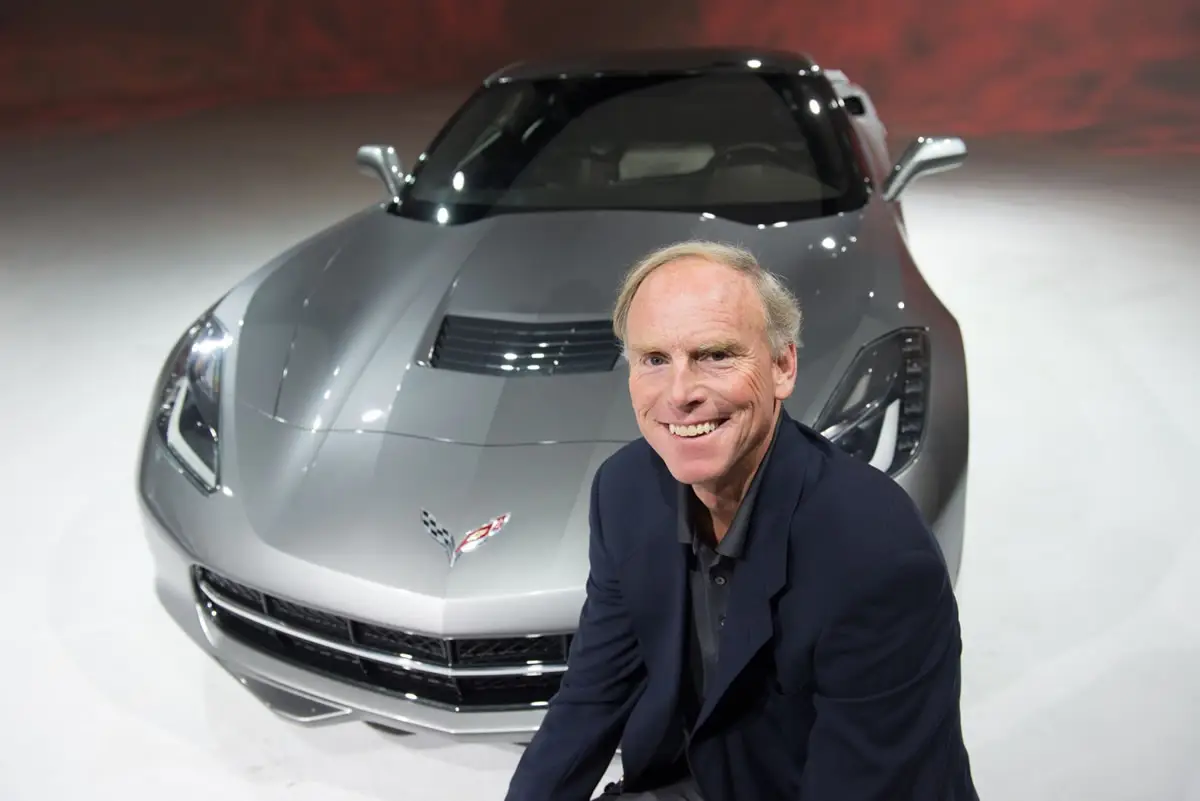
Tadge Juechter joined the Corvette program in 1993, became assistant chief engineer in 1999, and ultimately assumed leadership as the car’s executive chief engineer in 2006. Over the decades that followed, he helped guide Corvette through the C6 and C7 generations before overseeing its most transformative evolution: the development of the mid-engine C8. Working with a deeply experienced engineering team, Juechter turned the architecture long envisioned by Zora Arkus-Duntov into a practical, attainable production Corvette—an achievement that now stands as the defining legacy of his remarkable career. (Image credit: GM)
Tadge Juechter understood that challenge better than almost anyone. Juechter joined the Corvette program in 1993, became its assistant chief engineer in 1999, and was appointed executive chief engineer in 2006. During his tenure, he helped oversee the maturation of the C6, the development of the C7, and ultimately the most dramatic architectural change in Corvette history.
Under Juechter’s leadership, the mid-engine Corvette was not developed merely to produce exotic proportions or an attention-grabbing launch. The architecture was intended to give the program room to grow. By moving the engine behind the passenger compartment, Chevrolet improved rear-wheel traction, centralized the car’s mass, and opened new possibilities for aerodynamics, cooling, suspension design, and future powertrains.
Just as important, the team preserved the car’s everyday usefulness. The C8 retained front and rear luggage compartments offering a combined 12.6 cubic feet of cargo capacity. The coupe kept a removable roof panel that could be stored in the rear compartment, while the convertible gained a fully retractable hardtop that did not consume the primary luggage space. The driver still sat in a comfortable, climate-controlled cabin rather than an uncompromising racing cell.
That balance was the C8’s real achievement. Chevrolet had not merely built an inexpensive alternative to a European supercar. It had created a mid-engine automobile that still behaved like a Corvette: powerful, approachable, practical enough to use, and attainable enough to be driven rather than hidden.
The 2020 Stingray introduced that formula. The shortened 2020 production run and the industry-wide upheaval that followed prevented the first two C8 model years from ever settling into anything resembling normal production. By 2022, however, the engineering foundation was established, customers understood the car, and Chevrolet could begin refining the details rather than defending the decision to move the engine.
Launching the 2022 Corvette Stingray
Chevrolet introduced the 2022 Corvette Stingray on June 9, 2021, against the unmistakable backdrop of Detroit’s Belle Isle circuit. The presentation brought the production Stingray together with the C8.R and the newly announced IMSA GTLM Championship Edition, visually reinforcing the growing connection between Corvette’s road and racing programs. More than a routine model-year unveiling, the event celebrated the C8’s successful transition to mid-engine performance while previewing the colors, equipment, and racing-inspired identity that would define the 2022 lineup. (Image credit: GM)
Chevrolet introduced the 2022 Corvette Stingray on June 9, 2021, during the week of the Detroit Grand Prix on Belle Isle. The setting was intentional. Instead of treating the new model year as a routine collection of colors and option changes, Chevrolet connected it directly to the C8.R and Corvette Racing’s championship-winning first season with the mid-engine race car.
The centerpiece was the 2022 Corvette Stingray IMSA GTLM Championship Edition. Chevrolet initially announced plans to build 1,000 left-hand-drive examples, although final production records show that 1,007 cars received the package. It was available on 3LT coupes and convertibles equipped with the Z51 Performance Package and was offered in two race-inspired configurations: Accelerate Yellow with gray graphics, reflecting the No. 3 C8.R, or Hypersonic Gray with yellow accents, reflecting the No. 4 car.
The package included a high-wing rear spoiler, Carbon Flash exterior mirrors, black rocker extensions, yellow brake calipers, black Trident-design wheels, Jake-logo center caps, and Corvette Racing graphics. Inside, the cars received a Strike Yellow and Sky Cool Gray color combination, GT2 seats, yellow seat belts, and a numbered plaque. Chevrolet priced the Championship Edition package at $6,595, making it more than just a simple decal package yet still accessible to dedicated Corvette Racing enthusiasts.
The 2022 IMSA GTLM Championship Edition placed Corvette’s production and competition identities side by side, pairing race-inspired Stingrays with the championship-winning C8.R machines that inspired them. The connection extended beyond shared colors, graphics, and aerodynamic attitude: both cars emerged from the same mid-engine architecture and a development culture in which road-car engineering and motorsports continually informed one another. Together, they demonstrated that Corvette Racing was not merely a marketing exercise—it remained an essential proving ground for the technology, durability, and performance character carried into every production Corvette.
The special edition also served as a snapshot of the relationship between Corvette’s production and racing programs. Laura Klauser, General Motors’ sports car racing program manager, and her team were overseeing the C8.R’s transition into an evolving global racing environment. The Championship Edition gave street-car buyers a tangible connection to that effort at a moment when the production Corvette and its racing counterpart shared more visual and architectural DNA than at any previous point in the nameplate’s history.
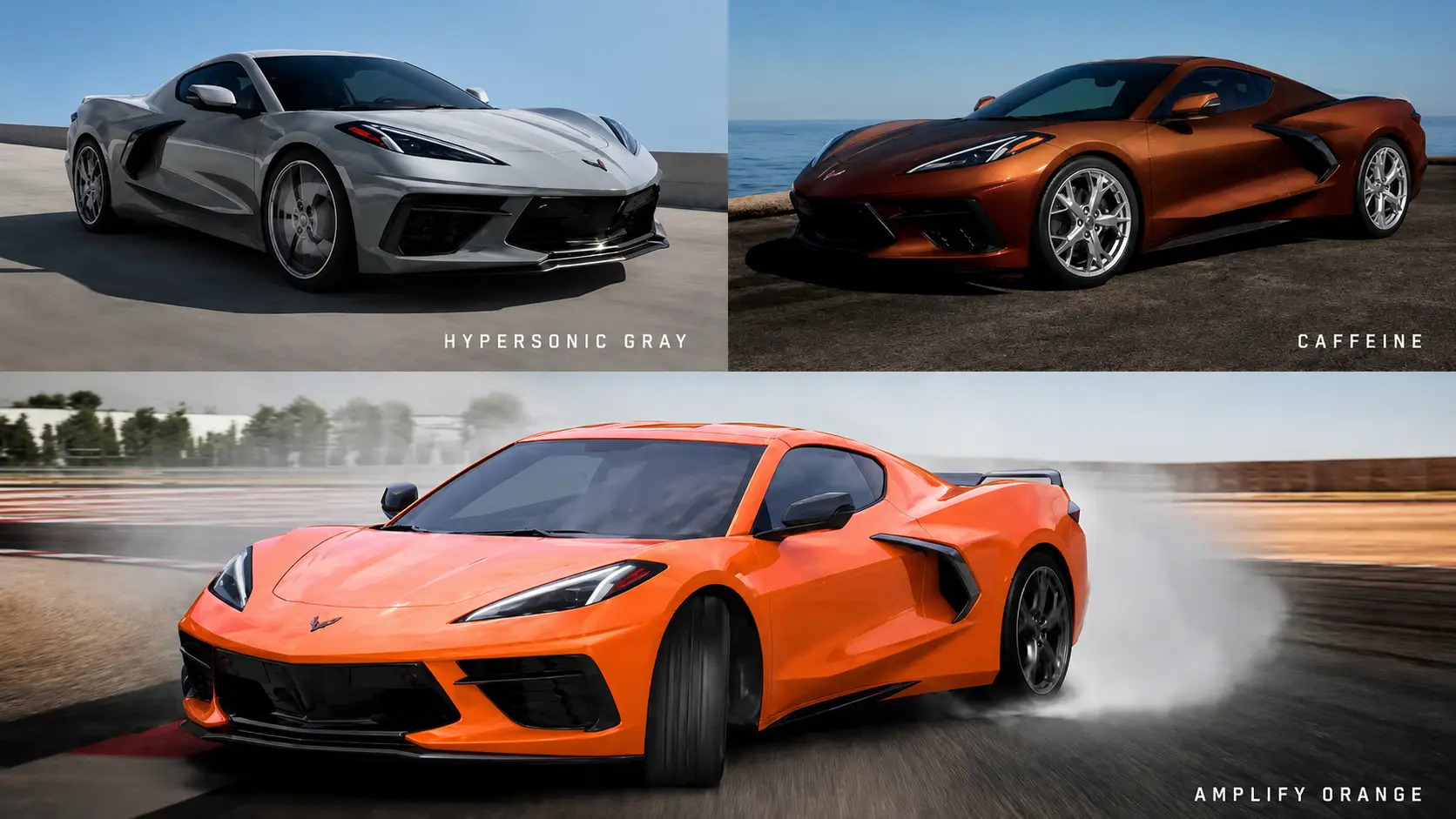
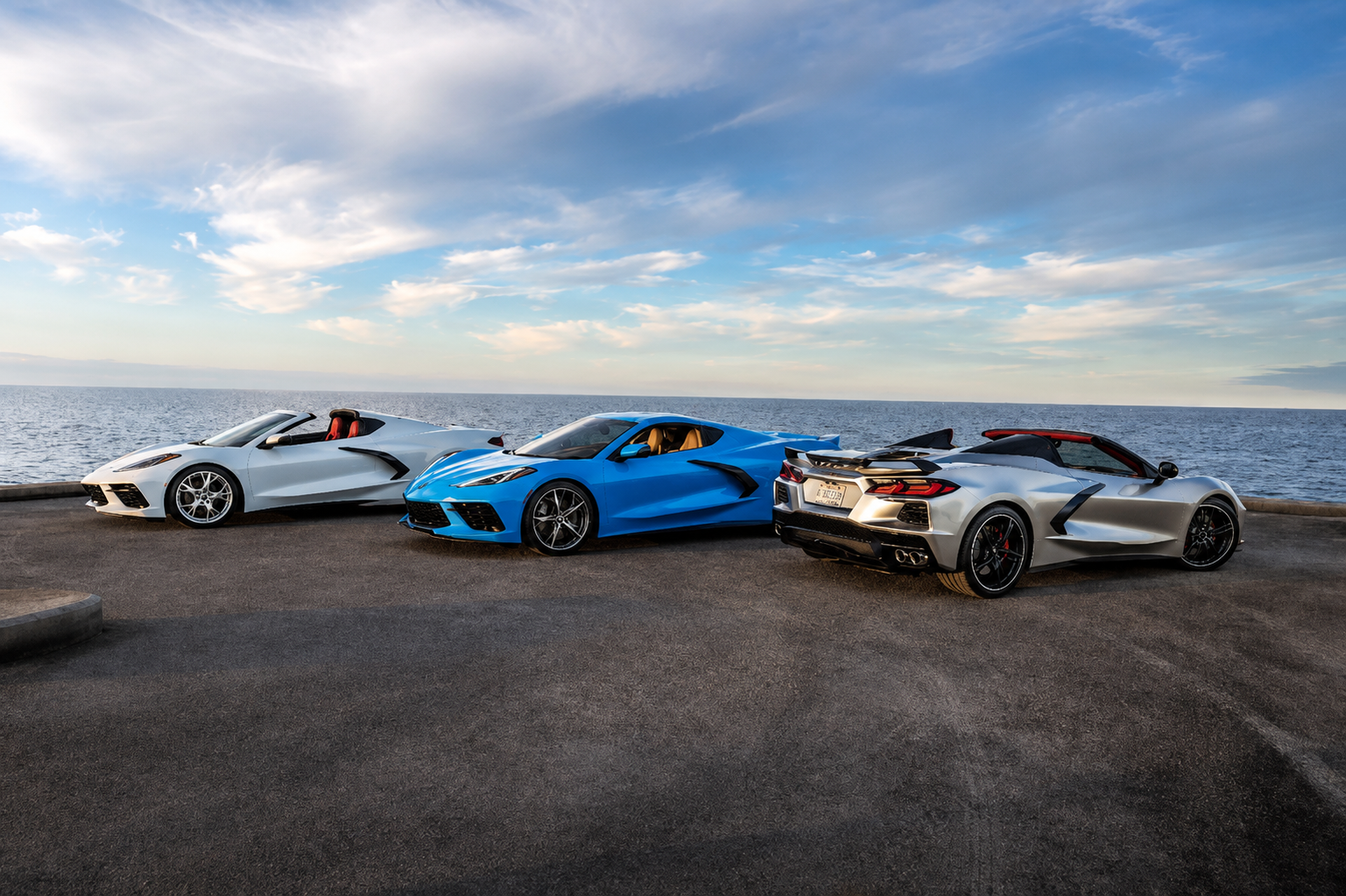
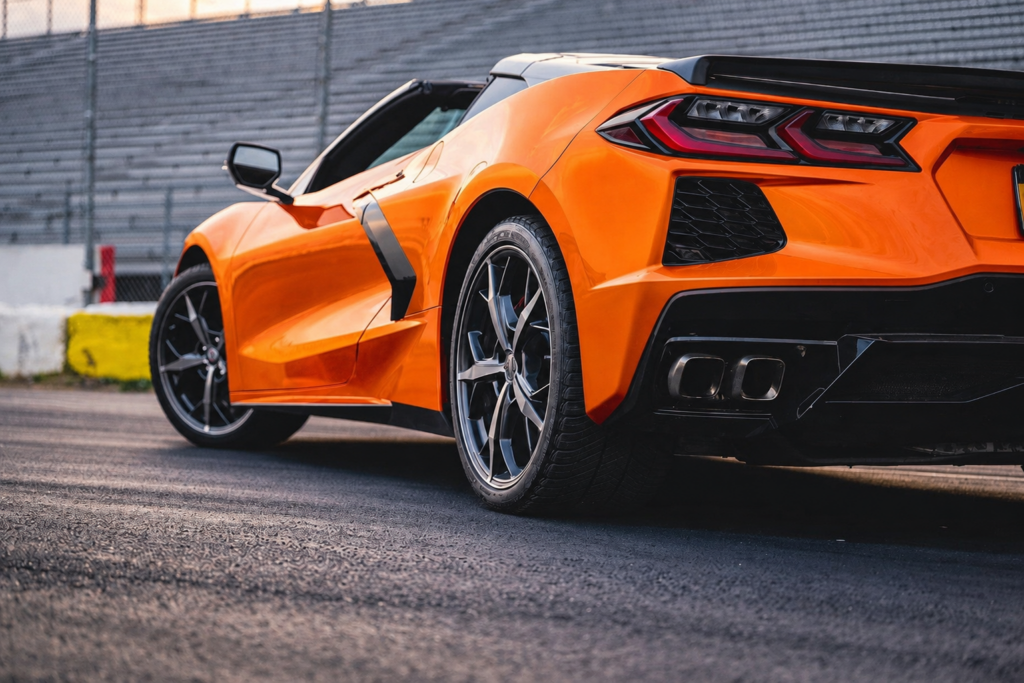
Chevrolet expanded the 2022 Corvette Stingray palette with three distinctive new finishes: Hypersonic Gray Metallic, Caffeine Metallic, and Amplify Orange Tintcoat. Ranging from understated and technical to rich and unconventional—or unapologetically bold—the new colors demonstrated how dramatically paint could reshape the character of the C8’s angular, mid-engine design.
Beyond the Championship Edition, the 2022 Stingray received three significant new exterior colors. Hypersonic Gray Metallic replaced Shadow Gray, Amplify Orange Tintcoat succeeded Sebring Orange, and Caffeine Metallic introduced an unusually rich bronze-brown tone to the C8 palette. The complete color range also included Black, Arctic White, Ceramic Matrix Gray Metallic, Silver Flare Metallic, Torch Red, Red Mist Metallic Tintcoat, Rapid Blue, Elkhart Lake Blue Metallic, and Accelerate Yellow Metallic.
These additions were more consequential than paint changes sometimes appear. The C8’s body is highly sensitive to color. Its deep side intakes, sharply defined fenders, horizontal body lines, and contrasting aerodynamic elements can make the same basic design appear elegant, technical, aggressive, or almost theatrical. Hypersonic Gray emphasized the car’s architecture. Amplify Orange highlighted its exotic proportions. Caffeine Metallic offered something more understated and mature.
The complete 2022 Corvette Stingray exterior color palette, with factory paint codes. (Image courtesy of the author)
Chevrolet also made the low-profile rear spoiler and front splitter associated with the Z51 appearance available on non-Z51 Stingrays. That decision gave buyers greater freedom to separate the car’s appearance from its mechanical configuration. An owner who wanted the visual attitude of the aero components without the complete track-oriented package could now order the car accordingly.
Pricing began at $62,195 for the coupe and $69,695 for the retractable-hardtop convertible, including destination charges. Chevrolet opened the initial order process on July 1, 2021, with model-year production scheduled to begin during the third quarter. Although the advertised base price had risen from the C8’s original sub-$60,000 launch figure, the Stingray remained an extraordinary proposition: a 490-horsepower mid-engine sports car with a sophisticated dual-clutch transmission and supercar-level acceleration for considerably less than almost any direct competitor.
Refinement Without Reinvention
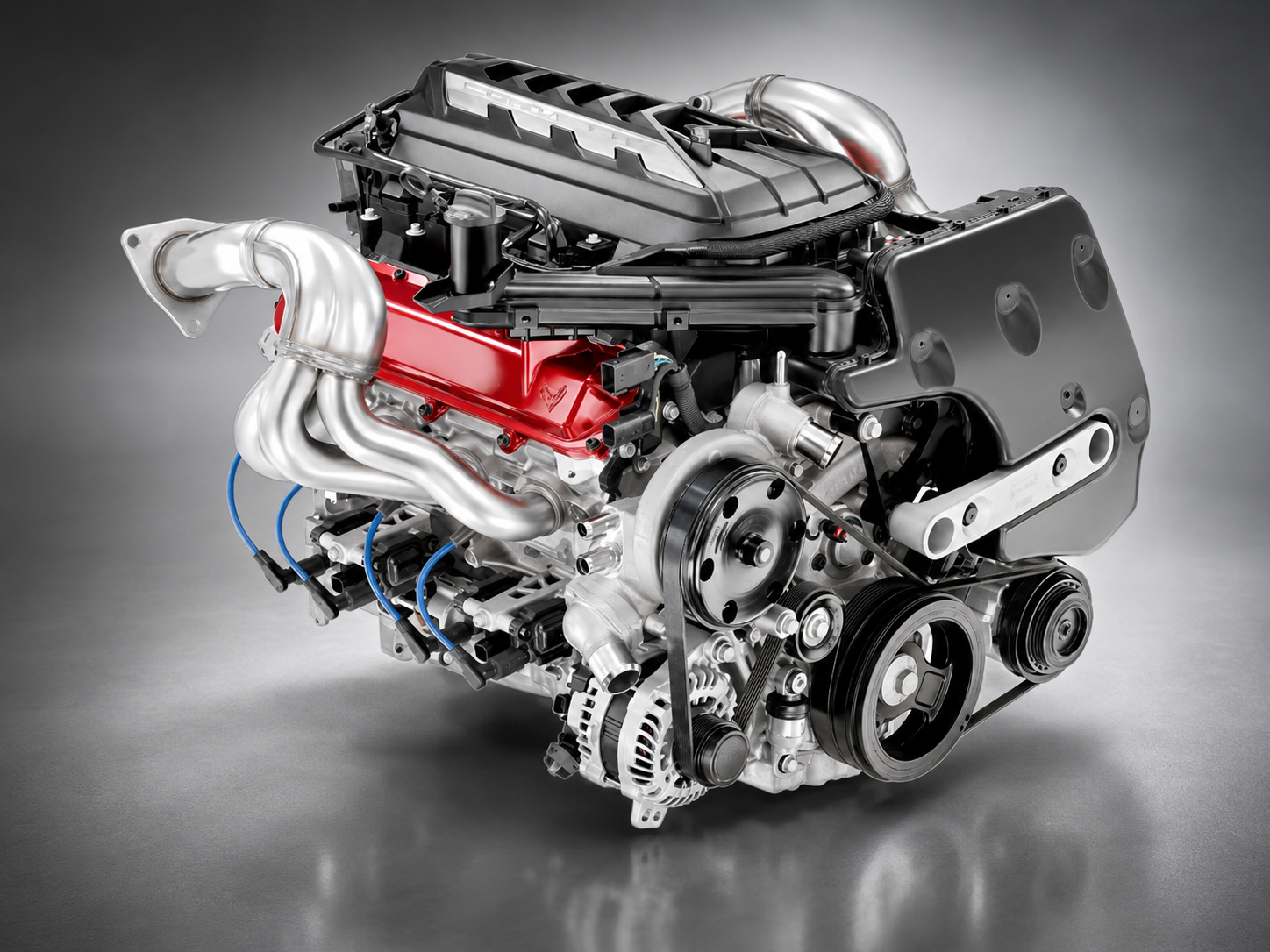
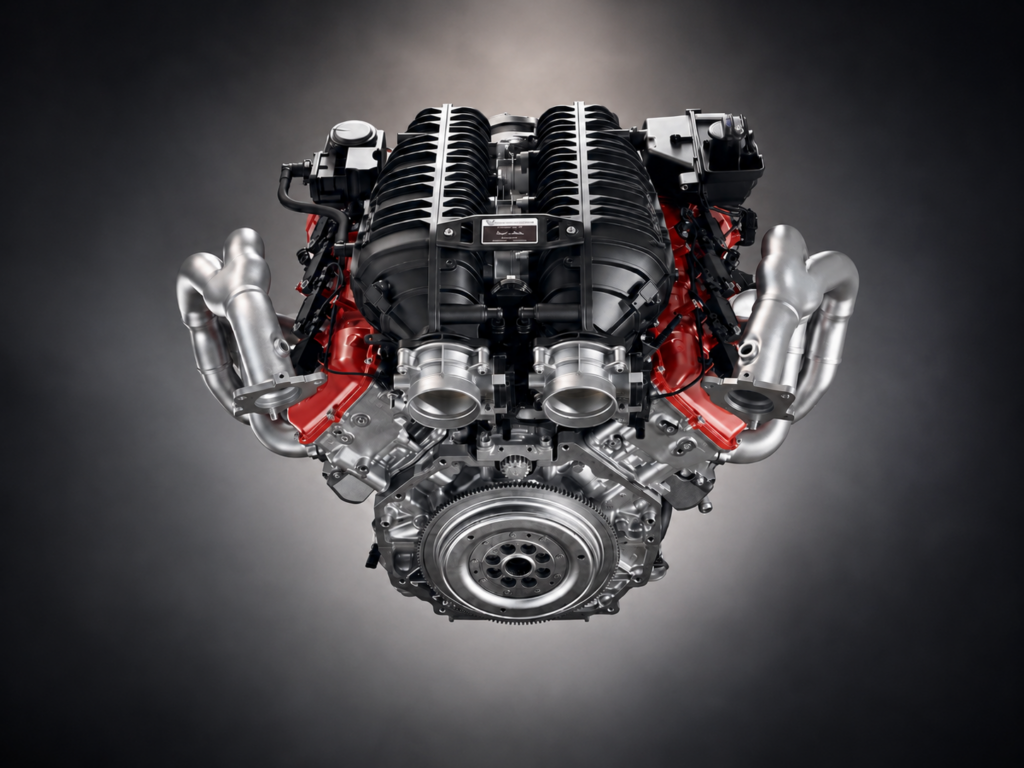
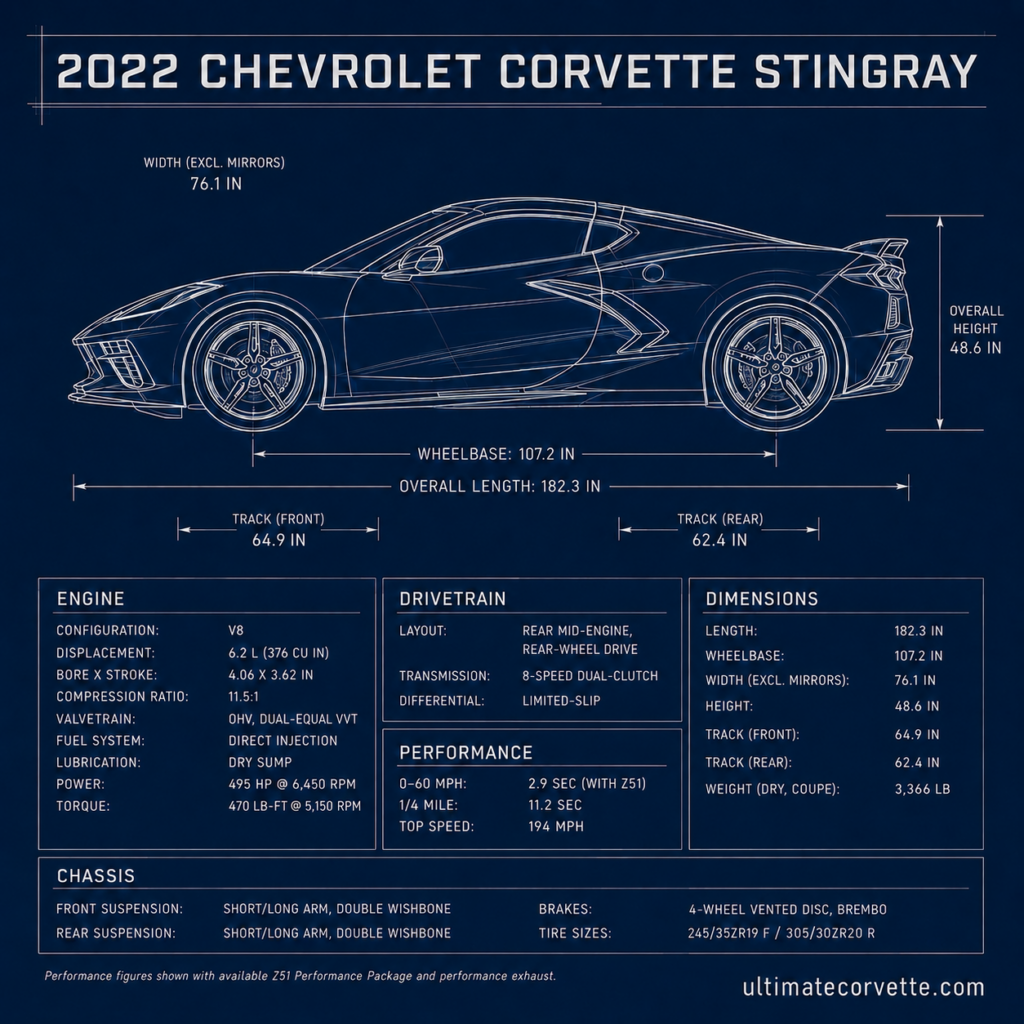
The 2022 Corvette Stingray continued to rely on the naturally aspirated 6.2-liter LT2 V8, producing 490 horsepower in standard form and 495 horsepower with the available performance exhaust. For the new model year, Chevrolet revised the direct-injection system, updated the engine calibration, and expanded the operating range of Active Fuel Management to improve emissions performance, efficiency, and overall refinement. The result was not a more powerful engine, but a more polished version of the C8’s defining mechanical centerpiece—one that preserved the immediate response, broad torque, and unmistakable character of a traditional Corvette V8.
The 2022 Stingray did not receive a headline-grabbing power increase, and it did not need one. Its naturally aspirated 6.2-liter LT2 V8 continued to produce 490 horsepower and 465 lb-ft of torque with the standard exhaust. Cars equipped with the NPP performance exhaust were rated at 495 horsepower and 470 lb-ft.
For 2022, Chevrolet revised the direct-injection fuel system, recalibrated the engine, and expanded the operating range of Active Fuel Management. The changes were primarily intended to improve emissions performance, idle quality, and efficiency without reducing output or changing the character of the engine.
That character remained central to the Stingray’s appeal. The LT2 was derived from Chevrolet’s long-running small-block V8 architecture, but its installation in the C8 required extensive changes. Mounted behind the passenger compartment, the engine used a low-profile intake arrangement, dry-sump lubrication, and cooling systems designed around the demands of the new layout. The result was an engine that delivered immediate throttle response and a broad wave of torque without relying on turbochargers to generate its performance.
The LT2 also preserved an important connection to Corvette history. At a time when many competing performance cars were moving toward smaller turbocharged engines, the Stingray retained the sound, response, and mechanical directness of a large-displacement naturally aspirated V8. It was modern in its management systems and packaging, but familiar in the way it built power.
The 2022 Corvette Stingray’s M1L eight-speed dual-clutch transmission was developed around the C8’s mid-engine architecture, combining near-instant gear changes with the smooth operation required for everyday driving. Using separate wet clutches for odd- and even-numbered gears, the Tremec-built transaxle could preselect the next ratio before the shift occurred, minimizing interruption in power delivery. More than an alternative to a traditional manual, the M1L was a central part of the C8’s acceleration, balance, and modern supercar character.
All 2022 Stingrays used the M1L eight-speed dual-clutch transmission. Developed with Tremec for the C8’s rear transaxle configuration, the transmission employed two clutches to preselect the next gear, allowing shifts to occur with almost no interruption in power delivery. In automatic operation, it could behave smoothly enough for traffic and long-distance travel. In manual mode, steering-wheel-mounted paddles gave the driver direct control with shift speeds no conventional manual gearbox could match.
The absence of a manual transmission remained controversial among traditionalists, but the dual-clutch unit was fundamental to what the C8 had become. It contributed to the car’s acceleration, allowed the engine to remain within its most effective operating range, and gave the control systems much greater authority over traction and vehicle dynamics. Rather than treating the transmission as a substitute for something the Corvette had lost, the engineering team treated it as an enabler of the new platform.
With the Z51 Performance Package, Chevrolet claimed a 0–60 mph time of 2.9 seconds. That number placed the Stingray in territory once reserved for all-wheel-drive exotics and extremely specialized performance machines. More important, the acceleration was repeatable and accessible. The driver did not need to manage wheelspin through delicate throttle modulation or execute a perfect manual launch. The engine, transmission, electronic differential, tires, and launch-control strategy worked as a coordinated system.
One Performance Foundation, Three Trim Levels
Chevrolet offered the 2022 Stingray in 1LT, 2LT, and 3LT trim levels, each available as a coupe or convertible. The trims did not represent different engine outputs or fundamentally different versions of the car. Instead, they allowed buyers to choose how much technology, comfort, and interior finish they wanted, all around the same basic performance architecture.
The 1LT interior preserved the C8’s essential driver-focused architecture, including its digital instrument cluster, central touchscreen, leather seating, and distinctive cockpit divider, while leaving several premium convenience features to the 2LT and 3LT trims. Most visibly, there are no head-up-display controls beside the steering wheel because the 1LT was not equipped with a HUD. It also did without the Performance Data Recorder, connected navigation, heated and ventilated seats, heated steering wheel, driver-memory settings, and several enhanced camera and driver-awareness systems. The result was a cleaner, more straightforward cabin for buyers who wanted the complete Stingray driving experience without paying for equipment they might not use.
The 1LT remained the most direct path into the C8. It included the LT2 engine, dual-clutch transmission, digital instrument display, Chevrolet infotainment system, removable roof panel on the coupe, and the essential chassis and structural content that defined every Stingray. For an owner primarily interested in the driving experience—or one who intended to direct the budget toward Z51 hardware and exterior options—the 1LT was anything but a stripped car.
The 2LT retained the same LT2 V8, dual-clutch transmission, chassis, and standard GT1 seating found in the 1LT, but added a substantial layer of comfort, technology, and driver awareness. Its equipment included a color head-up display, connected navigation, Performance Data Recorder, 14-speaker Bose audio system, Rear Camera Mirror, and HD front and rear cameras. Heated and ventilated seats with power lumbar and bolster adjustment, a heated steering wheel, driver and passenger memory settings, wireless phone charging, power-folding mirrors, Side Blind Zone Alert, and Rear Cross Traffic Alert made the 2LT especially well suited to owners who intended to drive their Corvette regularly. It was not a faster Stingray than the 1LT—it was a more comprehensively equipped one.
The 2LT added the equipment that made the Corvette easier to use as an everyday automobile. Features such as the head-up display, Performance Data Recorder, navigation, heated and ventilated seats, upgraded audio system, additional driver-assistance technology, and enhanced visibility equipment addressed the realities of living with a low, wide mid-engine car. This was the trim that made the Corvette feel less like an occasional indulgence and more like a genuine grand tourer.
The 3LT package included every comfort, technology, and driver-awareness feature found in the 2LT, then elevated the cabin through materials and craftsmanship rather than additional performance hardware. Standard GT2 seats brought genuine Napa leather, carbon-fiber trim, and a more sculpted appearance, while the custom interior package wrapped the upper instrument panel, doors, and center console in leather and added sueded-microfiber trim overhead. It also opened the door to the C8’s most expressive interior color combinations, including the blue-and-black treatment shown here. Like the 2LT, the 3LT was no faster than the 1LT—but it presented the Stingray as a more convincingly premium, exotic-caliber automobile.
The 3LT retained the 2LT’s technology while substantially upgrading the cabin materials. Additional leather wrapping and richer surface treatments gave the cockpit a more handcrafted appearance. Because the C8 interior surrounds the driver with a tall center console, sweeping instrument panel, and prominent structural forms, those material changes had a greater visual effect than they might in a more conventional cabin.
The seat choices provided another layer of personalization. GT1 seats emphasized comfort and accessibility. GT2 seats added more pronounced bolstering and premium construction without becoming difficult to live with. Competition Sport seats provided the greatest lateral support for track use and aggressive driving. As with the trim levels, the choice was less about declaring one seat objectively superior and more about matching the car to the owner’s intended use.
Z51 and the Hardware That Mattered
The Z51 Performance Package transformed the 2022 Stingray from an already formidable road car into a more track-capable and repeatable performance machine. It added FE3 performance suspension, an electronic limited-slip differential, a shorter 5.17:1 final-drive ratio, larger Brembo brakes, heavy-duty cooling, Michelin Pilot Sport 4S summer tires, and the NPP dual-mode exhaust—which raised LT2 output to 495 horsepower and 470 lb-ft of torque. A functional front splitter and rear spoiler completed the package, improving high-speed stability while giving the car a more purposeful appearance. Magnetic Ride Control was not included with Z51, but remained available as a separate option for owners seeking adaptive damping alongside the package’s performance hardware. (Image credit: GM)
The Z51 Performance Package was the most important mechanical option available on the Stingray. It added performance-oriented suspension tuning, larger Brembo brakes, an electronic limited-slip differential, a shorter performance rear-axle ratio, enhanced cooling, Michelin Pilot Sport 4S summer tires, the NPP performance exhaust, and functional aerodynamic components.
No single component defined Z51. Its value came from the way the parts worked together.
The Z51 Performance Package gave the 2022 Corvette Stingray a meaningful braking upgrade, pairing larger rotors with four-piston Brembo monobloc calipers at all four corners. The added thermal capacity improved resistance to fade during repeated high-speed stops, giving the car greater consistency and confidence during track sessions, mountain driving, and other sustained performance use. Rather than simply shortening one emergency stop, the Z51 system was engineered to deliver strong, predictable braking lap after lap.
The larger brakes increased thermal capacity during repeated high-speed stops. The additional cooling supported sustained operation under track conditions. The electronic limited-slip differential could actively manage torque distribution across the rear axle, improving stability under braking and helping the car deploy power during corner exit. The summer tires increased dry grip, while the axle ratio and transmission calibration sharpened acceleration.
The package did not turn the Stingray into a Z06, nor was it intended to. What it did was increase repeatability. A standard Stingray was already extremely fast on the street. A Z51-equipped car was better prepared to sustain that performance through a full track session, a demanding mountain drive, or repeated hard use in high temperatures.
Magnetic Selective Ride Control could be ordered with or without Z51, giving buyers the ability to combine adaptive damping with either chassis configuration. The magnetorheological dampers continuously adjusted to road conditions and driving inputs, allowing the car to provide more disciplined body control when driven aggressively without becoming unnecessarily harsh during ordinary use.
The available front lift system addressed a less glamorous but equally real element of supercar ownership. By raising the front of the car to clear steep driveways, ramps, and abrupt transitions, it reduced the anxiety associated with using a low vehicle in the real world. It did not improve a lap time, but it often determined whether an owner felt comfortable driving the car to a particular destination.
That distinction says something important about the C8. Chevrolet understood that usability was not separate from performance. A car that is too delicate, too inconvenient, or too intimidating to drive regularly cannot fully deliver on its capabilities. The 2022 Stingray’s most successful options were often those that helped it perform one moment and integrate into ordinary life the next.
What Buyers Chose—and What Those Choices Revealed
Although the retractable hardtop was introduced with the C8 rather than added for 2022, it played a major role in expanding the convertible’s appeal during the model year. The power-operated roof gave buyers the security, refinement, and coupe-like appearance of a fixed top while preserving open-air driving and the Corvette’s rear cargo capacity. By eliminating many of the traditional compromises associated with a soft-top convertible, Chevrolet transformed the open-roof Stingray from a secondary body style into one of the C8 lineup’s most desirable configurations. (Image credit: GM)
Chevrolet built 25,831 Corvettes for the 2022 model year. Of those, 13,451 were coupes and 12,380 were convertibles, producing a remarkably close 52.1-to-47.9-percent split.
That near-even division between body styles marked a significant shift from earlier generations, when the convertible generally represented a much smaller share of production. The C8 retractable hardtop changed the calculation. It offered open-air driving without the visual or security compromises associated with a traditional fabric roof, and its operation did not eliminate the car’s primary rear luggage compartment. The convertible was no longer a secondary derivative. It had become one of the C8’s core identities.
The trim breakdown was equally revealing. Chevrolet produced 3,982 cars in 1LT form, accounting for 15.4 percent of the model-year total. The 2LT represented 11,060 cars, or 42.8 percent, while the 3LT accounted for 10,789 cars, or 41.8 percent. More than four out of every five buyers, therefore, selected one of the two upper trims.
That was not the behavior of a market interested only in obtaining the least expensive mid-engine car available. Buyers were adding technology, premium materials, upgraded seating, and convenience equipment because they viewed the Stingray as a complete ownership proposition. The C8 was not merely being purchased for a single spectacular acceleration run. Owners expected to travel in it, commute in it, display it, track it, and live with it.
Like the fighter aircraft framed above it, a Z51-equipped 2022 Corvette was engineered to perform repeatedly under demanding conditions—not merely to deliver one dramatic burst of speed. Larger brakes, additional cooling, performance suspension, an electronic limited-slip differential, summer tires, and the shorter final-drive ratio gave the Stingray greater durability, sharper response, and more consistent performance during sustained high-load driving. The result was a Corvette better prepared to withstand the heat, braking forces, and repeated acceleration of track use while remaining fully usable on the road.
The option rates reinforced the same conclusion. Approximately 68.6 percent of 2022 Corvettes received the Z51 Performance Package. The NPP performance exhaust appeared on 86.9 percent, while the front lift system was installed on 58.8 percent. Magnetic Ride Control paired with Z51 appeared on 11,757 cars, representing 45.5 percent of total production. The Performance Data Recorder was installed in 22,167 cars—an extraordinary 85.8-percent take rate for equipment originally conceived as a specialized driver-development and track-analysis tool.
Buyers also showed a strong preference for familiar Corvette colors. Torch Red led production with 4,147 cars, followed by Arctic White with 3,603. Hypersonic Gray, new for 2022, finished close behind with 3,291 examples, demonstrating how quickly the metallic gray connected with buyers. Red Mist Metallic Tintcoat accounted for 3,274 cars, while Black appeared on 2,766. At the opposite end of the spectrum, Caffeine Metallic was selected for only 385 cars, making it the rarest exterior color of the model year.
Most production remained in the United States, where Chevrolet delivered 23,503 of the 25,831 cars. Canada received 1,014, while additional cars were allocated to Mexico, the Middle East, Japan, Europe, Australia, and New Zealand. Chevrolet built 442 right-hand-drive Corvettes, evidence that the C8 was becoming more than an American performance car exported in limited numbers. It was being engineered and distributed as an increasingly global product.
The National Corvette Museum’s R8C Museum Delivery program allows buyers to take delivery of their new Corvette in Bowling Green, just steps from the assembly plant where it was built. More than a handoff, the experience turns ownership into an event—complete with a personalized delivery, museum access, and a direct connection to Corvette history. (Image credit: National Corvette Museum)
The National Corvette Museum’s R8C delivery program accounted for 1,146 cars. For those owners, the transaction became part of the experience: traveling to Bowling Green, seeing the museum and assembly complex, and taking delivery near the plant where every production Corvette had been built since 1981.
The numbers tell a consistent story. Buyers did not simply accept the mid-engine Corvette. They embraced its most sophisticated forms. They selected convertibles almost as frequently as coupes, favored the premium trims, ordered the performance hardware, and invested heavily in personalization.
By 2022, the novelty of the engine’s location was no longer carrying the car. The product itself was.
Bowling Green Under Pressure
In the early morning hours of December 11, 2021, a violent EF3 tornado tore through Bowling Green with winds approaching 150 mph, destroying homes, businesses, and entire neighborhoods while claiming 17 lives across Warren County. The National Corvette Museum was spared significant structural damage; its collection remained secure, and employees were safe, though the amphitheater area was damaged and the facility temporarily closed as crews restored power and cleared debris. Across Interstate 65, the NCM Motorsports Park suffered a far harsher blow as roofs and exterior walls were ripped from buildings, garages and storage structures were heavily damaged, debris was scattered for more than half a mile, and several vehicles were struck or displaced. Nearby, Bowling Green Assembly sustained extensive roof and infrastructure damage, while more than one hundred completed or partially built Corvettes were ultimately deemed unsalvageable. For a community inseparably linked to America’s sports car, the storm was more than a production disruption—it was a night of terrible loss that tested the resilience of Bowling Green, its people, and the institutions that preserve Corvette’s legacy.
The 2022 Corvette was built during a period when consistency could not be taken for granted.
The global automotive industry was still dealing with semiconductor shortages, transportation problems, supplier disruptions, and the lingering effects of the COVID-19 pandemic. Corvette production was particularly vulnerable because every car came from a single plant: General Motors’ Bowling Green Assembly facility in Kentucky.
Then, in the early morning hours of December 11, 2021, a devastating tornado passed through Bowling Green. The storm damaged the assembly plant, the surrounding community, and portions of the nearby National Corvette Museum Motorsports Park. More than one hundred completed or partially completed 2022 Corvettes inside the facility were damaged beyond repair. Contemporary reports placed the number at approximately 122, although early accounts varied as the plant assessed the damage.
The destruction occurred in the middle of a model year already facing overwhelming demand. Chevrolet halted production while the building was inspected and repaired, then resumed operations with the added burden of replacing damaged equipment and managing an unstable supply chain.
Temporary parts constraints led to additional shutdowns in March and April 2022. Chevrolet confirmed that both shifts would be idled during the week of March 21, with production expected to resume the following week. Another interruption arrived in late April, adding further pressure to a schedule that was already being adjusted around the transition to the 2023 model year.
Constraints could also affect how individual cars were configured. Equipment availability changed as particular components moved on and off restriction, forcing some customers to choose between delaying an order and accepting a build without a desired option. For historians and future collectors, that makes the build records of 2022 cars particularly important. Two Stingrays ordered at different points in the year could reflect not only different customer preferences, but different realities within the production system.
Despite those difficulties, Bowling Green completed 25,831 cars before 2022-model production ended on May 13, 2022. Production of the 2023 Stingray began the following Monday, May 16.
That total was not simply a measure of demand. It represented the ability of the plant, its workforce, suppliers, and the broader Corvette organization to continue building a complex, highly personalized sports car through one of the most disrupted manufacturing periods in modern automotive history.
The Z06 Becomes Real
By the time Chevrolet issued its October 26 reveal notice, anticipation surrounding the first mid-engine Corvette Z06 had been building for nearly two years. Camouflaged prototypes had been photographed testing at the Nürburgring and near Le Mans, while the unmistakable sound captured in Chevrolet’s teaser videos fueled reports of a high-revving, flat-plane-crank V8 derived from the C8.R racing program. Automotive media scrutinized every intake, aerodynamic surface, exhaust note, and spy photograph, speculating about horsepower, engine speed, carbon-fiber wheels, and an even more extreme Z07 package. Chevrolet carefully sustained that excitement through brief audio clips, disguised track footage, and the promise of a worldwide film premiere titled Putting the World on Notice. When the Z06 finally emerged on October 26, 2021, its 670-horsepower LT6, 8,600-rpm redline, and track-focused engineering proved that the C8 architecture could support a genuinely world-class American supercar.
Although the Stingray was the only Corvette carrying a 2022 model-year designation, the development and launch of the 2023 Z06 became one of the defining Corvette stories of calendar-year 2022.
Chevrolet had officially revealed the new Z06 on October 26, 2021. What followed was a year of final validation, public demonstrations, production preparation, charity auctions, customer anticipation, and an extraordinary level of scrutiny. The Stingray had proven that Chevrolet could build a convincing mid-engine Corvette. The Z06 now had to prove that the architecture could support a genuine American supercar.
General Motors unveiled the 2023 Corvette Z06 on October 26, 2021, through the global premiere of Putting the World on Notice. The presentation introduced the wider, more aggressively sculpted C8 Z06 in both coupe and retractable-hardtop convertible form, powered by the 670-horsepower, flat-plane-crank LT6 V8. More than a new Corvette variant, the Z06 announced Chevrolet’s intention to challenge the world’s most accomplished exotic cars with a uniquely American, naturally aspirated supercar. (Image credit: Chevrolet)
The responsibility rested with the team led by Tadge Juechter and a broad group of engineers specializing in powertrain development, aerodynamics, chassis control, thermal management, manufacturing, and motorsports. Mark Reuss, General Motors’ president and a committed high-performance enthusiast, served as one of the program’s most visible executive advocates. Together, they positioned the Z06 not as a modified Stingray, but as a separate expression of the C8 platform.
Its defining component was the LT6 engine.
The 5.5-liter naturally aspirated V8 abandoned the traditional pushrod configuration used by the Stingray’s LT2 in favor of dual overhead camshafts, four valves per cylinder, and a flat-plane crankshaft. It produced 670 horsepower at 8,400 rpm and 460 lb-ft of torque at 6,300 rpm, with an 8,600-rpm redline. At its introduction, Chevrolet identified it as the most powerful naturally aspirated V8 offered in a production automobile.
Developed alongside lessons learned from the C8.R racing program, the 5.5-liter LT6 represented the most radical production engine in Corvette history. Its dual-overhead-cam, 32-valve architecture and flat-plane crankshaft allowed it to produce 670 horsepower at 8,400 rpm, 460 lb-ft of torque, and an 8,600-rpm redline without supercharging or turbocharging. Hand-assembled at Bowling Green’s Performance Build Center, the LT6 gave the C8 Z06 the immediate throttle response, rapid-revving character, and unmistakable exhaust note of a purpose-built exotic engine.
That specification represented a philosophical departure from every previous production Corvette engine. Rather than using large displacement, supercharging, or turbocharging to generate massive low- and mid-range torque, the LT6 relied on airflow, reduced rotating mass, and engine speed. Its flat-plane crankshaft allowed a firing order and exhaust pulse arrangement suited to high-rpm breathing, while its oversquare bore-and-stroke dimensions helped the engine rev with an urgency unlike the familiar cadence of a traditional small-block.
Yet the LT6 was not an attempt to erase Corvette history. It extended the same principle that had always driven the best versions of the car: apply the most effective technology available to produce performance that could challenge far more expensive machinery.
The engine’s relationship to the C8.R was critical. Corvette Racing had been competing with a racing version of the same basic 5.5-liter, flat-plane-crank architecture since the C8.R’s 2020 debut. The competition engine was not identical to the production LT6, but the racing program exposed the architecture to endurance events, heat cycles, vibration, sustained high rpm, and the unforgiving operational demands of international sports-car competition.
That did not mean the Z06 received a racing engine with license plates attached. It meant that Chevrolet had already spent years learning how the configuration behaved under pressure before the first customer car reached production.
Each LT6 was hand-assembled at the Performance Build Center within the Bowling Green plant. The process reinforced the engine’s specialized nature and connected each unit to the technicians responsible for its assembly.
The rest of the Z06 was developed around the engine’s capabilities. Its body measured 3.6 inches wider than the Stingray’s, accommodating broader wheels, 345-section rear tires, and larger side openings required to feed additional air into the cooling system. A shorter 5.56:1 final-drive ratio helped keep the LT6 in its high-rpm operating range, while revised transmission calibration matched the engine’s very different torque curve.
As the 2022 model year drew to a close, the Stingray had already proven the strength of the C8 platform—but the next chapter was rapidly approaching. The 2023 Z06 stood on the horizon as the car that would push that foundation into far more serious performance territory, signaling that Corvette’s mid-engine evolution was only beginning.
Even in its standard form, the Z06 incorporated larger brakes, additional cooling capacity, model-specific suspension calibration, and bodywork designed to generate useful aerodynamic stability. Buyers seeking the most aggressive configuration could select the Z07 Performance Package.
Z07 added carbon-ceramic brakes, Michelin Pilot Sport Cup 2 R ZP tires, specific Magnetic Ride Control calibration, and an available carbon-fiber aerodynamic package. With the complete aero configuration installed, Chevrolet claimed 734 pounds of downforce at 186 mph. Available carbon-fiber wheels reduced total unsprung and rotating mass by approximately 41 pounds, improving steering response, acceleration, braking, and the suspension’s ability to follow the road surface. Chevrolet reported lateral acceleration of up to 1.22 g for the Z07-equipped car.
Those numbers were impressive, but the deeper achievement was integration. The wider tires, brakes, differential, dampers, cooling systems, aerodynamics, transmission, and engine had to operate as one vehicle. The Z06 could not merely feel like a powerful Stingray. It needed to feel coherent at speeds where minor weaknesses become major problems.
The 70th Anniversary and the First Z06 Auctions
Chevrolet marked seven decades of Corvette history with the 2023 Corvette 70th Anniversary Edition, offered in exclusive White Pearl Metallic Tri-coat and Carbon Flash Metallic finishes. Available on both the Stingray and Z06, the package added distinctive striping, unique wheels, red brake calipers, commemorative badging, special interior details, and a coordinated luggage set. More than a cosmetic tribute, the edition connected the mid-engine C8 to a lineage that began in 1953—celebrating how far America’s sports car had come without losing sight of the heritage that made it possible. (Image credit: Chevrolet Newsroom)
Chevrolet used 2022 to connect the forthcoming Z06 with another important milestone. On January 24, the company announced the Corvette 70th Anniversary Edition, which would be available on 2023 Stingray 3LT and Z06 3LZ coupes and convertibles.
The package commemorated the seven decades separating the first Corvette’s 1953 debut from the 2023 model year. It included exclusive exterior colors, distinctive striping, special wheels, anniversary badging, red brake calipers, unique interior details, and a coordinated luggage set. The first retail-production Z06 would be built as a 70th Anniversary Edition model.
At the 2022 Barrett-Jackson Scottsdale Auction, the first retail-production 2023 Corvette Z06 crossed the block for an extraordinary $3.6 million. The 70th Anniversary Edition was driven onto the stage by retired Corvette Racing driver Oliver Gavin before Rick Hendrick placed the winning bid, setting a Barrett-Jackson record for a manufacturer-donated charity vehicle. Every dollar benefited Operation Homefront, transforming the arrival of the first customer Z06 into both a historic Corvette moment and a powerful show of support for America’s military families.
Five days after the announcement, the rights to that first retail-production Z06 crossed the Barrett-Jackson auction block in Scottsdale. Retired Corvette Racing driver Oliver Gavin drove the car onto the stage, and Rick Hendrick ultimately placed the winning bid of $3.6 million. Hendrick, the chairman and chief executive officer of Hendrick Automotive Group and owner of Hendrick Motorsports, had already acquired several historically significant first-production Corvettes at charity auctions. The full Z06 bid benefited Operation Homefront, an organization supporting military families.
In April, Hendrick also paid $1 million for the first retail-production Z06 convertible, with proceeds benefiting the Thurgood Marshall College Fund. Together, the two auctions generated $4.6 million for charity before regular customer deliveries had begun.
At Barrett-Jackson’s Palm Beach Auction on April 9, 2022, the first retail-production 2023 Corvette Z06 convertible brought a $1 million winning bid. Rick Hendrick secured the right to configure and receive the historic VIN 001 car, with the entire purchase price benefiting the Thurgood Marshall College Fund’s Teacher Quality & Retention Program for aspiring K–12 educators. Combined with the $3.6 million raised by the first retail Z06 coupe earlier that year, Chevrolet’s first two customer Z06 models generated an extraordinary $4.6 million for charity before regular production had even begun.
The events created enormous visibility, but they also illustrated the unusual position the Z06 occupied. It was simultaneously a new production automobile, a symbol of Corvette’s 70-year history, a flagship for American engineering, and a cultural artifact valuable enough to raise millions before its first owner had driven it home.
Production began in limited quantities during September 2022. The first completed cars began shipping to dealerships in early November, finally moving the Z06 from years of engineering, testing, speculation, and carefully managed previews into customer hands.
The volumes were initially small, and the demand was extraordinary. Chevrolet temporarily stopped accepting additional orders after determining that the existing pipeline would fill the available 2022 calendar-year production slots. That scarcity produced frustration, but it also reflected the magnitude of what the team had created.
The Z06 did more than add power to the C8 range. It validated the entire decision to move the Corvette’s engine. The architecture had not been developed simply to make the Stingray quicker from a stop. It had been created so that a car like the Z06 could exist.
The E-Ray Develops in Public
This camouflaged prototype captures the Corvette E-Ray during its 2022 development phase, when Chevrolet was still validating what would become the first electrified, all-wheel-drive Corvette. Hidden beneath the wrap was a major new branch of the C8 family, one that signaled Corvette’s future would extend beyond the Stingray and Z06 alone. Although the E-Ray would not be officially unveiled until January 2023 as a 2024 model, images like this offered an early look at the careful testing and refinement that shaped one of the most important performance Corvettes of the modern era. (Image credit: carscoops.com)
While the Z06 commanded most of the attention, another Corvette was being developed more quietly.
During 2022, camouflaged wide-body C8 prototypes were photographed testing at the Nürburgring and elsewhere. They resembled the Z06 in width but lacked its center-mounted exhaust outlets and carried subtle differences that suggested another powertrain was under development. Contemporary reports increasingly identified the prototypes as an electrified, all-wheel-drive Corvette commonly referred to as the E-Ray.
At the time, many details remained speculative. Reports correctly anticipated an electric motor driving the front axle and the Stingray’s LT2 V8 powering the rear, but other predictions—including the possibility of plug-in capability—proved inaccurate. The distinction is important. The 2022 test cars confirmed that Chevrolet was actively validating an electrified Corvette, but the production specifications did not become official until January 17, 2023.
When Chevrolet finally revealed the 2024 Corvette E-Ray, it confirmed that the car combined the Stingray’s 495-horsepower LT2 with a front electric motor producing 160 horsepower and 125 lb-ft of torque. Total system output was rated at 655 horsepower. A 1.9-kWh lithium-ion battery was mounted within the structural tunnel between the seats, and the system replenished itself through regenerative braking and normal driving rather than external charging.
The resulting e-AWD system gave the Corvette front-wheel drive for the first time. It also produced the quickest acceleration figure Chevrolet had claimed for a production Corvette to that point: 0–60 mph in 2.5 seconds and a quarter-mile in 10.5 seconds.
During July 2022, camouflaged E-Ray prototypes repeatedly circulated the Nürburgring Nordschleife, returning to Chevrolet’s nearby technical center between runs for adjustments before resuming testing late in the day. Contemporary reports and footage documented the development laps, but Chevrolet released no verified lap time, top speed, or instrumented acceleration figure from those sessions—making any claimed Nürburgring time speculative. The testing instead represented the difficult work of calibrating the Corvette’s new electrified all-wheel-drive system, including power delivery, traction, braking, thermal management, and chassis behavior across one of the world’s most demanding circuits. When the production E-Ray was revealed six months later, the results became clear: 655 combined horsepower, a Chevrolet-estimated 2.5-second sprint to 60 mph, and a 10.5-second quarter-mile. (Image credit: Chevrolet)
Yet the E-Ray was not developed simply to win a launch-control comparison. The electric front axle provided traction on wet, cold, and imperfect surfaces where a powerful rear-drive car could not always use its full output. Standard carbon-ceramic brakes, Magnetic Ride Control 4.0, and all-season tires supported a broader mission than the Z06’s uncompromising track focus.
Tadge Juechter described the E-Ray as a Corvette intended to provide greater all-season confidence, while lead development engineer Mike Kutcher and the engineering team calibrated the battery and motor for rapid deployment and recovery of energy. It was a performance hybrid rather than an economy-focused one—a car that used electrification to increase capability instead of replacing the V8 experience.
The front motor also enabled a limited Stealth Mode, allowing the car to move at low speeds under electric power for short distances. This was not meaningful electric-only transportation in the conventional sense. It was a practical feature for quietly leaving a neighborhood or garage before the LT2 came to life.
In retrospect, the E-Ray prototypes circulating during 2022 revealed the breadth of the C8 program. Chevrolet was developing two radically different high-performance variants on the same platform at the same time. The Z06 pursued engine speed, aerodynamics, and track performance. The E-Ray used electrification and all-wheel drive to expand traction, acceleration, and year-round usability.
Neither car was an afterthought. Both had been made possible by decisions embedded in the C8’s structure years earlier.
Corvette Racing Goes Global
The No. 3 Corvette C8.R remained the centerpiece of Corvette Racing’s North American campaign in 2022, competing in IMSA’s newly formed GTD Pro class after years in the outgoing GTLM category. Adapted to meet GT3-based regulations, the car carried Corvette into a transitional season that demanded new tires, revised performance parameters, and a different competitive framework. Even as the rules changed around it, the C8.R continued to demonstrate the speed, durability, and engineering depth that had made Corvette Racing one of the most respected programs in international sports-car competition. (Image credit: antoniogarcia.com)
The production cars told only part of the 2022 story. Corvette Racing entered the year facing one of the most significant transitions in the program’s modern history.
Since its factory return in 1999, Corvette Racing had become one of the world’s most successful sports-car operations. Developed in partnership with Pratt Miller Engineering, the program had accumulated victories at Daytona, Sebring, Le Mans, and throughout the American Le Mans Series and IMSA competition. Its yellow race cars had become as central to the modern Corvette identity as crossed-flags emblems and small-block V8s.
The arrival of the mid-engine C8.R in 2020 represented another major departure. Chevrolet had designed the race car alongside the production C8, allowing both programs to benefit from shared architectural development. The C8.R won the IMSA GT Le Mans manufacturers’, drivers’, and team championships during its first season, providing the basis for the Championship Edition offered for 2022.
The racing environment, however, was changing. IMSA discontinued the GTLM category after 2021 and replaced it with GTD PRO, a class based on global GT3 regulations. The C8.R had been constructed for the outgoing GTE rules rather than GT3, so Chevrolet had to adapt the existing car to compete during the transition.
Changes included revised aerodynamics, reduced engine output, antilock braking, driver-assistance systems permitted by GT3 regulations, and customer-specification Michelin tires rather than the confidential development tires used in GTLM. Those revisions changed the way the car behaved and forced the team to learn a new competitive framework while racing against established GT3 machinery.
In 2022, Corvette Racing committed to its first full season in the FIA World Endurance Championship, fielding the No. 64 C8.R for Nick Tandy and Tommy Milner in the final year of the LMGTE Pro class. The program immediately proved competitive against Ferrari and Porsche, earning a breakthrough class victory at the 6 Hours of Monza through disciplined driving and a perfectly executed fuel-saving strategy. Its strongest opportunity at the 24 Hours of Le Mans ended when Alexander Sims was forced into the barriers on the Mulsanne Straight following contact from an LMP2 car, but the season still established Corvette as a credible full-time presence on the world stage. More than an overseas expansion, the campaign demonstrated that the C8.R could compete across dramatically different circuits, formats, and conditions while carrying Corvette Racing into a broader international future. (Richard Prince/Chevrolet Photo).
At the same time, Chevrolet committed to the C8.R’s first full-season FIA World Endurance Championship campaign. For the first time in Corvette Racing’s history, the program would contest complete seasons in both IMSA and the WEC.
The organizational challenge was enormous. Corvette Racing split its resources between a single full-season IMSA entry and a separate WEC car, while preparing two C8.Rs for the 24 Hours of Le Mans. The American No. 3 entry would be led by Antonio García and Jordan Taylor, with Nicky Catsburg joining for endurance events. The WEC No. 64 brought together Tommy Milner and Nick Tandy, with Alexander Sims added for Le Mans.
García, a Spanish endurance-racing veteran, had been part of Corvette Racing since 2009 and had built a reputation for speed, consistency, and exceptional racecraft. Taylor, a second-generation American racer and son of championship-winning driver and team owner Wayne Taylor, joined the factory Corvette program in 2020. Catsburg brought extensive international GT experience and had already proven himself in Corvette endurance competition.
Milner had been a Corvette Racing fixture since 2011 and had won at both Le Mans and Sebring. Tandy arrived with an overall Le Mans victory and extensive factory Porsche experience, while Sims contributed years of international GT and prototype competition. This was not a collection of celebrity names assembled for publicity. It was a group built to manage traffic, changing conditions, tire degradation, mechanical sympathy, and the mental strain of races measured in hours rather than laps.
Learning GTD PRO the Hard Way
Corvette Racing returned to winning form at the 2022 Mobil 1 Twelve Hours of Sebring, where the No. 3 C8.R of Antonio García, Jordan Taylor, and Nicky Catsburg captured victory in the new GTD Pro class. It was an important result for the program, proving that the mid-engine Corvette could adapt and win even as IMSA’s rules and class structure evolved around it. More than just another trophy, the Sebring win reaffirmed Corvette Racing’s toughness, speed, and endurance credibility at one of the most demanding circuits in American motorsports.
The season began with the Rolex 24 at Daytona, where the converted C8.R faced its first GTD PRO race. The event exposed the scale of the adjustment. The Corvette lacked straight-line performance relative to portions of the field and experienced mechanical difficulties, eventually finishing sixth in class.
Daytona made clear that prior GTLM success did not guarantee immediate GTD PRO dominance. The team was competing with a car adapted to a ruleset for which it had not originally been designed, using different tires, revised aerodynamics, and a performance balance intended to equalize several very different automobiles.
Corvette Racing responded at the 12 Hours of Sebring.
The Florida circuit is among the most physically punishing permanent tracks in the world. Its concrete sections, abrupt surface changes, heavy braking zones, and relentless traffic test far more than outright speed. A car must remain mechanically intact while drivers, engineers, strategists, and pit crews execute for half a day without allowing small problems to become decisive ones.
García, Taylor, and Catsburg delivered exactly that kind of performance. The No. 3 Corvette led 247 of the race’s 323 laps and won GTD PRO by 5.464 seconds. It was the first victory for the C8.R in its revised configuration and the twelfth Sebring class win in Corvette Racing history.
The podium celebration captured the reward for a near-flawless day in which the No. 3 Corvette led 247 of 323 laps and delivered Corvette Racing its 12th class victory at Sebring. For Nicky Catsburg, Jordan Taylor, and Antonio García, the trophies represented more than the result itself—they reflected twelve hours of precise pit work, disciplined strategy, and relentless execution across Sebring’s punishing concrete surface. It was a defining moment in Corvette Racing’s transitional 2022 season, proving that the team’s championship culture remained intact even as the technical rules surrounding the C8.R changed.
The victory mattered because it was earned through adaptation. Corvette was not operating from a position of established technical advantage. The team had to understand the control tire, manage the car’s revised braking systems, learn how the Balance of Performance affected race strategy, and compete against cars developed specifically around GT3 regulations.
The remainder of the IMSA season demonstrated how competitive that environment had become. The No. 3 continued collecting valuable results, but Corvette did not secure the inaugural GTD PRO championship. The season was therefore not one of overwhelming statistical dominance. It was something more instructive: a year in which the organization absorbed a new formula, proved it could still win one of endurance racing’s hardest events, and gathered the knowledge required for the next phase of the program.
A Full World Championship Campaign
Photographed by Corvette Racing’s Richard Prince in Place de la République, at the heart of Le Mans, this image captures the full Corvette Racing contingent during the traditional pre-race pesage—the public technical and administrative scrutineering that formally opens Le Mans week. The No. 63 and No. 64 C8.Rs stand alongside their drivers, engineers, mechanics, and support personnel, emphasizing the enormous collective effort required to place two factory Corvettes on the grid for the 90th running of the 24 Hours. More than a team portrait, the scene connects Corvette Racing directly with the city and its fans, celebrating a program preparing to pursue its ninth class victory on endurance racing’s greatest stage. (Image credit: Richard Prince Photography)
The WEC effort exposed Corvette Racing to a different collection of circuits, strategic demands, and competitors. Instead of making selected appearances at Le Mans and occasional overseas rounds, the team committed to the complete championship.
That decision brought Corvette into sustained competition at tracks where the program had comparatively little recent experience. It also required the team to operate across international logistics, regulatory structures, and race formats while sharing technical resources with the IMSA effort.
The centerpiece remained the 24 Hours of Le Mans.
For Corvette, Le Mans has always been more than another race. Its combination of history, international visibility, extreme speed, and mechanical attrition makes it one of the clearest measures of a manufacturer’s competence. Corvette Racing had already earned multiple class victories there, helping establish the C5-R, C6.R, and C7.R as internationally respected competition cars.
The 2022 race initially offered reason for optimism. Both C8.Rs showed competitive speed, and the program appeared capable of fighting for a GTE Pro victory. Le Mans, however, has never rewarded expectation.
Both Corvettes ultimately retired. The loss was particularly painful because the result did not reflect the pace the team had demonstrated. One car suffered mechanical trouble, while the other sustained terminal damage in an incident. Years of preparation were undone within the compressed and often brutal logic of endurance racing.
That disappointment could have defined the international season. Instead, Corvette responded at Monza.
Only weeks after both C8.Rs retired from the 24 Hours of Le Mans, Corvette Racing rebounded with a dramatic LMGTE Pro victory at the 6 Hours of Monza on July 10, 2022. Nick Tandy and Tommy Milner kept the No. 64 Corvette within striking distance through disciplined fuel management, then inherited the lead when the No. 52 Ferrari was forced to make a late splash-and-dash stop on the penultimate lap. The result delivered Corvette its first victory of its inaugural full-season FIA World Endurance Championship campaign.
The six-hour race developed into a strategic contest in which fuel management became as important as outright speed. Nick Tandy and Tommy Milner brought the No. 64 C8.R into contention, and the closing laps became a calculation of pace, remaining fuel, and track position. The Corvette reached the finish and secured the GTE Pro victory in dramatic fashion.
Winning at Monza did not erase Le Mans, nor did it need to. It proved something different: the team could recover. It could take the operational knowledge gathered through a demanding international campaign, place itself in position, and execute when the opportunity arrived.
That resilience has always been one of Corvette Racing’s defining qualities. The program’s reputation was not built solely through victories. It was built through its response to failures, accidents, unfavorable regulations, and the thousand unpredictable events that make endurance racing different from every other form of motorsport.
Racing Toward the GT3 Era
As Corvette Racing entered the 2022 season, Chevrolet had already announced that the C8.R’s successor would be the new Corvette Z06 GT3.R—a purpose-built, globally homologated customer race car scheduled to debut in 2024. Development continued throughout the year, culminating in the GT3.R’s first on-track test in September 2022 and signaling Corvette Racing’s coming transition from a factory-focused program to a broader international presence supported by customer teams. (Image courtesy of the author)
The adapted C8.R was always an interim solution. Chevrolet had already announced development of the Corvette Z06 GT3.R, a new customer racing car intended to comply fully with global GT3 regulations beginning in 2024.
The Z06 GT3.R would use a production-based version of the LT6 engine architecture, along with chassis and aerodynamic lessons drawn from the C8.R. Unlike the traditional factory-only Corvette Racing model, it would be available to approved customer teams, allowing Corvettes to compete in GT3 championships around the world.
That made 2022 a bridge between eras. The C8.R was completing the GTE story while learning the realities of GTD PRO, and Chevrolet was preparing to move Corvette racing into a customer-supported global structure.
For production-car owners, the significance extended beyond trophies. The racing program provided an environment in which ideas about cooling, aerodynamics, engine durability, braking, control systems, serviceability, and driver ergonomics could be tested under extraordinary pressure. Not every racing component migrated directly to the road car, but the knowledge moved through the organization.
The Stingray, Z06, E-Ray, C8.R, and forthcoming GT3.R were not isolated projects carrying a common badge. They were branches of the same engineering program.
The 2022 Stingray in Technical Detail
Technical blueprint graphic showing key dimensions and specifications of the 2022 Chevrolet Corvette Stingray.
Beneath its composite body panels, the 2022 Stingray was built around a mixed-material structure designed to provide the stiffness required by both the coupe and convertible. Short-long-arm double-wishbone suspension was used at all four corners, with forged and cast aluminum components chosen to balance strength, mass, and production cost.
The standard car employed a mechanical limited-slip differential, while Z51 models received the electronically controlled unit. Electric power-assisted steering used a 15.7:1 ratio, and available Magnetic Selective Ride Control adjusted damping continuously according to road conditions and vehicle behavior.
Standard Stingray brakes used four-piston Brembo calipers with 12.6-inch front and 13.6-inch rear rotors. The Z51 package increased rotor diameter to approximately 13.3 inches in front and 13.8 inches at the rear while using monobloc four-piston calipers at both ends.
Every Stingray used staggered wheels and tires. The front wheels measured 19 by 8.5 inches and carried 245/35ZR19 tires, while the rear wheels measured 20 by 11 inches with 305/30ZR20 tires. Standard cars used Michelin Pilot Sport All Season 4 rubber, while Z51 brought Pilot Sport 4S summer tires.
The car’s 107.2-inch wheelbase was contained within an overall length of approximately 182.3 inches. It measured 76.1 inches wide and just 48.6 inches tall. Those dimensions created the C8’s low, cab-forward stance without making it dramatically longer than the C7 it replaced.
The LT2 displaced 6,162 cubic centimeters through a 4.06-inch bore and 3.62-inch stroke. Its aluminum block used cast-in iron cylinder liners, while the two-valve overhead-valve cylinder heads incorporated variable valve timing. The engine’s 11.5:1 compression ratio, direct injection, dry-sump oiling, and 6,600-rpm redline reflected the blend of traditional architecture and modern control that defined the Stingray.
The eight-speed dual-clutch transaxle used tightly spaced lower gears for acceleration and extremely tall upper ratios for relaxed cruising. Its 5.17:1 final-drive ratio worked with the transmission’s internal gearing to provide both the hard launch expected of the car and reasonable engine speed during highway travel.
Fuel capacity was 18.5 gallons. Combined front and rear cargo volume measured 12.6 cubic feet, and the cabin provided 42.8 inches of legroom—an important number in a car intended to accommodate a wide range of drivers rather than only those who fit the physical profile of a racing professional.
These specifications explain part of the Stingray’s character, but not all of it. The car succeeded because none of its individual systems operated in isolation. The engine’s torque, the transmission’s shift logic, the differential’s response, the suspension geometry, the brake-by-wire system, and the stability controls were calibrated as a single performance network.
That integration allowed the Corvette to behave differently according to circumstance. It could navigate traffic without protesting, settle into a long highway drive, absorb imperfect pavement, and then become dramatically more alert when placed in Sport, Track, or a personalized Z Mode.
This breadth—not any single performance statistic—was the defining achievement of the 2022 Stingray.
Key Specifications
Vehicle configuration
Generation: Eighth-generation Corvette, commonly identified as the C8
Body styles: Two-door coupe with a removable roof panel or two-door convertible with a power-retractable hardtop
Assembly location: General Motors Bowling Green Assembly Plant, Bowling Green, Kentucky
Engine
Engine designation: LT2
Configuration: Naturally aspirated 90-degree V8
Displacement: 6.2 liters
Exact displacement: 6,162 cc
Approximate displacement: 376 cubic inches
Bore: 4.06 inches, or 103.25 mm
Stroke: 3.62 inches, or 92.0 mm
Compression ratio: 11.5:1
Block construction: A319-T7 cast aluminum with cast-in iron cylinder liners and nodular-iron main bearing caps
Cylinder-head construction: Cast aluminum
Combustion-chamber volume: 59 cc
Valvetrain: Overhead-valve design with two valves per cylinder
Camshaft location: Single camshaft mounted within the engine block
Valve timing: Dual-equal variable valve timing
Intake-valve diameter: 2.13 inches, or 54 mm
Exhaust-valve diameter: 1.59 inches, or 40.4 mm
Intake valves: Hollow-stem construction
Exhaust valves: Sodium-filled construction
Fuel delivery: High-pressure direct injection
Throttle body: 87-mm electronically controlled single-bore unit
Cylinder-management system: Active Fuel Management, capable of deactivating four cylinders under lighter operating loads
Standard firing order: 1-8-7-2-6-5-4-3
Active Fuel Management firing sequence: 1-7-6-4
Maximum engine speed: 6,600 rpm
Engine-management system: GM E99 electronic control module
Model-year changes: The 2022 LT2 received an upgraded direct-injection system, revised engine calibration, and a broader Active Fuel Management operating range.
Engine output
Standard exhaust:
490 horsepower at 6,450 rpm
465 lb-ft of torque at 5,150 rpm
NPP dual-mode performance exhaust:
495 horsepower at 6,450 rpm
470 lb-ft of torque at 5,150 rpm
The NPP system used electronically controlled valves to alter exhaust flow and sound according to the selected drive mode, engine load, and driver input.
Lubrication and cooling
Lubrication system: Dry-sump
Piston cooling: Dedicated oil-spray jets
Engine-oil capacity with filter: 7.5 quarts, or 7.1 liters
Clutch arrangement: Electronically controlled wet dual-clutch system
Driver controls: Fully automatic operation or manual shifting through steering-wheel-mounted paddles
First gear: 2.905:1
Second gear: 1.759:1
Third gear: 1.220:1
Fourth gear: 0.878:1
Fifth gear: 0.653:1
Sixth gear: 0.508:1
Seventh gear: 0.397:1
Eighth gear: 0.329:1
Reverse: 2.632:1
The tightly spaced lower ratios supported acceleration, while the extremely tall seventh and eighth gears reduced engine speed during highway cruising.
Final drive and differential
Standard effective final-drive ratio: 4.89:1
Z51 effective final-drive ratio: 5.17:1
Standard differential: Mechanical limited-slip differential
The Z51 electronic differential varied clutch engagement according to throttle position, steering input, vehicle speed, yaw, wheel slip, and the selected drive mode, improving both corner-entry stability and power delivery at corner exit.
Suspension
Front suspension: Short-long-arm double-wishbone arrangement
Front lower control arms: Cast-aluminum L-shaped design
Rear upper control arms: Forged aluminum
Rear lower control arms: Cast-aluminum L-shaped design
Dampers: 46-mm monotube shock absorbers
Standard suspension: FE1 touring suspension
Standard suspension with Magnetic Ride Control: FE2
Z51 performance suspension: FE3
Z51 suspension with Magnetic Ride Control: FE4
Magnetic Ride Control used magnetorheological fluid and electronically managed damping to adjust each shock absorber continuously.
Available front lift raised the front of the car by approximately two inches in less than three seconds at speeds below approximately 24 mph. Its location-memory function could automatically recognize frequently encountered obstacles.
Steering
Type: Variable-ratio rack-and-pinion steering
Power assistance: Electric
Steering ratio: 15.7:1
Turning circle without Magnetic Ride Control: Approximately 38.1 feet
Turning circle with Magnetic Ride Control and Active Steer Stops: Approximately 36.4 feet
The steering system was mounted ahead of the front axle and calibrated specifically around the C8’s rearward weight distribution.
Brakes
General configuration: Four-wheel ventilated disc brakes with electronic brake boost
Caliper supplier: Brembo
Standard front calipers: Four-piston, two-piece fixed calipers
Standard rear calipers: Four-piston monobloc fixed calipers
Z51 front and rear calipers: Four-piston monobloc fixed calipers
Standard front rotors:
12.6 inches in diameter
1.18 inches thick
321 x 30 mm
Standard rear rotors:
13.3 inches in diameter
1.02 inches thick
339 x 26 mm
Z51 front rotors:
13.6 inches in diameter
1.18 inches thick
345 x 30 mm
Z51 rear rotors:
13.8 inches in diameter
1.06 inches thick
350 x 27 mm
Z51 increased both braking capacity and resistance to heat buildup during repeated high-speed stops.
Wheels and tires
Front-wheel dimensions: 19 x 8.5 inches
Rear-wheel dimensions: 20 x 11 inches
Bolt pattern: 5 x 120 mm
Front-tire size: 245/35ZR19
Rear-tire size: 305/30ZR20
Standard tire: Michelin Pilot Sport All Season 4
Z51 tire: Michelin Pilot Sport 4S high-performance summer tire
Wheel construction and finish varied according to the wheel design selected, with multiple painted, polished, machined-face, and accessory wheel options offered during the model year.
Z51 Performance Package
FE3 performance suspension with track-oriented calibration
Electronic limited-slip differential
5.17:1 effective final-drive ratio
Larger Brembo brakes
Additional engine and transmission cooling
NPP dual-mode performance exhaust
Michelin Pilot Sport 4S summer tires
Functional front splitter
Performance rear spoiler
Z51-specific chassis and electronic-control calibration
The package was designed around repeatable performance rather than a single acceleration run, giving the Stingray the cooling, braking, traction, and tire capacity required for sustained track use.
Factory performance
Chevrolet-quoted 0–60 mph time with the Z51 Performance Package: 2.9 seconds
Chevrolet-quoted quarter-mile time: 11.2 seconds
Maximum factory-quoted top track speed: Up to 194 mph
Top speed varied with body style, aerodynamic equipment, temperature, altitude, tire specification, and vehicle configuration.
Approximate maximum lateral acceleration with Z51 equipment: 1.03 g
Launch Control coordinated engine output, clutch engagement, transmission operation, traction management, and the electronic differential to provide consistent standing-start acceleration.
Exterior dimensions
Wheelbase: 107.2 inches, or 2,722 mm
Overall length: Approximately 182.3 inches, or 4,630 mm
Overall width without mirrors: 76.1 inches, or 1,934 mm
Overall height:
Coupe: Approximately 48.6 inches
Convertible: Approximately 48.6 inches
Front track: Approximately 64.9 inches, or 1,648 mm
Rear track: Approximately 62.4 inches, or 1,586 mm
Front overhang: Approximately 40.8 inches
Rear overhang: Approximately 34.4 inches
Published ground clearance:
Between the axles: Approximately 3.2 inches
Beneath the front axle: Approximately 5.3 inches
Beneath the rear axle: Approximately 5.0 inches
Approach angle at base curb weight: Approximately 8 degrees
Departure angle at base curb weight: Approximately 13.8 degrees
Interior dimensions
Headroom: 37.9 inches
Legroom: 42.8 inches
Shoulder room: 54.4 inches
Hip room: 52.0 inches
Seating capacity: Two
Available seats: GT1, GT2, or Competition Sport
Instrument display: 12-inch reconfigurable digital driver-information display
Center display: Eight-inch Chevrolet Infotainment touchscreen
Weight and distribution
Chevrolet-published base dry weight: Approximately 3,366 pounds for the coupe
Actual curb weight varied according to body style, trim level, wheels, seats, suspension, and optional equipment.
The rearward weight bias helped the Stingray transfer power to the pavement during acceleration while reducing the traction limitations associated with earlier front-engine Corvettes.
Fuel and capacities
Fuel-tank capacity: 18.5 gallons, or 70 liters
Recommended fuel: Premium unleaded for maximum performance
Total cargo volume: 12.6 cubic feet
Cargo areas: Separate front and rear storage compartments
Engine-oil capacity with filter: 7.5 quarts
Factory wheel-nut torque specification: 140 lb-ft
EPA-estimated fuel economy: 16 mpg city, 24 mpg highway, and 19 mpg combined; actual economy varied significantly with conditions and driving style.
Coupe roof and cargo configuration
The coupe’s removable roof panel could be stored within the rear cargo compartment.
The rear trunk was designed to accommodate the roof panel, while the front compartment provided additional storage for smaller luggage.
Combined cargo volume remained 12.6 cubic feet.
Convertible roof system
Power-retractable two-piece hardtop
Six electric motors controlled roof operation
The top could be raised or lowered in approximately 16 seconds.
Roof operation was possible at vehicle speeds of up to approximately 30 mph.
Unlike many convertibles, the C8’s primary rear cargo space remained available whether the roof was raised or lowered.
Why the 2022 Corvette Matters
The 2022 Corvette Stingray stands as one of the clearest demonstrations that Chevrolet’s mid-engine gamble had paid off. By then, the C8 was no longer surviving on novelty; it had matured into a fast, refined, highly configurable sports car that owners could drive, tour, track, and enjoy without surrendering the accessibility that has always defined Corvette. Its relevance continues today because nearly everything that followed—the Z06, the E-Ray, and the expanding performance reach of the C8 platform—was built upon the engineering foundation the 2022 Stingray had already proven. More than a successful model year, it was the moment Corvette showed that its future was not only secure, but more ambitious than ever.
The 2022 Corvette does not occupy the same historical position as the first C8 Stingray, the first Z06, or the first electrified Corvette. It was not the model year that introduced Chevrolet’s long-awaited mid-engine architecture, nor was it the moment when every major branch of the C8 family had reached customer hands.
Its importance lies in the way those stories began to converge.
By 2022, the Stingray had moved beyond the novelty of its engine placement and matured into a broadly understood, deeply configurable sports car. Buyers were no longer approaching the C8 simply because it was new; they were choosing among premium trim levels, the Z51 Performance Package, Magnetic Ride Control, the front-lift system, racing-derived technology, and two genuinely desirable body styles. Chevrolet had created a Corvette that could be tailored as a relatively straightforward performance car, a long-distance grand tourer, or a serious track-day machine without compromising the integrity of the underlying platform.
That growing confidence was reflected in the way customers embraced both the coupe and retractable-hardtop convertible. The C8 was no longer selling on the strength of a single configuration or headline specification. It had become a complete product line—one broad enough to appeal to traditional Corvette loyalists, first-time buyers, and drivers who might previously have looked exclusively toward European performance marques.
Bowling Green continued building the car amid tornado damage, supply-chain constraints, component shortages, production interruptions, and demand that remained greater than the plant could readily satisfy. Corvette Racing simultaneously adapted the C8.R to a changing regulatory landscape while undertaking its first full-season FIA World Endurance Championship campaign. On the road-car side, the 2023 Z06 began translating its extraordinary engineering promise into production reality, while camouflaged E-Ray prototypes demonstrated that electrification and all-wheel drive were already advancing through Chevrolet’s development program. The Z06 brought a hand-built, 670-horsepower LT6 V8 capable of reaching 8,600 rpm, while the E-Ray would later emerge as the first electrified, all-wheel-drive production Corvette.
Each of those developments traced back to the same foundational decision. The C8 had never been engineered merely as a familiar Stingray with its engine relocated behind the passengers. It had been conceived as an expandable architecture with the structural strength, cooling capacity, aerodynamic potential, electrical capability, and electronic sophistication necessary to support multiple forms of Corvette performance.
That is what became unmistakably clear during 2022.
In the end, the 2022 Corvette Stingray will be remembered not simply for what it was on paper, but for what it felt like to experience. For those fortunate enough to buy one, drive one, or even spend meaningful time behind the wheel, it offered something that all great Corvettes have promised at their best: the sense that American performance could still stir the soul, challenge expectations, and make an ordinary stretch of road feel memorable. It was a car born at the intersection of heritage and reinvention, confident enough to honor its name while bold enough to redefine it. And for that reason, the 2022 Stingray remains more than a milestone in Corvette history—it remains a reminder that the story is still being written.
The mid-engine Corvette was no longer an unanswered question, an engineering experiment, or a dramatic break with tradition that still needed to justify itself. It was a successful production sports car, an evolving international racing platform, the basis of a 670-horsepower naturally aspirated supercar, and the foundation for an electrified all-wheel-drive grand tourer. Chevrolet had not simply changed where the engine lived; it had fundamentally expanded what a Corvette could be.
That makes the 2022 model year more significant than its place between major debuts might initially suggest. It was the year the C8 stopped feeling like a singular revolution and began revealing itself as something larger: the opening movement of an entirely new era.
The mid-engine Corvette had landed. More importantly, it had survived the turbulence surrounding its arrival, earned the confidence of its customers, and begun stretching toward possibilities that would once have seemed incompatible with the Corvette name.
And as 2022 drew to a close, one truth had become impossible to ignore: the C8 had already changed Corvette forever—and it had only begun to show the world what it could become.
The 2022 Corvette marked the moment the C8 truly came of age. From the refined Stingray and expanding production story to the development of the Z06, E-Ray, and Corvette Racing’s global campaign, the year revealed the platform’s extraordinary depth. Read on to discover how Corvette’s remarkable future took shape.
On July 13, 2024, Alexander Sims delivered a record-setting qualifying performance in the No. 3 Corvette Z06 GT3.R at Canadian Tire Motorsport Park. His extraordinary lap did more than place Corvette Racing at the front of the GTD PRO field—it provided the clearest indication yet that Chevrolet’s new GT3 contender was ready to convert its considerable speed into a breakthrough victory.
Less than 24 hours later, that prediction would become reality.
A Record-Setting Lap at Canadian Tire Motorsport Park
On July 12, 2024, Alexander Sims delivered a blistering qualifying performance in the No. 3 Corvette Z06 GT3.R at Canadian Tire Motorsport Park. His record-setting 1:14.373 lap secured the GTD PRO pole, shattered the previous class benchmark, and positioned Corvette Racing for its breakthrough victory the following day. (Image courtesy of IMSA)
Qualifying for the 2024 Chevrolet Grand Prix took place on the fast, demanding 2.459-mile circuit traditionally known as Mosport. A brief interruption at the beginning of the 15-minute GT session added urgency, but Sims appeared completely unfazed once the track returned to green.
Driving the No. 3 Corvette Racing by Pratt Miller Motorsports Z06 GT3.R, Sims produced a succession of increasingly fast laps. He saved his best for the closing moments, recording a time of 1 minute, 14.373 seconds at an average speed of 119.027 mph.
The lap secured the GTD PRO pole and broke Jack Hawksworth’s existing class record by 0.656 seconds—an enormous improvement in a form of racing where qualifying positions are often separated by hundredths or thousandths of a second. Sims also finished 0.267 seconds ahead of Hawksworth’s No. 14 Lexus RC F GT3, giving Corvette a decisive advantage at the head of the field.
It was a spectacular demonstration of the driver’s commitment and the car’s capability. Canadian Tire Motorsport Park is one of North America’s fastest road courses, rewarding aerodynamic stability, confidence through high-speed corners, and the ability to carry momentum without exceeding the narrow margin between a perfect lap and a costly mistake.
On July 13, Sims and the new Corvette put every element together.
A New Kind of Corvette Race Car
Developed jointly by Chevrolet and Pratt Miller Motorsports, the 2024 Corvette Z06 GT3.R marked Corvette Racing’s transition into the global GT3 era. Built around the C8’s mid-engine architecture, it used a naturally aspirated 5.5-liter flat-plane-crank V8 derived from the production Z06 and was engineered to compete in major sports-car championships worldwide. Pratt Miller campaigned two factory-supported entries in IMSA’s GTD PRO class, while customer teams expanded Corvette’s presence internationally. The result was a purpose-built racer that preserved Corvette’s production-car connection while opening an entirely new chapter in the program’s competition history. (Image courtesy of Pratt Miller Motorsports)
The significance of the pole extended well beyond a single qualifying session. The Z06 GT3.R was still in its first season of international competition and was making its first appearance at Canadian Tire Motorsport Park.
Unlike the factory-focused C8.R it replaced, the Z06 GT3.R was developed to comply with international GT3 regulations and to be sold to professional and amateur customer teams competing in racing series worldwide. It represented a major change in Chevrolet’s motorsports strategy and the beginning of a new era for Corvette Racing.
The race car retained a meaningful connection to the road-going Corvette Z06. Its naturally aspirated 5.5-liter, double-overhead-cam V8 used a flat-plane crankshaft architecture derived from the production LT6 engine. Chevrolet stated that more than 70 percent of the racing engine’s components were shared with the production Z06 powerplant, including its crankshaft, connecting rods, cylinder heads, fuel injectors, coils, gaskets, and numerous sensors.
The Z06 GT3.R also employed a six-speed sequential racing transaxle, lightweight carbon-fiber bodywork developed in the wind tunnel, and a motorsports-specific double-wishbone suspension. It was unmistakably a purpose-built racing machine, but one closely connected to the engineering and identity of the production C8 Corvette Z06.
Speed Without the Breakthrough
With Alexander Sims shown here leading the field during qualifying, the image captures the moment Corvette Racing finally translated its pace into a statement lap at Canadian Tire Motorsport Park. In the races leading up to CTMP, the Corvette Z06 GT3.R had already shown flashes of front-running speed and even collected earlier pole positions, but the team had struggled to turn that raw pace into a complete race-winning performance. Sims’ record-setting qualifying run in the No. 3 Corvette demonstrated just how far the program had come in a short time. More importantly, it signaled that Corvette Racing was no longer just fast—it was ready to contend for the breakthrough victory that had been building all season. (Image courtesy of IMSA)
By the time Corvette Racing arrived in Canada, the Z06 GT3.R had already demonstrated considerable qualifying speed. Nicky Catsburg had earned a GTD PRO pole at WeatherTech Raceway Laguna Seca, and Antonio García had placed the No. 3 Corvette on pole for the Chevrolet Sports Car Classic in Detroit.
Results, however, had not consistently reflected the car’s pace.
As is common during the first season of an entirely new racing platform, Corvette Racing encountered a combination of bad luck, operational challenges, and new-car reliability issues. Both Pratt Miller entries had reached the podium, but neither had secured the Z06 GT3.R’s first IMSA victory. Through the opening half of the season, third place remained the best race result achieved by either factory Corvette.
That history gave Sims’ record-setting Canadian lap greater importance. It was not merely another pole position. It showed that the team’s development work was producing measurable gains and that the Z06 GT3.R could establish the pace at one of the most demanding circuits on the IMSA calendar.
The remaining question was whether Corvette Racing could finally convert that speed into a complete race weekend.
From Record-Setting Pole to Historic Victory
On July 14, 2024, Antonio García and Alexander Sims delivered a landmark victory for Corvette Racing at Canadian Tire Motorsport Park, converting Sims’ record-setting pole into the first IMSA win for the Corvette Z06 GT3.R. The No. 3 Corvette led 109 of 113 laps and capped the breakthrough with a dramatic Corvette 1-2 finish in GTD PRO. It was the moment the new GT3-era Corvette officially announced itself as a winner. (Image courtesy of IMSA)
On July 14, 2024, Alexander Sims and Antonio García provided the answer.
Starting from pole, the No. 3 Corvette dominated the GTD PRO portion of the Chevrolet Grand Prix. Sims controlled the opening half of the race before turning the car over to García, who maintained Corvette’s advantage through the closing stages.
Together, they led 109 of the race’s 113 laps and survived a late full-course caution that erased García’s comfortable lead. After the final restart, García held off the sister No. 4 Corvette Z06 GT3.R of Tommy Milner and Nicky Catsburg, winning by just 0.408 seconds.
The result delivered the first IMSA WeatherTech SportsCar Championship victory for the Corvette Z06 GT3.R—and Corvette Racing made the occasion even more significant by finishing first and second in GTD PRO.
It was also Corvette Racing’s 13th IMSA victory at Canadian Tire Motorsport Park, adding another chapter to the program’s exceptional record at the historic Canadian circuit.
The Lap That Announced Corvette’s Arrival
Alexander Sims celebrates after securing the GTD PRO pole at Canadian Tire Motorsport Park on July 13, 2024. His record-setting lap in the No. 3 Corvette Z06 GT3.R shattered the previous class benchmark and set the stage for Corvette Racing’s breakthrough victory the following day. (Image courtesy of IMSA)
In retrospect, Sims’ qualifying performance on July 13 was the moment the weekend changed from promising to historic. His lap established a new GTD PRO record, secured the best possible starting position, and demonstrated that the Z06 GT3.R possessed the speed necessary to lead the class.
The following day confirmed that the new Corvette also had the reliability, execution, and race pace needed to win.
Every major racing program has a moment when potential becomes proof. For the Corvette Z06 GT3.R in IMSA competition, that moment began with Alexander Sims’ record-setting lap at Canadian Tire Motorsport Park.
What is your favorite qualifying performance in Corvette Racing history? Tell us below—and let us know where Sims’ record-breaking lap ranks among the program’s greatest single-lap achievements.
Please be sure to visit Ultimate Corvette on Facebook for even more Corvette Racing history, breaking news, feature stories, enthusiast discussion, and our quick, down-and-dirty Fact of the Day posts for readers who want the essentials in a hurry. Follow the page, join the conversation, share your favorite Corvette memories, and stay connected with everything happening throughout the Ultimate Corvette community.
Alexander Sims’ record-setting Corvette lap at Canadian Tire Motorsport Park did more than secure pole position—it announced the arrival of the new Z06 GT3.R. Set on July 13, 2024, the blistering run foreshadowed Corvette Racing’s breakthrough victory less than 24 hours later. Here’s how one qualifying lap changed the weekend.
Corvette Racing did not leave Laguna Seca with the GTD PRO win, but it left Monterey with something nearly as important this early in the IMSA season: control of the championship conversation.
The No. 4 Corvette Racing by Pratt Miller Motorsports Chevrolet Corvette Z06 GT3.R of Tommy Milner and Nicky Catsburg finished second in GTD PRO after starting eighth in class, turning a difficult opening position into one of the team’s strongest results of the year. It was not a straightforward afternoon. Milner had to manage the usual Laguna Seca traffic and early contact, while the Pratt Miller crew quickly recognized that the race would likely be decided as much by pit timing and fuel strategy as outright speed.
That call proved critical. By moving the No. 4 Corvette onto an alternate strategy, the team gave Catsburg a chance to bring the car back into contention during the second half of the race. As the GTD PRO field cycled through stops and fuel-saving strategies began to unravel late, Catsburg was positioned to capitalize. He came home second, just behind the winning Ford Mustang GT3, securing another podium for the No. 4 team.
For the No. 4 Corvette Racing by Pratt Miller Motorsports Z06 GT3.R, Laguna Seca was a championship-building afternoon. Tommy Milner and Nicky Catsburg turned an eighth-place starting position into a second-place GTD PRO finish, using smart pit strategy and a disciplined closing run to stay in contention as the race became a fuel-and-timing exercise. The result gave the No. 4 Corvette its second straight podium and moved Milner, Catsburg, Chevrolet, and the Pratt Miller entry into the GTD PRO points lead. It was not the win they wanted, but it was the kind of measured, high-value result that defines a serious title campaign. (Image credit: Autosports.com)
More importantly, the finish moved Milner and Catsburg into the GTD PRO drivers’ championship lead. The No. 4 Corvette also took over the team standings, while Chevrolet moved to the top of the manufacturers’ championship. For a program still in the early stages of the Z06 GT3.R era, that is a meaningful marker.
The sister No. 3 Corvette of Antonio Garcia and Alexander Sims also delivered a solid points-paying result, finishing fourth in GTD PRO. Their strategy played out differently, with Sims among the drivers trying to stretch fuel late in the race. When the caution they needed never came, the No. 3 Corvette slipped out of podium position but still gave Corvette Racing both factory-supported entries inside the top four.
DragonSpeed’s No. 81 Corvette Z06 GT3.R had a quieter but useful afternoon at Laguna Seca, bringing the car home 11th in GTD after a cleaner run than some of its earlier-season outings. It was not the breakthrough result the team is chasing, but for a customer Corvette program still building rhythm with the Z06 GT3.R platform, finishing the race and gathering data represented a step in the right direction.
The customer Corvette programs had a more mixed afternoon. DragonSpeed’s No. 81 Corvette Z06 GT3.R finished 11th in GTD, giving the team a cleaner result after a difficult start to the season. The No. 13 13 Autosport Corvette retired with a mechanical issue, ending its day early.
Laguna Seca was not perfect for Corvette Racing, but it was productive. The Z06 GT3.R showed pace, the Pratt Miller pit stand made the right calls, and Corvette left California leading the GTD PRO title fight.
Corvette Racing turned a challenging Laguna Seca weekend into a championship-building result, with the No. 4 Z06 GT3.R landing on the GTD PRO podium and taking the points lead. The win slipped away, but Corvette’s two-car factory effort showed pace, strategy, and resilience when it counted.
DAYTONA BEACH, Fla. — Qualifying for the Rolex 24 at Daytona set the stage for another hard-fought endurance classic, and the five Corvette-entered teams produced a mix of headline-grabbing pace and strategically solid starting positions across both GTD PRO and GTD. With the grid now finalized, Corvette Racing and its customer partners head into the twice-around-the-clock marathon positioned to contend from multiple angles.
Corvette Racing celebrates a statement-making moment in Daytona Victory Lane after securing GTD PRO pole position for the Rolex 24 at Daytona. The No. 3 Corvette Racing by Pratt Miller Motorsports Chevrolet Corvette Z06 GT3.R delivered the pace when it mattered most, setting the tone for the twice-around-the-clock endurance classic. A strong qualifying result, a confident crew, and a Corvette ready to lead the field into one of the toughest races in motorsports.
The most eye-catching result came in GTD PRO, where Corvette Racing by Pratt Miller Motorsports locked down class pole. In the No. 3 Chevrolet Corvette Z06 GT3.R, Alexander Sims delivered a blistering lap to secure the Motul Pole Award, placing the car at the head of the GTD PRO field for Saturday’s start. Sims shares the No. 3 with Antonio Garcia and Marvin Kirchhöfer, and the trio’s qualifying performance reaffirmed Corvette’s outright speed in IMSA’s premier GT category.
#4: Corvette Racing by Pratt Miller Motorsports, Corvette Z06 GT3.R, GTD Pro: Tommy Milner, Nicky Catsburg, Nico Varrone
The sister No. 4 Corvette Z06 GT3.R, also entered by Corvette Racing by Pratt Miller Motorsports, qualified eighth in class. With Nicky Catsburg handling qualifying duties, the No. 4 crew—completed by Tommy Milner and Nico Varrone—secured a mid-pack starting spot that keeps the car within striking distance once endurance strategy and traffic management come into play.
The No. 36 DXDT Racing Chevrolet Corvette Z06 GT3.R flashes its qualifying pace at Daytona during sessions for the Rolex 24 at Daytona. A strong lap placed the DXDT Corvette near the sharp end of the GTD field, underscoring the team’s speed heading into the 2026 endurance classic. With qualifying complete, the focus now shifts from outright pace to execution, strategy, and survival over 24 demanding hours on the high banks of Daytona International Speedway.
In the highly competitive GTD category, Corvette customer teams showed encouraging pace and depth. DXDT Racing led the way for the customer entries, qualifying fourth in class with Charlie Eastwood setting the time in the No. 36 Corvette Z06 GT3.R. The result places DXDT firmly among the GTD frontrunners heading into race day.
Close behind, DragonSpeed continued its early progress with the Corvette platform by qualifying sixth in GTD. The No. 81 Corvette—shared by Giacomo Altoè, Henrik Hedman, Casper Stevenson, and Matteo Cairoli—earned a solid grid position that provides flexibility for pit strategy during the opening hours.
The No. 13 13 Autosport Chevrolet Corvette Z06 GT3.R heads down pit lane during qualifying for the Rolex 24 at Daytona. While the qualifying result placed the team deeper in the GTD field, Daytona has never been about a single lap. With 24 hours ahead, the focus now turns to clean execution, strategy, and endurance—areas where 13 Autosport has repeatedly proven it can fight its way forward when it matters most.
Rounding out the Corvette contingent, 13 Autosport qualified 16th in GTD with Orey Fidani behind the wheel. While the starting spot is deeper in the field, 13 Autosport enters the weekend with proven Daytona endurance credentials and will rely on consistency and clean execution to move forward over 24 hours.
Collectively, qualifying underscored the breadth of Corvette’s presence at Daytona: a class pole in GTD PRO, competitive top-10 pace throughout GTD, and multiple teams positioned to capitalize as the race inevitably evolves. When the green flag waves, all five Corvette entries will shift focus from outright speed to durability, traffic management, and strategy—hallmarks of success at the Rolex 24.
Sources IMSA WeatherTech SportsCar Championship – Official Qualifying Results Corvette Racing / Pratt Miller Motorsports – Team Communications CorvetteBlogger – Rolex 24 Qualifying Coverage NBC Sports – Rolex 24 at Daytona Qualifying and Grid Reports
Qualifying for the Rolex 24 at Daytona offered the first true competitive snapshot of where Corvette Racing stands heading into IMSA’s biggest endurance test. Across five Corvette Z06 GT3.R entries—spanning factory-backed efforts and customer teams—the results revealed outright speed, strategic starting positions, and the kind of depth that defines success at Daytona. This article breaks…