
In the mid-to-late 2000s, General Motors was in free fall. After a $39 billion accounting-driven loss in 2007 and a further $30.9 billion loss in 2008, GM entered Chapter 11 on June 1, 2009—restructuring under U.S. government oversight. The triage that followed shed whole brands—Pontiac was phased out, Saturn was slated for closure, GM attempted (and ultimately failed) to sell Hummer before winding it down, and Saab was sold to Spyker in early 2010.
Inside GM Design, however, there was a stubborn belief that Corvette had to point the way forward—even if the future was uncertain. Ed Welburn, then GM’s vice president of global design, quietly encouraged his staff to explore off-the-radar Corvette ideas. He even widened the aperture, inviting designers across GM’s global studios to submit sketches for what might become the next Stingray—a move he later described as an “explosion of emotion, passion and excitement” across the design staff.
Corvette exterior design manager Kirk Bennion recalls how fast the ideas poured in: “within two weeks…over 300 sketches,” and it fell to him to receive and curate them for review. Tom Peters—design director for GM Performance Cars—was tasked with shaping the most resonant ideas into a single, audacious theme: a modern interpretation of the 1959 Stingray Racer and 1963 Split-Window Sting Ray, with just enough futurism to signal where Corvette might go next.
Hollywood calls, and a concept gets a co-star credit
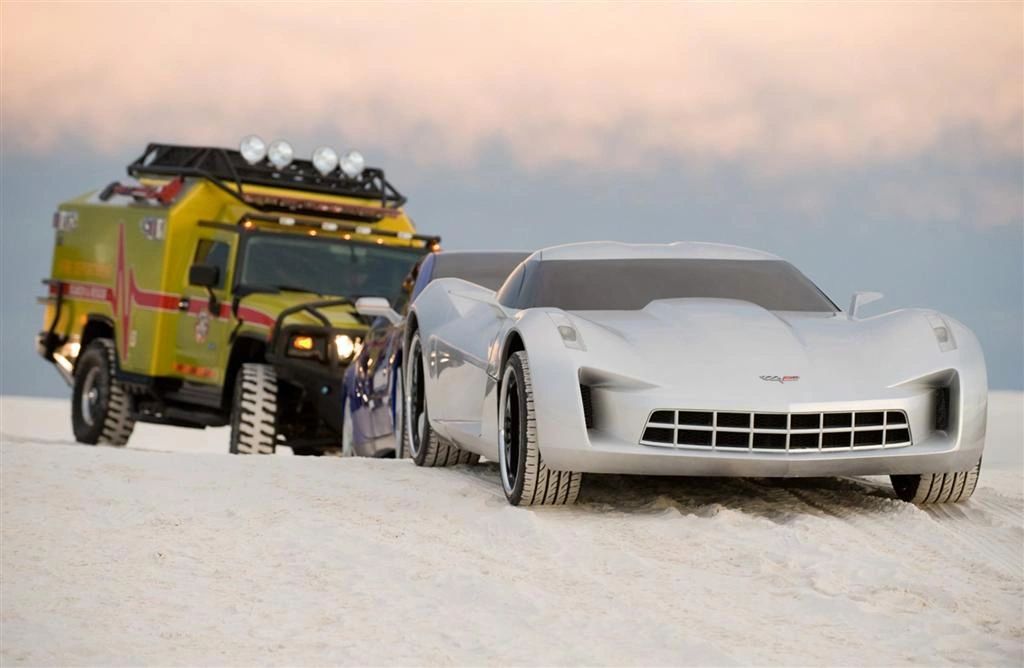
Momentum for a full-size build accelerated when director Michael Bay—fresh off the box-office success of the first Transformers film—asked GM for a Corvette to play the Autobot “Sideswipe” in the sequel “Transformers: Revenge of the Fallen.” GM was eager; the Camaro concept’s cameo as “Bumblebee” in the first film had sent awareness for the potential fifth-generation Camaro “up 97 percent,” Chevrolet general manager Ed Peper told the Chicago Auto Show audience.
Welburn took the wraps off the result, the Corvette StingRay Concept, at the 2009 Chicago Auto Show. In his words, “This vision concept is part of the free exploration of future products that I encourage our creative and talented design teams to develop…[it] pays homage to the 1959 StingRay Racer and 1963 Corvette StingRay Split-Window Coupe.” For the movie work there were two cars: a running, on-camera version and a pristine styling mock-up that Welburn brought to Chicago “without all the wear and tear and scars of an action movie.”
Consumers loved it. Over the show’s 10-day run, the StingRay was voted Best Concept Vehicle (39% of ballots) and also the “Vehicle I’d Most Like to Have in My Driveway” (12%)—rare double wins in the Chicago show’s Best of Show balloting.
Design: a fusion of past icons and sharp-edged futurism
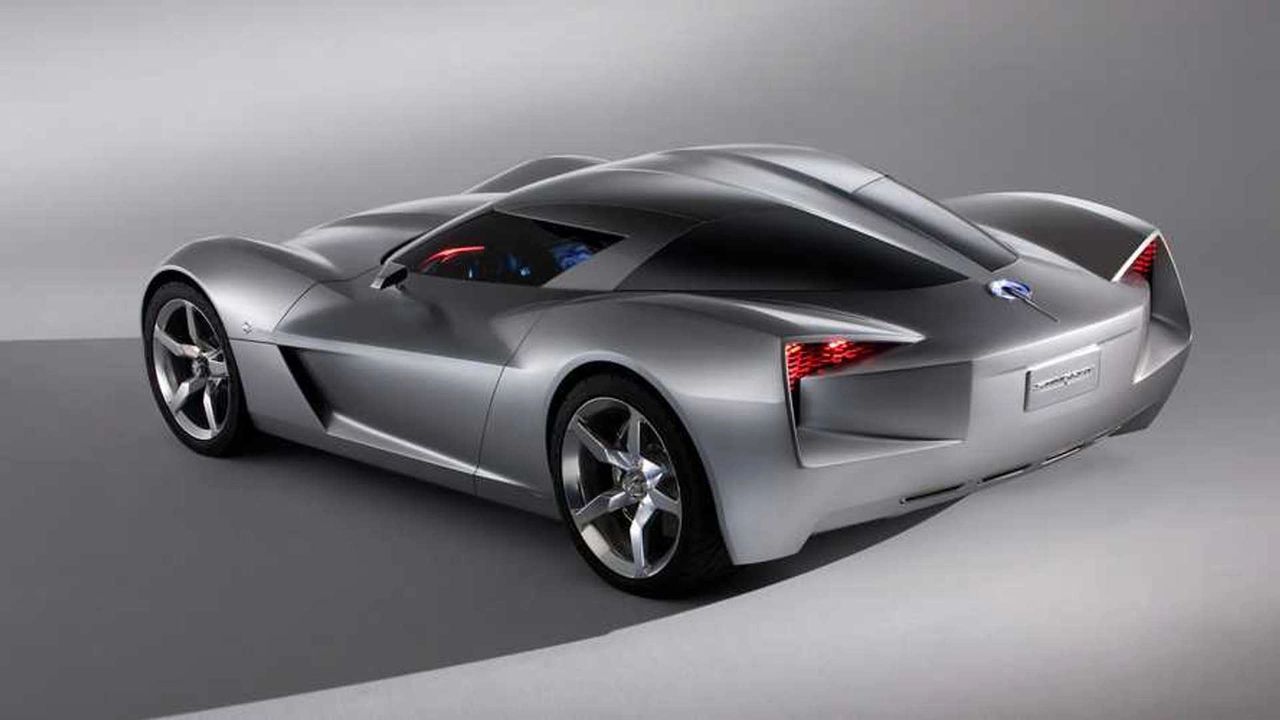
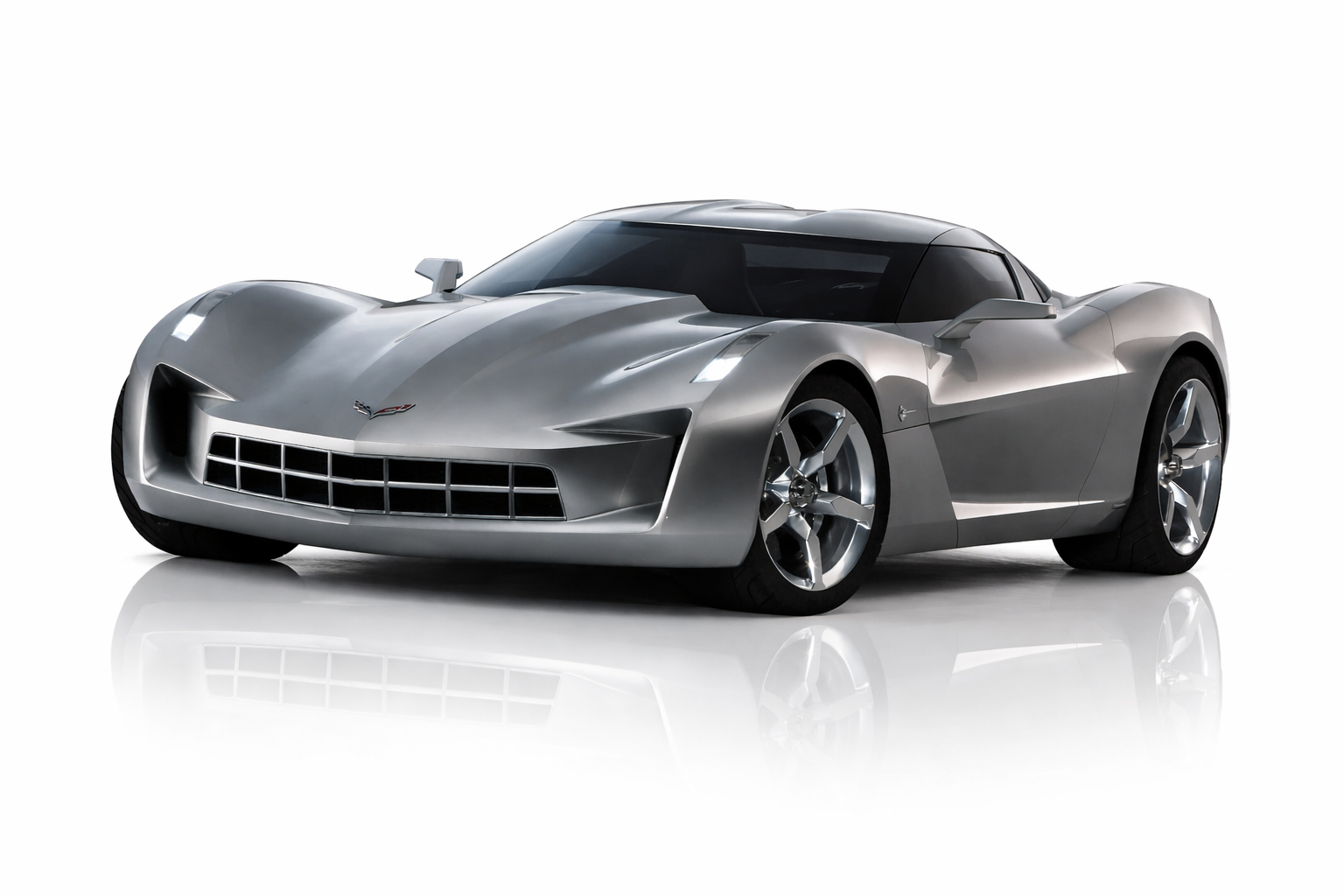
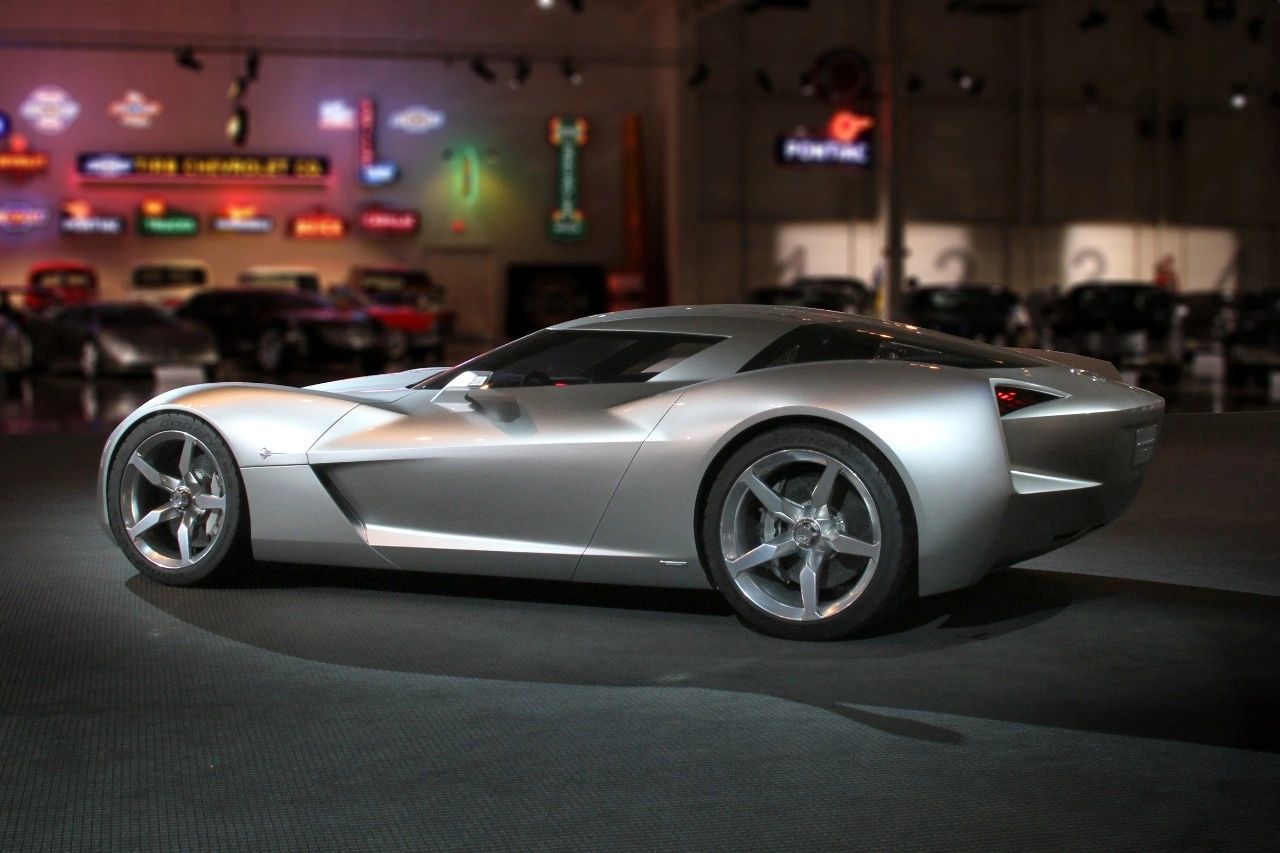
Peters’ team took a greatest-hits tour of Corvette iconography and sharpened it. The split rear window—a deliberate callback to the 1963 Corvette Sting Ray —sat under a roof with a more pronounced double-hump profile than the C5/C6. The front and rear fender humps blended the C2 Sting Ray’s tautness with the C3’s “Shark” drama. The egg-crate-style grille and low, extended nose nodded to the ’59 Stingray Racer. The side coves and hood bulge exaggerated themes familiar from the contemporary C6. The result was unmistakably Corvette yet startlingly crisp—intentionally “pressed-suit” in the Bill Mitchell idiom.
The proportions were bolder than a production C6: 3.1 inches longer, 5 inches lower, and 6.6 inches wider. It sat on enormous wheels and tires—20×9.5 with 275/30R20 up front and 21×13 with 355/30R21 at the rear—pushing visual mass to the corners. Beneath the reverse clamshell hood: a show-stopping, bell-crank front suspension presentation; out back: stock C6 hardware with modified wishbones and ZR1-spec discs. The body itself? Despite early talk of mixed composites, the built show car was all fiberglass, wrapped around a production C6 Corvette chassis—quick to fabricate and perfect for a one-off.
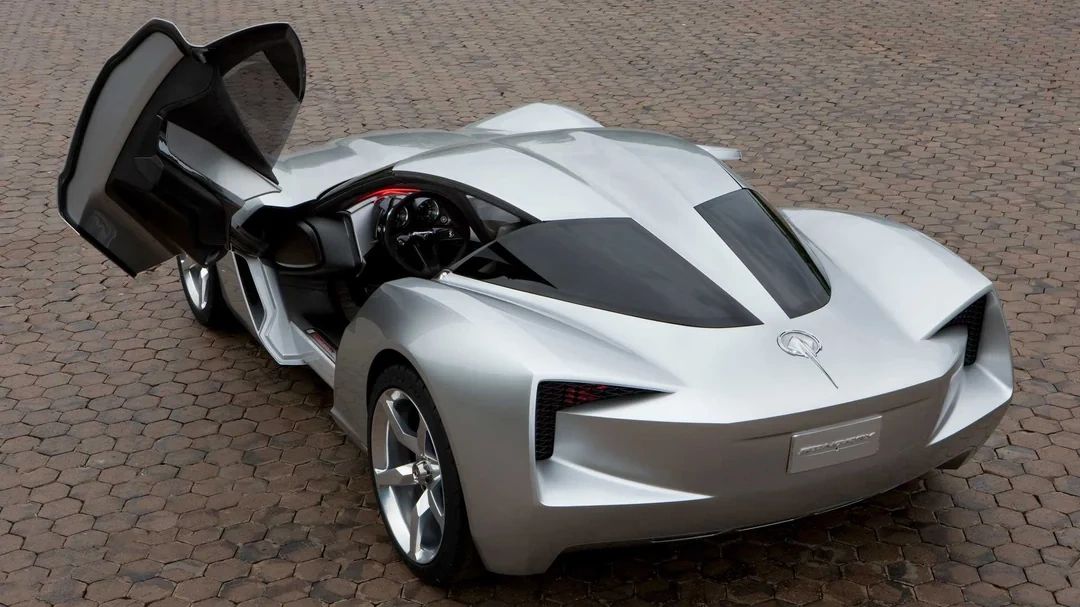
Even its theater had theater. The Stingray Concept wasn’t content to simply sit under lights—it performed. The power-operated reverse clamshell hood wasn’t just a nod to race-car serviceability; it was a deliberate spectacle piece. Hinged at the front and lifting from the rear, it exposed the engine bay in one sweeping motion, creating the kind of stage reveal that auto-show designers dream about. It framed the mechanicals like an exhibit, reinforcing the idea that this was a technical showcase as much as a styling exercise.
Then there were the scissor doors. Impractical for mass production? Perhaps. But absolutely intentional. They elevated ingress and egress into choreography, forcing crowds to pause, cameras to rise, and conversations to stop. Doors that pivot upward rather than outward change the way a car occupies space—suddenly it feels exotic, cinematic, almost supercar-adjacent. That was the point.
Together, those elements underscored the concept’s dual identity. It was a design manifesto wrapped in Hollywood sheetmetal—a Corvette engineered not just to be seen, but to arrive.
Powertrain: what “Hybrid Stingray” really meant
Pop the engine cover and the story gets even more grounded: LS3—the familiar 6.2-liter small-block that powered the contemporary C6 Corvette. That choice matters because it reinforces what the Stingray Concept really was: a design and directional technology statement built on known, proven Corvette architecture, not an all-new propulsion prototype. Even in a car dripping with show-stand drama, GM anchored it with a parts-bin heart for reliability, packaging confidence, and—frankly—because show cars are often about message first and metallurgy second.
Of course, the visual messaging in the engine bay helped fuel confusion. The rail covers wore “Hybrid Stingray” script, and in the context of 2009—when “hybrid” was the headline term for the industry’s future—that single word was enough to trigger a wave of breathless reporting. The key detail is what didn’t happen: GM never released a deep technical spec sheet for the concept that would substantiate a true hybrid system, and later, better-sourced contemporary retrospectives make it clear the car retained a stock LS3 rather than showcasing a bespoke hybrid drivetrain.
So what did “Hybrid” actually mean here? Think of it as an “umbrella concept” (a catch-all term for new tech ideas), not a literal drivetrain description. It pointed to a menu of efficiency ideas GM wanted associated with Corvette’s future—things like cylinder deactivation and other strategies that could preserve V-8 character while reducing consumption in light-load or low-speed operation. In other words, it was “hybrid” in the marketing sense of blended priorities—performance plus efficiency—rather than “hybrid” in the Prius-style, motor-and-battery propulsion sense.
For context, that era’s production C6 LS3 was rated at 430 hp and 424 lb-ft, or 436 hp and 428 lb-ft with the optional dual-mode exhaust—numbers that underline why GM didn’t need a complicated show-only powertrain to make the concept feel legitimate. The Stingray Concept’s powertrain wasn’t there to reinvent Corvette. It was there to keep the concept credible (an actual car versus an exterior design study) while the design—and the future-facing narrative—did the heavy lifting.
Inside: fixing the C6’s pain points and forecasting the future cabin
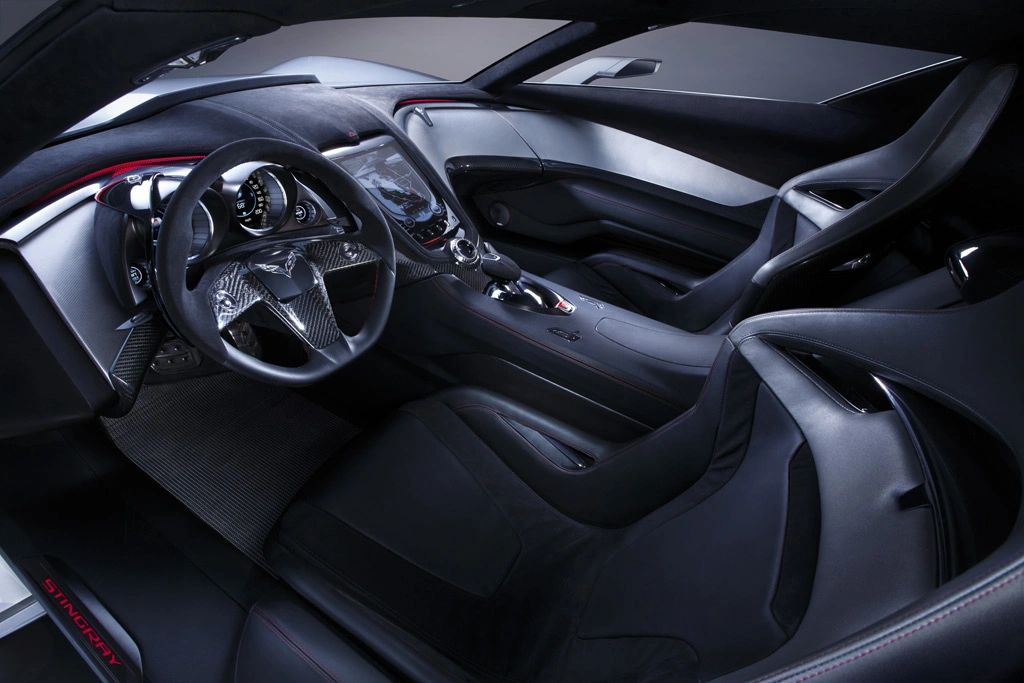
Corvette loyalists had been vocal about the C6’s interior, and GM knew exactly what they meant. The C6 delivered real performance, but the cabin didn’t always feel like it belonged in the same conversation as the car’s numbers—especially as buyers cross-shopped more premium, tech-forward competitors. The 2009 Stingray Concept responded to that critique almost point-by-point, using the cockpit as proof that the “future Corvette” wasn’t just about sharper bodylines—it was about elevating the driver’s environment to match the badge on the nose.
Start with the fundamentals: deep-bolstered seats that look purpose-built, not generic. They telegraphed a more serious, modern sports-car posture—lower, more wrapped-in, more “you and the chassis are one unit.” Around them, the cabin surfaces leaned into sweeping carbon-fiber textures and brightwork accents, not as gimmicks, but as a clear move toward a more intentional, premium material strategy. It felt designed, layered, and architectural—less like a parts-bin cockpit and more like a coherent interior concept.
Then came the tech, presented in a way that was unmistakably aimed at the criticism Corvette had been hearing. The Stingray Concept featured an early take on large-format infotainment, with navigation and media inputs integrated as a focal point rather than an afterthought. Today, that sounds normal—but in 2009, it signaled a Corvette that understood the modern expectations of daily usability: connectivity, clarity, and a center stack that didn’t look a generation behind.
The most forward-looking cue was the customizable instrument cluster, with LED-rich lighting and a more configurable, information-dense layout. That detail matters because it shows the interior was being treated like an interface—not just gauges and needles, but a driver-focused display system that could evolve. It’s exactly the kind of mindset that would become more visible later, when the C7 arrived with a noticeably upgraded cabin philosophy: higher perceived quality, more modern screens, better materials, and a stronger sense of “this is a flagship sports car.”
Bottom line: the Stingray Concept’s interior wasn’t just prettier—it was a direct answer to the questions about interior design quality that consumers had been asking for generations. It looked and felt like the premium, high-tech cockpit Corvette fans had been asking for, and it proved GM was listening in the one place enthusiasts spend every mile: behind the wheel.
The reveal: a superstar—but not a production promise
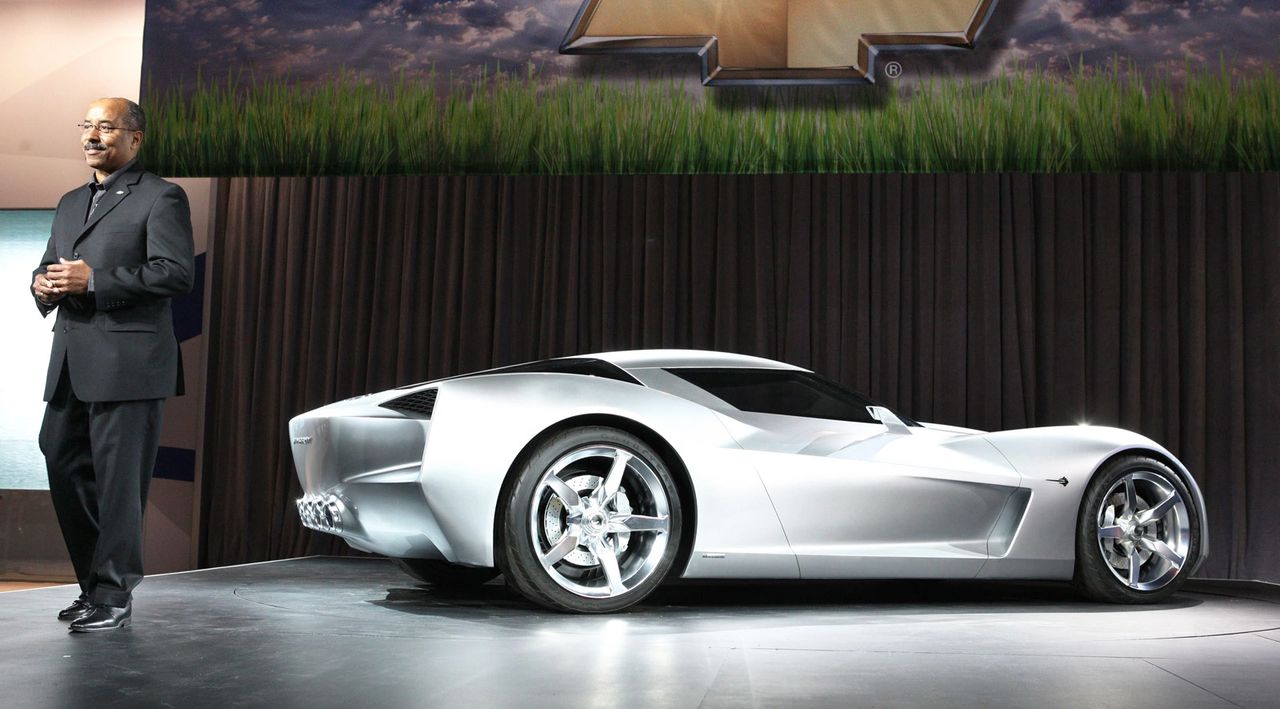
The StingRay’s Chicago debut on February 11, 2009, landed with perfect timing. GM needed a shot of optimism—something bold, modern, and unmistakably Corvette—and Paramount’s summer release calendar was lining up for maximum exposure. Chicago gave both sides a high-profile stage in front of media, enthusiasts, and a broader audience that might not have followed engineering details but absolutely responded to a dramatic reveal and a memorable silhouette.
Even with that momentum, Ed Welburn and the team kept the messaging disciplined. On stage, he framed the car as what it was: a “vision concept”—a design statement and an homage—not a thinly veiled production preview. That distinction mattered because the StingRay looked resolved enough that it could easily have been misread as a next-generation Corvette waiting quietly in the wings. GM essentially set guardrails around the hype: admire the direction, appreciate the tribute, but don’t mistake it for a program announcement.
The movie-prop reality became even clearer in later accounts of the running car. It wasn’t treated like a development mule that needed to be pushed to its limits; it functioned more like a working show-and-film asset that could move under its own power when required. Reports noted it never went much beyond about 80 mph, and it even wore hand-cut, stylized tires built to look right under lights and cameras rather than perform like true high-speed rubber. That detail underscored the point: the StingRay was engineered for presence and storytelling first, because its primary job was to sell an idea.

When Transformers: Revenge of the Fallen hit theaters that summer, the payoff followed. Sideswipe’s StingRay silhouette became one of the film’s most striking automotive forms—low, sharp, and instantly recognizable even in fast-cut action scenes. It fit neatly into the broader GM/Transformers strategy of the era, where vehicles weren’t just background props; they were characters and brand statements. Alongside the Camaro and other GM hardware that appeared in the franchise, the StingRay helped convert Hollywood screen time into mainstream attention, while the film benefited from real-world design that made the fantasy feel tangible.
In the end, the Chicago reveal and the Transformers tie-in worked as a coordinated moment: a Corvette concept that captured attention, steered conversation, and made the future feel close—even as GM’s real-world circumstances demanded restraint.
Legacy: the last “true” Corvette concept—and a bridge to C7/C8
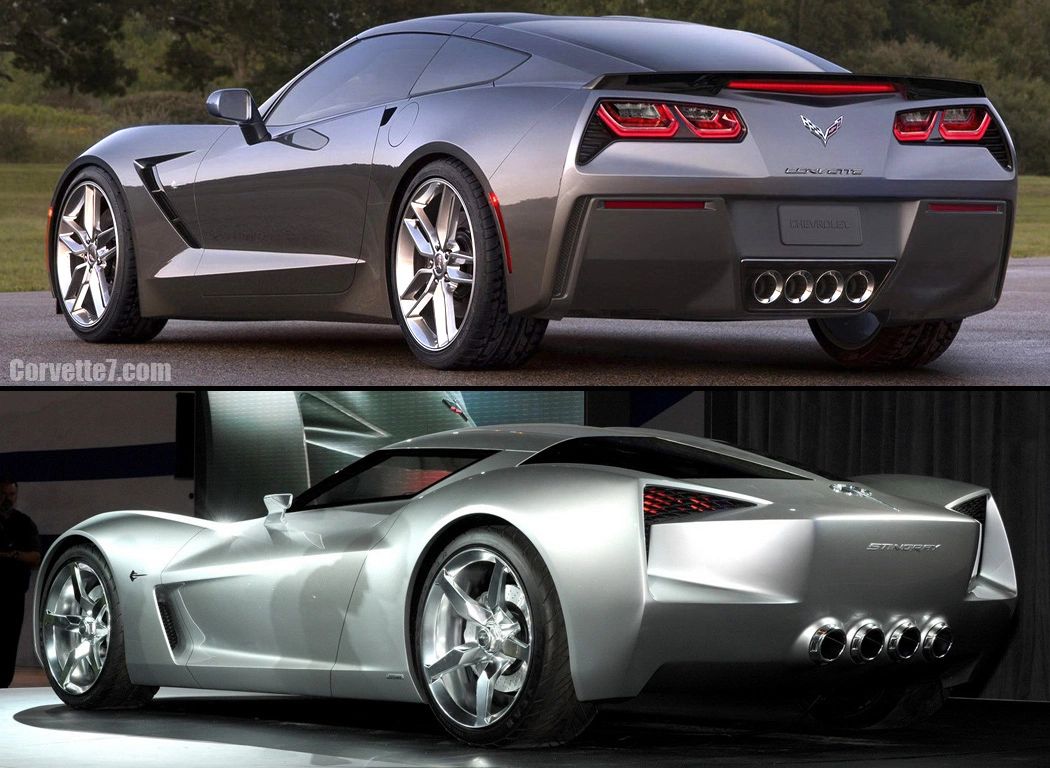
The 2009 StingRay Concept is widely regarded as the last all-out Corvette concept to push design and tech ideas in a single, bespoke show car. Its surface language—a crisper press to the planes, the modernized split-window motif, and the bolder stance—influenced subsequent GM performance shapes, most visibly on the fifth-gen Camaro and, crucially, on the seventh-generation Corvette that followed. The National Corvette Museum puts it plainly: the car’s styling and all-new interior prototypes influenced the C7.
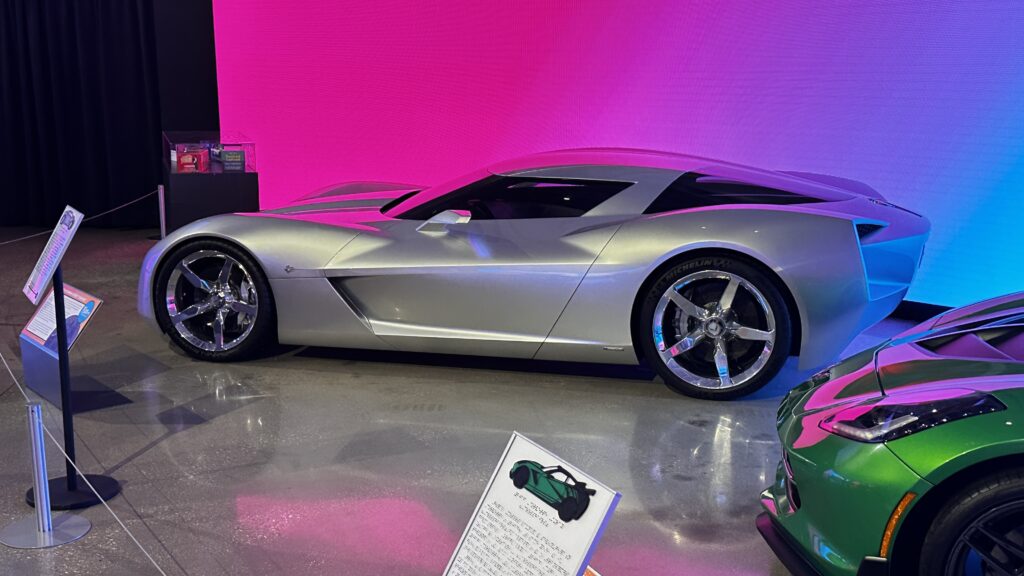
Today, the StingRay lives on as part of the GM Heritage Collection, while the National Corvette Museum preserves the full-scale model built to test the design in three dimensions—tangible reminders of how, even in GM’s darkest hour, Corvette’s future was being quietly sketched, modeled, and filmed into the public imagination.
Deep-dive facts & figures (integrated recap)
- Context & restructuring: GM’s 2007 record loss (~$39 billion), 2008 loss ($30.9 billion), and bankruptcy (June 1, 2009) frame the concept’s birth; GM shed or divested multiple brands as part of the turnaround.
- Design process: Welburn opened Corvette ideation to global studios; Kirk Bennion says 300+ sketches arrived in two weeks; Peters synthesized the winning vision.
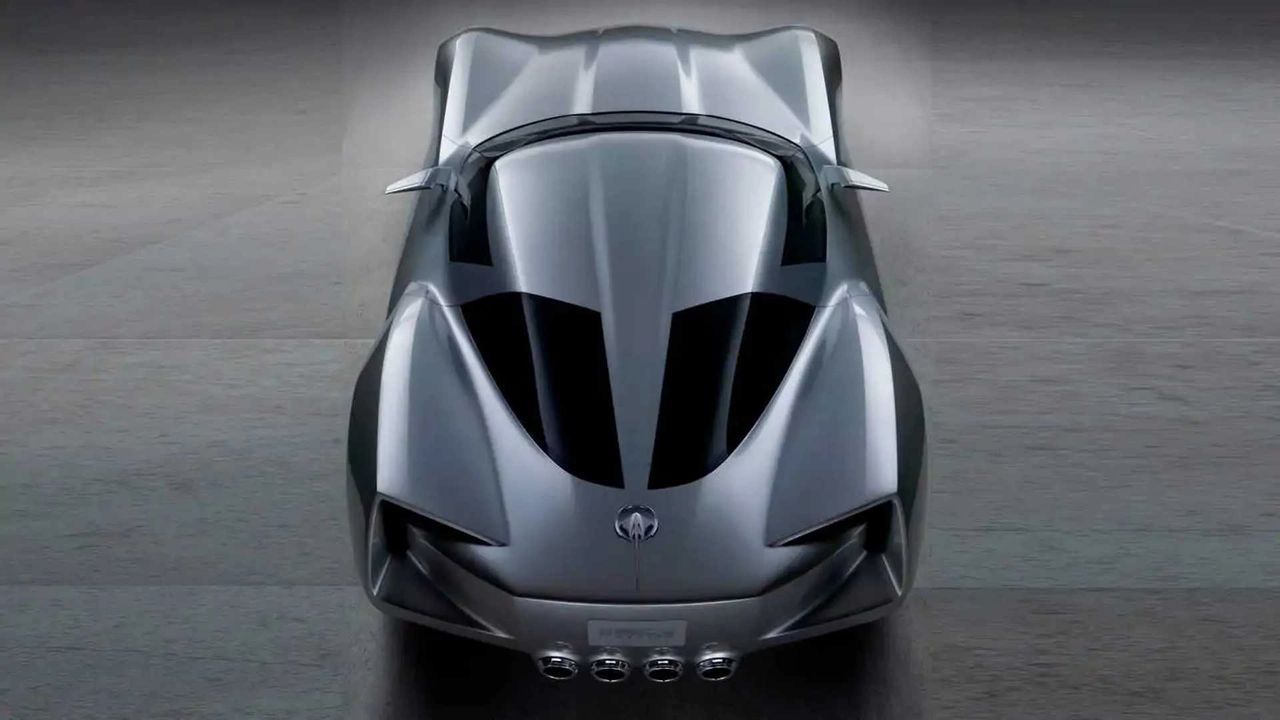
- Exterior cues: Split-window homage (’63), double-hump roof, C2/C3 fender drama, C6-inspired coves/bulge, 1959 Stingray Racer-influenced nose; 3.1″ longer / 5″ lower / 6.6″ wider than C6; 20×9.5/21×13 wheels with 275/30R20 and 355/30R21 tires.
- Construction & chassis: All-fiberglass body on production C6 structure; bell-crank front and modified C6 rear with ZR1 discs.
- Theater & access: Scissor doors and power reverse-clamshell hood for show and service access.
- Powertrain: Stock LS3 V-8 (“Hybrid” label reflected efficiency tech brainstorming, not a true hybrid); period C6 LS3 baseline 430 hp/424 lb-ft (436/428 with performance exhaust).
- Interior: Deep-bolstered seats, carbon fiber & chrome, LED lighting, large infotainment, and a customizable cluster that previewed C7’s step up in perceived quality.
- Debut & reception: Revealed at Chicago Auto Show (Feb. 11, 2009); Best Concept (39%) and Driveway pick(12%) in Best of Show voting; Camaro’s Transformers halo effect included a 97% awareness jump, which Chevrolet cited on stage.
- Movie fleet & multiples: Two physical cars (a working movie version and a pristine styling mock-up for display).
- Where the cars are now: GM Heritage Center collection; full-scale model and exhibit interpretation at the National Corvette Museum.
“This vision concept is part of the free exploration of future products… The Corvette has an amazing design lineage, and this StingRay concept pays homage to the 1959 StingRay Racer and 1963 Corvette StingRay Split-Window Coupe.” — Ed Welburn, Vice President of GM Design
“What you might not know is that after the movie, awareness for Camaro… jumped 97 percent.” — Ed Peper, Chevrolet
Notes on common misconceptions
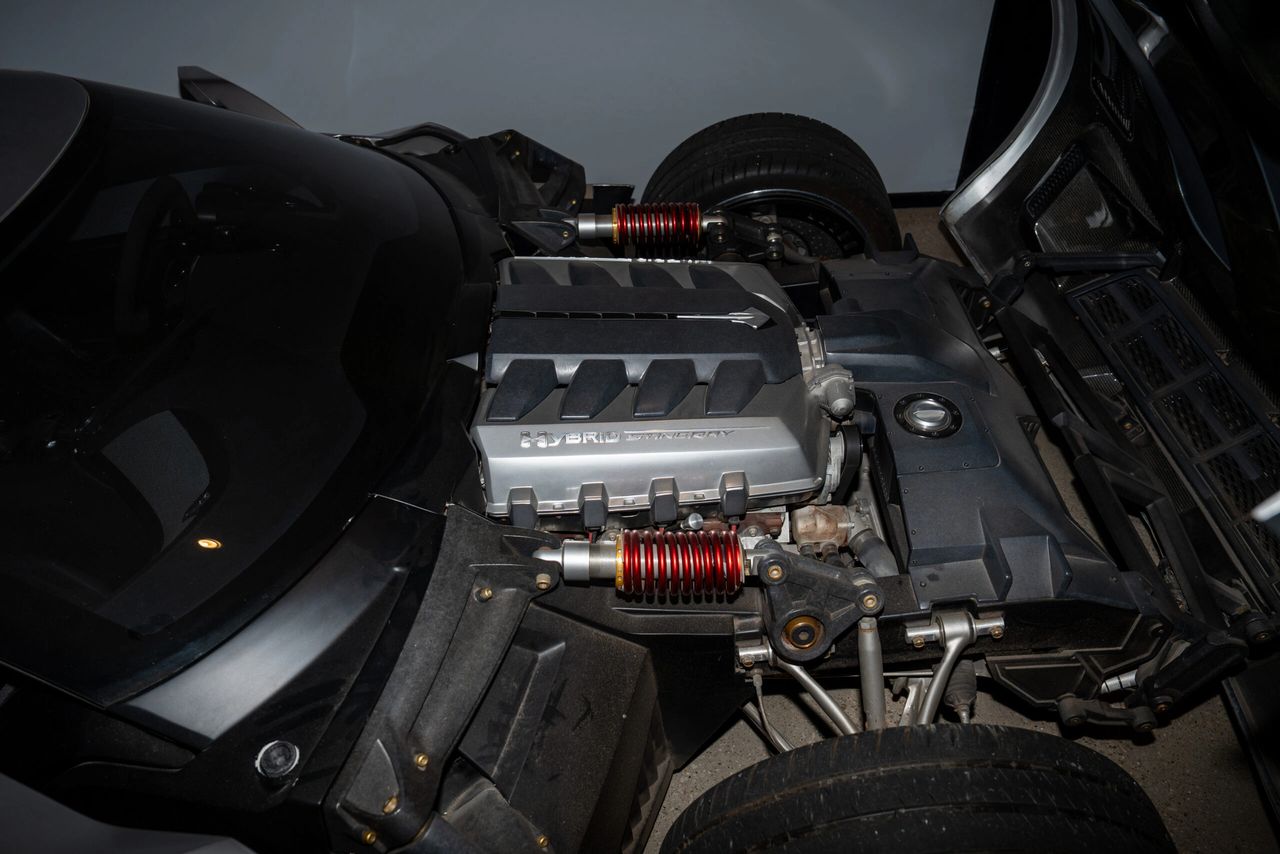
Early coverage of the 2009 Stingray Concept created a couple of “sticky” myths that still float around forums and social posts today—mainly that the car wore a carbon-fiber body and that it was a true hybrid. Both ideas are understandable if you look at the context of the time, but neither description accurately reflects what the show car actually was.
The carbon-fiber claim is a perfect example of how show-week shorthand turns into permanent “fact.” In 2009, carbon fiber was the buzzword for performance credibility, and the Stingray Concept’s surfaces—tight shutlines, sharp edges, dramatic vents—looked like the kind of thing you expect to be carbon. But later, better-sourced recollections and retrospectives clarified that the built display car was fiberglass, constructed over a C6-based structure, aligning it far more with traditional GM show-car practice than an exotic, carbon-skinned prototype.
The hybrid misconception has a similar origin, and it’s even easier to see how it happened. GM’s official messaging and the magazine-cover language at the time leaned hard into future-facing themes: efficiency, smarter aerodynamics, advanced materials, next-gen powertrain thinking—basically an umbrella of “what’s coming next.” So when the word “Hybrid” appeared in prominent places, many readers naturally interpreted it as a literal description of the drivetrain. In reality, that label was more of a conceptual headline—a grab-bag of efficiency and technology ideas—rather than confirmation that the Stingray show car itself carried a full hybrid system.
The clean way to frame it for readers is this: the 2009 Stingray Concept was a forward-looking design and technology statement, not a running proof-of-concept hybrid Corvette. The confusion isn’t surprising, but the distinction matters—because it changes how we understand the car’s purpose. It wasn’t built to demonstrate a finished propulsion breakthrough; it was built to signal direction, shape expectations, and stir the conversation about what a future Corvette could be.
Why the 2009 Stingray Concept Still Matters
The 2009 Stingray Concept matters because it arrived at a moment when Corvette’s future felt uncertain. The global financial crisis had shaken the auto industry to its core. GM had entered bankruptcy. Programs were under review. In that climate, the Stingray wasn’t just another show car—it was a signal. Corvette was not retreating. It was recalibrating.
Stylistically, the concept previewed a harder, more angular design language that would echo into the C7 generation. The sharp character lines, split-window-inspired rear glass, dramatic fender vents, and aggressive lighting signatures all pointed toward a Corvette that was evolving beyond the softer curves of the C6. Even if the production C7 Corvette Stingray didn’t mirror the concept panel-for-panel, the philosophical shift was clear: more technical. More assertive. More globally competitive.
It also reframed how Chevrolet could talk about performance. The Stingray Concept folded efficiency, materials strategy, and advanced propulsion thinking into the Corvette narrative without diluting its identity. That balancing act—performance with responsibility—would become a defining theme of the next decade, culminating in technologies like cylinder deactivation, lightweight architecture strategies, and ultimately electrified Corvette variants.
Most importantly, the Stingray Concept reminded enthusiasts of something fundamental: Corvette has always used show cars to test the emotional waters. From Motorama-era experiments to Bill Mitchell’s dream cars, GM has historically telegraphed intention through design studies. The 2009 Stingray fits squarely within that lineage. It wasn’t a production blueprint. It was a directional statement.
And direction matters.
Today, with the mid-engine C8 Corvette Stingray firmly established and electrification entering the Corvette conversation in very real ways, the 2009 Stingray Concept reads less like fantasy and more like a transitional artifact—a design and messaging bridge between eras. It captured a company in recovery, a brand redefining its trajectory, and a nameplate preparing to take its boldest step yet.