
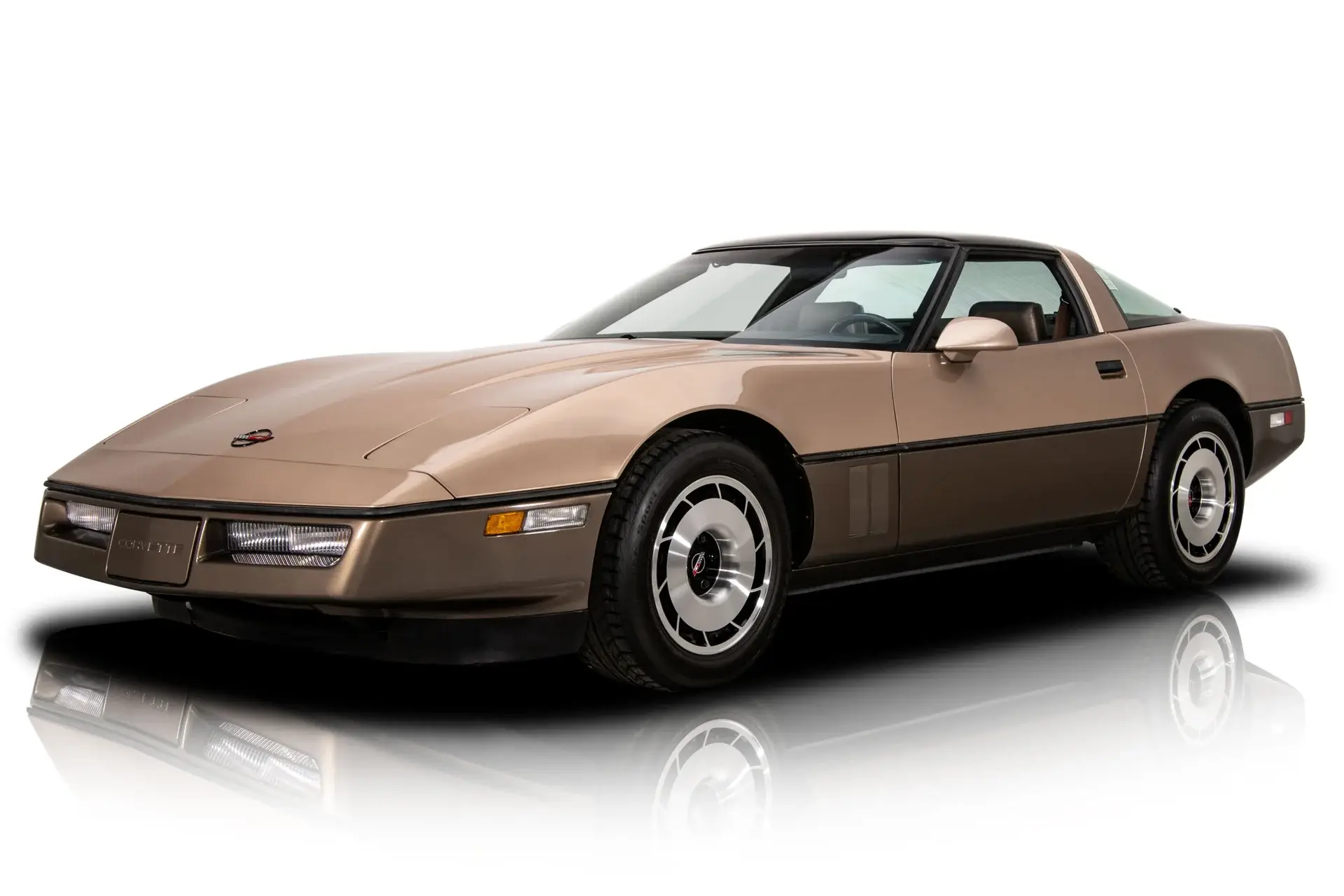
In the mid-1980s, the American automotive landscape was undergoing a subtle but pivotal shift. The recession that had hamstrung the nation’s economy in the early ’80s was giving way to renewed consumer confidence. Fuel prices—once inflated by conservation efforts in the wake of the 1970s energy crisis—plummeted thanks to a global oil glut, liberating buyers to once again dream of powerful, American‑made performance cars.
Enter the 1985 Corvette, poised not just as a sports car, but as Chevrolet’s statement of resurgence. Bolstered by protective trade agreements like the Voluntary Restraint Agreement (VRA) with Japanese automakers, General Motors found its moment. The C4 Corvette, criticized in its debut year for lacking power, was ready to deliver on all fronts.
Power Reimagined: From Cross-Fire Frustration to Tuned-Port Triumph
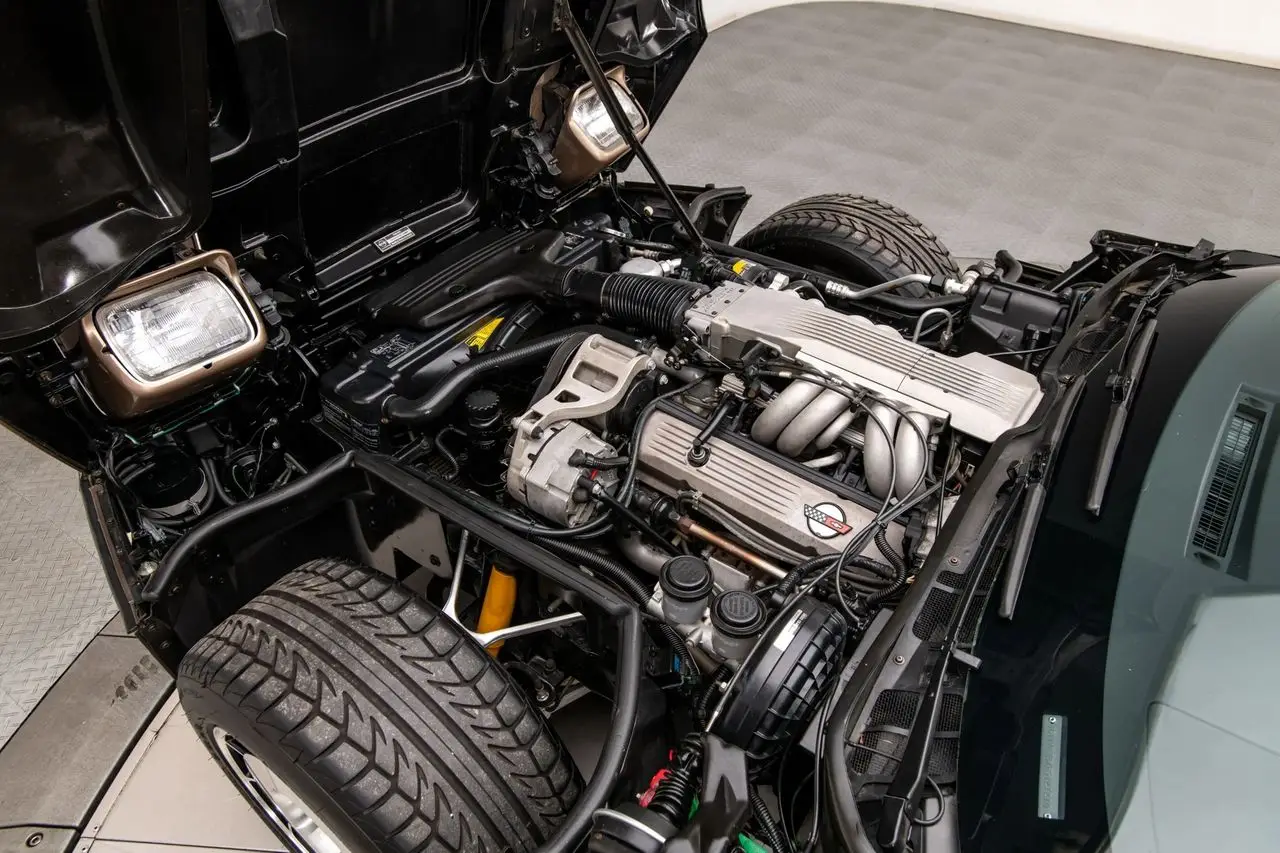
When the 1984 C4 rolled out, its Cross‑Fire Injection system elicited more groans than cheers—everyone recognized the Corvette’s lineage, yet many lamented its lackluster output. Chevrolet acted swiftly. By 1985, the Cross‑Fire nameplate was gone, replaced by the new L98 V8, featuring Bosch‑developed Tuned‑Port Injection (TPI). This sophisticated system supplied each cylinder with its own injector, incorporated a mass-air-flow sensor, and relied on fine-tuned intake runners for optimized performance.
The result? A jump from approximately 205 hp to 230 hp and torque up from around 290 lb.‑ft to 330 lb.‑ft—both at notably lower RPMs, reflecting a more flexible, street‑ready engine. This wasn’t just a tweak—it was a statement: the Corvette was ready to reclaim its performance crown.
Mechanics Refined: Transmission, Suspension, and Chassis Considerations
Underneath the skin, the Corvette received meaningful upgrades that made it more than just a faster car—it became a more complete one. The Doug Nash “4+3” manual transmission returned, still mated to an overdrive-equipped top three gears, but now with improved shift feel and a smarter, less intrusive override system—complete with a relocated button atop the shifter. A beefier 8.5‑inch differential replaced the previous 7.9‑inch unit, enhancing durability.
Ride comfort, long a sticking point for C4 owners, was addressed head-on. Spring rates were softened down about 26% in front and 25% in the rear, making daily drives more forgiving. To ensure that handling remained sharp, especially when equipped with the Z51 Performance Handling package, Chevrolet bolstered stabilizer bar diameters, deployed Delco‑Bilstein gas-pressurized shocks, and fitted wider, 9.5‑inch tires all around. The result was a Corvette that felt more composed, more responsive, and more assured at speed.
Sleek Yet Subtle: Design Enhancements & Interior Comfort
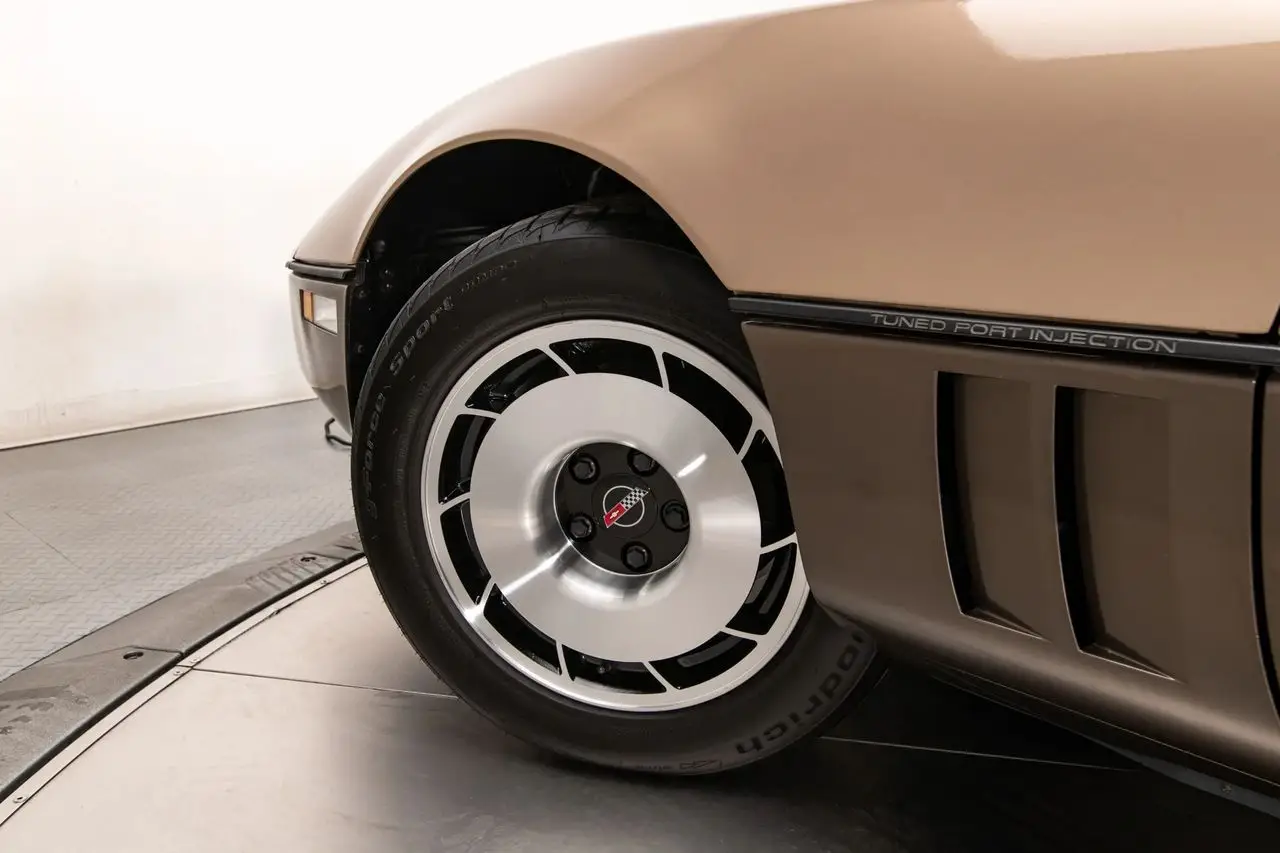
Aesthetically, the 1985 Corvette stayed true to the sharp, wind-tunnelled look that debuted in ’84: the ultra-raked windshield, frameless door glass, forward-tumbling pop-up headlamps, and the full glass hatch remained the visual calling cards. The biggest tell is on the front fenders—where “Tuned-Port Injection” badging replaced the prior year’s Cross-Fire script—telegraphing the new L98’s long-runner fuel injection without disturbing the clean body side defined by the continuous rub strip. Z51 cars could be spotted by their wider 16×9.5-inch wheels (vs. the standard 16×8.5), but otherwise the sheetmetal and aero detailing were intentionally unchanged, keeping the focus on the mechanical leap under the skin.
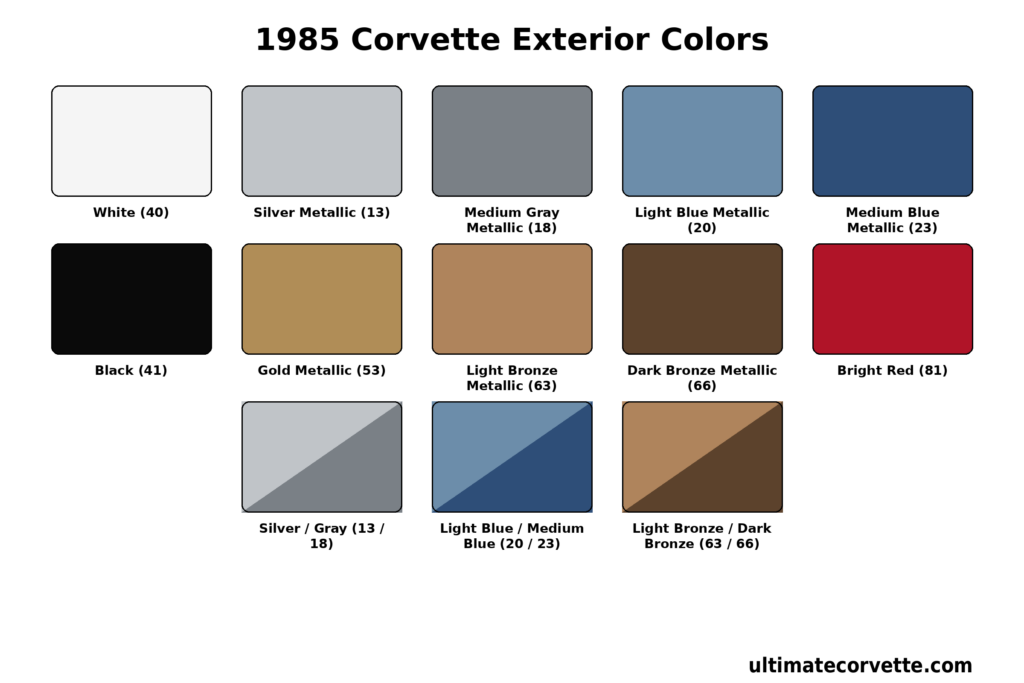
For 1985, Chevrolet offered a concise palette: White (40), Silver Metallic (13), Medium Gray Metallic (18), Black (41), Light Blue Metallic (20), Medium Blue Metallic (23), Gold Metallic (53), Light Bronze Metallic (63), Dark Bronze Metallic (66), and Bright Red (81)—with factory two-tone combinations under RPO D84 pairing Silver/Gray (13/18), Light Blue/Medium Blue (20/23), and Light Bronze/Dark Bronze (63/66). The numbers in parentheses are the GM paint codes you’ll see on build sheets and body tags, and they match period production references.
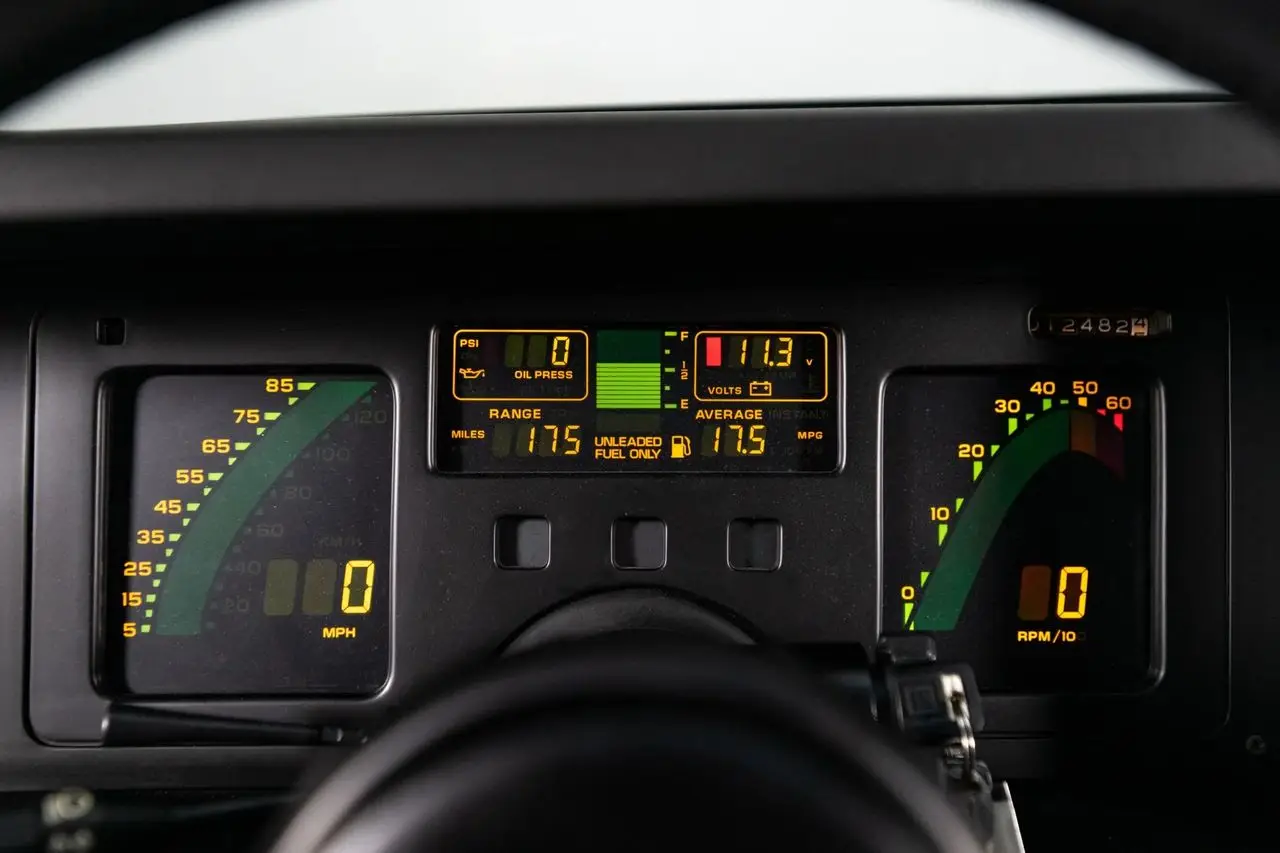
Inside, GM refined the digital dashboard, increasing legibility and reducing visual clutter. Optional Lear‑Siegler leather seats added luxury, and engineers quietly went to work sealing rattles and squawks that had marred early ownership experiences.
Archival Review: A 1985 Snapshot
In the summer of 1985, Car and Driver captured the essence of the new Corvette:
“We approached the 1985 Corvette with some skepticism… This year, however, Chevrolet has clearly listened. The new L98 Tuned‑Port Injection V8 is torque‑rich, eager, and civilized… Acceleration from zero to sixty now takes just 5.7 seconds… The ride… has been tamed enough to survive daily commuting without dental work… At $24,891, the Corvette remains a bargain compared to Europe’s best.”
This kind of praise wasn’t just technical—it spoke to what the Corvette had always meant: freedom, affordability, and an unapologetic performance spirit.
European Comparisons: A Sting to Porsche’s Ego
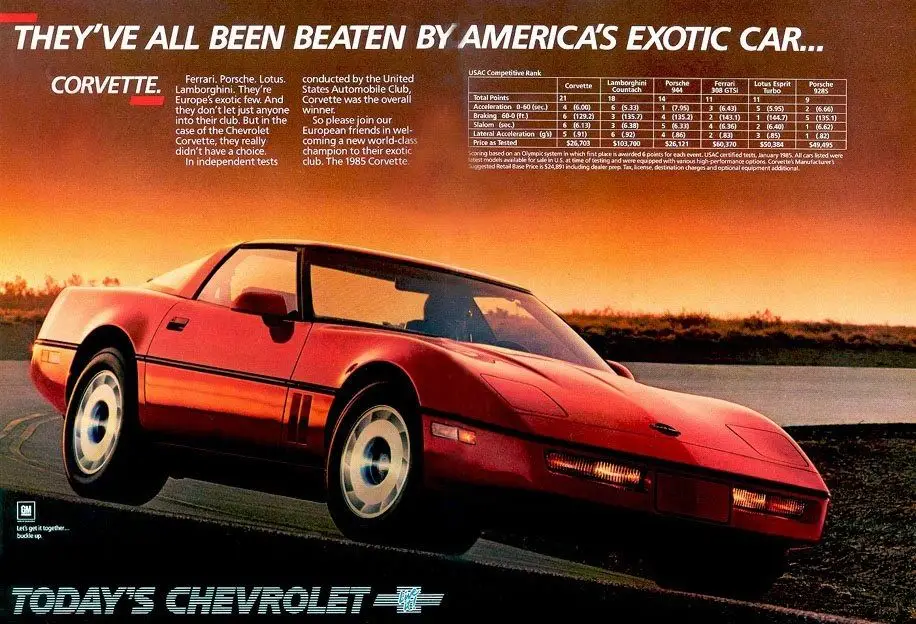
That confidence wasn’t misplaced. In 1985, comparisons with the Porsche 928 were inevitable. Despite the 928’s reputation as a luxurious, V8‑powered grand tourer, the Corvette held its own and outpaced it on performance, at approximately half the price. GM’s Corvette was dubbed “America’s fastest production vehicle,” and supposedly so intriguing that Porsche engineers reportedly dismantled a pair of ‘85 Vettes in Germany to uncover their secret.
While Porsche purists had once balked at the front-engine layout of the 928, publications like MotorTrend later recognized its merits, even calling the 928 “the most underrated Porsche of all time.” Yet for 1985, on a balance of bang-for-the-buck and raw speed, the Corvette held a clear edge.
Performance That Speaks: On the Track and Road
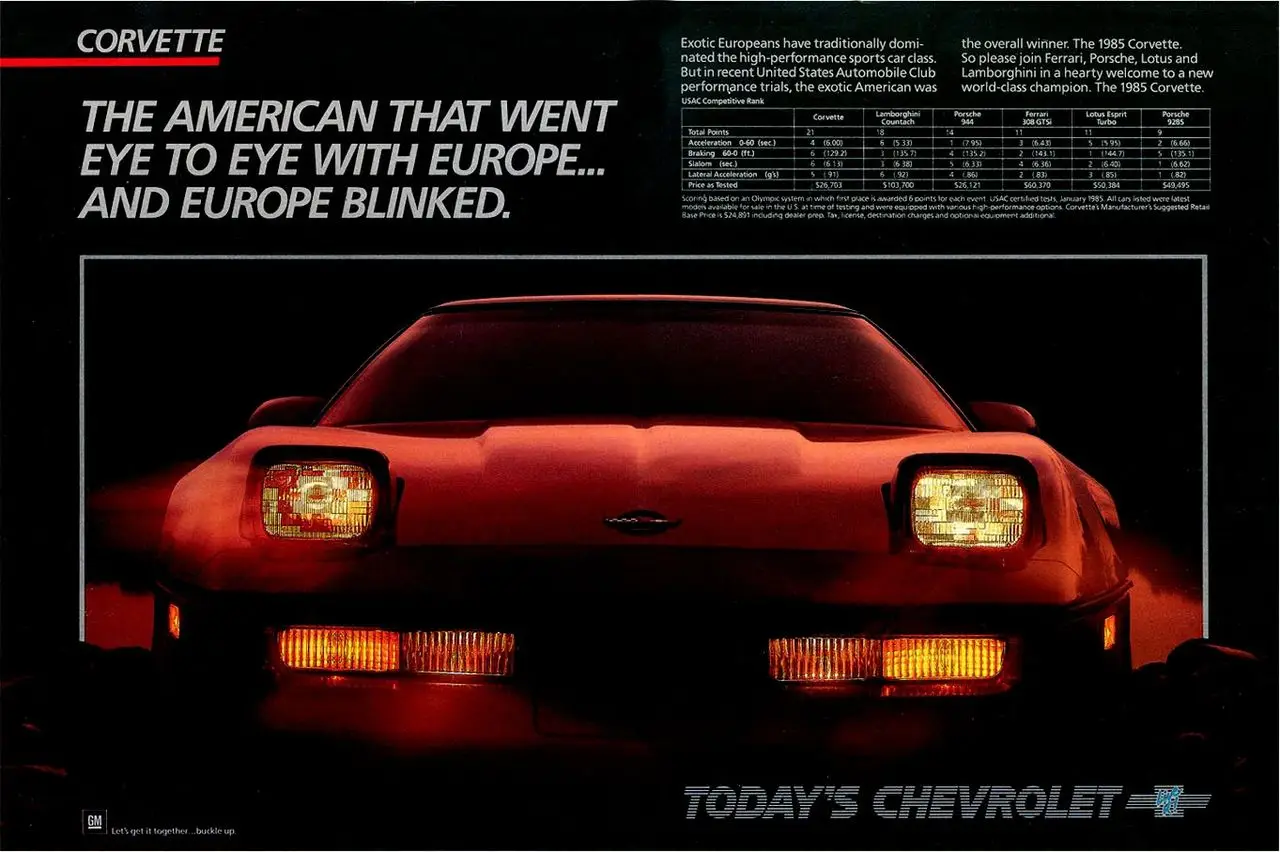
With newfound power and finesse, the 1985 Corvette grabbed headlines. Car and Driver recorded a 0‑60 mph run in just 5.7 seconds, quarter-mile blast in 14.1 seconds at 97 mph—impressive for any contender of that era. Coupled with reports of a 150 mph top speed when equipped appropriately, the Corvette reclaimed the title of America’s fastest production car.
Production & Pricing: The Cost of Excellence
Sales numbers tallied at 39,729 total units—all coupes, as convertibles were absent in 1985. Economically, the Corvette’s base price climbed from approximately $21,800 in 1984 to around $24,891 in 1985, reflecting the breadth of enhancements.
Today’s values echo its enduring appeal: median auction sales hover around $7,400, with excellent examples fetching up to $11,000 or more, and rare, pristine models climbing as high as $66,000.
In Retrospect: The 1985 Corvette’s Legacy
The 1985 C4 wasn’t a quiet mid-cycle tidy-up; it was a statement. Tuned Port Injection dropped long-runner torque right where owners lived—off idle, through the midrange—and the car finally felt eager in normal traffic instead of merely quick on paper. The L98’s broader shoulders, paired with a recalibrated chassis, turned the Corvette from a glass-cannon ’84 into a car you could use hard and live with. You felt it in the way the throttle stopped being an on/off switch and started acting like a rheostat.
Chevrolet also listened. Ride quality, the Achilles’ heel of early C4s, stopped shouting and started conversing. Spring and shock choices were rethought so the car flowed over broken pavement rather than skittering across it, yet the structure still read as tight and modern. Z51 kept its point-and-shoot precision for the faithful, but the baseline Corvette became the one you could take the long way home without bracing for every expansion joint.
Inside, the future-tech dash matured from novelty to tool—clearer graphics, better legibility—while the available Delco-Bose system gave the cockpit a premium note to match the car’s rising competence. The whole package felt less like a concept car that slipped into production and more like a fully considered sports car with bandwidth: commute, carve, and cruise without excuses.
Context matters. In an era when emissions and insurance had sanded the edges off many performance icons, the ’85 Corvette arrived with real power, real manners, and real speed. It didn’t reset physics, but it did reset expectations—of the Corvette and of what an American sports car could be. If 1984 announced the C4’s architecture, 1985 delivered its intent. That’s the legacy: a course correction so confident it became a compass for the rest of the generation.
1985 Corvette — Key Specifications
Quick Stats
- Engine: 5.7L (350 cu in) L98 Tuned Port Injection V8
- Output: 230 hp @ 4,000 rpm • 330 lb-ft @ 3,200 rpm (SAE net)
- Transmissions: 4+3 Doug Nash manual (MM4 with overdrive on 2–4) • 4-speed automatic THM 700-R4
- Layout: Front-engine, rear-wheel drive
- Curb weight: ~3,200–3,300 lb (equipment-dependent) General Motors+1
Performance (period tests)
- 0–60 mph: ~5.7–6.0 sec
- ¼-mile: ~14.3–14.6 sec @ ~95–97 mph
- Top speed: ~150+ mph (factory claim/period test) Car and Driver
Chassis & Suspension
- Structure: Uniframe with bolt-on front/rear cradles; composite body panels
- Front/Rear: Aluminum control arms, transverse composite leaf springs, gas shocks
- Steering: Power rack-and-pinion
- Brakes: 4-wheel power discs, ventilated rotors, aluminum calipers
- Notable 1985 change: Chevrolet softened the standard suspension tuning to improve ride quality; Delco-Bilstein gas-charged shocks available and included with Z51 Performance Handling Package. General Motors
Wheels & Tires
- Standard wheels: 16×8.5-in alloy (all around)
- With Z51: 16×9.5-in wheels front & rear
- Tires (typical): 255/50VR-16 Goodyear Eagle VR50 “Gatorback” General Motors
Dimensions
- Wheelbase: 96.2 in
- Length × Width × Height: ~176.5 × 71.0 × 46.7 in
- Fuel capacity: ~20 gal
- EPA (period): mid-teens city / low-20s highway (varies by trans/final drive) (Dimensions consistent with early C4; GM kit lists drivetrain/axle data and confirms TPI output figures.) General Motors
Powertrain Details
- Engine code: L98 (Tuned Port Injection, long-runner intake)
- Compression ratio: 9.0:1
- Spark control: Electronic (ESC), adaptive to fuel octane
- Axle ratios: 3.07 base; G92 Performance Axle Ratio available (application-dependent) General Motors+1
Paint & Trim (with GM paint codes)
Solid/metallic colors:
- 13 Silver Metallic
- 18 Medium Gray Metallic
- 20 Light Blue Metallic
- 23 Medium Blue Metallic
- 40 White
- 41 Black
- 53 Gold Metallic
- 63 Light Bronze Metallic
- 66 Dark Bronze Metallic
- 81 Bright Red
Factory two-tones (RPO D84):
- 13/18 Silver/Gray
- 20/23 Light Blue/Medium Blue
- 63/66 Light Bronze/Dark Bronze
(Codes are the two-digit GM paint identifiers used on build sheets/labels; GM records also show production quantities by color.)
Interior & Features Highlights
- Digital instrument cluster (revised graphics for clarity)
- Delco-Bose stereo system (UU8) available
- Removable transparent roof panel (CC3)
- Custom adjustable sport seat with available leather; new electronic temperature control for A/C added mid-year.
WHY THE 1985 CORVETTE STILL MATTERS TODAY
The 1985 Corvette remains relevant today because it represents the moment when the Corvette fully recommitted to modern performance after the reset of 1984. With meaningful refinements to the C4 chassis, improved ride quality, and a more sorted suspension, the 1985 model year is where Chevrolet began turning advanced ideas into a cohesive sports car. The introduction of tuned port fuel injection (TPI) wasn’t just a horsepower story—it delivered smoother power delivery, improved drivability, and efficiency that aligned with the realities of modern ownership. In many ways, 1985 marks the point where the Corvette stopped experimenting and started executing.
Just as important, the 1985 Corvette established a blueprint that still defines the car today: technology-forward engineering paired with everyday usability. Its digital instrumentation, aerodynamic focus, and emphasis on balance over brute force foreshadow the philosophy behind today’s mid-engine C8. For collectors and enthusiasts, the 1985 Corvette stands as an accessible, historically significant entry into modern Corvette DNA—a car that bridges analog heritage and contemporary performance thinking. It isn’t merely a product of its era; it’s a foundation that the Corvette continues to build upon.