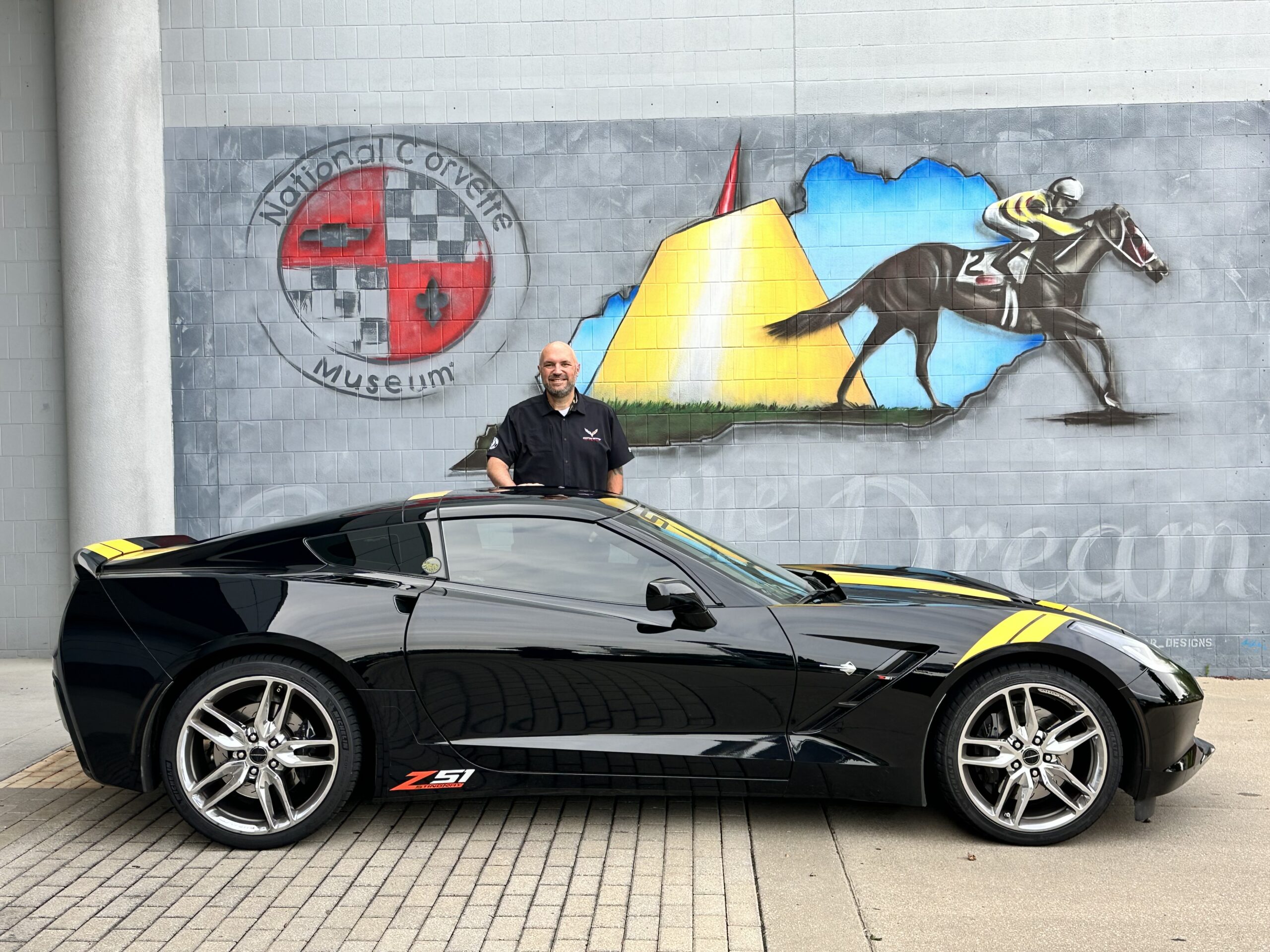
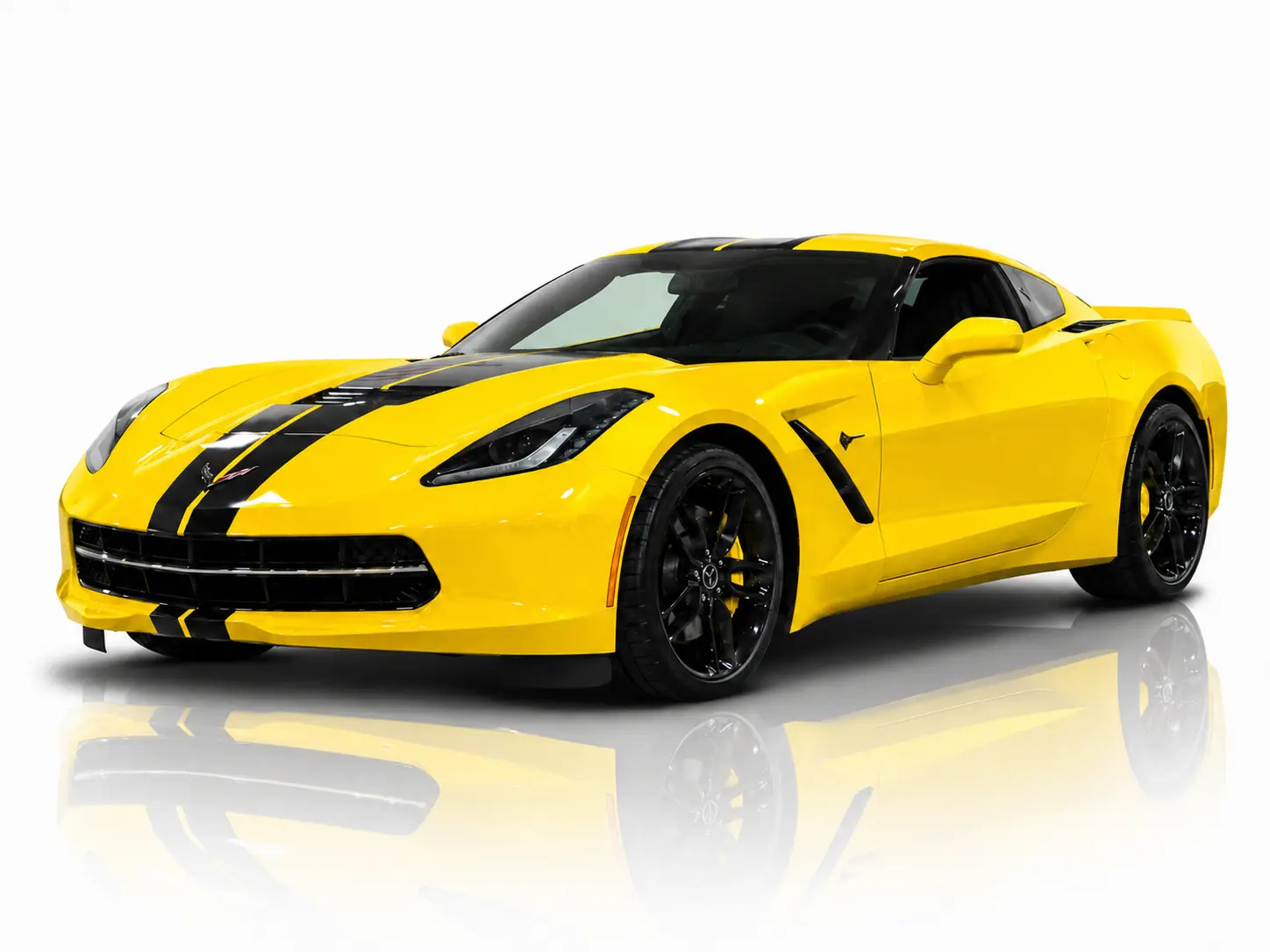
The 2015 Corvette did not introduce a new generation, reinvent the Stingray, or fundamentally alter the architecture Chevrolet had unveiled one year earlier. It did something arguably more consequential.
It demonstrated just how far the seventh-generation Corvette could go.
When the C7 Corvette Stingray arrived for 2014, Chevrolet had already accomplished something remarkable. The new car retained the essential formula that had defined the Corvette for generations—a front-mounted V-8, two seats, rear-wheel drive, composite bodywork, and an attainable price—while addressing many of the weaknesses that had traditionally separated America’s sports car from its European competitors. Its structure was more sophisticated, its interior was dramatically better, its electronics were more capable, and its LT1 V-8 combined traditional small-block architecture with direct fuel injection, variable valve timing, and cylinder deactivation. The C7 was not simply faster than the Corvette it replaced. It was more complete.
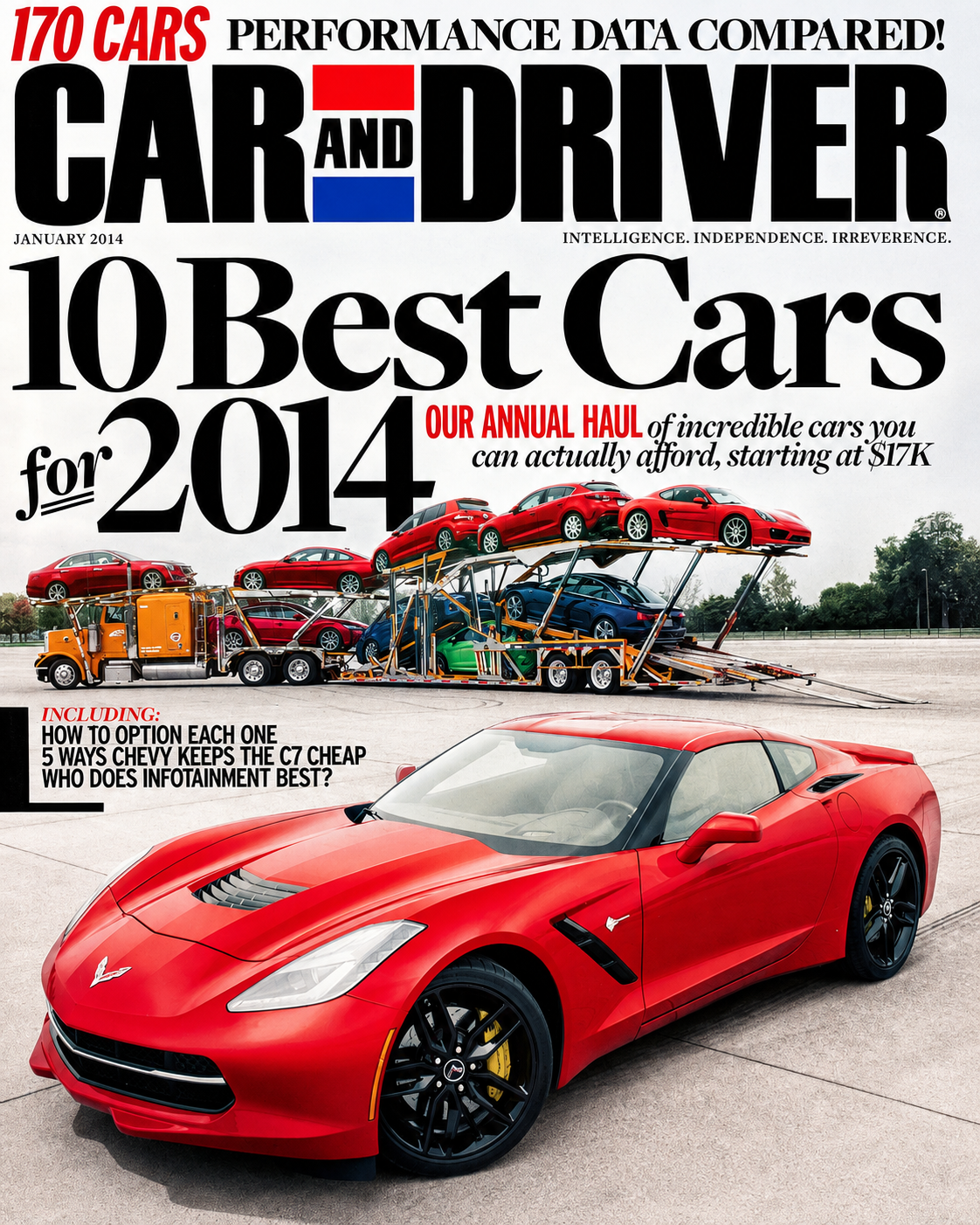
The automobile industry noticed. The 2014 Corvette Stingray was named North American Car of the Year and collected a remarkable array of additional awards during its inaugural season. The challenge confronting Chevrolet for 2015 was therefore very different from the one it had faced while developing the C7. There was no need to rescue the Corvette, nor was there any reason to dramatically reinvent a platform that had only just arrived.
Instead, Chevrolet began exploiting it.
For 2015, the Stingray received an all-new eight-speed automatic transmission, the extraordinary Performance Data Recorder, 4G LTE connectivity, additional appearance options, revised equipment packaging, and two distinctive personalization packages. More importantly, the Z06 returned with a supercharged 650-horsepower LT4, unprecedented aerodynamic capability, massive brakes and tires, available carbon-ceramic rotors, an available automatic transmission, and—in a development that would have seemed almost contradictory during earlier Corvette generations—a removable roof panel or full convertible body.
The result was a Corvette family that could stretch from comfortable grand tourer to legitimate track weapon without abandoning the essential character that had made the C7 such an immediate success. Chevrolet’s own engineers described the Z06 as the most track-capable Corvette the company had ever produced, and period instrumented testing demonstrated that this was more than marketing language.
Yet another Corvette story was unfolding at exactly the same time.
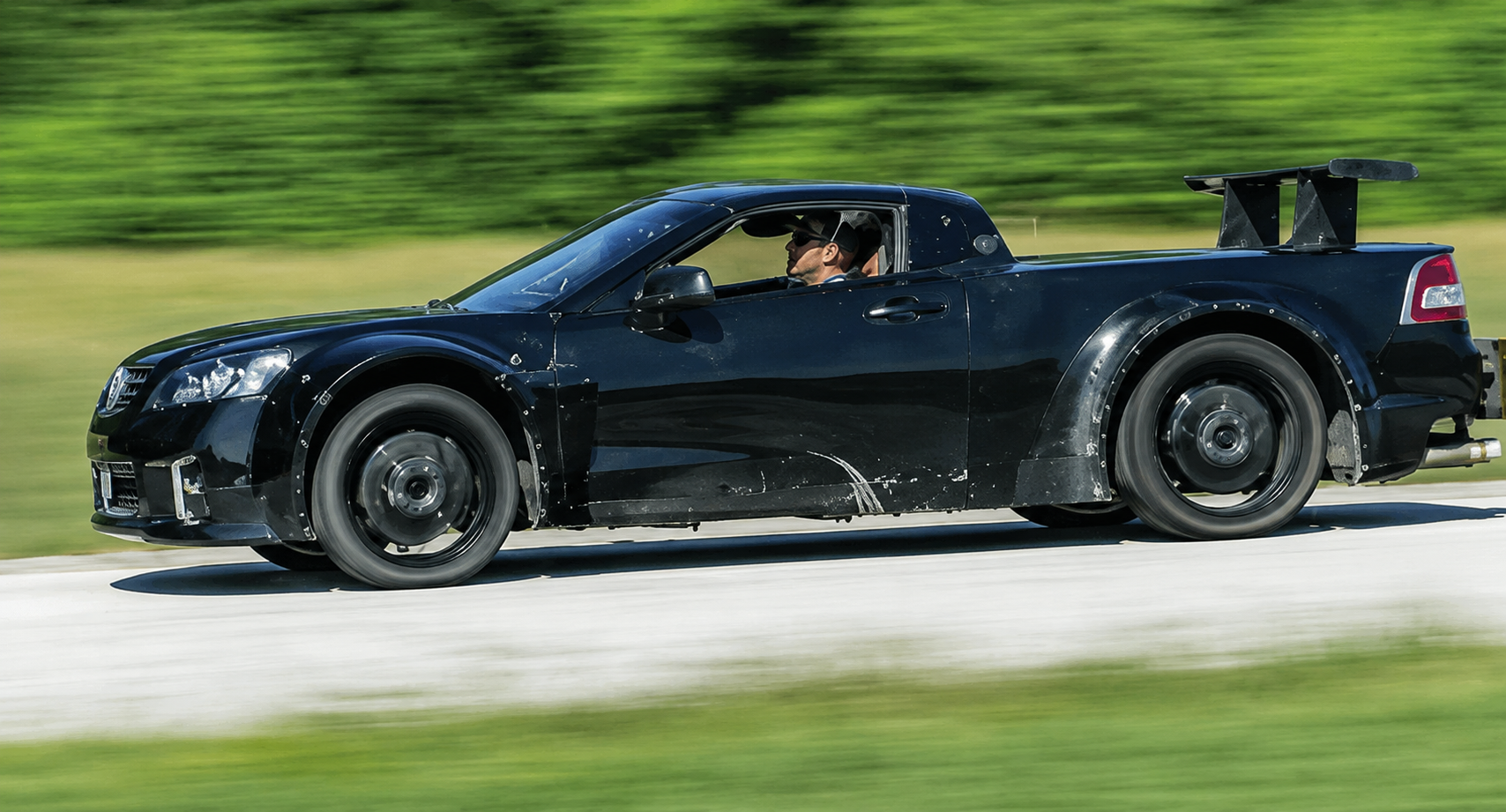
While the 650-horsepower Z06 models began reaching customers, and Corvette Racing was chasing victories at Daytona, Sebring and Le Mans, a bizarre-looking black engineering mule was operating behind closed doors at General Motors. Known internally as Blackjack, it placed its engine behind the passenger compartment and concealed its proportions beneath a mixture of Holden and Corvette bodywork. GM had actually begun that program in 2013, but photographs published in January 2015 gave the outside world its first hard evidence that the long-rumored mid-engine Corvette was no longer simply another concept or internal proposal.
The irony is almost perfect. During the same year Chevrolet demonstrated how extraordinarily capable the traditional front-engine Corvette could become, engineers were already developing the architecture that would ultimately replace it.
That combination makes 2015 one of the most consequential model years of the entire C7 era.
Advancing the Corvette Without Reinventing It
The 2015 Corvette existed because the 2014 Stingray had already established a remarkably strong foundation.
Its aluminum structure, rear-mounted transaxle, carbon-fiber hood and removable roof panel, short-long-arm suspension, transverse composite springs, electronically controlled differential (on performance models), and LT1 small-block gave Chevrolet an architecture that was both familiar and technologically ambitious. The exterior was dramatically more aggressive than the C6 it replaced, while the interior finally presented a level of materials, fit, technology, and driver orientation appropriate to the Corvette’s increasingly serious performance capabilities.
For 2015, Chevrolet resisted the temptation to make unnecessary stylistic changes. The Stingray’s basic shape remained essentially unchanged because the second model year was about expanding capability rather than correcting fundamental shortcomings.
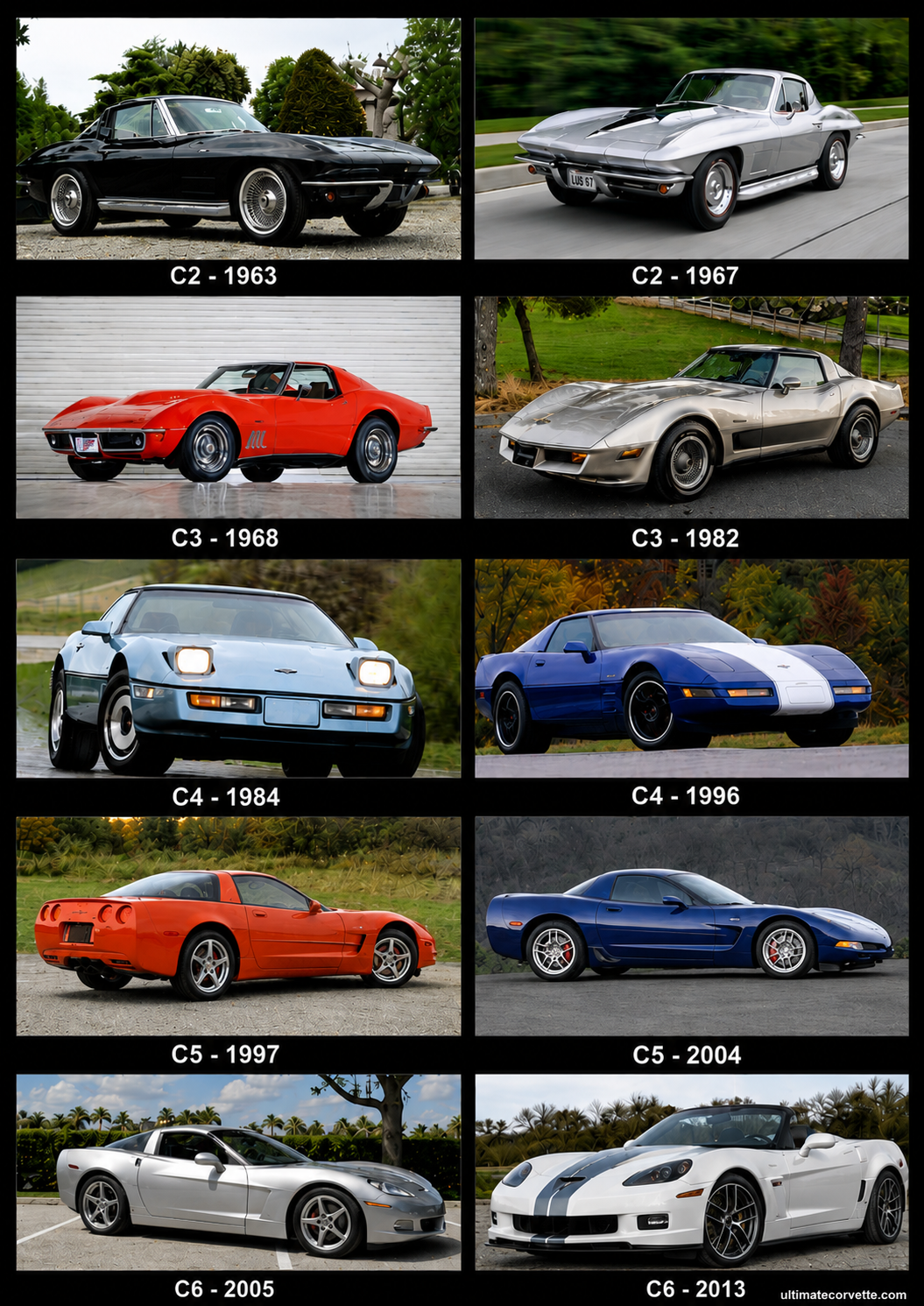
That approach followed a pattern familiar throughout Corvette history. The first production year of a generation traditionally established the platform. Subsequent years allowed engineers to exploit it. The 1963 Sting Ray quickly led to increasingly potent fuel-injected and big-block C2s. The 1968 Corvette evolved dramatically during the long C3 generation. The C4 introduced in 1984 eventually produced the ZR-1 and Grand Sport. The C5‘s fundamental architecture ultimately supported the Z06 and C5-R, while the C6 evolved from the 400-horsepower 2005 coupe into the 505-horsepower Z06 and 638-horsepower ZR1.
The C7 followed the same principle, but the timetable was compressed.
Only a year after the Stingray entered production, Chevrolet introduced a Z06 powerful enough to eclipse the previous C6 ZR1 while simultaneously improving the standard Corvette’s transmission, electronics, connectivity and personalization. In effect, the second-year C7 lineup already contained much of the technological hierarchy that would define the generation.
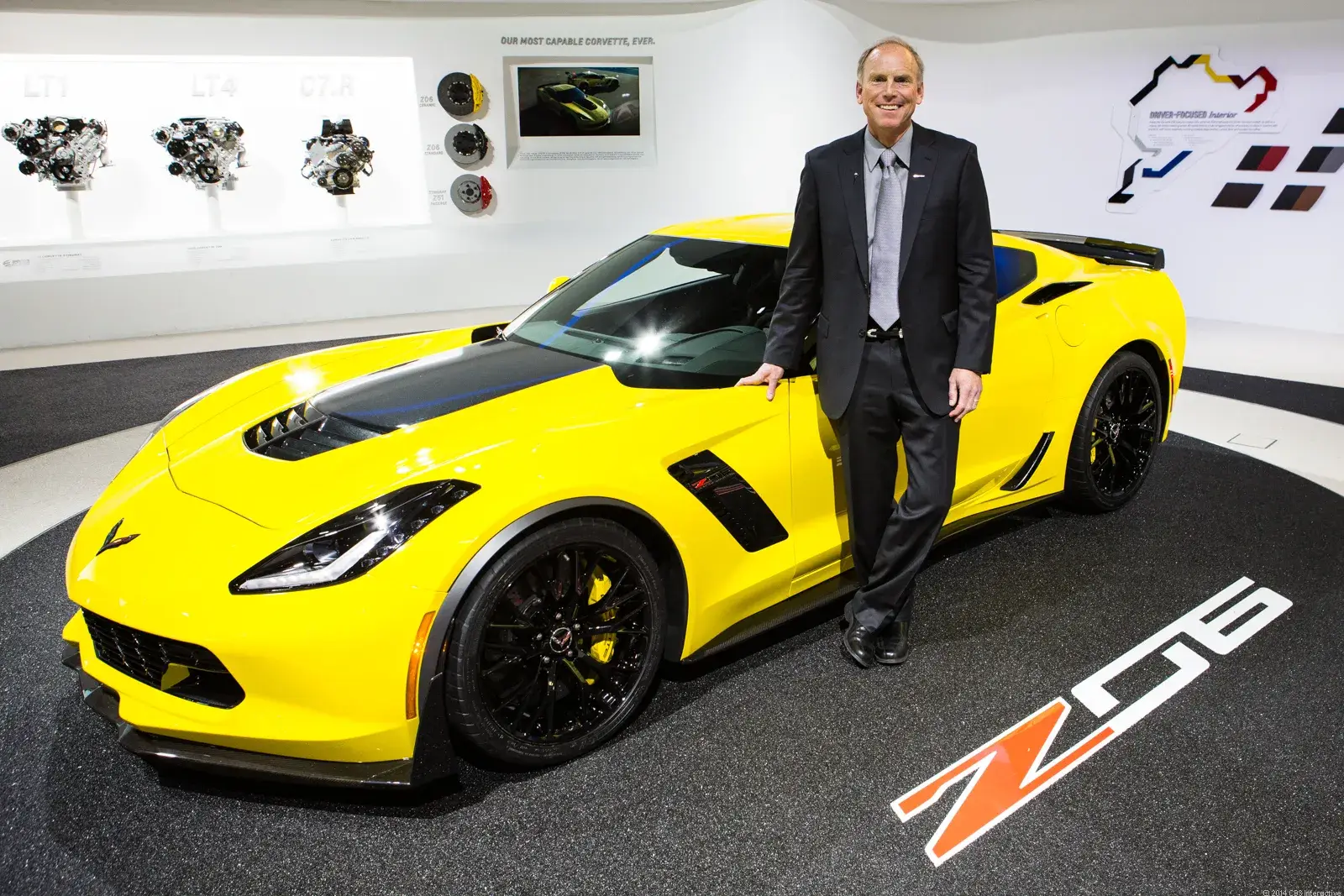
Tadge Juechter, then Corvette chief engineer, summarized the philosophy behind the Z06 in terms of making performance increasingly usable rather than merely increasing its numerical limits. Chevrolet wanted the driver to be able to exploit the available torque, grip and aerodynamic capability instead of simply advertising larger numbers. The foundational 2015 material captures that philosophy directly, including Juechter’s description of making Corvette’s performance “more accessible.”
That concept explains much of the 2015 Corvette.
The eight-speed automatic was not simply about adding gears. It was about making the car accelerate harder while consuming less fuel. The Performance Data Recorder was not simply another camera. It allowed an owner to study his or her driving with race-derived telemetry. Magnetic Ride Control did not merely stiffen the suspension. It continually altered damping to reconcile ride comfort with track capability. The Z07 package did not simply decorate the Z06 with more aggressive appendages. Those components generated measurable aerodynamic downforce.
The 2015 Corvette was therefore less about reinvention than integration.
Chevrolet was learning how to make extreme performance increasingly approachable.
Tom Peters, Kirk Bennion, and the Shape of the 2015 Corvette
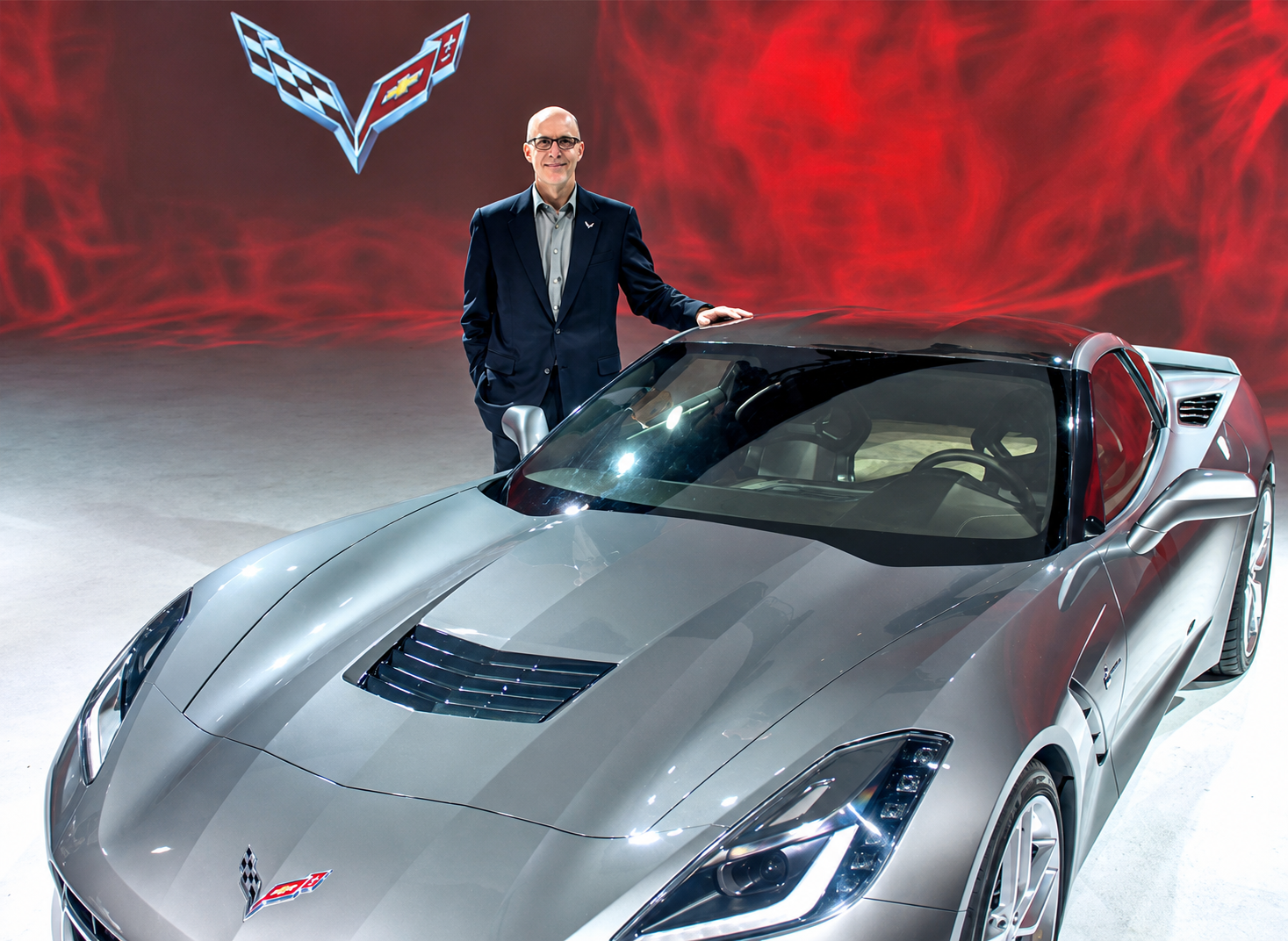
Tom Peters’ design organization had already given the seventh-generation Corvette one of the most dramatic shapes in the car’s history. The C7 still carried the visual DNA that had defined Corvette for generations—the long, low hood, pronounced front fenders, abbreviated rear deck, low seating position and unmistakable front-engine sports-car proportions—but almost everything about the way those elements were expressed had changed.
Where the C5 and C6 had evolved from their predecessors with a degree of visual continuity, the C7 deliberately broke from that pattern. Its surfaces were harder, its creases more pronounced, and its details more technical. The body was punctuated by functional openings, vents and extractors, while even the departure from Corvette’s traditional round taillamps signaled that Chevrolet was willing to challenge convention if doing so produced a more contemporary, more purposeful automobile.
The C7 increasingly looked less like a shape that had simply been sculpted around a mechanical package and more like a machine whose bodywork had been engineered as part of that package. That philosophy was already evident on the Stingray, but it became impossible to miss when Chevrolet introduced the 2015 Corvette Z06.
Form Follows Function
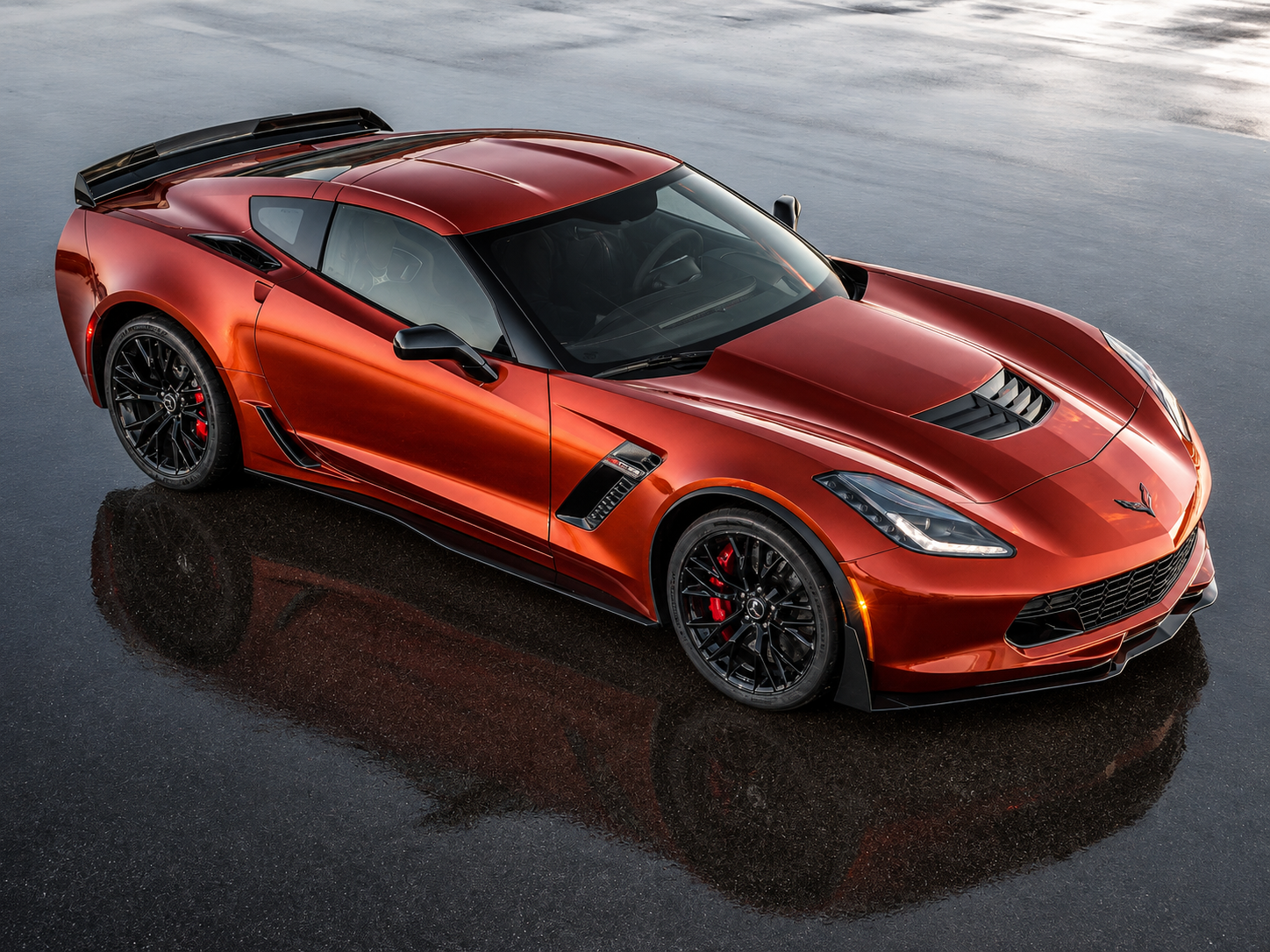
Where the Stingray was aggressive, the Z06 was almost confrontational, with little attempt to disguise what the car had become. The widened body, enlarged cooling openings, deeper aerodynamic appendages, and enormous tires transformed the already dramatic C7 into something that looked much closer to a competition car made street legal than a conventional production Corvette that had merely received more horsepower.
That appearance was not accidental, nor was it merely cosmetic. The Z06’s front fenders were widened by approximately 2.2 inches, while the rear bodywork grew by roughly 3.15 inches. Those changes were necessary to package substantially larger wheels and tires beneath the body, but they also changed the visual character of the automobile as a whole.
The standard Stingray looked lean and athletic, while the Z06 looked planted, almost compressed against the pavement by the width of its track. From virtually any angle, the additional body width was evident, particularly through the dramatically swollen rear quarters and the way the tires filled the wheel openings.
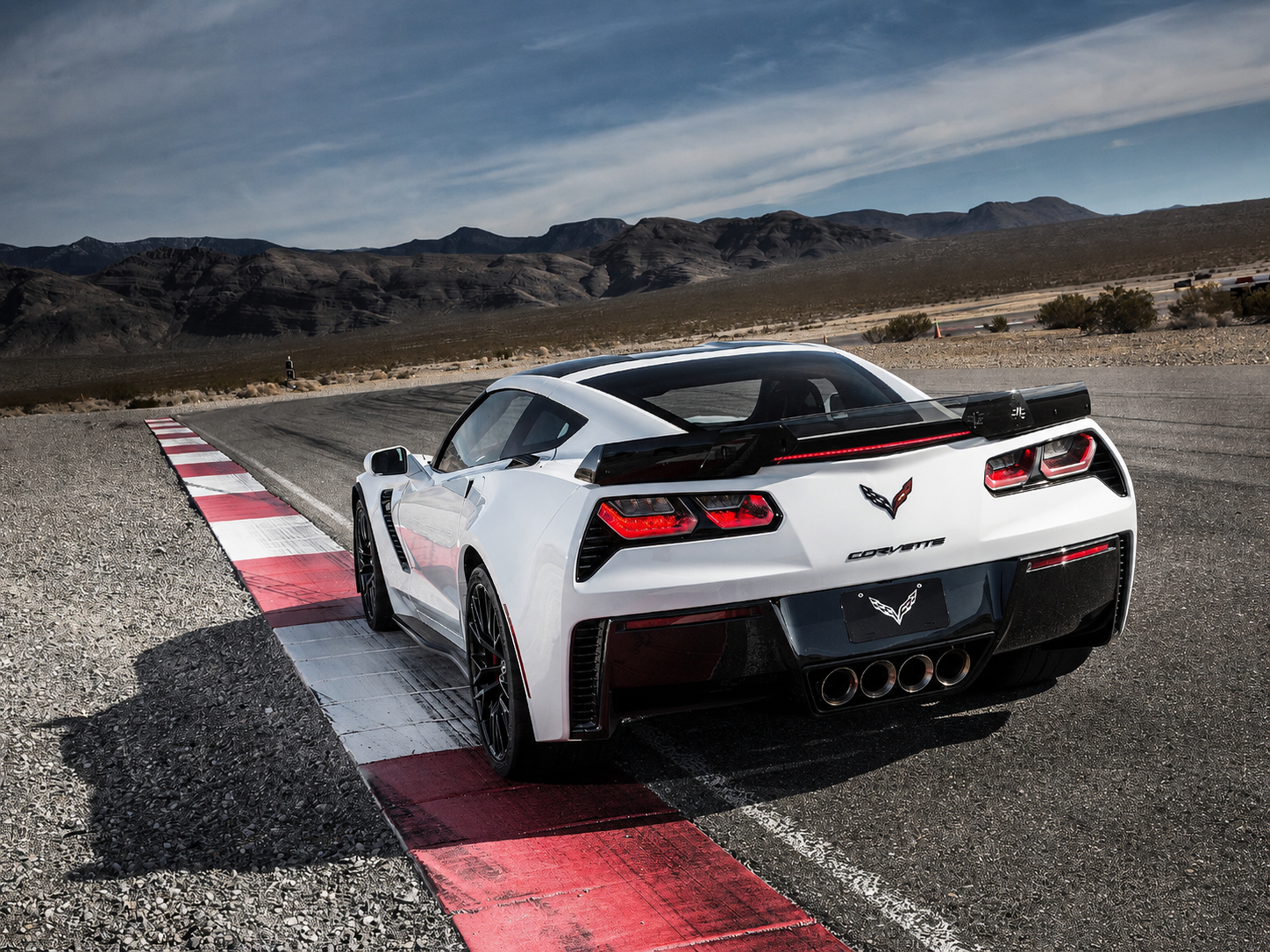
The rear bodywork wrapped around enormous P335/25ZR20 tires, while P285/30ZR19 rubber filled the front wheelhouses. The wheels themselves measured 19 x 10 inches in front and 20 x 12 inches at the rear, dimensions that would have seemed almost exotic on a road-going Corvette only a generation earlier. Chevrolet was no longer attempting to build a car that merely looked capable; the Z06 had been engineered around the physical requirements of generating and managing enormous levels of grip.
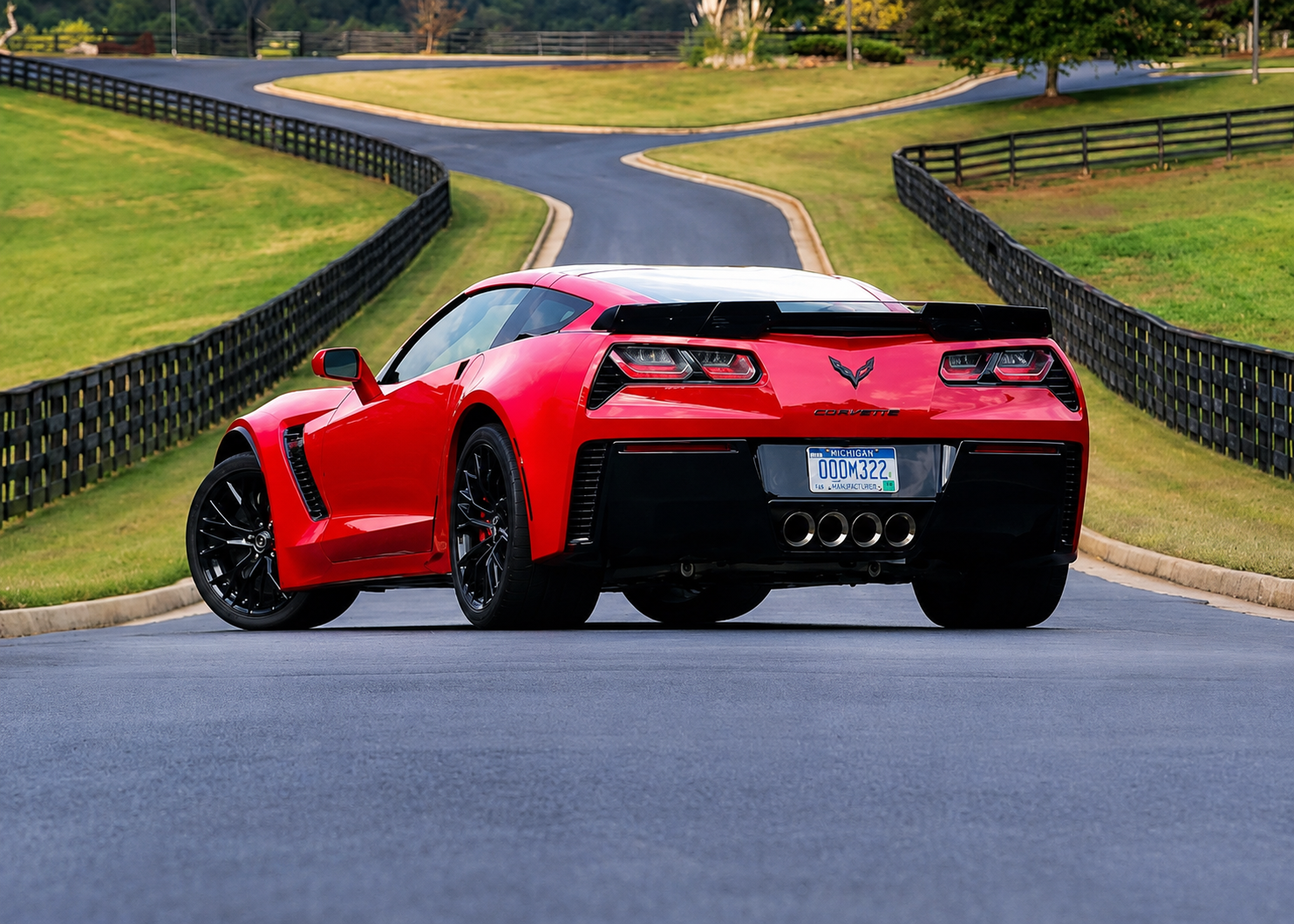
That widened stance also forced changes farther aft. The taillamps were pushed farther apart within a unique rear fascia, visually emphasizing the width of the car while accommodating the revised rear bodywork. The result was one of the broadest-looking Corvettes ever produced, particularly when viewed directly from behind, where the combination of wide tires, stretched fascia and rear aero hardware gave the car an unmistakably purposeful stance.
The front of the Z06 told the same story. The grille opening grew substantially because the LT4’s supercharged 6.2-liter V-8 created vastly greater thermal demands than the naturally aspirated LT1 in the Stingray, and additional cooling capacity was required not only for the engine but also for the transmission, differential, brakes and other systems expected to survive sustained high-speed track use.
In that sense, the Z06’s bodywork was not merely surrounding the mechanical components; it was actively supporting them. Tom Peters summarized the philosophy succinctly when he explained that “practically every exterior change served a functional purpose, as this beast needed more of everything,” a statement that could almost serve as the design brief for the entire automobile.
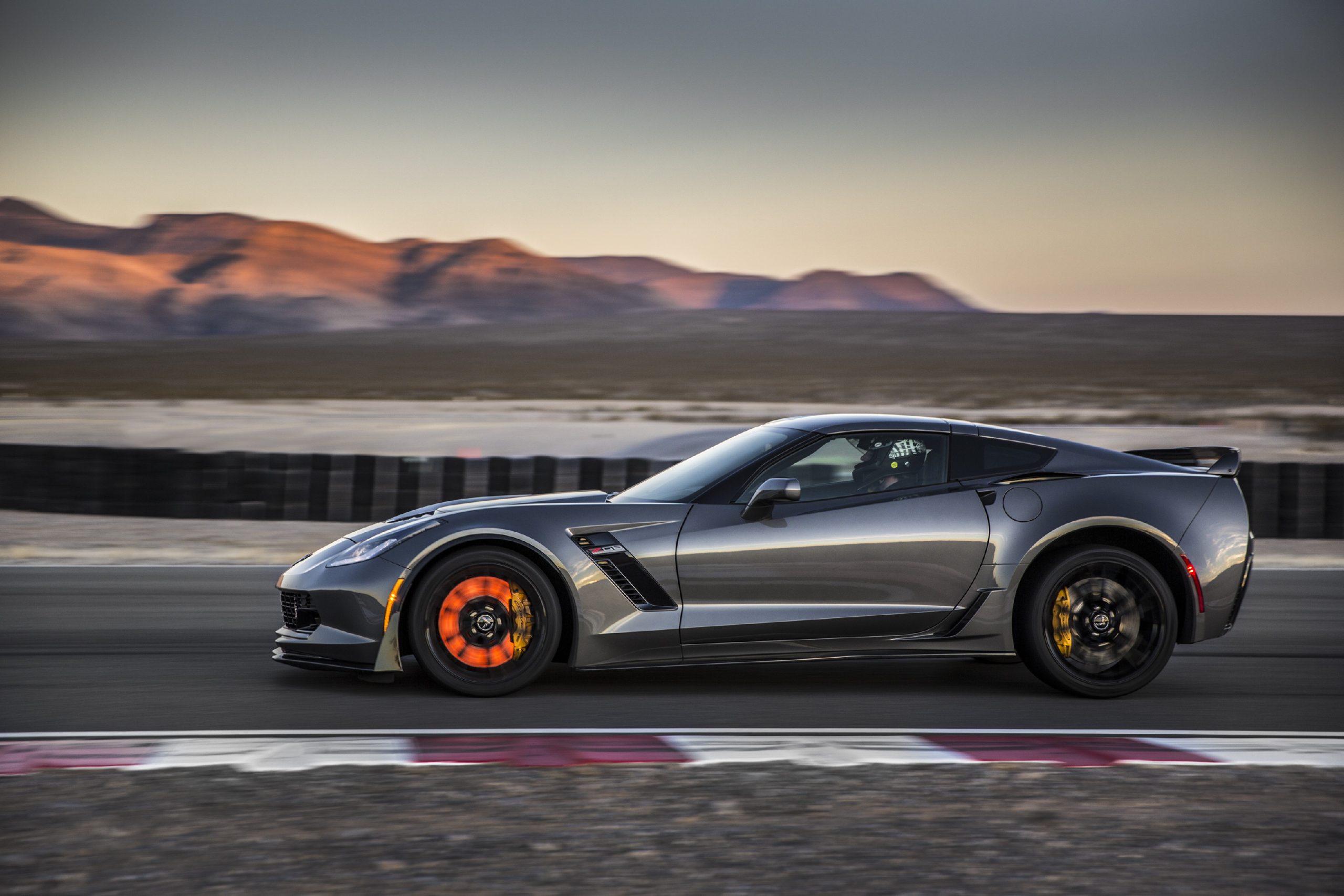
The Z06 needed more air entering the car, more heat leaving it, more tire contacting the pavement, more brake capacity, more high-speed stability and more aerodynamic control. Each of those requirements exerted pressure on the exterior design, and Peters’ team allowed those engineering demands to remain visible rather than concealing them beneath a cleaner or more conservative shape.
The hood provided one of the clearest examples. A larger extractor helped evacuate hot air from the engine compartment while simultaneously contributing to aerodynamic management at the front of the car. Rather than allowing high-pressure air to accumulate beneath the hood and create lift, the vent provided a controlled path for that air to escape, meaning what initially appeared to be another aggressive styling flourish performed a very real function at speed.
The same philosophy extended along the sides of the car. Air-management devices around the front wheels, fenders and rocker panels were shaped to control turbulent air moving around the body, while the broader rear quarter panels were dictated in large part by tire width. The enlarged openings fed systems that required greater cooling, and even the visual brutality of the Z06—the sense that the car had been stretched, vented and carved open—was a consequence of its intended performance envelope.
The result was a Corvette whose appearance increasingly communicated how it worked. Chevrolet then gave customers the ability to take that philosophy even farther through three progressively aggressive aerodynamic configurations, each building upon the same basic body with increasingly serious hardware.
The standard Z06 already incorporated a front splitter, wheel-opening spats and a rear spoiler. These elements gave the base car a considerably more serious aerodynamic package than the Stingray while maintaining a degree of everyday usability and visual restraint relative to the more extreme configurations.
An available carbon-fiber aero package increased that emphasis with a more aggressive carbon-fiber front splitter, rocker extensions and a larger rear spoiler. Carbon fiber was not simply being applied as decorative trim; it was being used in areas where shape, stiffness and low mass were useful while visually reinforcing the car’s increasingly competition-oriented character.
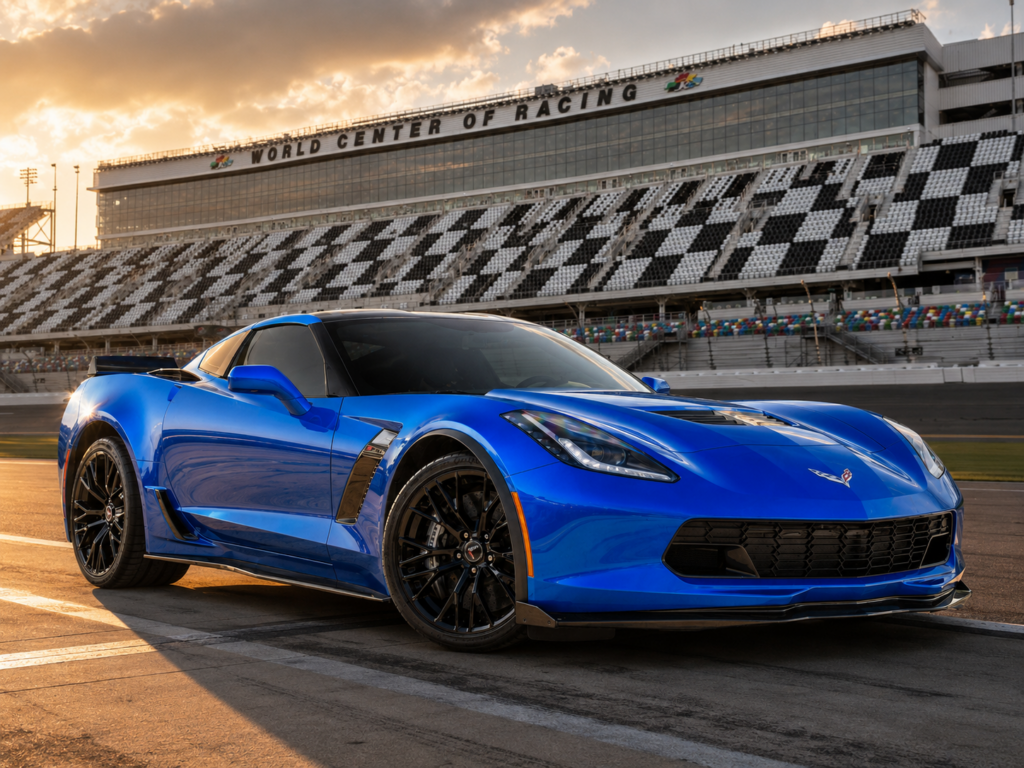
The Z07 Performance Package took the concept to its extreme. Z07-equipped cars received larger front splitter winglets and an adjustable transparent center section—commonly described as a wickerbill—on the rear spoiler. The transparent material allowed Chevrolet to add rear aerodynamic surface area without completely obstructing rearward visibility, while the adjustable configuration gave the car another degree of tuning for high-speed use.
With the full Z07 aerodynamic configuration installed, Chevrolet stated that the Z06 generated more aerodynamic downforce than any production automobile General Motors had tested to that point. That claim illustrates just how far Corvette development had progressed, especially when compared with earlier generations in which production-car aerodynamic work had concentrated far more heavily on reducing drag, maintaining stability and controlling lift.
By the time the C7 Z06 arrived, Chevrolet engineers were deliberately using the body to generate meaningful downforce while simultaneously attempting to preserve the attributes that made a Corvette usable away from the racetrack. That duality became one of the most remarkable characteristics of the 2015 Z06.
Here was a 650-horsepower Corvette capable of wearing enormous tires, producing genuine aerodynamic downforce and generating performance that placed it among the most serious track-capable road cars in the world. Yet it could still be configured with heated and ventilated seats, navigation, an automatic transmission and, in convertible form, a power-operated roof.
The car did not demand that an owner accept race-car austerity in exchange for race-car capability. Chevrolet instead attempted to deliver both, combining an increasingly competition-focused exterior and chassis with the comfort, convenience and everyday usability expected of a modern flagship sports car.
The Z06’s exterior design therefore represented far more than a more aggressive interpretation of the Stingray. It demonstrated the extent to which the C7 platform had been conceived as an adaptable performance architecture, one whose basic proportions remained recognizable even as nearly every major surface could be altered when the mechanical requirements demanded it.
The Z06 was unmistakably a C7 Corvette, but it looked as though every component had been turned up several degrees. That visual transformation was appropriate because, beneath the surface, nearly every performance system had been pushed in exactly the same direction.
Atlantic and Pacific: Two Personalities for the Stingray
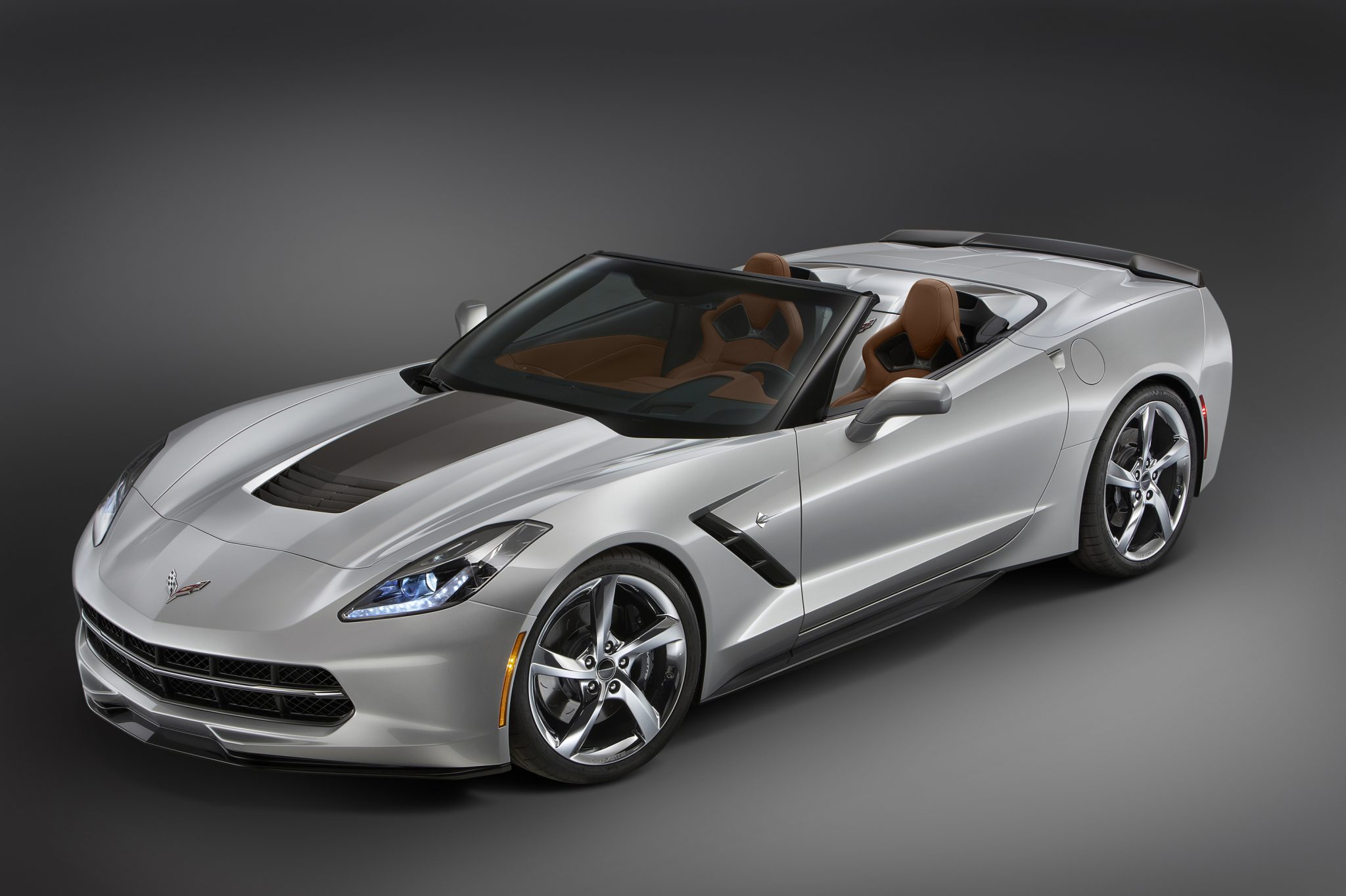
At the same time Chevrolet was pushing the C7 toward the extreme performance represented by the Z06, it was exploring another aspect of the Corvette’s growing sophistication: personalization. The Atlantic and Pacific Design Packages represented an entirely different interpretation of what the seventh-generation Corvette could become, showing how much character could be created through carefully coordinated appearance and equipment choices.
Both had originated as concept vehicles displayed at the 2013 SEMA Show, where Chevrolet used the enormous aftermarket and enthusiast gathering to gauge reaction to different combinations of factory accessories, trim, wheels, graphics and interior treatments. The response was sufficiently positive that the company moved forward with production versions for the 2015 model year.
The significance of the two packages was not that they transformed the Stingray mechanically, because they did not. Instead, they demonstrated how dramatically the Corvette customer base—and Chevrolet’s understanding of that customer base—had broadened.
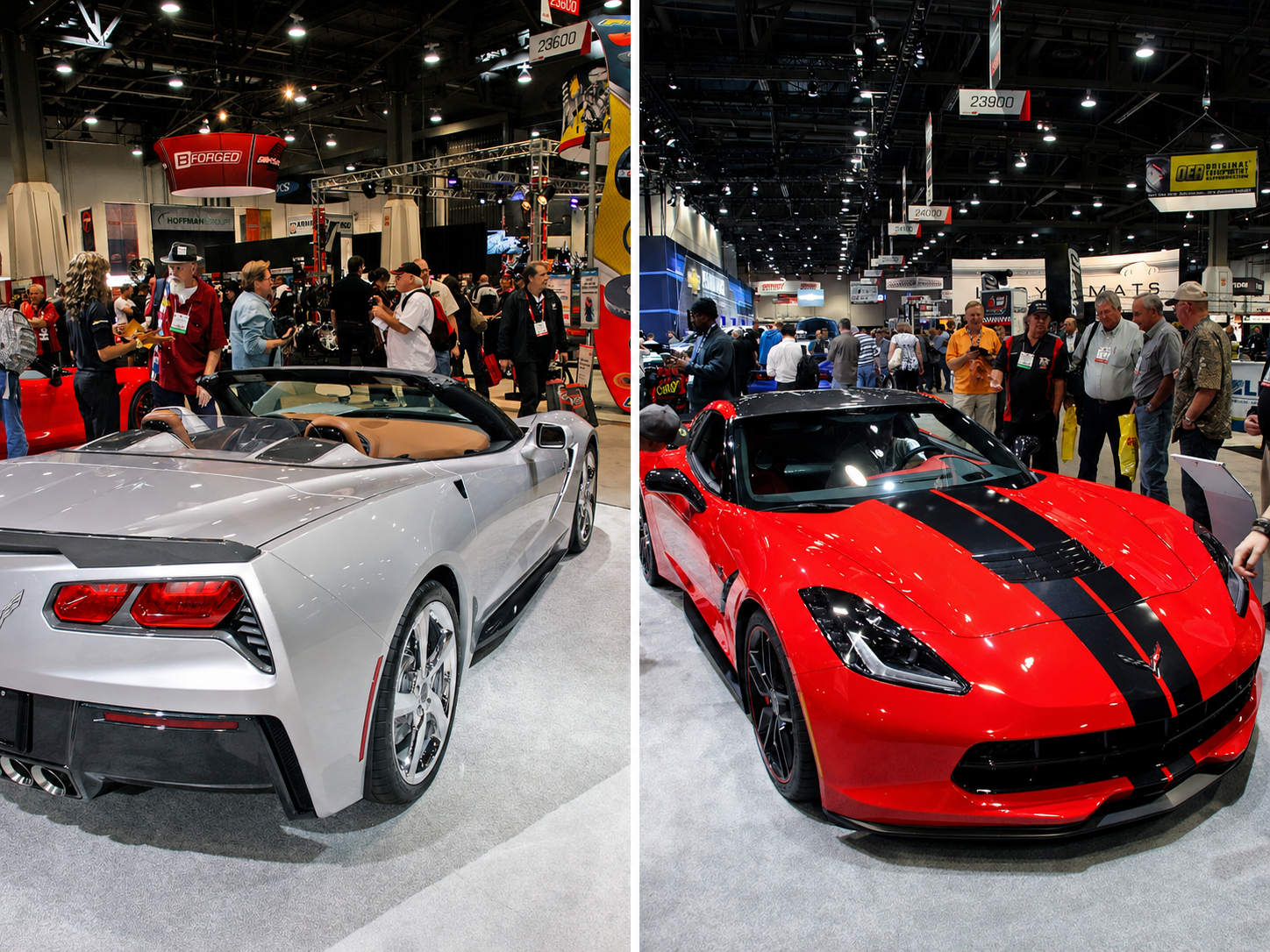
Kirk Bennion, Corvette exterior design manager, explained that one of the C7 program’s objectives was to give owners enough flexibility “to tailor the car to their personality.” The Atlantic and Pacific packages took that idea and turned it into two deliberately different interpretations of the same basic automobile.
The Atlantic represented the grand-touring side of Corvette ownership. Available only on Z51-equipped convertibles in 2LT or 3LT trim, the package was conceived around a more polished, destination-oriented personality. Chevrolet described its inspiration in terms that evoked private aviation, European travel and upscale grand touring rather than pit lanes and timing transponders.
That influence was reflected in the details. The Atlantic incorporated a Z06-style front splitter, Shark Gray exterior vents, distinctive hood graphics and matching tonneau inserts. Chrome Torque wheels gave the car a more formal appearance than the darker performance-oriented wheel treatments appearing elsewhere in the Corvette catalog, while unique Stingray-branded details reinforced the sense that this was intended as a coordinated factory design rather than a random collection of accessories.
Splash guards and fitted luggage further emphasized the package’s touring character. There was a certain logic to that approach because the C7 convertible had already evolved into a remarkably competent long-distance automobile, offering substantial power, genuine sports-car handling, a comfortable cabin and the ability to lower the roof without surrendering the fundamental character of the Corvette.
The Atlantic package simply leaned into that personality. It dressed the car for the owner who imagined the Corvette as something to pack for a weekend away rather than something that necessarily needed a helmet in the luggage compartment, creating an image that was more coastal grand tourer than weekend track weapon.
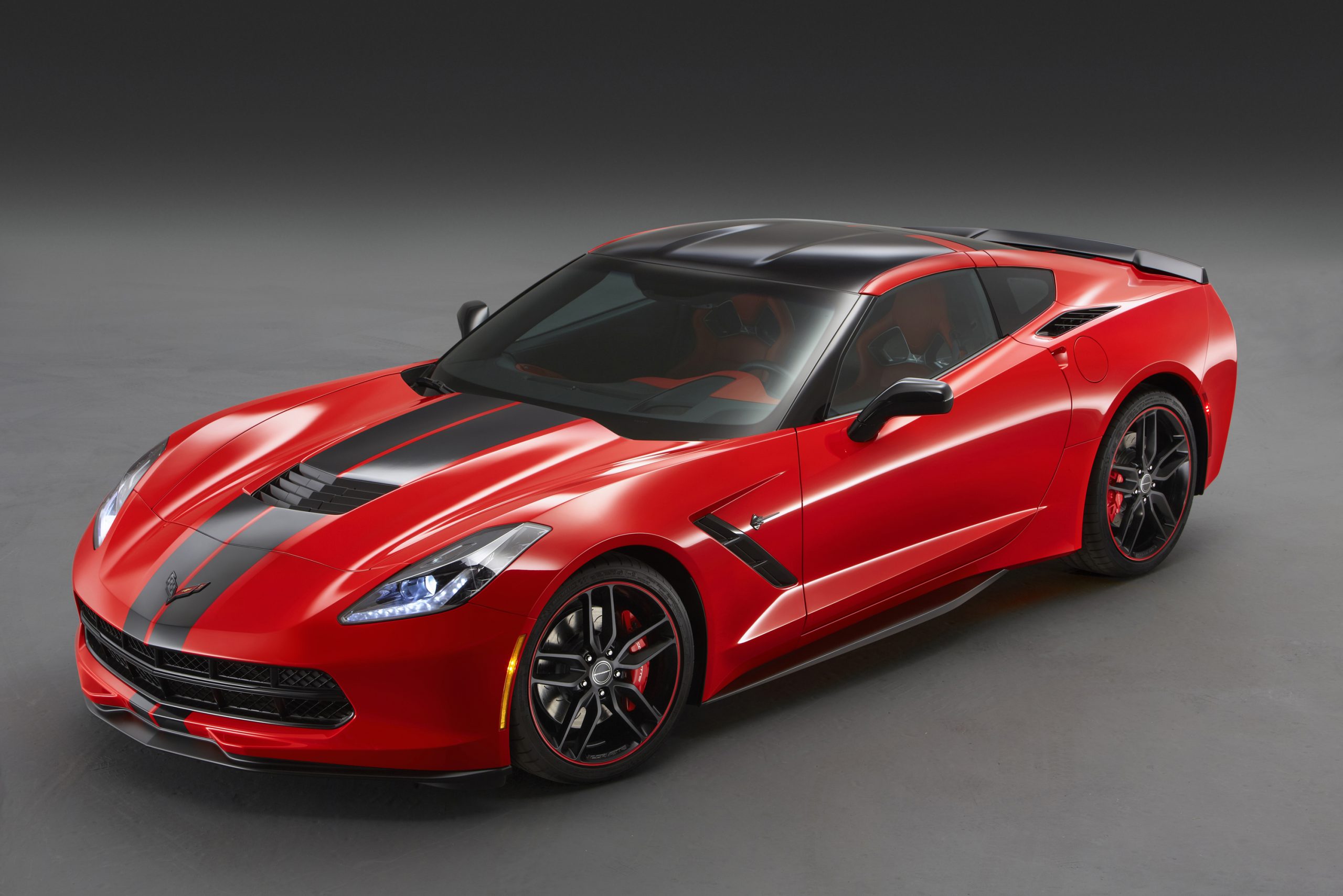
The Pacific package approached the Stingray from almost the opposite direction. Available only on Z51-equipped coupes in 2LT or 3LT trim, it was aimed at the enthusiast who wanted the car to communicate a stronger connection to the track even when it was sitting still.
Satin-black racing stripes immediately altered the car’s visual attitude. Black Z51 wheels with red accents, red brake calipers and carbon-fiber ground effects pushed the appearance farther toward motorsport, while a visible carbon-fiber roof panel continued the theme above the beltline. Carbon Flash exterior elements created a darker, more technical contrast against the body color and reinforced the sense that the package had been assembled with a much more aggressive visual purpose.
Inside, the Pacific continued the same theme with Competition Sport Seats and carbon-fiber appointments. Taken individually, none of those changes transformed the mechanical character of the Stingray, but together they gave the car a far different personality from the Atlantic.
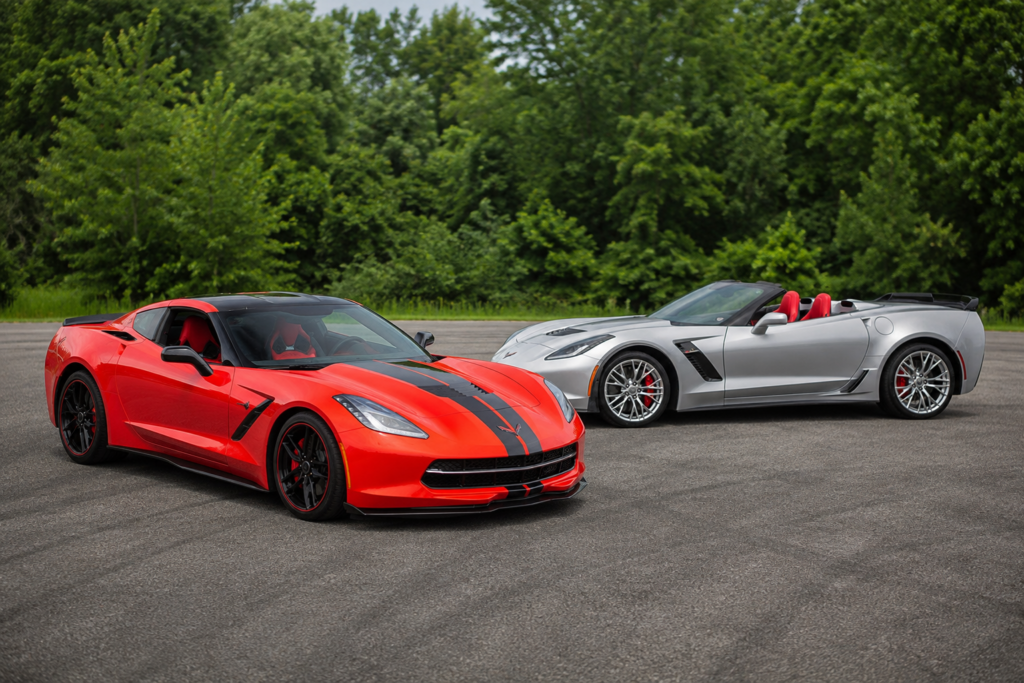
The Atlantic looked prepared for a long drive, while the Pacific looked prepared for a track day. That contrast was precisely the point, because Chevrolet was using essentially the same underlying Stingray to explore two different interpretations of Corvette ownership.
For much of Corvette history, buyers had selected colors, wheels, interiors and a relatively limited number of appearance options around a fairly fixed visual identity. By the C7 era, Chevrolet was beginning to treat the Corvette more like a customizable performance platform. A customer could start with essentially the same Stingray and push it toward grand touring, visual motorsport aggression or something closer to the standard car’s relatively restrained configuration.
The idea also reflected the growing importance of factory personalization in the performance-car marketplace. Corvette buyers had always modified their cars, and the aftermarket surrounding the model was enormous, but Chevrolet’s strategy with packages such as Atlantic and Pacific effectively brought part of that personalization process inside the factory ecosystem.
Rather than forcing owners to assemble a collection of aftermarket pieces after purchase, Chevrolet could offer a coordinated design whose components had been selected to work together visually. That was particularly important for the C7 because the design itself responded so strongly to small changes in trim.
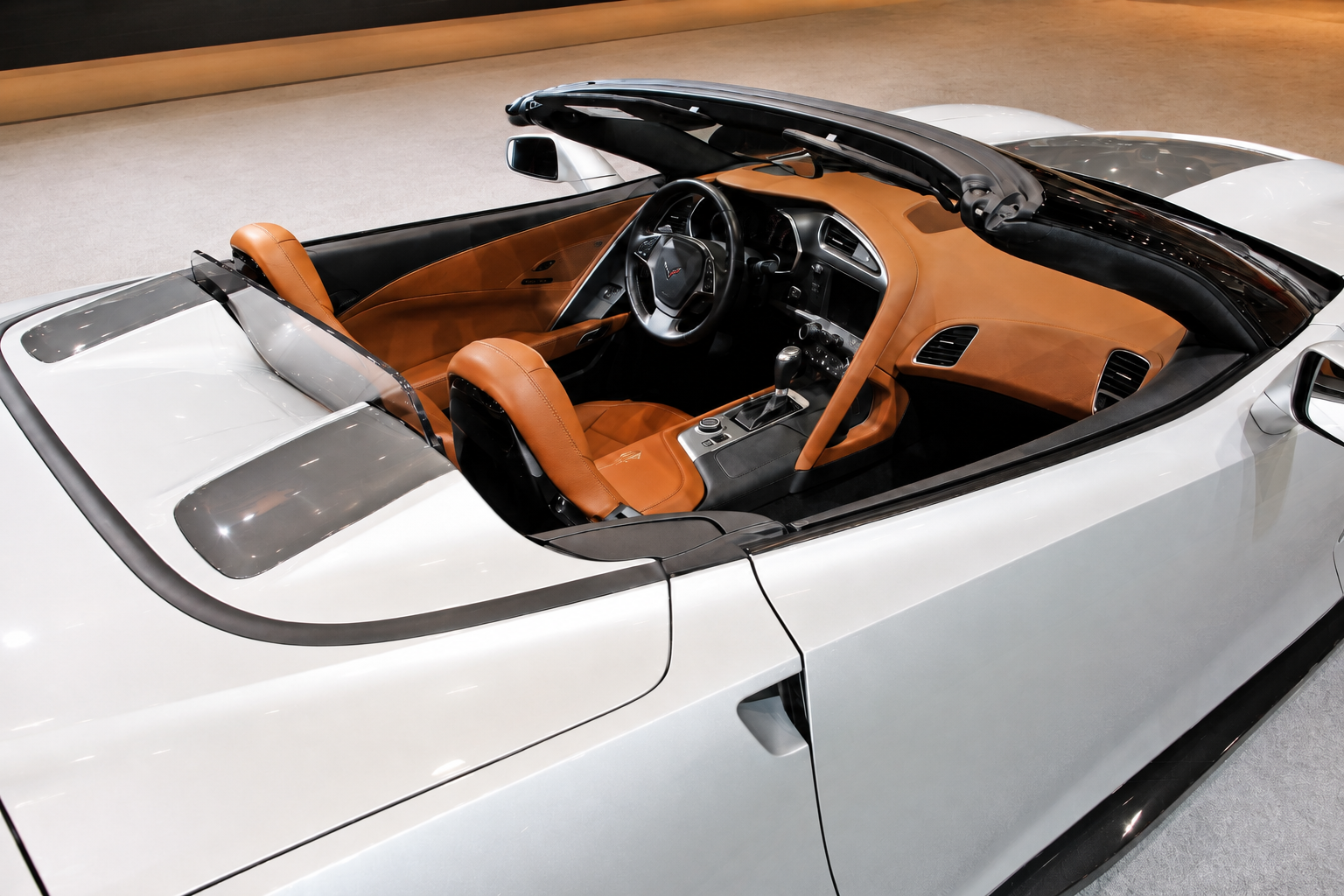
Darkening the vents, changing the wheels, adding a splitter or introducing a contrasting stripe could significantly alter the way the car read visually. The C7’s sharp creases and functional openings gave accessory designers natural places to introduce contrast, allowing Chevrolet to create dramatically different personalities without changing the basic body.
The Atlantic and Pacific packages therefore sat at an interesting point within the 2015 Corvette lineup. At one extreme was the Z06, where form was being reshaped by the requirements of 650 horsepower, enormous tires, serious cooling demands and genuine aerodynamic downforce. At the other was the Stingray, where Chevrolet was demonstrating how much visual character could be created through carefully coordinated personalization.
Both approaches grew from the same underlying idea: the seventh-generation Corvette had become a remarkably flexible canvas. It could be configured as a relatively understated coupe, a luxurious convertible, a visually aggressive Z51, an Atlantic grand tourer, a Pacific track-inspired Stingray or a Z06 capable of performance that only a few years earlier would have seemed almost unimaginable for a regular-production Corvette.
The Atlantic package ultimately became especially unusual, with contemporary production compilations recording only 17 examples equipped with RPO ATI. That placed it among the rarest regular-production configurations of the C7 era and gave the package an importance beyond the number of cars Chevrolet actually sold.
The Atlantic and Pacific demonstrated that Corvette design in the C7 era was no longer focused solely on creating a single recognizable sports car. Peters, Bennion, and the broader design organization had created a shape capable of supporting multiple identities without losing the visual foundation that made each of them unmistakably a Corvette.
For the Z06, that flexibility allowed the body to grow wider, more vented, and more aerodynamically aggressive in response to engineering necessity. For the Atlantic and Pacific, it allowed one Stingray to evoke a polished transcontinental grand tourer while another suggested a weekend spent chasing lap times.
The underlying automobile remained the same, but the personality could be remarkably different. That versatility became one of the defining strengths of the C7 platform and helped explain why the 2015 lineup could accommodate such dramatically different interpretations of the Corvette without any of them feeling disconnected from the car’s larger identity.
The Technology That Changed the Corvette Experience
If one technology best illustrates just how quickly the Corvette was evolving by 2015, it was not the supercharger bolted atop the Z06’s LT4, nor was it the new eight-speed automatic transmission arriving across the lineup. Those technologies unquestionably changed what the Corvette could do, but another innovation changed something arguably more fundamental: the relationship between the Corvette and the person sitting behind its steering wheel.
It was a camera.
More specifically, it was Chevrolet‘s new Performance Data Recorder, a technology that effectively allowed the Corvette to watch itself being driven, record what it experienced and then give that information back to its owner. In an era when increasingly sophisticated electronics were beginning to transform the automobile, the PDR represented something far more interesting than another convenience feature. It took technology normally associated with professional motorsports and made it accessible from the dashboard of a production Corvette.
The Performance Data Recorder

The Performance Data Recorder, commonly abbreviated simply as PDR, was developed in partnership with Cosworth, the legendary British motorsports-engineering company whose relationship with Corvette extended well beyond this particular project. Cosworth identifies the Corvette PDR as a direct outgrowth of its long-term partnership with Corvette Racing, where sophisticated data acquisition and analysis had already become indispensable tools for understanding what both car and driver were doing on the circuit.
That lineage is important because the system was never intended to be merely an integrated dash camera. Chevrolet and Cosworth were essentially attempting to package a portion of the analytical capability used in competition into something a Corvette owner could operate without a race engineer, a laptop balanced on a pit wall or a trunk full of aftermarket electronics. Cosworth continues to support the earlier-generation Corvette PDR systems and describes its analysis software as a way of visualizing driver inputs, vehicle dynamics and track information together—the same fundamental philosophy introduced with the C7 system in 2015.
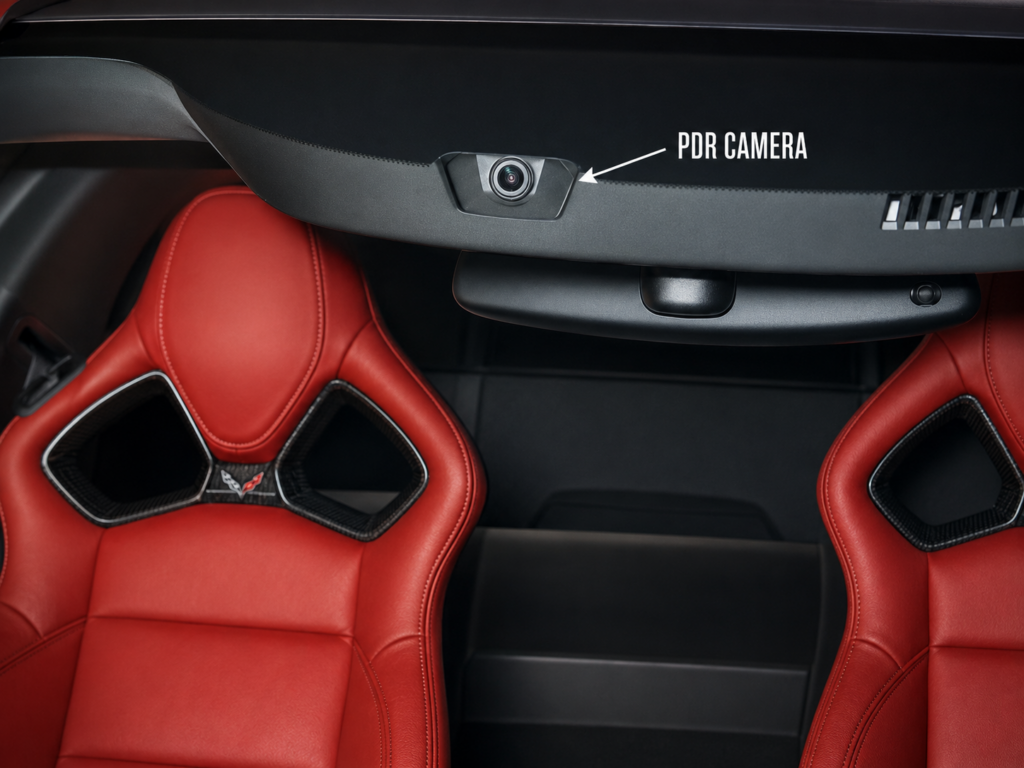
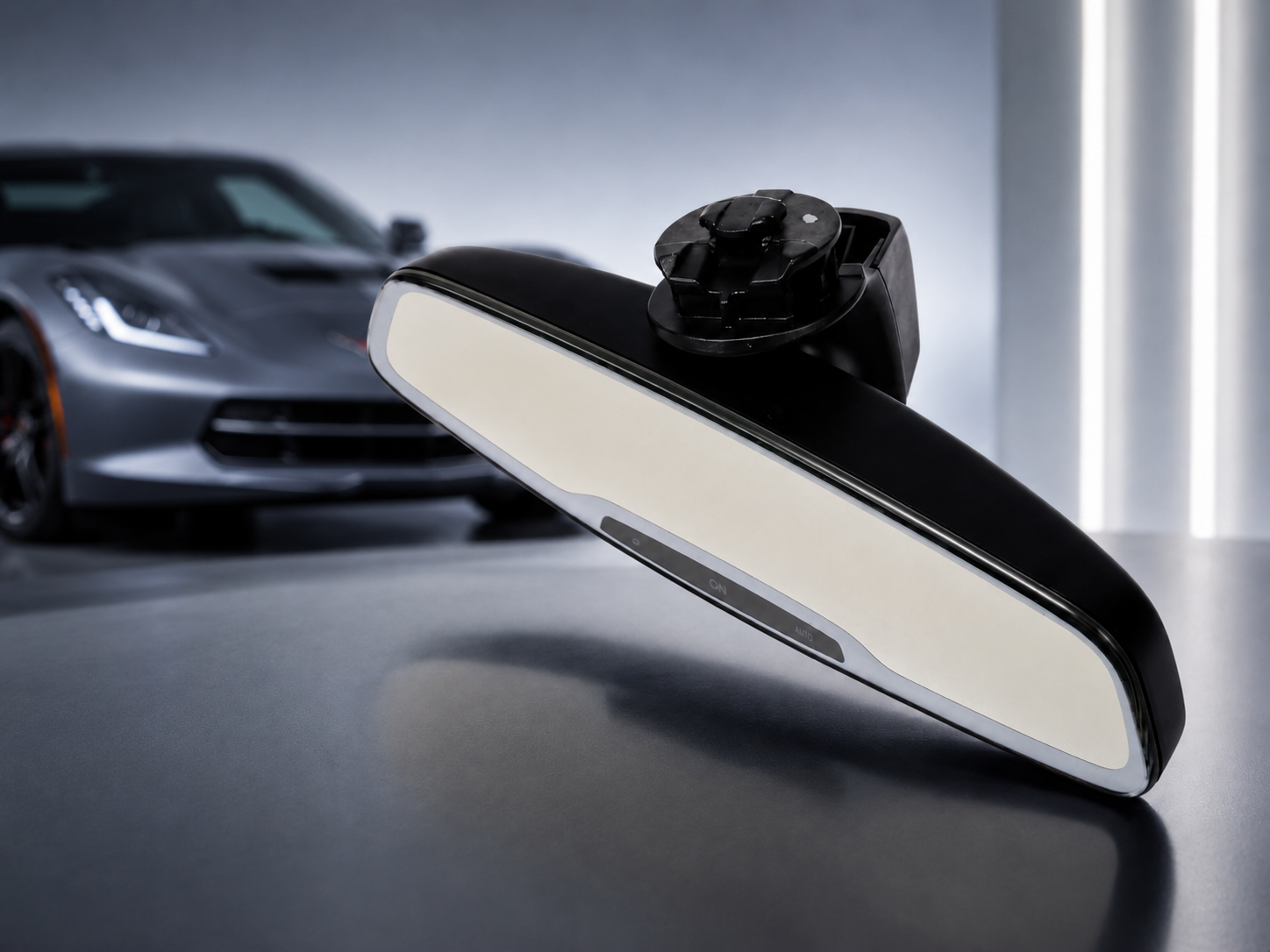
The original system combined a 720p high-definition forward-facing camera mounted within the windshield-header area, a dedicated telemetry recorder and GPS receiver, access to information flowing through the Corvette’s vehicle network, and a dedicated SD-card reader located inside the glovebox. The GPS system sampled position at a considerably higher rate than the car’s conventional navigation system, allowing the PDR to build a much more precise picture of where the Corvette was positioned on a circuit and what it was doing as it traveled around it. Chevrolet stated that an 8GB SD card could hold approximately 200 minutes of recorded driving, while larger cards substantially increased recording time.
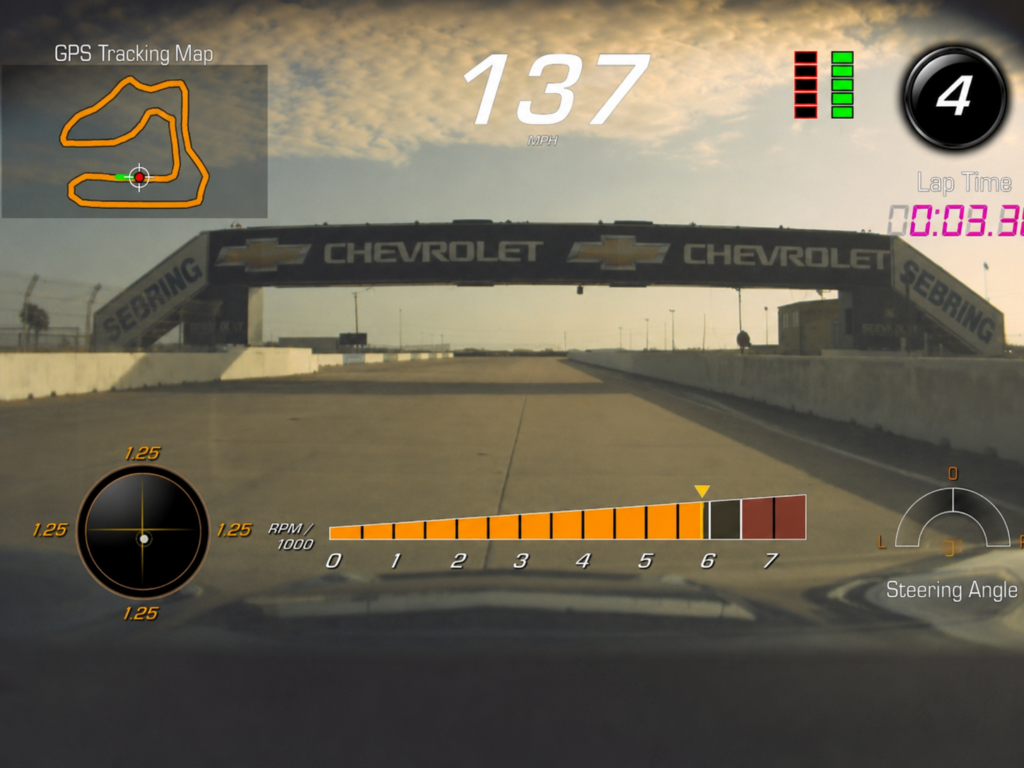
More important than any single piece of hardware was the way those components worked together. The system could combine the video image with information already being generated by the Corvette itself, including vehicle speed, engine rpm, gear selection, braking input, steering information and lateral acceleration. Instead of watching an isolated video after a track session and trying to remember where the driver had braked or lifted, the owner could see the behavior of the car and the actions of the driver presented together.
Chevrolet provided several different ways to display that information depending upon how the owner intended to use the recording. Track Mode presented the richest performance overlay, including speed, engine rpm, g-force information, lap timing and positional data. Sport Mode reduced the amount of information on the screen while retaining the most important performance indicators, while Touring Mode removed the telemetry overlay almost entirely and allowed the PDR to function more like a conventional driving recorder. A separate Performance Mode concentrated on acceleration exercises and straight-line performance measurements rather than circuit analysis.
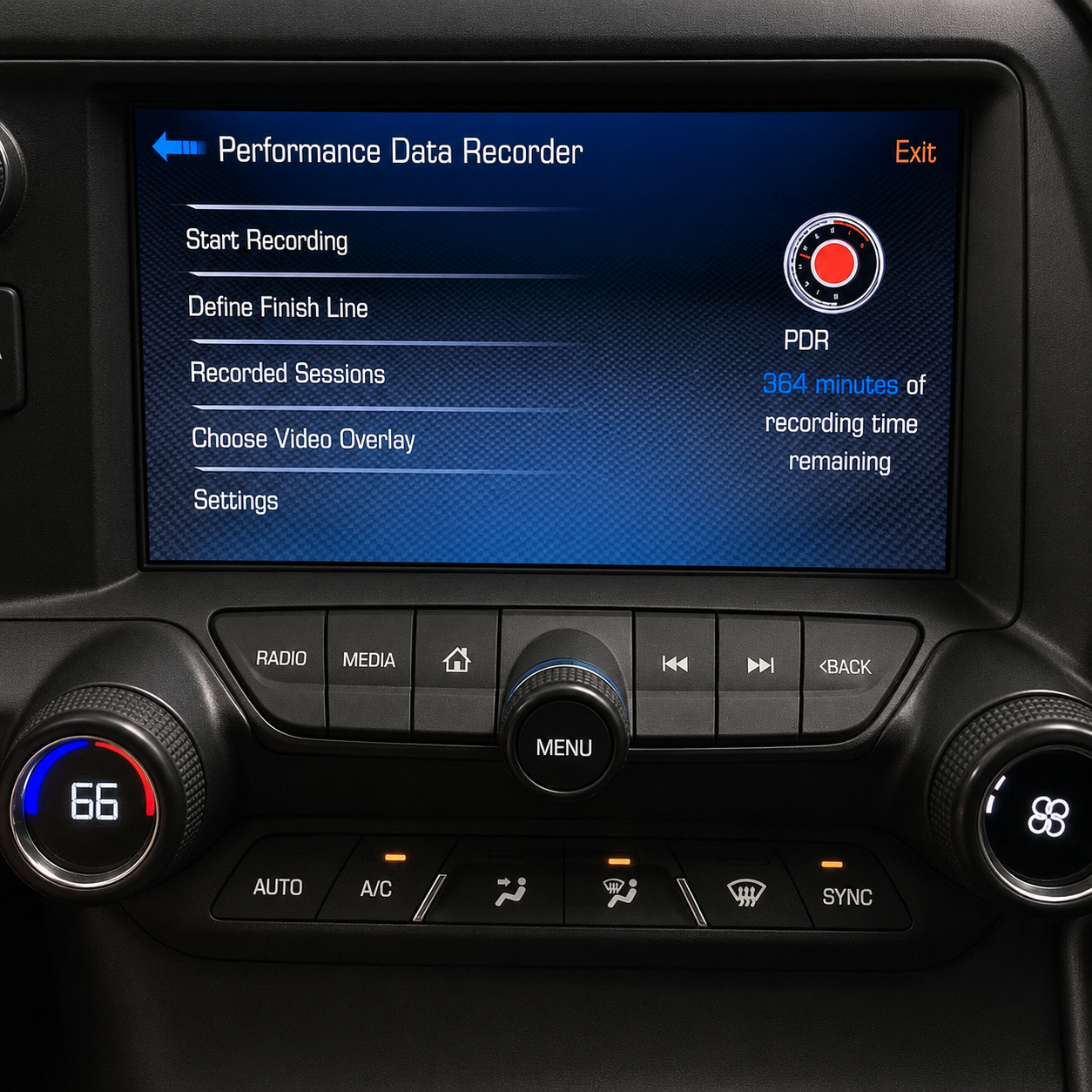
Once a recording had been completed, the owner could review the footage directly on the Corvette’s eight-inch center display while the vehicle was parked or remove the SD card and transfer the files to a computer. The latter opened the door to the Cosworth Toolbox software, which allowed recorded laps and vehicle data to be examined in substantially greater detail. Cosworth’s continuing support for these first-generation PDR files speaks to how serious the original system really was; this was not a disposable infotainment gimmick but the beginning of an entire Corvette data-analysis ecosystem that would continue evolving long after the C7 had left production.
For the Corvette owner who actually took advantage of it, the possibilities were remarkable. A driver could run a session at VIR, Road Atlanta, Watkins Glen or a local club circuit, return to the paddock and study where a lap had been gained or lost. Braking points could be compared, corner speeds evaluated and different laps examined against one another, transforming the Corvette from the object being evaluated into part of the evaluation process itself.
That changed the nature of a track day. Historically, an enthusiast trying to improve his driving relied heavily upon memory, feel, stopwatch timing and perhaps the observations of an instructor standing alongside the circuit. By 2015, the Corvette itself could preserve an enormous amount of information about what had just happened and provide it almost immediately after the driver returned to the pits. The car had, in effect, acquired the rudimentary ability to become its own driving coach.
There was something particularly appropriate about that development occurring in the Corvette. For decades, Chevrolet had emphasized the relationship between the production car and the lessons learned through competition, sometimes through obvious hardware and sometimes through less visible engineering knowledge. PDR extended that relationship directly to the customer by giving the person who purchased a Corvette access to a simplified version of the analytical process that had become routine inside a professional racing program.
Valet Mode—and an Unexpected Legal Problem
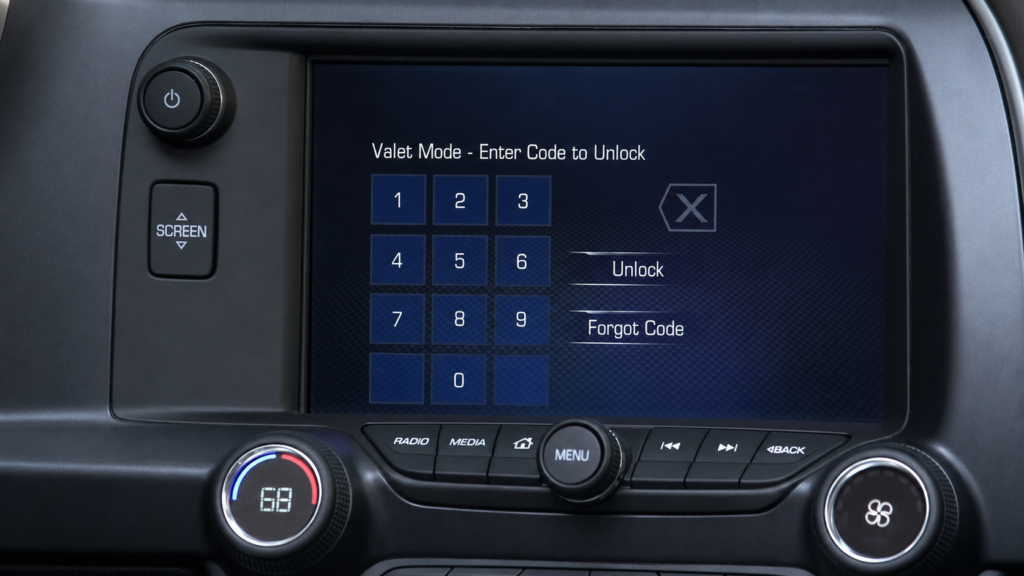
Chevrolet soon discovered that a system designed to watch a Corvette circulate a racetrack could serve another purpose entirely. The C7 already incorporated a Valet Mode, and for 2015 Chevrolet connected that functionality with the Performance Data Recorder so owners could see what happened to their Corvette after handing the keys to somebody else.
When activated through the car’s infotainment system, Valet Mode could restrict access to interior storage areas, disable portions of the infotainment system and, on PDR-equipped cars, automatically record video and vehicle information while someone else was driving. The idea addressed a concern that is probably familiar to virtually anyone who has ever reluctantly handed the keys of an expensive performance car to a stranger: Where exactly is my car going, and what are they doing with it once it disappears around the corner?
Corvette product manager Harlan Charles summarized the idea better than any lengthy marketing explanation ever could:
“Think of it as a baby monitor for your car.”
The description was amusing because it was also remarkably accurate. Corvette owners have never been especially famous for emotional detachment from their cars, and Chevrolet understood its audience well enough to turn that protectiveness into a product feature. The PDR meant an owner could potentially see whether the car had simply been moved to a parking space or whether somebody had decided that possession of the keys constituted an invitation to conduct an unscheduled road test.
However, Chevrolet had not fully anticipated one complication. The original PDR configuration could record cabin audio as well as video, and when that capability was automatically incorporated into Valet Mode, it created an entirely different issue. The Corvette was no longer simply recording what the vehicle was doing; it could also record conversations occurring inside the cabin without the occupants necessarily realizing that they were being recorded.
Laws governing the recording of private conversations vary between jurisdictions, and GM recognized that the audio portion of Valet Mode could therefore create legal problems for owners. The concern was not theoretical. GM’s own February 2015 service bulletin, PI1416, specifically stated that operation of the PDR in Valet Mode raised concerns under laws governing the recording of private conversations without consent. Dealers were instructed to reprogram the PDR module so that audio functionality was removed whenever Valet Mode was active.
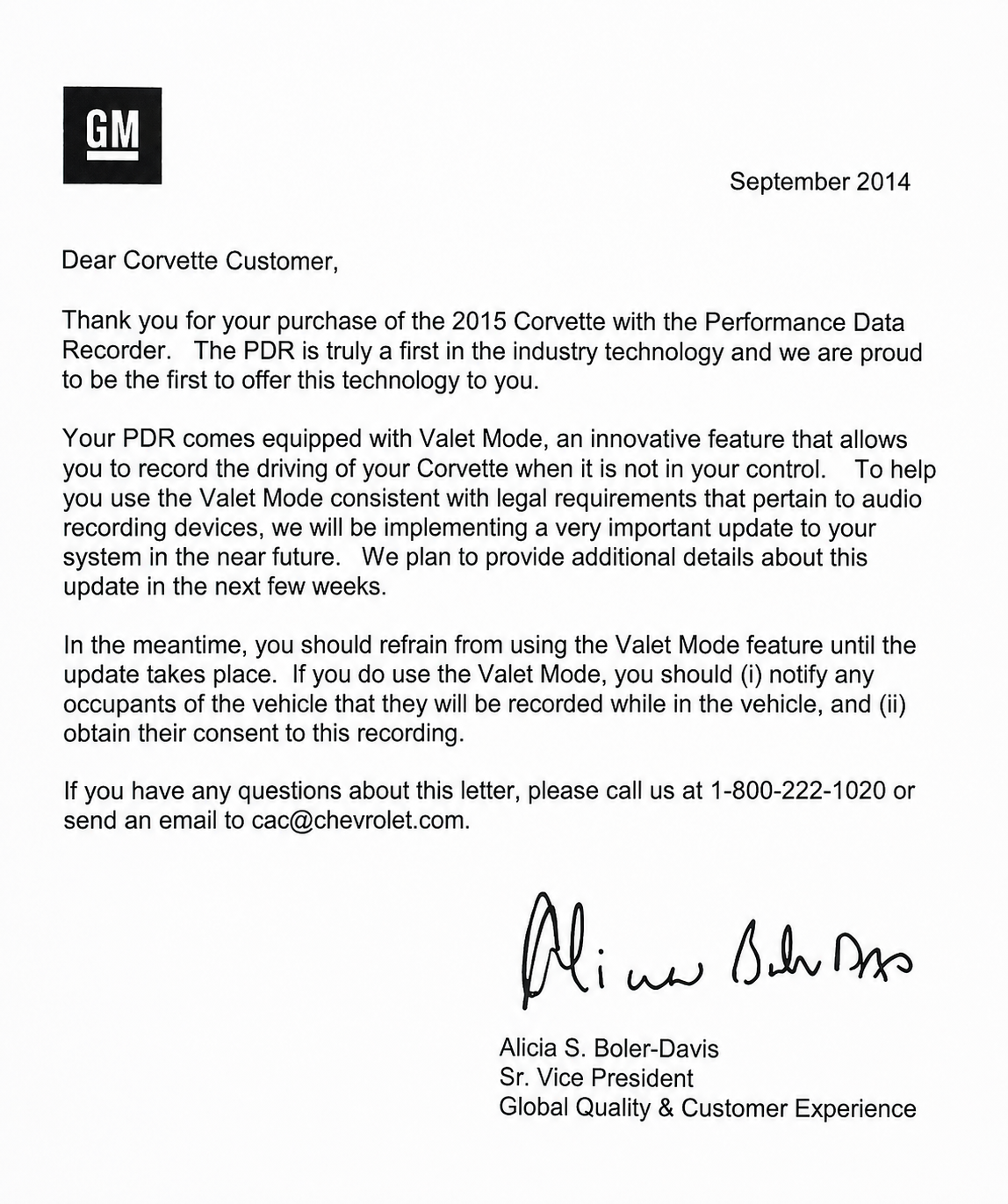
Importantly, the correction did not eliminate the PDR itself or remove its usefulness as a track and driving recorder. It specifically addressed the audio component while the system was functioning in Valet Mode, allowing the Corvette to continue recording the visual and vehicle information that made the feature useful without creating the same concern about recording private conversations. GM’s bulletin confirms that the recorded information remained stored on the SD card in the glovebox and could still be reviewed through the Corvette’s display.
It is a small episode when viewed against the enormous engineering story of the C7, but it is also a fascinating one. Chevrolet had introduced a production-car feature sophisticated enough that the technology briefly advanced faster than some of the assumptions surrounding how that technology would be used. The resulting correction became an early example of something that would become increasingly common throughout the automobile industry: software and connectivity creating questions that engineers could not solve purely with horsepower, aerodynamics or mechanical design.
4G LTE and the Connected Corvette
PDR was only part of the Corvette’s rapidly expanding digital environment. For 2015, Chevrolet also introduced OnStar with 4G LTE connectivity and a built-in Wi-Fi hotspot, turning the Corvette into something that would have seemed almost absurdly futuristic only a generation earlier. Rather than relying exclusively upon a passenger’s phone to provide an internet connection, the vehicle itself could serve as the communications hub, subject to the applicable OnStar and data services. OnStar continues to describe the basic advantage of the integrated hotspot in essentially the same terms: the connection is built into and powered by the vehicle rather than depending upon the battery and antenna of a handheld device.
In isolation, putting Wi-Fi into a Corvette might seem almost trivial compared with the introduction of a 650-horsepower Z06 during the same model year. Taken together with everything else happening inside the C7, however, it represented a profound shift. The Corvette now had an eight-inch touchscreen, configurable digital instrumentation, GPS navigation, selectable drive modes, electronically controlled chassis systems, sophisticated performance-management software, an available integrated video and telemetry recorder and a cellular data connection capable of turning the car into its own hotspot.
Only two model years earlier, Chevrolet had still been building the C6.
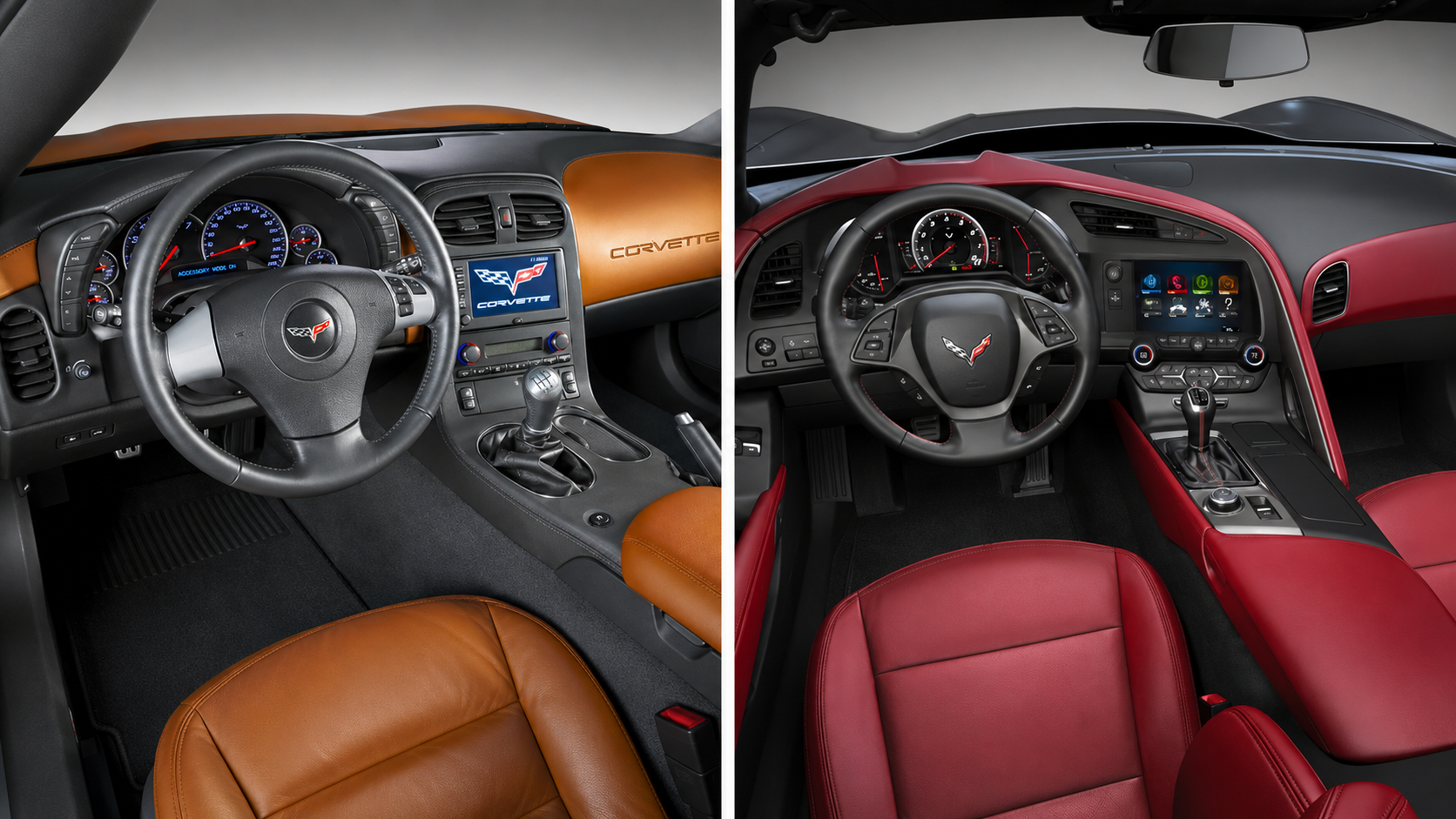
That short distance between generations helps explain why the 2015 Corvette feels like such an important moment in the model’s history. The Corvette had not abandoned the mechanical qualities that had always defined it; the steering wheel was still connected to a machine powered by a large-displacement V8, and the driver remained very much at the center of the experience. What changed was the amount of information moving around that driver and the sophistication with which the car could interpret, record and present it.
The best technology in the C7 did not attempt to replace the driver. Instead, it increasingly gave the driver tools that had previously existed outside the automobile, whether that meant sophisticated chassis controls helping manage the car at the limit or a telemetry system showing precisely what had happened after the lap was finished. That philosophy would eventually become commonplace among serious performance cars, but in 2015 Chevrolet was already demonstrating how deeply digital technology could be incorporated into the Corvette without stripping away the analog sensations that made people want to drive one in the first place.
The Corvette was becoming digital, but it had not stopped being mechanical. More importantly, Chevrolet was beginning to understand that those two ideas did not have to exist in opposition to one another. The technology could make the Corvette easier to understand, easier to analyze and, in the right hands, easier to drive well while leaving the fundamental experience—the driver, the road and the car between them—very much intact.
A More Complete Interior
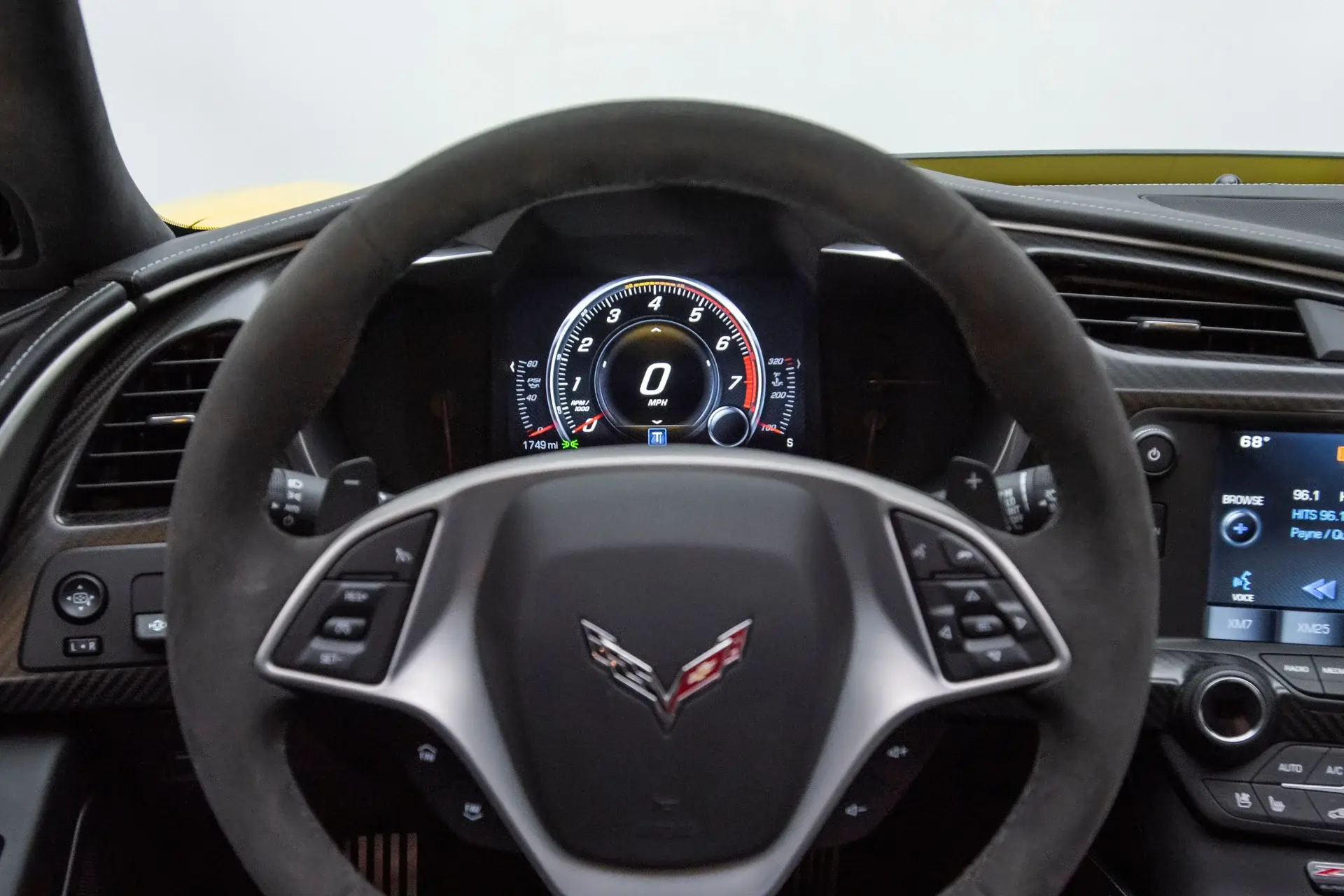
One of the most important achievements of the C7 had already occurred before the 2015 model year began: Chevrolet had finally given the Corvette an interior that felt worthy of the performance beneath it. That was more significant than it might sound today because, for years, the cabin had been one of the easiest places for critics to attack an otherwise extraordinary sports car. The C5 was enormously capable but carried switchgear, plastics and finishes that too often reminded occupants that they were still sitting in a mass-produced General Motors product, while the C6 improved the formula without completely closing the gap between the Corvette and the increasingly sophisticated European sports cars against which it was being compared.
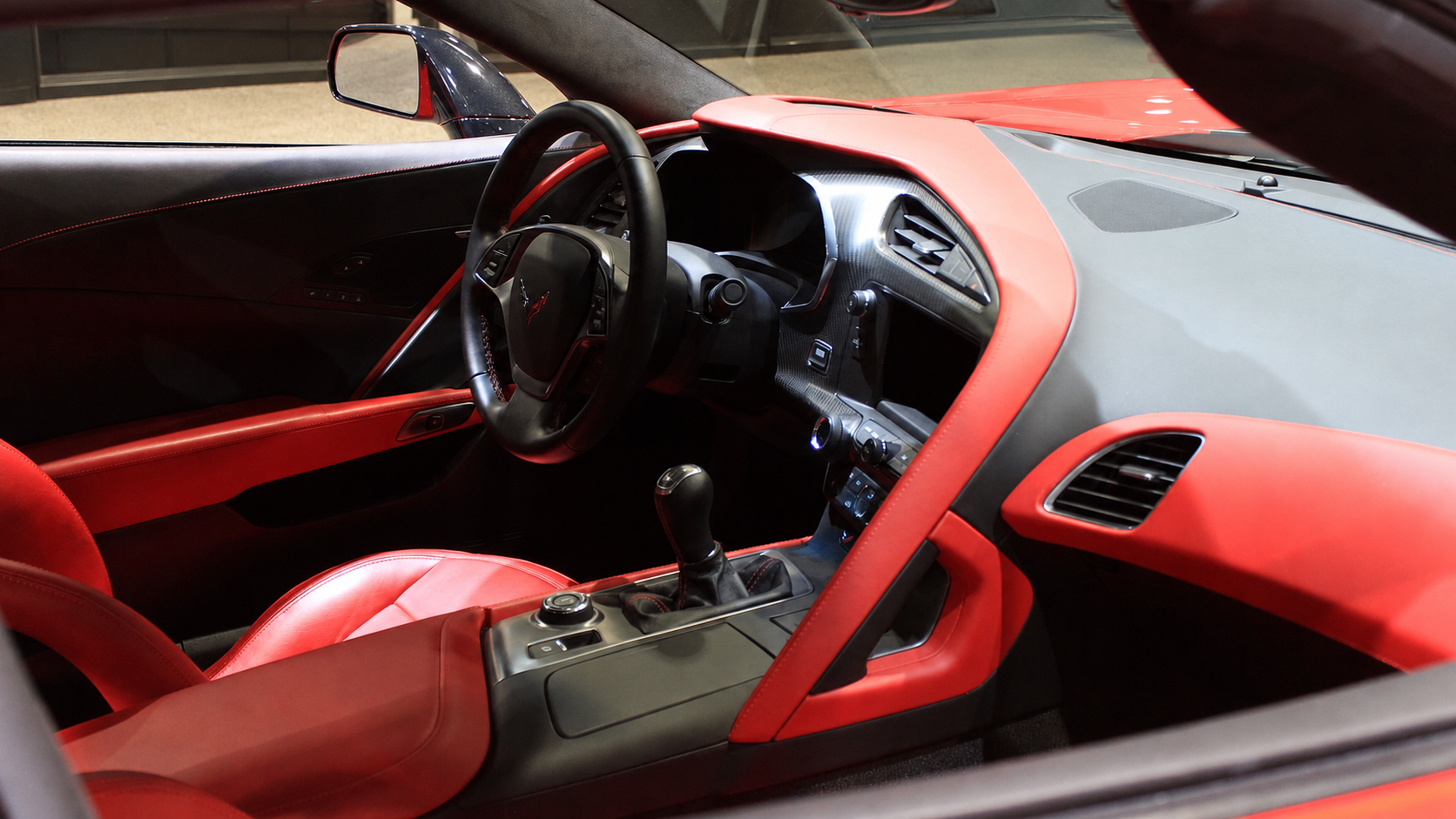
The C7 represented a conscious effort to end that conversation, and Chevrolet approached the interior as something more than a collection of upgraded materials. The architecture itself became considerably more purposeful, wrapping the instrument panel and center stack around the driver and creating a much stronger visual separation between the driver’s environment and the passenger side of the car. The passenger remained very much part of the experience, but there was no mistaking who the cockpit was designed around; controls, displays, and major vehicle functions were concentrated toward the person behind the steering wheel, making the Corvette feel much more like a dedicated performance machine.
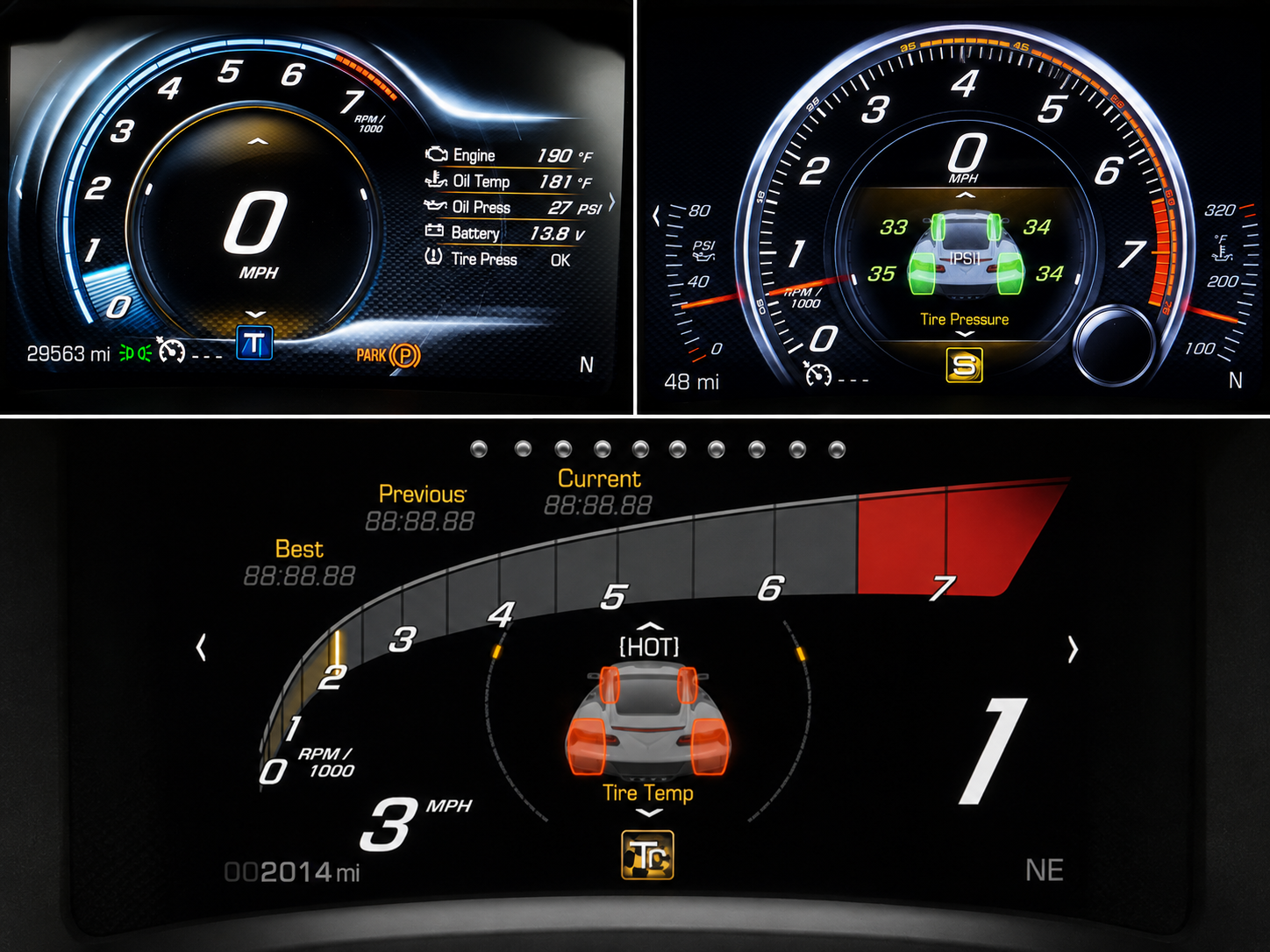
Technology played an equally important role in that transformation. An eight-inch reconfigurable digital driver display was used across the C7 lineup, allowing the information presented directly ahead of the driver to change with vehicle settings and driving conditions rather than remaining fixed in the manner of a conventional analog instrument panel. The center stack added another eight-inch color touchscreen running Chevrolet’s MyLink interface, bringing navigation, audio, communications and vehicle settings together in a far more integrated system than Corvette owners had previously experienced. By 2015, that same screen could also serve as the interface for technologies such as the available Performance Data Recorder, making the center display part of the Corvette’s performance toolkit rather than simply an entertainment system. Later C7 documentation continued to describe the Corvette around this combination of an eight-inch MyLink touchscreen and a fully wrapped, technology-focused cockpit.
The changes were just as apparent in the surfaces surrounding those displays. Chevrolet made a much greater effort to eliminate the expanses of hard, inexpensive-looking plastic that had generated so much criticism in previous generations, replacing them with soft-touch materials and offering a much broader selection of leather, genuine aluminum, carbon-fiber trim and sueded microfiber depending upon equipment and configuration. The result was not merely a cabin that photographed better; the places an owner actually touched—the steering wheel, center console, instrument-panel surrounds, door panels and seating surfaces—felt more substantial and more deliberately finished. Chevrolet would later describe the C7 Z06 interior as being fully wrapped in premium soft-touch materials, a philosophy that had already been fundamental to the Stingray’s interior transformation.
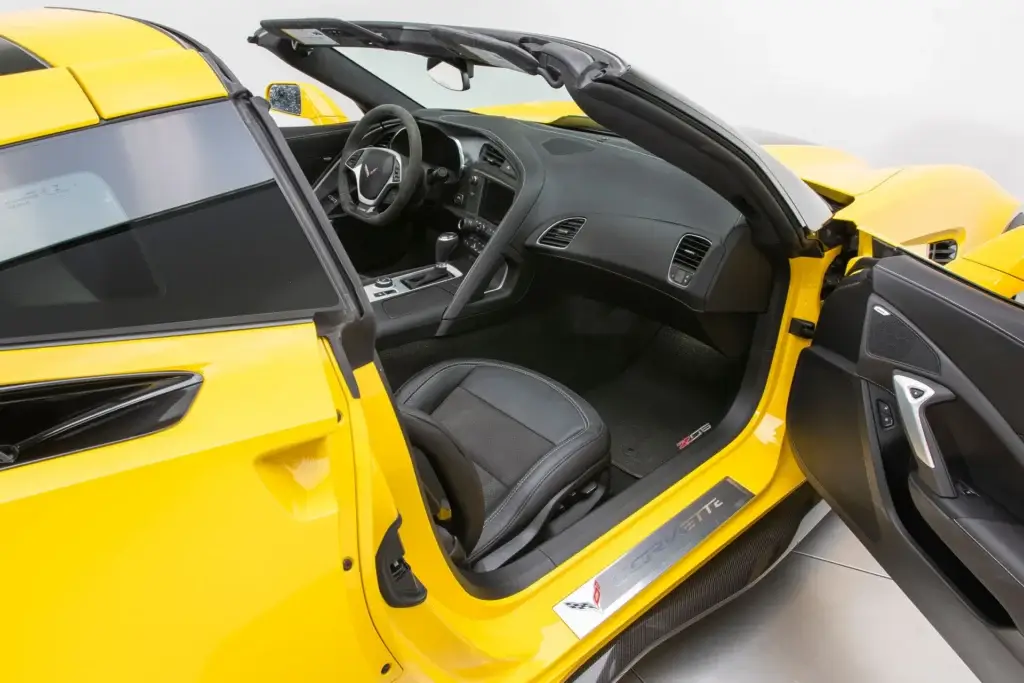
Trim levels allowed buyers to take that idea considerably further. The 3LT package expanded the use of premium leather across additional interior surfaces, creating a cabin that could be configured much more luxuriously than had traditionally been expected of a Corvette, while the Z06 offered its own progression through the 1LZ, 2LZ and 3LZ equipment groups. That range was important because Chevrolet was no longer treating every Corvette buyer as though they wanted exactly the same kind of interior. A customer could build a relatively straightforward performance car, move toward a more luxurious grand-touring environment, or combine the richer materials with the considerably more serious capabilities of the Z06.
The seating philosophy reflected the same thinking. Chevrolet offered the GT seat for owners who wanted a balance between lateral support, everyday comfort and the ability to spend several hours in the car without feeling as though they had climbed into a competition shell. For drivers whose priorities leaned more heavily toward track use, the Competition Sport Seat used more aggressive bolstering to hold the driver and passenger in place under higher cornering loads. The distinction became particularly meaningful in the Z06, where the additional grip and cornering capability could expose the limitations of a less heavily bolstered seat much more quickly. Chevrolet continued to identify Competition Sport seats as part of the C7’s track-focused equipment well into the generation’s production.
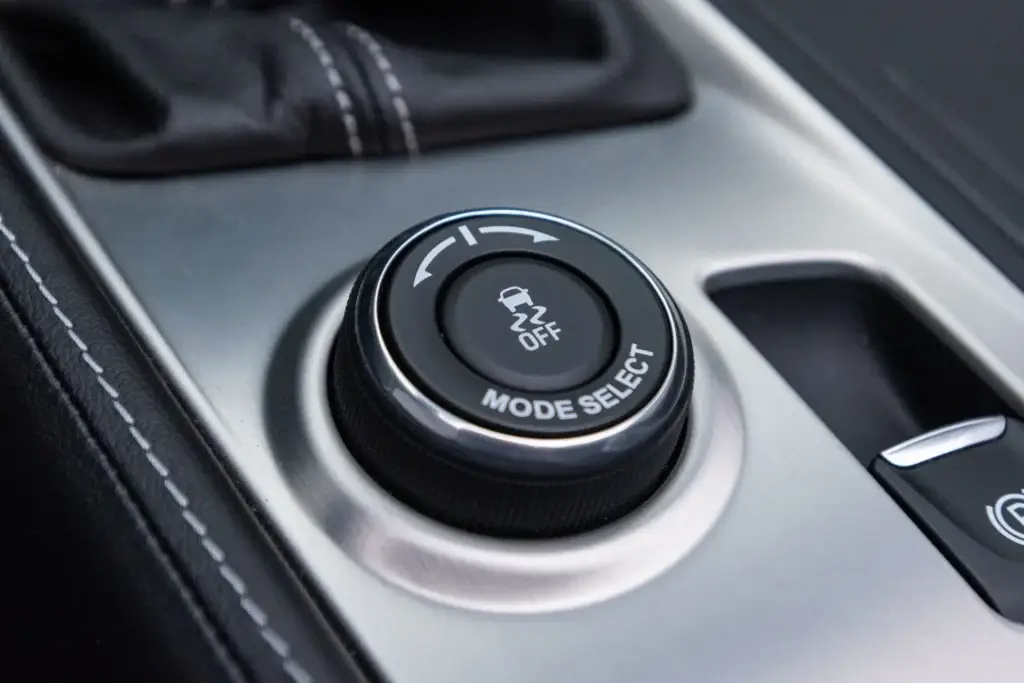
Just as important, the C7 interior was designed around the understanding that the Corvette itself had become considerably more complicated. The Driver Mode Selector could alter numerous vehicle systems, the configurable instrumentation could present different information depending upon how the car was being used, and technologies such as navigation, Bluetooth connectivity, OnStar, the Performance Data Recorder, and eventually 4G LTE meant that the driver was interacting with far more software than any Corvette owner of the previous generation had encountered. Chevrolet’s challenge was therefore not simply to add technology, but to organize it in a way that did not overwhelm the basic act of driving.
That did not mean every problem disappeared. Rearward visibility remained compromised by the Corvette’s low roofline, wide rear structure and dramatic bodywork, while the high center console and strongly wrapped cockpit could make the interior feel intimate, particularly when finished in darker colors. The growing number of menus, configurable displays and electronic systems also introduced a learning curve that simply had not existed in earlier Corvettes, and although the quality of the materials represented an enormous improvement, Chevrolet was still building a relatively attainable American sports car rather than attempting to recreate the interior of a Bentley or an Aston Martin.
Nor did it need to. The achievement of the C7 was not that Chevrolet had suddenly transformed the Corvette into a traditional luxury car, but that an owner no longer had to excuse the cabin because everything happening underneath it was so good. The interior had finally become part of the Corvette’s appeal rather than the price one paid to access its performance, and by 2015 the combination of better materials, genuinely supportive seating, increasingly sophisticated electronics and a cockpit designed unapologetically around the driver had made the cabin one of the clearest demonstrations of how far the Corvette had evolved.
The 6.2-Liter LT1—and the Supercharged LT4
The 2015 Corvette offered two very different expressions of Chevrolet’s fifth-generation small-block V-8. The Stingray continued with the naturally aspirated 6.2-liter LT1 introduced with the C7 a year earlier, while the new Z06 received the supercharged 6.2-liter LT4, an engine that shared the LT1’s basic architecture but was engineered to survive—and exploit—far greater cylinder pressures. Both displaced 376 cubic inches and retained the compact cam-in-block, two-valve-per-cylinder configuration that had defined generations of Chevrolet small-blocks, yet the difference between them demonstrated just how broad the performance envelope of that architecture had become.
The LT1: 455 Horsepower as the Starting Point
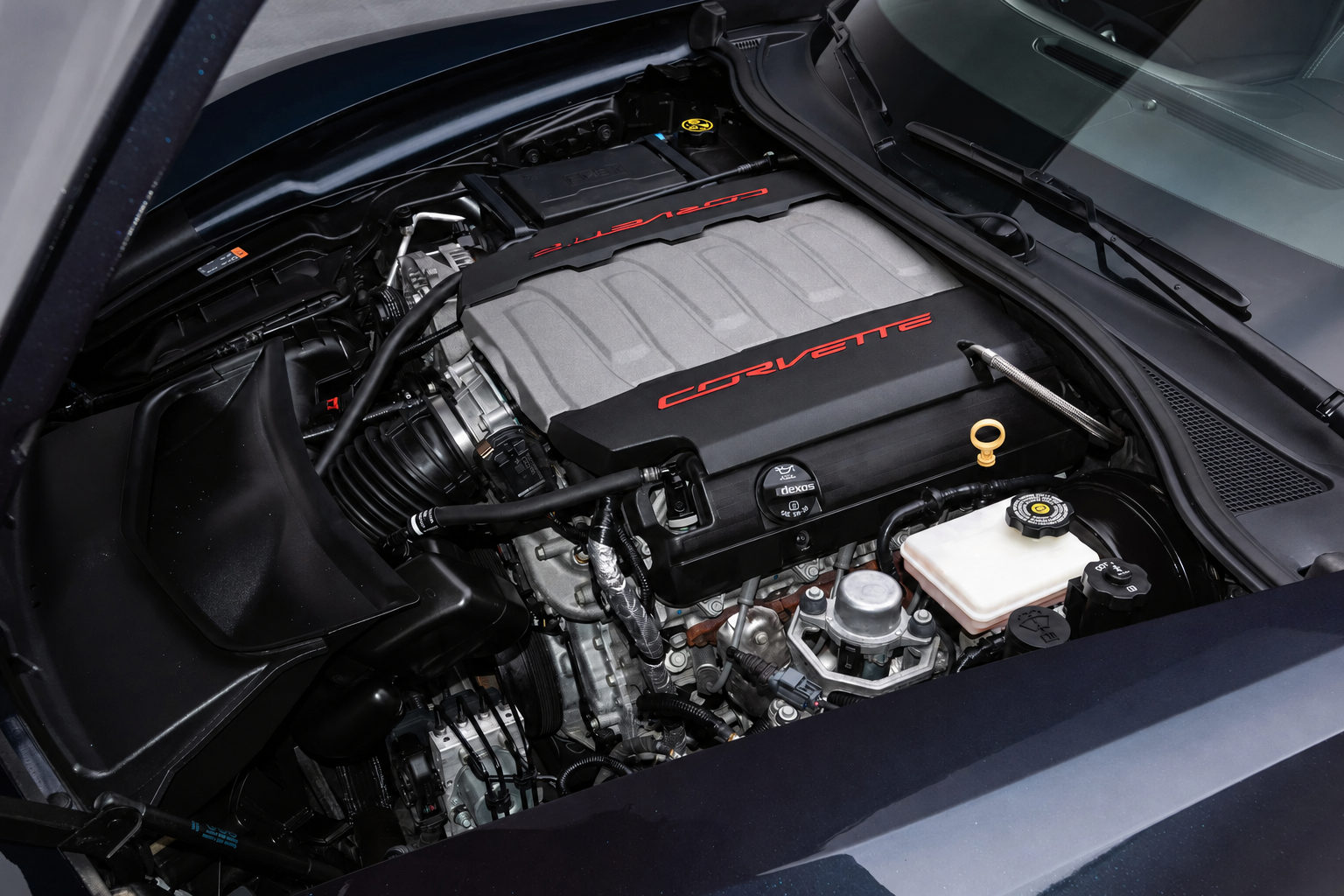
In standard form, the Stingray’s LT1 produced 455 horsepower at 6,000 rpm and 460 lb-ft of torque at 4,600 rpm, numbers that increased to 460 horsepower and 465 lb-ft with the dual-mode NPP performance exhaust. For 2015, Chevrolet folded that performance exhaust into the Z51 Performance Package, meaning every Z51-equipped Stingray received not only the more assertive exhaust note but the modest increase in output that came with it.
Those numbers told only part of the story because the LT1 represented a substantial modernization of the traditional Chevrolet small-block. Direct fuel injection delivered fuel directly into the combustion chamber, continuously variable valve timing let the engine adjust cam timing across a broader operating range, and Active Fuel Management could deactivate four cylinders during steady, light-load cruising. Chevrolet combined those technologies with an 11.5:1 compression ratio, an unusually high figure for a large-displacement production V-8 intended to provide both everyday tractability and sustained performance.
Chevrolet did not abandon the architecture that had made the Corvette so effective in the first place. The LT1 remained a pushrod V-8 with its camshaft in the block, keeping the engine physically compact despite its 6.2-liter displacement. That mattered in a Corvette because engine dimensions affected far more than packaging under the hood; keeping the powerplant low helped Chevrolet maintain the C7’s low hoodline and contributed to the low center of gravity that was central to the car’s handling philosophy. Chevrolet itself emphasized the relationship between the compact engine package, hood height and vehicle center of gravity when introducing the C7 powertrain.
The Z51 Performance Package developed that foundation for more sustained performance use. In addition to its specific suspension, larger brakes, performance gearing and electronic limited-slip differential, Z51 incorporated a dry-sump lubrication system, additional transmission and differential cooling, and the NPP performance exhaust. The dry-sump system was particularly important on a car expected to sustain significant lateral loads because it helped maintain reliable oil delivery during prolonged hard cornering rather than relying upon oil remaining around a conventional sump pickup.
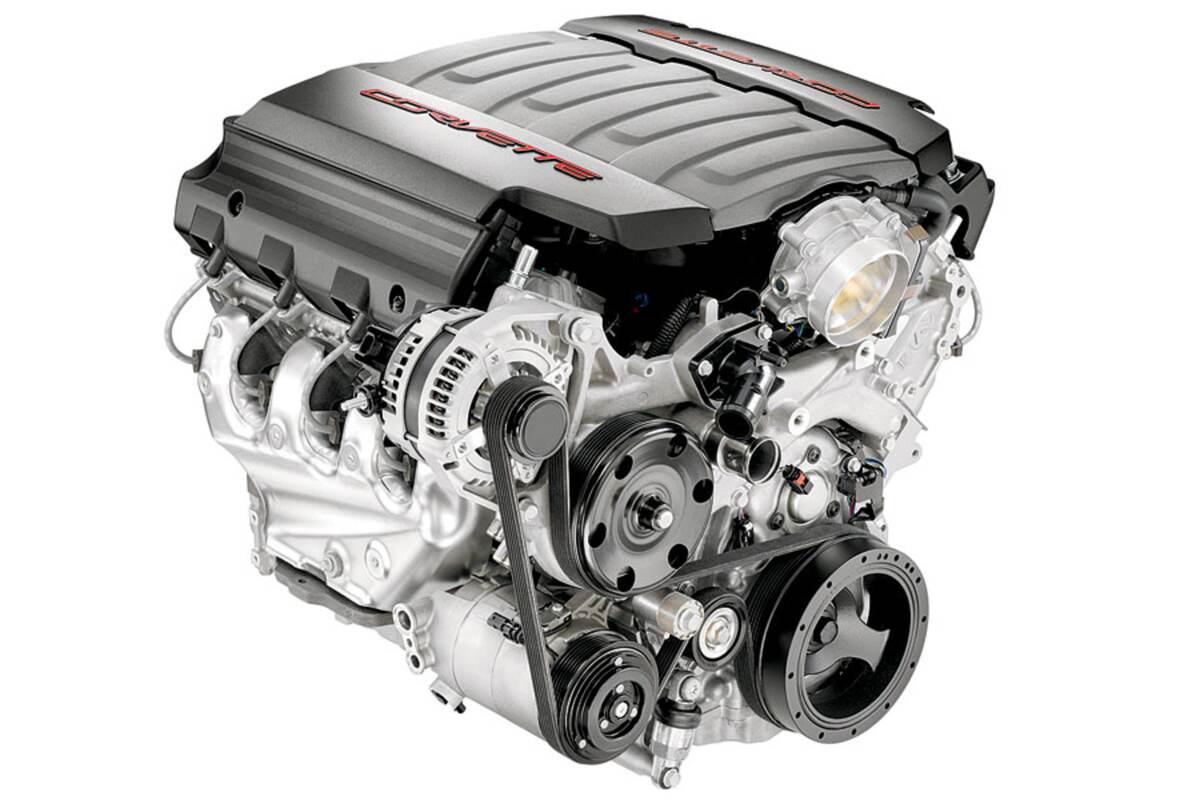
The result was an engine with an unusually broad personality. Driven gently, the LT1 could take advantage of cylinder deactivation, direct injection, and variable valve timing to behave with a level of efficiency and civility that would once have seemed unlikely from a 376-cubic-inch Corvette engine. Press the accelerator harder, and those concerns disappeared almost instantly, replaced by the linear throttle response, broad torque delivery, and naturally aspirated character that had long been part of the Corvette experience. Chevrolet didn’t make the LT1 sophisticated merely to add technology; each system existed because it improved performance, efficiency, drivability, or packaging.
That balance may be the best way to understand the LT1. It was thoroughly modern where modern technology offered a meaningful advantage, yet intentionally conventional where Chevrolet believed the existing small-block formula still worked. Rather than replacing the pushrod V-8 with something more complicated simply because competitors had moved toward overhead-cam architectures, Corvette engineers continued refining the advantages they already possessed: compact dimensions, relatively low mass, strong low- and mid-range torque and an engine package that fit naturally within the Corvette’s proportions.
The LT4: 650 Horsepower Changes the Conversation
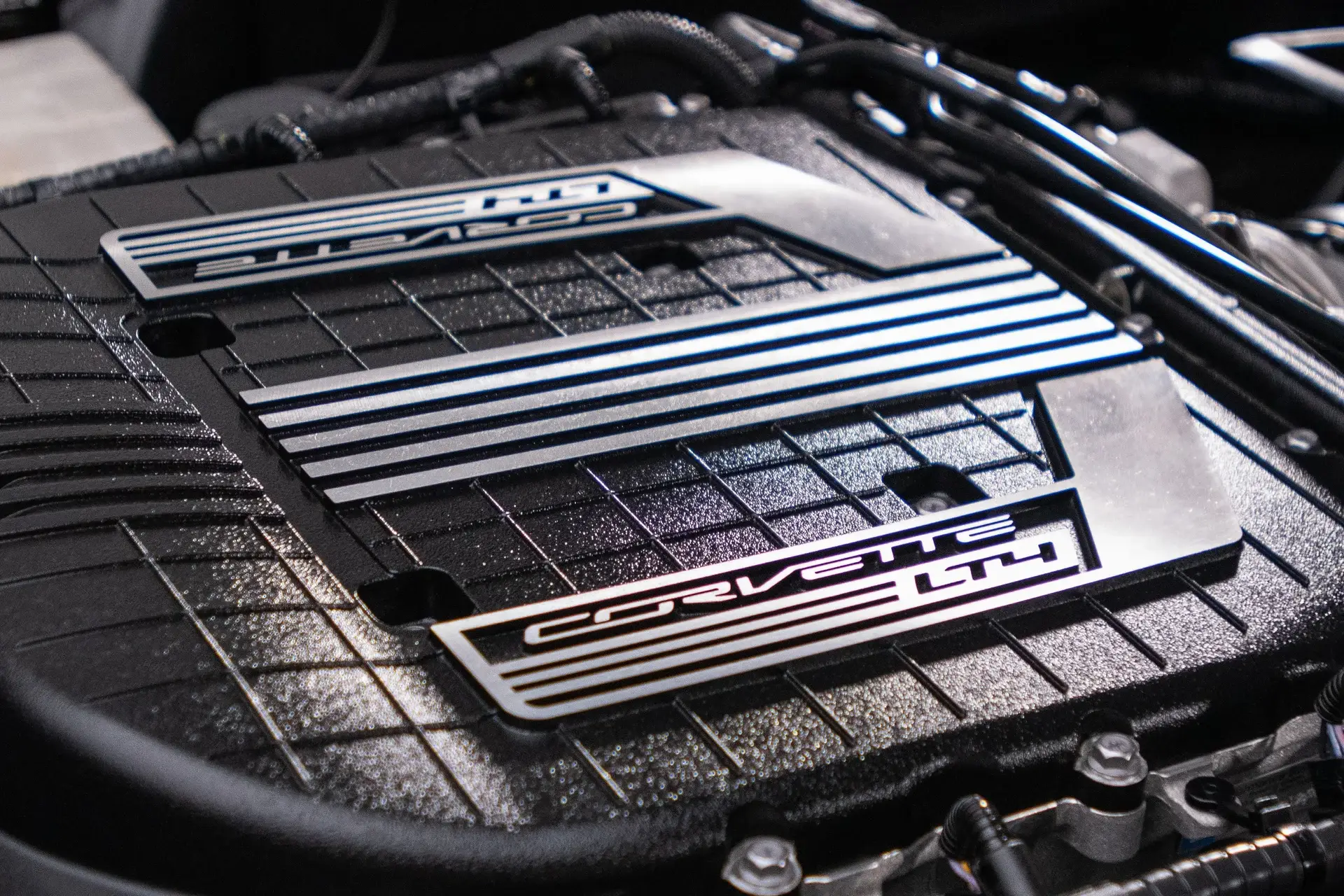
The LT4 took that same basic philosophy and pushed it into an entirely different performance category. In the 2015 Z06, Chevrolet’s supercharged 6.2-liter V-8 produced an SAE-certified 650 horsepower at 6,400 rpm and 650 lb-ft of torque at only 3,600 rpm, making the new Z06 the fastest and most powerful production Corvette Chevrolet had yet offered. The numbers alone were extraordinary, but the way the engine produced them was equally important: rather than building a highly specialized high-rpm engine, Chevrolet created a small-block capable of generating enormous torque across a broad portion of the operating range.
Although the LT4 shared the Gen V small-block foundation with the Stingray’s LT1, simply adding a supercharger was never going to be enough. Compression was reduced from the LT1’s 11.5:1 to 10.0:1, while the engine received forged aluminum pistons, stronger Rotocast A356T6 aluminum cylinder heads, lightweight titanium intake valves, and strengthened internal components designed to tolerate the additional heat and cylinder pressure created by forced induction. The Z06 also used a standard dry-sump lubrication system with greater cooling capacity, reflecting the expectation that this engine would spend considerably more time operating near the limits of the chassis.
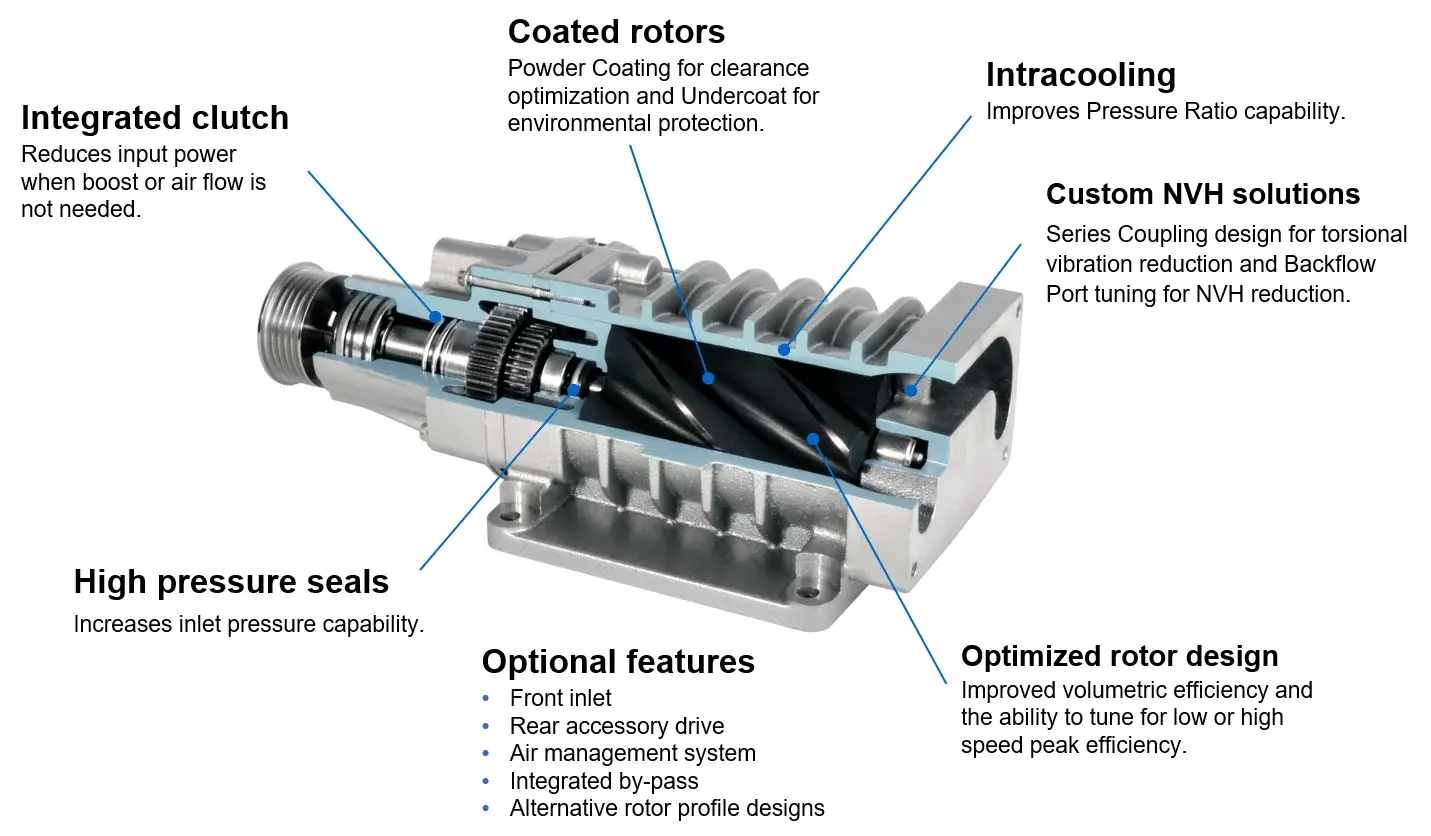
At the center of the package sat a compact 1.7-liter Eaton R1740 TVS supercharger mounted in the valley between the cylinder heads. Its relatively modest displacement was deliberate. The unit could spin at up to roughly 20,000 rpm, about 5,000 rpm faster than the larger supercharger used on the C6-generation ZR1’s LS9, allowing the smaller rotors to come up to speed quickly and begin producing meaningful boost earlier in the engine’s rev range. Chevrolet also redesigned the airflow path to reduce turbulence and heat, allowing the supercharger to deliver the airflow the LT4 needed without requiring a much taller engine package.
Packaging was one of the most impressive parts of the achievement. Even with the supercharger and intercooler assembly mounted atop the engine, Chevrolet stated that the LT4 stood only about one inch taller than the naturally aspirated LT1. That allowed engineers to preserve the Corvette’s low hood profile rather than allowing the supercharger to dictate the proportions of the car, an especially important consideration in a front-engine sports car where every additional inch of height works against both visibility and aerodynamic goals.
The LT4 also retained the same three major efficiency technologies introduced with the LT1—direct injection, Active Fuel Management and continuously variable valve timing—an unusual combination in a supercharged engine producing this level of power. That tells us something important about what Chevrolet was attempting with the Z06. The objective was not simply to create an engine that produced an enormous dyno number; it had to idle in traffic, cruise on the highway and behave like a production Corvette when the driver was not asking for all 650 horsepower.
When the driver did ask for it, however, the difference between the LT1 and LT4 became impossible to miss. The C6 Z06 and its naturally aspirated 7.0-liter LS7 had developed much of their character around immediate throttle response and an engine that rewarded the driver for working through the rev range. The 2015 Z06 delivered a different kind of experience: 650 lb-ft of torque arriving at only 3,600 rpm meant that enormous thrust was available without waiting for the engine to climb toward redline. Throttle application therefore became as much a question of available traction as engine response, because the rear tires were being asked to manage a level of torque that earlier production Corvettes simply had not produced.
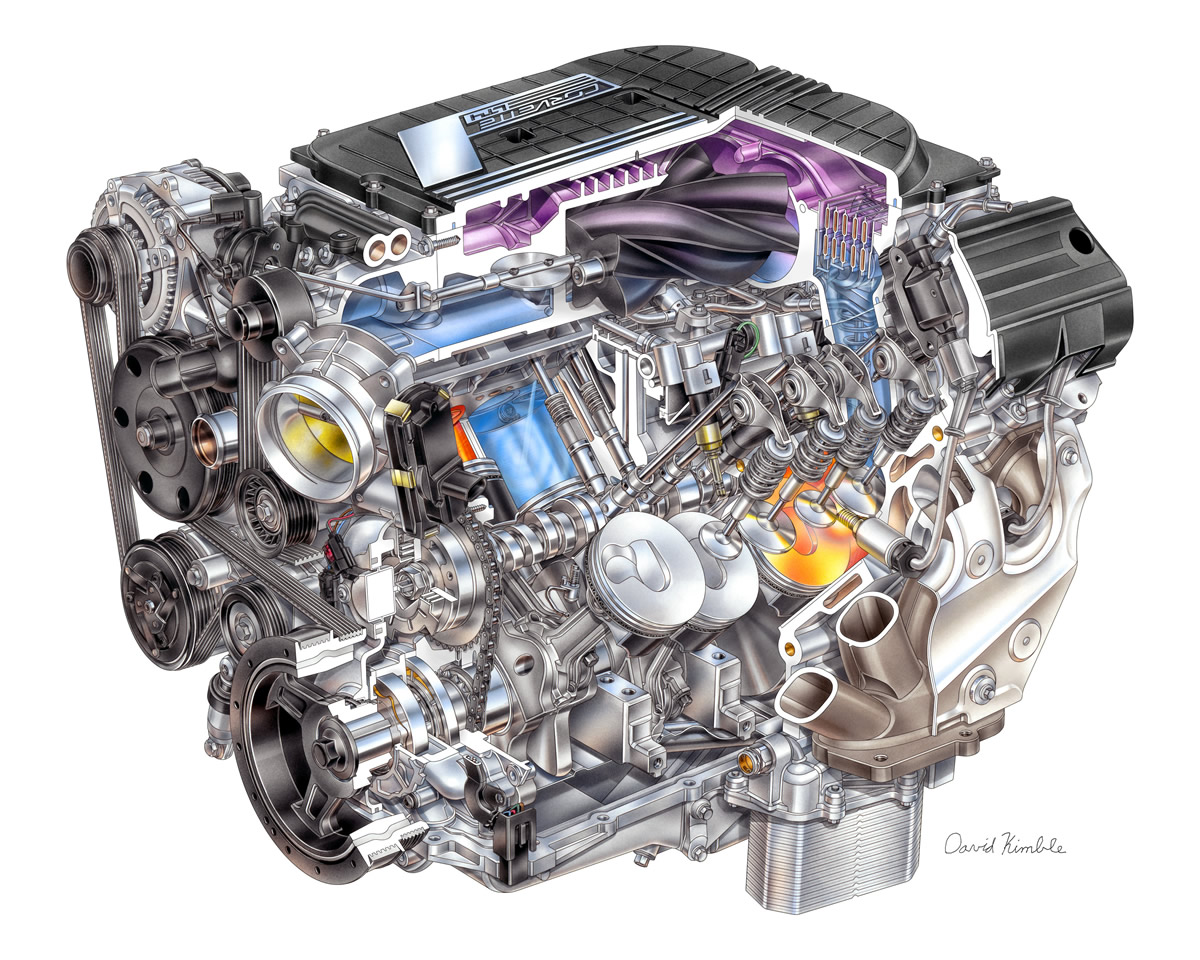
That changed the personality of the Z06 in a fundamental way. The engine could still pull hard toward its 6,600-rpm redline, but the defining sensation was the sheer breadth of its power delivery—the feeling that the LT4 did not need to be coaxed into its strongest operating range because enormous torque was already waiting for the driver. The supercharger did not replace the underlying small-block character so much as magnify it, combining the compact dimensions and low-rpm strength of the traditional Chevrolet V-8 with airflow and cylinder pressures that pushed the architecture into genuine supercar territory.
In that sense, the LT1 and LT4 represented two sides of the same engineering argument. The naturally aspirated LT1 demonstrated how much performance, efficiency and everyday usability Chevrolet could extract from a relatively simple 6.2-liter pushrod V-8, while the LT4 demonstrated how much farther the same basic philosophy could be pushed when forced induction, stronger internal components and additional cooling were brought into the equation. By 2015, Chevrolet had stretched the front-engine, rear-drive Corvette to 650 horsepower and 650 lb-ft of torque, a level of output that would have seemed almost unimaginable in a production Corvette only a generation earlier.
It was also beginning to expose the next engineering problem. Once an engine could deliver that much torque so early and so consistently, producing more power was no longer the only challenge; getting that power to the pavement became increasingly important. The LT4 therefore represented both a high-water mark for the traditional Corvette formula and a preview of the physics Chevrolet would ultimately have to confront if it intended to push the car substantially farther.
Seven-Speed Manual or Eight-Speed Automatic
The 2015 Corvette was one of those unusual automobiles in which the transmission choice could fundamentally change the car’s personality without making either version obviously inferior. Chevrolet offered two very different ways to access the C7‘s performance, and by 2015 the old assumption that the manual transmission was automatically the enthusiast’s choice was beginning to break down.
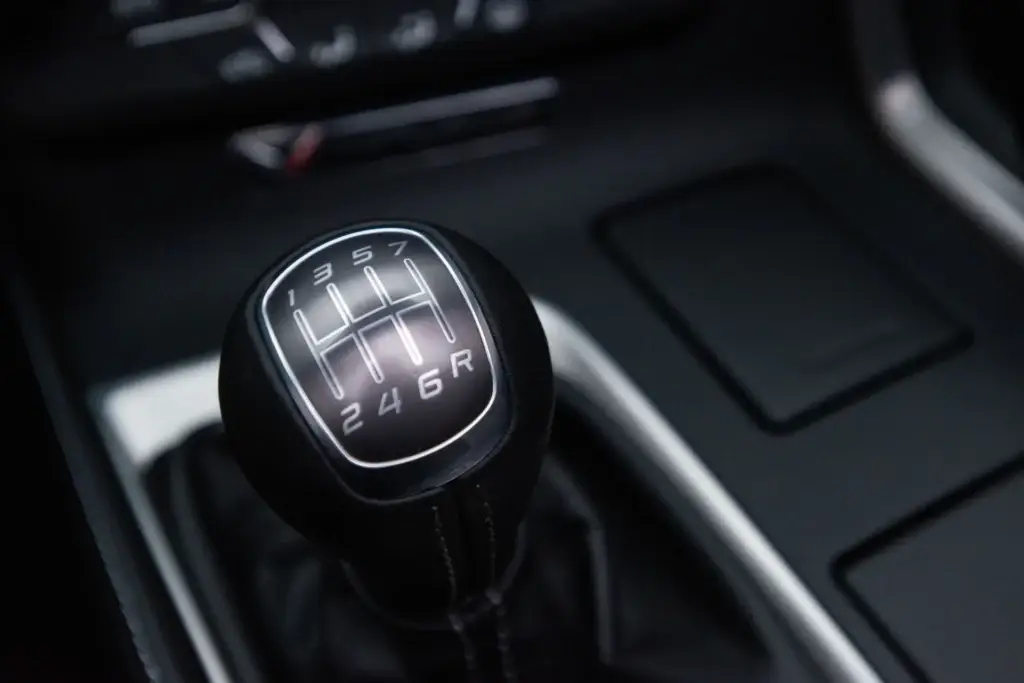
Chevrolet retained the Tremec seven-speed manual introduced with the C7, complete with driver-selectable Active Rev Matching. Paddle controls on the steering wheel could activate or deactivate the system, allowing the computer to automatically match engine speed during downshifts—and even assist during upshifts—while still retaining a conventional clutch pedal and manually operated shifter. The seven ratios also allowed Chevrolet to combine closely spaced performance gears with a tall cruising gear, giving the Corvette the flexibility to feel aggressive when driven hard without sacrificing relaxed highway operation.
For enthusiasts, it represented an intriguing compromise between old and new. The driver still selected the gear and operated the clutch, preserving the mechanical involvement that had traditionally been such an important part of the Corvette experience, but the electronics could execute the throttle blip associated with a practiced heel-and-toe downshift. Drivers who preferred to handle that technique themselves could simply deactivate the system.
Importantly, the Z06 retained that three-pedal arrangement even with 650 horsepower and 650 lb-ft of torque passing through the drivetrain. Chevrolet was not yet prepared to abandon the traditional manual-transmission sports-car experience simply because electronic gearboxes were becoming faster, and the presence of a seven-speed manual in a Corvette with that level of performance would become an increasingly significant part of the C7’s legacy.
But the major transmission news for 2015 was the automatic.
The 8L90 Eight-Speed Automatic
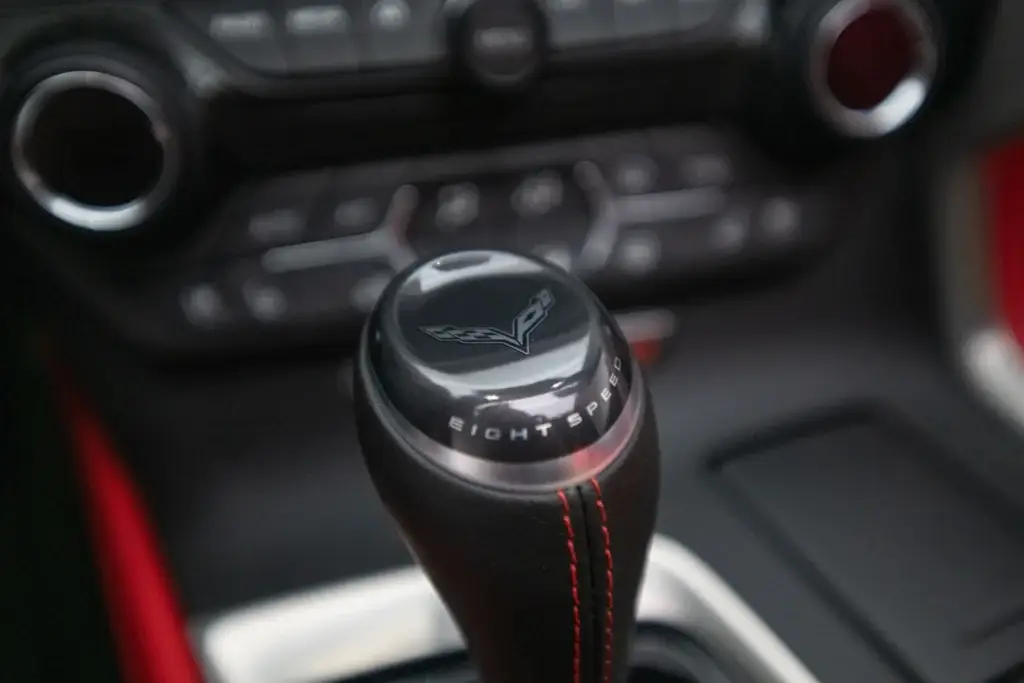
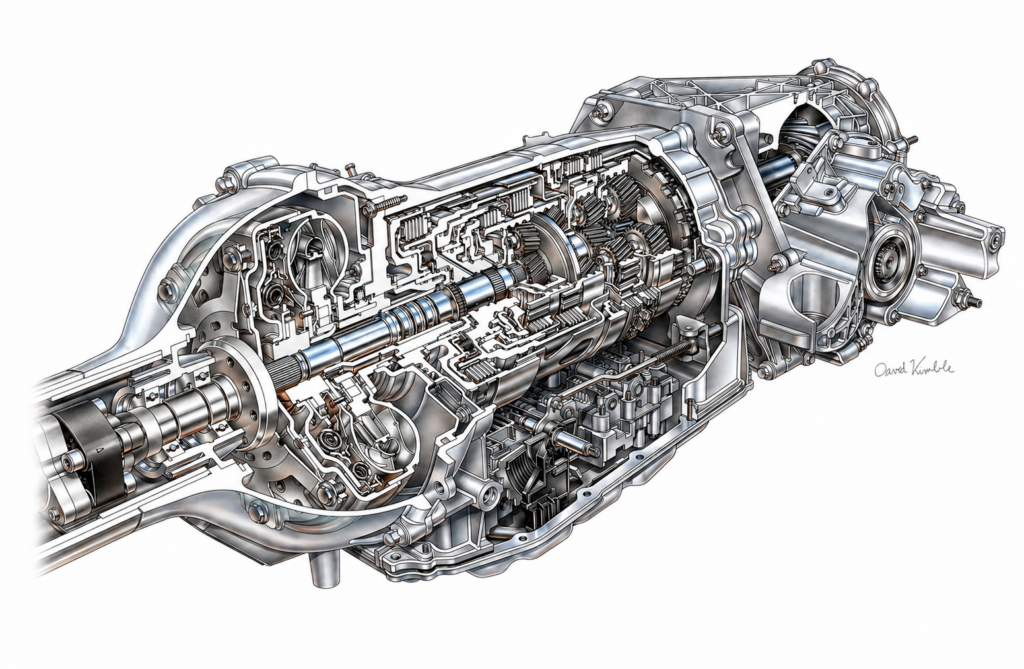
The new Hydra-Matic 8L90 replaced the six-speed automatic used in the 2014 Stingray and became available across the 2015 Corvette lineup, including the Z06. This was not simply another ratio added to the existing transmission. GM developed a substantially more sophisticated eight-speed unit intended to improve acceleration, shift speed, fuel economy and highway refinement while fitting within essentially the same packaging space available for the previous gearbox.
The 8L90 incorporated four gearsets and five clutches within that compact installation envelope. Extensive use of aluminum and magnesium helped make the transmission more than eight pounds lighter than the six-speed it replaced despite the addition of two forward ratios, while Chevrolet claimed the new transmission could contribute an efficiency improvement of as much as five percent.
Its ratio spread was considerably broader as well. First gear was an aggressive 4.56:1, providing substantially greater torque multiplication when launching the car from a stop, while eighth gear dropped to 0.65:1 for relaxed high-speed cruising. Between those extremes, the additional ratios let the transmission keep the engine closer to the part of its powerband best suited to whatever the driver was asking the Corvette to do.
Kavoos Kaveh, GM’s global chief engineer for eight-speed automatics, emphasized the unusual combination of benefits:
“It offers greater performance and efficiency, while weighing less than the transmission it replaces.”
The sophistication was equally apparent in the transmission’s electronic controls. The 8L90’s controller continuously evaluated vehicle speed, throttle position, engine load and other operating parameters to determine when and how aggressively to execute each shift. Chevrolet claimed that wide-open-throttle upshifts could occur as much as 0.08 second faster than those of the Porsche 911’s dual-clutch transmission used for comparison—a remarkable claim for a conventional torque-converter automatic in an era when dual-clutch gearboxes were generally regarded as the benchmark for shift speed.
The significance of the 8L90 became even clearer when the cars were tested for outright acceleration. In the Z06, the automatic could exploit the LT4’s enormous torque while executing shifts faster and more consistently than even a highly skilled driver could manage with the seven-speed manual. As a result, the automatic Z06 was not merely easier to drive quickly; it was actually the quicker configuration under maximum acceleration.
That represented a genuine cultural shift for the Corvette. For decades, the automatic had generally been regarded as the easier transmission, the cruising transmission or the choice for owners less concerned with maximum driver involvement. By 2015, choosing the automatic no longer meant accepting slower acceleration in exchange for convenience. The distinction had instead become one of experience: the manual offered greater physical involvement, while the automatic offered extraordinary consistency and outright speed.
With the 8L90 doing the shifting, Chevrolet stated that a properly equipped 2015 Corvette Z06 could accelerate from 0–60 mph in 2.95 seconds, making it the first production Corvette with an officially quoted sub-three-second sprint to 60 mph. It was an extraordinary benchmark for a front-engine, rear-wheel-drive automobile and compelling evidence that the automatic transmission had evolved from a convenience option into a genuine performance weapon.
Chassis, Suspension, and Brakes
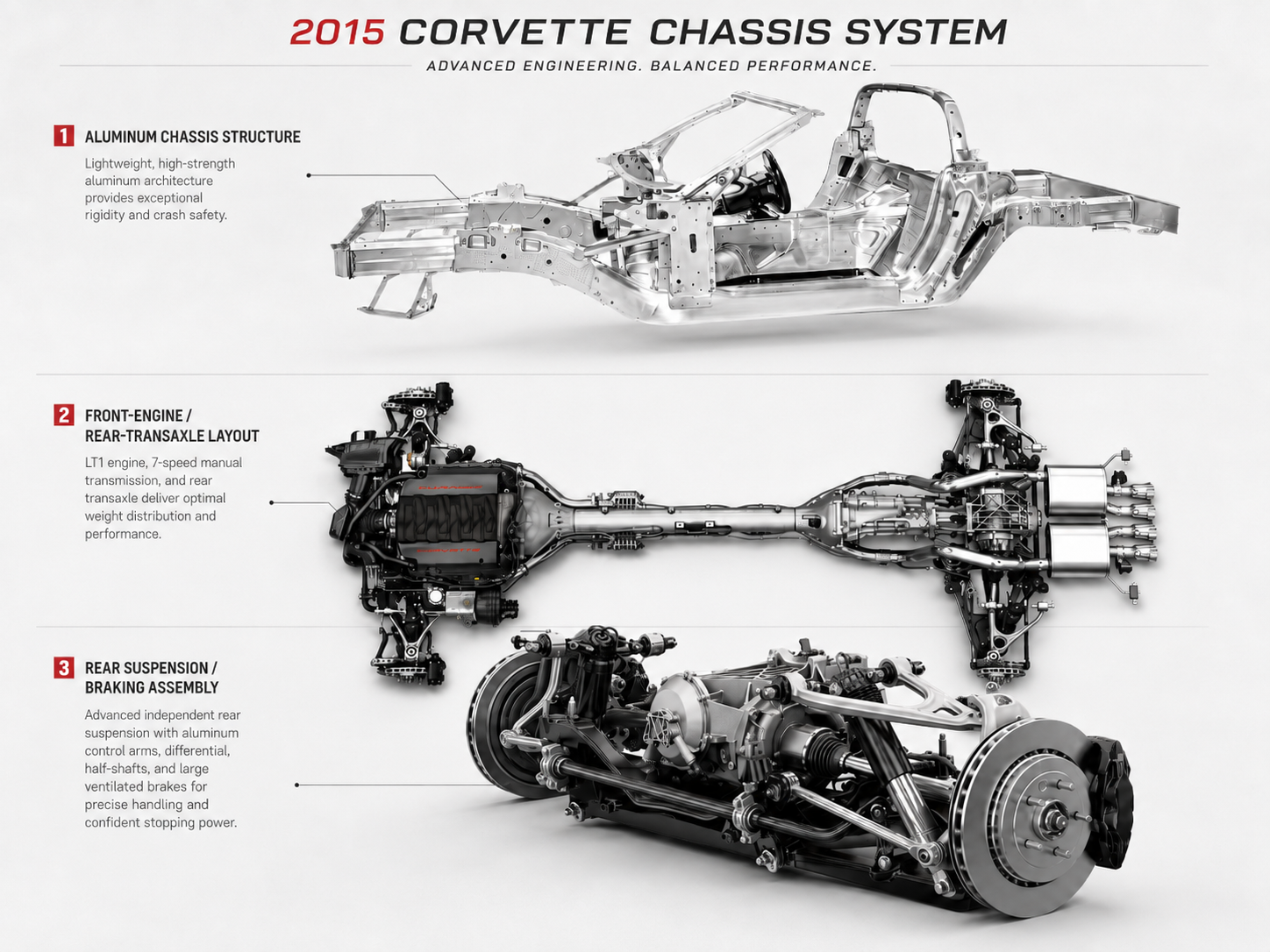
Underneath its dramatic bodywork, the 2015 Corvette retained the core chassis architecture introduced with the C7 a year earlier: short-long-arm independent suspension at all four corners, cast-aluminum control arms, transverse composite leaf springs, a rigid aluminum structure and the rear-mounted transaxle layout that helped distribute mass more evenly between the front and rear of the car. The basic ingredients were shared throughout the lineup, but Chevrolet used increasingly sophisticated suspension, braking, cooling and electronic-control hardware to transform that common foundation from an extremely capable road car into something capable of sustained track use.
The C7’s aluminum frame was central to that capability. Its stiffness provided a stable platform from which the suspension could work, while the Corvette’s long-established use of lightweight transverse composite springs allowed engineers to reduce mass without abandoning the packaging advantages of the arrangement. By 2015, however, the mechanical hardware represented only part of the story. Increasingly sophisticated electronic systems were becoming integral to the way the Corvette generated and managed grip.
Stingray and Z51
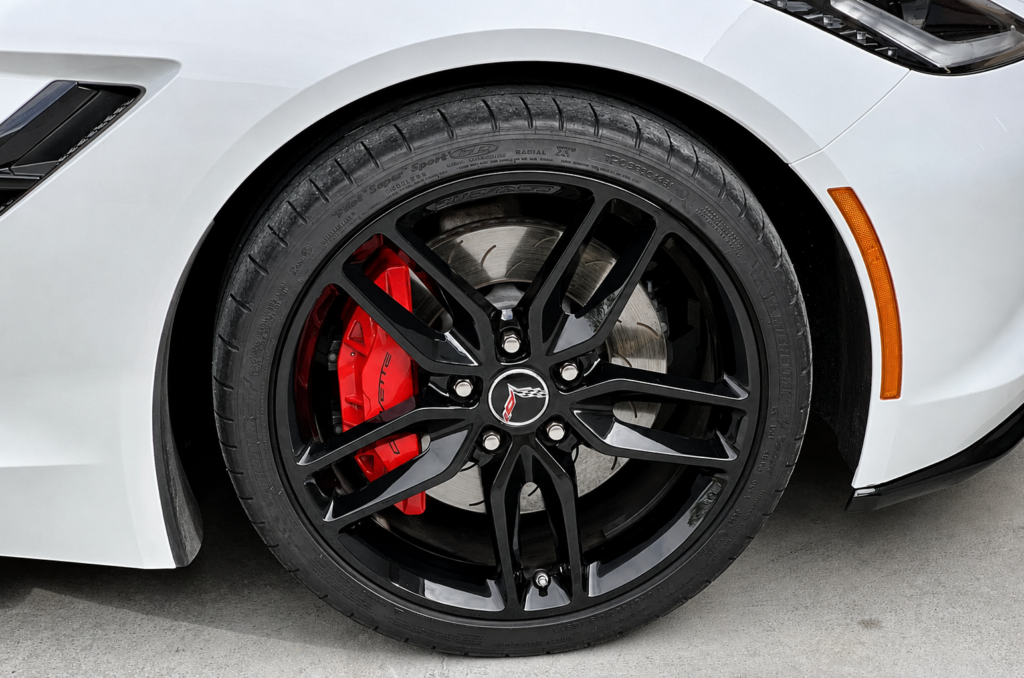
The standard Stingray used 35mm Bilstein monotube dampers, while the Z51 Performance Package upgraded the car with larger 45mm dampers and a collection of components intended to make repeated high-performance driving possible rather than merely improve a single acceleration or cornering number. Z51 was therefore considerably more comprehensive than a traditional suspension package.
Among its upgrades were larger performance brakes, dry-sump engine lubrication, additional transmission and differential cooling, performance-oriented gearing, larger 19-inch front and 20-inch rear wheels and tires, aerodynamic additions and an electronic limited-slip differential. For 2015, Chevrolet also bundled the dual-mode performance exhaust into the Z51 package, increasing the LT1’s output while giving the car a more aggressive exhaust character when conditions called for it.
The electronic limited-slip differential, or eLSD, was considerably more sophisticated than a conventional mechanical limited-slip unit. An electronically controlled hydraulic clutch could vary the amount of differential locking between the rear wheels according to conditions rather than relying upon a fixed mechanical response. The system continually considered information such as throttle position, steering input, vehicle speed, lateral acceleration and the selected Driver Mode, allowing differential behavior to change depending upon what the Corvette was doing at that moment.
That flexibility became particularly important when the eLSD worked in combination with the Corvette’s stability-control system and available Performance Traction Management. Instead of treating traction control, differential locking and chassis behavior as unrelated functions, the C7 increasingly managed them as parts of an integrated vehicle-dynamics system. The objective was not simply to prevent wheelspin, but to help the driver put as much usable power to the pavement as conditions allowed.
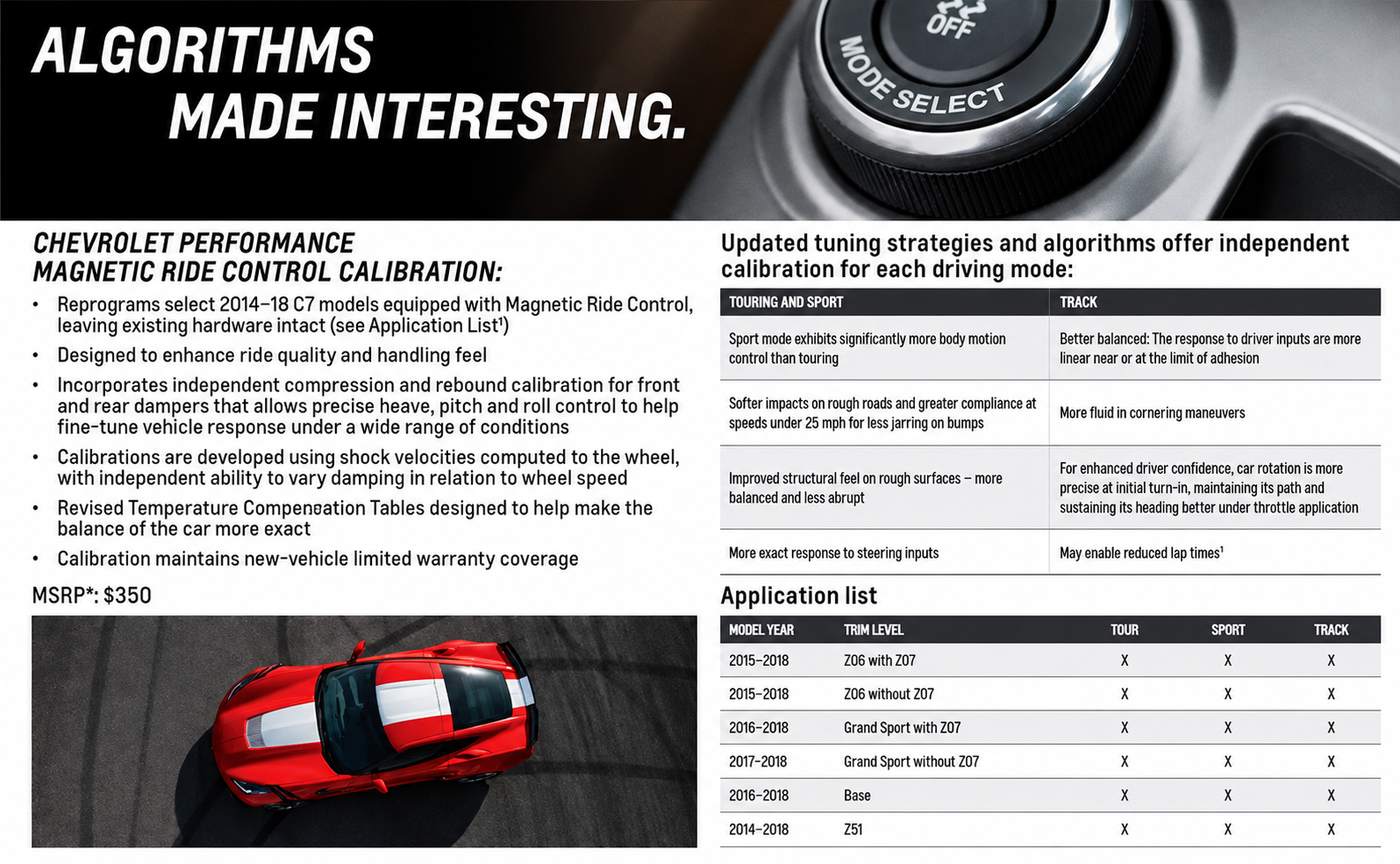
Available Magnetic Selective Ride Control added another layer of adaptability. Rather than depending exclusively on fixed damper characteristics, the system circulated magnetorheological fluid through electronically controlled dampers. Applying an electromagnetic field altered the behavior of microscopic metallic particles suspended in the fluid, changing damping force extremely quickly and allowing the suspension to respond continually to road conditions and driver inputs.
Chevrolet’s third-generation Magnetic Ride Control system reacted substantially faster than earlier versions, giving engineers considerably more latitude in how the Corvette behaved. In normal driving, the suspension could remain compliant enough for long-distance touring. As speeds and lateral loads increased—or as the driver selected a more aggressive operating mode—the dampers could exert greater control over body motion and wheel movement.
That breadth became one of the defining accomplishments of the C7. A properly equipped Stingray could cover hundreds of interstate miles in relative comfort, arrive at a road course, change several electronic settings and become a remarkably competent track car without requiring any mechanical alterations. The Corvette was increasingly becoming one automobile capable of serving several very different roles rather than forcing its owner to accept a permanent compromise in favor of either comfort or outright performance.
Z06: More of Everything
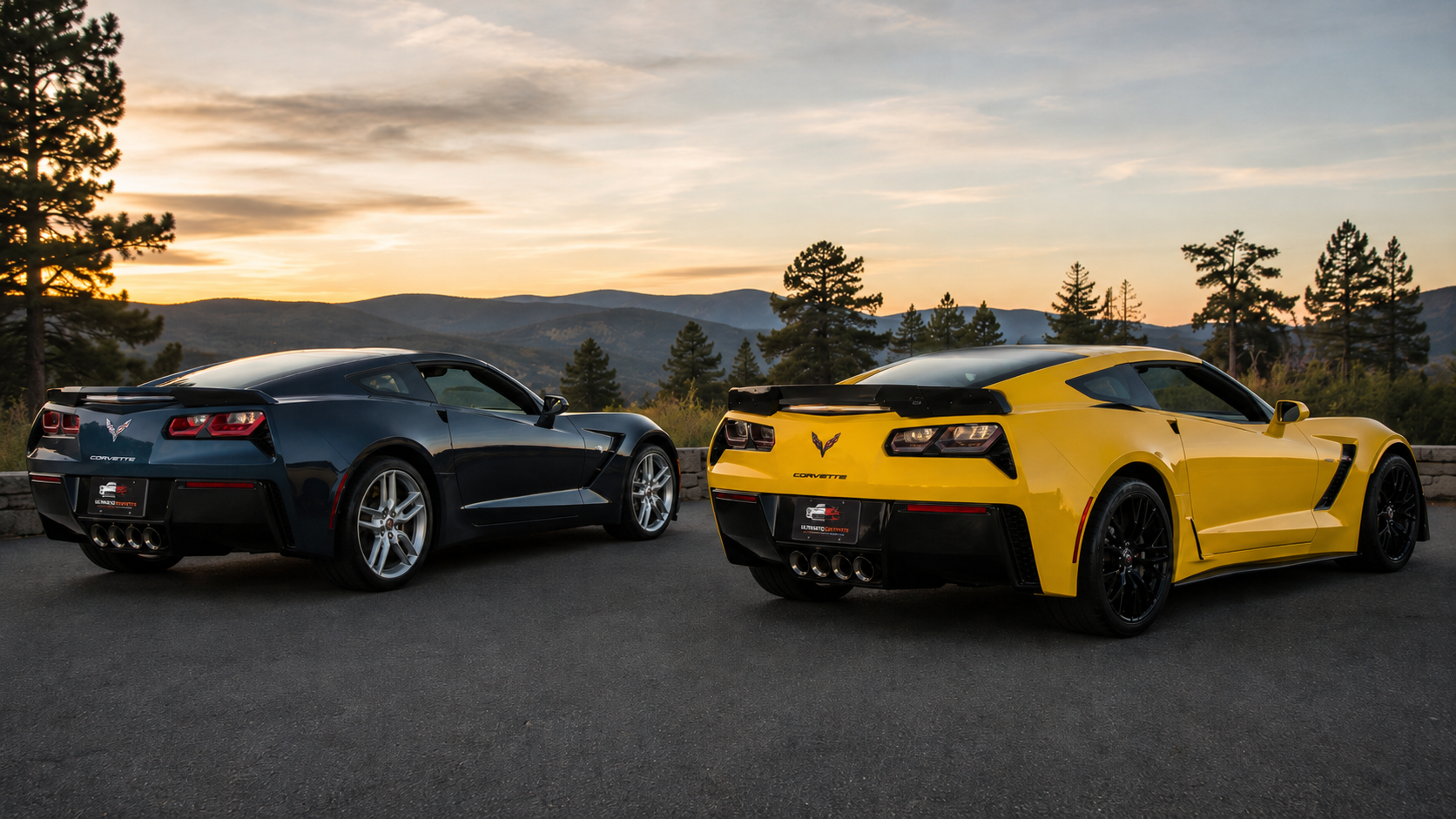
The Z06 magnified nearly every element of that philosophy. Magnetic Ride Control became standard, while Performance Traction Management, launch control, and the electronic limited-slip differential received calibrations developed specifically around the dramatically greater output of the supercharged LT4. Springs, dampers, anti-roll control, tires, brakes, cooling, and aerodynamic loading all had to work together because 650 horsepower was useful only if the chassis could translate it into acceleration, braking, and cornering performance.
Braking capacity increased accordingly. The standard Z06 employed large two-piece steel rotors measuring approximately 14.6 inches in diameter at the front and 14.4 inches at the rear, with six-piston front and four-piston rear calipers. The two-piece construction helped control mass while providing the thermal capacity required by a car capable of repeatedly reaching very high speeds and then shedding that speed under heavy braking.
For buyers who wanted to use the Z06 even more aggressively, the Z07 Performance Package raised braking capability another level by substituting carbon-ceramic matrix rotors measuring about 15.5 inches at the front and 15.3 inches at the rear. Carbon-ceramic brakes offered exceptional resistance to heat and fade during sustained track use while also reducing unsprung and rotating mass. Chevrolet quoted a reduction of about 23 pounds compared with the standard Z06 braking system, an unusually valuable weight saving because it occurred at the wheels rather than within the vehicle’s sprung mass.
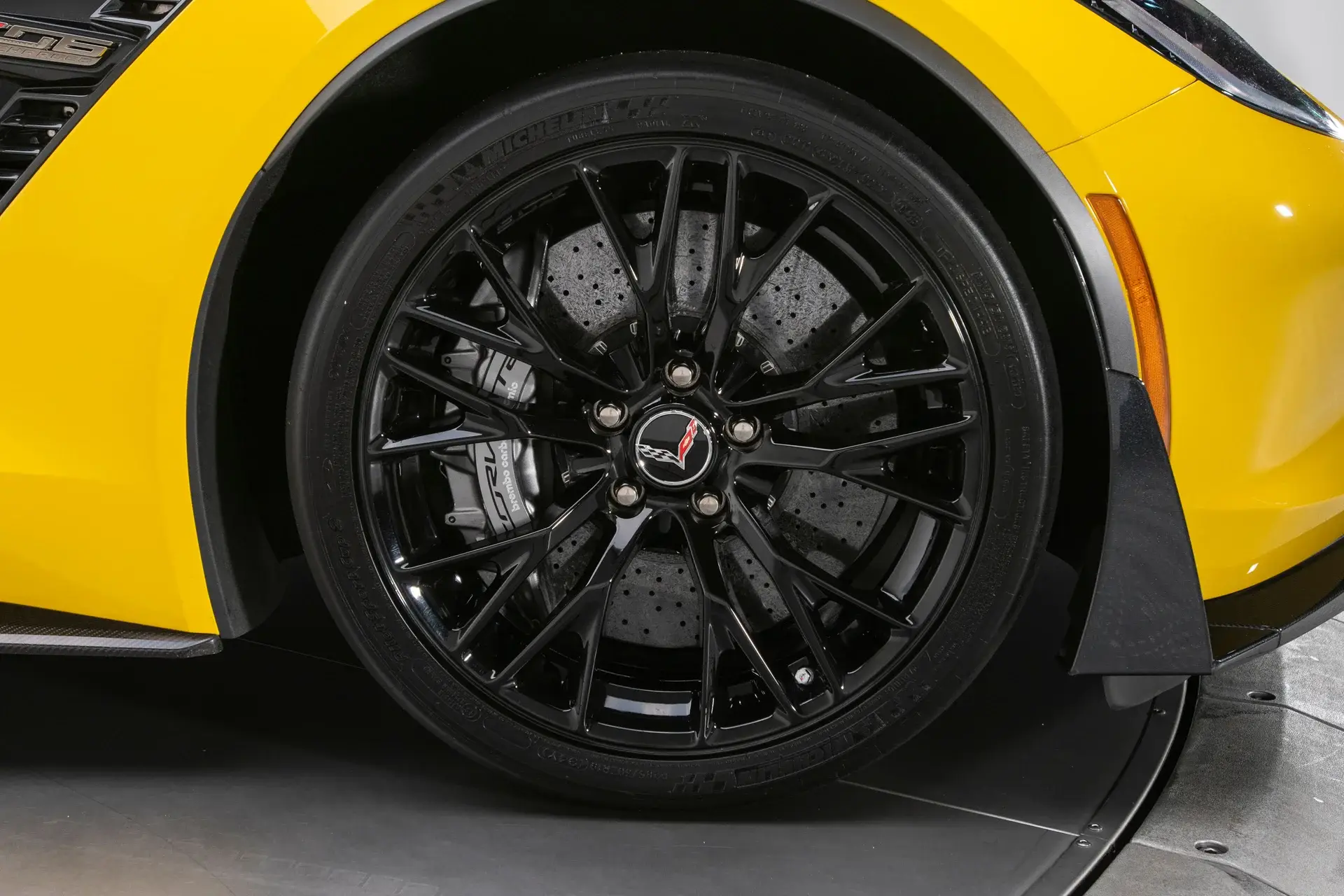
Tire development was equally important. The Z06 wore P285/30ZR19 front and P335/25ZR20 rear tires, dimensions that made the enormous rear contact patches visually obvious even before the car began moving. The Z07 package went further with Michelin Pilot Super Sport Cup 2 tires, a track-focused compound developed to generate substantially greater dry-weather grip than a conventional high-performance street tire, although that capability necessarily came with compromises in cold temperatures, wet-weather performance and tread life.
When combined with its additional aerodynamic downforce, those tires helped Chevrolet claim approximately 1.2 g of lateral acceleration for a Z07-equipped Z06. Numbers at that level would have been extraordinary for virtually any road-going automobile only a few years earlier, and they demonstrated how far Corvette development had moved beyond the old stereotype of an American sports car whose engine substantially exceeded the capabilities of its chassis.
By 2015, the Corvette was no longer simply placing enormous horsepower inside a relatively affordable two-seat package and asking the driver to manage the consequences. Its suspension, brakes, differential, tires, aerodynamics and electronic controls had been developed as an interconnected system capable of exploiting an increasingly large percentage of the performance available from the engine. There were still situations in which 650 horsepower could overwhelm the available traction—as there always will be in a powerful rear-wheel-drive automobile—but the C7 Z06 possessed a chassis sophisticated enough to challenge some of the most serious performance cars in the world on far more than horsepower alone.
The 2015 Corvette Convertible
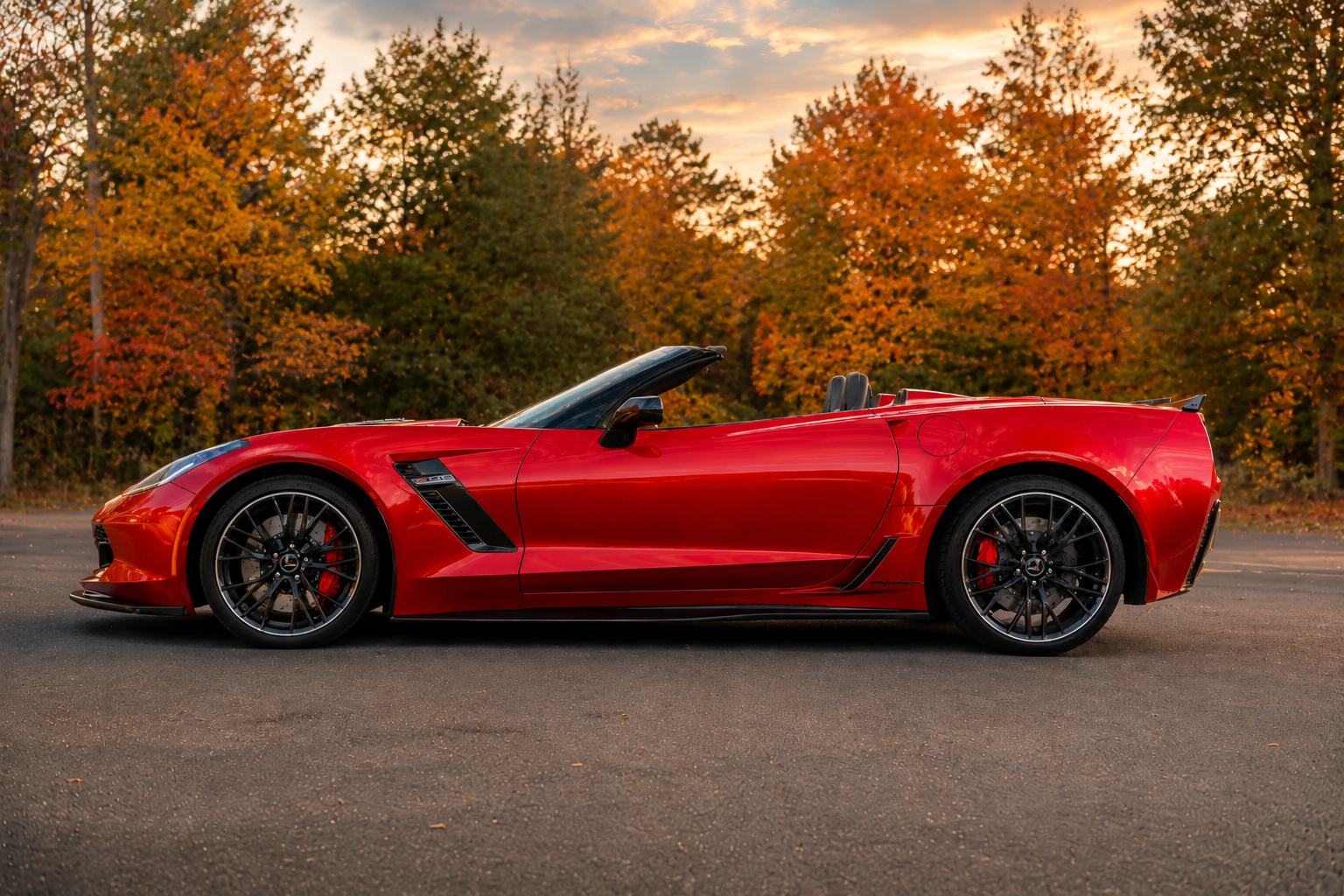
By the time the seventh-generation Corvette arrived, the idea that a convertible had to be the compromised member of the sports-car family was becoming increasingly outdated. Chevrolet had engineered the C7 architecture from the outset to accommodate both coupe and convertible configurations rather than developing the open car later and attempting to restore rigidity after removing the roof. Its aluminum structure was sufficiently stiff that both versions could share essentially the same foundation while preserving the precision and composure expected of a modern Corvette.
The Stingray convertible therefore retained far more than the appearance of its coupe counterpart. Buyers still received the 6.2-liter LT1 V-8, could specify the Z51 Performance Package and Magnetic Ride Control, and for 2015 could pair the car with Chevrolet’s new eight-speed automatic. The power-operated fabric roof could be lowered remotely with the key fob and raised or lowered while the Corvette was moving at speeds of up to approximately 30 mph.
That combination gave the Stingray convertible genuine dual-purpose character. It could deliver the open-air experience buyers expected from a Corvette roadster without surrendering the sophisticated chassis, braking, transmission and suspension technology that had transformed the C7 into such a capable sports car. The old formula of treating the convertible as the softer, heavier alternative was rapidly disappearing.
For most manufacturers, that would have been an ambitious enough achievement. Chevrolet went considerably further for 2015 by applying the same philosophy to the most powerful and track-focused Corvette in the lineup, creating something the company had not offered in more than half a century: a Z06 convertible.
The First Z06 Convertible Since 1963
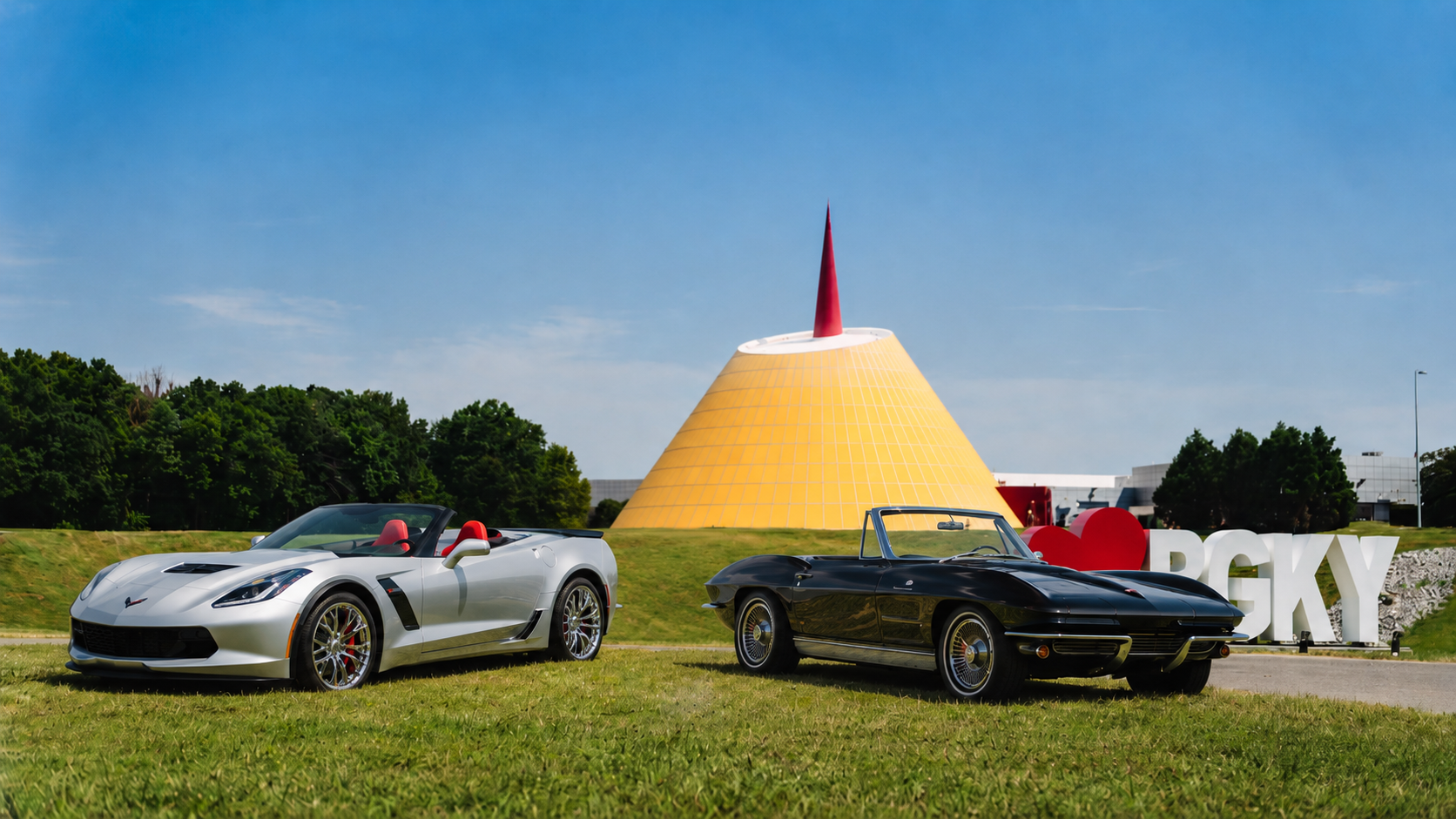
The historical connection reached back to the original Z06 Special Performance Equipment package introduced for 1963. Only 199 Corvettes were ultimately ordered with the competition-oriented package that year, and Chevrolet records indicate that just one was a convertible, making the 2015 model the first factory-offered open Z06 since that exceptionally rare car.
Previous generations had made such a combination difficult. Removing the fixed roof from a high-performance structure traditionally required additional reinforcement to control flex under braking, cornering and acceleration loads, and that reinforcement added mass exactly where engineers trying to build a track-capable car did not want it. The C7’s aluminum architecture fundamentally changed what Chevrolet could accomplish.
Corvette chief engineer Tadge Juechter explained that advances in computer-aided engineering, metallurgy and manufacturing had finally allowed Chevrolet to create a lightweight open structure capable of supporting the loads generated by the new Z06. Development of the aluminum frame involved more than 17,000 computer-generated structural iterations and approximately 186,000 hours of computational modeling, with engineers using extrusions, hollow cast nodes, variable-thickness rails, adhesives, welding and Flowdrill fasteners to place strength where it was needed without simply adding material everywhere.
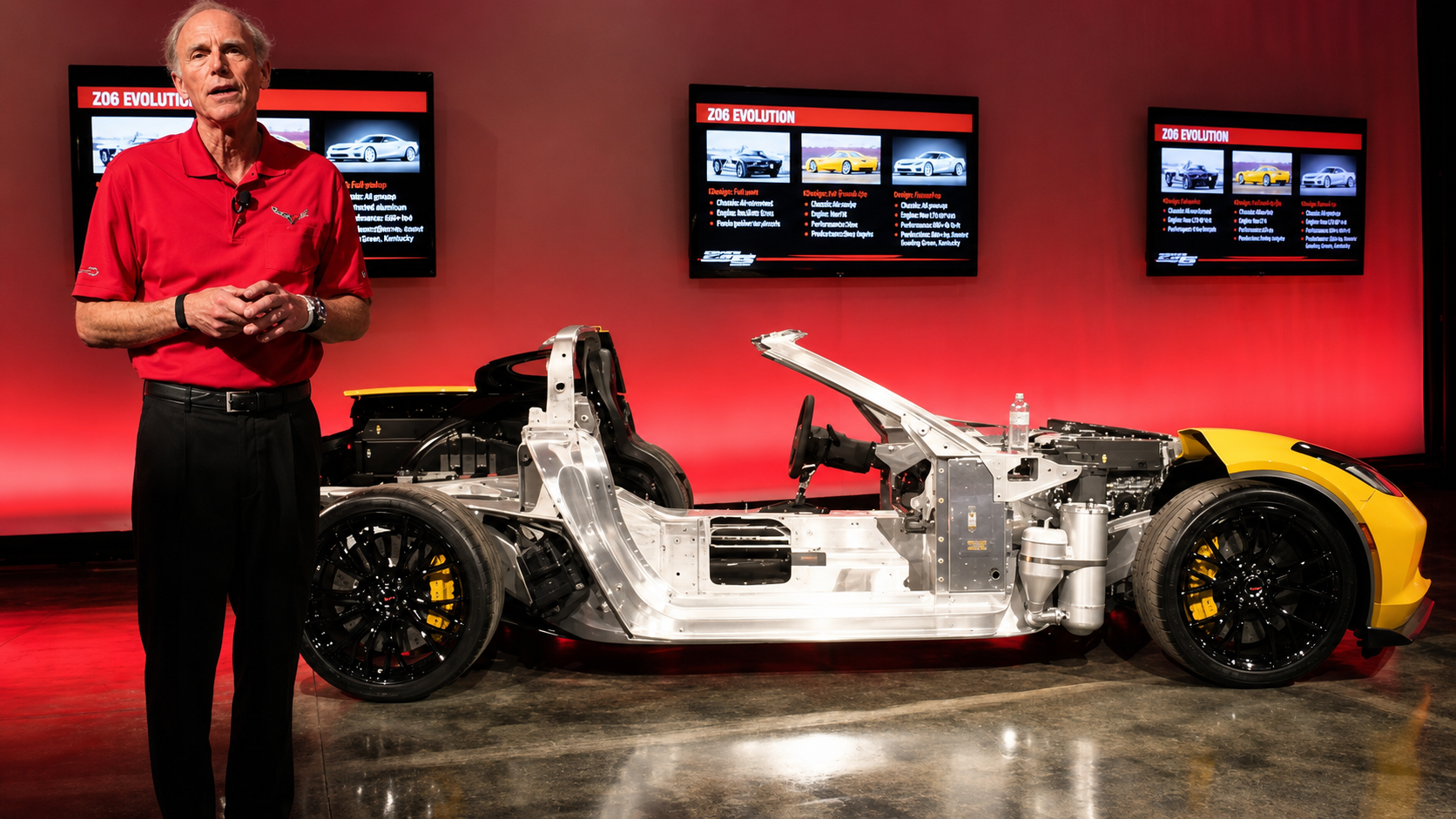
The result was a Z06 convertible that required no additional structural reinforcement solely because its roof folded away. The principal structural changes involved mounting provisions for the power top and revised seatbelt attachment points, while Chevrolet described the C7 aluminum structure as approximately 20 percent stiffer than the fixed-roof C6 Z06 chassis. Packaging the folding top did require another engineering solution: because the power tonneau occupied space used by the coupe’s transmission and differential cooling ducts, those air intakes were relocated to the underside of the convertible.
None of that required Chevrolet to soften the mechanical specification. The convertible retained the 650-horsepower, 650-lb-ft supercharged LT4, essentially the same chassis tuning and the same available Z07 Performance Package with Michelin Pilot Sport Cup 2 tires, carbon-ceramic brakes and aggressive aerodynamic hardware. It was not conceived as a grand-touring interpretation of the Z06 coupe; it was a Z06 whose roof happened to fold away.
Period testing reinforced how successful the engineering had been. Car and Driver weighed an automatic Z07 convertible at 3,613 pounds, only 55 pounds heavier than the automatic Z07 coupe it had tested, while recording 1.17 g on the skidpad, a 134-foot stop from 70 mph, 0–60 mph in 3.1 seconds and an 11.3-second quarter-mile at 126 mph. For a 650-horsepower open car to remain that close to the coupe in acceleration, braking and lateral grip demonstrated just how far Corvette structural engineering had advanced.
Performance in Period Testing
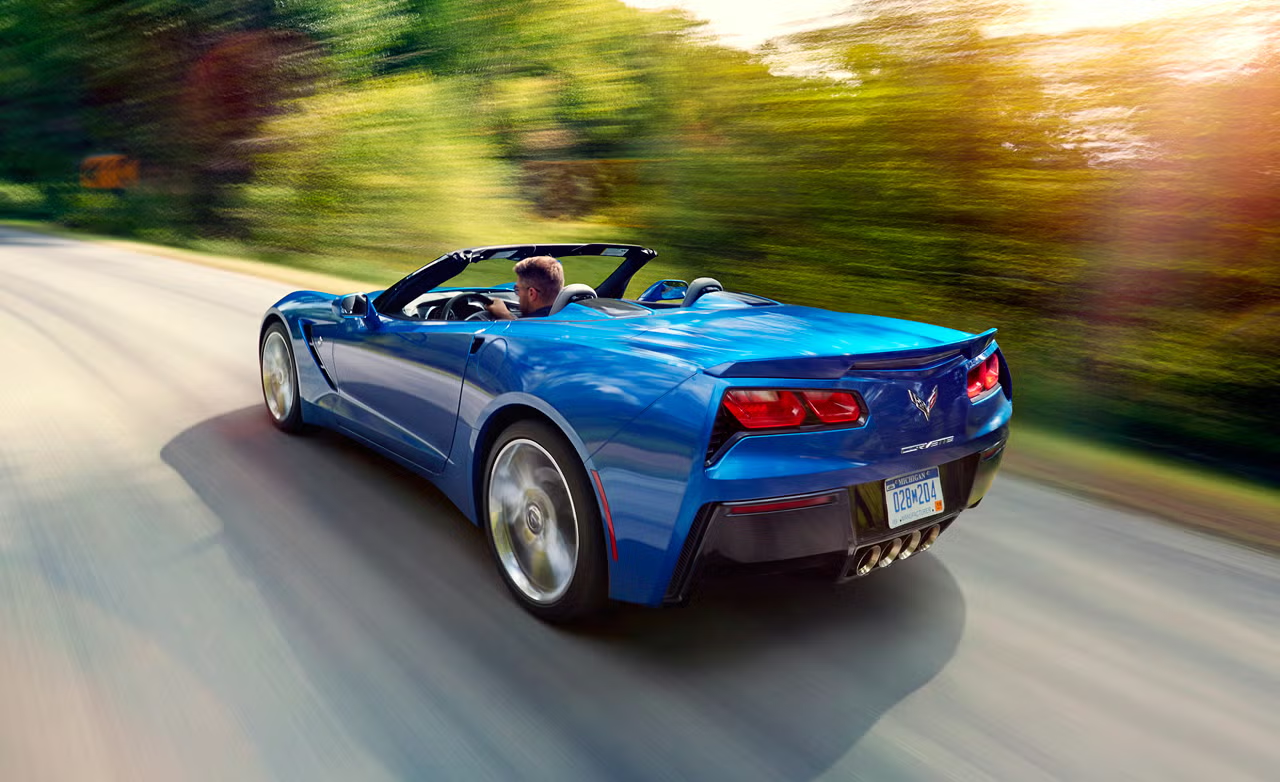
Even the standard 2015 Stingray was operating at a performance level that would have seemed remarkable for a regular-production Corvette only a generation earlier. Car and Driver tested an eight-speed-automatic Stingray convertible at 3.7 seconds from 0–60 mph, 8.3 seconds to 100 mph and approximately 12.0 seconds through the quarter-mile at 119 mph. The same car stopped from 70 mph in 136 feet, generated 1.04 g on the skidpad and still carried an EPA highway rating of 29 mpg.
That combination captured how much broader the Corvette’s abilities had become. Chevrolet was selling a naturally aspirated, front-engine American sports car capable of running a 12-second quarter-mile, exceeding one lateral g and returning highway fuel economy comparable with many ordinary passenger cars. The familiar Corvette value argument remained, but the C7 was becoming increasingly difficult to dismiss simply as a less expensive alternative to more exotic machinery.
The Z06 pushed the numbers into another category entirely. Car and Driver’s automatic Z07 coupe reached 60 mph in 2.9 seconds, covered the quarter-mile in 11.0 seconds at 126 mph, produced 1.19 g on the skidpad and stopped from 70 mph in only 128 feet. At the time, the lateral-acceleration and braking results established production-car records for the magazine.
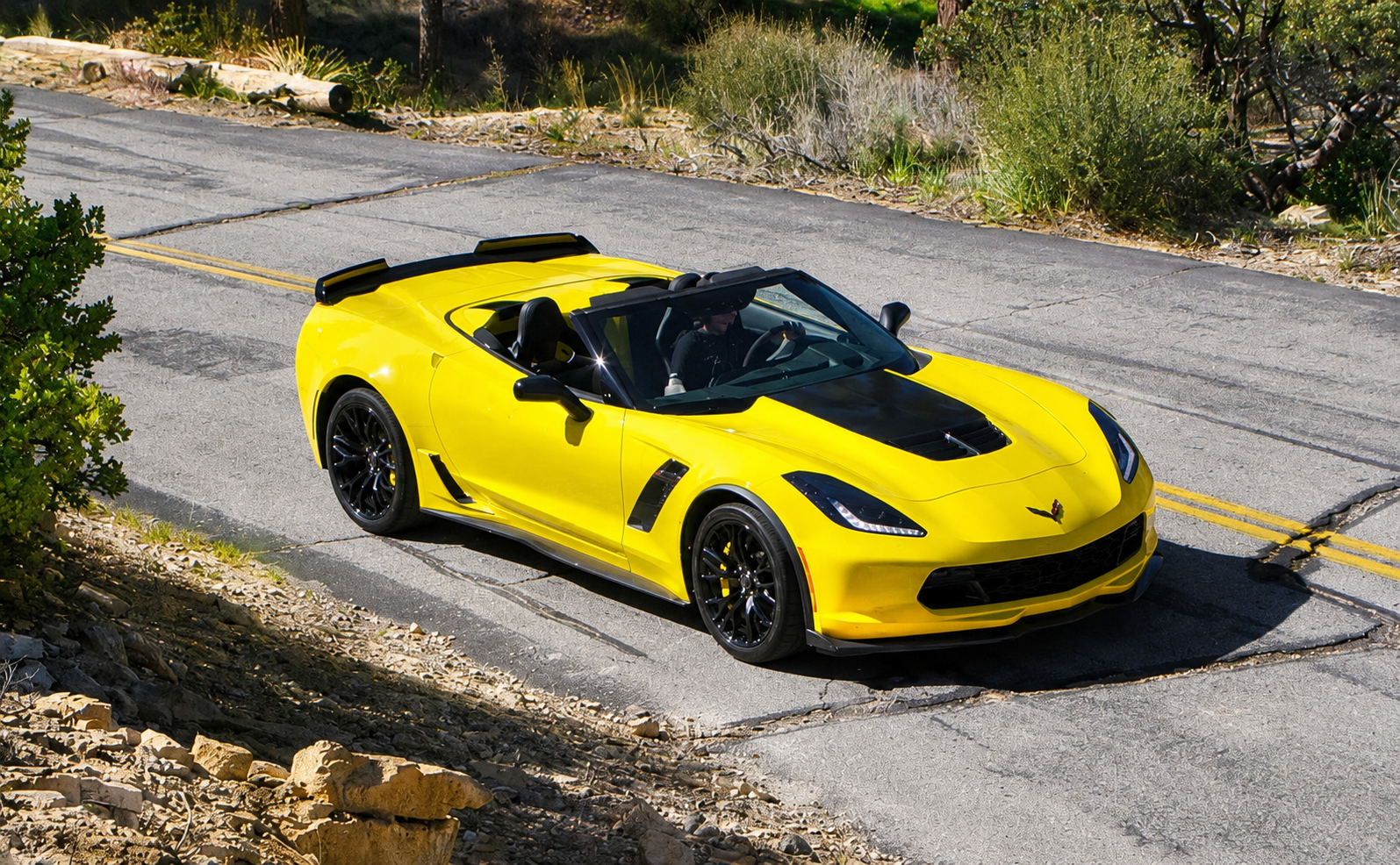
Chevrolet’s own development testing produced similarly dramatic figures. GM recorded 0–60 mph in 2.95 seconds and a 10.95-second quarter-mile at 127 mph with the automatic Z07, along with approximately 1.20 g of lateral acceleration and a 99.6-foot stop from 60 mph. The seven-speed manual remained extraordinarily quick at 3.2 seconds to 60 mph and 11.2 seconds through the quarter-mile, also reaching 127 mph.
The difference between the two transmissions reflected the changing character of modern performance cars. The eight-speed automatic could exploit the LT4’s enormous torque with rapid, closely spaced shifts and deliver the quickest possible acceleration, while the seven-speed manual preserved the clutch pedal, deliberate gear selection and active rev-matching experience many Corvette buyers still wanted. One favored the stopwatch; the other placed more of the process in the driver’s hands.
On a road course, horsepower was only part of the Z06 story. The Z07 Performance Package added Michelin Pilot Sport Cup 2 tires, carbon-ceramic brakes, revised chassis calibration and aerodynamic hardware capable of producing meaningful downforce, while the convertible remained remarkably close to the coupe with 1.17 g, a 3.1-second run to 60 mph and the same 126-mph quarter-mile trap speed. Chevrolet had created a Corvette family capable of delivering genuine supercar acceleration without limiting buyers to a single transmission, roof configuration or level of driver involvement.
The Limits of the Package
For all of its extraordinary capability, the early C7 Z06 was not without weakness. Sustained track use exposed thermal-management limitations in some cars, particularly during prolonged high-load operation in high ambient temperatures and especially in examples equipped with the eight-speed automatic. Coolant, engine-oil or transmission temperatures could climb high enough to trigger warnings and, under some conditions, reduced-power operation.
The severity was not uniform. Ambient temperature, circuit layout, engine speed, session length and driving style all affected the amount of heat generated, which helped explain why some owners could run their cars hard without difficulty while others encountered problems during extended sessions. The automatic’s closely spaced ratios could keep the LT4 operating at higher engine speeds for longer periods, increasing the thermal load during sustained track driving.
General Motors eventually addressed the issue formally. A technical bulletin explained that the manual-transmission Z06 cooling package had been engineered around professional-level running on what Chevrolet considered a typical racetrack at approximately 86 degrees Fahrenheit, while acknowledging that tighter circuits, higher ambient temperatures and sustained high engine speeds could create more severe conditions. GM also recognized that automatic-equipped cars could approach thermal limits more quickly under certain circumstances.
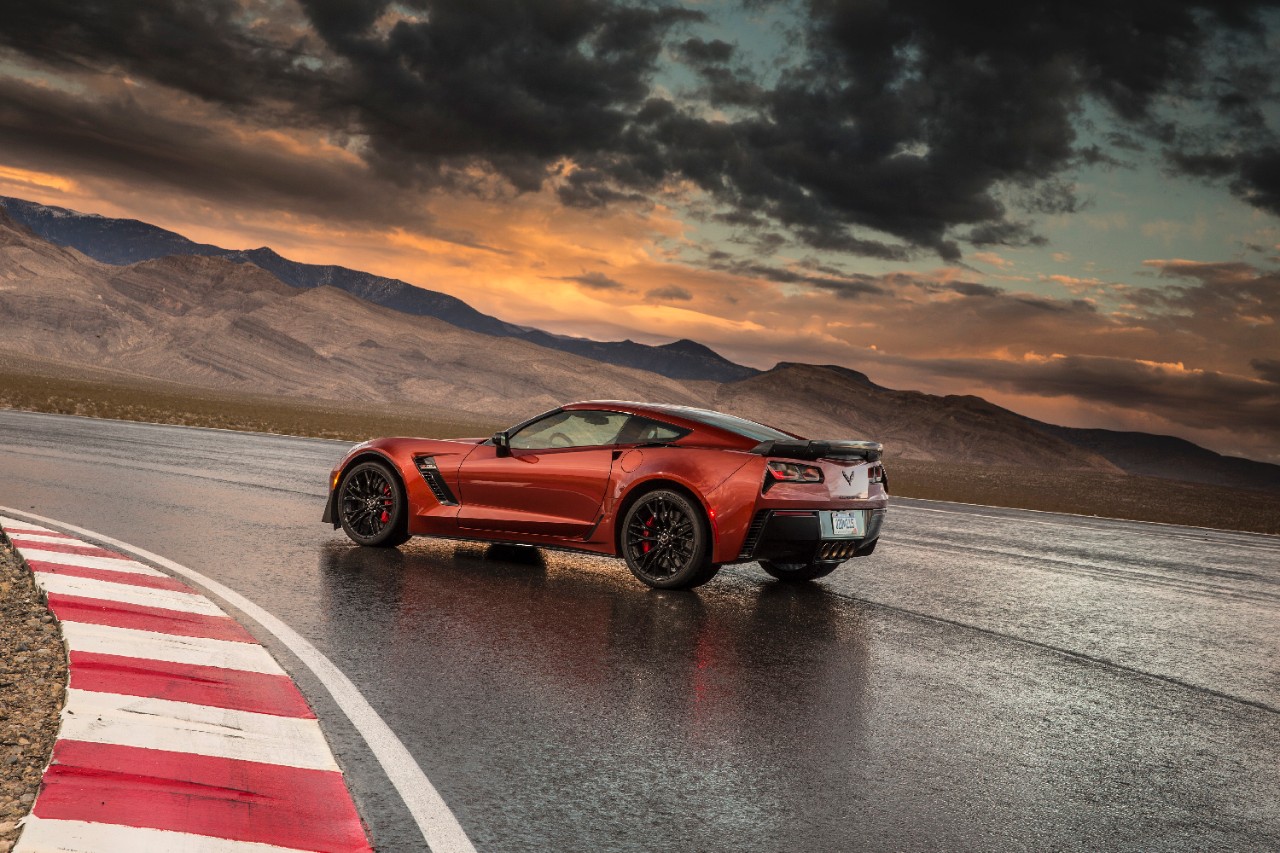
In 2021, Chevrolet established special coverage for qualifying 2015–2018 Z06 models that experienced track-related overheating. The program included updated cooling hardware for affected cars and revised automatic-transmission shift calibration intended to reduce sustained engine speeds and associated heat generation during track operation.
The controversy became part of the early Z06’s history, but it existed at the outer edge of an extraordinarily ambitious performance envelope. Chevrolet was simultaneously managing heat from a supercharged 650-horsepower engine, transmission, differential and brakes while packaging sophisticated aerodynamics and cooling systems into a relatively compact front-engine sports car. The limitations exposed under extreme use do not erase the Z06’s accomplishments, but they belong in any complete account of the car.
The broader 2015 Corvette lineup remained remarkable in its range. It stretched from a 29-mpg Stingray convertible capable of exceeding one lateral g to a 650-horsepower Z06 that could reach 60 mph in less than three seconds, with coupe and convertible bodies, seven-speed manual and eight-speed automatic transmissions, and everything from relatively restrained road-car specifications to the competition-minded Z07 package. By 2015, Corvette was no longer relying primarily on horsepower-per-dollar to establish its credibility; it had developed into a family of genuinely world-class performance cars built around one exceptionally adaptable architecture.
Pricing and Equipment
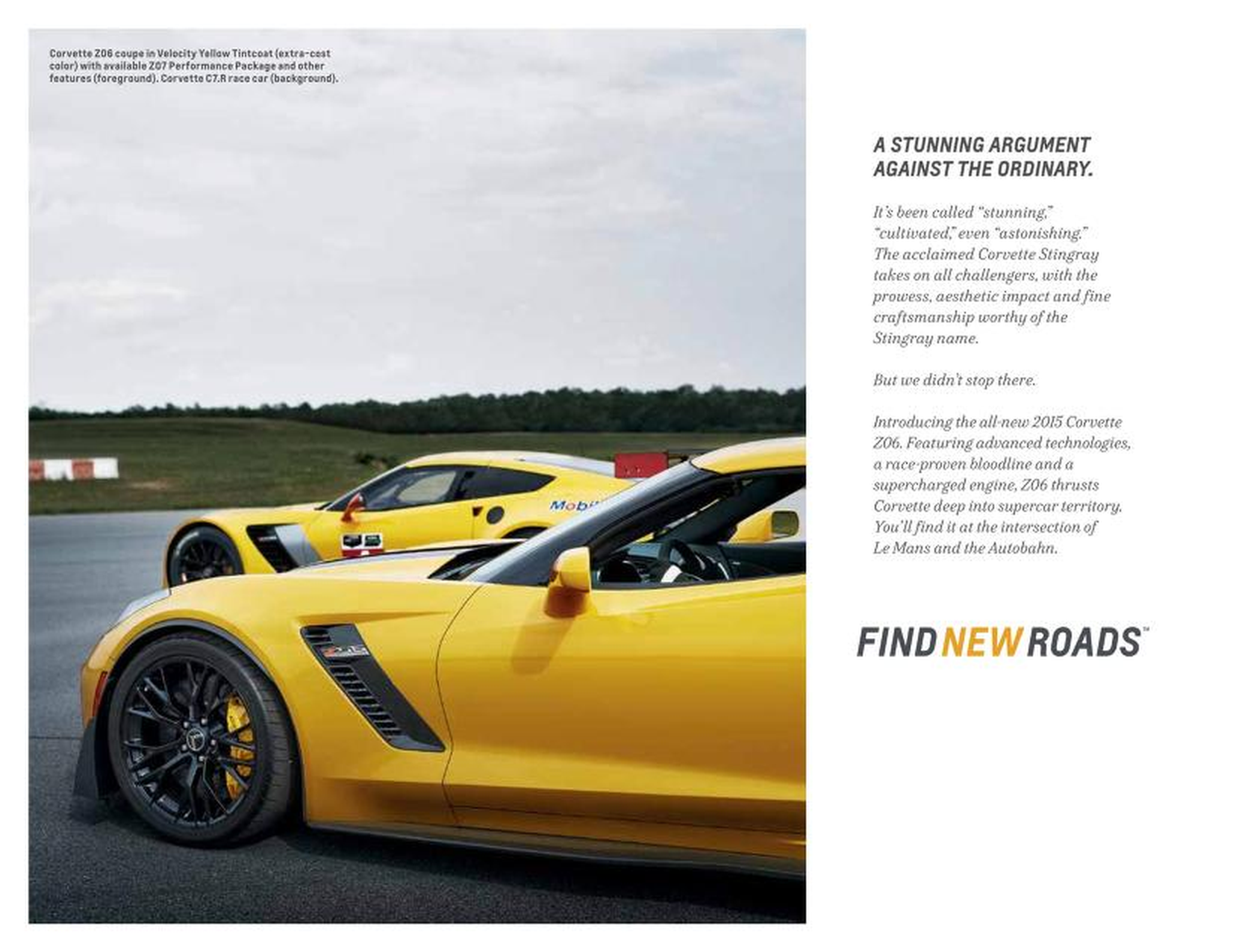
One of the more remarkable aspects of the 2015 Corvette was how aggressively Chevrolet priced the car relative to its capability, although the numbers require some explanation because prices changed during the model year. When first introduced, the standard Stingray coupe carried a $53,000 base price before the $995 destination charge, while the Z51 coupe started at $58,000. The convertible option added $5,000 in either configuration, placing the standard open car at $58,000 and the Z51 convertible at $63,000 plus destination charges. In February 2015, Chevrolet raised coupe pricing: the standard Stingray increased to $55,995 including destination, the Z51 coupe to $60,995, and the Z06 coupe from its original $78,995 figure to $79,995. The convertible prices were not included in that particular increase.
The relatively straightforward starting prices concealed enormous configurability. Stingray buyers could move from the standard 1LT equipment group to 2LT for $4,160 or 3LT for $9,450, adding progressively more robust interior appointments and convenience equipment. Beyond the trim level itself, buyers could specify the $1,795 Magnetic Selective Ride Control system on Z51 cars, the new eight-speed automatic for $1,725, Competition Sport Seats for $1,995—or $2,495 with suede inserts—and numerous wheel, roof, brake-caliper, interior and exterior appearance options. The new Performance Data Recorder was packaged with navigation for $1,795, giving Corvette buyers access to onboard video and vehicle-performance telemetry technology that remained unusual even among considerably more expensive sports cars.
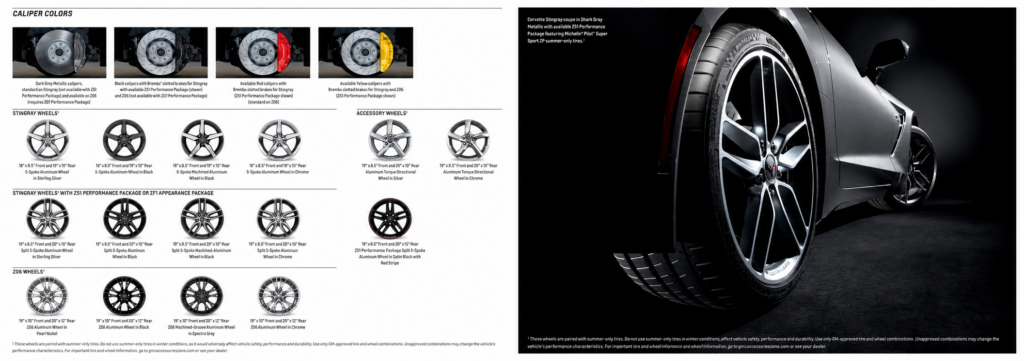
Chevrolet also used the 2015 model year to demonstrate just how far the Stingray could be personalized through the Atlantic and Pacific Design Packages. The Atlantic Design Package, offered on Z51 convertibles in 2LT or 3LT trim, leaned toward grand touring with its Z06-style splitter, Shark Gray accents, chrome Torque wheels, custom luggage and other appearance details; it added approximately $6,350 to the car. The Pacific Design Package approached the Stingray from the opposite direction, combining a Z51 coupe with carbon-fiber ground effects, a visible carbon-fiber roof, Competition Sport Seats, red brake calipers, black racing stripes and other track-inspired details for roughly $7,100. These were expensive packages, but they also illustrated Chevrolet’s increasingly sophisticated approach to Corvette personalization, allowing two mechanically related Stingrays to leave Bowling Green with remarkably different personalities.
The Z06 began at another level entirely. Chevrolet originally announced the Z06 coupe at $78,995 and the convertible at $83,995, both including the $995 destination charge, figures that immediately attracted attention given the car’s 650 horsepower and the performance benchmarks Chevrolet was targeting. From there, the 1LZ could be upgraded to 2LZ for $3,270 or 3LZ for $8,650, while buyers could add Competition Sport Seats, carbon-fiber interior trim, premium paint, alternate wheels, the eight-speed automatic and the $1,795 navigation/PDR system. Even before touching the major performance packages, it was easy to add well over $10,000 to the base price simply by building a more luxurious or heavily optioned Z06.
Then there was the Z07 Performance Package. At $7,995, Z07 added the carbon-ceramic braking system, Michelin Pilot Super Sport Cup tires and the Z06’s most aggressive adjustable aerodynamic configuration, but ordering it also required one of the available ground-effects packages. The detailed 2015 pricing sheet listed Carbon Flash ground effects at $2,995 and visible carbon-fiber ground effects at $3,995, pushing the effective cost of a Z07-equipped build still higher. Add 3LZ, Competition Sport Seats, the automatic transmission, PDR/navigation, premium paint and other appearance equipment, and the arithmetic quickly carried a Z06 beyond $100,000. A 3LZ Z07 was no longer an inexpensive automobile by any conventional measure, but neither was it competing with conventional automobiles.

That distinction defines the 2015 Corvette’s value proposition better than its base price alone. A Stingray beginning in the mid-$50,000 range delivered acceleration, braking and cornering performance capable of troubling cars carrying substantially higher price tags, while a six-figure Z07-equipped Z06 was being judged against machinery from Porsche, Ferrari and other exotic manufacturers that could cost two or three times as much. Chevrolet had not abandoned the traditional Corvette formula of delivering extraordinary performance for the money; it had expanded the scale on which that formula operated. By 2015, the Corvette could be configured as a relatively attainable 455-horsepower sports car, a sophisticated grand-touring convertible or a carbon-ceramic-braked, 650-horsepower track weapon—and all three emerged from the same basic C7 architecture.
Colors and Second-Year Production
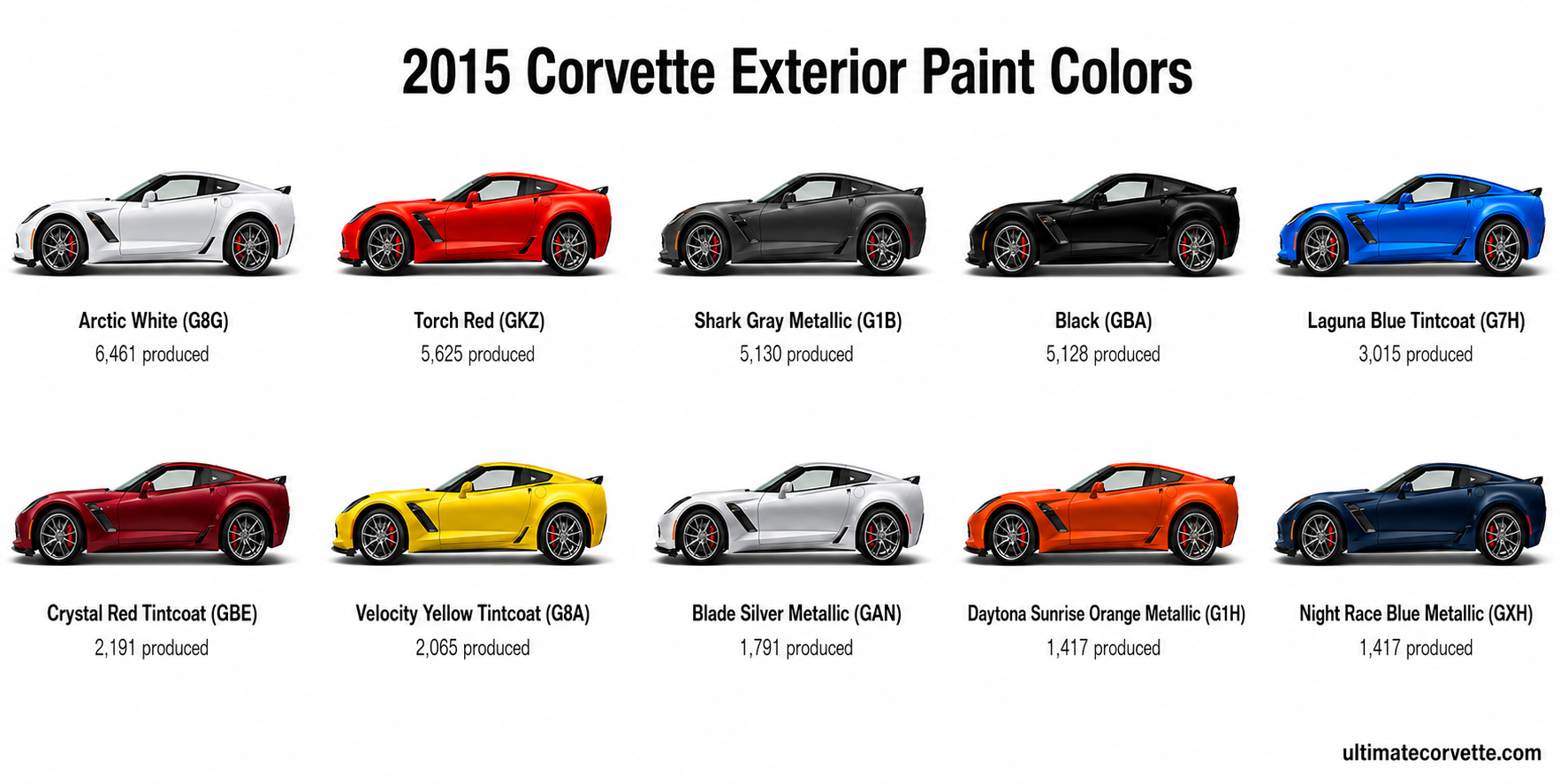
Chevrolet produced 34,240 Corvettes for the 2015 model year, a substantial total for a two-seat sports car and further evidence that the seventh-generation Corvette had found an enthusiastic audience. Stingray production accounted for 25,587 cars, divided between 20,757 coupes and 4,830 convertibles, while Chevrolet built 8,653 Z06 models—6,980 coupes and 1,673 convertibles. Put another way, slightly more than one out of every four Corvettes built for 2015 was a Z06. Considering the Z06’s significantly higher price and far more aggressive performance mission, its roughly 25-percent share of total production represented a remarkable level of demand for the most extreme member of the lineup.
The option data provides an equally revealing look at what C7 customers wanted. Approximately 53 percent of Stingray buyers selected the Z51 Performance Package, moving their cars beyond the standard specification with additional cooling, larger brakes, performance gearing, a dry-sump oiling system and other chassis upgrades. Z06 customers proved similarly willing to move farther up the performance ladder, with roughly 39 percent selecting the Z07 Performance Package. Interior choices followed the same pattern: nearly 69 percent of Z06 buyers chose the top-level 3LZ equipment group, while comparatively few settled for the entry-level 1LZ specification. The C7 was attracting buyers who were willing to spend beyond the advertised base price to obtain more performance, technology and luxury.
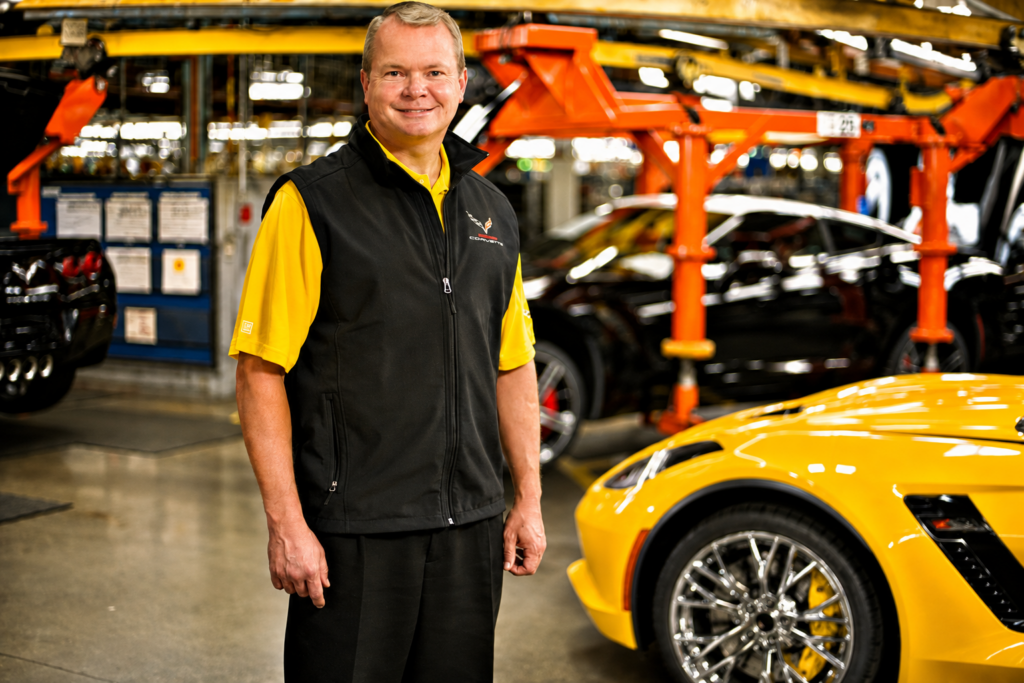
Few options demonstrate that tendency more clearly than the NPP dual-mode performance exhaust, which appeared on approximately 30,896 of the 34,240 Corvettes produced—roughly 90 percent of the entire model-year run. On Stingrays, the system helped raise LT1 output from 455 to 460 horsepower while using electronically controlled valves to alter exhaust flow and sound according to driving conditions and selected modes. Its extraordinary take rate suggests that buyers considered the louder, more expressive exhaust character nearly fundamental to the C7 experience rather than an indulgent accessory. By 2015, the sound of a Corvette had become another configurable part of the car’s personality.
Exterior-color production showed a different side of the same buyer base. Chevrolet offered ten colors, with Arctic White leading at 6,461 cars, followed by Torch Red at 5,625, Shark Gray Metallic at 5,130 and Black at 5,128. Those four colors alone accounted for nearly two-thirds of production. The remainder consisted of Laguna Blue Tintcoat at 3,015, Crystal Red Tintcoat at 2,191, Velocity Yellow Tintcoat at 2,065, Blade Silver Metallic at 1,791, and Daytona Sunrise Orange Metallic and Night Race Blue Metallic at 1,417 each. Arctic White represented approximately 18.9 percent of production, Torch Red 16.4 percent, while Shark Gray and Black each captured roughly 15 percent.
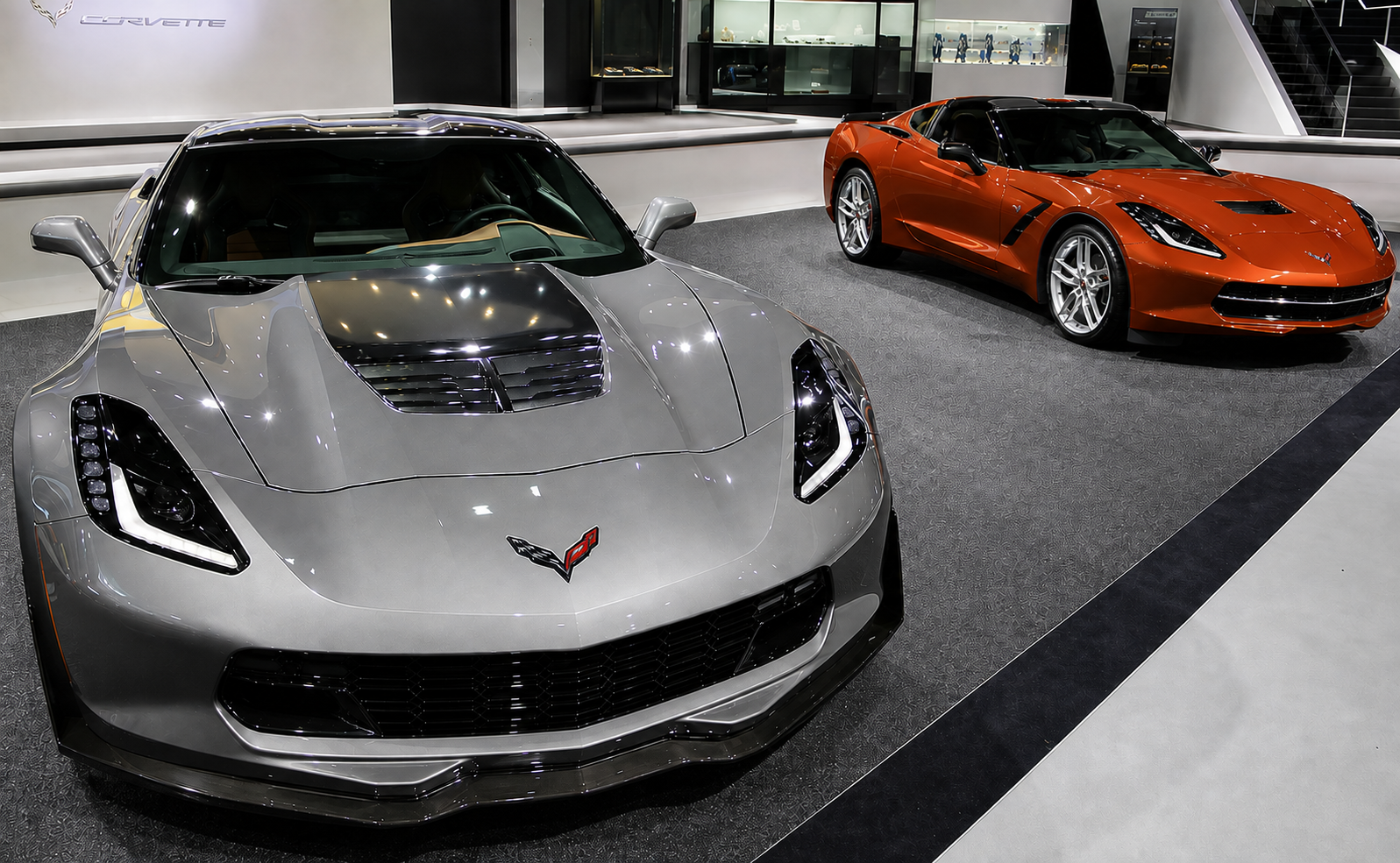
The palette also evolved for 2015. Shark Gray Metallic and Daytona Sunrise Orange Metallic were new, replacing the outgoing Cyber Gray Metallic and Lime Rock Green Metallic. Shark Gray proved immediately successful, becoming the third-most-popular color in its first year and finishing only two cars ahead of Black. Daytona Sunrise Orange occupied the opposite end of the spectrum: considerably less common, but visually dramatic and particularly effective at emphasizing the C7’s sharply creased body surfaces. Alongside Laguna Blue, Velocity Yellow, Crystal Red and the perennial Torch Red, it ensured that buyers who wanted their Corvette to announce its presence still had plenty of opportunity to do so.
Taken together, the production figures reveal a Corvette audience increasingly comfortable treating the C7 as both a serious performance machine and a premium automobile. Buyers disproportionately chose Z51, Z07, 3LZ and NPP rather than stopping at the least expensive configuration, while the color mix leaned heavily toward white, gray and black shades familiar across the contemporary luxury-car market. At the same time, Chevrolet continued to offer the saturated reds, blues, yellows, and oranges traditionally associated with America’s sports car. The 2015 Corvette could therefore be configured as an understated grand tourer or an unapologetically extroverted performance car, and the production numbers show that customers enthusiastically embraced both interpretations.
The C7.R and the 2015 Z06: One Development Philosophy, Two Different Jobs
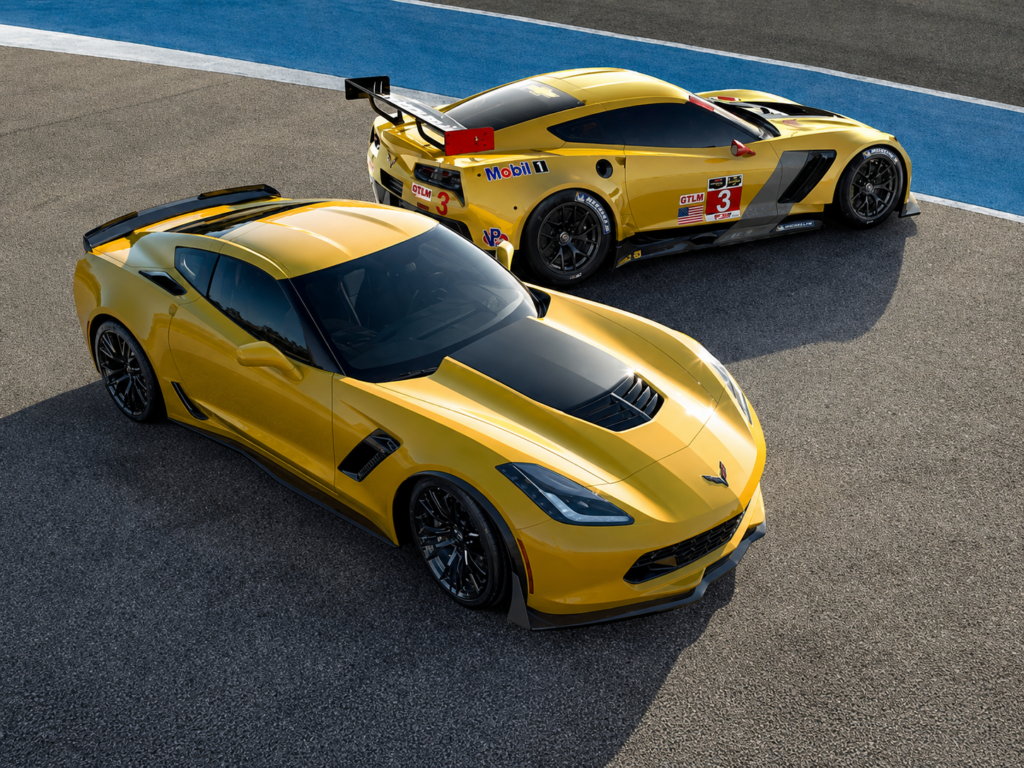
Corvette’s connection to motorsport was anything but ceremonial in 2015. Chevrolet developed the production Z06 and Corvette Racing’s C7.R in parallel, describing the two as representing the closest relationship yet between its road-going and racing Corvettes. They were never intended to be mechanically identical, but they emerged from the same engineering program, sharing structural architecture, aerodynamic strategies and many of the lessons already incorporated into the C7 Stingray.
At the center of that relationship was the aluminum frame produced at Bowling Green. Both the Z06 and C7.R used the same production-based aluminum structure, with advanced manufacturing techniques including laser welding, aluminum spot welding and Flowdrill fasteners helping produce a C7.R chassis Chevrolet described as 40 percent stronger than the outgoing C6.R. Their aerodynamic relationship was equally visible in similar splitters, rocker treatments, brake-cooling provisions and airflow management, but racing regulations created a major mechanical divide: while the Z06 used the supercharged 6.2-liter LT4, GTE rules limited the C7.R to 5.5 liters and prohibited forced induction.
The connection was therefore far more sophisticated than simply transferring racing hardware into a street car. Chevrolet used competition to develop its understanding of aerodynamics, cooling, braking, suspension behavior, structural stiffness and vehicle dynamics, while advances required for the production C7 gave Corvette Racing a stronger and more sophisticated foundation from which to develop the C7.R. The Z06 and race car performed very different jobs, but their simultaneous development demonstrated how thoroughly the road and racing programs had become intertwined.
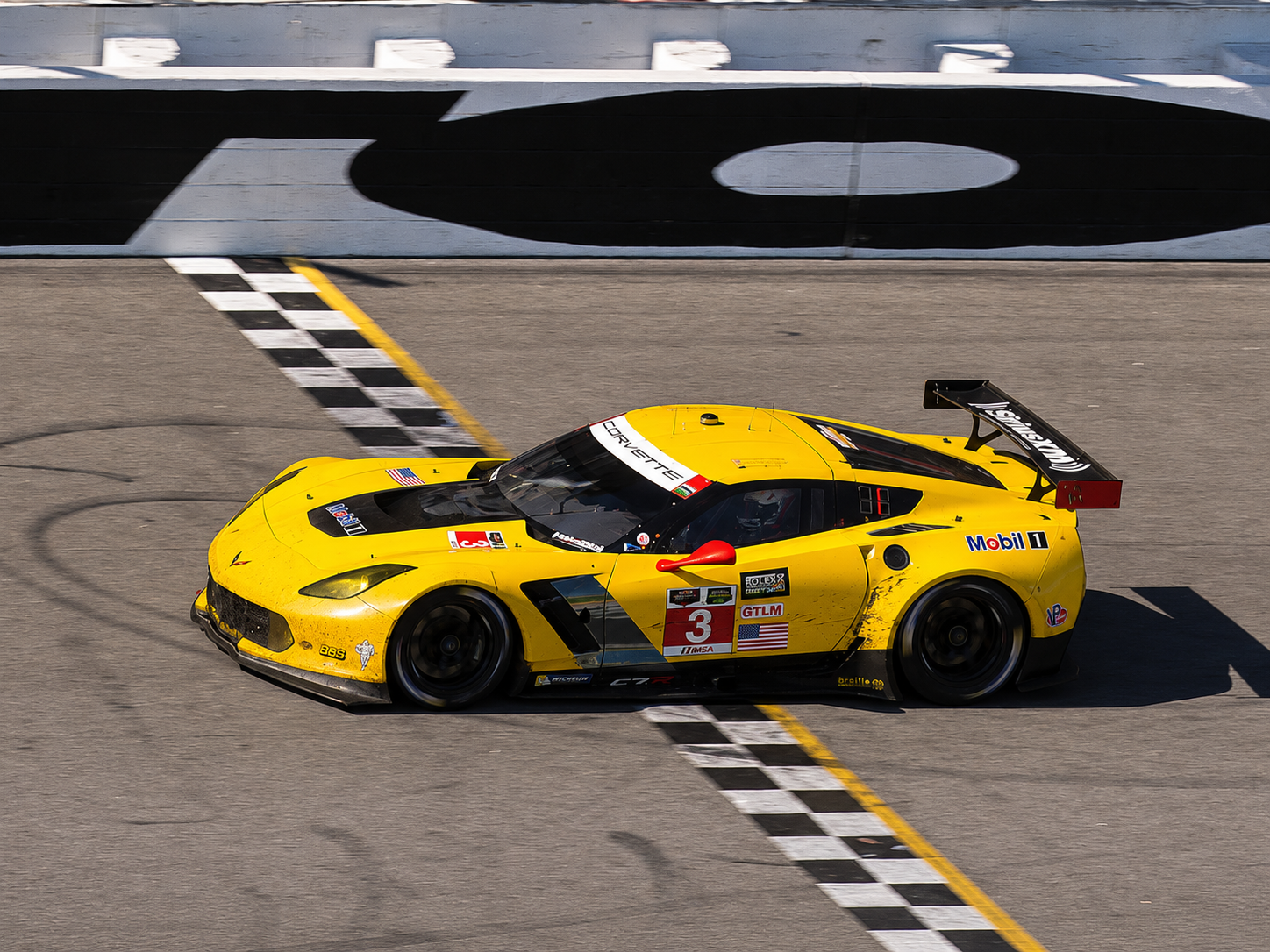
That philosophy produced extraordinary results when the 2015 racing season opened at the Rolex 24 At Daytona. Antonio García, Jan Magnussen and Ryan Briscoe drove the No. 3 Corvette C7.R to GTLM victory after completing 725 laps and 2,581 miles, with García crossing the finish line only 0.478 second ahead of the second-place BMW. The No. 4 Corvette of Oliver Gavin, Tommy Milner and Simon Pagenaud finished third, putting both factory C7.Rs on the class podium at one of North America’s most important endurance races.
Two months later, the No. 3 combination of García, Magnussen and Briscoe won again at the Twelve Hours of Sebring, completing 330 laps and approximately 1,221 miles. Corvette Racing had now captured GTLM honors at Daytona and Sebring in succession, giving the C7.R victories in the first two major endurance contests of the year. With those two American classics secured, attention shifted to the race that had defined so much of Corvette Racing’s international reputation: the 24 Hours of Le Mans.
Le Mans nearly unraveled before the race even began. During qualifying, Jan Magnussen suffered a severe accident in the No. 63 C7.R after a small piece of debris entered the pedal box and caused a throttle malfunction; Magnussen escaped injury, but the damaged Corvette could not be repaired in time to compete. That left the entire factory effort resting on the No. 64 C7.R of Oliver Gavin, Tommy Milner and Jordan Taylor, which had qualified only seventh among the GTE Pro entries.
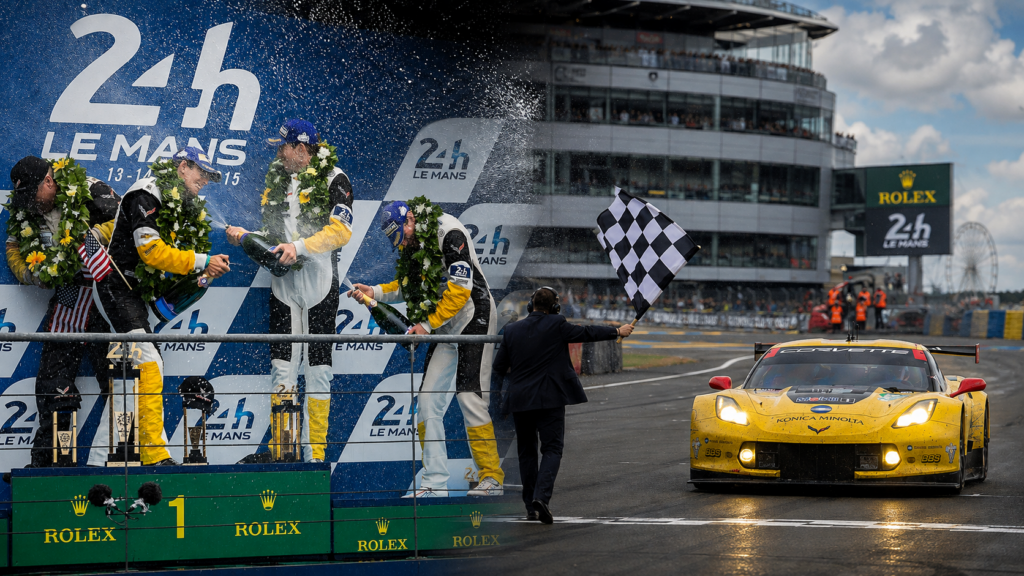
The remaining Corvette responded with one of the defining victories of the C7.R era. Gavin, Milner and Taylor worked their way through the field and completed 337 laps and 2,864.5 miles, ultimately winning GTE Pro by five laps and giving Corvette Racing its eighth class victory at Le Mans. Combined with the earlier wins at Daytona and Sebring, the result completed endurance racing’s unofficial Triple Crown, making Corvette Racing the first sports-car team in 15 years to win all three events in the same year.
The Triple Crown did not translate into domination of the entire 2015 championship. García and Magnussen finished third in GTLM competition in the No. 3 Corvette, and that car likewise ended the season third in the team standings after its brilliant opening stretch gave way to a more difficult second half. Corvette Racing therefore left 2015 without the season-long GTLM championship, an important distinction from the championships the C7.R would capture in subsequent years.
That contrast gives the 2015 season much of its character. The C7.R was not unbeatable at every circuit, nor was the production Z06 simply a racing Corvette wearing license plates, but both cars demonstrated how effectively Chevrolet had merged its road and competition engineering programs. In the same year that customers could purchase the 650-horsepower Z06, its racing counterpart won Daytona, Sebring and Le Mans—a remarkably appropriate validation of the development philosophy behind the most track-focused Corvette Chevrolet had yet offered.
While the C7 Reached Its Peak, the C8 Was Already Taking Shape
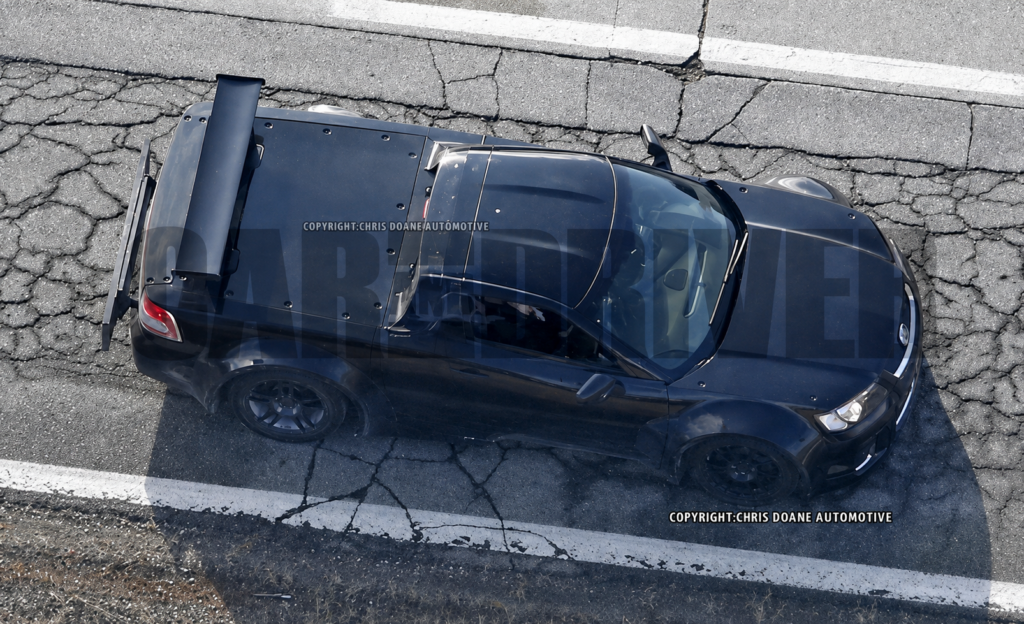
Perhaps the most fascinating part of the 2015 Corvette story was something virtually no customer could see. General Motors was already developing its replacement, and the work taking place behind closed doors would ultimately lead Corvette farther from its traditional formula than at any previous point in the car’s history.
That fact gives the 2015 Corvette an unusual place in the history of the marque. From the outside, the C7 appeared to represent Chevrolet’s fullest commitment yet to the front-engine Corvette, with the Stingray having restored considerable excitement to the nameplate and the new Z06 pushing production-car performance into territory once reserved for far more exotic machinery.
Corvette Racing was reinforcing the same message on circuits around the world. Everything visible about the program suggested that Chevrolet was continuing to refine, improve and extract greater performance from the architecture that had defined the Corvette for generations.
Behind closed doors, however, Chevrolet was preparing for something very different. Even as the C7 was approaching the height of its capabilities, a small group of engineers was already determining how Corvette might survive once the traditional layout finally reached the limits of what they believed it could realistically deliver.
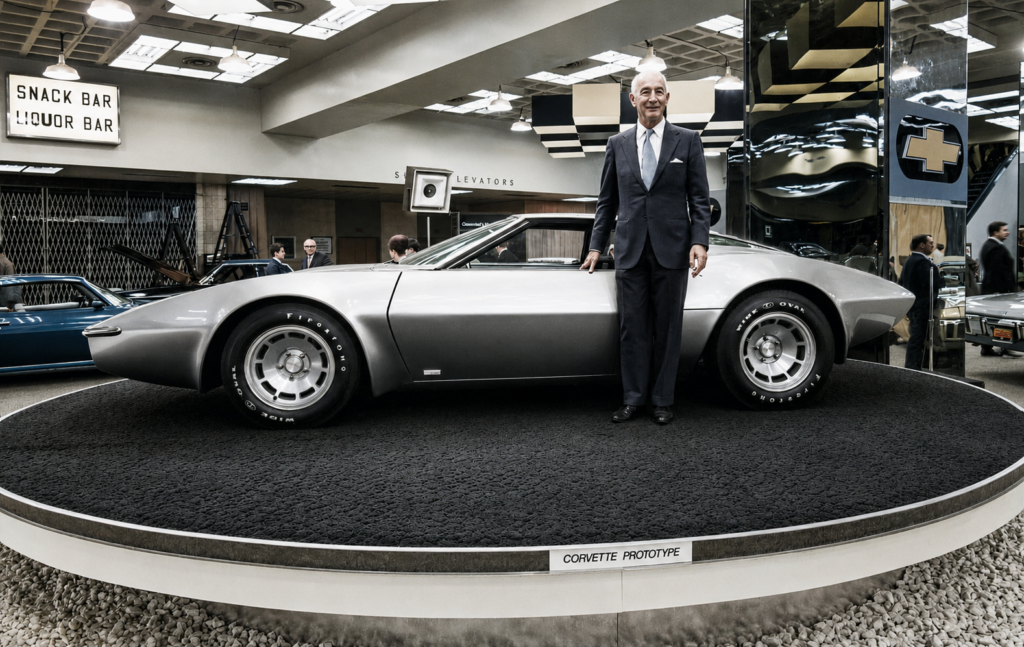
The idea of placing the Corvette’s engine behind its occupants was certainly not new. Zora Arkus-Duntov had spent decades investigating alternatives to the conventional front-engine layout, and Chevrolet’s experimental history included machines such as the CERV prototypes, the XP-882 and the Aerovette.
Those cars reflected a recurring belief inside Corvette engineering that moving the engine rearward might eventually provide advantages that could not be achieved indefinitely with the traditional configuration. Again and again, however, the production Corvette remained front-engined, and the more radical experimental cars became fascinating branches of development rather than the beginning of a new production lineage.
That nearly changed before the C7.
During the latter years of C6 development—particularly as Chevrolet pushed the supercharged C6 ZR1 toward production—Tadge Juechter and his team were becoming increasingly aware that simply adding more power to the traditional layout would eventually deliver diminishing returns. The transmission had already been moved to the rear of the car, leaving the engine as the largest remaining mass that could be relocated, and the engineering argument for placing it behind the occupants increasingly centered on weight distribution, traction and expanding Corvette’s performance envelope rather than simply creating something exotic.
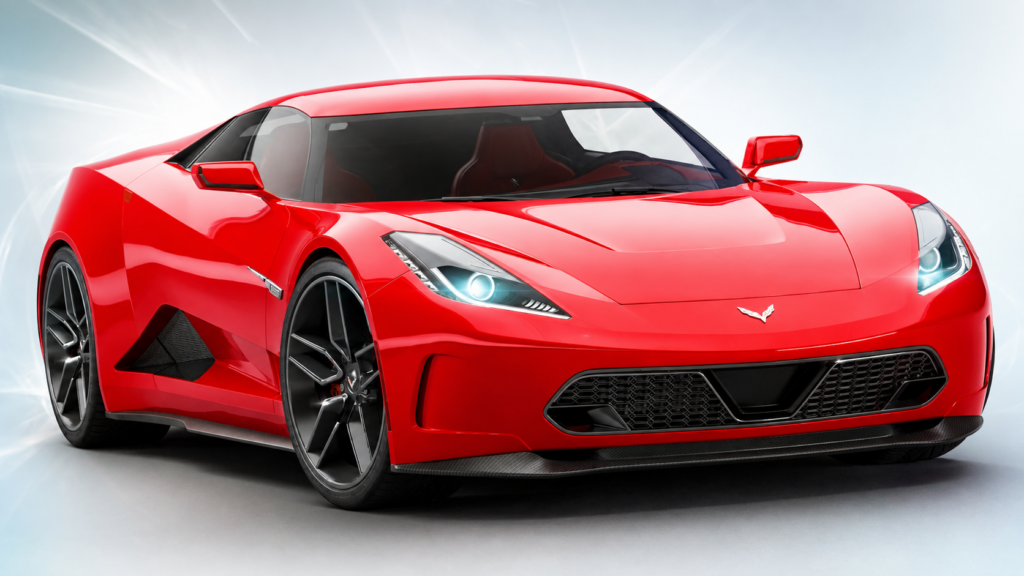
By the 2007–2008 period, the team had done meaningful planning around the possibility of making the C7 a mid-engine Corvette, and although senior management had historically been skeptical, Juechter later recalled that the engineering case eventually became persuasive enough to gain internal support.
Its timing could scarcely have been worse.
The global financial crisis struck just as General Motors was approaching one of the most precarious periods in its history, rapidly turning long-range product ambitions into questions of basic corporate survival. GM entered into emergency financing arrangements with the U.S. Treasury in late 2008, was required to submit increasingly aggressive restructuring plans, and by the spring of 2009 was operating under severe liquidity constraints while federal officials evaluated whether the company could remain viable. When those restructuring efforts proved insufficient, the old General Motors filed for Chapter 11 bankruptcy protection on June 1, 2009; a newly reorganized GM acquired substantially all of its operating assets on July 10. Under those conditions, expensive new vehicle architectures became extraordinarily difficult to justify, and Juechter has said the bankruptcy effectively locked down product spending and forced Corvette engineering to abandon its immediate mid-engine ambitions.
The mid-engine Corvette was therefore one of the casualties of the crisis, but the engineering argument behind it had not been disproven. Corvette’s team was forced to retrench, shelving the architecture it had been studying and developing what became the C7 around a more evolutionary front-engine platform that could be brought to market within GM’s new financial reality.
Juechter later described the period as one in which the team was effectively forced to postpone its aspirations, not abandon them, and that distinction is important: the question inside Corvette engineering was no longer whether a mid-engine layout offered advantages, but when the company would once again have the resources and institutional confidence to pursue it. The C7 emerged from that reset as a remarkable continuation of the traditional Corvette formula, while the more radical idea remained dormant only temporarily.
What ultimately became the C7 therefore evolved around a more familiar front-engine architecture. That decision did not make the seventh-generation Corvette conservative, because its aluminum structure, advanced electronically controlled chassis systems, increasingly sophisticated aerodynamics and modern powertrains allowed Chevrolet to push the traditional configuration farther than any previous production Corvette.
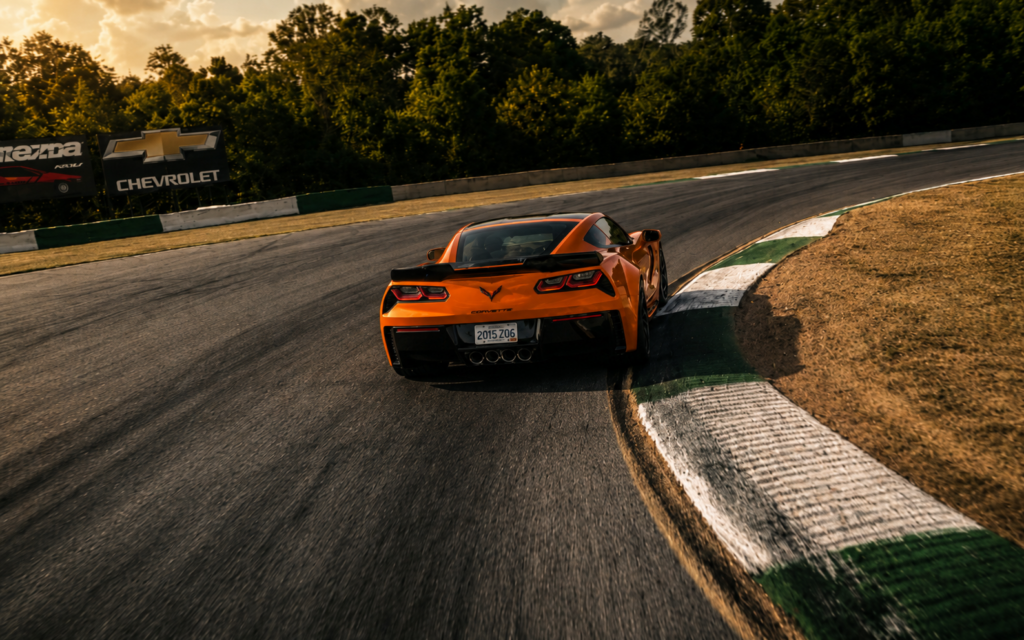
By the time the 2015 Z06 arrived, that philosophy had produced an extraordinary automobile. The supercharged LT4 delivered 650 horsepower and 650 lb-ft of torque, placing the C7 firmly among the most powerful and capable performance cars available at any price.
Yet even before customers could experience the Z06 for themselves, Corvette engineering had resumed its investigation of the alternative. By 2013—the same year Chevrolet publicly revealed the C7 Stingray—Tadge Juechter and a tightly restricted group of engineers were already working with genuine hardware for the Corvette that would eventually follow it.
The project was no longer merely an internal conversation about what a future Corvette might someday become. Chevrolet had built a functioning development vehicle, and although almost nothing about its appearance suggested the shape of the production car to come, its underlying architecture represented the beginning of the most fundamental transformation in Corvette history.
Its codename was Blackjack.
Blackjack
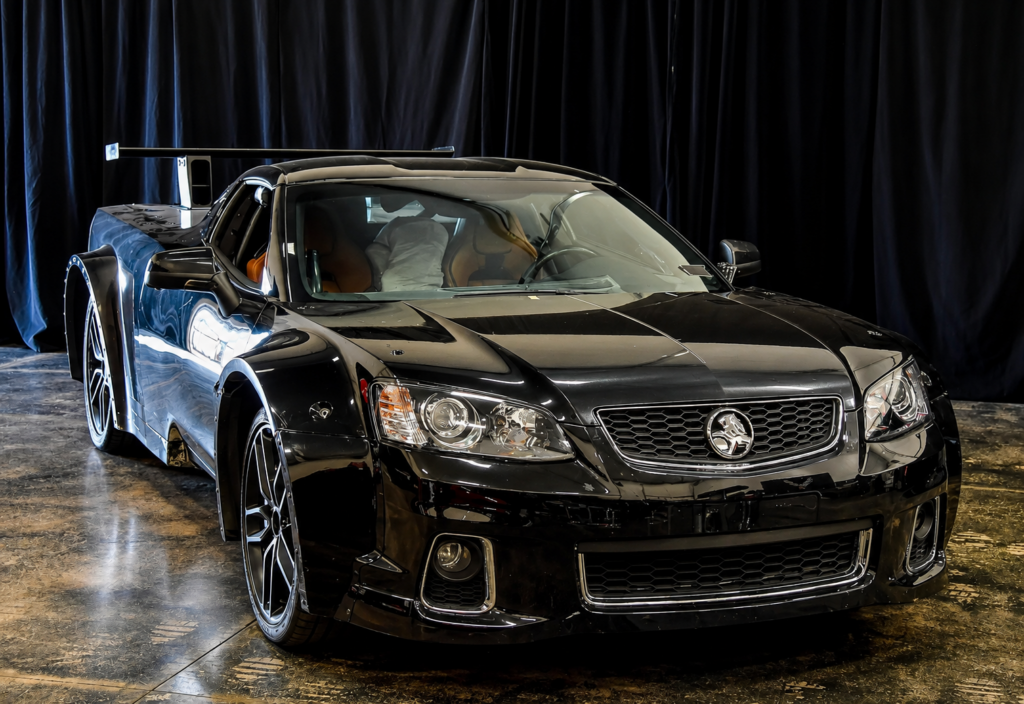
Blackjack looked ridiculous because it had to. A normal disguised prototype would have been almost impossible to conceal effectively because moving the engine from ahead of the passengers to behind them fundamentally changed the proportions of the automobile.
Manufacturers routinely hide future cars beneath camouflage, altered body panels and pieces borrowed from existing production vehicles. Those techniques can obscure styling details, but they are far less effective when the entire relationship between the passenger compartment, axles and powertrain has changed.
A conventional C7 body could not simply be stretched over a mid-engine platform and expected to fool anyone familiar with sports-car architecture. The cabin position, rear body volume and relationship between the driver and rear axle would immediately have suggested that something far more significant than a normal model update was taking place underneath.
So Chevrolet approached the problem from almost the opposite direction. Instead of trying to make Blackjack appear normal, engineers made it so strange that interpreting its actual purpose became considerably more difficult.
The result resembled a mutant Australian utility vehicle assembled from whatever parts were available. Holden-derived bodywork formed the front of the mule, recognizable C7 elements surrounded the passenger compartment, and crudely fabricated panels concealed the mechanical package behind the occupants.
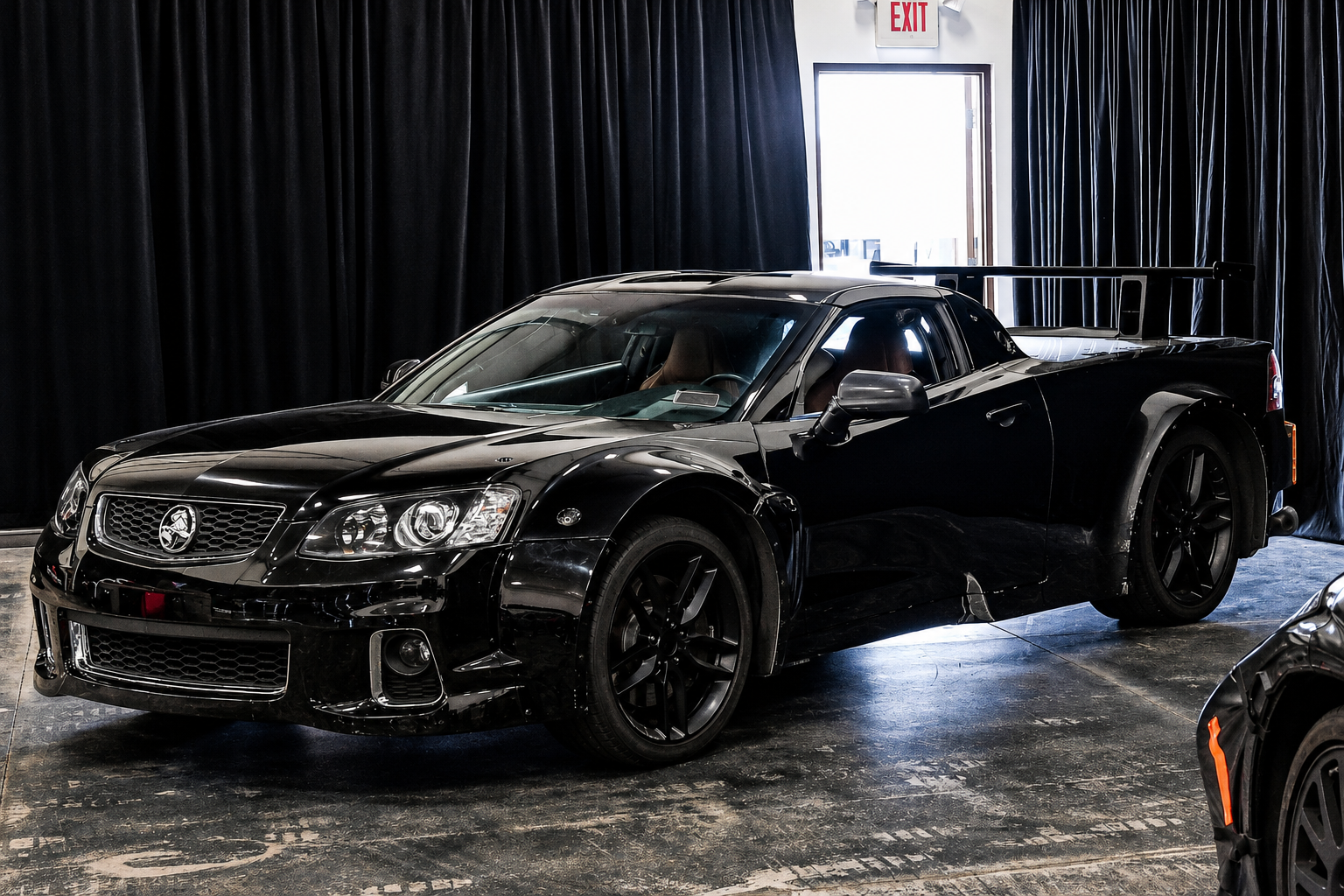
Rather than looking like the next Corvette, Blackjack looked like an experimental one-off that had escaped from an obscure corner of General Motors engineering. That was precisely what Chevrolet wanted, because anyone who encountered the car had to first determine what they were looking at before they could begin guessing what it might actually represent.
Juechter later explained the thinking behind the disguise with characteristic simplicity, noting that conventional camouflage could not hide mid-engine proportions and that the team therefore decided to make the vehicle look like a ute. The bizarre appearance was not evidence that the program was unserious; it was evidence of how seriously Chevrolet was attempting to protect what the engineers were doing underneath.
At this stage, Blackjack’s job was not to predict what the production C8 would look like. Its appearance was largely irrelevant because the mule existed primarily to answer much more fundamental questions about the architecture, suspension geometry, structural behavior and dynamic characteristics of a mid-engine Corvette.
Nor did every mechanical component need to represent something General Motors eventually intended to manufacture. Blackjack initially used an adapted Porsche PDK transmission because the production dual-clutch transaxle that would ultimately be developed for the C8 did not yet exist.
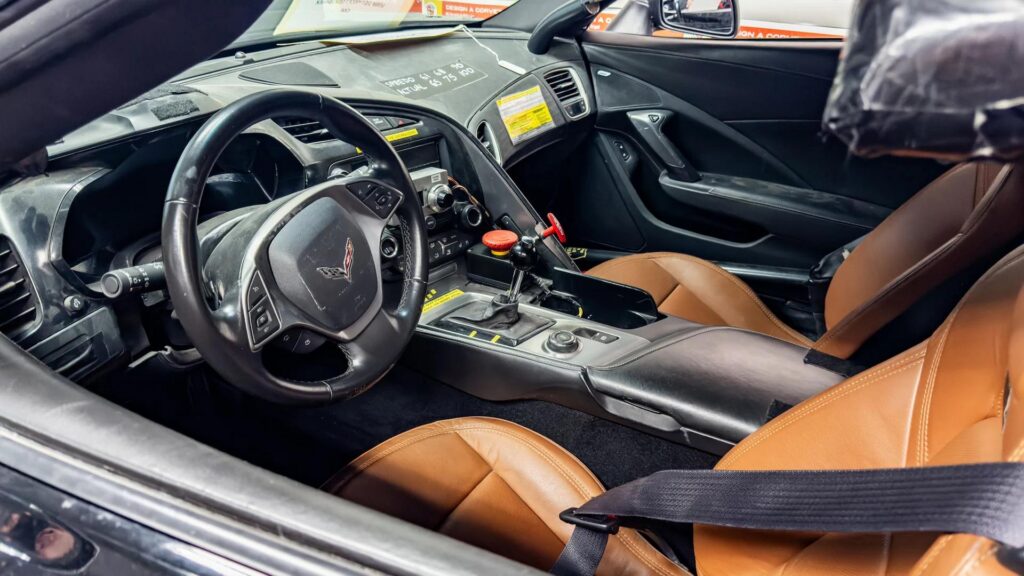
The Porsche transmission therefore served as engineering equipment rather than a preview of the production powertrain. It allowed Chevrolet to create a functioning development platform with which the team could begin learning how a mid-engine Corvette behaved while other components of the eventual production program were still years from completion.
What mattered first was the foundation. Moving the engine behind the occupants altered far more than the physical location of the powertrain, because the change affected nearly every major relationship governing how the car would behave.
The distribution of mass changed substantially, as did the relationship between the driver, engine and axles. Suspension loads, weight transfer, structural requirements and packaging considerations all had to be reconsidered around an arrangement fundamentally different from the Corvette Chevrolet had spent decades refining.
The development team needed to understand how the new configuration would react under acceleration, braking and cornering. It also needed to determine how the chassis would respond when suspension loads entered the structure from different locations and when considerably more of the automobile’s mass was concentrated near the rear axle.
Computer modeling could establish theories and provide enormously useful direction, but eventually those theories had to become physical behavior. Engineers needed an actual vehicle moving across actual pavement so that calculations could be compared against what drivers, instrumentation and suspension hardware were telling them.
Blackjack provided that laboratory. Its crude appearance concealed a machine performing some of the most consequential engineering work ever undertaken during Corvette development.
Even one of Blackjack’s strangest visual features existed for a legitimate engineering reason. The enormous rear wing was mounted upside down, an arrangement that looked absurd until the aerodynamic problem the engineers were attempting to solve was understood.
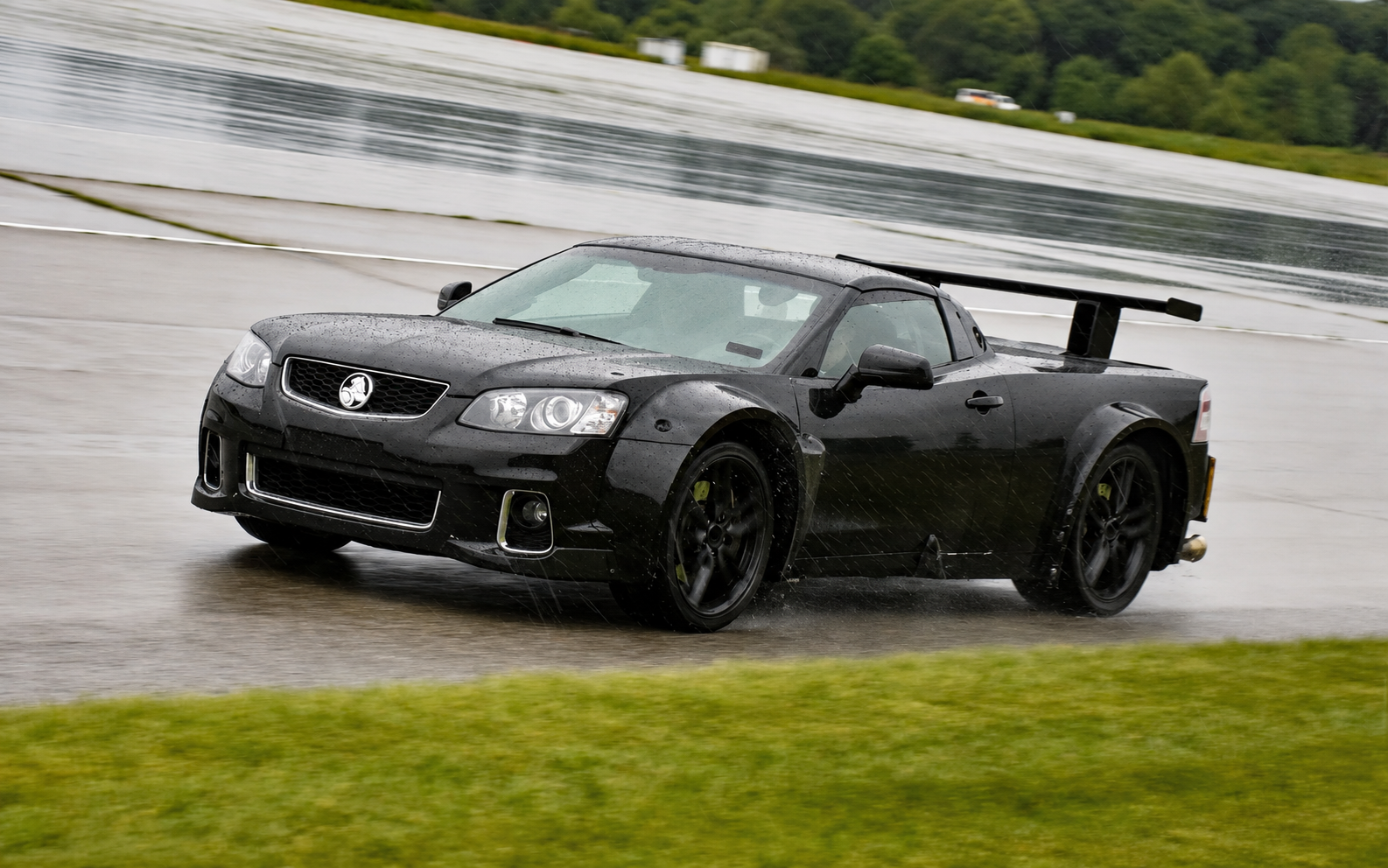
The Holden-derived nose generated substantial lift at speed. Because those aerodynamic forces affected suspension behavior, Chevrolet needed a way to establish a more useful pitch balance before the team could evaluate the developing chassis with any meaningful consistency.
Ordinarily, a rear wing is designed to produce downforce. On Blackjack, engineers inverted the wing so that it generated lift at the rear, helping counter the lift produced by the front bodywork and allowing the team to establish the aerodynamic balance it needed for suspension development.
It was an extraordinary-looking solution to a perfectly rational engineering problem. More importantly, it demonstrated that almost nothing about Blackjack’s external appearance should be interpreted in the same way one would evaluate a normal prototype.
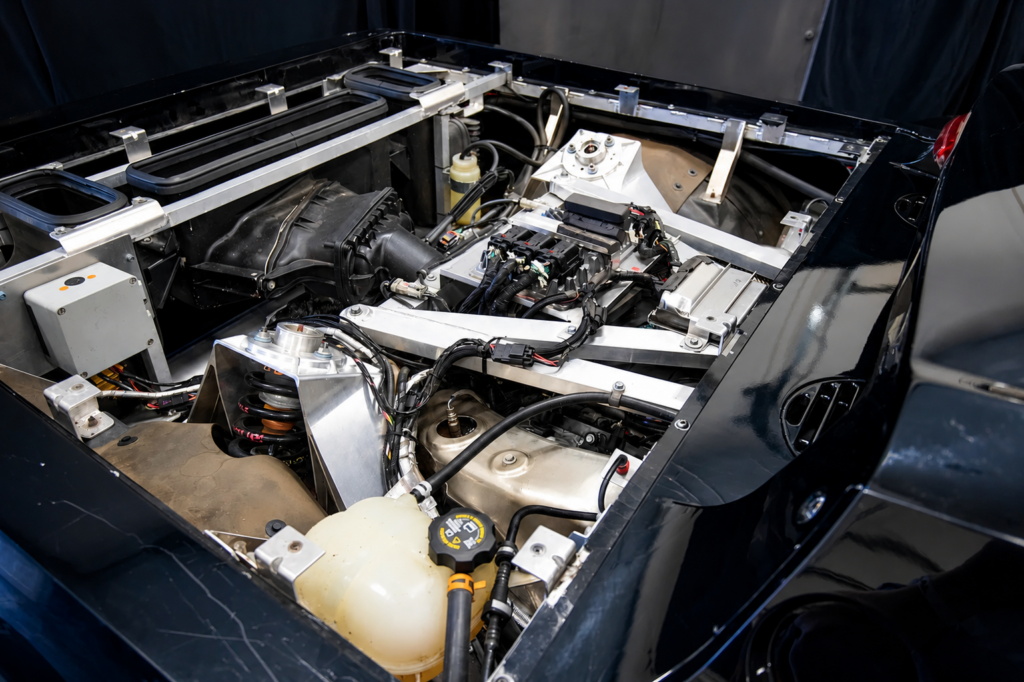
The body did not need to be attractive, and the interior did not need to resemble a production Corvette. The transmission did not need to come from General Motors, and even the aerodynamic devices did not need to perform the function anyone looking at them would normally expect.
The architecture was the experiment. Everything surrounding it existed to make that experiment possible and to allow engineers to begin answering questions that could not be resolved using the conventional C7 platform.
In that sense, Blackjack was more important for what it allowed Chevrolet to learn than for anything the mule itself was intended to become. It was an engineering bridge between decades of mid-engine Corvette experimentation and a production program that was finally beginning to move beyond sketches, concepts and canceled proposals.
January 2015: The Secret Begins to Escape
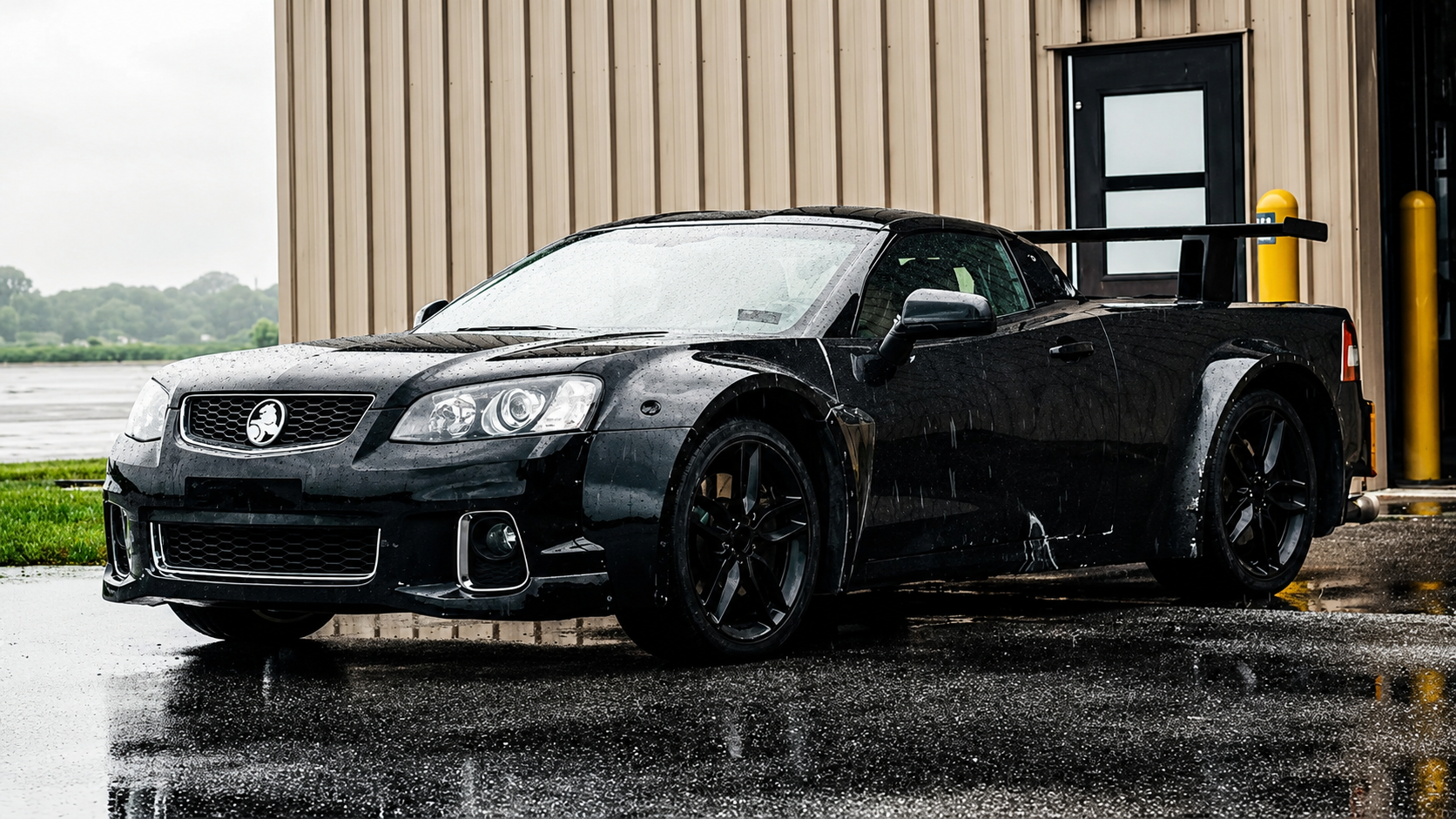
For nearly two years, Chevrolet managed to keep that work largely beyond public view. Then, in January 2015, the outside world finally obtained unmistakable evidence that something very unusual was occurring within Corvette development.
Spy photographers captured the strange black mule near a General Motors facility, and the images immediately generated questions because the vehicle was so difficult to categorize. What appeared at first glance to be some heavily modified Holden utility vehicle contained enough recognizable Corvette elements—and sufficiently unusual proportions—to suggest a far more provocative possibility.
Car and Driver published photographs of the mule and treated them as evidence that Chevrolet’s long-rumored mid-engine Corvette had advanced beyond concepts and internal speculation. For Corvette enthusiasts following the story at the time, Blackjack represented the first tangible indication that the idea might finally have escaped the conceptual stage.
The photographs showed a machine that seemed deliberately contradictory. Holden pieces, C7 components, fabricated bodywork and an enormous rear wing appeared together on a vehicle that clearly was not intended to become any recognizable production model in its existing form.
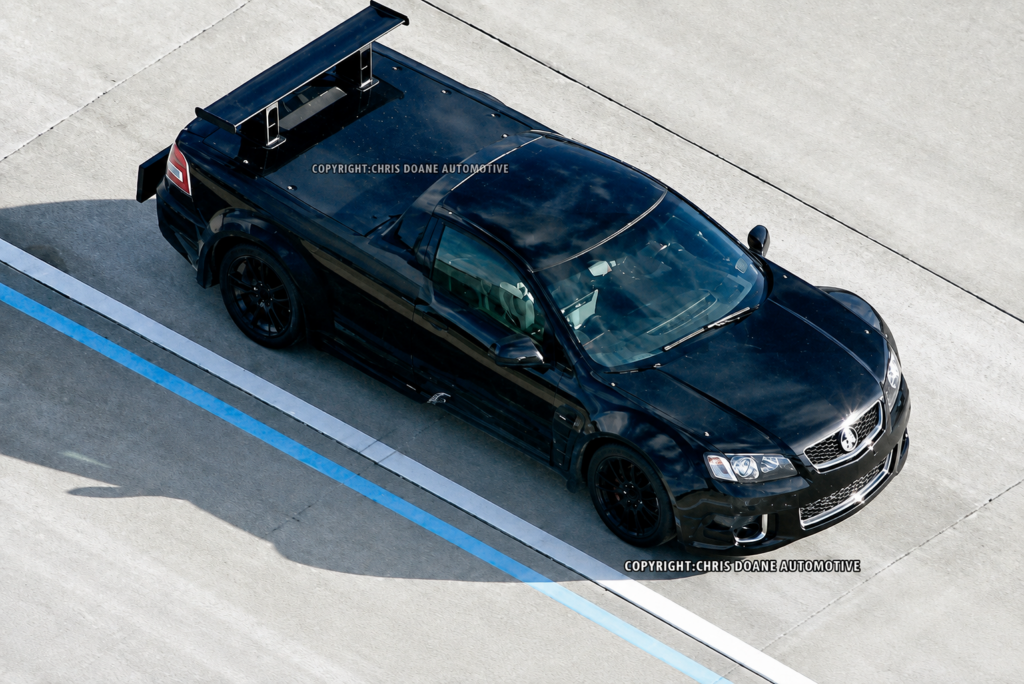
In hindsight, the photographs of Blackjack documented an enormously important moment in Corvette history. The public had effectively caught a glimpse of the architecture that would eventually bring nearly seven decades of front-engine Corvette development to an end, even though virtually nothing about the crude Holden-based mule revealed what the finished automobile would ultimately look like. Its appearance was deliberately misleading, but the engineering beneath it pointed toward a very different future.
The timing is what makes the story especially significant. In 2015, Chevrolet was publicly showcasing the C7 as one of the most advanced and capable Corvettes it had ever produced, while privately developing a mid-engine successor that had already been underway since 2013. That chronology is important because it dispels the idea that the C8 was conceived as a reaction to limitations discovered only after the 650-horsepower Z06 reached customers. Chevrolet was already investigating a fundamentally different Corvette architecture while the C7 program itself was still comparatively young.
What the Z06 did illustrate was the increasingly difficult physics confronting Corvette engineers as performance continued to rise. Sending 650 horsepower and 650 lb-ft of torque exclusively through the rear tires demanded sophisticated suspension development, increasingly capable tire technology and advanced electronic traction management. The C7 proved that Chevrolet could make the traditional front-engine Corvette extraordinarily fast, but moving the engine behind the occupants offered another path forward—one with the potential for greater static mass over the driven wheels, improved launch traction and new opportunities in weight distribution, aerodynamics, structure and packaging.
Years later, Popular Mechanics recalled an exchange that neatly captured the engineering crossroads. After driving the C7 Z06, writer Ezra Dyer told Corvette chief engineer Tadge Juechter that making the car substantially quicker seemed likely to require a mid-engine layout. Juechter already knew where that reasoning led; while journalists and enthusiasts were beginning to reach the conclusion from behind the wheel of the newest Corvette, his engineering team was already exploring the solution with Blackjack.
For a brief period, then, two very different Corvette philosophies existed simultaneously within General Motors. The visible Corvette represented the culmination of decades spent refining the front-engine formula, while Blackjack—assembled from Holden bodywork, Corvette components and experimental hardware—was teaching Chevrolet how to build the Corvette it had never built before. One program demonstrated how far the existing architecture could still be pushed; the other was quietly establishing the foundations of the car that would ultimately replace it.
2015 Ownership: Recalls, Heat, and the First-Year 8L90
No definitive account of the 2015 Corvette should pretend the car was flawless. The C7 had already represented a major technological step forward when the Stingray arrived for 2014, and the addition of the Z06, the LT4, expanded electronic controls and the new eight-speed automatic only increased the complexity of the platform for 2015.
Most owners never experienced every issue associated with the model year, and several of the safety recalls involved only very small production batches. Even so, these concerns form an important part of the historical record because they show where the first full year of the expanded C7 lineup encountered the practical realities of manufacturing, heat management and increasingly sophisticated driveline technology.
Early Safety Recalls
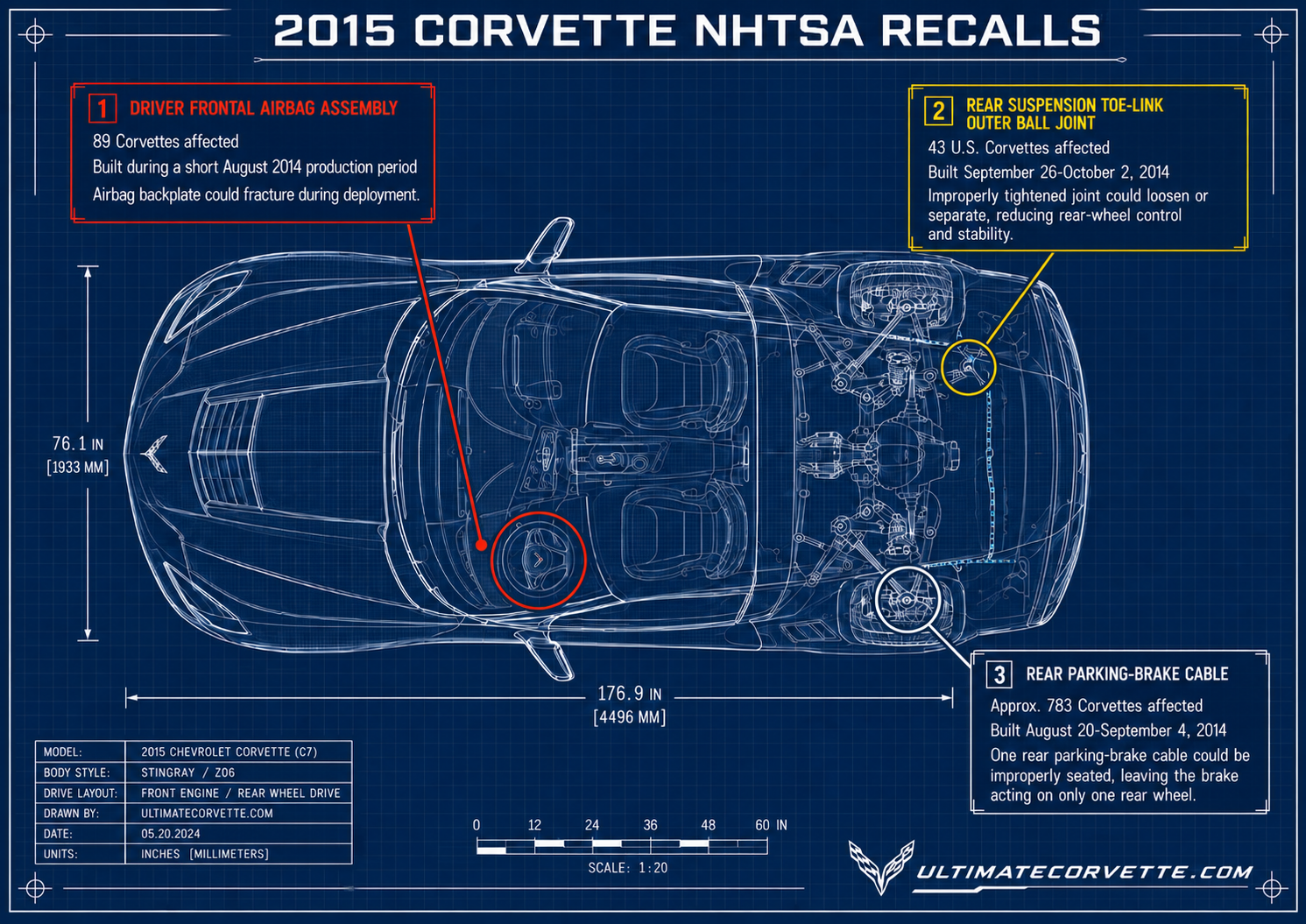
Several recalls affected relatively small groups of early-production 2015 Corvettes, and their narrow build windows are important to understand. These were not broad defects shared by every 2015 Corvette; rather, they were production-specific problems that GM identified within particular groups of cars and addressed through targeted campaigns.
One involved the rear suspension toe-link outer ball joint on 43 U.S. Corvettes built between September 26 and October 2, 2014. An improperly tightened joint could loosen in service and potentially separate, creating a loss of rear-wheel control that could reduce vehicle stability and increase the risk of a crash. The concern was serious because rear suspension geometry plays a direct role in maintaining directional control, but the extremely limited production window meant the issue applied to only a small fraction of total 2015 Corvette production.
Another campaign involved 89 Corvettes produced during a short August 2014 manufacturing period and centered on the driver’s frontal airbag assembly. The airbag backplate could fracture during deployment, potentially compromising the way the restraint system functioned during a collision. Again, this was not a design flaw affecting the entire model year, but rather a narrowly defined production problem isolated to specific vehicles.
A separate parking-brake recall affected approximately 783 cars built between August 20 and September 4, 2014. In those vehicles, one of the rear parking-brake cables could be improperly seated, potentially leaving the parking brake acting on only one rear wheel instead of both. The parking brake could therefore provide less holding force than intended, particularly on an incline, creating the possibility of unintended vehicle movement if the car was not otherwise secured.
Taken together, these early recalls illustrate the difference between a model-year problem and a production-batch problem. None of the campaigns represented a universal deficiency in the 2015 Corvette, which is why evaluating an individual car by VIN remains considerably more useful than simply assuming every example was affected.
For today’s buyer, recall history should be part of the same due diligence applied to service records, accident history and maintenance. NHTSA continues to recommend checking a vehicle’s VIN directly because recall applicability is vehicle-specific, and completed campaigns can generally be confirmed through dealer or federal records.
The 8L90 Shudder
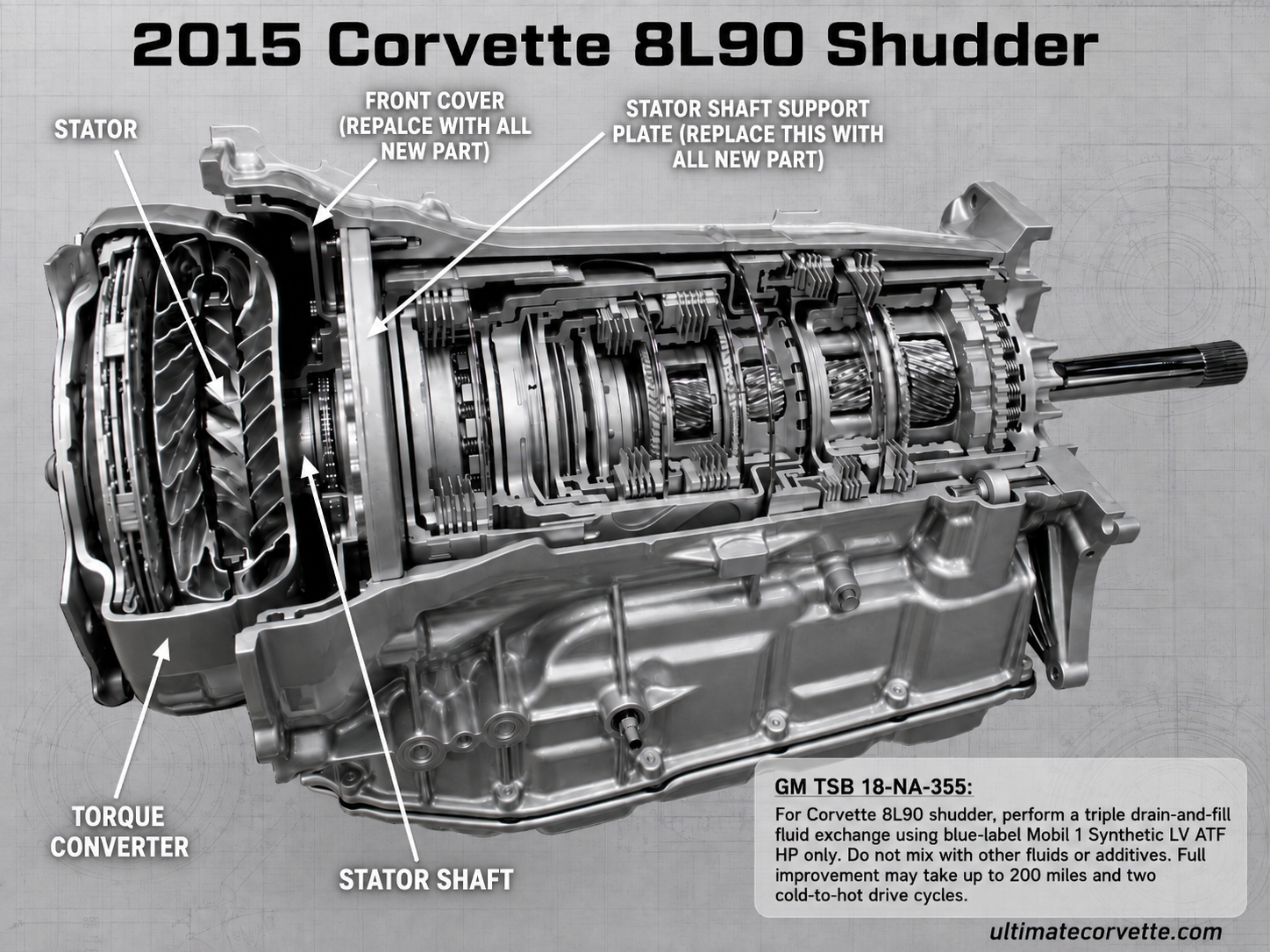
The introduction of the 8L90 eight-speed automatic represented one of the most significant mechanical changes to the 2015 Corvette. It replaced the previous six-speed automatic and gave both Stingray and Z06 buyers a much more modern transmission with closer ratios, quicker shifts and an additional overdrive range intended to improve both performance and efficiency.
Its long-term service history, however, became one of the better-known ownership concerns associated with automatic C7 Corvettes. General Motors eventually issued technical guidance addressing a torque-converter-clutch shudder that could affect 2015–2019 Corvettes equipped with the M5U version of the 8L90.
Owners typically described the condition as a vibration or oscillation occurring under light throttle at relatively steady road speeds. The sensation could resemble driving across a series of shallow rumble strips, making the problem easy to notice but not necessarily easy to diagnose because driveline vibration can originate from tires, wheels, engine operation, torque-converter behavior or several other sources.
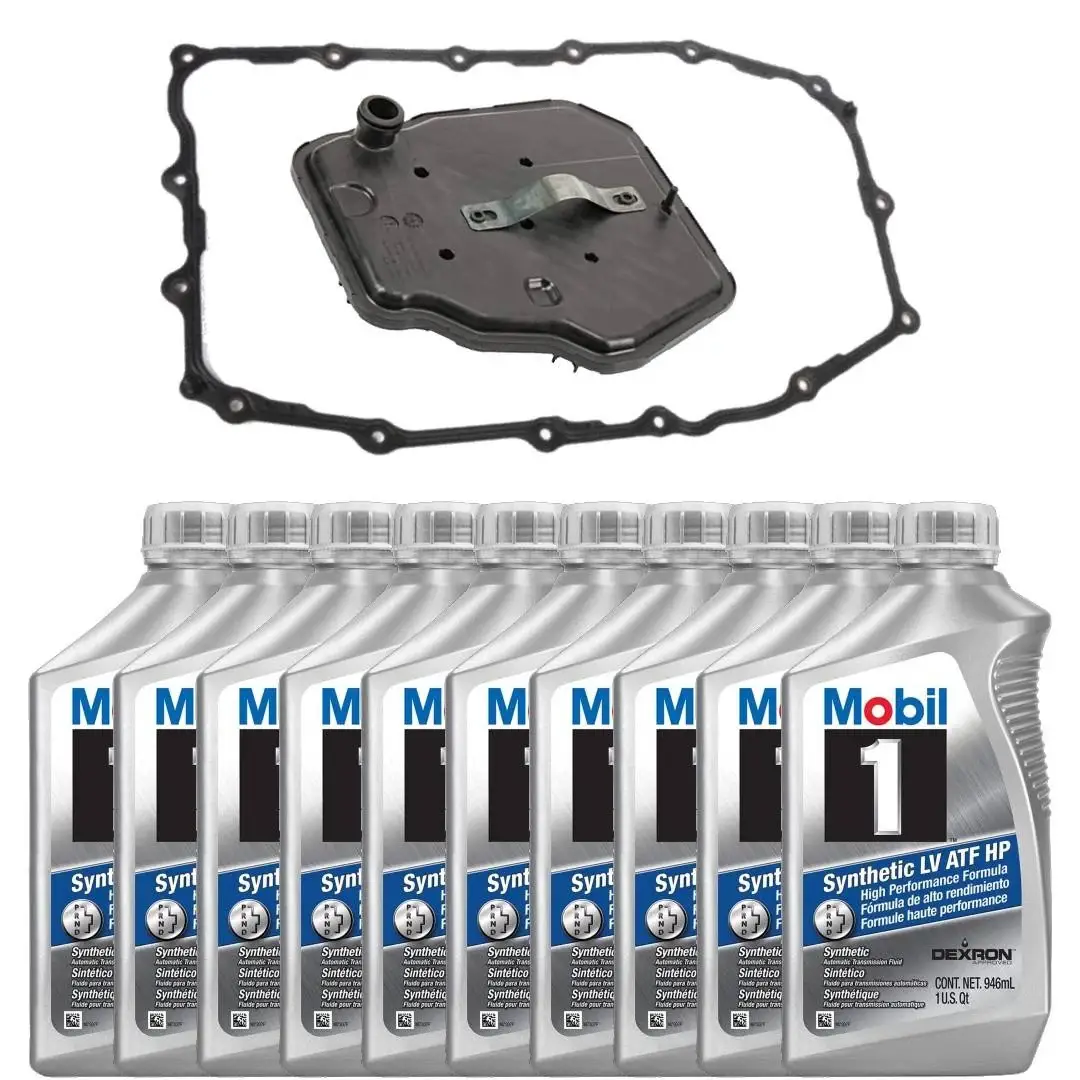
GM Technical Service Bulletin 18-NA-355 specifically identified certain 2015–2019 Corvettes equipped with LT1 or LT4 engines and the 8L90. Later revisions of the diagnostic procedure called for a complete transmission-fluid exchange using the updated Mobil 1 Synthetic LV ATF HP fluid where applicable, reflecting GM’s evolving understanding of how the original fluid formulation interacted with torque-converter-clutch operation.
The distinction between a technical service bulletin and a safety recall is important. A bulletin provides dealers with diagnostic and repair guidance for a recognized service condition; it does not mean that every vehicle covered by the bulletin automatically suffers from that condition.
That is particularly relevant to the 2015 Corvette. Many automatic cars have accumulated substantial mileage without developing a persistent shudder, while others have required fluid service or further diagnosis.
For anyone considering a surviving 2015 automatic today, the transmission deserves particular attention during a road test. Light-throttle cruising at highway and suburban speeds can help reveal the characteristic vibration, while service documentation showing that the updated fluid procedure was performed can provide useful context about how the car has been maintained.
The 8L90 issue should therefore be treated neither as insignificant nor as an automatic reason to avoid the transmission. It is better understood as one of the early service challenges associated with a new and considerably more sophisticated automatic gearbox entering Corvette production for the first time.
Z06 Thermal Management
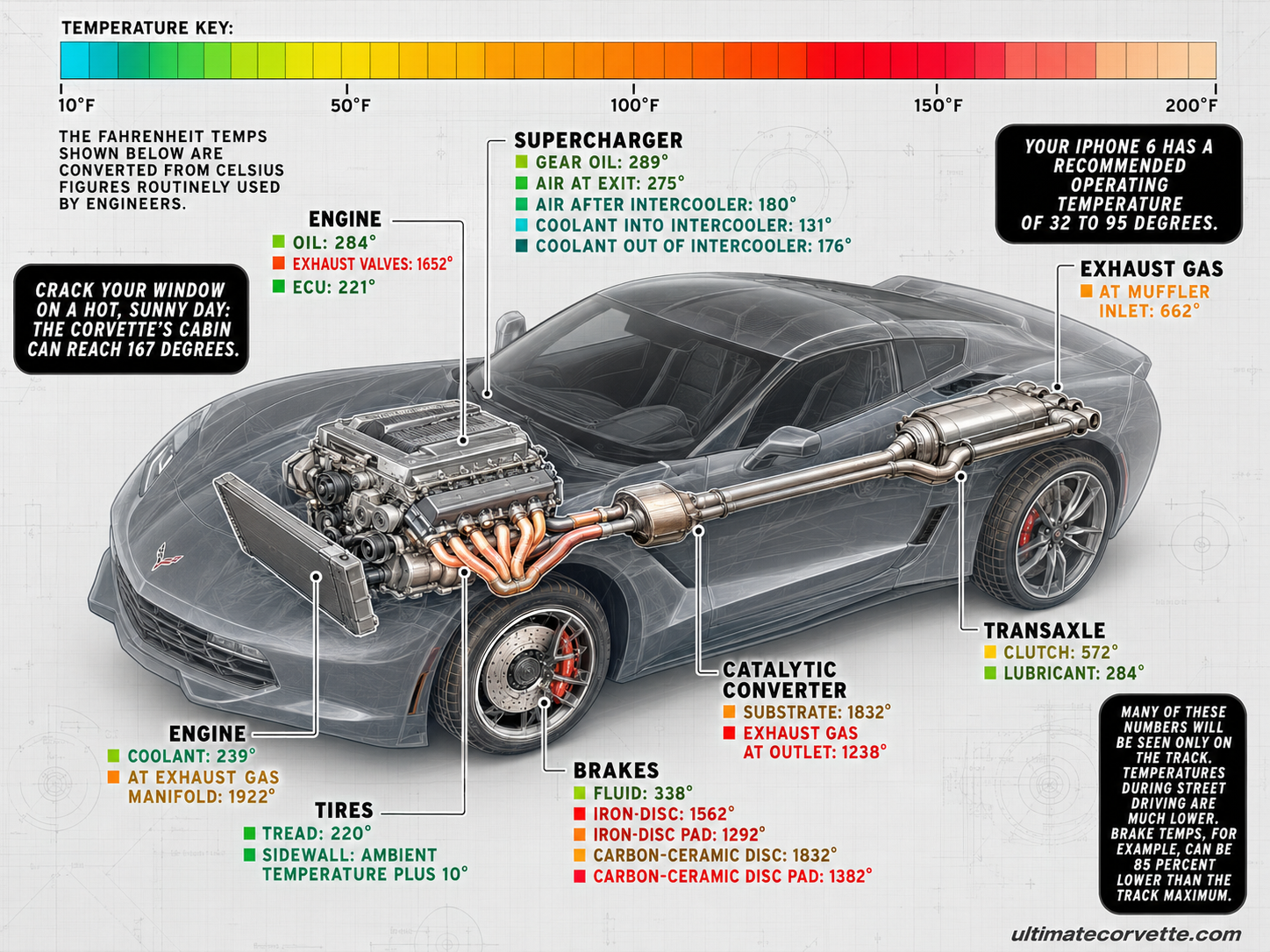
The more controversial issue surrounding the 2015 Z06 involved sustained track temperatures. Unlike the narrowly defined recalls, this concern went directly to the way Chevrolet had positioned the new Z06: as a road-legal Corvette capable of delivering extraordinary performance during serious circuit use.
Under many conditions, it fulfilled that promise. With 650 horsepower and 650 lb-ft of torque, enormous braking capability, exceptional grip and increasingly sophisticated chassis electronics, the Z06 could deliver performance that would have seemed nearly unimaginable in a production Corvette only a generation earlier. Sustained high-speed operation, however, revealed the enormous thermal load created by the complete powertrain package, particularly in cars equipped with the eight-speed automatic.
MotorTrend documented the problem during repeated track testing. In one retest, Randy Pobst reported that engine output began falling significantly as temperatures climbed, with the oil-temperature gauge approaching 320 degrees Fahrenheit after several hard laps before a cool-down lap brought temperatures back under control. The magazine had also encountered substantial supercharger heat soak during earlier testing, demonstrating that under certain conditions the LT4 could generate heat faster than the car’s cooling systems could reject it.
Tadge Juechter subsequently explained that automatic-transmission cars generally produced more heat than manual-transmission examples and could therefore reach protective operating limits sooner. He also noted that the Z06’s performance targets had been developed around ambient temperatures of approximately 86 degrees Fahrenheit or below, although MotorTrend reported experiencing temperature-related power reduction even during testing conducted in cooler weather.
That distinction became central to the controversy. Owners had purchased a Corvette marketed heavily around its track capability and reasonably expected that performance to remain available through extended sessions. From an engineering standpoint, however, the issue was more complicated than simply determining whether the Z06 could complete a track day. Thermal management is a balance between the heat a vehicle produces and the amount it can dissipate through airflow, coolant, oil, transmission fluid and available heat-exchanger capacity.
The 2015 Z06 pushed that balance exceptionally hard. Its supercharged 6.2-liter LT4 produced enormous power from a compact package, yet the production car still had to accommodate air conditioning, emissions equipment, catalytic converters, crash protection, passenger comfort, luggage capacity, street-legal ride height and a factory warranty. Unlike the C7.R race car, which could be optimized almost entirely around competition, the production Z06 had to idle in traffic, commute comfortably and meet regulatory requirements while still delivering near-race-car performance when driven onto a circuit.
Under prolonged high-load operation—particularly with elevated ambient temperatures or the additional heat generated by the automatic transmission—the car could eventually reach thresholds at which its engine-management system reduced output to protect the powertrain. The resulting debate became an important part of the early C7 Z06’s reputation and placed greater attention on cooling capacity and thermal management as Chevrolet continued refining the platform.
None of that diminishes what the 2015 Z06 accomplished. Its acceleration, braking, cornering capability and outright lap-time potential remained extraordinary. If anything, the thermal issue demonstrated just how close Chevrolet had pushed the front-engine Corvette architecture to its practical limits: the more power the engineers extracted and the more sustained performance they demanded from the car, the more difficult it became to manage the resulting heat within a street-legal package.
That is the more complete way to understand the 2015 Z06. It was an extraordinary automobile operating at an unprecedented performance level for Corvette, but it was also a first-year combination of new supercharged hardware, a new automatic transmission and extreme output. Some of the limitations exposed under sustained track use became part of the engineering lessons Chevrolet carried forward as development of the C7 continued.
Why the 2015 Corvette Still Matters Today
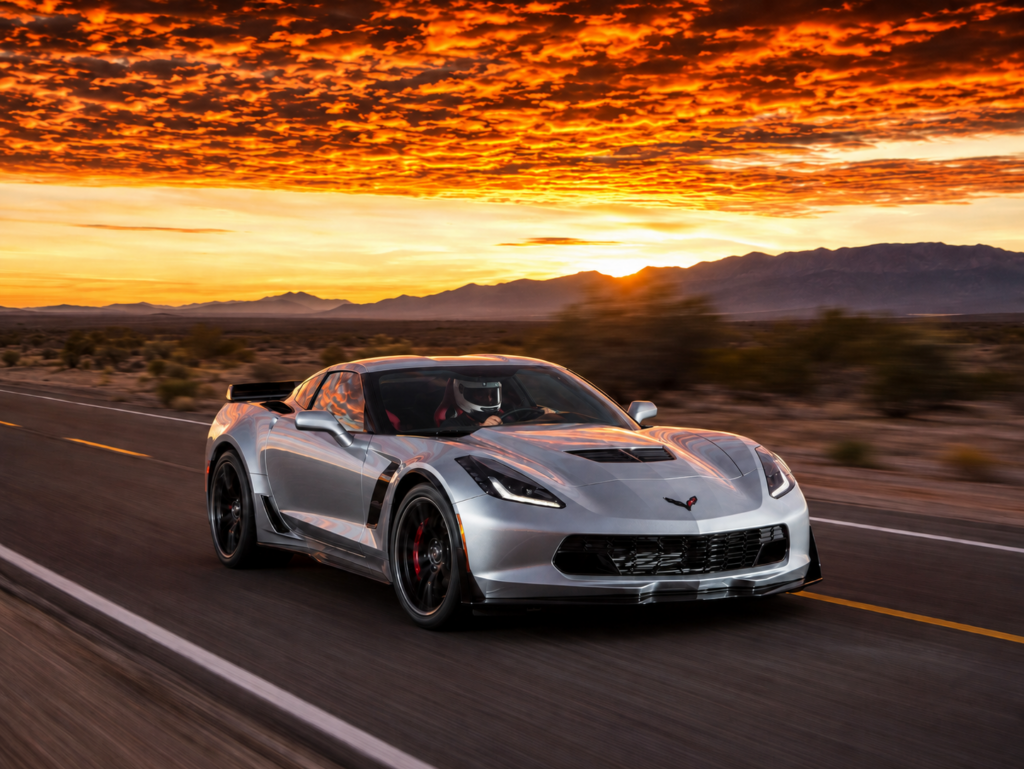
The 2015 Corvette occupies a particularly important position in the history of America’s sports car because it represents both an arrival and a beginning. It was only the second model year of the seventh-generation Corvette, yet Chevrolet had already moved well beyond simply establishing the credibility of the new Stingray. The 2014 Corvette had proven that the C7 was a legitimate world-class sports car, one capable of competing with contemporary offerings from Porsche, Ferrari, BMW and others without relying solely on the traditional Corvette argument of delivering exceptional performance for the money. By 2015, Chevrolet was no longer attempting to demonstrate that the new Corvette belonged in that company. Instead, the engineering team began showing just how much capability could be extracted from the platform.
In that respect, 2015 was the year the C7 truly came into its own. At one end of the lineup stood the naturally aspirated Stingray, producing between 455 and 460 horsepower depending on exhaust configuration and combining genuine sports-car performance with a removable roof panel, impressive highway efficiency, sophisticated electronics and enough comfort and cargo capacity to serve as a legitimate everyday automobile. Equipped with the Z51 Performance Package, that same basic Corvette became considerably more serious, gaining the cooling, braking, differential, suspension and lubrication hardware necessary to survive sustained high-performance driving without sacrificing the road manners that made the standard Stingray so usable.
At the opposite end of the spectrum was the returning Z06, and it fundamentally altered the conversation surrounding the Corvette. Its supercharged LT4 produced 650 horsepower and an equally staggering 650 lb-ft of torque, figures that not long before would have belonged almost exclusively to highly specialized exotics costing several times as much. Yet horsepower was only part of the story. Available carbon-ceramic brakes, enormous Michelin tires, Magnetic Ride Control, Performance Traction Management, an electronically controlled limited-slip differential and genuine aerodynamic downforce allowed the chassis to exploit levels of performance that earlier Corvettes simply could not approach with the same degree of composure. With the available eight-speed automatic, Chevrolet demonstrated that the Z06 could accelerate from zero to 60 mph in less than three seconds. The Corvette was no longer merely entering supercar territory on paper; it was producing the objective performance numbers to substantiate the claim.
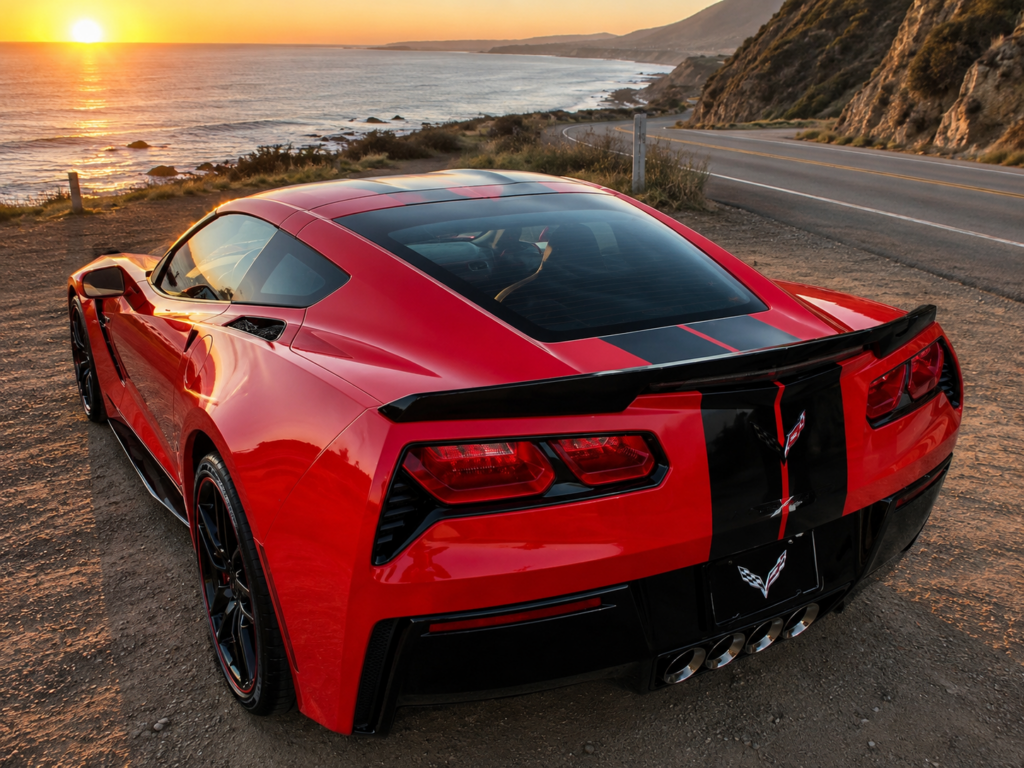
Perhaps the most compelling characteristic of the 2015 Corvette, however, was the remarkable amount of choice Chevrolet continued to offer its customers. This was still a Corvette that could be configured around the driver’s priorities rather than forcing every buyer into a narrowly defined performance formula. A traditionalist could order a seven-speed manual transmission and remain deeply involved in the mechanical process of driving the car. Another buyer could select the new eight-speed automatic and achieve quicker acceleration while enjoying effortless cruising. A Z06 customer could choose the removable-roof coupe or, for the first time in more than half a century, a full convertible. Meanwhile, the Stingray could be configured as a relatively understated grand tourer, an aggressively optioned Z51 track-day car, a luxury-oriented Atlantic convertible or a motorsport-inspired Pacific coupe.
That diversity tells us a great deal about where Corvette stood by the middle of the 2010s. It was no longer necessary for Chevrolet to define the car around a single interpretation of performance. The same basic platform could accommodate drivers who wanted long-distance comfort, weekend track capability, open-air touring, show-car personalization or outright supercar performance. More importantly, the underlying engineering was sophisticated enough that none of those identities felt artificial. The Corvette had evolved into a genuinely broad performance platform rather than simply a sports car offered with different trim packages.
The technology inside the car reinforced that evolution. The 2015 Corvette could automatically match engine speed during manual shifts, electronically manage differential locking, alter suspension damping in milliseconds, adjust traction and stability systems based on driving conditions, change the character of its exhaust and record high-definition video accompanied by GPS-based performance telemetry. The Performance Data Recorder, developed with Cosworth, effectively placed a motorsports-style data acquisition system inside a production Corvette. An owner could drive to a racetrack, record laps, review braking points and cornering loads, and then analyze that data after the session.
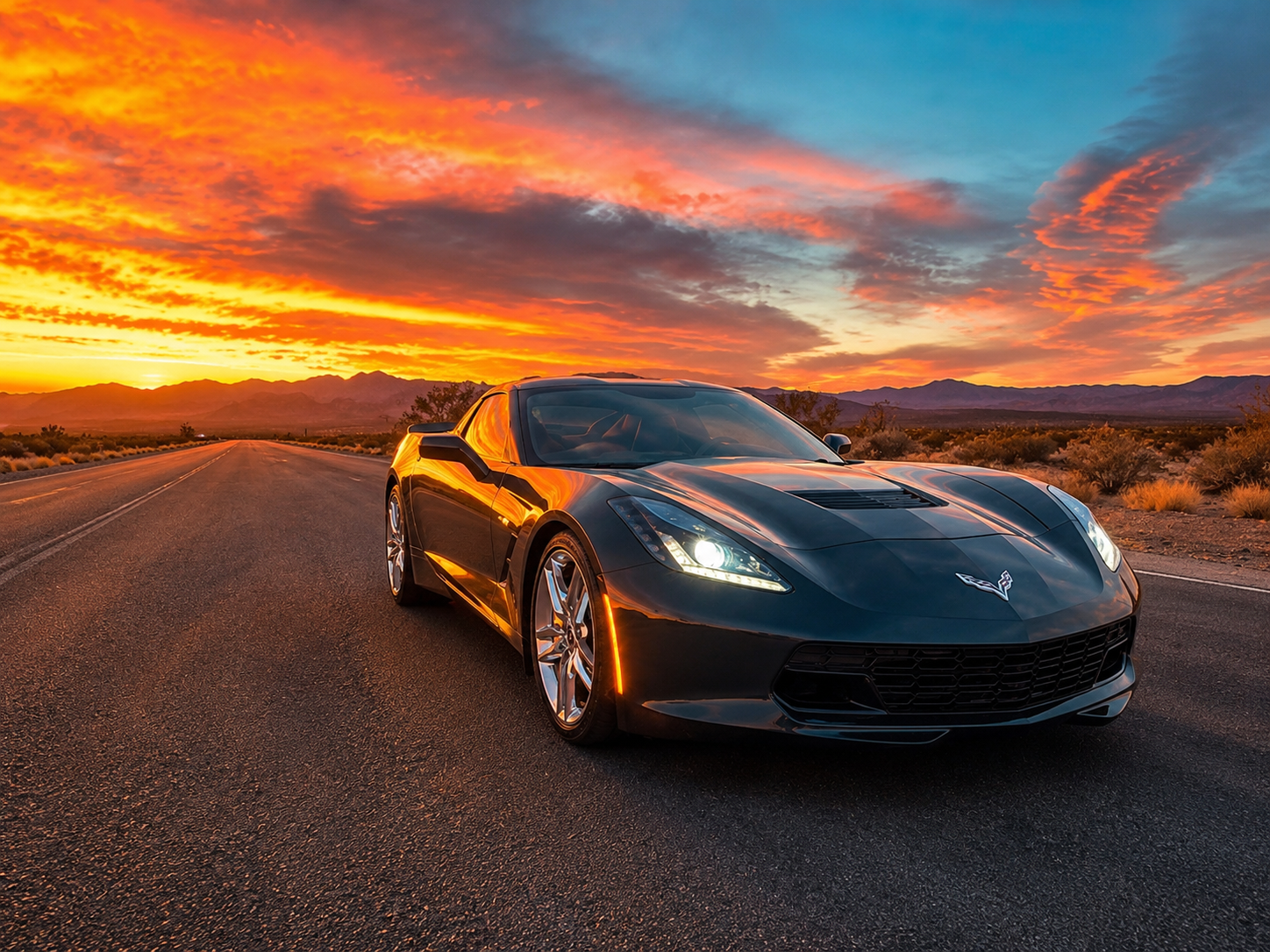
And yet, for all of that technology, the C7 still retained the fundamental mechanical character that had defined Corvette for generations. The driver could still depress a clutch pedal, move a physical shifter through its gates and control a naturally aspirated small-block V-8 mounted ahead of the passenger compartment. The steering wheel still sat behind an unmistakably long hood. The transmission remained mounted at the rear of the car as part of the traditional Corvette transaxle layout. In a period when performance automobiles were becoming increasingly digitized, the C7 managed to incorporate sophisticated electronic systems without allowing them to completely overwhelm the underlying mechanical experience.
That combination would not last forever.
The eighth-generation Corvette would eventually relocate the engine behind the occupants, replace the traditional manual transmission entirely with an eight-speed dual-clutch gearbox and fundamentally alter the physical experience of driving a Corvette. Those changes did not make the C8 any less authentic. In fact, they represented the culmination of ideas that Corvette engineers—beginning with Zora Arkus-Duntov—had explored for decades. The mid-engine configuration allowed Chevrolet to attack traction, weight distribution, aerodynamics and packaging problems that had become increasingly difficult to overcome as output continued climbing.
But the arrival of the C8 also gave the C7 an additional layer of historical significance. It became the final expression of the front-engine Corvette architecture that had defined the automobile since 1953, and the 2015 model year sits almost perfectly at the intersection between the Corvette that had been and the Corvette that was coming.
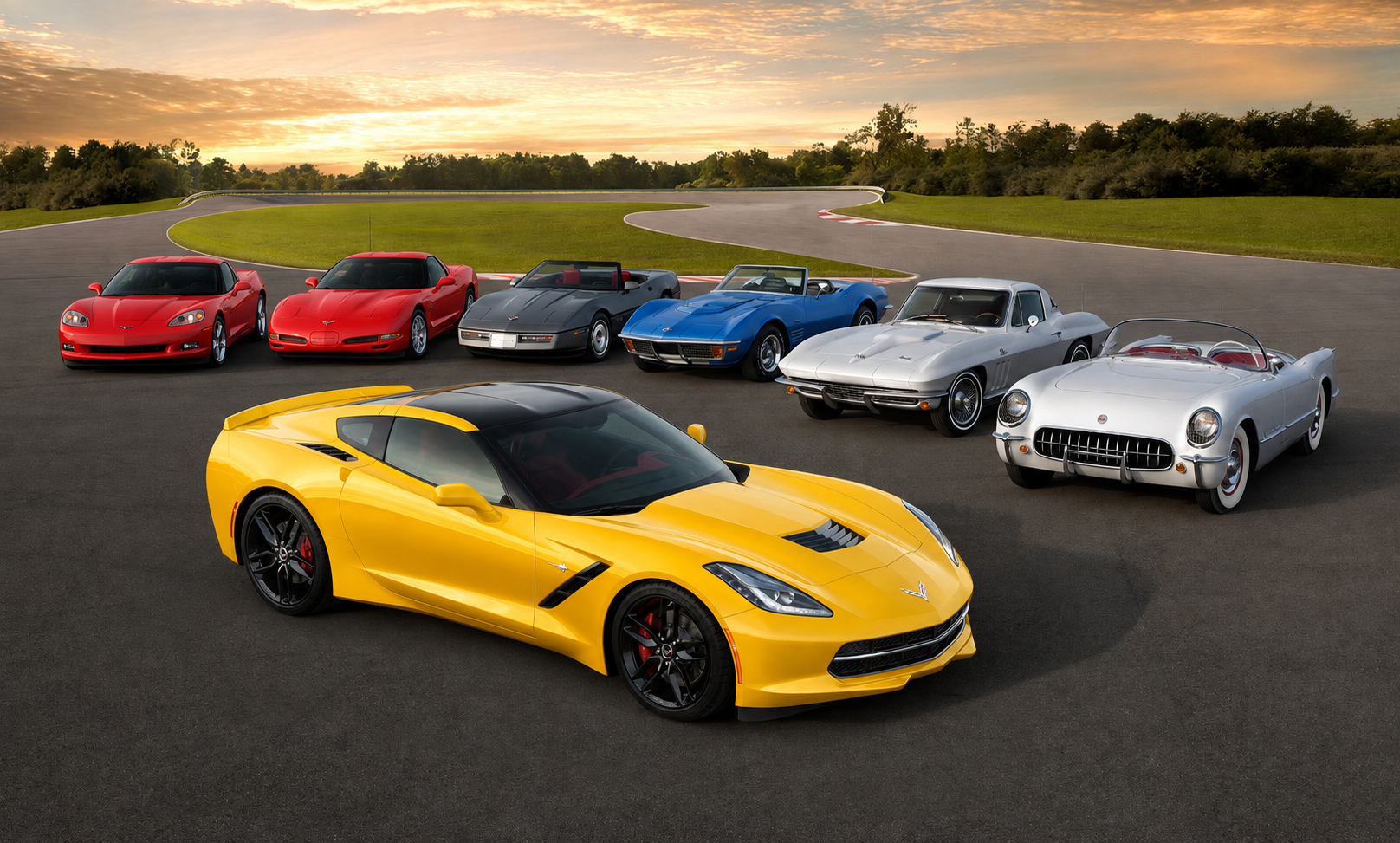
From that perspective, the 2015 Corvette becomes much more than an especially powerful version of the C7. It was technologically sophisticated enough to embarrass far more expensive contemporary machinery while remaining mechanically connected to generations of Corvettes that preceded it. Its pushrod V-8 remained ahead of the driver. Its transmission remained behind the passenger compartment. Its overall proportions—long hood, short rear deck, low roofline and pronounced rear haunches—were unmistakably Corvette. Most importantly for many enthusiasts, its manual transmission still required the driver to actively participate in extracting the performance the car could deliver.
At the same time, the technology embedded throughout the 2015 Corvette was already pointing toward the increasingly integrated future of performance-car engineering. Electronic differential control, adaptive damping, multiple driver modes, sophisticated traction management, telemetry, aerodynamic development and computer-controlled powertrain systems were no longer secondary features. They had become an essential part of making 455, 460 or 650 horsepower genuinely usable. Chevrolet was learning to manage performance as an entire vehicle system rather than treating horsepower, chassis tuning and aerodynamics as largely separate disciplines.
The racing program illustrated that philosophy perhaps better than anything else. During the same model year Chevrolet was delivering the new Z06 to customers, Corvette Racing campaigned the C7.R through one of the most memorable endurance-racing seasons in the program’s history. Victories at Daytona, Sebring and the 24 Hours of Le Mans reinforced the connection Chevrolet had spent decades cultivating between its competition program and the production Corvette. The similarities between the road-going Z06 and the C7.R were not simply cosmetic; both cars emerged from shared aerodynamic studies, structural development and an engineering culture in which racing continued to serve as an important proving ground for ideas that ultimately influenced the production automobile.
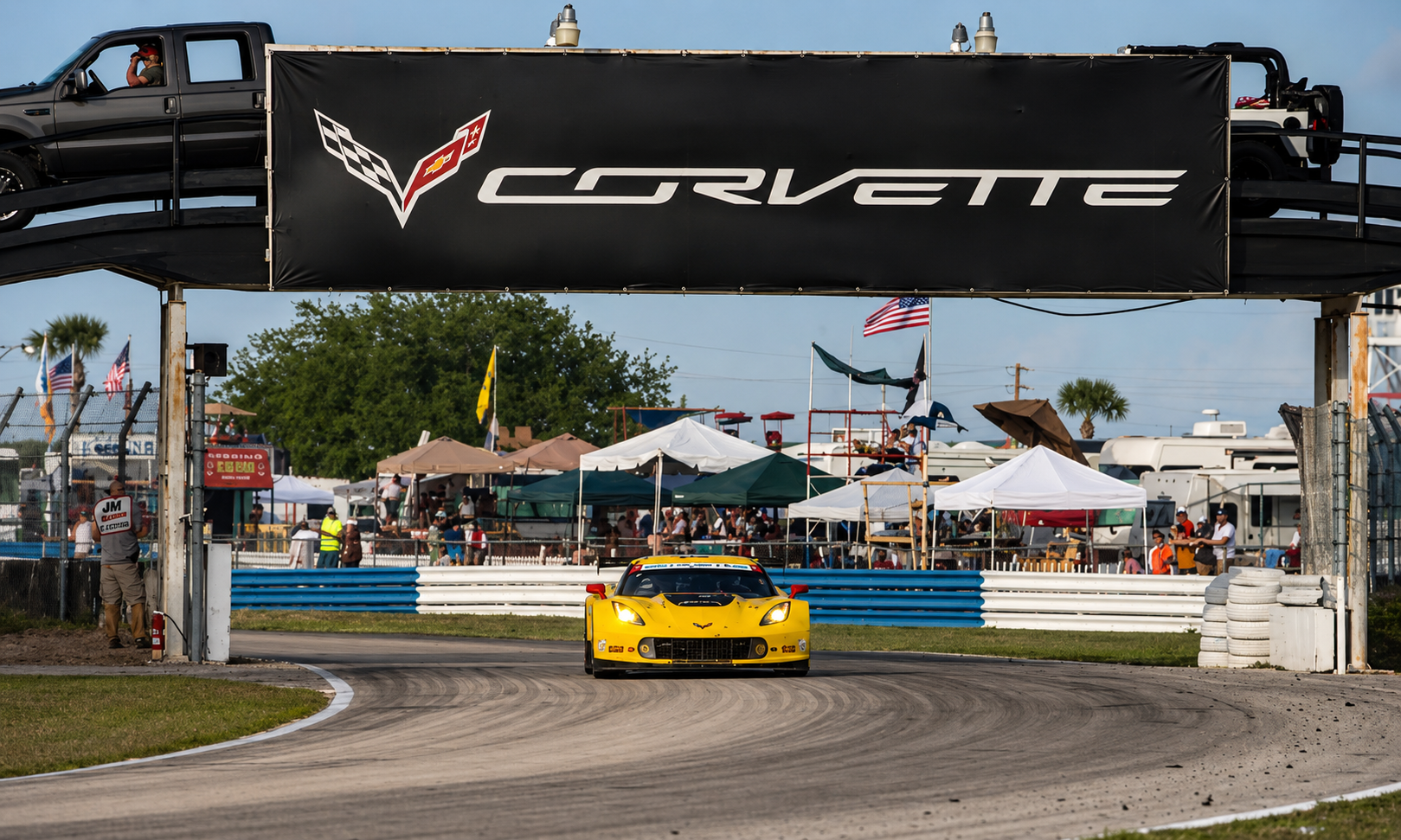
The 2015 Le Mans victory was especially appropriate. After the No. 63 Corvette was eliminated following its qualifying accident, the No. 64 C7.R of Oliver Gavin, Tommy Milner and Jordan Taylor carried the entire factory effort through the race and delivered the GTE Pro class victory. In a year when the production Z06 was being described as the most track-capable Corvette Chevrolet had ever built, the C7.R was simultaneously proving the broader Corvette engineering philosophy at the most famous endurance race in the world. Few model years provide such a clean alignment between what Chevrolet was selling in the showroom and what the Corvette name was accomplishing on the racetrack.
That is what makes the 2015 model year such an important hinge point in Corvette history. It perfected many of the ideas that Chevrolet had been developing for decades—lightweight construction, front-engine/rear-transaxle balance, small-block V-8 power, motorsports-driven engineering and extraordinary performance at a comparatively attainable price—while simultaneously introducing technologies and engineering philosophies that would influence the Corvette generations that followed.
The Stingray demonstrated that Corvette could deliver genuine sophistication without becoming detached or clinical. The Z06 demonstrated that a production Corvette could compete directly with some of the world’s most serious supercars without abandoning the small-block V-8 or the traditional front-engine architecture. The C7.R reinforced the credibility of the entire program by translating Corvette engineering into victories at Daytona, Sebring and Le Mans. And behind closed doors, the Blackjack development mule demonstrated that Chevrolet already understood that the next great leap forward would require something fundamentally different.
For all the attention naturally given to first-year Corvettes, final-year models and limited-production halo cars, the 2015 Corvette deserves to be recognized as one of the defining model years of the modern era. It was not the beginning of the C7, nor was it the end. Instead, it was the point at which the promise of the seventh-generation Corvette became fully visible.
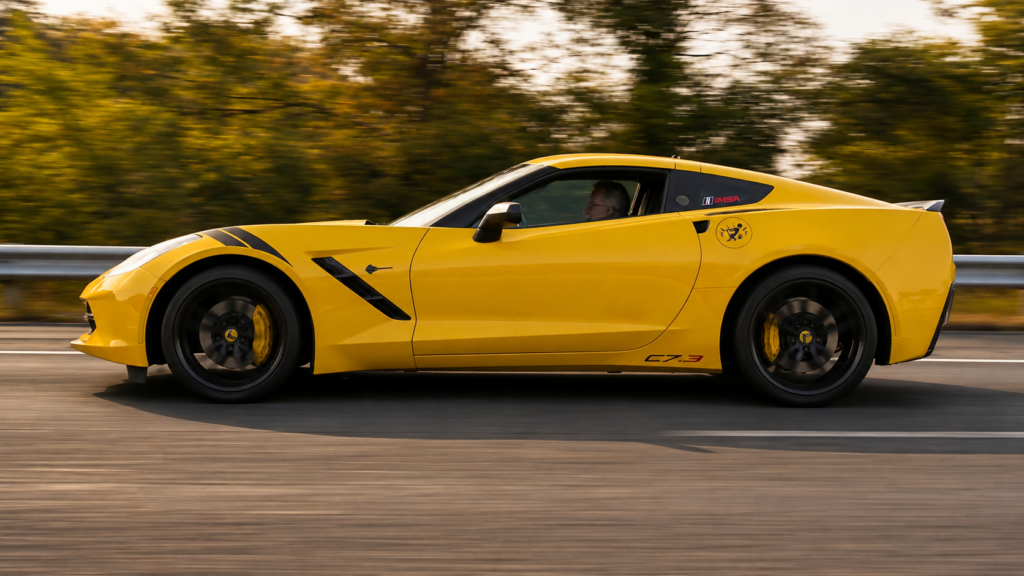
By 2015, Chevrolet no longer needed to prove that the C7 was good enough to compete with the best sports cars in the world. The Stingray had already established that point. What Chevrolet demonstrated during the car’s second model year was something considerably more important: just how extraordinary the Corvette could become when every element of the platform—engine, chassis, aerodynamics, electronics, racing development and driver technology—was allowed to work together.
And while the C7 was reaching those new heights, the Corvette’s next revolution was already quietly taking shape.
There are friendships that develop slowly, almost without notice, until one day you look around and realize the person who once happened to live across the street has somehow become part of the architecture of your life. More than ten years ago, when Cliff moved into the house across from mine, I could not possibly have known that I was meeting someone who would eventually become one of my closest friends, my partner in more adventures than either of us could probably count, and, in every way that actually matters, family.
Over the years, we have managed to find plenty of ways to get ourselves into trouble together. We have played music, discovered a shared appreciation for bourbon and whiskey—and occasionally demonstrated considerably more enthusiasm than restraint—and traveled thousands of miles across the country by car and motorcycle. We have laughed until we could barely breathe, gotten lost, found our way again, told stories that have somehow become better with every retelling, and accumulated the kind of memories that cannot be planned because the best ones usually happen somewhere between where you intended to go and wherever you actually ended up.
Corvettes eventually became another part of that story. In 2022, Cliff and I did something that probably surprised absolutely nobody who knew us: we bought matching C7 Corvettes. His was a 2015 Stingray, mine a 2016, officially cementing the title I had already begun using for him—my Corvette twin brother. We have since put countless miles beneath those cars together, but the miles themselves are not really what I remember most. I remember the conversations over radios, the fuel stops that somehow became an hour long, the roads we discovered because neither of us was quite ready to turn toward home, and the simple pleasure of looking in the mirror and seeing your best friend’s Corvette running right there with you.
And somewhere along the way, those cars opened another door. They connected us even more deeply to a Corvette community that has given both of us friendships, experiences and memories extending far beyond the machines themselves. Our immediate circle has become part of our shared story, as have the countless people we have met at shows, museums, events and somewhere out on the road. That may ultimately be one of the greatest things Corvette ownership has given us—not simply extraordinary cars, but another excuse to experience life together and another community in which to do it.
So, Cliff, this 2015 Corvette Overview is for you.
I hope that somewhere within these pages you discover something new about the car sitting in your garage. I hope you come away knowing a little more about the engineers who created it, the decisions that shaped it, the victories and challenges that defined its year, and the remarkable place it occupies in Corvette history. And because I know you well enough to know you will be looking, I should probably warn you that there may be a few Easter eggs buried along the way—little things placed here specifically for the guy who has shared so much of this journey with me.
But more than anything, I hope this article reminds you that your 2015 Stingray represents something much larger than horsepower, production numbers or engineering specifications. For me, that car will always be inseparable from the memories we have created around it and from a friendship I treasure more deeply than I probably say often enough. The Corvette has given us some remarkable adventures, but the greatest gift has never been the cars. It has been having someone beside me with whom I could share all of it.
Thank you for every mile, every song, every glass raised, every ridiculous story, every road trip, every late-night conversation and every adventure still waiting somewhere ahead of us. Thank you for being the friend I can share literally anything with, the constant companion who has been there through so many chapters of my life, and the brother I never expected to find living across the street.
Here’s to whatever road comes next.
Your friend always,
– S