When Chevrolet unveiled the sixth-generation Corvette at the North American International Auto Show in Detroit in January 2004, the car arrived carrying an unusually complex assignment. It had to replace one of the most successful Corvettes ever produced, advance America’s sports car into a new century, compete credibly against the finest performance machines in the world, and accomplish all of it without sacrificing the qualities that had made the outgoing C5 such a transformative success.
That was no small challenge.
The fifth-generation Corvette had done far more than modernize Chevrolet’s aging sports car when it debuted for the 1997 model year. Its hydroformed frame rails, rigid central backbone, rear-mounted transmission, improved weight distribution, composite body construction, and all-new LS1 V-8 established a foundation that fundamentally changed how the Corvette performed, how it drove, and how it was perceived. The C5 was comfortable enough to cross the country, practical enough to carry meaningful luggage, and powerful enough to challenge cars costing considerably more.
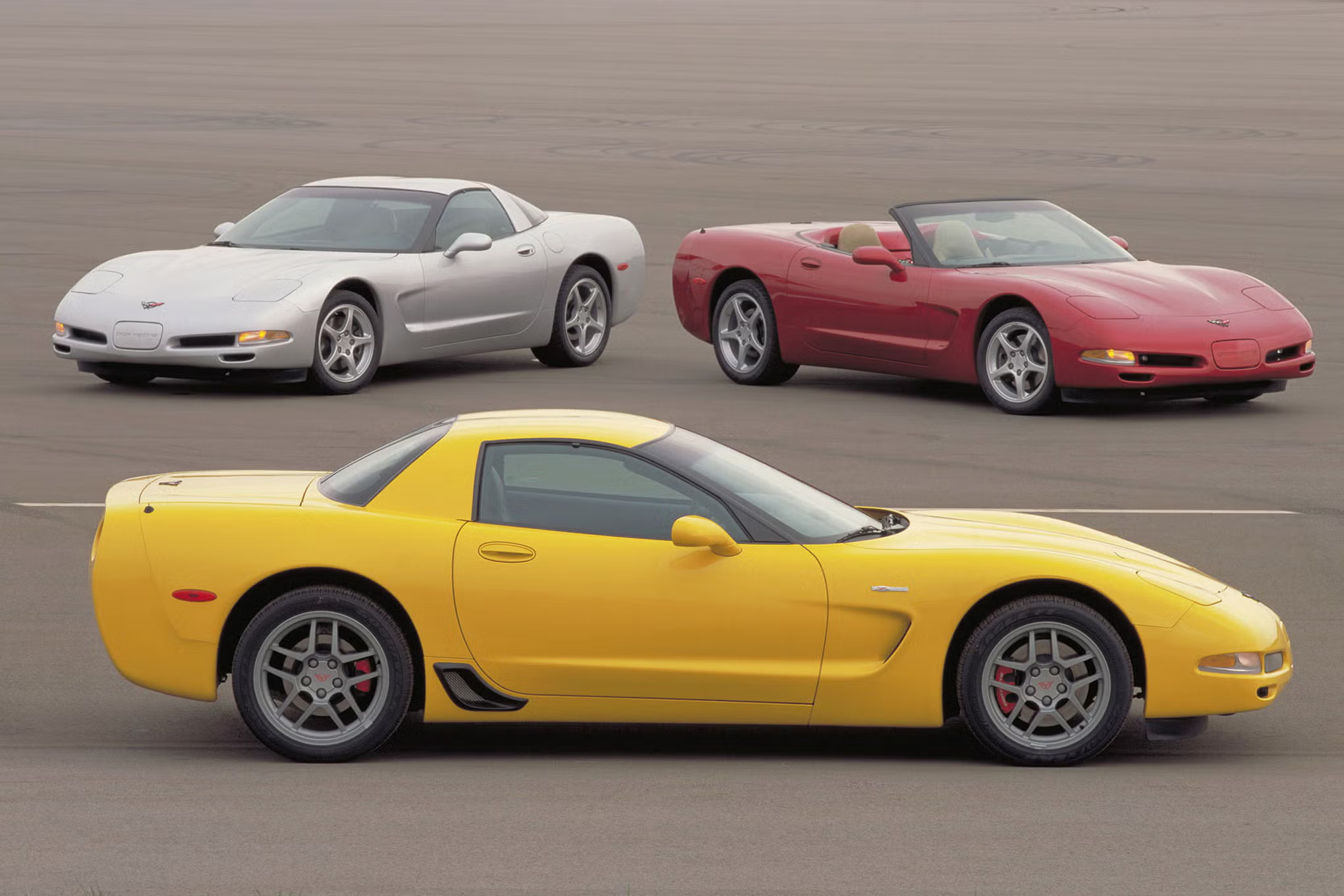
The arrival of the C5 Z06 in 2001 elevated the platform even further. By the final year of production, its 405-horsepower LS6 engine, reduced mass, firmer suspension, and competition-oriented hardware had transformed the Z06 into one of the most formidable road-going Corvettes ever built. At the same time, the C5-R race car had restored the Corvette’s international credibility by winning championships and major endurance races at Daytona, Sebring, and Le Mans.
The men and women developing the sixth-generation Corvette therefore understood that they were not correcting a failed automobile. They were advancing an architecture that had already proven remarkably successful.
The C6 would retain the C5’s core engineering philosophy, including its hydroformed frame rails, enclosed center tunnel, rear-mounted transaxle, short-long-arm suspension layout, transverse composite springs, composite body panels, and near-even weight distribution. Yet virtually every major component surrounding that philosophy was reconsidered, redesigned, recalibrated, or replaced.
The body was shorter and narrower, but the wheelbase was longer. The suspension configuration remained familiar, but Chevrolet stated that none of the individual suspension components carried over unchanged from the C5. The interior was entirely new. The engine grew from 5.7 to 6.0 liters. The brakes, wheels, tires, steering, electronics, aerodynamics, structural reinforcements, and driver interfaces were all extensively revised.
The result was not a revolution in the manner of the C5. It was something subtler and, in several respects, more difficult to achieve: a comprehensive refinement of an already successful idea.
The 2005 Corvette was evolutionary by intent, but it was never timid.
Advancing the Corvette Without Abandoning It
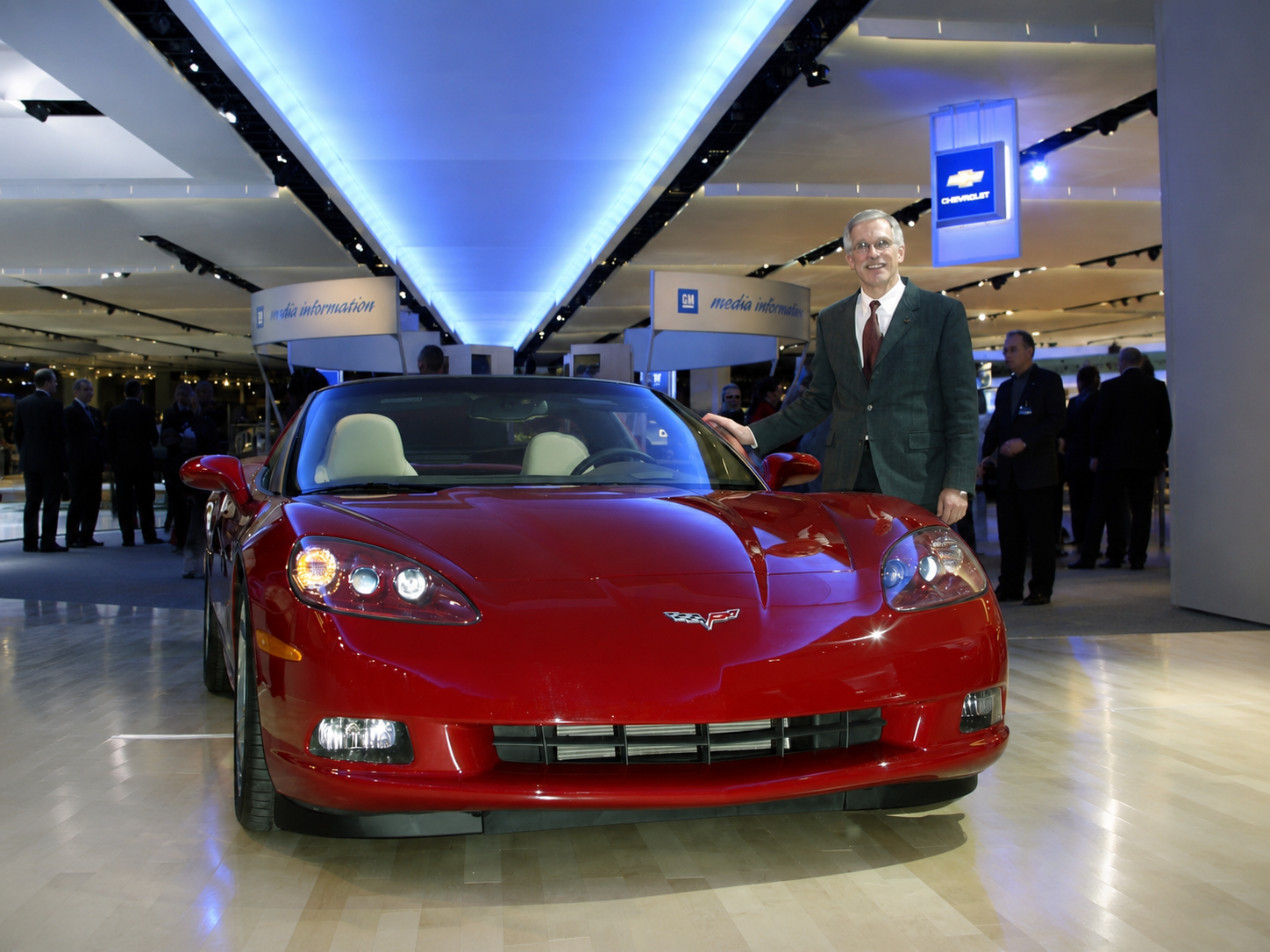
Development of the C6 proceeded under Corvette chief engineer Dave Hill, who had also led the C5 program and understood how much potential remained in the architecture his team had introduced in 1997.
Rather than discard the C5’s structure and begin again, Hill’s team focused on making the next Corvette more compact, more agile, more structurally refined, and more sophisticated. Chevrolet wanted the car to feel smaller from behind the wheel without materially reducing passenger space or undermining the practicality that had distinguished the C5 from many of its competitors.
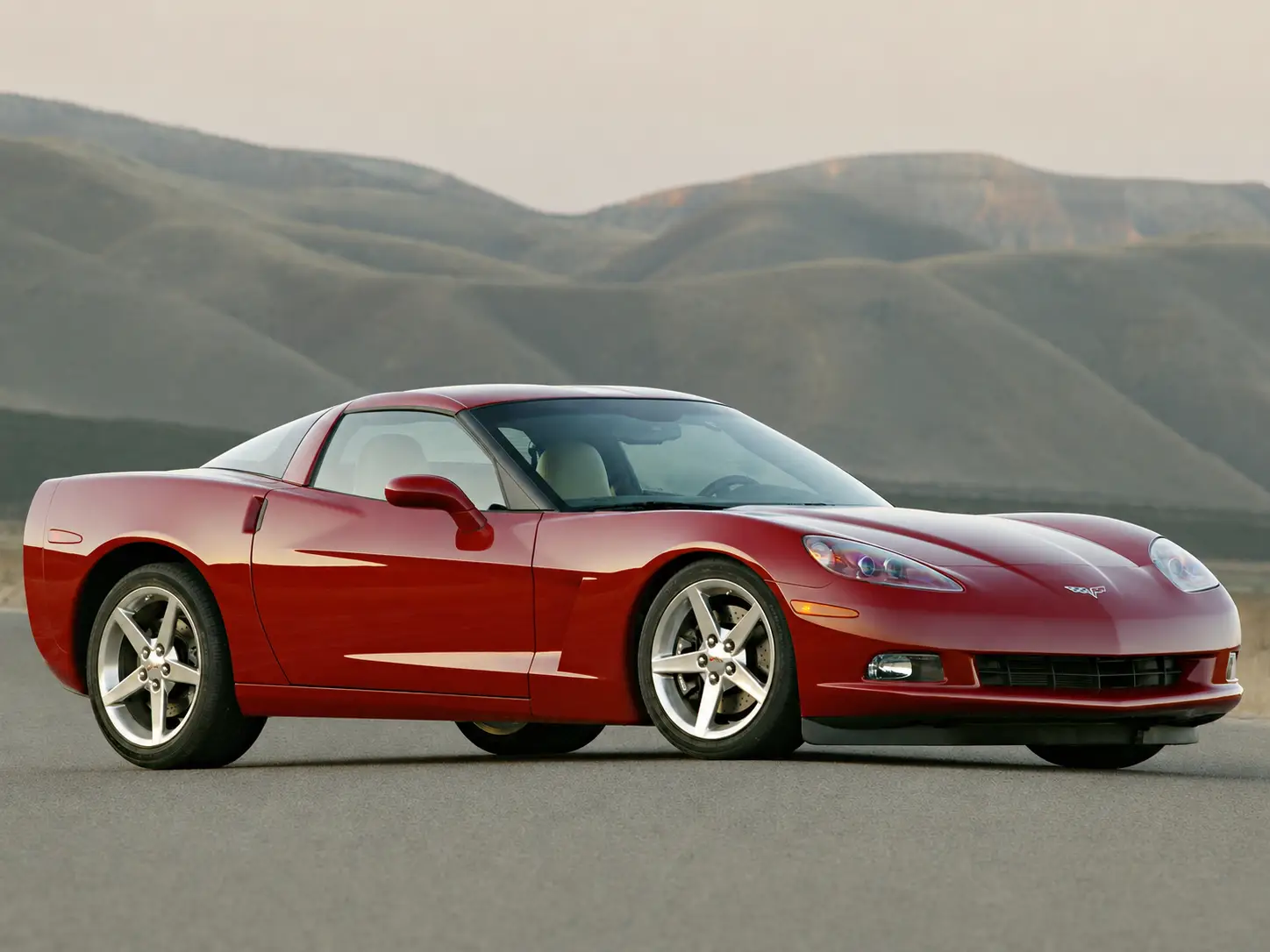
The finished C6 measured 174.6 inches long, 72.6 inches wide, and approximately 49.1 inches tall. Its wheelbase measured 105.7 inches. Compared with the C5, the new car was 5.1 inches shorter and 1.1 inches narrower, while its wheelbase grew by 1.1 inches.
Those changes significantly altered the proportions of the car.
The front sections of the hydroformed frame rails were shortened by 2.4 inches, while the front bumper beam was made more compact. At the rear, Chevrolet reduced length through more efficient placement of the energy-absorbing material and a shorter bumper and fascia structure. The wheels were pushed visually toward the corners, reducing the amount of bodywork extending beyond them and giving the Corvette a more concentrated stance.
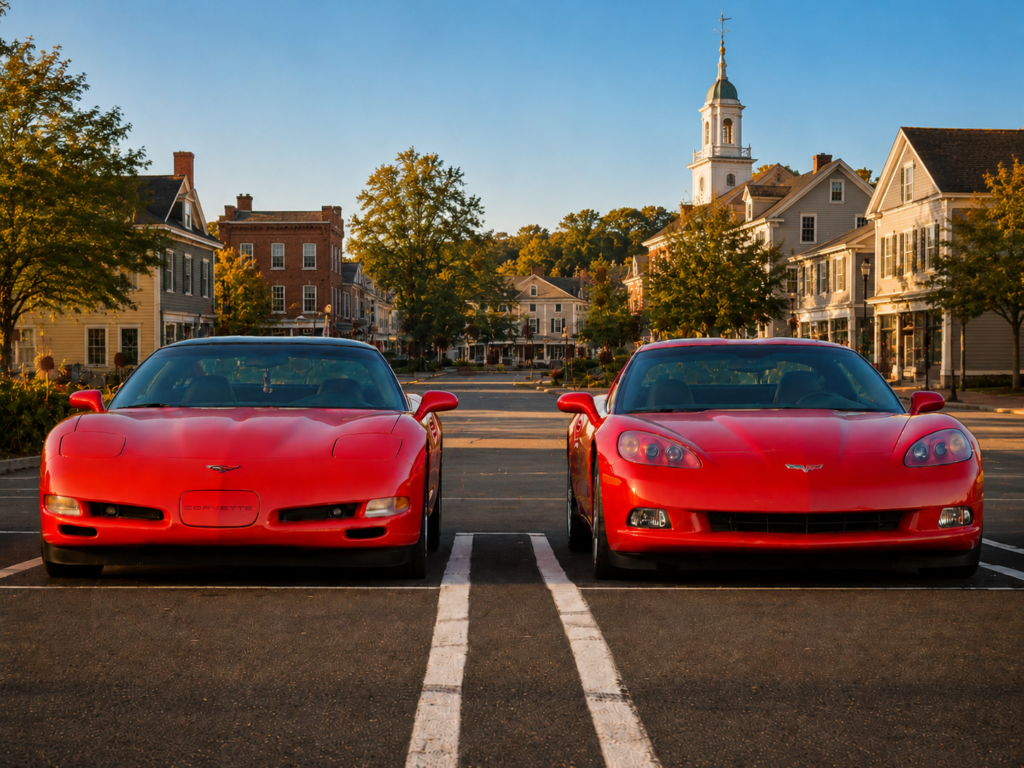
The C5 had been sleek, broad, and relatively long. The C6 looked tighter and more athletic, as though the body had been drawn more closely around its mechanical components.
The smaller exterior did not result in a correspondingly smaller cockpit. Efficient packaging and the longer wheelbase preserved approximately the same passenger space, while the coupe retained an exceptional 22.4 cubic feet of cargo capacity beneath its rear hatch. Even with the removable roof panel secured beneath the hatch, Chevrolet designed space for smaller items to be stored underneath it.
The published base curb weight for the coupe was approximately 3,179 pounds, while the convertible weighed approximately 3,199 pounds. The C6 therefore delivered larger wheels, stronger brakes, additional electronics, greater sound insulation, and a more substantial interior without becoming significantly heavier than the car it replaced. Chevrolet’s original preliminary specification sheet listed a higher estimated coupe weight, but the lower 3,179-pound figure became the commonly published base curb weight for the production car.
The reduction in length also brought the Corvette’s overall footprint closer to that of the Porsche 911, a comparison Chevrolet encouraged. The intention was clear: the new Corvette was being positioned not merely as the successor to another Chevrolet, but as a direct competitor to the world’s established performance cars.
Tom Peters and the Shape of the C6
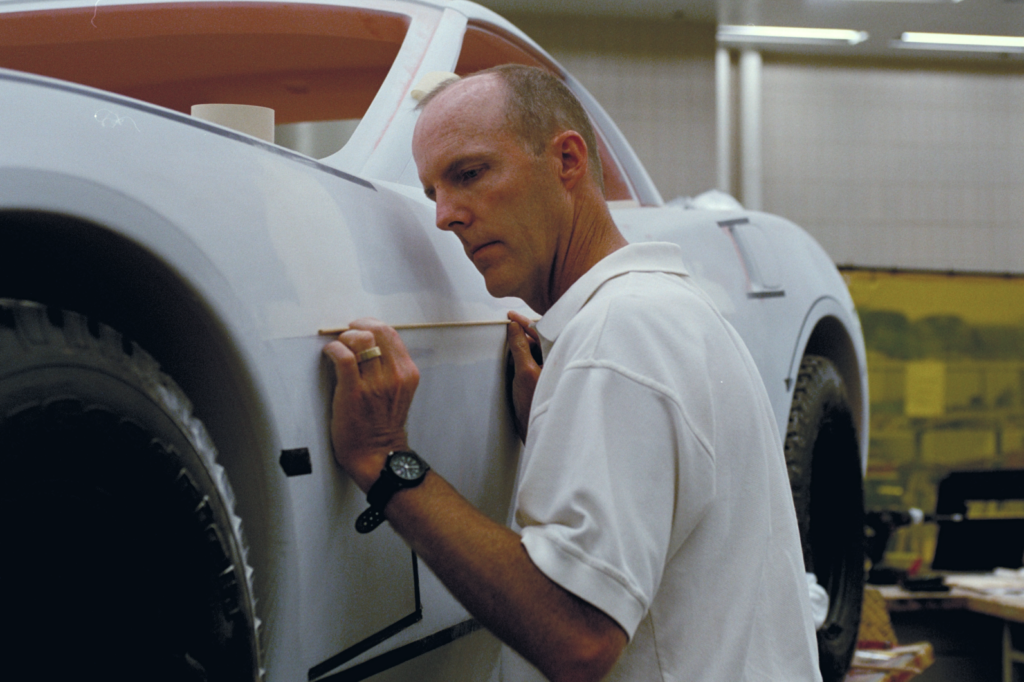
The exterior design was led by Tom Peters, the C6’s chief designer, working with lead designer Kirk Bennion and the broader Corvette design team. Peters held overall design responsibility for the program, while Bennion played an especially important role in translating its themes into the finished exterior and guiding the extensive aerodynamic development.
Peters was not attempting to produce a literal retro design. Instead, he studied the attributes that made the 1963–1967 Sting Ray so powerful and enduring. Those midyear Corvettes were defined by dramatic fender forms, a narrow central body, an aircraft-like cockpit, and a sense of motion that remained visible even when the cars were stationary.
Those qualities, rather than individual pieces of trim, informed the C6.
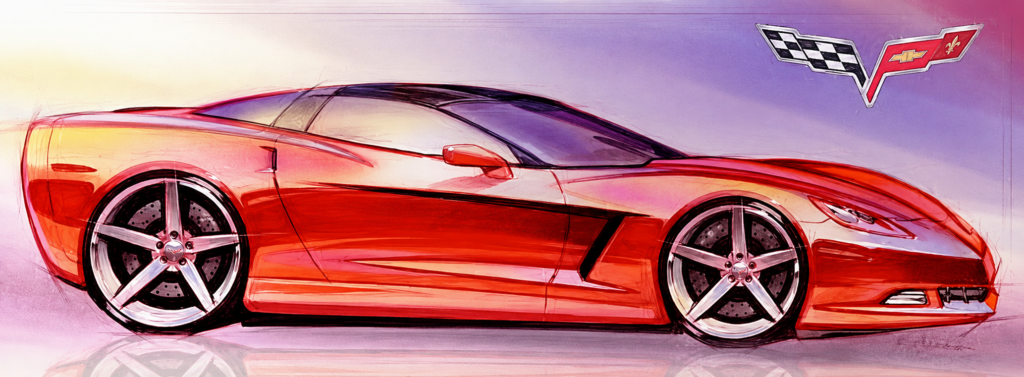
The new Corvette retained the long-established side extractors, muscular fenders, twin-cockpit greenhouse, round taillamps, and centrally grouped exhaust outlets. However, each of those elements was interpreted through sharper surfaces and more tightly controlled proportions.
The bodyside coves became cleaner and more architectural. Rather than surrounding the opening with the softer, rounded forms found on the C5, the C6 used intersecting creases and controlled transitions to create a more technical appearance. The feature remained unmistakably Corvette, but it appeared functional rather than decorative.
The front fenders were raised slightly and given more pronounced peaks. The beltline became sharper. The removable roof panel retained the Corvette’s familiar dual-bubble character, but the shape of the greenhouse was more clearly separated from the lower body, creating the impression of a jet-fighter canopy resting on a muscular fuselage.
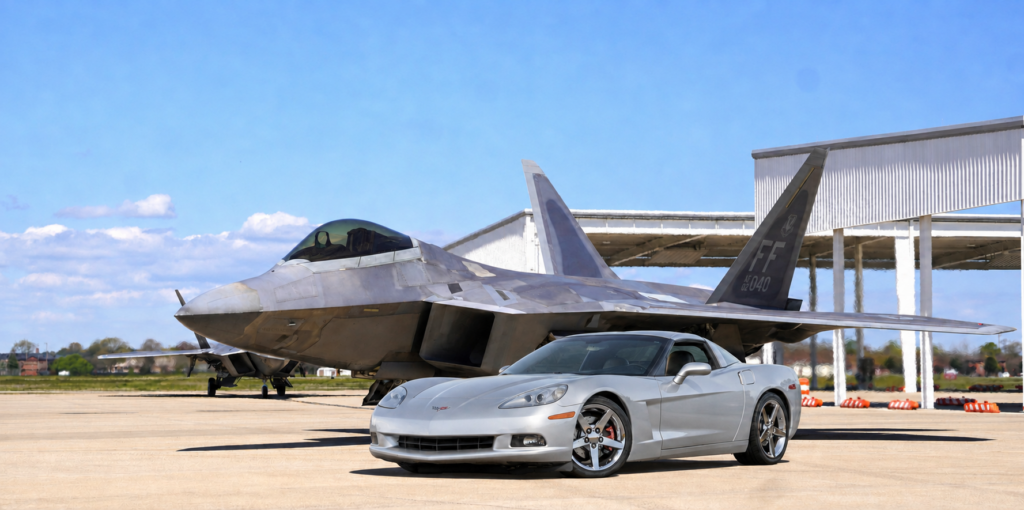
That aircraft influence was intentional. Peters specifically compared the profile to the angular but carefully contoured form of the F-22 Raptor. The comparison was not based simply on visual drama. Like a military aircraft, the Corvette needed to look purposeful because virtually every surface was being shaped by a functional requirement.
The rear glass tapered more aggressively toward the deck, while the rear fender lines continued inward to create a defined boattail effect. The rear fascia was shorter, lighter in appearance, and framed by a black upper spoiler and lower diffuser. Four circular exhaust tips emerged from the center of the diffuser, visually connecting them with the four round taillamps above.
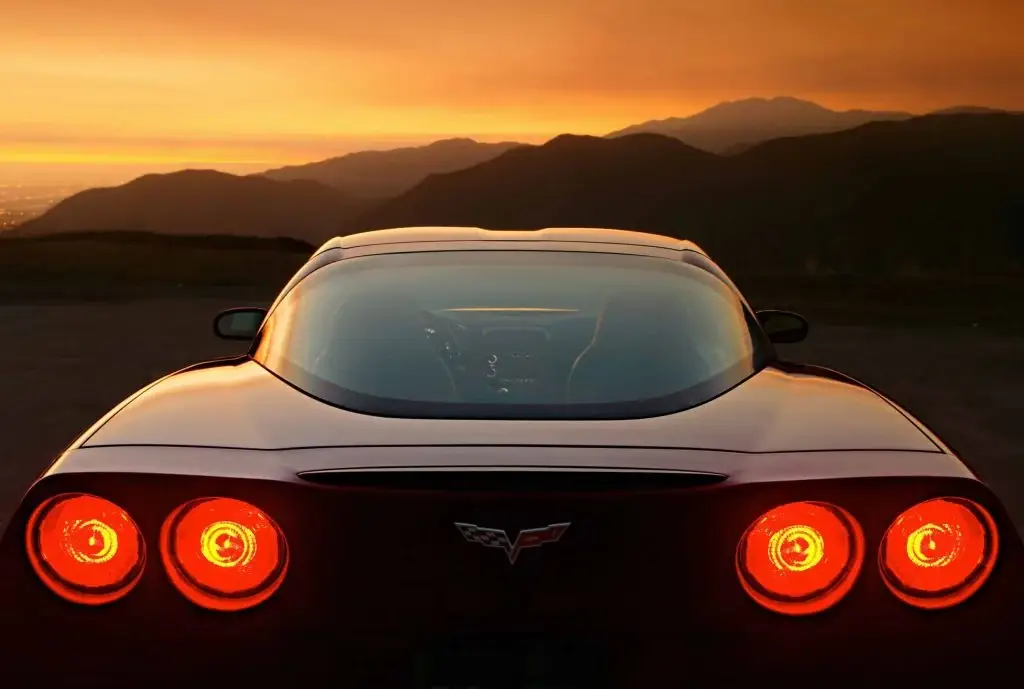
The taillamps themselves returned to a more nearly circular shape after the slightly ovalized treatment used on the C5. Chevrolet regarded the relationship between the four lamps and the license-plate opening as one of the Corvette’s essential visual identifiers.
The rear of the C6 was still broad, but it no longer appeared as massive as the C5. The surfaces were tighter, the taper was more pronounced, and the black diffuser reduced the perceived depth of the lower fascia.
The finished car was clearly related to the C5, but it did not look like a simple reskin. It was shorter, sharper, more expressive, and more deliberate.
The End of the Hidden Headlamp
No design decision attracted more attention than Chevrolet’s elimination of the retractable headlamps. The change immediately distinguished the 2005 Corvette from the car it replaced, giving the C6 a more contemporary face while removing a feature that many enthusiasts had come to regard as inseparable from the Corvette’s identity.
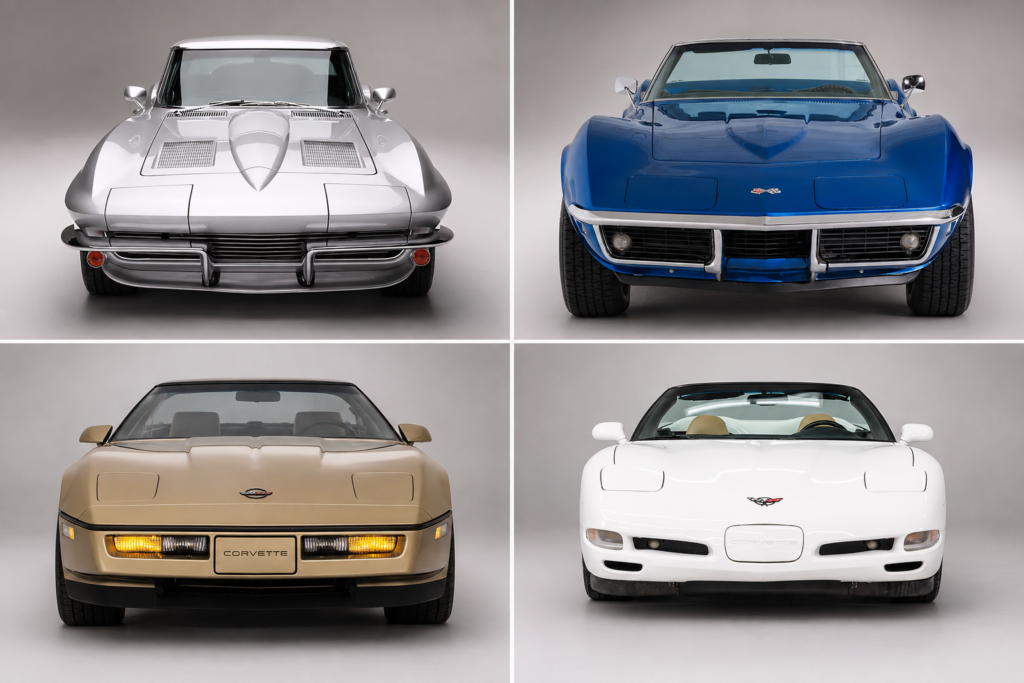
Every production Corvette built from 1963 through 2004 concealed its headlamps when they were not in use. The arrangement had survived the C2, C3, C4, and C5 generations, even as the mechanisms, body shapes, and methods of operation evolved. After more than four decades, retractable headlamps had become one of the longest-running visual traditions associated with America’s sports car.
The 2005 model therefore became the first Corvette since 1962 to use exposed headlamps. Although fixed lamps were hardly unprecedented in Corvette history—the first-generation cars had always carried their lights in view—the decision represented a dramatic break from the appearance established by the 1963 Sting Ray and carried through every subsequent generation.
The reaction among enthusiasts was immediate and often emotional. Some viewed the exposed lamps as an unnecessary rejection of tradition, while others recognized that retractable headlamps had become increasingly difficult to justify on a modern performance car. Tom Peters later acknowledged that the proposal generated considerable discussion within General Motors as the design team weighed the Corvette’s established identity against the functional and visual requirements of the new car.
The final choice was driven primarily by function, and the argument for fixed headlamps did not come from the production-car team alone. As Chevrolet began developing the C6, Chief Engineer Dave Hill asked Corvette Racing what changes would make the next production Corvette a better foundation for competition. According to Corvette Racing Program Manager Doug Fehan, the team returned with three principal requests: replace the retractable headlamps with fixed units, provide a single frontal air intake in place of the C5-R’s divided arrangement, and revise the car’s profile to support improved downforce.
The headlamp request reflected lessons learned with the C5-R. Production-style retractable lamps would have projected directly into the airflow whenever the car competed at night, creating a substantial aerodynamic penalty on high-speed circuits such as Le Mans. The C5-R therefore used purpose-built fixed lighting, and Fehan later characterized raised flip-up lamps as little more than air brakes at Le Mans. Integrating fixed lamps into the C6 production body gave the racing program a cleaner and more aerodynamically useful starting point for the forthcoming C6.R.
“First of all, we have to lose the flip-up headlights… Those friggin’ flip-up headlights were basically air brakes at Le Mans.”
—Doug Fehan, former Corvette Racing program manager, in “Corvette Racing: Once an Upstart, Now a Cornerstone of Worldwide Endurance Racing,” Grassroots Motorsports, February 2022.
The same decision produced meaningful benefits for the road car. Fixed headlamps offered lower weight, reduced mechanical complexity, improved lighting performance, and better nighttime aerodynamics. They also supported the C6 design team’s larger objective of creating a Corvette that appeared leaner, tighter, and more purposeful than the C5.
Eliminating the retractable system removed the doors, motors, pivots, linkages, actuator wiring, and packaging required to raise the previous assemblies through the bodywork. It also eliminated the aerodynamic interruption created whenever the C5’s lamps were raised into the airflow. Without those mechanisms occupying the upper corners of the nose, the designers gained greater freedom to shape the hood and front fenders around smaller, more precisely positioned lighting components.
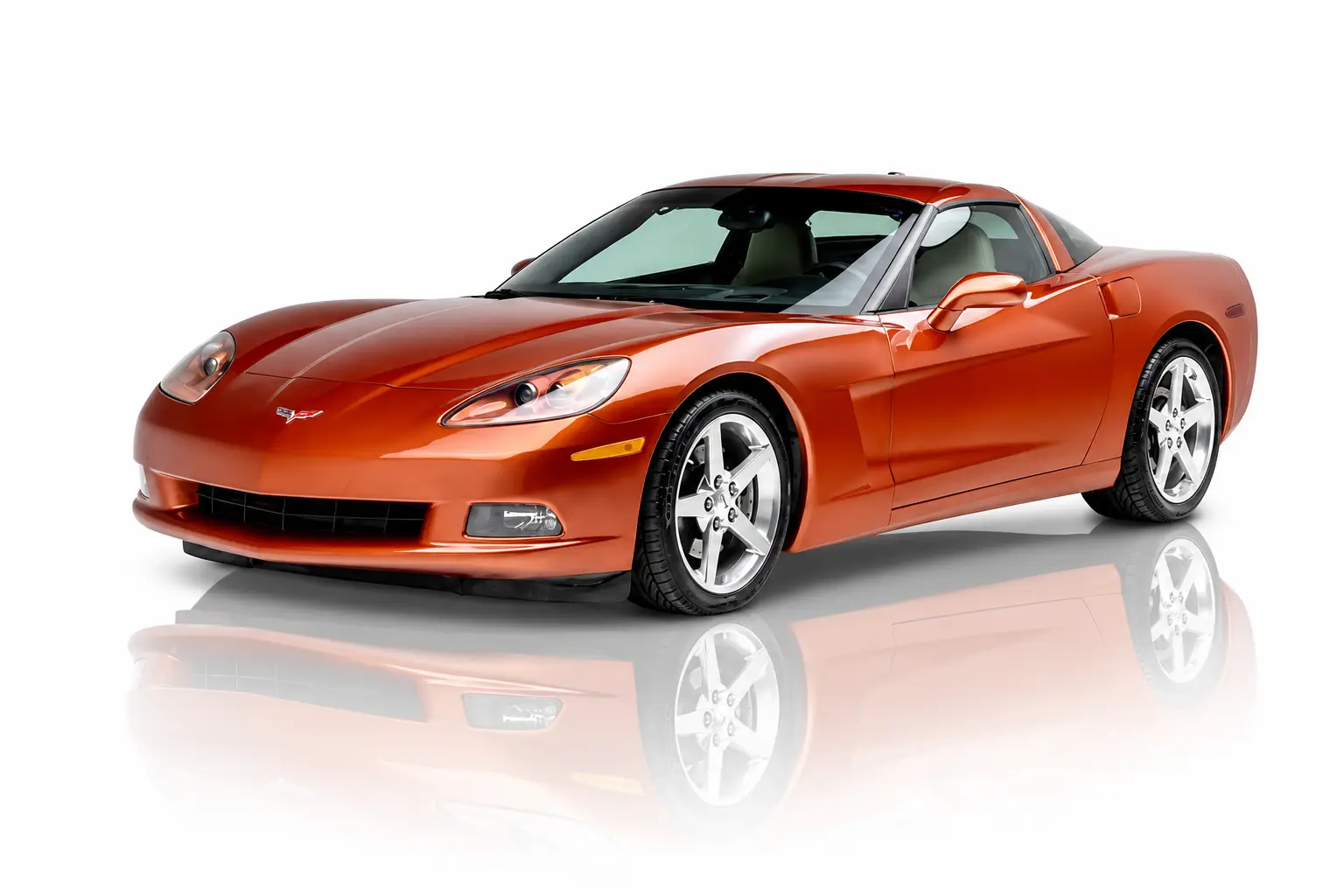
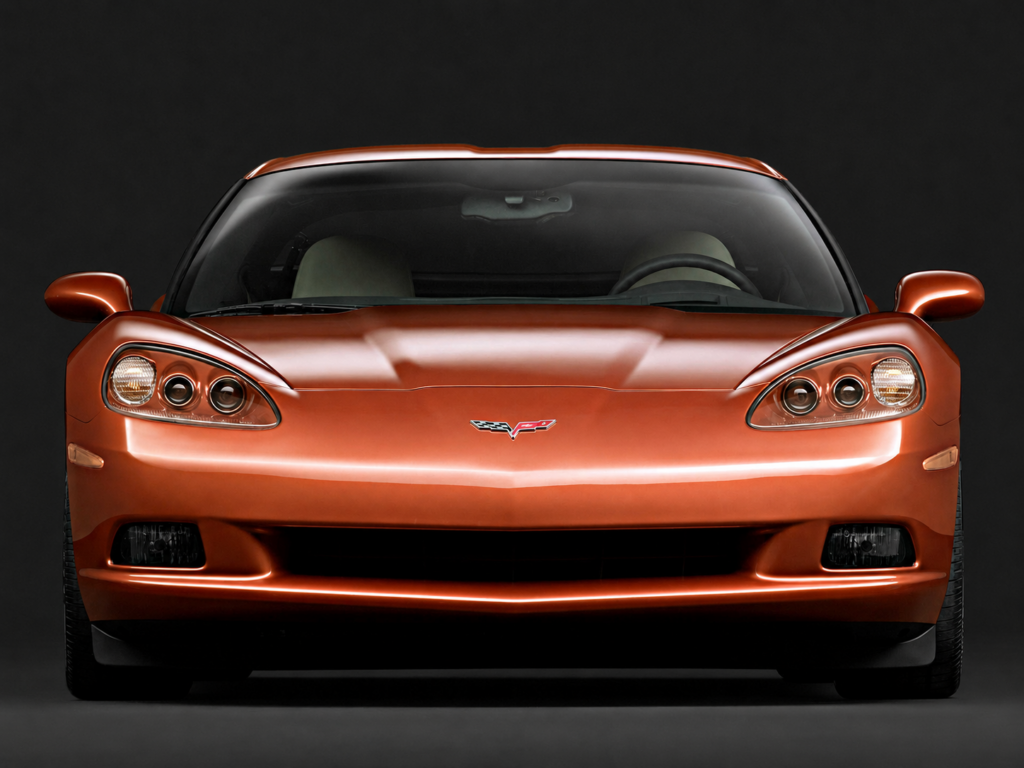
The C6 used xenon high-intensity-discharge projector lamps for its low beams and tungsten-halogen projectors for its high beams. The projectors were housed beneath clear polycarbonate covers shaped to follow the contours of the front fenders, allowing the assemblies to become part of the body rather than interrupting it. Parking lamps, side-turn markers, and daytime-running lamps were incorporated into the same enclosures, while chrome rings surrounded the principal projectors and body-colored lower bezels visually connected each assembly to the surrounding sheet-molded-composite bodywork.
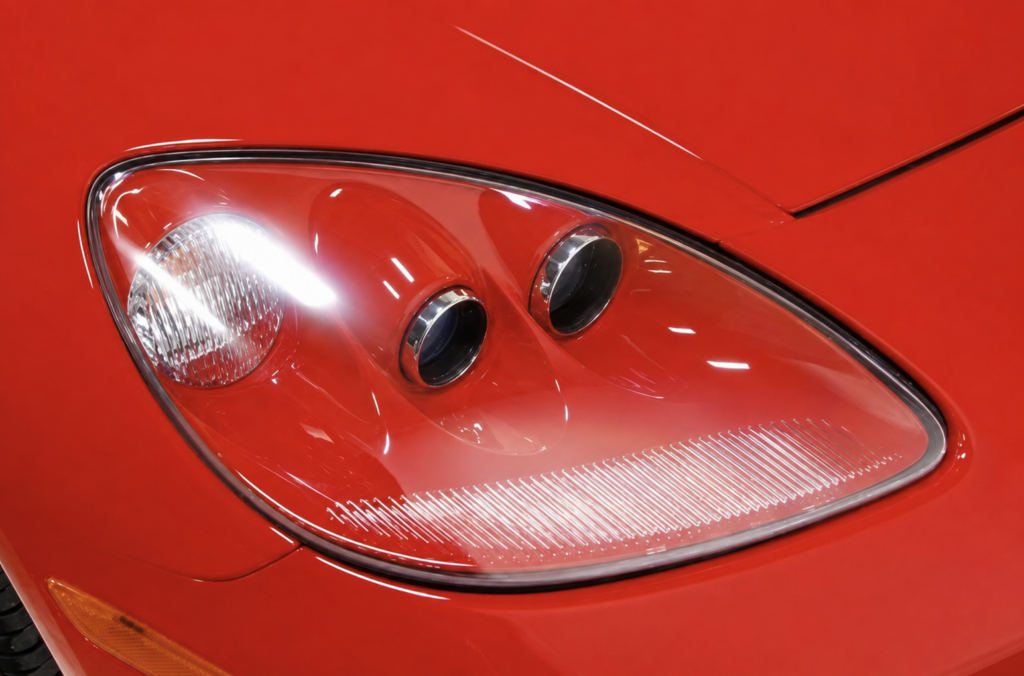
The fixed configuration also provided an immediate flash-to-pass function that did not require headlamp doors to open before the lights could be seen. More consistent projector alignment and improved illumination further strengthened the practical argument for the change. What appeared to be a purely stylistic departure was therefore closely connected to visibility, packaging, aerodynamic efficiency, mechanical simplification, and the requirements of endurance racing.
Together with the center-mounted grille, sculpted hood bulge, and raised fender peaks, the exposed lamps gave the C6 a face that was unmistakably different from the C5. Their elongated clear covers followed the sweep of the fenders, while the body-colored internal treatment prevented the assemblies from appearing as unrelated components placed on top of the car. The result retained enough familiar Corvette proportion to preserve the car’s identity while making the new generation recognizable at a glance.
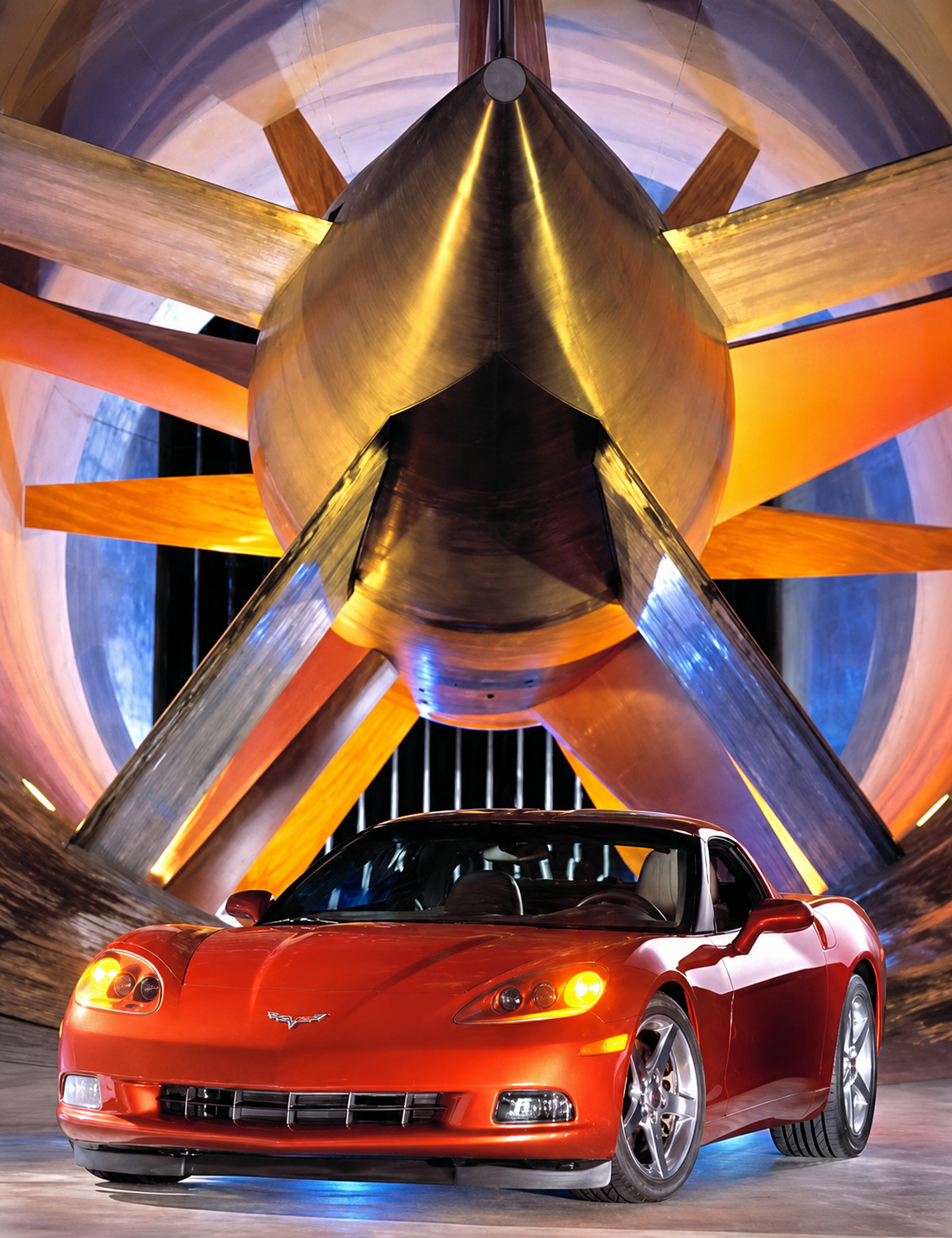
Aerodynamics remained central to the entire design. Chevrolet devoted more than 400 hours of wind-tunnel testing to the C6—reportedly more than GM had previously committed to any production car—and promoted a coefficient of drag rounded to 0.28. Contemporary reporting placed the production figure more precisely at 0.286, reflecting how narrowly the finished car missed the development team’s exact 0.28 target.
That result was especially notable because several of the C6’s basic requirements worked against reducing drag. The car had a larger engine with greater cooling demands, wider rear tires, shorter front and rear overhangs, and a body that was approximately five inches shorter overall than the C5. At the same time, the aerodynamic program had to control lift and provide the stability and confidence expected of a Corvette capable of operating at very high speeds. Corvette Racing’s request for a revised profile was part of that same development conversation, although its effect on the shape and performance of the C6.R extended beyond the production headlamp decision.
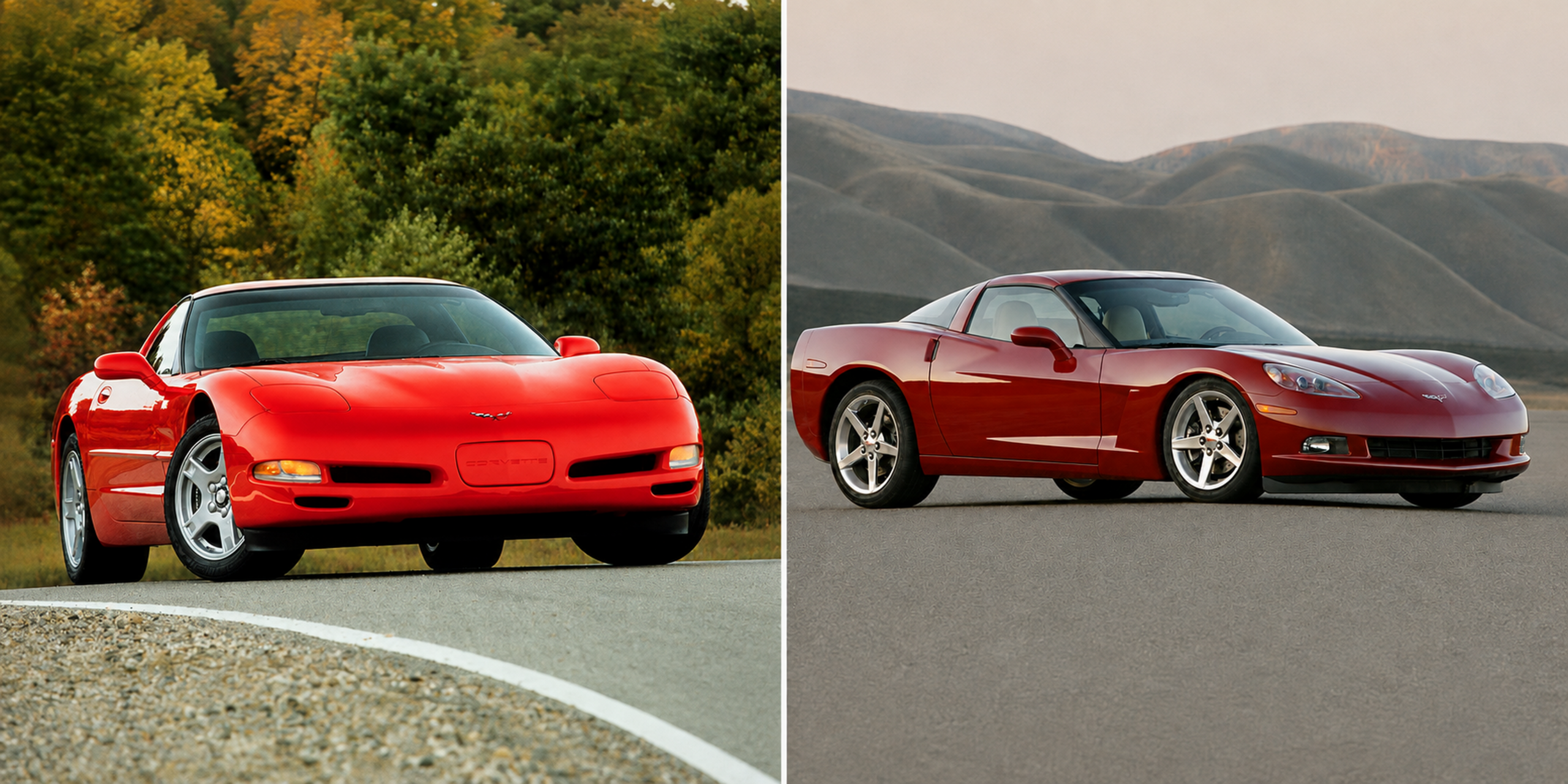
Cooling requirements played an equally important role in shaping the new front end. The C5 production car had relied on a completely bottom-fed—or “bottom-breathing”—system in which radiator air entered from beneath the nose. The C6 adopted a hybrid arrangement, with approximately 60 percent of the cooling airflow entering through the center grille and the remaining 40 percent arriving from below.
The center opening also reflected the racing program’s request for a cleaner, more useful frontal intake arrangement than the divided openings of the C5-R. Although the exact cooling and ducting requirements differed between the production C6 and the C6.R, the broader objective was shared: provide a more direct path for the air required by the engine, brakes, and other systems while reducing unnecessary aerodynamic disruption. The full effect of that request would become more apparent in the competition car, where airflow had to be divided among combustion, radiator, brake, and cockpit-cooling duties.
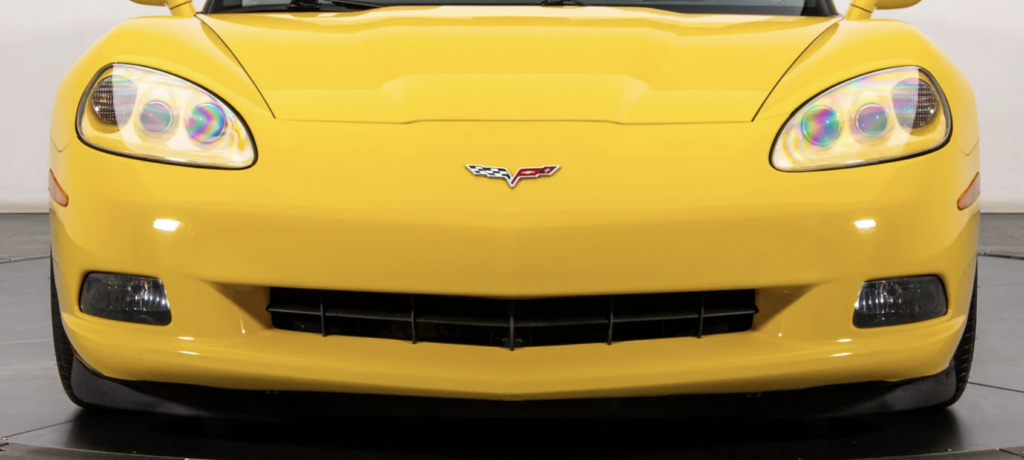
For Peters and the design team, the center grille created an opportunity to restore a more expressive face while meeting the thermal demands of the 6.0-liter LS2 engine. Its egg-crate texture referenced earlier Corvettes without turning the C6 into a retro design, while its functional opening supplied most of the cooling air the production car required. The grille, exposed headlamps, and more sharply defined fenders consequently worked together as styling elements, aerodynamic surfaces, and functional components.
The exposed lamps may have been controversial, but they belonged to a much larger effort to reduce mass, drag, mechanical complexity, and visual bulk. Their adoption improved illumination and gave the sixth-generation Corvette a face of its own, but it also demonstrated the increasingly close relationship between the production Corvette and the factory racing program. More than any other single exterior feature, the fixed headlamps showed how the demands of Le Mans could directly influence the Corvette driven on the street.
A More Complete Interior
If the exterior of the C5 had aged gracefully, its interior had become the car’s most frequently cited weakness by the end of the generation.
The fifth-generation cockpit remained spacious, comfortable, and intelligently arranged, but its appearance was dominated by dark molded plastic, broad uninterrupted surfaces, and buttons, knobs, and trim pieces that did little to distinguish the Corvette from less expensive General Motors products. Its seats favored long-distance comfort over firm lateral restraint, and the overall presentation did not always convey the sophistication suggested by the chassis or the car’s price.
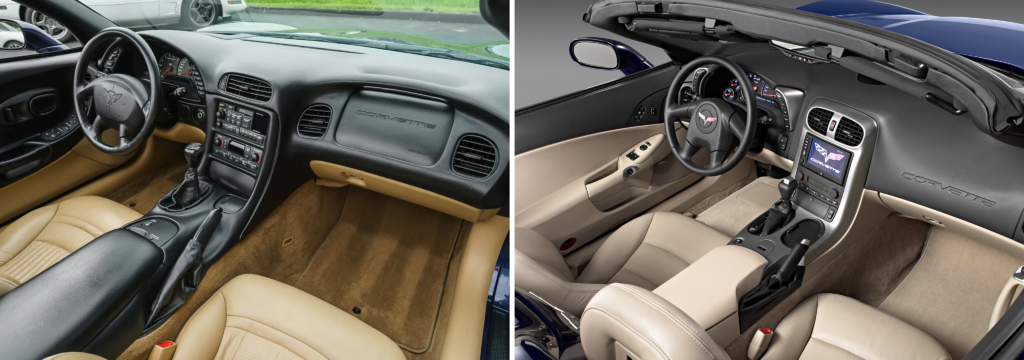
The C6 interior represented a substantial improvement, but it was not a rejection of everything that had come before. Eric Clough, the C6’s lead interior designer, and his team retained the Corvette’s traditional dual-cockpit arrangement while working toward three stated objectives: preserving the C5’s effective ergonomics, improving material quality, and assembling the cabin with greater precision.
A flowing upper line wrapped around the instrument panel, visually connecting the two sides of the cockpit. The driver’s instruments were enclosed within a more tightly defined pod, while the passenger side became cleaner and more open. The radio, climate controls, and other frequently used buttons were arranged in more orderly groups and fitted more cleanly into the center stack, reducing the visual clutter and uneven transitions found in the outgoing car.
Material quality received equal attention. Chevrolet covered the instrument panel and portions of the doors with a soft, foam-backed cast-skin material whose lower-gloss surface reduced reflections and gave the cabin a more substantial appearance. Aluminum trim plates with a finely textured surface added contrast, while anodized-aluminum accents appeared on functional pieces such as the manual-transmission shift knob and the electronic interior door-release buttons. Two-tone color combinations and a wider distribution of the selected interior color also helped relieve the predominantly black atmosphere associated with many C5 cabins.
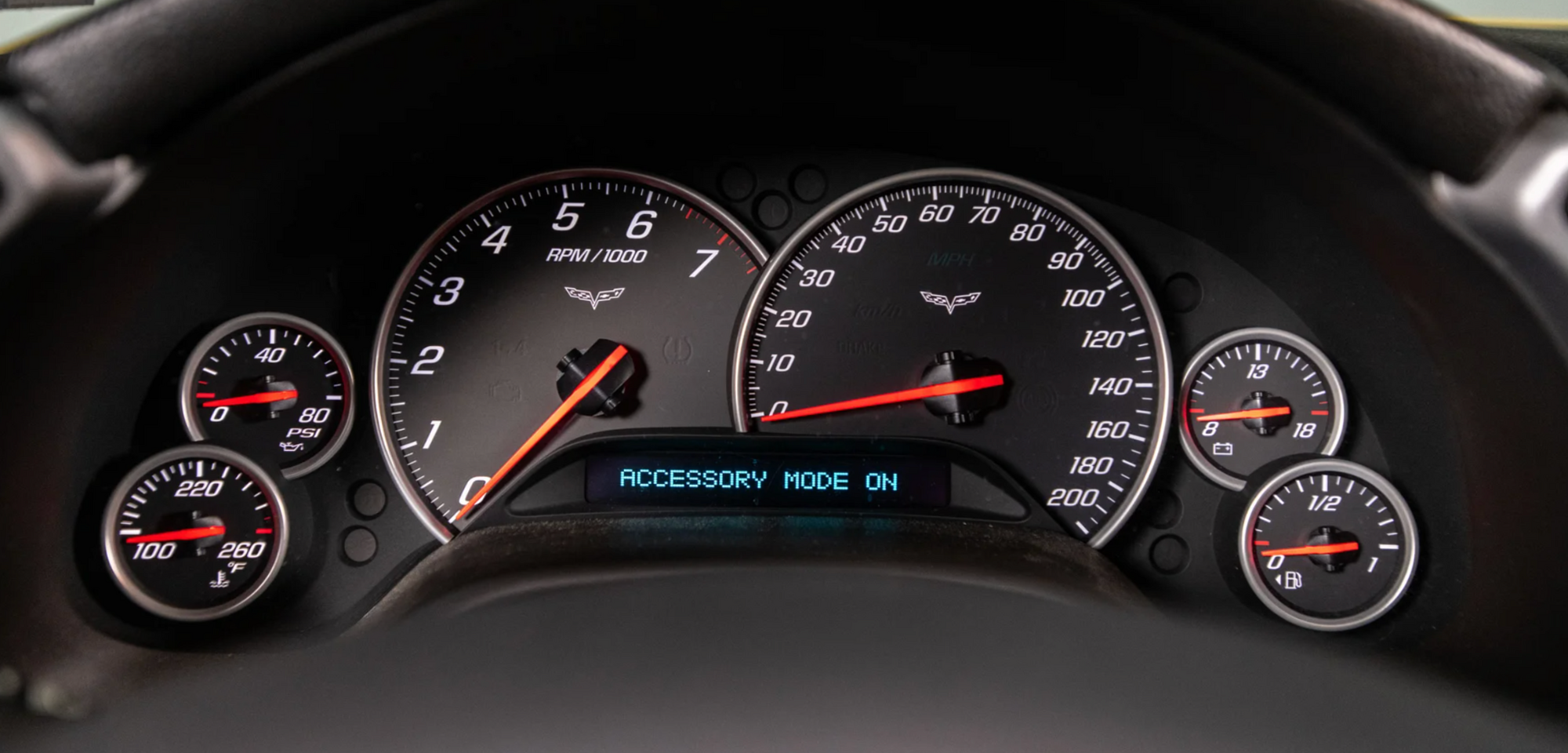
The basic instrument arrangement remained familiar, but nearly every element was refined. The speedometer and tachometer grew by five millimeters, their graphics became simpler, and satin-finished aluminum bezels surrounded the principal gauges. White light-emitting diodes improved daytime and nighttime contrast, while the Driver Information Center expanded to a two-line display capable of presenting fuel range, average fuel economy, trip information, tire pressures, oil life, warnings, and other vehicle data.
The available head-up display became considerably more sophisticated. Rather than offering a single fixed presentation, it provided three selectable formats: Street, Track 1, and Track 2. Street mode could display speed, audio information, transmission position, warning indicators, and turn-by-turn navigation instructions when the navigation system was fitted. The two Track formats added performance information, including a circular or linear tachometer, engine-condition readings, a shift indicator, and a real-time lateral-acceleration display.
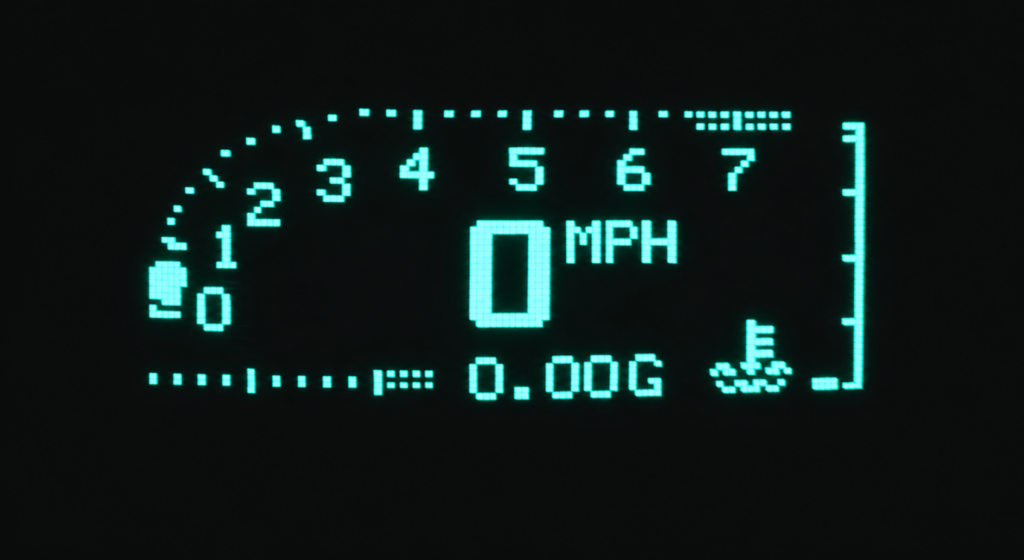
The feature proved exceptionally popular. Chevrolet’s final production records show that the head-up display was installed in 34,356 of the 37,372 Corvettes produced for 2005—approximately 91.9 percent of the model year’s total production.
The C6 also brought the Corvette further into the emerging digital age. An AM/FM radio with a CD player and MP3 capability was standard, while available equipment included an upgraded Bose system, an in-dash six-disc changer, XM Satellite Radio, and OnStar. For the first time in a Corvette, buyers could order a factory-installed navigation system. Its 6.5-inch color touchscreen used a DVD containing mapping data for the United States and Canada, while multilingual voice recognition reflected Chevrolet’s intention to make the C6 credible beyond its traditional domestic market.
Other available equipment included heated seats—the first offered in a production Corvette—a memory system, an automatically dimming mirror, and a power-telescoping steering column with manual tilt adjustment. These features were not remarkable in the most expensive European grand tourers, but their availability helped broaden the Corvette beyond the narrowly defined role of a weekend performance car.
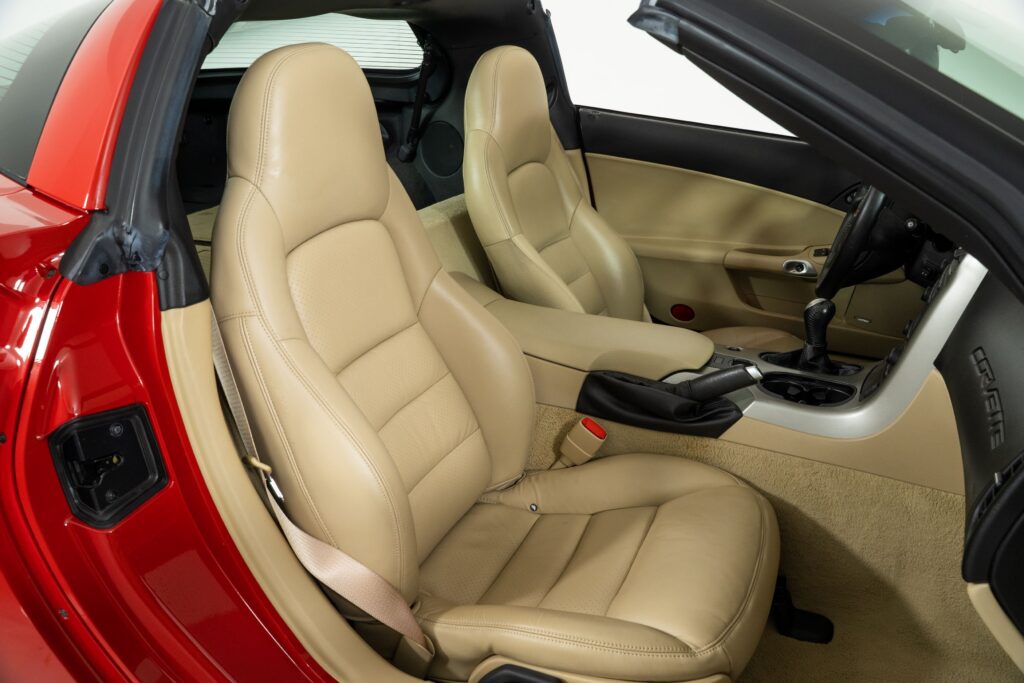
The seats themselves were redesigned rather than merely reupholstered. Chevrolet retained a two-layer composite frame supported by an aluminum base, but the cushions were lengthened and the bolsters made more supportive. The standard seats provided six-way power adjustment with manual backrest recline, while the available sport seats added power-adjustable lumbar support and side bolsters for both occupants, along with head-and-torso side-impact airbags. Contemporary tests from Car and Driver, MotorTrend, and MotorWeek generally regarded the new seats as a clear improvement over those in the C5, particularly in their ability to hold the driver in place.
Smaller accommodations received similar attention. The two cupholders were covered by a tambour-style sliding door and were designed to retain containers during hard acceleration, braking, and cornering. The center-console compartment grew large enough to hold a cellular telephone, sunglasses, and several compact-disc cases, while storage pockets were added to both doors. Additional sound insulation, improved seals, and the new indexing side windows also contributed to a quieter and more finished driving environment.
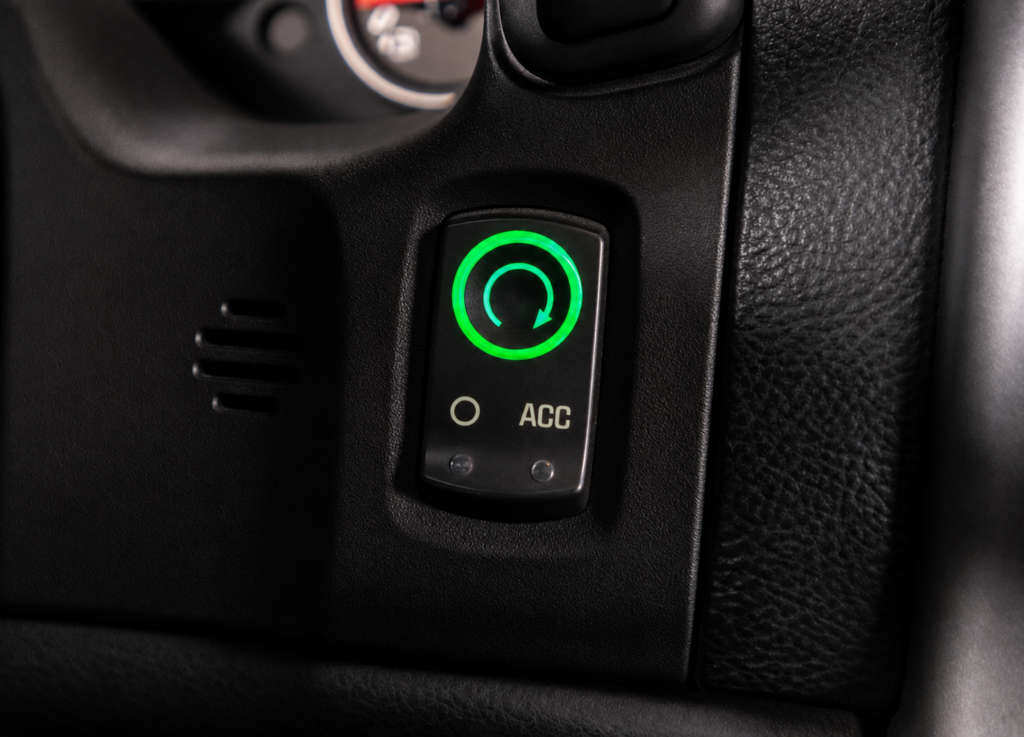
The most obvious technological departure was the elimination of the conventional ignition key and mechanical door handles. The Keyless Access system recognized a transmitter carried by the driver, allowing the doors to unlock and unlatch when the concealed exterior touch pad was pressed. Inside, electronic release buttons replaced conventional door handles, while a rocker-style control on the instrument panel started or stopped the engine when the transmitter was present and the brake or clutch pedal was depressed.
Chevrolet retained mechanical safeguards in case electrical power was lost. Emergency release handles beside the seats allowed occupants to open the doors from inside, while a mechanical key could open the rear hatch so that a separate cargo-area release could unlatch the driver’s door from outside. The frameless side windows automatically lowered slightly when either door opened and returned to their fully raised position after the door closed, clearing the weather seals and improving sealing pressure.
The first-year system also introduced an unusual operating requirement on manual-transmission cars. A 2005 Corvette equipped with the six-speed manual had to be placed in reverse to complete the shutdown sequence; otherwise, the car remained in accessory mode and displayed a “SHIFT TO REVERSE” message. It was a small but memorable peculiarity of Chevrolet’s first attempt to replace the Corvette’s conventional key with a fully electronic starting system.
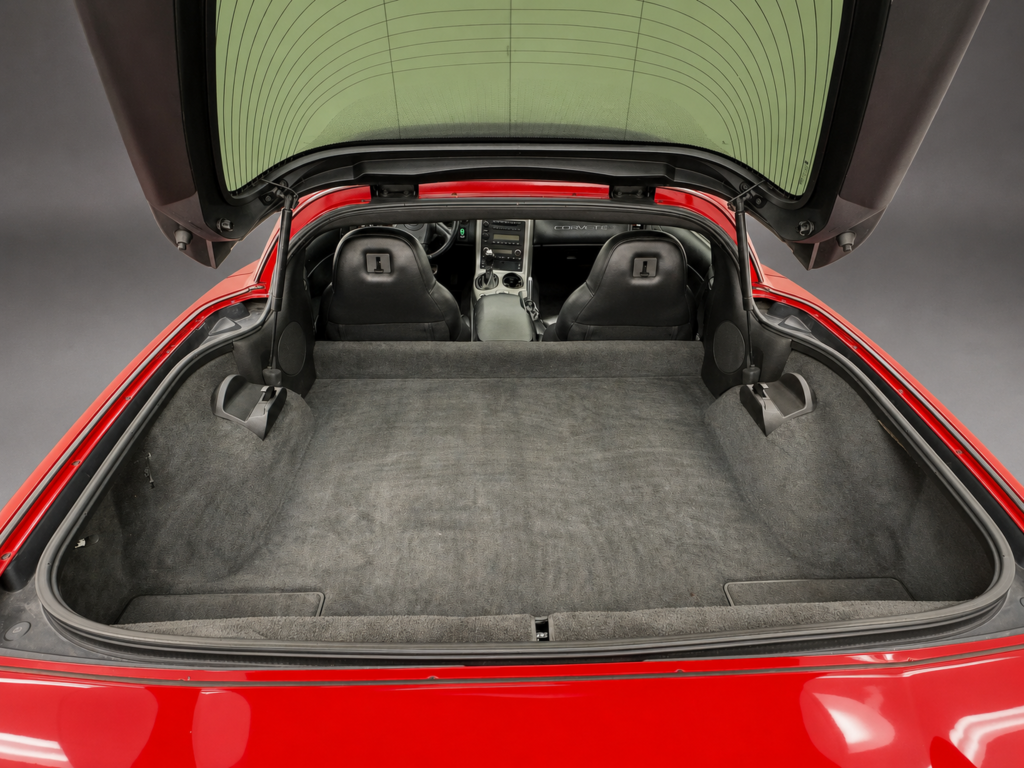
The concern for everyday operation extended beyond the cockpit. The forward-hinged hood was 15 percent smaller, 35 percent lighter, and 40 percent stiffer than the C5 hood, allowing it to latch securely from a single closing position. The rear hatch required less effort and incorporated a power-operated cinching latch that pulled it tightly against the seals.
The C6 cabin did not suddenly acquire the material richness of a contemporary Porsche 911. Some hard plastic remained, and not every reviewer was convinced by the metallic finishes or the relatively conservative dashboard design. Yet the interior no longer seemed disconnected from the sophistication of the car beneath it. It was more attractive, more precisely assembled, easier to use, better equipped, and far more appropriate to a Corvette that increasingly expected to be judged against the world’s best sports cars.
The 6.0-Liter LS2
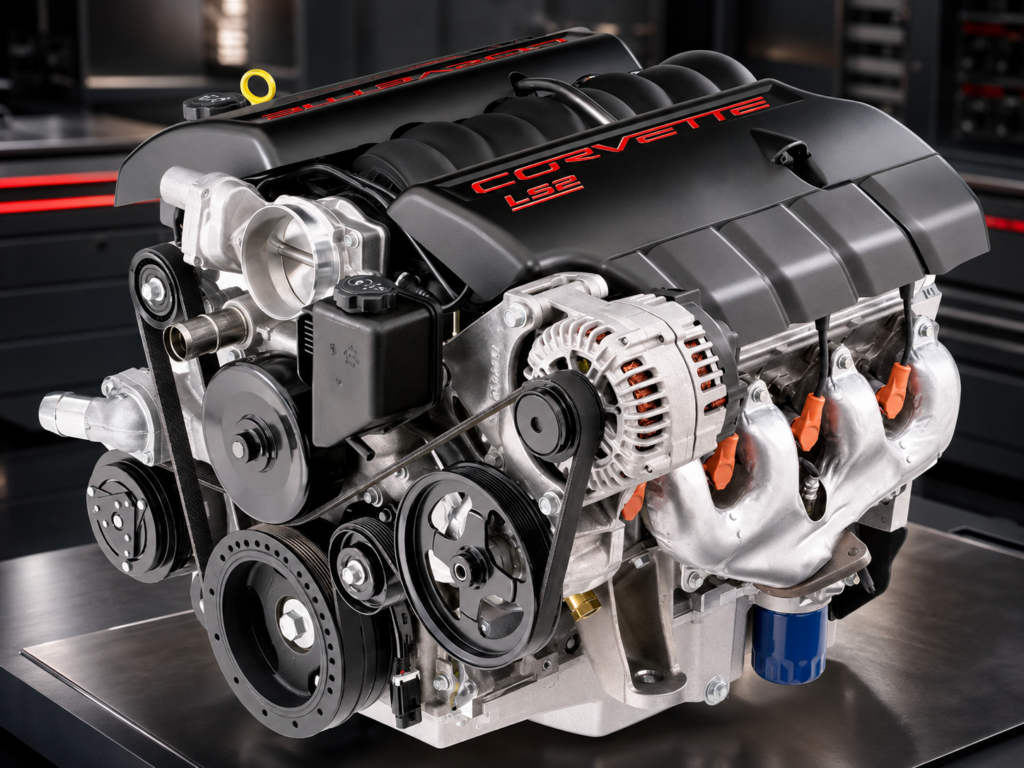
The defining mechanical feature of the 2005 Corvette was its new LS2 V-8—the first production application of General Motors’ fourth-generation small-block architecture and, at the time, the most powerful engine ever fitted as standard equipment in a Corvette.
The final standard C5 used the 5.7-liter LS1, rated at 350 horsepower and 360 pound-feet of torque. The 2004 Z06’s more specialized LS6 produced 405 horsepower and 400 pound-feet, but that output remained exclusive to Chevrolet’s highest-performance Corvette. For 2005, nearly the same power became standard in every Corvette coupe and convertible.
The LS2 displaced 6.0 liters, or 364 cubic inches. Chevrolet obtained the additional displacement by increasing the cylinder bore from 3.90 to 4.00 inches while retaining the LS1’s 3.62-inch stroke. Compression increased to 10.9:1, and Chevrolet recommended 93-octane premium fuel for maximum performance, although premium was not listed as an absolute requirement.
Output rose to 400 horsepower at 6,000 rpm and 400 pound-feet of torque at 4,400 rpm, with a 6,500-rpm maximum engine speed. Those matching horsepower and torque figures became a natural focus of Chevrolet’s marketing, but their significance went beyond symmetry: compared with the standard 2004 LS1, the LS2 gained 50 horsepower and 40 pound-feet. It was only five horsepower short of the outgoing Z06’s LS6 while equaling its peak torque.
Although the LS2 retained the small-block’s compact 90-degree, cam-in-block, two-valve-per-cylinder configuration, it was more than an enlarged LS1. Its new 319-T5 aluminum block casting used cast-in-place iron cylinder liners, a deep skirt extending below the crankshaft centerline, cross-bolted main-bearing caps, revised oil galleries, and externally mounted knock sensors that were easier to service than the sensors previously located beneath the intake manifold. The camshaft-position sensor moved from the rear of the block to the front, creating space for the revised oil passages.
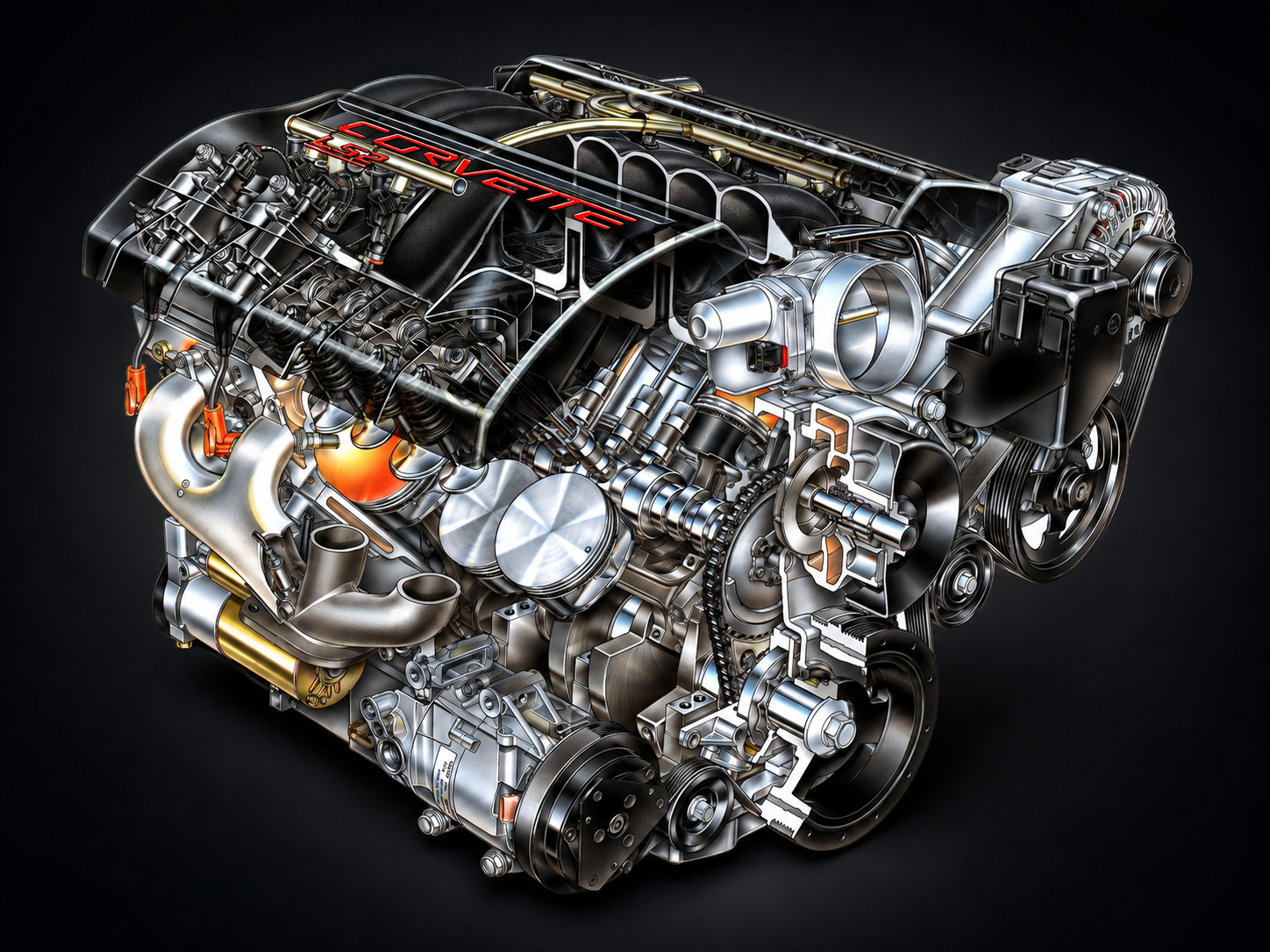
The aluminum cylinder heads were derived from designs developed for previous Z06 engines. Raised intake ports and combustion chambers that reduced valve shrouding improved airflow and mixture motion, while 2.00-inch intake valves, 1.55-inch exhaust valves, stronger valve springs, and a higher-lift camshaft supported the engine’s increased airflow and operating speed. A 90-millimeter single-blade throttle body supplied the engine, and the revised controller incorporated the electronic-throttle functions that had required a separate control module on the LS1. Eliminating that separate module reduced complexity and allowed faster communication between the engine controller and throttle actuator.
Internally, the LS2 used flat-top pistons with lower-tension rings to reduce friction. Full-floating wrist pins improved refinement, while a stronger timing chain and long-life iridium-tipped spark plugs contributed to durability and reduced maintenance. More efficient individual ignition coils required less electrical energy to produce a comparable spark, and the crankcase-ventilation arrangement moved the PCV system away from the rocker covers and into the block valley, following a configuration previously used on the LS6.
A newly designed “wingless” aluminum oil pan replaced the C5’s broader gull-wing design. Cast-in baffling improved control of the oil supply during high-rpm operation and sustained lateral acceleration, an advantage confirmed through Chevrolet’s track testing. The revised pan reduced specified capacity from 6.5 to 5.5 quarts—5.2 liters—with a dry filter, but the lower capacity did not represent reduced protection; Chevrolet reported that the new pan controlled the available oil more effectively under demanding maneuvers.
The exhaust manifolds were also redesigned. Their wall thickness decreased from four millimeters to three, making them approximately one-third lighter while improving airflow by about four percent. Advances in catalyst construction allowed Chevrolet to use one close-coupled converter for each cylinder bank instead of the LS1’s four-converter arrangement, reducing backpressure and eliminating the previous secondary-air-injection system. More gradual exhaust-pipe bends, larger inline mufflers, and Chevrolet’s tri-flow muffler arrangement further improved flow while addressing unwanted resonance between approximately 1,500 and 2,400 rpm.
A smaller, lighter water pump incorporated improved sealing, and Chevrolet’s engineering release documented a seven-kilogram—approximately 15-pound—mass reduction for the automatic-transmission version of the engine. That qualification matters: the figure applied specifically to the automatic configuration cited by Chevrolet and should not be presented as a universal LS1-to-LS2 weight difference for every installation.
The LS2 demonstrated why Chevrolet continued to develop the pushrod small-block while many competitors adopted physically larger overhead-camshaft engines. Its compact exterior dimensions allowed it to sit low in the Corvette’s engine compartment without requiring a tall hood, while its displacement produced a broad, accessible torque curve. The result was an engine that could operate smoothly in everyday traffic, cruise at low engine speed, and still deliver performance that had belonged to the Z06 only one model year earlier.
Manual or Automatic at No Additional Charge
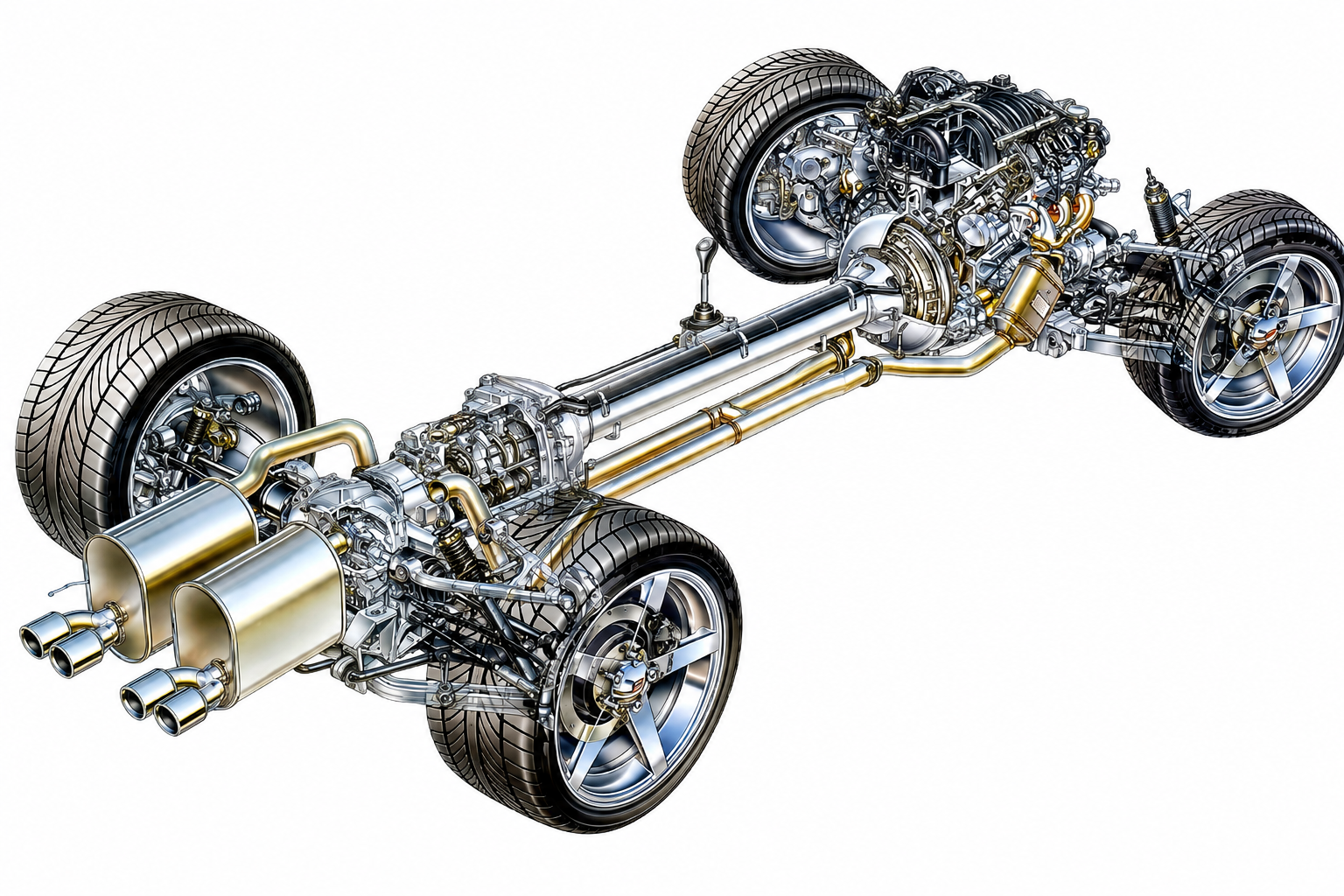
The LS2 was paired with either a Tremec T56 six-speed manual transmission or a Hydra-Matic 4L65-E four-speed automatic. Chevrolet described the manual as standard and the automatic as optional, but both were listed as no-cost selections for 2005. This reversed the arrangement used on the standard 2004 C5 coupe and convertible, for which the automatic carried no additional charge while the six-speed manual was a $915 option. The Z51-specific manual was included as part of the $1,495 Z51 Performance Package rather than priced as a separate transmission option.
The standard T56 used ratios of 2.66:1 in first, 1.78:1 in second, 1.30:1 in third, 1.00:1 in fourth, 0.74:1 in fifth, and 0.50:1 in sixth. Reverse was 2.90:1, and every manual Corvette used a 3.42:1 final-drive ratio. The exceptionally tall sixth gear reduced engine speed during highway cruising and helped the Corvette combine strong acceleration with comparatively economical long-distance operation.
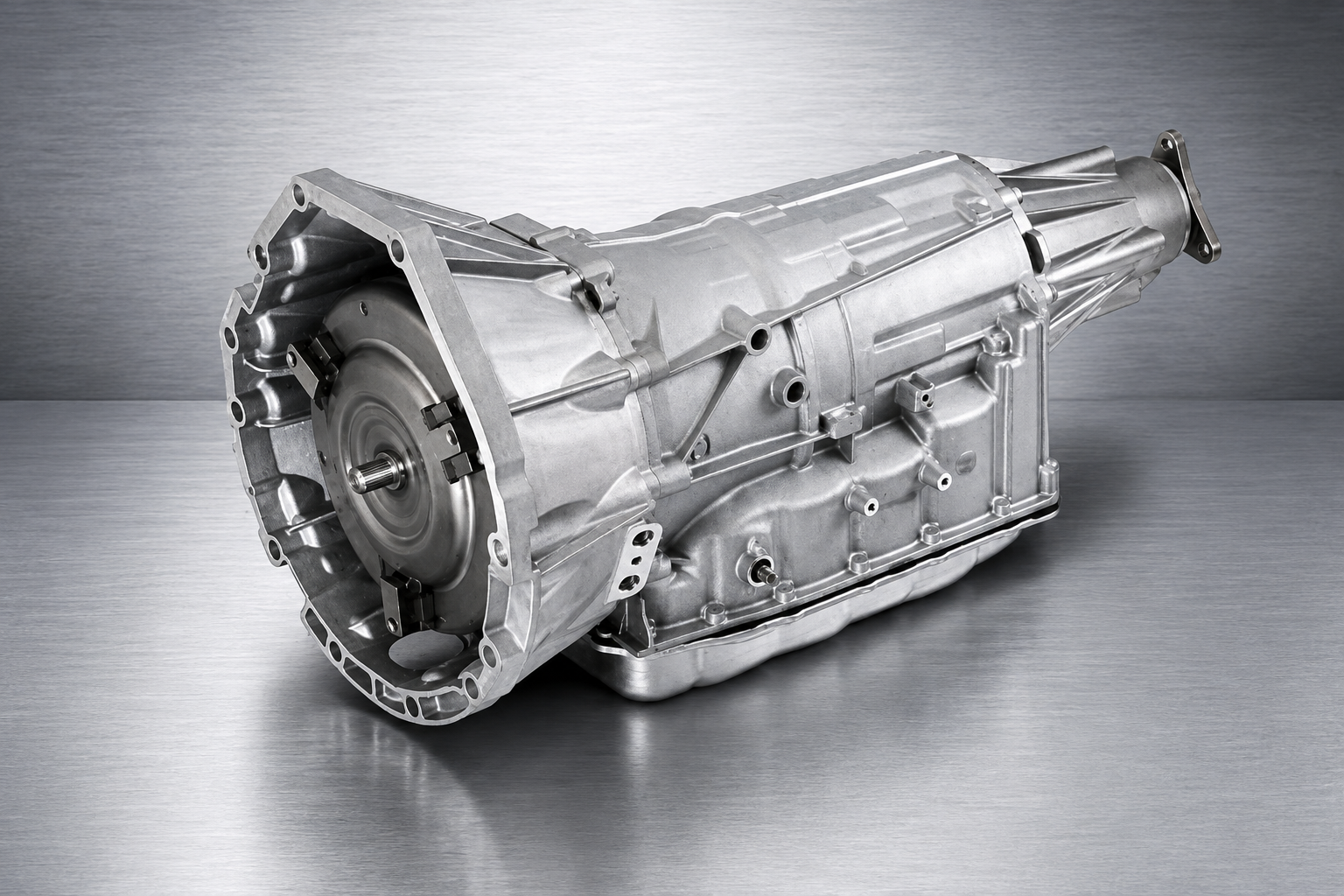
Chevrolet revised more than the ratios and internal calibration. The gear lever was shortened by one inch, synchronizer travel was reduced by 10 percent, and new linkage and shift-rail bearings were intended to provide shorter, smoother, and more positive shifts. Computer-Aided Gear Selection, commonly known as CAGS or “skip shift,” was retained; under certain low-speed, light-throttle conditions, it directed the driver from first gear into fourth to improve fuel-economy performance.
Manual cars ordered with Z51 received the MZ6 version of the T56. Its first three gears were numerically higher—2.97:1, 2.07:1, and 1.43:1—followed by direct-drive fourth at 1.00:1, a 0.71:1 fifth, and a 0.57:1 sixth. Reverse was 3.28:1, while the final drive remained 3.42:1. The lower first-through-third gearing increased torque multiplication and kept the LS2 closer to its strongest operating range during acceleration. Fifth was slightly taller than the standard transmission’s 0.74 ratio, while sixth was less extreme than the standard gearbox’s very tall 0.50 overdrive.
The Z51 manual also included a transmission cooler to improve durability during sustained high-speed and track operation. Chevrolet fitted the same cooling provision to base manual-transmission cars built for Europe, where extended high-speed driving was a more realistic operating requirement.
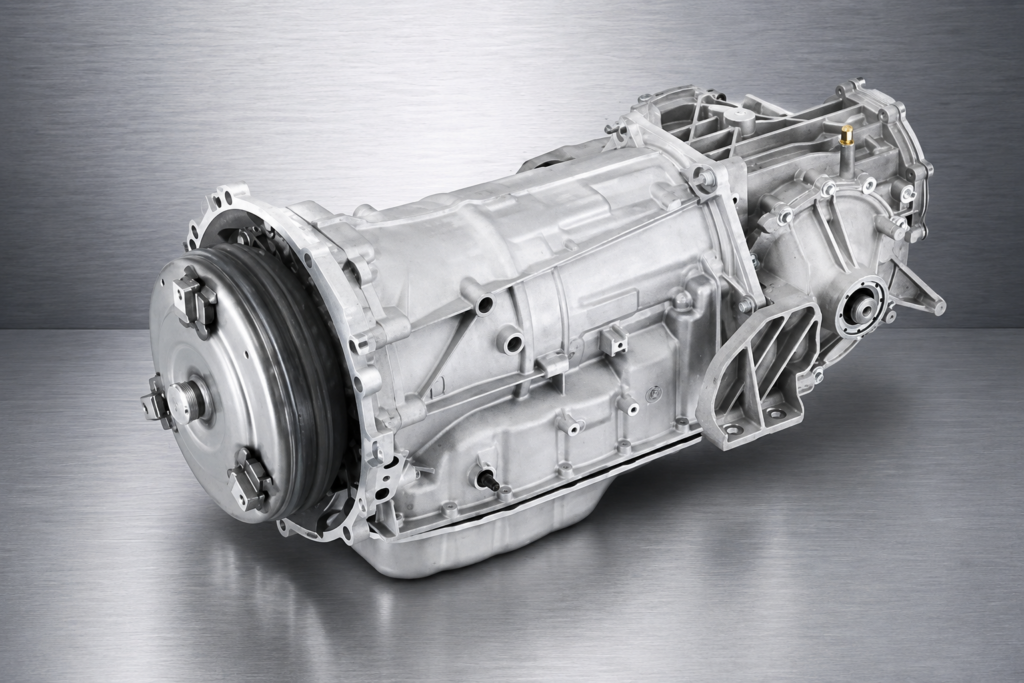
The automatic was the Hydra-Matic 4L65-E, a strengthened development of the C5’s 4L60-E. It retained four forward ratios—3.06:1, 1.63:1, 1.00:1, and 0.70:1—but received internal revisions intended to handle the LS2’s additional output. Five-pinion planetary gearsets replaced the earlier four-pinion arrangement, distributing loads across more gears, while low-friction washers between the gearsets supported sustained high-speed operation.
Additional thermal protection came from a four-plate transmission-fluid cooler. If fluid temperature reached approximately 260 degrees Fahrenheit—127 degrees Celsius—the control system kept the torque-converter clutch applied except briefly during shifts, limiting the additional heat that could otherwise be generated by converter slip.
The 4L65-E also used Performance Algorithm Shifting. Rather than following only an economy-oriented shift schedule, its electronic controller recognized performance driving and selected or retained gears appropriate to harder acceleration and cornering. It was calibrated to shift at higher engine speeds than the C5’s 4L60-E so that the automatic could take advantage of the LS2’s additional power and 6,500-rpm operating range.
Automatic cars came with a 2.73:1 final-drive ratio, while a 3.15:1 performance axle was available for $395. Of the 22,380 automatic Corvettes produced, 15,112 received the 3.15 axle and 7,268 retained the standard 2.73 ratio.
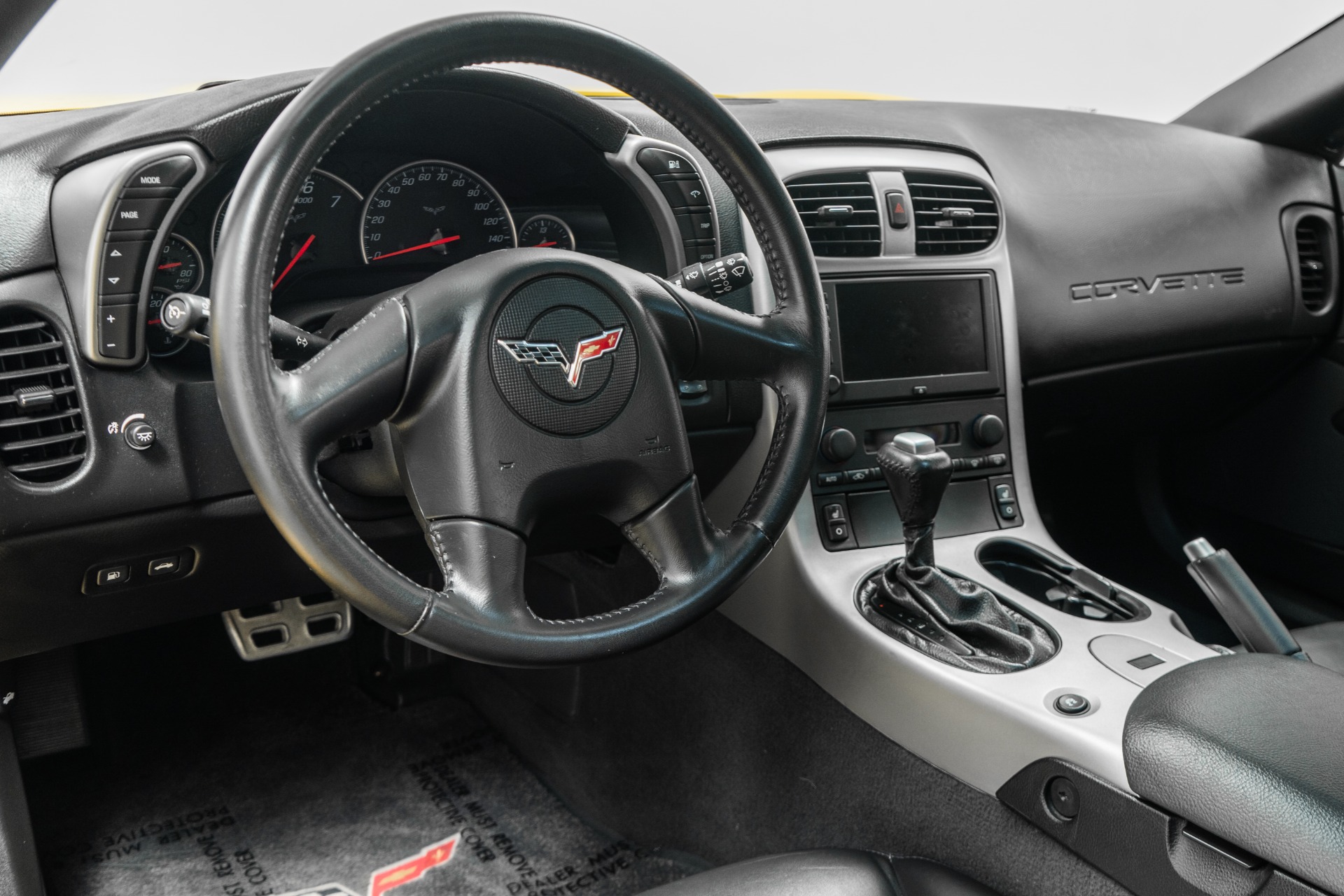
The final production totals demonstrate that the automatic remained the majority choice. Chevrolet built 22,380 automatic cars, representing 59.9 percent of the 37,372-unit model-year total. Another 6,358 received the standard-ratio MM6 six-speed, while 8,634 used the Z51-specific MZ6 transmission. Combined manual production was therefore 14,992 cars, or 40.1 percent.
The 4L65-E was considerably more sophisticated than an ordinary four-speed automatic, but its limited number of ratios made it the part of the 2005 powertrain that aged most quickly. Chevrolet addressed that limitation for 2006 by replacing it with a six-speed automatic offering steering-wheel-mounted manual-shift controls. The first-year C6 automatic was therefore both an important improvement over the C5 unit and a one-year transitional arrangement between the Corvette’s four-speed past and its six-speed automatic future.
Chassis, Suspension, and Brakes
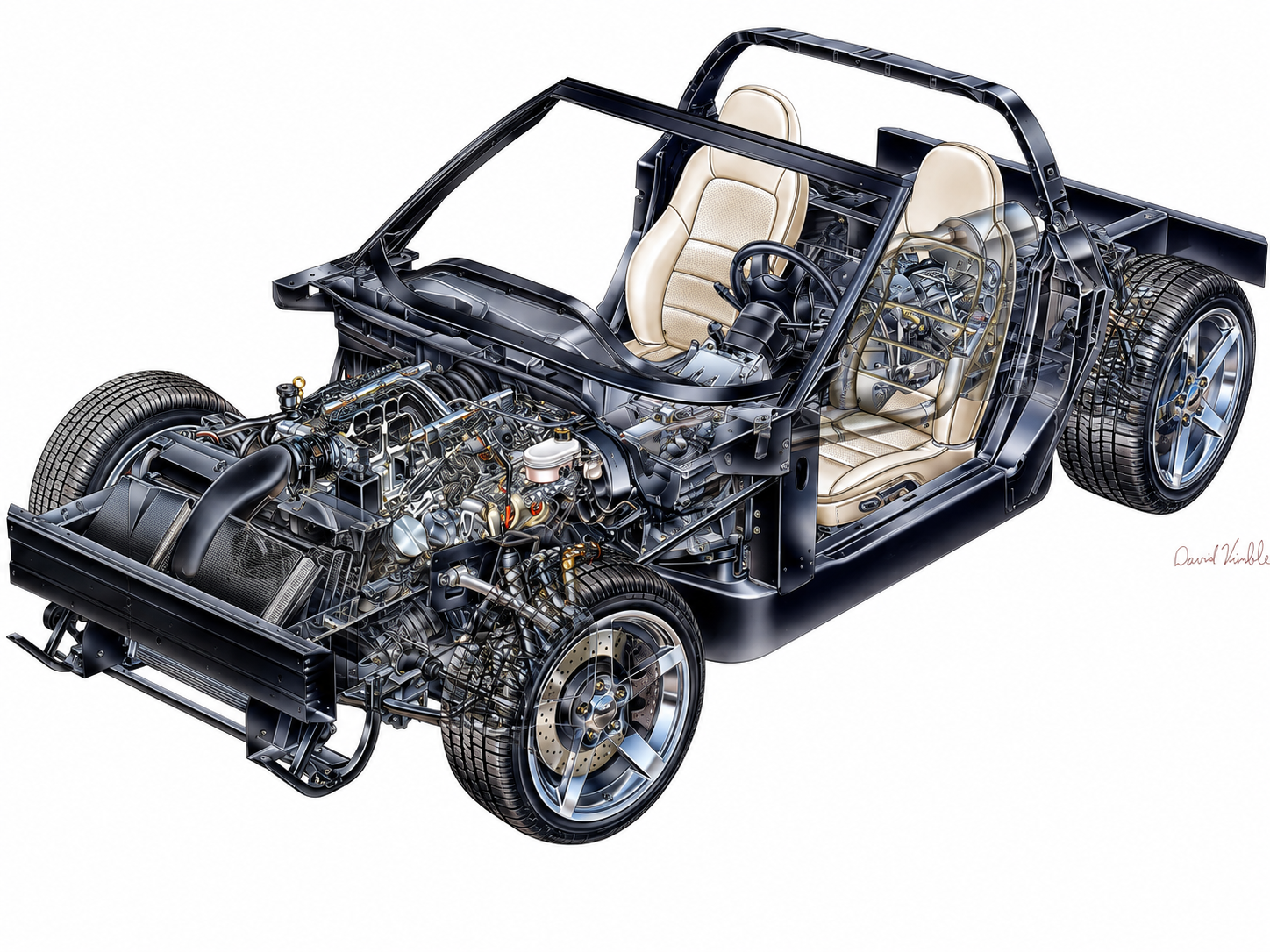
Although the C6 retained the C5’s basic suspension architecture, almost nothing attached to it was carried over unchanged. The new car continued to use short-long-arm independent suspension at all four corners, with cast-aluminum upper and lower control arms, transverse composite springs, stabilizer bars, and monotube dampers, but Chevrolet redesigned the cradles, control arms, knuckles, springs, dampers, bushings, stabilizer bars, and steering gear for the new generation.
Greater clearance within the hub knuckles and dampers allowed more suspension travel, while directional control-arm bushings and revised steering and suspension geometry improved both ride isolation and cornering control. Front caster increased by one degree, giving the C6 greater straight-line stability and reducing the front end’s tendency to wander when the tires encountered grooves or ruts in the road surface.
The objective was not simply to make the new Corvette stiffer. Chevrolet wanted greater body control, stronger grip, reduced road noise, and a calmer, more settled ride, allowing the C6 to operate as a serious performance car without sacrificing its usefulness as a long-distance grand tourer or an everyday driver.
Three suspension configurations let buyers choose where their Corvette would sit within that range. The standard suspension offered the broadest balance between ride comfort and precise handling, absorbing imperfect roads without surrendering the immediacy expected of a sports car.

F55 Magnetic Selective Ride Control added magnetorheological dampers capable of adjusting their resistance almost instantaneously in response to changing road conditions. Drivers could choose between Tour and Sport settings, and Chevrolet recalibrated the system for the C6 to create a more noticeable difference between the two modes.
The third choice was the $1,495 Z51 Performance Package, which functioned as a coordinated performance system rather than a simple spring-and-damper upgrade. It included more aggressive springs and dampers, larger stabilizer bars, Goodyear Eagle F1 Supercar Extended Mobility tires, larger cross-drilled brake rotors, performance-oriented transmission gearing or axle ratios, and additional transmission and power-steering cooling for sustained high-speed use.
Standard brake rotors measured 12.8 inches at the front and 12.0 inches at the rear, while Z51 increased those dimensions to 13.4 and 13.0 inches, respectively. All 2005 Corvettes used power-assisted four-wheel disc brakes with ABS, while traction control and Active Handling worked alongside the braking system to provide an integrated electronic safety net without unnecessarily interrupting performance driving.
Every 2005 Corvette rode on 18-by-8.5-inch front wheels and 19-by-10-inch rear wheels, carrying P245/40ZR-18 tires in front and P285/35ZR-19 tires at the rear. Standard and Magnetic Ride cars used Goodyear Eagle F1 GS-2 Extended Mobility tires, while Z51 substituted Eagle F1 Supercar Extended Mobility tires with an asymmetrical tread pattern, retaining the same nominal dimensions.
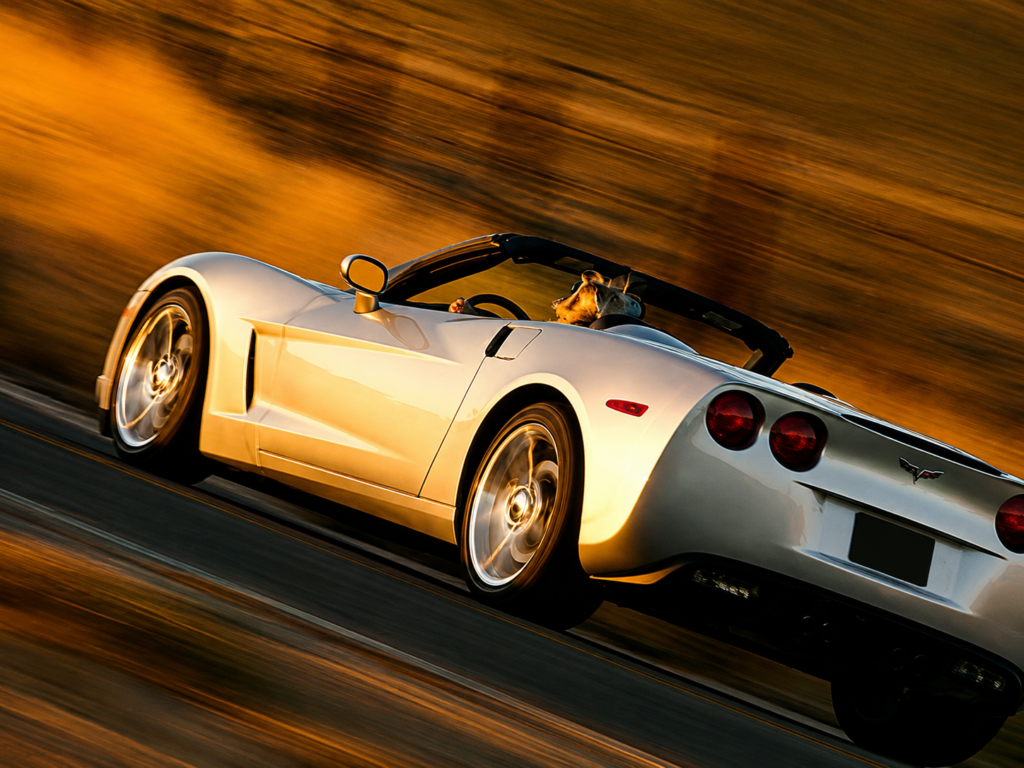
Chevrolet’s racetrack testing showed that a Z51-equipped C6 could nearly equal the lap times of the outgoing C5 Z06. That did not make Z51 a literal replacement for the lighter and more specialized fixed-roof Z06, but it demonstrated how dramatically the overall performance threshold of the standard Corvette platform had advanced.
Buyers responded strongly to the expanded range of chassis choices. Chevrolet built 15,345 Corvettes with Z51, representing 41.1 percent of production, while another 9,041 cars—24.2 percent—received Magnetic Selective Ride Control; combined, the two optional systems appeared on nearly two-thirds of all 2005 Corvettes.
The 2005 Corvette Convertible
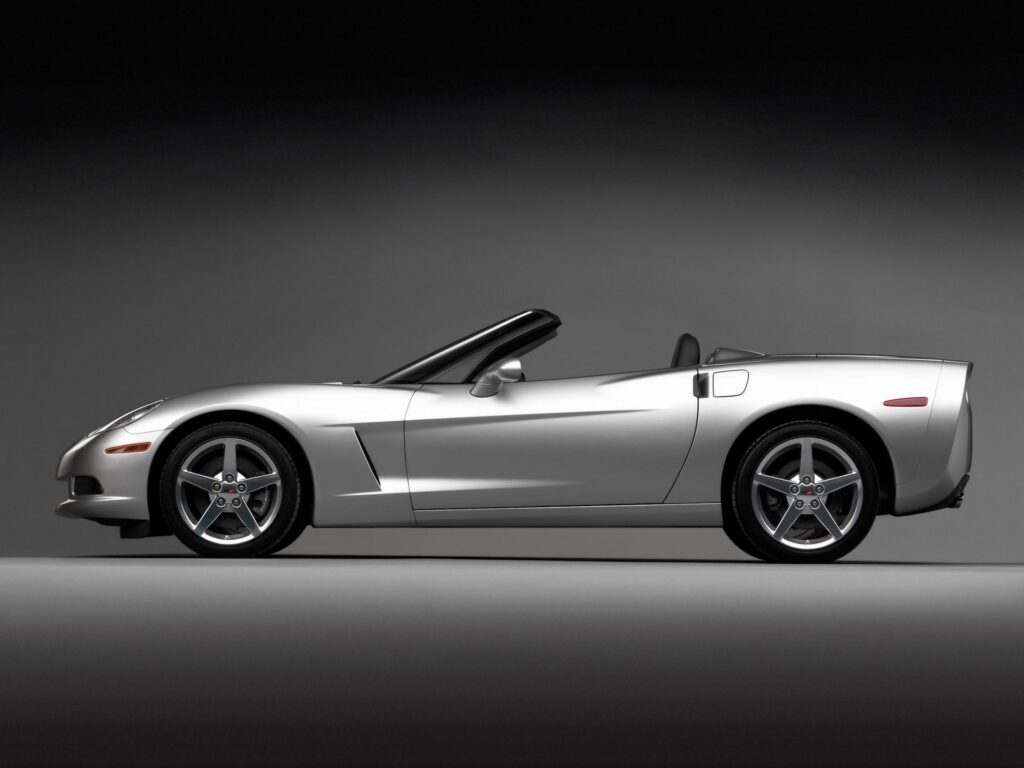
Chevrolet engineered the sixth-generation Corvette as an open car from the outset rather than treating the convertible as a coupe with its roof removed. Coupe production began in late summer 2004, with convertible production following in the fall, and the open car incorporated an aluminum windshield frame, a rear bulkhead, and structural provisions developed specifically to preserve ride, handling, and refinement.
The resulting weight penalty was remarkably small. The convertible’s base curb weight was approximately 3,199 pounds—only 20 pounds more than the commonly published 3,179-pound figure for the coupe and 49 pounds less than the 2004 C5 convertible.
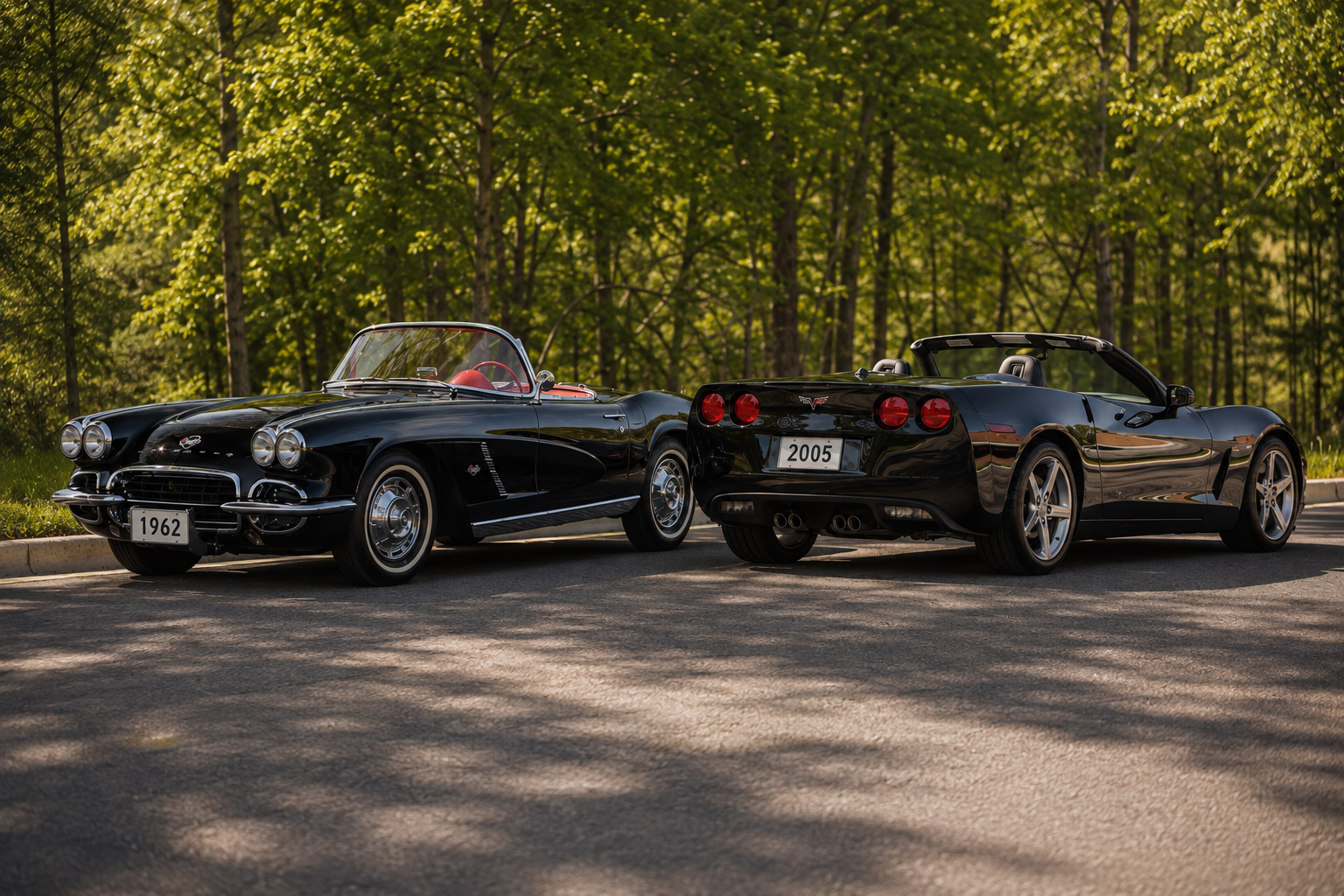
For the first time since 1962, Corvette buyers could order a power-operated soft top, although an easily operated manual roof remained standard. Once the front header latch was released, a single dashboard control completed the power top’s raising or lowering cycle in 18 seconds, and the mechanism added only 14 pounds compared with the manual arrangement.
Both roof systems used five-layer Twillfast fabric intended to improve durability, insulation, and appearance. The raised top was shaped to conceal more of its underlying structure, while the heated glass rear window was 18.5 percent larger than the one used in the 2004 convertible, improving rearward visibility.
Indexed side windows helped seal the cabin against wind and water, while extensive computer airflow modeling influenced the windshield frame and surrounding bodywork. Particular attention was given to reducing the frequencies that interfered with conversation, making top-down driving more comfortable during longer trips rather than limiting the convertible’s appeal to short recreational drives.
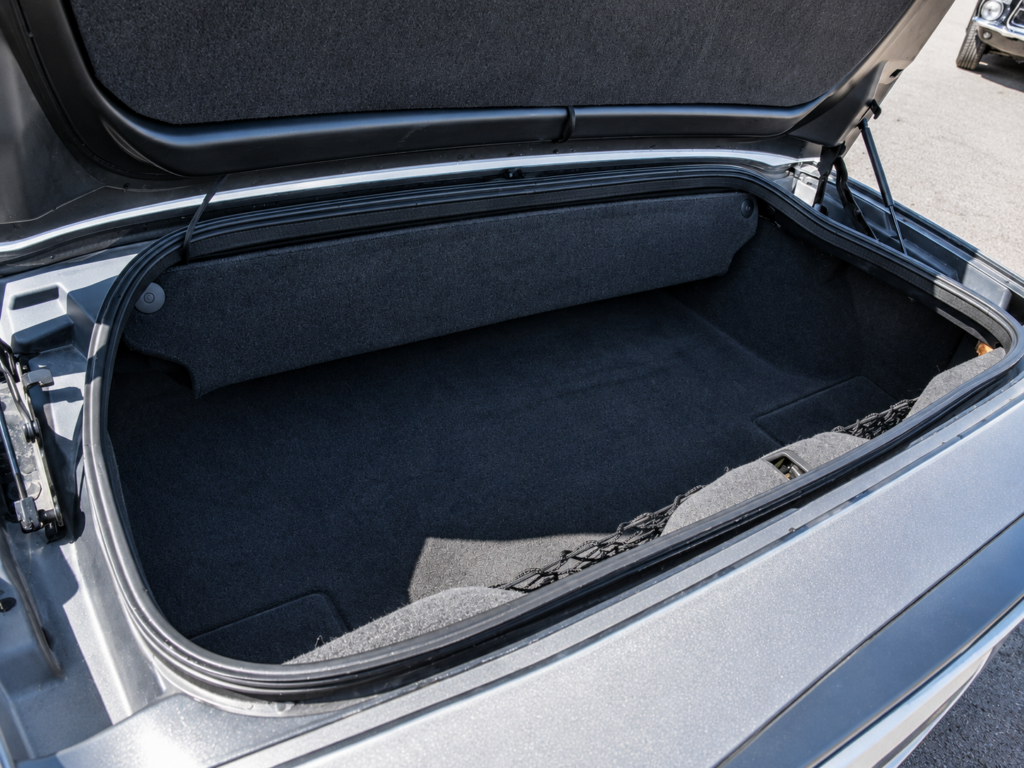
Published trunk capacity was approximately 10.4 cubic feet with the roof raised, with roughly 5 cubic feet remaining when the top was stowed. The power mechanism occupied no more luggage space than the manual system, meaning buyers did not surrender additional cargo capacity by selecting the electrically operated roof.
The power top quickly became the preferred configuration. Of the 10,644 convertibles built for 2005, 7,541—70.8 percent—were equipped with it, despite its $1,995 additional cost.
Convertible buyers were not excluded from the C6’s major performance or technology options. Z51, Magnetic Selective Ride Control, navigation, XM Satellite Radio, OnStar, and the other major equipment choices offered on the coupe were also available on the open car.
This was not a softened or ornamental version of the Corvette. It retained the same fundamental powertrain, chassis systems, performance options, and electronic controls as the coupe, adding open-air capability with only a minimal increase in weight.
Performance in Period Testing
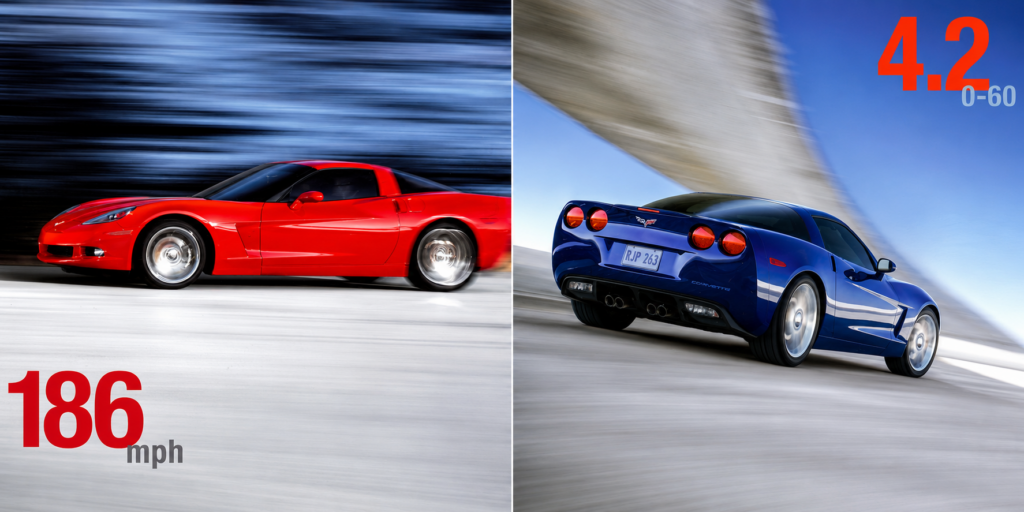
On paper, the 2005 Corvette possessed nearly everything required to challenge machinery costing substantially more. Its LS2 produced 400 horsepower and 400 pound-feet of torque, while the car combined a factory curb weight of roughly 3,200 pounds with large brakes, wide tires, efficient aerodynamics, and a near-even front-to-rear weight distribution. On the road and racetrack, the numbers proved to be more than advertising.
Results naturally varied with the individual car, surface, mileage, driver, and launch technique, but the pattern was remarkably consistent. Contemporary manual-transmission Z51 test cars generally reached 60 mph in approximately 4.1 to 4.3 seconds and completed the quarter-mile in roughly 12.6 to 12.7 seconds, with trap speeds extending well beyond 110 mph. Motor Trend, for example, recorded 4.3 seconds to 60 mph and a 12.7-second quarter-mile at 112.3 mph.
One of the most revealing period tests came from Car and Driver, which placed a Z51-equipped Corvette against the new Porsche 911 Carrera. The Corvette reached 60 mph in 4.1 seconds, completed the quarter-mile in 12.6 seconds at 114 mph, generated 0.98 g on the skidpad, and lapped GingerMan Raceway in 1:35.65—2.3 seconds quicker than the Porsche.
The comparison was not a simple story of the Corvette overwhelming the 911 in every measurable or subjective category. The Porsche stopped from 70 mph in 150 feet compared with the Corvette’s 164 feet, moved through the lane-change test more quickly, and received stronger evaluations for steering feel, brake response, body control, and the confidence it inspired over imperfect pavement. Its controls felt more precise, its chassis remained calmer when the road became unsettled, and its shifter operated with greater ease and accuracy.
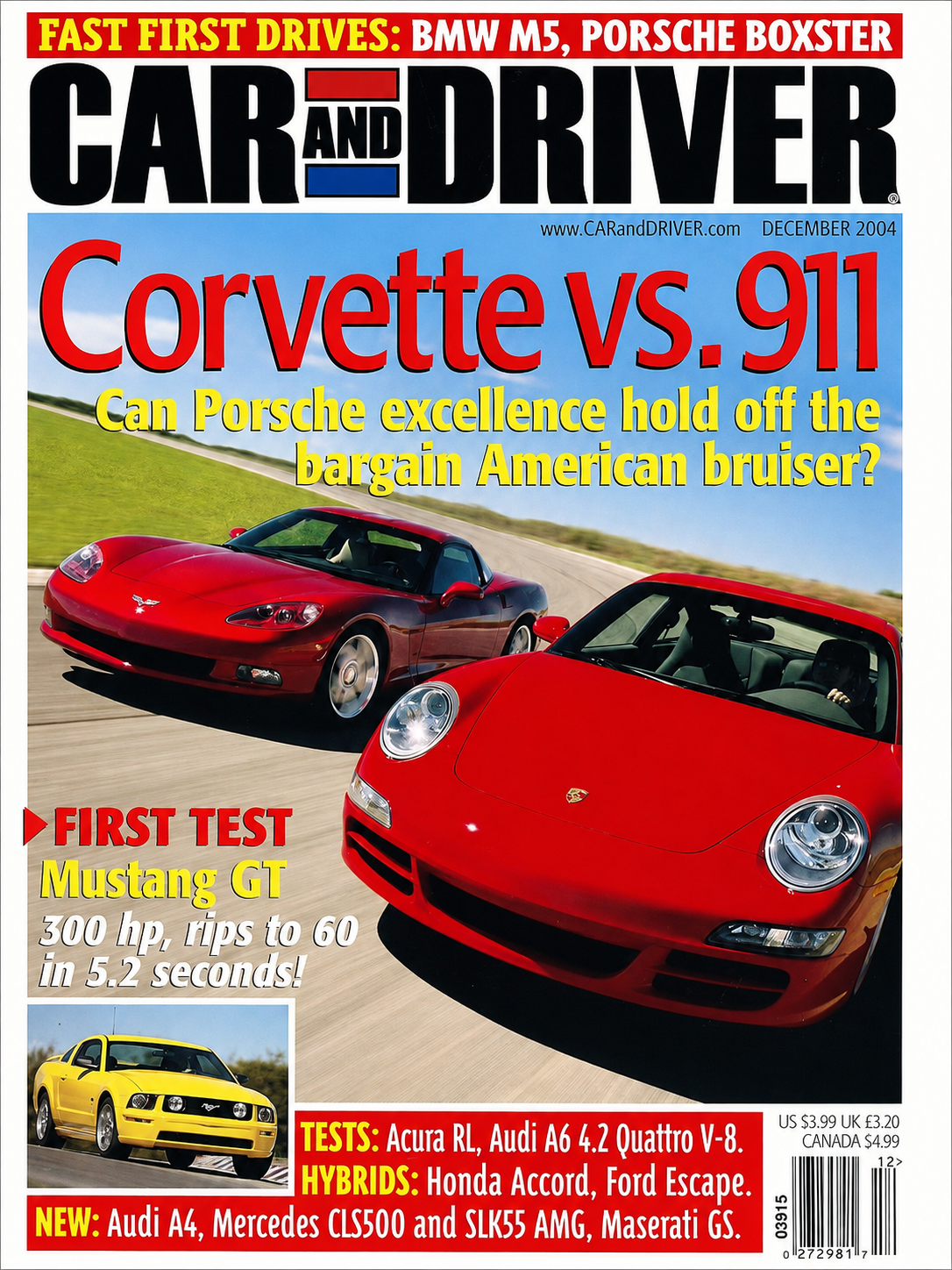
The Corvette countered with substantially greater power, quicker acceleration, slightly higher lateral grip, and the faster road-course lap. It was also remarkably comfortable at highway speeds, carried more standard convenience equipment, and offered performance that approached the threshold of a contemporary supercar while starting at $44,245—far below the Porsche’s $70,065 base price.
That price difference shaped the final result. Because the Porsche’s base price was 58 percent higher, Car and Driver expanded the value category within its scoring system, and the Corvette ultimately won the comparison by a single point. The Porsche remained the more polished and communicative machine in several important respects, but its advantage was not large enough to overcome the Corvette’s combination of speed, capability, equipment, comfort, and cost.
The significance of the comparison extended beyond the final score. The C6 had not suddenly become a Porsche built in Kentucky, nor was Chevrolet attempting to duplicate the character of the 911. Instead, the Corvette had advanced far enough to compete directly with one of the world’s most respected sports cars, matching or surpassing it in several objective measures while costing tens of thousands of dollars less.
That represented a meaningful change in the Corvette’s position. The C6 no longer needed to be defended merely as a powerful American alternative with an attractive price; it had become a legitimate participant in the international sports-car conversation, with performance strong enough to force the established European benchmarks to answer it.
Pricing and Equipment
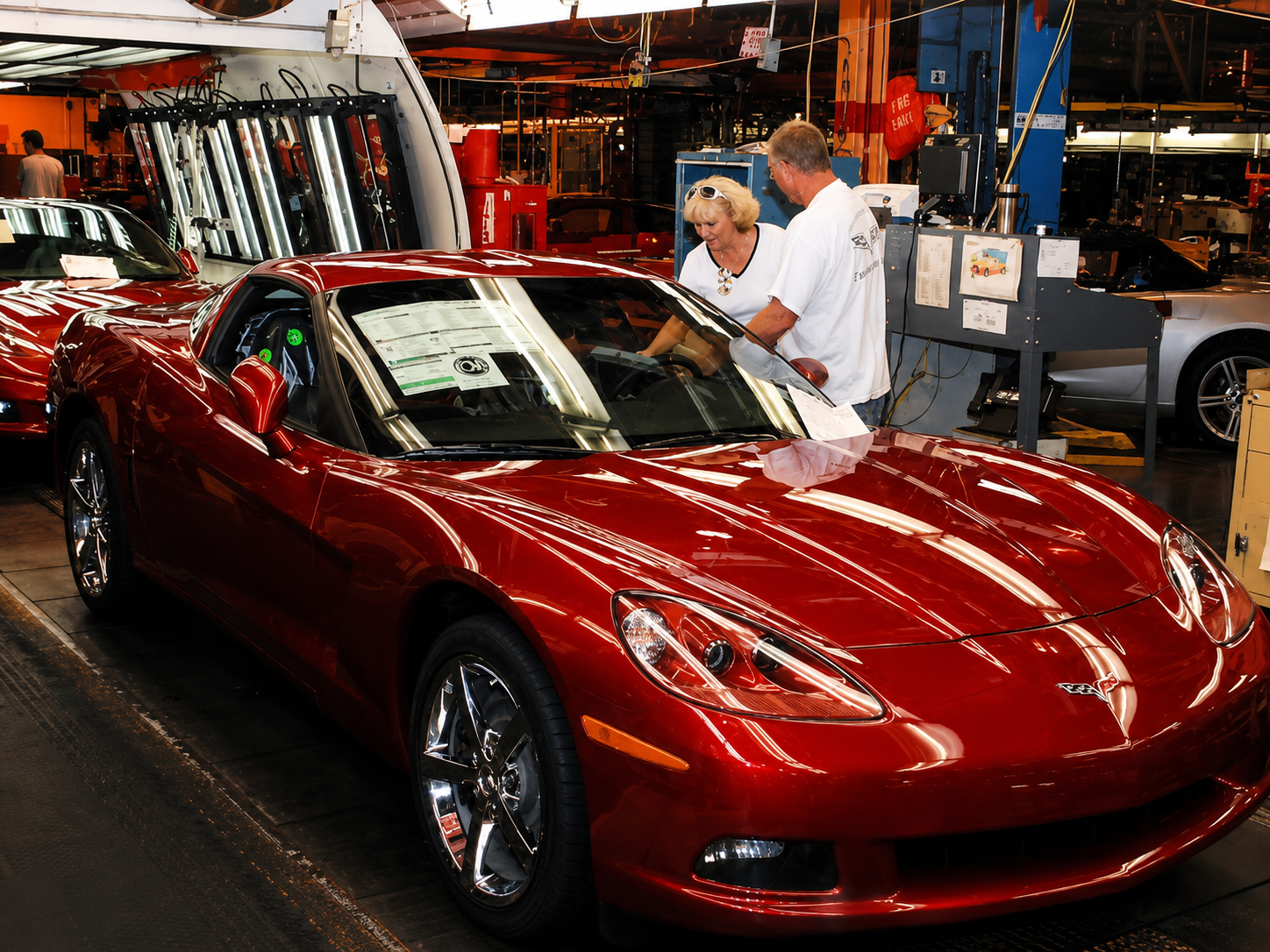
Chevrolet announced a starting MSRP of $44,245 for the 2005 Corvette coupe and $52,245 for the convertible, with both figures including an $800 destination charge. Those prices were particularly striking because the six-speed manual transmission was now standard, the new car offered considerably more power and equipment, and Chevrolet priced comparably configured manual-transmission models below their 2004 predecessors.
The standard-equipment list reflected the broader mission of the C6. In addition to the LS2 and six-speed manual, every Corvette received staggered 18- and 19-inch wheels, xenon low-beam headlamps, Keyless Access with push-button starting, automatic headlamps, cabin-air filtration, a power hatch pull-down, and an audio system capable of playing CDs and MP3 files. The four-speed automatic remained available as a no-cost alternative rather than an added-price option.
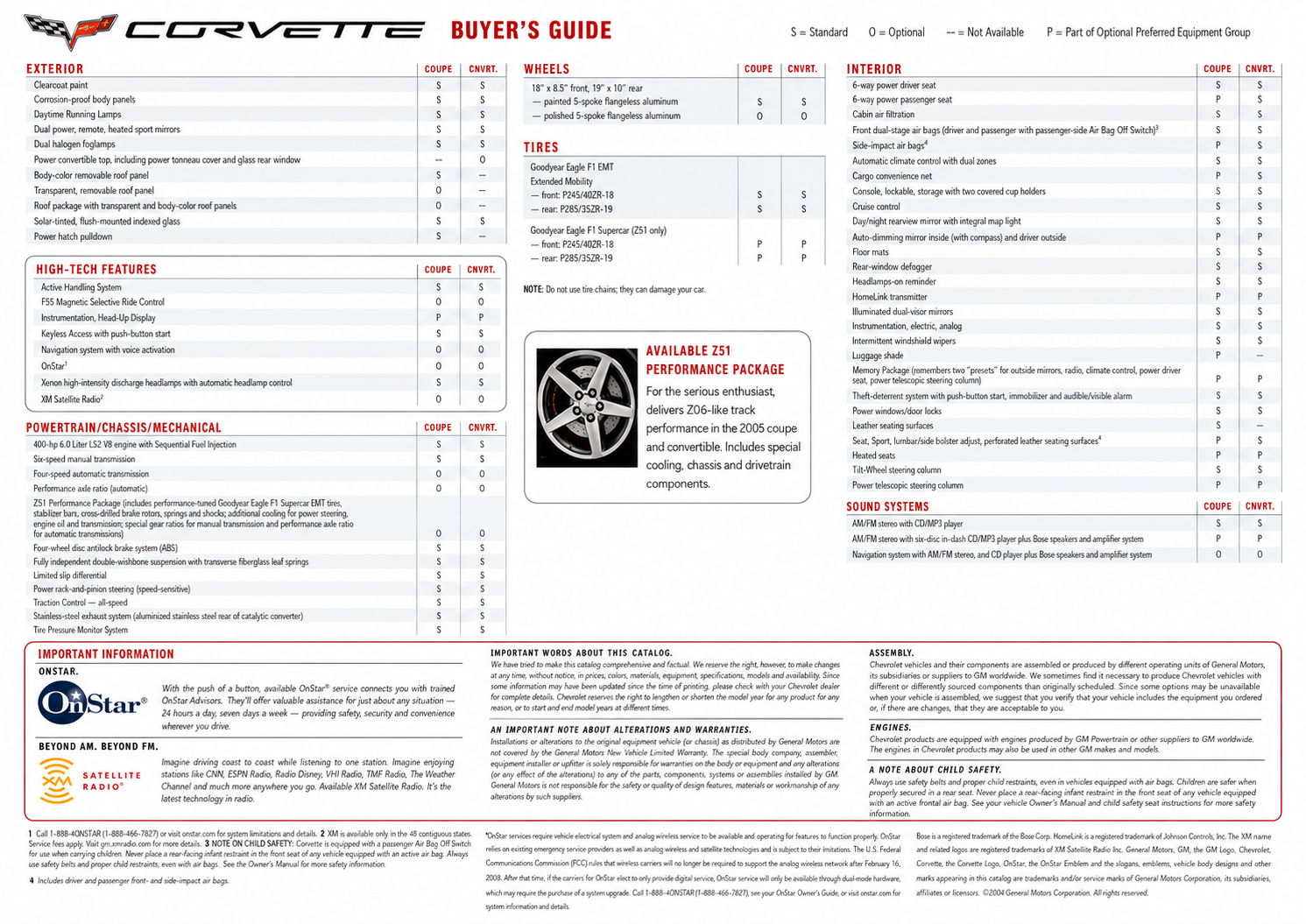
The options list demonstrated how far the Corvette had moved beyond the relatively sparse equipment traditionally associated with serious performance cars. XM Satellite Radio cost $325, OnStar approximately $695, the Bose DVD-navigation system $1,400, and the convertible’s power-operated roof $1,995. The Z51 Performance Package added $1,495, while F55 Magnetic Selective Ride Control cost $1,695.
Production totals show that most buyers did not approach the new Corvette as a stripped-down performance purchase. The 1SB Preferred Equipment Group appeared on 22,319 coupes and 10,306 convertibles, for a combined total of 32,625 cars—approximately 87.3 percent of the entire 37,372-car production run. Its principal additions included the head-up display, memory functions, power-telescoping steering column, heated seats, auto-dimming mirrors, HomeLink, and the premium Bose audio system with a six-disc changer.
Other option totals reinforce the same pattern. Polished aluminum wheels appeared on 27,080 Corvettes, XM Satellite Radio on 21,896, and OnStar on 19,634. These were not isolated indulgences selected by a small group of luxury-oriented buyers; they became defining elements of how the first-year C6 was commonly ordered.
Chevrolet’s production table separates the navigation system between two radio codes. URB, described as the Bose premium DVD-navigation system, appeared on 14,215 cars, while U3U—listed as the Bose DVD-navigation system with MP3 capability—appeared on another 4,676. Together, the entries account for 18,891 Corvettes, or approximately 50.5 percent of 2005 production, illustrating how quickly factory navigation became part of the model’s premium identity.
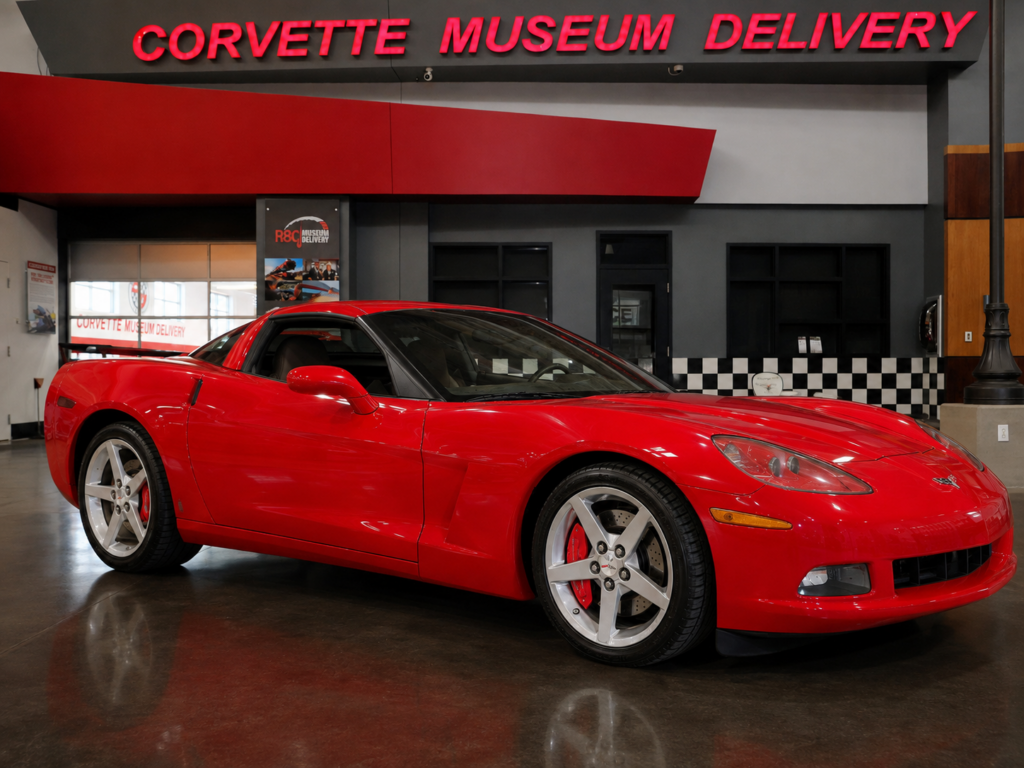
The National Corvette Museum’s R8C delivery program was selected by 831 buyers. Rather than receiving their cars through a conventional dealership handoff, those owners traveled to Bowling Green for a personalized museum delivery experience that connected the purchase of the car with the plant, the museum, and the larger history of the marque.
That relationship was unusual within the broader automobile market. For many owners, purchasing a Corvette was not simply a transaction but a personal milestone, and museum delivery allowed the beginning of ownership to become part of the story surrounding the car itself.
Colors and First-Year Production
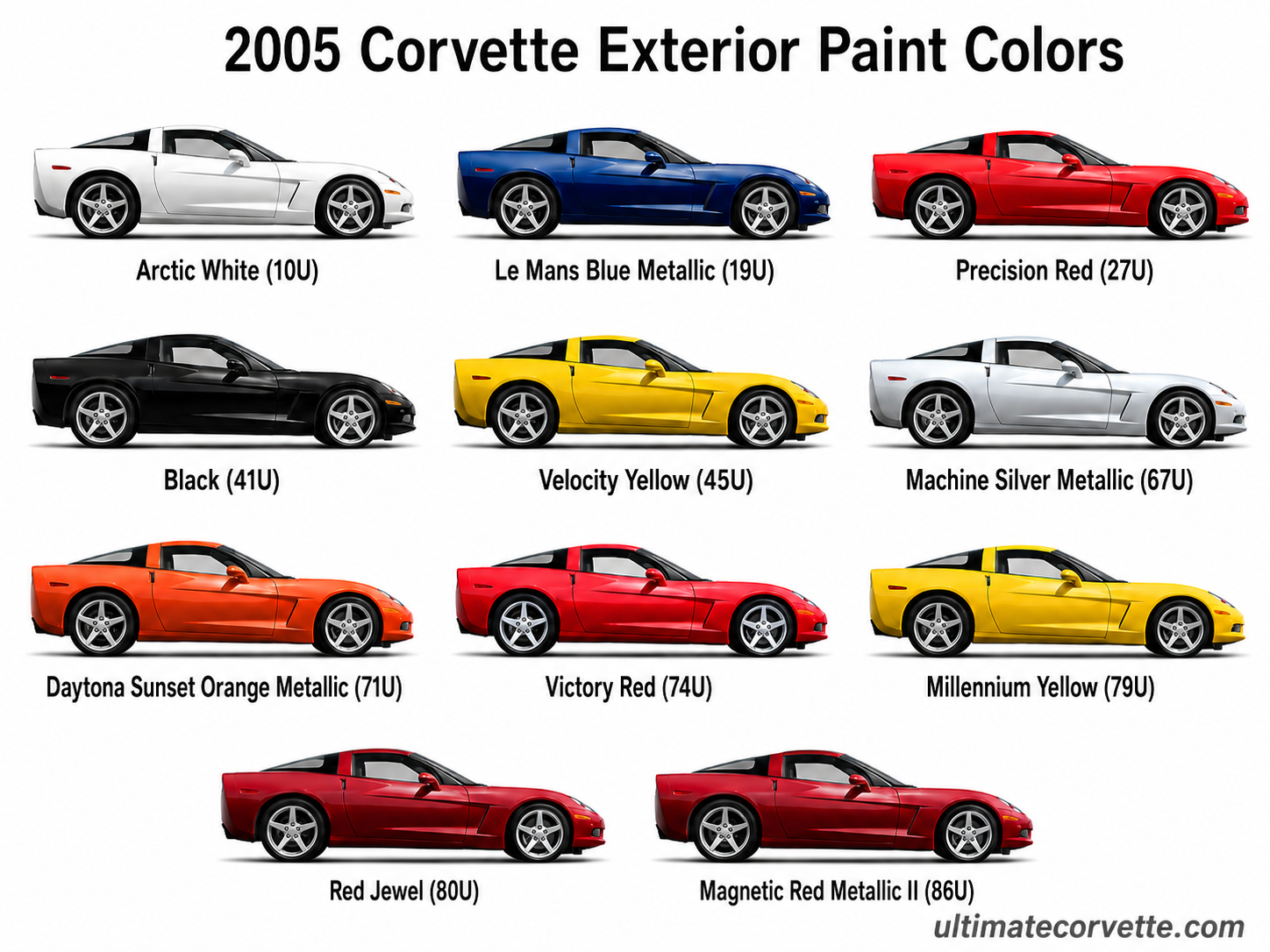
Chevrolet offered eleven exterior colors across the full 2005 model year, although the lineup changed as production progressed. Precision Red was discontinued in October 2004, while Victory Red became available after October, meaning the final production record contains more colors than a buyer would have found on a single order sheet at any one point in the year.
The complete palette consisted of Arctic White (10U), Le Mans Blue Metallic (19U), Precision Red (27U), Black (41U), Velocity Yellow (45U), Machine Silver Metallic (67U), Daytona Sunset Orange Metallic (71U), Victory Red (74U), Millennium Yellow (79U), Red Jewel (80U), and Magnetic Red Metallic II (86U). Black led production with 7,995 cars, followed by Machine Silver Metallic with 6,865, Victory Red with 5,617, Le Mans Blue Metallic with 3,759, Magnetic Red Metallic II with 3,404, Daytona Sunset Orange Metallic with 2,981, Millennium Yellow with 2,002, Arctic White with 1,968, Precision Red with 1,304, Velocity Yellow with 760, and Red Jewel with 717. Together, those totals account for every one of the 37,372 Corvettes built for the model year.
Black represented 21.4 percent of production, while Machine Silver Metallic accounted for another 18.4 percent, making neutral colors the dominant choices during the C6’s first year. Victory Red finished third at 15 percent, followed by Le Mans Blue Metallic at 10.1 percent and Magnetic Red Metallic II at 9.1 percent. Daytona Sunset Orange Metallic captured 8 percent, while each of the remaining colors accounted for less than 6 percent of production.
The red selections require additional explanation because Chevrolet used three distinctly different red finishes during the model year. Precision Red appeared on early-production cars before giving way to the brighter Victory Red, which ultimately became the far more popular choice, while Red Jewel occupied the deeper, more luxurious end of the spectrum. Chevrolet’s final 2005 production documentation identifies paint code 80U as Red Jewel; although later C6 literature frequently associates 80U with the Monterey Red name, Red Jewel is the appropriate designation when discussing the official 2005 production record.
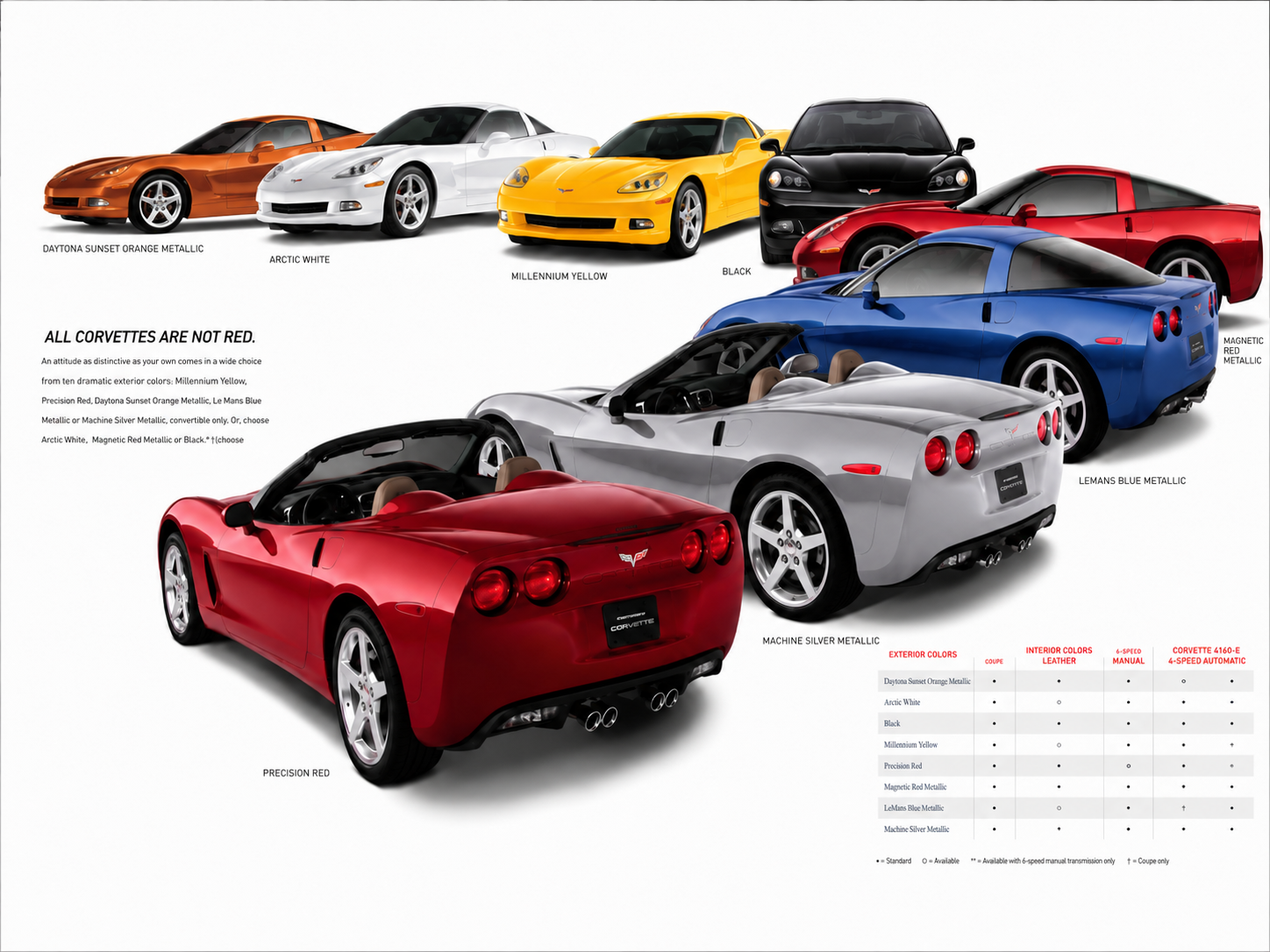
The breadth of the palette gave the first C6 several very different visual personalities. Black and Machine Silver Metallic emphasized the car’s tighter proportions and more technical appearance, while Victory Red preserved one of Corvette’s most familiar identities. Daytona Sunset Orange Metallic brought greater definition to the new fender lines and body creases, while Le Mans Blue Metallic reinforced the relationship between the production Corvette and Chevrolet’s increasingly successful racing program.
Bowling Green ultimately produced 37,372 Corvettes for 2005, divided between 26,728 coupes and 10,644 convertibles. Coupes accounted for approximately 71.5 percent of production, with convertibles representing the remaining 28.5 percent, and the final 2005 Corvette came off the assembly line on September 8, 2005.
That total represented an increase of 3,308 cars—or approximately 9.7 percent—over the 34,064 Corvettes built for the final C5 model year. It was a healthy beginning for an all-new generation, particularly because Chevrolet was asking buyers to accept several major visual departures, including exposed headlamps and a shorter, more tightly drawn body, while the outgoing C5 and its Z06 remained highly respected.
The first-year total was not an explosive sales surge, but it did not need to be. The 2005 model successfully established the new platform, proved that buyers would embrace the C6’s revised design and expanded capability, and gave Bowling Green the foundation from which the Z06 and the remainder of the sixth-generation Corvette family would soon emerge.
The C6.R Arrives (Alongside the 2006 Z06)
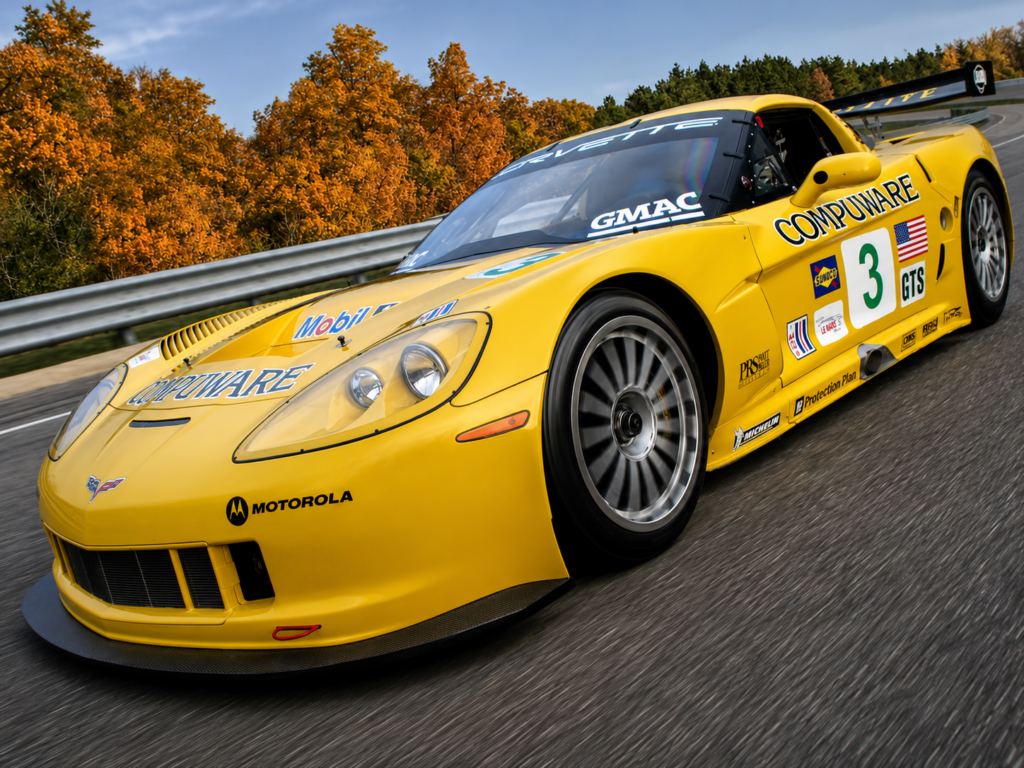
The production Corvette represented only one half of Chevrolet’s sixth-generation program. While engineers prepared the new C6 for showrooms, Corvette Racing and Pratt & Miller Engineering were developing the car that would carry the same design language into the most demanding endurance races in the world.
The new C6.R faced the unenviable task of replacing one of the most successful competition Corvettes ever built. By Chevrolet’s accounting at the beginning of 2005, the C5-R had accumulated 35 victories, three class wins at the 24 Hours of Le Mans, four championships, and a remarkable overall victory at the 2001 Rolex 24 at Daytona. It had done more than win races; it had transformed Corvette Racing from an ambitious factory program into one of the defining forces in international GT competition.
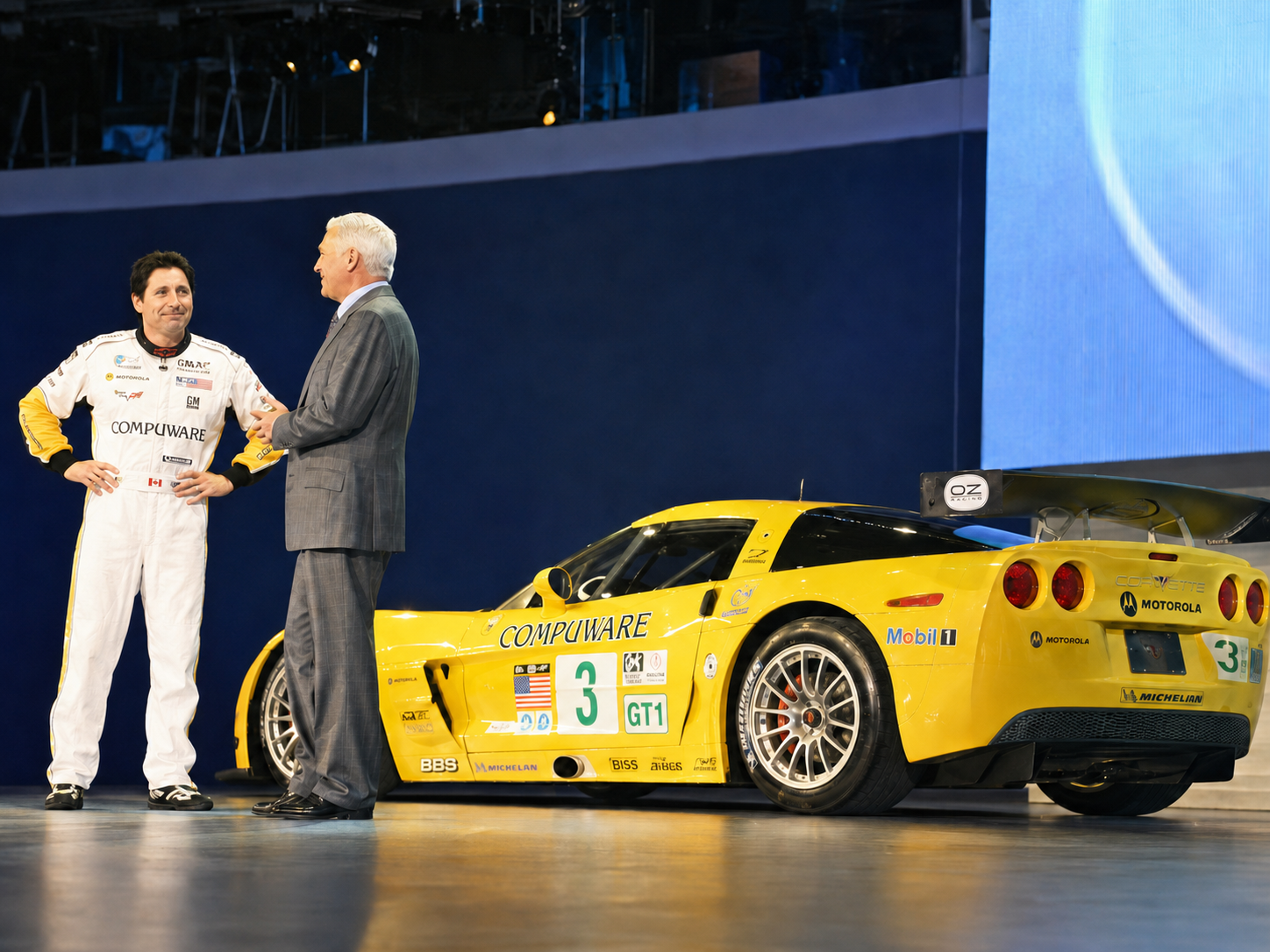
Chevrolet formally unveiled the C6.R in Detroit on January 10, 2005, after approximately a year of testing and development. Its competition debut was scheduled for the 12 Hours of Sebring that March, giving the team only a short interval between the public introduction and the first serious test of the new car. Harry Turner, GM’s group manager for road racing, called it “the best sports car we’ve ever built,” while acknowledging that the C5-R had established an extraordinarily high standard for its successor.
Although the C6.R was not simply a showroom Corvette fitted with a roll cage and racing tires, its connection to the production car was real. The race car’s hydroformed frame rails came from the same manufacturing process that supplied the Corvette Assembly Plant in Bowling Green, and its structure began with the production car’s basic frame-rail and center-tunnel concept before Pratt & Miller added the cage, composite floor, and competition-specific reinforcements required for endurance racing.
The new C6 body created opportunities as well as problems. Compared with the C5, the production C6 was shorter overall but rode on a longer wheelbase, leaving engineers with reduced front and rear overhangs and a different set of proportions around which to manage airflow, cooling, stability, and downforce. Those considerations became especially important at Le Mans, where the car needed to remain stable at close to 180 mph on the Mulsanne Straight without carrying so much aerodynamic drag that it sacrificed speed.
The production car’s flush headlamps, cleaner nose, and inherently lower-drag body gave the racing team a promising foundation. A front splitter and rear wing completed the visible transformation, while computational fluid-dynamics studies and extensive track testing allowed engineers to tune the car for the low-drag requirements of Le Mans or the greater downforce demanded at tighter circuits. Chevrolet reported that the resulting lift-to-drag balance was better than that of the outgoing C5-R, demonstrating that the C6’s shorter body did not prevent it from becoming a more aerodynamically effective race car.
Development of the C6.R also took place alongside the forthcoming 2006 Corvette Z06, creating one of the closest working relationships yet between Chevrolet’s production and racing organizations. Information moved in both directions through aerodynamics, cooling, chassis analysis, safety, weight reduction, engine durability, and high-speed testing, rather than flowing exclusively from the racetrack into the road car. Dave Hill, Corvette chief engineer and performance-cars vehicle-line executive, described the process as a genuine two-way exchange in which the production and competition teams learned from one another.
The relationship was particularly evident in the 7.0-liter small-block architecture developed for the C6.R and the new Z06. Both engines used dry-sump lubrication, CNC-ported aluminum cylinder heads, titanium valves and connecting rods, forged-steel crankshafts, and plate-honed cylinder bores, although the individual components and calibrations were tailored to entirely different operating environments. The race engine existed to survive repeated full-throttle operation under competition rules, while the LS7 in the Z06 also had to satisfy emissions, noise, drivability, warranty, and long-term durability requirements.
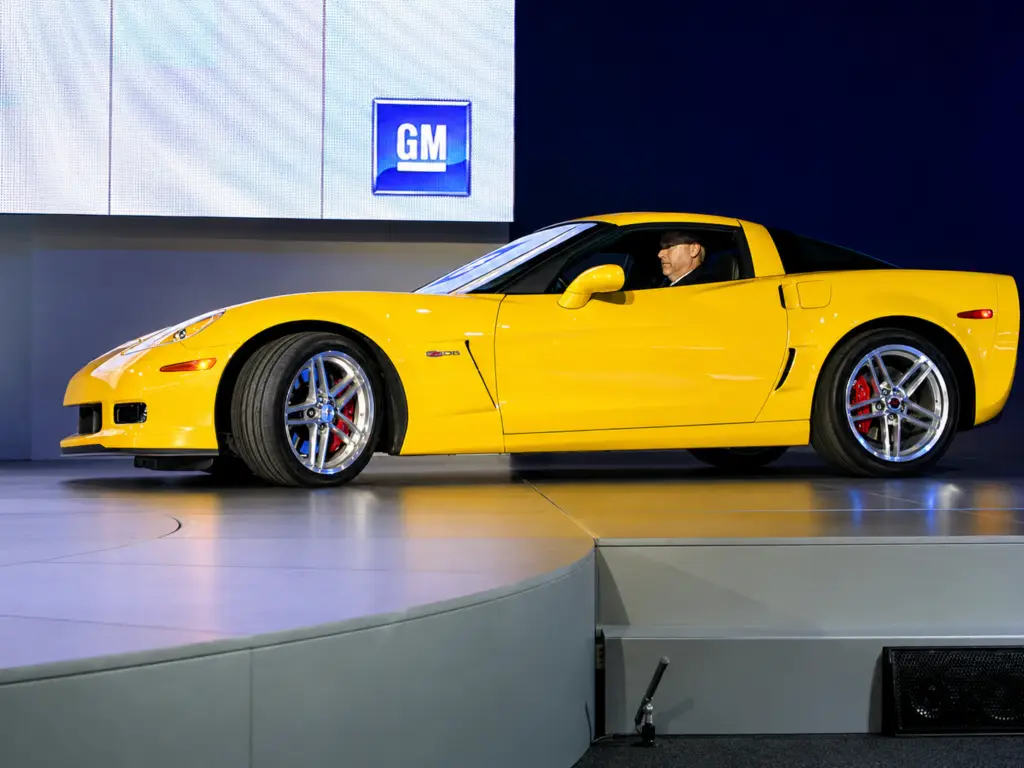
That distinction is significant because the road-and-race relationship was never based on the claim that the two cars were identical. Instead, the C6.R and Z06 shared an engineering philosophy: reduce unnecessary weight, move air efficiently, control heat, build structural strength where it was needed, and create an engine capable of delivering sustained performance rather than a brief burst of impressive power. The parts differed, but the questions confronting the engineers were often the same.
The C6.R’s first race at Sebring immediately demonstrated that the new car would not inherit the C5-R’s dominance without resistance. Aston Martin arrived with the new DBR9 and won the GT1 class on its competitive debut, providing Corvette Racing with a serious international rival and ensuring that the opening season would be defined by genuine competition rather than a ceremonial passing of the torch.
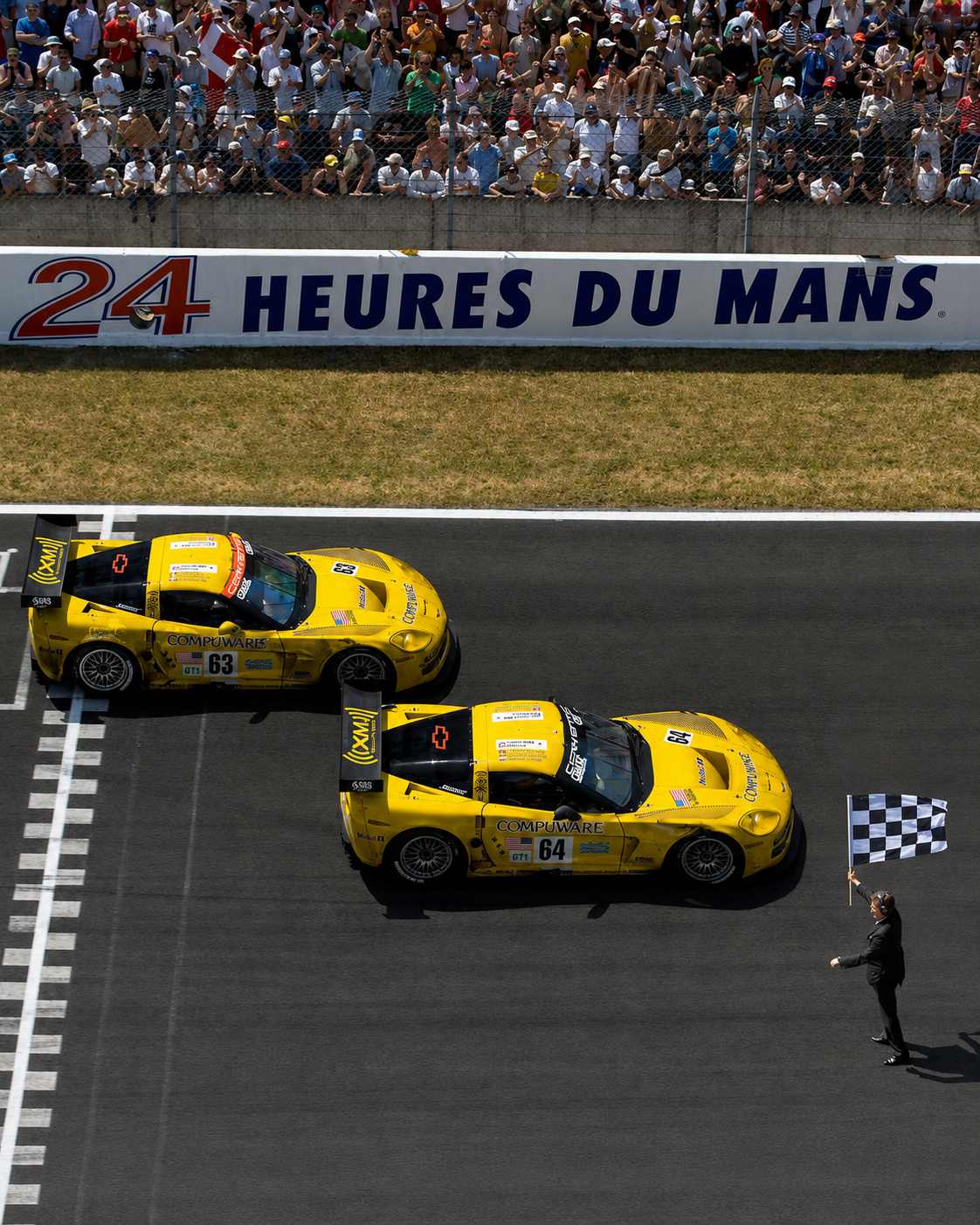
Three months later, the balance shifted at Le Mans. The No. 64 C6.R driven by Oliver Gavin, Olivier Beretta, and Jan Magnussen won the GT1 class, while the sister Corvette finished second, giving Chevrolet a one-two result in the C6.R’s first appearance at the race. For a new competition car to arrive at Le Mans and immediately reproduce the kind of result that had defined the C5-R era was an extraordinary validation of the entire program.
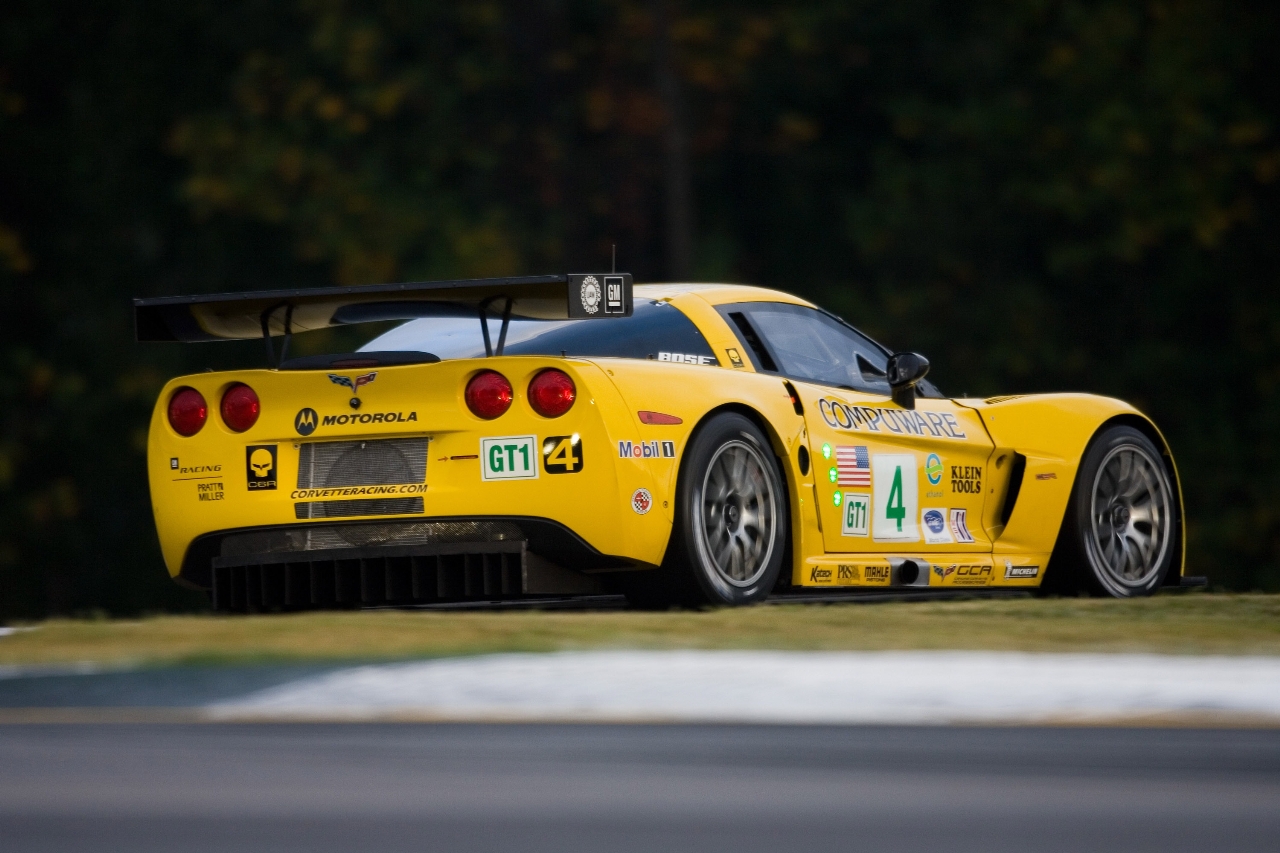
The success continued throughout the American Le Mans Series season. Gavin and Beretta won six of the ten rounds and shared the GT1 drivers’ championship, while Magnussen joined them for the endurance events, including their victory at Petit Le Mans. Corvette Racing also secured the GT1 team and manufacturer championships, making the C6.R a championship-winning successor in its first year rather than a promising new car still waiting to mature.
The importance of those results extended far beyond trophies and championship tables. The velocity-yellow C6.R gave the production Corvette immediate international credibility, becoming a familiar presence in advertisements, enthusiast magazines, dealership displays, and museum exhibits. Even Le Mans Blue carried a stronger meaning in that environment, connecting the road car’s color palette with Chevrolet’s increasingly visible presence in European endurance racing.
More significantly, the C6.R confirmed that racing had become part of Corvette’s institutional identity. This was no longer an occasional marketing venture or a privately supported effort operating at a distance from Chevrolet’s production engineers; it was a sustained factory program in which racing, design, powertrain development, and vehicle engineering formed part of the same culture.
The production C6 and the C6.R were built for different worlds, but they expressed the same priorities. Each emphasized low weight, aerodynamic efficiency, structural integrity, dependable power, effective cooling, and the ability to remain composed at speeds and loads that exposed weaknesses quickly. The C6.R did not merely advertise the new Corvette—it demonstrated, under the unforgiving conditions of endurance racing, the seriousness with which Chevrolet now approached America’s sports car.
First-Year Ownership and the Roof-Panel Recall
As the first production year of an entirely new generation, the 2005 Corvette developed a character that later C6 models would not completely share. Its LS2 engine, four-speed automatic, one-year steering-wheel design, early electronic architecture, and original color palette all distinguish it from the Corvettes that followed, giving the inaugural C6 a recognizable identity within the generation.
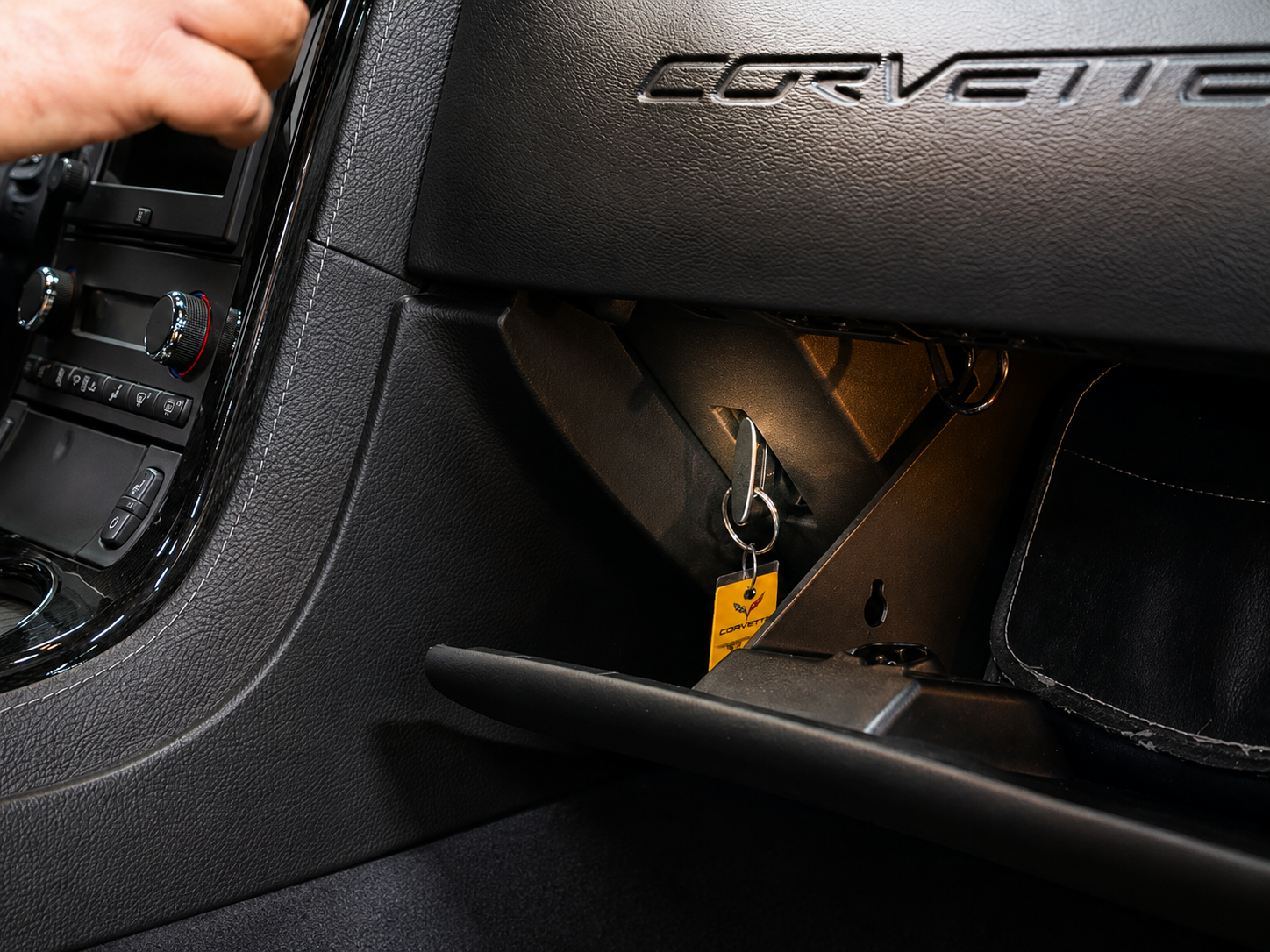
The new electronics also required owners to learn a slightly different relationship with the car. Keyless Access, push-button starting, electronic door releases, and indexed side windows replaced several familiar mechanical interactions, making the Corvette feel more advanced but also placing greater importance on battery condition and knowledge of the emergency procedures built into the car. The owner’s manual explained that a weak transmitter could be placed in a dedicated glove-box pocket to start the engine, while a complete loss of vehicle power required owners to use the manual door-release handles beside the seats or the driver-door release cable inside the rear compartment.
The indexed windows were another small but important part of that learning curve. Each window automatically lowered slightly when its door opened and returned to its fully raised position after the door closed, allowing the glass to clear the weather sealing before reseating itself. If battery power was interrupted, the indexing function could require reinitialization, making the procedure one of those practical details that experienced C6 owners quickly learned.
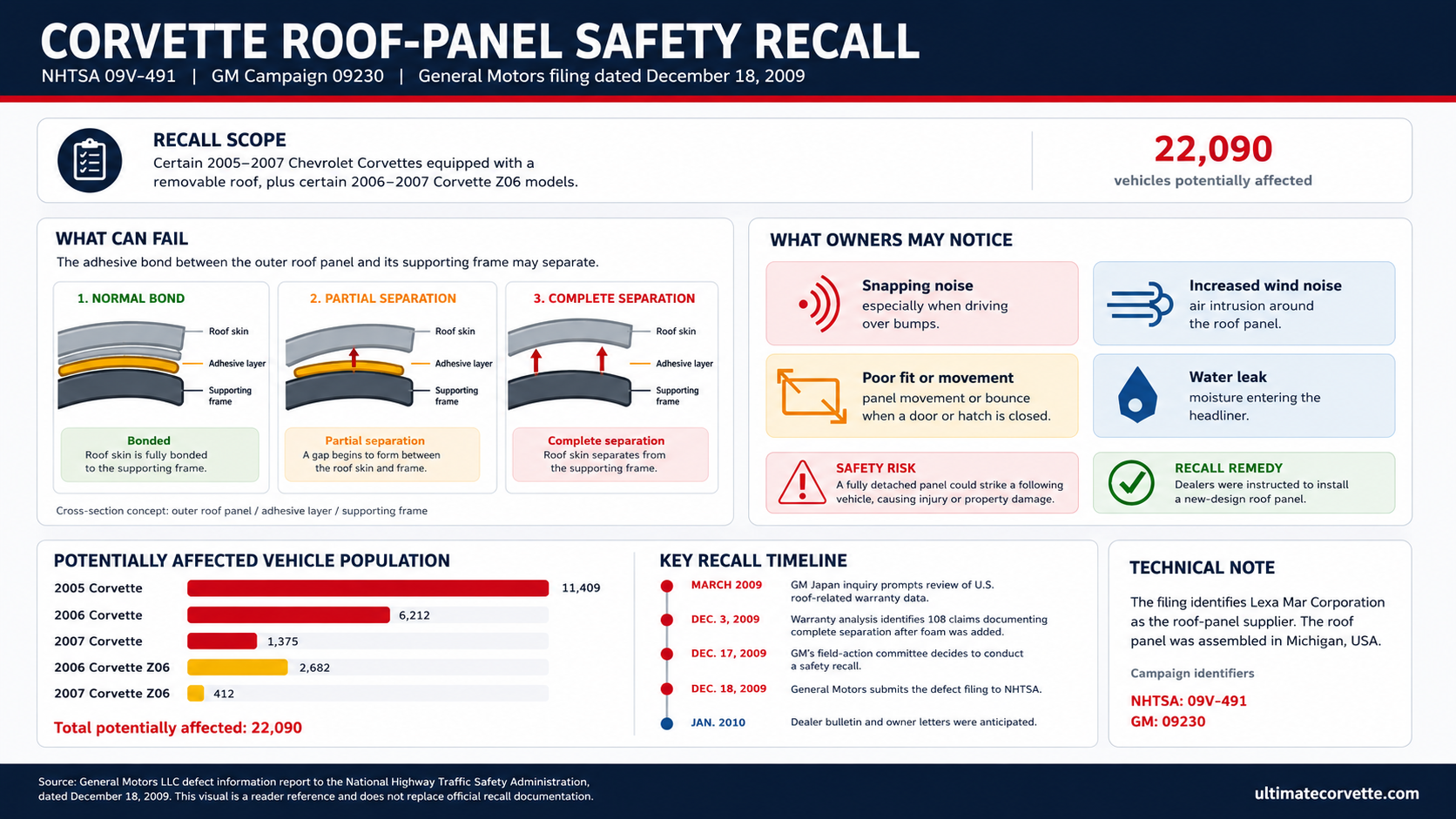
A more serious issue emerged around the removable roof panel. General Motors notified NHTSA in December 2009 of a safety defect involving certain 2005–2007 Corvettes equipped with removable roofs, as well as certain 2006–2007 Z06 models, creating NHTSA campaign 09V-491 and GM recall 09230. The concern centered on the adhesive joining the outer roof panel to its supporting frame, which could weaken and allow the two pieces to separate.
A partial separation could announce itself through snapping noises over bumps, increased wind noise, water entering the headliner, poor panel fit, or visible movement when a door or hatch was closed. A complete failure carried a much greater risk because the outer roof skin could detach while the Corvette was moving and become a hazard to traffic behind it. General Motors’ remedy was not simply to reapply adhesive but to have dealers install a redesigned roof panel at no charge.
The campaign did not mean that every 2005 coupe was recalled, nor did inclusion within the published production range automatically establish that a particular car required the repair. General Motors instructed dealers to verify eligibility through the vehicle’s identification and campaign history before beginning work, specifically noting that not every Corvette within the listed VIN breakpoints was involved. The 2009 action also followed an earlier recall, NHTSA campaign 06V-181, which addressed roof separation on certain 2005–2006 Corvettes equipped with body-color removable panels.
For a current owner or prospective buyer, the sensible course is to check the VIN through Chevrolet or NHTSA and confirm that every applicable recall has been completed. Owners should also inspect the panel for unusual movement, poor alignment, unexplained wind noise, moisture intrusion, or evidence that an earlier repair was performed improperly.
The roof-panel campaign remains part of the 2005 Corvette’s ownership history, but it should not be allowed to define the entire car. Properly maintained examples continue to offer the combination of LS2 performance, long-distance comfort, usable cargo capacity, and everyday practicality that made the first C6 so compelling when it was new. Its first-year details require a little more knowledge and attention, but those same details have also made the 2005 Corvette one of the most distinctive models of the sixth-generation era.
Why the 2005 Corvette Still Matters Today
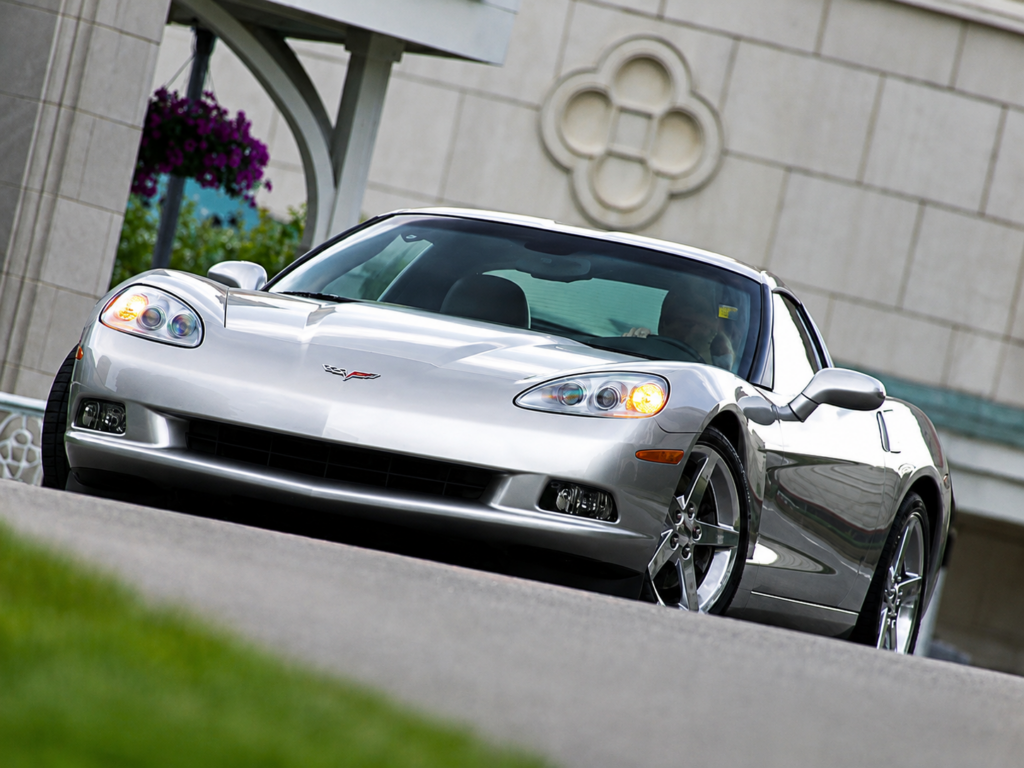
The 2005 Corvette does not occupy the same historical position as the original 1953 roadster, the 1963 Sting Ray, or the first mid-engine C8. It did not overturn the Corvette’s established architecture, nor did it ultimately become the fastest, most powerful, or most exclusive member of the sixth generation. Its continuing significance comes from something less dramatic but equally important: it demonstrated how comprehensively Chevrolet could improve an already successful formula without sacrificing the qualities that made the Corvette distinctive.
That achievement remains visible in the car today. The C6 was shorter, narrower, and more aerodynamic than the C5, yet it preserved generous passenger room and exceptional cargo capacity. Its 6.0-liter LS2 placed 400 horsepower and 400 pound-feet of torque in every coupe and convertible, bringing the standard Corvette to within five horsepower of the outgoing C5 Z06 while matching its peak torque. The chassis retained the Corvette’s proven suspension layout, but its individual components, geometry, bushings, dampers, springs, stabilizer bars, and steering system were substantially reconsidered for the new generation.
The exposed headlamps broke with a production tradition that had extended from 1963 through 2004, but they reduced weight, drag, and mechanical complexity while giving the C6 an identity unmistakably separate from the car it replaced. Shorter overhangs and a longer wheelbase produced tighter proportions and a more compact road presence, while the available Z51 Performance Package brought the standard Corvette remarkably close to the track capability of the preceding Z06. The result was a car that respected Corvette history without allowing tradition to prevent meaningful progress.
Its contemporary performance helps explain why the original C6 remains so compelling. With the Z51 package and six-speed manual transmission, Car and Driver recorded a 4.1-second sprint to 60 mph, a 12.6-second quarter-mile at 114 mph, and 0.98 g of lateral grip. The Corvette also lapped GingerMan Raceway 2.3 seconds faster than the Porsche 911 Carrera tested alongside it and ultimately won the comparison by a single point. Those figures established the 2005 Corvette as far more than an impressive automobile for its price; they placed it in direct competition with some of the world’s most respected sports cars.
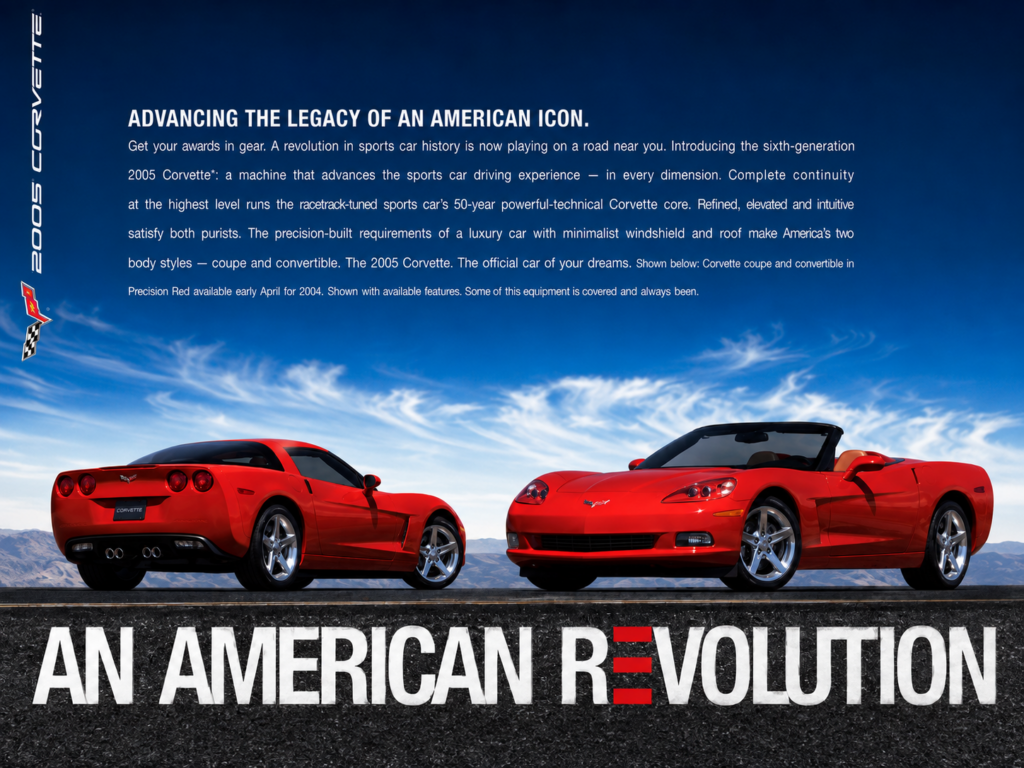
Value was nevertheless central to its identity. Chevrolet announced the coupe at $44,245, including destination, and included a 400-horsepower V-8, six-speed manual transmission, large staggered wheels and tires, xenon low-beam headlamps, Keyless Access, push-button starting, and a level of everyday practicality uncommon among cars with comparable performance. It could accelerate with extraordinary force, carry luggage for a serious road trip, cruise comfortably for long distances, and return respectable highway fuel economy. Few automobiles combined those abilities so convincingly, and fewer still did so at anything approaching the Corvette’s price.
The 2005 model also matters because of everything its architecture made possible. The C6.R won the GT1 class at Le Mans and helped secure the ALMS GT1 team and manufacturer championships during its first season. At the same time, Chevrolet was preparing the 505-horsepower Z06, whose aluminum frame, 7.0-liter LS7, dry-sump lubrication, and competition-oriented construction demonstrated how far the basic sixth-generation concept could be extended. The Grand Sport and supercharged ZR1 would carry that development still further during the years that followed.
Time has not erased the first-year C6’s shortcomings. Its steering lacked the clarity and communication of the contemporary Porsche 911, its seats did not provide all the lateral support its chassis deserved, and its improved interior still fell short of the material richness offered by more expensive European competitors. The four-speed automatic also became dated almost immediately when Chevrolet introduced a six-speed automatic for 2006. Today, those limitations help define the 2005 model as a product of its period, but they do not diminish the scale of what Chevrolet accomplished.
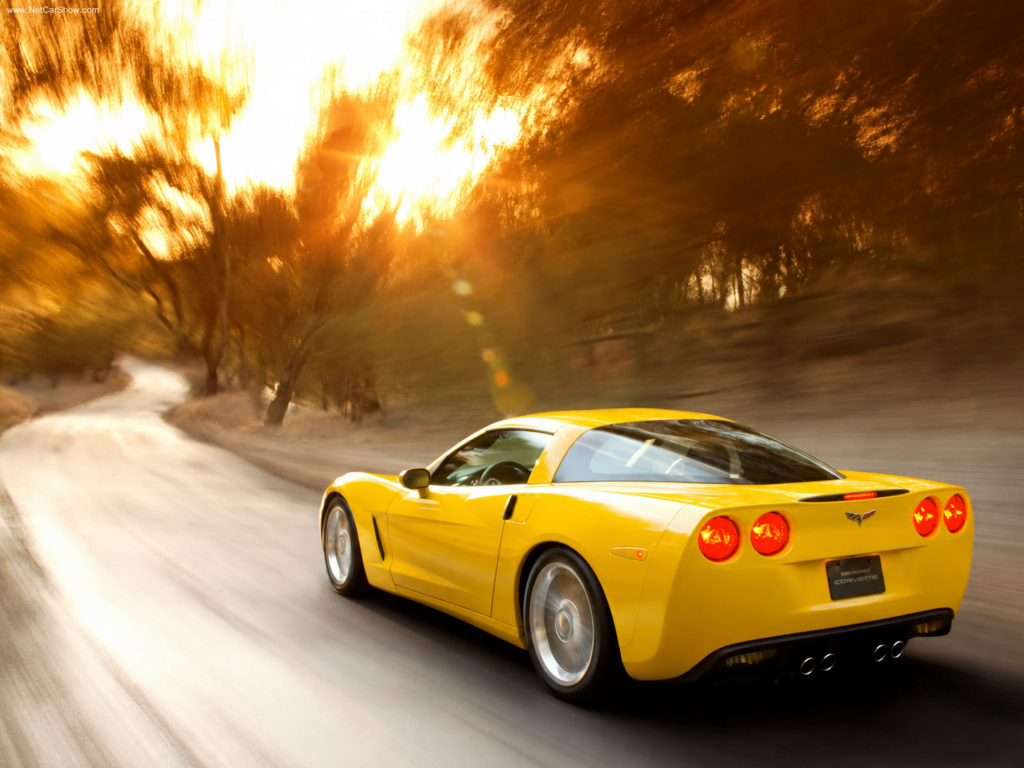
More than two decades after its introduction, the 2005 Corvette remains one of the clearest expressions of the traditional Corvette formula: a compact pushrod V-8 mounted low and behind the front axle, a rear-mounted transaxle, rear-wheel drive, a removable roof, substantial luggage space, and performance capable of challenging far more expensive machinery. It belongs to an era before increasingly complex driver interfaces and the Corvette’s eventual transition to a mid-engine layout, yet it possesses enough refinement and technology to remain entirely usable as a modern performance car.
That balance is ultimately why the 2005 Corvette still deserves attention. It preserved the front-engine character that had defined the marque for more than half a century while creating the foundation for some of the most formidable production and racing Corvettes Chevrolet had yet built. Before the 505-horsepower Z06, the wide-bodied Grand Sport, and the supercharged ZR1, there was the original LS2-powered C6—a Corvette that showed how much performance, sophistication, and versatility could still be extracted from a proven idea.
Everything the sixth generation later became began with the 2005 Corvette.