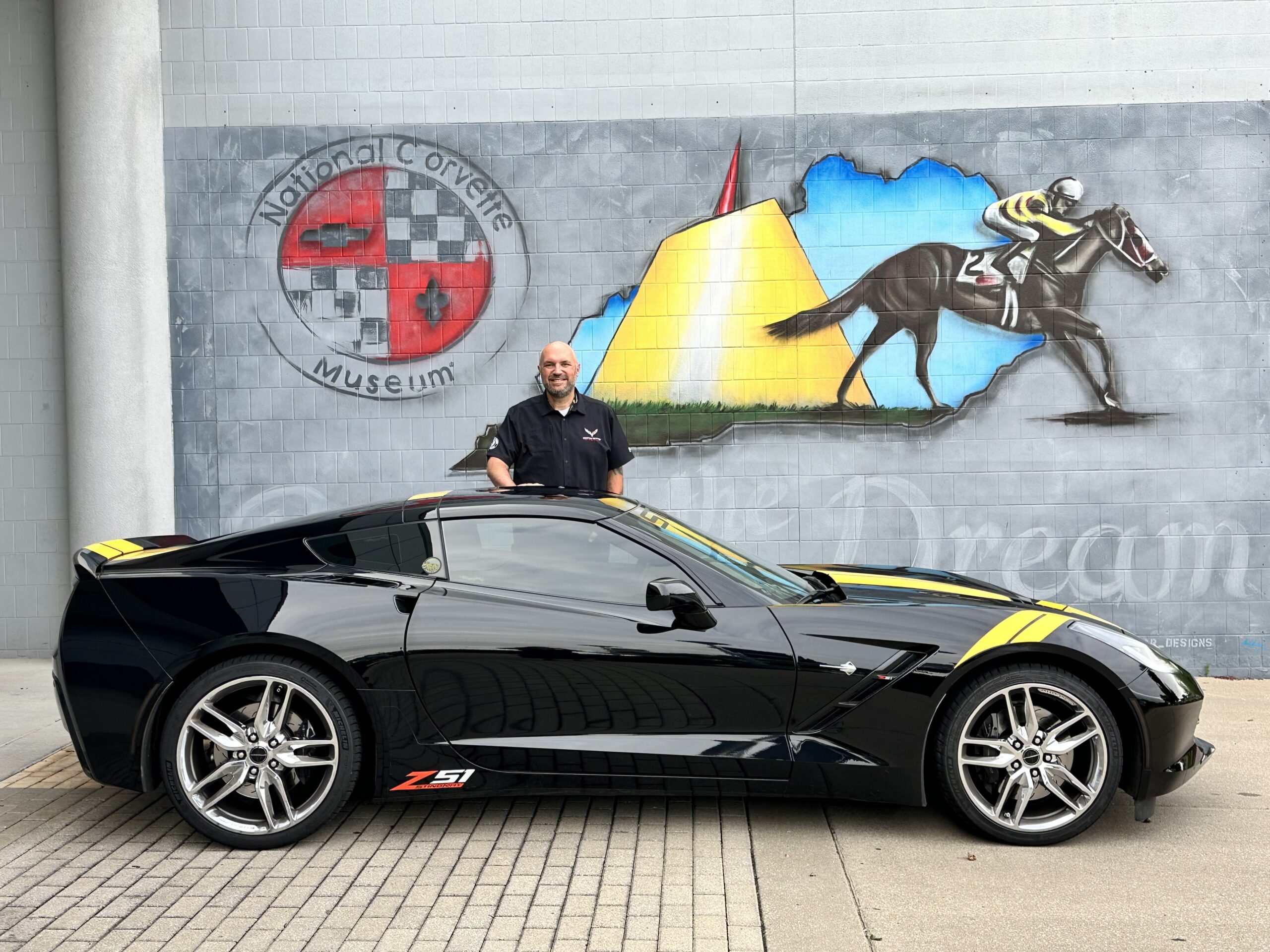

By the time Chevrolet introduced the 1976 Corvette, America’s sports car had already survived one of the most turbulent periods in the history of the American automobile. In less than a decade, the industry had moved from inexpensive high-octane gasoline, rising compression ratios and an almost unrestricted horsepower war to unleaded fuel, catalytic converters, increasingly stringent emissions requirements, rising insurance costs and the lingering effects of the 1973–74 energy crisis. Engines that only a few years earlier had been advertised with 400 horsepower or more had disappeared, and several of the cars that had defined American performance during the late 1960s were either gone entirely or transformed into something very different.
The Corvette survived, but it had changed as well. The big-block engine disappeared after 1974, followed by the convertible after 1975. The chrome bumpers, high-compression engines and brutally powerful optional powerplants that had helped define the Corvette during the previous decade had already become part of its history. Even Zora Arkus-Duntov, the engineer who had spent more than twenty years pushing Chevrolet’s sports car toward ever greater levels of performance, had retired at the beginning of 1975. For anyone measuring the Corvette strictly against what it had been five or six years earlier, the direction seemed unmistakable.
But something important happened in 1976. For the first time in several years, Corvette horsepower increased.
The standard L48 350-cubic-inch V8 rose from 165 horsepower in 1975 to 180 horsepower for 1976, while the optional L82 increased from 205 to 210 horsepower. Neither number was spectacular, particularly when compared with the Corvettes Chevrolet had sold less than a decade earlier, but their significance was not found entirely in the numbers themselves. The regulatory environment had not suddenly become easier. The catalytic converter remained, unleaded fuel remained mandatory, emissions requirements were still shaping engine calibration, and Chevrolet was not returning to the high-compression formulas of the 1960s. Instead, Chevrolet’s engineers were beginning to recover performance while working within those restrictions, and that represented a fundamental change from the direction Corvette performance had been moving during the first half of the decade.

At the same time, engineers continued improving areas of the Corvette that had little to do with peak horsepower. The induction system was redesigned. A partial steel underbody was incorporated into the forward floor structure to increase rigidity and better isolate the passenger compartment from engine and exhaust heat. Astro Ventilation disappeared. Automatic transmission applications were revised. A maintenance-free Delco Freedom battery became standard. An electrically heated rear-window defogger replaced the earlier forced-air arrangement, and the cast-aluminum wheels Chevrolet had struggled to bring into regular production finally became a legitimate factory option.
None of these changes dramatically transformed the appearance of the car. From across a parking lot, a 1976 Corvette still looked very much like the C3 that had arrived for 1968. Underneath that familiar shape, however, Chevrolet was methodically improving the automobile, addressing heat, noise, drivability, maintenance and structural refinement while beginning the slow process of recovering the performance that had been lost earlier in the decade.
Buyers apparently approved. Chevrolet produced 46,558 Corvettes for the 1976 model year, all of them coupes, establishing a new model-year production record. The result was particularly remarkable because the Corvette was becoming considerably more expensive. Its base price had climbed to $7,604.85, and a heavily optioned example could move comfortably beyond $10,000. Customers continued buying them anyway, demonstrating that Corvette’s appeal had grown beyond the horsepower figure printed in the sales brochure.
The contemporary automotive press also discovered that the Corvette retained considerably more capability than its modest horsepower ratings suggested. In a 1976 Car and Driver comparison intended to identify America’s fastest production automobile, an L82-powered Corvette equipped with an automatic transmission reached 124.5 mph. It was faster than the Pontiac Trans Am, Dodge Dart Sport 360, Ford Mustang II Cobra II and even a 454-powered Chevrolet C10 pickup included in the test. The Corvette was down on displacement and advertised horsepower compared with some of those competitors, yet its combination of aerodynamics, gearing and chassis efficiency allowed it to emerge as the fastest of the group.
That contradiction sits near the heart of the 1976 Corvette story. This was not a return to the horsepower wars, nor was Chevrolet pretending that the regulatory and economic changes of the previous five years had never happened. Instead, the company was beginning to demonstrate that performance could eventually be recovered through better engineering rather than simply greater displacement and compression. The 1976 Corvette was therefore neither the end of the old era nor the beginning of an entirely new one. It occupied the space between them, and for the first time in years, the numbers were beginning to move in the right direction.
David McLellan and a Corvette Without Duntov

The transition from Zora Arkus-Duntov to David McLellan was considerably more complicated than simply replacing one Corvette chief engineer with another. Duntov had joined Chevrolet in 1953 and spent the following two decades shaping nearly every aspect of the Corvette’s evolution. He pushed for V8 power, better brakes, improved suspension geometry, fuel injection, stronger transmissions and increasingly serious competition capability. His influence extended far beyond individual components because Duntov helped establish the fundamental idea that performance had to remain central to Corvette’s identity.
When Duntov retired on January 1, 1975, Chevrolet did not merely lose an engineer. It lost the individual most closely identified with the engineering philosophy of the Corvette itself. David McLellan became only the second chief engineer in the car’s history, and the timing could hardly have been more challenging.
Duntov had spent much of his career asking how fast Chevrolet could make the Corvette. McLellan inherited a period in which that question had become considerably more complicated. Corvette still had to perform, but it also had to satisfy emissions requirements, operate on unleaded gasoline, meet increasingly demanding safety standards, control noise, deliver acceptable fuel economy and remain profitable within General Motors. The regulatory environment was no longer something Corvette engineering could work around or regard as a temporary inconvenience. It had become a permanent part of the engineering problem.

That distinction would ultimately help define McLellan’s tenure. He had joined General Motors in 1959 after earning an engineering degree from Wayne State University and had become involved with Corvette development before succeeding Duntov. McLellan did not possess Duntov’s public persona, nor did he attempt to imitate it. Where Duntov often approached Corvette development with the instincts of a racer, McLellan increasingly viewed the automobile as an integrated engineering system, an approach that would become essential as emissions, aerodynamics, electronics and fuel economy became inseparable from performance.
The easiest paths to horsepower had disappeared. Chevrolet could no longer simply add compression, camshaft, carburetion and displacement without considering what those changes would do to emissions, fuel economy, drivability, durability and certification. Future gains would increasingly have to come from better combustion, improved airflow, more precise ignition, optimized gearing, reduced parasitic losses, improved aerodynamics and, eventually, electronic engine management.
Much of that technology remained years away in 1976, and it would be inaccurate to credit McLellan personally with every change appearing on the car during his first complete model year. Automotive development cycles are long, and many of the improvements incorporated into the 1976 Corvette had been initiated while Duntov was still actively involved with the program. Still, the direction of Corvette engineering was changing. The organization was moving away from a period defined primarily by the loss of performance and toward one focused on recovering it within a completely different set of rules.
The horsepower increases for 1976 were modest evidence of that transition, while the numerous engineering improvements beneath the car provided more. McLellan would eventually oversee one of the most consequential transitions in Corvette history: the replacement of the long-running C3 with the dramatically more sophisticated fourth-generation Corvette. That future remained several years away. For 1976, his responsibility was considerably more immediate—continue improving the Corvette Chevrolet already had while determining what the next Corvette would eventually need to become.
An Aging Design That Refused to Become Irrelevant

When the third-generation Corvette debuted for 1968, its appearance was startling. The production car drew heavily from the Mako Shark II concepts created under GM styling chief Bill Mitchell, translating their exaggerated proportions into something Chevrolet could actually manufacture. The long hood, sharply peaked fenders, narrow waist and abbreviated rear deck made the new Corvette appear almost impossibly dramatic beside most other American automobiles.
By 1976, that same basic design was entering its ninth model year. Ordinarily, that would have made the Corvette ancient. American manufacturers of the period frequently replaced or substantially restyled their cars after only a few years. Yet the C3’s appearance had proven unusually durable, in part because the original design had been so extreme that it never depended heavily upon conventional styling trends.
Chevrolet had also continued modifying it. The chrome front bumper disappeared for 1973, replaced by a body-colored energy-absorbing nose. The rear chrome bumpers followed for 1974, and for 1975 Chevrolet replaced the two-piece rear bumper cover with a cleaner one-piece molding. By 1976, the C3 had evolved significantly from the car introduced eight years earlier even though its fundamental proportions remained intact.

The absence of a major restyle for 1976 did not indicate that Chevrolet had stopped developing the car. Much of the work had simply moved beneath the surface, although there were visible changes for anyone who knew where to look. The hood was unique to the model year because Chevrolet revised the engine’s air-induction system. Earlier C3s drew induction air from the high-pressure region near the base of the windshield. While effective in principle, the arrangement could generate an objectionable intake howl that entered the passenger compartment. For 1976, Chevrolet moved the air pickup forward, drawing air from the region above the radiator instead. The change eliminated the earlier induction noise and required a revised hood configuration.
Chevrolet also eliminated Astro Ventilation, allowing the vents previously located on the rear deck to disappear. Their removal cleaned up the surface behind the rear window and subtly simplified the Corvette’s appearance. At the back of the car, the individual CORVETTE letters used previously gave way to a one-piece nameplate positioned between the familiar pairs of round taillamps.
None of these changes would have been enough to convince anyone that Chevrolet had redesigned the Corvette, but that was never the objective. By 1976, the C3 shape itself had become part of Corvette’s identity. Chevrolet did not need to reinvent it simply to demonstrate progress. The engineering organization was increasingly focused on making the automobile beneath that shape quieter, cooler, stronger and easier to live with while preserving the visual character that continued attracting buyers into Chevrolet showrooms.
For the First Time, Every Corvette Was a Coupe

One of the most significant changes to the 1976 Corvette lineup involved a model Chevrolet no longer offered. There was no convertible.
For the first time in Corvette history, Chevrolet entered a complete model year offering only a closed body style. That represented a remarkable reversal for an automobile that had begun life exclusively as a roadster. Every one of the 300 Corvettes Chevrolet built for 1953 had been open, and when the second-generation Sting Ray arrived for 1963, Chevrolet finally offered buyers a true coupe alongside the traditional convertible. Both body styles remained part of the Corvette lineup throughout the C2 generation and well into the C3.
By the middle of the 1970s, however, convertible demand had declined sharply. Chevrolet sold only 4,629 Corvette convertibles for 1975 compared with 33,836 coupes. Changing consumer tastes played a role, as did concerns surrounding potential federal rollover standards that many manufacturers feared would make open cars increasingly difficult to certify. The widely anticipated federal prohibition on convertibles never materialized, but manufacturers had already reacted to the possibility. Chrysler had abandoned convertibles, Ford had done the same, and Cadillac famously marketed its 1976 Eldorado as the final American convertible.
Chevrolet discontinued the Corvette roadster after 1975. In retrospect, the decision feels especially consequential because the convertible would not return until the fourth-generation Corvette was well established. Chevrolet finally restored an open Corvette for 1986, leaving a ten-model-year gap in which every Corvette was a coupe.

The C3‘s removable roof panels made that transition considerably easier. Introduced with the third-generation car, the twin removable panels provided much of the open-air experience without sacrificing the fixed windshield header, center roof bar and rear structure. An owner could remove one panel or both, store them and dramatically change the character of the car without dealing with a folding fabric roof. It was not a convertible, but for a growing number of buyers it was apparently close enough.
The disappearance of the roadster also reflected a broader change in how customers were using Corvettes. Air conditioning was becoming nearly universal. Automatic transmissions dominated production. Power windows, upgraded interiors, stereo radios and tilt-and-telescoping steering columns appeared on enormous percentages of cars. Corvette was still a sports car, but it was increasingly being asked to function as a grand touring automobile as well. The 1976 option totals make that transition impossible to ignore.
Two Engines, One Displacement and Two Very Different Personalities

The Corvette engine catalog had once been almost bewildering. During the 1960s, buyers could choose among multiple small-block and big-block combinations with different carburetion, compression ratios, camshafts and power ratings. At various points, Chevrolet offered everything from relatively mild base engines to solid-lifter big-blocks producing more than 400 advertised horsepower.
By 1976, the engine lineup had been reduced to two choices, both displacing 350 cubic inches. The standard engine was the L48, while the optional performance engine was the L82. On paper, the difference was thirty horsepower. Mechanically and in the way the two engines delivered their power, the differences ran considerably deeper.
The 180-Horsepower L48

The standard engine beneath the hood of the 1976 Corvette was Chevrolet’s familiar L48 350-cubic-inch small-block V8, rated at 180 SAE net horsepower and 270 lb-ft of torque. On paper, those numbers remain modest when compared with the extraordinary outputs associated with Corvettes from only a few years earlier. Viewed within the context of the mid-1970s, however, the L48 represented something considerably more encouraging. Corvette performance had stopped moving backward. For 1976, Chevrolet extracted another fifteen horsepower from its standard engine, raising output from the 165 horsepower offered in 1975 to 180 horsepower for 1976. That amounted to an improvement of slightly more than nine percent in a single model year, and it offered an early indication that Chevrolet’s engineers were beginning to reclaim some of the performance that had been lost during the first half of the decade.
The basic formula remained deliberately conservative. The L48 retained an 8.5:1 compression ratio and breathed through a Rochester Quadrajet four-barrel carburetor, a combination designed around the realities of the fuel and emissions environment in which the Corvette now operated. By this point Chevrolet could no longer engineer the Corvette engine simply around maximum horsepower. The L48 had to run reliably on unleaded gasoline, satisfy increasingly stringent federal emissions standards, function with the catalytic converter introduced a year earlier, and remain tractable across an enormous range of operating conditions. It also needed to tolerate the electrical and mechanical loads imposed by air conditioning, power steering and the other comfort equipment that had become increasingly common on Corvettes. In other words, the 1976 small-block was being asked to do far more than simply produce a compelling number on a specification sheet.
Its most revealing number may therefore have been its torque rating rather than its horsepower output. The L48 produced its 270 lb-ft of torque at just 2,400 rpm, placing a substantial portion of the engine’s useful output exactly where a street-driven Corvette spent much of its time. Rather than forcing the driver to carry the engine deep into the upper reaches of the tachometer before anything meaningful happened, the L48 developed its strength comparatively early. A squeeze of the throttle in normal traffic, pulling away from an intersection or accelerating onto an interstate brought the engine into the heart of its usable torque almost immediately.
That characteristic was particularly important when the L48 was paired with the increasingly popular Turbo Hydra-Matic automatic transmission. The combination did not deliver the explosive, high-rpm personality associated with the best small-block Corvettes of the previous decade, nor was it intended to. Instead, it provided a broad, accessible power delivery that suited the way many Corvette owners were actually using their cars by the middle of the 1970s. The engine could pull cleanly from relatively low rpm, the automatic transmission could make use of that torque without constantly searching for engine speed, and the result was a Corvette that often felt more responsive in everyday driving than its 180-horsepower rating might suggest.
That distinction is important because the base 1976 Corvette is easily misunderstood when judged solely through the lens of peak horsepower. The L48 was not another LT-1, nor was Chevrolet attempting to make it behave like one. The earlier LT-1 had been conceived during a very different period, when high compression, aggressive camshaft timing, premium leaded fuel and fewer emissions constraints allowed engineers to pursue horsepower with considerably fewer compromises. By 1976, the engineering problem had changed dramatically. The objective was no longer simply to create the most powerful 350 Chevrolet knew how to build. The challenge was to create an engine that remained responsive and recognizably Corvette-like while complying with an entirely new regulatory, fuel and ownership environment.

That meant drivability mattered enormously. A 1976 Corvette had to start reliably whether it had spent a cold night outside or had just been shut down after sitting in summer traffic. It had to idle with accessories operating, tolerate extended periods of low-speed driving, and deliver acceptable fuel economy without producing the emissions levels that had been permissible only a few years earlier. It needed to work with an exhaust system built around a catalytic converter and do so while burning the unleaded gasoline that had become central to Chevrolet’s emissions strategy. None of those requirements produced the kind of headline numbers that appeared prominently in performance advertising, but together they defined whether a contemporary Corvette could function as a usable road car.
The L48 also reflected the durability and flexibility that had made Chevrolet’s small-block architecture so successful in the first place. By 1976, the basic 350 was hardly exotic technology, but that familiarity was itself an advantage. Chevrolet understood the engine exceptionally well, and years of development had produced a package that could be tuned around changing emissions and fuel requirements without abandoning the fundamental small-block layout that Corvette owners knew. The challenge was increasingly one of calibration—finding horsepower where possible while maintaining emissions compliance, cold-start behavior, fuel economy and long-term reliability. The fifteen-horsepower increase for 1976 demonstrated that Chevrolet was learning how to work within those restrictions rather than simply surrendering performance to them.
There was also something psychologically important about that improvement. Corvette horsepower had declined so dramatically during the first half of the 1970s that each new reduction seemed to reinforce the idea that meaningful performance might simply belong to an earlier era. The 180-horsepower L48 did not suddenly restore the numbers of 1970 or 1971, and Chevrolet certainly had not escaped the limitations imposed by emissions equipment and lower compression ratios. But the direction had changed. For the first time in several years, the standard Corvette entered a new model year with noticeably more horsepower rather than less.
Within that context, the L48’s 180 horsepower and 270 lb-ft of torque represented a competent and carefully balanced package. It delivered its strongest torque where drivers could actually use it, retained the smoothness and familiarity of Chevrolet’s 350 small-block, worked comfortably with either manual or automatic transmissions and met the practical demands being placed on a mid-1970s production engine. It would be unfair to describe the L48 as a return to the high-performance glory years because it was not. What it represented instead was something arguably more significant to the Corvette’s immediate future: evidence that Chevrolet had begun figuring out how to make performance move forward again.
The L82: Thirty Horsepower Doesn’t Tell the Whole Story

For another $481, buyers could order RPO L82. Only 5,720 did, representing just over twelve percent of total production and making the L82 a relatively uncommon option even though it represented the strongest Corvette engine available.
Its official output was 210 horsepower at 5,200 rpm and 255 lb-ft of torque at 3,600 rpm. At first glance, one specification seems backward: the performance engine produced less peak torque than the base engine. The difference was where that torque occurred and how effectively the L82 continued producing power as engine speed increased.
The L48 reached maximum torque at only 2,400 rpm. The L82’s torque peak occurred 1,200 rpm higher, at 3,600 rpm, and its horsepower peak did not arrive until 5,200 rpm. The engines therefore possessed fundamentally different personalities. The L48 emphasized low-speed response and flexibility, while the L82 rewarded a driver willing to use more of the tachometer.
Chevrolet accomplished that through genuine mechanical differences rather than simply changing carburetor calibration. The L82 used a 9.0:1 compression ratio compared with the L48’s 8.5:1. It received more aggressive camshaft timing and larger valves to improve airflow at higher engine speeds. Its rotating assembly included forged pistons and a forged crankshaft, while the block used four-bolt main-bearing caps. Those components mattered for durability as much as horsepower because the L82 was designed to tolerate sustained higher-rpm operation better than the standard engine.

One misconception deserves clearing up because it has been repeated in some later Corvette descriptions: the 1976 L82 did not use the solid-lifter valvetrain associated with Chevrolet’s earlier high-performance engines. It used hydraulic lifters. That distinction helps define the changing philosophy of performance engineering. A solid-lifter LT-1 or L71 required periodic valve-lash adjustment and carried much of the mechanical character enthusiasts associated with Chevrolet’s earlier competition-oriented engines. The L82 belonged to a different generation, one increasingly concerned with reduced maintenance, emissions compliance and everyday usability without completely surrendering high-rpm capability.
Contemporary Car and Driver reporting specifically identified the L82’s hotter cam timing, larger valves, higher compression, forged pistons, four-bolt-main block and fFor buyers who wanted more than the standard engine could provide, Chevrolet continued to offer RPO L82, the highest-performance Corvette engine available for 1976. At $481, it was not an insignificant addition to the price of the car, and only 5,720 buyers selected it. That represented just over twelve percent of total Corvette production, making the L82-equipped 1976 Corvette relatively uncommon even though it occupied the top position in the engine hierarchy. More importantly, the option represented considerably more than the thirty-horsepower difference suggested by Chevrolet’s published ratings. The L82 was a mechanically stronger, more aggressively configured version of the Chevrolet small-block, designed to deliver its performance higher in the rev range and to tolerate the kind of sustained operation that accompanied harder driving.
Chevrolet rated the L82 at 210 SAE net horsepower at 5,200 rpm and 255 lb-ft of torque at 3,600 rpm. The torque figure can initially appear puzzling because the performance engine actually carried a lower peak torque rating than the standard L48. As with the L48, however, the important question is not simply how much torque the engine produced but where it produced it and how the shape of the power curve influenced the way the Corvette felt from behind the wheel. The L82 developed its peak torque considerably farther up the tachometer and continued building horsepower until 5,200 rpm. That alone tells us that Chevrolet had calibrated the engine around a different operating philosophy.
Where the standard engine emphasized immediate response and accessible power during ordinary street driving, the L82 became increasingly rewarding as engine speed climbed. A driver who kept the engine in the middle and upper portions of the tachometer found considerably more performance available than the horsepower difference alone might imply. The engine was happier being worked, and its breathing characteristics allowed it to continue producing useful power after the standard engine had begun moving beyond the strongest portion of its operating range. In a manual-transmission Corvette especially, that gave the L82 a more traditional performance personality: gear selection and engine speed mattered, and the driver could extract more from the car by deliberately keeping the engine where its camshaft and airflow characteristics were most effective.
That behavior was the product of meaningful mechanical differences rather than a carburetor adjustment or a more generous rating from Chevrolet. The L82 used a 9.0:1 compression ratio, providing greater cylinder pressure and improved efficiency compared with the standard engine. Chevrolet also employed more aggressive camshaft timing and larger valves to improve breathing as rpm increased. These changes were fundamental to the L82’s character. A camshaft optimized for stronger upper-rpm airflow necessarily moved some of the engine’s emphasis away from the very bottom of the rev range, while the larger valves allowed the cylinder heads to move a greater volume of air as engine speed increased. The resulting package was deliberately biased toward the portion of the tachometer where a performance-oriented driver was more likely to operate the engine.

Chevrolet also strengthened the L82 internally. Forged pistons, a forged crankshaft and four-bolt main-bearing caps distinguished it from the more conservatively configured standard engine and reflected the expectation that an L82 might be subjected to more demanding use. Those components were not installed merely to create another talking point in the sales literature. Forged components generally offered greater resistance to the stresses associated with sustained engine speed, combustion loading and repeated hard acceleration, while the four-bolt-main block provided additional support for the crankshaft within the lower end of the engine. In practical terms, Chevrolet was not simply asking the L82 to make more power. It was building an engine better suited to spending more of its life producing that power at higher rpm.
This is also why the $481 option price should not be viewed simply as the cost of purchasing thirty additional horsepower. Contemporary Car and Driver reporting specifically called attention to the L82’s hotter cam timing, larger valves, increased compression, forged pistons, forged crankshaft and four-bolt-main construction. Taken together, those changes created a substantially different engine package. The horsepower rating was simply the easiest number to print in a brochure. What buyers were really purchasing was stronger internal construction, improved breathing, a more aggressive power curve and an engine that retained more of the mechanical intent enthusiasts traditionally associated with the Corvette’s performance offerings.
There is an important misconception surrounding the 1976 L82 that deserves to be addressed because it occasionally appears in later descriptions of the engine. The L82 did not use a solid-lifter valvetrain. It used hydraulic lifters. Earlier Chevrolet performance engines had helped establish the idea that a serious high-performance small-block should announce itself through a solid-lifter camshaft, complete with the periodic valve-lash adjustments and mechanical soundtrack that accompanied it. By the mid-1970s, however, Chevrolet’s engineering priorities had changed. The L82 needed to combine higher-rpm capability with the reduced maintenance, quieter operation and greater everyday usability expected from a contemporary production automobile.
That does not make the L82 less legitimate as a performance engine; rather, it illustrates how the definition of a Corvette performance engine was evolving. As with the L48, the L82 still had to exist within the world of unleaded gasoline, catalytic converters, emissions certification and increasingly stringent drivability requirements. Chevrolet could no longer treat maximum output as the only objective. The difference was that the L82 pushed farther toward the performance side of that compromise. It retained the hydraulic valvetrain and road-going manners expected from a modern production engine while using its camshaft, cylinder-head airflow, compression and stronger rotating assembly to recover performance where Chevrolet could still legally and reliably find it.
The L82’s relatively high horsepower peak is particularly revealing when viewed through that lens. An engine reaching maximum output at 5,200 rpm was clearly intended to remain productive well beyond the engine speeds encountered during gentle cruising. The driver had reason to hold a gear longer, use more throttle and allow the small-block to climb toward the upper half of the tachometer. This did not transform the 1976 Corvette into an LT-1-era car, nor did Chevrolet pretend that emissions-era engineering had somehow disappeared. What it did provide was a distinctly more enthusiastic version of the contemporary Corvette powertrain—one that rewarded the driver for using the engine rather than simply relying on low-rpm torque.
The L82 therefore occupies an important place in the 1976 Corvette story. It represented Chevrolet’s refusal to allow the performance version of the Corvette to become nothing more than a cosmetic package backed by a different carburetor calibration. The company continued investing in stronger internal components, improved airflow and more aggressive engine tuning even during a period when regulatory pressures made every additional horsepower increasingly difficult to obtain. Its official 210-horsepower rating was certainly significant, but the construction behind that number tells us much more about what Chevrolet intended the L82 to be.
There was, however, one major restriction: the L82 was not available in California. Buyers there were limited to the standard engine because California’s more stringent emissions-certification requirements made the higher-performance package unavailable in that market. By 1976, even the engine a Corvette buyer could order depended in part on where the car would be sold. Few details illustrate the transformation of the American performance landscape more clearly. Chevrolet was still finding ways to make the Corvette faster, stronger and more engaging, but it was now doing so inside a regulatory framework that could literally change from one state to another.orged crankshaft. The $481 option therefore purchased considerably more than thirty additional horsepower. It purchased an engine constructed to breathe better at higher engine speeds and withstand harder use.
There was one significant limitation. The L82 was not available in California, where more stringent emissions certification requirements left buyers with the L48. By 1976, geography could determine which Corvette engine Chevrolet was legally able to sell, another indication of how dramatically the performance environment had changed.
The Quadrajet: Better Than Its Reputation

Both Corvette engines relied on Rochester’s Quadrajet four-barrel carburetor. The Quadrajet has accumulated a complicated reputation among enthusiasts, particularly when compared with the Holley carburetors associated with many of Chevrolet’s highest-performance engines, but its design was remarkably well suited to the world in which the 1976 Corvette operated.
The Quadrajet used relatively small primary throttle bores for ordinary driving and much larger secondary passages when greater airflow was required. Under light throttle, the small primaries helped maintain air velocity and fuel atomization while contributing to reasonable drivability and fuel economy. Push deeper into the throttle and the enormous secondaries opened to provide the airflow demanded by the 350.
The concept gave Chevrolet engineers a carburetor capable of behaving relatively economically during normal driving without becoming an obvious restriction when the driver asked for power. That was precisely the kind of compromise an emissions-era Corvette required.
Calibration remained critical. Engines of the period frequently operated with leaner mixtures and more conservative ignition timing, and those requirements could expose weaknesses in carburetor setup. A poorly adjusted Quadrajet could produce hesitation, hard starting or inconsistent operation, helping create some of the negative reputation the design later acquired. Properly calibrated, however, it was an extremely capable production carburetor.
Electronic fuel injection would eventually solve many of the compromises inherent in carburetion. In 1976, that future had not yet arrived, and Chevrolet engineers were extracting what they could from one of the most sophisticated production carburetors available.
The 1976 Corvette Hood: Form Following Airflow

The revised hood introduced for 1976 was more than another subtle styling change to an aging C3 body. Its shape was directly connected to a significant revision in the Corvette’s induction system and, more specifically, to the way Chevrolet chose to bring outside air into the engine. Earlier third-generation Corvettes had drawn induction air from an inlet located toward the rear of the hood, near the base of the windshield. That location took advantage of the airflow characteristics that developed in the high-pressure area at the base of the windshield and had long made sense from a performance standpoint. By the middle of the 1970s, however, Chevrolet was evaluating the system against a much broader set of requirements than airflow alone.
One of the disadvantages of the earlier arrangement was induction noise. Positioning the inlet so close to the windshield and passenger compartment meant that the sounds produced by the engine drawing air through the induction system could be transmitted more noticeably into the cabin. That may have been acceptable—even desirable—to some enthusiasts, but the Corvette was evolving into a considerably more refined automobile. Buyers increasingly expected air conditioning, power accessories, improved sound insulation and the ability to cover long distances without the mechanical noise that had been accepted almost without question in earlier performance cars. Chevrolet therefore had reason to reconsider whether the old inlet location still made sense for the kind of Corvette it was building.
In 1976, engineers moved the induction-air pickup forward, allowing the engine to draw outside air from the area above and behind the radiator rather than from the rear of the hood near the windshield. The revised arrangement placed the air inlet farther from the passenger compartment and helped reduce induction noise reaching the occupants. More importantly, it demonstrates how even something as seemingly straightforward as an air-cleaner inlet had become part of a larger engineering system. Air temperature, airflow consistency, carburetor calibration, emissions performance, packaging, and noise all had to be considered together. Maximizing airflow at wide-open throttle was no longer the only measurement by which the design could be judged.

That philosophy was increasingly evident throughout the 1976 Corvette. Chevrolet engineers tried to preserve performance while improving refinement and meeting requirements that barely existed when the C3 debuted in 1968. The induction system therefore had to work not simply with the engine, but with the cooling system, carburetor, emissions equipment, and passenger compartment. Changes that might have seemed unnecessary to an enthusiast focused only on horsepower could make much more sense when viewed as part of the complete automobile. The 1976 Corvette was becoming quieter and more civilized, but Chevrolet was trying to accomplish that refinement without disconnecting the driver from the character that still made the car a Corvette.
The 1976-only hood became the most visible evidence of that engineering decision. At a glance its differences can appear minor, particularly when compared with the dramatic body changes Corvette had undergone earlier in the decade, yet it remains one of the useful visual identifiers of the model year. More importantly, the engineering beneath it captures the direction Corvette development was taking. Chevrolet was no longer changing components in isolation; airflow, emissions, noise, comfort and packaging were increasingly being engineered as parts of the same system. The hood may have been what owners saw, but the reason it changed was happening underneath.
HEI and the Changing Meaning of a Tune-Up
High Energy Ignition had arrived on Corvette before 1976, but its importance to the emissions-era engine deserves more than passing mention. Traditional ignition systems relied on mechanical breaker points that physically opened and closed thousands of times per minute. As the contact surfaces wore, dwell and ignition timing changed, making regular adjustment and eventual replacement part of normal automotive maintenance.
HEI eliminated the breaker points. An electronic triggering system controlled ignition while a higher-output coil allowed wider spark-plug gaps and produced a stronger, more consistent spark. That was valuable for performance, but it became even more important as engines were calibrated around leaner mixtures to satisfy emissions requirements. Lean mixtures are more difficult to ignite reliably, and a stronger spark helped reduce misfires and promote more complete combustion.
More complete combustion improved drivability while also reducing the amount of unburned hydrocarbons entering the exhaust. The technology therefore improved maintenance, emissions performance and engine operation simultaneously, making HEI an early example of the direction performance engineering was heading.
Electronic fuel injection, computer-controlled ignition timing, oxygen sensors, knock sensors, and closed-loop fuel control remained in the future, but the Corvette had already begun its transition away from an automobile whose performance depended almost entirely upon mechanical adjustment. The electronics revolution did not arrive all at once. Components such as HEI represented its quiet beginning.
The Catalytic Converter Becomes Part of the System

When the catalytic converter arrived on the Corvette for 1975, many enthusiasts viewed it as another symbol of everything that had gone wrong with American performance. The frustration was understandable. Compression ratios had fallen, horsepower had declined, unleaded gasoline had become mandatory and exhaust systems were increasingly constrained by emissions equipment.
Yet the catalytic converter ultimately gave engineers something they desperately needed: another place to clean the exhaust.
Without a catalyst, emissions reductions had to occur largely through the combustion process itself. That could require lean mixtures, retarded ignition timing, lower compression and other compromises that directly affected performance and drivability. A catalytic converter allowed part of the emissions treatment to occur downstream. As catalyst technology improved, engineers gained greater freedom to optimize combustion without relying exclusively on compromises inside the engine.
The process did not happen overnight, and the 1976 Corvette remained very much an early emissions-era automobile. Still, the horsepower increases provide evidence that emissions compliance did not have to produce an endless downward staircase in output. The catalyst was gradually becoming integrated into the complete powertrain rather than treated simply as an obstruction attached to the exhaust.
It also created another problem: heat. A catalytic converter operates at extremely high temperature, and mounting one beneath a low-slung fiberglass sports car already known for transmitting drivetrain and exhaust heat into its cockpit created an obvious engineering challenge. Chevrolet addressed that problem for 1976 in an unexpected way—with steel.
Fiberglass Meets Steel: The Partial Steel Underbody

Fiberglass had been part of Corvette’s identity from the beginning, but Chevrolet’s engineers never treated it as a material that had to be used everywhere simply because it was part of the car’s tradition. For 1976, they incorporated a partial steel section into the forward underbody because steel offered real advantages in an area where heat, vibration and structural load were becoming increasingly important considerations.
The steel subsection added rigidity to the forward floor area while also providing another layer of isolation between the drivetrain and exhaust system and the passenger compartment. Just as important, it helped reduce the amount of heat entering the cabin. That had become a more pressing issue with the catalytic converter operating beneath the car and adding another significant source of heat directly below an already tightly packaged cockpit.
Anyone who has spent meaningful time in an early C3 knows that heat management was never one of the design’s greatest strengths. The driver and passenger sat low inside a relatively confined interior, with the engine, transmission, and exhaust system all packed close around them. By 1976, Chevrolet could no longer simply accept that as part of the Corvette experience. The partial steel underbody was one of several practical refinements intended to make the car more comfortable and better isolated without requiring a fundamental redesign of the C3 structure.
It is exactly the kind of improvement that tends to disappear when Corvette history is reduced to horsepower figures and quarter-mile times. A steel floor reinforcement could never generate the excitement of another fifty horsepower, but owners experienced its benefits every time they drove the car through greater rigidity, reduced heat transfer and improved isolation from the machinery beneath them. It was not glamorous engineering, but it was useful engineering.
There is also an important consequence for anyone evaluating a surviving 1976 Corvette today. Fiberglass does not rust; steel certainly does. The partial steel floor structure therefore introduced another area that deserves careful inspection during restoration or purchase. What Chevrolet added in 1976 to improve the Corvette when new has, nearly five decades later, become another place where preservation, corrosion and condition matter.
Transmission and Axle Ratios: Why the Numbers Matter

By 1976, the automatic transmission had become the overwhelming choice of Corvette buyers. Of the 46,558 cars produced, fully 36,625 were equipped with Turbo Hydra-Matic, meaning fewer than one Corvette in four left St. Louis with a manual transmission. That shift would have seemed almost unthinkable during the Corvette’s earlier performance years, when the four-speed manual was so closely associated with the car’s identity, but by the middle of the 1970s the market had changed. Corvette buyers increasingly wanted a car that was easy to live with in traffic, comfortable on long trips and still capable of delivering useful performance when asked. The automatic was no longer simply the convenient choice. In many configurations, it was becoming the logical one.
For 1976, the standard L48 automatic combination used the Turbo Hydra-Matic 350. The TH350 was entirely capable of handling the base engine’s output and did so without carrying the additional size and mass of the heavier TH400. That made it a sensible match for an engine whose greatest strength was its broad low-speed torque. With the commonly used 3.08:1 rear axle, the automatic L48 was clearly configured around everyday drivability and highway use rather than maximum acceleration. The relatively tall final-drive ratio reduced engine speed at cruise, helped control noise and fuel consumption, and worked well with an engine that did not need to be spun hard to produce useful thrust.

The stronger L82 continued to use the Turbo Hydra-Matic 400, a transmission with a well-established reputation for durability behind some of General Motors’ most powerful engines. The TH400 brought greater strength and a heavier-duty character to the higher-performance Corvette, making it a more appropriate partner for an engine designed to spend more time in the upper portion of the tachometer. When combined with a 3.36:1 rear axle, the L82 automatic struck a more aggressive balance than the standard L48 package, giving the engine additional mechanical advantage while still retaining enough gearing for sustained road speed. More aggressive axle ratios could sharpen acceleration further, but they also raised engine speed at any given road speed, so Chevrolet’s choices always involved a compromise between launch, midrange response, highway refinement and top-end capability.
That relationship between transmission gearing and rear-axle ratio is especially important when evaluating the performance of a 1976 Corvette. Horsepower alone does not determine how quickly a car accelerates or how effectively it continues to pull as speed increases. The transmission determines how the engine moves through its power band, while the axle ratio determines how much of that torque is multiplied before it reaches the rear tires. A shorter gear can make the car feel much stronger leaving a stop, but it also forces the engine to turn faster on the highway. A taller gear gives up some initial mechanical advantage in exchange for lower cruising rpm and, under the right conditions, greater potential road speed. The same engine could therefore feel very different depending upon the transmission and differential behind it.

Manual-transmission buyers still had meaningful choices. A wide-ratio four-speed served as the standard manual arrangement and gave the Corvette broader spacing between gears, making it well suited to street driving and engines with a wider torque band. The optional M21 close-ratio four-speed, by contrast, was aimed squarely at the driver who wanted to keep the engine closer to the heart of its power curve. That mattered most with the L82, whose performance improved as engine speed climbed. With the ratios spaced more closely together, each upshift dropped the engine fewer rpm, allowing the driver to remain nearer the range where the hotter camshaft and improved breathing were doing their best work.
Rear-axle choices completed the equation. Depending upon engine and transmission configuration, buyers could choose gearing that ranged from relatively relaxed highway ratios to the much more aggressive 3.70:1 performance axle. The difference was substantial. A Corvette equipped with taller gearing was better suited to sustained highway use, while a shorter axle ratio noticeably improved acceleration and response at the expense of higher cruising rpm. For enthusiasts, the axle ratio could fundamentally change the personality of the car without altering a single component inside the engine.
Only 2,088 buyers selected the M21 close-ratio four-speed, a remarkably small number when compared with total production. That figure provides another measure of just how much the Corvette market had changed by 1976. Chevrolet still offered enthusiasts the chance to order a genuinely performance-oriented manual combination, but most buyers chose comfort and convenience instead. The close-ratio four-speed had not disappeared, nor had the Corvette abandoned its performance roots. It had simply become the choice of a much smaller group of owners who still wanted to participate directly in keeping the engine on the cam and making every shift themselves.
America’s Fastest Production Car

The most revealing performance test of the 1976 Corvette came not from Chevrolet’s own advertising department, but from Car and Driver. The magazine assembled an unusual cross-section of what remained of American performance in the middle of the decade: a Pontiac Firebird Trans Am, Dodge Dart Sport 360, Ford Mustang II Cobra II, Chevrolet C10 pickup carrying a 454-cubic-inch V8 and an L82-powered Corvette. It was a wonderfully straightforward premise at a time when the entire idea of American performance seemed to be under siege from emissions regulations, fuel-economy concerns and rapidly falling horsepower figures. The question was simple: which one was actually fastest?
The Corvette arrived with Chevrolet’s strongest available engine, the 210-horsepower L82, but the test car was not configured in the way many enthusiasts might instinctively expect. Rather than the close-ratio four-speed manual, it used the Turbo Hydra-Matic automatic transmission and a 3.36:1 rear axle. That combination was not necessarily the specification an owner would have chosen if the only objective had been maximizing acceleration away from a stop. It was, however, particularly well suited to sustained high-speed running, and that distinction demonstrates why performance cannot be understood by looking at horsepower—or even quarter-mile times—in isolation.
At higher road speeds, aerodynamic drag becomes increasingly dominant, and the amount of power required to continue accelerating rises dramatically. At that point, gearing becomes every bit as important as the engine’s peak output. A shorter rear axle ratio multiplies torque more aggressively and generally improves acceleration at lower speeds, but it also forces the engine to turn faster for any given road speed. Once the engine begins moving beyond the strongest portion of its power curve, additional rpm no longer guarantees additional velocity. A taller effective gearing combination can allow the engine to remain closer to the portion of its power band where it is still capable of overcoming the rapidly increasing aerodynamic resistance. In the L82 Corvette, the automatic transmission and 3.36 axle provided an effective compromise between acceleration, engine speed and maximum velocity.

Then the C3’s shape began doing its part. At Troy Dry Lake, Car and Driver used electronic timing equipment to measure maximum speed, removing much of the uncertainty that accompanied traditional speedometer-based claims. The Corvette reached 124.5 mph, ahead of the 121.8-mph Dodge Dart Sport and the 117.6-mph Pontiac Trans Am. The Corvette was not simply competitive with the remaining American performance cars of 1976; in that comparison, it was the fastest of them.
The result becomes even more interesting when viewed alongside the engine specifications. The L82 displaced only 350 cubic inches and produced 210 SAE net horsepower, while some of the competition relied on considerably greater displacement. The Corvette did not win because Chevrolet had somehow rediscovered the enormous horsepower outputs of the late 1960s. It won because the complete package worked. The C3 presented a relatively low frontal area, its body remained comparatively aerodynamic by contemporary American-car standards, and its gearing allowed the engine to make effective use of the horsepower that was available. Chevrolet had less power to work with than it once had, but the Corvette remained a car engineered to convert that power into speed efficiently.
That is what makes Car and Driver’s characterization of the Corvette as America’s fastest production automobile so significant. This was not a Chevrolet advertising claim built around an idealized test or carefully worded brochure copy. It emerged from a direct measured comparison against other cars that represented the remaining American performance market. At a time when enthusiasts could reasonably wonder whether the traditional American performance car had effectively reached the end of the road, the Corvette demonstrated that outright speed had not disappeared. The methods required to achieve it were simply changing.
Acceleration remained respectable as well. Period results varied with transmission choice, axle ratio, weather, surface conditions and test procedure, but an L82-equipped 1976 Corvette could reach 60 mph in roughly seven seconds and cover the quarter-mile in the mid-fifteen-second range. By modern standards those figures appear modest, but applying modern expectations to a 1976 automobile tells us almost nothing useful about its actual standing. The meaningful comparison is against the machinery available to a buyer walking into an American showroom in 1976. Against that field, the Corvette remained a serious performance automobile—and when the road became long enough for horsepower, aerodynamics, and gearing to work together, it was still capable of putting the rest of the American field behind it.
The Corvette Goes to Alaska

One of the most extraordinary contemporary evaluations of the C3 had nothing to do with a drag strip, skidpad or top-speed course. Car and Driver took a Corvette to Alaska.
Brock Yates and Jim Williams took Car and Driver’s specially prepared Corvette thousands of miles toward the Northwest Passage, subjecting a fiberglass American sports car to an environment that almost nobody at Chevrolet could have had in mind when the third-generation Corvette was conceived. The journey ultimately covered roughly 6,000 miles in ten days, combining sustained highway travel with long stretches of mud, ruts, deteriorated road surfaces and conditions dramatically removed from the smooth pavement on which most owners would ever expect to use a Corvette. It was not a carefully controlled durability test conducted on a proving ground. It was a genuine long-distance journey through terrain capable of exposing every weakness a car possessed.
The importance of the trip was not that the Corvette somehow proved itself to be an off-road vehicle. It obviously did not. The low ride height, wide body and sports-car suspension remained exactly what they were, and there were limits to what the car could reasonably be expected to tolerate. What mattered was that the Corvette endured conditions far outside its intended environment and continued doing the one thing that mattered most: carrying its occupants forward.

By the middle of the 1970s, the enthusiast press had developed an increasingly complicated relationship with the C3. Its styling remained dramatic and instantly recognizable, but the car was no longer new, and writers had become increasingly willing to point out the places where age was beginning to show. The cockpit was tight, some of the ergonomics could be awkward, build quality was not always consistent and certain aspects of the car could feel crude when measured against the best European grand tourers. The Corvette remained exciting, but it was no longer being judged only by how it looked parked at the curb or how quickly it could accelerate through a quarter-mile.
The Alaska journey tested a different question altogether. Could two people load a Corvette with the equipment necessary for an extended trip, point it toward some of the most unforgiving roads in North America and actually use the car as transportation for thousands of miles? Could the same automobile that carried the image of an American sports car function day after day, hour after hour, across conditions that were never part of the normal Corvette experience?
It could.
That answer revealed another side of what the Corvette had become by 1976. The car was no longer simply a weekend machine whose appeal depended upon acceleration, styling and the occasional fast run down an empty road. Its V8 could settle into sustained highway running, the availability of air conditioning and power accessories made long-distance travel far more practical, and there was enough useful luggage space behind the seats to make a serious road trip possible. Those qualities may not have generated the excitement of a horsepower figure, but over thousands of miles they mattered every bit as much.

The removable roof panels reinforced that flexibility. With the panels installed, the Corvette could function as an enclosed grand tourer, offering protection from weather and a more controlled environment during long hours on the road. When conditions allowed, those same panels could be removed, giving the car much of the open-air character that had defined the Corvette since its earliest years. It was a simple feature, but on a trip of this scale it illustrated how easily the car could move between different roles.
The physical demands of the journey also said something about the underlying durability of the car. Mud, rough surfaces and constant vibration could expose weaknesses that might never appear during ordinary ownership. The Corvette was not designed specifically for those conditions, and nobody would have mistaken it for the ideal vehicle for such a trip, but the fact that Yates and Williams could subject it to that kind of abuse over thousands of miles and still continue the journey spoke to a level of toughness that did not always appear in contemporary criticism of the C3.
That may be the most important takeaway from the story. The same basic automobile capable of exceeding 120 mph could also carry two people and their gear across a continent under conditions that were anything but ideal. By 1976, that dual personality had become increasingly central to the Corvette’s appeal. Buyers could choose comfort, convenience, and long-distance usability without abandoning the expectation that the car should still look like a Corvette, sound like a Corvette, and perform like one when the road finally opened up.
Four-Wheel Disc Brakes Remain One of Corvette’s Greatest Advantages

The 1976 Corvette retained four-wheel ventilated disc brakes, a feature that owners could easily take for granted because Corvette had already been using the basic arrangement for more than a decade. Chevrolet introduced four-wheel discs for 1965, and by 1976 the system had become such an established part of the car that it barely registered as exotic equipment. The broader American market provided useful context. Many domestic automobiles still combined front discs with rear drums, even on relatively powerful models, while Corvette continued using discs at all four corners as standard equipment.
The rotors measured approximately 11.75 inches in diameter front and rear, providing substantial swept area for a car of the Corvette’s size and weight. Power assistance had effectively become part of the normal Corvette experience by this point, giving the driver the braking effort expected from a contemporary grand-touring car while retaining the stopping capability demanded of a sports car. Period testing generally placed 60-to-0 stopping distances in the neighborhood of 160 to 166 feet, depending upon tires, road surface, vehicle specification and test procedure.
The more important advantage, however, was not a single stopping-distance number. Disc brakes dissipate heat more effectively than drums, and that becomes increasingly important when braking is repeated. A car capable of sustained high speeds has to be able to shed that speed more than once without the pedal becoming progressively less useful. That ability to resist fade and maintain relatively consistent braking performance was every bit as relevant to the Corvette’s character as acceleration.
The system also revealed something important about why the C3 remained competitive despite the basic platform approaching a decade in production. Beneath the fiberglass body were fundamentals that had been remarkably sophisticated when introduced: independent suspension at all four wheels, four-wheel disc brakes, a low seating position and center of gravity, and a V8 positioned well back within the chassis. Chevrolet was not attempting to keep an obsolete architecture alive simply through styling changes. The basic mechanical package had been advanced enough that engineers could continue refining it rather than replacing it outright.
That distinction matters when evaluating the 1976 Corvette. Horsepower had certainly declined from the extraordinary numbers of the late 1960s, but the car had not suddenly forgotten how to stop, turn or communicate with its driver. Its braking system remained one of the areas where the Corvette could still demonstrate that it had been engineered as something fundamentally different from the typical American passenger car.
FE7 Gymkhana Suspension: For Buyers Who Still Wanted the Edge

For only $35, Corvette buyers could order RPO FE7, the Gymkhana suspension package. A total of 5,368 buyers selected it, making FE7 relatively uncommon despite a price that was almost insignificant when measured against the cost of the car itself. That low take rate is revealing because affordability clearly was not what kept buyers away.
The package was aimed squarely at drivers willing to accept a firmer ride in exchange for sharper response. FE7 increased suspension stiffness and reduced body movement, giving the Corvette a more immediate character during rapid transitions and harder cornering. The standard suspension already benefited from Corvette’s independent layout and low center of gravity, but the Gymkhana package moved the calibration farther toward handling performance and away from ride isolation.
That made FE7 particularly attractive to owners interested in autocrossing, gymkhana competition or simply using the car more aggressively on winding roads. A softer suspension may be more comfortable over broken pavement, but additional body roll and slower transitional response become increasingly noticeable as cornering speeds rise. FE7 reduced some of that compliance and made the Corvette feel more deliberate when asked to change direction quickly.
The option’s relatively low popularity also illustrates how the Corvette customer was changing. Buyers overwhelmingly spent their money on features such as automatic transmissions, air conditioning, power windows and tilt-and-telescoping steering. The enthusiast who wanted the stiffest suspension Chevrolet would sell was still being served, but that individual represented a much smaller share of the market than the buyer seeking a fast, stylish and comfortable grand-touring car.
That did not mean performance had stopped mattering. It meant Corvette buyers increasingly expected performance to coexist with refinement. Chevrolet’s challenge was no longer simply making the car corner harder or accelerate faster. It was learning how to offer those capabilities without demanding that every owner tolerate the compromises traditionally associated with them.
Aluminum Wheels—Finally

The cast-aluminum Corvette wheel had endured a frustrating path toward becoming a genuine production option. Chevrolet had attempted to offer aluminum wheels earlier in the C3 era, but manufacturing difficulties and quality-control concerns prevented them from becoming as broadly available as originally intended. The idea was sound; consistently producing the wheels to Chevrolet’s standards proved considerably more difficult.
For 1976, buyers could finally order RPO YJ8 with reasonable confidence that their Corvette would actually arrive wearing the aluminum wheels shown in the literature. The option cost $299, and 6,253 buyers selected it. That was hardly an inexpensive cosmetic upgrade in 1976, but enough customers considered the wheels desirable to make them one of the more visible ways of distinguishing a specially ordered Corvette.
Manufactured by Kelsey-Hayes, the cast-aluminum wheels gave the C3 a noticeably more contemporary appearance. Steel rally wheels had become closely associated with Corvette during the previous decade, but aluminum carried stronger performance connotations and visually moved the car toward the direction sports-car design would follow during the late 1970s and 1980s. The material also offered the potential advantage of reduced unsprung mass, an important consideration because weight carried by the wheels, tires and suspension has a direct effect on how quickly those components can respond to changes in the road surface.

There was also a wonderfully practical bit of Chevrolet cost control hidden beneath the car. The YJ8 package provided four aluminum road wheels, but the spare remained steel. There was little reason to spend the additional money on an aluminum wheel that would normally spend its life hidden beneath the cargo area and only emerge temporarily during a roadside emergency.
That detail becomes surprisingly important decades later. A restored 1976 Corvette wearing five matching aluminum wheels may appear more complete, but it can actually be less representative of how the car left St. Louis than one retaining its ordinary steel spare. Details like that are often what separate a visually attractive restoration from a genuinely accurate one.
The YJ8 option also foreshadowed where the industry was going. Aluminum wheels would eventually become so common on performance and luxury cars that their presence would barely merit mention. In 1976, however, they were still sufficiently unusual to carry a substantial option price and enough visual impact to become a selling point of their own.
Inside the 1976 Corvette

The C3 cockpit had always been one of the most distinctive environments available in an American automobile. The driver sat low between the door and the prominent transmission tunnel, with the large speedometer and tachometer positioned directly ahead and the auxiliary instruments grouped within the center stack. The windshield appeared almost distant beyond the long hood, while the tops of the sculpted front fenders remained visible from the driver’s seat. Even before the engine started, the driving position made it clear that this was not an ordinary Chevrolet.
By 1976, however, familiarity had begun exposing some of the compromises inherent in that dramatic layout. The cockpit could feel tight, particularly for larger drivers, and climbing across the wide sill and settling beneath the relatively low roof was never especially graceful. Chevrolet therefore continued making incremental changes intended to improve usability without fundamentally changing the environment that gave the Corvette so much of its character.
The most obvious interior revision was the new four-spoke sport steering wheel. Its smaller diameter helped create additional space around the driver’s legs and made entry and exit somewhat easier in the confined cockpit. Functionally, there was logic behind the change. Visually, however, it immediately generated controversy because essentially the same steering-wheel design appeared elsewhere within General Motors and became especially associated in enthusiasts’ minds with the Chevrolet Vega.
That association mattered more in a Corvette than it might have in almost any other Chevrolet. Corvette had always relied heavily upon production components—engines, transmissions, switches, hardware and countless unseen pieces came from the broader corporation—but some components carried far more emotional weight than others. The steering wheel sat directly in front of the driver and remained in his hands during every mile. It was one of the primary points of contact between owner and automobile.
Seeing a familiar economy-car component in such a prominent position diluted some of the sense of exclusivity buyers expected from Chevrolet’s most expensive and distinctive automobile. There were also complaints that the smaller wheel could interfere with the driver’s view of portions of the instrument cluster depending upon seating position. Neither issue fundamentally damaged the Corvette, but both illustrated the compromises inherent in developing a low-volume specialty car inside a massive corporation increasingly concerned with controlling costs.
The broader interior still demonstrated how far Corvette had moved toward grand touring. Buyers could equip the car with air conditioning, power windows, tilt-and-telescoping steering and other convenience equipment that would have seemed secondary during the Corvette’s earlier competition-focused years. By 1976, those features were becoming part of the way many owners expected to experience the car. The cockpit still looked and felt unmistakably like a Corvette, but the environment was increasingly being asked to serve comfort as effectively as performance.
Astro Ventilation Disappears

Another change for 1976 involved a feature most owners probably noticed only when it was gone. Chevrolet eliminated the Astro Ventilation system, which had been designed to maintain the movement of fresh air through the passenger compartment even when the side windows remained closed. Air entered the cabin through the vehicle’s fresh-air ventilation system and was exhausted through dedicated outlets toward the rear of the car, creating a continuous flow without requiring occupants to open a window. The concept was particularly useful in an enclosed sports car like the Corvette, where limited interior space, expansive glass surfaces and heat generated by the drivetrain could make the passenger compartment uncomfortable during extended periods of driving.
Astro Ventilation had been part of the third-generation Corvette’s original design when the C3 debuted for 1968. The system reflected Chevrolet’s efforts to improve passenger comfort without compromising the Corvette’s distinctive exterior styling or requiring its occupants to rely entirely on open windows for fresh air. By allowing air to circulate through the cockpit while the windows remained raised, the arrangement also helped reduce the wind buffeting and additional road noise associated with driving at highway speeds with the windows partially open. It was a relatively simple concept, but one that complemented the Corvette’s growing reputation as a sports car capable of covering considerable distances.
Removing the system allowed Chevrolet to eliminate the associated rear-deck ventilation openings, simplifying both the bodywork and the network of ducts required to move air through the car. The twin rectangular grilles positioned immediately behind the rear window had been a familiar feature of the C3’s exterior appearance, making their disappearance one of the more subtle identifying characteristics of the 1976 model. Although the grilles remained visible on the 1975 Corvette, they were already largely decorative on cars equipped with factory air conditioning. Their eventual elimination reflected a ventilation arrangement that had become increasingly unnecessary as buyers turned toward more effective means of controlling the passenger compartment environment.

The change also reflected the way customers were actually using their Corvettes. Rather than relying primarily upon passive ventilation, owners were increasingly controlling cabin temperature through the conventional heating and air-conditioning system. This approach provided a greater degree of comfort and convenience, particularly during humid summer weather, when simply circulating outside air through the interior did relatively little to reduce cabin temperatures. Air conditioning also allowed occupants to keep the windows closed, minimizing wind noise and making the Corvette a more agreeable companion during long-distance highway driving.
The production figures make that shift impossible to ignore. Of the 46,558 Corvettes produced for 1976, 40,787 were equipped with air conditioning—approximately 88 percent of total production. At that point, air conditioning could hardly be described as an occasional luxury option. For the overwhelming majority of buyers, it had effectively become part of the expected Corvette experience. The relatively small number of customers who continued ordering their cars without air conditioning demonstrated just how thoroughly expectations had changed. Where earlier generations of Corvette buyers might have accepted limited climate control as part of the sports-car experience, customers in the mid-1970s were increasingly unwilling to make that compromise.
That mattered because the Corvette was increasingly being used as a genuine grand-touring automobile. A tightly enclosed fiberglass cockpit containing a large V8, transmission and hot exhaust system only inches away from its occupants could become uncomfortable quickly during warm-weather driving. Solar heat entering through the windshield and rear glass only added to the problem, particularly when the car was parked outside during the summer months. Effective climate control made the Corvette far more useful during long trips and allowed owners to enjoy its performance without accepting the heat and ventilation compromises that had once been considered part of sports-car ownership.
The disappearance of Astro Ventilation therefore represented more than the deletion of a few vents. It reflected another step in the Corvette’s transition from a relatively raw sports car into a more sophisticated performance automobile. Chevrolet was responding to customers who wanted the excitement and distinctive character of a Corvette without sacrificing the conveniences they had come to expect from other contemporary automobiles. Buyers still wanted the dramatic body, V8 power and unmistakable driving position, but by 1976 they increasingly expected to experience all of it from a cabin that could remain cool, comfortable and sealed from the outside world when necessary. The removal of the rear-deck grilles was a minor exterior revision, but the changing expectations behind that decision spoke volumes about the direction in which the Corvette was evolving.
Electric Rear Defogging, the Freedom Battery and the Quiet March Toward Modernity

For 1976, Chevrolet offered an electrically heated rear-window defogger rather than relying on the earlier forced-air arrangement, and nearly 25,000 buyers ordered it. Today, an electrically heated rear window is so ordinary that it barely deserves mention, but that familiarity is precisely why the change is historically interesting. Automobiles become modern through hundreds of incremental improvements that eventually become invisible.
The new Delco Freedom battery represented another example. Traditional lead-acid batteries required owners to periodically inspect electrolyte levels and add distilled water as necessary. The Freedom battery was designed to eliminate that routine maintenance and was also lighter than the unit it replaced.
Nobody walked into a Chevrolet dealership and purchased a Corvette because of its battery or rear-window defogger. Collectively, however, these improvements reduced the amount of attention required to live with the car. Combined with HEI ignition, better heat isolation, increasingly effective climate control, and automatic transmission availability, they were changing the ownership experience.
The Corvette was slowly becoming something its owner could simply drive for longer intervals without adjusting, lubricating or replenishing as many components. That transformation would accelerate dramatically once electronic engine management arrived, but Chevrolet was already moving in that direction during the middle of the 1970s.
Corvette Becomes an American Grand Tourer

If there is one conclusion that emerges clearly from the 1976 option totals, it is that Corvette buyers increasingly wanted more than raw performance. Of the 46,558 cars produced, 40,787 had air conditioning, 38,700 had power windows, 41,797 had tilt-and-telescoping steering columns and 36,625 had automatic transmissions. More than 34,000 received AM/FM stereo radios, while the upgraded custom interior appeared on the overwhelming majority of cars.
Compare those figures with the options traditionally associated with the enthusiast side of Corvette ownership. Only 5,720 buyers selected the L82, 5,368 ordered the FE7 Gymkhana suspension and just 2,088 chose the M21 close-ratio four-speed. Those numbers do not suggest that Corvette buyers had stopped caring about performance. They suggest something more important: performance was no longer the only thing they expected from the car.
The Corvette customer had changed, and Chevrolet was changing the automobile with him. By the middle of the 1970s, the ideal Corvette was becoming a car that could still run hard on a winding road, accelerate with authority and cruise at sustained speed, but could also carry luggage for a long trip, keep its occupants comfortable in summer heat and reduce the amount of effort required from the driver over hundreds of miles. Buyers wanted the drama and capability of a sports car without being asked to surrender comfort every time they climbed aboard.

In that sense, Corvette was becoming a genuine grand tourer, although it was doing so in a distinctly American way. European GTs often relied on sophisticated overhead-cam engines, expensive interiors and relatively limited production. Corvette used a pushrod Chevrolet V8, mass-production components and a fiberglass body assembled in St. Louis. It was less exotic in construction, but that simplicity also gave it advantages that many imported performance cars could not match.
A Corvette could deliver genuine speed, unmistakable styling and long-distance capability while remaining serviceable through Chevrolet’s enormous dealer network. Parts availability was excellent, the small-block V8 was familiar to mechanics almost everywhere, and routine maintenance did not require access to a specialist shop. Even as its price continued rising, Corvette remained substantially less expensive than many European alternatives offering comparable performance and visual presence.
That difference was not a compromise Corvette needed to apologize for. It was part of the car’s identity. Chevrolet did not need to turn the Corvette into a Ferrari or a Porsche in order to keep it relevant.
It needed to build a better Corvette.
And by 1976, that increasingly meant combining performance with comfort, usability and the ability to cover serious distance.
The Price of Corvette Ownership Was Rising

The 1976 Corvette carried a base price of $7,604.85, a significant increase over the previous year. More importantly, relatively few buyers actually drove away in cars resembling the base specification advertised in the brochure. Add $523 for air conditioning, $481 for the L82, $299 for aluminum wheels and $281 for an AM/FM stereo, then begin layering on power windows, upgraded interior trim, tilt-and-telescoping steering and the other equipment buyers increasingly considered essential, and the total climbed quickly.
A well-equipped Corvette could now exceed $10,000, which represented serious money in 1976. The car was no longer an inexpensive route into American performance, and Chevrolet was clearly discovering how much buyers were willing to spend to obtain the combination of style, performance, exclusivity, and comfort that Corvette now represented.
What makes that especially interesting is what happened next.
Sales increased dramatically.

Chevrolet had produced 38,465 Corvettes in 1975. For 1976, production climbed to 46,558, establishing a new model-year record. The Corvette became more expensive at the same time the convertible was gone; the big-block era had ended, and even the strongest available engine produced only a fraction of the horsepower that had defined the car only a few years earlier.
And Chevrolet sold more of them than ever before.
Part of the explanation is that Corvette had become an institution. By its twenty-third model year, America’s sports car carried cultural weight that extended far beyond any single engine rating or option package. Buyers knew what Corvette represented. The shape was instantly recognizable, the two-seat layout remained unique among American cars and the name itself had accumulated more than two decades of performance history.
But brand recognition alone does not explain everything. The competitive landscape had changed dramatically. The Plymouth Barracuda had disappeared. The Dodge Challenger was gone. AMC’s Javelin was gone. The Mustang had become the smaller Mustang II. Camaro and Firebird remained, but neither duplicated the Corvette’s combination of two-seat configuration, fiberglass body, independent rear suspension, low-slung proportions and unmistakable identity.
Corvette increasingly occupied a category of one.
If an American buyer wanted a purpose-built, two-seat performance car from a domestic manufacturer, there was no meaningful alternative. Chevrolet no longer had to win a horsepower contest against a field of similarly focused machines because much of that field had vanished. Corvette survived, and in surviving it had become something even more valuable: a singular product with no direct domestic equivalent.
Chevrolet understood that position, and the pricing increasingly reflected it. Buyers were being asked to pay more, but they were also receiving a car that offered a combination of attributes no other American manufacturer could provide.
The production numbers suggest that customers understood that equation perfectly.
The Numbers Behind the Record

Total 1976 Corvette production reached 46,558 units, establishing a new model-year record for Chevrolet’s sports car. Every one of them was a coupe, the convertible having disappeared after 1975, which meant the removable roof panels now carried the entire responsibility for providing the open-air experience that had been part of Corvette since 1953. The production total is significant on its own, but the way those cars were ordered tells us even more about what the Corvette—and the people buying it—had become.
Exterior color provides one of the clearest snapshots. Classic White was the overwhelming favorite, appearing on 10,674 cars, while Silver Metallic followed with 6,934. Those relatively conservative colors accounted for a substantial portion of production, but Chevrolet still offered a palette broad enough to satisfy buyers who wanted their Corvette to announce itself more aggressively.
The complete exterior-color breakdown was:
- Classic White – 10,674
- Silver Metallic – 6,934
- Bright Blue Metallic – 3,268
- Dark Green Metallic – 2,038
- Mahogany Metallic – 4,182
- Bright Yellow – 3,389
- Buckskin Metallic – 2,954
- Dark Brown Metallic – 4,447
- Flame Red – 4,073
- Medium Red – 4,590
The palette places the 1976 Corvette unmistakably within its decade. Mahogany Metallic, Buckskin Metallic and Dark Brown Metallic reflected the earth-tone colors that had become enormously popular across American automobiles, fashion and interior design during the mid-1970s. At the same time, Chevrolet retained Bright Yellow, Flame Red, Medium Red and Bright Blue Metallic for customers who still wanted the kind of vivid color traditionally associated with a sports car. The result was a lineup that could make the same Corvette appear either relatively restrained or impossible to ignore depending entirely upon how the buyer ordered it.

That range also suited the Corvette’s changing personality. A white or silver car fitted with leather, air conditioning and an automatic transmission could present itself as a sophisticated American grand tourer, while a Bright Yellow or Flame Red example still projected much of the visual attitude enthusiasts expected from the name. Chevrolet did not have to choose between those two identities because the option sheet allowed customers to decide which version of the Corvette they wanted.
Interior choices reinforce the same point. Leather upholstery became extraordinarily popular, another indication that buyers were willing to spend more to make the Corvette a richer and more comfortable automobile. The C3 cockpit remained tight and unmistakably sports-car-oriented, but increasingly it was being filled with materials and convenience equipment associated with more expensive grand-touring cars. For many customers, performance alone was no longer enough to justify the Corvette’s rising price.
The major option totals make that change particularly difficult to ignore. Power windows appeared on 38,700 cars, while an extraordinary 41,797 received the tilt-and-telescoping steering column. Air conditioning was installed in 40,787, and 36,625 Corvettes left St. Louis with Turbo Hydra-Matic automatic transmissions. These were not niche conveniences chosen by a small group of buyers. They represented the way the overwhelming majority of customers actually wanted their Corvettes equipped.

That is what makes the 1976 production record more interesting than the total alone. Chevrolet did not sell 46,558 Corvettes because buyers suddenly rediscovered the stripped-down sports car. They bought them while increasingly selecting automatic transmissions, climate control, power accessories, upgraded interiors and other features that made the car easier to use every day and more comfortable over long distances.
The numbers therefore reinforce a theme that appears throughout the 1976 Corvette. Comfort had stopped being something added around the edges of the performance experience. It had become part of the experience itself. The Corvette was still expected to look dramatic, accelerate hard, corner well, and carry the identity of America’s sports car, but buyers increasingly wanted all of that without giving up the equipment that made the car pleasant to live with.
White-Letter Tires and the Changing Look of Performance

One seemingly minor option statistic says a great deal about the visual language of performance during the 1970s. Chevrolet fitted the 1976 Corvette with GR70-15 steel-belted radial tires, supplied from the factory by Goodyear and Firestone. The two documented original-equipment tires were the Goodyear Custom Tread Steelgard and Firestone Steel Radial 500, with availability depending upon production and supplier allocation. Both were produced in the GR70-15 specification used by Corvette.
Buyers could choose among blackwall, white-stripe and raised-white-letter versions, meaning tire appearance could substantially change the personality of the car without changing its underlying mechanical capabilities. The difference was overwhelmingly cosmetic, but the way buyers voted with their wallets tells us something about what they believed a performance car should look like.
Only 3,992 buyers selected white-stripe tires.
A remarkable 39,923 chose white-letter tires.
The old narrow whitewall, or its more contemporary white-stripe equivalent, belonged increasingly to the world of conventional passenger cars, while raised white lettering communicated performance. It connected Corvette visually with muscle cars, racing tires and aggressive street machines of the period. The prominent lettering along the sidewall provided an immediate visual statement, particularly when combined with the Corvette’s wide tires, pronounced fender openings and relatively low stance.
The transformation was particularly noticeable when viewed against the Corvette’s earlier history. Whitewall tires had once been a familiar sight on American sports cars, including early Corvettes, when they were considered both fashionable and appropriate for an upscale automobile. By the middle of the 1970s, however, the visual expectations surrounding performance cars had changed. Black sidewalls and bold manufacturer lettering had become closely associated with racing and high-performance street machinery, while the more restrained white-stripe tire increasingly suggested a traditional grand-touring or luxury-car appearance.
The choice was cosmetic, but its overwhelming popularity was cultural. Corvette buyers may have increasingly preferred air conditioning, automatic transmissions and other conveniences, but they still wanted the car to look like a performance machine. Raised white-letter tires provided a relatively inexpensive way of reinforcing that identity, even as government regulations and changing market conditions continued reshaping the automobile underneath them.
In many respects, the popularity of white-letter tires summarized the Corvette’s position in 1976. The car was becoming more refined, more comfortable, and considerably easier to live with, but its customers had not abandoned the styling cues that distinguished America’s sports car from ordinary passenger automobiles. Performance remained central to the Corvette’s identity, even when part of that identity was being communicated visually through a set of Goodyear Steelgards or Firestone Steel Radial 500s carrying bold white lettering around their sidewalls.
Racing Had Not Forgotten What the Corvette Could Do

While production Corvette engineering focused increasingly on emissions, noise, comfort and drivability, another version of the C3 was demonstrating what happened when those compromises were removed. In professional and amateur racing, the Corvette continued to provide a remarkably effective foundation for competition, even as the showroom car moved farther away from the extraordinary horsepower figures that had defined its earlier years.
Independent racers had never stopped developing the Corvette, and few pushed it farther than John Greenwood. A three-time IMSA GT champion from 1970 through 1972, Greenwood had established himself as one of the most formidable Corvette competitors of the era. His approach extended well beyond conventional engine modifications or suspension adjustments. Greenwood recognized that the Corvette’s fundamental architecture could support much greater performance if the bodywork, aerodynamics and chassis were developed around the demands of sustained high-speed competition.
Greenwood’s racing Corvettes bore only a passing relationship to the cars sitting in Chevrolet showrooms. Their bodywork expanded dramatically around enormous racing tires, aerodynamic modifications transformed the familiar shape, and their engines produced several times the output available in a production Corvette. What had begun as a recognizable American sports car became an increasingly specialized racing machine capable of challenging purpose-built international competition.
Yet beneath the exaggeration remained something recognizably C3, and that relationship became impossible to ignore at the 1976 24 Hours of Le Mans. At a time when the production Corvette was widely criticized for its diminished horsepower, Greenwood’s racing program was preparing to demonstrate just how much performance could still be extracted from Chevrolet’s long-running sports-car platform.
The Spirit of Le Mans

The Greenwood Corvette that traveled to France in 1976 was commissioned by Chicago-area Chevrolet dealer and racer Rick Mancuso and became known as the Spirit of Le Mans. Its appearance alone made a statement. Massively flared bodywork wrapped around enormous racing tires, while the familiar Corvette nose had been transformed through aerodynamic development. Wide fenders, aggressively shaped body panels and carefully developed airflow management gave the car an appearance unlike anything a Corvette customer could purchase from Chevrolet.
Underneath sat a lightened production-based Corvette frame modified for competition, including full coil-over suspension and racing brakes. The car retained its connection to the C3’s basic architecture, but almost every element had been reconsidered for the demands of professional endurance racing. Front and rear suspension modifications were intended to provide considerably greater control over wheel movement, while the enormous racing tires delivered the contact area necessary to transmit the engine’s output to the pavement.
Power came from a highly developed Chevrolet racing V8. Historical descriptions of Greenwood’s engines vary considerably depending upon the particular configuration and event, with contemporary and retrospective accounts placing output well beyond 700 horsepower. Some later descriptions of the Spirit of Le Mans cite a substantially higher figure, approaching 900 horsepower from its large-displacement, fuel-injected engine. Whatever the precise output in race trim, the difference between Greenwood’s Corvette and the 180-horsepower base production car could scarcely have been more dramatic.
Aerodynamics had become equally important. Greenwood’s broad rear bodywork incorporated flat-topped fenders and carefully shaped surfaces intended to control airflow and improve high-speed stability. The car’s underside also received attention, reflecting the growing recognition that air moving beneath a racing automobile could influence lift, downforce and overall handling. At the speeds Greenwood intended to achieve, aerodynamic behavior was no longer merely a secondary consideration. It was fundamental to keeping the car stable enough for the driver to exploit its extraordinary horsepower.

The car qualified ninth overall at Le Mans, an extraordinary achievement for a machine whose fundamental architecture still had ties to a production Corvette frame. Against an international field containing purpose-built prototypes and some of the most sophisticated endurance racing machinery in the world, the American V8-powered Corvette had established itself as a serious contender on raw performance.
Then came the Mulsanne Straight.
Before the installation of the chicanes that later interrupted it, Mulsanne allowed the fastest cars at Le Mans to remain at full throttle for an extraordinary length of time. The uninterrupted straight placed enormous demands on engines, transmissions, tires and aerodynamic stability, while rewarding cars capable of combining exceptional horsepower with sufficiently low aerodynamic drag.
Speed there depended upon horsepower, gearing, aerodynamic efficiency and stability.
The Greenwood Corvette possessed all four.
Historical accounts place its maximum speed somewhere in the range of approximately 215 to 222 mph, with later IMSA recollections citing 222 mph. The precise figure varies among sources, and it is better to acknowledge that variation than pretend a single number is beyond dispute. What is beyond dispute is that the Corvette was extraordinarily fast, with IMSA’s Mark Raffauf later recalling it as the fastest car at Le Mans that year.
That observation carries particular weight because Le Mans was not a venue where speed records came easily. The circuit attracted manufacturers with dedicated engineering organizations, substantial racing budgets and highly specialized competition machinery. Yet among that field was a Chevrolet Corvette developed largely through the efforts of American privateers, employing a production-derived chassis concept and an engine whose basic lineage remained rooted in Chevrolet’s familiar V8 architecture.
The contrast with the production car could hardly have been greater. A customer walking into a Chevrolet dealership in 1976 could purchase a Corvette with 180 horsepower, while at Le Mans a C3-derived machine was thundering down the Mulsanne Straight at well over 200 mph among purpose-built international racing machinery.
The production Corvette and Greenwood’s racer existed at opposite ends of the same engineering spectrum. One carried a catalytic converter, air conditioning and emissions calibration. The other existed almost entirely to go fast.

Speed, however, did not guarantee endurance. The Spirit of Le Mans completed only 29 laps before a fuel-system problem forced its retirement. The problem was particularly disappointing given the car’s qualifying performance and its extraordinary straight-line speed. Endurance racing demanded more than the ability to produce immense horsepower or achieve remarkable velocity; every mechanical system had to survive repeated stress over an entire day of competition.
The Corvette did not win and did not finish, and those facts belong in the story every bit as much as its extraordinary velocity.
What the car demonstrated while it was running was nevertheless remarkable. The Greenwood Corvette showed that the fundamental C3 platform still possessed tremendous competition potential when liberated from production constraints. Its performance also reinforced the importance of private racing organizations to the Corvette’s reputation during a period when Chevrolet was not maintaining a traditional factory-backed racing effort.
At a moment when American performance was supposedly dead, a Corvette went to France, qualified ninth overall and became one of the fastest automobiles at Le Mans. The result was not an endurance racing victory, but it was a memorable demonstration that the Corvette’s competition identity remained alive.
Corvette Wins in SCCA Competition

The Greenwood story was spectacular, but it was not the only evidence of Corvette’s continuing competition relevance. In Sports Car Club of America racing, Gene Bothello captured the 1976 A-Production National Championship in a Corvette, continuing a competition tradition that stretched back to the earliest years of serious Corvette development.
Bothello’s achievement reflected a very different form of competition from Greenwood’s high-speed assault on Le Mans. SCCA production racing placed greater emphasis on developing recognizable sports cars within established class regulations, rewarding careful preparation, effective chassis tuning, driver skill and mechanical reliability. Although these cars were modified for competition, their connection to the production automobiles from which they originated remained an essential part of their identity.
The Corvette had enjoyed a long and successful history in SCCA competition, and that experience continued paying dividends well into the 1970s. Independent racers understood the strengths of the Corvette’s chassis, including its independent suspension, four-wheel disc brakes and durable V8 powertrain. They also understood its weaknesses and had spent years developing solutions through changes to spring rates, shock absorbers, alignment settings, braking systems and engine preparation.
The results extended beyond A-Production. Howard Park captured the 1976 B-Production National Championship in a Corvette, further demonstrating the marque’s continued competitiveness across multiple SCCA categories. These championships were especially meaningful because they were earned by racers working outside the structure of a fully funded Chevrolet factory racing program. Their success depended upon preparation, experience and the continued suitability of the Corvette as a competition platform.
Duntov had always understood that racing accomplished something advertising could not. Competition demonstrated capability under conditions where excuses disappeared. A successful racing Corvette offered proof that the fundamental engineering beneath the fiberglass body possessed genuine performance potential, even when the requirements of mass production prevented Chevrolet from exploiting that potential fully in its showroom automobiles.
The relationship between racing and the production car had become less direct than during the days of the original Sting Ray, but it had not disappeared. The chassis fundamentals remained sound, and decades of competition had created an enormous knowledge base among racers who understood how to exploit them.
The showroom Corvette might have been becoming quieter and more comfortable.
The racing Corvette remained anything but.
Meanwhile, Chevrolet Was Debating the Corvette’s Future

The most fascinating Corvette associated with 1976 may not have been a car that was not available for sale at all. While engineers continued refining the C3, General Motors was still exploring what might eventually replace it, and that story led directly to the Aerovette.
The question facing Chevrolet was considerably more complicated than simply determining how the next Corvette should look. The existing C3 remained commercially successful, but its basic architecture traced its origins to engineering work completed during the early 1960s. Although Chevrolet had continually refined the car, advances in suspension design, materials, manufacturing technology and automotive aerodynamics raised legitimate questions about whether the traditional front-engine, rear-drive arrangement should continue defining the Corvette indefinitely.
Zora Arkus-Duntov had spent years pursuing the idea of a mid-engine Corvette. He believed that placing the engine nearer the center of the automobile could offer important advantages in mass distribution, traction and handling, particularly as engine output increased. Experimental vehicles such as the XP-882 demonstrated Chevrolet‘s willingness to investigate the architecture, while the later Four-Rotor Corvette pushed the concept in an even more exotic direction.
The Four-Rotor represented one of General Motors’ most ambitious efforts to combine unconventional powertrain engineering with advanced sports-car design. Built around the XP-895 development program, the car employed a dramatic mid-engine body with distinctive folding gullwing doors and a four-rotor engine derived from GM’s broader rotary-engine research.

The rotary program itself emerged during a period when automobile manufacturers were searching for alternatives to conventional piston engines. Rotary engines promised compact dimensions and smooth operation, qualities that appeared particularly attractive for a mid-engine sports car. Their potential packaging advantages offered engineers considerable flexibility in determining where the powertrain could be positioned within the chassis.
Unfortunately, the rotary engine’s disadvantages became increasingly difficult to reconcile with the changing automotive industry. Fuel consumption and exhaust emissions presented substantial obstacles, particularly as manufacturers faced tightening federal regulations and growing pressure to improve efficiency following the energy crisis.
When GM’s rotary program collapsed, the concept’s body remained too compelling to discard.
Chevrolet installed a conventional V8.
The result became the Aerovette.
The Aerovette: A Corvette From Another Future

The Aerovette looked almost unrelated to the production Corvette sitting in showrooms. It was low, wide and mid-engined, with proportions that suggested an exotic European supercar more readily than a traditional front-engine American sports car. Its dramatically different body shape, short nose and broad rear section immediately communicated that Chevrolet was considering a fundamentally different interpretation of its most recognizable performance automobile.
The contrast with the C3 could hardly have been stronger. One represented a design rooted in the 1960s and refined continuously for nearly a decade. The other appeared to point directly toward the future.
In 1976, under the direction of General Motors styling chief Bill Mitchell, the former Four-Rotor Corvette was revived and reconfigured with a conventional 400-cubic-inch Chevrolet V8 mounted behind the passenger compartment. The transformation preserved the concept’s striking exterior design while abandoning the rotary engine that had originally defined much of its mechanical development. Renamed Aerovette, the car demonstrated that Chevrolet’s mid-engine ambitions were not necessarily dependent upon an unconventional powerplant.
That was an important engineering development. A Chevrolet V8 provided a familiar source of power, supported by decades of engine development and a substantial manufacturing infrastructure. Rather than requiring an entirely new engine program, the Aerovette suggested that a mid-engine Corvette could potentially retain the traditional V8 character that customers had come to associate with the nameplate.

For a time, the possibility of a production mid-engine Corvette was taken seriously. The Aerovette was considered as a potential successor to the C3, with plans at one stage envisioning production around the beginning of the 1980s. This was more than an isolated styling exercise intended merely to attract attention at automobile shows. It reflected an active debate within General Motors over the mechanical architecture and market position of the next-generation Corvette.
The concept offered obvious dynamic advantages. Moving the engine behind the occupants could centralize mass and improve weight distribution while freeing designers from the proportions dictated by a long front-mounted V8. The approach also offered opportunities to reconsider suspension geometry, aerodynamic balance and the relationship between the driver, powertrain and wheels.
But producing a mid-engine Corvette involved considerably more than demonstrating that one could be built.
Manufacturing cost mattered. Serviceability mattered. Luggage capacity mattered. Passenger comfort mattered. Dealer familiarity mattered. Production tooling mattered.
A mid-engine automobile also introduced packaging challenges that differed substantially from those Chevrolet had spent years addressing with its front-engine Corvettes. Cooling airflow, exhaust routing, transmission placement and access to mechanical components all required careful consideration. The arrangement could improve certain aspects of performance while introducing complications in everyday usability and manufacturing efficiency.
Those considerations were particularly important because Corvette had evolved into more than a weekend sports car. By 1976, customers increasingly expected air conditioning, automatic transmissions, comfortable interiors and the ability to travel long distances with relatively little inconvenience. Any replacement would need to satisfy those expectations while delivering the performance improvements necessary to justify a completely new generation.
Perhaps most importantly, the existing Corvette was selling extremely well.
Chevrolet had just built a record 46,558 cars. It is difficult to persuade a corporation to abandon a successful architecture when customers are buying more examples than ever before.
The company’s strong sales also demonstrated that customers were not necessarily demanding a wholesale reinvention of the Corvette. Despite declining horsepower and an aging platform, the C3 continued attracting buyers through its unmistakable styling, V8 performance, established reputation and increasingly refined road manners. The commercial success of the existing car gave Chevrolet both the resources and the flexibility to investigate alternatives, but it also reduced the immediate pressure to pursue a radically different design.
As the next-generation program developed, David McLellan ultimately favored a front-engine configuration. Cost, engineering practicality and the continued appeal of the traditional Corvette layout all contributed to the decision. The fourth-generation car that eventually emerged retained the front-engine, rear-drive arrangement while introducing a dramatically more modern chassis, suspension system and body structure.

That decision did not mean the Aerovette had been an engineering failure. It represented one possible direction for the Corvette, and its existence demonstrated how seriously Chevrolet had considered departing from the layout that had defined the car since 1953.
From today’s perspective, the Aerovette inevitably invites speculation because Chevrolet finally moved the Corvette’s engine behind the occupants with the C8 for 2020. The resemblance in basic engineering philosophy makes the 1976 Aerovette appear almost prophetic, particularly when viewed alongside the other mid-engine Corvette prototypes that preceded and followed it.
History should not be written backward, however.
In 1976, the mid-engine architecture was not an inevitable future waiting for conservative executives to discover it. It was one possible solution among several, carrying substantial engineering and financial risk. The production Corvette was already profitable, recognizable and successful, and Chevrolet still possessed considerable opportunities to improve its performance through the continued development of a front-engine platform.
The Aerovette demonstrated what Chevrolet’s engineers and designers were capable of imagining. The eventual C4 demonstrated what the company believed it could manufacture, sell and support successfully within the realities of the automotive marketplace.
The next Corvette would therefore evolve rather than abandon the front-engine formula.
At least for another four decades.
The Last Stingray of the Original Era

There was another ending hidden inside the 1976 model year. After 1976, the Stingray name disappeared from the Corvette.
The designation had become part of the car’s identity beginning with the revolutionary 1963 Sting Ray, when Chevrolet introduced the second-generation Corvette and originally rendered the name as two words. During the C3 era, the spelling evolved into the single-word Stingray, but the association remained the same. For more than a decade, the name had become inseparable from the image of Corvette itself, appearing on some of the most recognizable and important cars Chevrolet had ever built.
Then it was gone.
The 1977 Corvette retained essentially the same basic body and continued the C3 lineage, but the familiar Stingray script no longer appeared on the car. At the time, the deletion may have seemed like a relatively minor branding change, particularly because the Corvette itself continued with few outward signs that an era had ended. History gave the decision considerably more weight.
The Stingray name remained absent from production Corvettes for decades. Chevrolet would not revive it until the introduction of the seventh-generation Corvette for 2014, when the name once again became part of the identity of the standard production car.
That makes the 1976 Corvette the final model belonging to the uninterrupted original Sting Ray/Stingray lineage that began in 1963. The C3 itself still had several years left to run, but one of the most recognizable names in Corvette history had reached the end of its original chapter. For that reason alone, the 1976 model represents more than just another step in the evolution of the third-generation car—it marks the close of an era that had helped define Corvette for thirteen years.
The Corvette Was Aging—and Chevrolet Knew It

Record sales should not be mistaken for evidence that the C3 had no shortcomings. By 1976, the architecture was undeniably old. The chassis traced its fundamental design to the 1963 Sting Ray, while the body dated to 1968. Even allowing for the substantial engineering changes Chevrolet had made along the way, the Corvette was still riding on a platform conceived in a very different automotive era.
That age showed itself in places owners experienced every day. The cockpit was cramped, entry and exit could be awkward, rearward visibility was limited and build quality varied from car to car. Some interior materials did not always seem appropriate for a car whose price continued climbing, while shared General Motors components occasionally undermined the sense of exclusivity buyers expected from America’s sports car. None of those criticisms were new by 1976, but they became harder to ignore as competing performance cars grew more sophisticated.
European manufacturers were also demonstrating different approaches to performance-car development. Porsche continued refining the 911 while preparing the front-engine 928. Ferrari, Lotus and others were pushing deeper into mid-engine architecture, better packaging and increasingly sophisticated chassis design. Against that backdrop, the Corvette could sometimes appear mechanically conservative even if its actual capabilities remained competitive.
Chevrolet understood this better than anyone. Work on future Corvette architectures continued even while the C3 was setting sales records, and the Aerovette made clear that engineers inside General Motors were willing to question even the most basic assumptions about where the engine belonged. The company was not ignoring the C3’s age simply because customers were still buying the car in record numbers.
The mistake is assuming that an aging design and a bad automobile are the same thing. They are not. The C3 remained successful because its underlying strengths were substantial enough to survive years of changing regulations, shifting customer expectations and increasingly difficult emissions requirements.
Its independent rear suspension remained sophisticated by contemporary American standards. Its four-wheel disc brakes remained effective. The small-block Chevrolet V8 was compact, durable and familiar to mechanics virtually everywhere, while the fiberglass body remained visually distinctive in a marketplace increasingly dominated by more conventional designs. The removable roof panels gave owners an open-air experience without requiring a separate convertible model, and the Corvette’s low seating position and long hood still created an environment unlike anything else sold by Chevrolet.
Most importantly, the basic shape still worked at speed. A 210-horsepower L82 Corvette could exceed 120 mph not because the engine was overwhelmingly powerful, but because the car’s relatively low frontal area, aerodynamic shape and gearing allowed Chevrolet to make effective use of the power that remained available.
The Corvette needed replacement eventually, and Chevrolet knew it.
But it did not mean that they needed to apologize for what they’d created.
The Corvette Buyer of 1976

Imagine walking into a Chevrolet dealership during America’s Bicentennial year. The Corvette on the showroom floor still looked exotic by domestic standards. Its hood seemed impossibly long, the roof barely reached the height of many contemporary sedans’ beltlines and the sculpted front fenders remained visible from the driver’s seat. There was room for two people, a modest amount of luggage behind them and very little argument about inviting anyone else along.
Open the hood and there was still a Chevrolet V8. The Corvette remained unapologetically American in the way it was engineered, styled and marketed.
But the sales conversation had changed.
A salesman could still talk about the stronger L82, four-wheel disc brakes, independent rear suspension and the FE7 Gymkhana suspension. Increasingly, however, he could spend just as much time discussing air conditioning, power windows, tilt-and-telescoping steering, stereo sound, leather upholstery, automatic transmission, electric rear defogging, aluminum wheels, radial tires and a maintenance-free battery.
That was not the Corvette showroom conversation of 1967, nor should it have been. The customer had changed because the automobile had become part of a different world. Buyers were spending more money on the car, using it more frequently and expecting it to do considerably more than deliver straight-line acceleration on a Saturday afternoon.
Many Corvette customers now wanted a car they could drive to work during the week, take on vacation over the weekend and sit in traffic with the air conditioning running without feeling as though they had made some fundamental compromise by buying a sports car. They wanted a stereo that sounded good, windows that moved at the touch of a switch and an automatic transmission if that made the car easier to use every day.
Then, when the road opened up, they still wanted the steering, seating position, V8 sound and sense of occasion that had brought them into the Chevrolet showroom in the first place.
That balancing act was becoming central to Corvette development. Chevrolet was learning that performance and comfort did not have to exist at opposite ends of the same equation. The car could become easier to live with without abandoning the characteristics that made it feel different from an ordinary passenger automobile.
That lesson would define Corvette for decades. Every later generation would be asked to do the same basic thing more effectively: provide serious performance while demanding fewer sacrifices from the person sitting behind the wheel.
The 1976 Corvette by the Numbers

The 1976 Chevrolet Corvette was offered exclusively as a two-passenger Sport Coupe with removable roof panels. Chevrolet produced 46,558 examples at the St. Louis assembly plant, establishing a new model-year production record, while the base price climbed to $7,604.85. The convertible had disappeared after 1975, making the removable roof panels the only factory route to open-air motoring.
The car retained its 98-inch wheelbase and measured approximately 185.2 inches overall. Standard wheels measured 15 x 8 inches and carried GR70-15 steel-belted radial tires, a combination that provided the wide footprint and aggressive stance that had become central to the C3’s appearance.
The standard L48 displaced 350 cubic inches through a 4.00-inch bore and 3.48-inch stroke. With 8.5:1 compression, a Rochester Quadrajet four-barrel carburetor and hydraulic lifters, it produced 180 SAE net horsepower and 270 lb-ft of torque at 2,400 rpm. That low torque peak tells us a great deal about the engine’s intended character: the L48 was designed to deliver useful response at ordinary road speeds rather than requiring the driver to chase power near the top of the tachometer.
The optional L82 shared the same displacement but represented a meaningfully different performance specification. Compression increased to 9.0:1, while the engine incorporated a more aggressive camshaft, larger valves, forged pistons, a forged crankshaft and a four-bolt-main block. Output rose to 210 horsepower at 5,200 rpm and 255 lb-ft of torque at 3,600 rpm, giving the engine a stronger high-rpm personality than the standard L48. Chevrolet built 5,720 L82 Corvettes, and the option cost $481.
Transmission choices included wide- and close-ratio four-speed manuals along with Turbo Hydra-Matic automatics. The L48 automatic combination used the lighter TH350, while the more performance-oriented L82 retained the stronger TH400. Rear-axle ratios varied by engine and transmission combination, allowing Chevrolet to tailor acceleration, cruising rpm and maximum-speed capability around the way each car was equipped.
The chassis continued to use a separate frame with independent front and rear suspension and four-wheel ventilated disc brakes. Those fundamentals had been part of Corvette’s engineering advantage for years and remained important in 1976, particularly at a time when many American performance cars still relied on much more conventional suspension and braking layouts.
Power steering and power brakes had become effectively universal parts of the Corvette experience, while the FE7 Gymkhana suspension remained available for buyers who wanted a firmer and more responsive chassis. Combined with the car’s low center of gravity, wide tires and independent suspension, FE7 gave the Corvette customer an opportunity to move the car’s character back toward the handling side of the equation.
Taken together, the specifications describe a Corvette in transition. The numbers no longer belonged to the muscle-car era, but neither did the car. The 1976 Corvette was being engineered around a broader definition of performance—one that included acceleration, braking, handling, high-speed capability, comfort and the ability to use the car regularly rather than preserve it for occasional bursts of speed.
1976 Corvette Options and Production (RPO CODES)

The option totals provide one of the clearest portraits of the 1976 Corvette customer.
Custom Interior Trim – 36,762
Power Windows – 38,700
Rear Window Defogger – 24,960
Air Conditioning – 40,787
FE7 Gymkhana Suspension – 5,368
Power Brakes – 46,558
L82 350/210-hp Engine – 5,720
M21 Close-Ratio Four-Speed – 2,088
Turbo Hydra-Matic Automatic – 36,625
Tilt-Telescoping Steering Column – 41,797
Power Steering – 46,385
White-Stripe GR70-15 Tires – 3,992
White-Letter GR70-15 Tires – 39,923
AM/FM Stereo – 34,272
AM/FM Radio – 11,083
Heavy-Duty Battery – 25,909
Map Light – 35,361
California Emissions Certification – 3,527
YJ8 Aluminum Wheels – 6,253
The numbers leave little ambiguity about the market. Comfort equipment dominated, while the serious performance options remained available for the smaller percentage of customers who wanted them. That combination was becoming the Corvette formula.
1976 Chevrolet Corvette — Complete Vehicle SpecificationS
The following specifications provide a comprehensive technical reference for the 1976 Chevrolet Corvette, covering its dimensions, engines, transmissions, suspension, braking systems, steering, wheels, tires and other essential mechanical details. Unless otherwise indicated, the figures represent Chevrolet’s published factory specifications for the 1976 model year. Certain specifications varied depending on engine selection, transmission, emissions certification and optional equipment.
General Information and Production
| Specification | 1976 Corvette |
|---|---|
| Manufacturer | Chevrolet Division, General Motors |
| Model year | 1976 |
| Generation | Third Generation (C3) |
| Body style | Two-door Sport Coupe |
| Seating capacity | 2 passengers |
| Roof configuration | Removable T-top roof panels |
| Assembly plant | St. Louis, Missouri |
| Total production | 46,558 |
| Base MSRP | $7,604.85 |
| Base engine | 350-cu.-in. L48 V8 |
| Optional engine | 350-cu.-in. L82 V8 |
| Drivetrain | Front-engine, rear-wheel drive |
| Body construction | Fiberglass-reinforced body on separate steel frame |
| VIN model identifier | 1Z37 |
| VIN serial sequence | 400001–446558 |
Exterior Dimensions and Weight
| Specification | Measurement |
|---|---|
| Wheelbase | 98.0 in. |
| Overall length | 185.2 in. |
| Overall width | 69.0 in. |
| Overall height | 48.0 in. (factory summary) |
| Front track | 58.7 in. |
| Rear track | 59.5 in. |
| Front overhang | 42.4 in. |
| Rear overhang | 44.8 in. |
| Shipping weight | 3,445 lb. |
| Curb weight | 3,541 lb. |
| Front curb weight | 1,710 lb. |
| Rear curb weight | 1,831 lb. |
| Minimum running clearance | 4.2 in., at catalytic converter |
| Luggage compartment capacity | Approximately 6.5 cu. ft. |
Engine Specifications
| Specification | L48 (Standard) | L82 (Optional) |
|---|---|---|
| Configuration | OHV V8 | OHV V8 |
| Displacement | 350 cu. in. | 350 cu. in. |
| Displacement (metric) | 5.7 liters | 5.7 liters |
| Bore | 4.00 in. | 4.00 in. |
| Stroke | 3.48 in. | 3.48 in. |
| Compression ratio | 8.5:1 | 9.0:1 |
| Horsepower (SAE net) | 180 hp | 210 hp |
| Horsepower peak | 4,000 rpm | 5,200 rpm |
| Maximum torque | 270 lb-ft | 255 lb-ft |
| Torque peak | 2,400 rpm | 3,600 rpm |
| Carburetion | Rochester Quadrajet four-barrel | Rochester Quadrajet four-barrel |
| Valve arrangement | Two valves per cylinder | Two valves per cylinder |
| Valve actuation | Pushrod OHV | Pushrod OHV |
| Lifters | Hydraulic | Hydraulic |
| Engine block | Cast iron | Cast iron |
| Cylinder heads | Cast iron | Cast iron |
| Ignition system | High Energy Ignition (HEI) | High Energy Ignition (HEI) |
| Cooling system | Liquid-cooled | Liquid-cooled |
| Fuel delivery | Mechanical fuel pump | Mechanical fuel pump |
| Emissions equipment | Catalytic converter and associated controls | Catalytic converter and associated controls |
| Production | 40,838* | 5,720 |
*L48 production is calculated by subtracting L82 production from total production, rather than representing a separately reported engine-option count.
Transmission Specifications
| Specification | Details |
|---|---|
| Standard manual | M20 wide-ratio four-speed |
| Optional manual | M21 close-ratio four-speed (L82 only) |
| Automatic transmission | M40 Turbo Hydra-Matic three-speed |
| L48 automatic | Turbo Hydra-Matic 350 |
| L82 automatic | Turbo Hydra-Matic 400 |
| Drive configuration | Rear-wheel drive |
| Clutch (manual) | Single dry-plate |
| Final drive | Hypoid differential |
| Positraction differential | Standard |
| Automatic production | 36,625 |
| Close-ratio manual production | 2,088 |
Manual Transmission Gear Ratios
| Gear | M20 Wide-Ratio | M21 Close-Ratio |
|---|---|---|
| First | 2.64:1 | 2.43:1 |
| Second | 1.75:1 | 1.61:1 |
| Third | 1.34:1 | 1.23:1 |
| Fourth | 1.00:1 | 1.00:1 |
| Reverse | 2.55:1 | 2.35:1 |
Automatic Transmission Gear Ratios
| Gear | TH350 (L48) | TH400 (L82) |
|---|---|---|
| First | 2.48:1 | 2.52:1 |
| Second | 1.48:1 | 1.52:1 |
| Third | 1.00:1 | 1.00:1 |
| Reverse | 2.08:1 | 1.94:1 |
Factory Rear-Axle Ratios
| Engine | Available Ratios |
|---|---|
| L48, 180 hp | 3.08:1, 3.36:1 |
| L82, 210 hp | 3.36:1, 3.55:1, 3.70:1 |
Rear-axle availability depended on the selected engine and transmission combination. Not every ratio could be ordered with every powertrain.
Chassis and Suspension
| Specification | Description |
|---|---|
| Frame | Separate steel perimeter-type frame with crossmembers |
| Front suspension | Independent, unequal-length control arms |
| Front springs | Coil springs |
| Front damping | Telescopic hydraulic shock absorbers |
| Front stabilizer | Anti-roll bar |
| Rear suspension | Independent, trailing-arm arrangement |
| Rear spring | Transverse multi-leaf spring |
| Rear damping | Telescopic hydraulic shock absorbers |
| Rear differential | Frame-mounted |
| Optional suspension | FE7 Gymkhana |
| FE7 characteristics | Increased spring and front stabilizer-bar stiffness |
Steering System
| Specification | Description |
|---|---|
| Steering type | Recirculating-ball |
| Steering assistance | Power-assisted (RPO N41) |
| Steering ratio | 16.1:1 |
| Steering wheel diameter | 15.0 in. |
| Steering wheel | Four-spoke sport design |
| Turning diameter, curb-to-curb | Approximately 37.0 ft. |
| Turning diameter, wall-to-wall | Approximately 38.6 ft. |
| Optional steering column | Tilt-telescopic (RPO N37) |
| Power steering production | 46,385 |
| Tilt-telescopic production | 41,797 |
Braking System
| Specification | Description |
|---|---|
| Brake configuration | Four-wheel hydraulic disc brakes |
| Front brakes | Ventilated disc |
| Rear brakes | Ventilated disc |
| Rotor diameter | 11.75 in. |
| Caliper design | Four-piston fixed calipers |
| Hydraulic system | Dual-circuit |
| Power assistance | Vacuum-assisted |
| Power brake RPO | J50 |
| Power brake production | 46,558 |
| Parking brake | Mechanical rear-wheel parking brake system |
Wheels and Tires
| Specification | Description |
|---|---|
| Standard wheel diameter | 15 in. |
| Standard wheel width | 8 in. |
| Standard wheel construction | Steel |
| Optional wheels | YJ8 aluminum wheels |
| Standard tire size | GR70-15 |
| Tire construction | Steel-belted radial |
| Front tire size | GR70-15 |
| Rear tire size | GR70-15 |
| White-stripe tire option | RPO QRM |
| Raised white-letter tire option | RPO QRZ |
| Aluminum wheel production | 6,253 |
| White-stripe tire production | 3,992 |
| White-letter tire production | 39,923 |
Interior Dimensions and Equipment
| Specification | Description |
|---|---|
| Passenger capacity | 2 |
| Seating arrangement | Two individual bucket seats |
| Headroom | 36.2 in. |
| Shoulder room | 47.9 in. |
| Hip room | 48.8 in. |
| Instrumentation | Analog gauges |
| Speedometer | 160-mph scale |
| Tachometer | Standard |
| Auxiliary gauges | Oil pressure, coolant temperature, fuel level, battery/charging indication |
| Steering wheel | Four-spoke sport wheel |
| Roof panels | Removable |
| Standard upholstery | Vinyl |
| Optional trim | Custom Interior Trim with leather seating |
| Air conditioning | Optional RPO C60 |
| Power windows | Optional RPO A31 |
| Rear window defogger | Optional RPO C49 |
| AM/FM radio | Optional |
| AM/FM stereo | Optional |
| Tilt-telescopic column | Optional |
Electrical, Fuel and Cooling Systems
| Specification | Description |
|---|---|
| Electrical system | 12-volt, negative ground |
| Ignition | GM High Energy Ignition |
| Battery | Delco maintenance-free battery |
| Optional battery | Heavy-duty battery (UA1) |
| Charging system | Alternator |
| Fuel system | Carbureted |
| Fuel pump | Engine-driven mechanical |
| Fuel capacity | Approximately 17 US gal. (factory specification) |
| Engine cooling | Pressurized liquid cooling |
| Cooling capacity | Approximately 20.7 US qt. with heater |
| Radiator cap pressure | Approximately 15 psi |
| Lubrication | Pressure-fed, wet-sump |
Factory Identification and Production Data
| Specification | Description |
|---|---|
| Model year digit | 6 |
| Assembly plant code | S — St. Louis |
| L48 engine VIN code | L |
| L82 engine VIN code | X |
| First production VIN | 1Z37L6S400001 |
| Last accepted production VIN | 1Z37L6S446558 |
| Standard engine RPO | L48 |
| Optional engine RPO | L82 |
| Standard transmission | M20 four-speed manual |
| Optional close-ratio manual | M21 |
| Automatic transmission RPO | M40 |
| High-performance suspension RPO | FE7 |
| Aluminum wheel RPO | YJ8 |
The complete specification sheet reinforces the character of the 1976 Corvette. Although emissions regulations and changing consumer expectations had influenced engine development, Chevrolet continued to offer a sports car with independent suspension, four-wheel ventilated disc brakes, a choice of manual or automatic transmissions, and two distinct small-block V8 configurations. For buyers who wanted additional performance, the L82 engine, close-ratio transmission, optional axle gearing and FE7 suspension provided opportunities to tailor the car’s capabilities. For everyone else, the Corvette delivered much of that same engineering in a package designed to be driven and enjoyed every day.
Why the 1976 Corvette Still Matters Today

The importance of the 1976 Corvette cannot be measured by horsepower alone. By the middle of the decade, America’s sports car had been transformed by changing emissions regulations, fuel requirements, rising production costs, and an automotive marketplace that was moving away from the excesses of the muscle-car era. The big-block engines were gone, the convertible had disappeared, and the horsepower figures that once defined Corvette performance had become distant memories. Yet Chevrolet continued building the Corvette, refining its engineering and preserving the qualities that had made it an American icon. The 1976 model represented something more important than another chapter in the C3’s production history. It demonstrated that Corvette could adapt to a changing world without surrendering its identity.
That adaptability would prove essential to the Corvette’s future. Chevrolet’s engineers were learning how to recover performance while working within increasingly demanding emissions and fuel-economy requirements. For 1976, the standard L48 gained fifteen horsepower, while the optional L82 offered 210 horsepower and a more performance-oriented engine specification. Improvements to the induction system, ignition, structural rigidity, heat management, and overall drivability reflected a broader effort to make the Corvette a better automobile. These were not the dramatic developments that typically dominate Corvette history, but they represented the kind of incremental engineering progress that would eventually lead to more sophisticated engine management, improved aerodynamics, and the return of genuinely formidable horsepower in later generations.
Just as importantly, the 1976 Corvette demonstrated that the appeal of America’s sports car extended well beyond acceleration. Its independent suspension, four-wheel disc brakes, low center of gravity, and unmistakable styling remained compelling, even as the automobile industry struggled to redefine performance. In testing, Car and Driver recorded a top speed of 124.5 mph from an L82-equipped Corvette, making it the fastest American production car in the magazine’s comparison. Meanwhile, Corvette continued demonstrating its capabilities in competition, from Gene Bothello’s SCCA A-Production National Championship to John Greenwood’s extraordinary Spirit of Le Mans Corvette. The production cars and racing machines were very different animals, but both reinforced the idea that the Corvette’s fundamental architecture still possessed considerable potential.
The buying public seemed to recognize that potential as well. Chevrolet produced 46,558 Corvettes for 1976, establishing a new model-year production record despite the loss of the convertible, the absence of big-block power, and a base price that had climbed beyond $7,600. Customers increasingly selected air conditioning, automatic transmissions, power windows, stereo systems, and other convenience features. Their choices reflected an important evolution in the Corvette’s identity. It was no longer enough to build a sports car that performed well during brief moments of spirited driving. Buyers wanted something they could enjoy every day, a car capable of covering hundreds of miles in comfort while still delivering the unmistakable experience of driving a Corvette. That combination of performance and refinement would become increasingly important to the success of every generation that followed.
For today’s enthusiasts, much of the 1976 Corvette’s appeal comes from the qualities that specifications cannot adequately describe. There is something unmistakable about the view over that long, sculpted hood, the sound of a Chevrolet small-block V8, the low seating position, and the mechanical character of a car built before electronic systems became central to the driving experience. Its removable roof panels offer an open-air connection to the road, while its flowing bodywork remains one of the most recognizable expressions of American automotive design. The 1976 model also carries a particular historical distinction: it was the final Corvette to wear the Stingray name until Chevrolet revived it for the seventh-generation Corvette in 2014. For collectors and enthusiasts, that connection to the original Sting Ray lineage adds another dimension to an already distinctive automobile.
Beyond its styling and driving character, the 1976 Corvette deserves appreciation for its place in the brand’s survival and continued evolution. Chevrolet could have allowed the Corvette to become little more than a nostalgic reminder of an earlier performance era, or abandoned the formula altogether as other American performance nameplates struggled through the decade. Instead, the company continued investing in the car, developing its engineering, and responding to the customers who still wanted to own one. The lessons learned during these years helped establish a more complete definition of Corvette performance, one that balanced power, handling, braking, comfort, reliability, and everyday usability. The remarkable capabilities of later Corvettes did not appear overnight. They were the result of decades of continued development, including the difficult but necessary work undertaken during the 1970s.
Today, the 1976 Corvette stands as a reminder that a sports car’s legacy is measured by far more than the performance figures printed in its sales brochure. It helped carry the Corvette through one of the most challenging periods in American automotive history, proved that enthusiasm for the brand remained extraordinarily strong, and contributed to the foundation upon which future generations would be built. Nearly half a century later, these cars continue to attract owners who appreciate their styling, mechanical simplicity, historical significance, and the experience of driving a classic American sports car. The 1976 Corvette was never intended to be the ultimate expression of Corvette performance. Its contribution was something arguably more lasting: it helped ensure that the Corvette story would continue, giving future generations the opportunity to become everything the car’s original creators had imagined—and considerably more.