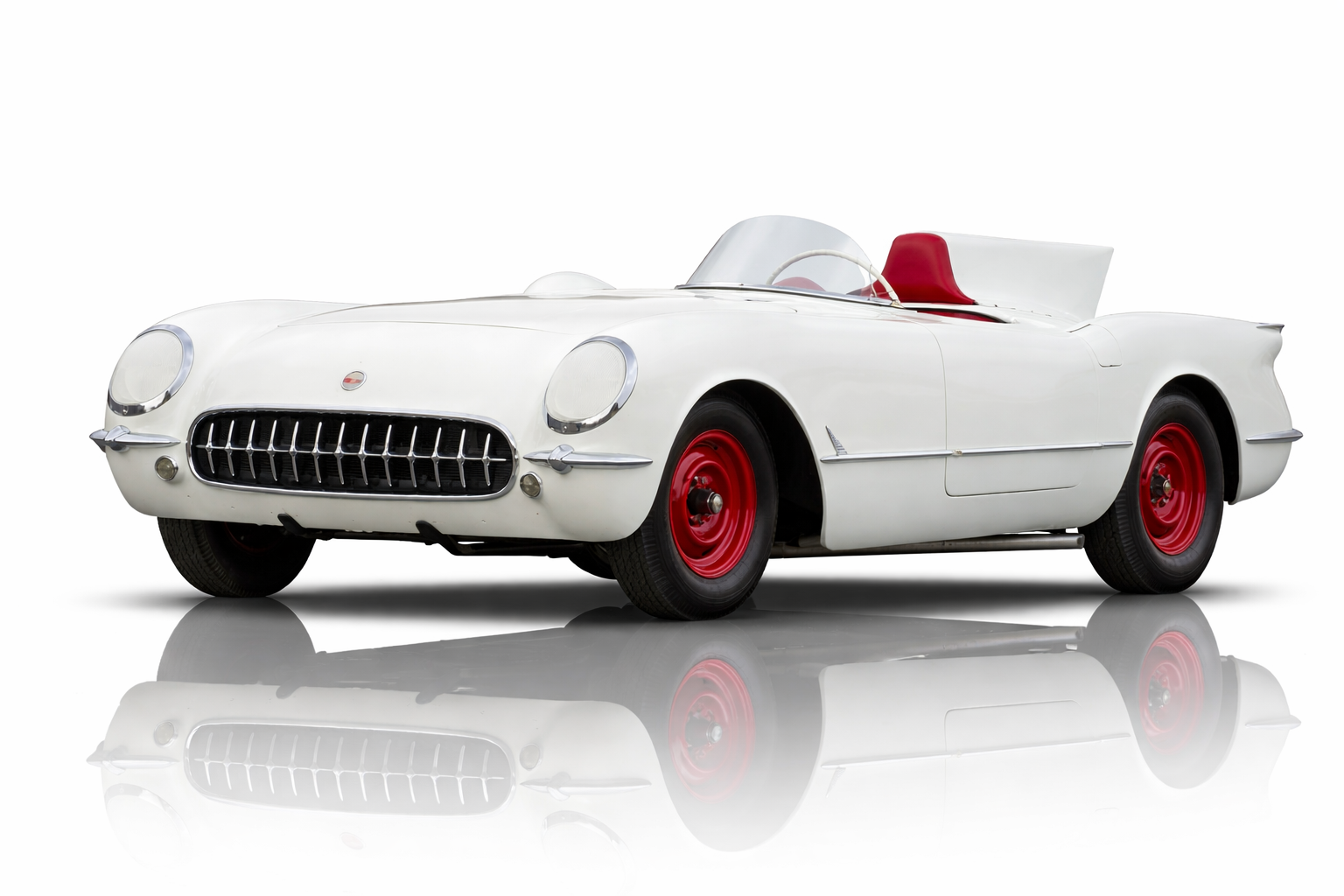
On January 17, 1953, Chevrolet rolled its EX-122 two-seat “dream car” onto the stage at GM’s glittering Motorama in New York’s Waldorf-Astoria, and the effect was electric. Beneath the chandeliers of that storied ballroom, America caught its first glimpse of a fiberglass-skinned roadster unlike anything to ever wear a bowtie. The moment had the pulse of theater—bright lights, orchestras, choreographed models striding past the car as if it were haute couture. Crowds queued in the bitter January cold just for a chance to press forward and see the future up close. GM brass, led by interim president Harlow Curtice, stood at the receiving line as if presenting royalty. By the end of that first day, an estimated 50,000 people had filed through to marvel at the Corvette prototype. And as the Motorama caravan crisscrossed the nation—Detroit, Miami, Los Angeles, San Francisco—the tally would swell past a million Americans, all seduced by the idea that Chevrolet had conjured not just a car, but a dream on wheels.
Press excerpt (1953):Popular Mechanics, looking ahead in mid-1953, teased readers about Chevrolet’s coming sports car: “Chevrolet’s newest model, the two-seater sports car, the Corvette… is expected to have a terrific impact… on the whole industry.”
Greenlit Before the Applause
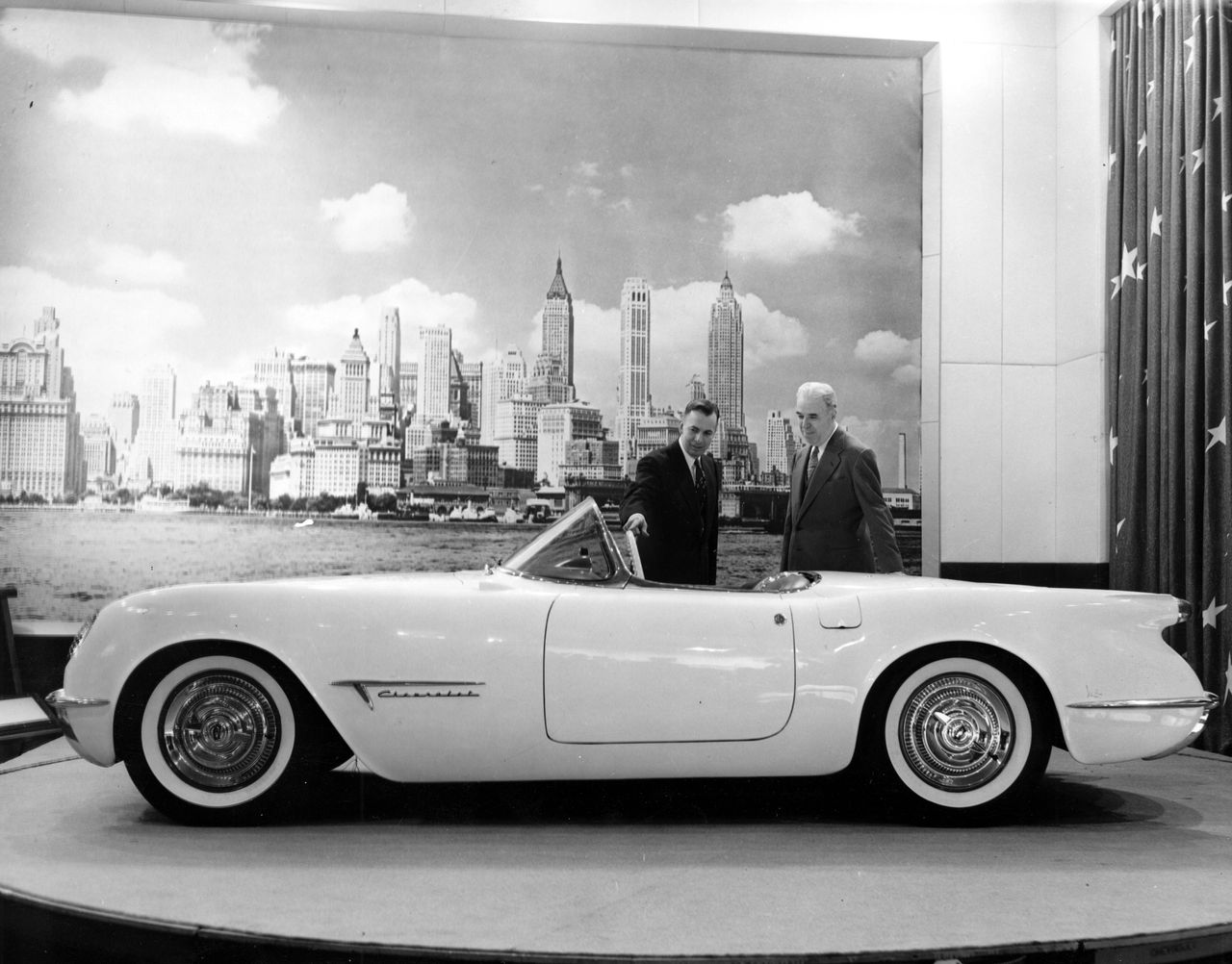
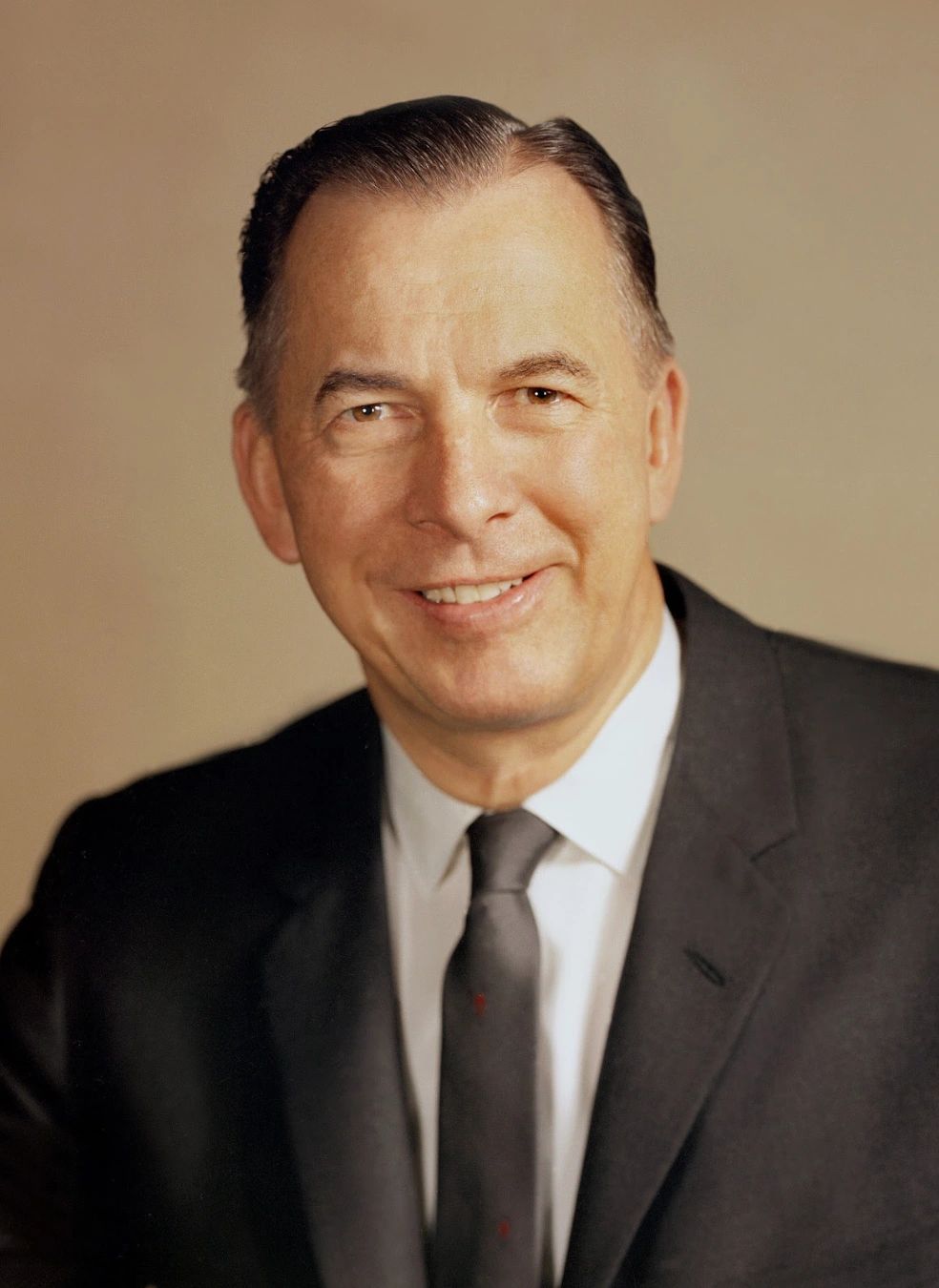
Ed Cole (left) and Thomas Keating inspect the Corvette concept in the lobby of the Waldorf Astoria Hotel. The synergy of Cole, Keating, and Harley Earl all but guaranteed that Chevrolet’s new sports car would be the hot topic of the 1953 Motorama Auto Show. (Photo Courtesy General Motors LLC)
Behind the velvet curtain, the decision had already been made. Chevrolet general manager Tom Keating and GM’s newly anointed president Harlow Curtice had quietly given the green light to build the car even before the first Motorama spotlight hit its fiberglass curves. The rapture of the crowd didn’t change their minds—it simply lit the fuse. What followed was nothing short of unprecedented: within just six months, Chevrolet transformed a show-stopping dream car into a production reality. On June 30, 1953, in a corner of GM’s Flint assembly plant, the first production Corvette rolled into the light. It wasn’t born on a high-volume line but in a kind of handcrafted ritual, each body laid up in fiberglass, each piece assembled with the urgency of a moonshot. By year’s end, only 300 Corvettes would exist—rare, fragile, almost experimental machines that announced not just a new model, but the arrival of America’s sports car.
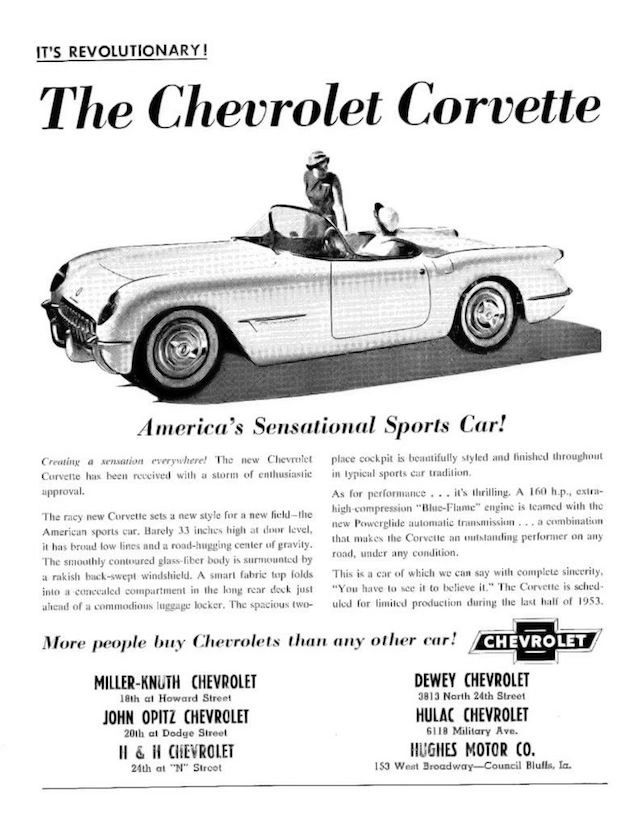
Press excerpt (1953): From a period newspaper report reprinted by Click Americana:“Chevrolet presented the Corvette as the first plastic-bodied automobile ever built by mass production methods.”
Why Fiberglass?
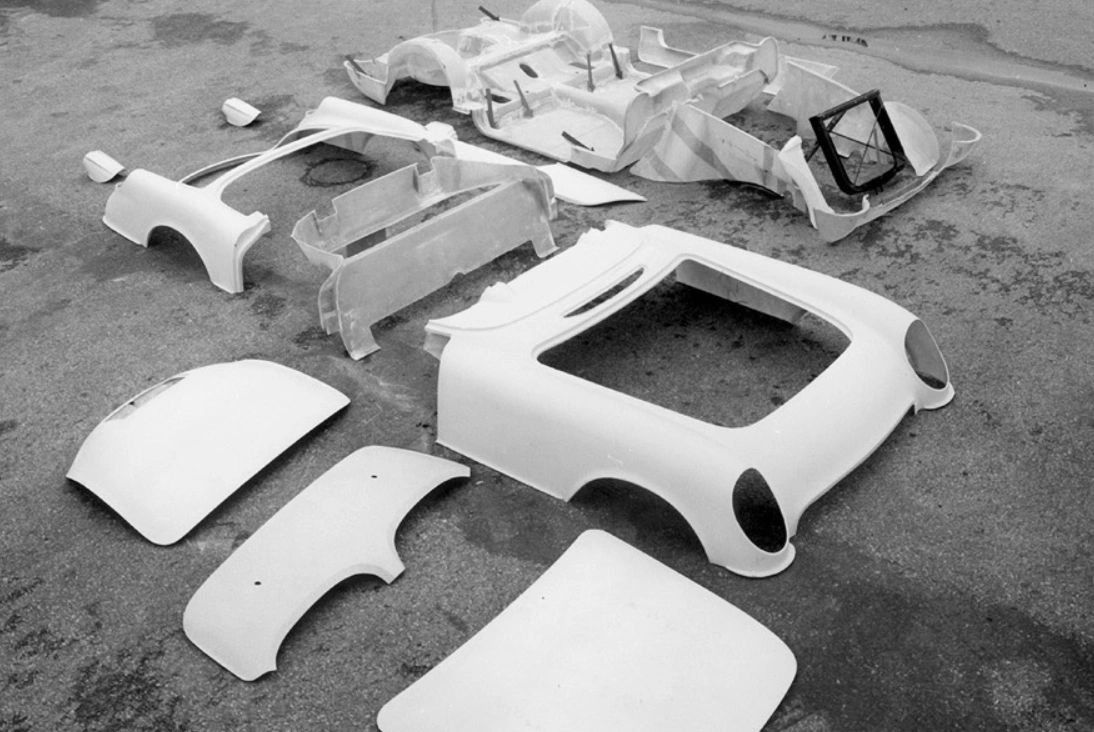
Chevrolet didn’t choose glass-reinforced plastic (GRP) for style alone. Fiberglass let GM avoid the time and capital for steel stamping dies, enabling quick, low-volume production with dramatic surfacing—and corrosion resistance to boot. But the learning curve was steep. Bodies arrived from Molded Fiber Glass Company (Ashtabula, Ohio) as subcomponents that workers jigged, bonded, and finished by hand; early panel fit and surface quality varied, and production practice evolved on the fly.
The fiberglass assemblies of the 1953 Corvette as produced by the Molded Fiber Glass Company in Ashtabula, Ohio.
Period figures frequently cited by historians: 46 separate GRP pieces formed each 1953 body before bonding into larger assemblies. While this detail is widely reported in marque histories and museum write-ups, it also appears in contemporary-style retrospectives about MFG’s role in the program.
Press excerpt (1953):The Racine Journal Times (via Click Americana) explained the new process to readers: “Body parts are ‘cured’ into panels in 61 separate molds. The parts are then bonded and riveted together to form a body shell.” (Reprinted 10/2/1953.)
Note on numbers: The “46 pieces” describes the number of body sections assembled; the “61 molds” quoted above refers to the number of tooling molds used to cure those sections, which can exceed the number of final bonded pieces. Both reflect the intense handwork behind early production.
Hand-built in Flint
One of the 1953 Motorama prototype cars is driven by Zora Arkus-Duntov at the Milford Proving Grounds. Early road testing allowed General Motors the opportunity to fully evaluate the Corvette in advance of production later that same year. As seen here, Duntov pushed the car to its limits (and beyond!) to measure the durability of its suspension under extreme driving conditions. (Photo Courtesy General Motors LLC)
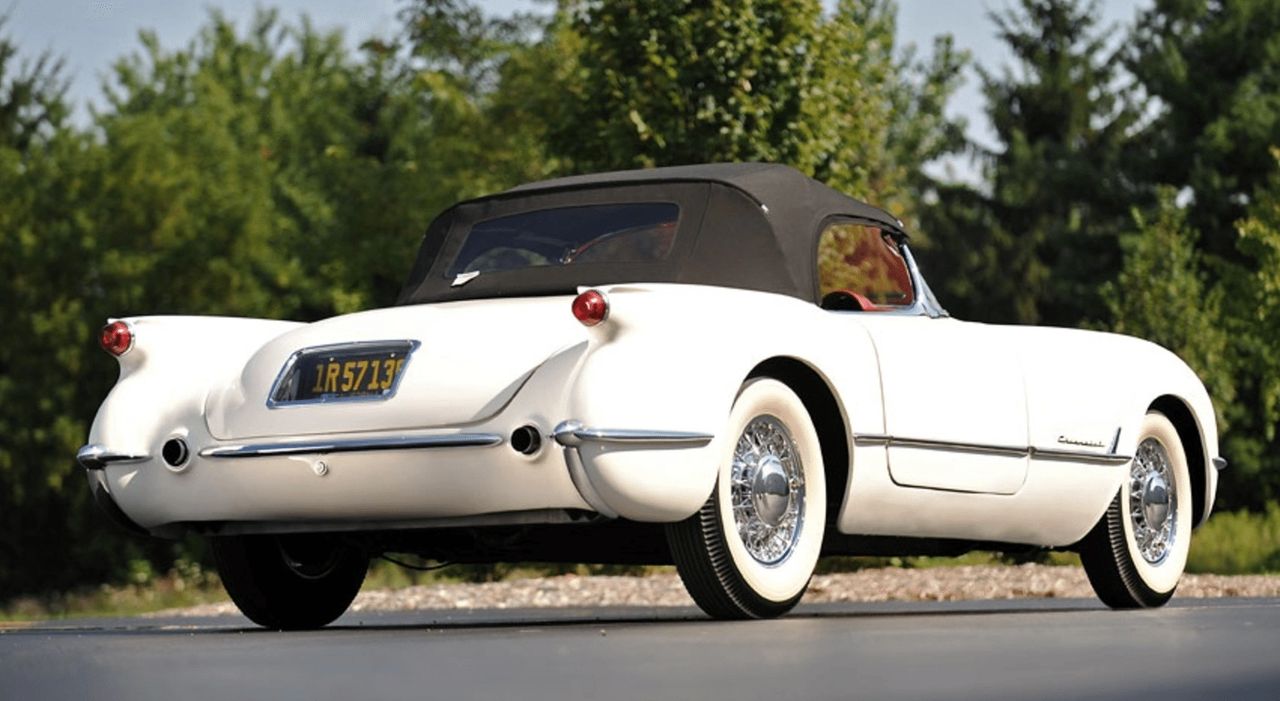
The first two Flint-built cars served as engineering test units and were later destroyed; the remaining cars were distributed in limited fashion while Chevrolet refined processes and prepared a dedicated line in St. Louis for 1954. Every 1953 car was Polo White with Sportsman Red interior and a black canvas top.
To simplify assembly, trim and equipment were standardized. Although a signal-seeking AM radio and heater were listed as options, all cars received both; fiberglass’s non-conductivity also allowed Chevrolet to hide the radio antenna in the trunk lid—a neat party trick on an all-plastic body that period restorers and marque specialists still discuss today.
Styling: American jet-age sleek
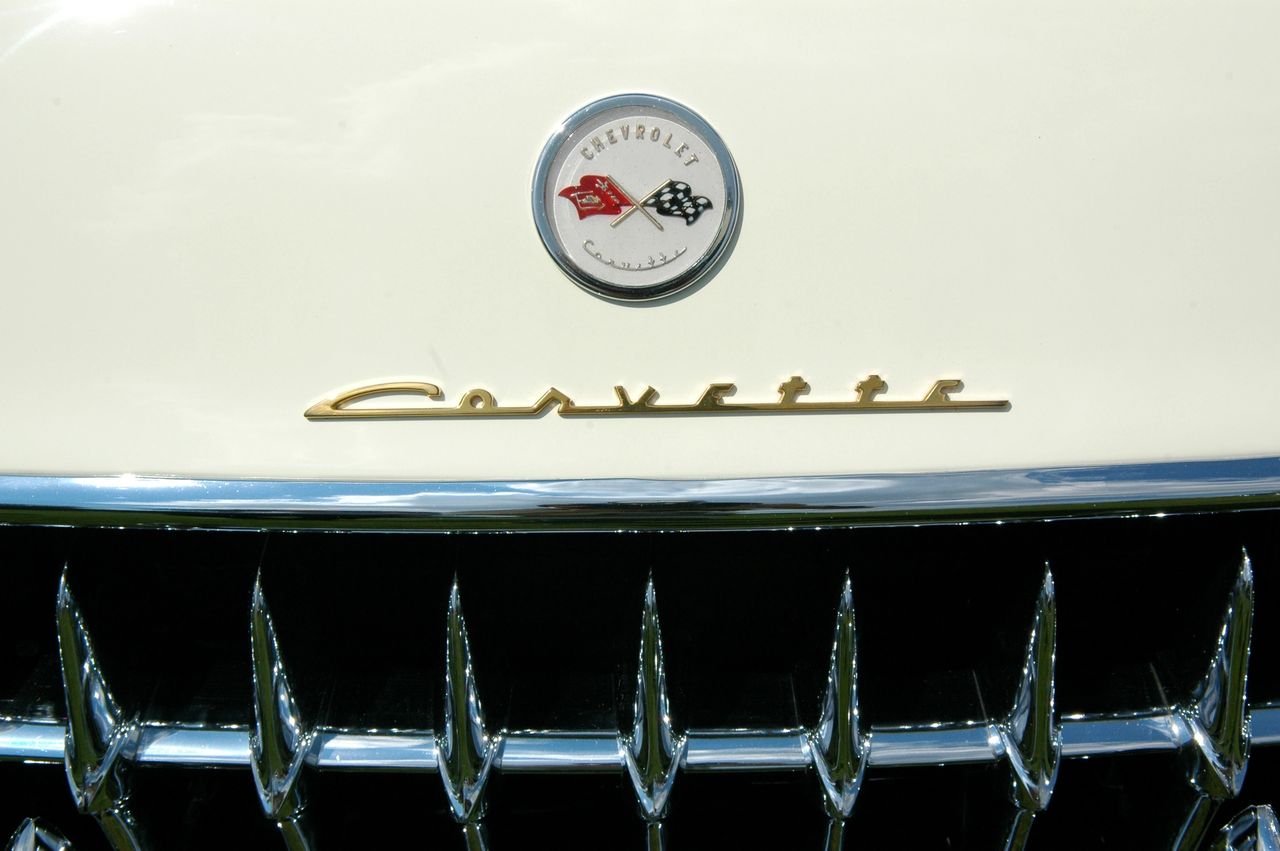
The grille “teeth” of the 1953 Corvette.
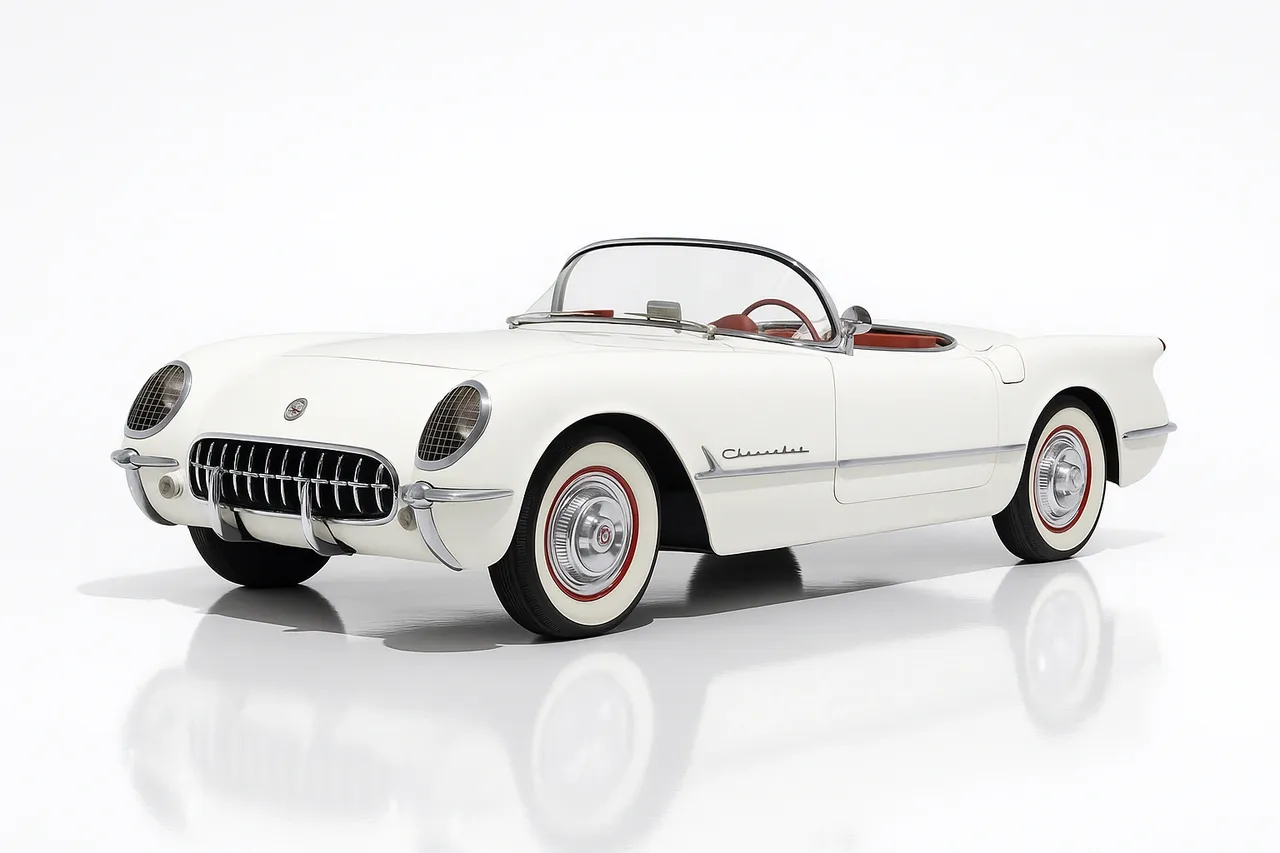
Harley Earl’s team penned a low, flowing form—grille “teeth,” faired rear fenders, a wraparound windshield—that nodded to European roadsters without abandoning American drama. The Motorama prototype’s white finish was a favorite of Earl’s for concept cars, as it highlighted complex curves under show lights and photography.
Press excerpt (1953): A Talk-of-the-Town piece in The New Yorker captured the Motorama’s aura—Buick’s “Wildcat” and other dream cars shared the stage as GM executives greeted celebrities—underscoring the glitzy context into which the Corvette was born.
Mechanical reality: Powerglide and the Blue Flame Six
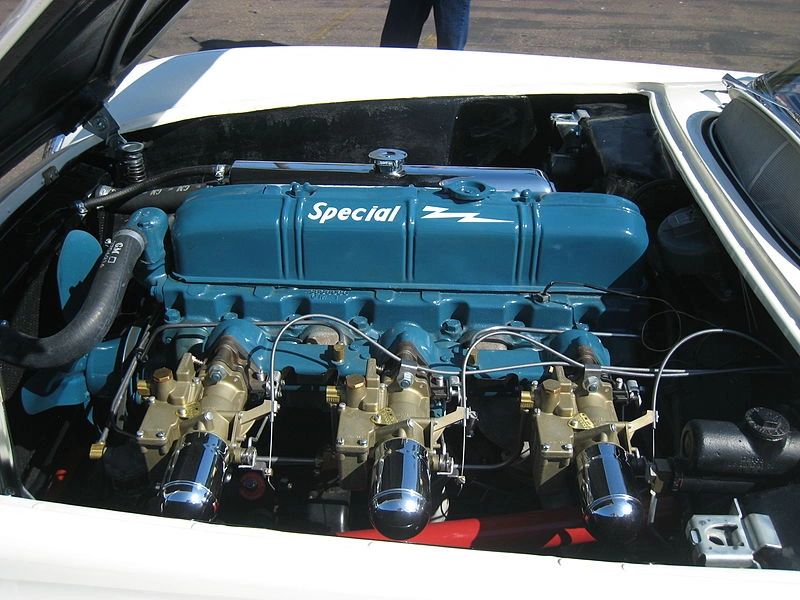
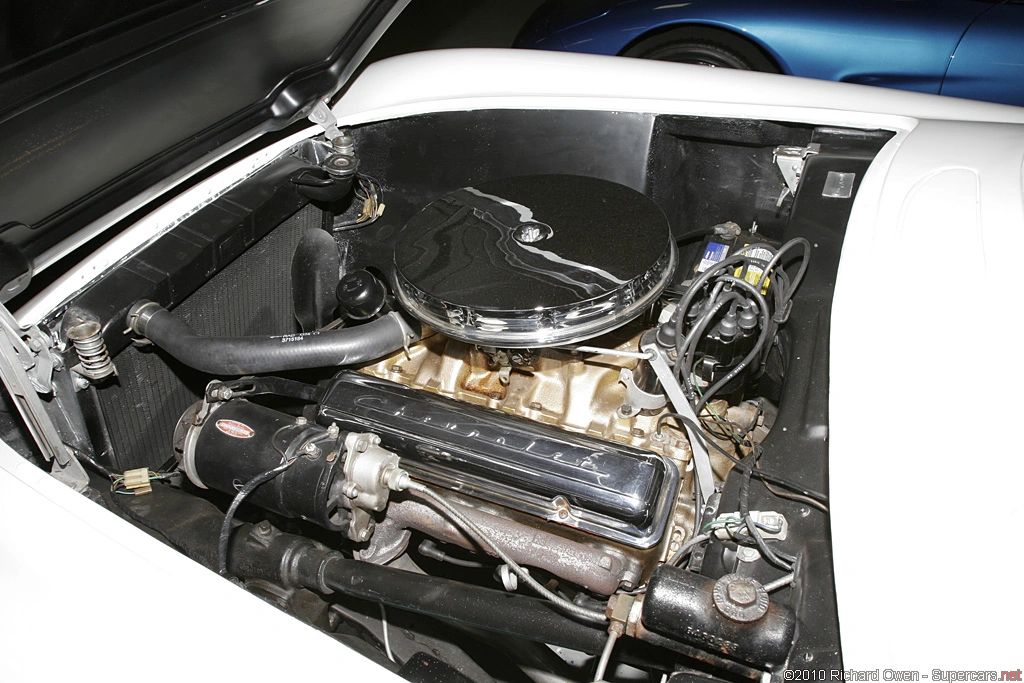
The 1953 Corvette was powered by a “Blue Flame” inline-six engine, not a V8. This engine, borrowed from Chevrolet’s sedan lineup and modified, produced 150 horsepower. While it was an inline-six, it was a step up from the standard 235 cubic inch “Stovebolt” engine, thanks to upgrades like a high-compression cylinder head, a more aggressive camshaft, and three side-draft carburetors.
Under the long hood beat Chevrolet’s 235-cu-in Blue Flame straight-six, hot-rodded with a higher-lift cam, solid lifters, dual valve springs, 8.0:1 compression, and triple Carter YH side-draft carburetors. Output: 150 hp at 4,500 rpm—respectable for a Chevrolet six, but not exotic by European standards. Every 1953 car used the two-speed Powerglide automatic; a manual gearbox wouldn’t arrive until 1955.
Period and retrospective tests peg performance around 0–60 mph in ~11–11.5 seconds, ¼-mile ~17.9 sec @ ~77 mph, and top speed ~108 mph.
Press excerpt (1953):Chevrolet’s own positioning (again via a 1953 news reprint) set expectations: GM’s Keating said the Corvette “is not a racing car in the accepted sense that a European car is a race car.”
Selling sizzle (and scarcity)
Chevrolet used the 1953 Corvette as a “prestige halo” car to promote the Chevrolet brand. While the 1953 Corvette was not available to the public, it helped promote the rest of their product lineup and increase vehicle sales.
Chevrolet treated the ’53 as a prestige halo, initially rotating cars through regional showrooms and leaning on VIP allocations to build mystique—mayors, local celebrities, industrialists. The strategy generated chatter but also frustration: the public could see a Corvette yet not purchase one, and some early opinion leaders criticized the car’s “jet-age” styling, modest performance, side-curtain weather sealing, and price ($3,498).
Press excerpt (1953): A period news report reprinted by Click Americana hyped the fundamentals—“high power-to-weight ratio, low center of gravity, and balanced weight distribution”—but also spelled out the boulevard-friendly kit: Powerglide, radio, heater, clock.
Production Numbers
Location & date: Flint, Michigan; first car built June 30, 1953.
Volume:300 hand-built cars for 1953; the first two were engineering cars later destroyed.
Spec uniformity: All Polo White / Sportsman Red / black top. Radio and heater functionally standard.
The moment that changed Corvette’s future
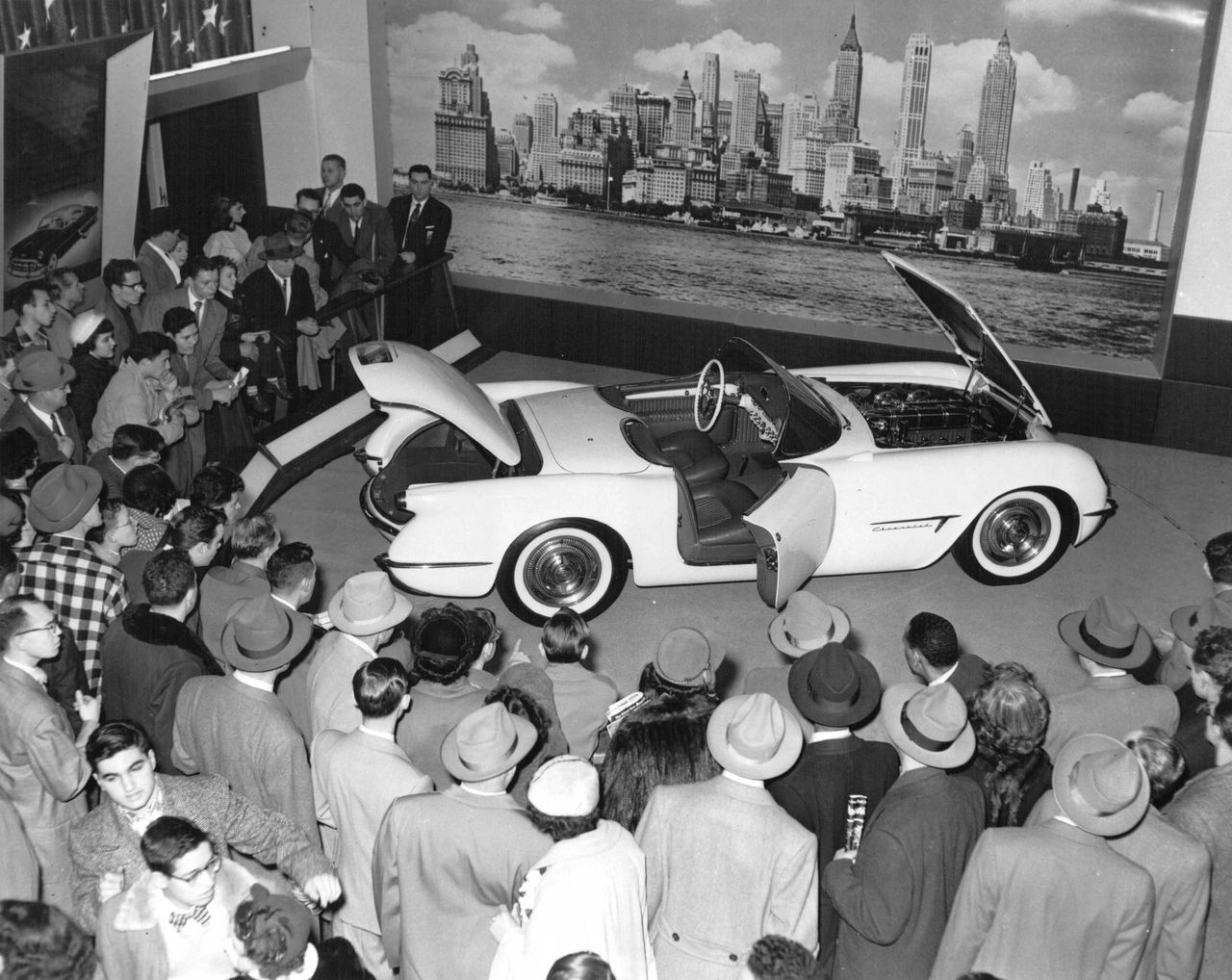
The EX-122 Corvette Concept Car on display at the Waldorf Astoria Hotel in New York City in January, 1953. (Image courtesy of GM Media LLC.)
One Motorama attendee—Zora Arkus-Duntov—famously admired the Corvette’s looks but lamented its mechanicals, then wrote Ed Cole and soon joined Chevrolet (May 1, 1953). His memos and engineering leadership would drive the car toward true high performance, most dramatically with the arrival of the small-block V-8 in 1955.
Beyond the myth: What the ’53 really was
The 1953 Corvette wasn’t a lap-time champion, nor was it priced like a bare-bones British roadster. It was a bold manufacturing experiment, a halo style statement, and a deliberate brand-builder for Chevrolet. The hand-built Flint cars laid the groundwork for a far more ambitious 1954 program in St. Louis and signaled that America would have a home-grown sports car—even if the formula needed several quick revisions.
Quick-reference technical summary (1953)
Engine: 235-cu-in OHV “Blue Flame” inline-six, 150 hp @ 4,500 rpm; triple Carter YH carbs; dual exhaust.
Body: Glass-reinforced plastic (fiberglass) bonded shell; body assembled from ~46 pieces; production used 61 molds for panels per period reporting.
Performance (typical): 0–60 mph ~11–11.5 s; ¼-mile ~17.9 s @ 77 mph; 108 mph top speed.
Price:$3,498 list.
Colors:Polo White exterior / Sportsman Red interior only.
Production:300; Flint, MI; first car June 30, 1953.
Motorama-era press & period voices (short excerpts)
Popular Mechanics (June 1953):“Chevrolet’s newest model, the two-seater sports car, the Corvette… is expected to have a terrific impact… on the whole industry.”
Racine Journal Times (Oct. 2, 1953; via Click Americana):“Chevrolet… revealed for the first time the company’s facilities for the production of reinforced plastic bodies.”
Racine Journal Times (Oct. 2, 1953; via Click Americana):“The Corvette isn’t a race car,” said Chevrolet’s T. H. Keating—distancing it from European competition focus.
The New Yorker (Jan. 31, 1953): A “seven-day capacity run” at the Waldorf, with GM executives greeting celebrities amid dream cars like Buick’s Wildcat—setting the glamorous stage for Corvette’s debut.
Legacy
While initial reactions to the original Corvette were mixed when first introduced, today the 1953 Corvette is a highly sought-after model by collectors around the globe.
If the 1953 Corvette asked America to buy into a vision, customers answered “show us more.”Chevrolet did—quickly—adding V-8 power and manual transmissions within two years. But the spark was here: an American sports car, built with unconventional materials, wearing unforgettable style. Today the 1953s are blue-chip collectibles, rolling artifacts from the hectic months when GM turned a show car into a reality, one bonded fiberglass panel at a time.
Introduced in 1953, the Corvette marked Chevrolet’s bold entry into the sports car world. Hand-built in Flint and finished only in Polo White, it blended fiberglass innovation with American optimism—laying the foundation for a performance icon that would define generations.
The EX-87 was never intended to be a show car, nor was it born from the glamour-driven world of GM’s Motorama turntables. It did not wear dramatic chrome flourishes, nor did it preview a futuristic body style meant to dazzle the public. Instead, the EX-87 emerged quietly, almost anonymously, from Chevrolet Engineering—built not to inspire dreams, but to answer a far more fundamental question: Could the Corvette survive as a true performance machine?
By 1954, the Corvette’s future was far from secure. Sales were lukewarm, the Blue Flame six-cylinder engine was widely regarded as underwhelming, and within General Motors there remained deep skepticism that an American-built sports car could—or should—compete with Europe’s established marques. Harley Earl had given Chevrolet a shape and a name, but shape alone would not save the car.
As Harley Earl reflected on the Corvette’s early identity crisis, he was blunt about the limits of styling alone. “You can’t sell a sports car on looks only,” Earl later explained when discussing the program’s early challenges. “It has to perform like one.”
That belief increasingly aligned Earl with Duntov’s push for measurable performance, reinforcing the idea that the Corvette’s credibility would ultimately be earned on the road and the stopwatch, not the show stand.
It was into this uncertain environment that the EX-87 was created.
A Mule With a Mission
The EX-87 began life as a 1954 production Corvette pulled from the line and reassigned as a full-time engineering test vehicle—a “mule” in the purest sense. Chevrolet Engineering assigned it the internal designation EX-87 to track its progress through an experimental powertrain program spearheaded by Ed Cole, who at the time was quietly laying the groundwork for what would become one of the most consequential engines in automotive history.
Cole was not interested in incremental improvement. He believed Chevrolet’s future depended on a lightweight, compact V8 that could be produced economically and adapted across multiple platforms. “We needed an engine that would democratize performance,” Cole would later explain. “Power shouldn’t be exotic. It should be accessible.”
What you’re looking at is the mechanical turning point that transformed the EX-87 from a Corvette-based experiment into a legitimate top-speed contender. The program initially relied on an early high-performance 265-ci small-block V8 rated at roughly 225 horsepower, but testing quickly revealed that it lacked the output needed to meet Zora Arkus-Duntov’s 150-mph objective. In response, the engine was progressively evolved—bored to approximately 307 cubic inches, fitted with Duntov’s high-lift camshaft, higher compression pistons, and extensively reworked cylinder heads—ultimately producing around 305 horsepower. In this final configuration, the EX-87 validated its purpose by achieving speeds as high as 163 mph, proving that Corvette performance limits were defined not by concept, but by ambition. (Image source: MotorTrend.com)
The engine installed in the EX-87 was an early developmental version of that vision—an experimental small-block V8 initially targeted at 283 cubic inches. The Corvette was not chosen for prestige. It was selected because it offered something no other Chevrolet did: low weight, a fiberglass body, and a layout already suited to performance testing.
At first, the EX-87’s work was strictly internal—hours of durability testing, cooling evaluations, and power validation. Had history taken a different turn, it might have remained nothing more than a footnote in GM’s engineering logs.
But Zora Arkus-Duntov had other ideas.
Zora’s Opportunity
Zora Arkus-Duntov’s work on the EX-87 was less about spectacle and more about proof. Using the car as a rolling laboratory, he pushed Chevrolet’s small-block V8 beyond accepted limits, validating high-compression performance and sustained high-speed capability at a time when the Corvette’s future was far from secure. The EX-87 gave Zora something invaluable: data, confidence, and a tangible argument that the Corvette was capable of standing toe-to-toe with Europe’s best. In that sense, the car wasn’t just a test mule—it was a turning point. (Image courtesy of GM Media LLC.)
Duntov joined Chevrolet in 1953 with a singular obsession: proving that the Corvette could be a legitimate high-performance sports car. From the outset, he believed Ed Cole’s new V8 was far more than a convenient replacement for the Blue Flame six—it was a platform capable of sustained development, real measurement, and genuine competition. To Zora, the EX-87 represented more than an engine test bed. It was proof—waiting to be demonstrated—that the Corvette could stand shoulder to shoulder with Europe’s best.
“I did not believe the Corvette lacked ability,” Duntov once said. “I believed it lacked opportunity.”
He approached Ed Cole with a bold proposal: use the EX-87 to demonstrate, publicly and unequivocally, that a Corvette could achieve a top speed of 150 miles per hour. Cole, ever the pragmatist, immediately recognized the value. Performance numbers could silence critics far faster than styling sketches or sales projections.
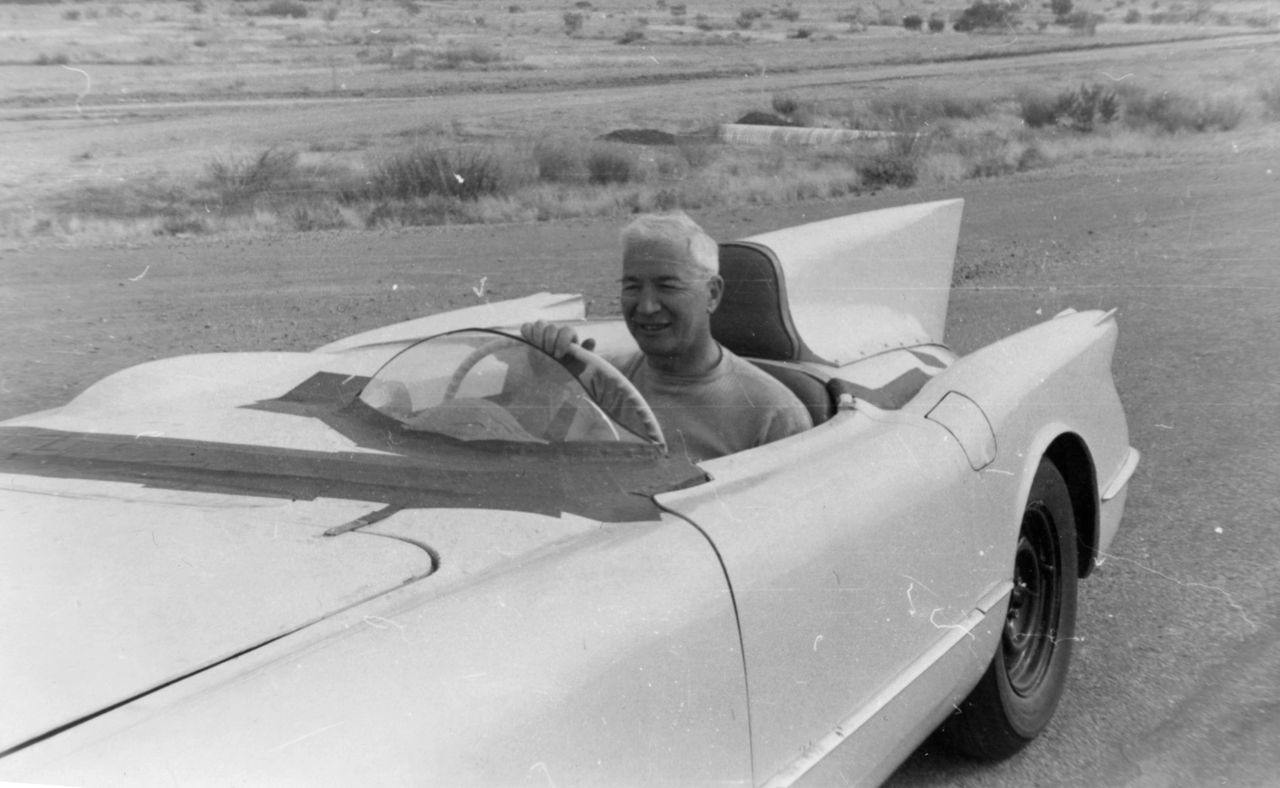
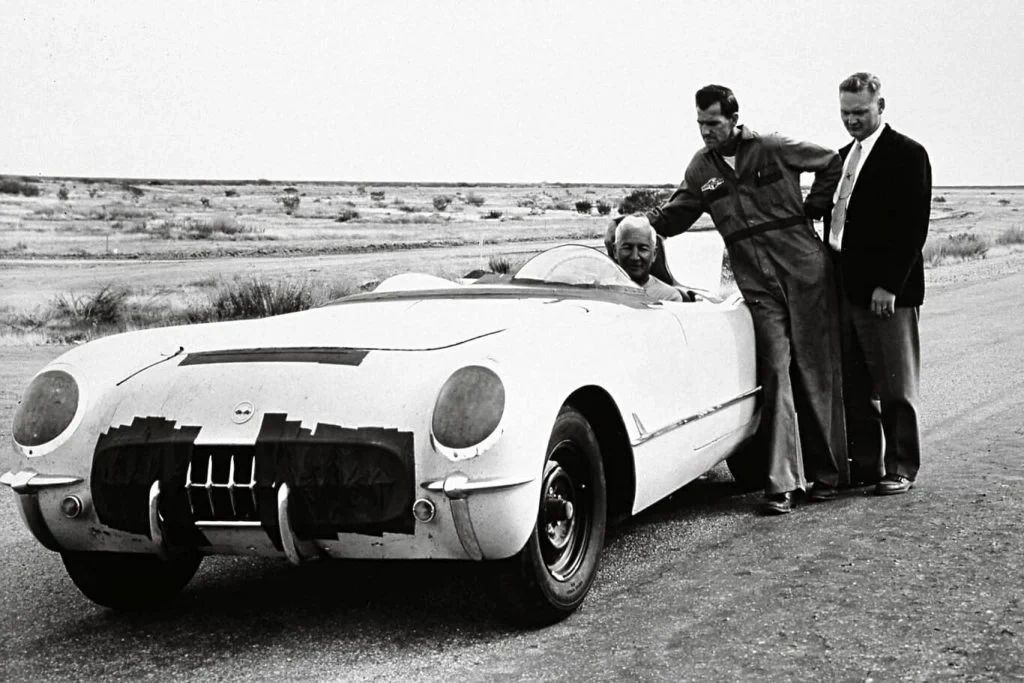
Captured during high-speed testing at the Arizona Proving Grounds, this image shows the Corvette EX-87 in its most critical role: a purpose-built test mule engineered to validate sustained top-speed performance. The car’s stripped windshield, improvised nose treatment, and minimal bodywork reflect its singular mission—cutting aerodynamic drag while evaluating the limits of Chevrolet’s experimental small-block V8. In this configuration, the EX-87 would ultimately record a verified top speed of 163 mph, an extraordinary figure for a mid-1950s American production-based sports car. The photograph underscores how empirical testing—not styling exercises—was reshaping the Corvette’s engineering trajectory. (Image source: GM Media LLC)
Cole approved the plan without hesitation. A second internal tracking number—#5951—was assigned to the car in the fall of 1955 as it was formally transferred into Duntov’s engineering division. From that moment forward, the EX-87 ceased to be merely an engine mule. It became a weapon.
In the years that followed, Zora would continue to push those same boundaries—most famously in 1956, when he drove a modified Corvette to victory at the Pikes Peak Hill Climb, stunning both skeptics and GM leadership alike. That climb was not an isolated triumph, but a continuation of the philosophy first proven with EX-87: that Corvette performance was not theoretical—it simply needed to be unleashed.
Engineering the Air
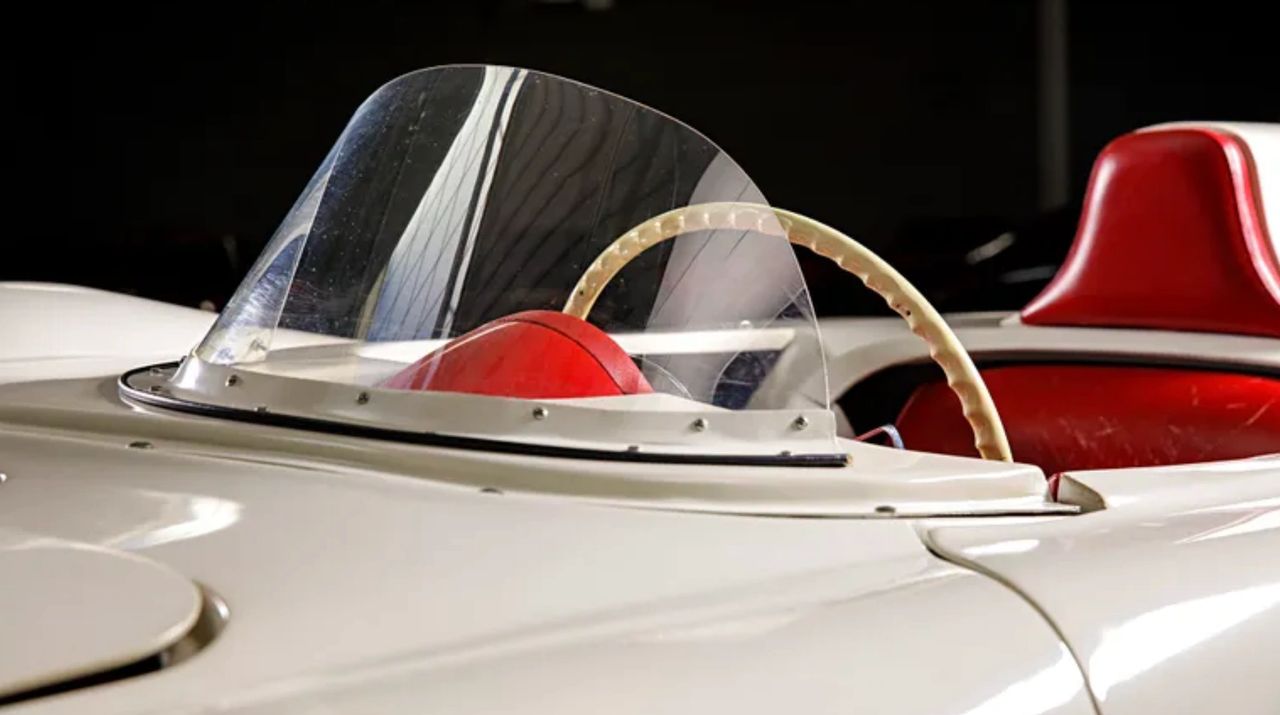
The low, wraparound windshield fitted to the EX-87 was a deliberate aerodynamic tool, not a styling flourish. By reducing frontal area and smoothing airflow over the cockpit, it helped stabilize the car at sustained high speeds while minimizing turbulence around the driver—critical factors during record-attempt testing. Just as important, the windshield offered a controlled compromise between outright drag reduction and driver protection, allowing Zora Arkus-Duntov to push the car harder and longer than an open cockpit would permit. In the EX-87’s mission, visibility, stability, and survivability were inseparable from performance. (Image source: MotorTrend.com)
Zora attacked the problem methodically. Speed, he understood, was as much about air as horsepower. His first modification was the addition of a full underpan beneath the chassis, smoothing airflow and reducing drag. Next came the windshield—removed entirely and replaced with a low, curved plexiglass windscreen that barely rose above the cowl.
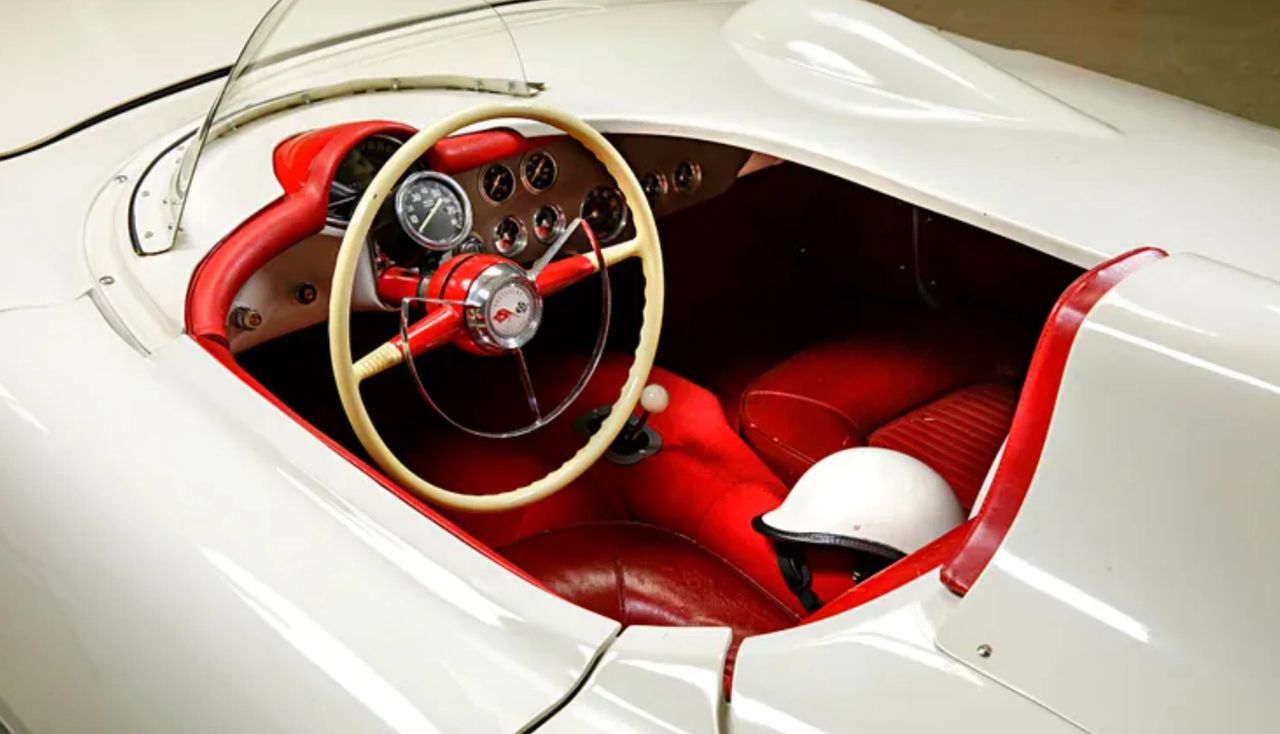
The enclosed cockpit of the EX-87 was engineered with a singular priority: control at extreme speed. By recessing the driver deeper within the bodywork and surrounding the cockpit with smooth, continuous surfaces, Chevrolet reduced aerodynamic disturbance while improving high-speed stability and driver endurance. The layout also allowed critical instrumentation to remain directly in the driver’s line of sight, reinforcing the car’s role as a data-gathering platform rather than a production prototype. In the EX-87, the cockpit was not about comfort—it was about precision, safety, and sustained high-velocity testing. (Image source: MotorTrend.com)
The passenger seat was sealed beneath a fiberglass tonneau cover, transforming the cockpit into a strictly single-occupant environment. Duntov also fabricated a headrest that extended rearward into a subtle tailfin, a feature conceived solely to improve directional stability at extreme speed rather than visual appeal.
The EX-87 embodied that philosophy completely—its form dictated by airflow, stability, and data, with no concessions made to aesthetics.
Power Becomes the Limiting Factor
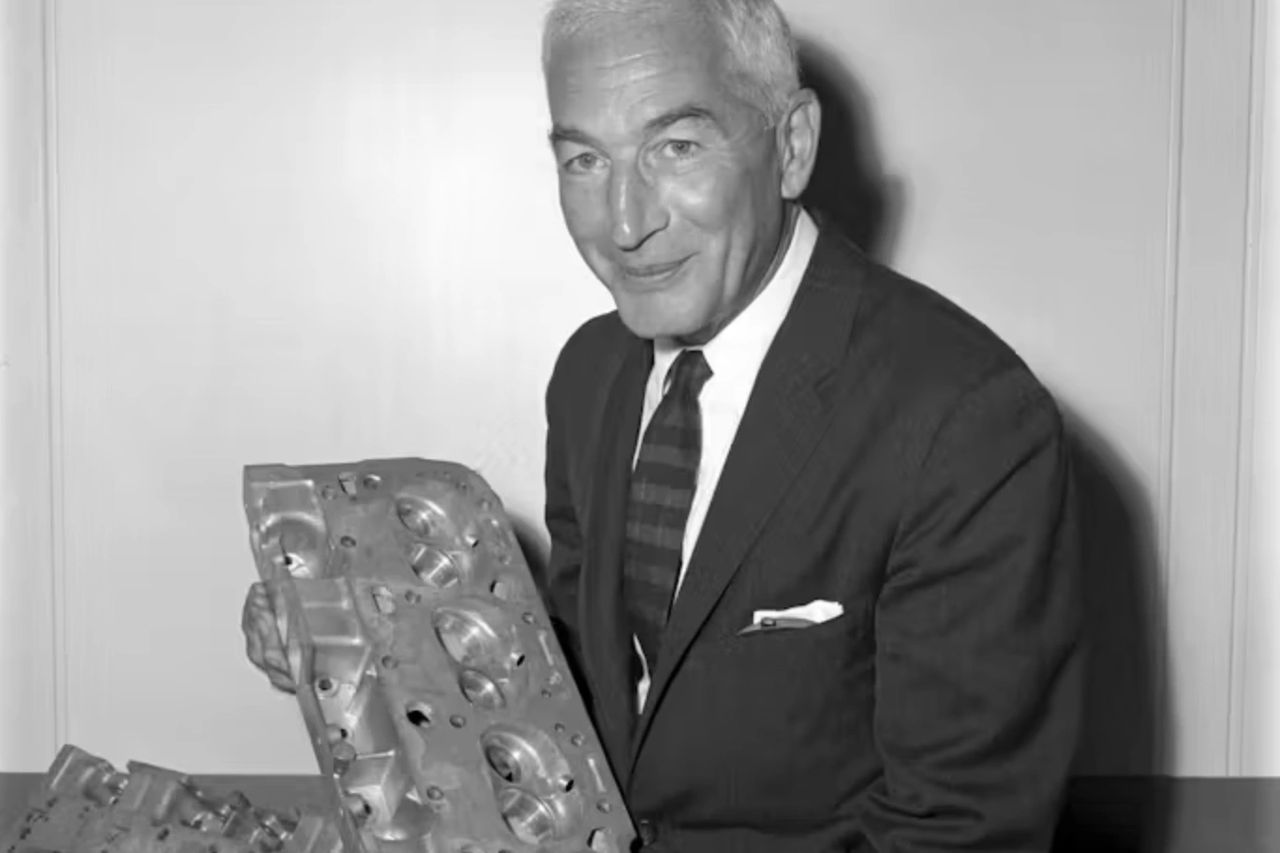
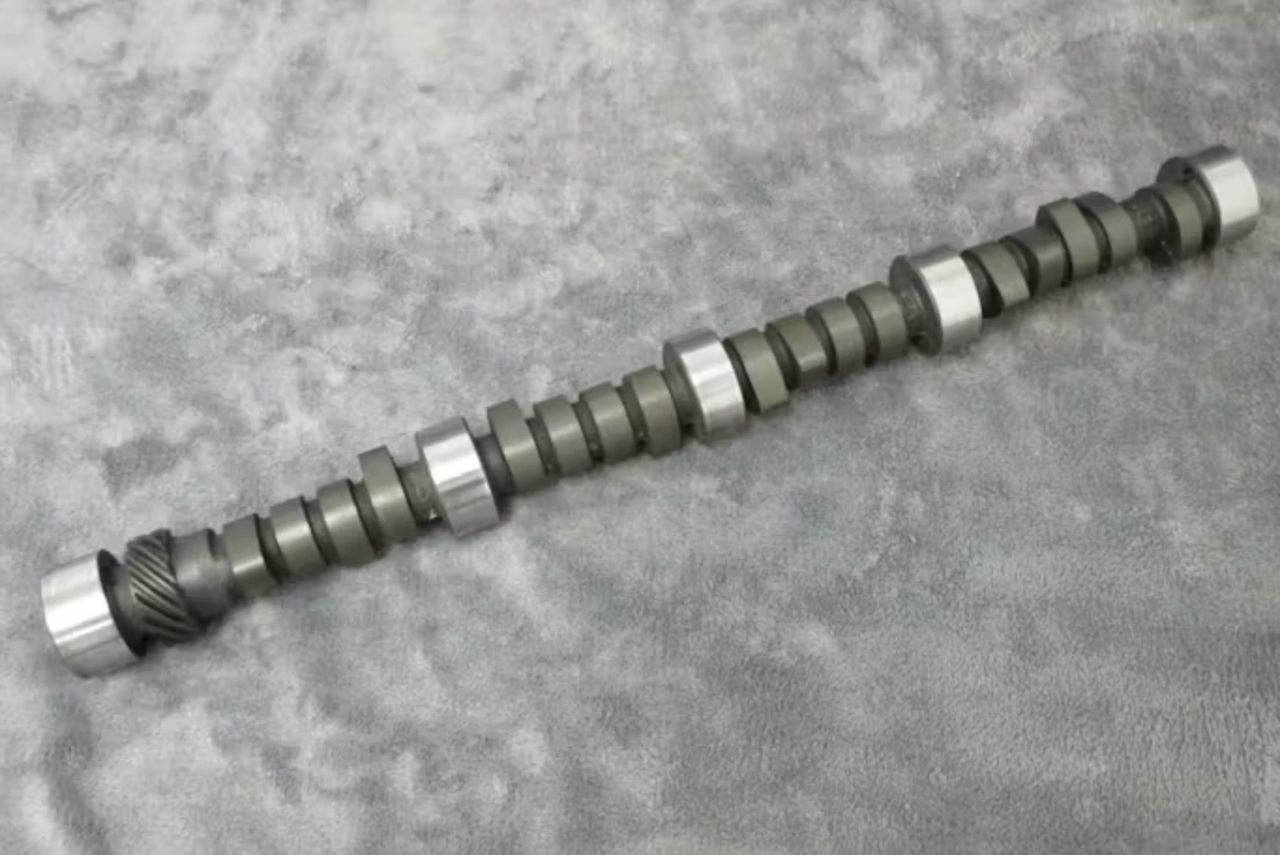
Zora Arkus-Duntov approached horsepower the way a racer approaches a stopwatch: as something earned through airflow, valvetrain control, and relentless iteration. During the EX-87 program, he helped push Chevrolet’s early small-block well beyond its original limits by combining increased displacement with an aggressive high-lift camshaft developed through GM engineering, driving output to roughly 305 horsepower and enabling sustained 160-mph performance. That work sits squarely within the same lineage as the camshaft enthusiasts would later call the “Duntov” grind—the solid-lifter 097—whose purpose was to let the small-block breathe, rev, and survive at high rpm. Long before Chevrolet, Duntov had already proven his engineering instincts with the Ardun overhead-valve hemispherical-head conversion for the Ford flathead V8, a solution that addressed cooling and airflow limitations while dramatically increasing power potential. Seen in this context, the EX-87 was not an isolated experiment but part of a lifelong pursuit: redefining what American engines could do when engineering, not convention, set the limits. (Image courtesy of GM Media LLC.)
Initial testing at GM’s new Technical Center in Warren, Michigan, revealed the uncomfortable truth: even with improved aerodynamics, the Corvette simply did not have enough power. The early 283 fell short of the 150-mph goal.
Zora calculated the deficit precisely. Approximately thirty additional horsepower would be required.
Drawing on his pre-war engineering experience in Europe, Duntov increased displacement to 307 cubic inches and turned his attention to the camshaft—a component often overlooked, but central to engine character. His design emphasized longer intake and exhaust durations with comparatively modest valve lift, optimizing high-rpm breathing and throttle response.
The “Duntov cam,” officially GM part number 3736097 and commonly known as the 097, became one of the most influential performance camshafts of the early small-block era. Introduced for Chevrolet’s solid-lifter V8s in the late 1950s, it featured approximately .447 inches of valve lift with 1.5:1 rockers, duration in the high-220° range at .050-inch lift, and a relatively wide lobe separation intended to balance high-rpm power with durability. Zora Arkus-Duntov developed the profile to improve airflow and extend usable engine speed, directly addressing the breathing limitations he encountered during early Corvette performance testing, including work tied to the EX-87 program. Unlike peaky racing grinds of the era, the 097 cam delivered a broad, usable powerband that could survive sustained high-rpm operation. Its success cemented Duntov’s philosophy that reliable horsepower came from controlled valvetrain dynamics, not excess. Decades later, the cam remains a benchmark—proof that thoughtful engineering can define an entire generation of performance. (Image source: Chevy Hardcore.com)
When Zora presented the camshaft to Cole’s engineering staff, the reaction was skeptical. The design was labeled “unorthodox,” even risky. But Duntov had no patience for theoretical debate.
Rather than wait for approval, he loaded the EX-87/#5951 onto a trailer and headed for GM’s Mesa Proving Grounds in Arizona, where conditions favored high-speed testing. Only after further internal review did Cole’s team approve the camshaft for production, and a sample was rushed to Mesa.
The results were immediate and undeniable.
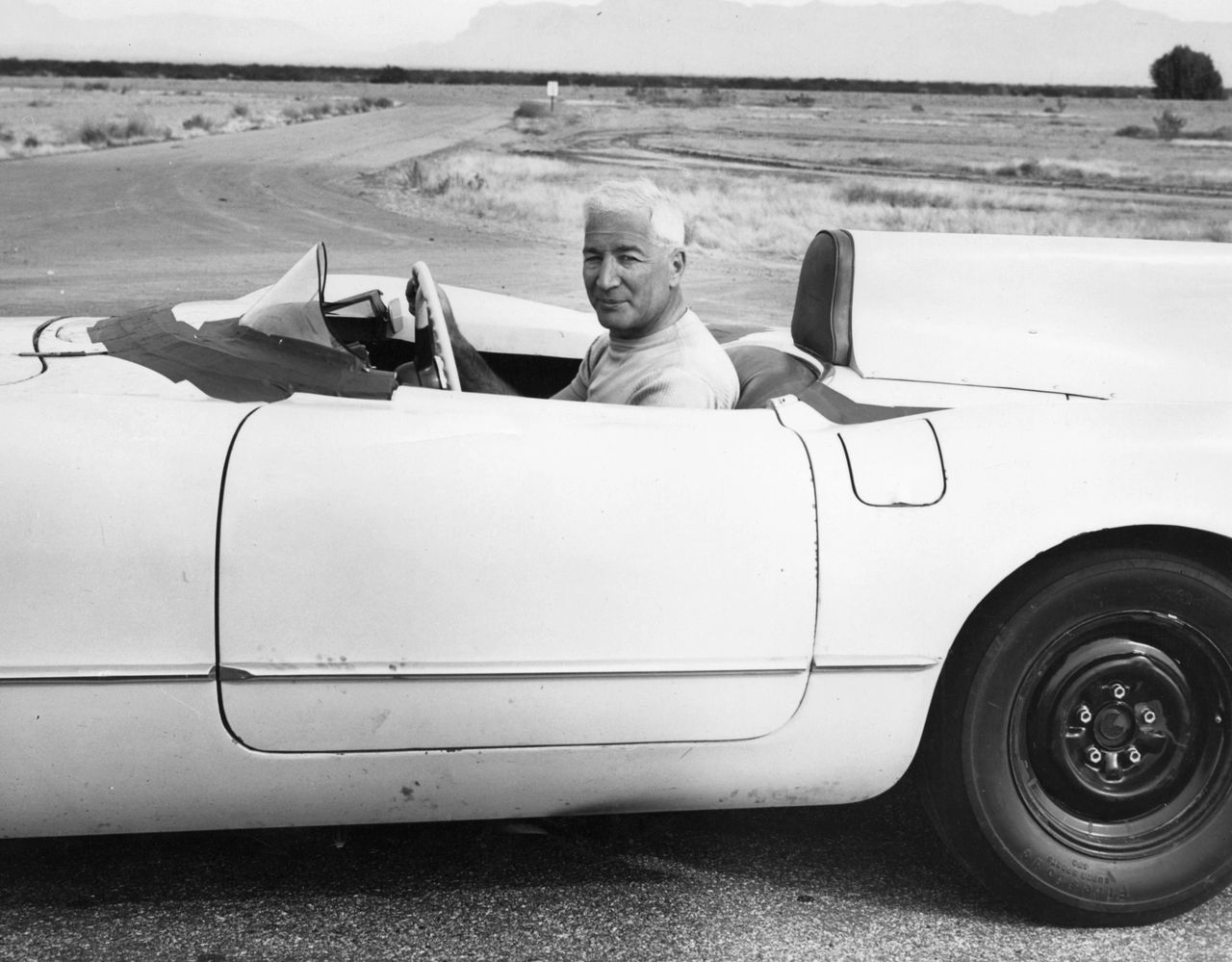
Photographed at the General Motors Arizona Proving Grounds in Mesa, this image captures Zora Arkus-Duntov during the decisive EX-87 high-speed sessions of December 1955—most notably the December 12, 1955 run that produced a two-way average of 156.16 mph, surpassing his 150-mph objective. The program didn’t stop there: after Duntov installed his hotter high-lift camshaft (paired with the rest of the engine’s evolved high-output configuration), the EX-87 returned with the breathing and rpm it needed to go further. In that later configuration, the car achieved a recorded top speed of 163 mph—turning a development exercise into a hard-number performance statement Chevrolet couldn’t ignore. (Image courtesy of GM Media LLC)
On December 20, 1955, Zora piloted the EX-87 to 163 miles per hour at 6,300 rpm, the desert air ringing with the sound of what would soon be known as the Duntov Cam. It was a defining moment—not just for the Corvette, but for Chevrolet engineering as a whole.
“That camshaft,” Cole later acknowledged, “changed how we thought about performance engines.”
Daytona: Making It Public
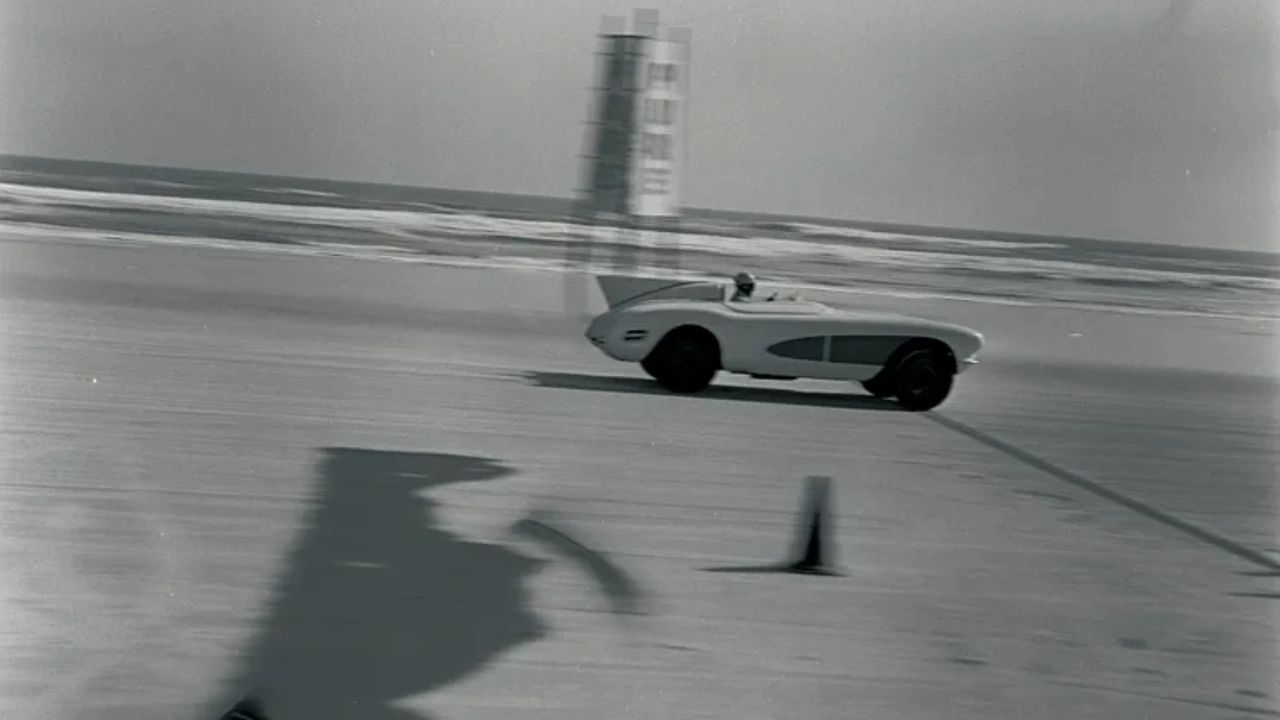
aptured during February 1956 speed testing at Daytona Beach, this image shows the EX-87 pushed hard across the hard-packed sand in pursuit of absolute top-speed data. Following its Arizona successes, the car was brought to Daytona to validate high-speed stability and power delivery in a radically different environment, where surface conditions and crosswinds posed new challenges. The testing reinforced the gains made through Duntov’s engine and aerodynamic refinements, confirming that the Corvette’s performance advances were repeatable—not isolated to a single proving ground. At Daytona, the EX-87 continued its role as proof, not prototype, demonstrating that Chevrolet’s sports car could sustain serious speed wherever it was tested.
For the official record attempt, Chevrolet selected a 1956 Corvette—chassis #6901—into which the EX-87’s engine, transmission, rear axle, tachometer, and instrumentation were transplanted wholesale. The goal was no longer internal validation. It was public proof.
In January 1956, on the hard-packed sands of Daytona Beach, Zora Arkus-Duntov drove the Corvette flat-out through the flying mile. When the timers stopped, the result was unmistakable: 150.583 miles per hour, averaged over two runs in opposite directions.
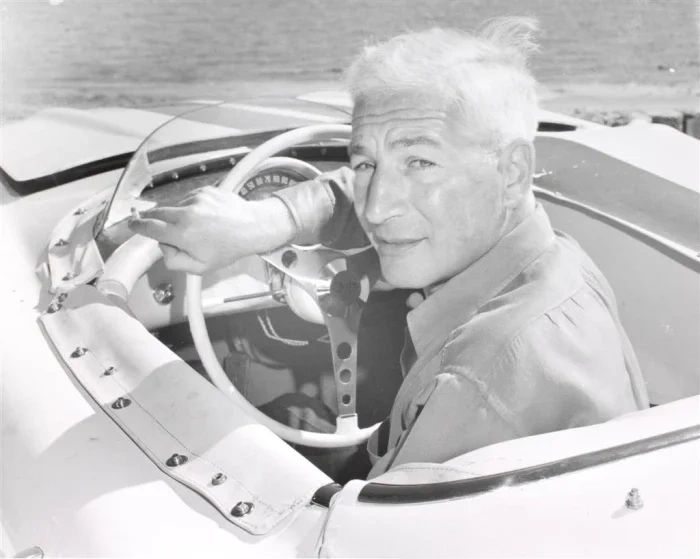
By the time this photograph was taken, Zora Arkus-Duntov had accomplished exactly what he set out to do at Daytona Beach in 1956: turn Corvette performance from promise into proof. The two-way speed runs on the sand validated the lessons learned with the EX-87, demonstrating that Chevrolet’s small-block—properly developed—could sustain world-class speeds under public scrutiny. For Duntov, Daytona was not a victory lap but a confirmation, the moment when data finally caught up to belief. The Corvette would never again be dismissed as merely stylish—because Zora had ensured it was fast, and provably so. (Image courtesy of GM Media LLC)
The number carried weight far beyond its decimals. It announced, unequivocally, that the Corvette had crossed a threshold.
“The car did not ask permission,” Zora later reflected. “It simply did what it was capable of doing.”
From Experiment to Identity
The work done with the EX-87 reshaped the Corvette’s destiny. The lessons learned—from aerodynamics to camshaft theory—were applied directly to production engineering. More importantly, the achievements at Mesa and Daytona transformed public perception. The Corvette was no longer merely America’s sports car. It was becoming a serious one.
As GM retired the Motorama after 1956, reallocating funds toward engineering and competition development, the Corvette quietly shifted from spectacle to substance. Harley Earl, nearing the end of his career, recognized the moment with clarity.
“I started the Corvette with a shape,” Earl said. “These men gave it a soul.”
In trusting Duntov and Cole to carry the Corvette forward, Earl ensured that his creation would evolve beyond styling into a legacy. The EX-87—born as a humble test mule—had become the crucible in which the Corvette’s performance identity was forged.
From that point forward, the Corvette would no longer be judged by what it promised, but by what it proved.
1955 Chevy Corvette EX-87 Mule: Specs and Details
Engine: 306.6-cu-in/5025cc OHV V-8, 1×4-bbl Rochester Carter WCFB
Power and torque: (SAE gross, est.) 275 hp @ 5400 rpm, 295 lb-ft @ 3650 rpm
Drivetrain: 3-speed manual RWD
Brakes: Drum, front and rear
Suspension, front: Control arms, coil springs
Suspension, rear: Live axle, leaf springs
Dimensions: 167.0 in, W: 72.2 in, H: 46.1 in (est. )
Weight: 2393 lb
0-60 MPH*: 5.7 sec
Quarter mile*: 14.3 sec @ 94 mph
Price: Incalculable
Why the EX-87 Still Matters
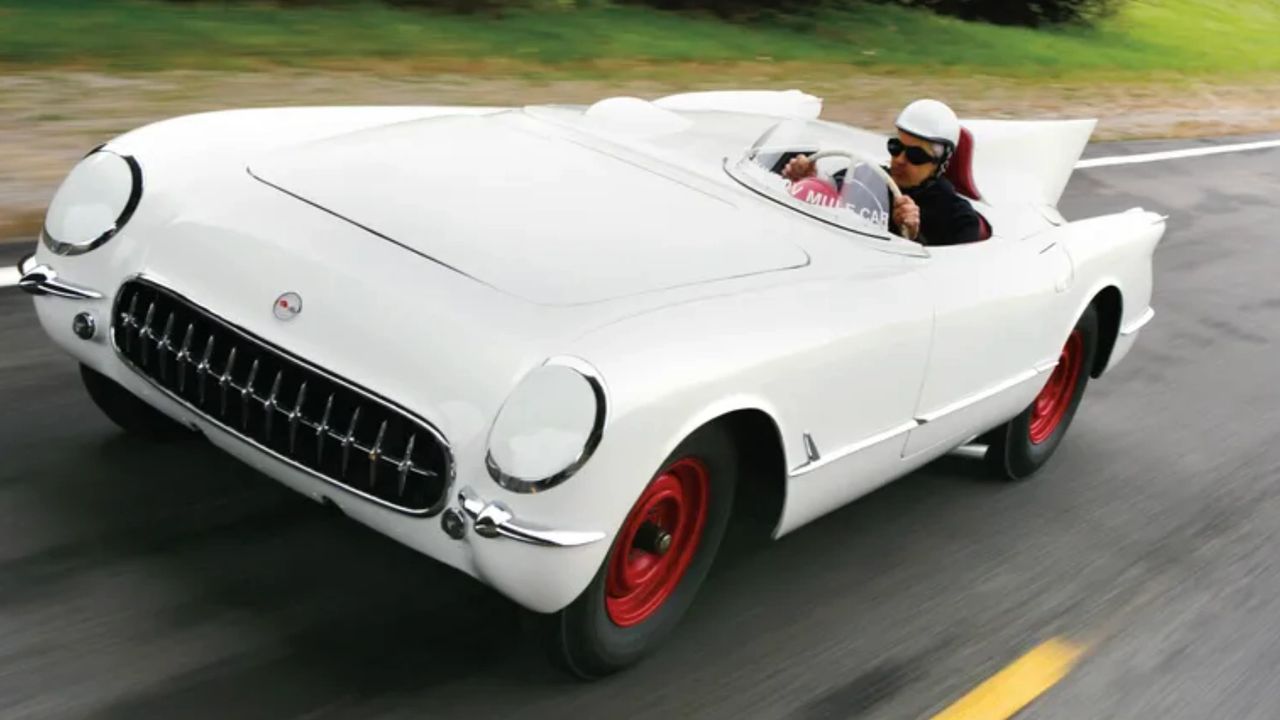
Photographed for Hot Rod during a modern evaluation of the EX-87 survivor, this image reconnects the car’s experimental past with the philosophy that still defines Corvette today. As detailed in the magazine’s feature, the car retains its distinctive single-seat layout, faired passenger side, low windscreen, and aerodynamic tail treatment—elements born not from styling ambition, but from Zora Arkus-Duntov’s insistence on measurable performance. Seen in motion once again, the EX-87 reinforces why it still matters: it established the template for Corvette development built on testing, validation, and engineering honesty. Nearly seventy years later, the car remains a rolling reminder that Corvette’s credibility was earned the hard way—at speed, under scrutiny, and with data to back it up. (Image source: Hot Rod Magazine)
The EX-87 matters today because it was the moment the Corvette stopped being judged solely as a styling experiment and started being defended as an engineering program. In the mid-1950s, Chevrolet did not need another beautiful two-seater—it required proof that its new sports car could compete with the world’s best when the conversation shifted from showrooms to speed, durability, and repeatable performance. The EX-87 delivered that proof in the language that executives, engineers, and enthusiasts all understand: measured results. It established a template that would become Corvette doctrine—test relentlessly, validate everything, and let numbers settle arguments.
Just as importantly, the EX-87 represents the origin point of a philosophy that still defines Corvette development: real performance is engineered, not claimed. The car’s focus on airflow management, driver stability, gearing strategy, and incremental engine evolution foreshadowed the way Corvette programs would later be built—from the big-block era to ZR-1, Z06, and today’s ZR1/Z06-style track-capable variants. Modern Corvettes arrive with wind-tunnel refinement, track validation, and durability testing baked into their DNA because the brand learned early—through cars like the EX-87—that reputation is earned at speed and under load.
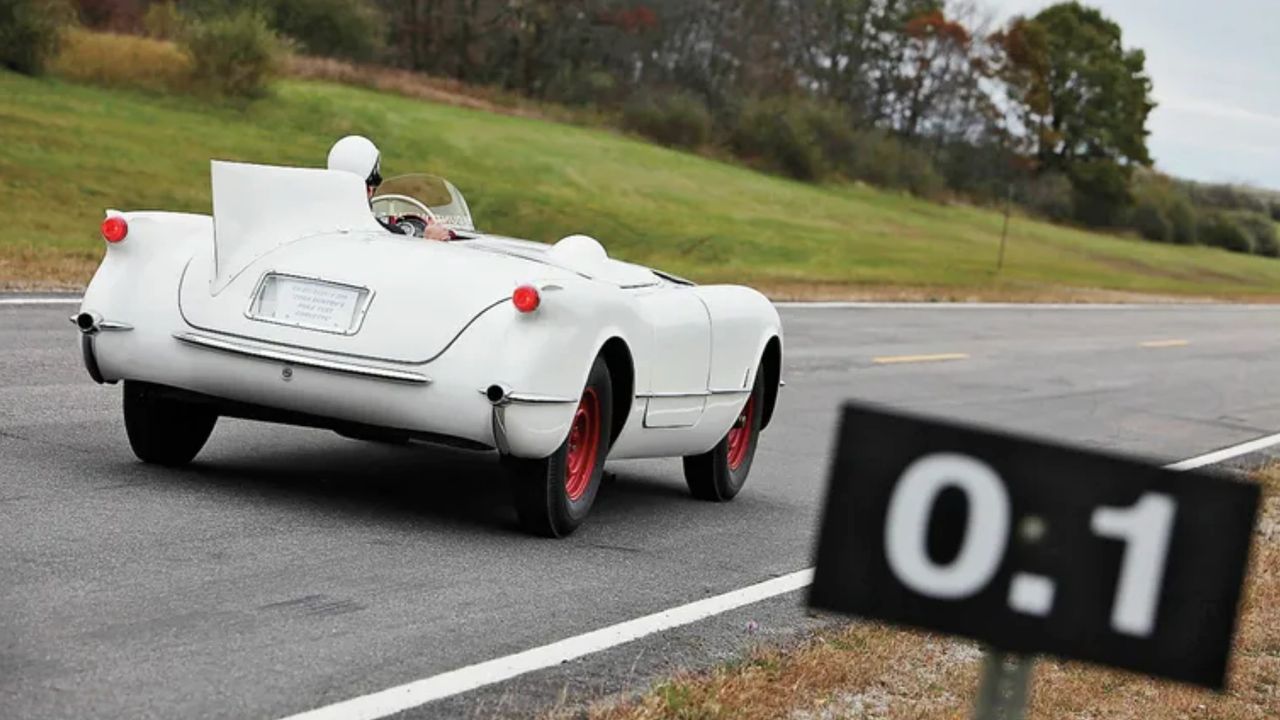
Captured during Hot Rod’s modern drive of the EX-87 survivor, this image shows the car easing away down the test road with Jeff Smith—the article’s author—at the wheel. As Smith notes in the feature, the car remains remarkably faithful to its 1955–56 configuration, from the faired single-seat layout to the red steel wheels and minimalist rear bodywork that once served a very specific aerodynamic purpose. Seen from behind, the EX-87 looks less like a museum artifact and more like what it has always been: a tool built to move forward, not to stand still. As it disappears down the course, the image becomes a fitting metaphor for the car itself—an experiment that proved its point, shaped Corvette’s future, and then quietly drove on, leaving a legacy far larger than its footprint. (Image source: Hot Rod Magazine)
In the long arc of Corvette history, the EX-87 is not remembered for its appearance, but for what it proved: that a Corvette could be a serious performance machine when given serious engineering intent. That distinction still matters in a world where performance claims are easy to make and hard to substantiate. The EX-87 was substantiation—an early, uncompromising demonstration that the Corvette’s identity would be forged by innovation, verified testing, and the refusal to accept “good enough” as an answer.
Before the Corvette had a reputation for speed, dominance, or defiance, it had a problem to solve—and the EX-87 Test Mule was the answer. Born not as a show car but as an engineering experiment, this unassuming 1954 Corvette became the proving ground for a radical idea: that America’s sports car could be more than…