“CERV I is design without limits. It is very fast. It is very sensitive. It amplifies all disturbances of steering and driver control, and all problems of transmitting power to the road. It is an admirable tool. It tells us, for example, what to put in Corvette, for the highest margin of safety for the driver.” — Zora Arkus-Duntov, Esquire, November 1961.
Prologue: Why a Mid-Engine “Research Vehicle” in 1960?
By the end of the 1950s, the center of gravity in top-tier racing had literally moved. Front-engine “roadsters” still thundered around Indianapolis, but in Europe, nimble mid-engine Coopers were rewriting the Formula One playbook. Zora Arkus-Duntov—already the driving intellectual force behind Chevrolet’s young sports car—saw the shift up close and understood what it meant: a mid-engine platform promised better weight distribution, a lower polar moment, and a clearer path to extracting all the tire had to give.
Inside General Motors, however, the 1957 Automobile Manufacturers Association (AMA) “ban” on factory-backed racing still hung like a storm cloud. Duntov’s answer was pure Zora—if he could not race, he would research. The Chevrolet Engineering Research Vehicle—CERV—would be a fully functional, single-seat, mid-engine machine built to racing standards but justified as an engineering instrument. It could go where no brochure-friendly test mule could and bring back data that would filter directly into Chevrolet’s production cars—especially Corvette.
The Birth of an Idea: From the “R-Car” and “Hillclimber” to CERV I
Work began in 1959 with a small, formidable team: Zora at the center, flanked by engineers Harold Krieger and Walt Zetye, with designers Larry Shinoda and Tony Lapine brought in as the packaging congealed. Krieger and Zetye were the hands-on translators of Zora’s philosophy into metal—mapping hard points, triangulating the chromoly spaceframe, sorting the kinematics of a fully independent suspension that would talk back at the limit. Shinoda and Lapine, working under Bill Mitchell’s watchful eye, took that ruthless packaging and wrapped it in a minimal fiberglass skin that was thin by design—just enough to manage airflow and keep the driver out of the slipstream, while leaving the mechanicals visible and accessible. The studio nickname captured the mood: this wasn’t a style exercise; it was a machine to be driven and read.
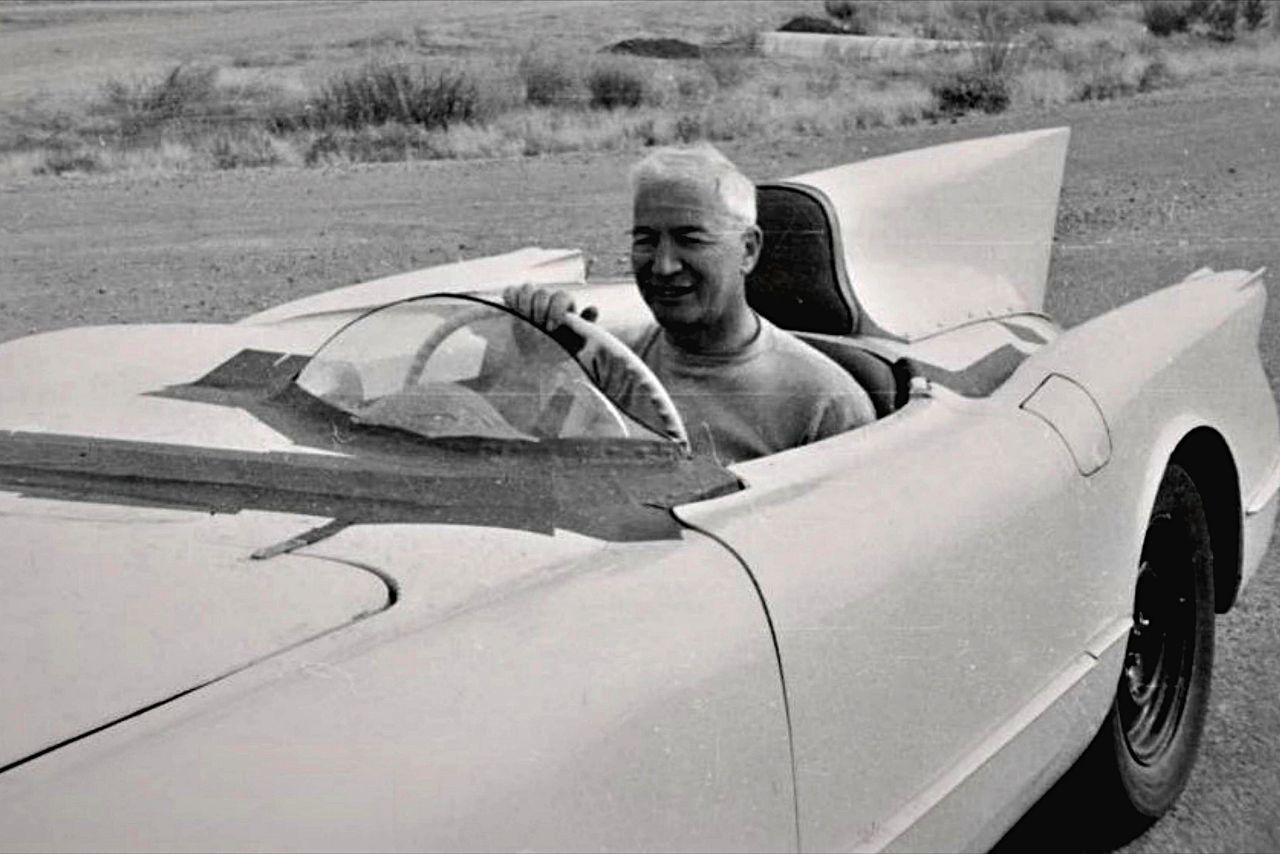
Internally, the project went by the plain “R-Car,” a catch-all label from Chevrolet Engineering that said everything and nothing. Around the design studios, though, it quickly picked up a more evocative moniker—“Hillclimber.” That wasn’t idle poetry. Zora had unfinished business on the mountain. He’d set a production-car record at Pikes Peak in 1955 in a disguised Chevrolet test mule, and the place had imprinted on him: long climbs, broken surfaces, and corners that punished any vagueness in chassis or tire. From the outset he wanted a car that could go back and take the overall—not just as a publicity stunt, but as a brutal proving ground. If a new Chevrolet single-seater could stay composed on the Peak, it would be composed anywhere.
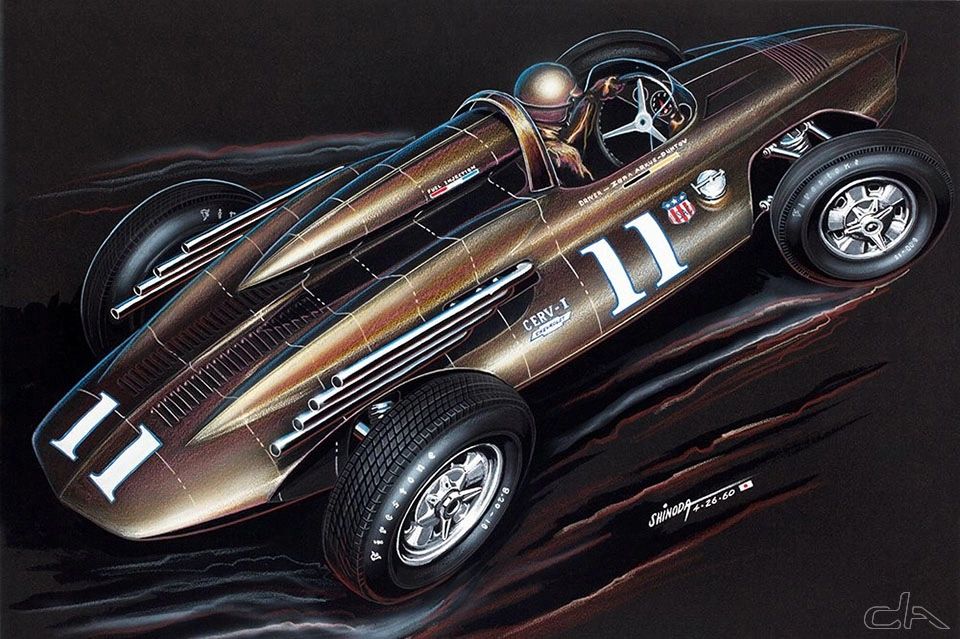
Dimensionally, Duntov sketched the car inside the broad Indianapolis envelope of the day—about a 96-inch wheelbase, open wheels, narrow overall width—so that, on paper at least, the door to the Speedway remained unlocked. He avoided painting himself into a formula corner: the layout and silhouette were Indy-correct if the rules ever mattered, but the powerplant could be anything the test program demanded. Even the cockpit ergonomics nodded to oval work; Zora specified dual brake pedals to enable left-foot braking and kept the controls dense and immediate. In effect, CERV I was packaged like a contemporary Champ car, then liberated from the constraints of a rulebook so it could chase whatever question the engineers needed answered that week.
Inside GM, where corporate policy still frowned on racing, Zora sold the car with a scientist’s logic. His pitch reduced to a sentence: build a vehicle that amplifies everything. Make it so light and so centralized that every steering input, every load transfer, every change in tire slip angle comes through louder and sooner. That thinking dictated the architecture. The driver, the dual fuel cells, and the engine cluster are tightly wrapped around the center of gravity to shrink the polar moment; a rigid, triangulated chromoly spaceframe so the suspension—not chassis flex—does the talking; an open-wheel, open-cockpit layout so engineers and drivers can literally watch the front tires and links at work. Even the driveline supported the experiment: a rear transaxle with a quick-change final drive let Krieger and Zetye swing from short-course gearing to high-speed ratios in minutes, not days, so the same chassis could map low-speed compliance in the morning and high-speed stability in the afternoon.
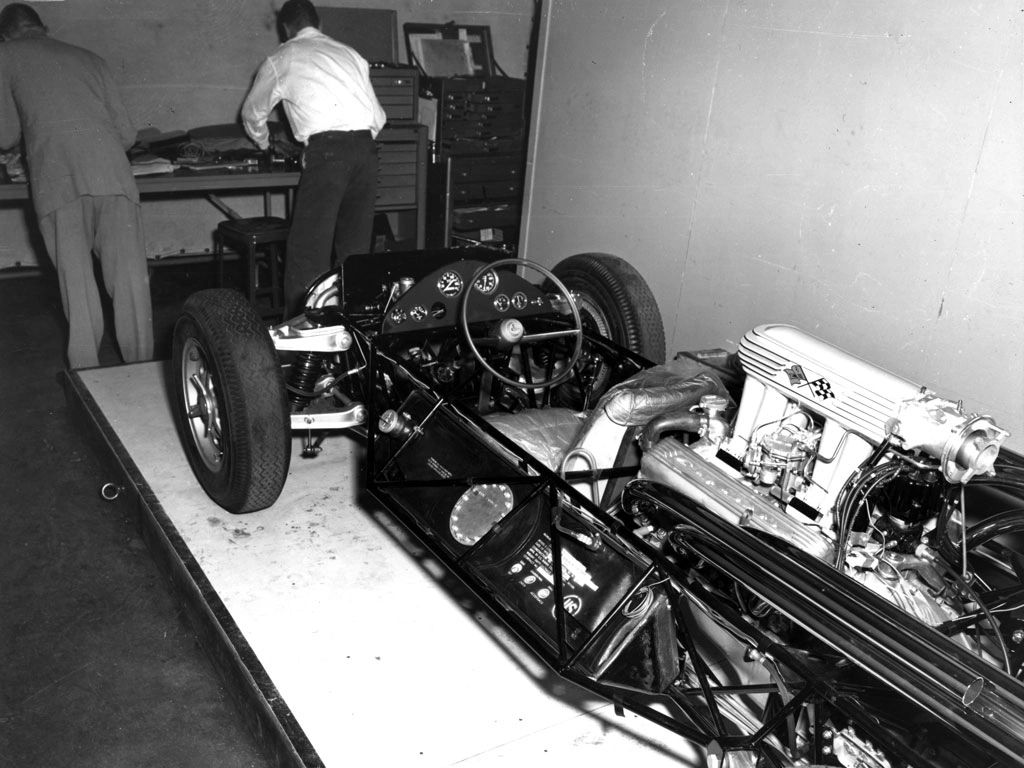
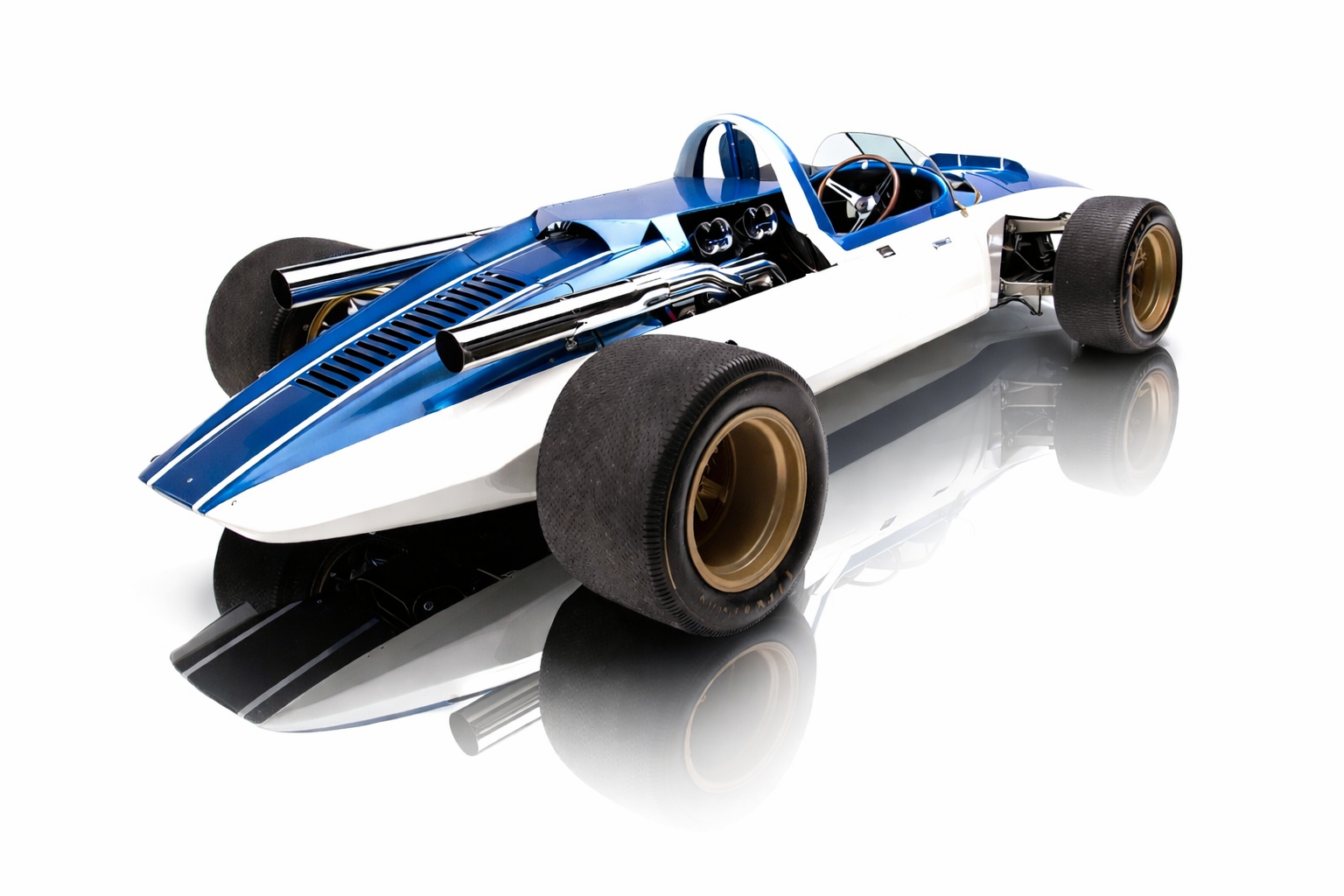
Shinoda and Lapine’s bodywork followed that brief to the letter. The shell was purposefully thin, hand-laid fiberglass in just a few sections—white with blue center stripes and a single roll hoop—more instrument casing than automobile couture. Air management was pragmatic: a small nose to feed the front-mounted radiator, clean flanks, and intake scoops just aft of the driver’s head to stand the tall ram pipes Zora favored for mid-range torque. The result looked like what it was—a research tool built to run hard, change quickly, and accurately report on its strengths…and its weaknesses.
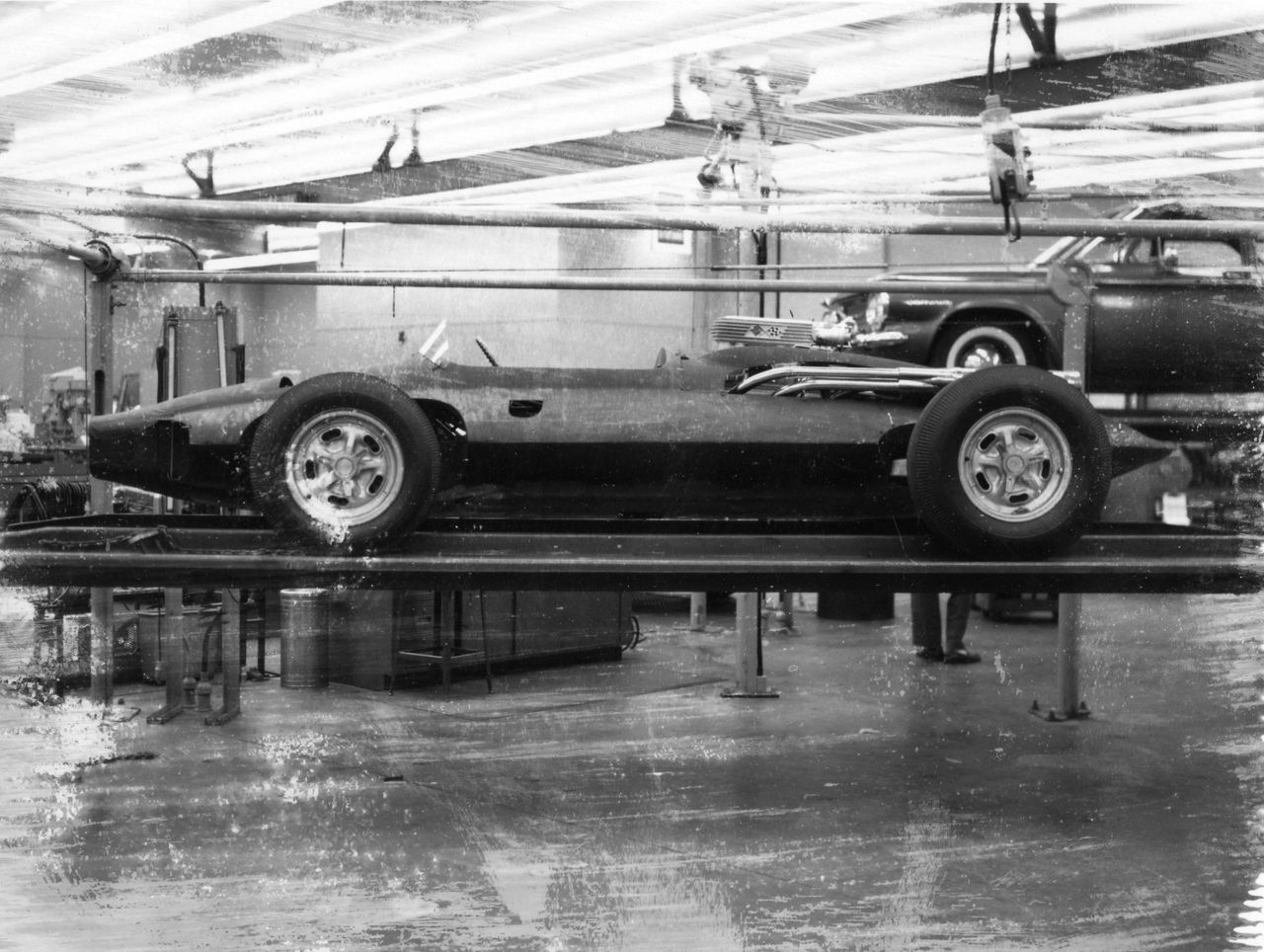
Put together, those choices explain why the “Hillclimber” nickname stuck and why the “R-Car” code name sufficed for the paperwork. In the shop, it was a mountain-obsessed single-seater; in the memos, it was the Chevrolet Engineering Research Vehicle—a lab-on-wheels whose sensitivity was the point. And in Zora’s mind, it was both at once: a car packaged carefully enough to be eligible when circumstances allowed, and honest enough in its responses to improve every Chevrolet performance car, whether it ever saw a green flag or not.
Engineering Philosophy: Amplify Everything
The 1960 CERV I was designed to amplify ride and handling phenomena—both to expose problems and to validate solutions. Chevrolet’s own 1960 engineering write-up described it point-blank as a vehicle “for continuous investigations into automotive ride and handling phenomena under the most realistic conditions,” with the explicit goal of magnifying responses so engineers could study them directly. That same factory paper explains why the car was open-wheeled and open-cockpit: the driver and engineers needed an unobstructed view of the front wheels, suspension motion, and tire contact patches in real time.
To achieve the desired “high-gain” behavior, the team concentrated mass near the center of gravity. The driver, dual fuel cells (20 gallons total), and the powertrain were grouped around the middle of the car to lower the polar moment and sharpen responses. The resulting package wasn’t just quick; it was talkative—the kind of car that told you exactly what each corner was doing at the limit and punished ham-fisted inputs.
Structure and Suspension: Chromoly Bones, Fully Independent Limbs
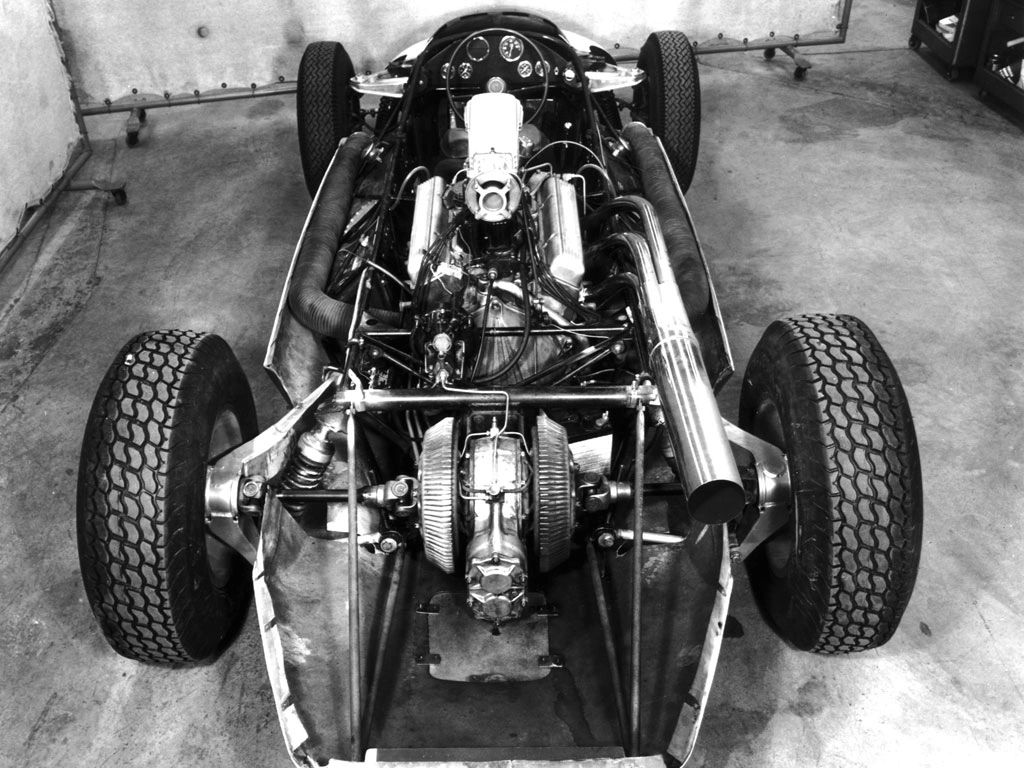
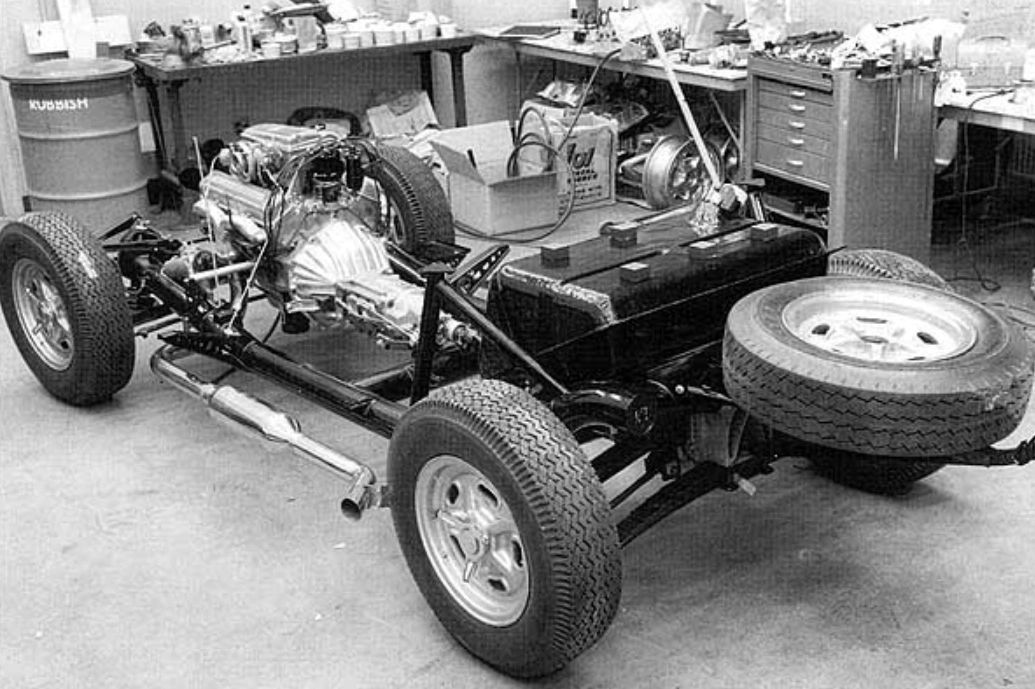
At the heart of the 1960 CERV I sat a triangulated chrome-molybdenum tubular spaceframe, its long, slender members forming a rigid spine without the weight of a ladder frame. Contemporary company literature emphasized that the structure was stiff enough to let the suspension do the“talking,” rather than the chassis flex muddying the message. The frame, clothed in thin fiberglass, supported fully independent suspension at all four corners.
Up front, Chevrolet used a high-roll-center geometry with variable-rate coil springs and direct-acting, double-acting dampers. In back, the layout previewed what would become a Corvette hallmark: each rear wheel’s vertical motion was controlled by two lateral links—the upper link doubling as a driveshaft—with a separate fore-aft link to take driving and braking thrust. Variable-rate coils and direct-acting shocks were mounted diagonally. With adjustment provisions for camber and toe, the rear end could be tuned quickly to suit test objectives. This architecture directly informed the independent rear suspension that debuted on the 1963 Corvette Sting Ray.
Steering That Spoke Clearly
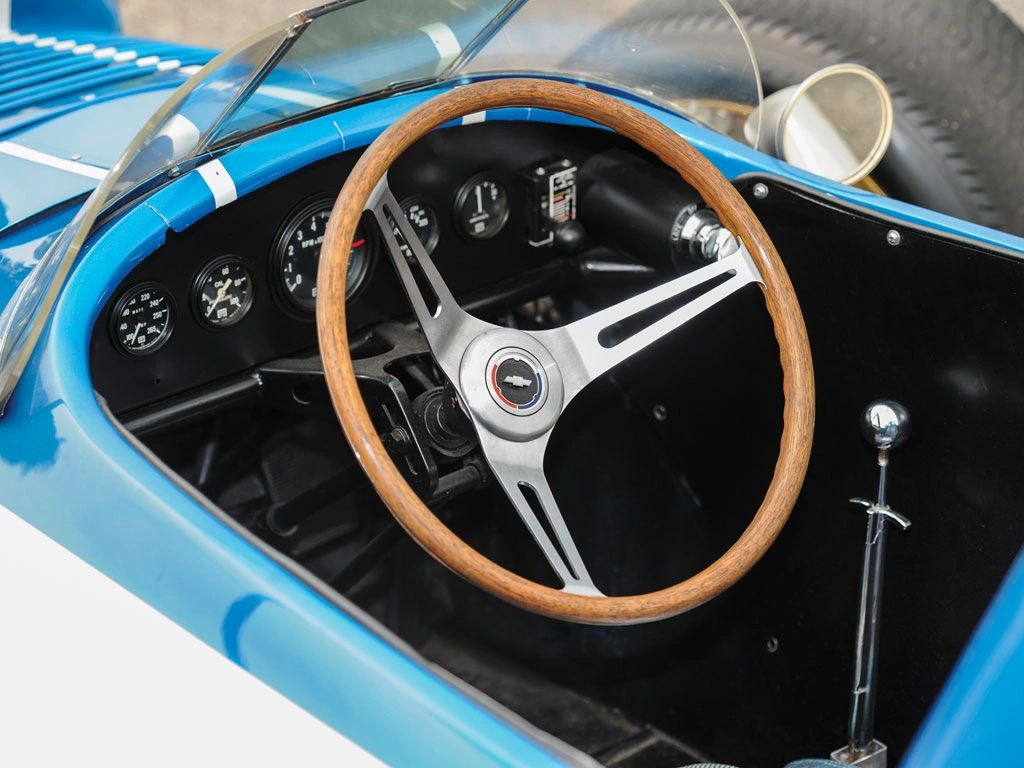
Duntov and the team specified quick steering—12:1 with just 2.3 turns lock-to-lock—because they wanted fingertip authority at speed. Compared with the slower 16:1–20:1 boxes common in road cars of the day, this ratio meant tiny inputs produced meaningful front-wheel angle. On a light-nose, mid-engine mule, that was a feature, not a liability: the modest front axle load kept effort reasonable without assist, while the fast rack let the driver trim the line mid-corner and catch weight transfer the instant it began.
Geometry and compliance were treated like performance parts. Forward-mounted, “balanced” linkages shortened the load path and kept the tie-rods working in simple tension/compression, so the system didn’t wind up under load. The team chased near-zero bump steer through the suspension’s mid-travel, paired generous positive caster for self-centering and straight-line stability, and targeted a small scrub radius by aligning steering-axis inclination with wheel offset. Add in stiff, race-style joints and carefully chosen bushing durometers, and you had a front end that filtered almost nothing: surface texture, grip build-up, carcass squirm, and the first hint of push or bite all arrived through the rim in real time.
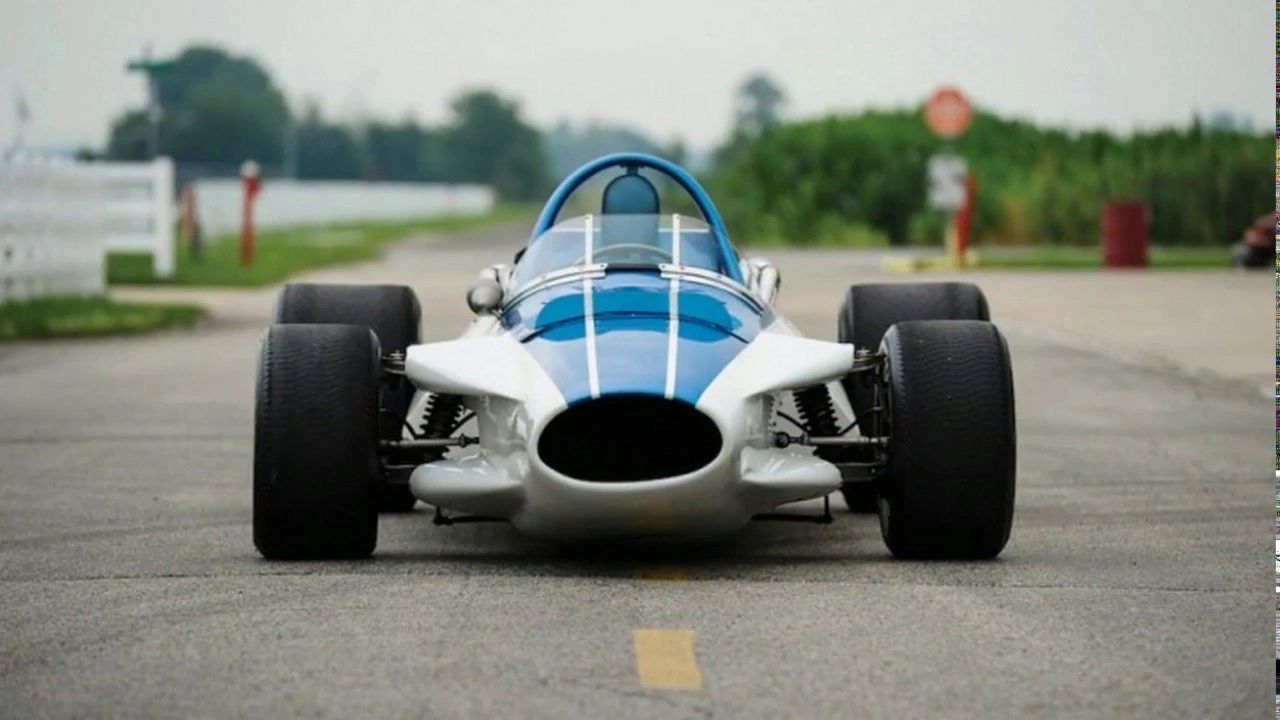
The result matched Duntov’s philosophy to the letter. Instead of isolating the driver from kickback with slow ratios and soft rubber, they reduced the sources of kickback and kept the steering fast. The car still told you everything—only now the messages were clean, timely, and easy to act on, exactly the kind of feedback loop you need when you’re developing a chassis at the limit.
Brakes Designed for Stopping, Not Comfort
The 1960 CERV I ran inboard rear brakes to cut unsprung mass and improve the suspension’s ability to keep the tire planted. Drums—aluminum with cast-in iron braking surfaces—were drilled in the webs to shed heat; the linings were sintered iron. Brake balance was set at 57% front / 43% rear, and a dual-piston master cylinder kept one axle working if the other circuit failed—forward-looking hardware in 1960. Even the pedal box reflected dual purposes: there were two brake pedals (right and left) to accommodate left-foot braking for oval/Indy-style running.
The Powerplants: From Featherweight 283 to 377 and Beyond
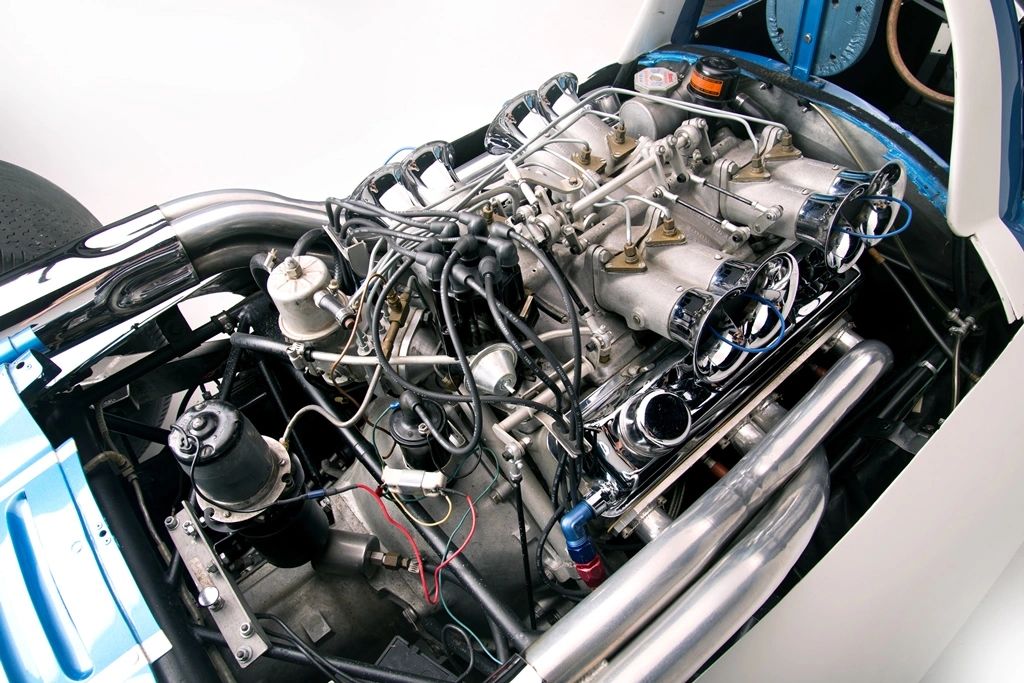
The 1960 CERV I’s original engine was a technical statement in itself: a lightweight, all-aluminum 283-cid small-block with Rochester fuel injection and a flock of mass-reduced ancillaries (aluminum water pump, starter, flywheel, pressure plate). Fully dressed, it weighed a startling ~350 pounds and made ~353 hp at 6,200 rpm—almost one horsepower per pound and roughly one horsepower per cubic inch, levels that were exotic in period. Period coverage makes clear what that meant in practice: with “350-plus horsepower and 1,600 pounds of car plus driver,” Ray Brock wrote in Hot Rod, the 1960 CERV I was “an outstanding performer.”
Power went through a rear transaxle hung behind the engine, with a Halibrand quick-change differential sandwiched by the inboard rear brakes. The quick-change let the team swap final-drive ratios rapidly; Chevrolet’s documentation refers to thirteen available gearsets, spanning 2.63 to 4.80:1—perfect for moving from a tight handling course to a high-speed oval in an afternoon.
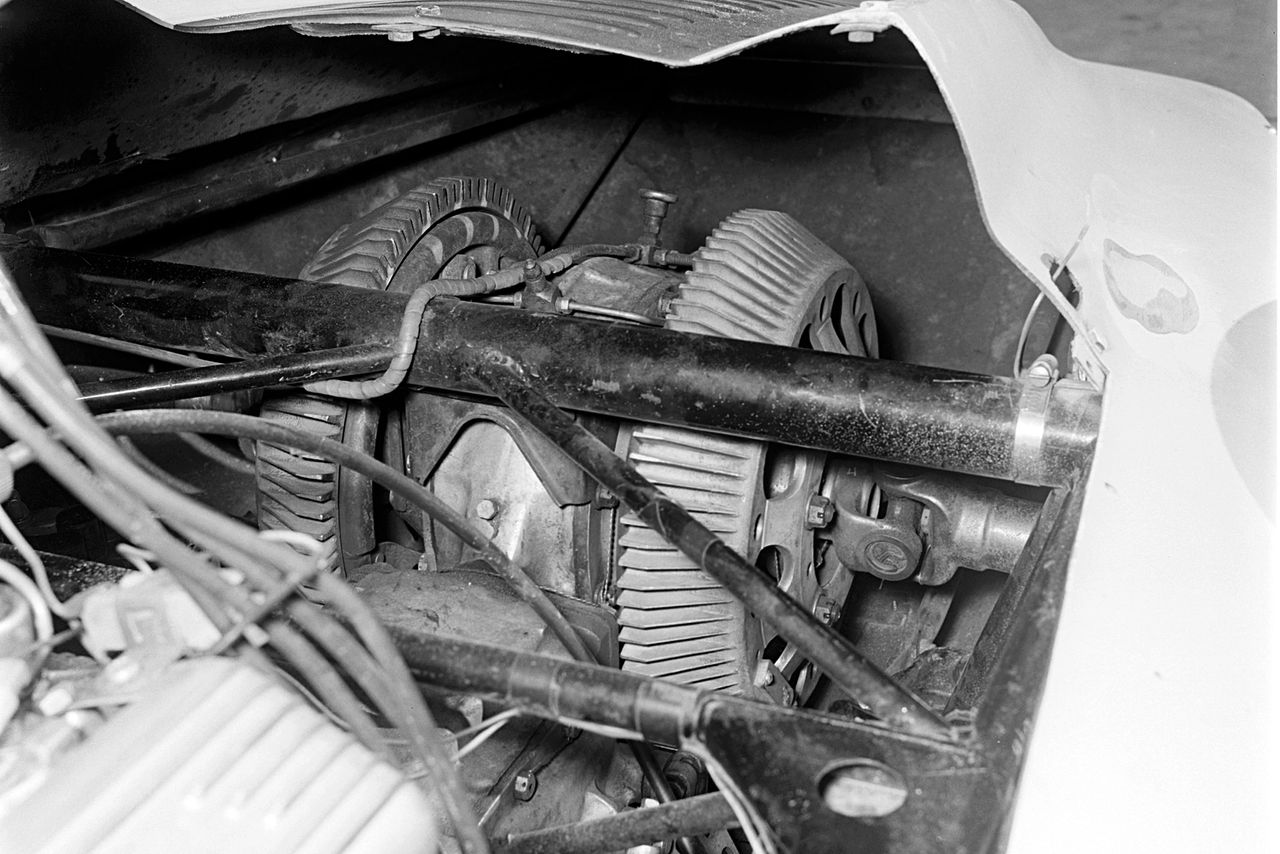
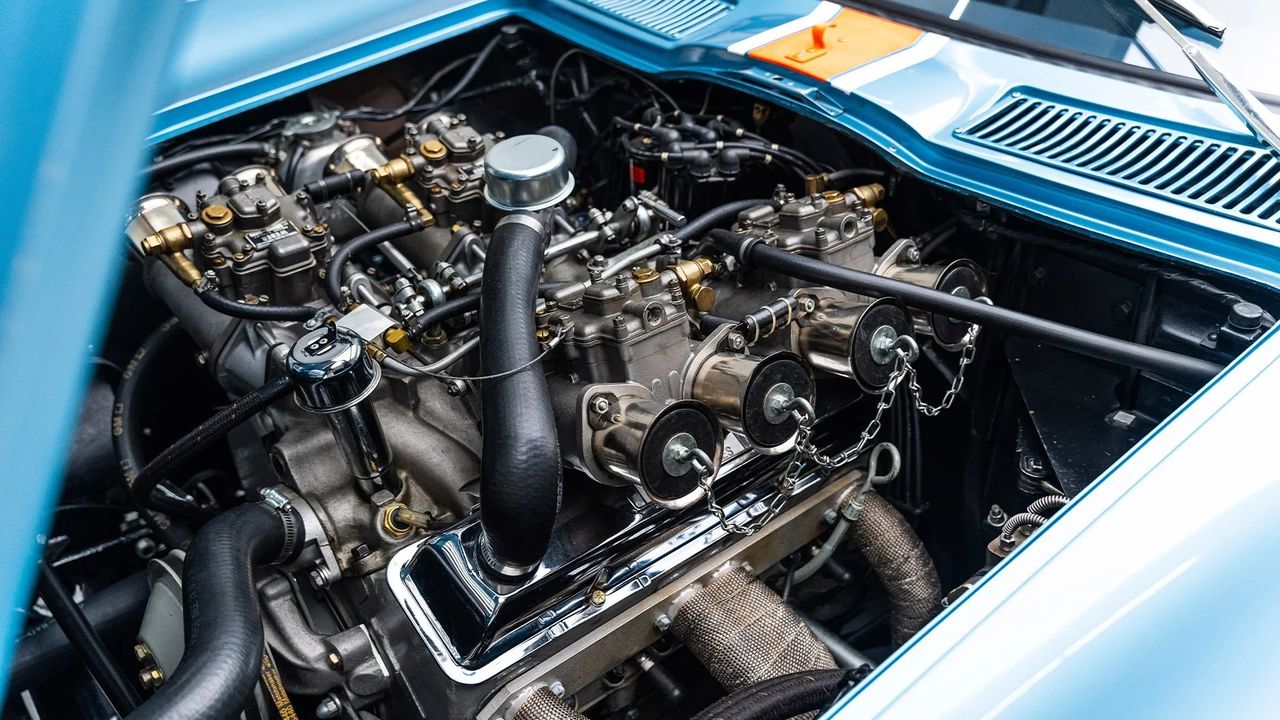
The 1960 CERV I’s value as a rolling laboratory meant the powertrain was never static. By auction accounting it cycled through seven engine configurations, evolving from early Rochester-injected 283s and hot 327s to an ultimate all-aluminum 377-cid small-block with Hilborn mechanical injection and dry-sump lubrication. That final package combined light weight with razor response from the eight independent runners, and the low-mounted sump let the engine sit down in the chassis, trimming frontal area and helping stability at speed.
With the 377 in place, Duntov chased outright velocity on the five-mile banked circle at GM’s Milford Proving Ground. The team treated each run like a controlled experiment—swapping ratios in the Halibrand quick-change, adjusting ride height and alignment, and working tire pressures to keep the car planted as speeds climbed. Period accounts and later histories consistently credit the 1960 CERV I with a measured 206 mph, a figure enabled by tall gearing, clean packaging, and a low-compliance chassis that stayed calm as aero loads built.
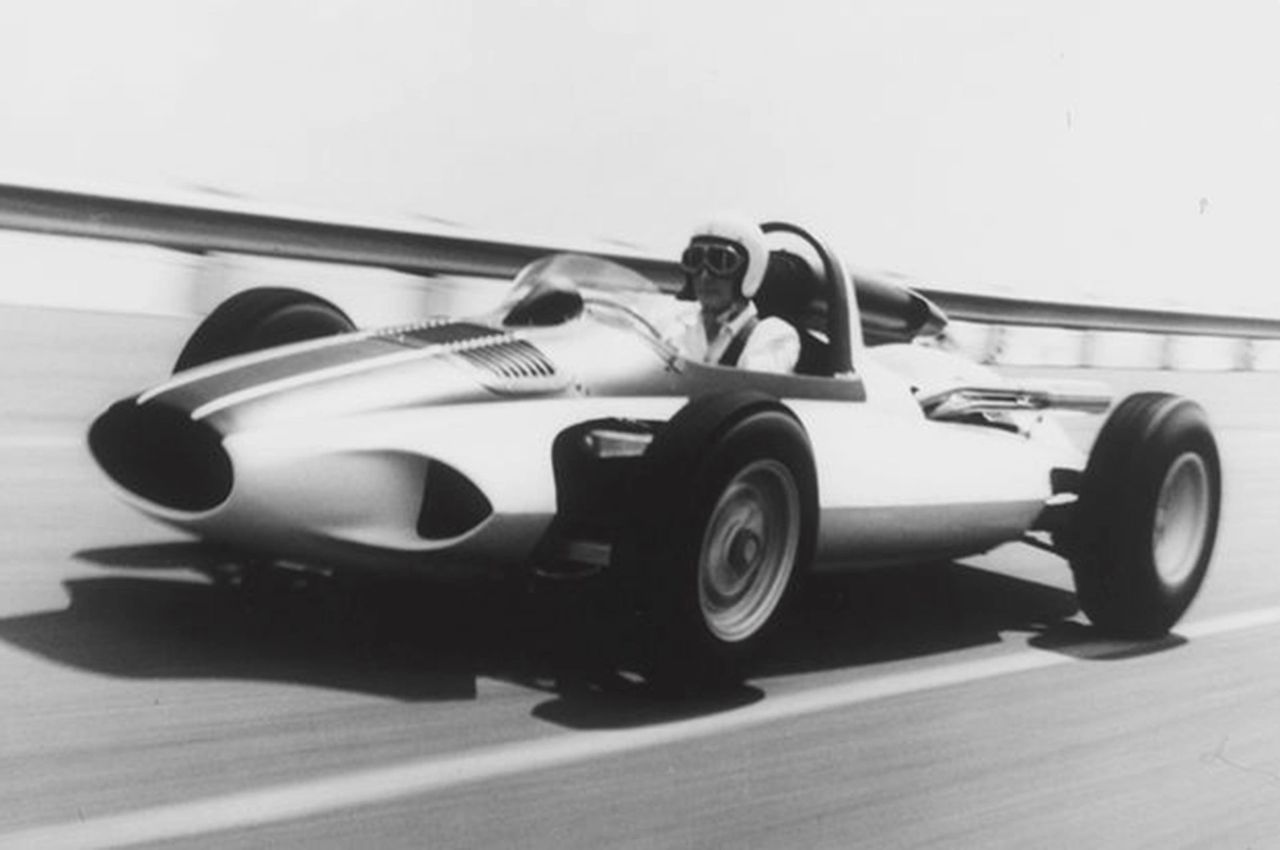
Ever the experimenter, Zora pushed further with forced induction. A TRW turbocharger system reportedly run to about 17 psi demanded new plumbing, heat management, and conservative fuel/ignition settings, but returned roughly 500 hp—enough to shift the limitation from power to aerodynamics. To keep the envelope safely open, Larry Shinoda lowered the nose and massaged the bodywork to reduce lift and tidy flow, ensuring the car remained stable while the team probed the outer edge of its speed potential.
Form Follows Function: The Fiberglass Shell
Shinoda and Lapine wrapped the chromoly skeleton and mid-ships engine in a sleek, hand-laid fiberglass body that was dramatically thinner than Corvette’s production panels—just enough structure to fair the shape through the air and cover the mechanicals. Completed in white with metallic blue center stripes, the shell weighed on the order of 80 pounds, and the whole car was a study in purposeful minimalism: a single roll hoop, a small screen, and air scoops just behind the driver’s head feeding the tall intake trumpets.
Dimensions were keyed to versatility: a 96-inch wheelbase and comparatively narrow tracks (about 53 in front / 50.5 in rear, depending on wheel and tire) kept the footprint within Indy’s norms while suiting tight road courses. Chevrolet’s own memo pegged the ready-to-run weight at roughly 1,600 pounds with driver; other period measurements cite ~1,450 pounds dry—both numbers consistent with the car’s featherweight reputation.
Testing the Thesis: Milford, Pikes Peak, Continental Divide, Riverside
Duntov didn’t build trailers—he built cars to be driven. At GM’s Milford high-speed track, Ray Brock reported the 1960 CERV I“in excess of 170 mph… beautifully [handling] despite 15–20 mph crosswind gusts,” confirming both aero cleanliness and the chassis’ high-speed manners.
Pikes Peak: The Hill That Named It
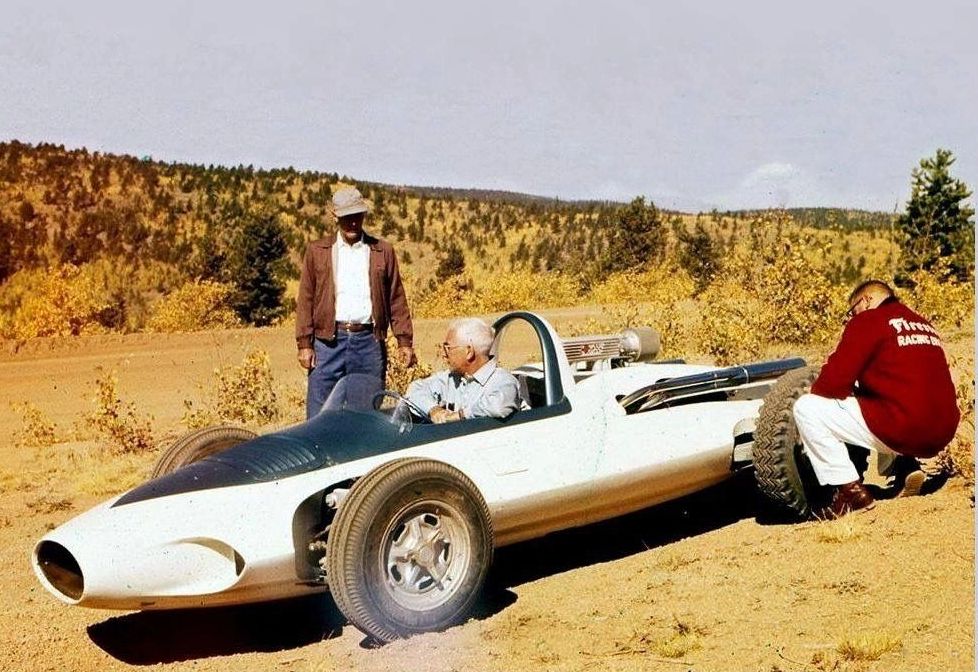
Late-season trials on Pikes Peak came next. Chevrolet never entered the July 4th Hill Climb with the car, but the late-fall test sessions told the team what they needed: on a 0.9-mile test segment, the times were comparable to the fastest championship cars that ran the full course each summer, proof that a mid-engine, high-power single-seater could survive—and thrive—on broken, climbing tarmac. Even so, the 1960 CERV I was more naturally suited to road-course and high-speed work than to gravelly hillclimbs, and Zora moved on.
Continental Divide Raceway: Making Tires Talk
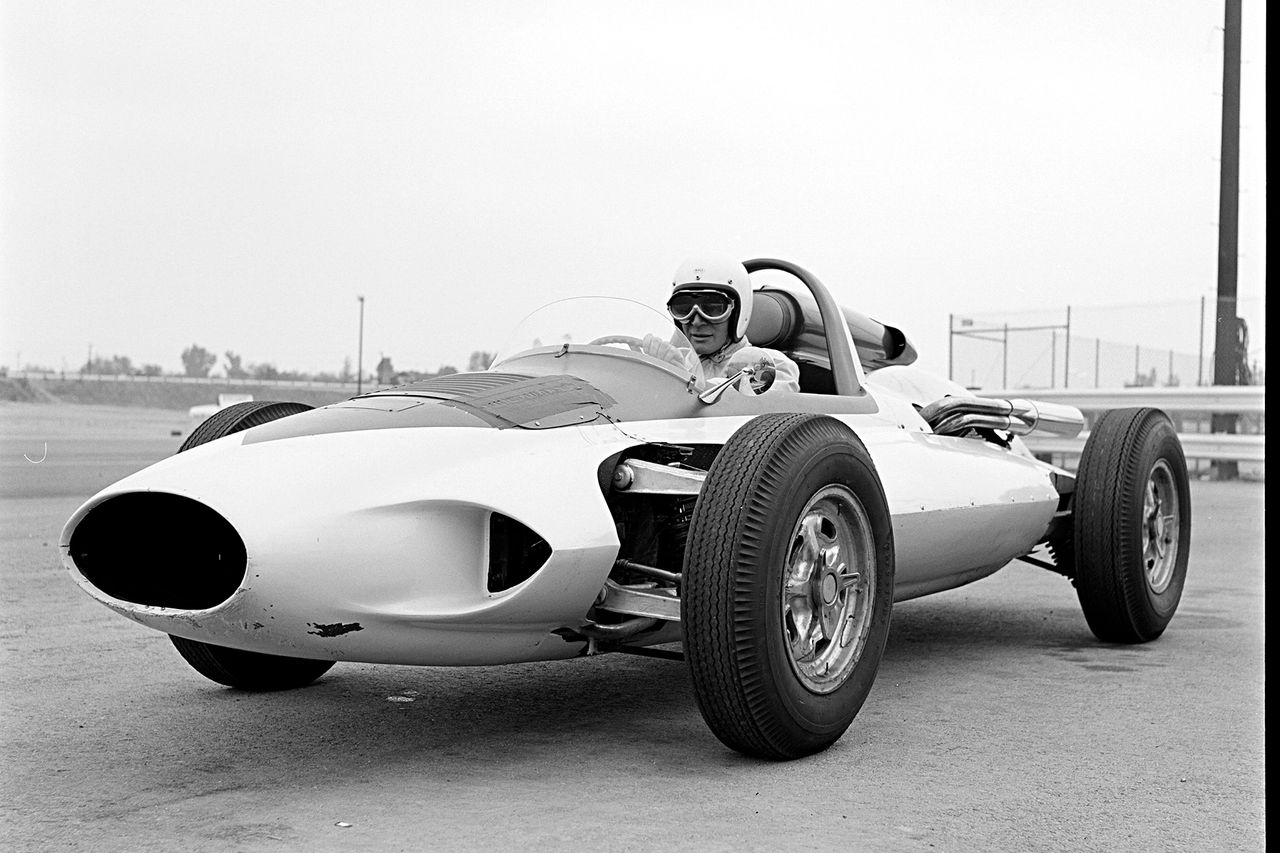
To deepen the tire learning, Zora partnered with Firestone at Continental Divide Raceway outside Castle Rock, Colorado. There, across two demanding weeks, Duntov, Dan Gurney, and Stirling Moss cycled through combinations of Firestone tires and Halibrand magnesium wheels, mapping how section width, aspect ratio, and compound affected turn-in, mid-corner balance, and exit traction. The work was seminal—helping to push open-wheel racing toward wider, lower-profile race tires in the 1960s.
Riverside, November 20, 1960: The Public Debut of the CERV I
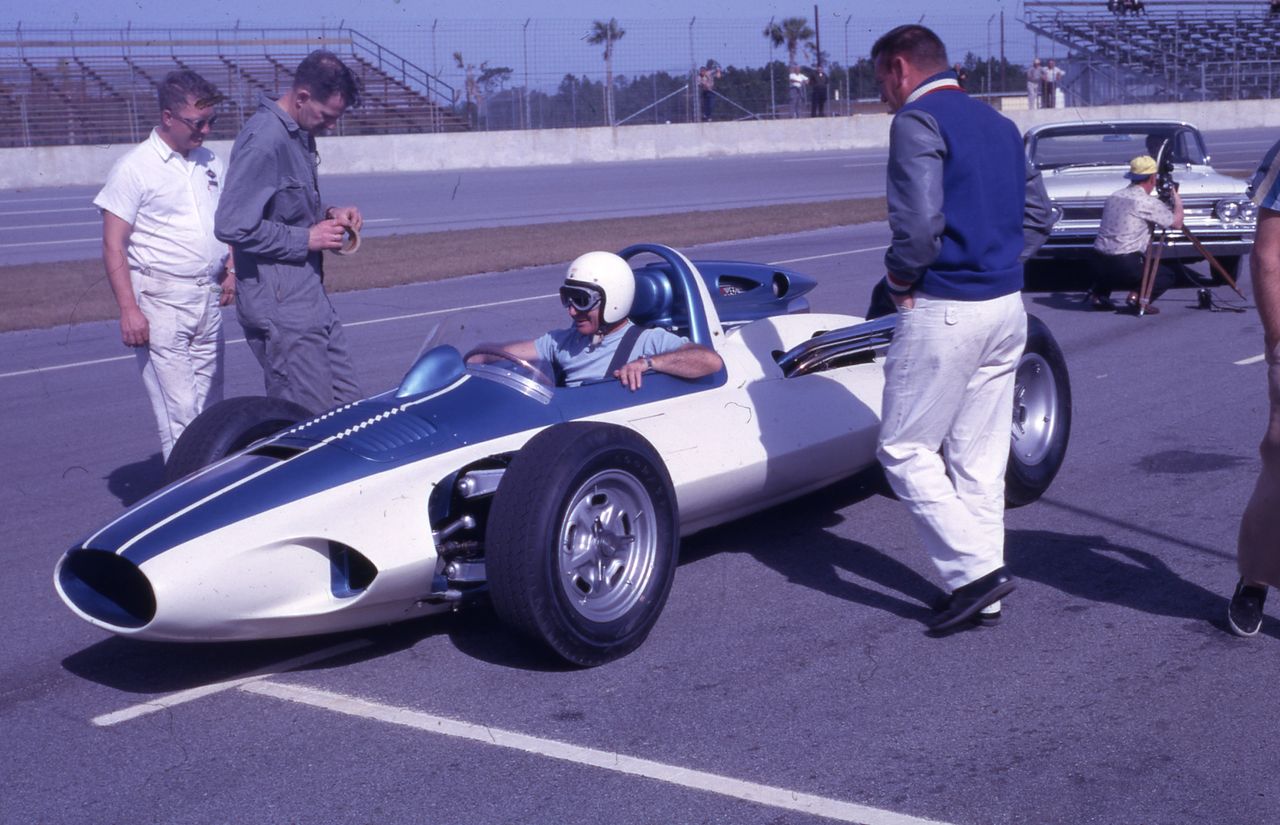
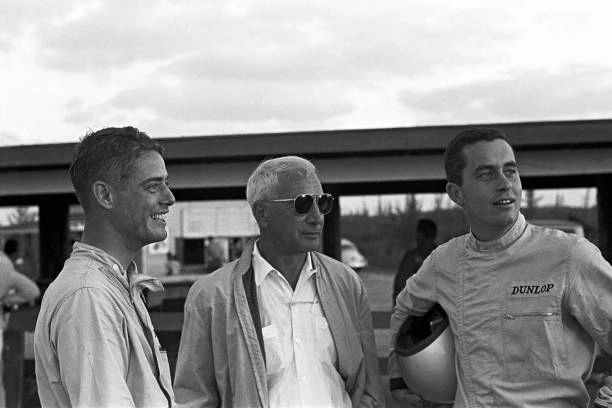
Chevrolet’s racing hands were tied, but its eyes were wide open. On November 20, 1960, during the U.S. Grand Prix weekend at Riverside International Raceway, the 1960 CERV I made its public bow—officially labeled the Chevrolet Engineering Research Vehicle to keep the “R” word out of press copy. Duntov, Stirling Moss, and Dan Gurney turned laps; both Moss and Gurney were under 2:04 within a few tours—astonishing given that Moss’s GP lap record in a Lotus was just under 1:55. The point had been made: Chevrolet wasn’t racing, but it was absolutely doing race-level engineering.
What CERV I Was (and Wasn’t): A Racer’s Tool, Not a Race Entry
It bears underlining: the 1960 CERV I never raced. The AMA anti-racing policy still constrained GM, and Chevrolet carefully framed the car as a rolling laboratory. But in configuration, performance, and behavior, it was indistinguishable from a competitive mid-engine single-seater of its day. Indeed, Duntov proportioned the car to Indy eligibility, chased Pikes Peak times, hunted 200-mph stability, and brought in the very best drivers to help interpret the results—all under the banner of R&D.
The Anatomy of the Instrument: Details That Mattered
- Wheels/Tires: Knock-off magnesium wheels from Halibrand carried a mix of narrow and progressively wider Firestone tires, depending on the test program. The switch to broader section widths and lower aspect ratios produced the very discoveries Zora was after: more contact patch at lean, different breakaway characteristics, and more definition in the car’s “language” to the driver.
- Final Drive: The quick-change differential, framed by the inboard rear drums, let the team tailor the car from a short, second-gear slalom to a long straight without changing the entire gearbox. Chevrolet’s records cite 13 ratio choices from 2.63 to 4.80.
- Steering & Pedals: The 12:1 steering spoke immediately. The dual-pedal brake arrangement enabled left-foot braking for certain tests, with the dual-circuit master cylinder bringing a layer of redundancy rare in the era.
- Cooling & Induction: Tall ram pipes boosted mid-range torque (vital in a hillclimb or at corner exit). Side scoops aft of the driver’s head fed cool air; the front radiator kept mass centralized while enjoying undisturbed flow.
The Payoff: What the 1960 CERV I Taught—and What Corvette Kept
Two big, durable takeaways from CERV I made their way into Corvette’s DNA:
- Independent Rear Suspension. The core link-and-half-shaft concept, with the driveshaft doubling as the upper link and a separate trailing/locating link for thrust, matured into the 1963 Sting Ray’s famous IRS—a system lauded for giving the Corvette a level of composure over broken pavement and consistency at the limit that its solid-axle predecessors couldn’t match.
- Systems Thinking for Brakes & Tires. Zora’s insistence on unsprung mass reduction (inboard brakes), bias optimization (57/43 baseline), and tire-first handling tuning made Corvette a more sophisticated performance car in the 1960s and beyond. The move toward dual-circuit hydraulic safety, while not widespread in 1960, was a clear signal of where engineering culture was headed—and where production would end up as safety expectations rose later in the decade.
Beyond hard parts, the 1960 CERV I embedded a process in Chevrolet engineering: build purpose-designed, instrumented vehicles to answer high-risk, high-reward questions quickly—and listen to the tire. That process echoes through later Chevy experimental platforms (CERV II, CERV III, CERV IV) and, ultimately, the mid-engine production Corvette launched sixty years later.
Later Lives: Engines Swapped, Speeds Chased, Myths Made
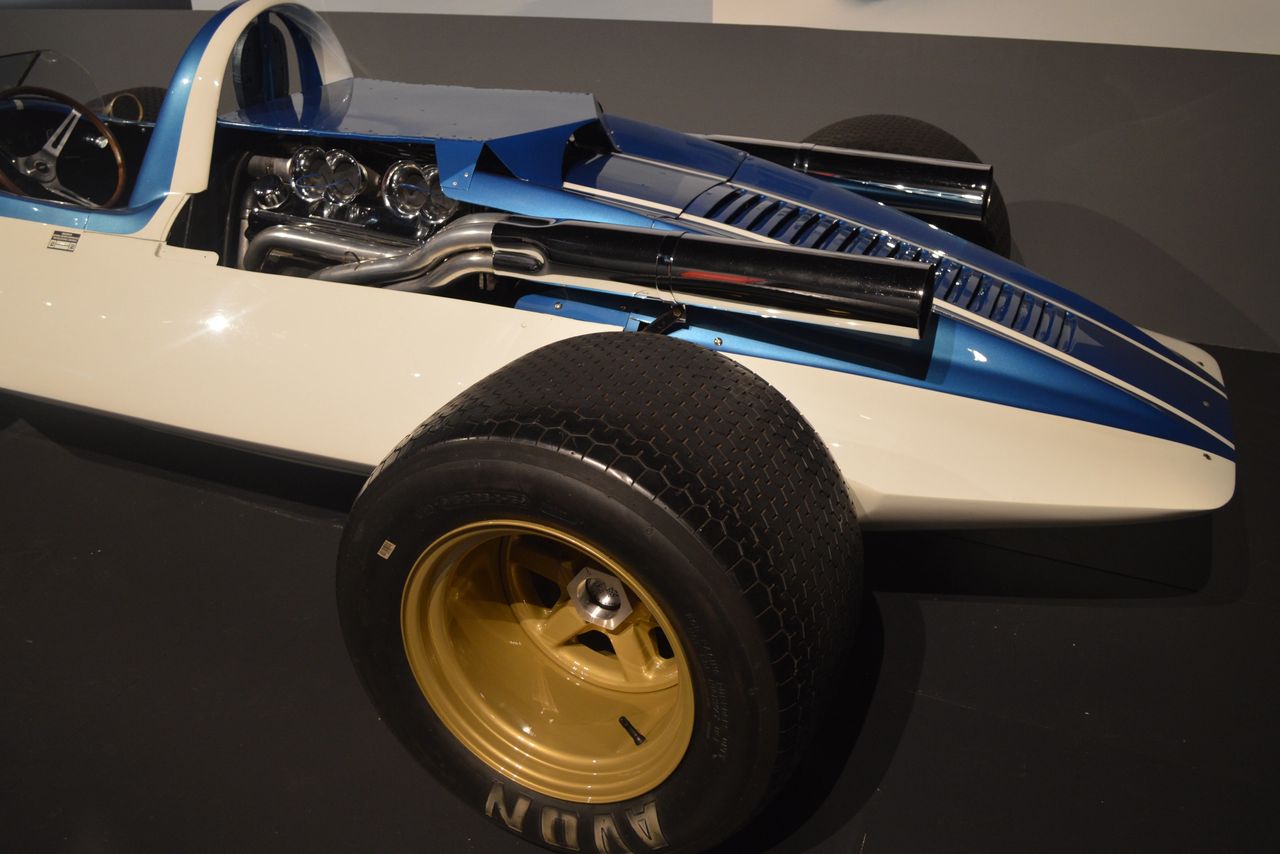
Because the 1960 CERV I was a tool, engines came and went as programs demanded. The Hilborn-injected 377 turned the car into a land-missile for high-speed tests; the brief turbocharged interlude proved both how much headroom the chassis had and how quickly aero lift became the limiting factor at ultra-high speeds—hence Shinoda’s low-nose revisions. Period reports and later histories converge on the canonical headline number: 206 mph at Milford. A dramatic Daytona run was even floated (with Bill France rumored to offer a bounty for a 180-mph lap), but that particular circus never set up its tent.
Over the years, the car’s original featherweight aluminum 283 separated from the chassis, and the engine found a life in other Chevrolet testbeds. That kind of parts fluidity was normal in R&D—what mattered was the data and the lessons, which stayed with Chevrolet even as components migrated.
The Public Story: From Secret Lab to Heritage Icon
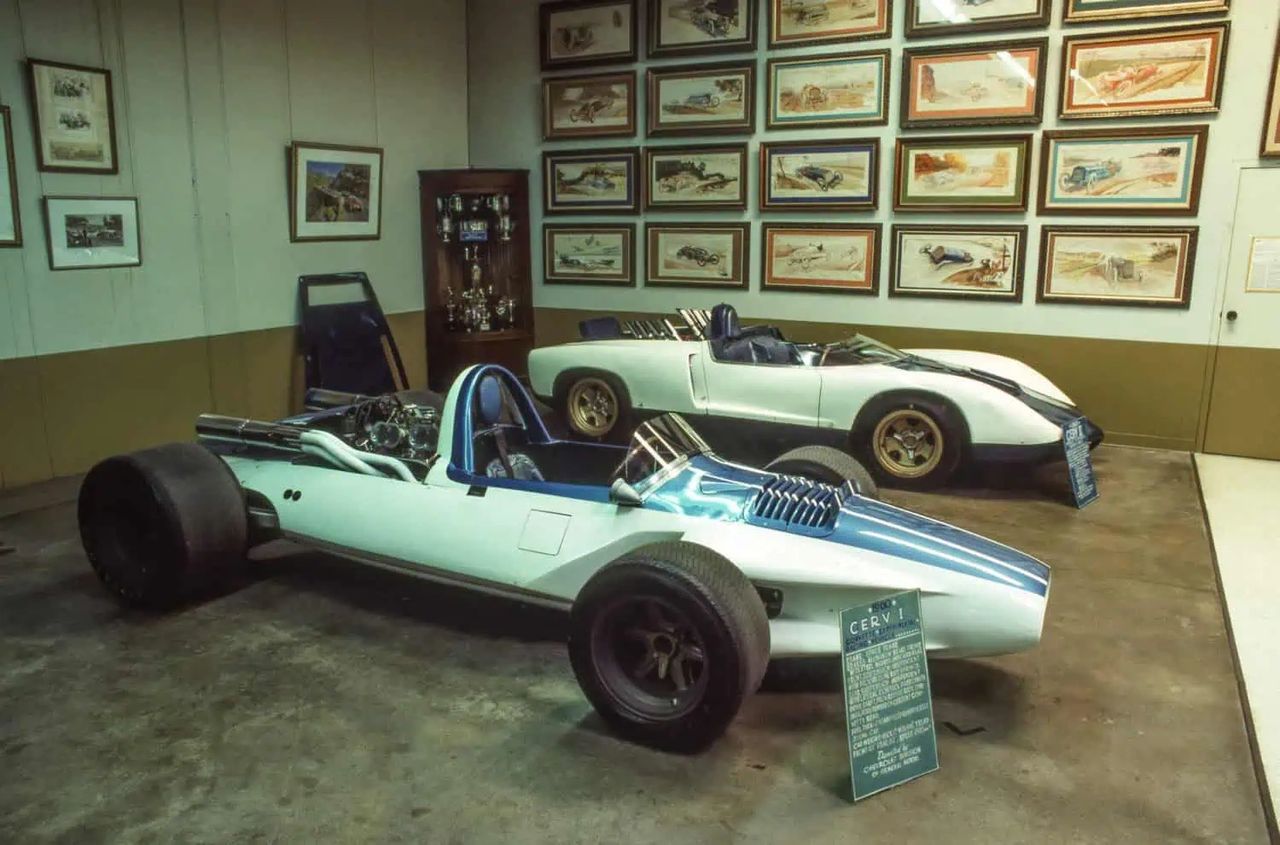
Like most one-off engineering instruments, the 1960 CERV I lived with a death sentence from the day it was welded together. Prototypes are usually destroyed for liability, secrecy, and accounting reasons; they’ve served their purpose and take up space. Zora Arkus-Duntov fought that culture. He understood that the CERV I wasn’t just a mule but a record of ideas—geometry, packaging, data—the seed corn for everything that followed. Through his preservationist push, the car escaped the crusher and, in 1972, went to Briggs Cunningham’s museum in Costa Mesa, where it was displayed as a living piece of American racing technology rather than a discarded tool.
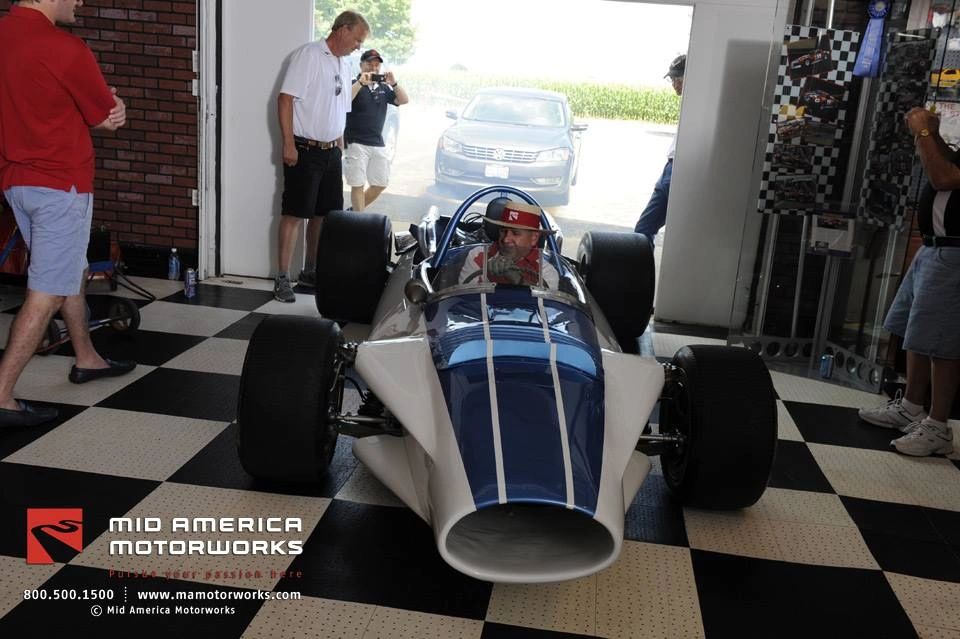
When Cunningham’s collection transitioned, the 1960 CERV I was migrated to the Collier Collection and later spent time with Mike Yager at Mid America Motorworks, remaining visible to the public rather than disappearing into storage. In 2017, it surfaced at Barrett-Jackson Scottsdale and sold for $1.2M at the hammer ($1.32M with premium). Quietly and appropriately, General Motors stepped in to repatriate its landmark prototype to the GM Heritage Center in Sterling Heights—bringing the testbed back under the roof of the company that created it.
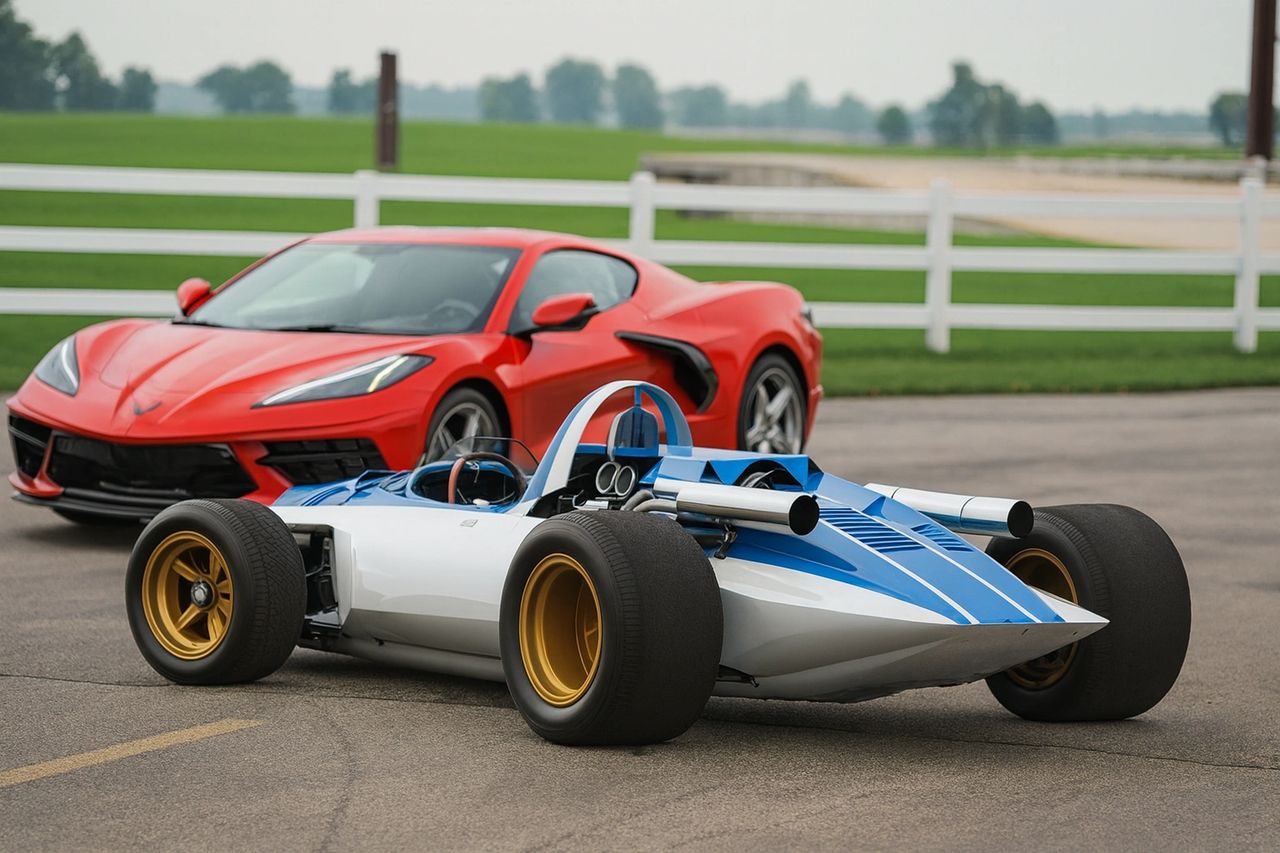
There it sits today—not mothballed, but interpreted and cared for as a keystone in a straight line of development: from the 1959 Stingray Racer and the 1960s CERV programs to the 1990 CERV III and, ultimately, the 2020 C8 Stingray that finally made Duntov’s mid-engine vision a production reality. CERV I survives because someone inside believed the past was worth saving to inform the future.
A Closer Technical Walkaround (for the record)
Because CERV I is so often reduced to just a few “greatest-hits” factoids, it’s worth logging its factory-documented design choices plainly:
- Purpose: A high-gain tool to study ride/handling “under amplified conditions,” with visual access to the front suspension and tires.
- Layout: Mid-engine, single-seat, open-wheel/open-cockpit; fuel mass centralized (dual cells totaling 20 gal); radiator forward; engine air scoops behind the driver.
- Chassis: Chrome-moly tubular spaceframe; fiberglass body panels (hand-laid, very thin); finished in white with blue stripes; single roll hoop.
- Dimensions/Weight: 96-in wheelbase; tracks ~53/50.5 in (front/rear, depending on setup); ~1,600 lb ready-to-run w/ driver per Chevrolet; ~1,450 lb dry per later documentation.
- Suspension: Front: high roll-center geometry, variable-rate coils, direct-acting dampers. Rear: upper lateral link serving as half-shaft, lower lateral link, separate fore-aft link, diagonally mounted coils/dampers; adjustable for camber and toe.
- Steering: 12:1 ratio; 2.3 turns lock-to-lock; balanced, forward-mounted linkages.
- Brakes: Inboard rear drums (aluminum drums with iron surfaces), drilled webs; 57/43 front/rear balance; dual-piston master cylinder; dual brake pedals (left/right).
- Driveline: Rear transaxle with Halibrand quick-change diff; 13 ratio sets from 2.63 to 4.80:1; inboard rear brakes straddling the diff.
- Engines: Began with aluminum 283 (≈353 hp, ≈350 lb); later 377 with Hilborn mechanical injection; experimental TRW turbo (≈500 hp); high-speed work culminating in 206 mph runs at Milford.
- Public outings: Riverside U.S. Grand Prix weekend, Nov. 20, 1960; laps by Duntov, Moss, Gurney under 2:04 within a few tours.
Legacy: The Line from CERV I to Every Corvette Thereafter
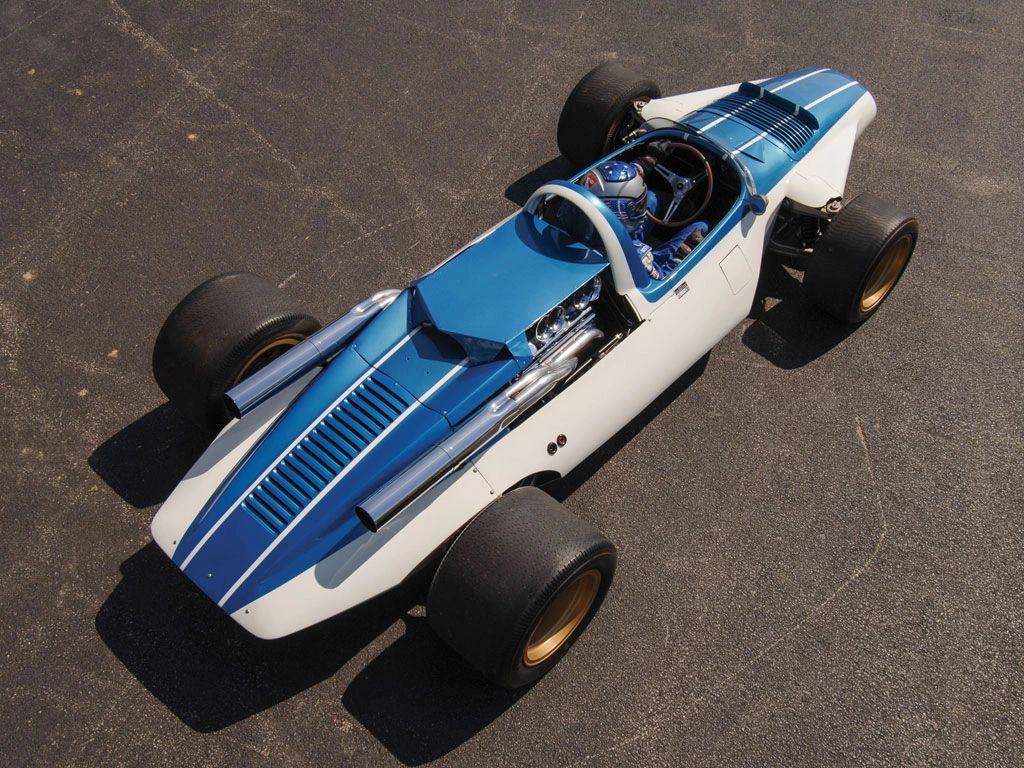
It’s tempting to read CERV I as a glorious cul-de-sac—a brilliant prototype with nowhere to go while corporate policy frowned on racing. The truth is the opposite. CERV I was less a detour than a surveyor’s stake, hammered into Chevrolet’s landscape so future engineers would know exactly where “true north” lived. Its lessons—about where to put mass, how to let the suspension do the talking, how to bias a brake system, how to select and listen to tires—migrated outward to everything Chevrolet touched, especially Corvette.
You can see the fingerprints first in the 1963 Sting Ray. The independent rear suspension that defined the C2’s road manners didn’t drop from the sky; it grew from CERV I’s rear layout where the half-shaft served as the upper lateral link, a separate lower link controlled camber, and a fore-aft member took thrust. That basic division of labor—let each piece do one job cleanly—gave the Sting Ray composure over imperfect pavement and consistency at the limit. It also locked in a new mindset inside Chevrolet: solve handling with geometry and compliance, not brute stiffness and “band-aid tires” (using extra-wide or ultra-sticky rubber to cover up underlying chassis problems.)
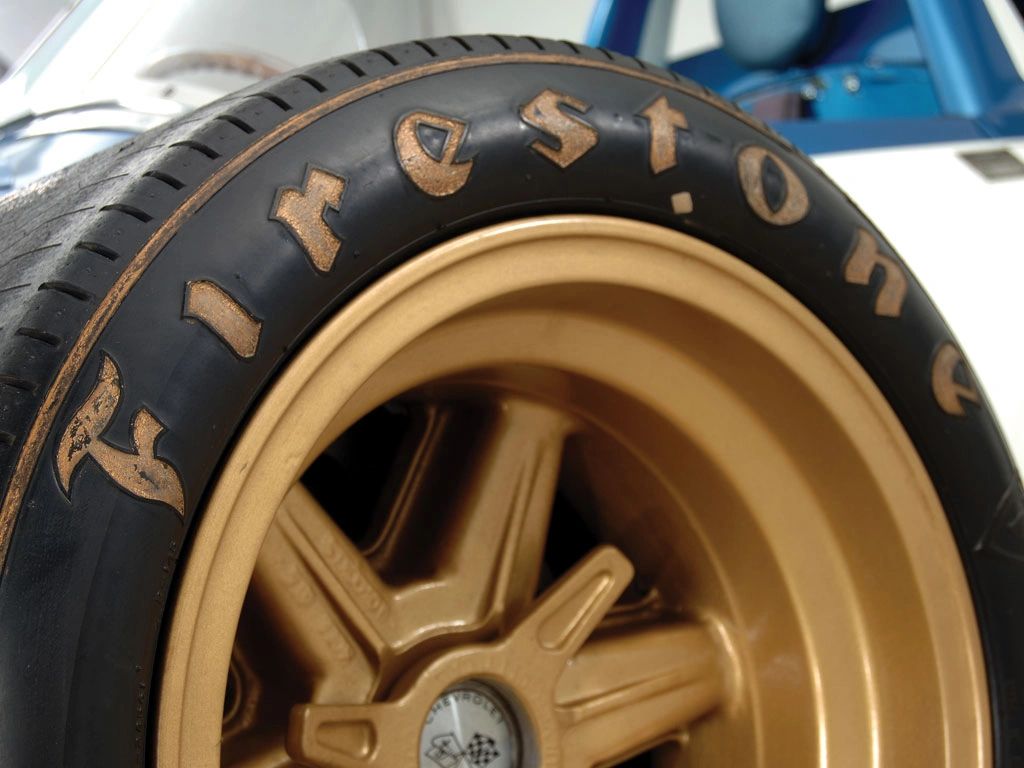
Brakes and tires were the other big early harvest. CERV I’s inboard rear drums cut unsprung mass and sharpened the way the suspension traced the road. The 57/43 baseline brake bias, the dual-circuit master cylinder, and even the two-pedal layout for left-foot braking weren’t gimmicks; they were the beginnings of a systems view that treated stopping, turning, and power-down as linked problems. Out on Continental Divide Raceway and other test venues, Zora’s tire programs with Firestone—and later, Goodyear—made a lasting cultural dent. By cycling through section widths, aspect ratios, and compounds and then reading what the car told him, he normalized something that now seems obvious: the tire is the first suspension element. That philosophy would shape Corvette setups for decades.
Packaging may be CERV I’s most durable gift. Centralizing the driver, fuel, and engine to shrink polar moment became second nature for Corvette engineers, even when a mid-engine street car wasn’t politically possible. You can draw a straight line from CERV I’s rear transaxle/quick-change mindset to the rear transaxle architecture on the C5–C7—a production solution that moved mass off the nose, improved fore-aft balance, and made the car more honest in fast transitions. And when the door finally opened to a production mid-engine Corvette, the C8 didn’t require a philosophical leap; it required execution. The fundamentals—cooling paths, serviceability around a mid-ship powertrain, the feel targets that come from a low polar moment—had been rehearsed, in spirit, since 1960.
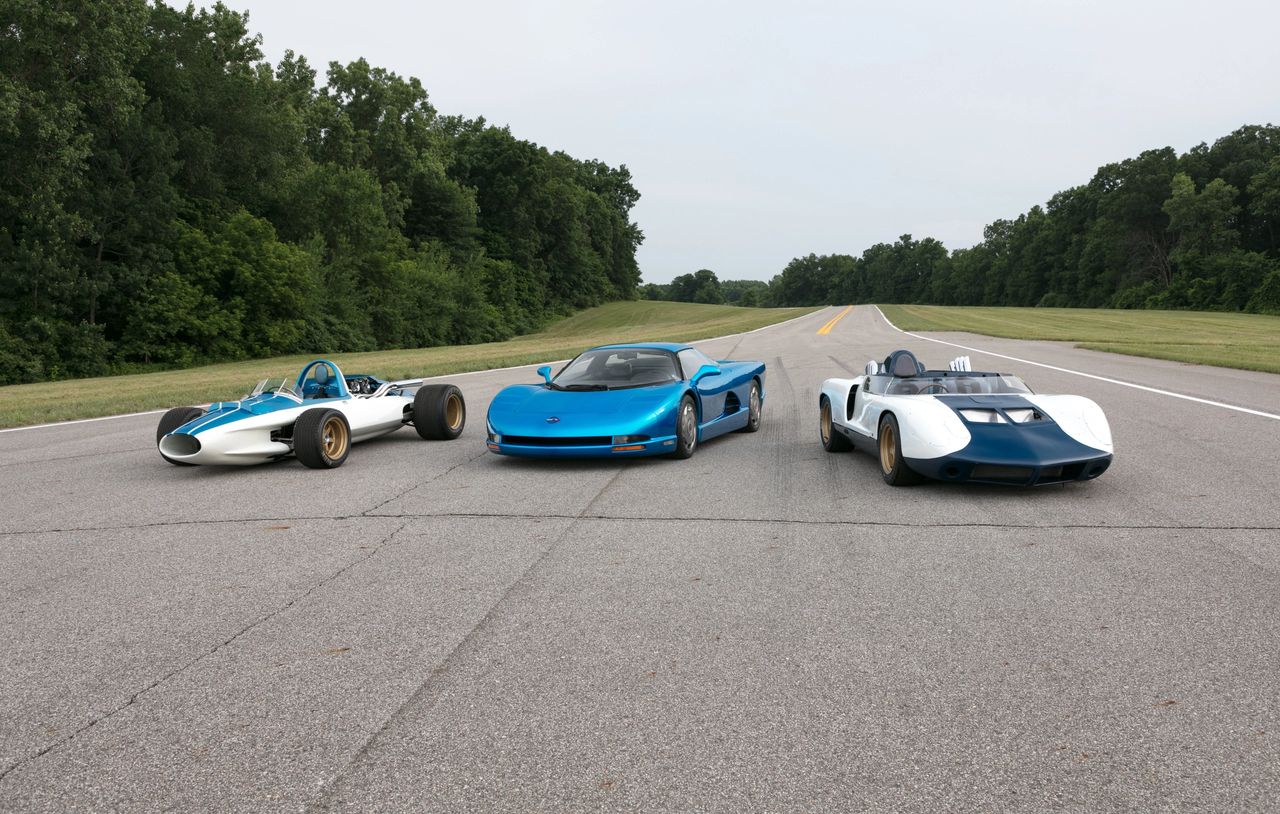
The 1960 CERV I also seeded an organizational habit: when the question is big enough, build a rolling lab to answer it. That’s the throughline to CERV II (with Zora exploring four-wheel-drive torque paths and high-speed endurance packaging) and CERV III (composites, active systems, and advanced electronics that would echo in later production safety and stability controls). The names and technologies change; the pattern doesn’t. Create a purpose-built instrument, amplify the phenomena you care about, let great drivers and engineers interrogate it, then fold the truth back into the cars the public can buy.
And the ripple effect extends beyond hard parts. the 1960 CERV I normalized driver-in-the-loop development at Chevrolet. It brought world-class pilots into the program to translate the car’s language and forced engineers to chase measurable cause-and-effect rather than myth. That “test, measure, teach” cycle shows up later in everything from Corvette’s high-speed stability work to the track-packages that let owners feel real, engineered differences—Z07 brake and tire tuning, aero balance that stays with you as speed climbs, damper curves chosen to preserve the tire over a stint. None of that happens if your culture doesn’t value the disciplined curiosity CERV I demanded.
So yes, the car never took a green flag. But some of the most consequential “Corvettes” never wore VINs. Built under the cover of research in an era officially hostile to competition, the 1960 CERV I accelerated Chevrolet’s understanding of how a high-performance car should be packaged, suspended, braked, and shod—and it did so in Zora’s favorite way: at full song, with the best drivers of the day, on real circuits that forced real answers. The line it drew runs through the Sting Ray’s rear suspension, through the transaxle Corvettes of the modern era, and straight into the mid-engine C8—a production car that finally wears, for the world to see, the layout Zora proved in a white-and-blue single-seater six decades earlier.
Epilogue: Coming Home
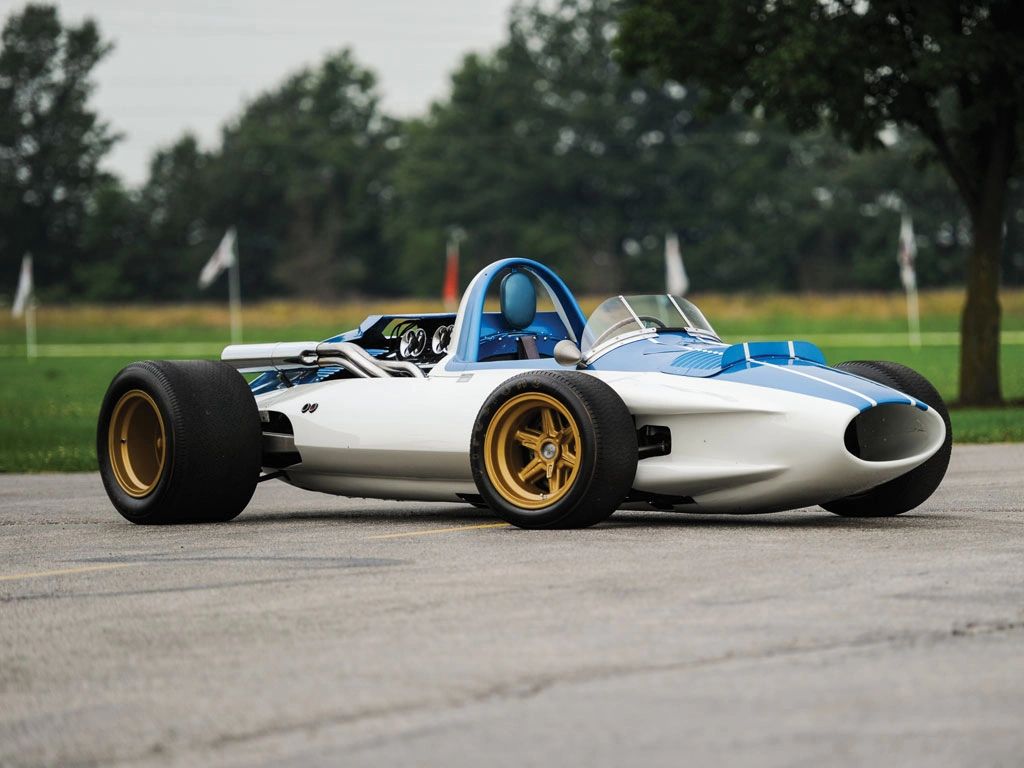
That GM chose, in January 2017, to spend $1.32 million to bring CERV I back to the Heritage Center was more than an act of preservation; it was an act of continuity and self-recognition. Within days of the Barrett-Jackson hammer falling at $1.2 million (fee-inclusive $1.32M), GM confirmed the car was coming home—“GM is proud to have CERV 1 back,” said Heritage Center manager Greg Wallace—framing the purchase as an opportunity to reclaim a cornerstone of the company’s engineering DNA and to keep it in the institutional bloodstream that created it. The CERV I returned not as a museum curio but as a living syllabus, parked among the Stingray Racer, Mako Shark, and other mid-engine studies that trace a straight line from Zora’s rolling lab to today’s Corvette.
Once repatriated, the car didn’t retreat into a vault. It began doing what it has always done—teaching—this time in public. In 2020, the National Corvette Museum’s “The Vision Realized” exhibit put CERV I alongside the pantheon of mid-engine prototypes, a traveling seminar in how ideas become architecture and then production reality. NCM curators made it explicit: the display told “the story of Zora Arkus-Duntov’s dream of one day having a production mid-engine,” with CERV I on loan from the GM Heritage Center anchoring that story. Visitors, from school-age kids to retired engineers, could walk the timeline and see the experiment that started the rumor become the proof that became the car.
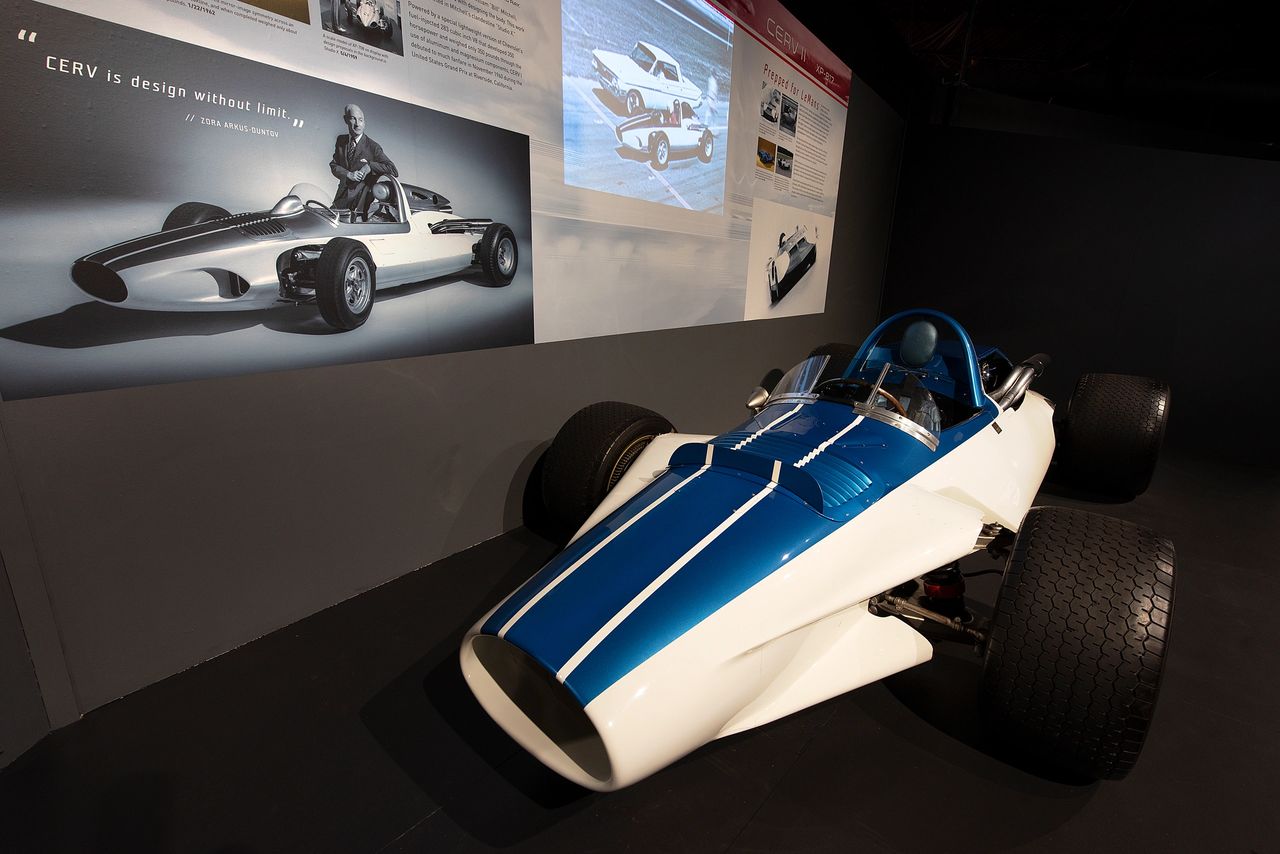
Beyond Bowling Green, the CERV I continues to surface at blue-chip marquees that treat engineering as art. Amelia Island staged a special Mid-Engine Corvette class in March 2020, gathering CERV I with its later siblings and experimental kin—a once-in-a-generation tableau that let crowds absorb, in one glance, six decades of Chevrolet’s mid-engine thinking. A few years earlier, the Lake Mirror Classic offered the rare spectacle of CERV I and CERV II together, a two-car master class in “what if?” and “what’s next?” that reminded onlookers how much of American innovation has been forged in skunkworks and on proving grounds.
Which is why the buy-back matters so much. GM didn’t simply purchase a historic chassis; it brought home a method—build a tool that amplifies truth, put it in the hands of brave drivers, and listen. Every time CERV I rolls into the National Corvette Museum, or out under the lights at Amelia, it restarts that conversation. You can see it in the faces pressed to the stanchions: design students sketching the body’s clean airflow, young engineers puzzling over the inboard brakes and diagonal springs, club racers tracing with their fingers the line from quick-change gearsets to a perfect final drive. The car that never took a green flag still waves one—inviting the next Zora, the next Shinoda, the next Krieger or Zetye—to step over the rope, ask better questions, and then go build the answer. In that sense, CERV I is not just back where it belongs; it’s exactly where it’s most dangerous and most useful—within reach of the next generation.
Why the CERV I Still Matters Today
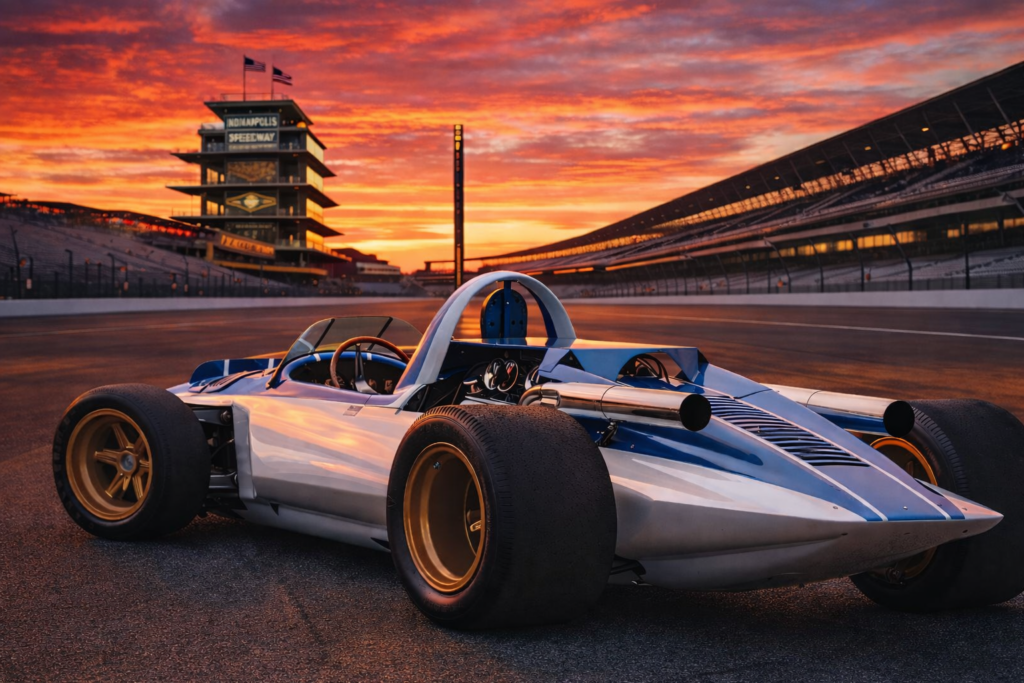
The 1960 CERV I still matters because it reminds us that Corvette history was never built on production cars alone. Some of the most important chapters began in experimental machines designed to ask difficult questions before the public ever saw the answers. CERV I was one of those machines. It was not created to fill a showroom. It was created to push. To test. To prove.
That is what makes it so significant in the larger Corvette story. Under Zora Arkus-Duntov’s direction, CERV I gave Chevrolet a purpose-built platform for exploring weight, balance, handling, braking, and high-speed durability in ways a conventional road car could not. It was a rolling engineering argument for what Corvette could become when ambition outran convention. Long before the mid-engine Corvette became a production reality, long before advanced chassis tuning became part of the car’s modern identity, CERV I was already pointing in that direction.
It also matters because it reveals something essential about the people behind Corvette. This was not a program content to protect the status quo. It was led by engineers and thinkers willing to experiment, fail, learn, and keep moving. CERV I stands as physical proof that Corvette’s rise was driven as much by curiosity and courage as by horsepower.
Seen from today’s perspective, CERV I feels less like an outlier and more like an origin point. Its influence runs quietly but directly through decades of Corvette development, from racing research to advanced concept work to the eventual arrival of the production mid-engine C8. The shape changed. The technology evolved. But the underlying idea remained the same: if Corvette was going to lead, it had to be willing to explore.
That is why the CERV I still matters today. Not simply because it was first, and not simply because it was rare, but because it captured the experimental spirit that made everything after it possible. It was Corvette thinking ahead, years before the rest of the world could see where that thinking would lead.
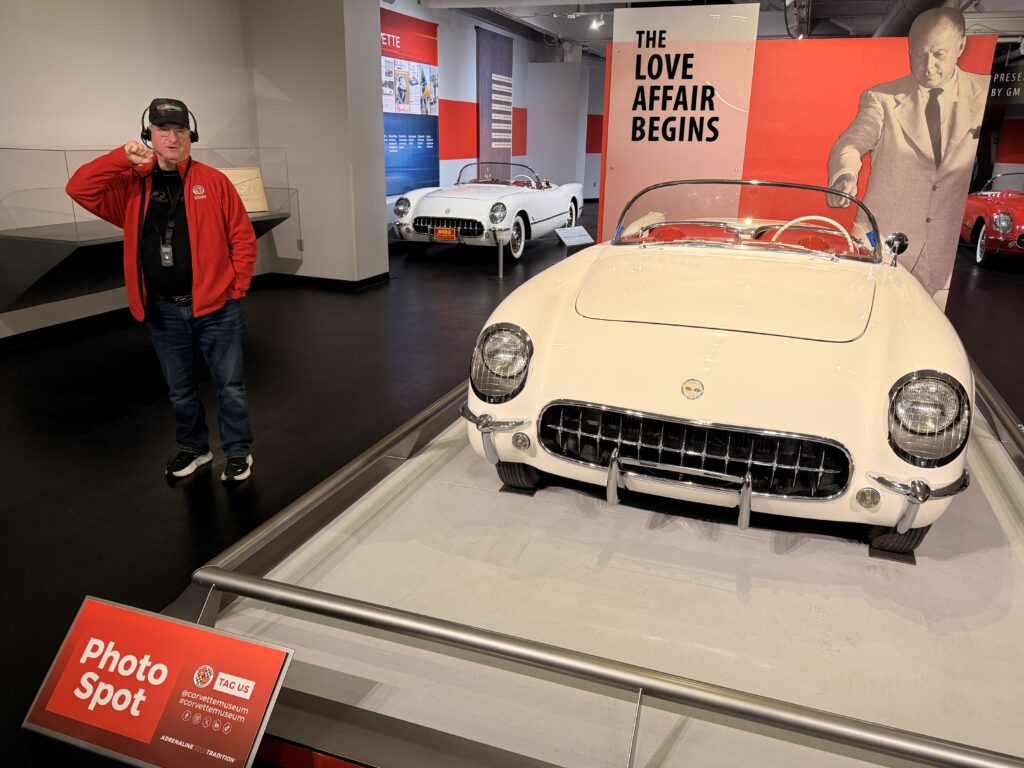
This piece is dedicated to my friend and fellow Corvette enthusiast, Brad Burdick. Brad and I first met at the National Corvette Museum while I was researching my book, Corvette Concept Cars: Developing America’s Favorite Sports Car. We were introduced through a mutual friend who, like Brad, was part of the Museum team at the time. What began as a simple introduction in 2021 soon became a valued friendship, and over the years, Brad and I have shared countless conversations, ideas, and insights centered around our mutual passion for the Chevrolet Corvette.
Brad is the kind of person who makes the Corvette community better. He is deeply knowledgeable, generous with his time, and always willing to share what he knows with genuine enthusiasm. If you ever find yourself in Bowling Green and have the opportunity to tour the National Corvette Museum, I strongly encourage you to ask for Brad as your guide. He is not only a wealth of knowledge, but also one heck of a nice guy. I can promise you that you will be richer for the experience. – SK