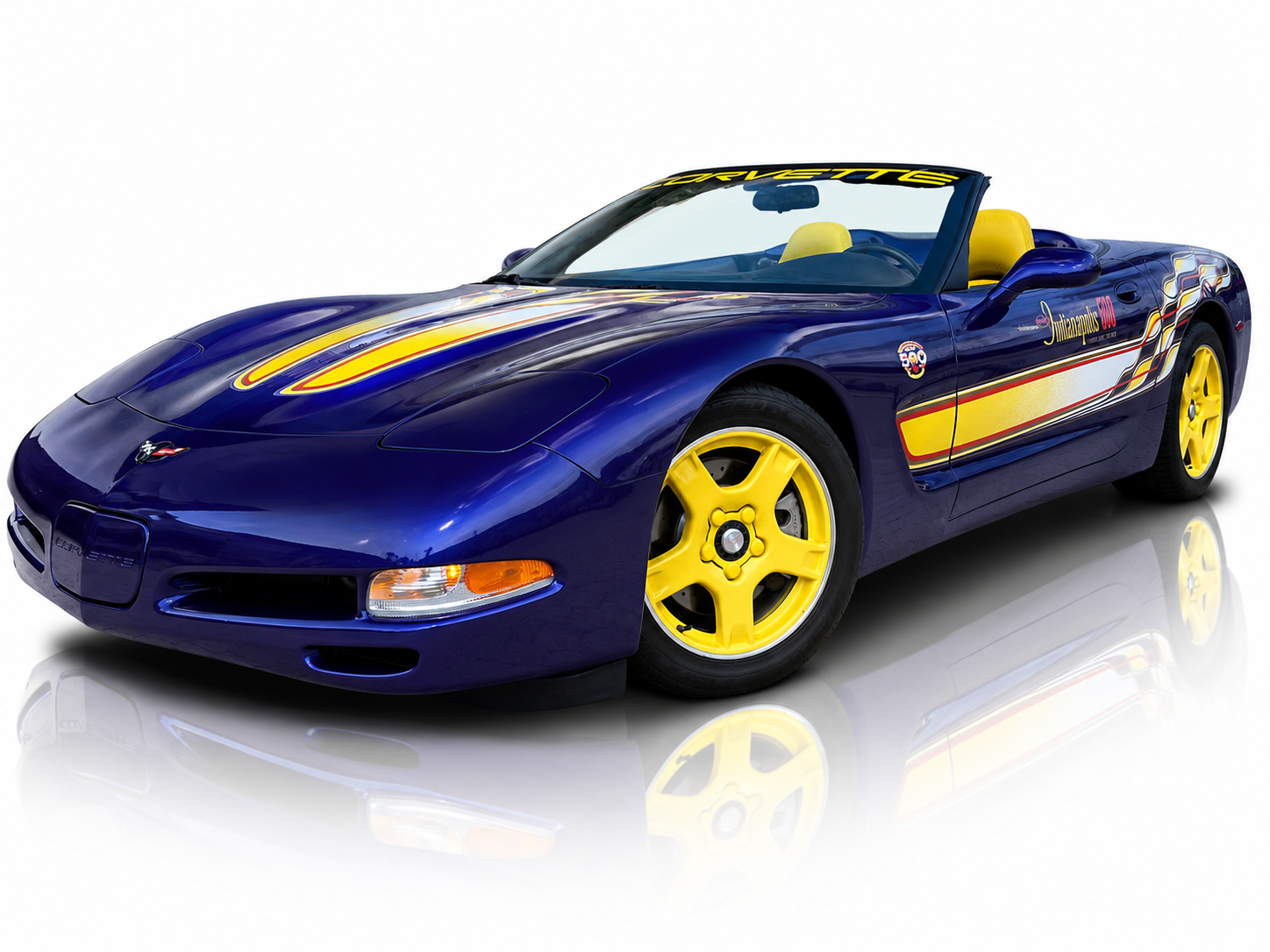
Category: C5 Corvette

  • 1998 Corvette Indy Pace Car Replica (RPO Z4Z)

    1998 Corvette Indy Pace Car Replica (RPO Z4Z)

    There’s the car you see, and then there’s the car Chevrolet wanted you to see.

    In 1998, as the C5 convertible took its first public bow, Corvette did something that looked outrageous on the surface but was quietly disciplined beneath the surface. It sent a nearly stock production convertible to lead America’s most famous race, then turned around and offered that same basic car—visually, mechanically, and philosophically—to anyone willing to sign the order sheet. The message was larger than paint, decals, or pageantry. It was not simply “look at us.” It was “this is the Corvette now.”

    That distinction gave the 1998 Corvette Indianapolis 500 Pace Car Replica its real significance. Chevrolet was not just dressing up a Corvette for promotional effect. It was using the grandest stage in American motorsports to introduce the open-air version of the new C5 and to make a very specific claim about what the fifth-generation Corvette had become. This was a car built around structural honesty, not compromise. It was calm at speed, modern in its electronics, and composed enough to set the rhythm at Indy without requiring the sort of heavy-handed transformation that had often separated pace cars from their showroom counterparts.

    The livery made sure no one missed the moment. Radar Blue paint, yellow wheels, a flowing checkered motif that swept across the bodywork, and read clearly from the upper grandstands—none of it was shy, and none of it was intended to be. The car was loud in the way pace cars are supposed to be loud: instantly recognizable, unmistakably tied to the event, and memorable long after the field took the green flag. Yet beneath that visual bravado was the more interesting point. The spectacle served the engineering message.

    By 1998, the C5 platform was sorted enough that Chevrolet did not need to turn the pace car into a fantasy build. It did not need to disguise weakness with special hardware or create a one-off machine that lived outside the normal Corvette world. The on-track car received the equipment necessary to perform its official duties—safety gear, lighting, and race-day requirements—but it remained, in essence, the same Corvette convertible that could be purchased through a Chevrolet dealer. That was the flex. The production car was good enough to wear the uniform.

    For Corvette, that mattered. The C5 convertible was arriving with something to prove, not because the Corvette name lacked credibility, but because every new generation has to defend itself against memory. The outgoing C4 had carried the brand through a long and important era, but the C5 represented a far more complete rethink of what a modern Corvette could be. Using the Indianapolis 500 to showcase the convertible was not accidental. It placed the car in front of a national audience and framed it not as a nostalgic American roadster, but as a thoroughly modern performance car with the composure to lead the field at one of the most scrutinized events in motorsports.

    Chevrolet did not whisper that point in period communications. It said it plainly. The 1998 Corvette Indy Pace Car Replica was not meant to be understood as a distant tribute to the actual Indy machine. It was meant to be understood as a production Corvette with a direct connection to the car that paced the race. The paint, graphics, wheels, interior treatment, and mechanical package all reinforced that idea. What you saw on race day was not some unreachable promotional prop. It was a preview of a Corvette you could actually own.

    And that is what makes the 1998 Corvette Indy Pace Car Replica more interesting than its colors alone suggest. Yes, it was wild. Yes, it was divisive. Yes, it remains one of the most visually extroverted Corvettes of the modern era. But beneath the Radar Blue paint and yellow wheels was a very deliberate statement of confidence. Chevrolet was telling the world that the new C5 convertible did not need an asterisk. It could lead at Indy, sit on the showroom floor, and represent the next chapter of America’s sports car without changing its basic identity.

    Before the green flag: setting 1998 in context
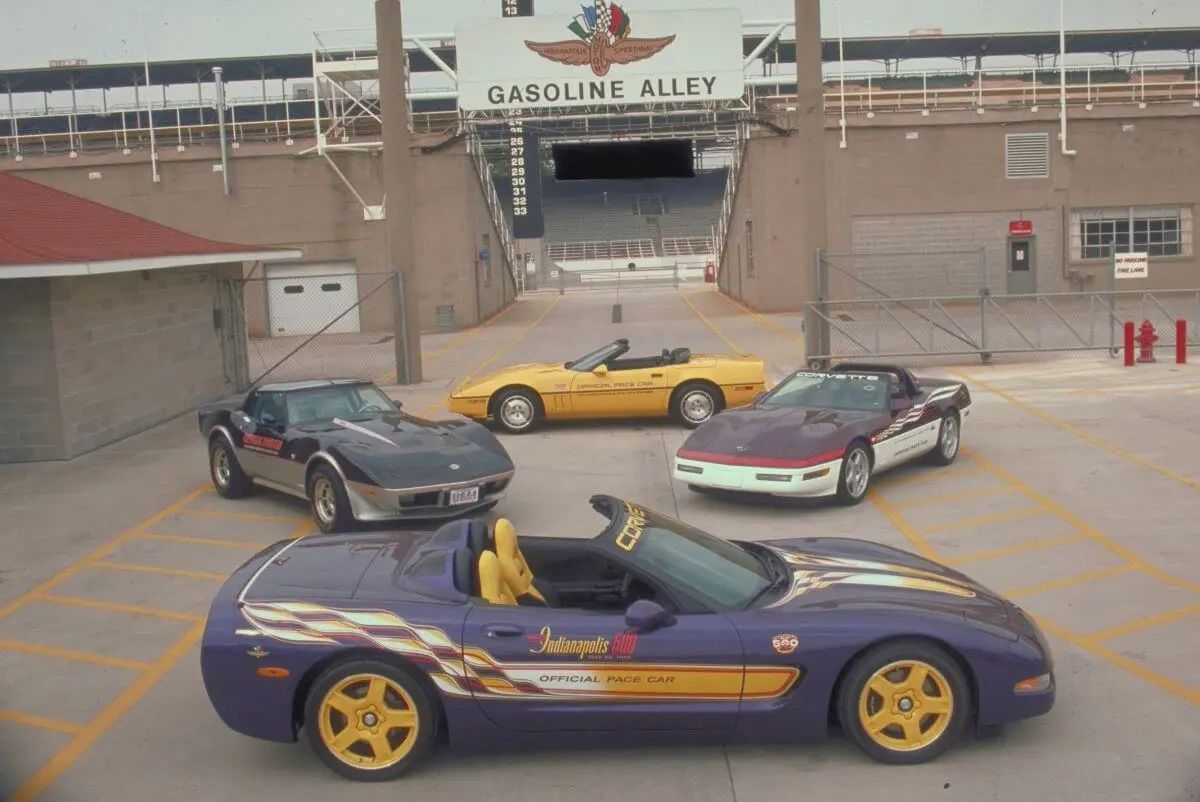
    Gasoline Alley roll call: 1978, 1986, 1995, and 1998—the four Corvette Indy 500 pace cars lined up where the show begins. Black-and-silver C3, Sunflower-yellow ’86 ragtop, the purple-over-white ’95 Z4Z, and out front the Radar Blue ’98 with yellow graphics and wheels. Twenty years after Corvette’s first turn at the job, the C5 takes the baton and makes the case in plain sight: same lineage, sharper tools, still leading the field. Indy and Corvette, shoulder to shoulder.
    Gasoline Alley roll call: 1978, 1986, 1995, and 1998—the four Corvette Indy 500 pace cars lined up where the show begins. Black-and-silver C3, Sunflower-yellow ’86 convertible, the purple-over-white ’95 Z4Z, and out front the Radar Blue ’98 with yellow graphics and wheels. Twenty years after Corvette’s first turn at the job, the C5 takes the baton and makes the case in plain sight: same lineage, sharper tools, still leading the field. Indy and Corvette, shoulder to shoulder. (Image courtesy of GM Media LLC.)

    By 1998, Corvette and the Indianapolis 500 were old friends. The relationship already had a meaningful history, and Chevrolet understood exactly what the Brickyard could do for America’s sports car when the timing was right. Corvette had first led the field in 1978, marking the car’s 25th anniversary with a black-and-silver pace car that immediately became one of the most recognizable late-C3 special editions. In 1986, the Corvette convertible returned to the role just as the open-air model returned to the showroom after more than a decade away. Then, in 1995, the purple-over-white Z4Z pace car gave the C4 another high-profile moment at Indianapolis, again accompanied by a commemorative production run for customers.

    The 1998 car belonged to that same lineage, but the C5 changed the tone.

    This was not simply another Corvette selected to lead the Indianapolis 500. The fifth-generation car represented a major architectural reset for the brand, with its rear transaxle layout, stiffer backbone structure, and thoroughly modern LS1 small-block V8. The C5 was not a warmed-over continuation of the C4. It was a clean-sheet reboot, a Corvette designed to feel more composed, more structurally confident, and more in step with the expectations of a modern performance car. In that context, debuting the convertible version at Indy was more than convenient timing. It was a proof of concept placed in front of the biggest American motorsport audience Chevrolet could find.

    A convertible always has to answer certain questions. Is it rigid enough? Is it refined enough? Does it feel like a compromised version of the coupe, or does it stand on its own? Chevrolet used the Indianapolis 500 to answer those questions in public. The company made it official on November 6, 1997, announcing that the 1998 Corvette convertible would serve as the next Indy 500 pace car and confirming that a limited run of replicas would be offered to the public. As with the earlier Corvette pace cars, customers would be able to buy into the moment. But this time, the replica was doing more than commemorating a race. It was helping introduce the open C5 as a serious, fully realized production Corvette.
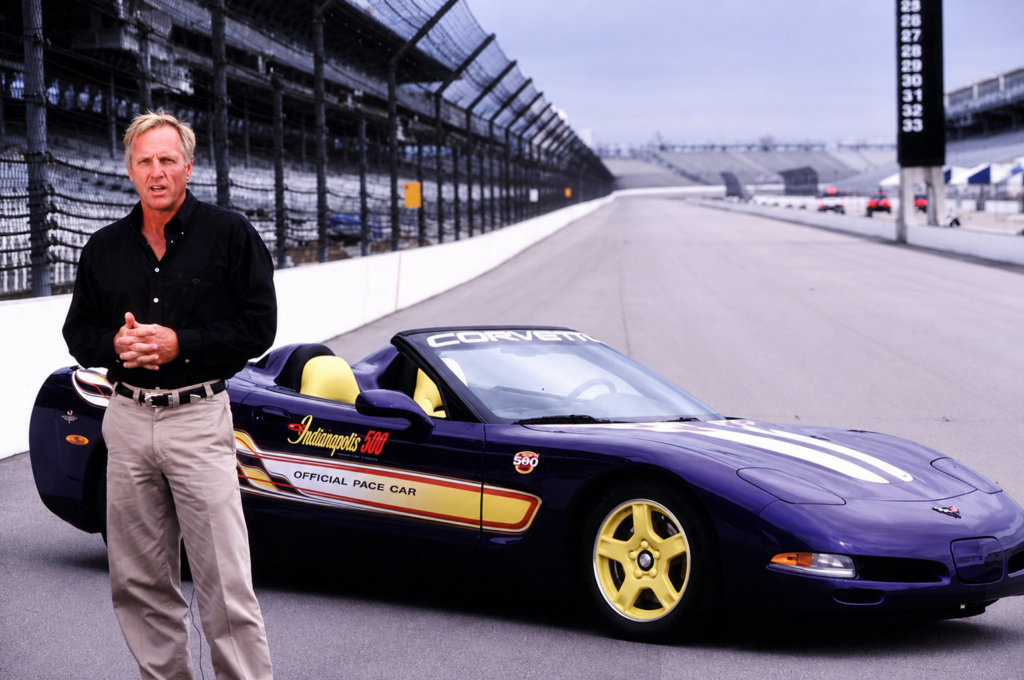
    Greg Norman at the Brickyard with Chevy’s 1998 Corvette Indy 500 Pace Car—Radar Blue, yellow graphics, and all the pageantry lined up. He’d turned early practice laps and fronted the promo push, but arthroscopic surgery on his left shoulder sidelined him during race week. Indy royalty Parnelli Jones took over on May 24, 1998, yet this moment shows the plan as it started: star power and a C5 under the pagoda.

    There was also a bit of last-minute drama around who would actually hold the steering wheel. Early plans put golfer Greg Norman in the driver’s seat. Norman brought celebrity visibility to the program and had even turned practice laps at Indianapolis Motor Speedway in April. His involvement fit the promotional side of the pace car assignment: a famous international sports figure, a new Corvette convertible, and one of the most watched racing events in America.

    Then the plan changed.

    The following month, arthroscopic surgery on Norman’s left shoulder for a rotator-cuff injury took him out of action. With race week looming, Chevrolet and the Speedway needed a replacement, and they did not settle for a stand-in. They named Parnelli Jones, winner of the 1963 Indianapolis 500, to pace the 82nd running on Sunday, May 24, 1998.

    Jones was not a mere substitute. He was a signal.

    Norman’s withdrawal could have made a carefully organized promotional moment feel scrambled. Instead, it gave the 1998 pace car story a different kind of weight. Putting a past Indy winner behind the wheel immediately shifted the emphasis from celebrity appearance to racing legitimacy. Jones’ résumé needed no explanation at Indianapolis. He was part of the Speedway’s own memory, a driver whose name carried the authority of having won the race outright. With him in the Corvette, Chevrolet did not have to borrow credibility from the event. The car was placed in the hands of someone who already belonged there.

    That fit the message Chevrolet wanted the C5 to send. The new Corvette convertible was not being presented as a lifestyle accessory or a softened companion to the coupe. It was being shown as a proper performance car, one capable of leading the field at Indianapolis with a racer’s racer at the wheel. The imagery was direct: Parnelli Jones out front, the field tucked in behind him, and a Radar Blue C5 convertible setting the rhythm for the 500. On a day when Corvette wanted to telegraph legitimacy, Indy royalty led the grid.
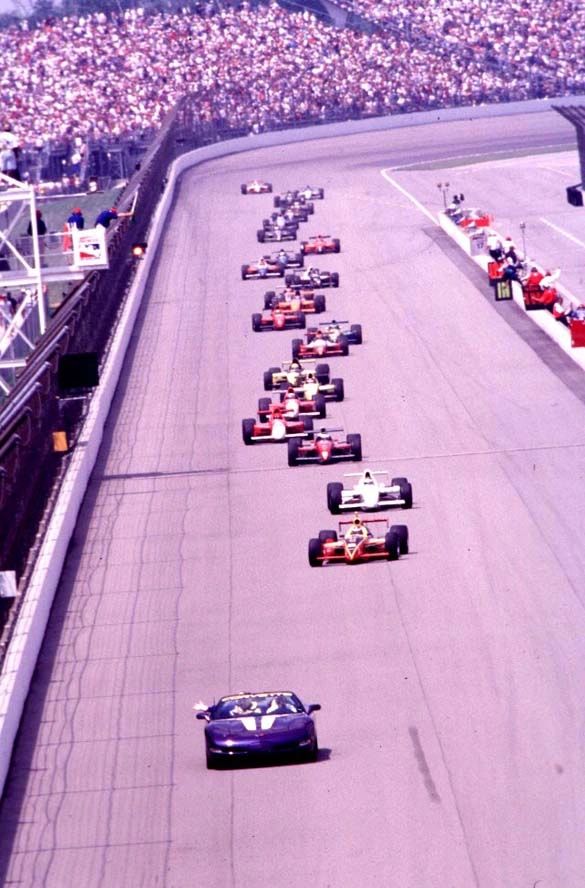
    At the Brickyard in ’98, Greg Norman is sidelined by shoulder surgery, so 1963 winner Parnelli Jones takes the wheel of the Radar Blue C5 pace car. He gathers the field and draws 33 cars down the front straight, yellow wheels glinting as the grandstands rise. It reads less like a substitute and more like a statement—Indy royalty setting the tempo, Corvette credibility earned in plain sight.
    At the Brickyard in ’98, Greg Norman is sidelined by shoulder surgery, so 1963 winner Parnelli Jones takes the wheel of the Radar Blue C5 pace car. He gathers the field and draws 33 cars down the front straight, yellow wheels glinting as the grandstands rise. It reads less like a substitute and more like a statement—Indy royalty setting the tempo, Corvette credibility earned in plain sight.

    That tone had been established months earlier at the car’s unveiling. Chevrolet rolled out the 1998 Corvette Indy Pace Car Convertible Replica at the SEMA show in Las Vegas on November 6, 1997, with Mary F. Hulman and Chevrolet General Manager John Middlebrook helping make the announcement official. At that point, Norman was still billed as the driver, and the car’s promotional identity was already fully formed.

    The look was impossible to miss: Radar Blue paint, bold yellow graphics, and matching yellow wheels. It was a visual package designed to read instantly from a distance, whether parked under show lights, photographed for press material, or rolling down the front straight at Indianapolis. Middlebrook framed the intent plainly, saying, “We told the designers we wanted something that would grab people immediately, and they didn’t disappoint us.” That was the brief in a sentence. The 1998 pace car was not supposed to ease into the Corvette story quietly. It was built to stop people first, then make its case.

    Under the skin, however, the pace car remained notably close to showroom stock. The official car used the LS1 V8 paired with an automatic transmission, with the additions required for pace-car duty—most notably a roll bar and strobes—rather than a wholesale transformation into a one-off machine. That was the larger point. Chevrolet did not need to create a special mechanical outlier to make the C5 convertible look credible at Indy. The production car’s basic architecture was strong enough to carry the assignment.

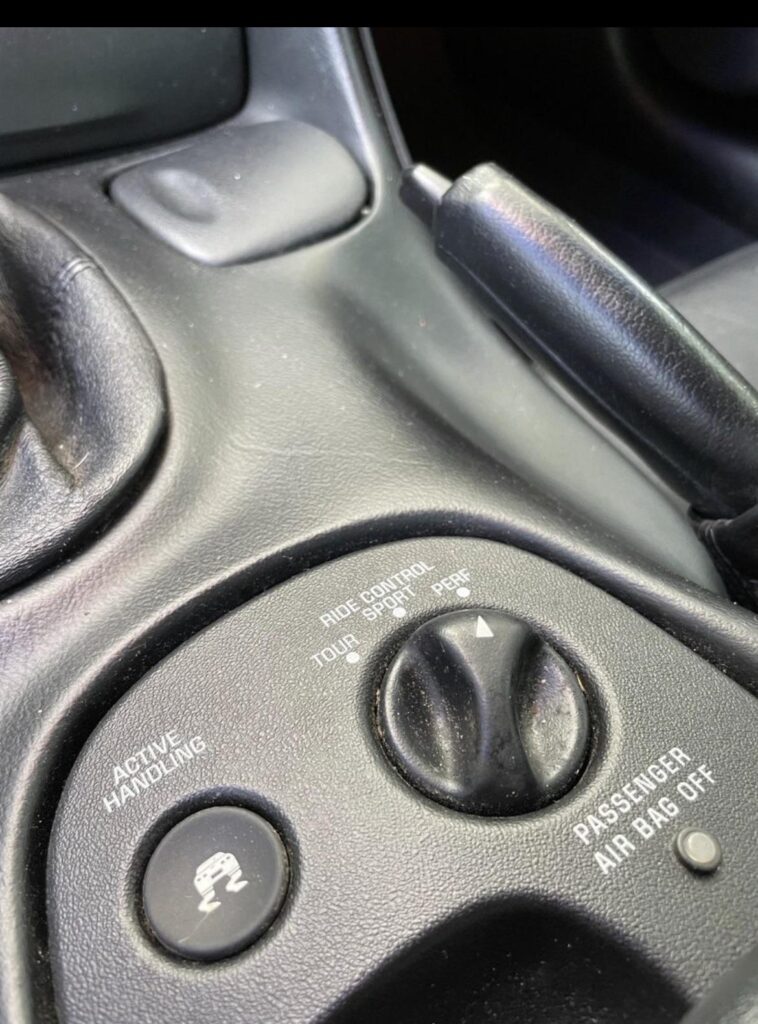
    The limited-run Z4Z replicas reinforced that idea for customers. They carried the same visual package, linking the showroom car directly to the one seen at Indianapolis, and they also showcased Corvette’s new JL4 Active Handling system. That production debut was very much part of the message Chevrolet wanted to put out front. The C5 was still recognizably Corvette—front-engine, V8-powered, unmistakably American—but it was also a more sophisticated machine than the cars that came before it. Active Handling gave Chevrolet another way to present the new Corvette as a modern performance car, one that blended traditional Corvette power with a more advanced electronic safety and control strategy.

    In the end, the storyline tightened rather than frayed. Norman’s shoulder surgery sidelined the celebrity. Parnelli Jones took the wheel and gave the moment a deeper connection to Indianapolis itself. The C5 convertible paced the 82nd running of the Indy 500 not as a purpose-built special or a heavily modified promotional prop, but as a largely stock Corvette making its case in front of 250,000 people.

    It did not need special pleading.

    It just needed a green flag.

    Why the graphics were loud—and smart
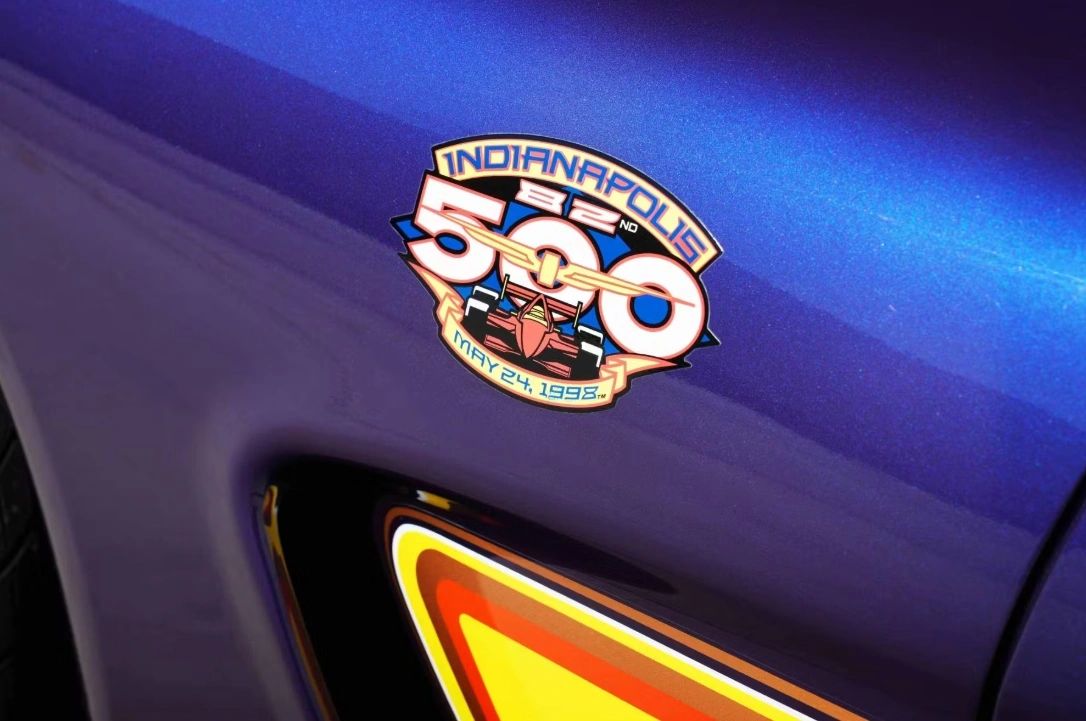
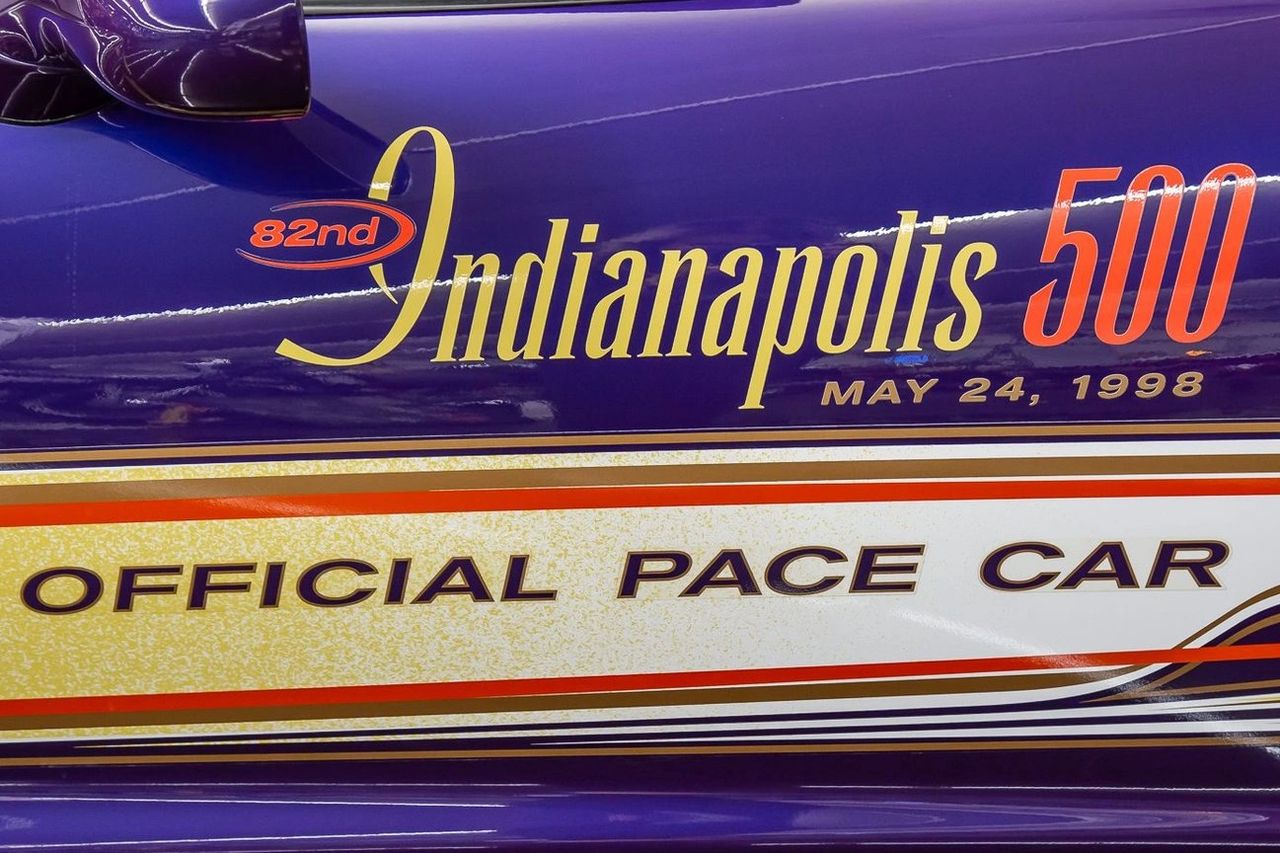
    82nd Indianapolis 500 — May 24, 1998. The fender badge on the Radar Blue C5 pace car—stylized “500” wrapped around an IndyCar—serves as a timestamp and a promise: today Corvette leads. The same emblem marked the Z4Z replicas, a small crest linking the street cars to race-day duty and to Parnelli Jones setting the pace.
    82nd Indianapolis 500 — May 24, 1998. The fender badge on the Radar Blue C5 pace car—stylized “500” wrapped around an IndyCar—serves as a timestamp and a promise: today Corvette leads. The same emblem marked the Z4Z replicas, a small crest linking the street cars to race-day duty and to Parnelli Jones setting the pace.

    Good pace-car graphics are not really about fashion. They are about readability.

    That distinction is important with the 1998 Corvette Indy Pace Car Replica, because the car’s visual treatment is often judged first by its color and only later by its purpose. Radar Blue paint, yellow wheels, yellow interior accents, and a sweeping checkered graphic package make for one of the most extroverted Corvettes of the modern era. It is not a quiet car, and it was never meant to be one. But viewed in the proper context, the design begins to make more sense. At the Indianapolis Motor Speedway, a pace car has to communicate from a distance. It has to stand apart in a massive bowl of grandstands, television cameras, sunlight, shadow, and motion. Subtlety is not the assignment.
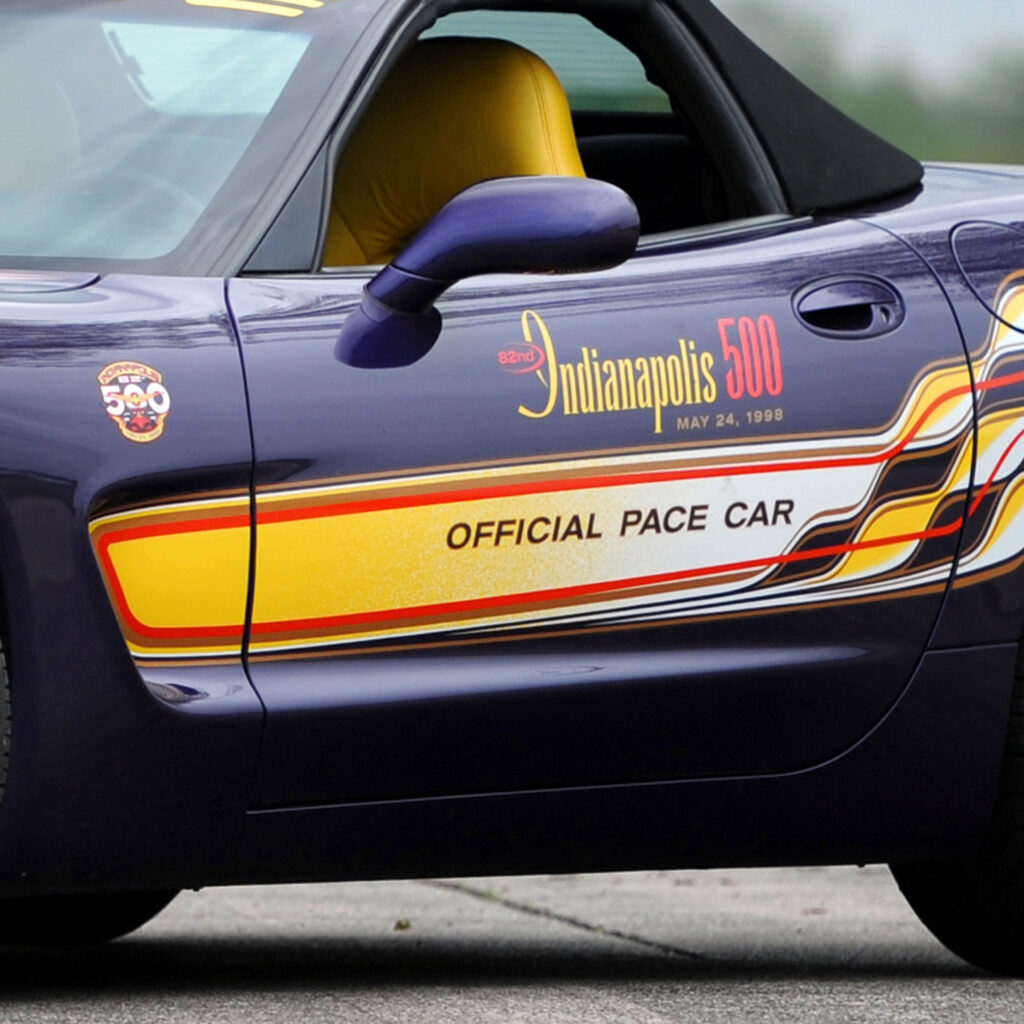
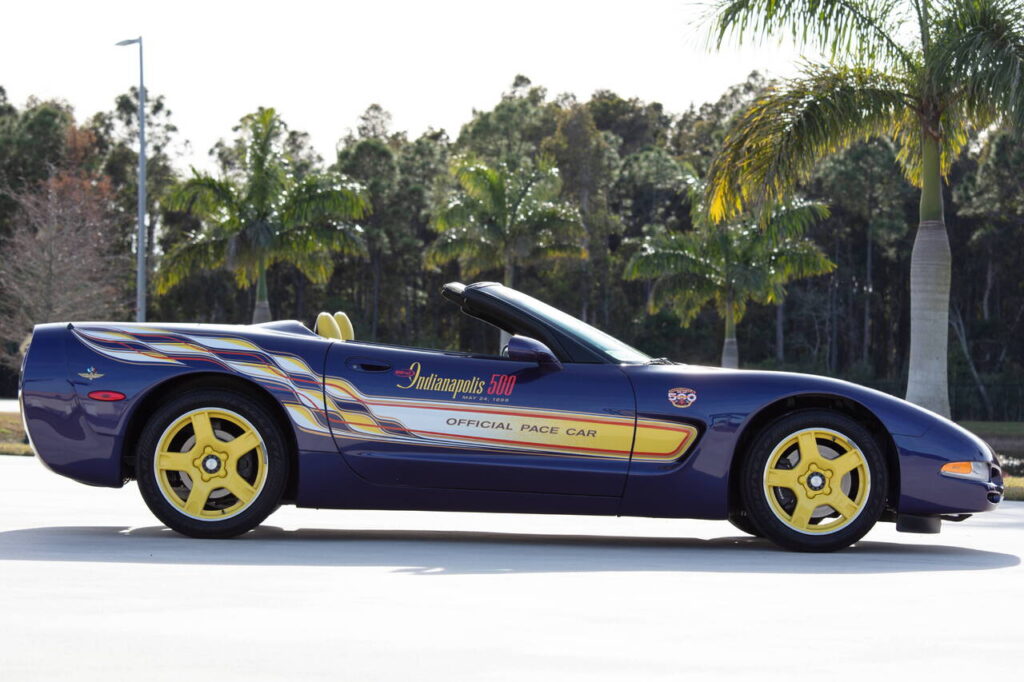
    The 1998 Corvette Indy 500 Pace Car graphics package works because it understands the assignment: this was never meant to be a quiet showroom special. The sweeping yellow, white, red, and black graphics pull the eye across the C5’s door and rear quarter, giving the car a sense of motion even at rest, while the oversized “Official Pace Car” lettering and Indianapolis 500 branding make its purpose unmistakable from a distance. At the Brickyard, where scale, speed, sunlight, and grandstand sightlines all work against subtle design, boldness becomes function. The Radar Blue paint may provide the foundation, but the graphics give the car its event identity—turning a production Corvette convertible into something instantly tied to May 24, 1998, and to the larger story Chevrolet wanted to tell about the new C5.

    In a setting as vast as the Brickyard, the visuals have to telegraph both movement and identity from far away and at odd light. The 1998 design does exactly that. The graphics begin up front, dive along the flanks, and climb over the rear deck in a flowing checkered arc that gives the car an unmistakable sense of motion even when it is standing still. Rather than simply applying stripes for decoration, the layout works with the C5’s lower, more rounded body shape. It follows the car’s sculpture instead of fighting it, emphasizing the long horizontal sweep of the new-generation Corvette and drawing attention to the bodyline that helped distinguish the C5 from the C4 before it.

    That is part of what makes the car more sophisticated than its first impression suggests. Yes, the color combination is loud. Yes, the yellow wheels are impossible to ignore. But the graphic package is not random noise. It is organized around the car’s form and around the pace-car function itself. The checkered motif ties directly to racing without relying on a literal flag slapped onto the body, and the arc of the graphics gives the Corvette a visual signature that reads clearly in photographs, press material, and trackside views. It was designed to be seen quickly, understood immediately, and remembered afterward.

    The yellow wheels pushed the whole composition even further. On a conventional production Corvette, they would have felt almost defiant. On an Indianapolis 500 pace car, they made sense. They gave the car instant contrast against the Radar Blue bodywork and helped visually anchor the yellow elements in the graphics and interior. The result was a car that did not merely wear a special paint scheme; it had a complete visual identity. The exterior, wheels, and cabin all spoke the same language. Pair the blue-and-yellow bodywork with the yellow-and-black interior, and the car becomes something more than a graphic package. It becomes a fully coordinated event car.

    That coordination is one reason the 1998 Corvette Indy Pace Car Replica photographs so sharply. Some special editions look better in person than they do in images, while others flatten under a camera lens. The 1998 car does not have that problem. Its contrast is strong, its shapes are readable, and its graphic movement gives still photography a sense of energy. Whether you like the palette or not, the design does what it was built to do. It announces itself.

    The real quiet innovation, though, was not the colorway. It was the process.
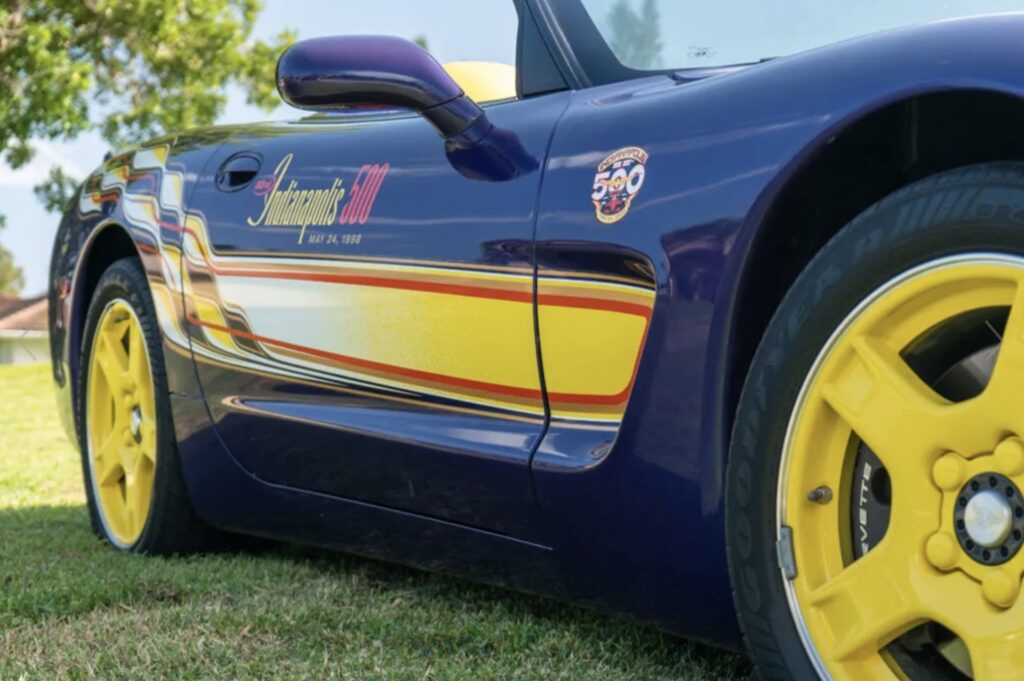
    One of the most important details of the 1998 Corvette Indy 500 Pace Car Replica was not simply what the graphics looked like, but how they were applied. Unlike some earlier pace-car replicas where the striping and decals could be installed after the fact, the 1998 Z4Z graphics were applied at the factory, giving the car a level of consistency and finish that matched Chevrolet’s “same as the real thing” message. On a design this bold—with sweeping yellow panels, red and black accent stripes, Indianapolis 500 markings, and graphics that had to flow cleanly across the C5’s doors and rear quarters—alignment was everything. Factory application meant the package felt integrated rather than added on, turning the livery into part of the car’s production identity instead of a decorative afterthought.

    Unlike earlier pace car replicas, where graphics could involve dealer or owner installation, the 1998 livery was applied at the factory. That may sound like a small production detail, but it mattered enormously to the way the cars were received and preserved. Factory application meant clean alignment, reliable adhesion, and consistency from car to car. Every replica left with the same basic visual execution, rather than relying on the patience, skill, or interpretation of whoever installed the decals after delivery.

    Anyone who has spent time around collector cars understands why that matters. Crooked stripes, bubbled vinyl, uneven placement, or graphics that age differently from panel to panel can change the whole character of a special edition. On a car as visually dependent as the 1998 Pace Car Replica, execution was everything. The design was too bold to hide sloppy application. If the graphics were off, the whole car would feel off. By applying the livery at the factory, Chevrolet gave the package the kind of discipline it needed to support the claim being made around it.

    That claim was straightforward: the replicas were meant to be understood as closely connected to the real pace car, not as loose tributes assembled after the fact. Chevrolet’s own positioning only worked if the look was delivered with factory-level consistency. The Radar Blue paint, yellow wheels, checkered graphics, and interior treatment all had to feel intentional and repeatable. A pace car replica depends on that credibility. The more disciplined the execution, the stronger the connection between the car in the showroom and the car leading the field at Indianapolis.

    That is why the factory-applied graphics deserve more attention than they usually receive. They helped separate the 1998 Z4Z from the idea of a decorative package and moved it closer to a fully integrated production special. The car may have been visually outrageous, but it was not casually assembled. Chevrolet treated the livery as part of the car’s identity, not as an accessory. For a Corvette built around the promise that customers could own something remarkably close to the official Indy pace car, that decision made the whole story more convincing.

    The 1998 Pace Car Replica was loud by design. But the more you study it, the more you realize that the loudness had structure. The graphics were functional as much as expressive. The colors gave the car distance-read clarity. The wheels and interior made the theme feel complete. And the factory application gave the entire package a level of consistency that matched Chevrolet’s larger message.

    This was not just a Corvette wearing decals.

    It was a pace car identity executed with production-car discipline.

    “Born ready”: the engineering subtext
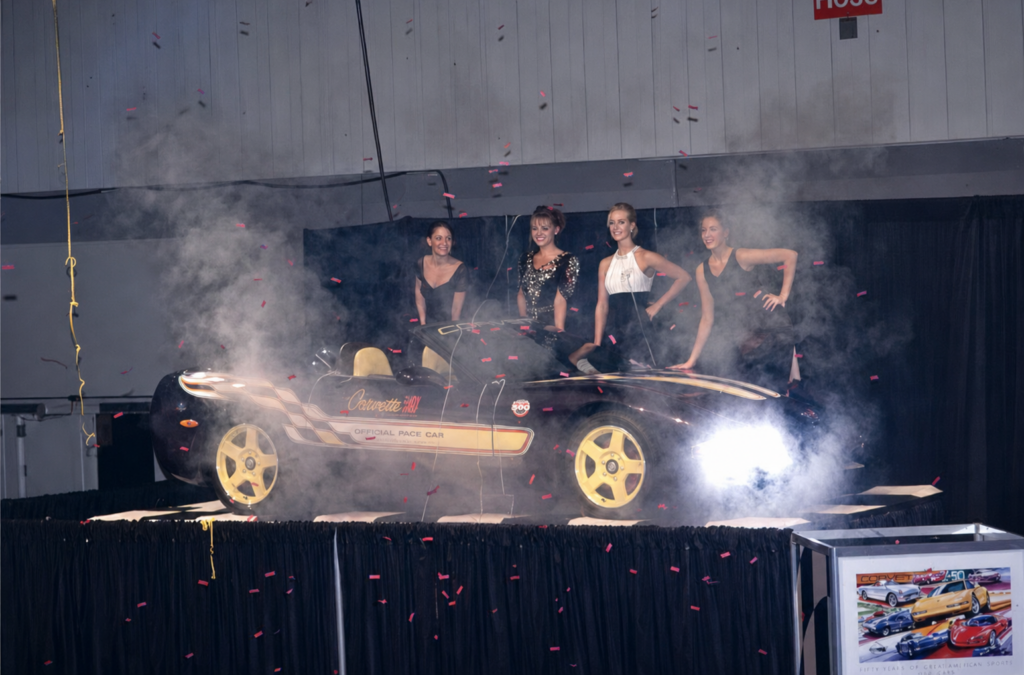
    SEMA, Las Vegas—November 6, 1997: smoke, lights, and confetti as Chevrolet pulls the cover off the 1998 Corvette Indy 500 Pace Car. The Radar Blue C5 rolls onto the stage on yellow wheels, graphics blazing, headlights cutting the haze like it’s already pacing to green. IMS chair Mari Hulman George joins Chevrolet GM John Middlebrook to make it official, with Greg Norman introduced as the intended pace-car driver. The message is simple and loud: this car is built for the spotlight—and the Z4Z replicas will carry that look straight to Main Street.

    The C5’s platform confidence shows in how little the official pace car actually needed.

    For all the visual noise of the 1998 Indy Pace Car package, the mechanical story was remarkably restrained. Indianapolis safety requirements meant the official car had to receive the expected race-duty additions: roll-over hoops, rear-facing strobes integrated into the tonneau’s fairings, and the normal provisions required for event logistics. Those pieces were necessary for the job, but they did not transform the Corvette into some distant, specially prepared machine. That was the point Chevrolet wanted people to understand. Beneath the lights, safety equipment, and event markings, the car remained very close to the production C5 convertible customers could buy.

    Chevrolet’s own description of the pace car was intentionally matter-of-fact. Mechanically, it was essentially factory stock. That choice gave the 1998 program much of its credibility. The company was not trying to sell the public a one-lap hero or a purpose-built promotional prop that only looked like the showroom car. It was using the Indianapolis 500 to make a more disciplined claim: the production C5 convertible had the structure, steering precision, powertrain refinement, and electronic support to lead the field without needing a long list of special explanations.

    That message was especially important because convertibles are always asked to prove themselves in ways coupes are not. Removing the fixed roof can expose weakness in a platform. It can bring cowl shake, flex, looseness, and the sense that the open car is more about style than substance. The C5 convertible was designed to resist that criticism, and the Indy assignment gave Chevrolet the ideal stage to show it. The pace car did not need a wholesale mechanical makeover because the architecture underneath it was already strong enough to carry the moment.
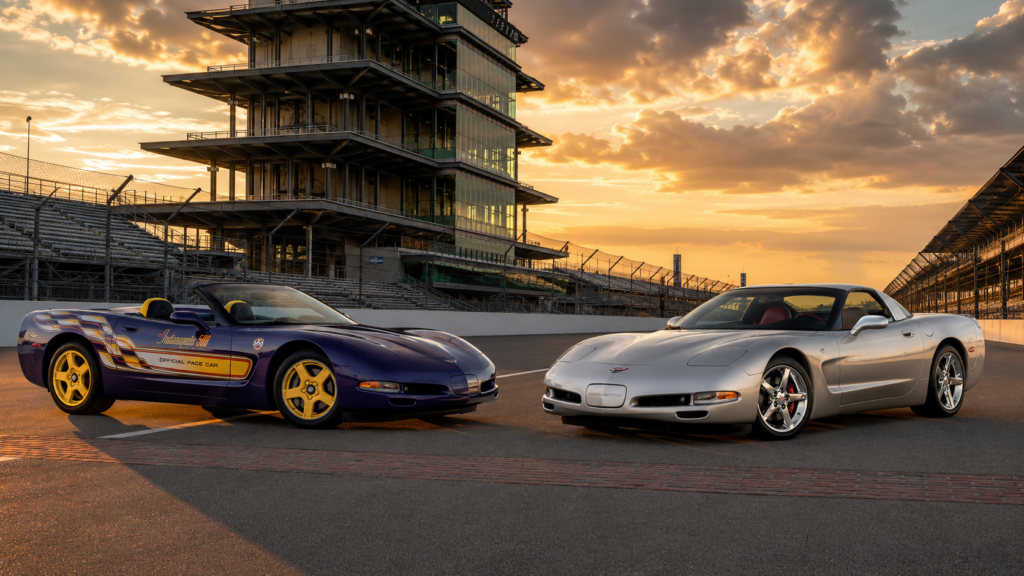
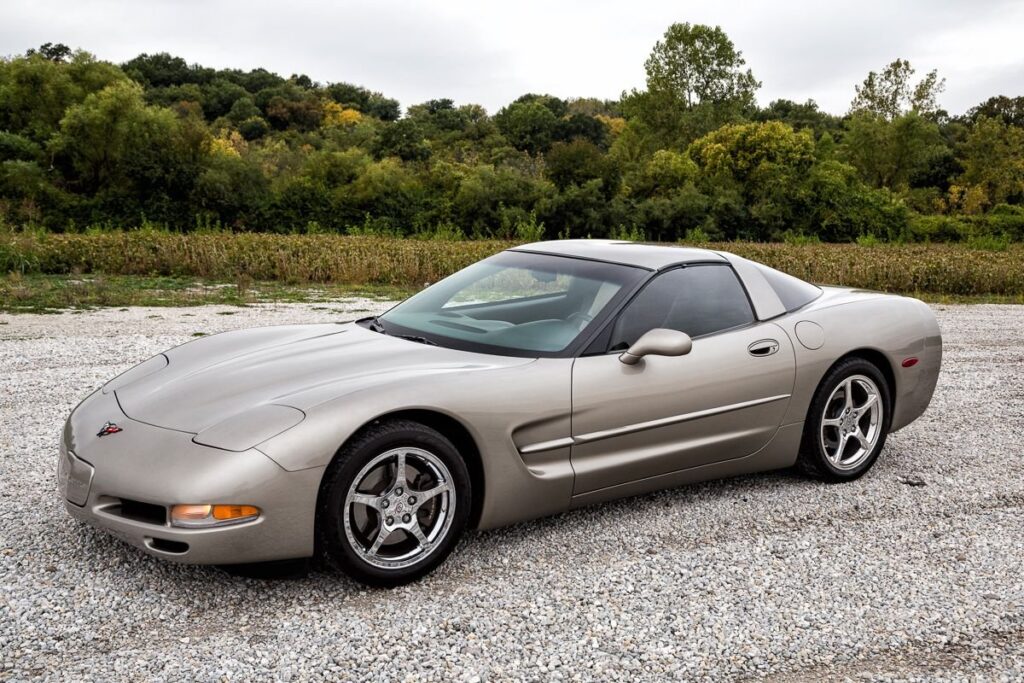
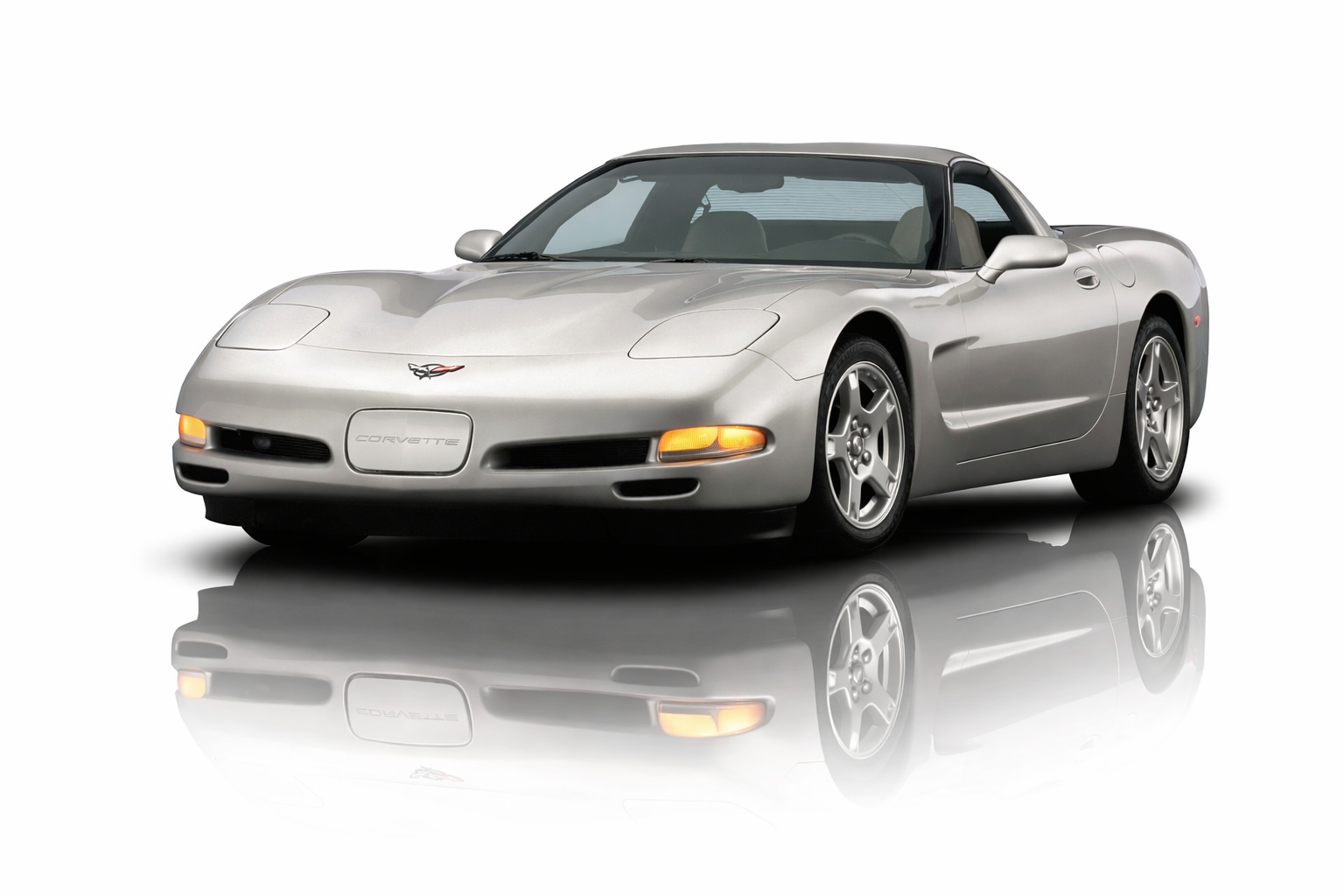
    Seen together, the standard C5 coupe and the 1998 Indy Pace Car convertible make Chevrolet’s argument without needing a spec sheet. The coupe shows the clean form of the fifth-generation Corvette; the pace car shows that the same engineering foundation could stand exposed, roof down, graphics blazing, and still carry itself with authority. That was the quiet substance beneath the spectacle. The C5 convertible was not being presented as a sunny-day compromise or a softened version of the car—it was being trusted on the most visible American motorsports stage because the structure underneath it was already right. With JL4 Active Handling adding a new layer of electronic composure, Chevrolet could point to the open Corvette and say, in effect, this is not the fragile one, not the lesser one, not the pose. It is the same new-generation Corvette confidence, just with the sky overhead.

    Active Handling, RPO JL4, sits at the center of that story.

    New for 1998 and fitted to the Z4Z pace-car replicas, Active Handling gave Chevrolet a modern electronic layer to pair with the C5’s new structure and powertrain. The system used a yaw sensor, steering-angle input, and lateral-G sensing to help determine when the car was beginning to move away from the driver’s intended path. When needed, it could selectively apply braking at individual wheels to help stabilize the car, trimming unwanted rotation or helping bring the Corvette back into line when traction got thin or the driver asked for too much, too quickly.

    In period, Chevrolet was careful about how it presented the system. Active Handling was framed first as an accident-avoidance feature, and only second as a performance-confidence tool. That was smart positioning. Corvette had never lacked speed, and Chevrolet did not need to convince anyone that a small-block V8 two-seater could be quick. What JL4 added was composure. It made the car’s performance more repeatable and more accessible when conditions were less than ideal—on uneven pavement, in rain grooves, during a late-braking mistake, or in that brief moment when the rear of the car starts to rotate faster than the driver intended.

    The best electronic systems do not announce themselves every mile. They work quietly in the background, allowing the car to feel natural until they are needed. Active Handling belonged to that category. It did not erase the Corvette’s character or make the car feel artificially restrained. Instead, it added a layer of control that helped the driver use more of the car with greater confidence. You might not think about it during an ordinary drive, but the first time it helped clean up a slide or settle the car without strangling the experience, the value became obvious.

    That is why JL4 was such a fitting part of the 1998 Pace Car Replica story. The system reinforced exactly what Chevrolet wanted the C5 convertible to represent: not just speed, but composure; not just horsepower, but control; not just a bold-looking replica, but a modern Corvette with real engineering substance underneath the graphics. The car’s Indy role did not depend on a radical mechanical transformation. It depended on Chevrolet’s confidence that the showroom Corvette was finally strong, refined, and technically capable enough to stand in front of the field as itself.

    The package: what RPO Z4Z actually bought you
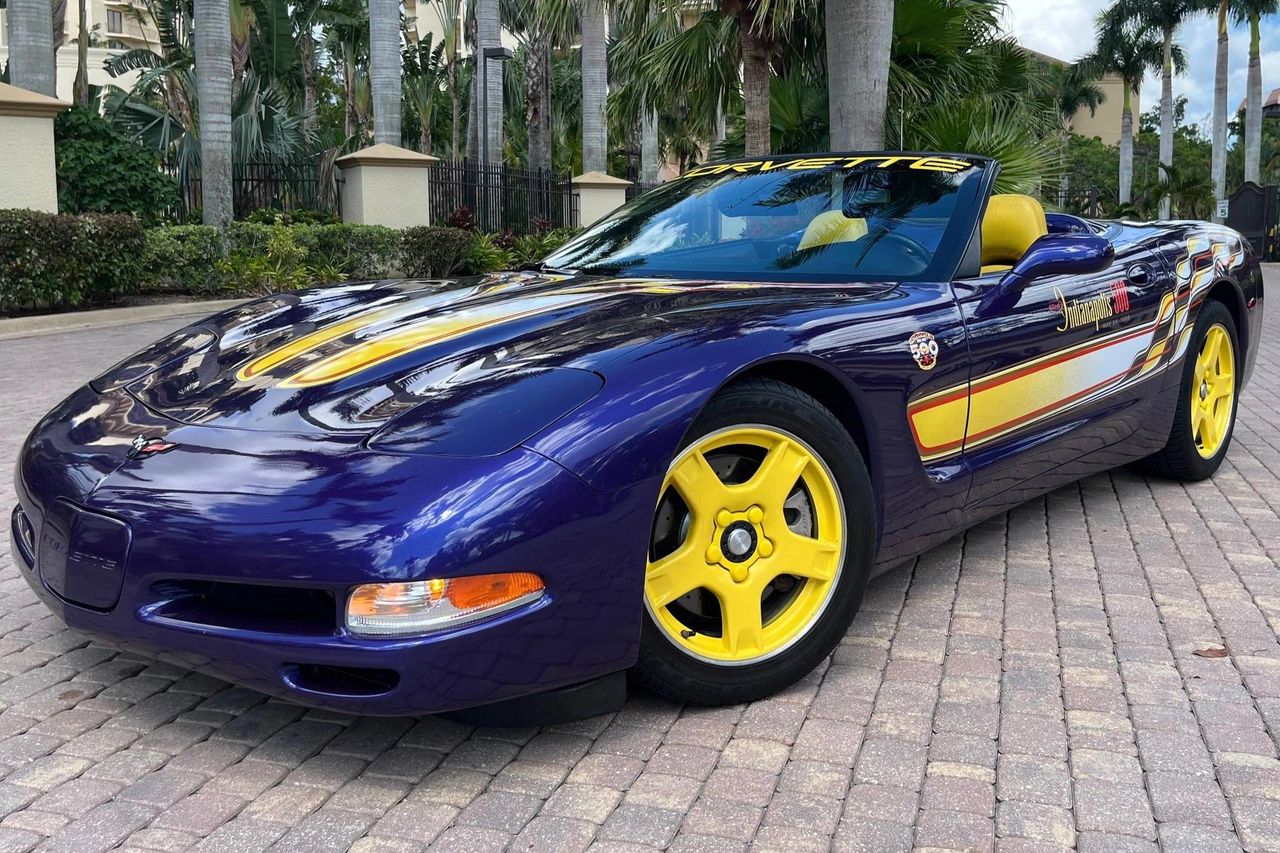
    Radar Blue like wet ink, with twin yellow hood streaks that flow into the checkerboard ribbon graphics down the flanks. Color-keyed 5-spoke wheels and yellow cockpit accents carry the theme, capped by the 82nd Indy 500 fender medallion and “Indianapolis 500” door script. Pace car livery that reads loud and cohesive from every angle.
    Radar Blue like wet ink, with twin yellow hood streaks that flow into the checkerboard ribbon graphics down the flanks. Color-keyed 5-spoke wheels and yellow cockpit accents carry the theme, capped by the 82nd Indy 500 fender medallion and “Indianapolis 500” door script. Pace car livery that reads loud and cohesive from every angle.

    On paper, Z4Z was straightforward: take a 1998 Corvette convertible and give it the full Indianapolis 500 Pace Car identity. Radar Blue paint. Yellow wheels. The sweeping checkered-flag graphics. A yellow-and-black interior that carried the exterior theme into the cabin. It was not a subtle package, but it was a complete one, and that completeness is what separated the car from a standard C5 wearing a few commemorative decals.

    What made the package more convincing was the way Chevrolet tied the visual treatment to the equipment customers would actually live with. The Z4Z cars were not stripped-down replicas built only for display. They carried the comfort and convenience features expected of a well-optioned late-1990s Corvette convertible, including Bose audio and the appropriate convenience content, while also incorporating JL4 Active Handling. That combination gave the car two identities at once: a limited-production Indy replica with unmistakable event presence, and a usable C5 convertible equipped like something meant to be driven rather than merely stored.

    Period pricing can get a little slippery because announcement figures and window-sticker totals rarely align perfectly from car to car. Options, transmission choice, and final retail documentation can all affect how the numbers appear. But the basic story is consistent. The pace-car package added roughly five thousand dollars on top of a mid-$40,000 Corvette convertible, while the 6-speed manual added approximately another $800. Chevrolet was clearly asking buyers to pay for the occasion, but the car was not priced like an unreachable halo collectible. It was expensive enough to feel special, yet still grounded in the real production Corvette lineup.
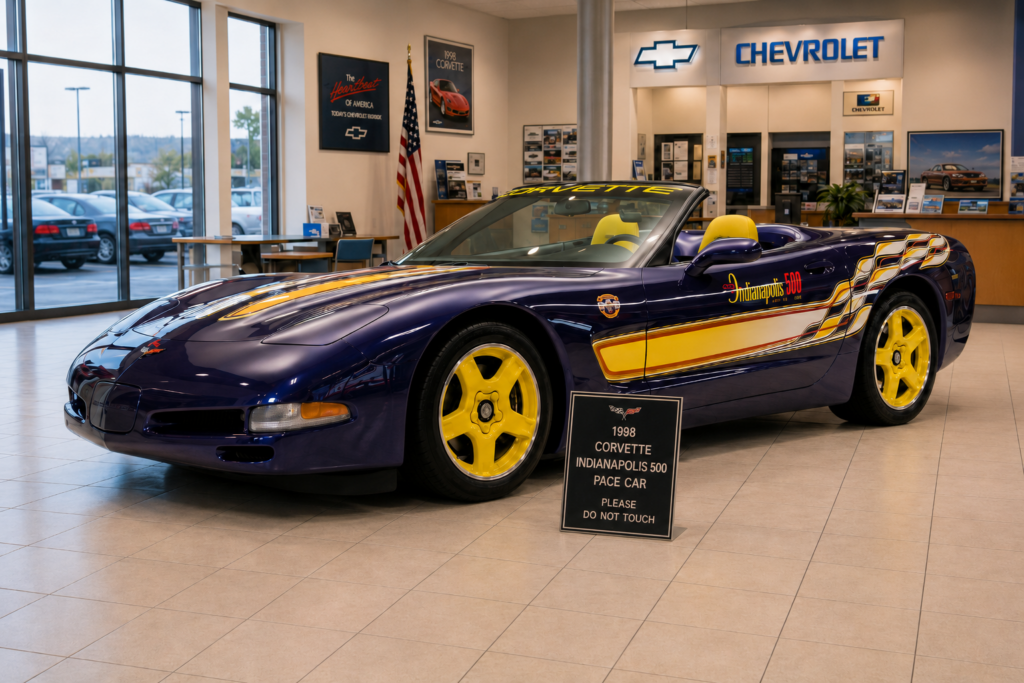

    For Chevrolet dealers, cars like the 1998 Corvette Indianapolis 500 Pace Car were never just inventory; they were showroom magnets. GM understood the value of a halo car placed where customers could see it, circle it, talk about it, and then imagine some piece of that excitement attached to whatever Chevrolet they had actually come in to buy. The Pace Car did that job perfectly—bright, loud, unmistakably special, and directly connected to the biggest race in America. Images like this also take me back to the first time I saw one in person, shortly after GM introduced the replicas, sitting inside the showroom at Merrick Chevrolet in Berea, Ohio. I was not looking at an ordinary Corvette that day. I was looking at something that made the whole idea of Corvette feel bigger, closer, and somehow more possible. For me, that first encounter was a game-changer, and it only deepened the desire I already had to someday own a Corvette of my own. (Image credit: Author / ChatGPT)

    That balance was part of the car’s appeal. The 1998 Pace Car Replica was not a hand-built exotic or a commemorative object detached from normal Corvette ownership. It remained a production C5 convertible, optioned and finished in a way that made it stand apart. Buyers were paying for a direct connection to Indianapolis, for the visual drama of the Z4Z package, and for the new-generation confidence Chevrolet was trying to attach to the C5. The car looked wild, but the business case behind it was practical: build something distinctive, keep it attainable for Corvette buyers, and let the Indy association do the rest.

    Then there is the question that always follows a pace car replica: how many were actually built?

    This is where enthusiasts can get pulled in different directions if they rely solely on early announcements. Initial estimates placed the production run somewhere in the low-thousand range, which was useful at the time but not precise enough for collectors trying to understand the car decades later. Final accounting, compiled and cross-checked through the C5 community, pace-car registries, and cars documented with original paperwork, lands at 1,163 total examples. That figure includes five pilot cars and breaks down by transmission into 616 automatics and 547 6-speeds.

    Those numbers help explain the Z4Z’s unusual place in the Corvette world. It is not so rare that the car disappears into folklore, where only a handful trade privately and most enthusiasts never see one. But it is limited enough that a genuine Pace Car Replica still draws attention when it arrives at a show, a cruise-in, or a Corvette gathering. The production total gives the car credibility without making it inaccessible. It is scarce enough to feel like a find, yet present enough to have built its own small culture inside the larger C5 community.

    That may be the sweet spot for a pace car replica. Too many, and the car risks feeling like a graphics package sold at scale. Too few, and it becomes more of a museum object than an enthusiast car. At 1,163 built, the 1998 Corvette Indy 500 Pace Car Replica landed in the middle: rare enough to spark a conversation, common enough to create a scene, and distinctive enough that no one mistakes it for anything else.

    What Chevrolet was really saying at Indy in ’98
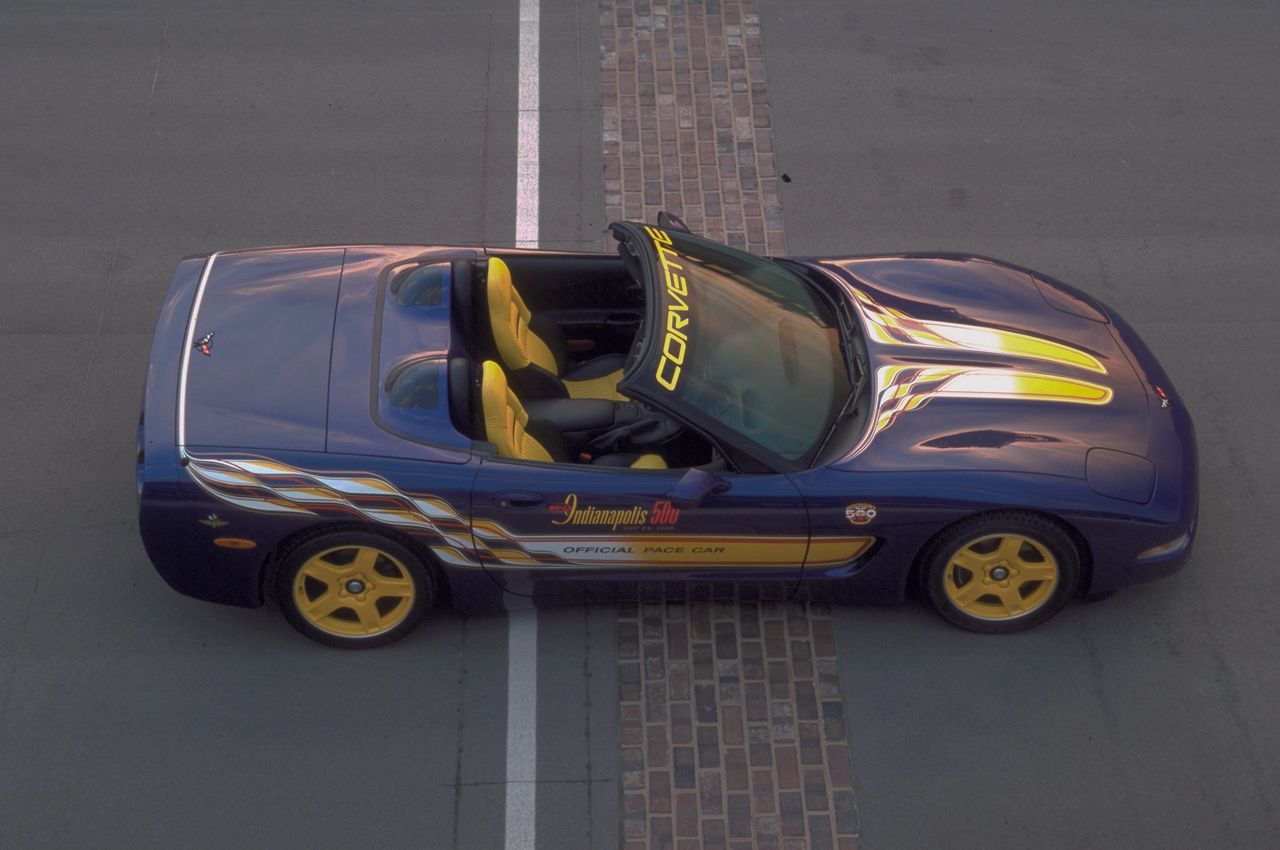
    Indianapolis Motor Speedway’s iconic brick start/finish line, seen from above—the 1998 Corvette Indy 500 Pace Car straddles the stripe, Radar Blue and yellow livery laid out like a starter’s flag. The CORVETTE windshield banner, triple hood streaks, and checkerboard ribbon graphics broadcast its mission at a glance.
    Indianapolis Motor Speedway’s iconic brick start/finish line, seen from above—the 1998 Corvette Indy 500 Pace Car straddles the stripe, Radar Blue and yellow livery laid out like a starter’s flag. The CORVETTE windshield banner, triple hood streaks, and checkerboard ribbon graphics broadcast its mission at a glance.

    The real “why” behind this car lives at the intersection of architecture and audience:

    • Architecture: The C5’s backbone changed what everyday Corvette driving felt like. The steering stayed lucid over expansion joints; the structure shrugged off the cowl shake that once defined American convertibles. Mount the transaxle at the rear, stiffen the tunnel and sills, and suddenly long-distance Corvette becomes a two-finger car instead of a work assignment. Putting that convertible at Indy—rather than a coupe with a token opening—telegraphed confidence in the chassis, not just the motor.
    • Audience: Corvette’s move in the late ’90s was to pair big-league performance with approachable technology. JL4 fits that pivot. Call it stability control if you want—Chevrolet did—but the core was a stability culture shift. You didn’t have to be Mario Andretti to go quickly without drama. You could be a Sunday-morning driver with a long on-ramp and a rain cloud, and the car would flatter you.
    • Authenticity: At a time when other pace-car programs would quietly tweak powertrains or braking systems to make an event day look easy, Chevrolet chose to undercut the myth. The ’98 pace-car program hung its hat on mechanical normalcy, then invited you to buy the match. The replica wasn’t “like” the pace car; it was the pace car in the ways that mattered.

    What it’s like to drive a 1998 Corvette Indy Pace Car Replica now
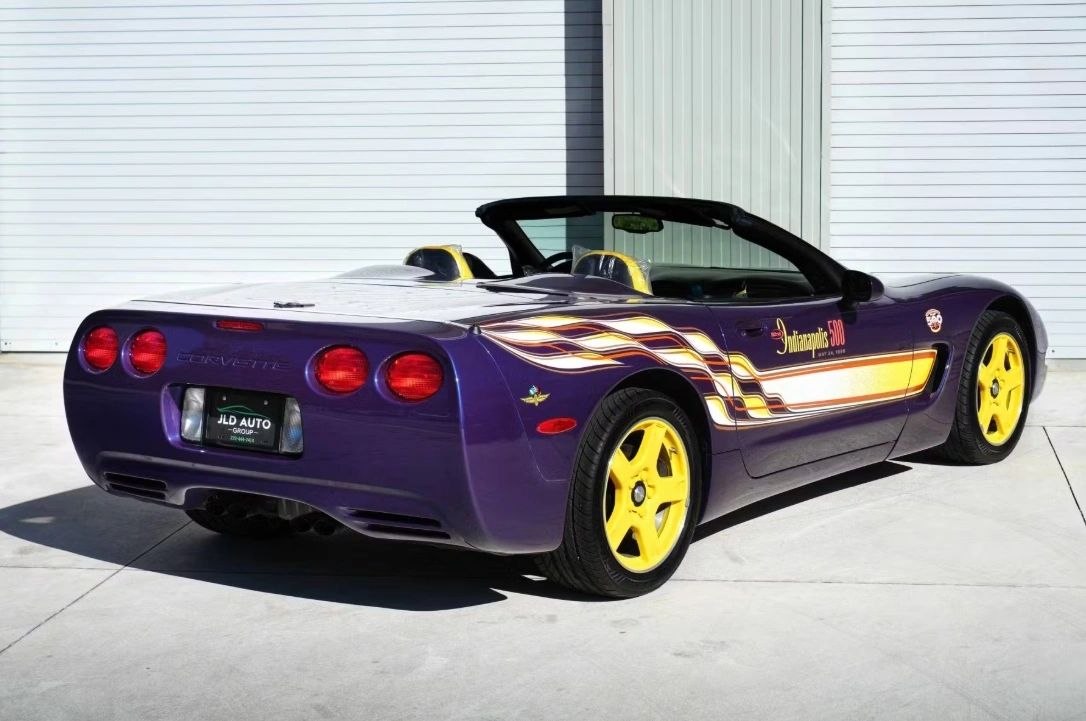
    Drive a good 1998 Z4Z and two things happen in short order.

    First, the livery noise fades. The yellow wheels, Radar Blue paint, and sweeping Indianapolis 500 graphics are the first things anyone notices, and understandably so. The car announces itself before the starter ever turns. But once you are behind the wheel, the visual volume begins to recede, and what remains is the basic goodness of the C5. The pace-car package may define the car at rest, but motion reminds you that this is still a fifth-generation Corvette convertible at its core—balanced, composed, and far more mature than the graphics suggest.

    What stays with you is calm. That easy, unbothered C5 rhythm was one of the reasons the car changed so many opinions when it was new. It had the power people expected from Corvette, but it delivered that power through a platform that finally felt like it was working with the driver instead of constantly asking for forgiveness. The LS1 starts cleanly, settles quickly, and pulls with a smooth, confident sweep through the middle of the rev range. It does not need to be wrung out to feel satisfying. It has that broad-shouldered, small-block ease that makes the car feel quick without feeling frantic.

    With the 6-speed manual, the car gains another layer of involvement. The gates feel deliberate, not vague; the shift action feels like a proper mechanical decision rather than a loose suggestion. The manual suits the C5’s personality because it makes the driver part of the car’s composure. You are not wrestling it into cooperation. You are working with something sorted. Even the base ride plays its part. Paired with the C5’s stronger structure, it gives the car a settled quality that earlier Corvette convertibles did not always possess. The chassis no longer feels like it is arguing with itself over every broken seam or uneven patch of pavement.
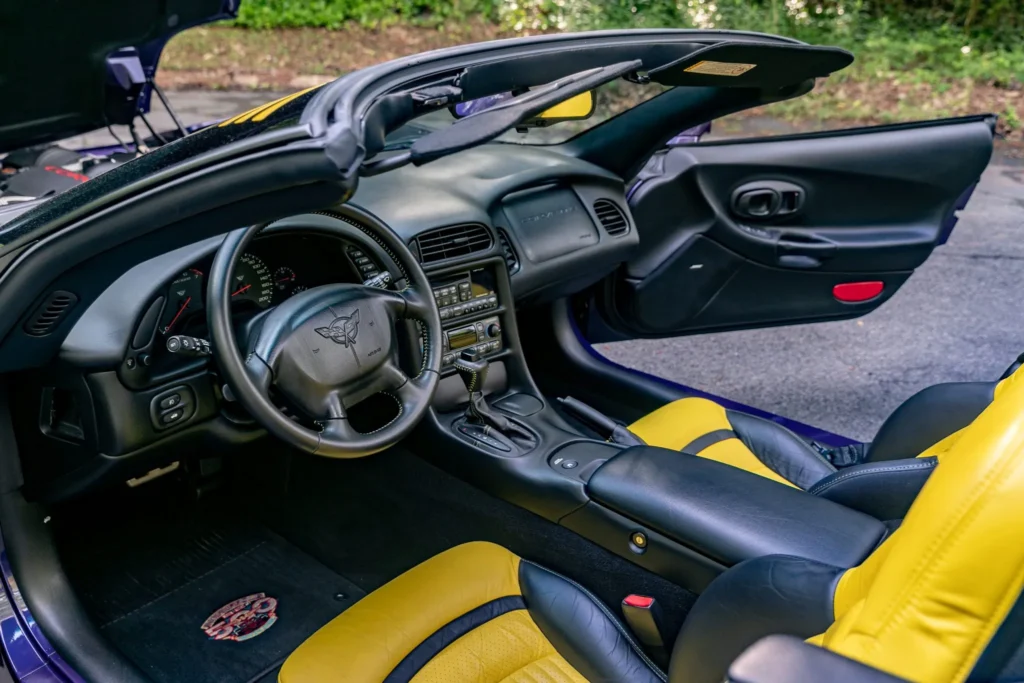
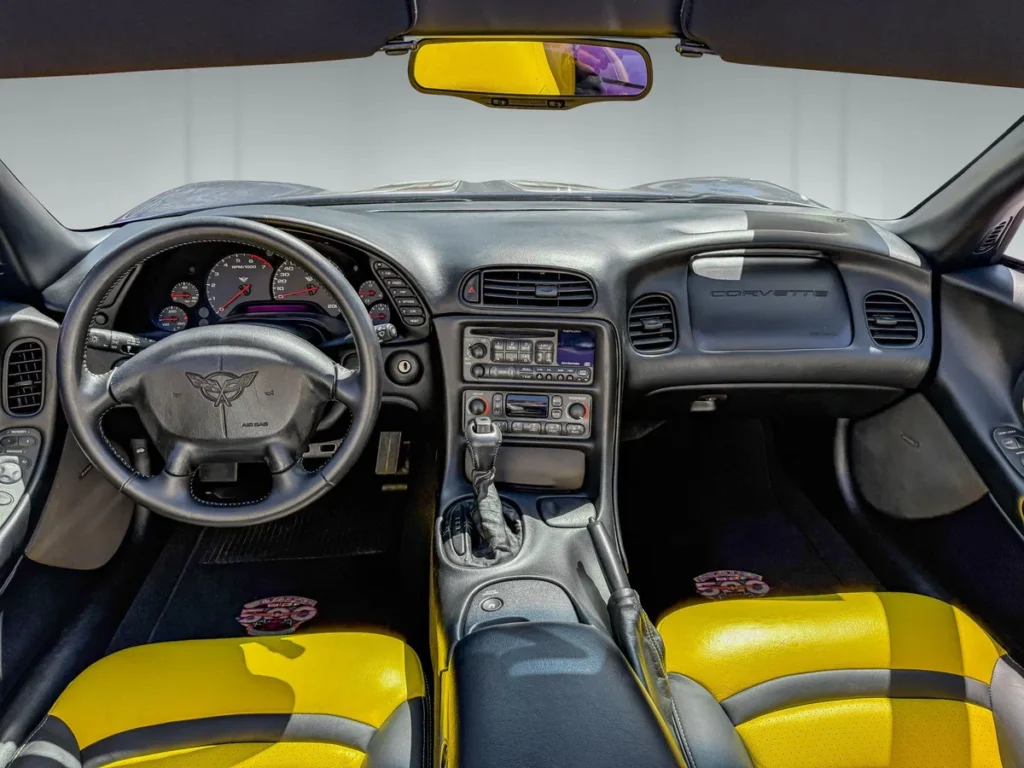
    Climb into the 1998 Corvette Pace Car, and the spectacle outside gives way to something more focused and familiar. The yellow-and-black seats carry the Indy theme into the cabin, but the view over the C5’s low dash, the clean sweep of the console, and the small-block waiting under your right foot remind you this is still a driver’s Corvette first. The graphics may get everyone else’s attention, but from behind the wheel, the car settles into that confident C5 rhythm—comfortable, composed, and ready to turn the page from showroom conversation piece to real Corvette experience.

    That is the first surprise for anyone expecting the Pace Car Replica to feel like a novelty item. It does not drive like a commemorative object. It drives like a Corvette that happens to be wearing a very loud uniform.

    The second thing you notice is that JL4 Active Handling earns its keep. Not by taking over the car, and not by making the driver feel scolded, but by quietly standing watch at the edges. Maybe you are cresting a crowned two-lane road just as a shower starts. Maybe you turn in a little early and the rear begins to move before you are ready for it. Maybe the pavement gets greasy in a place where your right foot had already made a decision. In those moments, JL4 works with a kind of measured restraint. It trims yaw with a small, precise brake intervention and gives the car back to you before the moment becomes untidy.

    That was the brilliance of the system in a Corvette context. Active Handling did not erase the car’s personality or turn the C5 into something sterile. It simply added a layer of composure that made the car easier to trust. Corvette had always offered speed. The C5, especially with JL4, made that speed feel more usable in the imperfect conditions where real drivers actually live: wet roads, uneven pavement, early turn-ins, late corrections, and all the small mistakes that happen between confidence and consequence. It was more quiet aide than schoolmarm, stepping in just enough to keep the conversation civilized.
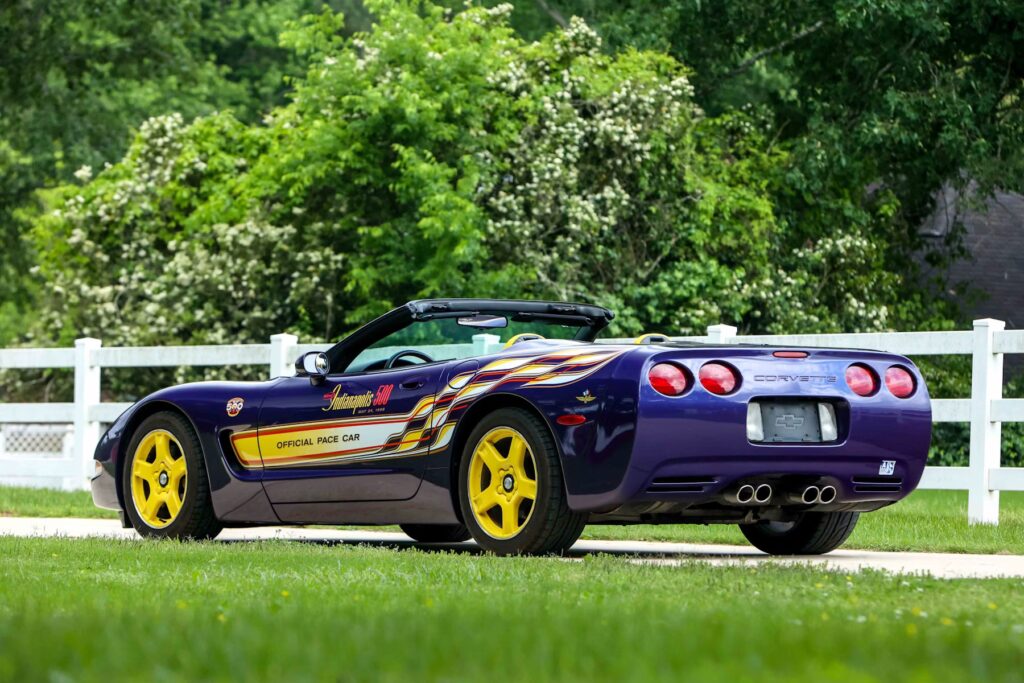
    Compared with the C4 convertible, the C5 felt like a much more complete open Corvette—stiffer, quieter, better sealed, and less prone to the flex and cowl shake that earlier cars could reveal over rough pavement. The top itself integrated more cleanly with the body, helping the convertible read as part of the C5 program rather than a roofless adaptation of it. On the 1998 Indy Pace Car, that matters visually as much as dynamically: with the top down, the yellow seats, roll-hoop area, and sweeping side graphics become part of one continuous display. The car looks less like a coupe with something removed and more like a purpose-built convertible designed to wear all that Indy pageantry in the open air. (Image source: Hagerty)

    If you are used to C4 convertibles, the difference is especially clear. The C5’s soft top and seal management feel almost luxurious by comparison. With the top up, the car is quiet enough to have a conversation without raising your voice over wind noise and body tremor. It feels less like an open car trying to impersonate a coupe and more like a convertible designed into the platform from the beginning. That sense of integration changes the whole experience. You are not constantly aware of what was removed. You are more aware of what Chevrolet managed to preserve.

    With the top down, the car stays present in a way that earlier Corvette convertibles could struggle to match. The body does not quiver over railroad crossings. The cowl does not shake its way through rough pavement. The steering remains clean, the structure feels settled, and the car retains the confident rhythm that made the C5 such a meaningful step forward. The open-air experience adds to the car rather than exposing it.

    The upshot is that the 1998 Pace Car Replica drives like a Corvette first and a special edition second. That is its real charm. The graphics get people to walk over. The yellow wheels start the conversation. The Indianapolis connection gives the car its story. But the reason owners actually enjoy these cars is that beneath all the event identity is a genuinely good C5 convertible—smooth, stable, usable, and modern in the way late-1990s Corvette needed to be.

    That is also why so many Z4Z owners put miles on them. The car may look like something built to sit under lights, but it was never limited to display duty. It has enough rarity to feel special, enough visual presence to make every fuel stop an event, and enough real Corvette substance to make the drive worth repeating. The Pace Car Replica may have been born from Indianapolis pageantry, but once the livery fades into the background, what remains is the car Chevrolet wanted you to discover all along.

    The Details That Complete the Story
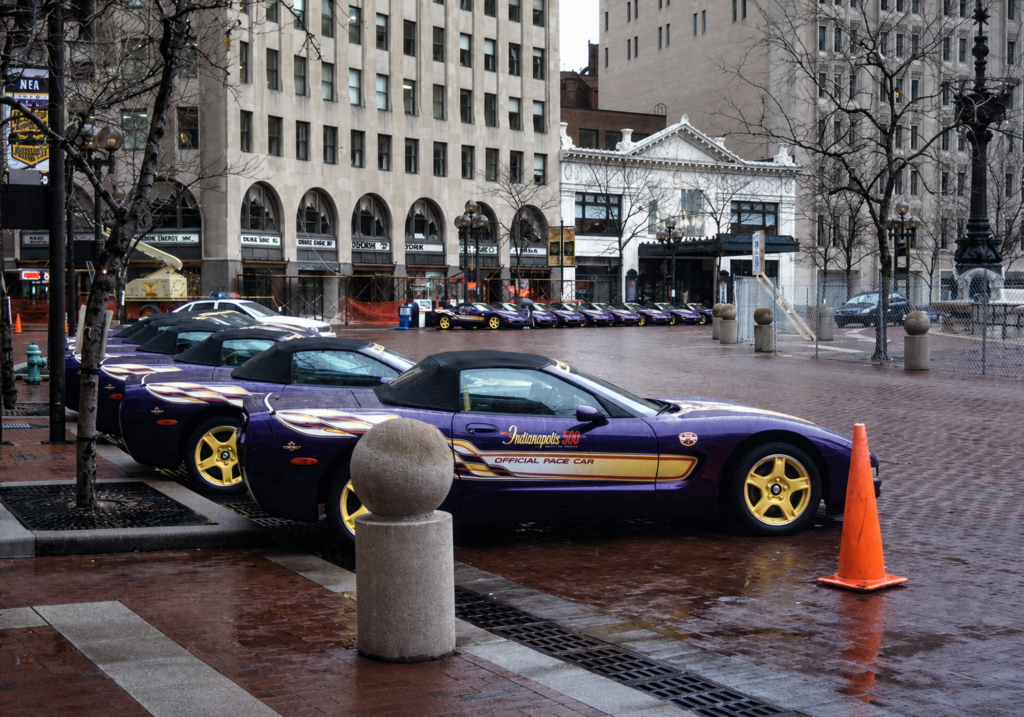
    Monument Circle becomes a Corvette corral—Radar Blue C5 pace cars idling against wet brick, their yellow wheels popping under a gray Indiana sky. These convertibles wore the full Indy 500 livery, staged downtown for promo duty and parade laps ahead of race week. Nearly twins to the Brickyard pacers, they broadcast May in Indianapolis from a block away. No billboard needed—just a circle full of Corvettes.

    The 1998 Corvette Indy Pace Car story is easy to understand at full volume: Radar Blue paint, yellow wheels, wild graphics, and a C5 convertible leading the field at Indianapolis. But the smaller details are where the car becomes more interesting. The Z4Z was not just a bright commemorative package attached to a famous race. It was a carefully timed, carefully staged Corvette moment, and several of its best supporting details help explain why the car still has a distinct place in C5 history.

    Monument Circle may be the best example. Before race day, downtown Indianapolis became its own kind of Corvette corral, with Radar Blue C5 pace cars gathered against wet brick and gray Indiana skies, their yellow wheels cutting through the gloom like signal flares. These cars wore the full Indy 500 livery and served as rolling promotion for race week, visually extending the Speedway into the heart of the city. Nearly twins to the Brickyard pacers, they announced May in Indianapolis from a block away. No billboard was required. A circle full of Corvettes did the work.

    The driver change added its own layer to the story. Greg Norman may have been the original celebrity choice, but Parnelli Jones ultimately gave the 1998 pace-car assignment more weight. Norman’s late withdrawal could have made the program feel unsettled; instead, Jones’s substitution tied Chevrolet’s newest Corvette to a driver who already held a permanent place in Speedway history. It sharpened the narrative rather than weakening it. A new-generation Corvette convertible out front was one thing. A new-generation Corvette convertible led by a past Indy 500 winner was something else entirely.
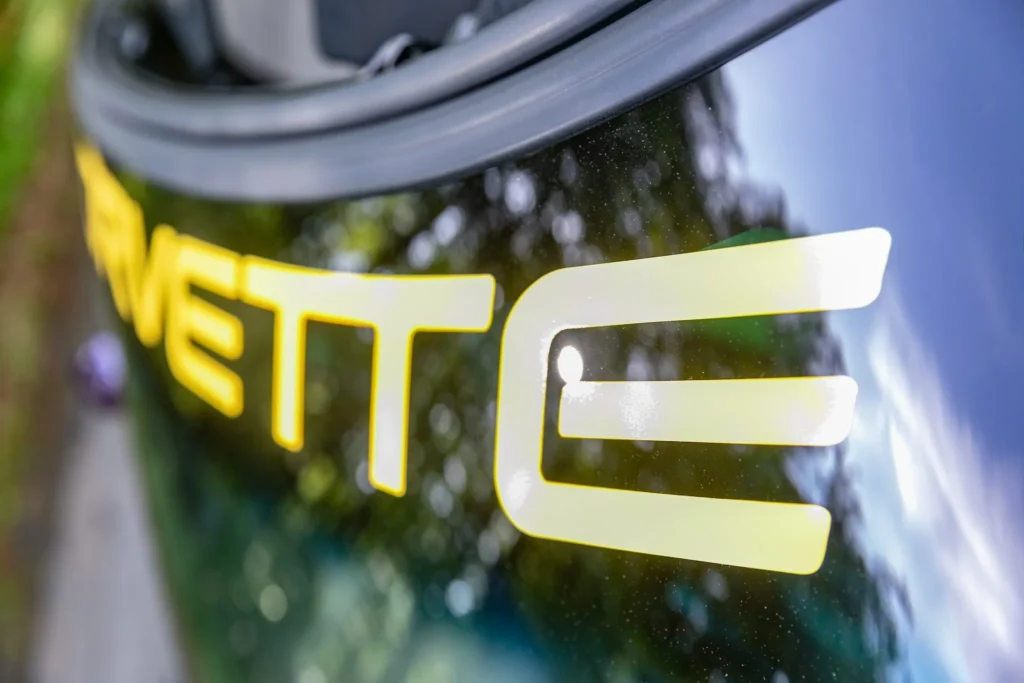
    One of the defining details of the 1998 Corvette Indy 500 Pace Car Replica was that its graphics were installed at the Bowling Green Assembly Plant, giving the Z4Z package a factory-applied finish rather than the uneven feel of an afterthought. That mattered on a car this visually dependent on precision: the yellow windshield “CORVETTE” script, the Indianapolis 500 door graphics, the Official Pace Car callout, the front fender event medallions, and the flowing checkered-flag sweep over the rear quarters all had to land cleanly for the design to work. The close-up view of the windshield lettering shows the point beautifully—this was not just decoration, but part of a coordinated identity that tied the Radar Blue paint, yellow wheels, yellow-and-black interior, and race-week livery into one unmistakable package. Factory installation helped make the car feel like a true production special, not a standard convertible wearing dealer-installed costume jewelry.

    Then there were the graphics. Chevrolet’s decision to apply the livery at Bowling Green removed a major variable from the replica program. For collectors and restorers today, “factory stripes” versus “dealer stripes” is not just trivia. It is the difference between a car that left the line with clean, consistent execution and one that may spend years fighting alignment issues, lifting edges, bubbled vinyl, or aged adhesive. On a special edition built so heavily around visual impact, consistency was not a minor production detail. It was part of the car’s credibility.

    The transmission split also says more than it first appears to. Of the 1,163 total Z4Z cars, 547 were built with the 6-speed manual. That number matters because it shows the package did not land only with parade enthusiasts or collectors chasing a bright commemorative edition. A substantial number of buyers wanted to row their own gears under that neon suit. The Pace Car Replica may have looked like event merchandise from a distance, but plenty of its original customers clearly still saw it as a Corvette to drive.

    Active Handling gave the car another layer of purpose. GM’s press framing for JL4 read like a careful engineer’s argument for accident avoidance, stability, and control. In practice, the system helped present the C5 as something more mature than the old caricature of brute-force American performance. Corvette was still fast, still V8-powered, still unmistakably itself, but JL4 gave the car a more polished public face. It suggested performance with composure, not just performance with bravado.

    That is why the Z4Z still works better than its loudest details might suggest. The downtown promo cars reinforced the “same as the real thing” message. The factory graphics gave the package a higher floor of execution. The manual-transmission count proved that real drivers were paying attention. And Active Handling helped position the C5 as a more complete Corvette for a new era. The 1998 Pace Car Replica was theatrical on the surface, but the fine print had substance.

    The market, then and now
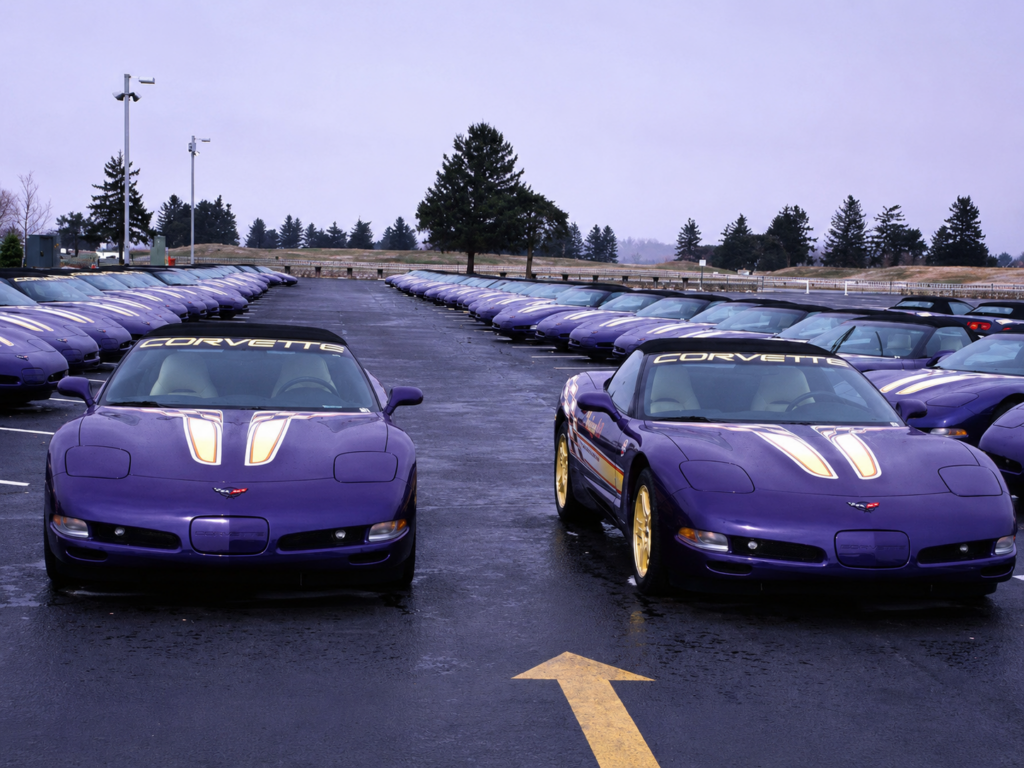
    Lined up at the Corvette Manufacturing Plant in Bowling Green, these 1998 Corvette Indianapolis 500 Pace Car Replicas look less like a novelty run and more like a moment in Corvette history coming into focus. Each Radar Blue convertible, set off by yellow wheels and race-week graphics, represents the point where Chevrolet’s Indy spectacle became real production cars no longer serving only as pace-car imagery, but as finished Corvettes preparing to leave the plant and enter the world. Seen this way, the row carries a little more weight: not just colorful special editions waiting for keys, but a full assembly-line statement that the C5 was modern enough, confident enough, and polished enough to turn a bold promotional idea into a legitimate piece of Corvette manufacturing history. It is a late-1990s Corvette at full volume, lined up where the story became tangible.

    Window-sticker arithmetic put a well-optioned Z4Z in a sweet spot: special but not absurd. That helped the cars find garages outside of the “park and stare” crowd. Two and a half decades on, values tell a familiar story: driver-grade cars in the high-teens to mid-$20s, clean survivors and low-mile examples in the $30s, and documentation-rich or provenance-heavy cars that pop higher when the right buyer falls in love with the right story. High-visibility auction comps and marketplace pieces continue to cite the 1,163 total and the manual/automatic split, underlining how long the community has converged on those totals. The broader lesson isn’t that they’ve spiked; it’s that originality, paperwork, and factory graphics separate the good from the merely shiny.

    The quick reference you’ll want handy
    • Official announcement: Chevrolet made the program official on November 6, 1997, confirming that the 1998 Corvette convertible would pace the Indianapolis 500 and that a limited run of replicas would be offered to the public. It was a major visibility play for the new C5 convertible, but also a production-car statement: the open Corvette was ready for the spotlight.
    • Race day: The 82nd running of the Indianapolis 500 took place on May 24, 1998, with Parnelli Jones behind the wheel of the Corvette pace car. Greg Norman had originally been announced as the driver and even participated in early promotional activity, but shoulder surgery forced him to withdraw before race week.
    • Mechanical story: The official pace car stayed remarkably close to showroom specification. Race-day equipment such as safety gear, roll-over protection, and lighting separated the track-duty car from the replicas, but the basic message was clear: Chevrolet did not need to create a heavily modified one-off to put the C5 convertible out front at Indy.
    • Active Handling — RPO JL4: Active Handling debuted for 1998 and was fitted to the Z4Z pace-car replicas, giving Chevrolet a high-profile way to introduce the system. Built around yaw, steering-angle, and lateral-G inputs, JL4 helped position the C5 as a more composed and electronically sophisticated Corvette. It later became standard equipment for 2001.
    • Production: Final production is generally accepted at 1,163 total cars, including five pilot cars. The transmission split gives the number more texture: 616 automatics and 547 6-speeds, a healthy manual count that reinforces the idea that many buyers saw the Z4Z as a Corvette to drive, not just a commemorative object to store.
    • Pricing context: The pace-car package added roughly $5,039 over the price of a well-optioned, mid-$40,000 Corvette convertible. Period announcements, registry material, and window-sticker references can vary slightly depending on equipment and accounting, but the direction is consistent: Chevrolet priced the Z4Z as a special car without pushing it completely outside normal Corvette buyer territory.
    • Factory livery: For 1998, the major exterior graphics were applied at the Bowling Green Assembly Plant, giving the replicas a consistency that earlier decal-based special editions did not always enjoy. The windshield name decal remained an owner-installed piece, a small but useful distinction for restorers and collectors trying to understand what was factory-applied and what was delivered separately.

    Why the 1998 Corvette Pace Car Replica Still Matters Today
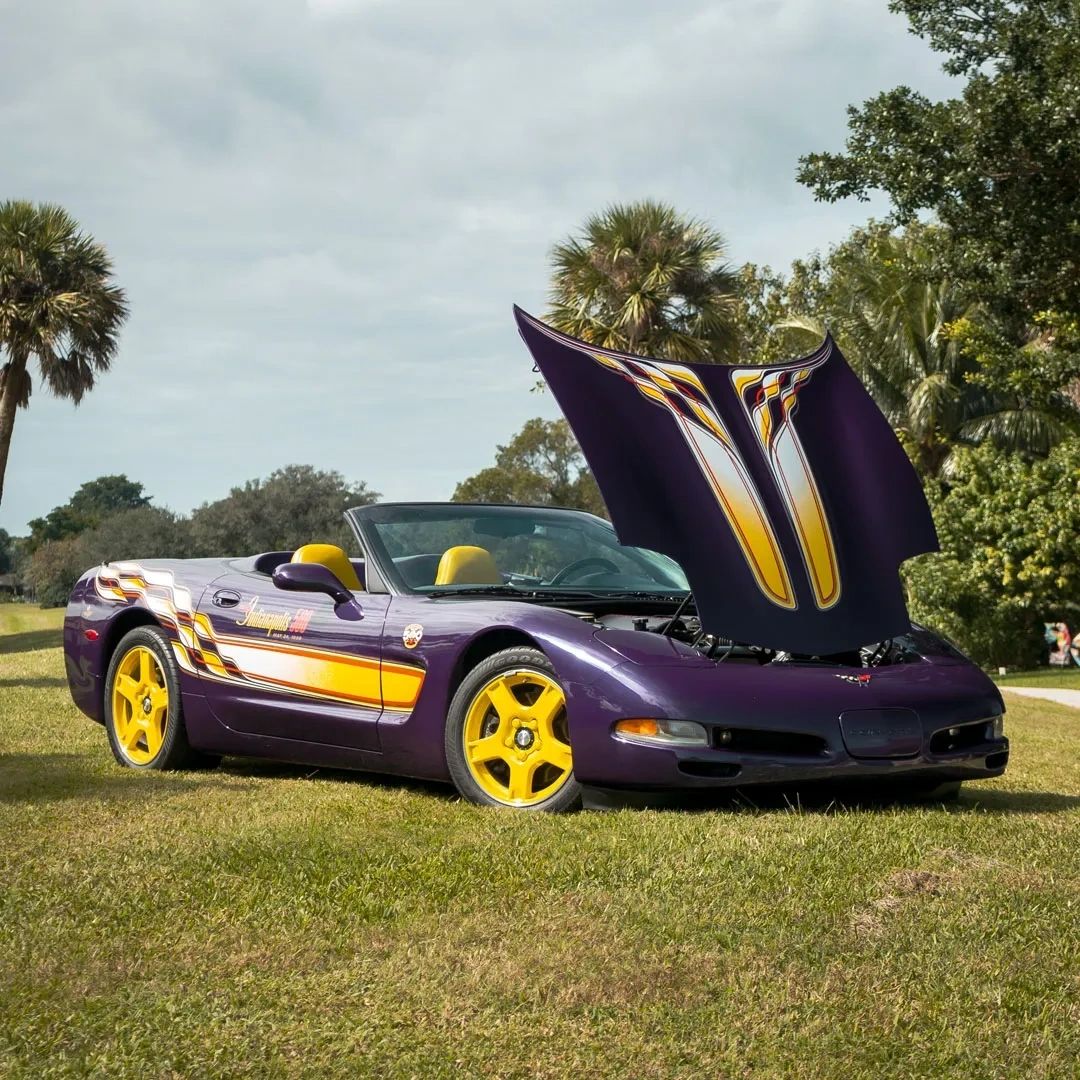
    The ’98 Indy 500 Pace Car mattered because it proved the new C5 convertible’s structure in the harshest spotlight—top down at speed, with no gimmick mechanicals, just strobe gear and safety mods. It also debuted GM’s boldest late-’90s look and helped launch the return of the Corvette ragtop for the C5 era. Many replicas (1,163) were sold nearly spec-for-spec with the real pacers, turning a one-day assignment into a rolling validation of the platform. In short: engineering credibility, broadcast in purple and yellow.
    The ’98 Indy 500 Pace Car mattered because it proved the new C5 convertible’s structure in the harshest spotlight—top down at speed, with no gimmick mechanicals, just strobe gear and safety mods. It also debuted GM’s boldest late-’90s look and helped launch the Corvette ragtop’s return for the C5 era. Many replicas (there were 1,163 produced in total) were sold nearly spec-for-spec with the real pacers, turning a one-day assignment into a rolling validation of the platform. In short: engineering credibility, broadcast in purple and yellow.

    The 1998 Corvette Indianapolis 500 Pace Car Replica has always been easy to dismiss from a distance. Too purple. Too yellow. Too loud. Too tied to a particular late-1990s moment when Chevrolet was not afraid to let a special edition announce itself from the far end of a parking lot. But that quick reading misses why the car continues to hold a place in Corvette history. The Z4Z was never just a paint-and-decal exercise. It was the moment Chevrolet used the Indianapolis 500 to introduce the C5 convertible, showcase the credibility of the new platform, and put a factory-built replica into customers’ hands that was close enough to the real pace car to make the connection feel legitimate.

    That is what separates it from simple commemorative dressing. The 1998 Pace Car arrived at a pivotal time for Corvette. The C5 had already begun changing the conversation around America’s sports car, but the convertible still had something to prove. Open Corvettes had always carried emotional weight, but they also carried the usual convertible questions: structure, refinement, sealing, cowl shake, and whether the roofless version felt like a compromise. The Indy assignment allowed Chevrolet to answer those questions in public. The car did not need a special chassis, a one-off engine, or a long list of mechanical excuses. It was essentially a production C5 convertible with the required pace-car equipment added for duty, and that was the point. Chevrolet trusted the showroom car enough to put it in front of the field.

    The livery, for all its controversy, is part of what keeps the car working. A restrained 1998 Indy Pace Car would have been easier to like, but probably easier to forget. The Radar Blue paint, yellow wheels, black-and-yellow interior, windshield callout, event medallions, and sweeping checkered graphics gave the car a visual signature no other C5 shares. It is not merely colorful; it is unmistakable. At a cars-and-coffee, a concours field, a Corvette gathering, or a dealer showroom, the car does not need explanation before it starts a conversation. It brings Indianapolis with it.
    The 82nd Indianapolis 500 emblem on the 1998 Corvette Pace Car Replica is more than a decorative badge; it is the timestamp that explains why the car still carries historical weight. The Z4Z package matters today because it preserves the moment Chevrolet used America’s biggest racing stage to introduce the C5 convertible and prove that the new-generation Corvette had the structure, composure, and confidence to lead at Indy without becoming something other than itself. In that sense, the event was as important to the car’s story as the car was to the event’s spectacle. Every badge, graphic, and yellow-wheel flourish points back to May 24, 1998, when the C5 convertible stopped being merely the new open Corvette and became part of Indianapolis 500 history.

    That kind of instant identity has become more valuable with time. Modern Corvette special editions often live in the space between tasteful and marketable, with unique stitching, wheel finishes, stripe packages, or numbered plaques doing much of the work. The 1998 Z4Z comes from a different school. It is a full-body event car, built during an era when Chevrolet still understood the promotional power of putting something visually outrageous in the showroom and letting people gather around it. For some buyers, that meant a limited-production collectible. For others, especially younger enthusiasts seeing one under dealership lights, it meant something more personal: proof that Corvette was still capable of stopping people in their tracks.

    The production numbers help the car’s case. With 1,163 built, including five pilot cars, the 1998 Pace Car Replica is limited without being unobtainable. The transmission split also gives the story texture: 616 automatics and 547 six-speeds, which means nearly half the production run went to buyers who wanted the full visual drama paired with a manual gearbox. That matters for how the car is understood today. It was not simply a parade car for collectors who wanted the loudest Corvette on the block. A meaningful number of customers ordered it as a driver’s car, and the best surviving examples still carry that dual identity. They are collectible, yes, but they are also C5 convertibles with LS1 power, real chassis sophistication, and the kind of long-distance ease that made the fifth-generation Corvette such a leap forward.

    The market seems to understand that balance. A standard 1998 Corvette convertible remains one of the more approachable ways into modern Corvette ownership, while documented Pace Car Replicas sit in their own lane because of the package, production total, mileage, transmission, originality, and paperwork. Hagerty’s valuation data places a typical 1998 Corvette convertible in good condition well below the strongest Pace Car Replica results, while Classic.com’s market page for the 1998 Indy Pace Car shows an average sale price around the low-$30,000 range, with a reported high sale above $50,000 and lower-mile or highly original examples trading at a premium. Recent auction data reinforces that spread, including a 22-mile 6-speed example that sold on Bring a Trailer for $41,000 in February 2026.

    That spread is important because it tells the truth about the car. The Z4Z is not rare in the way a factory lightweight, developmental prototype, or ultra-low-production performance model is rare. It is not a secret-code Corvette that only specialists understand. Its appeal is more visible, more emotional, and more tied to provenance. The best cars are the ones that still have their factory graphics intact, their yellow wheels present, their black-and-yellow interiors preserved, their documentation in order, and their connection to the Indy program clearly understood. Mileage helps, but originality and completeness may matter even more because this car’s identity depends on the whole package being there.

    That is also why the factory-applied graphics deserve a place in the closing argument. On many special editions, stripes are decoration. On the 1998 Pace Car, the livery is the car’s passport. Chevrolet applying the major graphics at Bowling Green gave the replicas a higher level of consistency and helped make the “same as the real thing” positioning more convincing. For collectors, that distinction becomes more meaningful with every passing year. A car with tired vinyl, missing details, incorrect replacement graphics, chrome wheels substituted for the original yellow pieces, or a softened interior loses more than condition points. It loses part of the reason the Z4Z exists.

    And yet, the 1998 Pace Car Replica should not be reduced to preservation anxiety. One of the best things about the car is that it still drives like a good C5. The LS1 is smooth and eager. The chassis is calm. The convertible structure is far more convincing than the open C4s that came before it. JL4 Active Handling gave the car a modern safety and stability story at precisely the moment Corvette needed one. Taken together, those elements make the Z4Z more than a static collectible. It is a usable artifact of Corvette’s late-1990s reinvention.

    That is the real reason the car still resonates. It captures the C5 at the moment Chevrolet was no longer simply trying to prove that Corvette was fast. Corvette had already won that argument many times over. The more important question was whether it could be modern, refined, electronically sophisticated, structurally honest, and still feel like itself. The 1998 Indy Pace Car answered with a kind of unapologetic confidence. It was flamboyant on the surface, but serious underneath. It could sit roped off in a showroom, pace the field at Indianapolis, turn heads on Monument Circle, and still behave like a Corvette once the road opened up.
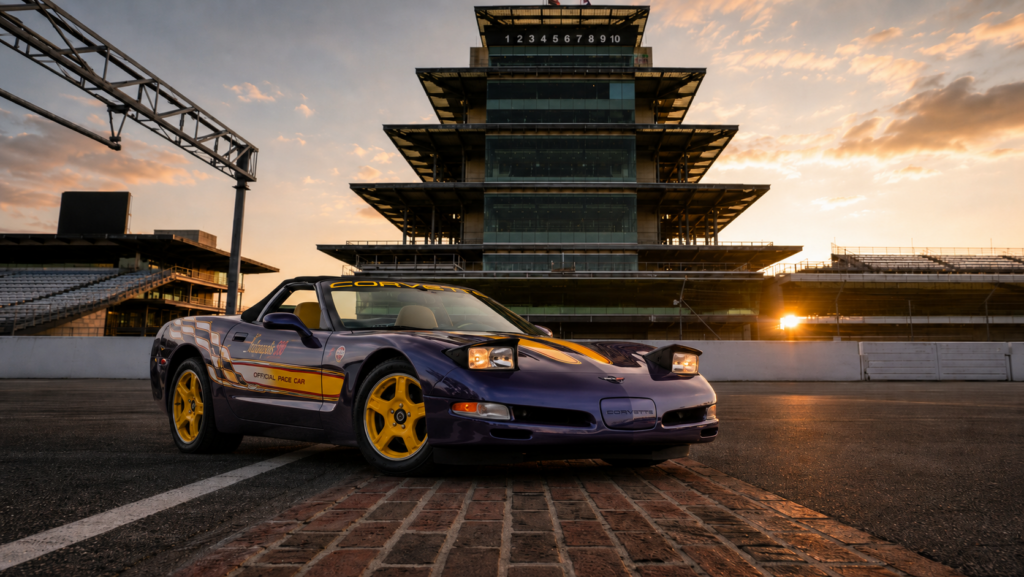
    Some Corvettes earn their place quietly. This one never had any interest in that. The 1998 Indy Pace Car Replica still matters because it preserved a moment when Chevrolet let the C5 convertible be bold, public, and completely unafraid of attention—then backed the spectacle with real engineering. It is May in Indianapolis, rendered in Radar Blue, yellow wheels, and factory confidence: a car built to be seen, but remembered because it was ready. (Image courtesy of the author.)

    Not every important Corvette is subtle. Some mark their place by being elegant, rare, or technically revolutionary. Others do it by becoming impossible to ignore at exactly the right moment. The 1998 Corvette Indianapolis 500 Pace Car Replica belongs to the second group, but its importance runs deeper than its color. It helped introduce the C5 convertible, gave Active Handling a public stage, tied Corvette once again to the Speedway, and turned a bold promotional idea into a factory-built production car with real engineering behind it.

    Twenty-plus years later, the yellow wheels still do their job. The graphics still start arguments. The car still looks like May in Indianapolis turned into fiberglass. But beneath all of that is the reason it deserves a serious place in the Corvette story: the 1998 Pace Car Replica was Chevrolet telling the world that the C5 convertible was not merely ready for the showroom.

    It was ready to lead.
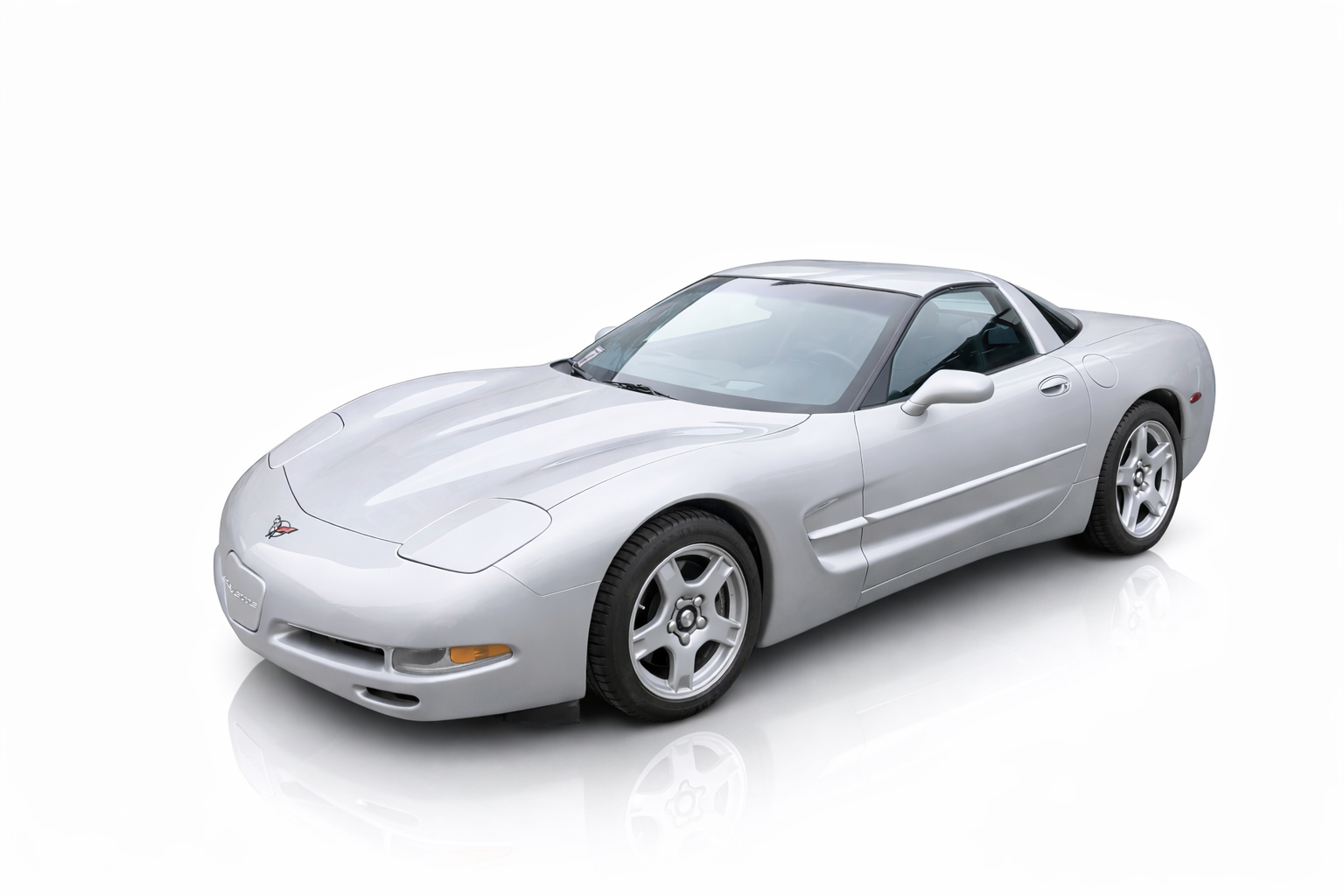
    The 1998 Corvette Indy Pace Car Replica was loud by design, but its real story runs deeper than Radar Blue paint and yellow wheels. It introduced the C5 convertible on America’s biggest racing stage, showcased Active Handling, and turned Indy spectacle into one of the most memorable C5-era production Corvettes.

  • 1999 Corvette Overview: The Year the C5 Found Its Full Identity

    1999 Corvette Overview: The Year the C5 Found Its Full Identity

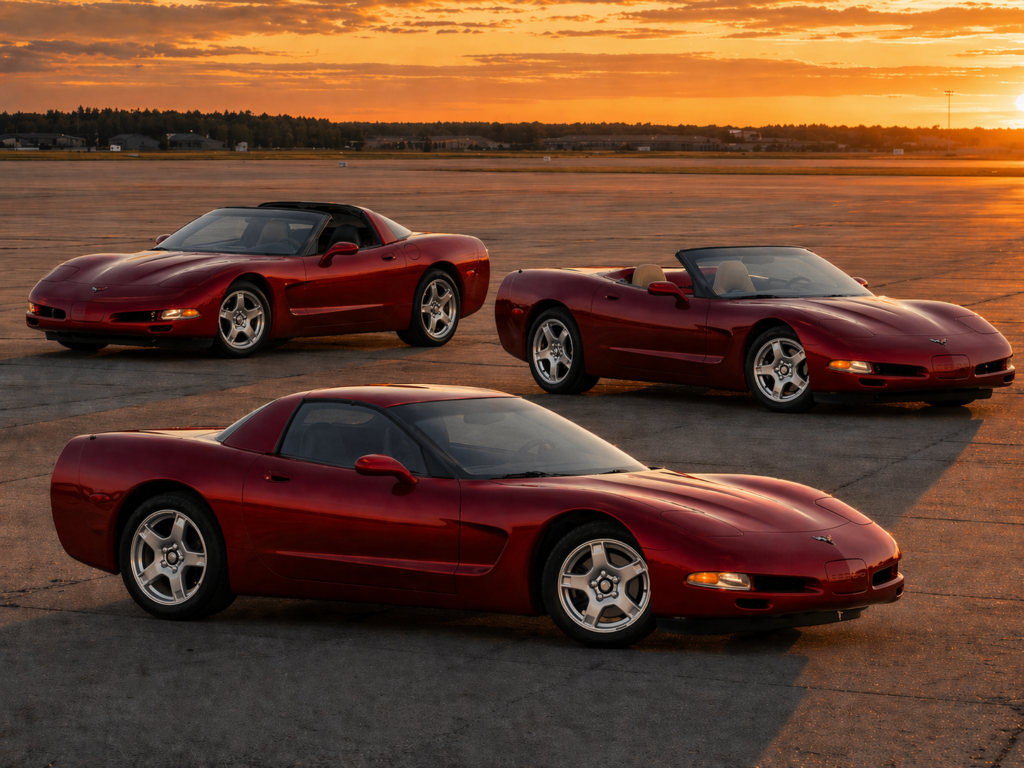
    By 1999, the fifth-generation Corvette was no longer the promising new car that had stunned the industry in 1997. It had become something more important than that: a settled, confident platform that Chevrolet now understood well enough to stretch in multiple directions. The coupe was already established as a legitimate world-class sports car. The convertible had returned in 1998 and restored open-air Corvette motoring to the lineup. Then, for 1999, Chevrolet added the third body style that completed the C5 family: the hardtop, the car enthusiasts would come to know as the FRC, or Fixed Roof Coupe. At the same time, the model year introduced the Head-Up Display, refined the steering system, continued the march toward a more polished interior experience, and marked the beginning of Corvette’s modern return to factory-backed racing through the C5-R. In other words, 1999 was not a transitional year. It was the year the C5 lineup came fully into focus.

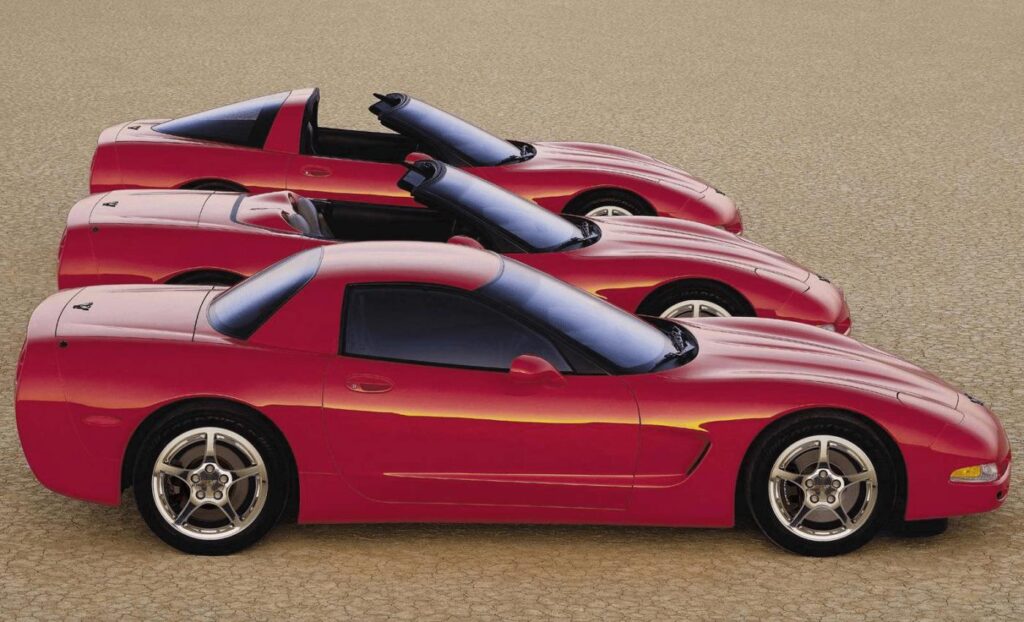
    That matters because the 1999 Corvette was not defined by a single massive mechanical leap. Horsepower remained 345 from the LS1, torque stayed at 350 lb-ft, and the basic C5 architecture remained as brilliant as it had been at launch: hydroformed perimeter frame, rear transaxle, unequal-length control arms, composite transverse springs, and a body that finally gave Corvette the structural and dynamic polish it had chased for decades. What changed in 1999 was the breadth of the idea. Chevrolet was no longer just selling a coupe and a convertible. It was beginning to segment the Corvette audience with real precision: grand-touring buyers, open-air buyers, and hard-core drivers who wanted the sharpest, leanest version of the platform available. That shift would shape the rest of the C5 era.

    The Fear Behind the Hardtop

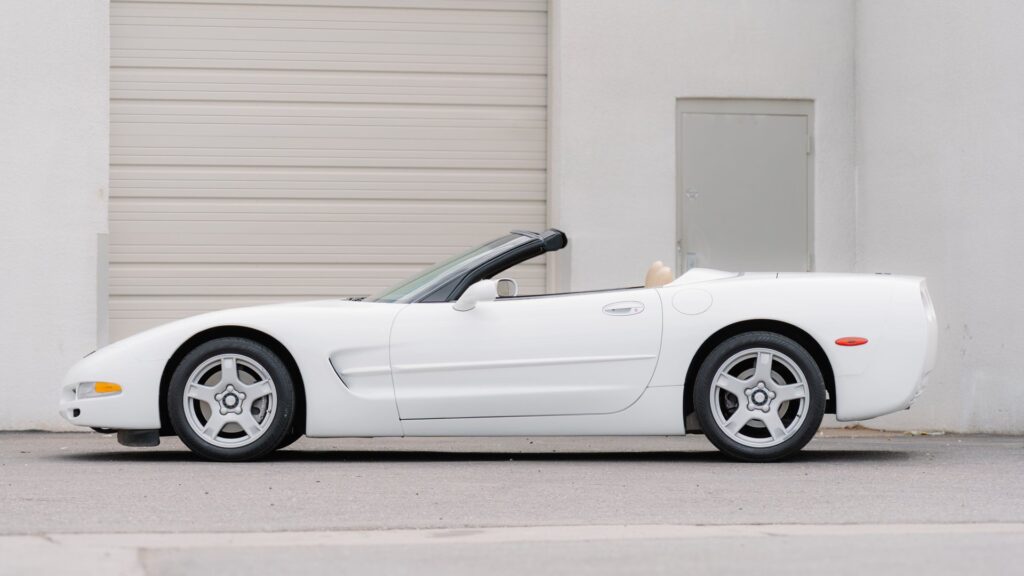
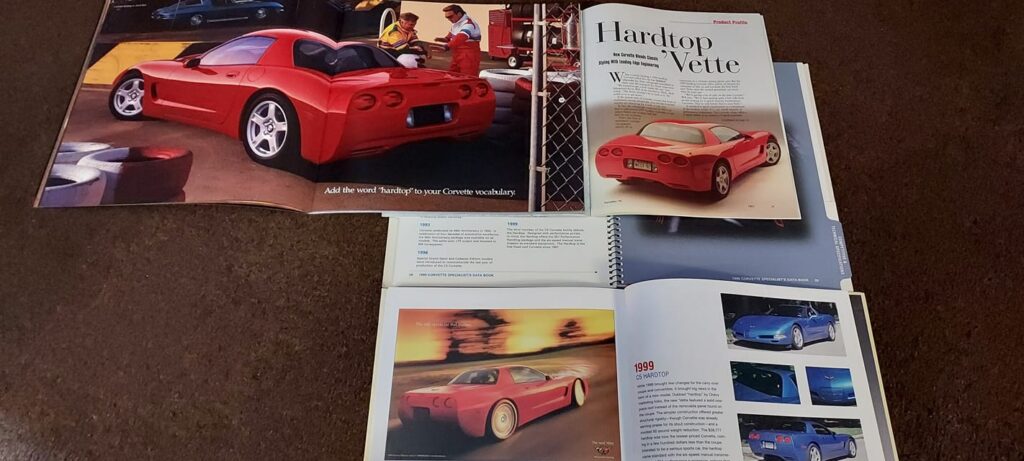
    Introduced in 1999, the Fixed Roof Coupe was born out of Chevrolet’s search for a more focused, lower-cost C5 variant, but it quickly evolved into something much more important: a stiffer, lighter Corvette aimed squarely at serious drivers. By pairing the convertible’s trunk structure with a permanent roof, the FRC delivered greater chassis rigidity, standard Z51 handling hardware, and a six-speed manual, giving the brand a more performance-driven entry point without diminishing Corvette’s image. Just as importantly, it proved there was real demand for a stripped-back, track-minded Corvette that emphasized precision over luxury. In doing so, the FRC helped sharpen the C5’s identity and laid the engineering and marketing groundwork for the 2001 Corvette Z06. (Image courtesy of GM Media LLC.)

    One of the most interesting truths about the 1999 Corvette is that its most important new variant did not begin life as a purity special. It began life as a pricing exercise. Early in the C5’s development, Chevrolet explored the idea of creating a cheaper Corvette—something intentionally pared back, aimed at broadening the car’s reach at a time when there was internal concern about whether Corvette was becoming too exclusive, too expensive, and too vulnerable to shrinking demand. Chief engineer Dave Hill later recalled that Chevrolet asked him to find a way to make a cheaper Corvette, and period reporting from Car and Driver makes clear that early clinic cars reflected exactly that thinking: manually adjusted cloth seats, smaller tires, fewer features, and even an automatic transmission in some prototypes.

    The problem was that customers did not want a bargain-basement Corvette. They wanted a Corvette that felt special. According to Car and Driver, clinic reactions to those stripped prototypes were overwhelmingly negative, and Hill himself drew a sharp line between the abandoned budget concept and the production car that followed, saying flatly, “This is not a stripper.” That sentence tells you almost everything you need to know about how the 1999 hardtop came to market. Chevrolet did not abandon the idea of a lighter, less expensive Corvette. It redefined the mission. Instead of trying to make the Corvette cheaper in a way buyers would perceive as diminished, Chevrolet repositioned the car as more focused, more rigid, and more serious. John Middlebrook described the resulting model as “lighter, stiffer and slightly more agile,” and that language was not accidental. The hardtop would not be sold as a lesser Corvette. It would be sold as a sharper one.

    From Budget Exercise to Serious Driver’s Car

    1999 FRC Corvette on track.
    For serious drivers, the 1999 FRC quickly became more than just a new body style. Its lighter weight, greater structural rigidity, standard six-speed manual, and standard Z51 suspension made it the most focused C5 in the lineup, appealing to enthusiasts who cared more about balance, feedback, and control than luxury options. In many ways, it became the purest performance expression of the early C5 formula. More importantly, it showed Chevrolet there was real enthusiasm for a harder-edged Corvette, helping pave the way for the factory-built track weapon that would follow two years later: the Corvette Z06.

    That repositioning is what makes the 1999 hardtop such a fascinating car in Corvette history. The production model preserved some of the original austerity logic, but only where Chevrolet believed it could be recast as performance discipline. The hardtop arrived as the first fixed-roof Corvette since the 1963–67 Sting Ray coupes. It used the convertible’s rear body structure and external trunk, then paired that with a bonded fixed roof rather than the coupe’s removable targa panel and large glass hatch. The result was the stiffest C5 body shell to date, with period and retrospective sources consistently pegging it at about 12 percent stiffer than the coupe and roughly 80 to 90 pounds lighter depending on how the comparison was made. Official archival specs list the hardtop at 3,155 pounds versus 3,245 for the hatchback coupe, while Car and Driver measured a 79-pound advantage against a comparably equipped hatchback.

    Chevrolet then made sure the supporting hardware backed up the story. Every hardtop came standard with the six-speed manual transmission, the 3.42 limited-slip rear axle, and the Z51 Performance Handling Package, featuring stiffer springs, larger stabilizer bars, and monotube shocks. That was a meaningful bundle. On the coupe and convertible, those items cost extra. On the hardtop, they defined the car. Jim Campbell pointed out at launch that the six-speed and Z51 package represented a value that widened the real price gap between the hardtop and a comparably equipped coupe beyond the base MSRP suggested. In pure sticker terms, the hardtop started at $38,777, the coupe at $39,171, and the convertible at $45,579. But Chevrolet knew buyers were not comparing bare numbers on paper. They were comparing what they got for those numbers.

    What the Hardtop Kept, and What It Gave Up

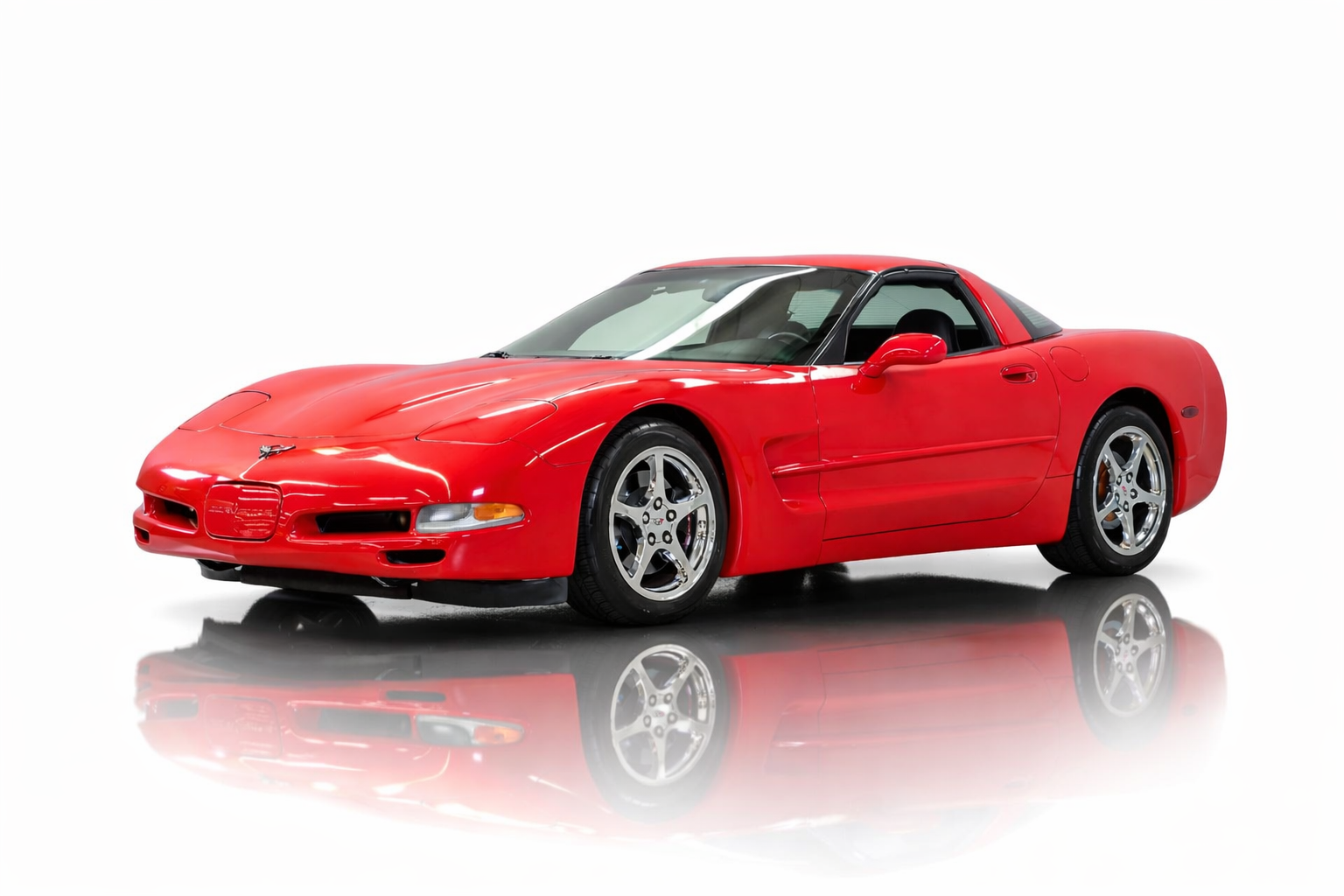
    Although the 1999 Corvette lineup now included three distinct personalities, the coupe, convertible, and new Fixed Roof Coupe still shared the same essential C5 foundation: the 345-horsepower LS1 V-8, hydroformed chassis, rear transaxle layout, four-wheel disc brakes with ABS, traction control, and the overall suspension architecture that made the fifth-generation Corvette such a leap forward. Where the FRC began to separate itself was in its mission. Rather than loading it with comfort and convenience equipment, Chevrolet kept it focused, omitting features such as the automatic transmission, the power telescoping steering column, Selective Real Time Damping, and several luxury-oriented convenience options so the car could be lighter, stiffer, and more performance-minded. In return, the FRC came standard with the six-speed manual and Z51 performance suspension, underscoring that this was not intended as a “cheap” Corvette, but as a more serious driver’s Corvette. (Image courtesy of GM Media LLC.)

    What is often missed in retellings of the 1999 hardtop is that Chevrolet did not build a bare-bones penalty box. In fact, the launch press release makes clear that all 1999 Corvettes—including the hardtop—still came with a strong baseline of standard equipment: the 5.7-liter V8, traction control, four-wheel ABS, run-flat tires, aluminum wheels, tire-pressure monitoring, air conditioning, power windows, power locks, cruise control, heated power mirrors, and rear-window defogger. That is an important corrective to the old myth that the 1999 hardtop was some kind of crank-window, heater-delete special. It was not. The production car remained recognizably upscale. Chevrolet simply tightened its focus.

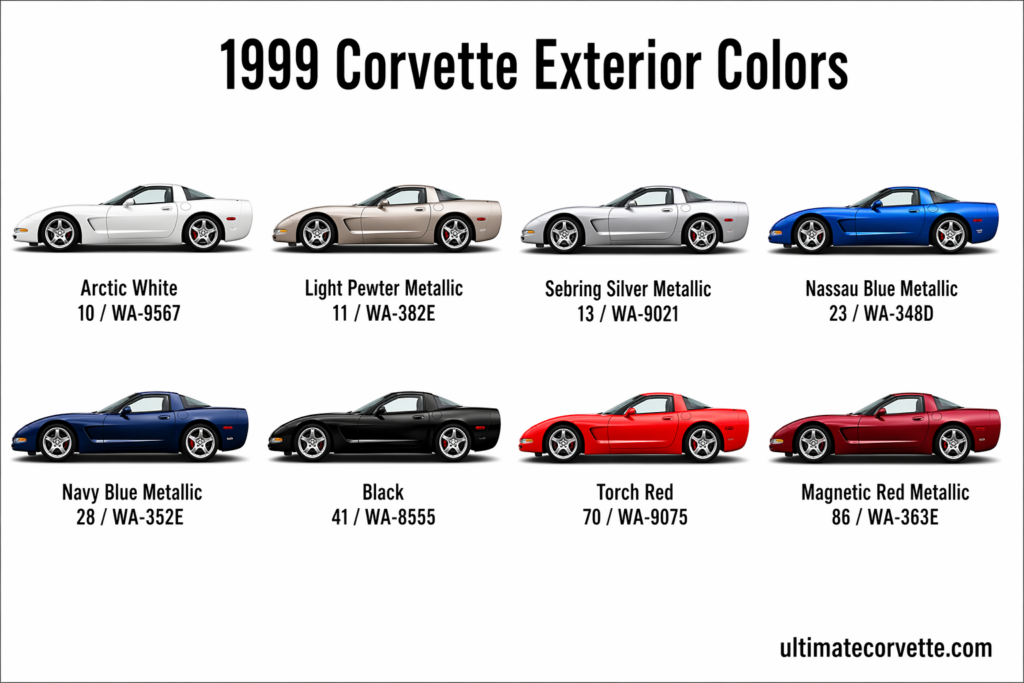
    Where the hardtop did narrow the menu was in exactly the areas Chevrolet believed added weight, complexity, cost, or luxury positioning. At launch, the hardtop’s option list was intentionally short: power driver seat, Active Handling, Bose audio, CD changer, and bodyside moldings. It came only with black leather interior and only in five exterior colors: Torch Red, Arctic White, Black, Light Pewter Metallic, and Nassau Blue Metallic. No automatic transmission was offered. No power telescoping steering column was offered. Real Time Damping was excluded because Z51 was standard. The brochure also presented the Head-Up Display as unavailable on the hardtop. So while Chevrolet had backed away from the crude idea of a “cheap Corvette,” it had not walked away from the discipline of building a more purpose-built one. The hardtop was the Corvette for the buyer who wanted less garnish and more intent.

    Did the Hardtop Deliver on Performance?

    The 1999 FRC did exactly what Chevrolet needed it to do: it proved there was real enthusiasm for a harder-edged, more performance-focused Corvette. With its lighter weight, stiffer fixed-roof structure, standard six-speed manual, and standard Z51 suspension, the FRC immediately established itself as the most serious driver’s car in the C5 lineup, even if its performance gains over the coupe were modest on paper. More importantly, it changed the conversation around what a modern Corvette could be, showing that buyers would embrace a version of the car that sacrificed some comfort and convenience in favor of sharper dynamics and greater purpose. In that sense, the FRC was not just a new body style for 1999, but the first clear step toward the C5 Z06. (Image courtesy of GM Media LLC.)

    In the real world, the answer was yes—but not by some earth-shattering margin. The hardtop was quicker, but only a little. Car and Driver recorded 0–60 mph in 4.8 seconds and the quarter mile in 13.2 seconds at 110 mph, edging the magazine’s recent hatchback-coupe tests by a tenth here and there. Corvette Action Center’s period performance compilation, drawn from multiple contemporary publications and GM specs, places the hardtop in essentially the same range: 4.7 to 4.8 seconds to 60 and 13.3-ish in the quarter, depending on source. That was enough to validate Chevrolet’s pitch without turning the hardtop into some giant-killer within the lineup. It was not a different species of Corvette. It was a cleaner expression of the same one.

    The more interesting difference was in feel. Car and Driver wrote that you could sense the hardtop’s slightly stiffer structure on the road, and that observation aligns with Chevrolet’s own engineering rationale. With the roof bonded around its perimeter instead of removable, the car gave up some of the coupe’s versatility in exchange for a more unified shell. It was also not quite as slippery through the air. Because of the hardtop’s more upright rear glass profile, Chevrolet acknowledged it was a little less aerodynamic than the coupe, and Car and Driver saw that in testing with a 169-mph top speed versus 171 mph for its most recent coupe and 175 mph for earlier examples. Corvette Action Center’s period compilation similarly shows published top-speed figures in the low- to mid-170s, depending on source. So the hardtop was not faster in every way. It was simply more direct.

    The 1999 CORVETTE Coupe and Convertible Were Still the Core of the Line

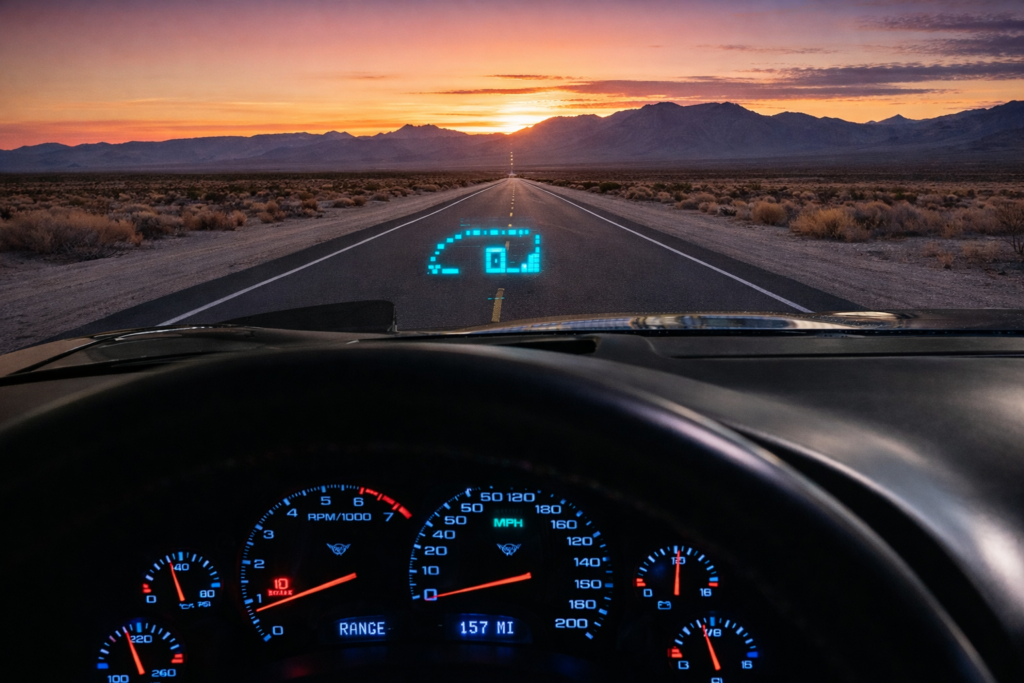
    For the 1999 model year, the coupe and convertible gained several notable features that helped make the C5 feel even more modern and refined. Most significant was the new optional Head-Up Display, which projected key information such as speed and engine data onto the windshield so drivers could keep their eyes on the road. Chevrolet also added an optional power telescoping steering column, giving drivers a greater range of adjustment and improving overall comfort behind the wheel. At the same time, all 1999 Corvettes benefited from steering refinements to improve on-center feel and reduce highway wander, while the coupe and convertible continued to offer a broader range of comfort and convenience options than the new Fixed Roof Coupe, reinforcing their role as the more fully equipped versions of the C5 lineup.
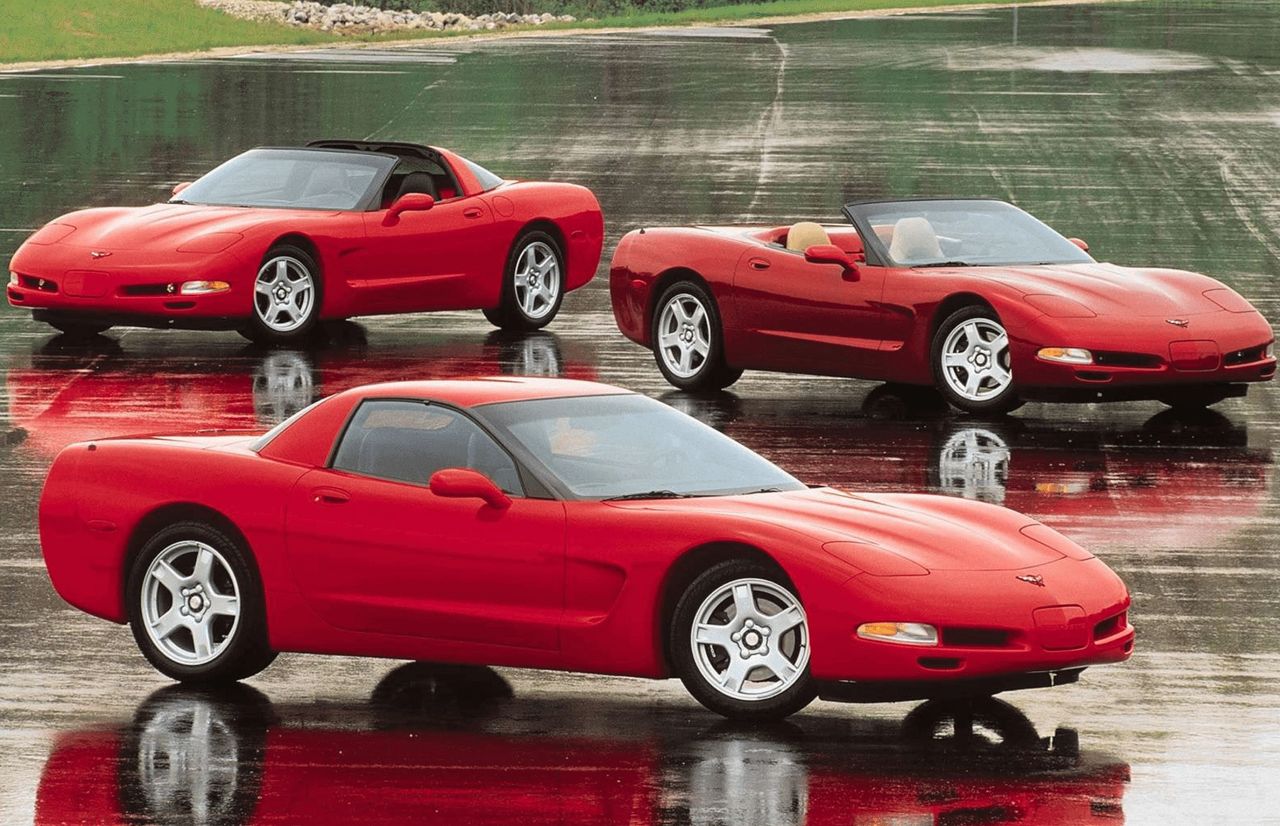
    As important as the hardtop was, the 1999 Corvette story was bigger than the FRC alone. The coupe and convertible remained the volume models and the broader expression of what the C5 had become. Both continued with the 5.7-liter LS1 rated at 345 horsepower and 350 lb-ft of torque, paired either with the rear-mounted four-speed automatic or the six-speed manual. Both kept the C5’s now well-established strengths: low cowl, long wheelbase, impressive ride quality, genuine high-speed stability, and an interior that finally made the Corvette feel like a complete sports car rather than a brilliant engine wrapped in compromise. The C5 had already changed the conversation around Corvette. In 1999, Chevrolet refined the package rather than reinventing it.

    That refinement showed up in the details. Chevrolet updated the speed-sensitive variable-assist steering system—Magnasteer II—for 1999, seeking better on-center feel and less highway wander. Car and Driver noted the steering changes directly and quoted Corvette suspension engineer Mike Neal, who said the goal was to let the car cover “hundreds and hundreds of miles” without fatiguing the driver. The magazine also noted slightly softer seat cushions across the line and additional damping and sound insulation for the coupe. This is one of those places where the 1999 Corvette reveals what the C5 program really was at heart. Even in its performance years, Corvette engineering was not chasing racetrack numbers alone. It was trying to deliver the sort of composure, usability, and long-distance civility buyers associated with much more expensive European machinery.

    The New Technology That Elevated the 1999 CORVETTE

    The 1999 Corvette did more than bring speed to the table. It showed just how serious Chevrolet had become about giving the C5 a genuinely modern technology package, with features like the Head-Up Display putting critical information directly in the driver’s line of sight instead of forcing eyes down to the gauges. Paired with the car’s growing suite of electronic driver aids, it helped make the 1999 Corvette feel less like a traditional sports car and more like a true high-speed grand touring machine for the modern era.

    If there was one new option in 1999 that most clearly signaled Corvette’s continued move upmarket, it was the Head-Up Display. Chevrolet’s brochure treated it as one of the year’s headline additions, and for good reason. In an era when this still felt genuinely high-tech, the HUD projected key instrumentation directly onto the windshield so the driver could monitor speed and other readouts without taking his/her eyes off the road. The production summary for 1999 lists it among the model-year highlights, and the brochure language shows Chevrolet understood exactly how to sell it: as both performance technology and luxury convenience, something borrowed from higher segments and now embedded in America’s sports car.
    The power telescoping steering column fits the same pattern. It was available on the coupe and convertible but not on the hardtop, reinforcing the split Chevrolet was now making within the lineup. The coupe and convertible were the richer, more customizable Corvettes. The hardtop was the disciplined one. Alongside those convenience upgrades, all 1999 Corvettes also received next-generation reduced-force airbags, which GM documented as standard across the board. Active Handling remained optional, integrating chassis, brake, traction-control, and powertrain inputs through acceleration and yaw-rate sensing. In hindsight, that combination of driver aids, safety revision, and display technology helps explain why the 1999 Corvette feels like more than just a continuation of 1998. It was a more sophisticated car, even when its powertrain was at rest.

    A Model Year Full of Interesting Ordering Details

    Front and center, the FRC is the purist of the trio—the lighter, stiffer, six-speed-only hardtop with standard Z51 hardware and fewer comfort-oriented extras, which made it the most performance-minded C5 of the bunch. The coupe at left was the best all-arounder, and the convertible at right was the grand-touring charmer; both leaned further into features with available new-for-1999 items like the Head-Up Display, power telescoping steering column, Memory Package, and dual-zone climate control, while the hardtop kept things leaner and more focused.

    The 1999 Corvette also gets more interesting the deeper you go into the ordering data. Total production reached 33,270 units, up from 31,084 in 1998. The breakdown was 18,078 coupes, 11,161 convertibles, and 4,031 hardtops. That means the hardtop, despite all the uncertainty that preceded it, accounted for roughly 12 percent of total production immediately. For a body style born out of internal anxiety and then reinvented through customer rejection, that is a strong debut. It was not a niche failure. It was a meaningful addition to the line.

    Eight colors, one iconic shape. The 1999 Corvette lineup offered everything from crisp Arctic White and brilliant Torch Red to the rich depth of Magnetic Red Metallic and Nassau Blue Metallic—proof that Chevrolet knew exactly how to let the C5’s design do the talking.

    The color and trim numbers are just as revealing. Torch Red was the most popular exterior across the full 1999 range at 8,361 cars, followed by Black at 7,235 and Light Pewter Metallic at 6,164. Among hardtops specifically, Torch Red led with 1,245 units, followed by Black at 1,227, and Light Pewter Metallic at 1,040. Nassau Blue accounted for 202 hardtops and Arctic White for 311. Sebring Silver Metallic, Navy Blue Metallic, and Magnetic Red Metallic were not offered on the hardtop. Inside, the hardtop was black only; Bowling Green records show 100 percent of hardtops carrying black interior trim. Even the option take rates tell the story of a focused buyer base: all 4,031 hardtops had the six-speed, all had the 3.42 axle, and just over half—2,082 cars—were ordered with JL4 Active Handling.

    The Odd Hardtop Paper Trail

    One of the most fascinating parts of the 1999 Corvette Hardtop story is how inconsistently Chevrolet documented it at the time. Depending on the source, the car could be described as a Hardtop, a Fixed Roof Coupe, or simply folded into broader C5 production material, which has created confusion for historians and enthusiasts ever since. That inconsistency is exactly why preserving brochures, magazine features, order guides, and period reference books matters so much today. Taken together, they help reconstruct the real identity of the 1999 FRC and give this important performance-focused Corvette the historical clarity it deserves.

    One of the quirks of researching the 1999 model year is that the hardtop’s documentation is not perfectly tidy. Chevrolet’s launch press release described a very narrow option set; the brochure explicitly stated that the HUD was “not available on hardtop”; and Car and Driver similarly reported that the new fixed-roof model did without items such as the power-telescoping steering column, dual-zone air, F45 damping, and HUD. Yet the Bowling Green production tallies later attributed small numbers of hardtops to items such as automatic climate control, fog lamps, sport custom wheels, and even the HUD. There are only a few plausible explanations: late-year ordering changes, coding anomalies in the records, pre-production or non-standard builds being counted, or some combination of the three.

    The safest conclusion is not to pretend that those documents all say the same thing, because they do not. The safest conclusion is that the hardtop was clearly conceived and launched as the most tightly controlled C5 in the range, even if the surviving production accounting suggests a few edge cases around the margins. For a comprehensive historical overview, that nuance is worth preserving. It also says something useful about the car itself. The 1999 hardtop was never supposed to be the Corvette for everyone. It was supposed to be the Corvette for the buyer who understood why fewer choices could be part of the appeal. And in that sense, every one of those documents—whether launch brochure, road test, or assembly tally—still points in the same direction.

    The C5-R Brought Corvette’s Confidence Back to the Track

    The 1999 Corvette C5-R was the car that transformed Corvette Racing from an ambitious factory return into a legitimate international endurance contender, pairing Pratt & Miller engineering with Chevrolet small-block power in a purpose-built machine that still looked unmistakably like a Corvette. Shown here in the team’s early two-car No. 63 and No. 64 configuration, the C5-R made its factory-backed Le Mans debut in 2000, where Ron Fellows, Chris Kneifel, and Justin Bell piloted the 63 while Andy Pilgrim, Kelly Collins, and Franck Fréon shared the 64. Their third- and fourth-place class finishes at Le Mans helped lay the foundation for the C5-R’s dominant years to come and secured its place as one of the most important competition Corvettes ever built. (Image credit: Richard Prince)

    If the hardtop gave the 1999 Corvette lineup a sharper internal identity, the C5-R gave the whole franchise a renewed public mission. Chevrolet chose the 1999 Rolex 24 at Daytona to unveil the brand-new C5-R, fielding two factory-supported cars after only about 4,000 miles of testing and development. That alone was an aggressive move. It said Chevrolet believed not only in the C5 as a production car, but in the strength of the architecture underneath it. The Daytona press release made that explicit, describing the effort as the first full factory-supported program designed around a production vehicle using a wide range of production components. By season’s end, Chevrolet’s own materials were framing the C5-R as a major new chapter in Corvette’s racing heritage and as a central expression of the car’s renewed standing.

    The debut justified that faith. The No. 2 C5-R of Ron Fellows, Chris Kneifel, and John Paul Jr. started near the front, led for more than half the race, and finished third after an oil-consuming problem dropped it back. The No. 4 car of John Heinricy, Andy Pilgrim, and Scott Sharp also ran strongly before minor teething issues pushed it to 12th. Dave Hill called it “a tremendous accomplishment” that both cars were still running at the end and emphasized that neither suffered failures tied to their production-vehicle components. Jim Campbell distilled the larger purpose even more cleanly: “Our primary focus is to improve the breed.” That line is one of the keys to understanding 1999. The model year was not just about selling another 33,270 Corvettes. It was about proving, in the showroom and on the track, that Corvette was once again moving with momentum.

    Why the 1999 Corvette Still Matters Today


    The 1999 Corvette remains a pivotal chapter in the C5 story because it showed Chevrolet wasn’t content to simply build a better sports car — it was beginning to sharpen the Corvette into something more focused, more sophisticated, and more clearly defined for different kinds of buyers. This was the year the Fixed Roof Coupe arrived, giving performance-minded enthusiasts a leaner, stiffer, more purposeful machine, while the coupe and convertible continued to prove that comfort, technology, and everyday drivability did not have to come at the expense of real performance. More than two decades later, the 1999 model stands as a reminder of the moment the modern Corvette formula really started to take shape.

    With the benefit of hindsight, the 1999 Corvette reads as one of the most important years in shaping the entire C5 generation. It completed the body-style lineup. It introduced a now-iconic fixed-roof configuration that would soon provide the foundation for the C5 Z06. It expanded the car’s technology with the arrival of the HUD and other refinements. It sharpened the distinction between the luxury-leaning and driver-leaning versions of the C5. And it put Corvette back into serious factory-backed competition with the C5-R. MotorTrend would later summarize the arc cleanly: the hardtop began as a lower-cost idea, became a performance variant instead, and ultimately fed directly into the Z06 story that followed.

    More than that, the 1999 Corvette captured a moment when Chevrolet finally seemed to understand that Corvette did not need to be diluted to broaden its appeal. Buyers did not want the car reduced. They wanted it clarified. They wanted the coupe to be a world-class sport-tourer, the convertible to be a true open-air Corvette again, and the hardtop to be a sharper-edged driver’s car without apology. Chevrolet gave them all three. That is why the 1999 model year still carries so much weight today. It was the year the C5 stopped being merely the new Corvette and became a fully realized Corvette family—one with enough range, confidence, and engineering depth to carry the name into a new century.

    For 1999, Chevrolet did more than update the C5 Corvette. It completed the lineup, introduced the first fixed-roof Corvette in decades, added new technology, sharpened the car’s performance identity, and launched the C5-R race program—making 1999 one of the most important turning points of the entire generation.

  • 1998 CORVETTE OVERVIEW

    1998 CORVETTE OVERVIEW

    The Year Chevrolet Had to Prove the C5 Was No Fluke

    The 1998 Corvette was not asked to reinvent the franchise. Chevrolet had already done that in 1997. What 1998 had to do was something just as important: prove that the all-new C5 was not a one-year wonder, not a limited-launch success story inflated by novelty, and not a coupe-only achievement that would lose its structural rigidity the moment the roof came off. In that respect, the introduction of the 1998 model year was absolutely decisive. It brought about the first full-production season of the C5, reintroduced a convertible variant (which had always been part of the plan), introduced meaningful new technology, gave Chevrolet a high-profile Indianapolis 500 halo car, and closed the model year by pointing Corvette back toward serious factory-backed endurance racing. This was the year the C5 stopped being “the new Corvette” and started becoming the Corvette that reset expectations.

    The sales mix tells part of that story. Chevrolet built 31,084 Corvettes in 1998, split between 19,235 coupes and 11,849 convertibles, meaning the open-car model accounted for approximately 38 percent of total production in its inaugural year. That was not a niche body style tacked onto a successful coupe. It was an immediate, meaningful part of the C5 story, and buyers responded like they had been waiting for it. At the same time, the car’s industry reception remained emphatic: the new-generation Corvette won Motor Trend’s 1998 Car of the Year, North American Car of the Year, and a Popular Science Best of What’s New grand prize, while Car and Driver put it on its 10Best list and praised the new convertible’s solidity, speed, and ease of use.

    Chevrolet Did Not “Add” a Convertible. It Engineered One From the Beginning.

    The return of the Corvette convertible in 1998 wasn’t an afterthought—it was part of the C5’s DNA from the very beginning. Unlike earlier generations that required heavy reinforcements after the fact, the C5 was engineered from day one to accommodate an open-top design. The result was a convertible that retained nearly all the structural rigidity of the coupe, avoided excessive weight gain, and delivered a level of refinement and performance that earlier Corvette convertibles simply couldn’t match.

    As the heading states, the distinction matters because the 1998 convertible was not a compromise. Chevrolet said outright that Corvette engineers had designed the 1997 car as a “topless” vehicle from the start, which is exactly why the 1998 convertible arrived without the usual structural challenges that tend to follow open-air variants. John Middlebrook, a senior engineer at General Motors and one of the key figures behind the development of the C5 Corvette, went even further, stating that the new car was “more rigid than any of the world-class convertible sports cars that Chevrolet measured during Corvette development.” That was a bold claim, but period road tests backed up the basic point. Car and Driver found the C5 convertible unusually free of cowl shake and rattles, and recorded a torsional-rigidity figure of 21.3 hertz with the top down, only two hertz shy of the coupe with its roof panel in place.

    Just as important, Chevrolet achieved that result without turning the convertible into a heavy, overbuilt afterthought. Car and Driver reported that the manual top helped keep weight in check and noted that the convertible was only one pound heavier than the coupe, according to Chevrolet’s specifications. That was a remarkable figure for the period, and it explains why the 1998 convertible never felt like a softer, less serious member of the family. It was still a C5 first. It just happened to let the sky in.

    The Convertible’s Best Trick Was Practicality

    When Chevrolet introduced the 1998 Corvette Convertible, it gave the car something earlier open-air Corvettes had rarely offered in any meaningful way: a genuinely usable trunk. With 13.9 cubic feet of cargo space, the new compartment was impressively generous for a two-seat sports car, thanks in part to the compact manual folding top and the use of run-flat tires that eliminated the need for a spare. Contemporary reviewers noted that it could handle real luggage duty—up to two sets of golf clubs or enough bags for a week away—making the C5 convertible feel every bit as capable as it was exciting.

    Chevrolet understood that if the new convertible was going to matter, it had to be more than pretty. So the 1998 Corvette convertible brought back something Corvette buyers had not had in an open car since 1962: a proper trunk accessible from the outside. Chevrolet’s own material bragged that it could hold two sets of golf clubs, while Motor Trend pegged the space at 13.9 cubic feet and emphasized how unusual that was in a real sports car. Car and Driver likewise noted how usable the trunk was and how much less space the manual top took up than a power arrangement would have. In other words, this was not just a Corvette with the roof removed. It was a Corvette that managed to be more livable while still looking sharper in profile with the top stowed.

    The top itself was one of the most thoughtfully executed elements of the entire car. Chevrolet paired the cloth roof with a heated glass rear window, an express-down feature that partially lowered the side windows while releasing the tonneau cover, and a manual operation so efficient that Dick Almond famously summed it up: “We’re talking about seconds to take the top down.” Car and Driver put a number to it, timing the process at just 18 seconds and praising how cleanly it worked. This is significant because any awkwardness or complexity in the top’s operation would have compromised the car’s larger mission. Instead, the mechanism supported everything the C5 represented: a Corvette engineered not for gimmicks or unnecessary flourish, but to be more refined, more usable, and simply better in all the places that counted.

    And visually, Chevrolet got it right. Motor Trend singled out the way the tonneau flowed into a waterfall section between the seats, explicitly connecting the car back to 1953-1962 Corvettes. That was more than nostalgia. It was a disciplined way to reintroduce an old Corvette cue in a body that otherwise looked modern, lower, cleaner, and far more resolved than the C4 convertible ever was. The 1998 roadster did not look like a roofless coupe. It looked like a Corvette that had been born open.

    The LS1 and the Transaxle Layout Were Still the Heart of the Car

    For 1998, the Corvette’s real story was still underneath the skin. The C5’s hydroformed steel frame, rear-mounted transaxle, and rigid torque-tube layout gave the car a far more balanced and sophisticated foundation than any previous Corvette, while the 5.7-liter LS1 V8 delivered 345 horsepower with the kind of smooth, effortless torque that made the whole package feel modern. Short/long-arm suspension at all four corners and composite transverse leaf springs remained part of the formula, but in the C5 they worked within a chassis that was dramatically stiffer, more refined, and far better organized. In the 1998 model year, that engineering mattered even more, because it proved the new convertible was not a compromise car at all, but a fully realized extension of the C5’s world-class platform.

    Even with all the attention focused on the arrival of the convertible, the real foundation of the 1998 Corvette remained the engineering formula that had already made the C5 such a watershed car. The LS1 continued as the lone engine offering, rated by Chevrolet at 345 horsepower and 350 lb-ft of torque. Chevrolet quoted a top speed of 175 mph and a 0-to-60 time of about 4.7 seconds with the six-speed, while Motor Trend recorded 4.8 seconds to 60 in the coupe along with a 13.2-second quarter-mile at 109.3 mph. Car and Driver, in its 10Best writeup, made clear that the C5 had not simply become more polished and more refined. It was still legitimately fast. That distinction was important, because while the Corvette had become more civilized, it had not given up the performance character that gave the name its weight in the first place.

    The LS1 also represented a philosophical win for the Corvette team. In Motor Trend’s Car of the Year coverage, project manager John Juriga said “the key deciding factor” in sticking with a pushrod layout was that it “could develop more power while occupying less space than a DOHC engine.” That was not backward thinking. It was targeted engineering. The aluminum LS1 block saved substantial weight compared to the old LT4, met the packaging demands of the new chassis, and helped the C5 achieve its near-ideal balance target. Motor Trend credited that combination with contributing to a 51/49 front-rear weight distribution.

    Then there was the transaxle. Motor Trend put the point plainly: the C5 became the first Corvette to use a rear-mounted transaxle in order to reduce crowding in the footwell and preserve a more even weight distribution. A five-inch torque tube tied the engine to the rear-mounted gearbox, and Chevrolet’s own materials emphasized the resulting gains in packaging, ride quality, and refinement. By 1998, that layout no longer needed to be defended in theory. It was proving itself in the real world as the foundation of a Corvette that felt more expensive, more composed, and far more international in the best sense of that word.

    Transmission choice revealed how buyers used the car. The four-speed automatic remained the dominant gearbox, appearing in 23,978 of the Corvettes built in 1998, or 77.1 percent of total production, while the six-speed manual accounted for 7,106 cars, or 22.9 percent. Chevrolet also installed the F45 real-time damping suspension on 8,374 cars, or 26.9 percent of production, and the Z51 handling package was included on 4,249 cars, or 13.7 percent. That mix says a lot. Buyers still wanted performance, but they were now buying a Corvette that had broadened its appeal without becoming generic.

    Chevrolet Kept Making the Car Easier to Live With

    One of the clearest ways the 1998 Corvette distanced itself from the outgoing C4 and the generations before it was in the cabin, where Chevrolet moved decisively toward greater comfort, better technology, and far-improved day-to-day drivability. The C5 introduced a roomier cockpit with more legroom and footroom, lower door sills, and wider footwells, all of which made getting in and out, and spending real time behind the wheel, noticeably easier than in earlier Corvettes. At the same time, Chevrolet brought in features that gave the interior a much more modern character, including available dual-zone electronic climate control, an available head-up display, and an optional memory package that could store seat, mirror, radio, and HVAC settings. Taken together, those changes made the 1998 Corvette feel less like a sports car that demanded compromise and more like one that had finally learned how to combine serious performance with genuine comfort and usability.

    One of the most underrated parts of the 1998 Corvette story is how clearly Chevrolet understood that convenience and credibility no longer had to be enemies. The C5 already felt like a better long-distance car than the C4, and for 1998, Chevrolet leaned into that sentiment. New-year features included an engine air-filter monitor, extended-life coolant, and a 10,000-mile recommended oil-change interval under prescribed conditions. Standard extended-mobility tires and the low tire-pressure warning system remained central to the package, which is why Chevrolet could continue to eliminate the spare tire while preserving cargo capacity. The result was a Corvette that was easier to use, easier to maintain, and less compromised in day-to-day life than most people expected from a two-seat American sports car in the late 1990s.

    The cabin story mattered too. Motor Trend pointed to the more spacious interior, dramatically improved instrument presentation, easier entry, and far friendlier ergonomics. Car and Driver’s 10Best piece made the same case more bluntly, noting that the old Corvette’s raw muscle had finally been joined by refinement and practicality. Those were not throwaway compliments. For decades, Corvette defenders had to explain away its shortcomings. By 1998, the burden was shifting. Now critics had to explain why the Corvette was no longer easy to dismiss.

    Active Handling Brought Corvette Into the Electronic-Chassis Era

    Introduced on the 1998 Corvette as the new JL4 Active Handling option, Chevrolet’s system marked a major step forward in how the car behaved at the limit, because it could recognize when the Corvette was no longer following the driver’s intended path and then selectively apply individual brakes to help bring the chassis back into line. Using inputs from the steering-angle sensor, yaw-rate sensor, lateral accelerometer, ABS, and traction control, Active Handling gave the C5 a layer of intelligence no earlier Corvette had offered, helping reduce both understeer and oversteer without diluting the car’s core performance character. Just as important, Chevrolet understood this was still a Corvette, which is why the system was calibrated to intervene only when the limits had been exceeded and even offered a Competitive Driving mode that left Active Handling armed while relaxing traction control for more aggressive use. In practical terms, it revolutionized Corvette drivability by making the 1998 car faster to trust, easier to gather up in an emergency, and far more confidence-inspiring than the generations that came before it.
    Introduced on the 1998 Corvette as the new JL4 Active Handling option, Chevrolet’s system marked a major step forward in how the car behaved at the limit, because it could recognize when the Corvette was no longer following the driver’s intended path and then selectively apply individual brakes to help bring the chassis back into line. Using inputs from the steering-angle sensor, yaw-rate sensor, lateral accelerometer, ABS, and traction control, Active Handling gave the C5 a layer of intelligence no earlier Corvette had offered, helping reduce both understeer and oversteer without diluting the car’s core performance character. Just as important, Chevrolet understood this was still a Corvette, which is why the system was calibrated to intervene only when the limits had been exceeded and even offered a Competitive Driving mode that left Active Handling armed while relaxing traction control for more aggressive use. In practical terms, it revolutionized Corvette drivability by making the 1998 car faster to trust, easier to gather up in an emergency, and far more confidence-inspiring than the generations that came before it.

    The most important technical change introduced during the 1998 model year was Active Handling, RPO JL4. Chevrolet announced it in November 1997, describing it as an optional chassis-control system that would become available on all Corvette models early in 1998, with the pace car package making it standard. Chevrolet was explicit about the system’s significance, stating that “No other sports car has a system like this,” and its technical description made clear that this was not a simple traction-control add-on. Active Handling monitored steering angle, yaw rate, and lateral acceleration, then selectively applied individual brakes to help stabilize the car when its actual path diverged from the driver’s intent.

    What made the system important was not just what it did, but how it was tuned. Chevrolet said it gave the driver more latitude before intervention than rival systems, and it included a competition mode that disabled the traction-control portion to allow wheelspin in motorsport-style use. Mike Rizzo, one of the engineers behind the calibration, summed up the philosophy perfectly: “We never want to penalize a good driver for the deficiencies of a bad driver.” John Heinricy, deeply involved in the system’s development, was just as revealing when he said, “I wanted it to be a system I could drive at the track and wouldn’t want to turn it off.” That tells you everything about the mindset behind the 1998 Corvette. Chevrolet was not adding electronics to make the car timid. It was adding electronics to make the car smarter without dulling its edge.

    The take rate shows that buyers recognized the value. Production data lists JL4 on 5,356 Corvettes, or 17.2 percent of the 1998 run. That is a healthy number for a mid-year-introduced performance-electronics option in 1998, and it also underscores how quickly Corvette buyers were willing to embrace new technology when it felt like it belonged in the car.

    The Indianapolis 500 Pace Car Was a Big Moment, but the Details Matter

    The 1998 Corvette Indianapolis 500 Pace Car captured an important moment for the nameplate, because it marked the first appearance of the new C5 generation at Indy and the fourth time Corvette had been selected to lead the field at the Speedway. Although Chevrolet’s original announcement named Greg Norman for pace-car duties, the car that actually paced the 82nd running of the Indianapolis 500 on May 24, 1998 was driven by 1963 Indy 500 winner Parnelli Jones. Visually, the car was impossible to miss, finished in special Radar Blue with vivid yellow Indy 500 graphics, matching yellow wheels, and yellow interior accents that were unique to the pace car treatment and not offered on a standard production Corvette. Mechanically, it remained close to factory stock, though Chevrolet added race-day equipment including a steel roll bar and strobe lights, while the program also introduced the new Active Handling system that would appear on the pace car and its limited-edition replicas. Chevrolet ultimately built 1,158 pace car replicas, giving collectors a version that stayed remarkably faithful to the car seen at Indianapolis. (Image courtesy of GM Media LLC)

    The 1998 Indianapolis 500 pace car gave Chevrolet exactly the kind of national spotlight the new convertible deserved. The company announced in November 1997 that the all-new convertible would serve as the official ace car at the 82nd running of the Great American Race, marking Corvette’s fourth Indy 500 appearance after 1978, 1986, and 1995. Chevrolet described the actual pace car as essentially factory stock, requiring only a steel roll bar, strobe lights behind the seats, and enlarged tonneau bulges with clear lenses to package the warning lights. That is worth emphasizing because it directly contradicts the common tendency to treat the real pace car as a heavily modified special. Chevrolet’s own press material said the 345-horsepower LS1 street drivetrain was sufficient for the job as delivered.

    The look, of course, was anything but subtle. Chevrolet’s pace-car press releases described a special Radar Blue exterior with bright yellow wheels, yellow graphics, and a yellow-and-black interior. Yet production and paint-code references usually list the 21U color as Radar Purple Metallic. That is one of those wonderfully strange Corvette details that make the 1998 pace car so memorable: even its color is part of the lore. Chevrolet’s marketing language leaned blue; the production documentation leans purple; owners and collectors have spent years arguing somewhere in between.

    Inside, the 1998 Corvette Indy 500 Pace Car carried the same theme as the exterior by taking the standard C5 cockpit and giving it a far more dramatic, event-specific presentation. The basic dashboard, center stack, and driver-focused layout remained pure Corvette, but the cabin was set apart by its bold yellow seat inserts and Indy 500-branded floor mats, details that immediately tied the interior to the car’s Radar Blue and yellow pace car livery. It was a smart execution, because Chevrolet did not try to reinvent the C5’s already modern interior architecture. Instead, it used carefully placed color and branding to transform the cabin into something far more distinctive, giving the pace car a look that felt special the moment you opened the door. (Image source: Hemmings.com)

    The replicas are another area where a careful review of the records is important. Chevrolet’s November 1997 press releases repeatedly said it planned to build 1,158 pace car replicas. But production references for the finished 1998 model year consistently show 1,163 Z4Z cars, matching the 1,163 total listed under 21U pace-car color production. So the cleanest way to say it is this: Chevrolet announced a 1,158-car plan, but the production data that enthusiasts and registries now rely on records 1,163 built. The package itself was generous, bundling the special paint and graphics with sport seats, memory package, dual-zone climate control, Bose audio, fog lamps, performance axle, and standard Active Handling. Chevrolet even noted unique neon-yellow stitching on the wheel, shifter, seats, and transmission-boot trim.

    Even the pace-driver story has a twist. Chevrolet’s November 1997 announcement named Greg Norman as the driver, but the Indianapolis Motor Speedway’s official historical pace-car list records Parnelli Jones as the 1998 pace-car driver. That kind of discrepancy is exactly why the 1998 Corvette deserves a closer read than the usual shorthand summary. The year is full of details that were later simplified.

    The 1998 Corvette Is Packed With the Sort of Collector Details People Love to Chase

    Finished in Light Pewter Metallic, one of the new exterior colors introduced for the 1998 model year, this C5 wears the kind of understated finish that suited the new-generation Corvette especially well. Rather than relying on bright color or heavy ornamentation, Light Pewter emphasized the C5’s cleaner body lines, tighter surfacing, and more sophisticated overall shape, giving the car a refined, contemporary look that felt very much in step with Chevrolet’s broader rethink of the Corvette. Paired with five-spoke wheels, the combination only strengthens that impression, giving the car a crisp, modern stance that complements the more polished and technically advanced character the C5 brought to the nameplate.

    This is also one of the most interesting C5 model years if you care about rare-option and color trivia. Chevrolet officially added Light Pewter Metallic and Medium Purple Pearl Metallic for 1998, while the optional N73 five-spoke magnesium wheels arrived as a serious enthusiast item. Corvette Action Center’s production data identifies those Speedline-made magnesium wheels as a 1998 addition, and the production numbers show 1,425 cars got them, or 4.6 percent of the total run. That is low enough to matter, especially when you remember how expensive they were and how many were later damaged, refinished, or replaced.

    Then there are the rare colors. Production tables show just 15 Aztec Gold cars and 14 Navy Blue cars for 1998, making them rarer than the pace-car color and dramatically rarer than medium-volume colors like Nassau Blue, Fairway Green, or Medium Purple Pearl. Registry documentation adds that Aztec Gold ended after only 15 cars, including three convertibles, while Navy Blue emerged late enough in production to edge it as the rarest 1998 shade. Fairway Green, meanwhile, was discontinued on November 13, 1997. These are the kinds of details that separate a broad C5 overview from a real 1998 discussion, because they show how active Chevrolet still was behind the scenes even as the basic product had already become a success.

    For 1998, Chevrolet delivered one of the most diverse and expressive color palettes of the C5 era—ranging from timeless staples like Arctic White and Black to bold, era-defining hues like Nassau Blue Metallic and Light Carmine Red Metallic. Unique offerings such as the Pace Car-exclusive Purple/Radar Blue and the rich Medium Purple Pearl Metallic added a layer of collectability, while colors like Aztec Gold and Fairway Green Metallic reflected the late-’90s push toward deeper, more sophisticated metallic finishes. Together, the palette perfectly captured the dual personality of the C5: refined grand tourer and unapologetic American performance car.

    One of the best obscure details from the year has nothing to do with paint at all. In July 1998, the C5 Registry reported that Chevrolet had begun placing a build sheet in the front frame rail of every new C5, a delightful echo of the old mid-year practice of hiding build sheets on top of fuel tanks. That is the sort of small production note that becomes catnip for future restorers and NCRS-style document hunters, and it is exactly the kind of thing that makes 1998 such a rewarding year to study closely.

    By the End of 1998, Corvette Was Already Looking Back to Racing

    In 1998, Chevrolet made a pivotal announcement that signaled a return to its racing roots: Corvette would once again compete with full factory backing beginning in 1999. That commitment materialized through the all-new C5-R program, developed in partnership with Pratt & Miller, and aimed squarely at the fiercely competitive GT ranks of international endurance racing. The car was built to contest the GTS class in the IMSA-sanctioned American Le Mans Series (ALMS), which itself debuted in 1999 as the North American extension of the 24 Hours of Le Mans rulebook. Corvette Racing officially made its competition debut at the 1999 Rolex 24 at Daytona, marking the first time since the early 1960s that Chevrolet had fielded a truly factory-supported Corvette effort. While early results were modest as the team developed the car in real time, the significance of that moment cannot be overstated—it laid the foundation for what would become one of the most dominant and enduring factory GT racing programs in motorsports history. (Image credit: HotRod.com)

    The final reason the 1998 model year matters so much is that it ended by pointing Corvette toward the next stage of its identity. In November 1998, Chevrolet announced that Corvette would return to factory-backed road racing with the C5-R, beginning in 1999 at the Rolex 24 at Daytona. John Middlebrook framed it as a restoration of purpose, saying, “The return of Chevrolet Corvette to the racetrack reinforces everything Corvette stands for.” Jim Campbell was even more direct: “Our primary focus is to improve the breed.” And Dave Hill connected the road car to the race program in the most important sentence of all: “The things that make it a great road car will also contribute to its success as a racecar.”

    That announcement matters in any 1998 overview because it confirms what the best observers were already sensing. The C5 was not merely a better Corvette. It was a better platform. Chevrolet said Ron Fellows had already logged more than 4,000 miles in the C5-R using a significant number of production-based components. That meant the C5’s structure, layout, and general engineering logic were no longer just competitive in magazine comparisons. They were becoming the basis for a serious international endurance-racing effort. Once that happened, the story changed. Corvette was no longer asking for respect. It was building the tools to take it.

    Why the 1998 Corvette Still Matters Today

    The 1998 Corvette still matters because it proved the C5 was no one-year wonder. With the return of the convertible, the debut of Active Handling, and the launch of the factory-backed C5-R program, Chevrolet showed that Corvette’s fifth generation was built to do more than replace the C4. It was here to push the brand forward. Even now, the 1998 model stands as the year the C5 found its stride and the modern Corvette story really began. (Image courtesy of GM Media LLC / ChatGPT)

    If 1997 was the breakthrough, 1998 was the confirmation. It proved the C5 coupe was not a one-shot success. It proved Chevrolet could build a genuinely rigid convertible without burying it under weight and excuses. It proved Corvette buyers would embrace new technology like Active Handling when it was engineered with the right philosophy. It gave the C5 its first full-year production footprint, its first true open-air variant, its first Indy 500 spotlight of the generation, and some of its strangest and most collectible color stories. And by year’s end, it helped set the stage for the C5-R, which would go on to change the way the world talked about Corvette in competition.

    That is why the 1998 Corvette deserves to be remembered as far more than the year the convertible came back. It was the year Chevrolet demonstrated that the C5 architecture was flexible, durable, sophisticated, and ambitious enough to carry Corvette into an entirely different era. The car had the performance. It had usability. It had the engineering credibility. And now, for the first time in a long time, it also had the unmistakable sense that the people behind it knew exactly what they had built. The rest of the world would spend the next several years catching up.

    The 1998 Corvette proved the C5 revolution was no fluke. With the debut of the long-awaited convertible, Indianapolis 500 pace car honors, groundbreaking engineering, and growing global credibility, Chevrolet’s sports car took a confident second-year leap forward. Explore the full story behind one of the most important Corvettes of its era.

  • 1992 STINGRAY III (CALIFORNIA CORVETTE)

    1992 STINGRAY III (CALIFORNIA CORVETTE)

    The closing years of the 1980s were years of reckoning for General Motors. For decades, GM had been America’s automotive giant, an unshakable force that seemed as permanent as steel itself. But by the late 1980s, the edifice was crumbling. Market share had slipped precipitously. Japanese automakers, with their reputation for efficiency and quality, were eroding GM’s once-dominant position. The company’s brand image sagged under the weight of bureaucracy and uninspired products.

    Even the Corvette, long considered Chevrolet’s crown jewel, was not immune. The C4 Corvette, launched in 1984 with fanfare as a high-tech reinvention of America’s sports car, had begun to feel stale. Sales that had peaked in the mid-1980s were now in sharp decline. Competitors from Europe and Asia offered refinement, reliability, and performance that left the Corvette looking vulnerable.

    At a 1989 executive conference in Traverse City, Michigan, GM’s new president, Robert Stempel, raised the unthinkable: perhaps it was time to postpone—or even cancel—the fifth-generation Corvette. Some executives even suggested phasing out the C4 entirely, arguing that the Corvette no longer made business sense in a shrinking sports car market. The Corvette, America’s icon, suddenly looked like an expendable liability.

    Robert Stempel and Jim Perkins share the stage at the 1991 Motor Trend Car of the Year awards, a rare moment of unity between two GM leaders often at odds over Corvette’s future. Stempel, then GM president, had considered delaying or even canceling the C5 program amid the company’s financial woes, while Perkins, Chevrolet’s general manager, fought fiercely to preserve Corvette as the brand’s halo. Their tug-of-war over resources and priorities defined the early 1990s, with Perkins’ resolve ultimately ensuring that the fifth-generation Corvette would be developed—proving once again that Corvette’s survival depended as much on passion and politics as it did on engineering.
    Robert Stempel and Jim Perkins share the stage at the 1991 Motor Trend Car of the Year awards, a rare moment of unity between two GM leaders often at odds over Corvette’s future. Stempel, then GM president, had considered delaying or even canceling the C5 program amid the company’s financial woes, while Perkins, Chevrolet’s general manager, fought fiercely to preserve Corvette as the brand’s halo. Their tug-of-war over resources and priorities defined the early 1990s, with Perkins’ resolve ultimately ensuring that the fifth-generation Corvette would be developed—proving once again that Corvette’s survival depended as much on passion and politics as it did on engineering.

    But Chevrolet’s general manager, Jim Perkins, refused to accept that vision. A passionate believer in Corvette’s role as Chevrolet’s halo, Perkins delivered a pointed reminder: Corvette was more than just a model in the lineup. It was the aspirational flagship, the car that cast a glow over every Camaro, Impala, and pickup Chevrolet sold. Killing it, Perkins argued, would not save the company—it would gut its identity. His conviction swayed opinion. The Corvette program survived.

    Yet survival was not enough. To truly endure, Corvette needed to evolve. It needed to capture the public’s imagination once again.

    California Dreaming

    Chuck Jordan, GM’s vice president of design, used the freedom of his Los Angeles–based Advanced Concept Center to push Chevrolet into bold new territory. Out of that West Coast studio came the Stingray III, a “California Corvette” that stunned with its scissor doors, sweeping curves, and futuristic suspension. Alongside it, Jordan also greenlit a dramatic Camaro concept, low-slung and aerodynamic, meant to recapture youthful excitement. Both cars embodied his conviction that GM needed to break from tradition and embrace forward-looking design. Though neither reached production in their purest form, their influence carried into future Corvettes and Camaros. Together, they remain testaments to Jordan’s belief that Chevrolet should never stop dreaming.
    Chuck Jordan, GM’s vice president of design, used the freedom of his Los Angeles–based Advanced Concept Center to push Chevrolet into bold new territory. Out of that West Coast studio came the Stingray III, a “California Corvette” that stunned with its scissor doors, sweeping curves, and futuristic suspension. Alongside it, Jordan also greenlit a dramatic Camaro concept, low-slung and aerodynamic, meant to recapture youthful excitement. Both cars embodied his conviction that GM needed to break from tradition and embrace forward-looking design. Though neither reached production in their purest form, their influence carried into future Corvettes and Camaros. Together, they remain testaments to Jordan’s belief that Chevrolet should never stop dreaming.

    As the executive battles played out in Traverse City, another drama was unfolding on the design side of GM. Chuck Jordan, the company’s Vice President of Design, knew that Corvette could not simply continue unchanged. It needed reinvention, something bold enough to make even the skeptics take notice. In October 1989, Jordan staged a contest across GM’s design studios: each would present their vision for the next-generation Corvette.

    Among those who rose to the challenge was John Schinella, director of Chevrolet’s Advanced Concept Center in Newbury Park, California. Schinella was no stranger to the Corvette; his career at GM had included stints on Camaro and Firebird, and he carried with him a deep understanding of Chevrolet’s performance DNA. But his West Coast studio was unlike the traditional halls of Warren, Michigan. In Newbury Park, the culture was looser, influenced by California’s aerospace industry, surf scene, and Hollywood spectacle. This was the perfect soil in which to grow something radical.

    An early 1989 rendering of the Stingray III “California Corvette” by designer Jim Brinkerhoff at GM’s Advanced Concept Center, this sketch captures the radical scissor doors, sweeping canopy glass, and futuristic stance that defined the concept. Created during a heated internal competition between GM’s design studios to shape the Corvette’s future, Brinkerhoff’s vision showcased the bold, West Coast flair that set the Advanced Concept Center apart—and ultimately helped secure its place as the creative force behind one of the most daring Corvette concepts ever imagined.
    An early 1989 rendering of the Stingray III “California Corvette” by designer Jim Brinkerhoff at GM’s Advanced Concept Center, this sketch captures the radical scissor doors, sweeping canopy glass, and futuristic stance that defined the concept. Created during a heated internal competition between GM’s design studios to shape the Corvette’s future, Brinkerhoff’s vision showcased the bold, West Coast flair that set the Advanced Concept Center apart—and ultimately helped secure its place as the creative force behind one of the most daring Corvette concepts ever imagined.

    Schinella and his team asked a simple but provocative question: What if Corvette were downsized? What if it shed mass, leaned into fluidity, and embraced futuristic technology while still nodding to its past? The sketches began to flow. Some were rough, others detailed, but together they formed a vision: a Corvette that was at once familiar and alien. Its shape evoked Bill Mitchell’s Manta Ray and Mako Shark concepts, with long fenders, muscular haunches, and fluid curves, but stripped of excess, honed to a futuristic edge.

    These sketches were critiqued, refined, and reimagined until the Stingray III—the “California Corvette”—was born.

    Sculpture in Motion

    A glimpse inside GM’s Advanced Concept Center in California during the late 1980s and early 1990s, where the Stingray III was born. These sketches, clay models, and full-size prototypes show the breadth of experimentation as designers explored everything from radical scissor-doored visions to sleeker, more production-minded studies. The competition between studios—California’s free-flowing flair versus Detroit’s more conservative edge—pushed the Corvette program into daring new territory. What emerged was the Stingray III, a concept that captured the imagination of enthusiasts and hinted at design cues that would ultimately shape the next generation of America’s sports car.
    A glimpse inside GM’s Advanced Concept Center in California during the late 1980s and early 1990s, where the Stingray III was born. These sketches, clay models, and full-size prototypes show the breadth of experimentation as designers explored everything from radical scissor-doored visions to sleeker, more production-minded studies. The competition between studios—California’s free-flowing flair versus Detroit’s more conservative edge—pushed the Corvette program into daring new territory. What emerged was the Stingray III, a concept that captured the imagination of enthusiasts and hinted at design cues that would ultimately shape the next generation of America’s sports car.

    The 1992 Stingray III, when translated from sketch to clay to prototype, was breathtaking. It was both Corvette and not-Corvette, a car that seemed to have leapt forward a generation overnight.

    Its proportions were deliberate and dramatic. The wheelbase stretched nearly seven inches beyond the C4, while the body widened by more than three inches. This gave the car a planted, muscular stance. Yet it was not bloated. The tail was bobbed, the deck rounded and taut, giving the car an almost feline readiness to pounce. The windshield was steeply raked, blending into a roofline that felt more spacecraft than sports car.

    From this rear three-quarter angle, the Stingray III reveals several of its most distinctive—and forward-looking—design cues. The rounded taillamps, set into a smooth, almost liquid surface, were a deliberate evolution of Corvette’s trademark quad-light theme. Instead of being recessed or split by bodywork, they float in a clean horizontal line, previewing the flush, minimalist rear ends that would dominate GM design language in the 1990s. The sharply tucked rear fascia and integrated exhaust outlet mark a clear departure from the blockier, bumper-defined C4 Corvette, hinting at the flowing surfaces that would arrive with the C5. The roofline and expansive glass taper down gracefully, emphasizing aerodynamics and cab-rearward stance—an element that pushed Corvette closer to its exotic European rivals. Finally, the wide five-spoke wheels, pushed out to the corners, give the car a planted, muscular presence. Each of these choices underscored the Stingray III’s mission: to prove Corvette design could move beyond the digital angularity of the 1980s and embrace organic curves and restrained sophistication for the future.
    From this rear three-quarter angle, the Stingray III reveals several of its most distinctive—and forward-looking—design cues. The rounded taillamps, set into a smooth, almost liquid surface, were a deliberate evolution of Corvette’s trademark quad-light theme. Instead of being recessed or split by bodywork, they float in a clean horizontal line, previewing the flush, minimalist rear ends that would dominate GM design language in the 1990s. The sharply tucked rear fascia and integrated exhaust outlet mark a clear departure from the blockier, bumper-defined C4 Corvette, hinting at the flowing surfaces that would arrive with the C5. The roofline and expansive glass taper down gracefully, emphasizing aerodynamics and cab-rearward stance—an element that pushed Corvette closer to its exotic European rivals. Finally, the wide five-spoke wheels, pushed out to the corners, give the car a planted, muscular presence. Each of these choices underscored the Stingray III’s mission: to prove Corvette design could move beyond the digital angularity of the 1980s and embrace organic curves and restrained sophistication for the future.

    Every detail pushed the concept further into the realm of sculpture. The clamshell hood arced upward to reveal the engine bay. The doors opened vertically, scissor-style, in the manner of a Lamborghini Countach—flamboyant, impractical, and unforgettable. At the rear, four elliptical taillights glowed within a stylized bumper, their shapes both futuristic and instantly recognizable as Corvette.

    Even its stance conveyed intent. The 1992 Stingray III sat on cast-aluminum wheels wrapped in 285/35ZR-18 Goodyear tires, the kind of wide, sticky rubber usually reserved for European exotics. Its low side sills made entry easier than the C4, a nod to real-world usability. And in one particularly theatrical flourish, the left side of the dashboard itself rose when the driver’s door swung open, offering extra clearance for knees. It was engineering as performance art.

    The Stingray III looked alive even at rest, a car that seemed to lean forward into motion, as if impatient to prove itself.

    The Cockpit of Tomorrow

    The interior of the Stingray III was as radical as its exterior, with a driver-focused cockpit that looked more like something out of a concept jet than a road car. The sweeping dash wrapped tightly around the driver, emphasizing Corvette’s mission to create a true “driver’s car.” Digital displays and clustered controls hinted at the electronic future GM envisioned, while the sculpted two-tone surfaces gave the cabin a futuristic, almost organic flow. Even the placement of switchgear on the steering wheel and console showed a push toward ergonomics and tech integration years ahead of its time. From this angle, the Stingray III’s cabin reveals itself as both a design experiment and a blueprint for the digital, driver-centric environments that would define Corvettes well into the 21st century. (Image courtesy of GM Media LLC,)
    The interior of the Stingray III was as radical as its exterior, with a driver-focused cockpit that looked more like something out of a concept jet than a road car. The sweeping dash wrapped tightly around the driver, emphasizing Corvette’s mission to create a true “driver’s car.” Digital displays and clustered controls hinted at the electronic future GM envisioned, while the sculpted two-tone surfaces gave the cabin a futuristic, almost organic flow. Even the placement of switchgear on the steering wheel and console showed a push toward ergonomics and tech integration years ahead of its time. From this angle, the Stingray III’s cabin reveals itself as both a design experiment and a blueprint for the digital, driver-centric environments that would define Corvettes well into the 21st century. (Image courtesy of GM Media LLC,)

    If the exterior was bold, the interior was audacious. Sliding into the 1992 Stingray III was less like entering a car than strapping into a jet fighter.

    The seats were fixed in place, reclined deeply, cradling the driver in a low, aggressive position. Instead of moving the seat, the wheel and pedals adjusted—a nod to aerospace ergonomics and a reminder that this was no ordinary automobile.

    The dashboard was a sweeping cocoon of technology. Black pods flanked the central cluster, each bristling with analog dials, digital readouts, illuminated toggles, and switches. Motor Trend would later describe it as “a collection of dials, illuminated buttons, and toggle switches to operate the car’s many onboard technologies.” Among those was an in-car camera system with telemetric storage—unheard of in 1992, but prescient of the onboard recorders and infotainment systems to come.

    From above, the Stingray III’s cabin shows off its futuristic dual-cockpit layout, a sculpted interior that cradled driver and passenger in deep, form-fitting seats. The flowing center spine bisected the space with dramatic intent, reinforcing the Corvette’s identity as a sports car built around the individual behind the wheel. This perspective also highlights how the exterior bodywork and interior design were conceived as one continuous form—an approach that gave the concept a level of integration rarely seen in production cars of its era.
    From above, the Stingray III’s cabin shows off its futuristic dual-cockpit layout, a sculpted interior that cradled driver and passenger in deep, form-fitting seats. The flowing center spine bisected the space with dramatic intent, reinforcing the Corvette’s identity as a sports car built around the individual behind the wheel. This perspective also highlights how the exterior bodywork and interior design were conceived as one continuous form—an approach that gave the concept a level of integration rarely seen in production cars of its era.

    The atmosphere was futuristic, but not sterile. It was immersive, intoxicating, and deliberately driver-focused. Sitting inside the Stingray III, one could almost imagine flying rather than driving.

    And for safety, a pop-up roll bar was concealed behind the seats, ready to spring into place in the event of a rollover. It was a small detail, but it revealed the seriousness beneath the spectacle. This was a show car, yes, but one designed with a mind toward possibility.

    Technology Beneath the Surface

    The Stingray III was not just a styling exercise—it carried some of the most advanced mechanical thinking of its era. Underneath its sleek body sat a state-of-the-art suspension system with double wishbones and electronically controlled dampers, paired with four-wheel steering that allowed the rear wheels to turn in harmony or opposition to the fronts for sharper handling and greater stability. The car also featured traction control and anti-lock brakes, showcasing GM’s effort to explore technologies that would later become standard across the Corvette line. Despite these innovations, the Stingray III remained a showpiece rather than a production candidate. Public reaction was mixed: many praised its fluid lines and futuristic stance, but others felt its design was too radical, diverging too far from Corvette tradition. Ultimately, the cost of implementing its cutting-edge systems, combined with the financial pressures facing GM in the early 1990s, meant the project never advanced beyond the concept stage—leaving the Stingray III as a tantalizing glimpse of what might have been.
    The Stingray III was not just a styling exercise—it carried some of the most advanced mechanical thinking of its era. Underneath its sleek body sat a state-of-the-art suspension system with double wishbones and electronically controlled dampers, paired with four-wheel steering that allowed the rear wheels to turn in harmony or opposition to the fronts for sharper handling and greater stability. The car also featured traction control and anti-lock brakes, showcasing GM’s effort to explore technologies that would later become standard across the Corvette line. Despite these innovations, the Stingray III remained a showpiece rather than a production candidate. Public reaction was mixed: many praised its fluid lines and futuristic stance, but others felt its design was too radical, diverging too far from Corvette tradition. Ultimately, the cost of implementing its cutting-edge systems, combined with the financial pressures facing GM in the early 1990s, meant the project never advanced beyond the concept stage—leaving the Stingray III as a tantalizing glimpse of what might have been.

    The Stingray III was not just an exercise in aesthetics. Beneath its curvaceous skin lay engineering ambition that bordered on science fiction.

    Most striking was its suspension. Four optical sensors mounted beneath the chassis projected beams of white light onto the road. By measuring the reflected light, the system could detect changes in surface texture, feeding that data into a computer that adjusted the damping of its coil-over shocks in real time. “Active suspension was all the buzz in Detroit,” Motor Trend recalled, “and the Sting Ray III used a system with four optical sensors that shined white lights from the undercarriage that fed information to a computer that adjusted the damping.” It was a technological leap far ahead of its time.

    All-wheel steering added another layer of sophistication. The rear wheels could pivot slightly, tightening the car’s cornering radius at low speeds and enhancing stability at high speeds. For a front-engine sports car, this promised a level of agility usually associated with mid-engine exotics.

    The question of powertrain revealed the tension between innovation and tradition. Schinella’s team initially designed the 1992 Stingray III around a high-output V6, consistent with its smaller, lighter ethos. But within GM, the notion of a V6 Corvette sparked outrage. Corvette meant V8—always had, always would. Many within GM argued that moving to a six-cylinder platform would be a literal “step backward.” The compromise was fitting the prototype with the brand-new LT1 small-block V8, a 5.7-liter engine producing 300 horsepower—the same powerplant that debuted in the 1992 production Corvette.

    It was a compromise that ensured the 1992 Stingray III’s legitimacy. No matter how futuristic its lines or radical its technology, it had the heart of a small-block V8.

    The Detroit Reveal

    On display at the 1992 North American International Auto Show in Detroit, the Corvette Stingray III concept (also known as the California Corvette) turned heads with its deep purple finish, minimalist cockpit, and futuristic surfacing. (Image courtesy of GM Media LLC.)
    On display at the 1992 North American International Auto Show in Detroit, the Corvette Stingray III concept (also known as the California Corvette) turned heads with its deep purple finish, minimalist cockpit, and futuristic surfacing. (Image courtesy of GM Media LLC.)

    The Stingray III made its public debut at the 1992 North American International Auto Show in Detroit. As it rolled onto the stage under the harsh white lights of Cobo Hall, it stole the show.

    The public reaction was electric. Journalists and enthusiasts crowded around it, marveling at its curves, gawking at its scissor doors, and puzzling over its space-age interior. “The car was loaded with cutting-edge hardware and was well received by the general public and press,” Motor Trend later remembered. For a brand fighting to prove its relevance, the Stingray III was exactly the shot of adrenaline Chevrolet needed.

    But inside GM, reception was more complicated. Many within the Detroit design community resisted the car’s California flavor. Where was the “sting” of the Sting Ray? Where was the sharp-edged menace that had defined the Corvette’s golden years in the 1960s? To them, the Stingray III felt too soft, too European, too removed from Corvette’s muscular identity.

    It was the classic Corvette paradox: push too far, and you risk alienating loyalists. Play it too safe, and you risk irrelevance. The Stingray III was caught in the middle.

    The Price of Boldness

    The sleek Corvette Stingray III concept captured attention with futuristic surfacing, minimalist proportions, and advanced technology. Yet despite the excitement, GM never moved it into production. The radical design was deemed too far ahead of its time, with styling and packaging that would have been difficult—and prohibitively expensive—to translate into a street-legal car. Add in early ’90s budget constraints and shifting corporate priorities, and the Stingray III remained a showpiece of possibility rather than the foundation for the next Corvette. (Image courtesy of GM Media LLC.)
    The sleek Corvette Stingray III concept captured attention with futuristic surfacing, minimalist proportions, and advanced technology. Yet despite the excitement, GM never moved it into production. The radical design was deemed too far ahead of its time, with styling and packaging that would have been difficult—and prohibitively expensive—to translate into a street-legal car. Add in early ’90s budget constraints and shifting corporate priorities, and the Stingray III remained a showpiece of possibility rather than the foundation for the next Corvette. (Image courtesy of GM Media LLC.)

    Ultimately, what doomed the 1992 Stingray III was not taste, but cost. Estimates for producing the car as designed hovered near $300,000 per unit.

    “Automotive historians have said that this concept was considered for production, however, its $300,000 price tag made that idea a responsible no,” Robert Tate wrote for MotorCities. In 1992, that figure was astronomical—triple the price of the Corvette ZR-1 “King of the Hill” and well above Ferrari’s 512TR. For GM, still reeling from financial troubles, the Stingray III was a dream too rich to build.

    It would remain a one-off, a tantalizing vision of what could have been.

    Echoes in the Future

    The 1997–2004 C5 Corvette carried forward several themes first explored on the Stingray III concept, even if its hidden headlamps remained a Corvette staple until the C6. The Stingray III’s flowing, “shrink-wrapped” body surfaces (a design approach where the body panels look as though they've been pulled tightly over the mechanicals for a lean, aerodynamic form), integrated signal lamps, and cab-forward stance previewed the sleeker look that would define the C5. Nowhere was the influence clearer than in the Fixed Roof Coupe (FRC), which emphasized structural rigidity and purpose-built proportions—ideas central to the Stingray III’s purist design philosophy. While too radical for its time, the concept quietly guided the production team led by Jerry Palmer and John Cafaro as they shaped a Corvette ready for the 21st century.
    The 1997–2004 C5 Corvette carried forward several themes first explored on the Stingray III concept, even if its hidden headlamps remained a Corvette staple until the C6. The Stingray III’s flowing, “shrink-wrapped” body surfaces (a design approach where the body panels look as though they’ve been pulled tightly over the mechanicals for a lean, aerodynamic form), integrated signal lamps, and cab-forward stance previewed the sleeker look that would define the C5. Nowhere was the influence clearer than in the Fixed Roof Coupe (FRC), which emphasized structural rigidity and purpose-built proportions—ideas central to the Stingray III’s purist design philosophy. While too radical for its time, the concept quietly guided the production team led by Jerry Palmer and John Cafaro as they shaped a Corvette ready for the 21st century.

    Though it never reached production, the 1992 Stingray III’s influence reverberated through Chevrolet’s lineup in subtle but unmistakable ways.

    Its taillights, with their rounded elliptical shape, would define the look of the C5 Corvette in 1997. Its functional trunk returned on the 1998 Corvette convertible and again on the 1999 Fixed Roof Coupe, resurrecting a feature long absent from the model. Its exposed headlights, shocking in 1992, found their way onto the C6 in 2005, ending Corvette’s decades-long reliance on pop-up lamps.

    Though it may seem surprising, the design language of the mid-1990s Chevrolet Cavalier owed a quiet debt to the Stingray III concept car. When GM Styling under Chuck Jordan and John Cafaro advanced the Stingray III’s lean, organic surfacing and cab-forward stance in 1992, those themes filtered down into Chevrolet’s mainstream cars. By 1995, the third-generation Cavalier carried slim, wraparound headlamps, a rounded nose, and body sides that looked more “shrink-wrapped” over the wheels—clear echoes of the concept’s sculptural simplicity. While the Corvette remained the aspirational halo, the Cavalier convertible pictured here demonstrates how GM spread elements of advanced design across its lineup, softening boxy edges of the 1980s in favor of a sleeker, more aerodynamic family look inspired by the Stingray III. (Image courtesy of HotCars.com)
    Though it may seem surprising, the design language of the mid-1990s Chevrolet Cavalier owed a quiet debt to the Stingray III concept car. When GM Styling under Chuck Jordan and John Cafaro advanced the Stingray III’s lean, organic surfacing and cab-forward stance in 1992, those themes filtered down into Chevrolet’s mainstream cars. By 1995, the third-generation Cavalier carried slim, wraparound headlamps, a rounded nose, and body sides that looked more “shrink-wrapped” over the wheels—clear echoes of the concept’s sculptural simplicity. While the Corvette remained the aspirational halo, the Cavalier convertible pictured here demonstrates how GM spread elements of advanced design across its lineup, softening boxy edges of the 1980s in favor of a sleeker, more aerodynamic family look inspired by the Stingray III. (Image courtesy of HotCars.com)

    Even outside the Corvette lineage, Stingray III left fingerprints. The mid-1990s Chevrolet Cavalier coupe and convertible carried echoes of its profile, a democratized echo of the California dream.

    As HotCars later put it,“How the 1992 Stingray III influenced future Corvettes is plain to see—from its taillights to its rounded form language.” Its legacy was not direct, but it was pervasive.

    The 1992 STINGRAY III – From Showpiece to Cult Classic

    The Stingray III sits today within the GM Heritage Center in Sterling Heights, Michigan—a facility that serves as General Motors’ private archive, museum, and research library all in one. Opened in 2004, the Heritage Center houses more than 600 historically significant GM vehicles, ranging from early prototypes and Motorama dream cars to milestone production models and race-winning machines. While the collection rotates and only select vehicles are displayed at a time, its mission is clear: to preserve GM’s design, engineering, and cultural legacy for future generations. Among its treasures, the Stingray III reminds visitors how bold experimentation has always been woven into Corvette’s—and GM’s—story.
    The Stingray III sits today within the GM Heritage Center in Sterling Heights, Michigan—a facility that serves as General Motors’ private archive, museum, and research library all in one. Opened in 2004, the Heritage Center houses more than 600 historically significant GM vehicles, ranging from early prototypes and Motorama dream cars to milestone production models and race-winning machines. While the collection rotates and only select vehicles are displayed at a time, its mission is clear: to preserve GM’s design, engineering, and cultural legacy for future generations. Among its treasures, the Stingray III reminds visitors how bold experimentation has always been woven into Corvette’s—and GM’s—story.

    Today, the Stingray III resides at the GM Heritage Center in Sterling Heights, Michigan, and it is occasionally displayed at the National Corvette Museum in Bowling Green. To see it in person is to confront a paradox: a car both quintessentially of its era and startlingly ahead of it. Its curves, its proportions, its details—all feel futuristic, even now.

    Among enthusiasts, the car has achieved cult status. Online forums and social media threads praise its audacity and mourn its unrealized potential. One Redditor captured the fascination succinctly: “It features active suspension, four-wheel steering, adjustable steering wheel and pedals, analog/digital dashboards… Plans for production were cancelled due to (the) projected cost of $300,000.”

    It is remembered not as a failure, but as a dream too bold to materialize.

    Epilogue: The Corvette That Might Have Been

    The Stingray III is many things at once: a reminder of GM’s late-1980s anxiety, a product of California’s free-spirited design culture, and a glimpse of the Corvette’s future. It is also a symbol of the tension that has always defined Corvette: tradition versus innovation, cost versus ambition, the need to honor the past while daring to imagine the future.

    Though it never entered production, its DNA lived on—through the C5’s taillights, the C6’s headlights, the return of the trunk, and even the humble Cavalier. In that sense, Stingray III did exactly what a concept car should: it pushed the boundaries of imagination, tested what was possible, and whispered ideas that future models would carry forward.

    Standing before it today, you see more than a car. You see a manifesto. You see a Corvette that dared too much, cost too much, and dreamed too much. And for that very reason, you can also see why it still matters.

    1992 Corvette Stingray III (California Corvette) – Technical Specifications

    Vehicle Type
    Concept roadster / design study

    Design & Development
    Chevrolet Advanced Concept Center – Newbury Park, California
    Design leadership: John Schinella

    Platform / Mechanical Basis
    C4 Corvette architecture (modified concept chassis)

    Powertrain

    • Engine: Chevrolet LT1 V8 (modified)
    • Displacement: 5.7 liters (350 cu in)
    • Output: Approximately 300 horsepower (concept specification)
    • Transmission: Rear-mounted transaxle configuration
    • Drivetrain: Rear-wheel drive

    Chassis & Technology

    • Suspension: Computer-controlled active suspension system with optical road-sensing technology
    • Steering: Four-wheel steering (4WS) system
    • Driver Interface: Fixed seating position with adjustable steering column and pedal assembly

    Wheels & Tires

    • Wheels: Turbine-style aluminum wheels (concept design)
    • Wheel fastening: Experimental three-lug hub design
    • Tires: 285/35ZR-18 performance tires

    Dimensions (Concept Study)

    • Wheelbase: Extended compared to C4 production Corvette
    • Width: Wider track than contemporary Corvette (design study proportions)

    Performance (Concept Estimates)

    Because the Stingray III was a show and technology concept, Chevrolet never released instrumented performance testing.

    However, based on its LT1 V8 powertrain and Corvette-based architecture:

    • Estimated horsepower: ~300 hp
    • Estimated top speed (concept claim): up to 225 mph (unverified concept claim)
    • 0–60 mph: Not officially published

    Why the 1992 Stingray III Still Matters Today

    Like the sunset stretching across the Pacific, the Stingray III reminds us that great ideas never truly disappear—they simply fade into the horizon, waiting for their moment to return. In many ways, this concept foreshadowed the Corvette’s modern evolution. Even decades later, its vision still echoes in every new generation that follows.

    Concept cars often live brief lives—rolling design exercises that appear on an auto show stand and quietly disappear. The Stingray III was different. Developed at Chevrolet’s Advanced Concept Center in California, it represented a moment when Corvette designers were free to imagine what the next generation of America’s sports car might become without the constraints of production engineering.

    Several ideas explored in the Stingray III carried over into later Corvette development. Its longer wheelbase proportions, wider stance, and more integrated aerodynamic surfaces hinted at the design direction the Corvette would ultimately take with the C5 generation later in the decade. The concept also explored advanced technologies—including active suspension and four-wheel steering—that reflected GM’s broader push toward electronically managed performance systems.

    But the Stingray III’s real significance lies in what it symbolized. It demonstrated that Corvette’s future would not simply be an evolution of the C4—it would require a fundamental rethink of proportion, packaging, and technology. In that sense, the California Corvette helped keep Corvette design thinking bold at a time when the brand was preparing for one of the most important generational shifts in its history.

    Introduced in 1992, the Stingray III—often called the “California Corvette”—was a bold concept created by Chevrolet’s Advanced Design Studio in Newbury Park, California. Blending C4 mechanical foundations with dramatic, futuristic styling, the car explored what a next-generation Corvette might become while showcasing the creative freedom of GM’s West Coast design team.

  • 1997 CORVETTE OVERVIEW

    1997 CORVETTE OVERVIEW

    For Corvette enthusiasts the world over, March 7, 1997 was the day the waiting finally ended. After a long C4 sunset and months of spy shots, teases, and careful press choreography, Chevrolet opened the doors and let the first all-new Corvette in thirteen years out into the wild. The C5 wasn’t just a “next model year.” It was a structural, philosophical, and cultural reset—engineers and designers starting over with a clean sheet, refusing to let the Corvette become a museum piece defined by nostalgia more than capability. In Detroit that winter, and in showrooms by early spring, you could feel it: the fifth-generation Corvette would reframe the conversation about America’s sports car.

    Even before customers could buy one, the new car’s reveal showed how carefully Chevrolet staged the moment. At the January 1997 North American International Auto Show, the company put on a split-coast unveiling complete with Vegas-style misdirection and a magician orchestrating the stunts, then followed with a February press event in Chicago that doubled down on headlines. It worked. AutoWeek’s editors named the new C5 “Best in Show” in Detroit, and American Woman Motorscene called it “Most Likely to Be Immortalized”—early signals that the Corvette was being received as more than just a new body and brochure.

    Chevrolet unveiled the all-new 1997 Corvette (C5) on January 6, 1997 at the North American International Auto Show in Detroit. The clean-sheet car debuted a stiffer hydroformed frame, a rear-mounted transaxle for better cabin space and near-perfect balance, and a sleek 0.29 drag coefficient. Power came from the new aluminum 5.7-liter LS1 rated at 345 hp and 350 lb-ft, paired with either a 4L60-E automatic or Borg-Warner T-56 six-speed manual. Tech highlights at the reveal included Goodyear Eagle F1 GS EMT run-flats, optional Selective Real-Time Damping (F45), and the Z51 performance package. Chevrolet said retail sales would begin March 7, 1997, with a $38,060 MSRP—just $270 more than 1996 despite about $1,200 in added standard equipment.
    Chevrolet unveiled the all-new 1997 Corvette (C5) on January 6, 1997 at the North American International Auto Show in Detroit. The clean-sheet car debuted a stiffer hydroformed frame, a rear-mounted transaxle for better cabin space and near-perfect balance, and a sleek 0.29 drag coefficient. Power came from the new aluminum 5.7-liter LS1 rated at 345 hp and 350 lb-ft, paired with either a 4L60-E automatic or Borg-Warner T-56 six-speed manual. Tech highlights at the reveal included Goodyear Eagle F1 GS EMT run-flats, optional Selective Real-Time Damping (F45), and the Z51 performance package. Chevrolet said retail sales would begin March 7, 1997, with a $38,060 MSRP—just $270 more than 1996, despite about $1,200 in added standard equipment.

    The car that rolled out from under the cloth justified the hype. Car and Driver’s contributing editor Csaba Csere—rarely a pushover for marketing gloss—summed up the feeling from the enthusiast press in a line that has since become part of C5 lore: “If, as they say, God is in the details, then this is the first holy Corvette.” He wasn’t being cute. He was acknowledging real, hard-won substance: a structure four times stiffer than the C4, a ground-up chassis with hydroformed rails and a proper backbone, a new all-aluminum LS-series small-block, and—at last—a rear-mounted transaxle that brought weight distribution to the coveted neighborhood of 50/50.

    Clean-Sheet Thinking, Corvette DNA

    Here’s the C5 Corvette coupe at a glance: 179.7 inches long on a 104.5-inch wheelbase, 73.6 inches wide, and just 47.7 inches tall. Track width measures 62.0 inches up front and 62.1 inches at the rear, giving the car its planted stance. The long wheelbase, wide tracks, and low roofline were central to the C5’s stability, interior packaging, and aero efficiency. (Graphic created by and courtesy of the author.)
    Here’s the C5 Corvette coupe at a glance: 179.7 inches long on a 104.5-inch wheelbase, 73.6 inches wide, and just 47.7 inches tall. Track width measures 62.0 inches up front and 62.1 inches at the rear, giving the car its planted stance. The long wheelbase, wide tracks, and low roofline were central to the C5’s stability, interior packaging, and aero efficiency. (Graphic created by and courtesy of the author.)

    From twenty paces the C5 read unmistakably as a Corvette: long hood, tucked tail, hidden headlights, round taillamps. Up close, though, the proportions and sections told a different story. The wheelbase stretched to 104.5 inches, the body grew wider and a touch taller, and designers lowered the cowl to open forward visibility. The result was a car that sat planted on its wheels with a more modern stance—and, crucially, a cockpit that welcomed full-size humans without gymnastic entry rituals. Those choices weren’t rhetorical. They were the visible outcome of engineering priorities that had moved decisively toward structural rigidity, ergonomics, and day-to-day livability, without abandoning the car’s role as a track-capable performance tool. Period tests noted the effect immediately, praising the easy ingress/egress, low cowl, and calmer, more settled responses over broken pavement and crown-rutted highways.

    The surface development had purpose, too. Wind-tunnel work pared the drag coefficient down to an impressive 0.29—significantly slipperier than the outgoing C4—and the taller, cleaner tail helped both luggage capacity and high-speed stability. Even in a time when supercars were starting to chase wind-tunnel fantasy numbers, the Corvette’s mix of low drag, reasonable frontal area, and reduced lift marked a leap forward for the nameplate.

    “We Examined Our Weak Points…”

    David Hill took over as Corvette chief engineer in late 1992 with a mandate to deliver a no-excuses successor to the C4. Under his leadership the 1997 C5 arrived as a clean-sheet car with a hydroformed steel frame, a rear-mounted transaxle tied together by a torque tube, and a dramatically stiffer, quieter structure. It launched the all-aluminum LS1 V-8 (345 hp) and everyday-usable tech like run-flat tires, reflecting Hill’s obsession with pairing world-class performance to real livability and quality. The result reestablished Corvette on the global stage, seeded the C5-R racing program, and laid the foundation for every modern Corvette that followed. (Image courtesy of GM Media LLC)
    David Hill took over as Corvette chief engineer in late 1992 with a mandate to deliver a no-excuses successor to the C4. Under his leadership the 1997 C5 arrived as a clean-sheet car with a hydroformed steel frame, a rear-mounted transaxle tied together by a torque tube, and a dramatically stiffer, quieter structure. It launched the all-aluminum LS1 V-8 (345 hp) and everyday-usable tech like run-flat tires, reflecting Hill’s obsession with pairing world-class performance to real livability and quality. The result reestablished Corvette on the global stage, seeded the C5-R racing program, and laid the foundation for every modern Corvette that followed. (Image courtesy of GM Media LLC)

    Inside Chevrolet, the re-think began years before the reveal. Corvette Vehicle Line Executive and Chief Engineer Dave Hill was blunt about the mission: fix weaknesses, turn them into strengths, and sweat execution. “We examined our weak points and turned them into strengths,” Hill said. “Things that were good, we made great. Things that are now great are now even better.” He tied that ambition to a laser focus on build quality—“Owners in this segment expect excellent quality”—and to an insistence that engineering teams start from a stiff, quiet structure before tuning ride and handling. That approach permeated the program, from the chassis layout to the plastics used for interior touch points.

    The C5 Corvette’s hydroformed steel perimeter frame and rigid central tunnel created a true backbone, tying the LS1 to a rear-mounted transaxle through a torque tube. This layout shifted mass rearward for near 50/50 balance, reduced noise and vibration, and opened up meaningful cabin and trunk space. Aluminum suspension components and composite transverse leaf springs kept weight down while sharpening ride and handling. The result was a platform so stiff and refined that even the convertible became a no-compromise performance model and a foundation for the next generation.
    The C5 Corvette’s hydroformed steel perimeter frame and rigid central tunnel created a true backbone, tying the LS1 to a rear-mounted transaxle through a torque tube. This layout shifted mass rearward for near 50/50 balance, reduced noise and vibration, and opened up meaningful cabin and trunk space. Aluminum suspension components and composite transverse leaf springs kept weight down while sharpening ride and handling. The result was a platform so stiff and refined that even the convertible became a no-compromise performance model and a foundation for the next generation.

    There’s a practical hero in this story: the frame. Instead of a welded mosaic of dozens of individual stampings, the C5’s core structure combined a closed-section steel backbone with hydroformed, galvanized side rails that ran the length of the car. The rails began life as round tubes that were bent, inserted into dies, and “inflated” by water at ~5,000 psi to achieve their final rectangular cross-sections. The floor panels were a composite sandwich with balsa wood cores—light, stiff, and acoustically friendly. Sprinkle in magnesium castings (steering column support, roof frame) and cast-aluminum subframes, and you had a parts bin chosen for stiffness-per-pound rather than tradition. The payoff was obvious the first time you hit a frost heave: fewer squeaks, less cowl shake, and suspension geometry that could finally work from a stable foundation.

    The Transaxle That Changed Everything

    Pictured is the Borg-Warner (later Tremec) T-56 six-speed used in the 1997 Corvette. In the C5 it was packaged as a rear transaxle and linked to the LS1 by a rigid torque tube, improving weight balance and quieting NVH. The T-56’s double overdrive allowed relaxed highway rpm, and its CAGS “skip-shift” could route 1st-to-4th under light throttle for fuel-economy targets. Its robust aluminum case and heavy-duty synchronizers comfortably handled the LS1’s 345 hp/350 lb-ft while delivering the crisp shift feel that helped define the new Corvette. (Image courtesy of GM Media LLC)
    Pictured is the Borg-Warner (later Tremec) T-56 six-speed used in the 1997 Corvette. In the C5 it was packaged as a rear transaxle and linked to the LS1 by a rigid torque tube, improving weight balance and quieting NVH. The T-56’s double overdrive allowed relaxed highway rpm, and its CAGS “skip-shift” could route 1st-to-4th under light throttle for fuel-economy targets. Its robust aluminum case and heavy-duty synchronizers comfortably handled the LS1’s 345 hp/350 lb-ft while delivering the crisp shift feel that helped define the new Corvette. (Image courtesy of GM Media LLC)

    Corvette had flirted with the idea of moving the transmission rearward before, but the C5 made it real. By bolting the gearbox to a differential unit just ahead of the rear axle and connecting it to the engine with a rigid torque tube, the team moved mass where it mattered, chased polar-moment benefits, and freed up the cabin from the pinched footwells that had defined C4 long-distance discomfort. The result: a near-ideal balance—51.4/48.6 front/rear in standard form—and steering/handling behavior that felt calmer at the limit and more predictable on rough roads. It wasn’t theoretical; instrumented tests and long reviews made a point of how different the C5 felt once you started leaning on it.

    LS1: A New Small-Block With an Old Soul

    Development of the LS1 began in 1993 as GM’s clean-sheet Gen III small-block for the 1997 Corvette. The all-aluminum 5.7-liter kept pushrod simplicity but added a deep-skirt “Y-block” with six-bolt main caps, a structural oil pan, coil-near-plug ignition, and a composite intake feeding high-flow cathedral-port heads—big gains in breathing, NVH, and durability. In Corvette tune it made 345 hp and 350 lb-ft at 10.1:1 compression, backed by either a T-56 six-speed manual or 4L60-E automatic. Its compact size and reduced mass helped enable the C5’s rear transaxle layout and near-50/50 balance while improving efficiency and emissions. The LS1 launched an entire LS lineage (LS6/LS2/LS3/LS7 and beyond) that defined GM performance for the next two decades. (Image courtesy of GM Media LLC)
    Development of the LS1 began in 1993 as GM’s clean-sheet Gen III small-block for the 1997 Corvette. The all-aluminum 5.7-liter kept pushrod simplicity but added a deep-skirt “Y-block” with six-bolt main caps, a structural oil pan, coil-near-plug ignition, and a composite intake feeding high-flow cathedral-port heads—big gains in breathing, NVH, and durability. In Corvette tune it made 345 hp and 350 lb-ft at 10.1:1 compression, backed by either a T-56 six-speed manual or 4L60-E automatic. Its compact size and reduced mass helped enable the C5’s rear transaxle layout and near-50/50 balance while improving efficiency and emissions. The LS1 launched an entire LS lineage (LS6/LS2/LS3/LS7 and beyond) that defined GM performance for the next two decades. (Image courtesy of GM Media LLC)

    Under the hood sat a familiar displacement—5.7 liters—and a familiar architectural recipe: two valves per cylinder actuated by pushrods. That’s where the carryover ended. The Gen-III LS1 was an all-aluminum design with deep skirt block, six-bolt main bearing caps (four vertical, two cross-bolts), revised head fastener patterns, and modern sealing practices. Output landed at 345 hp @ 5,600 rpm and 350 lb-ft @ 4,400 rpm—numbers that put the base C5 in the same performance time zone as the earlier LT5-powered ZR-1 without the ZR-1’s complexity or mass. Period coverage emphasized not just peak numbers but durability targets (100,000-mile design horizons) and the package work that tucked the sump as shallow as packaging allowed, preserving ground clearance while ensuring oil control during sustained lateral loads.

    Chevrolet paired the LS1 with two familiar transmissions: a four-speed automatic and a Borg-Warner/Tremec-pattern six-speed manual. The manual kept the first-to-fourth CAGS (Computer Aided Gear Selection) skip-shift logic (less intrusive than before), and the aft location of the gearbox added rotating inertia to the driveline that the synchros had to manage—one reason testers occasionally noted a notch here and there in the shift feel. The automatic, meanwhile, remained a smart choice for owners who wanted grand-touring ease with plenty of long-legged punch. Either way, the torque tube tied the powertrain into the spine of the car, turning the entire engine-to-axle assembly into a structural member.

    Chassis Tuning: Leaf Springs, Done Right

    The image shows the C5 Corvette’s rear suspension module—a double-wishbone (short/long arm) layout mounted to a rigid cradle. It pairs forged-aluminum control arms and knuckles with a composite transverse leaf spring, monotube shocks, a toe link, and a hollow anti-roll bar to slash unsprung mass. This compact, lightweight package worked around the rear transaxle and is a big reason the C5 felt planted and modern compared with the C4.
    The image shows the C5 Corvette’s rear suspension module—a double-wishbone (short/long arm) layout mounted to a rigid cradle. It pairs forged-aluminum control arms and knuckles with a composite transverse leaf spring, monotube shocks, a toe link, and a hollow anti-roll bar to slash unsprung mass. This compact, lightweight package worked around the rear transaxle and is a big reason the C5 felt planted and modern compared with the C4.

    Yes, the C5 still wore transverse composite leaf springs at both ends—not because engineers were nostalgic, but because the springs were light, compact, and freed valuable packaging space for low hoods and usable trunks. The geometry around those springs changed dramatically: true short/long-arm double wishbones, carefully controlled toe curves, and cast-aluminum subframes that located everything precisely. Buyers chose among a base passive-damper tune; the Z51 performance handling package; or F45 Selective Real Time Damping, an electronically controlled system with Tour, Sport, and Performance modes that could alter shock force up to 100 times per second. Contemporary testers praised the spread: Tour for commuting calm, Performance for canyon resolve, with Sport as the just-right middle that flattened pitch without going brittle. Brakes, meanwhile, grew thicker and breathed better thanks to dedicated ducting through the front fascia.

    Goodyear’s Eagle F1 GS EMT was the 1997 Corvette’s factory performance tire—a Z-rated run-flat that let Chevy delete the spare and gain real cargo space. Its stiff sidewalls and directional V-tread delivered about 50 miles of mobility at up to 55 mph after a puncture while preserving crisp steering. OE sizing was 245/45ZR17 up front and 275/40ZR18 in back, tuned for the C5’s aluminum control-arm chassis. Not ultimate track rubber, but a smart blend of grip, stability, and peace of mind. (Image courtesy of Goodyear Tires)
    Goodyear’s Eagle F1 GS EMT was the 1997 Corvette’s factory performance tire—a Z-rated run-flat that let Chevy delete the spare and gain real cargo space. Its stiff sidewalls and directional V-tread delivered about 50 miles of mobility at up to 55 mph after a puncture while preserving crisp steering. OE sizing was 245/45ZR17 up front and 275/40ZR18 in back, tuned for the C5’s aluminum control-arm chassis. Not ultimate track rubber, but a smart blend of grip, stability, and peace of mind. (Image courtesy of Goodyear Tires)

    The tire story mattered, too. The C5 arrived on Goodyear Eagle F1 GS EMT “extended mobility” (run-flat) tires, 245/45ZR-17 front and 275/40ZR-18 rear, with pressure monitoring as standard. The run-flats let Chevrolet delete the spare and jack—reducing mass and freeing cargo volume—while the staggered diameters contributed to stability and gave the car a purposeful stance without resorting to cartoon-wide rubber. Critics expected numbness; what they reported instead was tactility and improved on-center stability versus late C4s, even though the C5’s tires were actually a bit narrower.

    Interior: Analog Dials, Real Materials, Human Fit

    The C5 cabin traded the C4’s digital arcade for crisp analog gauges and a thick, airbag wheel wearing crossed flags. The center stack grouped Bose audio, true climate control, and driver-memory switches within easy reach, while the stubby six-speed shifter fell naturally to hand. Quiet, solid, and functional—this was the first Corvette cockpit that felt genuinely modern.
    The C5 cabin traded the C4’s digital arcade for crisp analog gauges and a thick, airbag wheel wearing crossed flags. The center stack grouped Bose audio, true climate control, and driver-memory switches within easy reach, while the stubby six-speed shifter fell naturally to hand. Quiet, solid, and functional—this was the first Corvette cockpit that felt genuinely modern.

    When you climbed into a C5 after a late C4, you understood the word “civilized.” The sill height dropped. The footwells expanded and—hallelujah—there was a proper dead pedal. The dash traded arcade-era digital for a clean, legible analog cluster with layered, three-dimensional faces. The materials moved away from brittle plastics toward a mix that felt less cost-reduced and more intentional. Critics who had long ribbed Corvette for buzzy, squeaky cabins discovered a cockpit that stayed quiet over expansion joints and read like it had been assembled with a torque wrench, not a hope and a prayer. Car and Driver’s May 1997 road test put it memorably: “After years of wrong answers, the Corvette guys finally did their homework and aced a test.”

    The features list also read like modernity had finally arrived. It included a standard removable roof panel (with optional blue-tint polycarbonate), Bose audio with an in-dash CD, keyless entry, and a memory package that could recall seat, mirror, climate, and radio settings. Options such as dual-zone climate control, a remote 12-disc changer, and F45 damping added customization without drowning owners in complexity. The idea wasn’t to gild the Corvette into a boulevard cruiser; it was to recognize that even the most track-curious owners spent most of their time living with their cars. The C5 respected the week as much as the weekend.

    Performance: Numbers and Nuance

    The 1997 Corvette looked every bit as revolutionary as it drove, and this early C5 test car proves it—hunkered down, nose low, and carving through the kind of back road it was born for. Captured here by Car and Driver magazine, the all-new fifth-gen ‘Vette showcased its sleeker body, rigid structure, and LS1 powertrain in one clean shot: America’s sports car, finally modernized for the new era. (Image courtesy of Jim Frenak - Car and Driver)
    The 1997 Corvette looked every bit as revolutionary as it drove, and this early C5 test car proves it—hunkered down, nose low, and carving through the kind of back road it was born for. Captured here by Car and Driver magazine, the all-new fifth-gen ‘Vette showcased its sleeker body, rigid structure, and LS1 powertrain in one clean shot: America’s sports car, finally modernized for the new era. (Image courtesy of Jim Frenak – Car and Driver)

    The stopwatch didn’t flinch. With the six-speed manual, period tests recorded 0–60 mph in about five seconds flat (quicker in early preview tests on a sticky strip), quarter-miles in the mid-13s at ~107–108 mph, and a top speed brushing 171–172 mph—territory that only the most serious C4s could touch. Braking from 70 mph took well under 180 feet in independent testing, and skidpad numbers in the high-0.8s came with a stability and friendliness that C4 drivers didn’t always trust. It wasn’t simply “faster.” It was easier to drive quickly, and easier to live with when you weren’t.

    Those numbers translated directly into the narrative around the car. Car and Driver’s archive preview and full road test stressed the theme of latitude: a car that could hustle or loaf; a chassis that stayed calm when the road didn’t; a cabin that finally fit people and luggage in the same sentence. That nuance matters when you’re trying to understand why the C5 didn’t just win comparisons—it reset expectations about what a Corvette could be between bursts of throttle.

    Aerodynamics and the “High Tail”

    Few shapes in the Corvette world are as distinctive as the C5’s tall rear deck. That “high tail” wasn’t just a styling flourish—it let Chevy stretch the hatch and deepen the cargo well, so this two-seater could swallow real luggage instead of just a gym bag. Aerodynamically, the raised tail helps clean up airflow and reduce high-speed lift, giving the C5 better stability on the highway and front straight than the slab-back C4 it replaced. Visually, it makes the car look hunkered down and purposeful, like it’s squatting over those quad exhaust tips, ready to launch. From this angle, you can see why the C5’s backside became a modern Corvette signature.
    Few shapes in the Corvette world are as distinctive as the C5’s tall rear deck. That “high tail” wasn’t just a styling flourish—it let Chevy stretch the hatch and deepen the cargo well, so this two-seater could swallow real luggage instead of just a gym bag. Aerodynamically, the raised tail helps clean up airflow and reduce high-speed lift, giving the C5 better stability on the highway and front straight than the slab-back C4 it replaced. Visually, it makes the car look hunkered down and purposeful, like it’s squatting over those quad exhaust tips, ready to launch. From this angle, you can see why the C5’s backside became a modern Corvette signature.

    Corvette stylists and aerodynamicists struck a useful compromise. The low nose improved sightlines and helped reduce lift. The taller rear fascia—broken up visually by oval lamps and slots—did the unfashionable work of drag reduction and flow management, while also enabling the now-famous “two golf bag” cargo boast. The raw numbers tell the story: a 0.29 Cd, roughly 8–9 percent less total drag than a comparable C4 when you account for the C5’s slightly larger frontal area, and a substantial reduction in lift at speed. The latter is why the C5 feels settled when you’re deep into triple digits—this isn’t a style decision alone; it’s stability you can sense in your fingertips.

    Awards, Reception, and the Culture Shift

    ChatGPT said:  When Car and Driver splashed “C5: A Corvette to Crave!” across its February 1997 cover, it was the opening salvo in a tidal wave of praise for the all-new fifth-gen car. That early test quickly proved prophetic: the C5 would go on to be named Motor Trend’s 1998 Car of the Year, thanks to its blend of 345-hp LS1 performance, real-world usability, and cutting-edge chassis design. In the broader industry, the reborn Corvette also captured the 1998 North American Car of the Year award, beating out prestige sedans and imports that had traditionally owned that space. Car and Driver then cemented the point by returning the Corvette to its coveted 10Best list for 1998, signaling that America’s sports car wasn’t just quicker—it had finally achieved the refinement and polish enthusiasts had been begging for. (Image courtesy of Car and Driver)
    ChatGPT said: When Car and Driver splashed “C5: A Corvette to Crave!” across its February 1997 cover, it was the opening salvo in a tidal wave of praise for the all-new fifth-gen car. That early test quickly proved prophetic: the C5 would go on to be named Motor Trend’s 1998 Car of the Year, thanks to its blend of 345-hp LS1 performance, real-world usability, and cutting-edge chassis design. In the broader industry, the reborn Corvette also captured the 1998 North American Car of the Year award, beating out prestige sedans and imports that had traditionally owned that space. Car and Driver then cemented the point by returning the Corvette to its coveted 10Best list for 1998, signaling that America’s sports car wasn’t just quicker—it had finally achieved the refinement and polish enthusiasts had been begging for. (Image courtesy of Car and Driver)

    “Driver’s Choice”-type honors by outlets that had long treated Corvette with arched-eyebrow skepticism. Editors who expected to trade creaks and ergonomic compromises for lap times instead found a car that was quiet at speed, rock-solid over bad pavement, and genuinely comfortable for hours. The verdicts started to sound the same: this wasn’t a fast car that happened to be livable; it was a modern sports car that happened to be a Corvette.

    Long-term evaluations cemented that shift. The hydroformed frame and rear transaxle kept noise and vibration tamped down, the interior held together without the familiar squeaks, and the big hatch and real trunk turned weekend trips into non-events. Reviewers praised steering precision, brake feel, and highway stability while noting the everyday civility—reasonable fuel economy, compliant ride, and the security of run-flat tires—that made the C5 easy to recommend without caveats. The tone changed from “if you can live with it” to “why wouldn’t you,” and even the curmudgeons conceded the point.

    The Business End: Price, Options, and Colors

    Chevrolet announced a base MSRP of $38,060 (including destination) for the 1997 Corvette at the Detroit auto show—only $270 more than a ’96—while adding more than $1,200 in premium standard equipment such as the Bose audio, tire-pressure warning system, power driver’s seat, speed-sensitive steering, and EMT (Extended Mobility Technology) run-flat tires. Option pricing reflected the engineering priorities: $1,695 for the F45 Selective Real-Time Damping, $815 for the six-speed manual transmission, $365 for dual-zone climate control, $600 for the remote 12-disc changer, and $650 for the blue-tinted roof panel (or $950 for dual panels). The Z51 handling package, tuned for track-day appetites, was a modest $350.

    Production started late, so 1997 volumes were modest by Corvette standards: 9,752 coupes—no convertibles or hardtops yet—each identified by VINs whose last six ran from 100001 through 109707. (Pilot and pre-production cars complicate the sequence, so VIN serials don’t map one-to-one to production totals.)

    Paint choices for the launch year leaned classic: Torch Red (the runaway favorite), Black, Sebring Silver Metallic, Arctic White, Nassau Blue Metallic, Light Carmine Red Metallic, and Fairway Green Metallic—some hues far rarer than others by percentage. Those distributions telegraphed two truths: Corvette buyers still loved red, and the C5 wore subtler, more sophisticated tones particularly well.

    Specifications Snapshot (What Mattered Most)

    • Engine: LS1 5.7-liter Gen-III small-block V-8, aluminum block/heads, 345 hp @ 5,600 rpm, 350 lb-ft @ 4,400 rpm.
    • Transmissions: 4-speed automatic or 6-speed manual; rear-mounted transaxle via rigid torque tube.
    • Chassis: Hydroformed steel rails, closed-box backbone, balsa-core composite floors, cast-aluminum subframes.
    • Suspension: SLA control arms F/R with composite transverse leaf springs; F45 electronically adjustable dampers optional; Z51 performance option.
    • Brakes: Vented discs with aluminum calipers; Bosch ABS integrated with traction control; dedicated front brake ducting.
    • Aero: Cd 0.29, reduced lift with higher tail and cleaner underbody.
    • Tires/Wheels: Goodyear Eagle F1 GS EMT run-flats; 245/45ZR-17 (F), 275/40ZR-18 (R); tire-pressure monitoring standard.
    • Dimensions: 104.5-in wheelbase; 179.7-in length; 73-plus-in width; 25 cu-ft cargo volume.
    • Performance (period testing): 0–60 mph ≈ 5.0 sec (manual), 1/4-mile 13.5 @ ~107 mph, top speed ~171–172 mph, 70–0 braking in ~166 ft.

    Inside the Development Culture

    ChatGPT said:  By the time this 1997 Corvette rolled out, it was more than just a new generation—it was the product of a wholesale culture shift inside Chevy engineering. After years of living with the compromises of the C4, the C5 team operated almost like a skunkworks group, obsessed with doing the car “right” instead of “cheap and quick.” They fought for the hydroformed backbone frame, the rear transaxle, and that deep, low cargo well in back because they believed Corvette had to be a world-class sports car, not just an American curiosity. Every surface, from the high tail to the tucked exhaust, reflects a group of engineers and designers who finally had permission—and the mandate—to rethink America’s sports car from the pavement up.
    ChatGPT said: By the time this 1997 Corvette rolled out, it was more than just a new generation—it was the product of a wholesale culture shift inside Chevy engineering. After years of living with the compromises of the C4, the C5 team operated almost like a skunkworks group, obsessed with doing the car “right” instead of “cheap and quick.” They fought for the hydroformed backbone frame, the rear transaxle, and that deep, low cargo well in back because they believed Corvette had to be a world-class sports car, not just an American curiosity. Every surface, from the high tail to the tucked exhaust, reflects a group of engineers and designers who finally had permission—and the mandate—to rethink America’s sports car from the pavement up.

    It’s easy to treat a generational change like a checklist. The C5 story resists that reduction. There’s a through-line from Dave Hill’s team that you hear across the period quotes and technical write-ups: start with structure; insist on quality; pick materials and processes because they work, not because “we’ve always done it that way.” Magazine tech features of the time read almost like love letters to manufacturing: hydroforming pressures, magnesium castings, bolt counts on the backbone’s closing plate, balsa sandwich lay-ups. Those aren’t trivia. They’re the fingerprints of a group that understood how to make a two-seat performance car feel like a car you could drive across a continent without Advil.

    The suspension philosophy tells the same story. Keeping the composite leaf springs was a lightning-rod decision—fuel for every late-night forum fight—but in context, the springs were a rational choice that enabled the low hood, supported a wide range of frequencies with little mass penalty, and worked superbly with the new geometry. Reviewers who arrived ready to sneer at “old tech” walked away praising balance, body control, and the uncanny way the car settled after mid-corner bumps. The engineering wasn’t chasing spec-sheet snobbery. It was chasing results that owners could feel.

    Why the C5 Matters Beyond 1997

    Line these four cars up and you can draw a straight line back to 1997. The fifth-generation Corvette didn’t just replace the C4—it rewrote the engineering playbook with its rear transaxle, stiff backbone structure, and LS1 small-block, giving Chevrolet a modern performance platform it could grow into. The C5 Z06 showed just how serious that foundation really was, and the C6 and C7 Z06 programs simply kept turning up the intensity on the same core ideas: light, rigid, relentlessly capable. Even the mid-engine C8, which looks like a clean break on the surface, exists because Corvette engineers spent two decades refining the expectations set by that ’97 car. Every lap these newer Corvettes run is still, in many ways, a victory for the team that launched the C5. (Image courtesy of corvetteforum.com)
    Line these four cars up and you can draw a straight line back to 1997. The fifth-generation Corvette didn’t just replace the C4—it rewrote the engineering playbook with its rear transaxle, stiff backbone structure, and LS1 small-block, giving Chevrolet a modern performance platform it could grow into. The C5 Z06 showed just how serious that foundation really was, and the C6 and C7 Z06 programs simply kept turning up the intensity on the same core ideas: light, rigid, relentlessly capable. Even the mid-engine C8, which looks like a clean break on the surface, exists because Corvette engineers spent two decades refining the expectations set by that ’97 car. Every lap these newer Corvettes run is still, in many ways, a victory for the team that launched the C5. (Image courtesy of corvetteforum.com)

    The measure of a generational reset isn’t just whether it delights on day one; it’s whether the core ideas endure. Here, the C5 is a watershed. The fundamental layout—front-engine, rear transaxle; hydroformed rails; balsa-core composite floors; LS-series small-block—proved so sound that it carried forward into C6 and C7. Chevrolet refined, lightened, and sharpened. But the bones were C5 bones. And when Corvette finally made the mid-engine jump for C8, it did so from a position of strength born in the C5 era: a global reputation restored and a technical culture that had already demonstrated it could rethink the car without breaking the brand.

    You can feel the cultural change in the way the car is still discussed. Owners talk about road trips measured in states, not zip codes. Track-day folks talk about predictability, cooling, and consistency. Collectors point to 1997 as a hinge year that makes sense of the cars that followed. And historians—my tribe—note that the C5 was the first Corvette in a long time that convinced skeptics on both sides of the Atlantic that this wasn’t a nostalgic exercise. It was a sophisticated, modern sports car that happened to be built in Bowling Green.

    A Year One Coda

    As the 1997 model year drew to a close, Corvette was already driving into a very different future than the one it had inherited from the late C4 era. The all-new C5 chassis, LS1 small-block, and surprisingly refined ride had proven themselves not just as a clean-sheet redesign, but as a rock-solid foundation Chevy could build on. That momentum cleared the way for 1998: the return of the Corvette convertible, broader appeal, and the first wave of refinements that would sharpen the C5 without diluting its character. This image of a Torch Red ’97 disappearing into the sunset is the perfect sendoff—a visual handoff from the breakthrough first year to the deeper, more confident Corvette lineup that followed in 1998.
    As the 1997 model year drew to a close, Corvette was already driving into a very different future than the one it had inherited from the late C4 era. The all-new C5 chassis, LS1 small-block, and surprisingly refined ride had proven themselves not just as a clean-sheet redesign, but as a rock-solid foundation Chevy could build on. That momentum cleared the way for 1998: the return of the Corvette convertible, broader appeal, and the first wave of refinements that would sharpen the C5 without diluting its character. This image of a Torch Red ’97 disappearing into the sunset is the perfect sendoff—a visual handoff from the breakthrough first year to the deeper, more confident Corvette lineup that followed in 1998.

    Because 1997 production started late, volumes stayed under ten thousand units. That scarcity wasn’t a failure; it was a function of ramp timing and a deliberate pace to get quality right. Chevrolet didn’t dump inventory onto dealers and hope for the best. It introduced the coupe, dialed in the line, listened to owners, and prepared the convertible for the following model year. The market responded the way markets do when the product is right: with orders, with magazine covers, with used-car values that told their own story about desirability.

    And the car that buyers took home in ’97 still reads clean today. The proportions are resolved. The interior is human. The driving experience—especially with the six-speed—remains analog in the best sense, with a live front end and a long-legged top gear that reminds you this car was built by people who knew just how big the United States really is.


    The 1997 Corvette launched the all-new C5—and a true reset for America’s sports car. With a hydroformed frame, rear transaxle for near-perfect balance, and the debut of the LS1 V8, it delivered a leap in performance, refinement, and everyday usability. A modern Corvette era begins here.