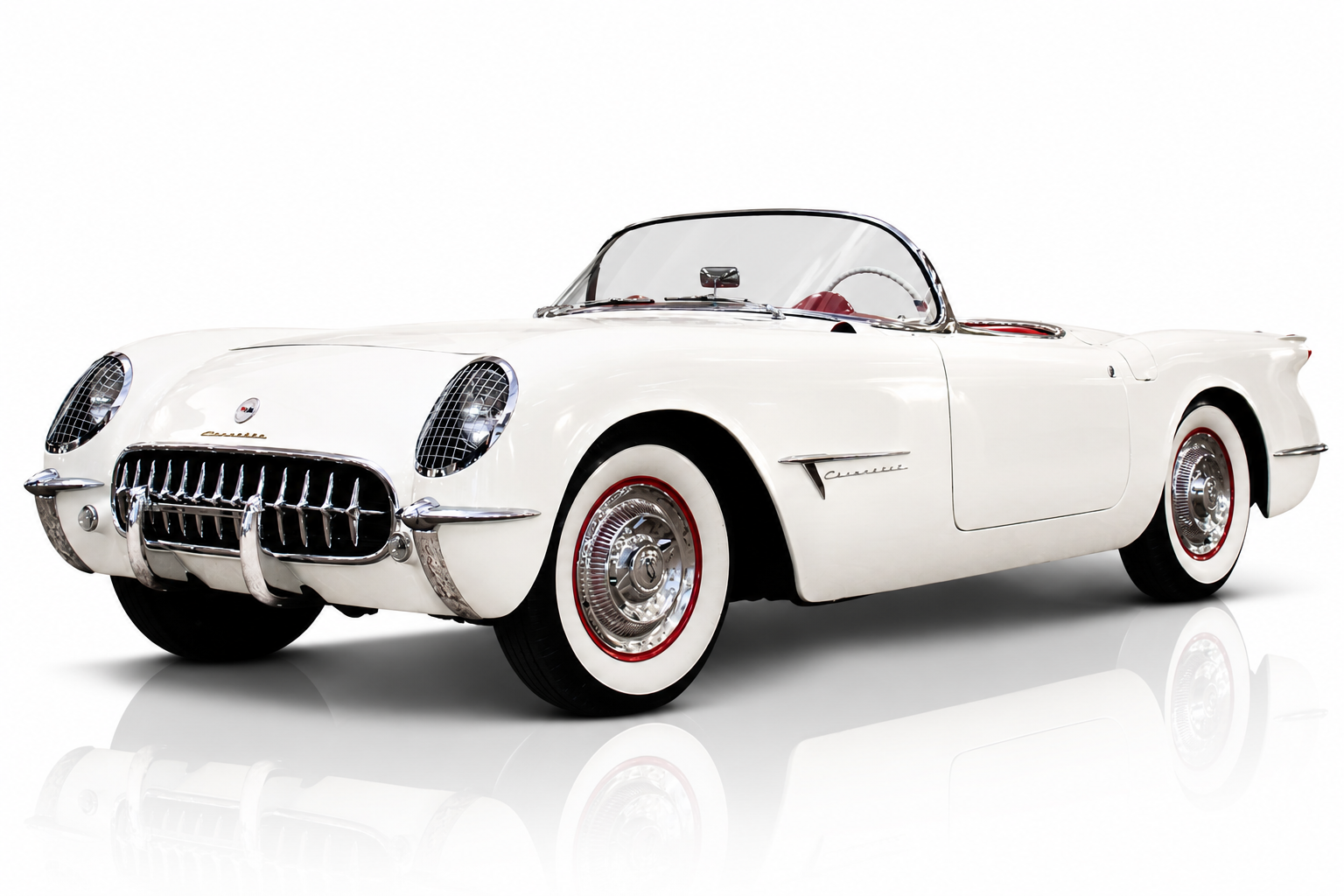
At a time when America’s postwar automobile industry was still largely defined by practical sedans, chrome-trimmed optimism, and ever-larger family cars, EX-122 arrived with an entirely different energy. It was low, lean, youthful, and unexpectedly bold. It borrowed inspiration from Europe’s sports-car culture, but it did not simply imitate it. Instead, it translated that spirit through an American lens, giving Chevrolet a car that felt fresh, attainable, and full of possibility.
What made EX-122 so compelling was not just its fiberglass body, its Motorama glamour, or its carefully sculpted proportions. It was the larger idea behind it: that Chevrolet could build something emotional. Something aspirational. Something that existed not because the market had already demanded it, but because a small group of visionaries believed it deserved to exist.
That belief would become the foundation for everything that followed. But before the Corvette became a production car, a performance icon, or America’s Sports Car, it began here—with a single concept, a compressed development timeline, and a bold question placed before the public: what if Chevrolet built a true American sports car?
Harley Earl’s Vision: American Style Meets European Spirit
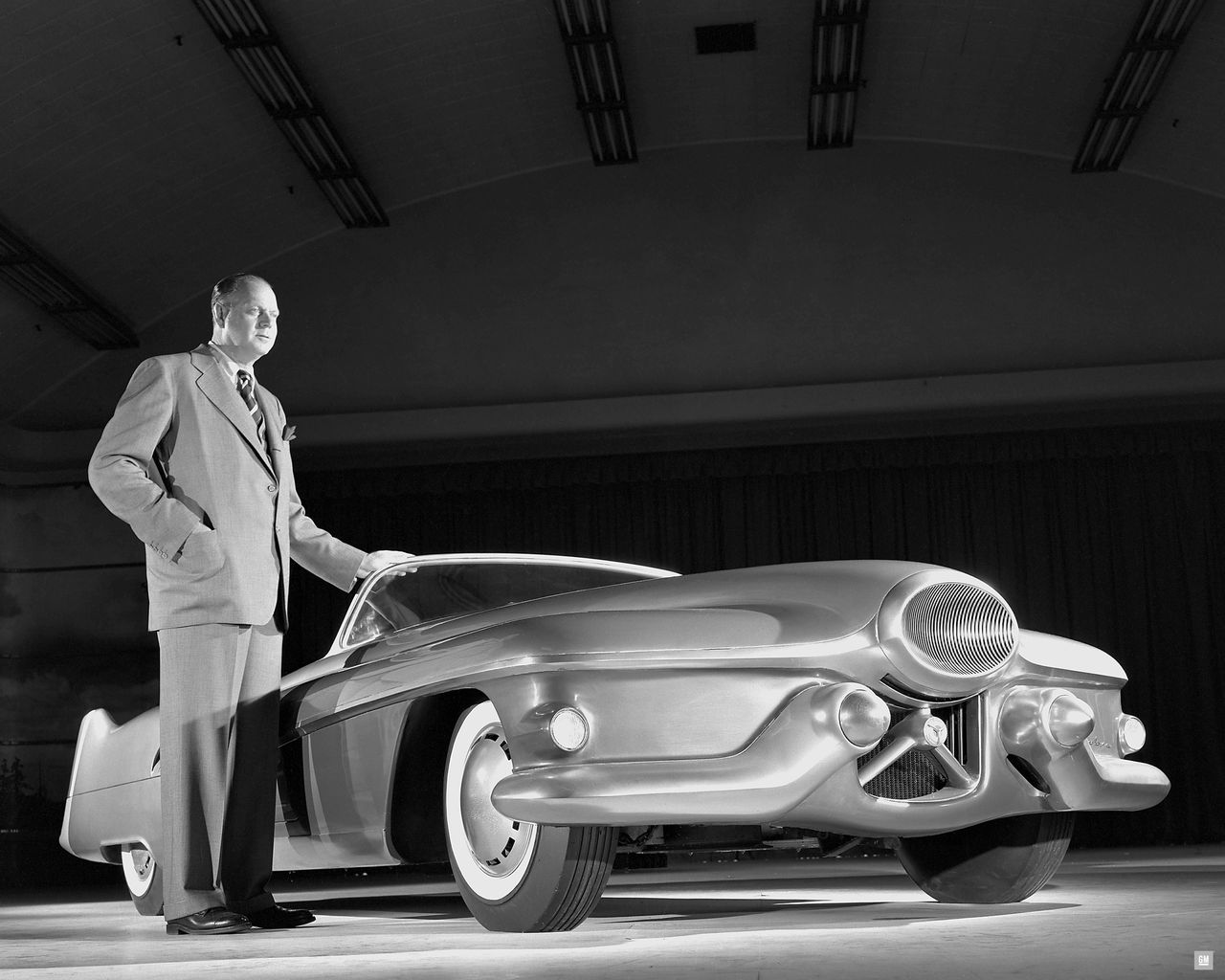
Harley Earl was never content to treat automobiles as mere transportation. Long before EX-122, he had already helped reshape the way Detroit thought about design, styling, proportion, color, and the emotional connection between people and cars. At General Motors, Earl understood that an automobile could be more than a machine. It could be an object of desire, a rolling expression of optimism, status, progress, and personal identity.
That belief had guided much of his career. As GM’s styling leader, Earl helped move the American automobile away from purely functional shapes and into a new era of visual drama. He championed clay modeling, elevated the role of the designer within the corporation, and helped turn the concept car into one of GM’s most powerful public-facing tools. His dream cars were not always intended for immediate production, but they mattered because they gave the public a glimpse of what the future could look like.
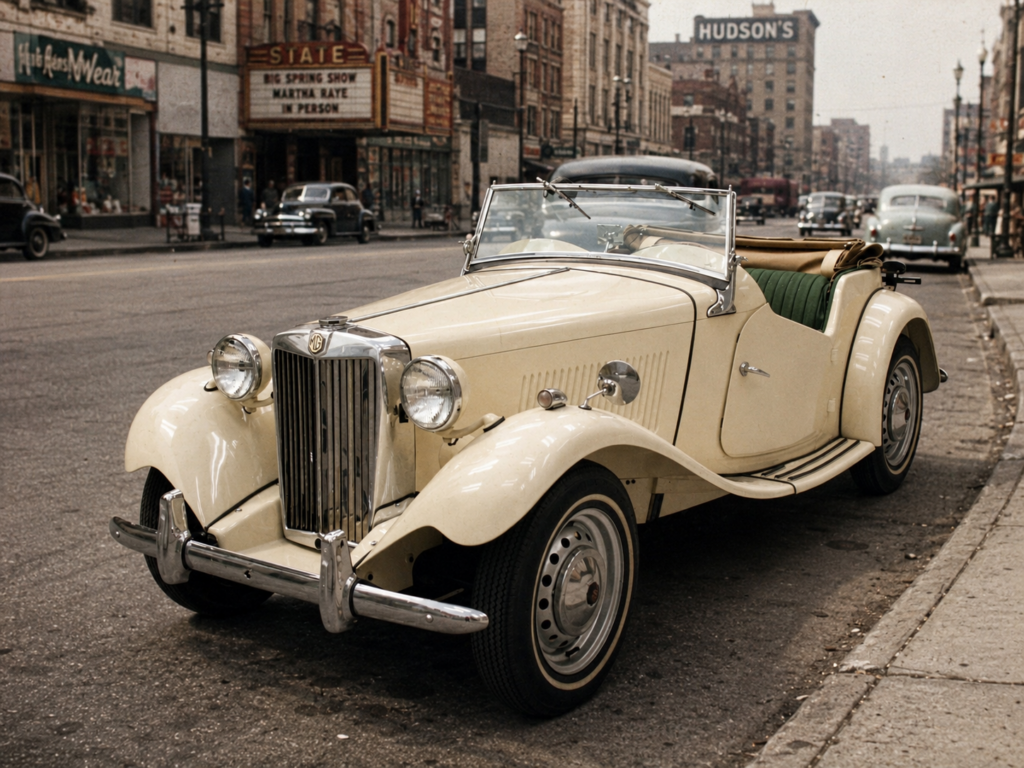
By the fall of 1951, Earl’s attention had turned toward something more specific. European sports cars were appearing with increasing frequency on American roads, often brought home by servicemen or discovered by young enthusiasts who wanted something lighter, lower, and more responsive than the typical domestic sedan. Cars from MG, Jaguar, and other European manufacturers offered a different kind of driving experience—less formal, more intimate, and far more connected to the road.
Earl recognized the appeal immediately. He also recognized the opportunity. Chevrolet, GM’s volume brand, had never been positioned as a builder of sports cars, but that was precisely what made the idea so intriguing. If Chevrolet could create an American two-seater that captured the spirit of those European machines while remaining affordable, serviceable, and distinctly GM, it could open the brand to an entirely new kind of buyer.
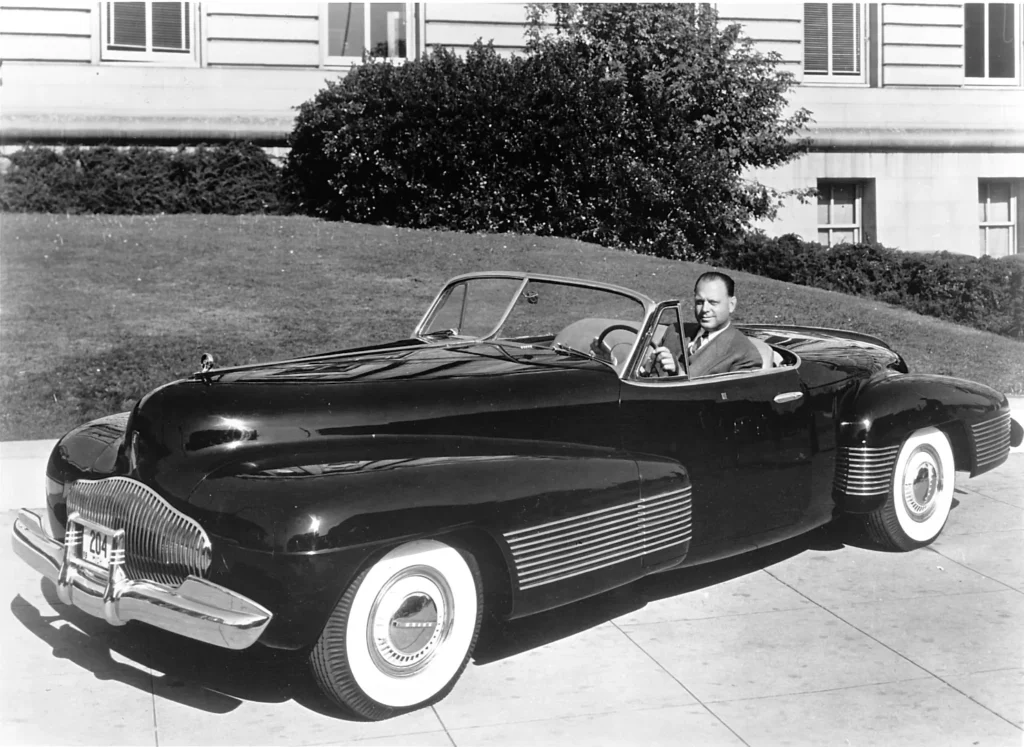
Earl’s vision was not to create an exotic car for the few. That would have been the easy answer—and the wrong one for Chevrolet. He wanted a sports car with style and presence, but also with a measure of accessibility. It needed to feel special without being remote. It needed to look aspirational without abandoning Chevrolet’s practical foundation. It needed to be something an American enthusiast could imagine owning, driving, servicing, and enjoying.
To keep the idea alive before it could be shut down by internal caution, Earl launched the project quietly. The effort was given the code name “Project Opel,” a deliberately low-profile designation that allowed the work to proceed away from the full glare of corporate scrutiny. Earl understood GM well enough to know that a Chevrolet sports car could be dismissed as impractical before it had the chance to make its case. The project needed protection until it had a shape, a purpose, and a persuasive reason to exist.
That protection came in the form of a private, low-profile studio near GM’s main Body Development Studio. Inside that space, Earl gathered a trusted group of collaborators who could move quickly and work discreetly. Vincent Kaptur Sr., director of body engineering at the Styling Studio, helped bridge the space between design ambition and manufacturing reality. Carl Peebles translated ideas into technical drawings. Carl Renner and Bill Bloch contributed to the car’s visual development, while Tony Balthasar helped give the design physical form in clay.
Together, they began shaping a car that did not fit comfortably into Chevrolet’s existing image. That was the point. Project Opel was not merely an attempt to build a prettier Chevrolet. It was an attempt to expand the brand’s emotional range. Earl wanted to prove that America’s most familiar carmaker could also build something lean, stylish, youthful, and personal.
The first Corvette began as a question asked behind closed doors. Could Chevrolet build a sports car that embodied European spirit, American confidence, and real-world attainability in a single body? Harley Earl believed it could. Project Opel was his answer in progress.
The Engineering Challenge: Radical Ideas, Common Parts
From the beginning, Project Opel had to live inside a difficult set of contradictions. It needed to look fresh, dramatic, and unlike any Chevrolet then in production, but it could not be engineered as an expensive one-off fantasy. Earl’s sports car had to be exciting enough to capture the imagination and practical enough that Chevrolet could at least consider building it.
That requirement shaped nearly every early decision. Unlike many concept cars, EX-122 was not intended to be a purely theatrical object. It had to suggest production feasibility. Chevrolet could not justify a low-volume sports car built entirely from exotic components, specialized tooling, and expensive engineering solutions. The car had to rely on existing GM hardware wherever possible, especially proven Chevrolet components that could help control cost, accelerate development, and keep the project connected to the brand’s production reality.
Earl reportedly wanted the car to target a price of roughly $1,850, placing it below the 1951 MG TD and giving Chevrolet a credible answer to the imported sports cars that were beginning to attract American attention. That target was ambitious, and it forced the team to think creatively. The project could not simply chase style at any cost. It had to balance design, engineering, manufacturability, and value in a way that made sense for Chevrolet.
This was where the early Corvette story became especially interesting. The car’s limitations did not kill the idea; they sharpened it. The need to use common components encouraged ingenuity. The need to control costs demanded discipline. The need to move quickly forced the team to separate what was essential from what was merely desirable.
Still, the project needed something more. It needed a material, a method, or a breakthrough that could allow Chevrolet to create a low, sculptural sports-car body without committing to the time and expense of conventional steel tooling. That breakthrough arrived from an unexpected place—not from inside Chevrolet engineering, but from a fiberglass-bodied prototype standing within Earl’s reach.
The Alembic I: A Spark in Fiberglass
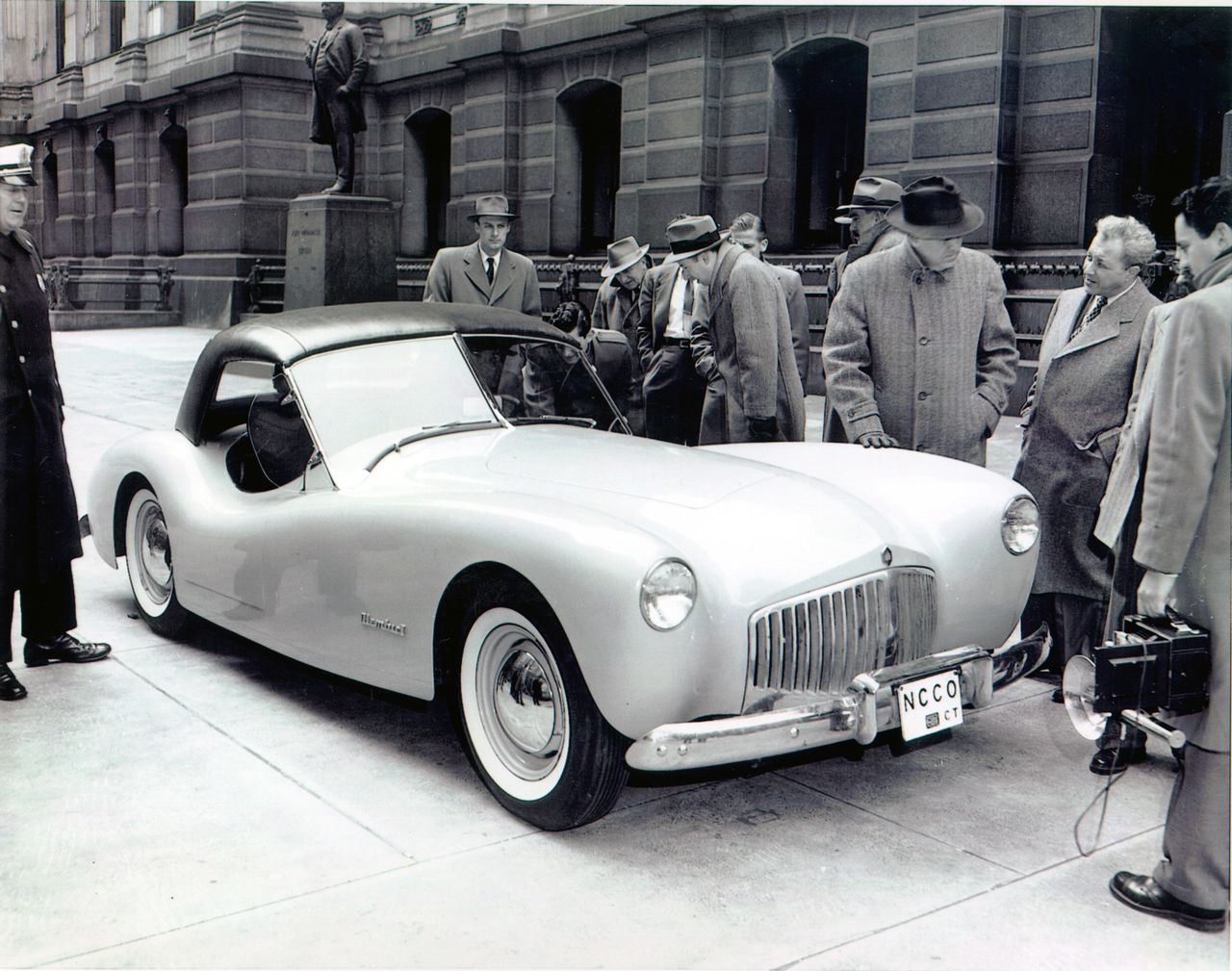
The Alembic I was not a General Motors project, but its presence inside the GM Styling Auditorium gave Harley Earl exactly the kind of inspiration Project Opel needed. Created by Glasspar founder Bill Tritt for Naugatuck Chemical, a division of U.S. Rubber, the Alembic I demonstrated the possibilities of fiberglass-reinforced plastic in a way that could not be ignored.
For Earl, the timing was nearly perfect. Here was a lightweight, corrosion-resistant, fiberglass-bodied roadster that proved a small team could create dramatic automotive forms without relying on traditional stamped steel. Its body did not require the same massive tooling investment associated with conventional production panels, and its shape suggested a freedom that steel could not easily provide on a short timeline.
That discovery made all the difference. Earl had the imagination to see the Corvette, but imagination alone would not get the car to Motorama. Fiberglass offered a practical path. It gave Project Opel a way to become more than an internal styling exercise, because it addressed one of the greatest obstacles standing between a dream car and a buildable automobile: the cost and time required to create the body.
The Alembic I also reinforced a larger philosophical point. Innovation did not have to wait for Detroit’s established systems to approve it. Sometimes the future arrived from small shops, experimental materials, and people willing to work outside conventional methods. Earl saw that clearly. If Bill Tritt and Glasspar could use fiberglass to create a lightweight roadster, then General Motors—with its design talent, engineering depth, and manufacturing resources—could certainly explore the same path.
In that sense, the Alembic I did not create the Corvette idea, but it helped unlock it. It gave Earl a material argument to support his design argument. It showed that a lightweight, dramatically styled sports car did not have to remain trapped inside clay, plaster, and wishful thinking. Fiberglass could give Project Opel a body. More importantly, it could give Chevrolet a way to move quickly.
That was the spark Earl needed.
A Fresh Vision, A New Team
With fiberglass now part of the conversation, Earl intensified the project and brought in Robert F. McLean, one of the most important figures in the early Corvette’s development. McLean was unusually well-suited for the assignment. A Caltech-trained engineer with a background in industrial design, he understood both structure and shape, as well as mechanical packaging and visual proportion. He was also a sports-car enthusiast, which meant he understood the appeal of the European roadsters that had captured Earl’s attention.
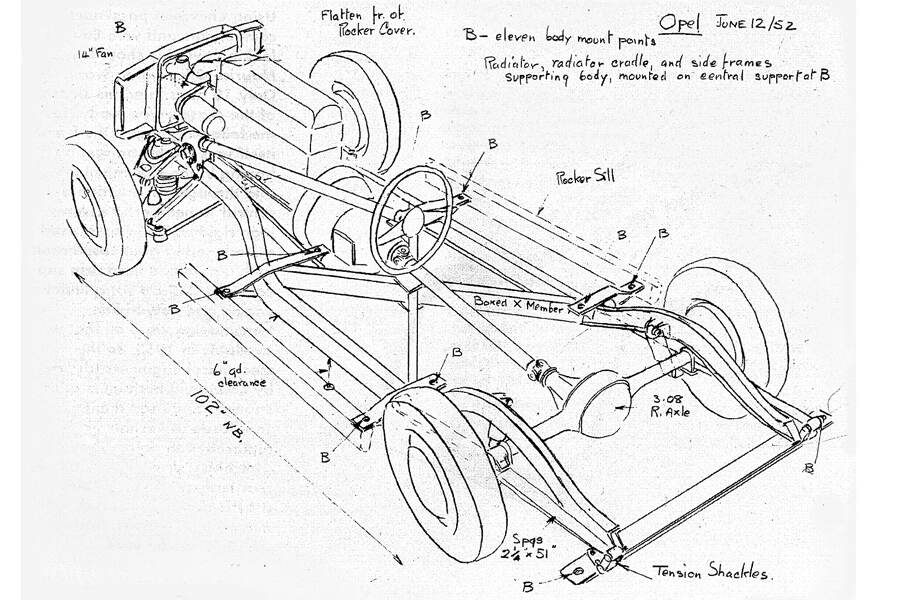
Earl gave McLean a mandate that ran counter to Detroit convention: design the car from the rear forward. For a traditional American passenger car, that would have been unusual. For a compact two-seat sports car, it made sense. Seating position, rear axle location, fuel tank placement, differential packaging, engine position, and overall weight distribution all mattered if the car was going to feel balanced rather than merely look attractive.
This rear-forward approach helped the team think about the Corvette as a complete driving machine. Instead of styling a dramatic body first and forcing mechanical parts into the available space later, McLean’s layout considered the driver, passenger, drivetrain, and chassis as part of the design from the outset. That process helped achieve the low center of gravity and a near 50/50 weight balance, which the team wanted.
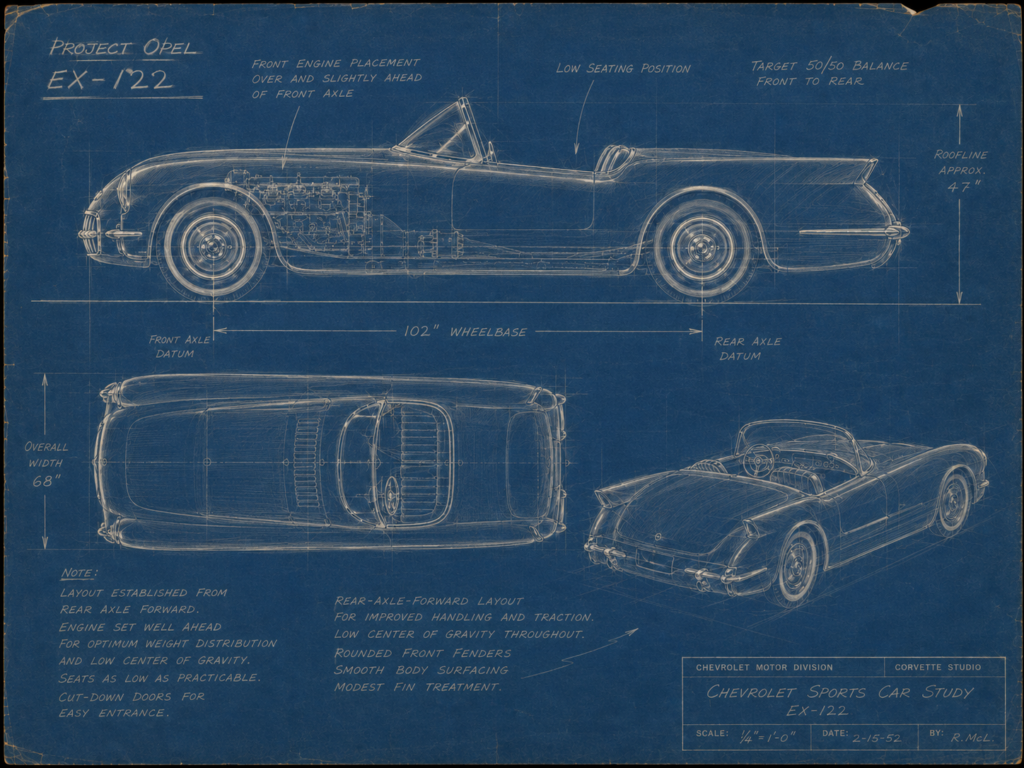
The solution also introduced a new challenge. Existing GM frames would not give Earl’s team exactly what the car needed. The Corvette’s proportions, low stance, and compact two-seat layout required a more specialized foundation. That threatened the project’s early cost assumptions, but it also clarified the stakes. If the car was going to earn its sports-car identity, it needed the bones to support the promise of its shape.
Earl held his ground. He understood that the Corvette could not simply be an ordinary Chevrolet dressed in a more glamorous body. It had to feel credible. It had to sit right, drive with purpose, and carry itself with the visual tension people associated with European sports cars. If the public believed in the car, the business case could follow.
That was the gamble at the center of Project Opel. The team was not merely drawing a car. They were trying to build enough authenticity into the idea that Chevrolet would have no choice but to take it seriously.
Secrets Behind Closed Doors
Secrecy remained essential as Project Opel moved forward. Earl knew that a Chevrolet sports car could be vulnerable inside a corporation accustomed to clear brand hierarchies and predictable product planning. Chevrolet sold practical, dependable, high-volume automobiles. A two-seat fiberglass sports car did not fit neatly into that formula.
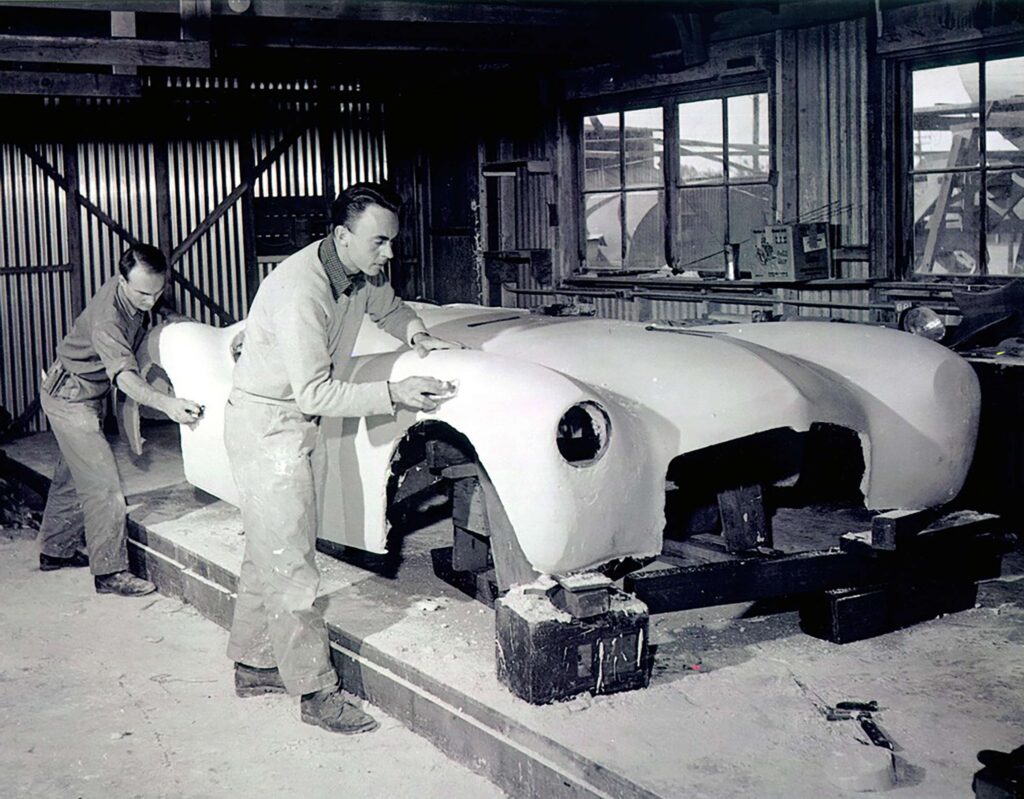
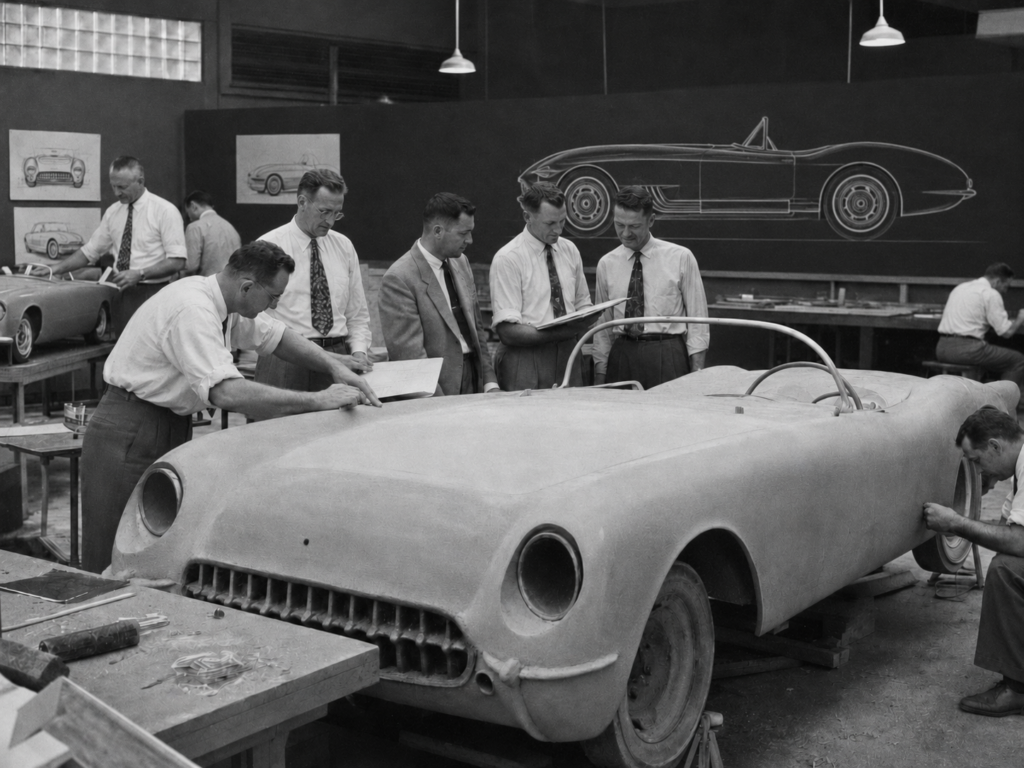
So the team worked quietly, refining the shape in clay and plaster within a controlled studio environment. That privacy gave Earl and his collaborators the freedom to develop the car before exposing it to broader internal criticism. The goal was not simply to hide the project for the sake of secrecy. It was to protect the idea until it could defend itself visually.
The final form reflected Earl’s ability to blend glamour with restraint. The car was low and clean, with simple body sides, rounded fenders, a compact cabin, and a wraparound windshield that gave it a modern, almost aircraft-inspired quality. It did not look overburdened with ornament. It did not look like a scaled-down sedan. It looked like something Chevrolet had never offered before.
That was the quiet power of the design. The first Corvette did not need excessive decoration to announce itself. Its proportions did the work. The long hood, short rear deck, open cockpit, and clean body surfaces made the car feel youthful and athletic without abandoning GM polish.
Behind those closed doors, Project Opel became more than an experiment in styling. It became a challenge to Chevrolet’s identity. If the car succeeded, it would prove that GM’s value brand could carry emotion, aspiration, and performance imagery without losing its American character.
That was a bold proposition in 1952. It was also the beginning of Chevrolet’s most enduring design legacy.
Gaining Corporate Traction
By April 1952, the team had created a full-size clay model and plaster cast, giving Earl something tangible to show Chevrolet leadership. That was a crucial turning point. Ideas can be dismissed. Drawings can be debated. But a full-size model has presence. It asks executives to respond not to an abstraction, but to a car standing directly in front of them.
The first major internal supporter was Ed Cole, Chevrolet’s new chief engineer. Cole was not easily impressed by styling for styling’s sake, but he understood opportunity when he saw it. He had the engineering mind to recognize the challenges ahead and the product instinct to understand what the car could mean for Chevrolet. In Earl’s proposal, Cole saw more than a display piece. He saw a chance to give Chevrolet a new kind of public energy.
His support mattered. Earl’s influence could get the car noticed, but Cole’s backing helped make it credible inside Chevrolet. A sports car could not survive on visual appeal alone. It needed engineering leadership, production investigation, and someone within Chevrolet willing to see the idea through the lens of possibility rather than inconvenience.
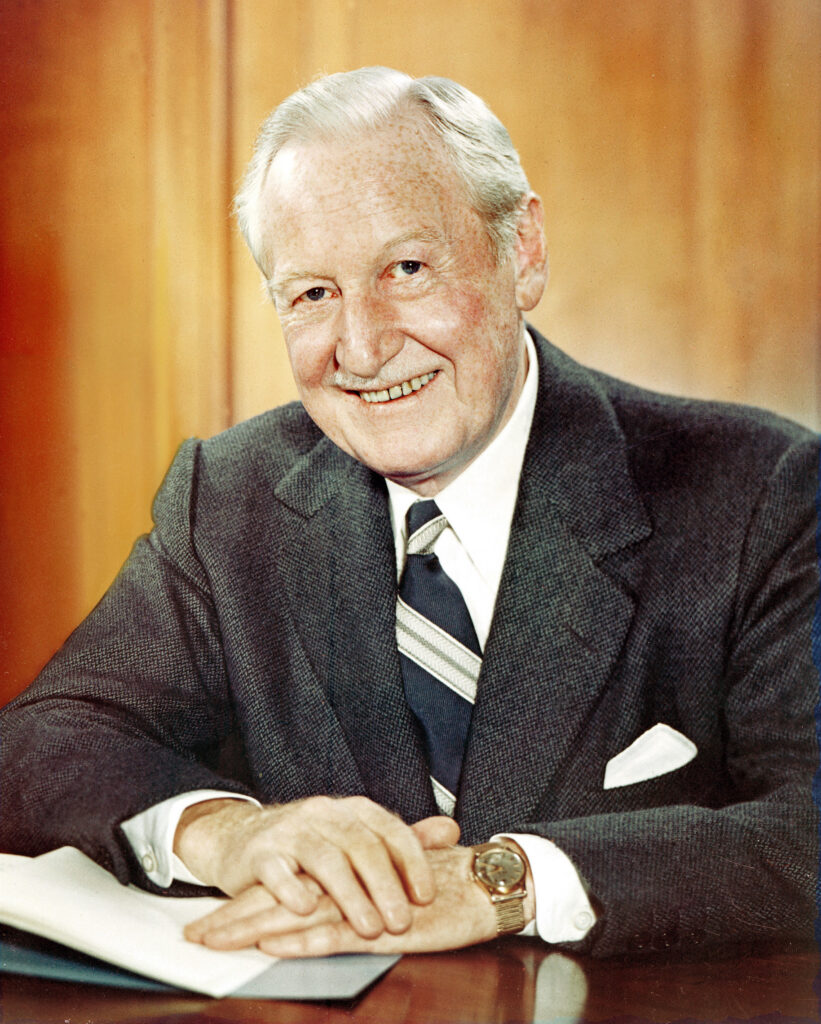
Next came GM President Harlow “Red” Curtice, a leader who understood the emotional power of cars and the promotional strength of GM’s Motorama program. Earl positioned the car as a way to bring younger, more performance-minded buyers into Chevrolet. It was not intended to replace Chevrolet’s core identity. It was intended to expand it.
Curtice responded to the idea, and so did Chevrolet General Manager Thomas Keating. On June 2, 1952, Keating approved the next step: build a running prototype, prepare the car for the 1953 GM Motorama, and begin exploring whether production might be possible.
With that decision, Project Opel became EX-122.
The change in designation marked more than a shift in internal paperwork. It signaled that Earl’s hidden sports-car proposal had crossed an important threshold. The idea was no longer merely protected in a private studio. It had executive support, a public deadline, and a path—however narrow—toward becoming a real Chevrolet.
Engineering the 1953 EX-122 Corvette CONCEPT: Enter Maurice Olley
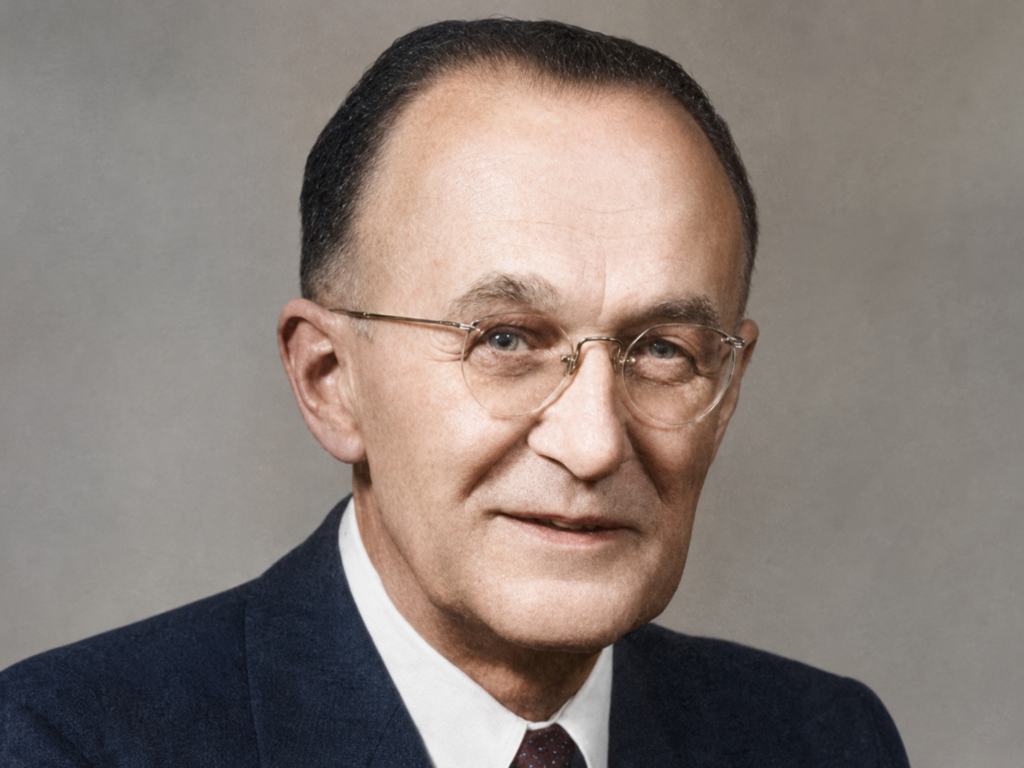
Building a drivable prototype in such a compressed window was no small feat. Harley Earl’s vision had given the Corvette its shape, its presence, and its emotional pull, but EX-122 still had to become a real automobile—one that could be driven, displayed, evaluated, and potentially adapted for production if the public response justified the effort.
That responsibility fell largely to Maurice Olley, one of the most capable chassis engineers at General Motors. An English-born engineer with experience at Rolls-Royce, Cadillac, and GM Research, Olley brought the discipline the Corvette program needed. Earl could sketch the dream. Olley had to make sure the dream had a proper foundation beneath it.
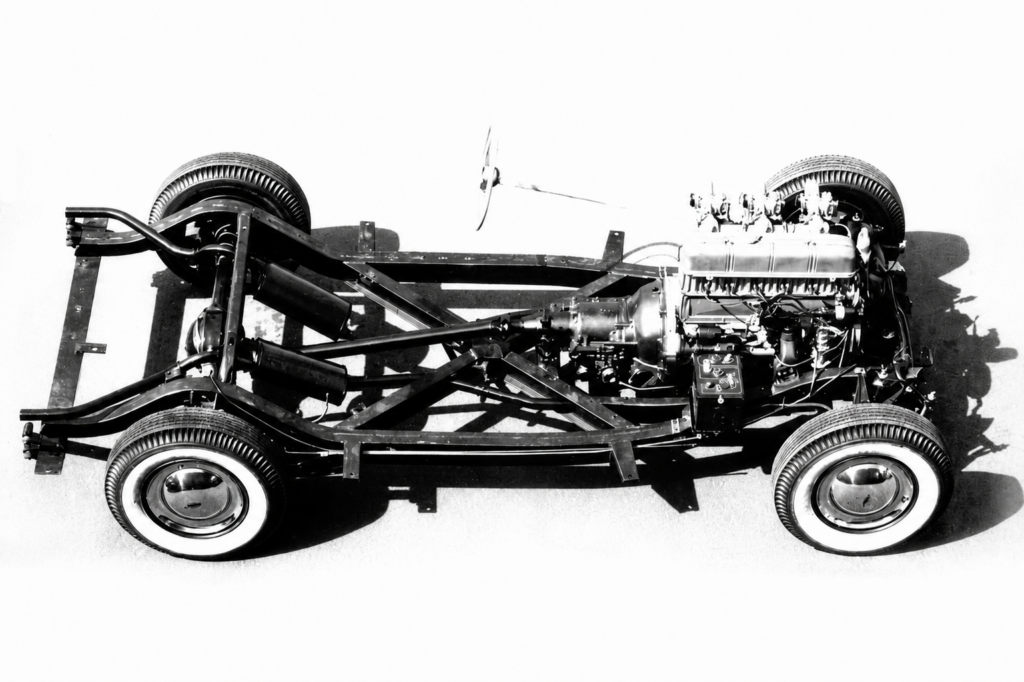
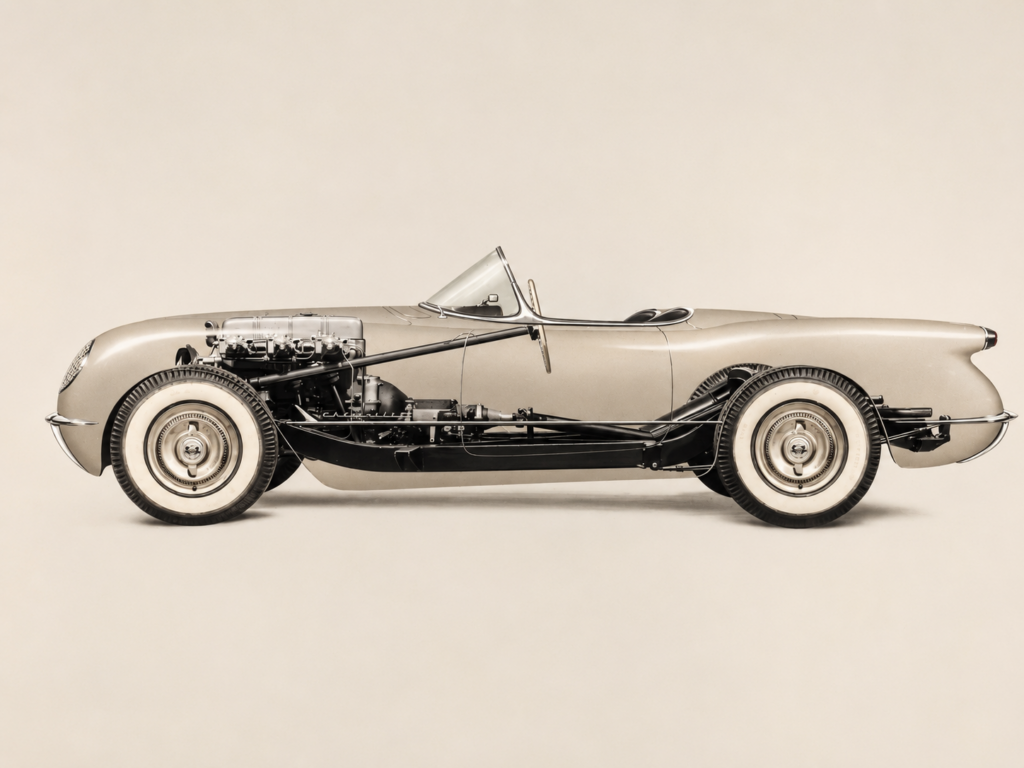
His team developed a purpose-built chassis that was strong, efficient, and remarkably light. Using boxed steel side rails and a central X-member, the frame gave the low-slung roadster the rigidity it needed without adding unnecessary weight. At just 213 pounds, it was an impressive piece of work—light enough to suit the Corvette’s sports-car mission, yet strong enough to support the fiberglass body and the mechanical components Chevrolet intended to use.
The chassis was not simply a shortened Chevrolet passenger-car frame with a show body placed on top. The Corvette required a structure suited to a different kind of vehicle. It had to sit lower, respond more directly, and support a two-seat roadster body with proportions unlike anything Chevrolet had in regular production. Olley’s frame gave EX-122 the structural backbone it needed while preserving the lightweight character Earl had envisioned from the beginning.
That balance between ambition and practicality defined the engineering of the first Corvette. The team used Chevrolet parts where they made sense, but they were not trapped by them. They modified, relocated, recalibrated, and rethought components to suit the new car’s purpose. The result was a prototype rooted in Chevrolet reality, but not limited by Chevrolet convention.
Maurice Olley’s Chassis and Suspension Work
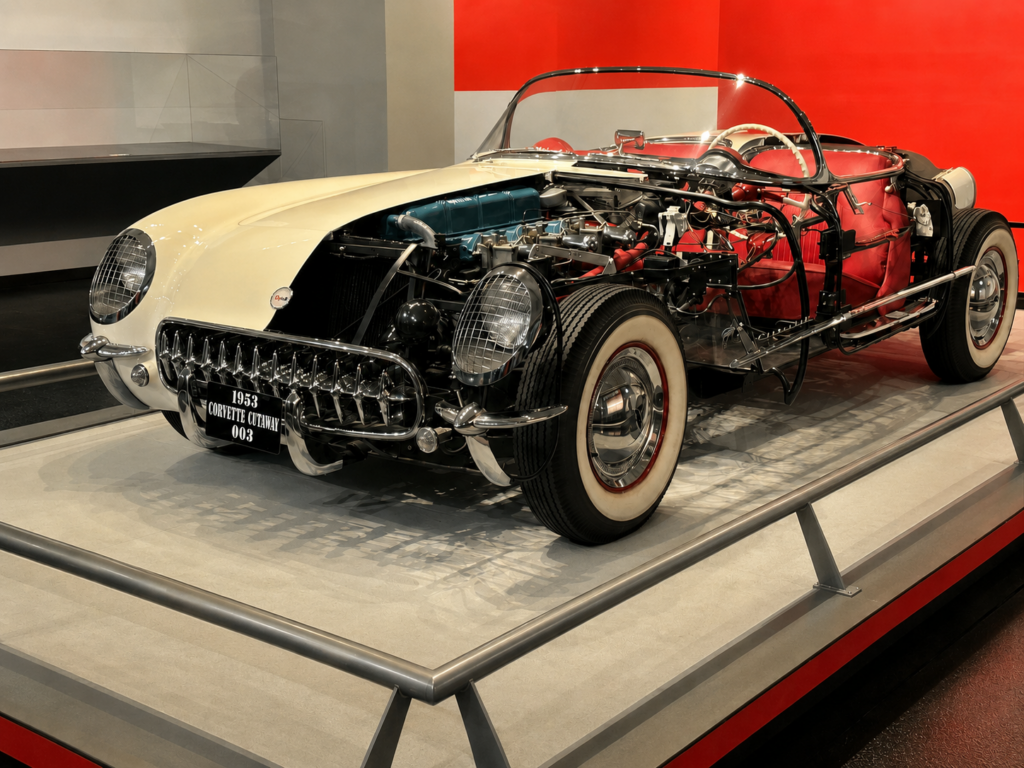
The Corvette’s suspension reflected the same practical ingenuity as its frame. Rather than attempting to reinvent every component from scratch, Olley’s team adapted proven Chevrolet parts and reworked them for the Corvette’s smaller, lighter, more athletic character.
Up front, the Corvette used modified Chevrolet suspension components with geometry tailored to the new roadster’s lower stance and handling goals. The car needed to feel more precise than an ordinary Chevrolet sedan, and its lower center of gravity allowed the engineers to think differently about ride, response, and balance. Shorter springs, revised component placement, and careful calibration helped give the car the poise its styling promised.
At the rear, the engineers again relied on Chevrolet thinking where it made sense, but adapted the layout to suit the Corvette’s compact dimensions. The result was a suspension package that remained grounded in production reality while still giving EX-122 the basic road manners expected of a stylish American sports car.
One of the more interesting engineering solutions involved the steering. The Corvette’s triple-carburetor induction system created packaging challenges beneath the low hood, and the engineers had to route the steering linkage around those constraints. Their answer was a split track rod steering arrangement, designed to clear the engine’s side-draft carburetors while preserving the more direct steering feel expected of a two-seat roadster.
The braking system was also revised around the Corvette’s proportions. Chevrolet improved the master cylinder and adjusted rear brake bias to better match the car’s weight distribution and lower center of gravity. It was the kind of subtle engineering work that rarely receives the same attention as styling or horsepower, but it helped make EX-122 feel like a complete automobile rather than a display body with mechanical parts underneath.
That was Olley’s real contribution. He did not simply make the car stand on its wheels. He helped make it believable. Beneath Earl’s sweeping fiberglass form was a chassis and suspension package engineered with enough care to support the Corvette’s larger promise.
Powering the Dream: The Enhanced Blue Flame Six
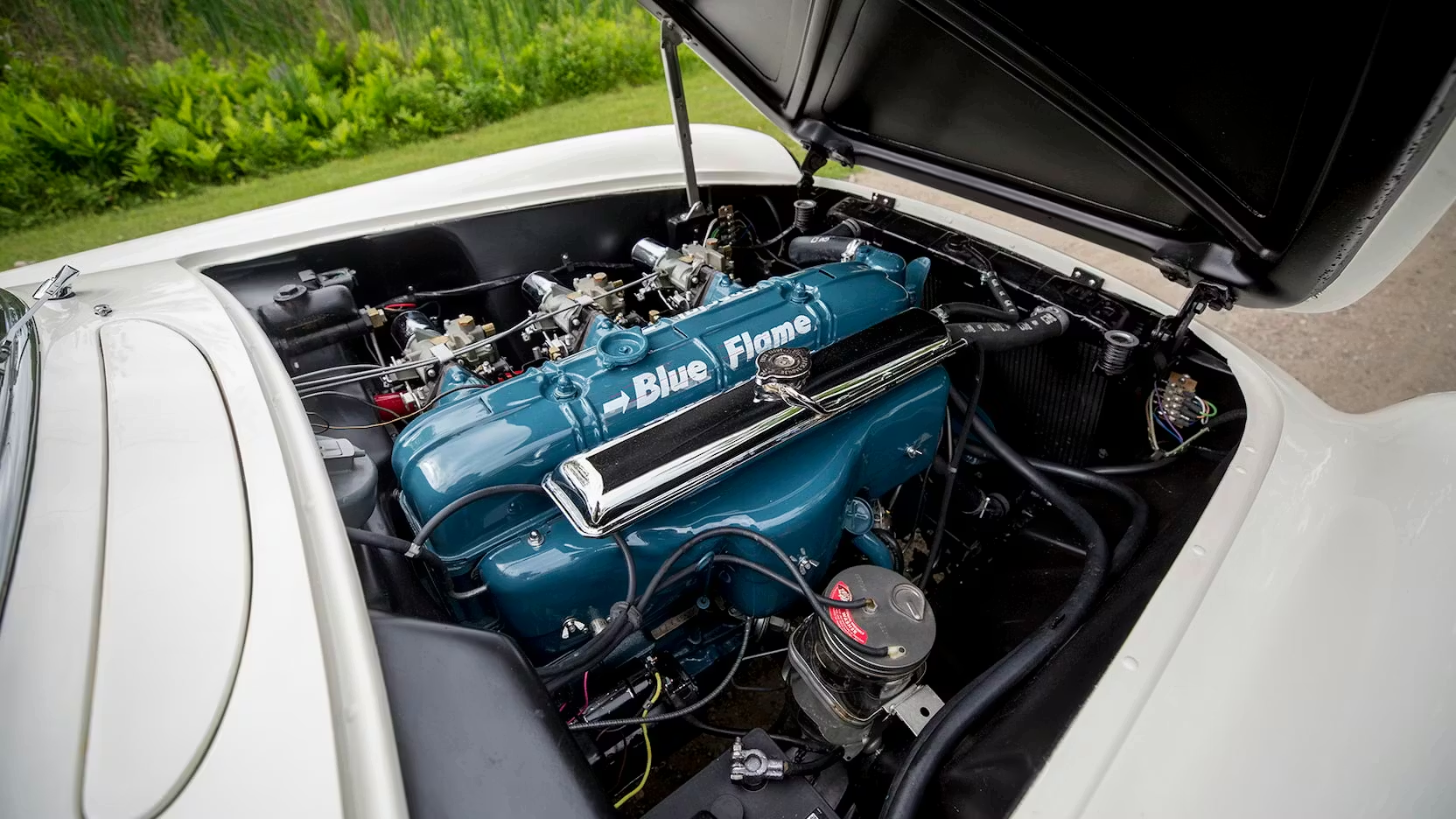
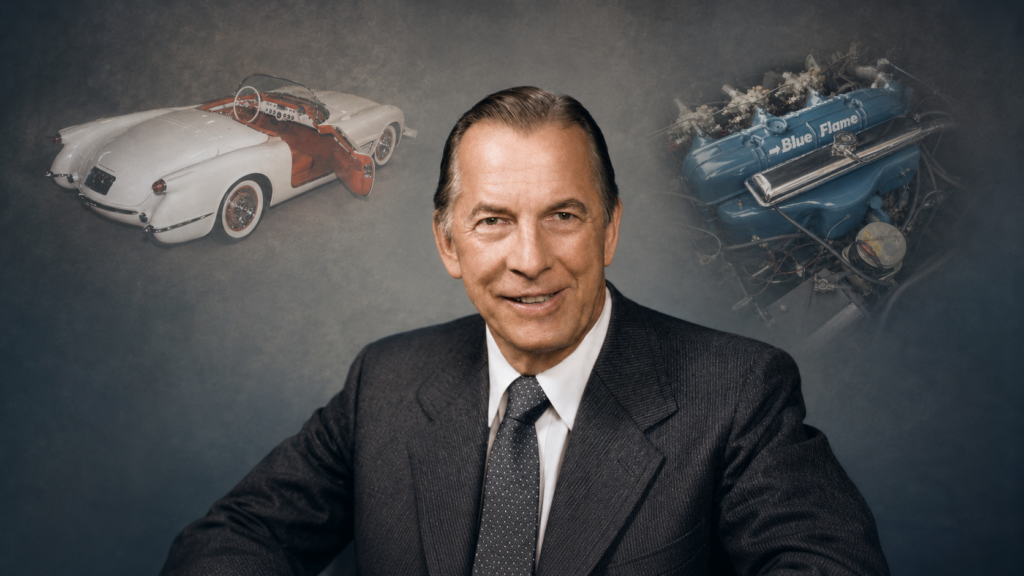
If Maurice Olley gave the Corvette its foundation, Ed Cole helped give it a heartbeat.
Under the hood, Chevrolet used its 235.5-cubic-inch inline-six, a version of the dependable engine often associated with the Stovebolt family. In standard Chevrolet form, it was known more for durability than glamour. For EX-122, however, Cole and his team transformed it into something more appropriate for the image Earl’s new sports car projected.
The Corvette’s version of the six received a series of meaningful upgrades. Mechanical lifters replaced the standard hydraulic setup. Compression was increased. A performance camshaft helped the engine breathe and rev more eagerly. Three Carter YH side-draft carburetors were fitted to a custom aluminum intake manifold, creating one of the most recognizable early Corvette engine layouts.
Those side-draft carburetors were not merely decorative. They helped solve the packaging demands created by the Corvette’s low hoodline while also giving the engine the additional airflow it needed. The arrangement gave the engine a purposeful, almost European appearance, but it remained fundamentally Chevrolet—resourceful, practical, and built from components the company understood.
The result was a substantial jump in output. The modified six produced 150 horsepower and 223 lb-ft of torque, a significant figure for Chevrolet at the time and enough to give EX-122 credibility as more than a styling exercise. Just as important, the engine visually reinforced the car’s personality. When the hood was opened, the triple-carbureted Blue Flame Six gave showgoers something to study, discuss, and remember.
That combination mattered. The first Corvette’s engine was not simply about raw numbers. It was about making Chevrolet’s available hardware feel special. Cole and his team took a familiar powerplant and gave it the breathing, presentation, and mechanical character needed to suit a two-seat sports car. It was a practical solution, but also an imaginative one.
The Powerglide Decision
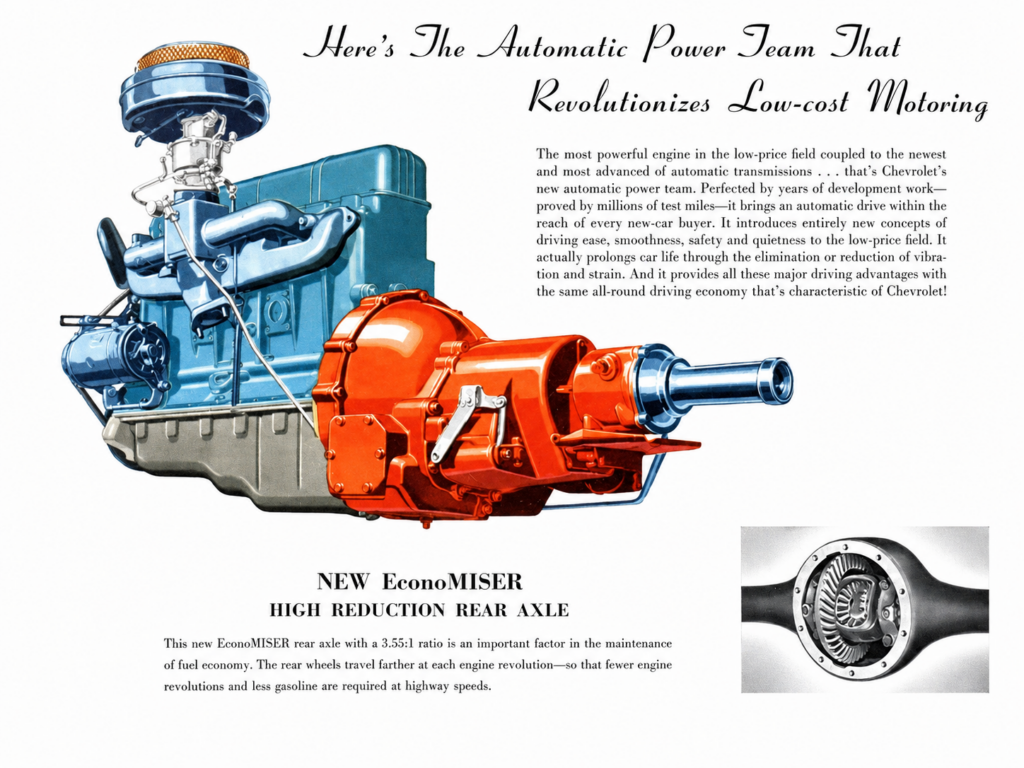
A manual transmission might seem like the obvious choice for a two-seat sports car, especially through the lens of later Corvette history. But the Corvette was being created inside early-1950s Chevrolet, and the company’s priorities were shaped by more than enthusiast convention.
Chevrolet paired the enhanced six-cylinder engine with the two-speed Powerglide automatic, a decision that reflected both engineering practicality and the image GM wanted the car to project. The Powerglide was smooth, modern, and refined. It suited Earl’s vision of an upscale American roadster—something sporty and youthful, but still polished enough to feel like a product of General Motors rather than a stripped-down European racer.
That choice also helped position the Corvette as something distinctly American. It did not simply copy the European sports-car formula. Instead, it blended European-inspired proportions with Chevrolet mechanical familiarity, GM refinement, and a level of usability that made the car feel less like an exotic curiosity and more like something Chevrolet could actually sell.
The Powerglide worked with the engine’s torque curve and helped create the relaxed, seamless driving character Chevrolet wanted for its first sports car. In the context of EX-122, that mattered. The car had to impress showgoers, demonstrate that Chevrolet could build something stylish and aspirational, and remain close enough to production reality that the idea could survive beyond the Motorama stage.
It also reflected the Corvette’s earliest identity. This was not yet a hardened competition machine. It was a modern American sports car concept built for a company still learning how far Chevrolet could stretch. The transmission choice was part of that larger negotiation between performance imagery, showroom polish, and production feasibility.
Fiberglass for the Future
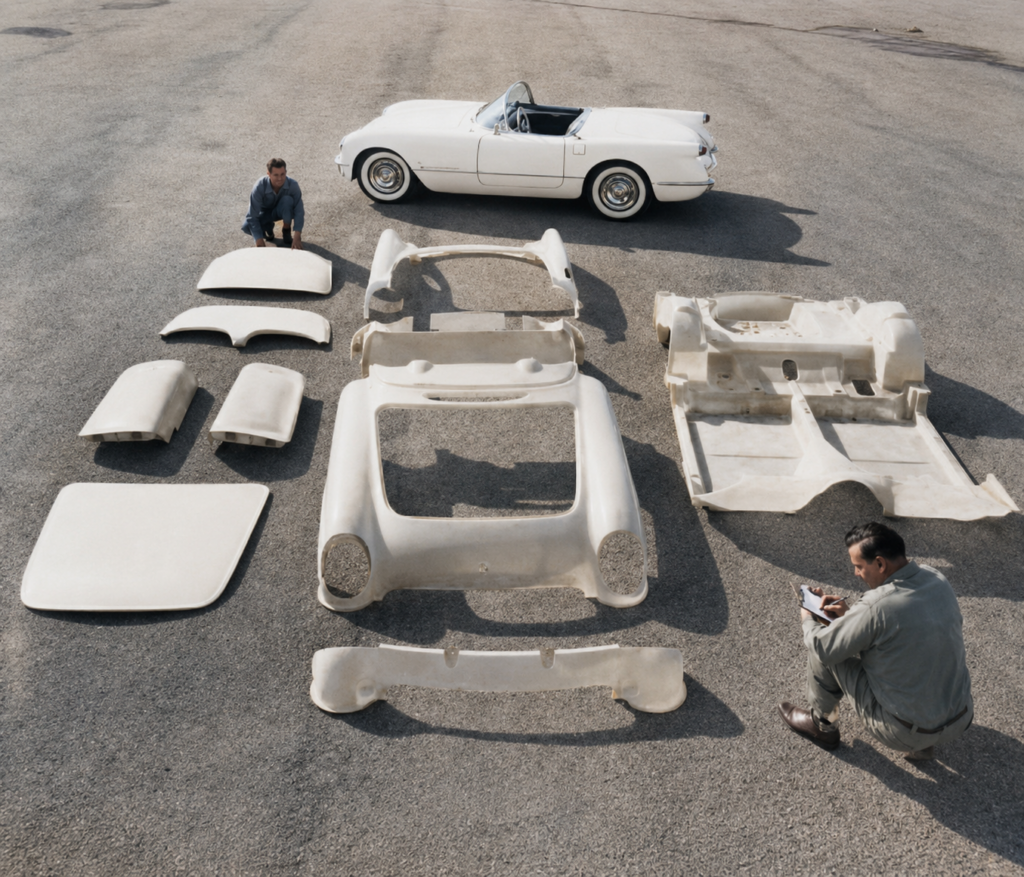
The boldest engineering gamble was the Corvette’s body.
Harley Earl had been deeply influenced by the Alembic I, the fiberglass-bodied concept created by Bill Tritt and Glasspar. Earl understood what fiberglass could offer that traditional steel could not: speed, flexibility, and dramatically reduced tooling cost. For a low-volume experimental sports car, those advantages were impossible to ignore.
Chevrolet had never attempted a full fiberglass body like this before. Building EX-122 from fiberglass required GM to move beyond familiar steel-body methods and embrace a material that was still novel in American automobile production. But Earl saw the opportunity. Fiberglass allowed his team to create a sleek, low, sculptural body without waiting for the expensive steel tooling that would have slowed the program and possibly kept the idea from reaching the public at all.
Using plaster molds pulled from the clay model, engineers and craftsmen created 46 individual fiberglass panels. Those panels were then assembled into nine major body subassemblies, gradually turning Earl’s design into a complete, physical automobile. The process demanded patience, experimentation, and substantial handwork. This was not yet the streamlined Corvette production method that would evolve later. It was a first attempt—fast, ambitious, and deeply consequential.
The fiberglass body gave the Corvette a character unlike anything else in the American market. It allowed Chevrolet to create dramatic shapes in a compressed timeframe, but it also made the car feel modern in a way steel could not. The material itself became part of the Corvette’s identity. From the beginning, the car was different not only because of how it looked, but because of how it was made.
That choice would define the Corvette far beyond 1953. Fiberglass was not simply a shortcut to Motorama. It became one of the car’s signatures, a material expression of the Corvette’s willingness to operate outside Detroit’s usual assumptions.
Racing the Clock
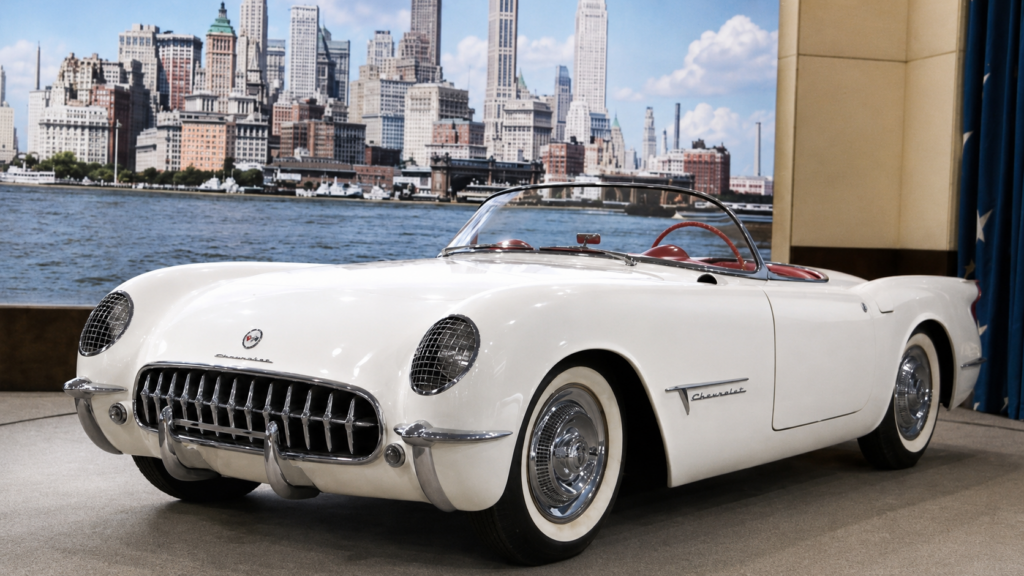
By December 1952, final construction of the Motorama prototype was complete. That timing is crucial because the Corvette’s public debut was only weeks away. Every major decision—the chassis, suspension, steering, brakes, modified six-cylinder engine, Powerglide transmission, and fiberglass body—had been compressed into an extraordinary development window.
What emerged was not merely a static dream car. EX-122 was a working statement of intent. It carried Earl’s design vision, Olley’s chassis discipline, Cole’s mechanical development, and Chevrolet’s first serious attempt to create an American sports car capable of capturing the public imagination.
The achievement was not just that the car existed in time for Motorama. It was that EX-122 brought so many new or reworked ideas together with enough coherence to make the concept believable. The boxed steel frame gave it structure. The modified suspension gave it poise. The triple-carbureted Blue Flame Six gave it identity under the hood. The Powerglide gave it smoothness and accessibility. The fiberglass body gave it form, lightness, and production possibility.
By the time EX-122 was ready for the Waldorf-Astoria, the Corvette was no longer just Harley Earl’s inspired answer to Europe’s postwar sports cars. It was a functioning Chevrolet prototype, built through a rare convergence of design ambition, engineering speed, and corporate willingness to take a chance.
The dream had been shaped in clay.
Now it could move under its own power.
Naming America’s Sports Car
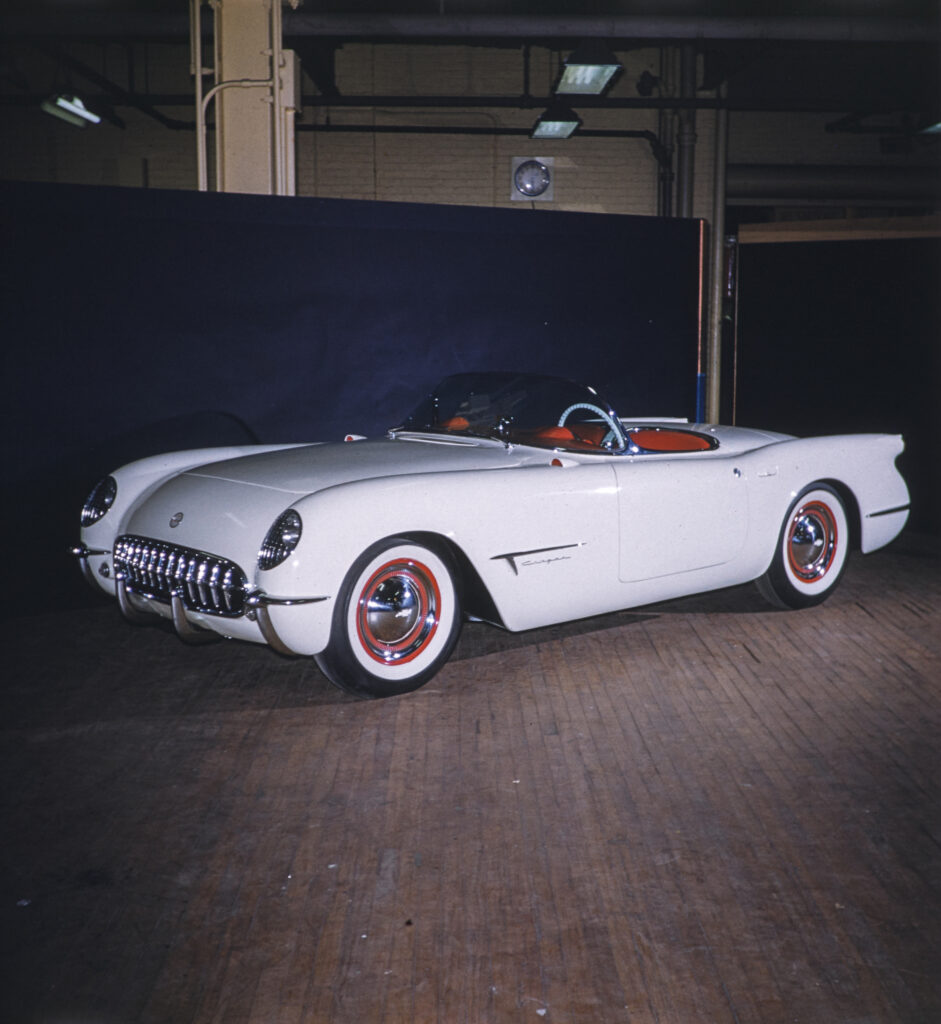
Just weeks before the Corvette made its public debut at the 1953 GM Motorama, Chevrolet still had one important problem to solve: its new sports car needed a name. The project had already taken shape under Harley Earl’s direction. The fiberglass body was finished. The Motorama deadline was closing in. But the car that would become America’s Sports Car was still missing the word that would carry it into history.
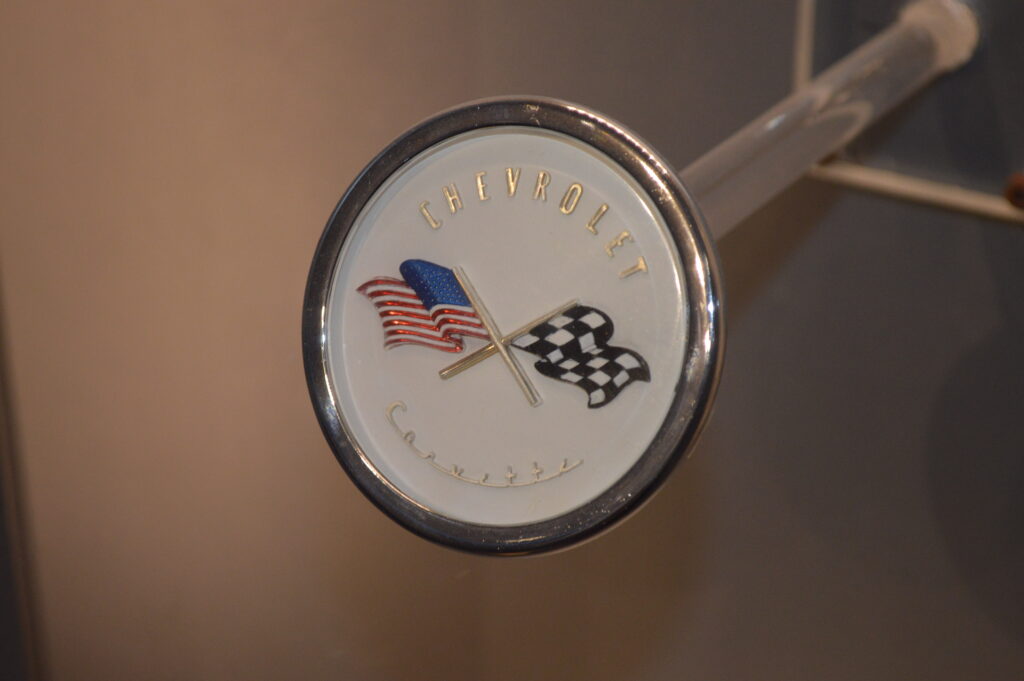
Chevrolet wanted a name that began with the letter “C,” linking the new sports car to the brand while giving it a distinct identity of its own. More than 300 possible names were reviewed, but none captured the spirit of the car. Then Myron E. “Scottie” Scott, an assistant director in Chevrolet’s Public Relations department, went home and began searching through the “C” section of the dictionary. There, he found the word corvette—a term used for a small, fast naval vessel.
It was an inspired choice, and not merely because it sounded good. The word carried movement. It had sharp edges. It suggested speed, agility, and purpose without borrowing the glamour of Europe’s established sports-car world. A corvette, in naval terms, was smaller than a frigate, fast, maneuverable, and often used for escort or patrol duty. During World War II, the term carried particular resonance because corvettes were closely associated with naval escort service.
For Chevrolet, the name fit beautifully. This new car was not meant to sound heavy, formal, or aristocratic. It was not a Cadillac. It was not a grand touring machine built for old-world luxury. It was low, clean, youthful, and American—something with enough European sports-car influence to feel sophisticated, but enough Chevrolet identity to feel accessible. Corvette gave the car a name that felt fast before the engine ever started.
The choice also reflected Myron Scott’s gift for public imagination. Scott was not just another corporate employee assigned to a naming discussion. Before joining Chevrolet, he had worked as an artist, photographer, and art director at the Dayton Daily News. In 1933, after photographing boys racing homemade wooden cars down a hill in Ohio, he helped create what became the All-American Soap Box Derby. Chevrolet later sponsored the Derby nationally, and in 1937 hired Scott into its Public Relations department, where he worked on photography, press kits, graphics, and special events.
Scott understood more than words. He understood images, motion, youth, competition, and the way a simple idea could capture the public’s imagination. That background helps explain why Corvette worked so well. The name did not simply label the car. It positioned it. It gave Chevrolet’s experimental two-seater a sense of identity before the public ever gathered around it at the Waldorf-Astoria.
Corvette suggested quickness. It suggested confidence. It suggested something compact, capable, and ready to move. It was not a name borrowed from mythology or geography. It was not decorative. It was purposeful. In hindsight, it gave Chevrolet’s newborn sports car a destiny it would spend the next seven decades growing into.
The name was more than a clever branding decision.
It was the first promise the Corvette ever made.
Motorama 1953: The World Meets the Corvette
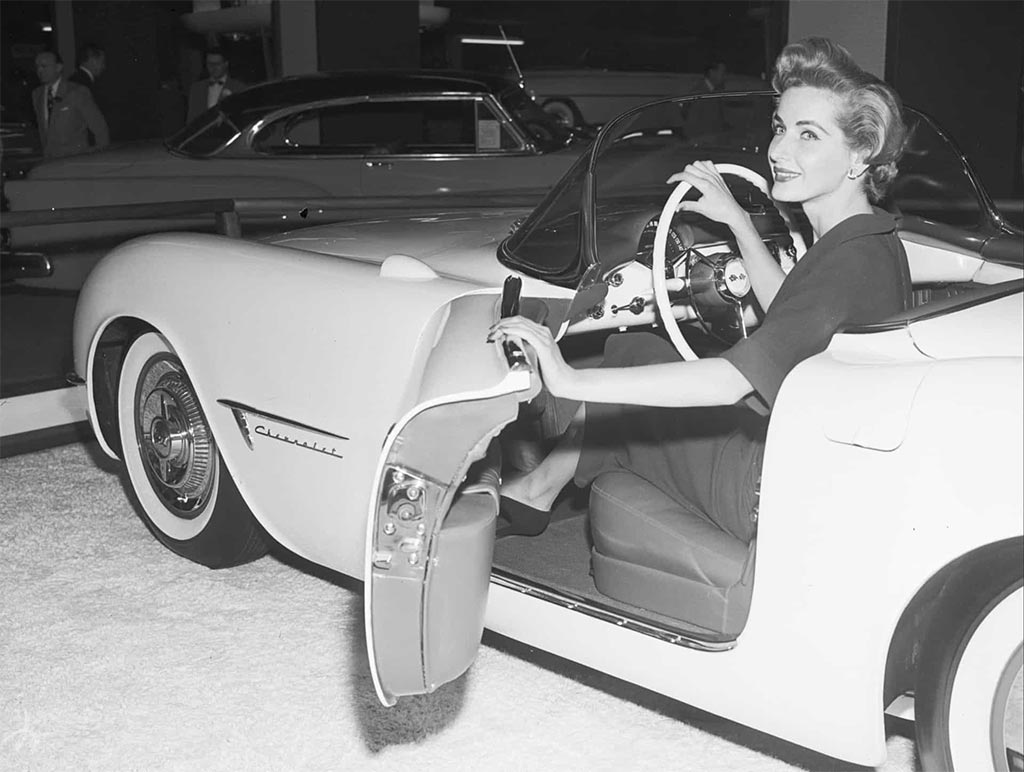
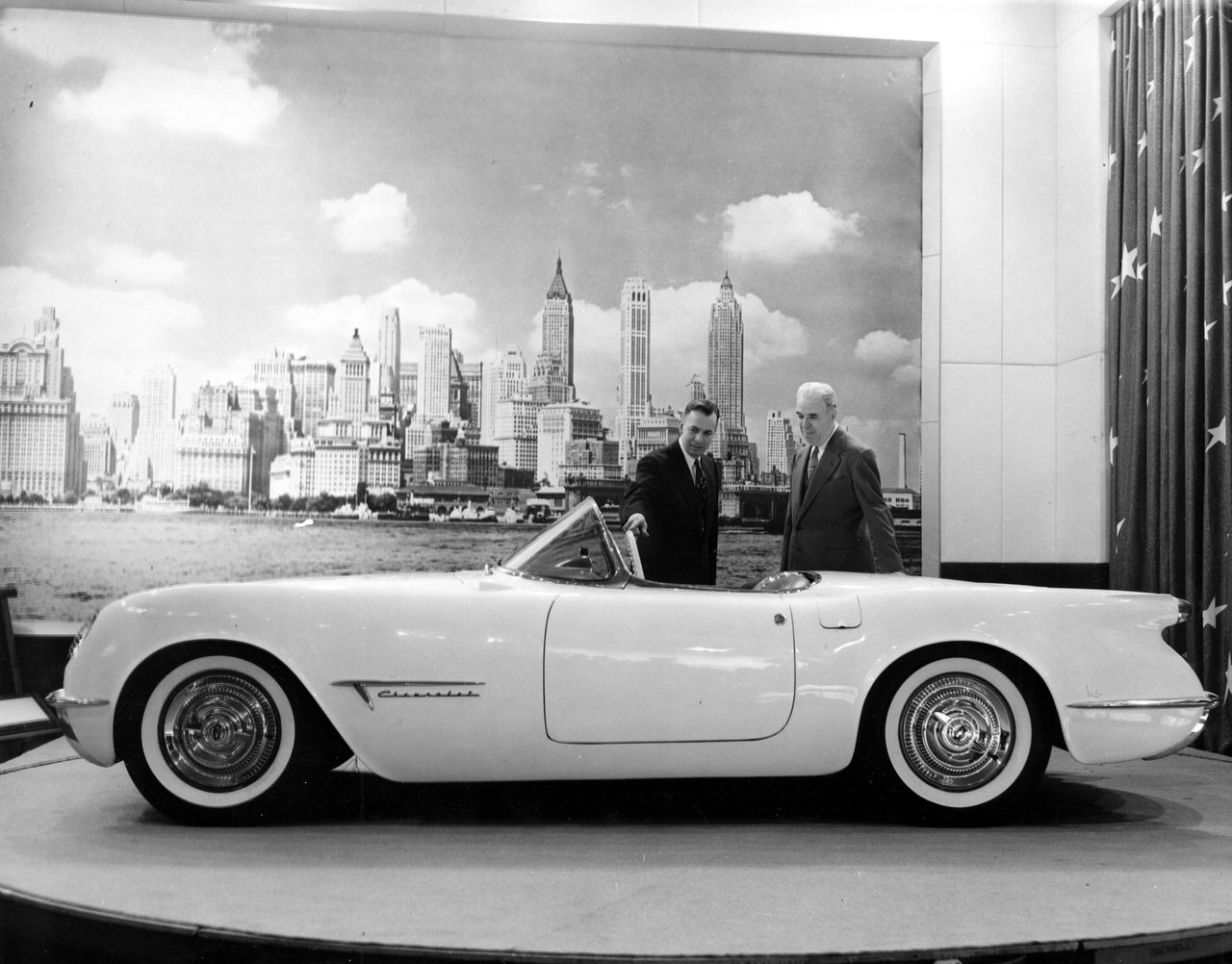
On January 17, 1953, the Chevrolet Corvette made its public debut at the Waldorf-Astoria Hotel in New York City as part of General Motors’ Motorama, but to simply say the car was “introduced” does not fully capture the scale of the moment. This was not a quiet display tucked into a conventional auto show. It was GM at the height of its postwar confidence, presenting its vision of the future inside one of New York’s grandest hotels.
Outside, the weather was bitterly cold, with temperatures barely rising above freezing. Still, thousands waited to get inside. By the National Corvette Museum’s account, approximately 50,000 people came through the New York show on opening day alone, pressing into a production that combined new cars, futuristic dream cars, elaborate displays, fashion, music, dancers, and carefully staged spectacle.
Inside the Waldorf-Astoria’s Grand Ballroom, the scene was crowded and formal, almost cinematic in its presentation. One attendee, Donald DeFilippo, later recalled taking the train from Poughkeepsie to New York as a 15-year-old who dreamed of becoming a GM designer. He remembered walking up an elegant marble staircase into a huge ballroom, where the crowd stood shoulder-to-shoulder as cars emerged from behind curtains, surrounded by models and dancers.
For a young enthusiast seeing Motorama firsthand, the entire event felt like design made real. DeFilippo described the elevated turntables, the gleaming show cars, and the difficulty of moving through the packed crowd. Then he noticed something different: a tight group of people gathered around another display, with enough excitement in their voices to make him push closer. The Corvette was drawing the kind of attention that made people stop, linger, and refuse to move aside.
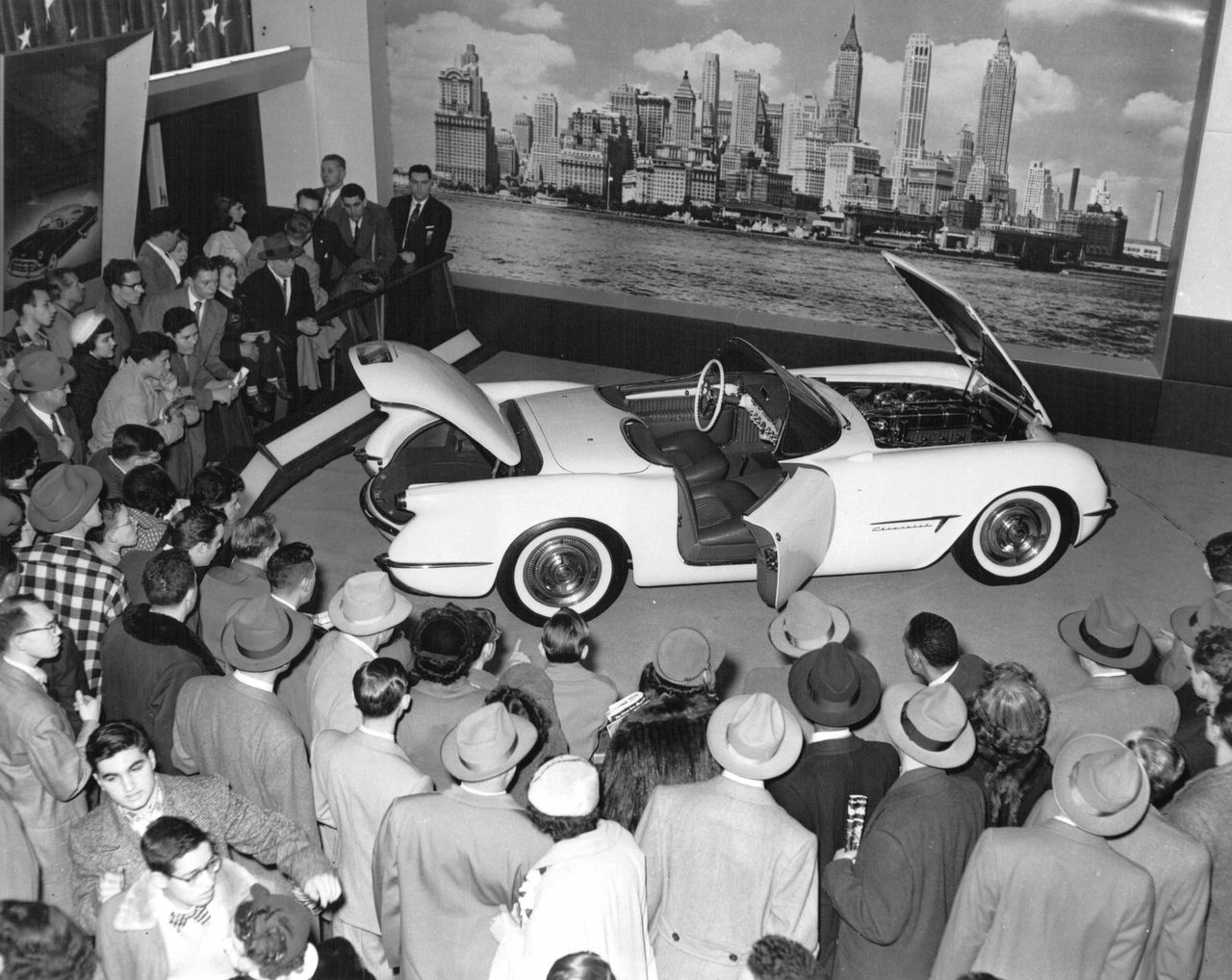
When he finally squeezed through the crowd, DeFilippo saw what Chevrolet had placed before the public for the first time: a low, sleek, two-seat convertible with its hood and trunk open, a straight-six engine with three carburetors beneath the hood, and wire mesh over the headlights. His reaction captured the dual appeal of the car. It was beautiful enough to stop him in place, but mechanical enough to make him immediately wonder what it might become.
Zora Arkus-Duntov was also there, and his own response to the Corvette would help redirect the future of the car. Seeing EX-122 at Motorama prompted Duntov to write to Chevrolet Chief Engineer Ed Cole, a step that eventually helped bring him into General Motors and onto the path that would reshape Corvette history.
Clad in Polo White with a Sportsman Red interior, EX-122 did not look like a typical Chevrolet. It looked low, clean, modern, and distinctly American, yet it carried the influence of the European sports cars that had inspired Harley Earl in the first place. Its proportions, fiberglass body, open cockpit, and compact two-seat layout gave Chevrolet something it had never had before: a car people gathered around not because they needed one, but because they wanted to understand it, imagine it, and dream about owning it.
That was the significance of the Waldorf-Astoria debut. The Corvette did not merely attract casual attention. It created a reaction. The crowd around the car, the photographs that captured the display, and the response from enthusiasts and engineers alike revealed that Chevrolet had touched something deeper than novelty. The car suggested a new kind of American aspiration—not luxury in the Cadillac sense, not mass-market practicality in the traditional Chevrolet sense, but personal style, motion, youth, and speed.
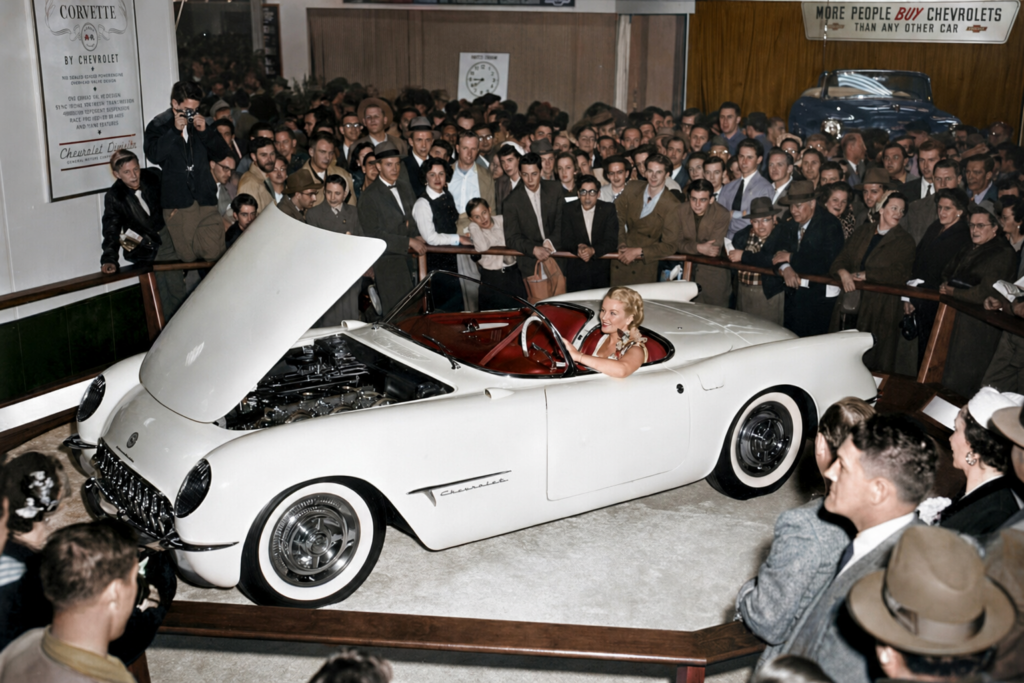
Chevrolet moved quickly after Motorama. Encouraged by the reception to the car, the company built 300 fiberglass-bodied Corvettes by the end of 1953, with the first production cars reaching showrooms in June. Every one of those first-year cars carried the same essential visual identity as the Motorama prototype: Polo White exterior, Sportsman Red interior, and a fiberglass body that made the Corvette unlike anything else in the American market.
Seen in that context, the Waldorf-Astoria debut was more than the Corvette’s first public appearance. It was the moment the public validated the idea. EX-122 arrived as an experiment, a show car, and a calculated act of corporate imagination. It left New York as something far more dangerous to ignore: a Chevrolet people wanted to stand near, talk about, dream over, and eventually own.
Why the 1953 EX-122 Still Matters Today
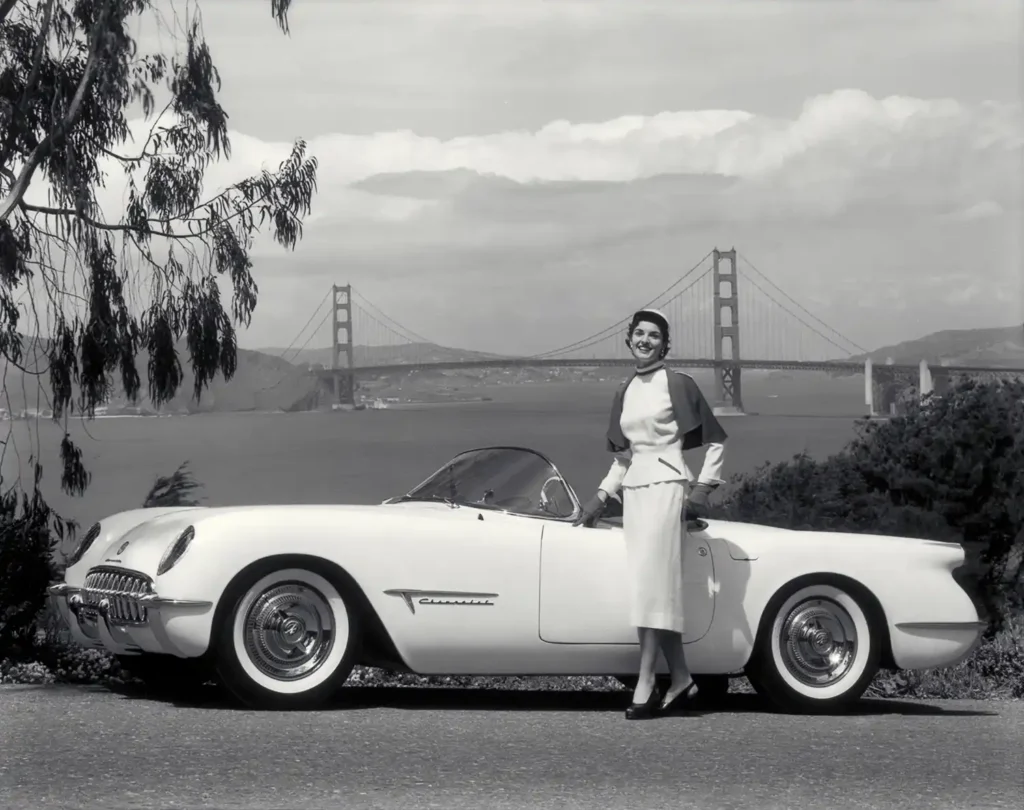
Looking back, it is astonishing how much vision, risk, and ingenuity went into creating the Corvette. The 1953 EX-122 was not born from inevitability. It was shaped by instinct, ambition, and a very deliberate refusal to accept that America’s automotive future had to be practical, predictable, or safe.
From the quiet inspiration of the Alembic I to the tireless efforts of Harley Earl, Ed Cole, Maurice Olley, Robert McLean, Myron Scott, and the small group of believers inside General Motors, EX-122 represented something far larger than a fiberglass-bodied show car. It was a declaration that Chevrolet could build something aspirational, emotional, and unmistakably American.
That is why EX-122 still matters today. It marks the moment the Corvette idea moved from private conviction to public reality. Before there was a production legacy, before there were small-block V8s, fuel injection, independent rear suspension, Sting Rays, Z06s, ZR1s, Le Mans victories, and generations of devoted owners, there was this first act of belief.
Without EX-122, the Corvette story as we know it does not unfold. There is no platform for Zora Arkus-Duntov to transform. No American sports car lineage stretching across seven decades. No cultural shorthand powerful enough to make “Corvette” mean far more than a model name. The car that stood inside the Waldorf-Astoria in January 1953 carried all of that potential before anyone could fully see where it would lead.
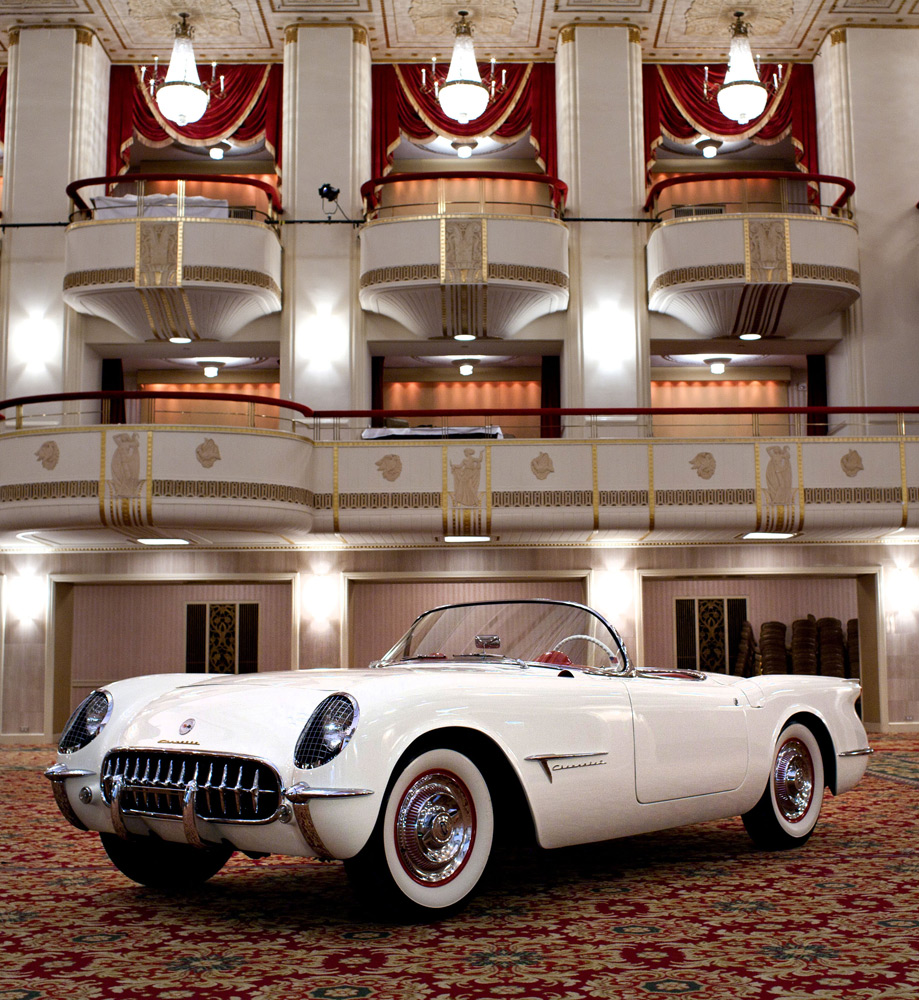
EX-122 reminds us that every icon begins as a risk. Before the accolades, before the racing history, before the generational loyalty, there was a moment when a handful of people chose to build something that did not yet have permission to exist. They protected the idea, shaped it in secret, engineered it under pressure, named it with care, and placed it before the public with the hope that people would understand what Chevrolet was trying to say.
They did.
The 1953 EX-122 Corvette Concept was not a footnote in Corvette history. It was the spark. The beginning of the argument. The proof that a bold idea, placed in the right hands at the right moment, could become something far greater than anyone in that Motorama hall could have fully imagined.
EX-122 was the first chapter in a legend.