
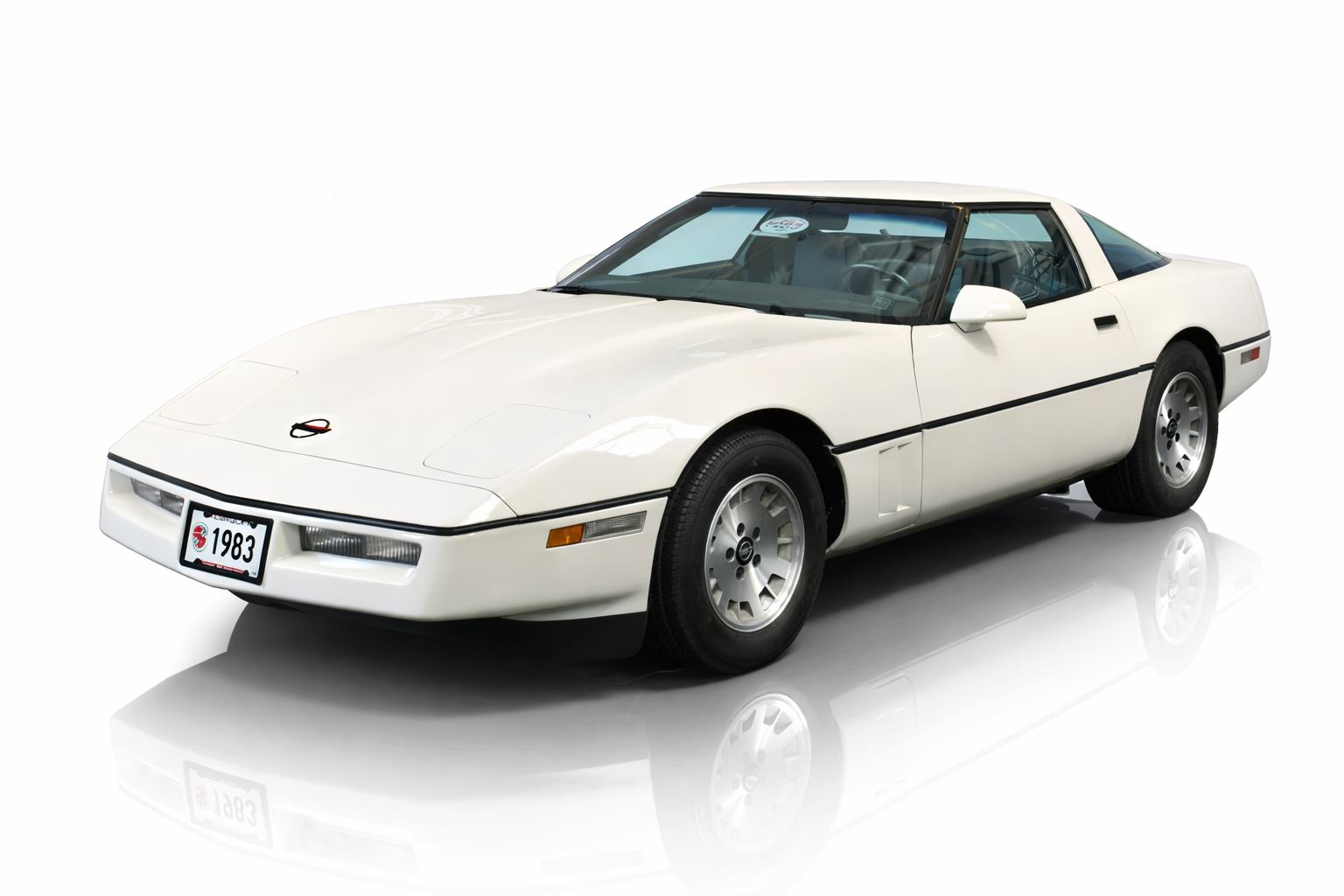
Since its inception nearly forty years ago, the 1983 Corvette has remained surrounded by mystique and intrigue within the Corvette community. Some enthusiasts have even questioned whether a 1983 model ever truly existed, fueling rumors that Chevrolet skipped the model year altogether. Theories abound, ranging from production delays at GM’s newly opened Bowling Green Assembly Plant to technical hurdles with the car’s innovative new systems. While these explanations contain elements of truth, the full story is more nuanced.
A Brief History
The development of the fourth-generation Corvette (C4) officially began in 1978-79 under Chief Engineer David McLellan and Chief Designer Jerry Palmer. Their goal was to create a dramatically different Corvette—with improved handling, a sleek aerodynamic profile, and state-of-the-art technology. By April 1980, a prototype was presented to Chevrolet’s Product Policy Group (PPG), which immediately approved it for production.
Over the next two years, the C4 evolved through extensive engineering and testing, benefiting from a robust “prototype program” that accelerated development. GM initially planned to launch the new Corvette as a 1982 model, potentially replacing the C3 that year. However, ongoing challenges—especially related to emissions and drivetrain systems—delayed production.
The new Corvette was unveiled to the public in September 1982 at Riverside International Raceway. Yet, many details remained uncertain, including pricing, production start dates, and even the model year designation: would it be a 1983 or 1984 Corvette?
Why No 1983 Production Model?
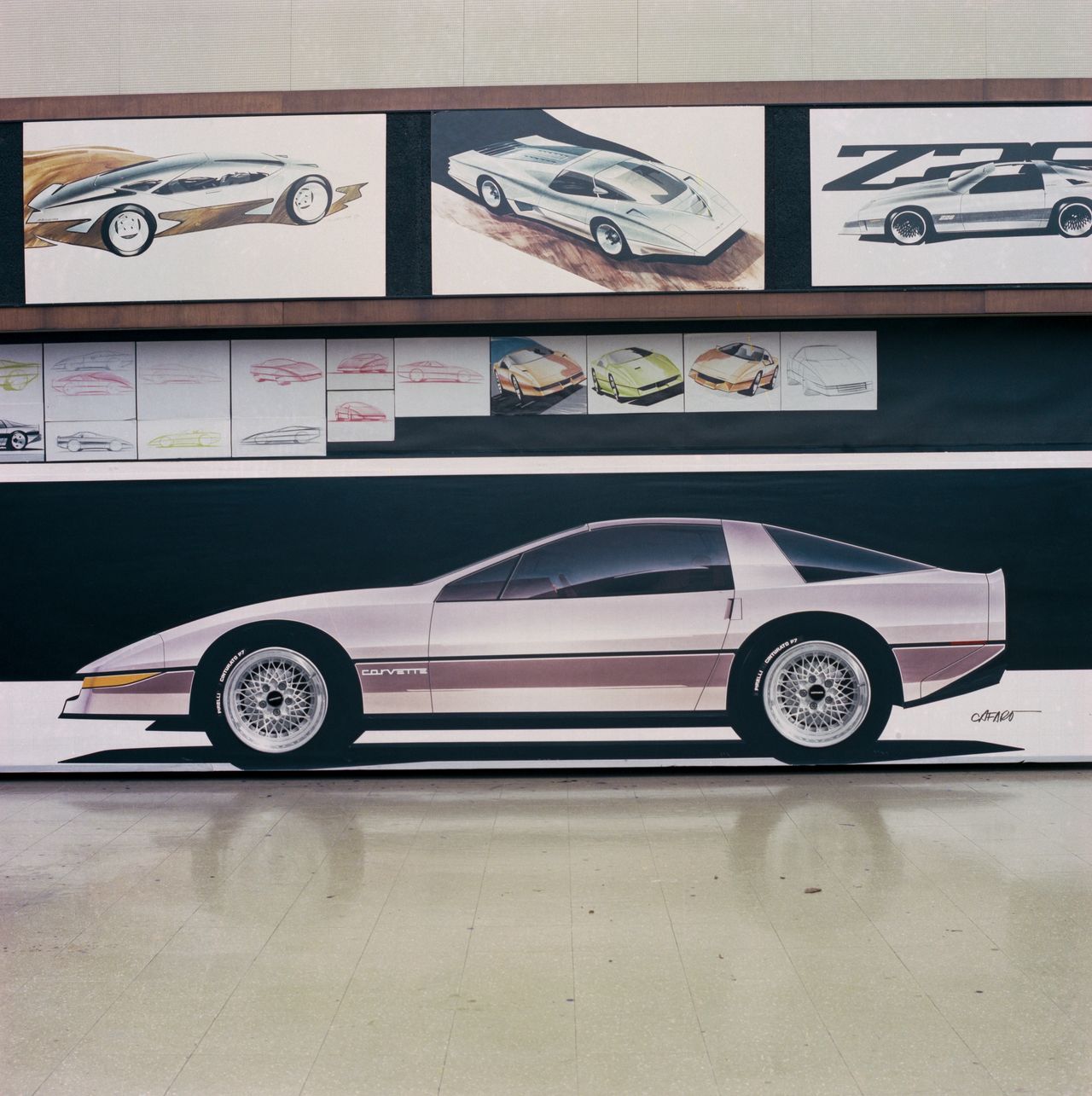
Initially, Chevrolet planned for a 1983 launch. However, the U.S. federal government introduced more stringent exhaust and emissions regulations effective January 1, 1983. GM was already testing the new Corvette’s emission systems when these standards were announced. Meeting the new requirements required additional development time, prompting GM to postpone full-scale production until 1984 to ensure compliance.
Delaying production had several benefits:
- It allowed the Corvette to be certified under the 1984 emission standards, avoiding costly dual certification.
- It provided engineers extra time to refine critical systems, prioritizing quality and performance over rushing to market.
- It aligned production with the start of the calendar year, simplifying logistics and compliance.
Despite the production delay, Chevrolet built a limited number of 1983 Corvettes—around 14 engineering test mules and 43 pilot (pre-production) cars—each assigned a unique 1983 VIN. These vehicles were used for rigorous testing, validation, and public relations, but none were sold to the public.
The 1983 Corvette: The “One and Only”
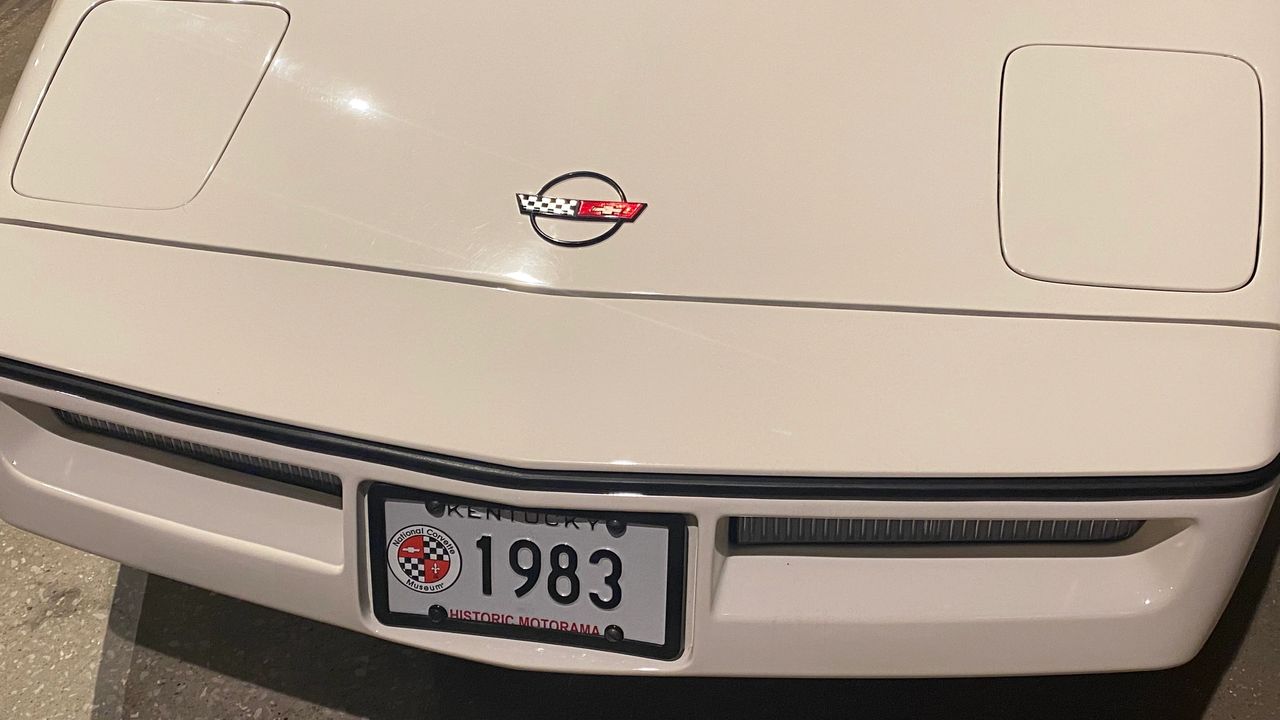
Forty-three of these 1983 pilot Corvettes rolled off the Bowling Green Assembly Plant production line as part of a pilot program designed to streamline production of the upcoming fourth-generation model. Each was assigned a unique Vehicle Identification Number (VIN) and prepped for transportation. The “one and only” 1983 Corvette, VIN 1G1AY0783D5110023, was dispatched to GM’s Milford Proving Grounds for additional shakedown and testing by the Corvette engineering and design teams. Upon completion, like its counterparts, it was scheduled to be returned to Bowling Green and destroyed.
What happened next has become a legendary story within Corvette lore, with two popular accounts explaining how this unique Corvette escaped destruction.
A New Pair of Boots
General Motors reportedly rented a mobile crusher to demolish the 1983 test mules and pilot cars upon their return to Bowling Green. As the systematic destruction of these cars commenced, a sudden torrential downpour soaked southern Kentucky. The facilities engineer overseeing the operation halted work, concerned about the weather and, notably, his brand-new, expensive cowboy boots getting soaked. Allegedly, all but one car had already been crushed when he decided to delay destroying the last vehicle until fairer weather.
When operations resumed the following day, the mobile crusher was gone. Management, assuming that the 43 Corvettes had been fully destroyed, had the crusher picked up and removed from the premises. Fearing repercussions for the oversight, the engineer notified his superiors of the remaining Corvette and the absent crusher. The “one and only” 1983 Corvette was quietly relocated to the backlot of the plant and left abandoned—only to be rediscovered a year later by Bowling Green’s then-new plant general manager, Paul Schnoes.
The Covert Rescue Mission
An alternative version of the events leading to the preservation of a single 1983 Corvette exists, and it’s a story that has been passed down from generation to generation, repeated over the years by plant insiders and Corvette historians. Faced with the imminent disposal of the remaining 1983 cars, a small group of Bowling Green Assembly Plant employees allegedly moved one unit to a remote backlot area and covered it, effectively removing it from the normal line of sight. It wasn’t a brazen theft or a paperwork rebellion—it was a strategic act of delay. “Out of sight, out of mind” was the operating principle.
The emotional context matters. 1983 marked Corvette’s 30th anniversary. For many inside the plant, the idea that there would be no commemorative production model—no official car wearing a 1983 VIN to mark three decades of America’s sports car—felt wrong. The C4 represented a monumental leap forward in chassis rigidity, aerodynamics, and electronics. To let the transitional year vanish entirely seemed, to some, like erasing a chapter of the story.
What Happened Next
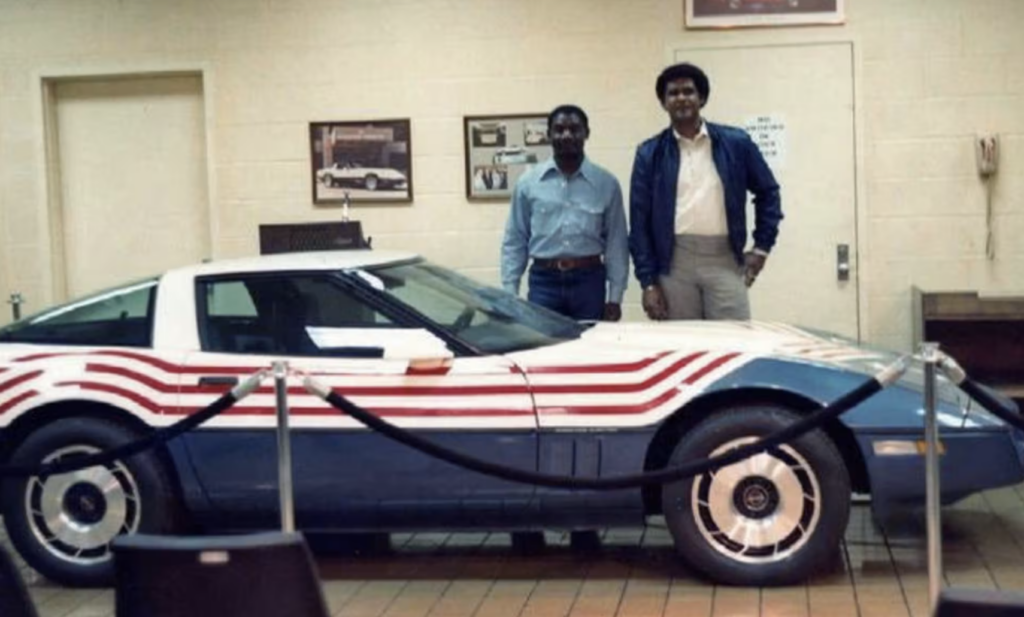
Regardless of which version of the rescue story is ultimately the most accurate, the outcome is undisputed: the “one and only” 1983 Corvette avoided destruction and lived on at the Bowling Green Assembly Plant for nearly a decade. Rather than disappearing into a warehouse or being treated like an inconvenient prototype, it became something far more visible—a living reminder of the model year that never made it to showrooms. In the years immediately after the 1984 launch, the car remained on-site, close to the people who built Corvettes every day and understood exactly what made this one so unusual.
During its time at the plant, the Corvette was transformed into a display piece with a distinctive stars-and-stripes paint scheme, a patriotic livery that turned the “missing year” into a rolling celebration of the brand’s identity. It also received 16-inch directional wheels from the 1984 model year, a subtle but telling update that visually connected the 1983 pilot car to the production C4 that followed. The result was a car that looked less like an orphaned prototype and more like an official emblem—something meant to be seen, recognized, and talked about.
From 1984 through 1994, the surviving 1983 Corvette served as a familiar fixture at the plant, proudly displayed near the entrance where employees and visitors could see it as they came and went. In that role, it became more than a curiosity—it became a mascot. For the Bowling Green workforce, it represented both a point of pride and a kind of shared inside knowledge: a Corvette that existed outside the normal rules, preserved not because it was sold, but because it mattered.
When the National Corvette Museum prepared for its grand opening on September 2, 1994, the car’s significance finally received a permanent home. In celebration of that moment, the “one and only” 1983 Corvette was donated to the Museum, ensuring it would be preserved and interpreted as history rather than kept as a plant artifact. As part of that transition, the car was restored to its original white exterior, and its original 15-inch wheels were reinstalled, returning it to the configuration that defined it as an authentic 1983 pilot Corvette. Today, displayed as a centerpiece of the NCM collection, it stands as a tangible link between the end of the C3 era, the launch of the C4, and the rare circumstances that created Corvette’s most famous “missing” model year.
Form Versus Function: The Engineering Marvel of the 1983 Corvette
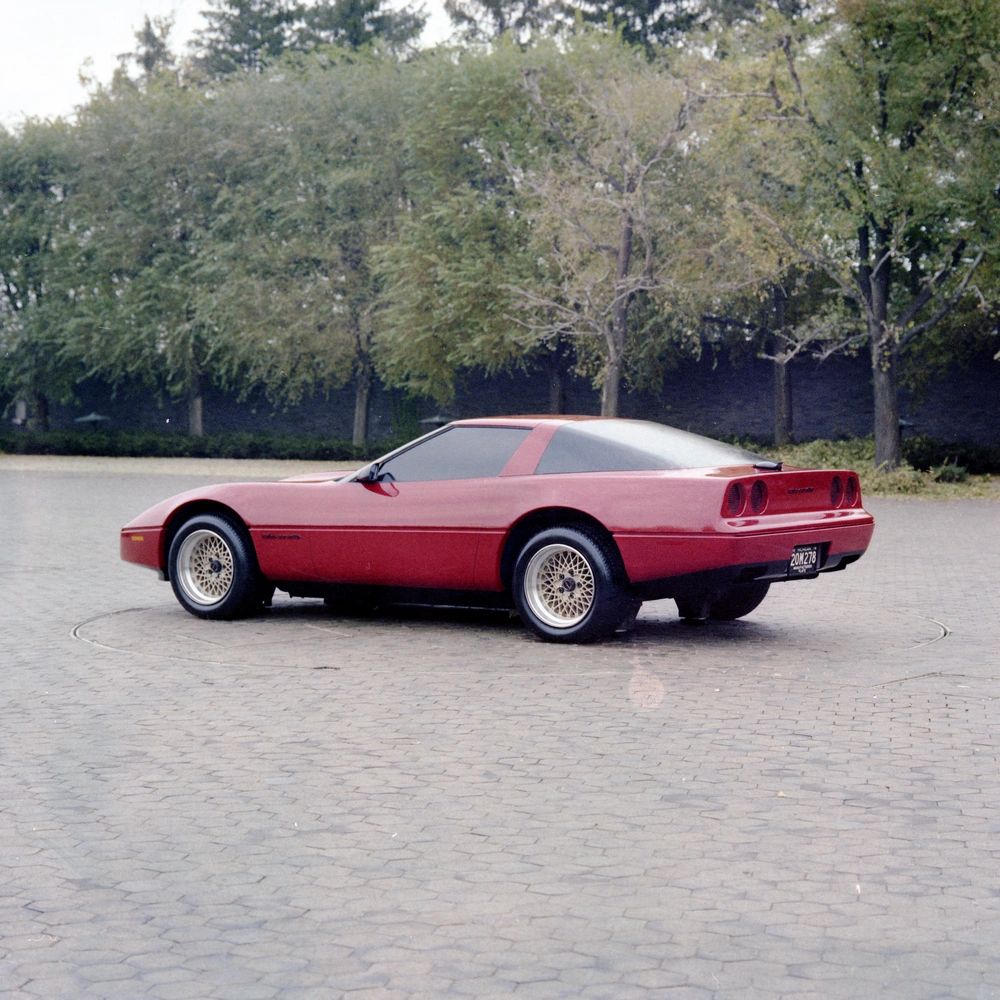
The 1983 Corvette was the first in the brand’s history to embrace the principle that “form follows function” in nearly every major design aspect. Its drag coefficient (Cd) of 0.341 was a record low for a Corvette at the time, achieved through extensive wind tunnel testing and aerodynamic refinement.
Key aerodynamic features included:
- A sharply raked windshield angled at 64.7 degrees—the most acute of any production vehicle from that era.
- Pop-up headlights that rotated backward to reduce drag.
- Aerodynamically shaped side mirrors.
- Frameless rear hatch glass, which also served as the rear window.
- Minimal exterior trim and body-side moldings to reduce airflow disturbances.
These features combined to reduce drag and wind noise, delivering a smooth, stable ride at high speeds—even with the removable one-piece roof panel installed.
To improve handling, the C4 introduced a lightweight, rigid uniframe chassis that greatly reduced flex during aggressive cornering. The suspension system was completely redesigned:
- Front suspension used a transverse fiberglass composite monoleaf spring replacing traditional coil springs.
- Forged aluminum unequal-length control arms and steering knuckles reduced unsprung weight.
- Rear suspension featured a similar transverse fiberglass spring paired with a five-link independent setup using aluminum trailing arms and tie rods.
These innovations delivered exceptional agility, steering precision, and road feel.
The “Heartbeat” of the 1983 Corvette
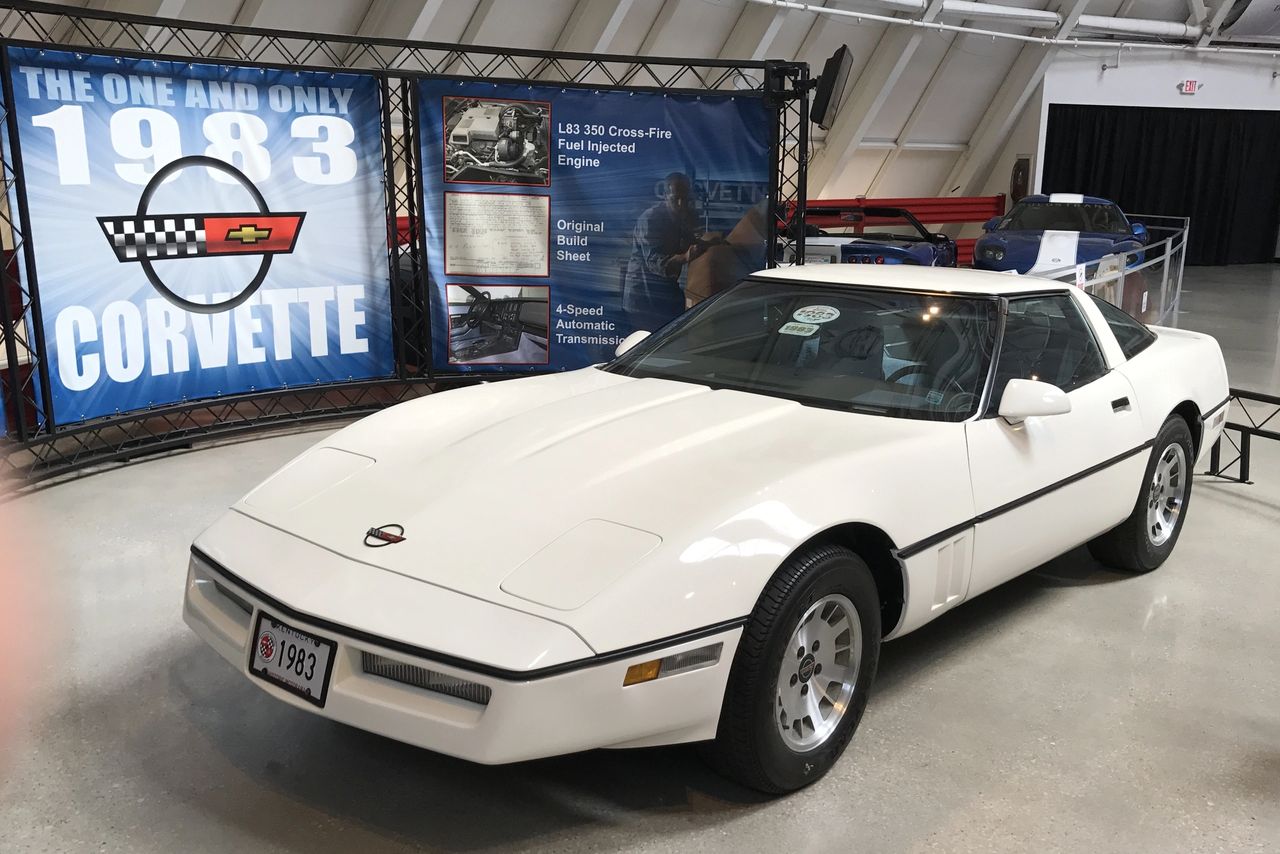
The 1983 Corvette featured a unique front clamshell hood design—a single piece that opened forward, giving unobstructed access to the engine and front suspension.
Power came exclusively from the new 5.7-liter (350 cubic inch) L83 V8 engine equipped with Cross-Fire fuel injection—a twin throttle-body system first introduced in the 1982 Corvette. Though the L83 produced a modest 200 horsepower (due to tightening emissions regulations), it was advanced for its time and perfectly matched to the car’s sophisticated chassis.
The engine was mated to a 4-speed automatic transmission with overdrive. Although a 4-speed manual with an automatic overdrive unit—the Doug Nash 4+3 transmission—was engineered, it was not offered until 1984.
A 3.31:1 rear axle ratio balanced acceleration and highway cruising. Performance testing showed the 1983 Corvette could accelerate from 0 to 60 mph in under seven seconds, with a top speed near 140 mph.
Tire development was a close collaboration with Goodyear, resulting in special 15-inch Eagle VR tires designed with “natural path” tread patterns derived from Formula 1 rain tire technology. These P215/65R15 tires offered outstanding grip and handling balance. For 1984, a 16-inch tire option was introduced.
Braking was handled by Gridlok four-wheel disc brakes with aluminum calipers, providing strong and fade-resistant stopping power.
The car’s curb weight was approximately 3,192 pounds—lighter than the outgoing 1982 model—while overall dimensions shifted to a lower (46.7 inches tall), wider (71 inches), and shorter (176.5 inches) footprint, enhancing its sporty stance and handling.
A “Successful Failure”
The 1983 Corvette stands as a fascinating “what could have been” in Corvette history—a car born of cutting-edge engineering and bold design, but delayed by external factors beyond GM’s control. Though it never reached full production, the 1983 Corvette exemplifies General Motors’ philosophy of “getting it right over simply getting it done,” setting the stage for the enduring success of the C4 Corvette starting in 1984.
Why the 1983 Corvette Still Matters Today
The 1983 Corvette matters because it represents the most dramatic reset in the model’s history. It wasn’t a styling refresh or a mid-cycle update—it was the bridge between two entirely different philosophies. The C3 bowed out after fifteen years, and the C4 was poised to redefine Corvette with new aerodynamics, digital instrumentation, and a far more rigid chassis. The 1983 pilot cars sit precisely at that fault line, capturing the moment when Corvette engineering pivoted toward modern performance.
It also matters because it’s a case study in discipline. Rather than rush an unfinished product to market, Chevrolet absorbed the embarrassment of skipping a model year. Quality, refinement, and regulatory readiness took precedence over calendar optics. That decision ultimately benefited the 1984 launch and reinforced a principle that still echoes today: Corvette would rather delay than compromise.
And then there’s the singular survivor. With only one 1983 Corvette preserved, the car has become less a prototype and more a physical artifact of transition. It reminds us that automotive history isn’t always defined by what was sold—it’s often shaped by what was corrected, refined, and, in this case, withheld. The 1983 Corvette still matters because it proves that even an “absent” model year can leave a lasting mark.