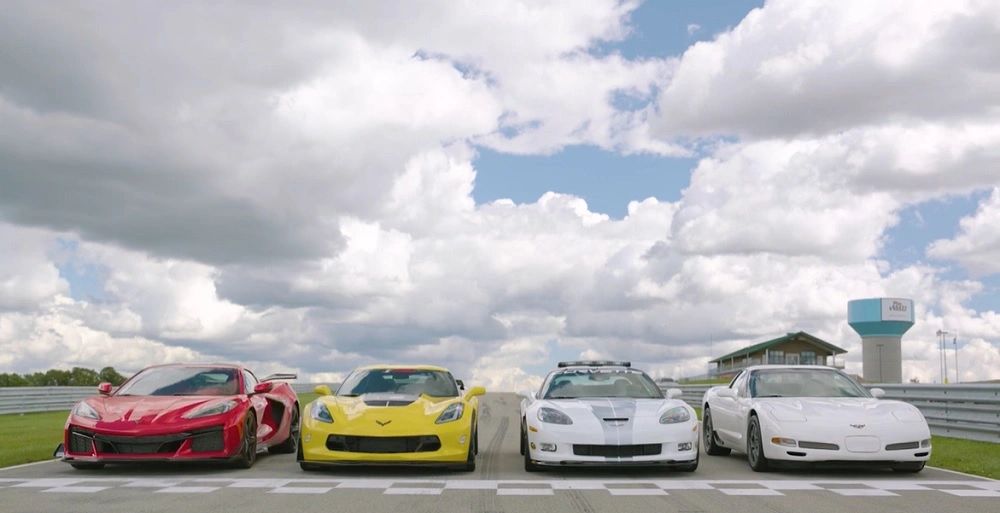
Tag: David Hill

  • 2001 Corvette Overview: The Year the C5 Became a Legend

    2001 Corvette Overview: The Year the C5 Became a Legend

    The 2001 Chevrolet Corvette arrived at a pivotal moment in the history of America’s Sports Car.

    When the fifth-generation Corvette debuted for 1997, it represented one of the most comprehensive reinventions the nameplate had ever undergone. The C5 introduced an all-new hydroformed perimeter frame, a rear-mounted transaxle, a substantially stiffer structure, a more aerodynamic body, and the aluminum LS1 V8. It was faster, more comfortable, more practical, and more capable than the C4 it replaced. More importantly, it gave Chevrolet a genuinely modern foundation upon which the Corvette could grow.

    Over the next several years, Chevrolet methodically expanded that foundation. The convertible returned for 1998. The Fixed Roof Coupe followed in 1999, giving performance-minded buyers a lighter, stiffer alternative to the removable-roof hatchback coupe. Corvette Racing began campaigning the purpose-built C5-R at the highest levels of international endurance racing. Each of these developments moved the Corvette closer to becoming more than just a single sports car.

    By 2001, those individual pieces finally began to converge.

    Corvette Racing’s No. 2 Chevrolet Corvette C5-R claimed an historic overall victory at the 2001 Rolex 24 at Daytona
    Corvette Racing’s No. 2 Chevrolet Corvette C5-R claimed an historic overall victory at the 2001 Rolex 24 at Daytona, with Ron Fellows, Johnny O’Connell, Franck Fréon, and Chris Kneifel sharing the driving duties. Competing in the GTS class, the Corvette outlasted the entire field through relentless rain that flooded the cockpit and forced crews to drill drainage holes through the floorboards. The sister No. 3 Corvette, driven by Dale Earnhardt Sr., Dale Earnhardt Jr., Andy Pilgrim, and Kelly Collins, finished an impressive fourth overall—completing one of the most memorable weekends in Corvette Racing history. (Image credit: Richard Prince Photography)

    The standard coupe and convertible received more power, substantially more low-speed torque, better drivability, improved fuel economy, a stronger driveline, and a more sophisticated Active Handling system. The Fixed Roof Coupe was transformed into the all-new Z06, reviving one of the most significant option codes in Corvette history. On the racetrack, the C5-R won the Rolex 24 at Daytona overall, delivered Corvette Racing’s first factory class victory at the 24 Hours of Le Mans, and secured the program’s first American Le Mans Series team and manufacturer championships.

    Meanwhile, inside General Motors, the earliest work on the sixth-generation Corvette was already underway. Engineers and designers were studying everything the C5 had accomplished—and every area where it could still be improved. Lessons from the road-going Corvette, the Z06, and the C5-R would influence the direction of the C6 and eventually help create a much closer relationship between Chevrolet’s production and racing programs.

    The 2001 Corvette was therefore more than another annual update. It was the year the C5 matured into a complete family of performance cars, the year Corvette Racing established itself as a legitimate international force, and the year Chevrolet demonstrated that the Corvette could challenge the world without abandoning the qualities that had always made it uniquely American.

    It was the moment the fifth-generation Corvette moved beyond proving itself and began laying the foundation for a dynasty.

    The C5 Reaches Maturity

    2001 C5 Corvette Z06 three dimensional schematic.

    The culmination of product quality rarely happens overnight. By 2001, the C5 Corvette had benefited from four years of continual refinement, with Chevrolet steadily improving its structure, performance, comfort, and overall execution. The arrival of the Z06 represented the clearest expression of that evolution—a lighter, sharper, more purposeful Corvette that transformed the already accomplished C5 into one of the most capable American performance cars of its era.

    By the beginning of the 2001 model year, the C5 Corvette had already answered many of the questions that surrounded its launch.

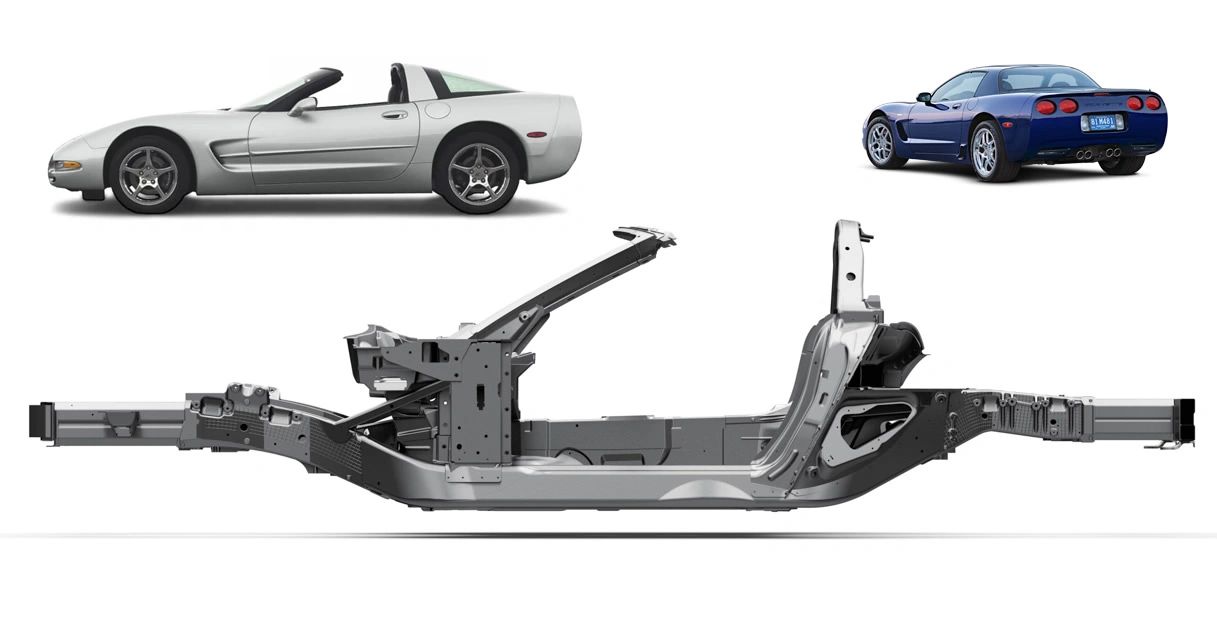
    The completely redesigned 1997 coupe had demonstrated that Chevrolet could produce a Corvette with world-class structural rigidity, weight distribution, ride quality, braking, and high-speed stability. Its rear-mounted transaxle helped create a near-balanced mass distribution, while the hydroformed frame rails and one-piece composite floor structure delivered a level of solidity that earlier generations had struggled to achieve.

    The LS1 engine had also begun establishing the reputation that would eventually make the third-generation small-block one of General Motors’ most celebrated powertrain families. With an aluminum block and cylinder heads, deep-skirt construction, six-bolt main bearing caps, coil-near-plug ignition, and sequential fuel injection, the LS1 retained the compact external dimensions and pushrod simplicity associated with the Chevrolet small-block while introducing an entirely new level of efficiency and durability.

    The C5 was not perfect. Its interior materials remained a common target of criticism; its seats did not provide the lateral support many serious drivers wanted; and some enthusiasts viewed its styling as too restrained compared with the more flamboyant Corvettes of the past. The base car’s extended-mobility tires also contributed to road noise and ride harshness, while the early Active Handling system could feel intrusive when a capable driver began pressing the car near its limits.

    Even so, the C5’s fundamental engineering was exceptionally sound. Chevrolet did not need to begin again. The team could concentrate on refining the existing car, expanding its capabilities, and correcting the smaller shortcomings that became apparent through customer feedback, performance testing, and competition.

    That distinction is important. The 2001 Corvette was not the result of one dramatic redesign. It was the product of continuous development—hundreds of individual improvements working together to make an already accomplished automobile faster, safer, more durable, and easier to live with.

    Dave Hill, Corvette’s chief engineer, summarized the approach when Chevrolet announced the 2001 lineup: “We’ve expanded the envelope in every direction, especially with the new Z06.”

    A Three-Car Corvette Family

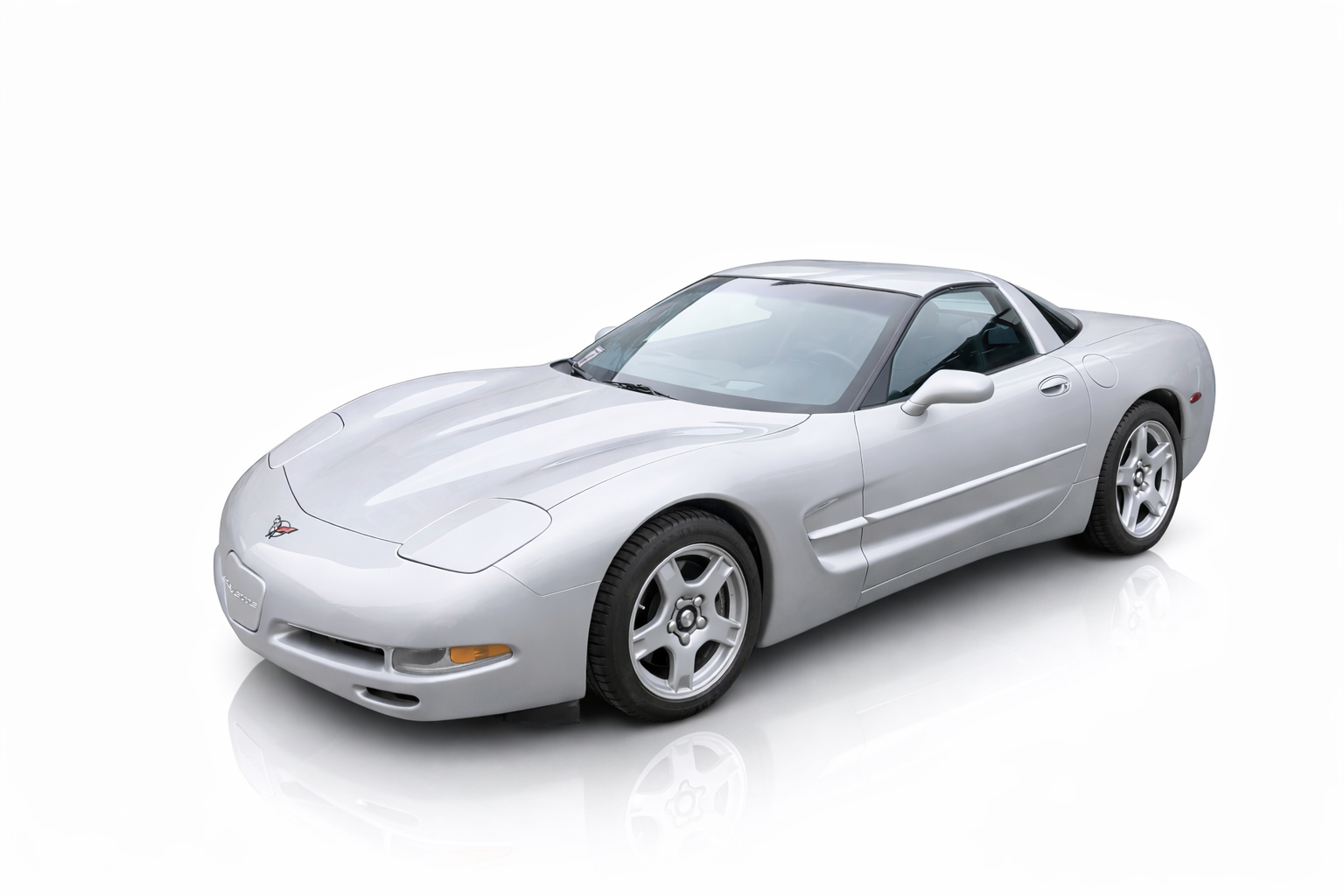
    The 2001 Corvette Coupe (silver), convertible (red), and Z06 coupe (yellow).
    For 2001, Chevrolet offered the Corvette in three distinct forms: the versatile hatchback coupe, the open-air convertible, and the new performance-focused Z06. Four years after the C5’s introduction, the platform had matured into the fully realized sports car GM had envisioned, combining refined styling, everyday usability, advanced engineering, and formidable performance. With the arrival of the 385-horsepower LS6-powered Z06, the 2001 lineup demonstrated the C5’s remarkable breadth—from comfortable grand tourer to genuine track-ready contender. (Image credit: GM Media LLC.)

    The 2001 Corvette lineup consisted of three distinct models, each built around a different interpretation of the sports-car experience.

    The removable-roof coupe remained the most versatile member of the family. Its large rear hatch, expansive cargo area, removable roof panel, and broad range of available equipment made it equally suitable for cross-country touring, daily driving, or an occasional weekend at the track. It was the Corvette for buyers who wanted performance without sacrificing the C5’s considerable practicality.

    The convertible offered much of the same mechanical capability with the added appeal of open-air driving. Unlike many convertibles of the era, it had been engineered alongside the coupe rather than derived from it as an afterthought. The C5’s strong central structure allowed Chevrolet to build the convertible without the excessive structural reinforcement that often added significant mass to competing roadsters.

    For 2001, Chevrolet revised the convertible top to improve sealing, reduce wind and road noise, and create a smoother appearance when raised. The car retained its conventional rear trunk, a feature that had returned to the Corvette with the C5 convertible after being absent from the model line since 1962.

    At the top of the range stood the new Z06. It used the basic fixed-roof body introduced for 1999, but almost every major mechanical system had been revised around a more focused mission. The Z06 was not intended to be the most luxurious Corvette, the most comfortable Corvette, or the most broadly appealing Corvette.

    It was engineered to be the fastest production Corvette Chevrolet had ever offered.

    The Significance of the Fixed Roof Coupe (FRC)

    2000 Corvette FRC
    The 1999–2000 Corvette Fixed Roof Coupe was the purest expression of the early C5—lighter, structurally stiffer, and more focused than the standard hatchback coupe. Originally positioned as a lower-cost performance model, the FRC ultimately became the foundation for the 2001 Corvette Z06, making it one of the most important transitional models in modern Corvette history.

    The Fixed Roof Coupe is sometimes treated as little more than the body style Chevrolet used when creating the Z06. In reality, it was one of the most important steps in the C5’s evolution.

    Chevrolet introduced the FRC for the 1999 model year as a lower-cost, lighter alternative to the hatchback coupe and convertible. Instead of the coupe’s removable roof and lift-up rear glass, the FRC used a permanently bonded roof panel, a conventional rear window, and a separate decklid that opened into a traditional trunk.

    Those changes produced the stiffest body structure in the Corvette lineup. Removing the large hatch opening and permanently closing the roof allowed the structure to resist twisting more effectively, creating a more stable platform for suspension tuning. The FRC was also lighter than the standard coupe and positioned as the most performance-oriented member of the range.

    Its commercial reception was modest. Many Corvette buyers preferred the versatility of the hatchback coupe or the open-air experience of the convertible, especially when the FRC’s lower initial price did not translate into the dramatic performance advantage some customers expected.

    From an engineering perspective, however, the FRC was nearly ideal.

    It offered the strongest C5 structure, the least mass, and the simplest packaging. Chevrolet already had the body it needed for a serious factory performance model. The challenge was no longer determining what shape that car should take.

    The challenge was deciding how far to push it.

    David Hill’s Corvette for the Purist

    Corvette Chief Engineer David Hill next to the 2001 C5 Corvette Z06.
    David Hill was one of the most influential engineering figures in modern Corvette history, guiding the program through a transformative period as the C5 matured into a world-class performance car. During his long career with General Motors, he served as Corvette chief engineer and helped refine the platform’s structure, handling, quality, and overall capability. Hill was also instrumental in creating the C5 Corvette Z06, championing a lighter, stiffer, more focused model built around serious performance. The result established the modern Z06 formula and set the standard for every high-performance Corvette that followed. (Image courtesy of GM Media LLC. / ChatGPT)

    Dave Hill understood that Corvette buyers did not all want the same automobile—and that attempting to satisfy every customer with a single configuration would inevitably compromise the car for everyone.

    Some buyers wanted a fast, refined grand tourer that could be enjoyed every day. They valued the removable roof panel, the convenience of an automatic transmission, a premium audio system, a compliant ride, and the long-distance comfort that made the standard C5 remarkably easy to live with. For these customers, the Corvette’s appeal came from its ability to deliver serious performance without demanding that every drive feel like a qualifying lap. They represented an essential part of the Corvette market, and Chevrolet had no intention of abandoning them.

    Hill also recognized that another group wanted something more concentrated. These customers were prepared to accept a firmer ride, greater road and exhaust noise, fewer body-style choices, and less day-to-day flexibility in exchange for quicker acceleration, sharper turn-in, greater grip, and more consistent behavior during sustained high-performance driving. They were not looking for additional luxury or a broader range of options. They wanted every meaningful component of the car to contribute to speed, control, durability, or driver confidence.

    They did not want a Corvette that merely looked fast.

    They wanted one engineered around the assumption that it would be driven hard—and driven hard repeatedly.

    That distinction mattered. A car capable of producing an impressive acceleration figure or generating strong cornering numbers during a brief test was not necessarily prepared for the prolonged thermal, mechanical, and dynamic demands of serious performance driving. The purist buyer wanted a Corvette that remained composed as speeds increased, that communicated clearly through the steering and chassis, and that behaved predictably when pushed near its limits. Performance could not be treated as a collection of isolated statistics; it had to define the character of the entire automobile.

    2001 C5 Corvette Convertible (left), Coupe (right), and Z06 Coupe models on display in a grassy field.
    For 2001, Chevrolet engineered each Corvette body style around a distinct kind of driver. The coupe offered the broadest balance of performance, comfort, cargo space, and open-air enjoyment through its removable roof panel, making it the most versatile choice in the lineup. The convertible emphasized style, refinement, and the experience of top-down grand touring without sacrificing the C5’s underlying speed and capability. The Z06, by contrast, was created for the enthusiast willing to trade some comfort and flexibility for lower weight, sharper responses, greater grip, and a more direct connection to the road. Together, the three models demonstrated how the same basic C5 architecture could support three very different interpretations of the Corvette experience.

    Rather than force every Corvette to satisfy both audiences, Chevrolet used the fixed-roof platform to separate the two missions. The coupe and convertible continued to evolve as exceptionally fast, comfortable grand-touring cars, preserving the versatility and refinement that had broadened the C5’s appeal. The Z06 would occupy a more specialized position: a purist’s Corvette in which nearly every significant engineering decision supported acceleration, handling, durability, reduced weight, or improved response.

    This approach also freed the engineering team from compromises that would have been unavoidable in the standard models. The Z06 did not need to be the quietest Corvette, the softest-riding Corvette, or the Corvette with the broadest menu of comfort and convenience features. It needed to be the most focused. Its value would come not from offering more of everything, but from removing distractions and concentrating the C5 architecture around a clearly defined performance objective.

    That clarity of purpose became one of the Z06’s greatest strengths. It gave the car a distinct identity within the Corvette lineup rather than allowing it to become merely a more powerful trim level. The Z06 was intended to feel different because its priorities were different. It asked more of its driver, but it also delivered a degree of immediacy, precision, and capability that the more broadly focused Corvette models were not designed to provide.

    In doing so, Hill and the Corvette team established a formula Chevrolet would repeat throughout later generations. The standard Corvette would continue to provide extraordinary everyday performance, comfort, and usability, while the Z06 would translate the same fundamental architecture into something more closely aligned with circuit driving and competition. The two models would not undermine one another. Instead, each would become more convincing because Chevrolet had given it a clearly defined mission.

    Reviving the Z06 Name

    The 1963 Corvette Z06 (left) and the 2001 Corvette Z06 (right).
    The 2001 Corvette Z06 was not a reinvention of the name, but the modern continuation of an idea first championed by Zora Arkus-Duntov in 1963. The original Z06 transformed the split-window Sting Ray into a competition-ready machine through purposeful engineering, reduced weight, and track-focused hardware. Nearly four decades later, the C5 Z06 carried that same philosophy forward with more power, sharper handling, and a renewed emphasis on performance above all else. Though separated by generations of technology, both cars were built around the same uncompromising principle: create the most capable Corvette possible, then let the driver discover its limits.

    The Z06 designation had not been selected simply because it sounded suitably technical.

    Its history reached back to 1963, when Zora Arkus-Duntov helped develop a special competition package for the newly introduced Sting Ray. At the time, General Motors remained publicly committed to the Automobile Manufacturers Association’s prohibition on direct factory participation in racing. Duntov nevertheless understood that private competitors would continue taking Corvettes to racetracks across the country.

    The original Z06 package allowed those customers to order many of the necessary competition components through a single regular production option. Depending upon configuration and timing, the package included heavy-duty brakes, a larger front stabilizer bar, stiffer springs and dampers, a large-capacity fuel tank, and other equipment intended for sustained competition.

    Only a small number of 1963 Corvettes were built with the original package, but the Z06 code came to represent something much larger than its production total. It symbolized Duntov’s conviction that a Corvette should be capable of competing directly from the showroom, even when corporate policy prevented Chevrolet from officially placing a racing team behind it.

    Reviving the designation for 2001 connected the new car to that philosophy. The modern Z06 would not be a homologation special in the narrowest sense, nor was it a stripped racing car wearing license plates. It retained air conditioning, leather seating, a Bose audio system, power accessories, and enough civility to function as everyday transportation.

    Its purpose, however, was unmistakable.

    Like the original, it was the Corvette Chevrolet built for owners who intended to explore the outer limits of the car’s performance.

    The LS6: Building a Better Small-Block

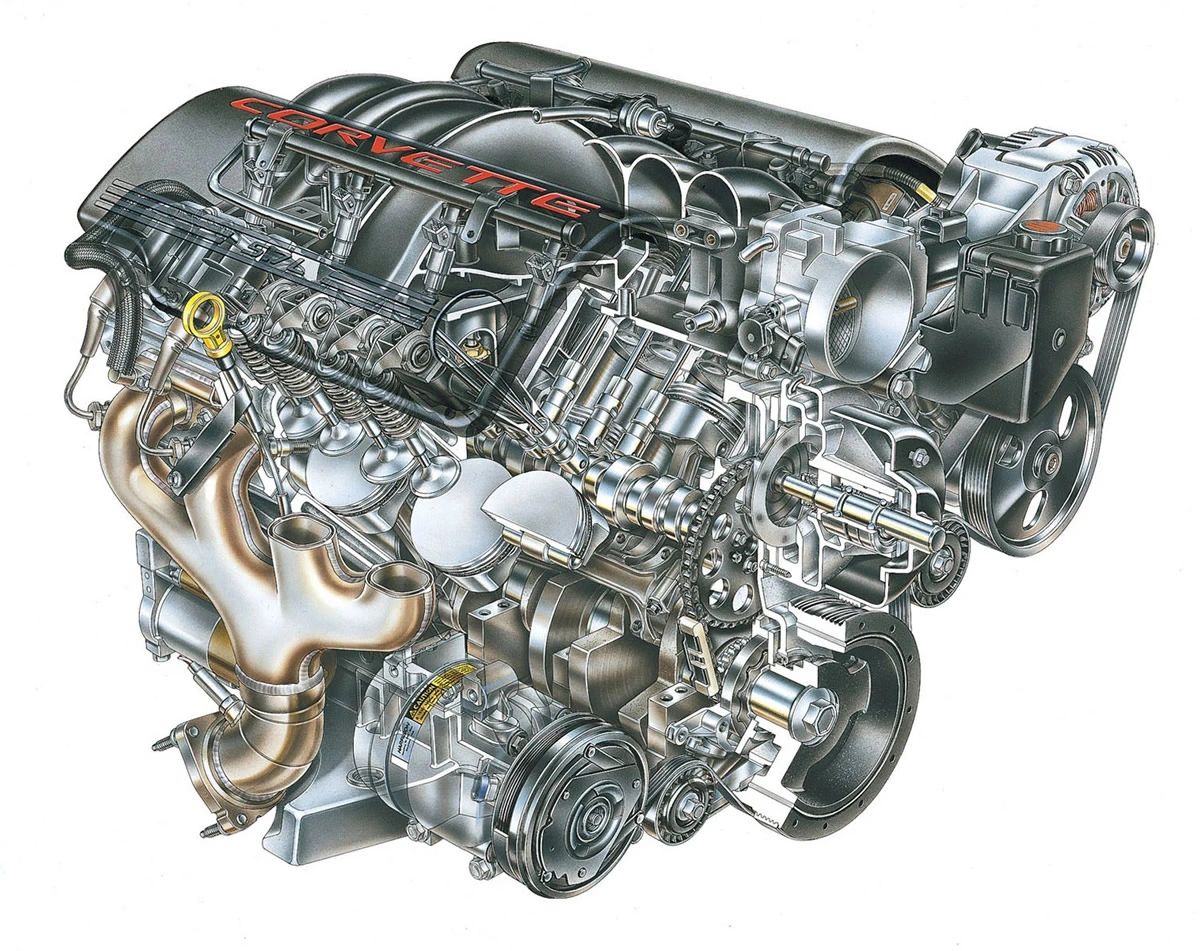
    The 2001 Corvette LS6 5.7-liter V8 engine.
    The 2001 Corvette Z06 introduced the LS6, a high-output evolution of Chevrolet’s aluminum 5.7-liter (346-cubic-inch) small-block V8. With a 10.5:1 compression ratio, higher-flow cylinder heads and intake system, a more aggressive camshaft, stronger valvetrain components, and improved lubrication, it produced 385 horsepower at 6,000 rpm and 385 lb-ft of torque at 4,800 rpm. Paired exclusively with a six-speed manual transmission, the LS6 transformed the lightweight fixed-roof Corvette into the quickest production Corvette offered to that point. Car and Driver recorded 0–60 mph in 4.3 seconds and a 12.7-second quarter-mile at 113 mph, with Chevrolet claiming a top speed of approximately 171 mph. More than a simple upgrade to the LS1, the LS6 gave the revived Z06 the power, durability, and track-focused character its historic designation demanded.

    At the heart of the 2001 Corvette Z06 was the new 5.7-liter LS6 V8.

    The LS6 shared its basic architecture with the LS1, but describing it as little more than a higher-output version of the standard Corvette engine understates the scope of its development. Chevrolet revised the block, pistons, cylinder heads, camshaft, valve springs, fuel injectors, intake system, crankcase ventilation, and exhaust system to create an engine that could produce substantially more power while enduring the sustained heat, speed, and mechanical loads associated with track driving.

    Output reached 385 horsepower at 6,000 rpm and 385 lb-ft of torque at 4,800 rpm—an increase of 35 horsepower and 20 lb-ft over the LS1 installed in the standard Corvette. The redline also increased from the LS1’s 6,000 rpm to 6,500 rpm, giving the LS6 a harder, more urgent upper-range character and allowing the driver to remain in each gear longer under acceleration.

    The LS6 retained the LS1’s lightweight cast-aluminum, deep-skirt block architecture, dry cast-iron cylinder liners, and six-bolt cross-bolted main-bearing caps. Its principal difference was found within the crankcase, where Chevrolet eliminated the LS1’s smaller machined bulkhead openings and incorporated larger cast-in windows between adjacent bays. These passages allowed displaced air to move more freely beneath the pistons, reducing pumping losses and improving the engine’s efficiency during sustained high-rpm operation. (Image credit: GM Media LLC.)

    The aluminum block incorporated cast-in windows between the crankcase bays. As the pistons moved downward, they displaced air within the crankcase, creating resistance beneath the rotating assembly. Allowing that air to move more freely between adjacent bays reduced pumping losses and the parasitic drag working against piston movement, helping the engine operate more efficiently at elevated speeds.

    Chevrolet cast the pistons from a stronger aluminum alloy and reshaped them with a subtle barrel profile. The revised design improved durability during sustained high-load operation while also reducing mechanical noise. Smaller combustion chambers in the cylinder heads raised the compression ratio from 10.1:1 to 10.5:1, while revised intake and exhaust ports allowed the engine to breathe more effectively.

    The 2001 LS6 used a more aggressive steel-billet camshaft—GM part number 12560950—designed to improve cylinder filling and sustain power near the engine’s 6,500-rpm redline. Its lobes produced 0.525 inch of valve lift on both the intake and exhaust sides, with 207 degrees of intake duration and 217 degrees of exhaust duration at 0.050-inch lift, ground on a 116-degree lobe-separation angle. Working with stronger valve springs and the LS6’s higher-flow cylinder heads, the camshaft gave the engine a harder, more urgent upper-rpm character while retaining the drivability expected of a production Corvette. (Image courtesy of EBay)

    A more aggressive steel-billet camshaft increased valve lift and extended the engine’s ability to move air at higher rpm. Stronger valve springs maintained control as the engine approached its elevated redline, while higher-capacity fuel injectors supplied the additional fuel required by the improved airflow. A revised intake manifold, freer-flowing exhaust system, and more effective crankcase ventilation further supported the engine’s increased output and its ability to sustain that performance.

    Individually, none of these changes defined the LS6. Its strength came from the way they functioned as a complete system. The result was an engine that did not simply produce more power than the LS1, but delivered that power with greater urgency, broader capability, and the durability required of a Corvette intended to perform far beyond the street.

    Controlling Oil Under Sustained Cornering

    One of the less glamorous LS6 improvements may also have been one of its most important.

    A high-performance engine must do more than produce a strong number during a brief dynamometer pull. It has to maintain lubrication, crankcase ventilation, temperature control, and oil return while the vehicle is accelerating, braking, and cornering at forces far beyond those encountered in ordinary driving.

    The Z06 was capable of generating approximately one lateral g on suitable pavement. At that level, oil inside the engine no longer behaves as it does during normal straight-line operation. It can collect in areas where it interferes with crankcase ventilation, increases consumption, or reduces the efficiency of oil return from the upper engine.

    Chevrolet relocated the positive crankcase ventilation system to the engine valley, where a unique aluminum valley cover incorporated composite oil-separation baffles and internal PCV passages. The revised arrangement limited the amount of oil drawn into the ventilation system during sustained cornering, reduced external plumbing, and eliminated several potential leak points.

    The cylinder heads were modified to improve oil drainback from the valvetrain area, helping return lubricant to the sump more efficiently during prolonged operation at elevated engine speeds. Although these revisions contributed little to the LS6’s outward appearance or headline specifications, they addressed the less visible challenges associated with maintaining oil control, crankcase ventilation, and mechanical consistency under demanding conditions.

    Together, these changes demonstrated that the LS6 had been developed around more than a peak horsepower figure. Its supporting systems were engineered to preserve performance under the heat, lateral loads, and repeated high-rpm operation encountered during sustained track use.

    A Historic Name, Recast

    1971 Corvette (left) and the 1970 Chevrolet Chevele (right) in front of a General Motors assembly plant.
    The LS6 designation first appeared on Chevrolet’s 454-cubic-inch big-block, most famously in the 1970 Chevelle SS, where it was rated at 450 gross horsepower and 500 lb-ft of torque. Equipped with high-flow rectangular-port cylinder heads, a solid-lifter camshaft, forged internal components, and an 800-cfm Holley carburetor, it became one of the defining engines of the muscle-car era. A revised LS6 appeared in the 1971 Corvette with aluminum cylinder heads and a 425-horsepower rating, giving Chevrolet’s sports car one of its final truly formidable big-block powerplants. Although the 2001 LS6 shared none of that engine’s architecture, Chevrolet revived the name to signal that the new Z06 carried the same uncompromising performance intent into a different era.

    The LS6 designation carried considerable historical weight within Chevrolet.

    It had first identified one of the most formidable engines of the muscle-car era: the 450-horsepower LS6 454 offered in the 1970 Chevelle, followed by a related 425-horsepower version in the 1971 Corvette. The modern LS6 shared no architecture with that earlier big-block, but the return of the name was deliberate.

    Much as the Z06 designation connected the 2001 Corvette to the competition-oriented Sting Ray of 1963, LS6 linked its engine to an earlier period of uncompromising Chevrolet performance. Together, the two names acknowledged that history without allowing the new car to become an exercise in nostalgia.

    The 2001 Z06 did not recreate the past. It advanced the same principle through lighter materials, greater efficiency, more sophisticated engineering, and performance that could be used repeatedly rather than merely advertised.

    The M12 Six-Speed Transmission

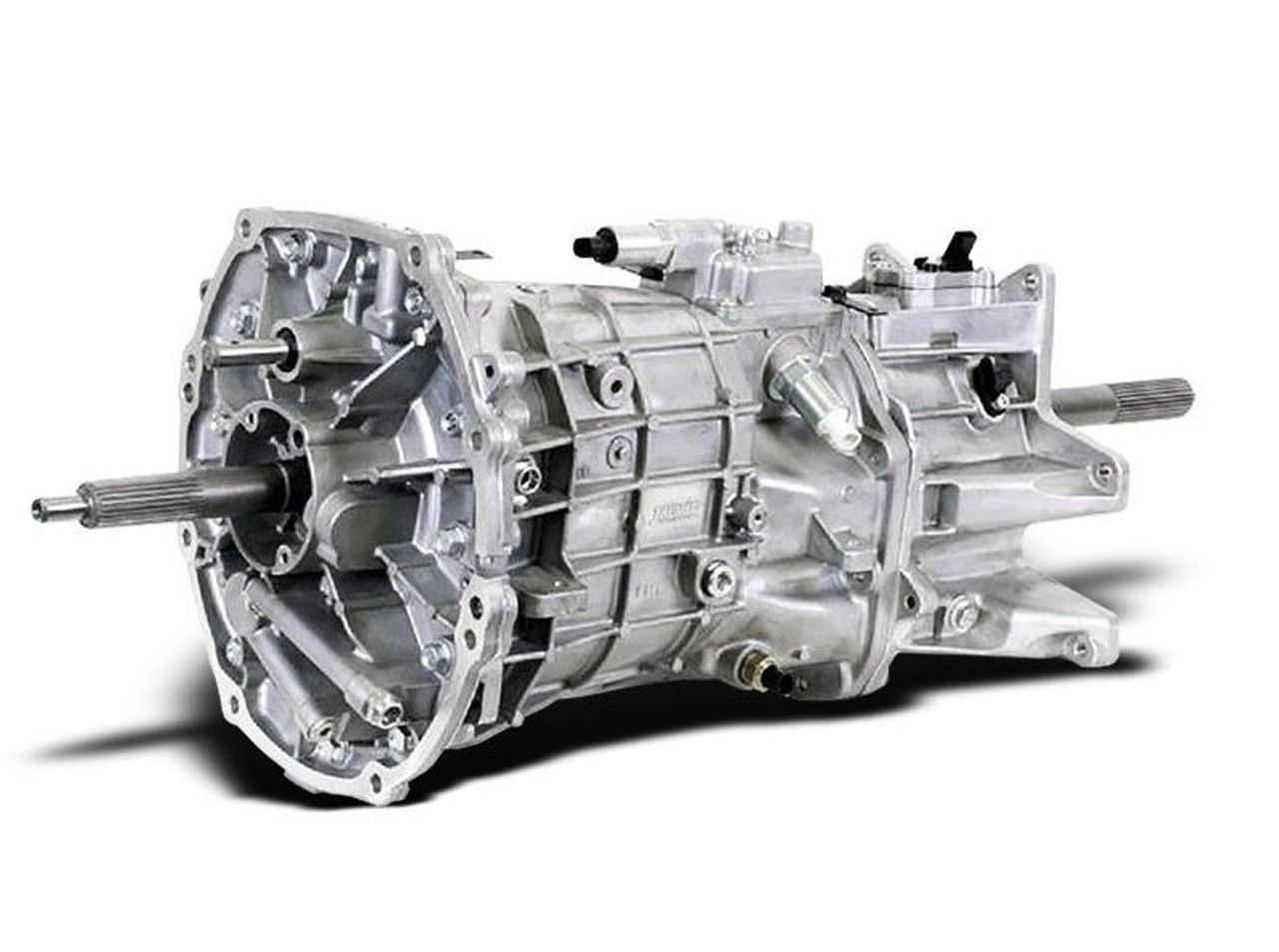
    The 2001 Z06 paired the LS6 exclusively with the M12 six-speed manual transaxle, a revised version of the Corvette’s rear-mounted transmission developed around more aggressive gearing. Ratios of 2.97:1, 2.07:1, and 1.43:1 in the first three gears—compared with 2.66:1, 1.78:1, and 1.30:1 in the standard six-speed—kept the LS6 closer to its strongest operating range during acceleration, while 0.84:1 and 0.56:1 overdrive ratios preserved reasonable highway cruising. Combined with the Corvette’s 3.42:1 final drive, the M12 sharpened the Z06’s response without altering the balanced rear-transaxle layout fundamental to the C5.

    The LS6 was paired exclusively with a new M12 six-speed manual transmission.

    No automatic was available. That decision immediately separated the Z06 from the rest of the Corvette lineup and reinforced the car’s driver-focused mission. Chevrolet was not merely limiting buyer choice for the sake of exclusivity; the M12’s ratios had been selected specifically to exploit the LS6’s power curve.

    First gear increased from the standard MM6 transmission’s 2.66:1 ratio to 2.97:1. Second changed from 1.78:1 to 2.07:1, while third increased from 1.30:1 to 1.43:1. Fourth remained direct at 1.00:1, with fifth and sixth also receiving shorter ratios than those used in the standard manual Corvette.

    The more aggressive gearing increased torque multiplication and kept the LS6 operating closer to the portion of its rev range where it produced the most power. First gear carried the Z06 to approximately 48 mph at redline, while second reached roughly 69 mph. The standard Corvette’s taller gearing produced higher theoretical speeds in the lower gears, but it did not accelerate through them with the same urgency.

    A transmission-temperature sensor monitored thermal loads and could warn the driver through the Driver Information Center if temperatures became excessive. Carbon blocker rings were installed on the forward gears to improve shift quality and durability, and a revised clutch provided greater clamping force with lower pedal effort.

    The larger Corvette driveline also received attention. Chevrolet replaced the earlier metal-matrix composite driveshaft with a stronger 6061-aluminum unit, increasing its diameter from 55 to 63 millimeters. Revised couplings improved durability on manual-transmission cars.

    Once again, the objective was not simply to make the Z06 quicker in a single acceleration test. It was to create a driveline capable of repeatedly managing the LS6’s output.

    Titanium Beneath the Car

    Rear view of a 2001 C5 Z06 Corvette at the south rim of the Grand Canyon, Arizona.
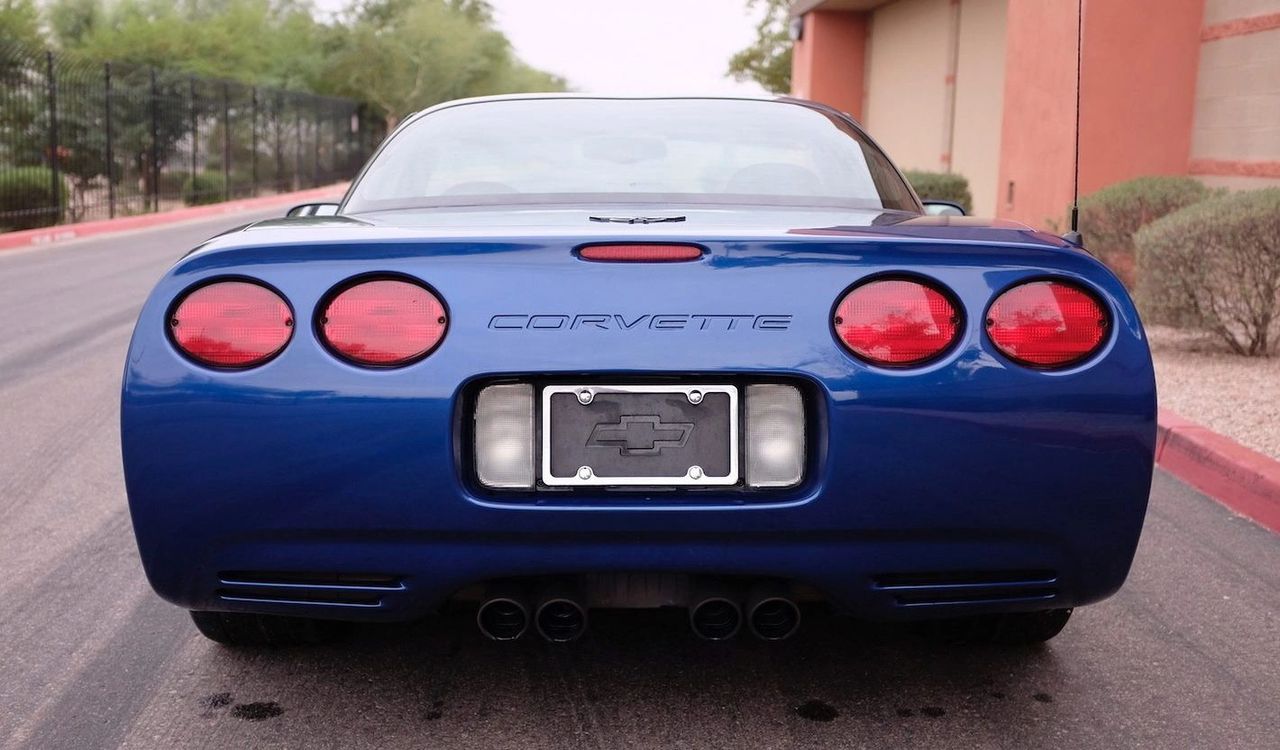
    Although most of the Z06’s titanium exhaust system is concealed in this rear view, it remains one of the car’s most significant engineering features. Beginning ahead of the rear axle and continuing through the mufflers, outlet pipes, and exhaust tips, the assembly was constructed from titanium rather than the stainless steel used beneath the standard coupe and convertible. Chevrolet stated that this was the first production use of a titanium exhaust system in a mass-produced automobile, and the change reduced weight by approximately 17.6 pounds while also allowing larger internal passages for improved flow. The result was an exhaust that did more than save mass: it helped the LS6 breathe more efficiently and gave the 2001 Z06 a sharper, more purposeful voice.

    The Z06’s exhaust system represented one of the most advanced uses of material anywhere in the 2001 Corvette.

    Beginning ahead of the rear axle and continuing through the mufflers, outlet pipes, and exhaust tips, the system was constructed from titanium. Chevrolet described it as the first production use of a titanium exhaust system in a mass-produced automobile.

    Titanium combined exceptional strength with substantially lower density than steel. The Z06 system weighed approximately 17.6 pounds less than the stainless-steel assembly used beneath the coupe and convertible, reducing the weight of that portion of the exhaust by roughly 50 percent.

    Larger internal passages also reduced restriction and backpressure, allowing the LS6 to expel exhaust gases more efficiently. Engineers carefully tuned the mufflers to produce a deeper, more aggressive sound without introducing excessive noise or resonance during ordinary driving.

    The titanium system was not an exercise in exotic materials intended solely to attract attention. It reduced mass, improved exhaust flow, and gave the Z06 a more distinctive character while demonstrating Chevrolet’s willingness to apply costly materials where they delivered a measurable performance advantage.

    A Comprehensive Weight-Reduction Program

    Weight reduction influenced nearly every aspect of the 2001 Z06, beginning with the fixed-roof body visible here. Derived from the earlier C5 hardtop, the configuration eliminated the removable roof panel and large rear hatch of the standard coupe, replacing them with a permanently enclosed roof structure, thinner rear glass, and a conventional trunk opening. The result provided Chevrolet with a lighter, more rigid foundation before engineers removed additional mass through thinner glass, lighter wheels and tires, a compact battery, and the titanium exhaust system. Rather than reducing weight at the expense of refinement or structural integrity, the fixed-roof design allowed the Z06 to become both lighter and more responsive under demanding driving conditions.
    Weight reduction influenced nearly every aspect of the 2001 Z06, beginning with the fixed-roof body visible here. Derived from the earlier C5 hardtop, the configuration eliminated the removable roof panel and large rear hatch of the standard coupe, replacing them with a permanently enclosed roof structure, thinner rear glass, and a conventional trunk opening (not pictured). The result provided Chevrolet with a lighter, more rigid foundation before engineers removed additional mass through thinner glass, lighter wheels and tires, a compact battery, and the titanium exhaust system. Rather than reducing weight at the expense of refinement or structural integrity, the fixed-roof design allowed the Z06 to become both lighter and more responsive under demanding driving conditions. (Image credit: RK Motors / ChatGPT)

    The titanium exhaust formed only one part of the Z06’s weight-reduction strategy.

    Chevrolet installed thinner windshield and rear-window glass, substituted a smaller battery, and eliminated the heavier extended-mobility tires used on the standard coupe and convertible. The fixed roof and conventional trunk already gave the body a structural and mass advantage over the removable-roof hatchback.

    The Goodyear Eagle F1 Supercar tires developed for the Z06 were not run-flat designs. Removing the reinforced sidewall construction required by extended-mobility tires reduced unsprung and rotating mass while improving compliance and grip.

    Because the Z06 carried neither a spare tire nor run-flats, Chevrolet included a sealant-and-inflator kit for roadside punctures. This was an acceptable compromise for the car’s intended customer, even if it reduced the reassurance offered by the standard Corvette’s ability to continue driving after losing tire pressure.

    The completed Z06 weighed approximately 36 pounds less than the outgoing Fixed Roof Coupe and around 117 pounds less than the standard coupe. Depending on the test equipment and published specifications, curb weight generally ranged from 3,115 to 3,130 pounds.

    Paired with 385 horsepower, that produced a power-to-weight ratio of roughly 8.1 pounds per horsepower—better than any previous production Corvette and competitive with far more expensive machinery.

    The significance of the weight program was not the absolute number of pounds removed. It was the engineers who searched throughout the car for reductions that could be achieved without compromising the structure, the powertrain, or the basic usability expected of a production Corvette.

    FE4: A Suspension Unique to the Z06

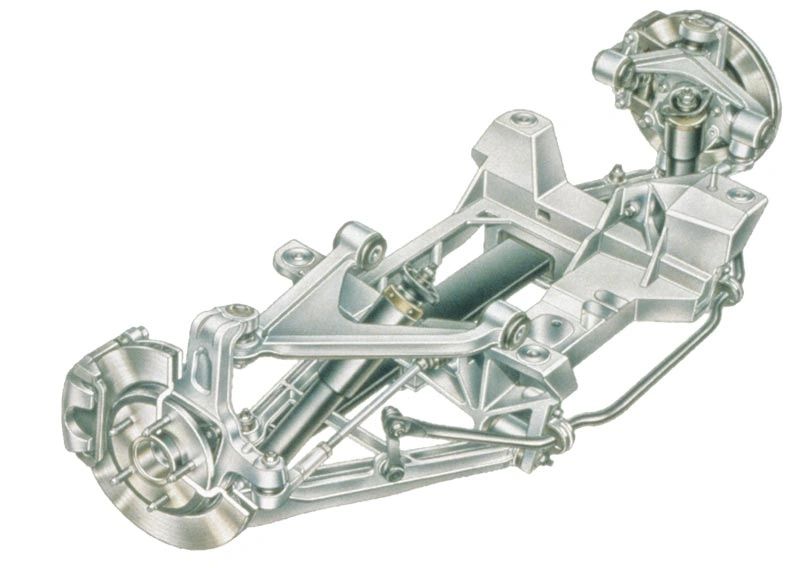
    The 2001 Z06’s FE4 suspension combined firmer spring rates, revised stabilizer bars, and specially calibrated shocks to sharpen turn-in and better control body motion than the standard C5 setup. The result was a more immediate, composed chassis under hard braking and cornering—exactly what Chevrolet needed for its new track-focused Corvette.

    A common historical error is to describe the 2001 Z06 as using the optional Z51 Performance Handling Package found on the coupe and convertible.

    It did not.

    The Z06 received its own FE4 suspension, calibrated specifically around its lower mass, fixed-roof structure, wider tires, and circuit-oriented mission. The package included a larger front stabilizer bar, a stiffer rear transverse composite leaf spring, revised damping, and more aggressive camber settings.

    The additional negative camber helped keep the tires’ contact patches flatter as the body rolled during cornering. This improved grip and made the car’s responses more consistent near the limit, although it could also contribute to more pronounced tire wear when the car was used primarily for straight-line highway driving.

    The suspension was firmer than the standard FE1 setup and less forgiving over broken pavement. Chevrolet did not attempt to disguise that tradeoff. The Z06 was supposed to communicate more road texture and resist body movement more aggressively.

    Even so, the car remained remarkably usable. Period testers consistently noted that the ride was firm without becoming punishing and that the Z06 retained the C5’s long-distance stability. It did not behave like a racing car reluctantly adapted for the street.

    It behaved like a road car whose priorities had been rearranged around performance.

    Goodyear Eagle F1 Supercar Tires

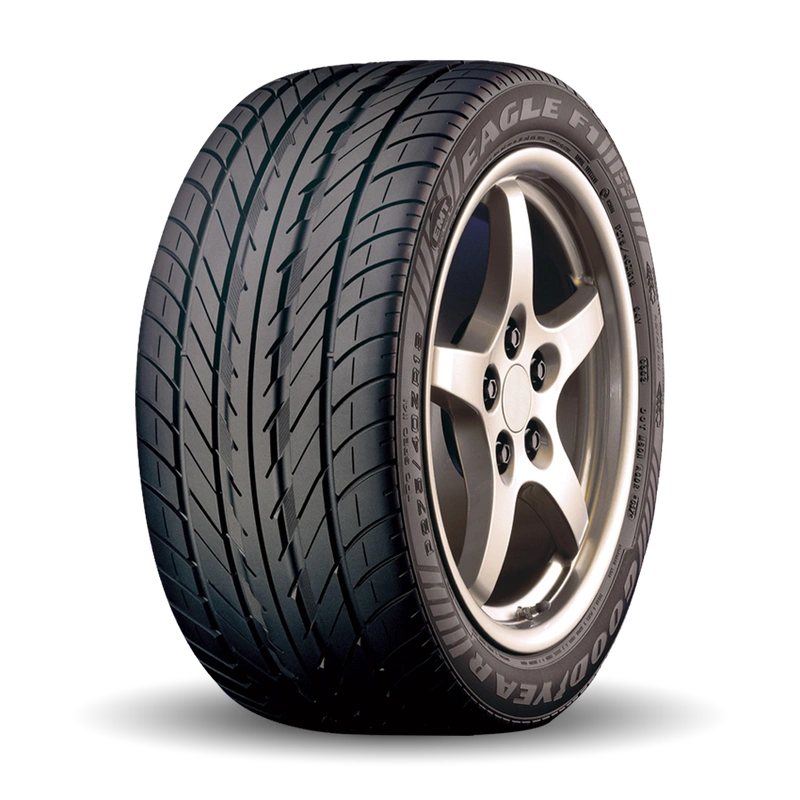
    The 2001 Z06 introduced specially developed Goodyear Eagle F1 Supercar tires, sized P265/40ZR-17 at the front and P295/35ZR-18 at the rear. Mounted on wider forged-aluminum wheels, their performance-oriented compound and broad contact patches provided the grip needed to complement the FE4 suspension and 385-horsepower LS6. These tires were integral to the Z06’s transformation from a lightweight fixed-roof Corvette into a genuinely track-capable performance car. The center cap shown is not correct for the 2001 C5 Z06; however, this image was selected to highlight the Goodyear Eagle F1 Supercar tire, with the wheel included for visual reference only.

    The Z06’s forged-aluminum wheels measured 17 by 9.5 inches at the front and 18 by 10.5 inches at the rear—one inch wider than the corresponding wheels fitted to the standard Corvette. The staggered dimensions allowed Chevrolet to place more tire beneath the car without compromising steering response, while the forged construction provided the strength required for sustained high-load driving without adding unnecessary unsprung weight.

    Those wheels carried P265/40ZR-17 front and P295/35ZR-18 rear Goodyear Eagle F1 Supercar tires developed specifically for the new Z06. Their substantial width increased the available contact patch at both ends of the car, while the asymmetrical tread pattern was engineered to deliver high levels of dry-weather grip without making the Corvette unusable when the road turned wet. Chevrolet was not simply fitting a more aggressive tire to an existing chassis; the tire, wheel, and FE4 suspension calibrations were developed as an integrated system.

    Equally significant was the decision to abandon the Extended Mobility run-flat construction used by the standard Corvette. Run-flat tires offered obvious convenience, but their reinforced sidewalls also introduced additional weight and stiffness. By moving to a conventional high-performance tire, Chevrolet reduced unsprung mass and allowed the sidewalls to flex more progressively as cornering loads increased.

    That compliance improved more than ride quality. It allowed the tire to build lateral force in a more natural and predictable manner, giving the driver clearer information through the steering wheel and chassis as the car approached its limit. The resulting advantage was not merely greater peak adhesion, but a broader and more communicative performance envelope—one that made the Z06 easier to place accurately and more confidence-inspiring during repeated high-speed cornering.

    Chevrolet’s development testing indicated that the Z06 could lap a road course several seconds faster than the previous Fixed Roof Coupe. The additional output of the 385-horsepower LS6 accounted for part of that improvement, but power alone could not explain the difference. The wider wheels, purpose-developed tires, reduced mass, and more aggressive FE4 suspension allowed the Z06 to carry greater speed into a corner, maintain that speed more consistently through the middle, and begin applying power sooner on the way out.

    The complete package also made the car more composed during rapid transitions. Where a less developed chassis might overwhelm its tires or require the driver to wait for the body to settle, the Z06 responded immediately and remained balanced as loads moved from one side of the car to the other. Each component supported the next: the suspension controlled the platform, the forged wheels reduced unnecessary mass, and the Goodyears converted those improvements into usable grip.

    The tires reinforced one of the most important truths in performance engineering: horsepower produces meaningful lap-time improvement only when the rest of the automobile can use it. In the 2001 Z06, Chevrolet created a chassis capable of exploiting nearly everything the LS6 could deliver—and the result was a Corvette that felt faster not only in a straight line, but at every point around a racetrack.

    Brakes: Cooling Rather Than Size

    The 2001 C5 Z06 retained the Corvette’s four-wheel vented-disc brake system, but Chevrolet optimized the package for the lighter, more capable chassis. Red-painted calipers provided a visual distinction, while performance-oriented friction materials, grippier tires, and carefully calibrated ABS helped deliver exceptional stopping performance. Functional cooling ducts positioned ahead of the rear wheels directed air toward the rear brakes, improving temperature control during repeated high-speed stops.

    The 2001 Z06 did not receive the dramatically enlarged brake system that would distinguish later high-performance Corvettes. Instead, Chevrolet retained the basic four-wheel vented-disc arrangement used throughout the C5 lineup, relying on careful optimization of the existing hardware rather than introducing a completely new package.

    The rotor dimensions and caliper architecture were fundamentally shared with the standard Corvette, although the Z06’s calipers were painted red to provide an immediate visual distinction. More important than their appearance, however, was the environment in which the brakes operated. Performance-oriented friction materials, revised chassis calibration, lower vehicle mass, and the substantially greater grip of the Goodyear Eagle F1 Supercar tires allowed the system to perform at a level that exceeded what its familiar specifications might suggest.

    The most visible functional change appeared immediately ahead of the rear wheels. Openings incorporated into the rocker panels directed cooling air toward the rear brakes, helping the system shed heat during repeated high-speed stops. These ducts were not decorative additions. They were a direct response to the demands of sustained performance driving, where temperature management could become as important as rotor diameter or caliper size.

    That distinction is essential to understanding the Z06’s braking system. Larger brakes do not automatically produce shorter stopping distances during a single emergency stop. In that situation, braking performance is often limited primarily by tire adhesion, road conditions, weight transfer, and the calibration of the anti-lock braking system. Once the tires have reached the limit of their available grip, increasing rotor size alone cannot make the car stop appreciably sooner.

    Greater brake capacity becomes increasingly valuable when the system is asked to perform repeatedly. Each stop converts the car’s kinetic energy into heat, and that heat must be absorbed and dissipated before it overwhelms the pads, fluid, rotors, or calipers. If temperatures continue to rise, friction can diminish, pedal feel can deteriorate, and the system may begin to fade even though it performed perfectly during the first stop.

    Positioned in the rocker panels immediately ahead of the rear wheels, the C5 Z06’s brake ducts directed cooling air toward the rear brakes during sustained high-speed driving. Their purpose was not to increase one-time stopping power, but to control heat and reduce fade during repeated braking. It was a subtle but functional detail that reinforced the Z06’s track-focused engineering.

    The Z06’s rear brake-cooling ducts addressed precisely that sustained-use problem. By feeding additional air toward the rear rotors, Chevrolet improved the system’s ability to control temperatures over a series of demanding braking events. Combined with the car’s reduced curb weight, balanced chassis, aggressive tires, and carefully calibrated ABS, the ducts allowed the existing brake hardware to operate closer to its full potential for longer periods.

    This approach reflected the broader engineering philosophy behind the 2001 Z06. Chevrolet did not replace every component simply to create a longer list of exclusive specifications. Instead, the engineering team focused on areas that would yield meaningful improvements in actual performance. In the case of the brakes, better cooling and a more capable supporting package offered greater value than enlarging the hardware merely for appearance or marketing.

    Period testing demonstrated just how effective the complete system could be. MotorWeek recorded a 60-to-zero stopping distance of approximately 104 feet, while Car and Driver measured 152 feet from 70 mph. Differences in surface, temperature, tires, and testing procedure naturally produced different figures, but both results placed the Z06 firmly among the strongest-braking production cars of its era.

    The numbers also reinforced an important point: braking performance was never the product of the calipers and rotors alone. The Z06 stopped as well as it did because its tires generated exceptional grip, its lower mass reduced the energy that had to be managed, its chassis remained composed under load, and its cooling provisions helped preserve consistency. Chevrolet achieved outstanding results not by overwhelming the C5 with oversized hardware, but by making the entire car work together.

    Second-Generation Active Handling

    Close-up of the 2001 Corvette Z06 center console showing the Active Handling button, Selective Ride Control dial, and passenger airbag indicator.
    The C5 Corvette’s center console placed the Active Handling controls within easy reach of the driver, reinforcing the system’s role as an integral part of the car’s performance technology. The button allowed the driver to manage the stability-control system, while the adjacent selector reflected the broader effort to tailor the Corvette’s chassis behavior to different driving conditions. In the 2001 Z06, these controls gave drivers greater freedom to explore the car’s limits without completely abandoning the electronic safety net.

    The Z06’s mechanical grip was complemented by the second generation of Chevrolet’s Active Handling system, which became standard across the 2001 Corvette lineup.

    The system monitored steering angle, lateral acceleration, vehicle yaw, wheel speed, and other inputs to determine whether the car was following the driver’s path. When it detected developing understeer or oversteer, it could apply braking pressure to individual wheels and coordinate with traction control to help restore stability.

    Earlier versions had demonstrated the technology’s safety potential, but the intervention could feel abrupt during enthusiastic driving. For 2001, Chevrolet introduced a new Bosch brake-pressure modulator and revised the calibration to make the system smoother, faster, and less intrusive.

    Red 2001 Corvette driving through a snow-covered parking area as Active Handling helps stabilize the car during a controlled slide in winter conditions.
    The 2001 Corvette’s Active Handling system gave drivers an added measure of control when conditions became unpredictable. By monitoring steering angle, wheel speed, yaw, and lateral movement, it could apply braking pressure to individual wheels and help correct developing understeer or oversteer before the situation became more difficult to manage. On wet, icy, or snow-covered pavement, that added layer of stability could make the difference between a brief slide and a complete loss of control. (Image credit: MotorTrend)

    In many situations, the driver knew Active Handling had intervened only because a message appeared in the instrument display. Rather than dramatically cutting power or unsettling the chassis, the system applied a measured correction intended to preserve the car’s balance and momentum.

    Competitive Mode allowed experienced drivers to disable traction control while retaining the stabilizing functions of Active Handling. This provided greater freedom to manage wheelspin and throttle position without completely surrendering the electronic safety net.

    The system could not repeal the laws of physics, and Chevrolet never presented it as a substitute for sound judgment. What it provided was a wider margin for error—an especially valuable safeguard in a powerful, rear-drive sports car capable of approaching 170 mph.

    Identifying the 2001 Z06

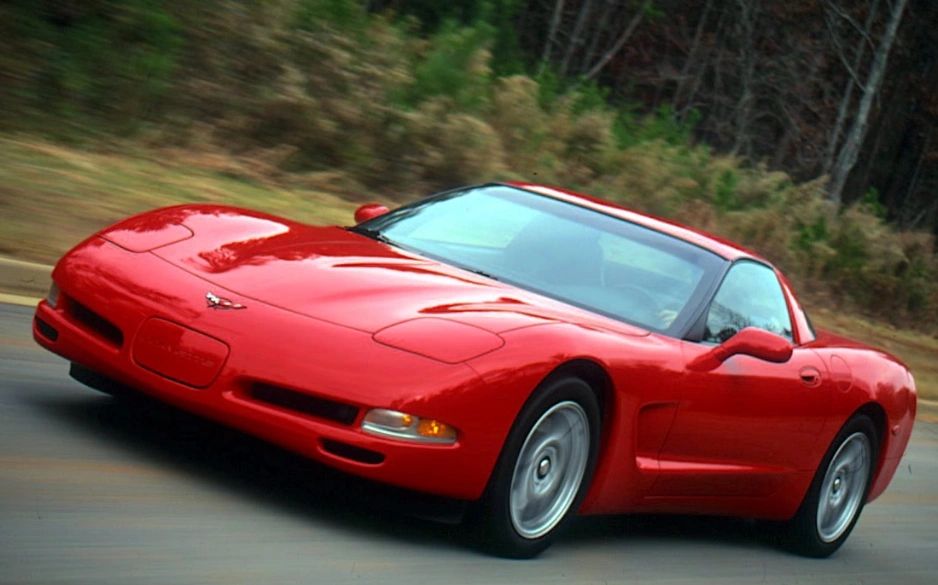
    The 2001 Corvette Z06 did not rely on exaggerated styling to announce itself. Instead, Chevrolet gave the first-year Z06 a disciplined, functional appearance defined by its fixed-roof coupe profile, mesh front grilles, lightweight forged wheels, red brake calipers, Z06 fender badges, rear brake-cooling ducts, and titanium exhaust outlets. Every visual cue served a purpose, reinforcing the car’s mission as a lighter, more focused, and more capable evolution of the C5. The result was a Corvette that looked restrained at a glance, but unmistakably serious to anyone who knew what they were seeing. (Image credit: UltimateCorvette.com)

    Visually, the 2001 C5 Corvette Z06 remained remarkably restrained.

    It did not receive wider bodywork, an oversized rear wing, a deep front splitter, or the aggressive aerodynamic hardware that would later define high-performance Corvette variants. Its basic shape remained that of the Fixed Roof Coupe, preserving the clean proportions and disciplined profile already built into the C5 architecture.

    The differences were subtle, but none were accidental. Mesh grilles replaced the standard inserts in the front cooling openings, giving the nose a more purposeful appearance while supporting the car’s increased performance demands. Functional scoops positioned ahead of the rear wheels fed air toward the rear brakes, while the wider forged-aluminum wheels and Goodyear Eagle F1 Supercar tires filled the wheel openings more completely and gave the Z06 a lower, more planted stance.

    The red-painted brake calipers became one of the 2001 Z06’s most recognizable visual cues, adding a subtle but unmistakable performance signature behind the forged aluminum wheels. More than decoration, they helped distinguish the first-year Z06 from the standard Corvette while reinforcing the car’s more focused, track-oriented mission. Set against the silver wheels, the calipers provided a sharp contrast that hinted at the braking capability and engineering seriousness beneath the Z06’s otherwise restrained exterior.

    Red brake calipers became visible through the open-spoke wheels, adding a controlled flash of color without overwhelming the design. Beneath the hood, red engine covers identified the LS6, while small Z06 emblems on the front fenders replaced the standard Corvette badging and quietly announced that this was something different.

    The rear treatment followed the same philosophy. Four polished titanium exhaust outlets provided one of the clearest visual distinctions, their larger diameter and purposeful finish hinting at the lightweight system concealed beneath the car. Even here, Chevrolet resisted the temptation to turn the exhaust into an oversized decorative feature. It looked serious because it was functional.

    That restraint has helped the first-year Z06 age exceptionally well. It appears more focused than a standard C5 without looking exaggerated or disconnected from the original design. The performance hardware seems to belong to the car because it was integrated into the engineering from the beginning rather than applied afterward for effect.

    Chevrolet did not need to make the Z06 shout.

    Its numbers were loud enough.

    Inside the Z06

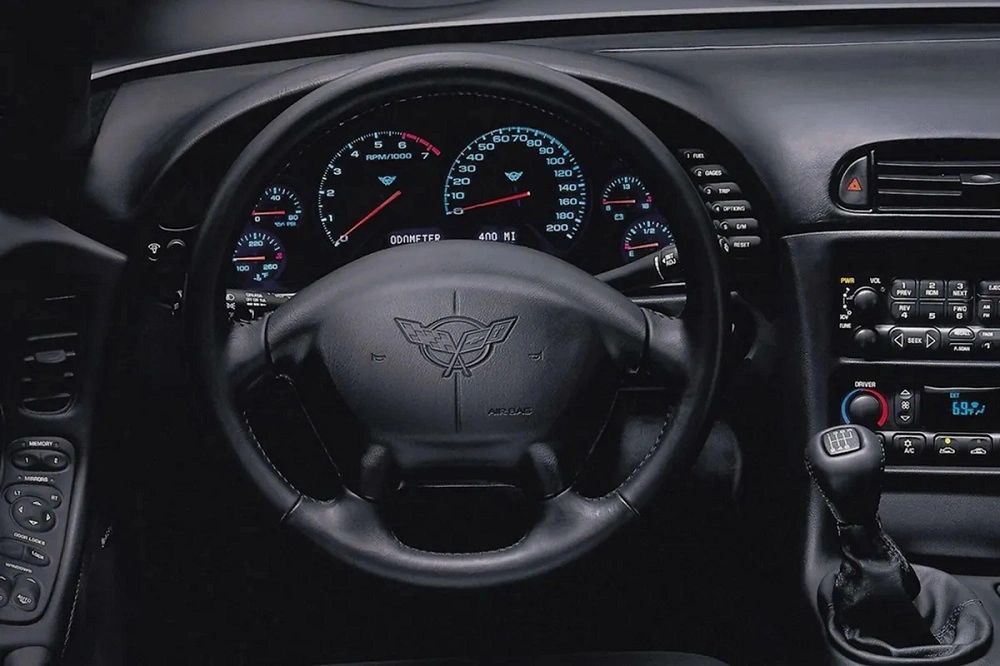
    Close-up of the 2001 Chevrolet Corvette Z06 instrument cluster, featuring a 7,000-rpm tachometer with Z06 branding, a 200-mph speedometer, red needles, checkerboard-pattern gauge faces, and a digital odometer reading 1,105 miles.
    The 2001 Corvette Z06 dashboard combined the familiar C5 instrument layout with a more performance-focused identity. Its 7,000-rpm tachometer, 200-mph speedometer, red needles, and subtle checkerboard background reinforced the car’s track-oriented character without compromising readability. The Z06 logo within the tachometer served as a subtle reminder that this was not a standard Corvette, but the most focused production C5 Chevrolet had yet to create.

    The interior received several model-specific details, although it remained recognizably C5.

    The instrument cluster used unique graphics and a tachometer calibrated around the LS6’s 6,500-rpm redline. The standard seats were trimmed in black leather and offered somewhat greater lateral support, with Z06 embroidery reinforcing the car’s identity.

    Buyers could also choose a black-and-Torch Red interior treatment that added red seat inserts and matching lower-cabin accents. Of the 5,773 Z06s produced for 2001, 1,661 received the black-and-red interior, while the remainder used the all-black treatment.

    Close-up of a black leather 2001 Chevrolet Corvette Z06 seat headrest featuring a red embroidered Z06 logo, with a red seat insert visible in the background.
    The embroidered Z06 emblem on the seat headrest gave the 2001 Corvette’s otherwise restrained cabin a distinct performance identity. Rendered in red against the black leather upholstery, it added a subtle but unmistakable reminder that this was Chevrolet’s most focused C5. Rather than transforming the interior with unnecessary decoration, the detail reinforced the Z06’s purposeful character through carefully placed branding.

    A Bose audio system with an in-dash CD player was fitted to nearly every car, and conveniences such as dual-zone climate control, power seating, memory functions, and electrochromic mirrors remained available or standard depending upon configuration.

    This equipment makes clear that the Z06 was never intended to be a bare-bones club racer. Chevrolet removed weight where it could do so intelligently, but it did not strip the cabin to painted metal or require buyers to tolerate an automobile unsuitable for normal use.

    The car’s shortcomings were largely inherited from the broader C5. The dashboard plastics lacked the visual and tactile quality found in many European competitors, the seats still did not hold occupants as firmly as the cornering capability suggested they should, and the cabin architecture emphasized function over ornamentation.

    Nonetheless, those criticisms were valid. They also became easy to forgive once the road began to curve.

    The Standard LS1 Corvette Gets Better

    Yellow 2001 Chevrolet Corvette coupe parked beside a wooded pond at sunset, shown from the front three-quarter angle with warm evening light reflecting across the bodywork.
    For 2001, the standard Corvette’s LS1 became more refined, more responsive, and more useful across the rev range. Its modest increase to 350 horsepower told only part of the story, as the revised intake manifold and broader torque curve gave the coupe stronger acceleration in everyday driving. The result was a Corvette that required fewer downshifts, responded more decisively at lower speeds, and felt noticeably more complete than the car it replaced.

    Although the Z06 dominated the headlines, the coupe and convertible received some of the most meaningful mechanical improvements introduced during the C5’s production run.

    The LS1’s output increased from 345 to 350 horsepower at 5,600 rpm. A five-horsepower gain may appear insignificant, especially beside the LS6’s 385-horsepower rating, but the peak figure revealed only a small part of what Chevrolet had accomplished. The more important changes occurred at lower revs, where most owners experienced the engine during daily driving.

    More Than Just Five Additional Horsepower

    Close-up of the 2001 Chevrolet Corvette LS1 engine bay, showing the black composite intake manifold, red Corvette lettering on the engine covers, throttle body, air intake assembly, and surrounding components in clean, restored condition.
    For 2001, the Corvette’s LS1 became a stronger and more complete engine, producing 350 horsepower while delivering noticeably more torque across the lower and middle portions of the rev range. A revised composite intake manifold improved airflow and helped broaden the engine’s response, giving the standard Corvette greater urgency without sacrificing its smoothness or everyday usability. The result was not a dramatic reinvention, but a carefully refined V8 that made the coupe and convertible quicker, more flexible, and more satisfying in nearly every driving situation.

    At the center of the improvement was a revised composite intake manifold featuring greater plenum volume and smoother internal runners. The new design reduced airflow restrictions and improved cylinder filling across a broader portion of the operating range. With the intake system doing more of the work, engineers were able to moderate portions of the camshaft profile without sacrificing peak output, producing an engine that was more flexible, more responsive, and easier to use.

    The revised LS1 did not suddenly become a different engine. It became a more complete version of the one Chevrolet had introduced with the C5 four years earlier.

    Automatic-transmission cars produced a maximum of 360 lb-ft of torque, while manual-transmission models reached 375 lb-ft. More important than either peak number was how quickly that torque became available. Chevrolet reported 300 lb-ft at only 1,000 rpm, 320 lb-ft by 1,400 rpm, and 340 lb-ft at 2,500 rpm.

    Those figures gave the 2001 Corvette an unusually broad reserve of usable power. The engine no longer needed to be pushed deep into the upper portion of the tachometer before it began to feel urgent. It responded strongly from just above idle, carried that strength through the middle of the rev range, and continued pulling toward its horsepower peak with the smooth, progressive delivery that had become one of the LS1’s defining qualities.

    Better Where Owners Used It

    For 2001, the Corvette convertible benefited from the same LS1 refinements that improved the coupe, including a revised intake manifold, stronger low- and mid-range torque, and a modest increase to 350 horsepower. Those changes made the open-top C5 more responsive in everyday driving, with better acceleration from lower engine speeds and less need to downshift when passing or climbing. The result was a convertible that retained its long-distance comfort and relaxed character while feeling quicker, more flexible, and more fully developed than earlier C5 models. (Image credit: GM Media LLC.)

    The difference was especially noticeable in ordinary driving. The 2001 Corvette required fewer downshifts when passing, accelerated more decisively when leaving a stop, and pulled with greater authority when exiting a corner or merging onto a highway. A driver could leave the transmission in a taller gear and rely on the engine’s torque rather than constantly searching for a lower ratio.

    That quality made the improvements particularly relevant to the majority of Corvette buyers. Approximately 55 percent of all 2001 Corvettes were equipped with the four-speed automatic transmission. For those owners, the broader torque curve delivered a more immediate and responsive car without requiring any change in driving style.

    Chevrolet estimated that the slowest configuration—an automatic-equipped Corvette with the standard rear axle—reached 60 mph approximately one-quarter second quicker than its 2000 counterpart. When paired with the optional 3.15:1 performance axle, the automatic could match the acceleration of the previous year’s manual-transmission car.

    The manual Corvette benefited differently. Its higher torque rating and stronger midrange made the six-speed gearbox easier to exploit, allowing the driver to carry a gear longer without sacrificing acceleration. The car remained rewarding when driven aggressively, but it also became less demanding when traffic, road conditions, or simple convenience called for a more relaxed approach.

    These changes reflected Chevrolet’s growing understanding of the C5 platform. By 2001, the engineering team was no longer correcting major weaknesses or proving the basic validity of the architecture. It was refining the relationship between the engine, transmission, gearing, chassis, and electronic controls so that the car performed more effectively in every environment.

    The standard Corvette also benefited from many of the same lessons that produced the LS6. Although the Z06 received the more aggressive engine specification, the development work behind that program improved the broader Corvette lineup. Better airflow, stronger low-speed torque, and more carefully calibrated power delivery made the coupe and convertible quicker without making them less civilized.

    That balance was important. The standard Corvette still had to function as a long-distance grand tourer, a daily driver, and an approachable performance car. It needed to idle smoothly, tolerate traffic, deliver respectable fuel economy, and remain comfortable enough to cross several states in a single day. The 2001 revisions strengthened its performance without compromising any of those qualities.

    The Z06 was the model built to attract attention, chase lap times, and reestablish one of the most important names in Corvette history.

    The standard Corvette became better in the places its owners used it every day.

    Shared Engineering Benefits

    The engineering relationship between the LS1 and LS6 reflected the broader philosophy behind the 2001 Corvette lineup. Development work performed for the higher-output Z06 did not remain isolated to a single model; improvements in airflow, intake design, calibration, and power delivery also informed the standard coupe and convertible. In turn, the durability, refinement, and proven architecture of the LS1 provided the foundation from which the LS6 could be developed. That exchange of engineering demonstrated that the three versions of the 2001 Corvette were not separate programs, but distinct expressions of the same increasingly mature C5 platform. (Image credit: GM Media LLC.)

    Several components developed or refined during the Z06 program improved the coupe and convertible as well.

    The standard LS1 adopted the new intake architecture and revised exhaust manifolds associated with the broader LS6 development effort. Manual-transmission cars received the stronger, lower-effort clutch and improved synchronizers, while every model benefited from the larger-diameter aluminum driveshaft.

    The automatic transmission case was optimized to remove unnecessary material, reducing mass by approximately 3.3 pounds. A revised alternator pulley incorporated a clutch that helped reduce accessory disturbance at idle and diminished the tendency of automatic cars to creep forward.

    These were not the kinds of changes likely to dominate a showroom brochure, but they improved the ownership experience. The car shifted more smoothly, idled more cleanly, responded more strongly, and carried additional power through a more robust driveline.

    The relationship between the Z06 and the standard Corvette also illustrated an engineering principle that would become increasingly important to Chevrolet: developing an extreme variant can expose opportunities to improve the entire product line.

    The Z06 was not isolated from the rest of the program.

    Its development raised the standard for every 2001 Corvette.

    Performance With Greater Efficiency

    The additional performance did not come at the expense of fuel economy or emissions compliance.

    EPA estimates improved by approximately one mile per gallon in both city and highway driving, depending upon transmission and configuration. The manual-transmission Corvette’s tall overdrive ratios allowed the engine to operate at relatively low speed during highway cruising, preserving one of the C5’s most surprising strengths: exceptional long-distance efficiency for a car with its performance.

    Every 2001 Corvette also achieved National Low Emission Vehicle certification. That accomplishment is easy to overlook today, but it demonstrated how far electronically managed combustion, catalytic converters, airflow modeling, and engine calibration had advanced.

    Earlier generations of performance cars frequently required obvious compromises. More power could mean poor cold-start behavior, unstable idle quality, increased fuel consumption, limited durability, or difficulty meeting emissions requirements. The LS1 and LS6 showed that a modern V8 could become more powerful while simultaneously becoming cleaner and more efficient.

    Mobil 1 synthetic motor oil and an ACDelco oil filter displayed together, representing the lubricants and filtration products used to support the 2001 Corvette’s high-performance engine and extended oil-change intervals.
    Mobil 1’s role in the 2001 Corvette extended well beyond simple lubrication. As the car’s factory-fill synthetic oil, it worked in concert with Corvette’s oil-life monitoring system and GM’s extended maintenance strategy, helping support oil-change intervals of up to 15,000 miles or one year under normal conditions. Its resistance to heat, oxidation, and viscosity breakdown made it especially well-suited to the Corvette’s high-output V8, whether in daily driving or sustained high-performance use. In that sense, Mobil 1 was not just recommended for the Corvette—it was part of the broader engineering philosophy that allowed the car to deliver serious performance with modern durability and reduced maintenance demands.

    Chevrolet also extended the recommended oil-change interval for every 2001 Corvette from 10,000 to as much as 15,000 miles or one year under normal operating conditions. That recommendation did not rest upon mileage alone. The Corvette’s oil-life monitoring system evaluated operating factors that affected lubricant degradation, allowing the car to determine when service was required rather than relying exclusively upon a fixed schedule. The system still imposed a firm upper limit, and severe conditions—including dusty operation—could require substantially earlier changes.

    The longer interval was made possible in part by the Corvette’s established use of Mobil 1 synthetic motor oil, which had been factory-filled and recommended for the model since 1993. Synthetic lubricant offered greater resistance to oxidation, thermal breakdown, and viscosity loss than conventional oils of the period—qualities that were particularly valuable in an aluminum V8 capable of sustained high engine speeds, elevated oil temperatures, and significant cornering loads. GM’s use of Mobil 1 was therefore not simply a branding arrangement; the lubricant formed part of a larger engineering strategy in which the engine, lubrication system, electronic oil-life monitor, and prescribed maintenance schedule were validated to operate together.

    The extended interval also carried consequences beyond owner convenience. Fewer oil and filter changes reduced routine maintenance costs, lowered the volume of used lubricant requiring collection and recycling, and sent fewer discarded filters into landfills. Chevrolet could therefore improve the ownership experience while simultaneously reducing the Corvette’s environmental burden over its service life.

    The 2001 Corvette represented more than brute force. Its greater horsepower and acceleration existed alongside cleaner emissions, longer maintenance intervals, electronic monitoring systems, and the durability expected of a modern production automobile. Chevrolet was demonstrating that serious performance no longer had to demand constant adjustment, frequent service, or exemption from increasingly stringent regulatory standards. The C5 had matured into a car capable of delivering extraordinary speed while functioning with the reliability, efficiency, and everyday discipline expected of any contemporary Chevrolet.

    Comfort and Convenience Improvements

    Chevrolet also continued refining the quieter, more comfortable side of the C5, recognizing that the coupe and convertible still needed to function as usable road cars rather than narrowly focused performance machines.

    Additional insulation helped reduce unwanted noise and vibration without adding enough weight to compromise the Corvette’s performance character. The convertible received further attention with a revised top design that improved sealing and reduced wind intrusion, making open-top models more comfortable on longer drives and less prone to the familiar noise associated with removable roof structures.

    Chrome-finished exhaust tips became standard across the model range, giving the rear fascia a cleaner and more finished appearance. The change was largely cosmetic, but it reflected Chevrolet’s continued effort to make the standard Corvette feel more polished as the C5 entered the mature phase of its production run.

    Close-up of a black 2001 Chevrolet Corvette remote key fob with gray lock, unlock, and hatch-release buttons and a red panic button, displayed against a metallic abstract background.
    For 2001, Chevrolet introduced a smaller, more compact remote key fob that improved everyday convenience without changing its basic functions. The redesigned transmitter was easier to carry and continued to provide remote locking, unlocking, panic-alarm activation, and rear-hatch release. It was a minor update, but one that reflected Chevrolet’s broader effort to make the C5 Corvette more polished and user-friendly.

    Everyday convenience also improved through smaller details. A more compact remote key fob was easier to carry, while available electrochromic interior and exterior mirrors automatically reduced glare during nighttime driving. On the coupe and convertible, these mirrors were generally included within the upper preferred-equipment package alongside the head-up display, Twilight Sentinel automatic lighting, and the power telescoping steering column.

    The head-up display remained one of the C5’s most useful technologies. It could project speed, engine rpm, warning messages, and other vehicle information into the driver’s line of sight, reducing the need to look down at the instrument cluster during highway driving or more aggressive use. What had once seemed like an advanced novelty had become an important part of the Corvette’s driver-focused identity.

    Buyers could also continue tailoring the chassis to their priorities. Selective Real-Time Damping remained available for those who wanted electronically adjustable ride control, while the Z51 Performance Handling Package provided coupe and convertible buyers with a firmer suspension calibration without requiring them to move up to the more narrowly focused Z06.

    Two 2001 Chevrolet Corvettes shown together outdoors, one finished in Speedway White and the other in Quicksilver Metallic, photographed in a realistic parking-area setting with trees and open sky in the background.
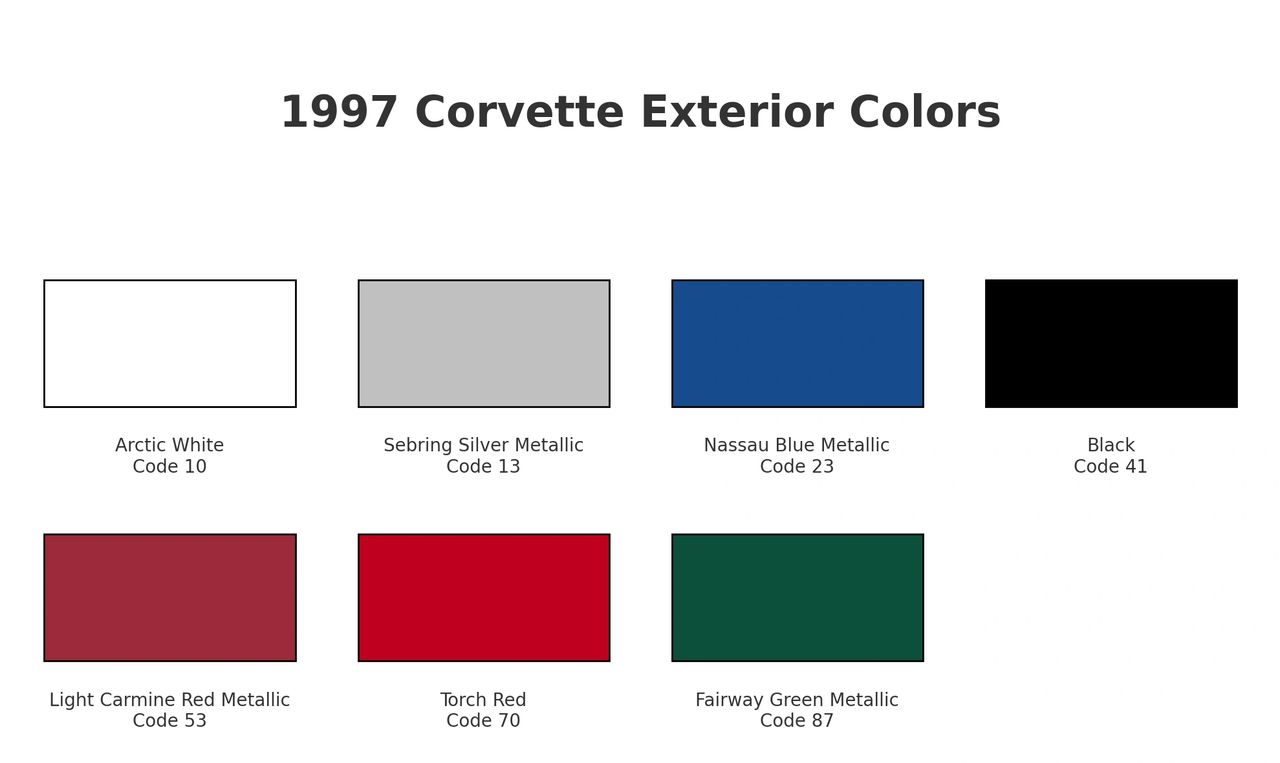
    For 2001, Chevrolet expanded the Corvette’s color palette with two new finishes: Quicksilver Metallic and Speedway White. Both gave the C5 a cleaner, more contemporary look, but Speedway White proved especially significant on the first-year Z06, where production remained notably limited. Together, the two additions helped freshen the model line visually while reinforcing the more mature, polished character the 2001 Corvette had begun to achieve.

    Two new exterior colors—Quicksilver Metallic and Speedway White—joined the palette for 2001. Speedway White was especially notable on the Z06, where only 352 examples were produced in the color, making it one of the less common combinations from the model’s inaugural year.

    None of these changes fundamentally transformed the C5 interior or erased every criticism directed at its materials and presentation. They did, however, make the Corvette quieter, more polished, and easier to live with, reinforcing the growing distinction between the increasingly refined coupe and convertible and the more specialized, performance-driven Z06.

    What the Numbers Said

    aptured during Car and Driver testing in late summer 2000, this image shows the new 2001 Corvette Z06 being evaluated before its public arrival. The car’s composed stance and visible speed reflect the balance Chevrolet had achieved between reduced weight, greater power, and sharper chassis response. Even before the Z06 reached showrooms, it was already demonstrating that the C5 had evolved into a far more serious performance machine. (Image credit: Car & Driver)

    Chevrolet claimed the Z06 could accelerate from zero to 60 mph in four seconds and complete the quarter-mile in approximately 12 seconds under optimal conditions.

    Independent testing produced slightly more conservative—but still extraordinary—results.

    Car and Driver recorded zero to 60 mph in 4.3 seconds, a quarter-mile in 12.7 seconds at 113 mph, a top speed of 168 mph, 0.98 g of lateral acceleration, and a 70-to-zero braking distance of 152 feet. MotorWeek achieved 60 mph in 4.5 seconds, completed the quarter-mile in 13 seconds at 113 mph, and measured 60-to-zero braking in approximately 104 feet.

    Differences in weather, surface preparation, launch technique, mileage, and testing procedure explain much of the variation. What mattered was where those results placed the Corvette.

    The Z06 accelerated more quickly than the celebrated C4 ZR-1. Its measured cornering grip exceeded figures recorded by many contemporary exotics, including the Dodge Viper GTS and Ferrari 360 Modena. It stopped with the authority expected of a serious track car and approached 170 mph without forced induction, all-wheel drive, or an exotic multi-cam engine.

    The performance was impressive in isolation.

    Its price made it disruptive.

    Challenging the World for Less

    The 2001 Corvette Z06 entered a performance market defined by both domestic muscle and increasingly sophisticated European engineering. Against rivals from Dodge and Ford, as well as Porsche, BMW, and Ferrari, Chevrolet answered with a lighter, more focused C5 that delivered world-class acceleration, braking, and cornering performance without abandoning everyday usability. The Z06 did not rely on exotic construction, luxury branding, or an inflated price to make its case; it challenged the established hierarchy by proving that an American production car could compete credibly with some of the world’s most respected performance machines.

    The 2001 Corvette in a Changing Performance Market

    The performance-car market surrounding the 2001 Corvette was becoming increasingly sophisticated. Buyers could choose from a wider range of engineering philosophies than ever before, each offering a different interpretation of what a modern high-performance car should be.

    Porsche’s 996-generation 911 combined rear-engine traction, refined road manners, and decades of sports-car credibility. The newly introduced 911 Turbo added all-wheel drive and twin turbochargers, creating a level of speed and technical sophistication the Corvette could not directly replicate, but its price placed it well beyond the reach of most Z06 buyers.

    Ferrari’s 360 Modena delivered a more exotic experience through its mid-mounted, high-revving V8 and aluminum-intensive construction. Dodge’s Viper GTS approached performance from the opposite direction, using greater displacement, dramatic styling, and immense torque, but it demanded far more compromise in comfort, visibility, and everyday usability.

    Other competitors broadened the definition of performance still further. BMW’s E46 M3 combined a high-output six-cylinder engine, a deeply developed chassis, and a practical four-seat body. The Porsche Boxster S, Honda S2000, and Mercedes-Benz SLK32 AMG each brought a different interpretation of the modern roadster, emphasizing balance, precision, or forced-induction power.

    The Corvette could not match the interior finish, brand cachet, or mechanical theater of any of those cars, and it did not try to. Instead, Chevrolet concentrated on the qualities that had always defined the Corvette at its best: acceleration, braking, cornering grip, durability, cargo capacity, dealer support, and everyday drivability.

    That combination gave the Z06 unusual breadth. It could perform at a level associated with far more expensive machinery while remaining practical enough to drive daily, be serviced through a national dealer network, and be used for long-distance travel. Few rivals could match its balance of outright speed, accessibility, and ownership convenience.

    Chevrolet promoted the Z06 at approximately $47,500 before destination and other accounting adjustments, while period publications generally listed a normally equipped example at or just below $50,000. That was substantial money in 2001, but it remained only a fraction of the price commanded by many European cars the Z06 could equal—or defeat—on a racetrack.

    The Corvette had long been described as a performance value. The 2001 Z06 elevated that familiar claim into something more serious: an international challenge to the idea that world-class performance required an exotic badge or a six-figure price.

    Critical Reception

    When Automobile named the 2001 Corvette Z06 its Automobile of the Year, the award confirmed that Chevrolet had built far more than a faster C5. With 385 horsepower, a lighter fixed-roof structure, track-focused suspension tuning, and the kind of usable performance once reserved for far more expensive exotics, the Z06 represented the most complete expression of the fifth-generation Corvette to that point. These dramatic images captured both sides of its personality: an unmistakably American performance car rooted in Detroit and a world-class sports machine capable of delivering extraordinary speed with composure and precision.

    The automotive press responded with unusual enthusiasm.

    Automobile Magazine selected the Z06 as its 2001 Automobile of the Year. Editor-in-Chief Jean Jennings praised the car not as a promising American alternative but as a fully credible sports car capable of standing against the world’s best without requiring excuses or qualifications.

    Car and Driver acknowledged the familiar shortcomings of the C5 cabin and the Z06’s busy ride over rough pavement, but its test results made the larger conclusion unavoidable. The car delivered extraordinary speed, grip, balance, and braking for its price.

    MotorWeek similarly emphasized the combination of performance and usability. The Z06 was loud enough, firm enough, and responsive enough to feel special, yet it remained quiet and compliant enough to travel on ordinary roads without exhausting its occupants.

    This reception mattered because the Corvette had spent decades fighting a perception that it was fast primarily by American standards. Critics often admired its horsepower while questioning its refinement, braking, consistency, or ability to perform on complex roads.

    The C5 had already weakened that criticism.

    The Z06 made it exceedingly difficult to sustain.

    Production and Pricing

    The 2001 model year was a strong one for Bowling Green, with the plant turning out 35,627 Corvettes in total—15,681 coupes, 14,173 convertibles, and 5,773 Z06s. That mix tells the story of a factory building at full maturity: traditional Corvettes continued to sell in healthy numbers, while the all-new Z06 immediately established itself as a major part of the lineup and helped define the year. Inside the Bowling Green Assembly Plant, more than 1,025 employees worked alongside 58 robots to build the 2001 Corvette, underscoring just how sophisticated and efficient the operation had become by the time the C5 platform reached its stride. In many ways, these production results reflected the broader success of the 2001 Corvette itself—confident, refined, and finally operating at the level Chevrolet had intended from the start. (Image credit: GM Media LLC.)

    Chevrolet built 35,627 Corvettes for the 2001 model year, making it the strongest production year since 1985.

    The total included:

    • 15,681 removable-roof coupes
    • 14,173 convertibles
    • 5,773 Z06 fixed-roof coupes

    The Z06 therefore accounted for approximately 16 percent of total production during its introductory year—a significant share for a manual-only, performance-focused model.

    Automatic transmissions were installed in 19,608 coupes and convertibles, representing roughly 55 percent of total Corvette production. The remaining 16,019 cars used six-speed manuals, a figure that included every Z06.

    The standard coupe listed for approximately $40,000, while the convertible and Z06 both occupied the upper-$40,000 range depending upon published price point, destination charge, equipment, and changes during the model year.

    Popular equipment included polished-aluminum wheels, the head-up display, dual-zone climate control, power telescoping steering, and the upper preferred-equipment packages. A total of 7,817 standard coupes and convertibles received the Z51 Performance Handling Package, while 5,620 were equipped with Selective Real Time Damping.

    The R8C National Corvette Museum Delivery program also allowed buyers to take ceremonial delivery of their cars at the museum in Bowling Green, strengthening the relationship between the factory, the museum, and the enthusiast community surrounding the Corvette.

    The Z06 Color Breakdown

    This color chart brings together the full exterior palette available on the 2001 Corvette Z06, showing how each finish shaped the character of Chevrolet’s first-year C5 flagship. From familiar choices like Black, Torch Red, and Millennium Yellow to less common shades such as Speedway White, Quicksilver Metallic, and Dark Bowling Green Metallic, the lineup reflects both the breadth and maturity of the 2001 model range. Presented in side profile, the chart makes it easy to see how the Z06’s restrained, purposeful design carried over to every available color. (Image credit: Ultimate Corvette.com)

    The 5,773 first-year Z06s were offered in a comparatively focused range of colors.

    Black was the most popular, accounting for 1,719 cars. Torch Red followed with 1,623, while 1,345 were finished in Quicksilver Metallic. Chevrolet built 634 Millennium Yellow Z06s and only 352 in Speedway White.

    The rarity of Speedway White has made it one of the most immediately recognizable first-year combinations. Its clean appearance also emphasized the fixed-roof body’s shape and contrasted strongly with the dark wheels, grille openings, red brake calipers, and black rear window surround.

    Millennium Yellow required an additional charge because of its tinted-clearcoat process. The vivid finish suited the Z06’s personality and anticipated the close association between yellow Corvettes and the factory racing program.

    Interior selection was simpler. A total of 4,112 cars received the all-black cabin, while 1,661 combined black with Torch Red accents.

    Unlike later special editions, no exterior color created a mechanically distinct version of the car. The production totals nevertheless give each combination its own identity within the first-year Z06 story.

    The 2001 Corvette in an Uncertain America

    Set against a backdrop of recession, shaken consumer confidence, the aftermath of September 11, and a rapidly changing automotive marketplace, this image captures the world into which the 2001 Corvette was sold. While much of the industry leaned on aggressive incentives, light trucks, and shifting consumer priorities to maintain momentum, the Corvette remained a bright spot, with Chevrolet producing and selling 35,627 examples for the model year. The silver C5 in the foreground stands as a reminder that America’s sports car was not insulated from the uncertainty of its time, but it proved resilient within it. Even during one of the most unsettled periods in recent American history, the Corvette remained commercially strong, technically relevant, and important enough to help Chevrolet confidently carry it into the next generation.

    The 2001 Corvette entered production during an uncertain period for both the United States and its automobile industry.

    As the new model year began, the country was approaching the end of an extraordinary period of economic growth. The expansion that had begun in March 1991 lasted exactly ten years—the longest uninterrupted expansion then recorded in the official chronology of the American economy. By March 2001, however, business activity had peaked, and the United States had entered its first recession in a decade.

    The causes extended well beyond the automobile business. The technology-stock bubble had collapsed, corporate investment was weakening, manufacturing activity had contracted, and employers were becoming increasingly cautious. Industrial production had already begun to decline in 2000, leaving many manufacturers to confront softer demand, excess inventory, and growing pressure to reduce costs.

    On September 11, 2001, the United States endured one of the darkest days in its history as attacks on the World Trade Center, the Pentagon, and United Airlines Flight 93 claimed nearly 3,000 lives and permanently altered the nation’s sense of security. The images of the Twin Towers burning and collapsing became symbols of unimaginable loss, but the day was also defined by extraordinary courage, from first responders who rushed toward danger to ordinary people who helped strangers escape and comforted the injured. For those who lived through it, September 11 divided time into a before and an after, reshaping travel, business, public life, national policy, and the emotional character of an entire generation. Any history of the 2001 Corvette model year exists within that larger national story: the car itself was not shaped by the attacks, but it was built, sold, and experienced during a year marked by profound grief, uncertainty, sacrifice, and resilience. (Image courtesy of the Independent)

    The terrorist attacks of September 11 transformed that economic slowdown into something more immediate and deeply personal. In addition to the catastrophic loss of life, the attacks disrupted air travel, tourism, financial activity, commerce, and consumer behavior. Showroom traffic fell sharply in the days that followed as Americans absorbed the scale of what had happened and reconsidered purchases that suddenly appeared less urgent.

    The National Bureau of Economic Research ultimately dated the recession from March through November 2001. Because the contraction had begun months before September 11, the attacks cannot properly be described as its original cause. They did, however, deepen the downturn, intensify uncertainty, and threaten to turn a comparatively mild contraction into a more severe national economic crisis.

    The Corvette’s engineering program had been established long before any of these events. Its revised LS1, newly introduced LS6, second-generation Active Handling system, weight-reduction program, and Z06 development were products of decisions made during the closing years of the 1990s. The recession and terrorist attacks should therefore not be presented as influences upon the car’s design. They formed the environment in which the completed automobile reached dealerships, found buyers, and established its place in the market.

    The industry’s response to the post-September collapse in showroom activity was immediate and unprecedented. On September 19—just eight days after the attacks—General Motors introduced its “Keep America Rolling” campaign, offering zero-percent financing across much of its vehicle range. Competing manufacturers quickly followed with similarly aggressive financing, rebates, and other incentives.

    In the aftermath of September 11, General Motors launched its “Keep America Rolling” campaign to help restore consumer confidence and draw buyers back into showrooms. Built around aggressive financing incentives, the program became one of the most visible responses to the economic uncertainty of late 2001 and helped the auto industry regain momentum during an exceptionally difficult period. (Image credit: GM Media LLC.)

    The program helped produce a remarkable reversal. Vehicle purchases surged during the fourth quarter, even as unemployment increased and much of the manufacturing sector remained under pressure. October became an especially dramatic month, with automobile sales helping drive one of the largest monthly increases in American retail activity then recorded. Even models that were seldom discounted, including the Corvette, participated in the broader push to bring customers back into dealerships.

    By the end of the calendar year, approximately 17.18 million new cars and light trucks had been sold in the United States. That made 2001 the second-strongest sales year then recorded, trailing only the extraordinary results of 2000. It was a striking outcome for a year defined by recession, terrorist attacks, declining consumer confidence, and significant job losses.

    Those headline numbers did not mean that the automobile business was unchanged. Beneath the continued strength of the overall market, American buying habits were shifting decisively. Pickups, sport-utility vehicles, and other light trucks were claiming an increasingly large share of sales, while the traditional passenger car was losing ground. Manufacturers were directing greater investment toward trucks and SUVs because those vehicles combined growing consumer demand with substantial profit margins.

    A two-seat sports car consequently occupied an increasingly specialized corner of the market. The Corvette offered little of the practicality that was drawing buyers toward crew-cab pickups, family-oriented SUVs, and luxury utility vehicles. It was not transportation designed around cargo capacity, rear-seat accommodation, or an elevated driving position. Its continued commercial strength depended upon desirability rather than necessity.

    Chevrolet’s description of the Corvette as an “American icon” carried added weight in 2001, a year marked by national tragedy, economic uncertainty, and profound changes in consumer behavior following September 11. Buyers increasingly gravitated toward trucks and sport-utility vehicles, yet demand for America’s two-seat sports car remained remarkably strong: Bowling Green produced 35,627 Corvettes, making 2001 the C5’s strongest model year to that point. The result demonstrated that the Corvette’s appeal extended beyond nostalgia or symbolism—it remained a desirable, commercially healthy performance car during one of the most difficult and consequential periods in modern American history. (Image credit: GM Media LLC.)

    Against that backdrop, Bowling Green produced 35,627 Corvettes for the 2001 model year. The total included 15,681 coupes, 14,173 convertibles, and 5,773 Z06s. Those results placed the year among the strongest of the C5 era and demonstrated that Chevrolet could sustain substantial demand even as it expanded the range to three clearly differentiated models.

    The coupe remained the most versatile expression of the Corvette, combining its removable roof panel and generous rear storage area with the revised 350-horsepower LS1. The convertible served buyers who valued open-air touring and a more traditional sense of occasion. The Z06 addressed a different audience altogether, exchanging some convenience and comfort for reduced weight, increased structural rigidity, sharper responses, and the 385-horsepower LS6.

    That breadth mattered. Chevrolet was no longer asking one version of the Corvette to satisfy every customer. The three-model strategy allowed the division to serve buyers seeking a fast grand-touring coupe, an open roadster, or an uncompromising high-performance machine without abandoning the basic engineering and manufacturing efficiencies of the C5 platform.

    The Z06 accounted for slightly more than sixteen percent of total Corvette production during its first model year. That was a meaningful result for a car offered only with a manual transmission, a fixed roof, a more aggressive chassis, and fewer concessions to traditional luxury expectations. Its success suggested that a substantial portion of the Corvette audience wanted a more focused automobile and was willing to accept a narrower mission in exchange for greater capability.

    More broadly, the production total demonstrated that the Corvette was not surviving on heritage, nostalgia, or institutional habit. Nearly five decades after its introduction, it remained commercially healthy enough to justify dedicated manufacturing capacity, specialized engineering, continued motorsports investment, and the creation of an increasingly sophisticated performance hierarchy.

    That profitability was strategically important. Specialty cars exist within large corporations only when their value can be defended—not simply as symbols, but as products capable of generating revenue, strengthening the parent brand, and supporting future investment. The C5’s sustained sales gave Chevrolet the financial and institutional credibility required to continue improving the existing Corvette while simultaneously developing its successor.

    In that sense, the 2001 Corvette represented more than a successful model year. It proved that America’s sports car could remain relevant during a historic national crisis, a changing consumer market, and an industry increasingly dominated by trucks and utility vehicles. The C5 had matured into a profitable, internationally credible performance platform, and its success gave Chevrolet the foundation from which the sixth-generation Corvette could move forward.

    Corvette Racing Comes of Age

    The Corvette C5-R helped define 2001 as a breakthrough year for Corvette Racing, delivering major victories and establishing Chevrolet as a genuine force in international endurance competition.

    The production Z06 represented only one side of the Corvette performance story in 2001. The other unfolded on racetracks across North America and Europe, where Corvette Racing began converting the promise of the C5-R into sustained international success. Developed by Chevrolet and Pratt & Miller, the purpose-built endurance racer retained the basic identity of the production C5—a front-mounted V8, rear transaxle, composite bodywork, and unmistakable Corvette silhouette—but nearly every component had been adapted for competition. After two seasons spent learning how to survive the demands of long-distance racing, the team entered 2001 prepared to do more than demonstrate potential.

    Daytona: The First Breakthrough

    At the 2001 Rolex 24 at Daytona, Corvette Racing scored one of the most important victories in the program’s history. The No. 2 C5-R of Ron Fellows, Johnny O’Connell, Chris Kneifel, and Franck Fréon outlasted the faster prototype field to win both the GTS class and the race overall, completing 656 laps. The No. 3 Corvette—driven by Dale Earnhardt, Dale Earnhardt Jr., Andy Pilgrim, and Kelly Collins—finished fourth overall and second in class, giving Chevrolet a commanding 1–2 GTS result and confirming that the C5-R had become a world-class endurance racer.

    The season began at the Rolex 24 at Daytona, where Corvette Racing returned determined to finish what it had narrowly missed one year earlier. Pratt & Miller had continued refining the cars, improving durability, rehearsing pit procedures, and studying every area in which time or reliability could be gained. The No. 2 C5-R was driven by Ron Fellows, Johnny O’Connell, Chris Kneifel, and Franck Fréon, while the No. 3 brought Dale Earnhardt Sr. and Dale Earnhardt Jr. together with Andy Pilgrim and Kelly Collins.

    The race became a test of endurance in the most literal sense. Heavy rain reduced visibility, changed grip from lap to lap, and forced the crews to manage water entering the cockpits; at one point, a drain hole was drilled through the floor. When the leading prototype encountered mechanical trouble late in the event, the No. 2 Corvette was positioned to take advantage—not through luck, but because it had maintained pace, avoided major mistakes, executed clean stops, and preserved the car well enough to remain in contention.

    After 24 hours, the No. 2 C5-R crossed the finish line first overall, defeating not only the other GTS entries but every prototype in the race. The No. 3 finished fourth overall and second in class, completing an extraordinary result for a factory program still early in its development. Daytona gave Corvette Racing its first victory, and it came as an overall win at one of North America’s most demanding endurance events.

    The Earnhardt Connection

    The No. 3 Corvette C5-R team of Kelly Collins, Andy Pilgrim, Dale Earnhardt Jr., and Dale Earnhardt Sr. delivered one of the most memorable stories of the 2001 Rolex 24 at Daytona, finishing fourth overall and second in the GTS class. Their result complemented the No. 2 Corvette’s overall victory and helped make the race a defining early triumph for Corvette Racing.

    The presence of Dale Earnhardt Sr. and Dale Earnhardt Jr. brought Corvette Racing before an audience far larger than the traditional sports-car community. Their participation was not treated as a publicity exercise; both drivers learned the car, respected the demands of sharing it, worked within the team, and adapted quickly to endurance racing. Their fourth-place overall finish helped legitimize the C5-R program among NASCAR fans who might otherwise have paid little attention to it.

    The result took on a far deeper meaning two weeks later, when Dale Earnhardt Sr. was killed on the final lap of the Daytona 500. The Rolex 24 became the final completed race of his career, and the images of father and son sharing the yellow Corvette gained a permanent place in American motorsports history. The No. 3 car did not win Daytona, but its role in the story of the 2001 season remains inseparable from the program’s achievement.

    Le Mans and a Championship Season


    At the 2001 24 Hours of Le Mans, Corvette Racing achieved the breakthrough it had been chasing since the program’s launch, capturing its first class victory in the GTS category and finishing eighth overall. The result validated the C5-R on the world’s most demanding endurance stage, proving that Corvette was no longer simply an American performance icon, but a legitimate international force in sports car racing. It was one of the defining competitive achievements of the 2001 Corvette story and a major step in building the endurance-racing dynasty that followed.

    Corvette Racing carried its momentum through Sebring and toward the season’s central objective: the 24 Hours of Le Mans. Chevrolet had taken the C5-R to France in 2000 and shown promise, but the factory program had not yet secured the class victory required to establish itself against Europe’s most experienced endurance-racing organizations. That changed on June 17, 2001.

    The No. 63 C5-R, driven by Ron Fellows, Johnny O’Connell, and Scott Pruett, won the GTS category, while the No. 64 Corvette of Andy Pilgrim, Kelly Collins, and Franck Fréon finished second. The two yellow cars crossed the line together in formation, delivering a one-two class finish and the first Le Mans victory for Chevrolet’s official Corvette Racing program. Briggs Cunningham’s privately entered Corvette had won its class in 1960; the 2001 result proved that the factory-backed effort had become an international winner in its own right.

    The success continued through the American Le Mans Series, where Corvette Racing faced established opposition that included the Saleen S7-R and Dodge Viper GTS-R. By the end of the season, Chevrolet had secured its first ALMS manufacturer and team championships, completing a year defined by an overall victory at Daytona, a one-two class finish at Le Mans, and sustained success across the championship. More important than any single trophy, Corvette Racing had become a complete organization—one in which Chevrolet, Pratt & Miller, the drivers, engineers, engine program, and pit crews operated as a unified system.

    That maturity established the foundation for everything that followed. The lessons learned during the C5-R era carried directly into the C6.R, C7.R, C8.R, and Z06 GT3.R programs, transforming Corvette Racing from an ambitious factory effort into one of the most successful and enduring organizations in modern sports-car competition.

    Although the C5-R and the 2001 Corvette Z06 were often mentioned in the same breath, they were not the same car and were never intended to be. Both shared the fifth-generation Corvette’s basic silhouette, front-engine/rear-transaxle architecture, and the broader engineering philosophy that emphasized low weight, structural rigidity, and balanced performance, but the C5-R was a purpose-built endurance racer developed by Pratt & Miller for international competition, while the Z06 was a production road car engineered by Chevrolet for the street and track-day use. The Z06 benefited from lessons learned through racing—particularly in areas such as chassis tuning, weight reduction, and performance credibility—but it retained production-based construction, comfort features, and road-going usability that the race car did not. In that sense, the two cars were closely related in spirit and appearance, yet fundamentally different in mission: one was built to win at Le Mans, the other to bring a measure of that sharper, more focused character to Chevrolet showrooms.

    The production Z06 and the C5-R were not the same automobile in different clothing.

    The C5-R was a purpose-built competition machine constructed around racing regulations, endurance requirements, and serviceability. Its chassis, bodywork, engine, suspension, brakes, fuel system, aerodynamics, and safety structure were far removed from those of a showroom Corvette.

    The connection was nevertheless meaningful.

    Both used the C5’s front-engine, rear-transaxle philosophy. Both benefited from the production car’s balanced proportions and aerodynamic development. Both depended upon compact, naturally aspirated Chevrolet V8 power. Most importantly, the production and racing programs increasingly shared information, personnel awareness, and development priorities.

    Racing exposed components and systems to concentrated stress. It taught engineers how heat moved through the vehicle, how drivers responded to changes in balance, how aerodynamics affected stability in traffic, and how apparently minor packaging decisions influenced serviceability and durability.

    Production engineering worked in the opposite direction. The road car provided an efficient architectural foundation, advanced materials, manufacturing experience, and a recognizable identity that allowed the racer to remain unmistakably a Corvette.

    The relationship was not a simple matter of transferring one race-car component directly into a street car. It was a continuous exchange of knowledge.

    As later GM motorsports leadership explained, production cars made the race cars better, and racing made the production cars better.

    In 2001, that cycle began gaining real momentum.

    The Earliest Shape of the C6

    Early sketches such as this reveal how Tom Peters and the Corvette design team approached the C6 not as a rejection of the C5, but as a disciplined evolution of an already successful architecture. Peters, working with designers including Kirk Bennion, SangYup Lee, Chris Knack, and GM’s sculpting and aerodynamic teams, retained the C5’s long-hood, short-deck proportions, muscular fender forms, low cowl, and planted stance while tightening the body around a shorter, narrower package. The surfaces became sharper and more athletic, the wheel openings more pronounced, and the front end more compact—changes shaped as much by aerodynamic development as by styling intent. Peters later explained that the C5 was already highly refined, so progress came through the accumulation of many carefully considered improvements rather than one radical breakthrough; the result was a C6 that remained unmistakably Corvette while appearing leaner, more modern, and more globally competitive. (Image credit: GM Media LLC.)

    While the C5 was achieving its greatest successes, Chevrolet was already looking toward its successor.

    Development of the sixth-generation Corvette began around 2000. The program did not start from a blank sheet of paper, nor did Chevrolet intend to discard the C5’s successful front-engine, rear-transaxle architecture.

    Dave Hill later described the difference between the two development programs succinctly. Creating the C5 had required “a completely new invention from the ground up.” With the C6, there would be “less new invention and more working on excellence.” [8]

    That philosophy could only exist because the C5 had provided such a strong foundation. Engineers could focus on making the next Corvette smaller externally, more refined internally, quieter, more aerodynamically efficient, and more precise without sacrificing the performance, balance, cargo capacity, or structural strength customers valued.

    The team also cataloged the C5’s shortcomings. Cabin materials needed improvement. Wind and tire noise required further attention. The exterior dimensions could be tightened without reducing useful passenger space. Aerodynamic refinement would become increasingly difficult as engineers approached an already-low drag coefficient.

    The 2001 model year therefore occupied an unusual position. Chevrolet was still improving the C5 aggressively, but each improvement also clarified what the next Corvette would need to accomplish.

    The Z06 and the Emerging C6

    Tom Peters works alongside a full-size clay model of the C6 Corvette during the car’s early development, refining the proportions, surface transitions, and visual character that would carry Corvette into its sixth generation. The clay process allowed Peters and the design team to evaluate the car at full scale, preserving the essential identity of the C5 while creating a tighter, sharper, and more contemporary shape. (Image credit: GM Media LLC.)

    Tom Peters assumed design responsibility for the C6 within a development structure that brought the styling organization into unusually close contact with Dave Hill’s engineering team. The designers explored numerous themes while preserving enough Corvette identity to make the new car immediately recognizable, drawing selectively from earlier Sting Rays through peaked fenders, taut surfaces, and more disciplined proportions without turning the project into a retro exercise.

    Aerodynamics became one of the program’s most difficult challenges because the C5 was already highly efficient. Peters later described the process as accumulating base hits rather than discovering a single home run: the shortened front overhang, fenders, hood cutlines, mirrors, roof, rear deck, and underbody all had to contribute incremental gains. Fixed headlamps, a more centralized front opening, improved cooling, and reduced high-speed lift increasingly reflected lessons emerging from Corvette Racing as the road and competition programs developed in parallel.

    At the same time, the 2001 Z06 gave the future C6 a new production-performance benchmark. Its 385-horsepower LS6, lower mass, firmer chassis tuning, stronger braking, and heightened steering response demonstrated how much capability could be extracted from the existing architecture when comfort and convenience were no longer the only priorities. It also raised expectations for acceleration, grip, durability, and track performance in one coordinated package.

    Just as important, the Z06 proved that buyers would accept a more specialized Corvette. Chevrolet sold 5,773 first-year examples despite offering no automatic transmission, removable roof, convertible body, or broad selection of interior colors. That commercial success showed that a focused high-performance derivative could become a meaningful part of the Corvette business rather than merely serving as a low-volume engineering exercise or image builder.

    Later C5 Z06s would gain more power and additional refinements, but the 2001 model did the essential work: it established the modern Z06 formula. The C6 Z06, C7 Z06, and mid-engine C8 Z06 would become radically different automobiles, yet each inherited the same basic mission—reduce mass where possible, sharpen the chassis, increase sustained performance, and create a Corvette for drivers willing to prioritize capability over convenience.

    What the 2001 Corvette Still Did Not Fix

    For all of the C5’s mechanical sophistication, its interior remained one of the car’s clearest weaknesses. Hard plastics, dated switchgear, uneven material quality, and a dashboard shared too visibly with other General Motors products made the cabin feel less special than the performance beneath it deserved. By 2001, the basic design was also beginning to show its age, particularly when compared with increasingly polished European and Japanese competitors. The layout was functional and driver-focused, but its presentation lacked the refinement expected of a sports car competing on an international stage.

    A definitive assessment must acknowledge what remained unresolved.

    The C5 interior continued to trail the best European competitors in material quality, switchgear feel, and visual sophistication. The dashboard was functional and driver-focused, but too many surfaces appeared inexpensive for a car approaching or exceeding $50,000.

    The seats remained a particular weakness. Chevrolet added support to the Z06 design, but the cushions and bolsters still struggled to restrain occupants against the lateral forces the chassis could generate. Drivers often found themselves bracing against the steering wheel, console, or door during aggressive cornering.

    The standard car’s run-flat tires provided real roadside security but contributed to noise, impact harshness, and less progressive breakaway behavior. The Z06’s conventional tires improved those qualities but sacrificed the ability to travel any meaningful distance after a puncture.

    The Z06’s ride could become busy over rough pavement, and its additional negative camber could accelerate tire wear. The fixed-roof body also surrendered the hatchback coupe’s removable roof and larger cargo opening, compromises some buyers considered too significant for the performance gained.

    None of these shortcomings invalidated the car’s achievement. They revealed where the next generation needed to improve.

    In that sense, even the criticisms directed at the 2001 Corvette became part of the C6 development program.

    2001 Corvette Specifications at a Glance

    Standard Coupe and Convertible

    Engine: 5.7-liter LS1 OHV V8
    Construction: Aluminum block and cylinder heads
    Horsepower: 350 at 5,600 rpm
    Torque: 360 lb-ft with automatic; 375 lb-ft with manual
    Compression ratio: 10.1:1
    Transmissions: Four-speed automatic or MM6 six-speed manual
    Final-drive ratios: 2.73:1 standard automatic; 3.15:1 performance automatic; 3.42:1 manual
    Suspensions: FE1 standard, F45 Selective Real Time Damping, or Z51/FE3 Performance Handling
    Tires: P245/45ZR-17 front and P275/40ZR-18 rear extended-mobility tires
    Body styles: Removable-roof hatchback coupe or convertible
    Active Handling: Second-generation system standard

    Z06

    Engine: 5.7-liter LS6 OHV V8
    Construction: Aluminum block and cylinder heads
    Horsepower: 385 at 6,000 rpm
    Torque: 385 lb-ft at 4,800 rpm
    Compression ratio: 10.5:1
    Redline: 6,500 rpm
    Transmission: M12 six-speed manual only
    Final-drive ratio: 3.42:1
    Suspension: Z06-exclusive FE4
    Wheels: Forged aluminum, 17 x 9.5 inches front and 18 x 10.5 inches rear
    Tires: P265/40ZR-17 front and P295/35ZR-18 rear Goodyear Eagle F1 Supercar
    Body style: Fixed-roof coupe with conventional trunk
    Approximate curb weight: 3,115–3,130 pounds
    Factory performance claim: 0–60 mph in approximately four seconds
    Independent testing: Generally 4.3–4.6 seconds to 60 mph and 12.7–13.0 seconds through the quarter-mile
    Top speed: Approximately 168–171 mph

    Why the 2001 Corvette Still Matters Today

    As the sun sets on the C5 era’s most consequential model year, the 2001 Corvette stands as more than a great sports car—it marks the moment the entire Corvette program found its modern direction. The standard coupe and convertible had matured into more complete machines, the Z06 revived a legendary name and established the performance formula that still defines Corvette’s most focused road cars, and the C5-R proved on the world stage that Corvette Racing belonged among endurance racing’s elite. That is why the 2001 Corvette still matters today: it was the year Chevrolet aligned refinement, performance, racing credibility, and future development into one clear vision, creating the blueprint from which every Corvette since has benefited.

    The 2001 Corvette was not the most powerful C5, nor was it the final or most exclusive expression of the fifth-generation platform. Later Z06 models produced more horsepower, received additional chassis refinements, and ultimately delivered stronger performance on paper. Measured only by specifications, the 2002–2004 cars appear superior. Historically, however, the 2001 model was more consequential because it established the modern Corvette formula that the later cars merely refined.

    That importance extended well beyond the arrival of the Z06. The coupe and convertible became stronger, quicker, quieter, cleaner, and more efficient, while second-generation Active Handling became standard throughout the range. Chevrolet was learning how to use electronic technology not to isolate the driver, but to make more of the Corvette’s performance accessible without removing meaningful control. The 2001 lineup demonstrated how thoroughly the C5 architecture had matured and how much capability remained within the platform.

    The Z06 was the clearest expression of that progress. Its 385-horsepower LS6, FE4 suspension, forged wheels, Goodyear Eagle F1 Supercar tires, titanium exhaust, M12 gearing, fixed-roof structure, improved cooling, and reduced mass were not preliminary ideas awaiting completion. They formed a fully realized performance package that revived the Z06 designation after nearly four decades and returned it to its original purpose: creating a Corvette for drivers willing to prioritize sustained capability over convenience.

    It also transformed the fixed-roof coupe from an underappreciated and seemingly cost-conscious body style into the foundation for one of the most capable production cars available at any price. Chevrolet sold 5,773 examples during the first year despite offering no automatic transmission, removable roof panel, convertible body, or broad selection of interior colors. That commercial success proved that a focused Corvette could become a meaningful part of the business rather than merely serving as a low-volume engineering exercise or image builder.

    The Z06 further demonstrated that a track-oriented Corvette did not need to be crude, fragile, or inaccessible. It remained comfortable enough for regular use, durable enough for long-distance travel, and affordable relative to the exotic machinery it could challenge. That balance between exceptional performance and everyday usability became the defining principle followed by every Z06 that came afterward, from the C6 and C7 models to the radically different mid-engine C8 Z06.

    At the same time, Corvette Racing completed its transformation from an ambitious factory effort into a world-class organization. The C5-R earned an overall victory at the 2001 Rolex 24 at Daytona, followed by a one-two GTS class finish at the 24 Hours of Le Mans and the program’s first American Le Mans Series team and manufacturer championships. Those victories built more than a trophy collection. They created engineering knowledge, institutional confidence, and a competitive culture that carried forward into the C6.R, C7.R, C8.R, and Z06 GT3.R.

    That is why the 2001 Corvette still matters. It was the year the standard road cars, the Z06, the racing program, and the emerging C6 all began moving in the same direction. The C5 had already restored Corvette’s technical credibility; 2001 established the blueprint that continues to define the program today—an accomplished standard model, specialized high-performance derivatives, a serious international motorsports presence, and a continuous exchange of knowledge from racing to production and from one generation to the next. The year did not represent the conclusion of the C5’s success. It marked the beginning of everything that followed.


    This 2001 Corvette overview is lovingly dedicated to my friend and “brother,” Billy Quinn.

    I have been fortunate to know a few truly great friends in my lifetime, but very few people have understood or shared my passion for automobiles—and sports cars in particular—the way Billy does. We are kindred spirits in countless ways, from the values we place on life and family to the remarkable fact that we were born just five days apart. Those similarities may have helped bring us together, but it is the loyalty, trust, laughter, and shared experiences that have made our bond something truly special.

    Billy, thank you for your friendship, for the many miles we have traveled side by side, and for every adventure and memory we have collected along the way. More than a friend, you are family by choice—and that is a bond I will always value deeply. Here’s to the roads already behind us and, more importantly, to all the journeys still waiting ahead.

    The 2001 Corvette marked a defining moment in the C5’s evolution. With the arrival of the Z06, meaningful improvements across the lineup, and landmark victories in international competition, Chevrolet transformed an already accomplished sports car into a genuine performance benchmark—and laid crucial groundwork for the Corvette’s next generation and future.

  • 2000 Corvette Overview: The C5’s Quiet Turning Point

    2000 Corvette Overview: The C5’s Quiet Turning Point

    At first glance, the 2000 Corvette looks like a holdover year.

    There was no radical redesign. No new production engine. No anniversary package. No pace car graphics. No dramatic bodywork change. The C5 Corvette had already done the heavy lifting when it arrived for 1997, bringing with it a stiffer structure, a rear-mounted transaxle, a new LS1 small-block V-8, better weight distribution, and a level of real-world refinement that moved Corvette into a different league.

    But that is also what makes the 2000 Corvette so interesting.

    The 2000 model year was not about reinventing the C5. It was about sharpening it. Chevrolet made a series of thoughtful changes to the production car, quietly improved some of the areas that mattered most to owners, gave the Corvette two memorable new paint colors, continued to refine the hardtop formula, and, perhaps most importantly, watched the C5-R racing program begin to deliver on the promise that had been building since the factory’s return to serious sports-car competition.

    By the end of 2000, the Corvette was no longer just America’s sports car with a new chassis and a modern engine. It was becoming something bigger: a credible road car, a legitimate grand tourer, a performance bargain, and a factory-backed endurance-racing threat.

    That is the real story of the 2000 Corvette. It was the year the C5 stopped having to prove the idea and started building the legacy.

    The C5 Had Already Changed the Corvette Conversation

    2000 Corvette Coupe (rear), convertible (center), and FRC/Fixed Roof Coup (front).
    By 2000, the fifth-generation Corvette had settled into a confident three-model lineup: the coupe, the convertible, and the fixed-roof coupe. Together, they showed just how broad the C5’s mission had become, offering open-air cruising, long-distance grand touring, and a more focused performance personality from the same basic platform. It was a Corvette lineup that looked clean, modern, and unmistakably ready for the new millennium. (Image courtesy of GM Media LLC.)

    To understand the 2000 Corvette, you have to understand where Chevrolet was by the end of the 1990s.

    The fifth-generation Corvette had arrived for 1997 as one of the most substantial re-engineering efforts in Corvette history. It was not simply a new body over the old car. The C5 brought a new structure, a rear transaxle layout, a torque-tube driveline, improved packaging, more usable cargo space, better ride quality, and the all-aluminum LS1 V-8. That combination gave Corvette buyers something the nameplate had always promised but had not always delivered in such balanced form: everyday usability and serious performance in the same package.

    The LS1 remained the centerpiece. For the 2000 model year, the 5.7-liter, 346-cubic-inch V-8 was rated at 345 horsepower at 5,600 rpm and 350 lb-ft of torque at 4,400 rpm. It used an aluminum block and heads, sequential fuel injection, coil-near-plug ignition, and the now-familiar two-valve pushrod architecture that would become one of the great modern Chevrolet performance signatures. MotorTrend’s retrospective comparison of the C5 LS1 against classic big-block muscle-era powerplants framed the engine well, noting that the LS1 delivered “real-world horsepower” in a modern, efficient, tractable package.

    The LS1 engine powered all variants of the 2000 Corvette.
    The 2000 Corvette’s 5.7-liter LS1 V8 remained the heart of the C5’s appeal, delivering 345 horsepower and 350 lb-ft of torque from a compact, all-aluminum Gen III small-block that helped redefine modern Corvette performance. By this point, the LS1 had already proven that the C5 was more than a cleaner redesign; it was a fundamentally stronger, more refined, and more technically advanced Corvette. Whether fitted to the coupe, convertible, or fixed-roof coupe, the LS1 gave the 2000 lineup the same confident performance baseline and helped set the stage for the higher-output LS6 and Z06 that would follow.

    This is significant because the C5 Corvette did not need to win on nostalgia. It won on performance. Period reviews repeatedly showed that the car could run with much more expensive machinery while remaining civilized enough for long-distance use. Car and Driver’s testing of the C5 hardtop placed the car comfortably in the high-four-second 0-to-60-mph range, with quarter-mile performance in the low 13s and a top speed near 170 mph. MotorTrend’s performance data for a 2000 Corvette convertible equipped with the automatic transmission showed 0 to 60 mph in 4.9 seconds, the quarter mile in 13.4 seconds at 105.5 mph, 60-to-0 braking in 113 feet, and 0.88 g on the skidpad.

    That was the baseline entering 2000. The Corvette was fast, efficient for its output, comfortable, and broadly competitive. Chevrolet did not need to change everything. It needed to keep polishing the car until the rest of the world had to take it seriously.

    What Changed for 2000

    The 2000 Corvette Fixed Roof Coupe in Millennium Yellow.
    As can be seen on this 2000 Corvette Z51 Coupe, Chevrolet introduced several subtle-but-significant updates for the 2000 model year. They sharpened the C5’s performance edge by upgrading the Z51 Performance Handling Package with larger front and rear stabilizer bars, improving the car’s already impressive balance and cornering response. The 2000 model year also brought new five-spoke forged aluminum wheels (as shown above), available in an optional high-polish finish, along with two new exterior colors: Millennium Yellow (also shown above) and Dark Bowling Green Metallic. Inside, Torch Red joined the interior color palette, while the LS1 V8 received revised engine calibration to meet stricter LEV emissions requirements in California and other states following California standards. The result was not a radical reinvention, but a carefully refined Corvette that felt better sorted, more contemporary, and more confident as the C5 entered the new millennium.

    The 2000 Corvette did not receive a new production powertrain, and that is important to state clearly. The LS1 carried over, still rated at 345 horsepower and 350 lb-ft of torque. The four-speed automatic remained standard on coupe and convertible models, while the six-speed manual was optional on those body styles and standard on the fixed-roof hardtop.

    The changes were more subtle, but they were not insignificant.

    In 2000, Chevrolet focused first on making the C5 Corvette sharper without compromising the balance that had made the fifth-generation car such a major step forward. The Z51 Performance Handling Package received thicker front and rear anti-roll bars along with revised shock-absorber damping, changes intended to reduce body roll, improve transient response, and give the car a more planted feel during quick directional changes. As seen on this 2000 Corvette Z51 Coupe, the goal was not to turn the Corvette into a harsh, single-purpose track machine. Instead, Chevrolet refined the car’s already capable chassis so it felt more precise while still retaining the long-distance grand-touring character that defined the C5.

    The optional Selective Real-Time Damping system, RPO F45, was also updated in 2000. Chevrolet revised the system’s control algorithms and added softer jounce bumpers, giving the electronically controlled suspension a broader operating range between comfort and control. The changes helped the Corvette respond more cleanly to road conditions while improving ride quality over rough surfaces. Manual-transmission cars received a smaller but useful driver-interface update as well, with increased shifter spring tension to better locate the lever between the first-second and fifth-sixth gear gates. It was the kind of detail improvement that did not change the car on paper, but made the Corvette feel more confident and deliberate from behind the wheel.

    2000 Corvette Keys and FOB
    The key and twin fobs shown here capture a small but useful 2000 Corvette change: Chevrolet made Active Remote Keyless Entry standard on the coupe, convertible, and hardtop, replacing the earlier Passive Keyless Entry setup. The outgoing passive/active C5 system was clever but fussy: with the fob’s passive slider switched on, the car could automatically disarm and unlock as the driver approached, then lock both doors, arm the theft-deterrent system, confirm with horn/lamp feedback, and shut off the interior lamps after the driver walked away; it also had active button functions for unlock, hatch/trunk release, and panic alarm. The 2000 system simplified that experience into a more conventional button-operated remote: press LOCK, UNLOCK, hatch release, or panic as needed, with Chevrolet’s brochure describing remote operation for locking/unlocking the doors, turning on interior lights, or arming the alarm from up to 30 feet away. It was less futuristic than the proximity-based system, but it was cleaner, more predictable, and easier for owners to understand—especially paired with another 2000 exterior change, the deletion of the passenger-side door lock cylinder.

    Chevrolet also gave the 2000 Corvette several livability and safety updates, many of them aimed at making the C5 feel more refined in everyday use. One of the more noticeable changes was the move away from the earlier passive keyless-entry system. On 19971999 Corvettes, the system could automatically unlock or lock the car based on the driver’s proximity to the vehicle when the passive feature was enabled. In 2000, Chevrolet replaced that arrangement with a more conventional active keyless-entry setup, meaning the driver now locked or unlocked the doors by pressing a button on the transmitter. Replacement parts listings can make this change a little confusing, since later GM remote listings often group 1997–2000 Corvettes together, but the functional change for 2000 was clear: proximity operation was gone, and the system now relied on deliberate button input from the driver.

    A tire-pressure monitoring system also became standard equipment, giving drivers active information about tire inflation conditions at a time when high-performance run-flat tires were becoming a central part of the Corvette ownership experience. Inside, the car received electronic dual-zone air conditioning, revised seat materials and seat construction, seat-belt changes, and improved windshield seals, all of which helped make the cabin feel more polished, quieter, and better suited to regular use.

    The 2000 model year also brought several visual and technical updates. The previous “wagon wheel” design was replaced by new five-spoke forged aluminum wheels, available in painted silver or optional high-polish finishes, giving the C5 a cleaner and more contemporary appearance. Millennium Yellow, offered as a premium tint coat, and Dark Bowling Green Metallic joined the exterior color palette, while Torch Red replaced Firethorn Red in the interior lineup. Chevrolet also deleted the passenger-side exterior door lock cylinder, leaving the driver-side lock as the mechanical backup and giving the passenger door a cleaner appearance. Under the skin, powertrain revisions allowed properly equipped Corvettes to meet government-mandated Low Emissions Vehicle standards in California-emissions states. None of these changes reinvented the C5, but together they showed Chevrolet steadily refining the Corvette into a more polished, more modern, and more complete performance car.

    Powertrain: The LS1 Was Still the Right Engine

    2000 Corvette LS1 Engine.
    For 2000, the Corvette’s LS1 was less about added power and more about refinement. The 5.7-liter Gen III small-block remained rated at 345 horsepower and 350 lb-ft of torque, so there was no headline performance bump over the 1997–1999 cars. Visually, it carried the familiar C5 identifiers: black composite engine covers with red CORVETTE script, composite intake, coil-near-plug ignition, aluminum block and heads, and the VIN G LS1 designation. The real 2000 update was cleaner operation. Chevrolet revised the LS1 package so properly equipped cars could meet Low Emission Vehicle standards in California-emissions states, cutting emissions without dulling the car’s character. In that sense, the 2000 LS1 sits at the end of the early C5 phase: still the original 345-horsepower version, but cleaner and more polished just before the 2001 intake and calibration updates pushed the base Corvette to 350 horsepower. (Image credit: RK Motors)

    By 2000, the LS1 had already proven itself as one of the most important Corvette engines since the original small-block.

    It was compact, relatively light, powerful, and durable. It gave the C5 the performance Corvette buyers expected while also helping the car deliver surprising highway efficiency. Under modern adjusted EPA reporting, the 2000 Corvette with the six-speed manual is listed at 16 mpg city, 25 mpg highway, and 19 mpg combined on premium fuel. Period figures were often reported differently under older EPA methods, but the bigger point remains: the C5 delivered legitimate performance without the fuel-economy penalties once associated with big-displacement sports cars.

    The LS1 also fits the Corvette’s personality. It made its torque down low, revved willingly, and gave the car a broad operating range that made it quick in almost any situation. It did not require exotic maintenance. It did not hide behind forced induction. It was a modern small-block with enough sophistication to satisfy the late 1990s and enough simplicity to earn the long-term loyalty of owners, racers, and tuners.

    In production form, every 2000 Corvette used the same basic LS1 rating, whether coupe, convertible, or hardtop. That is an important distinction when discussing the C5-R race program, because the race cars were a different story entirely. The 2000 C5-Rs moved to a larger 7.0-liter race engine, while the production car retained the 5.7-liter LS1.

    That separation is part of what makes the 2000 model year so compelling. Chevrolet was selling a refined 345-horsepower street car while developing a factory race program that was becoming more serious, more powerful, and more credible with every outing.

    Chassis, Suspension, and the C5 Balance

    2000 Corvette chassis schematic and specifications.
    The 2000 Corvette’s chassis was still one of the C5’s master strokes: a hydroformed steel perimeter frame paired with a rigid central backbone and a torque-tube driveline that linked the front-mounted, all-aluminum 5.7-liter LS1 V8 to a rear-mounted aluminum transaxle for near-ideal weight balance. In 2000, that layout supported 345 horsepower and 350 lb-ft of torque, while the Corvette’s four-wheel short/long-arm independent suspension, wide 73.6-inch stance, and low 0.29 drag coefficient helped deliver the kind of composure and high-speed stability that made the C5 feel so modern. Just as important, this structure was roughly four times stiffer than the C4’s, yet engineered with more than 1,200 fewer parts, proving that the 2000 Corvette’s performance was rooted as much in smart chassis design as in raw LS1 power. (Image credit: UltimateCorvette.com)

    The C5’s chassis was the car’s real breakthrough.

    Previous Corvettes had been fast, and many had been genuinely capable, but the C5 brought a new level of balance. The rear-mounted transaxle helped improve weight distribution. The structure was stiffer. The suspension geometry was cleaner. The steering was more precise. The car felt less like a traditional American performance car trying to compete with Europe and more like a Corvette that had finally stopped apologizing for being a Corvette.

    The 2000 revisions to Z51 and F45 worked within that framework.

    Z51 remained the choice for buyers who wanted a sharper Corvette without moving into a dedicated race-prep environment. For 2000, it received larger front and rear stabilizer bars and revised shocks. Chevrolet’s goal was improved body control, particularly during quick directional changes. The package remained affordable, listed at $350, and was ordered on 7,775 cars according to the option figures included in the original production data.

    F45 Selective Real Time Damping occupied a different space. It was more expensive, listed at $1,695, and appeared on 6,724 cars. It gave the Corvette an adaptive character, allowing the car to better reconcile ride comfort and performance control. The 2000 recalibration and revised jounce bumpers were exactly the kind of changes that rarely make headlines but can meaningfully alter the ownership experience.

    Active Handling, RPO JL4, also continued to define the C5’s move into the modern performance era. Introduced in 1998 and still optional in 2000, it brought a stability-control layer to the Corvette without stripping away the driver’s role. It was ordered on 22,668 cars for 2000, making it one of the more significant technology options of the year.

    This was the balance Chevrolet was chasing: a car that could be fast, comfortable, controllable, and forgiving without feeling numb. That balance is one reason the C5 aged so well.

    The 2000 Corvette Hardtop: Last Call Before the Z06

    2000 Corvette Fixed Roof Coupe in black.
    The 2000 Corvette Fixed Roof Coupe was the final year for the FRC as a standalone model, but it did not disappear so much as evolve. Introduced as the lighter, more rigid, no-nonsense member of the C5 family, the FRC traded the removable roof and hatchback glass of the coupe for a fixed hardtop structure, added useful chassis stiffness, and gave Chevrolet a cleaner performance foundation to build from. By 2000, it had become the enthusiast’s Corvette: simpler, lighter, 6-speed focused, and visually distinct from both the coupe and convertible. Its real legacy arrived one year later, when Chevrolet used that same fixed-roof architecture as the basis for the 2001 Corvette Z06. In that sense, the 2000 FRC was less an ending than a handoff—the last “plain” hardtop Corvette and the direct bridge to the first modern Z06.

    The fixed-roof hardtop, often referred to as the FRC, is one of the most important parts of the 2000 Corvette story.

    Introduced for 1999, the hardtop was originally rooted in the idea of a lower-cost, lighter, more focused Corvette. Chevrolet had considered a more stripped-down version of the C5, but the final production car was not a bare-bones special. It came with the LS1, a six-speed manual transmission, performance-oriented suspension tuning, and a fixed roof bonded to the convertible-style body structure.

    Car and Driver reported that the hardtop was 79 pounds lighter than a comparable hatchback coupe, largely because it eliminated the removable roof panel and heavy rear glass hatch. The magazine also noted that it was the first fixed-roof Corvette coupe since the 1963-1967 Sting Ray. MotorTrend’s retrospective on the FRC added another key figure, stating that the fixed-roof structure generated a 12-percent increase in chassis stiffness while removing roughly 80 pounds.

    That made the hardtop more than a price play. It was the lightest and most focused C5 configuration available before the Z06 arrived.

    It was also short-lived. Chevrolet built 4,031 hardtops for 1999 and only 2,090 for 2000. Production data sources also confirm 2,090 hardtops out of 33,682 total 2000 Corvettes. That 2,090 figure is worth emphasizing because it is sometimes confused with 2,941, which was the production count for Magnetic Red Metallic paint in 2000, not the hardtop body style count.

    2001 Corvette Z06.
    The 2001 Corvette Z06 picked up where the Fixed Roof Coupe left off, turning the C5 hardtop’s lighter, stiffer structure into a true factory performance weapon. Chevrolet kept the FRC’s fixed-roof layout, then added the 385-horsepower LS6, a standard 6-speed manual, revised suspension tuning, upgraded brakes, unique wheels, and functional brake-cooling ducts. What had been the enthusiast’s stripped-down hardtop in 1999–2000 became something far more serious for 2001: the first modern Z06 and the beginning of a new performance chapter for Corvette. (Image credit: CarandDriver.com)

    The hardtop also gave Chevrolet a platform for something more serious. In 2001, the FRC body style evolved into the Z06, complete with the LS6 engine, more aggressive chassis tuning, and a sharper performance mission. In hindsight, the 2000 hardtop is not just the last FRC. It is the bridge between the standard C5 and the Z06 era.

    Car and Driver understood the appeal. Dave Hill, then Corvette chief engineer, rejected the idea that the hardtop was simply a low-budget Corvette, telling the magazine, “This is not a stripper.” The same review concluded, “We love the concept of cheaper and lighter.”

    That is the hardtop in one sentence. Cheaper and lighter, yes. But not less.

    Wheels, Paint, and the Look of the 2000 Corvette

    The five-spoke wheel was first introduced on the 2000 Corvette (all variants)

    Cosmetically, the 2000 Corvette remained familiar, but there were meaningful detail changes.

    The most visible change was the new standard five-spoke aluminum wheel. The earlier “wagon wheel” design gave way to a thinner-spoke design that looked cleaner and more modern. The standard wheel was fully forged with a flow-formed rim for added durability. A polished version, RPO QF5, was available for $895 and proved popular enough that Chevrolet had to adjust wheel sourcing during the model year to support demand.

    The polished aluminum wheel was ordered on 15,204 cars. The magnesium wheel option, RPO N73, remained available at $2,000 and appeared on 2,652 cars. Those numbers tell us something about how buyers viewed the C5. They were willing to spend money on appearance and performance-adjacent upgrades, even when the base car was already strong.

    Color was another major 2000 story.

    2000 Corvette exterior color guide.
    For 2000, Chevrolet’s C5 Corvette palette mixed familiar staples with a pair of new-for-the-year colors. The full exterior lineup included Arctic White — GM paint code 10, Light Pewter Metallic — 11, Sebring Silver Metallic — 13, Nassau Blue Metallic — 23, Navy Blue Metallic — 28, Black — 41, Torch Red — 70, Millennium Yellow — 79, Magnetic Red Metallic — 86, and Dark Bowling Green Metallic — 91. Torch Red remained the volume leader with 6,700 cars produced, while Nassau Blue Metallic was the rarest standard color at just 851 cars; the two headline additions for 2000 were Millennium Yellow and Dark Bowling Green Metallic.

    Chevrolet added two new exterior colors: Millennium Yellow and Dark Bowling Green Metallic. The National Corvette Museum’s 2000 Corvette color reference notes that Millennium Yellow and Magnetic Red carried a $500 surcharge because they required extra tinted clear coat and special application equipment.

    Millennium Yellow quickly became one of the signature C5 colors. It was bold, modern, and perfectly suited to the turn-of-the-century moment. Chevrolet built 3,578 Corvettes in Millennium Yellow for 2000. Dark Bowling Green Metallic, meanwhile, offered a more subtle connection to Corvette’s Kentucky home. Production reached 1,663 units.

    The most popular 2000 color was Torch Red at 6,700 units, followed by Black at 5,807 and Light Pewter Metallic at 5,125. Nassau Blue Metallic was the rarest regular-production color, with just 851 cars built.

    The color lineup gave the 2000 Corvette a broad personality. Buyers could choose traditional Corvette flash, understated metallics, or new-millennium drama. That range helped the C5 appeal to more than one kind of Corvette buyer.

    Interior and Technology: Corvette Keeps Growing Up

    Interior of a 2000 Corvette convertible.
    For 2000, the Corvette cockpit did not get a dramatic redesign, but Chevrolet did sharpen the car’s technology story from the driver’s seat. The biggest change was the move from the earlier passive keyless-entry system to a more conventional active remote, giving owners direct button control over lock and unlock functions. Just as important, the Tire Pressure Monitoring System became standard, feeding tire-pressure warnings through the Corvette’s driver-information electronics and reinforcing the C5’s increasingly tech-forward personality. Inside, the 2000 Corvette still carried the familiar wraparound C5 cockpit, analog gauges, dual-zone climate controls, integrated audio controls, and available head-up display, but the added convenience and monitoring systems made the car feel more refined, more modern, and better suited to real-world ownership. (Image credit: RK Motors)

    Inside, the 2000 Corvette continued the C5’s gradual move toward a more livable cabin.

    The most notable addition was electronic dual-zone air conditioning. RPO CJ2 was listed at $365 and was installed on 29,428 cars, making it one of the more commonly selected comfort features of the year. For a car that was increasingly being used for long-distance trips, weekend travel, and daily driving, that kind of feature mattered.

    The Head-Up Display, RPO UV6, also remained a defining C5 technology feature. It appeared on 26,482 cars for 2000. The HUD helped reinforce the idea that the Corvette was both driver-focused and technologically current. It was not just a gimmick. It kept speed and key information in the driver’s line of sight, which suited the Corvette’s grand-touring mission.

    The Memory Package, power seats, sport seats, Bose audio, CD changer, Twilight Sentinel, fog lamps, and luggage convenience options all continued to build out the Corvette as a car people could tailor to their intended use. Some buyers wanted a lightweight hardtop with a manual transmission and few extras. Others wanted a convertible with polished wheels, dual-zone climate control, sport seats, a premium audio system, and the HUD.

    That breadth is easy to overlook today, but it was part of the C5’s success. The 2000 Corvette could be a weekend toy, a cross-country car, a track-day platform, or a collector-grade garage queen. Chevrolet had finally given the model enough bandwidth to satisfy multiple audiences without losing the central Corvette identity.

    Production, Pricing, and Option Highlights

    Page from the 2000 Corvette brochure, originally published by Chevrolet.
    This factory-style “technical guide” captures exactly what made the 2000 Corvette lineup so compelling: three distinct body styles, one shared performance mission, and a long list of features and specifications that showed just how advanced the C5 had become. With the coupe, convertible, and hardtop all presented together, the piece works as both a buyer’s guide and a snapshot of the Corvette’s engineering maturity at the turn of the millennium. It is the kind of brochure spread that reminds you, Chevrolet was not just selling speed—it was selling a fully developed American sports car with real breadth, real sophistication, and clear choices for every kind of enthusiast. (Source: Chevrolet Marketing)

    Chevrolet built 33,682 Corvettes for the 2000 model year.

    The coupe remained the volume leader with 18,113 units. The convertible followed closely with 13,479. The hardtop accounted for just 2,090 units, making it the rarest body style by a wide margin.

    Base pricing was also part of the story. The 2000 Corvette coupe listed at $39,475. The convertible listed at $45,900. The hardtop, positioned as the lowest-priced and most focused model, listed at $38,900.

    Those prices made the Corvette one of the strongest performance values in the world. It could deliver acceleration, braking, handling, and top-speed capability that embarrassed cars costing far more. That had always been part of Corvette’s appeal, but the C5 made the value argument harder to dismiss because the car was no longer relying on straight-line speed alone.

    A few option numbers help define what buyers wanted in 2000. The floor-mat option, RPO B34, appeared on 33,188 cars, almost the entire production run. Fog lamps, RPO T96, appeared on 31,992. The power passenger seat option, RPO AG2, appeared on 29,462 coupe and convertible models. Sport seats, RPO AQ9, appeared on 27,103. The HUD appeared on 26,482. The Memory Package appeared on 26,595.

    Performance-minded buyers also had plenty to choose from. The six-speed manual transmission, RPO MN6, was ordered on 13,320 coupes and convertibles in addition to being standard on the hardtop. The G92 performance axle ratio for automatic cars appeared on 14,090. Z51 appeared on 7,775. F45 appeared on 6,724. Active Handling appeared on 22,668.

    Taken together, those numbers show a Corvette buyer base that wanted both speed and comfort. The C5 was no longer a car people bought only for the engine. They were ordering technology, convenience, appearance upgrades, and chassis systems. The Corvette was becoming a complete product.

    No Official Special Edition, But Several Special-Interest Stories

    2000 Fixed Roof Coupe Corvette in red.
    Despite a lack of special-edition Corvettes for the 2000 model year, the Fixed Roof Coupe was unique in its own right. Introduced as the stripped-down, more serious member of the C5 family, the FRC traded the removable roof panel and large rear hatch of the standard coupe for a fixed roof structure and notchback body, giving it added rigidity, less weight, and a cleaner performance-focused personality. It was available only with the 6-speed manual transmission, carried the same 345-horsepower LS1 as the coupe and convertible, and sat apart visually with its hardtop profile and no-nonsense presentation. With only 2,090 built for 2000, the FRC was also the rarest regular-production Corvette body style that year. More importantly, it became the direct foundation for the C5 Z06 that followed in 2001, making the 2000 Corvette FRC feel less like a forgotten trim level and more like the quiet first draft of one of the greatest modern performance Corvettes.

    The 2000 Corvette did not have an official commemorative edition, pace car replica, or anniversary package.

    That does not mean the year lacked special-interest cars.

    The first and most important is the fixed-roof hardtop. With just 2,090 built for 2000, it is one of the key collector configurations of the model year. It was the last C5 hardtop before the Z06 arrived, and it represents the moment immediately before Chevrolet transformed the FRC concept into a true performance sub-brand.

    The second is Millennium Yellow. It was not a special edition, but it was a special color. It arrived at exactly the right time, carried an added cost, and became one of the visual signatures of the C5 generation. The color’s 3,578-unit production total makes it common enough to be recognized but still distinct enough to stand out.

    2000 Corvette coupe in Dark Bowling Green Metallic parked in front of the National Corvette Museum in Bowling Green, Kentucky.
    Dark Bowling Green Metallic was more than a new-for-2000 paint color; it was a subtle hometown tribute. Chevrolet added it to the C5 palette for 2000 under paint code 91U / WA9529, and the name tied the car directly to Bowling Green, Kentucky, where Corvette production had been centered since GM moved assembly there in 1981. Unlike Millennium Yellow, the other major new color that year, Dark Bowling Green gave the 2000 Corvette a quieter, more traditional look — deep, rich, and almost British racing green in spirit — while still carrying a distinctly Corvette-specific identity. Only 1,663 Corvettes were finished in Dark Bowling Green Metallic for 2000, about 5 percent of total production, making it one of the less common C5 colors from that model year. Its significance is really in the name: this was not just “green.” It was Bowling Green — a color that quietly acknowledged the birthplace of every modern Corvette. (Image courtesy of the author).

    The third is Dark Bowling Green Metallic. It was subtle, elegant, and deeply tied to Corvette geography. Bowling Green was not just a production location. By 2000, it was the center of the Corvette world, home to the assembly plant and the National Corvette Museum. A Corvette painted Dark Bowling Green Metallic carries that connection in a way no other 2000 color does.

    The fourth is the C5-R, though it was obviously not a production special edition. The race cars gave the 2000 model year its defining historical energy. They connected the showroom Corvette to a factory-backed motorsports program that was about to reshape the way the world viewed American endurance racing.

    Corvette Racing in 2000: The Breakthrough Year

    2000 Corvette C5-R at the 24 Hours of Le Mans.
    Captured by Richard Prince, this image freezes the No. 64 Corvette C5-R in full flight during Corvette Racing’s formative 2000 season, when the program was still proving itself on the world stage. The yellow, white, and black Goodwrench/G-MAC livery became one of the early visual signatures of the factory C5-R effort, and the speed-blurred Le Mans backdrop says exactly what Chevrolet was chasing: credibility against the best GT teams in endurance racing. In 2000, Corvette Racing was still learning, still refining, and still fighting through the hard lessons that come with 24-hour competition—but images like this show how serious the effort already was. The C5-R looked fast, sounded brutal, and carried the production C5’s performance story into a much bigger arena. (Image credit: Richard Prince / rprincephoto.com)

    If the production 2000 Corvette was a refinement year, Corvette Racing’s 2000 season was anything but quiet.

    The C5-R had debuted in 1999 as Chevrolet’s factory-backed return to top-level sports-car racing. By 2000, the program was stronger, more experienced, and more ambitious. The race car’s engine displacement increased from 6.0 liters to 7.0 liters, giving the C5-R additional power and helping it better match the demands of endurance racing.

    Le Mans was a major step. In June 2000, Corvette Racing entered the 24 Hours of Le Mans and finished third and fourth in the GTS class. Official Le Mans historical summaries list Corvette Racing’s 2000 result as third and fourth in GTS, followed by class wins in 2001 and 2002. Contemporary race-entry summaries identify the third-place GTS car as the No. 64 Corvette driven by Andy Pilgrim, Kelly Collins, and Franck Fréon, with the No. 63 car of Ron Fellows, John Paul Jr./Chris Kneifel, and Justin Bell finishing fourth in class.

    Corvette Racing’s first appearance at Le Mans in 2000 was less a debut than a declaration. Shown here during technical inspection before the 24 Hours, the two factory Corvette C5-Rs arrived in France carrying Chevrolet’s most serious international GT effort in decades, backed by Pratt & Miller engineering and a program still young enough to be learning in public. The yellow-and-white No. 63 and No. 64 cars faced a brutally competitive GTS field led by the dominant Vipers, yet both Corvettes finished the race, placing third and fourth in class in their first Le Mans attempt. That result did not make headlines like a victory, but it gave Corvette Racing something more valuable: proof that the C5-R could survive Le Mans, run with the world’s best GT cars, and come back stronger. One year later, it did exactly that, winning GTS and beginning the Le Mans legacy that would help define Corvette Racing for the next two decades. (Image credit: Richard Prince / rprincephoto.com)

    The result was not a win, but it was hugely important. Corvette Racing had gone to Le Mans and survived. It had run against serious international competition. It had proven that the program belonged.

    Ron Fellows later remembered Corvette Racing’s first trip to Le Mans in 2000 as the “hottest Le Mans on record.” The team was quick, he said, and “learned a ton,” even while working through the kind of “mechanical gremlins” that define a young endurance program. Even so, the debut was hardly a failure: the two Corvette C5-Rs finished third and fourth in GTS, giving Chevrolet a credible first showing on the world’s biggest sports-car stage. One year later, in a race Fellows recalled as one of the wettest Le Mans events he had experienced, Corvette Racing returned with a sharper program, better-prepared cars, and a revised driver lineup—and won the GTS class.

    The first victory came before that.

    On September 2, 2000, Corvette Racing scored its first win at Texas Motor Speedway. Pratt Miller’s official history of the program identifies that race as Corvette Racing’s first victory. The conditions were brutal. Doug Fehan later recalled that it was “117 degrees at 7 p.m.” for the race, and Andy Pilgrim joked that Ron Fellows was “a friggin’ reptile” because Fellows seemed able to tolerate the heat better than anyone.

    Andy Pilgrim and Ron Fellows at their first win in the 2000 C5-R Corvette at Texas Motor Speedway.
    “Sometimes nice guys finish first” is a line closely associated with Andy Pilgrim, and it fits Corvette Racing’s breakthrough at Texas perfectly. Richard Prince even used it as the title of his profile of Pilgrim, and it feels especially appropriate in the context of the team’s first win at Texas Motor Speedway in 2000, where Pilgrim and Ron Fellows gave Corvette Racing its first major victory with the C5-R. That win was bigger than a single result. It was the payoff for a young program that had already shown speed, endured the usual early growing pains, and kept learning race after race. Texas was the moment Corvette Racing stopped looking like a promising effort and started looking like a real contender. Sometimes nice guys do finish first—and in Corvette Racing’s case, that first win helped launch one of the great success stories in modern American endurance racing.

    Pilgrim brought the car home, and the win gave the factory program the breakthrough it needed. He later called it “a great night” and a privilege to win with Fellows.

    Corvette Racing followed with another major GTS victory at Road Atlanta in the 2000 Petit Le Mans, further cementing the idea that the C5-R was no longer merely a promising new car. It was a contender.

    That matters because the racing program changed the Corvette’s public identity. Chevrolet could point to Le Mans, the American Le Mans Series, and factory-supported endurance competition as proof that the C5 platform had genuine motorsports credibility. Jim Campbell later summarized Chevrolet’s view of the program, saying that racing’s “technical learnings” directly benefit production Corvette and powertrains.

    For the 2000 Corvette, that connection is central. The production car and race car were not the same machine, but they were part of the same larger strategy. Chevrolet was using racing to sharpen the Corvette brand, and by 2000, the effort was visibly working.

    What the Reviews Understood

    By 2000, the Corvette was no longer being treated by the automotive press as America’s rough-around-the-edges sports car—it was being judged as a legitimate world-class performance machine. This Motor Trend cover says a lot all by itself: Chevrolet’s Fixed Roof Coupe was thrown into a true high-speed heavyweight fight with the Ferrari 550 Maranello, Porsche Carrera 4, Dodge Viper GTS, Acura NSX Zanardi, BMW M Coupe, and Mercedes-Benz E55. That kind of company shows how seriously critics had come to take the C5. What impressed them was not just straight-line speed, but the whole package: a rigid chassis, balanced transaxle layout, strong LS1 power, real high-speed composure, and performance that routinely punched above its price class. By the 2000 model year, the Corvette had earned something important with the critics—respect. (Image credit: MotorTrend)

    The strongest reviews of the C5 Corvette understood that Chevrolet had changed the formula without abandoning the car’s identity.

    Car and Driver’s hardtop review is especially useful because it captured the logic behind the FRC. The magazine described a car that was lighter, more rigid, less expensive, and still fully equipped enough to be a real Corvette. It also emphasized the car’s long-distance character, quoting Corvette assistant chief engineer Mike Neal as saying the goal was to cover “hundreds and hundreds of miles” without driver fatigue.

    That is the C5 in miniature. It was not just faster than before. It was easier to use.

    MotorTrend’s work around the C5 also shows how the Corvette’s reputation was changing. The LS1 was no longer being treated as a crude American V-8. It was being discussed as a compact, efficient, highly effective modern performance engine. The hardtop was no longer dismissed as a cheap variant. It was recognized as a lighter, stiffer, more focused C5 that helped set the stage for the Z06.

    The press did not view the 2000 Corvette as a radical model-year leap because it was not one. But the best reviews recognized that the C5 was already good enough that refinement was the story. Chevrolet had built a car that could accelerate hard, stop well, corner with confidence, carry luggage, run highway miles, and still feel like a Corvette.

    That combination was not accidental. It was the result of Chevrolet finally aligning Corvette engineering, product planning, and motorsports ambition around a modern platform.

    The 2000 Corvette in Historical Context

    The 2000 Corvette FRC (Fixed Roof Coupe) paved the way for the Z06, which would forever change how the Corvette was seen (and celebrated) around the world. While the FRC lacked the upgraded power plant, it provided the foundation (stiffer suspension, chassis, etc.) that enabled David Hill to breathe life into the 2001 Corvette Z06….and that alone makes the 2000 model year one for the record books.

    The 2000 Corvette occupies a unique position in C5 history.

    It was the fourth model year of the generation, which meant the original launch excitement had passed. It was also the final year before the Z06 arrived and changed the C5 conversation again. That makes the 2000 model year a hinge point.

    The 1997 Corvette introduced the C5 coupe.

    The 1998 Corvette brought back the convertible and introduced Active Handling, along with the highly visible Indianapolis 500 Pace Car story.

    The 1999 Corvette added the fixed-roof hardtop.

    The 2000 Corvette refined all of it.

    Then the 2001 Z06 took the fixed-roof idea and turned it into a factory performance weapon.

    DID YOU KNOW?

    A single C5 Corvette took roughly 55 hours to build from start to finish, according to period Corvette production commentary cited in the original model-year overview. That was approximately 15 hours less than a C4 Corvette, helped by the C5’s more efficient design and reduced mechanical complexity.

    The 2000 Corvette hardtop was also far rarer than many casual enthusiasts realize. Chevrolet built only 2,090 hardtops for the model year, compared with 18,113 coupes and 13,479 convertibles.

    And while Millennium Yellow tends to get more attention today, Nassau Blue Metallic was actually the rarest 2000 exterior color, with only 851 cars produced.

    That sequence makes 2000 easy to overlook, but it should not be. It represents the fully matured pre-Z06 C5. It was the last year of the standard hardtop. It was the first year Corvette Racing won. It was the year Le Mans became part of the modern Corvette story again. It was the year Chevrolet added one of the C5’s defining colors. It was also a year when the production car became more polished without becoming softer.

    For collectors, that gives the 2000 Corvette several identities.

    A well-optioned coupe or convertible represents the refined grand-touring side of the C5. A six-speed car with Z51 and Active Handling represents the enthusiast spec. A Millennium Yellow or Dark Bowling Green Metallic car tells a model-year-specific story. A 2000 hardtop is the purist play, especially because it was built in such small numbers and directly precedes the Z06.

    No single version defines the whole model year. That is part of the appeal.

    Why the 2000 Corvette Still Matters Today

    The 2000 Corvette still matters because it captured the C5 at one of its most confident points. By then, the fifth-generation car was no longer new enough to be judged on promise alone, but it was still fresh enough to feel like a revolution compared to the Corvette that came before it. The formula was exactly right: hydroformed structure, rear transaxle balance, LS1 power, real suspension sophistication, and performance that could hold its own in the same conversation as cars costing far more. It was comfortable, fast, efficient, durable, and genuinely world-class, yet still unmistakably Corvette. That is what makes the 2000 model so compelling today. It was not the loudest C5, the rarest C5, or the most collectible C5, but it was one of the clearest examples of why this generation changed the Corvette’s trajectory. The 2000 Corvette proved that America’s sports car had grown up without losing its edge—and more than two decades later, that achievement still holds up.

    The 2000 Corvette still matters because it captures the C5 at a fascinating moment: mature, confident, and just one step away from becoming something even more focused.

    It was not the first C5. It was not the first C5 convertible. It was not the first hardtop. It was not the Z06. But it was the year all of those pieces came together just before Chevrolet changed the Corvette performance hierarchy again.

    As a production car, the 2000 Corvette showed how complete the C5 had become. The LS1 still delivered serious speed. The chassis still felt balanced and modern. The revised Z51 and F45 tuning sharpened the car without spoiling it. Active Handling, the HUD, dual-zone climate control, polished and magnesium wheels, sport seats, and a wide range of options allowed buyers to configure the Corvette in ways that suited their real lives. This was not a one-dimensional sports car. It was a Corvette that could cross states, run back roads, commute, autocross, and still look right parked at a weekend show.

    As a collector car, the 2000 model year has several hooks. The hardtop was built in very small numbers and stands as the final stop before the Z06. Millennium Yellow gave the C5 one of its signature turn-of-the-century looks. Dark Bowling Green Metallic gave buyers a subtle color with a direct emotional tie to Corvette’s Kentucky home. Nassau Blue Metallic gave rarity seekers a low-production color. And the overall production mix offers today’s enthusiasts enough variety to choose the version that best fits their tastes.

    As a racing-year milestone, 2000 is even more important. This was the season Corvette Racing went to Le Mans and finished third and fourth in GTS. It was the season the C5-R scored the program’s first victory at Texas Motor Speedway. It was the season the factory Corvette effort stopped looking like an experiment and started looking like a dynasty in the making. Everything that followed, including Le Mans victories, ALMS championships, and Corvette’s modern endurance-racing credibility, traces through this period.

    That is why the 2000 Corvette deserves more attention than it usually receives. It was quiet on the surface, but historically important underneath. It refined the road car, closed the book on the short-lived fixed-roof coupe, introduced memorable colors, and helped launch the Corvette Racing era that would redefine the brand’s global reputation.

    The 2000 Corvette was not a loud model-year reset. It was something better: proof that the C5 had become the Corvette Chevrolet always wanted it to be.

    At the dawn of a new millennium, the 2000 Corvette proved the C5 was no experiment—it was Chevrolet’s sports car coming fully into its own. Sharper, stronger, and more refined than ever, it blended everyday usability with real performance credibility, setting the stage for an even greater Corvette chapter ahead.

  • 1999 Corvette Overview: The Year the C5 Found Its Full Identity

    1999 Corvette Overview: The Year the C5 Found Its Full Identity

    By 1999, the fifth-generation Corvette was no longer the promising new car that had stunned the industry in 1997. It had become something more important than that: a settled, confident platform that Chevrolet now understood well enough to stretch in multiple directions. The coupe was already established as a legitimate world-class sports car. The convertible had returned in 1998 and restored open-air Corvette motoring to the lineup. Then, for 1999, Chevrolet added the third body style that completed the C5 family: the hardtop, the car enthusiasts would come to know as the FRC, or Fixed Roof Coupe. At the same time, the model year introduced the Head-Up Display, refined the steering system, continued the march toward a more polished interior experience, and marked the beginning of Corvette’s modern return to factory-backed racing through the C5-R. In other words, 1999 was not a transitional year. It was the year the C5 lineup came fully into focus.

    That matters because the 1999 Corvette was not defined by a single massive mechanical leap. Horsepower remained 345 from the LS1, torque stayed at 350 lb-ft, and the basic C5 architecture remained as brilliant as it had been at launch: hydroformed perimeter frame, rear transaxle, unequal-length control arms, composite transverse springs, and a body that finally gave Corvette the structural and dynamic polish it had chased for decades. What changed in 1999 was the breadth of the idea. Chevrolet was no longer just selling a coupe and a convertible. It was beginning to segment the Corvette audience with real precision: grand-touring buyers, open-air buyers, and hard-core drivers who wanted the sharpest, leanest version of the platform available. That shift would shape the rest of the C5 era.

    The Fear Behind the Hardtop
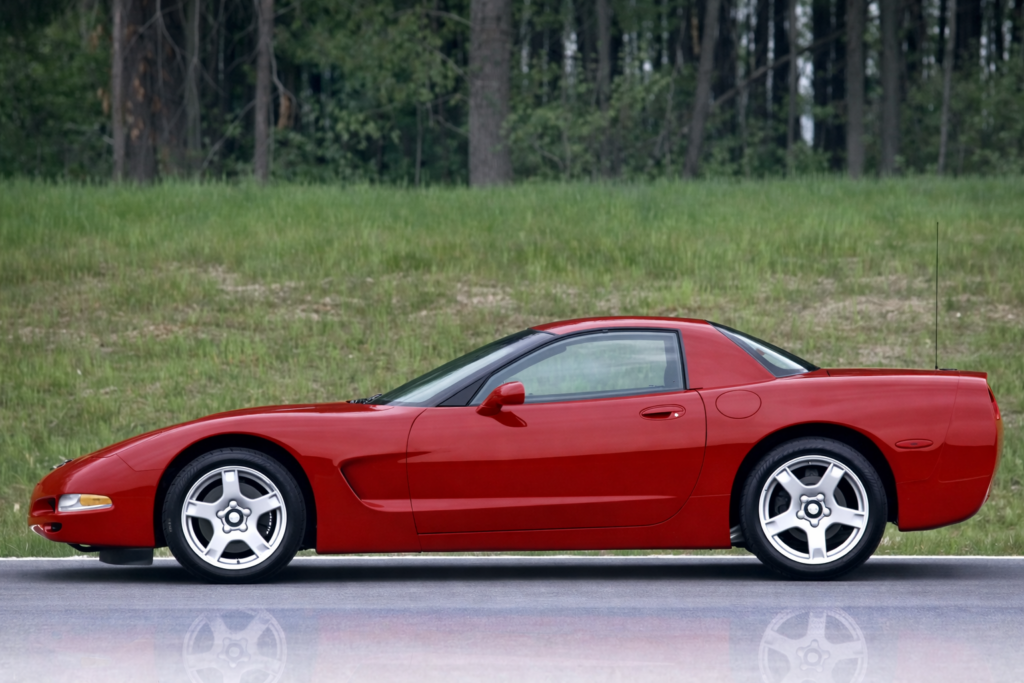
    Introduced in 1999, the Fixed Roof Coupe was born out of Chevrolet’s search for a more focused, lower-cost C5 variant, but it quickly evolved into something much more important: a stiffer, lighter Corvette aimed squarely at serious drivers. By pairing the convertible’s trunk structure with a permanent roof, the FRC delivered greater chassis rigidity, standard Z51 handling hardware, and a six-speed manual, giving the brand a more performance-driven entry point without diminishing Corvette’s image. Just as importantly, it proved there was real demand for a stripped-back, track-minded Corvette that emphasized precision over luxury. In doing so, the FRC helped sharpen the C5’s identity and laid the engineering and marketing groundwork for the 2001 Corvette Z06. (Image courtesy of GM Media LLC.)

    One of the most interesting truths about the 1999 Corvette is that its most important new variant did not begin life as a purity special. It began life as a pricing exercise. Early in the C5’s development, Chevrolet explored the idea of creating a cheaper Corvette—something intentionally pared back, aimed at broadening the car’s reach at a time when there was internal concern about whether Corvette was becoming too exclusive, too expensive, and too vulnerable to shrinking demand. Chief engineer Dave Hill later recalled that Chevrolet asked him to find a way to make a cheaper Corvette, and period reporting from Car and Driver makes clear that early clinic cars reflected exactly that thinking: manually adjusted cloth seats, smaller tires, fewer features, and even an automatic transmission in some prototypes.

    The problem was that customers did not want a bargain-basement Corvette. They wanted a Corvette that felt special. According to Car and Driver, clinic reactions to those stripped prototypes were overwhelmingly negative, and Hill himself drew a sharp line between the abandoned budget concept and the production car that followed, saying flatly, “This is not a stripper.” That sentence tells you almost everything you need to know about how the 1999 hardtop came to market. Chevrolet did not abandon the idea of a lighter, less expensive Corvette. It redefined the mission. Instead of trying to make the Corvette cheaper in a way buyers would perceive as diminished, Chevrolet repositioned the car as more focused, more rigid, and more serious. John Middlebrook described the resulting model as “lighter, stiffer and slightly more agile,” and that language was not accidental. The hardtop would not be sold as a lesser Corvette. It would be sold as a sharper one.

    From Budget Exercise to Serious Driver’s Car
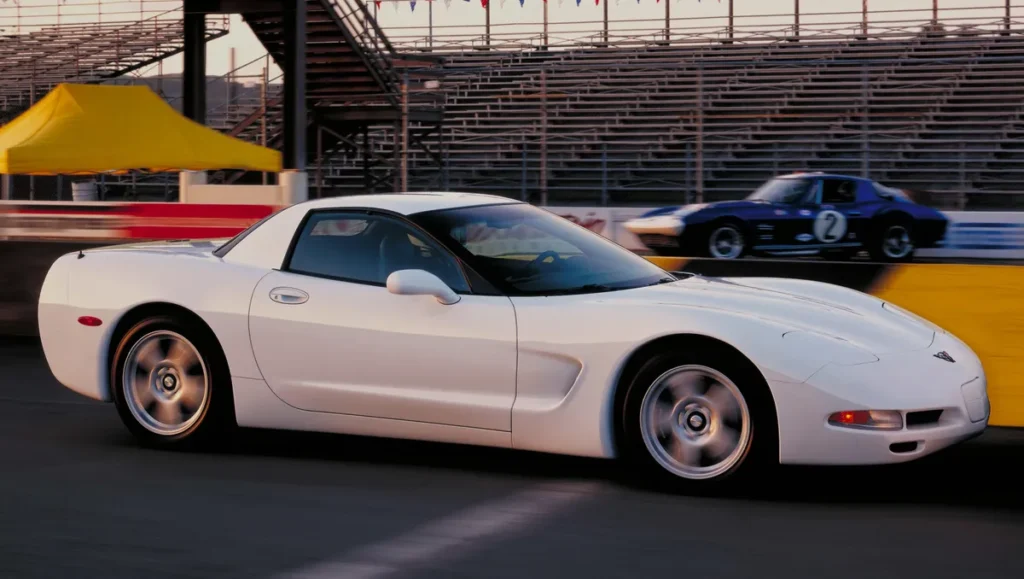
    1999 FRC Corvette on track.
    For serious drivers, the 1999 FRC quickly became more than just a new body style. Its lighter weight, greater structural rigidity, standard six-speed manual, and standard Z51 suspension made it the most focused C5 in the lineup, appealing to enthusiasts who cared more about balance, feedback, and control than luxury options. In many ways, it became the purest performance expression of the early C5 formula. More importantly, it showed Chevrolet there was real enthusiasm for a harder-edged Corvette, helping pave the way for the factory-built track weapon that would follow two years later: the Corvette Z06.

    That repositioning is what makes the 1999 hardtop such a fascinating car in Corvette history. The production model preserved some of the original austerity logic, but only where Chevrolet believed it could be recast as performance discipline. The hardtop arrived as the first fixed-roof Corvette since the 1963–67 Sting Ray coupes. It used the convertible’s rear body structure and external trunk, then paired that with a bonded fixed roof rather than the coupe’s removable targa panel and large glass hatch. The result was the stiffest C5 body shell to date, with period and retrospective sources consistently pegging it at about 12 percent stiffer than the coupe and roughly 80 to 90 pounds lighter depending on how the comparison was made. Official archival specs list the hardtop at 3,155 pounds versus 3,245 for the hatchback coupe, while Car and Driver measured a 79-pound advantage against a comparably equipped hatchback.

    Chevrolet then made sure the supporting hardware backed up the story. Every hardtop came standard with the six-speed manual transmission, the 3.42 limited-slip rear axle, and the Z51 Performance Handling Package, featuring stiffer springs, larger stabilizer bars, and monotube shocks. That was a meaningful bundle. On the coupe and convertible, those items cost extra. On the hardtop, they defined the car. Jim Campbell pointed out at launch that the six-speed and Z51 package represented a value that widened the real price gap between the hardtop and a comparably equipped coupe beyond the base MSRP suggested. In pure sticker terms, the hardtop started at $38,777, the coupe at $39,171, and the convertible at $45,579. But Chevrolet knew buyers were not comparing bare numbers on paper. They were comparing what they got for those numbers.

    What the Hardtop Kept, and What It Gave Up
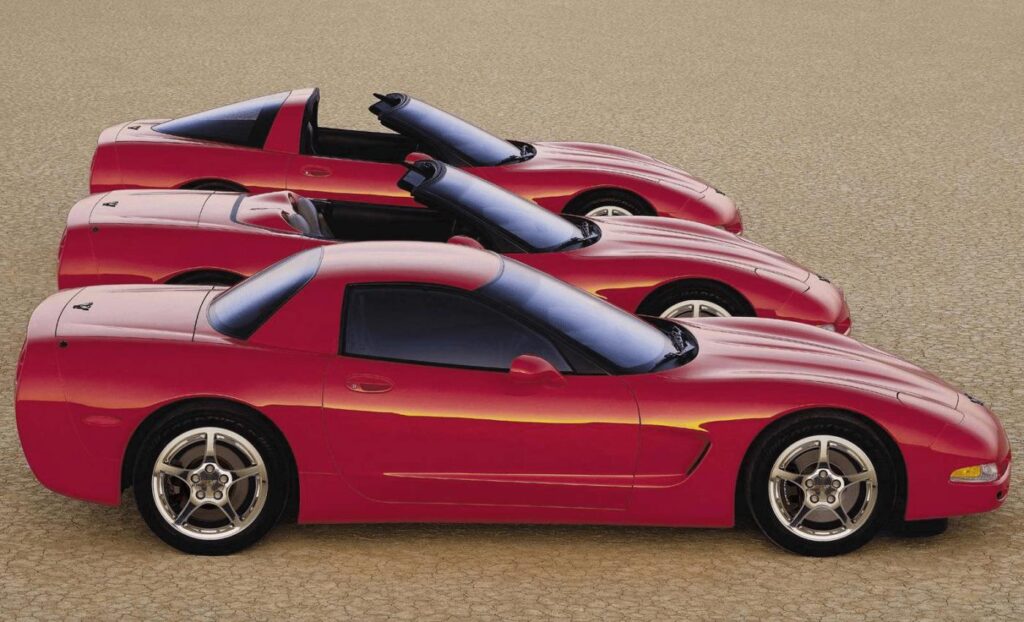
    Although the 1999 Corvette lineup now included three distinct personalities, the coupe, convertible, and new Fixed Roof Coupe still shared the same essential C5 foundation: the 345-horsepower LS1 V-8, hydroformed chassis, rear transaxle layout, four-wheel disc brakes with ABS, traction control, and the overall suspension architecture that made the fifth-generation Corvette such a leap forward. Where the FRC began to separate itself was in its mission. Rather than loading it with comfort and convenience equipment, Chevrolet kept it focused, omitting features such as the automatic transmission, the power telescoping steering column, Selective Real Time Damping, and several luxury-oriented convenience options so the car could be lighter, stiffer, and more performance-minded. In return, the FRC came standard with the six-speed manual and Z51 performance suspension, underscoring that this was not intended as a “cheap” Corvette, but as a more serious driver’s Corvette. (Image courtesy of GM Media LLC.)

    What is often missed in retellings of the 1999 hardtop is that Chevrolet did not build a bare-bones penalty box. In fact, the launch press release makes clear that all 1999 Corvettes—including the hardtop—still came with a strong baseline of standard equipment: the 5.7-liter V8, traction control, four-wheel ABS, run-flat tires, aluminum wheels, tire-pressure monitoring, air conditioning, power windows, power locks, cruise control, heated power mirrors, and rear-window defogger. That is an important corrective to the old myth that the 1999 hardtop was some kind of crank-window, heater-delete special. It was not. The production car remained recognizably upscale. Chevrolet simply tightened its focus.

    Where the hardtop did narrow the menu was in exactly the areas Chevrolet believed added weight, complexity, cost, or luxury positioning. At launch, the hardtop’s option list was intentionally short: power driver seat, Active Handling, Bose audio, CD changer, and bodyside moldings. It came only with black leather interior and only in five exterior colors: Torch Red, Arctic White, Black, Light Pewter Metallic, and Nassau Blue Metallic. No automatic transmission was offered. No power telescoping steering column was offered. Real Time Damping was excluded because Z51 was standard. The brochure also presented the Head-Up Display as unavailable on the hardtop. So while Chevrolet had backed away from the crude idea of a “cheap Corvette,” it had not walked away from the discipline of building a more purpose-built one. The hardtop was the Corvette for the buyer who wanted less garnish and more intent.

    Did the Hardtop Deliver on Performance?
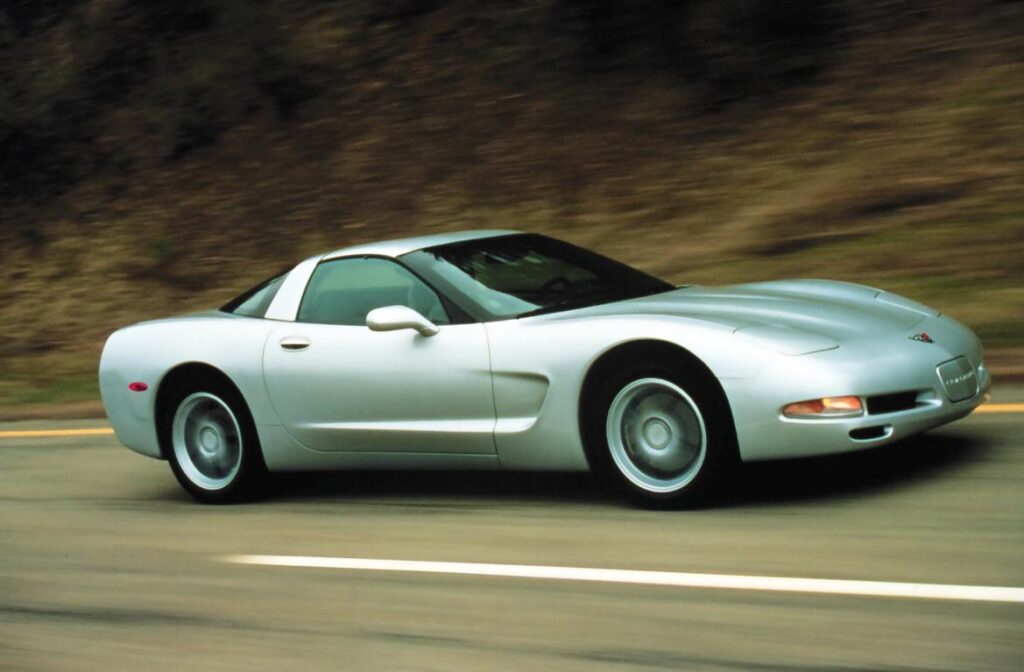
    The 1999 FRC did exactly what Chevrolet needed it to do: it proved there was real enthusiasm for a harder-edged, more performance-focused Corvette. With its lighter weight, stiffer fixed-roof structure, standard six-speed manual, and standard Z51 suspension, the FRC immediately established itself as the most serious driver’s car in the C5 lineup, even if its performance gains over the coupe were modest on paper. More importantly, it changed the conversation around what a modern Corvette could be, showing that buyers would embrace a version of the car that sacrificed some comfort and convenience in favor of sharper dynamics and greater purpose. In that sense, the FRC was not just a new body style for 1999, but the first clear step toward the C5 Z06. (Image courtesy of GM Media LLC.)

    In the real world, the answer was yes—but not by some earth-shattering margin. The hardtop was quicker, but only a little. Car and Driver recorded 0–60 mph in 4.8 seconds and the quarter mile in 13.2 seconds at 110 mph, edging the magazine’s recent hatchback-coupe tests by a tenth here and there. Corvette Action Center’s period performance compilation, drawn from multiple contemporary publications and GM specs, places the hardtop in essentially the same range: 4.7 to 4.8 seconds to 60 and 13.3-ish in the quarter, depending on source. That was enough to validate Chevrolet’s pitch without turning the hardtop into some giant-killer within the lineup. It was not a different species of Corvette. It was a cleaner expression of the same one.

    The more interesting difference was in feel. Car and Driver wrote that you could sense the hardtop’s slightly stiffer structure on the road, and that observation aligns with Chevrolet’s own engineering rationale. With the roof bonded around its perimeter instead of removable, the car gave up some of the coupe’s versatility in exchange for a more unified shell. It was also not quite as slippery through the air. Because of the hardtop’s more upright rear glass profile, Chevrolet acknowledged it was a little less aerodynamic than the coupe, and Car and Driver saw that in testing with a 169-mph top speed versus 171 mph for its most recent coupe and 175 mph for earlier examples. Corvette Action Center’s period compilation similarly shows published top-speed figures in the low- to mid-170s, depending on source. So the hardtop was not faster in every way. It was simply more direct.

    The 1999 CORVETTE Coupe and Convertible Were Still the Core of the Line
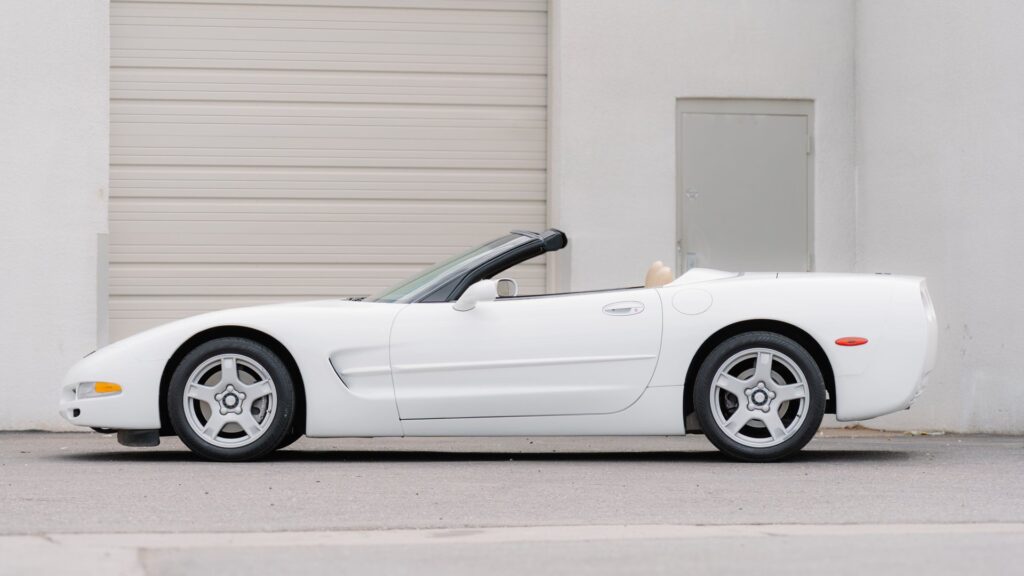
    For the 1999 model year, the coupe and convertible gained several notable features that helped make the C5 feel even more modern and refined. Most significant was the new optional Head-Up Display, which projected key information such as speed and engine data onto the windshield so drivers could keep their eyes on the road. Chevrolet also added an optional power telescoping steering column, giving drivers a greater range of adjustment and improving overall comfort behind the wheel. At the same time, all 1999 Corvettes benefited from steering refinements to improve on-center feel and reduce highway wander, while the coupe and convertible continued to offer a broader range of comfort and convenience options than the new Fixed Roof Coupe, reinforcing their role as the more fully equipped versions of the C5 lineup.

    As important as the hardtop was, the 1999 Corvette story was bigger than the FRC alone. The coupe and convertible remained the volume models and the broader expression of what the C5 had become. Both continued with the 5.7-liter LS1 rated at 345 horsepower and 350 lb-ft of torque, paired either with the rear-mounted four-speed automatic or the six-speed manual. Both kept the C5’s now well-established strengths: low cowl, long wheelbase, impressive ride quality, genuine high-speed stability, and an interior that finally made the Corvette feel like a complete sports car rather than a brilliant engine wrapped in compromise. The C5 had already changed the conversation around Corvette. In 1999, Chevrolet refined the package rather than reinventing it.

    That refinement showed up in the details. Chevrolet updated the speed-sensitive variable-assist steering system—Magnasteer II—for 1999, seeking better on-center feel and less highway wander. Car and Driver noted the steering changes directly and quoted Corvette suspension engineer Mike Neal, who said the goal was to let the car cover “hundreds and hundreds of miles” without fatiguing the driver. The magazine also noted slightly softer seat cushions across the line and additional damping and sound insulation for the coupe. This is one of those places where the 1999 Corvette reveals what the C5 program really was at heart. Even in its performance years, Corvette engineering was not chasing racetrack numbers alone. It was trying to deliver the sort of composure, usability, and long-distance civility buyers associated with much more expensive European machinery.

    The New Technology That Elevated the 1999 CORVETTE
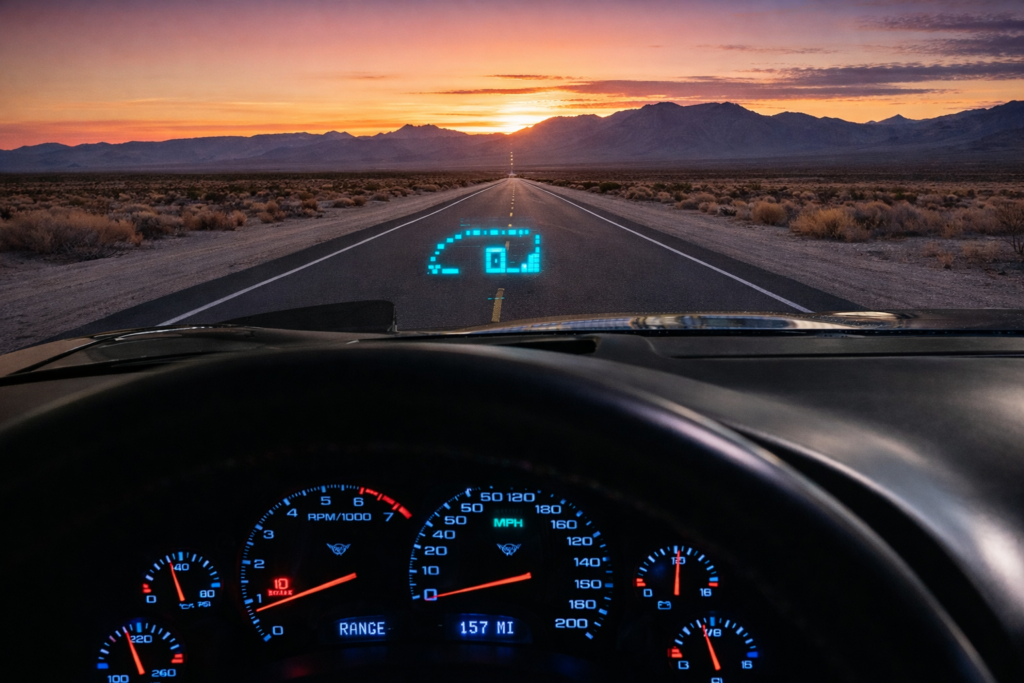
    The 1999 Corvette did more than bring speed to the table. It showed just how serious Chevrolet had become about giving the C5 a genuinely modern technology package, with features like the Head-Up Display putting critical information directly in the driver’s line of sight instead of forcing eyes down to the gauges. Paired with the car’s growing suite of electronic driver aids, it helped make the 1999 Corvette feel less like a traditional sports car and more like a true high-speed grand touring machine for the modern era.

    If there was one new option in 1999 that most clearly signaled Corvette’s continued move upmarket, it was the Head-Up Display. Chevrolet’s brochure treated it as one of the year’s headline additions, and for good reason. In an era when this still felt genuinely high-tech, the HUD projected key instrumentation directly onto the windshield so the driver could monitor speed and other readouts without taking his/her eyes off the road. The production summary for 1999 lists it among the model-year highlights, and the brochure language shows Chevrolet understood exactly how to sell it: as both performance technology and luxury convenience, something borrowed from higher segments and now embedded in America’s sports car.

    The power telescoping steering column fits the same pattern. It was available on the coupe and convertible but not on the hardtop, reinforcing the split Chevrolet was now making within the lineup. The coupe and convertible were the richer, more customizable Corvettes. The hardtop was the disciplined one. Alongside those convenience upgrades, all 1999 Corvettes also received next-generation reduced-force airbags, which GM documented as standard across the board. Active Handling remained optional, integrating chassis, brake, traction-control, and powertrain inputs through acceleration and yaw-rate sensing. In hindsight, that combination of driver aids, safety revision, and display technology helps explain why the 1999 Corvette feels like more than just a continuation of 1998. It was a more sophisticated car, even when its powertrain was at rest.

    A Model Year Full of Interesting Ordering Details
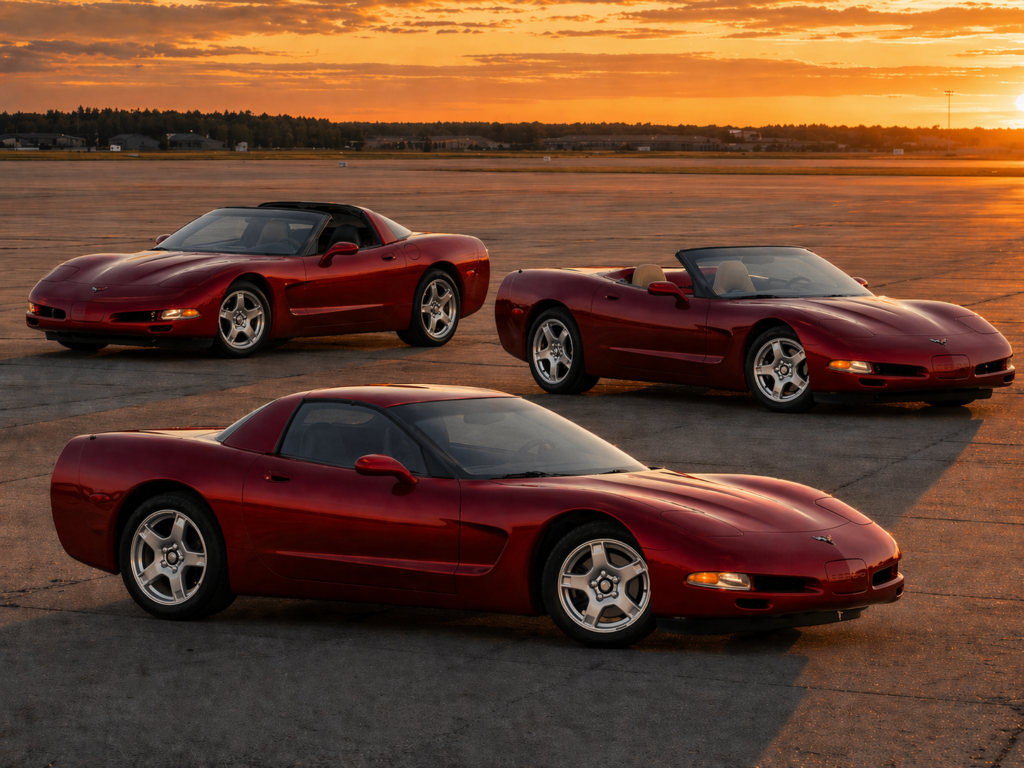
    Front and center, the FRC is the purist of the trio—the lighter, stiffer, six-speed-only hardtop with standard Z51 hardware and fewer comfort-oriented extras, which made it the most performance-minded C5 of the bunch. The coupe at left was the best all-arounder, and the convertible at right was the grand-touring charmer; both leaned further into features with available new-for-1999 items like the Head-Up Display, power telescoping steering column, Memory Package, and dual-zone climate control, while the hardtop kept things leaner and more focused.

    The 1999 Corvette also gets more interesting the deeper you go into the ordering data. Total production reached 33,270 units, up from 31,084 in 1998. The breakdown was 18,078 coupes, 11,161 convertibles, and 4,031 hardtops. That means the hardtop, despite all the uncertainty that preceded it, accounted for roughly 12 percent of total production immediately. For a body style born out of internal anxiety and then reinvented through customer rejection, that is a strong debut. It was not a niche failure. It was a meaningful addition to the line.
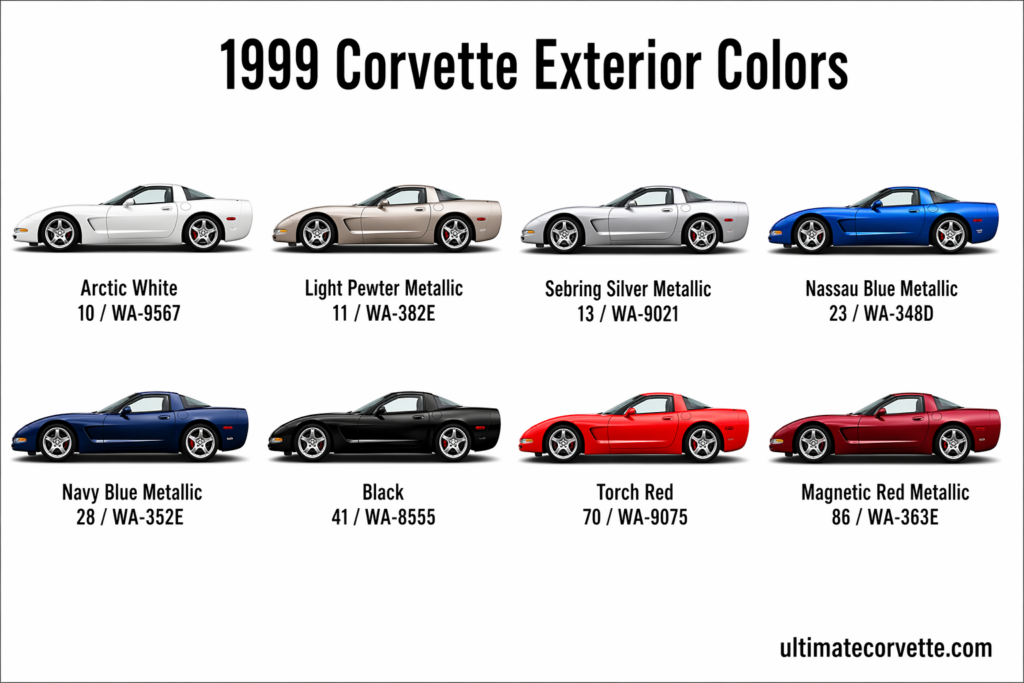
    Eight colors, one iconic shape. The 1999 Corvette lineup offered everything from crisp Arctic White and brilliant Torch Red to the rich depth of Magnetic Red Metallic and Nassau Blue Metallic—proof that Chevrolet knew exactly how to let the C5’s design do the talking.

    The color and trim numbers are just as revealing. Torch Red was the most popular exterior across the full 1999 range at 8,361 cars, followed by Black at 7,235 and Light Pewter Metallic at 6,164. Among hardtops specifically, Torch Red led with 1,245 units, followed by Black at 1,227, and Light Pewter Metallic at 1,040. Nassau Blue accounted for 202 hardtops and Arctic White for 311. Sebring Silver Metallic, Navy Blue Metallic, and Magnetic Red Metallic were not offered on the hardtop. Inside, the hardtop was black only; Bowling Green records show 100 percent of hardtops carrying black interior trim. Even the option take rates tell the story of a focused buyer base: all 4,031 hardtops had the six-speed, all had the 3.42 axle, and just over half—2,082 cars—were ordered with JL4 Active Handling.

    The Odd Hardtop Paper Trail
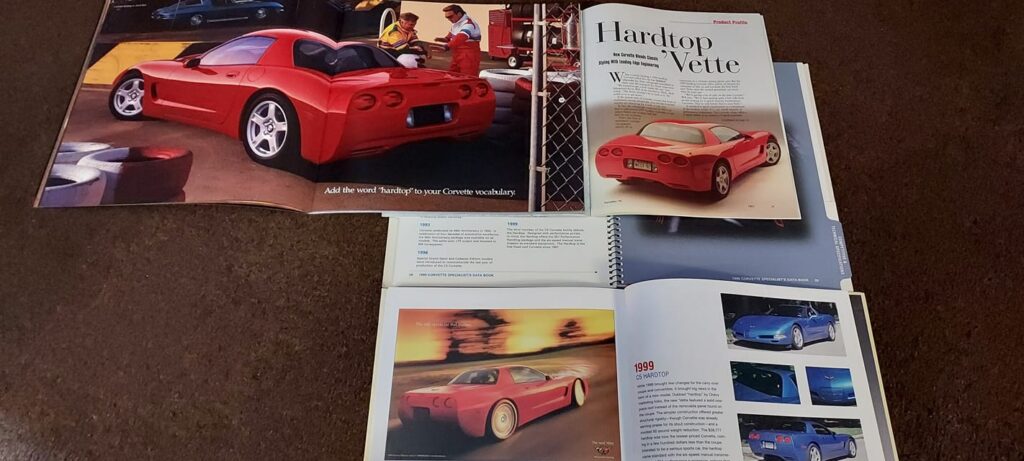
    One of the most fascinating parts of the 1999 Corvette Hardtop story is how inconsistently Chevrolet documented it at the time. Depending on the source, the car could be described as a Hardtop, a Fixed Roof Coupe, or simply folded into broader C5 production material, which has created confusion for historians and enthusiasts ever since. That inconsistency is exactly why preserving brochures, magazine features, order guides, and period reference books matters so much today. Taken together, they help reconstruct the real identity of the 1999 FRC and give this important performance-focused Corvette the historical clarity it deserves.

    One of the quirks of researching the 1999 model year is that the hardtop’s documentation is not perfectly tidy. Chevrolet’s launch press release described a very narrow option set; the brochure explicitly stated that the HUD was “not available on hardtop”; and Car and Driver similarly reported that the new fixed-roof model did without items such as the power-telescoping steering column, dual-zone air, F45 damping, and HUD. Yet the Bowling Green production tallies later attributed small numbers of hardtops to items such as automatic climate control, fog lamps, sport custom wheels, and even the HUD. There are only a few plausible explanations: late-year ordering changes, coding anomalies in the records, pre-production or non-standard builds being counted, or some combination of the three.

    The safest conclusion is not to pretend that those documents all say the same thing, because they do not. The safest conclusion is that the hardtop was clearly conceived and launched as the most tightly controlled C5 in the range, even if the surviving production accounting suggests a few edge cases around the margins. For a comprehensive historical overview, that nuance is worth preserving. It also says something useful about the car itself. The 1999 hardtop was never supposed to be the Corvette for everyone. It was supposed to be the Corvette for the buyer who understood why fewer choices could be part of the appeal. And in that sense, every one of those documents—whether launch brochure, road test, or assembly tally—still points in the same direction.

    The C5-R Brought Corvette’s Confidence Back to the Track
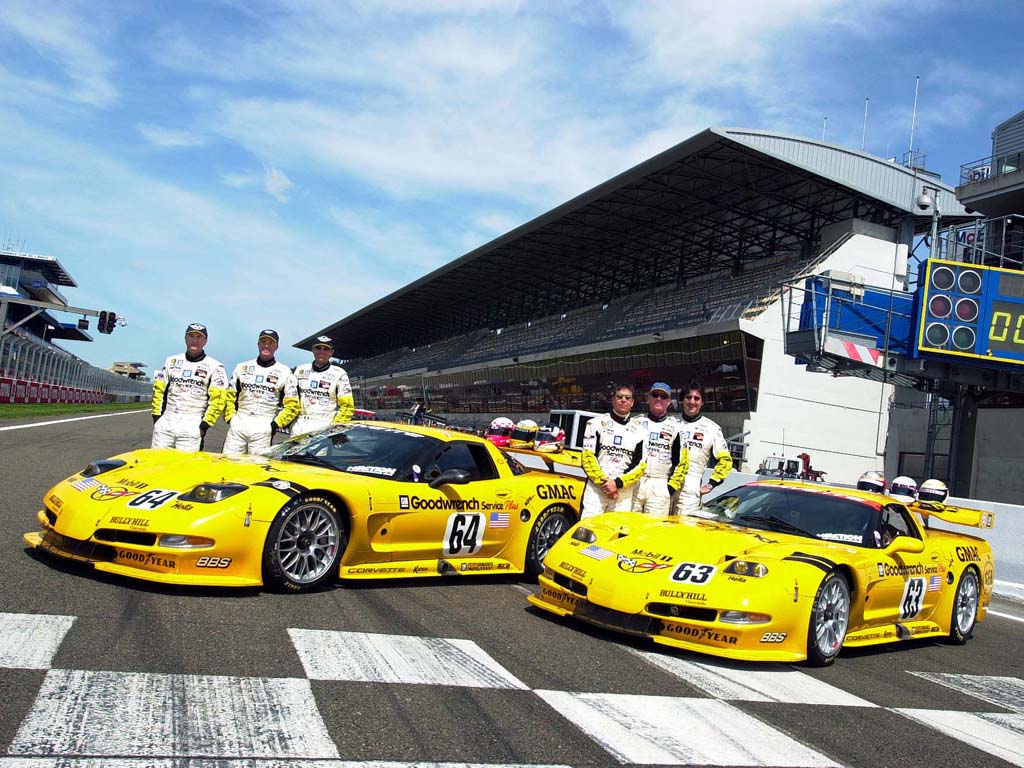
    The 1999 Corvette C5-R was the car that transformed Corvette Racing from an ambitious factory return into a legitimate international endurance contender, pairing Pratt & Miller engineering with Chevrolet small-block power in a purpose-built machine that still looked unmistakably like a Corvette. Shown here in the team’s early two-car No. 63 and No. 64 configuration, the C5-R made its factory-backed Le Mans debut in 2000, where Ron Fellows, Chris Kneifel, and Justin Bell piloted the 63 while Andy Pilgrim, Kelly Collins, and Franck Fréon shared the 64. Their third- and fourth-place class finishes at Le Mans helped lay the foundation for the C5-R’s dominant years to come and secured its place as one of the most important competition Corvettes ever built. (Image credit: Richard Prince)

    If the hardtop gave the 1999 Corvette lineup a sharper internal identity, the C5-R gave the whole franchise a renewed public mission. Chevrolet chose the 1999 Rolex 24 at Daytona to unveil the brand-new C5-R, fielding two factory-supported cars after only about 4,000 miles of testing and development. That alone was an aggressive move. It said Chevrolet believed not only in the C5 as a production car, but in the strength of the architecture underneath it. The Daytona press release made that explicit, describing the effort as the first full factory-supported program designed around a production vehicle using a wide range of production components. By season’s end, Chevrolet’s own materials were framing the C5-R as a major new chapter in Corvette’s racing heritage and as a central expression of the car’s renewed standing.

    The debut justified that faith. The No. 2 C5-R of Ron Fellows, Chris Kneifel, and John Paul Jr. started near the front, led for more than half the race, and finished third after an oil-consuming problem dropped it back. The No. 4 car of John Heinricy, Andy Pilgrim, and Scott Sharp also ran strongly before minor teething issues pushed it to 12th. Dave Hill called it “a tremendous accomplishment” that both cars were still running at the end and emphasized that neither suffered failures tied to their production-vehicle components. Jim Campbell distilled the larger purpose even more cleanly: “Our primary focus is to improve the breed.” That line is one of the keys to understanding 1999. The model year was not just about selling another 33,270 Corvettes. It was about proving, in the showroom and on the track, that Corvette was once again moving with momentum.

    Why the 1999 Corvette Still Matters Today
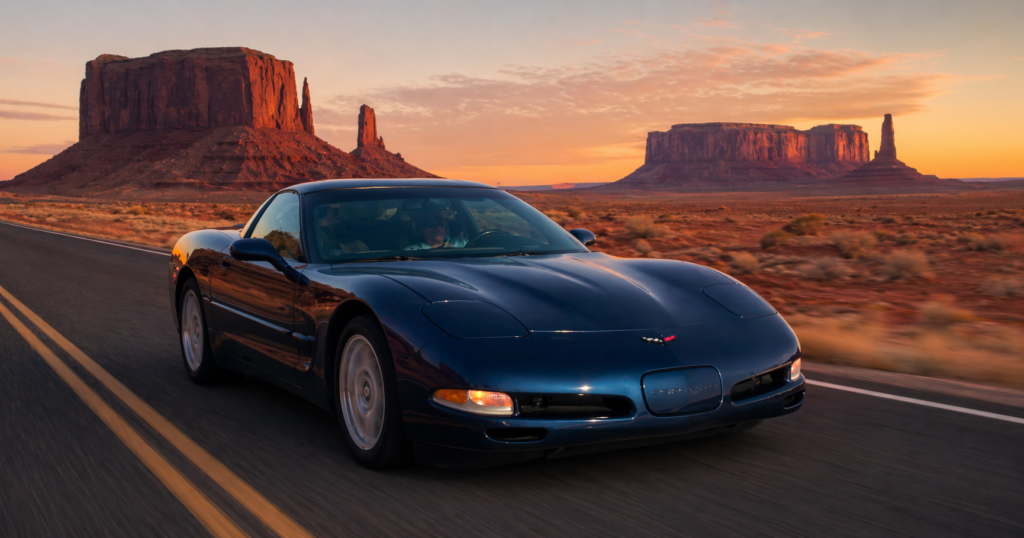

    The 1999 Corvette remains a pivotal chapter in the C5 story because it showed Chevrolet wasn’t content to simply build a better sports car — it was beginning to sharpen the Corvette into something more focused, more sophisticated, and more clearly defined for different kinds of buyers. This was the year the Fixed Roof Coupe arrived, giving performance-minded enthusiasts a leaner, stiffer, more purposeful machine, while the coupe and convertible continued to prove that comfort, technology, and everyday drivability did not have to come at the expense of real performance. More than two decades later, the 1999 model stands as a reminder of the moment the modern Corvette formula really started to take shape.

    With the benefit of hindsight, the 1999 Corvette reads as one of the most important years in shaping the entire C5 generation. It completed the body-style lineup. It introduced a now-iconic fixed-roof configuration that would soon provide the foundation for the C5 Z06. It expanded the car’s technology with the arrival of the HUD and other refinements. It sharpened the distinction between the luxury-leaning and driver-leaning versions of the C5. And it put Corvette back into serious factory-backed competition with the C5-R. MotorTrend would later summarize the arc cleanly: the hardtop began as a lower-cost idea, became a performance variant instead, and ultimately fed directly into the Z06 story that followed.

    More than that, the 1999 Corvette captured a moment when Chevrolet finally seemed to understand that Corvette did not need to be diluted to broaden its appeal. Buyers did not want the car reduced. They wanted it clarified. They wanted the coupe to be a world-class sport-tourer, the convertible to be a true open-air Corvette again, and the hardtop to be a sharper-edged driver’s car without apology. Chevrolet gave them all three. That is why the 1999 model year still carries so much weight today. It was the year the C5 stopped being merely the new Corvette and became a fully realized Corvette family—one with enough range, confidence, and engineering depth to carry the name into a new century.
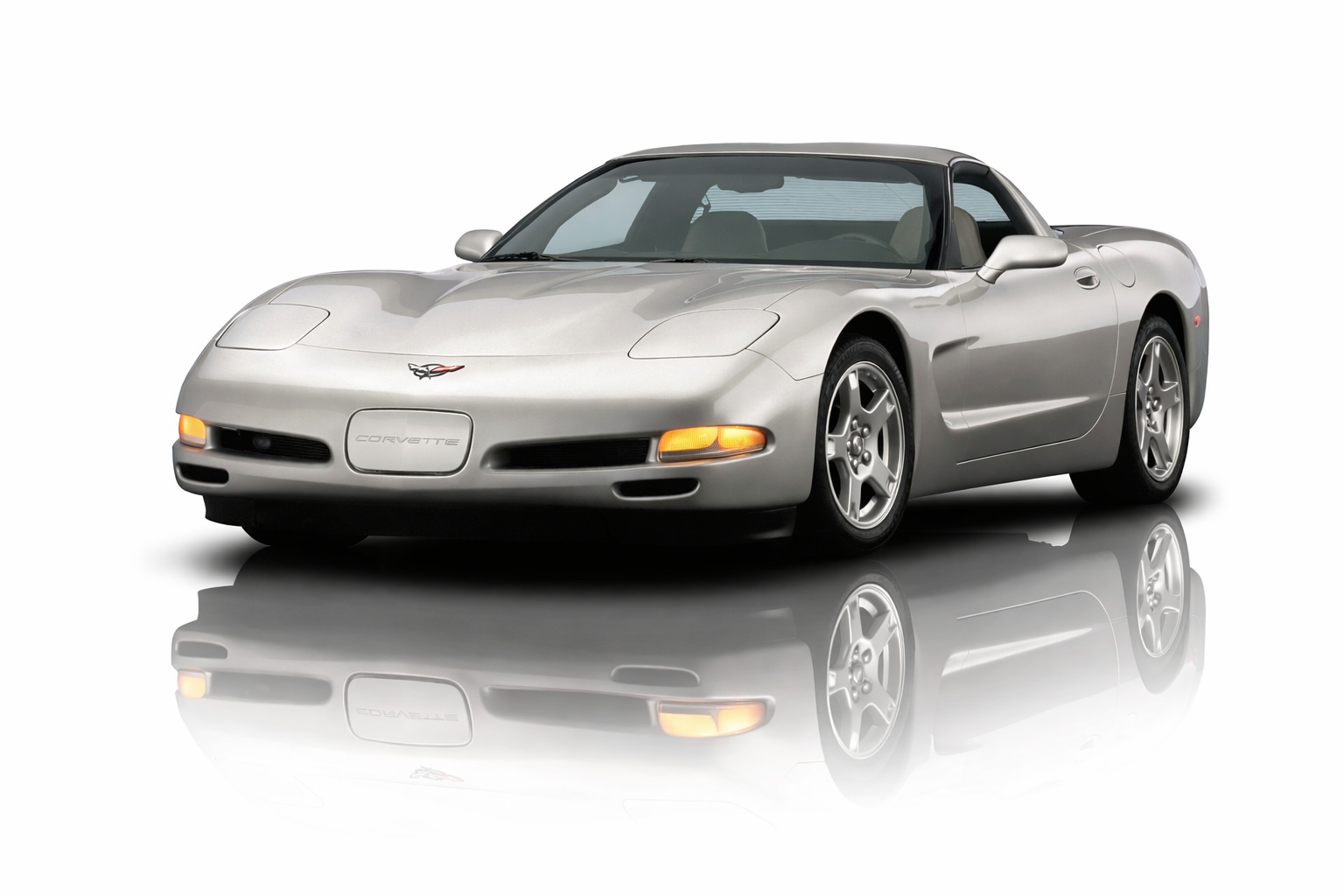
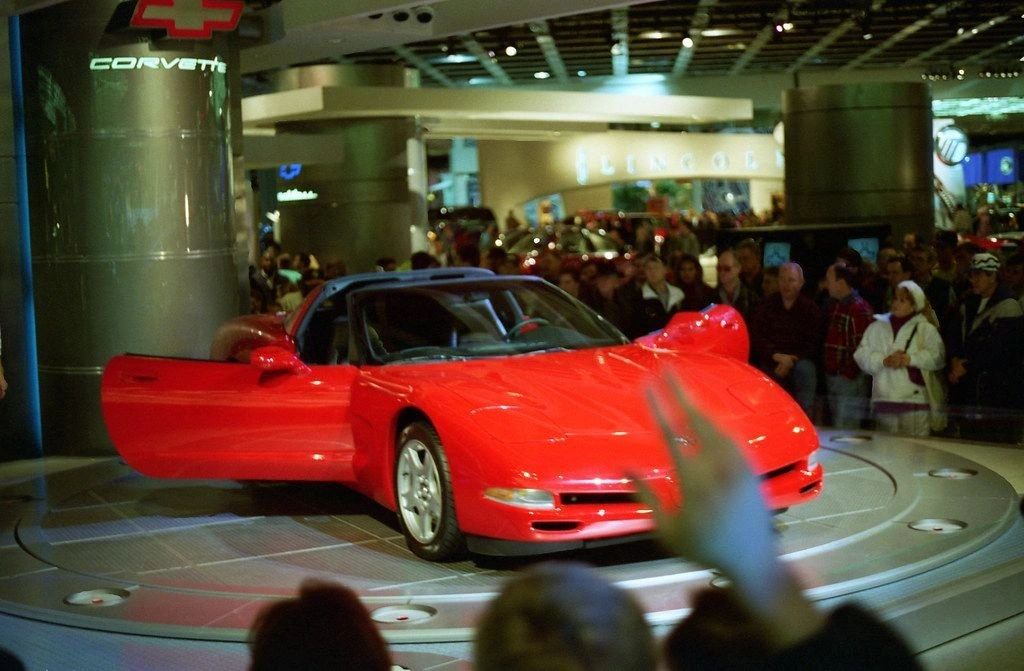
    For 1999, Chevrolet did more than update the C5 Corvette. It completed the lineup, introduced the first fixed-roof Corvette in decades, added new technology, sharpened the car’s performance identity, and launched the C5-R race program—making 1999 one of the most important turning points of the entire generation.

  • 1997 CORVETTE OVERVIEW

    1997 CORVETTE OVERVIEW

    For Corvette enthusiasts the world over, March 7, 1997 was the day the waiting finally ended. After a long C4 sunset and months of spy shots, teases, and careful press choreography, Chevrolet opened the doors and let the first all-new Corvette in thirteen years out into the wild. The C5 wasn’t just a “next model year.” It was a structural, philosophical, and cultural reset—engineers and designers starting over with a clean sheet, refusing to let the Corvette become a museum piece defined by nostalgia more than capability. In Detroit that winter, and in showrooms by early spring, you could feel it: the fifth-generation Corvette would reframe the conversation about America’s sports car.

    Even before customers could buy one, the new car’s reveal showed how carefully Chevrolet staged the moment. At the January 1997 North American International Auto Show, the company put on a split-coast unveiling complete with Vegas-style misdirection and a magician orchestrating the stunts, then followed with a February press event in Chicago that doubled down on headlines. It worked. AutoWeek’s editors named the new C5 “Best in Show” in Detroit, and American Woman Motorscene called it “Most Likely to Be Immortalized”—early signals that the Corvette was being received as more than just a new body and brochure.

    Chevrolet unveiled the all-new 1997 Corvette (C5) on January 6, 1997 at the North American International Auto Show in Detroit. The clean-sheet car debuted a stiffer hydroformed frame, a rear-mounted transaxle for better cabin space and near-perfect balance, and a sleek 0.29 drag coefficient. Power came from the new aluminum 5.7-liter LS1 rated at 345 hp and 350 lb-ft, paired with either a 4L60-E automatic or Borg-Warner T-56 six-speed manual. Tech highlights at the reveal included Goodyear Eagle F1 GS EMT run-flats, optional Selective Real-Time Damping (F45), and the Z51 performance package. Chevrolet said retail sales would begin March 7, 1997, with a $38,060 MSRP—just $270 more than 1996 despite about $1,200 in added standard equipment.
    Chevrolet unveiled the all-new 1997 Corvette (C5) on January 6, 1997 at the North American International Auto Show in Detroit. The clean-sheet car debuted a stiffer hydroformed frame, a rear-mounted transaxle for better cabin space and near-perfect balance, and a sleek 0.29 drag coefficient. Power came from the new aluminum 5.7-liter LS1 rated at 345 hp and 350 lb-ft, paired with either a 4L60-E automatic or Borg-Warner T-56 six-speed manual. Tech highlights at the reveal included Goodyear Eagle F1 GS EMT run-flats, optional Selective Real-Time Damping (F45), and the Z51 performance package. Chevrolet said retail sales would begin March 7, 1997, with a $38,060 MSRP—just $270 more than 1996, despite about $1,200 in added standard equipment.

    The car that rolled out from under the cloth justified the hype. Car and Driver’s contributing editor Csaba Csere—rarely a pushover for marketing gloss—summed up the feeling from the enthusiast press in a line that has since become part of C5 lore: “If, as they say, God is in the details, then this is the first holy Corvette.” He wasn’t being cute. He was acknowledging real, hard-won substance: a structure four times stiffer than the C4, a ground-up chassis with hydroformed rails and a proper backbone, a new all-aluminum LS-series small-block, and—at last—a rear-mounted transaxle that brought weight distribution to the coveted neighborhood of 50/50.

    Clean-Sheet Thinking, Corvette DNA

    Here’s the C5 Corvette coupe at a glance: 179.7 inches long on a 104.5-inch wheelbase, 73.6 inches wide, and just 47.7 inches tall. Track width measures 62.0 inches up front and 62.1 inches at the rear, giving the car its planted stance. The long wheelbase, wide tracks, and low roofline were central to the C5’s stability, interior packaging, and aero efficiency. (Graphic created by and courtesy of the author.)
    Here’s the C5 Corvette coupe at a glance: 179.7 inches long on a 104.5-inch wheelbase, 73.6 inches wide, and just 47.7 inches tall. Track width measures 62.0 inches up front and 62.1 inches at the rear, giving the car its planted stance. The long wheelbase, wide tracks, and low roofline were central to the C5’s stability, interior packaging, and aero efficiency. (Graphic created by and courtesy of the author.)

    From twenty paces the C5 read unmistakably as a Corvette: long hood, tucked tail, hidden headlights, round taillamps. Up close, though, the proportions and sections told a different story. The wheelbase stretched to 104.5 inches, the body grew wider and a touch taller, and designers lowered the cowl to open forward visibility. The result was a car that sat planted on its wheels with a more modern stance—and, crucially, a cockpit that welcomed full-size humans without gymnastic entry rituals. Those choices weren’t rhetorical. They were the visible outcome of engineering priorities that had moved decisively toward structural rigidity, ergonomics, and day-to-day livability, without abandoning the car’s role as a track-capable performance tool. Period tests noted the effect immediately, praising the easy ingress/egress, low cowl, and calmer, more settled responses over broken pavement and crown-rutted highways.

    The surface development had purpose, too. Wind-tunnel work pared the drag coefficient down to an impressive 0.29—significantly slipperier than the outgoing C4—and the taller, cleaner tail helped both luggage capacity and high-speed stability. Even in a time when supercars were starting to chase wind-tunnel fantasy numbers, the Corvette’s mix of low drag, reasonable frontal area, and reduced lift marked a leap forward for the nameplate.

    “We Examined Our Weak Points…”

    David Hill took over as Corvette chief engineer in late 1992 with a mandate to deliver a no-excuses successor to the C4. Under his leadership the 1997 C5 arrived as a clean-sheet car with a hydroformed steel frame, a rear-mounted transaxle tied together by a torque tube, and a dramatically stiffer, quieter structure. It launched the all-aluminum LS1 V-8 (345 hp) and everyday-usable tech like run-flat tires, reflecting Hill’s obsession with pairing world-class performance to real livability and quality. The result reestablished Corvette on the global stage, seeded the C5-R racing program, and laid the foundation for every modern Corvette that followed. (Image courtesy of GM Media LLC)
    David Hill took over as Corvette chief engineer in late 1992 with a mandate to deliver a no-excuses successor to the C4. Under his leadership the 1997 C5 arrived as a clean-sheet car with a hydroformed steel frame, a rear-mounted transaxle tied together by a torque tube, and a dramatically stiffer, quieter structure. It launched the all-aluminum LS1 V-8 (345 hp) and everyday-usable tech like run-flat tires, reflecting Hill’s obsession with pairing world-class performance to real livability and quality. The result reestablished Corvette on the global stage, seeded the C5-R racing program, and laid the foundation for every modern Corvette that followed. (Image courtesy of GM Media LLC)

    Inside Chevrolet, the re-think began years before the reveal. Corvette Vehicle Line Executive and Chief Engineer Dave Hill was blunt about the mission: fix weaknesses, turn them into strengths, and sweat execution. “We examined our weak points and turned them into strengths,” Hill said. “Things that were good, we made great. Things that are now great are now even better.” He tied that ambition to a laser focus on build quality—“Owners in this segment expect excellent quality”—and to an insistence that engineering teams start from a stiff, quiet structure before tuning ride and handling. That approach permeated the program, from the chassis layout to the plastics used for interior touch points.

    The C5 Corvette’s hydroformed steel perimeter frame and rigid central tunnel created a true backbone, tying the LS1 to a rear-mounted transaxle through a torque tube. This layout shifted mass rearward for near 50/50 balance, reduced noise and vibration, and opened up meaningful cabin and trunk space. Aluminum suspension components and composite transverse leaf springs kept weight down while sharpening ride and handling. The result was a platform so stiff and refined that even the convertible became a no-compromise performance model and a foundation for the next generation.
    The C5 Corvette’s hydroformed steel perimeter frame and rigid central tunnel created a true backbone, tying the LS1 to a rear-mounted transaxle through a torque tube. This layout shifted mass rearward for near 50/50 balance, reduced noise and vibration, and opened up meaningful cabin and trunk space. Aluminum suspension components and composite transverse leaf springs kept weight down while sharpening ride and handling. The result was a platform so stiff and refined that even the convertible became a no-compromise performance model and a foundation for the next generation.

    There’s a practical hero in this story: the frame. Instead of a welded mosaic of dozens of individual stampings, the C5’s core structure combined a closed-section steel backbone with hydroformed, galvanized side rails that ran the length of the car. The rails began life as round tubes that were bent, inserted into dies, and “inflated” by water at ~5,000 psi to achieve their final rectangular cross-sections. The floor panels were a composite sandwich with balsa wood cores—light, stiff, and acoustically friendly. Sprinkle in magnesium castings (steering column support, roof frame) and cast-aluminum subframes, and you had a parts bin chosen for stiffness-per-pound rather than tradition. The payoff was obvious the first time you hit a frost heave: fewer squeaks, less cowl shake, and suspension geometry that could finally work from a stable foundation.

    The Transaxle That Changed Everything

    Pictured is the Borg-Warner (later Tremec) T-56 six-speed used in the 1997 Corvette. In the C5 it was packaged as a rear transaxle and linked to the LS1 by a rigid torque tube, improving weight balance and quieting NVH. The T-56’s double overdrive allowed relaxed highway rpm, and its CAGS “skip-shift” could route 1st-to-4th under light throttle for fuel-economy targets. Its robust aluminum case and heavy-duty synchronizers comfortably handled the LS1’s 345 hp/350 lb-ft while delivering the crisp shift feel that helped define the new Corvette. (Image courtesy of GM Media LLC)
    Pictured is the Borg-Warner (later Tremec) T-56 six-speed used in the 1997 Corvette. In the C5 it was packaged as a rear transaxle and linked to the LS1 by a rigid torque tube, improving weight balance and quieting NVH. The T-56’s double overdrive allowed relaxed highway rpm, and its CAGS “skip-shift” could route 1st-to-4th under light throttle for fuel-economy targets. Its robust aluminum case and heavy-duty synchronizers comfortably handled the LS1’s 345 hp/350 lb-ft while delivering the crisp shift feel that helped define the new Corvette. (Image courtesy of GM Media LLC)

    Corvette had flirted with the idea of moving the transmission rearward before, but the C5 made it real. By bolting the gearbox to a differential unit just ahead of the rear axle and connecting it to the engine with a rigid torque tube, the team moved mass where it mattered, chased polar-moment benefits, and freed up the cabin from the pinched footwells that had defined C4 long-distance discomfort. The result: a near-ideal balance—51.4/48.6 front/rear in standard form—and steering/handling behavior that felt calmer at the limit and more predictable on rough roads. It wasn’t theoretical; instrumented tests and long reviews made a point of how different the C5 felt once you started leaning on it.

    LS1: A New Small-Block With an Old Soul

    Development of the LS1 began in 1993 as GM’s clean-sheet Gen III small-block for the 1997 Corvette. The all-aluminum 5.7-liter kept pushrod simplicity but added a deep-skirt “Y-block” with six-bolt main caps, a structural oil pan, coil-near-plug ignition, and a composite intake feeding high-flow cathedral-port heads—big gains in breathing, NVH, and durability. In Corvette tune it made 345 hp and 350 lb-ft at 10.1:1 compression, backed by either a T-56 six-speed manual or 4L60-E automatic. Its compact size and reduced mass helped enable the C5’s rear transaxle layout and near-50/50 balance while improving efficiency and emissions. The LS1 launched an entire LS lineage (LS6/LS2/LS3/LS7 and beyond) that defined GM performance for the next two decades. (Image courtesy of GM Media LLC)
    Development of the LS1 began in 1993 as GM’s clean-sheet Gen III small-block for the 1997 Corvette. The all-aluminum 5.7-liter kept pushrod simplicity but added a deep-skirt “Y-block” with six-bolt main caps, a structural oil pan, coil-near-plug ignition, and a composite intake feeding high-flow cathedral-port heads—big gains in breathing, NVH, and durability. In Corvette tune it made 345 hp and 350 lb-ft at 10.1:1 compression, backed by either a T-56 six-speed manual or 4L60-E automatic. Its compact size and reduced mass helped enable the C5’s rear transaxle layout and near-50/50 balance while improving efficiency and emissions. The LS1 launched an entire LS lineage (LS6/LS2/LS3/LS7 and beyond) that defined GM performance for the next two decades. (Image courtesy of GM Media LLC)

    Under the hood sat a familiar displacement—5.7 liters—and a familiar architectural recipe: two valves per cylinder actuated by pushrods. That’s where the carryover ended. The Gen-III LS1 was an all-aluminum design with deep skirt block, six-bolt main bearing caps (four vertical, two cross-bolts), revised head fastener patterns, and modern sealing practices. Output landed at 345 hp @ 5,600 rpm and 350 lb-ft @ 4,400 rpm—numbers that put the base C5 in the same performance time zone as the earlier LT5-powered ZR-1 without the ZR-1’s complexity or mass. Period coverage emphasized not just peak numbers but durability targets (100,000-mile design horizons) and the package work that tucked the sump as shallow as packaging allowed, preserving ground clearance while ensuring oil control during sustained lateral loads.

    Chevrolet paired the LS1 with two familiar transmissions: a four-speed automatic and a Borg-Warner/Tremec-pattern six-speed manual. The manual kept the first-to-fourth CAGS (Computer Aided Gear Selection) skip-shift logic (less intrusive than before), and the aft location of the gearbox added rotating inertia to the driveline that the synchros had to manage—one reason testers occasionally noted a notch here and there in the shift feel. The automatic, meanwhile, remained a smart choice for owners who wanted grand-touring ease with plenty of long-legged punch. Either way, the torque tube tied the powertrain into the spine of the car, turning the entire engine-to-axle assembly into a structural member.

    Chassis Tuning: Leaf Springs, Done Right

    The image shows the C5 Corvette’s rear suspension module—a double-wishbone (short/long arm) layout mounted to a rigid cradle. It pairs forged-aluminum control arms and knuckles with a composite transverse leaf spring, monotube shocks, a toe link, and a hollow anti-roll bar to slash unsprung mass. This compact, lightweight package worked around the rear transaxle and is a big reason the C5 felt planted and modern compared with the C4.
    The image shows the C5 Corvette’s rear suspension module—a double-wishbone (short/long arm) layout mounted to a rigid cradle. It pairs forged-aluminum control arms and knuckles with a composite transverse leaf spring, monotube shocks, a toe link, and a hollow anti-roll bar to slash unsprung mass. This compact, lightweight package worked around the rear transaxle and is a big reason the C5 felt planted and modern compared with the C4.

    Yes, the C5 still wore transverse composite leaf springs at both ends—not because engineers were nostalgic, but because the springs were light, compact, and freed valuable packaging space for low hoods and usable trunks. The geometry around those springs changed dramatically: true short/long-arm double wishbones, carefully controlled toe curves, and cast-aluminum subframes that located everything precisely. Buyers chose among a base passive-damper tune; the Z51 performance handling package; or F45 Selective Real Time Damping, an electronically controlled system with Tour, Sport, and Performance modes that could alter shock force up to 100 times per second. Contemporary testers praised the spread: Tour for commuting calm, Performance for canyon resolve, with Sport as the just-right middle that flattened pitch without going brittle. Brakes, meanwhile, grew thicker and breathed better thanks to dedicated ducting through the front fascia.

    Goodyear’s Eagle F1 GS EMT was the 1997 Corvette’s factory performance tire—a Z-rated run-flat that let Chevy delete the spare and gain real cargo space. Its stiff sidewalls and directional V-tread delivered about 50 miles of mobility at up to 55 mph after a puncture while preserving crisp steering. OE sizing was 245/45ZR17 up front and 275/40ZR18 in back, tuned for the C5’s aluminum control-arm chassis. Not ultimate track rubber, but a smart blend of grip, stability, and peace of mind. (Image courtesy of Goodyear Tires)
    Goodyear’s Eagle F1 GS EMT was the 1997 Corvette’s factory performance tire—a Z-rated run-flat that let Chevy delete the spare and gain real cargo space. Its stiff sidewalls and directional V-tread delivered about 50 miles of mobility at up to 55 mph after a puncture while preserving crisp steering. OE sizing was 245/45ZR17 up front and 275/40ZR18 in back, tuned for the C5’s aluminum control-arm chassis. Not ultimate track rubber, but a smart blend of grip, stability, and peace of mind. (Image courtesy of Goodyear Tires)

    The tire story mattered, too. The C5 arrived on Goodyear Eagle F1 GS EMT “extended mobility” (run-flat) tires, 245/45ZR-17 front and 275/40ZR-18 rear, with pressure monitoring as standard. The run-flats let Chevrolet delete the spare and jack—reducing mass and freeing cargo volume—while the staggered diameters contributed to stability and gave the car a purposeful stance without resorting to cartoon-wide rubber. Critics expected numbness; what they reported instead was tactility and improved on-center stability versus late C4s, even though the C5’s tires were actually a bit narrower.

    Interior: Analog Dials, Real Materials, Human Fit

    The C5 cabin traded the C4’s digital arcade for crisp analog gauges and a thick, airbag wheel wearing crossed flags. The center stack grouped Bose audio, true climate control, and driver-memory switches within easy reach, while the stubby six-speed shifter fell naturally to hand. Quiet, solid, and functional—this was the first Corvette cockpit that felt genuinely modern.
    The C5 cabin traded the C4’s digital arcade for crisp analog gauges and a thick, airbag wheel wearing crossed flags. The center stack grouped Bose audio, true climate control, and driver-memory switches within easy reach, while the stubby six-speed shifter fell naturally to hand. Quiet, solid, and functional—this was the first Corvette cockpit that felt genuinely modern.

    When you climbed into a C5 after a late C4, you understood the word “civilized.” The sill height dropped. The footwells expanded and—hallelujah—there was a proper dead pedal. The dash traded arcade-era digital for a clean, legible analog cluster with layered, three-dimensional faces. The materials moved away from brittle plastics toward a mix that felt less cost-reduced and more intentional. Critics who had long ribbed Corvette for buzzy, squeaky cabins discovered a cockpit that stayed quiet over expansion joints and read like it had been assembled with a torque wrench, not a hope and a prayer. Car and Driver’s May 1997 road test put it memorably: “After years of wrong answers, the Corvette guys finally did their homework and aced a test.”

    The features list also read like modernity had finally arrived. It included a standard removable roof panel (with optional blue-tint polycarbonate), Bose audio with an in-dash CD, keyless entry, and a memory package that could recall seat, mirror, climate, and radio settings. Options such as dual-zone climate control, a remote 12-disc changer, and F45 damping added customization without drowning owners in complexity. The idea wasn’t to gild the Corvette into a boulevard cruiser; it was to recognize that even the most track-curious owners spent most of their time living with their cars. The C5 respected the week as much as the weekend.

    Performance: Numbers and Nuance

    The 1997 Corvette looked every bit as revolutionary as it drove, and this early C5 test car proves it—hunkered down, nose low, and carving through the kind of back road it was born for. Captured here by Car and Driver magazine, the all-new fifth-gen ‘Vette showcased its sleeker body, rigid structure, and LS1 powertrain in one clean shot: America’s sports car, finally modernized for the new era. (Image courtesy of Jim Frenak - Car and Driver)
    The 1997 Corvette looked every bit as revolutionary as it drove, and this early C5 test car proves it—hunkered down, nose low, and carving through the kind of back road it was born for. Captured here by Car and Driver magazine, the all-new fifth-gen ‘Vette showcased its sleeker body, rigid structure, and LS1 powertrain in one clean shot: America’s sports car, finally modernized for the new era. (Image courtesy of Jim Frenak – Car and Driver)

    The stopwatch didn’t flinch. With the six-speed manual, period tests recorded 0–60 mph in about five seconds flat (quicker in early preview tests on a sticky strip), quarter-miles in the mid-13s at ~107–108 mph, and a top speed brushing 171–172 mph—territory that only the most serious C4s could touch. Braking from 70 mph took well under 180 feet in independent testing, and skidpad numbers in the high-0.8s came with a stability and friendliness that C4 drivers didn’t always trust. It wasn’t simply “faster.” It was easier to drive quickly, and easier to live with when you weren’t.

    Those numbers translated directly into the narrative around the car. Car and Driver’s archive preview and full road test stressed the theme of latitude: a car that could hustle or loaf; a chassis that stayed calm when the road didn’t; a cabin that finally fit people and luggage in the same sentence. That nuance matters when you’re trying to understand why the C5 didn’t just win comparisons—it reset expectations about what a Corvette could be between bursts of throttle.

    Aerodynamics and the “High Tail”

    Few shapes in the Corvette world are as distinctive as the C5’s tall rear deck. That “high tail” wasn’t just a styling flourish—it let Chevy stretch the hatch and deepen the cargo well, so this two-seater could swallow real luggage instead of just a gym bag. Aerodynamically, the raised tail helps clean up airflow and reduce high-speed lift, giving the C5 better stability on the highway and front straight than the slab-back C4 it replaced. Visually, it makes the car look hunkered down and purposeful, like it’s squatting over those quad exhaust tips, ready to launch. From this angle, you can see why the C5’s backside became a modern Corvette signature.
    Few shapes in the Corvette world are as distinctive as the C5’s tall rear deck. That “high tail” wasn’t just a styling flourish—it let Chevy stretch the hatch and deepen the cargo well, so this two-seater could swallow real luggage instead of just a gym bag. Aerodynamically, the raised tail helps clean up airflow and reduce high-speed lift, giving the C5 better stability on the highway and front straight than the slab-back C4 it replaced. Visually, it makes the car look hunkered down and purposeful, like it’s squatting over those quad exhaust tips, ready to launch. From this angle, you can see why the C5’s backside became a modern Corvette signature.

    Corvette stylists and aerodynamicists struck a useful compromise. The low nose improved sightlines and helped reduce lift. The taller rear fascia—broken up visually by oval lamps and slots—did the unfashionable work of drag reduction and flow management, while also enabling the now-famous “two golf bag” cargo boast. The raw numbers tell the story: a 0.29 Cd, roughly 8–9 percent less total drag than a comparable C4 when you account for the C5’s slightly larger frontal area, and a substantial reduction in lift at speed. The latter is why the C5 feels settled when you’re deep into triple digits—this isn’t a style decision alone; it’s stability you can sense in your fingertips.

    Awards, Reception, and the Culture Shift

    ChatGPT said:  When Car and Driver splashed “C5: A Corvette to Crave!” across its February 1997 cover, it was the opening salvo in a tidal wave of praise for the all-new fifth-gen car. That early test quickly proved prophetic: the C5 would go on to be named Motor Trend’s 1998 Car of the Year, thanks to its blend of 345-hp LS1 performance, real-world usability, and cutting-edge chassis design. In the broader industry, the reborn Corvette also captured the 1998 North American Car of the Year award, beating out prestige sedans and imports that had traditionally owned that space. Car and Driver then cemented the point by returning the Corvette to its coveted 10Best list for 1998, signaling that America’s sports car wasn’t just quicker—it had finally achieved the refinement and polish enthusiasts had been begging for. (Image courtesy of Car and Driver)
    ChatGPT said: When Car and Driver splashed “C5: A Corvette to Crave!” across its February 1997 cover, it was the opening salvo in a tidal wave of praise for the all-new fifth-gen car. That early test quickly proved prophetic: the C5 would go on to be named Motor Trend’s 1998 Car of the Year, thanks to its blend of 345-hp LS1 performance, real-world usability, and cutting-edge chassis design. In the broader industry, the reborn Corvette also captured the 1998 North American Car of the Year award, beating out prestige sedans and imports that had traditionally owned that space. Car and Driver then cemented the point by returning the Corvette to its coveted 10Best list for 1998, signaling that America’s sports car wasn’t just quicker—it had finally achieved the refinement and polish enthusiasts had been begging for. (Image courtesy of Car and Driver)

    “Driver’s Choice”-type honors by outlets that had long treated Corvette with arched-eyebrow skepticism. Editors who expected to trade creaks and ergonomic compromises for lap times instead found a car that was quiet at speed, rock-solid over bad pavement, and genuinely comfortable for hours. The verdicts started to sound the same: this wasn’t a fast car that happened to be livable; it was a modern sports car that happened to be a Corvette.

    Long-term evaluations cemented that shift. The hydroformed frame and rear transaxle kept noise and vibration tamped down, the interior held together without the familiar squeaks, and the big hatch and real trunk turned weekend trips into non-events. Reviewers praised steering precision, brake feel, and highway stability while noting the everyday civility—reasonable fuel economy, compliant ride, and the security of run-flat tires—that made the C5 easy to recommend without caveats. The tone changed from “if you can live with it” to “why wouldn’t you,” and even the curmudgeons conceded the point.

    The Business End: Price, Options, and Colors

    Chevrolet announced a base MSRP of $38,060 (including destination) for the 1997 Corvette at the Detroit auto show—only $270 more than a ’96—while adding more than $1,200 in premium standard equipment such as the Bose audio, tire-pressure warning system, power driver’s seat, speed-sensitive steering, and EMT (Extended Mobility Technology) run-flat tires. Option pricing reflected the engineering priorities: $1,695 for the F45 Selective Real-Time Damping, $815 for the six-speed manual transmission, $365 for dual-zone climate control, $600 for the remote 12-disc changer, and $650 for the blue-tinted roof panel (or $950 for dual panels). The Z51 handling package, tuned for track-day appetites, was a modest $350.

    Production started late, so 1997 volumes were modest by Corvette standards: 9,752 coupes—no convertibles or hardtops yet—each identified by VINs whose last six ran from 100001 through 109707. (Pilot and pre-production cars complicate the sequence, so VIN serials don’t map one-to-one to production totals.)

    Paint choices for the launch year leaned classic: Torch Red (the runaway favorite), Black, Sebring Silver Metallic, Arctic White, Nassau Blue Metallic, Light Carmine Red Metallic, and Fairway Green Metallic—some hues far rarer than others by percentage. Those distributions telegraphed two truths: Corvette buyers still loved red, and the C5 wore subtler, more sophisticated tones particularly well.

    Specifications Snapshot (What Mattered Most)

    • Engine: LS1 5.7-liter Gen-III small-block V-8, aluminum block/heads, 345 hp @ 5,600 rpm, 350 lb-ft @ 4,400 rpm.
    • Transmissions: 4-speed automatic or 6-speed manual; rear-mounted transaxle via rigid torque tube.
    • Chassis: Hydroformed steel rails, closed-box backbone, balsa-core composite floors, cast-aluminum subframes.
    • Suspension: SLA control arms F/R with composite transverse leaf springs; F45 electronically adjustable dampers optional; Z51 performance option.
    • Brakes: Vented discs with aluminum calipers; Bosch ABS integrated with traction control; dedicated front brake ducting.
    • Aero: Cd 0.29, reduced lift with higher tail and cleaner underbody.
    • Tires/Wheels: Goodyear Eagle F1 GS EMT run-flats; 245/45ZR-17 (F), 275/40ZR-18 (R); tire-pressure monitoring standard.
    • Dimensions: 104.5-in wheelbase; 179.7-in length; 73-plus-in width; 25 cu-ft cargo volume.
    • Performance (period testing): 0–60 mph ≈ 5.0 sec (manual), 1/4-mile 13.5 @ ~107 mph, top speed ~171–172 mph, 70–0 braking in ~166 ft.

    Inside the Development Culture

    ChatGPT said:  By the time this 1997 Corvette rolled out, it was more than just a new generation—it was the product of a wholesale culture shift inside Chevy engineering. After years of living with the compromises of the C4, the C5 team operated almost like a skunkworks group, obsessed with doing the car “right” instead of “cheap and quick.” They fought for the hydroformed backbone frame, the rear transaxle, and that deep, low cargo well in back because they believed Corvette had to be a world-class sports car, not just an American curiosity. Every surface, from the high tail to the tucked exhaust, reflects a group of engineers and designers who finally had permission—and the mandate—to rethink America’s sports car from the pavement up.
    ChatGPT said: By the time this 1997 Corvette rolled out, it was more than just a new generation—it was the product of a wholesale culture shift inside Chevy engineering. After years of living with the compromises of the C4, the C5 team operated almost like a skunkworks group, obsessed with doing the car “right” instead of “cheap and quick.” They fought for the hydroformed backbone frame, the rear transaxle, and that deep, low cargo well in back because they believed Corvette had to be a world-class sports car, not just an American curiosity. Every surface, from the high tail to the tucked exhaust, reflects a group of engineers and designers who finally had permission—and the mandate—to rethink America’s sports car from the pavement up.

    It’s easy to treat a generational change like a checklist. The C5 story resists that reduction. There’s a through-line from Dave Hill’s team that you hear across the period quotes and technical write-ups: start with structure; insist on quality; pick materials and processes because they work, not because “we’ve always done it that way.” Magazine tech features of the time read almost like love letters to manufacturing: hydroforming pressures, magnesium castings, bolt counts on the backbone’s closing plate, balsa sandwich lay-ups. Those aren’t trivia. They’re the fingerprints of a group that understood how to make a two-seat performance car feel like a car you could drive across a continent without Advil.

    The suspension philosophy tells the same story. Keeping the composite leaf springs was a lightning-rod decision—fuel for every late-night forum fight—but in context, the springs were a rational choice that enabled the low hood, supported a wide range of frequencies with little mass penalty, and worked superbly with the new geometry. Reviewers who arrived ready to sneer at “old tech” walked away praising balance, body control, and the uncanny way the car settled after mid-corner bumps. The engineering wasn’t chasing spec-sheet snobbery. It was chasing results that owners could feel.

    Why the C5 Matters Beyond 1997

    Line these four cars up and you can draw a straight line back to 1997. The fifth-generation Corvette didn’t just replace the C4—it rewrote the engineering playbook with its rear transaxle, stiff backbone structure, and LS1 small-block, giving Chevrolet a modern performance platform it could grow into. The C5 Z06 showed just how serious that foundation really was, and the C6 and C7 Z06 programs simply kept turning up the intensity on the same core ideas: light, rigid, relentlessly capable. Even the mid-engine C8, which looks like a clean break on the surface, exists because Corvette engineers spent two decades refining the expectations set by that ’97 car. Every lap these newer Corvettes run is still, in many ways, a victory for the team that launched the C5. (Image courtesy of corvetteforum.com)
    Line these four cars up and you can draw a straight line back to 1997. The fifth-generation Corvette didn’t just replace the C4—it rewrote the engineering playbook with its rear transaxle, stiff backbone structure, and LS1 small-block, giving Chevrolet a modern performance platform it could grow into. The C5 Z06 showed just how serious that foundation really was, and the C6 and C7 Z06 programs simply kept turning up the intensity on the same core ideas: light, rigid, relentlessly capable. Even the mid-engine C8, which looks like a clean break on the surface, exists because Corvette engineers spent two decades refining the expectations set by that ’97 car. Every lap these newer Corvettes run is still, in many ways, a victory for the team that launched the C5. (Image courtesy of corvetteforum.com)

    The measure of a generational reset isn’t just whether it delights on day one; it’s whether the core ideas endure. Here, the C5 is a watershed. The fundamental layout—front-engine, rear transaxle; hydroformed rails; balsa-core composite floors; LS-series small-block—proved so sound that it carried forward into C6 and C7. Chevrolet refined, lightened, and sharpened. But the bones were C5 bones. And when Corvette finally made the mid-engine jump for C8, it did so from a position of strength born in the C5 era: a global reputation restored and a technical culture that had already demonstrated it could rethink the car without breaking the brand.

    You can feel the cultural change in the way the car is still discussed. Owners talk about road trips measured in states, not zip codes. Track-day folks talk about predictability, cooling, and consistency. Collectors point to 1997 as a hinge year that makes sense of the cars that followed. And historians—my tribe—note that the C5 was the first Corvette in a long time that convinced skeptics on both sides of the Atlantic that this wasn’t a nostalgic exercise. It was a sophisticated, modern sports car that happened to be built in Bowling Green.

    A Year One Coda

    As the 1997 model year drew to a close, Corvette was already driving into a very different future than the one it had inherited from the late C4 era. The all-new C5 chassis, LS1 small-block, and surprisingly refined ride had proven themselves not just as a clean-sheet redesign, but as a rock-solid foundation Chevy could build on. That momentum cleared the way for 1998: the return of the Corvette convertible, broader appeal, and the first wave of refinements that would sharpen the C5 without diluting its character. This image of a Torch Red ’97 disappearing into the sunset is the perfect sendoff—a visual handoff from the breakthrough first year to the deeper, more confident Corvette lineup that followed in 1998.
    As the 1997 model year drew to a close, Corvette was already driving into a very different future than the one it had inherited from the late C4 era. The all-new C5 chassis, LS1 small-block, and surprisingly refined ride had proven themselves not just as a clean-sheet redesign, but as a rock-solid foundation Chevy could build on. That momentum cleared the way for 1998: the return of the Corvette convertible, broader appeal, and the first wave of refinements that would sharpen the C5 without diluting its character. This image of a Torch Red ’97 disappearing into the sunset is the perfect sendoff—a visual handoff from the breakthrough first year to the deeper, more confident Corvette lineup that followed in 1998.

    Because 1997 production started late, volumes stayed under ten thousand units. That scarcity wasn’t a failure; it was a function of ramp timing and a deliberate pace to get quality right. Chevrolet didn’t dump inventory onto dealers and hope for the best. It introduced the coupe, dialed in the line, listened to owners, and prepared the convertible for the following model year. The market responded the way markets do when the product is right: with orders, with magazine covers, with used-car values that told their own story about desirability.

    And the car that buyers took home in ’97 still reads clean today. The proportions are resolved. The interior is human. The driving experience—especially with the six-speed—remains analog in the best sense, with a live front end and a long-legged top gear that reminds you this car was built by people who knew just how big the United States really is.


    The 1997 Corvette launched the all-new C5—and a true reset for America’s sports car. With a hydroformed frame, rear transaxle for near-perfect balance, and the debut of the LS1 V8, it delivered a leap in performance, refinement, and everyday usability. A modern Corvette era begins here.