
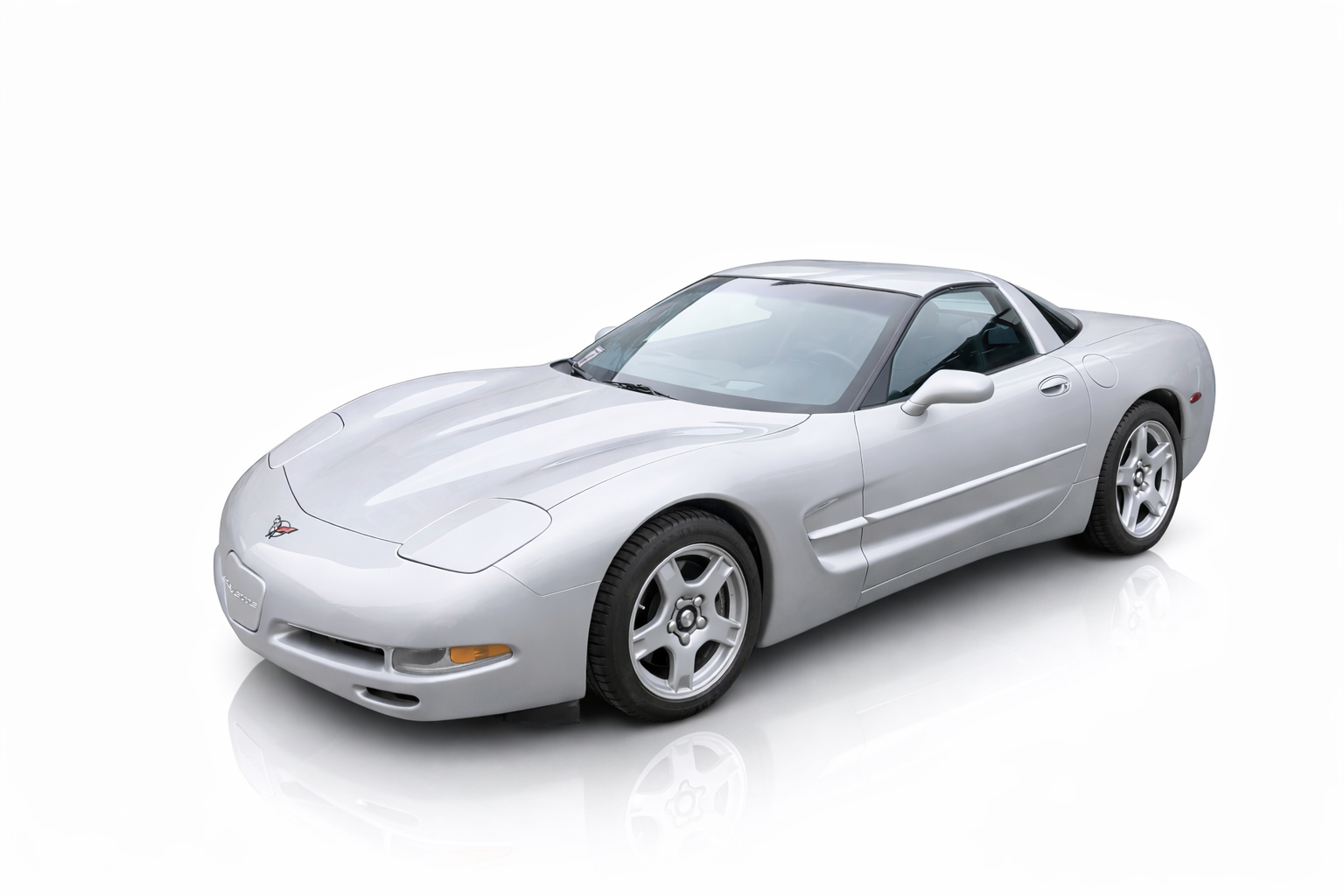
Tag: FRC

  • 2000 Corvette Overview: The C5’s Quiet Turning Point

    2000 Corvette Overview: The C5’s Quiet Turning Point

    At first glance, the 2000 Corvette looks like a holdover year.

    There was no radical redesign. No new production engine. No anniversary package. No pace car graphics. No dramatic bodywork change. The C5 Corvette had already done the heavy lifting when it arrived for 1997, bringing with it a stiffer structure, a rear-mounted transaxle, a new LS1 small-block V-8, better weight distribution, and a level of real-world refinement that moved Corvette into a different league.

    But that is also what makes the 2000 Corvette so interesting.

    The 2000 model year was not about reinventing the C5. It was about sharpening it. Chevrolet made a series of thoughtful changes to the production car, quietly improved some of the areas that mattered most to owners, gave the Corvette two memorable new paint colors, continued to refine the hardtop formula, and, perhaps most importantly, watched the C5-R racing program begin to deliver on the promise that had been building since the factory’s return to serious sports-car competition.

    By the end of 2000, the Corvette was no longer just America’s sports car with a new chassis and a modern engine. It was becoming something bigger: a credible road car, a legitimate grand tourer, a performance bargain, and a factory-backed endurance-racing threat.

    That is the real story of the 2000 Corvette. It was the year the C5 stopped having to prove the idea and started building the legacy.

    The C5 Had Already Changed the Corvette Conversation

    2000 Corvette Coupe (rear), convertible (center), and FRC/Fixed Roof Coup (front).
    By 2000, the fifth-generation Corvette had settled into a confident three-model lineup: the coupe, the convertible, and the fixed-roof coupe. Together, they showed just how broad the C5’s mission had become, offering open-air cruising, long-distance grand touring, and a more focused performance personality from the same basic platform. It was a Corvette lineup that looked clean, modern, and unmistakably ready for the new millennium. (Image courtesy of GM Media LLC.)

    To understand the 2000 Corvette, you have to understand where Chevrolet was by the end of the 1990s.

    The fifth-generation Corvette had arrived for 1997 as one of the most substantial re-engineering efforts in Corvette history. It was not simply a new body over the old car. The C5 brought a new structure, a rear transaxle layout, a torque-tube driveline, improved packaging, more usable cargo space, better ride quality, and the all-aluminum LS1 V-8. That combination gave Corvette buyers something the nameplate had always promised but had not always delivered in such balanced form: everyday usability and serious performance in the same package.

    The LS1 remained the centerpiece. For the 2000 model year, the 5.7-liter, 346-cubic-inch V-8 was rated at 345 horsepower at 5,600 rpm and 350 lb-ft of torque at 4,400 rpm. It used an aluminum block and heads, sequential fuel injection, coil-near-plug ignition, and the now-familiar two-valve pushrod architecture that would become one of the great modern Chevrolet performance signatures. MotorTrend’s retrospective comparison of the C5 LS1 against classic big-block muscle-era powerplants framed the engine well, noting that the LS1 delivered “real-world horsepower” in a modern, efficient, tractable package.

    The LS1 engine powered all variants of the 2000 Corvette.
    The 2000 Corvette’s 5.7-liter LS1 V8 remained the heart of the C5’s appeal, delivering 345 horsepower and 350 lb-ft of torque from a compact, all-aluminum Gen III small-block that helped redefine modern Corvette performance. By this point, the LS1 had already proven that the C5 was more than a cleaner redesign; it was a fundamentally stronger, more refined, and more technically advanced Corvette. Whether fitted to the coupe, convertible, or fixed-roof coupe, the LS1 gave the 2000 lineup the same confident performance baseline and helped set the stage for the higher-output LS6 and Z06 that would follow.

    This is significant because the C5 Corvette did not need to win on nostalgia. It won on performance. Period reviews repeatedly showed that the car could run with much more expensive machinery while remaining civilized enough for long-distance use. Car and Driver’s testing of the C5 hardtop placed the car comfortably in the high-four-second 0-to-60-mph range, with quarter-mile performance in the low 13s and a top speed near 170 mph. MotorTrend’s performance data for a 2000 Corvette convertible equipped with the automatic transmission showed 0 to 60 mph in 4.9 seconds, the quarter mile in 13.4 seconds at 105.5 mph, 60-to-0 braking in 113 feet, and 0.88 g on the skidpad.

    That was the baseline entering 2000. The Corvette was fast, efficient for its output, comfortable, and broadly competitive. Chevrolet did not need to change everything. It needed to keep polishing the car until the rest of the world had to take it seriously.

    What Changed for 2000

    The 2000 Corvette Fixed Roof Coupe in Millennium Yellow.
    As can be seen on this 2000 Corvette Z51 Coupe, Chevrolet introduced several subtle-but-significant updates for the 2000 model year. They sharpened the C5’s performance edge by upgrading the Z51 Performance Handling Package with larger front and rear stabilizer bars, improving the car’s already impressive balance and cornering response. The 2000 model year also brought new five-spoke forged aluminum wheels (as shown above), available in an optional high-polish finish, along with two new exterior colors: Millennium Yellow (also shown above) and Dark Bowling Green Metallic. Inside, Torch Red joined the interior color palette, while the LS1 V8 received revised engine calibration to meet stricter LEV emissions requirements in California and other states following California standards. The result was not a radical reinvention, but a carefully refined Corvette that felt better sorted, more contemporary, and more confident as the C5 entered the new millennium.

    The 2000 Corvette did not receive a new production powertrain, and that is important to state clearly. The LS1 carried over, still rated at 345 horsepower and 350 lb-ft of torque. The four-speed automatic remained standard on coupe and convertible models, while the six-speed manual was optional on those body styles and standard on the fixed-roof hardtop.

    The changes were more subtle, but they were not insignificant.

    In 2000, Chevrolet focused first on making the C5 Corvette sharper without compromising the balance that had made the fifth-generation car such a major step forward. The Z51 Performance Handling Package received thicker front and rear anti-roll bars along with revised shock-absorber damping, changes intended to reduce body roll, improve transient response, and give the car a more planted feel during quick directional changes. As seen on this 2000 Corvette Z51 Coupe, the goal was not to turn the Corvette into a harsh, single-purpose track machine. Instead, Chevrolet refined the car’s already capable chassis so it felt more precise while still retaining the long-distance grand-touring character that defined the C5.

    The optional Selective Real-Time Damping system, RPO F45, was also updated in 2000. Chevrolet revised the system’s control algorithms and added softer jounce bumpers, giving the electronically controlled suspension a broader operating range between comfort and control. The changes helped the Corvette respond more cleanly to road conditions while improving ride quality over rough surfaces. Manual-transmission cars received a smaller but useful driver-interface update as well, with increased shifter spring tension to better locate the lever between the first-second and fifth-sixth gear gates. It was the kind of detail improvement that did not change the car on paper, but made the Corvette feel more confident and deliberate from behind the wheel.

    2000 Corvette Keys and FOB
    The key and twin fobs shown here capture a small but useful 2000 Corvette change: Chevrolet made Active Remote Keyless Entry standard on the coupe, convertible, and hardtop, replacing the earlier Passive Keyless Entry setup. The outgoing passive/active C5 system was clever but fussy: with the fob’s passive slider switched on, the car could automatically disarm and unlock as the driver approached, then lock both doors, arm the theft-deterrent system, confirm with horn/lamp feedback, and shut off the interior lamps after the driver walked away; it also had active button functions for unlock, hatch/trunk release, and panic alarm. The 2000 system simplified that experience into a more conventional button-operated remote: press LOCK, UNLOCK, hatch release, or panic as needed, with Chevrolet’s brochure describing remote operation for locking/unlocking the doors, turning on interior lights, or arming the alarm from up to 30 feet away. It was less futuristic than the proximity-based system, but it was cleaner, more predictable, and easier for owners to understand—especially paired with another 2000 exterior change, the deletion of the passenger-side door lock cylinder.

    Chevrolet also gave the 2000 Corvette several livability and safety updates, many of them aimed at making the C5 feel more refined in everyday use. One of the more noticeable changes was the move away from the earlier passive keyless-entry system. On 19971999 Corvettes, the system could automatically unlock or lock the car based on the driver’s proximity to the vehicle when the passive feature was enabled. In 2000, Chevrolet replaced that arrangement with a more conventional active keyless-entry setup, meaning the driver now locked or unlocked the doors by pressing a button on the transmitter. Replacement parts listings can make this change a little confusing, since later GM remote listings often group 1997–2000 Corvettes together, but the functional change for 2000 was clear: proximity operation was gone, and the system now relied on deliberate button input from the driver.

    A tire-pressure monitoring system also became standard equipment, giving drivers active information about tire inflation conditions at a time when high-performance run-flat tires were becoming a central part of the Corvette ownership experience. Inside, the car received electronic dual-zone air conditioning, revised seat materials and seat construction, seat-belt changes, and improved windshield seals, all of which helped make the cabin feel more polished, quieter, and better suited to regular use.

    The 2000 model year also brought several visual and technical updates. The previous “wagon wheel” design was replaced by new five-spoke forged aluminum wheels, available in painted silver or optional high-polish finishes, giving the C5 a cleaner and more contemporary appearance. Millennium Yellow, offered as a premium tint coat, and Dark Bowling Green Metallic joined the exterior color palette, while Torch Red replaced Firethorn Red in the interior lineup. Chevrolet also deleted the passenger-side exterior door lock cylinder, leaving the driver-side lock as the mechanical backup and giving the passenger door a cleaner appearance. Under the skin, powertrain revisions allowed properly equipped Corvettes to meet government-mandated Low Emissions Vehicle standards in California-emissions states. None of these changes reinvented the C5, but together they showed Chevrolet steadily refining the Corvette into a more polished, more modern, and more complete performance car.

    Powertrain: The LS1 Was Still the Right Engine

    2000 Corvette LS1 Engine.
    For 2000, the Corvette’s LS1 was less about added power and more about refinement. The 5.7-liter Gen III small-block remained rated at 345 horsepower and 350 lb-ft of torque, so there was no headline performance bump over the 1997–1999 cars. Visually, it carried the familiar C5 identifiers: black composite engine covers with red CORVETTE script, composite intake, coil-near-plug ignition, aluminum block and heads, and the VIN G LS1 designation. The real 2000 update was cleaner operation. Chevrolet revised the LS1 package so properly equipped cars could meet Low Emission Vehicle standards in California-emissions states, cutting emissions without dulling the car’s character. In that sense, the 2000 LS1 sits at the end of the early C5 phase: still the original 345-horsepower version, but cleaner and more polished just before the 2001 intake and calibration updates pushed the base Corvette to 350 horsepower. (Image credit: RK Motors)

    By 2000, the LS1 had already proven itself as one of the most important Corvette engines since the original small-block.

    It was compact, relatively light, powerful, and durable. It gave the C5 the performance Corvette buyers expected while also helping the car deliver surprising highway efficiency. Under modern adjusted EPA reporting, the 2000 Corvette with the six-speed manual is listed at 16 mpg city, 25 mpg highway, and 19 mpg combined on premium fuel. Period figures were often reported differently under older EPA methods, but the bigger point remains: the C5 delivered legitimate performance without the fuel-economy penalties once associated with big-displacement sports cars.

    The LS1 also fits the Corvette’s personality. It made its torque down low, revved willingly, and gave the car a broad operating range that made it quick in almost any situation. It did not require exotic maintenance. It did not hide behind forced induction. It was a modern small-block with enough sophistication to satisfy the late 1990s and enough simplicity to earn the long-term loyalty of owners, racers, and tuners.

    In production form, every 2000 Corvette used the same basic LS1 rating, whether coupe, convertible, or hardtop. That is an important distinction when discussing the C5-R race program, because the race cars were a different story entirely. The 2000 C5-Rs moved to a larger 7.0-liter race engine, while the production car retained the 5.7-liter LS1.

    That separation is part of what makes the 2000 model year so compelling. Chevrolet was selling a refined 345-horsepower street car while developing a factory race program that was becoming more serious, more powerful, and more credible with every outing.

    Chassis, Suspension, and the C5 Balance

    2000 Corvette chassis schematic and specifications.
    The 2000 Corvette’s chassis was still one of the C5’s master strokes: a hydroformed steel perimeter frame paired with a rigid central backbone and a torque-tube driveline that linked the front-mounted, all-aluminum 5.7-liter LS1 V8 to a rear-mounted aluminum transaxle for near-ideal weight balance. In 2000, that layout supported 345 horsepower and 350 lb-ft of torque, while the Corvette’s four-wheel short/long-arm independent suspension, wide 73.6-inch stance, and low 0.29 drag coefficient helped deliver the kind of composure and high-speed stability that made the C5 feel so modern. Just as important, this structure was roughly four times stiffer than the C4’s, yet engineered with more than 1,200 fewer parts, proving that the 2000 Corvette’s performance was rooted as much in smart chassis design as in raw LS1 power. (Image credit: UltimateCorvette.com)

    The C5’s chassis was the car’s real breakthrough.

    Previous Corvettes had been fast, and many had been genuinely capable, but the C5 brought a new level of balance. The rear-mounted transaxle helped improve weight distribution. The structure was stiffer. The suspension geometry was cleaner. The steering was more precise. The car felt less like a traditional American performance car trying to compete with Europe and more like a Corvette that had finally stopped apologizing for being a Corvette.

    The 2000 revisions to Z51 and F45 worked within that framework.

    Z51 remained the choice for buyers who wanted a sharper Corvette without moving into a dedicated race-prep environment. For 2000, it received larger front and rear stabilizer bars and revised shocks. Chevrolet’s goal was improved body control, particularly during quick directional changes. The package remained affordable, listed at $350, and was ordered on 7,775 cars according to the option figures included in the original production data.

    F45 Selective Real Time Damping occupied a different space. It was more expensive, listed at $1,695, and appeared on 6,724 cars. It gave the Corvette an adaptive character, allowing the car to better reconcile ride comfort and performance control. The 2000 recalibration and revised jounce bumpers were exactly the kind of changes that rarely make headlines but can meaningfully alter the ownership experience.

    Active Handling, RPO JL4, also continued to define the C5’s move into the modern performance era. Introduced in 1998 and still optional in 2000, it brought a stability-control layer to the Corvette without stripping away the driver’s role. It was ordered on 22,668 cars for 2000, making it one of the more significant technology options of the year.

    This was the balance Chevrolet was chasing: a car that could be fast, comfortable, controllable, and forgiving without feeling numb. That balance is one reason the C5 aged so well.

    The 2000 Corvette Hardtop: Last Call Before the Z06

    2000 Corvette Fixed Roof Coupe in black.
    The 2000 Corvette Fixed Roof Coupe was the final year for the FRC as a standalone model, but it did not disappear so much as evolve. Introduced as the lighter, more rigid, no-nonsense member of the C5 family, the FRC traded the removable roof and hatchback glass of the coupe for a fixed hardtop structure, added useful chassis stiffness, and gave Chevrolet a cleaner performance foundation to build from. By 2000, it had become the enthusiast’s Corvette: simpler, lighter, 6-speed focused, and visually distinct from both the coupe and convertible. Its real legacy arrived one year later, when Chevrolet used that same fixed-roof architecture as the basis for the 2001 Corvette Z06. In that sense, the 2000 FRC was less an ending than a handoff—the last “plain” hardtop Corvette and the direct bridge to the first modern Z06.

    The fixed-roof hardtop, often referred to as the FRC, is one of the most important parts of the 2000 Corvette story.

    Introduced for 1999, the hardtop was originally rooted in the idea of a lower-cost, lighter, more focused Corvette. Chevrolet had considered a more stripped-down version of the C5, but the final production car was not a bare-bones special. It came with the LS1, a six-speed manual transmission, performance-oriented suspension tuning, and a fixed roof bonded to the convertible-style body structure.

    Car and Driver reported that the hardtop was 79 pounds lighter than a comparable hatchback coupe, largely because it eliminated the removable roof panel and heavy rear glass hatch. The magazine also noted that it was the first fixed-roof Corvette coupe since the 1963-1967 Sting Ray. MotorTrend’s retrospective on the FRC added another key figure, stating that the fixed-roof structure generated a 12-percent increase in chassis stiffness while removing roughly 80 pounds.

    That made the hardtop more than a price play. It was the lightest and most focused C5 configuration available before the Z06 arrived.

    It was also short-lived. Chevrolet built 4,031 hardtops for 1999 and only 2,090 for 2000. Production data sources also confirm 2,090 hardtops out of 33,682 total 2000 Corvettes. That 2,090 figure is worth emphasizing because it is sometimes confused with 2,941, which was the production count for Magnetic Red Metallic paint in 2000, not the hardtop body style count.

    2001 Corvette Z06.
    The 2001 Corvette Z06 picked up where the Fixed Roof Coupe left off, turning the C5 hardtop’s lighter, stiffer structure into a true factory performance weapon. Chevrolet kept the FRC’s fixed-roof layout, then added the 385-horsepower LS6, a standard 6-speed manual, revised suspension tuning, upgraded brakes, unique wheels, and functional brake-cooling ducts. What had been the enthusiast’s stripped-down hardtop in 1999–2000 became something far more serious for 2001: the first modern Z06 and the beginning of a new performance chapter for Corvette. (Image credit: CarandDriver.com)

    The hardtop also gave Chevrolet a platform for something more serious. In 2001, the FRC body style evolved into the Z06, complete with the LS6 engine, more aggressive chassis tuning, and a sharper performance mission. In hindsight, the 2000 hardtop is not just the last FRC. It is the bridge between the standard C5 and the Z06 era.

    Car and Driver understood the appeal. Dave Hill, then Corvette chief engineer, rejected the idea that the hardtop was simply a low-budget Corvette, telling the magazine, “This is not a stripper.” The same review concluded, “We love the concept of cheaper and lighter.”

    That is the hardtop in one sentence. Cheaper and lighter, yes. But not less.

    Wheels, Paint, and the Look of the 2000 Corvette

    The five-spoke wheel was first introduced on the 2000 Corvette (all variants)

    Cosmetically, the 2000 Corvette remained familiar, but there were meaningful detail changes.

    The most visible change was the new standard five-spoke aluminum wheel. The earlier “wagon wheel” design gave way to a thinner-spoke design that looked cleaner and more modern. The standard wheel was fully forged with a flow-formed rim for added durability. A polished version, RPO QF5, was available for $895 and proved popular enough that Chevrolet had to adjust wheel sourcing during the model year to support demand.

    The polished aluminum wheel was ordered on 15,204 cars. The magnesium wheel option, RPO N73, remained available at $2,000 and appeared on 2,652 cars. Those numbers tell us something about how buyers viewed the C5. They were willing to spend money on appearance and performance-adjacent upgrades, even when the base car was already strong.

    Color was another major 2000 story.

    2000 Corvette exterior color guide.
    For 2000, Chevrolet’s C5 Corvette palette mixed familiar staples with a pair of new-for-the-year colors. The full exterior lineup included Arctic White — GM paint code 10, Light Pewter Metallic — 11, Sebring Silver Metallic — 13, Nassau Blue Metallic — 23, Navy Blue Metallic — 28, Black — 41, Torch Red — 70, Millennium Yellow — 79, Magnetic Red Metallic — 86, and Dark Bowling Green Metallic — 91. Torch Red remained the volume leader with 6,700 cars produced, while Nassau Blue Metallic was the rarest standard color at just 851 cars; the two headline additions for 2000 were Millennium Yellow and Dark Bowling Green Metallic.

    Chevrolet added two new exterior colors: Millennium Yellow and Dark Bowling Green Metallic. The National Corvette Museum’s 2000 Corvette color reference notes that Millennium Yellow and Magnetic Red carried a $500 surcharge because they required extra tinted clear coat and special application equipment.

    Millennium Yellow quickly became one of the signature C5 colors. It was bold, modern, and perfectly suited to the turn-of-the-century moment. Chevrolet built 3,578 Corvettes in Millennium Yellow for 2000. Dark Bowling Green Metallic, meanwhile, offered a more subtle connection to Corvette’s Kentucky home. Production reached 1,663 units.

    The most popular 2000 color was Torch Red at 6,700 units, followed by Black at 5,807 and Light Pewter Metallic at 5,125. Nassau Blue Metallic was the rarest regular-production color, with just 851 cars built.

    The color lineup gave the 2000 Corvette a broad personality. Buyers could choose traditional Corvette flash, understated metallics, or new-millennium drama. That range helped the C5 appeal to more than one kind of Corvette buyer.

    Interior and Technology: Corvette Keeps Growing Up

    Interior of a 2000 Corvette convertible.
    For 2000, the Corvette cockpit did not get a dramatic redesign, but Chevrolet did sharpen the car’s technology story from the driver’s seat. The biggest change was the move from the earlier passive keyless-entry system to a more conventional active remote, giving owners direct button control over lock and unlock functions. Just as important, the Tire Pressure Monitoring System became standard, feeding tire-pressure warnings through the Corvette’s driver-information electronics and reinforcing the C5’s increasingly tech-forward personality. Inside, the 2000 Corvette still carried the familiar wraparound C5 cockpit, analog gauges, dual-zone climate controls, integrated audio controls, and available head-up display, but the added convenience and monitoring systems made the car feel more refined, more modern, and better suited to real-world ownership. (Image credit: RK Motors)

    Inside, the 2000 Corvette continued the C5’s gradual move toward a more livable cabin.

    The most notable addition was electronic dual-zone air conditioning. RPO CJ2 was listed at $365 and was installed on 29,428 cars, making it one of the more commonly selected comfort features of the year. For a car that was increasingly being used for long-distance trips, weekend travel, and daily driving, that kind of feature mattered.

    The Head-Up Display, RPO UV6, also remained a defining C5 technology feature. It appeared on 26,482 cars for 2000. The HUD helped reinforce the idea that the Corvette was both driver-focused and technologically current. It was not just a gimmick. It kept speed and key information in the driver’s line of sight, which suited the Corvette’s grand-touring mission.

    The Memory Package, power seats, sport seats, Bose audio, CD changer, Twilight Sentinel, fog lamps, and luggage convenience options all continued to build out the Corvette as a car people could tailor to their intended use. Some buyers wanted a lightweight hardtop with a manual transmission and few extras. Others wanted a convertible with polished wheels, dual-zone climate control, sport seats, a premium audio system, and the HUD.

    That breadth is easy to overlook today, but it was part of the C5’s success. The 2000 Corvette could be a weekend toy, a cross-country car, a track-day platform, or a collector-grade garage queen. Chevrolet had finally given the model enough bandwidth to satisfy multiple audiences without losing the central Corvette identity.

    Production, Pricing, and Option Highlights

    Page from the 2000 Corvette brochure, originally published by Chevrolet.
    This factory-style “technical guide” captures exactly what made the 2000 Corvette lineup so compelling: three distinct body styles, one shared performance mission, and a long list of features and specifications that showed just how advanced the C5 had become. With the coupe, convertible, and hardtop all presented together, the piece works as both a buyer’s guide and a snapshot of the Corvette’s engineering maturity at the turn of the millennium. It is the kind of brochure spread that reminds you, Chevrolet was not just selling speed—it was selling a fully developed American sports car with real breadth, real sophistication, and clear choices for every kind of enthusiast. (Source: Chevrolet Marketing)

    Chevrolet built 33,682 Corvettes for the 2000 model year.

    The coupe remained the volume leader with 18,113 units. The convertible followed closely with 13,479. The hardtop accounted for just 2,090 units, making it the rarest body style by a wide margin.

    Base pricing was also part of the story. The 2000 Corvette coupe listed at $39,475. The convertible listed at $45,900. The hardtop, positioned as the lowest-priced and most focused model, listed at $38,900.

    Those prices made the Corvette one of the strongest performance values in the world. It could deliver acceleration, braking, handling, and top-speed capability that embarrassed cars costing far more. That had always been part of Corvette’s appeal, but the C5 made the value argument harder to dismiss because the car was no longer relying on straight-line speed alone.

    A few option numbers help define what buyers wanted in 2000. The floor-mat option, RPO B34, appeared on 33,188 cars, almost the entire production run. Fog lamps, RPO T96, appeared on 31,992. The power passenger seat option, RPO AG2, appeared on 29,462 coupe and convertible models. Sport seats, RPO AQ9, appeared on 27,103. The HUD appeared on 26,482. The Memory Package appeared on 26,595.

    Performance-minded buyers also had plenty to choose from. The six-speed manual transmission, RPO MN6, was ordered on 13,320 coupes and convertibles in addition to being standard on the hardtop. The G92 performance axle ratio for automatic cars appeared on 14,090. Z51 appeared on 7,775. F45 appeared on 6,724. Active Handling appeared on 22,668.

    Taken together, those numbers show a Corvette buyer base that wanted both speed and comfort. The C5 was no longer a car people bought only for the engine. They were ordering technology, convenience, appearance upgrades, and chassis systems. The Corvette was becoming a complete product.

    No Official Special Edition, But Several Special-Interest Stories

    2000 Fixed Roof Coupe Corvette in red.
    Despite a lack of special-edition Corvettes for the 2000 model year, the Fixed Roof Coupe was unique in its own right. Introduced as the stripped-down, more serious member of the C5 family, the FRC traded the removable roof panel and large rear hatch of the standard coupe for a fixed roof structure and notchback body, giving it added rigidity, less weight, and a cleaner performance-focused personality. It was available only with the 6-speed manual transmission, carried the same 345-horsepower LS1 as the coupe and convertible, and sat apart visually with its hardtop profile and no-nonsense presentation. With only 2,090 built for 2000, the FRC was also the rarest regular-production Corvette body style that year. More importantly, it became the direct foundation for the C5 Z06 that followed in 2001, making the 2000 Corvette FRC feel less like a forgotten trim level and more like the quiet first draft of one of the greatest modern performance Corvettes.

    The 2000 Corvette did not have an official commemorative edition, pace car replica, or anniversary package.

    That does not mean the year lacked special-interest cars.

    The first and most important is the fixed-roof hardtop. With just 2,090 built for 2000, it is one of the key collector configurations of the model year. It was the last C5 hardtop before the Z06 arrived, and it represents the moment immediately before Chevrolet transformed the FRC concept into a true performance sub-brand.

    The second is Millennium Yellow. It was not a special edition, but it was a special color. It arrived at exactly the right time, carried an added cost, and became one of the visual signatures of the C5 generation. The color’s 3,578-unit production total makes it common enough to be recognized but still distinct enough to stand out.

    2000 Corvette coupe in Dark Bowling Green Metallic parked in front of the National Corvette Museum in Bowling Green, Kentucky.
    Dark Bowling Green Metallic was more than a new-for-2000 paint color; it was a subtle hometown tribute. Chevrolet added it to the C5 palette for 2000 under paint code 91U / WA9529, and the name tied the car directly to Bowling Green, Kentucky, where Corvette production had been centered since GM moved assembly there in 1981. Unlike Millennium Yellow, the other major new color that year, Dark Bowling Green gave the 2000 Corvette a quieter, more traditional look — deep, rich, and almost British racing green in spirit — while still carrying a distinctly Corvette-specific identity. Only 1,663 Corvettes were finished in Dark Bowling Green Metallic for 2000, about 5 percent of total production, making it one of the less common C5 colors from that model year. Its significance is really in the name: this was not just “green.” It was Bowling Green — a color that quietly acknowledged the birthplace of every modern Corvette. (Image courtesy of the author).

    The third is Dark Bowling Green Metallic. It was subtle, elegant, and deeply tied to Corvette geography. Bowling Green was not just a production location. By 2000, it was the center of the Corvette world, home to the assembly plant and the National Corvette Museum. A Corvette painted Dark Bowling Green Metallic carries that connection in a way no other 2000 color does.

    The fourth is the C5-R, though it was obviously not a production special edition. The race cars gave the 2000 model year its defining historical energy. They connected the showroom Corvette to a factory-backed motorsports program that was about to reshape the way the world viewed American endurance racing.

    Corvette Racing in 2000: The Breakthrough Year

    2000 Corvette C5-R at the 24 Hours of Le Mans.
    Captured by Richard Prince, this image freezes the No. 64 Corvette C5-R in full flight during Corvette Racing’s formative 2000 season, when the program was still proving itself on the world stage. The yellow, white, and black Goodwrench/G-MAC livery became one of the early visual signatures of the factory C5-R effort, and the speed-blurred Le Mans backdrop says exactly what Chevrolet was chasing: credibility against the best GT teams in endurance racing. In 2000, Corvette Racing was still learning, still refining, and still fighting through the hard lessons that come with 24-hour competition—but images like this show how serious the effort already was. The C5-R looked fast, sounded brutal, and carried the production C5’s performance story into a much bigger arena. (Image credit: Richard Prince / rprincephoto.com)

    If the production 2000 Corvette was a refinement year, Corvette Racing’s 2000 season was anything but quiet.

    The C5-R had debuted in 1999 as Chevrolet’s factory-backed return to top-level sports-car racing. By 2000, the program was stronger, more experienced, and more ambitious. The race car’s engine displacement increased from 6.0 liters to 7.0 liters, giving the C5-R additional power and helping it better match the demands of endurance racing.

    Le Mans was a major step. In June 2000, Corvette Racing entered the 24 Hours of Le Mans and finished third and fourth in the GTS class. Official Le Mans historical summaries list Corvette Racing’s 2000 result as third and fourth in GTS, followed by class wins in 2001 and 2002. Contemporary race-entry summaries identify the third-place GTS car as the No. 64 Corvette driven by Andy Pilgrim, Kelly Collins, and Franck Fréon, with the No. 63 car of Ron Fellows, John Paul Jr./Chris Kneifel, and Justin Bell finishing fourth in class.

    Corvette Racing’s first appearance at Le Mans in 2000 was less a debut than a declaration. Shown here during technical inspection before the 24 Hours, the two factory Corvette C5-Rs arrived in France carrying Chevrolet’s most serious international GT effort in decades, backed by Pratt & Miller engineering and a program still young enough to be learning in public. The yellow-and-white No. 63 and No. 64 cars faced a brutally competitive GTS field led by the dominant Vipers, yet both Corvettes finished the race, placing third and fourth in class in their first Le Mans attempt. That result did not make headlines like a victory, but it gave Corvette Racing something more valuable: proof that the C5-R could survive Le Mans, run with the world’s best GT cars, and come back stronger. One year later, it did exactly that, winning GTS and beginning the Le Mans legacy that would help define Corvette Racing for the next two decades. (Image credit: Richard Prince / rprincephoto.com)

    The result was not a win, but it was hugely important. Corvette Racing had gone to Le Mans and survived. It had run against serious international competition. It had proven that the program belonged.

    Ron Fellows later remembered Corvette Racing’s first trip to Le Mans in 2000 as the “hottest Le Mans on record.” The team was quick, he said, and “learned a ton,” even while working through the kind of “mechanical gremlins” that define a young endurance program. Even so, the debut was hardly a failure: the two Corvette C5-Rs finished third and fourth in GTS, giving Chevrolet a credible first showing on the world’s biggest sports-car stage. One year later, in a race Fellows recalled as one of the wettest Le Mans events he had experienced, Corvette Racing returned with a sharper program, better-prepared cars, and a revised driver lineup—and won the GTS class.

    The first victory came before that.

    On September 2, 2000, Corvette Racing scored its first win at Texas Motor Speedway. Pratt Miller’s official history of the program identifies that race as Corvette Racing’s first victory. The conditions were brutal. Doug Fehan later recalled that it was “117 degrees at 7 p.m.” for the race, and Andy Pilgrim joked that Ron Fellows was “a friggin’ reptile” because Fellows seemed able to tolerate the heat better than anyone.

    Andy Pilgrim and Ron Fellows at their first win in the 2000 C5-R Corvette at Texas Motor Speedway.
    “Sometimes nice guys finish first” is a line closely associated with Andy Pilgrim, and it fits Corvette Racing’s breakthrough at Texas perfectly. Richard Prince even used it as the title of his profile of Pilgrim, and it feels especially appropriate in the context of the team’s first win at Texas Motor Speedway in 2000, where Pilgrim and Ron Fellows gave Corvette Racing its first major victory with the C5-R. That win was bigger than a single result. It was the payoff for a young program that had already shown speed, endured the usual early growing pains, and kept learning race after race. Texas was the moment Corvette Racing stopped looking like a promising effort and started looking like a real contender. Sometimes nice guys do finish first—and in Corvette Racing’s case, that first win helped launch one of the great success stories in modern American endurance racing.

    Pilgrim brought the car home, and the win gave the factory program the breakthrough it needed. He later called it “a great night” and a privilege to win with Fellows.

    Corvette Racing followed with another major GTS victory at Road Atlanta in the 2000 Petit Le Mans, further cementing the idea that the C5-R was no longer merely a promising new car. It was a contender.

    That matters because the racing program changed the Corvette’s public identity. Chevrolet could point to Le Mans, the American Le Mans Series, and factory-supported endurance competition as proof that the C5 platform had genuine motorsports credibility. Jim Campbell later summarized Chevrolet’s view of the program, saying that racing’s “technical learnings” directly benefit production Corvette and powertrains.

    For the 2000 Corvette, that connection is central. The production car and race car were not the same machine, but they were part of the same larger strategy. Chevrolet was using racing to sharpen the Corvette brand, and by 2000, the effort was visibly working.

    What the Reviews Understood

    By 2000, the Corvette was no longer being treated by the automotive press as America’s rough-around-the-edges sports car—it was being judged as a legitimate world-class performance machine. This Motor Trend cover says a lot all by itself: Chevrolet’s Fixed Roof Coupe was thrown into a true high-speed heavyweight fight with the Ferrari 550 Maranello, Porsche Carrera 4, Dodge Viper GTS, Acura NSX Zanardi, BMW M Coupe, and Mercedes-Benz E55. That kind of company shows how seriously critics had come to take the C5. What impressed them was not just straight-line speed, but the whole package: a rigid chassis, balanced transaxle layout, strong LS1 power, real high-speed composure, and performance that routinely punched above its price class. By the 2000 model year, the Corvette had earned something important with the critics—respect. (Image credit: MotorTrend)

    The strongest reviews of the C5 Corvette understood that Chevrolet had changed the formula without abandoning the car’s identity.

    Car and Driver’s hardtop review is especially useful because it captured the logic behind the FRC. The magazine described a car that was lighter, more rigid, less expensive, and still fully equipped enough to be a real Corvette. It also emphasized the car’s long-distance character, quoting Corvette assistant chief engineer Mike Neal as saying the goal was to cover “hundreds and hundreds of miles” without driver fatigue.

    That is the C5 in miniature. It was not just faster than before. It was easier to use.

    MotorTrend’s work around the C5 also shows how the Corvette’s reputation was changing. The LS1 was no longer being treated as a crude American V-8. It was being discussed as a compact, efficient, highly effective modern performance engine. The hardtop was no longer dismissed as a cheap variant. It was recognized as a lighter, stiffer, more focused C5 that helped set the stage for the Z06.

    The press did not view the 2000 Corvette as a radical model-year leap because it was not one. But the best reviews recognized that the C5 was already good enough that refinement was the story. Chevrolet had built a car that could accelerate hard, stop well, corner with confidence, carry luggage, run highway miles, and still feel like a Corvette.

    That combination was not accidental. It was the result of Chevrolet finally aligning Corvette engineering, product planning, and motorsports ambition around a modern platform.

    The 2000 Corvette in Historical Context

    The 2000 Corvette FRC (Fixed Roof Coupe) paved the way for the Z06, which would forever change how the Corvette was seen (and celebrated) around the world. While the FRC lacked the upgraded power plant, it provided the foundation (stiffer suspension, chassis, etc.) that enabled David Hill to breathe life into the 2001 Corvette Z06….and that alone makes the 2000 model year one for the record books.

    The 2000 Corvette occupies a unique position in C5 history.

    It was the fourth model year of the generation, which meant the original launch excitement had passed. It was also the final year before the Z06 arrived and changed the C5 conversation again. That makes the 2000 model year a hinge point.

    The 1997 Corvette introduced the C5 coupe.

    The 1998 Corvette brought back the convertible and introduced Active Handling, along with the highly visible Indianapolis 500 Pace Car story.

    The 1999 Corvette added the fixed-roof hardtop.

    The 2000 Corvette refined all of it.

    Then the 2001 Z06 took the fixed-roof idea and turned it into a factory performance weapon.

    DID YOU KNOW?

    A single C5 Corvette took roughly 55 hours to build from start to finish, according to period Corvette production commentary cited in the original model-year overview. That was approximately 15 hours less than a C4 Corvette, helped by the C5’s more efficient design and reduced mechanical complexity.

    The 2000 Corvette hardtop was also far rarer than many casual enthusiasts realize. Chevrolet built only 2,090 hardtops for the model year, compared with 18,113 coupes and 13,479 convertibles.

    And while Millennium Yellow tends to get more attention today, Nassau Blue Metallic was actually the rarest 2000 exterior color, with only 851 cars produced.

    That sequence makes 2000 easy to overlook, but it should not be. It represents the fully matured pre-Z06 C5. It was the last year of the standard hardtop. It was the first year Corvette Racing won. It was the year Le Mans became part of the modern Corvette story again. It was the year Chevrolet added one of the C5’s defining colors. It was also a year when the production car became more polished without becoming softer.

    For collectors, that gives the 2000 Corvette several identities.

    A well-optioned coupe or convertible represents the refined grand-touring side of the C5. A six-speed car with Z51 and Active Handling represents the enthusiast spec. A Millennium Yellow or Dark Bowling Green Metallic car tells a model-year-specific story. A 2000 hardtop is the purist play, especially because it was built in such small numbers and directly precedes the Z06.

    No single version defines the whole model year. That is part of the appeal.

    Why the 2000 Corvette Still Matters Today

    The 2000 Corvette still matters because it captured the C5 at one of its most confident points. By then, the fifth-generation car was no longer new enough to be judged on promise alone, but it was still fresh enough to feel like a revolution compared to the Corvette that came before it. The formula was exactly right: hydroformed structure, rear transaxle balance, LS1 power, real suspension sophistication, and performance that could hold its own in the same conversation as cars costing far more. It was comfortable, fast, efficient, durable, and genuinely world-class, yet still unmistakably Corvette. That is what makes the 2000 model so compelling today. It was not the loudest C5, the rarest C5, or the most collectible C5, but it was one of the clearest examples of why this generation changed the Corvette’s trajectory. The 2000 Corvette proved that America’s sports car had grown up without losing its edge—and more than two decades later, that achievement still holds up.

    The 2000 Corvette still matters because it captures the C5 at a fascinating moment: mature, confident, and just one step away from becoming something even more focused.

    It was not the first C5. It was not the first C5 convertible. It was not the first hardtop. It was not the Z06. But it was the year all of those pieces came together just before Chevrolet changed the Corvette performance hierarchy again.

    As a production car, the 2000 Corvette showed how complete the C5 had become. The LS1 still delivered serious speed. The chassis still felt balanced and modern. The revised Z51 and F45 tuning sharpened the car without spoiling it. Active Handling, the HUD, dual-zone climate control, polished and magnesium wheels, sport seats, and a wide range of options allowed buyers to configure the Corvette in ways that suited their real lives. This was not a one-dimensional sports car. It was a Corvette that could cross states, run back roads, commute, autocross, and still look right parked at a weekend show.

    As a collector car, the 2000 model year has several hooks. The hardtop was built in very small numbers and stands as the final stop before the Z06. Millennium Yellow gave the C5 one of its signature turn-of-the-century looks. Dark Bowling Green Metallic gave buyers a subtle color with a direct emotional tie to Corvette’s Kentucky home. Nassau Blue Metallic gave rarity seekers a low-production color. And the overall production mix offers today’s enthusiasts enough variety to choose the version that best fits their tastes.

    As a racing-year milestone, 2000 is even more important. This was the season Corvette Racing went to Le Mans and finished third and fourth in GTS. It was the season the C5-R scored the program’s first victory at Texas Motor Speedway. It was the season the factory Corvette effort stopped looking like an experiment and started looking like a dynasty in the making. Everything that followed, including Le Mans victories, ALMS championships, and Corvette’s modern endurance-racing credibility, traces through this period.

    That is why the 2000 Corvette deserves more attention than it usually receives. It was quiet on the surface, but historically important underneath. It refined the road car, closed the book on the short-lived fixed-roof coupe, introduced memorable colors, and helped launch the Corvette Racing era that would redefine the brand’s global reputation.

    The 2000 Corvette was not a loud model-year reset. It was something better: proof that the C5 had become the Corvette Chevrolet always wanted it to be.

    At the dawn of a new millennium, the 2000 Corvette proved the C5 was no experiment—it was Chevrolet’s sports car coming fully into its own. Sharper, stronger, and more refined than ever, it blended everyday usability with real performance credibility, setting the stage for an even greater Corvette chapter ahead.

  • 1999 Corvette Overview: The Year the C5 Found Its Full Identity

    1999 Corvette Overview: The Year the C5 Found Its Full Identity

    By 1999, the fifth-generation Corvette was no longer the promising new car that had stunned the industry in 1997. It had become something more important than that: a settled, confident platform that Chevrolet now understood well enough to stretch in multiple directions. The coupe was already established as a legitimate world-class sports car. The convertible had returned in 1998 and restored open-air Corvette motoring to the lineup. Then, for 1999, Chevrolet added the third body style that completed the C5 family: the hardtop, the car enthusiasts would come to know as the FRC, or Fixed Roof Coupe. At the same time, the model year introduced the Head-Up Display, refined the steering system, continued the march toward a more polished interior experience, and marked the beginning of Corvette’s modern return to factory-backed racing through the C5-R. In other words, 1999 was not a transitional year. It was the year the C5 lineup came fully into focus.

    That matters because the 1999 Corvette was not defined by a single massive mechanical leap. Horsepower remained 345 from the LS1, torque stayed at 350 lb-ft, and the basic C5 architecture remained as brilliant as it had been at launch: hydroformed perimeter frame, rear transaxle, unequal-length control arms, composite transverse springs, and a body that finally gave Corvette the structural and dynamic polish it had chased for decades. What changed in 1999 was the breadth of the idea. Chevrolet was no longer just selling a coupe and a convertible. It was beginning to segment the Corvette audience with real precision: grand-touring buyers, open-air buyers, and hard-core drivers who wanted the sharpest, leanest version of the platform available. That shift would shape the rest of the C5 era.

    The Fear Behind the Hardtop
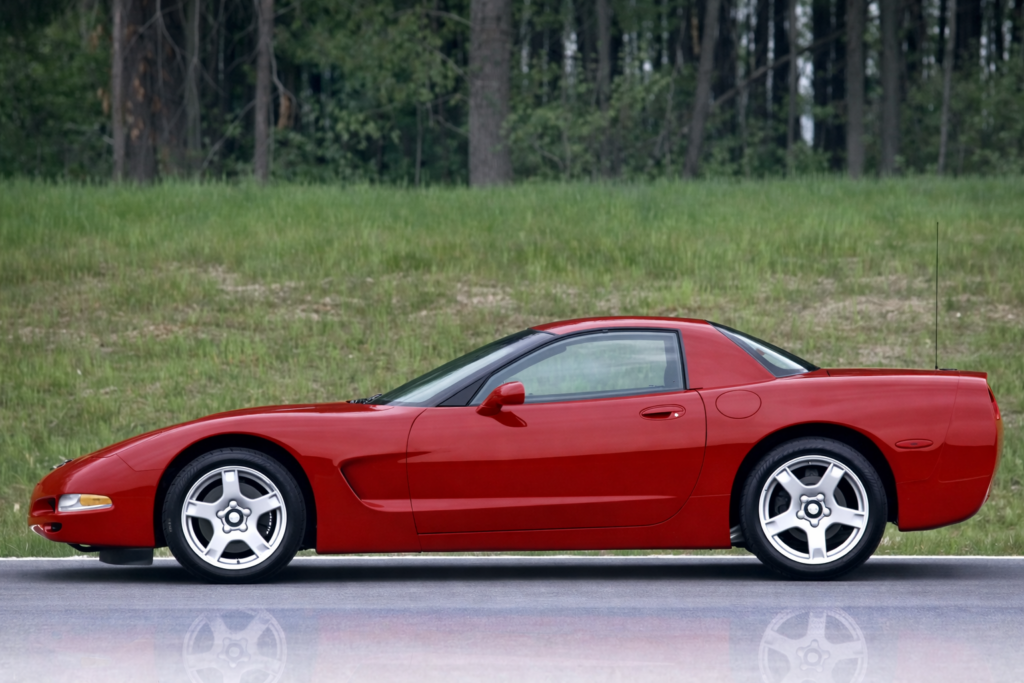
    Introduced in 1999, the Fixed Roof Coupe was born out of Chevrolet’s search for a more focused, lower-cost C5 variant, but it quickly evolved into something much more important: a stiffer, lighter Corvette aimed squarely at serious drivers. By pairing the convertible’s trunk structure with a permanent roof, the FRC delivered greater chassis rigidity, standard Z51 handling hardware, and a six-speed manual, giving the brand a more performance-driven entry point without diminishing Corvette’s image. Just as importantly, it proved there was real demand for a stripped-back, track-minded Corvette that emphasized precision over luxury. In doing so, the FRC helped sharpen the C5’s identity and laid the engineering and marketing groundwork for the 2001 Corvette Z06. (Image courtesy of GM Media LLC.)

    One of the most interesting truths about the 1999 Corvette is that its most important new variant did not begin life as a purity special. It began life as a pricing exercise. Early in the C5’s development, Chevrolet explored the idea of creating a cheaper Corvette—something intentionally pared back, aimed at broadening the car’s reach at a time when there was internal concern about whether Corvette was becoming too exclusive, too expensive, and too vulnerable to shrinking demand. Chief engineer Dave Hill later recalled that Chevrolet asked him to find a way to make a cheaper Corvette, and period reporting from Car and Driver makes clear that early clinic cars reflected exactly that thinking: manually adjusted cloth seats, smaller tires, fewer features, and even an automatic transmission in some prototypes.

    The problem was that customers did not want a bargain-basement Corvette. They wanted a Corvette that felt special. According to Car and Driver, clinic reactions to those stripped prototypes were overwhelmingly negative, and Hill himself drew a sharp line between the abandoned budget concept and the production car that followed, saying flatly, “This is not a stripper.” That sentence tells you almost everything you need to know about how the 1999 hardtop came to market. Chevrolet did not abandon the idea of a lighter, less expensive Corvette. It redefined the mission. Instead of trying to make the Corvette cheaper in a way buyers would perceive as diminished, Chevrolet repositioned the car as more focused, more rigid, and more serious. John Middlebrook described the resulting model as “lighter, stiffer and slightly more agile,” and that language was not accidental. The hardtop would not be sold as a lesser Corvette. It would be sold as a sharper one.

    From Budget Exercise to Serious Driver’s Car
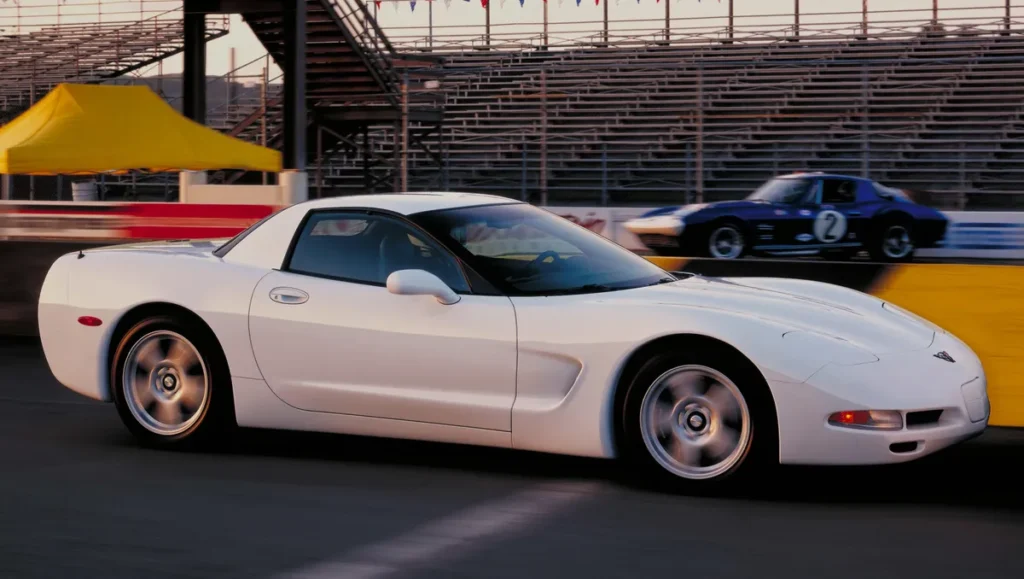
    1999 FRC Corvette on track.
    For serious drivers, the 1999 FRC quickly became more than just a new body style. Its lighter weight, greater structural rigidity, standard six-speed manual, and standard Z51 suspension made it the most focused C5 in the lineup, appealing to enthusiasts who cared more about balance, feedback, and control than luxury options. In many ways, it became the purest performance expression of the early C5 formula. More importantly, it showed Chevrolet there was real enthusiasm for a harder-edged Corvette, helping pave the way for the factory-built track weapon that would follow two years later: the Corvette Z06.

    That repositioning is what makes the 1999 hardtop such a fascinating car in Corvette history. The production model preserved some of the original austerity logic, but only where Chevrolet believed it could be recast as performance discipline. The hardtop arrived as the first fixed-roof Corvette since the 1963–67 Sting Ray coupes. It used the convertible’s rear body structure and external trunk, then paired that with a bonded fixed roof rather than the coupe’s removable targa panel and large glass hatch. The result was the stiffest C5 body shell to date, with period and retrospective sources consistently pegging it at about 12 percent stiffer than the coupe and roughly 80 to 90 pounds lighter depending on how the comparison was made. Official archival specs list the hardtop at 3,155 pounds versus 3,245 for the hatchback coupe, while Car and Driver measured a 79-pound advantage against a comparably equipped hatchback.

    Chevrolet then made sure the supporting hardware backed up the story. Every hardtop came standard with the six-speed manual transmission, the 3.42 limited-slip rear axle, and the Z51 Performance Handling Package, featuring stiffer springs, larger stabilizer bars, and monotube shocks. That was a meaningful bundle. On the coupe and convertible, those items cost extra. On the hardtop, they defined the car. Jim Campbell pointed out at launch that the six-speed and Z51 package represented a value that widened the real price gap between the hardtop and a comparably equipped coupe beyond the base MSRP suggested. In pure sticker terms, the hardtop started at $38,777, the coupe at $39,171, and the convertible at $45,579. But Chevrolet knew buyers were not comparing bare numbers on paper. They were comparing what they got for those numbers.

    What the Hardtop Kept, and What It Gave Up
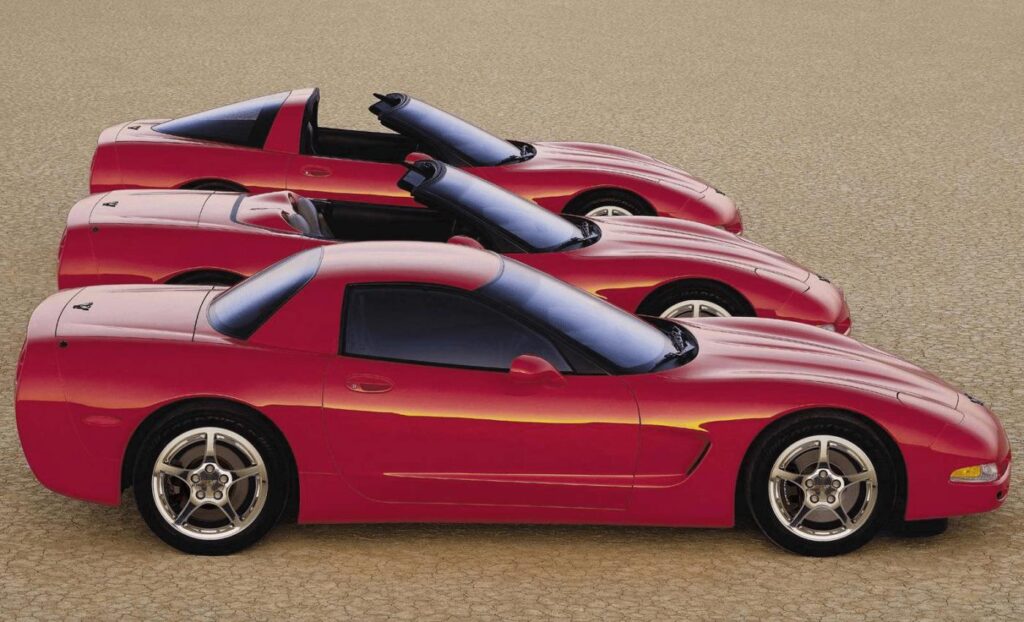
    Although the 1999 Corvette lineup now included three distinct personalities, the coupe, convertible, and new Fixed Roof Coupe still shared the same essential C5 foundation: the 345-horsepower LS1 V-8, hydroformed chassis, rear transaxle layout, four-wheel disc brakes with ABS, traction control, and the overall suspension architecture that made the fifth-generation Corvette such a leap forward. Where the FRC began to separate itself was in its mission. Rather than loading it with comfort and convenience equipment, Chevrolet kept it focused, omitting features such as the automatic transmission, the power telescoping steering column, Selective Real Time Damping, and several luxury-oriented convenience options so the car could be lighter, stiffer, and more performance-minded. In return, the FRC came standard with the six-speed manual and Z51 performance suspension, underscoring that this was not intended as a “cheap” Corvette, but as a more serious driver’s Corvette. (Image courtesy of GM Media LLC.)

    What is often missed in retellings of the 1999 hardtop is that Chevrolet did not build a bare-bones penalty box. In fact, the launch press release makes clear that all 1999 Corvettes—including the hardtop—still came with a strong baseline of standard equipment: the 5.7-liter V8, traction control, four-wheel ABS, run-flat tires, aluminum wheels, tire-pressure monitoring, air conditioning, power windows, power locks, cruise control, heated power mirrors, and rear-window defogger. That is an important corrective to the old myth that the 1999 hardtop was some kind of crank-window, heater-delete special. It was not. The production car remained recognizably upscale. Chevrolet simply tightened its focus.

    Where the hardtop did narrow the menu was in exactly the areas Chevrolet believed added weight, complexity, cost, or luxury positioning. At launch, the hardtop’s option list was intentionally short: power driver seat, Active Handling, Bose audio, CD changer, and bodyside moldings. It came only with black leather interior and only in five exterior colors: Torch Red, Arctic White, Black, Light Pewter Metallic, and Nassau Blue Metallic. No automatic transmission was offered. No power telescoping steering column was offered. Real Time Damping was excluded because Z51 was standard. The brochure also presented the Head-Up Display as unavailable on the hardtop. So while Chevrolet had backed away from the crude idea of a “cheap Corvette,” it had not walked away from the discipline of building a more purpose-built one. The hardtop was the Corvette for the buyer who wanted less garnish and more intent.

    Did the Hardtop Deliver on Performance?
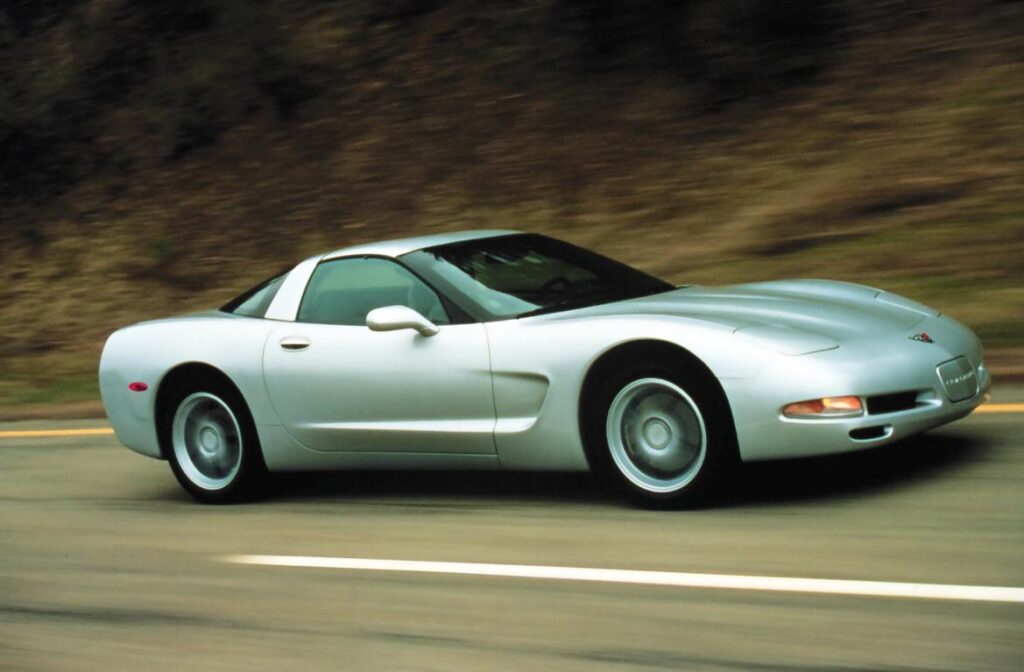
    The 1999 FRC did exactly what Chevrolet needed it to do: it proved there was real enthusiasm for a harder-edged, more performance-focused Corvette. With its lighter weight, stiffer fixed-roof structure, standard six-speed manual, and standard Z51 suspension, the FRC immediately established itself as the most serious driver’s car in the C5 lineup, even if its performance gains over the coupe were modest on paper. More importantly, it changed the conversation around what a modern Corvette could be, showing that buyers would embrace a version of the car that sacrificed some comfort and convenience in favor of sharper dynamics and greater purpose. In that sense, the FRC was not just a new body style for 1999, but the first clear step toward the C5 Z06. (Image courtesy of GM Media LLC.)

    In the real world, the answer was yes—but not by some earth-shattering margin. The hardtop was quicker, but only a little. Car and Driver recorded 0–60 mph in 4.8 seconds and the quarter mile in 13.2 seconds at 110 mph, edging the magazine’s recent hatchback-coupe tests by a tenth here and there. Corvette Action Center’s period performance compilation, drawn from multiple contemporary publications and GM specs, places the hardtop in essentially the same range: 4.7 to 4.8 seconds to 60 and 13.3-ish in the quarter, depending on source. That was enough to validate Chevrolet’s pitch without turning the hardtop into some giant-killer within the lineup. It was not a different species of Corvette. It was a cleaner expression of the same one.

    The more interesting difference was in feel. Car and Driver wrote that you could sense the hardtop’s slightly stiffer structure on the road, and that observation aligns with Chevrolet’s own engineering rationale. With the roof bonded around its perimeter instead of removable, the car gave up some of the coupe’s versatility in exchange for a more unified shell. It was also not quite as slippery through the air. Because of the hardtop’s more upright rear glass profile, Chevrolet acknowledged it was a little less aerodynamic than the coupe, and Car and Driver saw that in testing with a 169-mph top speed versus 171 mph for its most recent coupe and 175 mph for earlier examples. Corvette Action Center’s period compilation similarly shows published top-speed figures in the low- to mid-170s, depending on source. So the hardtop was not faster in every way. It was simply more direct.

    The 1999 CORVETTE Coupe and Convertible Were Still the Core of the Line
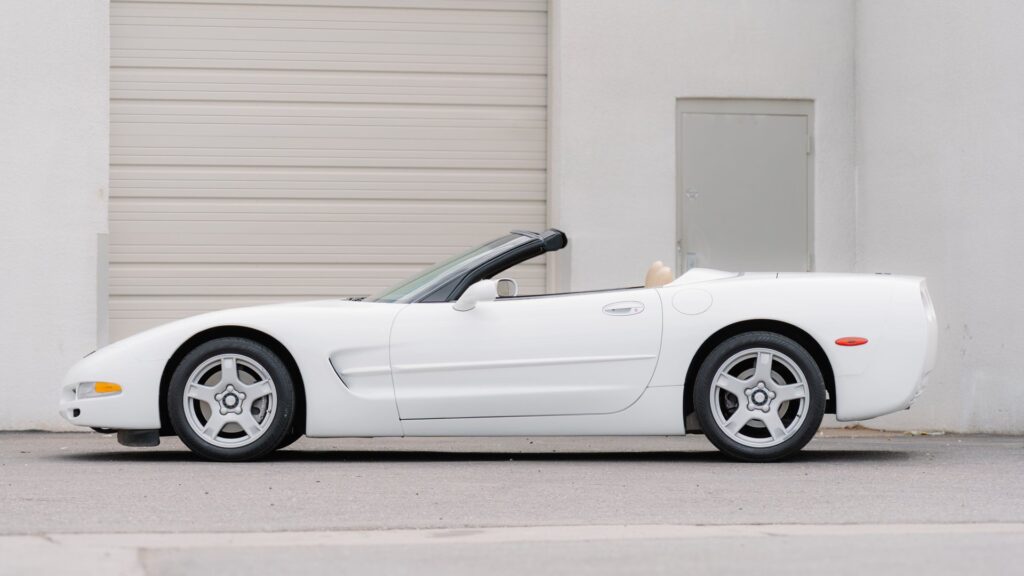
    For the 1999 model year, the coupe and convertible gained several notable features that helped make the C5 feel even more modern and refined. Most significant was the new optional Head-Up Display, which projected key information such as speed and engine data onto the windshield so drivers could keep their eyes on the road. Chevrolet also added an optional power telescoping steering column, giving drivers a greater range of adjustment and improving overall comfort behind the wheel. At the same time, all 1999 Corvettes benefited from steering refinements to improve on-center feel and reduce highway wander, while the coupe and convertible continued to offer a broader range of comfort and convenience options than the new Fixed Roof Coupe, reinforcing their role as the more fully equipped versions of the C5 lineup.

    As important as the hardtop was, the 1999 Corvette story was bigger than the FRC alone. The coupe and convertible remained the volume models and the broader expression of what the C5 had become. Both continued with the 5.7-liter LS1 rated at 345 horsepower and 350 lb-ft of torque, paired either with the rear-mounted four-speed automatic or the six-speed manual. Both kept the C5’s now well-established strengths: low cowl, long wheelbase, impressive ride quality, genuine high-speed stability, and an interior that finally made the Corvette feel like a complete sports car rather than a brilliant engine wrapped in compromise. The C5 had already changed the conversation around Corvette. In 1999, Chevrolet refined the package rather than reinventing it.

    That refinement showed up in the details. Chevrolet updated the speed-sensitive variable-assist steering system—Magnasteer II—for 1999, seeking better on-center feel and less highway wander. Car and Driver noted the steering changes directly and quoted Corvette suspension engineer Mike Neal, who said the goal was to let the car cover “hundreds and hundreds of miles” without fatiguing the driver. The magazine also noted slightly softer seat cushions across the line and additional damping and sound insulation for the coupe. This is one of those places where the 1999 Corvette reveals what the C5 program really was at heart. Even in its performance years, Corvette engineering was not chasing racetrack numbers alone. It was trying to deliver the sort of composure, usability, and long-distance civility buyers associated with much more expensive European machinery.

    The New Technology That Elevated the 1999 CORVETTE

    The 1999 Corvette did more than bring speed to the table. It showed just how serious Chevrolet had become about giving the C5 a genuinely modern technology package, with features like the Head-Up Display putting critical information directly in the driver’s line of sight instead of forcing eyes down to the gauges. Paired with the car’s growing suite of electronic driver aids, it helped make the 1999 Corvette feel less like a traditional sports car and more like a true high-speed grand touring machine for the modern era.

    If there was one new option in 1999 that most clearly signaled Corvette’s continued move upmarket, it was the Head-Up Display. Chevrolet’s brochure treated it as one of the year’s headline additions, and for good reason. In an era when this still felt genuinely high-tech, the HUD projected key instrumentation directly onto the windshield so the driver could monitor speed and other readouts without taking his/her eyes off the road. The production summary for 1999 lists it among the model-year highlights, and the brochure language shows Chevrolet understood exactly how to sell it: as both performance technology and luxury convenience, something borrowed from higher segments and now embedded in America’s sports car.

    The power telescoping steering column fits the same pattern. It was available on the coupe and convertible but not on the hardtop, reinforcing the split Chevrolet was now making within the lineup. The coupe and convertible were the richer, more customizable Corvettes. The hardtop was the disciplined one. Alongside those convenience upgrades, all 1999 Corvettes also received next-generation reduced-force airbags, which GM documented as standard across the board. Active Handling remained optional, integrating chassis, brake, traction-control, and powertrain inputs through acceleration and yaw-rate sensing. In hindsight, that combination of driver aids, safety revision, and display technology helps explain why the 1999 Corvette feels like more than just a continuation of 1998. It was a more sophisticated car, even when its powertrain was at rest.

    A Model Year Full of Interesting Ordering Details
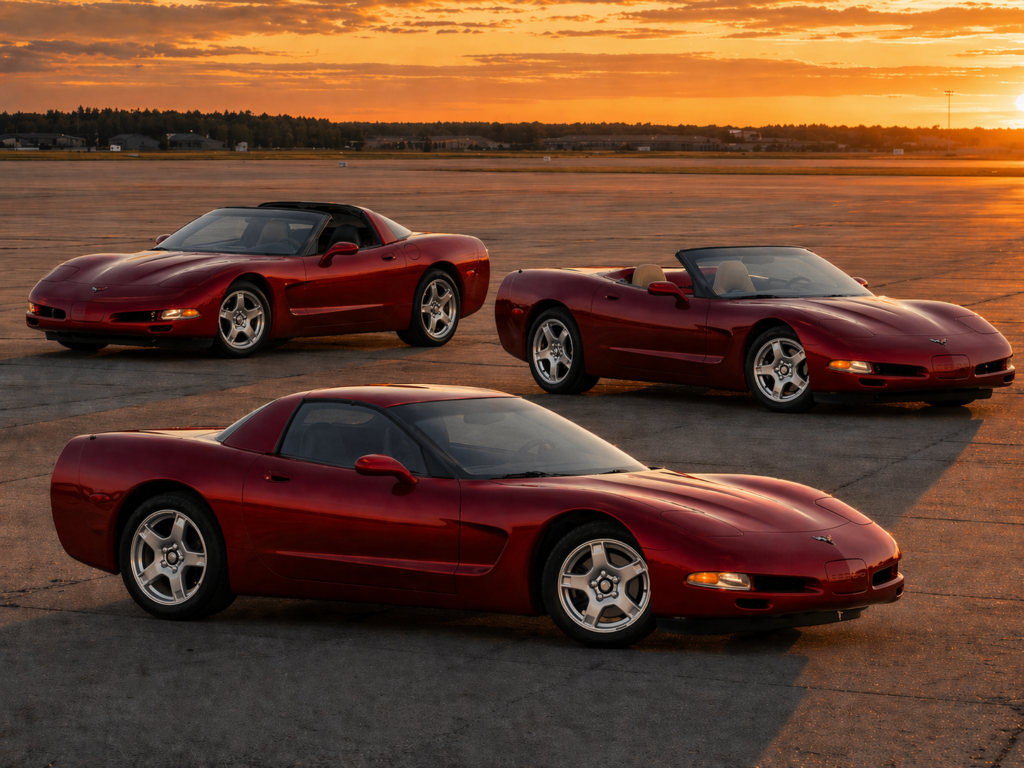
    Front and center, the FRC is the purist of the trio—the lighter, stiffer, six-speed-only hardtop with standard Z51 hardware and fewer comfort-oriented extras, which made it the most performance-minded C5 of the bunch. The coupe at left was the best all-arounder, and the convertible at right was the grand-touring charmer; both leaned further into features with available new-for-1999 items like the Head-Up Display, power telescoping steering column, Memory Package, and dual-zone climate control, while the hardtop kept things leaner and more focused.

    The 1999 Corvette also gets more interesting the deeper you go into the ordering data. Total production reached 33,270 units, up from 31,084 in 1998. The breakdown was 18,078 coupes, 11,161 convertibles, and 4,031 hardtops. That means the hardtop, despite all the uncertainty that preceded it, accounted for roughly 12 percent of total production immediately. For a body style born out of internal anxiety and then reinvented through customer rejection, that is a strong debut. It was not a niche failure. It was a meaningful addition to the line.
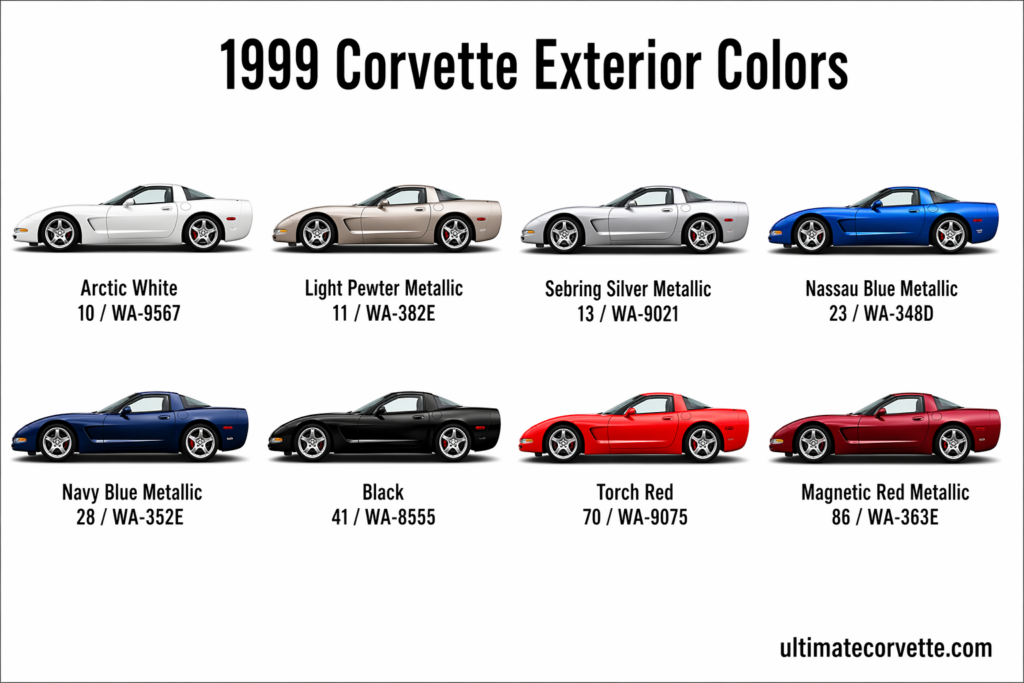
    Eight colors, one iconic shape. The 1999 Corvette lineup offered everything from crisp Arctic White and brilliant Torch Red to the rich depth of Magnetic Red Metallic and Nassau Blue Metallic—proof that Chevrolet knew exactly how to let the C5’s design do the talking.

    The color and trim numbers are just as revealing. Torch Red was the most popular exterior across the full 1999 range at 8,361 cars, followed by Black at 7,235 and Light Pewter Metallic at 6,164. Among hardtops specifically, Torch Red led with 1,245 units, followed by Black at 1,227, and Light Pewter Metallic at 1,040. Nassau Blue accounted for 202 hardtops and Arctic White for 311. Sebring Silver Metallic, Navy Blue Metallic, and Magnetic Red Metallic were not offered on the hardtop. Inside, the hardtop was black only; Bowling Green records show 100 percent of hardtops carrying black interior trim. Even the option take rates tell the story of a focused buyer base: all 4,031 hardtops had the six-speed, all had the 3.42 axle, and just over half—2,082 cars—were ordered with JL4 Active Handling.

    The Odd Hardtop Paper Trail
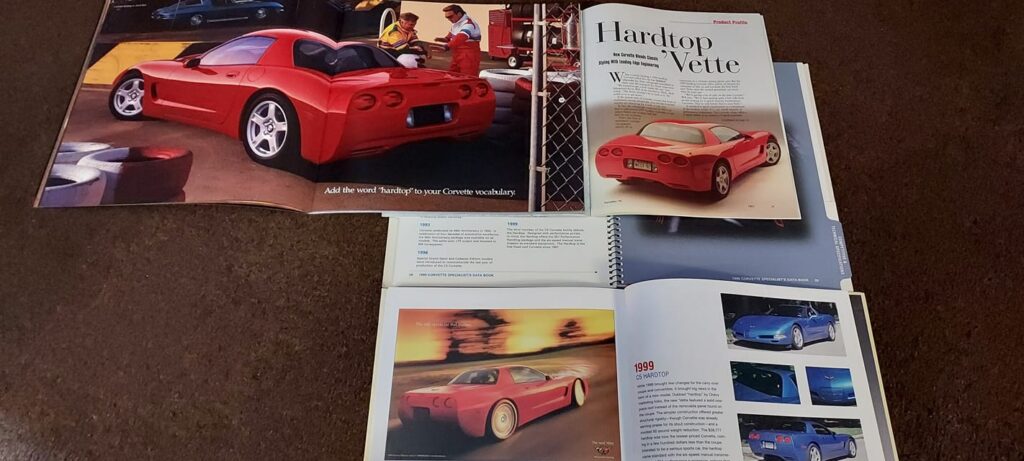
    One of the most fascinating parts of the 1999 Corvette Hardtop story is how inconsistently Chevrolet documented it at the time. Depending on the source, the car could be described as a Hardtop, a Fixed Roof Coupe, or simply folded into broader C5 production material, which has created confusion for historians and enthusiasts ever since. That inconsistency is exactly why preserving brochures, magazine features, order guides, and period reference books matters so much today. Taken together, they help reconstruct the real identity of the 1999 FRC and give this important performance-focused Corvette the historical clarity it deserves.

    One of the quirks of researching the 1999 model year is that the hardtop’s documentation is not perfectly tidy. Chevrolet’s launch press release described a very narrow option set; the brochure explicitly stated that the HUD was “not available on hardtop”; and Car and Driver similarly reported that the new fixed-roof model did without items such as the power-telescoping steering column, dual-zone air, F45 damping, and HUD. Yet the Bowling Green production tallies later attributed small numbers of hardtops to items such as automatic climate control, fog lamps, sport custom wheels, and even the HUD. There are only a few plausible explanations: late-year ordering changes, coding anomalies in the records, pre-production or non-standard builds being counted, or some combination of the three.

    The safest conclusion is not to pretend that those documents all say the same thing, because they do not. The safest conclusion is that the hardtop was clearly conceived and launched as the most tightly controlled C5 in the range, even if the surviving production accounting suggests a few edge cases around the margins. For a comprehensive historical overview, that nuance is worth preserving. It also says something useful about the car itself. The 1999 hardtop was never supposed to be the Corvette for everyone. It was supposed to be the Corvette for the buyer who understood why fewer choices could be part of the appeal. And in that sense, every one of those documents—whether launch brochure, road test, or assembly tally—still points in the same direction.

    The C5-R Brought Corvette’s Confidence Back to the Track
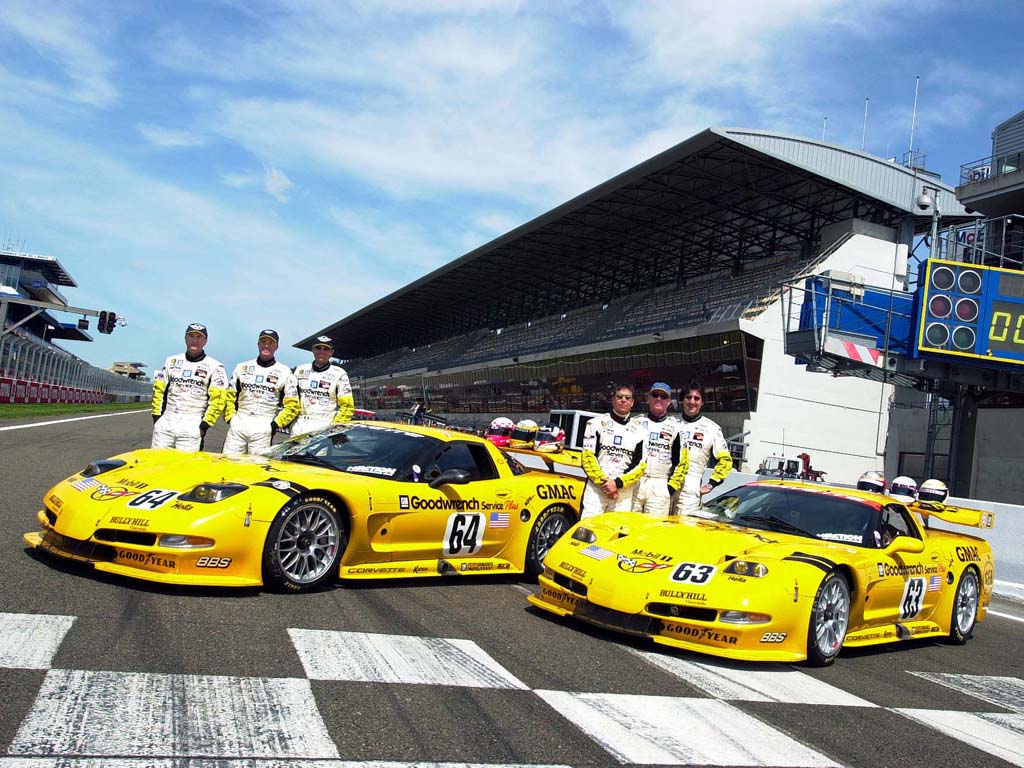
    The 1999 Corvette C5-R was the car that transformed Corvette Racing from an ambitious factory return into a legitimate international endurance contender, pairing Pratt & Miller engineering with Chevrolet small-block power in a purpose-built machine that still looked unmistakably like a Corvette. Shown here in the team’s early two-car No. 63 and No. 64 configuration, the C5-R made its factory-backed Le Mans debut in 2000, where Ron Fellows, Chris Kneifel, and Justin Bell piloted the 63 while Andy Pilgrim, Kelly Collins, and Franck Fréon shared the 64. Their third- and fourth-place class finishes at Le Mans helped lay the foundation for the C5-R’s dominant years to come and secured its place as one of the most important competition Corvettes ever built. (Image credit: Richard Prince)

    If the hardtop gave the 1999 Corvette lineup a sharper internal identity, the C5-R gave the whole franchise a renewed public mission. Chevrolet chose the 1999 Rolex 24 at Daytona to unveil the brand-new C5-R, fielding two factory-supported cars after only about 4,000 miles of testing and development. That alone was an aggressive move. It said Chevrolet believed not only in the C5 as a production car, but in the strength of the architecture underneath it. The Daytona press release made that explicit, describing the effort as the first full factory-supported program designed around a production vehicle using a wide range of production components. By season’s end, Chevrolet’s own materials were framing the C5-R as a major new chapter in Corvette’s racing heritage and as a central expression of the car’s renewed standing.

    The debut justified that faith. The No. 2 C5-R of Ron Fellows, Chris Kneifel, and John Paul Jr. started near the front, led for more than half the race, and finished third after an oil-consuming problem dropped it back. The No. 4 car of John Heinricy, Andy Pilgrim, and Scott Sharp also ran strongly before minor teething issues pushed it to 12th. Dave Hill called it “a tremendous accomplishment” that both cars were still running at the end and emphasized that neither suffered failures tied to their production-vehicle components. Jim Campbell distilled the larger purpose even more cleanly: “Our primary focus is to improve the breed.” That line is one of the keys to understanding 1999. The model year was not just about selling another 33,270 Corvettes. It was about proving, in the showroom and on the track, that Corvette was once again moving with momentum.

    Why the 1999 Corvette Still Matters Today
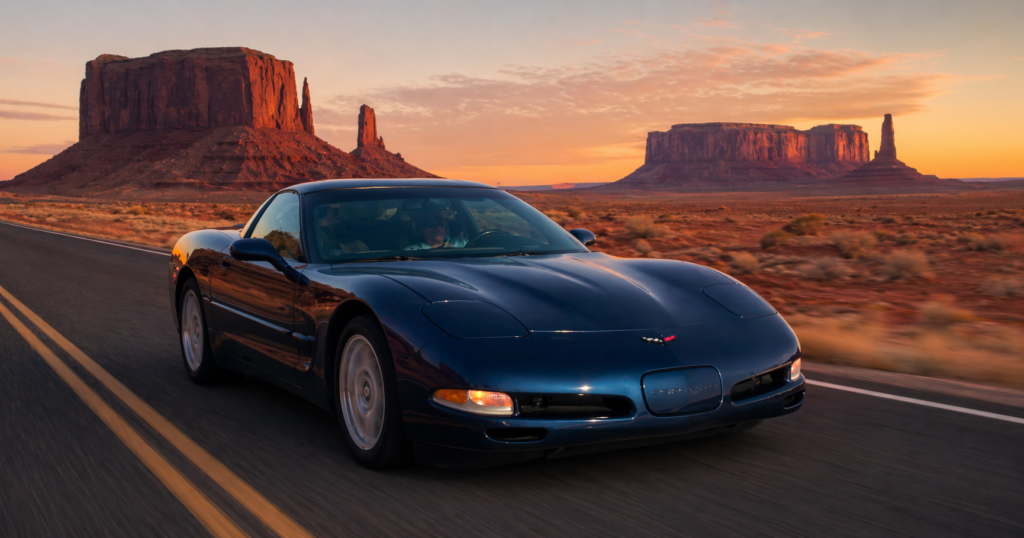

    The 1999 Corvette remains a pivotal chapter in the C5 story because it showed Chevrolet wasn’t content to simply build a better sports car — it was beginning to sharpen the Corvette into something more focused, more sophisticated, and more clearly defined for different kinds of buyers. This was the year the Fixed Roof Coupe arrived, giving performance-minded enthusiasts a leaner, stiffer, more purposeful machine, while the coupe and convertible continued to prove that comfort, technology, and everyday drivability did not have to come at the expense of real performance. More than two decades later, the 1999 model stands as a reminder of the moment the modern Corvette formula really started to take shape.

    With the benefit of hindsight, the 1999 Corvette reads as one of the most important years in shaping the entire C5 generation. It completed the body-style lineup. It introduced a now-iconic fixed-roof configuration that would soon provide the foundation for the C5 Z06. It expanded the car’s technology with the arrival of the HUD and other refinements. It sharpened the distinction between the luxury-leaning and driver-leaning versions of the C5. And it put Corvette back into serious factory-backed competition with the C5-R. MotorTrend would later summarize the arc cleanly: the hardtop began as a lower-cost idea, became a performance variant instead, and ultimately fed directly into the Z06 story that followed.

    More than that, the 1999 Corvette captured a moment when Chevrolet finally seemed to understand that Corvette did not need to be diluted to broaden its appeal. Buyers did not want the car reduced. They wanted it clarified. They wanted the coupe to be a world-class sport-tourer, the convertible to be a true open-air Corvette again, and the hardtop to be a sharper-edged driver’s car without apology. Chevrolet gave them all three. That is why the 1999 model year still carries so much weight today. It was the year the C5 stopped being merely the new Corvette and became a fully realized Corvette family—one with enough range, confidence, and engineering depth to carry the name into a new century.

    For 1999, Chevrolet did more than update the C5 Corvette. It completed the lineup, introduced the first fixed-roof Corvette in decades, added new technology, sharpened the car’s performance identity, and launched the C5-R race program—making 1999 one of the most important turning points of the entire generation.