Tag: Dave McLellan

  • 1990 CORVETTE OVERVIEW

    1990 CORVETTE OVERVIEW

    As the 1980s drew to a close, few nameplates carried as much symbolic weight for American performance as the Chevrolet Corvette. By the end of the decade, the C4 Corvette had matured into a respected sports car — one that had gone from being dismissed in its early years for lackluster power, to becoming a finely honed machine capable of holding its own against much of Europe’s best. Yet for 1990, anticipation rose to a fever pitch. This wasn’t simply another incremental update. Chevrolet was preparing to unleash a Corvette that would redefine expectations: the ZR-1 “King of the Hill.”

    The excitement was palpable because the car had already been teased, whispered about, and delayed. Originally projected for a mid-1989 introduction, the ZR-1’s arrival was pushed to the 1990 model year. The reason was simple: Chevrolet and its partners refused to compromise. The car was subjected to further refinements in engineering and design, and only when it met its lofty performance and durability targets would GM permit it to launch. That patience would prove worthwhile.

    For Corvette enthusiasts, 1990 marked the dawn of a new era — one in which Chevrolet’s halo car was no longer simply keeping pace with the competition, but setting entirely new benchmarks.

    Refining the Base Corvette
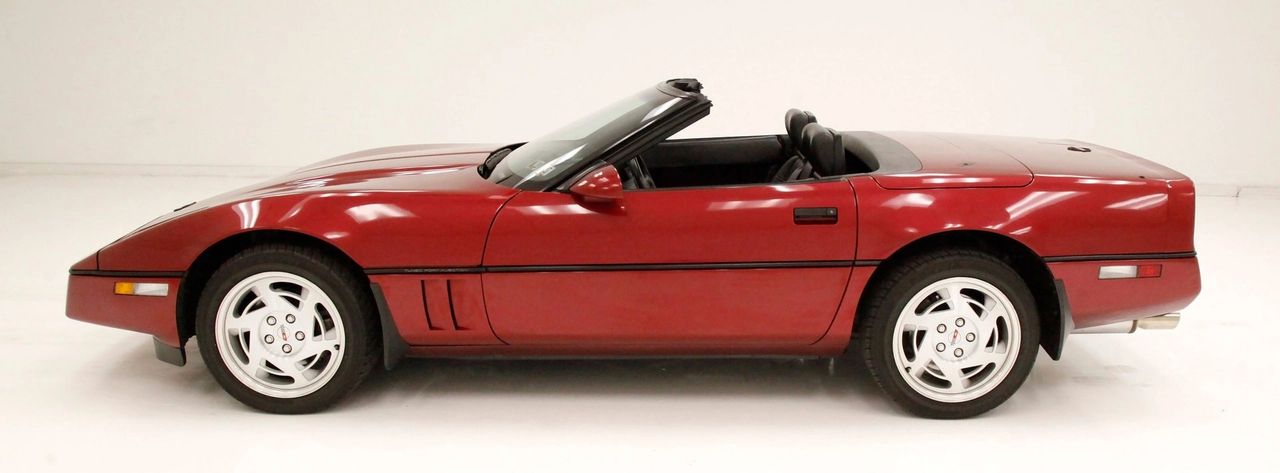
    A 1990 Chevrolet Corvette Convertible, finished in Dark Red Metallic (74U), sits low and sleek with its signature wedge-shaped C4 profile. The body lines are sharp and aerodynamic, flowing from the pointed nose with its pop-up headlights to the smooth, integrated rear deck. The convertible’s soft top is neatly stowed, emphasizing the clean beltline and wide stance. The car rides on 17-inch turbine-style alloy wheels wrapped in Goodyear Eagle tires, a defining look of late-’80s and early-’90s Corvettes. Inside, the cabin features the updated 1990 dashboard with its hybrid digital/analog instrumentation and newly added passenger glovebox. The overall impression is both elegant and purposeful — a car equally at home cruising with the top down or flexing its performance heritage.
    A 1990 Chevrolet Corvette Convertible, finished in Dark Red Metallic (74U), sits low and sleek with its signature wedge-shaped C4 profile. The body lines are sharp and aerodynamic, flowing from the pointed nose with its pop-up headlights to the smooth, integrated rear deck. The convertible’s soft top is neatly stowed, emphasizing the clean beltline and wide stance. The car rides on 17-inch turbine-style alloy wheels wrapped in Goodyear Eagle tires, a defining look of late-’80s and early-’90s Corvettes. Inside, the cabin features the updated 1990 dashboard with its hybrid digital/analog instrumentation and newly added passenger glovebox. The overall impression is both elegant and purposeful — a car equally at home cruising with the top down or flexing its performance heritage.

    While the ZR-1 captured headlines, every Corvette sold in 1990 benefited from meaningful updates. The most visible was the introduction of a driver’s side airbag, part of Chevrolet’s compliance with the federal government’s phased-in “passive restraint” crash protection regulations. For a two-seat sports car rooted in performance, safety advances weren’t always the headline, but the Corvette entered the 1990s with technology aligned to both performance and protection.

    Corvette’s anti-lock braking system (ABS), first introduced in 1986, was updated with more sophisticated yaw control. The system was tuned to provide greater security under hard braking, particularly in emergency maneuvers. Combined with four-wheel independent suspension and the precise steering geometry of the C4 platform, the improvements reinforced Corvette’s reputation as a true handling car.
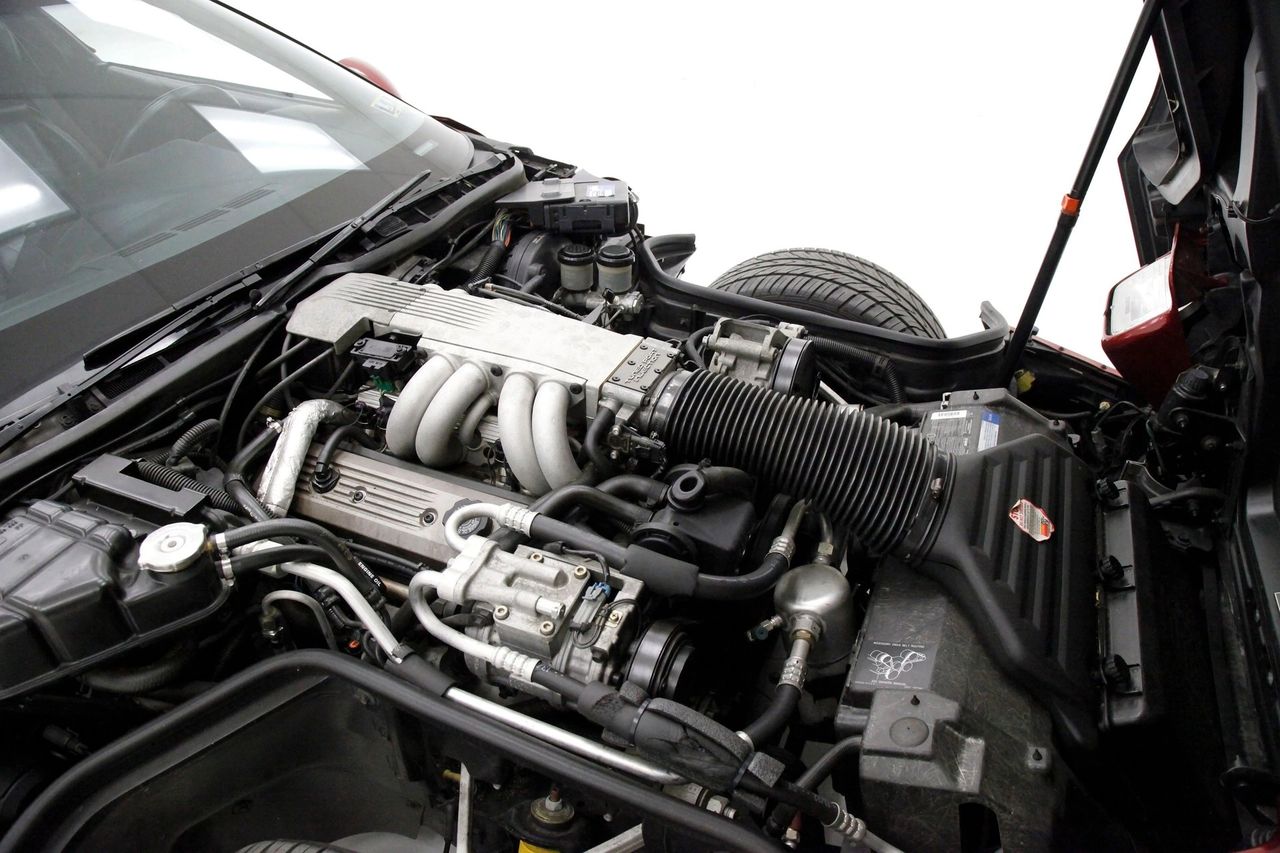
    The 1990 Corvette’s standard powerplant was the 5.7L L98 V8, now rated at 245 horsepower thanks to a revised camshaft, higher compression ratio, and a new speed-density intake system. Smooth, torquey, and dependable, the L98 had matured into a refined small block by 1990, delivering strong performance while serving as the backbone of the Corvette lineup—even as the exotic LT5 in the new ZR-1 stole the headlines. (Image courtesy Classic Auto Mall.)
    The 1990 Corvette’s standard powerplant was the 5.7L L98 V8, now rated at 245 horsepower thanks to a revised camshaft, higher compression ratio, and a new speed-density intake system. Smooth, torquey, and dependable, the L98 had matured into a refined small block by 1990, delivering strong performance while serving as the backbone of the Corvette lineup—even as the exotic LT5 in the new ZR-1 stole the headlines. (Image courtesy Classic Auto Mall.)

    The standard L98 V8 received incremental but meaningful improvements for 1990, raising output to 245 horsepower. A revised camshaft profile, a higher compression ratio, and the adoption of a new speed-density air-intake system provided the engine with sharper throttle response and greater refinement. While inevitably overshadowed by the exotic LT5 in the ZR-1, the L98 remained a strong, dependable small block, now in its fifth year of Tuned Port Injection development and still a cornerstone of the Corvette lineup.

    The cooling system also received attention. A more efficient radiator was introduced, so effective that the optional auxiliary “boost fan” (RPO B24), which had been offered from 1986 through 1989, was dropped from the option list entirely. Corvette engineers, by this point, had refined airflow through the C4’s narrow nose into a science.

    The 1990 Corvette introduced a redesigned instrument cluster that blended digital and analog readouts for the first time. At the center sat a bright orange LCD display providing speed, fuel economy, and trip information, flanked by traditional analog gauges for tachometer, oil pressure, and temperature. This hybrid layout offered the futuristic feel of the C4’s earlier all-digital dash while restoring the tactile clarity many enthusiasts had missed, making it both more functional and more in tune with Corvette’s performance image.
    The 1990 Corvette introduced a redesigned instrument cluster that blended digital and analog readouts for the first time. At the center sat a bright orange LCD display providing speed, fuel economy, and trip information, flanked by traditional analog gauges for tachometer, oil pressure, and temperature. This hybrid layout offered the futuristic feel of the C4’s earlier all-digital dash while restoring the tactile clarity many enthusiasts had missed, making it both more functional and more in tune with Corvette’s performance image.

    Inside, the 1990 Corvette cabin reflected both ergonomic lessons learned and the march of consumer technology. The instrument cluster, a long-standing point of debate since the introduction of “all-digital” graphics in 1984, was redesigned. Drivers were now greeted with a hybrid display: a digital speedometer paired with analog auxiliary gauges — tachometer, fuel, oil pressure, voltmeter — providing the tactile familiarity enthusiasts had demanded. The arrangement struck a balance between modernity and usability, quieting critics who had long argued the Corvette’s “video game” dash was too gimmicky.

    Equally practical was the addition of a passenger-side glove box, something so basic that it had become an odd omission throughout the 1980s. A new engine oil life monitor system was incorporated into the driver information center, calculating oil degradation and reminding owners of service intervals — a forward-thinking touch at the time.
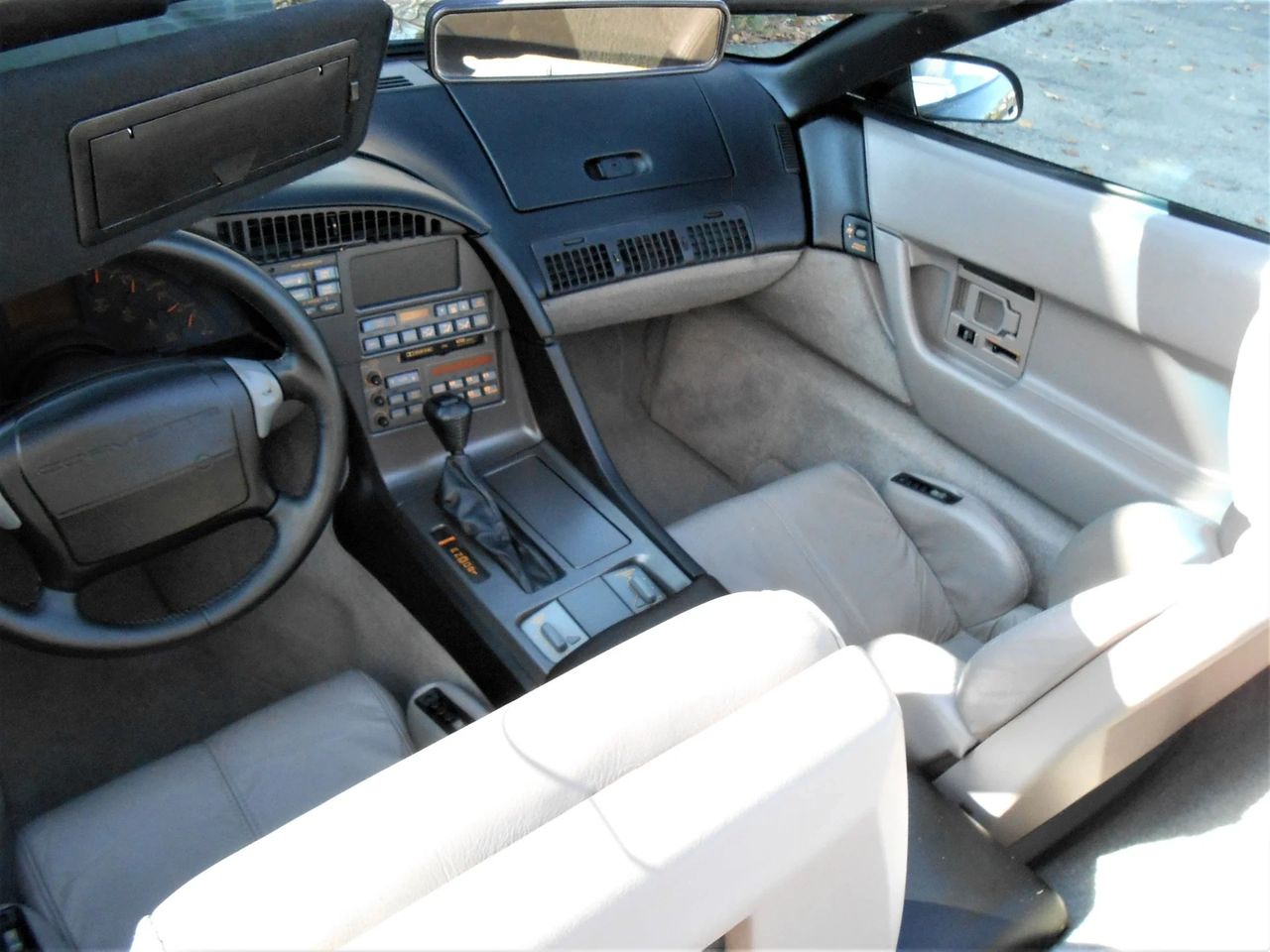
    Beyond the new hybrid instrument cluster, the 1990 Corvette interior featured several thoughtful updates that improved both comfort and usability. A long-awaited passenger-side glove box was added, restoring practicality that had been missing since the C4’s debut. Optional leather seating became available across the entire lineup, enhancing the sense of luxury, while the driver information center introduced an engine oil life monitor to track maintenance needs. Together, these changes made the Corvette’s cockpit more refined, user-friendly, and aligned with the expectations of a premium sports car buyer entering a new decade.
    Beyond the new hybrid instrument cluster, the 1990 Corvette interior featured several thoughtful updates that improved both comfort and usability. A long-awaited passenger-side glove box was added, restoring practicality that had been missing since the C4’s debut. Optional leather seating became available across the entire lineup, enhancing the sense of luxury, while the driver information center introduced an engine oil life monitor to track maintenance needs. Together, these changes made the Corvette’s cockpit more refined, user-friendly, and aligned with the expectations of a premium sports car buyer entering a new decade.

    On the entertainment front, Corvette embraced the digital age. While cassettes still dominated the aftermarket, the factory introduced an optional Delco-Bose CD player. To deter theft, the unit carried a lockout system requiring a reactivation code if removed. This “anti-theft coding” was decades ahead of the ubiquitous infotainment locks found today.

    Even the seating saw refinement: leather upholstery became available across all Corvette models, rather than being restricted to higher trims. It was part of Chevrolet’s recognition that even base Corvette buyers expected a premium experience.

    The Need for Something Greater

    Despite these thoughtful improvements, the Corvette team knew the car needed more than incremental gains. Since the C4’s debut in 1984, performance purists had lamented the lack of an engine equal to the chassis. The L83 Cross-Fire Injection engine of the first C4s had been underwhelming. Even after Tuned Port Injection brought torque and smoother power delivery in 1985, Corvette enthusiasts couldn’t ignore that European competitors — Ferrari, Porsche, and Jaguar — offered exotic multi-valve, overhead-cam engines that revved higher and produced more horsepower.
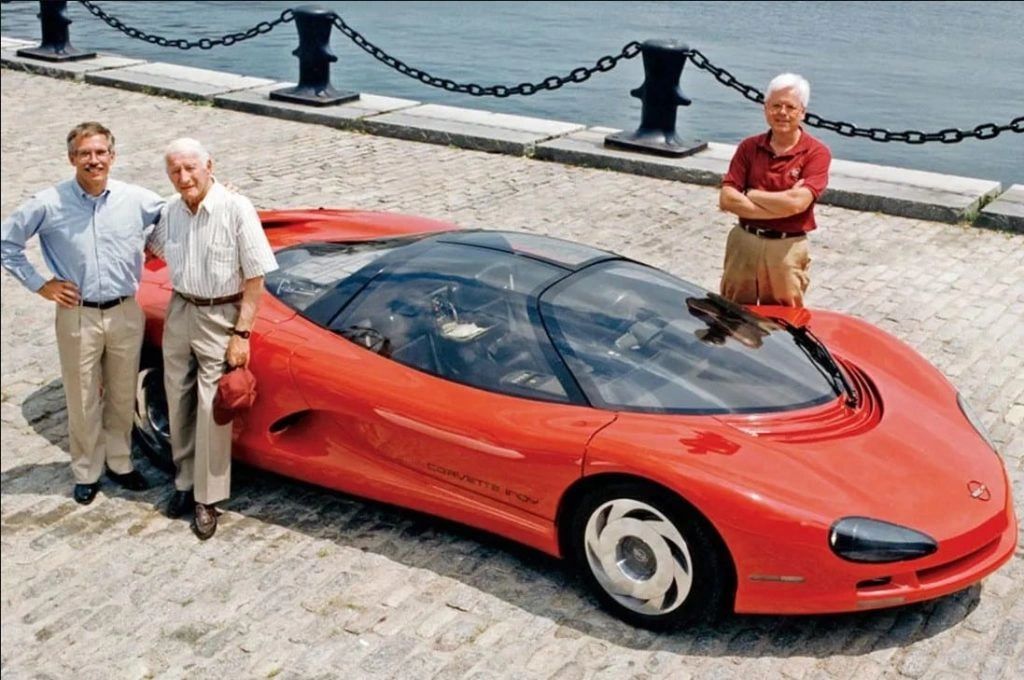
    Dave McLellan (right), Zora Arkus-Duntov (left), and David Hill (far left) each served as Corvette's Chief Engineer.  As it pertains to the 1990 Corveite, the Corvette Indy (the vehicle pictured here), was one of the very first vehicles to be powered by the LT5 engine developed by Lotus for the C4 ZR-1 Corvette. (Image courtesy of GM Media LLC.)
    Dave McLellan (right), Zora Arkus-Duntov (left), and David Hill (far left) each served as Corvette’s Chief Engineer. As it pertains to the 1990 Corveite, the Corvette Indy (the vehicle pictured here), was one of the very first vehicles to be powered by the LT5 engine developed by Lotus for the C4 ZR-1 Corvette. (Image courtesy of GM Media LLC.)

    Corvette Engineering Chief Dave McLellan, who had succeeded Zora Arkus-Duntov in 1975, recognized the dilemma. So did Lloyd Reuss, the GM executive who would become the fiercest champion of Corvette’s halo project. Reuss, a powertrain engineer by background, was convinced that without a true world-beating Corvette, GM risked ceding the performance market to rising Japanese imports and entrenched European marques.

    It was Reuss who coined the phrase halo vehicle” (a flagship model that elevates a brand’s image and appeal) to describe what the Corvette must become. And it was he who shielded the project during the turbulent corporate environment of mid-1980s GM, when programs were often cut for cost savings.

    Planting the Seeds of the ZR-1
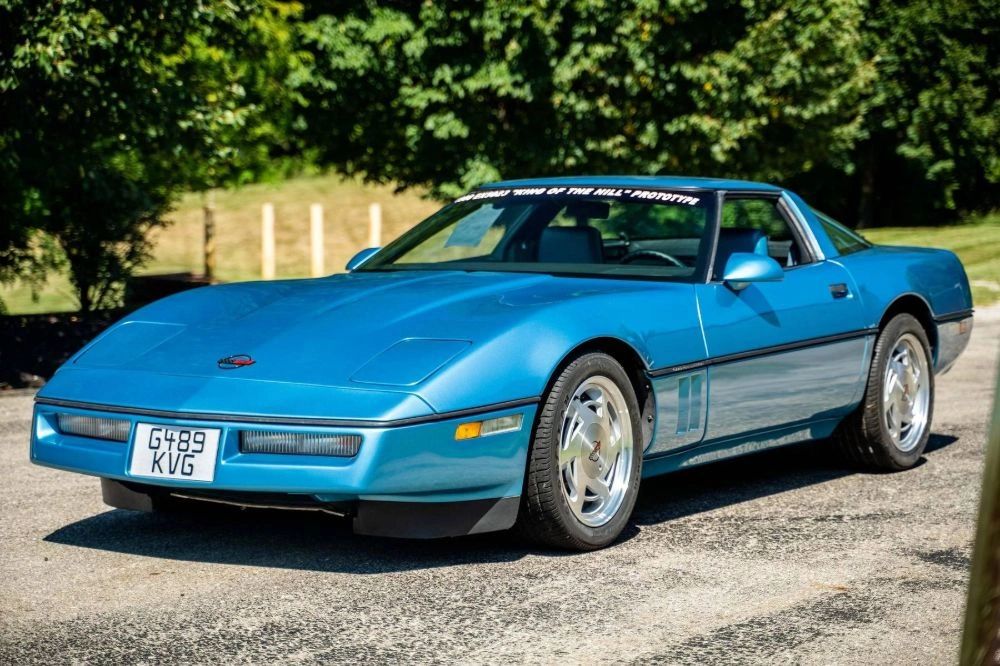
    This rare 1988 “King of the Hill” prototype—an early testbed for the upcoming ZR-1—helped pave the way for the 1990 production model’s revolutionary LT5 engine and world-class performance. With unique bodywork, experimental wheels, and its “Prototype” windshield banner, it remains one of the most important stepping stones in Corvette’s fourth generation.
    This rare 1988 “King of the Hill” prototype—an early testbed for the upcoming ZR-1—helped pave the way for the 1990 production model’s revolutionary LT5 engine and world-class performance. With unique bodywork, experimental wheels, and its “Prototype” windshield banner, it remains one of the most important stepping stones in Corvette’s fourth generation.

    The earliest attempts to elevate Corvette performance within GM’s corporate ecosystem came through Powertrain Engineering Director Russ Gee and Roy Midgley, Chief Engineer of V-type Engines. Their team sketched out dozens of possibilities — everything from turbocharged V6s to radical small-block variants. Some experimental engines were made into running prototypes. A twin-turbo V8 was among the most promising, showing eye-watering output figures, but emissions and fuel economy realities doomed it. A turbo V6 was dismissed as culturally unacceptable: “No Corvette buyer,” as McLellan remarked, “would accept six cylinders, no matter the power.”

    In fact, the turbocharged experiments indirectly paved the way for the CallawayTwin-Turbo Corvette, which GM endorsed as an official option in 1987 after reviewing internal prototype data. But as clever as the Callaway was, it remained a tuner’s car, not a factory supercar.
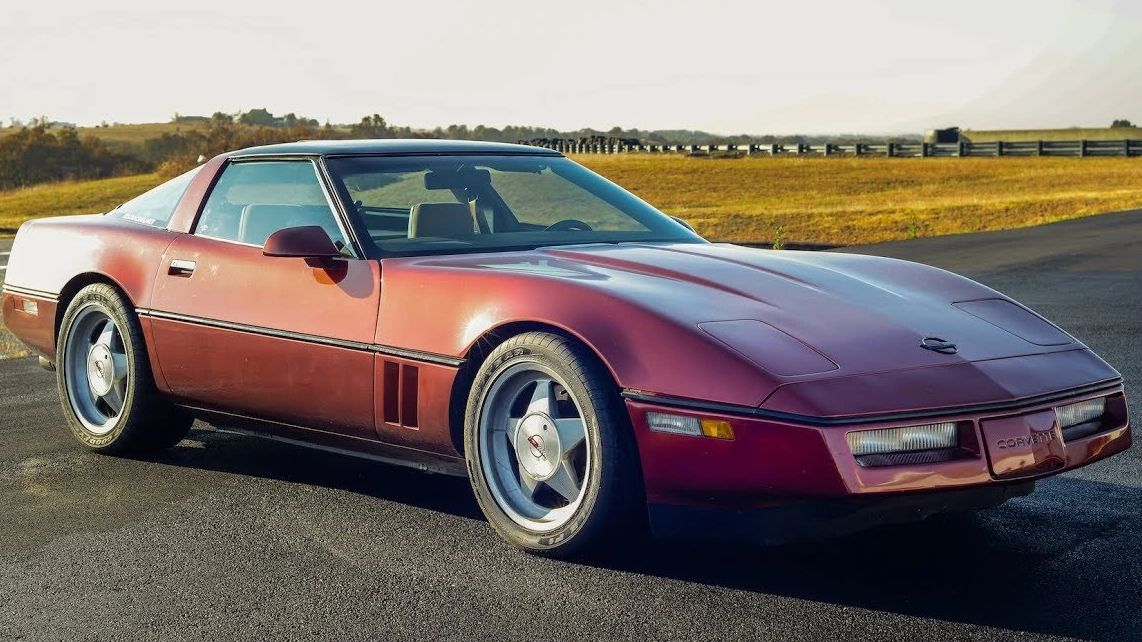
    The 1988 Callaway Twin Turbo Corvette (seen here), offered through select Chevrolet dealers under RPO B2K, represented a parallel path to high performance alongside the factory ZR-1 program. While the ZR-1 relied on the exotic Lotus-designed LT5 V8, the Callaway delivered blistering speed with its twin-turbocharged L98, showcasing the multiple avenues GM explored to elevate the C4 into world-class territory.
    The 1988 Callaway Twin Turbo Corvette (seen here), offered through select Chevrolet dealers under RPO B2K, represented a parallel path to high performance alongside the factory ZR-1 program. While the ZR-1 relied on the exotic Lotus-designed LT5 V8, the Callaway delivered blistering speed with its twin-turbocharged L98, showcasing the multiple avenues GM explored to elevate the C4 into world-class territory.

    What Corvette needed was a purpose-built, clean-sheet engine — one that could be docile in traffic but ferocious at full throttle. The solution was captured in a single word that engineers began using: “bi-modal.” The future Corvette powerplant had to behave like two engines in one: quiet, tractable, reliable for everyday use, yet able to summon exotic-car performance on demand.

    Enter Group Lotusof Hethel, England. By 1985, GM was negotiating to purchase the famed British engineering firm, known worldwide for Formula 1 success and for extracting remarkable performance from small, high-revving engines. McLellan’s team opened talks with Tony Rudd, Lotus’sManaging Director, about adapting Lotus’s multi-valve head technology to the venerable Chevrolet small block. Early trials revealed that the existing L98 couldn’t be stretched that far. Rudd’s advice was blunt: if Chevrolet wanted Ferrari-level performance, it needed a completely new engine.

    The corporate stars aligned. Backed by Reuss and then-Chairman Roger Smith, GM acquired Lotus in 1986, and with that acquisition came official sanction to build what would become the LT5 engine. For the Corvette faithful, it was the beginning of something truly extraordinary.

    The Birth of the LT5
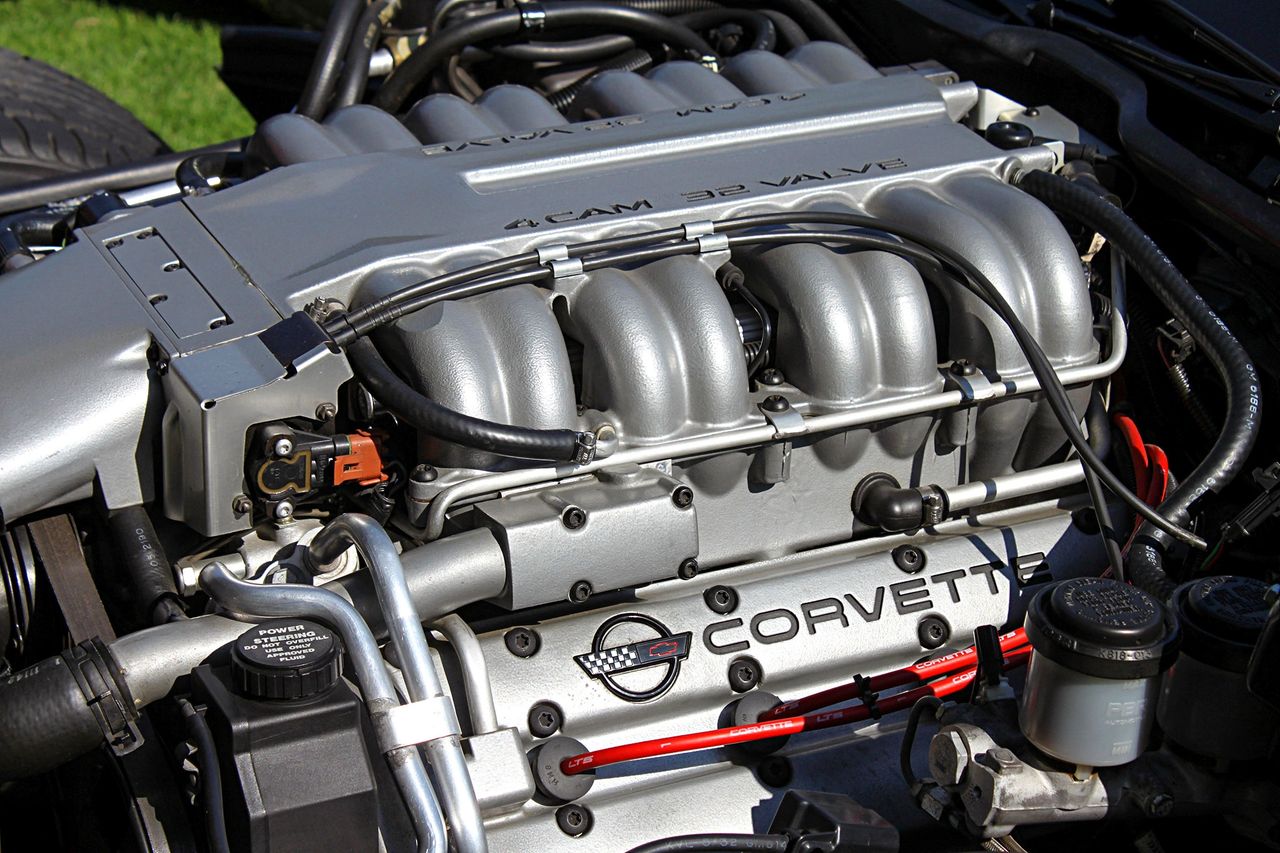
    The heart of the ZR-1 was the 5.7-liter LT5 V8, an all-aluminum, 32-valve, dual overhead cam masterpiece co-developed with Lotus and hand-assembled by Mercury Marine. Producing 375 horsepower at its debut, the LT5 transformed the Corvette into a legitimate supercar, earning the ZR-1 the title “King of the Hill” and proving that Chevrolet could build a world-class performance engine to rival the best from Europe and Japan.
    The heart of the ZR-1 was the 5.7-liter LT5 V8, an all-aluminum, 32-valve, dual overhead cam masterpiece co-developed with Lotus and hand-assembled by Mercury Marine. Producing 375 horsepower at its debut, the LT5 transformed the Corvette into a legitimate supercar, earning the ZR-1 the title “King of the Hill” and proving that Chevrolet could build a world-class performance engine to rival the best from Europe and Japan.

    Once General Motors gave Lotus the green light, the engineering brief was unlike anything ever placed before a Corvette development team. The new engine had to meet seemingly contradictory goals:

    • World-class power — at least 50% greater than the L98.
    • Drivability — smooth idle, docile in traffic.
    • Durability — capable of extended high-rpm use without compromising longevity.
    • Efficiency — fuel economy on par with the base Corvette, while meeting emissions standards.
    • Integration — it had to fit the existing C4 chassis without major structural changes.
    • Appearance — it needed to look as refined underhood as it was powerful.

    The result was the LT5, a 5.7-liter (350 cu. in.) all-aluminum V8 with 32 valves and dual overhead cams. On paper, its displacement matched the old L98, but in reality, it was an entirely different animal. From block to cylinder heads, from pistons to lubrication, this was a clean-sheet design born in Hethel and refined in America.
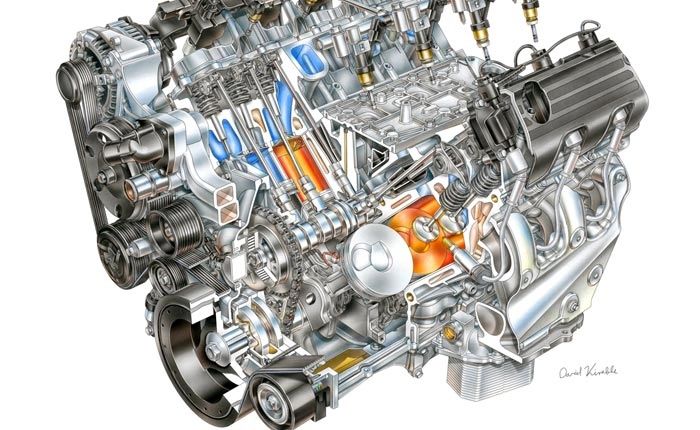
    This stunning cutaway illustration by automotive artist David Kimble captures the intricate engineering of the Corvette’s LT5 engine, highlighting its dual overhead cams, 32-valve layout, and advanced aluminum construction. Kimble’s rendering not only showcases the LT5’s technical sophistication but also immortalizes the artistry and innovation that made the ZR-1 a groundbreaking supercar of its era.
    This stunning cutaway illustration by automotive artist David Kimble captures the intricate engineering of the Corvette’s LT5 engine, highlighting its dual overhead cams, 32-valve layout, and advanced aluminum construction. Kimble’s rendering not only showcases the LT5’s technical sophistication but also immortalizes the artistry and innovation that made the ZR-1 a groundbreaking supercar of its era.

    Lotus engineers started with a narrow 22-degree valve angle — chosen specifically so the engine would fit between the Corvette’s front frame rails. Its compact 26.6-inch width meant Chevrolet could drop it into the C4’s engine bay without reengineering the uniframe. Yet the internals bore little resemblance to a pushrod small block.

    The block used Nikasil-coated aluminum liners paired with forged steel crank and rods. Pistons were lightweight aluminum Mahle slugs, dished slightly to yield a high 11.25:1 compression ratio. A heavily ribbed block and a one-piece aluminum bearing cradle secured the crank with 28 bolts, giving the LT5 race engine rigidity.

    But the real marvel was the induction system. Engineers devised a staged three-mode intake that allowed the LT5 to breathe like two different engines.

    1. Primary mode — below ~3,500 rpm, only eight of the sixteen intake runners flowed, delivering smooth, efficient operation.
    2. Secondary mode — when the ECM judged more power was needed, vacuum actuators opened the additional eight runners, unleashing the full fury of 375 horsepower.
    3. Valet mode — unique to the LT5, the secondary runners could be disabled entirely by a key in the center console, locking the car into “half-power” mode. It was equal parts practical (for handing the keys to a hotel valet) and theatrical, underscoring just how exotic this Corvette had become.

    At full tilt, the LT5 sang to 7,200 rpm, far beyond the safe range of the L98, with a distinctive mechanical shriek that was closer to Modena than Michigan. Yet at idle, it was glassy smooth, aided by Rochester Multec injectors and Bosch engine management. Road testers noted that the LT5 felt docile in traffic, but ferocious on demand — precisely what Reuss and McLellan had envisioned with their “bi-modal” brief.

    Mercury Marine: Building an American Exotic
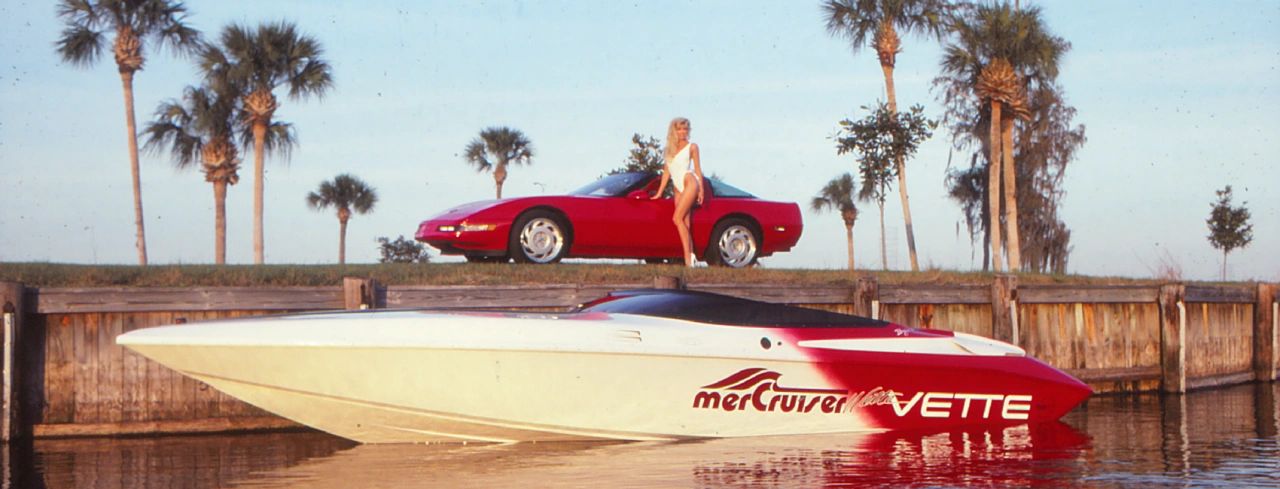
    This promotional shot pairs the revolutionary Corvette ZR-1 with a high-performance MerCruiser Marine Vette speedboat, both powered by versions of the legendary LT5 engine. The collaboration highlighted the versatility and engineering prowess of Chevrolet and Mercury Marine, proving that the ZR-1’s all-aluminum 32-valve V8 could deliver world-class performance on land and water alike.
    This promotional shot pairs the revolutionary Corvette ZR-1 with a high-performance MerCruiser Marine Vette speedboat, both powered by versions of the legendary LT5 engine. The collaboration highlighted the versatility and engineering prowess of Chevrolet and Mercury Marine, proving that the ZR-1’s all-aluminum 32-valve V8 could deliver world-class performance on land and water alike.

    As Lotus finalized the design, Chevrolet faced a sobering reality: GM’s own engine plants weren’t equipped to hand-build a low-volume exotic engine to aerospace-like tolerances. Corvette’s annual sales hovered in the 20–25,000 unit range, but projected ZR-1 volumes were only a fraction of that — just a few thousand per year. This wasn’t the scale Flint or Tonawanda were designed for.

    The solution was unconventional: Mercury Marine of Stillwater, Oklahoma. Known primarily for their high-performance “MerCruiser” marine engines, Mercury had both the expertise in aluminum machining and the small-volume assembly capability to deliver LT5s to spec.

    Each engine was built by a dedicated team of technicians, assembled almost like a race engine rather than a production motor. Once completed, LT5s were shipped by flatbed to Bowling Green, where they were installed into ZR-1 chassis on the same line as standard Corvettes.
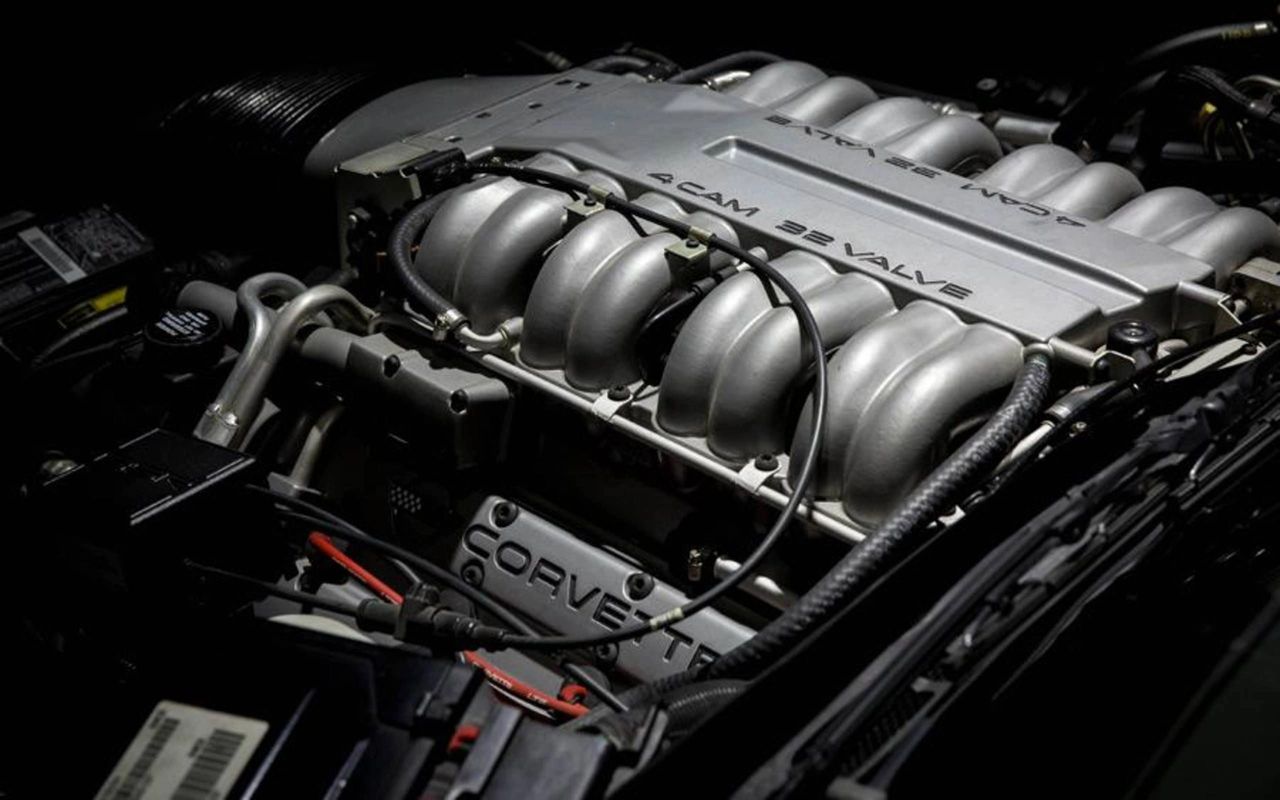
    The partnership between Chevrolet and Mercury Marine was instrumental in bringing the ZR-1’s revolutionary LT5 engine to life, with Mercury’s expertise in high-performance marine engines ensuring each hand-built unit met world-class standards. Today, the legacy of that collaboration is preserved at the Mercury Marine Museum in Fond du Lac, Wisconsin, where visitors can see the LT5 on display—a testament to the precision craftsmanship and engineering partnership that made the Corvette ZR-1 a true “King of the Hill.”
    The partnership between Chevrolet and Mercury Marine was instrumental in bringing the ZR-1’s revolutionary LT5 engine to life, with Mercury’s expertise in high-performance marine engines ensuring each hand-built unit met world-class standards. Today, the legacy of that collaboration is preserved at the Mercury Marine Museum in Fond du Lac, Wisconsin, where visitors can see the LT5 on display—a testament to the precision craftsmanship and engineering partnership that made the Corvette ZR-1 a true “King of the Hill.”

    Perhaps most fascinating was Mercury’s ongoing role in service and warranty support. For the first several years (1990–1993), major LT5 repairs could not be performed at dealerships. Instead, Chevrolet dealers were required to remove the engine and ship it back to Stillwater. Owners would then either receive a repaired original or, in some cases, an entirely new engine. This unusual arrangement underscored just how exotic the LT5 was compared to a pushrod small block. Only later, after 1993, did Chevrolet take full responsibility for LT5 servicing.

    For Mercury, the LT5 was a point of pride. Their own marine division explored adapting it for boat use, though those applications never went into large-scale production. The LT5 remains one of the most extraordinary examples of cross-industry collaboration in GM’s history.

    Transmission: The ZF Six-Speed
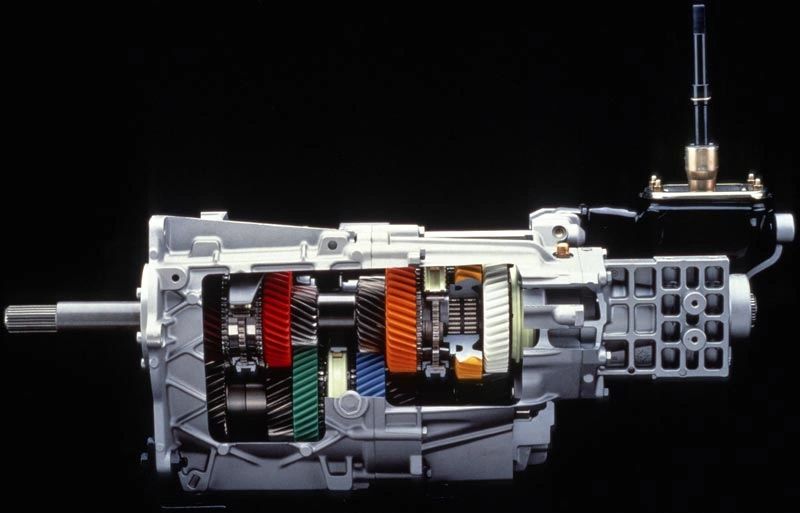
    The Corvette ZR-1’s special German-made ZF six-speed manual transmission, tuned with a taller 3.33:1 final drive, was critical in channeling the LT5’s power into supercar velocities. Its robust design and precise gearing, sometimes subtly varied between units, ensured that each ZR-1 could fulfill Chevrolet’s vision of world-class performance.
    The Corvette ZR-1’s special German-made ZF six-speed manual transmission, tuned with a taller 3.33:1 final drive, was critical in channeling the LT5’s power into supercar velocities. Its robust design and precise gearing, sometimes subtly varied between units, ensured that each ZR-1 could fulfill Chevrolet’s vision of world-class performance.

    An engine as revolutionary as the LT5 demanded an equally advanced transmission. The solution came from ZF Friedrichshafen, the German gearbox specialist with a reputation for bulletproof engineering. Chevrolet had already struggled with the quirky Doug Nash 4+3 overdrive manual through the mid-1980s. The ZR-1 would suffer no such compromise.

    The new ZF S6-40 six-speed manual was not only smoother and stronger, but also cleverly geared. Ratios were chosen to exploit the LT5’s broad power band, with a tall sixth gear enabling highway fuel economy that spared the ZR-1 from the dreaded gas-guzzler tax.

    But there was a catch: Computer-Aided Gear Selection (CAGS). To meet fuel economy regulations, Chevrolet implemented a skip-shift system that forced drivers, under light throttle between 15–19 mph, to shift from first gear directly into fourth. While effective in testing cycles, it irritated many owners, who felt robbed of control. Aftermarket kits to disable CAGS quickly became popular.

    Critics aside, the ZF six-speed was a revelation compared to the 4+3. Shifts were positive, the gearbox was durable, and the ratios kept the LT5 on boil when pushed hard. Combined with a reinforced differential and heavy-duty half shafts, the ZR-1 driveline was engineered to withstand sustained abuse at 7,000 rpm — something no prior Corvette transmission could reliably claim.

    A Wolf in Subtle Clothing
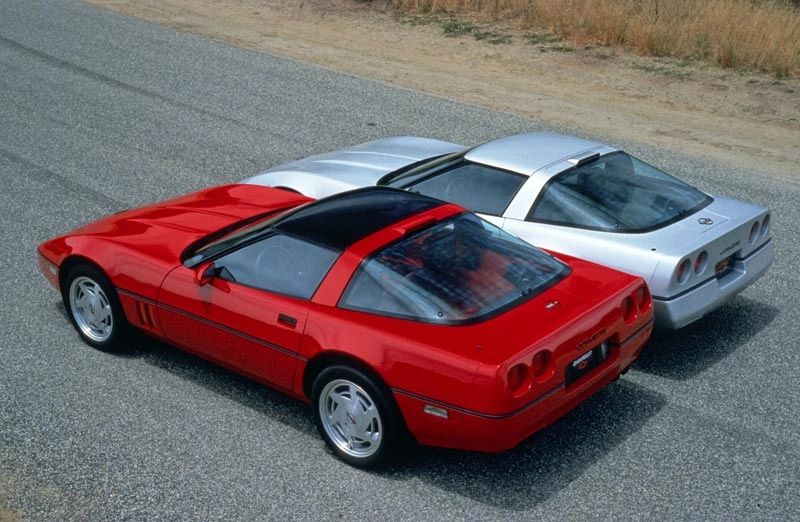
    In this photo, the 1990 Corvette ZR-1 (red) sits alongside a standard Corvette coupe (silver), highlighting the surprisingly subtle differences between the two. The ZR-1 can be distinguished by its wider rear haunches to accommodate massive 315-series tires, a unique rear fascia with squared-off taillights, and subtle badging, but otherwise it looked nearly identical to the base model. Many enthusiasts expecting a radical visual departure were initially underwhelmed, yet this understated approach was intentional—Chevrolet wanted the ZR-1’s supercar credentials to be proven on the road and track, not merely in its appearance.
    In this photo, the 1990 Corvette ZR-1 (red) sits alongside a standard Corvette coupe (silver), highlighting the surprisingly subtle differences between the two. The ZR-1 can be distinguished by its wider rear haunches to accommodate massive 315-series tires, a unique rear fascia with squared-off taillights, and subtle badging, but otherwise it looked nearly identical to the base model. Many enthusiasts expecting a radical visual departure were initially underwhelmed, yet this understated approach was intentional—Chevrolet wanted the ZR-1’s supercar credentials to be proven on the road and track, not merely in its appearance.

    When the ZR-1 finally emerged from years of rumor and speculation, its styling surprised many enthusiasts. Rather than create a radical new body, Chevrolet opted for a design philosophy of evolution over revolution. Corvette Chief Engineer Dave McLellan often remarked that the car’s engineering spoke for itself, and he resisted anything that would compromise the C4’s already aerodynamic form.

    Still, differentiation was essential. The ZR-1’s most defining cues were in the rear: the body widened three inches to accommodate massive 315/35ZR17 Goodyear Eagle Gatorback tires. These 11-inch-wide rears gave the car an aggressive stance, though the flare was subtle enough to escape casual notice. Corvette enthusiasts quickly learned to check the haunches — the ZR-1’s broader hips became an insider’s telltale.
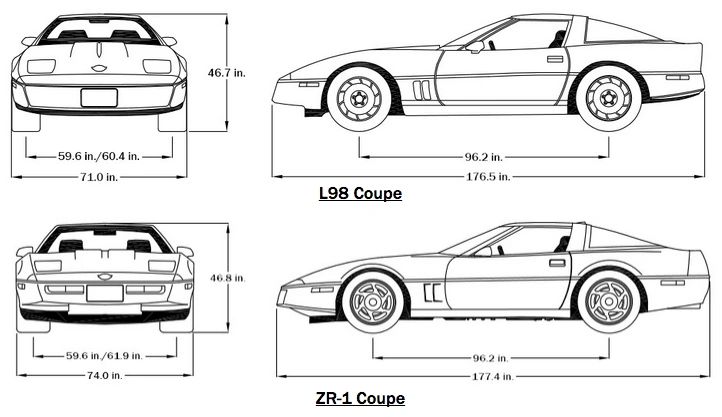
    Even more distinctive was the new convex rear fascia with squared taillights. Base models retained the familiar concave panel and round lamps, but the ZR-1 debuted this bold new look. Function matched form: Chevrolet engineers claimed the convex shape improved aerodynamics at high speeds. The squared taillamps broke tradition but hinted at Corvette’s evolution into a more modern design language. By 1991, the convex rear and square lights became standard on all Corvettes, but in 1990, it remained a ZR-1 exclusive.

    A discreet “ZR-1” badge graced the rear bumper, and a high-mount center brake lamp sat at the roofline — a feature mandated by federal safety law but integrated in a way unique to the ZR-1 until 1991. Beyond those details, the car looked deceptively ordinary. To the uninitiated, a ZR-1 parked beside an L98 coupe might appear identical. Owners often joked it was a $60,000 Corvette hiding in plain sight.

    This restraint divided opinion. Purists loved the understatement: here was an American exotic that didn’t need wild spoilers or bulges. Others, however, argued that at twice the price of a base Corvette, the ZR-1 deserved flashier styling. It was a debate that mirrored Corvette’s own identity struggle: was it a brash American muscle machine, or a refined international sports car?

    Supercar Numbers, Corvette Price
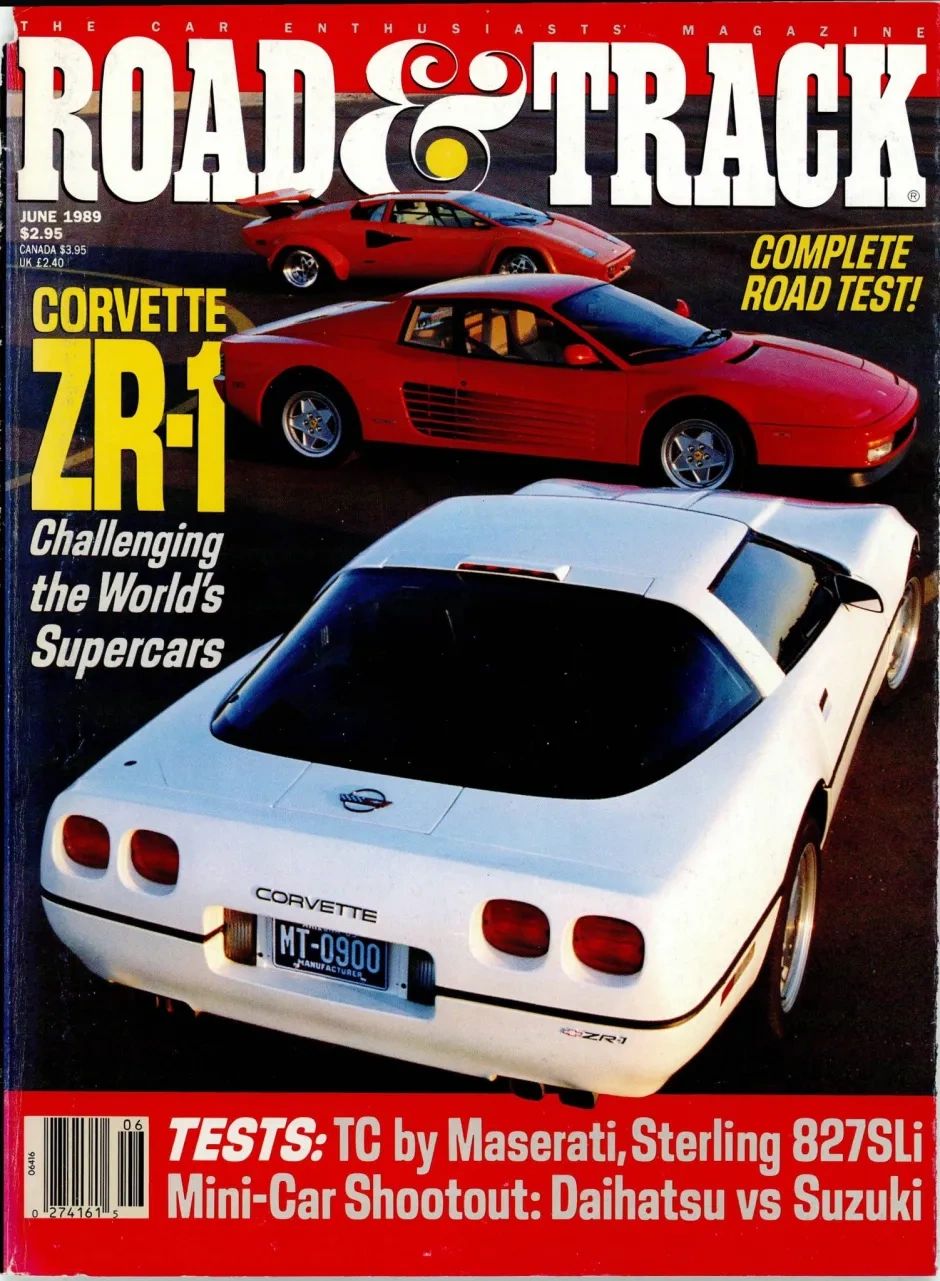
    When the Corvette ZR-1 debuted in 1990, critics worldwide hailed it as a watershed moment in American performance. Magazines like Road & Track put the ZR-1 head-to-head against Europe’s finest, as seen in this June 1989 cover story that boldly declared it was “challenging the world’s supercars.” With its exotic Lotus-designed LT5 engine, world-class handling, and blistering performance numbers, the ZR-1 silenced skeptics and proved that Corvette could not only compete with—but in many cases outperform—the likes of Ferrari and Lamborghini. (Image courtesy of Road and Track Magazine)
    When the Corvette ZR-1 debuted in 1990, critics worldwide hailed it as a watershed moment in American performance. Magazines like Road & Track put the ZR-1 head-to-head against Europe’s finest, as seen in this June 1989 cover story that boldly declared it was “challenging the world’s supercars.” With its exotic Lotus-designed LT5 engine, world-class handling, and blistering performance numbers, the ZR-1 silenced skeptics and proved that Corvette could not only compete with—but in many cases outperform—the likes of Ferrari and Lamborghini. (Image courtesy of Road and Track Magazine)

    If the exterior sparked debate, the performance silenced it. When magazines tested the ZR-1 in early 1990, jaws dropped:

    • 0–60 mph in as little as 4.5 seconds.
    • Quarter mile in 12.8 seconds at over 110 mph.
    • Top speed in the 175 mph range.

    These figures placed the ZR-1 squarely in the realm of Ferrari’s 348 and Porsche’s 911 Turbo. Car and Driver declared it “the Corvette that finally delivers on the promise of the C4 chassis.” Motor Trend, in a famous headline, dubbed it “King of the Hill,” and it became the nickname that stuck.
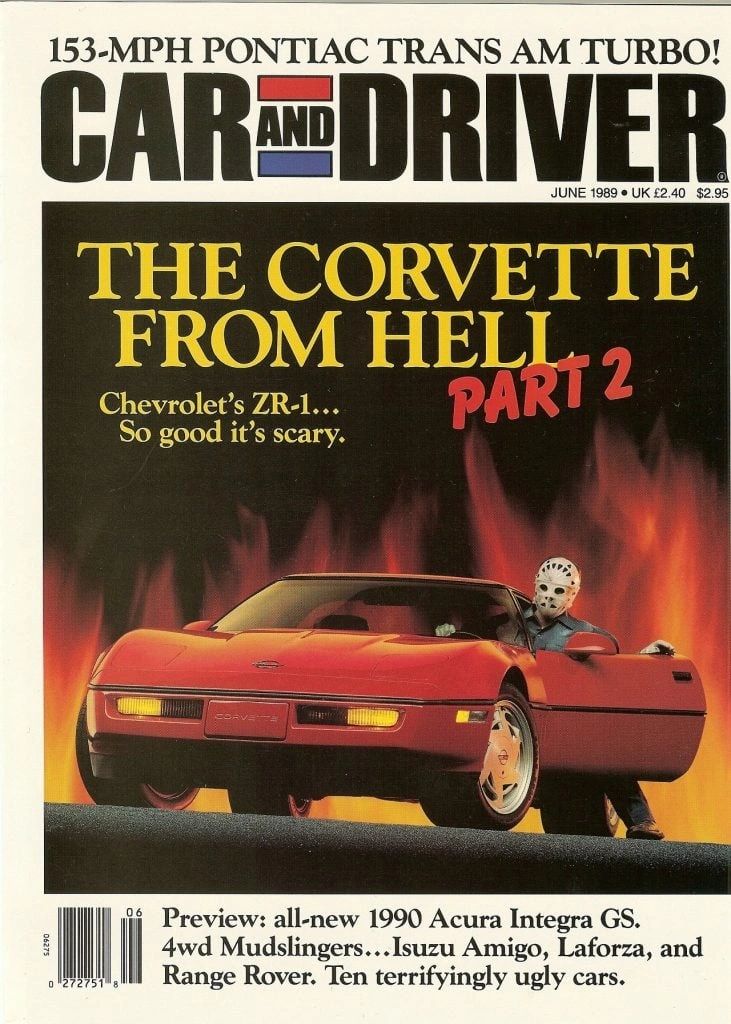
    When Car and Driver splashed the 1990 Corvette ZR-1 across its June 1989 cover with the headline “The Corvette from Hell,” it wasn’t just for shock value—it was a reflection of the car’s dual nature. On one hand, the ZR-1 was refined enough to serve as a daily driver, with all the comfort and usability Corvette owners expected. But beneath that civility lurked something far more sinister: a 375-horsepower, Lotus-engineered LT5 V8 paired with a rock-solid ZF six-speed transmission that turned the ZR-1 into a track monster capable of terrifying supercars from Europe. Car and Driver and other magazines of the era hailed it as a groundbreaking performance machine, one that was “so good, it’s scary.” The ZR-1 proved that Chevrolet could build a Corvette that was as livable as it was lethal—a sports car that truly earned its reputation as both a commuter’s dream and a hell-raiser on the open road. (Image source: Car and Driver Magazine)
    When Car and Driver splashed the 1990 Corvette ZR-1 across its June 1989 cover with the headline “The Corvette from Hell,” it wasn’t just for shock value—it was a reflection of the car’s dual nature. On one hand, the ZR-1 was refined enough to serve as a daily driver, with all the comfort and usability Corvette owners expected. But beneath that civility lurked something far more sinister: a 375-horsepower, Lotus-engineered LT5 V8 paired with a rock-solid ZF six-speed transmission that turned the ZR-1 into a track monster capable of terrifying supercars from Europe. Car and Driver and other magazines of the era hailed it as a groundbreaking performance machine, one that was “so good, it’s scary.” The ZR-1 proved that Chevrolet could build a Corvette that was as livable as it was lethal—a sports car that truly earned its reputation as both a commuter’s dream and a hell-raiser on the open road. (Image source: Car and Driver Magazine)

    But raw numbers only told part of the story. Reviewers consistently praised the LT5’s dual personality. Around town, with the secondary intake runners closed, the ZR-1 was docile and quiet, pulling smoothly from idle. On the highway or track, when the vacuum actuators opened the secondaries, the car transformed into a snarling exotic, rushing to 7,200 rpm with a ferocity no pushrod small block could match. Road & Track wrote that the ZR-1 seemed to have “two engines under one hood, both eager and both Corvette.”

    Handling matched the power. With its wider rear track and Goodyear’s specially developed tires, the ZR-1 generated nearly 0.94 g on the skidpad — a world-class figure for the time. Brakes, borrowed from the 1988 Z51 package and upgraded further, hauled the car down from 60 mph in just over 120 feet. Reviewers noted that the ZR-1 felt unflappable at triple-digit speeds, thanks to its planted stance and carefully tuned suspension.

    The Price of Greatness
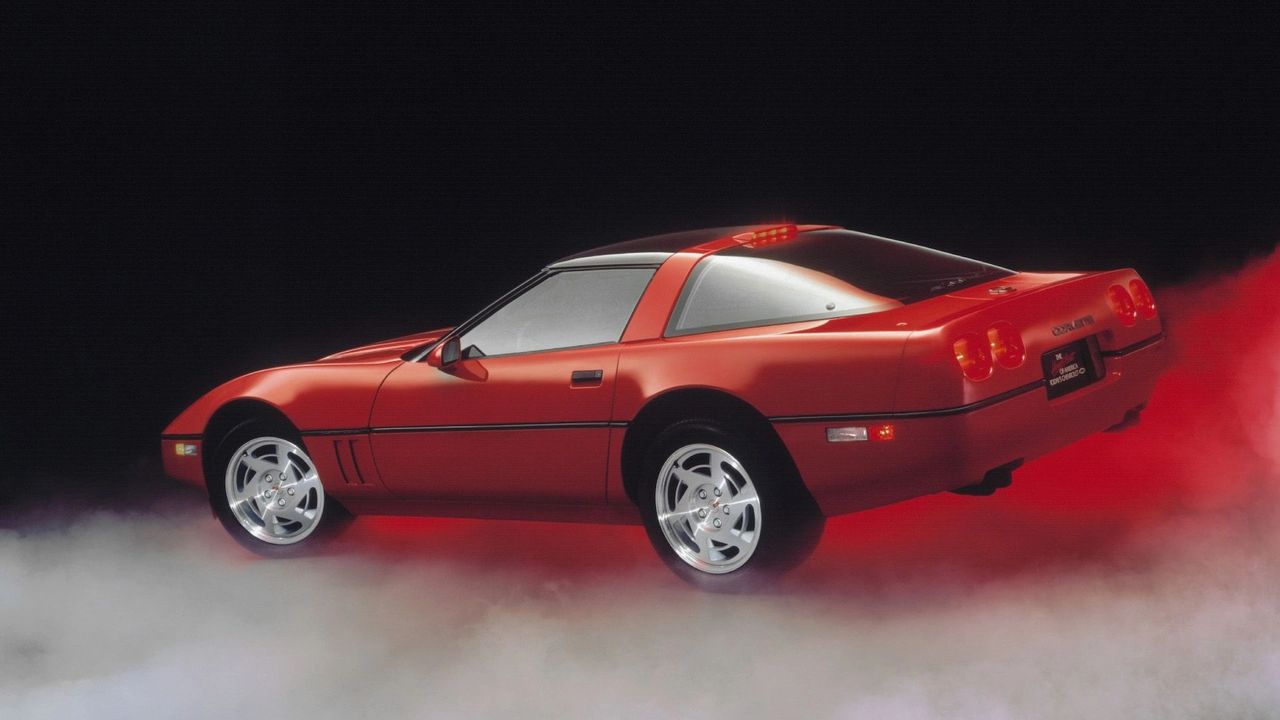
    This GM promo shot of the 1990 Corvette ZR-1 highlights what set it apart: widened rear fenders, unique convex taillights, and exclusive wheels. Beneath the sleek bodywork lurked the 375-hp LT5 V8, a hand-built Mercury Marine masterpiece that elevated the Corvette into true world-class supercar territory. (Image courtesy of GM Media LLC.)
    This GM promo shot of the 1990 Corvette ZR-1 highlights what set it apart: widened rear fenders, unique convex taillights, and exclusive wheels. Beneath the sleek bodywork lurked the 375-hp LT5 V8, a hand-built Mercury Marine masterpiece that elevated the Corvette into true world-class supercar territory. (Image courtesy of GM Media LLC.)

    At $58,995, the ZR-1’s price shocked some longtime Corvette buyers. It was, after all, nearly double the base coupe. For the first time in history, a Corvette could not be considered “affordable” by average enthusiast standards. But when compared to its rivals — Ferrari 348 at $120,000, Porsche 911 Turbo at $105,000 — the ZR-1 was still a supercar bargain.

    Dealers, sensing demand, often pushed the car into speculative territory. Reports spread quickly of dealerships marking up early ZR-1s by $20,000, $30,000, even $40,000. Anecdotes circulated of buyers paying close to $100,000 for one of the first allocations. Some enthusiasts grumbled, but Chevrolet hardly minded: the ZR-1 was a halo car, and the frenzy only elevated Corvette’s global reputation.

    Still, critics had their points. Three themes emerged in contemporary press reviews:

    1. Sticker Shock — Enthusiasts accustomed to Corvette’s bang-for-buck value struggled to reconcile the ZR-1’s cost.
    2. Skip-Shift Frustration — The federally mandated CAGS (1st-to-4th skip-shift) irritated drivers, even if it spared the car from the gas-guzzler tax.
    3. Styling Restraint — Reviewers wondered if a car this exotic deserved a more distinctive body.

    Yet, even with those quibbles, the consensus was clear: Chevrolet had delivered a Corvette that could compete toe-to-toe with Europe’s best.

    The Texas Records
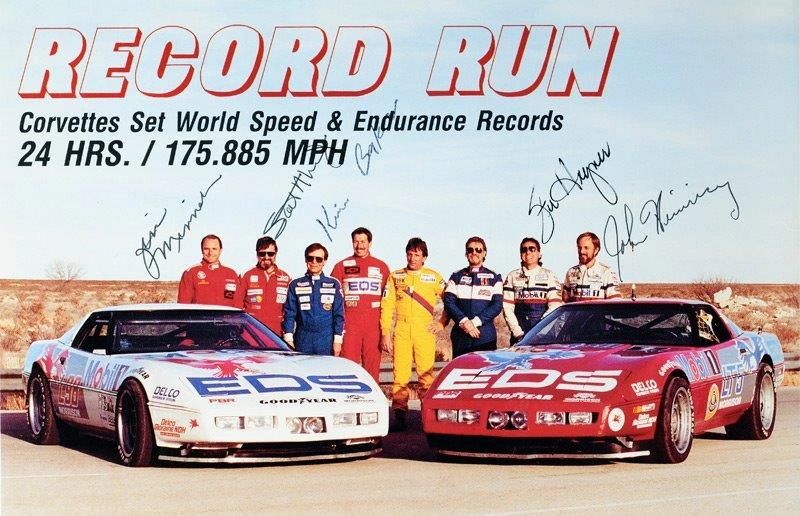
    In March 1990, Chevrolet proved the Corvette ZR-1 was more than hype with a record-shattering endurance run at Fort Stockton, Texas. Two specially prepared ZR-1s averaged 175.885 mph for 24 hours straight, setting new FIA World Speed and Endurance records and demonstrating the LT5 engine’s world-class durability. Behind the wheel was an all-star roster of drivers: Tommy Morrison, John Heinricy, Stu Hayner, Jim Minneker, Scott Lagasse, Don Knowles, and Kim Baker. Their combined effort showed that the ZR-1 wasn’t just fast—it was a car that could run flat-out for an entire day, a feat few exotics of the era could match. This photo immortalizes the cars, the crew, and the drivers who helped etch the ZR-1 into the record books.
    In March 1990, Chevrolet proved the Corvette ZR-1 was more than hype with a record-shattering endurance run at Fort Stockton, Texas. Two specially prepared ZR-1s averaged 175.885 mph for 24 hours straight, setting new FIA World Speed and Endurance records and demonstrating the LT5 engine’s world-class durability. Behind the wheel was an all-star roster of drivers: Tommy Morrison, John Heinricy, Stu Hayner, Jim Minneker, Scott Lagasse, Don Knowles, and Kim Baker. Their combined effort showed that the ZR-1 wasn’t just fast—it was a car that could run flat-out for an entire day, a feat few exotics of the era could match. This photo immortalizes the cars, the crew, and the drivers who helped etch the ZR-1 into the record books.

    If magazine tests impressed, the ZR-1’s March 1990 endurance run in Texas cemented its legend. On Firestone’s 7.7-mile high-banked oval in Fort Stockton, a stock-spec ZR-1 (with safety modifications but no performance alterations) attempted to prove what no Corvette had ever proven before: that it could dominate not just in sprints, but in endurance.

    Over 24 continuous hours, a team of drivers rotated stints at racing speeds. Fuel, tire, and driver changes were the only interruptions. When the checkered flag fell, the ZR-1 had shattered 12 FIA world records.

    Most staggering was the 24-hour average speed: 175.885 mph. This wasn’t a one-lap wonder — it was a day-long demonstration of reliability and stamina. Among the 12 records, three were “absolute” world marks, regardless of classification, making the ZR-1 the first production car in 50 years to claim outright FIA honors.
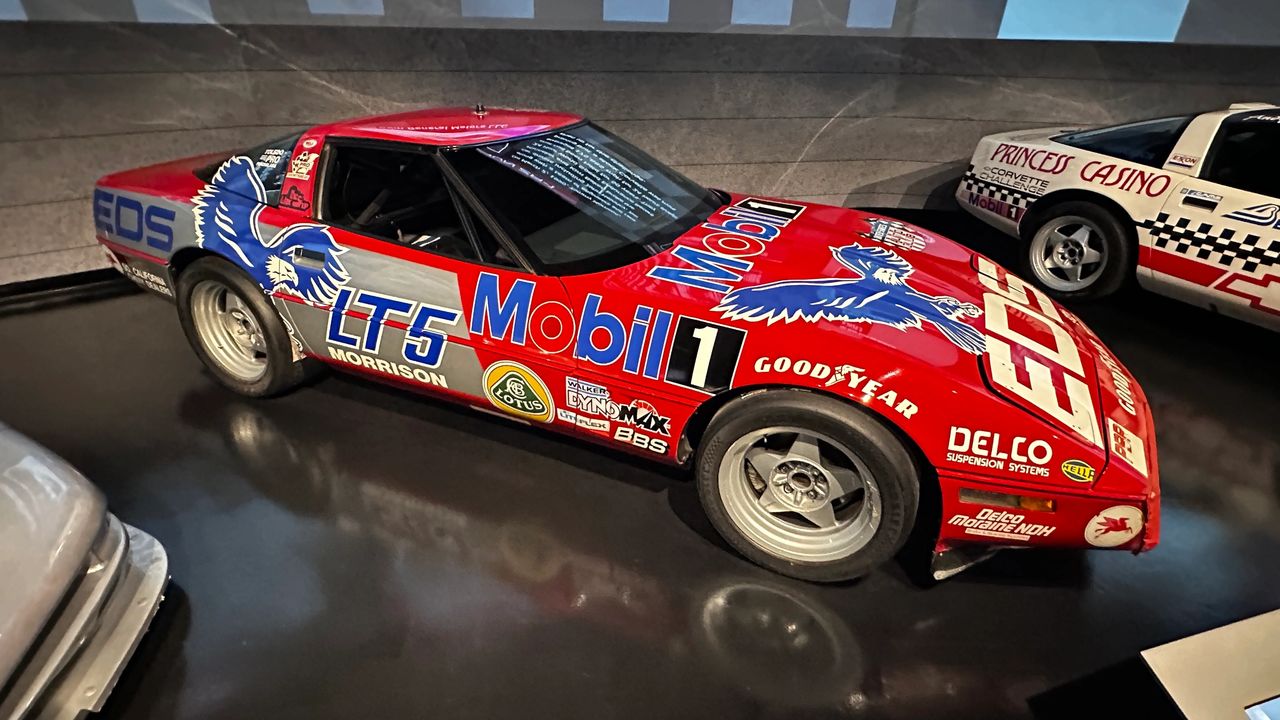
    The record-breaking 1990 Corvette ZR-1 “Record Run” car, which averaged 175.885 mph for 24 hours straight at Fort Stockton, Texas, can now be seen at the National Corvette Museum. This legendary LT5-powered machine invites visitors to experience a defining moment in Corvette history—an endurance feat that proved America’s sports car could run with the world’s best. (Image property of the author)
    The record-breaking 1990 Corvette ZR-1 “Record Run” car, which averaged 175.885 mph for 24 hours straight at Fort Stockton, Texas, can now be seen at the National Corvette Museum. This legendary LT5-powered machine invites visitors to experience a defining moment in Corvette history—an endurance feat that proved America’s sports car could run with the world’s best. (Image property of the author)

    The achievement resonated worldwide. European manufacturers had long touted endurance as their domain. Now an American Corvette, built in Bowling Green and powered by an engine assembled in Stillwater, Oklahoma, had proven itself on the global stage. The records would stand until 2001, when Volkswagen’s 600-hp W-12 prototype finally eclipsed them. That it took a purpose-built concept car to dethrone the ZR-1 spoke volumes.

    Instant Icon
    The 1990 Corvette ZR-1 introduced the exotic, Lotus-engineered 5.7L LT5 V8, producing 375 horsepower and delivering 0–60 times in the 4-second range with a top speed near 180 mph. Unique styling cues—wider rear bodywork, convex taillights, and 17-inch wheels—distinguished it from the standard Corvette. In its debut year, just 3,049 examples were built, making the 1990 ZR-1 both a technological showcase and one of the rarest Corvettes of its era.
    The 1990 Corvette ZR-1 introduced the exotic, Lotus-engineered 5.7L LT5 V8, producing 375 horsepower and delivering 0–60 times in the 4-second range with a top speed near 180 mph. Unique styling cues—wider rear bodywork, convex taillights, and 17-inch wheels—distinguished it from the standard Corvette. In its debut year, just 3,049 examples were built, making the 1990 ZR-1 both a technological showcase and one of the rarest Corvettes of its era.

    Before 1990, the Corvette had stood at the crossroads of performance history. For much of the 1980s, aftermarket tuners had filled a void that Chevrolet itself could not yet address. Callaway Cars, most famously, had produced the Twin-Turbo Corvette — a factory-sanctioned but independently engineered package that turned the Corvette into a legitimate 180-mph machine. The highlight was the legendary Callaway Sledgehammer, a one-off experimental car that reached an almost mythical 254.76 mph on Ohio’s Transportation Research Center oval in 1988. That feat, though never replicated in production, gave Corvette a kind of halo by association.

    But in 1990, the landscape shifted dramatically. For the first time since the days of Zora Arkus-Duntov’s 1960s racing specials, Chevrolet itself had produced a Corvette that no tuner could match: the ZR-1. With its Lotus-designed LT5 engine, Mercury Marine assembly, and FIA world records, it was the factory — not Callaway or Lingenfelter or Greenwood — setting the standard. Callaway’s own production reflected the change: only 58 Twin-Turbos were sold in 1990, compared to 3,049 ZR-1s.

    In the press, the verdict was near unanimous: the ZR-1 was not only the fastest, most capable Corvette ever built, but also a watershed moment in American automotive history. For decades, Corvette had been an underdog — respected at home, doubted abroad. In 1990, that narrative flipped. Ferrari and Porsche were no longer untouchable. Corvette had joined their ranks, and in some respects, surpassed them.

    The message was unmistakable: the Corvette no longer needed validation from outside firms. It had become its own exotic.

    Racing Aspirations: SCCA World Challenge
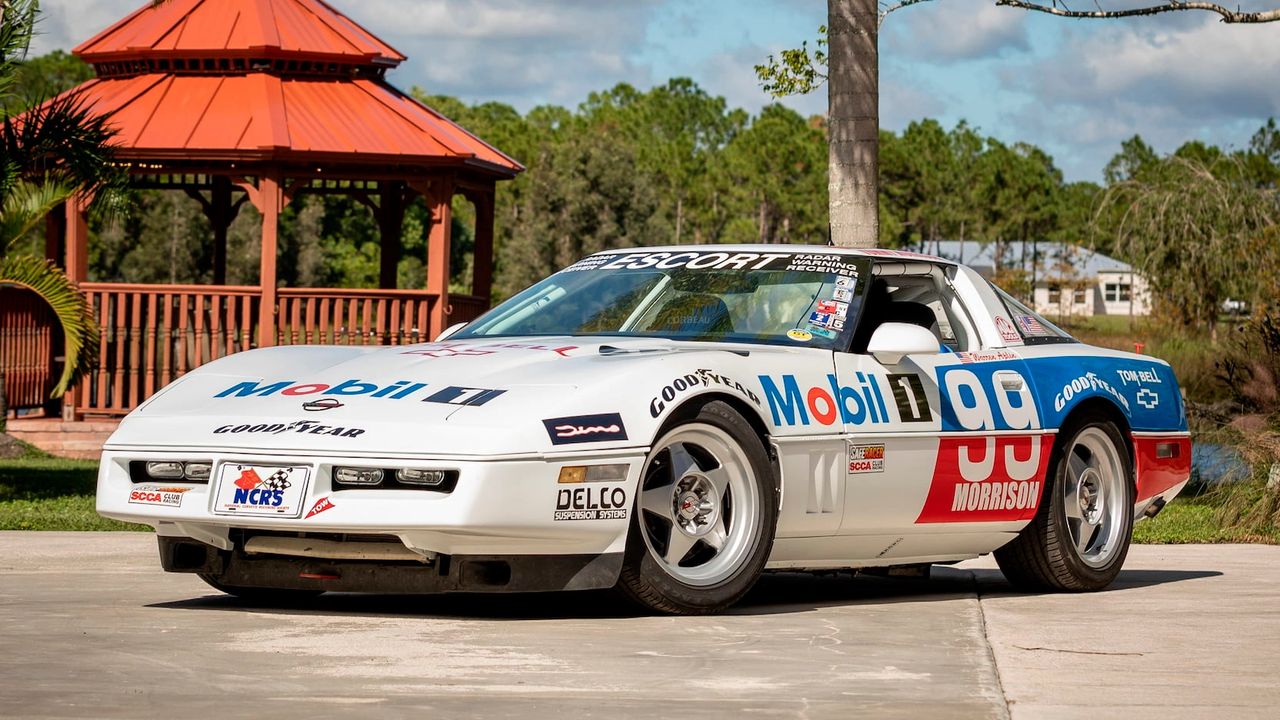
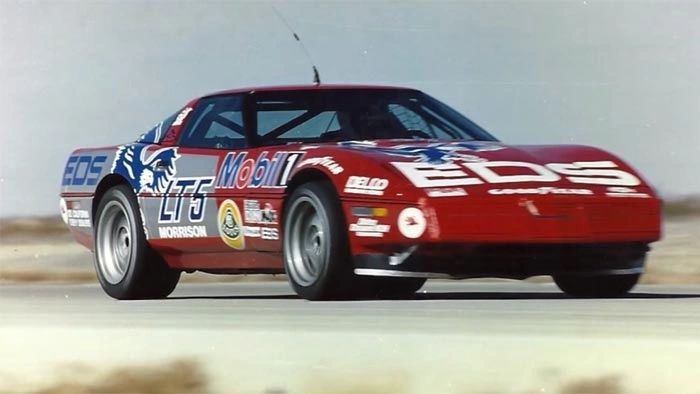
    The 1990 SCCA Escort World Challenge brought production-based racing into the spotlight, and Tommy Morrison’s Mobil 1–sponsored Corvette was one of its standouts. Driven by Morrison and his team, the C4 competed in the inaugural season of the series, showcasing the balance of speed, handling, and durability that made the Corvette a natural contender. Wearing its now-iconic white, blue, and red livery, the #99 car represents an important chapter in Corvette’s racing legacy, where showroom-stock machines were pushed to their limits against the world’s best.
    The 1990 SCCA Escort World Challenge brought production-based racing into the spotlight, and Tommy Morrison’s Mobil 1–sponsored Corvette was one of its standouts. Driven by Morrison and his team, the C4 competed in the inaugural season of the series, showcasing the balance of speed, handling, and durability that made the Corvette a natural contender. Wearing its now-iconic white, blue, and red livery, the #99 car represents an important chapter in Corvette’s racing legacy, where showroom-stock machines were pushed to their limits against the world’s best.

    While Chevrolet had officially withdrawn from factory-backed racing programs in the wake of the AMA’s late-1950s racing ban, the spirit of competition never disappeared from Corvette engineering. By 1990, with the ZR-1 redefining Corvette’s technological ceiling, Chevrolet supported grassroots racing through production-based efforts.

    The newly created SCCA World Challenge series (launched in 1990) became a proving ground. Chevrolet offered 23 specially prepared Corvettes with heavy-duty suspension systems that could be ordered directly through dealerships. Though technically available to any customer, these cars were aimed at privateer racers eager to test Corvette against emerging imports in showroom-stock competition.

    Unlike the FIA endurance records in Texas — a corporate-backed showcase designed to prove the LT5’s durability — the SCCA Corvettes reflected Chevrolet’s confidence that the platform, even in near-stock form, could compete wheel-to-wheel in sanctioned racing. Buyers could either run the robust L98 small block or provide their own modified powerplants. Chevrolet’s willingness to make such cars available through normal dealer channels spoke volumes: Corvette was once again a legitimate racing foundation, not just a high-speed street car.

    Production Realities

    For all the ZR-1’s fanfare, overall Corvette production declined in 1990, reflecting broader market conditions. Chevrolet built 23,646 Corvettes total, broken down as follows:

    • 20,597 standard coupes/convertibles (VINs 100001–120597).
    • 3,049 ZR-1 coupes (VINs 800001–803049).

    The drop from 1989’s 26,412 cars wasn’t catastrophic, but it reflected an important reality: the Corvette was no longer a volume car. By the dawn of the 1990s, buyers who had once been lured by the glamour of America’s only sports car now had a wealth of alternatives, from Japan’s rising stars (the Acura NSX, Mazda RX-7 Turbo, Nissan 300ZX Twin Turbo) to Europe’s stalwarts.

    Yet Chevrolet was content with the lower totals. Corvette wasn’t meant to be everyman’s car in 1990; it was meant to be America’s technological flag-bearer. The ZR-1, even at limited production, served its halo purpose brilliantly.

    Price and Value

    At $31,979 for a base coupe and $37,264 for a convertible, the Corvette remained accessible to many enthusiasts. But the ZR-1, with its $27,016 option package, carried a sticker of $58,995.

    The number shocked some. Corvette had always been a relatively affordable sports car — exotic looks and performance at a fraction of the price of European competitors. But now, Chevrolet had crossed a psychological threshold. For the first time in history, a Corvette cost as much as a luxury home in many parts of America.

    Still, compared to its peers, the ZR-1 was a bargain. A Ferrari 348 of the era listed at $120,000; a Porsche 911 Turbo approached $105,000. Road & Track called the ZR-1 “the supercar bargain of the decade,” noting that no other car offered such speed, refinement, and endurance at anywhere near the price.

    In the showroom, however, supply and demand distorted the equation. Dealers routinely added $20,000–$40,000 markups. Anecdotal reports tell of buyers paying close to $100,000 for early cars, just for the privilege of being first. The Corvette, once criticized for “cheapness,” was suddenly the subject of exotic-level speculation.

    Colors and Character
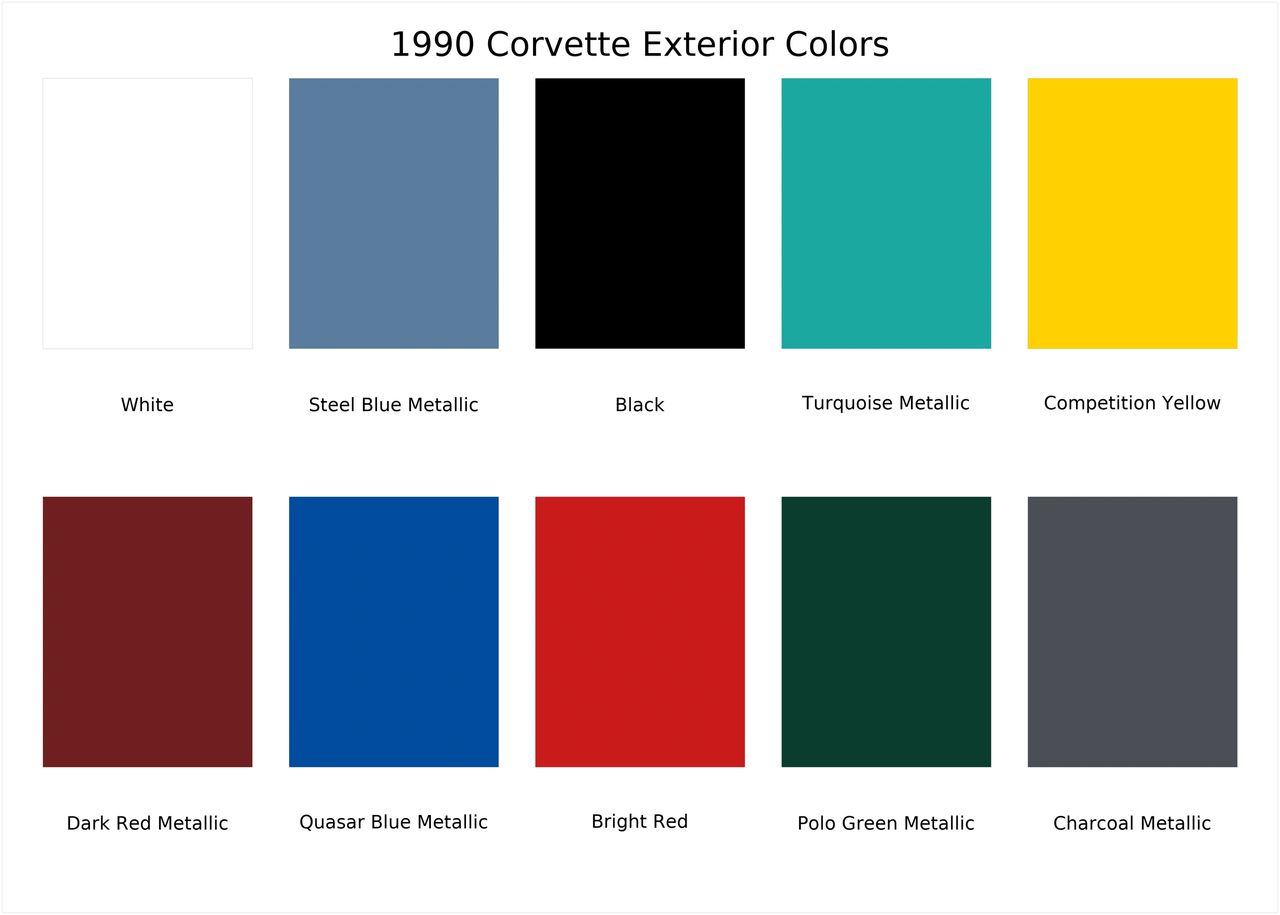
    1990 Corvette Exterior Paint Colors
    1990 Corvette Exterior Paint Colors

    Ten paint options defined the 1990 palette:

    • White
    • Steel Blue Metallic
    • Black
    • Turquoise Metallic
    • Competition Yellow
    • Dark Red Metallic
    • Quasar Blue Metallic
    • Bright Red
    • Polo Green Metallic
    • Charcoal Metallic

    Bright Red dominated production (29.4%), followed by Black (20.1%) and White (20.6%). These bold, primary hues reflected the Corvette’s extroverted image — loud, proud, and unapologetically American. Meanwhile, colors like Competition Yellow and Quasar Blue brought energy to the range, and Polo Green tied the model back to Corvette’s long tradition of offering a rich, British Racing-inspired shade.

    Inside, Corvette finally embraced practicality and modern expectations: leather seating became available across all trims, the glovebox returned, and the hybrid analog-digital dashboard offered drivers the best of both worlds. Small touches, but together they made the Corvette cabin feel contemporary.

    VINs and Collectability
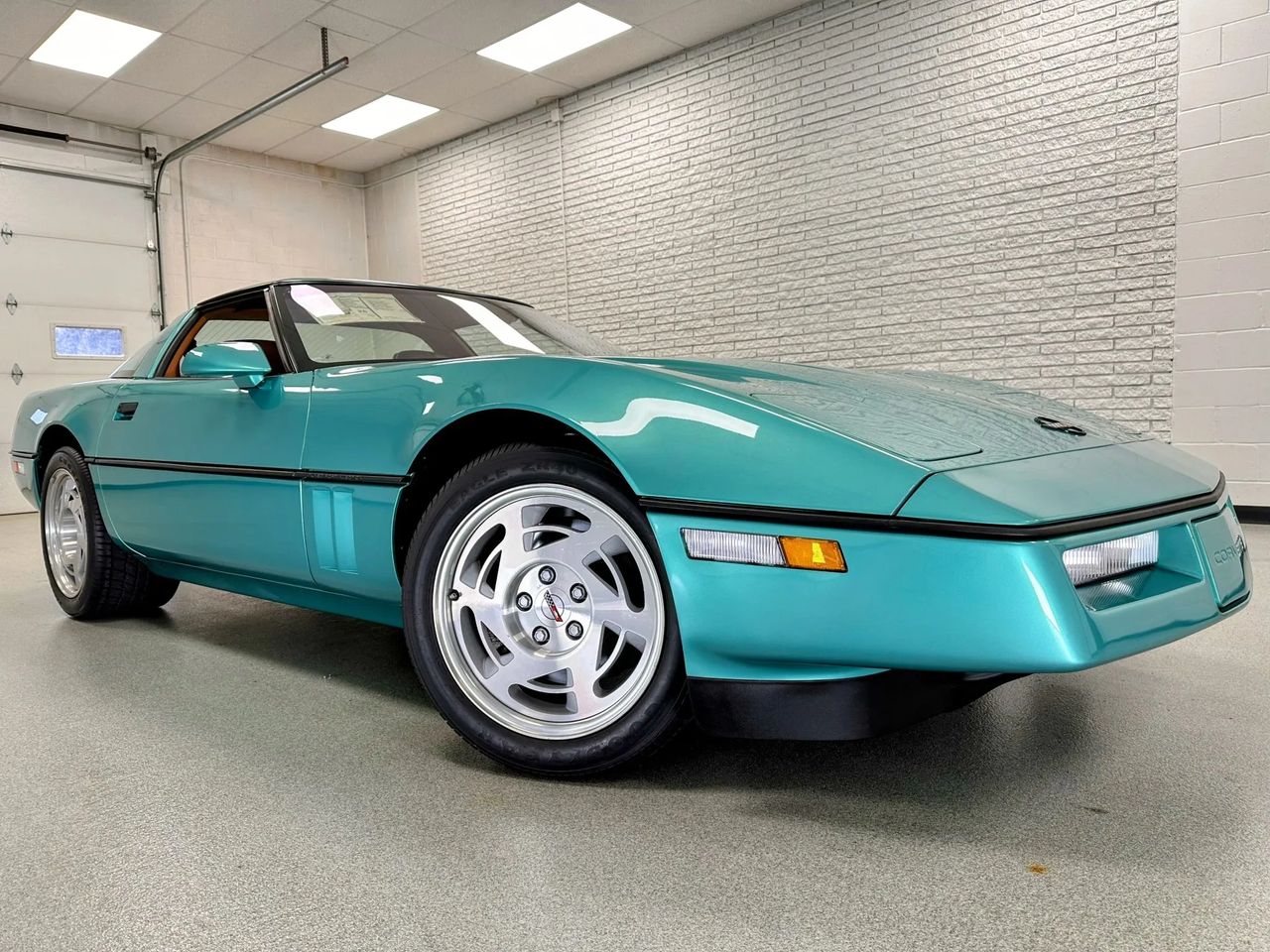
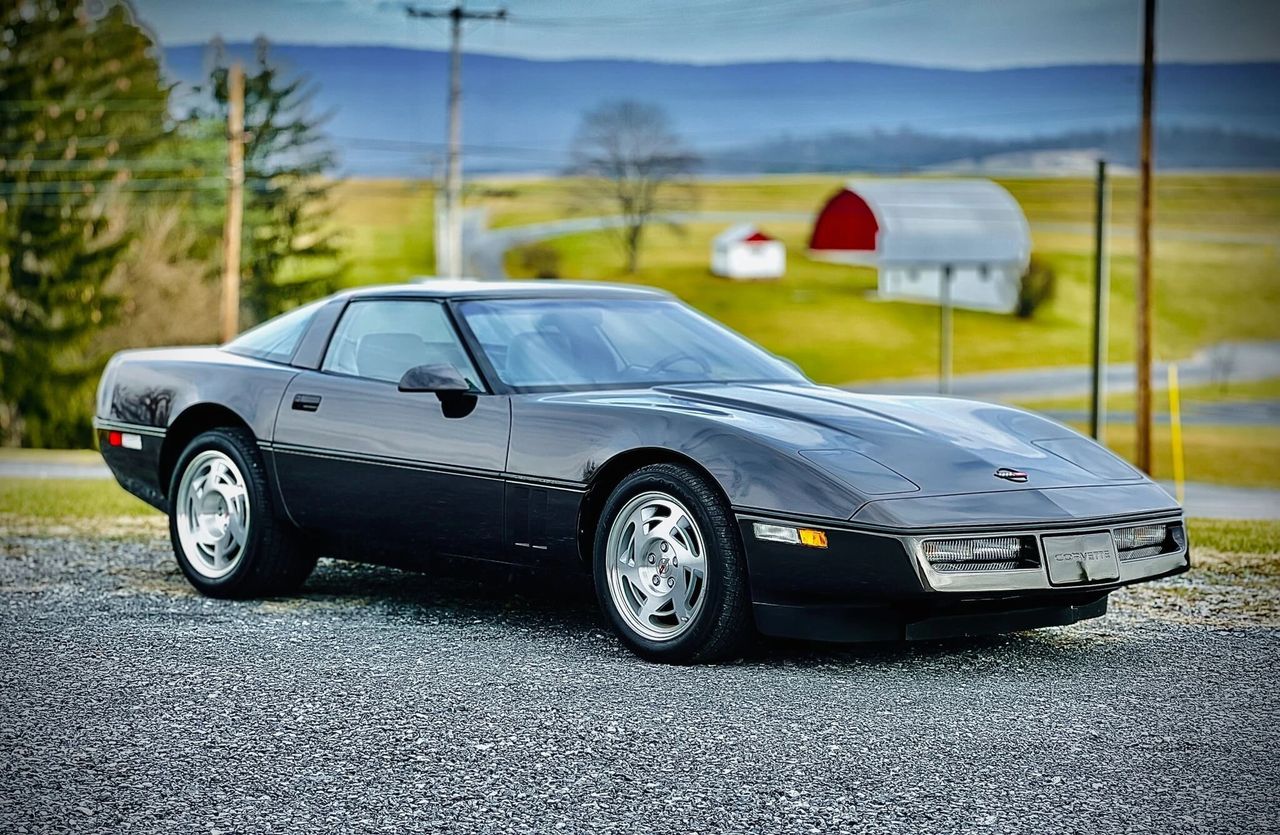
    One of the rarer colors on a 1990 Corvette was Turquoise Metallic, with only 589 units produced. Other rare colors for that year include Quasar Blue and Competition Yellow, each with very low production numbers.  (Image courtesy of BringATrailer.com)
    One of the rarer colors on a 1990 Corvette was Turquoise Metallic, with only 589 units produced. Other rare colors for that year include Quasar Blue and Competition Yellow, each with very low production numbers. (Image courtesy of BringATrailer.com)

    For historians and collectors, the VIN structure of 1990 tells an important story. Standard Corvettes ran sequentially from 100001 to 120597. ZR-1s, however, occupied their own unique sequence: 800001–803049. That separation effectively created a “model within a model,” underscoring Chevrolet’s intention that the ZR-1 stand apart.

    Today, collectors scrutinize these VINs carefully, especially since counterfeit ZR-1s have been attempted. The wide-body rear haunches and convex fascia can be retrofitted, but the VIN remains the definitive marker of authenticity.

    Legacy: A Watershed Year

    Looking back, 1990 was not simply a model year — it was a declaration.

    For the standard Corvette, incremental gains kept the car sharp: airbags, ABS refinement, improved cooling, revised instrumentation, and creature comforts. But the ZR-1 was the thunderclap. It told the world that Chevrolet, and by extension America, could build a supercar that rivaled anything from Modena, Stuttgart, or Maranello.

    The LT5 was an engineering statement, the ZF six-speed a driver’s dream, and the Texas endurance records a mic-drop moment in performance history. Critics could complain about price, styling subtlety, or skip-shift irritations, but none of that dulled the achievement.

    The ZR-1 also shifted Corvette’s cultural image. Through much of the 1970s and early 1980s, Corvette had been viewed as a flashy cruiser, more boulevard toy than serious sports car. In 1990, that perception evaporated. The Corvette was now measured against Ferrari and Porsche in earnest, not as an underdog, but as a peer.

    Production numbers would fall in subsequent years, and the ZR-1’s exclusivity ensured it was never a mass-market car. But that was the point. The ZR-1 existed to elevate the Corvette nameplate, and in that, it succeeded spectacularly.

    For collectors today, the 1990 ZR-1 is revered not just as the first year of a special option, but as the moment Corvette entered the modern performance conversation. Its VIN range, world records, and Lotus/Mercury Marine pedigree make it one of the most historically significant Corvettes ever built.

    Final Word on 1990
    Want a sense of how serious the first ZR-1 was? On March 1, 1990, at Fort Stockton, Texas, a 1990 ZR-1 went out and set three world records—all in one shot. It averaged 175.710 mph (282.778 km/h) over 5,000 km (3,100 mi), held 173.791 mph (279.690 km/h) for 5,000 miles (8,000 km), and then nailed a 24-hour endurance mark of 175.885 mph (283.059 km/h), covering 4,221.256 miles (6,793.453 km). In other words: a showroom-based Corvette lapped at airliner speeds for an entire day—and asked for more.
    Want a sense of how serious the first ZR-1 was? On March 1, 1990, at Fort Stockton, Texas, a 1990 ZR-1 went out and set three world records—all in one shot. It averaged 175.710 mph (282.778 km/h) over 5,000 km (3,100 mi), held 173.791 mph (279.690 km/h) for 5,000 miles (8,000 km), and then nailed a 24-hour endurance mark of 175.885 mph (283.059 km/h), covering 4,221.256 miles (6,793.453 km). In other words: a showroom-based Corvette lapped at airliner speeds for an entire day—and asked for more.

    The 1990 Corvette was the start of something new — a car that looked back to its heritage while leaping into the future. The base model offered evolutionary improvements, but the ZR-1 was revolutionary. It wasn’t just a Corvette with more horsepower; it was a Corvette that redefined what America could build.

    In March of that year, on a high-speed oval in Texas, a group of engineers, test drivers, and mechanics watched as their car circled endlessly, shattering records once thought untouchable. As the sun rose the next day, and the ZR-1 crossed the 24-hour mark at nearly 176 mph average speed, it wasn’t just a Corvette triumph. It was a statement: the King of the Hill had arrived, and it wore crossed flags.

    1990 Corvette — Key Specifications (Base vs. ZR-1)

    Engines & Transmissions

    • Base (Coupe/Convertible): L98 5.7L TPI V8245 hp @ 4,400 rpm, 345 lb-ft @ 3,200 rpm. Transmissions: 4-spd automatic (TH700-R4) or ZF S6-40 6-spd manual (no-cost).
    • ZR-1: LT5 5.7L DOHC V8375 hp @ 6,000 rpm, 370 lb-ft @ 4,800 rpm; ZF S6-40 6-spd manual only.

    Performance (period ranges)

    • Base: ~5.7–6.5 s 0–60 mph • ~14.5–14.9 s @ ~96–98 mph ¼-mile • ~150 mph top speed (equipment/axle dependent).
    • ZR-1: Quicker in most tests; substantially higher top speed vs. L98 per factory literature and period tests.

    Chassis, Suspension & Brakes

    • Base: Uniframe with composite body; forged-aluminum control arms (F/R); independent 5-link rear; transverse composite monoleaf springs; gas-pressurized shocks; power rack-and-pinion steering; Bosch ABS II standard. Options: Z51 Performance Handling (HD springs/bars/cooling, performance axle) and FX3 Selective Ride Control (requires Z51 + 6-spd on coupe).
    • ZR-1: Same core structure with unique rear body widening to cover 11-in rear wheels; ABS and ZF 6-spd standard; FX3 commonly paired.

    Wheels & Tires

    • Base: 17 × 9.5-in alloy wheels (L/R specific) with P275/40ZR-17 unidirectional Goodyear Eagles.
    • ZR-1: Front 17 × 9.5-in / 275/40ZR-17, Rear 17 × 11-in / 315/35ZR-17; necessitated the wider rear bodywork/doors/rockers.

    Dimensions & Weights

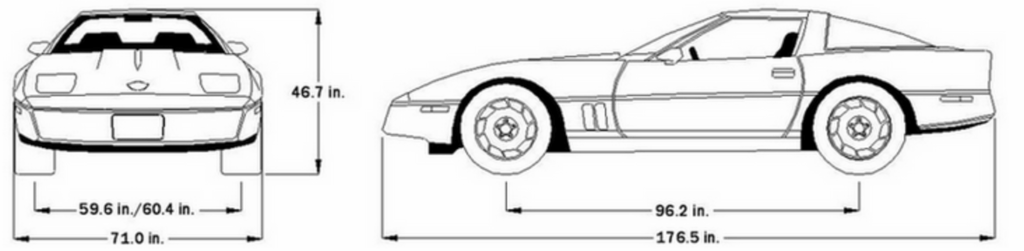
    • Base (typical): Wheelbase 96.2 in • L/W/H ~176.5 / 71.0 / 46.7 in • Turning circle ~40.4 ft • Curb weight ~3,223–3,336 lb (auto vs. 6-spd; body style).
    • ZR-1: Curb weight ~3,465–3,479 lb (coupe). Cargo volume smaller due to wider rear structure.

    Powertrain Details & Axles

    • Base: L98 9.5:1 compression; TPI; Electronic Spark Control. Common axle ratios: 2.59 (auto), 3.33 (manual; 3.07 used with certain packages).
    • ZR-1: LT5 aluminum block/heads, 32-valve DOHC, 11.0:1 compression; factory axle 3.45:1 final drive.

    Safety & Interior (all 1990)

    • Driver airbag (SIR) added; redesigned wraparound dash with hybrid analog/digital cluster; low tire-pressure warning system.

    Paint & Trim (factory brochure palette)

    • Launch colors (brochure): Black, Steel Blue Metallic, Charcoal Metallic, Polo Green Metallic, White, Bright Red, Dark Red Metallic (availability by trim as listed).
    • ZR-1 brochure confirms same palette for ZR-1 with model-specific interior/exterior listings.

    Why the 1990 Corvette Still Matters Today

    The 1990 Corvette matters because it represents the moment the C4 platform fully came into its own. With the arrival of the ZR-1 and its Lotus-engineered LT5, Chevrolet proved that America’s sports car could compete on a global stage—not just in straight-line acceleration, but in engineering sophistication and top-speed credibility. That halo effect reshaped public perception of the entire Corvette lineup and laid the groundwork for the high-performance variants that would follow in later generations.

    But the significance runs deeper than the “King of the Hill.” The 1990 model year reflected a C4 that had matured—chassis tuning refined, electronics modernized, and driver confidence sharpened. Today, the 1990 Corvette stands as a bridge between the experimental boldness of the early C4 Corvette years and the polished dominance Corvette would achieve in the 1990s and beyond. It’s a reminder that evolution, when done methodically, can redefine an icon without abandoning its roots.
    The 1990 Corvette marked a turning point for the C4—refined, confident, and finally ready to swing at the world’s best. It’s best remembered for the ZR-1’s debut and its exotic, all-aluminum LT5 V8 developed with Lotus, but the standard L98 cars also benefited from steady platform improvements that made the whole lineup feel more mature…

  • 1983 CORVETTE: “THE ONE AND ONLY”

    1983 CORVETTE: “THE ONE AND ONLY”

    Since its inception nearly forty years ago, the 1983 Corvette has remained surrounded by mystique and intrigue within the Corvette community. Some enthusiasts have even questioned whether a 1983 model ever truly existed, fueling rumors that Chevrolet skipped the model year altogether. Theories abound, ranging from production delays at GM’s newly opened Bowling Green Assembly Plant to technical hurdles with the car’s innovative new systems. While these explanations contain elements of truth, the full story is more nuanced.

    A Brief History

    The development of the fourth-generation Corvette (C4) officially began in 1978-79 under Chief Engineer David McLellan and Chief Designer Jerry Palmer. Their goal was to create a dramatically different Corvette—with improved handling, a sleek aerodynamic profile, and state-of-the-art technology. By April 1980, a prototype was presented to Chevrolet’s Product Policy Group (PPG), which immediately approved it for production.

    Over the next two years, the C4 evolved through extensive engineering and testing, benefiting from a robust “prototype program” that accelerated development. GM initially planned to launch the new Corvette as a 1982 model, potentially replacing the C3 that year. However, ongoing challenges—especially related to emissions and drivetrain systems—delayed production.

    The new Corvette was unveiled to the public in September 1982 at Riverside International Raceway. Yet, many details remained uncertain, including pricing, production start dates, and even the model year designation: would it be a 1983 or 1984 Corvette?

    Why No 1983 Production Model?

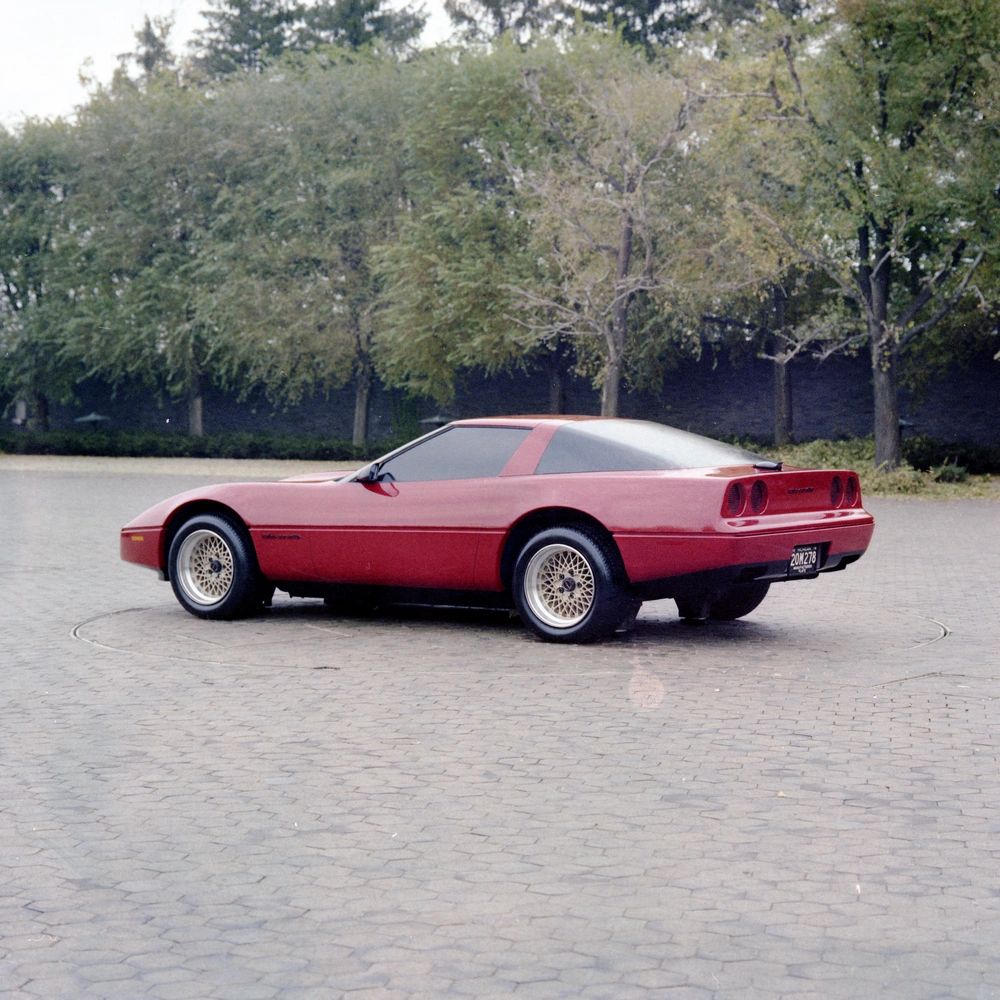
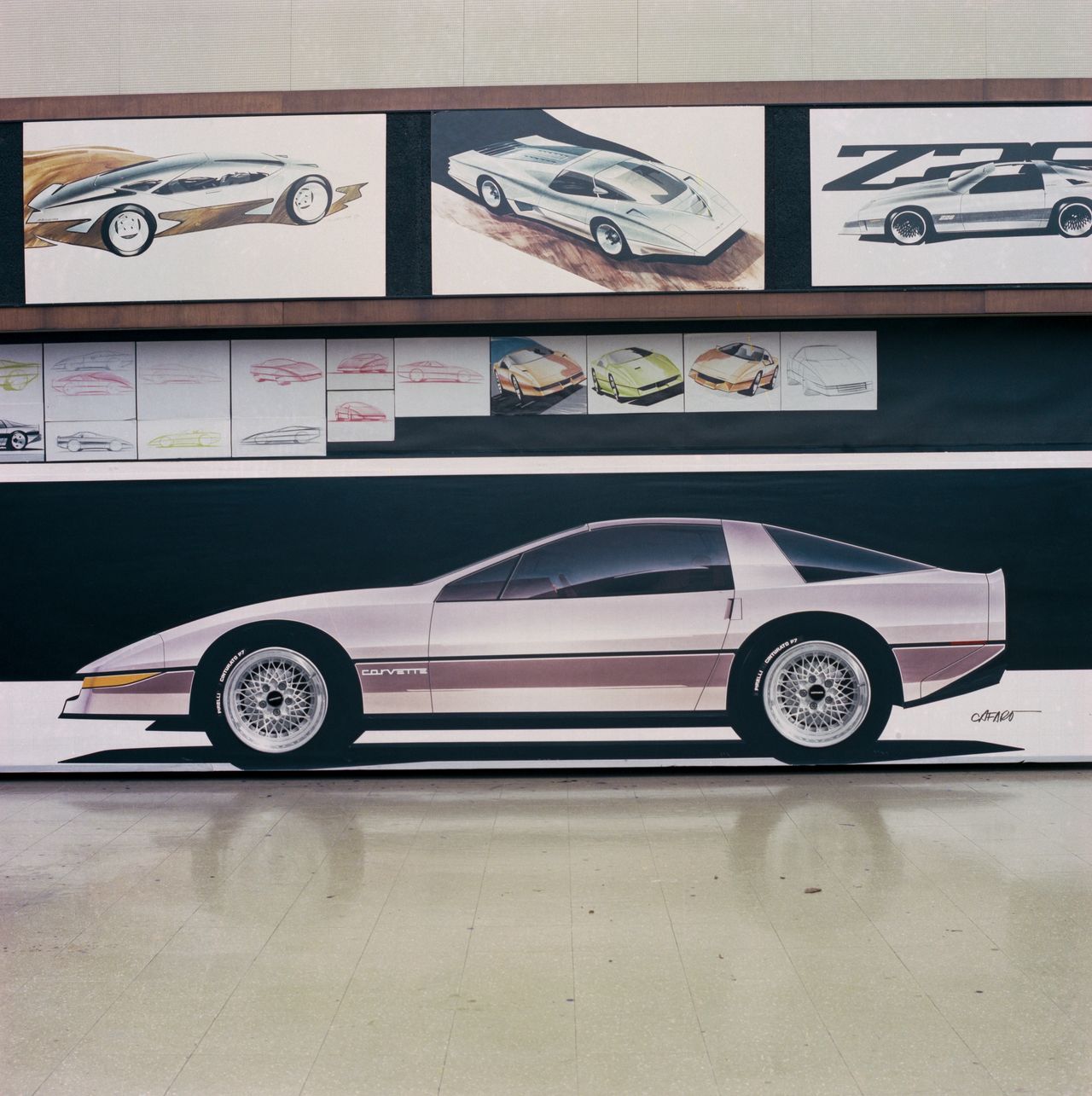
    One of the many early, full scale renderings by John Cafaro of the 1983 Corvette (as envisioned by Jerry Palmer and David McLellan.)(Image courtesy of GM Media.)
    One of the many early, full scale renderings by John Cafaro of the 1983 Corvette (as envisioned by Jerry Palmer and David McLellan.)(Image courtesy of GM Media.)

    Initially, Chevrolet planned for a 1983 launch. However, the U.S. federal government introduced more stringent exhaust and emissions regulations effective January 1, 1983. GM was already testing the new Corvette’s emission systems when these standards were announced. Meeting the new requirements required additional development time, prompting GM to postpone full-scale production until 1984 to ensure compliance.

    Delaying production had several benefits:

    • It allowed the Corvette to be certified under the 1984 emission standards, avoiding costly dual certification.
    • It provided engineers extra time to refine critical systems, prioritizing quality and performance over rushing to market.
    • It aligned production with the start of the calendar year, simplifying logistics and compliance.

    Despite the production delay, Chevrolet built a limited number of 1983 Corvettes—around 14 engineering test mules and 43 pilot (pre-production) cars—each assigned a unique 1983 VIN. These vehicles were used for rigorous testing, validation, and public relations, but none were sold to the public.

    The 1983 Corvette: The “One and Only”

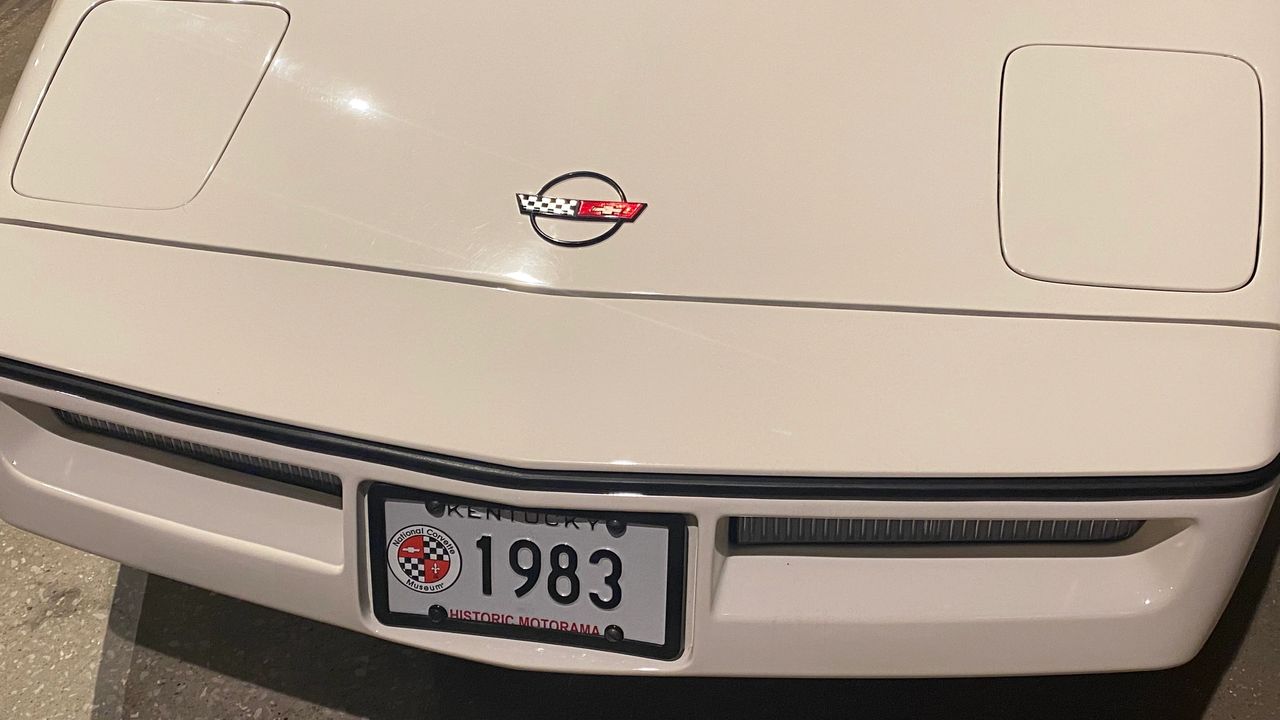
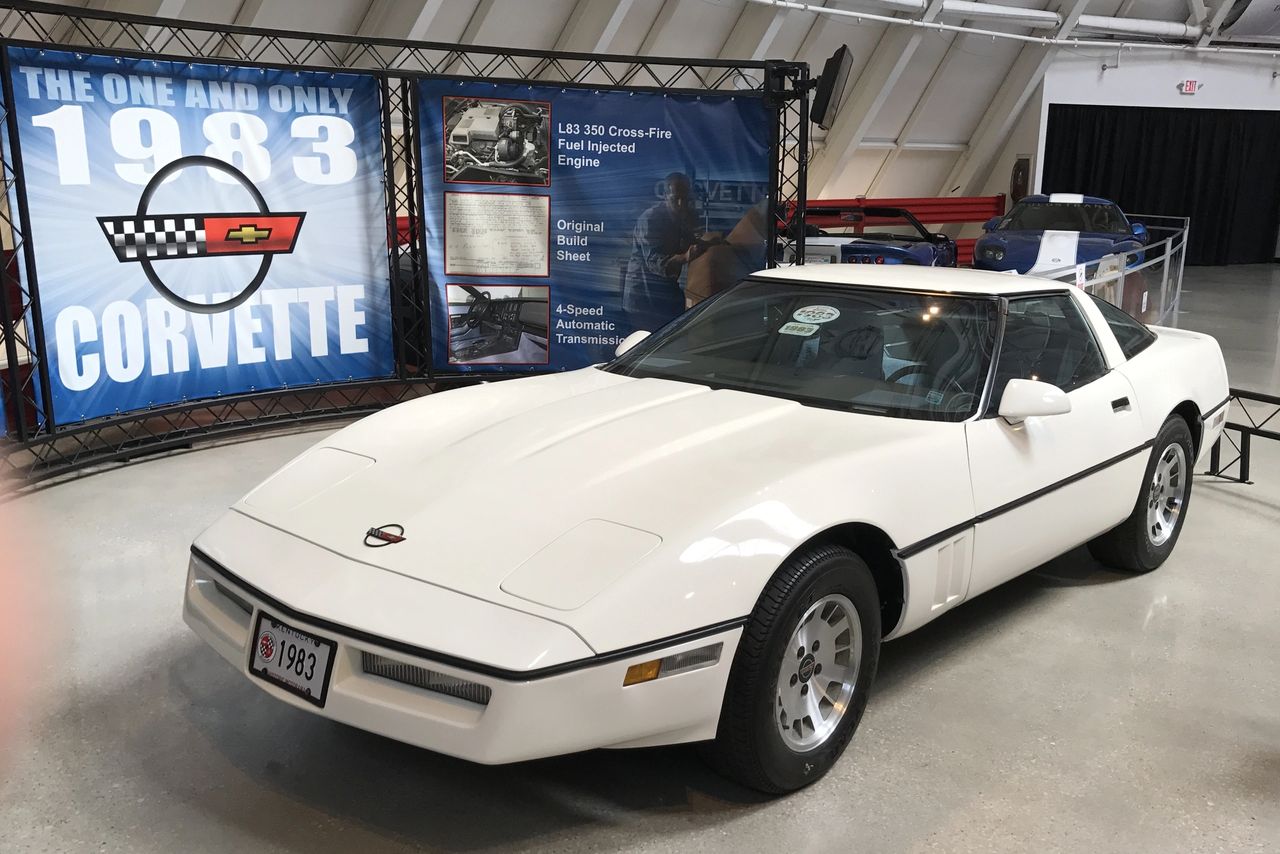
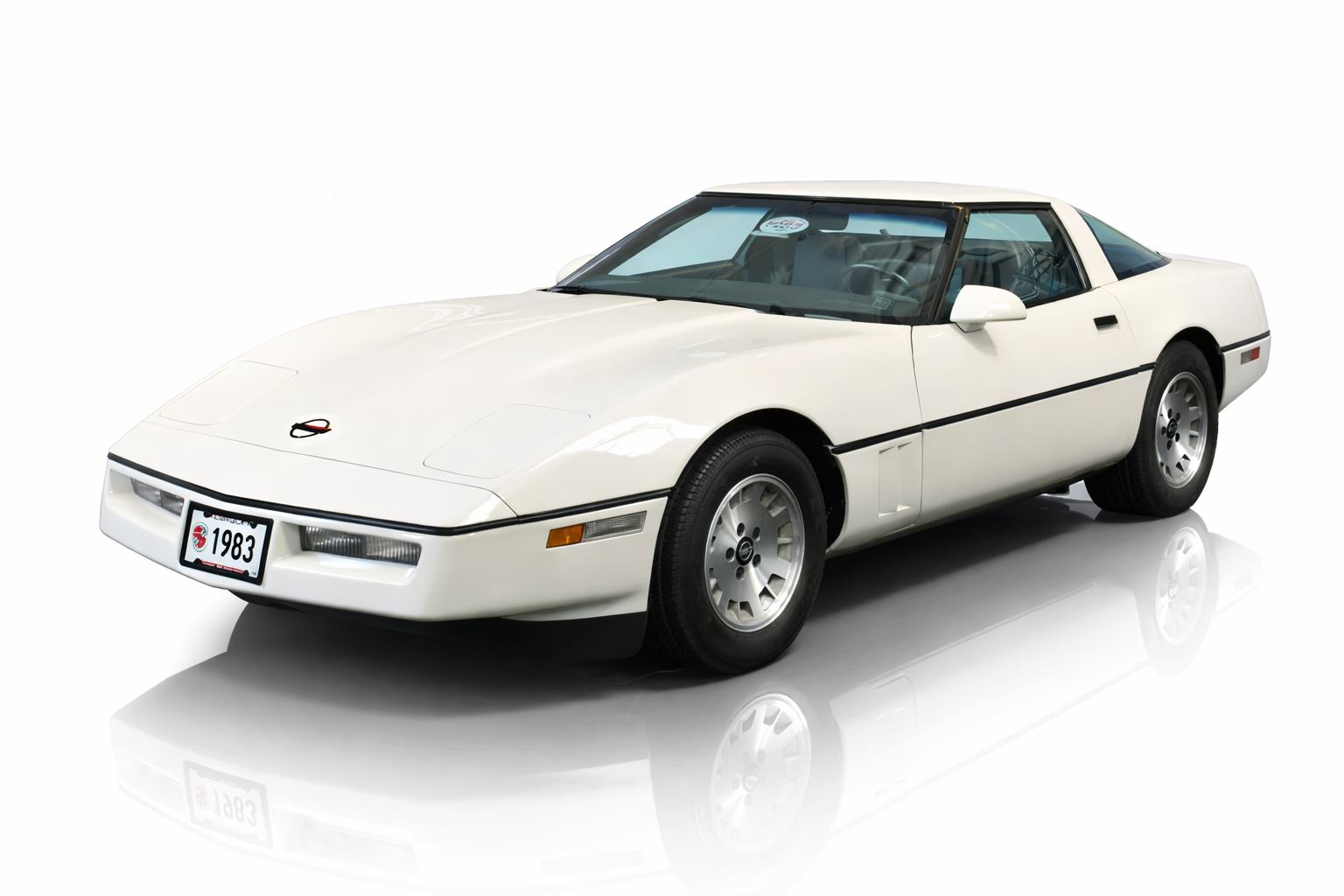
    Although the debate has raged for decades, there is ONE 1983 Corvette, and it resides in Bowling Green, Kentucky at the National Corvette Museum.
    Although the debate has raged for decades, there is ONE 1983 Corvette, and it resides in Bowling Green, Kentucky at the National Corvette Museum.

    Forty-three of these 1983 pilot Corvettes rolled off the Bowling Green Assembly Plant production line as part of a pilot program designed to streamline production of the upcoming fourth-generation model. Each was assigned a unique Vehicle Identification Number (VIN) and prepped for transportation. The “one and only” 1983 Corvette, VIN 1G1AY0783D5110023, was dispatched to GM’s Milford Proving Grounds for additional shakedown and testing by the Corvette engineering and design teams. Upon completion, like its counterparts, it was scheduled to be returned to Bowling Green and destroyed.

    What happened next has become a legendary story within Corvette lore, with two popular accounts explaining how this unique Corvette escaped destruction.

    A New Pair of Boots

    General Motors reportedly rented a mobile crusher to demolish the 1983 test mules and pilot cars upon their return to Bowling Green. As the systematic destruction of these cars commenced, a sudden torrential downpour soaked southern Kentucky. The facilities engineer overseeing the operation halted work, concerned about the weather and, notably, his brand-new, expensive cowboy boots getting soaked. Allegedly, all but one car had already been crushed when he decided to delay destroying the last vehicle until fairer weather.

    When operations resumed the following day, the mobile crusher was gone. Management, assuming that the 43 Corvettes had been fully destroyed, had the crusher picked up and removed from the premises. Fearing repercussions for the oversight, the engineer notified his superiors of the remaining Corvette and the absent crusher. The “one and only” 1983 Corvette was quietly relocated to the backlot of the plant and left abandoned—only to be rediscovered a year later by Bowling Green’s then-new plant general manager, Paul Schnoes.

    The Covert Rescue Mission

    An alternative version of the events leading to the preservation of a single 1983 Corvette exists, and it’s a story that has been passed down from generation to generation, repeated over the years by plant insiders and Corvette historians. Faced with the imminent disposal of the remaining 1983 cars, a small group of Bowling Green Assembly Plant employees allegedly moved one unit to a remote backlot area and covered it, effectively removing it from the normal line of sight. It wasn’t a brazen theft or a paperwork rebellion—it was a strategic act of delay. “Out of sight, out of mind” was the operating principle.

    The emotional context matters. 1983 marked Corvette’s 30th anniversary. For many inside the plant, the idea that there would be no commemorative production model—no official car wearing a 1983 VIN to mark three decades of America’s sports car—felt wrong. The C4 represented a monumental leap forward in chassis rigidity, aerodynamics, and electronics. To let the transitional year vanish entirely seemed, to some, like erasing a chapter of the story.

    What Happened Next

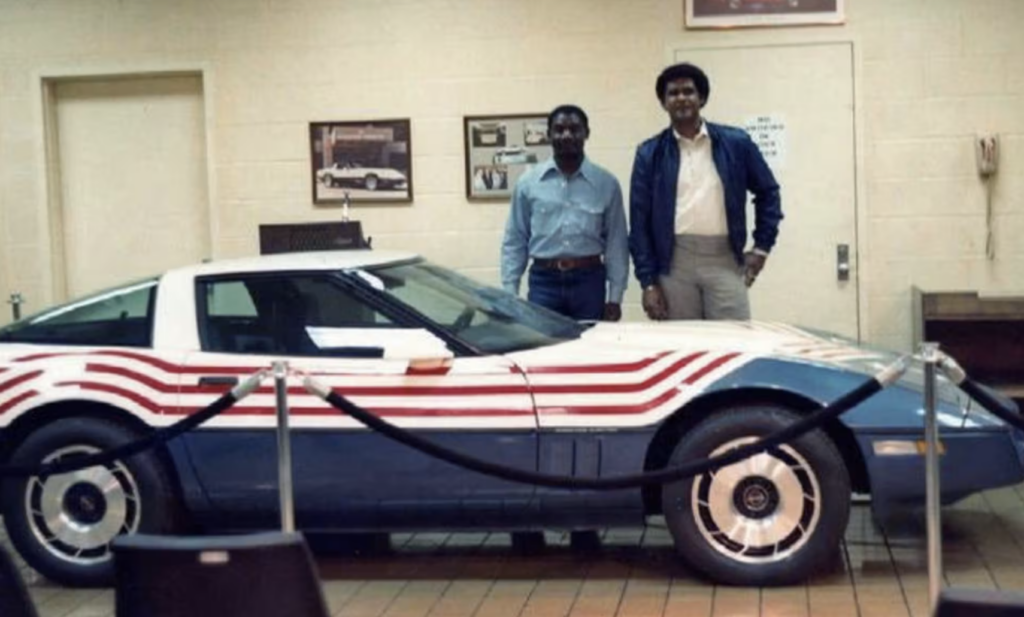
    This image captures the lone surviving 1983 Corvette at the Bowling Green Assembly Plant, shown here in a distinctive red, white, and blue commemorative paint scheme. The patriotic livery was applied for display purposes, transforming the pre-production C4 into a visual tribute to Corvette’s heritage and its American identity. Standing beside the car is Wendyll Strode, who would later become the founding Executive Director of the National Corvette Museum. When the Museum opened in 1994, the one-and-only 1983 Corvette was formally placed on display there—permanently preserving the “missing” model year as a centerpiece of Corvette history.
    This image captures the lone surviving 1983 Corvette at the Bowling Green Assembly Plant, shown here in a distinctive red, white, and blue commemorative paint scheme. The patriotic livery was applied for display purposes, transforming the pre-production C4 into a visual tribute to Corvette’s heritage and its American identity. Standing beside the car is Wendyll Strode, who would later become the founding Executive Director of the National Corvette Museum. When the Museum opened in 1994, the one-and-only 1983 Corvette was formally placed on display there—permanently preserving the “missing” model year as a centerpiece of Corvette history.

    Regardless of which version of the rescue story is ultimately the most accurate, the outcome is undisputed: the “one and only” 1983 Corvette avoided destruction and lived on at the Bowling Green Assembly Plant for nearly a decade. Rather than disappearing into a warehouse or being treated like an inconvenient prototype, it became something far more visible—a living reminder of the model year that never made it to showrooms. In the years immediately after the 1984 launch, the car remained on-site, close to the people who built Corvettes every day and understood exactly what made this one so unusual.

    During its time at the plant, the Corvette was transformed into a display piece with a distinctive stars-and-stripes paint scheme, a patriotic livery that turned the “missing year” into a rolling celebration of the brand’s identity. It also received 16-inch directional wheels from the 1984 model year, a subtle but telling update that visually connected the 1983 pilot car to the production C4 that followed. The result was a car that looked less like an orphaned prototype and more like an official emblem—something meant to be seen, recognized, and talked about.

    From 1984 through 1994, the surviving 1983 Corvette served as a familiar fixture at the plant, proudly displayed near the entrance where employees and visitors could see it as they came and went. In that role, it became more than a curiosity—it became a mascot. For the Bowling Green workforce, it represented both a point of pride and a kind of shared inside knowledge: a Corvette that existed outside the normal rules, preserved not because it was sold, but because it mattered.

    When the National Corvette Museum prepared for its grand opening on September 2, 1994, the car’s significance finally received a permanent home. In celebration of that moment, the “one and only” 1983 Corvette was donated to the Museum, ensuring it would be preserved and interpreted as history rather than kept as a plant artifact. As part of that transition, the car was restored to its original white exterior, and its original 15-inch wheels were reinstalled, returning it to the configuration that defined it as an authentic 1983 pilot Corvette. Today, displayed as a centerpiece of the NCM collection, it stands as a tangible link between the end of the C3 era, the launch of the C4, and the rare circumstances that created Corvette’s most famous “missing” model year.

    Form Versus Function: The Engineering Marvel of the 1983 Corvette

    Full scale clay model of the 1983/C4 Corvette in the courtyard of GM's Design Studios in Detroit, Michigan.  (Image courtesy of GM Media.)
    Full scale clay model of the 1983/C4 Corvette in the courtyard of GM’s Design Studios in Detroit, Michigan. (Image courtesy of GM Media.)

    The 1983 Corvette was the first in the brand’s history to embrace the principle that “form follows function” in nearly every major design aspect. Its drag coefficient (Cd) of 0.341 was a record low for a Corvette at the time, achieved through extensive wind tunnel testing and aerodynamic refinement.

    Key aerodynamic features included:

    • A sharply raked windshield angled at 64.7 degrees—the most acute of any production vehicle from that era.
    • Pop-up headlights that rotated backward to reduce drag.
    • Aerodynamically shaped side mirrors.
    • Frameless rear hatch glass, which also served as the rear window.
    • Minimal exterior trim and body-side moldings to reduce airflow disturbances.

    These features combined to reduce drag and wind noise, delivering a smooth, stable ride at high speeds—even with the removable one-piece roof panel installed.

    To improve handling, the C4 introduced a lightweight, rigid uniframe chassis that greatly reduced flex during aggressive cornering. The suspension system was completely redesigned:

    • Front suspension used a transverse fiberglass composite monoleaf spring replacing traditional coil springs.
    • Forged aluminum unequal-length control arms and steering knuckles reduced unsprung weight.
    • Rear suspension featured a similar transverse fiberglass spring paired with a five-link independent setup using aluminum trailing arms and tie rods.

    These innovations delivered exceptional agility, steering precision, and road feel.

    The “Heartbeat” of the 1983 Corvette

    1983 Chevrolet Corvette featured an L83 350 Cubic Inch Cross-Fire Fuel Injected Engine mated to a 4-Speed Automatic Transmission.
    1983 Chevrolet Corvette featured an L83 350 Cubic Inch Cross-Fire Fuel Injected Engine mated to a 4-Speed Automatic Transmission.

    The 1983 Corvette featured a unique front clamshell hood design—a single piece that opened forward, giving unobstructed access to the engine and front suspension.

    Power came exclusively from the new 5.7-liter (350 cubic inch) L83 V8 engine equipped with Cross-Fire fuel injection—a twin throttle-body system first introduced in the 1982 Corvette. Though the L83 produced a modest 200 horsepower (due to tightening emissions regulations), it was advanced for its time and perfectly matched to the car’s sophisticated chassis.

    The engine was mated to a 4-speed automatic transmission with overdrive. Although a 4-speed manual with an automatic overdrive unit—the Doug Nash 4+3 transmission—was engineered, it was not offered until 1984.

    A 3.31:1 rear axle ratio balanced acceleration and highway cruising. Performance testing showed the 1983 Corvette could accelerate from 0 to 60 mph in under seven seconds, with a top speed near 140 mph.

    Tire development was a close collaboration with Goodyear, resulting in special 15-inch Eagle VR tires designed with “natural path” tread patterns derived from Formula 1 rain tire technology. These P215/65R15 tires offered outstanding grip and handling balance. For 1984, a 16-inch tire option was introduced.

    Braking was handled by Gridlok four-wheel disc brakes with aluminum calipers, providing strong and fade-resistant stopping power.

    The car’s curb weight was approximately 3,192 pounds—lighter than the outgoing 1982 model—while overall dimensions shifted to a lower (46.7 inches tall), wider (71 inches), and shorter (176.5 inches) footprint, enhancing its sporty stance and handling.

    A “Successful Failure”

    The 1983 Corvette stands as a fascinating “what could have been” in Corvette history—a car born of cutting-edge engineering and bold design, but delayed by external factors beyond GM’s control. Though it never reached full production, the 1983 Corvette exemplifies General Motors’ philosophy of “getting it right over simply getting it done,” setting the stage for the enduring success of the C4 Corvette starting in 1984.

    Why the 1983 Corvette Still Matters Today

    The 1983 Corvette matters because it represents the most dramatic reset in the model’s history. It wasn’t a styling refresh or a mid-cycle update—it was the bridge between two entirely different philosophies. The C3 bowed out after fifteen years, and the C4 was poised to redefine Corvette with new aerodynamics, digital instrumentation, and a far more rigid chassis. The 1983 pilot cars sit precisely at that fault line, capturing the moment when Corvette engineering pivoted toward modern performance.

    It also matters because it’s a case study in discipline. Rather than rush an unfinished product to market, Chevrolet absorbed the embarrassment of skipping a model year. Quality, refinement, and regulatory readiness took precedence over calendar optics. That decision ultimately benefited the 1984 launch and reinforced a principle that still echoes today: Corvette would rather delay than compromise.

    And then there’s the singular survivor. With only one 1983 Corvette preserved, the car has become less a prototype and more a physical artifact of transition. It reminds us that automotive history isn’t always defined by what was sold—it’s often shaped by what was corrected, refined, and, in this case, withheld. The 1983 Corvette still matters because it proves that even an “absent” model year can leave a lasting mark.

    There was never supposed to be a “lost” Corvette model year—but 1983 became exactly that. As Chevrolet prepared to launch the all-new C4, production delays and last-minute refinements forced a reset that erased an entire calendar year from the official record. Only 43 pilot cars were built, and just one survives today. The 1983 Corvette…

  • 1984 CORVETTE OVERVIEW

    1984 CORVETTE OVERVIEW

    In the early 1980s, America stood on the precipice of a technological renaissance. Personal computers were becoming household staples, NASA’s Space Shuttle Columbia had just embarked on its maiden voyage, and the automotive industry was poised for its own revolution. At the forefront of this transformation was the Chevrolet Corvette, a symbol of American engineering excellence. The 1984 Corvette, the first of the C4 generation, was not just a car; it was a statement—a declaration that American ingenuity could redefine the sports car.

    A New Generation Dawns

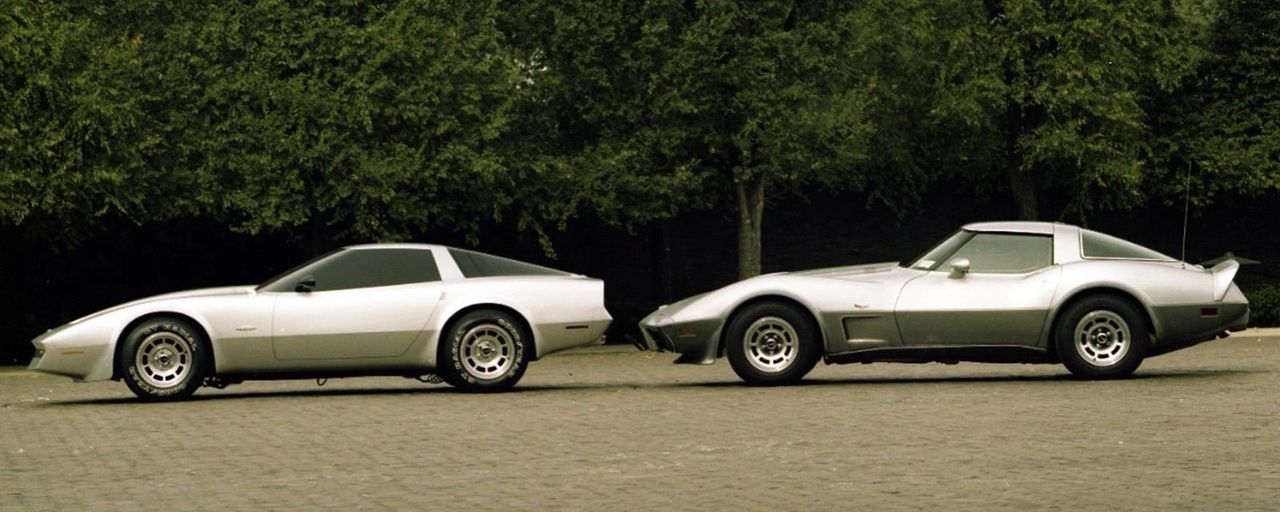
    A 1982 Corvette (right) parked with a full-scale clay model of the C4 (still in development at the time this picture was taken).  While the design of the C4 would continue to evolve, this picture clearly depicts the evolution of the Corvette's design between the third- and fourth-generation models. (Image courtesy of GM Media.)
    A 1982 Corvette (right) parked with a full-scale clay model of the C4 (still in development at the time this picture was taken). While the design of the C4 would continue to evolve, this picture clearly depicts the evolution of the Corvette’s design between the third- and fourth-generation models. (Image courtesy of GM Media.)

    The unveiling of the 1984 Corvette in March 1983 was met with anticipation and a mix of disbelief. For fifteen years, Corvette enthusiasts had clung to the iconic curves and aggressive presence of the C3, a car steeped in raw muscle car heritage. The C4 threw that old image aside, replacing it with a sleek, sharply sculpted form that emphasized aerodynamics and precision.

    Its clean, straight lines and low-slung body gave it a silhouette far more European in spirit, influenced by the likes of Porsche’s 928 and other contemporary sports cars that prized airflow and balance over flamboyant styling. Gone was the traditional front grille—a Corvette hallmark since 1953—replaced by an innovative underbody ducting system that channeled air efficiently to the radiator. This grill-less front end was flanked by halogen fog lamps that echoed the styling cues of high-end European sportsters, while the pop-up headlights no longer flipped up but rolled out smoothly, reducing drag and enhancing the car’s aerodynamic profile.

    At 96.2 inches, the wheelbase was slightly longer than the C3’s, but the overall car was 8½ inches shorter, contributing to a more agile feel. The hatchback, which had made its debut on the limited 1982 Collector’s Edition, became a permanent fixture, offering practical rear storage access and modern utility unheard of in earlier models.

    Powertrain: Balancing Tradition with Innovation

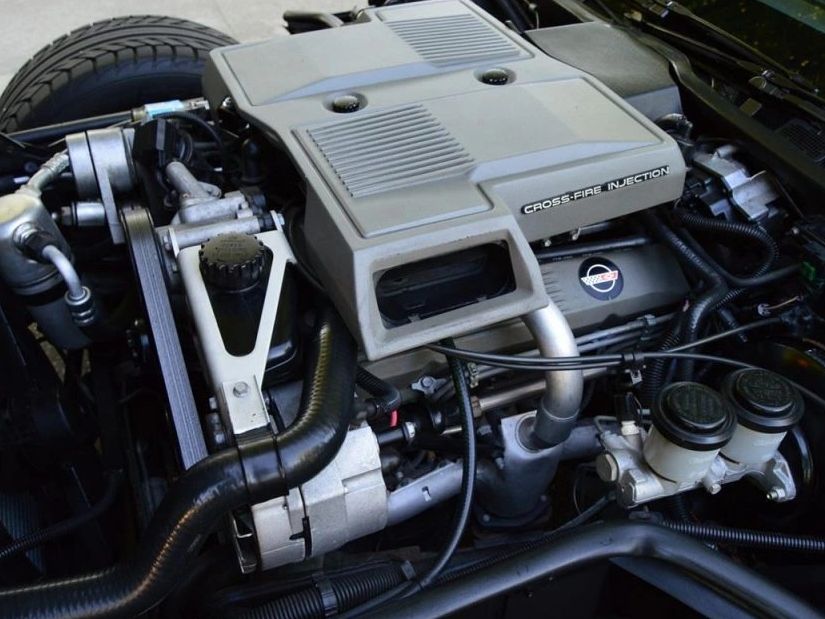
    The 1984 Corvette featured an L83 engine equipped with Cross-Fire Injection.  While innovative for its time, the CFI injection system proved troublesome and would be replaced on the 1985 MY Corvette.
    The 1984 Corvette featured an L83 engine equipped with Cross-Fire Injection. While innovative for its time, the CFI injection system proved troublesome and would be replaced on the 1985 MY Corvette.

    Under the hood, the 1984 Corvette carried a familiar yet evolved heart: the 5.7-liter (350 cubic inch) L83 V8. Its Cross-Fire Fuel Injection system, first introduced in 1982, represented an important technological advance over carburetors, offering improved fuel metering and emissions control.

    With a conservative output of 205 horsepower and approximately 270 lb-ft of torque, the engine prioritized smoothness and emissions compliance in an era increasingly shaped by regulation. The careful calibration reflected GM’s cautious approach to melding performance with the realities of tightening environmental laws. For many, the power numbers felt modest—especially compared to the high-horsepower muscle cars of the 1960s—but the 1984 Corvette’s strength lay in its balanced, composed driving dynamics rather than raw straight-line speed.

    The standard transmission was a smooth-shifting 4-speed automatic, but for those craving a more involved driving experience, Chevrolet introduced the ambitious “4+3” manual transmission option. Designed by Doug Nash, this unique gearbox combined a 4-speed manual with electronically controlled overdrive on the top three gears. The idea was ingenious—allowing spirited driving with the benefit of fuel-saving overdrive—but in practice, the system’s heavy clutch and finicky electronics frustrated drivers, making it a short-lived chapter in Corvette’s manual transmission history.

    The Z51 Package: Performance Reimagined

    1984 Corvette equipped with the Z51 package. (Image courtesy of GM Media.)
    1984 Corvette equipped with the Z51 package. (Image courtesy of GM Media.)

    Chevrolet knew that the true essence of Corvette was in its performance. To that end, the 1984 model introduced the Z51 Performance Handling Package, a $470 option that turned the C4 into a driver’s car at heart.

    The Z51 package included:

    • Bilstein Shock Absorbers, painted signature yellow, delivering improved damping and response
    • Heavy-Duty Springs, stiffer and more resilient for sharper cornering
    • Upgraded Sway Bars to reduce body roll and increase chassis stiffness
    • Goodyear Eagle GT P255/50VR-16 Tires providing enhanced grip and stability
    • Additional Cooling Hardware for the differential and transmission, ensuring reliability during high-performance driving

    The effect was dramatic. The Z51 Corvette hugged corners with newfound precision and poise, delivering lateral grip upwards of 0.95g on the skidpad—numbers that rivaled sports cars with far more horsepower. However, this came at a price: the ride was notably firmer and less forgiving on rough roads, dividing buyers between track enthusiasts and those wanting a more comfortable daily driver.

    From Curves to Edges: The C4 Exterior

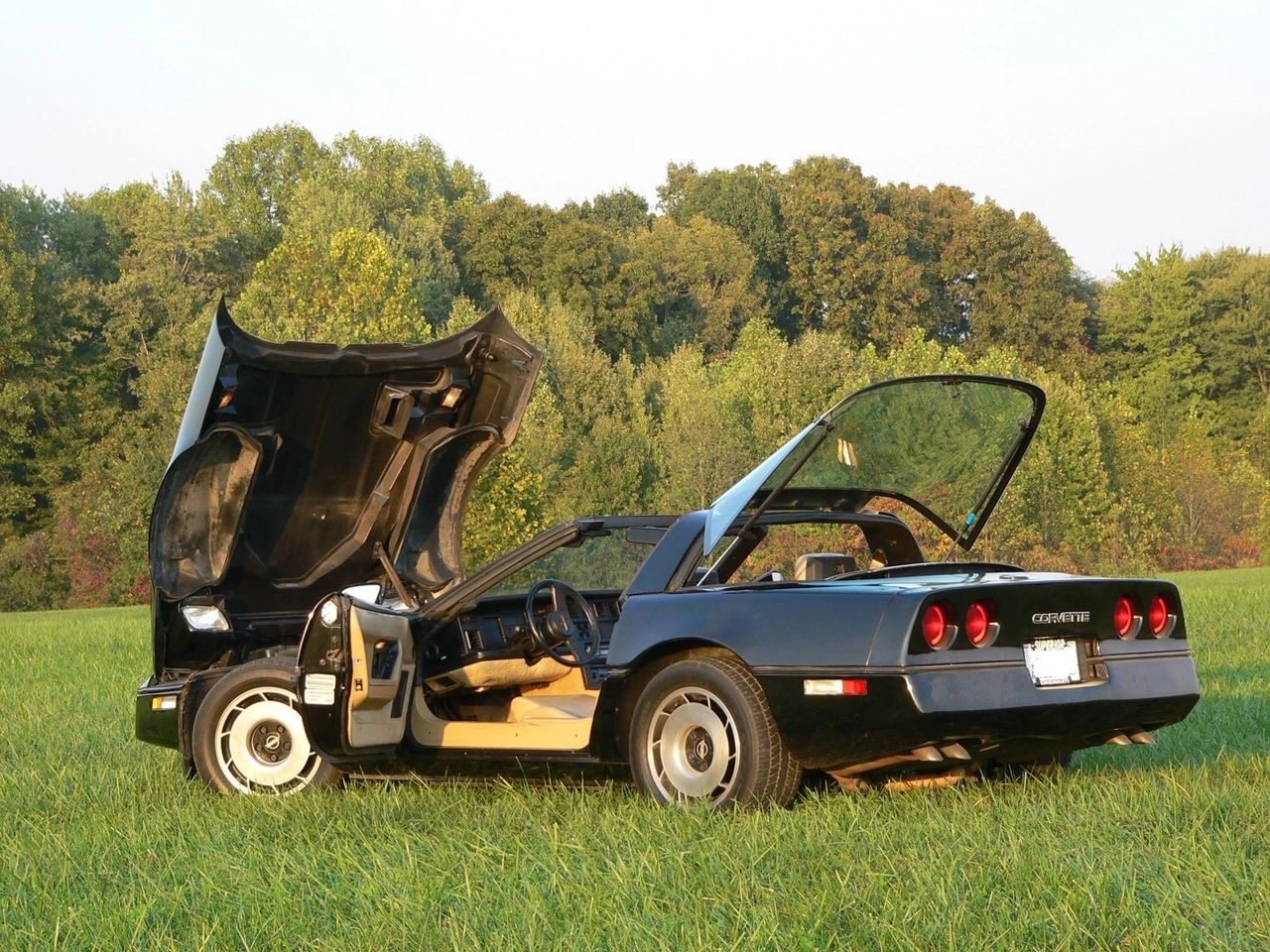
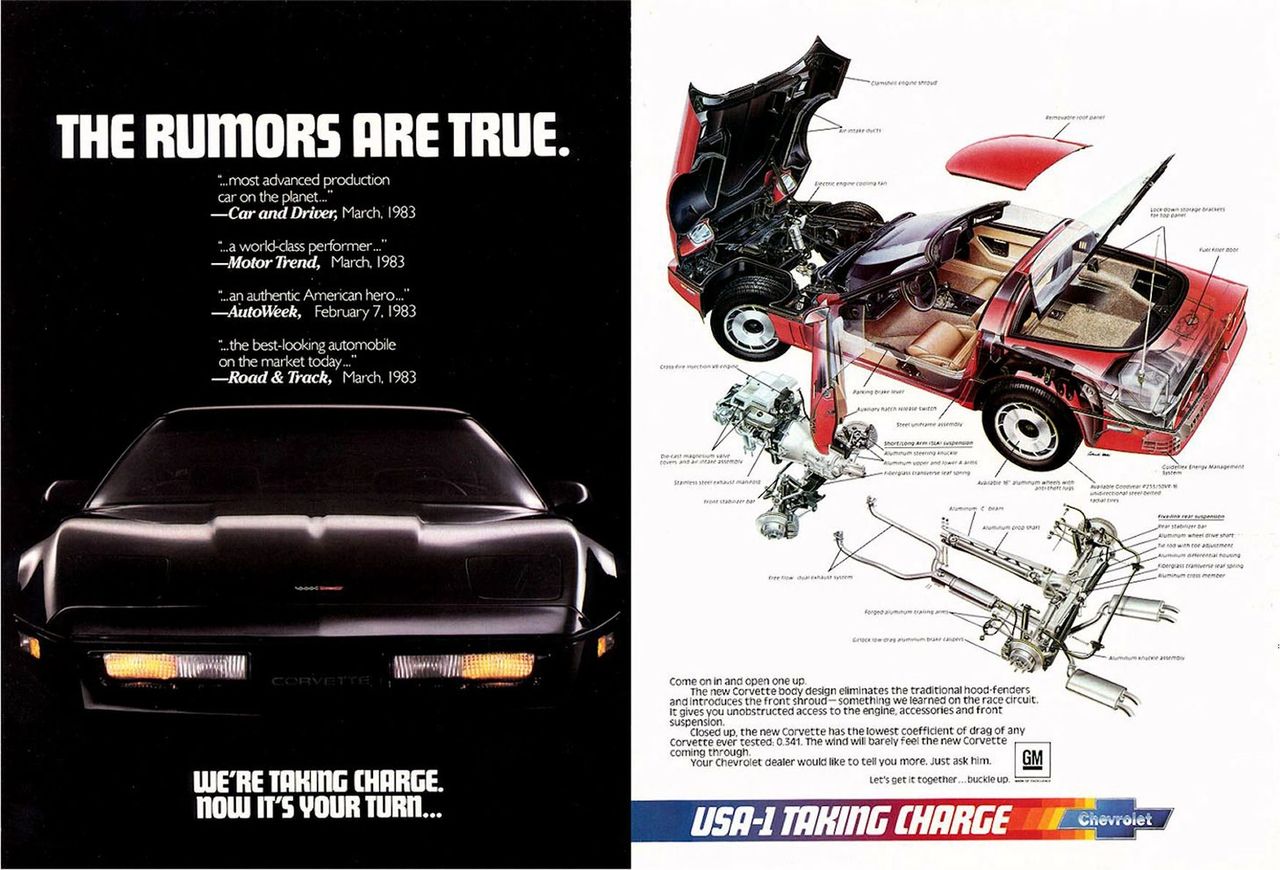
    The first C4 reads like a clean-sheet reset: a low wedge with a seriously raked windshield (about 64–65°), forward-tumbling hidden headlamps, and a glass hatch that made the whole rear of the car open like a display case. The hood hinged at the nose in a one-piece “clamshell,” lifting away to reveal not just the L83 but the front suspension and structure—a purposeful service detail baked into the styling. To keep the new shape visually clean, Chevrolet tucked most panel joints behind a continuous rub strip; aero mirrors, flush halogen lamps, and frameless door glass finish the theme. This was the vocabulary that would define the C4 from day one.

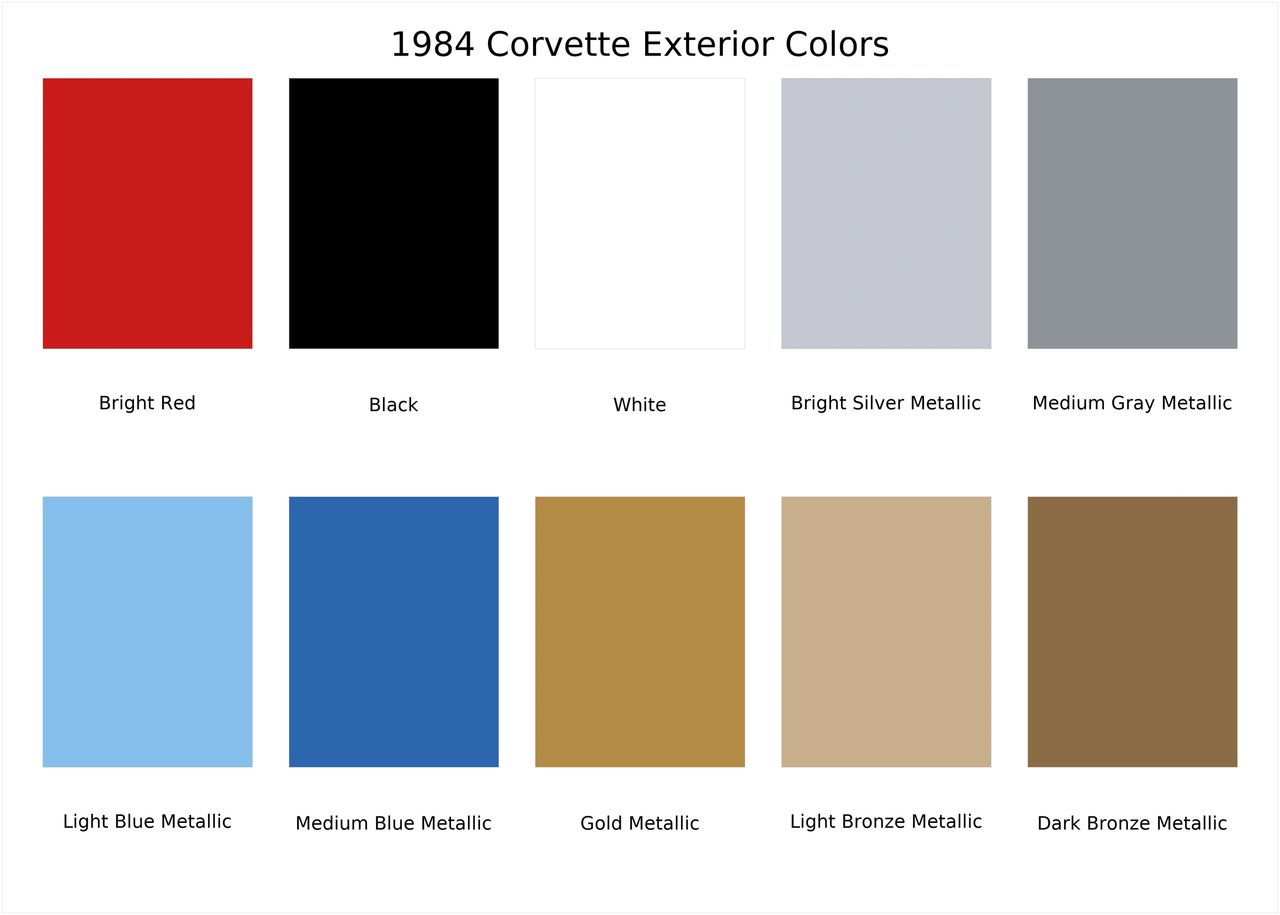
    Paint and trim echoed that modernism. For 1984, Chevrolet offered a palette of solid and metallic finishes plus a “Custom Two-Tone” option that paired complementary shades: Silver over Gray, Light Blue over Medium Blue, and Light Bronze over Dark Bronze. (Those combos were factory options, not dealer add-ons.)

    If you’re cataloging cars, the two-digit GM paint codes are the easiest shorthand. Period/OEM references list the 1984 colors as: White (10), Bright Silver Metallic (16), Medium Gray Metallic (18), Black (19/41), Light Blue Metallic (20), Medium Blue Metallic (23), Gold Metallic (53), Light Bronze Metallic (63), Dark Bronze Metallic (66), and Bright Red (33). You’ll occasionally see alternate numbers in enthusiast tables (e.g., Bright Red shown as 72, Black shown as 19 vs. 41); the code above reflects how OEM paint databases index 1984 formulas, while museum/brochure sources confirm the names and the three factory two-tones.

    Two other exterior firsts became C4 signatures in ’84: the standard, full glass hatch (now on every Corvette, not just special trims) and that forward-tilting hood. Together with the extreme windshield angle, they weren’t just design flourishes—they were functional choices meant to reduce drag, improve access, and modernize Corvette’s proportions after the C3.

    Interior Innovation and Controversy

    The digitial dashboard of the early C4 Corvettes (including the 1984 model, shown here) was considered controversal at its time as every Corvette before the 1984 MY had been equipped with conventional, analog gauges.
    The digitial dashboard of the early C4 Corvettes (including the 1984 model, shown here) was considered controversal at its time as every Corvette before the 1984 MY had been equipped with conventional, analog gauges.

    Step inside the 1984 Corvette and you’d be greeted by one of the boldest interiors in Corvette history. Gone were the analog gauges of the past, replaced with a fully digital instrument cluster that displayed speed, engine data, and warnings through a mix of bright LED and LCD readouts.

    While revolutionary, this digital dashboard was polarizing. Some praised its futuristic look and clear, precise readouts, while others complained about visibility issues in bright sunlight and the impersonal feel compared to classic needle gauges.

    The cockpit was driver-focused, with a center console that dominated the cabin—housing controls for climate, audio, and the transmission. Interior space was improved, thanks in part to a lowered floorpan that routed exhaust and drivetrain components below the cabin, allowing for better headroom despite the car’s lowered roofline. However, the deep door sills inherent to the unibody frame made ingress and egress a challenge, especially for taller drivers.

    Safety was also on the designers’ minds. Under the Reagan Administration, passive restraint systems were proposed, and though the legislation never fully passed, the 1984 Corvette included a large padded “passive restraint” on the passenger side dashboard—a rounded pad designed to protect occupants in the event of a crash without requiring seatbelt use.

    Reception: Triumphs and Trials

    The 1984 Corvette was a considerable leap forward in the evolution of the brand.  Its clamshell hood made for easy access to the L83 engine, while the rear hatch (standard on all C4 models) provided easy access to the storage area behind the cockpit.
    The 1984 Corvette was a considerable leap forward in the evolution of the brand. Its clamshell hood made for easy access to the L83 engine, while the rear hatch (standard on all C4 models) provided easy access to the storage area behind the cockpit.

    As the C4 began to hit the streets, reviewers and enthusiasts offered a mixed chorus of praise and critique. The handling was lauded—especially on Z51-equipped cars—with many noting the Corvette’s newfound agility and balanced chassis as game-changing.

    Yet the ride quality was criticized for being harsh, especially on the performance suspension. Noise intrusion into the cabin—both from exhaust and road—was noticeable. The digital dashboard, while a marvel of technology, was considered by many to be hard to read and “cold” compared to the warmth of analog dials.

    The 4+3 manual transmission option, despite its clever engineering, proved troublesome and unpopular. Most buyers preferred the automatic transmission for its smoother operation and reliability, a preference that persisted until GM offered a more traditional 6-speed manual years later.

    Styling also divided opinions. The new C4’s sleek, aerodynamic lines were undeniably sophisticated but lacked the muscular flair and voluptuous curves that had defined earlier generations. The absence of a front grille was especially controversial for purists. Nevertheless, the car’s signature circular taillights and sweeping rear hatchback glass retained the classic Corvette cues that tied the new model to its heritage.

    Production and Popularity

    The 1984 model year was longer than usual, stretching from early 1983 into late 1984, which helped Chevrolet produce 51,547 units—the second-highest annual production for a Corvette at the time.

    Color options were plentiful, with 14 different hues offered. Bright Red emerged as the most popular choice, selected by over a quarter of buyers, followed by Black and White. The availability of metallic and two-tone options reflected a growing trend toward personalization.

    A Lasting Legacy

    Promotional article introducing the 1984 Corvette.
    Promotional article introducing the 1984 Corvette.

    Though not without its flaws, the 1984 Corvette was undeniably a pivotal moment in Corvette history. It established a new blueprint for the brand—one focused on technology, precision engineering, and aerodynamic efficiency.

    Its influence stretched far beyond the C4 generation. The digital dashboard foreshadowed the growing role of electronics and driver information systems. The aluminum suspension components and rack-and-pinion steering became the foundation for subsequent Corvettes, culminating in the advanced chassis designs of the C5, C6, and beyond.

    The Z51 package’s success proved that performance-oriented handling upgrades would be a mainstay in Corvette’s arsenal, evolving into sophisticated, computer-controlled systems that maintain the brand’s racing pedigree.

    In Retrospect

    The 1984 Corvette was more than a new model; it was a statement—a bold commitment to innovation in the face of a changing automotive landscape. It balanced tradition with the future, creating a sports car that was as much about driving precision as it was about power.

    For enthusiasts, it may not have been the rawest or fastest Corvette ever built, but it was the one that set the stage for the modern American sports car era. It remains a fascinating and cherished chapter in Corvette lore, embodying the spirit of reinvention that continues to define the brand today.

    1984 Corvette — Key Specifications

    Quick Stats

    • Engine: 5.7L (350 cu in) L83 Cross-Fire Injection V8
    • Output: 205 hp @ 4,300 rpm • 290 lb-ft @ 2,800 rpm
    • Transmissions: 4-speed automatic (TH700-R4) • 4+3 Doug Nash manual (4-speed with overdrive on 2–4)
    • Layout: Front-engine, rear-wheel drive
    • Curb Weight: ~3,200–3,300 lb (equipment-dependent)

    Performance (period test ranges)

    • 0–60 mph: ~6.7–7.2 sec (Z51/4+3 typically quickest)
    • ¼-mile: ~15.2–15.5 sec @ ~92–94 mph
    • Top Speed: ~146–150 mph
    • Skidpad: up to ~0.87–0.90 g with Z51
    • 60–0 mph Braking: ~150–160 ft

    Chassis & Suspension

    • Structure: Unitized “uniframe” with bolt-on front/rear cradles; composite body panels
    • Front Suspension: Short/long arm (aluminum control arms), transverse composite leaf spring, gas shocks
    • Rear Suspension: Five-link independent, transverse composite leaf spring, gas shocks
    • Steering: Power rack-and-pinion (first year for Corvette)
    • Brakes: 4-wheel power disc; ventilated rotors; aluminum calipers
    • Packages:
    • Z51 Performance Handling Package: higher-rate springs/anti-roll bars, heavy-duty shocks, quicker steering, performance alignment & cooling tweaks

    Wheels & Tires

    • Wheels: 16 × 8.5 in cast aluminum
    • Tires: 255/50VR-16 Goodyear Eagle VR50 “Gatorback” (V-rated)

    Dimensions

    1984 Corvette Dimensions (Image courtesy of the author.)
    • Wheelbase: 96.2 in
    • Length x Width x Height: ~176.5 × 71.0 × 46.7 in
    • Track (F/R): ~59.6 / 60.4 in
    • Fuel Capacity: ~20.0 gal
    • EPA (period): mid-teens city / low-20s highway (varies by trans/axle)

    Powertrain Details

    • Engine Code: L83 Cross-Fire Injection (twin throttle-body)
    • Compression Ratio: 9.0:1
    • Induction/Management: Dual TBI with electronic engine control
    • Axle Ratios (common): 3.07, 3.31 (varies w/ trans & Z51)

    Paint & Trim (1984)

    Exterior colors (U.S. production):

    • Black
    • White
    • Silver Metallic
    • Medium Gray Metallic
    • Medium Blue Metallic
    • Light Bronze Metallic
    • Bright Red (late availability)

    Two-tone treatments: select combinations using Gray or Bronze lower accents (period option).

    Interiors: Cloth or leather in Graphite (Gray), Red, Medium Blue, and Saddle (availability varied by exterior color and build timing).

    Interior & Features Highlights

    • All-digital instrument cluster with bar-graph tach/speedo
    • 6-way power driver seat (opt) • Delco audio (cassette, Bose system arrived later)
    • Removable one-piece roof panel (body-color or bronze acrylic)
    • Rear hatch glass with remote release

    Why the 1984 Corvette Still Matters Today

    The 1984 Corvette remains relevant not because it looks back, but because it showed Chevrolet how to move ahead. Even as the C4 Corvette continues to fade further into the horizon with each passing year, its existence still symbolizes Chevrolet’s courage to start over, and it set the course for every Corvette that followed.

    More than four decades after its debut, the 1984 Corvette remains deeply relevant—not as a relic of the past, but as the foundation upon which every modern Corvette is built. As the first model of the fourth generation, the 1984 Corvette represented a complete philosophical reset for America’s sports car. It abandoned incremental evolution in favor of a clean-sheet redesign that prioritized aerodynamics, chassis rigidity, handling precision, and driver integration. These core principles—lightweight construction, balanced performance, and a driver-centric cockpit—continue to define the Corvette’s identity today, from the C5 and C6 to the mid-engine C8.

    The 1984 Corvette also marked the moment when Chevrolet decisively repositioned the Corvette as a technologically forward, globally competitive performance car. Its advanced aluminum suspension components, modernized chassis, digital instrumentation, and dramatically improved structural stiffness reflected a mindset that performance was no longer just about straight-line speed. That same shift toward holistic performance—where handling, braking, and driver confidence matter as much as horsepower—is now central to modern performance car design, making the 1984 Corvette feel less like an artifact of the 1980s and more like the opening chapter of the Corvette’s modern era.

    Just as importantly, the 1984 Corvette remains relevant because it represents the courage to start over. In an era when legacy brands often struggle to reinvent themselves, the 1984 Corvette stands as proof that bold reinvention—when guided by engineering discipline and long-term vision—can redefine a nameplate without losing its soul. For today’s enthusiasts, collectors, and historians, the 1984 Corvette is not simply the first C4; it is the car that taught Chevrolet how to build the Corvette of the future.

    The 1984 Corvette marked one of the most transformative moments in the model’s history, ushering in the fourth generation with a bold, clean-sheet redesign. After a one-year production hiatus, Chevrolet reintroduced America’s sports car with a radically modernized chassis, advanced aerodynamics, and a renewed focus on handling, technology, and driver engagement. The result was a…