Tag: Tadge Juechter

  • 2022 Corvette Overview: The C8 Comes of Age

    2022 Corvette Overview: The C8 Comes of Age

    There are Corvette model years that feel like a launch, and there are model years that feel like a landing. The 2022 Corvette was the latter—the point at which the C8 stopped being viewed primarily as the radical new mid-engine Corvette and began establishing itself as the Corvette’s new normal.

    That change marked an important turning point. When Chevrolet unveiled the eighth-generation Corvette in July 2019, nearly every conversation about the car began and ended with the location of its engine. After more than six decades of front-engine production, the Corvette had adopted the basic architecture associated with Ferrari, Lamborghini, McLaren, and the world’s most sophisticated racing machinery. It was a transformation so fundamental that the early C8 was often discussed more as an idea than as an automobile.

    By 2022, however, the big idea had already been proven. The mid-engine layout worked. The cabin was no longer regarded as an experiment. The eight-speed dual-clutch transmission had demonstrated that it was not merely a concession to modernity but one of the car’s defining strengths. Owners had accumulated real miles, dealers had learned the product, and buyers were no longer asking whether Chevrolet could build a credible mid-engine Corvette. They were deciding which version they wanted.

    At the same time, the 2022 Corvette story extended well beyond the Stingray carrying a 2022 vehicle identification number. Calendar year 2022 became one of the most consequential periods in the C8’s development. Chevrolet was preparing the 670-horsepower Z06 for production, engineers were validating the Corvette variant that would become the first all-wheel-drive and electrified Corvette, and Corvette Racing was taking the C8.R into a new international campaign shaped by changing regulations and increasingly global ambitions.

    In other words, two Corvette stories were unfolding simultaneously. The 2022 Corvette Stingray represented the maturation of the original C8 formula, while the Z06, E-Ray, and racing program revealed just how much performance potential Chevrolet had built into the platform from the beginning.

    Taken together, they made 2022 the year the C8 Corvette stopped being a single revolutionary model and began becoming a complete family of cars.

    The Long Road to a Mid-Engine Corvette

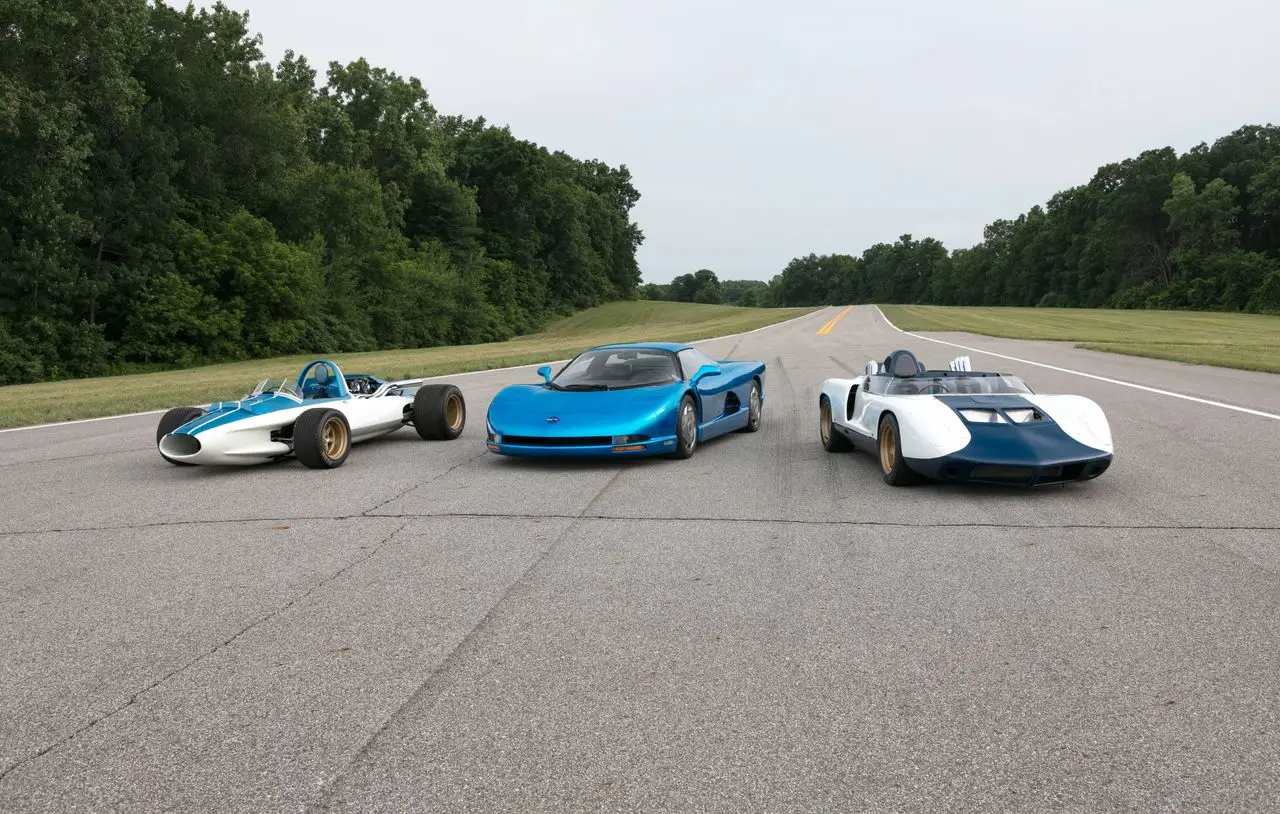
    Seen together, the CERV I, CERV II, and CERV III trace the decades-long evolution of Chevrolet’s mid-engine ambitions. That pursuit began with Zora Arkus-Duntov, whose experimental CERV program explored the balance, traction, aerodynamics, and racing potential of placing the engine behind the driver. Although production reality remained decades away, each successive car carried his vision forward, gradually closing the distance between engineering experiment and road-going Corvette. The C8 did not invent the mid-engine Corvette—it fulfilled the future Duntov had begun pursuing generations earlier.

    The Corvette’s move to a mid-engine configuration was not a sudden attempt to imitate European exotics. It was the result of an engineering argument that had been unfolding inside General Motors for generations.

    Zora Arkus-Duntov, the engineer whose influence helped transform the early Corvette from a stylish boulevard cruiser into a legitimate performance car, recognized the advantages of placing the engine behind the driver decades before the C8 entered production. Through experimental vehicles such as the Chevrolet Engineering Research Vehicles—better known as the CERV I and CERV II—Duntov and his colleagues explored the traction, balance, packaging, and aerodynamic possibilities offered by a mid-engine platform.

    Those vehicles were never direct production proposals in the conventional sense. They were laboratories—machines built to answer questions about chassis configuration, suspension geometry, cooling, weight distribution, and the future of high-performance automobiles. Later concepts, including the rotary-powered XP-882 and the technologically ambitious CERV III, kept the idea alive even as Chevrolet continued developing increasingly capable front-engine production Corvettes.

    The resistance to a mid-engine Corvette was never simply a matter of engineering conservatism. Chevrolet had to protect the qualities that made the Corvette successful in the first place. The car needed to remain fast but also be usable. It needed enough luggage space for a road trip, sufficient ground clearance for ordinary streets, and a cabin that could accommodate owners who were not built like professional racing drivers. Most importantly, it needed to deliver world-class performance without abandoning the value proposition that had always set Corvette apart from traditional exotics.

    Every generation of Corvette pushed the front-engine layout farther. The C5 introduced a hydroformed frame, rear-mounted transaxle, and dramatically improved chassis structure. The C6 refined that formula, while the C7 brought advanced aerodynamics, direct injection, sophisticated electronic controls, and performance variants capable of competing with almost anything in the world.

    Yet the limits were becoming increasingly clear. As power climbed, the front-engine Corvette’s ability to put that power to the pavement became one of the platform’s defining constraints. Adding more horsepower was comparatively easy. Using it effectively—particularly from a standing start and during corner exit—was becoming more difficult.

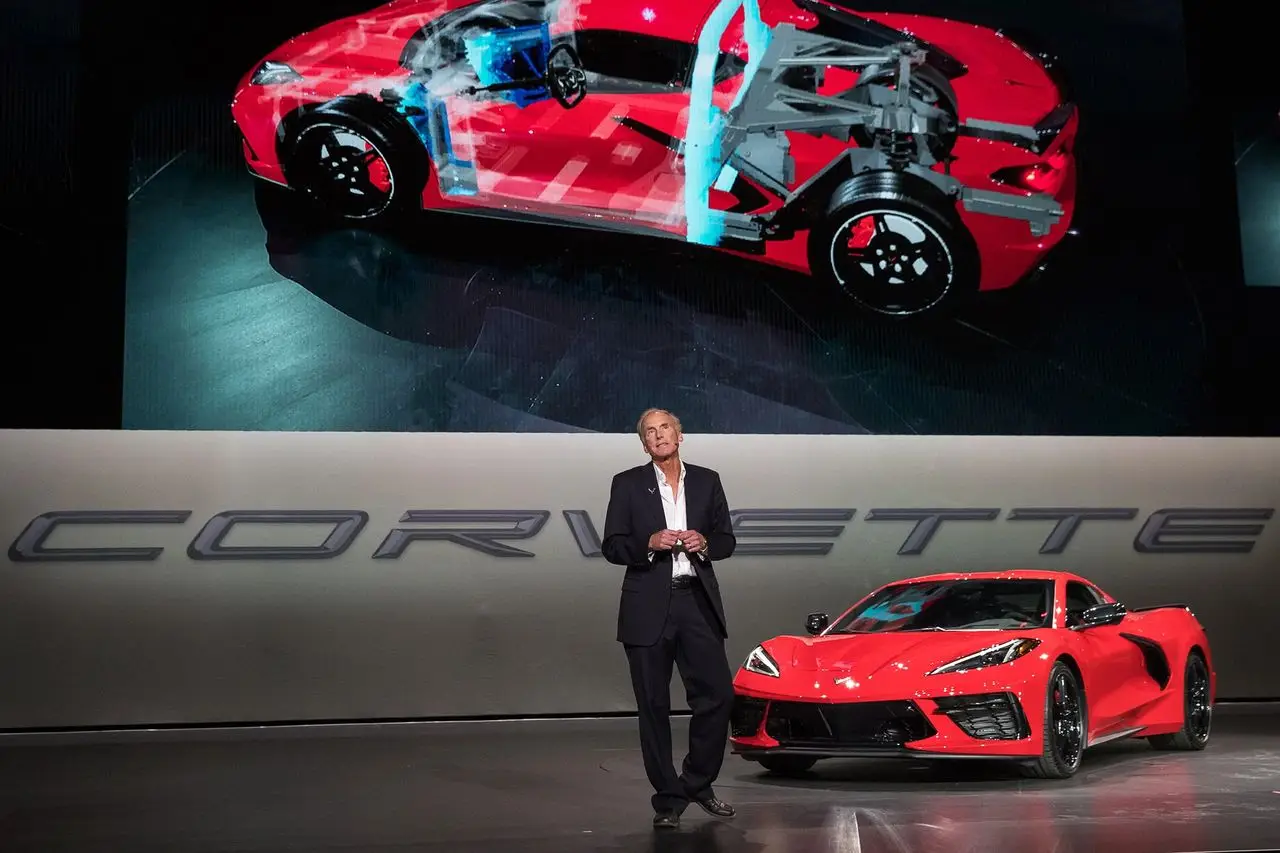
    Tadge Juechter joined the Corvette program in 1993, became assistant chief engineer in 1999, and ultimately assumed leadership as the car’s executive chief engineer in 2006. Over the decades that followed, he helped guide Corvette through the C6 and C7 generations before overseeing its most transformative evolution: the development of the mid-engine C8. Working with a deeply experienced engineering team, Juechter turned the architecture long envisioned by Zora Arkus-Duntov into a practical, attainable production Corvette—an achievement that now stands as the defining legacy of his remarkable career. (Image credit: GM)

    Tadge Juechter understood that challenge better than almost anyone. Juechter joined the Corvette program in 1993, became its assistant chief engineer in 1999, and was appointed executive chief engineer in 2006. During his tenure, he helped oversee the maturation of the C6, the development of the C7, and ultimately the most dramatic architectural change in Corvette history.

    Under Juechter’s leadership, the mid-engine Corvette was not developed merely to produce exotic proportions or an attention-grabbing launch. The architecture was intended to give the program room to grow. By moving the engine behind the passenger compartment, Chevrolet improved rear-wheel traction, centralized the car’s mass, and opened new possibilities for aerodynamics, cooling, suspension design, and future powertrains.

    Just as important, the team preserved the car’s everyday usefulness. The C8 retained front and rear luggage compartments offering a combined 12.6 cubic feet of cargo capacity. The coupe kept a removable roof panel that could be stored in the rear compartment, while the convertible gained a fully retractable hardtop that did not consume the primary luggage space. The driver still sat in a comfortable, climate-controlled cabin rather than an uncompromising racing cell.

    That balance was the C8’s real achievement. Chevrolet had not merely built an inexpensive alternative to a European supercar. It had created a mid-engine automobile that still behaved like a Corvette: powerful, approachable, practical enough to use, and attainable enough to be driven rather than hidden.

    The 2020 Stingray introduced that formula. The shortened 2020 production run and the industry-wide upheaval that followed prevented the first two C8 model years from ever settling into anything resembling normal production. By 2022, however, the engineering foundation was established, customers understood the car, and Chevrolet could begin refining the details rather than defending the decision to move the engine.

    Launching the 2022 Corvette Stingray


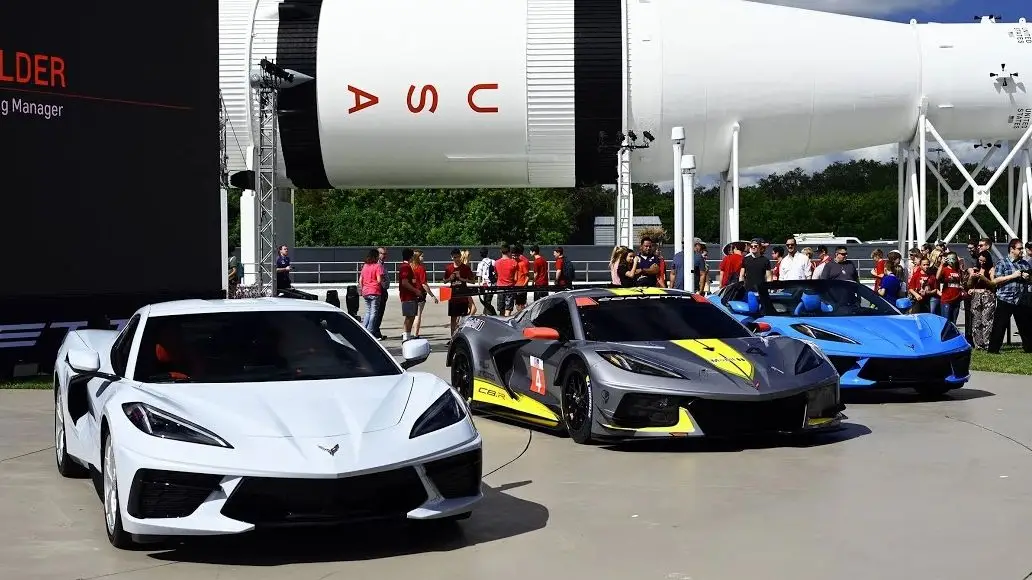
    Chevrolet introduced the 2022 Corvette Stingray on June 9, 2021, against the unmistakable backdrop of Detroit’s Belle Isle circuit. The presentation brought the production Stingray together with the C8.R and the newly announced IMSA GTLM Championship Edition, visually reinforcing the growing connection between Corvette’s road and racing programs. More than a routine model-year unveiling, the event celebrated the C8’s successful transition to mid-engine performance while previewing the colors, equipment, and racing-inspired identity that would define the 2022 lineup. (Image credit: GM)

    Chevrolet introduced the 2022 Corvette Stingray on June 9, 2021, during the week of the Detroit Grand Prix on Belle Isle. The setting was intentional. Instead of treating the new model year as a routine collection of colors and option changes, Chevrolet connected it directly to the C8.R and Corvette Racing’s championship-winning first season with the mid-engine race car.

    The centerpiece was the 2022 Corvette Stingray IMSA GTLM Championship Edition. Chevrolet initially announced plans to build 1,000 left-hand-drive examples, although final production records show that 1,007 cars received the package. It was available on 3LT coupes and convertibles equipped with the Z51 Performance Package and was offered in two race-inspired configurations: Accelerate Yellow with gray graphics, reflecting the No. 3 C8.R, or Hypersonic Gray with yellow accents, reflecting the No. 4 car.

    The package included a high-wing rear spoiler, Carbon Flash exterior mirrors, black rocker extensions, yellow brake calipers, black Trident-design wheels, Jake-logo center caps, and Corvette Racing graphics. Inside, the cars received a Strike Yellow and Sky Cool Gray color combination, GT2 seats, yellow seat belts, and a numbered plaque. Chevrolet priced the Championship Edition package at $6,595, making it more than just a simple decal package yet still accessible to dedicated Corvette Racing enthusiasts.

    The 2022 IMSA GTLM Championship Edition placed Corvette’s production and competition identities side by side, pairing race-inspired Stingrays with the championship-winning C8.R machines that inspired them. The connection extended beyond shared colors, graphics, and aerodynamic attitude: both cars emerged from the same mid-engine architecture and a development culture in which road-car engineering and motorsports continually informed one another. Together, they demonstrated that Corvette Racing was not merely a marketing exercise—it remained an essential proving ground for the technology, durability, and performance character carried into every production Corvette.

    The special edition also served as a snapshot of the relationship between Corvette’s production and racing programs. Laura Klauser, General Motors’ sports car racing program manager, and her team were overseeing the C8.R’s transition into an evolving global racing environment. The Championship Edition gave street-car buyers a tangible connection to that effort at a moment when the production Corvette and its racing counterpart shared more visual and architectural DNA than at any previous point in the nameplate’s history.

    Three-panel image showing 2022 Corvette Stingrays finished in Hypersonic Gray Metallic, Caffeine Metallic, and Amplify Orange Tintcoat.
    Chevrolet expanded the 2022 Corvette Stingray palette with three distinctive new finishes: Hypersonic Gray Metallic, Caffeine Metallic, and Amplify Orange Tintcoat. Ranging from understated and technical to rich and unconventional—or unapologetically bold—the new colors demonstrated how dramatically paint could reshape the character of the C8’s angular, mid-engine design.

    Beyond the Championship Edition, the 2022 Stingray received three significant new exterior colors. Hypersonic Gray Metallic replaced Shadow Gray, Amplify Orange Tintcoat succeeded Sebring Orange, and Caffeine Metallic introduced an unusually rich bronze-brown tone to the C8 palette. The complete color range also included Black, Arctic White, Ceramic Matrix Gray Metallic, Silver Flare Metallic, Torch Red, Red Mist Metallic Tintcoat, Rapid Blue, Elkhart Lake Blue Metallic, and Accelerate Yellow Metallic.

    These additions were more consequential than paint changes sometimes appear. The C8’s body is highly sensitive to color. Its deep side intakes, sharply defined fenders, horizontal body lines, and contrasting aerodynamic elements can make the same basic design appear elegant, technical, aggressive, or almost theatrical. Hypersonic Gray emphasized the car’s architecture. Amplify Orange highlighted its exotic proportions. Caffeine Metallic offered something more understated and mature.

    Twelve 2022 Corvette Stingrays displayed in every available factory exterior color.
    The complete 2022 Corvette Stingray exterior color palette, with factory paint codes. (Image courtesy of the author)

    Chevrolet also made the low-profile rear spoiler and front splitter associated with the Z51 appearance available on non-Z51 Stingrays. That decision gave buyers greater freedom to separate the car’s appearance from its mechanical configuration. An owner who wanted the visual attitude of the aero components without the complete track-oriented package could now order the car accordingly.

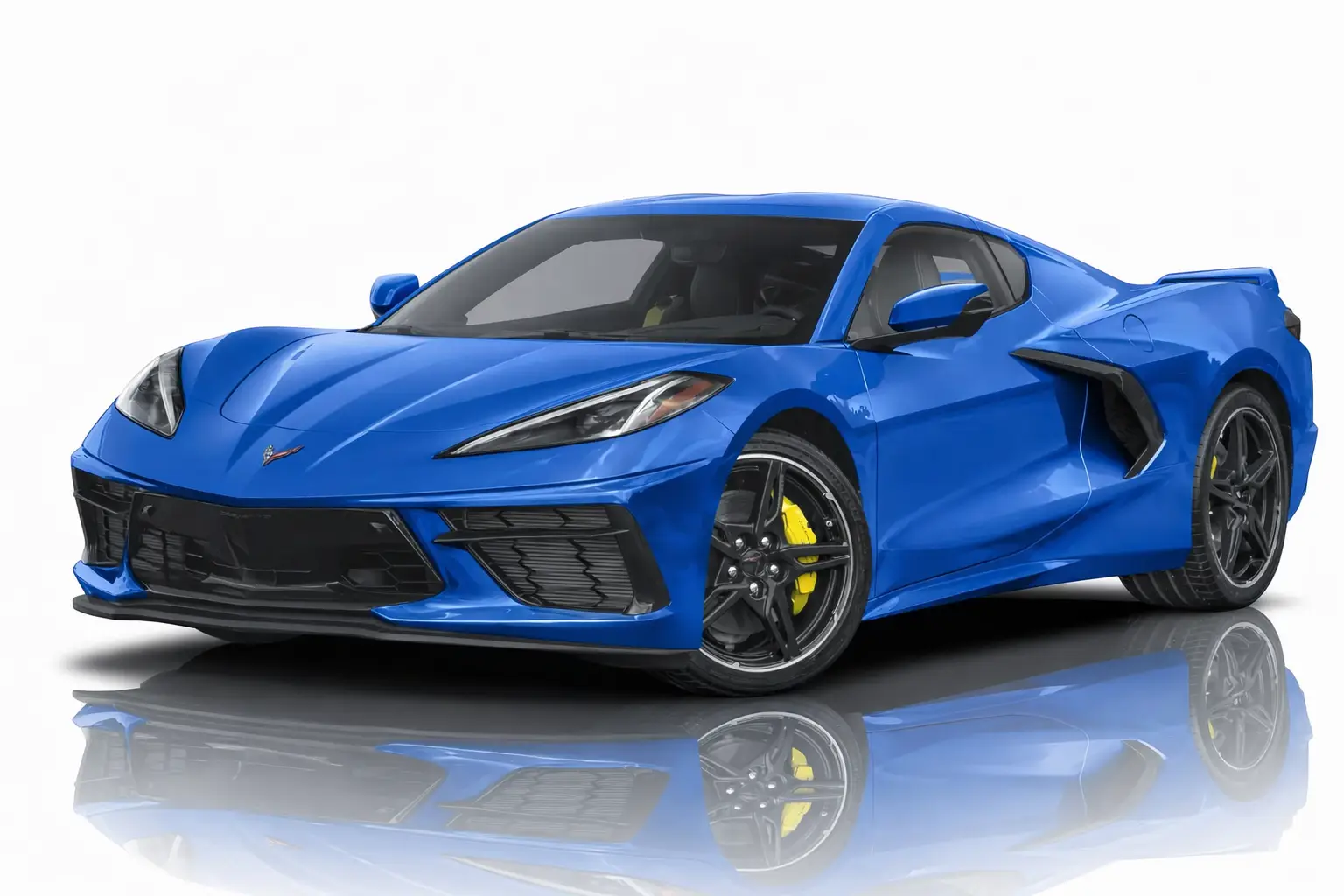
    Pricing began at $62,195 for the coupe and $69,695 for the retractable-hardtop convertible, including destination charges. Chevrolet opened the initial order process on July 1, 2021, with model-year production scheduled to begin during the third quarter. Although the advertised base price had risen from the C8’s original sub-$60,000 launch figure, the Stingray remained an extraordinary proposition: a 490-horsepower mid-engine sports car with a sophisticated dual-clutch transmission and supercar-level acceleration for considerably less than almost any direct competitor.

    Refinement Without Reinvention

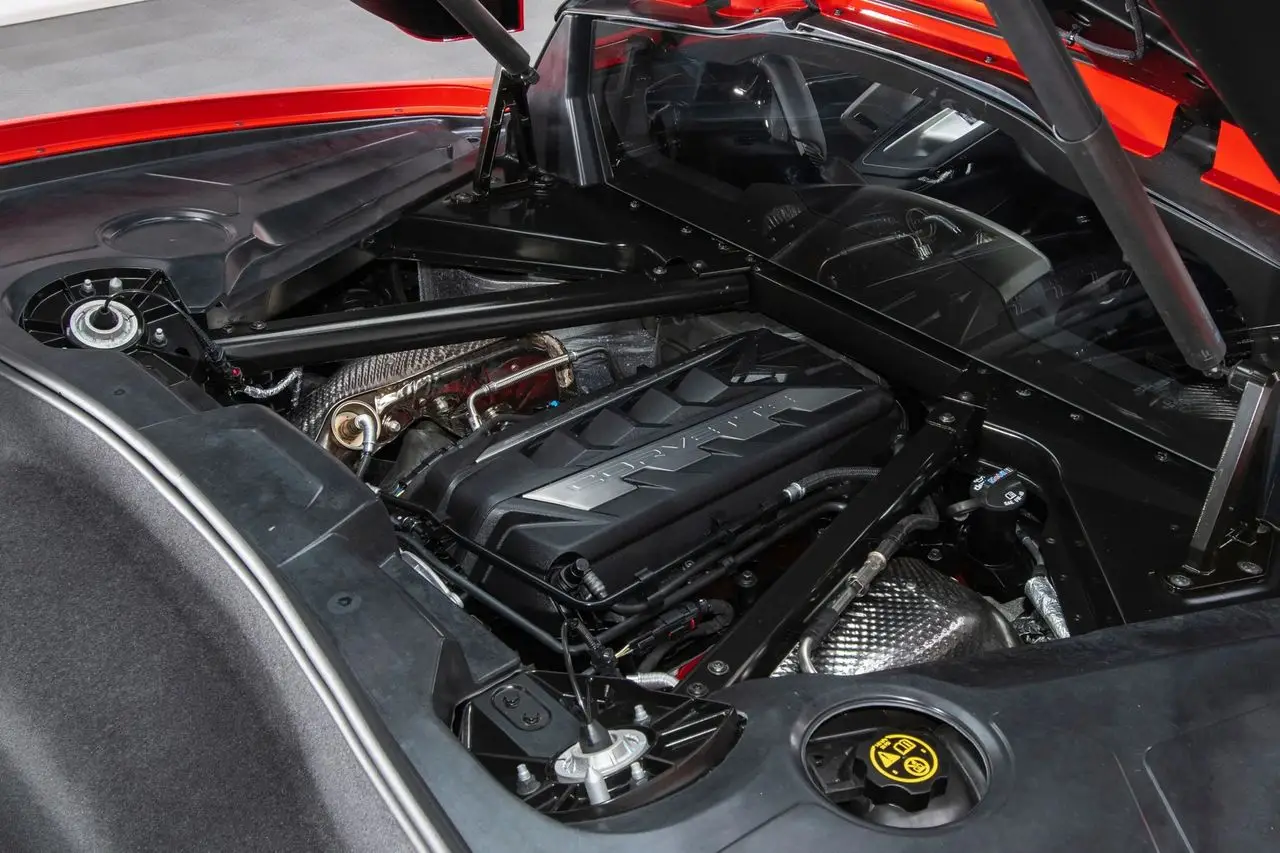
    Studio image of the 2022 Corvette Stingray’s 6.2-liter LT2 V8 engine, showing its red valve covers, intake assembly, exhaust headers, accessory pulleys, and exposed mechanical components.
    The 2022 Corvette Stingray continued to rely on the naturally aspirated 6.2-liter LT2 V8, producing 490 horsepower in standard form and 495 horsepower with the available performance exhaust. For the new model year, Chevrolet revised the direct-injection system, updated the engine calibration, and expanded the operating range of Active Fuel Management to improve emissions performance, efficiency, and overall refinement. The result was not a more powerful engine, but a more polished version of the C8’s defining mechanical centerpiece—one that preserved the immediate response, broad torque, and unmistakable character of a traditional Corvette V8.

    The 2022 Stingray did not receive a headline-grabbing power increase, and it did not need one. Its naturally aspirated 6.2-liter LT2 V8 continued to produce 490 horsepower and 465 lb-ft of torque with the standard exhaust. Cars equipped with the NPP performance exhaust were rated at 495 horsepower and 470 lb-ft.

    For 2022, Chevrolet revised the direct-injection fuel system, recalibrated the engine, and expanded the operating range of Active Fuel Management. The changes were primarily intended to improve emissions performance, idle quality, and efficiency without reducing output or changing the character of the engine.

    That character remained central to the Stingray’s appeal. The LT2 was derived from Chevrolet’s long-running small-block V8 architecture, but its installation in the C8 required extensive changes. Mounted behind the passenger compartment, the engine used a low-profile intake arrangement, dry-sump lubrication, and cooling systems designed around the demands of the new layout. The result was an engine that delivered immediate throttle response and a broad wave of torque without relying on turbochargers to generate its performance.

    The LT2 also preserved an important connection to Corvette history. At a time when many competing performance cars were moving toward smaller turbocharged engines, the Stingray retained the sound, response, and mechanical directness of a large-displacement naturally aspirated V8. It was modern in its management systems and packaging, but familiar in the way it built power.

    The 2022 Corvette Stingray’s M1L eight-speed dual-clutch transmission was developed around the C8’s mid-engine architecture, combining near-instant gear changes with the smooth operation required for everyday driving. Using separate wet clutches for odd- and even-numbered gears, the Tremec-built transaxle could preselect the next ratio before the shift occurred, minimizing interruption in power delivery. More than an alternative to a traditional manual, the M1L was a central part of the C8’s acceleration, balance, and modern supercar character.

    All 2022 Stingrays used the M1L eight-speed dual-clutch transmission. Developed with Tremec for the C8’s rear transaxle configuration, the transmission employed two clutches to preselect the next gear, allowing shifts to occur with almost no interruption in power delivery. In automatic operation, it could behave smoothly enough for traffic and long-distance travel. In manual mode, steering-wheel-mounted paddles gave the driver direct control with shift speeds no conventional manual gearbox could match.

    The absence of a manual transmission remained controversial among traditionalists, but the dual-clutch unit was fundamental to what the C8 had become. It contributed to the car’s acceleration, allowed the engine to remain within its most effective operating range, and gave the control systems much greater authority over traction and vehicle dynamics. Rather than treating the transmission as a substitute for something the Corvette had lost, the engineering team treated it as an enabler of the new platform.

    With the Z51 Performance Package, Chevrolet claimed a 0–60 mph time of 2.9 seconds. That number placed the Stingray in territory once reserved for all-wheel-drive exotics and extremely specialized performance machines. More important, the acceleration was repeatable and accessible. The driver did not need to manage wheelspin through delicate throttle modulation or execute a perfect manual launch. The engine, transmission, electronic differential, tires, and launch-control strategy worked as a coordinated system.

    One Performance Foundation, Three Trim Levels

    Chevrolet offered the 2022 Stingray in 1LT, 2LT, and 3LT trim levels, each available as a coupe or convertible. The trims did not represent different engine outputs or fundamentally different versions of the car. Instead, they allowed buyers to choose how much technology, comfort, and interior finish they wanted, all around the same basic performance architecture.

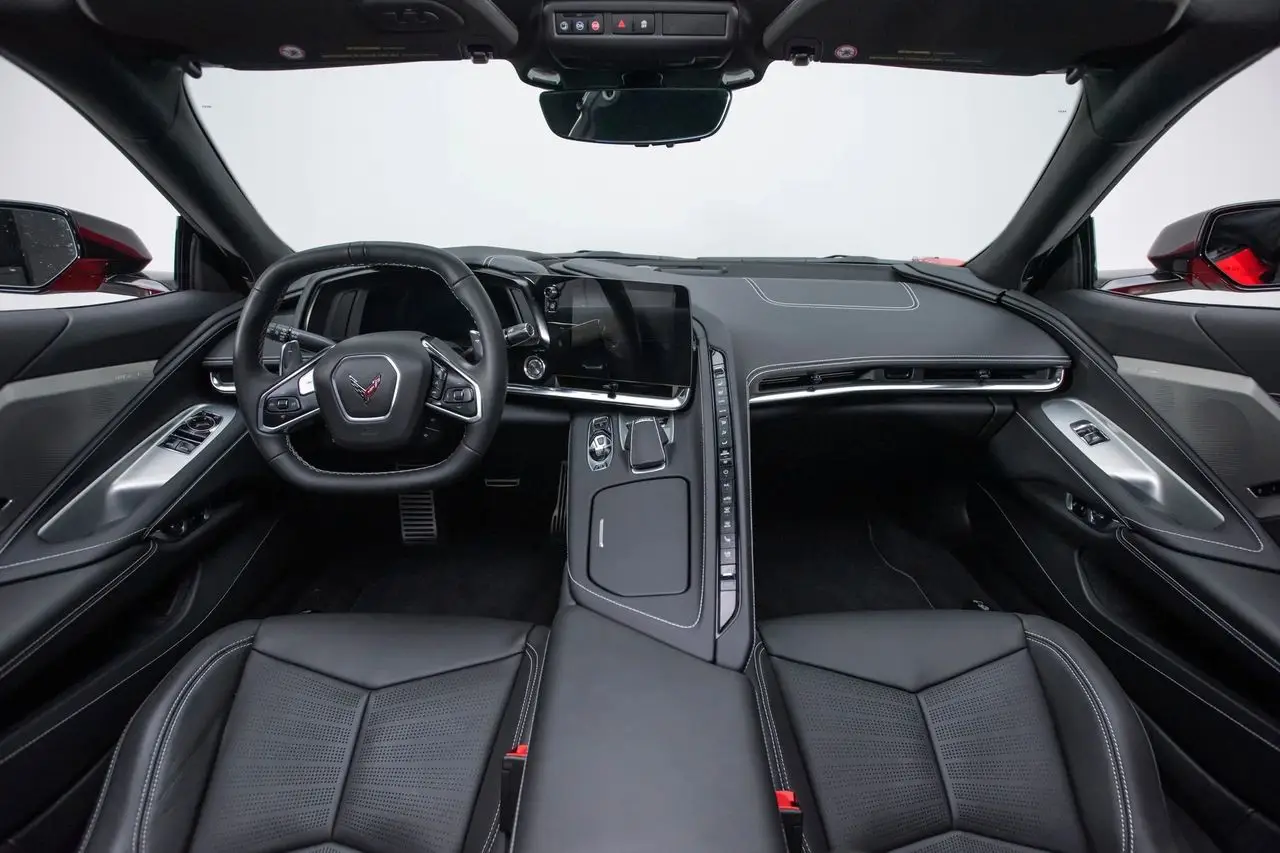
    The 1LT interior preserved the C8’s essential driver-focused architecture, including its digital instrument cluster, central touchscreen, leather seating, and distinctive cockpit divider, while leaving several premium convenience features to the 2LT and 3LT trims. Most visibly, there are no head-up-display controls beside the steering wheel because the 1LT was not equipped with a HUD. It also did without the Performance Data Recorder, connected navigation, heated and ventilated seats, heated steering wheel, driver-memory settings, and several enhanced camera and driver-awareness systems. The result was a cleaner, more straightforward cabin for buyers who wanted the complete Stingray driving experience without paying for equipment they might not use.

    The 1LT remained the most direct path into the C8. It included the LT2 engine, dual-clutch transmission, digital instrument display, Chevrolet infotainment system, removable roof panel on the coupe, and the essential chassis and structural content that defined every Stingray. For an owner primarily interested in the driving experience—or one who intended to direct the budget toward Z51 hardware and exterior options—the 1LT was anything but a stripped car.

    Interior of a 2022 Corvette Stingray equipped with the 2LT trim, showing the driver-focused cockpit, digital instrument cluster, central touchscreen, head-up-display controls, two-tone dashboard, and black sport seats.
    The 2LT retained the same LT2 V8, dual-clutch transmission, chassis, and standard GT1 seating found in the 1LT, but added a substantial layer of comfort, technology, and driver awareness. Its equipment included a color head-up display, connected navigation, Performance Data Recorder, 14-speaker Bose audio system, Rear Camera Mirror, and HD front and rear cameras. Heated and ventilated seats with power lumbar and bolster adjustment, a heated steering wheel, driver and passenger memory settings, wireless phone charging, power-folding mirrors, Side Blind Zone Alert, and Rear Cross Traffic Alert made the 2LT especially well suited to owners who intended to drive their Corvette regularly. It was not a faster Stingray than the 1LT—it was a more comprehensively equipped one.

    The 2LT added the equipment that made the Corvette easier to use as an everyday automobile. Features such as the head-up display, Performance Data Recorder, navigation, heated and ventilated seats, upgraded audio system, additional driver-assistance technology, and enhanced visibility equipment addressed the realities of living with a low, wide mid-engine car. This was the trim that made the Corvette feel less like an occasional indulgence and more like a genuine grand tourer.

    The 3LT package included every comfort, technology, and driver-awareness feature found in the 2LT, then elevated the cabin through materials and craftsmanship rather than additional performance hardware. Standard GT2 seats brought genuine Napa leather, carbon-fiber trim, and a more sculpted appearance, while the custom interior package wrapped the upper instrument panel, doors, and center console in leather and added sueded-microfiber trim overhead. It also opened the door to the C8’s most expressive interior color combinations, including the blue-and-black treatment shown here. Like the 2LT, the 3LT was no faster than the 1LT—but it presented the Stingray as a more convincingly premium, exotic-caliber automobile.

    The 3LT retained the 2LT’s technology while substantially upgrading the cabin materials. Additional leather wrapping and richer surface treatments gave the cockpit a more handcrafted appearance. Because the C8 interior surrounds the driver with a tall center console, sweeping instrument panel, and prominent structural forms, those material changes had a greater visual effect than they might in a more conventional cabin.

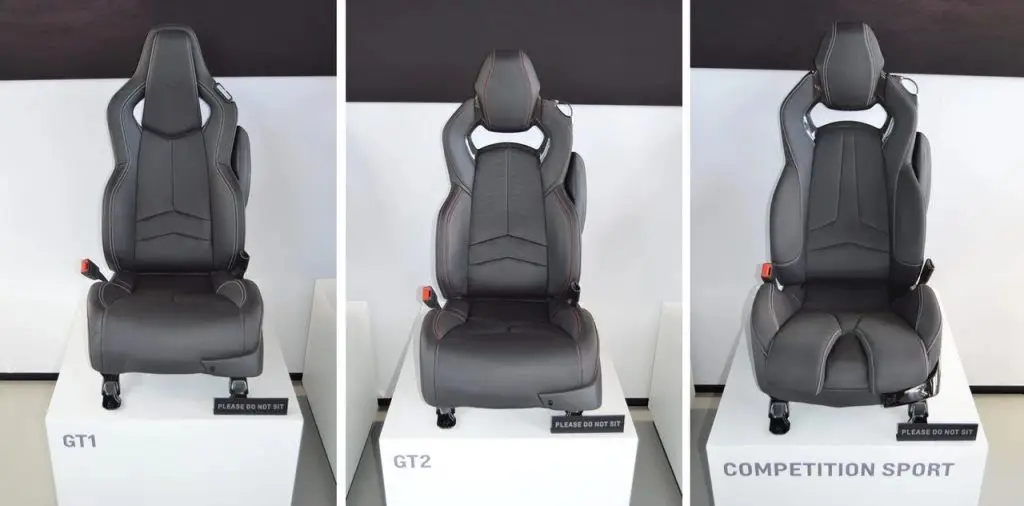
    The seat choices provided another layer of personalization. GT1 seats emphasized comfort and accessibility. GT2 seats added more pronounced bolstering and premium construction without becoming difficult to live with. Competition Sport seats provided the greatest lateral support for track use and aggressive driving. As with the trim levels, the choice was less about declaring one seat objectively superior and more about matching the car to the owner’s intended use.

    Z51 and the Hardware That Mattered

    The Z51 Performance Package transformed the 2022 Stingray from an already formidable road car into a more track-capable and repeatable performance machine. It added FE3 performance suspension, an electronic limited-slip differential, a shorter 5.17:1 final-drive ratio, larger Brembo brakes, heavy-duty cooling, Michelin Pilot Sport 4S summer tires, and the NPP dual-mode exhaust—which raised LT2 output to 495 horsepower and 470 lb-ft of torque. A functional front splitter and rear spoiler completed the package, improving high-speed stability while giving the car a more purposeful appearance. Magnetic Ride Control was not included with Z51, but remained available as a separate option for owners seeking adaptive damping alongside the package’s performance hardware. (Image credit: GM)

    The Z51 Performance Package was the most important mechanical option available on the Stingray. It added performance-oriented suspension tuning, larger Brembo brakes, an electronic limited-slip differential, a shorter performance rear-axle ratio, enhanced cooling, Michelin Pilot Sport 4S summer tires, the NPP performance exhaust, and functional aerodynamic components.

    No single component defined Z51. Its value came from the way the parts worked together.

    The Z51 Performance Package gave the 2022 Corvette Stingray a meaningful braking upgrade, pairing larger rotors with four-piston Brembo monobloc calipers at all four corners. The added thermal capacity improved resistance to fade during repeated high-speed stops, giving the car greater consistency and confidence during track sessions, mountain driving, and other sustained performance use. Rather than simply shortening one emergency stop, the Z51 system was engineered to deliver strong, predictable braking lap after lap.

    The larger brakes increased thermal capacity during repeated high-speed stops. The additional cooling supported sustained operation under track conditions. The electronic limited-slip differential could actively manage torque distribution across the rear axle, improving stability under braking and helping the car deploy power during corner exit. The summer tires increased dry grip, while the axle ratio and transmission calibration sharpened acceleration.

    The package did not turn the Stingray into a Z06, nor was it intended to. What it did was increase repeatability. A standard Stingray was already extremely fast on the street. A Z51-equipped car was better prepared to sustain that performance through a full track session, a demanding mountain drive, or repeated hard use in high temperatures.

    Magnetic Selective Ride Control could be ordered with or without Z51, giving buyers the ability to combine adaptive damping with either chassis configuration. The magnetorheological dampers continuously adjusted to road conditions and driving inputs, allowing the car to provide more disciplined body control when driven aggressively without becoming unnecessarily harsh during ordinary use.

    The available front lift system addressed a less glamorous but equally real element of supercar ownership. By raising the front of the car to clear steep driveways, ramps, and abrupt transitions, it reduced the anxiety associated with using a low vehicle in the real world. It did not improve a lap time, but it often determined whether an owner felt comfortable driving the car to a particular destination.

    That distinction says something important about the C8. Chevrolet understood that usability was not separate from performance. A car that is too delicate, too inconvenient, or too intimidating to drive regularly cannot fully deliver on its capabilities. The 2022 Stingray’s most successful options were often those that helped it perform one moment and integrate into ordinary life the next.

    What Buyers Chose—and What Those Choices Revealed

    Although the retractable hardtop was introduced with the C8 rather than added for 2022, it played a major role in expanding the convertible’s appeal during the model year. The power-operated roof gave buyers the security, refinement, and coupe-like appearance of a fixed top while preserving open-air driving and the Corvette’s rear cargo capacity. By eliminating many of the traditional compromises associated with a soft-top convertible, Chevrolet transformed the open-roof Stingray from a secondary body style into one of the C8 lineup’s most desirable configurations. (Image credit: GM)

    Chevrolet built 25,831 Corvettes for the 2022 model year. Of those, 13,451 were coupes and 12,380 were convertibles, producing a remarkably close 52.1-to-47.9-percent split.

    That near-even division between body styles marked a significant shift from earlier generations, when the convertible generally represented a much smaller share of production. The C8 retractable hardtop changed the calculation. It offered open-air driving without the visual or security compromises associated with a traditional fabric roof, and its operation did not eliminate the car’s primary rear luggage compartment. The convertible was no longer a secondary derivative. It had become one of the C8’s core identities.

    The trim breakdown was equally revealing. Chevrolet produced 3,982 cars in 1LT form, accounting for 15.4 percent of the model-year total. The 2LT represented 11,060 cars, or 42.8 percent, while the 3LT accounted for 10,789 cars, or 41.8 percent. More than four out of every five buyers, therefore, selected one of the two upper trims.

    That was not the behavior of a market interested only in obtaining the least expensive mid-engine car available. Buyers were adding technology, premium materials, upgraded seating, and convenience equipment because they viewed the Stingray as a complete ownership proposition. The C8 was not merely being purchased for a single spectacular acceleration run. Owners expected to travel in it, commute in it, display it, track it, and live with it.

    Like the fighter aircraft framed above it, a Z51-equipped 2022 Corvette was engineered to perform repeatedly under demanding conditions—not merely to deliver one dramatic burst of speed. Larger brakes, additional cooling, performance suspension, an electronic limited-slip differential, summer tires, and the shorter final-drive ratio gave the Stingray greater durability, sharper response, and more consistent performance during sustained high-load driving. The result was a Corvette better prepared to withstand the heat, braking forces, and repeated acceleration of track use while remaining fully usable on the road.

    The option rates reinforced the same conclusion. Approximately 68.6 percent of 2022 Corvettes received the Z51 Performance Package. The NPP performance exhaust appeared on 86.9 percent, while the front lift system was installed on 58.8 percent. Magnetic Ride Control paired with Z51 appeared on 11,757 cars, representing 45.5 percent of total production. The Performance Data Recorder was installed in 22,167 cars—an extraordinary 85.8-percent take rate for equipment originally conceived as a specialized driver-development and track-analysis tool.

    Buyers also showed a strong preference for familiar Corvette colors. Torch Red led production with 4,147 cars, followed by Arctic White with 3,603. Hypersonic Gray, new for 2022, finished close behind with 3,291 examples, demonstrating how quickly the metallic gray connected with buyers. Red Mist Metallic Tintcoat accounted for 3,274 cars, while Black appeared on 2,766. At the opposite end of the spectrum, Caffeine Metallic was selected for only 385 cars, making it the rarest exterior color of the model year.

    Most production remained in the United States, where Chevrolet delivered 23,503 of the 25,831 cars. Canada received 1,014, while additional cars were allocated to Mexico, the Middle East, Japan, Europe, Australia, and New Zealand. Chevrolet built 442 right-hand-drive Corvettes, evidence that the C8 was becoming more than an American performance car exported in limited numbers. It was being engineered and distributed as an increasingly global product.

    The National Corvette Museum’s R8C Museum Delivery program allows buyers to take delivery of their new Corvette in Bowling Green, just steps from the assembly plant where it was built. More than a handoff, the experience turns ownership into an event—complete with a personalized delivery, museum access, and a direct connection to Corvette history. (Image credit: National Corvette Museum)

    The National Corvette Museum’s R8C delivery program accounted for 1,146 cars. For those owners, the transaction became part of the experience: traveling to Bowling Green, seeing the museum and assembly complex, and taking delivery near the plant where every production Corvette had been built since 1981.

    The numbers tell a consistent story. Buyers did not simply accept the mid-engine Corvette. They embraced its most sophisticated forms. They selected convertibles almost as frequently as coupes, favored the premium trims, ordered the performance hardware, and invested heavily in personalization.

    By 2022, the novelty of the engine’s location was no longer carrying the car. The product itself was.

    Bowling Green Under Pressure


    In the early morning hours of December 11, 2021, a violent EF3 tornado tore through Bowling Green with winds approaching 150 mph, destroying homes, businesses, and entire neighborhoods while claiming 17 lives across Warren County. The National Corvette Museum was spared significant structural damage; its collection remained secure, and employees were safe, though the amphitheater area was damaged and the facility temporarily closed as crews restored power and cleared debris. Across Interstate 65, the NCM Motorsports Park suffered a far harsher blow as roofs and exterior walls were ripped from buildings, garages and storage structures were heavily damaged, debris was scattered for more than half a mile, and several vehicles were struck or displaced. Nearby, Bowling Green Assembly sustained extensive roof and infrastructure damage, while more than one hundred completed or partially built Corvettes were ultimately deemed unsalvageable. For a community inseparably linked to America’s sports car, the storm was more than a production disruption—it was a night of terrible loss that tested the resilience of Bowling Green, its people, and the institutions that preserve Corvette’s legacy.

    The 2022 Corvette was built during a period when consistency could not be taken for granted.

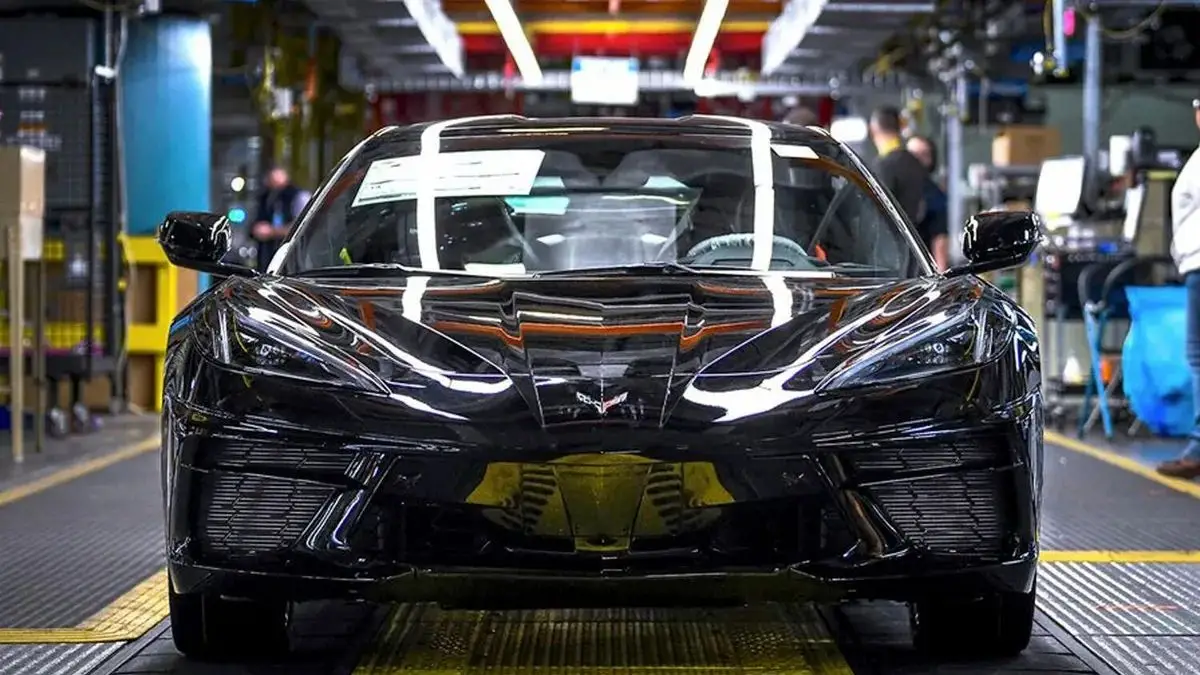
    The global automotive industry was still dealing with semiconductor shortages, transportation problems, supplier disruptions, and the lingering effects of the COVID-19 pandemic. Corvette production was particularly vulnerable because every car came from a single plant: General Motors’ Bowling Green Assembly facility in Kentucky.

    Then, in the early morning hours of December 11, 2021, a devastating tornado passed through Bowling Green. The storm damaged the assembly plant, the surrounding community, and portions of the nearby National Corvette Museum Motorsports Park. More than one hundred completed or partially completed 2022 Corvettes inside the facility were damaged beyond repair. Contemporary reports placed the number at approximately 122, although early accounts varied as the plant assessed the damage.

    The destruction occurred in the middle of a model year already facing overwhelming demand. Chevrolet halted production while the building was inspected and repaired, then resumed operations with the added burden of replacing damaged equipment and managing an unstable supply chain.

    Temporary parts constraints led to additional shutdowns in March and April 2022. Chevrolet confirmed that both shifts would be idled during the week of March 21, with production expected to resume the following week. Another interruption arrived in late April, adding further pressure to a schedule that was already being adjusted around the transition to the 2023 model year.

    Constraints could also affect how individual cars were configured. Equipment availability changed as particular components moved on and off restriction, forcing some customers to choose between delaying an order and accepting a build without a desired option. For historians and future collectors, that makes the build records of 2022 cars particularly important. Two Stingrays ordered at different points in the year could reflect not only different customer preferences, but different realities within the production system.

    Despite those difficulties, Bowling Green completed 25,831 cars before 2022-model production ended on May 13, 2022. Production of the 2023 Stingray began the following Monday, May 16.

    That total was not simply a measure of demand. It represented the ability of the plant, its workforce, suppliers, and the broader Corvette organization to continue building a complex, highly personalized sports car through one of the most disrupted manufacturing periods in modern automotive history.

    The Z06 Becomes Real

    By the time Chevrolet issued its October 26 reveal notice, anticipation surrounding the first mid-engine Corvette Z06 had been building for nearly two years. Camouflaged prototypes had been photographed testing at the Nürburgring and near Le Mans, while the unmistakable sound captured in Chevrolet’s teaser videos fueled reports of a high-revving, flat-plane-crank V8 derived from the C8.R racing program. Automotive media scrutinized every intake, aerodynamic surface, exhaust note, and spy photograph, speculating about horsepower, engine speed, carbon-fiber wheels, and an even more extreme Z07 package. Chevrolet carefully sustained that excitement through brief audio clips, disguised track footage, and the promise of a worldwide film premiere titled Putting the World on Notice. When the Z06 finally emerged on October 26, 2021, its 670-horsepower LT6, 8,600-rpm redline, and track-focused engineering proved that the C8 architecture could support a genuinely world-class American supercar.

    Although the Stingray was the only Corvette carrying a 2022 model-year designation, the development and launch of the 2023 Z06 became one of the defining Corvette stories of calendar-year 2022.

    Chevrolet had officially revealed the new Z06 on October 26, 2021. What followed was a year of final validation, public demonstrations, production preparation, charity auctions, customer anticipation, and an extraordinary level of scrutiny. The Stingray had proven that Chevrolet could build a convincing mid-engine Corvette. The Z06 now had to prove that the architecture could support a genuine American supercar.

    General Motors unveiled the 2023 Corvette Z06 on October 26, 2021, through the global premiere of Putting the World on Notice. The presentation introduced the wider, more aggressively sculpted C8 Z06 in both coupe and retractable-hardtop convertible form, powered by the 670-horsepower, flat-plane-crank LT6 V8. More than a new Corvette variant, the Z06 announced Chevrolet’s intention to challenge the world’s most accomplished exotic cars with a uniquely American, naturally aspirated supercar. (Image credit: Chevrolet)

    The responsibility rested with the team led by Tadge Juechter and a broad group of engineers specializing in powertrain development, aerodynamics, chassis control, thermal management, manufacturing, and motorsports. Mark Reuss, General Motors’ president and a committed high-performance enthusiast, served as one of the program’s most visible executive advocates. Together, they positioned the Z06 not as a modified Stingray, but as a separate expression of the C8 platform.

    Its defining component was the LT6 engine.

    The 5.5-liter naturally aspirated V8 abandoned the traditional pushrod configuration used by the Stingray’s LT2 in favor of dual overhead camshafts, four valves per cylinder, and a flat-plane crankshaft. It produced 670 horsepower at 8,400 rpm and 460 lb-ft of torque at 6,300 rpm, with an 8,600-rpm redline. At its introduction, Chevrolet identified it as the most powerful naturally aspirated V8 offered in a production automobile.

    Developed alongside lessons learned from the C8.R racing program, the 5.5-liter LT6 represented the most radical production engine in Corvette history. Its dual-overhead-cam, 32-valve architecture and flat-plane crankshaft allowed it to produce 670 horsepower at 8,400 rpm, 460 lb-ft of torque, and an 8,600-rpm redline without supercharging or turbocharging. Hand-assembled at Bowling Green’s Performance Build Center, the LT6 gave the C8 Z06 the immediate throttle response, rapid-revving character, and unmistakable exhaust note of a purpose-built exotic engine.

    That specification represented a philosophical departure from every previous production Corvette engine. Rather than using large displacement, supercharging, or turbocharging to generate massive low- and mid-range torque, the LT6 relied on airflow, reduced rotating mass, and engine speed. Its flat-plane crankshaft allowed a firing order and exhaust pulse arrangement suited to high-rpm breathing, while its oversquare bore-and-stroke dimensions helped the engine rev with an urgency unlike the familiar cadence of a traditional small-block.

    Yet the LT6 was not an attempt to erase Corvette history. It extended the same principle that had always driven the best versions of the car: apply the most effective technology available to produce performance that could challenge far more expensive machinery.

    The engine’s relationship to the C8.R was critical. Corvette Racing had been competing with a racing version of the same basic 5.5-liter, flat-plane-crank architecture since the C8.R’s 2020 debut. The competition engine was not identical to the production LT6, but the racing program exposed the architecture to endurance events, heat cycles, vibration, sustained high rpm, and the unforgiving operational demands of international sports-car competition.

    That did not mean the Z06 received a racing engine with license plates attached. It meant that Chevrolet had already spent years learning how the configuration behaved under pressure before the first customer car reached production.

    Each LT6 was hand-assembled at the Performance Build Center within the Bowling Green plant. The process reinforced the engine’s specialized nature and connected each unit to the technicians responsible for its assembly.

    The rest of the Z06 was developed around the engine’s capabilities. Its body measured 3.6 inches wider than the Stingray’s, accommodating broader wheels, 345-section rear tires, and larger side openings required to feed additional air into the cooling system. A shorter 5.56:1 final-drive ratio helped keep the LT6 in its high-rpm operating range, while revised transmission calibration matched the engine’s very different torque curve.

    Rear 7/8 view of 2023 Chevrolet Corvette Z06 in Elkhart Lake Blue Metallic driving down a road.
    As the 2022 model year drew to a close, the Stingray had already proven the strength of the C8 platform—but the next chapter was rapidly approaching. The 2023 Z06 stood on the horizon as the car that would push that foundation into far more serious performance territory, signaling that Corvette’s mid-engine evolution was only beginning.

    Even in its standard form, the Z06 incorporated larger brakes, additional cooling capacity, model-specific suspension calibration, and bodywork designed to generate useful aerodynamic stability. Buyers seeking the most aggressive configuration could select the Z07 Performance Package.

    Z07 added carbon-ceramic brakes, Michelin Pilot Sport Cup 2 R ZP tires, specific Magnetic Ride Control calibration, and an available carbon-fiber aerodynamic package. With the complete aero configuration installed, Chevrolet claimed 734 pounds of downforce at 186 mph. Available carbon-fiber wheels reduced total unsprung and rotating mass by approximately 41 pounds, improving steering response, acceleration, braking, and the suspension’s ability to follow the road surface. Chevrolet reported lateral acceleration of up to 1.22 g for the Z07-equipped car.

    Those numbers were impressive, but the deeper achievement was integration. The wider tires, brakes, differential, dampers, cooling systems, aerodynamics, transmission, and engine had to operate as one vehicle. The Z06 could not merely feel like a powerful Stingray. It needed to feel coherent at speeds where minor weaknesses become major problems.

    The 70th Anniversary and the First Z06 Auctions

    Chevrolet marked seven decades of Corvette history with the 2023 Corvette 70th Anniversary Edition, offered in exclusive White Pearl Metallic Tri-coat and Carbon Flash Metallic finishes. Available on both the Stingray and Z06, the package added distinctive striping, unique wheels, red brake calipers, commemorative badging, special interior details, and a coordinated luggage set. More than a cosmetic tribute, the edition connected the mid-engine C8 to a lineage that began in 1953—celebrating how far America’s sports car had come without losing sight of the heritage that made it possible. (Image credit: Chevrolet Newsroom)

    Chevrolet used 2022 to connect the forthcoming Z06 with another important milestone. On January 24, the company announced the Corvette 70th Anniversary Edition, which would be available on 2023 Stingray 3LT and Z06 3LZ coupes and convertibles.

    The package commemorated the seven decades separating the first Corvette’s 1953 debut from the 2023 model year. It included exclusive exterior colors, distinctive striping, special wheels, anniversary badging, red brake calipers, unique interior details, and a coordinated luggage set. The first retail-production Z06 would be built as a 70th Anniversary Edition model.

    At the 2022 Barrett-Jackson Scottsdale Auction, the first retail-production 2023 Corvette Z06 crossed the block for an extraordinary $3.6 million. The 70th Anniversary Edition was driven onto the stage by retired Corvette Racing driver Oliver Gavin before Rick Hendrick placed the winning bid, setting a Barrett-Jackson record for a manufacturer-donated charity vehicle. Every dollar benefited Operation Homefront, transforming the arrival of the first customer Z06 into both a historic Corvette moment and a powerful show of support for America’s military families.

    Five days after the announcement, the rights to that first retail-production Z06 crossed the Barrett-Jackson auction block in Scottsdale. Retired Corvette Racing driver Oliver Gavin drove the car onto the stage, and Rick Hendrick ultimately placed the winning bid of $3.6 million. Hendrick, the chairman and chief executive officer of Hendrick Automotive Group and owner of Hendrick Motorsports, had already acquired several historically significant first-production Corvettes at charity auctions. The full Z06 bid benefited Operation Homefront, an organization supporting military families.

    In April, Hendrick also paid $1 million for the first retail-production Z06 convertible, with proceeds benefiting the Thurgood Marshall College Fund. Together, the two auctions generated $4.6 million for charity before regular customer deliveries had begun.

    At Barrett-Jackson’s Palm Beach Auction on April 9, 2022, the first retail-production 2023 Corvette Z06 convertible brought a $1 million winning bid. Rick Hendrick secured the right to configure and receive the historic VIN 001 car, with the entire purchase price benefiting the Thurgood Marshall College Fund’s Teacher Quality & Retention Program for aspiring K–12 educators. Combined with the $3.6 million raised by the first retail Z06 coupe earlier that year, Chevrolet’s first two customer Z06 models generated an extraordinary $4.6 million for charity before regular production had even begun.

    The events created enormous visibility, but they also illustrated the unusual position the Z06 occupied. It was simultaneously a new production automobile, a symbol of Corvette’s 70-year history, a flagship for American engineering, and a cultural artifact valuable enough to raise millions before its first owner had driven it home.

    Production began in limited quantities during September 2022. The first completed cars began shipping to dealerships in early November, finally moving the Z06 from years of engineering, testing, speculation, and carefully managed previews into customer hands.

    The volumes were initially small, and the demand was extraordinary. Chevrolet temporarily stopped accepting additional orders after determining that the existing pipeline would fill the available 2022 calendar-year production slots. That scarcity produced frustration, but it also reflected the magnitude of what the team had created.

    The Z06 did more than add power to the C8 range. It validated the entire decision to move the Corvette’s engine. The architecture had not been developed simply to make the Stingray quicker from a stop. It had been created so that a car like the Z06 could exist.

    The E-Ray Develops in Public

    This camouflaged prototype captures the Corvette E-Ray during its 2022 development phase, when Chevrolet was still validating what would become the first electrified, all-wheel-drive Corvette. Hidden beneath the wrap was a major new branch of the C8 family, one that signaled Corvette’s future would extend beyond the Stingray and Z06 alone. Although the E-Ray would not be officially unveiled until January 2023 as a 2024 model, images like this offered an early look at the careful testing and refinement that shaped one of the most important performance Corvettes of the modern era. (Image credit: carscoops.com)

    While the Z06 commanded most of the attention, another Corvette was being developed more quietly.

    During 2022, camouflaged wide-body C8 prototypes were photographed testing at the Nürburgring and elsewhere. They resembled the Z06 in width but lacked its center-mounted exhaust outlets and carried subtle differences that suggested another powertrain was under development. Contemporary reports increasingly identified the prototypes as an electrified, all-wheel-drive Corvette commonly referred to as the E-Ray.

    At the time, many details remained speculative. Reports correctly anticipated an electric motor driving the front axle and the Stingray’s LT2 V8 powering the rear, but other predictions—including the possibility of plug-in capability—proved inaccurate. The distinction is important. The 2022 test cars confirmed that Chevrolet was actively validating an electrified Corvette, but the production specifications did not become official until January 17, 2023.

    When Chevrolet finally revealed the 2024 Corvette E-Ray, it confirmed that the car combined the Stingray’s 495-horsepower LT2 with a front electric motor producing 160 horsepower and 125 lb-ft of torque. Total system output was rated at 655 horsepower. A 1.9-kWh lithium-ion battery was mounted within the structural tunnel between the seats, and the system replenished itself through regenerative braking and normal driving rather than external charging.

    The resulting e-AWD system gave the Corvette front-wheel drive for the first time. It also produced the quickest acceleration figure Chevrolet had claimed for a production Corvette to that point: 0–60 mph in 2.5 seconds and a quarter-mile in 10.5 seconds.

    During July 2022, camouflaged E-Ray prototypes repeatedly circulated the Nürburgring Nordschleife, returning to Chevrolet’s nearby technical center between runs for adjustments before resuming testing late in the day. Contemporary reports and footage documented the development laps, but Chevrolet released no verified lap time, top speed, or instrumented acceleration figure from those sessions—making any claimed Nürburgring time speculative. The testing instead represented the difficult work of calibrating the Corvette’s new electrified all-wheel-drive system, including power delivery, traction, braking, thermal management, and chassis behavior across one of the world’s most demanding circuits. When the production E-Ray was revealed six months later, the results became clear: 655 combined horsepower, a Chevrolet-estimated 2.5-second sprint to 60 mph, and a 10.5-second quarter-mile. (Image credit: Chevrolet)

    Yet the E-Ray was not developed simply to win a launch-control comparison. The electric front axle provided traction on wet, cold, and imperfect surfaces where a powerful rear-drive car could not always use its full output. Standard carbon-ceramic brakes, Magnetic Ride Control 4.0, and all-season tires supported a broader mission than the Z06’s uncompromising track focus.

    Tadge Juechter described the E-Ray as a Corvette intended to provide greater all-season confidence, while lead development engineer Mike Kutcher and the engineering team calibrated the battery and motor for rapid deployment and recovery of energy. It was a performance hybrid rather than an economy-focused one—a car that used electrification to increase capability instead of replacing the V8 experience.

    The front motor also enabled a limited Stealth Mode, allowing the car to move at low speeds under electric power for short distances. This was not meaningful electric-only transportation in the conventional sense. It was a practical feature for quietly leaving a neighborhood or garage before the LT2 came to life.

    In retrospect, the E-Ray prototypes circulating during 2022 revealed the breadth of the C8 program. Chevrolet was developing two radically different high-performance variants on the same platform at the same time. The Z06 pursued engine speed, aerodynamics, and track performance. The E-Ray used electrification and all-wheel drive to expand traction, acceleration, and year-round usability.

    Neither car was an afterthought. Both had been made possible by decisions embedded in the C8’s structure years earlier.

    Corvette Racing Goes Global

    The No. 3 Corvette C8.R remained the centerpiece of Corvette Racing’s North American campaign in 2022, competing in IMSA’s newly formed GTD Pro class after years in the outgoing GTLM category. Adapted to meet GT3-based regulations, the car carried Corvette into a transitional season that demanded new tires, revised performance parameters, and a different competitive framework. Even as the rules changed around it, the C8.R continued to demonstrate the speed, durability, and engineering depth that had made Corvette Racing one of the most respected programs in international sports-car competition. (Image credit: antoniogarcia.com)

    The production cars told only part of the 2022 story. Corvette Racing entered the year facing one of the most significant transitions in the program’s modern history.

    Since its factory return in 1999, Corvette Racing had become one of the world’s most successful sports-car operations. Developed in partnership with Pratt Miller Engineering, the program had accumulated victories at Daytona, Sebring, Le Mans, and throughout the American Le Mans Series and IMSA competition. Its yellow race cars had become as central to the modern Corvette identity as crossed-flags emblems and small-block V8s.

    The arrival of the mid-engine C8.R in 2020 represented another major departure. Chevrolet had designed the race car alongside the production C8, allowing both programs to benefit from shared architectural development. The C8.R won the IMSA GT Le Mans manufacturers’, drivers’, and team championships during its first season, providing the basis for the Championship Edition offered for 2022.

    The racing environment, however, was changing. IMSA discontinued the GTLM category after 2021 and replaced it with GTD PRO, a class based on global GT3 regulations. The C8.R had been constructed for the outgoing GTE rules rather than GT3, so Chevrolet had to adapt the existing car to compete during the transition.

    Changes included revised aerodynamics, reduced engine output, antilock braking, driver-assistance systems permitted by GT3 regulations, and customer-specification Michelin tires rather than the confidential development tires used in GTLM. Those revisions changed the way the car behaved and forced the team to learn a new competitive framework while racing against established GT3 machinery.

    In 2022, Corvette Racing committed to its first full season in the FIA World Endurance Championship, fielding the No. 64 C8.R for Nick Tandy and Tommy Milner in the final year of the LMGTE Pro class. The program immediately proved competitive against Ferrari and Porsche, earning a breakthrough class victory at the 6 Hours of Monza through disciplined driving and a perfectly executed fuel-saving strategy. Its strongest opportunity at the 24 Hours of Le Mans ended when Alexander Sims was forced into the barriers on the Mulsanne Straight following contact from an LMP2 car, but the season still established Corvette as a credible full-time presence on the world stage. More than an overseas expansion, the campaign demonstrated that the C8.R could compete across dramatically different circuits, formats, and conditions while carrying Corvette Racing into a broader international future. (Richard Prince/Chevrolet Photo).

    At the same time, Chevrolet committed to the C8.R’s first full-season FIA World Endurance Championship campaign. For the first time in Corvette Racing’s history, the program would contest complete seasons in both IMSA and the WEC.

    The organizational challenge was enormous. Corvette Racing split its resources between a single full-season IMSA entry and a separate WEC car, while preparing two C8.Rs for the 24 Hours of Le Mans. The American No. 3 entry would be led by Antonio García and Jordan Taylor, with Nicky Catsburg joining for endurance events. The WEC No. 64 brought together Tommy Milner and Nick Tandy, with Alexander Sims added for Le Mans.

    García, a Spanish endurance-racing veteran, had been part of Corvette Racing since 2009 and had built a reputation for speed, consistency, and exceptional racecraft. Taylor, a second-generation American racer and son of championship-winning driver and team owner Wayne Taylor, joined the factory Corvette program in 2020. Catsburg brought extensive international GT experience and had already proven himself in Corvette endurance competition.

    Milner had been a Corvette Racing fixture since 2011 and had won at both Le Mans and Sebring. Tandy arrived with an overall Le Mans victory and extensive factory Porsche experience, while Sims contributed years of international GT and prototype competition. This was not a collection of celebrity names assembled for publicity. It was a group built to manage traffic, changing conditions, tire degradation, mechanical sympathy, and the mental strain of races measured in hours rather than laps.

    Learning GTD PRO the Hard Way

    Corvette Racing returned to winning form at the 2022 Mobil 1 Twelve Hours of Sebring, where the No. 3 C8.R of Antonio García, Jordan Taylor, and Nicky Catsburg captured victory in the new GTD Pro class. It was an important result for the program, proving that the mid-engine Corvette could adapt and win even as IMSA’s rules and class structure evolved around it. More than just another trophy, the Sebring win reaffirmed Corvette Racing’s toughness, speed, and endurance credibility at one of the most demanding circuits in American motorsports.

    The season began with the Rolex 24 at Daytona, where the converted C8.R faced its first GTD PRO race. The event exposed the scale of the adjustment. The Corvette lacked straight-line performance relative to portions of the field and experienced mechanical difficulties, eventually finishing sixth in class.

    Daytona made clear that prior GTLM success did not guarantee immediate GTD PRO dominance. The team was competing with a car adapted to a ruleset for which it had not originally been designed, using different tires, revised aerodynamics, and a performance balance intended to equalize several very different automobiles.

    Corvette Racing responded at the 12 Hours of Sebring.

    The Florida circuit is among the most physically punishing permanent tracks in the world. Its concrete sections, abrupt surface changes, heavy braking zones, and relentless traffic test far more than outright speed. A car must remain mechanically intact while drivers, engineers, strategists, and pit crews execute for half a day without allowing small problems to become decisive ones.

    García, Taylor, and Catsburg delivered exactly that kind of performance. The No. 3 Corvette led 247 of the race’s 323 laps and won GTD PRO by 5.464 seconds. It was the first victory for the C8.R in its revised configuration and the twelfth Sebring class win in Corvette Racing history.

    The podium celebration captured the reward for a near-flawless day in which the No. 3 Corvette led 247 of 323 laps and delivered Corvette Racing its 12th class victory at Sebring. For Nicky Catsburg, Jordan Taylor, and Antonio García, the trophies represented more than the result itself—they reflected twelve hours of precise pit work, disciplined strategy, and relentless execution across Sebring’s punishing concrete surface. It was a defining moment in Corvette Racing’s transitional 2022 season, proving that the team’s championship culture remained intact even as the technical rules surrounding the C8.R changed.

    The victory mattered because it was earned through adaptation. Corvette was not operating from a position of established technical advantage. The team had to understand the control tire, manage the car’s revised braking systems, learn how the Balance of Performance affected race strategy, and compete against cars developed specifically around GT3 regulations.

    The remainder of the IMSA season demonstrated how competitive that environment had become. The No. 3 continued collecting valuable results, but Corvette did not secure the inaugural GTD PRO championship. The season was therefore not one of overwhelming statistical dominance. It was something more instructive: a year in which the organization absorbed a new formula, proved it could still win one of endurance racing’s hardest events, and gathered the knowledge required for the next phase of the program.

    A Full World Championship Campaign

    Photographed by Corvette Racing’s Richard Prince in Place de la République, at the heart of Le Mans, this image captures the full Corvette Racing contingent during the traditional pre-race pesage—the public technical and administrative scrutineering that formally opens Le Mans week. The No. 63 and No. 64 C8.Rs stand alongside their drivers, engineers, mechanics, and support personnel, emphasizing the enormous collective effort required to place two factory Corvettes on the grid for the 90th running of the 24 Hours. More than a team portrait, the scene connects Corvette Racing directly with the city and its fans, celebrating a program preparing to pursue its ninth class victory on endurance racing’s greatest stage. (Image credit: Richard Prince Photography)

    The WEC effort exposed Corvette Racing to a different collection of circuits, strategic demands, and competitors. Instead of making selected appearances at Le Mans and occasional overseas rounds, the team committed to the complete championship.

    That decision brought Corvette into sustained competition at tracks where the program had comparatively little recent experience. It also required the team to operate across international logistics, regulatory structures, and race formats while sharing technical resources with the IMSA effort.

    The centerpiece remained the 24 Hours of Le Mans.

    For Corvette, Le Mans has always been more than another race. Its combination of history, international visibility, extreme speed, and mechanical attrition makes it one of the clearest measures of a manufacturer’s competence. Corvette Racing had already earned multiple class victories there, helping establish the C5-R, C6.R, and C7.R as internationally respected competition cars.

    The 2022 race initially offered reason for optimism. Both C8.Rs showed competitive speed, and the program appeared capable of fighting for a GTE Pro victory. Le Mans, however, has never rewarded expectation.

    Both Corvettes ultimately retired. The loss was particularly painful because the result did not reflect the pace the team had demonstrated. One car suffered mechanical trouble, while the other sustained terminal damage in an incident. Years of preparation were undone within the compressed and often brutal logic of endurance racing.

    That disappointment could have defined the international season. Instead, Corvette responded at Monza.

    Only weeks after both C8.Rs retired from the 24 Hours of Le Mans, Corvette Racing rebounded with a dramatic LMGTE Pro victory at the 6 Hours of Monza on July 10, 2022. Nick Tandy and Tommy Milner kept the No. 64 Corvette within striking distance through disciplined fuel management, then inherited the lead when the No. 52 Ferrari was forced to make a late splash-and-dash stop on the penultimate lap. The result delivered Corvette its first victory of its inaugural full-season FIA World Endurance Championship campaign.

    The six-hour race developed into a strategic contest in which fuel management became as important as outright speed. Nick Tandy and Tommy Milner brought the No. 64 C8.R into contention, and the closing laps became a calculation of pace, remaining fuel, and track position. The Corvette reached the finish and secured the GTE Pro victory in dramatic fashion.

    Winning at Monza did not erase Le Mans, nor did it need to. It proved something different: the team could recover. It could take the operational knowledge gathered through a demanding international campaign, place itself in position, and execute when the opportunity arrived.

    That resilience has always been one of Corvette Racing’s defining qualities. The program’s reputation was not built solely through victories. It was built through its response to failures, accidents, unfavorable regulations, and the thousand unpredictable events that make endurance racing different from every other form of motorsport.

    Racing Toward the GT3 Era

    As Corvette Racing entered the 2022 season, Chevrolet had already announced that the C8.R’s successor would be the new Corvette Z06 GT3.R—a purpose-built, globally homologated customer race car scheduled to debut in 2024. Development continued throughout the year, culminating in the GT3.R’s first on-track test in September 2022 and signaling Corvette Racing’s coming transition from a factory-focused program to a broader international presence supported by customer teams. (Image courtesy of the author)

    The adapted C8.R was always an interim solution. Chevrolet had already announced development of the Corvette Z06 GT3.R, a new customer racing car intended to comply fully with global GT3 regulations beginning in 2024.

    The Z06 GT3.R would use a production-based version of the LT6 engine architecture, along with chassis and aerodynamic lessons drawn from the C8.R. Unlike the traditional factory-only Corvette Racing model, it would be available to approved customer teams, allowing Corvettes to compete in GT3 championships around the world.

    That made 2022 a bridge between eras. The C8.R was completing the GTE story while learning the realities of GTD PRO, and Chevrolet was preparing to move Corvette racing into a customer-supported global structure.

    For production-car owners, the significance extended beyond trophies. The racing program provided an environment in which ideas about cooling, aerodynamics, engine durability, braking, control systems, serviceability, and driver ergonomics could be tested under extraordinary pressure. Not every racing component migrated directly to the road car, but the knowledge moved through the organization.

    The Stingray, Z06, E-Ray, C8.R, and forthcoming GT3.R were not isolated projects carrying a common badge. They were branches of the same engineering program.

    The 2022 Stingray in Technical Detail

    Blue technical-style specification graphic of a 2022 Chevrolet Corvette Stingray side profile with labeled dimensions and key specs.
    Technical blueprint graphic showing key dimensions and specifications of the 2022 Chevrolet Corvette Stingray.

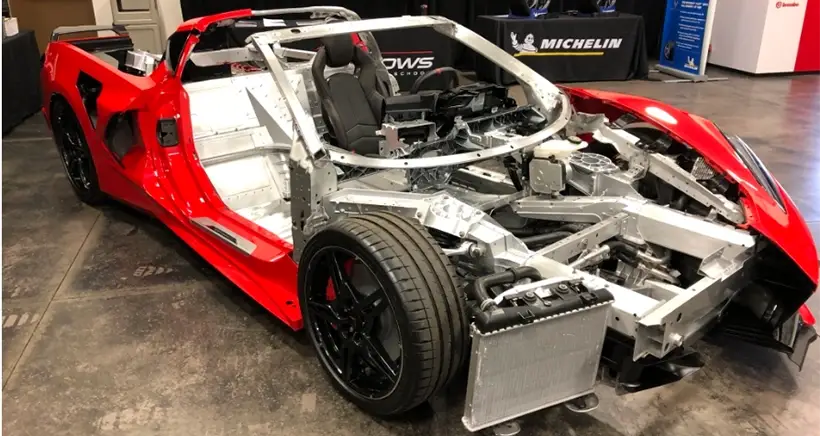
    Beneath its composite body panels, the 2022 Stingray was built around a mixed-material structure designed to provide the stiffness required by both the coupe and convertible. Short-long-arm double-wishbone suspension was used at all four corners, with forged and cast aluminum components chosen to balance strength, mass, and production cost.

    The standard car employed a mechanical limited-slip differential, while Z51 models received the electronically controlled unit. Electric power-assisted steering used a 15.7:1 ratio, and available Magnetic Selective Ride Control adjusted damping continuously according to road conditions and vehicle behavior.

    Standard Stingray brakes used four-piston Brembo calipers with 12.6-inch front and 13.6-inch rear rotors. The Z51 package increased rotor diameter to approximately 13.3 inches in front and 13.8 inches at the rear while using monobloc four-piston calipers at both ends.

    Every Stingray used staggered wheels and tires. The front wheels measured 19 by 8.5 inches and carried 245/35ZR19 tires, while the rear wheels measured 20 by 11 inches with 305/30ZR20 tires. Standard cars used Michelin Pilot Sport All Season 4 rubber, while Z51 brought Pilot Sport 4S summer tires.

    The car’s 107.2-inch wheelbase was contained within an overall length of approximately 182.3 inches. It measured 76.1 inches wide and just 48.6 inches tall. Those dimensions created the C8’s low, cab-forward stance without making it dramatically longer than the C7 it replaced.

    The LT2 displaced 6,162 cubic centimeters through a 4.06-inch bore and 3.62-inch stroke. Its aluminum block used cast-in iron cylinder liners, while the two-valve overhead-valve cylinder heads incorporated variable valve timing. The engine’s 11.5:1 compression ratio, direct injection, dry-sump oiling, and 6,600-rpm redline reflected the blend of traditional architecture and modern control that defined the Stingray.

    The eight-speed dual-clutch transaxle used tightly spaced lower gears for acceleration and extremely tall upper ratios for relaxed cruising. Its 5.17:1 final-drive ratio worked with the transmission’s internal gearing to provide both the hard launch expected of the car and reasonable engine speed during highway travel.

    Fuel capacity was 18.5 gallons. Combined front and rear cargo volume measured 12.6 cubic feet, and the cabin provided 42.8 inches of legroom—an important number in a car intended to accommodate a wide range of drivers rather than only those who fit the physical profile of a racing professional.

    These specifications explain part of the Stingray’s character, but not all of it. The car succeeded because none of its individual systems operated in isolation. The engine’s torque, the transmission’s shift logic, the differential’s response, the suspension geometry, the brake-by-wire system, and the stability controls were calibrated as a single performance network.

    That integration allowed the Corvette to behave differently according to circumstance. It could navigate traffic without protesting, settle into a long highway drive, absorb imperfect pavement, and then become dramatically more alert when placed in Sport, Track, or a personalized Z Mode.

    This breadth—not any single performance statistic—was the defining achievement of the 2022 Stingray.

    Key Specifications

    • Vehicle configuration
      • Generation: Eighth-generation Corvette, commonly identified as the C8
      • Body styles: Two-door coupe with a removable roof panel or two-door convertible with a power-retractable hardtop
      • Passenger capacity: Two
      • Trim levels: 1LT, 2LT, and 3LT
      • Drivetrain layout: Longitudinally mounted rear-mid-engine, rear-wheel drive
      • Assembly location: General Motors Bowling Green Assembly Plant, Bowling Green, Kentucky
    • Engine
      • Engine designation: LT2
      • Configuration: Naturally aspirated 90-degree V8
      • Displacement: 6.2 liters
      • Exact displacement: 6,162 cc
      • Approximate displacement: 376 cubic inches
      • Bore: 4.06 inches, or 103.25 mm
      • Stroke: 3.62 inches, or 92.0 mm
      • Compression ratio: 11.5:1
      • Block construction: A319-T7 cast aluminum with cast-in iron cylinder liners and nodular-iron main bearing caps
      • Cylinder-head construction: Cast aluminum
      • Combustion-chamber volume: 59 cc
      • Valvetrain: Overhead-valve design with two valves per cylinder
      • Camshaft location: Single camshaft mounted within the engine block
      • Valve timing: Dual-equal variable valve timing
      • Intake-valve diameter: 2.13 inches, or 54 mm
      • Exhaust-valve diameter: 1.59 inches, or 40.4 mm
      • Intake valves: Hollow-stem construction
      • Exhaust valves: Sodium-filled construction
      • Fuel delivery: High-pressure direct injection
      • Throttle body: 87-mm electronically controlled single-bore unit
      • Cylinder-management system: Active Fuel Management, capable of deactivating four cylinders under lighter operating loads
      • Standard firing order: 1-8-7-2-6-5-4-3
      • Active Fuel Management firing sequence: 1-7-6-4
      • Maximum engine speed: 6,600 rpm
      • Engine-management system: GM E99 electronic control module
      • Model-year changes: The 2022 LT2 received an upgraded direct-injection system, revised engine calibration, and a broader Active Fuel Management operating range.
    • Engine output
      • Standard exhaust:
        • 490 horsepower at 6,450 rpm
        • 465 lb-ft of torque at 5,150 rpm
      • NPP dual-mode performance exhaust:
        • 495 horsepower at 6,450 rpm
        • 470 lb-ft of torque at 5,150 rpm
      • The NPP system used electronically controlled valves to alter exhaust flow and sound according to the selected drive mode, engine load, and driver input.
    • Lubrication and cooling
      • Lubrication system: Dry-sump
      • Piston cooling: Dedicated oil-spray jets
      • Engine-oil capacity with filter: 7.5 quarts, or 7.1 liters
      • Factory-specified oil: dexos2-approved 0W-40 synthetic
      • Cooling-system capacity without the Performance Package: Approximately 21.7 quarts, or 20.5 liters
      • Cooling-system capacity with the Performance Package: Approximately 22.7 quarts, or 21.5 liters
      • Z51-equipped cars received additional cooling capability intended to support sustained high-load and track operation.
    • Transmission
      • Transmission designation: M1L
      • Type: Tremec TR-9080 eight-speed dual-clutch transaxle
      • Clutch arrangement: Electronically controlled wet dual-clutch system
      • Driver controls: Fully automatic operation or manual shifting through steering-wheel-mounted paddles
      • First gear: 2.905:1
      • Second gear: 1.759:1
      • Third gear: 1.220:1
      • Fourth gear: 0.878:1
      • Fifth gear: 0.653:1
      • Sixth gear: 0.508:1
      • Seventh gear: 0.397:1
      • Eighth gear: 0.329:1
      • Reverse: 2.632:1
      • The tightly spaced lower ratios supported acceleration, while the extremely tall seventh and eighth gears reduced engine speed during highway cruising.
    • Final drive and differential
      • Standard effective final-drive ratio: 4.89:1
      • Z51 effective final-drive ratio: 5.17:1
      • Standard differential: Mechanical limited-slip differential
      • Z51 differential: Electronically controlled limited-slip differential
      • The Z51 electronic differential varied clutch engagement according to throttle position, steering input, vehicle speed, yaw, wheel slip, and the selected drive mode, improving both corner-entry stability and power delivery at corner exit.
    • Suspension
      • Front suspension: Short-long-arm double-wishbone arrangement
      • Rear suspension: Short-long-arm double-wishbone arrangement
      • Front upper control arms: Forged aluminum
      • Front lower control arms: Cast-aluminum L-shaped design
      • Rear upper control arms: Forged aluminum
      • Rear lower control arms: Cast-aluminum L-shaped design
      • Dampers: 46-mm monotube shock absorbers
      • Standard suspension: FE1 touring suspension
      • Standard suspension with Magnetic Ride Control: FE2
      • Z51 performance suspension: FE3
      • Z51 suspension with Magnetic Ride Control: FE4
      • Magnetic Ride Control used magnetorheological fluid and electronically managed damping to adjust each shock absorber continuously.
      • Available front lift raised the front of the car by approximately two inches in less than three seconds at speeds below approximately 24 mph. Its location-memory function could automatically recognize frequently encountered obstacles.
    • Steering
      • Type: Variable-ratio rack-and-pinion steering
      • Power assistance: Electric
      • Steering ratio: 15.7:1
      • Turning circle without Magnetic Ride Control: Approximately 38.1 feet
      • Turning circle with Magnetic Ride Control and Active Steer Stops: Approximately 36.4 feet
      • The steering system was mounted ahead of the front axle and calibrated specifically around the C8’s rearward weight distribution.
    • Brakes
      • General configuration: Four-wheel ventilated disc brakes with electronic brake boost
      • Caliper supplier: Brembo
      • Standard front calipers: Four-piston, two-piece fixed calipers
      • Standard rear calipers: Four-piston monobloc fixed calipers
      • Z51 front and rear calipers: Four-piston monobloc fixed calipers
      • Standard front rotors:
        • 12.6 inches in diameter
        • 1.18 inches thick
        • 321 x 30 mm
      • Standard rear rotors:
        • 13.3 inches in diameter
        • 1.02 inches thick
        • 339 x 26 mm
      • Z51 front rotors:
        • 13.6 inches in diameter
        • 1.18 inches thick
        • 345 x 30 mm
      • Z51 rear rotors:
        • 13.8 inches in diameter
        • 1.06 inches thick
        • 350 x 27 mm
      • Z51 increased both braking capacity and resistance to heat buildup during repeated high-speed stops.
    • Wheels and tires
      • Front-wheel dimensions: 19 x 8.5 inches
      • Rear-wheel dimensions: 20 x 11 inches
      • Bolt pattern: 5 x 120 mm
      • Front-tire size: 245/35ZR19
      • Rear-tire size: 305/30ZR20
      • Standard tire: Michelin Pilot Sport All Season 4
      • Z51 tire: Michelin Pilot Sport 4S high-performance summer tire
      • Wheel construction and finish varied according to the wheel design selected, with multiple painted, polished, machined-face, and accessory wheel options offered during the model year.
    • Z51 Performance Package
      • FE3 performance suspension with track-oriented calibration
      • Electronic limited-slip differential
      • 5.17:1 effective final-drive ratio
      • Larger Brembo brakes
      • Additional engine and transmission cooling
      • NPP dual-mode performance exhaust
      • Michelin Pilot Sport 4S summer tires
      • Functional front splitter
      • Performance rear spoiler
      • Z51-specific chassis and electronic-control calibration
      • The package was designed around repeatable performance rather than a single acceleration run, giving the Stingray the cooling, braking, traction, and tire capacity required for sustained track use.
    • Factory performance
      • Chevrolet-quoted 0–60 mph time with the Z51 Performance Package: 2.9 seconds
      • Chevrolet-quoted quarter-mile time: 11.2 seconds
      • Maximum factory-quoted top track speed: Up to 194 mph
      • Top speed varied with body style, aerodynamic equipment, temperature, altitude, tire specification, and vehicle configuration.
      • Approximate maximum lateral acceleration with Z51 equipment: 1.03 g
      • Launch Control coordinated engine output, clutch engagement, transmission operation, traction management, and the electronic differential to provide consistent standing-start acceleration.
    • Exterior dimensions
      • Wheelbase: 107.2 inches, or 2,722 mm
      • Overall length: Approximately 182.3 inches, or 4,630 mm
      • Overall width without mirrors: 76.1 inches, or 1,934 mm
      • Overall height:
        • Coupe: Approximately 48.6 inches
        • Convertible: Approximately 48.6 inches
      • Front track: Approximately 64.9 inches, or 1,648 mm
      • Rear track: Approximately 62.4 inches, or 1,586 mm
      • Front overhang: Approximately 40.8 inches
      • Rear overhang: Approximately 34.4 inches
      • Published ground clearance:
        • Between the axles: Approximately 3.2 inches
        • Beneath the front axle: Approximately 5.3 inches
        • Beneath the rear axle: Approximately 5.0 inches
      • Approach angle at base curb weight: Approximately 8 degrees
      • Departure angle at base curb weight: Approximately 13.8 degrees
    • Interior dimensions
      • Headroom: 37.9 inches
      • Legroom: 42.8 inches
      • Shoulder room: 54.4 inches
      • Hip room: 52.0 inches
      • Seating capacity: Two
      • Available seats: GT1, GT2, or Competition Sport
      • Instrument display: 12-inch reconfigurable digital driver-information display
      • Center display: Eight-inch Chevrolet Infotainment touchscreen
    • Weight and distribution
      • Chevrolet-published base dry weight: Approximately 3,366 pounds for the coupe
      • Actual curb weight varied according to body style, trim level, wheels, seats, suspension, and optional equipment.
      • Approximate front-to-rear weight distribution: 40/60
      • The rearward weight bias helped the Stingray transfer power to the pavement during acceleration while reducing the traction limitations associated with earlier front-engine Corvettes.
    • Fuel and capacities
      • Fuel-tank capacity: 18.5 gallons, or 70 liters
      • Recommended fuel: Premium unleaded for maximum performance
      • Total cargo volume: 12.6 cubic feet
      • Cargo areas: Separate front and rear storage compartments
      • Engine-oil capacity with filter: 7.5 quarts
      • Factory wheel-nut torque specification: 140 lb-ft
      • EPA-estimated fuel economy: 16 mpg city, 24 mpg highway, and 19 mpg combined; actual economy varied significantly with conditions and driving style.
    • Coupe roof and cargo configuration
      • The coupe’s removable roof panel could be stored within the rear cargo compartment.
      • The rear trunk was designed to accommodate the roof panel, while the front compartment provided additional storage for smaller luggage.
      • Combined cargo volume remained 12.6 cubic feet.
    • Convertible roof system
      • Power-retractable two-piece hardtop
      • Six electric motors controlled roof operation
      • The top could be raised or lowered in approximately 16 seconds.
      • Roof operation was possible at vehicle speeds of up to approximately 30 mph.
      • Unlike many convertibles, the C8’s primary rear cargo space remained available whether the roof was raised or lowered.

    Why the 2022 Corvette Matters

    The 2022 Corvette Stingray stands as one of the clearest demonstrations that Chevrolet’s mid-engine gamble had paid off. By then, the C8 was no longer surviving on novelty; it had matured into a fast, refined, highly configurable sports car that owners could drive, tour, track, and enjoy without surrendering the accessibility that has always defined Corvette. Its relevance continues today because nearly everything that followed—the Z06, the E-Ray, and the expanding performance reach of the C8 platform—was built upon the engineering foundation the 2022 Stingray had already proven. More than a successful model year, it was the moment Corvette showed that its future was not only secure, but more ambitious than ever.

    The 2022 Corvette does not occupy the same historical position as the first C8 Stingray, the first Z06, or the first electrified Corvette. It was not the model year that introduced Chevrolet’s long-awaited mid-engine architecture, nor was it the moment when every major branch of the C8 family had reached customer hands.

    Its importance lies in the way those stories began to converge.

    By 2022, the Stingray had moved beyond the novelty of its engine placement and matured into a broadly understood, deeply configurable sports car. Buyers were no longer approaching the C8 simply because it was new; they were choosing among premium trim levels, the Z51 Performance Package, Magnetic Ride Control, the front-lift system, racing-derived technology, and two genuinely desirable body styles. Chevrolet had created a Corvette that could be tailored as a relatively straightforward performance car, a long-distance grand tourer, or a serious track-day machine without compromising the integrity of the underlying platform.

    That growing confidence was reflected in the way customers embraced both the coupe and retractable-hardtop convertible. The C8 was no longer selling on the strength of a single configuration or headline specification. It had become a complete product line—one broad enough to appeal to traditional Corvette loyalists, first-time buyers, and drivers who might previously have looked exclusively toward European performance marques.

    Bowling Green continued building the car amid tornado damage, supply-chain constraints, component shortages, production interruptions, and demand that remained greater than the plant could readily satisfy. Corvette Racing simultaneously adapted the C8.R to a changing regulatory landscape while undertaking its first full-season FIA World Endurance Championship campaign. On the road-car side, the 2023 Z06 began translating its extraordinary engineering promise into production reality, while camouflaged E-Ray prototypes demonstrated that electrification and all-wheel drive were already advancing through Chevrolet’s development program. The Z06 brought a hand-built, 670-horsepower LT6 V8 capable of reaching 8,600 rpm, while the E-Ray would later emerge as the first electrified, all-wheel-drive production Corvette.

    Each of those developments traced back to the same foundational decision. The C8 had never been engineered merely as a familiar Stingray with its engine relocated behind the passengers. It had been conceived as an expandable architecture with the structural strength, cooling capacity, aerodynamic potential, electrical capability, and electronic sophistication necessary to support multiple forms of Corvette performance.

    That is what became unmistakably clear during 2022.

    In the end, the 2022 Corvette Stingray will be remembered not simply for what it was on paper, but for what it felt like to experience. For those fortunate enough to buy one, drive one, or even spend meaningful time behind the wheel, it offered something that all great Corvettes have promised at their best: the sense that American performance could still stir the soul, challenge expectations, and make an ordinary stretch of road feel memorable. It was a car born at the intersection of heritage and reinvention, confident enough to honor its name while bold enough to redefine it. And for that reason, the 2022 Stingray remains more than a milestone in Corvette history—it remains a reminder that the story is still being written.

    The mid-engine Corvette was no longer an unanswered question, an engineering experiment, or a dramatic break with tradition that still needed to justify itself. It was a successful production sports car, an evolving international racing platform, the basis of a 670-horsepower naturally aspirated supercar, and the foundation for an electrified all-wheel-drive grand tourer. Chevrolet had not simply changed where the engine lived; it had fundamentally expanded what a Corvette could be.

    That makes the 2022 model year more significant than its place between major debuts might initially suggest. It was the year the C8 stopped feeling like a singular revolution and began revealing itself as something larger: the opening movement of an entirely new era.

    The mid-engine Corvette had landed. More importantly, it had survived the turbulence surrounding its arrival, earned the confidence of its customers, and begun stretching toward possibilities that would once have seemed incompatible with the Corvette name.

    And as 2022 drew to a close, one truth had become impossible to ignore: the C8 had already changed Corvette forever—and it had only begun to show the world what it could become.

    The 2022 Corvette marked the moment the C8 truly came of age. From the refined Stingray and expanding production story to the development of the Z06, E-Ray, and Corvette Racing’s global campaign, the year revealed the platform’s extraordinary depth. Read on to discover how Corvette’s remarkable future took shape.

  • 2021 CORVETTE STINGRAY OVERVIEW

    2021 CORVETTE STINGRAY OVERVIEW

    There are new-car years, and then there are years that change the orbit of a nameplate. The 2021 Corvette Stingray is the latter: a second-year car that had to shoulder first-year expectations, sustain global demand, and keep the mid-engine revolution on boil—while the world kept moving the goalposts. With a starting base price of less than sixty thousand dollars when the model year began, the rest of the experience—supply chains, allocations, recalls, take-rates, colors, tech—became a living case study in how a modern halo car evolves in real time. This is that story, told through the facts, the data, and the lived experience of the people who tried to buy one.

    From Strike to Shutdown: How 2021 Became the C8’s Real Launch Year

    Night falls on the Bowling Green line as UAW Local 2164 joins the 40-day national walkout in fall 2019. The strike—Sept. 16 to Oct. 25—paused pre-launch activity on the mid-engine Corvette, compressing the 2020 run and cascading demand into 2021. (Photo by Rob Harris, documented on Twitter)
    Night falls on the Bowling Green line as UAW Local 2164 joins the 40-day national walkout in fall 2019. The strike—Sept. 16 to Oct. 25—paused pre-launch activity on the mid-engine Corvette, compressing the 2020 run and cascading demand into 2021. (Photo by Rob Harris, documented on Twitter)

    The C8’s path to “normal” was anything but. The runway everyone expected in late 2019 evaporated when the 40-day nationwide UAW strike shut GM’s plants from September 16 to October 25, 2019, idling Bowling Green before the mid-engine car ever saw a regular build. Local coverage in Kentucky captured the moment the lights came back on—October 29, 2019, the Corvette plant returned to full operations after “nearly six weeks” on pause—but the calendar damage was done. What had been penciled as a December start was pushed.
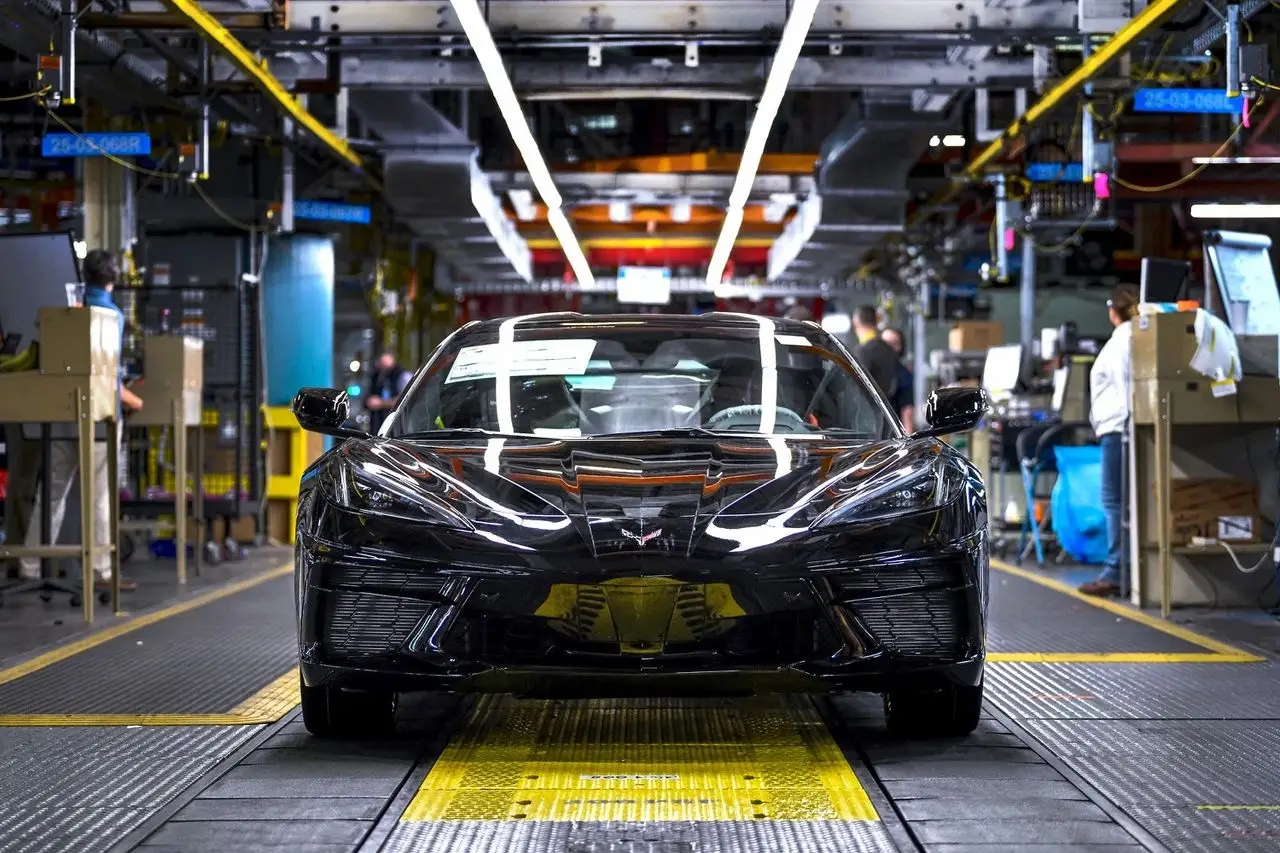
    Inside dealer circles, the target had been clear: Start of Regular Production (SORP) was originally slated for the week of December 2, 2019. That plan—already tight for a clean-sheet car—slipped with the strike. Chevrolet regrouped, finished validation, and officially began 2020 C8 production on February 3, 2020. The first regular-production Stingray, a black-on-black coupe, rolled off the line that Monday morning—an image that ran everywhere from MotorWeek to The Drive—and shipments to dealers were slated for late February/early March. It felt like the real launch at last.
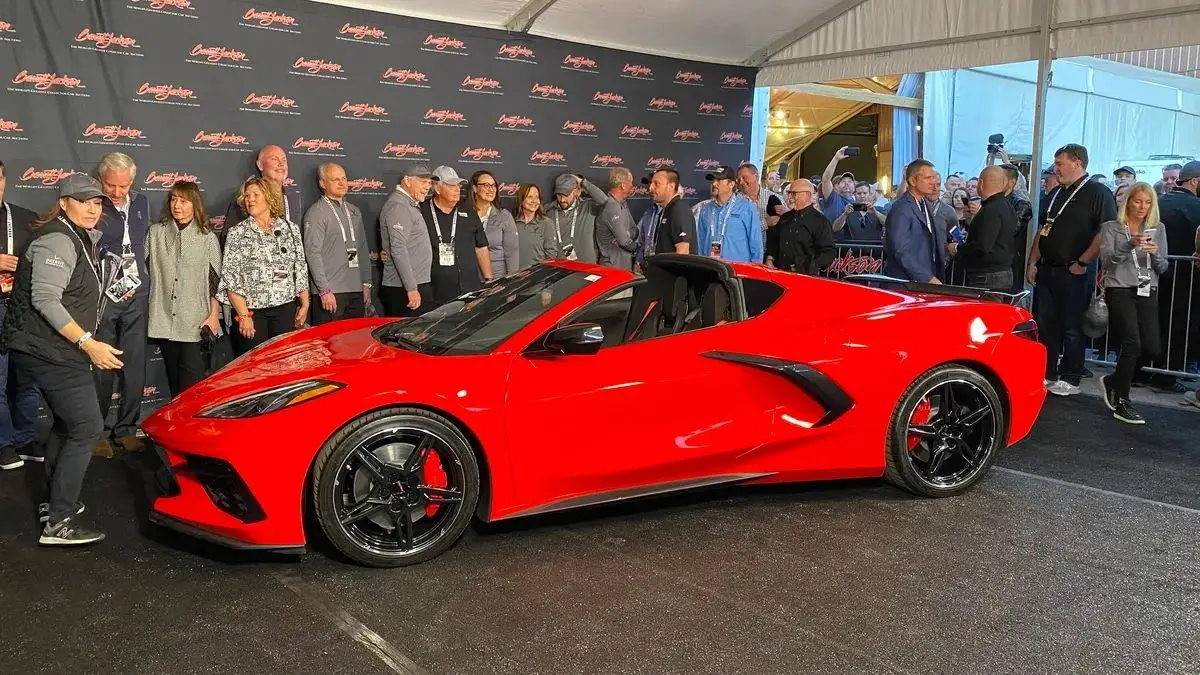
    VIN 001—the first retail 2020 C8 Stingray—crossed the Barrett-Jackson Scottsdale block in January 2020 and hammered at $3,000,000 for charity. Winning bidder Rick Hendrick took the honor; Chevrolet directed the proceeds to the Detroit Children’s Fund. More than a sale, it was a statement: the mid-engine era arrived with supercar buzz and Corvette-scale heart.
    VIN 001—the first retail 2020 C8 Stingray—crossed the Barrett-Jackson Scottsdale block in January 2020 and hammered at $3,000,000 for charity. Winning bidder Rick Hendrick took the honor; Chevrolet directed the proceeds to the Detroit Children’s Fund. More than a sale, it was a statement: the mid-engine era arrived with supercar buzz and Corvette-scale heart.

    Even before that first car moved, the opening act had a headline: VIN 0001 sold for $3 million at Barrett-Jackson in January 2020, with Rick Hendrick winning the hammer and the money benefiting the Detroit Children’s Fund. It was theater with purpose, and a signal that the C8’s cultural wattage extended well beyond the spec sheet.
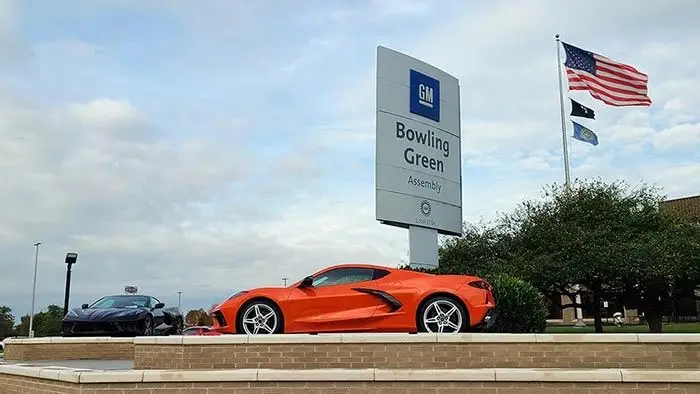
    Bowling Green Assembly went dark in March 2020 as COVID-19 halted GM’s North American production, freezing the C8’s early ramp just weeks after SOP. The 2020 order bank closed, schedules slipped, and unslotted demand rolled forward. Limited output resumed in late May under new safety protocols—proof that even a moonshot has to navigate real-world headwinds.
    Bowling Green Assembly went dark in March 2020 as COVID-19 halted GM’s North American production, freezing the C8’s early ramp just weeks after SOP. The 2020 order bank closed, schedules slipped, and unslotted demand rolled forward. Limited output resumed in late May under new safety protocols—proof that even a moonshot has to navigate real-world headwinds.

    Then the world changed. March 2020 brought COVID-19, and with it, a company-wide production halt. Bowling Green’s line shut down at the end of the shift on Friday, March 20, just weeks after SOP. Chevy simultaneously closed the 2020 order books—the stated reasons: overwhelming demand and a launch already shortened by the six-week strike—while also simultaneously hinting that 2021 ordering would open in late May. Public-health orders, parts logistics, and a suddenly fragile supply chain turned the rest of the inaugural C8 model year into a salvage operation.

    The restart was tentative. Kentucky’s phased reopening allowed manufacturing to resume in late May; local reporting and enthusiast outlets pointed to the week of May 25, 2020 for Bowling Green’s return, with GM Authority noting that even if the plant turned on, upstream components—LT2 engines from Tonawanda in New York, among others—could govern the actual cadence. What had looked like a sprint became meter-in, meter-out production. Convertible builds didn’t join the party until August 3, 2020.
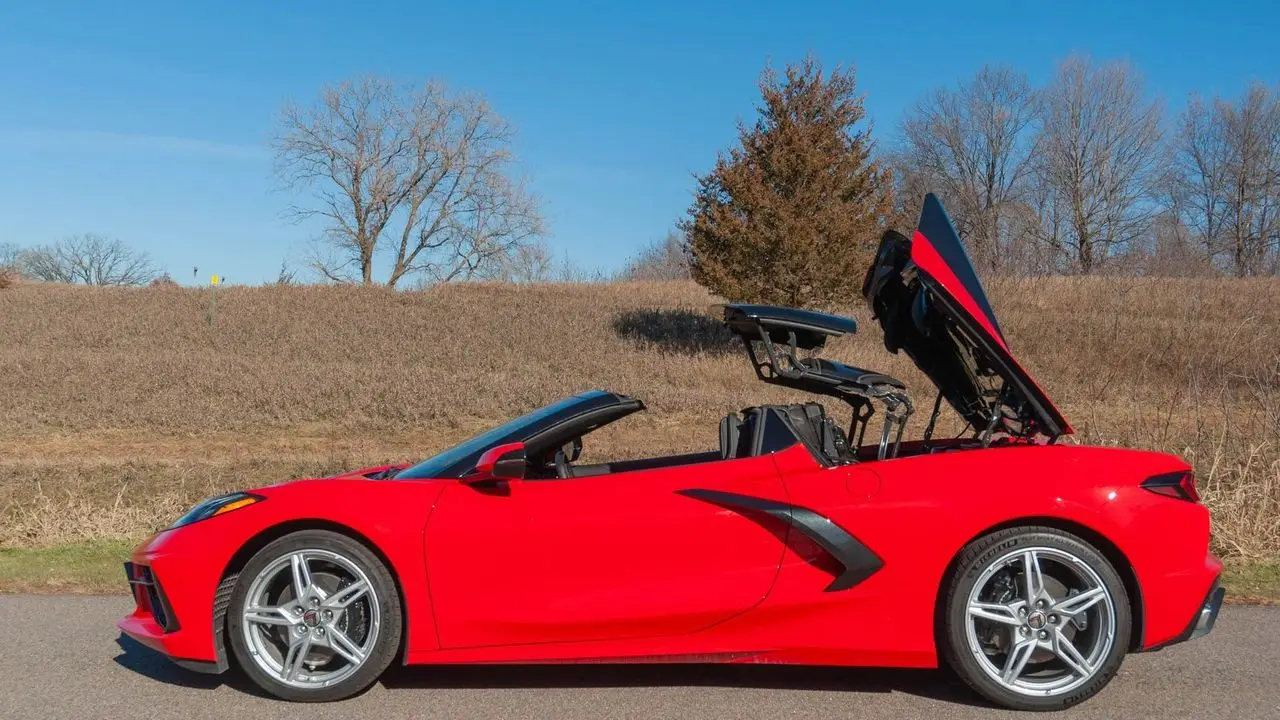
    Convertible production kicked off in early August 2020 at Bowling Green, just weeks after the COVID shutdowns had idled the plant and scrambled supplier schedules. Chevrolet had to re-qualify parts flow, retrain crews, and add extra quality checks for the new six-motor power hardtop—its hinges, seals, and sensors—while still catching up on coupe demand. The C8 became the first Corvette with a factory power-folding hardtop, dropping in about 16 seconds at up to 30 mph, with an independent rear glass and the two-trunk layout intact (frunk + rear for real luggage). The mechanism adds roughly 100 pounds, but the mid-engine structure preserves rigidity and keeps performance within a blink of the coupe—trading little speed for a lot of everyday usability. The bet paid off: by the next model year, the hardtop convertible would make up about 42% of C8 production, proving the packaging was exactly what buyers wanted.
    Convertible production kicked off in early August 2020 at Bowling Green, just weeks after the COVID shutdowns had idled the plant and scrambled supplier schedules. Chevrolet had to re-qualify parts flow, retrain crews, and add extra quality checks for the new six-motor power hardtop—its hinges, seals, and sensors—while still catching up on coupe demand. The C8 became the first Corvette with a factory power-folding hardtop, dropping in about 16 seconds at up to 30 mph, with an independent rear glass and the two-trunk layout intact (frunk + rear for real luggage). The mechanism adds roughly 100 pounds, but the mid-engine structure preserves rigidity and keeps performance within a blink of the coupe—trading little speed for a lot of everyday usability. The bet paid off: by the next model year, the hardtop convertible would make up about 42% of C8 production, proving the packaging was exactly what buyers wanted.

    By late summer, Chevrolet started leveling with customers: some 2020 sold orders would be moved to 2021. The base price held, but a few options—Z51 pieces, Front Lift, certain wheels—carried 2021 pricing when those builds flipped model years. On forums and in inboxes, it stung, but the intent was straightforward: finish the first-year cars you can, secure parts, and get the rest built under a 2021 VIN before momentum is lost.

    The numbers tell you how compressed 2020 really was: 20,368 total Stingrays built for the inaugural year (16,787 coupes, 3,581 convertibles), versus 26,216 for 2021 after the line stabilized. Chevrolet and local media telegraphed the baton pass in plain language that spring—close out 2020 early; build the 2021s and keep the line moving—and that’s exactly what happened. In practice, 2021 became the C8’s first full-throttle production year, the moment demand that had backed up behind a strike and a pandemic finally met sustained supply.
    Supply-chain turbulence turned Bowling Green into a stop-start operation. To keep promises realistic, Chevrolet halted new sold orders on March 26, 2021, then canceled the June allocation cycle, concentrating on building only orders already at status 3000 or higher. It wasn’t ideal, but it kept momentum alive and set up a clean handoff to 2022.
    Supply-chain turbulence turned Bowling Green into a stop-start operation. To keep promises realistic, Chevrolet halted new sold orders on March 26, 2021, then canceled the June allocation cycle, concentrating on building only orders already at status 3000 or higher. It wasn’t ideal, but it kept momentum alive and set up a clean handoff to 2022.

    Even then, headwinds lingered. As 2021 wore on, unplanned downtime and parts constraints forced GM to do what it had avoided the year before: suspend new sold orders for 2021 on March 26, 2021, and later cancel the June allocation cycle, with a promise to build only those orders already at status 3000 or higher. It wasn’t the victory lap anyone wanted, but it spared buyers a second round of false starts—and it closed the loop on a two-year launch defined more by resilience than by ribbon-cuttings.

    What reads like a simple paragraph in retrospect was, in the moment, a rolling triage: a strike that stole the runway, a virus that shut the runway, and a manufacturer determined to get the airplane airborne anyway. That’s why the 2021 Stingray feels like the true beginning. It wasn’t just “year two.” It was the year Chevrolet finally got to build the mid-engine Corvette at speed—and the year thousands of buyers who’d been stuck on the wrong side of timing finally got their keys.

    What Actually Changed for 2021 (and Why It Mattered)
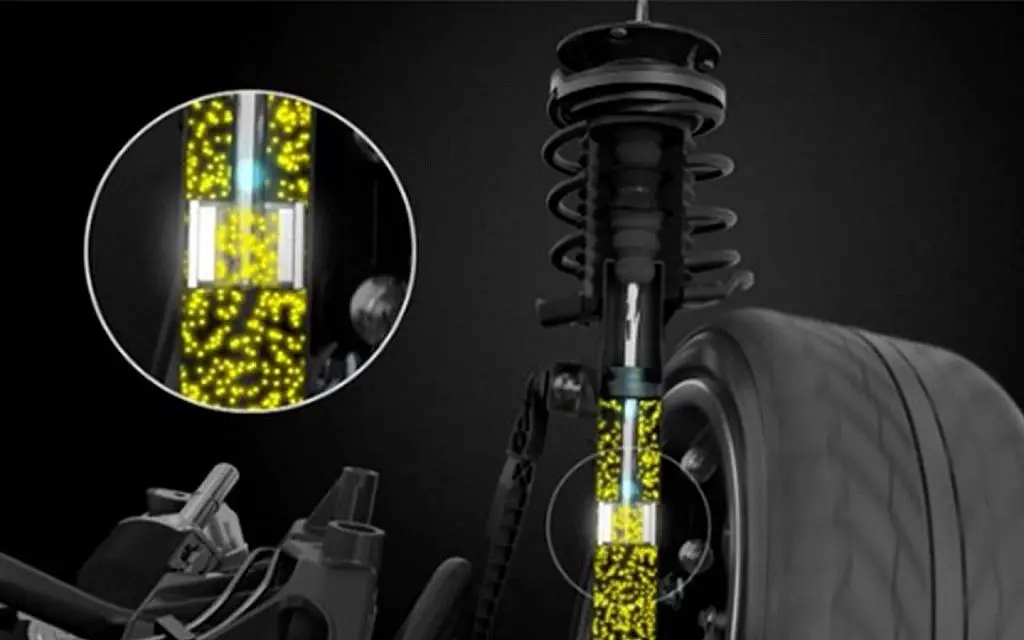
    Magnetic Ride Control in the C8 uses a magnetorheological fluid—microscopic metal particles suspended in oil—that stiffens instantly when an electric field is applied. Sensors read wheel and body motions in milliseconds, and the control unit alters damping on the fly to keep the car composed over broken pavement or curbing. For 2021, MRC wasn’t just tied to Z51: you could spec it standalone as FE2 (comfort-first bandwidth) or with Z51 as FE4 (track-ready body control)—one button, two personalities.
    Magnetic Ride Control in the C8 uses a magnetorheological fluid—microscopic metal particles suspended in oil—that stiffens instantly when an electric field is applied. Sensors read wheel and body motions in milliseconds, and the control unit alters damping on the fly to keep the car composed over broken pavement or curbing. For 2021, MRC wasn’t just tied to Z51: you could spec it standalone as FE2 (comfort-first bandwidth) or with Z51 as FE4 (track-ready body control)—one button, two personalities.

    Chevrolet smartest move for year two wasn’t a flashy horsepower bump—it was discipline. By holding the line at launch—$59,995 for the coupe and $67,495 for the hardtop convertible, destination included—the team protected the C8’s value story while spending effort where owners actually live: ride quality, daily tech, and thoughtful customization. The headline example is Magnetic Selective Ride Control uncoupled from Z51. In 2020, those fourth-gen magnetorheological dampers were essentially a track-rat ticket; in 2021, FE2 let you spec the magic without the rest of the performance bundle. The hardware itself is deeply clever: a fluid seeded with microscopic iron particles flows through electronically controlled valves; when the controller sends current, the particles align and thicken the fluid, stiffening the damper in milliseconds. Wheel and body sensors continuously feed that controller, so Tour can breathe over broken pavement, Sport trims out secondary motions, and Track locks the car down with the kind of body control that makes mid-engine geometry feel inevitable. Owners could now build two very different Corvettes off the same core—one tuned for long, quiet miles and another eager for curbing—without giving up the essential character either way.

    The cabin updates were small on paper and big in practice. Wireless Apple CarPlay and Android Auto removed the last cable from a driver-centric cockpit where real estate matters, turning the phone from a dangling accessory into a background utility that just works. The drive-mode visualization matured from “menu” to “mindset,” with clearer graphics that show what’s changing as you roll the mode wheel—steering effort, throttle mapping, exhaust, eLSD behavior, and, if you’ve chosen MRC, damping character. Flip into the new track-spec digital tach and the cluster prioritizes the LT2’s sweep and shift cues at a glance—exactly what you want the moment your world narrows to apexes and brake markers. All of this layers perfectly with Z-Mode, the one-button preset that lets you save your own blend of chassis and powertrain personality; it’s how owners made “their” C8 feel instant every time they climbed in.
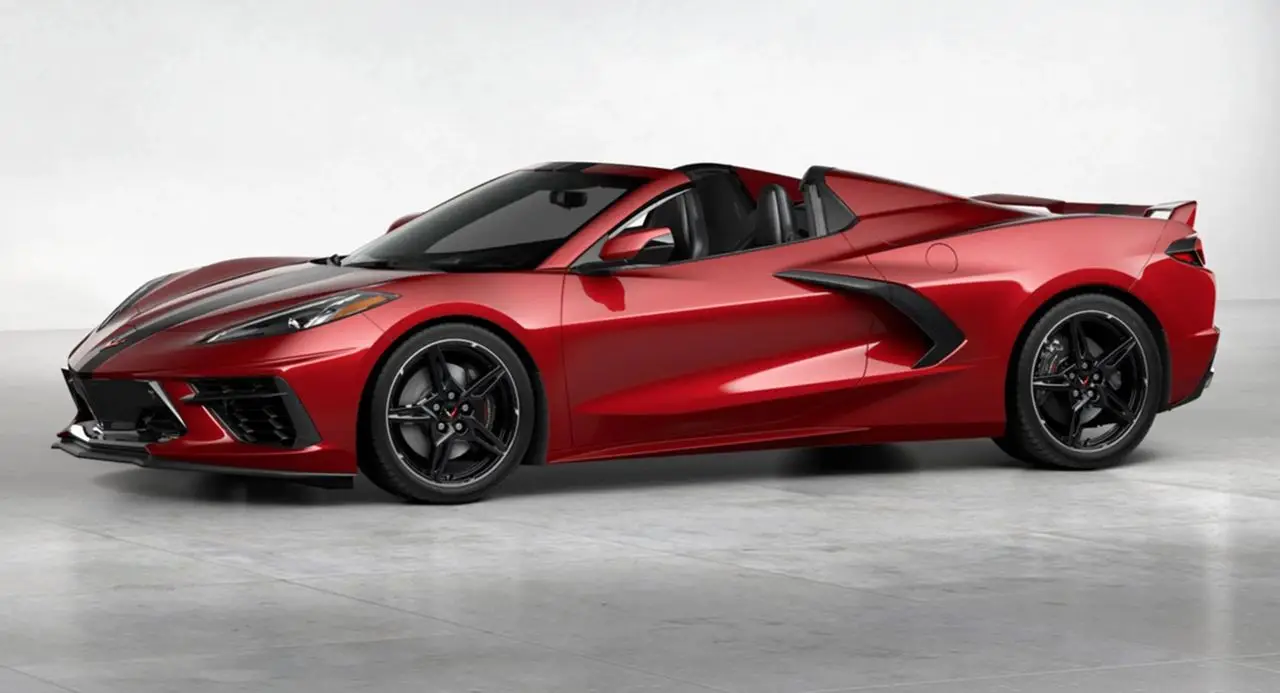
    New-for-2021 Red Mist Metallic Tintcoat—a deep tri-coat that replaced Long Beach Red and instantly became a top-three C8 color, showing off the Stingray’s sharp surfacing with a candy-like glow.
    New-for-2021 Red Mist Metallic Tintcoat—a deep tri-coat that replaced Long Beach Red and instantly became a top-three C8 color, showing off the Stingray’s sharp surfacing with a candy-like glow.

    Outside, Chevrolet treated the C8 like the design statement it is. Red Mist Metallic Tintcoat didn’t just replace Long Beach Red—it brought a deep, candy-like glow that rides the C8’s hard creases and long highlights. Silver Flare Metallic gave buyers a high-flake silver that pops under LEDs and never looks flat in shade, a subtle nod to the car’s aero-carved surfacing. Factory graphics finally matched the attitude: full-length dual stripes in bold primaries and Stinger accents that trace the Carbon Flash nacelles. The message was clear—you didn’t have to go aftermarket to make a Stingray look like your Stingray.
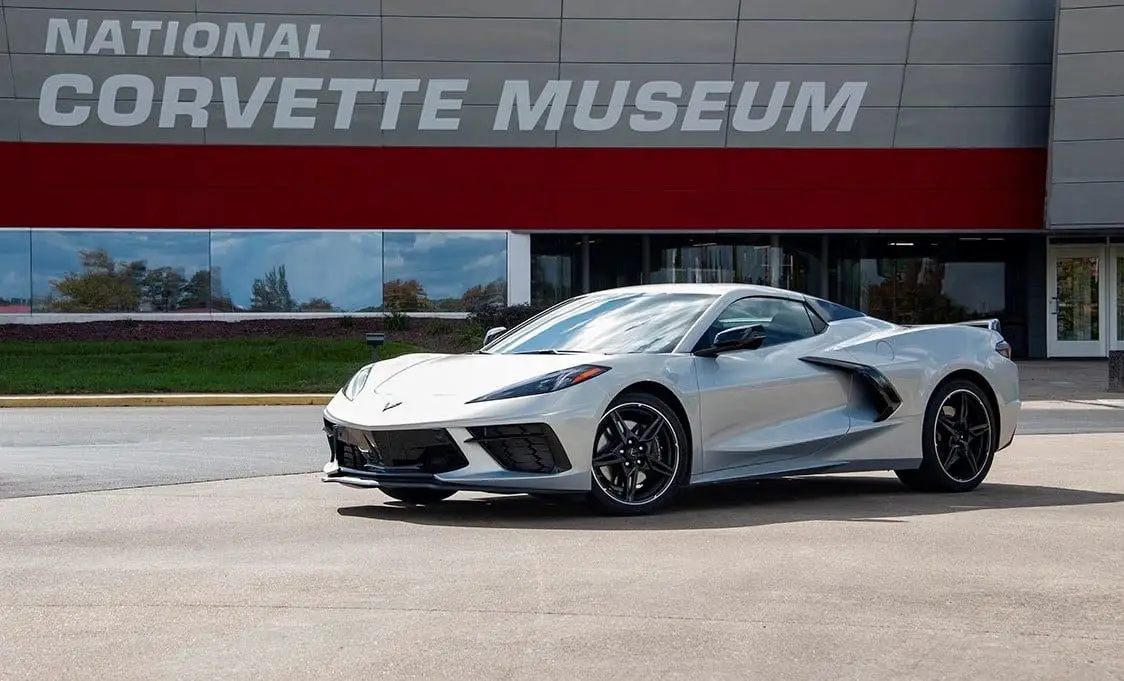
    In addition to Red Mist Metallic (seen above), 2021 introduced Silver Flare Metallic—a high-flake, cooler-toned replacement for Blade Silver that makes the C8’s sharp surfacing pop under sun or LED. Shown here at the National Corvette Museum, it delivers a liquid-metal sheen without reading flat gray.
    In addition to Red Mist Metallic (seen above), 2021 introduced Silver Flare Metallic—a high-flake, cooler-toned replacement for Blade Silver that makes the C8’s sharp surfacing pop under sun or LED. Shown here at the National Corvette Museum, it delivers a liquid-metal sheen without reading flat gray.

    Safety and habit-forming UX got the same intentional treatment. Buckle to Drive is the sort of feature you barely notice after day two, but it quietly changes behavior: if the driver’s belt isn’t latched, the car briefly locks out the shift from Park. It’s selectable, integrates with Teen Driver, and shows how Chevrolet used software to make good habits the path of least resistance rather than an admonition on a sticker.
    2021 C8 Front Lift with memory—tap once and the nose rises ~40 mm in about three seconds; save the spot and it auto-lifts at up to 1,000 GPS-tagged locations (driveways, speed humps, shop aprons). No more scraping the front splitter.
    2021 C8 Front Lift with memory—tap once and the nose rises ~40 mm in about three seconds; save the spot and it auto-lifts at up to 1,000 GPS-tagged locations (driveways, speed humps, shop aprons). No more scraping the front splitter.

    And none of this was brochure theater. The factory Front Lift with memory solved the one anxiety every low-nose, mid-engine owner shares: approach angles. Tap the switch and the nose rises roughly 40 mm in a couple of seconds; tell it to remember, and the system geo-tags up to 1,000 locations. From then on, your Corvette quietly takes care of itself—your steep driveway at dawn, that notorious speed hump by the coffee shop, the shop apron you visit every Saturday—no fumbling for a button, no white-knuckle diagonals. It’s a small interaction that changes how and where you use the car, turning “supercar stance” into “everyday confidence.”

    Taken together, the 2021 changes read like a values statement. Chevrolet didn’t chase headlines; it refined ownership. The C8 stayed ferociously quick and scalpel-precise when you asked for it, but it became calmer, cleaner, and more intuitive in the spaces between the hero moments. That’s what a great second-year car does: it doesn’t rewrite the story—it makes the story easier to live every mile.

    The Performance Truth: What the Numbers Say
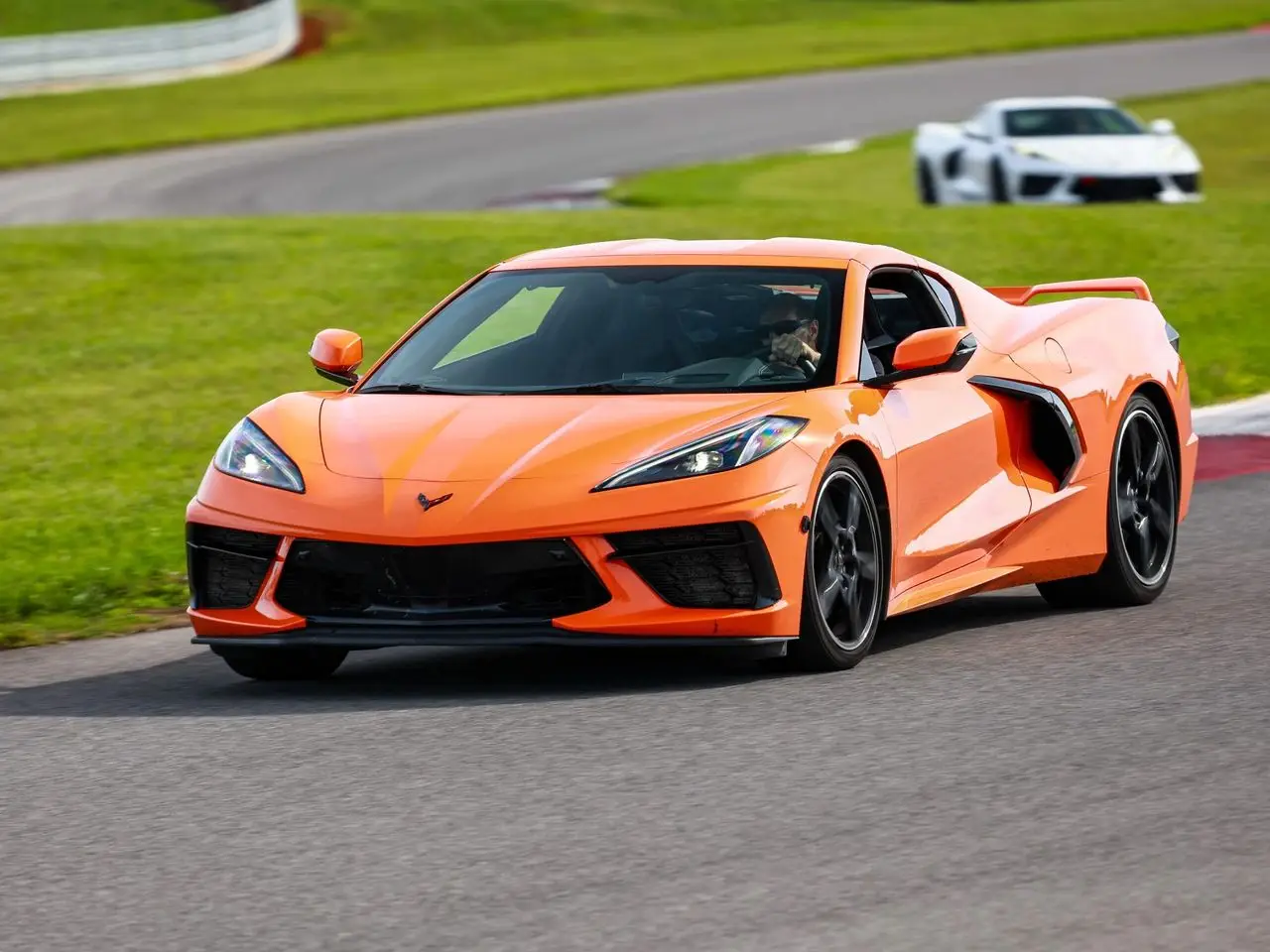
    Shot at NCM Motorsports Park—the 3.2-mile road course across from the National Corvette Museum in Bowling Green—this Sebring Orange Tintcoat Stingray underscores why the 2021 car’s numbers mattered on real pavement. With Z51 hardware, the mid-engine C8 routinely posted 0–60 in 2.8–2.9 sec and 11.1–11.2 sec quarters at 122–123 mph, and turned a 2:49.0 Lightning Lap at VIR—performance rooted in the LT2 + TR-9080 DCT combo, eLSD, Michelin PS4S tires, and FE4 Magnetic Ride Control calibration. The track is a stone’s throw from the assembly plant, making it a natural proving ground where the 2021’s updates—clearer Track tach/drive-mode visuals and the fine-tuned chassis—translated directly into confident laps. (Image courtesy of NCM Motorsports Park)
    Shot at NCM Motorsports Park—the 3.2-mile road course across from the National Corvette Museum in Bowling Green—this Sebring Orange Tintcoat Stingray underscores why the 2021 car’s numbers mattered on real pavement. With Z51 hardware, the mid-engine C8 routinely posted 0–60 in 2.8–2.9 sec and 11.1–11.2 sec quarters at 122–123 mph, and turned a 2:49.0 Lightning Lap at VIR—performance rooted in the LT2 + TR-9080 DCT combo, eLSD, Michelin PS4S tires, and FE4 Magnetic Ride Control calibration. The track is a stone’s throw from the assembly plant, making it a natural proving ground where the 2021’s updates—clearer Track tach/drive-mode visuals and the fine-tuned chassis—translated directly into confident laps. (Image courtesy of NCM Motorsports Park)

    If you came for the stopwatch, the numbers really are the point—and the reason they kept repeating is baked into the car. Chevrolet’s own spec drew the outline—0–60 mph in 2.9 seconds with Z51, 11.2 in the quarter, 194 mph v-max for the standard-aero car—and independent tests lived right on top of those claims. The Stingray launches like it means it because the mass sits where physics wants it: weight on the driven tires, a quick, progressive torque feed from the DCT, and an eLSD that meters thrust instead of wasting it in drama. Most outlets use a 1-foot rollout like a drag strip, which explains why you keep seeing 2.8–2.9 to 60 and 11.1–11.2 quarters from Z51 cars on summer rubber. The surprising part isn’t the first number you run; it’s how easy it is to run it again.

    Launch control is the quiet enabler. Stand on the brake, pin the throttle, and the LT2 stabilizes at an algorithmic launch rpm shaped by surface grip and mode. Come off the brake and the Tremec clutches “quick-fill” and then slip just enough to ride the tire at peak mu. The diff shuffles torque across the axle as the car takes a breath of yaw, so it leaves straight even on a less-than-perfect street. On VHT (a sticky, resin-based traction compound sprayed on drag-strip launch areas to increase grip), the thing is violent; on an average back road, it’s simply efficient. Either way, there’s no histrionics—just a short, hard shove toward the horizon.
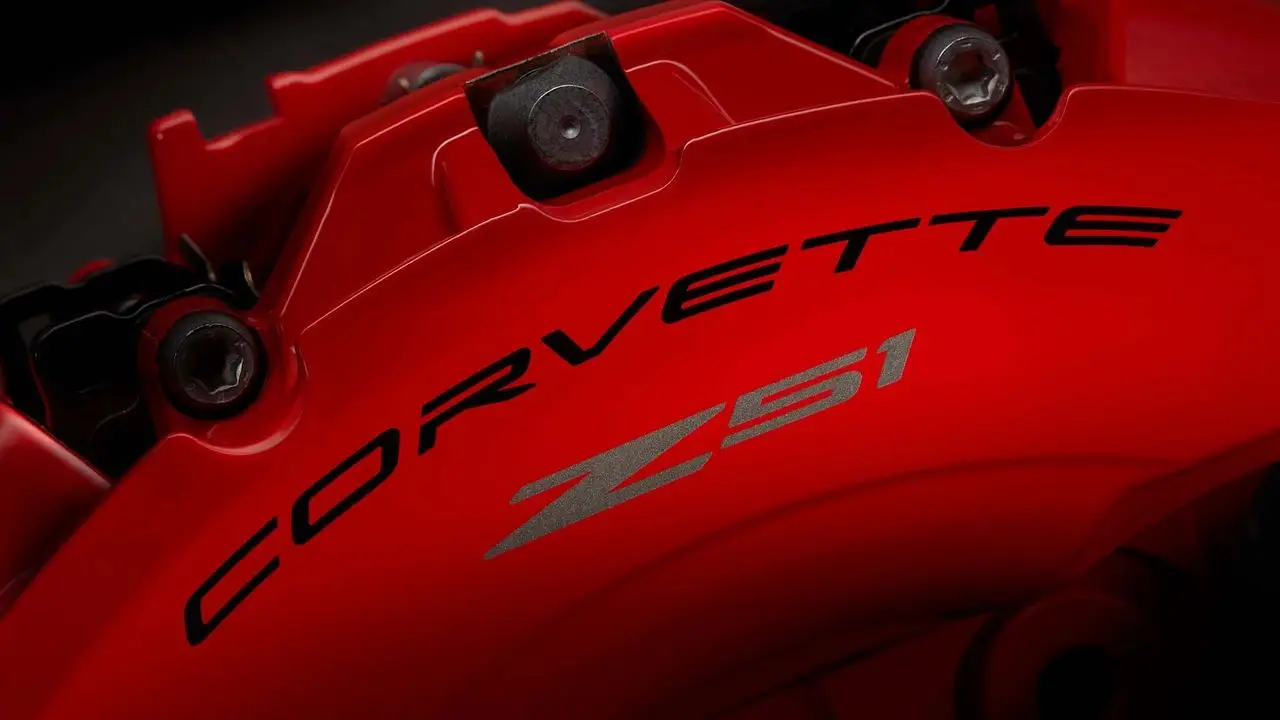
    Checking Z51 on a 2021 Stingray turned the C8 from quick to merciless. The package added Michelin Pilot Sport 4S tires, shorter performance gearing, larger brakes with extra cooling, a track-tuned suspension (FE3, or FE4 when paired with Magnetic Ride Control), an eLSD, and aero pieces that generated real downforce. With the included performance exhaust, output rose to 495 hp/470 lb-ft, and the combo delivered repeatable 2.8–2.9 s 0–60 blasts and 11.1–11.2 s quarter-miles. You gave up a slice of v-max versus the base aero, but you gained serious mid-corner grip, braking confidence, and honest lap time. (Image courtesy of Hot Rod Magazine)
    Checking Z51 on a 2021 Stingray turned the C8 from quick to merciless. The package added Michelin Pilot Sport 4S tires, shorter performance gearing, larger brakes with extra cooling, a track-tuned suspension (FE3, or FE4 when paired with Magnetic Ride Control), an eLSD, and aero pieces that generated real downforce. With the included performance exhaust, output rose to 495 hp/470 lb-ft, and the combo delivered repeatable 2.8–2.9 s 0–60 blasts and 11.1–11.2 s quarter-miles. You gave up a slice of v-max versus the base aero, but you gained serious mid-corner grip, braking confidence, and honest lap time. (Image courtesy of Hot Rod Magazine)

    Z51 posts the staunchest short-track times for predictable reasons. You trade a slice of v-max for what matters below triple digits: shorter effective gearing, stickier Michelin Pilot Sport 4S tires, bigger brakes and more cooling, and the aero that helps the chassis settle when the speed climbs. It’s exactly how owners use the car, which is why the package shows up on build sheets at a rate that would make a marketing VP blush. Base cars keep the long legs and the 194-mph bragging rights; Z51 owns the spaces between 30 and 130.

    The unsung star here is Tremec’s TR-9080 dual-clutch. It packages the clutches, gears, differential, and mechatronics in one compact transaxle tucked tight behind the LT2. Two wet clutches split duty—odds on one, evens on the other—so the next gear is always staged. When you pull a paddle (or when the Performance Shift Algorithm decides you’re driving as you should have), one clutch blends on as the other releases, the engine never falls off its cam, and you get that clean “single shove” upshift or crisp, rev-matched downshift that makes the car feel expensive. The unit runs a single high-spec fluid that cools, lubricates, and feeds the hydraulics, which simplifies thermal management; add the Z51 coolers, and you get a driveline that feels the same on lap twelve as it did on lap three.

    Year two sharpened the calibration in ways you feel every day. Creep is natural in a parking garage, hill-hold grabs with authority, and the box’s PSA logic in Sport/Track holds gears under load and downshifts under braking exactly where your right hand would have. Tie that to the improved track-spec tach graphic in the cluster, and you stop thinking about gear charts altogether; you’re just placing the car and letting the LT2 pull.
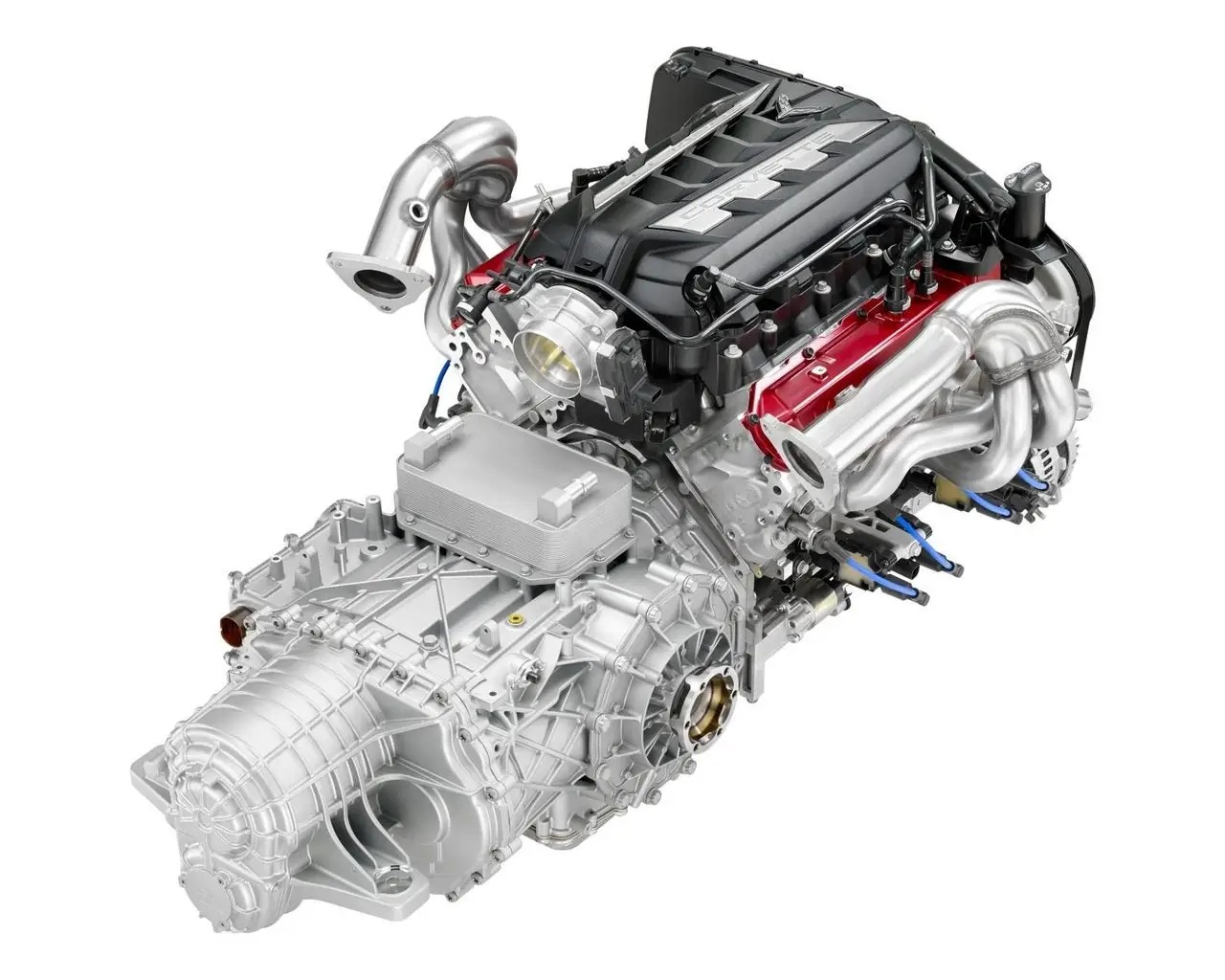
    Chevrolet’s LT2 is a 6.2-liter, naturally aspirated small-block engineered for the mid-engine layout: a low-mount dry-sump keeps the mass down and oiling rock-solid under sustained g-loads, while a high-flow intake and freer-breathing exhaust let it pull hard to redline. Output in the 2021 Stingray is 490 hp and 465 lb-ft, or 495 hp and 470 lb-ft with the performance exhaust/Z51 spec. Broad, linear torque makes real speed everywhere in the rev range, and paired with the TR-9080 dual-clutch, the LT2’s instant response translates directly into those repeatable sub-3-second 0–60 runs and low-11s quarters. It’s old-school displacement meeting modern breathing and control—no turbos, just clean, relentless shove. (Image courtesy of GM Media LLC)
    Chevrolet’s LT2 is a 6.2-liter, naturally aspirated small-block engineered for the mid-engine layout: a low-mount dry-sump keeps the mass down and oiling rock-solid under sustained g-loads, while a high-flow intake and freer-breathing exhaust let it pull hard to redline. Output in the 2021 Stingray is 490 hp and 465 lb-ft, or 495 hp and 470 lb-ft with the performance exhaust/Z51 spec. Broad, linear torque makes real speed everywhere in the rev range, and paired with the TR-9080 dual-clutch, the LT2’s instant response translates directly into those repeatable sub-3-second 0–60 runs and low-11s quarters. It’s old-school displacement meeting modern breathing and control—no turbos, just clean, relentless shove. (Image courtesy of GM Media LLC)

    That engine is the other half of the trick. The low-mount dry-sump and rearward placement help the car plant; the LT2’s broad, linear torque lets the DCT work any of the middle ratios without hunting. The soundtrack has theater at full chat, but the real magic is how invisible the powertrain is at three-tenths. Ruthless at ten-tenths, unbothered the rest of the time—that duality is why the 2021 Stingray’s numbers weren’t one-off unicorn passes. They were the natural consequence of a layout that favors traction, a gearbox that never loses the thread, and a calibration that grew up nicely for year two.

    The Year of Headwinds: Microchips, Memos, and a Price Nudge
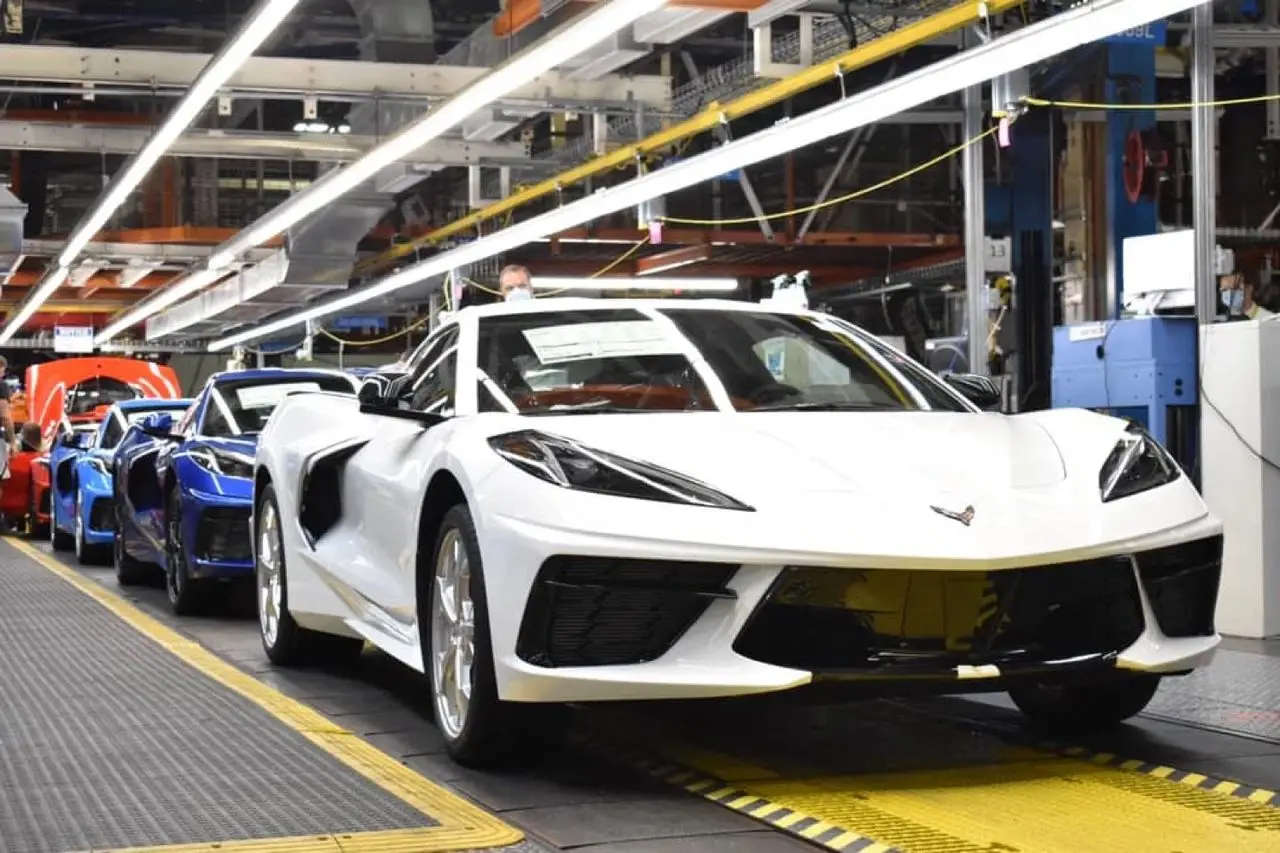
    ChatGPT said:  Bowling Green built 2021 Corvettes in sprints, with a start-stop cadence driven by supplier outages, freight bottlenecks, and even the February deep-freeze that choked deliveries. Specific components—most notably TR-9080 DCT and electronic modules—went short, prompting targeted shutdowns rather than stockpiling incomplete cars. To keep promises realistic, Chevrolet halted new sold orders on March 26 and later canceled the June allocation cycle. Summer brought the same pattern—run, pause, restart—compounded by logistics snarls and COVID-era absenteeism. Even so, the year closed at 26,216 Stingrays built, though customers saw shifting target weeks and tighter constraints on popular options.
    ChatGPT said: Bowling Green built 2021 Corvettes in sprints, with a start-stop cadence driven by supplier outages, freight bottlenecks, and even the February deep-freeze that choked deliveries. Specific components—most notably TR-9080 DCT and electronic modules—went short, prompting targeted shutdowns rather than stockpiling incomplete cars. To keep promises realistic, Chevrolet halted new sold orders on March 26 and later canceled the June allocation cycle. Summer brought the same pattern—run, pause, restart—compounded by logistics snarls and COVID-era absenteeism. Even so, the year closed at 26,216 Stingrays built, though customers saw shifting target weeks and tighter constraints on popular options.

    Now the hard part. The same 2021 that brought features also brought scarcity. The industry-wide semiconductor shortage collided with Corvette’s demand curve; internal memos landed; allocation math hardened. On March 25, 2021, GM told dealers to stop taking new orders for MY21 Stingrays. The car remained buildable for those already in the system, especially those at Event Code 3000 (accepted by production control), but for others, it meant rolling to 2022. Then GM canceled the June 2021 allocation cycle altogether, effectively calling the model year.

    Chevrolet held the line at launch, but the math caught up. On March 1, 2021, the base MSRP moved up $1,000, nudging the coupe past the psychological $60K mark. For customers already deep in the order pipeline, many dealers honored price protection tied to status codes; for shoppers still waiting on allocation, the bump simply became the new floor. Chevy’s explanation—rising supplier costs and a volatile logistics picture—tracked with the times, and it didn’t change the core value proposition of a mid-engine V-8 at this price. What it did change was sentiment: anyone who’d watched their place in line creep from winter into spring felt the sting of paying a little more for the same spec.

    The rest was pure supply and demand. Allocation stayed tight, production pulsed with parts interruptions, and market adjustments filled the gap between appetite and availability. By mid-year, it wasn’t uncommon to see $20,000–$75,000 add-ons posted right on dealer listings, sometimes accompanied by “first in line” promises or out-of-state shipping offers. Enthusiast forums split into camps—MSRP-only purists versus “pay to play” realists—while a handful of dealers earned folk-hero status for refusing ADMs and letting the queue run clean. Most buyers navigated it pragmatically: keep a deposit with a dealer you trust, know your status code by heart, and be ready to pounce when your allocation finally hit. In a year defined by scarcity, the pricing story wasn’t about greed so much as gravity—too many hands, not enough cars, and a halo product that everyone wanted right now.

    By the Numbers: Production, Take-Rates, Tires, and the Color Story
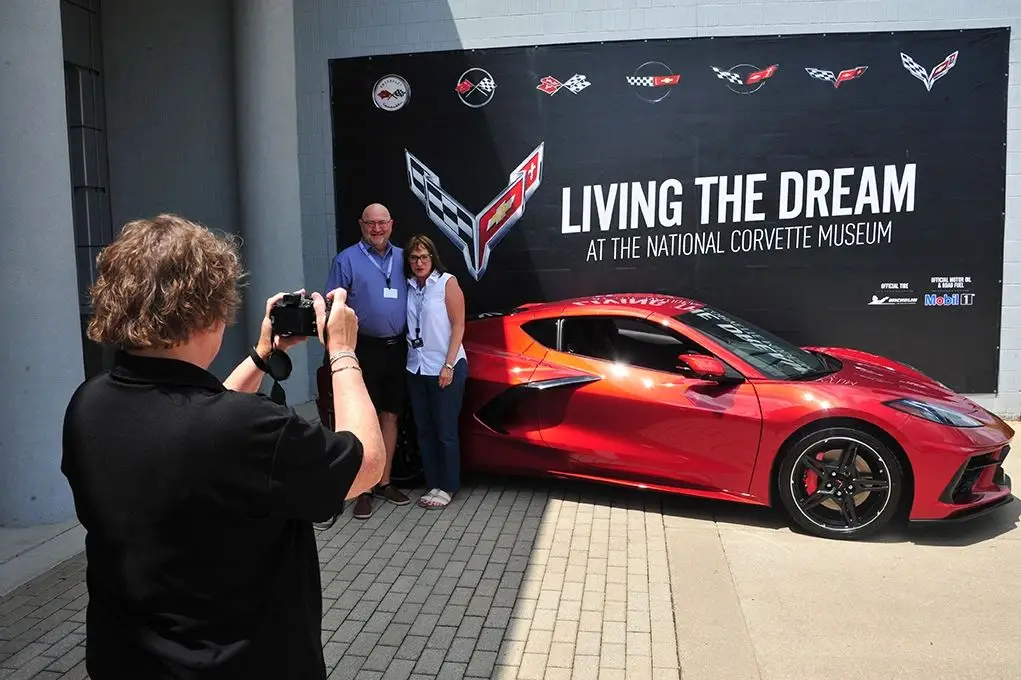
    The R8C Museum Delivery turned a Corvette handoff into a curated experience at the National Corvette Museum: owners were welcomed with signage, a VIP tour, and their car staged on Corvette Boulevard before a delivery host led a full orientation and formal presentation. Each R8C car received a door-jamb decal, a personalized dash and wall plaque, a one-year family museum membership, professional photos, and many buyers capped the day with lead/follow laps at NCM Motorsports Park. The program hit a milestone in 2021 when, on July 2, the museum celebrated its 14,000th R8C delivery—a Red Mist Stingray coupe handed to first-time Corvette owners John and Gina Engel of Omaha, Nebraska. (Image courtesy of the National Corvette Museum)
    The R8C Museum Delivery turned a Corvette handoff into a curated experience at the National Corvette Museum: owners were welcomed with signage, a VIP tour, and their car staged on Corvette Boulevard before a delivery host led a full orientation and formal presentation. Each R8C car received a door-jamb decal, a personalized dash and wall plaque, a one-year family museum membership, professional photos, and many buyers capped the day with lead/follow laps at NCM Motorsports Park. The program hit a milestone in 2021 when, on July 2, the museum celebrated its 14,000th R8C delivery—a Red Mist Stingray coupe handed to first-time Corvette owners John and Gina Engel of Omaha, Nebraska. (Image courtesy of the National Corvette Museum)

    The National Corvette Museum’s year-end ledger is the definitive snapshot of 2021. Total production landed at 26,216 Stingrays. Of those, 13,787 were coupes, and 12,429 were hardtop convertibles—an almost even split and, crucially, among the highest convertible shares of the modern era. The car went truly global: 23,573 stayed in the U.S., 1,887 went to Canada, 149 to Mexico, and 607 to other export markets. R8C Museum Delivery remained a flex for enthusiasts, with 1,387 cars delivered through the program.

    Option behavior told a clear story about how owners actually used their cars. The Z51 package appeared on 18,223 cars—about 69.5% of the run—and with it, the Michelin Pilot Sport 4S summer tire spec dominated. Magnetic Ride’s new freedom showed up in the ledger too: FE4 (Z51 with MRC) appeared 12,785 times, FE2 (MRC without Z51) on 3,419, and FE1 (standard) on 10,012 cars. Front Lift? Owners checked it 9,028 times—more than a third of the run—because life has curbs.

    The paint chart doubled as a heat map of Corvette culture. Torch Red led the line, with Arctic White and the newcomer Red Mist right behind. Silver Flare—the other new color—punched above its weight for a gray-silver, while Rapid Blue and Black continued to be safe harbors. However you chart it, 2021 didn’t play it safe: buyers explored.

    Living Within It: Cabin, Cargo, and the Everyday Supercar Brief
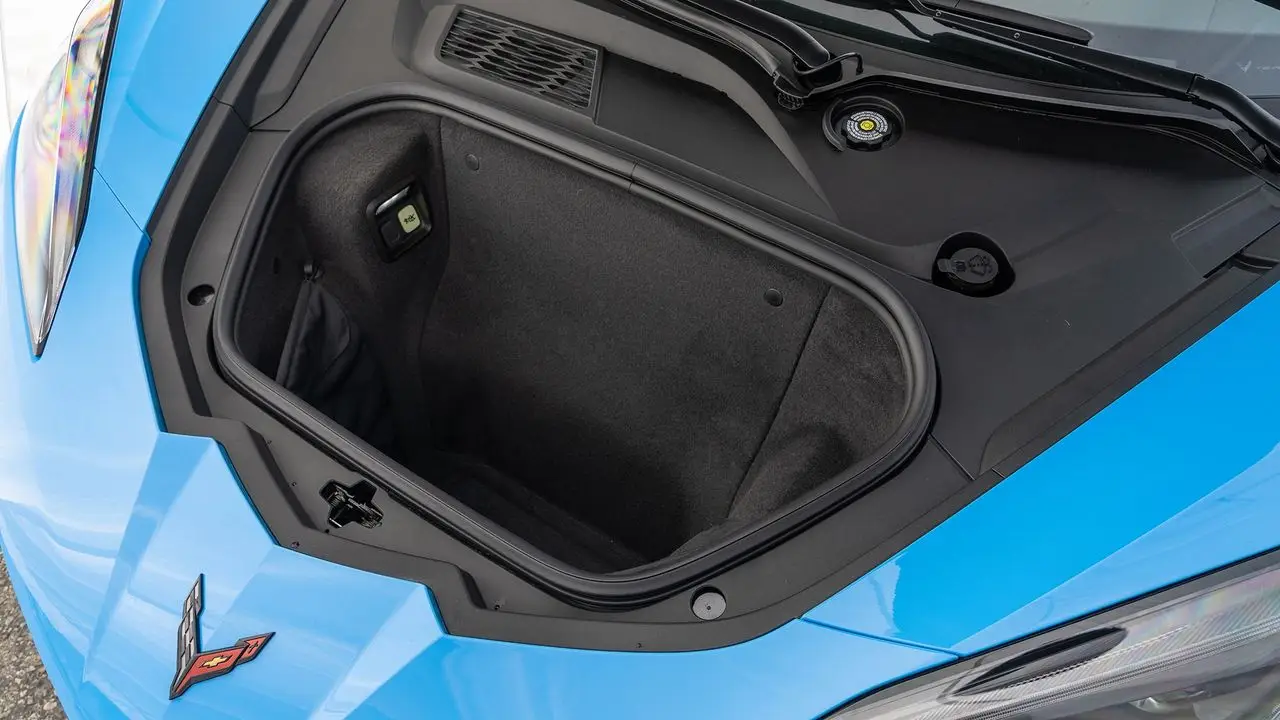
    Up front, the C8’s frunk is a deep, squared-off bin that easily swallows a roll-aboard and backpack—perfect when the coupe’s roof panel is riding in the rear. It’s lined and weather-sealed, with power open/close and an interior emergency release, so it’s as everyday-useful as any small hatchback trunk—just in the nose of a mid-engine Corvette. (Image courtesy of Motor Trend)
    Up front, the C8’s frunk is a deep, squared-off bin that easily swallows a roll-aboard and backpack—perfect when the coupe’s roof panel is riding in the rear. It’s lined and weather-sealed, with power open/close and an interior emergency release, so it’s as everyday-useful as any small hatchback trunk—just in the nose of a mid-engine Corvette. (Image courtesy of Motor Trend)

    Mid-engine or not, the Stingray still had to do chores—and it did. The two-trunk layout delivered a real 12.6 cu ft of usable space: a squared-off frunk that easily fit a roll-aboard and backpack, plus a rear trunk shaped for duffels or a golf bag on the diagonal. In the coupe, dropping the roof panel into the rear bay ate most of that aft volume, but the frunk stayed free, so a quick weekend away didn’t require Tetris. The hardtop convertible kept the same combined capacity thanks to smart packaging, so top-down owners didn’t have to travel light.

    Inside, the trim walk let you tune the cabin to your life. 1LT set the baseline with Mulan leather and straightforward Bose audio—clean, focused, no fluff—making a great canvas for people who planned to drive more than they planned to show. 2LT layered in richer touch points and the Bose Performance Series setup, plus the head-up display that makes long miles and spirited runs easier on your eyes. 3LT went full dress uniform with Nappa leather and stitched/wrapped surfaces across the dash, console, and doors, the kind of execution that made even a daily commute feel considered.
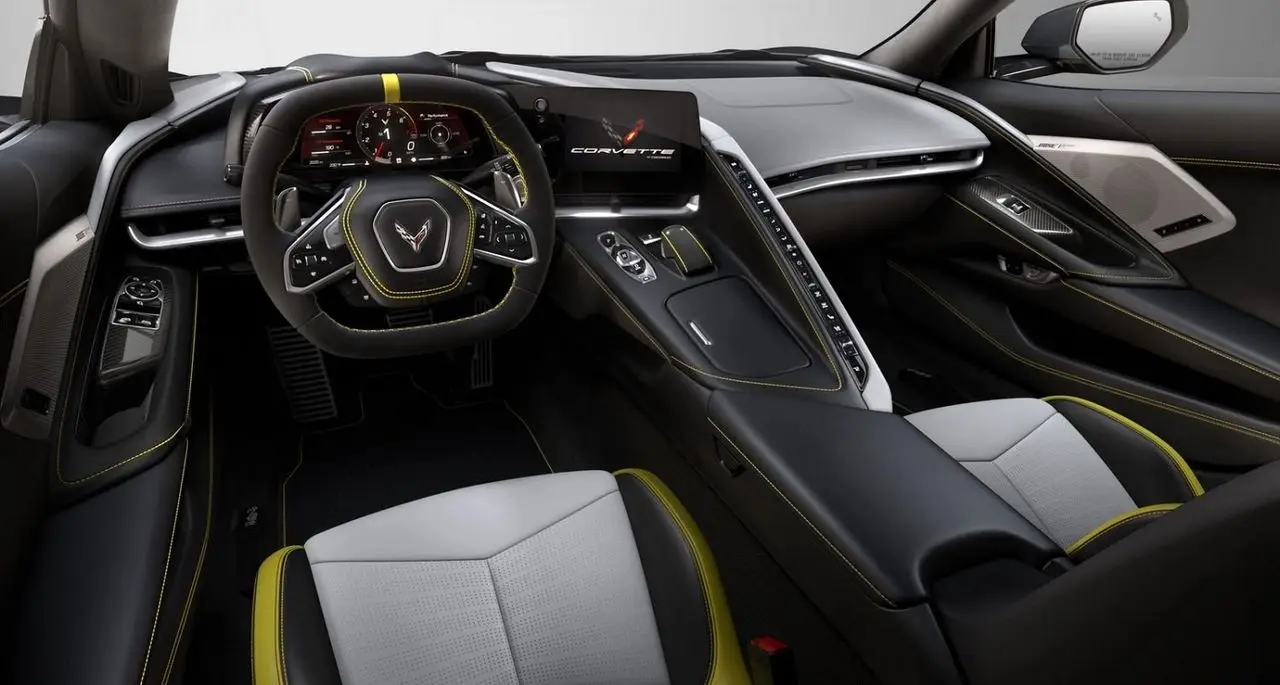
    The C8’s “fighter-cockpit” cabin wrapped the driver with a squared-off wheel, a high cowl of stitched leather, and that signature ridge of climate toggles dividing the seats. In 2021 it felt even smarter: the 12-inch cluster added a clearer Track tach and richer drive-mode graphics, while wireless Apple CarPlay/Android Auto cleaned up the console. Shown here in Sky Cool Gray/Yellow Strike with Bose Performance Series grilles, it nailed the brief—driver-first ergonomics, premium materials, and just enough theater to match the car’s pace.
    The C8’s “fighter-cockpit” cabin wrapped the driver with a squared-off wheel, a high cowl of stitched leather, and that signature ridge of climate toggles dividing the seats. In 2021 it felt even smarter: the 12-inch cluster added a clearer Track tach and richer drive-mode graphics, while wireless Apple CarPlay/Android Auto cleaned up the console. Shown here in Sky Cool Gray/Yellow Strike with Bose Performance Series grilles, it nailed the brief—driver-first ergonomics, premium materials, and just enough theater to match the car’s pace.

    Color and character were part of the story, too. The 2021 palette added Sky Cool Gray/Yellow Strike, a scheme that looked polarizing in the configurator but came alive in person—cool, modern base tones traced by precise yellow accents on the seats, console, and door panels. It paired beautifully with the year’s new exteriors—Red Mist Metallic Tintcoat and Silver Flare Metallic—whether you wanted a quiet, technical vibe or something that popped in late-day light.

    The point is simple: you could spec a C8 to be loud or low-key, track-tuned or boulevard-composed, and none of it diluted the car’s dynamic core. The storage was honest, the ergonomics worked, and the cabin scaled from purposeful to premium without losing the driver-first feel that made the 2021 Stingray more than just quick—it was easy to live with.

    Recalls and Maturity: OTA as a Safety Valve

    No modern car gets through a launch cycle without some field learning. The 2021 Stingray was part of a GM safety recall (21V-421) in June 2021 addressing an airbag indicator light behavior caused by a communications fault. The notable bit wasn’t just the scope—13,119 Corvettes included—but the remedy: a software update deliverable over-the-air via the car’s gateway module, with dealers as a fallback. For owners, it was a glimpse of how the C8’s electrical architecture could fix itself at home. Contextually, Chevrolet had already been through the 2020 “frunk release” FMVSS recall—so by 2021, both the hardware and the update playbook were better aligned.

    The Tornado That Bent the Next Chapter

    The scene in Mayfield, Kentucky after the December 11, 2021 tornado outbreak shows entire blocks leveled, historic buildings gutted, and neighborhoods reduced to splinters. The long-track, late-season storm became one of the deadliest and most destructive in Kentucky’s history, leaving dozens dead and thousands displaced across the western part of the state. In Mayfield, the courthouse district and downtown corridor suffered catastrophic damage as first responders and volunteers began days of search, rescue, and recovery. This image captures the scale of loss that would frame a long rebuild. (Image courtesy of the Atlantic)
    The scene in Mayfield, Kentucky after the December 11, 2021 tornado outbreak shows entire blocks leveled, historic buildings gutted, and neighborhoods reduced to splinters. The long-track, late-season storm became one of the deadliest and most destructive in Kentucky’s history, leaving dozens dead and thousands displaced across the western part of the state. In Mayfield, the courthouse district and downtown corridor suffered catastrophic damage as first responders and volunteers began days of search, rescue, and recovery. This image captures the scale of loss that would frame a long rebuild. (Image courtesy of the Atlantic)

    What happened on December 11, 2021 wasn’t just a footnote to a production schedule—it was a night Kentucky won’t forget. A violent tornado outbreak tore across the state, leveling neighborhoods in towns like Mayfield and Dawson Springs, killing dozens and injuring many more, and leaving thousands without homes or power. Warren County—home to Bowling Green Assembly and the National Corvette Museum—took a direct hit. Sirens sounded before dawn; debris fields crossed major roads; entire blocks were peeled open. Against that backdrop, the Corvette story is only one thread, but it helps explain why the moment still echoes for owners.
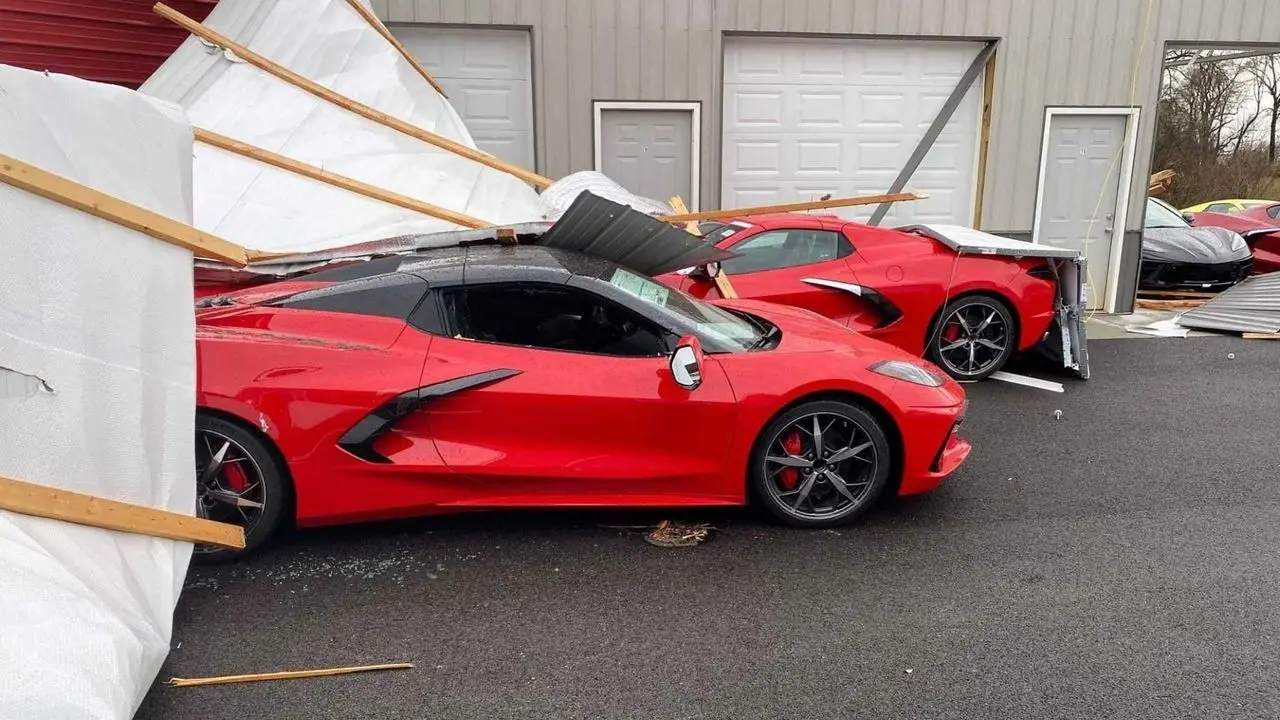
    The December 11, 2021 tornado outbreak that battered western Kentucky tore into Bowling Green, ripping roof panels and sheet metal from buildings and dumping debris onto brand-new 2021 Corvettes awaiting shipment. Dozens of cars suffered broken glass, dented bodywork, and water intrusion—damage severe enough that GM scrapped more than a hundred in-process Stingrays rather than attempt repairs, and paused production while the plant’s roof and entrances were fixed. Affected customers were re-slotted for new builds, and R8C deliveries were briefly put on hold as the Museum campus and Motorsports Park addressed storm damage. It was a sobering coda to the model year, and a reminder that even a well-run program lives in the path of real weather.
    The December 11, 2021 tornado outbreak that battered western Kentucky tore into Bowling Green, ripping roof panels and sheet metal from buildings and dumping debris onto brand-new 2021 Corvettes awaiting shipment. Dozens of cars suffered broken glass, dented bodywork, and water intrusion—damage severe enough that GM scrapped more than a hundred in-process Stingrays rather than attempt repairs, and paused production while the plant’s roof and entrances were fixed. Affected customers were re-slotted for new builds, and R8C deliveries were briefly put on hold as the Museum campus and Motorsports Park addressed storm damage. It was a sobering coda to the model year, and a reminder that even a well-run program lives in the path of real weather.

    At the plant, the storm ripped portions of the roof and damaged entrances, sprinklers, and utilities. Water and debris reached cars on the line; after inspections, Chevrolet deemed more than a hundred in-process Stingrays beyond safe repair and scrapped them. Production was stopped, the building was stabilized, and customers with affected build numbers were re-slotted into future weeks. Nobody at Bowling Green tried to “polish through” it; the message to dealers and buyers was pragmatic and clear—fix the facility, build safe cars, and make every customer whole.

    Across the street, the Museum fared better than you might expect from the aerial photos that morning. The main galleries were spared major structural harm, but campus clean-up was significant, and the NCM Motorsports Park took the brunt—roofs and outbuildings damaged, fencing and lighting down, and the track closed until repairs were complete. Staff who would normally be staging R8C deliveries spent that week securing the grounds, checking on members, and coordinating with city crews while the community at large dug out.

    If there was a silver lining, it was how quickly the Corvette ecosystem moved. GM facilities teams and local contractors worked through the holidays to stabilize the plant; museum volunteers and club members organized supply drives; owners offered lodging and truckloads of essentials. Production restarted only after safety systems and inspections were signed off, and the Museum returned to welcoming deliveries once the campus was ready. It was a stark reminder that even a well-oiled manufacturing program lives in the real world—and that the Corvette community extends far beyond an assembly line or a VIN list when that world is hurting.

    The Customer Journey: Allocations, Status Codes, and the Long Wait

    Ask any 2021 buyer about “Event Codes,” and you’ll get a masterclass. For many, 3000 status became the psychological finish line: once GM accepted the order into production control, the odds improved dramatically—even as that pivotal March 25 memo closed the door to new 2021 sold orders and the June allocation cancellation froze the last cycle. Add a modest MSRP bump and heavy markups at some stores, and you had a year where patience and dealer relationships mattered as much as spec sheets.

    Engineering, Explained Where It Counts

    Corvette people love the “why,” not just the “what.” So the essentials: the LT2’s low-mount dry-sump and rearward weight bias let the Stingray launch harder than any base Corvette before it. The TR-9080’s closely stacked ratios keep the 495-hp (with performance exhaust/Z51) small-block in its fat torque. The eLSD integrates seamlessly with Performance Traction Management, and MRC’s magnetorheological fluid gives the car its dual personality—calm on broken pavement, taut on curbing. None of it is theoretical; it’s why magazine numbers were repeatable, not unicorn one-offs.

    Strip away the drama, and the 2021 Stingray did exactly what a year-two car should do: it added usability, broadened choice, and kept the stopwatch honest, all while absorbing and navigating through one of the most chaotic supply climates in modern automotive history. The numbers back it up—26,216 units built in 2021; nearly 70% Z51; a convertible mix approaching half; thousands of owners voting with options for MRC and Front Lift. If 2020 proved the concept, 2021 proved the platform: that the mid-engine Corvette wasn’t a stunt, but a foundation that could evolve, scale, and satisfy, whether your use case was apexes or airport runs.

    Specifications (key 2021 Stingray data)

    • Engine: 6.2-L LT2 V-8 (490 hp/465 lb-ft; 495 hp/470 lb-ft with performance exhaust/Z51)
    • Transmission: Tremec TR-9080 8-speed dual-clutch (integrated diff), assembled in Wixom, MI
    • Official Performance: 0–60 mph 2.9 sec (Z51); quarter-mile 11.2 sec; top speed 194 mph (standard suspension)
    • Curb Weights (dry): Coupe 3,366 lb, Convertible 3,467 lb
    • Cargo Volume: 12.6 cu ft (combined frunk/trunk)
    • EPA: 15/27 mpg (city/hwy)
    • 2021 Production: 26,216 total (13,787 coupes; 12,429 convertibles)
    • Key Take-Rates: Z51 18,223 (~69.5%); MRC FE2 3,419; MRC FE4 12,785; Front Lift 9,028
    • Top Colors by Volume: Torch Red, Arctic White, Red Mist, Black, Rapid Blue, Silver Flare.

    Epilogue: Why 2021 STILL MATTERS TODAY
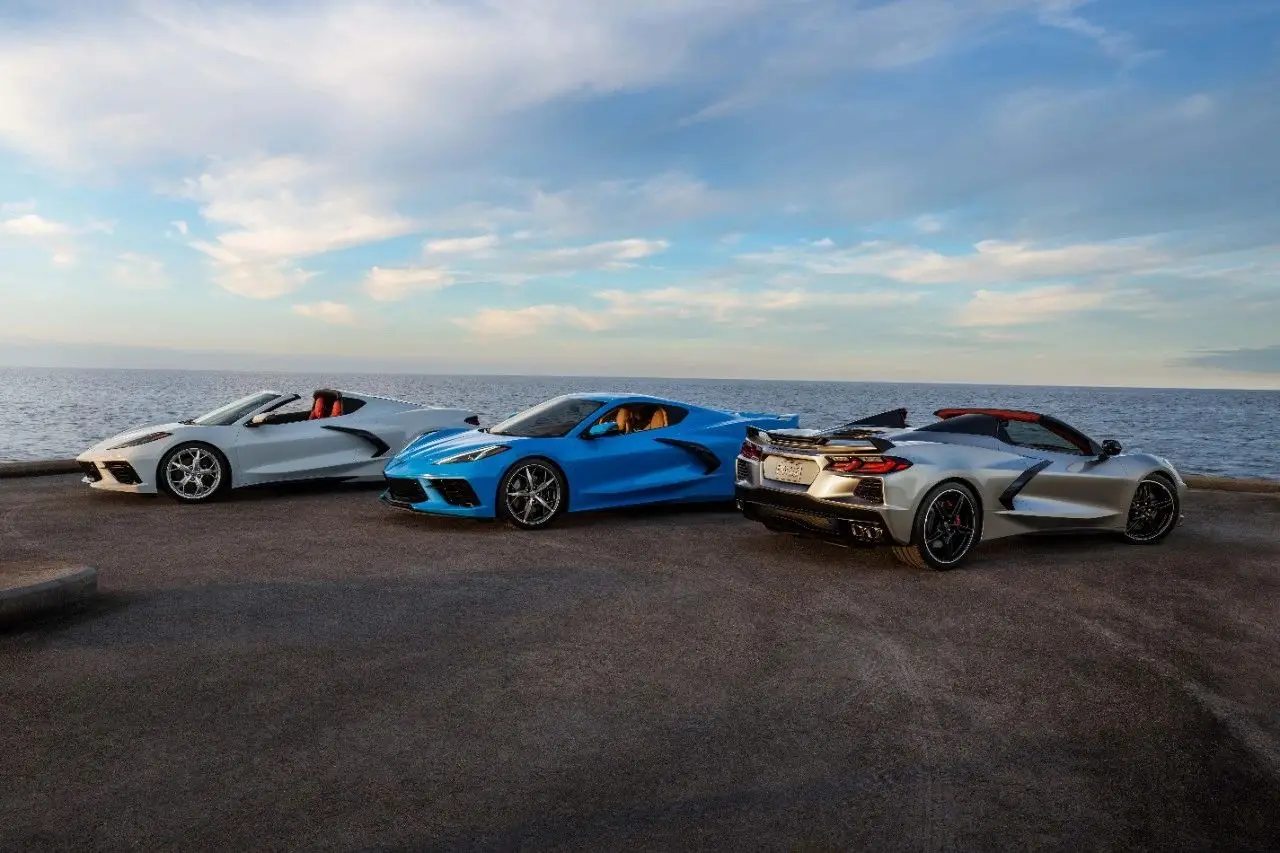
    The 2021 Corvette was the year the mid-engine gamble became everyday reality—refined ride (MRC available without Z51), cleaner tech (wireless CarPlay/Android Auto), and real choice from coupe to the wildly successful hardtop convertible. It kept supercar numbers—sub-3s to 60, low-11s in the quarter—while remaining a genuine road-trip partner with two trunks and an upscale cabin. New colors like Red Mist and Silver Flare signaled confidence, and a huge Z51 take rate proved buyers understood the hardware. In a market that only got pricier, 2021 locked in the C8’s identity: no-asterisk performance you could actually live with. (Image courtesy of GM Media)
    The 2021 Corvette was the year the mid-engine gamble became everyday reality—refined ride (MRC available without Z51), cleaner tech (wireless CarPlay/Android Auto), and real choice from coupe to the wildly successful hardtop convertible. It kept supercar numbers—sub-3s to 60, low-11s in the quarter—while remaining a genuine road-trip partner with two trunks and an upscale cabin. New colors like Red Mist and Silver Flare signaled confidence, and a huge Z51 take rate proved buyers understood the hardware. In a market that only got pricier, 2021 locked in the C8’s identity: no-asterisk performance you could actually live with. (Image courtesy of GM Media)

    The C8 story is already into spicy chapters—Z06s singing to 8,600 rpm, E-Rays demoing hybrid cleverness, ZR1 setting headlines on fire—but the 2021 Corvette Stingray is the volume pillar that made the rest possible. It normalized mid-engine Corvette ownership, proved the architecture’s daily-driver brief, and made good on the promise that supercar pace and blue-collar pragmatism can share the same VIN. In the data, the reviews, and the order banks that kept refilling, the verdict is the same: 2021 wasn’t just a mid-cycle year. It was the moment the mid-engine Corvette became the Corvette!
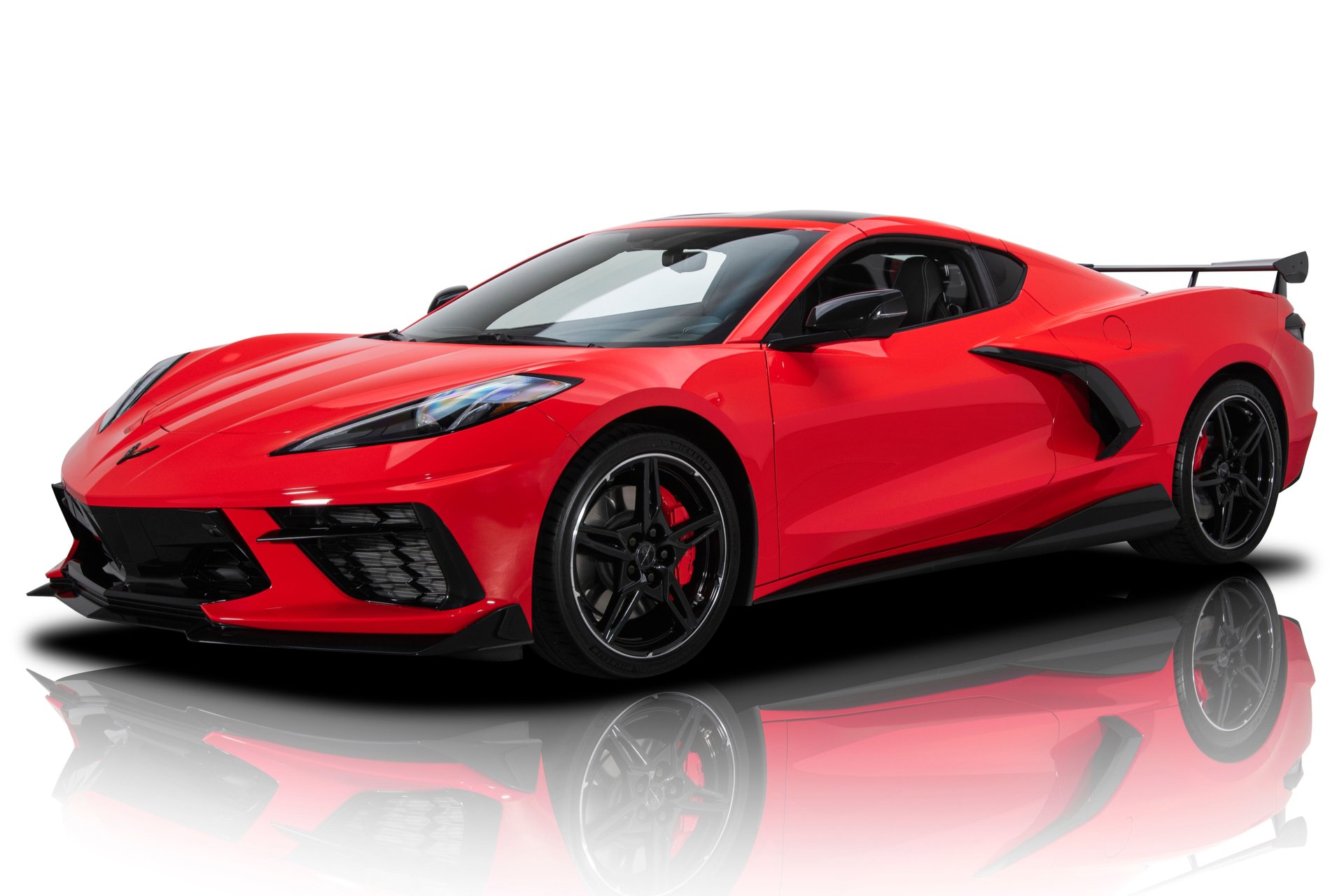
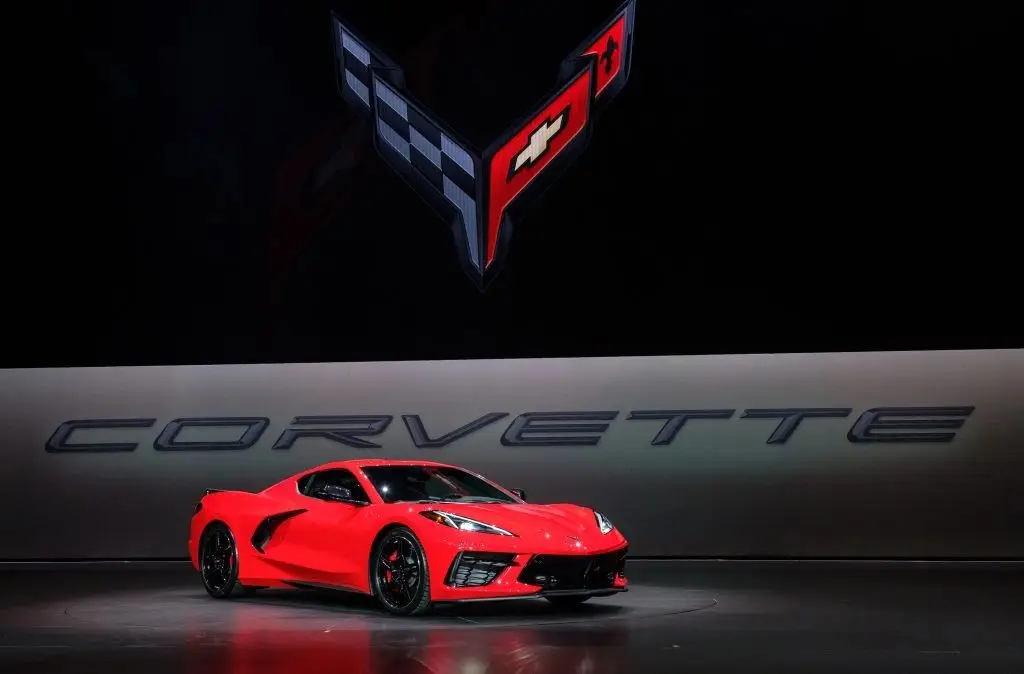
    The 2021 Corvette Stingray represents the moment Chevrolet’s mid-engine gamble fully found its stride. Building on the groundbreaking redesign introduced in 2020, the Stingray entered its sophomore year more refined, more attainable, and more confident in its role as a true world-class sports car. With supercar proportions, everyday usability, and performance that continued to challenge…

  • 2020 CORVETTE STINGRAY OVERVIEW

    2020 CORVETTE STINGRAY OVERVIEW

    On July 18, 2019, beneath the soaring arches of a World War II–era blimp hangar in Tustin, California, Chevrolet finally pulled the covers off a car that had existed for decades as rumor, prototype, and dream. The eighth-generation Corvette, designated C8, emerged into the spotlight as the first production mid-engine Corvette in history. It was a seismic moment — one that simultaneously honored Zora Arkus-Duntov’s long-held vision and rewrote the DNA of America’s sports car.

    For 66 years, Corvette had adhered to the same basic design formula: front-engine, rear-drive, small-block V-8. It was a recipe perfected over generations, honed on racetracks, refined in wind tunnels, and cherished on highways. But as Chief Engineer Tadge Juechter admitted bluntly, the C7 had taken that configuration as far as physics would allow. “We had taken (the) front-engine Corvette as far as it could go. The next level of performance demanded something new.” That something new was bold, risky, and unprecedented: a complete re-imagining of America’s favorite sports car.

    The 2020 Mid-Engine Corvette is revealed in Tustin, California on July 18, 2019.
    The 2020 Mid-Engine Corvette is revealed in Tustin, California on July 18, 2019.

    The timing of its arrival was almost surreal. What should have been a moment of unbroken triumph collided with real-world crises. A strike by the United Auto Workers in late 2019 delayed the start of production. Then, just as Bowling Green Assembly finally began building the C8 in February 2020, the COVID-19 pandemic shut down the world. Orders piled up. Dealers were overwhelmed. Buyers who had placed sizable deposits could only watch and wait.

    And yet, even as chaos swirled around it, the C8 Stingray emerged not only as a new Corvette, but as a declaration that Chevrolet could build a true supercar — and sell it for under $60,000.

    The Mid-Engine Dream Fulfilled

    The CERV I (left), the CERV II (right), and the CERV III were all early efforts by Corvette's engineers to create a mid-engine platform.  Zora Arkus-Duntov directly oversaw the creation of the CERV I & II models, while the CERV III was develop long after his retirement. (Image courtesy of GM Media LLC.)
    The CERV I (left), the CERV II (right), and the CERV III were all early efforts by Corvette’s engineers to create a mid-engine platform. Zora Arkus-Duntov directly oversaw the creation of the CERV I & II models, while the CERV III was develop long after his retirement. (Image courtesy of GM Media LLC.)

    To understand why the C8 mattered so deeply, one must trace Corvette history back through its most daring experiments. Zora Arkus-Duntov, the “Father of the Corvette,” had pushed for a mid-engine layout since the late 1950s. He believed it was the only way to keep Corvette competitive with Europe’s finest. Through the decades, GM teased enthusiasts with mid-engine prototypes: the CERV I in 1960, a rolling test bed for chassis concepts; the sleek CERV II in 1964, intended as a potential Le Mans contender; the radical XP-882 and XP-895 concepts of the early 1970s, which previewed layouts and body proportions that looked more Ferrari than Chevrolet. The 1977 Aerovette hinted at the exotic but never saw production. Even the CERV III of the late 1980s, with its twin-turbo V-8 and all-wheel drive, reminded fans of what could be — and what never would.

    But cost, tradition, and market positioning always intervened. Corvette was America’s attainable sports car, and Chevrolet wasn’t willing to gamble it on exotic architecture. Not until the limits of the front-engine layout were finally undeniable. The seventh-generation Corvette, the C7, had delivered staggering performance, but Juechter and his team knew they were boxed in. To move forward, the mid-engine leap could no longer be avoided.

    The Tustin Reveal

    Corvette owners, clubs, and organizations alike converged on the spacious hangar in Tustin, California, for the reveal of the 2020 Mid-Engine Corvette.
    Corvette owners, clubs, and organizations alike converged on the spacious hangar in Tustin, California, for the reveal of the 2020 Mid-Engine Corvette.

    The reveal itself was as theatrical as the car. A cavernous hangar, dramatic lighting, and a crowd of journalists and enthusiasts set the stage for what GM President Mark Reuss described as nothing less than Corvette’s rebirth. When the car rolled onto the stage, the audience gasped. Shorter hood, cockpit pushed dramatically forward, muscular haunches over massive rear tires — it was instantly clear this was no mere evolution.

    Chevrolet executives were quick to frame the shift. “Corvette has always represented the pinnacle of innovation and boundary-pushing at GM. The traditional front-engine vehicle reached its limits of performance, necessitating the new layout,” said Reuss. “In terms of comfort and fun, it still looks and feels like a Corvette, but drives better than any vehicle in Corvette history.”

    The most shocking moment of the night came at the end, when Chevrolet announced pricing. Base MSRP: $59,995. For a mid-engine car with performance figures that rivaled supercars ten times its price, the announcement sent shockwaves through the industry. While Porsche, Ferrari, and McLaren had long commanded six-figure sums for similar performance, Corvette once again held to its contract with enthusiasts: world-class performance at an attainable price.

    2020 CORVETTE Production Delays: Strikes, Shutdowns, and Restart

    Production of the 2020 C8 Mid-Engine Corvette halted in February 2020 as fear of the COVID pandemic spread like wildfire across the United States.  (Image courtesy of GM Media, LLC.)
    Production of the 2020 C8 Mid-Engine Corvette halted in February 2020 as fear of the COVID pandemic spread like wildfire across the United States. (Image courtesy of GM Media, LLC.)

    Even before the pandemic hit, the C8’s launch was complicated. A UAW strike in the fall of 2019 halted re-tooling of Bowling Green Assembly, delaying production until February 2020. Chevrolet marked the start of production with a tweet on February 3, accompanied by photos from the line. Buyers, some of whom had placed deposits the night of the reveal, finally had hope their cars were on the way.

    But barely a month later, COVID-19 forced General Motors to suspend operations. On March 18, 2020, the company announced that no more 2020 Corvette orders would be taken. Dealers were instructed to convert unbuilt orders into 2021 models. For a moment, it seemed the 2020 model year might become one of the shortest and rarest in Corvette history.

    By May, as case counts ebbed and the U.S. began reopening, Bowling Green cautiously restarted production. In August, the convertible variant entered assembly, proof that GM intended to honor its 2020 commitments. By September, reports surfaced of second shifts running deep into the night, with as many as 140 cars being built in a single day. In the end, 20,368 Corvettes were produced for 2020 — making it one of the rarest model years in modern Corvette history.

    A New Shape: Form Follows Function

    The C8’s styling was a revelation, but every angle was dictated by necessity. With the engine relocated behind the driver, the proportions shifted radically: a low hood, cabin thrust forward 16.5 inches, and wide rear quarters sculpted to manage airflow.

    Corvette Exterior Design Manager Kirk Bennion (Image courtesy of GM Media LLC.)
    Corvette Exterior Design Manager Kirk Bennion (Image courtesy of GM Media LLC.)

    Exterior Design Manager Kirk Bennion put it simply: “We worked very hard to incorporate low drag and manipulate downforce. Every line serves airflow, cooling, or stability.”

    The front end was defined by three large heat exchangers, channeling air to radiators and brakes. Massive side scoops funneled air to rear-mounted coolers. Underbody panels directed flow to generate stability, while the Z51 package added a rear spoiler capable of generating nearly 400 pounds of downforce.

    Despite the radical departure, Corvette DNA was preserved. Longtime design head Tom Peters described it best: “The new Corvette is the culmination of all that it has ever been, refined by all we’ve learned and imagined. Done correctly, something magic happens — it becomes timeless.”

    Distinctive cues marked the C8’s new era: low-profile LED headlights, hidden releases for doors and hatches, dual-element LED taillamps with animated turn signals, quad exhaust tips pushed to the outer edges, and a massive rear hatch that proudly displayed the LT2 engine through glass.

    Chevrolet offered 12 colors, including classics like Torch Red, Arctic White, and Black, alongside new hues like Rapid Blue, Zeus Bronze, and Accelerate Yellow. Torch Red proved dominant, accounting for a quarter of production, while Rapid Blue emerged as a fan favorite. Zeus Bronze, polarizing though it was, stood out as one of the rarest.

    Inside the Cockpit

    Interior of the 2020 Mid-Engine Corvette Stingray (Image courtesy of RK Motors)
    Interior of the 2020 Mid-Engine Corvette Stingray (Image courtesy of RK Motors)

    If the exterior was dramatic, the interior was revolutionary. Gone was the traditional American GT layout. In its place: a cockpit inspired by fighter jets. The steering wheel was squared off for improved sightlines, framing a 12-inch reconfigurable digital cluster. A narrow vertical strip of climate controls rose along the center console, recalling the switch stacks of aircraft cockpits.

    Materials were elevated throughout. Hand-stitched leather, aluminum and carbon-fiber trim, and stainless steel Bose speaker grilles replaced the plastics of previous generations. Buyers could choose from six interior themes — from Jet Black to Morello Red — and personalize further with six seatbelt colors and optional contrast stitching.

    Three seat options defined the experience. GT1 provided comfort for everyday use. GT2 blended long-distance touring support with racing cues, featuring carbon-fiber trim and dual-density foam. Competition Sport, the most aggressive, offered bolstering for track duty and materials inspired by racing harnesses and protective textiles.

    The overall effect was immersive. Drivers weren’t merely operating a machine; they were piloting it.

    The LT2: Jewel in the Center

    The Chevy LT2, a 6.2-liter small block V8 engine (Image courtesy of RK Motors)
    The Chevy LT2, a 6.2-liter small block V8 engine (Image courtesy of RK Motors)

    At the heart of the C8 was the LT2, a 6.2-liter small-block V-8 that represented both continuity and evolution. Rated at 490 horsepower and 465 lb-ft of torque in standard form — or 495 and 470 with the Z51 package — it was the most powerful base Corvette engine in history.

    For the first time, the base Corvette featured a dry-sump oiling system. Three scavenge pumps ensured lubrication even under sustained lateral loads beyond 1g, while also allowing the engine to be mounted lower in the chassis. The result: a reduced center of gravity and improved handling balance.

    Engineers treated the LT2 not just as a power plant but as a centerpiece. A 3.2-mm glass hatch displayed the engine, with details down to fasteners and heat shields designed for visual appeal. Jordan Lee, GM’s global chief engineer of small-block engines, summarized the philosophy: “Though now placed behind the driver, the LT2 gives the same visceral experience we all expect from Corvette.”

    The Dual-Clutch Transmission

    Tadge Juechter introduces the 2020 Corvette in Tustin, California.  (Image courtesy of GM Media LLC.)
    Tadge Juechter introduces the 2020 Corvette in Tustin, California. (Image courtesy of GM Media LLC.)

    For the first time in Corvette history, no manual was offered. Instead, Chevrolet partnered with Tremec to develop an eight-speed dual-clutch transmission. It was a controversial decision — Corvette had long been associated with manual shifting — but the reasoning was sound. The DCT delivered near-instant gear changes, maintained packaging efficiency, and provided both the convenience of an automatic and the engagement of paddle-shift control.

    Juechter explained: “The performance shift algorithms are so driver-focused, they can sense when you’re doing spirited driving — regardless of driving mode — and will hold lower gears longer for more throttle response.”

    Drivers also gained new tools. A double-paddle declutch feature allowed manual clutch disengagement. Drive modes expanded to include MyMode, which saved personalized settings, and Z Mode, named after Corvette’s storied performance packages, which provided instant access to aggressive configurations.

    Performance figures validated the choice: 0–60 mph in 2.8 seconds with Z51, quarter-mile runs in 11.2 seconds at 122 mph, and a top speed of 194 mph.

    The Chassis: Bedford Six and Beyond

    The 2020 Mid-Engine Corvette Stingray chassis assembly was aptly nicknamed the "Bedford Six"
    The 2020 Mid-Engine Corvette Stingray chassis assembly was aptly nicknamed the “Bedford Six”

    The C8’s chassis, designated Y2, was a clean-sheet design. At its core were six massive aluminum die-cast nodes, nicknamed the “Bedford Six” after the Indiana plant where they were produced. These structural elements tied the car together with remarkable rigidity, eliminating the need for a transverse leaf spring. In its place, Corvette engineers adopted coil-over suspension for greater flexibility and precision.

    Steering benefited from the forward-set cockpit, enabling a shorter, stiffer column and quicker ratio. The brake system adopted electronic eBoost assist, replacing vacuum with by-wire precision. Magnetic Ride Control, updated to version 4.0, became available for even faster damping response — adjusting every millisecond to road conditions.

    The result was a car that felt sharper, more responsive, and more stable than any Corvette before it.

    Practicality Intact

    2020 Corvette front-lift system
    2020 Corvette front-lift system

    Despite its exotic layout, the C8 remained faithful to Corvette’s promise of practicality. The coupe retained a removable targa roof. Luggage capacity, split between a front trunk and rear compartment, totaled 12.6 cubic feet — enough for two golf bags, a point Chevrolet proudly emphasized.

    The front-lift system, one of its most ingenious features, raised the nose 40 mm (1.6 inches) in less than three seconds and could memorize up to 1,000 GPS locations, automatically lifting at familiar obstacles like driveways or speed bumps. In Tour mode, ride comfort remained supple enough for cross-country travel. In every sense, this was still a Corvette you could live with daily.

    Convertible at the Kennedy Space Center

    2020 Corvette coupe (left), C8.R race car (middle) and the new 2020 C8 Convertible (right) on display at the Kennedy Space Center in Florida.
    2020 Corvette coupe (left), C8.R race car (middle) and the new 2020 C8 Convertible (right) on display at the Kennedy Space Center in Florida.

    Just months after the coupe’s reveal, Chevrolet unveiled the convertible version at NASA’s Kennedy Space Center, a nod to Corvette’s long association with astronauts. For the first time, Corvette offered a power-retractable hardtop. Folding in just 16 seconds at speeds up to 30 mph, it preserved both aerodynamics and visibility of the LT2 engine under glass.

    Reception and Demand

    The GT1, GT2 and Competition Sport Seats of the 2020 Corvette Stingray.
    The GT1, GT2 and Competition Sport Seats of the 2020 Corvette Stingray.

    Critical response was almost universally glowing. The C8 was praised for its performance, refinement, and value. It was named MotorTrend’s 2020 Car of the Year, with testers marveling at its stability and comfort at speed. Other outlets echoed the sentiment: the C8 wasn’t just a great Corvette — it was a world-class sports car.

    Owners embraced it with equal enthusiasm. Most opted for the Z51 Performance Package. The most popular configuration? A Torch Red coupe with Z51, GT2 seats, and the Performance Data Recorder. Nearly three-quarters of all 2020 Corvettes carried Z51, while more than half were ordered with front lift.

    Demand outstripped supply almost immediately. With production constrained by strikes and the pandemic, resale values skyrocketed, with many cars selling well over $100,000 on the secondary market.

    Legacy

    The 2020 Corvette Stingray was more than a generational change. It was a philosophical leap — one that fulfilled Zora Arkus-Duntov’s mid-engine dream, reset expectations of what Corvette could be, and established a foundation for future models like the Z06, E-Ray, and beyond.

    It launched into chaos, but it emerged triumphant. Against strikes, shutdowns, and global uncertainty, it proved that Corvette’s essence — value, ingenuity, and unrelenting performance — could survive even the most turbulent of times.

    Closing Thoughts

    The 2020 Mid-Engine Corvette Stingray (Image courtesy of RK Motors)
    The 2020 Mid-Engine Corvette Stingray (Image courtesy of RK Motors)

    To drive a 2020 Corvette today is to experience both engineering ambition and historical significance. It represents the end of one era and the beginning of another. Where earlier Corvettes proved America could build a sports car, the 2020 Corvette proved America could build a supercar — and sell it for the price of a loaded pickup.

    That is the enduring contract of the Corvette. Engine behind the driver, but heart still exactly where it belongs.

    The 2020 Corvette Stingray represented the most radical transformation (to date) in the model’s (then) 67-year history. With its long-anticipated mid-engine layout finally realized, Chevrolet didn’t merely reposition the engine—it redefined what a Corvette could be. The C8 blends supercar proportions, world-class performance, and everyday usability into a platform that shattered expectations and price barriers…