Tag: Chevy

  • 1965 Mako Shark II: Corvette’s Future Takes Shape

    1965 Mako Shark II: Corvette’s Future Takes Shape

    Few concept cars have left an imprint as lasting as the 1965 Mako Shark II. When General Motors unveiled the radical Corvette study in New York during the spring of 1965, the car did more than attract a crowd beneath the exhibition lights. It announced that Chevrolet was preparing to move beyond one of the most admired sports-car designs of its generation and enter a new era defined by exaggerated proportion, sculptural surfaces, and an altogether more aggressive interpretation of the Corvette identity.

    Internally designated XP-830, the Mako Shark II provided the public with an unusually direct glimpse of the design philosophy that would shape the third-generation Corvette. Its influence became unmistakable when the new production car appeared for 1968, but the XP-830 was never simply a disguised production proposal. It was more extreme than that—part prediction, part experiment, and part declaration of General Motors Styling Staff’s ability to transform an automobile into an object that communicated speed and power before its engine had even started.

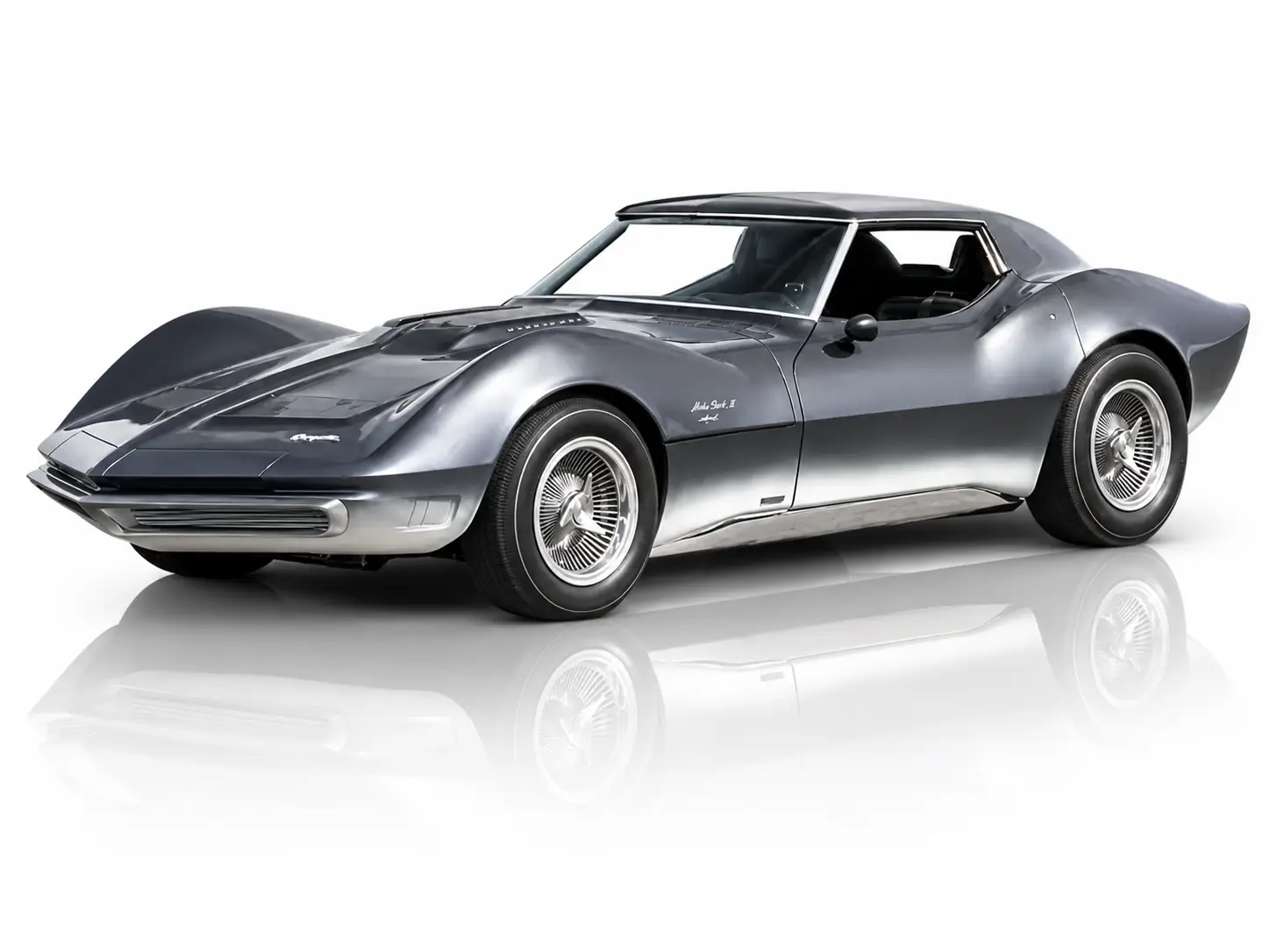
    Nothing about the 1965 Mako Shark II appeared passive. Its body seemed to stretch forward under its own momentum, beginning with a prow so thin and sharply drawn that it appeared to part the air rather than push against it. The body contracted dramatically through the doors, creating a narrow center section between high, muscular fenders. Behind the cockpit, the roof and rear body tapered inward before terminating in a tail unlike anything Chevrolet had previously offered.

    The 1965 Mako Shark II was more than a sensational concept car—it was Chevrolet’s dramatic preview of Corvette’s future. Developed under Bill Mitchell and shaped by Larry Shinoda’s team, the third-generation Corvette established the visual foundation for the third-generation Corvette while becoming an enduring icon in its own right, with its predatory proportions, sculpted bodywork, and marine-inspired finish. (Image courtesy of GM Media LLC.)

    Its effect depended less upon decoration than proportion. The Mako Shark II did not need racing stripes, elaborate brightwork, or external badging to explain itself. The height of the fenders, the depth of the waist, the length of the nose, and the tension carried through its surfaces made its intentions clear. It looked fast because the entire body appeared to have been pulled, compressed, and stretched by movement.

    The graduated finish intensified the illusion. Deep blue and blue-gray covered the upper surfaces before fading into metallic pewter and silver, then into a pale lower body. The progression echoed the natural countershading of a mako shark: dark across the back and lighter beneath. Rather than dividing the automobile with a conventional two-tone break, the color transition flowed across the body, visually connecting its roof, fenders, doors, and lower flanks.

    Under exhibition lighting, those colors changed constantly. The upper body could appear nearly black from one angle, then reveal blue and metallic gray as the light moved across it. The lighter lower surfaces sharpened the contraction through the doors and made the fenders appear heavier and more powerful. The paint was not merely applied to the form. It participated in the form, revealing contours that might otherwise have disappeared into shadow.

    That was what made the XP-830 so important. It was not simply another glamorous object created for an auto-show turntable. It was a promise that Corvette was preparing to leave the familiar behind. The future of America’s sports car was no longer being hinted at through minor styling exercises. It was being presented openly, dramatically, and without apology.

    America, Corvette, and the Need for Something New

    A Performance Culture in Full Acceleration

    The Mako Shark II appeared at a moment when American enthusiasm for performance was expanding far beyond the traditional sports-car market. By the middle of the 1960s, horsepower had become part of the nation’s popular vocabulary. Drag racing, cruising, engine modifications, performance-option packages, custom wheels, and increasingly powerful street cars were shaping how younger buyers understood the automobile.

    Detroit responded with remarkable speed. Pontiac’s GTO demonstrated that an intermediate car could become a cultural event when equipped with a large engine, aggressive marketing, and the right visual attitude. Oldsmobile’s 4-4-2 offered a more polished interpretation of the same formula, while Chrysler’s competition-oriented Hemi engines strengthened the company’s image through success on drag strips and stock-car circuits.

    1965 Ford GT40 Race Car
    The Ford GT40 emerged from Henry Ford II’s determination to challenge—and ultimately defeat—Ferrari at the 24 Hours of Le Mans. Developed as a purpose-built endurance racer, it carried America’s growing obsession with speed onto the international stage, where Ford sought not merely victory but technical and cultural supremacy. After early setbacks, the GT40 broke Ferrari’s six-year winning streak with a dominant 1-2-3 finish at Le Mans in 1966, beginning four consecutive Ford victories.

    Ford was simultaneously pursuing an international performance identity. Its GT40 program was created with the explicit goal of defeating Ferrari at the 24 Hours of Le Mans, committing American resources and engineering ambition to one of Europe’s most prestigious competitions. Although victory remained elusive when the Mako Shark II debuted, the effort demonstrated that Detroit’s performance ambitions were no longer confined to domestic showrooms or quarter-mile acceleration.

    The Ford Mustang, introduced in April 1964, added another dimension. Its runaway success proved that style, personalization, and youthful image could matter as much as mechanical sophistication. The Mustang did not need to be an uncompromising performance car in every configuration. It only needed to make buyers feel that they were purchasing something personal, modern, and connected to a faster-moving culture.

    These developments changed the relationship between styling and performance. A car’s speed was no longer communicated solely through an engine specification or a timed acceleration run. It was expressed through stance, proportion, hood treatments, body contours, wheel openings, instruments, exhaust outlets, and every other visual signal that suggested capability. Styling had become a form of horsepower in its own right.

    Chevrolet had already secured Corvette’s status with the second-generation Sting Ray, whose dramatic styling, independent rear suspension, and expanding performance options made it one of America’s most desirable sports cars. But as the mid-1960s market became increasingly driven by horsepower, racing credibility, and visual aggression, the next Corvette could not merely preserve that success—it had to push the design farther and give future buyers an even more dramatic vision of American performance. (Image credit: bringatrailer.com)

    That environment created both an opportunity and a problem for Corvette. Chevrolet already possessed one of the most visually arresting automobiles in America. The second-generation Sting Ray had arrived for 1963 with hidden headlamps, independent rear suspension, sharply defined fenders, a low beltline, and a fastback coupe body that looked unlike anything else in an American showroom. It gave Corvette a powerful identity rooted neither in imitation nor nostalgia.

    Success, however, creates its own burden. The Sting Ray had been so widely admired that its successor could not simply be different. It had to advance Corvette without appearing to abandon the qualities that had made the existing car successful. It needed to be more modern without becoming fashionable, more dramatic without becoming theatrical, and more aggressive without losing the visual discipline that gave the Sting Ray its authority.

    Bill Mitchell and the Evolution of the Shark

    Bill Mitchell (1912–1988), seen here with the 1959 Sting Ray Racer, was one of the most influential automotive designers in General Motors’ history. After succeeding Harley Earl as GM’s design chief, Mitchell steered the company toward lower, leaner, and more sculptural automobiles defined by strong proportions and restrained ornamentation. His personal passion for Corvette produced the Sting Ray Racer, the Mako Shark concepts, and the design direction that shaped both the C2 and C3 generations. Bold, demanding, and intensely competitive, Mitchell believed Corvette should always look as powerful and exciting as its performance promised. (Image courtesy of GM Media LLC.)

    Bill Mitchell understood that even the most celebrated design enjoyed only a limited period in which it could feel genuinely new. As vice president of General Motors Styling Staff, Mitchell had succeeded Harley Earl as GM’s dominant design authority, but his aesthetic preferences differed from those of his predecessor. Earl often favored broad forms, bright ornamentation, aerospace references, and carefully staged corporate spectacle. Mitchell retained the drama while pushing GM design toward automobiles that appeared lower, leaner, and more tightly controlled.

    Mitchell admired pronounced fenders, restrained trim, sharp body creases, long hoods, and surfaces that conveyed tension. He believed the wheels should remain visually important and that the body surrounding them should communicate motion rather than simply enclose mechanical components. Corvette became one of his most personal design interests because its low volume, fiberglass construction, and performance mission allowed him to explore ideas with greater freedom than he could on a conventional Chevrolet sedan.

    The 1959 Stingray Racer provided one of the clearest early expressions of that philosophy. Built using the chassis of the abandoned Corvette SS racing program, the Stingray Racer placed the occupants between pronounced wheel forms beneath a body that appeared exceptionally low and tightly drawn. Its influence was visible in the production Sting Ray that followed, although the road car necessarily adopted a more practical roof, cabin, and body structure.

    1961 XP-755 Mako Shark (I) Corvette Concept Car designed by Bill Mitchell.
    The original Mako Shark, designated XP-755, debuted in 1961 as Bill Mitchell’s dramatic interpretation of a Corvette shaped by the speed and predatory character of a mako shark he had caught off Florida. Developed under Mitchell’s direction, the concept combined a pointed nose, exposed side exhaust, sculpted fenders, and an iridescent blue upper body that gradually faded into white, reproducing the shark’s natural countershading. More than a spectacular show car, the first Mako Shark helped establish the marine-inspired design language that would influence the 1963 Sting Ray and later evolve into the far more radical Mako Shark II. (Image courtesy of GM Media LLC.)

    The original Mako Shark, designated XP-755, carried Mitchell’s interests in another direction. Created under his direction and closely associated with Larry Shinoda, the first Shark incorporated an extended pointed nose, a more theatrical roof treatment, exposed side pipes, a periscope-style rearview system, and the graduated blue-to-white finish that became inseparable from the Mako name.

    General Motors describes the original car’s basic lines and coloration as having been inspired by a mako shark Mitchell caught off the Florida coast. The dark upper body and pale underside reproduced the fish’s natural countershading, creating a connection between Corvette and one of the ocean’s fastest predators.

    The connection was more than a naming exercise. Mitchell saw in the shark a visual model for an automobile that could appear sleek without seeming delicate, organic without becoming soft, and predatory without relying upon excessive ornamentation. The XP-755 transformed the shark into a design philosophy—one in which a Corvette could resemble a living form shaped by speed.

    Larry Shinoda, a General Motors designer working under Bill Mitchell and one of the key figures shaping Corvette’s emerging visual identity, later remembered that the paint technology required to create the original fade was exceptionally challenging. He nevertheless called the finished car “a real show-stopper,” while emphasizing that the broader shark theme originated with Mitchell and that many of the ideas later associated with the Mako Shark II had already been explored on the first Mako Shark.

    Bill Mitchell had every reason to be proud of the Sting Ray Racer and the original Mako Shark. By 1964, however, he was already looking beyond both designs. The second-generation Corvette had established a powerful new identity, but Mitchell understood that success could not become an excuse for repetition. He wanted the next concept to advance the shark theme, push proportion and surface development much farther, and define an entirely new generation of America’s sports car. (Image courtesy of GM Media LLC.)

    By 1964, however, Mitchell was ready to move beyond both the XP-755 and the production Sting Ray. The C2 had established a powerful identity, and the first Mako Shark had amplified it into something more theatrical, but repeating either design would only diminish its impact. The next concept needed to reset expectations rather than refine an established formula.

    Mitchell wanted a car capable of interrupting the conversation. It needed to stand beneath the lights of an international automobile show and make the surrounding machinery appear suddenly conventional. It had to remain recognizably Corvette while presenting a shape more sculptural, more aggressive, and more advanced than anything Chevrolet had previously shown.

    The shark theme would continue, but the automobile carrying it would be entirely new.

    Creating the XP-830

    Studio III and the People Behind the Design

    The GM Design Center provided the setting in which some of Chevrolet’s most consequential experimental automobiles were conceived, but the Mako Shark II took shape in the more secluded Chevrolet Studio III. Led by Larry Shinoda, with John Schinella, Allen Young, Dennis Wright, and others contributing, the studio operated with unusual independence and close oversight from Bill Mitchell. That protected environment allowed the XP-830 team to pursue its extreme proportions and sculptural surfaces before production requirements began reshaping the concept into the third-generation Corvette. (Image credit: General Motors)

    The Mako Shark II emerged from one of the most accomplished automotive design organizations in the world. General Motors Styling Staff operated through a disciplined process in which sketches, renderings, scale models, full-size clay, fiberglass bodies, trim studies, engineering packages, and running prototypes gradually transformed an idea into a physical automobile.

    Designers established the theme and basic proportions, but clay modelers determined how those ideas behaved at full scale. Tape lines defined edges and transitions. Models were studied beneath controlled studio lighting and rolled outdoors so that executives could evaluate reflections, stance, and surface continuity under natural light. A change measured in fractions of an inch could determine whether a fender appeared powerful or merely heavy.

    Mitchell frequently protected important Corvette programs from the broader design organization. Restricted workspaces allowed small groups to pursue experimental ideas without exposing them prematurely to committees or divisional review. The best-known example was the original Studio X, the small basement operation used for advanced projects during the late 1950s, but the XP-830 was developed later in a separate Chevrolet Studio III housed in a warehouse across from the main GM Technical Center facilities.

    Chevrolet Studio III operated with much of the same protected, experimental spirit that had defined Bill Mitchell’s earlier Studio X. Physically separated from GM’s main Styling operations, the studio gave Larry Shinoda and his team room to develop advanced projects with fewer interruptions and less exposure to the broader corporate review process. That relative isolation encouraged bolder thinking and helped produce work ranging from the Mako Shark II to the Astro concepts, including the full-size clay shown here. (Image courtesy of GM Media LLC.)

    Larry Shinoda was placed in charge of Studio III, with John Schinella, then an assistant designer within Chevrolet Styling, serving as his principal assistant. Shinoda later identified Allen Young and Dennis Wright as two additional designers who “did a lot of the work.” Together, the group developed the Mako Shark II, the Astro concepts, the GS II-B, and the successful design proposal that helped shape the 1968 Corvette.

    That description is important because the 1965 Mako Shark II is too frequently presented as the uninterrupted work of a single designer. Mitchell supplied the authority, broad direction, and many of the essential instructions. Shinoda led the studio, interpreted Mitchell’s intentions, and coordinated the proposal. Allen Young shared direct design responsibility, while Schinella, Wright, modelers, engineers, fabricators, painters, and interior specialists helped resolve the hundreds of individual decisions required to create the finished automobile.

    The National Corvette Museum records the XP-830 as having been designed by Larry Shinoda and Alan Young under Mitchell’s direction. Shinoda was ideally suited to translate Mitchell’s intentions. He was not only a gifted stylist but an experienced hot rodder with a practical understanding of engines, wheel placement, chassis layout, and mechanical packaging. He understood that a performance car needed to look credible before it moved and possessed an instinctive feel for stance—the relationship between wheel size, overhang, roof height, body mass, and the way an automobile appeared to sit on the road.
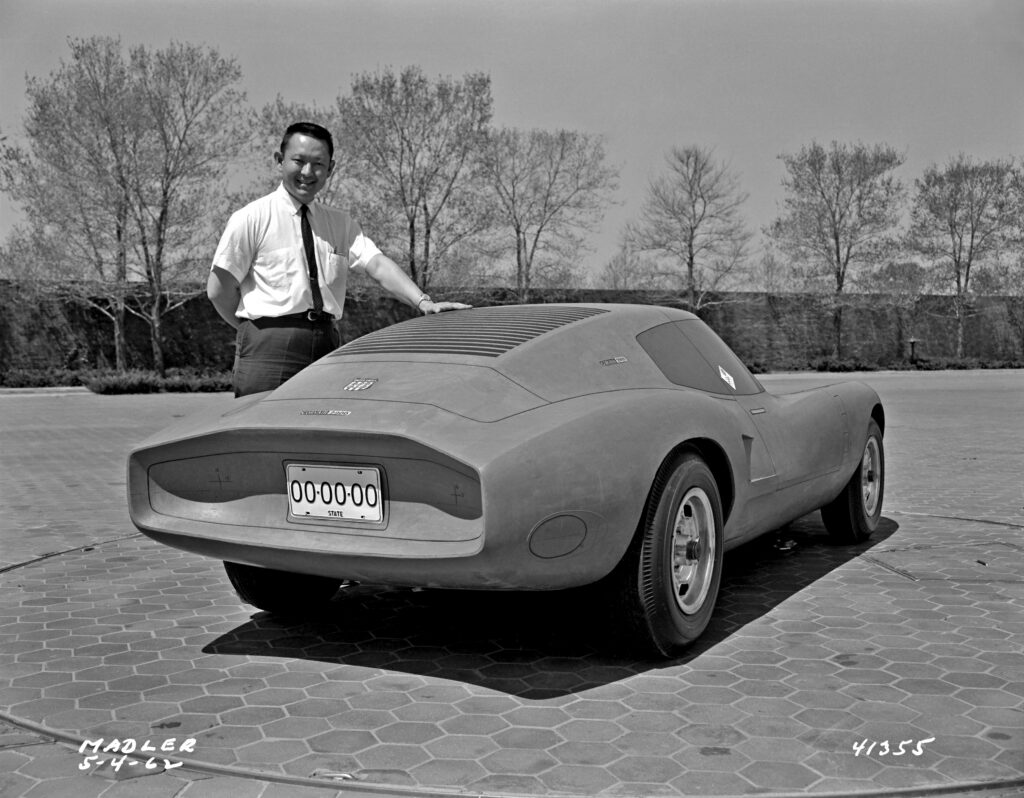
    Larry Shinoda and the full size clay of the Corvair Monza GT at the GM Technical Center in Detroit, Michigan.

    Larry Shinoda’s leadership on the Mako Shark II drew upon years of experience developing some of General Motors’ most progressive experimental automobiles. Seen here with the 1962 Corvair Monza GT clay model, Shinoda helped explore the low roofline, integrated passenger compartment, pronounced wheel forms, and tightly controlled surfaces that broadened GM’s design vocabulary during the early 1960s. Although the mid-engine Monza GT differed fundamentally from the front-engine Mako Shark II, it provided an important laboratory for ideas Shinoda would later refine as he and Alan Young shaped the XP-830 under Bill Mitchell’s direction. (Image courtesy of GM Media LLC.)

    His earlier work had already touched many of the most consequential Corvette and Chevrolet projects of the Mitchell era. He contributed to the Stingray Racer, the production C2, the original Mako Shark, and the Corvair Monza GT and SS concepts. Those projects allowed him to explore low cabins, pronounced wheel forms, sharply controlled surfaces, and the integration of the passenger compartment into the body.

    The National Corvette Museum also credits Shinoda with playing a major role in the execution of the 1963 Sting Ray, the car that most helped Corvette establish its own uniquely American visual identity. His later work at Ford, particularly on the Boss 302 Mustang, further demonstrated his ability to give a performance automobile a clear and disciplined visual purpose.

    The XP-830 interior was also a collaborative undertaking. The source material identifies George Angersbach, John Schettler, and Suzanne Vanderbilt among the interior specialists involved. The cabin, instruments, seating, controls, materials, and trim were related to the exterior but required their own design expertise. Mitchell again retained final approval, while Shinoda coordinated the overall program.


    These interior design drawings reveal how completely the XP-830 Mako Shark II carried its futuristic identity into the cockpit. A deeply integrated instrument panel, sweeping center console, fixed bucket seats, and tightly enclosed driver environment made the cabin feel less like a conventional Corvette interior and more like the command center of an advanced experimental machine. (Images courtesy of GM Media LLC.)

    Painters faced an equally difficult assignment. The blue-gray-to-silver finish required the transition between colors to remain smooth across surfaces that expanded and contracted dramatically along the length of the body. Metallic content, spray density, pearlescence, overlap, and the direction of the fade all affected how the finished car appeared beneath show lighting.

    Mitchell’s expectations were demanding and frequently subject to revision. A surface that had taken days to model could be changed after a brief review if it failed to produce the correct reflection. A feature that worked in a drawing could be rebuilt after appearing too heavy at full scale. The XP-830 was therefore not the product of one sudden inspiration. It was the result of concentrated judgment, repeated correction, and an unusually capable group working under a powerful design authority.

    From Mitchell’s Brief to a Full-Size Automobile

    John Schinella’s early rendering captures the Mako Shark II before its final surfaces were fully resolved, yet the concept’s essential character is already unmistakable. The knife-edged nose, elevated fender peaks, tightly drawn center body, and low integrated cockpit translate Bill Mitchell’s design brief into a dramatic study of speed, tension, and mechanical presence. (Image courtesy of GM Media LLC.)

    Mitchell’s central requirements were unusually clear. He wanted a narrow center section, a genuine coupe body, a tapered tail, an upper structure that blended with the lower body rather than looking like a roof placed upon it, and wheels whose fenders remained visually distinct while still appearing organically connected to the automobile.

    Those instructions described relationships rather than individual decorations. Mitchell was not beginning with the shape of a grille, lamp, vent, or emblem. He was defining how the major volumes of the car should expand, contract, and interact. The center would be slender. The wheels and fenders would be prominent. The roof would be absorbed into the body. The tail would taper rather than terminate as a broad vertical mass.

    Shinoda later called the Mako Shark II “truly a Bill Mitchell-inspired car,” identifying its narrow Coke-bottle waist and pronounced fenders as Mitchell’s central ideas. He also acknowledged that the relationship between design and engineering was different during this period: design established the major parameters first, after which engineering was expected to work within them.

    Mako Shark II drawing
    This image is a faithful recreation of several original Mako Shark II design drawings displayed during the development of the concept’s early full-size clay models. Because the surviving artwork was visible only within a period photograph—and at an angle that obscured its true proportions—the three views were carefully redrafted to preserve their essential forms and present them more clearly. Although the original display was not signed by Larry Shinoda, his signature has been included here as a respectful tribute to the central role he played in shaping the XP-830—not as a claim that he personally created or signed the original drawings.

    Development began during 1964, giving the team little more than a year to prepare the first full-size version for the 1965 show season. That timetable was demanding because nearly every component had to be designed or modified specifically for the automobile. Sketches and renderings had to become scale models, full-size clay, a fiberglass body, fitted trim, special glass, a complete interior, and eventually a mechanically operational second version.

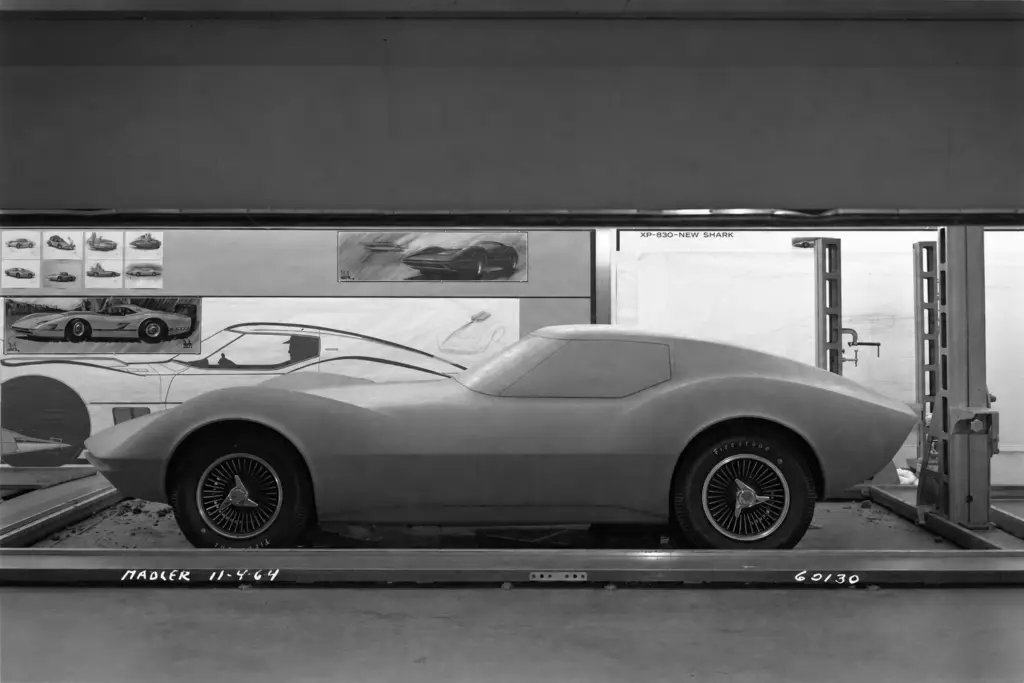
    A full-size styling buck helped establish the relationship between the chassis, wheel placement, occupants, engine compartment, cockpit, and the exaggerated front and rear forms. Once those assumptions had been established, the clay model allowed the team to evaluate the surfaces at actual scale.

    A rare look at the Mako Shark II in its styling-buck phase: a steel-tube armature and foam sections mapping out the car’s dramatic stance, deep fender tunnels, and knife-edge beltline before clay ever touched the surface. This is how Mitchell and Shinoda proved proportions in three dimensions—locking in the show car that would set the template for the C3 Corvette. (Image courtesy of GM Media LLC)
    A rare look at the Mako Shark II in its styling-buck phase: a steel-tube armature and foam sections mapping out the car’s dramatic stance, deep fender tunnels, and knife-edge beltline before clay ever touched the surface. This is how Mitchell and Shinoda proved proportions in three dimensions—locking in the show car that would set the template for the C3 Corvette. (Image courtesy of GM Media LLC)

    This stage was especially important because the 1965 Mako Shark II relied so heavily upon reflection and changing curvature. The transition from the narrow doors into the rear fenders could not appear abrupt or accidental. The front fenders needed enough height to dominate the composition without becoming swollen. The roof had to remain visually light while still enclosing a usable passenger compartment. The tail needed to taper dramatically without making the car appear fragile.

    The shape was also constrained by a broadly recognizable Corvette package. Although the XP-830 was an experimental automobile, it still needed to account conceptually for a front-mounted engine, transmission, occupants, wheels, suspension, and a Corvette-sized wheelbase. Mitchell was not asking the studio to hide those requirements. He wanted the designers to transform them visually until the car appeared lower, longer, and more aggressively angular than its underlying architecture suggested.

    The first car was built primarily as a non-running styling model. Its purpose was to establish the design in its most concentrated form, free from many of the compromises that would accompany a functioning automobile. Work on a second, operational Mako Shark II proceeded afterward, requiring the team to reconsider the concept around an engine, driveline, cooling system, steering, suspension movement, exhaust routing, fuel delivery, wiring, and a usable driver environment.

    This distinction between the two cars would become one of the most important elements of the XP-830 story. The static model represented the dream with few concessions. The running version revealed how much of that dream could survive when the automobile was required to move.

    Filed on March 21, 1966, and granted on October 25, U.S. Design Patent D206,063 formally protected the Mako Shark II’s ornamental vehicle-body design. The patent named William L. Mitchell as inventor and General Motors Corporation as assignee, reflecting Mitchell’s executive authorship of the program. Its side, plan, front, and rear views preserve the XP-830’s defining proportions—the narrow waist, pronounced fenders, low integrated roof, pointed nose, and sharply tapered tail—in a precise technical record stripped of paint and exhibition drama.

    The design was later protected through U.S. Design Patent D206,063. Filed on March 21, 1966, and granted on October 25, the patent identified William L. Mitchell as inventor and General Motors Corporation as the original assignee. Its side, plan, front, and rear views preserved the essential relationships of the Mako Shark II without the distraction of paint, exhibition lighting, or photographic perspective.

    The patent’s attribution reflected Mitchell’s executive authorship and authority over the program rather than documenting every person involved. Viewed today, its drawings provide one of the clearest records of the XP-830’s underlying architecture: a narrow central body suspended between four pronounced wheel forms, an exceptionally low roof, a pointed nose, and a rear structure that contracted dramatically behind the occupants.

    The Design That Made the Mako Shark II Unique

    Proportion, Surface, and the Appearance of Movement

    The Mako Shark II represented the fullest expression of General Motors’ creative design process, transforming Bill Mitchell’s broad vision into a cohesive automobile through the combined work of designers, sculptors, modelers, fabricators, engineers, and craftsmen. Every surface—from its knife-edged nose and towering fenders to its compressed waist and tapering tail—was studied, shaped, and refined to communicate speed before the car ever moved. The finished XP-830 was not simply styled; it was sculpted into one of the most dramatic and influential Corvette concepts ever created. (Image courtesy of GM Media LLC.0

    The Mako Shark II’s most important design element was not its nose, roof, paint, vents, or side exhaust. It was the relationship between its major volumes. Every memorable detail depended upon an underlying composition that made the body appear to expand and contract along its length.

    The front began with an exceptionally thin leading edge. Rather than presenting an upright grille or a large vertical surface, the body projected forward as a shallow wedge, with the primary openings integrated low into the front. Concealed headlamps maintained the uninterrupted surface when not in use, allowing the nose to appear complete without exposed lighting hardware.

    Viewed from the side, the nose seemed almost unsupported as it extended ahead of the front wheels. That visual extension made the passenger compartment appear farther rearward than the dimensions alone would suggest. It also gave the car the long-hood posture Mitchell considered essential to a powerful sports car.

    The Mako Shark II’s knife-edged nose was designed to appear as though it sliced through the air rather than pushed against it. Concealed headlamps, low-mounted openings, and the sharply defined central form preserved an uninterrupted wedge profile, giving the XP-830 an exceptionally low, predatory stance. (Image courtesy of GM Media LLC.)

    Behind the pointed prow rose a pronounced hood dome. The feature established a strong central axis, implied the presence of substantial power, and divided what might otherwise have become a broad, flat surface between the fenders. Light collected along the dome while the surrounding body fell away toward the wheel openings.

    The front fenders climbed sharply over the wheels and remained visible from the cockpit as high crests. They made the central hood and nose appear lower by comparison and established the undulating profile that became one of the car’s defining characteristics. From outside, the body seemed to rise and fall around its mechanical components rather than simply enclose them.

    The body then contracted dramatically through the doors. This narrow center section gave the XP-830 its familiar Coke-bottle plan view, although the description understates the severity of the form. The Mako Shark II did not simply curve inward. Its torso appeared tightly compressed between the front and rear wheel masses.

    That contraction transformed the apparent dimensions of the automobile. By removing visual mass from the center, the designers made the fenders appear broader and more muscular without creating a body that was uniformly wide. The doors seemed stretched between the wheels, and the rear quarters appeared to swell outward under stored mechanical force.

    The wheels therefore became structural elements in the composition. They were not hidden beneath a smooth enclosing shell. Each wheel occupied a visually distinct mass, with the body gathering around four widely established contact points. The result made the car look planted despite the extraordinary lightness of the nose and roof.

    The Mako Shark II’s roofline was conceived as an extension of the body rather than a separate cabin placed above it. Its broad B-pillars sweep rearward into the tapered center structure, framing a bank of horizontal louvers that visually replaces the rear glass and carries the roof into the tail with remarkable continuity. The result is a cockpit that appears carved into the car’s sculpture, with the greenhouse, rear deck, and surrounding fenders reading as one integrated form. (Image courtesy of GM Media LLC.)

    Above the waist, the passenger compartment was compressed into a low, dark volume. The windshield, roof, side glass, pillars, and rear body flowed together rather than reading as a cabin stacked upon a lower body. The nearly flat roof minimized the greenhouse and allowed the surrounding fenders to dominate.

    The dark glazing further reduced the apparent mass of the cabin. Instead of looking like an upright enclosure, the cockpit appeared carved into the automobile. High sills and a broad center structure placed the occupants deep within the body, creating the impression of a command position rather than an airy passenger compartment.

    Behind the occupants, the roof and upper body narrowed toward the centerline. This boat-tail treatment gave the rear structure a sense of aerodynamic extension before the shape ended abruptly at a truncated surface. The combination of gradual taper and sudden termination created visual tension: the body appeared to be moving toward a point that had been cut away before it could fully form.

    Sharp projections at the rear corners framed that termination and carried the fender lines rearward. They suggested marine anatomy without becoming literal tailfins. The rear therefore remained broad and muscular at the wheels while the roof and central body appeared narrow and light.

    A bank of horizontal louvers covered the rear glass. Their practical value was limited because they restricted rearward visibility even when adjusted, but architecturally they strengthened the car’s horizontal emphasis and visually connected the rear window to the vents and ribbed details used elsewhere.

    rear view of the 1965 Mako Shark II

    The Mako Shark II’s exaggerated width was concentrated over its front and rear wheels, while the body contracted sharply through the doors and passenger compartment. That alternating expansion and compression created its unmistakable Coke-bottle profile, making the fenders appear even more muscular while giving the center of the car a taut, almost pinched appearance. (Image courtesy of GM Media LLC.)

    The Mako Shark II was therefore best understood as one continuous exercise in proportion. The knife-edge nose drew the eye forward. The fenders expanded outward and upward. The body contracted through the center. The rear quarters swelled again before the roof and tail narrowed toward the centerline. The automobile appeared to inhale and exhale along its length.

    This was the source of its movement. The car did not look fast merely because it was low or pointed. It looked fast because its surfaces appeared to have been displaced by pressure—as though air, speed, and mechanical force had shaped the body around the wheels and cockpit.

    The Shark Finish, Cockpit, and Technical Theater
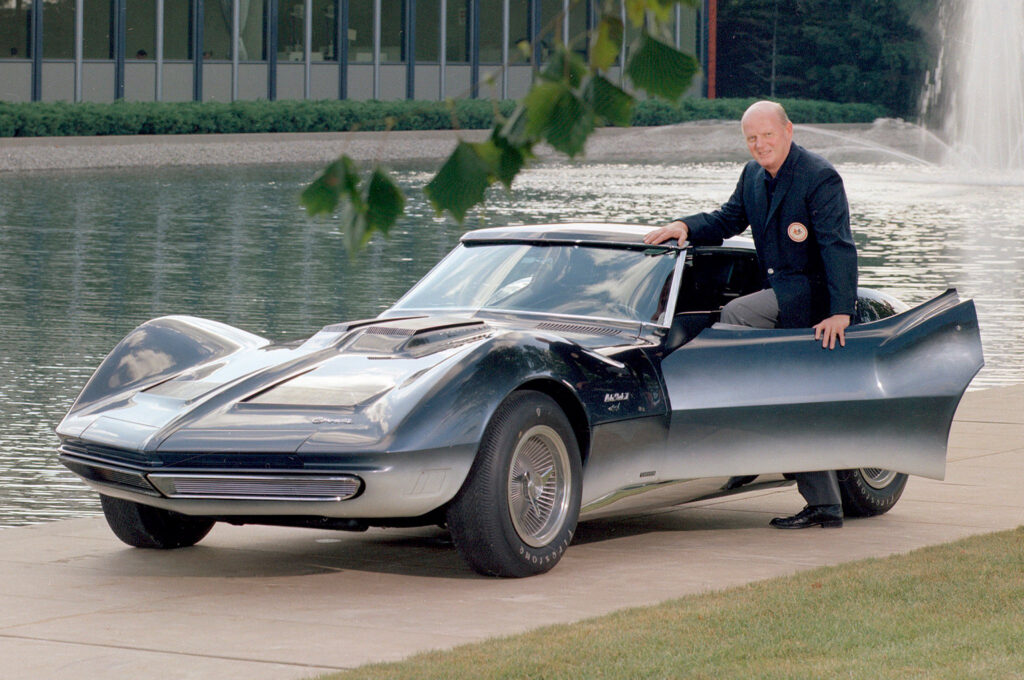
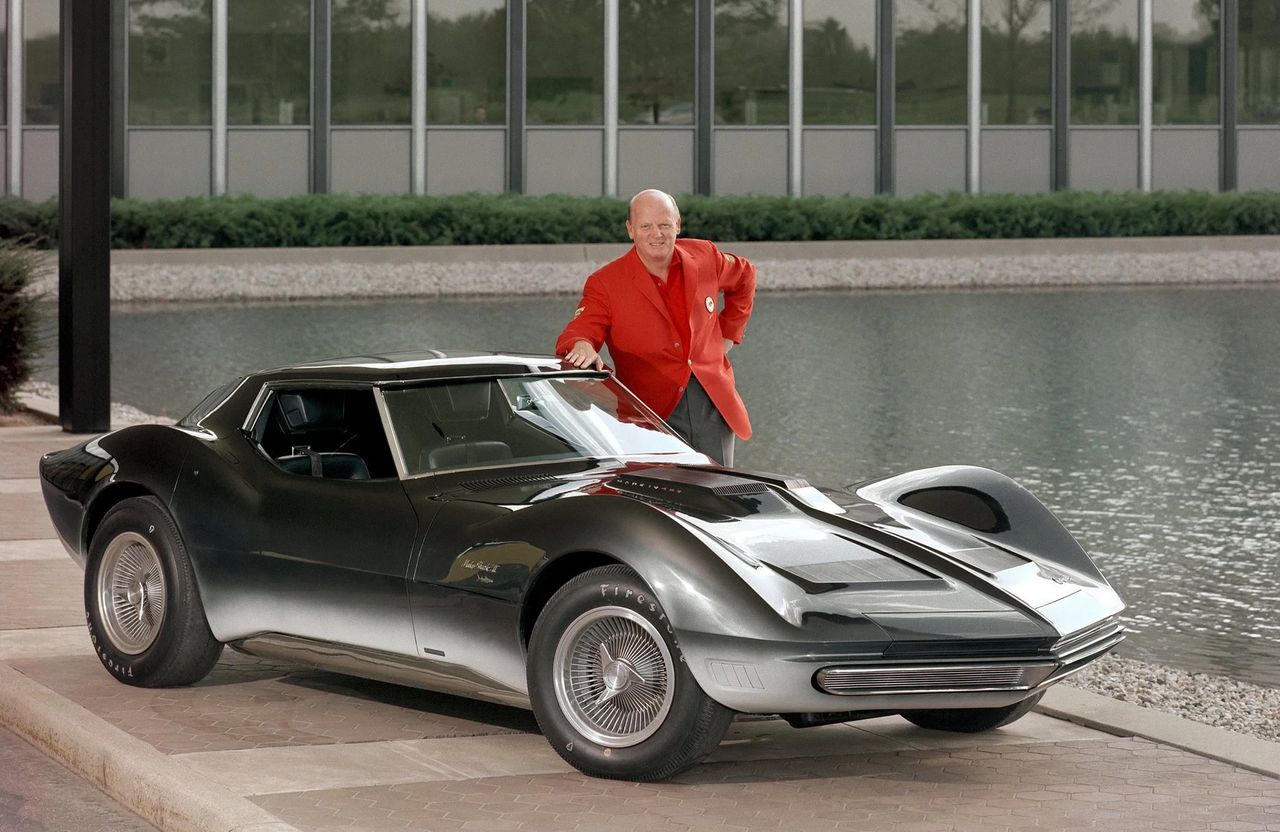
    Bill Mitchell stands beside the open door of the blue-and-silver 1965 Mako Shark II near the GM Design Center fountain, highlighting the concept’s dramatic shark-inspired gradient paint.
    Bill Mitchell is seen here alongside the Mako Shark II, whose extraordinary blue-to-silver finish became as important to its identity as the shape itself. Inspired by the natural countershading of a mako shark, the dark upper body gradually dissolved through metallic gray into a pale lower surface, emphasizing the car’s sculpted fenders, narrow waist, and flowing contours. Under changing light, the finish gave the XP-830 an almost living quality, reinforcing Mitchell’s vision of a Corvette that appeared predatory even while standing still. (Image courtesy of GM Media LLC.)

    The celebrated paint finish reinforced every major element of the body. Dark blue-gray covered the roof, hood, and upper fenders before fading through metallic gray, pewter, silver, and finally a pale lower body. The transition reproduced the countershading of the original Mako Shark while connecting the two concepts visually despite their fundamentally different forms.

    A hard color break would have divided the XP-830 into separate upper and lower bodies. The gradual fade accomplished the opposite. It preserved the automobile as a single uninterrupted sculpture while allowing each surface to react differently as light moved across it.

    The dark upper body gave the car visual weight and emphasized its spine. Metallic gray rolled across the shoulders and fenders, where the changing curvature caused the color to brighten and recede. Silver gathered along the lower doors and rocker areas, sharpening the narrow center section and separating the body from the pavement.

    The finish therefore performed some of the work normally assigned to creases, moldings, and trim. It traced the car’s changing volumes without interrupting them. Under natural light, the fenders could move from dark blue to bright silver within a single reflection, making the body appear almost alive.

    The famous story that Mitchell’s mounted shark was secretly repainted to match the automobile remains part of GM design folklore. It has been repeated for decades, including by people associated with the studios, but it is best understood as an unverified legend rather than a documented fact. Its endurance nevertheless reveals something important about Mitchell’s reputation: he demanded a specific visual effect, and the people working for him were believed capable of extraordinary ingenuity to achieve it.

    The first Mako Shark II’s interior was created for visual impact rather than road-going practicality, allowing GM’s designers to push the cockpit far beyond conventional Corvette thinking. Its aircraft-inspired steering yoke, dense arrangement of gauges and switches, deeply integrated dashboard, and fixed seating transformed the non-running show car into a futuristic design statement—one intended to make the familiar automobile interior seem instantly outdated.

    Inside, the Mako Shark II extended the same philosophy into a tightly integrated driver environment. Deep bucket seats, high sills, a prominent center structure, and a wraparound instrument panel made the occupants appear contained by the automobile. Controls and instrumentation were arranged to give the cockpit an aircraft-influenced character without becoming completely disconnected from the driving task.

    The non-running model used a small rectangular steering control with several secondary functions incorporated into it. The device looked futuristic but was poorly suited to the large steering angles required by an ordinary road car. It demonstrated the static model’s purpose: the cockpit was intended to make familiar controls appear obsolete, not prove that every proposed solution was ready for daily use.

    Much of the informational instrumentation was positioned on the passenger side, while the principal driver display concentrated on the tachometer and speedometer. Warning lamps monitored major fluid levels, open doors, and other vehicle conditions. Shinoda later described the interior as a molded, wraparound environment and suggested that the industry could have pushed its early ergonomic ideas farther than it did.

    The seats were fixed, but the accelerator and brake pedals moved together on an adjustable control board. The steering column could also be positioned to meet the driver. Instead of requiring occupants of different sizes to move the seat, the concept brought the controls toward them—an idea that anticipated adjustable pedal systems used decades later.

    The second Mako Shark II replaced the first model’s theatrical steering yoke and dense, exhibition-oriented instrumentation with a conventional round wheel and a more practical control layout suited to a drivable automobile. Its broad center console and deeply integrated cockpit retained the futuristic character of the original, but the controls were reorganized around actual operation rather than visual spectacle. The result was still unmistakably experimental, yet far closer to the environment required for a functioning Corvette. (Image courtesy of GM Media LLC.)

    The operational car carried fiber-optic lamp monitors that allowed the driver to confirm whether the exterior lights were functioning. The same basic principle appeared on the production Corvette for 1968, providing a direct example of an experimental feature making its way from the show car into customer use.

    Other equipment was more theatrical. The roof panel could raise to improve access to the low cockpit. The entire front body tilted forward, exposing the engine compartment while preserving an uninterrupted surface across the hood and fender tops. Small service ports allowed basic fluids to be checked without opening the entire front clip.

    Retractable protection devices, adjustable rear louvers, auxiliary brake-warning panels, concealed license-plate hardware, and a deployable rear aerodynamic device contributed to the sense that nearly every conventional component could be reconsidered. Some of these mechanisms were inherited from earlier Mitchell concepts, while others belonged specifically to the XP-830 program.

    Not every feature was practical, nor was it intended to be. The Mako Shark II existed partly to test public reaction and partly to provoke designers and engineers into imagining solutions beyond the limits of current production. Shinoda later defended that role, noting that the public often thinks in terms of the present while advanced-design teams are expected to think about the future.

    The XP-830 was therefore more than an exterior styling exercise. It presented a complete imagined environment in which the shape, paint, controls, access systems, service features, and warning equipment worked together to suggest a new relationship between driver and automobile.

    Two Mako Shark IIs

    The New York Show Car
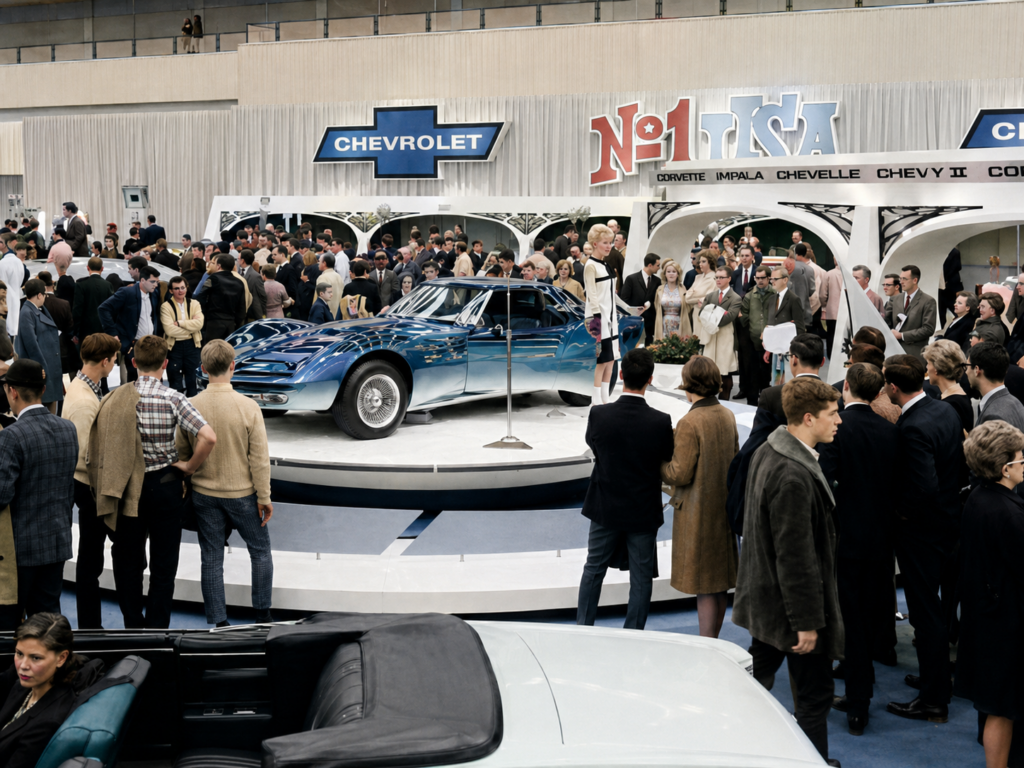
    1965 Mako Shark II at New York International Auto Show.
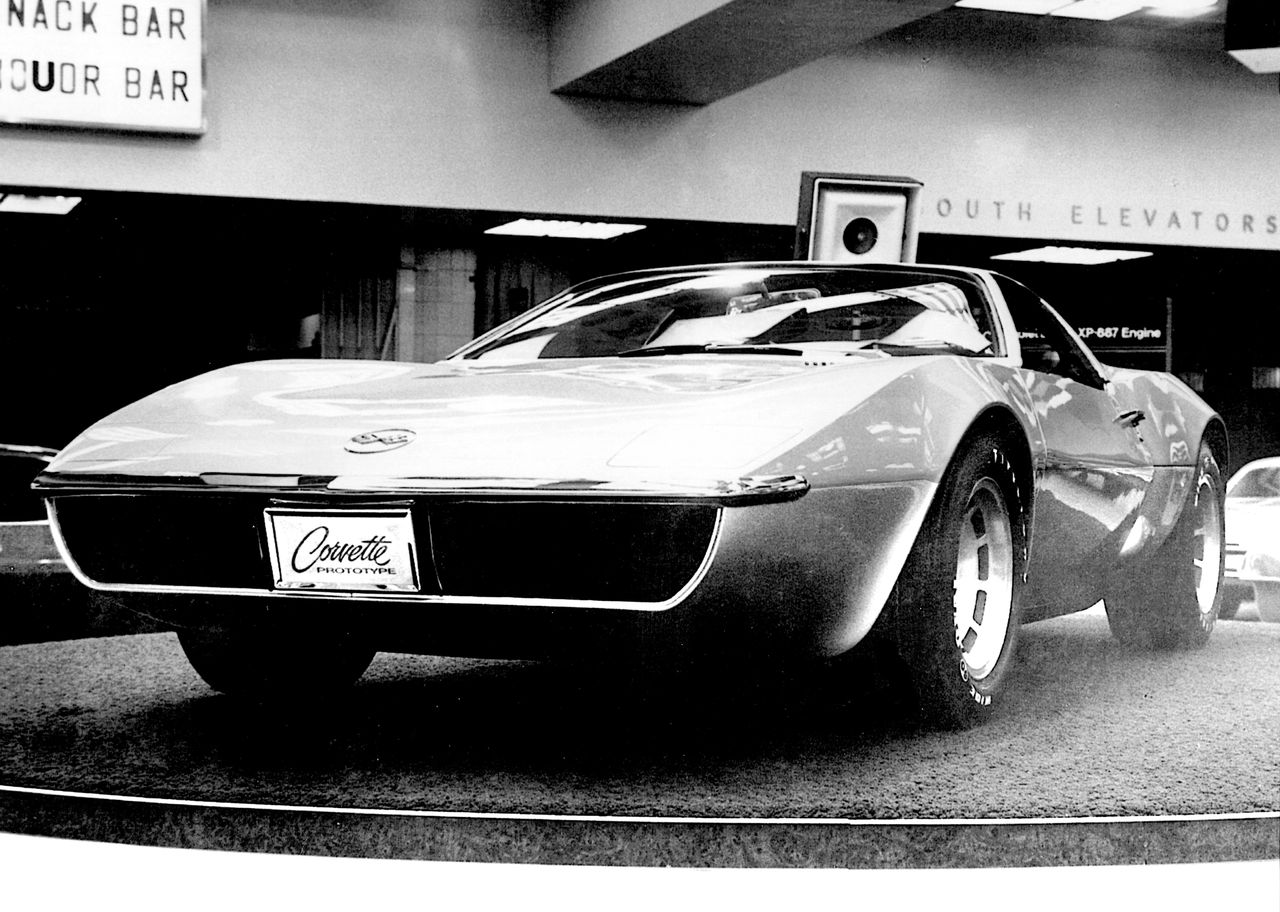
    The Mako Shark II made its public debut at the 1965 New York International Automobile Show, where its razor-edged nose, towering fenders, pinched waist, and blue-to-silver finish immediately distinguished it from the production cars surrounding it. Presented as Chevrolet’s vision of Corvette’s future, the XP-830 drew intense attention and gave the public its first clear look at the design language that would shape the third-generation Corvette. More than a show-floor spectacle, its unveiling marked the moment Bill Mitchell’s most ambitious shark-inspired concept entered the public imagination. (Image colorized using ChatGPT.)

    There were two principal Mako Shark II automobiles, and distinguishing between them is essential to understanding the program. The first was a full-size, non-running styling model completed for the spring 1965 show season. It presented the design with the fewest compromises and carried several of the features most closely associated with period photographs of the XP-830.

    The static car made its public introduction at the New York International Automobile Show in April 1965. Its appearance was an immediate sensation, confronting an audience already familiar with flamboyant Detroit concepts yet still managing to look radically different from the machinery surrounding it.

    This first version wore the elaborate square-section side-exhaust treatment that appeared to descend from the front fenders into broad ribbed housings beneath the doors. The arrangement extended the visual weight of the front body downward and rearward, emphasized the narrowness of the cabin, and gave the car an overtly mechanical character.

    The first Mako Shark II was a full-size, non-running styling model created to present Bill Mitchell’s vision in its most uncompromising form. Its square-section side-exhaust treatment, deeply pinched waist, towering fenders, and sharply tapered profile emphasized visual drama over mechanical practicality. Although this version never operated under its own power, it established the essential design language that would define the later running car and heavily influence the third-generation Corvette. (Image courtesy of GM Media LLC.)

    Precisely how that exhaust would have functioned on a driven automobile was never fully resolved because the static model did not require a complete answer. Heat shielding, passenger protection, ground clearance, noise control, and long-term durability remained secondary to the visual effect. The pipes looked functional enough to suggest extraordinary power while remaining primarily pieces of exhibition theater.

    The rectangular steering control served a similar purpose. Combined with the deep cabin, warning lamps, switches, and other experimental equipment, it presented the occupants with an environment that felt more like the command station of an advanced aircraft than the interior of an existing Chevrolet.

    The non-running model could preserve these ideas because it did not have to cope with steering effort, suspension movement, engine heat, cooling airflow, exhaust temperatures, or the structural demands of road use. It needed to survive transportation, photography, exhibition, and public scrutiny, but it did not need to behave as a complete automobile.

    Its lack of mechanical operation did not diminish its importance. Freed from the compromises demanded by movement, the first XP-830 presented the Mako Shark II in its purest form. It established the proportions, paint, posture, and emotional character that made the concept unforgettable.

    General Motors also understood that the car’s reach depended upon photography. Myron Scott, the Chevrolet publicist credited with suggesting the Corvette name in 1953, helped create a series of widely circulated images pairing the Mako Shark II with model, singer, and actress Conny Van Dyke.

    Seated low in the cockpit, Conny Van Dyke turns the Mako Shark II from sculpture into something inhabited—her gaze meeting the camera while the car’s razor nose and side exhaust underline its menace. It’s a cool, composed moment that sells the Shark II as both attainable fantasy and living design. (Image courtesy of GM Media LLC)
    Seated low in the cockpit, Conny Van Dyke turns the Mako Shark II from sculpture into something inhabited—her gaze meeting the camera while the car’s razor nose and side exhaust underline its menace. It’s a cool, composed moment that sells the Shark II as both attainable fantasy and living design. (Image courtesy of GM Media LLC)

    The photographs gave the car human scale and connected it with youth, fashion, glamour, and the aspirational culture of the mid-1960s. They also preserved details of the original static model that became especially important after the automobile was returned to General Motors and dismantled.

    The loss was typical of an era in which concept vehicles were often treated as temporary corporate tools rather than permanent historical artifacts. Once the running version was available to assume the show-car role, the first body occupied space, required maintenance, and had been superseded by a more useful automobile.

    As a result, many of the most famous images of the Mako Shark II document a car that no longer exists. The pointed nose, extraordinary side pipes, aircraft-style controls, precise color transition, and uncompromised rear treatment survive primarily through photographs, drawings, patent views, and later recreations.

    The Running Car Meets Mechanical Reality

    1965 Paris Motor Show: the Mako Shark II stops foot traffic on GM’s stand. Under the hall’s skylights, its knife-edge nose, sunken headlamps, and boattail flanks look otherworldly—drawing journalists, executives, and curious showgoers into the cockpit. In Paris, the Corvette future felt immediate, and Europe took notice.
    1965 Paris Motor Show: the Mako Shark II stops foot traffic on GM’s stand. Under the hall’s skylights, its knife-edge nose, sunken headlamps, and boattail flanks look otherworldly—drawing journalists, executives, and curious showgoers into the cockpit. In Paris, the Corvette future felt immediate, and Europe took notice.

    The second Mako Shark II was constructed as a functioning automobile. Completed during the autumn of 1965, it was presented to the press before making its European debut at the Paris Auto Salon in October. From there, it appeared at additional European events, placing an unapologetically American vision of performance before audiences accustomed to Ferrari, Jaguar, Maserati, Aston Martin, and other established marques.

    The operational version retained the fundamental design: the narrow waist, prominent fenders, low roof, pointed nose, hood dome, hinged roof panel, tapering rear structure, and shark-inspired finish. Some of the theatrical equipment, however, was revised so that the automobile could be driven.

    The rectangular steering control was replaced by a conventional round wheel, with major functions relocated to more familiar positions. The square-section side exhaust also disappeared. Instead, the pipes were routed beneath the car and exited through highly styled boxed and finned outlets at the rear, preserving a technical appearance without placing an elaborate hot exhaust system directly below the doors.

    Shinoda later recalled that the operational car initially carried a 425-horsepower 396-cubic-inch big-block and was subsequently changed to a ZL-1-style 427. Because surviving accounts occasionally confuse the engine histories of the two Mako Sharks and the later Manta Ray, the exact sequence has not always been reported consistently. What is clear is that Chevrolet ensured the running XP-830 possessed genuine big-block authority rather than merely implying performance through badges and proportion.

    Close-up of the drivable 1965 Mako Shark II’s engine bay, showing its chrome-detailed Chevrolet 396-cubic-inch Mark IV big-block V-8, intake assembly, hoses, wiring, and surrounding chassis components beneath the open front bodywork.
    The drivable 1965 Mako Shark II was powered initially by Chevrolet’s new 396-cubic-inch Mark IV big-block V-8, factory-rated at 425 horsepower in its highest-performance Corvette specification. With solid lifters, high-flow cylinder heads, a four-barrel carburetor, and roughly 415 lb-ft of torque, the engine delivered the sound, heat, and forceful acceleration expected from Chevrolet’s most serious performance machinery. Power was routed through a three-speed Turbo Hydra-Matic automatic transmission, giving the XP-830 genuine operating capability rather than merely the appearance of speed. Some accounts indicate that the car later received a 427-cubic-inch engine as Chevrolet’s big-block program evolved, but the 396 established its original mechanical identity. (Image courtesy of GM Media LLC.)

    Once the concept began moving, however, its design encountered the limits of physics. The long, low nose and sweeping upper surfaces generated front-end lift at speed. Small aerodynamic devices were added to improve stability, demonstrating that a form capable of appearing aerodynamic was not automatically aerodynamically balanced.

    Visibility presented another problem. The front fender crests that looked so dramatic from outside the automobile restricted the driver’s view from the low seating position. Rearward vision through the louvered glass was also poor, reinforcing the distinction between an architectural feature that strengthened the exterior and a window that needed to serve an actual driver.

    Cooling proved equally difficult. A big-block engine generated substantial heat beneath a body whose thin nose and limited openings had been shaped primarily for visual effect. Additional openings and ducting were required, exposing one of the recurring conflicts in performance-car development: the same surfaces that created the desired appearance could interfere with the airflow needed to sustain the machinery beneath them.

    Placed beside the Ferrari 275 GTB, the Mako Shark II reveals just how differently Chevrolet interpreted high-performance design in the mid-1960s. The Ferrari relied on graceful proportion, restrained surfacing, and competition-bred elegance, while the XP-830 was broader, lower, and far more theatrical—its towering fenders, sharply pinched waist, and predatory nose communicating power through visual exaggeration. Rather than imitate Europe, the Mako Shark II presented an unmistakably American vision of the future: muscular, dramatic, and entirely confident in its own identity.

    These limitations did not make the running Mako Shark II a failure. They made it more valuable. The car became a rolling laboratory that identified the exact areas where the show-car design would have to change before it could become a production Corvette, from outward visibility and cooling to service access, structural integrity, and the operation of its more ambitious mechanical features.

    Its value extended well beyond engineering. After its completion in October 1965, the running Mako Shark II traveled through Europe, appearing in Paris before continuing to London, Turin, Brussels, and Geneva. In each setting, the car represented something distinctly American. It did not attempt to imitate the smaller, more restrained sports cars produced by Ferrari, Jaguar, Aston Martin, or Maserati. Instead, it arrived with exaggerated proportions, a sweeping body, dramatic color, and the promise of Chevrolet big-block power—an unmistakable expression of GM’s confidence at the height of the American concept-car era.

    The new Mako Shark II concept car from Chevrolet at the Paris Motor Show in 1965.
    The new Mako Shark II concept car from Chevrolet at the Paris Motor Show in 1965.

    The response demonstrated that the Corvette was beginning to transcend its image as merely an American performance car. European audiences were accustomed to sophisticated coachwork and prestigious sporting machinery, yet the Mako Shark II offered a different interpretation of the grand touring automobile: broader, more theatrical, and deliberately sculptural. Its presence on the European show circuit helped establish the Corvette as an international design statement, while giving observers an early preview of the shapes and proportions that would soon define Chevrolet’s next production generation.

    One of the most frequently repeated episodes from the tour involved Fiat leader Giovanni Agnelli, for whom special arrangements were reportedly made to drive the Mako Shark II at an airport near Turin. The precise details of his impressions have not been preserved as clearly as the drive itself, but the invitation was significant. Agnelli occupied a central position in the European automobile industry and had access to virtually any important performance car of the period; his interest in driving Chevrolet’s experimental Corvette reflected the attention the XP-830 commanded even among Europe’s most influential automotive figures.

    These photographs capture the Mako Shark II during its 1965 European tour, where Chevrolet’s radical XP-830 concept was presented as an international design statement rather than merely an American show car. Photographed on an airfield near Turin, the car drew the attention of Fiat leader Giovanni Agnelli, whose interest extended beyond a formal inspection to time behind the wheel. Against the restrained industrial setting, the Mako Shark II’s exaggerated fenders, sweeping profile, and dramatic proportions looked even more futuristic, underscoring how far its design departed from the European sports cars of the period. The encounter demonstrated that Corvette had begun to command serious attention from some of Europe’s most influential automotive figures. Together, these images preserve an important moment when Chevrolet’s experimental sports car proved that American design could capture imaginations far beyond its home market. (Images courtesy of GM Media LLC.)

    Whether Agnelli’s time behind the wheel was treated as a serious evaluation or simply an opportunity to experience an extraordinary automobile, the episode reinforced the Mako Shark II’s reach. This was no longer a styling exercise admired only within General Motors or on the American show circuit. It had become an object of international fascination—one that demonstrated how rapidly the Corvette was capturing the imagination of enthusiasts, designers, executives, and performance-minded drivers far beyond the United States.

    Public reaction was important because the design of the next Corvette had not been completely frozen when the Mako Shark II began appearing. Shinoda later explained that the reaction to the show car could still influence the production program and that differences remained between the static model, running automobile, and emerging road car.

    The XP-830 was therefore neither a meaningless fantasy nor a literal promise. It occupied the productive space between them. It gave Chevrolet the opportunity to present an uncompromised idea, observe the response, and then determine which elements possessed enough strength to survive production.

    From Mako Shark II to the Third-Generation Corvette
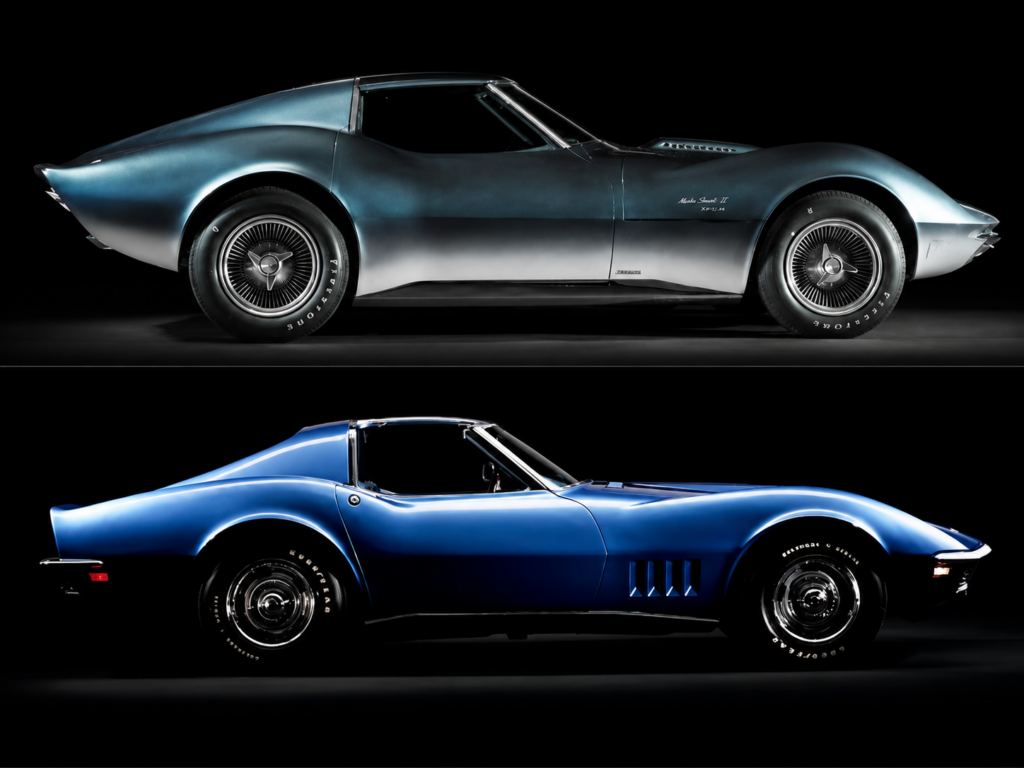
    The 1965 Mako Shark II established the design language that would become unmistakable when the third-generation Corvette reached production for 1968. The concept’s pointed nose, pronounced fenders, pinched waist, and tapering rear profile were softened and reworked around visibility, cooling, manufacturing, and everyday use, but the central character survived. Together, the two cars demonstrate how Chevrolet transformed an uncompromising showpiece into one of the most recognizable production Corvettes ever built.

    Henry Haga, Zora Arkus-Duntov, and the Work of Translation

    Once Chevrolet selected the Mako Shark II’s design philosophy for the next Corvette, the program entered a more difficult phase. Creating an unforgettable concept was one challenge. Preserving its emotional force through manufacturing, durability, regulation, mechanical packaging, and customer use was another.

    Responsibility for that translation moved into the Chevrolet 2/3 studio led by Henry Haga. Haga had become chief of the studio in 1963 and was widely respected for his command of proportion and his ability to refine an exciting design without draining it of character.

    Henry Haga center
    Henry Haga became one of the pivotal figures in translating the Mako Shark II’s dramatic show-car language into a production-ready Corvette. Working alongside designers such as Dick Ruzzin and the broader Chevrolet studio team, Haga refined the concept around visibility, occupant space, mechanical packaging, manufacturing tolerances, and everyday usability without surrendering its emotional impact. His ability to balance Bill Mitchell’s uncompromising design vision with Zora Arkus-Duntov’s engineering requirements helped preserve the XP-830’s pointed nose, muscular fenders, pinched waist, and unmistakable stance in the 1968 Corvette. (Image courtesy of GM Media LLC.)

    The National Corvette Museum describes Haga as leading the effort to productionize the third-generation Corvette. His assignment was to reshape the Mako Shark II around mechanical components and manufacturing variables that did not have to be considered when building a one-off prototype.

    Haga did not simply replace Shinoda’s design with something safer. His task was to identify which relationships made the XP-830 compelling and preserve them while negotiating away the impractical elements. That required an extraordinary number of revisions, many of which were individually subtle but collectively essential.

    Zora Arkus-Duntov brought the engineering discipline required to make those judgments. Duntov respected the value of a dramatic design in maintaining Corvette’s public appeal, but he was unwilling to ignore compromised visibility, lift, cooling, occupant space, or mechanical access. His objections were not attacks on styling. They reflected his responsibility for ensuring that Corvette remained credible as a performance automobile.

    Zora Arkus-Duntov viewed the Mako Shark II with a mix of admiration and pragmatism. He respected Bill Mitchell’s bold styling vision and recognized the concept’s value in keeping Corvette exciting and forward-looking. At the same time, the engineer in him remained grounded, aware that many of its dramatic features would never make it into production. For Duntov, performance always came first, and while he appreciated the show car’s impact, his focus was on translating its spirit into a Corvette that could deliver on the road. In that sense, he saw the Mako Shark II as a vital bridge—an inspiring design exercise that helped shape the production C3 while reminding everyone that engineering credibility was just as important as stunning looks. (Image courtesy of GM Media LLC)
    Zora Arkus-Duntov viewed the Mako Shark II with a mix of admiration and pragmatism. He respected Bill Mitchell’s bold styling vision and recognized the concept’s value in keeping Corvette exciting and forward-looking. At the same time, the engineer in him remained grounded, aware that many of its dramatic features would never make it into production. For Duntov, performance always came first, and while he appreciated the show car’s impact, his focus was on translating its spirit into a Corvette that could deliver on the road. In that sense, he saw the Mako Shark II as a vital bridge—an inspiring design exercise that helped shape the production C3 while reminding everyone that engineering credibility was just as important as stunning looks. (Image courtesy of GM Media LLC)

    The relationship between Mitchell and Duntov was often contentious because the two men began from different priorities. Mitchell considered visual impact essential to Corvette’s identity. Duntov insisted that the car’s dynamic behavior justify its appearance. Each could view the other’s demands as an intrusion, yet Corvette benefited from the tension between them.

    Haga became an effective intermediary. He maintained a strong relationship with Duntov while understanding which proportions Mitchell considered non-negotiable. When the high front fenders created unacceptable sightline problems, Haga lowered them without eliminating their presence. The result remained recognizably descended from the Mako Shark II but no longer placed theatrical exterior form entirely ahead of the driver’s ability to see the road.
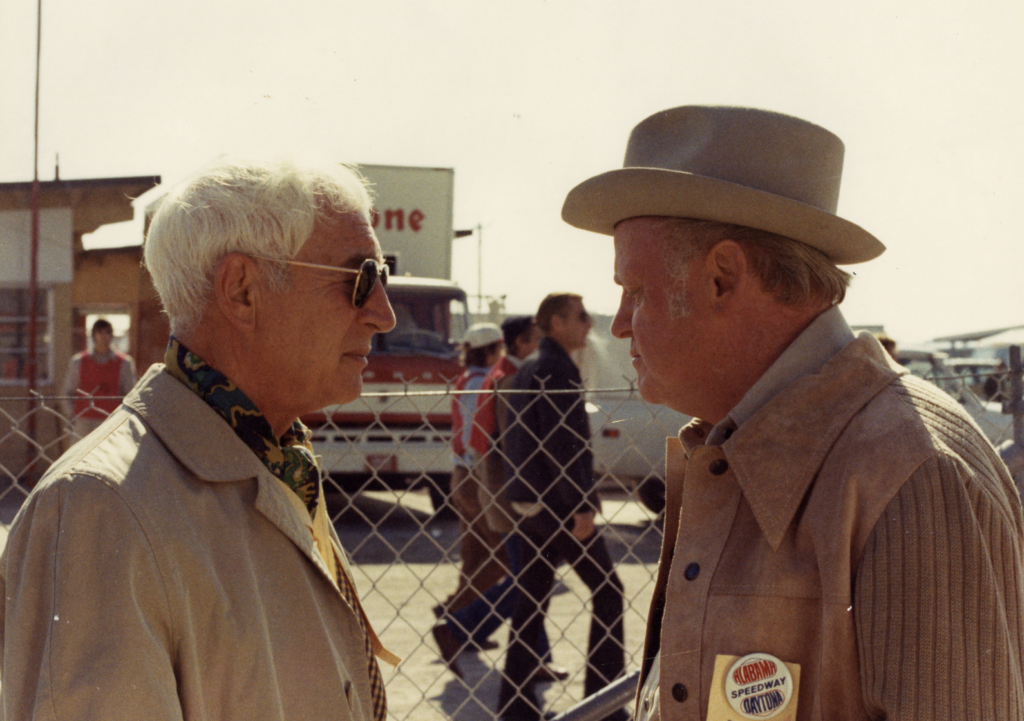

    Zora Arkus-Duntov and Bill Mitchell were two forceful personalities whose competing visions frequently placed them at odds: Duntov viewed the Corvette primarily as a serious performance machine, while Mitchell defended the authority of styling and visual drama. Their most famous battle involved the 1963 split rear window, which Duntov condemned for restricting visibility and Mitchell fiercely protected as an essential part of the Sting Ray’s design. Although their disagreements could become heated—and neither man was known for quietly surrendering his position—their relationship was less a personal feud than a productive professional rivalry. Ultimately, Mitchell gave the Corvette its unmistakable presence, while Duntov supplied the engineering credibility to make it more than merely beautiful. (Image courtesy of GM Media LLC.)

    The roof and rear structure required equally significant changes. The XP-830’s boat-tail upper body and louvered rear glass looked extraordinary but offered poor visibility and little practical usefulness. The production coupe instead adopted a recessed, near-vertical backlight between broad rear shoulders—often described as a sugar-scoop treatment.

    Removable roof panels gave the coupe an open-air character without requiring a conventional folding top, while the removable rear window enhanced ventilation and created another link between coupe and convertible driving. This arrangement produced the first production Corvette equipped with twin removable roof panels, establishing a feature that would become closely associated with the nameplate.

    The doors, sills, glass, weather seals, bumpers, lighting systems, cooling passages, body attachments, and service access all required production solutions. Panels had to be molded consistently, fitted within acceptable tolerances, sealed against water, assembled in a practical sequence, and repaired after years of use.

    The body also had to accommodate the established Corvette chassis and much of the C2’s mechanical architecture. Carrying forward the existing frame, suspension principles, engines, and transmissions controlled cost and development risk, but it imposed fixed relationships upon a shape that had originally been conceived with greater freedom.

    The 1968 Corvette production vehicle replaced the Mako Shark II’s dramatic louvered rear treatment with a recessed, near-vertical backlight set between broad rear shoulders. Often described as the “sugar-scoop” rear window, the new arrangement improved rearward visibility while preserving the concept’s tapered roofline and muscular haunches. It was a clear example of Chevrolet refining the show car’s most theatrical ideas into a form better suited to production and everyday use.

    The third-generation Corvette had initially been expected earlier, but the complexity of transforming the show car into a roadworthy automobile contributed to the decision to continue the C2 through the 1967 model year. The additional development time was necessary, although the 1968 Corvette still experienced the kinds of quality and assembly difficulties that can accompany an ambitious new body and interior.

    What Survived and What Had to Change

    The relationship between the Mako Shark II and the 1968 Corvette Stingray is impossible to miss, because the production car clearly translated the concept’s dramatic design language into something Chevrolet could actually build and sell. The long pointed nose, pronounced fender peaks, tapered waist, muscular rear haunches, and aggressive overall stance all carried forward, giving the 1968 Stingray an unmistakable show-car pedigree. While the production Corvette was necessarily softened and adapted for real-world use, its visual DNA remained rooted in the Mako Shark II’s bold, futuristic vision. In many ways, the 1968 Stingray stands as the closest showroom expression of a Corvette dream car ever put into production.

    When the third-generation Corvette reached production for 1968, its relationship to the Mako Shark II was unmistakable. The pointed nose, concealed headlamps, high fender lines, narrow center section, broad rear quarters, low cockpit, and tapering overall posture all survived in moderated form.

    The production car did not reproduce the concept surface for surface. Its body was fuller where structure and occupant space required additional volume. Its fenders were lower and softer. The doors were more conventional, the roof was taller, the glass more practical, and the rear architecture fundamentally revised.

    Yet the essential visual rhythm remained intact. The body still expanded over the front wheels, narrowed through the doors, and swelled again over the rear quarters. The cabin remained visually subordinate to the fenders. The nose still projected forward with relatively little mass beneath it, and the rear still appeared to contract rather than terminate as a conventional box.

    The static model’s square-section side pipes disappeared, although production side exhaust became available. The rectangular steering control, powered roof mechanism, adjustable rear louvers, retractable bumpers, concealable license plate, and numerous other exhibition features did not survive.

    The Mako Shark II’s forward-tilting front clip was also abandoned for the C3. A production hood provided more conventional engine access while reducing structural complexity and the cost of repairing minor front-end damage. The principle of opening the entire front body would later return on the C4 Corvette in a far more developed form.


    Even the most radical concept-car ideas have a way of resurfacing once engineering and production technology catch up with the designer’s imagination. The C4 Corvette’s forward-hinged clamshell hood was far more practical and restrained than the dramatic assembly fitted to the Mako Shark II, yet the family resemblance is unmistakable. Both designs lifted the Corvette’s entire front body section to expose the engine, suspension, and underlying structure as a unified mechanical display. Nearly two decades later, the C4 transformed one of the Mako Shark II’s most theatrical features into a functional production signature.

    Other ideas reached the street more directly. Fiber-optic lamp monitoring appeared in the 1968 Corvette. The deeply integrated cockpit, high center console, removable roof panels, concealed exterior hardware, and emphasis upon placing the driver within the automobile rather than above it all reflected lessons explored by the XP-830.

    TThe resulting C3 was not simply a watered-down version of the Mako Shark II. It was the production translation of that concept—one that preserved its essential shape and visual drama while adapting every surface and mechanism to meet the real-world demands of visibility, cooling, serviceability, tooling, assembly, regulation, durability, and everyday ownership.

    That distinction is fundamental to appreciating both automobiles. The XP-830 showed what Corvette could become when design was permitted to lead with few immediate constraints. The C3 demonstrated how much of that vision could be retained once the constraints were restored.

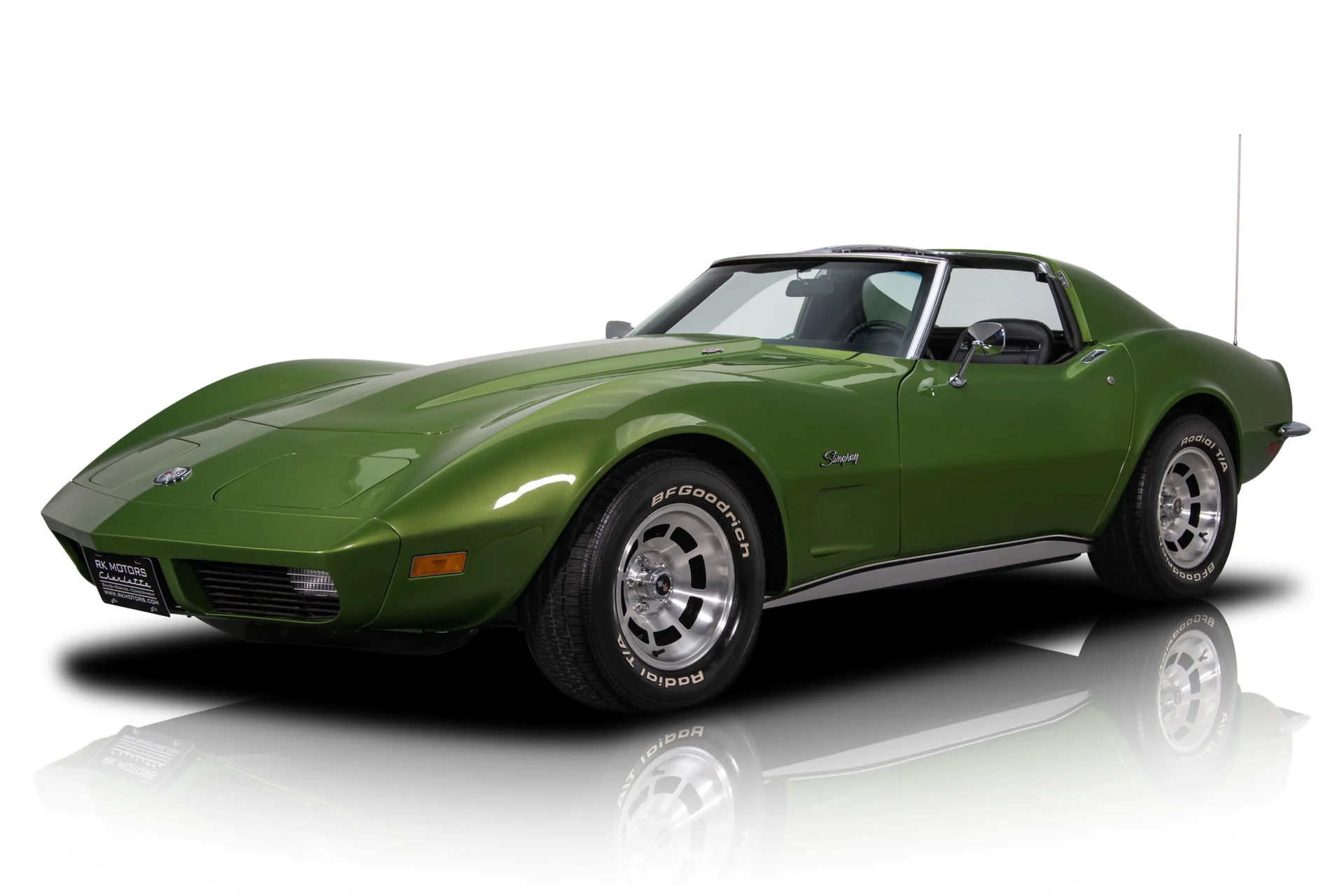
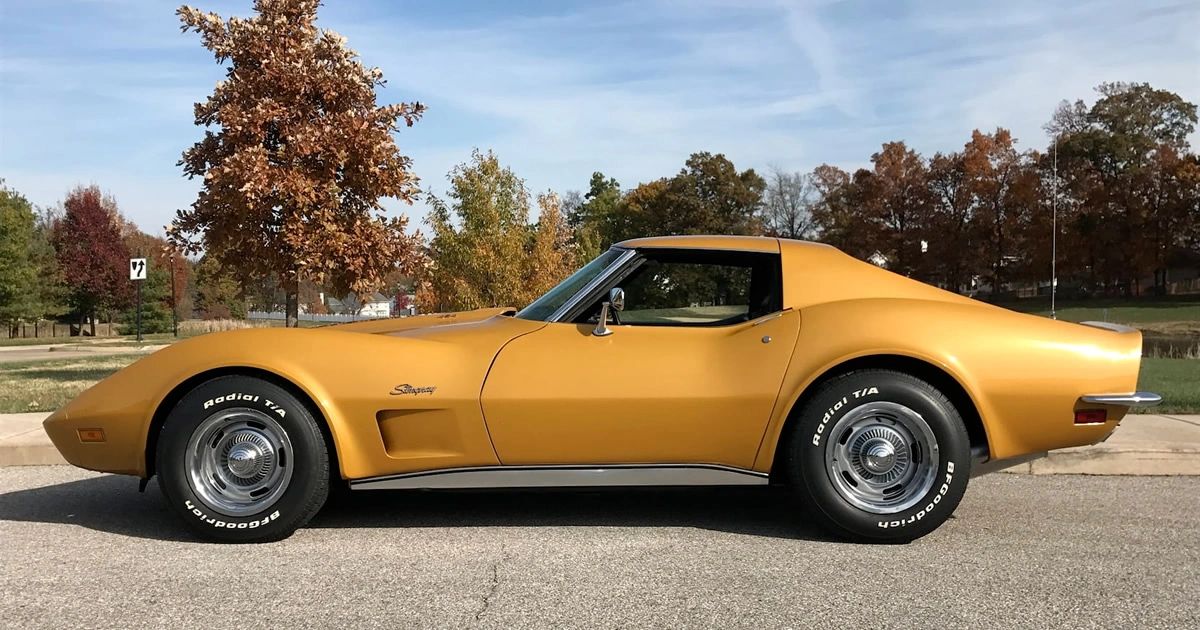
    The result remained in production from 1968 through 1982—fourteen model years during which the automobile, regulatory environment, and performance market changed almost beyond recognition. The same basic silhouette carried the Corvette from the big-block performance peak of the late 1960s through emissions regulations, insurance pressure, fuel crises, reduced compression ratios, new bumper requirements, and the changing expectations of the 1970s.

    Evolution of the C3 Corvette - beginning with the 1965 Mako Shark II, the original 1968 Corvette Stingray, the 1973 Corvette coupe, the last 1975 Corvette Convertible, the 1978 Corvette Indy Pace Car, and the 1982 Collectors Edition.

    This graphic illustrates the visual evolution of the C3 Corvette from the 1965 Mako Shark II through the final 1982 production model, showing just how closely the production car remained tied to its concept-car origins. From the knife-edged nose and dramatic proportions of the XP-830 to the progressively refined shapes of the later Stingrays, the lineup makes clear that the C3’s long production run was rooted in one of the most influential design studies in Corvette history. Taken together, these six profiles tell the story of a concept so strong that it shaped an entire generation of America’s sports car.

    The C3’s details evolved continuously. Chrome bumpers gave way to body-colored energy-absorbing fascias. The rear window eventually expanded into a large fastback backlight. Front and rear spoilers altered the body’s aerodynamic presentation, while interior, chassis, engine, and trim changes kept the automobile viable.

    Through each transformation, however, the Mako Shark II’s underlying composition remained visible. The narrow waist, powerful wheel forms, long nose, low cockpit, and muscular rear quarters proved adaptable enough to survive circumstances the XP-830’s designers could not have anticipated.

    That endurance became one of the concept’s greatest achievements. The Mako Shark II did not merely influence one attractive production model. It supplied a design language strong enough to define Corvette through one of the longest and most turbulent generations in its history.

    From Mako Shark II to Manta Ray

    The 1969 Manta Ray evolved from the drivable Mako Shark II, carrying Bill Mitchell’s marine-inspired design philosophy into a more mature and production-oriented form. Revised rear bodywork, flying buttresses, functional side exhaust, and experimental aerodynamic features gave the concept a distinct identity while preserving the dramatic proportions of the original XP-830. More than a renamed show car, the Manta Ray extended one of Corvette history’s most influential design experiments into a new decade. (Image courtesy of GM Media LLC.)

    The running Mako Shark II did not disappear when the production C3 model reached the street. In 1969, General Motors, under the direction of Bill Mitchell (who had come to believe that the Mako Shark II had lost its “distinctive edge” as a concept vehicle given its physical similarities to the production Stingray), returned the automobile to the design studios and transformed the Mako Shark II into a revised concept car known as the Manta Ray.

    The conversion altered the front and rear treatments while preserving the underlying XP-830. The louvered boat-tail rear was replaced by a more production-oriented arrangement with flying buttresses surrounding a recessed backlight. The lower body, grille, spoiler, exhaust, and other details were revised, allowing the car to continue serving as an advanced showcase of styling and engineering.

    General Motors confirms that the 1965 Mako Shark II was returned to the design studio and renamed the 1969 Manta Ray. The company also notes that the revised car featured more production-realistic side pipes, along with rear decklid panels that raised during braking to serve as reflective auxiliary warning devices.

    The Manta Ray’s name continued Mitchell’s fascination with marine forms. Where the mako shark suggested speed, aggression, and a pointed, predatory shape, the manta ray offered a broader, more flowing source of inspiration. The revised body was less visually severe than the original XP-830 but remained unmistakably part of the same lineage.

    The Manta Ray’s front end represented a deliberate evolution of the Mako Shark II’s sharper, more aggressive face. Its revised nose was broader and more integrated, with rectangular headlamp elements, cleaner horizontal openings, and a more controlled treatment of the fender peaks that gave the car a flatter, more mature appearance. While the Mako Shark II looked like a predatory concept pushing toward production, the Manta Ray refined that language into something smoother and more cohesive. The result preserved the underlying drama of the earlier car while giving the front end a distinctly late-1960s, forward-looking identity.

    The conversion also ensured that the operational Mako Shark II survived. The static New York show model had been dismantled, but its running counterpart remained valuable enough to update rather than destroy. Today, the Manta Ray preserves the physical foundation of the XP-830 program within the GM Heritage Collection.

    That survival presents an unusual historical paradox. The most extreme Mako Shark II—the static model most people recognize from the famous publicity photographs—no longer exists. The surviving automobile is the operational version after its transformation into another concept.

    Modern recreations have attempted to restore the lost first car using period photographs, patent drawings, and other surviving records. Their construction demonstrates how difficult the original automobile was to resolve. Every transition had to be recreated without the benefit of complete tooling, engineering data, or an original body from which measurements could be taken.

    Those projects also reveal how much the Mako Shark II continues to occupy the imagination. Enthusiasts are not merely attracted to its connection with the C3. They remain fascinated by the concept as an independent object—an automobile whose proportions were so complete that the design remains compelling even when separated from the production car it inspired.

    The Manta Ray survives today as part of the GM Heritage Collection, preserved as the final evolution of the running Mako Shark II rather than as a separate, newly constructed concept. Its dramatic bodywork, revised nose, buttressed rear deck, external exhaust treatment, and distinctive blue-to-silver finish remain intact, allowing the car to document both the original XP-830 design and its 1969 transformation. The collection is no longer based at the former GM Heritage Center in Sterling Heights; General Motors relocated its Heritage operations to a substantially larger facility in Grand Blanc Township, Michigan. Although the center is currently closed to the general public, the Manta Ray remains under GM’s care as one of the company’s most historically significant Corvette concepts. (Image courtesy of GM Media LLC.)

    The XP-830 also established an important model for later Corvette concepts. It demonstrated that an experimental automobile could be radical enough to provoke conversation while remaining recognizably connected to the production nameplate. Later cars—including the mid-engine Astro II, XP-882, Four-Rotor, Aerovette, Indy, and CERV concepts—would operate within a similar space between fantasy, engineering exploration, and future production intent.

    Some would influence individual technologies. Others would test alternative engine placements, structures, aerodynamics, or control systems. None followed the exact path of the Mako Shark II, but all benefited from the precedent it established: a Corvette concept could be more than a decorated production car. It could serve as an argument about what Corvette might become.

    Why the 1965 Mako Shark II Still Matters Today

    This is the running Mako Shark II, pictured with Bill Mitchell himself. Unlike the earlier show mock-up, this example was fully drivable, equipped with a powerful big-block V-8, independent suspension, and a complete interior trimmed in futuristic detail. It retained the dramatic fade paintwork and flowing bodylines but dropped the mock-up’s side pipes in favor of a cleaner, more production-oriented lower body. Mitchell often used this car for demonstrations and personal drives, making it one of the rare GM concepts to live both on the show floor and out on the road. (Image courtesy of GM Media LLC)
    Bill Mitchell understood that the Mako Shark II could do more than preview another Corvette—it could redefine what the Corvette was allowed to become. His vision pushed the program beyond convention, using exaggerated form, theatrical proportion, and unmistakable presence to establish a design language bold enough to carry Chevrolet’s sports car into an entirely new era. In Mitchell’s hands, the concept became a declaration that Corvette’s future would not be shaped by restraint but by confidence. The Mako Shark II was his proof that the next generation could remain unmistakably American while still commanding the world’s attention. (Image courtesy of GM Media LLC.)

    The Mako Shark II remains important because it made the future visible. Most concept cars hint at possibilities through details that may or may not reach production. The XP-830 went farther. It gave the public a recognizable preview of the next Corvette’s fundamental identity three years before customers could purchase it.

    That relationship between concept and production was neither literal nor superficial. Chevrolet did not simply transfer a grille, lamp, or fender vent from the show car to the assembly line. It adopted the XP-830’s underlying philosophy: a narrow body gathered between powerful wheel forms, a low cabin integrated into the sculpture, and a long pointed nose balanced by muscular rear quarters.

    The concept also demonstrated the value of excess. Many of its individual features were impractical. The towering fenders compromised visibility. The rear louvers restricted the view behind the car. The side exhaust was too elaborate for the static model to operate. The rectangular steering control was unsuitable for normal driving, and the thin front body presented difficult cooling and aerodynamic problems.

    Yet those excesses forced the production team to identify what truly mattered. Had the Mako Shark II begun as a restrained and immediately practical proposal, the final Corvette might have become less memorable with every subsequent compromise. Because the concept began so far beyond the requirements of production, Haga, Duntov, and the broader development organization could remove a great deal while preserving a powerful idea.

    The car, therefore, stands as an especially clear example of productive friction between design and engineering. Mitchell’s studio created an automobile that engineering could not accept in its exact form. Duntov’s objections forced the design to confront visibility, airflow, stability, packaging, and driver use. Haga’s production studio found the middle ground.

    None of those disciplines could have created the final result alone. Design without engineering might have produced a beautiful but unusable object. Engineering without design might have created a capable but emotionally anonymous sports car. Production discipline without either might have reduced the program to what was easiest to manufacture.

    The Mako Shark II matters because the disagreement did not end in surrender. Mitchell did not get every theatrical feature he wanted. Duntov did not receive the smaller, more function-led Corvette he might have preferred. Haga did not simply soften the automobile until every objection disappeared. The C3 emerged from negotiation, carrying the emotional power of the show car and the mechanical credibility required of a Corvette.

    The XP-830 also reminds us that automotive design is rarely the work of one celebrated individual. Mitchell supplied the vision and corporate authority. Shinoda translated that vision and led the special studio. Allen Young shared direct responsibility for the design, while John Schinella, Dennis Wright, interior specialists, sculptors, modelers, engineers, fabricators, painters, and craftspeople turned the idea into two physical automobiles.

    Henry Haga then led a different team through the equally important work of production translation. Duntov and Chevrolet Engineering exposed the weaknesses created by the concept’s extreme proportions and developed the systems required to make the next Corvette function. The final production car became stronger because each group challenged the others.

    This collaborative authorship does not diminish Mitchell or Shinoda. It makes the achievement more impressive. The Mako Shark II possessed an idea powerful enough to survive reinterpretation by dozens of specialists, corporate approval, engineering objections, tooling realities, federal requirements, and fourteen years of production evolution.

    Its cultural relevance also extends beyond Corvette. The XP-830 represented a period when American automobile companies possessed the resources, institutional confidence, and public audience required to create concepts whose principal purpose was to provoke imagination. These automobiles were not focus-grouped previews assembled from predictable market data. They were arguments made in fiberglass, paint, metal, glass, and light.

    Framed through the lens of GM’s master photographer Myron Scott, the Mako Shark II became more than just a futuristic Corvette concept—it became a cultural moment. Scott paired the car with Conny Van Dyke, a young actress and singer whose rising profile in the mid-1960s brought a charge of sex appeal and youthful energy to the scene. The contrast was deliberate: the sharp, predatory lines of the Shark II softened and humanized by Van Dyke’s glamour and charm. Marketed in captions as “Miss Teen America,” the pairing transformed a styling prototype into a symbol of desire, sophistication, and modernity. These images, reproduced endlessly in magazines and promotional material, underscored the way GM wove fashion, celebrity, and technology into one irresistible package—cementing the Shark II’s place as one of the most iconic photo subjects in Corvette history. (Image courtesy of GM Media LLC)
    Photographed by Myron Scott beside teenage model Connie Van Dyke, a recent Miss Teen America winner, the Mako Shark II was presented as the Corvette for a younger and more ambitious generation. The pairing was deliberate: both the car and the model embodied youth, confidence, style, and the promise of a future that looked very different from the America of the early 1950s. With its low roofline, sweeping fenders, and almost impossibly dramatic proportions, the XP-830 signaled that America’s sports car would evolve alongside the generation preparing to inherit it. This was more than a publicity photograph—it was a carefully constructed image of renewal, positioning the Corvette not as a product of the past, but as a machine already reaching toward the world ahead. (Image courtesy of GM Media LLC.)

    The Mako Shark II argued that an American sports car did not need to imitate Europe to achieve international significance. It could be broader, more aggressive, more theatrical, and more deeply connected to Detroit’s own design culture. It could embrace a large front-mounted V-8 and exaggerated long-hood proportions while still presenting a level of sculptural sophistication equal to the world’s most admired automobiles.

    It also demonstrated that nature could inspire a machine without being copied literally. The XP-830 did not resemble a shark because it carried fins, teeth, or obvious marine decoration. Its connection came through countershading, tension, muscular volume, a pointed prow, and the sense of a body shaped for rapid movement.

    That approach has remained relevant throughout subsequent Corvette history. Later generations have continued to use pronounced fenders, tightly controlled cabins, sharply defined front forms, and surfaces that communicate performance before the mechanical specifications are known. The details change, but the conviction that Corvette should possess an unmistakable visual identity remains.

    Even the mid-engine C8, despite abandoning the traditional long-hood architecture that defined the Mako Shark II and every production Corvette it directly influenced, continues the XP-830’s larger mission. It presents Corvette not as a cautious evolution of the familiar but as an automobile willing to reconsider its proportions in pursuit of a more ambitious future.

    That may be the Mako Shark II’s most enduring lesson. Its significance is not confined to the Coke-bottle waist, the shark-fade paint, the high fenders, or the production C3. It demonstrated that Corvette’s identity could survive dramatic change so long as the result remained bold, purposeful, and emotionally immediate.

    Six decades after its debut, the XP-830 still appears to be moving even when viewed in a motionless photograph. The prow reaches forward. The fenders rise around the wheels. The doors draw inward under tension. The cockpit sinks into the body, and the tail contracts as though the entire automobile is being pulled through the air.

    Few concept cars have maintained that authority. Many appear inseparable from the fashions, materials, and technological optimism of the period that produced them. The Mako Shark II certainly reflects the mid-1960s, but it is not imprisoned by them. Its proportions remain coherent, its stance remains convincing, and its sense of purpose has not faded.

    Larry Shinoda later observed, “I don’t know of many other show cars of that era which made such an impact or have stood the test of time so well.”

    That assessment has only become more accurate with time. The Mako Shark II was not merely a show car, a technological exhibit, or a preview of the 1968 Corvette. It was the moment when General Motors made Corvette’s next identity visible in its most concentrated form.

    In the end, the Mako Shark II was never just a concept car. It was a statement of faith—faith in design, faith in possibility, and faith that the Corvette could become something bolder, sharper, and more emotionally powerful than it had ever been before. Every hand that shaped it, from Bill Mitchell’s sweeping vision to the designers, modelers, engineers, and craftsmen who gave that vision form, helped point America’s sports car toward a future it might never otherwise have reached. Seen here driving into the horizon, the Mako Shark II becomes more than a machine; it becomes a metaphor for motion itself, a symbol of a Corvette program moving relentlessly forward, carrying its past with it while refusing to be limited by it. That is its legacy: not simply that it inspired the C3, but that it proved the Corvette’s future would always belong to those bold enough to imagine it first.

    It showed what could happen when design was permitted to reach beyond immediate practicality, when engineering was strong enough to challenge rather than erase that vision, and when production specialists understood that compromise did not have to mean anonymity.

    The 1965 Mako Shark II still matters because it was more than a shape. It was a statement of intent—Corvette’s future revealed in advance, carrying enough conviction to define an automobile for the next fourteen years and enough visual power to remain unforgettable long after the world it predicted had arrived.
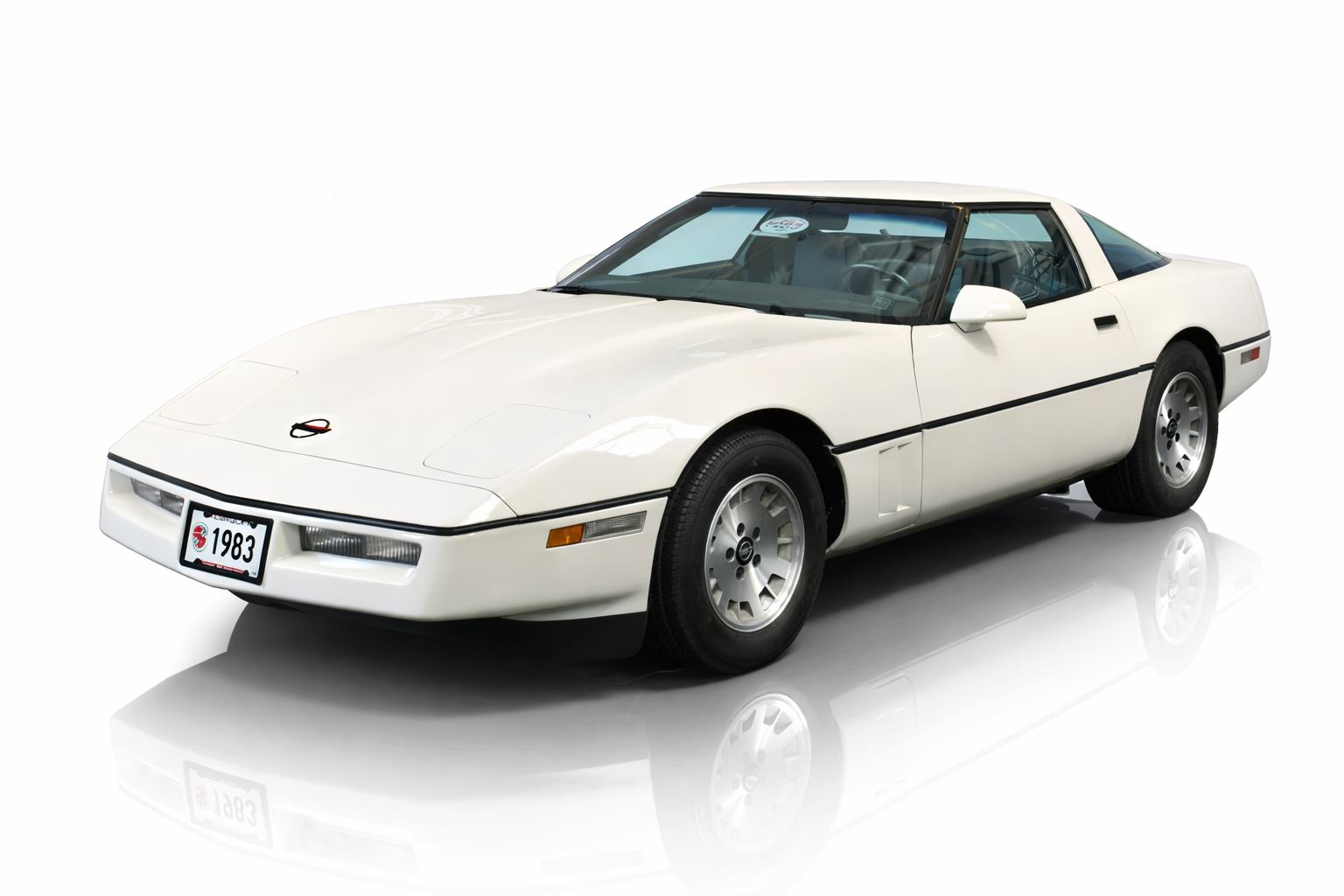
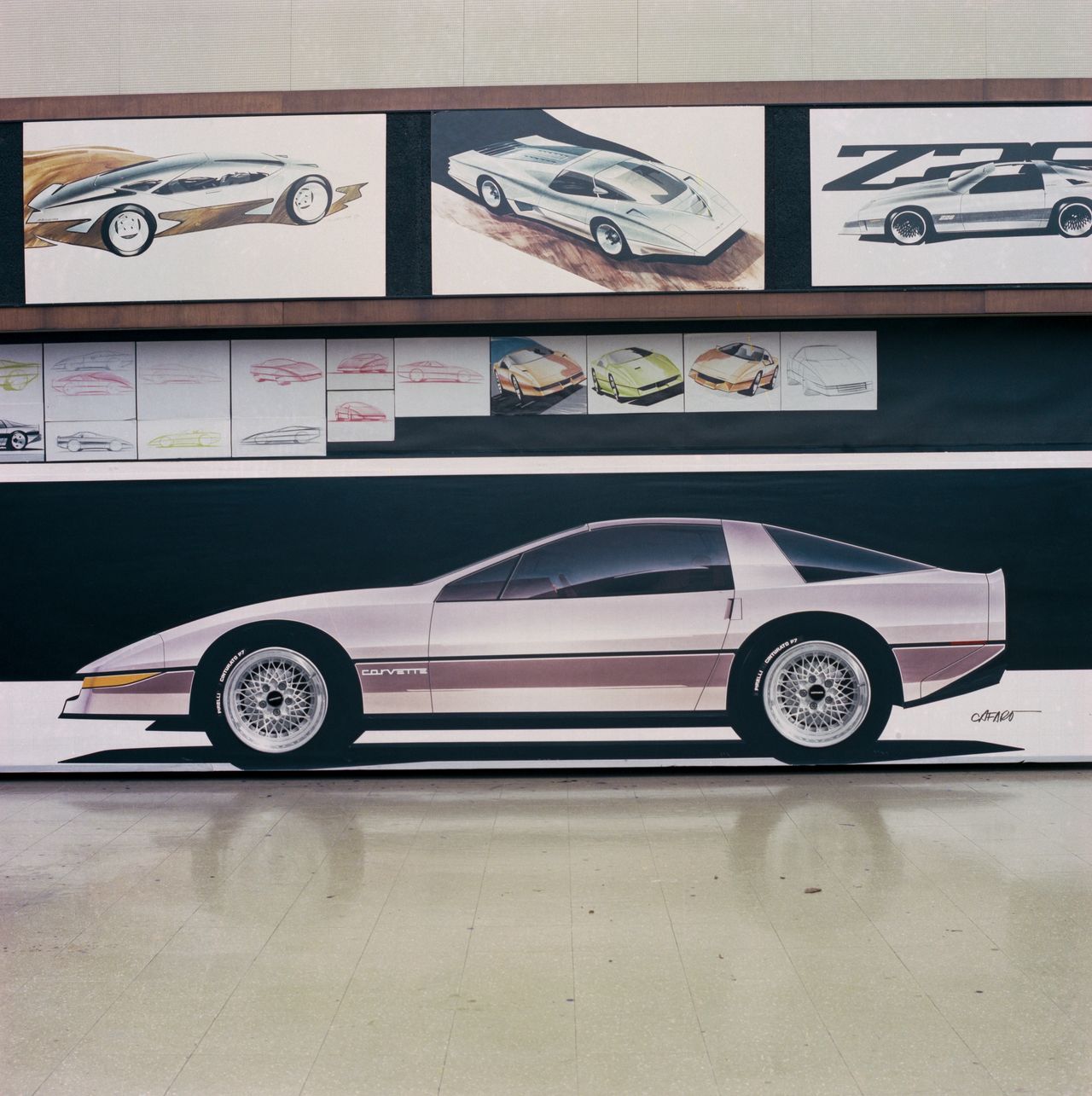
    Unveiled in 1965, the Mako Shark II was more than a spectacular show car—it was Chevrolet’s vision of Corvette’s future. Born from Bill Mitchell’s ambition and shaped by Larry Shinoda’s team, its predatory proportions, experimental technology, and unmistakable influence on the C3 changed America’s sports car forever in profound ways.

  • 1983 CORVETTE: “THE ONE AND ONLY”

    1983 CORVETTE: “THE ONE AND ONLY”

    Since its inception nearly forty years ago, the 1983 Corvette has remained surrounded by mystique and intrigue within the Corvette community. Some enthusiasts have even questioned whether a 1983 model ever truly existed, fueling rumors that Chevrolet skipped the model year altogether. Theories abound, ranging from production delays at GM’s newly opened Bowling Green Assembly Plant to technical hurdles with the car’s innovative new systems. While these explanations contain elements of truth, the full story is more nuanced.

    A Brief History

    The development of the fourth-generation Corvette (C4) officially began in 1978-79 under Chief Engineer David McLellan and Chief Designer Jerry Palmer. Their goal was to create a dramatically different Corvette—with improved handling, a sleek aerodynamic profile, and state-of-the-art technology. By April 1980, a prototype was presented to Chevrolet’s Product Policy Group (PPG), which immediately approved it for production.

    Over the next two years, the C4 evolved through extensive engineering and testing, benefiting from a robust “prototype program” that accelerated development. GM initially planned to launch the new Corvette as a 1982 model, potentially replacing the C3 that year. However, ongoing challenges—especially related to emissions and drivetrain systems—delayed production.

    The new Corvette was unveiled to the public in September 1982 at Riverside International Raceway. Yet, many details remained uncertain, including pricing, production start dates, and even the model year designation: would it be a 1983 or 1984 Corvette?

    Why No 1983 Production Model?

    One of the many early, full scale renderings by John Cafaro of the 1983 Corvette (as envisioned by Jerry Palmer and David McLellan.)(Image courtesy of GM Media.)
    One of the many early, full scale renderings by John Cafaro of the 1983 Corvette (as envisioned by Jerry Palmer and David McLellan.)(Image courtesy of GM Media.)

    Initially, Chevrolet planned for a 1983 launch. However, the U.S. federal government introduced more stringent exhaust and emissions regulations effective January 1, 1983. GM was already testing the new Corvette’s emission systems when these standards were announced. Meeting the new requirements required additional development time, prompting GM to postpone full-scale production until 1984 to ensure compliance.

    Delaying production had several benefits:

    • It allowed the Corvette to be certified under the 1984 emission standards, avoiding costly dual certification.
    • It provided engineers extra time to refine critical systems, prioritizing quality and performance over rushing to market.
    • It aligned production with the start of the calendar year, simplifying logistics and compliance.

    Despite the production delay, Chevrolet built a limited number of 1983 Corvettes—around 14 engineering test mules and 43 pilot (pre-production) cars—each assigned a unique 1983 VIN. These vehicles were used for rigorous testing, validation, and public relations, but none were sold to the public.

    The 1983 Corvette: The “One and Only”

    Although the debate has raged for decades, there is ONE 1983 Corvette, and it resides in Bowling Green, Kentucky at the National Corvette Museum.
    Although the debate has raged for decades, there is ONE 1983 Corvette, and it resides in Bowling Green, Kentucky at the National Corvette Museum.

    Forty-three of these 1983 pilot Corvettes rolled off the Bowling Green Assembly Plant production line as part of a pilot program designed to streamline production of the upcoming fourth-generation model. Each was assigned a unique Vehicle Identification Number (VIN) and prepped for transportation. The “one and only” 1983 Corvette, VIN 1G1AY0783D5110023, was dispatched to GM’s Milford Proving Grounds for additional shakedown and testing by the Corvette engineering and design teams. Upon completion, like its counterparts, it was scheduled to be returned to Bowling Green and destroyed.

    What happened next has become a legendary story within Corvette lore, with two popular accounts explaining how this unique Corvette escaped destruction.

    A New Pair of Boots

    General Motors reportedly rented a mobile crusher to demolish the 1983 test mules and pilot cars upon their return to Bowling Green. As the systematic destruction of these cars commenced, a sudden torrential downpour soaked southern Kentucky. The facilities engineer overseeing the operation halted work, concerned about the weather and, notably, his brand-new, expensive cowboy boots getting soaked. Allegedly, all but one car had already been crushed when he decided to delay destroying the last vehicle until fairer weather.

    When operations resumed the following day, the mobile crusher was gone. Management, assuming that the 43 Corvettes had been fully destroyed, had the crusher picked up and removed from the premises. Fearing repercussions for the oversight, the engineer notified his superiors of the remaining Corvette and the absent crusher. The “one and only” 1983 Corvette was quietly relocated to the backlot of the plant and left abandoned—only to be rediscovered a year later by Bowling Green’s then-new plant general manager, Paul Schnoes.

    The Covert Rescue Mission

    An alternative version of the events leading to the preservation of a single 1983 Corvette exists, and it’s a story that has been passed down from generation to generation, repeated over the years by plant insiders and Corvette historians. Faced with the imminent disposal of the remaining 1983 cars, a small group of Bowling Green Assembly Plant employees allegedly moved one unit to a remote backlot area and covered it, effectively removing it from the normal line of sight. It wasn’t a brazen theft or a paperwork rebellion—it was a strategic act of delay. “Out of sight, out of mind” was the operating principle.

    The emotional context matters. 1983 marked Corvette’s 30th anniversary. For many inside the plant, the idea that there would be no commemorative production model—no official car wearing a 1983 VIN to mark three decades of America’s sports car—felt wrong. The C4 represented a monumental leap forward in chassis rigidity, aerodynamics, and electronics. To let the transitional year vanish entirely seemed, to some, like erasing a chapter of the story.

    What Happened Next

    This image captures the lone surviving 1983 Corvette at the Bowling Green Assembly Plant, shown here in a distinctive red, white, and blue commemorative paint scheme. The patriotic livery was applied for display purposes, transforming the pre-production C4 into a visual tribute to Corvette’s heritage and its American identity. Standing beside the car is Wendyll Strode, who would later become the founding Executive Director of the National Corvette Museum. When the Museum opened in 1994, the one-and-only 1983 Corvette was formally placed on display there—permanently preserving the “missing” model year as a centerpiece of Corvette history.
    This image captures the lone surviving 1983 Corvette at the Bowling Green Assembly Plant, shown here in a distinctive red, white, and blue commemorative paint scheme. The patriotic livery was applied for display purposes, transforming the pre-production C4 into a visual tribute to Corvette’s heritage and its American identity. Standing beside the car is Wendyll Strode, who would later become the founding Executive Director of the National Corvette Museum. When the Museum opened in 1994, the one-and-only 1983 Corvette was formally placed on display there—permanently preserving the “missing” model year as a centerpiece of Corvette history.

    Regardless of which version of the rescue story is ultimately the most accurate, the outcome is undisputed: the “one and only” 1983 Corvette avoided destruction and lived on at the Bowling Green Assembly Plant for nearly a decade. Rather than disappearing into a warehouse or being treated like an inconvenient prototype, it became something far more visible—a living reminder of the model year that never made it to showrooms. In the years immediately after the 1984 launch, the car remained on-site, close to the people who built Corvettes every day and understood exactly what made this one so unusual.

    During its time at the plant, the Corvette was transformed into a display piece with a distinctive stars-and-stripes paint scheme, a patriotic livery that turned the “missing year” into a rolling celebration of the brand’s identity. It also received 16-inch directional wheels from the 1984 model year, a subtle but telling update that visually connected the 1983 pilot car to the production C4 that followed. The result was a car that looked less like an orphaned prototype and more like an official emblem—something meant to be seen, recognized, and talked about.

    From 1984 through 1994, the surviving 1983 Corvette served as a familiar fixture at the plant, proudly displayed near the entrance where employees and visitors could see it as they came and went. In that role, it became more than a curiosity—it became a mascot. For the Bowling Green workforce, it represented both a point of pride and a kind of shared inside knowledge: a Corvette that existed outside the normal rules, preserved not because it was sold, but because it mattered.

    When the National Corvette Museum prepared for its grand opening on September 2, 1994, the car’s significance finally received a permanent home. In celebration of that moment, the “one and only” 1983 Corvette was donated to the Museum, ensuring it would be preserved and interpreted as history rather than kept as a plant artifact. As part of that transition, the car was restored to its original white exterior, and its original 15-inch wheels were reinstalled, returning it to the configuration that defined it as an authentic 1983 pilot Corvette. Today, displayed as a centerpiece of the NCM collection, it stands as a tangible link between the end of the C3 era, the launch of the C4, and the rare circumstances that created Corvette’s most famous “missing” model year.

    Form Versus Function: The Engineering Marvel of the 1983 Corvette

    Full scale clay model of the 1983/C4 Corvette in the courtyard of GM's Design Studios in Detroit, Michigan.  (Image courtesy of GM Media.)
    Full scale clay model of the 1983/C4 Corvette in the courtyard of GM’s Design Studios in Detroit, Michigan. (Image courtesy of GM Media.)

    The 1983 Corvette was the first in the brand’s history to embrace the principle that “form follows function” in nearly every major design aspect. Its drag coefficient (Cd) of 0.341 was a record low for a Corvette at the time, achieved through extensive wind tunnel testing and aerodynamic refinement.

    Key aerodynamic features included:

    • A sharply raked windshield angled at 64.7 degrees—the most acute of any production vehicle from that era.
    • Pop-up headlights that rotated backward to reduce drag.
    • Aerodynamically shaped side mirrors.
    • Frameless rear hatch glass, which also served as the rear window.
    • Minimal exterior trim and body-side moldings to reduce airflow disturbances.

    These features combined to reduce drag and wind noise, delivering a smooth, stable ride at high speeds—even with the removable one-piece roof panel installed.

    To improve handling, the C4 introduced a lightweight, rigid uniframe chassis that greatly reduced flex during aggressive cornering. The suspension system was completely redesigned:

    • Front suspension used a transverse fiberglass composite monoleaf spring replacing traditional coil springs.
    • Forged aluminum unequal-length control arms and steering knuckles reduced unsprung weight.
    • Rear suspension featured a similar transverse fiberglass spring paired with a five-link independent setup using aluminum trailing arms and tie rods.

    These innovations delivered exceptional agility, steering precision, and road feel.

    The “Heartbeat” of the 1983 Corvette

    1983 Chevrolet Corvette featured an L83 350 Cubic Inch Cross-Fire Fuel Injected Engine mated to a 4-Speed Automatic Transmission.
    1983 Chevrolet Corvette featured an L83 350 Cubic Inch Cross-Fire Fuel Injected Engine mated to a 4-Speed Automatic Transmission.

    The 1983 Corvette featured a unique front clamshell hood design—a single piece that opened forward, giving unobstructed access to the engine and front suspension.

    Power came exclusively from the new 5.7-liter (350 cubic inch) L83 V8 engine equipped with Cross-Fire fuel injection—a twin throttle-body system first introduced in the 1982 Corvette. Though the L83 produced a modest 200 horsepower (due to tightening emissions regulations), it was advanced for its time and perfectly matched to the car’s sophisticated chassis.

    The engine was mated to a 4-speed automatic transmission with overdrive. Although a 4-speed manual with an automatic overdrive unit—the Doug Nash 4+3 transmission—was engineered, it was not offered until 1984.

    A 3.31:1 rear axle ratio balanced acceleration and highway cruising. Performance testing showed the 1983 Corvette could accelerate from 0 to 60 mph in under seven seconds, with a top speed near 140 mph.

    Tire development was a close collaboration with Goodyear, resulting in special 15-inch Eagle VR tires designed with “natural path” tread patterns derived from Formula 1 rain tire technology. These P215/65R15 tires offered outstanding grip and handling balance. For 1984, a 16-inch tire option was introduced.

    Braking was handled by Gridlok four-wheel disc brakes with aluminum calipers, providing strong and fade-resistant stopping power.

    The car’s curb weight was approximately 3,192 pounds—lighter than the outgoing 1982 model—while overall dimensions shifted to a lower (46.7 inches tall), wider (71 inches), and shorter (176.5 inches) footprint, enhancing its sporty stance and handling.

    A “Successful Failure”

    The 1983 Corvette stands as a fascinating “what could have been” in Corvette history—a car born of cutting-edge engineering and bold design, but delayed by external factors beyond GM’s control. Though it never reached full production, the 1983 Corvette exemplifies General Motors’ philosophy of “getting it right over simply getting it done,” setting the stage for the enduring success of the C4 Corvette starting in 1984.

    Why the 1983 Corvette Still Matters Today

    The 1983 Corvette matters because it represents the most dramatic reset in the model’s history. It wasn’t a styling refresh or a mid-cycle update—it was the bridge between two entirely different philosophies. The C3 bowed out after fifteen years, and the C4 was poised to redefine Corvette with new aerodynamics, digital instrumentation, and a far more rigid chassis. The 1983 pilot cars sit precisely at that fault line, capturing the moment when Corvette engineering pivoted toward modern performance.

    It also matters because it’s a case study in discipline. Rather than rush an unfinished product to market, Chevrolet absorbed the embarrassment of skipping a model year. Quality, refinement, and regulatory readiness took precedence over calendar optics. That decision ultimately benefited the 1984 launch and reinforced a principle that still echoes today: Corvette would rather delay than compromise.

    And then there’s the singular survivor. With only one 1983 Corvette preserved, the car has become less a prototype and more a physical artifact of transition. It reminds us that automotive history isn’t always defined by what was sold—it’s often shaped by what was corrected, refined, and, in this case, withheld. The 1983 Corvette still matters because it proves that even an “absent” model year can leave a lasting mark.

    There was never supposed to be a “lost” Corvette model year—but 1983 became exactly that. As Chevrolet prepared to launch the all-new C4, production delays and last-minute refinements forced a reset that erased an entire calendar year from the official record. Only 43 pilot cars were built, and just one survives today. The 1983 Corvette…

  • 1973 CORVETTE OVERVIEW

    1973 CORVETTE OVERVIEW

    From the moment the clock struck midnight on January 1, 1973, the world seemed to sprint toward two competing futures. One path soared upward—toward discovery, ingenuity, and possibility. The other pulled sharply inward, forcing nations and institutions to reckon with protests, policy, and a growing demand for accountability.

    The positive milestones were extraordinary. NASA launched Skylab, giving America its first foothold in long-duration life beyond Earth. Rivers of oil began moving through 800 miles of frozen frontier as construction of the Trans-Alaska Pipeline entered high gear. On the other side of the globe, the Sydney Opera House opened its wind-carved sails, a monument to creativity finally realized after years of setbacks. Even diplomacy found a breakthrough, as the Paris Peace Accords formally signaled America’s exit from the Vietnam conflict.

    In 1973, the U.S. Senate launched one of the most consequential investigations in American political history: the Watergate hearings. For 51 days that spring and summer, senators and special counsel interrogated the machinery behind the President’s re-election campaign—unraveling a conspiracy that stretched far beyond a botched break-in at Democratic National Committee headquarters. Broadcast live to an estimated 80 million Americans, the hearings transformed accountability into prime-time national ritual, revealing secret taping systems, coded campaign slush funds, and testimony that exposed deliberate obstruction at the highest levels of government. What began as political scandal evolved into constitutional crisis, redefining public expectations of transparency and proving that even the most powerful institutions must eventually answer to the unblinking eye of record. (photo credit: Gene Forte)
    In 1973, the U.S. Senate launched one of the most consequential investigations in American political history: the Watergate hearings. For 51 days that spring and summer, senators and special counsel interrogated the machinery behind the President’s re-election campaign—unraveling a conspiracy that stretched far beyond a botched break-in at Democratic National Committee headquarters. Broadcast live to an estimated 80 million Americans, the hearings transformed accountability into a prime-time national ritual, revealing secret taping systems, coded campaign slush funds, and testimony that exposed deliberate obstruction at the highest levels of government. What began as a political scandal evolved into a constitutional crisis, redefining public expectations of transparency and proving that even the most powerful institutions must eventually answer to the unblinking eye of record. (photo credit: Gene Forte)

    Yet political turbulence was impossible to ignore. The Watergate hearings began to tighten around the Nixon administration. The Supreme Court issued its landmark Roe v. Wade ruling, triggering national celebration for some and organized political backlash for others. The Yom Kippur War was still months away, but tensions in the Middle East were already simmering, with global oil politics becoming visibly unstable. Social movements filled streets and headlines, reshaping conversations around civil rights, women’s rights, and public trust in institutions.

    And while the world wrestled with reinvention, so did Detroit—literally. NHTSA bumper mandates for low-speed impacts forced new engineering priorities across the auto industry. Chevy’s Corvette, celebrating 20 years of defying convention, met the moment not by retreating from innovation but reframing it. The 1973 model debuted its federally-required rubberized front bumper—less about yielding to aesthetics, more about adapting a performance icon to a new cultural reality.

    In profile, this 1973 Corvette makes its point quietly: the familiar shark nose is now a body-color urethane bumper, with no trace of the gleaming chrome “bumperettes” that defined earlier C3s. It was the first Corvette to trade brightwork for impact-absorbing engineering up front, even as the traditional chrome rear bumper hung on for just one more year—literally marking 1973 as the hinge between eras. (Image courtesy Corvette Action Center)
    In profile, this 1973 Corvette makes its point quietly: the familiar shark nose is now a body-color urethane bumper, with no trace of the gleaming chrome “bumperettes” that defined earlier C3s. It was the first Corvette to trade brightwork for impact-absorbing engineering up front, even as the traditional chrome rear bumper hung on for just one more year—literally marking 1973 as the hinge between eras. (Image courtesy Corvette Action Center)

    What mattered most wasn’t the bumper itself, but what it represented: a car built from fiberglass and rebellion learning to work within a world demanding resilience, responsibility, and reinvention—without losing its spirit, or its speed.

    Years earlier, Zora Arkus-Duntov had joked that Corvette was “too rough for boulevard duty but built for endurance,” and the 1973 car somehow honored that spirit while sanding down its sharpest edges. More than any Corvette before it, this was a car of compromise—but not in the sense of surrender. It was a negotiation for continuation, a way of carrying the performance torch into a world that now demanded crash standards, emissions controls, and a different kind of responsibility. It marked the quiet end of the chrome-bright era and the beginning of a Corvette whose shape was dictated more by engineering function than showroom flash. Chevrolet never formally stamped “form follows function” into its press materials in 1973, but the car made the statement without needing words. The rest of Detroit just wouldn’t feel those words for another decade.

    The Federal Mandate Meets the Mako Shark

    The Mako Shark II was the purest expression of late-’60s Corvette fantasy—a rolling manifesto of knife-edge fenders, a pinched, chrome-laden nose, and bodywork that seemed to ignore anything as mundane as crash standards. By 1973, that attitude simply couldn’t survive the new NHTSA 5-mph bumper mandate. The production Corvette’s front end had to evolve into a longer, urethane-covered impact structure that could deform and recover without shattering paint or fiberglass. In the process, the Mako’s theatrical spear-point face was softened into something more compliant and durable—proof that even the most dramatic show car visions eventually answer to regulation, or disappear.
    The Mako Shark II was the purest expression of late-’60s Corvette fantasy—a rolling manifesto of knife-edge fenders, a pinched, chrome-laden nose, and bodywork that seemed to ignore anything as mundane as crash standards. By 1973, that attitude simply couldn’t survive the new NHTSA 5-mph bumper mandate. The production Corvette’s front end had to evolve into a longer, urethane-covered impact structure that could deform and recover without shattering paint or fiberglass. In the process, the Mako’s theatrical spear-point face was softened into something more compliant and durable—proof that even the most dramatic show car visions eventually answer to regulation, or disappear. (Image courtesy of GM Media LLC.)

    When the C3 Corvette debuted for 1968, it landed like a Space Age statement—arriving at the height of America’s race to the Moon, just months before the Apollo 11 mission would make history. The car wasn’t merely new, it was transformative: lower, chiseled, aggressively surfaced, and sparkling with chrome like the edge of a turbine blade catching runway sun. It felt inevitable, as though it had been shaped in a wind tunnel designed by dreamers instead of committees. The Mako Shark II concept that inspired it was a car that treated styling as an event-horizon breaker, a philosophy of motion even at rest. That original design era—from 1970 through 1972 for production customers—still delivered Corvettes powered by high-compression, mechanical-lifter, small-block engines, breathing through independent fender vent grilles and framed by delicate chrome bumpers that carried more ego than apology. It was a time when the Corvette shape led first, and engineering was asked to follow—quickly, dramatically, and always under protest.

    In 1973, the team behind the Corvette reversed the order completely, not by preference, but by ultimatum. That was the year the United States government demanded something automotive designers had historically dreaded: durability without negotiation. Beginning in 1973, every new passenger car sold in the country had to carry a bumper system capable of surviving a 5-mph impact without cosmetic damage. For most manufacturers, this translated into bulkier reinforcements and styling that suddenly looked like it had been engineered for combat instead of motion. But the Corvette’s rebellion had always been its altitude—low enough to defy convention, sharp enough to mock physics, compact enough to embarrass compromise. Those very strengths became the problem. Chevrolet didn’t need focus groups to confirm it. The engineers, product planners, and designers all saw the same unwelcome reality: you could not armor the existing 1968 Mako-derived front fascia against 5-mph impacts without destroying the car’s proportion, inviting infinite warranty claims, or handing the enthusiastic press a loaded rifle by which to cripple credibility.

    The upper photo reveals the true front bumper structure of the 1973 Corvette—the steel impact bar engineered to meet new 5-mph NHTSA durability mandates, normally invisible to the public eye. Beneath the theatrics of the earlier Mako-inspired chrome nose, this is the hardware that had to absorb and yield, protecting paint and fiberglass from a regulatory impact it was never designed to face. The lower image shows that same engineering now concealed beneath a body-matched urethane fascia, a compliant skin that preserved Corvette’s low, sharp identity while sacrificing the chrome sparkle up front. It wasn’t design revisionism—it was design triage: function first, beauty salvaged second. (Images courtesy of Corvette Magazine)
    The upper photo reveals the true front bumper structure of the 1973 Corvette—the steel impact bar engineered to meet new 5-mph NHTSA durability mandates, normally invisible to the public eye. Beneath the theatrics of the earlier Mako-inspired chrome nose, this is the hardware that had to absorb and yield, protecting paint and fiberglass from a regulatory impact it was never designed to face. The lower image shows the same engineering now concealed beneath a body-matched urethane fascia, a compliant skin that preserved Corvette’s low, sharp identity while sacrificing the chrome sparkle up front. It wasn’t design revisionism—it was design triage: function first, beauty salvaged second. (Images courtesy of Corvette Magazine)

    The solution that emerged was surgical in its restraint, brilliant in its brutality, and misunderstood for decades because it was born from necessity, not fashion. Chevrolet introduced a deformable steel impact bar, wrapped not in chrome, but in an all-new urethane cover, then color-matched to the body paint itself. The chrome “bumperettes” were gone—not because Corvette had outgrown them, but because they could no longer be defended. This new system extended the Corvette’s nose forward by approximately 2 inches and increased curb weight by about 35 pounds, a figure that, by modern standards, barely seems worth acknowledging.

    But nothing about Corvette existed in a vacuum, especially not in 1973. Those 35 pounds were measured at a time when the world still benchmarked performance purity against European aristocracy and Japanese upstarts armed with precision and innocence. Corvette suddenly found itself weighed—literally—against cars like Ferrari’s 365 GTB/4, Porsche’s 911E, Datsun’s 240Z, Lamborghini’s Miura, and DeTomaso’s Pantera. Worse yet, it was measured against the 1972 Corvette itself, a car whose LT-1 small-block still represented the high-water mark for enthusiast-grade small-block toughness in boulevard skin. Thirty-five pounds was not a statistic. It was a betrayal. It was something testers could quantify, journalists could weaponize, and owners could feel before third gear. The enthusiast press didn’t just note the change—they announced it, amplified it, and interrogated it like sworn testimony.

    When car magazines talked about the 1973 Corvette, they kept circling back to the 1970 XP-882 concept like it was a prophecy they almost missed. Publications loved how low, futuristic, and aerodynamic it looked, and many treated it as the moment Chevy silently signaled a new design direction. Writers “latched” onto it because it felt like the bridge between the wild chrome-edged concept era and the more regulated 1973 production reality. Some outlets even framed 1973 as the year Detroit finally started catching up to the vision XP-882 previewed three years earlier. The concept became an easy shorthand for explaining why 1973 looked so different — and why the Corvette story still felt ahead of its time. (Image courtesy of GM Media LLC)
    When car magazines talked about the 1973 Corvette, they kept circling back to the 1970 XP-882 concept like it was a prophecy they almost missed. Publications loved how low, futuristic, and aerodynamic it looked, and many treated it as the moment Chevy silently signaled a new design direction. Writers “latched” onto it because it felt like the bridge between the wild chrome-edged concept era and the more regulated 1973 production reality. Some outlets even framed 1973 as the year Detroit finally started catching up to the vision XP-882 previewed three years earlier. The concept became an easy shorthand for explaining why 1973 looked so different — and why the Corvette story still felt ahead of its time. (Image courtesy of GM Media LLC)

    Magazines latched onto the prototype XP-882 when explaining 1973, fascinated by trench-style cooling evaluations, aerodynamic transfer resolution, and aluminum-wheel porosity testing. All of it was gorgeous, nerdy, necessary stuff. But the truth of 1973’s design revolution was even simpler, harsher, and more historically important: the real production influence was function itself. The new bumper wasn’t engineered to stand out at car shows. It was engineered so that Corvette could continue to exist at all, and then still look distinctive enough to justify its own mythology.

    And it did. 1973 became the first production Corvette to prove that engineering could lead to style without murdering it. The nose was not redesigned to be different—it was redesigned so it could endure a future the original shape hadn’t been built to survive. It changed American automotive styling more than any design manifesto ever did, because it wrote a new one without trying: Form, when forced by law, must still bow to physics. Function, once proven, earns the right to become style again.

    From Separate Grilles to Integrated Reliefs

    On the 1973 Corvette, the front fender had lost the ornate egg-crate grille of the ’70–’72 cars and gained this smooth, sculpted vent pressed directly into the body side. The opening read as part of the fender instead of a bolt-on trim piece, giving the Stingray a cleaner, more contemporary profile. Up close, it quietly marked the moment when Corvette styling started to answer more to airflow and engineering than to chrome decoration. (Image courtesy of RK Motors)
    On the 1973 Corvette, the front fender had lost the ornate egg-crate grille of the ’70–’72 cars and gained this smooth, sculpted vent pressed directly into the body side. The opening read as part of the fender instead of a bolt-on trim piece, giving the Stingray a cleaner, more contemporary profile. Up close, it quietly marked the moment when Corvette styling started to answer more to airflow and engineering than to chrome decoration. (Image courtesy of RK Motors)

    Beyond the bumper, Corvette’s front fenders were redesigned to replace separate vent-grille assemblies with integrated recessed air vents. Instead of bolt-on chrome-trim egg-crate-style grilles, the fenders incorporated simplified, nearly vertical openings molded directly into the car’s fiberglass forms. This eliminated part complexity and provided a sleeker fender sculpt. The appearance shift mattered here, but again, not for the reason critics assumed. The 19701972 vent assemblies looked race-inspired, mechanical, industrial, and parts-heavy. For 1973, lowering the parts count and integrating them made the Corvette look more mature without abandoning the functional purpose of the vents themselves. It was the first proof point that Corvette was maturing toward real-world consumer sophistication, not Saturday-night stoplight theatrics.

    To complement the updated fenders, Corvette received a longer hood panel that concealed the wipers when parked. This was not an exercise in aesthetic indulgence—it was a functional necessity. Before 1973, the wiper-door panel was raised via vacuum actuation to allow the windshield wipers to operate. The system, while mechanical and novel, was infamous for misalignment, vacuum leaks, and sluggish operation. If 1973 was the year the country decided to mandate functionality in automotive regulatory frameworks, it was also the year Chevy quietly eliminated a vacuum-actuated panel that had already been embarrassing owners since 1968. It was both mandated progress and a matter of mercy.

    For 1973, Corvette retired the troublesome vacuum-operated wiper door and introduced this new domed hood. Its raised center section flowed into a rectangular cowl vent at the trailing edge, feeding a rear air-induction system that drew cooler, high-pressure air from the base of the windshield under full throttle. All ’73s carried this hood, which quietly improved under-hood temperatures and straight-line performance while giving the car a visibly more purposeful nose. (Image courtesy of bringatrailer.com)
    For 1973, Corvette retired the troublesome vacuum-operated wiper door and introduced this new domed hood. Its raised center section flowed into a rectangular cowl vent at the trailing edge, feeding a rear air-induction system that drew cooler, high-pressure air from the base of the windshield under full throttle. All ’73s carried this hood, which quietly improved under-hood temperatures and straight-line performance while giving the car a visibly more purposeful nose. (Image courtesy of bringatrailer.com)

    But Chevy didn’t stop there. The new hood also reincorporated a cowl-induction system to deliver cooler air to the carburetor, controlled by a solenoid-operated valve built into the hood. The return of cowl-induction was not just a hat-tip to earlier small-blocks—it was an engineering improvement poised to maintain power output stability in heavier and emissions-restricted contexts, a necessary step for a maturing car in a tightening era. Chevy had killed mechanical lifters in 1973, but it brought automated air induction back to compensate—and that one move did more to maintain Corvette’s continuity-holding air-fuel-power spirit than the chrome-elimination ever did to drain it. This was airflow with purpose.

    Longitudinal Door Beams and the Rising “Birdcage” Standard

    Inside the car’s doors, Chevrolet installed longitudinal fluted steel impact beams, extending from the door hinges to the lock plates. These beams tied into the car’s steel “birdcage” body structure, providing improved occupant protection from side impacts. Unlike traditional automotive doors that relied primarily on geometry and metal thickness for safety, Corvette’s side-impact beams were an engineered safety innovation pioneered by General Motors.

    These beams were not lightweight. They w ere not elegant. They were heavy, fluted, and hammered together like structural guardrails—yet they were one of the most important safety improvements the car ever received at a product-level stage. The beams gave Corvette a more “civilized” real-world justification for being both louder and lower than almost anything else on the road. Corvette was a fiberglass car, but its skeleton was increasingly steel-reinforced by 1973—and that mattered enormously. If 1973 was the estimated peak of consumer safety evolution for the C3 series before the 1974 chrome-elimination, 1973 was also the year that the skeleton became singular in its duty to protect the people inside it, starting from the doors inward.

    Corvette fans today debate a lot of controversial engineering divides over the course of the model’s run: which car was the best balanced, which was the most aggressive, which was the least compromised. But if you want a pre-OPEC regulation moment that changed Corvette’s actual occupant safety infrastructure irrevocably—and proved that even a part-heavy birdcage can bolster continuation without needing to be chrome-finished—it was the 1973 longitudinal door beam upgrade.

    Radial Tires – The Technology that Gave Stability but Took the Bragging Rights

    On the 1973 Corvette, this is exactly the kind of rubber that marked Chevy’s move into the radial era. From the factory, Stingrays rode on GR70x15 steel-belted radials, most commonly Firestone 500s or Goodyear Steelgards, depending on supplier and how the car was optioned. Buyers could choose narrow white stripes or bold raised white letters, but either way the tire size and construction were the same. These radials replaced the old bias-ply Wide Ovals and gave the ’73 Corvette better highway stability, improved wet-weather manners, and longer tread life. Enthusiasts grumbled about the 120-mph speed rating and slightly softer skidpad numbers, but visually and mechanically, a 1973 Corvette sitting on Firestone 500 or Goodyear Steelgard GR70-15s is pure period-correct Stingray. (image courtesy of Goodyear)
    On the 1973 Corvette, this is exactly the kind of rubber that marked Chevy’s move into the radial era. From the factory, Stingrays rode on GR70x15 steel-belted radials, most commonly Firestone 500s or Goodyear Steelgards, depending on supplier and how the car was optioned. Buyers could choose narrow white stripes or bold raised white letters, but either way the tire size and construction were the same. These radials replaced the old bias-ply Wide Ovals and gave the ’73 Corvette better highway stability, improved wet-weather manners, and longer tread life. Enthusiasts grumbled about the 120-mph speed rating and slightly softer skidpad numbers, but visually and mechanically, a 1973 Corvette sitting on Firestone 500 or Goodyear Steelgard GR70-15s is pure period-correct Stingray. (image courtesy of Goodyear)

    In 1973, Chevrolet did something consequential but easy to miss if you only skim the spec sheets: it made radial-ply tires standard equipment across the entire Corvette lineup. Until that   ,mmoment, Corvette had been a bias-ply, big-cam, edge-case machine—happy on dry pavement, happiest when mistreated, and most alive when flung through corners with more optimism than traction science could justify. Radials changed the baseline. They brought improved tread life, better stability at highway speeds, and significantly improved performance in the rain. They also brought math into the conversation. Not fantasy. Not folklore. Just hard advantages every owner could measure in real-world driving.

    But progress rarely arrives without irony, and the radial-tire upgrade was no exception. The gains in stability and wet-weather grip were immediate. The losses were measurable. The tires—speed-rated to just 120 mph—set a theoretical ceiling far below what automotive journalists had achieved in earlier years. Reporters in 1972 routinely tested Corvettes that were capable of comfortably exceeding 140 mph. LT-1 cars, especially, routinely embarrassed their published limits. Then 1973 came along and told enthusiasts, gently but firmly: your new traction miracles are highway-smart…not high-speed immortal.

    The 1973 Corvette was the year the Stingray officially grew up, shaped less by bravado and more by obligation—both regulatory and consumer-driven. As the attached article teases, the biggest visual statement was the new body-color urethane-wrapped bumper, paired with cleaner, integrated fender vents that replaced the parts-heavy grilles of earlier years. Chevrolet swapped bias-ply for GR70-15 steel-belted radials, trading headline top-speed heroics for better highway stability, longer tread life, and manners that shined when the weather didn’t cooperate. Longitudinal steel door beams fortified the birdcage, while insulation, revised body mounts, thicker carpeting, and an extended cowl-induction hood made the car quieter, sturdier, and more livable. It wasn’t the fastest Corvette of its era, but it was the most road-wise, proof that refinement, not speed, was the new currency. In the end, 1973 didn’t dull the legend—it seasoned it. (source: GM Marketing)
    The 1973 Corvette was the year the Stingray officially grew up, shaped less by bravado and more by obligation—both regulatory and consumer-driven. As the attached article teases, the biggest visual statement was the new body-color urethane-wrapped bumper, paired with cleaner, integrated fender vents that replaced the parts-heavy grilles of earlier years. Chevrolet swapped bias-ply for GR70-15 steel-belted radials, trading headline top-speed heroics for better highway stability, longer tread life, and manners that shone when the weather didn’t cooperate. Longitudinal steel door beams fortified the birdcage, while insulation, revised body mounts, thicker carpeting, and an extended cowl-induction hood made the car quieter, sturdier, and more livable. It wasn’t the fastest Corvette of its era, but it was the most road-wise, proof that refinement, not speed, was the new currency. In the end, 1973 didn’t dull the legend—it seasoned it. (source: GM Marketing)

    The most interesting tension wasn’t the change itself. It was the reinterpretation of it. For years, Corvette had been the car that magazines used to benchmark how fast American street engineering could get without filing a flight plan. Now it was the car being graded against the physics of low-speed bumper survival and tire-compound behavior. Owners gained durability and stability, but the tradeoff surfaced in the worst possible place for bragging rights: the stopwatch. Independent magazine tests logged longer stopping distances compared to 1972, even though the brake hardware was unchanged. The culprit was transition behavior—weight transfer under deceleration, tread squirm, and thermodynamic differences in how radials deformed under braking load compared to bias-ply.

    Lateral grip told an even stranger story. Corvette now hugged the road with more contact-patch integrity at highway speed, but posted lower lateral-G figures on skidpad testing. On the surface, this sounded like regression. In reality, it was just reclassification. The skidpad is a controlled environment—predictable asphalt, predictable temps, predictable heroics. But the wet road isn’t predictable. And the biggest gain in 1973 wasn’t lateral-G fantasy. It was predictability in conditions that would’ve sent a 1968 Zora-era bias-ply C3 sliding into the guardrail like a drunk figure-skater.

    Even acceleration testing had a footnote, though most enthusiasts glossed over it. Despite the added 35 lbs from the mandated urethane nose and the changed behavior of the new radials under load, magazine-tested 1973 Corvettes were still running quarter-miles in the mid-15-second bracket. That meant something important: the 1973 Corvette wasn’t slow. It was comparable. It stacked up respectably against Europe’s finest when tested without hometown favoritism. On a drag strip, 1973 still produced results comfortably within shouting distance of the Porsche 911E, Ferrari Dino, Jaguar E-Type V12, and DeTomaso Pantera. It just got there with more stability than swagger.

    To European eyes, the 1973 Corvette looked like the loud American extrovert parked at the beach—low, long, and drenched in color—but by this point it was quietly closing the gap on their idea of a well-rounded grand tourer. Magazine tests still showed the Stingray running with cars like the Porsche 911 and Ferrari Dino in straight-line performance, yet Chevrolet was steadily engineering in the kind of reliability and comfort that made it more than a weekend toy. Year by year, the convertible in this brochure gained better tires, improved body mounts, stronger door beams, and more sound insulation, turning it into a car that could cross states as confidently as it blitzed on-ramps. European sports cars were praised for their balance and refinement; the ’73 Corvette was starting to earn similar respect while keeping its big-bore attitude and open-sky drama. To many enthusiasts, it proved that America’s fiberglass icon didn’t have to choose between speed and staying power—it could do both, with each model year getting just a little more grown-up.
    To European eyes, the 1973 Corvette looked like the loud American extrovert parked at the beach—low, long, and drenched in color—but by this point it was quietly closing the gap on their idea of a well-rounded grand tourer. Magazine tests still showed the Stingray running with cars like the Porsche 911 and Ferrari Dino in straight-line performance, yet Chevrolet was steadily engineering in the kind of reliability and comfort that made it more than a weekend toy. Year by year, the convertible in this brochure gained better tires, improved body mounts, stronger door beams, and more sound insulation, turning it into a car that could cross states as confidently as it blitzed on-ramps. European sports cars were praised for their balance and refinement; the ’73 Corvette was starting to earn similar respect while keeping its big-bore attitude and open-sky drama. To many enthusiasts, it proved that America’s fiberglass icon didn’t have to choose between speed and staying power—it could do both, with each model year getting just a little more grown-up.

    And that’s where perception fell behind reality. Corvette legend had always been built around the outliers—the rare engines, the underrated tires, the top speeds that seemed to defy the rulebook. The switch to radial tires didn’t suddenly make the car slow or soft. It just made its performance easier to measure and harder to exaggerate. Instead of feeding the myths, the radials forced people to see what the car could really do.

    If 1973 taught us anything, it’s that Corvette engineering kept moving forward even when opinions about the car didn’t. The move to radial tires wasn’t a sellout of performance—it simply changed how that performance showed up. On paper, the Corvette was still a sports car. In practice, it was becoming a smarter one: better in the rain, more stable at highway speeds, and more livable for owners who actually expected their tires to last longer than their monthly payment cycle.

    When the 1973 Corvette hit the road-test circuit, publications like Car and Driver and Road & Track didn’t just critique the car—they mourned what they felt had been lost. Progress toward a calmer ride, better manners, and federal compliance was treated as regression, with every softer response or quieter mile stacked up against the razor-edged, high-compression cars of just a few years prior. One test even mislabeled the car as an LT-1 when it was actually an L82, a slip that perfectly captured the mindset of the day: critics were still mentally living in the solid-lifter era and judging the new car against a ghost. The ’73’s broader usability and maturing character were largely dismissed because they didn’t fit the old spec-sheet hero narrative. Instead of seeing a Corvette that was evolving into a more refined, everyday-capable sports car, many reviewers framed it as a fallen idol. In that climate, every change—tires, tuning, insulation, or otherwise—was read as evidence that the Corvette was drifting away from its “proper” past, even when the numbers said it was still very much in the fight. (source: Road and Track)
    When the 1973 Corvette hit the road-test circuit, publications like Car and Driver and Road & Track didn’t just critique the car—they mourned what they felt had been lost. Progress toward a calmer ride, better manners, and federal compliance was treated as regression, with every softer response or quieter mile stacked up against the razor-edged, high-compression cars of just a few years prior. One test even mislabeled the car as an LT-1 when it was actually an L82, a slip that perfectly captured the mindset of the day: critics were still mentally living in the solid-lifter era and judging the new car against a ghost. The ’73’s broader usability and maturing character were largely dismissed because they didn’t fit the old spec-sheet hero narrative. Instead of seeing a Corvette that was evolving into a more refined, everyday-capable sports car, many reviewers framed it as a fallen idol. In that climate, every change—tires, tuning, insulation, or otherwise—was read as evidence that the Corvette was drifting away from its “proper” past, even when the numbers said it was still very much in the fight. (source: Road and Track)

    The real story of 1973 isn’t just tire chemistry; it’s survival. Corvette didn’t need to run 140 mph to prove it still belonged. It needed to pass new 5-mph impact rules, live with tighter emissions standards, and come out the other side recognizable. It did that through engineering discipline, shedding some chrome flash and bias-ply habit while keeping its core character intact.

    Progress in 1973 simply landed faster than many fans were ready to admit. The radials weren’t installed to turn the Corvette into a slower cornering car—they were there to extend its usefulness in a world about to face fuel shortages and changing expectations. The straight-line performance remained, stability improved, tread life stretched out, and the brakes waited their turn for an upgrade. The legend stayed loud, even as the cabin got quieter and the car itself became better behaved on real roads in real weather.

    The Wheel That Was Nearly a Revolution: RPO YJ8

    The 1973 Corvette YJ8 wheel option marked Chevrolet’s first serious push into lightweight aluminum rolling stock for America’s favorite fiberglass sports car. These cast aluminum wheels—distinguished by their symmetrical 8-slot turbine-style windows and small tri-bar center cap—shaved precious unsprung mass at a moment when Corvette engineering was fighting weight everywhere it could. Not only did they signal a break from stamped-steel wheel norms, they previewed an industry transition toward aluminum wheels as de facto performance equipment in the decades to follow. In 1973, they weren’t the popular choice—networks of purists still clung to road feel over material innovation—but they were the right choice for anyone who understood racing math: less weight at the wheel meant more wheel doing the driving. (Image: RK Motors)
    The 1973 Corvette YJ8 wheel option marked Chevrolet’s first serious push into lightweight aluminum rolling stock for America’s favorite fiberglass sports car. These cast aluminum wheels—distinguished by their symmetrical 8-slot turbine-style windows and small tri-bar center cap—shaved precious unsprung mass at a moment when Corvette engineering was fighting weight everywhere it could. Not only did they signal a break from stamped-steel wheel norms, but they also previewed an industry transition toward aluminum wheels as de facto performance equipment in the decades to follow. In 1973, they weren’t the popular choice—networks of purists still clung to road feel over material innovation—but they were the right choice for anyone who understood racing math: less weight at the wheel meant more wheel doing the driving. (Image: RK Motors)

    If 1973 was a year of reach, radial compromise, noise suppression, and federal rules crashing into fiberglass sports-car dreams, then nothing sums it up better than Corvette’s infamous RPO YJ8 cast aluminum wheel. Unlike most chrome-era wheels, YJ8 stands out not because Chevrolet nailed it, but because the option failed in a big way. Only four customer-ordered sets are officially recorded for 1973, yet Chevy is believed to have built as many as 800 sets before discovering serious porosity problems in the aluminum. That porosity created structural weakness, forcing Chevrolet to recall the wheels that had gone out. They carried casting number 329381 and used lug nuts with black painted, recessed centers—small details that now loom large in the legend.

    Wheels have always mattered to Corvette’s identity, visually and dynamically, but YJ8 took on a life far bigger than its tiny production footprint. It’s remembered today not for how many exist, but for how few were sold and how quickly they were pulled back. The story fits perfectly into Corvette culture, which has always been built more on rare exceptions than everyday averages. In the same year unused VINs were left on the table, engines lost compression to regulations, radials replaced Wide Ovals, side-impact beams appeared in the doors, and extra insulation quieted the cabin, this one aluminum wheel option quietly became the most talked-about RPO of the C3 era.

    In the world of automotive folklore, a memorable failure often outlives a routine success—and YJ8 is proof. These wheels didn’t just fade into obscurity; some slipped into customer hands through dealer parts channels, with spotty documentation and plenty of speculation. Chevrolet never set out to create a myth around them. The metal itself did that.

    NVH – The Quietest Loud Car Ever Tested

    ChatGPT said:  One of the subtler but most meaningful upgrades for 1973 was Chevrolet’s push to tame noise, vibration, and harshness in the Corvette. Under the hood, new insulation pads like the one shown here helped soak up valvetrain clatter and induction roar before it reached the cabin, taking the edge off the big V8 without muting it. Chevrolet paired that with revised rubber engine and body mounts that isolated more vibration from the frame while still keeping the car feeling tight and responsive. The result was a Stingray that sounded less raw and tinny, but still very much like a Corvette when you laid into the throttle. It was the first real step toward a car you could drive all day without feeling like you’d spent it inside the engine bay. (Source: RK Motors)
    One of the subtler but most meaningful upgrades for 1973 was Chevrolet’s push to tame noise, vibration, and harshness in the Corvette. Under the hood, new insulation pads like the one shown here helped soak up valvetrain clatter and induction roar before it reached the cabin, taking the edge off the big V8 without muting it. Chevrolet paired that with revised rubber engine and body mounts that isolated more vibration from the frame while still keeping the car feeling tight and responsive. The result was a Stingray that sounded less raw and tinny, but still very much like a Corvette when you laid into the throttle. It was the first real step toward a car you could drive all day without feeling like you’d spent it inside the engine bay. (Source: RK Motors)

    Perhaps the most under-appreciated evolution of the 1973 Corvette was the quiet work happening under the paint—literally. While the buzz in brochures was all about bumpers, vents, and safety, Chevrolet engineers were pouring serious effort into what we now call Noise, Vibration, and Harshness—NVH. They didn’t use that acronym in 1973, but they were absolutely engineering toward it. The goal was simple: make the Corvette feel more solid, more refined, and less fatiguing to drive…without turning it into something unrecognizable.

    One of the biggest steps forward was the introduction of rubber-steel-encased body mounts. These mounts isolated more of the drivetrain and road harshness from the cabin, but still kept the chassis tight enough to feel like a proper sports car. Pair that with asphalt-based sound-deadening sprayed onto inner body panels and a new hood insulation pad, and the ’73 Corvette really did sound and feel different from behind the wheel. Chevrolet advertising even claimed up to a 40% reduction in interior noise, and period tests backed up the idea that this wasn’t just marketing fluff. The exact percentage matters less than the intent: Chevy was making a Corvette you could drive farther, more often, without coming out of it feeling wrung out.

    For the 1973 Corvette, fixing the rear glass delivered a real NVH win, even if the headlines were chasing bumpers and horsepower drama. Making the window permanent reduced wind turbulence and pressure pulses in the cabin, cutting the booming buffet that came with the old removable glass. With one solid, sealed light, Chevrolet also eliminated rattle points and air gaps, helping keep highway noise out instead of letting it echo in. The result was a cockpit that felt tighter, quieter, and less tiring at speed, without taking anything away from the character of the car. It was a small engineering decision that made a surprisingly big difference the longer you drove. (source: RK Motors)
    For the 1973 Corvette, fixing the rear glass delivered a real NVH win, even if the headlines were chasing bumpers and horsepower drama. Making the window permanent reduced wind turbulence and pressure pulses in the cabin, cutting the booming buffet that came with the old removable glass. With one solid, sealed light, Chevrolet also eliminated rattle points and air gaps, helping keep highway noise out instead of letting it echo in. The result was a cockpit that felt tighter, quieter, and less tiring at speed, without taking anything away from the character of the car. It was a small engineering decision that made a surprisingly big difference the longer you drove. (source: RK Motors)

    Inside, the upgrades continued with thicker carpeting and strategically placed acoustic mats, all aimed at cutting down on road roar and driveline hum. Even the change from a removable to a fixed rear window played a role. The earlier pop-out glass gave you novelty and noise; the new fixed window reduced wind buffeting, tightened up the cabin, and freed up more usable storage space behind the seats. It was a small but telling shift—from weekend toy thinking to real grand-touring usability.

    What matters most is that none of this killed the car’s character. The federally strangled engines might have lost some of their old spec-sheet swagger, but the Corvette didn’t suddenly go mute. You could still hear the tires working, still hear the carburetor pulling air—you just didn’t have to shout over it. By 1973, Corvette wasn’t trying to yell its legend anymore. It was learning how to communicate it: still mechanical, still emotional, just filtered through a cabin that finally let you hear your own thoughts along with the exhaust.

    Engine Philosophy Meets Reality – The Year the LT-1 Left and Hydraulics Became Standard

    The 454 big-block in the 1973 Corvette, the LS4, stood as the lineup’s elder statesman in a year dominated by change. It carried forward its 270-hp rating from 1972, but felt different in the real world because the car around it was getting heavier, quieter, and more composed. The big 454 delivered effortless low-end torque, making the ’73 Corvette feel strong off the line without needing to scream its way to peak power. It paired especially well with the 3.70:1 axle and close-ratio 4-speed in test cars, pulling hard through the midrange where most drivers actually lived. By 1973, the 454 wasn’t the wild heavyweight champ anymore, but it was still the car’s big, steady proof that size and muscle could evolve without completely losing their bite.ChatGPT said:  The 454 big-block in the 1973 Corvette, the LS4, stood as the lineup’s elder statesman in a year dominated by change. It carried forward its 270-hp rating from 1972, but felt different in the real world because the car around it was getting heavier, quieter, and more composed. The big 454 delivered effortless low-end torque, making the ’73 Corvette feel strong off the line without needing to scream its way to peak power. It paired especially well with the 3.70:1 axle and close-ratio 4-speed in test cars, pulling hard through the midrange where most drivers actually lived. By 1973, the 454 wasn’t the wild heavyweight champ anymore, but it was still the car’s big, steady proof that size and muscle could evolve without completely losing their bite. (source: RK Motors)
    The 454 big-block in the 1973 Corvette, the LS4, stood as the lineup’s elder statesman in a year dominated by change. It carried forward its 270-hp rating from 1972, but felt different in the real world because the car around it was getting heavier, quieter, and more composed. The big 454 delivered effortless low-end torque, making the ’73 Corvette feel strong off the line without needing to scream its way to peak power. It paired especially well with the 3.70:1 axle and close-ratio 4-speed in test cars, pulling hard through the midrange where most drivers actually lived. By 1973, the 454 wasn’t the wild heavyweight champ anymore, but it was still the car’s big, steady proof that size and muscle could evolve without completely losing their bite.ChatGPT said: The 454 big-block in the 1973 Corvette, the LS4, stood as the lineup’s elder statesman in a year dominated by change. It carried forward its 270-hp rating from 1972, but felt different in the real world because the car around it was getting heavier, quieter, and more composed. The big 454 delivered effortless low-end torque, making the ’73 Corvette feel strong off the line without needing to scream its way to peak power. It paired especially well with the 3.70:1 axle and close-ratio 4-speed in test cars, pulling hard through the midrange where most drivers actually lived. By 1973, the 454 wasn’t the wild heavyweight champ anymore, but it was still the car’s big, steady proof that size and muscle could evolve without completely losing their bite. (source: RK Motors)

    Perhaps no topic fuels more debate among enthusiasts of the C3 generation than the disappearance of the mechanical-lifter LT-1 engine option for 1973. Since 1956, Corvette owners could choose a mechanical-lifter engine—an unapologetically raucous valvetrain configuration that carried the car’s racing parity, its snarling idle, and its ripsaw mechanical vibe. 1973 killed that engine—not for lack of fans, but for lack of federal permissions. Instead, Chevrolet offered a choice of three hydraulic-lifter engines, each engineered to be quieter, smoother, and compliant with tightening emissions standards.

    Under the hood of many 1973 Corvettes lived this workhorse: the L48 350-cubic-inch small-block. Rated at 190 horsepower, it was no longer the fire-breather of the late ’60s, but it delivered smooth, usable torque and easy drivability that matched the car’s move toward a more refined grand-touring role. Paired with either a four-speed manual or Turbo-Hydramatic automatic, the L48 made the ’73 Stingray perfectly happy in traffic, on the highway, or cruising a back road without constant gear-hunting. It also tolerated the new unleaded-fuel and emissions realities better than the wilder solid-lifter mills that came before it. In a year defined by compromise, this engine became the dependable, everyday heart that kept Corvette ownership within reach for a broad slice of buyers. (source: CorvetteForum)
    Under the hood of many 1973 Corvettes lived this workhorse: the L48 350-cubic-inch small-block. Rated at 190 horsepower, it was no longer the fire-breather of the late ’60s, but it delivered smooth, usable torque and easy drivability that matched the car’s move toward a more refined grand-touring role. Paired with either a four-speed manual or Turbo-Hydramatic automatic, the L48 made the ’73 Stingray perfectly happy in traffic, on the highway, or cruising a back road without constant gear-hunting. It also tolerated the new unleaded fuel and emissions realities better than the wilder solid-lifter mills that came before it. In a year defined by compromise, this engine became the dependable, everyday heart that kept Corvette ownership within reach for a broad slice of buyers. (source: CorvetteForum)

    The base 350 CID V8 (RPO L48) was rated at 190 horsepower, a noticeable drop from prior years. An upgraded 350 (L82) produced 250 horsepower, while the lone 454 big-block engine option (LS4) generated 270 horsepower. While all outputs were diminished from the small-block glory days of the late 60s and early 70s, none of them kept the car from running 15-second quarter-miles in road tests—figures comparable to many European contemporaries from Porsche and DeTomaso. The 454 big-block was the only engine that did not receive a horsepower downgrade for 1973, but even that figure often created confusion among contemporary writers, since some marketing materials misquoted performance outputs early in the year’s release before official ratings were finalized.

    The reason mechanical lifters disappeared was simple: emissions legislation and unleaded-fuel mandates pushed the car away from high-emissions-tolerant configurations and forced Chevy to reprioritize engine compliance, noise diplomacy, and airflow induction improvements to compensate for mass and emissions restrictions.

    Here’s the sweet spot of the 1973 lineup: the L82 350-cubic-inch small-block. Rated at 250 horsepower, it gave the Stingray a sharper edge than the base L48 without the nose-heavy feel of the 454, making it the enthusiast’s choice in a year full of compromises. The higher compression and hotter cam let it pull harder through the midrange, and paired with a close-ratio four-speed, it delivered the kind of throttle response that still felt properly Corvette. It wasn’t the wild LT-1 of just a few seasons earlier, but it carried enough punch to keep the car respectable in any European company. In many ways, the L82 was the bridge between the muscle-era Stingrays and the more refined, emissions-era Corvettes that would follow.
    Here’s the sweet spot of the 1973 lineup: the L82 350-cubic-inch small-block. Rated at 250 horsepower, it gave the Stingray a sharper edge than the base L48 without the nose-heavy feel of the 454, making it the enthusiast’s choice in a year full of compromises. The higher compression and hotter cam let it pull harder through the midrange, and paired with a close-ratio four-speed, it delivered the kind of throttle response that still felt properly Corvette. It wasn’t the wild LT-1 of just a few seasons earlier, but it carried enough punch to keep the car respectable in any European company. In many ways, the L82 was the bridge between the muscle-era Stingrays and the more refined, emissions-era Corvettes that would follow.

    It wasn’t the end of performance—it was the beginning of a new era where Corvette would have to justify its performance identity not through theater, but through engineering and owner loyalty.

    Let’s put it bluntly: the LT-1 didn’t disappear because Corvette ran out of heroes. It disappeared because it legally couldn’t breathe out leaded emissions anymore.

    Hydraulic lifters didn’t make it slower. They made it qualified for continuation.

    VINs, Identity, and Numerological Oddities – A Year of Proof That Chevy Wasn’t Cutting Corners Either

    This dash VIN stamp reads 1Z37J3S405483, the unique 13-character vehicle identification number assigned to this Corvette. Decoding it shows 1 = Chevrolet, Z = Corvette, 37 = coupe body, J = L48 350-ci small-block V-8, 3 = 1973 model year, and S = St. Louis assembly plant. The final six digits (405483) mark it as the 5,483rd 1973 Corvette built, an important reference point for confirming its numbers-matching status. (source: Classic Auto Mall)
    This dash VIN stamp reads 1Z37J3S405483, the unique 13-character vehicle identification number assigned to this Corvette. Decoding it shows 1 = Chevrolet, Z = Corvette, 37 = coupe body, J = L48 350-ci small-block V-8, 3 = 1973 model year, and S = St. Louis assembly plant. The final six digits (405483) mark it as the 5,483rd 1973 Corvette built, an important reference point for confirming its numbers-matching status. (source: Classic Auto Mall)

    Corvette’s production identity in 1973 was every bit as polarizing—and as talked-about—as its new urethane nose. Chevrolet reserved a block of VIN serials running from 400001 through 434464, enough for 34,464 potential cars. In reality, only 30,464 Corvettes were built that year. That left exactly 4,000 VINs that were never stamped on a frame or title, creating one of those neat, maddening little gaps that Corvette people love to argue about.

    The unused block corresponds to sequence numbers 24001–28000, a clean, 4,000-car hole that historians later mapped out and collectors have obsessed over ever since. Federal rules required every car to have a unique VIN—but they didn’t require Chevrolet to use every number it set aside. By leaving that chunk of the sequence untouched, Chevy made it clear that real-world production, safety upgrades, and the hard work of getting the 1973 car right took precedence over making the paperwork look perfectly continuous on paper.

    This 1973 Corvette VIN guide breaks down all 13 characters—division, series, body style, engine, plant, and build sequence—so you can verify exactly what your ’73 left St. Louis as from day one. (Image courtesy of UltimateCorvette.com)
    This 1973 Corvette VIN guide breaks down all 13 characters—division, series, body style, engine, plant, and build sequence—so you can verify exactly what your ’73 left St. Louis as from day one. (Image courtesy of UltimateCorvette.com)

    For Corvette enthusiasts, that skipped VIN range became more than a clerical oddity. It turned into a symbol of how turbulent and transition-heavy 1973 really was. Corvette mythology has never been just about horsepower numbers or quarter-mile times; it’s also about the continuity and identity encoded in details like this. Even the VIN analysts were, in their own way, acknowledging how far-reaching—and controversial—the year’s changes had become. In that sense, 1973 stands as an emblematic inflection point: Chevy literally assigned numbers it never meant to build, and in doing so, added yet another layer of lore to a car already overflowing with it.

    Concept Corvettes in the 1973 Orbit

    For 1973, Corvette engineering thinking stretched well beyond the familiar C3 shape in the form of the XP-987 GT, a mid-engine two-rotor concept car. Built on a shortened Porsche 914 chassis with Pininfarina-crafted steel bodywork, it housed GM’s experimental twin-rotor Wankel engine amidships and explored a smaller, more European-flavored Corvette of the future. Intended as a possible mid-’70s successor to the production car, it was ultimately sidelined when GM’s rotary program was cancelled, but the one-off survived and now lives in museum custody as a rolling “what if.” We cover the full story of the XP-987 GT—its development, near-disposal, and unlikely rescue—in a dedicated deep-dive on the Mid-Engine/C8 Corvette Concepts page of UltimateCorvette.com. (Image courtesy of Joe Kolecki/Kolecki Photography)
    For 1973, Corvette engineering thinking stretched well beyond the familiar C3 shape in the form of the XP-987 GT, a mid-engine two-rotor concept car. Built on a shortened Porsche 914 chassis with Pininfarina-crafted steel bodywork, it housed GM’s experimental twin-rotor Wankel engine amidships and explored a smaller, more European-flavored Corvette of the future. Intended as a possible mid-’70s successor to the production car, it was ultimately sidelined when GM’s rotary program was cancelled, but the one-off survived and now lives in museum custody as a rolling “what if.” We cover the full story of the XP-987 GT—its development, near-disposal, and unlikely rescue—in a dedicated deep-dive on the Mid-Engine/C8 Corvette Concepts page of UltimateCorvette.com. (Image courtesy of Joe Kolecki/Kolecki Photography)

    For all the talk of rubber bumpers, emissions hardware, and NVH improvements, 1973 was also the year Corvette flirted hardest with an entirely different future. While the production car stayed front-engined and familiar, Chevrolet’s advanced studios were quietly pushing out a string of radical mid-engine and rotary-powered concepts that wore Corvette badges but shared almost nothing with the long-hood C3 in your local showroom. Seen together, these cars form a shadow “lineup” around the 1973 model year—a parallel timeline where Corvette might have gone lighter, smaller, and far more exotic.

    The most visible of these was the XP-987 GT Two-Rotor Corvette, a compact mid-engine coupe originally developed as the “Chevrolet GT.” Underneath its low, Pininfarina-built body sat a shortened and widened Porsche 914/6 chassis, with the suspension, steering, and brakes largely carried over. GM’s experimental RC2-206 two-rotor Wankel engine—206 cubic inches and roughly 180 horsepower—was mounted transversely behind the seats and drove a new automatic transaxle, previewing hardware meant for future compact Chevrolets. Days before its debut at the 1973 Frankfurt Motor Show, Chevrolet quietly rebranded the car as the Corvette Two-Rotor, an acknowledgment that, at least for a moment, this tidy, European-scale machine was being considered as a legitimate extension of the Corvette story.

    If the Two-Rotor hinted at a smaller, more efficient Corvette, its big sibling went in the opposite direction. Building off the earlier XP-882 mid-engine program, Chevrolet created the XP-895 Four-Rotor Corvette—a dramatic wedge-shaped prototype powered by a 420-horsepower Wankel built by pairing two Vega two-rotor engines into a single four-rotor unit. The chassis layout remained mid-engine, but the car itself was bolder, lower, and visually closer to the supercars Chevrolet expected to battle on the world stage. This was the “no apologies” interpretation of a rotary Corvette, aimed squarely at traditional performance expectations even as fuel economy and regulations were tightening around the production car.

    Though its internal project date is 1972, the XP-895 Reynolds Aluminum Corvette is often treated as a 1973 concept because that’s the year it made its public debut at the New York Auto Show. Developed as an evolution of the XP-882 mid-engine program, XP-895 used a transverse-mounted 400-cid small-block V-8 driving the rear wheels through a Turbo-Hydramatic and bevel gearbox. Chevrolet had two nearly identical cars built, one in conventional steel and one in aluminum, the latter crafted in partnership with Reynolds Metals to test how much weight—and therefore performance—could be gained by going all-alloy. When the silver mid-engine coupe finally rolled onto the New York show stand in 1973, it served as both a rolling laboratory for lightweight construction and a very public hint at the mid-engine Corvette future GM was actively exploring. (Image courtesy of GM Media LLC)
    Though its internal project date is 1972, the XP-895 Reynolds Aluminum Corvette is often treated as a 1973 concept because that’s the year it made its public debut at the New York Auto Show. Developed as an evolution of the XP-882 mid-engine program, XP-895 used a transverse-mounted 400-cid small-block V-8 driving the rear wheels through a Turbo-Hydramatic and bevel gearbox. Chevrolet had two nearly identical cars built, one in conventional steel and one in aluminum, the latter crafted in partnership with Reynolds Metals to test how much weight—and therefore performance—could be gained by going all-alloy. When the silver mid-engine coupe finally rolled onto the New York show stand in 1973, it served as both a rolling laboratory for lightweight construction and a very public hint at the mid-engine Corvette future GM was actively exploring. (Image courtesy of GM Media LLC)

    XP-895 also spawned one of the era’s most technically interesting offshoots: the so-called Reynolds Aluminum Corvette. In place of the original steel body, Chevrolet and Reynolds Metals Company (yes, that Reynolds company….as in Reynolds Wrap aluminum foil) developed an aluminum skin that closely followed the same basic surfacing but cut roughly 400–500 pounds from the car’s mass. The prototype—finished in a simple silver—served as a rolling proof-of-concept that lightweight alloys could be used for volume bodywork, something well beyond Corvette’s fiberglass comfort zone at the time. Even when later re-fitted with a transversely mounted 400-cubic-inch small-block V8 and automatic transmission, the car remained a test bed for materials and packaging ideas that wouldn’t fully pay off until much later generations.

    All of these experiments eventually converged into what enthusiasts now simply call the Aerovette—a further-refined evolution of the XP-882/XP-895 theme with a V8 in place of the rotary and striking details like double-folding gullwing doors. By the mid-1970s, there was a serious internal push to put a version of this car into production as an early-1980s Corvette, priced above the existing C3 and aimed squarely at exotic imports. The program ultimately died as key champions like Zora Arkus-Duntov, Bill Mitchell, and Ed Cole left GM, and as new leadership decided that a front/mid-engine layout (what we’d eventually recognize in the C4) made more sense for cost, performance, and manufacturing.

    To a 1973 Corvette buyer leafing through magazines, these cars may have looked like distant possibilities—cool showpieces with no clear path to the local dealer. Inside Chevrolet, though, they were very real alternatives being weighed against the familiar Shark-bodied car that stayed in production. Together, the Two-Rotor Corvette, the XP-895 Reynolds Aluminum prototypes, and the Aerovette family show just how wide the decision space really was around the 1973 model year. The fact that the C3 stayed front-engined and fiberglass doesn’t diminish those concepts; if anything, it makes them even more compelling side stories. Each one represents a different answer to the same question—what should Corvette become next?—and each earns its own deep-dive exploration beyond this overview.

    Colors, Body Styles & How Many Were Built

    1973 Chevy Corvette Exterior Paint Color Palette
    1973 Corvette paint colors with description and original paint codes. (Image source: UltimateCorvette.com)

    From a pure numbers standpoint, 1973 was a healthy year for Corvette production. Chevrolet built 30,464 cars in total, divided into 25,521 coupes and 4,943 convertibles—roughly 84 percent coupes to 16 percent convertibles, or about five fixed-roof cars for every open one. It was another data point in a trend that had been building since the late ’60s: buyers were increasingly choosing the T-top coupe over the soft-top Corvette, even as Chevrolet continued to offer both. Adding to the production trivia, Chevrolet skipped 4,000 VINs (numbers 24,001 through 28,000) during the 1973 run, so the last serial number ends at 34,464 even though only 30,464 cars were actually built.

    Paint choices were just as interesting. The 1973 palette offered ten exterior colors: Classic White (910), Silver (914), Medium Blue (922), Dark Blue (927), Blue-Green (945), Elkhart Green (947), Yellow (952), Metallic Yellow (953), Mille Miglia Red (976), and Orange (980). They ranged from conservative showroom staples—white, silver, and the familiar Mille Miglia Red—to more adventurous hues like the one-year-only Blue-Green and the butterscotch-toned Metallic Yellow, both of which are widely regarded in the hobby as rare sights today. Chevrolet, however, never released a formal breakdown of how many cars were painted in each shade, and even the most detail-heavy reference guides list those color quantities as “n/a,” so any claims of exact per-color totals are educated guesses rather than factory-documented fact.

    Even without hard numbers, the survivor population tells its own story. On today’s show fields and in auction catalogs, Classic White, Silver, and Mille Miglia Red appear far more frequently, suggesting they were the safe, high-volume dealer orders in 1973, while Blue-Green and Metallic Yellow tend to draw attention precisely because they’re seldom seen and were offered for a very short window. Taken together—body-style mix, skipped VINs, and a color chart that ranged from conservative to downright bold—the 1973 production picture underscores a Corvette trying to satisfy mainstream demand while still giving buyers enough visual drama to stand out in the era of insurance surcharges and tightening regulations.

    Economics, Passion, and a Slightly Softer Legend

    A metallic burnt-orange 1973 Chevrolet Corvette Stingray coupe is shown in side profile, parked on a paved desert turnout in Southern Arizona. The car features a long sculpted hood, removable T-top roof panels, chrome rear bumper, turbine-style wheels, and polished side-exit exhausts, all illuminated by a vivid sunset sky filled with layered orange and pink clouds. Sparse desert vegetation, saguaros, and distant rock formations stretch across the background, emphasizing the Corvette’s low stance and dramatic C3 silhouette against the open desert landscape.
    he 1973 Corvette was a pivotal one-year bridge in the C3 era: it introduced the first urethane (energy-absorbing) front bumper, while retaining the last chrome rear bumper. That split-personality look makes ’73 instantly recognizable—and historically important—as Corvette began adapting to new safety and emissions realities without losing its long-hood Stingray attitude. Today, its unique “best of both worlds” bumper combination, classic C3 proportions, and role as a true transition-year model keep the 1973 Corvette highly relevant (and highly collectible) in the modern hobby.

    Sales volumes for 1973 increased slightly over 1972, with Chevy manufacturing 30,464 cars in total—more than 80% being coupes. The base coupe price was $5,561.50, while the convertible listed at $5,398.50. Options like air conditioning (C60) were ordered on 21,578 cars—more than 70% of the total production run. This was not a coincidence. Corvette fans wanted a car capable of personality, comfort, and performance—not silence.

    It was the end of Vietnam, the beginning of regulatory accountability, and Corvette’s own coming-of-age year—where the car met federal safety mandates while retaining mechanical diplomacy through noise suppression, induction automation, and European performance parity.

    Today’s Corvette lovers may debate which model years best maintain high-performance identities without compromise. But 1973 does something rarer: it reminds the world that compromise is the currency of continuation, and continuation is what protects myth.

    The 1973 Corvette doesn’t just represent an inflection point in Corvette history—it embodies the paradox of 1973 itself:

    • We could put people in space, yet still argued over whether a bumper would survive a 5-mph parking-lot nudge.
    • We watched a war wind down overseas even as a different kind of battle erupted at home over fuel, safety, and emissions.
    • We built pipelines across frozen wilderness while fretting over the weight of steel, the cost of chrome, and the porosity of aluminum wheels.
    • We matured politically, technologically, culturally—and Corvette matured right along with it, trading chrome for urethane, noise for nuance, and proving that growing up didn’t have to mean giving up.

    It was a decade of research. It was a year of reach. It was the beginning of engineering-led styling. It was the end of mechanical lifters.

    And frankly? It made the legend stronger.

    The 1973 Corvette arrived at a crossroads—where muscle-era attitude met a changing automotive world. With its dramatic C3 styling, one-year-only bumper combination, and unmistakable Stingray presence, the ’73 Corvette tells a story of adaptation without surrender. It’s a model year defined not just by what changed, but by what Corvette fiercely refused to give up.