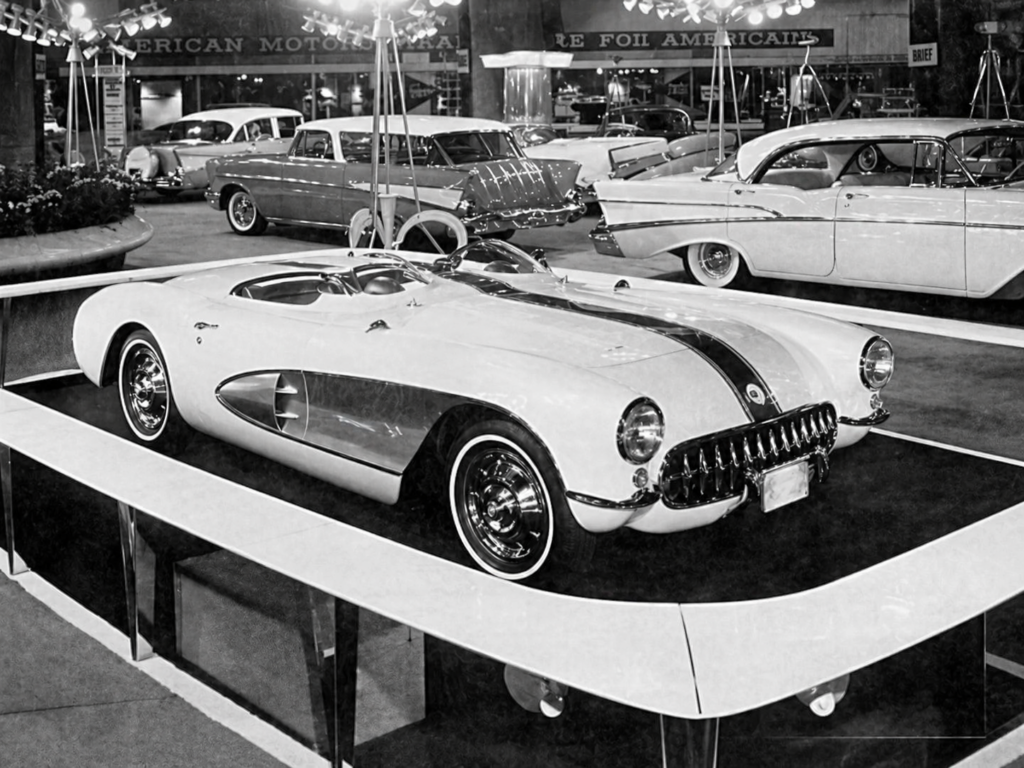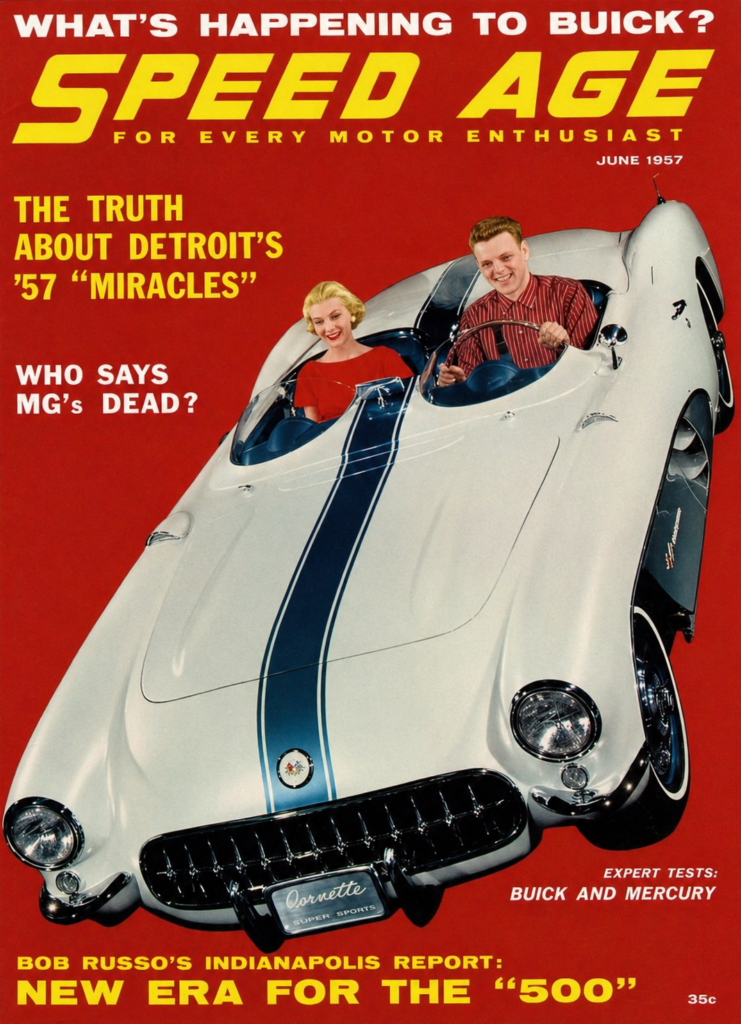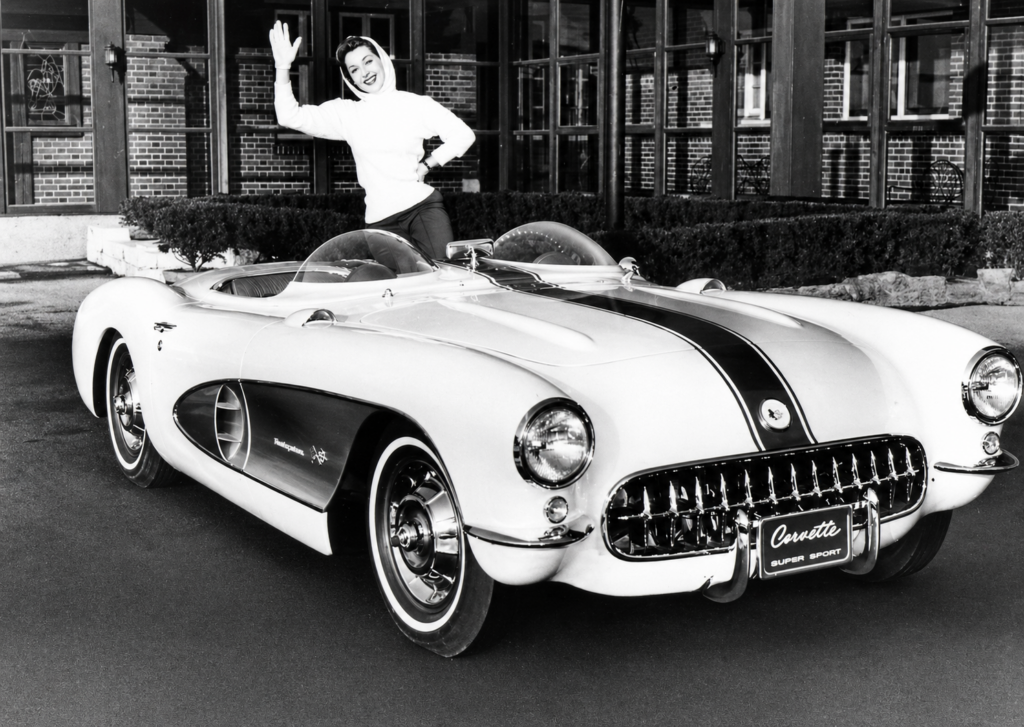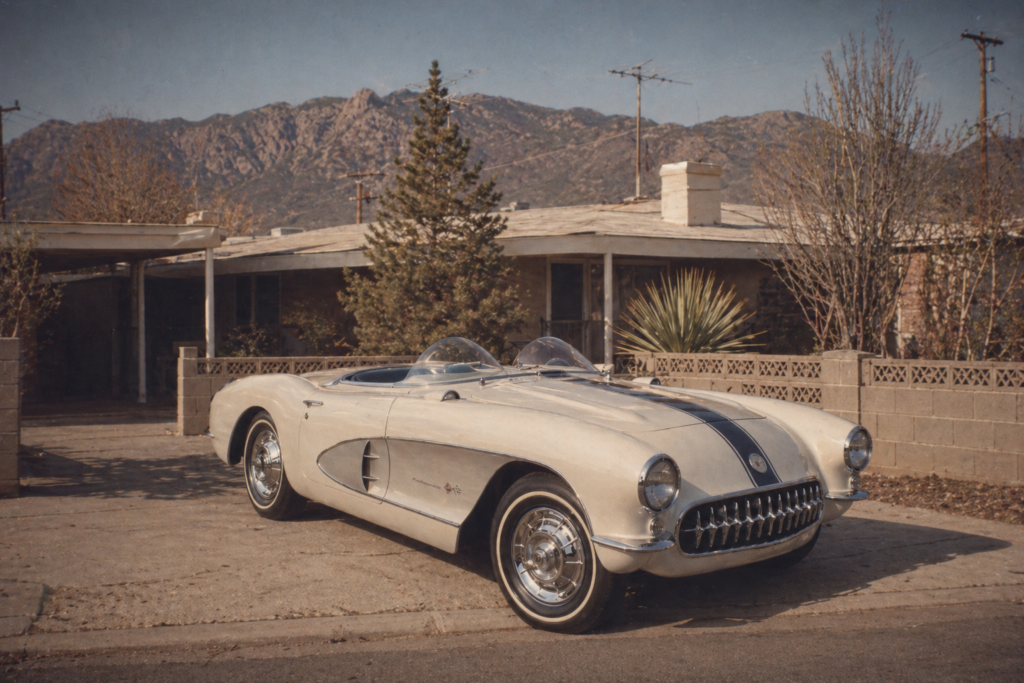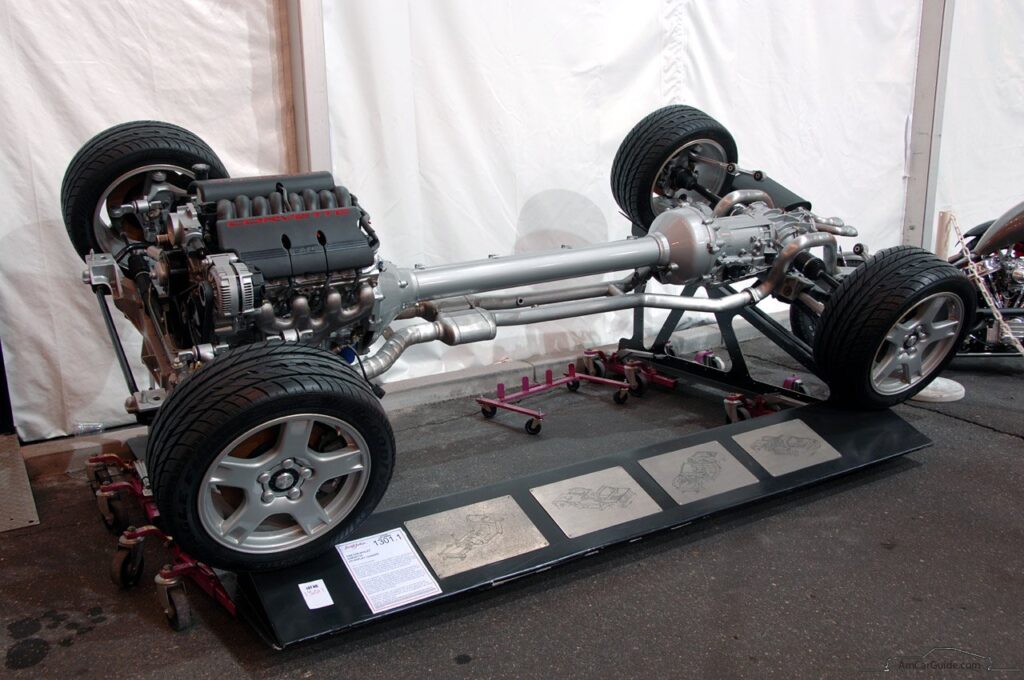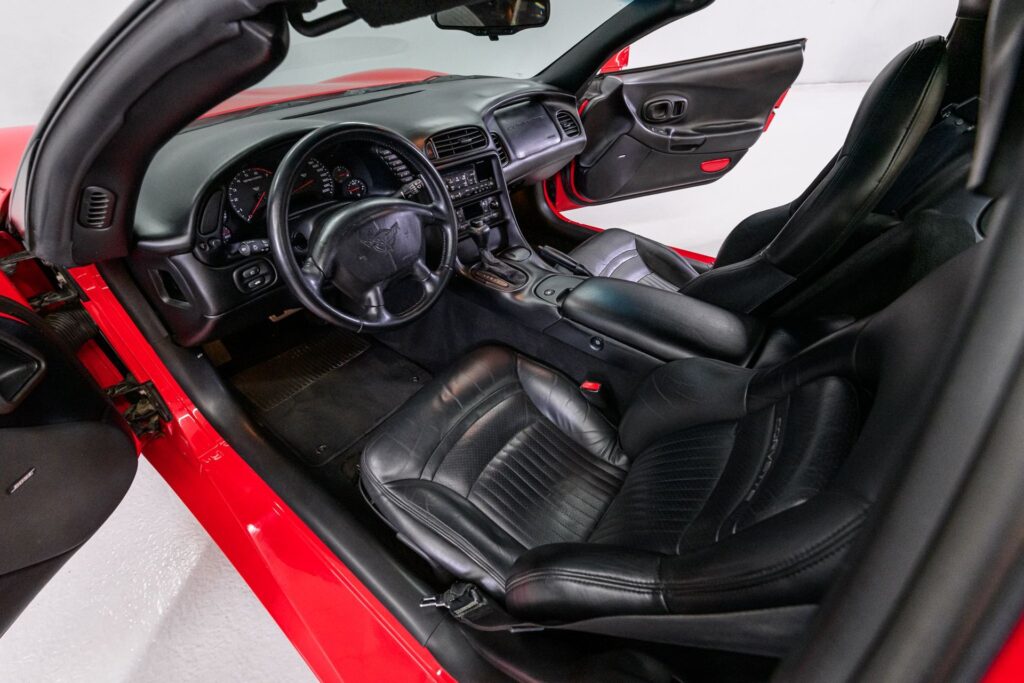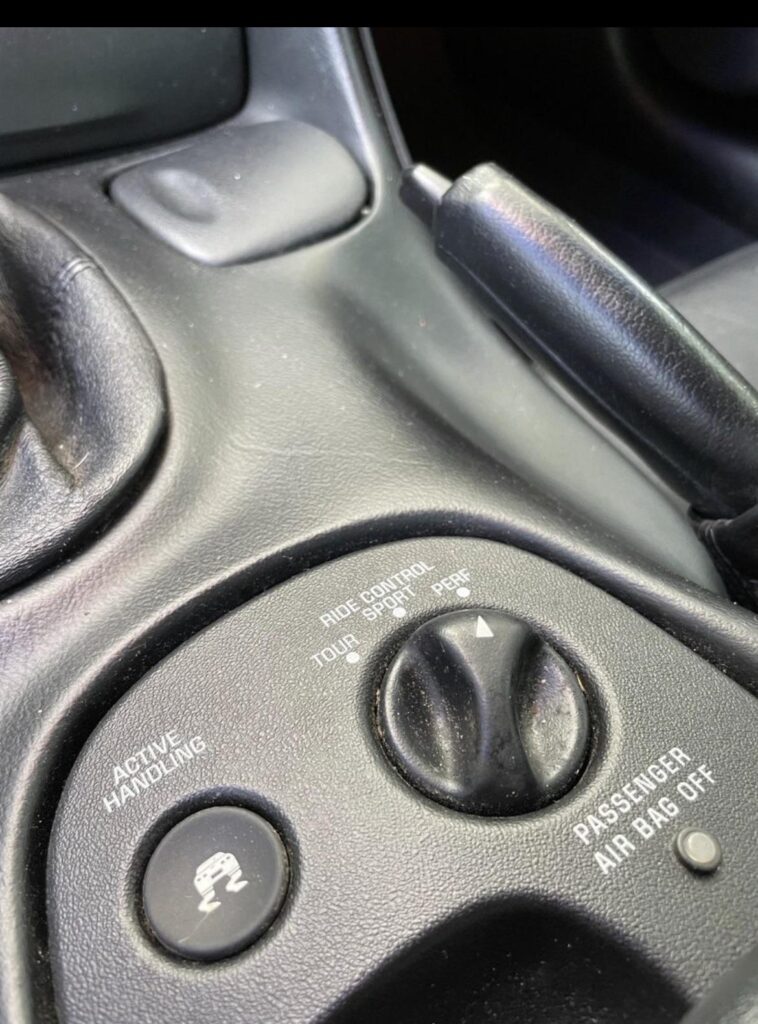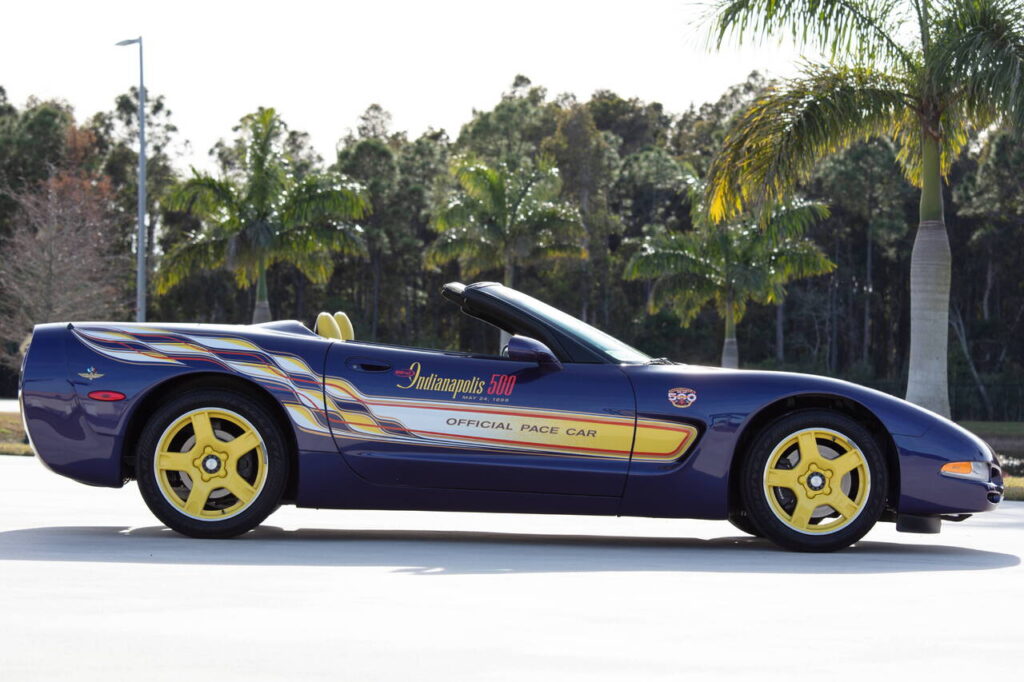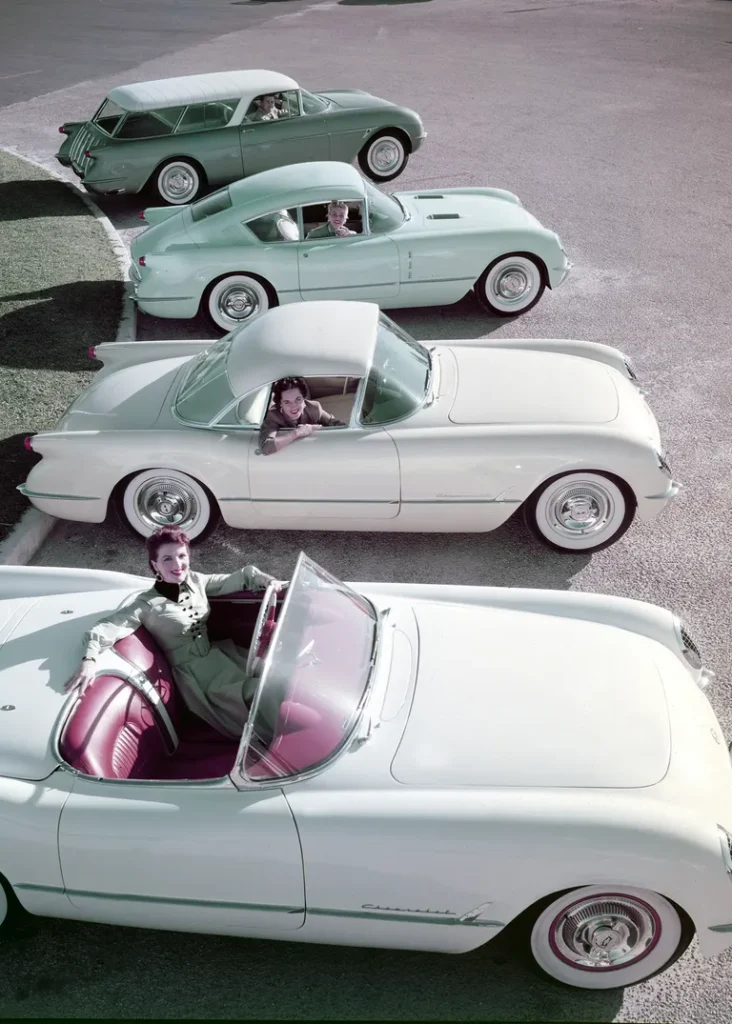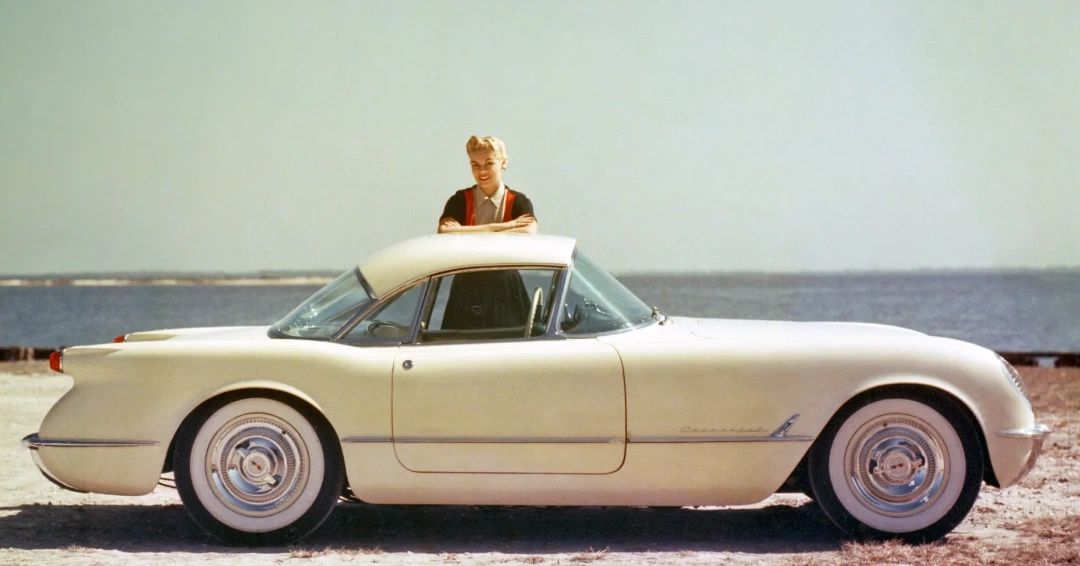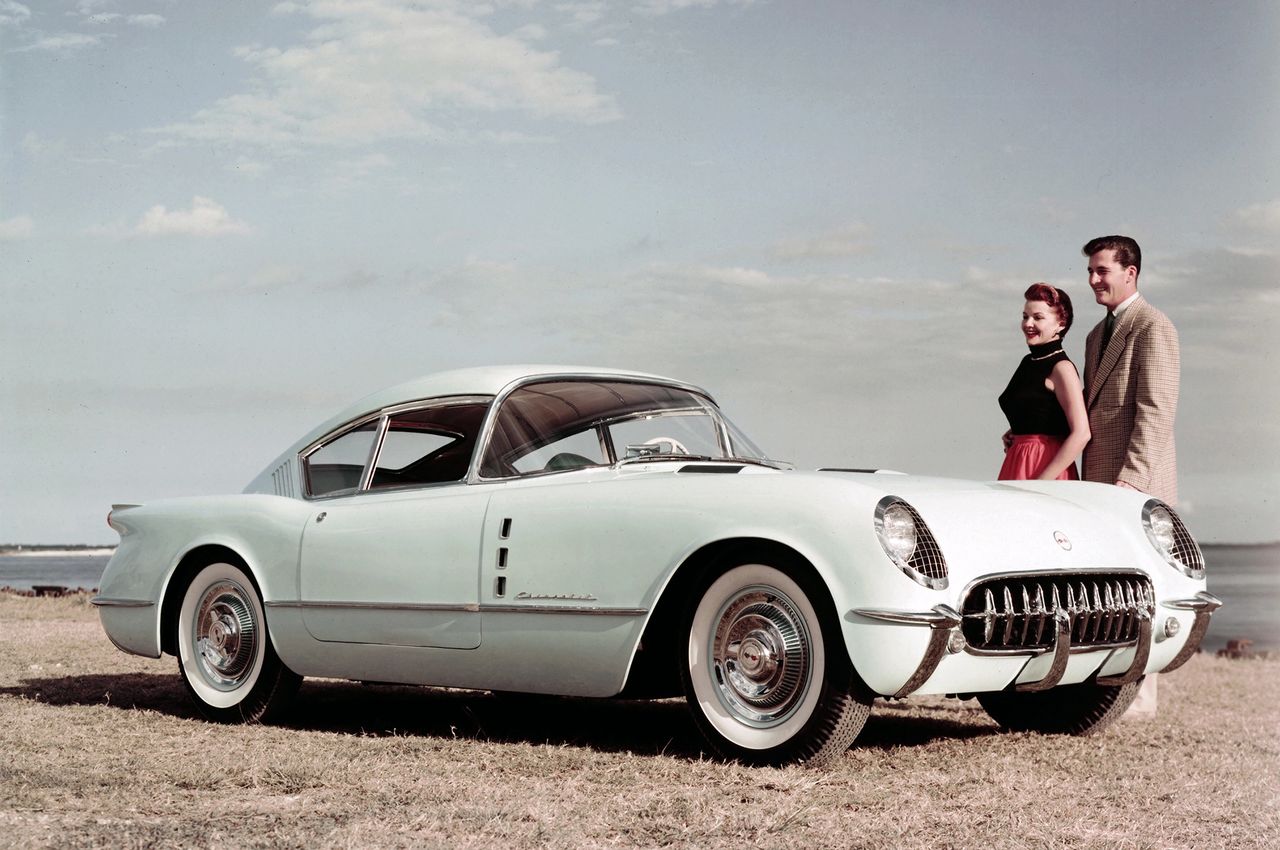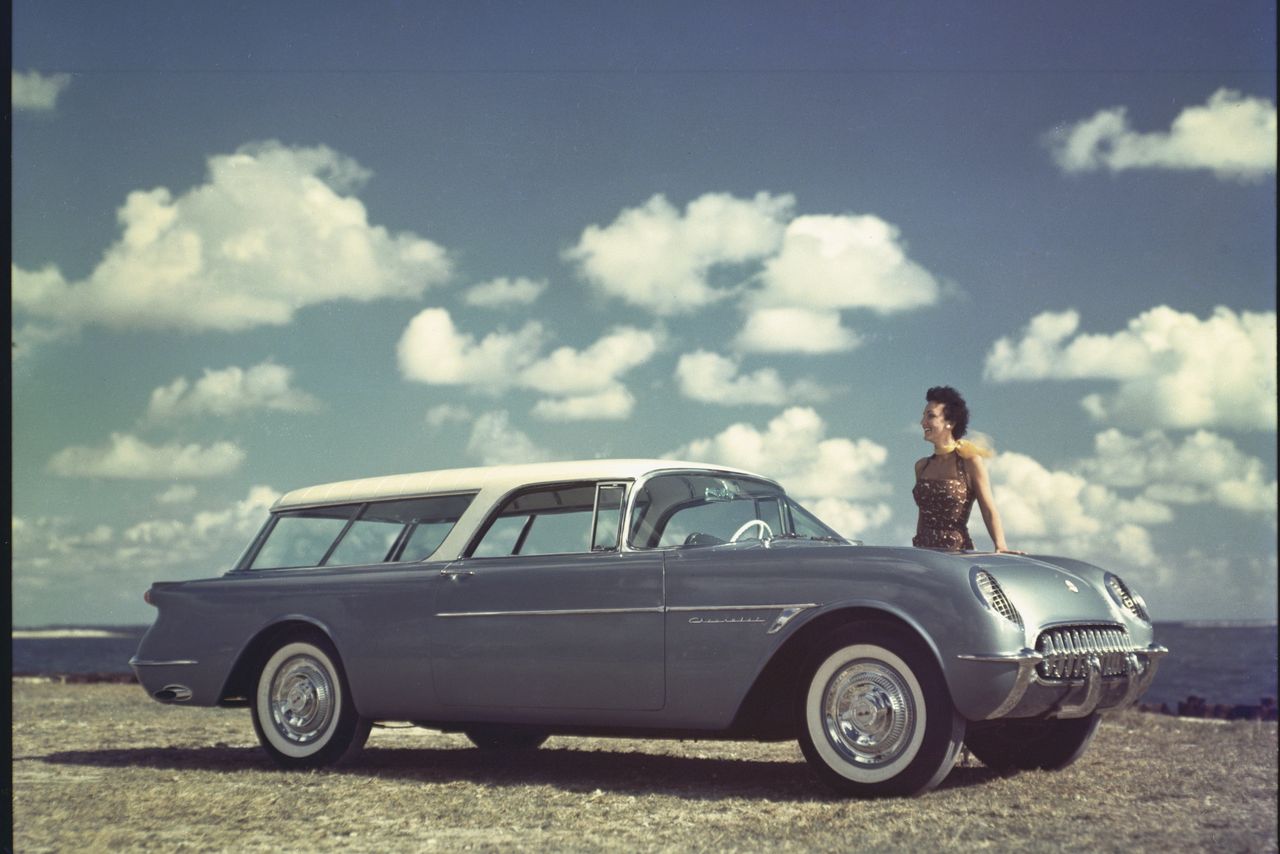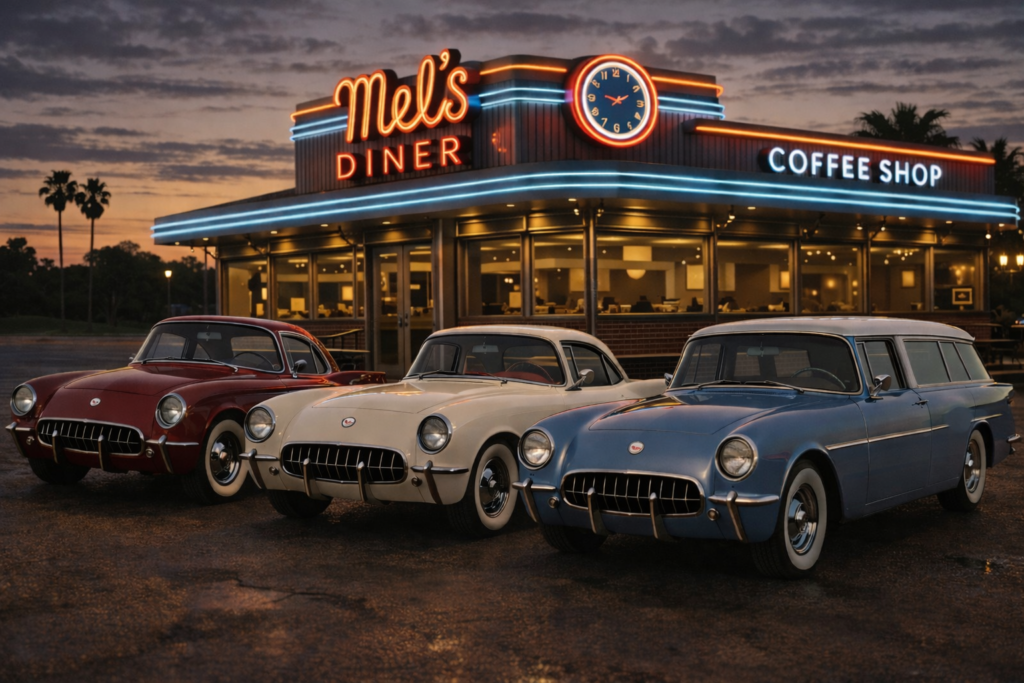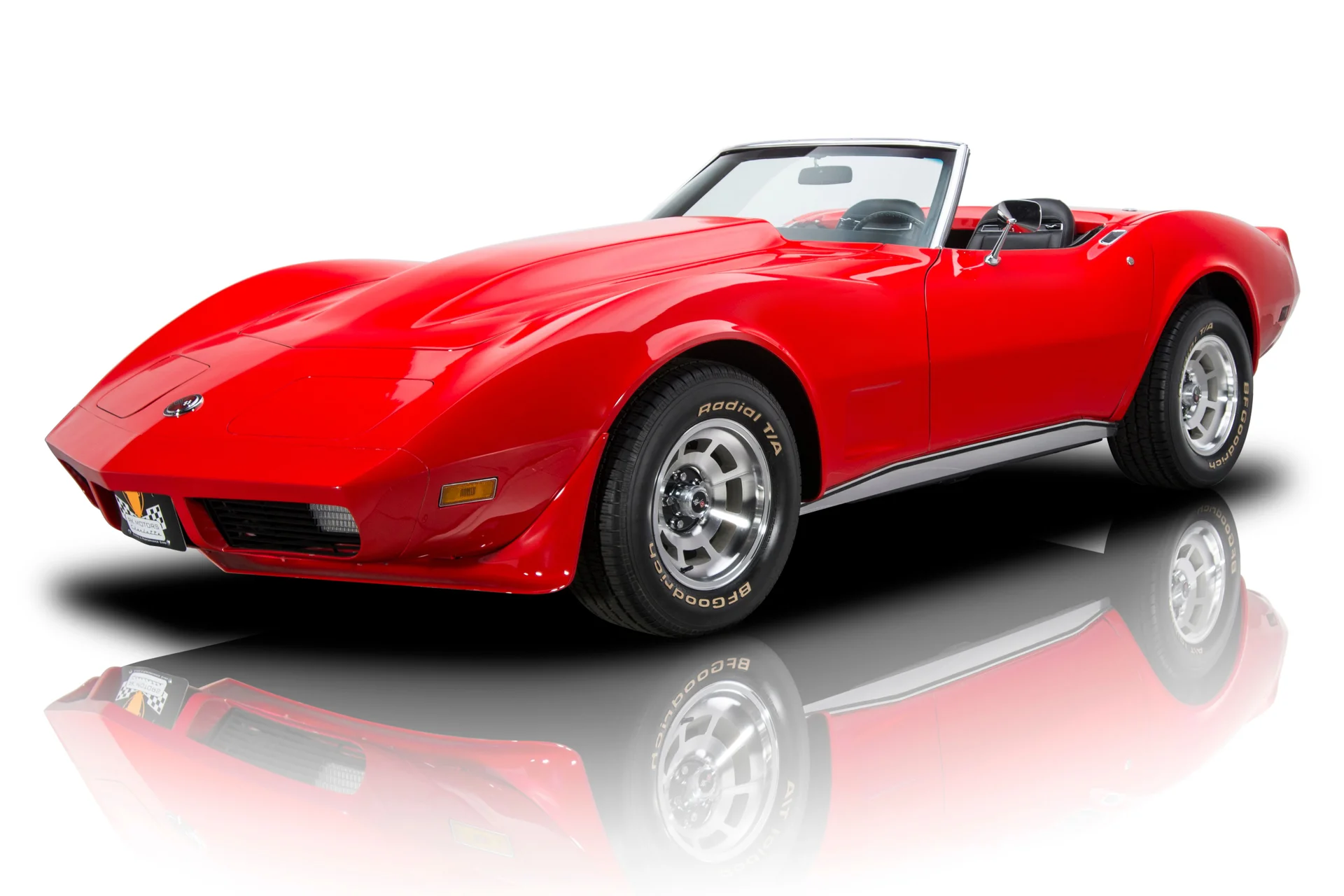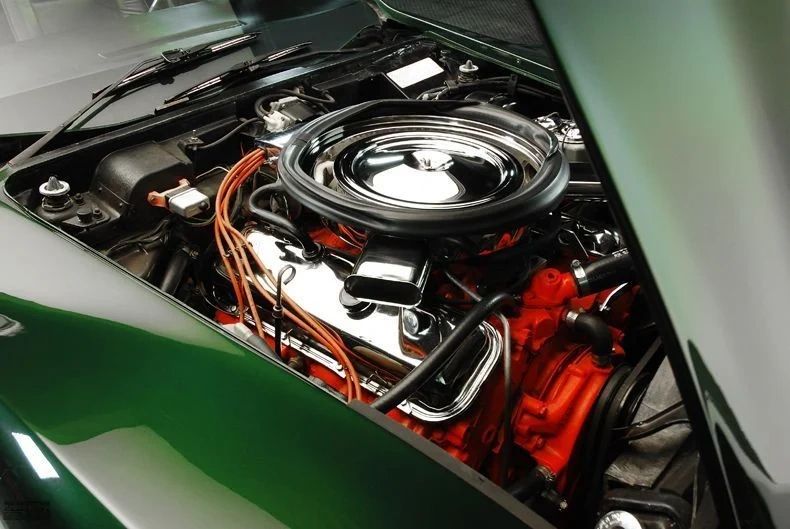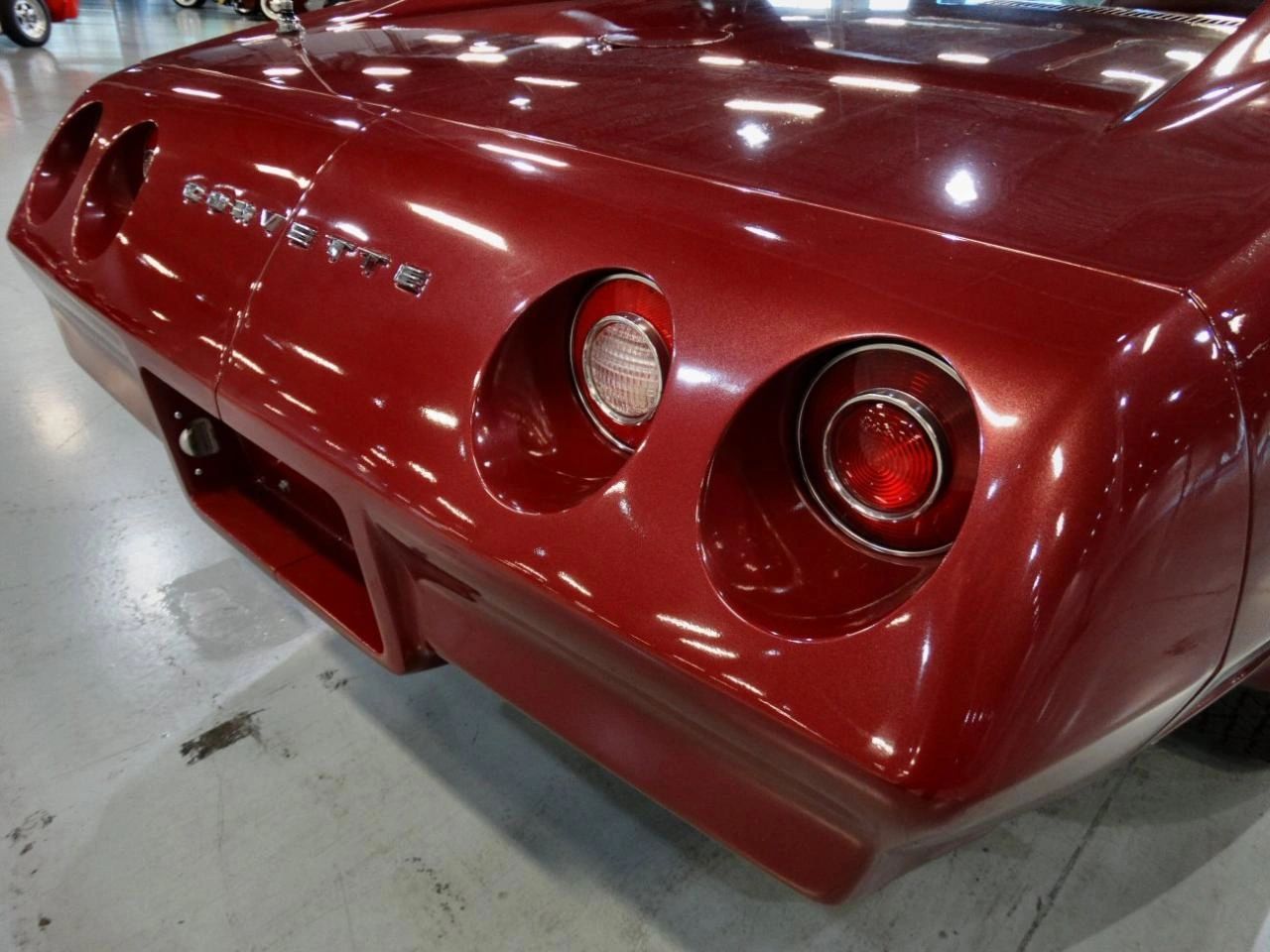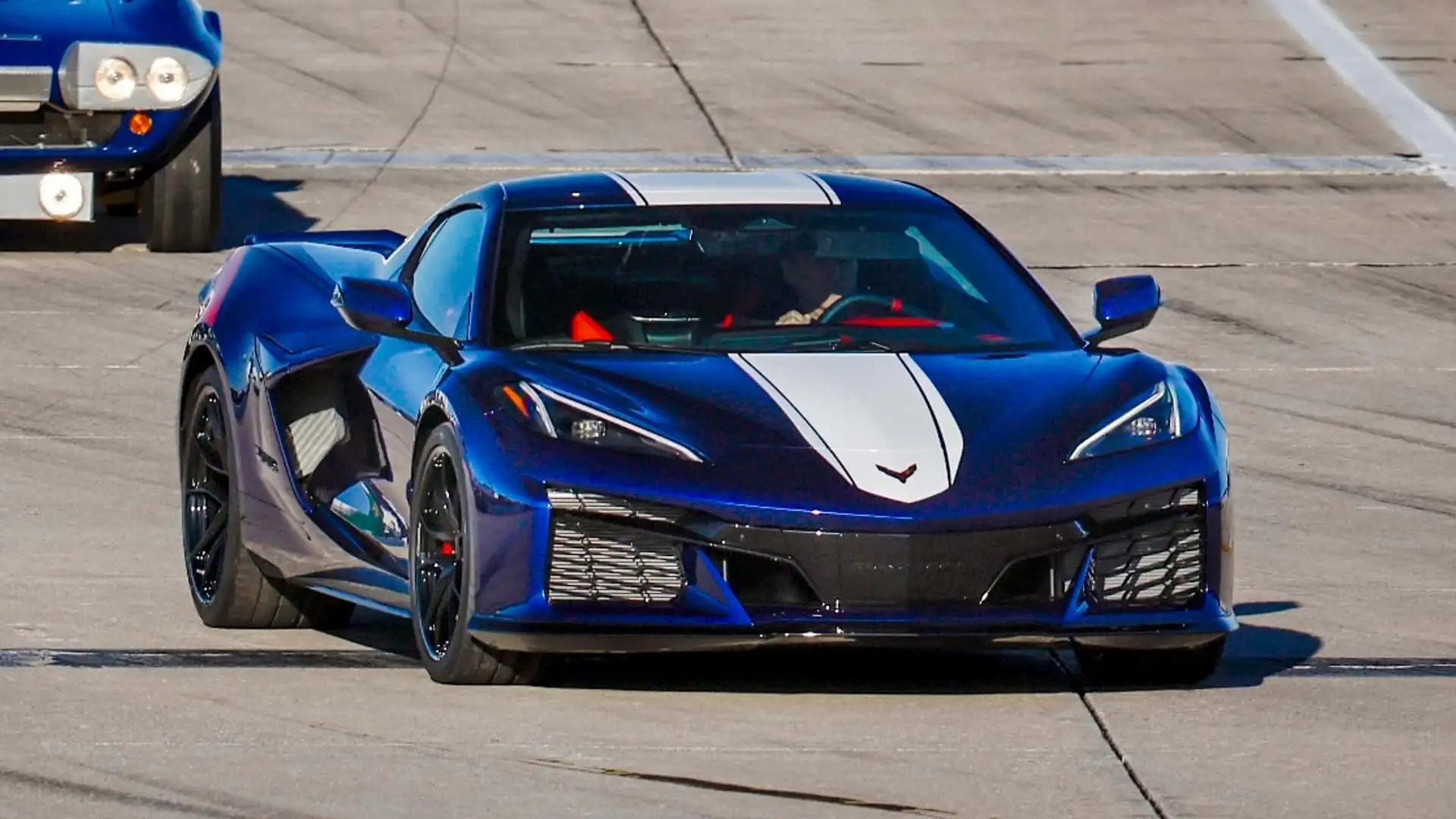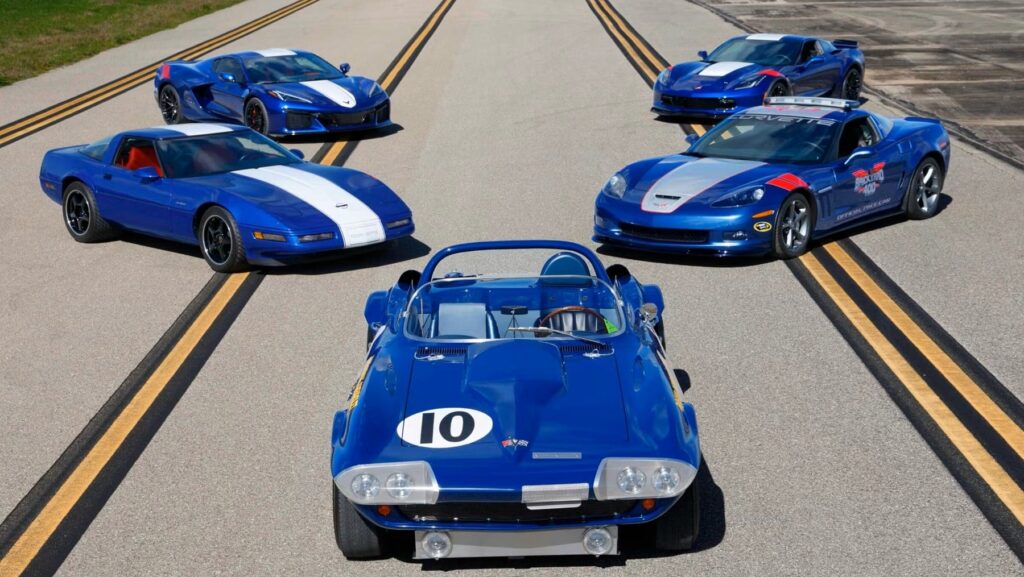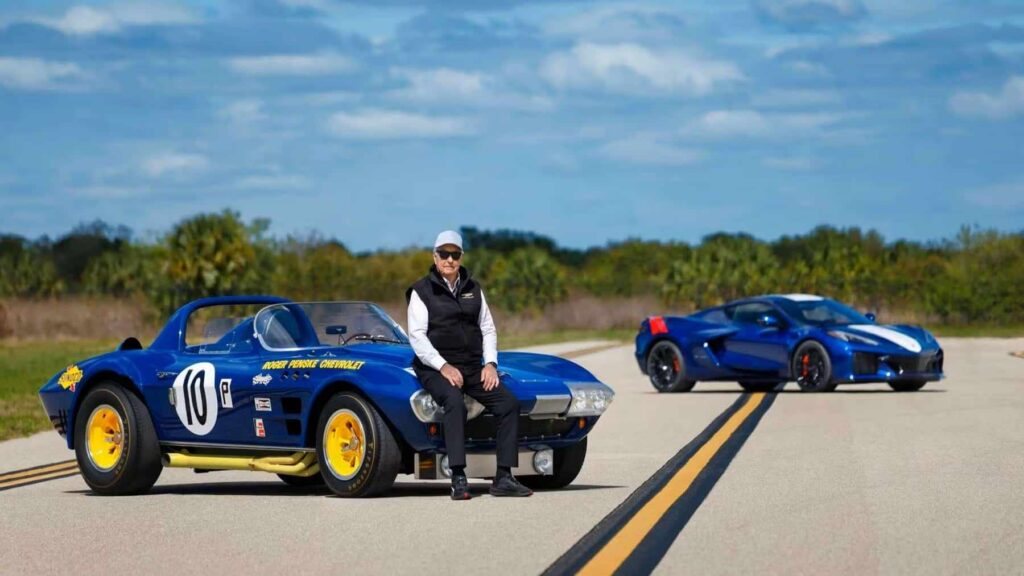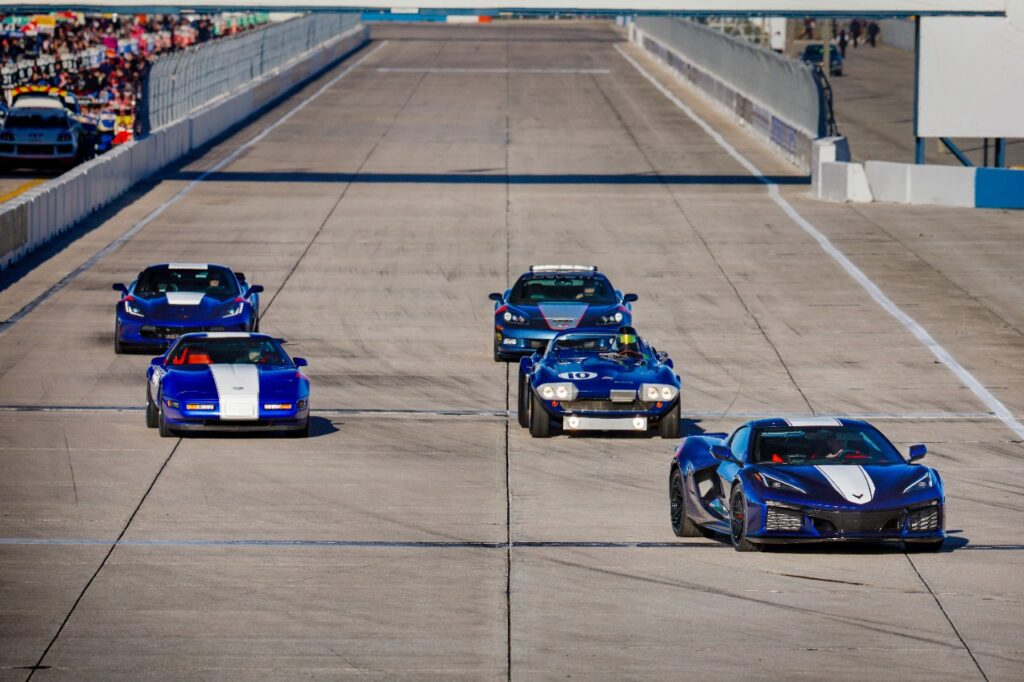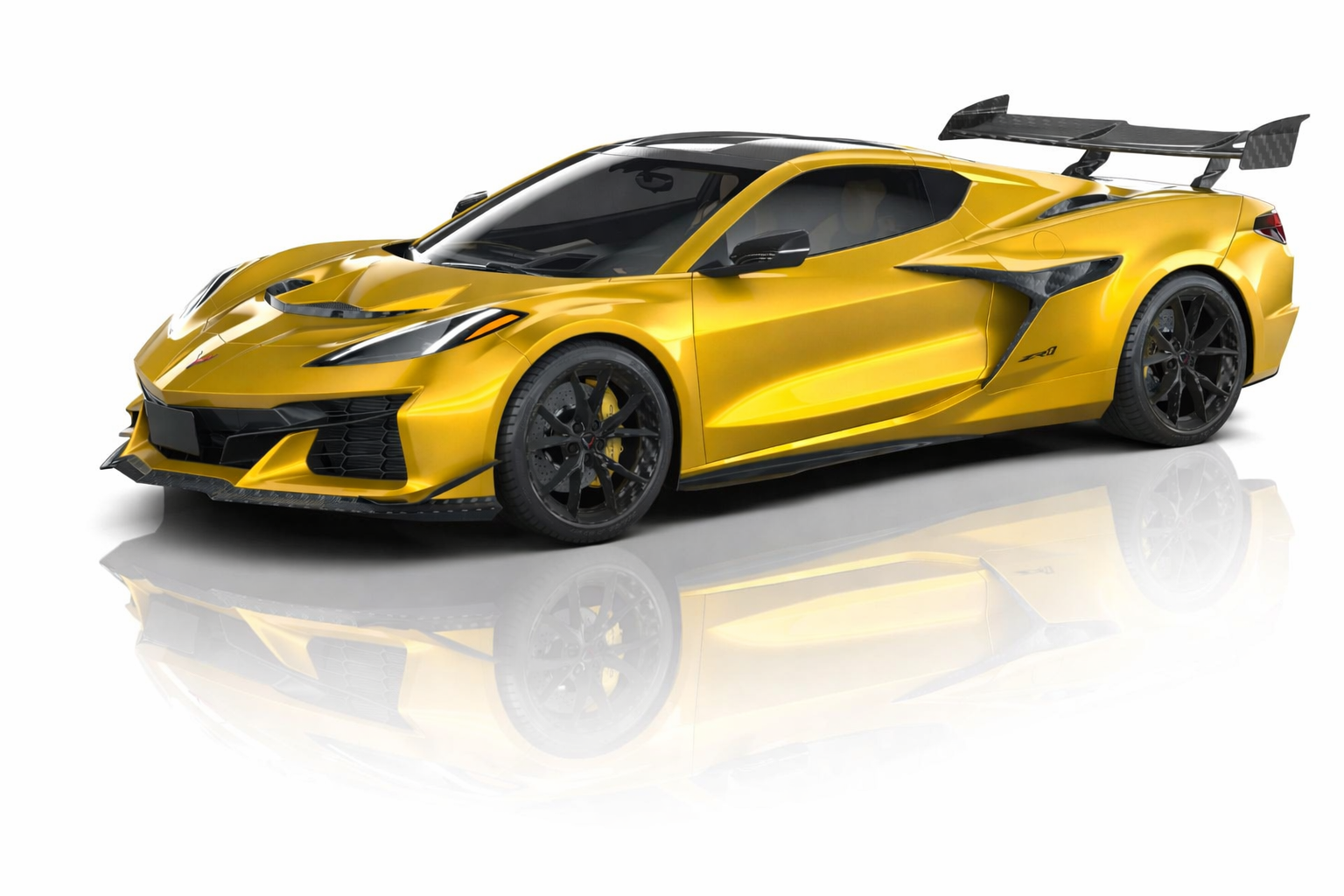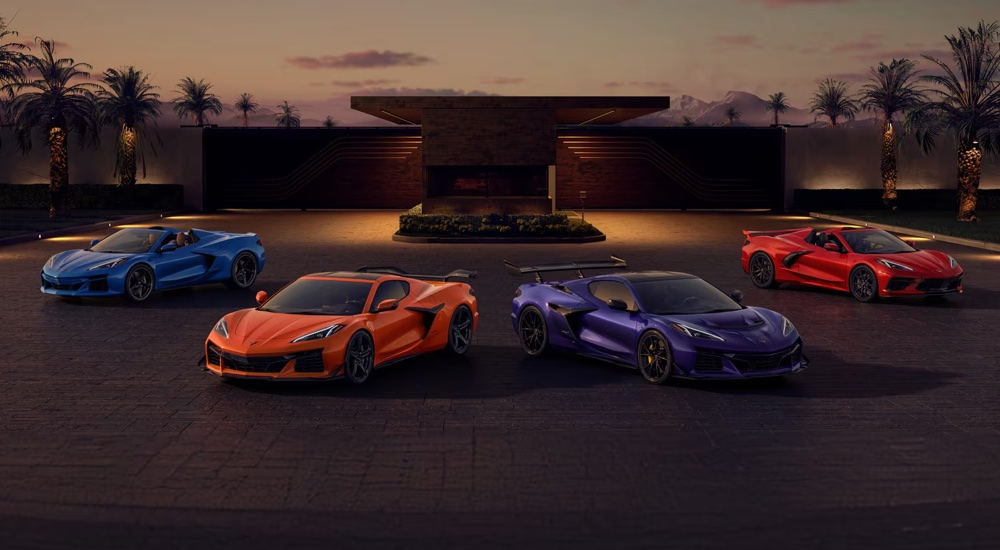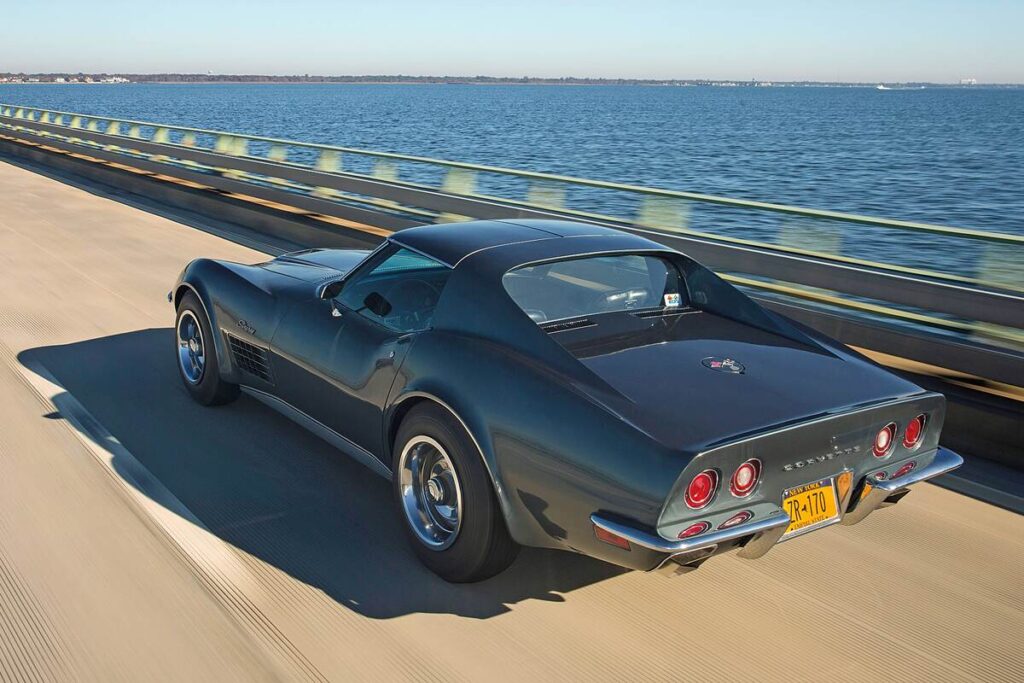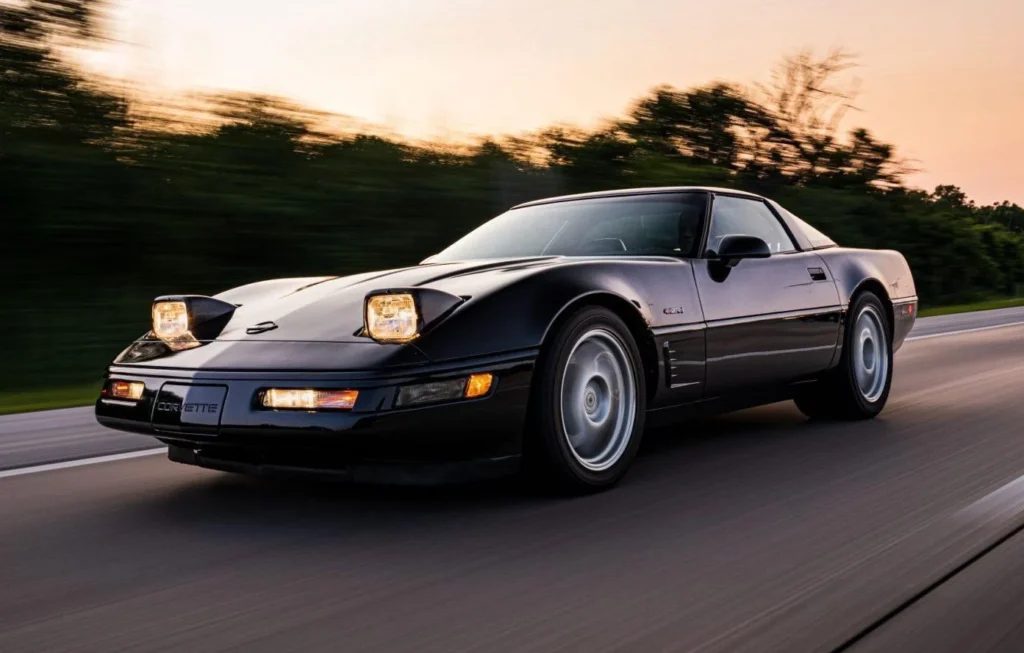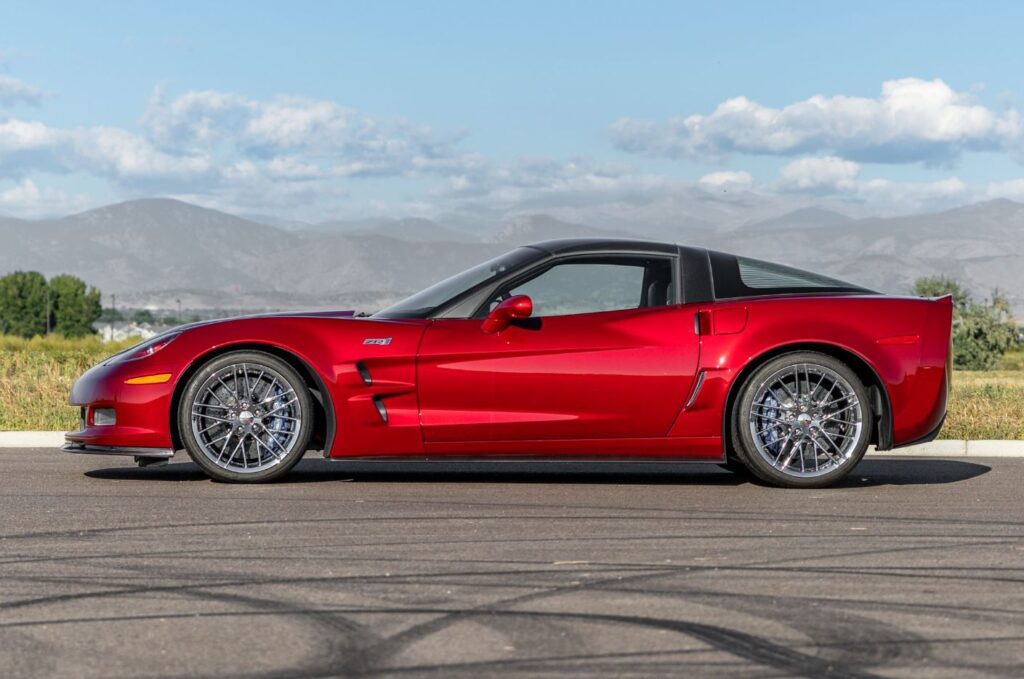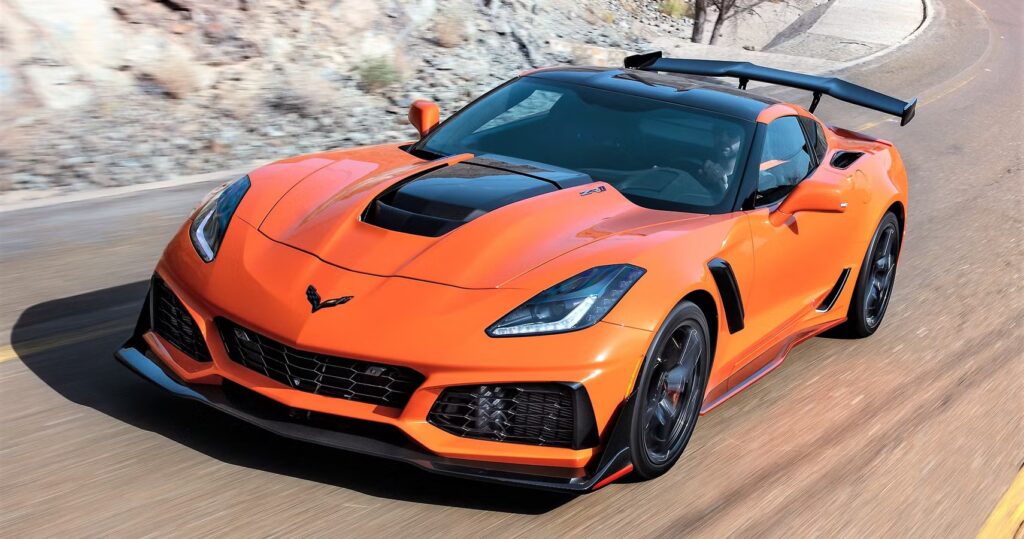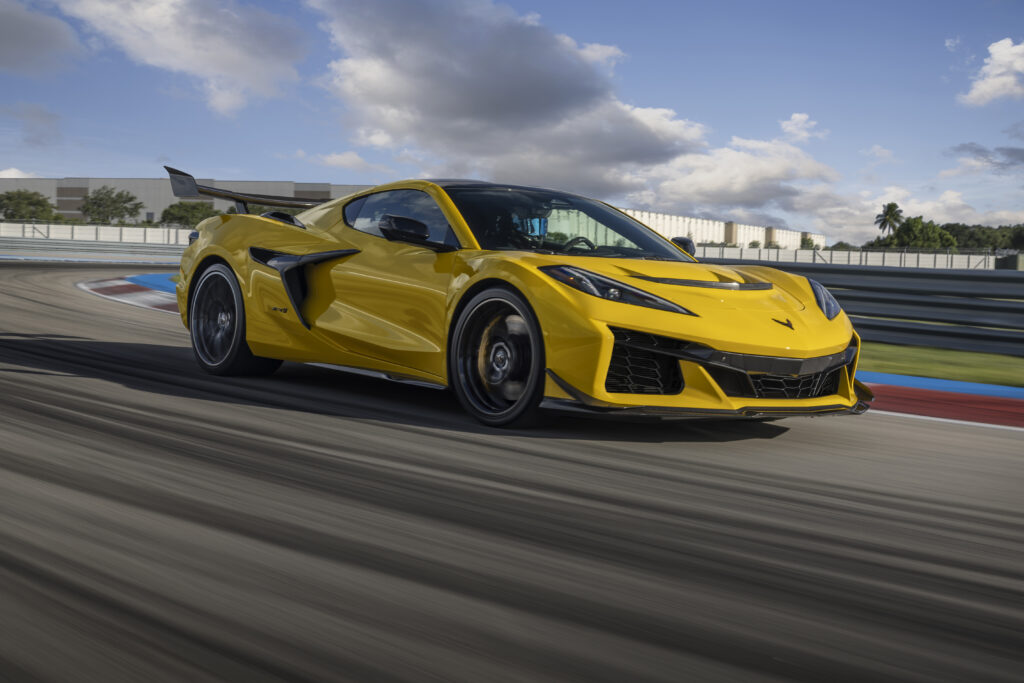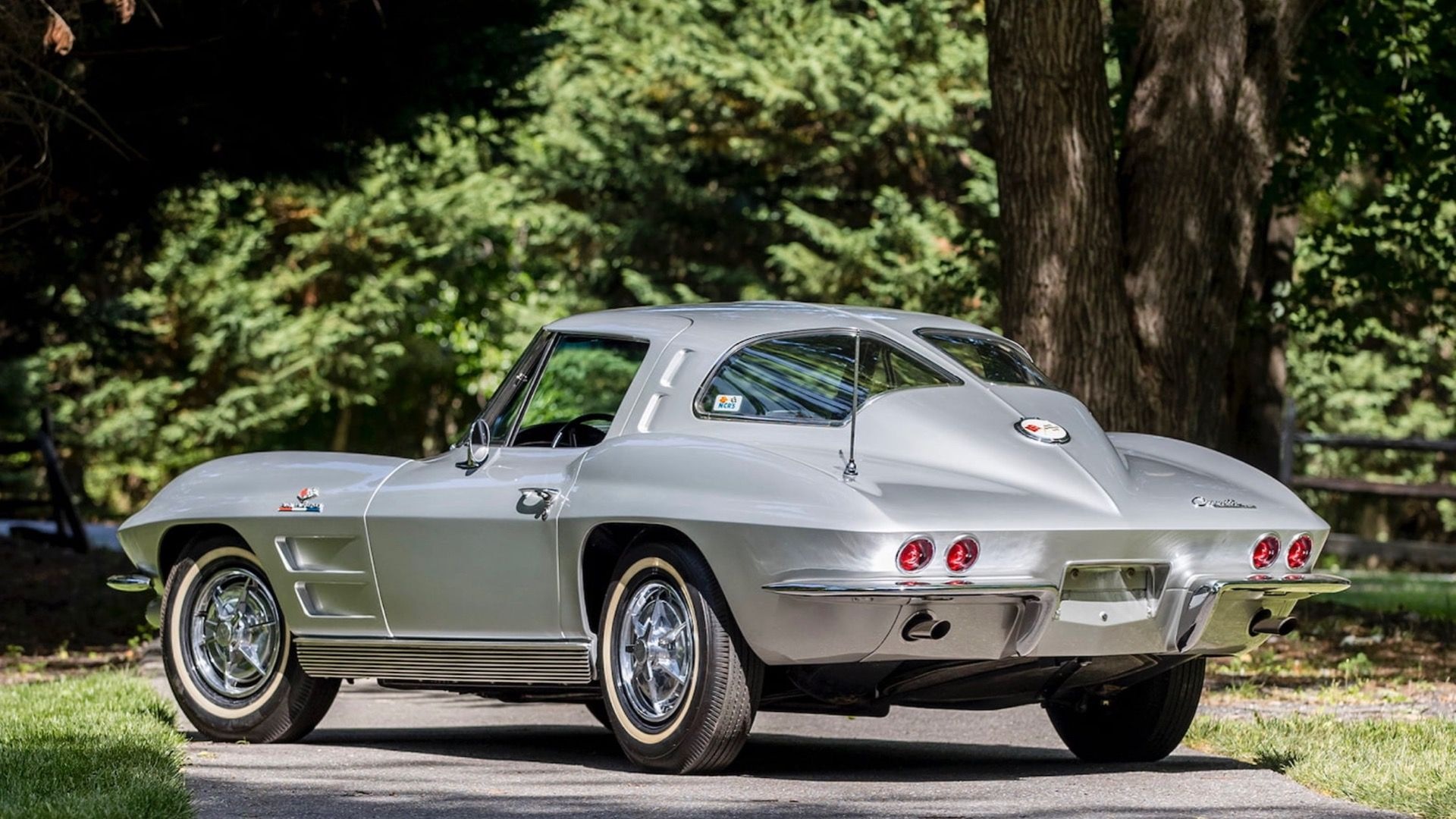
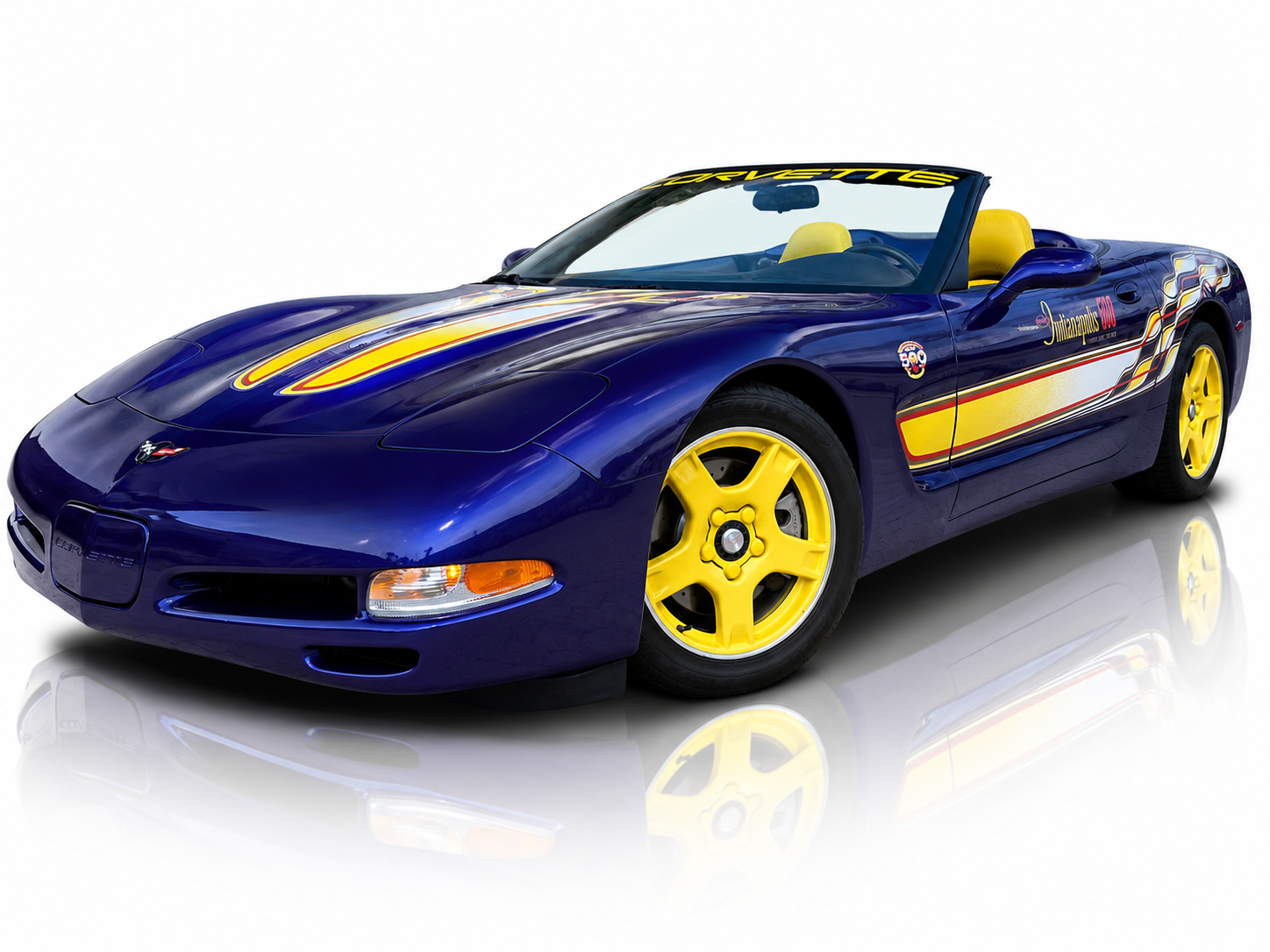
For Corvette enthusiasts, the final days of June and the opening days of July have evolved into an annual celebration unlike anything else in the automotive world. June 30 commemorates the day the first production Corvette rolled off Chevrolet‘s assembly line in Flint, Michigan, in 1953. Just a few days later, on the Friday closest to that anniversary, thousands of owners across North America—and increasingly around the world—fire up their Corvettes for Drive Your Corvette to Work Day, an enthusiast tradition that has become as much a part of the Corvette calendar as Bloomington Gold, Corvettes at Carlisle, or the annual anniversary celebration at the National Corvette Museum.
Together, these events have become what many owners simply think of as Corvette Week.
They remind us that Corvette’s story extends well beyond engineering specifications, racing victories, horsepower figures, or production numbers. Corvette has endured for more than seven decades because generations of enthusiasts have embraced it as something larger than transportation. It has become part of American culture, and every June, owners take a moment to celebrate not only the car itself but the people, places, and traditions that have carried the nameplate from a small fiberglass roadster to one of the world’s most respected performance cars.
Where It All Began
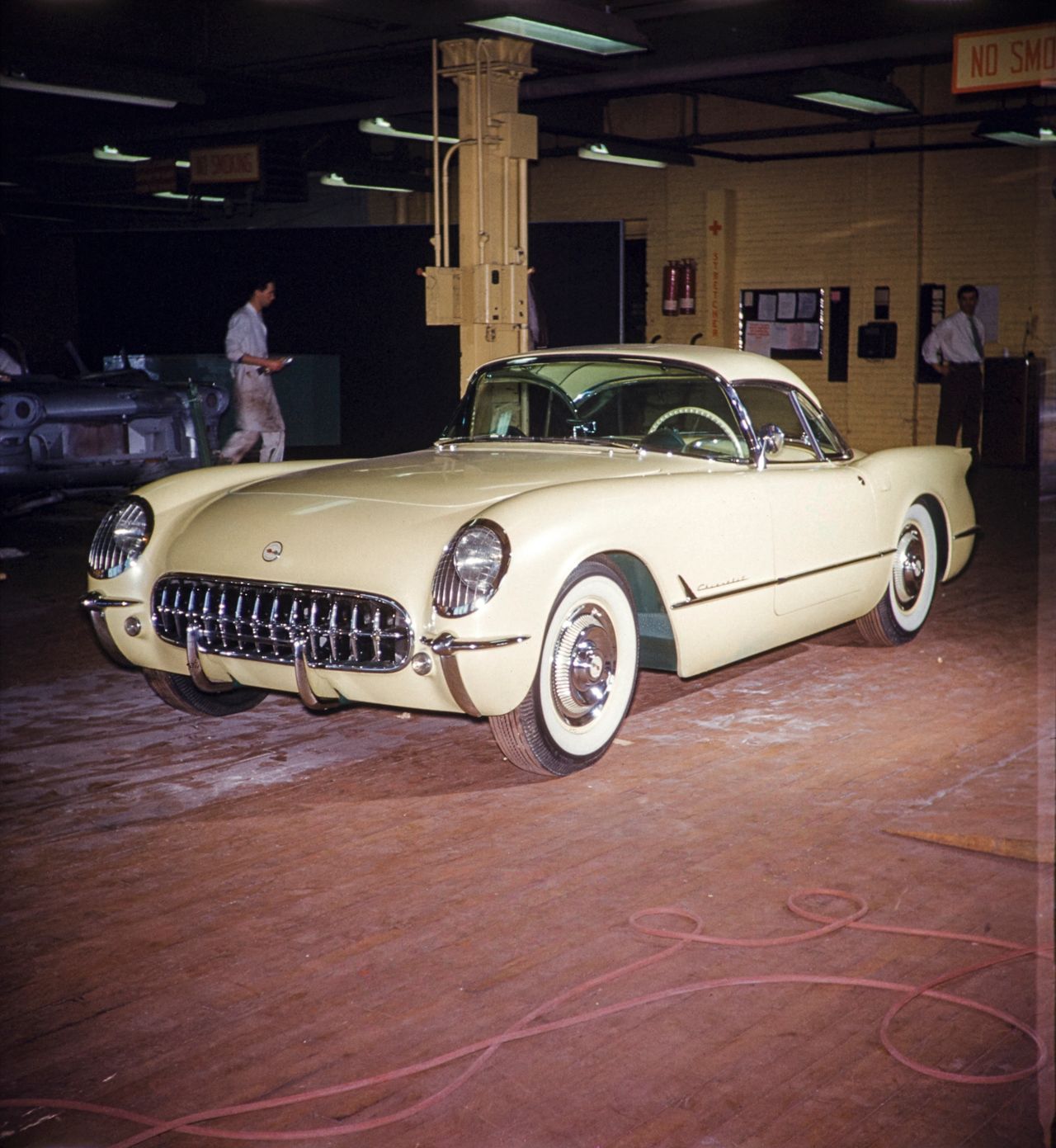
On June 30, 1953, the Corvette stopped being a Motorama dream car and became a production reality. This image captures the beginning of that legend: the first Corvette, hand-built in Flint, surrounded by the people who helped launch America’s Sports Car. Seventy-three years later, every Corvette still traces its lineage back to this moment—one Polo White roadster, one assembly line, and one bold idea that changed American performance forever. (Image credit: GM Media LLC. / ChatGPT)
The story begins in Flint, Michigan.
On June 30, 1953, Chevrolet completed the first production Corvette. It wasn’t merely another new model joining the Chevrolet lineup. It represented one of the boldest decisions General Motors had made in decades.
Only months earlier, visitors to General Motors’ Motorama exhibition had crowded around Harley Earl’s striking Corvette concept. Long, low, and unmistakably American, the fiberglass roadster generated enthusiasm unlike anything Chevrolet had experienced. Executives quickly realized the concept deserved more than life as a show car.
Production was accelerated at an astonishing pace.
The result was a hand-built sports car unlike anything else produced by an American manufacturer.
Every one of the first 300 Corvettes shared the same specifications. Each wore Polo White paint accented by a Sportsman Red interior. Every example featured a black folding convertible top, removable side curtains instead of roll-up windows, full wheel covers, and Chevrolet’s 235-cubic-inch Blue Flame inline-six engine backed by a two-speed Powerglide automatic transmission.
Measured against modern Corvettes, those first cars were modest performers.
Measured against history, they changed everything.
Chevrolet had committed itself to building an American sports car at a time when many questioned whether such a market even existed. The first production Corvette was less the finished product than the opening chapter of a story that would span generations.
From Survival to Legend
The arrival of Chevrolet’s small-block V8 in 1955 changed the Corvette’s future forever. Replacing the original Blue Flame inline-six with a compact 265-cubic-inch V8 producing up to 195 horsepower, the new engine delivered the performance enthusiasts had been waiting for and transformed the Corvette into a legitimate American sports car. More than just a power increase, the V8 gave the Corvette the personality, sound, and performance credentials that would define the nameplate for generations, laying the foundation for one of the most celebrated engine families in automotive history.
It is easy to celebrate Corvette today.
It is much harder to remember that the car’s future was anything but certain during its earliest years.
Production totaled just 300 cars in 1953 before increasing to 3,640 in 1954. Sales struggled, critics questioned whether the Corvette possessed enough performance to compete with European sports cars, and there were moments when the program appeared to be in genuine danger.
Everything changed in 1955.
The arrival of Chevrolet’s new small-block V8 transformed the Corvette almost overnight. Combined with the arrival of gifted engineers such as Zora Arkus-Duntov, the Corvette quickly evolved from an attractive roadster into a legitimate high-performance sports car.
The momentum never truly stopped.
Each generation built upon the accomplishments of the one before it. The Sting Ray introduced independent rear suspension and dramatic styling. The big-block era brought astonishing straight-line performance. The C4 reestablished Corvette as a world-class sports car through advanced engineering. The C5 delivered the structural and mechanical foundation that still influences Corvette development today. The C6, C7, and today’s mid-engine C8 each expanded the Corvette’s capabilities while remaining faithful to the original mission Chevrolet embraced in 1953: deliver world-class performance at a price enthusiasts could actually afford.
Through every chapter, one constant remained.
The anniversary of June 30 quietly connected every Corvette ever built back to that first Polo White roadster that emerged from Flint.
Why June 30 Matters
June 30 marks the day the first production Corvette rolled off the assembly line in Flint, Michigan, in 1953. More than seven decades later, America’s Sports Car remains a symbol of performance, innovation, and passion. Happy National Corvette Day!
Unlike many automotive anniversaries that become little more than corporate marketing opportunities, June 30 has always carried genuine meaning for Corvette enthusiasts. It represents more than the beginning of production; it marks the birth of America’s longest-running continuously produced sports car.
Generations of owners recognized the date through local club gatherings, cruises, informal celebrations, and anniversary events long before National Corvette Day gained broader recognition. For many enthusiasts, simply taking their Corvette out for a drive on June 30 became an annual tradition.
The significance of the date lies in that remarkable continuity. Few automobiles have endured changing regulations, oil crises, recessions, evolving consumer tastes, technological revolutions, and constantly shifting performance benchmarks while preserving such a clear identity.
Every Corvette—from the earliest solid-axle models to today’s hybrid-powered E-Ray—belongs to the same uninterrupted family tree. More than seven decades after the first car rolled off the assembly line, that enduring legacy remains something worth celebrating.
National Corvette Day Becomes an Annual Celebration
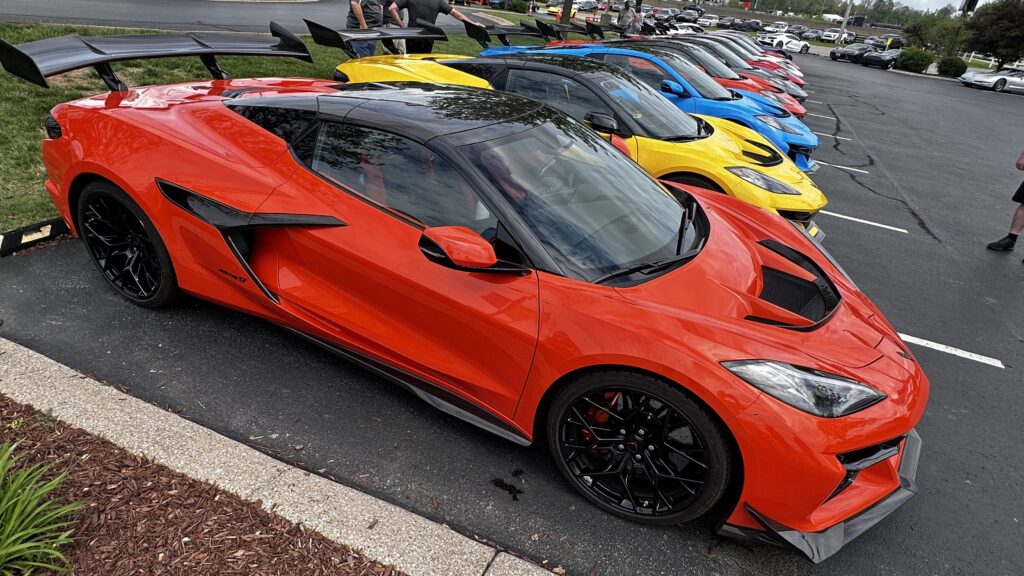
There is no single way to celebrate National Corvette Day. Some owners gather for club cruises, car shows, museum visits, and community events, while others simply wash their Corvette, take the long way home, or share a favorite memory with fellow enthusiasts. Whether it is spent behind the wheel, admiring the cars of earlier generations, or introducing someone new to the Corvette story, June 30 is ultimately about celebrating the people, passion, and history that have kept America’s Sports Car alive for more than seven decades. (Image credit: Motor Texas)
As Corvette ownership grew through the 1960s, 1970s, and beyond, June 30 gradually evolved from an anniversary recognized by a handful of enthusiasts into a date celebrated by clubs and organizations across the country. Annual cruises, local gatherings, dealership events, and birthday celebrations became increasingly common, each paying tribute to the sports car that had become an American institution.
In time, June 30 became widely recognized as National Corvette Day—not because of a single proclamation or corporate marketing campaign, but because the Corvette community embraced the date as its own. Chevrolet, Corvette clubs, museums, collectors, and enthusiasts all recognized the significance of the first production Corvette leaving Flint Assembly on June 30, 1953, and the anniversary naturally became the focal point for annual celebrations.
Today, National Corvette Day is less about official ceremonies than it is about participation. Across the country, owners organize breakfast cruises, charity drives, evening car shows, scenic road tours, and local Corvette club gatherings. Some celebrate by visiting the National Corvette Museum in Bowling Green. Others simply open the garage door, start the engine, and enjoy a drive on the very roads their Corvette was built to conquer.
That may be the most fitting tribute of all.
After all, the Corvette has never been defined solely by the factory that assembled it. Its true legacy has always been written by the people who have driven, preserved, restored, raced, and shared these cars over the past seventy-three years.
The Birth of Drive Your Corvette to Work Day
Mid America Motorworks founder and longtime Corvette enthusiast Mike Yager created Drive Your Corvette to Work Day in 2001 with one simple goal: encourage owners to get their cars out of the garage and back on the road. Held on the Friday closest to June 30, the annual tradition celebrates Corvette’s birthday by reminding enthusiasts that these remarkable machines were built to be driven. (Image credit: Old Cars Weekly)
If National Corvette Day celebrates Corvette’s past, Drive Your Corvette to Work Day celebrates something equally important: enjoying the car exactly as Chevrolet intended.
The tradition began in 2001 through the efforts of longtime Corvette enthusiast and Mid America Motorworks founder Mike Yager. He understood something many collectors already knew—Corvettes have an unfortunate habit of becoming garage decorations.
Owners spend countless hours detailing, modifying, maintaining, and protecting their cars from bad weather. Many Corvettes accumulate surprisingly few miles each year, emerging only for shows, club events, or perfect Sunday afternoons. Preserving these cars is unquestionably important, but Yager believed Corvette ownership should also include something far simpler.
Driving them.
He proposed a day when owners across America would set aside concerns about mileage, uncertain weather forecasts, and crowded parking lots and simply commute to work in their Corvettes. The idea was brilliantly uncomplicated: no registration, no admission fee, no organized route, and no requirement beyond getting behind the wheel.
To encourage participation, the event was scheduled for the Friday closest to June 30. This allowed owners to celebrate Corvette’s birthday while giving many of them an opportunity to extend the occasion into a long summer weekend.
The concept resonated almost immediately. What began as a simple invitation became an annual tradition embraced by Corvette clubs, dealerships, museums, businesses, and individual owners across North America. Social media later accelerated its growth, allowing enthusiasts to share photographs of their cars parked outside offices, factories, schools, hospitals, military installations, and businesses of every kind.
For one day each year, ordinary parking lots become impromptu Corvette shows. More importantly, those cars often spark conversations between longtime owners, curious coworkers, and people experiencing a Corvette up close for the first time. In that sense, Drive Your Corvette to Work Day does more than put additional miles on the odometer—it keeps the Corvette story visible, accessible, and alive.
A Tradition Built Around Driving
There is an important distinction between Drive Your Corvette to Work Day and most other automotive events. Traditional car shows tend to celebrate perfection; this event celebrates participation.
Nobody cares whether a Corvette has accumulated 12 miles or 212,000, whether it has been freshly restored or proudly wears the evidence of a lifetime on the road. It may be a base coupe, convertible, Grand Sport, Z06, ZR1, or E-Ray, and it may remain showroom stock or reflect decades of personal modifications.
For one Friday each summer, every Corvette becomes equally important because every Corvette is doing exactly what it was engineered to do: move.
That philosophy reflects one of the principles that has guided Corvette from the beginning. The car was never conceived as a static display piece. Harley Earl envisioned a sports car that would inspire people to drive, while Zora Arkus-Duntov spent decades ensuring that it rewarded those who did. Every generation of Corvette engineers since has carried that mission forward.
Driving a Corvette to work may seem like a small gesture, but it represents something much larger. It honors seventy-three years of engineering, design, manufacturing, and enthusiasm far more effectively than leaving the car hidden beneath a cover in the garage.
Corvette Week in 2026
This year gives Corvette enthusiasts two outstanding opportunities to celebrate.
Tuesday, June 30, 2026, marks the 73rd anniversary of the first production Corvette leaving the assembly line in Flint, Michigan. Just three days later, on Friday, July 3, owners across the country will once again participate in Drive Your Corvette to Work Day.
The timing could hardly be better. With Independence Day weekend immediately following, many enthusiasts will turn a simple commute into an extended road trip, club cruise, or holiday gathering. Communities throughout the country will host local events, while thousands of other owners will create traditions of their own by meeting with friends, visiting a favorite destination, or simply taking the scenic route home.
No matter how you choose to celebrate, these observances are not reserved for pristine museum pieces or six-figure collector cars. Every Corvette belongs, every generation matters, and every owner contributes to the same remarkable story.
More Than a Birthday
The remarkable thing about Corvette is not simply that it has survived for more than seven decades. It is that the car has continued to evolve while remaining relevant to each new generation of drivers.
Automotive technology has changed almost beyond recognition since 1953. Horsepower has more than doubled, while advances in safety, electronics, materials, aerodynamics, and manufacturing have moved far beyond anything Harley Earl or the original Corvette team could have imagined.
Yet the fundamental promise remains unchanged: build a world-class American sports car that delivers exceptional performance, unmistakable styling, and an experience capable of making every drive memorable.
That promise has connected eight generations of Corvettes and millions of enthusiasts around the world. Each June 30, we celebrate where that journey began. On Drive Your Corvette to Work Day, we celebrate where it continues.
Whether your Corvette is a first-year 1953 roadster, a chrome-bumper Sting Ray, a big-block C3, a well-loved C4, a track-ready C5 Z06, a supercharged C7 ZR1, or a mid-engine C8 representing the future of America’s Sports Car, its lineage leads directly back to that first Polo White Corvette completed in Flint during the summer of 1953.
Seventy-three years later, the Corvette story is still being written—one mile, one owner, and one unforgettable drive at a time.
So this week, celebrate the anniversary, join the tradition, and most importantly, take your Corvette out on the open road. There is no better way to honor America’s Sports Car than by enjoying the experience that has defined it from the very beginning.
Happy National Corvette Day, and happy Drive Your Corvette to Work Day.
We’ll see you on the road.
June 30 is more than Corvette’s birthday—it is a celebration of the people, passion, and performance that have sustained America’s Sports Car for 73 years. Discover why the date still matters, how its traditions began, and how Corvette enthusiasts everywhere can join the celebration.
There is no denying the technology transfer that occurred between the C6.R Corvette race car and the 2006 Corvette Z06 (and later models) production cars. For the first time in the brand’s fifty-plus years, engineers had developed a street car that was directly related to its race car counterpart. (Image courtesy of GM Media.)
Some race cars earn their place in history because of a single extraordinary victory, one unforgettable driver, or a defining confrontation with a legendary rival. The Chevrolet Corvette C6.R earned its reputation through something far more difficult to achieve: sustained excellence across multiple seasons, racing series, circuits, and continents. It won sprint races and endurance contests, conquered Sebring and Road Atlanta, and stood atop the class podium at the 24 Hours of Le Mans. In the process, it delivered championships to Chevrolet, Corvette Racing, Pratt Miller, and the drivers who pushed it to the limits of adhesion, endurance, and mechanical durability. For an entire generation of Corvette enthusiasts, the bright yellow C6.R became more than another successful factory race car. It became proof that America’s sports car belonged alongside the most sophisticated and formidable grand touring machines in the world.
The expectations surrounding the C6.R were considerable, in large part because its predecessor had already transformed Chevrolet’s modern endurance-racing program into an international powerhouse. By the end of the C5-R era, Corvette Racing had won at Daytona, Sebring, Petit Le Mans, and the 24 Hours of Le Mans. It had secured championships, built an intensely loyal following, and established the partnership between Chevrolet and Pratt Miller as one of the most effective technical collaborations in contemporary motorsports. Replacing the C5-R, therefore, required more than simply creating a faster Corvette. The new car needed to preserve the durability, serviceability, and competitive discipline that had made the earlier program successful while taking advantage of the smaller dimensions, cleaner aerodynamics, and more advanced architecture of the sixth-generation Corvette.
It also had to compete in one of the most demanding grand touring categories of its era. The GT1 field included machines such as the Aston Martin DBR9, Ferrari 550 and 575 GTC, Saleen S7-R, and Maserati MC12, each of which represented a serious commitment from its manufacturer, constructor, or private racing organization. These were not lightly modified production cars wearing competition tires and sponsor decals. They were highly specialized racing machines that retained a recognizable connection to their road-going counterparts while exploiting the considerable engineering freedom permitted by contemporary GT1 regulations.
Chevrolet and Pratt Miller
Chevrolet and Pratt Miller approached the development of the C6.R with that reality firmly in mind. Rather than treating the race car as an isolated competition project, they developed it alongside the road-going C6 Corvette and the upcoming Corvette Z06. This parallel development allowed the production and racing programs to influence one another much earlier than had traditionally been possible. The relationship was not as simple as transferring race-car components directly onto a street car, nor was the C6.R merely a production Corvette stripped of its interior and fitted with a roll cage. Instead, engineers from both programs exchanged priorities, packaging requirements, aerodynamic considerations, durability data, and design objectives while the sixth-generation Corvette was still taking shape.
Shown charging through Laguna Seca, C6.R chassis No. 002 became one of the most accomplished Corvettes of the modern era, earning 15 victories in 76 starts, including the 2005 GT1 win at Le Mans and the 2005 ALMS GT1 championship. After its factory career, the car continued competing in Europe with PSI Experience and DKR Engineering, remaining a front-running GT1 machine through the category’s final season in 2011. (Image credit: Richard Prince Photography)
That collaboration helped produce a road car whose basic configuration was better suited to the demands of racing, and a race car whose visual identity remained unmistakably connected to the Corvette available in Chevrolet showrooms. The fixed headlamps, centralized front air opening, tighter exterior proportions, and cleaner body profile of the C6 were beneficial to the production car, but they also provided Pratt Miller with a stronger foundation on which to develop the competition model. At the same time, lessons learned through racing continued to influence the way Chevrolet evaluated aerodynamics, materials, braking systems, cooling, durability, and overall vehicle performance.
This connection between the streetcar and the racecar became one of the central themes of the C6 era, but it is important not to overstate the similarities between them. In GT1 specification, the C6.R was a highly specialized machine designed around the requirements of international endurance racing. Its naturally aspirated 7.0-liter V8, sequential racing transmission, wide-track suspension, competition braking system, purpose-developed aerodynamics, sophisticated electronics, and tightly packaged cockpit existed for one reason: to cover as much ground as possible, as quickly and reliably as the regulations allowed. The C6.R looked like a Corvette because the rules required it to retain a recognizable relationship to the production model, but nearly every system beneath its bodywork had been evaluated and refined according to the unforgiving logic of the racetrack.
A common misconception is that the C6.R was simply a racing evolution of the production C6 Z06, but the GT1 car actually evolved from Pratt & Miller’s championship-winning C5-R and was developed alongside the new C6 road-car program. The C6.R debuted in competition during 2005—before the 2006 Z06 reached customers—although it was homologated around the Z06’s architecture and intentionally shared its wide-body proportions and 7.0-liter small-block identity. Both engines incorporated technologies such as dry-sump lubrication, CNC-ported aluminum heads, titanium valves, a forged-steel crankshaft, and plate-honed cylinder bores. Beneath those similarities, however, the Z06 was a street-legal production car, while the C6.R employed a heavily reinforced racing structure, LS7.R competition engine, sequential gearbox, specialized suspension, extensive aerodynamic hardware, and full endurance-racing safety equipment. They were not parent and offspring, but closely related siblings—one engineered for extraordinary road performance and the other created expressly to win Sebring, Le Mans, and the world’s toughest GT races. (Image credit: Ultimate Corvette / ChatGPT)
The distinction becomes even more important because the name C6.R eventually came to describe two substantially different Corvette racing programs. The original version was designed for the faster, more technically permissive GT1 category. This was the approximately 590-horsepower machine that began competition in 2005 and carried Corvette Racing through the conclusion of its factory GT1 campaign in 2009. Later that year, Chevrolet introduced a different C6.R developed for the more production-oriented GT2 regulations. That second car, which would later compete under evolving GT and GTE terminology, was based more closely on the Corvette ZR1 and continued racing through the remainder of the C6 generation.
Both versions were successful and contributed meaningfully to the broader history of Corvette Racing, but they should not be treated as interchangeable variations of the same car. This article focuses exclusively on the first of them: the GT1 C6.R that made its competition debut at Sebring in 2005, won its class at Le Mans during its inaugural season, repeated that victory in 2006, and returned to win again in 2009 during Corvette Racing’s final factory appearance in the category. It was also the car that delivered four consecutive sets of American Le Mans Series driver, team, and manufacturer championships from 2005 through 2008, establishing a level of consistency that few factory racing programs have ever matched.
The C6.R’s dominance became central to its mythology, although that success also complicates the way its history is sometimes remembered. The car did not single-handedly cause the collapse of GT1 racing. Rising costs, changing manufacturer priorities, uneven global participation, increasingly complex regulations, and the emergence of more production-based alternatives all contributed to the category’s decline. Even so, Corvette Racing’s ability to continue competing at an exceptionally high level while many of its rivals reduced their involvement or withdrew altogether left the two factory Corvettes increasingly racing against one another in the American Le Mans Series. By the final years of the program, the C6.R had become something of a paradox: a race car so successful within its original competitive environment that the environment itself was disappearing around it.
Describing the C6.R as the last great GT1 Corvette does not diminish the achievements of the later GT2 C6.R, the C7.R, the C8.R, or any of the competition Corvettes that followed. Instead, it identifies the car’s particular place in the evolution of Corvette Racing. The GT1 C6.R belonged to the final period in which Chevrolet fielded a large-displacement, front-engine Corvette under regulations that permitted extraordinary levels of power, aerodynamic freedom, and mechanical specialization. It represented the fullest expression of the racing philosophy established by the C5-R and, at the same time, marked the end of a form of factory-backed grand touring competition that no longer exists.
The C6.R was therefore more than the successor to the C5-R. It was the culmination of everything Chevrolet and Pratt Miller had learned in the early years of the modern Corvette Racing program, refined into one of the most successful, recognizable, and revered grand-touring race cars of its generation.
Form Follows Function
Detailed engineering rendering of the C6.R GT1 Corvette.
The relationship between the production C6 Corvette and the C6.R was genuine, although it is sometimes described in terms that make the two cars sound more mechanically interchangeable than they actually were. The C6.R was not a production Z06 with its interior stripped out and a collection of racing components added in its place. It was a purpose-built competition machine developed by Pratt Miller around the structural, dimensional, and homologation requirements of the sixth-generation Corvette, with nearly every element modified or replaced to withstand the demands of international endurance racing.
Even so, the connection began with something considerably more substantial than a shared silhouette. Like the C5-R before it, the C6.R incorporated hydroformed frame rails sourced from the same production system used to manufacture the road-going Corvette at GM’s Corvette Assembly Plant in Bowling Green, Kentucky. These steel rails served as the starting point for a heavily reinforced racing structure that included a fully integrated, welded roll cage, competition-specific suspension mounting points, safety structures, and composite exterior bodywork. The resulting chassis retained an authentic connection to the production Corvette while providing the rigidity, strength, repairability, and occupant protection required of a car expected to survive events lasting six, twelve, or twenty-four hours.
There is an important distinction to be made here. The road-going C6 Z06 used a lightweight hydroformed aluminum frame, whereas the original GT1 C6.R was constructed around production-sourced steel frame rails. The race car, therefore, did not simply inherit the complete Z06 chassis beneath its bodywork, despite the close visual and engineering relationship between the two. The connection was found instead in their common architecture, proportions, engine philosophy, and the unusual degree of cooperation that existed between the production Corvette engineers and the team developing the new race car.
The LS7.R was named the “Global Motorsports Engine of the Year” in 2006, thanks to its enormous performance and endurance capabilities. Unrestricted, it is alleged that the LS7.R engine was capable of producing more than 800 horsepower, though these numbers were dialed back for the racing programs. In the GT1 category, the LS7.R was configured to generate 590 horsepower. In the GT2 category, engine output was decreased to 470 horsepower.
That cooperation was perhaps most evident in the development of the two cars’ 7.0-liter engines. The Katech-built LS7.R used in the C6.R grew out of the engine program that had already powered the later C5-Rs, but it shared a broader engineering philosophy with the production LS7 developed for the 2006 Corvette Z06. Both engines used 7.0 liters of displacement, dry-sump lubrication, CNC-machined cylinder heads, titanium valves and connecting rods, forged steel crankshafts, and carefully controlled cylinder-bore finishing. The exact parts, tolerances, operating requirements, and service expectations differed considerably, but the lessons learned through racing helped shape the production engine while GM’s engineering resources strengthened the competition program.
In GT1 specification, the LS7.R produced approximately 590 horsepower at 5,400 rpm and roughly 640 lb-ft of torque at 4,600 rpm, although its output was governed by the air restrictors and technical regulations imposed on the category. This was not an engine built to produce an impressive dyno number for a few seconds at a time. It had to operate at sustained speed through extreme heat, vibration, repeated shifts, extended periods at full throttle, and the inevitable contact and debris encountered during endurance racing. Just as importantly, it needed to remain serviceable enough for the Corvette Racing crew to inspect, maintain, and, when necessary, replace components within the tightly controlled rhythm of a race weekend.
The LS7.R’s combination of output, durability, and efficiency earned it considerable recognition beyond the Corvette paddock. In 2006, a panel of fifty racing-engine specialists selected it as the Global Motorsport Engine of the Year, an award that acknowledged more than its outright power. By that point, the engine had already demonstrated that it could survive and win at venues such as Sebring and Le Mans, where reliability mattered every bit as much as acceleration. The award reinforced what Corvette Racing’s competitors already understood: the LS7.R was not simply one of the C6.R’s strongest components; it was one of the finest endurance-racing engines of its era.
The C6.R’s cockpit was designed entirely around the demands of endurance racing, placing the steering-wheel controls, digital instrumentation, warning lights, and essential switches within immediate reach of the driver. Because the car’s structure and fuel-system packaging eliminated a conventional rear window, Pratt Miller fitted a rear-facing camera linked to a cockpit monitor, giving drivers a far clearer view of approaching traffic than the side mirrors alone could provide. That visibility was especially important in multiclass racing, where faster prototypes could close rapidly from behind, and the concept later evolved into a radar-assisted system capable of identifying closing speed and the direction of an approaching pass. (Image credit: Tommy Milner / YouTube)
One of the C6.R’s less obvious technical solutions could be found inside the cockpit. Because of the firewall, structural framework, and fuel-system packaging behind the driver, the rear hatch area did not function as a conventional window. Forward visibility was already compromised by the car’s low seating position, wide bodywork, roll-cage structure, and heavily enclosed cockpit, while rear visibility through the center of the car was effectively nonexistent. In traffic that included faster prototypes approaching at enormous closing speeds, relying entirely on the door mirrors placed an additional burden on drivers who were already managing tires, brakes, fuel consumption, radio communication, and surrounding traffic.
Pratt Miller addressed the problem by using a rear-facing camera connected to a monitor inside the cockpit, giving the driver a clearer view of the cars approaching from behind. The system was far simpler than the radar-assisted technology Corvette Racing would introduce years later, but it represented the same practical philosophy: when the racing architecture created a visibility problem, the team developed an electronic solution rather than compromising the structure or aerodynamic shape of the car. The basic concept would eventually become familiar to owners of later production Corvettes through camera-based rearview-mirror systems, although the modern road-car technology is considerably more sophisticated.
The most visible examples of cooperation between the production and racing programs began much earlier, while the exterior shape of the C6 was still being defined. Corvette Racing program manager Doug Fehan later recalled that the production design team asked the racers what changes could be incorporated into the next Corvette to provide a better foundation for competition. The race team responded with three principal requests: replace the C5’s divided front openings with a single central inlet, eliminate the production car’s retractable headlamps in favor of fixed units, and revise the Corvette’s overall profile to improve its aerodynamic potential.
When General Motors asked Doug Fehan—seen here addressing enthusiasts in the Corvette Corral during the 2010 running of the 12 Hours of Sebring, with a C6 Z06 on display—and the Corvette Racing engineers what they needed from the developing C6, their response was remarkably focused: replace the C5’s divided frontal openings with a single central air intake, abandon the aerodynamically disruptive pop-up headlights in favor of fixed units, and reshape the roof and rear-body profile to produce more useful downforce. Those requests were far more than cosmetic preferences; they gave the production C6 cleaner airflow, reduced drag and created a more efficient basic shape from which Pratt & Miller could develop the GT1 C6.R’s cooling system, underbody aerodynamics, diffuser and rear wing. Because the road car and race car were developed concurrently, the racing program was able to influence the production architecture before it became fixed, giving the C6.R a homologated foundation inherently better suited to competition rather than forcing engineers to overcome compromises after the fact. The C6.R remained an engineering evolution of the championship-winning C5-R, but Fehan’s input allowed it to combine that proven mechanical foundation with a body designed from the outset to work more effectively at racing speeds. The result was not only a formidable GT1 Corvette that won its class at Le Mans in its 2005 debut season, but also a development model in which Corvette Racing became an active engineering partner—helping establish the enduring principle that improvements discovered for the racetrack could strengthen the production Corvette, while decisions made for the road car could give the race team a better starting point. (Image credit: Corvette Blogger)
All three requests were reflected, to varying degrees, in the production C6 introduced for 2005.
The fixed headlamps represented the most obvious departure from the Corvettes that had come before it. With the exception of the earliest first-generation cars, concealed or retractable headlamps had been part of the Corvette’s identity since 1963. They were visually distinctive, but they also required space, mechanisms, doors, and body contours that complicated airflow management. The C5-R did not use operational pop-up lamps, but its competition headlight assemblies still occupied raised housings shaped partly by the production car’s underlying architecture.
The C6’s exposed, flush-mounted headlamps gave the production car a cleaner frontal profile while providing Pratt Miller with a more aerodynamically efficient starting point. Air could move across the nose and front fenders without encountering the interruptions created by retractable lamp doors or the pronounced fairings used on the C5-R. The change also simplified the conversion from the production shape to the race car’s lighting arrangement, allowing the C6.R to retain a recognizable relationship to the road car without carrying forward one of the C5 platform’s aerodynamic compromises.
The central front opening was equally important, even though its contribution was less immediately apparent. A single large inlet gave the engineers greater control over how air entered the car and was distributed among its various cooling systems. In racing trim, the C6.R required enormous airflow to manage engine coolant, oil temperature, brakes, and other heat-sensitive components, but every opening in the body also carried an aerodynamic penalty. The objective was therefore not simply to force more air into the car. It was to admit only what was required, direct it efficiently through the appropriate heat exchangers and ducts, and manage its exit without creating unnecessary drag or front-end lift.
The C6’s overall proportions presented both opportunities and challenges. The production car was more than five inches shorter than the C5, yet it rode on a slightly longer wheelbase, which dramatically reduced the front and rear overhangs. The cleaner body produced less drag, but the abbreviated rear overhang left the racing engineers with less body length through which to manage airflow and generate aerodynamic load. In particular, the center of aerodynamic pressure moved forward, making it more difficult to maintain the balance between front and rear downforce.
The C6.R’s shape reflected direct input from Doug Fehan and the Corvette Racing team, who asked that the production C6 receive fixed headlamps, a single large front air opening, and a more aerodynamically favorable body profile. Those changes gave the road car a cleaner, more modern appearance while providing Pratt Miller with a stronger foundation for cooling, airflow management, reduced drag, and increased downforce on the race car. (Image credit: Richard Prince Photography)
Pratt Miller addressed these challenges through a combination of computational fluid-dynamics analysis, wind-tunnel development, and extensive track testing. The C6.R’s front splitter, rear wing, enclosed side windows, revised fascia, flat underbody treatment, and multi-channel rear diffuser worked together rather than functioning as isolated additions. Even the side windows played an aerodynamic role by helping the airflow remain attached as it moved over the roof and toward the rear wing, allowing the wing to operate more effectively while carrying less angle and therefore producing less drag.
At the front of the car, the fascia flared outward near the wheel openings to create low-pressure areas that helped extract air from beneath the nose and through the wheel wells. At the rear, the diffuser divided the exiting airflow into multiple controlled channels, reducing turbulence and making the car less sensitive to changes in pitch and roll. The rear wing and front splitter could then be adjusted to suit the circuit, with a lower-drag configuration used on the long straights at Le Mans and a more aggressive downforce package selected for shorter, tighter venues.
The finished C6.R achieved a better lift-to-drag relationship than the C5-R, even though the production C6’s shortened body initially appeared to leave the racing team with fewer surfaces through which to generate downforce. That accomplishment illustrates the real meaning of “technology transfer” during the C6 program. Chevrolet did not build a road-going race car, nor did Pratt Miller simply convert a showroom Z06 into a GT1 competitor. Instead, the two programs developed alongside one another, with each side recognizing that seemingly ordinary decisions involving headlamps, grille openings, roof angles, body length, cooling paths, and structural materials could have significant consequences once the car reached the racetrack.
The C6 was therefore shaped in part by what Corvette Racing had learned from the C5-R, while the C6.R benefited from receiving a cleaner and more accommodating production foundation. In both cases, the final form followed the function expected of the car—whether that meant carrying two occupants across the country or carrying three drivers through an entire day and night at Le Mans.
The GT1 C6.R Was Too Good for Its Own Good
The 2005 Corvette C6.R and 2006 Corvette Z06 were revealed together at the North American International Auto Show in Detroit on January 10, 2005. Corvette Racing driver Ron Fellows drove the C6.R onto the stage during the presentation. (Image courtesy of Mark Scheuern.)
After a full year of development and testing, Chevrolet formally introduced the Corvette C6.R alongside the new 2006 Corvette Z06 at the North American International Auto Show in Detroit on January 10, 2005. General Motors Vice Chairman Bob Lutz handled the introduction, while Corvette Racing driver Ron Fellows provided the more memorable portion of the presentation by driving the yellow race car onto the stage. The message Chevrolet intended to convey was unmistakable. The Z06 and C6.R were developed as complementary expressions of the same performance philosophy, with one engineered for the road and the other designed to represent Corvette on the international racing stage.
At the time of its introduction, Chevrolet described the C6.R as the most technically advanced sports car it had ever developed. That was an ambitious claim, particularly given the success of the C5-R program that preceded it, but the new car arrived with every reason to inspire confidence. Pratt Miller had retained the institutional knowledge, personnel, driver lineup, and operational discipline that had carried the C5-R through an undefeated final season in 2004. The C6.R gave that same organization a cleaner aerodynamic package, a more compact production silhouette, and a racing platform shaped by everything the team had learned during the previous six years.
The 2005 24 Hours of Le Mans marked a defining moment for Corvette Racing, as the new C6.R delivered a commanding GT1 one-two finish in its first appearance at the French endurance classic. The No. 64 Corvette of Oliver Gavin, Olivier Beretta and Jan Magnussen won the class and finished an extraordinary fifth overall, while the No. 63 car of Ron Fellows, Johnny O’Connell and Max Papis followed in second and sixth overall. The result proved that the C6.R had successfully carried forward the strength of the championship-winning C5-R while immediately establishing itself as the new standard in international GT racing. Seeing both yellow Corvettes take the checkered flag together created one of the most enduring images in Corvette Racing history—and confirmed that the team’s next generation had arrived fully prepared to win.
Even so, the C6.R did not begin its competitive life with an immediate victory. When the two factory Corvettes made their racing debut at the 12 Hours of Sebring in March 2005, they finished second and third in GT1 behind the new Aston Martin DBR9. It was a reminder that Chevrolet had not entered an empty category and that the C6.R’s success would need to be earned against another serious manufacturer’s effort. The disappointment did not last long. Corvette Racing responded by winning at Road Atlanta and Mid-Ohio before traveling to France, where the new C6.R delivered a commanding first-and-second-place finish in GT1 at the 24 Hours of Le Mans.
That victory immediately established the C6.R as a worthy successor to the C5-R, although the result was about more than simply adding another trophy to the Corvette Racing collection. Le Mans was the event around which the modern factory program had been built, and winning there during the car’s first season validated nearly every major decision made during its development. The C6.R had demonstrated its speed, fuel efficiency, serviceability, and durability under the most demanding conditions the team would face, completing twenty-four hours of competition while defeating Aston Martin, Ferrari, Saleen, and the other GT1 machinery assembled for the race.
The momentum continued throughout the remainder of the 2005 American Le Mans Series season. After losing the opener at Sebring, Corvette Racing won every remaining GT1 round on the schedule, including Petit Le Mans and the season finale at Laguna Seca. Oliver Gavin and Olivier Beretta secured the drivers’ championship, while Chevrolet and Corvette Racing claimed the corresponding manufacturer and team titles. The C6.R had entered the season facing the considerable burden of replacing one of the most successful GT cars of its era and ended it having begun a dynasty of its own.
The 2005 Pratt Miller-built Corvette C6.R. (Image courtesy of MotorTrend.)
The following season produced some of the best racing of the entire GT1 program. Aston Martin returned with the Prodrive-developed DBR9, and the rivalry between the two manufacturers forced Corvette Racing to fight for nearly every significant result. The Aston’s V12, straight-line speed, and aerodynamic efficiency made it an exceptionally capable opponent, while the Corvette countered with the torque of its 7.0-liter V8, outstanding reliability, rapid pit work, and the accumulated experience of the Pratt Miller organization. Performance adjustments made under the category’s balancing regulations added another layer of complexity, with changes to weight, air restrictors, and fuel capacity capable of altering the competitive order from one event to the next.
At Le Mans, the two programs remained locked together through much of the race. The No. 64 Corvette shared by Oliver Gavin, Olivier Beretta, and Jan Magnussen ultimately prevailed, finishing fourth overall and securing the C6.R’s second consecutive GT1 victory. The result was among the greatest achievements of the program, not because the Corvette had overwhelmed weak opposition, but because it had defeated an Aston Martin team that was capable of matching its pace and applying pressure for virtually the entire twenty-four hours.
The battle between Corvette Racing’s C6.R and Aston Martin’s Prodrive-developed DBR9 became the defining GT1 rivalry of the mid-2000s, pitting America’s thunderous 7.0-liter V8 against Britain’s sophisticated V12 in contests where neither team could afford a single mistake. At the 2006 24 Hours of Le Mans, the Aston Martins possessed formidable speed and challenged throughout the race, but a late clutch problem for the leading DBR9 opened the door for the No. 64 Corvette of Oliver Gavin, Olivier Beretta, and Jan Magnussen to capture GT1 and finish an extraordinary fourth overall. The victory completed a remarkable third consecutive Le Mans class win for that driver trio and demonstrated that the C6.R combined outright performance with the durability, strategy, and pit execution required to survive 24 hours at racing speed. Aston Martin would answer with GT1 victories in 2007 and 2008, but the intensity of these battles elevated both programs and produced one of the most memorable manufacturer rivalries in modern endurance-racing history. (Image credit: Regis Lefebure)
That distinction matters when evaluating the C6.R’s broader legacy. The Corvette was extraordinarily successful, but it was never invincible. Aston Martin ended Corvette’s Le Mans winning streak in 2007 and repeated the achievement in 2008, while the leading factory Corvette finished second in GT1 on both occasions. Those defeats did little to slow the team’s progress in North America, where Corvette Racing continued to accumulate victories and championships, but they demonstrated that a properly funded and professionally operated rival could still beat the C6.R on the largest stage in endurance racing.
Between 2005 and 2008, Corvette Racing secured the ALMS GT1 driver, team, and manufacturer championships in four consecutive seasons. Chevrolet’s own historical accounting credits the GT1 C6.R with 39 ALMS victories, including a twelve-race winning streak spanning portions of 2005 and 2006 and another run of twenty-five consecutive victories from 2007 through the beginning of 2009. Oliver Gavin, Olivier Beretta, Johnny O’Connell, and Jan Magnussen all earned GT1 driving championships during that period, while Ron Fellows, Max Papis, and the team’s other endurance drivers contributed to victories at Sebring, Petit Le Mans, and Le Mans.
Charging through the rain and darkness at the 2008 24 Hours of Le Mans, the battle-scarred No. 63 C6.R embodied the resilience that had become Corvette Racing’s trademark. Johnny O’Connell, Jan Magnussen, and Ron Fellows remained locked in a relentless GT1 fight with Aston Martin, completing the same 344 laps as the winning No. 009 DBR9 and finishing only 4 minutes, 23.843 seconds behind after a full day of racing. Although second place denied Corvette the class victory, the narrow margin demonstrated how evenly matched the two great rivals had become—and how every tire decision, pit stop, and rain-soaked lap could determine the outcome. With the sister No. 64 C6.R finishing third, Corvette Racing nevertheless placed both factory cars on the GT1 podium and once again proved the durability of the C6.R under Le Mans’ most punishing conditions. (Image credit: Arnaud Cornilleau – ACO/Nikon)
Those numbers are remarkable, but they also require context. By 2007 and 2008, the GT1 field in the American Le Mans Series had begun to contract. The high cost of developing and operating the cars discouraged new manufacturers, while several existing programs shifted their attention to other championships or more production-based categories. Some privateer teams could no longer afford to compete at the level required to challenge a factory organization as mature and well financed as Corvette Racing. Aston Martin remained a genuine threat at selected events and continued to prove its competitiveness at Le Mans, but it did not maintain the same uninterrupted full-season presence in the ALMS that Chevrolet did.
As the number of regular competitors declined, Corvette Racing increasingly found itself in the unusual position of racing its own two cars for class honors. That situation was less satisfying from a marketing perspective than defeating Aston Martin, Saleen, Ferrari, or another manufacturer, but it did not mean the No. 3 and No. 4 Corvettes merely circulated together until the checkered flag. The two driver pairings were exceptionally well matched, and the competition between them remained intense. Each crew developed its own setup preferences, tire strategies, fuel calculations, and approaches to traffic, creating an internal rivalry that continued to produce useful engineering data even when outside competition was scarce.
Doug Fehan later recalled that the shrinking field caused some within General Motors to question whether the company should suspend the program long enough for the rest of the category to recover. His response was grounded in the realities of operating a professional race team. Closing the shop for a year or more would risk losing drivers, engineers, mechanics, managers, and the institutional knowledge that had taken years to assemble. Those people were competitors by nature—“Racers want to go racing,” as Fehan put it—and there was no guarantee that they would still be available whenever Chevrolet decided to return.
The 2009 season gave the GT1 C6.R one of its most distinctive liveries, with the No. 3 car retaining Corvette Racing’s familiar yellow finish while the No. 4 reversed the theme in black with bold yellow accents. The paired designs made the two cars easier to distinguish on track while tying them directly to Chevrolet’s 2009 Corvette GT1 Championship Edition road cars. As the factory GT1 program entered its final season, the black-and-yellow color schemes provided a fitting visual farewell to one of the most successful chapters in Corvette Racing history.
Fehan also understood that Corvette Racing had become one of Chevrolet’s most effective marketing tools. During an era in which conventional Corvette advertising was comparatively limited, the racing program placed the car in front of enthusiasts across North America and around the world. The yellow Corvettes appeared at major endurance events, television broadcasts, dealer programs, enthusiast corrals, auto shows, and international competitions, creating an identity that connected the production Corvette to a visibly successful factory effort. Walking away from the program simply because the team had become too difficult to beat would have sacrificed much of what that success had created.
The situation nevertheless became increasingly difficult to sustain. A racing category requires more than one committed manufacturer if it is going to remain commercially relevant, and by the end of the decade the ALMS version of GT1 no longer offered the depth of competition it had possessed only a few years earlier. It would be tempting to say that the C6.R destroyed the category by winning too often, but that explanation gives the Corvette both too much credit and too much blame. GT1 was undermined by escalating costs, shrinking grids, shifting manufacturer priorities, fragmented international participation, and a growing preference for regulations that required cars to remain more closely related to their production counterparts.
The C6.R’s dominance accelerated the problem because it established the financial and technical standard that any new challenger would need to meet. At the same time, the presence of Aston Martin at Le Mans proved that Corvette could still be beaten when another manufacturer committed comparable resources to the effort. The larger issue was not that no one could build a faster car. It was that fewer companies could justify spending the money required to develop, homologate, operate, and continually update a full GT1 program.
By 2009, Corvette Racing had already committed to moving into the more production-oriented GT2 category, but the team planned one final abbreviated campaign for the original GT1 C6.R. The two factory cars opened the ALMS season by winning at Sebring and Long Beach before returning to Le Mans for their last race in GT1 specification. There, the No. 63 Corvette shared by Johnny O’Connell, Jan Magnussen, and Antonio García secured the class victory, giving the factory GT1 C6.R a fitting conclusion at the event that had done more than any other to define its reputation.
The No. 64 Corvette C6.R at the 2009 running of the 24 Hours of Le Mans. The sister No. 63 Corvette won GT1, completing the factory car’s final appearance in the category with another class victory.
After Le Mans, Corvette Racing introduced the new GT2-specification C6.R at Mid-Ohio. Although it carried the same basic name and retained the unmistakable appearance of a sixth-generation Corvette, it was a substantially different car developed around more restrictive regulations and a much closer relationship to the production Corvette ZR1. The GT2 version competed through the conclusion of the 2013 season before being replaced by the C7.R in 2014.
The move did not represent a retreat from competition so much as an acknowledgment of where international GT racing was headed. GT2 offered deeper fields, greater manufacturer participation, and a regulatory structure intended to control costs while strengthening the connection between the racing cars and the models sold to the public. Corvette Racing would encounter formidable opposition from Ferrari, Porsche, BMW, Ford, and Aston Martin under those rules, beginning another successful chapter in the program’s history.
Still, the GT1 C6.R occupied a space that none of its successors could completely replicate. It belonged to the closing years of an era in which large-displacement, highly specialized grand touring cars competed with an extraordinary degree of mechanical and aerodynamic freedom. Its success did not single-handedly end that era, but it exposed how difficult the category had become for anyone unwilling or unable to match Corvette Racing’s commitment.
In that sense, the C6.R really may have been too good for its own good. It did not merely defeat the competition placed in front of it; it established a standard of preparation, reliability, and sustained performance that fewer and fewer rivals were prepared to pursue. By the time Chevrolet finally moved on, the C6.R had not run out of speed or victories. It had simply outlasted the competitive environment for which it had been created.
The GT1 C6.R’s Enduring Legacy / Why It Still Matters Today
The C6.R GT1 Corvette continues to be remembered as one of the greatest race cars of the modern era, not only because of the victories and championships it accumulated, but because of the complete racing program it represented. Its 7.0-liter V8, unmistakable yellow bodywork, and relentless performances at Sebring, Road Atlanta, Spa, and Le Mans made it one of the most recognizable machines in international endurance racing. Even today, the appearance of a surviving C6.R at a museum, concours, or historic racing event immediately recalls a period when Corvette Racing stood at the absolute height of its power and became the standard against which the rest of the GT1 field was measured.
For anyone fortunate enough to witness the GT1 C6.R in competition, the statistics tell only part of the story. Its victories and championships were extraordinary, but the car’s reputation was also shaped by the experience of seeing and hearing it operate at racing speed. The low, wide body appeared almost impossibly planted to the pavement, while the unmistakable sound of its naturally aspirated 7.0-liter V8 carried across a circuit long before the yellow bodywork came into view. At venues such as Sebring, Road Atlanta, Mosport, Road America, and Le Mans, the arrival of a C6.R was not something spectators had to see to recognize.
Those qualities made the car memorable, but it was the consistency of the larger Corvette Racing program that made it historically significant. Chevrolet and Pratt Miller did not build one exceptional race car, discover one advantageous rules package, or assemble one championship season before fading back into the field. They created an organization capable of competing at the highest level year after year, across sprint races, endurance contests, temporary street circuits, permanent road courses, and the changing conditions of the 24 Hours of Le Mans. From the C6.R’s debut in 2005 through the conclusion of the factory GT1 campaign in 2009, Corvette Racing maintained a standard of preparation and execution that few sports-car racing programs have equaled.
Chevrolet’s historical accounting credits the C6.R GT1 Corvette with 39 victories in the American Le Mans Series. When its three GT1 wins at the 24 Hours of Le Mans are added, the factory-era total reaches 42 major class victories. The car also delivered ALMS driver, team, and manufacturer championships in four consecutive seasons from 2005 through 2008, along with winning streaks that demonstrated just how difficult the program had become to defeat. Corvette Racing won twelve consecutive ALMS races across portions of the 2005 and 2006 seasons, followed by an even more remarkable stretch of twenty-five consecutive class victories from 2007 into 2009.
By 2009, Corvette Racing’s celebrated GT1 era was no longer merely declining—it was approaching a deliberate conclusion, and the team arrived at Le Mans determined to close the chapter on top. The yellow No. 63 C6.R of Johnny O’Connell, Jan Magnussen, and Antonio Garcia delivered Corvette’s sixth Le Mans class victory and the factory program’s final GT1 triumph, while the black No. 64 beside it represented the formidable two-car effort that had defined Corvette Racing for a decade. After Le Mans, the team introduced its more production-based, ZR1-derived GT2 C6.R at Mid-Ohio and earned the new car’s first victory at Mosport, beginning the transition toward the GT2—and later GTE—regulations that would shape its next era. GT3 was also becoming an important part of the wider Corvette competition story, but the C6 Z06.R GT3 was developed and campaigned separately by Callaway Competition for customer racing in Europe, not as the successor to Corvette Racing’s factory GT1 program. This photograph, therefore, captures far more than a team portrait: it records the hinge point between Corvette’s thunderous GT1 dynasty and the production-focused racing platform that would carry the marque successfully into the following decade. (Image credit: GM Media LLC.)
The Le Mans results remain central to the C6.R’s identity. Corvette Racing won GT1 during the car’s first appearance at the Circuit de la Sarthe in 2005, repeated the achievement in 2006, and returned to the top step of the class podium in 2009 during the factory team’s final race under GT1 regulations. The 2006 result was especially impressive, as the victorious No. 64 Corvette finished fourth overall behind only the three Audi R10 diesel prototypes. For a front-engine grand touring car competing among purpose-built prototypes, it was an extraordinary accomplishment and one of the finest overall finishes ever achieved by Corvette Racing at Le Mans.
None of this meant the C6.R was invincible. Aston Martin defeated Corvette at Le Mans in both 2007 and 2008, proving that a properly funded and professionally operated rival could still overcome the yellow cars on the largest stage in endurance racing. The Aston Martin DBR9, Saleen S7-R, Maserati MC12, Ferrari 550 and 575 GTC, and other GT1 machines of the period represented serious engineering programs in their own right, and the best of them were capable of matching or surpassing the Corvette under the right conditions.
What separated Corvette Racing across the length of the program was not any single mechanical advantage, but the completeness of the effort. The LS7.R engine was powerful, but it was also durable. The chassis was fast, but it had been designed around the practical realities of endurance racing, including serviceability, repair access, driver changes, cooling requirements, and the need to remain predictable over long runs. The drivers were aggressive, but they understood traffic management, tire conservation, fuel strategy, and the importance of bringing the car home. Behind them stood a disciplined crew and engineering group that continued refining the C6.R even after the depth of regular competition in the ALMS had begun to decline.
The C5-R and GT1 C6.R eras were shaped by one of the deepest and most accomplished driver rosters in modern endurance racing. Ron Fellows and Johnny O’Connell became the early public faces of Corvette Racing, while Oliver Gavin, Olivier Beretta, Jan Magnussen, and Max Papis brought additional speed, experience, and international credibility as the program matured into a perennial championship contender. Endurance specialists and later additions—including Scott Pruett, Antonio García, and Marcel Fässler—further strengthened the team at Daytona, Sebring, and Le Mans, where consistency and adaptability mattered as much as outright pace. Together, these drivers helped the C5-R earn three Le Mans class victories and guided the C6.R through a dominant GT1 run that produced 39 ALMS victories and consecutive driver, team, and manufacturer championships from 2005 through 2008. Their continuity also gave Corvette Racing something statistics cannot fully capture: a shared technical language, deep trust in the Pratt & Miller organization, and the disciplined team culture that transformed America’s sports car into a global endurance-racing benchmark.
The drivers themselves became inseparable from the car’s history. Ron Fellows, Johnny O’Connell, Oliver Gavin, Olivier Beretta, Jan Magnussen, Max Papis, Antonio García, and the other men who shared the C6.R’s cramped cockpit contributed far more than lap times. Their battles against Aston Martin, their performances at Sebring and Le Mans, and the increasingly intense rivalry between Corvette Racing’s own No. 3 and No. 4 crews gave the program a human dimension that results tables alone cannot communicate. These were highly competitive drivers operating within one organization, and the internal fight for victories and championships often remained fierce even when the number of outside GT1 entrants had diminished.
Another remarkable aspect of the program was how few cars Pratt Miller required to produce such an extensive record. Eight GT1 C6.R chassis were constructed, numbered C6R-001 through C6R-008, with successive pairs introduced as the factory program evolved. Although the newest chassis generally received the latest developments, the earlier cars did not immediately become obsolete when Corvette Racing moved on to newer equipment. Several began second careers in Europe, where they competed in different liveries and under the direction of private teams.
Organizations including PSI Experience, Luc Alphand Aventures, Phoenix Carsport, PK Carsport, Selleslagh Racing Team, and Mad-Croc Racing campaigned former factory C6.Rs in the Le Mans Series, FIA GT Championship, French GT competition, and, eventually, the FIA GT1 World Championship. Those appearances extended the competitive life of the C6.R well beyond the factory team’s abbreviated final GT1 season in 2009 and demonstrated that the car’s success was not entirely dependent upon Chevrolet entering it beneath the Pratt Miller awning.
24 Hours of Spa
This team portrait captures Luc Alphand Aventures’ No. 3 Corvette C6.R ahead of the 2007 Total 24 Hours of Spa, where Oliver Gavin, Olivier Beretta, Vincent Vosse and Grégory Franchi combined factory-level Corvette experience with the strength of a leading European privateer operation. Starting third, the white C6.R remained among the GT1 contenders through Spa’s demanding mixture of speed, elevation changes and unpredictable weather before finishing sixth overall. Its result formed part of a remarkable showing for Corvette machinery: the Carsport Holland C6.R won the race outright, while PK Carsport placed an older C5-R third. More than a single finish, the weekend demonstrated how effectively Pratt & Miller’s GT1 Corvettes had migrated beyond the factory program, giving independent European teams the durability and performance required to challenge—and defeat—the era’s formidable Maseratis, Aston Martins and Ferraris.
The 24 Hours of Spa became an especially important part of the C6.R’s privateer history. Carsport Holland won the event with a Corvette in 2007, and PK Carsport repeated the achievement in 2009. Those victories gave the C6.R two of the most prestigious endurance-racing successes available outside Le Mans and proved that former factory chassis remained capable of defeating the strongest GT1 competition in Europe after several seasons of use.
The international careers of these cars also gave individual chassis unusually complex histories. A single C6.R might begin its life in Corvette Racing yellow, compete at Sebring and Le Mans with factory drivers, and later reappear in Europe wearing an entirely different color scheme and carrying the identity of another team. Some cars accumulated years of competition across several championships, while others were rebuilt following accidents, updated as regulations changed, or transferred among teams as the remaining GT1 market evolved.
That history gives each surviving chassis an importance that extends beyond its appearance. These are not interchangeable examples of a common racing design. Every car carries its own combination of drivers, liveries, race entries, victories, repairs, mechanical revisions, and ownership changes. Establishing the identity and provenance of an individual C6.R therefore requires more than checking the number painted on its doors. Chassis plates, build records, period photographs, race documentation, and the records maintained by Pratt Miller and the private teams all contribute to understanding what a particular car accomplished.
Everything That Came After
The legacy of the C6.R GT1 Corvette version should not be used to diminish the later GT2 and GTE C6.R that followed it. The second-generation competition car entered a deeper and more consistently populated category, where Corvette Racing faced factory-backed opposition from Ferrari, Porsche, BMW, Aston Martin, and others. It won the GTE Pro class at Le Mans in 2011 and provided an essential bridge between the original GT1 program and the arrival of the C7.R. Its achievements deserve to be evaluated on their own merits rather than dismissed simply because its annual victory totals did not resemble those accumulated during the final years of a shrinking GT1 field.
Following the extraordinary success of the GT1 C6.R, Corvette Racing reinvented itself rather than simply repeating the same formula. The ZR1-based C6.R GT2, introduced midway through 2009, brought the program into a more production-relevant category populated by Ferrari, Porsche, BMW, and Aston Martin, strengthening the technical connection between the race car and the Corvette sold to customers. Its successor, the C7.R, was developed alongside the C7 Z06 and represented an even closer integration of production and racing engineering; its achievements included Corvette Racing’s remarkable 2015 endurance “Triple Crown” of class victories at Daytona, Sebring, and Le Mans. The C8.R then delivered the most dramatic transformation in the program’s history, adopting the production Corvette’s mid-engine layout and becoming the team’s first clean-sheet racing design since the original C5-R. From its first victory and championship season in 2020 through its 2023 Le Mans victory and FIA World Endurance Championship title, the C8.R proved that Corvette Racing could preserve its identity while fundamentally changing the architecture beneath it. Together, these three cars trace the evolution of Corvette Racing from a dominant but specialized GT1 operation into an increasingly sophisticated, production-connected global program—each generation carrying forward the lessons of the last while preparing Corvette for the next era of international competition.
Even so, the original C6.R GT1 Corvette occupies a different place in Corvette history. It represented the final and most fully developed expression of the large-displacement, front-engine racing philosophy Chevrolet and Pratt Miller had introduced with the C5-R. The C7.R and C8.R that followed were successful in their respective categories, but they operated under different regulations and reflected different eras of international GT competition. Neither was intended to reproduce the GT1 C6.R’s particular combination of displacement, relatively low weight, aerodynamic freedom, mechanical specialization, and unmistakable V8 character.
That distinctiveness remains one reason the C6.R GT1 Corvette continues to command such attention whenever one appears at a museum, concours, historic race, or track demonstration. The bright yellow bodywork, black rear wing, exposed headlamps, crossed-flags emblems, and later “Jake” skull graphic created a visual identity recognizable far beyond the traditional Corvette community. The No. 3 and No. 4 cars became familiar to spectators who might never have considered purchasing a Corvette, while the battles with Aston Martin introduced many enthusiasts to international GT racing.
The sound was every bit as important as the appearance. Racing history can be preserved through photographs, lap times, chassis records, and finishing positions, but none of those fully capture what it was like to stand near the circuit as a C6.R accelerated through the gears. Its exhaust note became part of the atmosphere at the tracks where it competed, creating an emotional connection that no specification sheet could reproduce. Historic demonstrations continue to draw crowds because they restore that sensory experience, even if only for a few laps.
The car’s continued relevance also rests in what the program taught Chevrolet and Pratt Miller about building a lasting racing organization. The C6.R years reinforced the value of stable personnel, consistent driver pairings, detailed preparation, rapid pit work, and continuous development. When outside competition disappeared from much of the ALMS GT1 field, the team used the rivalry between its own two cars to maintain competitive intensity and continue gathering useful engineering data. That discipline later became essential when Corvette entered GT2, GTE, GTD Pro, and GT3 competition against renewed manufacturer opposition.
Pratt Miller’s partnership with General Motors transformed Corvette Racing from an ambitious factory project into a global endurance-racing benchmark, beginning with the C5-R’s 1999 debut. The C5-R established the program’s core strengths—durability, disciplined execution, and tightly integrated engineering—while the GT1 C6.R refined that foundation into one of the most successful racing Corvettes ever built. Those cars supplied far more than trophies: their accumulated knowledge, personnel, and development methods carried directly into the production-based C6.R GT2, then on to the C7.R, the mid-engine C8.R, and today’s Z06 GT3.R. Although regulations and vehicle architecture continued to change, each later program remained an evolution of the competitive culture Pratt Miller and Corvette Racing forged during the C5-R and GT1 C6.R years. (Image credit: Pratt Miller)
In this sense, the most enduring contribution of the C6.R may not be any individual component or victory. It helped define what Corvette Racing expected of itself. The program demonstrated that success at Le Mans could not be treated as a once-a-year project and that championships could not be won through horsepower alone. They required a permanent organization capable of retaining knowledge, developing personnel, learning from failures, adapting to changing regulations, and applying the same standards regardless of whether the team was fighting Aston Martin for a Le Mans victory or racing its own sister car in a depleted ALMS class.
The relationship between the C6.R and the production C6 also helped establish a model that continues to influence Corvette development. The two cars did not share every component, nor was the road-going Z06 simply a detuned race car, but their parallel development encouraged greater cooperation between the engineers responsible for the showroom Corvette and those working at the racetrack. Aerodynamics, cooling, materials, braking, engine durability, driver visibility, and packaging could be studied as connected parts of one broader performance program.
That philosophy has endured even as the Corvette itself has changed dramatically. The modern mid-engine C8 and its racing derivatives occupy territory that engineers and enthusiasts discussed for decades, while the current GT3 program reflects a global customer-racing structure far removed from the factory-centered GT1 effort of 2005. Even so, Chevrolet and Pratt Miller remain connected, and the idea that competition should inform the production Corvette—and that the production car should provide a credible foundation for racing—remains central to the program.
The privateer careers of the original C6.R GT1 Corvettes also anticipated the broader customer-racing approach Corvette has now embraced. After leaving the factory team, those GT1 cars continued competing under independent ownership, carrying the Corvette name into championships and markets where the two yellow factory cars could not appear every weekend. Today, customer teams perform a similar role on a much larger scale, competing with Corvette machinery across multiple international series.
The GT1 C6.R also provides an important counterpoint to the modern mid-engine Corvette. The C8 has demonstrated the advantages of placing the engine behind the driver, but the C6.R reminds us that the traditional front-engine Corvette architecture was never simply an outdated limitation waiting to be corrected. In its most developed form, it produced a car capable of winning repeatedly against some of the finest GT machinery in the world.
As the GT1 C6.R charges into the fading light at Road Atlanta, it leaves behind far more than one of Corvette Racing’s most successful chapters. Its first enduring legacy is the record itself: 39 American Le Mans Series GT1 victories, four consecutive seasons of driver, team, and manufacturer championships, and class wins at Le Mans in 2005, 2006, and 2009. Just as important was the development philosophy it helped perfect, bringing Corvette’s production and racing engineers together so that the road car provided a stronger foundation for competition, while lessons learned under racing’s harshest conditions could influence the Corvettes’ customers drove. Finally, the C6.R established a standard of preparation, continuity, and collective discipline that proved every bit as important as horsepower—allowing Corvette Racing to defeat the best factory-backed GT programs in the world and remain competitive through changing regulations, technologies, and generations of machinery. The cars that followed would become more production-based, more technologically complex, and eventually mid-engined, but the principles forged during the GT1 era remained intact: build the strongest possible Corvette, surround it with exceptional people, and never arrive at the racetrack expecting anything less than victory. That is why the GT1 C6.R remains relevant today—not merely as a celebrated race car from Corvette’s past, but as the machine that helped define what Corvette Racing would continue to represent.
That achievement gives the C6.R a permanent place in the larger Corvette story. It stands at the intersection of the traditional and modern eras: front-engined but technologically sophisticated, recognizably related to the production Corvette yet purpose-built for competition, rooted in the lessons of the C5-R while influencing every racing Corvette that followed.
There will almost certainly be faster competition Corvettes, and future programs may eventually surpass portions of the C6.R’s statistical record. What will be much harder to reproduce is the particular combination of car, category, sound, rivalry, and circumstance that defined the GT1 era. The C6.R arrived when Corvette Racing had matured into a world-class organization, competed during the closing years of one of sports-car racing’s most spectacular categories, and completed its factory GT1 career with another victory at Le Mans.
Nearly two decades after its debut, the C6.R GT1 Corvette remains one of the clearest statements Chevrolet has ever made about what the Corvette could accomplish on the international stage. It was powerful, durable, technically disciplined, unmistakable in appearance, and supported by one of the finest organizations in endurance racing. Most importantly, it fulfilled the purpose for which it was created: to compete against the best grand touring cars in the world and win often enough that its rivals, drivers, and the enthusiasts who witnessed it have never forgotten it.
Born from the championship-winning C5-R and developed alongside the production C6, the C6.R GT1 became one of Corvette Racing’s defining machines. This deep dive explores its engineering, drivers, rivalries, Le Mans triumphs, and enduring influence on every racing Corvette that followed—revealing how Pratt Miller perfected America’s global endurance-racing icon.
The streets of Le Mans have once again been filled with race cars, team transporters, engineers, drivers, and fans, and this year, Corvette has arrived in France with its largest presence at the 24 Hours in a decade. Four Chevrolet Corvette Z06 GT3.Rs will start the 94th running of the French endurance classic on Saturday, giving the Bowtie brand one of the strongest numerical lineups in the 25-car LMGT3 field.
This is not the familiar two-car factory assault that defined Corvette Racing’s greatest years at Le Mans. The yellow Pratt Miller entries that carried America’s sports car to nine class victories are not competing as separate cars this weekend, nor is DXDT Racing entered under its own banner. Instead, the 2026 lineup represents the global customer-racing program that Corvette and Pratt Miller have spent the past several years building around the Z06 GT3.R.
TF Sport sits at the center of that effort. The British organization is fielding its two full-season FIA World Endurance Championship Corvettes, operating a third entry with Johor Motorsports Racing and supporting the North American-based 13 Autosport team. GM and Corvette Racing personnel are also embedded across the program, with the crews sharing data, engineering resources, equipment, and spare parts along the same section of pit lane.
Corvette wasted little time showing its potential during Sunday’s official Le Mans Test Day, placing three Z06 GT3.Rs among the eight fastest LMGT3 entries. Jonny Edgar put TF Sport’s No. 33 third in class with a 3:56.885 lap, while Matt Bell followed just 0.031 second behind in 13 Autosport’s Canadian-liveried No. 13. Charlie Eastwood added the seventh-fastest time aboard the No. 34, giving Corvette three cars within half a second of the class-leading pace. Test Day never tells the entire story, but the early speed provided an encouraging start to race week. (Image credit: Chevrolet)
Pratt Miller remains an essential part of the story. The Michigan organization co-developed the Z06 GT3.R with GM Motorsports Competition Engineering, builds the race cars, and provides the engineering foundation behind the global customer program. DXDT is represented indirectly through Charlie Eastwood and Salih Yoluc, who race the No. 36 Corvette in IMSA endurance competition and will share TF Sport’s No. 34 at Le Mans. The entry list may show TF Sport and 13 Autosport, but the combined effort draws upon experience gathered by Corvette teams racing in North America, Europe, Asia, and Australia.
That cooperation was evident during Sunday’s official Test Day, when all four Corvettes completed two three-hour sessions on the 8.48-mile Circuit de la Sarthe. Three of the four finished inside the top eight in LMGT3, and two were separated by only 0.031 seconds.
Jonny Edgar led the Corvette contingent in the No. 33 TF Sport entry with a 3:56.885 lap, third-fastest in class and just 0.239 seconds behind the day’s quickest LMGT3 car. Matt Bell followed with a 3:56.916 in the red No. 13 from 13 Autosport. Charlie Eastwood placed the No. 34 Racing Team Turkey by TF Corvette seventh, leaving three Z06 GT3.Rs within roughly half a second of the class benchmark.
Test Day times at Le Mans never tell the whole story. Teams work through fuel loads, driver acclimation, tire programs, aerodynamic settings, and race simulations, while nobody is eager to reveal everything before qualifying. Still, the early pace showed that the Corvette has straight-line speed and a workable baseline. Lars Kern and Salih Yoluc were tied at the top of the LMGT3 speed traps, while Ben Keating was only fractionally behind in the No. 33.
TF Sport’s No. 33 Corvette Z06 GT3.R emerged as the quickest of the four Corvettes during Sunday’s Le Mans Test Day, with Jonny Edgar recording a 3:56.885 lap—third-fastest in LMGT3 and just 0.239 seconds off the class benchmark. Edgar shares the car with 2023 Le Mans class winner Nicky Catsburg and the returning Ben Keating, giving TF Sport a lineup rich in both outright speed and endurance experience. The early pace guarantees nothing over 24 hours, but it confirms that the No. 33 enters race week as one of Corvette’s strongest contenders in the pursuit of its tenth Le Mans class victory. (Image credit: Luc Warnotte)
The No. 33 may be Corvette’s most complete bid for victory. Nicky Catsburg returns to a Corvette at Le Mans for the first time since helping deliver the program’s ninth class win in 2023. Jonny Edgar has already demonstrated his pace, and Ben Keating is back after missing the first two WEC rounds while recovering from elbow surgery following a mountain-bike accident.
Keating’s return adds another layer to the weekend. He arrived late at scrutineering after two canceled flights, then completed multiple runs and a full stint during Test Day. His endurance may still be tested over 24 hours, but the car has already scored a runner-up finish at Imola with substitute Blake McDonald and enters Le Mans fourth in the LMGT3 championship. With double points available, a clean race could dramatically reshape the title picture.
The No. 34 carries a different kind of urgency. Eastwood, Yoluc, and Peter Dempsey scored their first championship points of the season with a ninth-place finish at Spa, but the results have not yet reflected the group’s potential. Eastwood finished on the Le Mans podium last year and has repeatedly proven himself in long-distance competition. Yoluc is an experienced Bronze-rated driver and a former Le Mans class winner, while Dempsey adds another steady hand to a lineup built for consistency rather than outright qualifying theatrics.
For Corvette followers in the United States, the DXDT connection gives the No. 34 an added point of familiarity. Eastwood and Yoluc have both contributed to DXDT’s IMSA Corvette program, carrying lessons from Daytona, Sebring, and other North American endurance races into TF Sport’s European operation. That cross-pollination is exactly what Chevrolet envisioned when the Z06 GT3.R replaced the single factory-centered model with a customer platform capable of competing worldwide.
TF Sport’s No. 2 Corvette Z06 GT3.R sweeps through the streets of Le Mans carrying one of the newest stories in Corvette’s four-car 2026 campaign. The entry was secured through TF Sport’s 2025 European Le Mans Series championship and combines the British team’s experience with personnel from Johor Motorsports Racing. Prince Jefri Ibrahim and Ben Green will make their Le Mans debuts alongside Lorcan Hanafin, the trio’s only driver with previous race experience at the Circuit de la Sarthe. For JMR, the dark-blue Corvette represents the fulfillment of a seven-year ambition to compete in endurance racing’s most celebrated event. (Image credit: Chevrolet)
The No. 2 Corvette is the newest and least experienced of the four. TF Sport earned the automatic invitation by winning the 2025 European Le Mans Series LMGT3 championship, but the Le Mans entry is being run jointly with Johor Motorsports Racing. Roughly 70 percent of the crew comes from JMR and 30 percent from TF Sport, with the organizations sharing management, equipment, and technical support.
Prince Jefri Ibrahim and Ben Green are making their Le Mans debuts, while Lorcan Hanafin was added to the lineup only days before the event as a replacement for Afiq Ikhwan Yazid. Hanafin raced at Le Mans in 2025 and has previous experience in the Corvette, making him the only driver in the No. 2 with prior knowledge of both the circuit and the car. The entry finished 23rd on Test Day, but its weekend is less about a single lap and more about shortening the learning curve before Saturday afternoon.
The fourth Corvette belongs to 13 Autosport, the renamed successor to the AWA-supported operation that raced here last year. Orey Fidani earned the invitation by winning his second consecutive IMSA Bob Akin Award, and he returns with Matt Bell and Lars Kern after the trio finished 10th in its 2025 Le Mans debut.
Draped in a striking red-and-white Canadian livery, 13 Autosport’s No. 13 Corvette Z06 GT3.R returns to Le Mans with Orey Fidani, Matt Bell and Lars Kern sharing the cockpit for a second consecutive year. Formerly competing as AWA, the team earned its return invitation after Fidani captured a second straight IMSA Bob Akin Award. The same trio finished 10th in LMGT3 during its 2025 Le Mans debut and now returns with a year of hard-earned experience at the Circuit de la Sarthe. Bell’s fourth-fastest class time during Test Day further demonstrated that the Canadian Corvette has the speed to become a serious contender.
Their red Canadian Corvette was already one of the visual standouts of race week, but this is a far more experienced group than the one that arrived twelve months ago. Bell’s Test Day speed confirmed the car’s potential. Fidani and Kern have also spoken openly about lessons learned from slow zones, traffic procedures, and penalties—small details that can erase minutes and destroy a race long before mechanical reliability becomes a factor.
All four Corvette crews will face a crowded and highly competitive LMGT3 field. Corvette is the second-most represented marque in the class behind Ferrari, and the opposition includes entries from Aston Martin, BMW, Ford, Lexus, McLaren, Mercedes-AMG, and Porsche. The Z06 GT3.R brings a production-derived aluminum chassis and a 5.5-liter flat-plane-crank V8 that shares extensive content with the road-going Z06, but Le Mans will ultimately reward execution: staying out of trouble, controlling brake and tire wear, avoiding penalties and keeping the car on the lead lap through the night.
Corvette arrives with nine class victories at Le Mans, including the final GTE-Am win in 2023, and the GT3-spec car earned its first Le Mans podium with a third-place finish last season. Four entries increase the opportunities, but they also demonstrate how much the program has changed. What was once a single American factory team has become a coordinated international network, linked by one car, shared engineering, and a common objective.
The opening sessions begin on Wednesday, followed by qualifying and Hyperpole on Thursday. The 24 Hours of Le Mans starts Saturday, June 13, at 4:00 p.m. in France—10:00 a.m. Eastern and 9:00 a.m. Central—and runs through the same time on Sunday.
How to Watch or Listen
This weekend, Corvette Racing returns to Le Mans with four Z06 GT3.Rs and one goal: conquer the world’s greatest endurance race. Let’s go racing.
U.S. television coverage will air on truTV, with streaming available through HBO Max. FIAWEC+ will carry live and on-demand coverage of race-week sessions in supported territories, although regional restrictions may apply. Live timing is available through the official FIA World Endurance Championship platforms.
Radio Le Mans will provide live English-language audio throughout the event. SiriusXM will also carry Le Mans coverage beginning Saturday morning at 8:30 a.m. Eastern on channel 202 and channel 965 through the SiriusXM app.
Corvette Racing arrives at Le Mans with four Z06 GT3.Rs, four international teams and one shared goal: another class victory in France. From TF Sport and Pratt Miller to DXDT and 13 Autosport, here’s how Corvette’s largest Le Mans effort in a decade is taking shape.
At first glance, the 2000 Corvette looks like a holdover year.
There was no radical redesign. No new production engine. No anniversary package. No pace car graphics. No dramatic bodywork change. The C5 Corvette had already done the heavy lifting when it arrived for 1997, bringing with it a stiffer structure, a rear-mounted transaxle, a new LS1 small-block V-8, better weight distribution, and a level of real-world refinement that moved Corvette into a different league.
But that is also what makes the 2000 Corvette so interesting.
The 2000 model year was not about reinventing the C5. It was about sharpening it. Chevrolet made a series of thoughtful changes to the production car, quietly improved some of the areas that mattered most to owners, gave the Corvette two memorable new paint colors, continued to refine the hardtop formula, and, perhaps most importantly, watched the C5-R racing program begin to deliver on the promise that had been building since the factory’s return to serious sports-car competition.
By the end of 2000, the Corvette was no longer just America’s sports car with a new chassis and a modern engine. It was becoming something bigger: a credible road car, a legitimate grand tourer, a performance bargain, and a factory-backed endurance-racing threat.
That is the real story of the 2000 Corvette. It was the year the C5 stopped having to prove the idea and started building the legacy.
The C5 Had Already Changed the Corvette Conversation
By 2000, the fifth-generation Corvette had settled into a confident three-model lineup: the coupe, the convertible, and the fixed-roof coupe. Together, they showed just how broad the C5’s mission had become, offering open-air cruising, long-distance grand touring, and a more focused performance personality from the same basic platform. It was a Corvette lineup that looked clean, modern, and unmistakably ready for the new millennium. (Image courtesy of GM Media LLC.)
To understand the 2000 Corvette, you have to understand where Chevrolet was by the end of the 1990s.
The fifth-generation Corvette had arrived for 1997 as one of the most substantial re-engineering efforts in Corvette history. It was not simply a new body over the old car. The C5 brought a new structure, a rear transaxle layout, a torque-tube driveline, improved packaging, more usable cargo space, better ride quality, and the all-aluminum LS1 V-8. That combination gave Corvette buyers something the nameplate had always promised but had not always delivered in such balanced form: everyday usability and serious performance in the same package.
The LS1 remained the centerpiece. For the 2000 model year, the 5.7-liter, 346-cubic-inch V-8 was rated at 345 horsepower at 5,600 rpm and 350 lb-ft of torque at 4,400 rpm. It used an aluminum block and heads, sequential fuel injection, coil-near-plug ignition, and the now-familiar two-valve pushrod architecture that would become one of the great modern Chevrolet performance signatures. MotorTrend’s retrospective comparison of the C5 LS1 against classic big-block muscle-era powerplants framed the engine well, noting that the LS1 delivered “real-world horsepower” in a modern, efficient, tractable package.
The 2000 Corvette’s 5.7-liter LS1 V8 remained the heart of the C5’s appeal, delivering 345 horsepower and 350 lb-ft of torque from a compact, all-aluminum Gen III small-block that helped redefine modern Corvette performance. By this point, the LS1 had already proven that the C5 was more than a cleaner redesign; it was a fundamentally stronger, more refined, and more technically advanced Corvette. Whether fitted to the coupe, convertible, or fixed-roof coupe, the LS1 gave the 2000 lineup the same confident performance baseline and helped set the stage for the higher-output LS6 and Z06 that would follow.
This is significant because the C5 Corvette did not need to win on nostalgia. It won on performance. Period reviews repeatedly showed that the car could run with much more expensive machinery while remaining civilized enough for long-distance use. Car and Driver’s testing of the C5 hardtop placed the car comfortably in the high-four-second 0-to-60-mph range, with quarter-mile performance in the low 13s and a top speed near 170 mph. MotorTrend’s performance data for a 2000 Corvette convertible equipped with the automatic transmission showed 0 to 60 mph in 4.9 seconds, the quarter mile in 13.4 seconds at 105.5 mph, 60-to-0 braking in 113 feet, and 0.88 g on the skidpad.
That was the baseline entering 2000. The Corvette was fast, efficient for its output, comfortable, and broadly competitive. Chevrolet did not need to change everything. It needed to keep polishing the car until the rest of the world had to take it seriously.
What Changed for 2000
As can be seen on this 2000 Corvette Z51 Coupe, Chevrolet introduced several subtle-but-significant updates for the 2000 model year. They sharpened the C5’s performance edge by upgrading the Z51 Performance Handling Package with larger front and rear stabilizer bars, improving the car’s already impressive balance and cornering response. The 2000 model year also brought new five-spoke forged aluminum wheels (as shown above), available in an optional high-polish finish, along with two new exterior colors: Millennium Yellow (also shown above) and Dark Bowling Green Metallic. Inside, Torch Red joined the interior color palette, while the LS1 V8 received revised engine calibration to meet stricter LEV emissions requirements in California and other states following California standards. The result was not a radical reinvention, but a carefully refined Corvette that felt better sorted, more contemporary, and more confident as the C5 entered the new millennium.
The 2000 Corvette did not receive a new production powertrain, and that is important to state clearly. The LS1 carried over, still rated at 345 horsepower and 350 lb-ft of torque. The four-speed automatic remained standard on coupe and convertible models, while the six-speed manual was optional on those body styles and standard on the fixed-roof hardtop.
The changes were more subtle, but they were not insignificant.
In 2000, Chevrolet focused first on making the C5 Corvette sharper without compromising the balance that had made the fifth-generation car such a major step forward. The Z51 Performance Handling Package received thicker front and rear anti-roll bars along with revised shock-absorber damping, changes intended to reduce body roll, improve transient response, and give the car a more planted feel during quick directional changes. As seen on this 2000 Corvette Z51 Coupe, the goal was not to turn the Corvette into a harsh, single-purpose track machine. Instead, Chevrolet refined the car’s already capable chassis so it felt more precise while still retaining the long-distance grand-touring character that defined the C5.
The optional Selective Real-Time Damping system, RPO F45, was also updated in 2000. Chevrolet revised the system’s control algorithms and added softer jounce bumpers, giving the electronically controlled suspension a broader operating range between comfort and control. The changes helped the Corvette respond more cleanly to road conditions while improving ride quality over rough surfaces. Manual-transmission cars received a smaller but useful driver-interface update as well, with increased shifter spring tension to better locate the lever between the first-second and fifth-sixth gear gates. It was the kind of detail improvement that did not change the car on paper, but made the Corvette feel more confident and deliberate from behind the wheel.
The key and twin fobs shown here capture a small but useful 2000 Corvette change: Chevrolet made Active Remote Keyless Entry standard on the coupe, convertible, and hardtop, replacing the earlier Passive Keyless Entry setup. The outgoing passive/active C5 system was clever but fussy: with the fob’s passive slider switched on, the car could automatically disarm and unlock as the driver approached, then lock both doors, arm the theft-deterrent system, confirm with horn/lamp feedback, and shut off the interior lamps after the driver walked away; it also had active button functions for unlock, hatch/trunk release, and panic alarm. The 2000 system simplified that experience into a more conventional button-operated remote: press LOCK, UNLOCK, hatch release, or panic as needed, with Chevrolet’s brochure describing remote operation for locking/unlocking the doors, turning on interior lights, or arming the alarm from up to 30 feet away. It was less futuristic than the proximity-based system, but it was cleaner, more predictable, and easier for owners to understand—especially paired with another 2000 exterior change, the deletion of the passenger-side door lock cylinder.
Chevrolet also gave the 2000 Corvette several livability and safety updates, many of them aimed at making the C5 feel more refined in everyday use. One of the more noticeable changes was the move away from the earlier passive keyless-entry system. On 1997–1999 Corvettes, the system could automatically unlock or lock the car based on the driver’s proximity to the vehicle when the passive feature was enabled. In 2000, Chevrolet replaced that arrangement with a more conventional active keyless-entry setup, meaning the driver now locked or unlocked the doors by pressing a button on the transmitter. Replacement parts listings can make this change a little confusing, since later GM remote listings often group 1997–2000 Corvettes together, but the functional change for 2000 was clear: proximity operation was gone, and the system now relied on deliberate button input from the driver.
A tire-pressure monitoring system also became standard equipment, giving drivers active information about tire inflation conditions at a time when high-performance run-flat tires were becoming a central part of the Corvette ownership experience. Inside, the car received electronic dual-zone air conditioning, revised seat materials and seat construction, seat-belt changes, and improved windshield seals, all of which helped make the cabin feel more polished, quieter, and better suited to regular use.
The 2000 model year also brought several visual and technical updates. The previous “wagon wheel” design was replaced by new five-spoke forged aluminum wheels, available in painted silver or optional high-polish finishes, giving the C5 a cleaner and more contemporary appearance. Millennium Yellow, offered as a premium tint coat, and Dark Bowling Green Metallic joined the exterior color palette, while Torch Red replaced Firethorn Red in the interior lineup. Chevrolet also deleted the passenger-side exterior door lock cylinder, leaving the driver-side lock as the mechanical backup and giving the passenger door a cleaner appearance. Under the skin, powertrain revisions allowed properly equipped Corvettes to meet government-mandated Low Emissions Vehicle standards in California-emissions states. None of these changes reinvented the C5, but together they showed Chevrolet steadily refining the Corvette into a more polished, more modern, and more complete performance car.
Powertrain: The LS1 Was Still the Right Engine
For 2000, the Corvette’s LS1 was less about added power and more about refinement. The 5.7-liter Gen III small-block remained rated at 345 horsepower and 350 lb-ft of torque, so there was no headline performance bump over the 1997–1999 cars. Visually, it carried the familiar C5 identifiers: black composite engine covers with red CORVETTE script, composite intake, coil-near-plug ignition, aluminum block and heads, and the VIN G LS1 designation. The real 2000 update was cleaner operation. Chevrolet revised the LS1 package so properly equipped cars could meet Low Emission Vehicle standards in California-emissions states, cutting emissions without dulling the car’s character. In that sense, the 2000 LS1 sits at the end of the early C5 phase: still the original 345-horsepower version, but cleaner and more polished just before the 2001 intake and calibration updates pushed the base Corvette to 350 horsepower. (Image credit: RK Motors)
By 2000, the LS1 had already proven itself as one of the most important Corvette engines since the original small-block.
It was compact, relatively light, powerful, and durable. It gave the C5 the performance Corvette buyers expected while also helping the car deliver surprising highway efficiency. Under modern adjusted EPA reporting, the 2000 Corvette with the six-speed manual is listed at 16 mpg city, 25 mpg highway, and 19 mpg combined on premium fuel. Period figures were often reported differently under older EPA methods, but the bigger point remains: the C5 delivered legitimate performance without the fuel-economy penalties once associated with big-displacement sports cars.
The LS1 also fits the Corvette’s personality. It made its torque down low, revved willingly, and gave the car a broad operating range that made it quick in almost any situation. It did not require exotic maintenance. It did not hide behind forced induction. It was a modern small-block with enough sophistication to satisfy the late 1990s and enough simplicity to earn the long-term loyalty of owners, racers, and tuners.
In production form, every 2000 Corvette used the same basic LS1 rating, whether coupe, convertible, or hardtop. That is an important distinction when discussing the C5-R race program, because the race cars were a different story entirely. The 2000 C5-Rs moved to a larger 7.0-liter race engine, while the production car retained the 5.7-liter LS1.
That separation is part of what makes the 2000 model year so compelling. Chevrolet was selling a refined 345-horsepower street car while developing a factory race program that was becoming more serious, more powerful, and more credible with every outing.
Chassis, Suspension, and the C5 Balance
The 2000 Corvette’s chassis was still one of the C5’s master strokes: a hydroformed steel perimeter frame paired with a rigid central backbone and a torque-tube driveline that linked the front-mounted, all-aluminum 5.7-liter LS1 V8 to a rear-mounted aluminum transaxle for near-ideal weight balance. In 2000, that layout supported 345 horsepower and 350 lb-ft of torque, while the Corvette’s four-wheel short/long-arm independent suspension, wide 73.6-inch stance, and low 0.29 drag coefficient helped deliver the kind of composure and high-speed stability that made the C5 feel so modern. Just as important, this structure was roughly four times stiffer than the C4’s, yet engineered with more than 1,200 fewer parts, proving that the 2000 Corvette’s performance was rooted as much in smart chassis design as in raw LS1 power. (Image credit: UltimateCorvette.com)
The C5’s chassis was the car’s real breakthrough.
Previous Corvettes had been fast, and many had been genuinely capable, but the C5 brought a new level of balance. The rear-mounted transaxle helped improve weight distribution. The structure was stiffer. The suspension geometry was cleaner. The steering was more precise. The car felt less like a traditional American performance car trying to compete with Europe and more like a Corvette that had finally stopped apologizing for being a Corvette.
The 2000 revisions to Z51 and F45 worked within that framework.
Z51 remained the choice for buyers who wanted a sharper Corvette without moving into a dedicated race-prep environment. For 2000, it received larger front and rear stabilizer bars and revised shocks. Chevrolet’s goal was improved body control, particularly during quick directional changes. The package remained affordable, listed at $350, and was ordered on 7,775 cars according to the option figures included in the original production data.
Shown here is the F45 Selective Real Time Damping shock used on the C5 Corvette’s electronically controlled suspension system. This component continuously adjusted damping rates based on road and driving conditions, helping the 2000 Corvette deliver a better balance of ride comfort, body control, and high-speed stability. It was one of the more sophisticated chassis technologies available on the C5 and a key part of what made the car feel so composed on the road.Shown here is the C5 Corvette’s Active Handling and Selective Ride Control interface, a small switch panel that represented a major leap in Corvette chassis technology. Active Handling used sensors, ABS, traction control, and selective brake intervention to help the car stay composed when the driver pushed past available grip, while the F45 Ride Control dial allowed the suspension to be tuned between Tour, Sport, and Performance settings. For the 2000 Corvette, this system helped give the C5 a broader personality: comfortable enough for long highway miles, but sharp and controlled when the road opened up.
F45 Selective Real Time Damping occupied a different space. It was more expensive, listed at $1,695, and appeared on 6,724 cars. It gave the Corvette an adaptive character, allowing the car to better reconcile ride comfort and performance control. The 2000 recalibration and revised jounce bumpers were exactly the kind of changes that rarely make headlines but can meaningfully alter the ownership experience.
Active Handling, RPO JL4, also continued to define the C5’s move into the modern performance era. Introduced in 1998 and still optional in 2000, it brought a stability-control layer to the Corvette without stripping away the driver’s role. It was ordered on 22,668 cars for 2000, making it one of the more significant technology options of the year.
This was the balance Chevrolet was chasing: a car that could be fast, comfortable, controllable, and forgiving without feeling numb. That balance is one reason the C5 aged so well.
The 2000 Corvette Hardtop: Last Call Before the Z06
The 2000 Corvette Fixed Roof Coupe was the final year for the FRC as a standalone model, but it did not disappear so much as evolve. Introduced as the lighter, more rigid, no-nonsense member of the C5 family, the FRC traded the removable roof and hatchback glass of the coupe for a fixed hardtop structure, added useful chassis stiffness, and gave Chevrolet a cleaner performance foundation to build from. By 2000, it had become the enthusiast’s Corvette: simpler, lighter, 6-speed focused, and visually distinct from both the coupe and convertible. Its real legacy arrived one year later, when Chevrolet used that same fixed-roof architecture as the basis for the 2001 Corvette Z06. In that sense, the 2000 FRC was less an ending than a handoff—the last “plain” hardtop Corvette and the direct bridge to the first modern Z06.
The fixed-roof hardtop, often referred to as the FRC, is one of the most important parts of the 2000 Corvette story.
Introduced for 1999, the hardtop was originally rooted in the idea of a lower-cost, lighter, more focused Corvette. Chevrolet had considered a more stripped-down version of the C5, but the final production car was not a bare-bones special. It came with the LS1, a six-speed manual transmission, performance-oriented suspension tuning, and a fixed roof bonded to the convertible-style body structure.
Car and Driver reported that the hardtop was 79 pounds lighter than a comparable hatchback coupe, largely because it eliminated the removable roof panel and heavy rear glass hatch. The magazine also noted that it was the first fixed-roof Corvette coupe since the 1963-1967 Sting Ray. MotorTrend’s retrospective on the FRC added another key figure, stating that the fixed-roof structure generated a 12-percent increase in chassis stiffness while removing roughly 80 pounds.
That made the hardtop more than a price play. It was the lightest and most focused C5 configuration available before the Z06 arrived.
It was also short-lived. Chevrolet built 4,031 hardtops for 1999 and only 2,090 for 2000. Production data sources also confirm 2,090 hardtops out of 33,682 total 2000 Corvettes. That 2,090 figure is worth emphasizing because it is sometimes confused with 2,941, which was the production count for Magnetic Red Metallic paint in 2000, not the hardtop body style count.
The 2001 Corvette Z06 picked up where the Fixed Roof Coupe left off, turning the C5 hardtop’s lighter, stiffer structure into a true factory performance weapon. Chevrolet kept the FRC’s fixed-roof layout, then added the 385-horsepower LS6, a standard 6-speed manual, revised suspension tuning, upgraded brakes, unique wheels, and functional brake-cooling ducts. What had been the enthusiast’s stripped-down hardtop in 1999–2000 became something far more serious for 2001: the first modern Z06 and the beginning of a new performance chapter for Corvette. (Image credit: CarandDriver.com)
The hardtop also gave Chevrolet a platform for something more serious. In 2001, the FRC body style evolved into the Z06, complete with the LS6 engine, more aggressive chassis tuning, and a sharper performance mission. In hindsight, the 2000 hardtop is not just the last FRC. It is the bridge between the standard C5 and the Z06 era.
Car and Driver understood the appeal. Dave Hill, then Corvette chief engineer, rejected the idea that the hardtop was simply a low-budget Corvette, telling the magazine, “This is not a stripper.” The same review concluded, “We love the concept of cheaper and lighter.”
That is the hardtop in one sentence. Cheaper and lighter, yes. But not less.
Wheels, Paint, and the Look of the 2000 Corvette
The five-spoke wheel was first introduced on the 2000 Corvette (all variants)
Cosmetically, the 2000 Corvette remained familiar, but there were meaningful detail changes.
The most visible change was the new standard five-spoke aluminum wheel. The earlier “wagon wheel” design gave way to a thinner-spoke design that looked cleaner and more modern. The standard wheel was fully forged with a flow-formed rim for added durability. A polished version, RPO QF5, was available for $895 and proved popular enough that Chevrolet had to adjust wheel sourcing during the model year to support demand.
The polished aluminum wheel was ordered on 15,204 cars. The magnesium wheel option, RPO N73, remained available at $2,000 and appeared on 2,652 cars. Those numbers tell us something about how buyers viewed the C5. They were willing to spend money on appearance and performance-adjacent upgrades, even when the base car was already strong.
Color was another major 2000 story.
For 2000, Chevrolet’s C5 Corvette palette mixed familiar staples with a pair of new-for-the-year colors. The full exterior lineup included Arctic White — GM paint code 10, Light Pewter Metallic — 11, Sebring Silver Metallic — 13, Nassau Blue Metallic — 23, Navy Blue Metallic — 28, Black — 41, Torch Red — 70, Millennium Yellow — 79, Magnetic Red Metallic — 86, and Dark Bowling Green Metallic — 91. Torch Red remained the volume leader with 6,700 cars produced, while Nassau Blue Metallic was the rarest standard color at just 851 cars; the two headline additions for 2000 were Millennium Yellow and Dark Bowling Green Metallic.
Chevrolet added two new exterior colors: Millennium Yellow and Dark Bowling Green Metallic. The National Corvette Museum’s 2000 Corvette color reference notes that Millennium Yellow and Magnetic Red carried a $500 surcharge because they required extra tinted clear coat and special application equipment.
Millennium Yellow quickly became one of the signature C5 colors. It was bold, modern, and perfectly suited to the turn-of-the-century moment. Chevrolet built 3,578 Corvettes in Millennium Yellow for 2000. Dark Bowling Green Metallic, meanwhile, offered a more subtle connection to Corvette’s Kentucky home. Production reached 1,663 units.
The most popular 2000 color was Torch Red at 6,700 units, followed by Black at 5,807 and Light Pewter Metallic at 5,125. Nassau Blue Metallic was the rarest regular-production color, with just 851 cars built.
The color lineup gave the 2000 Corvette a broad personality. Buyers could choose traditional Corvette flash, understated metallics, or new-millennium drama. That range helped the C5 appeal to more than one kind of Corvette buyer.
Interior and Technology: Corvette Keeps Growing Up
For 2000, the Corvette cockpit did not get a dramatic redesign, but Chevrolet did sharpen the car’s technology story from the driver’s seat. The biggest change was the move from the earlier passive keyless-entry system to a more conventional active remote, giving owners direct button control over lock and unlock functions. Just as important, the Tire Pressure Monitoring System became standard, feeding tire-pressure warnings through the Corvette’s driver-information electronics and reinforcing the C5’s increasingly tech-forward personality. Inside, the 2000 Corvette still carried the familiar wraparound C5 cockpit, analog gauges, dual-zone climate controls, integrated audio controls, and available head-up display, but the added convenience and monitoring systems made the car feel more refined, more modern, and better suited to real-world ownership. (Image credit: RK Motors)
Inside, the 2000 Corvette continued the C5’s gradual move toward a more livable cabin.
The most notable addition was electronic dual-zone air conditioning. RPO CJ2 was listed at $365 and was installed on 29,428 cars, making it one of the more commonly selected comfort features of the year. For a car that was increasingly being used for long-distance trips, weekend travel, and daily driving, that kind of feature mattered.
The Head-Up Display, RPO UV6, also remained a defining C5 technology feature. It appeared on 26,482 cars for 2000. The HUD helped reinforce the idea that the Corvette was both driver-focused and technologically current. It was not just a gimmick. It kept speed and key information in the driver’s line of sight, which suited the Corvette’s grand-touring mission.
The Memory Package, power seats, sport seats, Bose audio, CD changer, Twilight Sentinel, fog lamps, and luggage convenience options all continued to build out the Corvette as a car people could tailor to their intended use. Some buyers wanted a lightweight hardtop with a manual transmission and few extras. Others wanted a convertible with polished wheels, dual-zone climate control, sport seats, a premium audio system, and the HUD.
That breadth is easy to overlook today, but it was part of the C5’s success. The 2000 Corvette could be a weekend toy, a cross-country car, a track-day platform, or a collector-grade garage queen. Chevrolet had finally given the model enough bandwidth to satisfy multiple audiences without losing the central Corvette identity.
Production, Pricing, and Option Highlights
This factory-style “technical guide” captures exactly what made the 2000 Corvette lineup so compelling: three distinct body styles, one shared performance mission, and a long list of features and specifications that showed just how advanced the C5 had become. With the coupe, convertible, and hardtop all presented together, the piece works as both a buyer’s guide and a snapshot of the Corvette’s engineering maturity at the turn of the millennium. It is the kind of brochure spread that reminds you, Chevrolet was not just selling speed—it was selling a fully developed American sports car with real breadth, real sophistication, and clear choices for every kind of enthusiast. (Source: Chevrolet Marketing)
Chevrolet built 33,682 Corvettes for the 2000 model year.
The coupe remained the volume leader with 18,113 units. The convertible followed closely with 13,479. The hardtop accounted for just 2,090 units, making it the rarest body style by a wide margin.
Base pricing was also part of the story. The 2000 Corvette coupe listed at $39,475. The convertible listed at $45,900. The hardtop, positioned as the lowest-priced and most focused model, listed at $38,900.
Those prices made the Corvette one of the strongest performance values in the world. It could deliver acceleration, braking, handling, and top-speed capability that embarrassed cars costing far more. That had always been part of Corvette’s appeal, but the C5 made the value argument harder to dismiss because the car was no longer relying on straight-line speed alone.
A few option numbers help define what buyers wanted in 2000. The floor-mat option, RPO B34, appeared on 33,188 cars, almost the entire production run. Fog lamps, RPO T96, appeared on 31,992. The power passenger seat option, RPO AG2, appeared on 29,462 coupe and convertible models. Sport seats, RPO AQ9, appeared on 27,103. The HUD appeared on 26,482. The Memory Package appeared on 26,595.
Performance-minded buyers also had plenty to choose from. The six-speed manual transmission, RPO MN6, was ordered on 13,320 coupes and convertibles in addition to being standard on the hardtop. The G92 performance axle ratio for automatic cars appeared on 14,090. Z51 appeared on 7,775. F45 appeared on 6,724. Active Handling appeared on 22,668.
Taken together, those numbers show a Corvette buyer base that wanted both speed and comfort. The C5 was no longer a car people bought only for the engine. They were ordering technology, convenience, appearance upgrades, and chassis systems. The Corvette was becoming a complete product.
No Official Special Edition, But Several Special-Interest Stories
Despite a lack of special-edition Corvettes for the 2000 model year, the Fixed Roof Coupe was unique in its own right. Introduced as the stripped-down, more serious member of the C5 family, the FRC traded the removable roof panel and large rear hatch of the standard coupe for a fixed roof structure and notchback body, giving it added rigidity, less weight, and a cleaner performance-focused personality. It was available only with the 6-speed manual transmission, carried the same 345-horsepower LS1 as the coupe and convertible, and sat apart visually with its hardtop profile and no-nonsense presentation. With only 2,090 built for 2000, the FRC was also the rarest regular-production Corvette body style that year. More importantly, it became the direct foundation for the C5 Z06 that followed in 2001, making the 2000 Corvette FRC feel less like a forgotten trim level and more like the quiet first draft of one of the greatest modern performance Corvettes.
The 2000 Corvette did not have an official commemorative edition, pace car replica, or anniversary package.
That does not mean the year lacked special-interest cars.
The first and most important is the fixed-roof hardtop. With just 2,090 built for 2000, it is one of the key collector configurations of the model year. It was the last C5 hardtop before the Z06 arrived, and it represents the moment immediately before Chevrolet transformed the FRC concept into a true performance sub-brand.
The second is Millennium Yellow. It was not a special edition, but it was a special color. It arrived at exactly the right time, carried an added cost, and became one of the visual signatures of the C5 generation. The color’s 3,578-unit production total makes it common enough to be recognized but still distinct enough to stand out.
Dark Bowling Green Metallic was more than a new-for-2000 paint color; it was a subtle hometown tribute. Chevrolet added it to the C5 palette for 2000 under paint code 91U / WA9529, and the name tied the car directly to Bowling Green, Kentucky, where Corvette production had been centered since GM moved assembly there in 1981. Unlike Millennium Yellow, the other major new color that year, Dark Bowling Green gave the 2000 Corvette a quieter, more traditional look — deep, rich, and almost British racing green in spirit — while still carrying a distinctly Corvette-specific identity. Only 1,663 Corvettes were finished in Dark Bowling Green Metallic for 2000, about 5 percent of total production, making it one of the less common C5 colors from that model year. Its significance is really in the name: this was not just “green.” It was Bowling Green — a color that quietly acknowledged the birthplace of every modern Corvette. (Image courtesy of the author).
The third is Dark Bowling Green Metallic. It was subtle, elegant, and deeply tied to Corvette geography. Bowling Green was not just a production location. By 2000, it was the center of the Corvette world, home to the assembly plant and the National Corvette Museum. A Corvette painted Dark Bowling Green Metallic carries that connection in a way no other 2000 color does.
The fourth is the C5-R, though it was obviously not a production special edition. The race cars gave the 2000 model year its defining historical energy. They connected the showroom Corvette to a factory-backed motorsports program that was about to reshape the way the world viewed American endurance racing.
Corvette Racing in 2000: The Breakthrough Year
Captured by Richard Prince, this image freezes the No. 64 Corvette C5-R in full flight during Corvette Racing’s formative 2000 season, when the program was still proving itself on the world stage. The yellow, white, and black Goodwrench/G-MAC livery became one of the early visual signatures of the factory C5-R effort, and the speed-blurred Le Mans backdrop says exactly what Chevrolet was chasing: credibility against the best GT teams in endurance racing. In 2000, Corvette Racing was still learning, still refining, and still fighting through the hard lessons that come with 24-hour competition—but images like this show how serious the effort already was. The C5-R looked fast, sounded brutal, and carried the production C5’s performance story into a much bigger arena. (Image credit: Richard Prince / rprincephoto.com)
If the production 2000 Corvette was a refinement year, Corvette Racing’s 2000 season was anything but quiet.
The C5-R had debuted in 1999 as Chevrolet’s factory-backed return to top-level sports-car racing. By 2000, the program was stronger, more experienced, and more ambitious. The race car’s engine displacement increased from 6.0 liters to 7.0 liters, giving the C5-R additional power and helping it better match the demands of endurance racing.
Le Mans was a major step. In June 2000, Corvette Racing entered the 24 Hours of Le Mans and finished third and fourth in the GTS class. Official Le Mans historical summaries list Corvette Racing’s 2000 result as third and fourth in GTS, followed by class wins in 2001 and 2002. Contemporary race-entry summaries identify the third-place GTS car as the No. 64 Corvette driven by Andy Pilgrim, Kelly Collins, and Franck Fréon, with the No. 63 car of Ron Fellows, John Paul Jr./Chris Kneifel, and Justin Bell finishing fourth in class.
Corvette Racing’s first appearance at Le Mans in 2000 was less a debut than a declaration. Shown here during technical inspection before the 24 Hours, the two factory Corvette C5-Rs arrived in France carrying Chevrolet’s most serious international GT effort in decades, backed by Pratt & Miller engineering and a program still young enough to be learning in public. The yellow-and-white No. 63 and No. 64 cars faced a brutally competitive GTS field led by the dominant Vipers, yet both Corvettes finished the race, placing third and fourth in class in their first Le Mans attempt. That result did not make headlines like a victory, but it gave Corvette Racing something more valuable: proof that the C5-R could survive Le Mans, run with the world’s best GT cars, and come back stronger. One year later, it did exactly that, winning GTS and beginning the Le Mans legacy that would help define Corvette Racing for the next two decades. (Image credit: Richard Prince / rprincephoto.com)
The result was not a win, but it was hugely important. Corvette Racing had gone to Le Mans and survived. It had run against serious international competition. It had proven that the program belonged.
Ron Fellows later remembered Corvette Racing’s first trip to Le Mans in 2000 as the “hottest Le Mans on record.” The team was quick, he said, and “learned a ton,” even while working through the kind of “mechanical gremlins” that define a young endurance program. Even so, the debut was hardly a failure: the two Corvette C5-Rs finished third and fourth in GTS, giving Chevrolet a credible first showing on the world’s biggest sports-car stage. One year later, in a race Fellows recalled as one of the wettest Le Mans events he had experienced, Corvette Racing returned with a sharper program, better-prepared cars, and a revised driver lineup—and won the GTS class.
The first victory came before that.
On September 2, 2000, Corvette Racing scored its first win at Texas Motor Speedway. Pratt Miller’s official history of the program identifies that race as Corvette Racing’s first victory. The conditions were brutal. Doug Fehan later recalled that it was “117 degrees at 7 p.m.” for the race, and Andy Pilgrim joked that Ron Fellows was “a friggin’ reptile” because Fellows seemed able to tolerate the heat better than anyone.
“Sometimes nice guys finish first” is a line closely associated with Andy Pilgrim, and it fits Corvette Racing’s breakthrough at Texas perfectly. Richard Prince even used it as the title of his profile of Pilgrim, and it feels especially appropriate in the context of the team’s first win at Texas Motor Speedway in 2000, where Pilgrim and Ron Fellows gave Corvette Racing its first major victory with the C5-R. That win was bigger than a single result. It was the payoff for a young program that had already shown speed, endured the usual early growing pains, and kept learning race after race. Texas was the moment Corvette Racing stopped looking like a promising effort and started looking like a real contender. Sometimes nice guys do finish first—and in Corvette Racing’s case, that first win helped launch one of the great success stories in modern American endurance racing.
Pilgrim brought the car home, and the win gave the factory program the breakthrough it needed. He later called it “a great night” and a privilege to win with Fellows.
Corvette Racing followed with another major GTS victory at Road Atlanta in the 2000 Petit Le Mans, further cementing the idea that the C5-R was no longer merely a promising new car. It was a contender.
That matters because the racing program changed the Corvette’s public identity. Chevrolet could point to Le Mans, the American Le Mans Series, and factory-supported endurance competition as proof that the C5 platform had genuine motorsports credibility. Jim Campbell later summarized Chevrolet’s view of the program, saying that racing’s “technical learnings” directly benefit production Corvette and powertrains.
For the 2000 Corvette, that connection is central. The production car and race car were not the same machine, but they were part of the same larger strategy. Chevrolet was using racing to sharpen the Corvette brand, and by 2000, the effort was visibly working.
What the Reviews Understood
By 2000, the Corvette was no longer being treated by the automotive press as America’s rough-around-the-edges sports car—it was being judged as a legitimate world-class performance machine. This Motor Trend cover says a lot all by itself: Chevrolet’s Fixed Roof Coupe was thrown into a true high-speed heavyweight fight with the Ferrari 550 Maranello, Porsche Carrera 4, Dodge Viper GTS, Acura NSX Zanardi, BMW M Coupe, and Mercedes-Benz E55. That kind of company shows how seriously critics had come to take the C5. What impressed them was not just straight-line speed, but the whole package: a rigid chassis, balanced transaxle layout, strong LS1 power, real high-speed composure, and performance that routinely punched above its price class. By the 2000 model year, the Corvette had earned something important with the critics—respect. (Image credit: MotorTrend)
The strongest reviews of the C5 Corvette understood that Chevrolet had changed the formula without abandoning the car’s identity.
Car and Driver’s hardtop review is especially useful because it captured the logic behind the FRC. The magazine described a car that was lighter, more rigid, less expensive, and still fully equipped enough to be a real Corvette. It also emphasized the car’s long-distance character, quoting Corvette assistant chief engineer Mike Neal as saying the goal was to cover “hundreds and hundreds of miles” without driver fatigue.
That is the C5 in miniature. It was not just faster than before. It was easier to use.
MotorTrend’s work around the C5 also shows how the Corvette’s reputation was changing. The LS1 was no longer being treated as a crude American V-8. It was being discussed as a compact, efficient, highly effective modern performance engine. The hardtop was no longer dismissed as a cheap variant. It was recognized as a lighter, stiffer, more focused C5 that helped set the stage for the Z06.
The press did not view the 2000 Corvette as a radical model-year leap because it was not one. But the best reviews recognized that the C5 was already good enough that refinement was the story. Chevrolet had built a car that could accelerate hard, stop well, corner with confidence, carry luggage, run highway miles, and still feel like a Corvette.
That combination was not accidental. It was the result of Chevrolet finally aligning Corvette engineering, product planning, and motorsports ambition around a modern platform.
The 2000 Corvette in Historical Context
The 2000 Corvette FRC (Fixed Roof Coupe) paved the way for the Z06, which would forever change how the Corvette was seen (and celebrated) around the world. While the FRC lacked the upgraded power plant, it provided the foundation (stiffer suspension, chassis, etc.) that enabled David Hill to breathe life into the 2001 Corvette Z06….and that alone makes the 2000 model year one for the record books.
The 2000 Corvette occupies a unique position in C5 history.
It was the fourth model year of the generation, which meant the original launch excitement had passed. It was also the final year before the Z06 arrived and changed the C5 conversation again. That makes the 2000 model year a hinge point.
The 1997 Corvette introduced the C5 coupe.
The 1998 Corvette brought back the convertible and introduced Active Handling, along with the highly visible Indianapolis 500 Pace Car story.
The 1999 Corvette added the fixed-roof hardtop.
The 2000 Corvette refined all of it.
Then the 2001 Z06 took the fixed-roof idea and turned it into a factory performance weapon.
DID YOU KNOW?
A single C5 Corvette took roughly 55 hours to build from start to finish, according to period Corvette production commentary cited in the original model-year overview. That was approximately 15 hours less than a C4 Corvette, helped by the C5’s more efficient design and reduced mechanical complexity.
The 2000 Corvette hardtop was also far rarer than many casual enthusiasts realize. Chevrolet built only 2,090 hardtops for the model year, compared with 18,113 coupes and 13,479 convertibles.
And while Millennium Yellow tends to get more attention today, Nassau Blue Metallic was actually the rarest 2000 exterior color, with only 851 cars produced.
That sequence makes 2000 easy to overlook, but it should not be. It represents the fully matured pre-Z06 C5. It was the last year of the standard hardtop. It was the first year Corvette Racing won. It was the year Le Mans became part of the modern Corvette story again. It was the year Chevrolet added one of the C5’s defining colors. It was also a year when the production car became more polished without becoming softer.
For collectors, that gives the 2000 Corvette several identities.
A well-optioned coupe or convertible represents the refined grand-touring side of the C5. A six-speed car with Z51 and Active Handling represents the enthusiast spec. A Millennium Yellow or Dark Bowling Green Metallic car tells a model-year-specific story. A 2000 hardtop is the purist play, especially because it was built in such small numbers and directly precedes the Z06.
No single version defines the whole model year. That is part of the appeal.
Why the 2000 Corvette Still Matters Today
The 2000 Corvette still matters because it captured the C5 at one of its most confident points. By then, the fifth-generation car was no longer new enough to be judged on promise alone, but it was still fresh enough to feel like a revolution compared to the Corvette that came before it. The formula was exactly right: hydroformed structure, rear transaxle balance, LS1 power, real suspension sophistication, and performance that could hold its own in the same conversation as cars costing far more. It was comfortable, fast, efficient, durable, and genuinely world-class, yet still unmistakably Corvette. That is what makes the 2000 model so compelling today. It was not the loudest C5, the rarest C5, or the most collectible C5, but it was one of the clearest examples of why this generation changed the Corvette’s trajectory. The 2000 Corvette proved that America’s sports car had grown up without losing its edge—and more than two decades later, that achievement still holds up.
The 2000 Corvette still matters because it captures the C5 at a fascinating moment: mature, confident, and just one step away from becoming something even more focused.
It was not the first C5. It was not the first C5 convertible. It was not the first hardtop. It was not the Z06. But it was the year all of those pieces came together just before Chevrolet changed the Corvette performance hierarchy again.
As a production car, the 2000 Corvette showed how complete the C5 had become. The LS1 still delivered serious speed. The chassis still felt balanced and modern. The revised Z51 and F45 tuning sharpened the car without spoiling it. Active Handling, the HUD, dual-zone climate control, polished and magnesium wheels, sport seats, and a wide range of options allowed buyers to configure the Corvette in ways that suited their real lives. This was not a one-dimensional sports car. It was a Corvette that could cross states, run back roads, commute, autocross, and still look right parked at a weekend show.
As a collector car, the 2000 model year has several hooks. The hardtop was built in very small numbers and stands as the final stop before the Z06. Millennium Yellow gave the C5 one of its signature turn-of-the-century looks. Dark Bowling Green Metallic gave buyers a subtle color with a direct emotional tie to Corvette’s Kentucky home. Nassau Blue Metallic gave rarity seekers a low-production color. And the overall production mix offers today’s enthusiasts enough variety to choose the version that best fits their tastes.
As a racing-year milestone, 2000 is even more important. This was the season Corvette Racing went to Le Mans and finished third and fourth in GTS. It was the season the C5-R scored the program’s first victory at Texas Motor Speedway. It was the season the factory Corvette effort stopped looking like an experiment and started looking like a dynasty in the making. Everything that followed, including Le Mans victories, ALMS championships, and Corvette’s modern endurance-racing credibility, traces through this period.
That is why the 2000 Corvette deserves more attention than it usually receives. It was quiet on the surface, but historically important underneath. It refined the road car, closed the book on the short-lived fixed-roof coupe, introduced memorable colors, and helped launch the Corvette Racing era that would redefine the brand’s global reputation.
The 2000 Corvette was not a loud model-year reset. It was something better: proof that the C5 had become the Corvette Chevrolet always wanted it to be.
At the dawn of a new millennium, the 2000 Corvette proved the C5 was no experiment—it was Chevrolet’s sports car coming fully into its own. Sharper, stronger, and more refined than ever, it blended everyday usability with real performance credibility, setting the stage for an even greater Corvette chapter ahead.
The 1954 Buick Wildcat II did not simply appear beneath the lights of General Motors’ Motorama. It arrived like a dare. Low, bright, and unapologetically strange, it represented Buick at its most adventurous—a division better known for polished power, formal confidence, and upper-middle-class prestige suddenly imagining itself as the builder of a radically styled two-seat American sports car.
Introduced during the 1954 General Motors Motorama season, the Wildcat II stood among some of the most memorable dream cars GM ever produced. The 1954 show opened at New York’s Waldorf-Astoria on January 26 and later traveled to additional major cities, drawing more than 1.9 million visitors during the season. The roster included the Chevrolet Nomad, Pontiac Bonneville Special, Oldsmobile F-88, Cadillac La Espada, Cadillac El Camino, Cadillac Park Avenue, and the gas-turbine Firebird I. Even in that company, the Buick was difficult to ignore. Its exposed front wheels, flying-wing fenders, wraparound windshield, cowl-mounted lamps, and electric-blue fiberglass body made it one of the most radical GM concepts of the decade.
Buick did not describe the Wildcat II quietly. Period language called it “a revolutionary front-end design with flying-wing fenders that flare straight out from the body, exposing the entire front wheel and part of the front-end suspension.” That sentence still captures the car’s central shock. Most 1950s American cars concealed their chassis and suspension beneath heavy fenders, chrome bumpers, and broad front-end mass. The Wildcat II did the opposite. It treated the mechanical pieces as jewelry. It made the suspension part of the view.
Buick’s Place in the Motorama Moment
The 1954 Buick Wildcat II was only one of several GM dream cars that made an appearance at that year’s Motorama in New York City. The lineup also included, as seen here, the Chevrolet Corvette Nomad, the Pontiac Bonneville Special, the gas-turbine Firebird I, the Cadillac La Espada, the Cadillac Park Avenue, and the Oldsmobile F-88, all of them reflecting the sense of optimism, experimentation, and forward-looking design language that defined GM’s traveling dream-car showcase during the 1950s. (Image created by author for visual reference only – not a historical image from GM.)
To understand the Wildcat II, it helps to understand the world that produced it. The early 1950s were the great dream-car years at General Motors. Harley Earl’s styling organization had become one of the most powerful creative engines in American industry, and Motorama gave GM a national stage on which to turn future product direction into public spectacle. These shows were part auto show, part design laboratory, part sales campaign, and part corporate confidence exercise. GM was not merely showing cars; it was selling the idea that tomorrow would be longer, lower, brighter, faster, and more glamorous.
The 1954 Motorama season was especially important because GM was putting multiple fiberglass-bodied dream cars in front of the public at once. Chevrolet had already launched the Corvette for 1953, but GM’s divisions were still exploring what an American two-seat performance car could look like if each brand interpreted the idea for itself. Pontiac answered with the Bonneville Special. Oldsmobile answered with the F-88. Cadillac had La Espada. Buick answered with the Wildcat II.
That point is central to the car’s identity. The Wildcat II was not simply Buick’s version of the Corvette, even though the two cars shared the broader two-seat fiberglass sports-car conversation. It was Buick testing how far its own brand vocabulary could be stretched. The Corvette was relatively clean, rounded, and restrained in its first-generation form. The Wildcat II was bolder, heavier-looking, more ornate, and more mechanical in its presentation. It was not trying to be European. It was trying to be American in a Buick-specific way: powerful, polished, dramatic, and visibly expensive.
From Wildcat I to Wildcat II
Buick Wildcat IBuick Wildcat II
The Wildcat II was the second in Buick’s run of 1950s Wildcat dream cars. The original Wildcat I appeared in 1953 as a low, two-seat fiberglass convertible, helping establish the name as Buick’s experimental sports-car identity. The Wildcat II followed in 1954 with a far more radical design vocabulary. Then Buick returned in 1955 with the Wildcat III, a concept that was more conventional in its proportions and more directly connected to production Buick styling themes.
That three-car progression is useful because the Wildcat II was the most extreme of the group. The Wildcat I showed that Buick could imagine a sports car. The Wildcat II asked how wild that idea could become before it stopped looking like a Buick. The Wildcat III brought the idea back toward the showroom. In the middle sits the 1954 car: the boldest, strangest, and arguably most unforgettable of the Wildcats.
Ned Nickles, Harley Earl, and Buick’s Design Voice
Ned Nickles, shown at far right in this 1951 GM Styling picnic photo, was one of Buick’s most important postwar designers and a key figure in shaping the division’s richer, more expressive design language. Working under Harley Earl at GM Styling, Nickles is closely associated with Buick’s VentiPorts, the landmark 1949 Buick Roadmaster Riviera hardtop, and the dramatic show-car thinking that later helped define Buick’s Wildcat concepts, including the 1953 Wildcat I and the more radical 1954 Wildcat II. This candid image offers a rare informal glimpse of the people behind GM’s dream-car era, with identified GM employees Jim Ramshaw, Waino Husko, and Nickles appearing alongside several unidentified men. (Image courtesy of GM Design Archive & Special Collections.)
Credit for the Wildcat II’s design is generally given to Buick stylist Ned Nickles, working under GM design chief Harley Earl. A GM press handout quoted Nickles describing the car as “an American adventure in tomorrow’s design.” That phrase is worth keeping because it is not generic show-car language. It explains the car’s intent. The Wildcat II was not presented as an imitation of a Jaguar, Ferrari, Austin-Healey, or Mercedes-Benz. It was an American adventure—meaning a homegrown answer to the sports-car question, expressed through American size, American chrome, American V-8 power, and American postwar confidence.
Nickles was a natural fit for that assignment. He was closely associated with some of Buick’s most memorable early-1950s design cues, including the brand’s famous VentiPorts. The often-repeated origin story traces those portholes to Nickles’ personal 1948 Roadmaster, where he experimented with illuminated openings in the front fenders. Buick eventually translated the idea into production as non-illuminated VentiPorts, and the feature became one of the brand’s most recognizable design signatures.
Buick’s famous VentiPorts were one of Ned Nickles’ most recognizable styling contributions, turning a simple row of fender openings into a signature Buick design cue. First appearing on the 1949 Buick, the portholes suggested power, prestige, and a subtle aircraft-inspired sense of motion, perfectly fitting GM’s postwar fascination with speed and technology. By the time Buick’s Wildcat concepts arrived in the 1950s, that idea had evolved into a broader design language where vents, ports, and chrome details helped make Buick feel both luxurious and forward-looking.
On the Wildcat II, that familiar cue was moved from the front fenders to the top of the hood. It was a brilliant piece of brand translation. With the normal front fender area largely opened up by the flying-wing design, Buick could not simply place the VentiPorts where buyers expected them. So the designers relocated them above the centerline, where they became part of the hood’s visual jewelry. The result was unmistakably Buick even though the rest of the car shared almost nothing with a production Roadmaster, Super, Century, or Special.
Harley Earl’s broader influence was equally visible. Earl famously said in a 1954 interview, “My main purpose in those twenty-eight years was to lengthen and lower the American automobile. My perception was that oblongs are more attractive than squares.” The Wildcat II was that philosophy compressed into a two-seat show car: a long hood, low cowl, short passenger compartment, clean deck, and a body that looked stretched even on a compact 100-inch wheelbase.
Defining the Wildcat II’s Design
This close-up captures the Buick Wildcat II’s design language in one of its most dramatic forms: the front fender as sculpture. Rather than treating the wheel opening as a simple cutout, Buick’s designers shaped the entire front quarter into a flowing, almost architectural form, with the chrome-trimmed fender sweeping over the whitewall tire and wire wheel before dropping into the darker side recess behind it. The small vertical vents, polished chrome, blue metallic paint, and layered bumper details all work together to give the Wildcat II a sense of speed, luxury, and mechanical sophistication. It was not just a show car with flashy details. It was Buick experimenting with how surface, shadow, and ornamentation could make a car feel powerful even when standing still.
The Wildcat II’s design begins at the front because there is no way around it. The exposed front-wheel treatment is the car’s defining element. The fenders flare outward from the body like horizontal wings, leaving the front wheels and part of the suspension exposed. Polished metal liners fill the wheel openings, giving the area a crafted, almost aircraft-like finish. It is not subtle. It is not practical in the normal production-car sense. But it is unforgettable.
That exposed suspension treatment did something important: it turned the Wildcat II into a rolling sculpture of motion. Even standing still, the car seemed to be showing how it worked. It made the connection between body, wheel, and road visible. In a period when most American production cars used mass and ornament to project importance, the Wildcat II used negative space. The open wheel wells became as important as the fiberglass surfaces around them.
The Wildcat II’s front end was designed less like a conventional grille-and-headlamp arrangement and more like a piece of sculpted machinery, with the lamps set into deep black recesses that made the blue fenders appear to float over the chrome structure below. The unusual split headlamp layout gave the car an almost predatory expression, while the heavy chrome bumper and low oval grille reinforced Buick’s mix of luxury and experimental performance. Rather than simply lighting the road, the lamps became part of the car’s face, helping the Wildcat II look futuristic, dramatic, and unmistakably different from a production Buick.
The front-end details intensified the effect. Early versions of the car used cowl-mounted headlamps near the base of the windshield, giving the front view a strange, almost creature-like expression. Later in the car’s life, more conventional fender-mounted lamps were reportedly added, though at least one large cowl lamp remained. Mac’s Motor City Garage also notes that the car originally used “Roto-Static” front wheel covers, stationary covers intended to serve as brake scoops while the wheels rotated, before they were replaced with Kelsey-Hayes wire wheels.
The windshield was another key element in the modernization. The wraparound panoramic glass fit directly into GM’s early-1950s fascination with aircraft-inspired visibility and low rooflines. On the Wildcat II, the windshield helped visually separate the cockpit from the broad hood and rear deck, creating the impression of a sleek personal aircraft as much as a sports car. This was the same design world that produced jet-age tailfins, panoramic glass, turbine concepts, and dashboards that looked increasingly influenced by aviation.
The Wildcat II’s wraparound windshield gave the car a low, aircraft-inspired cockpit feel, reinforcing the sense that Buick was pushing beyond conventional roadster design and into true Motorama fantasy. From the rear, the car’s rounded haunches, exposed wheel openings, chrome accents, and fin-like tail treatment created a powerful visual contrast: part sports car, part jet-age sculpture. The rear deck’s flowing surfaces and dramatic end treatment made the Wildcat II look fast even at rest, while the open cockpit and slim glass kept the entire design light, futuristic, and unmistakably experimental.
The rear of the Wildcat II was less shocking than the front, but it was still full of intent. The deck was clean and sculpted, the tail treatment sharply finished, and the rear details suggested the direction Buick production styling would continue to explore. Seen from behind, the car looked more like a polished dream of future Buick elegance. Seen from the front, it looked like an experiment that had broken out of the studio before anyone could tame it. That tension is what gives the Wildcat II so much life.
Color, Trim, and Visual Personality
Before returning to the blue finish most associated with the Buick Wildcat II today, the car spent part of its later life wearing this warmer champagne/rose-gold color. The alternate paint gives the Wildcat II a very different personality, softening some of the car’s harder jet-age drama while emphasizing the flowing body contours, chrome surfacing, and sculptural fender work. Even in this lighter color, the concept’s core design language remains unmistakable: low, wide, experimental, and full of the kind of hand-built GM Motorama detail that made Buick’s dream cars feel both luxurious and futuristic.
The Wildcat II’s original color scheme was Electric Blue over a white leather interior, a pairing that gave the car both technical coolness and luxury contrast. The blue paint made the body look crisp and futuristic, while the white cockpit gave it the tailored, expensive quality expected of Buick. The car was reportedly repainted later in its life—variously described in later accounts as metallic lavender, dark tan, gold, or platinum-like depending on source and period—but it has since been returned to a blue presentation closer to its original identity.
That color history is more than trivia. It shows how dream cars often lived multiple lives. They were updated, repainted, re-trimmed, repaired, and sometimes altered as they moved from Motorama spotlights to dealer appearances, storage, museum display, or private hands. Many did not survive at all. The fact that the Wildcat II exists today in recognizable form is remarkable by itself.
The Buick Wildcat II’s interior was significant because it reinforced the car’s identity as a compact, personal, performance-oriented dream car rather than just another glamorous Motorama showpiece. Its low wraparound windshield gave the cockpit an aircraft-inspired openness, while the blue-and-cream color treatment tied the cabin directly to the exterior design. The thin-rim steering wheel, chrome horn ring, textured blue dashboard insert, bright instrument bezels, and polished center console gave the interior a technical, jewel-like quality, and the floor-mounted shifter added a sportier tone that helped separate it from the more formal Cadillac concepts and the larger, more theatrical GM dream cars of the period. Inside and out, the Wildcat II felt focused, experimental, and distinctly Buick.
The interior followed the same message as the exterior: sporty, but still Buick. It was a true two-seat cockpit with bucket-style seating, a low windshield, and a driver-focused feel. Buick would not offer bucket seats in regular production until much later, which gives the Wildcat II’s cabin additional significance as an early exploration of personal-car packaging inside a GM division better known for bench-seat comfort. Period dream cars often previewed ideas long before they became normal, and the Wildcat II’s cockpit is a good example of that pattern.
Mechanical Composition: Nailhead Power in a Fiberglass Body
Buick’s then-new “Nailhead” Fireball V-8 was a 322-cubic-inch (5.3-liter) overhead-valve engine that debuted in 1953 and quickly became the backbone of the brand’s performance identity. Nicknamed “Nailhead” for its unusually small-diameter vertical valves, the engine was compact yet torquey, delivering a broad powerband and plenty of low-end grunt. In the Wildcat II, this Fireball V-8 was tuned to an impressive 220 horsepower with four side-draft carburetors—an output that put Buick squarely in the emerging American sports-car conversation and hinted at the division’s growing appetite for speed and innovation. (Image courtesy of GM Media LLC.)
For all its visual drama, the Wildcat II was not an empty styling shell. It carried Buick’s 322-cubic-inch overhead-valve V-8, the engine later nicknamed the “Nailhead” because of its small, vertically arranged valves. In the Wildcat II, the engine was rated at 220 horsepower. ConceptCarz lists the car as a front-engine, rear-drive fiberglass roadster with a 322-cubic-inch V-8, 220 horsepower, a cast-iron block, 16-valve OHV layout, and automatic transmission.
Mac’s Motor City Garage adds one of the most interesting mechanical details: the Wildcat II’s V-8 used four Carter YH sidedraft carburetors on a log manifold. Those carburetors were the same type used on the six-cylinder Corvette, but here they fed Buick’s larger V-8. The engine was paired with Buick’s Dynaflow automatic transmission, and the chassis used coil springs at all four corners.
Additional view of the 1954 Buick Wildcat II’s 322-cubic-inch (5.3-liter) overhead-valve V8 engine with its four-sidedraft carburetors.
The Dynaflow automatic is an important detail because it reinforces the car’s Buick character. A lighter, more European-minded sports car might have demanded a manual gearbox, but Buick’s identity in the early 1950s was rooted in smoothness, torque, and effortless power delivery. The Wildcat II may have looked like a radical sports roadster, but mechanically it still spoke Buick fluently. It was less a track weapon than a dream of a high-style American grand roadster.
The fiberglass body was mounted on a 100-inch wheelbase chassis. Reported figures place the car at roughly 171 inches long and less than 41 inches high, with a curb weight around 3,770 pounds. Those numbers tell an honest story. The Wildcat II was short and low by Buick standards, but it was not a featherweight. It had visual speed, V-8 power, and compact proportions, but it still carried the mass and material richness associated with a GM dream car.
Why the Wildcat II Was Not a Production Car
The Buick Wildcat II was never transformed into a production vehicle because it was conceived first and foremost as a Motorama dream car, built to showcase Buick’s styling imagination rather than to meet the realities of mass production. Its low, hand-built body, extreme fender sculpting, specialized trim, and highly customized cockpit would have been expensive and difficult to engineer for showroom sale in the mid-1950s. Just as important, the Wildcat II’s compact, sporty character sat a little outside Buick’s core production identity at the time, which still leaned more toward upscale comfort than limited-run performance roadsters. In the end, the car’s influence showed up more in Buick’s evolving design language than in a direct production counterpart. (Image courtesy of GM Media LLC.)
It is tempting to look at the Wildcat II and ask why Buick did not build it. That question becomes even stronger when you remember the timing. Chevrolet already had the Corvette in production. Ford would launch the Thunderbird in 1955. American automakers were clearly aware of growing interest in personal two-seat cars, even if the market remained limited. Buick had the engine, the prestige, and the design talent to play in that space.
But the Wildcat II was never a clean production proposal. Its exposed front wheels and flying-wing fenders were spectacular but impractical for mass production. The open wheel wells would have raised obvious concerns around weather protection, debris, durability, and customer expectations. The cowl-mounted lighting, Roto-Static covers, fiberglass body, and low two-seat packaging all belonged to the experimental world more than the showroom.
Buick had little incentive to compete directly with the Corvette in 1954 because GM’s divisions were expected to occupy distinct lanes, and Chevrolet had already been given the corporation’s new fiberglass sports-car experiment. Buick’s identity was built around premium comfort, style, and aspirational engineering, not low-volume two-seat performance, so a production Wildcat II would have risked blurring the line between Buick and Chevrolet while also creating an expensive niche product with uncertain demand. The Corvette itself was still struggling to prove there was a real market for an American sports car, making it unlikely that GM would approve an internal rival from a more upscale division. Instead, the Wildcat II served its purpose as a design statement: it showed what Buick could imagine without forcing the brand into a production fight it was never meant to enter.
There was also the question of internal GM politics and brand spacing. Chevrolet was already tasked with making the Corvette work. A Buick two-seater might have created overlap within GM at a time when the corporation preferred each division to maintain a distinct market role. Buick’s job was not to be Chevrolet. Its job was to sell aspirational, powerful, comfortable cars to customers moving up the GM ladder. A production Wildcat II might have been fascinating, but it would also have been a narrow-market car inside a division built around volume, prestige, and comfort.
That does not make the Wildcat II less serious. In many ways, it makes the car more interesting. It was free to be bold precisely because it did not have to pass through every production filter. It could test public reaction. It could advance Buick’s image. It could give designers permission to explore proportions and details that might later be softened for production. It could make Buick look young, powerful, and technically curious without requiring the division to bet its business case on a two-seat roadster.
The Wildcat II as a Buick Identity Study
The Buick Wildcat II gave Buick a chance to test the outer edges of its own identity in 1954, presenting the brand as something leaner, sportier, and more experimental than its production showroom image suggested. As seen here at the 1954 Motorama at the Waldorf Astoria Hotel in New York City, the Wildcat II was not intended to become Buick’s Corvette, but rather to show how Buick luxury could be translated into a compact, high-style performance roadster with jet-age surfacing, dramatic chrome, and unmistakable presence. On the Motorama stage, it acted as a design manifesto: proof that Buick could remain elegant and upscale while still looking daring, modern, and genuinely provocative. (Image courtesy of GM Media LLC.)
The best way to read the Wildcat II is not as a failed production car, but as a Buick identity study. It asked what would happen if the division’s core values were compressed into a sports-car form.
Power was there in the 322-cubic-inch V-8. Polish was there in the chrome, white leather, and carefully finished exposed suspension. Presence was there in the flying-wing fenders and dramatic nose. Brand memory was there in the hood-top VentiPorts. Futurism was there in the panoramic windshield, fiberglass construction, cowl lighting, and clamshell-style front access. The Wildcat II was not Buick abandoning itself. It was Buick turning itself up.
That is why the car still feels so different from the Corvette. A Corvette of the period was Chevrolet’s sports-car experiment. The Wildcat II was Buick’s dream of what a premium American performance roadster might be if it did not have to apologize for size, ornament, or chrome. It was not trying to chase European minimalism. It was making a case for American abundance.
The Clamshell Front End and Mechanical Display
This image shows one of the Wildcat II’s most dramatic mechanical ideas: the entire upper front bodywork opens in clamshell fashion, exposing the engine bay while turning the car’s already radical front-end sculpture into functional access hardware. On the original 1954 concept, that clamshell nose revealed Buick’s 322-cubic-inch V8, reportedly tuned to 220 horsepower and fitted with four Carter YH sidedraft carburetors on a log-style manifold, a setup that reinforced the car’s role as more than a styling exercise. The replica shown here deserves its own credit as well: American Torque identifies it as a Wildcat II clone/replica built by Ken Mitson of Phoenix, Arizona over an eight-year period, while designer Ron Will later credited Ken Mitson and Marvin Compton with building the recreation and noted that he helped true up its lines and proportions to better match the original car. That combination makes the photo especially useful: it captures both the Wildcat II’s unusual engineering logic and the craftsmanship required to recreate one of Buick’s most complex Motorama dream cars. (Image credit: AmericanTorque.com)
One of the Wildcat II’s more fascinating features was the way its front bodywork opened. Mac’s Motor City Garage notes that the entire top half of the front end hinged upward in a clamshell fashion to provide engine access. That detail adds another layer to the car’s mechanical drama. The Wildcat II not only showed pieces of its suspension from the outside; it also opened in a way that made the powertrain part of the presentation.
For a Motorama car, that was valuable. Show cars had to communicate quickly. Visitors were moving through crowded exhibition spaces, surrounded by music, lighting, models, turntables, displays, and other dream cars. A car like the Wildcat II had to be legible from across the room. Its front end accomplished that instantly. Then, when opened or photographed with the hood raised, it had to reward closer inspection. The clamshell front and carbureted Nailhead V-8 helped it do exactly that.
This is also where the car’s design and engineering language overlap most strongly. The exposed suspension was not necessary. The clamshell front was not the only possible solution. The hood-top VentiPorts did not have to be there. But together, these pieces made the car feel engineered and designed as one object. It presented motion, mechanics, and brand identity in a single visual package.
The Motorama Purpose: Public Reaction, Publicity, and Product Direction
When people first saw the 1954 Buick Wildcat II at GM’s Motorama in New York City, the reaction was much the same as GM had hoped: surprise, curiosity, and real excitement over just how radical Buick’s dream car looked compared with anything in its regular showroom lineup. Its low stance, dramatic front fenders, exposed cockpit, and jet-age detailing gave visitors a glimpse of Buick as something far sportier and more adventurous than expected. In a setting filled with concept cars, the Wildcat II still stood out as one of Buick’s boldest visual statements of the era. (Image courtesy of GM Media LLC. / Image colorized using ChatGPT)
The Wildcat II’s purpose was not limited to looking outrageous. GM used dream cars as tools. They created excitement around the corporation’s design leadership, drew crowds to Motorama venues, generated newspaper and magazine coverage, and enabled designers to study how the public responded to advanced ideas.
Joseph M. Sherlock’s historical overview makes this broader point well, noting that GM’s traveling Motorama put dream cars in front of wide audiences and that aging concepts could later appear at major auto shows, smaller shows, or even key dealerships to draw showroom traffic.
After its debut at the 1954 Motorama at the Waldorf Astoria in New York City, the Buick Wildcat II became part of GM’s traveling dream-car spectacle, helping draw crowds as the show moved beyond New York to other major-market stops, including Miami, Los Angeles, San Francisco, and Chicago. Motorama was far more than a static auto show; it was a carefully staged corporate road show built around concept cars, production models, music, fashion, lighting, and futuristic displays, all designed to make GM feel like the company already building tomorrow. Cars like the Wildcat II gave visitors a reason to show up, dream, and then walk into local dealerships with Buick, Chevrolet, Cadillac, Oldsmobile, or Pontiac fresh in their minds. Even though most Motorama dream cars were never intended for production, their value was enormous: they created showroom traffic, made ordinary production cars feel connected to a glamorous future, and helped GM turn design excitement into consumer confidence across the United States. (Image courtesy of GM Media LLC.)
That publicity cycle gave a concept like the Wildcat II a longer life than a single debut. It could generate excitement at Motorama and then continue to build Buick’s image through subsequent appearances. The car became part of a rolling conversation between GM and the public. Even if visitors never expected to buy that exact car, they absorbed the message: Buick had imagination, Buick had power, Buick had access to GM’s most advanced styling ideas, and Buick was not afraid to experiment.
This was especially useful in 1954. Buick was a major GM division, but it needed to remain visually fresh in a market becoming more competitive and more style-driven. Dream cars helped keep the brand emotionally charged. They made production cars feel connected to a larger future, even when showroom Buicks remained far more practical and conservative than the Motorama machines.
A Brief Competition Footnote: Watkins Glen
The Buick Wildcat II’s appearance at the Watkins Glen Grand Prix Road Race helped move the car beyond the controlled glamour of the Motorama stage and into a setting tied directly to American sports-car culture. Seen leading or pacing the field beneath the Watkins Glen start-finish banner, the Wildcat II looked less like a static dream car and more like Buick’s statement that it understood the excitement building around road racing in the 1950s. Its low roadster stance, exposed cockpit, dramatic front-end treatment, and performance-oriented proportions made it a natural fit for the event, even if Buick had no intention of turning it into a production Corvette rival. In that context, the Wildcat II became a rolling theater for the brand: a show car used to project speed, sophistication, and relevance to an audience already primed to appreciate sports-car design. (Image courtesy of GM Media LLC. / Image colorized using ChatGPT)
The Wildcat II’s public life was not confined to static display. Sherlock notes that the car served as the pace car for the 11-lap 1955 Seneca Cup Race at Watkins Glen. That detail gives the car a small but useful connection to the competition world, placing Buick’s dream roadster in front of an enthusiast audience rather than only Motorama crowds.
It would be easy to overstate this. The Wildcat II was not a racecar. Its Dynaflow automatic, substantial weight, show-car construction, and ornate design made it very different from the Jaguars, specials, and European sports cars that populated serious road racing in the mid-1950s. But as a pace car, it made perfect sense. It looked fast, it sounded credible, and it carried enough Buick power to avoid feeling like a hollow styling exercise. For Buick, the Watkins Glen appearance helped connect the Wildcat II to the performance conversation in a more public, enthusiast-facing way.
Influence and Production Echoes
This GM marketing image appears to come from the Wildcat II’s time in Miami during the 1954 GM Motorama tour, where Buick used the car’s low roadster profile, bright metallic blue paint, and tropical beach setting to sell more than just a concept car — it sold a lifestyle. Away from the formal Motorama turntable, the Wildcat II looked modern, youthful, and glamorous, surrounded by sun, sand, palm trees, and casually posed beachgoers who made the car feel less like an untouchable showpiece and more like a preview of the exciting future Buick wanted people to imagine. That was the real power of these promotional images: even if the Wildcat II was never headed for production, GM could use it to make Buick feel aspirational, stylish, and connected to the optimism of postwar American leisure culture.
The Wildcat II did not become a production Buick, but that does not mean it existed in isolation. GM dream cars often indirectly influenced production design. Details, proportions, colors, rooflines, lighting ideas, grille treatments, and interior concepts could be applied to showroom cars after being softened for manufacturing and customer acceptance.
With the Wildcat II, the most obvious influence was not a single direct production transfer but a broader attitude. It showed Buick designers exploring lower proportions, more dramatic front-end identity, stronger performance imagery, and more adventurous personal-car language. Some later accounts have pointed to the car’s front bumper and rear taillight ideas as elements that could be seen in later full-size Buick design. Hot Rod noted that while Buick stayed away from the two-seat sporty-car field for years, elements such as the Wildcat II’s front bumper and rear taillights could be seen echoed in later full-size styling.
The hood-top VentiPorts also deserve attention. They did not become a standard Buick feature in that exact form, but they showed how flexible a brand signature could be. A design cue did not have to stay frozen in one location to remain recognizable. On the Wildcat II, Buick’s portholes were transformed from side decoration into hood sculpture, proving that familiar brand elements could be reinterpreted in a futuristic setting.
Survival, Restoration, and Current Home
The Buick Wildcat II is shown here on display in Flint, Michigan, inside the Sloan Museum/Longway Automotive Collection’s Buick-focused gallery space. Surrounded by period Buick signage, vintage gas-station memorabilia, and other historic GM vehicles, the Wildcat II sits in an environment that connects the car directly to the brand’s home-city heritage. It is a fitting setting for one of Buick’s most important Motorama dream cars, placing the 1954 Wildcat II alongside the broader story of Flint, GM design, and Buick’s postwar concept-car legacy.
Many GM Motorama cars were destroyed after their useful lives ended. Some were cut up. Some were buried. Some were sold, altered, or lost. That makes the Wildcat II’s survival especially valuable. The car lived long enough to be restored and preserved, and today it is strongly associated with the Sloan Museum/Buick Automotive Gallery in the Flint, Michigan area. The Buick Gallery identifies the 1954 Wildcat II among its regular feature concept cars, alongside the 1951 XP-300, 1956 Centurion, 1963 Silver Arrow I, and 1977 Phantom.
The Buick Car Club of Australia’s historical page goes further, stating that the Wildcat II is owned by Sloan Museum, while other sources describe it as housed or displayed at Sloan’s Buick Gallery. That aligns with the broader public record and is the safest way to present the car’s current status.
In our research on the Buick Wildcat II, we came across references suggesting that Joe Bortz may have played an active role in both the car’s restoration and its ownership history. That association deserves careful handling. Bortz is one of the most important private collectors in the world of GM dream cars, and his name is closely associated with the 1953 Buick Wildcat I, as well as several other surviving Motorama concepts. However, the 1954 Buick Wildcat II belongs in a different category. The current Bortz Collection vehicle gallery includes the 1953 Wildcat I and several other GM dream cars, but it does not include the 1954 Wildcat II. For that reason, Bortz should not be identified as the current owner of the 1954 Wildcat II.
Why the Wildcat II Still Feels So Radical
More than 70 years later, the 1954 Buick Wildcat II still feels remarkably contemporary because its proportions, surfacing, and stance were never tied to ordinary production-car convention. It is clearly a concept car, with its exaggerated fenders, exposed wheel openings, dramatic rear treatment, and jewel-like detailing, but it also carries design DNA that would echo through later Buick models and, in more subtle ways, into the evolving language of the first-generation Corvette. The sculpted body sides, low-slung glamour, and balance of sporty intent with upscale presentation helped anticipate the more expressive direction GM styling would take in the years that followed. The Wildcat II may have been too radical for the showroom, but its design language reached well beyond Buick alone. (Image courtesy of GM Media LLC.)
The Wildcat II has not lost its ability to surprise because its weirdness is structural rather than decorative. Many 1950s dream cars look flamboyant because of fins, chrome, bubble tops, jet-age lamps, or dramatic paint. The Buick is different. Its most radical choice is the front-end architecture. Remove the paint, remove the upholstery, remove the show-car lighting, and the exposed front-wheel layout would still stop people cold.
That is the genius of the car. It did not rely only on ornament. It changed how a Buick sports car could be visually organized. The body did not simply sit over the wheels; it opened around them. The suspension was not hidden; it was framed. The fenders did not enclose; they projected. The car asked viewers to reconsider what a front end could be.
At the same time, the Wildcat II avoided becoming anonymous futurism. It remained tied to Buick through its V-8, VentiPorts, chrome treatment, road presence, and upscale cockpit. The car was wild, but it was not random. It was a Buick dream car, not a generic Motorama fantasy.
Key Specifications and Features
We created this interpretive specification graphic to give readers a clearer sense of the 1954 Buick Wildcat II’s basic proportions, layout, and key design features. Because the Wildcat II was a one-off Motorama concept car, some dimensional data is either incomplete or inconsistently reported, so the information shown here has been extrapolated from publicly available sources, period images, and known published specifications. Items such as overall length, wheelbase, and height are presented as the best available figures, while width and track dimensions remain unconfirmed. Should additional verified documentation become available, we will update this graphic and the accompanying specifications accordingly. (Image credit: UltimateCorvette.com)
The known and commonly cited specifications place the 1954 Buick Wildcat II on a 100-inch wheelbase, with a fiberglass body, a two-seat roadster layout, a front-engine/rear-drive configuration, and Buick’s 322-cubic-inch OHV V-8 rated at 220 horsepower. The engine used four Carter YH sidedraft carburetors, and power was routed through a Dynaflow automatic transmission. The car’s height is generally described as just under 41 inches, with an overall length of around 171 inches and a reported weight of around 3,770 pounds.
Its defining design features included the flying-wing front fenders, exposed front suspension, polished front wheel-well liners, hood-top VentiPorts, panoramic wraparound windshield, early cowl-mounted headlamp treatment, fiberglass body construction, white leather cockpit, and show-car blue exterior. Over time, the car’s wheels, lighting, and paint presentation changed, but the essential form survived.
Why the 1954 Buick Wildcat II Still Matters Today
The 1954 Buick Wildcat II still earns its place in the story because it represents one of GM’s clearest attempts to imagine what an American sports car could become once the Corvette had opened the door. It was not simply Buick’s answer to Chevrolet’s new two-seater, nor was it a realistic production proposal; it was a design study that pushed the same fiberglass, compact-roadster conversation in a more flamboyant, upscale, Buick-specific direction. Its 100-inch wheelbase, low stance, exposed front wheels, sculpted fenders, wraparound windshield, VentiPort detailing, chrome-lined recesses, and dramatic rear nacelles all showed GM experimenting with proportion, surface tension, and brand identity at a moment when the Corvette itself was still young and searching for its own long-term personality. That is where the Wildcat II becomes especially important to the Corvette story: it proves that the Corvette was not evolving in isolation but within a much larger GM design culture, where Motorama dream cars, divisional experiments, and Harley Earl’s styling studios were constantly testing ideas that could echo across brands. More than 70 years later, the Wildcat II remains a reminder that some of GM’s most influential cars were never intended for the showroom; they existed to stretch imagination, sharpen future design language, and help define what American performance glamour could look like. (Image courtesy of GM Media LLC,)
The 1954 Buick Wildcat II remains one of the clearest expressions of Buick’s postwar imagination. It was not a production forecast in the strict sense, and it was never meant to be judged like a showroom car. Its value comes from something larger. It shows Buick using the full force of GM Styling to ask what an American sports car could be when filtered through Flint’s own design language.
That is what gives the Wildcat II its staying power. It was radical without abandoning Buick’s identity. It was futuristic without becoming anonymous. It had fiberglass construction, a low two-seat body, an exposed front suspension, cowl lighting, a panoramic windshield, and a clamshell front end, but it also had a Buick Nailhead V-8, Dynaflow automatic, VentiPorts, white leather, chrome confidence, and the visual weight of an upscale American car.
It also reminds us how important Motorama was to American automotive culture. These cars were not only decorations for turntables and spotlights. They were experiments in public desire. GM used them to measure reaction, shape expectations, create headlines, and push its own designers toward bolder solutions. Some ideas faded. Some were softened for production. Some survived only as photographs. The Wildcat II survived as a complete object, which makes it one of the more important Buick dream cars still available for study.
For Buick, the Wildcat II is a statement of possibility. It shows a division often remembered for comfort and prestige stepping directly into the sports-car conversation with something stranger, richer, and more daring than anyone would have expected. It was not the Corvette’s Buick sibling. It was its own animal entirely—a flying-wing Motorama roadster with Nailhead power, fiberglass skin, and a face only the 1950s could have produced. That is why, seventy years later, the Wildcat II still feels alive.
Explore the 1954 Buick Wildcat II, Buick’s radical Motorama dream car that pushed GM’s sports-car imagination beyond the Corvette. From its fiberglass body and dramatic design language to its lasting influence on Buick and Corvette history, this one-off concept remains one of GM’s most fascinating 1950s creations.
There’s the car you see, and then there’s the car Chevrolet wanted you to see.
In 1998, as the C5 convertible took its first public bow, Corvette did something that looked outrageous on the surface but was quietly disciplined beneath the surface. It sent a nearly stock production convertible to lead America’s most famous race, then turned around and offered that same basic car—visually, mechanically, and philosophically—to anyone willing to sign the order sheet. The message was larger than paint, decals, or pageantry. It was not simply “look at us.” It was “this is the Corvette now.”
That distinction gave the 1998 Corvette Indianapolis 500 Pace Car Replica its real significance. Chevrolet was not just dressing up a Corvette for promotional effect. It was using the grandest stage in American motorsports to introduce the open-air version of the new C5 and to make a very specific claim about what the fifth-generation Corvette had become. This was a car built around structural honesty, not compromise. It was calm at speed, modern in its electronics, and composed enough to set the rhythm at Indy without requiring the sort of heavy-handed transformation that had often separated pace cars from their showroom counterparts.
The livery made sure no one missed the moment. Radar Blue paint, yellow wheels, a flowing checkered motif that swept across the bodywork, and read clearly from the upper grandstands—none of it was shy, and none of it was intended to be. The car was loud in the way pace cars are supposed to be loud: instantly recognizable, unmistakably tied to the event, and memorable long after the field took the green flag. Yet beneath that visual bravado was the more interesting point. The spectacle served the engineering message.
By 1998, the C5 platform was sorted enough that Chevrolet did not need to turn the pace car into a fantasy build. It did not need to disguise weakness with special hardware or create a one-off machine that lived outside the normal Corvette world. The on-track car received the equipment necessary to perform its official duties—safety gear, lighting, and race-day requirements—but it remained, in essence, the same Corvette convertible that could be purchased through a Chevrolet dealer. That was the flex. The production car was good enough to wear the uniform.
For Corvette, that mattered. The C5 convertible was arriving with something to prove, not because the Corvette name lacked credibility, but because every new generation has to defend itself against memory. The outgoing C4 had carried the brand through a long and important era, but the C5 represented a far more complete rethink of what a modern Corvette could be. Using the Indianapolis 500 to showcase the convertible was not accidental. It placed the car in front of a national audience and framed it not as a nostalgic American roadster, but as a thoroughly modern performance car with the composure to lead the field at one of the most scrutinized events in motorsports.
Chevrolet did not whisper that point in period communications. It said it plainly. The 1998 Corvette Indy Pace Car Replica was not meant to be understood as a distant tribute to the actual Indy machine. It was meant to be understood as a production Corvette with a direct connection to the car that paced the race. The paint, graphics, wheels, interior treatment, and mechanical package all reinforced that idea. What you saw on race day was not some unreachable promotional prop. It was a preview of a Corvette you could actually own.
And that is what makes the 1998 Corvette Indy Pace Car Replica more interesting than its colors alone suggest. Yes, it was wild. Yes, it was divisive. Yes, it remains one of the most visually extroverted Corvettes of the modern era. But beneath the Radar Blue paint and yellow wheels was a very deliberate statement of confidence. Chevrolet was telling the world that the new C5 convertible did not need an asterisk. It could lead at Indy, sit on the showroom floor, and represent the next chapter of America’s sports car without changing its basic identity.
Before the green flag: setting 1998 in context
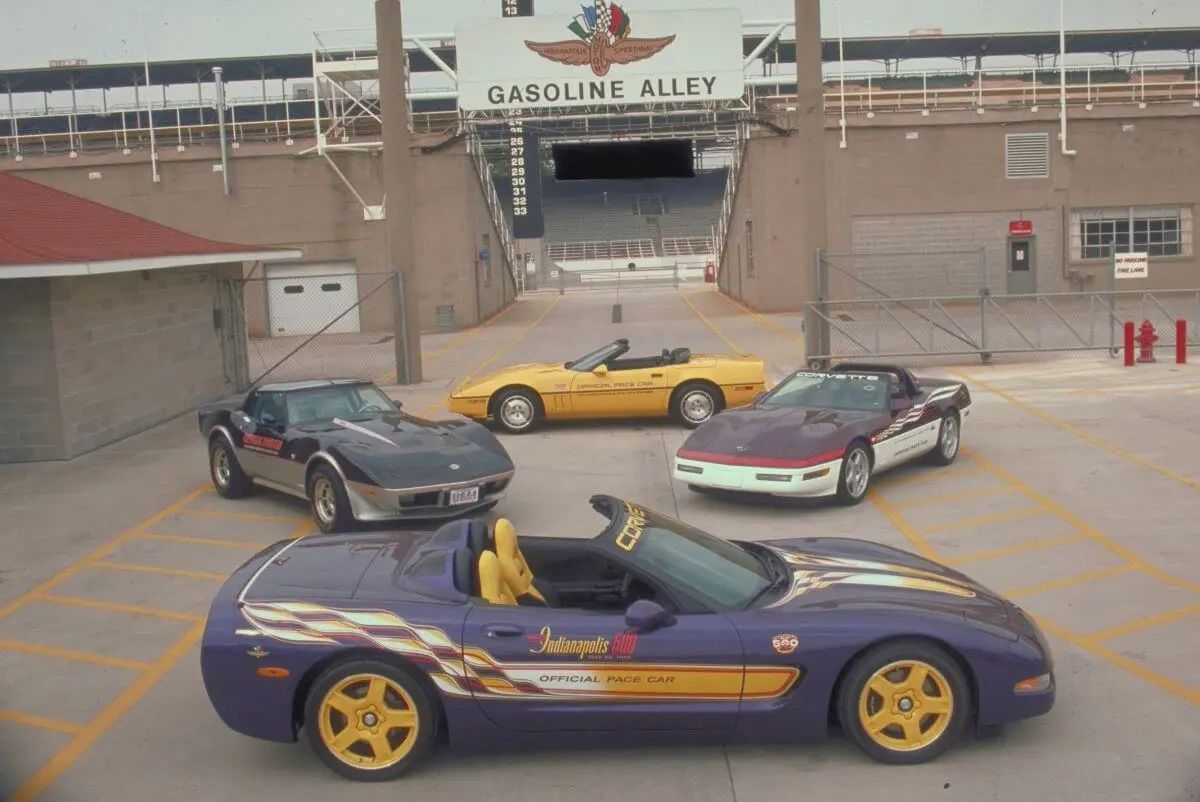
Gasoline Alley roll call: 1978, 1986, 1995, and 1998—the four Corvette Indy 500 pace cars lined up where the show begins. Black-and-silver C3, Sunflower-yellow ’86 convertible, the purple-over-white ’95 Z4Z, and out front the Radar Blue ’98 with yellow graphics and wheels. Twenty years after Corvette’s first turn at the job, the C5 takes the baton and makes the case in plain sight: same lineage, sharper tools, still leading the field. Indy and Corvette, shoulder to shoulder. (Image courtesy of GM Media LLC.)
By 1998, Corvette and the Indianapolis 500 were old friends. The relationship already had a meaningful history, and Chevrolet understood exactly what the Brickyard could do for America’s sports car when the timing was right. Corvette had first led the field in 1978, marking the car’s 25th anniversary with a black-and-silver pace car that immediately became one of the most recognizable late-C3 special editions. In 1986, the Corvette convertible returned to the role just as the open-air model returned to the showroom after more than a decade away. Then, in 1995, the purple-over-white Z4Z pace car gave the C4 another high-profile moment at Indianapolis, again accompanied by a commemorative production run for customers.
The 1998 car belonged to that same lineage, but the C5 changed the tone.
This was not simply another Corvette selected to lead the Indianapolis 500. The fifth-generation car represented a major architectural reset for the brand, with its rear transaxle layout, stiffer backbone structure, and thoroughly modern LS1 small-block V8. The C5 was not a warmed-over continuation of the C4. It was a clean-sheet reboot, a Corvette designed to feel more composed, more structurally confident, and more in step with the expectations of a modern performance car. In that context, debuting the convertible version at Indy was more than convenient timing. It was a proof of concept placed in front of the biggest American motorsport audience Chevrolet could find.
A convertible always has to answer certain questions. Is it rigid enough? Is it refined enough? Does it feel like a compromised version of the coupe, or does it stand on its own? Chevrolet used the Indianapolis 500 to answer those questions in public. The company made it official on November 6, 1997, announcing that the 1998 Corvette convertible would serve as the next Indy 500 pace car and confirming that a limited run of replicas would be offered to the public. As with the earlier Corvette pace cars, customers would be able to buy into the moment. But this time, the replica was doing more than commemorating a race. It was helping introduce the open C5 as a serious, fully realized production Corvette.
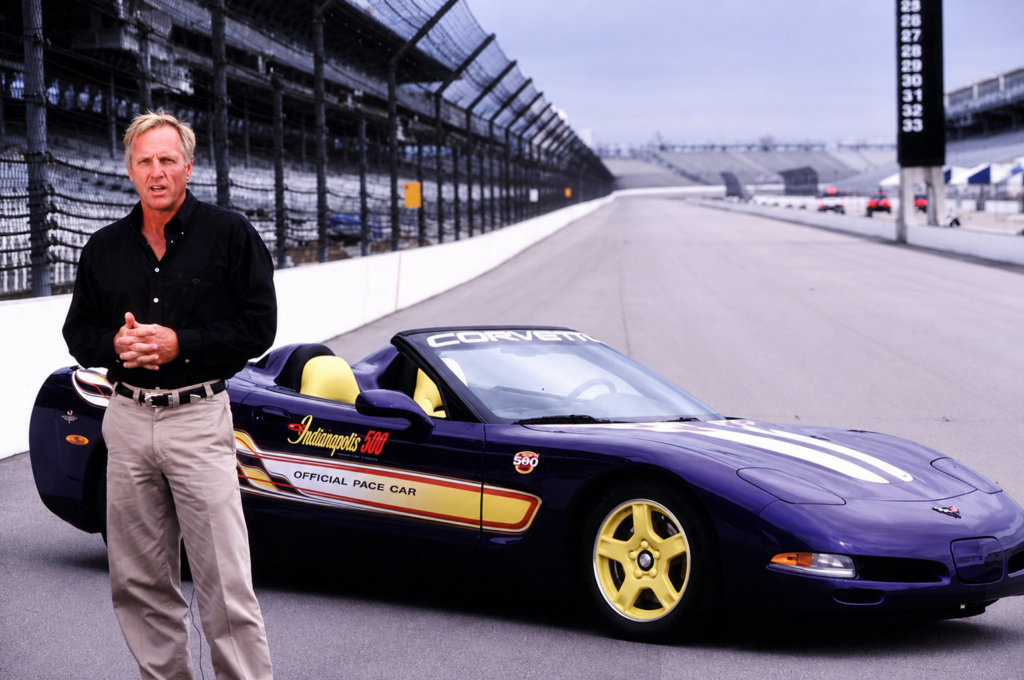
Greg Norman at the Brickyard with Chevy’s 1998 Corvette Indy 500 Pace Car—Radar Blue, yellow graphics, and all the pageantry lined up. He’d turned early practice laps and fronted the promo push, but arthroscopic surgery on his left shoulder sidelined him during race week. Indy royalty Parnelli Jones took over on May 24, 1998, yet this moment shows the plan as it started: star power and a C5 under the pagoda.
There was also a bit of last-minute drama around who would actually hold the steering wheel. Early plans put golfer Greg Norman in the driver’s seat. Norman brought celebrity visibility to the program and had even turned practice laps at Indianapolis Motor Speedway in April. His involvement fit the promotional side of the pace car assignment: a famous international sports figure, a new Corvette convertible, and one of the most watched racing events in America.
Then the plan changed.
The following month, arthroscopic surgery on Norman’s left shoulder for a rotator-cuff injury took him out of action. With race week looming, Chevrolet and the Speedway needed a replacement, and they did not settle for a stand-in. They named Parnelli Jones, winner of the 1963 Indianapolis 500, to pace the 82nd running on Sunday, May 24, 1998.
Jones was not a mere substitute. He was a signal.
Norman’s withdrawal could have made a carefully organized promotional moment feel scrambled. Instead, it gave the 1998 pace car story a different kind of weight. Putting a past Indy winner behind the wheel immediately shifted the emphasis from celebrity appearance to racing legitimacy. Jones’ résumé needed no explanation at Indianapolis. He was part of the Speedway’s own memory, a driver whose name carried the authority of having won the race outright. With him in the Corvette, Chevrolet did not have to borrow credibility from the event. The car was placed in the hands of someone who already belonged there.
That fit the message Chevrolet wanted the C5 to send. The new Corvette convertible was not being presented as a lifestyle accessory or a softened companion to the coupe. It was being shown as a proper performance car, one capable of leading the field at Indianapolis with a racer’s racer at the wheel. The imagery was direct: Parnelli Jones out front, the field tucked in behind him, and a Radar Blue C5 convertible setting the rhythm for the 500. On a day when Corvette wanted to telegraph legitimacy, Indy royalty led the grid.
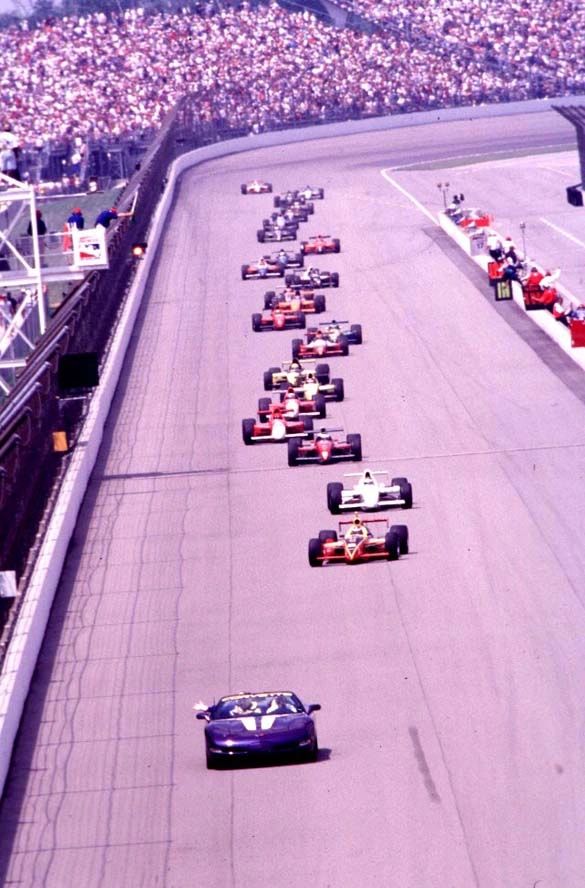
At the Brickyard in ’98, Greg Norman is sidelined by shoulder surgery, so 1963 winner Parnelli Jones takes the wheel of the Radar Blue C5 pace car. He gathers the field and draws 33 cars down the front straight, yellow wheels glinting as the grandstands rise. It reads less like a substitute and more like a statement—Indy royalty setting the tempo, Corvette credibility earned in plain sight.
That tone had been established months earlier at the car’s unveiling. Chevrolet rolled out the 1998 Corvette Indy Pace Car Convertible Replica at the SEMA show in Las Vegas on November 6, 1997, with Mary F. Hulman and Chevrolet General Manager John Middlebrook helping make the announcement official. At that point, Norman was still billed as the driver, and the car’s promotional identity was already fully formed.
The look was impossible to miss: Radar Blue paint, bold yellow graphics, and matching yellow wheels. It was a visual package designed to read instantly from a distance, whether parked under show lights, photographed for press material, or rolling down the front straight at Indianapolis. Middlebrook framed the intent plainly, saying, “We told the designers we wanted something that would grab people immediately, and they didn’t disappoint us.” That was the brief in a sentence. The 1998 pace car was not supposed to ease into the Corvette story quietly. It was built to stop people first, then make its case.
Under the skin, however, the pace car remained notably close to showroom stock. The official car used the LS1 V8 paired with an automatic transmission, with the additions required for pace-car duty—most notably a roll bar and strobes—rather than a wholesale transformation into a one-off machine. That was the larger point. Chevrolet did not need to create a special mechanical outlier to make the C5 convertible look credible at Indy. The production car’s basic architecture was strong enough to carry the assignment.
The limited-run Z4Z replicas reinforced that idea for customers. They carried the same visual package, linking the showroom car directly to the one seen at Indianapolis, and they also showcased Corvette’s new JL4 Active Handling system. That production debut was very much part of the message Chevrolet wanted to put out front. The C5 was still recognizably Corvette—front-engine, V8-powered, unmistakably American—but it was also a more sophisticated machine than the cars that came before it. Active Handling gave Chevrolet another way to present the new Corvette as a modern performance car, one that blended traditional Corvette power with a more advanced electronic safety and control strategy.
In the end, the storyline tightened rather than frayed. Norman’s shoulder surgery sidelined the celebrity. Parnelli Jones took the wheel and gave the moment a deeper connection to Indianapolis itself. The C5 convertible paced the 82nd running of the Indy 500 not as a purpose-built special or a heavily modified promotional prop, but as a largely stock Corvette making its case in front of 250,000 people.
It did not need special pleading.
It just needed a green flag.
Why the graphics were loud—and smart
82nd Indianapolis 500 — May 24, 1998. The fender badge on the Radar Blue C5 pace car—stylized “500” wrapped around an IndyCar—serves as a timestamp and a promise: today Corvette leads. The same emblem marked the Z4Z replicas, a small crest linking the street cars to race-day duty and to Parnelli Jones setting the pace.
Good pace-car graphics are not really about fashion. They are about readability.
That distinction is important with the 1998 Corvette Indy Pace Car Replica, because the car’s visual treatment is often judged first by its color and only later by its purpose. Radar Blue paint, yellow wheels, yellow interior accents, and a sweeping checkered graphic package make for one of the most extroverted Corvettes of the modern era. It is not a quiet car, and it was never meant to be one. But viewed in the proper context, the design begins to make more sense. At the Indianapolis Motor Speedway, a pace car has to communicate from a distance. It has to stand apart in a massive bowl of grandstands, television cameras, sunlight, shadow, and motion. Subtlety is not the assignment.
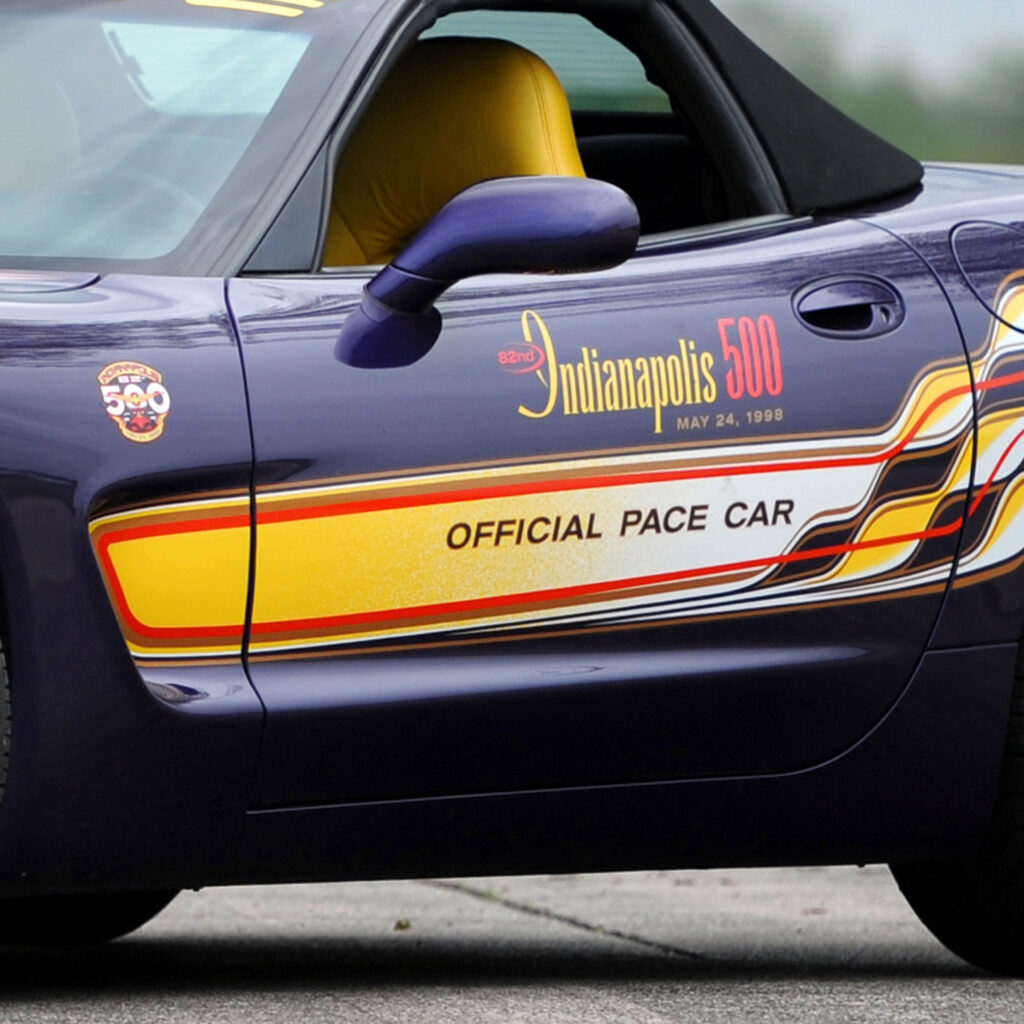
The 1998 Corvette Indy 500 Pace Car graphics package works because it understands the assignment: this was never meant to be a quiet showroom special. The sweeping yellow, white, red, and black graphics pull the eye across the C5’s door and rear quarter, giving the car a sense of motion even at rest, while the oversized “Official Pace Car” lettering and Indianapolis 500 branding make its purpose unmistakable from a distance. At the Brickyard, where scale, speed, sunlight, and grandstand sightlines all work against subtle design, boldness becomes function. The Radar Blue paint may provide the foundation, but the graphics give the car its event identity—turning a production Corvette convertible into something instantly tied to May 24, 1998, and to the larger story Chevrolet wanted to tell about the new C5.
In a setting as vast as the Brickyard, the visuals have to telegraph both movement and identity from far away and at odd light. The 1998 design does exactly that. The graphics begin up front, dive along the flanks, and climb over the rear deck in a flowing checkered arc that gives the car an unmistakable sense of motion even when it is standing still. Rather than simply applying stripes for decoration, the layout works with the C5’s lower, more rounded body shape. It follows the car’s sculpture instead of fighting it, emphasizing the long horizontal sweep of the new-generation Corvette and drawing attention to the bodyline that helped distinguish the C5 from the C4 before it.
That is part of what makes the car more sophisticated than its first impression suggests. Yes, the color combination is loud. Yes, the yellow wheels are impossible to ignore. But the graphic package is not random noise. It is organized around the car’s form and around the pace-car function itself. The checkered motif ties directly to racing without relying on a literal flag slapped onto the body, and the arc of the graphics gives the Corvette a visual signature that reads clearly in photographs, press material, and trackside views. It was designed to be seen quickly, understood immediately, and remembered afterward.
The yellow wheels pushed the whole composition even further. On a conventional production Corvette, they would have felt almost defiant. On an Indianapolis 500 pace car, they made sense. They gave the car instant contrast against the Radar Blue bodywork and helped visually anchor the yellow elements in the graphics and interior. The result was a car that did not merely wear a special paint scheme; it had a complete visual identity. The exterior, wheels, and cabin all spoke the same language. Pair the blue-and-yellow bodywork with the yellow-and-black interior, and the car becomes something more than a graphic package. It becomes a fully coordinated event car.
That coordination is one reason the 1998 Corvette Indy Pace Car Replica photographs so sharply. Some special editions look better in person than they do in images, while others flatten under a camera lens. The 1998 car does not have that problem. Its contrast is strong, its shapes are readable, and its graphic movement gives still photography a sense of energy. Whether you like the palette or not, the design does what it was built to do. It announces itself.
The real quiet innovation, though, was not the colorway. It was the process.
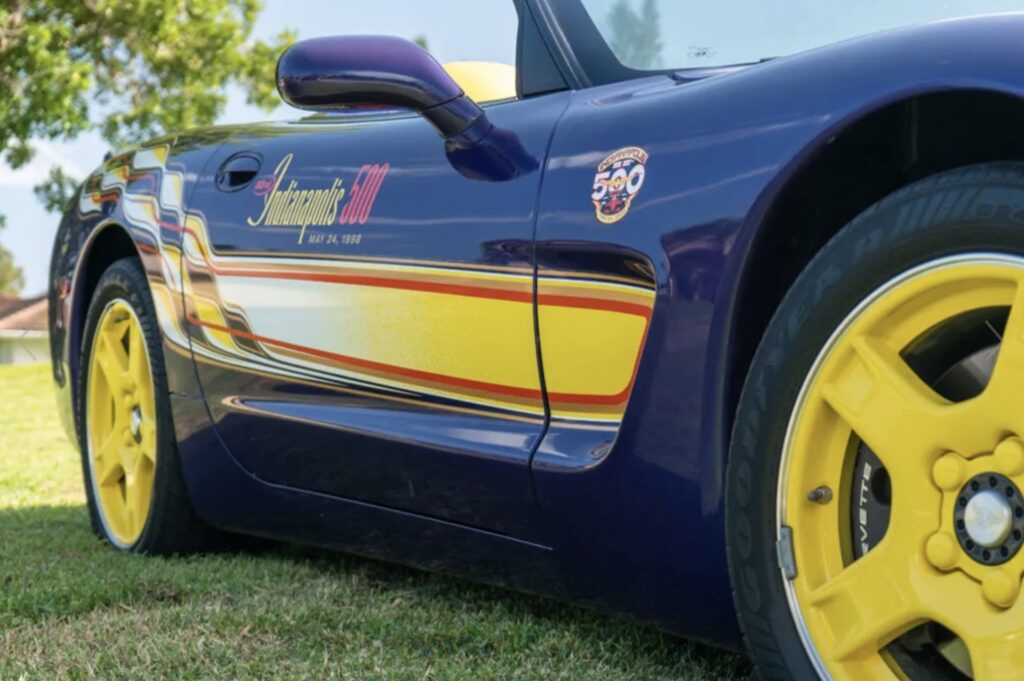
One of the most important details of the 1998 Corvette Indy 500 Pace Car Replica was not simply what the graphics looked like, but how they were applied. Unlike some earlier pace-car replicas where the striping and decals could be installed after the fact, the 1998 Z4Z graphics were applied at the factory, giving the car a level of consistency and finish that matched Chevrolet’s “same as the real thing” message. On a design this bold—with sweeping yellow panels, red and black accent stripes, Indianapolis 500 markings, and graphics that had to flow cleanly across the C5’s doors and rear quarters—alignment was everything. Factory application meant the package felt integrated rather than added on, turning the livery into part of the car’s production identity instead of a decorative afterthought.
Unlike earlier pace car replicas, where graphics could involve dealer or owner installation, the 1998 livery was applied at the factory. That may sound like a small production detail, but it mattered enormously to the way the cars were received and preserved. Factory application meant clean alignment, reliable adhesion, and consistency from car to car. Every replica left with the same basic visual execution, rather than relying on the patience, skill, or interpretation of whoever installed the decals after delivery.
Anyone who has spent time around collector cars understands why that matters. Crooked stripes, bubbled vinyl, uneven placement, or graphics that age differently from panel to panel can change the whole character of a special edition. On a car as visually dependent as the 1998 Pace Car Replica, execution was everything. The design was too bold to hide sloppy application. If the graphics were off, the whole car would feel off. By applying the livery at the factory, Chevrolet gave the package the kind of discipline it needed to support the claim being made around it.
That claim was straightforward: the replicas were meant to be understood as closely connected to the real pace car, not as loose tributes assembled after the fact. Chevrolet’s own positioning only worked if the look was delivered with factory-level consistency. The Radar Blue paint, yellow wheels, checkered graphics, and interior treatment all had to feel intentional and repeatable. A pace car replica depends on that credibility. The more disciplined the execution, the stronger the connection between the car in the showroom and the car leading the field at Indianapolis.
That is why the factory-applied graphics deserve more attention than they usually receive. They helped separate the 1998 Z4Z from the idea of a decorative package and moved it closer to a fully integrated production special. The car may have been visually outrageous, but it was not casually assembled. Chevrolet treated the livery as part of the car’s identity, not as an accessory. For a Corvette built around the promise that customers could own something remarkably close to the official Indy pace car, that decision made the whole story more convincing.
The 1998 Pace Car Replica was loud by design. But the more you study it, the more you realize that the loudness had structure. The graphics were functional as much as expressive. The colors gave the car distance-read clarity. The wheels and interior made the theme feel complete. And the factory application gave the entire package a level of consistency that matched Chevrolet’s larger message.
This was not just a Corvette wearing decals.
It was a pace car identity executed with production-car discipline.
“Born ready”: the engineering subtext
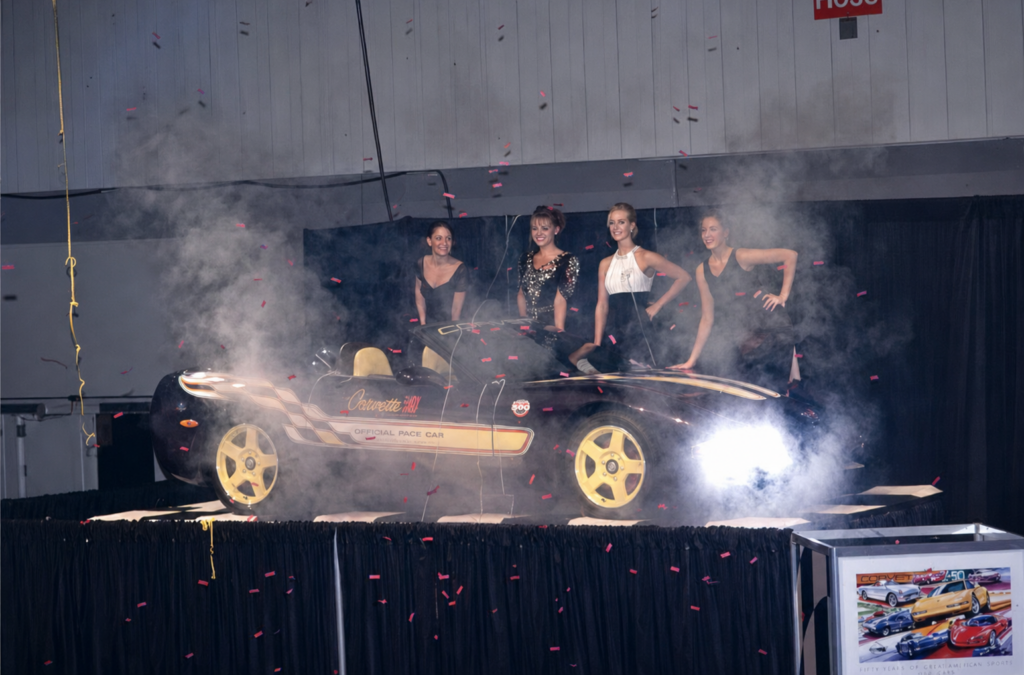
SEMA, Las Vegas—November 6, 1997: smoke, lights, and confetti as Chevrolet pulls the cover off the 1998 Corvette Indy 500 Pace Car. The Radar Blue C5 rolls onto the stage on yellow wheels, graphics blazing, headlights cutting the haze like it’s already pacing to green. IMS chair Mari Hulman George joins Chevrolet GM John Middlebrook to make it official, with Greg Norman introduced as the intended pace-car driver. The message is simple and loud: this car is built for the spotlight—and the Z4Z replicas will carry that look straight to Main Street.
The C5’s platform confidence shows in how little the official pace car actually needed.
For all the visual noise of the 1998 Indy Pace Car package, the mechanical story was remarkably restrained. Indianapolis safety requirements meant the official car had to receive the expected race-duty additions: roll-over hoops, rear-facing strobes integrated into the tonneau’s fairings, and the normal provisions required for event logistics. Those pieces were necessary for the job, but they did not transform the Corvette into some distant, specially prepared machine. That was the point Chevrolet wanted people to understand. Beneath the lights, safety equipment, and event markings, the car remained very close to the production C5 convertible customers could buy.
Chevrolet’s own description of the pace car was intentionally matter-of-fact. Mechanically, it was essentially factory stock. That choice gave the 1998 program much of its credibility. The company was not trying to sell the public a one-lap hero or a purpose-built promotional prop that only looked like the showroom car. It was using the Indianapolis 500 to make a more disciplined claim: the production C5 convertible had the structure, steering precision, powertrain refinement, and electronic support to lead the field without needing a long list of special explanations.
That message was especially important because convertibles are always asked to prove themselves in ways coupes are not. Removing the fixed roof can expose weakness in a platform. It can bring cowl shake, flex, looseness, and the sense that the open car is more about style than substance. The C5 convertible was designed to resist that criticism, and the Indy assignment gave Chevrolet the ideal stage to show it. The pace car did not need a wholesale mechanical makeover because the architecture underneath it was already strong enough to carry the moment.
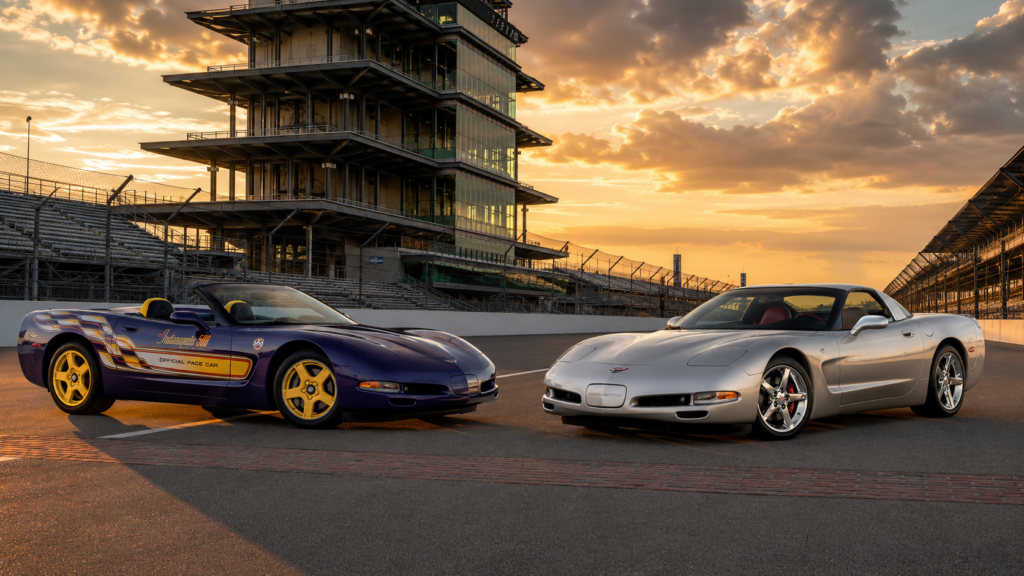
Seen together, the standard C5 coupe and the 1998 Indy Pace Car convertible make Chevrolet’s argument without needing a spec sheet. The coupe shows the clean form of the fifth-generation Corvette; the pace car shows that the same engineering foundation could stand exposed, roof down, graphics blazing, and still carry itself with authority. That was the quiet substance beneath the spectacle. The C5 convertible was not being presented as a sunny-day compromise or a softened version of the car—it was being trusted on the most visible American motorsports stage because the structure underneath it was already right. With JL4 Active Handling adding a new layer of electronic composure, Chevrolet could point to the open Corvette and say, in effect, this is not the fragile one, not the lesser one, not the pose. It is the same new-generation Corvette confidence, just with the sky overhead.
Active Handling, RPO JL4, sits at the center of that story.
New for 1998 and fitted to the Z4Z pace-car replicas, Active Handling gave Chevrolet a modern electronic layer to pair with the C5’s new structure and powertrain. The system used a yaw sensor, steering-angle input, and lateral-G sensing to help determine when the car was beginning to move away from the driver’s intended path. When needed, it could selectively apply braking at individual wheels to help stabilize the car, trimming unwanted rotation or helping bring the Corvette back into line when traction got thin or the driver asked for too much, too quickly.
In period, Chevrolet was careful about how it presented the system. Active Handling was framed first as an accident-avoidance feature, and only second as a performance-confidence tool. That was smart positioning. Corvette had never lacked speed, and Chevrolet did not need to convince anyone that a small-block V8 two-seater could be quick. What JL4 added was composure. It made the car’s performance more repeatable and more accessible when conditions were less than ideal—on uneven pavement, in rain grooves, during a late-braking mistake, or in that brief moment when the rear of the car starts to rotate faster than the driver intended.
The best electronic systems do not announce themselves every mile. They work quietly in the background, allowing the car to feel natural until they are needed. Active Handling belonged to that category. It did not erase the Corvette’s character or make the car feel artificially restrained. Instead, it added a layer of control that helped the driver use more of the car with greater confidence. You might not think about it during an ordinary drive, but the first time it helped clean up a slide or settle the car without strangling the experience, the value became obvious.
That is why JL4 was such a fitting part of the 1998 Pace Car Replica story. The system reinforced exactly what Chevrolet wanted the C5 convertible to represent: not just speed, but composure; not just horsepower, but control; not just a bold-looking replica, but a modern Corvette with real engineering substance underneath the graphics. The car’s Indy role did not depend on a radical mechanical transformation. It depended on Chevrolet’s confidence that the showroom Corvette was finally strong, refined, and technically capable enough to stand in front of the field as itself.
The package: what RPO Z4Z actually bought you
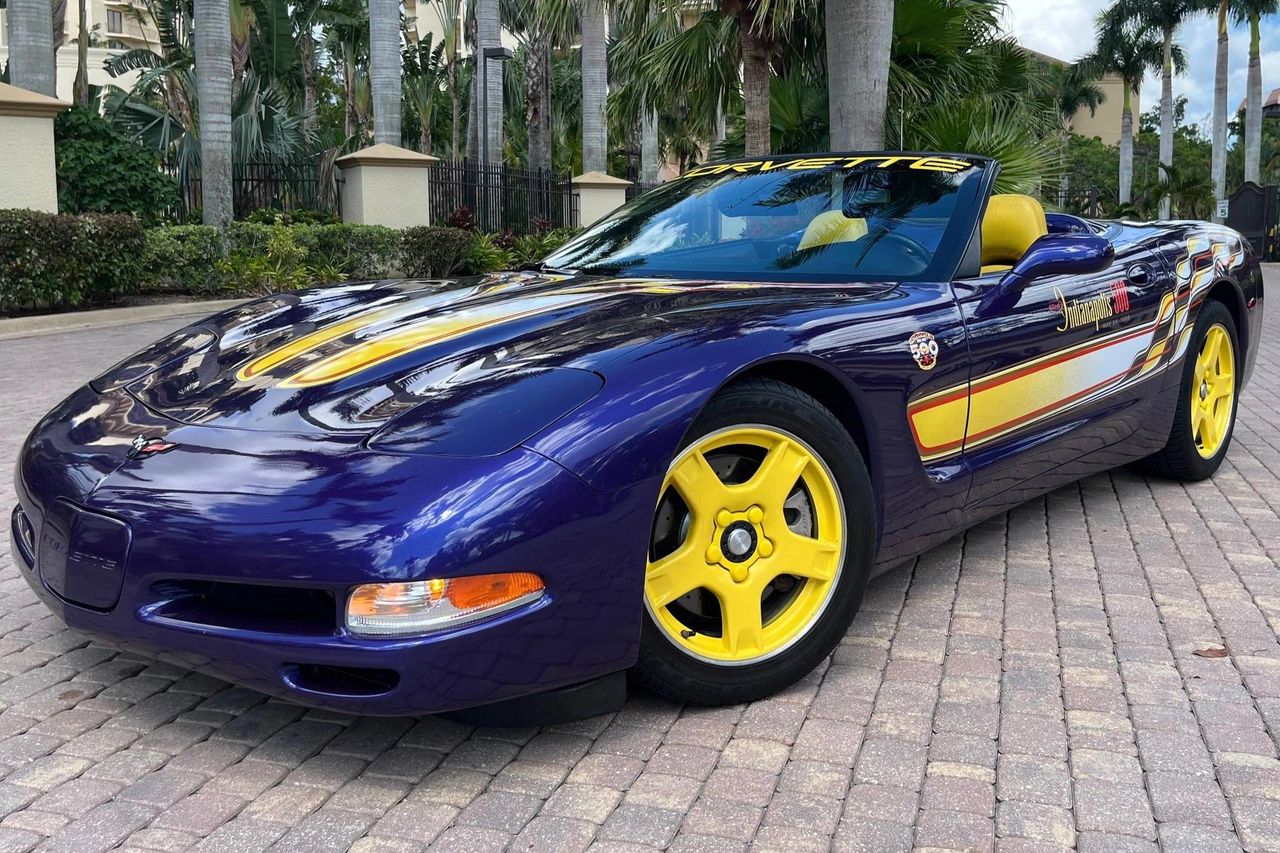
Radar Blue like wet ink, with twin yellow hood streaks that flow into the checkerboard ribbon graphics down the flanks. Color-keyed 5-spoke wheels and yellow cockpit accents carry the theme, capped by the 82nd Indy 500 fender medallion and “Indianapolis 500” door script. Pace car livery that reads loud and cohesive from every angle.
On paper, Z4Z was straightforward: take a 1998 Corvette convertible and give it the full Indianapolis 500 Pace Car identity. Radar Blue paint. Yellow wheels. The sweeping checkered-flag graphics. A yellow-and-black interior that carried the exterior theme into the cabin. It was not a subtle package, but it was a complete one, and that completeness is what separated the car from a standard C5 wearing a few commemorative decals.
What made the package more convincing was the way Chevrolet tied the visual treatment to the equipment customers would actually live with. The Z4Z cars were not stripped-down replicas built only for display. They carried the comfort and convenience features expected of a well-optioned late-1990s Corvette convertible, including Bose audio and the appropriate convenience content, while also incorporating JL4 Active Handling. That combination gave the car two identities at once: a limited-production Indy replica with unmistakable event presence, and a usable C5 convertible equipped like something meant to be driven rather than merely stored.
Period pricing can get a little slippery because announcement figures and window-sticker totals rarely align perfectly from car to car. Options, transmission choice, and final retail documentation can all affect how the numbers appear. But the basic story is consistent. The pace-car package added roughly five thousand dollars on top of a mid-$40,000 Corvette convertible, while the 6-speed manual added approximately another $800. Chevrolet was clearly asking buyers to pay for the occasion, but the car was not priced like an unreachable halo collectible. It was expensive enough to feel special, yet still grounded in the real production Corvette lineup.
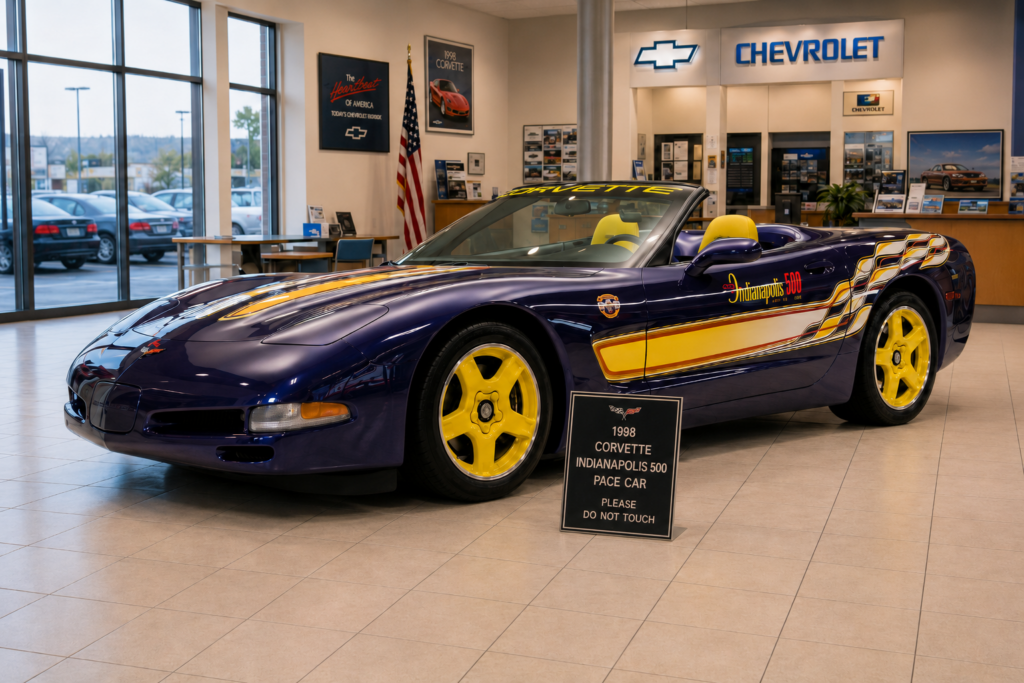
For Chevrolet dealers, cars like the 1998 Corvette Indianapolis 500 Pace Car were never just inventory; they were showroom magnets. GM understood the value of a halo car placed where customers could see it, circle it, talk about it, and then imagine some piece of that excitement attached to whatever Chevrolet they had actually come in to buy. The Pace Car did that job perfectly—bright, loud, unmistakably special, and directly connected to the biggest race in America. Images like this also take me back to the first time I saw one in person, shortly after GM introduced the replicas, sitting inside the showroom at Merrick Chevrolet in Berea, Ohio. I was not looking at an ordinary Corvette that day. I was looking at something that made the whole idea of Corvette feel bigger, closer, and somehow more possible. For me, that first encounter was a game-changer, and it only deepened the desire I already had to someday own a Corvette of my own. (Image credit: Author / ChatGPT)
That balance was part of the car’s appeal. The 1998 Pace Car Replica was not a hand-built exotic or a commemorative object detached from normal Corvette ownership. It remained a production C5 convertible, optioned and finished in a way that made it stand apart. Buyers were paying for a direct connection to Indianapolis, for the visual drama of the Z4Z package, and for the new-generation confidence Chevrolet was trying to attach to the C5. The car looked wild, but the business case behind it was practical: build something distinctive, keep it attainable for Corvette buyers, and let the Indy association do the rest.
Then there is the question that always follows a pace car replica: how many were actually built?
This is where enthusiasts can get pulled in different directions if they rely solely on early announcements. Initial estimates placed the production run somewhere in the low-thousand range, which was useful at the time but not precise enough for collectors trying to understand the car decades later. Final accounting, compiled and cross-checked through the C5 community, pace-car registries, and cars documented with original paperwork, lands at 1,163 total examples. That figure includes five pilot cars and breaks down by transmission into 616 automatics and 547 6-speeds.
Those numbers help explain the Z4Z’s unusual place in the Corvette world. It is not so rare that the car disappears into folklore, where only a handful trade privately and most enthusiasts never see one. But it is limited enough that a genuine Pace Car Replica still draws attention when it arrives at a show, a cruise-in, or a Corvette gathering. The production total gives the car credibility without making it inaccessible. It is scarce enough to feel like a find, yet present enough to have built its own small culture inside the larger C5 community.
That may be the sweet spot for a pace car replica. Too many, and the car risks feeling like a graphics package sold at scale. Too few, and it becomes more of a museum object than an enthusiast car. At 1,163 built, the 1998 Corvette Indy 500 Pace Car Replica landed in the middle: rare enough to spark a conversation, common enough to create a scene, and distinctive enough that no one mistakes it for anything else.
What Chevrolet was really saying at Indy in ’98
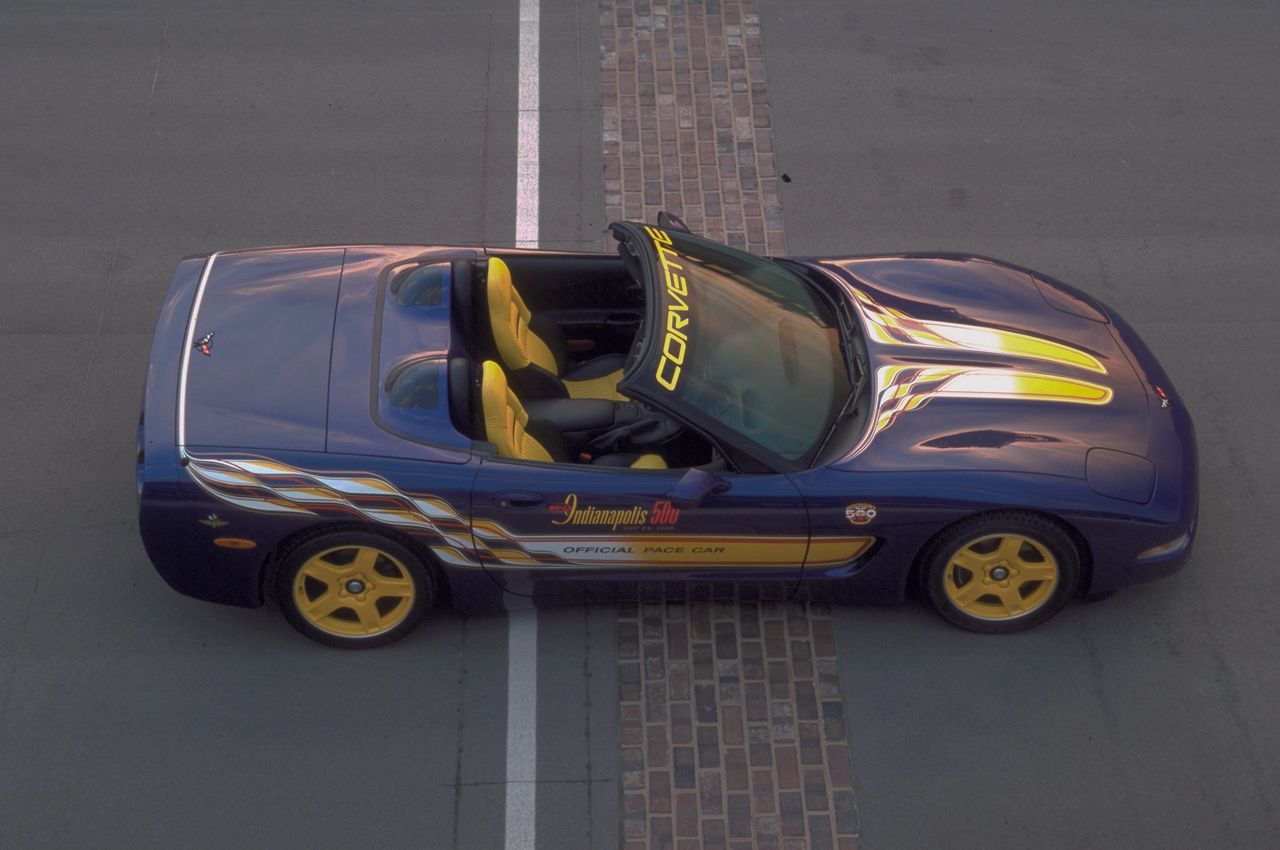
Indianapolis Motor Speedway’s iconic brick start/finish line, seen from above—the 1998 Corvette Indy 500 Pace Car straddles the stripe, Radar Blue and yellow livery laid out like a starter’s flag. The CORVETTE windshield banner, triple hood streaks, and checkerboard ribbon graphics broadcast its mission at a glance.
The real “why” behind this car lives at the intersection of architecture and audience:
Architecture: The C5’s backbone changed what everyday Corvette driving felt like. The steering stayed lucid over expansion joints; the structure shrugged off the cowl shake that once defined American convertibles. Mount the transaxle at the rear, stiffen the tunnel and sills, and suddenly long-distance Corvette becomes a two-finger car instead of a work assignment. Putting that convertible at Indy—rather than a coupe with a token opening—telegraphed confidence in the chassis, not just the motor.
Audience: Corvette’s move in the late ’90s was to pair big-league performance with approachable technology. JL4 fits that pivot. Call it stability control if you want—Chevrolet did—but the core was a stability culture shift. You didn’t have to be Mario Andretti to go quickly without drama. You could be a Sunday-morning driver with a long on-ramp and a rain cloud, and the car would flatter you.
Authenticity: At a time when other pace-car programs would quietly tweak powertrains or braking systems to make an event day look easy, Chevrolet chose to undercut the myth. The ’98 pace-car program hung its hat on mechanical normalcy, then invited you to buy the match. The replica wasn’t “like” the pace car; it was the pace car in the ways that mattered.
What it’s like to drive a 1998 Corvette Indy Pace Car Replica now
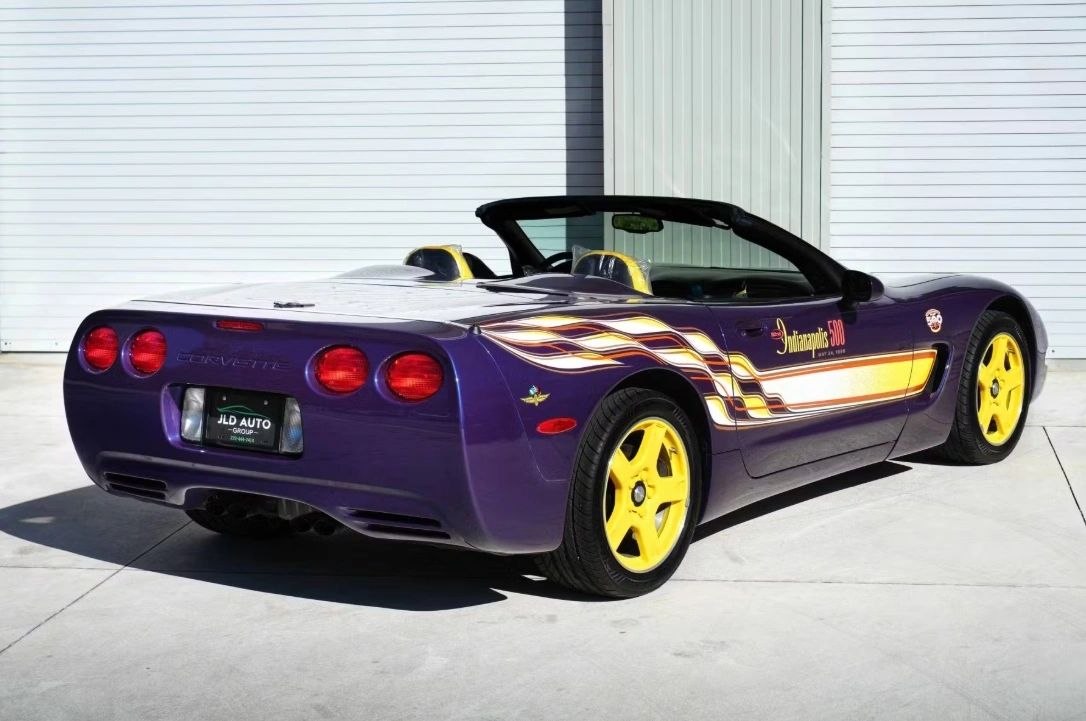
Drive a good 1998 Z4Z and two things happen in short order.
First, the livery noise fades. The yellow wheels, Radar Blue paint, and sweeping Indianapolis 500 graphics are the first things anyone notices, and understandably so. The car announces itself before the starter ever turns. But once you are behind the wheel, the visual volume begins to recede, and what remains is the basic goodness of the C5. The pace-car package may define the car at rest, but motion reminds you that this is still a fifth-generation Corvette convertible at its core—balanced, composed, and far more mature than the graphics suggest.
What stays with you is calm. That easy, unbothered C5 rhythm was one of the reasons the car changed so many opinions when it was new. It had the power people expected from Corvette, but it delivered that power through a platform that finally felt like it was working with the driver instead of constantly asking for forgiveness. The LS1 starts cleanly, settles quickly, and pulls with a smooth, confident sweep through the middle of the rev range. It does not need to be wrung out to feel satisfying. It has that broad-shouldered, small-block ease that makes the car feel quick without feeling frantic.
With the 6-speed manual, the car gains another layer of involvement. The gates feel deliberate, not vague; the shift action feels like a proper mechanical decision rather than a loose suggestion. The manual suits the C5’s personality because it makes the driver part of the car’s composure. You are not wrestling it into cooperation. You are working with something sorted. Even the base ride plays its part. Paired with the C5’s stronger structure, it gives the car a settled quality that earlier Corvette convertibles did not always possess. The chassis no longer feels like it is arguing with itself over every broken seam or uneven patch of pavement.
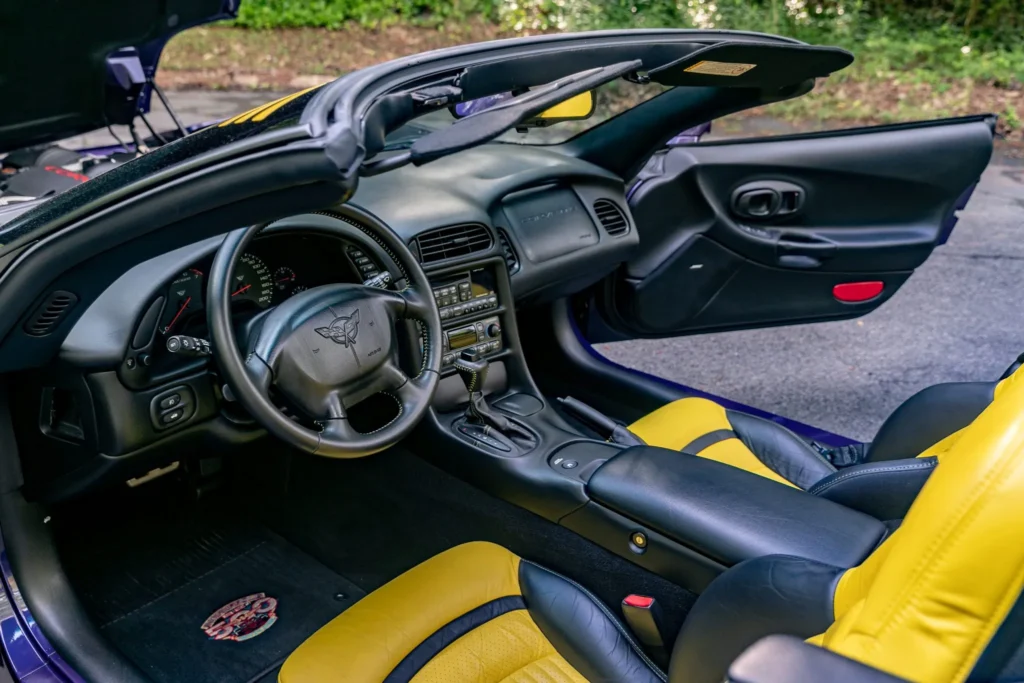
Climb into the 1998 Corvette Pace Car, and the spectacle outside gives way to something more focused and familiar. The yellow-and-black seats carry the Indy theme into the cabin, but the view over the C5’s low dash, the clean sweep of the console, and the small-block waiting under your right foot remind you this is still a driver’s Corvette first. The graphics may get everyone else’s attention, but from behind the wheel, the car settles into that confident C5 rhythm—comfortable, composed, and ready to turn the page from showroom conversation piece to real Corvette experience.
That is the first surprise for anyone expecting the Pace Car Replica to feel like a novelty item. It does not drive like a commemorative object. It drives like a Corvette that happens to be wearing a very loud uniform.
The second thing you notice is that JL4 Active Handling earns its keep. Not by taking over the car, and not by making the driver feel scolded, but by quietly standing watch at the edges. Maybe you are cresting a crowned two-lane road just as a shower starts. Maybe you turn in a little early and the rear begins to move before you are ready for it. Maybe the pavement gets greasy in a place where your right foot had already made a decision. In those moments, JL4 works with a kind of measured restraint. It trims yaw with a small, precise brake intervention and gives the car back to you before the moment becomes untidy.
That was the brilliance of the system in a Corvette context. Active Handling did not erase the car’s personality or turn the C5 into something sterile. It simply added a layer of composure that made the car easier to trust. Corvette had always offered speed. The C5, especially with JL4, made that speed feel more usable in the imperfect conditions where real drivers actually live: wet roads, uneven pavement, early turn-ins, late corrections, and all the small mistakes that happen between confidence and consequence. It was more quiet aide than schoolmarm, stepping in just enough to keep the conversation civilized.
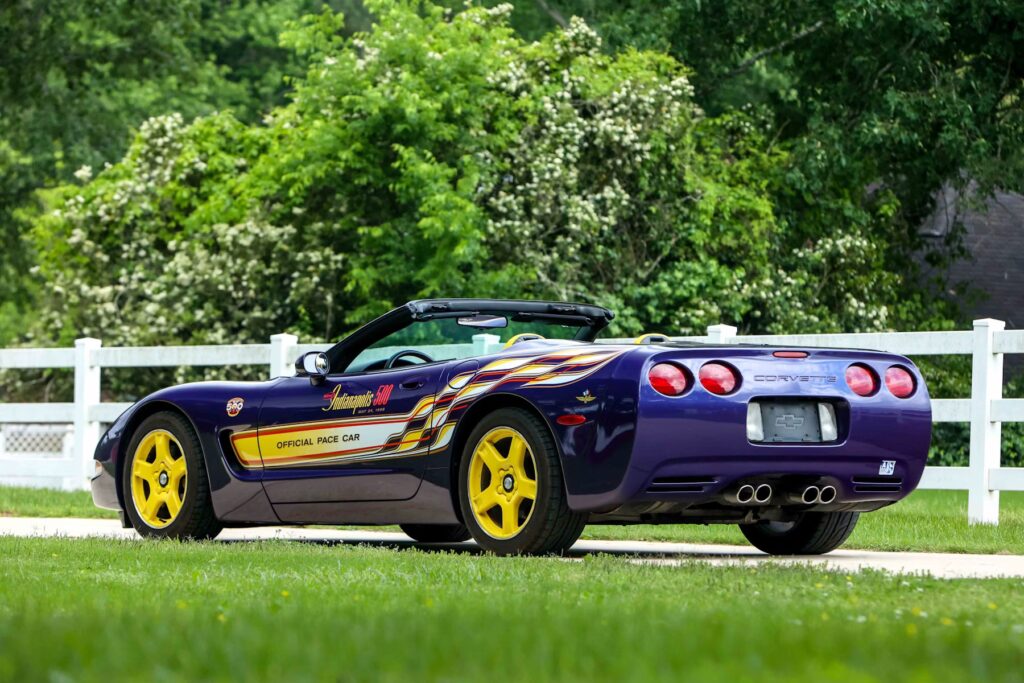
Compared with the C4 convertible, the C5 felt like a much more complete open Corvette—stiffer, quieter, better sealed, and less prone to the flex and cowl shake that earlier cars could reveal over rough pavement. The top itself integrated more cleanly with the body, helping the convertible read as part of the C5 program rather than a roofless adaptation of it. On the 1998 Indy Pace Car, that matters visually as much as dynamically: with the top down, the yellow seats, roll-hoop area, and sweeping side graphics become part of one continuous display. The car looks less like a coupe with something removed and more like a purpose-built convertible designed to wear all that Indy pageantry in the open air. (Image source: Hagerty)
If you are used to C4 convertibles, the difference is especially clear. The C5’s soft top and seal management feel almost luxurious by comparison. With the top up, the car is quiet enough to have a conversation without raising your voice over wind noise and body tremor. It feels less like an open car trying to impersonate a coupe and more like a convertible designed into the platform from the beginning. That sense of integration changes the whole experience. You are not constantly aware of what was removed. You are more aware of what Chevrolet managed to preserve.
With the top down, the car stays present in a way that earlier Corvette convertibles could struggle to match. The body does not quiver over railroad crossings. The cowl does not shake its way through rough pavement. The steering remains clean, the structure feels settled, and the car retains the confident rhythm that made the C5 such a meaningful step forward. The open-air experience adds to the car rather than exposing it.
The upshot is that the 1998 Pace Car Replica drives like a Corvette first and a special edition second. That is its real charm. The graphics get people to walk over. The yellow wheels start the conversation. The Indianapolis connection gives the car its story. But the reason owners actually enjoy these cars is that beneath all the event identity is a genuinely good C5 convertible—smooth, stable, usable, and modern in the way late-1990s Corvette needed to be.
That is also why so many Z4Z owners put miles on them. The car may look like something built to sit under lights, but it was never limited to display duty. It has enough rarity to feel special, enough visual presence to make every fuel stop an event, and enough real Corvette substance to make the drive worth repeating. The Pace Car Replica may have been born from Indianapolis pageantry, but once the livery fades into the background, what remains is the car Chevrolet wanted you to discover all along.
The Details That Complete the Story
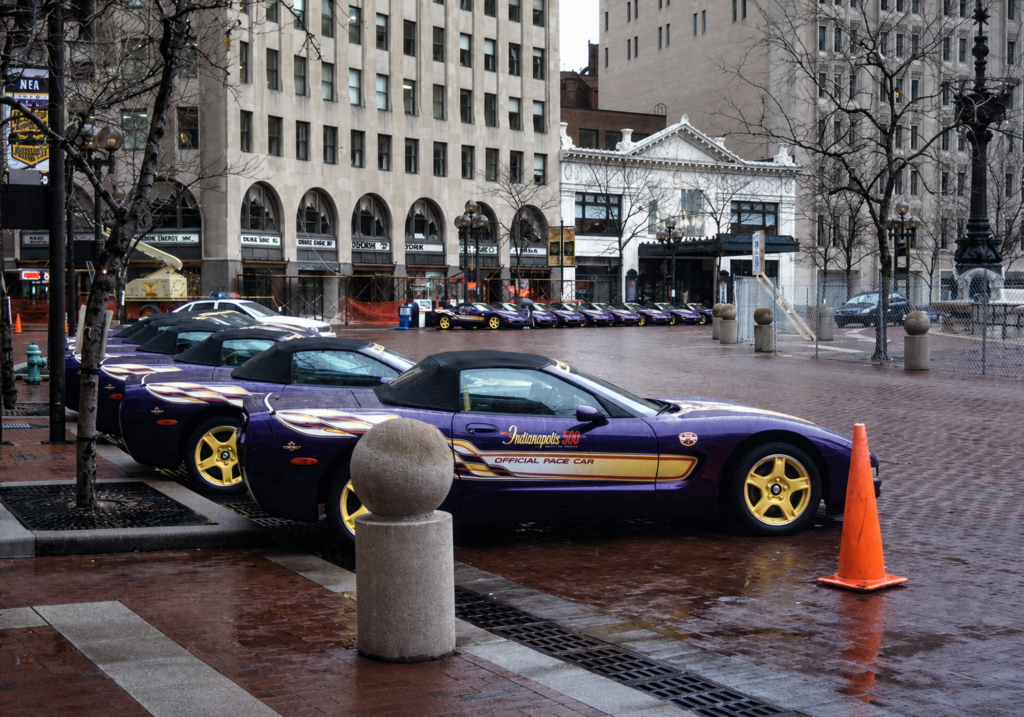
Monument Circle becomes a Corvette corral—Radar Blue C5 pace cars idling against wet brick, their yellow wheels popping under a gray Indiana sky. These convertibles wore the full Indy 500 livery, staged downtown for promo duty and parade laps ahead of race week. Nearly twins to the Brickyard pacers, they broadcast May in Indianapolis from a block away. No billboard needed—just a circle full of Corvettes.
The 1998 Corvette Indy Pace Car story is easy to understand at full volume: Radar Blue paint, yellow wheels, wild graphics, and a C5 convertible leading the field at Indianapolis. But the smaller details are where the car becomes more interesting. The Z4Z was not just a bright commemorative package attached to a famous race. It was a carefully timed, carefully staged Corvette moment, and several of its best supporting details help explain why the car still has a distinct place in C5 history.
Monument Circle may be the best example. Before race day, downtown Indianapolis became its own kind of Corvette corral, with Radar Blue C5 pace cars gathered against wet brick and gray Indiana skies, their yellow wheels cutting through the gloom like signal flares. These cars wore the full Indy 500 livery and served as rolling promotion for race week, visually extending the Speedway into the heart of the city. Nearly twins to the Brickyard pacers, they announced May in Indianapolis from a block away. No billboard was required. A circle full of Corvettes did the work.
The driver change added its own layer to the story. Greg Norman may have been the original celebrity choice, but Parnelli Jones ultimately gave the 1998 pace-car assignment more weight. Norman’s late withdrawal could have made the program feel unsettled; instead, Jones’s substitution tied Chevrolet’s newest Corvette to a driver who already held a permanent place in Speedway history. It sharpened the narrative rather than weakening it. A new-generation Corvette convertible out front was one thing. A new-generation Corvette convertible led by a past Indy 500 winner was something else entirely.
One of the defining details of the 1998 Corvette Indy 500 Pace Car Replica was that its graphics were installed at the Bowling Green Assembly Plant, giving the Z4Z package a factory-applied finish rather than the uneven feel of an afterthought. That mattered on a car this visually dependent on precision: the yellow windshield “CORVETTE” script, the Indianapolis 500 door graphics, the Official Pace Car callout, the front fender event medallions, and the flowing checkered-flag sweep over the rear quarters all had to land cleanly for the design to work. The close-up view of the windshield lettering shows the point beautifully—this was not just decoration, but part of a coordinated identity that tied the Radar Blue paint, yellow wheels, yellow-and-black interior, and race-week livery into one unmistakable package. Factory installation helped make the car feel like a true production special, not a standard convertible wearing dealer-installed costume jewelry.
Then there were the graphics. Chevrolet’s decision to apply the livery at Bowling Green removed a major variable from the replica program. For collectors and restorers today, “factory stripes” versus “dealer stripes” is not just trivia. It is the difference between a car that left the line with clean, consistent execution and one that may spend years fighting alignment issues, lifting edges, bubbled vinyl, or aged adhesive. On a special edition built so heavily around visual impact, consistency was not a minor production detail. It was part of the car’s credibility.
The transmission split also says more than it first appears to. Of the 1,163 total Z4Z cars, 547 were built with the 6-speed manual. That number matters because it shows the package did not land only with parade enthusiasts or collectors chasing a bright commemorative edition. A substantial number of buyers wanted to row their own gears under that neon suit. The Pace Car Replica may have looked like event merchandise from a distance, but plenty of its original customers clearly still saw it as a Corvette to drive.
Active Handling gave the car another layer of purpose. GM’s press framing for JL4 read like a careful engineer’s argument for accident avoidance, stability, and control. In practice, the system helped present the C5 as something more mature than the old caricature of brute-force American performance. Corvette was still fast, still V8-powered, still unmistakably itself, but JL4 gave the car a more polished public face. It suggested performance with composure, not just performance with bravado.
That is why the Z4Z still works better than its loudest details might suggest. The downtown promo cars reinforced the “same as the real thing” message. The factory graphics gave the package a higher floor of execution. The manual-transmission count proved that real drivers were paying attention. And Active Handling helped position the C5 as a more complete Corvette for a new era. The 1998 Pace Car Replica was theatrical on the surface, but the fine print had substance.
The market, then and now
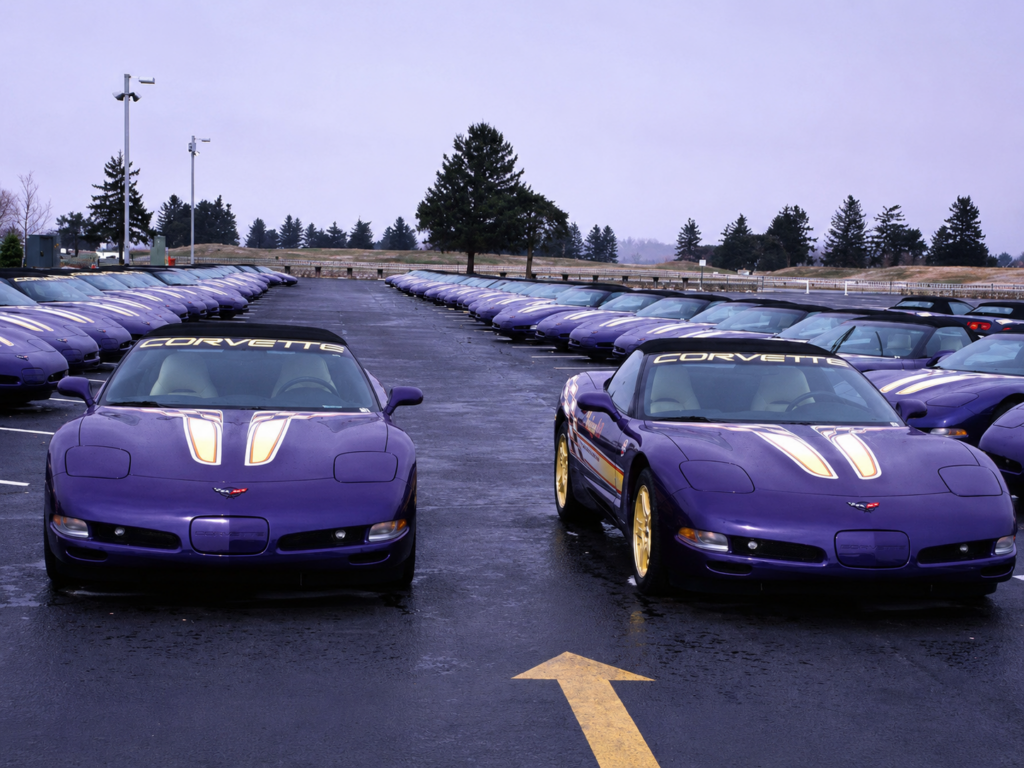
Lined up at the Corvette Manufacturing Plant in Bowling Green, these 1998 Corvette Indianapolis 500 Pace Car Replicas look less like a novelty run and more like a moment in Corvette history coming into focus. Each Radar Blue convertible, set off by yellow wheels and race-week graphics, represents the point where Chevrolet’s Indy spectacle became real production cars no longer serving only as pace-car imagery, but as finished Corvettes preparing to leave the plant and enter the world. Seen this way, the row carries a little more weight: not just colorful special editions waiting for keys, but a full assembly-line statement that the C5 was modern enough, confident enough, and polished enough to turn a bold promotional idea into a legitimate piece of Corvette manufacturing history. It is a late-1990s Corvette at full volume, lined up where the story became tangible.
Window-sticker arithmetic put a well-optioned Z4Z in a sweet spot: special but not absurd. That helped the cars find garages outside of the “park and stare” crowd. Two and a half decades on, values tell a familiar story: driver-grade cars in the high-teens to mid-$20s, clean survivors and low-mile examples in the $30s, and documentation-rich or provenance-heavy cars that pop higher when the right buyer falls in love with the right story. High-visibility auction comps and marketplace pieces continue to cite the 1,163 total and the manual/automatic split, underlining how long the community has converged on those totals. The broader lesson isn’t that they’ve spiked; it’s that originality, paperwork, and factory graphics separate the good from the merely shiny.
The quick reference you’ll want handy
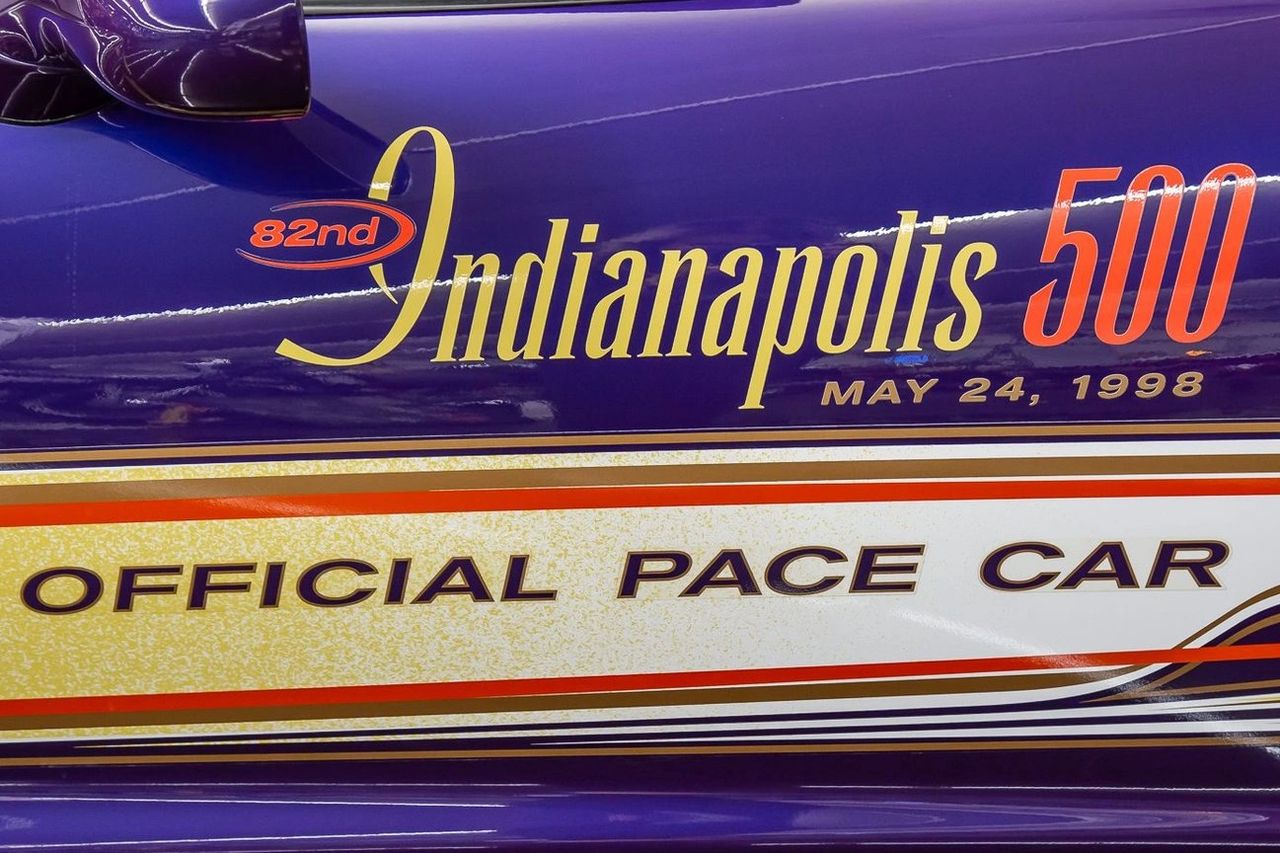
Official announcement: Chevrolet made the program official on November 6, 1997, confirming that the 1998 Corvette convertible would pace the Indianapolis 500 and that a limited run of replicas would be offered to the public. It was a major visibility play for the new C5 convertible, but also a production-car statement: the open Corvette was ready for the spotlight.
Race day: The 82nd running of the Indianapolis 500 took place on May 24, 1998, with Parnelli Jones behind the wheel of the Corvette pace car. Greg Norman had originally been announced as the driver and even participated in early promotional activity, but shoulder surgery forced him to withdraw before race week.
Mechanical story: The official pace car stayed remarkably close to showroom specification. Race-day equipment such as safety gear, roll-over protection, and lighting separated the track-duty car from the replicas, but the basic message was clear: Chevrolet did not need to create a heavily modified one-off to put the C5 convertible out front at Indy.
Active Handling — RPO JL4: Active Handling debuted for 1998 and was fitted to the Z4Z pace-car replicas, giving Chevrolet a high-profile way to introduce the system. Built around yaw, steering-angle, and lateral-G inputs, JL4 helped position the C5 as a more composed and electronically sophisticated Corvette. It later became standard equipment for 2001.
Production: Final production is generally accepted at 1,163 total cars, including five pilot cars. The transmission split gives the number more texture: 616 automatics and 547 6-speeds, a healthy manual count that reinforces the idea that many buyers saw the Z4Z as a Corvette to drive, not just a commemorative object to store.
Pricing context: The pace-car package added roughly $5,039 over the price of a well-optioned, mid-$40,000 Corvette convertible. Period announcements, registry material, and window-sticker references can vary slightly depending on equipment and accounting, but the direction is consistent: Chevrolet priced the Z4Z as a special car without pushing it completely outside normal Corvette buyer territory.
Factory livery: For 1998, the major exterior graphics were applied at the Bowling Green Assembly Plant, giving the replicas a consistency that earlier decal-based special editions did not always enjoy. The windshield name decal remained an owner-installed piece, a small but useful distinction for restorers and collectors trying to understand what was factory-applied and what was delivered separately.
Why the 1998 Corvette Pace Car Replica Still Matters Today
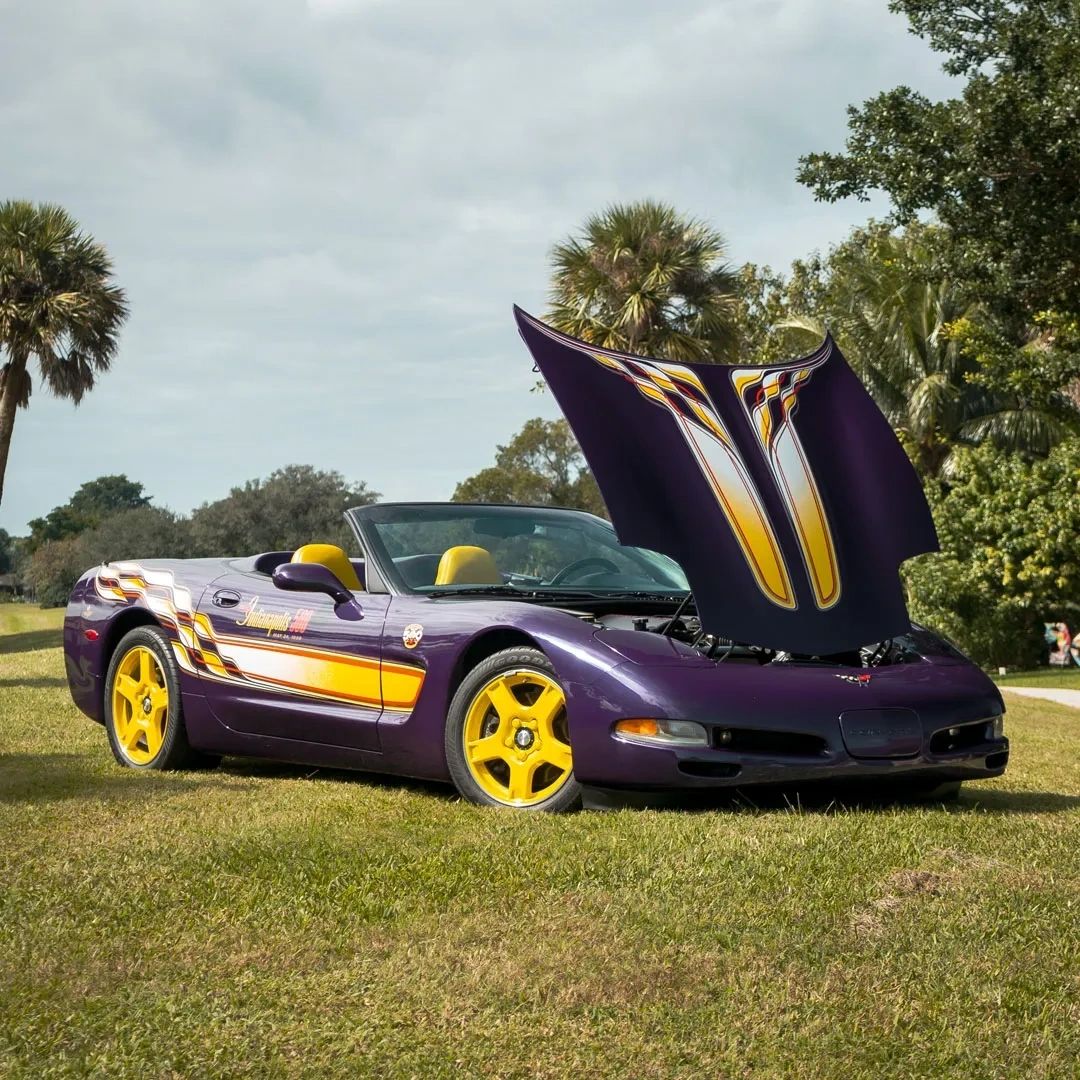
The ’98 Indy 500 Pace Car mattered because it proved the new C5 convertible’s structure in the harshest spotlight—top down at speed, with no gimmick mechanicals, just strobe gear and safety mods. It also debuted GM’s boldest late-’90s look and helped launch the Corvette ragtop’s return for the C5 era. Many replicas (there were 1,163 produced in total) were sold nearly spec-for-spec with the real pacers, turning a one-day assignment into a rolling validation of the platform. In short: engineering credibility, broadcast in purple and yellow.
The 1998 Corvette Indianapolis 500 Pace Car Replica has always been easy to dismiss from a distance. Too purple. Too yellow. Too loud. Too tied to a particular late-1990s moment when Chevrolet was not afraid to let a special edition announce itself from the far end of a parking lot. But that quick reading misses why the car continues to hold a place in Corvette history. The Z4Z was never just a paint-and-decal exercise. It was the moment Chevrolet used the Indianapolis 500 to introduce the C5 convertible, showcase the credibility of the new platform, and put a factory-built replica into customers’ hands that was close enough to the real pace car to make the connection feel legitimate.
That is what separates it from simple commemorative dressing. The 1998 Pace Car arrived at a pivotal time for Corvette. The C5 had already begun changing the conversation around America’s sports car, but the convertible still had something to prove. Open Corvettes had always carried emotional weight, but they also carried the usual convertible questions: structure, refinement, sealing, cowl shake, and whether the roofless version felt like a compromise. The Indy assignment allowed Chevrolet to answer those questions in public. The car did not need a special chassis, a one-off engine, or a long list of mechanical excuses. It was essentially a production C5 convertible with the required pace-car equipment added for duty, and that was the point. Chevrolet trusted the showroom car enough to put it in front of the field.
The livery, for all its controversy, is part of what keeps the car working. A restrained 1998 Indy Pace Car would have been easier to like, but probably easier to forget. The Radar Blue paint, yellow wheels, black-and-yellow interior, windshield callout, event medallions, and sweeping checkered graphics gave the car a visual signature no other C5 shares. It is not merely colorful; it is unmistakable. At a cars-and-coffee, a concours field, a Corvette gathering, or a dealer showroom, the car does not need explanation before it starts a conversation. It brings Indianapolis with it.
The 82nd Indianapolis 500 emblem on the 1998 Corvette Pace Car Replica is more than a decorative badge; it is the timestamp that explains why the car still carries historical weight. The Z4Z package matters today because it preserves the moment Chevrolet used America’s biggest racing stage to introduce the C5 convertible and prove that the new-generation Corvette had the structure, composure, and confidence to lead at Indy without becoming something other than itself. In that sense, the event was as important to the car’s story as the car was to the event’s spectacle. Every badge, graphic, and yellow-wheel flourish points back to May 24, 1998, when the C5 convertible stopped being merely the new open Corvette and became part of Indianapolis 500 history.
That kind of instant identity has become more valuable with time. Modern Corvette special editions often live in the space between tasteful and marketable, with unique stitching, wheel finishes, stripe packages, or numbered plaques doing much of the work. The 1998 Z4Z comes from a different school. It is a full-body event car, built during an era when Chevrolet still understood the promotional power of putting something visually outrageous in the showroom and letting people gather around it. For some buyers, that meant a limited-production collectible. For others, especially younger enthusiasts seeing one under dealership lights, it meant something more personal: proof that Corvette was still capable of stopping people in their tracks.
The production numbers help the car’s case. With 1,163 built, including five pilot cars, the 1998 Pace Car Replica is limited without being unobtainable. The transmission split also gives the story texture: 616 automatics and 547 six-speeds, which means nearly half the production run went to buyers who wanted the full visual drama paired with a manual gearbox. That matters for how the car is understood today. It was not simply a parade car for collectors who wanted the loudest Corvette on the block. A meaningful number of customers ordered it as a driver’s car, and the best surviving examples still carry that dual identity. They are collectible, yes, but they are also C5 convertibles with LS1 power, real chassis sophistication, and the kind of long-distance ease that made the fifth-generation Corvette such a leap forward.
The market seems to understand that balance. A standard 1998 Corvette convertible remains one of the more approachable ways into modern Corvette ownership, while documented Pace Car Replicas sit in their own lane because of the package, production total, mileage, transmission, originality, and paperwork. Hagerty’s valuation data places a typical 1998 Corvette convertible in good condition well below the strongest Pace Car Replica results, while Classic.com’s market page for the 1998 Indy Pace Car shows an average sale price around the low-$30,000 range, with a reported high sale above $50,000 and lower-mile or highly original examples trading at a premium. Recent auction data reinforces that spread, including a 22-mile 6-speed example that sold on Bring a Trailer for $41,000 in February 2026.
That spread is important because it tells the truth about the car. The Z4Z is not rare in the way a factory lightweight, developmental prototype, or ultra-low-production performance model is rare. It is not a secret-code Corvette that only specialists understand. Its appeal is more visible, more emotional, and more tied to provenance. The best cars are the ones that still have their factory graphics intact, their yellow wheels present, their black-and-yellow interiors preserved, their documentation in order, and their connection to the Indy program clearly understood. Mileage helps, but originality and completeness may matter even more because this car’s identity depends on the whole package being there.
That is also why the factory-applied graphics deserve a place in the closing argument. On many special editions, stripes are decoration. On the 1998 Pace Car, the livery is the car’s passport. Chevrolet applying the major graphics at Bowling Green gave the replicas a higher level of consistency and helped make the “same as the real thing” positioning more convincing. For collectors, that distinction becomes more meaningful with every passing year. A car with tired vinyl, missing details, incorrect replacement graphics, chrome wheels substituted for the original yellow pieces, or a softened interior loses more than condition points. It loses part of the reason the Z4Z exists.
And yet, the 1998 Pace Car Replica should not be reduced to preservation anxiety. One of the best things about the car is that it still drives like a good C5. The LS1 is smooth and eager. The chassis is calm. The convertible structure is far more convincing than the open C4s that came before it. JL4 Active Handling gave the car a modern safety and stability story at precisely the moment Corvette needed one. Taken together, those elements make the Z4Z more than a static collectible. It is a usable artifact of Corvette’s late-1990s reinvention.
That is the real reason the car still resonates. It captures the C5 at the moment Chevrolet was no longer simply trying to prove that Corvette was fast. Corvette had already won that argument many times over. The more important question was whether it could be modern, refined, electronically sophisticated, structurally honest, and still feel like itself. The 1998 Indy Pace Car answered with a kind of unapologetic confidence. It was flamboyant on the surface, but serious underneath. It could sit roped off in a showroom, pace the field at Indianapolis, turn heads on Monument Circle, and still behave like a Corvette once the road opened up.
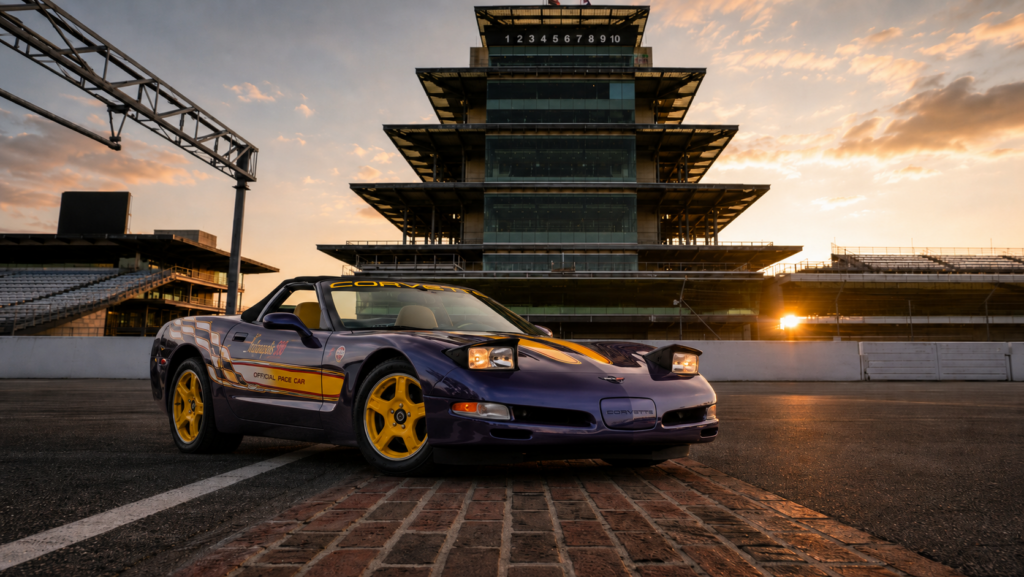
Some Corvettes earn their place quietly. This one never had any interest in that. The 1998 Indy Pace Car Replica still matters because it preserved a moment when Chevrolet let the C5 convertible be bold, public, and completely unafraid of attention—then backed the spectacle with real engineering. It is May in Indianapolis, rendered in Radar Blue, yellow wheels, and factory confidence: a car built to be seen, but remembered because it was ready. (Image courtesy of the author.)
Not every important Corvette is subtle. Some mark their place by being elegant, rare, or technically revolutionary. Others do it by becoming impossible to ignore at exactly the right moment. The 1998 Corvette Indianapolis 500 Pace Car Replica belongs to the second group, but its importance runs deeper than its color. It helped introduce the C5 convertible, gave Active Handling a public stage, tied Corvette once again to the Speedway, and turned a bold promotional idea into a factory-built production car with real engineering behind it.
Twenty-plus years later, the yellow wheels still do their job. The graphics still start arguments. The car still looks like May in Indianapolis turned into fiberglass. But beneath all of that is the reason it deserves a serious place in the Corvette story: the 1998 Pace Car Replica was Chevrolet telling the world that the C5 convertible was not merely ready for the showroom.
It was ready to lead.
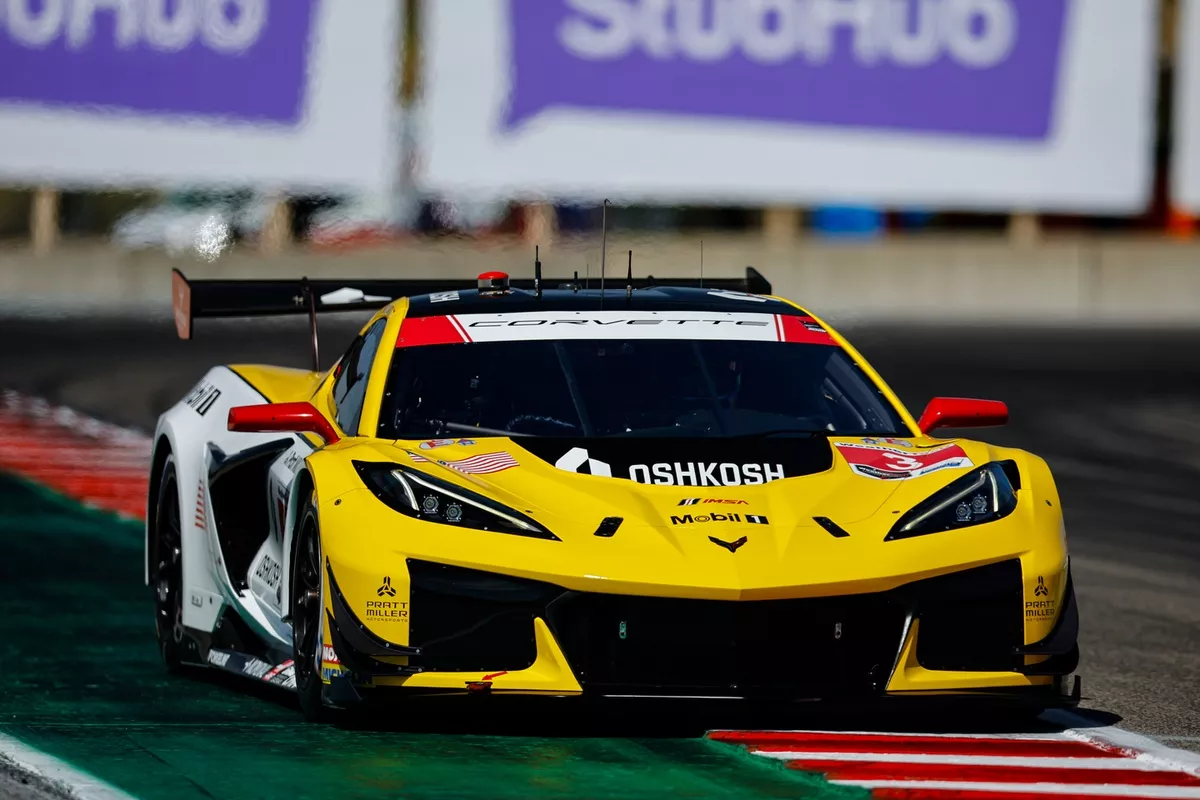
The 1998 Corvette Indy Pace Car Replica was loud by design, but its real story runs deeper than Radar Blue paint and yellow wheels. It introduced the C5 convertible on America’s biggest racing stage, showcased Active Handling, and turned Indy spectacle into one of the most memorable C5-era production Corvettes.
Corvette Racing did not leave Laguna Seca with the GTD PRO win, but it left Monterey with something nearly as important this early in the IMSA season: control of the championship conversation.
The No. 4 Corvette Racing by Pratt Miller Motorsports Chevrolet Corvette Z06 GT3.R of Tommy Milner and Nicky Catsburg finished second in GTD PRO after starting eighth in class, turning a difficult opening position into one of the team’s strongest results of the year. It was not a straightforward afternoon. Milner had to manage the usual Laguna Seca traffic and early contact, while the Pratt Miller crew quickly recognized that the race would likely be decided as much by pit timing and fuel strategy as outright speed.
That call proved critical. By moving the No. 4 Corvette onto an alternate strategy, the team gave Catsburg a chance to bring the car back into contention during the second half of the race. As the GTD PRO field cycled through stops and fuel-saving strategies began to unravel late, Catsburg was positioned to capitalize. He came home second, just behind the winning Ford Mustang GT3, securing another podium for the No. 4 team.
For the No. 4 Corvette Racing by Pratt Miller Motorsports Z06 GT3.R, Laguna Seca was a championship-building afternoon. Tommy Milner and Nicky Catsburg turned an eighth-place starting position into a second-place GTD PRO finish, using smart pit strategy and a disciplined closing run to stay in contention as the race became a fuel-and-timing exercise. The result gave the No. 4 Corvette its second straight podium and moved Milner, Catsburg, Chevrolet, and the Pratt Miller entry into the GTD PRO points lead. It was not the win they wanted, but it was the kind of measured, high-value result that defines a serious title campaign. (Image credit: Autosports.com)
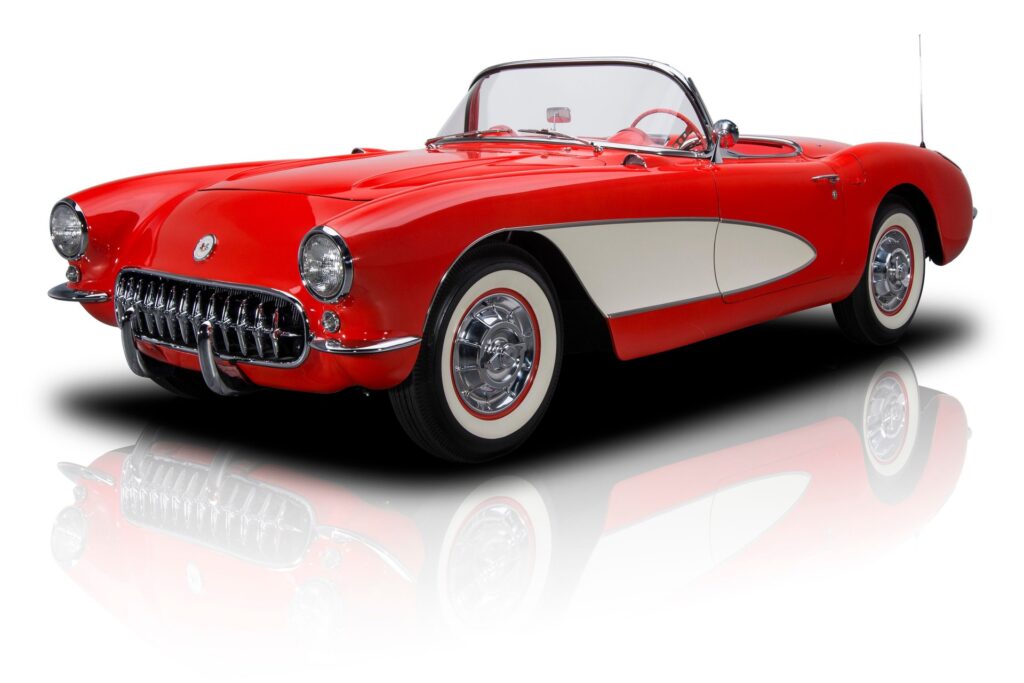
More importantly, the finish moved Milner and Catsburg into the GTD PRO drivers’ championship lead. The No. 4 Corvette also took over the team standings, while Chevrolet moved to the top of the manufacturers’ championship. For a program still in the early stages of the Z06 GT3.R era, that is a meaningful marker.
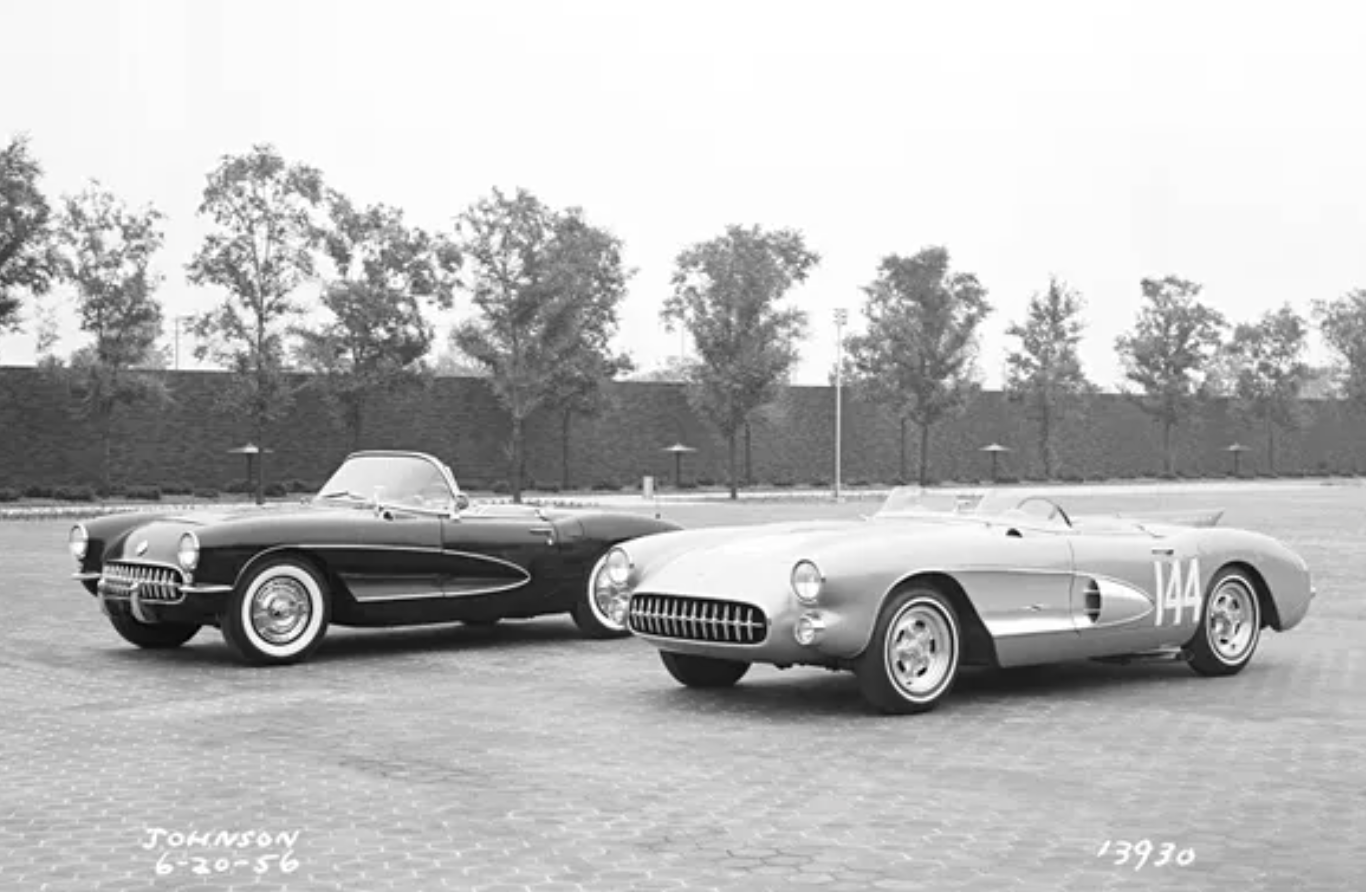
The sister No. 3 Corvette of Antonio Garcia and Alexander Sims also delivered a solid points-paying result, finishing fourth in GTD PRO. Their strategy played out differently, with Sims among the drivers trying to stretch fuel late in the race. When the caution they needed never came, the No. 3 Corvette slipped out of podium position but still gave Corvette Racing both factory-supported entries inside the top four.
DragonSpeed’s No. 81 Corvette Z06 GT3.R had a quieter but useful afternoon at Laguna Seca, bringing the car home 11th in GTD after a cleaner run than some of its earlier-season outings. It was not the breakthrough result the team is chasing, but for a customer Corvette program still building rhythm with the Z06 GT3.R platform, finishing the race and gathering data represented a step in the right direction.
The customer Corvette programs had a more mixed afternoon. DragonSpeed’s No. 81 Corvette Z06 GT3.R finished 11th in GTD, giving the team a cleaner result after a difficult start to the season. The No. 13 13 Autosport Corvette retired with a mechanical issue, ending its day early.
Laguna Seca was not perfect for Corvette Racing, but it was productive. The Z06 GT3.R showed pace, the Pratt Miller pit stand made the right calls, and Corvette left California leading the GTD PRO title fight.
Corvette Racing turned a challenging Laguna Seca weekend into a championship-building result, with the No. 4 Z06 GT3.R landing on the GTD PRO podium and taking the points lead. The win slipped away, but Corvette’s two-car factory effort showed pace, strategy, and resilience when it counted.
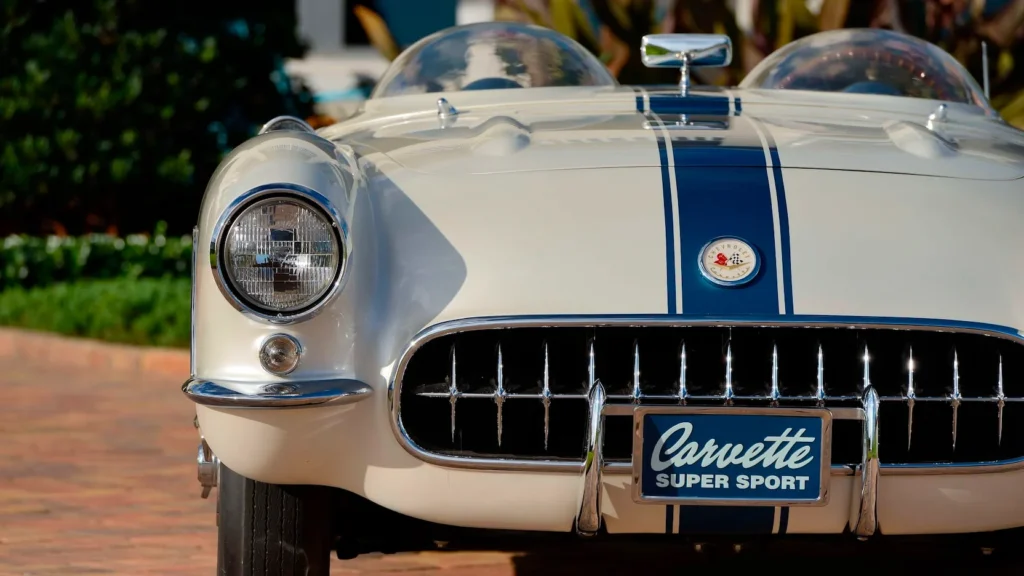
The 1975 Chevrolet Corvette arrived at a moment when the entire American automotive industry was being forced to rethink some of its most basic assumptions. The new model year did not simply bring another round of styling tweaks, emissions adjustments, or horsepower reductions. It marked a much larger turning point. After years of mounting concern over the serious health risks and environmental contamination associated with leaded gasoline, the industry was moving toward a future without it. For Chevrolet, for Corvette, and for anyone who still believed in American performance, that shift was impossible to ignore.
Today, the end of leaded fuel feels like an obvious and necessary step. In the mid-1970s, however, it was anything but simple. For Corvette engineers — and really for the entire performance world — leaded gasoline had been part of the operating formula for decades. It was not some optional ingredient sitting on the margins. It helped make high-compression V8s practical. It allowed engines to tolerate aggressive spark advance, harder timing curves, and the kind of combustion pressures that had defined Corvette performance through the muscle-car era. Remove the lead, and the whole equation changed. Suddenly, the challenge was no longer just building power. It was building power that could survive on the new fuel, meet tightening emissions standards, and still feel worthy of the Corvette name.
The 1975 Corvette arrived at a turning point, and this Orange Flame (Code 70) T-top coupe captures that moment perfectly. With its long, sculpted C3 bodywork and removable roof panels, it still delivered the presence and drama buyers expected from America’s sports car—even as the era around it was changing. This was a Corvette shaped as much by adaptation as ambition, balancing style, comfort, and identity in a decade defined by transition. It’s the ideal starting point for understanding what 1975 was really about—and why the story deserves a closer look.
Tetraethyllead — better known simply as TEL — had been part of the American gasoline story since the 1920s for one very simple reason: it worked. By reducing knock, it allowed engineers to raise compression ratios and build more powerful engines without constantly fighting detonation. For decades, that made leaded gasoline a quiet but essential partner in the development of high-performance V8s. But by the 1970s, the other side of that bargain could no longer be dismissed. Lead coming out of vehicle exhaust was not just an environmental concern in some distant, theoretical sense. It was being tied to widespread public exposure and serious neurological harm, especially in children. Public concern was growing, the science was becoming harder to ignore, and regulatory pressure was moving quickly behind it.
For Corvette, the issue was not only philosophical or environmental. It also became brutally mechanical. Leaded fuel and catalytic converters simply could not live together. As catalysts moved from experimental or emerging emissions technology into required equipment, lead contamination became a deal-breaker because it could damage the catalyst and prevent it from doing its job. That left the industry facing one of the hardest transitions of the era. The same fuel chemistry that had made traditional high-performance tuning easier was now incompatible with the emissions hardware that would define whether a car could legally be sold.
That is why the 1975 model year played such a significant role in the brand’s evolution. Not because the Corvette suddenly became faster, louder, or more dramatic, but because the priorities behind the car were changing in real time. Corvette engineers now had to think beyond peak horsepower numbers and quarter-mile mythology. They had to make a performance car work inside a completely new rulebook, one shaped by ignition calibration, emissions controls, exhaust aftertreatment, evaporative systems, durability requirements, and day-to-day drivability. The 1975 Corvette still looked familiar from the outside, but underneath the skin, the “how” of Corvette engineering was being rewritten.
The End of an Era: Duntov Steps Away
Zora Arkus-Duntov retired from Chevrolet in January 1975, closing a chapter that had defined Corvette engineering for more than two decades. In his final years with the program, his focus had shifted from raw performance to helping the Corvette navigate a rapidly changing regulatory environment—emissions compliance, unleaded fuel, catalytic converters, and safety-driven engineering compromises that were reshaping the car. Even as performance numbers fell, Duntov remained deeply engaged in protecting the Corvette’s technical integrity and long-term viability. His retirement marked not just a personnel change, but the symbolic end of the Corvette’s original, engineer-led performance era. (Image courtesy of GM Media LLC.)
Zora Arkus-Duntov — the man most responsible for giving the Corvette its performance soul — retired at the beginning of 1975 after more than two decades with General Motors. His connection to Corvette began in 1953, when he saw Harley Earl’s original Corvette prototype on GM’s Motorama stage in New York. For Duntov, that first encounter was more than professional curiosity. He recognized something in the car that many inside Chevrolet had not yet fully grasped. Beneath the fiberglass body and show-car excitement was the possibility of a true American sports car. Duntov saw it, understood it, and then did what he would spend the rest of his career doing: he pushed.
Later that same year, he joined Chevrolet after writing to Ed Cole with his observations about the Corvette prototype. In hindsight, the story almost feels too perfect to be real — the brilliant engineer essentially introducing himself by telling Chevrolet how to improve, strengthen, and possibly save its own sports car. But that is also why the story has endured. Corvette has always needed champions at the exact moments when the program was most vulnerable, and Duntov became the man inside General Motors who was willing to challenge the system from within.
Even while assigned to other work, Duntov began “fiddling on the side” with Corvette throughout 1953 and 1954, gradually shaping the car into something more serious than the attractive but underdeveloped roadster that had first appeared under the Motorama lights. By 1956, he had been named Chevrolet’s director of high-performance vehicle design and development, giving him a more formal role in the company’s growing performance ambitions. Still, despite his deep and constant involvement with Corvette, Duntov was not officially named Corvette’s Chief Engineer until 1968. That long gap says a great deal about the car’s strange early life. Corvette had become a symbol, a dream, and a marketing statement before it was fully supported as a dedicated engineering program with the authority it deserved.
By 1975, the man who had defined Corvette’s performance identity for an entire generation was stepping away. Given Duntov’s reputation, his personal investment in the car, and the extraordinary run of Corvettes he had helped guide into existence, it was entirely reasonable for people to wonder what would happen next. Replacing a chief engineer is one thing. Replacing the person many enthusiasts regarded as Corvette’s conscience was something else entirely.
That anxiety was not romanticized nostalgia. It was real. Corvette has been shaped by the personalities behind it more than almost any other American car. Duntov was never simply an administrator moving paper through the corporate system. He represented Corvette as a serious performance machine, and he fought for that idea again and again when it would have been easier to let the car become little more than a stylish boulevard cruiser. In 1975, with horsepower under pressure, emissions regulations tightening, fuel changing, and performance itself becoming increasingly difficult to defend, losing Duntov felt like losing Corvette’s fiercest advocate at precisely the moment the car needed one most.
The New Steward: David McLellan Takes the Wheel
This is one of the rare images that captures a real handoff moment—Dave McLellan and Zora Arkus-Duntov together, moving in the same direction, even as the Corvette’s priorities were shifting under them. Duntov represented the original performance-first era: horsepower, durability at speed, and the belief that Corvette had to prove itself the hard way. McLellan inherited that DNA, but his time would be defined by a different kind of fight—engineering a Corvette that could survive the late-’70s reality of emissions, fuel changes, noise regulations, and tighter safety standards without losing its identity. In that sense, this photo isn’t just two chief engineers traveling together; it’s the bridge between the Corvette’s raw muscle years and its more systems-driven, compliance-era evolution.
The person tasked with the challenging position—and the sizable shoes to fill—was David Ramsay McLellan, a man who had worked with Duntov and been groomed for the job after joining GM in 1959.
McLellan is often described as a “different kind of Corvette leader,” and that is exactly the right way to understand his arrival. In 1975, Corvette did not need another romantic. It needed a strategist. It needed someone who could look at a shrinking box of options and still find a way to keep the car coherent, credible, and worthy of the name. The assignment was no longer as simple as chasing a bigger horsepower number or winning an internal argument with raw performance. The real work was in managing trade-offs without letting them define the car’s entire personality. That required discipline. It required patience. It required an engineer who understood that Corvette’s identity had to be protected even as the rules, the fuel, the emissions requirements, and the business realities around it continued to shift. In McLellan’s era as Chief Engineer, leadership was not about dreaming louder. It was about navigating more clearly.
That is part of what makes McLellan’s preparation so interesting. He spent much of 1973 and 1974 at MIT’s Sloan School of Management at GM’s direction, a move that says a great deal about the kind of leadership General Motors believed it needed by the middle of the decade. This was not simply about making a talented engineer more technically capable. McLellan already had that foundation. GM was preparing him for the broader, more complicated world Corvette was entering — a world shaped by regulation, corporate planning, emissions compliance, budgets, timing, supplier realities, fuel economy concerns, and the long, often unforgiving chess game of product development. By the mid-1970s, protecting a performance car inside a major corporation required more than passion. It required someone who could speak engineering, management, and survival at the same time.
McLellan returned to Chevrolet as one of Duntov’s staff engineers, and when Duntov retired shortly thereafter, it was understood that McLellan would step into the role he had been carefully prepared to assume. Still, it is important to view his early tenure in the right context. McLellan would not place his full stamp on Corvette’s design language and engineering direction until the C4 era, when a clean-sheet opportunity finally gave him room to reshape the car in a more comprehensive way. The 1975 Corvette was not that kind of assignment. The C3 architecture was already established. The body, chassis, packaging, and much of the car’s basic personality had been locked in long before he took the chair. The market was changing, the regulations were tightening, and the performance landscape was becoming more difficult by the month. McLellan’s immediate job was not to reinvent Corvette overnight. It was to guide it through the turbulence without letting it lose its center.
Seen that way, 1975 becomes one of the most important years of leadership transition in Corvette history. The car was being passed from Zora Arkus-Duntov, the performance evangelist who had fought for Corvette’s soul, to Dave McLellan, the systems-minded engineer who would have to protect that soul in a very different world. Duntov had helped teach Corvette how to run. McLellan’s task was to make sure it could endure. And in the mid-1970s, that may have been the harder job.
A Corvette That Looked Familiar—Because the Revolution Was Underneath
At first glance, the 1974 and 1975 Corvettes appear nearly identical, sharing the same flowing body lines, T-top roof, and unmistakable long-hood silhouette. But while the overall shape remained consistent, the 1975 model introduced subtle yet meaningful changes that reflected the Corvette’s gradual evolution. Most visibly, black bumper pads were added at the outer corners of the front and rear fascias—an understated but functional response to new federal regulations requiring cars to withstand low-speed (5 mph) impacts without damage. Beneath the surface, the ’75 Corvette saw refinements in emissions control, ride quality, and safety, shifting the model toward a quieter, more civilized driving experience. Together, these updates marked the Corvette’s slow but steady move away from raw edge and toward a more integrated, modern feel—without abandoning its performance roots.
The 1975 Corvette looked almost identical to the 1974 model. That visual continuity was part of the year’s deception. If you judged 1975 by a quick glance, you missed what mattered.
The most notable exterior change was the introduction of front and rear bumper pads integrated into the soft bumpers—parking protection in a decade when even sports cars were being asked to behave like appliances in crowded lots. That small feature captured the era perfectly: the Corvette was still meant to be desired, but it was also expected to survive daily life.
The vertical front bumper guards, positioned on either side of the license plate area, were a distinctive and functional detail on mid-’70s Corvettes. Integrated into the urethane front fascia, these guards helped the car meet federal 5-mph impact regulations without compromising the Corvette’s sculpted nose design. Their presence added a subtle layer of protection while visually anchoring the front end with a bit of definition and symmetry.
Beyond the pads, both bumpers were modified structurally. The front bumper gained an inner honeycomb core for added rigidity. The rear bumper received inner shock absorbers intended to reduce damage in low-speed impacts. And perhaps most importantly for anyone who had ever stared at the back of a 1974, the 1975 rear bumper fascia became a single molded urethane component rather than two separate assemblies meeting down the centerline. That one change—though subtle on paper—mattered to owners because it eliminated the unsightly seam and misalignment issues common with earlier “two-piece meets in the middle” bumper designs. On previous models, the split rear bumper could shift or gap over time, especially after minor impacts or wear, leading to a sloppy appearance. The switch to a one-piece urethane cover with integrated bumper pads not only met new federal crash standards but also offered a cleaner, more durable solution that better maintained its fit and finish over time.
This was how 1975 operated: not by announcing change, but by layering it. The C3’s shape stayed dramatic and instantly recognizable, but its intent evolved. By 1975, Corvette had stepped away from its raw, race-inspired edge and moved toward a more finished, cohesive identity. The crisp aggression of chrome gave way to the seamless flow of urethane, and the Corvette settled into the mid-1970s with a sense of purpose that would’ve seemed out of place just a few years earlier.
The Convertible: A Farewell That Didn’t Feel Like One
The 1975 Corvette marked the end of an era—it was the final year a convertible would be offered in the C3 generation. As safety concerns and shifting market trends took hold, Chevrolet quietly dropped the drop-top after this model year, making the ’75 convertible an instant milestone. For over a decade, the Corvette would be coupe-only, with the convertible not returning until 1986. In hindsight, the 1975 convertible stands as a graceful farewell to open-air Corvette motoring in the ’70s—its rarity and elegance only growing with time. (Image courtesy of GM Media LLC)
A significant milestone represented in the 1975 model year had nothing to do with what the Corvette introduced as a new option, but rather what it was about to eliminate as a production option for nearly the next decade.
The 1975 Corvette was the last of the third-generation Corvettes to be offered as both a coupe and a convertible. Convertible volumes had diminished year after year, and Chevrolet had already considered eliminating the option. But when the government threatened legislation that would have effectively banned fully open cars after 1975, it sealed the decision. Corvette convertible production was discontinued, and the last C3 ragtop rolled off the line in late July of 1975.
This was a critical distinction: the myth was that convertibles were outlawed. The reality was that the industry anticipated an unfavorable regulatory direction, and manufacturers used that forecast—combined with slowing convertible demand—to justify decisions they were already leaning toward. The proposed rules never materialized into the ban many feared, but by the time that became clear, the business case had been rewritten. The decision stood.
The Corvette was born as a convertible in 1953—an open-air roadster that set the tone for America’s sports car legacy. For over two decades, every Corvette model year carried on that tradition, offering a convertible option without interruption. From its fiberglass beginnings to its wind-in-your-hair appeal, the drop-top configuration became a defining trait of the Corvette’s early identity. That uninterrupted run would finally end in 1975, closing the chapter on a classic Corvette era. (Image courtesy of Silodrome)
Naturally, enthusiasts were not pleased. Corvette had been a convertible since its introduction in 1953. That open-car identity wasn’t optional in the emotional sense; it was foundational. Losing it felt like losing a piece of Corvette’s soul.
And yet another detail spoke to the era: 1975 was the last time in Corvette history that a convertible was actually less expensive than a coupe. That was such a mid-1970s twist—an iconic body style quietly priced below the “practical” option, right before it vanished for a decade.
In retrospect, the 1975 convertible occupied a strange space. Buyers at the time often assumed it would become instantly rare and financially untouchable. The Corvette convertible returned in 1986, and the collector’s story became more complicated. But rarity wasn’t the real point. The point was emotional and historical: 1975 was the year Corvette closed the roof—because the decade forced its hand.
Engines: Fewer Choices Than Years Past
The engine shown here is the 1975 Corvette’s base L48 350-cubic-inch V8, a small-block that delivered 165 horsepower and 255 lb-ft of torque. While modest by earlier Corvette standards, the L48 reflected the era’s shifting priorities toward emissions compliance and fuel economy. It came equipped with a 4-barrel carburetor and was mated to either a 3-speed automatic or a 4-speed manual transmission. Despite its lower output, the L48 offered smooth, reliable performance—and remained the most common engine choice for 1975 Corvettes. (source: RK Motors)
Engine options for the 1975 Corvette were more limited than any second– or third-generation Corvette that had come before it. GM briefly offered an optional big-block early in the model run, but it was dropped quickly, leaving the standard 165-horsepower 350 and the optional L82 205-horsepower 350 as the only available choices.
Not since the 1955 Corvette had consumers faced such a limited engine menu. And it was the first year since 1967 that only a single displacement was offered.
That fact carried weight. Corvette had trained its audience to think in tiers: base engine, high-performance small-block, then the big-block hammer for those who wanted to rewrite the road. In 1975, the tiers collapsed into two versions of the same idea—a 350 built to survive and a 350 built to still feel like a Corvette.
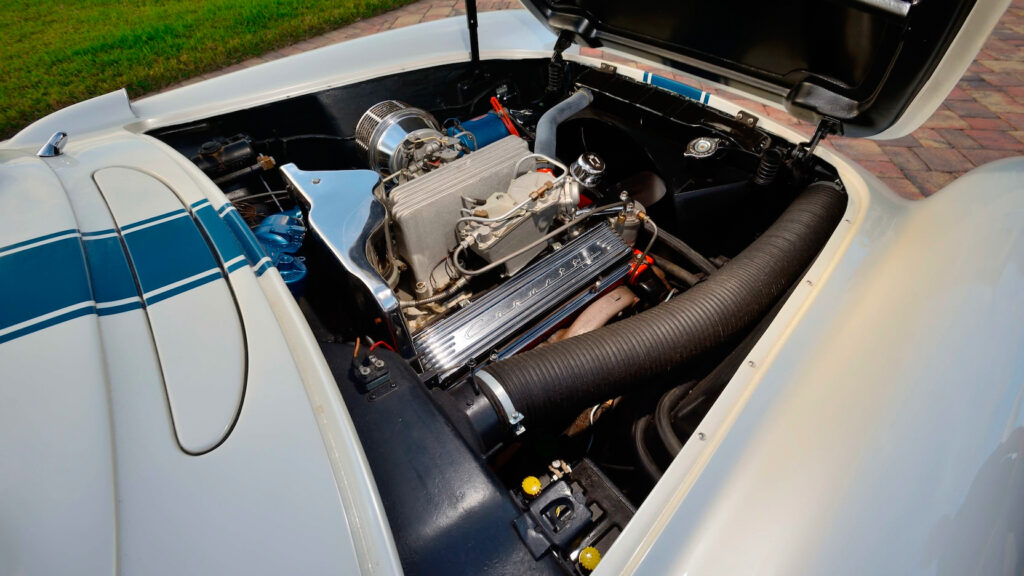
This was where the narrative often got misunderstood, because the horsepower numbers alone didn’t tell the full story. Yes, the numbers were down. Yes, enthusiasts felt the loss. But the deeper truth was that the nature of engine development changed. Instead of “how high can we push compression,” the questions became: How stable was the calibration? How well did it start? How did it behave in real-world temperature swings? How did it stay compliant as components wore? How did engineers protect the catalyst? How did they meet warranty expectations? How did they prevent drivability complaints from becoming costly reputational damage?
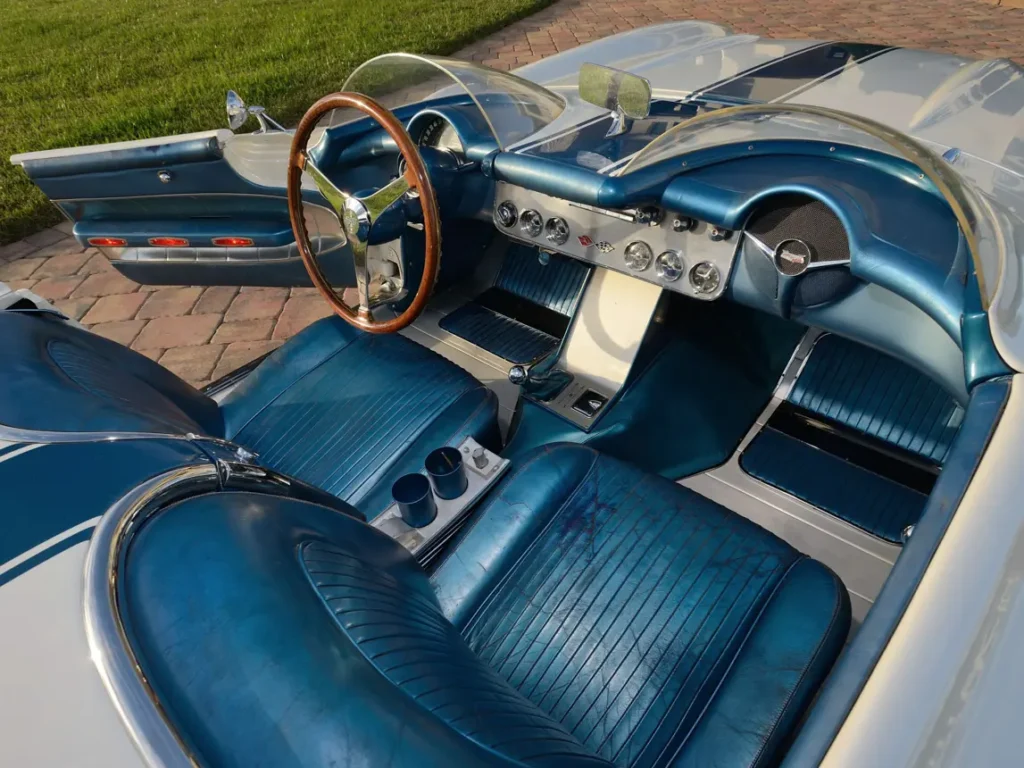
In 1975, Corvette became less of a single-minded hot rod and more of an engineered product for an era that demanded consistency.
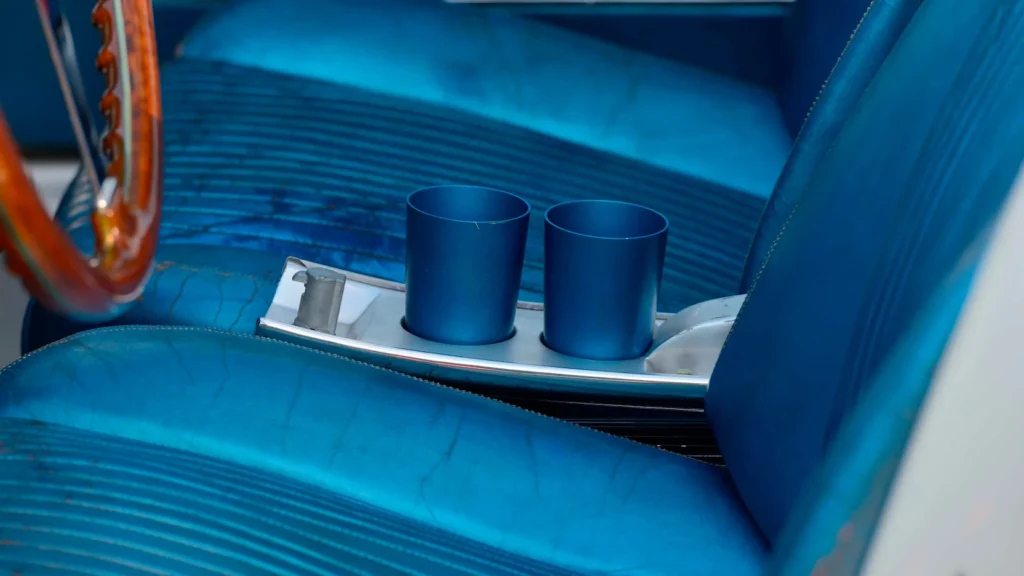
The L48: The Corvette That Had to Work Every Day
Pictured here is the L48 350ci V8, the standard engine for the 1975 Corvette. Producing 165 horsepower, it was a product of the era’s tightening emissions standards and shifting performance expectations. While not a powerhouse by earlier Corvette standards, the L48 delivered smooth drivability and remained a dependable choice for the majority of buyers. It represented the Corvette’s effort to balance tradition with the realities of mid-‘70s regulation. (Image courtesy of futureclassicsnj.com)
The base L48 was the survival engine. It wasn’t built for glory runs. It was built to start, idle, behave, and keep doing so.
In the smog era, a base engine could not be fragile. It couldn’t require constant tuning. It couldn’t drift out of compliance easily. It had to be resilient to the reality that most owners would not adjust points, chase vacuum leaks with the patience of a saint, or tolerate an engine that behaved differently every time the weather changed.
So the L48 became the anchor. It was the engine that kept Corvette accessible and sellable. It was the engine that kept the Corvette from becoming a temperamental boutique car at exactly the moment the country was losing patience for temperamental anything.
The L82: The Version That Still Wanted to Be a Corvette
This is the 1975 Corvette’s optional L82 350-cubic-inch V8, a higher-performance alternative to the base engine. Rated at 205 horsepower and 255 lb-ft of torque, the L82 featured a higher 9.0:1 compression ratio, a performance camshaft, and a four-barrel carburetor for improved airflow and responsiveness. While still constrained by mid-‘70s emissions regulations, it offered a noticeable bump in performance over the L48, appealing to buyers who still wanted a taste of traditional Corvette muscle. In 1975, only about 15% of Corvettes were ordered with the L82, making it a more desirable and rare option today.
The L82 existed for a different buyer: the person who still wanted the Corvette to sharpen when asked.
With the L82, buyers paid for character. They paid for the version of the 1975 Corvette that still spoke in a slightly more aggressive dialect—stronger pull, a more willing top end, a tone that felt less apologetic.
And in 1975, that mattered because it signaled Chevrolet had not given up. The L82 wasn’t the late-’60s dream reborn. It was a realistic performance option engineered inside the rules. That might not have sounded romantic, but it was actually one of the most Corvette things imaginable: finding a way to preserve the spirit when the method had to change.
The Catalytic Converter: A New Era Under the Floor
For 1975, the Corvette adopted a catalytic converter for the first time—an emissions control milestone that reshaped the car’s exhaust system and performance profile. Located beneath the car and integrated into a new single-exhaust setup, the converter was designed to reduce harmful pollutants in compliance with tightening federal regulations. Its introduction meant the end of true dual exhausts for the time being, a change that reflected the industry’s broader shift toward cleaner, more regulated engines. While controversial among purists, the catalytic converter was a necessary step in the Corvette’s adaptation to a changing automotive landscape.
The 1975 model year was a significant one not only for Corvette but for American production automobiles as a whole: it was the year the catalytic converter was formally introduced and adopted broadly across U.S. manufacturers.
The catalytic converter was designed to convert toxic byproducts produced by internal combustion engines into less toxic substances via catalyzed chemical reactions. Compared to earlier emissions-control strategies, it was more effective and—crucially—more scalable. It also altered everything about how the Corvette breathed.
A key point remained front and center: this method of managing emissions may have prevented Corvette’s horsepower ratings from dropping even further than they had. That was the nuance many people missed. The converter wasn’t simply a power thief; it was a new tool in the emissions equation. It changed where the burden lived. It allowed engineers to consider different tuning strategies because the aftertreatment system was doing work downstream.
In 1975, the Corvette’s exhaust system was redesigned to accommodate a new emissions device—the catalytic converter. To make this work, a Y-pipe was introduced, merging the traditional dual exhaust headers into a single pipe that fed into the converter. This layout replaced the true dual-exhaust setup of earlier years, simplifying the system but also slightly muting performance and sound. It was a clear visual and mechanical sign of the Corvette adapting to a more regulated automotive world.
But there was no free lunch. Chevrolet understood that better than anyone, even if the 1975 sales literature tried to frame the change as progress. The brochure called it “Dual exhausts with catalytic converter” and reminded buyers that dual exhaust meant “less exhaust back pressure.” Chevrolet even claimed, “With the catalytic converter on the job, the factory can now tune your Corvette more toward performance and economy.” It was careful language for a difficult moment: technically optimistic, federally compliant, and written to reassure Corvette buyers that the car they loved had not been smothered by regulation.
Still, the hardware told a more complicated story.
For 1975, the Corvette no longer carried true dual exhaust in the traditional sense. Both manifolds fed into a Y-pipe, the exhaust passed through a single catalytic converter, and only then split again toward two mufflers and tailpipe assemblies. From the rear, the Corvette still gave owners the familiar visual signature of dual outlets. Underneath, however, the system had changed in a fundamental way.
For Corvette people, exhaust was never just plumbing. It was part of the car’s identity. It was the sound on startup, the pulse at idle, the look beneath the rear valance, and the mechanical honesty of a small-block Chevrolet exhaling through both sides of the car. In 1975, that voice was not silenced, but it was filtered. The Corvette still sounded like a Corvette, but the edge had been softened. The rawness had been reduced. Federal emissions compliance had become part of the exhaust note.
The catalytic converter also introduced a new ownership reality: heat. A mid-1970s Corvette already asked a lot of its cabin, floors, insulation, and surrounding components. The small-block, transmission tunnel, tight underbody packaging, and fiberglass structure all contributed to the car’s interior warmth. Add a converter beneath the floor, doing exactly what it was designed to do, and the environment under the car changed again. Owners felt it in hotter footwells, aging insulation, stressed shielding, and the slow wear that heat brings to anything living nearby.
None of this makes the 1975 Corvette less important. If anything, it makes the car more revealing. This was not Chevrolet giving up on Corvette. It was Chevrolet trying to keep Corvette alive inside a rulebook that had changed almost overnight. The catalytic converter cleaned up the exhaust stream and gave the engineers a legal path forward, but it also made the Corvette more managed, more mediated, and less instinctively raw than the cars that came before it.
The 1975 Corvette was still a Corvette. It was simply a Corvette learning how to breathe through the 1970s.
HEI Ignition: The Quiet Upgrade That Made the Whole Package Better
The 1975 Corvette introduced HEI (High Energy Ignition) as standard equipment—one of the most important ignition system upgrades of the era. Developed by GM, HEI replaced the conventional points-style distributor with a more powerful, maintenance-free setup that delivered a stronger spark for improved combustion. This not only enhanced cold starts and throttle response, but also contributed to better reliability and emissions performance. It was a major leap forward in drivability and helped set the stage for modern ignition systems.
Under the hood was a new breakerless electronic ignition system known as HEI (High Energy Ignition). Unlike the previously available transistor ignition systems, the HEI was the first Corvette ignition to feature a distributor that did not require a points and condenser setup.
This was one of the most important “living with it” improvements of 1975, and it didn’t get enough credit because it wasn’t sexy in the way big horsepower numbers were sexy. But in a compliance era, ignition stability was everything. Points wore. Dwell drifted. Performance became inconsistent. Emissions became inconsistent. Starting became inconsistent. Owners complained. Warranty claims climbed. The car’s reputation suffered.
HEI was Chevrolet engineering the Corvette to be less fragile—more modern, more dependable, more consistent—at the exact moment consistency became a legal and economic requirement.
For the first time in Corvette history, the 1975 model year featured a fully electronic tachometer. Replacing the older mechanical cable-driven system, the new setup received its signal directly from the HEI ignition system, improving accuracy and reliability. This modernized approach reduced mechanical complexity and allowed for smoother needle operation—just one more way the ’75 Corvette quietly embraced advancing technology beneath its familiar skin.
In conjunction with the new ignition, Chevrolet introduced the first electronic (instead of mechanical) tachometer drive. Where tachometers had previously been driven off the distributor, the new system translated an electrical signal into the output seen on the dashboard.
This particular detail, while arguably subtler than some of the more visible changes that were made to the 1975 Corvette, was still significant. It was a sign of Corvette’s transition into an era of greater electronic mediation. For all previous examples that predated the 1975 model year, the Corvette was still an analog experience, but it was beginning to rely on electrical architecture that would become normal in the decades to come.
Add to that the first appearance of the “Kilometers Per Hour” subtext beneath the “Miles Per Hour” on the speedometer—small, easy to dismiss, but emblematic of the time: standardization, global thinking, and the creeping presence of regulation and conformity even in America’s most iconic sports car.
The Other Changes That Told You This Car Was Built for the Mid-1970s Reality
New for 1975, Corvettes equipped with the optional L-82 engine wore a bold visual identifier: the L-82 hood emblem. Positioned prominently on the domed hood, this red-and-chrome badge let onlookers know this wasn’t just any small-block Corvette. It was a subtle yet proud nod to the car’s performance intent—offering buyers a touch of muscle-era spirit even as the Corvette adapted to a more regulated age.
Elsewhere on the 1975 Corvette, a headlights-on warning buzzer was added per federal mandate—another reminder that by the mid-1970s, the government wasn’t merely regulating what came out of the tailpipe; it was increasingly influencing how cars were expected to behave in the hands of normal drivers.
An internal bladder was added to the fuel tank to help prevent fuel vapors from escaping while also keeping air from entering and getting trapped—a piece of the emissions story that didn’t get the spotlight but absolutely belonged in any serious conversation about the 1975 model year. Emissions weren’t only about combustion; it was about evaporation. Corvette had to adapt at every point where hydrocarbons could enter the atmosphere.
Hood emblems featuring the engine designation “L82” were introduced in 1975, though many cars built that year did not include the emblem—a perfect micro-detail from the era of running changes and production variability.
The diagram illustrates Astro Ventilation, a fresh-air flow system introduced in earlier Corvettes and still present in the 1975 model. Designed to bring in outside air through the front vents and circulate it through the cabin before exiting out the rear, it eliminated the need for vent windows and gave the Corvette a cleaner, more modern side profile. By 1975, however, the system was less emphasized in marketing as t-top models and tighter emissions standards reshaped interior airflow dynamics. Still, Astro Ventilation remained part of the car’s functional DNA, quietly improving comfort in a cabin that was becoming increasingly refined.
And finally, 1975 was the last model year to feature Astro Ventilation, a system introduced with the 1968 C3. The end of Astro Ventilation was one of those details that seemed small until you realized it marked the closing of another early-C3 chapter. Corvette was gradually shedding parts of its 1968 identity, piece by piece, as the decade forced modernization.
Performance: The Numbers Were Down, but the Story Wasn’t Over
By 1975, the Corvette’s performance story was changing, but not ending. The focus was shifting from brute force to refinement and usability. While the era demanded compromises, the car’s essential character remained intact—long hood, short deck, low stance, and balanced chassis dynamics. It still felt like a sports car behind the wheel, with crisp steering, responsive handling, and a sense of purpose baked into the platform. What began as a reaction to regulation quietly became an evolution of the Corvette’s identity—less about raw numbers, more about the complete driving experience. (Image: hotcars.com)
There was no denying it: the 1975 model year marked a sharp downturn in Corvette horsepower. The base L48 engine delivered just 165 horsepower, and even the optional L82 topped out at 205—respectable, but far from the high-water marks of the late 1960s. Emissions regulations, unleaded fuel, and new noise and durability standards all played a role. It’s easy to write the year off as a low point. But the full story is more complicated.
Despite the drop in output, the Corvette’s fundamentals remained intact. The chassis architecture—fully independent suspension, low center of gravity, wide track, and rearward weight bias—still delivered balanced handling and good feedback. The car hadn’t lost its identity; it had lost power. On a back road, the 1975 model still drove like a sports car.
More importantly, the era demanded a shift in what performance meant. Drivability became a key metric. The new High Energy Ignition (HEI) system made starting easier and tuning more stable. Electronic tachometers provided more reliable feedback. Catalytic converters and a Y-pipe exhaust helped the car meet new standards without entirely strangling performance. In daily use, the car was smoother, quieter, and more consistent than earlier models.
Road test numbers reflected the lower output, but they didn’t tell the whole story. Corvette in 1975 wasn’t obsolete—it was transitioning.And the updates made that transition possible without sacrificing the car’s core dynamics.
Sales and Production: Corvette Demand Proved the Name Still Mattered
This 1975 Corvette ad leaned into the idea that a Corvette was more than a car—it was a canvas for personal expression. With bold styling, a long list of standard features, and a variety of options, it promised buyers the chance to build not just a vehicle, but a dream uniquely their own. (Image courtesy of GM Media LLC)
Despite the lack of dramatic year-to-year change, the 1975 Corvette continued to sell with remarkable strength. Chevrolet moved 38,465 Corvettes that year, just 297 units shy of the 1969 model year’s 38,762-car total — still, at that point, the highest production year Corvette had ever recorded. For a car operating in the middle of emissions constraints, fuel-economy pressure, insurance scrutiny, and a broader performance-market retreat, that was not a small achievement. It was proof that Corvette still had gravity.
The mix told an equally important story. Of those 38,465 cars, 33,836 were coupes. The convertible accounted for just 4,629 units, representing barely 12% of total production. As painful as it was for traditionalists, the numbers made Chevrolet’s decision easier to understand. The open Corvette had been part of the car’s identity since 1953, but by the mid-1970s, the buyer had clearly moved toward the coupe. The removable roof panels gave owners much of the open-air experience with better weather protection, better security, and a shape that had become one of the most recognizable profiles in American performance-car design.
That is one of the underrated truths of the 1975 Corvette. On paper, this should have been a vulnerable moment. Horsepower was down. The big-block was gone. The catalytic converter had arrived. The convertible was nearing the end of its first continuous run. And yet buyers kept showing up.
Chevrolet’s own 1975 brochure leaned into that tension. It called the Corvette “this year’s version of last year’s ‘Best All-Around Car,’” referencing its selection by Car and Driver readers, and closed the thought with the line, “Corvette makes excitement make sense.” That was not just ad copy. It was the argument Chevrolet needed to make in 1975. Corvette could no longer sell itself on brute force alone. It had to sell the total experience.
And it did.
By 1975, Corvette had grown beyond the output rating stamped on a specifications chart. It was design. It was identity. It was reward. It was the car you bought because it still looked like nothing else in the showroom, because it still carried the promise of something special, and because even in a compromised decade, it remained unmistakably separate from the ordinary Chevrolet lineup.
That was the real achievement. The Corvette survived the mid-1970s not because it escaped the era, but because it adapted without losing its emotional value. The numbers prove it. Buyers understood that the car had changed. They also understood that it was still a Corvette.
And in 1975, that was enough.
Options, Pricing, and the Corvette Buyer Profile in 1975
The 1975 Corvette wasn’t just about performance—it was about comfort, too. Bucket seats with optional leather, a tilt-telescopic steering column, power accessories, and available air conditioning all helped transform the C3 into a genuine long-distance cruiser. With its aircraft-inspired gauge cluster and center console layout, the cockpit delivered an experience that felt as refined as it was sporty. (Image: RK Motors)
If you wanted to understand how people actually bought the 1975 Corvette, you had to look past the horsepower rating and study the order sheet.
That was where the story became clearer.
Air conditioning was ordered on 31,914 cars, a remarkable number for a two-seat American sports car still carrying the emotional residue of the big-block era. Power steering appeared on 37,591 cars. Power brakes were selected on 35,842. Power windows went into 28,745 Corvettes. The tilt-telescopic steering column was chosen by 31,830 buyers, and the AM/FM stereo radio was installed in 24,701 cars. These were not fringe selections. They were mainstream buyer choices, and they said a great deal about where Corvette ownership had moved by the middle of the decade.
This was not Corvette selling out. It was Corvette growing up in public.
The 1975 buyer still wanted a sports car, but not necessarily a punishing one. Many wanted something they could drive regularly, take on trips, sit in comfortably, and enjoy without treating every mile like an act of mechanical devotion. That did not make the Corvette less serious. It made the Corvette more survivable. Chevrolet needed a healthy buyer pool at a time when the old performance formula was under pressure from emissions regulations, insurance costs, changing fuel expectations, and a market rapidly cooling toward traditional muscle. Comfort and convenience were not betrayals. They were part of the car’s defense mechanism.
Pricing added another strange wrinkle. The coupe carried a higher base price than the convertible, with Chevrolet listing the coupe at $6,797.10 and the convertible at $6,550.10. In emotional terms, the open Corvette had always felt like the more romantic car. In 1975, it was not the most expensive one. That inversion now reads almost like a farewell gesture: one last moment when the convertible remained available, still beautiful, still tied to the Corvette’s earliest identity, but no longer the dominant expression of what customers were actually buying.
The coupe had become the modern Corvette. The T-top body gave buyers enough open-air flavor to preserve the spirit of the roadster, while offering better security, better weather protection, and a more usable ownership experience. By 1975, that compromise was not viewed as a compromise by most buyers. It was the car they wanted.
And yet, Corvette had not completely turned its back on the serious driver. The FE7 Gymkhana Suspension remained available for buyers who wanted sharper responses, and Chevrolet still offered the more aggressive Z07 off-road suspension and brake package. The numbers were tiny — just 144 cars received Z07 — but the option’s presence still mattered in the larger story. Corvette was broadening, yes, but it was not abandoning its harder edge. It simply understood that not every customer needed to prove something every time they turned the key.
That is what makes the 1975 Corvette more interesting than its horsepower rating suggests. It was no longer a car defined only by maximum performance. It was becoming a more complete ownership proposition: part sports car, part personal reward, part long-distance companion, part rolling identity statement. The purist thread was still there for those who wanted it. But Chevrolet no longer built the Corvette around the assumption that every buyer was chasing the same experience.
By 1975, Corvette had learned something essential. Survival would not come from clinging to one narrow definition of performance. It would come from giving buyers enough Corvette to believe in, and enough comfort to keep coming back.
1975 Corvette Color Options: Inside and Out
The 1975 Corvette arrived with a rich selection of factory paint colors that reflected both the era’s trends and Corvette’s evolving identity. A total of ten exterior colors were offered, ranging from bold shades like Mille Miglia Red, Bright Blue, and Bright Green, to more subdued and sophisticated tones like Silver, Classic White, and Steel Blue. New for the year was Medium Saddle Metallic, a deep bronze-gold hue that fit perfectly with the mid-1970s aesthetic. Each color was available with either a body-color or black urethane front and rear bumper, depending on the combination.
Interior choices were just as expressive, with a palette that included Black, Dark Red, Medium Saddle, Smoke, Silver, and Dark Blue. Buyers could select either vinyl or optional leather upholstery, and materials were updated for improved durability and appearance. The ability to pair almost any interior with any exterior paint gave owners a wide latitude for customization—whether they wanted a subtle monochrome look or a contrasting, high-impact combination.
This flexibility in color and trim was part of what made the 1975 Corvette feel personal. Even during a period of regulatory change, the car still offered enough individuality to reflect its driver’s personality.
Greenwood and IMSA: The Other Corvette Story Running in Parallel
By the 1975 IMSA season, John Greenwood had firmly established himself as the torchbearer for Corvette performance at a time when the street car was being forced to evolve more quietly. While Chevrolet focused on compliance and survivability in the showroom, Greenwood was carrying the Corvette flag on track—showing up with wide, aggressive, unmistakably purposeful race cars that looked nothing like compromise. His IMSA Corvette wasn’t about nostalgia or rebellion; it was about proving, in real competition, that the Corvette platform still belonged in the fight. This car and this season set the tone for what Greenwood would represent throughout the mid-1970s: a relentless, privateer-driven commitment to keeping Corvette loud, visible, and competitive when it mattered most.
If you wanted to understand the other side of the 1975 Corvette story, you did not look only at the showroom. You looked to the racetrack.
The production Corvette was being engineered around an entirely new set of realities: catalytic converters, unleaded fuel, emissions calibration, federal compliance, and the long-term survival of the nameplate in a market that had turned hard against traditional performance. That work was essential. Without it, Corvette would have become a memory instead of a continuing program. But it also meant the production car could no longer deliver the same unfiltered, full-throttle experience that enthusiasts associated with the badge.
John Greenwood filled that gap in the most direct way possible.
Greenwood did not treat the Corvette as a nostalgic object or a compromised relic of the muscle-car years. He treated it as a platform still worth developing. While the production car was being quieted, cleaned up, and calibrated for the regulatory world of the 1970s, Greenwood took the Corvette into IMSA and kept pushing it in the one environment where speed, durability, aerodynamics, and engineering nerve still carried the argument.
His cars were not modified street Corvettes in the casual, bolt-on sense. They were purpose-built racing machines, developed around the brutal realities of endurance competition. They had to stay alive over long stints. They had to manage heat. They had to use tires intelligently. They had to brake lap after lap without surrendering. They had to remain stable at speeds far beyond anything the production car was expected to see.
The bodywork made the point before the engine even fired. The wide fenders were not decoration; they were there to cover serious tire. The aero was not styling drama; it was an attempt to settle the car at speed. The stance was not about showroom swagger; it was dictated by lap time, track width, and the demands of racing a big, powerful Corvette against sophisticated international machinery.
That is where Greenwood’s Corvettes become so important to the 1975 story. The showroom car was adapting to survive the decade. The racecar was reminding everyone what the platform could still become when the rulebook rewarded capability instead of restraint.
In that period, that distinction carried real weight. Corvette buyers could see that the production car had changed. They understood that horsepower had been reduced, emissions equipment had arrived, and the old muscle-car formula was no longer available in the same way. But Greenwood’s presence in IMSA kept the Corvette connected to something larger than its catalog rating. It gave enthusiasts proof that the basic architecture still had teeth. The name still belonged at Daytona, Sebring, and the other places where American performance had to prove itself in public.
That kind of visibility helped protect Corvette’s credibility during one of the most difficult chapters in its history. A performance car can survive a temporary drop in output if people still believe in what it represents. Greenwood helped preserve that belief. He showed that the Corvette had not been reduced to style alone. Beneath the emissions controls, the softer street tuning, and the altered expectations of the mid-1970s, a serious competition machine still waited to be extracted.
The 1975 Greenwood Corvette did more than race—it carried the brand when the showroom alone couldn’t do all the talking. While emissions regulations and federal compliance softened the production car’s outright performance, John Greenwood was proving in IMSA that the Corvette platform itself was still formidable. That mattered to buyers. Racing success and visibility reinforced credibility, reminding enthusiasts that the Corvette they could buy still shared DNA with a car battling at Sebring and Daytona. Greenwood’s presence on track created continuity at a moment when Corvette risked being defined by regulation rather than capability, helping preserve confidence in the nameplate and sustaining its performance image through one of the most transitional periods in the brand’s history.
That is why Greenwood belongs in any honest overview of the 1975 Corvette. The mid-1970s are too often summarized as a decline, but that only tells the showroom side of the story. On track, the Corvette platform was still being tested, refined, and pushed by people who understood its potential. Greenwood’s cars were loud, wide, fast, difficult, and demanding. They were also a necessary counterweight to the era’s more cautious production reality.
The factory Corvette was learning how to live within the new rules. Greenwood’s Corvette was making sure nobody forgot what the badge could do when performance remained the first priority.
Together, they explain 1975 more completely. One Corvette was adapting to preserve the future. The other was fighting to protect the legend.
This is why Greenwood belongs in any honest 1975 Corvette overview. The mid-1970s are often summarized as a performance downturn, but that only tells the showroom side of the story. On track, the Corvette platform was still being proven in real time—against real competition—by a team willing to invest the effort to make it fast and make it finish. The factory Corvette was learning compliance and longevity. Greenwood’s Corvette was demonstrating capability. Together, they explain the year more completely: one Corvette was adapting to survive the era, and the other was making sure nobody forgot what the badge could do when performance was the only requirement.
1975 Corvette Pricing, Options, and What Buyers Actually Chose
For most buyers in 1975, a Corvette still wasn’t purchased on a spec sheet—it was bought for the shape, the presence, and the feeling of owning America’s sports car. This example, finished in Medium Saddle (Code 67), captures the era’s shift toward style and day-to-day enjoyment: a bold color, long-hood stance, and that unmistakable C3 profile that turned heads even at idle. What mattered most was the total experience—comfortable, well-equipped, and visually dramatic—paired with the confidence that it was still a real Corvette, even in a changing performance landscape.
If the 1975 Corvette teaches anything about the mid-1970s, it’s that the Corvette buyer was changing right along with the car. The option sheet becomes a mirror of the era: still plenty of performance intent if you knew where to look, but a clear tilt toward comfort, convenience, and everyday drivability. In other words, Corvette wasn’t just surviving emissions and fuel realities—it was also learning how to remain desirable to people who wanted a sports car they could actually live with.
Start with pricing, because it tells a story all by itself. A base 1975 Corvette Sport Coupe (350ci, 165 hp, wide-ratio four-speed) carried a sticker price of $6,810.10, while the convertible—in its final year before the long hiatus—was actually less expensive at $6,550.10. That detail feels almost impossible through a modern lens, where corvettes are almost universally marketed as the premium experience. In 1975, the market logic was different. The coupe was increasingly the mainstream Corvette choice, and the convertible was an emotional holdover at a time when open cars were falling out of favor due to safety fears and rumored regulations.
Performance options still existed, but in 1975 they were chosen by a smaller, more deliberate group. The key mechanical upgrade was the L82 350ci, 205 hp engine—priced at $336—and its production count shows how niche “more performance” had become in the smog era: only 2,372 buyers checked that box. For the purist who wanted the most engaged version of the car, the M21 close-ratio four-speed was available (and effectively tied to the L82), with just 1,057 cars equipped that way. Meanwhile, the Turbo Hydra-Matic automatic dominated the transmission mix at 28,473 units—one of the clearest signals that by 1975, a large share of Corvette buyers valued effortless drivability over maximum involvement.
By 1975, convertible sales were collapsing across the industry, driven largely by looming federal safety proposals and public fear that open cars were on the way out. With proposed rollover protection standards and shifting compliance priorities, GM treated the Corvette convertible as a growing liability—expensive to certify, hard to defend in a changing regulatory climate, and increasingly out of step with buyer behavior. The result was a pivotal decision: Chevrolet dropped the Corvette convertible after 1975, effectively betting the model’s future on the coupe’s durability, packaging, and regulatory certainty.
Then there are the options that reveal the Corvette’s split personality—half boulevard grand tourer, half still-ready-to-fight sports car. Chevrolet offered the FE7 Gymkhana Suspension for a laughably low $7, and while only 3,194 cars received it, the mere existence of a low-cost handling package tells you Chevrolet still cared about the driver. At the far end of the spectrum sat the Z07 Off-Road Suspension and Brake Package, priced at $400 and ordered by just 144 buyers. That number is small, but it’s also proof: even in 1975, when the Corvette was being engineered around catalysts and compliance, there were still customers—and still engineers—who wanted something sharper, more serious, more capable when pushed.
Some of the most telling options are the ones that sound mundane, because they expose what owners worried about in the real world. The rear window defogger shows up in meaningful numbers, as does the heavy-duty battery—practical upgrades for a car expected to start reliably and be driven in more conditions than the old muscle-era weekend fantasy. The auxiliary hardtop for convertibles was ordered by more than half of ragtop buyers, which speaks to how these cars were being used: owners wanted the open experience, but they also wanted a more sealed, quieter, more weatherproof configuration when the season—or the highway—demanded it.
For 1975, the Corvette rode on steel-belted radial tires, most commonly supplied by Goodyear, marking a clear shift away from the bias-ply designs of the muscle-car era. These radials emphasized durability, stability, and predictable road manners over outright grip, aligning with the Corvette’s growing role as a high-speed grand tourer rather than a raw street racer. While less aggressive in appearance than earlier tires, they delivered improved ride quality, tread life, and everyday usability—traits buyers increasingly valued in the mid-1970s.
Even the tire choices tell a story. By 1975, most Corvettes rolled out on white-letter steel-belted tires, a subtle but important cultural shift. Lettered tires weren’t just an aesthetic—though they absolutely were that—they were a declaration that the car still had attitude, even if the horsepower numbers had been humbled by regulation.
If you read the 1975 option sheet as a simple list, you miss the point. The choices buyers made—air conditioning in huge numbers, power steering nearly everywhere, automatics dominating, a smaller but meaningful performance minority checking L82 and suspension boxes—tell you exactly what Corvette had become by the middle of the decade: a car that still looked like a sports car, still turned like a sports car, still carried the Corvette promise, but increasingly delivered it in a way people could live with every day. And in 1975, that ability to be both aspirational and usable wasn’t just a feature. It was a survival strategy.
1975 Corvette Pricing and Options Summary (for Reference)
Base Coupe (1YZ37): 33,836 built — $6,810.10
Base Convertible (1YZ67): 4,629 built — $6,550.10
L82 205 hp engine (RPO L82): 2,372 — $336.00
Close-ratio 4-speed (M21): 1,057 — $0.00
Automatic (M40 THM): 28,473 — $0.00
Air Conditioning (C60): 31,914 — $490.00
Power Steering (N41): 37,591 — $129.00
Power Brakes (J50): 35,842 — $50.00
Power Windows (A31): 28,745 — $93.00
Tilt-Telescopic Column (N37): 31,830 — $82.00
Rear Defogger (C50): 13,760 — $46.00
Gymkhana Suspension (FE7): 3,194 — $7.00
Z07 Off Road Suspension/Brakes: 144 — $400.00
Auxiliary Hardtop for Convertible (C07): 2,407 — $267.00
Vinyl Covered Aux Hardtop (C08): 279 — $350.00
AM/FM Stereo (U58): 24,701 — $284.00
AM/FM Radio (U69): 12,902 — $178.00
White-letter tires (QRZ): 30,407 — $48.00
White-stripe tires (QRM): 5,233 — $35.00
Why the 1975 Corvette Still Matters Today
The 1975 Corvette is easy to misread if you judge it only by the decade’s headlines. Built in the shadow of new regulations and shifting expectations, it proved the nameplate could adapt and endure without losing its identity, keeping the C3’s unmistakable shape while becoming a more livable, refined grand tourer. It wasn’t an ending—it was a reset, an inflection point where survival became part of the performance story. The Corvette’s harder edge continued in competition and enthusiast culture, even as the street car focused on drivability and compliance. And that continuity mattered, because Chevrolet’s steady investment through these transitional years set the foundation for the renewed performance and confidence that would follow as the decade moved toward its next chapter. (Image: hotcars.com)
The 1975 Corvette is easy to underestimate if you judge it only by the usual mid-1970s shorthand. Lower horsepower. New emissions equipment. Catalytic converters. Unleaded fuel. The final year of the convertible. The end of Zora Arkus-Duntov’s direct leadership. On paper, it can look like a year defined by things Corvette lost.
But that is not the full story.
What the 1975 Corvette actually represents is survival with intent. Chevrolet was not simply reacting to the decade. It was repositioning the Corvette so the car could endure it. The rules had changed. The fuel had changed. The market had changed. Buyer expectations had changed. And instead of letting those pressures dilute the car into irrelevance, Chevrolet found a way to keep Corvette recognizable, desirable, and commercially strong.
That is why 1975 matters.
It was the year the catalytic converter became part of the Corvette story, forcing a new exhaust layout and a new way of thinking about calibration, compliance, and drivability. It was the year unleaded fuel was no longer a future concern, but a daily operating reality. It was the year HEI ignition helped modernize the car’s starting, spark delivery, and everyday usability at a moment when clean running mattered more than ever. It was also the final year of the convertible’s first continuous production run, a decision that still feels emotional but made sense in the context of safety concerns, buyer trends, and the overwhelming popularity of the coupe.
And then there was Duntov.
His retirement at the end of the 1975 model year gave the moment an added sense of gravity. Corvette was already changing, but now the man most closely associated with its transformation into a true American sports car was stepping away. That could have marked an ending. Instead, it became a handoff. Duntov’s era had given Corvette its fighting character. The next chapter would require a different kind of discipline: strategic endurance, regulatory intelligence, and the ability to protect the car’s identity while the definition of performance itself was being rewritten.
That is the part of 1975 that deserves more respect. This was not Corvette surrendering to the times. It was Corvette learning how to survive them.
The street car became more refined, more livable, and more carefully managed. Buyers responded to that. They ordered air conditioning, power steering, power brakes, power windows, tilt-telescopic columns, better radios, and automatic transmissions in huge numbers because the Corvette had become more than a weekend weapon. It was a personal reward, a design statement, and a car people wanted to live with. The horsepower figure may have softened, but the desire did not.
At the same time, Corvette’s harder edge did not disappear. It simply showed up more clearly in other places. John Greenwood’s IMSA efforts kept the platform visible, aggressive, and credible in competition while the production car navigated emissions law, fuel changes, and federal expectations. That parallel story matters because it reminds us that the Corvette’s performance spirit was never extinguished. It was being expressed differently, depending on where the rules allowed it to breathe.
That is why the 1975 Corvette cannot be reduced to a single statistic. It was not just a low-horsepower C3. It was not just the last convertible before the long pause. It was not just Duntov’s farewell year. It was all of those things at once, and together they make 1975 one of the most revealing model years in Corvette history.
The 1975 Corvette still matters because it proved the car could adapt without disappearing into the decade around it. It kept the C3’s unmistakable shape. It preserved the Corvette’s emotional pull. It remained commercially strong. It gave buyers a version of the car that made sense for the world they were actually living in, while racing efforts kept the badge connected to speed, endurance, and credibility.
The Corvette did not outlast the mid-1970s by accident. It survived because Chevrolet made difficult choices before the program was cornered by them.
That is the legacy of 1975. It was not Corvette at its loudest, fastest, or most romantic. It was Corvette at one of its most important crossroads — a year when survival became part of the performance story.
And because the car survived that moment, everything that followed remained possible.
The 1975 Corvette marked one of the C3’s most important turning points, blending emissions-era adaptation, HEI ignition, catalytic converters, strong sales, and the final convertible before its long hiatus. Explore how Chevrolet preserved Corvette’s identity while reshaping it for a changing automotive world.
Most Corvette people know of the 1957 Corvette SS race car. They know the magnesium-bodied Sebring machine, the Zora Arkus-Duntov connection, and the brief but brilliant moment when Chevrolet looked ready to take Corvette racing all the way to Europe. But there was another “SS” Corvette born from the same moment in time. It did not go to Sebring. It did not chase lap records. It did not become a production car. Instead, it was built to stand under the lights, stop people in their tracks, and show America what Chevrolet performance was about to become.
That car was the 1957 Corvette Super Sport show car.
It was the first Chevrolet to carry the Super Sport name, the first Corvette used to introduce Rochester Ramjet fuel injection to the public, and one of the most unusual factory Corvette show cars ever built. It started life as a 1956 Corvette, was transformed by GM Styling for the 1957 show circuit, disappeared from public view for roughly six decades, survived a street-racing crash, passed through a hazy chain of private owners, spent decades in unrestored storage, and eventually returned to the spotlight at Amelia Island in 2017.
That alone would make it historically significant. But the full story is better than the headline.
Because the 1957 Corvette Super Sport was not simply a dressed-up Corvette. It was a statement of intent.
The Corvette Needed More Than Good Looks
The Corvette SS racer and the Corvette Super Sport are best understood as two expressions of the same restless idea: Chevrolet wanted to know how far Corvette could be pushed beyond its showroom identity. The blue SS was the pure competition weapon, built to test lightweight construction, advanced chassis thinking, and international racing potential. The white Super Sport carried that same spirit in a more polished, road-car-shaped form, translating the SS’s provocative performance language into something Corvette faithful could immediately recognize. They are not the same car, but they are unquestionably connected by purpose, ambition, and the moment when Chevrolet began treating Corvette not just as America’s sports car, but as a platform capable of taking on the world. (Image courtesy of GM Media LLC. / ChatGPT)
By the middle of the 1950s, Corvette was still fighting for credibility. The original 1953 Corvette had the styling, the fiberglass body, and the Motorama glamour, but it did not yet have the performance foundation that would define the nameplate. The arrival of Chevrolet’s small-block V8 in 1955 changed the conversation. By 1956, Corvette finally looked like a proper sports car. By 1957, Chevrolet wanted the public to understand that the Corvette was becoming something more serious.
That is where the Super Sport show car entered the story.
The car was created under Chevrolet shop order SO-90181, a project tied to the 1957 show season and the introduction of Rochester Ramjet fuel injection. Multiple published accounts identify the car as a GM Styling project, built from an existing 1956 Corvette display car that had been used in the General Motors Building in Detroit. Road & Trackidentifies the original donor car as a Venetian Red 1956 Corvette powered by a 265 cubic-inch V8 and backed by a three-speed manual transmission, carrying VIN E56S001589.
According to Road & Track, the Corvette Super Sport’s story began not as a completely custom one-off, but as a 1956 Corvette finished in Venetian Red. That origin matters because it anchors the car’s later transformation in something familiar: beneath the experimental bodywork and racing-inspired ambition was a production Corvette that Chevrolet used as a starting point for something far more provocative. (Image source: RK Motors)
That donor-car detail is an important part of this story because the Super Sport was not built from scratch. It was a production Corvette that GM transformed into a rolling announcement for Chevrolet’s next performance chapter. Before the work began, the car was reclassified as a 1957 model. Public listings and secondary accounts differ in the exact formatting of the altered VIN: Corvette Mike lists the VIN as E57S0001589, while other accounts use a 1957-style identifier that preserves the last four digits of the original 1956 VIN. Either way, the consensus is that GM wanted the car to represent the 1957 model year without using a standard production VIN.
The conversion reportedly cost more than $18,000, an extraordinary sum for the period, and a figure that tells us how seriously Chevrolet approached the project. This was not a cosmetic refresh done on the cheap. It was a factory-backed show car designed to present fuel injection, racing flavor, and Corvette image-building in one carefully staged package.
Born From The Same Energy As The SR-2 And The SS Racer
Seen alongside a more familiar production Corvette, the 1956 SR-2 makes clear just how quickly Chevrolet was beginning to stretch the Corvette’s identity beyond boulevard sports car and into something far more serious. Its racing bodywork, revised side cove treatment, competition stance, and purposeful details helped establish a visual and philosophical bridge to the later Corvette Super Sport — not as the same car, but as an important early step in the same pursuit. This was Chevrolet learning how to make Corvette look, feel, and behave like a machine built for the world stage. (Image courtesy of GM Media LLC.)
The Super Sport’s timing was no accident. Chevrolet was already experimenting with more aggressive Corvette forms through the SR-2 program and the 1957 Corvette SS race car. Harley Earl’s SR-2 had captured attention wherever it appeared, combining Corvette production-car identity with race-bred visual drama. Chevrolet understood the reaction. The public wanted the Corvette to look and feel more serious. The company needed a car that could bring that image into the showroom conversation.
The Super Sport borrowed from that visual vocabulary. It used twin aircraft-style windscreens rather than a full-width windshield. It wore a full-length blue stripe over pearlescent white paint. Its bodyside coves were treated with brushed aluminum, and the rear portions of those coves carried air-scoop forms that suggested brake cooling, even if they were more visual theater than functional hardware. Road & Track notes that the Super Sport’s cove covers were larger than those used on production C1 Corvettes and were made from chromed brass rather than standard stainless trim.
The 1957 Corvette Super Sport’s exterior was all about turning a familiar Corvette shape into something sharper, lower, and more competition-minded. The most dramatic change was the replacement of the standard full windshield with twin aircraft-like bubble windscreens, giving the car a purposeful, almost prototype-racer profile while visually lowering the entire cockpit. Up front, the Corvette identity remained intact through the production-style headlamp placement, chrome grille, and bumper treatment, but the blue center stripe, exposed cockpit, polished trim, and Super Sport-specific detailing gave the car a far more serious attitude — one that clearly tied Chevrolet’s showroom sports car to the racing ideas being explored through the SR-2 and SS programs. (Image source: silodrome.com)
The car also received special rear taillamp treatment, custom door-top inserts, and a cleaner, lower, more competition-minded appearance after the original windshield, side glass, and wipers were removed. The result was still unmistakably Corvette, but it had the stance and intent of something that belonged closer to Sebring than to a suburban driveway.
That was the genius of it. The team behind the 1957 Corvette Super Sport did not ask the public to imagine a better Corvette. They simply put one directly in front of them.
The First Public Face Of Fuel-Injected Corvette Performance
The Corvette Super Sport’s engine bay made clear that this was more than a styling exercise. Beneath the hood was Chevrolet’s small-block V8 fitted with Rochester Ramjet fuel injection, a preview of the technology that would help define the 1957 production Corvette and push the car decisively toward serious performance driving. With its polished hardware, competition-minded presentation, and fuel-injected small-block sitting where a showroom Corvette engine once lived, the Super Sport helped signal a turning point: Corvette was no longer just learning how to look like a sports car — it was beginning to prove it could perform like one. (Image source: silodrome.com)
The most important part of the Super Sport was under the hood.
Chevrolet installed a 283 cubic-inch small-block V8 with Rochester Ramjet mechanical fuel injection, rated at 283 horsepower. That one-horsepower-per-cubic-inch achievement became part of Corvette mythology, and the Super Sport helped introduce that idea to the public before the production fuel-injected 1957 Corvettes began building their own legend.
The Super Sport’s engine bay was detailed like a show car but configured like a serious performance machine. Vette Vues’ summary of the Mecum listing identifies the engine as an original EL-stamped fuel-injected 283/283 V8 with a special camshaft, first-design 4360 fuel injector with double-spider fuel-distribution lines, an 889 first-design distributor with original tag, factory chromed aluminum valve covers, an original off-road exhaust system, and a rare one-piece louvered chrome air cleaner.
The engine was paired with a close-ratio three-speed manual transmission. That detail is easy to overlook because production fuel-injected 1957 Corvettes would become strongly associated with the four-speed manual, but the Super Sport retained the close-ratio three-speed. The car also reportedly used a limited-slip differential, metallic brake linings, finned brake drums, heavier-duty springs, and brake-cooling ductwork, giving it the credibility to match its appearance.
It was absolutely a show car, but dismissing it as little more than a dressed-up styling exercise sells the Super Sport far short of what Chevrolet actually built.
That distinction is important because GM show cars of the era often walked the line between fantasy and feasibility. The Super Sport sat much closer to feasibility. Its engine technology was headed directly to production. Its performance message was already being shaped by Corvette through an increased presence in racing circuits. Its styling cues were exotic but also grounded in production concepts that Chevrolet was actively exploring.
The Super Sport’s Interior Was Part of the Prototype Story
Inside, the 1957 Corvette Super Sport carried the same experimental design language found throughout the rest of the car. The twin-cockpit layout, aircraft-style bubble windscreens, metallic blue upholstery, exposed brightwork, competition-inspired gauges, wood-rimmed steering wheel, and sculpted dashboard gave the cabin a purpose-built character that felt far removed from a standard 1956 Corvette interior. It was still recognizably Corvette, but everything about the cockpit suggested Chevrolet was imagining something more serious, more specialized, and far more performance-focused than a conventional showroom roadster. (Image source: silodrome.com)
Much like the rest of the car, the Super Sport’s interior deserves more attention than it usually receives.
Inside, the car was trimmed in blue-dyed leather, and has been widely documented as the first use of leather upholstery in a Corvette as well as the first-ever blue Corvette interior. The seats, dash roll, floor-pan pads, door panels, shifter boot, and other interior details were treated to match the car’s blue exterior striping.
GM Styling also reworked the floor area with die-stamped metal floor pans, ribbed aluminum floor panels, leather heel pads, and custom footrests. Some accounts describe plywood and anodized aluminum being used as part of the layered floor treatment, giving the interior a competition-inspired look that was far removed from a normal 1956 Corvette cockpit.
The instrument panel, door panels, driveline tunnel cover, pedals, and steering wheel were all unique. Vette Vues notes that the car had a one-off solid-spoke wood-rimmed steering wheel, one-off gas, clutch, and brake pedals, a custom tachometer housing, and a center-console-mounted clipboard ring system.
And then there were the cupholders.
One of the Super Sport’s most charming surprises is hiding in plain sight between the seats: a pair of integrated cupholders. In a 1957 Corvette-based show car filled with racing cues, aircraft-style windscreens, fuel-injection hardware, and experimental trim, those two blue cups bring a wonderfully human quality to the design. They remind us that Chevrolet was not just imagining a faster, more capable Corvette — it was also playing with the idea of a more complete, more personalized sports car experience. (Image source: silodrome.com)
It sounds absurdly modern, but the Super Sport is frequently identified as the first Corvette to feature interior cupholders. These were not the molded-plastic conveniences we have come to associate with newer cars. They were magnetized cupholders with original blue anodized cups, along with cushions in the glovebox for a thermos bottle. In other words, the Super Sport’s cockpit mixed race-car functionality with long-distance rally practicality and GM show-car imagination.
This is one of the reasons the car is so compelling. It was not merely a preview of Corvette performance. It was also experimenting with how a more purposeful Corvette interior might feel.
The Tires ARE ALSO Part Of The Story
The 1957 Corvette Super Sport stood on more than ordinary production tires. According to period references, it wore special U.S. Royal XP-140 experimental narrow whitewalls, complete with Corvette crossed-flags molded into the sidewalls — the kind of bespoke detail Chevrolet reserved for a car meant to make a statement from every angle. Even the tires reinforced what the Super Sport represented: a carefully considered blend of show-car polish, engineering ambition, and Corvette performance identity. (Image source: silodrome.com)
The Super Sport rode on U.S. Royal XP-140 experimental narrow whitewall tires. These were not ordinary tires pulled from regular inventory. They were thin-line whitewalls with Corvette crossed-flags branding on the sidewalls, and the surviving set is believed to be the only complete set of five still in existence.
That kind of detail is exactly why this car sits in a category of its own. A production Corvette can be restored. A show car has to be decoded. The tires, the cove trim, the cupholders, the blue leather, the first-design fuel-injection components, the cowl tag, the S.O. markings, the special interior hardware—each piece helps prove that this was not a later custom masquerading as factory history. It was a GM-built artifact from the moment when Corvette’s performance identity was being deliberately engineered, styled, and sold to the public.
New York, Chicago, Detroit, And Speed Age
Seen here on display at GM’s Motorama, the 1957 Corvette Super Sport looked every bit like Chevrolet’s vision of where Corvette could go if styling ambition and performance thinking were allowed to run together. Elevated on its show stand and surrounded by America’s newest cars, the Super Sport stood apart with its low, dramatic body, racing-inspired cockpit, and unmistakable sense of purpose. This was more than a crowd-pleasing concept — it was a public statement that Chevrolet was beginning to imagine Corvette as something far more advanced, far more specialized, and far more serious than the sports car it had introduced just a few years earlier. (Image courtesy of GM Media LLC.)
The Super Sport’s public debut is one of the places where the record becomes frustrating. Some sources state that the car debuted at the 42nd Annual New York Auto Show on December 8, 1956. Others list a January 1957 New York appearance, including references to the Waldorf Astoria and the New York Coliseum. What appears consistent is that the car was built for the 1957 show season, appeared in New York, went on to the Chicago Auto Show, was shown at a 1957 Sports Car Club of America event or convention in Detroit, and appeared on the cover of the June 1957 issue of Speed Age magazine.
While our research supports the December 1956 dates, the exact date of the New York show (and subsequent reveal) would be most easily verified against an original show program or GM photo caption (assuming one could still be discovered). Still, the larger point is clear. The Super Sport was not a forgotten back-room exercise. Chevrolet showcased it at major venues in front of the public because the car had an important job to do.
The June 1957 issue of Speed Age gave the Corvette Super Sport a national spotlight, placing Chevrolet’s experimental show car directly on the cover at the height of America’s performance awakening. Framed against bold headlines about Detroit’s 1957 “miracles,” the Super Sport looked every inch the future-facing Corvette Chevrolet wanted the public to see: low, dramatic, open-cockpit, wearing its blue center stripe, twin windscreens, and competition-inspired attitude with unmistakable confidence. It was a cover image that captured the moment perfectly — Corvette was no longer simply trying to find its place in the sports car world; it was beginning to challenge what an American sports car could become.
In part, it was there to help sell the idea of fuel injection. It was also there to help advance the idea of the Corvette in racing. It gave Chevrolet its first Super Sport identity. And it offered a visual bridge between the production Corvette, the SR-2s, and the radical SS race car that would soon become one of the most famous experimental competition Corvettes ever built.
After the Lights Went Out – CONFLICTING MYTHOS involving THE 1957 corvette super SPort
This image appears to be one of GM’s staged promotional photographs for the 1957 Corvette Super Sport, showing the car exactly as Chevrolet wanted the public to see it: low, dramatic, polished, and unmistakably advanced. The woman posed behind the twin-cockpit roadster gives the photo the kind of Motorama-era energy GM used so effectively in its marketing, blending engineering bravado with glamour and public spectacle. What makes the image especially valuable today is how little commercially available photography of the Super Sport seems to exist after it left the show circuit. Once the lights went down and the car moved into private hands, the visual record became far less complete, leaving images like this to carry much of the car’s public identity. For a one-off Corvette dream car that helped preview Chevrolet’s performance ambitions, surviving photographs are more than decoration; they are some of the best evidence we have of how the car was presented, understood, and remembered. (Image courtesy of GM Media LLC.)
Once the Corvette Super Sport’s moment under the show lights ended, its history became far harder to follow. What follows below is a summary of the most commonly repeated stories surrounding the 1957 Corvette Super Sport. While none of these has been corroborated or proved conclusively, each has been well documented by various factions in the Corvette community and, as such, deserves to be captured for the record here. It is important to note, however, that further substantiation still needs to take place, and soon, before the parties involved with the car’s history are no longer able to come forward and share their story for the official record.
There are several variations of the events that transpired after the Super Sport finished its tenure on the auto show circuits, and it is here that the story begins to splinter. The first, widely repeated version of the story states that GM sold the 1957 Corvette Super Sport to Ralph Poole of Albuquerque, New Mexico, after its Motorama duties had concluded. Both Old Cars Weekly and ClassicCars.com identify Poole as the buyer, and both note that John Baldwin later purchased the car in 1996 before undertaking its restoration.
The second, equally well-documented account, as captured in Mecum-related summaries and later Corvette reporting, states that the car was sold after the 1957 show circuit to Ron Wilsie of Wilsie/Kelley Chevrolet in Caro, Michigan. CorvetteBlogger embraced this version of the story as factual and named the car’s current owner as John Baldwin, who restored the car after purchasing it in 1997. Vette Vues’ Mecum summary also names Ron Wilsie and Wilsie/Kelley Chevrolet as the Super Sport’s first private owner.
Then there is a third thread, which places Dick Doane Motors of Dundee, Illinois, somewhere in the chain before the car reached Ralph Poole Auto Sales in Albuquerque. That version does not necessarily contradict the others as much as it complicates them. It suggests the Super Sport may have moved through Chevrolet dealer channels after GM was finished with it, passing from one caretaker to another before it finally landed in New Mexico.
And that, in many ways, fits the car’s larger story. Factory show cars were not always preserved with the reverence they command today. Once their official use ended, they often became surplus property, dealer attractions, promotional tools, or simply unusual used cars acquired and sometimes “used up” by unsuspecting buyers. The Corvette Super Sport may have been a one-off Chevrolet showpiece, but after the lights went out and the crowds moved on, it entered a world where recordkeeping was less formal, paperwork was often incomplete or non-existant, and, as a result, provenance was often reconstructed decades later from memory, sales records, auction descriptions, and enthusiast reporting.
So the simplest answer may also be the most honest one: the publicly accessible record does not present a perfectly documented, step-by-step ownership chain from GM to every subsequent custodian. What does appear clear is that the Super Sport left Chevrolet’s direct control after its 1957 show duties, likely moved through dealer hands, eventually made its way to New Mexico, and from there began the second, far more turbulent chapter of its life.
The Albuquerque Chapter
This image is best understood as an imagining of what the 1957 Corvette Super Sport might have looked like during its years in Albuquerque, New Mexico, after the show circuit had ended and the car entered a far less clearly documented chapter of its life. We know the Super Sport spent time there, but as with so much of the car’s post-Motorama history, the details are not always neatly aligned, and the story can shift depending on which historical narrative one finds most convincing. What is beyond dispute, however, is that Bill Hovey played a meaningful role in the car’s survival, preserving it during a period when a one-off concept like this could easily have been lost, discarded, or simply forgotten. His stewardship matters because it helped ensure that one of Corvette’s most important dream cars lived long enough to be appreciated by later generations. At the same time, because we do not have access to Mr. Hovey’s private photographs from that period, this image should be viewed not as documentary proof, but as a respectful visual interpretation meant to capture the spirit of the era. (Image credit: GM / ChatGPT)
By the 1960s, the Super Sport was no longer a protected GM showpiece. It was a used Corvette with a wild backstory, and at some point, it was reportedly involved in an illegal street race or drag race in the Albuquerque area. During that episode, the car struck a telephone pole hard enough to make it undrivable. Road & Track notes that the car found itself running“face-first in(to) a telephone pole” during the mid-1960s, while other accounts place the crash happening in/around 1960.
That crash could have ended the story.
Many factory show cars were destroyed deliberately. Others were modified beyond recognition. Some simply disappeared. The Super Sport could have been parted out, stripped, customized, or discarded beyond recovery. Instead, it survived in damaged form, and that survival appears to be tied directly to Bill Hovey of Albuquerque.
The best public family-linked statement comes from Ron Hovey, who commented on a 2017 CorvetteBlogger article and identified Bill Hovey as his father. Ron stated that the car had been in Bill Hovey’s garage for more than 30 years and credited his father with preserving it and keeping the parts together until it was sold in the 1990s.
These images, credited to photographer Jack Logan and shared through CorvetteForum, represent some of the only photographic evidence we were able to locate of the 1957 Corvette Super Sport after its accident and before its eventual restoration. Because the car’s post-show-circuit history remains fragmented, images like these are especially valuable. They help document a chapter of the Super Sport’s life that is often discussed but rarely seen. We are sharing them here for historical context and preservation, with full credit to CorvetteForum and Jack Logan, the photographer. While much of the Super Sport’s later story remains open to interpretation, these photographs provide a rare visual record of the car during one of its most vulnerable periods. (Images credit: Jack Logan / CorvetteForum)
That may not sound glamorous, but in the history of this car, Bill Hovey’s role in its survival is critical.
He does not appear in the story as a GM executive, a famous racer, or a big-name collector. He appears as the person who kept the car from being erased. That is often how important cars survive—not because someone has a museum plan from day one, but because one person recognizes that the thing sitting in the garage should not be thrown away, cut up, or scattered.
In the Super Sport’s case, preservation mattered as much as restoration. The car’s later value depended on the survival of its original GM Styling components. Its one-off interior pieces, show-car trim, drivetrain, tires, and unusual details could not simply be ordered from a catalog. If those pieces disappeared, the car would have lost a significant part of its credibility. Hovey’s long-term stewardship kept the car’s physical history together.
John Baldwin And The Long Road Back
The 1957 Corvette Super Sport’s survival story ultimately leads to its fully restored presentation in the modern era, when John Baldwin returned the car to the public eye after decades largely hidden from view. Baldwin is consistently identified in published accounts as the owner who acquired the car in the mid-to-late 1990s and oversaw its return to original condition, with some sources listing the purchase as 1996 and others as 1997. The restoration was significant not simply because the car was made presentable again, but because it brought one of Chevrolet’s most important one-off dream cars back from a damaged, uncertain, and nearly lost chapter of its life. When the Super Sport reappeared at the 2017 Amelia Island Concours d’Elegance, it marked the first major public showing of the car in roughly six decades and confirmed that this piece of Corvette history had survived in remarkably complete form. Reports also note that much of the original car remained intact, including key interior materials, which makes the restoration especially meaningful as an act of preservation rather than simple reconstruction.
The car eventually left Bill Hovey’s care in the 1990s and entered the hands of John Baldwin. Sources differ slightly on the acquisition date, with some saying 1996 and others saying 1997. Old Cars Weekly reports that Baldwin purchased the car in 1996, while other later auction-related summaries describe it as being in the same owner’s care since 1997.
Either way, Baldwin became the owner responsible for bringing the Super Sport back from obscurity.
That restoration could not have been simple. This was not a standard 1957 Corvette restoration. It was the reconstruction of a one-off GM Styling car whose unique components had to be understood, preserved, repaired, and reinstalled correctly. Road & Track reported that nearly every item installed by GM during the original build was saved and reused in the restoration.
That is the difference between a restored show car and a recreated one.
The Super Sport’s return was not built on guesswork alone. Its credibility came from the survival of the original drivetrain, the original or unique show-car components, the special tires, and the physical evidence left by GM Styling. The restoration returned the car to its original Motorama-style condition, but the story was anchored by the parts that had stayed with it through decades of neglect, storage, and damage.
Amelia Island: Sixty Years Later
The 1957 Corvette Super Sport made its long-awaited return to public view at the 2017 Amelia Island Concours d’Elegance, appearing after roughly six decades away from the spotlight. Restored under the ownership of John Baldwin, the one-off Motorama show car was presented in its pearlescent white finish with blue striping, twin racing-style windscreens, bright side-cove trim, wire-style wheel covers, and its fuel-injected 283 small-block presentation intact. Its appearance at Amelia was more than a display moment; it marked the reemergence of one of Chevrolet’s most historically significant Corvette dream cars. The Super Sport was recognized at the event with the Presentation of Significant Cars Award, an appropriate honor for a concept car whose survival, restoration, and return helped reconnect modern Corvette enthusiasts with one of the marque’s rarest experimental showpieces. (Image source: Dan Vaughn/ConceptCarz.com)
In March 2017, the Super Sport re-emerged publicly at the Amelia Island Concours d’Elegance. Old Cars Weekly described the car as breaking cover after six decades hidden from view, and Amelia founder Bill Warner called it “practically unknown,” noting its June 1957 Speed Age cover appearance and long disappearance from public sight.
For Corvette historians, that Amelia appearance was more than a concours debut. It was the public reintroduction of a missing chapter.
The car went on to receive the Presentation of Significant Cars award at Amelia Island. Vette Vues’ Mecum summary also notes that it received the Historic Vehicle Association National Heritage Award and completed the first half of the NCRS Heritage Award process.
Those honors make sense because the Super Sport is not significant in the normal collector-car way. It is not merely rare. It is not merely beautiful. It sits at an intersection of Corvette history where factory styling, fuel injection, racing influence, show-car culture, and Chevrolet performance branding all came together.
The 2022 Public Offering
This Mecum Kissimmee 2022 video offers a closer look at the fully restored 1957 Chevrolet Corvette Super Sport Show Car, one of the rarest and most visually arresting Corvette concepts ever built. Presented decades after its Motorama-era debut and long after its uncertain post-show life, the Super Sport appears here as a restored survivor — a one-off Chevrolet dream car whose design, engineering, and preservation story continue to make it one of the most fascinating chapters in Corvette history.
After its restoration and Amelia Island return, the Super Sport entered the public collector conversation again when it was listed for Mecum Kissimmee 2022. CorvetteBlogger reported that the car had previously been offered through VetteFinders for $2.8 million or best offer and was later scheduled to cross the block at Mecum’s January 2022 Kissimmee auction.
Vette Vues reported a Mecum estimate of $1.75 million to $2 million, while Road & Track also noted that the auction house estimated the car could bring as much as $2 million.
Those numbers are interesting, but they are not the main story. The main story is that the Super Sport had finally been recognized as one of the truly important factory Corvette artifacts of the 1950s.
That recognition also came at a time when the market was beginning to distinguish more carefully between rarity in production and historical importance. A fuel-injected 1957 production Corvette is special. A factory show car that introduced fuel injection, carried the first Chevrolet Super Sport name, survived intact enough to be restored, and connects visually to the SR-2 and SS racing programs belongs in a different category.
Not The SS Racer — And That Is The Point
The 1957 Corvette SS and the 1957 Corvette Super Sport are often discussed in the same breath, but they were very different machines with very different missions. The Corvette SS was Chevrolet’s serious, purpose-built sports-racing prototype, developed under Zora Arkus-Duntov to test Corvette’s potential against the best European competition of the day. The Corvette Super Sport, by contrast, was a Motorama-style show car that translated many of the same performance ideas into a dramatic public-facing design statement, complete with twin cockpits, bubble windscreens, advanced styling cues, and show-car polish. Keeping the two cars distinct is important because one represented Chevrolet’s competition ambitions, while the other helped sell the dream of where Corvette could go. Together, though, they tell a richer story: the SS proved Corvette’s engineering appetite, while the Super Sport gave that ambition a shape the public could see, admire, and remember.
One of the persistent challenges with this car is that it lives in the shadow of the 1957 Corvette SS racer. That is understandable. The SS race car was a stunning piece of engineering, and its connection to Zora Arkus-Duntov, Sebring, and Chevrolet’s international racing ambitions gives it the kind of competition mythology that tends to dominate Corvette history.
But the Super Sport show car should not be treated as a footnote.
The SS racer showed what Chevrolet wanted to do on the track. The Super Sport showed what Chevrolet wanted the public to believe about Corvette. Those are different jobs, but both mattered, and both reflected the same moment in Chevrolet history when Corvette was being pushed beyond its early identity as a stylish American roadster.
Parked together, the lineage becomes impossible to miss. The 1956 Corvette SR-2 (left) was more than a dressed-up production Corvette; it was Chevrolet’s first serious attempt to push Corvette toward the world of purpose-built competition machinery. Its low, aggressive bodywork, race-inspired detailing, and experimental attitude helped establish the visual and philosophical groundwork for what followed in 1957: the Corvette SS racer and the Corvette Super Sport show car. One was built to chase speed at Sebring. The other was designed to translate that racing ambition into something the public could see, admire, and believe in. The SR-2 stood at the beginning of that evolution. (Image credit: GM Media / ChatGPT)
The Super Sport translated Chevrolet’s racing ambitions into something the public could stand beside at an auto show. It took the excitement of the SR-2s, the seriousness of fuel injection, the glamour of GM Styling, and the promise of Corvette performance, then wrapped it all in a package that looked more sensational without fully severing its production-car identity. That balance was important. The car looked advanced, dramatic, and almost impossibly low, but it still carried enough Corvette DNA to make the connection clear.
In some ways, that made it more useful to Chevrolet than the racer.
A prototype racer could impress engineers, journalists, and sports-car loyalists. The Super Sport could influence customers. It could take the same performance conversation and make it aspirational, approachable, and visible to the people Chevrolet hoped would walk into showrooms. It could make the coming 1957 fuel-injected Corvette feel like part of something bigger than a new engine option or a revised model-year package. It suggested that Corvette was becoming a true performance car, not merely in mechanical terms, but in the way Chevrolet presented it to the world.
That is why the Super Sport deserves to be evaluated on its own terms. It was not the SS racer, and it was never meant to be. It was a show car, a statement piece, and a carefully shaped message about Corvette’s future. Where the SS racer gave Chevrolet credibility through competition intent, the Super Sport gave Corvette imagination, glamour, and public-facing momentum. Together, the two cars help explain why 1957 was such an important turning point. Chevrolet was not simply improving Corvette. Chevrolet was redefining it.
Why The 1957 Corvette Super Sport Still Matters Today
In the end, the 1957 Corvette Super Sport remains one of those rare machines that tells a bigger story than its one-off status might suggest. It was a bridge between styling and performance, between public image and engineering ambition, and between the Corvette Chevrolet had already built and the one it was still learning to become. More than half a century later, that is what still makes this remarkable car worth remembering.
The 1957 Corvette Super Sport still matters today because it captures a moment when Chevrolet was learning how to present Corvette as something more than a modest, two-seat boulevard cruiser.
By 1957, Corvette had already survived its earliest identity crisis. The car that nearly disappeared after 1955 was beginning to find its footing, helped by V-8 power, sharper styling, and a growing performance reputation. But Chevrolet still needed to convince the public that the Corvette was not just a sporty boulevard car. It needed to look credible. It needed to feel aspirational. It needed to suggest that something deeper was happening inside Chevrolet.
The Super Sport helped do that.
Before the Super Sport name was applied to Impalas, Chevelles, Camaros, Novas, Monte Carlos, and later generations of Chevrolet performance cars, it first appeared in 1957 on this single Corvette show car. That alone gives the Super Sport an important place in Chevrolet history. But its significance runs deeper than the badge. The Super Sport gave Chevrolet a way to connect Corvette’s public image with the company’s growing performance ambitions. It was not a race car in the same sense as the 1957 Corvette SS, but it stood close enough to that world to make the connection obvious.
That is what makes the car so fascinating. The Corvette SS racer showed what Chevrolet wanted to attempt on the track. The Super Sport showed what Chevrolet wanted people to believe about the Corvette when they encountered it under the lights of an auto show. It translated competition intent into showroom imagination.
The timing was critical. Fuel injection was about to become one of the defining claims of the 1957 Corvette, and the Super Sport helped introduce the public to Rochester Ramjet technology in a dramatic, highly stylized package. It was beautiful, certainly, but it was not merely decorative. It used beauty as persuasion. It told the public that Corvette was becoming faster, more sophisticated, more technically serious, and more closely aligned with the kind of European sports cars that enthusiasts already admired.
That message still carries weight today because it shows how carefully Corvette’s identity was being shaped. The Super Sport connected several threads at once: the excitement of the SR-2 program, the promise of fuel injection, the visual glamour of GM Styling, and the growing seriousness of Chevrolet Engineering. It stood at the intersection of dream car, show car, prototype, and brand statement.
Its survival only adds to its importance.
This car could have disappeared several times over. It survived the end of its show-car life. It survived the used-car years. It survived a crash. It survived decades outside the spotlight. It survived because pieces of the original car remained together, because Bill Hovey preserved what he had, and because John Baldwin eventually restored it with enough discipline and respect to bring it back as a legitimate GM Styling artifact rather than a lost legend reconstructed from rumor.
For Corvette historians, that is the heart of the story.
The 1957 Corvette Super Sport was not simply a pretty white roadster with blue stripes. It was one of Chevrolet’s earliest and most important attempts to package Corvette performance as an idea, a product direction, and a public identity. It helped bridge the gap between the Motorama stage and the racetrack, between styling and engineering, between Corvette’s fragile early years and the far stronger performance image that would soon define the nameplate.
Today, the Super Sport stands as one of the most important one-off Corvettes ever built. Not because it won races. Not because it changed production overnight. But because it helped Chevrolet teach the public what Corvette could become.
And in 1957, that was exactly what Corvette needed.
This article is respectfully dedicated to Bill Hovey and his beautiful family.
I had the enormous privilege of meeting Mr. Hovey at the 2026 National Corvette Museum Bash and spending a few minutes speaking with him and his family about this remarkable car. At 89 years young, Mr. Hovey continues to actively enjoy the Corvette hobby, and seeing him surrounded by his children and grandchildren as they toured the Museum was both an honor and a blessing.
Thank you to the Hovey family for sharing a few minutes of your day with me. It was a moment I will never forget.
Before the Corvette became America’s definitive sports car, Chevrolet built a one-off dream machine that introduced the Super Sport name and hinted at the performance future to come. The 1957 Corvette Super Sport’s story is deeper, complicated, and more important than most enthusiasts realize. Read on for the full story.
Before we dive in, we need to give credit first where it is due: we want to extend a special thanks to Morgan Watson of NCM Motorsports Park for sharing the original media release that brought this story to our attention. For Corvette enthusiasts, this one is especially good because it brings the latest chapter of Corvette performance history right back home to Bowling Green.
The Corvette ZR1X has officially added NCM Motorsports Park to its growing list of conquered road courses, setting a new production-car lap record on Monday, April 20, with a blistering lap time of 2:02.11. The lap was set by Drew Cattell, a Corvette vehicle dynamics engineer at General Motors, and it eclipsed the previous production-car benchmark of 2:02.86, which had been held by a McLaren Senna driven by professional racer Andy Pilgrim.
That is not just a number on a timing sheet. It is another statement from the Corvette team.
The ZR1X has already made its presence known on the international stage, most notably at the Nürburgring, where Cattell drove the electrified all-wheel-drive Corvette to a 6:49.275 lap around the 12.9-mile Nordschleife. That run helped establish Corvette’s current standing as the fastest American manufacturer at the Nürburgring and further proved that Chevrolet’s engineering team has built something far beyond a straight-line headline machine.
Now, the ZR1X has brought that same kind of credibility to Corvette’s backyard.
NCM Motorsports Park sits just minutes from the Bowling Green Assembly Plant, where Corvettes are built, and directly connects the car’s present-day performance story to the community that has helped define Corvette for more than four decades. The track itself is no casual test loop. Its Grand Full configuration combines technical corners, elevation changes, and high-speed sections, with a layout inspired in part by the character of Le Mans.
According to details released around the run, the ZR1X reached 169 mph into Turn 1, pulled a peak combined acceleration figure at the exit of Turn 15, and recorded 1.85 g under braking into Turn 1. Those figures help explain why this lap matters. The ZR1X is not simply relying on horsepower. It is using power, braking, aero, chassis tuning, and all-wheel-drive traction as one integrated system.
That is the part of this car that continues to separate it from the old arguments about Corvette performance. For years, the Corvette was measured against European exotics as the value disruptor — the car that could run with the world’s best for a fraction of the price. The ZR1X changes that conversation. It is no longer just asking to be compared. It is putting lap times on the board and forcing the rest of the performance world to respond.
There is also something meaningful about who set the lap. Like the Nürburgring record effort, this was not simply a case of putting a factory car in the hands of a hired professional and chasing a headline. The NCM Motorsports Park record was set by one of the engineers who helped develop the car. That detail matters because it reinforces how deeply integrated the Corvette program has become. These cars are being tuned, validated, and pushed by the same people responsible for making them work in the hands of customers.
NCM Motorsports Park CEO Greg Waldron called the record “an incredibly exciting moment in track history,” noting that watching the car come to life on the circuit was a showcase of the performance and engineering behind it. He also emphasized the Park’s pride in being part of this latest chapter in Corvette history.
For NCM Motorsports Park, the record is another reminder of the facility’s importance within the Corvette world. It is not just a track near the Museum. It is a living extension of the Corvette story — a place where enthusiasts can experience the car’s performance, where GM can demonstrate what the platform is capable of, and where Bowling Green’s connection to America’s Sports Car becomes even more tangible.
For the ZR1X, this is one more line in an already serious résumé. Nürburgring credibility. Sonoma pace. Now a new production-car lap record at NCM Motorsports Park. The car is quickly building the kind of record that future Corvette historians will not be able to ignore.
And for Corvette fans, that may be the best part. This record did not happen somewhere far removed from the brand’s center of gravity. It happened in Bowling Green, Kentucky — right where it belongs.
The Corvette ZR1X has added another headline to its fast-growing résumé, this time at NCM Motorsports Park in Bowling Green. With a new production-car lap record now attached to Corvette’s home track, Chevrolet’s most advanced performance machine has delivered another statement where it feels most appropriate: on Corvette ground.
The Year Chevrolet Had to Prove the C5 Was No Fluke
The 1998 Corvette was not asked to reinvent the franchise. Chevrolet had already done that in 1997. What 1998 had to do was something just as important: prove that the all-new C5 was not a one-year wonder, not a limited-launch success story inflated by novelty, and not a coupe-only achievement that would lose its structural rigidity the moment the roof came off. In that respect, the introduction of the 1998 model year was absolutely decisive. It brought about the first full-production season of the C5, reintroduced a convertible variant (which had always been part of the plan), introduced meaningful new technology, gave Chevrolet a high-profile Indianapolis 500 halo car, and closed the model year by pointing Corvette back toward serious factory-backed endurance racing. This was the year the C5 stopped being “the new Corvette” and started becoming the Corvette that reset expectations.
The sales mix tells part of that story. Chevrolet built 31,084 Corvettes in 1998, split between 19,235 coupes and 11,849 convertibles, meaning the open-car model accounted for approximately 38 percent of total production in its inaugural year. That was not a niche body style tacked onto a successful coupe. It was an immediate, meaningful part of the C5 story, and buyers responded like they had been waiting for it. At the same time, the car’s industry reception remained emphatic: the new-generation Corvette won Motor Trend’s 1998 Car of the Year, North American Car of the Year, and a Popular Science Best of What’s New grand prize, while Car and Driver put it on its 10Best list and praised the new convertible’s solidity, speed, and ease of use.
Chevrolet Did Not “Add” a Convertible. It Engineered One From the Beginning.
The return of the Corvette convertible in 1998 wasn’t an afterthought—it was part of the C5’s DNA from the very beginning. Unlike earlier generations that required heavy reinforcements after the fact, the C5 was engineered from day one to accommodate an open-top design. The result was a convertible that retained nearly all the structural rigidity of the coupe, avoided excessive weight gain, and delivered a level of refinement and performance that earlier Corvette convertibles simply couldn’t match.
As the heading states, the distinction matters because the 1998 convertible was not a compromise. Chevrolet said outright that Corvette engineers had designed the 1997 car as a “topless” vehicle from the start, which is exactly why the 1998 convertible arrived without the usual structural challenges that tend to follow open-air variants. John Middlebrook, a senior engineer at General Motors and one of the key figures behind the development of the C5 Corvette, went even further, stating that the new car was “more rigid than any of the world-class convertible sports cars that Chevrolet measured during Corvette development.” That was a bold claim, but period road tests backed up the basic point. Car and Driver found the C5 convertible unusually free of cowl shake and rattles, and recorded a torsional-rigidity figure of 21.3 hertz with the top down, only two hertz shy of the coupe with its roof panel in place.
Just as important, Chevrolet achieved that result without turning the convertible into a heavy, overbuilt afterthought. Car and Driver reported that the manual top helped keep weight in check and noted that the convertible was only one pound heavier than the coupe, according to Chevrolet’s specifications. That was a remarkable figure for the period, and it explains why the 1998 convertible never felt like a softer, less serious member of the family. It was still a C5 first. It just happened to let the sky in.
The Convertible’s Best Trick Was Practicality
When Chevrolet introduced the 1998 Corvette Convertible, it gave the car something earlier open-air Corvettes had rarely offered in any meaningful way: a genuinely usable trunk. With 13.9 cubic feet of cargo space, the new compartment was impressively generous for a two-seat sports car, thanks in part to the compact manual folding top and the use of run-flat tires that eliminated the need for a spare. Contemporary reviewers noted that it could handle real luggage duty—up to two sets of golf clubs or enough bags for a week away—making the C5 convertible feel every bit as capable as it was exciting.
Chevrolet understood that if the new convertible was going to matter, it had to be more than pretty. So the 1998 Corvette convertible brought back something Corvette buyers had not had in an open car since 1962: a proper trunk accessible from the outside. Chevrolet’s own material bragged that it could hold two sets of golf clubs, while Motor Trend pegged the space at 13.9 cubic feet and emphasized how unusual that was in a real sports car. Car and Driver likewise noted how usable the trunk was and how much less space the manual top took up than a power arrangement would have. In other words, this was not just a Corvette with the roof removed. It was a Corvette that managed to be more livable while still looking sharper in profile with the top stowed.
The top itself was one of the most thoughtfully executed elements of the entire car. Chevrolet paired the cloth roof with a heated glass rear window, an express-down feature that partially lowered the side windows while releasing the tonneau cover, and a manual operation so efficient that Dick Almond famously summed it up: “We’re talking about seconds to take the top down.” Car and Driver put a number to it, timing the process at just 18 seconds and praising how cleanly it worked. This is significant because any awkwardness or complexity in the top’s operation would have compromised the car’s larger mission. Instead, the mechanism supported everything the C5 represented: a Corvette engineered not for gimmicks or unnecessary flourish, but to be more refined, more usable, and simply better in all the places that counted.
And visually, Chevrolet got it right. Motor Trend singled out the way the tonneau flowed into a waterfall section between the seats, explicitly connecting the car back to 1953-1962 Corvettes. That was more than nostalgia. It was a disciplined way to reintroduce an old Corvette cue in a body that otherwise looked modern, lower, cleaner, and far more resolved than the C4 convertible ever was. The 1998 roadster did not look like a roofless coupe. It looked like a Corvette that had been born open.
The LS1 and the Transaxle Layout Were Still the Heart of the Car
For 1998, the Corvette’s real story was still underneath the skin. The C5’s hydroformed steel frame, rear-mounted transaxle, and rigid torque-tube layout gave the car a far more balanced and sophisticated foundation than any previous Corvette, while the 5.7-liter LS1 V8 delivered 345 horsepower with the kind of smooth, effortless torque that made the whole package feel modern. Short/long-arm suspension at all four corners and composite transverse leaf springs remained part of the formula, but in the C5 they worked within a chassis that was dramatically stiffer, more refined, and far better organized. In the 1998 model year, that engineering mattered even more, because it proved the new convertible was not a compromise car at all, but a fully realized extension of the C5’s world-class platform.
Even with all the attention focused on the arrival of the convertible, the real foundation of the 1998 Corvette remained the engineering formula that had already made the C5 such a watershed car. The LS1 continued as the lone engine offering, rated by Chevrolet at 345 horsepower and 350 lb-ft of torque. Chevrolet quoted a top speed of 175 mph and a 0-to-60 time of about 4.7 seconds with the six-speed, while Motor Trend recorded 4.8 seconds to 60 in the coupe along with a 13.2-second quarter-mile at 109.3 mph. Car and Driver, in its 10Best writeup, made clear that the C5 had not simply become more polished and more refined. It was still legitimately fast. That distinction was important, because while the Corvette had become more civilized, it had not given up the performance character that gave the name its weight in the first place.
The LS1 also represented a philosophical win for the Corvette team. In Motor Trend’s Car of the Year coverage, project manager John Juriga said “the key deciding factor” in sticking with a pushrod layout was that it “could develop more power while occupying less space than a DOHC engine.” That was not backward thinking. It was targeted engineering. The aluminum LS1 block saved substantial weight compared to the old LT4, met the packaging demands of the new chassis, and helped the C5 achieve its near-ideal balance target. Motor Trend credited that combination with contributing to a 51/49 front-rear weight distribution.
Then there was the transaxle. Motor Trend put the point plainly: the C5 became the first Corvette to use a rear-mounted transaxle in order to reduce crowding in the footwell and preserve a more even weight distribution. A five-inch torque tube tied the engine to the rear-mounted gearbox, and Chevrolet’s own materials emphasized the resulting gains in packaging, ride quality, and refinement. By 1998, that layout no longer needed to be defended in theory. It was proving itself in the real world as the foundation of a Corvette that felt more expensive, more composed, and far more international in the best sense of that word.
Transmission choice revealed how buyers used the car. The four-speed automatic remained the dominant gearbox, appearing in 23,978 of the Corvettes built in 1998, or 77.1 percent of total production, while the six-speed manual accounted for 7,106 cars, or 22.9 percent. Chevrolet also installed the F45 real-time damping suspension on 8,374 cars, or 26.9 percent of production, and the Z51 handling package was included on 4,249 cars, or 13.7 percent. That mix says a lot. Buyers still wanted performance, but they were now buying a Corvette that had broadened its appeal without becoming generic.
Chevrolet Kept Making the Car Easier to Live With
One of the clearest ways the 1998 Corvette distanced itself from the outgoing C4 and the generations before it was in the cabin, where Chevrolet moved decisively toward greater comfort, better technology, and far-improved day-to-day drivability. The C5 introduced a roomier cockpit with more legroom and footroom, lower door sills, and wider footwells, all of which made getting in and out, and spending real time behind the wheel, noticeably easier than in earlier Corvettes. At the same time, Chevrolet brought in features that gave the interior a much more modern character, including available dual-zone electronic climate control, an available head-up display, and an optional memory package that could store seat, mirror, radio, and HVAC settings. Taken together, those changes made the 1998 Corvette feel less like a sports car that demanded compromise and more like one that had finally learned how to combine serious performance with genuine comfort and usability.
One of the most underrated parts of the 1998 Corvette story is how clearly Chevrolet understood that convenience and credibility no longer had to be enemies. The C5 already felt like a better long-distance car than the C4, and for 1998, Chevrolet leaned into that sentiment. New-year features included an engine air-filter monitor, extended-life coolant, and a 10,000-mile recommended oil-change interval under prescribed conditions. Standard extended-mobility tires and the low tire-pressure warning system remained central to the package, which is why Chevrolet could continue to eliminate the spare tire while preserving cargo capacity. The result was a Corvette that was easier to use, easier to maintain, and less compromised in day-to-day life than most people expected from a two-seat American sports car in the late 1990s.
The cabin story mattered too. Motor Trend pointed to the more spacious interior, dramatically improved instrument presentation, easier entry, and far friendlier ergonomics. Car and Driver’s 10Best piece made the same case more bluntly, noting that the old Corvette’s raw muscle had finally been joined by refinement and practicality. Those were not throwaway compliments. For decades, Corvette defenders had to explain away its shortcomings. By 1998, the burden was shifting. Now critics had to explain why the Corvette was no longer easy to dismiss.
Active Handling Brought Corvette Into the Electronic-Chassis Era
Introduced on the 1998 Corvette as the new JL4 Active Handling option, Chevrolet’s system marked a major step forward in how the car behaved at the limit, because it could recognize when the Corvette was no longer following the driver’s intended path and then selectively apply individual brakes to help bring the chassis back into line. Using inputs from the steering-angle sensor, yaw-rate sensor, lateral accelerometer, ABS, and traction control, Active Handling gave the C5 a layer of intelligence no earlier Corvette had offered, helping reduce both understeer and oversteer without diluting the car’s core performance character. Just as important, Chevrolet understood this was still a Corvette, which is why the system was calibrated to intervene only when the limits had been exceeded and even offered a Competitive Driving mode that left Active Handling armed while relaxing traction control for more aggressive use. In practical terms, it revolutionized Corvette drivability by making the 1998 car faster to trust, easier to gather up in an emergency, and far more confidence-inspiring than the generations that came before it.
The most important technical change introduced during the 1998 model year was Active Handling, RPO JL4. Chevrolet announced it in November 1997, describing it as an optional chassis-control system that would become available on all Corvette models early in 1998, with the pace car package making it standard. Chevrolet was explicit about the system’s significance, stating that “No other sports car has a system like this,” and its technical description made clear that this was not a simple traction-control add-on. Active Handling monitored steering angle, yaw rate, and lateral acceleration, then selectively applied individual brakes to help stabilize the car when its actual path diverged from the driver’s intent.
What made the system important was not just what it did, but how it was tuned. Chevrolet said it gave the driver more latitude before intervention than rival systems, and it included a competition mode that disabled the traction-control portion to allow wheelspin in motorsport-style use. Mike Rizzo, one of the engineers behind the calibration, summed up the philosophy perfectly: “We never want to penalize a good driver for the deficiencies of a bad driver.” John Heinricy, deeply involved in the system’s development, was just as revealing when he said, “I wanted it to be a system I could drive at the track and wouldn’t want to turn it off.” That tells you everything about the mindset behind the 1998 Corvette. Chevrolet was not adding electronics to make the car timid. It was adding electronics to make the car smarter without dulling its edge.
The take rate shows that buyers recognized the value. Production data lists JL4 on 5,356 Corvettes, or 17.2 percent of the 1998 run. That is a healthy number for a mid-year-introduced performance-electronics option in 1998, and it also underscores how quickly Corvette buyers were willing to embrace new technology when it felt like it belonged in the car.
The Indianapolis 500 Pace Car Was a Big Moment, but the Details Matter
The 1998 Corvette Indianapolis 500 Pace Car captured an important moment for the nameplate, because it marked the first appearance of the new C5 generation at Indy and the fourth time Corvette had been selected to lead the field at the Speedway. Although Chevrolet’s original announcement named Greg Norman for pace-car duties, the car that actually paced the 82nd running of the Indianapolis 500 on May 24, 1998 was driven by 1963 Indy 500 winner Parnelli Jones. Visually, the car was impossible to miss, finished in special Radar Blue with vivid yellow Indy 500 graphics, matching yellow wheels, and yellow interior accents that were unique to the pace car treatment and not offered on a standard production Corvette. Mechanically, it remained close to factory stock, though Chevrolet added race-day equipment including a steel roll bar and strobe lights, while the program also introduced the new Active Handling system that would appear on the pace car and its limited-edition replicas. Chevrolet ultimately built 1,158 pace car replicas, giving collectors a version that stayed remarkably faithful to the car seen at Indianapolis. (Image courtesy of GM Media LLC)
The 1998 Indianapolis 500 pace car gave Chevrolet exactly the kind of national spotlight the new convertible deserved. The company announced in November 1997 that the all-new convertible would serve as the official ace car at the 82nd running of the Great American Race, marking Corvette’s fourth Indy 500 appearance after 1978, 1986, and 1995. Chevrolet described the actual pace car as essentially factory stock, requiring only a steel roll bar, strobe lights behind the seats, and enlarged tonneau bulges with clear lenses to package the warning lights. That is worth emphasizing because it directly contradicts the common tendency to treat the real pace car as a heavily modified special. Chevrolet’s own press material said the 345-horsepower LS1 street drivetrain was sufficient for the job as delivered.
The look, of course, was anything but subtle. Chevrolet’s pace-car press releases described a special Radar Blue exterior with bright yellow wheels, yellow graphics, and a yellow-and-black interior. Yet production and paint-code references usually list the 21U color as Radar Purple Metallic. That is one of those wonderfully strange Corvette details that make the 1998 pace car so memorable: even its color is part of the lore. Chevrolet’s marketing language leaned blue; the production documentation leans purple; owners and collectors have spent years arguing somewhere in between.
Inside, the 1998 Corvette Indy 500 Pace Car carried the same theme as the exterior by taking the standard C5 cockpit and giving it a far more dramatic, event-specific presentation. The basic dashboard, center stack, and driver-focused layout remained pure Corvette, but the cabin was set apart by its bold yellow seat inserts and Indy 500-branded floor mats, details that immediately tied the interior to the car’s Radar Blue and yellow pace car livery. It was a smart execution, because Chevrolet did not try to reinvent the C5’s already modern interior architecture. Instead, it used carefully placed color and branding to transform the cabin into something far more distinctive, giving the pace car a look that felt special the moment you opened the door. (Image source: Hemmings.com)
The replicas are another area where a careful review of the records is important. Chevrolet’s November 1997 press releases repeatedly said it planned to build 1,158 pace car replicas. But production references for the finished 1998 model year consistently show 1,163 Z4Z cars, matching the 1,163 total listed under 21U pace-car color production. So the cleanest way to say it is this: Chevrolet announced a 1,158-car plan, but the production data that enthusiasts and registries now rely on records 1,163 built. The package itself was generous, bundling the special paint and graphics with sport seats, memory package, dual-zone climate control, Bose audio, fog lamps, performance axle, and standard Active Handling. Chevrolet even noted unique neon-yellow stitching on the wheel, shifter, seats, and transmission-boot trim.
Even the pace-driver story has a twist. Chevrolet’s November 1997 announcement named Greg Norman as the driver, but the Indianapolis Motor Speedway’s official historical pace-car list records Parnelli Jones as the 1998 pace-car driver. That kind of discrepancy is exactly why the 1998 Corvette deserves a closer read than the usual shorthand summary. The year is full of details that were later simplified.
The 1998 Corvette Is Packed With the Sort of Collector Details People Love to Chase
Finished in Light Pewter Metallic, one of the new exterior colors introduced for the 1998 model year, this C5 wears the kind of understated finish that suited the new-generation Corvette especially well. Rather than relying on bright color or heavy ornamentation, Light Pewter emphasized the C5’s cleaner body lines, tighter surfacing, and more sophisticated overall shape, giving the car a refined, contemporary look that felt very much in step with Chevrolet’s broader rethink of the Corvette. Paired with five-spoke wheels, the combination only strengthens that impression, giving the car a crisp, modern stance that complements the more polished and technically advanced character the C5 brought to the nameplate.
This is also one of the most interesting C5 model years if you care about rare-option and color trivia. Chevrolet officially added Light Pewter Metallic and Medium Purple Pearl Metallic for 1998, while the optional N73 five-spoke magnesium wheels arrived as a serious enthusiast item. Corvette Action Center’s production data identifies those Speedline-made magnesium wheels as a 1998 addition, and the production numbers show 1,425 cars got them, or 4.6 percent of the total run. That is low enough to matter, especially when you remember how expensive they were and how many were later damaged, refinished, or replaced.
Then there are the rare colors. Production tables show just 15 Aztec Gold cars and 14 Navy Blue cars for 1998, making them rarer than the pace-car color and dramatically rarer than medium-volume colors like Nassau Blue, Fairway Green, or Medium Purple Pearl. Registry documentation adds that Aztec Gold ended after only 15 cars, including three convertibles, while Navy Blue emerged late enough in production to edge it as the rarest 1998 shade. Fairway Green, meanwhile, was discontinued on November 13, 1997. These are the kinds of details that separate a broad C5 overview from a real 1998 discussion, because they show how active Chevrolet still was behind the scenes even as the basic product had already become a success.
For 1998, Chevrolet delivered one of the most diverse and expressive color palettes of the C5 era—ranging from timeless staples like Arctic White and Black to bold, era-defining hues like Nassau Blue Metallic and Light Carmine Red Metallic. Unique offerings such as the Pace Car-exclusive Purple/Radar Blue and the rich Medium Purple Pearl Metallic added a layer of collectability, while colors like Aztec Gold and Fairway Green Metallic reflected the late-’90s push toward deeper, more sophisticated metallic finishes. Together, the palette perfectly captured the dual personality of the C5: refined grand tourer and unapologetic American performance car.
One of the best obscure details from the year has nothing to do with paint at all. In July 1998, the C5 Registry reported that Chevrolet had begun placing a build sheet in the front frame rail of every new C5, a delightful echo of the old mid-year practice of hiding build sheets on top of fuel tanks. That is the sort of small production note that becomes catnip for future restorers and NCRS-style document hunters, and it is exactly the kind of thing that makes 1998 such a rewarding year to study closely.
By the End of 1998, Corvette Was Already Looking Back to Racing
In 1998, Chevrolet made a pivotal announcement that signaled a return to its racing roots: Corvette would once again compete with full factory backing beginning in 1999. That commitment materialized through the all-new C5-R program, developed in partnership with Pratt & Miller, and aimed squarely at the fiercely competitive GT ranks of international endurance racing. The car was built to contest the GTS class in the IMSA-sanctioned American Le Mans Series (ALMS), which itself debuted in 1999 as the North American extension of the 24 Hours of Le Mans rulebook. Corvette Racing officially made its competition debut at the 1999 Rolex 24 at Daytona, marking the first time since the early 1960s that Chevrolet had fielded a truly factory-supported Corvette effort. While early results were modest as the team developed the car in real time, the significance of that moment cannot be overstated—it laid the foundation for what would become one of the most dominant and enduring factory GT racing programs in motorsports history. (Image credit: HotRod.com)
The final reason the 1998 model year matters so much is that it ended by pointing Corvette toward the next stage of its identity. In November 1998, Chevrolet announced that Corvette would return to factory-backed road racing with the C5-R, beginning in 1999 at the Rolex 24 at Daytona. John Middlebrook framed it as a restoration of purpose, saying, “The return of Chevrolet Corvette to the racetrack reinforces everything Corvette stands for.” Jim Campbell was even more direct: “Our primary focus is to improve the breed.” And Dave Hill connected the road car to the race program in the most important sentence of all: “The things that make it a great road car will also contribute to its success as a racecar.”
That announcement matters in any 1998 overview because it confirms what the best observers were already sensing. The C5 was not merely a better Corvette. It was a better platform. Chevrolet said Ron Fellows had already logged more than 4,000 miles in the C5-R using a significant number of production-based components. That meant the C5’s structure, layout, and general engineering logic were no longer just competitive in magazine comparisons. They were becoming the basis for a serious international endurance-racing effort. Once that happened, the story changed. Corvette was no longer asking for respect. It was building the tools to take it.
Why the 1998 Corvette Still Matters Today
The 1998 Corvette still matters because it proved the C5 was no one-year wonder. With the return of the convertible, the debut of Active Handling, and the launch of the factory-backed C5-R program, Chevrolet showed that Corvette’s fifth generation was built to do more than replace the C4. It was here to push the brand forward. Even now, the 1998 model stands as the year the C5 found its stride and the modern Corvette story really began. (Image courtesy of GM Media LLC / ChatGPT)
If 1997 was the breakthrough, 1998 was the confirmation. It proved the C5 coupe was not a one-shot success. It proved Chevrolet could build a genuinely rigid convertible without burying it under weight and excuses. It proved Corvette buyers would embrace new technology like Active Handling when it was engineered with the right philosophy. It gave the C5 its first full-year production footprint, its first true open-air variant, its first Indy 500 spotlight of the generation, and some of its strangest and most collectible color stories. And by year’s end, it helped set the stage for the C5-R, which would go on to change the way the world talked about Corvette in competition.
That is why the 1998 Corvette deserves to be remembered as far more than the year the convertible came back. It was the year Chevrolet demonstrated that the C5 architecture was flexible, durable, sophisticated, and ambitious enough to carry Corvette into an entirely different era. The car had the performance. It had usability. It had the engineering credibility. And now, for the first time in a long time, it also had the unmistakable sense that the people behind it knew exactly what they had built. The rest of the world would spend the next several years catching up.
The 1998 Corvette proved the C5 revolution was no fluke. With the debut of the long-awaited convertible, Indianapolis 500 pace car honors, groundbreaking engineering, and growing global credibility, Chevrolet’s sports car took a confident second-year leap forward. Explore the full story behind one of the most important Corvettes of its era.
In the late 1960s and early 1970s, that timing seemed perfect for the Wankel rotary engine. Automakers across the globe were convinced Felix Wankel’s compact, high-revving rotary – with its triangular rotor spinning inside an epitrochoid housing – represented the next great leap beyond the conventional piston engine. It was smoother, smaller, and mechanically simpler, with far fewer moving parts than an equivalent reciprocating V-8. Fewer parts meant lower manufacturing cost, and that appealed directly to GM president Ed Cole, the same engineer who had shepherded Chevrolet’s small-block V-8 into existence two decades earlier. Convinced that the rotary could power everything from entry-level compacts to halo sports cars, Cole led GM to pay roughly $50 million in 1970 for broad production rights to the NSU ( which stands for “Neckarsulm”, the name of the town in Germany where the company was founded and located)/Wankel design, then launched an ambitious in-house “GMRCE” – General Motors Rotary Combustion Engine – program.
By the dawn of the 1970s, the plan inside the Tech Center was bold: GM’s RC-series two-rotor engine would go into small cars like the upcoming Vega/Monza family and, in suitably tuned form, into a new generation of performance machinery. The corporation’s engineers developed a compact two-rotor unit, most commonly documented as the RC2-206, displacing 206 cubic inches and rated at roughly 180 horsepower – a sizeable output for a naturally aspirated two-rotor from that era. The engine was meant to be GM’s future, not a sideshow. Cole openly talked about a time when every gasoline-powered GM vehicle would be rotary-driven. Against that backdrop, it was inevitable that someone would ask the question: “What about a rotary Corvette?”
Zora’s Rotary Assignment
On the left is Felix Wankel himself, the German engineer whose unconventional thinking rewrote the rulebook on internal-combustion design. Beside him sits the hardware that made his name famous: a cutaway-style rotary engine that reveals the triangular rotor and epitrochoid housing at the heart of the concept. Compared to a traditional piston engine, the Wankel design was lighter, smoother, and mechanically simpler—traits that made executives like Ed Cole believe it could power GM’s next generation of cars. That same promise would ultimately send Chevrolet and Zora Arkus-Duntov down the path toward a mid-engine, rotary-powered Corvette experimental…even as the engine’s thirst for fuel and tricky emissions behavior threatened to undermine the dream.
When that question reached the Corvette side of the house, it landed on the desk of Zora Arkus-Duntov. By then, Zora had spent more than a decade pushing for a mid-engine Corvette and honing the car’s image in competition. The rotary, however, left him cold. In later interviews, he made it clear that he had never fallen in love with the Wankel engine the way Cole had. Still, Cole was not asking – he was directing. As recounted by Zora and later authors, GM’s president kept “twisting his arm” about a rotary Corvette, pressing him to explore what a Wankel-powered sports car might look like.
Zora Arkus-Duntov stands proudly with another of the Wankel Rotary Engine Concept Corvettes – the XP-882 Four Rotor Aerovette – in New York city. (Image courtesy of GM Media LLC)
Zora was tasked with developing high-performance variants of GM’s rotary in one-, two-, three-, and four-rotor form and to investigate suitable platforms that could showcase both the technology and Chevrolet’s sporting intentions. Initially, he balked. The rotary’s poor fuel economy and emissions challenges were already apparent in testing, and its torque delivery and drivability were very different from the broad-shouldered small-block he knew so well. But the assignment forced him to think about packaging. A compact, relatively light power unit that could sit transversely over the rear axle opened doors that had long been closed by the length and mass of a conventional V-8. In that sense, the Wankel became a catalyst for something Zora had wanted all along: a mid-engine Corvette.
Conceiving the “Chevrolet GT”
This early XP-987 GT sketch by GM designer Henry “Hank” Wasenko captures the bold optimism of Chevrolet’s rotary-engine experiment at the dawn of the 1970s. The rendering showcases Wasenko’s trademark fuselage-style surfacing—fluid, organic, almost aerodynamic in its stance even at rest—paired with futuristic cues like full-width rear lamps and deeply recessed vents. According to GM Design anecdotes, Wasenko produced several of these dramatic rear-three-quarter views in rapid succession, exploring how a mid-engine Corvette might visually communicate “velocity” through sheer form alone. The huge, turbine-inspired wheels and glassy canopy weren’t just stylistic flourishes—they were deliberate attempts to signal a technological leap forward worthy of the unconventional Wankel engine beneath. Though the production-intended 2-rotor Corvette never materialized, renderings like this one became favorites within the Design Staff, often pinned on walls as a reminder of how radical the Corvette’s future could be. In many ways, Wasenko’s vision foreshadows the sculptural language that wouldn’t appear on a real Corvette until the C8—nearly half a century later. (Image courtesy of GM Media LLC)
Inside GM Styling, the rotary Corvette didn’t start life as a Corvette at all. The original brief was for a smaller, more European-scale mid-engine sports car that could slot beneath the full-size Corvette in price and stature – a kind of American analogue to a Porsche 914 or Opel GT. The internal project code was XP-987 GT. Over time, this car has famously been mis-reported in some sources as XP-897 GT, but period engineering documentation and later research confirm that XP-987 GT is the correct designation.
John Wasenko is a celebrated GM designer whose career helped shape some of the most forward-thinking concept vehicles of the late 20th century. Known for his fluid, sculptural surfacing and his ability to convey motion even in still sketches, Wasenko played a key role in the exploratory era when Chevrolet seriously considered mid-engine and rotary-powered Corvettes. His renderings—often dramatic, wide-stance rear perspectives—became staples within GM Design studios, admired for their fearless experimentation and aerodynamic imagination. Beyond the XP-987 program, Wasenko contributed to numerous advanced projects, bringing a designer’s intuition for proportion, balance, and emotional impact to every assignment. Colleagues frequently recalled his ability to visualize radical ideas with uncommon clarity, often elevating early concept discussions into full stylistic directions. Today, his work stands as a vivid reminder of GM’s most daring creative period—and of a designer who pushed Corvette design into the realm of the possible long before the world was ready for it.
GM designer John“Kip” Wasenko, working under Vice President of Styling Bill Mitchell, was assigned to give this new “Chevrolet GT” its shape. From the outset, the concept was meant to be compact, lithe, and worldly. Mitchell wanted a car that could look at home on the streets of Turin or Frankfurt as easily as in Detroit – a dramatic departure from the long-hood, short-deck stance of the contemporary C3. The rotary’s modest size encouraged that shift. With no big V-8 sitting ahead of the driver, the nose could be low and wedge-like, the cabin pushed forward, and the rear deck shortened to just cover the transaxle and luggage space.
Building on a Porsche Backbone
This brilliantly preserved Porsche 914 isn’t just a quirky mid-engine sports car—it’s one of the key inspirations for Chevrolet’s XP-987 GT rotary Corvette experiment. Finished in a striking yellow with period-correct fog lamps, widened stance, and rally details, it showcases the compact proportions and mid-engine packaging that captured GM stylists’ attention in the early 1970s. Its crisp targa profile, agile stance, and honest, driver-focused character made it an ideal reference point as GM explored what an affordable, mid-engine American sports car could be. This particular example—as seen at the Petersen Auto Museum—stands as a vivid reminder that the XP-987 GT’s story begins, in part, with a humble but brilliantly conceived Porsche. (Image courtesy of the Petersen Auto Museum)
There was a practical problem, however: GM didn’t have a ready-made mid-engine chassis lying around that matched the compact dimensions Mitchell and Wasenko envisioned. Rather than lose time developing one from scratch, Chevrolet quietly purchased a Porsche 914/6 – the six-cylinder version of Porsche’s entry-level mid-engine sports car – to serve as the structural foundation.
Engineers shortened the Porsche’s wheelbase by about 6.5 inches, trimming it down to roughly 90 inches, and then widened the front and rear tracks to help fill out the more muscular GM bodywork that Wasenko was sketching. The basic 914 suspension – MacPherson struts up front and trailing arms in the rear – remained in place, as did the four-wheel disc brakes, though mounting points and geometry were adjusted to accommodate the new stance. The result was a chassis with the proven mid-engine balance of the 914, but re-proportioned for a lower, wider, more aggressive grand-touring coupe.
This vibrant side-view rendering of the XP-987 GT captures GM Design’s early vision for a lithe, mid-engine Corvette of the 1970s. The ultra-low nose, expansive canopy, and tightly drawn tail give the car a racy, almost European stance, while the bold “Corvette” script and red bodywork anchor it firmly in Chevy territory. Clean, unbroken surfaces and tucked-in wheels emphasize agility over brute force, hinting at a lighter, more nimble kind of American sports car. (Image courtesy of GM Media LLC)
On top of that Porsche-derived floorpan, GM engineers mounted a transverse powerpack – the two-rotor GM rotary coupled to a three-speed automatic transaxle that had originally been developed for front-wheel-drive applications. Turned around and placed ahead of the rear axle line, this compact engine-transmission unit made packaging the XP-987’s mid-engine layout surprisingly straightforward. It is worth noting that while some period documents list the engine as a 266-cubic-inch RC2-266, most later factory-linked sources describe the two-rotor unit used in the Vega/Monza program – and intended for XP-987 – as an RC2-206 of 206 cubic inches, rated at approximately 180 horsepower. That discrepancy highlights the rapid evolution of the GMRCE program (and the incompleteness of some surviving paperwork). Still, the broad picture is clear: this was a relatively high-output two-rotor that, in a very light car, promised performance comparable to that of a small-block V-8.
From Clay to “Space Buck”
This black-and-white studio shot captures the XP-987 GT in one of its most critical stages of development—a full-size clay model sitting on the surface plate inside GM Design. With its broad haunches, short overhangs, and long, tapering rear deck, the car already communicates the purposeful stance of a true mid-engine Corvette, even before a single panel is stamped in steel or fiberglass. The taped-in glass lines, roughed-in scoops, and early bumper forms show designers still fine-tuning airflow, engine-cooling needs, and crash requirements. Period wheel-and-tire mockups give the model real-world proportions, helping the team judge how the XP-987 GT would sit on the road. Scenes like this are where radical ideas stopped being sketches on the wall and started becoming three-dimensional reality. (Image courtesy of GM Media LLC)
While the engineering team massaged the Porsche chassis, GM Styling moved rapidly from sketches to full-size clay. By mid-1971, the Design Staff had created a full-scale fiberglass mock-up of the Chevrolet GT, followed by what they called a “first-class space buck” – an incredibly detailed physical layout model showing where every major component, from the fuel tank and cooling system to wiring looms and pedal box, would live in the finished car.
The 1971 XP-987 GT styling buck was far more than a static design exercise—it was the first moment GM’s leadership could walk around, study, and feel what a mid-engine Corvette might truly be. Built full-size and finished in vivid orange, the buck allowed designers and engineers to evaluate sightlines, proportions, aerodynamics, and packaging long before committing to a running prototype. Its presence in the courtyard and studio made the concept tangible, helping teams refine everything from cabin ergonomics to airflow management over the rear deck. Just as importantly, the buck became a powerful persuasion tool inside GM, convincing executives that this radical rotary-powered Corvette deserved to leap from clay and fiberglass into a fully operational show car. In many ways, the XP-987 GT’s entire journey began the moment this styling buck proved the vision was not only feasible—but irresistible. (Image courtesy of GM Media LLC)
These were not just pretty showpieces. The space buck allowed engineers and stylists to sit in the car, check visibility, evaluate ergonomics, and verify that systems packaging made sense. It also provided GM executives with a tangible sense of how “real” the project had become. When the fiberglass mock-up and the space buck were presented to top brass in 1971, the reaction was strong enough that the directive came back to turn XP-987 from a static model into a fully running car. At that moment, the little rotary GT transitioned from an internal experiment into a serious contender for future production.
Sending a Corvette to Pininfarina
The image shows the completed XP-987 GT/2-Rotor Corvette body at Pininfarina, still in its bare silver finish before receiving its final show-car paint. Standing beside it are key GM design leaders Jim Juif and Clare “Mac” MacKichan, who helped champion the mid-engine, rotary-powered Corvette concept inside GM’s Experimental Studio. Wikipedia +1 Seeing the sleek Italian-crafted bodywork mounted on its shortened Porsche 914 chassis gave GM management a tangible preview of how radical—and how refined—this new direction for Corvette could be. In many ways, moments like this courtyard photo were as important as any design sketch or clay model, turning an internal design study into a fully realized concept that GM could confidently send onto the world’s auto-show stages. (Image courtesy of GM Media LLC)
If timing is everything, then this was the moment when the XP-987 GT’s path crossed with Italy. Bill Mitchell, long enamored with European design houses and always keen to imbue GM concepts with a more international flavor, saw an opportunity. Rather than ask the already-stretched GM body engineering groups to tool and hand-build the car’s steel bodywork, he turned to one of the most storied coachbuilders in the world: Pininfarina of Turin.
In early 1972, the shortened Porsche chassis – now carrying a mock-up of the two-rotor powertrain – was crated up along with a full-size plaster model of the Chevrolet GT and shipped to Italy. A small supervisory team from GM Styling accompanied the car to ensure that Wasenko’s lines and Mitchell’s proportions were translated faithfully from clay to steel. Pininfarina, used to working at breakneck speed for manufacturers like Ferrari, Peugeot, and Alfa Romeo, took on the task of fabricating the car’s body panels and assembling the complete prototype. Over the course of roughly six months, the Turin shop built a steel bodyshell with aluminum doors, hood, and rear hatch – a blend aimed at balancing strength, weight, and tooling practicality.
A Compact Corvette in Ferrari Clothing
The Corvette Two-Rotor wears its Pininfarina-sculpted nose like a concept straight off a European show stand, complete with single-rectangular pop-up headlamps and a razor-thin grille. Seen here on the lawn outside GM’s tech center, it looks every bit like the mid-engine future that almost was. (Image courtesy of GM Media LLC)
When the XP-987 GT returned from Italy, it did so first in an unpublicized silver finish with a silver interior – a quiet, almost understated color combination that emphasized the car’s surfaces rather than its presence. Internally, it was still known simply as the Chevrolet GT. But the shape that Pininfarina had hammered into existence was anything but anonymous. Shorter, narrower, and markedly lower than a C3 Corvette, the car was only about 166 inches long, 65-plus inches wide, and a mere 43.3 inches high. At roughly 2,600 pounds, it weighed several hundred pounds less than a contemporary production Corvette.
Visually, it looked like a cross-pollination between contemporary Ferraris and the sharper wedges that would define mid-1970s Italian design. The nose was low and clean, with a slim bumper and integrated rectangular turn signals. The most striking feature was the headlamp treatment: four square lamps recessed into pockets and covered by clear glazing – effectively exposed quad headlights at a time when U.S. regulations still forced most makers into pop-up units. The front and rear bumpers were formed from energy-absorbing polypropylene, part of GM’s broader work on 5-mph impact systems, and integrated neatly into the bodywork.
Finished in the understated silver it wore when Pininfarina shipped it back to Detroit as the “Chevrolet GT,” this early form of the Corvette Two-Rotor looks more like an Italian show car than an American experiment. The clean metallic finish accentuates its glassy rear hatch and crisp shoulder line, highlighting just how refined the design was before it ever received Corvette badging or bright red paint. (Image courtesy of GM Media LLC)
Along the flanks, the car wore flowing fender forms, subtly blistered over the wheels, with a pronounced beltline that kicked up gently into the rear quarter. The doors wrapped generously around the A-pillars, easing ingress and egress and giving the glasshouse a taut, cockpit-like feel. In the roof, Mitchell specified a split windshield with the radio antenna embedded along the center seam – one of his signature touches. Behind the B-pillars, shallow air intakes were carved into the rear quarters to feed cooling air into the engine bay. That air was then vented out through discreet outlets above the rear fascia, visually echoing the louvers and ducts that were becoming hallmarks of mid-engine exotics.
Under the large, fastback-style rear hatch, spectators could peer down onto the two-rotor engine and transaxle, separated from the passenger compartment by a glass bulkhead. It was an intentional piece of theater: this was a car that wanted you to see its unconventional heart beating behind the seats.
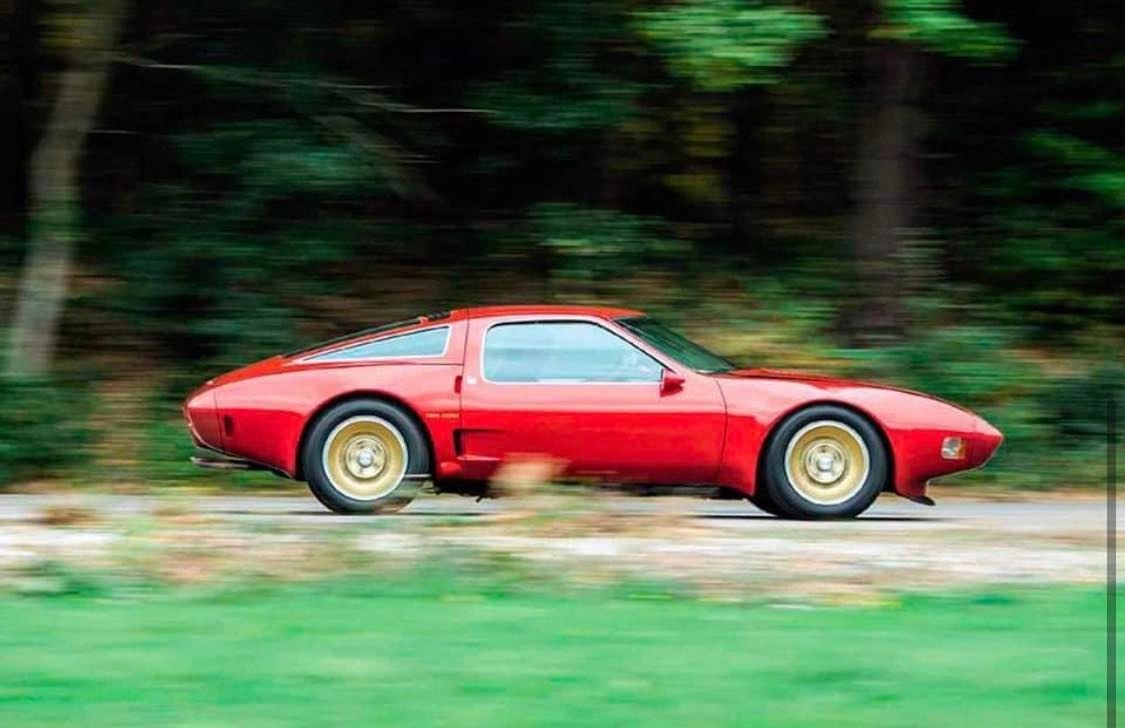
Inside the XP-987 GT, the cabin is as experimental as the car’s rotary heart, with a sweeping dash that wraps around the driver in a clean, almost architectural arc. Deep-set round gauges, simple rectangular vents, and the minimalist three-spoke wheel give the cockpit a purposeful, almost aircraft-like feel. The high, narrow console and upright shifter emphasize that this was meant to be driven, not just displayed. It’s a fascinating bridge between late C3 ergonomics and the driver-focused layouts that would later define modern Corvettes.
Inside, the cabin was tighter than a C3 but thoughtfully laid out. Fixed-back bucket seats were paired with an adjustable steering column and even adjustable pedals, allowing drivers of different sizes to find a workable position in what was, by any measure, a very compact interior. Luggage space behind the engine measured a modest 8.1 cubic feet – enough for weekend bags, but not much more.
The Rotary Heart of the XP-987 GT
Three engineers crowd around an early prototype of GM’s rotary combustion engine, studying every fitting and fastener as it sits on a test stand. This is where the Wankel dream became real work—fuel lines routed, ignition mocked up, housings checked and rechecked before the engine ever met a chassis. In rooms like this, far from auto-show spotlights, GM’s team chased Ed Cole’s vision of a compact, high-revving rotary that could power the next-generation Corvette. Even if the program ultimately fell short, moments like this capture the quiet intensity behind the XP-987 GT story.
For most of its early development, XP-987 ran with either a mock-up power unit or an experimental RC-series engine. By the time the car was ready for its public life, the rotary program had settled on a two-rotor layout for the Chevrolet GT/Corvette application. The engine displaced just over 200 cubic inches – again, most commonly documented as the RC2-206 – and was fed by a Rochester Quadrajet carburetor. It used side intake ports, peripheral exhaust ports, and a twin-plug ignition system to promote more complete combustion and smoother running at high rpm.
GM literature and contemporary reporting cite an output of about 180 horsepower at around 6,000–6,100 rpm – numbers in line with what Mazda was producing from its two-rotor engines at the time, but from a significantly larger displacement. In the featherweight XP-987 GT, that power, routed through the compact three-speed automatic and Porsche-based running gear, promised lively performance. Internal projections suggested the car could match or better the acceleration of a small-block C3, while offering a very different character: a smooth, free-revving surge rather than the big-torque lunge of a V-8.
This archival image captures a proud moment in GM history: the ceremonial launch of the “First Production Assembly GM Rotary Engine” at Hydra-Matic on March 20, 1974. That date marked the official start of GM’s ambitious Wankel program, which aimed to put a smooth, high-revving rotary engine into production. The plan was to use this powerplant in the Chevrolet Vega (and later the Monza 2+2), bringing rotary technology to mainstream buyers. At the same time, GM envisioned a more exclusive role for the engine in the XP-987 GT “Two-Rotor Corvette,” showcasing its performance potential in a mid-engine sports car. Unfortunately, changing emissions standards, fuel economy concerns, and the fallout from the 1973 oil crisis ultimately killed the program before any rotary-powered Chevrolets reached showrooms. As a result, this photo stands as both a celebration of bold innovation and a reminder of one of GM’s most fascinating “what might have been” stories. (Image courtesy of GM Media LLC)
On paper, the package made sense, but there were clouds on the horizon. Early testing of GM’s rotary showed that getting acceptable emissions out of the engine without strangling performance was far harder than originally advertised. Turning it into a fuel-efficient power plant was harder still. The same attributes that made the Wankel so smooth – its large combustion surface area and relatively short expansion stroke – also made it thirsty and dirty compared with even a mildly detuned piston engine.
From Chevrolet GT to Corvette Two-Rotor
Before the world ever saw XP-987, GM gave it a makeover. As the 1973 European auto-show season approached, corporate planners decided that the little mid-engine GT should no longer stand alone as a “Chevrolet” concept – it should carry the Corvette name. Shortly before its scheduled appearance in Germany, the silver paint and matching interior gave way to a dramatically richer Candy-style metallic red, a fawn (saddle) leather cabin, and a set of gold-anodized wheels with machined lips.
Those wheels are an interesting footnote in their own right. Designed by GM for the concept, their turbine-like pattern with a recessed center would later be released to Motor Wheel – a Goodyear-owned supplier – and sold in the aftermarket under the name “Vector,” becoming a minor icon of 1970s wheel design.
Less than a week before the car’s scheduled debut, GM’s leadership made one more change: the Chevrolet GT would appear on the stand as the “Corvette Two-Rotor.” There was no time to tool traditional script badges, so stylists produced decal-style nameplates for the flanks and rear, visually tying this compact exotic back to America’s sports car.
Up close, the XP-987 GT’s gold-finished turbine-style wheels instantly signal that this is no ordinary mid-engine prototype—they give the car a bold, almost competition-ready stance that fits its experimental mission. Just ahead of the rear wheel, the subtle “two rotor” script hints at the unconventional powerplant originally planned for the car, proudly calling out the Wankel engine configuration. Elsewhere on the body (not seen here), “Corvette Two-Rotor” decals were added to further “Americanize” the Pininfarina-built shape and clearly link this Italian-crafted body back to Chevrolet’s flagship sports car. Together, the wheels and graphics helped transform what began as a Porsche-based test bed into something that unmistakably read as a futuristic Corvette—at least to the executives and show-goers Chevy most wanted to impress. (Image courtesy of Joe Kolecki/Kolecki Photography LLC)
Most sources agree that the Corvette Two-Rotor’s first major public appearance came at the 45th German Motor Show in Frankfurt in September 1973, although some accounts emphasize the Paris Motor Show a month later; what’s clear is that the car quickly became a centerpiece of GM’s European car show circuit that fall. Under the intense lights of the exhibition halls, the low red hatchback and its gold wheels drew crowds. Here was a Corvette in name only – small, mid-engined, and unapologetically European in stance.
Rumors, naturally, exploded. The newly christened “Corvette Two-Rotor” arrived at Frankfurt sitting impossibly low and wide under the show lights—Candy Apple Red paint, gold wheels, saddle interior—and it drew a crowd almost instantly. Journalists and showgoers pressed against the stand railings, trying to peer past the glass to the twin-rotor powerplant and take in the unfamiliar proportions of a Corvette that looked more Turin than St. Louis. Many assumed they were seeing a full dress rehearsal for the next-generation Corvette; others whispered that Chevrolet was secretly cooking up a second, “junior” model that would slip beneath the C3 in price and size. Car and Driver later summed up the atmosphere around the program with a sly subhead: “Publicly, it’s a show/test car. Privately, it may be on the road in 1976.”
In December 1973, Car and Driver boldly proclaimed a “Wankel-powered Corvette” as the next generation of America’s sports car, splashing GM’s radical two-rotor Corvette concept across its cover. For a brief, intoxicating moment, it looked as if the future of Corvette would spin on a triangular rotor instead of a small-block V8. (source: Car and Driver Magazine, December 1973)
The European press, used to sneering at American bigness, suddenly found itself intrigued. Here was a GM product that borrowed the mid-engine layout and tidy footprint of cars like the Dino 246 GT and Porsche 911, wrapped in Pininfarina-shaped steel and powered by the same kind of exotic rotary that had made NSU’s Ro80 and Mazda’s Cosmo technical conversation pieces. Reports out of the show emphasized how quickly GM’s advanced studio had gone from idea to running car, and how seriously upper management seemed to be treating the project—granting it not just a splashy Frankfurt debut, but a full tour through the European show circuit. One retrospective would describe the reception at Frankfurt as “generally favorable,” noting that if the rotary gamble had paid off, this little red coupe might well have become the face of a very different Corvette era.
In a Europe still wary of American excess and reeling from the first tremors of the oil crisis, the notion of a GM-built, Pininfarina-bodied, two-rotor Corvette felt almost surreal. The car seemed to promise that Detroit could speak fluent European—sharp-edged engineering in a compact package, with just enough Chevrolet swagger baked in. Bench-racing arguments spilled from the show halls into cafés and editorial offices: Would this finally be the mid-engine Corvette? Was it a serious production candidate or just a rolling test bed for the Wankel? For a brief moment, as the crowds thinned each evening and the Two-Rotor’s red paint cooled under the hall lights, it was possible to believe that this experimental coupe from Chevrolet might rewrite not only Corvette history, but the way the world thought about American performance cars altogether.
When the XP-987 GT made its public debut at the 1973 Frankfurt Motor Show, it turned heads — automotive magazines and show-goers alike praised its sleek mid-engine proportions and the audacity of packaging a rotary powerplant inside what looked like a compact European sports coupe. Reviewers gushed over its low, wide stance, hidden headlamps, and the exotic appeal of GM’s “Two-Rotor Corvette” rebirth, while the public reacted with a mixture of hope and excitement — many believed this could be the future of Corvette. The reception was enthusiastic enough that whispers spread instantly of a possible production mid-engine Corvette, powered by GM’s experimental two-rotor Wankel engine. For a shining moment, it seemed as though GM might leap ahead of the pack — until external pressures and changing conditions pulled the plug on what was already being hailed as the next great Corvette. (Image courtesy of GM Media LLC)
Inside GM, the Corvette Two-Rotor generated serious discussion as well. There were tentative product-planning sketches that showed a late-1975 or 1976 introduction for a production derivative built on a unique GM platform, powered by the same two-rotor engine destined for the Monza and for AMC’s early Pacers. For a moment, the future of the Corvette family seemed to hinge on a compact rotary.
Zora, however, was not impressed. In Karl Ludvigsen’s research, Duntov famously dismissed the car as underpowered and, more damningly, impractical. He noted that interior and luggage space were so limited that “in case of rain you are forced to disrobe outside of the car and shove the raincoat in the trunk – there is no space to store the coat.” For a man who measured sports cars as much by their long-distance usability as their lap times, the Two-Rotor fell short.
Oil Shock, Emissions, and the Rotary’s Fall
The 1973 oil crisis, triggered when OAPEC nations cut production and placed an embargo on oil shipments, sent shockwaves through the U.S., sparking fuel shortages, economic inflation, and mile-long lines at gas stations like the one seen here. For the country, it meant rationing, reduced speed limits (55 mph), stalled travel, and a renewed urgency around fuel efficiency, forcing automakers and policymakers to rethink energy consumption nationwide. Inside GM, the crisis accelerated skepticism around the thirsty rotary program, even as engineers raced to production-optimize the 2-rotor Wankel for the Chevy Vega/Monza and concept projects like XP-987 GT. The inherent fuel-consumption drawbacks of the rotary—once tolerated in the name of innovation—suddenly felt politically and commercially dangerous. The turmoil shrank corporate appetite for risk, ultimately helping kill GM’s production-bound Wankel engine and steering Corvette development back toward more conventional powerplants.
Even if Zora had been its biggest fan, the Corvette Two-Rotor was about to run head-on into geopolitical reality. In October 1973, only weeks after the car’s European debut, the Organization of Arab Petroleum Exporting Countries (OAPEC) announced an embargo on oil shipments to nations – including the United States – that supported Israel during the Yom Kippur War. Within months, American motorists were facing gasoline rationing, long lines at the pumps, and soaring prices.
Suddenly, fuel economy wasn’t just a talking point – it was a primary buying criterion. At the same time, U.S. federal emissions standards were tightening rapidly. GM engineers struggled to get the RC2-series rotary to meet those standards without crippling performance. The engine’s inherently high surface-to-volume ratio and combustion characteristics made controlling unburned hydrocarbons particularly difficult. To make matters worse, even in best-case calibration, the two-rotor struggled to match the fuel efficiency of GM’s detuned piston engines, which were themselves no paragons of economy.
When Pete Estes succeeded Ed Cole as President of General Motors, the shift in leadership coincided with a turbulent moment in automotive history. Cole had championed the Wankel rotary-engine program and ambitious projects like XP-987 GT, but by the time Estes took the helm the 1973 OAPEC oil crisis was reshaping public demand and corporate priorities. With fuel prices soaring and emissions regulations tightening, the appetite for a fuel-thirsty rotary engine evaporated almost overnight. Under Estes, GM quietly wound down the Wankel program — and the two-rotor Corvette concept, like many other rotary-powered dreams, faded into history.
By September 1974, the handwriting was on the wall. Ed Cole, the rotary’s chief advocate, had retired, and his successors were far less willing to stake GM’s future on a powerplant that was now politically and environmentally suspect. GM officially postponed, and then effectively cancelled, the production GMRCE program. Dealer order guides that had once listed the RC2-206 as an upcoming option for the 1975 Monza quietly dropped the reference, and AMC’s plans to buy GM rotaries for the early Pacer were shelved.
For the Corvette Two-Rotor, cancellation of the rotary program was a death sentence. Even though the XP-987 GT had proven that a compact two-rotor could move a light mid-engine coupe smartly, there was no way to justify a thirsty, emissions-troubled halo car in the immediate aftermath of the oil crisis. Whatever small chance this unique production derivative once possessed had evaporated.
Exile Under a Temporary Bond
Hank Haga (left), Kip Wasenko (center), and Otto Soeding at the GM Design Center. During XP-987 GT development, some accounts suggest that GM was sensitive to how a Corvette-branded concept built in Italy might be perceived under evolving import and homologation rules in Europe. According to these stories, the car initially returned to Detroit simply as the “Chevrolet GT,” with Corvette identity and “Two-Rotor” graphics added later for press photography and auto-show duty. However, no known GM archival documents definitively confirm that this sequencing was driven by tax or regulatory necessity, so it’s best understood as a widely repeated anecdote rather than settled fact. What is clear is that XP-987 GT had to navigate not just engineering and styling hurdles, but also the corporate and political sensitivities of launching an American halo car with foreign coachwork during an era of oil shocks and trade tensions. (Image courtesy of GM Media LLC)
Concept cars often meet ignominious ends, but the Corvette Two-Rotor’s post-show life was especially complicated thanks to international tax law. Because Pininfarina had built most of the car’s bodywork in Italy, GM had brought the completed prototype into the United States under a “temporary importation” bond that allowed the company to display and test the car without paying full import duty on the Italian value added. That bond, however, came with strings attached: the car could only remain in the U.S. for a limited period unless GM either paid the duty or re-exported it.
After its European show run, the XP-987 GT toured the United States, appearing at events that ranged from auto shows to the 1974 World’s Fair in Spokane, Washington. When its American itinerary ended, GM removed the RC2 engine and automatic transaxle – the power unit was reportedly returned to NSU Motorenwerke AG, or otherwise scrapped along with most of the experimental rotaries – and crated the car for shipment back across the Atlantic.
The body and chassis, still wearing their Candy red paint and gold wheels but now without a drivetrain, were sent to GM’s British subsidiary, Vauxhall, and stored at the company’s Design Centre in Luton, Bedfordshire. The logic was simple: by re-exporting the car to Europe, GM avoided paying additional U.S. duty on a prototype program that had already cost millions. Once there, the XP-987 GT was effectively forgotten. For the better part of a decade, it sat sealed in a crate or tucked into a corner of the styling complex – a small, rotary-shaped dead end in GM’s mid-engine story.
Tom Falconer’s Rescue Mission
Tom Falconer’s stewardship of the XP-987 GT Two-Rotor Corvette stands as one of the most important preservation stories in Corvette history. When the radical mid-engine concept—built as a test bed for GM’s experimental Wankel rotary program—was drifting toward obscurity, Falconer stepped in and gave it a second life. With a blend of engineering ingenuity and historian-level respect for originality, he transformed a fragile, non-running relic into a fully mobile, mechanically credible machine. He engineered creative drivetrain solutions, fabricated one-off components, and ultimately reinstated a true rotary layout that honored the intent of Zora Arkus-Duntov’s team. Under his care, the car was stored properly, exercised thoughtfully, and shielded from the neglect that claims so many prototypes. Falconer didn’t just restore the XP-987 GT; he curated it, refining its presentation and documenting its story so that every line of Kip Wasenko’s design and every experimental idea beneath its skin could be appreciated in context. He reintroduced the car to enthusiasts around the world, allowing them to see—and hear—what a rotary-powered Corvette concept actually was, rather than just imagine it from grainy period photos. In doing so, he preserved not only a one-off showpiece, but an entire “what if” chapter of Corvette history that might otherwise have vanished. (Photo credit: Trevor Rogers)
The Corvette Two-Rotor might well have ended its life as scrap if not for a fortunate chain of friendships. In the early 1980s, Vauxhall’s Luton facilities were being remodeled, and long-stored items – including the XP-987 GT – had to be moved or disposed of. The plan, as is so often the case with obsolete concept cars, was to crush the car. Geoff Lawson, then head of styling at Bedford Trucks (part of GM’s British operations), was given responsibility for carrying out the order.
Lawson, however, happened to be a Corvette enthusiast. Before sending what he knew was a unique mid-engine coupe to the crusher, he called his friend Tom Falconer, proprietor of Claremont Corvette in Kent and author of numerous Corvette books. Falconer initially thought Lawson was offering him a compressed “cube” of the car as a piece of showroom sculpture – a macabre but not unheard-of fate for famous prototypes. Realizing from the description that the vehicle in question was the long-lost Two-Rotor, he balked. He didn’t want the cube; he wanted the whole car.
Geoff Lawson (1944–1999) was a British automotive designer best known for serving as Jaguar’s design director from 1989 until his passing, overseeing defining programs including the XJ sedans, XK grand tourers, and the legendary XJ220 supercar. Earlier in his career, during his tenure as head of styling at Bedford Trucks in Luton in the early 1980s, Lawson became unexpectedly tied to one of the most important survival stories in Corvette lore. A close friend and confidant to Tom Falconer, he made the pivotal 1982 phone call that warned Falconer a steel-bodied Corvette prototype stored atop his building was marked for crushing, later nudging Tom toward the realization that the car could only be the long-missing GM rotary concept, XP-987 GT. With a designer’s instinct for significance, Lawson stalled the crusher, pointed Falconer toward contacting GM styling chief Chuck Jordan, and encouraged him to appeal directly to Chuck Jordan and styling chief Chuck Jordan’s network for the car’s release—providing Tom the time and leverage to launch the rescue. Though he never turned a wrench, Lawson’s judgment, loyalty, and discreet intervention were the true spark that set Falconer on the path to acquiring and ultimately resurrecting the XP-987 GT. Lawson is remembered with enormous respect for his global design influence, but to Corvette history, he also remains the man whose calm insight and perfectly timed encouragement ensured an audacious rotary prototype lived long enough to be saved.
Lawson didn’t have the authority to overrule GM’s decision, but he urged Tom Falconer to go straight to the top and call GM’s head of Styling, Chuck Jordan—someone Falconer had gotten to know while researching a book on the Cadillac Seville. A meeting was arranged at the GM Tech Center in Detroit to discuss the fate of the orphaned prototype. Behind closed doors, Jordan laid out why the two-rotor Corvette had been condemned: to the corporation, it was a lingering embarrassment, a costly Wankel detour, and an ideological dead end. As far as he was concerned, no Corvette would ever wear a steel body or carry its engine amidships.
Even so, Falconer’s persistence made an impression. Against the odds, GM agreed to sell him the XP-987 GT, provided it left corporate custody without its experimental powertrain. Instead of being sent to the shredders, the car—still missing its heart—was shipped to Falconer, preserving a unique chapter of Corvette history that GM was otherwise ready to erase.
This image, shared on Tom Falconer’s own Facebook page, captures the essence of his relationship with the XP-987 GT Two-Rotor Corvette. It isn’t just a man cleaning an engine—it’s the caretaker of a one-off experiment, patiently coaxing life back into hardware most of the world had forgotten. Falconer’s hands-on devotion to this rotary powerplant, and his determination to see it turning again behind the cockpit of the XP-987 GT, speak louder than any trophy or headline. It’s a quiet, powerful reminder that history is often preserved not by institutions, but by individuals who simply care too much to let something special disappear. (Photo credit: unknown)
Getting the car running again required improvisation. Initially, Tom Falconer installed a Vauxhall Cavalier four-cylinder engine and automatic transmission — enough to make the car mobile and prevent it from being a static, crated relic. But as Falconer continued to work on the car, he made a bolder choice: he replaced that temporary drivetrain with a more fitting powerplant — a Mazda 13B two-rotor engine, mated to a front-wheel-drive Cadillac automatic transaxle turned and mounted to approximate the mid-engine, rear-drive layout that the original designers at General Motors had envisioned for the concept.
By the year 2000, after a careful cosmetic restoration that refreshed its original red paint and cleaned up the marks of long-term storage, Falconer reintroduced the reborn prototype to the public at a gathering of the National Corvette Restorers Society in the United States. The appearance stunned Corvette enthusiasts, many of whom had only known the car from grainy black-and-white photographs and half-remembered magazine features. What had been an obscure “what-if” prototype decades earlier was suddenly real, rolling under its own power and radiating the sharp, compact presence it had once carried on the auto-show circuit.
At the 2019 Amelia Island Concours d’Elegance, the XP-987 GT glides past the grandstand like a rediscovered secret from GM’s rotary era. In the passenger seat sits Tom Falconer, the man who saved, restored, and ultimately returned this remarkable two-rotor Corvette concept to the spotlight it always deserved.
Falconer did not stop there. Over the years that followed, he continued refining the restoration, chasing countless small details while quietly nurturing a much larger ambition: someday reuniting the prototype with its originally intended power source, a true GM Rotary Combustion Engine. Most of those experimental rotary engines had been destroyed when the program was cancelled, but Falconer persisted, following leads, talking to former GM engineers and insiders, and tracking the scattered remnants of the rotary project. After considerable persistence and detective work, he finally managed to locate one of the very few surviving GMRCE units.
That effort paid off in early 2019, when the prototype — by then widely known among enthusiasts as the “2-Rotor Corvette” — was invited to the Amelia Island Concours d’Elegance. There, the XP-897 GT was displayed alongside the freshly acquired GM rotary engine, giving the public its first true glimpse of what the car might have been: a compact, mid-engine Corvette powered not by a traditional small-block V8, but by the smooth, unconventional pulse of a two-rotor Wankel. For the first time since the early 1970s, the styling, chassis concept, and intended powerplant were reunited in one place.
Home at the National Corvette Museum
The XP-987 GT on display at the National Corvette Museum as part of the 2020-21 exhibit “The Vision Realized: 60 Years of Mid-Engine Corvette Design.” Ironically, this photograph was originally taken for my book “Corvette Concept Cars: Developing America’s Favorite Sports Car” in early spring 2021, just months after the Museum had acquired the Two-Rotor Corvette from Tom Falconer. (Image courtesy of Joe Kolecki/Kolecki Photography LLC)
For decades, the XP-987 GT lived in England under Falconer’s care, occasionally venturing out for shows and media features. Meanwhile, in the United States, the Corvette community’s fascination with mid-engine history grew as rumors – and eventually prototypes – of a production mid-engine Corvette evolved into the C8. By the time Chevrolet unveiled the 2020 mid-engine Stingray, the story of how Zora and others had pushed for that layout over 60 years had become central to Corvette’s official narrative.
In 2020, the National Corvette Museum in Bowling Green, Kentucky, brought the story full circle. Thanks to fundraising efforts led by the Lone Star Corvette Club and the Texas Corvette Association, the museum acquired the XP-987 GT from Tom Falconer and repatriated the car to the United States. Initially, the Two-Rotor Corvette served as a centerpiece of the special exhibit “The Vision Realized: 60 Years of Mid-Engine Corvette Design,” where it was displayed alongside other key mid-engine studies and engineering testbeds throughout 2020 and 2021. Sadly, the opportunity for spectators to experience the exhibit and see the XP-987 GT in person was dampened by the outbreak of the Coronavirus Pandemic in March 2020.
The XP-987 GT on display as part of the NCM’s 2023-2025 exhibit “An American Love Affair: 70 Years of Corvette.” (Image courtesy of the author)
Fortunately, even as the museum’s exhibits evolved, the XP-987 GT remained a key attraction at the National Corvette Museum. The car moved to a new “home” at the NCM within the iconic Skydome as part of the current (at the time of publication) “An American Love Affair: 70 Years of Corvette”display. There, it shares space with landmark machines like Zora Arkus-Duntov’s personal 1974 Corvette and a host of historically significant production and concept cars, all set against a dynamic “Skywall” video installation that traces the Corvette’s cultural and technological impact.
In that setting, visitors can walk around the low red coupe, peer through its glass rear hatch at the compact mid-engine layout, and appreciate just how different GM’s vision for a rotary-powered sports car really was. Just as importantly, they can follow the improbable journey that carried the car from Detroit to Turin, across the European show circuit, into exile in England, through a near-death encounter with a crusher, and finally onto the polished floor of the museum that now celebrates it. For anyone standing beneath the Skydome, the XP-987 GT is no longer a footnote or a rumor from a grainy photograph; it is a tangible reminder of how close Corvette once came to taking a radically different path.
Legacy of a Rotary Dead End
The XP-987 GT, properly equipped and fitted with a Wankel rotary engine, running wide open at the McLaren test track in Surrey. Special thanks to Tom Falconer for all his efforts to preserve and restore this car to its original grandeur. (Photo credit: Trevor Rogers)
On one level, the XP-987 GT / Corvette Two-Rotor is an evolutionary dead end – a car built around an engine architecture that GM abandoned before it ever reached showrooms. Its compact dimensions, modest luggage space, and reliance on a thirsty rotary make it difficult to imagine as a volume production Corvette in the post-OPEC world. Zora’s criticisms of its packaging and practicality were not wrong, and in the 1970s, the corporation had larger fires to fight than launching a niche mid-engine halo car that would have struggled to pass emissions and satisfy fuel-conscious buyers.
Yet to dismiss the Two-Rotor as a mere curiosity is to miss its broader significance. The XP-987 GT proves that GM’s design and engineering teams were willing to question almost every assumption about what a Corvette could be: its engine layout, its size, its styling language, even its country of coachbuild. It shows Bill Mitchell and Kip Wasenko experimenting with Pininfarina in ways that foreshadowed collaborations between American brands and European design. It reveals how far Ed Cole was willing to go in pursuit of rotary technology – far enough to build a mid-engine Corvette on a Porsche chassis and ship it halfway around the world.
Once crated, forgotten, and nearly crushed, this red coupe now blurs past the lens in motion — proof that even doomed ideas can outrun extinction with the right caretaker. Tom Falconer didn’t just restore a car, he restored a moment in time, eventually reuniting it with the distinctive hum of a reborn Wankel rotary. And today, back on American soil beneath the Skydome, it stands proudly in the National Corvette Museum’s collection — a reminder that reinvention isn’t just the Corvette’s legacy, it’s its lifeblood. (Photo credit: Trevor Rogers)
Most importantly, the car occupies a key chapter in the long narrative that culminates in the production C8. Along with the XP-882, the Four-Rotor “Aerovette,” and the CERV research vehicles, the Two-Rotor helped normalize the idea of a mid-engine Corvette inside GM and in the minds of enthusiasts. When you stand next to the XP-987 GT today, looking at its compact proportions and glass-covered engine bay, it’s hard not to see echoes of it in the modern Stingray’s silhouette. The rotary may have vanished from GM’s future, but the mid-engine dream it helped bring into focus eventually became reality.
In that sense, the XP-987 GT is more than a historical footnote. It is a tangible reminder that even failed experiments can push a marque forward, and that sometimes the path to a landmark production car runs through a forgotten crate in a British design center – and through the hands of people stubborn enough to believe that an obsolete rotary prototype is worth saving.
Why the XP-987 GT Still Matters Today
1973 XP-987GT Two-Rotor Corvette Concept Car (Image courtesy of Joe Kolecki/Kolecki Photography LLC)
The XP-987 GT still matters because it captures Corvette at one of its most intellectually restless moments. This was not Chevrolet polishing a proven formula or refining a familiar shape. It was Corvette leadership exploring an entirely different future—smaller, lighter, more internationally flavored, and powered by an engine GM believed could help redefine the modern automobile. Even without reaching production, that willingness to break from convention matters. It tells us that Corvette’s history was never as linear as it may appear in hindsight.
What makes the car especially important is how many competing ambitions it carries in a single package. The XP-987 GT is a Corvette experiment, a rotary experiment, a styling experiment, and a packaging experiment all at once. It reflects a period when General Motors was still large and confident enough to chase multiple futures simultaneously, even when those futures pulled in different directions. That gives the car unusual value today. It is not simply a prototype with an interesting shape. It is evidence of a corporation testing the outer edge of its own imagination.
It also matters because it exposes an alternate branch of Corvette development that feels surprisingly relevant in a modern context. Long before today’s sports cars became global objects shaped by international engineering influences, the XP-987 GT was already pointing in that direction. Its Pininfarina connection, Porsche-based underpinnings, and unconventional powertrain made it something far more cosmopolitan than the traditional image of a front-engine American V-8 sports car. In that respect, it reminds us that Corvette’s evolution was never confined to Bowling Green, St. Louis, or Detroit thinking alone. Some of its boldest ideas were born when Chevrolet looked outward.
There is another reason the XP-987 GT deserves attention: it helps us better understand failure as part of Corvette’s development process. Not every important car succeeds in the showroom. Some matter because they sharpen the questions that future cars must answer. The Two-Rotor forced GM to reckon with packaging, emissions, performance identity, fuel economy, and public expectations all at the same time. It may not have delivered the final solution, but it helped define the problem more clearly—and that, in engineering terms, is often just as important.
Today, the XP-987 GT stands as proof that Corvette’s eventual transformation into a mid-engine production sports car did not happen overnight, nor did it emerge from a single flash of inspiration. It was built through decades of trial, disagreement, ambition, and revision. The Two-Rotor belongs to that story in a very real way. It represents a moment when Chevrolet was willing to risk being wrong in order to discover what might be possible. And for a nameplate that has survived by evolving without losing its identity, that may be one of the most Corvette qualities of all.
A forgotten experiment, a radical vision, and a pivotal step toward Corvette’s mid-engine future—the XP-987 GT challenges everything you thought you knew about America’s sports car. From rotary ambition to European influence, this remarkable prototype tells a deeper story. Dive in and discover why it still commands attention today.
By the late 1960s, Chevrolet found itself in a fascinating position.
The Corvette was no longer an experiment. It was no longer a curiosity. It was no longer the “underdog” American sports car trying to prove it belonged in the same conversation as Europe’s best. By then, the Corvette had grown teeth. It had racing credibility. It had real performance. And with the arrival of the all-new C3 for 1968, it had a dramatic, high-style body that looked every bit as provocative as the era demanded. Sales were strong, public interest was high, and the car’s image had never burned brighter. In 1967, Chevrolet built 22,940 Corvettes. For 1968, first-year C3 production climbed to 28,566, and by 1969 it would rise again to 38,762. From a business standpoint, the argument for radical reinvention was not exactly urgent.
And yet, inside General Motors, the idea of a mid-engine Corvette would not go away.
That tension is what makes the 1968 XP-880 Astro II such a compelling chapter in Corvette history. It was born at the precise intersection of ambition and restraint, of engineering courage and corporate caution. It was a machine that asked a dangerous question at exactly the wrong time for a company already selling every Corvette it could build: what if America’s sports car stopped looking over its shoulder at Europe and instead decided to beat Europe at its own game?
The Astro II was not the first Chevrolet research vehicle to place the engine behind the driver, nor was it the first GM concept to flirt with exotic architecture. But it was the first true mid-engine Corvette prototype that looked, felt, and presented itself as something plausibly connected to the Corvette production line. It was not an abstract laboratory object. It was not a pure race mule. It was a Corvette-shaped provocation, and when it appeared before the public in April 1968 at the New York Auto Show, it ignited exactly the kind of speculation Chevrolet both wanted and feared.
To understand why the Astro II still matters today, you have to understand the moment that produced it.
The Pressure of the Era
Ford’s GT40 victories at Le Mans changed the game, proving an American automaker could challenge—and beat—Europe on its own terms. That shift helped spur GM’s creation of the XP-880 Astro II, a bold mid-engine concept born from a new era of engineering ambition.
The 1960s were not gentle years in the performance world. They were aggressive, glamorous, and deeply competitive. Racing programs had become extensions of national identity and corporate bravado. Ford’s GT40 program, with its famous Le Mans triumphs over Ferrari, had dramatically reshaped the conversation around what an American company could do when it set its mind to European-style performance. Even for brands not directly contesting that exact battlefield, the message was unmistakable: image mattered, engineering theater mattered, and exoticism mattered.
Within Chevrolet and GM more broadly, there was no shortage of people who understood this. Zora Arkus-Duntov had long believed that the Corvette’s future, at least at the highest level of world performance, pointed toward a mid-engine configuration. GM had already explored rear- and mid-engine ideas through vehicles like CERV I, CERV II, the GS II, and other research efforts. The Astro II did not emerge from nowhere. It emerged from a growing internal belief that the conventional front-engine layout, no matter how capable, might ultimately limit how far Corvette could go in image, packaging, and performance.
The Astro II was also shaped by another reality: GM was a huge corporation, and huge corporations rarely leap without a net. If Chevrolet was going to explore a mid-engine Corvette, the company was going to do it first through a concept that combined vision with practical experimentation. That is where Frank Winchell and his team entered the picture.
Frank Winchell, Larry Nies, and the Engineering Problem
Frank Winchell (center) was one of the driving forces behind Chevrolet’s mid-engine experimentation in the 1960s. As head of Chevrolet Research and Development, he helped shape the environment that produced the XP-880, a V-8-powered concept that would ultimately evolve into the Astro II and stand as one of GM’s boldest early steps toward a mid-engine Corvette.
Frank Winchell, who led Chevrolet’s Research and Development organization, was central to the Astro II story. Under his direction, the 1968 XP-880 Astro II became more than a styling proposal. It became a genuine engineering exercise—an attempt to figure out how one might package big-block American power in an all-new, mid-engine sports car without losing the structural discipline, drivability potential, and brand identity that would make such a machine feel authentically Chevrolet.
Larry Nies was tasked with solving what was, in truth, a vicious packaging puzzle.
A big-block 427 cubic-inch V8 is not a delicate piece of hardware. They are large, heavy, and not naturally suited to compact, mid-engine layouts. But Nies and the engineering group were determined to see what could be done. Their answer was ingenious: reverse the engine in the chassis. By turning the Mark IV big-block 180 degrees, the bulky accessory drive, water pump, alternator, and other front-mounted hardware could be moved rearward, creating additional room near the passenger compartment. The engine’s starter and ring gear wound up beneath the seatback area, while the accessory mass was moved farther aft. It was a deeply practical solution to an otherwise brutal spatial problem.
Loring “Larry” Francis Nies played a central engineering role in the XP-880 program, developing the mid-engine layout that made the concept feasible. His work packaging a 427 V-8 into the compact chassis helped give shape to what would become the Chevrolet Astro II—one of GM’s most important early steps toward a mid-engine Corvette. (Image courtesy of Stetson Funeral Home)
The XP-880’s structure was equally interesting. Rather than relying on a traditional production-style frame, the Astro II used a welded steel backbone chassis. This central spine housed key mass and helped organize the car around its mid-mounted powertrain. The layout also included a centrally mounted fuel bladder and a radiator placed at the rear, with venting integrated into the bodywork to manage airflow and cooling. From an engineering standpoint, this was not simply a Corvette body draped over a novelty chassis. It was a purpose-built architecture designed around the logic of a mid-engine sports car.
What makes the 1968 XP-880 Astro II especially fascinating is that its revolutionary layout coexisted with a heavy use of production-derived parts. Chevrolet was not trying to reinvent every nut and bolt. The front suspension incorporated largely off-the-shelf components, including Camaro wishbones, Corvette brakes, Oldsmobile Toronado universal joints, rack-and-pinion steering, and custom upper-control-arm geometry intended to keep the roll center very low. That mix of improvisation and discipline tells you a great deal about what the car really was: not a fantasy in fiberglass, but an experimental machine assembled quickly and intelligently to test a serious idea.
The 1968 XP-880 astro II: Big Power, Clever Compromise, and One Serious Weakness
The XP-880 paired a reversed, longitudinally mounted 427 V-8 with a rear transaxle—an advanced layout that helped keep the car low and dramatic, but also created serious packaging, cooling, and durability challenges for the engineers bringing Chevrolet’s mid-engine vision to life.
Power came from Chevrolet’s 427-cubic-inch Mark IV big-block V8, rated in period sources at roughly 390 to 400 horsepower depending on the source cited. Either way, the point was the same: this was a real engine, with real output and real intent. Chevrolet was not pretending. The Astro II was built around the kind of displacement and torque that defined American performance at its most unapologetic.
The problem was not the engine.
The problem was what sat behind it.
To transmit power to the rear wheels, engineers used a two-speed automatic transaxle from a 1963 Pontiac Tempest. On paper, this choice made sense. It was available, compact enough to adapt, and suited the rapid development schedule of a concept program. In practice, it was a weak link. The Tempest transaxle was not really up to handling sustained big-block torque in a demanding mid-engine application. Contemporary and retrospective sources alike point to this transmission choice as one of the Astro II’s most significant technical compromises, and when the transaxle proved inadequate, the system required redesign.
That detail matters because it gets to the heart of the Astro II’s dual identity.
The 1968 XP-880 Astro II looked like a future Chevrolet could almost reach, but not quite yet build. In this form, it stood as a beautifully executed proof of concept—evidence that a big-block, mid-engine Corvette was no longer fantasy, but a serious engineering possibility. What the car suggested in equal measure was both promise and limitation: extraordinary packaging ambition, balanced mass, and real dynamic potential, still waiting on the production-level durability and hardware needed to make it fully viable. (Image courtesy of GM Media LLC.)
The car was advanced enough to feel credible, but not yet resolved enough to be production-ready. Astro II was an elegant proof of concept, not a finished automobile. Chevrolet had demonstrated that it could package a big-block V8 behind the driver in something that looked and felt like a legitimate Corvette offshoot. What it had not yet proven was whether such a machine could be mass-produced at the right price, with the durability customers would expect, and with a transaxle stout enough to repeatedly produce the kind of performance the layout promised.
Even so, the 1968 XP-880 Astro II still hinted at genuinely startling capability. Riding on G70-15 tires and cast-aluminum wheels, with four-wheel disc brakes and its mass centralized within the chassis, the car reportedly generated 1.00 g of cornering grip—an astonishing figure for the era, particularly on street tires. That number has been repeated so often over the years that it has taken on a life of its own, and whether it is read as a precise engineering benchmark or as period shorthand for what the car could do, the broader takeaway remains the same: Astro II made the dynamic promise of a mid-engine Corvette impossible to ignore.
Larry Shinoda and the Art of Making It Look Inevitable
arry Shinoda (left) and Tony Lapine (right) stand with the full-size Monza SS clay model, one of the most important GM design studies of the early 1960s and a car that helped shape the visual language of Chevrolet performance for years to come. While this image is not directly tied to the XP-880 Astro II, it places Shinoda in the exact creative world that made such projects possible. Shinoda’s role in GM Styling helped advance the kind of low, dramatic, performance-driven forms that would later find expression in the Astro II, where Chevrolet pushed the idea of a mid-engine, big-block sports car into startlingly credible territory. Seen in that light, this image captures not the Astro II itself, but one of the designers whose influence helped lay the groundwork for it. (Image courtesy of GM Media LLC.)
If Winchell and Nies gave the Astro II its architectural seriousness, Larry Shinoda gave it its soul.
Shinoda was already one of the defining design voices in Corvette history. His work on cars like the Mako Shark II, the Monza SS, and other GM performance concepts had established him as a master of muscular elegance. The Astro II gave him a chance to translate that language into something more compact, more contemporary, and more overtly European in proportion without abandoning Corvette identity.
That balancing act is one of the car’s greatest triumphs.
One of the XP-880’s most distinctive visual cues was the dramatic “sugar scoop” treatment that framed the rear glass and flowed into the engine cover, giving the car a sculptural, unmistakably Corvette-like identity even as its mechanical layout broke sharply from tradition. On a concept built around an early mid-engine platform, that feature did important design work: it visually tied the car back to Chevrolet’s established sports car language while helping mask and integrate the mass of the engine bay behind the passenger compartment. In other words, the sugar scoop helped the XP-880 look like an evolution of the Corvette rather than a total departure from it. It was a clever piece of styling that blended familiar Corvette drama with the unique proportions of a mid-engine experiment. (Image courtesy of the author)
The 1968 XP-880 Astro II did not look like a foreign car with Corvette badges. It looked like a Corvette pulled taut around a new idea. The body carried the familiar emotional cues of the brand—curved fender masses, pronounced haunches, a pointed nose, Corvette taillight graphics, and a cockpit-forward stance—but everything was re-proportioned around the logic of the mid-engine package. The rear deck sat higher to clear the big-block and cooling layout. The tail incorporated vents to support the rear-mounted radiator arrangement. The signature “sugar scoop” rear window added drama while visually tying the roofline into the swollen rear bodywork. The front fascia was nearly seamless, lacking the overt grille treatment and bumper interruptions buyers expected from more conventional cars of the day.
Just as importantly, the Astro II looked usable.
Unlike the more radical Astro I that preceded it, the Astro II had conventional doors, a defined front storage area, and a rear body section that could be lifted for engine access. It looked less like a highly stylized concept car and more like a serious proposal. In truth, that may have been its most dangerous quality. Plenty of concepts are too wild to threaten the status quo. The Astro II was not. It looked close enough to reality to prompt people to wonder whether Chevrolet might actually build it.
New York, 1968: The Public Debut of the Astro II Concept
When Chevrolet unveiled the Astro II at the 1968 New York Auto Show, the car landed like a dispatch from the future. Low, wide, and dramatically different from the front-engine Corvette Americans already knew, the XP-880 stunned showgoers with its radical mid-engine proportions, flowing bodywork, and unmistakable sense of purpose. Public reaction was shaped by both fascination and speculation: here was a Chevrolet concept that looked less like a styling exercise and more like a serious preview of what a next-generation American supercar might become. Even if GM never intended the Astro II to be an immediate production promise, its reception made one thing clear—enthusiasts were more than ready to imagine a Corvette with its engine behind the driver.
By the time the 1968 XP-880 Astro II reached the New York Auto Show in April 1968, the new C3 Corvette was already in production and on the road. That timing was important. Chevrolet was not unveiling the Astro II because the existing Corvette had failed. It was a car unveiling because the company wanted to gauge public reaction to what a more evolved future Corvette might look like.
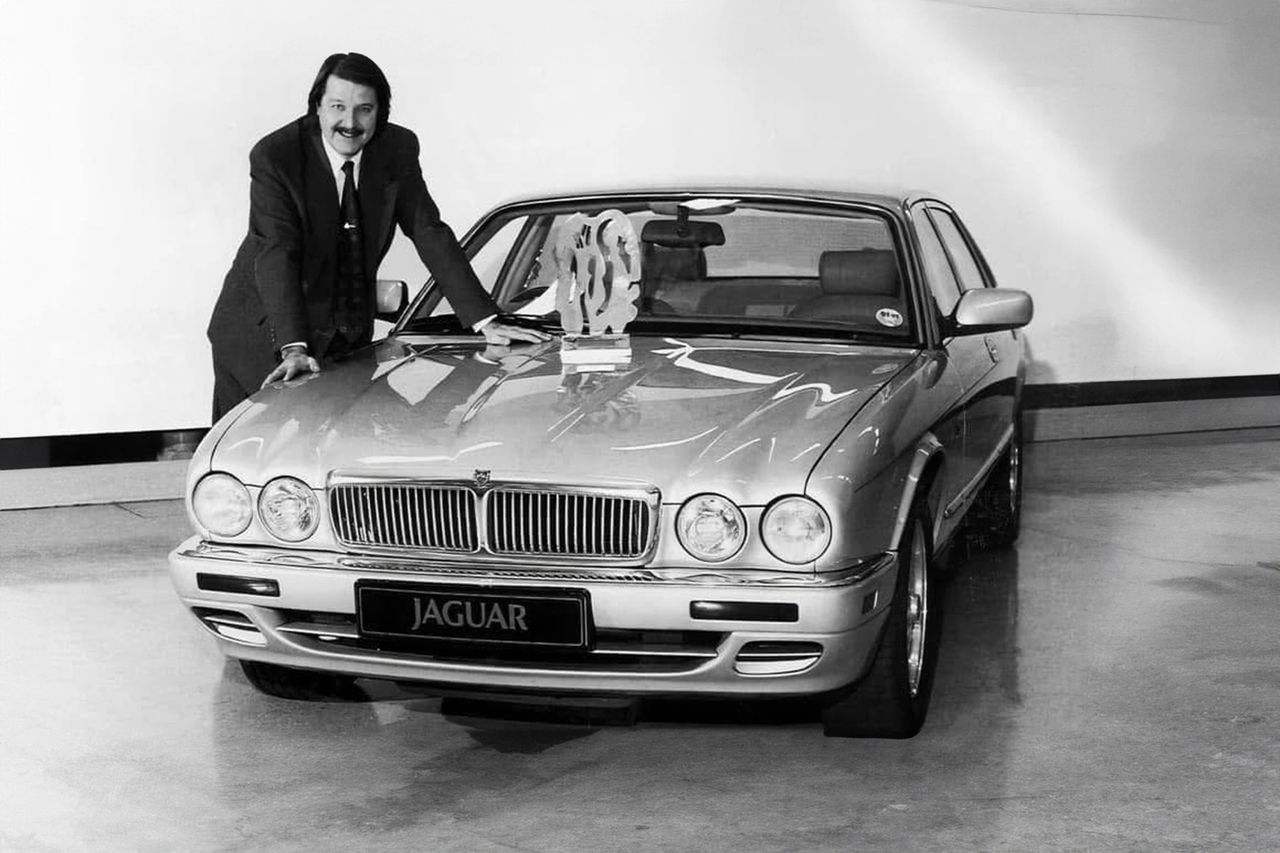
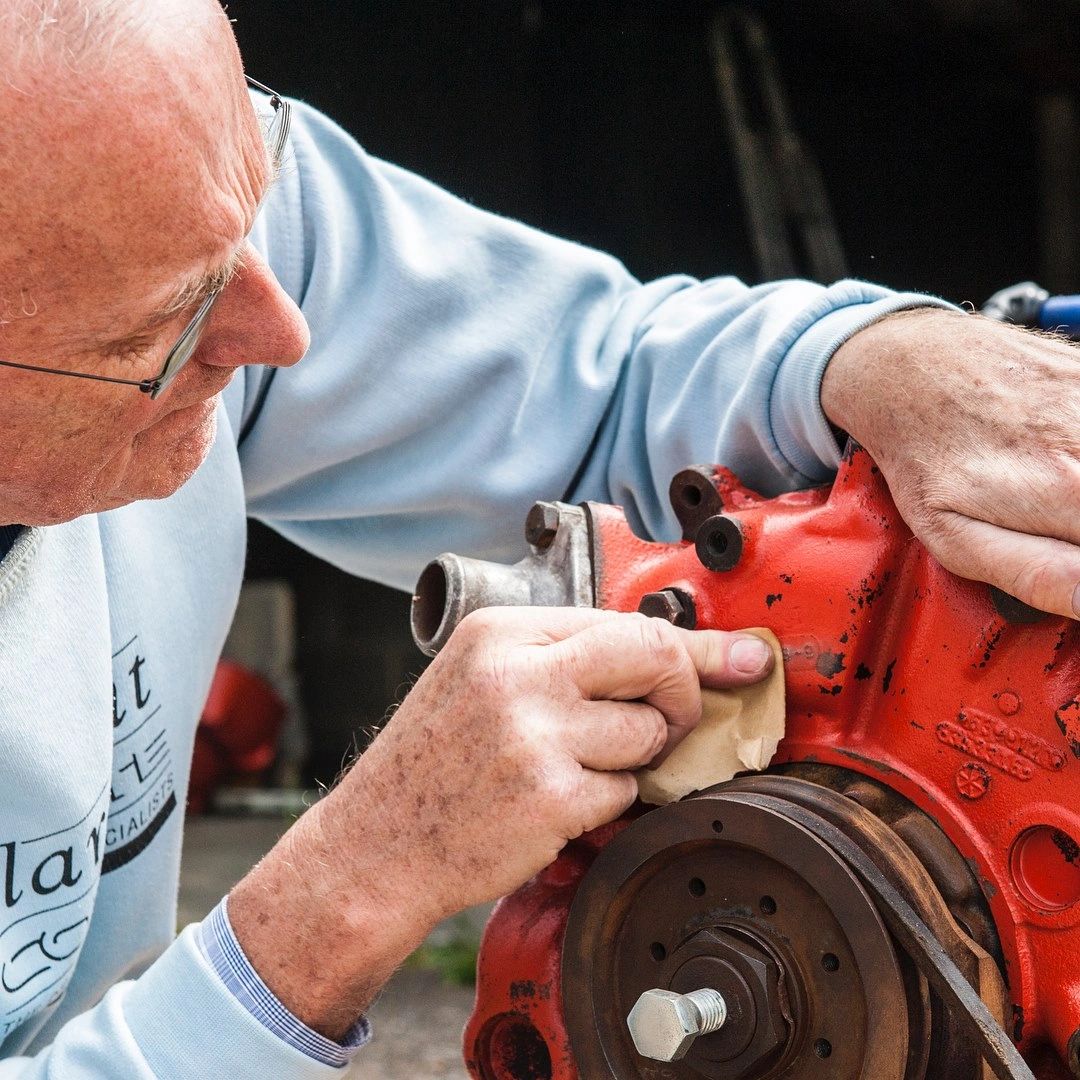
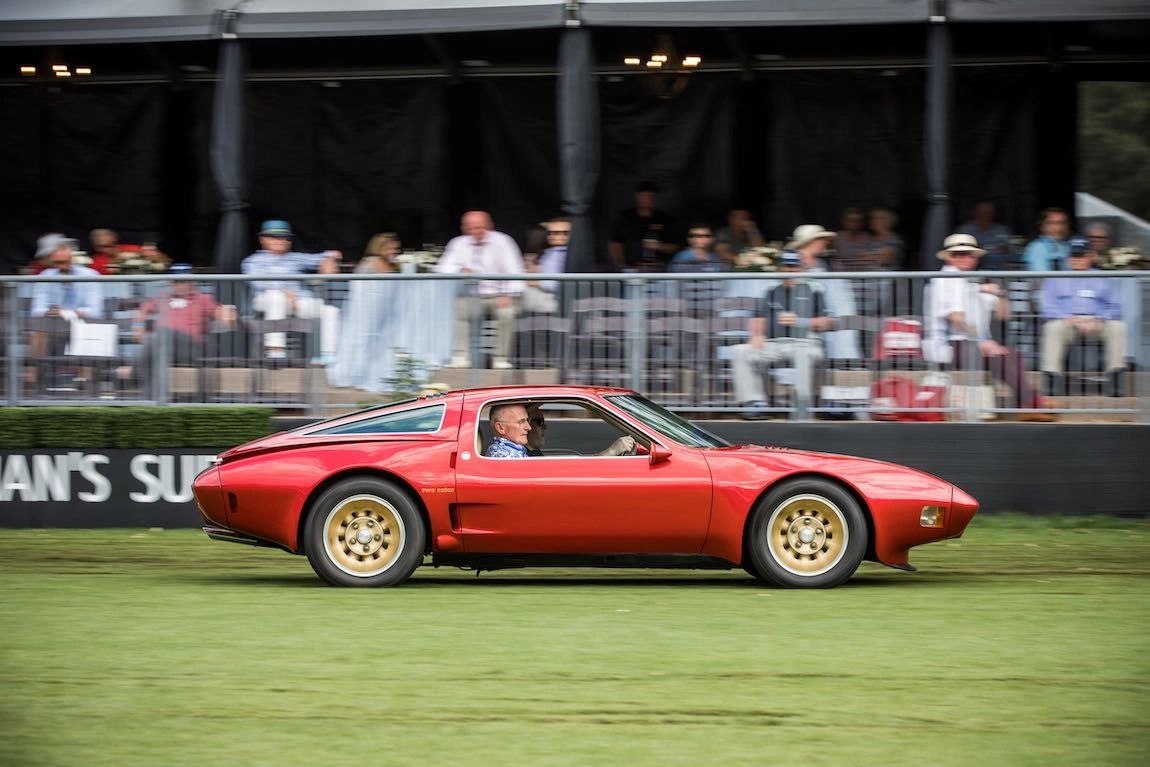
For its debut, the car was painted Firefrost Blue, a luminous, high-drama color that suited both Bill Mitchell’s taste and the car’s almost liquid body surfaces. It was low—just 43.7 inches tall according to GM Heritage material—and visually arresting in exactly the way a dream car needed to be. Showgoers saw something that looked simultaneously familiar and radical. It was unmistakably part of the Corvette universe, yet it also suggested a future in which Chevrolet would no longer be content merely refining the front-engine recipe.
The 1968 XP-880 Astro II rode on a compact 100-inch wheelbase and measured roughly 181 inches long, 74 inches wide, and just 43.7 inches tall, giving it a low, planted stance that looked every bit as exotic as its engineering suggested. Behind the cabin sat a mid-mounted 427-cubic-inch Mark IV big-block V8 rated at about 400 horsepower, routed through a two-speed transaxle in one of Chevrolet’s earliest serious attempts to package Corvette performance in a mid-engine layout. GM backed that drivetrain with a welded-steel backbone frame, a rear-mounted radiator, and a full-lift-up rear body section that exposed the engine and rear storage areas in one dramatic movement. Taken together, those specs made the Astro II less a simple show car than a fully realized experimental Corvette aimed squarely at the future. (Image courtesy of GM Media LLC.)
Speculation followed immediately.
Was this the next Corvette? Was Chevrolet preparing to strike directly at Europe’s exotics? Was America’s sports car about to move its heart behind the driver?
Those questions were the point. The 1968 XP-880 Astro II did not need to enter production to do important work for Chevrolet. It only needed to widen the imaginative boundaries of what Corvette could be. In that respect, it succeeded brilliantly.
Why It Didn’t Happen
What kept GM from turning the 1968 XP-880 Astro II into a production Corvette was not a lack of imagination, but a collision of engineering, cost, and practicality. Packaging a big-block V8 transversely behind the seats created real challenges in cooling, serviceability, durability, and transaxle strength, and Chevrolet had not yet solved those problems at the scale, reliability, and price point a production car would demand. Just as important, the Corvette was already succeeding as a front-engine sports car, so GM had little business incentive to gamble on such a radical and expensive departure in the late 1960s. In that sense, the Astro II was a brilliant proof of concept—far enough along to be credible, but still too complex and too risky to become the next Corvette. (Image courtesy of GM Media LLC.)
This is the part of the Astro II story where romance collides with arithmetic.
The C3 Corvette was succeeding. Dealers had demand. Buyers loved the styling. The Corvette had momentum, and momentum matters inside a corporation. A mid-engine production program would have required vast investment, major engineering development, new supply solutions, stronger transaxle technology, and almost certainly a higher price with lower volume. From Chevrolet’s point of view, that was a difficult argument to win when the existing formula was already printing enthusiasm and profit.
That is why the Astro II remains such a bittersweet artifact. It was not killed because it lacked imagination. It was not killed because it lacked aesthetic credibility. It was not even killed because the mid-engine idea was inherently unsound. It stalled because the business case was weak and the technical path to production was still expensive and incomplete. Chevrolet did not yet have a convincing answer to the question every large automaker eventually asks of every bold idea: yes, but can we make money on it in meaningful volume?
And so the car became what so many visionary machines become: a clue instead of a product.
The Quiet Influence of a Car That Never Reached Showrooms
The XP-880 Astro II was not an isolated flight of fancy. It was part of a long, deliberate succession of Chevrolet and GM mid-engine experiments—cars that tested proportion, packaging, aerodynamics, visibility, cooling, chassis balance, and the very idea of what a Corvette could become. From radical racing-adjacent studies to fully resolved design exercises, each concept pushed the conversation forward, and together they created the institutional memory that finally made the 2020 C8 Corvette possible. By the time Chevrolet committed to putting the engine behind the driver in a production Corvette, the company was no longer chasing a fantasy—it was drawing from decades of lessons first explored in cars like the XP-880 and the mid-engine concepts that followed it. (Images courtesy of the author.)
The 1968 XP-880 Astro II Corvette concept never entered production, but it did not vanish without leaving fingerprints.
Its broader influence can be seen in how it helped keep the mid-engine Corvette dream alive inside GM and in the public imagination. Once people had seen a Corvette-shaped machine with its engine behind the driver, the notion could no longer be dismissed as fantasy. The Astro II made the idea concrete. Later prototypes—the XP-882, Aerovette, Corvette Indy, CERV III, and eventually the production C8—would all move through a conceptual doorway that cars like the Astro II helped open.
Its styling influence appears to have been more direct still. Retrospective accounts from major enthusiast publications note that the Astro II’s body-color front treatment anticipated the 1973 Corvette’s cleaner nose, while its rear-end theme foreshadowed elements of the 1974 Corvette’s redesigned tail. Whether one wants to describe that as direct lineage or strong visual echo, the resemblance is real enough that the Astro II can fairly be read as a concept whose ideas did, in softened form, slip into production reality.
That, too, is part of how concept cars work. Not every dream reaches the street whole. Sometimes it is disassembled into gestures, surfaces, proportions, and ideas that gradually find their way into the showroom through side doors.
And that is precisely where the Astro II earns a more serious reading. It was not merely an exotic dead end or a dramatic showpiece created to stir crowds beneath the lights of an auto show stand. It was a rolling design argument—one that tested how far Chevrolet could stretch Corvette language without breaking it. Even stripped of its mid-engine destiny, the car still contributed. Its sharp, uncluttered front treatment, its tapered tail, and its overall sense of compression and purpose all suggested a future in which the Corvette could look cleaner, lower, and more sophisticated without surrendering its identity.
Seen that way, the Astro II occupies a fascinating middle ground in Corvette history. It was too advanced, too specialized, and too uncompromising to become a production car in its own right. But it was also too thoughtful, too resolved, and too influential to dismiss as a mere styling exercise. Some of its ideas were simply too good to disappear. They were absorbed, translated, and made digestible for production—muted where necessary, refined where practical, but still present. The result is that the Astro II’s legacy is not confined to the realm of unrealized possibility. Parts of it escaped the dreamscape and entered the bloodstream of the Corvette itself.
Why the 1968 XP-880 Astro II Still Matters Today
It’s easy to imagine the XP-880 stretching its legs on the open highways of the American West, its low, sculpted body slicing through the desert air as the sun falls behind the mountains. Out here—far from auto show turntables and design studios—the car feels less like a concept and more like a promise, one that Chevrolet wouldn’t fully deliver on for another half century. The proportions make sense. The stance feels right. And in this setting, with the road unwinding endlessly ahead, the Astro II no longer reads as an experiment—it reads as inevitability. That is the quiet brilliance of this car. Long before the mid-engine Corvette became reality in 2020, the XP-880 had already defined the visual and philosophical blueprint. It reminds us that progress doesn’t always move in straight lines; sometimes it takes decades for an idea to find its moment. But when it does, you realize it was never new at all—it was simply waiting for the world to catch up. (Image credit: GM Media LLC / ChatGPT)
The Astro II matters because it was one of the first times Chevrolet publicly revealed that the Corvette’s future might not be bound to tradition forever. It matters because it translated engineering restlessness into an object people could see, photograph, debate, and remember. It matters because it proved that Corvette designers and engineers were thinking in larger, bolder terms than the production line alone might suggest. And it matters because, more than fifty years before the C8 finally carried a mid-engine Corvette into showrooms, the Astro II made that future visible.
In a very real sense, the Astro II was not a failed Corvette. It was an early draft of a promise.
Today, preserved within GM’s heritage collection and displayed through institutions like the National Corvette Museum, the Astro II survives as more than a beautiful blue show car. It survives as evidence. Evidence that the mid-engine idea had real engineering substance decades before the C8. Evidence that Corvette’s stewards were willing, at least in flashes, to imagine something much more radical than the market required. Evidence that the dream did not begin in the 2010s, or even the 1980s, but deep in the experimental bloodstream of the 1960s.
And perhaps that is the most compelling thing about the XP-880 Astro II.
It was not built because Chevrolet had to build it. Chevrolet was already winning plenty of attention with the Corvette it had. The Astro II was built because somebody inside GM still believed that America’s sports car could be something even more exotic, more sophisticated, and more daring than the public had yet seen. That belief did not produce an immediate revolution in the showroom. But it did produce one of the most important concept cars in Corvette history.
The Astro II stands today as a polished, low-slung reminder that some of the most important cars are not the ones that make production. Sometimes the cars that matter most are the ones that reveal where the people behind the badge were trying to go.
And in the case of the Astro II, where they were trying to go was the future.
The XP-880 Astro II stands as one of the most compelling “what if” chapters in Corvette history—a bold mid-engine vision decades ahead of its time. This deep dive explores its design, engineering, and lasting influence, revealing how this experimental concept helped shape the path to Chevrolet’s ultimate performance breakthrough.
The image captures one of the great early Corvette moments: Chevrolet’s 1954 Motorama trio—the Corvette Nomad wagon, the Corvette Corvair fastback, and the experimental Corvette Hardtop—lined up behind a production 1953 Corvette roadster in the foreground. Together, they showed just how quickly Harley Earl’s new sports car had become both a production reality and a design canvas for GM’s wildest ideas. (Image courtesy of GM Media LLC.)
When General Motors flung open the doors of the Waldorf-Astoria on January 26, 1954, for the first stop of its traveling Motorama extravaganza, it wasn’t just showing next year’s showroom iron. Motorama was GM’s rolling theater: orchestras and dancers, revolving platforms, and—most memorably—“dream cars” that tested the limits of styling, materials, and ideas. The 1954 tour drew more than 1.9 million visitors across its cities, with New York as the kickoff venue, and it served up some of the most influential concepts of the decade: Buick’s Wildcat II, Pontiac’s Bonneville Special, Oldsmobile’s F-88, a trio of fiberglass Cadillacs—and the jet-inspired Firebird XP-21 that looked ready to lift off.
Amid that spectacle, Chevrolet used the stage to answer a pressing question: what’s next for Corvette? The fiberglass-bodied two-seater had stunned crowds at the 1953 show, but in production form, the early C1 struggled. Built first in Flint and then at St. Louis, the ’53–’54 cars kept the “Blue Flame” 235-cu-in inline-six and a Powerglide two-speed automatic, and they retained side curtains rather than roll-up glass. Sales were tepid: just 3,640 were built for 1954, and period accounts note that a significant number remained unsold at year’s end. Against that backdrop, Harley Earl’s Styling Section arrived at the 1954 Motorama with three Corvette-based concepts to re-ignite excitement: a detachable-hardtop prototype, a fastback coupe called Corvair, and a sleek sport wagon named Nomad.
1954 Corvette Hardtop
1954 Corvette Hardtop (Image courtesy of GM Media LLC.)
Of Earl’s three, the Corvette Hardtop was the most conservative—and arguably the most prophetic. At a glance it looked much like a production ’53/’54 roadster, but it wore a rounded, fixed-but-detachable fiberglass roof and, critically, it previewed features Corvette would not offer until 1956: roll-up side windows and outside door locks/handles. Contemporary and retrospective write-ups describe taller glass and a revised windshield frame to accommodate real roll-ups (a major upgrade from the snap-in curtains the early C1s used). That same wave of sources notes the presence of outside locks/handles, another feature that production Corvettes didn’t adopt until the 1956 redesign. In other words, the “Hardtop” was a preview of the daily-livability fixes that enthusiasts had been begging for.
Why did those details matter? As period testers (and plenty of later owners) observed, 1953–55 Corvettes lacked exterior door handles and roll-up windows, which made everyday use finicky; you reached inside via the curtain’s wind-wing to pull an interior knob. The 1956 restyle finally cured that. The Hardtop effectively showed the cure two years early, within a package that otherwise looked familiar enough to convince skeptics that Corvette could be a comfortable, weather-tight sports car as well as a glamorous showpiece.
1954 Corvette Corvair (Fastback Coupe)
1954 Corvette Corvair (Image courtesy of GM Media LLC.)
If the Hardtop whispered, the Corvair shouted. Built from a 1953 Corvette donor, the fastback coupe kept the stock front clip, doors, and rear quarters, but everything around the greenhouse was new. The forward-leaning A-pillars of the roadster were replaced by nearly vertical pillars that blended into the leading edge of a dramatic fastback roof, carrying the eye cleanly to a reworked tail. City-traffic practical? Not really. Visually arresting? Absolutely. Contemporary observers and later historians have likened the afterbody to jet-age forms, an impression Chevy amplified with a “cowled” rear license-plate enclosure styled like a turbine exhaust. That bright metal panel was etched with approximately 270 Chevy bowtie emblems and framed the plate and a pair of backup lamps.
The jet language didn’t stop there. The Corvair’s hood carried slotted chrome vents intended to draw off engine-bay heat. Ventilation for the cabin was handled by a clever fresh-air/exit-air system: three small rectangular intake slots stacked at the trailing edge of each front fender and manually controlled slatted vents in the C-pillars for exhaust. Air conditioning wouldn’t reach a production Corvette until 1963, so this was a pragmatic way to improve comfort while keeping the body lithe. Inside, the Corvair largely resembled its ’53 foundation, save for controls to operate those vents—and of course the fastback’s unique headliner and rear deck treatment.
As with many Motorama showstoppers, GM seriously considered a limited production run. According to period coverage and later research, management wavered more than once, even exploring the possibility of adapting the Corvair’s afterbody elements as a 1955 styling update. Ultimately, 1954’s slow Corvette sales—and the strategic decision to focus on a V-8-powered ma keover—killed the idea. The Corvair’s fate remains murky. Some sources assert at least two were built for the tour; others say one. Most accounts agree the coupe was destroyed (reportedly by the mid-to-late 1950s), though rumors of a survivor have bubbled up for decades without proof.
1954 Corvette Nomad (Sport Wagon)
1954 Corvette Nomad Sport Wagon (Image courtesy of GM Media LLC.)
If the Corvair made an emotional case, the Nomad made a practical one—without losing an ounce of style. Conceived by designer Carl Renner in one of Chevrolet’s special styling studios and developed under Harley Earl’s direction, the Nomad took the Corvette’s face and grafted it to a lithe two-door wagon body with a forward-slanting B-pillar and wraparound rear glass. It was a sport wagon in the literal sense: low, sleek, and purposeful—but with genuine utility built in.
Unlike the roadster’s 102-inch wheelbase, the Nomad rode on a 115-inch Chevrolet passenger-car chassis—more room for people and luggage. Under the skin, it kept the familiar “Blue Flame” six with a Powerglide automatic, just like the production ’53–’54 Corvette. The interior mixed show-car flourish with real functionality: blue-and-white leather trim, a distinctive ribbed headliner, and (most talked-about) an electric tailgate window. Unlock the tailgate, and the glass automatically retracted; there was also a dashboard button to raise or lower it. With a fold-flat rear seat, the Nomad could seat six and still swallow cargo—a package that no other “sports car” of the era could come close to matching.
Corvette Hall of Fame Inductee Carl Renner was part of the “Project Opel” original Corvette Motorama project design team. Renner’s design contributions include the Corvette side cove (1956), Corvette ducktail rear end (1961), the Corvette Nomad roofline and the deluxe steering wheel, grilles, recessed hoods, the “notch belt” fender line, parking lights, bumper guards and side trim. (Image courtesy of the National Corvette Museum.)
Renner’s clean sketch work and Earl’s showmanship were deliberate misdirection.“Nobody would expect to see a wagon version of the Corvette,” Chevrolet Studio chief designer Clare “Mac” MacKichan later recalled—an insight Karl Ludvigsen captured in Corvette: America’s Star-Spangled Sports Car. It was precisely that surprise that made the Nomad a sensation at the Waldorf and beyond. And unlike the Corvair, elements of the Nomad did reach production—just not on a Corvette. GM redirected the idea to its higher-volume A-body platform, yielding the 1955 Chevrolet Bel Air Nomad (and Pontiac’s related Safari) with a roofline that tracked the Motorama original astonishingly closely. The change in platform made financial sense and delivered one of the most recognizable silhouettes of the Tri-Five era.
How many Corvette-based Nomads existed? Here, the historical record gets fuzzy. Some sources claim three were built for the traveling show; others say five. Publicly accessible evidence of a complete surviving original has never surfaced, and several reputable publications treat the car(s) as lost to the scrapper—standard practice for many one-off show cars of the 1950s. Today’s “Corvette Nomads” are typically faithful recreations built from period photos and specs.
The 1954 Tour, the Crowd, and the Context
The 1954 Corvette Nomad on display in the lobby of the Waldorf Astoria Hotel at that year’s Motorama event. (Image courtesy of GM Media.)
Motorama ’54 wasn’t just New York. After the Waldorf-Astoria opener, the show moved to Miami’s Dinner Key Auditorium, then west to Los Angeles and San Francisco, and on to Chicago—hauling over 100 truckloads of exhibit gear and cars from city to city. In aggregate, the tour pulled nearly two million visitors that year, and for many, these dream cars were their first encounter with fiberglass bodies, power amenities you couldn’t yet buy, and styling that looked equal parts Paris and pilot’s lounge. It’s telling that GM put all three Corvette concepts into that mix: the company was both selling the Corvette of today and auditioning the Corvette of tomorrow.
Outside the Chevrolet corner of the floor, 1954 Motorama also set the tone for the industry’s full-tilt “Jet Age” fascination. Pontiac’s glass-domed Bonneville Special and Oldsmobile’s golden-hued F-88 carried exotic aircraft cues into swoopy fiberglass bodies, while the Firebird XP-21 went all the way—single seat, delta-like wings, vertical fin, and a Whirlfire gas turbine. The Firebird wasn’t meant for production; it was a laboratory on wheels and a statement of GM’s technological ambition. But the press coverage it drew helped legitimize the “experimental” status of Motorama concepts—including the Corvette trio—as more than simple eye candy.
Why the Corvette Trio Mattered
1954 Corvette Corvair on display at the 1954 Motorama. (Image courtesy of GM Media LLC.)
They answered the comfort/utility critique head-on. Early road tests and owner surveys praised the Corvette’s style but dinged its day-to-day usability—especially the side curtains and fiddly door access. The Hardtop directly previewed roll-up windows and exterior handles/locks that arrived with the 1956 redesign, addressing those pain points in exactly the way customers wanted.
They explored body styles that could broaden Corvette’s appeal without abandoning its character. The Corvair coupe posed a question Corvette wouldn’t revisit until the 1963 Sting Ray: what if a Corvette had a fastback roof? Even if the XP-series and Bill Mitchell’s later work were separate lineages, the Corvair made the coupe concept “thinkable” within Chevrolet. The Nomad, meanwhile, suggested an enthusiast’s family car long before “sport wagon” was a marketing term—an idea so compelling that GM found it a bigger home on its mainstream platform.
They kept Corvette in the conversation during a fragile moment. With 1954 sales lagging and V-8 power not yet in the lineup (that would come in 1955, with roll-up glass in 1956), the Motorama concepts reminded the public—and perhaps GM brass—that Corvette could be aspirational, adaptable, and American and modern. In that sense, the cars weren’t merely design studies; they were confidence builders.
Legacy: The “What-Ifs” That Shaped What Was
The 1954 Corvette Hardtop at GM’s Design Studio in Detroit, Michigan (Image courtesy of GM Media.)
It’s easy to dismiss Motorama cars as styling flights of fancy. Yet the Corvette Hardtop, Corvair, and Nomad show how GM used the tour as a true product lab. Within two years of their debut, production Corvettes had glass roll-up windows and a detachable hardtop on the order sheet. Within one year, Chevrolet launched a V-8 that altered the Corvette’s destiny. And within that same 1955 model year, Chevrolet and Pontiac were selling Nomads and Safaris that traced a straight line to Renner’s Motorama roofline.
Add the broader 1954 context—Firebird I’s turbine bravado, the fiberglass Cadillacs, the Bonneville Special’s bubble canopies—and you see why Motorama mattered. It gave GM permission to fail in public and to succeed in pieces. The 1954 Corvette trio didn’t roll straight from the Waldorf to the dealer lot, but their ideas absolutely did.
Why the Corvette Hardtop, Corvair, and Nomad Concepts Still Matter Today
Only a handful of images of the 1954 Motorama Corvette concepts still exist, and even fewer show the Corvette Corvair, Corvette Hardtop, and Corvette Nomad together in a single frame. That is part of what makes this rendering – while imperfect in its rendering of these early Motorama masterpieces – so meaningful. It offers another glimpse into what Harley Earl and his gifted team of designers were exploring at the dawn of Corvette history, when the car’s identity was still taking shape, and its future had not yet been fully defined.
Today, we know the Corvette as America’s great high-performance sports car, but these early concepts remind us that its path was never inevitable. They were not styling dead ends, but bold design studies that tested new ideas about form, function, and possibility. In at least one important case, they also helped shape what came next, as the production Chevrolet Nomad emerged as a clear and intentional descendant of the original Corvette Nomad shown here in blue. That is why these concepts still matter today: they prove that what one generation of designers imagines can become the catalyst for the production of cars that future generations come to know, admire, and remember. (Image courtesy of the author/ChatGPT.)
What made the 1954 Motorama trio so important was not simply that Chevrolet built three more dream cars around the Corvette name. It was that each one tested a different possible future for America’s sports car at the exact moment the division was still deciding what Corvette could become. The Corvette Corvair pushed the idea toward European-style fastback sophistication. The Corvette Nomad explored whether Corvette DNA could stretch into a sporty, style-forward utility car years before that kind of crossover thinking became common. And the Hardtop Corvette addressed something more immediate, but no less important: how to make the open Corvette feel more complete, more usable, and more appealing to buyers who wanted sports-car glamour without giving up year-round practicality. Taken together, they were not random showpieces. They were design proposals, market experiments, and strategic thought exercises wearing Motorama sheetmetal.
That is why the trio still matters today. These cars remind us that Corvette’s survival was never guaranteed by the production car alone. It endured because Chevrolet kept imagining beyond the car it already had. In the Corvair, Nomad, and Hardtop concepts, we can see a brand trying to find its shape in real time—testing elegance, versatility, and refinement before those ideas fully matured in production. They show us that even in Corvette’s infancy, the people guiding the program were already wrestling with the same question that has followed the car through every generation since: how do you protect the soul of America’s sports car while still allowing it to evolve?
Seen through that lens, the 1954 Motorama trio was more than a sideshow to the early Corvette story. It was part of the argument for why Corvette deserved a future at all. These concepts expanded the public’s understanding of what the Corvette name could mean and, in doing so, helped keep the conversation alive at a moment when the car itself was still finding its footing. That distinction still matters. Because long before Corvette became an institution, these three dream cars helped prove it had the imagination to become one.
In 1954, Chevrolet briefly imagined the Corvette as something more than a two-seat sports car. The Nomad, Corvair, and Hardtop concepts revealed just how wide Harley Earl’s vision really was—and how profoundly those early ideas helped shape Corvette history.
By the time the 1974 Corvette reached showrooms, the American performance car was fighting for its life. The trouble had not started in St. Louis, but half a world away.
In October 1973, the Arab members of OAPEC—joined by Egypt, Syria, and Tunisia—announced an oil embargo against the United States and several Western allies in response to U.S. support for Israel during the Yom Kippur War. From October 1973 to March 1974, crude prices roughly quadrupled from about $3 to $12 a barrel, while U.S. gasoline prices jumped nearly 50 percent in a matter of months. Long lines at the pump, odd/even rationing schemes, and shuttered stations became part of the American landscape.
Detroit had already been grappling with a different kind of crisis: tightening federal emissions rules and new safety standards that forced carmakers to add weight while simultaneously cutting compression and horsepower. The Clean Air Act amendments of 1970 had empowered the newly formed EPA to ratchet down allowable tailpipe emissions, effectively forcing a move toward catalytic converters in the mid-1970s and making unleaded gasoline a necessity, since leaded fuel quickly poisoned catalyst substrates.
Against that backdrop, the 1974 Corvette emerged as a transitional car in every sense. It still looked and felt like a classic C3 Stingray, still offered a genuine big-block 454, still exhaled through a real dual exhaust system—and yet it sat on the brink of the catalytic-converter era. In many ways, 1974 was the last Corvette of the “old world,” even as it pointed directly at the future.
Bridging Two Eras: Power, Fuel, and the End of the Big-Block
Pop the hood on a 1974 Corvette and you are looking at the end of an era. The LS4 454 big-block seen here was offered for the final time in ’74, closing the book on the torquey, brute-force V-8s that had defined Corvette performance since the mid-1960s. With emissions rules tightening and catalytic converters on the horizon, this was the last Corvette that could be ordered with a factory big-block—and the last to exhale through a true dual exhaust system. (Image courtesy of RK Motors)
From a historical standpoint, three “lasts” define the 1974 model year:
It is the final year a Corvette could be ordered with a big-block V-8, the LS4 454.
It is the final year of a true dual exhaust system, with separate pipes and mufflers for each bank of cylinders.
It is the final Corvette that could legally run on leaded gasoline; starting with the 1975 model year, federal regulations and the arrival of catalytic converters made unleaded fuel mandatory for new passenger cars.
The 1974 engines were engineered to operate on 91-octane leaded or low-lead fuel, a transitional step that anticipated the coming unleaded-only world. Chevrolet, like every other manufacturer, was walking a tightrope: trying to preserve as much of the Corvette’s performance character as possible while keeping the car compliant with emissions, noise, and fuel-economy pressures that simply did not exist when the C3 debuted for 1968.
If you draw a line through the early chrome-bumper cars and the late, catalyst-equipped C3s, the 1974 Corvette sits almost exactly at the pivot point. It is both the last of the big-inch bruisers and an increasingly refined grand touring car.
Styling: Urethane All Around and a One-Year-Only Tail
The 1974 Corvette’s split rear bumper is on full display here, its body-color urethane halves framing the tail and visually echoing the car’s signature four round taillights. Just above, the smoothed gas filler door stands out with its lack of emblem, giving the rear deck a cleaner, almost custom look that lets the sculpted lines and rich paint take center stage. (Image courtesy of Facebook user John Berg)
The most obvious visual change for 1974 is at the rear of the car. Federal bumper regulations had required a 5-mph front impact standard starting in 1973 and extended that 5-mph requirement to the rear for 1974.
Chevrolet’s response was to complete the transition begun in 1973. The chrome rear bumper was retired, and in its place came a body-color urethane fascia that visually matched the urethane front treatment introduced the previous year. Under that plastic “skin” lived a substantial aluminum impact bar mounted on telescoping brackets, engineered to absorb low-speed hits without damaging the frame.
Several details make the 1974 rear fascia unique:
The urethane shell was built in two halves, left and right, joined by a vertical center seam. No other C3 model year used this two-piece arrangement, and the seam is a quick visual tell for a ’74.
The taillamps were recessed into larger pockets, and the exhaust outlets were moved to exit underneath the bumper rather than through cutouts in the bodywork, as on earlier cars.
The familiar fuel-filler “cross-flags” emblem on the rear deck, last seen in 1973, disappeared; 1974s went without a gas-lid emblem altogether.
GM’s 1974 Corvette advertising leaned hard into the car’s role as an escape machine, selling it as the perfect way to “see the U.S.A.” on winding back roads far from the gas lines and malaise of the era. This vivid, almost storybook artwork puts the driver front and center, top down and nose pointed into the next curve, reinforcing Corvette as a lifestyle decision—equal parts performance, freedom, and style—rather than just another new car in the showroom.
Chevrolet’s own brochure copy made the case that this wasn’t change for the sake of change: when engineers strengthened the rear bumper, styling was refined as well, yielding a smoother, more integrated tail that complemented the wind-tunnel-honed nose and fenders.
Up front, the car carried over the ’73 urethane bumper cover, pop-up headlamps and the now-familiar “shark” profile. Subtle detail changes—black aluminum grille inserts, revised emblem treatment—kept the car visually fresh without disturbing the fundamental shape that had made Corvette one of the most recognizable silhouettes in the world by the mid-1970s.
Interior and Safety: Quiet Refinement
By 1974, Corvette’s engineers had fully integrated the shoulder belts into the seat design, eliminating the awkward roof-hung hardware of earlier C3s. The inertia-reel belts feed cleanly from behind the high-back buckets, giving the cockpit a much cleaner look while still meeting tightening federal safety standards. It is a small detail, but one that reflects how Corvette was evolving from a bare-bones sports car to a more refined, safety-conscious grand tourer. (Image courtesy thevettenet.com)
The interior of the 1974 Corvette did not undergo a wholesale redesign, but it did receive meaningful upgrades aimed at refinement, safety, and day-to-day usability.
The most important change came in occupant restraint. Coupes received new integrated lap-and-shoulder belts for the first time, with inertia-reel mechanisms engineered to lock under deceleration rather than solely on belt-pull rate. Convertibles retained separate lap and optional shoulder belts.
Other updates included:
A wider inside rearview mirror—now 10 inches across—to broaden the driver’s view aft.
Revisions to the HVAC ducting that improved air distribution, especially when equipped with the increasingly popular Four-Season air conditioning.
Additional attention to sound control. When steel-belted radials were adopted earlier, road noise dropped enough that the exhaust note stood out more prominently. For 1974, Chevrolet“retuned” the dual exhaust system with added resonators—essentially mini-mufflers—to soften the cabin sound level without losing the Corvette’s characteristic growl.
The overall cabin remained familiar: a driver-centric layout with a deep-dish sport steering wheel, full instrumentation grouped directly ahead and to the right of the column, a center console housing the shifter and handbrake, and twin storage bins under the rear deck. Deep-pleated vinyl or optional leather seats offered more lateral support than the pre-’70 chairs, and color-keyed, deep-twist carpeting helped sustain the Corvette’s increasingly upscale grand-touring persona.
Chassis, Suspension, and Brakes
The bare chassis of Zora Arkus-Duntov’s personal 1974 Corvette sits mid-restoration at the National Corvette Museum, giving a rare look at the bones of a mid-’70s C3. Under the fiberglass body, the ’74 rides on a stout ladder-type steel frame with fully independent suspension at all four corners, a transverse rear leaf spring, and four-wheel disc brakes—hardware that helped Corvette feel far more sophisticated than most domestic performance cars of the era. Seeing it stripped down like this underscores how much of the car’s legendary ride and handling was engineered into the chassis long before the body and big-block (or small-block) ever met. (Image courtesy of the National Corvette Museum)
Underneath, the 1974 Corvette remained fundamentally a 1963-era Sting Ray at heart—and that was not a bad thing. The basic chassis architecture, refined over a decade, still delivered the combination of ride and handling that made the Corvette the de facto benchmark for American sports cars.
The front suspension used unequal-length A-arms, coil springs, and an anti-roll bar; the rear retained the independent layout introduced in 1963, with a differential solidly mounted to the frame, and each wheel carried on trailing arms, struts, and a transverse multi-leaf steel spring. This independent rear suspension reduced unsprung weight and allowed each wheel to follow the road more faithfully, helping the Corvette maintain composure over broken pavement and during aggressive cornering.
Four-wheel disc brakes were standard, with power assist (RPO J50) ordered on an overwhelming majority of cars—33,306 of 37,502, or nearly 89 percent of production. Corvette owners in 1974 clearly valued braking confidence and everyday drivability as much as straight-line speed.
This blueprint-style illustration highlights the Corvette’s fully independent suspension, 4-wheel disc brakes, and independent rear differential—the same fundamental chassis layout that carried the car from 1963 all the way through 1982. While details evolved over those two decades, this basic configuration proved so advanced and well-balanced that Chevrolet refined it rather than replaced it, underscoring just how far ahead of its time the original design really was. (Image created by and property of K. Scott Teeters)
For the serious driver, the sleeper option of the year was the FE7 Gymkhana Suspension. For a mere seven dollars, Gymkhana added higher-rate springs, firmer shocks, and a larger-diameter front stabilizer bar. The package had its roots in the F41 and Z06 heavy-duty suspensions of the 1960s, but by 1974 it had morphed into one of the all-time performance bargains—specified on just 1,905 cars (about 5 percent of production).
Above that sat RPO Z07, the Off-Road Suspension and Brake package. Z07 combined the Gymkhana underpinnings with heavy-duty power disc brakes and specific gearing; just 47 cars were built with this package, making Z07-equipped ’74s some of the rarest performance-focused C3s of the era.
Powertrains: Three Very Different V-8 Characters
Despite the hostile regulatory and fuel environment, Chevrolet still offered three distinct engines for the 1974 Corvette, each with its own personality.
L48: The Everyday Small-Block
The 1974 Corvette’s L48 was the standard small-block V8 and, despite tightening emissions regulations, remained a well-balanced and dependable performer. Rated at 195 horsepower (net) with a four-barrel carburetor, it emphasized smooth drivability and usable torque rather than outright peak output. Period road tests consistently praised the L48 for its refinement and everyday performance, especially when paired with the Corvette’s relatively light chassis. In an era of declining horsepower figures, the L48 proved that balance and real-world performance still mattered.
The standard engine remained the 350-cid Turbo-Fire small-block (RPO ZQ3, commonly identified as L48 for 1974), rated at 195 net horsepower at 4,400 rpm and 275 lb-ft of torque at 2,800 rpm.
Compression sat at 8.5:1, and fueling was via a Rochester Quadrajet four-barrel carburetor. In this tune, the small-block was deliberately mild-mannered: smooth idle, good low-speed driveability, and enough mid-range torque to make the car feel lively even with the increasingly popular Turbo Hydra-Matic automatic transmission. Contemporary tests of base-engine, automatic-equipped cars with economy axle ratios produced 0–60 mph times in the high-eight to low-nine-second range—respectable performance in the early “malaise” years, if not the tire-melting brutality of late-1960s big-blocks.
L82: The “Enthusiast” 350
The 1974 Corvette’s L82 represented the high-water mark for small-block performance in an increasingly emissions-restricted era. Rated at 250 horsepower (net), it featured higher compression, a more aggressive camshaft, and revised induction that delivered noticeably stronger top-end power than the standard L48. Contemporary testers frequently cited the L82 as the best all-around engine in the lineup, blending improved acceleration with the responsiveness enthusiasts expected from a Corvette. For buyers who wanted maximum performance without stepping up to the big-block, the L82 was the clear choice.
For buyers who still wanted some sting in their Stingray, the L82 350-cid engine remained the sweet spot. Rated at 250 net horsepower at 5,200 rpm and 285 lb-ft at 4,000 rpm, the L82 employed a more aggressive camshaft, higher 9.0:1 compression, revised cylinder heads, and other detail changes to broaden the powerband and sharpen throttle response.
Hi-Performance Cars magazine’s September 1973 issue, in a period comparison of L48, L82, and LS4, praised the base engine for its balance but acknowledged that the L82 delivered the best all-around performance. Independent performance compilations show L82 four-speed cars posting 0–60 times in the mid-7-second range and quarter-mile runs in the mid-15s at around 90–92 mph.
In short, the L82 restored much of the real-world punch that the lower net horsepower labels tended to obscure. It was not an LT-1, but in the context of 1974, it remained one of the stronger performance engines available in an American production car.
LS4: The Final 454
The 1974 Corvette’s LS4 marked the final appearance of Chevrolet’s legendary 454 cubic-inch big-block, closing an important chapter in Corvette performance history. Rated at 270 horsepower (net), the LS4 emphasized immense low-end torque and effortless acceleration rather than high-revving horsepower. While emissions and fuel economy pressures had softened its peak output compared to earlier big-blocks, the driving experience remained unmistakably muscular. As the last big-block Corvette engine ever offered, the LS4 carries enduring historical significance and strong collector appeal today.
At the top of the range sat the LS4 454-cid Turbo-Jet big-block, rated at 270 net horsepower at 4,400 rpm and a stump-pulling 380 lb-ft of torque at just 2,800 rpm. Compression was a relatively modest 8.25:1, and like the other engines, the LS4 had been tamed to satisfy emissions and noise regulations.
On paper, the LS4’s 270 hp rating might look underwhelming next to earlier gross-rated 427s and 454s, but the engine still delivered immense mid-range thrust. Contemporary commentary often noted that the LS4 felt strongest in rolling acceleration, lunging the car forward on a wave of torque rather than screaming to redline.
Importantly, 1974 was the last time any Corvette buyer could check a box for a factory big-block. Only 3,494 cars—just over 9 percent of production—were ordered with the LS4, making 1974 454 cars a finite and historically significant subset of C3 production.
Transmissions and Axle Ratios
The Muncie M21 was Chevrolet’s close-ratio four-speed—an enthusiast-grade gearbox designed to keep the engine “on the cam” by tightening the spacing between shifts. Compared to the wide-ratio M20, the M21’s 2.20:1 first gear delivered a more performance-focused feel, rewarding drivers who paired it with a deeper rear axle ratio and weren’t afraid to use rpm to stay in the powerband. In Corvette applications, the M21 was typically reserved for higher-output combinations, reflecting its intent as the sharper, more aggressive manual option for buyers who wanted a crisp, mechanical shift quality and stronger acceleration feel once the car was moving. In short: if the TH400 was the smooth torque-handling workhorse, the M21 was the driver’s gearbox—purpose-built for control, response, and speed between the gears.
A fully synchronized four-speed manual transmission remained the Corvette’s baseline choice, carrying a wide-ratio gearset that used a 2.52:1 low gear to make the most of the era’s torque curves and relatively tall rear gearing. In practical terms, that 2.52 first gear gave drivers a livable launch without forcing an overly aggressive axle ratio, which helped keep engine speed (and cabin noise) reasonable at highway pace—an important consideration in the mid-1970s when fuel economy, emissions calibration, and drivability were all competing priorities. It also fit the Corvette’s dual-role identity of the period: still very much a performance car, but increasingly expected to behave like a refined grand tourer in normal traffic.
For buyers who wanted a more performance-oriented shift pattern, RPO M21 added a close-ratio four-speed with a 2.20:1 first gear—an arrangement that effectively “tightened up” gear spacing and kept the engine in a narrower, more usable power band during spirited driving. That closer stepping could make the car feel more eager once rolling, especially when paired with engines that responded well to being kept on the boil, but it also meant you generally needed the right rear axle ratio to avoid a soft, luggy launch. Notably, M21 availability was limited to higher-performance combinations—available only with the L82 and LS4—and it was installed on 3,494 cars, underscoring that most customers still prioritized broad drivability and everyday ease over a more demanding, track-leaning setup.
The Turbo Hydra-Matic 400 (TH400) was one of General Motors’ most robust automatic transmissions, prized for its strength, smooth operation, and ability to handle high torque with remarkable reliability. Introduced in the mid-1960s and used extensively in Corvettes through the 1970s, the TH400 featured a three-speed layout with a strong cast-aluminum case and a proven hydraulic control system. Its durability made it especially well-suited to big-block applications and high-output small-blocks, where consistency mattered as much as outright performance. By the mid-1970s, the TH400 had become a cornerstone of Corvette drivability, helping redefine the automatic transmission as a legitimate performance choice rather than a compromise.
Meanwhile, the Turbo Hydra-Matic three-speed automatic (RPO M40) continued to build momentum, appearing on 25,146 Corvettes—roughly two-thirds of total production—highlighting the market’s clear drift toward automatics even in sports cars. This wasn’t simply a comfort trend; it also reflected how well the THM units could handle torque, how consistent they were in real-world acceleration, and how many buyers wanted performance without the effort and learning curve of a manual in stop-and-go conditions. In a decade where manufacturers were heavily focused on emissions compliance and repeatable drivability, the automatic also offered a predictable, calibration-friendly operating window—one more reason it became the default choice for a large share of the Corvette audience.
Axle ratios, as always, were the quiet “multiplier” that shaped how each engine-and-transmission combination felt from a stop and at cruising speed, and choices varied by engine, transmission, and whether the car carried air conditioning. Base-engine cars typically leaned on 3.36:1 and 3.08:1 gears as balanced, all-purpose matches; L82 cars could be ordered with 3.55:1 or 3.70:1 to sharpen initial hit and midrange punch; and LS4 cars usually ran 3.08:1 or 3.36:1, with 3.55:1 reserved for off-road Z07 applications. Put simply, deeper gears improved jump off the line and helped a close-ratio four-speed feel “alive,” while taller gears reduced cruise rpm and noise—exactly the kind of tradeoff buyers weighed when deciding whether their Corvette would live more on back roads, highways, or the occasional competition-style environment.
Performance in Context
This 1974 Corvette—now proudly displayed at the National Corvette Museum—carries one of the most intriguing details in Corvette racing lore: a Ferrari badge on an American endurance racer. The emblem was not a tribute but a bit of psychological gamesmanship, added in-period to misdirect attention from scrutineers and rival teams by visually blending in with the dominant Italian machinery. At a time when production Corvettes were grappling with emissions rules and the fading big-block era, this car’s European racing exploits—and its mischievous Ferrari crest—show how much ingenuity, performance, and sheer audacity still lived within the C3 platform. (Image courtesy of the author)
Viewed through a modern lens, mid-7-second 0–60 times and mid-15-second quarter miles do not sound heroic. In the context of 1974, they were very real numbers—earned in an era when the entire industry was wrestling with lower compression, retarded ignition timing, leaner calibration, exhaust gas recirculation, and the added weight and aero compromises that came with new 5-mph bumper standards. The result wasn’t just slower stoplight sprints; it was a wholesale reshaping of the performance landscape. Many family sedans—and plenty of “personal luxury” coupes—now needed well into the teens to reach 60 mph, and the gap between “fast car” and “regular car” narrowed dramatically.
Against that backdrop, the 1974 Corvette—especially in L82 or LS4 form with a four-speed—remained a genuinely quick car by contemporary standards. It still delivered real passing power, still felt composed at speed, and still rewarded drivers who understood gearing and kept the engine in its sweet spot. Top speeds in the 120–125 mph range (depending on engine and axle ratio) weren’t just plausible; they reinforced Corvette’s identity as a high-speed American GT at a moment when many rivals were being detuned into softness. Contemporary reviewers continued to praise the Corvette’s stability, and as radial tires became more common, the Corvette’s ability to settle in and track cleanly at higher speeds only improved.
Car #51—the wide-arched, First National City–backed Corvette—remains one of the most compelling racing stories tied to the 1974 model year. Although based on earlier C3 architecture, this car embodied the aerodynamic and cooling challenges Chevrolet was wrestling with in 1974 as emissions regulations tightened and the big-block era drew to a close. Campaigned at the 24 Hours of Le Mans by Greder Racing, the #51 Corvette showcased how privateer teams continued to extract competitive performance from the platform even as showroom cars were transitioning into lower-compression, cleaner-burning powertrains. Its flared fenders, deep front spoiler, and aggressive ductwork previewed the functional approach to airflow management that Chevrolet refined during the mid-1970s, and its gritty endurance résumé stands today as a reminder that—even in a politically, economically, and mechanically constrained era—the Corvette remained a legitimate international competitor.
Fuel economy, however, was no longer a sidebar—it was front-page news. Period accounts and modern owner data consistently point to “mid-teens if you behave” highway mileage for a well-tuned small-block, with big-block cars generally returning somewhat lower figures, especially in city driving. The key change was psychological as much as mechanical: by 1974, even performance buyers could no longer treat mpg as trivia. With gas lines, price shocks, and a marketplace increasingly sensitized to efficiency, Corvette owners were being asked—often for the first time—to think about range and consumption in the same breath as acceleration.
Yet the Corvette’s performance identity was never confined to instrumented tests, and the mid-1970s did not mark an end to competition relevance. The C3 platform remained a stout foundation for racing thanks to its fundamentals—strong chassis geometry, broad parts support, and an engine architecture that privateers understood down to the last bolt. In road racing circles, the formula was clear: reduce weight, improve cooling, widen the tire footprint, upgrade brakes, and build the small-block or big-block to survive sustained rpm. Even as street cars absorbed the compromises of the day, track-prepped Corvettes continued to prove the underlying package still had real pace.
Still wearing its mischievous Ferrari shield, this #100 1974 Corvette continues to stretch its legs in historic racing, a living link to the C3’s gritty endurance past. Built for European long-distance events, it ran in an era when privateer Corvette teams relied on clever aero tweaks, big power, and a bit of psychological gamesmanship—like that Italian crest—to hold their own against factory-backed rivals. Today, every lap it turns is a reminder that even in the regulation-strangled mid-1970s, Corvette racers refused to back down on the world stage.
That dual identity—street compromise, track potential—helps explain why 1974-era Corvettes continue to appear in historic competition today. Many are prepared to period-correct specifications and run in vintage GT classes, where the C3’s long-wheelbase stability and V8 torque remain effective tools. The example shown here, wearing “GT1” markings and period-style sponsor livery, captures that spirit: a purposeful, wide-tired Corvette built to look and behave like the sort of privateer C3 that would have been developed for endurance-style road racing, where stability, braking, and reliability mattered as much as outright straight-line speed.
The most striking detail on the car—the Ferrari prancing horse—has its roots in one of the more unusual footnotes in Corvette endurance lore. In the early 1970s, a Corvette entry found a path to Le Mans through an arrangement connected to Luigi Chinetti’s North American Racing Team (N.A.R.T.), long associated with Ferrari’s international racing efforts. As part of that deal, the Corvette carried N.A.R.T./Ferrari identifiers, including the prancing horse, despite being very much a Chevrolet-powered car. On modern historic grids, the emblem is often worn as a deliberate tribute to that episode—a visual reminder that international endurance racing has always involved a blend of speed, politics, sponsorship leverage, and the occasional improbable alliance.
Production, Market Reception, and the State of Chevrolet
By 1974, the Corvette convertible was nearing the end of its run, and this Classic White Stingray captures the elegance of a body style living out its final chapters. Safety concerns—particularly looming federal rollover standards—had Detroit bracing for regulations that threatened the viability of open-top cars. Even though many of those rules never fully materialized, Chevrolet made the strategic decision to discontinue the convertible after 1975, focusing instead on the structurally stiffer, easier-to-certify coupe. As a result, late C3 convertibles like this one have become especially meaningful: they represent the last era in which the Corvette embraced true open-air motoring before a 10-year hiatus, and they reflect a moment when engineering realities and regulatory pressure reshaped the future of America’s sports car. (Image source: bringatrailer.com)
In a year when U.S. auto sales overall fell by more than 12 percent, Corvette did something remarkable: its sales went up. Model-year 1974 production totaled 37,502 units, up from 30,464 in 1973. That made 1974 one of the strongest sales years yet for the Corvette and a clear signal that America’s sports car still had drawing power even in an era of fuel shortages and performance retrenchment.
The body-style mix tells a more nuanced story. Coupes accounted for 32,028 units, while convertibles totaled just 5,474—about 14.6 percent of production. Convertible demand had been shrinking for years under the combined weight of safety concerns, noise and weather considerations, and the increasing appeal of air-conditioned, fixed-roof GTs. The trend would culminate in 1975, the final year of a Corvette convertible until the C4 droptop returned in 1986.
Base prices reflected both inflation and the growing equipment level. A 1974 coupe started at $6,001.50; a convertible at $5,765.50. But few cars left St. Louis without options. Consider the penetration of some key comfort and convenience features:
C60 air conditioning was ordered on 29,397 cars, 78.65 percent of production.
N41 power steering appeared on 35,944 cars, an astonishing 95.85 percent.
J50 power brakes showed up on 33,306 cars, or 88.81 percent.
A31 power windows found their way into 23,940 cars, or nearly 64 percent.
Tilt-tele steering (N37) was another overwhelmingly popular option, with 27,700 cars so equipped. These numbers paint a clear picture: by 1974, Corvette buyers expected their cars to be comfortable, well-equipped, long-distance machines as much as weekend autocross weapons.
On the other end of the spectrum, the ultra-low production Z07 Off-Road package (47 cars) and FE7 Gymkhana suspension (1,905 cars) speak to a smaller but passionate subset of owners who still saw the Corvette first and foremost as a driver’s car.
1974 Colors and Trim: Seventies Hues, Corvette Attitude
If you park a row of 1974 Corvettes together, the color palette tells you a lot about where American taste was headed in the mid-1970s. Chevrolet offered ten exterior colors for 1974:
Classic White, Mille Miglia Red, Corvette Silver Mist, Corvette Medium Blue Metallic, Corvette Dark Green Metallic, Corvette Brown Metallic, Corvette Gray Metallic, Corvette Bright Yellow, Corvette Medium Red Metallic, and Corvette Orange Metallic. Several of these—Dark Green, Brown, Gray, Bright Yellow, and Medium Red—were new for 1974.
Inside, standard-trim cars could be ordered in Silver (new), Light Neutral (new), Medium Saddle, Dark Blue, Dark Red, or Black. The Custom Interior option is layered in upgraded cut-pile carpeting, wood-grain accents, and genuine leather seating surfaces in Silver, Medium Saddle, or Black.
Viewed from the driver’s seat, the 1974 Corvette’s cockpit is pure C3: a driver-centric dash wrapped in textured vinyl, deep-bolstered bucket seats, and a center stack packed with auxiliary gauges framed by faux woodgrain. Chevrolet offered buyers a choice of vinyl or optional leather upholstery that could be paired with an unusually rich set of color options for the era. Beyond traditional black, interiors could be ordered in Dark Blue, Dark Red, Medium Saddle, Neutral, or even Silver—hues that allowed owners to create striking combinations with the year’s exterior palette. Pairings like Classic White over Silver or Bright Yellow over Saddle gave the 1974 Corvette a distinctly upscale, fashion-forward presence, demonstrating how interior materials and colors were used to keep the model feeling premium and modern despite the industry’s tightening regulatory and performance constraints. (Image courtesy of RK Motors)
The result is a fascinating mix of classic Corvette brights—Mille Miglia Red, Classic White, and Corvette Orange—with very period-correct metallic earth tones. A Brown or Dark Green ’74 with a Medium Saddle leather interior and a tilt-tele column reads more as European-flavored GT than stripped-down sports car, and that was very much Chevrolet’s intent.
Among the noteworthy 1974 Corvettes, none is more personally significant than the one owned by Zora Arkus-Duntov, the legendary “father of the Corvette.” Originally delivered as a silver-over-black LS4 model complete with power steering, power brakes, and air conditioning, this was the only Corvette that Arkus-Duntov ever personally purchased during his tenure at GM. However, the car that resides at the National Corvette Museum today is no longer in its original silver livery. At some point in its life, it was repainted into a striking two-tone blue scheme, a custom touch that adds another layer of uniqueness to an already historic car.
This two-tone blue 1974 Corvette at the National Corvette Museum was once the personal car of Zora Arkus-Duntov, the renowned “father of the Corvette.” Originally delivered as a silver-over-black LS4 coupe, this was the only Corvette he personally purchased during his GM tenure. Today, it’s preserved in its custom two-tone form, offering a unique glimpse into the mid-1970s Corvette era and the personal preferences of the man who guided its evolution during a pivotal time. (Image courtesy of the National Corvette Museum)
Now carefully preserved rather than fully restored, this Corvette serves as a rolling testament to the marque’s mid-1970s era. It highlights not only the car’s place in Corvette history but also what the model meant to its chief engineer. For enthusiasts, it’s a rare opportunity to see a Corvette that was truly personal to Arkus-Duntov, reflecting his connection to the car’s evolution and the changing landscape of American performance in the mid-1970s.
1974 Corvette Technical Specifications
For readers who want the hard numbers in one place, the 1974 Corvette in its primary configurations can be summarized as follows.
Powertrain
All engines used cast-iron blocks and heads and a single four-barrel carburetor.
350-cid Turbo-Fire V-8 (L48/ZQ3, standard): 195 net hp @ 4,400 rpm; 275 lb-ft @ 2,800 rpm; 8.5:1 compression.
350-cid Turbo-Fire Special V-8 (L82, optional): 250 net hp @ 5,200 rpm; 285 lb-ft @ 4,000 rpm; 9.0:1 compression; hotter camshaft and internal upgrades versus L48.
454-cid Turbo-Jet V-8 (LS4, optional): 270 net hp @ 4,400 rpm; approximately 380 lb-ft @ 2,800 rpm; 8.25:1 compression; final big-block Corvette engine.
Transmissions:
Standard wide-ratio four-speed manual (2.52:1 first).
Close-ratio four-speed manual (M21, 2.20:1 first), available with L82 and LS4 only; 3,494 cars built.
Turbo Hydra-Matic three-speed automatic (M40), available with all engines; 25,146 cars built.
Typical axle ratios:
L48: 3.36:1 and 3.08:1 depending on transmission and A/C.
L82: 3.55:1 or 3.70:1; performance-oriented gearing.
LS4: 3.08:1 or 3.36:1 standard; 3.55:1 in certain Z07/off-road applications.
Chassis and Dimensions
Body style: two-seat fiberglass coupe (with removable roof panels) or convertible, both on a separate steel frame.
Wheelbase: 98.0 in
Overall length: 185.5 in
Width: 69.0 in
Height: approx. 47.7–47.8 in
Front track: 58.7 in
Rear track: 59.5 in
Curb weight: approx. 3,500–3,550 lb, depending on equipment
Fuel capacity: 18.0 gal
Suspension:
Front: independent, unequal-length A-arms, coil springs, telescopic shocks, and anti-roll bar.
Standard four-wheel power-assisted disc brakes, vented rotors, with power assist ordered on most cars (J50).
Recirculating-ball steering with variable ratio; power steering (N41) on roughly 96 percent of production.
Tires:
GR70-15 steel-belted radial tires, with white stripe (QRM) or raised white letters (QRZ) as options.
VIN and Identification
The VIN stamping shown here, 1Z37Z4S429708, decodes as a 1974 Corvette coupe equipped with the LS4 454-cid big-block V8, built at the St. Louis, Missouri assembly plant. The first two characters “1Z” identify a Chevrolet Corvette, “37” denotes the coupe body style, “Z” is the LS4 engine code, “4” tags the 1974 model year, and “S” indicates St. Louis, while the final six digits place this car in the later portion of the 1974 production run. (Image credit:thevettenet.com)
All 1974 Corvettes carried a 13-digit VIN, with the last six digits running from 400001 through 437502, covering the total production run of 37,502 cars. The VIN plate is located on the left front body hinge pillar/windshield post area, visible with the driver’s door open.
The familiar “1YZ37” and “1YZ67” style codes marked base coupes and convertibles, respectively, with engine, year, and plant information encoded in the preceding characters—standard fare to anyone who has spent time decoding C3 tags, but still critical for evaluating originality today.
WHY THE 1974 CORVETTE STILL Matters
The 1974 Corvette endures as a landmark model year—an unmistakable blend of classic C3 styling, transitional engineering, and the final chapter of the big-block era. Its softened bumpers, reworked exhaust, and refined interior signaled the Corvette’s pivot toward a more sophisticated grand-touring identity, even as it continued to deliver the V8 character enthusiasts expected. Today, collectors and historians view the ’74 as a pivotal bridge between raw muscle and the more regulated performance landscape that followed. It remains iconic not only for what it was, but for what it represents: the Corvette’s unwavering ability to adapt, evolve, and stay true to its spirit. (Image courtesy of mecum.com)
It is easy to dismiss the mid-1970s as a lost era for performance cars, and certainly the numbers on paper do not match those of the late-1960s. But the 1974 Corvette tells a more complicated—and more interesting—story.
This is the car that completes the transition to impact-absorbing urethane bumpers while still preserving the classic shark profile. It is the last Corvette with a factory big-block, the last with a true dual exhaust system, and the last that could legally drink leaded fuel. It is also a car that sold in near-record numbers in the middle of an oil crisis and a recession, precisely because it offered a blend of style, performance, and comfort that no other American manufacturer could quite match.
In L48 form, it is an accessible, comfortable GT with enough performance to be engaging even today. As an L82 four-speed or an LS4 big-block, it becomes one of the more charismatic expressions of malaise-era muscle—faster in reality than its net horsepower ratings suggest, and deeply evocative of a generation when the Corvette was evolving from raw sports car to refined grand tourer without losing its identity.
For the historian, the 1974 Corvette is a hinge point. For the enthusiast, it remains a uniquely appealing way to experience both the last gasp of big-block power and the first real phase of modern Corvette refinement in a single, distinctive package—with that two-piece rear bumper seam as its signature.
The 1974 Corvette marked a turning point—its new soft rear bumper completed the C3’s evolving look, while the 454 big-block made its final appearance. Caught between regulation and rebellion, it remains one of the most fascinating Corvettes of the era—and well worth a closer look.